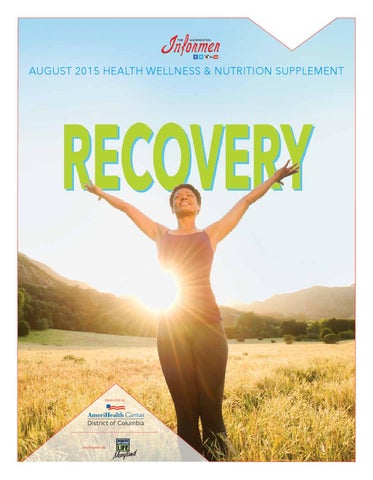
AUGUST 2015 HEALTH WELLNESS & NUTRITION SUPPLEMENT
PRESENTED BY
SPONSORED BY
NEWSPAPER READING IS A HABIT
Recovery: Joy Does Come in the Morning
DON’T BREAK THE HABIT!
This special health supplement is devoted to the chal-
lenging task of rehabilitation. Certainly we understand that whenever one seeks to claim they have been rehabilitated, they must first discover the tranquility that comes when one READ THE WASHINGTON INFORMER YOUR WAY:
embraces recovery and welcomes that arduous goal.
In Print – feel the ink between your fingers of our Award Winning Print Edition
journey down the dark road of substance or alcohol abuse.
n
Sometimes, it’s healing that has come after a long
Other times, the return to who we originally were, or who we
On the Web – www.washingtoninformer.com updated throughout the day, every day
n
were destined to be, is found after we have let go of things
n
On your tablet
like eating addictions, shopping addictions, sex addictions or
n
On your smartphone
something else that somehow took over our lives, our habits
n
Facebook Twitter
and even our way of thinking.
n n
Weekly Email Blast – sign up at www.washingtoninformer.com
In this issue, we have included medical experts and experts of another kind – those who have
either experienced the path of troubles or served as guides toward the path that led to rehabilitation. Either way, those who were once lost and hopeless somehow found the courage to seek assistance from family, from friends, from physicians and perhaps even from God – their higher
202-561-4100 For advertising contact Ron Burke at rburke@washingtoninformer.com
power. ...Informing you everyday in every way
It’s not easy to deal with the many obstacles that confront us in our lives. And, unfortunately,
some of us pick up crutches, things that we believe will help us as we move along this experience called life. But what we often find – at least hopefully we discover – is that those habits, mindsets,
In Memoriam Dr. Calvin W. Rolark, Sr. Wilhelmina J. Rolark
individuals, places and things that we thought would be of benefit were nothing more than hindrances – shackles as one songwriter put it.
THE WASHINGTON INFORMER NEWSPAPER (ISSN#0741-9414) is published weekly on each Thursday. Periodicals postage paid at Washington, D.C. and additional mailing offices. News and advertising deadline is Monday prior to publication. Announcements must be received two weeks prior to event. Copyright 2015 by The Washington Informer. All rights reserved. POSTMASTER: Send change of addresses to The Washington Informer, 3117 Martin Luther King, Jr. Ave., S.E. Washington, D.C. 20032. No part of this publication may be reproduced without written permission from the publisher. The Informer Newspaper cannot guarantee the return of photographs. Subscription rates are $45 per year, two years $60. Papers will be received not more than a week after publication. Make checks payable to:
PUBLISHER
When the lights come on, if indeed they do, and we realize that we need to change – that we
Denise Rolark Barnes
must change – that “ah ha” moment does not occur haphazardly. More often than not, the men or
THE WASHINGTON INFORMER 3117 Martin Luther King, Jr. Ave., S.E Washington, D.C. 20032 Phone: 202 561-4100 Fax: 202 574-3785 news@washingtoninformer.com www.washingtoninformer.com
Angie Johnson, Circulation
women who find themselves in that space and place have witnessed a great deal of pain, unhap-
STAFF
piness and frustration. They have broken promises. They have let down those they love. They have
D. Kevin McNeir, Managing Editor
fallen down and felt like they could not get up.
Ron Burke, Advertising/Marketing Director
Lafayette Barnes, IV Assistant Photo Editor
weak and unprincipled, in truth we are all strong, resilient and purposeful. However, to find that
John E. De Freitas, Sports Photo Editor
inner self – that which makes you uniquely ‘you,’ sometimes requires a little help – a nudge, if you
Dorothy Rowley, Online Editor ZebraDesigns.net, Design & Layout
We present this health guide because we know that while humankind often appears to be
will, in the right direction.
There’s a saying that goes, “today is the first day of the rest of your life, the rest of your life is the
best of your life, the best of your life is the rest of your life.”
Mable Neville, Bookkeeper
It is our sincere hope and fervent prayer that no matter what you may be facing today, that you
Mickey Thompson, Social Sightings Columnist
will use this guide, embrace the words shared and find the courage, if needed, to begin your own
Stacey Palmer, Social Media Manager
sojourn – your own road towards both recovery and rehabilitation. In the end, that first step, that initial leap, comes because you are willing to say, “Yes, I will go.” It takes courage to admit that we need to change. It takes even more courage to undergo the process by which we shed old skin and pick up a new way of walking, talking and living that may
REPORTERS Stacy Brown, Sam P.K. Collins, Eve Ferguson,
be somewhat foreign to us.
Elton Hayes, Kia Croom, Sarafina Wright
PHOTOGRAPHERS
Whenever I was confronted with two paths and unsure if I could make it down the road best suited
Shevry Lassiter, Roy Lewis, Corey Parrish, Travis Riddick, Nancy Shia
That, however, is the beauty of being human. There are all kinds of discoveries to be made
and mysteries to solve. It just requires the willingness to take one step at a time. for me, my mother would say, “Just spit in your hands and take a fresh hold.”
I leave you with that advice. Make this day the best day of your life. Embrace the blessings and
claim peace. There’s no better moment to do it than right now. s D. Kevin McNeir Managing Editor, The Washington Informer
www.washingtoninformer.com /AUGUST 2015 HEALTH WELLNESS & NUTRITION SUPPLEMENT
H-2
Maryland Care Facility: A Breath of Fresh Air By Pat Wheeler WI Contributing Writer As more and more of the population ages, many baby boomers are faced with how to take care of elderly parents and loved ones. Many seniors want to stay in their homes and only need a limited amount of assistance while others need assistance getting to doctor appointments and other treatment facilities. Some seniors just need a little help getting out of their homes so they can socialize with others who have similar interests and backgrounds. Enter Maryland Care, an adult medical day care service program that provides a full range of activities and services for seniors, 50 and above. Steven Flynn, the president of Maryland Care, believes that there is no other facility like it in Prince George’s County. He has spent the last several years studying and researching the needs of seniors and has created in Camp Springs a “first class adult medical day service operation.” Upon entering Maryland Care, the first thing you notice is the warm and friendly atmosphere. Colorful paintings, comfortable furniture and spacious rooms are typical of Maryland Care. On one visit, the members (the name attributed to the center’s participants) were treated to a luau with tropical smoothies, Hawaiian leis and Polynesian-style decorations. Members have their choice of activities; there is a game room, card room, billiard room, a gym, a library with the latest computers and a beauty parlor. Activities include: yoga, Zumba, arts and crafts and field trips. The media room has a big screen television and large comfortable chairs. Members are provided two meals and a snack daily, transportation and a wide range of other services that will help improve their well-being and quality of life. “Keeping seniors active plays a big role in preventive care,” Flynn said who added that their philosophy and motto is “Helping individuals live long and strong.” The program is staffed by a full-time nurse, program director, activities director, logistics managers and a social worker along with several nursing assistants. Program Director Desiree Henry is responsible for Maryland Care’s day-to-day operations and says her favorite part of the day is
H-3
when she can spend time with the members, listening to their stories and making them laugh. Henry has worked at other adult care facilities, but said she especially likes Maryland Care’s approach. “Here, it’s not only about getting our members proper medical care; we want to make sure they enjoy themselves and make new friends.” Both Flynn and Henry credit Kay Henry (no relationship to Desiree Henry), a managing partner for Maryland Care, for the facility’s high standards. Kay Henry is also a board member for the Maryland Association of Adult Care Services, a nonprofit organization that serves as an information and education source to its members and as a consultant to the medical day care and senior services industry, the public, the media and the government. One thing Flynn stated he wanted to do was to get rid of the stigma that so often comes with adult day care facilities. The warm and friendly atmosphere is important to the members’ comfort and well-being. Although Flynn developed the initial layout and design of the facility, he credits the entire team with the furnishing and decorating of the spaces. It appears that Flynn has left no stone unturned in his effort to create a program that provides seniors with programs that treat them with dignity and respect, and also offers things that are fun to do. If there is one drawback, it’s that not enough people have heard about Maryland Care and its myriad of services. Although Maryland Care opened in April of this year, Flynn spent most of his energy building a facility that he believed would be the best in the county – so now comes the next stage – getting the word out. He has held open houses and tours to educate Prince George’s County and District residents about their adult care services. He has spoken at churches and senior buildings about Maryland Care. Flynn says that many people are unaware that adult day care service is a cheaper alternative than nursing homes or in-home care for persons who are still mobile. Medicaid will cover the cost of adult day care. Flynn says he hopes to have a mixture of private pay and Medicaid members. The members who were there the day of the luau all gave positive shout outs when asked about the
meal. They also stated they were looking forward to the field trips which Flynn had earlier discussed. With a capacity for 100 persons, Maryland Care will become be the largest facility of its type in the county. Flynn knows he has hit upon a great idea – build and staff a facility for seniors that addresses their physical, mental and social needs. The facility is open Monday through Friday, 8:30 a.m. to 4:00 p.m. and is located at 4703 Old Soper Road, Camp Springs, Maryland. Additional information about the facility is available at www.MarylandCare.us. s
Maryland Care members enjoy an afternoon of cards and conversation.The facility has several activity rooms including a card room, yoga room, and arts and crafts room./ Marcus Bennett photo
AUGUST 2015 HEALTH WELLNESS & NUTRITION SUPPLEMENT / www.washingtoninformer.com
Join Mayor Bowser for the FitDC Billion Steps Challenge and Participate in a Ward FitDC is a citywide initiative to encourage DC residents to adopt healthier, more active lifestyles. FitDC was launched on April 11th by Mayor Muriel Bowser, Deputy Mayor for Health and Human Services, Brenda Donald, the Director of the DC Department of Health (DOH), Dr. LaQuandra Nesbitt and the Acting Director of the DC Department of Parks and Recreation (DPR), Keith A. Anderson. “This initiative will educate, encourage and challenge our residents to own their personal health and wellness knowing there are resources and programs in their city offering support along the way,” said Mayor Bowser. To help motivate residents to get active, Mayor Bowser is hosting Ward Walks as part of the FitDC Billion Steps Challenge. A 1.5 mile Ward Walk will be held in each ward of the city anchored by local recreation centers as a
way to highlight local resources available to residents interested in reducing stress, losing weight and getting involved in their community through exercise. To encourage and motivate DC residents to move more and make healthier choices, there are 10 FitDC Coaches representing each ward of the District as well as a senior and youth coach. The coaches are a diverse group including fitness and health experts as well as individuals with personal fitness goals. FitDC Coaches will help plan and co-lead Ward Walks and serve as role models for DC residents around health and wellness. Join the Billion Steps Challenge by participating in an upcoming Ward Walk and logging your steps. The next Ward Walk is Saturday, September 12 at the Rosedale Community Center at 9 a.m. Check FitDC.com/Events for details on additional Ward
Walks and other fitness events. For those that participate in other fitness activities, the FitDC Steps Conversion Chart shows how to convert other fitness activities into steps and participate in the Billion Steps Challenge. So whether you bike, swim, do yoga or any other fitness activity you can still participate in the challenge. You can log your steps with a text, a tweet, or by visiting FitDC. com. Here’s how:
TEXT IT Text the following to 202-7590470: [Your number of steps taken] in #Ward[Your Ward number]. For example: “6,500 steps in #Ward6.” Your steps will be recorded automatically! TWEET IT Send a Tweet to @MyFitDC with the following format: “I walked [your number of steps taken] steps
#Ward[Your Ward number] #BillionStepsChallenge @MyFitDC” For example: “I walked 6,500 steps in Ward 6 #BillionStepsChallenge @MyFitDC” Be sure to tag @MyFitDC and use the hashtag #BillionStepsChallenge. TRACK IT Visit FitDC.com/Steps on your computer or phone and log your mileage. s
www.washingtoninformer.com /AUGUST 2015 HEALTH WELLNESS & NUTRITION SUPPLEMENT
H-4
…because I get a physical and the shots I need every year. I’m D’Eric. I’m not a little kid anymore, but I know that it’s still important to see my doctor for regular check-ups. She gives me good advice to help me grow up healthy and strong! AmeriHealth Caritas District of Columbia supports healthy lifestyles and kids like D’Eric who are comfortable talking to their doctor. Here are some ways your kids can get to know their doctors: •
Visit your doctor at least once a year for a physical
•
Visit your dentist every 6 months for a check-up
•
See the same doctor and dentist every visit
•
Make sure your kids are up to date on their shots at the start of the school year
To see the I am healthy series and get more tips on ways to stay healthy, visit www.amerihealthcaritasdc.com/iamhealthy or scan the QR code with your mobile application. SM
5400ACDC-1422-63
www.amerihealthcaritasdc.com
H-5
AUGUST 2015 HEALTH WELLNESS & NUTRITION SUPPLEMENT / www.washingtoninformer.com
Nesbitt Gets Candid on Public Health New District Director Answers the Tough Questions Compiled by Sarafina Wright WI Staff Writer Dr. LaQuandra Nesbitt became the District’s director of the Department of Health in December of 2014. She recently spoke with Washington Informer’s publisher, Denise Rolark Barnes, where she discussed her position, the city’s most pressing public health issues like synthetic marijuana and the strategic way she runs her staff. Why did you take this job? You’ve been here before and returned. Why? The first time I came to the District, I was training as a physician in Baltimore and working in primary care. I became interested in public health and policy issues. I wanted to understand ways to eliminate the barriers my patients was facing in terms of getting access to care. After my training I participated in a fellowship program where I was working on a project that required me to look at cancer policies in a seven-or- eight state region and the District. There I was able to look at varying policies related to access to care for cancer and things that were in play in D.C. For example, black women got breast cancer screenings, and still do to this day at higher rates than whites, but still die more from breast cancer. So the magic sauce isn’t access to screenings but something else – that is, what happens after the screenings? It’s really a great paradox. It’s more than having health insurance, more than having access to screenings – it’s a real challenge. In 2011, I left the District to lead a department in Louisville, Kentucky. But I continued to follow what was happening back in D.C. Most people tend to think about what are our hospitals
doing, doctors and nurses, but fail to ask what their department of transportation, environment and school systems are doing to make their communities healthier. I was able to really focus on that aspect of the work in Louisville, and with Mayor Bowser’s commitment to health equity in all eight wards of the District, I am delighted to return. So, it’s a combination of unfinished business, one, from having served here before and then having the opportunity to serve on the mayor’s administration that really gets the concept of equity. And being able to do it through a lens that embraces and appreciates what needs to be done outside of the healthcare space to improve the health of our communities. What impact is synthetic marijuana having on the state of health in the District? What is your role in addressing the issue? It’s not that it’s something that isn’t on our radar, in general. I can have my team look at the overdose database and look at what synthetic drugs do to
D.C. Department of Health Director, Dr. LaQuandra Nesbitt sits down with the Washington Informer on June 23, 2015. /Photo by Shevry Lassiter
people. And how this has become a new public safety/health threat. Often times these are things that are silent to the general public until they become popular in the media. We work together with the Departments of Behavioral Health and Human Services on a myriad of issues so that when these emerging public health and public safety threats come up, we can confront them as partners. Would you support a policy of testing for synthetic marijuana? It’s not in effect yet but we have already spoken to hospitals about this. The current drug screening does not pick up syn-
thetic marijuana. Standard drug screenings will pick up regular marijuana, or THC, which is the active component. It will pick up opiates like heroin, some of the prescription drugs and cocaine. But we’re challenged with the fact that formulations change very quickly. We believe we have a test that would capture these substances. The drug test that the emergency rooms are doing now won’t capture it. So we’re putting a testing protocol in place. How are other drugs like heroin impacting the District? There doesn’t seem to be an
increase. It’s stable and we have not seen an increase in opiate-related overdoses. Nationally, there has been a lot of inquiry to determine what the new opiate user looks like. We are constantly looking at the data for the District and have seen that those entering treatment still tend to be older, in their 40s or 50s. That’s not to say we don’t have younger people abusing, but at this point it does not appear to us to be at the same magnitude that’s occurring in other parts of the U.S. including Kentucky from where I recently moved. Continued on page H-7
One of the things that creates the deception that [synthetic marijuana is] safe is people tend to believe that a product that is sold, but misused, is safer for you than a product that is sold to be illicit. www.washingtoninformer.com /AUGUST 2015 HEALTH WELLNESS & NUTRITION SUPPLEMENT
H-6
Continued from page H-6 What’s the biggest misnomer about synthetic marijuana? One of the things that creates the deception that it’s safe is people tend to believe that a product that is sold, but misused, is safer for you than a product that is sold to be illicit. If you think about synthetic drugs being sold in a convenience store or a gas station in nice pretty packaging, and even though it says not for human consumption, you can consume it, you get a little a high and you don’t die. So people think it’s safe. Our big challenge is how do we get to people despite the savvy marketing, that this product is illegal, unsafe and that despite the first use not having negative consequences doesn’t mean the second one won’t. Tobacco, as it relates to young adults? Any concerns? Absolutely. The District made a five point decrease in the percentage of adults who smoked over a ten-year period and there’s been some impact on teens. We can stop minors from smoking by pricing them out of the market. Actually, the District has some of the highest tax rates for tobacco products. The other thing is to get rid of flavored tobacco products, cigarillos and small cigars. Those are the products that are sexier to youth and young adults. And we can crack down on direct advertising so that we no longer advertise to children and youth. We got them off of cigarettes and then here comes the fancy water pipes that have been a part of the eastern culture for a very long time. Now it may be cool to do in a social setting with a bunch of your friends but we fail to talk about the risk of transferring of other diseases. We don’t talk about the bacteria that could fester in this pipe if it’s not cleaned properly. I am speaking on Hookah specifically, anything that you inhale is a risk to your lungs. Nicotine has damaging effects to the developing brain. My other nemesis is the e-cigarette – a liquid nicotine that is given to children which is addictive. They are also not cheap. And it’s not part of a regulated market. I do not know what the heck is in them. Some of them have been tested and studied. Some of them contain the same carcinogens as cancer, so they may not be safe for you. There have been some businesses that have been fined
H-7
for selling single cigarettes? Is that effective? Tobacco laws are spread out through three different entities. Some rests with the Department of Health, DCRA, and Secret Shopper people and a lot of collaboration happen across agencies. We’re looking at a lot of the tobacco policies from a comprehensive perspective. Director Bowling of DCRA is actively having conversations about our current policies and fees and asking if they’re solid enough or are there additional things we need to do. What initiatives, if any have you created within your department to address health issues? I have mixed feelings about that because they are not necessarily sustainable over time and there are a number of resources that the District is investing in that my staff doesn’t know about. I had a conversation with DCHR probably in my first month or so to talk about better ways to bring resources to my team. Instead of recreating the wheel, is there some kind of way for us to personalize it? I come from the thought of let’s lead by example. If we are the health agency for the city we should probably compete to be the healthiest. We have to be able to communicate a message effectively to the general public. In the case of a health crisis, how would people learn about this? What I have shared with the communications team here is that I have seen public health directors have too much visibility so when you’re on television it’s like white noise. Thus, the position that I am in is to get in front of the bad things. I have to say positive messages but if I’m always speaking you will tune me out. However, if I say anthrax I want you to hear me. We must maintain a balance when it comes to visibility so people can understand when there’s a crisis versus an opportunity for prevention.
2027 Martin Luther King Jr. Avenue SE, Washington, DC 20020
AmeriHealth Caritas District of Columbia Member Wellness Center
Connecting with our members right in their neighborhood! At the AmeriHealth Caritas District of Columbia (DC) Member Wellness Center, members can: • Get one-on-one advice on how to get and stay healthy • Take healthy cooking and fitness classes • Ask questions about their AmeriHealth Caritas DC benefits Visit www.amerihealthcaritasdc.com or scan the QR code to see the wellness classes we offer. Classes change each month. Free transportation can be provided to all members.
5400ACDC-1422-77
Three things people should begin doing to live a healthier life? First, substitute their sugar sweetened beverages for water. Two, walking as a first step to exercising and people with bad joints walking in a pool which takes impact off of joints. For the third tip, sleep six to eight hours a day. s
AUGUST 2015 HEALTH WELLNESS & NUTRITION SUPPLEMENT / www.washingtoninformer.com
Back-to-School Health: Finding Your Child a Medical Home
By Dr. Megan Hollis This August, families are preparing for a new school year. For many parents, that means going to the doctor to get our kids their required check-ups. A yearly well-child visit is a great first step in keeping our children healthy, but is it enough? Children deserve the best healthcare they can get. This begins with having a “medical home,” a place where your doctor knows your whole health story. I have been a primary care doctor in DC since 2012, now working at Community of Hope’s Conway Health and Re-
source Center. Every day I see why every family should have a medical home. When you have a medical home, you have a relationship with a trusted doctor who knows you. They know your history and keep track of your conditions and medications. People of all ages can benefit from having a medical home, especially children. In a medical home, your doctor can get to know the big picture of your family’s health. For example, if I am helping a mom manage her diabetes, I know to look for signs of it in her kids. If one child has asthma, I will watch the brothers and sisters for symptoms as well. Medical homes also help guide you through the complex healthcare system. Does your family have many doctors who provide dialysis, physical therapy or other specialty care? It can be a lot to manage. A medical home can help you keep track of it all. A medical home also encourages you to keep coming back to the same doctor over time. Here at Community of Hope, we have some adult patients who have been
seeing us since they were children. Some are now bringing their kids to see us, too. In fact, we now have a baby whose mother and grandmother have been our patients too. Those long-term relationships make it easier to give and receive great care. Sadly, less than half of DC children have a medical home, according to the Child and Adolescent Health Measurement Initiative. Of children whose family income is below the federal poverty line, only 38% are getting the complete care they deserve. What’s the alternative? For families who don’t have a regular doctor, parents may take their children to the emergency room when a problem comes up. In the case of asthma, a good doctor might have spotted symptoms and offered care before it became an emergency. So as you schedule those backto-school check-ups, maybe now is the time to find your kids a medical home. As a doctor, I urge you to find a provider who will take the time to get to know your family. Community health centers like Community of Hope are a
great place to start. We can get you scheduled within just a few days. While you’re here, check out our dentistry and other services. We are accepting new patients of all ages,
and hope you will come visit us. Dr. Megan Hollis is the Medical Director at Community of Hope’s Conway Health and Resource Center, located in Bellevue. s
Children deserve the best healthcare they can get. This begins with having a ‘medical home,’ a place where your doctor knows your name and your story.
HEADED BACK TO SCHOOL? VISIT THE CONWAY HEALTH AND RESOURCE CENTER Don’t forget to schedule your child’s dental cleaning, required shots and annual physical!
✔ Now Open Saturdays ✔ Same-Day Appointments ✔ Most Insurance and Medicaid Plans Accepted
202.540.9857 202.540.9862
MEDICAL APPOINTMENTS
This program is funded in part by the Government of the District of Columbia, Department of Health’s Community Health Administration.
www.communityofhopedc.org
DENTAL APPOINTMENTS
Jasiah Morgan, Ward 8 Student
4 Atlantic Street, SW
Our Family Caring for Yours
www.washingtoninformer.com /AUGUST 2015 HEALTH WELLNESS & NUTRITION SUPPLEMENT
H-8
A Wife’s Journey to Save Her Husband’s Life and Educate a Community Submitted by Donate Life Maryland The lives of nearly 4,000 Hispanics in the United States were saved last year through organ donation and transplantation. Many thousands more restored their sight, health, and mobility through cornea or tissue transplants. While the most recent U.S. census data listed Hispanics as approximately 16 percent of the total U.S. population, 18 percent of the more than 120,000 people who are waiting for organ transplants are Hispanic. Lissette Estepa, originally from Puerto Rico, knows firsthand about the importance of organ donation and community education. Living in Denver with her husband Reggie, Lissette and her family moved to Columbia, Maryland two years ago after her husband was added to the kidney transplant waitlist. “We knew we had to move since The Johns Hopkins Hospital and the University of Maryland Medical
H-9
Center are two of the best transplant centers in the country. We have family here so moving made sense,” says Lissette. At first, Reggie wouldn’t let Lissette take the test to find out if she was a match but Lissette knew she had to try. “I kept telling him, I know I will be a match. Watch, I’m going to be your kidney donor.” After a lot of research, Reggie finally gave the OK for Lissette to get tested and soon they found out that Lissette was, in fact, a match! Preston, their 9 year old son, became the family’s “trainer” taking them down to local nature trails to ensure his parents were in shape for such a surgery and his training seems to have paid off. “The surgery went fine, I have no complaints” says Lissette and Reggie says his new found energy has been life-changing. “I have a different desire for life. I want to do what’s important and that’s not working 100 hours a week. I find myself drawn to a more rewarding career in advocacy or a foundation now.
If I had it my way, I would hit the lottery and just be a stay at home dad.” Lissette feels a weight has been lifted. Before the surgery, she couldn’t sleep, always worried about Reggie’s health and stressed about keeping their kids, Eliana, 11, and Preston, 9, busy while she cared for Reggie. “I don’t miss that,” she says, “I love seeing Reggie with new energy and being able to live a life that can just happen, with no worries.” One of the biggest things Lissette and her family learned through their experience is how little the community knows about organ donation, especially the Hispanic community. “Donation is a taboo subject in my family and I took this opportunity to educate them about the whole process. I’m proud to say my three sisters and brother-inlaw are now designated donors because of our experience and all have a new found interest in kidney and general health.” Currently, there are more than
120,000 men, women and children in the United States in need of a life-saving or healing transplant, more than 20,000 of whom are of Hispanic heritage. The chances for a successful transplant increase significantly when people of the same ethnicity are matched, so it is imperative that we continue to register more donors of all ethnic back-
AUGUST 2015 HEALTH WELLNESS & NUTRITION SUPPLEMENT / www.washingtoninformer.com
grounds. Are you registered as an organ, eye and tissue donor? If so, you are encouraged to share your decision of generosity with your next of kin so they are aware of your wishes. If you haven’t yet registered, you can do so at any Maryland Motor Vehicle Administration (MVA) branch or online anytime at www.DonateLifeMaryland.org. s
Parents: Tips to Support Healthy Hydration (StatePoint) Parents often wonder how to maintain their kids’ health. One important step that may be overlooked is to ensure that young children are properly hydrated. It can also be a challenge for parents to create a menu kids will enjoy that meets the recommended Daily Value (DV) of vitamins and nutrients. “By including U.S. Department of Agriculture (USDA)-certified organic fruits and vegetables in your children’s diets, you can help ensure your child is staying hydrated from the water in them, while also consuming the necessary vitamins, minerals and protein that they need to grow healthy and strong,” says Dr. Deena Blanchard, Pediatrician at Premier Pediatrics in New York
City and a consultant for Ella’s Kitchen brand, which makes organic food for babies, toddlers and kids. “Nutritional shakes provide proteins, vitamins, and minerals, the necessary building blocks of a healthy immune system, to supplement kids’ daily diets for complete nutrition; and electrolyte waters with naturally-occurring electrolytes can also help keep kids hydrated.” Dr. Blanchard recommends the following tips to help parents make good choices for their children. • Hydrate children, especially when sick: When children are sick, the importance of proper hydration cannot be overestimated. If eating or drinking is difficult, try giving your child smaller amounts, more frequently. Choose
water, 100 percent juice or drinks that contain naturally occurring electrolytes and other components that help support kids’ immune systems. • Choose wisely: Watch out for artificial flavors, colors and preservatives as well as the amount of added sugars in sports drinks and other beverages. It is important to provide kids with beverages that are free of artificial ingredients and contain fruits and vegetables. You can be sure you’re avoiding those additions when you choose USDA organic beverages, such as Ella’s Kitchen Organic Coconut Water Electrolyte Drinks or their new Smoothie Drinks, which provide one full serving of fruit per 8 fluid ounces. • Don’t forget to hydrate when playing sports: Kids can become dehydrated while playing sports or engaging in other physical activity. At the ballpark or playground, it is important to keep drinks on hand. Good choices include organic fruit and veggie purees, which contribute significant water to the diet and naturally-occurring electrolytes for natural rehydra-
tion. • Supplement: Though vital to proper growth and development, meeting the recommended daily intake of vitamins and nutrients can be tough, especially for little ones who are picky eaters. A tasty, protein-packed nutritional shake can help parents ensure kids get the calories and nutrition they need. Consider trying Ella’s Kitchen Coconut + Milk Nutritional Shakes, which are made with certified USDA organic low-fat milk, fruit + veggie purees and coconut water, providing 44 percent of the recommended DV of protein, 30 percent DV of calcium, as well as vitamin B12, riboflavin, iodine and electrolytes. Made with ingredients parents recognize, these shakes provide a boost of nutrition with a taste that kids will enjoy. Visit EllasKitchen.com for more options for healthy hydration and nutrition for the little ones. In the warmer months, proper hydration is especially crucial. Parents should seek out choices for kids that support a healthy immune system. s
visit. Faster than an ER l than a u f r e w o P E p R O e M or
ble to treat A . e n o b n e k o r b ight. N t n a e t a L l d il your ch
Captain PM
It’s PM Pediatrics, the super urgent care for kids and young adults. • Staffed by Pediatric Emergency Specialists • On-site lab and digital X-ray • Most insurance plans accepted
Now Open in Greenbelt! Greenway Shopping Center, 7401 Greenbelt Road Open every day until midnight.
301.982.KIDS (5437) | pmpediatrics.com
www.washingtoninformer.com /AUGUST 2015 HEALTH WELLNESS & NUTRITION SUPPLEMENT
H-10
Tips for ‘Kids Eat Right Month’ this August (StatePoint) You want the best for your kids. As role models, parents and caregivers play a vital role in children’s health -- teaching kids about healthful foods and making sure they get enough daily physical activity. More than one third of children and adolescents are overweight or obese, according to recent Centers for Disease Control and Prevention statistics. But childhood obesity, which is associated with elevated risks of high cholesterol, high blood pressure, bone and joint problems and sleep apnea, amongst other adverse health effects, can usually be prevented. “August, which is Kids Eat Right Month, is the perfect opportunity for families to focus on the importance of healthful
eating and active lifestyles,” says Marina Chaparro, registered dietitian nutritionist and spokesperson for the Academy of Nutrition and Dietetics. To help, Chaparro is offering parents and caregivers tips they can use to promote healthy habits. • Shop smart. Get your children involved in selecting the food that will appear at the breakfast, lunch or dinner table. Be adventurous by picking a new food every week. • Cook healthfully. Involve your children in the preparation of all meals with age-appropriate tasks. Getting your kids involved helps teach them about food, and may entice them to try new foods they helped prepare. • Eat right. Breakfast is a
critical meal. Make sure no one in the family skips it -- including you. In the evening, sit down together as a family to enjoy dinner and the opportunity to share the day’s experiences with one another. Research indicates that families who eat together have a stronger bond, and children have higher self-confidence and perform better in school. • Plan wisely. When planning meals, start by filling half the plate with fruits and vegetables, choosing low-sodium options. Make sure at least half the grains your family eats are whole grains. For beverages, choose water over sugary drinks, and opt for fat-free or low-fat milk. Also, be mindful of appropriate portion sizes. • Get moving. After meals, get moving together. Aside from being a great way to spend time together, regular physical activity strengthens muscle and bones, helps to achieve a healthy body weight and supports learning. It can also help develop social skills and build self-esteem. Kids are encouraged to be active for 60 minutes per day.
• Consult an expert. A registered dietitian nutritionist (RDN) can deliver the highest level of nutrition counseling. Consider consulting an RDN to ensure your family is getting needed nutrients with a meal plan tailored to your family’s lifestyle and busy schedule. To search for an RDN in your area, to find more healthful eating tips, recipes and videos, and to
learn more about Kids Eat Right Month, visit KidsEatRight.org. As a parent, you are highly influential, and habits formed early on could potentially last a lifetime. Take steps to steer kids to a path of good health. s
To schedule an appointment, call 888-884-BEAR
Nationally recognized experts. Better outcomes. Dedicated to kids.
Being just right for your child means providing the best outcomes possible. It means expert doctors who understand the unique physical and emotional needs of kids. And it means being the region’s only health system designed with children — and their families — in mind. At Children’s National, that’s care that’s just right.
Choose care that’s Just Right.
C111-040668_HealthWellnessAd_WaInformer_Vs2.indd 1
H-11
AUGUST 2015 HEALTH WELLNESS & NUTRITION SUPPLEMENT / www.washingtoninformer.com
C111-040668_HealthWellnessAd_WaInformer_Vs2 (Health and Wellness Print) July 22, 2015 4:20 PM
7/23/15 4:51 PM
Recovering from Alcoholism No Easy Task
By Stacy M. Brown WI Contributing Writer
African-American youth culture is steeped in alcohol. References to booze have long been rife in rap music, and Jay Z, and P. Diddy are among hip-hop luminaries who have promoted alcohol, according to a 2013 NBC News investigative piece. NBC’s investigation also revealed a study by the Center on Alcohol Marketing and Youth at the Johns Hopkins Bloomberg School of Public Health that revealed young African Americans ages 12 to 20 see far more alcohol ads on television and in magazines than youth in general. While alcoholism is prevalent for all ages, recovery from the disease can either be stumbled or aided by loved ones if they recognize the importance of not being an enabler, said Nike Hamilton, the clinical director at the Aquila Recovery – Alcohol and Drug Rehab in Northwest. “We have a family program that we run on Saturdays and a lot of family members are big
time enablers because they don’t know any better and you tend to take care of those you love,” Hamilton said. “But, you have to love the addict enough to create boundaries. When they are in recovery, you have to say that you’re not lending them money, you’re not bailing them out of a situation,” Hamilton said. “Families need education too because they don’t know that it’s a shock to their system too but they have to learn to redirect their energy and it can be a struggle to see someone you love with growing pains,” she added. Hamilton said she understands that it stings for family members to take a step back and allow the person to work through recovery. “If it’s going to be a train wreck, then let the train wreck,” she said. “If you don’t let the train wreck then they are not going to know the consequences, they are not going to get taught valuable lessons. If you step in front of that train you are going to get hit by it and all they will feel is guilt which takes them right
back [to the alcohol].” Johnny Allem, the founder and president at Aquila and a leading national advocate for addiction recovery issues, said there are stages that everyone must endure. “You have physical recovery and it really takes about a year to get all the chemicals out of your body if you have had a long term addiction,” he said. “Then, you have cases where some people stop drinking and stay miserable for the rest of their lives. They are mad at the world. So, when you think of recovering, a litmus test doesn’t exist.” In an essay for Vox Media, Victor Yocco noted the important role of family. “I am 16 months out of an intensely abusive relationship with alcohol. At home, my wife helps me stay sober by supporting me and encouraging me to drink flavored seltzer water instead of the craft beers I used to down at every opportunity,” Yocco said, adding that for the majority of his waking hours he’s tempted to drink particularly at work where
Painful Conversations: Survey Finds Doctors and People with Pain Uncomfortable Discussing Prescription Drug Abuse (BPT) - Have you ever gone to the doctor knowing exactly what you were going to say, but the minute they walk in, all of your questions seem to disappear? You’re not alone. It’s not uncommon to feel overwhelmed and uncomfortable at the doctor’s office. There are a lot of important areas to cover in a short period of time. And, when you’re living with chronic pain, one of these areas is prescription drug use. The reality is that people affected by chronic pain are reluctant to talk about opioid treatment and issues of abuse and misuse with their clinicians, according to a recent survey conducted on behalf of Teva Pharmaceuticals in collaboration with the U.S. Pain Foundation and
the American Academy of Pain Management. In fact, 29 percent of people living with chronic pain said they worry that asking their doctor about prescription drug abuse will suggest they have a problem. Doctors are equally uncomfortable bringing up the issue as 40 percent of prescribers fear such discussions may damage their relationships with patients. “Chronic pain and prescription drug abuse are both significant health issues impacting our society. However, the stigma surrounding both of these can make them very difficult to talk about,” says Bob Twillman, PhD, executive director of the American Academy of Pain Management. Chronic pain is a serious
medical condition that affects more than 100 million Americans, according to the Institute of Medicine. It can impact many aspects of daily life and may greatly affect people leaving them unable to work, maintain relationships or participate in daily tasks. While prescription pain medications can be an important component of pain management, the reality is these products are prone to abuse and misuse. The person prescribed the medication isn’t necessarily the only one at risk for abuse and misuse. In fact, more than three out of four people who misuse prescription pain medications do so by using medication prescribed to someone else. “If you are prescribed a
alcohol is always present. “This disease quite often has many relapses,” Allem said. “The human mind and body are very fragile but they’re also very interesting and resilient.” At Aquila, staff devotes intensive education to screening, brief interventions and referrals to treatment for primary care providers, pastoral counselors and others. Allem said their model establishes a respect for and knowledge of brain disease – particu-
larly substance use disorder – at all stages of risk and dependence. Individual wellness plans are informed by medical examinations, counselor observations and client reporting. “In the African-American community, 60 percent of adult addicts are probably alcoholics,” Hamilton said. “The problem with alcoholism is that people tend to say drinking is legal. But, it’s one of the worst drugs in the world.” s
Johnny Allem brings years of experience to Aquila Recovery. /Courtesy photo
prescription opioid medicine, it is important to ask about the risks and who else may be affected,” says Melanie Rosenblatt, MD, Medical Director of Pain Management at Broward Health North in Pompano Beach, FL. “The good news is there are resources available to support this important conversation.” Three-quarters of patients and 71 percent of healthcare professionals believe that education is one of the best ways to help them deal with prescription drug abuse, according to the survey. A new resource from Teva Pharmaceuticals, PainMatters. com, provides healthcare professionals and people affected by pain information and resources to navigate this complex pain care landscape, including: The Pain Matters docu-
mentary film produced by the Discovery Channel and supported by Teva Pain Perspectives, providing community insights in a blog-like feature with ongoing insights from the pain community. A first-of-its kind video on the evolving science of abuse-deterrence technology Downloadable resources for people affected by pain, including discussion guides and pain self-assessments Practical tools for healthcare professionals treating pain, including the Brief Pain Inventory and opioid risk tool. Visit PainMatters.com for information and resources to support responsible pain management for healthcare professionals and people affected by pain. Dr. Rosenblatt has been compensated for her role as a spokesperson for Pain Matters. s
www.washingtoninformer.com /AUGUST 2015 HEALTH WELLNESS & NUTRITION SUPPLEMENT
H-12
Food Addiction Recovery Requires Vigilance By Stacy M. Brown WI Contributing Writer The introduction is familiar. “My name is Leeza and I’m an addict . . .” But, for Leeza and many others like her, the substance she’s abused isn’t drugs or alcohol; it’s food. “I’ve struggled with food and weight gains my entire life. I was using food to cover my emotions, to numb myself,” said Leeza, a District resident who for nearly two decades has been attending Food Addicts Anonymous, where recovery is based on the 12 steps and 12 traditions of Alcoholics Anonymous. At Food Addicts Anonymous, the same principles used with Alcoholic Anonymous are used to help individuals gain freedom from addictive eating. Denise Limongello, a psychotherapist and eating disorder specialist, said recovering from a food addiction is often harder to overcome than any other addiction, simply because abstinence from food isn’t an option.
H-13
Leeza agreed. “It’s a real challenge because people, your family, usually equate love with food and they’ll say to you that it’s okay to have that piece of cake but they don’t understand that if I have that piece of cake then it could lead to me over-indulging,” Leeza said. One 75-year-old African-American named John said he had a long time food addiction and it wasn’t until later in life that he joined Food Addicts Anonymous. “Before I joined, I was morbidly obsess, which caused health problems such as diabetes, high blood pressure, congestive heart failure, limited mobility and required me to use a wheel chair,” he said. “When I came into the program, I weighed 321 pounds and I have lost 180-plus pounds, have no need for the wheelchair and I no longer take medication for diabetes or high blood pressure. I walk to my meetings and stand as a healthy and grateful septuagenarian.”
Limongello said recovery can be successful. She said studies have revealed that a food addiction and emotional eating in general can mask a pre-existing depression or indicate avoidance of life problems. “Individuals who struggle with food addiction often struggle with talking about anything other than food and weight,” Limongello said. “A great way to support a loved one or to help you with your own food addiction is to make the topic of food and weight as off-limits as possible, so that you can remain present and cued in to the bigger picture,” she said. “A realization that compulsions around food are indicative of a bigger problem can help with shifting the focus to what is really wrong,” she added. In a previous interview with ABC News, Dr. Pamela Peeke, a nutrition and fitness expert, said that there are so many who suffer from food addiction and, although some doctors might dispute the claim, Peeke believes
emerging research is evidence that food addiction is real. In 2012, the Centers for Disease Control and Prevention in Atlanta noted that more than one-third of American adults are now classified as either overweight or obese and obesity kills more Americans every year than AIDS, all cancers and all accidents combined. In her book, “The Hunger Fix,” Peeke argued that for some people, food can be as addictive as cocaine with some experiencing cravings, binging and withdrawal. “It’s a mixture of what we call the hyper-palatable ingredients and these are uber-rewarding to the reward system,” she said. “In the brain, organically in the reward system, you’re secreting lots of that wonderful pleasure reward brain chemical called dopamine, and it’s coming out, and it’s just giving you that fantastic feeling of, ‘Wow, this is wonderful’... which is why my patients tell me, ‘I need a hit.’” Leeza said she’s thrilled that the medical and science commu-
AUGUST 2015 HEALTH WELLNESS & NUTRITION SUPPLEMENT / www.washingtoninformer.com
Food Addiction is beginning to be recognized by the medical and science communities as a legitimate illness. / Courtesy photo
nity is starting to take notice. “In the last few years, we’re seeing a huge change and things are starting to turn around with doctors recognizing food addiction as an illness,” Leeza said. “Just like our program and our recovery where everything is one day at a time, we’ll take inclusion of one doctor at a time.” For more information about food addiction and to receive assistance, visit www.foodaddicts. org. s
Recovery Takes a Village September, National Recovery Month By Sarafina Wright WI Staff Writer Recovery, the final and longest step in a clinical treatment process for people striving to overcome addiction, often makes or break a patient’s relapse chances. Love may not be the answer to all of life’s ills, but it can certainly make a difference for those who have experienced trauma which led them to unsavory circumstances. Healthy friendships and relationships can aid tremendously in one’s recovery from addiction. Ann Chauvin, chief clinical officer for So Others Might Eat [SOME] believes that isolation can be considered a leading cause to recidivism for patients striving to become clean and sober. “The biggest thing is to ask
for help and seek out assistance, which doesn’t have to be professional help. It can come from the community,” Chauvin said. “There have been studies that have shown that as soon as depressed people make a phone call and reach out to someone their symptoms subside. Relationships with other human beings is essential – medication alone isn’t going to fix problems,” Chauvin said. The Substance Abuse and Mental Health Services Administration [SAMHSA] sponsors national recovery month every September to increase awareness and understanding of mental and substance abuse issues. They have already begun rolling out “Road to Recovery” events, public service announcements and a television and radio
series. Housing, a key issue for patients, are addressed amongst SAMHSA’s platforms, as it can severely impact whether or not a patient will relapse. “We have found that providing people with a place in a clean and sober housing community does wonders,” Chauvin said. “For advocates and policymakers, we need them to be mindful that we are in need of recovery housing. It is very important.” Chauvin believes like many studies have shown that environment can be a positive or negative towards one’s sobriety because eventually patients have to go home. “The substance abuse program at SOME is our biggest treatment area. The whole process takes about a year,” Chauvin said. “We take them from D.C. to a residential treatment in the mountains of West Virginia. We found that rushing them into a new life doesn’t work, so there is a transitional phase of group living and assistance with employment
So Others Might Eat (SOME) has led the District since 1970 in providing food, shelter and services for the District’s poor and most vulnerable. /Courtesy photo
and permanent housing.” While on the year-long road to recovery, patients are encouraged to address issues that have impacted their lives. “We believe that 100 percent of our patients have experienced trauma. It is very significant to the people we serve, which is why we help them find ways to combat it,” Chauvin said. The SOME organization knows that meeting patients’ basic needs such as food, clothing and shelter will dramatically increase their chances of sobriety. SOME, a non-profit, interfaith, community-based organization specializes in the assistance of the poor and homeless in the District. Founded in 1970 with the intention of feeding the less fortunate, it has grown into a multi-faceted organization serving over 800 meals a day while providing healthcare, affordable
housing, job training, addiction treatment and counseling for those with mental illnesses. SOME’s door are open to those receiving Medicaid, Medicare and the uninsured. “They don’t have to have healthcare – we will help them with that,” Chauvin said. “We take a holistic approach to recovery.” While Chauvin agrees love and laughter makes for the best medicine, she advises against romantic relationships too soon in the recovery process. “Love makes a huge difference, but for many people overcoming addiction it could lead to triggers that will unfortunately make them relapse,” Chauvin said. “We teach them what a healthy relationship looks like. Even a relationship with a therapist will reduce their symptoms in the long run.” s
www.washingtoninformer.com /AUGUST 2015 HEALTH WELLNESS & NUTRITION SUPPLEMENT
H-14
Tips to Help You Avoid Surplus Fat as You Age (StatePoint) There are many ways you can stay fit and promote a long, healthy life. And you probably know about some of them, particularly those habits that are widely discussed in the media and by doctors. However, scientists have recently made new discoveries that can help you activate weight loss while gaining control over deadly aging processes. Beyond eating a well-balanced diet and getting plenty of exercise, how can you facilitate a healthy body weight? YOUR BODY’S ENZYMES CAN HELP New research indicates that when certain enzymes in your body are functioning properly, certain aging processes, such as weight gain, can be slowed or even reversed. One enzyme, in particular, known as AMPK, is being highlighted by medical researchers, Adenosine monophosphate-activated protein kinase (AMPK), an enzyme found within every cell, serves as your body’s master regulating switch, determining body fat composition and how long you will live. When switched “on,” AMPK triggers the use of stored energy from fats, enhances removal of fats and sugar from the blood, increases production of mitochondria, and reduces inflammation and cellular “junk.” “When AMPK is more activated, it can help protect you against obesity and diabetes and many degenerative processes can be reversed,” says Dr. Michael A. Smith, senior health scientist for Life Extension and host of “Healthy Talk” on RadioMD. com. Smith likens the processes that AMPK promotes as “cellular housekeeping,” warning that when these processes don’t work, dysfunctional cells can accumulate and create problems like weight gain and chronic inflammation.
H-15
SETBACKS As we grow older, cellular AMPK activation decreases, weight gain often follows, and we are more likely to succumb to the destructive factors of aging. Additionally, excess calorie consumption impairs the enzymatic activity of AMPK. Unfortunately, most humans today suffer chronic nutritional overload, say experts. SOLUTIONS Researchers have discovered four ways to boost the body’s AMPK activity: • Exercise: AMPK activity increases with regular vigorous exercise. • Restrict calories: By taking in fewer calories, you create increased AMPK activity as cells sense a requirement to function more efficiently. • Metformin: One of the drug metformin’s most beneficial mechanisms is to activate AMPK. This is one way it lowers elevated glucose. However, most physicians only prescribe metformin for Type II Diabetes, making access to this drug difficult for most people. • Botanical Extracts: Two natural agents, the Chinese herb Gynostemma pentaphyllum and trans-tiliroside derived from rose hips, have been shown to activate AMPK, reducing belly fat, cholesterol, blood sugar, and insulin levels. You can supplement your diet with an AMPK activator to turn off many damaging effects of aging. More information can be found at LifeExtension. com/activateAMPK. Over the years, you don’t just have to quietly accept weight gain and the effects of aging. Take advantage of the new scientific findings that can help you promote a long, healthy and fit life. s
Scientists have recently made new discoveries that can help you activate weight loss while gaining control over deadly aging processes.
Kenya Moore (The Real Housewives of Atlanta) and Patrik-Ian Polk (filmmaker, Blackbird) on set while filming the new PSA for Testing Makes Us Stronger. / Photo Credit: Duane Cramer
AUGUST 2015 HEALTH WELLNESS & NUTRITION SUPPLEMENT / www.washingtoninformer.com
2027 Martin Luther King Jr. Avenue SE, Washington, DC 20020 AmeriHealth Caritas District of Columbia Member Wellness Center
Connecting with our members right in their neighborhood! Our Member Wellness Center provides a location for AmeriHealth Caritas District of Columbia (DC) members to: •
Get one-on-one advice from AmeriHealth Caritas DC nurse care managers on how to get and stay healthy
•
Learn how to live a healthy lifestyle through healthy cooking and fitness classes
•
Speak with AmeriHealth Caritas DC community outreach representatives about their AmeriHealth Caritas DC benefits
Visit www.amerihealthcaritasdc.com or scan the QR code to see the wellness classes we offer. Classes change each month. Free transportation can be provided to all members.
5400ACDC-1422-77
www.amerihealthcaritasdc.com
www.washingtoninformer.com /AUGUST 2015 HEALTH WELLNESS & NUTRITION SUPPLEMENT
H-16