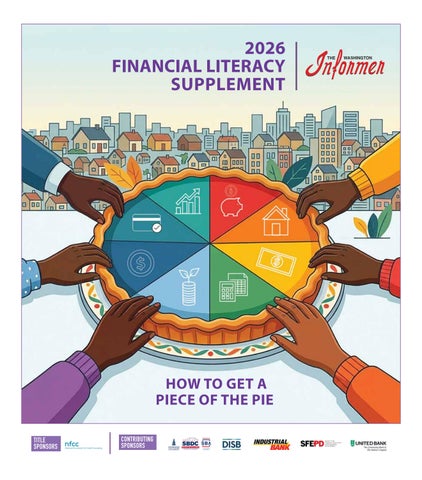
2026 FINANCIAL LITERACY SUPPLEMENT
HOW TO GET A PIECE OF THE PIE TITLE SPONSORS
CONTRIBUTING SPONSORS
MIMI’S MUSINGS: NATIONAL FINANCIAL PLANNING MONTH
Working to Getting a Piece of the Pie By Micha Green WI Managing Editor
In Memoriam Dr. Calvin W. Rolark, Sr. Wilhelmina J. Rolark
PUBLISHER Denise Rolark Barnes
THE WASHINGTON INFORMER NEWSPAPER (ISSN#0741-9414) is published weekly on each Thursday. Periodicals postage paid at Washington, D.C. and additional mailing offices. News and advertising deadline is Monday prior to publication. Announcements must be received two weeks prior to event. Copyright 2016 by The Washington Informer. All rights reserved. POSTMASTER: Send change of addresses to The Washington Informer, 3117 Martin Luther King, Jr. Ave., S.E. Washington, D.C. 20032. No part of this publication may be reproduced without written permission from the publisher. The Informer Newspaper cannot guarantee the return of photographs. Subscription rates are $96 per year, two years $168. Papers will be received not more than a week after publication. Make checks payable to:
THE WASHINGTON INFORMER 3117 Martin Luther King, Jr. Ave., S.E Washington, D.C. 20032 Phone: 202 561-4100 Fax: 202 574-3785 news@washingtoninformer.com www.washingtoninformer.com
STAFF Micha Green, Managing Editor Ron Burke, Advertising/Marketing Director Shevry Lassiter, WIN-TV Producer Ra-Jah Kelly, Digital Asset Manager Lafayette Barnes, IV, Editor, WI Bridge DC Desmond Barnes, WIN Daily Editor Anthony Tilghman, Social Media Strategist ZebraDesigns.net, Graphic Design Mable Neville, Bookkeeper Angie Johnson, Office/Circulation Manager Jada Ingleton, Content Editor REPORTERS Stacy Brown, National Reporter Sam Plo Kwia Collins, Jr., Political/Education Reporter Brenda Siler, Lifestyle Reporter Ed Hill, Sports Reporter Richard Elliott, Reporter Skylar Nelson, Sports Reporter Mya Trujillo, Multimedia Reporter PHOTOGRAPHERS Shevry Lassiter, Photo Editor Ja Mon Jackson, Asst. Photo Editor Roy Lewis, Jr. Robert R. Roberts Anthony Tilghman Abdullah Konte Cleveland Nelson FALL INTERNS Jumana Alsaadoon Kree Anderson Isabella Johnson Draia Shelton
From 1975-1985, fans watched George and Louise enjoy their deluxe apartment in the sky on the CBS sitcom “The Jeffersons.” However, between 11 seasons of laughs and engaging storylines, audience members weren’t ever quite given the recipe for a proverbial “piece of the pie,” as Ja’Net DuBois sings in the show’s theme song “Movin’ On Up.” Although the well-to-do, Black family representation was historic and important, the couple’s life was a far cry from reality for many African Americans during the time the show aired and today. In the United States, the racial wealth gap is stark. According to 2024 U.S. Census report white households with a white “householder had 10 times more wealth than those with a Black This financial planning householder in 2021.” While keeping up with the Joneses or Jeffersons should never month is about more than be the goal, closing the racial financial gap is truly the prize, at least for The Washington Informer. just getting a piece of the This October— National Financial Planning Month and National Pizza Month— The Washington Informer is helping pie, it’s about building the readers learn how to “finally [get] a piece of the pie.” From a piece about pathways toward financial freedom in whole pizza— toppings and Maryland, to roads toward generational wealth, challenges conall— for generations tributing to the wealth gap, and a story highlighting a Black pizza entrepreneur, this special edition has so much information to come. to save and build money for now and the future. Moreover, this edition is sponsored by several organizations to encourage financial planning in the Washington region and nationwide, not only in October, but year round. This financial planning month is about more than just getting a piece of the pie, it’s about building the whole pizza— toppings and all— for generations to come. Particularly at a time when all Americans are navigating steadily rising gas, grocery and household expenses, financial planning is critical to stay afloat while also setting goals for the future. “Regardless of household income, financial planning is beneficial at every stage of life, particularly when rising prices are making it harder for families to reach their goals,” said Rep. Joyce Beatty in a November 2025 statement, when she co-introduced a resolution to designate October as National Financial Planning Month. “As co-chair of the Financial Literacy and Wealth Creation Caucus, I am committed to expanding access to trusted financial guidance for hardworking Americans. As families prepare for holiday spending and look ahead to a new year, this month is a timely reminder of the importance of financial planning in helping to build stability, confidence, and long-term economic well-being.” n 4 While “The Jeffersons,” highlight a well-to-do Black family in the 1970s and 1980s, many African Americans are still navigating a stark racial wealth gap that leaves them working for a “piece of the pie.” (Courtesy Photo)
www.washingtoninformer.com / 2026 WASHINGTON INFORMER FINANCIAL LITERACY SUPPLEMENT
HS-2
Prince George’s Leaders Advise Financial Literacy in Daily Life By Richard Elliott WI Contributing Reporter With record-high costs for groceries and gasoline across the nation, financial literacy is becoming a necessary tool for navigating the world and making every dollar count. Beyond day-to-day savings, that includes long-term estate planning to protect generational wealth from tax liens, repossession, and bad actors, according to Prince George’s County leaders like Jocelyn Route. “Financial literacy is not only about how we earn, save, and spend our money. Financial literacy is also about how we protect what we have worked to build,” Route, Democratic nominee for Prince George’s County register of wills, told The Washington Informer. “Having a will is an important part of that responsibility.” Route, who won a contested primary election in June, said she wants residents to understand the importance of a will in keeping their family’s finances secure. Thus, in her role, she plans to be instrumental in estate planning and helping families write and store their wills. “It gives individuals an opportunity to clearly express their wishes, provide direction for their loved ones, and help preserve the legacy they have created,” said the twotime Howard University graduate. “Estate planning should not be viewed as something reserved for the wealthy; it is a meaningful step families at every income level can consider as part of their financial planning.” As October marks National Financial Planning Month, Maryland experts and advisers are doubling down on efforts to make economic wealth not only a priority, but a possibility for residents of all ages in the DMV. Deputy Treasurer Courtney Finklea Green administers the 529 college savings plan, a way for parents to begin tax-deductible investing early and pay for higher education. Backed by the support of Maryland Gov. Wes Moore (D) –– who recently declared Sept. 29 Maryland 529 Education Savings Day –– she recently wrote about the economic troubles facing
American consumers. “In September, the Conference Board Consumer Confidence Index fell to 81.9, its lowest level since April 2014. Its Expectations Index, which measures how consumers feel about the next six months, fell to 63.6,” read Finklea Green’s most recent Substack post. “Historically, a reading below 80 has been associated with recession concerns.” While the stock market continued to rise, Finklea Green points out that both prices and general economic anxieties are also seeing a spike. “This does not mean a recession has officially arrived. It means Americans are nervous about prices, employment, interest rates and whether their next major purchase will require a down payment, a co-signer and a financially stable aunt,” she continued. “That matters because consumer confidence is not merely a national feelings chart. Consumer spending drives much of the American economy. When people become uneasy, they postpone cars, homes, vacations and sometimes dental work.” A recent report by U.S. Bank displays that the traditional indicators of a recession are not as indicative as in past decades, and encourages the use of additional metrics such as jobless claims, disposable income, and mortgage application rates. “People are still spending, but spending money and feeling financially secure are not the same thing,” Finklea Green told The Informer. “Sometimes, people spend because life continues to send invoices whether they feel confident or not.” Consumer confidence, a metric based on a monthly survey of buyer attitudes and spending expectations, hit a 12-year low in September, and this decline in confidence has even extended to upper-income households. “So far, the deterioration in consumer confidence has been concentrated among low- to middle-income households. Which is precisely why consumer spending has stayed resilient. Spending by wealthier families has masked cuts by lower-income families,” said Paul Shea, an economics professor at Bates College. “And so if this is a sign that the higher-income households who account for more of the
consumption, of course, are starting to lose a little bit of faith, that could be a real red flag going forward.” Kathi Hart of the First Baptist Church of Capitol Heights preaches both biblical principles and responsible personal finances. "Know your wealth. Learn to budget, using wise and sound judgment and set limitations with spending,” she told The Informer. “If you have adult children, you should also work towards maintaining a financial trust.” In the meantime, the Prince George’s register of wills Democratic nominee emphasized a desire to shape a community rooted in Jocelyn Route, the a simple truth: “preparing for incoming Prince the future is an act of care for George’s County Register the people we love.” of Wills, encourages “Estate planning isn’t just for the wealthy,” she said in families to plan their a Facebook post. “It’s about estates and structure protecting your family, maktheir financial futures. ing your wishes known, and (Courtesy Photo/ preserving the legacy you’ve Jocelyn Route) worked hard to build.” n
HS-3 2026 WASHINGTON INFORMER FINANCIAL LITERACY SUPPLEMENT / www.washingtoninformer.com
Love Shouldn't Cost You Your Peace, Your Power, or Your Financial Future By Hermond Palmer SVP Outreach & Engagement National Foundation for Credit Counseling (NFCC) Let’s be honest—these are tough times. Love has the power to inspire, comfort, and strengthen us. At its best, a healthy relationship helps both people grow, heal, and become the best versions of themselves. But sometimes, what appears to be love is actually manipulation disguised as affection. For many women, especially those who have experienced disappointment, loneliness, loss, or major life transitions, the attention of a seemingly caring partner can feel like a blessing. He says all the right things. He moves quickly. He showers her with compliments. He makes her feel seen, valued, and special. But not every person who says "I love you" has loving intentions. Some individuals are experts in
what psychologists call "grooming" and financial exploitation. They are wolves in sheep's clothing. Their goal is not partnership. Their goal is access: access to trust, access to information, access to financial resources, and ultimately, control. The good news is that there are warning signs every woman should know.
Warning Sign #1: He Moves Too Fast
Healthy relationships develop over time. A manipulative person often tries to accelerate intimacy. Within weeks, he may be talking about soulmates, marriage, moving in together, or how no one has ever understood him the way she does. He may say: • "I've never felt this way before." • "We're meant to be together." • "You don't need anyone else but me."
Grab the keys to homeownership!
What sounds romantic can actually be a tactic designed to lower defenses before trust has been earned. Financial Self-Defense Tip: Take your time. Anyone worth your love will respect your need to move at a healthy pace.
Warning Sign #2: He Wants to Know Everything About Your Finances
In healthy relationships, financial discussions happen gradually and respectfully. A manipulative partner becomes unusually interested in: • Your income • Your savings • Your retirement accounts • Your credit score • Your investments • Your home equity • Your insurance policies He may frame the questions as concern, planning, or curiosity. In reality, he may be conducting a financial inventory. Financial Self-Defense Tip: Never share account numbers, passwords, PINs, banking credentials, or access to financial accounts simply because someone claims to love you.
Warning Sign #3: He Creates Financial Dependence
Unsure if you can afford that new home? A nonprofit credit counselor can help you prepare for a new home purchase—working with you to pay down debt and better position you to qualify for a mortgage. nfcc.org/keystohome (844) 865-3028
One of the oldest tactics in the financial predator playbook is making someone dependent. He may encourage her to: • Quit her job • Work fewer hours • Let him "handle the finances" • Put bills in her name • Open joint accounts prematurely • Co-sign loans • Add him to credit cards Over time, her financial independence begins to disappear.
Financial Self-Defense Tip: Maintain financial accounts in your own name and ensure you understand every financial decision involving your money.
Warning Sign #4: He Begins Isolating Her
Abusers and financial predators know that family and friends often recognize warning signs first. That is why they frequently attempt to create distance between their target and their support network. They may say: • "Your family doesn't appreciate you." • "Your friends are jealous of us." • “Your people don’t like me.” • "They are trying to come between us." Eventually, family members stop hearing from her. Friendships become strained. Trusted advisors disappear. Isolation increases vulnerability. Financial Self-Defense Tip: Never abandon relationships with people who love you, support you, and have your best interests at heart.
Warning Sign #5: He Manufactures Crises
Manipulative partners often seem to have one emergency after another. Suddenly: • The rent is due. • The car broke down. • A business deal collapsed. • Child support is late. • A relative is sick. • An unexpected bill arrived. Each crisis conveniently requires money. Initially, the requests may be modest. Over time, they become larger and more frequent. Financial Self-Defense Tip: Compassion should never replace verification. Before providing financial assistance, confirm facts independently. Beyond that the relationship is supposed to be a partnership not one carrying the other when they are a consistent liability, burden, or dead weight.
NFCC Page FL-5 www.washingtoninformer.com / 2026 WASHINGTON INFORMER FINANCIAL LITERACY SUPPLEMENT
HS-4
NFCC from Page FL-4
Warning Sign #6: He Uses Guilt as a Weapon
A healthy partner respects boundaries. A manipulative partner challenges them. When she says "no," he may respond with: • Anger • Silent treatment • Emotional manipulation • Accusations • Guilt Statements such as "If you really loved me, you would help me" are major warning signs. Love and financial access are not the same thing. Financial Self-Defense Tip: Anyone who requires money as proof of love is raising a huge red flag.
Warning Sign #7: Your Financial Life Starts Getting Worse
One of the clearest indicators of
exploitation is the impact on a person's financial health. Ask yourself: • Is savings decreasing? • Is debt increasing? • Are credit cards maxed out? • Has my credit score dropped? • Have I begun neglecting my own financial goals? If the relationship consistently drains resources without improving quality of life, it is time to step back and reassess.
The Five Things Every Woman Should Protect
Every woman should fiercely guard: 1. Her Credit – Monitor credit reports regularly and pay attention to unfamiliar activity. 2. Her Savings – Emergency funds should remain protected and accessible only by authorized individuals. 3. Her Identity – Guard Social Security numbers, passwords, online banking access, and personal documents. 4. Her Support System – Family
and trusted friends are often the first people to recognize danger. 5. Her Peace – A loving relationship brings security, not constant confusion, anxiety, or fear.
A Final Word
Our mothers and grandmothers often told us to "listen to that still, small voice." That advice remains powerful today. When someone's words and actions do not match, pay attention. When you feel pressured, pay attention. When a relationship requires you to sacrifice your financial security, your family relationships, your independence, or your peace of mind, pay attention. Real love does not isolate. Real love does not manipulate. Real love does not demand access to your savings account, your credit cards, or your financial future. Real love protects, respects, and empowers. And any relationship that threatens your financial well-being is not a pathway to security. It is a warning sign that deserves to be taken seriously before the cost becomes far greater than money. n
Are you ready to rewrite your financial story? Don’t let stigma hold you back. Grow your financial future. In diverse communities across this nation, credit counseling has provided the education, support, and discipline that has helped individuals understand their financial situation, make better decisions, create better outcomes, and build wealth. Why should our community be any different? Nonprofit credit counseling can begin to close the wealth gap that decades of redlining, predatory lending, and inequality created. HUD-certified, nonprofit credit counseling offers guidance, and a strategy to help you understand your financial standing, make wiser decisions, reduce debt, and unlock opportunities. Take control. Build confidence. Reach out to the National Foundation for Credit Counseling today. Visit nfcc.org or call (833) 691-6299 to connect with a nonprofit certified credit counselor today.
The NFCC offers education and solutions that ensure better financial futures for all.
HS-5 2026 WASHINGTON INFORMER FINANCIAL LITERACY SUPPLEMENT / www.washingtoninformer.com
Resources for Buying a Home in D.C. “Being a homeowner means taking financial responsibility by creating an investment into myself and future financial planning,” said Kelsi, a first-time homebuyer that used DC Open Doors (DCOD) to purchase her D.C. home. DCOD offers qualified buyers home purchase loans, down payment + closing cost assistance, and below-market interest rates for first trust mortgages. DC4ME provides D.C. government/government instrumentality employees a first trust mortgage at a reduced interest rate. HomeAdvantage DC makes homeownership more accessible by offering eligible buyers belowmarket mortgage financing with flexible assistance options. I, KELS NER MEOW
O D.C. H
For more information visit dchfa.org/homeownership/
Your Path to Financial Wellness & Homeownership Starts Here A Two-Part Webinar Series Every Month at 6 PM EST SCAN THE QR CODE TO REGISTER
view P INT What is the biggest barrier for Black Americans reaching financial freedom? GOV. WES MOORE (D-MD.) “Wealth is the ability to pass something off to your children besides debt and I think that we have got to focus on actually creating Black wealth because it benefits the entire country.”
TAMIKA MCGHEE /
DIRECTOR OF FAITH AFFAIRS, COMMUNITY ENGAGEMENT AND EVENTS AT THE CENTER FOR RESPONSIBLE LENDING
“One of the barriers is education. In some of the communities, especially in underserved communities, they're just not getting what they deserve.”
STATE SEN. SARAH ANTHONY (D-LANSING) / CHAIR OF THE MICHIGAN SENATE APPROPRIATIONS
Support The Washington Informer as we Celebrate 61 Years.
Donate online today at wicharities.org Purchase an ad to support our education programs. Email rburke@washingtoninformer.com
“This country was built on the backs of Black labor and we've never truly grappled with what Black liberation and Black reparations would look like. If we want to fix this issue, we need to have a serious conversation about how to write the historic wrongs that have been done to the descendants of enslaved Africans.”
www.washingtoninformer.com / 2026 WASHINGTON INFORMER FINANCIAL LITERACY SUPPLEMENT
HS-6
Turn Over a New Financial Leaf this Fall: Strategies for Credit Score Success Sponsored by JPMorganChase As the days grow shorter and autumn settles in, it’s a good time to shine a light on a topic that can feel mysterious: your credit score. For many, credit can feel confusing or even intimidating but understanding how it works and why it matters can be an important step toward strengthening your financial health journey.
How Your Credit Score Impacts Your Financial Journey
Your credit score is a three-digit number used by lenders, landlords, insurance companies, mobile phone providers, and financial institutions to assess your reliability. A higher score can help you qualify for lower interest rates and better loan terms, saving you money in interest and making it easier to achieve major financial goals such as buying a home or car. Establishing good credit means building a record of responsible usage. Using your credit card and paying your bill on time demonstrates financial responsibility to lenders. On the other hand, missing payment deadlines or not meeting the minimum amount due can negatively impact your score.
Understanding the Factors Behind Your Credit Score
Credit scores typically range from 300 to 850. The better your score, the more options you may have with lenders. Here’s what usually influences your score: • Payment History: Consistently paying bills on time has a positive impact, while late or missed payments can lower your score. • Credit Utilization: Using a smaller portion of your total available credit is better for your score; high balances relative to your total credit limits can be a negative factor. • Total Debt: Lower overall debt is viewed more favorably, while carrying high debt can reduce your score. • Types of Credit Accounts: Having a mix of credit accounts, such as credit cards, auto loans, and mortgages, can strengthen your score. • Length of Credit History: A longer track record of responsible credit use contributes positively to your score. • Recent Credit Applications: Applying for new credit can temporarily lower your score. •Credit Inquiries. Soft inquiries, like checking your own credit or receiving pre-approved offers, don’t affect your score. Hard in-
quiries, such as applying for a loan or credit card, may lower your score slightly, but the impact fades over time and drops off your report after two years. If your credit score is on the lower end, don’t worry—there are steps you can take to help improve it.
Credit Smart Habits
• Pay your bills on time. Payment history is an important factor when it comes to calculating your credit score. If you struggle with meeting payment deadlines, consider setting reminders or enrolling in autopay. • Pay down your debt. Your credit utilization—meaning the size of your card balance—is the second biggest factor in most credit scoring models. Create a plan to pay down high-interest debt first. • Monitor your credit with Chase Credit Journey®. Regularly checking your credit report can help you spot areas of improvement and fix errors. Chase Credit Journey is a free tool that lets you monitor your score without impacting it, and provides alerts if your personal information is exposed in a data breach. It’s free for everyone, no Chase account required.
JPMorgan Chase Bank, N.A. product or service. You should carefully consider your needs and objectives before making any decisions and consult the appropriate professional(s). Outlooks and past performance are not guarantees of future results. JPMorgan Chase & Co. and its
Turning Credit Concerns into Financial Wins
Building credit doesn’t have to be spooky and mysterious. With patience and smart financial habits, you can improve your score and unlock financial opportunities. This fall, take steps to understand and strengthen your credit. For informational/educational purposes only: Views and strategies described in this article or provided via links may not be appropriate for everyone and are not intended as specific advice/recommendation for any business. Information has been obtained from sources believed to be reliable, but JPMorgan Chase & Co. or its affiliates and/or subsidiaries do not warrant its completeness or accuracy. The material is not intended to provide legal, tax, or financial advice or to indicate the availability or suitability of any
HS-7 2026 WASHINGTON INFORMER FINANCIAL LITERACY SUPPLEMENT / www.washingtoninformer.com
affiliates are not responsible for, and do not provide or endorse third party products, services, or other content. Deposit products provided by JPMorgan Chase Bank, N.A. Member FDIC. Equal Opportunity Lender. © 2026 JPMorgan Chase & Co.
Behind the Interest Rate: What Today’s Housing Market Means for Families Tammie C. Barrett NMLS 659190 Industrial Bank Vice President, Director of Residential Lending
When Interest Rates Move, Families Feel It
Mortgage rates have been volatile. On September 24, 2026, Freddie Mac reported an average 30-year fixed mortgage rate of 7.03%, up from 6.66% four weeks earlier. The 15-year fixed rate rose to 6.42% from 5.98%. These figures are not merely numbers on a report. A higher rate can increase a monthly payment and reduce how much home a borrower qualifies to buy. For a first-time buyer already stretching a budget, that change can put a desired home out of reach. The impact can be substantial. On a $300,000 mortgage, principal and interest at 6.5% are approximately $1,896 per month. At 7.5%, the payment is about
For nearly 30 years, I have helped individuals and families pursue one of life’s most meaningful financial goals: homeownership. I have seen interest rates rise and fall, home values appreciate, lending guidelines change, and new programs emerge. Yet one thing remains constant: behind every mortgage application is a person or family making a decision that may affect them for years. That is why today’s interest-rate environment is more than an economic story to me. It is personal.
Let’s Make Room for Your Future Take the Next Step Toward Homeownership INDUSTRIAL BANK HAS PROGRAMS AND SERVICES TO MEET YOUR UNIQUE NEEDS: DOWN PAYMENT ASSISTANCE PROGRAMS *
HOME PURCHASE ASSISTANCE PROGRAM (HPAP)
FIRST TIME HOMEBUYER GRANT PROGRAMS *
FHA, CONVENTIONAL AND VA LOAN PROGRAMS *
GET PREAPPROVED FOR A HOME LOAN* * A preapproval is contingent upon an underwriting approval, a clean title search, and no significant changes to your financial situation.
HOME EQUITY LOANS* * Offer of credit is subject to credit approval
Scan to explore your home lending options
$2,098—more than $200 extra each month. For many households, that difference represents groceries, utilities, childcare, transportation, or savings.
Why Are Rates So Volatile?
Mortgage rates respond to inflation expectations, economic growth, Treasury yields, the bond market, Federal Reserve policy, and global conditions. Borrowers cannot control these forces, but financial literacy can help them understand the environment, compare options, and make informed decisions rather than reacting to headlines.
A Higher Rate Does Not Always Mean “Don’t Buy”
In a higher-rate environment, people often ask, “Should I wait?” The better question is: What is right for your financial situation? No single interest rate is right or wrong for every borrower. If you have stable income, manageable debt, adequate savings, and a payment that comfortably fits your budget, buying may still make sense. If the numbers are too tight, waiting while strengthening your finances may be wiser. Responsible lending should support sustainable homeownership, not place someone in a home they will struggle to afford.
Homeowners Have Another Asset: Equity
Existing homeowners may have another resource: equity built as property values increased. Two common ways to access it are a home equity loan and a home equity line of credit, or HELOC. A home equity loan provides a lump sum, generally with a fixed
rate and scheduled payments. A HELOC offers a revolving line of credit, usually with a variable rate tied to an index such as the prime rate. When that index changes, the rate and payment may change as well. Some homeowners value the predictability of a fixed-rate loan; others prefer a HELOC’s flexibility when they need funds periodically. Neither is automatically better. The right choice depends on the purpose, amount needed, repayment plan, and comfort with a changing rate. Equity can be valuable, but it should be used thoughtfully.
Do Not Count Yourself Out
Most importantly, do not assume today’s market makes homeownership impossible. Speak with a lender. You may qualify for down-payment assistance, firsttime homebuyer programs, grants, or other affordable lending options. If you are not ready, a good mortgage professional should explain what needs to change—not simply say no. The next step may be reducing debt, improving credit, or building savings, and some borrowers discover they are closer than they thought. After decades in mortgage banking, the conversations I remember are not about rates alone. They are about a first-generation buyer who did not believe ownership was possible, a family seeking stability, or a longtime homeowner needing repairs. Markets will change, rates will rise and fall, and economic conditions will improve and become challenging again. Financial knowledge provides something the market cannot take away: the ability to make informed decisions with confidence. n
Mortgages
Find Out More Information: Industrialbank.mymortgage online.com Ibmortgage@Industrial-bank.com NMLS #488640
www.washingtoninformer.com / 2026 WASHINGTON INFORMER FINANCIAL LITERACY SUPPLEMENT
HS-8
We’re celebrating 92 years! On August 20, 1934, during the Great Depression, Industrial Bank opened its doors, a testament to the community’s resilience and Jesse H. Mitchell’s vision. Today, we continue to proudly stand as a trusted, committed community bank and champion for all!
MORTGAGE LENDING
Industrial Bank Has Programs and Services to Meet Your Unique Needs
Purchasing a New Home? Get a Refund of Your Appraisal Fees! Qualified Borrowers Can Receive a Refund of Applicable Appraisal Fees. Appraisal refunds (for initial appraisal only) are available for closed residential loans in jurisdictions where Industrial Bank originates consumer mortgage loans. Available for a limited time. * Offer of credit is subject to credit approval ** A preapproval is contingent upon an underwriting approval, a clean title search, and no significant changes to your financial situation.
Find Out More Information: @INDUSTRIAL BANK
@BANKINDUSTRIAL
@INDUSTRIALBANK1934
INDUSTRIAL-BANK.COM/
NMLS #488640
INDUSTRIAL-BANK.COM/HOME/PRODUCT-SUB/MORTGAGE IBMORTGAGE@INDUSTRIAL-BANK.COM
202-722-2000 IBMORTGAGE@INDUSTRIAL-BANK.COM
HS-9 2026 WASHINGTON INFORMER FINANCIAL LITERACY SUPPLEMENT / www.washingtoninformer.com
What Will Your Children Inherit? For Black Families, the Fight to Build Wealth Starts Long Before the Will is Read By Stacy M. Brown WI Contributing Writer
5 Research reveals that Black families are significantly less likely to receive inheritances, such as home and funds, than white families, contributing to the wide racial wealth gap. (WI File Photo/Robert R. Roberts)
A child can inherit a family’s financial history long before they ever receive any money. It might show up in the house a grandmother bought at 30 and still owns at 75, in college tuition paid without loans, in stocks bought for a teenager to grow over
time, or in parents who can help their child buy a first home. Another child might inherit a different story: no property, no investments, no college fund, and no savings to keep an emergency from becoming more debt. The gap between these two starting points remains substantial for Black Americans, including families in Washington, D.C., and surrounding areas. “Data shows that only 1 of 20 students entering historically Black colleges and universities (HBCUs) has had a personal finance course,” Theodore R. Daniels, founder and president of the Society for Financial Education and Professional Development (SFEPD), a Washington-area nonprofit, said earlier this year. “In the long term, increasing financial literacy in young adults can equip them to make positive financial decisions for themselves and their families, strengthen the economy overall and close a widening wealth gap.” Among households that received an inheritance, Black homeowners had a median inheritance of $20,483 in 2022, according to a March Urban Institute report. White homeowners who received an inheritance had a median of $54,645. Among renters, Black households that received an inheritance had a median of $1,754. The median for white renters receiving an inheritance was $24,554. Black families were also less likely to receive an inheritance. About 12.6% of Black homeowners reported receiving one, compared with 32.4% of white homeowners. Among renters, the shares were 4.2% for Black households and 17.4% for White households. An inheritance of $20,000 from a parent or grandparent could help cover a down payment, reduce college debt, fund a business, or be invested for the future. Someone who receives nothing has to build savings by working, borrowing, or both. “The effects of inheritances for the sizable minority below the top that receive one are likely a significant source of economic opportunity,” Janet Yellen, former chair of the Federal Reserve Board, said in an earlier interview.
Financial Literacy to Combat Disparities
A May Urban Institute analysis revealed median Black household income in the District was $60,591 in 2024, compared with $168,800 for White non-Hispanic households. For families already struggling to cover rent, food, utilities, transportation, and child care, advice to save more can feel out of touch. Learning about finances does not raise a worker’s pay or make rent disappear. And a budgeting class cannot undo decades of discrimination in housing, lending, and employment that Black Americans have faced. But it can help someone spot a predatory loan, understand the cost of a 25% credit card interest rate, take advantage of an employer’s retirement match, understand the difference between saving and investing, protect their credit score, or see why having a will matters before a family faces loss. ”Black people cannot close the racial wealth gap by changing their individual behavior — i.e. by assuming more ‘personal responsibility’ or acquiring the portfolio management insights associated with ‘[financial] literacy,” declared William Darry, Jr., the Samuel DuBois Cook Professor of Public Policy, African and African American Studies and Economics at Duke University, and Darrick Hamilton, economist and founding director of the Institute on Race, Power and Political Economy at The New School. The Society for Financial Education and Professional Development says it has provided financial education to more than 500,000 people since 2001, including hundreds of thousands of college students, primarily at HBCUs. In 2024, the organization hired the independent research firm ICF to evaluate its financial education programs. SFEPD Student Ambassadors scored 132% higher than their peers on an objective financial knowledge assessment. They were five times more likely to maintain an emergency fund, seven times more
BUILD WEALTH Page FL-16
www.washingtoninformer.com / 2026 WASHINGTON INFORMER FINANCIAL LITERACY SUPPLEMENT
HS-10
National Estate Planning Awareness Month: Why Every Adult Needs a Will
Creating a will is one of the most important steps you can take to protect yourself, your loved ones, and your future. By Regan Lonchena, Esq., Senior Vice President and Director of Advanced Planning & Trust Legal Counsel, United Bank Wealth Management Most of us spend time planning for life's milestones, whether it's buying a home, saving for retirement, or providing for our families. But one important task often gets pushed aside: creating a will. A will is a legal document that specifies how your assets should be distributed, who will care for your dependents, and who should carry out your wishes after you pass. Yet despite its importance, creating a will remains something many people put off. According to a recent study by Caring.com, more than 50% of Americans haven’t prepared estate planning documents. National Estate Planning Awareness Month is an opportunity to make sure the people and things you care about are protected.
Why Now Is the Right Time to Make a Will
When we’re young, it’s easy to think we have plenty of time. Likewise, those just starting their careers or who haven’t yet accumulated significant wealth may assume they don’t have enough to justify a will. The reality is that waiting is one of the biggest mistakes people make. Even those with a will shouldn’t simply “set it and forget it.” As a rule of thumb, at a minimum of once every five years, or at the occurrence of any major life change, you should take another look at your estate planning documents and ensure they still meet your goals. Whether you have a new birth, death, marriage, divorce, or disability in the family, these are all times you should be reevaluating your estate plan.
Who Needs a Will? Everyone.
There’s a common misconception that estate planning is only for retirees or families with generational wealth deciding how to pass assets to heirs. If I had to name the one thing I wish more people knew about estate planning, it’s that every adult should have a will and it’s never too soon to create one. Suppose an 18-year-old suffers an
accident and becomes incapacitated or dies. As legal adults, their parents can no longer automatically access their health information or make medical or financial decisions on their behalf. So, who decides what happens to their assets, personal belongings, and private items under these circumstances? Unfortunately, without estate planning documents, such as a will or power of attorney, the state may have the final say, and court involvement may be necessary.
A Will Is Only the Beginning
Creating a will is a meaningful first step to securing your future, but it’s only one part of a comprehensive estate plan. Estate planning isn’t just about what happens to your assets at your death; it’s also about planning for incapacity during your lifetime. Planning for while you’re alive means preparing for situations such as accidents or medical emergencies that may leave you unable to make decisions for yourself. It’s having someone ready to step in and make those decisions on your behalf. Meanwhile, planning for after death ensures your assets go where you want them to go. It’s about making sure your voice is still heard. When planning, it’s important to consider the essential documents. While a will outlines who receives your assets after death, estate planning is broader and can include additional legal documents designed to protect you during life. Selecting the power of attorney is equally important. This person is permitted to make financial or medical decisions on your behalf if you’re unable to, such as during surgery or if you’re living with Alzheimer’s or dementia. However, this is limited to while you’re alive. After passing away, a personal representative or executor steps in to administer your estate. Whether you’re just beginning your career, starting a family, or planning for retirement, National Estate Planning Awareness Month is the perfect opportunity to take the first step. Creating a will – and reviewing it as life changes – can help ensure your wishes are carried out and your loved ones are protected.
vestment, legal, insurance or tax advice or a recommendation for any security, investment strategy, or an offer for wealth management services. The material is in summary form and should not be relied upon as being complete. Stated information is derived from proprietary and nonproprietary sources that have not been independently verified for accuracy and or completeness. Information contained herein is current as of the date published and is subject to change without notice. Investment Products: Not FDIC Insured. May lose value. No Bank Guarantee. n
The information herein is prepared and shared for informational purposes only and should not be construed as in-
HS-11 2026 WASHINGTON INFORMER FINANCIAL LITERACY SUPPLEMENT / www.washingtoninformer.com
Reset Your Personal Finances By Theodore (Ted) Daniels I often hear people say they do not have enough money to cover their cost of living, save, invest, or manage their monthly debt payments. While income is certainly an important factor in financial stability, earning more does not automatically translate into financial security. The first step is understanding where your money is going and making intentional decisions about how you use it. That is why I encourage individuals and families to periodically reset their personal finances. Begin by tracking every expense for at least 60 days. Look beyond the dollar amount and examine the frequency and purpose of each expense. Then ask yourself some important questions: Is this a necessary fixed expense? Is it discretionary? Is it an occasional or emotional purchase? Are debt payments overwhelming my budget? If I eliminate or reduce this expense, will it strengthen my financial stability, improve my financial resilience, or help me begin investing or save toward purchasing a home? Once you have answered these questions, begin the reset. Start by eliminating unnecessary recurring expenses, including streaming services, subscriptions, memberships, and other charges for which
lower-cost alternatives may exist. Review your credit card purchases and distinguish between wants and needs. Then examine your credit report and credit score. If high interest rates or poor credit are increasing the cost of your debt, make timely payments and develop a strategy to reduce outstanding balances. One approach is to pay off smaller credit card balances first and then redirect those payments toward larger balances. The important principle is to establish a disciplined repayment strategy and remain consistent. Your next step should be developing a budget—or, as I prefer to call it, a spending plan. A spending plan should reflect your financial values and prioritize what matters most. Those priorities should include shelter, food, transportation, utilities, and
appropriate insurance coverage. They should also include saving for emergencies, retirement, and future educational expenses. Whenever possible, make saving automatic. Establish an emergency fund and contribute to an employer-sponsored 401(k) plan or an Individual Retirement Account (IRA). Even when resources are limited, developing the habit of saving is an important step toward long-term financial resilience. Spending $4 less a day can yield $1,460 in savings each year and $7,304 over a five year period. Finally, financial success requires discipline—not only individually, but within the household. Families should have open conversations about financial priorities, spending decisions, saving, and long-term goals. At this point in our nation’s economic history, we should all take time to assess the state of our personal finances. A financial reset is not simply about cutting expenses. It is about aligning our financial resources with our values, strengthening our resilience, and creating opportunities to build wealth over time. Financial well-being does not happen by accident. It begins with financial knowledge, continues with disciplined action, and ultimately creates a stronger financial future.
Theodore “Ted” R. Daniels is the founder and president of the Society for Financial Education and Professional Development (SFEPD) and a 18TH ANNUAL FINANCIAL LITERACY LEADERSHIP CONFERENCE nationally recognized leader in financial literacy, with 40 years of experience as a financial and investment advisor. A global financial educator, author, and lecturer, Daniels SCAN TO REGISTER has helped advance financial empowerment through his work with more than 600,000 people and his pioOCTOBER 22-23, 2026 neering leadership of ICI HEADQUARTERS - WASHINGTON D.C. SFEPD’s Student AmUnlock the keys to financial success at SFEPD’s upcoming bassador Program at Financial Literacy Leadership Conference! Dive into expert-led workshops, HBCUs. n
MONEY TOOLS & STRATEGIES
network with industry leaders, and gain insights that will help you navigate today's financial landscape. Whether you're a student, professional, or entrepreneur, this event offers valuable tools and resources to boost your financial literacy, build wealth, and secure your future.
Proudly supported by our leading sponsors: Wells Fargo, ICI, NEFE, and ACLI.
www.sfepd.org
Financial Knowledge: The Engine for Economic Mobility By Theodore (Ted) Daniels Today, individuals and households have access to more financial products and services than ever before. These opportunities can help people build wealth, manage risk, purchase homes, invest for the future, and achieve greater economic mobility. But access alone is not enough. To make sound financial decisions, people need the knowledge and skills to evaluate their options and determine what best fits their financial circumstances and goals. The marketplace also contains products and services that can undermine economic mobility. Predatory loans, high-cost financial products, fraudulent schemes, and other practices can drain resources that individuals and families have worked hard to earn and save. Financial knowledge provides an important line of defense. Financial literacy is not simply about knowing financial terminology. It is about developing the ability to make informed decisions across the full spectrum of personal financial management—including credit and debt, budgeting, financial goal-setting, investing, risk management, insurance, homeownership, and estate planning. When people understand how financial products work and how their decisions affect their long-term financial well-being, they are better positioned to make choices that preserve and build their resources. Knowledge can influence financial behavior by helping individuals recognize both the potential benefits of effectively managing money and the long-term costs of mismanaging it. That knowledge can ultimately create something even more valuable: financial options. A household with financial knowledge is better equipped to prepare for unexpected expenses, manage debt, evaluate financial opportunities, and make decisions that support longterm goals. Over time, those choices
can increase financial resilience and reduce the financial stress that can affect virtually every aspect of life. The need is significant. A National Endowment for Financial Education survey found that nearly nine in 10 U.S. adults reported experiencing some form of financial stress. The survey also identified debt repayment, home-related expenses, and transportation among the major anticipated financial challenges. These findings underscore the importance of giving Americans the knowledge and skills necessary to navigate an increasingly complex financial environment. But financial knowledge is only part of the equation. Individuals and families must also identify their financial values. What matters most? What are the priorities that should guide spending, saving, investing, and other financial decisions? Taking time to answer these questions creates a foundation for purposeful financial decision-making. The combination of financial knowledge and clearly defined financial values can become a powerful engine for economic mobility. Financial education should therefore be viewed not simply as an educational exercise, but as a pathway to greater choice, resilience, and opportunity. When people have the knowledge to make informed financial decisions and the discipline to align those decisions with their values, they are better positioned to protect what they have, build what they need, and create a stronger financial future. About the Author: Theodore “Ted” R. Daniels is the founder and president of SFEPD and a nationally recognized leader in financial literacy, with 40 years of experience as a financial and investment advisor. A global financial educator, author, and lecturer, Daniels has helped advance financial empowerment through his work with more than 600,000 people and his pioneering leadership of SFEPD’s Student Ambassador Program at HBCUs. His contributions to the field have been recognized with the National Endowment for Financial Education’s inaugural Financial Education Impact Award and Jump$tart Coalition’s William E. Odom Visionary Leadership Award. n
www.washingtoninformer.com / 2026 WASHINGTON INFORMER FINANCIAL LITERACY SUPPLEMENT
HS-12
HS-13 2026 WASHINGTON INFORMER FINANCIAL LITERACY SUPPLEMENT / www.washingtoninformer.com
Your Numbers Capital Readiness: Why Financial Literacy Know Before Seeking Financing Is Essential to Small Business Success By Maria Randall, Founder of LLADNAR Services LLC and Business Counselor, DC Small Business Development Center For small business owners in the District of Columbia and across the country, access to capital remains one of the most significant challenges to starting, operating, and expanding a business. Although financing options have expanded considerably over the past decade, securing funding requires more than identifying a willing lender. Business owners must demonstrate that they are financially prepared to manage borrowed funds and repay their obligations. This is where financial literacy and capital readiness intersect.
Understanding Capital Readiness
Capital readiness is a business owner's ability to demonstrate that their company is financially sound, properly managed, and prepared to obtain and responsibly use financing. It involves understanding financial statements,
maintaining accurate records, managing cash flow, establishing creditworthiness, and presenting a credible business plan. Maria Randall, founder of LLADNAR Services LLC and a business counselor with the DC Small Business Development Center (DCSBDC), brings more than 25 years of commercial lending experience to this subject, including extensive experience with Small Business Administration (SBA) loans. "Financial literacy plays a huge role in capital readiness," Randall explains. Her experience highlights an important lesson: Business owners who understand their financial position are better equipped to make informed decisions, communicate with lenders, and recognize potential financial problems before they become crises.
One of the most important steps toward capital readiness is learning to read and interpret three essential financial statements. • Profit and Loss Statement: Also known as an income statement, this document summarizes revenue, expenses, and profitability over a specific period. It helps business owners identify opportunities to increase revenue, reduce costs, and improve operating performance. • Balance Sheet: This statement provides a snapshot of a company's assets, liabilities, and owner's equity. Lenders use it to evaluate financial stability and existing debt obligations. • Cash Flow Statement: This report tracks money entering and leaving a business. A company can be profitable on paper and still experience financial difficulties if insufficient cash is available to pay employees, suppliers, and creditors. Understanding these documents enables entrepreneurs to recognize financial trends, anticipate cash shortages, and make better decisions about borrowing and expansion.
What Do Lenders Look For?
While lending criteria vary among financial institutions, most lenders evaluate several fundamental factors when considering a business loan. They examine credit history, repayment capacity, existing debt, business profitability, available collateral when applicable, and the owner's investment in the business. Equally important is the business owner's ability to explain how borrowed funds will be used and how the financing will generate sufficient income to support repayment. Randall emphasizes that lenders look for both positive indicators and potential warning signs. Consistent revenue, accurate financial records, responsible credit management, and realistic financial projections can strengthen a loan application. Conversely, incomplete documentation, unexplained financial discrepancies, excessive debt, and inconsistent cash flow can raise concerns. Understanding these factors before approaching a lender allows entrepreneurs to address potential weaknesses and improve their financial position.
Five Steps Toward Becoming Capital Ready
1. Separate business and personal finances. Establish dedicated business banking accounts and maintain accurate records of all business transactions. 2. Monitor your credit. Regularly review personal and business credit reports, correct inaccuracies, and make payments on time. 3. Maintain current financial statements. Review financial reports monthly rather than waiting until financing is needed. Understand what the numbers reveal about your business. 4. Develop a realistic financing strategy. Determine precisely how much capital you need, how the funds will be used, and how your business will generate sufficient cash to repay the loan. 5. Prepare a complete loan application. Assemble your business plan, financial statements, tax returns, financial projections, and other documentation required by prospective lenders.
Financial Literacy Is an Ongoing Responsibility
Financial literacy should not begin when a business owner needs a loan, nor should it end when financing is approved. Entrepreneurs must continually evaluate their financial performance, understand the cost of borrowing, establish emergency reserves, and make informed decisions about reinvesting profits. Small business owners can also benefit from professional guidance. Organizations such as DCSBDC provide business counseling and educational resources to help entrepreneurs strengthen financial management skills and prepare for financing opportunities. Ultimately, capital readiness is about more than qualifying for a loan. It is about developing the financial knowledge, discipline, and confidence necessary to build a sustainable business. As Randall frequently reminds entrepreneurs, they cannot control whether a lender approves their application, but they can control how well they prepare and present their business. Financial literacy is not simply a pathway to capital. It is a foundation for long-term business success. n
www.washingtoninformer.com / 2026 WASHINGTON INFORMER FINANCIAL LITERACY SUPPLEMENT
HS-14
HS-15 2026 WASHINGTON INFORMER FINANCIAL LITERACY SUPPLEMENT / www.washingtoninformer.com
BUILD WEALTH from Page FL-10
BUILD
GENERATIONAL WEALTH with Financially Fit DC
SIGN UP TODAY. welcome.financiallyfitdc.com
Support The Washington Informer as we Celebrate 61 Years.
Donate online today at wicharities.org Purchase an ad to support our education programs. Email rburke@washingtoninformer.com
likely to make student loan payments on time, and 2.5 times more likely to have a retirement plan. “These findings lend evidence to the growing body of research proving tailored financial education makes a tangible difference in people’s lives,” Daniels said.
What a House Can Leave Behind
For many American families, the home is their most valuable asset. Mortgage payments build equity, and rising property values can increase it. A house bought years ago can later be sold to fund retirement or be passed down to children. In Prince George’s County, officials moved in 2023 to prohibit real estate appraisal discrimination after documented concerns that racial bias could depress property values. “Appraisal bias costs working families millions each year in equity and generational wealth in the value of their homes, the largest asset for most families,” then-Council member Mel Franklin said. “When someone’s home is devalued just because of the color of their skin, it is a violation of their civil rights and basic humanity.” Across the country, Urban Institute researchers reported this summer that renters had a median net worth of $10,400, compared with $400,000 for homeowners. First-time buyers accounted for a record-low 21% of buyers in 2025, and the typical firsttime buyer was more than a decade older than the typical first-time buyer in 1987. “Owning a home is a keystone of wealth—both financial affluence and emotional security,” said financial advisor Suze Orman.
The Importance of Estate Planning
A homeowner might spend decades paying off a mortgage, then pass away without a will or estate plan. Their children could be left to sort out ownership, navigate probate, and deal with legal costs and competing claims. A long-time D.C. or Prince George’s County homeowner may live on a modest retirement income while owning property worth hundreds of thousands of dollars. Savings, retirement accounts, businesses, land, and life insurance can add to what survives the owner.
Research from the Urban Institute, released earlier this year, found that senior Black families were more likely than their white counterparts to own life insurance. When life insurance coverage was included in senior Black families’ assets, it accounted for 16% of their total asset value, second only to their homes. Without up-to-date beneficiary information and basic planning, even assets saved for children can be difficult to pass on as intended. Constance Carter, founder of California’s largest independent Blackowned real estate firm, addressed the issue during an appearance on “Let It Be Known.” “Estate planning isn’t just paperwork. It’s survival. It’s power,” Carter said. “And it’s how we make sure that our children inherit more than just debt.”
Before the First Credit Card Arrives
A teenager can finish high school and, within a few years, take out student loans, open credit cards, finance a car, rent an apartment, and start a job that includes health insurance and a retirement plan. Parents don’t have to wait for college classes to teach these lessons. An allowance can teach kids about saving. The first paycheck can show them taxes and direct deposit. Teens can learn what happens if they don’t pay off a credit card. Parents can show their child a retirement statement and explain why money is deducted from each paycheck for the future. Sabrina Lamb, author of “Do I Look Like an ATM? Parents’ Guide to Raising Responsible African American Children,” has argued that parents should teach those lessons at home. “Empowering our children through financial education begins at home with parents because beliefs about money are formed in the home,” Lamb said. “As generational wealth slips through our fingers, it is no longer advisable for either parents or children to remain ignorant of these issues, particularly when a parent is confronted with them daily.” Daniels wants to teach those lessons before young people make their most expensive mistakes. “[The SFEPD] course is designed to address the financial challenges and needs of the Black community,” he said. n
www.washingtoninformer.com / 2026 WASHINGTON INFORMER FINANCIAL LITERACY SUPPLEMENT
HS-16
view P INT What is the biggest barrier for Black Americans reaching financial freedom? MAYERLINE LOUIS-JUSTE /
PROJECT MANAGER FOR STRATEGIC PARTNERSHIPS AT THE NATIONAL LOW INCOME HOUSING COALITION
“The biggest barriers to financial freedom is the access to homes, whether it's home ownership or even renting.”
REP. LAMONICA MCIVER (D-N.J.) “I think access to capital is a big problem. Many black businesses just cannot get the same access as white businesses to the capital they need to start their businesses.”
Securing Your Legacy: Estate Planning Workshops
Register: DISB.dc.gov/events
U.S. SEN. ANGELA ALSOBROOKS (D-MD.) “Being able to afford to pay for your health care, your education, and your housing.”
Support The Washington Informer as we Celebrate 61 Years.
Donate online today at wicharities.org Purchase an ad to support our education programs. Email rburke@washingtoninformer.com
HS-17 2026 WASHINGTON INFORMER FINANCIAL LITERACY SUPPLEMENT / www.washingtoninformer.com
A Piece of the Pie: Today’s Pizza is Building a Business on Their Own Terms By Demarco Rush WI Contributing Writer For Black entrepreneurs in Washington, D.C., opening a restaurant can be an opportunity to build wealth, create jobs and put a cultural stamp on the city, but keeping the doors open requires more than a good recipe. Rising labor and food costs, limited access to capital and the challenge of making sound financial decisions can make sustainability one of the biggest hurdles for small business owners. For Aqil Baker and Kwabena Shahir Nkrumah, co-owners of Today’s Pizza located at 3928 12th St NE, financial sustainability means constantly evaluating what the business can afford while finding ways to keep customers coming back. The owners have had to navigate rising ingredient and labor costs, find new revenue opportunities and determine how to finance growth while adhering to their Islamic faith. “With the food cost and the labor as high as it is, it’s really hard to be profitable in a climate like this,” Baker told The Informer. “But you’ve got to find ways to be creative and use some ingenuity to actually make it work.”
From Opportunity to Ownership
Baker did not enter the restaurant industry through a traditional path. His wife, a real estate broker, had an office next door to the existing Today’s Pizza and told him the business was for sale. Baker had never worked in food service. After researching the industry, and seeing a $40 billion dollar market size, Baker saw an opportunity. “We initially got into the business because it was for sale,” Baker said. “I had never had any food experience before in my life, so I consulted with my family. We used to run a family food business on 7th Street NW.”
The owners eventually developed Today’s Pizza around foods that reflect Black and D.C. culture. Its menu includes oxtail, jerk chicken, salmon and shrimp pizzas, as well as a D.C. carryout-inspired pizza featuring french fries, fried chicken and mambo sauce. Baker said operating independently gives the restaurant flexibility that larger chains do not have. “The ability to be creative and carve your own niche within an industry where a lot of things are already set in stone is what sets us apart from most of the pizza shops in D.C.,” he told The Informer. “We’re trying to do pizza from the Black experience, doing the cultural things that our people like.” The business also fills a niche as a halal restaurant, offering nonpork versions of popular pizza toppings, allowing customers with religious or dietary restrictions to order foods they might otherwise avoid. “We offer alternatives to the big chains where they sell all pork products,” Nkrumah said. “We have pepperoni, ham and sausage, but it’s not pork-based.”
Knowing the Numbers Behind the Pizza
For the owners, financial literacy is not simply knowing how much a pizza costs. It means understanding how payroll, ingredients, pricing and portions affect whether the business ultimately makes money. Labor is one of the restaurant’s largest expenses. “My payroll is pretty high because what we offer for pizza causes a lot of labor-intensive work,” Nkrumah told The Informer. D.C. recently raised its minimum wage from $17.95 an hour to $18.40 which began on July 1. “We have to use a bigger staff to get out the things that we need to get out in a timely fashion because of the way we do things,” Nkrumah continued. “It’s not just your average pizza.” Food costs present another chal-
For Aqil Baker and Kwabena Shahir Nkrumah, co-owners of Today’s Pizza located at 3928 12th St NE, financial sustainability means constantly evaluating what the business can afford while finding ways to keep customers coming back.
lenge. Today’s Pizza uses ingredients such as salmon, shrimp and oxtail, which can cost significantly more than traditional pizza toppings. “Oxtail has been as high as $9 a pound,” Baker said. Those costs have forced the owners to pay close attention to portion sizes and the types of products they sell. “You’ve got to find ways to be creative with what you serve and the portion control,” Baker said. “It’s a tough balance right now to actually be in the black on your books because the food cost is really high.” The owners are also looking for opportunities to work with public schools, Catholic schools and the city, which could provide larger and more consistent orders. For Nkrumah, understanding those financial realities should begin before an entrepreneur ever opens their doors. “A lot of people should do their homework on everything, startup costs, projections, and location,” Nkrumah said. “Just take a look at everything that can either make or break your business.”
Finding Capital Without Compromising Their Beliefs
Access to capital has presented another challenge for Today’s Pizza.
Baker spoke about the owners’ Islamic faith and how it prevents them from using conventional interest-based loans. In Islamic finance, riba, commonly translated as usury or interest, is prohibited. “For me, the biggest business challenge that we have as Muslims is that we don’t accept interest rate based loans,” Baker told The Informer. “On-hand capital is always a problem.” That limitation can make it more difficult for the business to access money when it needs to purchase equipment, expand operations or simply weather a difficult period. “We have to rely on grants and money that can be given to us without interest rates tied to it to actually grow the business,” Baker said. “It’s been a struggle so far.” Baker said the reasoning behind their position is rooted in the financial burden that interest can place on borrowers. “It’s oppressive to the person when they borrow $1,000, but they have to pay back $2,000,” he said. “Then if they miss a payment and it balloons, it can end up being $3,000 or $4,000, so as Muslims, we don’t partake in that system.” Marketing has helped them stretch those dollars. Rather than spending heavily on traditional ad-
vertising, Today’s Pizza has relied largely on social media. Baker said customers frequently post videos of the restaurant, tag the business and introduce it to new audiences. During a recent Washington Commanders game, Seattle Seahawks fans visited the restaurant after seeing it on TikTok. “We’ve had such a grassroots following from all over the world,” Baker said. “We get a lot of viral videos or viral moments that take off and reach so many people. It drives our business at this point.”
‘This is Not for the Faint of Heart’
For potential entrepreneurs, Nkrumah has advice on what to expect once you commit to the investment. “This is not for the faint of heart,” he said. “It’s for people who are self-starters and self-motivators who are ready to stay the course, because it’s not easy and it’s not glamorous. It’s very hard work.” He emphasized the importance of owners being heavily involved during the early stages of the business. “Being an owner, sometimes you’re going to have to do more work than the people that work in the store,” Nkrumah told The Informer. “In the beginning, be ready to get your hands dirty, move your business forward, and go from there.” n
www.washingtoninformer.com / 2026 WASHINGTON INFORMER FINANCIAL LITERACY SUPPLEMENT
HS-18
Make Growth Happen Chef Eric Adjepong and team Elmina
For over 50 years, JPMorganChase has empowered Washington D.C.’s local businesses — like Elmina — with the tools, resources and capital they need to grow. We’ve helped back over 100,000 small businesses in Greater D.C. because small businesses are the backbone of the economy, and growing the economy is our business.
©2025 JPMorgan Chase & Co. All rights reserved. JPMorgan Chase Bank, N.A. Member FDIC.
jpmorganchase.com/dc
HS-19 2026 WASHINGTON INFORMER FINANCIAL LITERACY SUPPLEMENT / www.washingtoninformer.com
Break the Silence. Build Your Financial Future. “Black people don’t do counseling.” It’s a phrase rooted in stigma—and it’s one that keeps many of us from using powerful tools for change. But nonprofit credit counseling isn’t about shame or failure. It’s about knowledge, control, and building a stronger future. In Black communities especially, credit counseling can begin to close the wealth gap that decades of redlining, predatory lending, and inequality created.
It offers education, guidance, and a strategy to help you understand your financial standing, make wiser decisions, reduce debt, and unlock opportunities. Are you ready to rewrite your financial story? Don’t let stigma hold you back from the tools that others use to grow. Reach out to the National Foundation for Credit Counseling today.
Take control. Build confidence. Grow your financial future – today!
Visit n f cc.o rg to connect with a nonprofi fitt certifi fie ed credit counselor or call (833) 691-6299 to start a confi fid dential session today. America’s trusted financial coach for more than 70 years, the National Foundation for Credit Counseling offers education and solutions that ensure better financial futures for all. www.washingtoninformer.com / 2026 WASHINGTON INFORMER FINANCIAL LITERACY SUPPLEMENT
HS-20