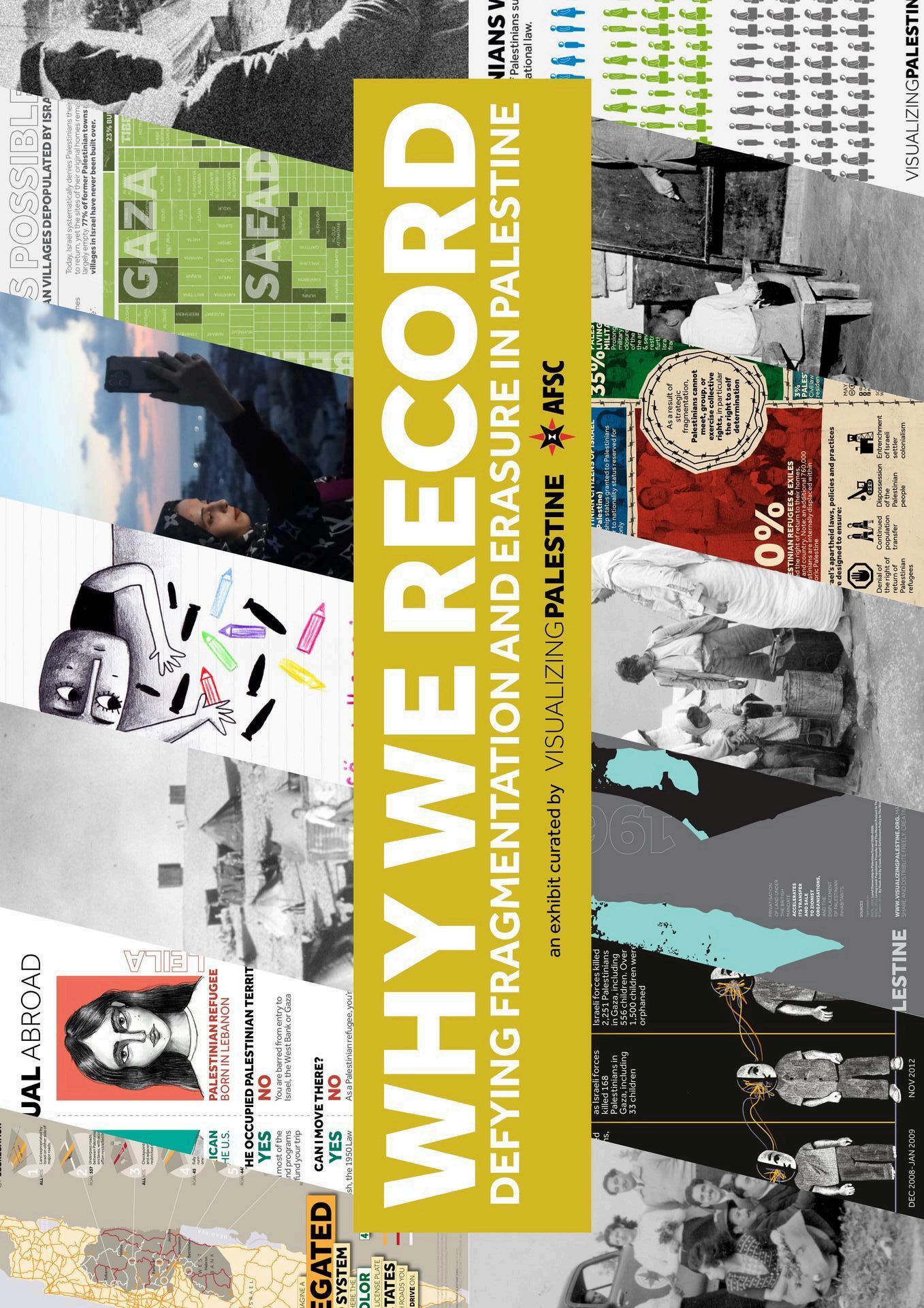
E X H I B I T G U I D E
E X H I B I T G U I D E
On October 25, 2023, Egyptian-Canadian journalist and writer Omar El Akkad wrote about the growing genocide in Gaza: “One day, when it's safe, when there's no personal downside to calling a thing what it is, when it's too late to hold anyone accountable, everyone will have always been against this.”
The truth of this statement, proven countless times throughout history, is only possible because of those who “record for future generations to tell them this is what truly happened,” as Asmaa Abu Mezeid writes in Light in Gaza: Writings Born of Fire. Recording the injustices that Palestinians face daily exposes, for the world to see, the crimes of the Israeli military, who act with unconditional support from the U.S. government and other complicit governments and actors. While the act of recording the truth has increasingly made Palestinian journalists and storytellers targets, they refuse to be silenced.
Visualizing Palestine (VP) and the American Friends Service Committee (AFSC) believe that these injustices will end, and that people of conscience all over the world have a role to play in realizing Palestinian liberation. We share a deep respect for the storytellers who narrate the painful realities of Palestinians who cannot yet live in dignity and freedom, and we invite visitors to this exhibit to witness the truths of
the past, the heartbreak of the present, and the possibilities of the future.
The exhibit is divided into three themes of the Palestinian experience: displacement, fragmentation, and return and future visioning. As the viewer looks at photographs from Palestine right after the Nakba, or “catastrophe” of 1948, and learns, or relearns, from VP’s visuals the truths of Israeli military occupation, settler colonialism, apartheid, and genocide, we invite them to consider what they might do to hold accountable those responsible before it is too late. As VP mentions in its book, Visualizing Palestine: A Chronicle of Colonialism and the Struggle for Liberation, we are working towards a world in which “these visuals are obsolete, not because they need to be updated with even more dire figures, but because the fundamental conditions of oppression have given way to justice.”
We invite you to first explore the exhibit without any additional information, making your own connections and noticing your initial understandings and confusions. After an initial pass, if you find yourself wanting more context and information, consult the following pages to learn more. Notice where you made correct or incorrect assumptions. Consider what information stands out to you. What have you learned from the exhibit? What beliefs have been challenged?
The entirety of Asmaa Abu Mezeid’s chapter “On Why We Still Hold Onto Our Phones and Keep Recording” can be found in Light in Gaza: Writings Born of Fire. Asmaa is from Gaza, and wrote the piece during the 2021 Israeli bombing campaign in Gaza. In a 2023 interview, Asmaa said of her experience writing the piece, “Writing was my only outlet to deal with all the emotion, the heartbreak, the experiences we were going through. I felt like if I was not writing, I was going to suffocate.”
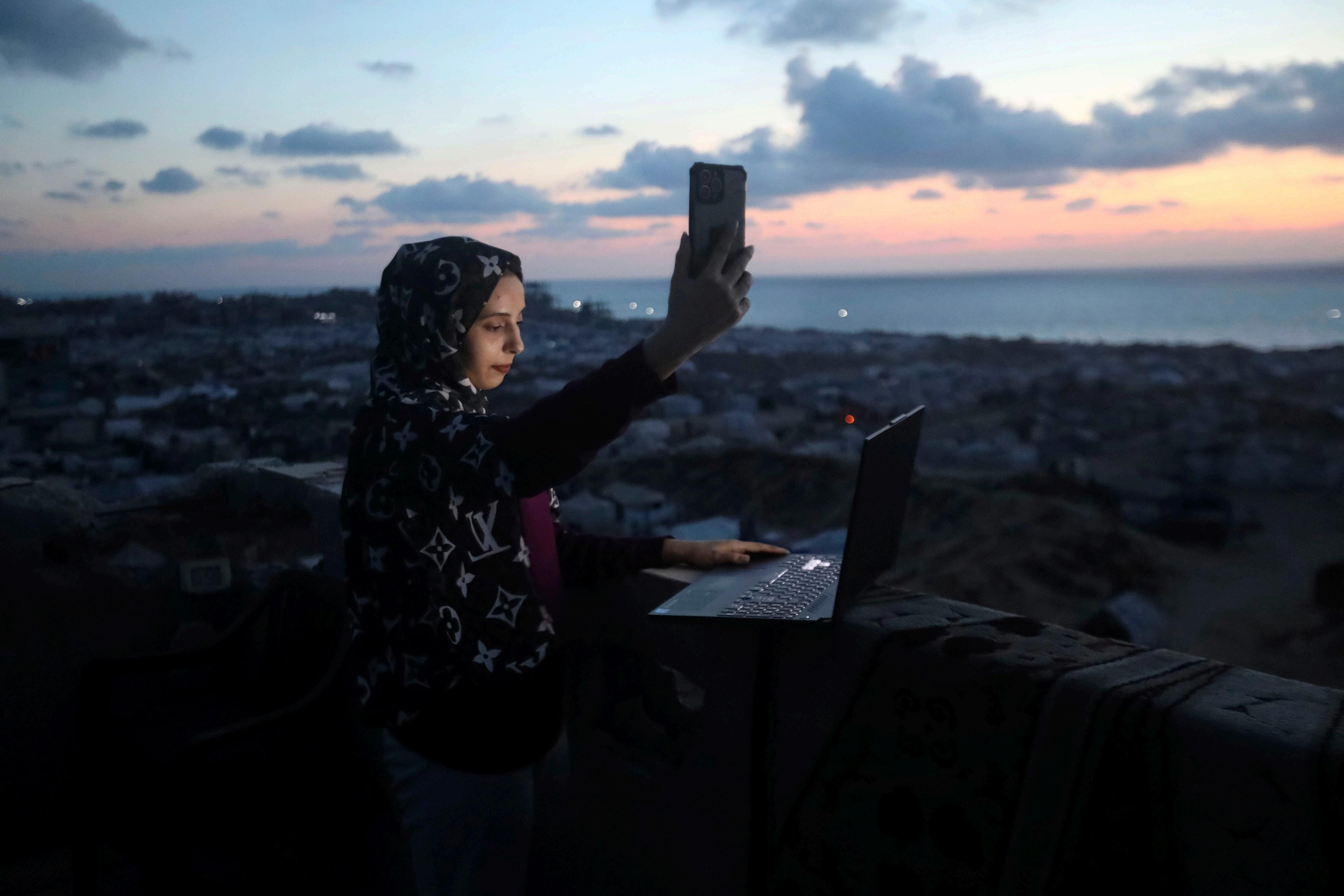
This photo, taken by Yousef Zaanoun for ActiveStills, is of a Palestinian woman in Gaza searching for an internet signal in a camp for displaced persons on June 2, 2025.
The first section of the exhibit records displacement. These visuals and images document Israel’s ongoing expulsion and erasure of Palestinians from their land. Often referred to as the ongoing Nakba, or catastrophe in English, Palestinians have endured displacement for generations.
In 1948, more than 750,000 Palestinians were violently displaced by Zionist militias and this violence and expulsion continues through today. In this section, explore the realities of forced displacement, historical and current.
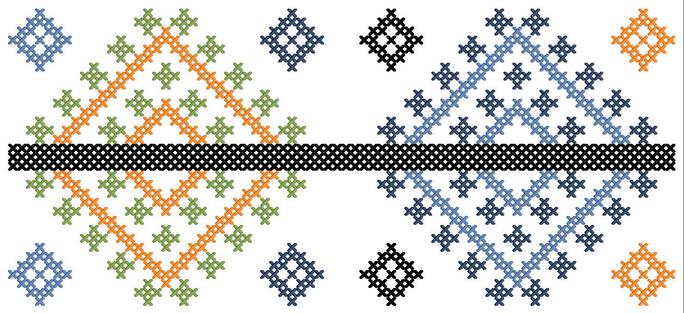
All displacement text panels are marked with the tatreez (embroidery) left. It is Al Khiyam/The Tents/مﺎﻴﺨﻟا and is attributed to Galilee and southern Lebanon. The tatreez image is used with permission from the Tirazain archive library.
‘Shrinking Palestine’ describes the military, legal and financial tools that have been utilized by the Zionist movement over the past century to acquire Palestinian land, and maps the gradual and ongoing fragmentation of historic Palestine and the exclusion of Palestinians from living in most of their homeland.
Prior to 1948, the black areas denote the land purchased by Jewish individuals and organizations, foremost the Jewish National Fund (JNF), amounting to less than 5% of historic Palestine in total. Post-1948, the black areas within 1948 Palestine refer to land administered by the Israel Lands Authority, the vast majority of which has been expropriated from Palestinian landowners.
In the West Bank, the state has used an obscure Ottoman law to declare around a quarter of the territory as ‘state land.’ The end result is that Palestinians are largely excluded from living in the vast majority of their homeland.
This is an archival photo taken in the late 1940s during AFSC’s relief work in Gaza. It shows the tents that many Palestinians lived in after being forcibly displaced to Gaza during the Nakba.
The entirety of Akram Abdul Nabi Al-Ajrami’s story can be found in the chapter “Creating Joy Despite Displacement” in Displaced in Gaza: Stories from the Gaza Genocide.
Palestinian children in Gaza are asking questions no child should have to ask. In 2024, VP created this series of visuals in collaboration with the #NoChildATarget campaign. They feature Palestinian children’s questions documented by staff at the Palestine Trauma Center-UK’s clinic in Gaza. The #NoChildATarget campaign, spearheaded by the PalestineGlobal Mental Health Network in collaboration with
international counterparts, also calls on governments to stop supplying Israel with weapons and advocates for immediate protection, humanitarian aid, and traumainformed care for Palestinian children.
In addition to killing Palestinian children at astonishing rates since October 2023, Israel has also been killing the childhood of those who survive. VP first published this visual as “Four Wars Old” in May 2021, and with this update, it draws attention to six Israeli military assaults on Gaza in sixteen years.
This archival photo shows a Palestinian mother and child. It was taken in the late 1940s when AFSC staff and volunteers were in Gaza providing food and shelter to Palestinians forcibly displaced during the Nakba.
The entirety of Fidaa Fathi Abu Yousef’s story can be found in the chapter “I Lost My Son, My Support in This Life” in Displaced in Gaza: Stories from the Gaza Genocide.
In Gaza, 1.7 million Palestinian refugees from more than 190 villages across historic Palestine have been confined to only 1% of their homeland for 75 years. [Since October 2023]. This map shows the villages of origin of Palestinian refugees in Gaza. The majority of their home villages are within 30–40 kilometers of where this genocide is unfolding.
During the ethnic cleansing of Palestine in 1948, known as the Nakba, about 27% of the 750,000 Palestinians who were forcibly displaced sought refuge in Gaza, tripling its population overnight. Most were peasant farmers who thought they would soon return to their land and livelihood. Instead, their futures are still held hostage by Israel.
Today, these survivors and their descendants make up 70% of the population in Gaza. They are once again experiencing a catastrophe, or Nakba, with 1.9 million people displaced in Gaza, 50,669 killed, around two million starving, and more than 437,000 housing units destroyed or damaged.
This archival photo shows a young Palestinian child standing outside of a tent set up in Khan Younis in 1949 to house Palestinians displaced during the Nakba.
The entirety of Shaymaa Al-Eisswei’s story can be found in the chapter “The Occupation Arrested My Sick Husband and We Live in Constant Suffering” in Displaced in Gaza: Stories from the Gaza Genocide. Her husband was detained and tortured by the Israeli military in February 2024.
The second section of the exhibit records fragmentation. Consider not only the realities of Israeli apartheid, a system that assigns rights based on identity within Israel and the Palestinian land it occupies, but also life for Palestinians in forced exile, denied the right to return to their family’s lands.
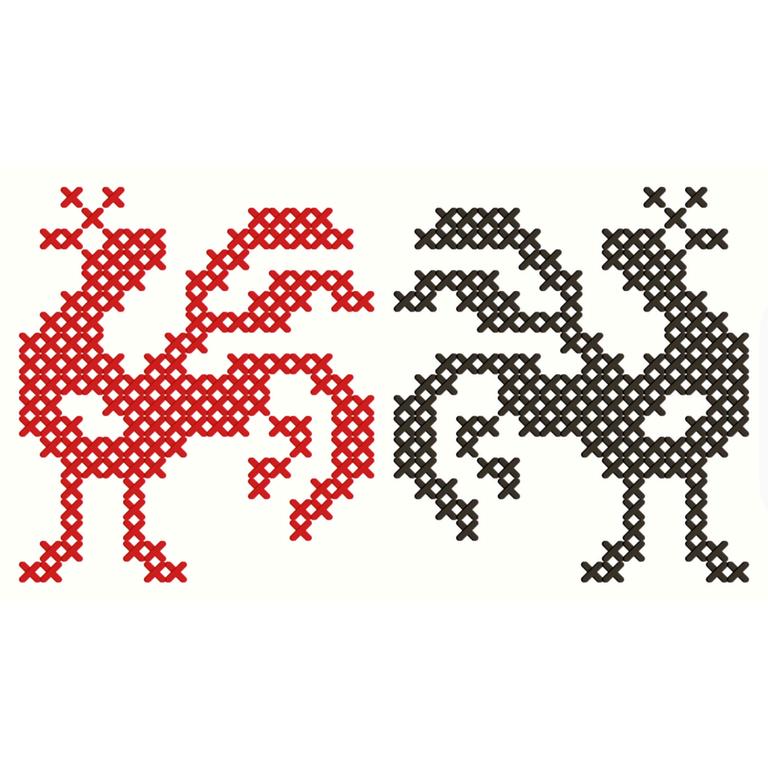
Displacement is compounded by Israel’s deliberate attempts to separate Palestinians from each other, from their land, and from the world. Though Israel has codified apartheid and continues enacting a settler colonial state, Palestinians persist in navigating Israel’s systems of oppression to overcome fragmentation.
All fragmentation text panels are marked with the tatreez (embroidery) above. It is Al Deek/The Rooster/ﻚﻳﺪﻟا and is attributed to Ramallah. The tatreez image is used with permission from the Tirazain archive library.
This visual outlines how the K-12 education system in Palestine is deeply fragmented and subject to restriction and repression under Israeli settler colonialism and apartheid.
Palestinian education has constituted a threat to Israel, which has historically sought to suppress and control Palestinian narratives, restrict educational freedoms, and limit access to knowledge that reinforces Palestinian identity, culture, and history. As a result, Palestinian education systems have frequently come under attack, whether through direct Israeli military assaults on schools, Israeli censorship of curricula, defunding of schools, demolitions, overcrowded classrooms, or barriers to academic freedom and mobility.
This archival photo shows Palestinian students in Gaza lined up outside of tents set up as makeshift schools. Today, some Palestinian children in Gaza are once again learning in tents instead of classrooms.
Many children in Gaza have no access to formal education because Israel has left no building untouched in the ongoing genocide in Gaza. Close to 90% of schools have been destroyed, and those that remain are being used as shelters for displaced people. Many teachers and students continue to meet in tents and makeshift schools. These informal classrooms defy fragmentation and displacement and create spaces for learning despite Israel’s efforts to eliminate Palestinian education.
A Palestinian teacher instructs children in this archival photo from the late 1940s. The benches are made from wood imprinted with the acronym “UNICEF,” which stands for the United Nations International Children’s Emergency Fund.
This visual highlights the apartheid-style hierarchy of rights granted to different population groups under Israeli control, including discrimination in relation to freedom of movement, voting, and access to services.
These visuals are part of a four-part series VP created in partnership with Human Rights Watch to communicate the report “A Threshold Crossed: Israeli Authorities and the Crimes of Apartheid and Persecution.” Human Rights Watch’s report was one of a few reports issued by major human rights organizations that began to institutionalize recognition of Israel as an apartheid state. Strategic fragmentation of Palestinians into different groups with distinct rights is Israel's principal tool to maintain apartheid over the Palestinian people as a whole.
Palestinians in Gaza draw water from one of the few taps at Bureij Camp in this photo from the late 1940s. Under Israeli apartheid, Palestinians in the occupied West Bank and in Gaza do not have control over water, a natural resource. Israel has consistently used water as a weapon of war.
Cars with Palestinian license plates are not allowed on Israeli roads, regardless of the identification held by the driver. Even on Palestinian roads, cars with Palestinian plates have restricted access, face endless delays at checkpoints, and are subject to regular road blocks. Cars with Israeli plates experience none of these difficulties. The infographic ‘Segregated Roads’ invites the viewer to imagine a road system in which the color of your license plate determines your mobility.
The entirety of Rasmiyya Ahmed Abbas’s story can be found in the chapter “Over 100 Displaced People Have Sheltered in My Home Since the Beginning of the War” in Displaced in Gaza: Stories from the Gaza Genocide.
The third and final section of the exhi g possibilities for return and future visioning. “Return” means that Israel’s ongoing displacement of Palestinians will end, and Palestinians will have the ability to return to land that they were violently dispossessed of. The right of return is central to the Palestinian struggle for liberation.
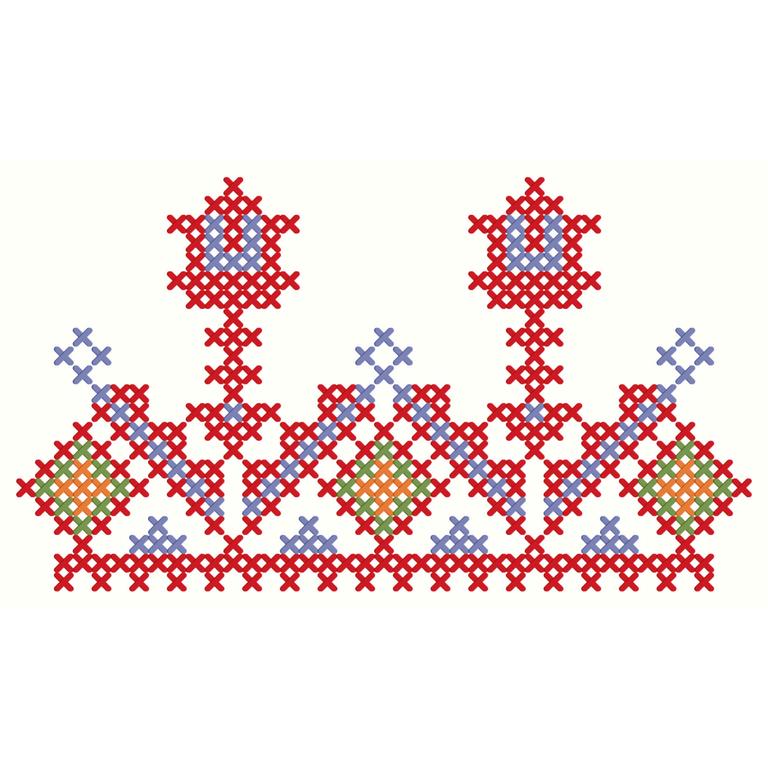
Return is possible. We must imagine and dream about this possibility in order to enact the right of return. Consider a future without restrictions on movement and access for certain groups of people. We envision a world in which Palestinians are free from oppression and settler colonialism. What do you envision?
All return and future visioning text panels are marked with the tatreez (embroidery) above. It is Azhar/Flowers/رﺎﻫزأ and is attributed to Hebron. The tatreez image is used with permission from the Tirazain archive library.
The right of return for Palestinians forcibly displaced during the Nakba is one of the three rights-based calls of the Boycott, Divestment, Sanctions (BDS) movement.
This visual highlights the three rights-based demands of Palestinian BDS movement, which represent a broad consensus from across Palestinian civil society. 2025 marked 20 years since Palestinians appealed to the global community to engage in BDS, which remains an effective tool to demonstrate solidarity with Palestinians.
The entirety of Mohammed Abdul Jabbar Abu Seif’s story can be found in the chapter “Displaced in 1948 and Today, Surviving Another Nakba and Genocide” in Displaced in Gaza: Stories from the Gaza Genocide. Mohammed is a Nakba survivor.
The entirety of Ikram Talaat Ahmed’s story can be found in the chapter “Teaching 200 Children in Displacement Camps: How I Turn Displacement Tents into Schools” in Displaced in Gaza: Stories from the Gaza Genocide. Ikram set up an educational initiative in her tent in February 2024.
Palestinians in Gaza gather in front of an aid truck with the AFSC logo in 1950.
The entirety of Dr. Refaat Alareer’s chapter, “Gaza Asks: When Shall This Pass?” can be found in Light in Gaza: Writings Born of Fire. Refaat was a highly respected scholar and mentor to many Palestinian writers in Gaza. He was killed, alongside some of his family members in an Israeli airstrike in December 2023.
The entirety of Yousef Aljamal’s article, “Gaza after 200 days of genocide: A message to the world” can be found on the AFSC website. Yousef is from Gaza, and serves as the Gaza Coordinator at AFSC.
“Our Youth, Our Future” was painted by the PalestinianAmerican artist Chris Gazaleh on the wall of a school in the neighborhood of Batn al-Hawa, Silwan. About the mural, he wrote, “One of the aspects of Palestinian identity which gives me a certain hope is the indestructible power of the people’s imagination. The ability to hold onto what is sacred. This spiritual, cultural/ancestral knowledge is what I wanted to represent on this mural in the form of a sunflower, a symbol of resistance. The knowledge passed down through generations which grows into a community's identity, this knowledge is what brings me hope.” The photo of the mural was taken by Afif Hanna Amireh.
The guestbook for this exhibit is virtual, and shared between all exhibit locations. Leave a message with your impressions of the exhibit or something you learned, explore the messages left by previous exhibit attendees, or share your commitment to take action for justice. Post at Padlet.com/WhyWeRecord/guestbook or scan below.
Every Friday, people across the United States gather on Zoom for AFSC’s Action Hour for Palestine. In the face of continuous and unconditional U.S. government support for Israel’s genocide and occupation, we act and learn together. You’ll get updates from AFSC staff in Gaza, have time to make calls to Congress, and hear from skilled guests on how to level up your activism and advocacy.
Register at afsc.org/actionhour
VP creates research-based visuals about Palestinian experiences to provoke narrative change. Besides the visuals you viewed today, there are hundreds more you can view, download, and use for free to share information with your community.
Learn more at visualizingpalestine.org
Take action in the future by signing up for emails.
Subscribe to AFSC emails at bit.ly/palactnews and VP emails at visualizingpalestine.org/subscribe
Both AFSC and VP have published books where you can learn more about the three themes of this exhibit— displacement, fragmentation, and return and future visioning. These books are all available for purchase from Haymarket Books.
Visualizing Palestine: A Chronicle of Colonialism and the Struggle for Liberation is a striking collection of more than 200 full-color infographics. The book is a vivid portrait of Israeli settler colonialism and the Palestinian struggle for freedom.
Displaced in Gaza: Stories from the Gaza Genocide is a collection of personal narratives collected in Gaza in May 2024. The book aims to raise global awareness of the impact of violent displacement and genocide.
Light in Gaza: Writings Born of Fire is a seminal, moving, and wide-ranging anthology of Palestinian writers and artists that imagines a future for Gaza beyond the cruelties of occupation and apartheid.
Consider hosting “Why We Record: Defying Fragmentation and Erasure in Palestine” in your community! Learn more about the exhibit, where else it is on display, and how you could host a version via our exhibit webpage.
Visit visualizingpalestine.org/downloadable-exhibit or scan below.
afsc org
visualizing palestine
afsc org
visualizingpal
American Friends Service Committee
Visualizing Palestine