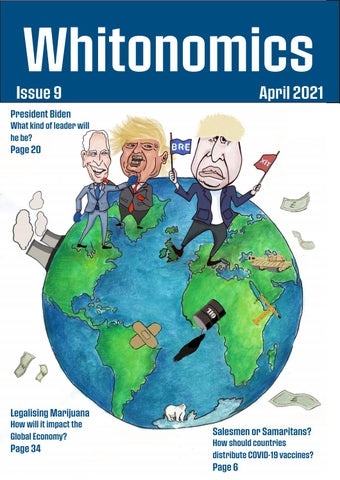
Whitonomics Issue 9
April 2021
President Biden What kind of leader will he be?
Page 20
Legalising Marijuana How will it impact the Global Economy?
Page 34
Salesmen or Samaritans? How should countries distribute COVID-19 vaccines?
Page 6
Introduction
Contents
Global Outlook
4
6
Salesmen or samaritans? How should countries distribute COVID-19 vaccines?
9
COVID-19 - How has the pandemic affected Mauritius?
11
South America - How has corruption faltered the Brazilian economy?
13
Nigeria - An investigation into the Nigerian oil industry.
15
The severity of South Sudan’s stagnated economic growth.
Whitonomics
Welcome to Whitonomics This issue of Whitonomics follows what has been a difficult year for many. From the Black Lives Matter movement to the devastating effects of COVID-19, the world is experiencing change at an astonishing pace. Whitonomics focuses on analysing the long-term impacts of these tumultuous events. This year, we have sixteen thought-provoking articles, covering a wide range of topics. I ensure that you will find something that interests you and hope that you will enjoy reading this magazine.
Hussain Zaidi Editor-in-Chief
18
Political Spotlight
20
President Biden - What kind of leader will he be?
23
America in turmoil - Assessing the economics behind President Trump.
27
Post Brexit - Is this the beginning of a new European dream?
29
The fall of Yugoslavia - What really led to the collapse?
Financial Focus
Front Cover by Hussain Zaidi
32
34
Legalising Marijuana - How will it impact the global economy?
37
Tesla and Airbnb – How do they issue successful IPOs?
40
Globalisation – How has it impacted the automotive industry?
43
Microtransactions – The rabble of the gaming industry?
45
Scandinavia – The successes of the Nordic System.
46
Universal Basic Income - Is it suitable for the UK?
48
Why do people invest in art? - An investigation into the art market
Bibliography
50 2 Whitonomics
Contributors Hussain Zaidi Editor-in-Chief
John Colman Editor/Writer
Seyi Bello Writer
James Vandrau Chief of Design/ Senior Editor
Ross Poon Editor/Writer
Brendan Lam Man Chun Writer
Suraj Shah Senior Editor
Ben Naylor Illustrator/Writer
Ismaail Khan Writer
Hasan Zaidi Senior Editor
Gorrav Bains Illustrator
Morgan Candleland Writer
Giorgio Grandi Editor/Writer
Marco Schettino Writer
Harrison Realls Writer
Josh Das Editor/Writer
Giorgio Schettino Writer
Henry Maric-Murray Editor/Writer
Shane Adeya Writer 3
Global Outlook Illustration by Gorrav Bains 4
Whitonomics
Global Outlook
Whitonomics
Salesmen or Samaritans? How should countries distribute COVID-19 vaccines? By Hasan Zaidi
No-one can deny that the COVID-19 pandemic has
defined 2020, having taken over millions upon millions of lives, both directly and indirectly, through the symptoms of the virus and the imprisonment it has laid upon the world. Fortunately, salvation has finally arrived in the form of vaccines that are being developed at unparalleled speeds thanks to the remarkable brains of scientists and the bodies of volunteers. Whilst these vaccines could have the capabilities to protect the public against the coronavirus, in order for any morsel, fragment or crumb of normality to return, everyone must be vaccinated. However, this raises a concern; the dichotomy of how they should be distributed. Should companies aim to maximise shareholder profit or the (above) Vaccinations can result in immunity to COVnumber of people who receive the virus? A benevolent ID-19. company would aim to achieve both, but by now the populace has learnt that that such types of organizaMédecins Sans Frontières have advised world leaders tion are as rare as hen’s teeth. to ask pharmaceutical companies to sell their vaccines The urgency of a vaccine is exemplified by the scenar- at cost price, so that the interests of health professionios the world has been submerged in. One where we als are put before those of shareholders, thus, preventgrieve thousands of preventable deaths, one where we ing overcharging as well as ensuring medical resources are imprisoned inside our own homes, one where the are allocated sensibly. The UK has authorised a vaccine economy goes into recession and the streets are filled produced by the American pharmaceutical firm, Pfizwith masked faces. Increased investments in vaccines er, and the German biotechnology company, BioNwill have a plethora of positive externalities on society. Tech. Known as Tozinameran, their vaccine contains For example, decreasing healthcare costs due to less mRNA that introduces the instructions for producing patients with COVID cases being admitted to hospi- antigens that are specific to SARS-COV-2. In doing so tals. This decrease in healthcare costs would allow the they generate an immune response that results in the government to maintain higher government revenue production of antibodies and memory cells that will which would permit them to spend this extra money protect the body against any further illness or ailments on other public services in need of aid such as educa- – one of the first of its kind. Surely a company which tion or other facets of the health industry. This is in has taken a great personal risk through investing two addition to increased productivity and thus, econom- billion USD of its own money, daring to seek such preic growth and stability a country gains as safeguarded carious forms of treatment will be rewarded greatly? people are finally allowed to return to their workplaces Perhaps one can disregard the intentions and conseafter months without. Unfortunately, due to the lack of quences related to a business decision.
Milton Friedman, renowned American economist and Nobel Memorial Prize winner for Economic Sciences, had a mantra: “the business of business is business,” echoing his belief that the sole purpose of a business is to make profit. If this approach were to be applied to the allocation of medical resources, then vaccines would be sold for high prices to maximise profits because companies would be viewed as not being socially accountable to the public and therefore unconscious of the problems caused by inflated medical costs. Financial experts are often inclined to believe that uncertainty comes with the expectation of award. This is not abiding by the purpose of healthcare, which is to enhance the quality of life within society, as those without universal healthcare might not purchase extortionately priced vaccines. The British government has currently secured 40 million doses of Pfizer’s vaccine, to be given to recipients in the form of two doses, 21 days apart. However, only four million are expected by the end of 2020. These vaccine dosages have been purchased at 20 USD apiece, a wholesale price negotiated by the government. Pfizer has suggested that the vaccine will not be sold for profit for the duration of the pandemic. This is commendable, as it is both a moral/ethically correct choice as it allows everyone, not just the rich access to the vaccine, ensuring that everyone is protected from the coronavirus. If Pfizer were to set exorbitant prices then herd immunity would not be achieved as the threshold of vaccination would not be reached. Thereby, it is blatantly immoral for vaccines to be sold at artificially high prices. The public-private program Operation Warp Speed, instigated by the US government, intends to “produce and deliver 300 million doses of safe and effective vaccines with the initial doses available by January 2021, as part of a broader strategy to accelerate the development, manufacturing, and distribution of COVID-19 vaccines, therapeutics, and diagnostics.” Consequently, many companies have received grants – one such company being Moderna, who aims to reach the US first to reciprocate the goodwill shown by their benefactors. Their vaccine is more expensive than Pfizer’s, pitched at 38 USD. Despite this, the US government has purchased 200 million doses. The success of this operation is unclear as whilst many companies have produced promising vaccines, some – notably Pfizer and
BioNTech – have refused funding from the US government. Perhaps Moderna is seeking to profit from its own mRNA technology. One could argue that Moderna’s vaccines are advantageous over Pfizer’s as they are easier to maintain. This is evident as Moderna’s can be stored at -20°C for six months and will remain stable within a fridge for up to 30 days. These conditions are cheaper than those for Tozinameran, which requires a temperature of -75°C and can only be stored in a fridge for five days. Simpler logistics allow for more people to be vaccinated, somewhat justifying the steeper price. However, Dr Zoltan Kis, a research associate at the Future Vaccine Hub, Imperial College London, has supposed that Tozinameran’s lower mRNA amount per dose compared to Moderna’s (30 as opposed to 100 micrograms) enables production at a lower cost in higher numbers. Moderna’s CEO, Stephane Bancel, has indicated that she is not interested in “maximum profit” and that the vaccine is being sold at a “fair price, given the cost to the health system, when someone becomes seriously ill with COVID-19.” She further justifies the relatively-high charge by claiming that it is “about the same price as a flu shot, which is between $10 and $50”. Moderna has admirably declared that this cost is below the actual value of the vaccine; their gracious intentions are to be well-received, but the lofty price may be out of reach for emerging/developing countries. There are concerns that emerging countries will not be able to purchase the more expensive vaccines. One might expect richer countries to purchase as many vaccines as possible, preventing global equitable protection – the Trump Administration has certainly demonstrated such vaccine nationalism in the past, with the president expressing his belief that the US should receive a vaccine first at the G20 leader’s telesummit. Having invested heavily in vaccine development, the US could have claimed that this gives them a right to access particular vaccines first. Fortunately, over 156 economies (not including the US, Russia or China) have indicated interest in the COVID-19 Vaccines Global Access Facility (COVAX), an initiative partly led by the WHO, Gavi, the Vaccine Alliance (GAVI), and the Coalition for Epidemic Preparedness Innovations (CEPI).
work experience, training and education over the past year, one could assume that productivity would be off to a slow start as people settle back into their old jobs. One can quickly infer that the number of people who receive a vaccine needs to be broadened with haste. However, creating a vaccine is not an easy feat.
6
7
Sixty-four high-income economies have joined the scheme which aims to enable 92 lower-income economies to access vaccines, representing more than 60% of the world’s population. Together they desire to provide two billion doses of vaccines equally, beginning with healthcare workers and then 20% of each countries’ population – of which AstraZeneca has already suggested that it will supply 300 million. A further instrument, the COVAX Advance Market Commitment (AMC), was launched in June by Gavi and hopes to motivate pharmaceutical companies to commit to providing enough vaccines for developing countries. Of its initial target of 2 billion USD, 600 million USD has already been raised through donations. It is therefore apparent that funding for vaccines for developing countries will largely hail from donations, on top of what they can afford on their own accord. It is also likely for another vaccine, co-produced by Oxford University and the pharmaceutical company AstraZeneca, to be approved for the UK before the end of the year. 90% effective and sold at $3 a dose, it will become the cheapest available vaccine and is already a part of COVAX. This is especially important for less economically developed regions, to whom it can be sold to at cost
price. It is also significant as it can be stored at fridge temperatures. They aim to maximise distribution over profit. This vaccine was partly funded by the UK government, who have ordered 100 million doses, and the US government using taxpayer money. 4 million are set to arrive in the UK by the end of the year if approved. For these reasons, it is clear that poorer countries will receive doses to vaccinate parts of their population. To conclude, vaccine manufacturers are intent on resolving the pandemic, allowing us to return to our former lives. Health professionals are adamant on ensuring global equitable access to vaccines, regardless of one’s financial state. This is evident when one observes the kindness of COVAX, which will ensure that developing countries receive vaccines. Vaccines should not be priced above cost price, as doing so would disadvantage parts of the population which is not within the spirit of healthcare. The ideal attitude for a company would be that of a Samaritan who acts out of kindness, bringing salvation.
(above) There are concerns about the accesibillity of vaccines to those in developing nations.
8
Global Outlook
Whitonomics
COVID-19 How has the pandemic affected Mauritius? By Brendan Lam Man Chun
Mauritius is an island off the coast of Madagascar. It
cases which is significantly lower than the UK which is a developing country with a population of around 1.2 was exceeding 30,000 daily cases at one point albeit with million people. It is known for its beaches and wonder- about a sixtieth of the population. ful weather which makes it a brilliant tourist attraction. It is full of many diverse cultures which are expressed through their dance, music and food. The first case of coronavirus was in December where it first originated in Wuhan, China. The virus only started off with a single case which started to affect other people in Wuhan, later spreading around China. It quickly started to spread around the world affecting most countries on the planet. At the start, many people did not expect the outbreak to be as severe as it has turned out to be. Many countries went into national lockdowns which caused people to lose their jobs and many businesses were not able to operate at their full productive potential. In total the world has around 68.5 million confirmed cases and over 1.56 million deaths. Many countries were hesitant in announcing lockdowns and restrictive measures, thinking that the virus would go away quickly which allowed the virus to spread rapidly as people roamed freely without restriction. Countries that had had very relaxed restrictions like the US suffered badly with a huge 15.2 million cases and 286,000 deaths. Many countries which took the pandemic seriously from the start dealt with the virus quite effectively like China who have a much larger population than the US but only have 86,000 reported cases, although this figure is almost certainly underreported by the Chinese government. Mauritius had its first case of the novel coronavirus in March which was very late compared to other countries which were peak infection rates. This may be due to Mauritius being an island. This allowed the government to see what other countries did to prevent the virus and analyse which methods were the best at suppressing the virus. They were more aware of the disastrous consequences which they would face if they didn’t implement restrictive measures like lockdowns and stopping flights from entering Mauritius. Although Mauritius is not the most developed country, it still did better than most other countries at stopping the spread the coronavirus. At its peak, they experienced 41 daily 9
(above) Mauritius is known for its beaches. The first lockdown Mauritius implemented was a “sanitary lockdown” on March 19th which only allowed essential services and some other services to stay open. As the situation got worse, the government implemented more restrictions for Mauritians. On March 24th a “full lockdown” was implemented, where only essential services such as the police, healthcare and the fire department were still allowed to operate. However, all supermarkets, shops and bakeries were closed and there was an 8:00pm curfew. The finance minister also announced that there will be a distribution of 35,000 food packs to families in need which allowed them to justify the closing of supermarkets. To help enforce the rules, there were fines given to people who disobeyed the rules. Many Mauritians, like others, did not enjoy the new rules and started to breach the lockdown laws causing over 8,000 people getting fines for infringing the rules. This made the government use the police force to try and fortify the law. This allowed Mauritius to reduce and eventually stop the transmission of corona virus through local transmission.
Most of the cases in Mauritius are imported from oth- Mauritius are lucky that they only endured one locker countries. This means that to prevent the spread of down as other countries have had two with their cases the virus, they needed to stop people coming in from barely decreasing as a result of it. abroad to stop the spread. To stop the virus from spreading, flights were less frequent, and it was mandatory for tourists to quarantine for 14 days which would cost them around £1,000 per person. This made travelling to Mauritius less appealing, which decreased the number of people entering Mauritius’ shores, helping to stop transmission of the virus. The Mauritian government got help from hotels which allowed them to have lots of rooms to help quarantine people who are travelling from abroad who might have the coronavirus. This has allowed Mauritius to only have 10 deaths and less than 500 cases.
Global Outlook
Whitonomics
South America
How has Corruption faltered the Brazilian Economy? By John Colman
Corruption has been evident throughout every nation
in the world; however, none are as intricate and dramatic as Brazil’s extensive and imposing corruption record, which still is prominent to this day. The origins of corruption
However, Mauritius needed other countries to help it get through the pandemic, like when China helped it by providing coronavirus testing and providing masks for everyone. They also relied on the EU who contributed MUR 11.3 million (£213,000) to the Solidarity Fund. The Solidarity Fund was used to support the population and the communities that had been affected the most by corona virus. Without the help, Mauritius would never have been able to deal with the corona virus pandemic economically as they do not have the fiscal might to support everybody with a GDP of only 12.22 billion USD as of 2018.
lished. One of the most recent and famous presidents involved in corruption was Luiz Inácio Lula da Silva. He is a very corrupt individual. Reports have surfaced from of acts of bribery in relation to Petrobras and vote rigging. Lula’s corruption led to him being sentenced to a 12-year prison sentence in 2018, 6 years after the end of his eight-year presidency. However, the Supreme Court ruled to release him after he had served only 580 days. They ruled that defendants could only be imprisoned after all appeals to higher courts had been exhausted.
During the era of military rule between 1964 to 1988, corruption was not apparent to the general population. This was due to the true level being hidden by the censorship of the media by the regime. For example, companies were extorted by military-appointed governors who used taxes to prevent the failure of their personal (below) Many locals protested in the wake of the scandal. businesses.
Although Mauritius has dealt with the pandemic quite well, the economy has not done so well. It relies heavily on tourism for the economy. Around 25% of its GDP is from tourism so the pandemic really affected its economy, making its GDP drop to around -14% (previously was around 3-4%). The over reliance on tourism has shown that Mauritius needs to diversify into other sectors as the pandemic shows that they cannot (above) Many wish to return to witness the natural survive another one economically. Mauritius has almost beauty of Mauritius. finished with the pandemic, but it still does not have massive GDP growth to show for it. Most Mauritians have returned to normality, but many people may not have jobs because there are not that many tourists going to Mauritius, so they are not needed. If Mauritius does not bounce back from the GDP fall, then it could be in a deep recession. This could then lead to a lot of unemployment (more than the current 6.9%) which could decrease Mauritius’ tax revenue which would decrease standards of living due to decreased government spending. The recession might cause a decrease in consumer and business confidence causing a decrease in investment and consumption, decreasing aggregate demand, hence economic growth. Economic recessions lead to decreased standards of living. People living in 10
The military dictatorship eventually fell like most do. A feeling of hope filled households around the country but was short-lived. José Sarney, the new president, was the frontrunner in the re-democratisation of Brazil. However, corruption clung to authority, with accusations of nepotism, overbilling, and irregularities in public infrastructure projects and dealing with private companies. This plethora of accusations led to a parliamentary commission in 1988. This was followed by many more investigations, paving the way of the way How is corruption being combatted? As information has become more widespread, voters for the fight against the undemocratic practice. have become more aware of the issues within their Until 1990, the number of scandals dwindled. Fernan- governments. Their new-found knowledge of the govdo Collor de Mello ascended to the presidency, bringing ernments stealing from their taxes has led to protests a new a level of corruption to the country. The presi- such as the ‘Free Brazil Movement’, ‘Fora Collor’ (getdent of Petrobras, a Brazilian state-owned oil company out Collor), and ‘Fora Dilma’. Although these effective and the largest business in the country, was pressured protests were helpful in bringing awareness towards by the financial secretary and Collor’s brother-in-law corruption, they did not address the direct root of the to offer loans to a recently privatised airline company problems. named VASP. Instead of giving in to corruption, the Judge Sergio Moro has attempted to change Brazil for president of ‘Petrobras’ quit. More pressure rose when the better. In 2014, he judicially ordered Operation Car the First Lady was accused of irregularities in her deal- Wash, an investigation conducted by the Federal Police. ings with of a charity. All this eventually led to the first This initially insignificant inquiry investigated money impeachment process in the history of Brazil. In 1992, laundering and expanded to probe the allegations of after attempting to stop the impeachment trial, Collor corruption related to Petrobras. This operation led to resigned. However, the number of scandals continued hundreds of search warrants, and it was suspected that to pile up, which in 1993 resulted in another Parliament the money laundering scheme discovered had moved Investigation Committee into corruption being estab- more than $11.3bn by the end of 2016. 11
The investigation involved politicians from Brazil’s largest parties, and it is considered the most extensive corruption investigation in the country’s history. At least eleven other countries were involved, and the scrutiny resulted in jail time for 3 former presidents (Collor, Lula and Michel Temer). However, there is another side to this story. Judge Sergio Moro may have controversially given inside information to prosecutors to prevent Lula’s party from winning the 2018 elections, which were instead won by Jair Bolsonaro. Masses of Lula’s fans have described him as a political prisoner. This was a contributing factor to his 2019 release.
ately is corruption has a strong correlation with poor environmental performance. Both Brazil’s corruption record and deforestation record follow this clear trend which may change the quality of life for Brazil in the very near future. This suggests that tackling corruption directly helps prevent global warming as most uncorrupted European first world countries are set to become carbon neutral. However, that would still not be enough to combat global warming, as the government must create policies to help tackle the disaster. These may not be enforced by developing countries who simply want fast economic growth, creating a challenge.
Petrobras’ annual financial results for 2014 showed $2.1bn in bribes and $17bn in write-downs for grafts and overvalued assets. To add to this, they characterised these figures as a conservative estimate. They were also forced to cut expenditures and announced they would sell $13.7bn in assets by 2016.
What now?
Brazil is tired of corruption and voted accordingly by electing Jair Bolsonaro. Bolsonaro went up against Haddad, who was from the Workers Party, which was a party associated with corruption. Bolsonaro, who ran with a slogan of fighting So, what is the effect on the Brazilian people? against corruption, elected Sergio Moro as his justice minister. Later, the minister was out of the government, and Bolsonaro was being investigated by the supreme The greatest sufferer of this corruption is the Brazilian court for misconduct. When Moro resigned, he stated population. that the president tried to replace a police chief in Rio de Janeiro to block investigations into his family and Brazil, already a country with severe issues of drugs and friends. Bolsonaro declared “corruption is no longer an violence, has one of the largest shadow economies in issue in Brazil”. This has been called hypocritical as the world. It is ranked 38th, with 35.22% of its econo- shortly after his proclamation one of his congressionmy made from illicit business. Corruption makes a size- al allies was found with wads of concealed cash. Adable proportion of GDP with estimations of 16.1% of ditionally, Flavio Bolsonaro, a senator, and son of the GDP originating in a fraudulent way. This results in a President, was charged with embezzlement and money ranking of 79 in the Corruption perception index. This laundering. According to prosecutors, he took taxes to could be interpreted as a good rank for a developing pay legislative aides while serving in the state assembly. country, if you do not account for the worsening of its Corruption has been prominent under the supposedly position. different current regime. A large shadow economy not only makes official statistics of GDP unreliable, but also means that 35.22% of Brazil’s money escapes taxation, leading to lower tax revenues which creates a cycle of lower quality of education and healthcare on top of the already-inefficient allocation of resources. All of this suggests that corruption lowers the living standards of society and ultimately undermines the fight against poverty and inequality; as a result, approval ratings have become incredibly low. This leads to the long-term effect of lower economic development. In 2015, Brazil’s unemployment rose whilst wages fell, government debt grew, and interest rates surged. Naturally, foreign investment fell by 12%. This was not helped by the Petrobras scandal. The reason corruption should be combatted immedi-
Many Brazilians have become accustomed to corruption and support him despite evidence of a crime as he is supposedly less corrupt than previous presidents. Bolsonaro seems to be on track for re-election with increased support from the poor and with relatively small opposition to his corruption from the middle class. Brazil may stay corrupt for many years to come as the population has become complacent. A lot of change is necessary to eliminate corruption to allow their economy to thrive and prosper.
12
Global Outlook
Whitonomics
Nigeria
An Investigation into the Nigerian Oil Industry By Seyi Bello
Nigeria – officially the Federal Republic of Nigeria – is
to oil price shocks. Furthermore, in many developed a sovereign country located in West Africa that borders nations, population growth is between low and negaCameroon, Benin, Gulf of Guinea, Niger and Chad. tive therefore the use of machinery requiring oil (such Nigeria is known for many things including Nollywood, as in a plethora of vehicles and the engines of heavy Masquerades and it’s immense population (being nick- construction equipment) will barely increase or even named the “Giant of Africa”), but none more than decrease. its oil reputation, being Africa’s largest oil producer, mass-producing 1,938,542.73 barrels per day of oil, ranking them 15th in the world for oil producers (using figures from 2016). The gas and oil sector accounts for 80% of the Federal Government’s revenue and more than 90% of the country’s exports. Only 9% of Nigeria’s GDP is contributed by their oil, however, oil revenues contribute to two thirds of the state revenues. On the border of the Gulf of Guinea is the Niger Delta region. This is where Nigeria’s crude oil production is concentrated – one may even go as far as saying it is the linchpin for the country’s crude oil production and the centre of many international controversies on pollution. The oil revenue in Nigeria has come to $340 billion since the 1970s in exports and it has become the fifth largest producer worldwide. Oil and gas companies involved in the Nigerian oil industry encompass Niger Delta Petroleum Resources Ltd, Northeast Petroleum Nigeria Ltd, AMNI International Petroleum Development Company Ltd, Cavendish Petroleum Nigeria Ltd, First Exploration & Petroleum Development Company Limited, etc. In Nigeria’s oil sector there has been much alleged corruption. For example, Eni and Shell, in an oil deal that led to Nigeria losing six billion dollars, may be charged of corruption by a court in Milan. Global Witness, an international non-governmental organization established in 1993, calculated that the OPL 245 deal in 2011 stripped Nigeria of twice its annual education and healthcare budget. Eni and Shell have been accused of being aware that the money they paid to Nigeria would be utilized for bribery.
(above) Nigeria has a developing oil industry.
Nevertheless, the main reason multiple nations are trying to reduce the usage of oil is to protect the environment. The Prime Minister of the United Kingdom and Leader of the Conservative Party, Boris Johnson, has said that new cars and vans powered entirely by petrol or diesel will no longer be sold in the UK starting from 2030. Mr. Johnson aims to tackle climate change as well as create jobs in industries such as the nuclear Developed countries are aiming to cut down the use industry through banning the sales of petrol and diesel of oil/petrol in such large quantities because they are vehicles. This is an example of how western nations try attempting to decrease the demand for petroleum as and reduce their dependence on oil as a result of their it could make their economic growth less vulnerable eagerness to protect the environment of their nation. 13
The oil industry causes various negative externalities onto the environment and atmosphere impacting many nations demand for oil. Through oil producing, the possibility of oil spills increases which, in turn, can pollute streams, rivers and groundwater (if it soaks through the rock and soil) as it spreads thinly over the ground surface stopping aquatic plants and animals from being supplied with oxygen – they are oxygen depleted. Oil is toxic and therefore is a threat to all plants and animals. For example, oil pollution means plants are unable to photosynthesise and causes a disruption in the food chain causing unwanted migration and possible extinction of certain species. Oil spills also can lead to contaminated water making it unsuitable for irrigation, diminishing growth yields for plants and disorders the maintenance of landscapes. Additionally, it makes drinking water supplies unusable which is awfully expensive to fix. Oil extraction requires drilling which disrupts wildlife habitats. This is due to human movement, vehicle traffic and loud noises generated from drilling operations. This intense noise pollution can negatively affect the communication of bird species as well as their breeding and nesting. By burning fossil fuels such as oil, greenhouse gases are released into the atmosphere. These emissions cause the temperature of the planet to increase because they trap unwanted solar heat. Carbon dioxide is the most plentiful greenhouse gas and is released into the air through the burning of oil as well as other fossil fuels. An increase in the enhanced greenhouse effect can cause a multitude of negative externalities upon the world and those in it. These include droughts, floods, rising sea levels, climate change, wildfires and all around disruption to agriculture which is a concern for the primary sector and the agricultural industry. In Nigeria serious worries over the impacts of oil pollution have been raised – mainly in the Niger Delta region. Local ethnic groups and communities have been severely affected by the oil pollution which has caused significant damage to their environment and home. In fact, according to a report from Amnesty International in 2009, “pollution and environmental damage caused by the oil industry [in the Niger Delta] have resulted in violations of the rights to health and a healthy environment, the right to an adequate standard of living (including the right to food and water) and the right to gain a living through work for hundreds of thousands of people.”
Global Outlook A panel of independent experts in 2006 from The Independent (UK) made an estimate that 1.5 million tonnes of oil had been spilt over the last 50 years in the Niger Delta region. This is likely to pollute river water in which Nigerians use to bath, drink and fish. Additionally, it prevents growth of plants along with disturbing aquatic wildlife in which Nigerians tend to eat. For instance, fishers in Nigeria struggle to catch fish that are fit to eat. Several of them are slim and have no flesh making it extremely difficult for villagers to feed themselves. There is a possibility that malnourishment could become a great problem in the future. In oil wells, surplus gas is burned off. This process is called gas flaring and has brought about major concerns. According to Environmental Rights Action, “flares contain a cocktail of toxins that affect the health and livelihood of local communities, exposing Niger Delta residents to an increased risk of premature deaths, child respiratory illnesses, asthma and cancer.” Although the Niger Delta region is affected the most by the environmental consequences of the oil industry, other areas are also affected. For example, in Port Harcourt roads and houses are all covered in soot due to the illegal refinement of crude oil and residents are worried that their health may be being compromised by this illegal activity. Soot is one of the lethal forms of air pollution and in 2016, a state investigation stated there to be an increase in deaths connected to respiratory infections caused by soot. Hopefully, the Nigerian government can attempt to resolve these issues as after years of campaigning from the Ogoni areas, they finally promised to clean up their oil-polluted areas which I think we can all agree is a step in the right direction. To conclude, I think Nigeria really need to plan for the future. Developed countries are reducing their dependency on oil which is Nigeria’s main export by a large margin accounting for more than ninety percent of the country’s exports. Consequently, if Nigeria do not find something else to offer it’s hard to see where their revenue will be generated from. This can be achieved through diversification of the Nigerian economy so that they are not so reliant on oil. In addition, oil pollution needs to be decreased in order to protect the well-being of Nigerian citizens. Accomplishing this would involve preventing oil spills and attempting to diminish air pollution caused by the activities in the oil industry from here on out.
14
Whitonomics
Africa Focus
The Severity of South Sudan’s stagnated Economic Growth By Shane Adeya
Since
South Sudan claimed independence from Su- facing at the time, leaving them again in an economic dan, the economy has been halted and little progress recession. has been made. As of yet they are one of the poorest countries in the world, despite having a large supply of natural resources, such as oil, iron and hydropower. Since 2011 when the country first claimed utopia, there has been lots of fluctuations in the economy. Although this is normally quite unexpected for a newly emerging country and economy, there has been lots of factors that have potentially had impacts on the changes in GDP of the country over the past few years. On October 9th, 2020, an article published by the Anadolu Agency stated the South Sudanese information minister, Michael Makuei Lueth, said that there were plans for the government to change currency in attempt to discourage hoarding to ‘improve (the) economic situation’ and ‘(their) infrastructure’. Although this seems to be a good idea in aid of revival of the collapsing government and economy, just merely a week later they had reverted this decision. In a source published by CGTN Africa on the 15th October 2020 it states that they had abandoned plans to introduce the new currency and that the decision was hardly a proposal in the cabinet. The economic mismanagement of the government and the lack of control of their country has left it with a deteriorating economy. In addition, a consequence of conflicts within the country, caused a very large refugee crisis. Stated by Mercy Corps, they have the third largest refugee crisis in the world with 3.7 million having fled their homes and 6 out of 10 of these refugees being children. Over the years, the political conflicts and economic downfall has caused over 7 million people with need of aid with shortages of food as well as living in poverty. Shown in the graph from Trading Economics, although there has been a growth in population, it has not been significant. A famine in 2017 was declared in South Sudan, the population slightly increased from 10.91 million to 10.98 in 2018. This negligible increase in population resulted mostly from the extreme refugee crisis they were
(aboce) A relitavely modern nation, South Sudan has only existed since 2011. It recently emerged from yet another civil war. Oil production in South Sudan is another great avenue that should have been taken advantage of by the government, to try and create economic growth, especially as they have high amounts of it. According to Xinhuanet, South Sudan has the third largest oil reserves in the Sub-Saharan Africa with approximately 3.5 billion barrels as well as more oil yet to be extracted. However, early disputes with Sudan after independence had not allowed that. The Guardian states that in 2012, oil production in South Sudan had shutdown due to disputes over pipeline fees with Sudan. At this time, the South Sudanese economy was not progressing adequately with a -4.6% to -41.6% annual growth rate from 2011 to the end of 2012 respectively. It came to the point where people thought that the government would not have enough money to pay key workers such as teachers and health workers for months. Oil plays a major role in South Sudan’s economy as production of it accounted for 80% of the economy and the oil is responsible for 98% of South Sudan’s aggregate GDP – showing the importance and heavy reliance of oil.
15
Since South Sudan gained independence, the new government has allowed lots of corruption to the country in many different assets which has led to economic decline. A country like South Sudan, has a high level of corruption making it unable to function properly or efficiently which leads to suffering in its society and a collapse in the economy. There are main avenues of corruption in the country for example, within the police, the tax administrations and in the judicial system.
Another factor being the tax administration in South Sudan is also very poor. More than three in every ten businesses are expected to give gifts to tax officials when having meetings. In the same source published by Numbeo shows that there is a 95% rate for corruption and bribery. These outstanding issues as a result of corruption in the country is one of the main reasons for the gradual economic decline over the years. Compared to other emerging markets and countries the crime rate overall in South Sudan very high. For example, Saudi In the judicial system, that almost two-thirds of citizens Arabia, an emerging market situated in the United Arab find the courts to be corrupt as they feel that justice Emirates (UAE), has a 31.10% crime rate for problems is not being delivered. Officials are often protected by occurring due to corruption and bribery in one of its their personal networks meaning that they would not main attraction cities, Mecca. face many sanctions. The corruption in the Judicial System decreases the trust of the population of South Sudan to the government which could be a reason to the halt in expected growth as an emerging economy. Although South Sudan has been in a deep recession for a long time, in the recent years they have been showFurthermore, the police are seen as a figure of corrup- ing signs of growth for the first time following a 4-year tion within the country as more citizens see them as in- contraction period. This is mostly due to the 10.7% effective and useless. There have been many people that growth in the oil and mining sectors. This is possibly a have reported the police themselves for actions such as a good omen for the future of South Sudan – the revival demand for bribes. However, as the police work closely of their economy has begun. with the government, minimal sanctions (if any) would be offered. In a source by GAN Integrity, it states that almost half of citizens find the police to be corrupt. The corruptness of the police due to a lack of funding is seen to have been one of the main contributors to the detachment between the citizens and the police over the past few years, is a major factor of South Sudan’s failed justice system. A source published by Numbeo showed over the past three years there has been a significant increase in crime in South Sudan, with a crime rate of 86.30% of which 84.96% are violent crimes (such as assault) displays an increase of violent crimes in the past three years, further emphasising the police force is in a need of a major reform.
(above) Many of the population live in poverty.
16
Illustration by James Vandrau with input from Ben Naylor and Hussain Zaidi
Political Spotlight Whitonomics
Political Spotlight
Whitonomics
President Biden
What kind of leader will he be? By Hussain Zaidi
Following the storming of the Capitol, Joe Biden has inherited the leadership of a divided America from Donald Trump.
Biden is not a ‘new’ politician. He previously served as Vice-President during the Obama administration, and has been in Washington since he was elected to the Senate in 1972. His life and career have been marked by personal tragedies and blunders. He was sworn in as a Senator form Delaware just three weeks after the tragic death of his wife and daughter in car accident. He became known as “Amtrak Joe”, as he commuted between his Delaware home to Washington, D.C. in a journey that took 90 minutes each way. He did this just to see his sons every day. Biden was re-elected six times and held the seat until he ascended to the Vice Presidency in 2009. This also is not the first time he has ran for the Presidency. He initially ran in 1988 but was forced to pull out for plagiarizing a speech by the then-British Labour Party leader, Neil Kinnock. His 2008 campaign was lacklustre and was dwarfed by those of then-Senators Hilary Clinton and eventual frontrunner, Barrack Obama. Biden is reported not to have run in 2016 due to the tragic death of his son, Beau. Biden’s career has been marked by bad luck. We are yet to see if this continues during his presidency. Biden will not be a reformer
ity and has gone as far as to prioritise the diversity of his cabinet over its ideology. The President has picked Lloyd Austin to be the first black Secretary of Defence. Austin, a four-star general has been on the board of Raytheon. This has angered many on the left of the Democrat party who oppose corporatism and militarism in Biden’s cabinet. However, the historic nature of his appointment has avoided any substantial opposition. Biden has also distanced himself from the Black Lives Matter movement. The President has made clear he will not defund police forces. Vice President Kamala Harris was a prosecutor and has faced criticism for her “overzealous” sentencing. She has navigated a difficult political terrain and has aimed to portray herself as having been a ‘progressive’ prosecutor. However, it is unlikely for the Biden-Harris administration to legalise Marijuana. Biden must be a moderate president to preserve the Democrats’ electoral gains.
far as to accuse Germany of being “delinquent”. Biden aims to rebuild trust amongst NATO, and heal internal divisions caused by Trump’s “America First” foreign policy. Biden’s administration is in the process of withdrawing U.S. troops from Afghanistan. Biden has chosen Anthony Blinker to be his secretary of state. He was formerly Vice President Biden’s National Security Advisor and helped craft Obama-era foreign policy on the Middle East. He has announced that the United States will “stand up for human rights everywhere” and has voiced alarm over the alleged abuses taking place in China. Biden does not want confrontation; instead, he wants to ensure that China abides by international rules for fair trade, competition and human rights. Donald Trump enjoyed a new-found relationship with North Korea; we can expect this not to continue under Biden.
President Biden has also proposed to make U.S. electricity production carbon free by 2035, and for the country to achieve net zero carbon emissions by 2050. He plans on spending $2 trillion to upgrade four million buildings to make them more energy efficient. All his plans lead to the creation of more jobs. Biden will inherit the leadership of a country in an economic crisis. The unemployment rate is 6.7%, having increased due to lockdowns caused by the COVID-19 pandemic. The Biden presidency will be cautious so not to alienate both world leaders and his electorate. However, Biden will not have the support to enact the Green New Deal. This is a plan to combat the climate crisis whilst creating more jobs and reducing wealth inequality. He has kept Alexandria Ocasio-Cortez and Bernie Sanders out of his cabinet, which has saddened many to the left of the Democratic Party. Climate change is one of the most pressing issues facing the world. Joe Biden faces an increasing battle in tackling growing environmental issues. Biden on foreign affairs and the military
Biden on the Environnement; Net Zero by 2050
Biden does not want to be controversial. Many view The President of the United States has declared that him as more authentic than Hillary Clinton, climate change is the “number one issue facing humanHis 2020 election campaign was unique due to the po- ity”. Joe Biden will be more “climate conscious” than larising nature of opponent and the events of the year Donald Trump. itself. The same strategy of uniting the left and right against Trumpism cannot be repeated in 2024. Groups such as the bi-partisan Lincoln Project may not support Biden against a more moderate Republican. Biden will have to be a moderate president to ensure that he does not lose the support of this unique demographic of the electorate. We can learn a lot from Biden’s cabinet appointments. Biden has the most diverse cabinet in American history. Biden has made diversity a prior-
President Trump formally withdrew from the Paris Climate Accord on the day following his defeat in November’s presidential election. Biden, a leader with a greater globalist outlook than his predecessor, has re-joined the agreement. The Paris Agreement is a legally binding treaty that aims to limit global warming to well below 2° Celsius of an increase compared to pre-industrial levels. Leaders whose countries are part of the agreement must aim to reduce the emissions of greenhouse gases to help attain a climate neutral world.
He has appointed John Kerry as the inaugural U.S. Special Presidential Envoy for Climate. John Kerry famously ran for the presidency himself, in 2004, losing to the incumbent George Bush. This unusual appointment signals his commitment to multilateralist environmental policy.
20
(above) Biden faces an internal struggle agaisnt TrumpThe Biden administration also has different goals for ism. (Image Credits: Sam Corum) the US military. Joe Biden is a multilateralist, who will (below) Biden’s victory was unsuccesfully contested by take a more co-operative approach than Trump. Unlike Donald Trump. (Cartoon by Bern Naylor) predecessors such as George W. Bush, Joe Biden has no distinct ‘doctrine’. Biden has supported the 2003 Invasion of Iraq, the war in Afghanistan, the intervention in the Balkans and the wars in Grenada and Panama. He did oppose the Gulf war, but later regretted it. In recent years, Biden’s views have softened so not to alienate the electorate. Whilst the incumbent president will not run for re-election in 2024, he does not want to tarnish the Democrat’s reputation. He has regretted his support for the Iraq war, and has held back support for recent military action, such as the NATO bombing of Libya and the late2000’s surge in Afghanistan. Former President Trump believed that European members of Nato were not spending enough to support the alliance. He went as 21
Biden on the economy The COVID-19 pandemic has devasted the United States of America. Biden has detailed his “Build Back Better” agenda for post-pandemic recovery. He plans on creating many jobs to help rebuild the economy. The Biden plan is to ensure the future of the United States is “made in all of America by all of America’s workers”. He does not believe that the manufacturing industries of the United States are a thing of the past. The President-elect plans to create 5 million new jobs in manufacturing and innovation, through his “Buy American” plan. He has attacked Trump’s economic strategy, describing it as “trickle-down”. Biden has appointed Janet Yellen as Treasure Secretary. She will be the first woman to be chair of the Federal Reserve, she was more concerned with unemployment than inflation. Brooklyn-born Yellen, who is a Keynesian, will help Biden rebuild the shattered economy whilst creating more jobs. He wants to spend $2trillion on new infrastructure over the next eight years. This will help by creating jobs in the construction industry. However, Biden has not had everything go to plan. His party has failed in its attempt to deliver a higher minimum wage. Biden is a softer politician than Trump. He will raise taxes on business income, investment income and labour income of those who earn over $400,000. Biden will not be an economic reformer.
Biden on home affairs
ican communities and reassert America’s commitment to asylum-seekers and refugees. He has halted the building of Donald Trump’s infamous wall. President Biden has ensured the protection of DACA. The Deferred Action for Childhood Arrivals allows undocumented immigrants who arrived in the United States as children to work. The Obama-era policy was derided by the Trump administration, who referred to these immigrants as ‘aliens’ and attempted to introduce legislation to dismantle it. In his first day in office, Biden reinstated DACA, showing his increased empathy compared to his predecessor. Biden plans on securing American values as that of a nation of immigrants. Joe Biden faces a difficult task in rebuilding a divided nation which has been damaged by political instability and a pandemic. His traditional administration will contrast with that of his unconventional predecessor, who has described him as “Sleepy Joe” on multiple occasions. Each presidency has a defining moment; Bush had September 11th, Obama had the killing of Osama Bin Laden and Trump had the storming of the Capitol. Biden’s legacy will be defined by his handling of this event. Joe Biden’s presidency will be cautious to ensure the Democrats’ re-election chances. Biden has said he will run for re-election in 2024; he will face a struggle in retaining votes he took from moderate Republicans. One thing is for certain; Biden will not have an easy presidency. (below) Biden has a long way to go in uniting America. (Image Credits: Sam Corum)
Joe Biden will once again attempt to reform the American healthcare system. He will build on Obama’s Affordable Care Act . This is in opposition to Trump, who has attempted to repeal the ACA since he entered office in 2017. He has attempted to bring drug costs down and provide more private plans in Medicare. 27.5 million Americans do not have health insurance. Biden will attempt to ensure that more people are covered.
Political Spotlight
Whitonomics
America in turmoil
Assessing the economics behind President Trump By Suraj Shah
The world was in shock, for on Wednesday 9th No-
vember 2016, Donald Trump, the Republican Party’s presidential nominee, won the presidential election, achieving 304 electoral college votes to Hilary Clinton’s 227. The former billionaire property tycoon, best-selling author and reality TV personality was announced as the 45th president of the United States of America. His success was majorly accredited to his implausible performance in the USA’s swing states – the states which flip between Democrat and Republican – and his phenomenal success in America’s rust belt, with many citizens forming emotional attachments to him and his campaign based on his promises ‘To Make America Great Again’ and bring back jobs to the Rust Belt that had been taken away by foreign lands due to globalisation. His campaign strategy was significantly astute, as by appealing to millions of Americans who had been neglected for years, he was able to win many of the key swing states such as Florida, Pennsylvania, Wisconsin, Michigan and Arizona that previously had voted for Barack Obama, the Democratic elect, in the 2012 Presidential election. His campaign was grounded in originality with massive rallies being held that dubbed his presidential bid a ‘movement’ instead of just a campaign, where he frequently insulted the democratic presidential nominee Hillary Clinton and her party in front of his cult-like following. A large part of Donald Trump’s presidential agenda was his nationalistic, non-globalist standpoint on foreign relations as he desired to see his country ‘not get ripped off ’ by foreign nations, and by being a brilliant deal-maker himself – shown by his best-selling book ‘The Art of the Deal’ published in 1987 on negotiating in business – he believed he would be able to make trade deals with foreign countries as he consistently vowed ‘to put America first.’ To be fair to former President Donald Trump, this is an aspect of his presidency where he had truly excelled. He was nominated for a Nobel Peace Prize due to his role in the vast improvement of relations between Israel and Arab nations in the middle east with the UAE which have now got formal diplomatic ties with Israel.
Biden also has a more traditional response to the pandemic. In the short term, he will restore the economy by protecting workers from COVID-19. The Democrat acheived his goal of delivering 100 million Covid vaccinations in his first 100 days in office. Donald Trump withdrew the United States of America from the World Health Organization, describing it as “China-centric”. Biden has re-joined the WHO, showing his pragmatism. Biden has promised to welcome immigrants into Amer22
(above) Trump is known for his press conferences. President Trump had successfully negotiated with North Korea’s leader and dictator, Kim Jong-Un, to totally eradicate the threat of North Korea becoming a nuclear power. This happened during the 2018 North Korea-United States Singapore Summit where both leaders met and signed a joint statement, agreeing to security guarantees from North Korea, new peaceful relations and the denuclearisation of the Korean peninsula. Furthermore, he withdrew from the Paris climate change agreement as soon as he came into office as he believed the terms to be unfair towards America due to it causing tougher emission rates on the USA than on China – which it was classed as a ‘developing country.’ Trump found this unjust to his country as China was the world’s second biggest economy at the time. Donald Trump has also sparked anger from Iran through the pulling out of the Iran nuclear deal as he believed Iran were only threatening having nuclear weapons to gain economic relief from the west. Moreover, former President Trump re-negotiated the NAFTA (North American Free Trade Agreement) founded by President Clinton in 1992 to form the USMCA (United States-Mexico-Canada Agreement) which increased environmental and working relations between the three countries and incentivised more domestic production of cars and trucks confronting the ‘Mexicans are stealing our jobs’ narrative his presidential campaign had set. Trump’s promise to stop illegal immigration from Mexico and his promise ‘to build the wall on the southern border’ has been kept with 400 miles of wall being built by the end of October.
23
In addition, Trump’s promise of ‘starting a trade war with China’ has also been kept, with the former President placing import tariffs of 10% on Chinese goods The American economy before the Coronavirus and services in September 2018, with China retaliating outbreak and Trump’s economic policy with the same percentage and then Trump increasing the tariff to 25% in May 2019, with retaliation from China to make their tariffs 25% for American goods and services in June 2019. President Trump’s median economic growth (20172019) was 2.33% compared to President Obama’s The trade war has decreased global economic growth median economic growth (2009-2016) of 2.05%. The with few positive externalities presented for the world. growth under President Trump’s tenure as president However, it has helped increase the number of jobs in outperformed the rest of the rich world, and projecthe secondary sector, but for the average American it tions. On employment, the US economy added 6.6 decreased disposable income due to higher amounts million jobs in Trump’s first three years, shy of the 8.1 having to be paid due to the tariffs as the goods and million jobs added in the last three years of the Obama services manufactured in China cost relatively far more administration. However, President Obama took over and the American-made goods and services are also during a recession, so much of said job growth must be more expensive due to American labour being much accredited to that. Under President Trump the nation’s more costly than Chinese labour. President Trump has unemployment rate fell to a half-century low of 3.5% also threatened to leave the NATO agreement – an in- before the coronavirus outbreak with unemployment tergovernmental military alliance used to provide col- rates for Latinos, Blacks and Asians dropping to an alllective security against the threat posed by the Soviet time low. The American people had a favourable view Union. To be part of NATO, traditionally, you have had on Trump’s handling of the economy, with an approval to dedicate spending equivalent of 2% of your GDP to rating of 54%, being second only to President Clinton’s the military and defence, which many European coun- 57% in 1996 among recent presidents who won re-electries haven’t been successful in doing. tion. This made the former President threaten to leave the NATO in an attempt to get them to increase their defence spending as he believed they weren’t pulling their weight. This has had a remarkable impact by increasing the defence spending of every single NATO country, helping to reduce its almost sole like reliance on the USA. However, President Trump has had a very strong friendship with the prime minister of the UK, Boris Johnson, encouraging him to cancel the installation of Huawei technology due to security concerns with him saying he believed ‘Brexit was a good idea’ as Boris Johnson is a well-known Brexiteer. All in all, Trump’s presidency in terms of deal-making with foreign countries has not been particularly positive for the world, yet positive for America as almost all of these agreements were more favourable to America than the previously negotiated deals adhering to his vow to ‘put America first’, with the exception of the trade war with China and the costly wall on the southern border. The man who knew ‘the art of the deal’, proved that his negotiating and deal-making skills were indeed transferable from the business setting to the presidential setting.
Unemployment rates have decreased from around 5% in 2017 to just under 4% before the pandemic, continuing on at the decreasing rate under the Obama administration. Average real wages also rose during the Trump administration from around $26 when Trump took over to just over $28 before the pandemic. This growth reached 2.1% per annum in February 2019 prior to the pandemic – lower than the real wage increases of up to 2.4% that President Obama oversaw in 2015. Under the Trump administration, poverty in America dramatically reduced as in 2019, 4.2 million fewer people were living in poverty in the US compared with the previous year, which was due to the strength of the US economy prior to the pandemic. The Dow Jones Industrial Average is a stock market performance of the 30 largest companies listed on stock exchanges in the United States.
24
This index grew from around $20,000 when Trump took over to just under $30,000 compared to Obama’s eight years where it increased from around $7,500 in 2009 to around $20,000 in 2017 – a much slower growth rate than under President Trump. The S&P 500 is a stock exchange market index that measures the stock perfor-
mance of 500 large companies listed on stock exchanges in the United States. Under President Trump, the value of this market index has risen from about $2200 to $3400, in comparison under President Obama over eight years it rose from around $700 to around $2200. Again, under President Trump’s single turn in office this index fund grew at a much faster rate than under the Obama administration. President Trump’s major economic policy while in office was his tax cuts in 2017. This law cut corporate tax rates permanently and individual tax rates temporarily, permanently removing the individual mandate-a key provision of the Affordable Care Act which was likely to reduce the number of people with coverage. This was seen as a major reason in why the DWJA and the S&P 500 did so well under the Trump administration as corporations had to pay less corporation tax, increasing post-tax profits, increasing the value of their shares. The economic theory behind this policy was that decreased income tax temporarily led to increased standards of living, due to higher disposable incomes. The decreased corporation tax bill would have been projected to lead to an increased entrepreneurial spirit within American society, increasing the number of businesses, leading to increased innovation in domestic goods and services and more jobs created as firms would have more risk economies of scale due to higher profit margins which would create more jobs, decrease the unemployment rate and lead to higher economic growth. However, as Trump’s tax cuts were relatively regressive, they benefited America’s wealthy disproportionately more than America’s poor citizens, leading to higher income inequality in American society. Therefore, I believe this data showed that
prior to the pandemic President Trump’s economy did relatively well and bettered expectations, however the real question is how much of this success can actually be accredited to Trump as the economy was already on an upward trajectory after Obama left office.
The American economy after the Coronavirus outbreak and Trump’s economic policy After the coronavirus found its way to American shores, with the percentage change on the previous quarter for GDP being around -5% in the first quarter of the year, a huge decrease of more than -30% in the second quarter, since rebounding up by around 33% in the third quarter of 2020. The recovery, although, strong hasn’t yet brought economic activity back to pre-pandemic levels. The chief economist at Capital Economics, Neil Shearing said “the US has done better than Europe but worse than China and some other Asian economies.” I believe this is due to American and European economies being predominantly service-based and Chinese and other economies being predominantly manufacturing-based as it was much easier to social distance and maintain coronavirus protocol in factories than offices. Unemployment rates in the USA increased rapidly from just under 4% to a peak of around 15%, although this was unproductive for the economy as America’s point on the Production Possibility Curve shifted further from the Production Possibility Frontier. However, since then unemployment has rebounded back up due to loosening restrictions. America’s citizens enjoyed receiving the world’s largest stimulus package granted by President Trump which entitled unemployed workers to $600 a week. This stimulus package was said to be economically successful, and in my opinion the best stimulus package globally. The stimulus package resulted in average hourly earnings reaching an all-time high of $30 per hour. 25
This allowed the US poverty rate to reach a record low of just 10.5% due to increased disposable incomes leading to increased standards of living as wages reached an all-time high since decreasing by a small amount due to more people being employed again. I believe this generous fiscal stimulus played a strong part in helping the American economic growth rebound in such strong fashion, as this increased consumption, increasing aggregate demand which thus, increased economic growth in America. Also, President Trump’s fiscal stimulus, unlike Mr Sunak’s furlough scheme in the UK, prevented the zombification of firms and industries. Allowing obsolete jobs to wither and new ones to blossom is one of the mains ways in which capitalist economies get richer and more productive. Governments interfere with this process of creative destruction at their peril.
ceedingly good on the whole with unemployment levels, decreasing poverty rates and increasing values of American index funds. However, I believe areas where he could have done better are decreasing inequality, improving the redistribution of income and helping oppose the destruction of the environment more as he valued the economy well above the environment during his presidency, which will change under President-elect Biden whose key focus will be the battle against climate change.
Political Spotlight
Whitonomics
Post Brexit
Is this the beginning of a new European Dream? By Giorgio Grandi
On the 31st of December 2020, the United Kingdom
available to them, but in the coming years, when the left an eleven-month transition period following its companies have to think where to re-invest, they shall withdrawal from the European Union. There shall be think twice of keeping /funding their factories in the great changes not only in the UK, but also great chang- UK. es in the EU. This begs the question: are they for the worse?
This is why I believe President Trump’s focus on protecting American’s incomes rather than jobs was far more effective, and this was evidently shown as the USA’s third quarter economic growth was a massive 33% compared to the UK’s modest 15.5%. The Dow Jones Industrial Average shrunk from almost $30,000 to around $18,000, however, it has now bounced back to pre-pandemic levels after the slump, with the latest rise coming due to a release of news by the medical company Pfizer (which is American), claiming that with BioNTech (another medical company), they had come up with a vaccine which was more than 95% effective. I believe President Trump’s corporation tax cuts in 2017, helped dramatically decrease the time that was needed for the vaccine to be developed as decreased corporation tax, increases post-tax profits, increasing medical firms spending on research and development, allowing a vaccine to be produced more quickly. The S&P 500 slumped from around $3800 to a low of around $2200, since rapidly bouncing back, and is now above (above) Trump’s legacy lives on with his many supportpre-pandemic levels due to the news of the vaccine ers. from Pfizer. As Amazon is included in the S&P 500 but not in the DWJA, I believe a key reason why the S&P 500 performed so well during the lockdown was due to the success of the American technology giants (Amazon in particular) during this period as many had increased disposable incomes due to the stimulus, many purchased an increased amount of goods and services online, increasing revenues for these firms, increasing post-tax profits, increasing the value of their stock on the market. Therefore, I believe President Trump’s economic performance during his four years in charge has been ex26
The UK has been defined as the Liberalist economic software of the EU, in other words, as it believes in a free market economy. Without the UK in the EU, countries like Germany and France will have a more dominant position in Europe with trade deals and decision making. The UK is a liberalist/capitalist economy, whereas Germany is socially democratic, and Italy and France both have economies with varying degrees of socialism. Consequently, this makes us guess that with (above) The European Union and the United Kingdom Brexit, we shall be seeing a more socialist Europe in the are embarking upon a new relationship. coming years. This implies further central regulation based on fairness and fair practices, more social policies based on equality, and more taxes to finance them throughout Europe. The agri-food trading relationship between the EU and UK is extremely tight that 35% of all food consumed In 2019, UK exports to the EU were £300 billion in the UK is from the EU, 73% of food imports to the (43% of all UK exports). UK imports from the EU UK come from the EU. In 2017, the total exports for were £372 billion (51% of all UK imports). In 2019, the EU were £138 billion, and the EU’s agri-food exof £1,928billion of exports from the EU to the world, ports to the UK came to a sum of £36.2 billion. This is nearly 20% of it was to the UK. £1,750 billion imports just more than 25% of all of the EU’s exports, which means that they must find a deal for this, as the EU to the EU, 17% of which were from the UK. could lose a major trading partner in this front. The UK is an important trading partner for the EU.
These statistics show that the EU and UK are interdependent to each other, but the EU would have suffered less from Brexit than the UK if there no deal was made. (as the EU has a bigger economy than the UK as more countries are involved). European automobile companies with factories in the UK such as Peugeot will not feel the downsides of having a factory there for the first few months because of the benefit of the free market 27
The Common Fishing Policy is a set of rules set by the EU to allow fishing fleets all over Europe to have equal access to EU waters, and therefore allowing each country to have a fair chance of competing to fish. With the UK leaving the EU, most of the North Sea will no longer be available to be used as a location for big boats to fish for their country and Europe. Subsequently, 200 miles of sea in the North Atlantic, known as the exclusive economic zone (EEZ) will be controlled by the UK, heavily affecting the EU’s imports of cod, mackerel, anchovy, and many other fish in abundance in the North Sea. The UK has a large fleet therefore they will be the main country fishing in that area, fish prices of that sort will most likely spike around the EU if there is no deal reached for this upcoming problem.
In the coming years after Brexit, we shall see a lot more of free movement. Countries with a surplus of unemployed work force can either provide workers to other countries by freely moving them around or other countries could build factories and offices in that said country. We shall see countries in the EU opening their doors to immigration and refugees from all over the world and there shall be more social spending towards low-income households, the elderly, disabled, sick or unemployed people. Citizen checks would be available towards households with an income lower than a set salary.
With a deal the EU will manage to only have a hiccup in its economy as the country with the second largest GDP in the EU after Germany leaves the EU on new year’s. We shall see how both parties bounce back after this worldwide upset. The EU will most likely be more socialist after Brexit instead of now where the EU policies are the result of a mix of diverse economic views, which could imply more immigration, more central intervention, less incentive to deregulated entrepreneurship, more fairness towards poorer demographics and new exciting business scenarios to be seen. Is this the beginning of a new European Dream?
(above) The Common Fishing Policy allows for equal access to European waters.
(above) Germany is seen as the most powerful nation in the European Union. 28
Political Spotlight
Whitonomics
The fall of Yugoslavia
What really led to the collapse? By Henry Maric-Murray
The break-up of Yugoslavia was one of the most con-
of the fall of Yugoslav communism; republics started sequential events faced by Eastern-Europe in the twen- to become more democratic which has had significant tieth century. The somewhat inevitable breakup of the long-term positive economic impacts. union took place between June 25th, 1991, and the 28th of April, 1992. The country was originally created in the aftermath of the first World War, only to be broken in World War 2 when the Axis powers invaded. Yugoslavia was re-founded as a republic in 1945. I will be highlighting some of the reasons for the second breaking after this founding again, and its consequences in the ongoing aftermath. During this period, immense political and economic tensions arose between these states which ultimately led to the horrific Yugoslav war which resulted in the breakup. Each former Yugoslav state views this part of history from quite different perspectives which to this day still affect each nation. I shall explore various of these perspectives. Many believe the downfall of the union began with the death of the former Yugoslav president, Josip Broz Tito, in 1980. There were always strong differences between the states in the union, especially regarding language, culture, and religion. What Tito was respected highly for was his focus on unifying the states and keeping the union stable, which he did with relative success through his control over the media. Many view him as a cruel dictator and compare him to the former ruler of the Soviet Union, Joseph Stalin. However, his role for Yugoslavia was incredibly significant and he is still liked by many. Many people from former Yugoslav countries view him as a good leader for his role in keeping the country somewhat stable. His rivalry with Stalin was noticeably clear; the Soviet ruler attempted to assassinate him 22 times. As president, Tito had a lot of power and disregarded a lot of Stalin’s views which made the Soviet feel as though he was under pressure. Under Tito’s rule, Yugoslavia was doing relatively well considering the problems between states; especially when compared to other communist countries. With no unification between the countries after his death, many ethnic tensions arose, and nationalism soared. This ultimately led to the war. Many believe that the loss of their leader was the root cause. Despite this, his death marked the start 29
(pictured above) Josip Broz Tito. Following Tito’s death in 1980, the Yugoslav economy fell into continuous decline. Prior to this, unemployment was rising at a moderate 7% in 1970. Tito’s goal was to increase economic growth, which was very effective in the 1970s. However, not all was good; the consequence was rising demand-pull inflation. After his death, Yugoslavia were not able to repair this damage, and in fact made it far worse. They took on many loans from the International Monetary Fund and hence got into extreme debt. Just a year following Tito’s passing, foreign debt had reached $18.9 billion. In the 1980s, unemployment reached 17%; over double what it was a decade before, as well as underemployment reaching 20%. Additionally, many resources such as labour were under-utilised due to a lack of productivity. This led to living conditions falling severely. Inflation was a significant issue; in 1991 it reached 164%. Being in a state of hyperinflation across all the states, the population’s purchasing power fell dramatically due to the rapid increases in prices. Many major strikes occurred as wages were not being increased enough to compensate for inflation.
Unfortunately, living standards fell whilst unemployment rose. State-owned banks said they would alter interest rates to match inflation, however, this did not work as they were unable to apply this to loan contracts. As a result, other currencies instead of the Yugoslav Dinar became widely accepted across the country, most commonly the German Mark. As unemployment rose national output dropped and Yugoslavia fell into a recession, in 1991 their GDP growth was -6.4%. This economic decline ultimately led to the failure of the country; many of the states clearly wanted independence. Many problems occurred between Serbia and other republics within Yugoslavia. Slobodan Milosevic was the first President of the new Republic of Serbia. Many of the problems revolved around the Serbian province of Kosovo. To begin with, Serbia had ownership of Kosovo, however it was vastly populated with Albanians. Serbian nationalists feared their land and felt threatened by Albanian power there. In 1987, President Slobodan was viewed highly by Serbs for protecting them from alleged Albanian prosecutions, however, this caused many protests. To this day the debate over the ownership of Kosovo continues, which in recent controversial action had its independence removed on various maps. Many Kosovan workers went on strike in response to their poor treatment, supported by Slovenia. Slobodan again felt somewhat attacked and responded, sanctioning Slovenian goods, an act that sparked tension. This act caused outrage and Slovenia left the Congress of the League of Communists in 1990, ending the Communist regime and paving the way for democratic elections. There were also many other political reasons for this; one being a significant economic one. The majority of Yugoslavia’s national income benefited Serbia (where the Capital of Yugoslavia, Belgrade, was located), which was an obvious economic issue for the other republics. Slovenia declaring independence was a moment of large significance as then elections took place and independence parties took power in many of the states including Macedonia, Bosnia, Slovenia, and Croatia. Serbians living in Croatia feared due to their treatment after World War 2 and so protests and riots sparked. Serbian nationalists in Croatia started clashes whilst tensions and nationalism across many Yugoslav states were rapidly rising. The war started when, on the 25th of June 1991, Croatia and Slovenia declared independence.
At this point tensions were at their peak, and it was then that Yugoslavia began to collapse. Slobodan had supposedly planned to take charge and form a new state known as Greater Serbia, in a land grab of a large amount of what was Yugoslavia. After many Yugoslav republics declared independence, he declared war, allied with Montenegro, and initially invaded Slovenia, in an attempt to prevent them from leaving the union. This lasted for only 10 days and was the beginning of many wars. However, this was ill-fated due to a struggle in reaching and therefore invading Slovenia. Once this ended, Serbia started to invade Croatia. This, alongside the invasion of Bosnia, was the main event of the overall conflict. Lasting between 1991 and 1995, this was a devastating war for independence with a horrific number of deaths. With Serbia failing to succeed in forming Greater Serbia and with the failure of preventing other Yugoslav countries from becoming independent, the federal state of Yugoslavia collapsed. The republics had now been successful in seeking independence; each republic became a country. Because of the horrific consequences of all his actions, Slobodan was prosecuted for many war crimes and ended up in the UN war crime tribunal’s detention centre in Hague, Netherlands, where he died in 2006. His actions were by far the most consequential in Yugoslavia, his acts and roles in the war are viewed by many as the ending point for the country. In summary, the breakup of Yugoslavia was the result of many factors. These include the death of their leader, ethnic tensions and the decline of their economy. Beginning in June 1991, the nation began to fall apart as republics started to declare independence. Since then, the individual countries have made economic progression, especially since moving away from communism, making the inevitable breakup viewed as beneficial to some. However, the effects of the war cannot be removed. Tensions between involved countries certainly still exist.
(above) Many died in Sarajevo during the Yugoslav wars. 30
Financial Focus Illustration by Gorrav Bains Whitonomics
Financial Focus
Whitonomics
Legalising Marijuana
How will it impact the Global Economy? By James Vandrau
After the mass controversy over the legalization (in 15
states) and decriminalization (in 16 states) of cannabis for recreational use in the United States of America most notably circa 2018, many other countries – most recently Mexico in the last few weeks – and governments have seen rise in protests and partaking in the annual Global Marijuana March. This mass requisition has spiralled throughout an array of newspapers and news outlets leaving one thought on everybody’s mind – how will the legalization impact a country’s economy? One of the first developments stemming from the legalization of cannabis would be the introduction of a cannabis tax. During the economic period where marijuana was illegal, revenue to the marijuana market added nothing to official figures for the country it was being sold in. However, despite no official figures, the market would still heavily profit from the selling of the substance and so by levying an indirect cannabis tax after legalization, the government would earn a larger profit and thus revenue from the consumers. In the case of Mexico, the main form of indirect tax is VAT (or Value-Added Tax) which is applied at a 16% rate on the sale of goods and services. With the global popularity of experimentation with recreational drugs, the Mexican government are likely to see mass rises in tax revenues from the legalization of marijuana. However, if the legalization is only for medicinal purposes then it is likely that the product will not be taxed as the sale of medicines in Mexico is zero-rated. Government revenue from this taxation could also be gained from income tax as prior to the legalization, income earned by drug peddlers was illegal and so was not taxed. With the legalization taking place, the salaries of these workers will become taxed and consequently the government would earn a higher percentage of financial charge revenue from the cannabis industry. This government revenue could then be spent on public services such as the health and education industries as well as welfare programs such as food stamps, housing assistance and unemployment compensation. With personal income tax rates in Mexico, those who gain an annual salary between 0 MXN and 125,900 MXN are exempt
from taxation whereas those who gain between 125,900 MXN and 1,000,000 MXN have a tax rate of 15% and those who earn higher than 1,000,000 MXN receive a tax rate of 30%. With these figures, it is evident that the Mexican government would see a significant rise in tax revenue as the cannabis industry will be seen as part of the formal economy with high-end jobs and high-end salaries that can be seen in official government figures.
(above) Cannabis is commonly extracted to form CBD oil. The legalization of marijuana would have various positive impacts on the economy including the negation of countless negative externalities that emanated from the illegal activities associated with this drug market. For example, if the possession and sale of cannabis becomes decriminalized, drug gangs that give rise to drug-related violence (such as the Sinaloa Cartel which remains Mexico’s dominant drug cartel) including murder and assault would no longer exist. This means that the number of people imprisoned for drug-related crimes would fall and the costs to the government for sustaining prisons and for the rehabilitation of prison inmates would drastically diminish. This, along with the diminished cost for law enforcement due to less street crime, means the government would have more disposable revenue for other projects. This would have a massive impact in Mexico as due to the Mexican Drug War, that has brought about an incessant asymmetric conflict between the Mexican government and a myriad of drug trafficking syndicates, over 120,000 people have been killed and over 27,000 have gone missing by 2013.
34
Unfortunately, this is only one way of looking at it, as although there is the possibility of drug gangs specializing in cannabis fizzling out due to the decriminalization of marijuana. There is still a likelihood that these drug gangs would shift their focus onto more permanently illegal and dangerous drugs such as cocaine, ecstasy, heroin, methamphetamines or krokodil to maintain a profit from the shadow economy and continue to not have to pay taxes. For Mexico, these drugs would most likely be cocaine and methamphetamines. Many of the drugs named above are more addictive then marijuana and thus, addiction to them could lead to some dire economic consequences. With drug addiction, productivity in the economy weakens due to premature deaths, incarcerations of labour and lack of labour participation and more of the government’s revenue has to be spent on medical and healthcare costs brought on by overdose treatments, rehabilitation costs and drug-stimulated medical issues such as bipolar disorder, seizures, kidney failure, heart attacks and strokes as well as gastrointestinal problems like constipation. Furthermore, the drug gangs and cartels would continue to stay active resulting in more drug-related violence which would cause increased persecution and incarceration rates and thus, more government revenue spent on the criminal justice and judiciary systems, creating an opportunity cost for what the government could have done with that extra money such as, in Mexico’s case, spending on education and training in order to reduce the unemployment rate which has increased by 0.37% from 2018 at 3.28% to 2020 at 3.65%. The setting up of infrastructure such as cannabis-producing factories, nurseries and dispensaries will generate an abundance of careers in the cannabis market, especially with the popularity of the product they would be producing/growing. The creation of these jobs will lower the unemployment rate and reduce poverty, allowing many of those searching for a job, to earn a salary and have an improved standard of living which would increase the country’s Gross Domestic Product and Human Development Index. For the government, the enlarged labour force, thanks to the legalization, leads to an increased overall government revenue from taxation, permitting the government to spend more on public services to further develop the country. The increased employment brought on from the new factories, nurseries and dispensaries will mean that there will be a high disposable income in the economy, so more private consumption will take place and there will eventually be an increase in aggregate demand, stimulating economic growth. With the example of Mexico, the country splits its land up as follows: 54.9% is agri-
cultural land (this includes 11.8% arable land, 1.4% permanent crop area and 41.7% permanent pasture area), 33.3% is forest area and the other 11.8% is used for other purposes. This informs us that if Mexico were to legalize cannabis production then some of the agricultural land in use would most likely be utilized instead as land for the growth and harvest of marijuana as well as to build factories, nurseries and dispensaries for the production of marijuana. In the case that the agricultural land wasn’t cultivated for marijuana growth, then an increase in deforestation may take place in order to create new farming land for marijuana where such areas as the Lacandon Jungle once were. Unfortunately, deforestation goes against the macroeconomic objective of protection of the environment as it has multiple negative externalities towards the environment such as soil erosion, climate change, desertification and increased greenhouse gases which overtime can lead to global warming.
As cannabis is still illegal in most countries around the world, it is hard for any investors to reap high-reward benefits from investing in the cannabis industry or cannabis-producing companies. The quantity of cannabis-producing companies working in public stock exchanges is infinitesimally small and so investors are unable to gain much or even any earnings from investing in them. Be that as it may, if marijuana were to be legalized, cannabis-related companies would extract themselves from the underground economy and begin listing their stocks freely on the country’s stock exchanges – for Mexico, this would the Mexican Stock Exchange (commonly known as Mexican Bolsa, Mexbol or BMV) which is Mexico’s largest stock exchange and Latin America’s second-largest stock exchange solely after the São Paulo Stock Exchange based in Brazil. This would allow for elevated liquidity and an inflated number of investors interested in investing in the stocks of these businesses/companies. With these investments, the marijuana industry could expand which would allow for greater improvements in quantity and quality of the products manufactured in this industry. These improvements would give way to new customers and increased loyalty from and benefits to existing customers, increasing overall profit for the firms which the firms can then use to pay dividends to shareholders and invest in capital to make the production process more productive. Improvements in productivity pave the way for positive externalities for firms such as economies of scale as more units of the product can be produced on a large scale with fewer input costs. 35
More recently, marijuana (medical cannabis) has been a medicinal drug used as medical treatments for epilepsy, vomiting and nausea caused by chemotherapy, muscle stiffness and spasms caused by multiple sclerosis. As the legalization of the drug becomes increasingly habitual in a country, commoditization will occur where cannabis is viewed as a commodity and thus the price for it will likely diminish. Although this has no visible benefits to the economy or government, those individuals who are struggling with epilepsy, cancer and multiple sclerosis would do good utilizing the medical aid at a considerably lower price than what would be expected. In addition, those struggling with these conditions are more likely to be productive in the economy if they receive the correct treatment for what ails them and although this is likely to be a considerably small percentage of the workforce, it will still allow the economy to reap benefits from the increased productivity due to these small cases of better-quality healthcare.
its as they know addicts will still buy from them. This is an example of consumer exploitation as the consumer is cheated out of a cheaper price for the product. In this situation, the government may need to intervene unless there are other firms (that aren’t forming an oligopoly) in the marijuana market whose prices are lower than the original firm, so the consumer isn’t exploited. However, this may lead to price wars between the firms where they continue to lower their prices in order to obtain the lowest price in the industry that consumers will inevitably flock to. If this were to take place, addicts would have the chance to buy copious amounts of the psychoactive drug due to the cheaper prices which would cause a variety of negative externalities including higher risk of lung inflammation and respiratory illnesses, structural changes in the brain, further addiction and the compromising of the immune system. These health-related downfalls of possible price wars would cause increased pressure on the healthcare system in the country the price war takes place in. The healthcare system may not In a circumstance where one country has legalized mar- be prepared to deal with the ramifications of the addicijuana usage, and another has not, the citizens of the tion and many may be permanently scarred health wise latter country who desire the experience of using can- from their experiences using marijuana. nabis may see the former as the perfect tourist destination and accordingly, venture there on holiday, wildly To conclude, there will always be a taboo around the proliferating the tourism rates for that country whilst smoking of marijuana, something that our society candoing so. This increase in tourism will also lead to a sig- not help and cannot change – at least not in this day and nificant rise in government revenue from tax levied on age. However, the legalization of this product will cremarijuana usage in their country and many cannabis-re- ate a plethora of opportunities for the economy of any lated businesses will thrive with the new-found custom- country it takes place in – including Mexico – with rises er loyalty from overseas citizens. In 2017, Mexico was in government expenditure, income and employment ranked sixth placed in a list displaying the most visited allowing for possible improvements in public services, countries in the world for tourism. This incredibly high customer loyalty and the liquidity of investment stocks rank in the list can be mainly thanked to the noteworthy as well as the standard of living of its citizens. number of UNESCO World Heritage sites found in the country, for instance, Sian Ka’an, the Rock Paintings of the Sierra de San Francisco, Revillagigedo Archipelago as well as the El Pinacate and Gran Desierto de Altar Biosphere Reserve. If Mexico were to legalize and decriminalize marijuana usage, then tourism rates to Mexico would fly and the cannabis industry would flourish, pushing the country further up the list of most visited countries globally. Due to the highly addictive nature of cannabis, if legalization were to take place, there is a high chance that the drug would have an inelastic price elasticity of demand. Elasticity of demand measures the responsiveness of quantity demanded to a change in price. This means that when there is a change in price for the marijuana, the change in quantity demanded for that good is relatively small. This would suggest that cannabis firms could raise their prices for products in order to maximise prof-
Financial Focus
Whitonomics
Tesla and Airbnb
How do they issue successful IPOs? By Marco Schettino and Giorgio Schettino
Recent headlines have been dominated by rumours of
shares they seek to purchase, choosing a price, detera possible Airbnb Initial Public Offering. One may have mining the overall price at which the stock must trade. pondered the meaning of such bizarre terms. Fortu- Book building offerings generally involve larger brands nately, we have defined and compared the strategies of to increase the low likelihood of a successful IPO two significant yet competing corporations, Tesla and through the method (it is rare for smaller companies to receive remarkable bids). Airbnb. An Initial Public Offering (IPO) is the process by which a private corporation is listed on the stock market. This entails making shares available for the public to buy or trade and is a process commonly used for businesses whose shares are only privately traded or bought by company employees and other shareholders, unavailable to the remainder of society. Prior to a business’s IPO, the average trader would have been unable to buy shares in the company as it would have been private, with a limited number of shares distributed amongst internal shareholders. To summarise, the issuing of an IPO creates a public offering of the company’s previ(above) Tesla is now the most valuable car maker in the ously privately-owned shares. world. The Model 3 (pictured) is their cheapest model. How do they work?
Why would a company want to issue an IPO?
When a private company decides that it wants to become public, they will turn to investment banks to help them issue an IPO, these banks value and fill company statements, ensuring the IPO is filed per Securities and Exchange Commission (SEC) guidelines. Companies must meet certain conditions for its application to go public to be accepted - disregarding these conditions would be illegal and would reflect poorly on the company, turning away investors. The primary condition a company must meet in order for it to be granted an IPO is reaching a 1 billion USD private valuation or its proving profitability and its ability to compete within the market. There are generally two ways in which a company can issue an IPO; through a fixed price or a book building offering. In a fixed price offering the company determines the price at which the shares are initially issued. Alternatively, the book building offering is comprised of the possible investors bidding on the quantity of the
36
There are several reasons as to why a company would choose to trade publicly on the stock market. Typically, a company may do so in order to access extra funding. This is achieved through the company receiving additional liquid shares which they can more easily sell in exchange for capital. It is also an excellent tool for rapidly expanding investor outreach, which further increases their funding and capital. Another reason behind the decision to issue an IPO is to widen one’s global outreach, creating much-needed interest in the company. IPOs can also ease up any future acquisition deals that the company participates in as it will allow the company to more accurately determine its valuation and better understand the cost of acquisition.
37
How do Tesla and Airbnb compare with each other?
During its Airbnb’s of trading like a public company, December 10th, 2020, its share price opened at $68 per share. Furthermore, the share closed at $144 per share – Having explained what IPOs are, we shall discuss their an extraordinary increase for new stock. This raises the true value. Let us consider the examples of some nota- question: why did Airbnb’s stock increase so dramatible recent IPOs, specifically Tesla and Airbnb. Analysing cally compared to Tesla’s gradual increase? their performance gives us insight into whether an IPO (below) Airbnb lets users list their own homes. was beneficial for these companies. For instance, after issuing its IPO, Tesla has seen a massive increase in its stock price over a ten-year period. Issuing an IPO has given them massive influence upon the stock market and has greatly improved investor relations. Additionally, if one surveys the graph displaying Tesla’s growth, dating from the release of its IPO to present-day, one may perceive steady growth over the course of 8 years. Whilst this may not indicate successful performance, it is important to note that Tesla still managed to guarantee a steady price, without risking bankruptcy or closure. As well as a prosperous stock market performance, Tesla has also likely amassed substantial financial gains after issuing its IPO, which was crucial for them to develop their wide range of electric vehicles. On the other hand, one might argue that Tesla has experienced several negative repercussions after issuing its IPO. In 2018, Elon Musk (Tesla’s CEO) talked about the possibility of re-taking the company private. This may be due to a variety of reasons: perhaps, as CNBC has claimed, clashes with Wall Street analysts due to Musk’s discontent with Tesla company valuations have provided a motive for taking the company private so that company reports could be internally managed, quenching the pressures of delivering upon promises made to a wide range of investors. One reason may be the different economic climates under which these two IPOs were initially issued; Tesla was In Tesla’s case, this would also mean that their own em- issued in 2010, a year with moderate economic activity ployees (who all own shares in the company) are more and no significant change in global markets. This is why concerned about the market rather than the company during their IPO’s initial stages the share price experiitself – a frightening and significant distraction. On the enced normal changes. Contrarily, the Airbnb IPO was other hand, an ancillary temptation behind Musk con- issued during the COVID-19 Pandemic, which has had sidering going private could be the publicity it would a significant impact upon global markets, provoking generate. This is likely to be the case after a poor per- volatility in stocks; their prices soar and plummet daily. formance in Tesla’s stock price, encouraging Elon to The prominence of these two companies should also increase the stock price to return better results to in- be considered when understanding their initial prices, as vestors. This could be achieved by increasing invest- Airbnb and Tesla both went public with different marment incentives in its stock. After all, this is not the ket and population exposure. In 2010, Tesla was arguafirst time Elon Musk has utilized unorthodox methods bly a small motor company, occupying a negligible share to increase his companies’ influence, with one such ex- in the Automotive market. On the other hand, Airbnb ample occurring during his unveiling of Cybertruck, its was classed as a peer-to-peer home renting giant ac“near-indestructible” windows. cording to many news corporations, and was acclaimed amongst the public. Therefore, one can conclude that Another recent IPO is that of Airbnb, a home rent- Airbnb was certain to be a higher-priced stock than Teing giant dominant in the US and European countries. sla at launch. 38
Another important distinction between the two companies is the uniqueness of their business type. Tesla, unlike Airbnb, is part of the automotive market, a market that encompasses countless other companies, some of which constitute a significantly larger proportion of the overall car production. This is unlike Airbnb, which has adopted a brand-new business strategy, (innovating one’s ability to rent their own home to others for financial gain), which is shared by very few companies. As such, it is easier for Airbnb to perform in a market which is not as saturated with competing companies, like that which Tesla has entered. Despite this, Tesla still managed to perform well, setting themselves apart from their rivals. Tesla is the first major electric car company, a circumstance which draws attention, increasing its massive day one gain.
both long-term and short-term difficulties and may not always prove successful. For Tesla, these came in the form of an absence of fair valuations and increased societal pressure that has resulted in a short-term market uncertainty.
Analysing the similarities between Airbnb and Tesla as companies reveals the factors which have affected their performance in the Stock market. Both will benefit from the revolutionary and unique ideas they have each conceived; Tesla has pioneered the electric vehicle market through a race to reform them to be similar to petrol-powered cars, gathering popularity worldwide for its efforts. Similarly, Airbnb has reshaped the house-renting market, making it easy to select a holiday-home with the click of a button. Aside from the parallels between these two great companies, future disadvantages for Airbnb plague its record performance. Several factors may negatively affect the lucrative stock in the future One of the most obvious factors is the rise of the pandemic or other comparable circumstances which lead the business into idleness. The recent pandemic has caused great distress for companies like Airbnb because lockdowns mean that people use their services less frequently. Consequently, they will currently be losing large amounts of money. Another great problem is the rise of competition in the market, like HomeToGo, which may be less significant and have inferior performance, but can still divert the attention away from Airbnb, further decreasing their business output. To conclude, it is obvious that IPOs present great advantages for companies, ranging from ample financial gains to escalating publicity and reducing notoriety. As has been observed in the example of Tesla, an IPO can advantage a company by providing access to necessary funds, in addition to cementing its name in history books as a legendary automotive company. On the other hand, it could be suggested that IPOs present 39
Financial Focus
Whitonomics
Globalisation
How has it impacted the automotive industry? By Ismaail Khan
For more than a century, the automotive industry has
means of travelling could only have rocketed at that played a significant role in world trade. From the hum- price. The ability for Henry Ford to export to the East ble Volkswagen Beetle to the legendary Bugatti Veyron, through Japanese docks helped commercialise the autothe automotive industry has absolutely revolutionised mobile across the Eastern hemisphere. the way of life for the everyman. The main reason for this is globalisation. Globalisation is the idea that countries all over the planet trade with each other to both prosper. Globalisation had already been huge with the foreign trade of goods such as commodities, crops or grain dating back hundreds of years, but it has quite not affected any industry like it has the automotive and gas industry over the 20th century. Part 1: The Ford Model T Henry Ford had engineered a masterpiece and brought motoring to the masses in 1908 with the Model T Ford. This revolutionary machine went on the determine the future of the automotive industry. One of the most significant reasons as to why the antique from Detroit was such a success worldwide was because of globalisation. Without the ability for the Henry Ford to export his Model Ts out of Detroit, he would never have been successful and would not have gone on to sell over fifteen million Model Ts during its nineteen years of production (1908-1927). The launch of the Ford Model T in 1908 was most definitely the point where the “convenience and comfort of the modern car for all replaced our historic reliance on domesticated animals for personal transportation” (The Independent). The creation of personal modes of transport that offered comfort and an element of flexibility by being able to travel anywhere caught the eye of everyone around the world. If there was one thing a factory worker in New York or London wanted for their next Christmas, it was the Model T. Henry Ford introduced the Model T to the world with the intentions of it being affordable, simple to operate, and durable so anyone could use the machine. The car was reportedly sold between $260 and $850 at the time of its production, equivalent to $21340 today. The demand for a revolutionary machine providing easier 40
(above) The Model T Ford introduced mainy principles of modern production. This therefore set the trend of car designers worldwide to design automobile machinery for the average family to be able to comfortably travel anywhere, with the Model T being a touring car, led to European manufacturers like Rolls Royce and Fiat to have several touring models on their production line – a famous example being the Rolls Royce Phantom I in 1925. Part 2: The rise of the “people’s car” Named by the Fuhrer, Volkswagen literally translated to the “people’s car”. The automobile company was formed on May 28th 1937, by the government of Germany. The leader of the Nazi Party was looking for someone to be able to make an affordable, cheap car that the average German worker could afford. Known for his later automobile company, Porsche, and their immense success in motorsport, Ferdinand Porsche had been crafting for years an affordable family car that would drive like a “real” automobile that was German powered, and came up with the beetle looking automobile, the hence named Volkswagen Beetle.
This was an immense political success at the time in Germany where owning a car was only for the rich. The car was revolutionary as it was oil cooled and rear engine based which was unheard of in a daily commuting car, which was done to distribute the weight of the car evenly. It did 34 miles per gallon, which was revolutionary at the time the Beetle was invented. After the much expected Second World War the Volkswagen factory was in ruins. The company then proceeded to look for other car companies to rebuild the factory in Berlin, in the area which the British military oversaw. After being rejected by companies like Ford Motoring, the company decided to go its own way and mass produce the Beetle and sell all over the World. The much-destroyed European economy meant that people simply did not have enough money to even fuel and maintain the cars they drove before the war, which is where the Beetle stepped in, offering a cheap to maintain, extremely economical family car. This led to a surge in demand for the automobile with other car companies looking to the car’s engineering to see how the car was able to consume such low amounts of petrol despite being able to travel over 100 km/h, or about 60 mph, and caused other car manufacturers to start building smaller hatchbacks that would fit a family of four, and also be driven by anyone, with other iconic inspired cars such as the Mini being designed by Alec Issigonis being one of the first cars to be socially classless. The Volkswagen continued to define the rest of the 20th century by becoming the most produced car at its time, with the last Beetle being built in Mexico, 2003. The Beetle won the hearts of the West, especially the Americans, nicknaming it the “Bug”, the car starred in several movies of the Disney franchise Herby, where the first production movie “The Love Bug” released in 1968.
company Toyota, it arguably marked a point in Western history where technology from the East was adopted by the West, despite the difference in culture. Nonetheless, Japanese automobiles were not seen as the centre of attention in the US market until the mid 70s. Since the end of the Second World War, the USA retained their title of the ‘Superpower’, which also led to huge cultural influences on the rest of the world. Prior to the Arab oil embargo of 1973, there were three American automobile companies that dominated the US market hence were referred to as the “Big Three” – General Motors, Ford, and Chrysler. This all changed when the first OPEC oil embargo was introduced in 1973, threatening the supply of available gasoline to the consumers of the USA, thus causing gasoline prices in the USA to skyrocket. This led to consumers looking for a more affordable daily driver. It was only until 1979 when the gasoline crisis took a serious turn for the worse, when the Iranian oil embargo happened, hitting American industrial cities like Detroit very hard. US consumers panicked when the retail gasoline industry “began a rationing program at filling stations across the nation. Gas stations would display a green flag if they had gas to sell. A red flag meant no gas for the day,” – Wards Auto. Gasoline supply was so short that motorists would queue up along streets to top off partially full tanks. But foreign, specifically Japanese car companies like Datsun, Honda and Toyota already produced fuel-efficient cars (that were relatively cheap to maintain) domestically and exported a small amount to the USA which at the time represented a small percent of the US market.
Part 3: the 1973 Oil Gas Crisis Ever since the end of the Second World War, to pay off any outlying debts to the USA, but also apologetically after the Pearl Harbour incident, the Japanese would export goods to the Americans at lower than usual prices, which usually consisted of commodities such as coal and steel, and food like rice and grain. Japan and the USA also had good trading relations before the war, with globalisation causing the integration of the two cultures, which for example explains the huge (above) Rising oil prices led to the invention of smaller surge in popularity of American sports such as baseball -engined cars. in Japan. This however was not significantly damaging But, until 1958, the first Japanese car was to be exported and sold in the mainland USA – the Toyota Crown. A significant and historical form of engineering of car 41
This led to American consumers to switch to more fuel-efficient yet sporty, moderate performing Japanese icons like the Datsun 240z and Toyota Celica, from their traditional big engine, high displacement “muscle cars” like Ford Mustangs and Chevy Camaros, also known as “gas guzzlers ”, as they used up so much fuel. This sparked a huge trend in the West, especially in the younger generation, of owning a small engine, lightweight car like a Honda Civic, that was cheap to run, but can also be fun to drive, with a smaller drivetrain, which was more responsive to steering and braking. Furthermore, American car companies like GM were very unresponsive and reluctant to leave their muscle car roots to then produce compact, fuel-efficient vehicles. This is when owning a Japanese car in the late 50s until this point was known as being of inferior quality. Edward Deming changed this, when revolutionising Japanese quality control production methods. People in the USA, and therefore the West began to see the superior quality in the cheaper, more energy efficient yet somehow cheaper Japanese products. This was where the JDM or Japanese Domestic Market (of goods) ‘blew up’ or skyrocketed in popularity in the West. Japanese car companies like Toyota and Honda now dominated the US market and were only able to do so because of their weaker currency, the Yen, which meant that any revenue brought into Japan from the USA was very profitable anyway because of the currency exchange rate favouring the strong US dollar, thus meaning these cars would go on to undercut any price set by American automobile companies for models on their production line. This therefore illustrates the shift in the automobile industry from the desire to own a high powered, high performance and big engine car, to then want a smaller, more economical, ‘fun to drive’ Japanese sedan.
Financial Focus
Whitonomics
Microtransactions
The Rabble of the Gaming Industry? By Ross Poon and John Colman
For many generations, online games have been bought
and sold. Companies are always looking for ways to increase profit, and due to the innovation of a few games, the whole online gaming industry has been changed. In this day and age, more and more games have moved from selling a game to keeping players enticed to games. The most significant factor in this change in the way that games are ‘bought’ is microtransactions (transactions made inside the game) such as cosmetic upgrades. Although, this leads to lower profits in the short run, by keeping an active player base those cosmetic purchases stack up to generate a consistent source of revenue along with increased earnings in the long run. Gambling and ‘pay to win’. (above) Nissan’s 240Z is an automotive legend.
An Overview To summarise, the overall point is not globalisation and foreign trade in most economies in the world is the only factor that decided the direction the automobile industry at a certain point in time, but it was to illustrate how automobiles have evolved and been developed and then illustrate how most of it would not have been possible without global success. To begin with Henry Ford achieving his aims of being able to accommodate a group of people with an element of comfort, practicality and affordability in the 1900s with Henry Ford’s Ford Model T, to then go towards a more compact, better driving car like the VW Beetle made by the Germans in the 1930s, to then emerge out of the Second World War as a fashionable mode of transport worldwide and an icon in the motor industry still to this date, to then proceed to the later decades of the second half of the 20th century towards more fuel-efficient, smaller engine and ‘fun-to-drive’ cars provided to the world by the small Japanese automobile companies of the 60s (above) Toyota is known for producing enthusiast cars like Toyota and Honda, exporting JDM icons like Civsuch as the Supra. ics and 2000GTs who till this day, dominate the global market with fellow European companies like VW and Mercedes-Benz. None of this would have been entirely possible today without globalisation. 42
Companies such as Blizzard have made games very appealing to the teenage audience such as Overwatch. Blizzard has made over $1bn from loot boxes alone, however astounding this measure, it must be known that these loot boxes are a form of gambling as loot within the box is unknown. This is important because, in the US, 21% of video game players are under the age of 18. It is known that most children are given the freedom to spend their parents’ money on games, but these parents do not see the harm this causes on their children. It has been found that many children feel pressured to spend money, and this could be setting them up for a future of gambling despite the gaming laws in place to prevent minors gambling. This not only shows the immorality of companies but also how the complexity of today’s gaming laws is allowing children to fall into an addictive cycle of gambling into adulthood. Similar to Blizzard, it is recorded that Electronic Arts (EA) made nearly 1 billion (993 million) in just the third quarter of 2019 and about 3 billion over the entire year. In 2017 EA was involved in a microtransaction controversy which allowed specific game characters and cosmetics to only be available to players who pay for them. Also known as ‘pay to win’, players would gain a competitive advantage in the game with certain characters or cosmetics, which could only be unlocked by 43
microtransactions. EA’s official community team responded to the criticism by saying that the intent of micro-transaction only characters is to provide the player with a sense of pride and accomplishment for unlocking different characters. However, this response led to a further backlash by the community. It was even reported by newspapers, seen as a cop-out answer as in reality most features and popular characters in the game are locked behind a paywall on top of the original game price. Micro-transactions by EA have also been further promoted through their new platform EA Mobile Games. Mobile games such as FIFA mobile, allowing players to open randomized packs to unlock their favourite players to compete with others. This is heavily encouraged, especially on mobile devices with the ease of access to payment such as Apple Pay or Google Pay, players can purchase in-game items just through a few clicks.
The rise of the Battle Pass
(below) Fortnite is a popular game with microtransacEpic Games, popularized the Battle Pass through hit tions. game Fortnite. A Battle Pass is like a Streaming Subscription, where you pay a low value every few weeks in exchange for new in-game cosmetics (instead of new shows). This idea boosted Fortnite’s revenues, but Battle Passes also include a ‘Fear of Missing Out’ aspect as you can only claim the rewards you paid for after playing a certain amount of games. Other companies quickly saw the success of Fortnite as an opportunity to trial this system on games of their own. Blizzard yet again utilizes microtransactions in the form of a Battle Pass for their new hit game Call of Duty Warzone, this was a big step for Blizzard as this was their first free game of the Call of Duty franchise. From July to September 2020 $1.95bn was made in revenue compared to $1.2bn from the same quarter in 2019. The most astounding figure was that of the total revenue in this quarter of 2020 $1.2bn was made from microtransactions mostly generated from Warzone and While impressive, these figures are alarming as gaming Modern Warfare (game within Call of Duty franchise laws are currently outdated and allowing gambling and with Battle Pass). predatory revenue models to be used towards children. It is common knowledge that children have more access As the trend of introducing battle pass increases over to mobile games than to computers or consoles, and the years, other companies such as EA have caught up this is especially true the younger the child. 21% of US as well. In August 2020 EA Play Pro was introduced, a iOS top 100 grossing games have a battle pass system subscription service which gives users access to individ- which is predatory as children feel pressured to pay into ual game titles and exclusive player content for specific these games simply because everyone does. Furthergames under the company. On top of this, subscription more, auto-renewable subscription models have growservices such as Battle Passes are available in unique ingly started to appear in mobile games showing that the games such as Apex Legends, where players purchase non-subscription games are only shrinking. Thankfully, a pass for a season which operates similarly to a Bat- some big companies such as Riot Games with their intle Pass. Players have to complete missions assigned by vestment into the mobile community with ‘Wild Rift’ spending more game time to unlock certain cosmetics. have strayed away from the subscription model, making Similar to Fortnite’s Battle Pass, it creates a massive in- most of their revenue from cosmetics instead of loot centive for players to purchase as the content will not boxes which are in general rejected by the community. be available again in the future. However, with the growing profits of companies with immoral tactics, only time can tell whether companies The future of the Gaming Industry will morally oppose subscription-based games models. The gaming industry is only growing, in 2020 $159.3bn in revenue and what is more impressive is the 9.3% year-over-year growth which allows entities such as ‘Newzoo’ to project the industry to surpass $200bn in revenue in 2023. Furthermore, the mobile industry is evolving, making up nearly half of the gaming industry’s revenue in 2020 and projected to gradually make up a more significant proportion of the gaming industry with an increase in revenue of 13.3% from 2019.
44
Financial Focus
Whitonomics
Scandinavia
The Successes of the Nordic System By Harrison Realls
The Nordic System was developed in the 1930s un-
den (7th) and Norway (9th) were all ranked in the top der the leadership of Social Democrats in Sweden and 10 in education standard rankings in 2019. Denmark. It is the economic system used in Nordic (Left) Norway is countries, such as Denmark, Sweden, Norway, Iceland, known for its scenic and Finland. It involves both the social and economic beauty. policies used by these countries. These policies have been used effectively, and they ensure that workers, employers, and consumers are all satisfied, and that the economy of these countries is strong and stable. The relationship between employees and employers is much more considerate than that of most countries. According to the 2014 Global Rights Index, Nordic countries have the highest-ranking protection of workers’ rights worldwide, with Denmark scoring1 (the top score available). Additionally, Labour Unions are far more popular in these countries than in other parts of the world, with 84% of Icelanders and 66% of Swedes respectively a part of one. This is These policies are directly related to the happiness of clear evidence that the Nordic System encourages pro- the countries under the Nordic system. All five of the tection for the workers,while simultaneously keeping Nordic countries feature in the top 10 of the 2020 business owners happy, which is further emphasised UN World Happiness report, with Finland, Denmark, by the fact that Denmark has a meagre 22% corporate Iceland, and Norway in the top 5. Iceland is tax, which is surprising considering the high but, ranked highest in providing social support, Norway reasonable tax on the civilians. It is also lower than and Denmark are ranked 3rd and 4th respectively the 24% average corporation tax worldwide, which en- in freedom to make life choices, and Denmark, courages businesses to be set up in Denmark. As well Finland, Sweden, and Norway are all in the top as a strong bond between workers and employers, 10 for low perceptions of corruption: Denmark government sunder the Nordic System spend a much was found to be the least corrupt country in the higher proportion of their GDP on public spending world, an achievement which they have held for five than most other countries. Sweden spends approxi- years consecutively. These economies have higher mately 49.3% of its GDP on public spending; this tax rates, but it is to support such an economically complements the fact that around 30% of employ- and socially successful environment. The inequality ees in the Scandinavian countries work in the pub- gap in the Nordic system is marginal. This is seen lic sector. Public pension plans are standard, ensuring in their National Health Services and school systems that elderly people within these countries are looked af- being funded by the government. These countries ter well. Universal health care and free, high standards have some of the biggest labour unions worldwide of education are further evidence of Nordic countries ensuring that the workers aretreated equally and being countries that care about their people, with correctly.The Nordic System turns the dreams spoken Denmark even paying University students 5,839 about in free market economies into a promise. People Krones (approx. $900) per month, which means that. in less socialist countries struggle to live a life with In contrast, the average US university student racks up health security, job security and a high standard of a debt of around $33,000, a flaw seen across most free living. Countries under the Nordic System promise and market economies. Finland (1st), Denmark (3rd), Swe- provide these to their population. 45
Financial Focus
of households would see their disposable income decrease and which 6% of them will lose a quarter of their disposable income. A net decrease in their disposable income is due to having to increase tax rates on income and corporations so the government can pay for a Universal Basic Income system. Furthermore, an increase in the tax rates of income and corporation tax may discourage the labour force to work for a higher income and ultimately may lead to a decrease in labour productivity. In addition, the fundamental problem with Universal Basic Income is the assumption that everyone uses their basic income effectively to increase their standard of living. Universal Basic Income is an unconditional system which does not account for this, hence morally, citizens in more need of a basic income will suffer compared to those who do not use it to its full advantage. In the Finnish experiment, Universal Basic Income had a net positive effect, but many people question the extent of its usefulness as it did not have any significant effects on the recipients’ standard of living.
Whitonomics
Universal Basic Income Is it suitable for the UK?
By Josh Das
The idea of a Universal Basic Income system is not rev-
olutionary but has become a hot topic recently, following a cross-party group of MPs calling the government to carry out trials of Universal Basic Income to combat mass unemployment caused by COVID-19. But what is a Universal Basic Income system? It is an unconditional system where citizens are given a set amount of money periodically. To see the quantifiable impacts of a Universal Basic Income system, it is useful analysing a Finland’s experiment on Universal Basic Income who have a similar demographic and economy to the UK. In Finland, the government agency Kela (which handles the basic economic security for everyone in Finland) conducted an experiment in 2017-2018 where 2000 randomly selected job seekers from ages 25 and 58 were given €560 monthly. This experiment aimed to test the impact on the participants’ employment status, income, use of the basic income and subjective well-being. To see the effects of basic income, the 2000 people who received basic income (a treatment group) was compared to a control group of 173,000 people without basic income. In terms of the participants’ employment status, from November 2017 to October 2018, employment increased on average six days more in the treatment group than the control group, especially if the participants have children or speak a second non-native language. This evidence counters the argument that a Universal Basic Income system will decrease the incentive for people to seek work as employment is higher than people who do not get partial income from a welfare system. Regarding the participants’ subjective wellbeing, a phone survey was conducted on both groups and shows that the response rate for both groups is expectedly low – 31% for the treatment group and 20% in the control group.
Results of the survey present there are significant differences between groups on key indicators representing different aspects of subjective wellbeing, hence the treatment group’s wellbeing was more positive than those in the control group. Therefore, implementing a Universal Basic Income may be socially beneficial on similar countries including the UK. Expanding on the effects of a basic income on the treatment group’s subjective wellbeing, they felt that they had a higher generalised and institutional trust, confidence in the future and less stress and symptoms of depression which subsequently improves their cognitive function, so they are more productive increasing the quantity and quality of goods and services which would highly benefit the UK. A common misconception is that the labour force will become lazier as a benefits system decreases the incentive to work if one is already comfortably living on their total income. However, this view disregards that some people choose to work not only for income but for other reasons such as enjoyment from fulfilling objectives, cooperating with others, achieving their aspirations. Contrary to popular belief, as referenced in the last paragraph, people in Finland’s employment status had increased rather than decreased so it disproves that most people will be lazier getting a higher income. Also, some may argue that Universal Basic Income provides a greater incentive for people out of employment because they do not lose the risk of losing their current benefits, hence the flexible and unconditional nature of Universal Basic Income can be quite useful for the UK. After Andrew Yang’s reasoning in his 2020 campaign that Universal Basic Income will help workers with jobs at risk because of automation becoming more prevalent, this begs the question what solution the UK has prepared preventing a potential 30% of workers being made redundant (by mid-2030s) by automation? (Opposite) Following his run for the presidency, Andrew Yang is a favorite in the race to become the next Mayor of New York City.
46
Universal Basic Income helps these workers who are structurally and frictionally unemployed to have an adequate standard of living even when seeking new jobs. Moreover, peoples disposable income could be used to be educated and retrained in a different industry with larger demands for labour. Under a scheme of Universal Basic Income, the percent of UK families with incomes below the current official poverty line would decrease from 16% to 4% so poorer families would have an increased standard of living due to their increase in disposable income.
Alternative solutions to solving societies’ social welfare issues must be considered. One method (if citizens are open to increasing income tax like in Universal Basic Income) is to increase the proportion of tax revenue contributing to improved education and training in the labour force. Consequently, people who are unemployed and are seeking benefits can gain the skills needed in an industry that demands skilled human capital and hence, more likely to be employed reducing the unemployment rate. Although, this process would have a large time lag to educate the people so it would be effective only in the long run. A unique solution would be to increase taxes to become more progressive (larger percent of income taxed from people at higher incomes). Therefore, the increased tax revenue can be used for schemes that benefit social welfare such as the furlough scheme which protects around 9.5 million jobs.
As discussed throughout the entire article, Universal Basic Income is a solution that is neither perfect nor highly flawed. The solution is depicted as being unnecessary because the Finnish experiment showed that a Universal Basic Income had a net positive effect on the people’s standard of living, however, the impact was (above) Table 1 by Dr Luke Martinelli. not significant at all. Therefore, this potential solution to social welfare issues may not be suitable for the UK, However, “an affordable Universal Basic Income would as the impact it will make will not be significant in the be inadequate, and an adequate Universal Basic Income long run. Although, amidst the COVID-19 pandemic would be unaffordable”. Dr Luke Martinelli also states during its early stages, a temporary Universal Basic Inthat there is a clear trade-off between the benefits that come system could be useful to positively impact the come with Universal Basic Income and the quality of economy in the short run. Universal Basic Income having an inverse relationship. This is clear when looking at Table 1 at Model 3.1, 42% 47
Financial Focus
Whitonomics
Why do people invest in Art? An Investigation into the Art Market
By Ben Naylor
The
most expensive painting ever sold was ‘Salvator Mundi’, a 600-year-old painting by Leonardo da Vinci. It sold for $450,000,000. It is a canvas with paint on it. You might be wondering why someone would spend this absurd amount of money on a painting, putting aside sentimental reasons or emotional ones. If you invested that money into the index fund VT, you could retire comfortably on the average annual interest of $31,000,000. The painting can provide no cash flow or income. So why buy it? I will attempt to provide an insight into the high-end art market and why it could potentially provide a more enticing investment opportunity than more typical asset classes such as real estate and stocks. As usual, the answer is wrapped up in taxes.
speculation: whilst crypto currencies such as Bitcoin are indirectly affected by external factors, there is only one thing that directly affects its value: how much people believe it’s worth. If everyone suddenly decided that the Salvador Mundi was worth nothing more than its material components: the paint and canvas, then it would maybe sell for $50, however, as seen in Bitcoin, the power of speculation can make something as simple as ones and zeroes worth thousands of pounds. A painting like this has an extremely low supply (it is completely unique) and a few dozen people willing to buy it, not based on its actual value, but based on speculation about what it could be worth. This explains why the painting is worth so much, but still doesn’t answer the question of ‘why is this a good investment?’. Now that we understand why the painting is worth so much, we need to understand why someone would invest in it, as most billionaires probably wouldn’t rely too heavily on the greater fool theory as this is fairly risky and relies too heavily on speculation. What drives the high-end art market? Why invest in art over real estate or stocks? So far the increase in the arts value seems nothing more than a speculative bubble. The economist Gene Tunny has already written about this topic briefly, but I will try to explain his points on how billionaires use art to create value and (more importantly) avoid tax in more depth. You buy 20 paintings worth a total of $20 million from an art dealer.
(above) Leonardo Da Vinci’s Mona Lisa may be worth $1 Bilion USD. If we take the example of the Salvator Mundi, it would seem that there is only one way to make money in the art market: to resell your painting at a higher price, say if they sold it for $500,000,000. But this isn’t necessarily a good idea as you are always relying on a greater fool, hoping that someone is willing to buy your painting for more than you paid for it; they also would have the intention to sell it for more than they paid for it. Like with crypto currencies, this isn’t actually investing but
They then artificially increase the perceived value of the portfolio through writing about them, telling people to buy more of these artists’ paintings, increasing demand, etc. Since they are speculative assets, they increase in value along with their perceived value. Then you further ‘create’ value through auctioning off one or two of these pieces at a “very public” auction house, getting a trusted representative, lawyer, or family member to bid these paintings up to 10x
48
This means absolutely nothing, however, unless you can somehow sell these paintings for $200 million: you have only increased the on-paper value of your portfolio. This seemingly has no practical application except, as Tunny points out, tax evasion. He outlines how, if you donated these two paintings to your local art gallery, you can write this off as a USD $20 million donation, the gallery being very happy to accept the donations, as they will make profit from all the people paying to see the art. The two paintings, initially $1 million each, will have saved you $20 million in taxes overall. Finally I would like to briefly offer an insight into the art market and the role it plays in the economy as a whole. It has been used as an indicator for overall market per- (above) The NASDAQ is a large stock exchange. formance. For example, in late 2007 there was a drop in sales within the high-end art market: “The silence in the room at the time of the auction was a resounding thud for the art market”, said Karen Finerman. She explained that Sotheby’s must now buy the art that didn’t sell – and at a time when she anticipates a real crack in the art market.” Whilst people still debate over cause and effect, no one can deny that the Mortgage crisis of 2008 happened very soon after. Arts’ effectiveness as an indicator can be further confirmed by looking at Sotheby’s Holdings (BID). Its share price predicts (some times more successfully than others) market crashes before they happen. Examples include: 2000, 2008, 2012, and other market crashes. People aren’t entirely sure why this is the case, however the correlation between the art market and others such as the NASDAQ or the NYSE is impossible to ignore. In conclusion, the art market is so much more than the sentimental speculative bubble it is perceived to be. As well as functioning as a somewhat effective indicator for the economy as a whole, it is also a good way to avoid paying those pesky taxes (for billionaires who would much rather buy a yacht or acquire a new company). Of course it produces many beautiful works along with being part of the growing ‘arts’ market but, from an economic standpoint, it is severely underappreciated and underutilised as a resource for predicting market (pictured above) A reproduction of the Salvador Mundi. patterns or as an investment opportunity.
49
Bibliography
Whitonomics Issue 9
Salesmen or Samaritans? How should countries distribute COVID-19 vaccines? By Hasan Zaidi More than 150 countries engaged in COVID-19 vaccine global access facility (WHO) Available online at: https://www.who.int/news/item/15-07-2020-more-than-150-countries-engaged-in-covid19-vaccine-global-access-facility Moderna says its Covid-19 vaccine to cost about the same as ‘a flu shot’ (Russia Today) Available online at: https://www.rt.com/business/507454-moderna-covid19-vaccine-price/ Hippocratic oath: Losing relevance in today’s world? (Vishal Indla and M. S. Radhika) Available online at: https://www.ncbi.nlm.nih.gov/pmc/articles/PMC6482690/ COVID-19 - How has the pandemic affected Mauritius? By Brendan Lam Mun Chun Mauritius - Contribution of travel and tourism to GDP as a share of GDP (Knoema) Available online at: https://knoema.com/atlas/Mauritius/topics/Tourism/Travel-and-Tourism-Total-Contribution-to-GDP/Contribution-of-travel-and-tourism-to-GDP-percent-of-GDP South America - How has Corruption faltered the Brazilian Economy? By John Colman “Strongest correlation” between corruption and poor environmental performance, study shows (Transparency International) Available online at: https://www.transparency.org/en/press/strongest-correlation-between-corruption-and-poor-environmental-performance# Bolsonaro ran against corruption. Now, he’ll have to find another slogan. (Terrence McCoy, The Washington Post) Available online at: https://www.washingtonpost.com/world/the_americas/brazil-bolsonaro-corruption-sergio-moro/2020/11/20/dfd4e9f0-282e-11eb-92b7-6ef17b3fe3b4_story.html Nigeria - An Investigation into the Nigerian Oil Industry. By Seyi Bello Oil industry in Nigeria - statistics & facts (Statistica) Available online at: https://www.statista.com/topics/6914/oil-industry-in-nigeria/ Africa Focus - The Severity of South Sudan’s stagnated Economic Growth. By Shane Adeya Figures on the population of South Sudan (Trading Economics) Available online at: https://tradingeconomics.com/south-sudan/population South Sudan faces economic disaster as cost of independence bites. (Mark Tran, The Guardian) Available online at: https://www.theguardian.com/global-development/2012/jul/09/south-sudan-economic-disaster-independence President Biden - What kind of leader will he be? By Hussain Zaidi The Biden doctrine, if only… (Martin Bishara, Al Jazeera) Available online at: https://www.aljazeera.com/opinions/2021/2/18/the-biden-doctrine-if-only In NATO debut, Biden’s Pentagon aims to rebuild trust damaged by Trump (Phil Stewart, Idrees Ali, Robin Emmott, Reuters) Available online at:https://www.reuters.com/article/us-usa-biden-nato-idUSKBN2AF1MX Joe Biden Has Changed (Franklin Foer, The Atlantic) Available online at:: https://www.theatlantic.com/ideas/archive/2020/10/biden-wants-transform-america-really/616748/ America in turmoil - Assessing the economics behind President Trump. By Suraj Shah US 2020 election: The economy under Trump in six charts (Reality Check Team, BBC News) Available online at: https://www.bbc.co.uk/news/world-45827430 Post Brexit - Is this the beginning of a new European Dream? By Giorgio Grandi The European dream : how Europe’s vision of the future is quietly eclipsing the American dream (Jeremy Rifkin) Available online at: https://www.europarl.europa.eu/100books/en/detail/75/the-european-dream-how-europes-vision-of-the-future-is-quietly-eclipsing-the-am The fall of Yugoslavia - What really led to the collapse? By Henry Maric-Murray The Breakup of Yugoslavia, 1990–1992 (Office of the Historian, US Department of State) Available online at: https://history.state.gov/milestones/1989-1992/breakup-yugoslavia 50
Bibliography
Whitonomics Issue 9
Legalising Marijuana - How will it impact the Global Economy? By James Vandrau The Economic Implications behind the Cannabis Legalization Debate (Ana Garcia Valdivia, Forbes) Available online at:: https://www.forbes.com/sites/anagarciavaldivia/2019/03/11/the-economic-implications-behind-the-cannabis-legalization-debate/?sh=d5b665c5c560 Tesla and Airbnb – How do they issue successful IPOs? By Marco Schettino and Giorgio Schettino Here’s Why Airbnb Is Going Public in the Middle of the Pandemic (Olivia Carville, Bloomberg) Available online at:: https://www.bloomberg.com/news/newsletters/2020-08-26/airbnb-ipo-why-it-s-going-public-during-coronavirus Elon Musk says he wants to take Tesla private at over $70 billion — here’s what that means (Tom Huddleston Jr., CNBC ) Available online at:: https://www.cnbc.com/2018/08/08/elon-musk-wants-to-take-tesla-private--heres-what-it-means.html Globalisation – How has it impacted the automotive industry? By Ismaail Khan Globalization and its impact on the automotive industry (Vince S Socco, Visor) Available online at:: https://visor.ph/industry/globalization-and-its-impact-on-the-industry/#:~:text=The%20automotive%20industry%20is%20greatly,such%20as%20mining%20and%20agriculture.&text=Auto%20parts%20trade%2C%20 in%20particular,in%20almost%20the%20same%20period. Microtransactions – The Rabble of the Gaming Industry? By Ross Poon and John Colman Report: Gaming revenue to top $159B in 2020 (Field Level Media, Reuters) Available online at: https://www.reuters.com/article/esports-business-gaming-revenues-idUSFLM8jkJMl Activision Blizzard made $1.2B in microtransactions in the last quarter (Malindy Hetfeld, PC Gamer) Available online at: https://www.pcgamer.com/uk/activision-blizzard-made-dollar12b-in-microtransactions-in-the-last-quarter/ Age breakdown of video game players in the United States in 2020 (J. Clement, Statistica) Available online at: https://www.statista.com/statistics/189582/age-of-us-video-game-players-since-2010/ Scandinavia – The successes of the Nordic System. By Harrison Realls Lessons from Norway, the world’s most inclusive economy (Gemma Corrigan, World Economic Forum) Available online at: https://www.weforum.org/agenda/2017/04/lessons-from-norway-the-world-s-most-inclusive-economy/ Universal Basic Income - Is it suitable for the UK? By Josh Das Assessing The Case For A Universal Basic Income In The UK. (Luke Martinelli, Institute for Policy Research at University of Bath) Available online at: https://opus.bath.ac.uk/publications/assessing-the-case-for-a-universal-basic-income-in-theuk/attachments/ipr-policy-brief-assessing-the-case-for-a-universal-basic-income-in-the-uk.pdf Results From The Evaluation Study Of The Finnish Basic Income Experiment 2017-2018. (Kangas, O., Simanainen, M., Jauhiainen, S. and Ylikännö, M., 2020.) Why do people invest in Art? - An Investigation into the Art Market. By Ben Naylor Why is art so expensive? (Gaby Del Valle, Vox) Available online at: https://www.vox.com/the-goods/2018/10/31/18048340/art-market-expensive-ai-painting All links are working as of 2.4.21 .
51
www.whitgift.co.uk
Whitonomics
Issue 9 - April 2021