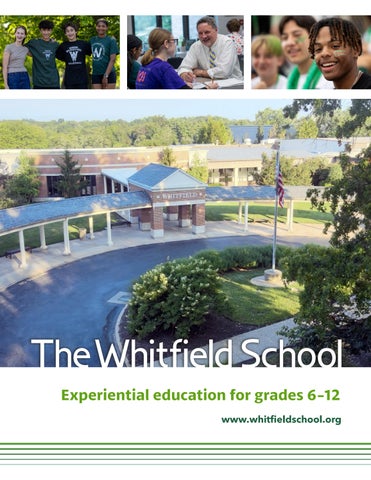
Experiential education for grades 6-12 www.whitfieldschool.org
OUR MISSION A small school community committed to kindness and trust, Whitfield inspires a diverse student body to lead lives of curiosity, integrity, and purpose.
OUR VISION Empowering young people to discover and become their best selves.
Welcome from our Head of School
Dear Prospective Families, When I was in junior high, my English teacher had us create dioramas depicting a favorite scene from a book we had recently studied. I found a shoebox, cut out the top, lined it with colored tissue paper, cut out several cardboard figures and a couple of pieces of scenery, glued them all in, and then cut out an eyehole–and voila!, your standard, slapdash student project. It’s maybe sad and somewhat telling that I have no memory of the book or anything about it. I don’t know what my teacher was hoping we’d take away from doing the diorama, but I suspect it was meant to be fun, and I do remember that we did the project only after we had done the work of “studying” the book. After that, we moved on to the next unit. So doing the project was the thing we did after the learning happened, a kind of dessert to reward us for eating our academic vegetables. My fear is that when some people hear “project-based learning” or “experiential learning,” this is what they think of. In fact, real project-based learning, and experiential teaching and learning more generally, is nothing like what my kind, well-intentioned teacher did long ago. In experiential classrooms and curricula, the projects and other hands-on work that students do isn’t dessert–it’s the meal itself. It’s the means by which students learn, complementing or replacing traditional “direct instruction.” When our Calculus students create their own individual textbooks, putting each new concept in their own words, that’s not dessert–that’s how they master taking the derivative and the definite integral and other foundational ideas and skills. When our juniors create their exhibits for the DNA of a Nation project, that’s not dessert–each exhibit is simultaneously the direct evidence and product of research and critical engagement with complex historical issues. When our Mandarin students create the itinerary for a trip to Taiwan, that’s not dessert. When students in 10th grade English reimagine Lord of the Flies as a modern film, that’s not dessert. When our middle school students write the script for and then perform an original play, that’s not dessert. When students work together at the board to solve a Chemistry problem, or talk in small groups in a Humanities class, or create an individualized logo for a teacher’s door–those are all ways for students to develop and deepen essential skills and understandings. In fact, decades of research both in schools and in the neuroscience of learning has shown that human beings learn best–deeply and enduringly–when they learn by doing. Even the most engaging and knowledgeable lecturer is going to be less effective than a well-designed class activity where students are doing the talking–and the thinking. And so at Whitfield, in our experience-based classrooms, the teacher is occasionally an explainer or instructor. But much more often and more importantly, the teacher is a designer of experiences, of opportunities for students to think and learn–discovering curiosities and passions that they’ll never forget. At Whitfield–truly– it’s the experience that counts. Won't you join us?
why Whitfield?
Wondering what makes Whitfield such a special place to learn and grow? Here's five of our favorite reasons—plus one bonus you won’t want to miss!
1
Learning That Leaps Off the Page At Whitfield, learning comes alive through
hands-on, inquiry-based experiences that connect students to real-world concepts. Whether building a full-size trebuchet in science, exploring literature through creative projects, or engaging in service learning, Whitfield students don’t just study—they experience education in meaningful ways.
2
Belonging Comes Naturally Here Whitfield’s inclusive, welcoming
environment encourages students to bring their authentic selves to school each day. Our low-stress culture and emphasis on balance help students thrive both academically and emotionally and foster genuine connections across backgrounds and perspectives.
3
Personalized Pathways to What Comes Next Whitfield’s College Counseling program takes
a thoughtful, individualized approach to help students find the right fit. With one-on-one guidance and a deep understanding of each student’s goals and strengths, our counselors ensure that every graduate’s next step feels exciting and intentional.
4
Something for Everyone Whitfield’s wide range of extracurricular activities, affinity groups, and athletic
programs give students countless ways to explore interests and build confidence. Whether performing on stage, competing on the field, or leading a club, students discover passions that enrich their academic journey and strengthen our close-knit community.
5
Teachers Who Truly Know Their Students Our teachers are more than educators—
they’re mentors, guides, and champions of every student’s success. With small class sizes and strong relationships, Whitfield faculty truly know each learner, sparking curiosity and helping students grow into thoughtful, capable young adults.
Four-legged Warrior Dusty, a golden retriever, has quickly become everyone’s favorite classmate. As Whitfield’s fifth school dog, he brings comfort, laughter, and a sense of family to every hallway he visits. It’s hard not to smile when Dusty is around— and that’s exactly how we like it.
middle school experience
A Destination For Growth Middle school is a key phase of growth, second only to early childhood. At Whitfield, we see it not just as a step to high school but as an important stage itself. We partner with families to create a culture of trust, curiosity, and joy. Our teachers guide students to take charge of their learning, build self-awareness, and develop skills to thrive through adolescence. This is supported by a strong advisory program based on Whitfield’s Habits of Mind & Heart, ensuring each student is known, supported, and challenged to grow as a learner and leader.
6th Grade
7th Grade
8th Grade
Belonging & Foundations
Perspective & Exploration
Leadership & Voice
Sixth grade is a year of joyful
Students look outward to the
Eighth grade is a capstone
transition focused on building,
broader world—developing cultural
year in which students step
community, confidence, and
empathy, scientific curiosity, and
fully into leadership and develop
essential school skills. Students
creative confidence. Humanities
a confident, authentic voice.
develop strong habits of
courses explore global cultures
Students engage deeply with
organization, collaboration, and
from mythology to modern
questions of identity, freedom,
advocacy while exploring the
literature, while math and science
justice, and civic responsibility
natural world, stories, and early
deepen algebraic reasoning and
while advancing in math, science,
American history.
life science understanding.
and interdisciplinary thinking.
The year begins with a three-
Students begin to explore new
As division leaders, they engage
day outdoor adventure at Trout
disciplines through our two-
in increased responsibility, a
Lodge in the Ozark Mountains.
year Exploratory STEM and
Habits of Mind & Heart exhibition,
Whitfield’s signature Middle
Arts program. Immersive field
and a travel experience to
School 101 course supports all
experiences, including the Kaplan
Washington, D.C. that brings
sixth graders with executive
Feldman Holocaust Museum and
learning into the real world
function, technology use, and
an off-campus outdoor education
the neuroscience of learning.
trip, encourage intellectual and personal risk-taking. .
upper school experience
Empowering Students to Thrive The Upper School at Whitfield is a dynamic environment where students continue to discover and develop their passions, explore leadership opportunities, and build the skills they need to succeed in college and beyond. With a focus on experiential learning, the Upper School provides countless opportunities for students to apply knowledge in meaningful, real-world contexts.
Academic Excellence Is Experiential
Challenging Coursework
Whitfield’s academic program fosters curiosity,
At Whitfield, students looking for additional challenge
creativity, and critical thinking. Students dive into
and rigor can choose to take accelerated, Advanced
subjects through interdisciplinary projects and
Placement® (AP), and advanced college credit courses.
hands-on learning. For example:
These courses are open to students who have
y The DNA of a Nation Project: Juniors combine English and Social Studies to create a unified American history narrative.
demonstrated the ability to do work at the highest levels
y Kinetic Sculptures: Science students blend engineering and art to build moving sculptures.
English, history, visual arts, French, and Spanish.
and seek challenge in the following subject areas: physics, chemistry, biology, calculus, statistics, computer science,
y Artistic Portfolios: Visual arts students display their talents in campus exhibitions showing creative growth.
Co-Curricular Opportunities
Graduation requires four years each of English,
in activities that build teamwork, creativity, and
social studies, math, and science; three years of
resilience, supported by caring faculty.
a world language; and one year each of fine arts and
y Athletics: Whitfield’s no-cut policy lets every student join while competing locally and statewide.
physical education. Advisory classes help develop life skills and strong bonds.
Learning goes beyond the classroom. Students engage
y The Arts: Students excel in theater, band, choir, and art shows celebrating their talents. y Clubs and Affinity Groups: Student-led clubs and identity groups help students explore passions and connect with peers.
curriculum OUR MISSION
OUR VISION
A small school community committed to kindness and trust, Whitfield inspires a diverse student body to lead lives of curiosity, integrity, and purpose.
Empowering young people to discover and become their best selves.
Advisory
English Students build character, purpose, and passion in an environment that prioritizes communication, ER ST RE CULTURAL connectivity, and innovative CT N A COMPETENCE thinking. Students develop an HABITS appreciation of the power and OF MIND beauty of the English language & HEART by exploring both traditional and contemporary literature, W D CITIZENSHIP T H MIN and through sustained focus on the writing process. Organized around essential questions and MINDFULNESS thematic literature selections, each English course combines collaborative experiences and individualized Mindfulness instruction, the hallmark of which is writing as aand process. design means Noticing observingLearner-centered things the present moment in order thatin students examine ideas, read critically, make to act with intention presentations, design media products, and propose arguments using a variety of technological resources, balancingLeadership deep thinking and concrete skill acquisition Cultural Competence to prepare for college, careers, and citizenship. Understanding one’s own and others’ Inspiring,them supporting, and O
T
E
S
GR
cultural identities and respectfully engaging across differences
HS
CH
A
R
ETHICAL CONDUCT
GT
The Advisory program ensures that all students are well-known and supported academically, socially, and emotionally. The Habits SCHOLARSHIP of Mind & Heart curriculum is the foundation of our advisory experience, helping students to understand themselves and others, and to grow LEADERSHIP into healthy, well-balanced human beings. The program also includes developmentally appropriate, research-based discussions of community norms, social media and mental health, and Ethical Conduct study strategies. Through this curriculum, students also foster an appreciationEvaluating for theand doing what is right,and even when strengths of others in their advisory group work no one is watching throughout the year to build trusting relationships.
empowering others towards a common goal
* Advanced Composition & Literature / AP English Language & Composition
Citizenship
Scholarship
Being a responsible, involved, and contributing member of a community
Exploring a subject with intention and curiosity and developing the skills for deep and life-long learning
Fine Arts
Students develop language and communications skills, creative problem-solving strategies, confidence, “BE KIND AND DO THE THING” andRIGHT perseverance through music, performing, and visual arts classes. In the visual arts, students develop essential studio techniques and skills, gain an understanding of how to approach art-making as a problem-based process, and create themes through visual imagery. They also develop the ability to articulate artistic concepts and use artistic vocabulary to critique work effectively. In the performing arts (including theater, band, and choir), students discover and develop their skills and talents, working onstage and behind the scenes to imagine, create, and move others. * AP 2D Art & Design / AP 3D Art & Design * Advanced Placement® (AP), accelerated, and advanced college credit courses
Math and Computer Science
Physical Education and Health
The goal of the math program is to provide a strong foundation in mathematics through challenging courses that are appropriate to the ages, abilities, and needs of our students. At all levels, students learn to work collaboratively as well as on their own. The curriculum covers a wide range of topics, including algebra, geometry, trigonometry, calculus, and statistics. In all courses, emphasis is placed on collaboration, problem-solving, computational thinking, and clearly communicating mathematical ideas and concepts. In mathematics and world languages, placement tests will assure that students enter our curriculum at the right place and receive the appropriate level of challenge.
The physical education program provides activities to develop students’ awareness of terms, scoring, rules of play, skill techniques, safety principles and basic offensive and defensive strategies for the sports covered in the instructional program. Activities for students may include the following: field hockey, fleetball, volleyball, basketball, wrestling, net games, hockey, weight training, soccer, lacrosse, track, softball and fitness testing.
The computer science program offers a series of electives. These courses aim to provide students with a strong foundation in computer science principles and to inspire innovative thinking through practical, hands-on applications. Computer science electives allow students to explore coding, web development, and computational thinking, preparing them for meaningful participation in our increasingly digital society. * AP Calculus AB / AP Calculus BC / Calculus III (AP Calculus BC is a prerequisite), AP Statistics / Computer Science A / Computer Science Principles (students are prepared to take AP exams from both computer science courses)
The health curriculum gives students the knowledge and tools to make healthy decisions throughout their lives. The curriculum is based upon the three areas of health: physical health, mental/emotional health, and social health. Physical health includes first aid, injury prevention, nutrition, sleep, physical activity, hygiene, body systems, human growth and development, disease prevention, and avoiding the use of alcohol, tobacco, and other drugs. Mental/emotional health includes character development, self-awareness, stress management, mental disorders, and spiritual health (a sense of meaning and purpose in life). Social health includes communication, conflict resolution, peer pressure, and healthy relationships.
curriculum
Foundations
Science
This required course for 9th grade students enhances the physical education and health curriculum. Special emphasis is placed on the practical application of the Habits of Mind & Heart to develop life-long wellness skills.
The seven-year science program is designed to produce well-rounded, confident individuals who are wellversed in scientific procedure and theory, have an appreciation for the natural world, and who can thrive in a demanding college environment and beyond. The Whitfield science department is dedicated to the development of critical thinking and collaboration skills by immersing students in scientific theory, process, and technique within a challenging laboratory environment. Students are also challenged to attain a sophisticated level of scientific literacy and technical writing ability.
Neuroscience and Self: This rotation focuses on developing the abilities necessary for recognizing and regulating one’s emotions, thinking, and behavior. Skills explored include adolescent brain development and executive function, emotional agility, self-management, and problem-solving. Technology and Society: This rotation focuses on the role today’s culture plays in building tomorrow’s tools and communities. Units emphasize social identities, dialogue, privacy, data structures, and implicit bias.
* Accelerated Physics I / Accelerated Physics II / AP Chemistry / AP Biology / Advanced STEM Research & Methodology
Physiological Awareness: This rotation focuses on topics and trends related to physical development and well-being. Units emphasize nutrition, CPR, sexual health, relationships, and addiction.
Social Studies Through the study of history, government, geography, psychology, sociology, and economics, students gain an understanding of the behavior and traditions of societies and cultures of the past and the present. Students explore the experience of diverse historical actors and a range of historical narratives. Students learn to integrate, analyze, synthesize, and evaluate both primary and secondary sources and to develop an understanding of human experience across time and space. They master critical thinking, writing, and research skills, and learn to present their ideas through papers, projects, and oral presentations. * United States History, Advanced College Credit
World Languages The primary emphasis of the world languages program is oral proficiency. Students work toward speaking in the target language and gain confidence to navigate successfully through a culture different than their own. Pair/group speaking activities in the target language involve face-to-face communication, active listening with a focused and conscious engagement with a partner, being respectful, and continually engaging in the learning process. Languages offered are French, Spanish, and Mandarin. * French, Advanced College Credit / Spanish, Advanced College Credit / AP Spanish Language & Culture
daily breakdown
Sample Schedules for Middle & Upper School 8th Grade Student
9th Grade Student
DAY 1
DAY 2
DAY 3
DAY 4
DAY 5
DAY 1
DAY 2
DAY 3
DAY 4
DAY 5
Science 8: Physical Science
English 8: Exploring Freedom and Identity
Middle School Choir
French II
Geometry
Physical Education & Health
Upper School Choir
English 9: Literature & Composition
Algebra II
Spanish III
French II
Social Studies 8: Civics & US Government
Physical Education & Health
English 8: Exploring Freedom and Identity
English 9: Literature & Composition
Algebra II
Global History I
Biology 9
Upper School Choir
Assembly
MS Assembly
Assembly
Assembly
Middle School Choir Assembly
Lunch
Lunch Advisory 8
Advisory 8
Lunch
Lunch
Community Time
Academic Lab 8
Physical Education & Health
Geometry
Science 8: Physical Science
Geometry
Academic Lab 8
English 8: Exploring Freedom and Identity
Middle School Choir
Bonus Block: MS Exploratory Theater
Science 8: Physical Science
Bonus Block: MS Exploratory Theater
Social Studies 8: Civics & US Government
Assembly
Community Time
Upper School Academic Lab
Advisory 9
Lunch
Lunch
Lunch
Lunch
Global History I
Biology 9
Spanish III
Physical Education & Health
Algebra II
Science 8: Physical Science
Spanish III
Academic Lab
Upper School Choir
English 9: Literature & Composition
Biology 9
Bonus Block: MS Exploratory Theater
Bonus Block: Foundations
Physical Education & Health
Bonus Block: Foundations
Global History I
Bonus Block: Foundations
Lunch
Social Studies 8: Civics & US Government
Assembly Advisory 9
Lunch
Advisory 9
French II
Physical Education & Health
Bonus Blocks
Academic Lab
Community Time
Bonus Blocks are flexible periods built into the schedule that vary by grade level and individual student needs. These blocks may include courses or experiences such as Middle School 101, Exploratory Arts and STEM, Ninth Grade Foundations, Study Hall, College Knowledge, AP courses, and other opportunities that support students' growth and interests.
Academic Lab is a dedicated time for students to connect with teachers, ask questions, and receive individualized support— modeled after college office hours. Whether they need extra help, feedback, or time to dive deeper into a subject, Academic Lab encourages students to take ownership of their learning.
Community Time gives students the opportunity to build connections beyond the classroom by choosing two clubs, affinity groups, or activities each semester. This dedicated time fosters exploration, leadership, and a strong sense of belonging within the Whitfield community.
college counseling
Recognized locally and nationally for its exceptional program, Whitfield's college counseling team mirrors the school's student-centered approach by offering a tailor-made experience for students and their families. Like all departments at Whitfield, the college counseling program uses a spiraling curriculum with an emphasis on individualization. The college counseling program begins informally in sixth grade, becomes more detailed and strategic in the ninth and tenth grades, and evolves into a one-on-one student/parent/counselor partnership in eleventh and twelfth grades. Our families value the personalization, professionalism, and low-stress approach of Whitfield’s college choice process which distinguishes it from all other schools in the region.
A selection of the schools Whitfield graduates have chosen to attend over the last five years: Alabama A & M University American University Bates College Boston University Brown University Bucknell University Case Western Reserve University
Class of 2026 The 76 graduates in the class of 2026 attended 55 different colleges and universities located in 24 states across the United States, in addition to institutions in the Netherlands and Belgium.
Emory University Fordham University Grinnell College Howard University IE University– Madrid (Spain) Illinois Institute of Technology Kenyon College
Catholic University of Leuven (Belgium)
Loyola Marymount University
Chapman University
Macalester College
Clemson University
Morehouse College
Colorado College
New York University
Colorado School of Mines
Northeastern University
Dartmouth College
Northwestern University
Elon University Embry-Riddle Aeronautical University
Oberlin College Pepperdine University
Prarie View A & M University
United States Air Force Academy
Reed College
University of California, San Diego
Rensselaer Polytechnic Institute Rose-Hulman Institute of Technology Savannah College of Art and Design School of Art Institute of Chicago Santa Clara University Scripps College Southern Methodist University
University of Edinburgh (Scotland) University of Michigan– Ann Arbor University of North Carolina at Chapel Hill University of Notre Dame University of Southern California
Spelman College
Washington University in St. Louis
Stevens Institute of Technology
Xavier University of Louisiana
Tulane University
Program Overview Middle School
Senior Year
• Awareness of college selection process begins for students and parents
• Application logistics
Freshman Year • Understanding the Whitfield transcript • The importance of getting involved • Introduction to MAIA Learning • Setting SMART goals
• Selective college admission: how it works and demonstrated interest • Letters of recommendation • Financial aid & Scholarships • Application completion workshops • Line-by-line review of all application materials • Mindfulness and stress management workshops • Making a final decision • Transition to College Workshops:
Sophomore Year • Revisiting SMART goals • Standardized testing and college admission • Practice ACT & SAT testing
y What to pack for a dorm room y Understanding college lingo y Self-care y The difference between high school & college academics
• Career & Major Exploration Program begins • Alumni conversations • University field trip • Establish a one-on-one connection with your college counselor
Junior Year • Standardized testing and college admission continues • Practice ACT & SAT testing • Career & Major Exploration Program continues • Alumni conversations • University field trip • Visiting colleges • College Knowledge coursework begins, with a special emphasis on: y Researching colleges y Crafting an activity list y Brainstorming and drafting a personal statement y Beginning work on the Common Application
Grades 9-12 • College Counseling Speaker Series: y Athletics and the College Choice Experience y International Students and the College Choice Experience y Navigating the Ever-Changing Standardized Testing Landscape y Financial Aid y Portfolio-Based Programs (Musical Theater, Fine Arts, Music, Dance, Theater) y First Generation College Students y Summer Programming • Curated kit of Resources: y Scholarship lists y Summer program opportunities y Need-based financial aid resources y Free ACT prep (strategy videos and practice exams) • Personalized college tour itineraries • Guidance on all elements of the college choice experience
athletics
Fall UPPER SCHOOL
Cross Country - Boys, Girls Field Hockey - Girls Golf - Girls Soccer - Boys Tennis - Girls Volleyball - Girls MIDDLE SCHOOL
Cross Country - Boys, Girls Field Hockey - Girls Soccer - Boys Volleyball - Girls
Winter
36
State Championships
89
District Championships
Whitfield has one of the most successful athletic programs in the area, claiming 36 state championships, earning multiple coach- and player-of-the-year awards, and sending numerous alumni to play at the collegiate level. The school emphasizes teamwork, time-management, personal growth, sportsmanship, health and fitness, and the development of leadership. Our student-athletes compete to the best of their abilities, grow as people, and strengthen school spirit within our close-knit Whitfield community.
A Team for Everyone Team sports allows young people to further develop athletic skills, improve communication skills, feel a sense of community, and make lasting friendships. Our no-cut policy allows all students to explore new athletic activities based on their interest, regardless
206
Individual state medalists
of prior experience. 80% of upper school students choose to play a sport.
UPPER SCHOOL
Basketball - Girls Basketball - Boys Cheer & Dance - Co-ed Wrestling - Boys MIDDLE SCHOOL
Basketball - Girls Basketball - Boys Cheer & Dance - Co-ed Wrestling - Boys
Spring UPPER SCHOOL
Baseball Golf - Boys Lacrosse - Girls Soccer - Girls Tennis - Boys Track & Field - Boys, Girls Volleyball - Boys MIDDLE SCHOOL
Baseball - Boys Soccer - Girls Volleyball - Boys
activities & clubs
100%
Clubs led by Students
Student Clubs
Affinity Groups
Student clubs provide an opportunity for students
Affinity group meetings provide a facilitated,
to explore their interests and passions outside the
affirming space for students who share an identity,
classroom, develop leadership skills, and contribute
background, or affiliation–or who want to support
to the Whitfield community.
their friends and classmates. Students in these
Admissions Club
Library Advisory Council
Art Club
Math Club
Chess Club
Mindfulness and Meditation Club
Climbing Club Community Service Club Cooking Club
Model UN Ping Pong Club
groups explore and reflect upon their own identity, celebrate shared culture and traditions, and discuss common experiences, needs, and challenges. Affinity spaces also offer an opportunity for mentorship, support, community-building, and leadership. Asian Student Union (ASU) Black Student Union (BSU)
Costume Design Club
Perspectives (literary magazine)
Debate Club
Philosophy Club
Gender & Sexuality Alliance (GSA)
Esports
Student Council
Hispanic Student Association (HSA)
Fashion Club
Thespian Society
International Student Union (ISU)
Film Club
Women in STEM
Jewish Student Union (JSU)
Garden Club
Yearbook Club
Muslim Student Union (MSU)
Green Scene (spirit club)
Yoga Club
Women’s Alliance
Fellowship of Christian Athletes (FCA)
Please note that clubs change based on student interest. Have an idea for a club you don't see on our list? Start a new one! New clubs form each year!
from Whitfield to the World
Middle School Memories Whitfield’s Middle School program includes immersive off-campus trips for each grade level. These kinds of experiences—where students discover they can do more than they imagined—help them uncover new skills, passions, and confidence. Far from a detour, the lessons learned on off-campus trips will enrich their school lives, deepening relationships and strengthening the sense of community that defines Whitfield.
The Hakuba Exchange Program Our unique international partnership with Hakuba International School allows Whitfield students the opportunity to travel to Japan for a semester of immersive, cross-cultural learning. At the same time, we welcome Hakuba students to our campus, enriching our community with new perspectives and shared experiences. These students won’t just learn about another culture—they’ll live it.
Spring Break Excursions Upper School students have the option to travel in small groups to different countries such as Taiwan, Panama, and France. Each trip offers students the opportunity to engage directly with language, culture, history, and community. Students step into new environments, apply their learning in real time, and build meaningful connections with people and places far from campus. Experiences like these extend the work of the classroom, challenging students to think critically, adapt, and engage with the world in thoughtful ways.
These opportunities are not stand-alone—they reflect the broader strategic commitment we’ve made through Whitfield 2030: to create rigorous, real-world experiences that challenge students to learn more deeply and more meaningfully.
uniquely Whitfield
W-Days At Whitfield, learning extends far beyond the classroom. Throughout the year, students participate in W-Days— immersive, grade-level experiences designed to connect classroom learning with the world around them. Whether conducting field research, exploring museums and historical sites, collaborating with community partners, or tackling outdoor challenges, students develop curiosity, confidence, and meaningful connections through hands-on discovery. Each W-Day is intentionally designed to deepen academic understanding while fostering collaboration, resilience, and a lifelong love of learning. It's one of the many ways Whitfield transforms education into experience.
Signature Exhibitions Learning deserves an audience. Throughout the year, Whitfield students showcase their work through Signature Exhibitions, where they present authentic, interdisciplinary projects to families, faculty, peers, and community members. These exhibitions celebrate not only what students have learned, but how they think, create, collaborate, and communicate. By sharing their work publicly, students build confidence, strengthen presentation skills, and learn to articulate their ideas with purpose— preparing them for success in college, careers, and beyond.
Capstone Every Whitfield senior completes Capstone, a year-long, inquiry-driven experience that serves as the culmination of their Whitfield education. Guided by faculty mentors, students pursue a topic that sparks their curiosity through research, interviews, field experiences, and real-world exploration before presenting their findings to the community. Capstone empowers students to think independently, solve complex problems, and communicate with confidence. More than a final project, it reflects the habits of curiosity, integrity, and purpose that define a Whitfield graduate.
take note
Events and Important Dates Below is a list of upcoming opportunities to experience Whitfield firsthand. We hope you'll join us for one or more of these events as you begin exploring your secondary school options. Each event offers a chance to meet our community, learn more about our programs, and discover what makes Whitfield a place where students are empowered to discover and become their best selves.
September Visit Days & Parent / THRU February Caregiver Tours
WEDNESDAY
October 7
I SSL Secondary & High School Night
TUESDAY Non-9th Grade January 12 Applications Due
WEDNESDAY
January 13 FRIDAY
th Grade Decisions 9 (Sent after 4:00 PM)
FRIDAY
9th Grade Contracts Due
FRIDAY
Non-9th Grade Decisions (Sent after 4:00 PM)
FRIDAY
Non-9th Contracts Due
February 5 SUNDAY
October 18
Open House February 26
THURSDAY
November 19
Upper School Experience
9th Grade December 11 Applications Due FRIDAY
Whitfield Night
March 12
April 2
INQUIRE AND REGISTER FOR EVENTS HERE
175 South Mason Road Saint Louis, Missouri 63141 Phone: (314) 434-5141 l Fax: (314) 434-6193 www.whitfieldschool.org admissions@whitfieldschool.org