S ed amp itio le n
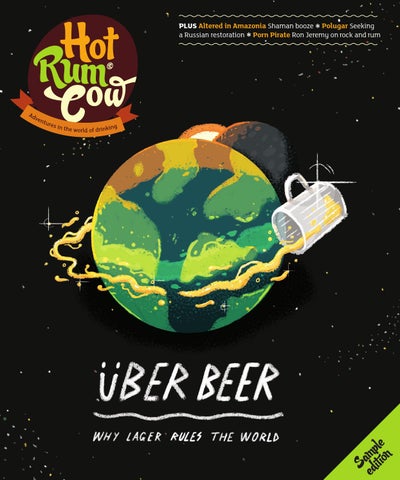
PLUS Altered in Amazonia Shaman booze * Polugar Seeking a Russian restoration * Porn Pirate Ron Jeremy on rock and rum
Ape�tif
the united nations of hangover Germany
Katzenjammer
Literally translated as cats wailing, katzenjammer now refers to most things causing an ‘unpleasant reaction’, but especially the morning after.
14
France
Mal aux cheveux
Translates as ‘hair-ache’. The French tiptoe around the terrible truth and suggest it ‘hurts the hair’, implying they had a little bit too much vin rouge last night.
ILLUSTRATION: LINDA COULTER
In Britain, before we ever had a hangover, we were crapulous. In the early 20th century the word ‘hangover’ shifted from meaning unfinished business to cover that morning after feeling. It serves its purpose, but lacks the poetry of some overseas phrases
Mexico
Cruda
A slang term for hangover, cruda literally means raw. Some of us do wake up feeling like a tenderised steak.
Iceland
Timburmaður
Literally translated as carpenter (timberman) but used more commonly to describe the aftermath of a night on the Brennivín in Reykjavík. The word could relate to a feeling of ‘timber-mouth’ resulting from dehydration.
www.hotrumcow.co.uk
15
Lager an apology words:
Liz Longden picture:
Hector Retamal
W
hen a mainstream brand of beer finds itself saddled with the epithet of ‘wife beater’, you might guess that that beer is in trouble. In 2012 it emerged that AB InBev, owners of Stella Artois, hired a PR firm to delete references to its unfortunate nickname from Wikipedia, but it will take more than some surreptitious online editing to solve lager’s image problem. Because in the minds of image-conscious beer drinkers, it seems that lager just isn’t classy anymore. Somehow, the images of sleek, continental sophistication that lager advertisers have been peddling over the past couple of decades have lost their magic. At some point, sexy ladies and suave gents have been substituted by ‘lads’ and ‘ladettes’ – that special kind of drinker for whom more is definitely more – and lager has become the unofficial drink of the sorriest kind of night out. Its demise has even made
16
Afp/Getty Images
www.hotrumcow.co.uk
17
Altered in Amazonia Alcohol plays a vital role in shamanic rituals across the world, as our man in Ecuador discovered during a heated encounter with the local firewater on entering the House of Visions
I
words: Richard Aslan Illustrations: Andrew Gibbs
jumped at the chance to meet a real, live Amazonian shaman, and like any good writer, I did my research thoroughly beforehand. Standing in a hut in my underpants in the Ecuadorian jungle, however, I feel woefully unprepared in spite of all my reading, and twist my fingers nervously behind my back as I wait to be shamanically cleansed. The shaman, Don Juan, is a diminutive, middle-aged man of no more than five foot one. He has a broad, friendly face and is stamping around me, muttering rhythmically under his breath. Every now and again, he swoops at me with a fan of feathers, sending goose pimples up and down my thighs. Despite the hut’s grand title of Alishina Huasi, or House of Visions, it is little more than a conical thatched roof held up
26
by wooden columns, and the racket of the rainforest is deafening. Insects clatter and drone, bright birds whoop and chatter, and off in the tangle of trees, something large howls and jibbers. My eyes are open a crack, even though I’ve been told to keep them closed, and I am acutely aware that there is something small and carnivorous feasting in the fold under my left buttock. Thanks to a bout of voracious reading on the unexpectedly plush, air-conditioned coach bound for the rainforest lodge, I have all sorts of shamanic trivia buzzing around my anxious mind. I know, for example, that shamanism is not a religion but rather a collection of traditions that have a few basic characteristics in common, practised across the world from Latin American to Siberia. I also know that shamans don’t reply to the situations vacant ads, but
32
www.hotrumcow.co.uk
33
B
y whatever means the mystery yeast arrived there, it’s known that coolfermented beer was being made in Bavaria before 1533, when a law was passed forbidding the brewing of beer in the summer. Horst Dornbusch, author of Prost! The Story of German Beer, says that before this time, without realising it, brewers would almost certainly have produced both ales and proto lagers – ales when the air was warmer and top-fermenting yeast could thrive, and lagers when cooler temperatures allowed bottomfermenting yeast to thrive. Since brewers had no understanding of hygiene or microbiology, however, these medieval beers were frequently foul-tasting, and brews made in the summer, when levels of bacteria in the air were higher, were the principal culprits – hence the summer brewing ban. The introduction of the Reinheitsgebot in 1516, Bavaria’s famous purity laws which forbade the use of anything other than barley, hops and water in beer, had, Dornbusch argues, already begun the process of forming one of the world’s first ‘beer styles’. By later banning summer brewing and restricting brewing conditions to those that were perfect for lagers, the authorities continued that development. And the law had another consequence: in order to ensure that winter brews would also last throughout the summer months, brewers would store their beer in caves or in cellars, thereby inadvertently inventing the lagering process.
36
37
The Forsaken With domestic sales in crisis, sake brewers must look to new markets to sustain their ancient drink Words: Tom Green and Chiara Pannozzo continued
50
www.hotrumcow.co.uk
51
MATT’S BEERS
PETE’S BEERS
nnnn LAGER
STOUT
WINDSOR & ETON: REPUBLIKA PILSNER LAGER
SLUGSGLERS
ZzZz AVERY: THE KAISER IMPERIAL OKTOBERFEST LAGER
Many beer drinkers think that British brewers simply can’t make lager, and that lager in Britain is tasteless yellow fizz. Windsor & Eton freely admit that they had some help from the home of Pilsner lager with this one, and it shows – side by side, it stands up to comparison with the best European lagers.
In true American fashion, Avery has taken the Oktoberfest style and ramped it up by doubling the original recipe. Not as sessionable as traditional Oktoberfest, a big bomber bottle of The Kaiser is enough for one person. A flavourful and bready lager, with a deep, rich copper colour and a bitter finish.
ACORN: GORLOVKA IMPERIAL STOUT Slightly biased because it’s from my home town, but this rich stout, named after Barnsley’s Ukrainian twin town, sits nicely between the easier drinking commercial stouts and the thick, heavy monsters that usually go under the ‘imperial’ moniker. A beautiful blend of strength and subtlety.
JAILHOUSE: BREAKOUT STOUT A hometown favourite made in Hampton, Georgia. Jailhouse is an exemplar of the American take on the umbrella-style ‘stout’. Rich, but relatively dry with some residual sweetness, this stout has a huge coffee note. It falls to the top end of the stout category without being an imperial stout.
WHEAT CAMDEN TOWN: GENTLEMAN’S WIT
Camden aren’t trying to shock or provoke they just make very good, flavoursome beers that reflect a broad range of influences. Brewed with roasted lemons and bergamot, this one combines everything that’s best about fruity, zesty wheat beers. IPA
The
STOUT
TWO BROTHERS: BARE TREE WEISS WHE AT WINE ’13 Wheat beer can cover such a broad range but this is a unique style with wheat, barley and German hops, which is aged in oak for over a year. Really complex with caramel, vanilla and a hint of banana. The flavours vary from year to year and if you can hold on to it for any time it will age in the bottle like wine for several years.
MEANTIME: INDIA PALE ALE We all love a hop bomb, but the original IPAs were intended to be drunk once those hops mellowed out, leaving the beer more balanced and yet more complex. This is one of the very best iterations of what we think an IPA might actually have tasted like in the sweltering heat of Calcutta in the mid-19th century.
ALESMITH: IPA Perfect for what it’s supposed to be, this IPA is proof that Alesmith don’t make a bad beer. With big, citrus, piney, resiny notes coming from those west coast American hops and a nice caramel molten note, it really is a stellar pale ale – San Diego’s flagship beer.
WILDCARD – WILD BEER CO: NINKASI Experimental, but not for the sake of being so. The blend of New Zealand hops, wild yeast and champagne fermentation may sound like a tick box exercise in hipster beer fashionability, but with one sip you can tell it was the flavour reward that mattered most. A sophisticated, mature, elegant beer.
WILDCARD – LOST ABBEY: CABLE CAR (2009) This is an American sour ale with lots of funk. A brewery-only release, Cable Car is very rare and hard to come by. Its cheese and lemon notes add a deep richness and the wild yeasts and bacteria – Brettanomyces, Lactobacillus and Pediococcus – add a huge complexity.
58
LAGER
IPA
BEER’S
BATTLE ROYALE
S
o, who to judge these proud warriors? Our five-strong panel, drawn from within and without the Hot Rum Cow stable, covered all the bases. Professionals and amateurs, men and women, Brits and Yanks (Red Coats and Rebels, if you prefer) and with a range of beer knowledge. The beers were served blind, category by category with no steer given on where they came from. This was far from a clinical, scientific process – our judges were simply asked to score each beer out of 10 based on their enjoyment, how the beer fared as a flag bearer for its style and how it compared with its US or UK foe. As with many good sessions, we launched with lager. Republika was praised for its subtlety, smokiness and above all how drinkable it was. But, for palates perhaps more familiar with the qualities of Pilsner, the shock of the new carried the Kaiser to victory thanks to the big man’s boldness and “sweet, sticky nose”. And so to IPA. Craft beer’s poster boy beer, here represented by two very distinct interpretations. Alesmith IPA dropped the West Coast ‘hop bomb’ Pete Brown was wary of and there was no question among panellists that this was a classic US IPA (unless, of course, it was a devious UK brewer perfectly mimicking a classic US IPA). But the bomb went off and
from the rubble strode the plucky, old-fashioned British underdog as Meantime’s subtlety, “malty whiff ” and “crusty bread” laid the brash American low. With wheat, while the scent of Camden’s Wit was for some “parma violets and perfume”, for others it was “a nineties hair salon”. Ultimately, the outcome of that debate was irrelevant as the London gent was overcome by the evening’s overall top scorer – Bare Tree’s Weiss Wine. “Mmmm, easy drinking, apricot jam, banana smells and tastes,” they said. “Break out the stout,” they said next. This clash of the captains’ hometown brews was a hotly contested round with the most consistent scores across the judges and little to choose between the competitors. Gorlovka was “roasty”, “deep chocolate and rising sweetness”. But Breakout was “bold espresso”, “100% cocoa chocolate and nuts”, even “fresh paint”, and took the honours for Hampton, Georgia. And so, bruised and bloodied, we staggered to the final showdown – the no holds barred, crazy fool, wildcard round. The US were three rounds to one to the good, but on overall scores a sensational show from the Brits and the empire could be ours again. Wild Beer’s Ninkasi’s subtlety, fruit burst and “easy-breezy” drinking posted a big score. The evening’s finale, Lost
Abbey’s Cable Car – easily the most divisive beer of the event – was briefly on the ropes as the sour naysayers weighed in. “Why would you make something like this?” pleaded one judge. But for the other half of the room this was the beer of the night – they hailed its mouth-pinching funk and its “lime sherberts and lychees”. The Cable Car forced a dead heat in the round and, with that, overall victory went to the USA. So, what did we really learn? Certainly not that US beer is definitively better than UK or vice versa. The really bold and unusual beers scored well in what was an unusual drinking scenario, but perhaps if asked to sit down and spend an evening in a beer’s company our judges would opt for something more subtle and familiar. A few beers split the sexes, suggesting there may be something to the theory that women have a keener sense for certain smells and flavours. Lastly, our panel was surprisingly accurate in guessing the beers’ country of origin, which perhaps goes some way to counter any sense that British brewers are just aping the US craft scene. Rather, the best breweries are playing to their own national strengths and traditions. To labour the already stricken sporting analogy to an overdue death, at the end of the day, beer was the winner. ■ www.hotrumcow.co.uk
59
The bluffers’ guide to lager Do you struggle to tell your Dunkels from your Dortmunders? Save yourself embarrassment with our easy-to-use lager flow chart
What lagers do you like?
Pale
Dark Medium strength
Medium strength or pay-attention strength? A bit more hoppy, or a bit less hoppy?
MORE LESS
Dortmunder
Traditionally brewed in the Dortmund region, a Dortmunder lager is typically a little bit less hoppy than a Pilsner. Full-bodied, and often with a slight biscuity, malty tone. 40
Pay-attention strength Crisp and fizzy? YES YES
German Pilsner
Lighter in colour than its Czech counterpart, a German Pilsner is also typically more carbonated, crisper and a bit drier. Zesty, grassy and gassy.
NO
Spicy and herby? YES
Czech/ Bohemian Pilsner
Bohemian by name, bohemian by nature! The original Pilsner tends to be a deeper golden colour, often with spicy or floral notes, a hint of malt and even a bit of butter.
Märzen
Traditionally served at Oktoberfest, Märzen beer is brewed in March (hence the name), stored over summer and drunk in October. Often amber in colour with a malty flavour and well-hopped.
Munich Dunkel The original dark Munich lager (‘dunkel’ means ‘dark’), these lagers are a deep brown colour and often have a nutty flavour, or hints of vanilla. Deep, rich and complex, but with lovely lagery smoothness.
REALLY DARK
YES
Do you like oompah bands?
Are you fasting?
Doppelbock
Feeling fruity?
NO
YES
Eisbock
BLACK
Really dark or black?
NO
YES
A stronger version of the traditional bock, it was allegedly invented by the Paulaner Friars of Munich to serve as ‘liquid bread’ when fasting. Intense and malty, it ranges in colour from deep golden to dark brown. Typical ABV: 7–12%.
Schwarzbier
Basically an even darker, possibly slightly drier version of a Dunkel. Or just a synonym for a Dunkel, depending on who you are talking to. Looks like a pint of stout, but it’s a lager! This beer will mess with your head.
Made by a process of partial freezing, an Eisbock offers fruity notes, such as raisins and plums, and puts a fiery glow in the belly. ABV ranges from around 9–13%. Should not be drunk in pints.
NO
Traditional bock Reasonably full-bodied and malty it comes in at an impressive 6-7.5% ABV. A traditional bock is a strong, solid and comforting beer. Can be drunk in pints. 41
76
ife was tough for London’s upper classes in the mid19th century. As the Great French Wine Blight devastated grape harvests across the Channel, gentlemen’s clubs across the British capital faced an unthinkable disaster. There simply wasn’t enough brandy to go round. There was only one solution. Whisky. It wasn’t ideal, but it would do in an emergency. Suddenly, Britain and Ireland’s northern distilleries received a surge in demand. And the Scots, with the most distilleries, a pragmatic approach to blending and their enthusiastic adoption of the Coffey still (see Hot Rum Cow Issue 3) had most to gain. Yet whilst Queen Victoria was fond of Scotland, many of her London contemporaries remained wary of this distant land of hairylegged frontiersmen and knew little of the whisky produced there. There was therefore an opportunity to enlighten a curious audience of Home Counties whisky tipplers – and Alfred Barnard was the man to do it. Barnard, an Essex-born merchant and journalist, was commissioned by drinks magazine Harper’s Weekly Gazette (the London-based ‘weekly organ of the wholesale wine and spirit trades’) to visit every far-flung distillery in Britain and report back to civilisation – a challenge he achieved with distinction. Between 1885 and 1887, Barnard visited and documented all 161 whisky distilleries in Scotland, Ireland and England. Of these, 129 were in Scotland, from the Stromness Distillery in Shetland to the Annandale Distillery in Dumfries and Galloway. He also visited 28 Irish distilleries (of which just four survive) and four long-defunct English whisky operations: two in Liverpool, one in Bristol and the Lea Valley Distillery (described by Barnard as a five-mile
tram-car ride from what is now the City of London’s financial district). The fascinating book that resulted, The Whisky Distilleries of the United Kingdom (serialised in Harpers Weekly Gazette), was a combination of travel writing and ‘distillery bagging’ way ahead of its time. Some have described it as the ‘bible’ of Victorian whisky distilleries, and many more have thumbed the pages of its five subsequent reprints, the most recent by Birlinn in 2003 and 2008. The author’s travels between sites, accompanied by an illustrator and assorted hangerson, ripple with joie de vivre, wry observations and fascinating insights into a bygone age. Yet the book does come with a warning – there is a Jekyll and Hyde element to Barnard, and parts of his book may bore you to distraction or, possibly, an emergency dram. As soon as Barnard leaves his horse-drawn carriage and enters the doors of the distilleries, another writer emerges – one with an unhealthy obsession for measuring tapes. This is where we meet Barnard the bumbling geek. He is continually obsessed with providing detailed measurements of the equipment in the distilleries, and reciting capacity statistics. Yet, observations of genuine interest to the modernday whisky anorak regarding the construction of the still and tasting notes for the whiskies themselves are oddly absent. As a result, The Whisky Distilleries of the United Kingdom is very much a book to be dipped into – unless your name is Richard Joynson. Joynson, who owned Loch Fyne Whiskies before selling it to The Whisky Shop in 2013, suspects he may be the only person to have read The Whisky Distilleries of the United Kingdom from cover to cover. He wrote the introductions to both Birlinn editions and probably has as good a feel for the man behind the book as anyone.
WHAT HO!
ANY CHANCE OF A REFRESHER?
Fun-loving Victorian waster, bumbling geek or astute opportunist? Fraser Allen raises a large tumbler to Alfred Barnard, the original whisky anorak
Antique No. 3
www.hotrumcow.co.uk
77
PAY JUST
£24
FOR 4 ISSUES * *UK DELIVER Y
or resubscribe now To get the next issue delivered straight to your door just visit our website and place an order: Go to www.hotrumcow.co.uk/shop where you can pay through Paypal. Alternatively, the magazine is stocked by selected newsagents around the UK and overseas – find out where at www.hotrumcow.co.uk/stockists Four-issue subscription to Hot Rum Cow UK: £24
Europe: £39
World Zone 1: £48
World Zone 2: £49
Stockists CAN’T FIND THE MAGAZINE? If you’d like your
local shop to stock Hot Rum Cow, email us at info@hotrumcow.co.uk and we’ll ask them if they would like to order copies.
WANT TO STOCK THE MAGAZINE? If you’re a
retailer and would like to stock Hot Rum Cow, email us at info@hotrumcow.co.uk and we’ll get in touch.