The Forest Lake Lake Association is a nonprofit organization dedicated to protecting and enhancing Forest Lake through water quality initiatives, invasive species prevention, education, and advocacy. Your membership helps preserve the lake for boating, fishing, swimming, and future generations.
EVERY MEMBERSHIP SUPPORTS: ON FOREST LAKE ON FOREST LAKE
Aquatic Invasive Species prevention
Water quality improvement projects
Lake vegetation management
Advocacy for responsible lake development
A stronger voice for the future of Forest Lake
JOIN FLLA TODAY!
FLLA is a non-profit 501(c)(3), and your donation is tax deductible for federal income taxes. Join more than 40 lake sponsors and over 500 individuals who believe our lake is our number one asset!
Household Membership: $50/year
Lake Sponsor Membership: $300/year
| Contributed
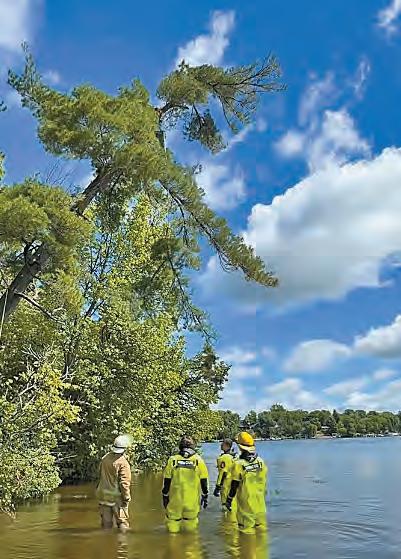
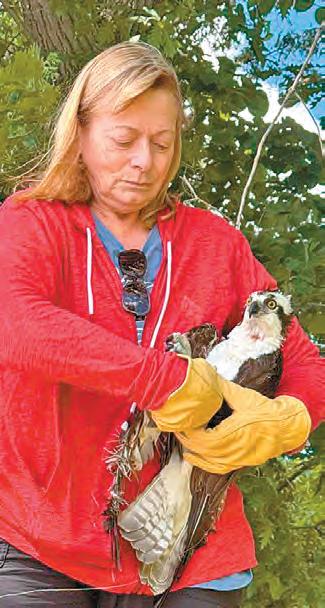
The Forest Lake Fire Department received a request for assistance from The Raptor Center at the University of Minnesota regarding an injured osprey entangled in fishing line. The bird was located at the tip of Pioneer Point on the west shore of Lake Two on Forest Lake. Forest Lake Fire Department personnel worked alongside Forest Lake Public Works certified tree climber Chris Larson to safely access the injured osprey and lower it to safety. Marylynn Robinson of The Raptor Center evaluated the bird on scene and transported it to The Raptor Center for further care and rehabilitation.
FOREST LAKE LAKE ASSOCIATION
Email to ppinfo@presspubs.com with subject line "Forest Lake Laker"
We’d like to hear what you think about The Forest Lake Laker. Comments are welcome via email at ppinfo@presspubs.com
Contributed
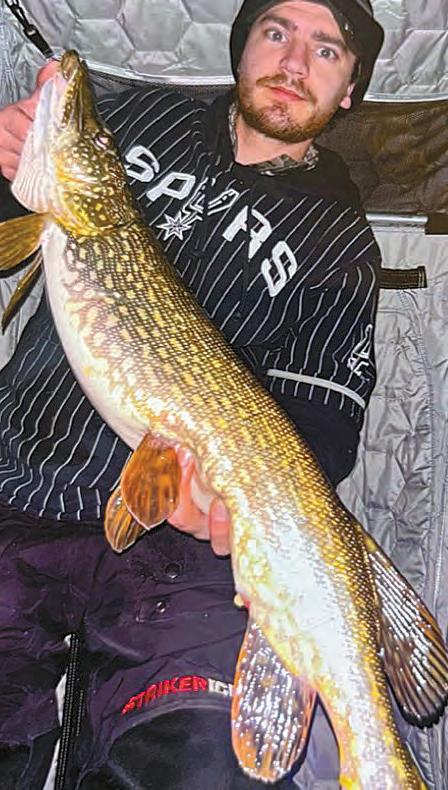
Zach Gartner shows off a big catch.
Forest Lake Fire
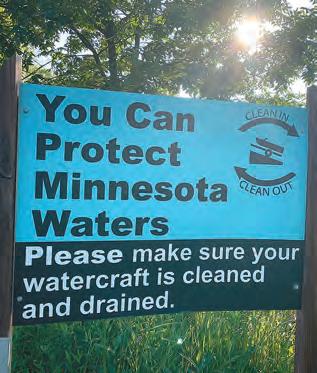
Contributed A boat etiquitte reminder from Public Launch #3.
The Cargo Manifest
Spectacular summer celebrations await
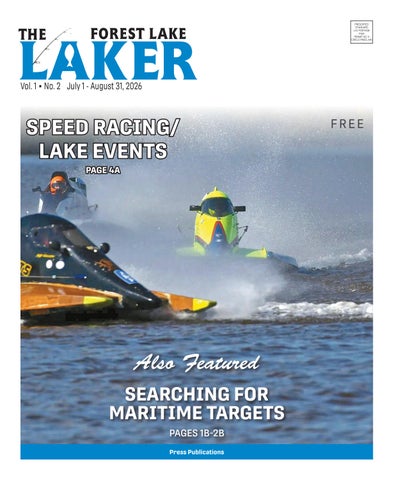
Summer is in full swing and we have all the splashy events of the season inside. We also have feature articles in which you can submerge yourself. Whether you’re skipping from one activity to the next or whiling away on a pontoon, this issue of the Forest Lake Laker is for you.
The Laker Calendar on Page 4A has the latest in ongoing summer events, July and August mainstays and fun festivals. Contributor Emma Masso previews Forest Lake’s Fourth of July celebration for America’s 250th birthday. Contributing Writer, Madeline Dolby also surveys Arts in the Park.
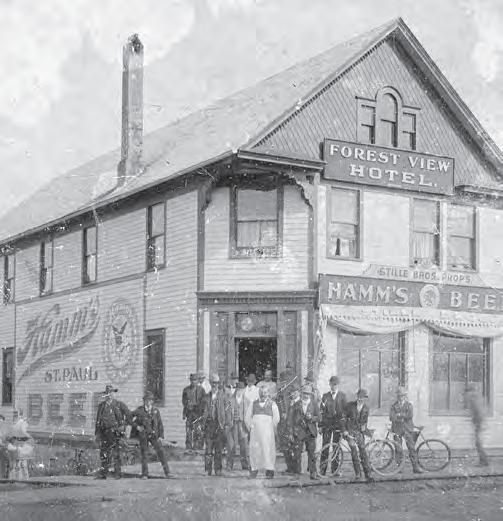
Dive into writer Debra Neutkens’ exploration of Maritime Heritage Minnesota archeological mission or dive into the past as special correspondent Justin Brink charts the history of the Forest View Hotel.
Learn about the water itself as contributor Shivam Vashishtha shares the latest research project from University of St. Thomas and University of Minnesota or learn about the shore as staff writer Logan Gion catalogs native plants and library resources.
Anglers can catch a unique fishinglure project on Page 6C while special correspondent Aiden Johnson reels in metro musky tips.
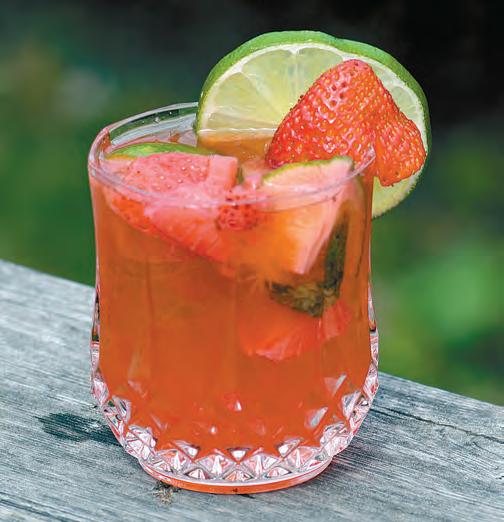
Our galley section adds a mocktail twist to the quintessential summer-on-the-water drink—the mojito. We’ve also got a pickled northern pike recipe, so you can enjoy your summer catch long after sunset of the last long day.
While having fun in the sun, please make sure to stay hydrated. Meanwhile, our crew is always thirsty for content, so if you have a story idea or thoughts, email ppinfo@presspubs.com. From our crew to yours, we hope this summer is a pleasure cruise.
SHORE LEAVE | EVENTS
LAKER CALENDAR
ONGOING EVENTS
Arts in the Park
When: 5-8:30 p.m. Tuesdays, through Aug. 25
Where: Lakeside Memorial Park, 97 1st St. NE
Details: Food trucks, vendors, activities and live music from 6:30-8:30 p.m.
Contact: ci.forest-lake.mn.us/192/Arts-inthe-Park
Forest Lake Farmers Market
When: 8 a.m.-noon Saturdays
Where: Forest Lake City Hall, 1408 Lake St. S.
Details: Local growers, artisans, community resources.
Details: Fishing and boating experiences for seniors, veterans, individuals with disabilities and youth groups, led by experienced volunteers.
Contact: forestlake.lgfws.com
JULY/AUGUST EVENTS
Purple Loosestrife Beetle Release
When: 10 a.m. Wednesday, July 1
Where: Forest Lake Public Launch #3
Details: Learn about how biological control is an effective, low cost method for managing infestations of purple loosestrife, which invades wetland areas, displaces native plants, and disrupts animal habitats.
Contact: 651-395-5852 or clflwd.org
Fourth of July Celebration
When: July 1-5
Where: Forest Lake American Legion Post 225, 355 West Broadway Ave.
Details: Carnival, Bingo tent, medallion hunt, live music and entertainment. Parade and flyover at 10 a.m. of July 4; Fireworks at dusk/10 p.m. at Lakeside Memorial Park. See schedule of events online.
Contact: post225.com/4th-of-july
True North Outdoors Kayaking
When: 10 a.m.-2 p.m. Wednesday, July 8
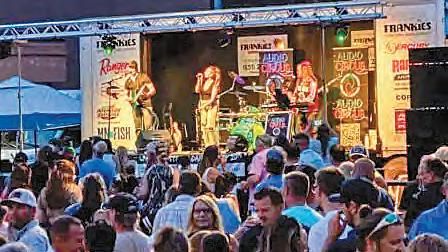
LAKE FEST STREET DANCE
When: 6-10 p.m. Saturday, Aug. 29
Where: 220 Lake St. N., Forest Lake
Details: Family-friendly community event includes live music by SHAG, food and beer tents.
Details: Event hosted by Invisible Wounds Project combines kayaking with meditation and breathwork, encouraging participants to slow down, disconnect from daily stressors and fully immerse themselves in the natural environment. Registration required; kayaks available. Contact: roufsisaiahusmc@outlook.com
Make Your Current Home Your Forever Home
When: 11:15 a.m.-12:15 p.m. Wednesday, July 8
Where: Forest Lake YMCA, 19845 Forest Road N.
Details: Find out what tools and aids are available to make your life easier and stay in your home longer.
Contact: 651-747-0819
31st Annual Rhubarb Frenzy
When: 10 a.m.-8 p.m. Saturday, July 11 and 11 a.m.-5 p.m. Sunday, July 12
Where: Winehaven Winery, 10020 Deer Garden Lane, Chisago City
Details: Sample new rhubard-inspired creations and flatbreads. Live music from noon-4 p.m.
Contact: winehaven.com/events
Life at the Lake - 3D paper art workshop
When: 3-5:30p.m. Sunday, July 12
Where: Uncommon Loon Brewing Comapny, 10825 Lake Blvd., Chisago City
Details: Create a vibrant, 3D lake-life art piece with seven layered cuts. Relax, craft and bring the northwoods vibe home. Admission will be charged; all supplies included.
Contact: designsbybrendamn@gmail. com
MN High School B.A.S.S. North Metro Conference Open
When: Monday, July 13
Where: Forest Lake
Details: Tournament includes Northeast Metro High School fishing teams of two on approximately 40 boats. Contact: minnesotajuniorbassnation.com
Food Scraps Pickup program
When: 5:30-6:30 p.m. Tuesday, July 14
Where: Hardwood Creek Library, Details: Learn how to reduce environmental impact through composting and other methods to recycle food scraps. Registration required. Contact: washcolib.org
Greenhorn
Advanced Wednesday Series Bass Tournament
When: 5-8:45 p.m. Wednesday, July 15
Where: Forest Lake
Details: Approximately 50 entrants participate as part of the Twin Citiesbased nonprofit bass fishing league. Contact: greenhornbasstour.com
Shredding event
When: 8 a.m.-4:30 p.m. Thursday, July 23
Where: North Environmental Center, 6065 Headwaters Parkway Forest Lake
Details: Washington Counmty residents and businesses can drop off up to six boxes or 30 pounds of documents for shredding and recycling.
Where: Your Boat Club, Lakeside Memorial Park, 97 NE 1st St.
Details: Chamber members and guests can meet and mingle with old friends and new business associates. Boat rides available. Contact: forestlakechamber.org
Details: Family-friendly summer festival featuring Swedish/Nordic and Japanese folk music, dance and visual arts, crafts for all ages, topurs, vendor fair, artist demos and food and beverages for purchase. Contact: gammelgardenmuseum.org/ event/spelmansstamman2026
Pastel Painting Workshop
When: 5-8 p.m., Wednesdays, Aug. 19 and 26
Where: Hallberg Center for the Arts, 5521 Viking Blvd., Wyoming
Details: This two-session pastel workshop is for intermediate artists who ant to learn chalk pastel. Contact: 651-272-8122
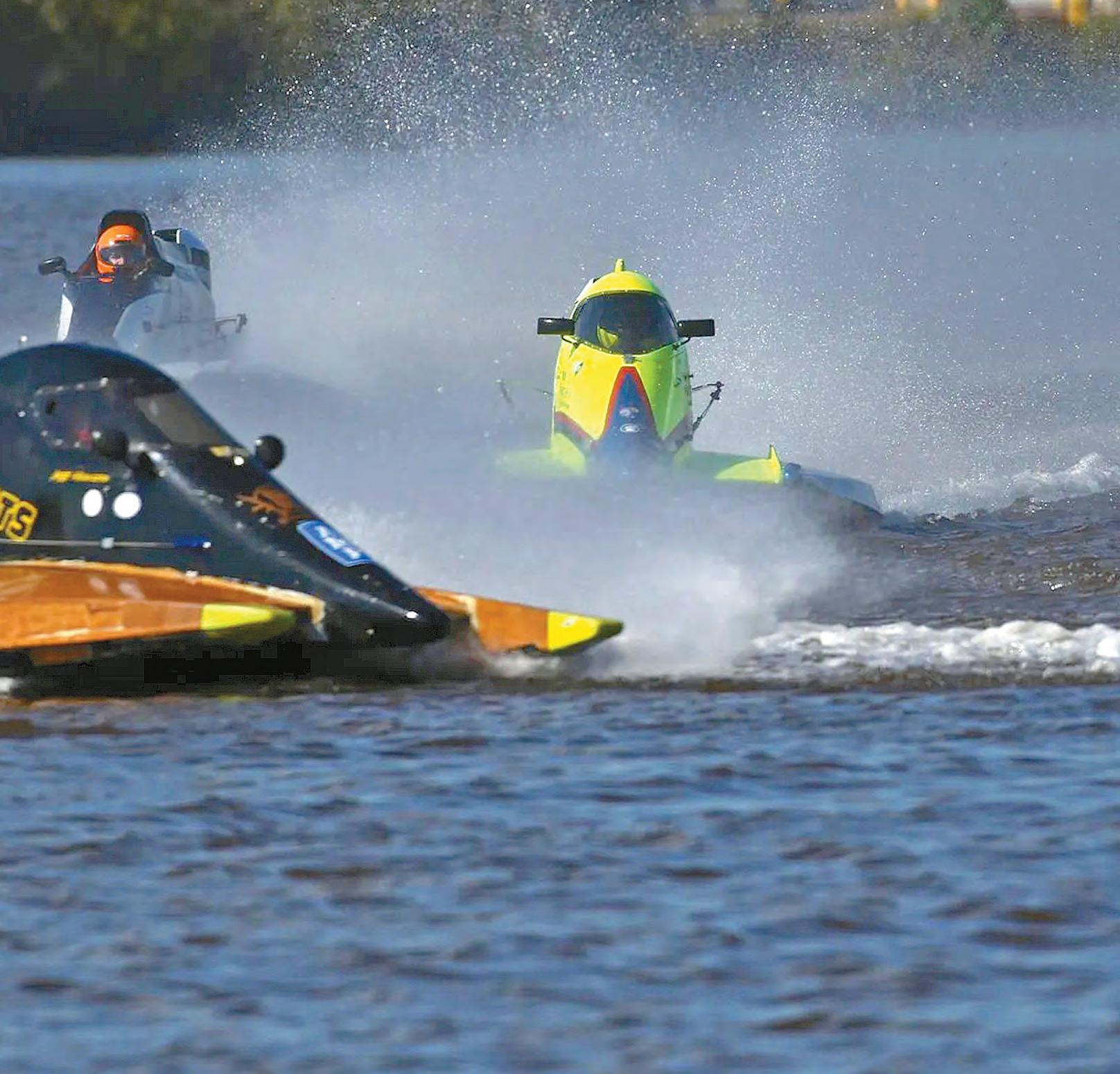
Ron Baker Sr. Memorial Forest Lake Regatta
When: Aug. 29-30
Where: Lakeside memorial Park, 69 Lake St. N.
Details: Come watch the fastest boats in the midwest featuring seven different classes of powerboats
Contact: board@tcbpa.org
Forest Lake Chamber | Contributed
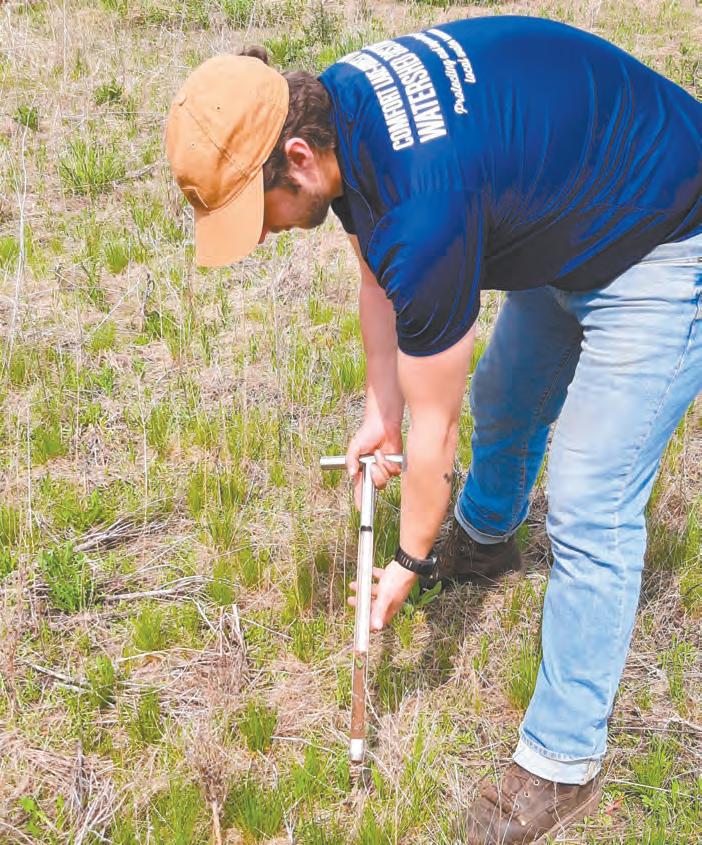
Comfort Lake Forest Lake Watershed District Soil Testing
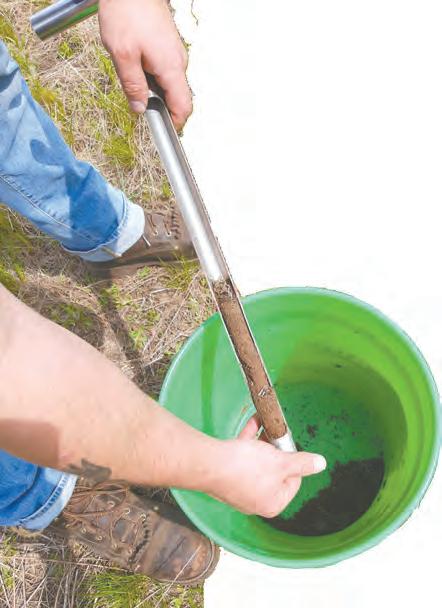
Soil testing is one of the most effective tools available for protecting local lakes while also maintaining healthy lawns and landscapes. Many homeowners apply fertilizer without knowing whether their soil actually needs additional nutrients. A soil test provides important information about nutrient levels, soil composition and pH, allowing property owners to apply only the fertilizer that is necessary. Reducing unnecessary fertilizer use is especially important because excess nutrients in lakes
In addition to protecting water quality, soil testing often saves homeowners money by reducing the overapplication of lawn products.
testing often saves homeowners money by reducing the overapplication of lawn products. When fertilizer is applied based on actual soil needs, lawns are typically healthier, stronger, and better able to resist drought, disease and weeds. Healthy turfgrass develops deeper root systems that help stabilize soil and absorb rainfall more effectively.
Reducing erosion is another important benefit of maintaining healthy lawns and landscapes. Soil erosion carries sediment, nutrients and other pollutants into lakes and wetlands, where they can negatively impact fish habitat, aquatic plants and overall ecosystem health. Dense, healthy vegetation acts as a natural filter by holding soil in place and slowing stormwater runoff.
Through soil testing and proper lawn care practices, property owners can play an important role in improving water quality, protecting natural resources and supporting the long-term health of local lakes and waterways.
Residential property owners within the Comfort Lake–Forest Lake Watershed District
(CLFLWD) are eligible for free soil testing once every three years. As part of the program, CLFLWD staff will collect a soil sample from your property, submit it to a certified soil testing laboratory and help interpret the results—all at no cost to the resident. This program is
designed to provide residents with simple, practical information that supports both healthy landscapes and cleaner lakes throughout the watershed. If you are interested or would like more information, contact the CLFLWD at info@clflwd.org or by phone at 651-395-5850.
A LASTING LEGACY:
102 years of spectacular Fourth of July celebrations
By Emma Masso Contributing Writer
Every year, American Legion Post 225 and the city of Forest Lake join together in hopes of creating lasting memories for the attendees of the Forest Lake Independence Day celebration. Volunteers from Post 225 work yearround to fundraise and plan the many activities of this event.
Ashley Venburg, commander of Post 225, said that they do this because they know the impact it has on the community, and they wish to maintain the tradition of this celebration.
“We are volunteers,” says Venburg. “We have day jobs and other obligations, but we do this for the community. We pour our hearts into this event, and I just hope the community appreciates the work we do to put this on.”
The 2026 Fourth of July celebration will mark 250 years since the United States of America was founded, and 102 years since the tradition of Forest Lake’s large celebrations started taking place.
“It really is a generational event,” said Past Post Commander and Fourth of July committee member Krista Goodyear. "Every year we have people from surrounding cities, out of state and even out of the country return home for our celebration. Across generations, community comes back to Forest Lake
for this celebration.”
“I love my country, I love veterans and I love my community,” said Goodyear.
“The children and their families are who we are doing this for.”
Venburg agreed that local community impact is what makes this event worth it.
“I always think of when someone will come up to me and say that they have good memories of the parade,” Venburg said. “Or when they say they enjoyed the event… That makes this worth it for me.”
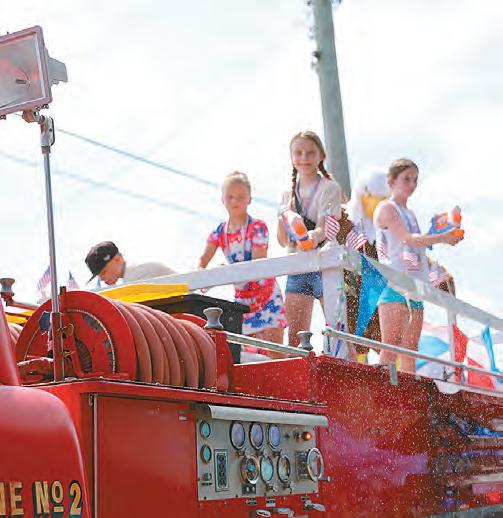
At the multi-day event, there will be a parade, live music, food vendors, carnival and a fireworks show to end the night of July 4. Post 225 puts on all of these activities through the support from others in the local community. The city of Forest Lake helps pay for the fireworks show, youth Boy Scouts hand out water and community members volunteer to be a part of the parade and help raise the funds that make these events possible.
The celebrations will take place at Lakeside Memorial Park, 95 East Broadway Ave., Forest Lake. On the Fourth of July, the parade and flyover will take place at 10 a.m. This year, there will be two honorary grand marshals heading the parade: Ron Miller and Nancy Daschel. The fireworks show will begin at 10 p.m.
There are also events throughout the rest of the week. The carnival will take
place on July 2-5, weather permitting. A bingo tent will be set up and operational from 5 p.m. to 10 p.m., July 2-3, and 11 a.m. to 5 p.m., July 5. At the bingo tent, there will also be a meat raffle drawing at 5:30 p.m. on July 5. Post 225 also has live music scheduled with Them Pesky Kids (TPK) on July 2, Six to Midnight on July 3 and Legacy of the Loud on July 4th. Lastly, the Medallion Hunt will begin with the first clue posted at 8 a.m. on July 1. A clue will be posted each day at 8 a.m. until the medallion is found. American Legion Post 225 is located at 355 W. Broadway Ave, Forest Lake. For more information about this year’s celebration, go to post225.com/4th-ofjuly/ or call Post 225 at 651-464-2600. Updates will also be posted on the Legion’s Facebook page. ◼
Photos by Jill Greene | Contributed
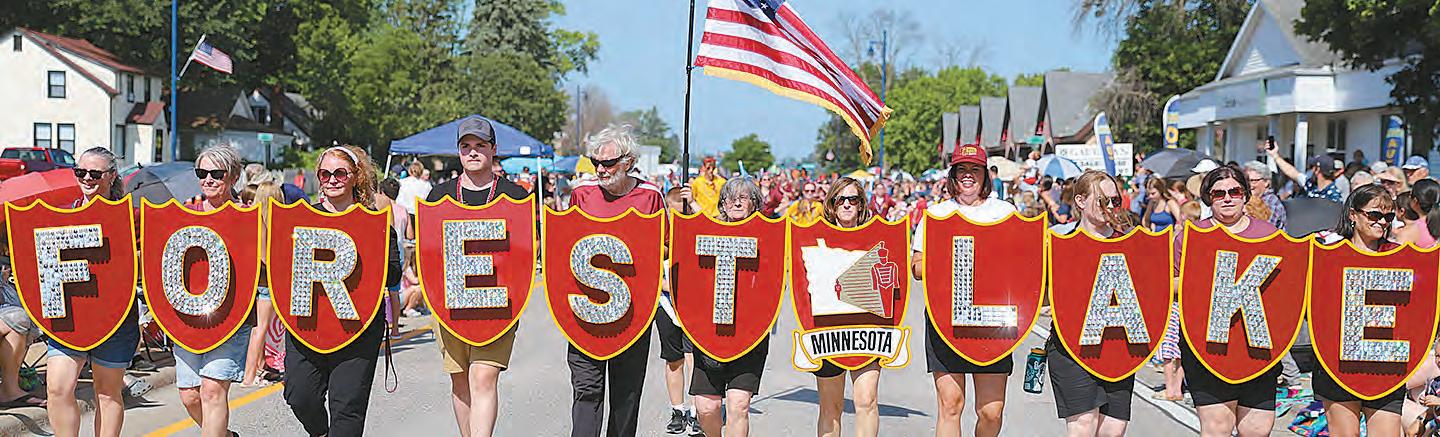
The 2026 Fourth of July celebration will mark 250 years since the United States of America was founded, and 102 years since the tradition of Forest Lake's large celebrations started taking place.
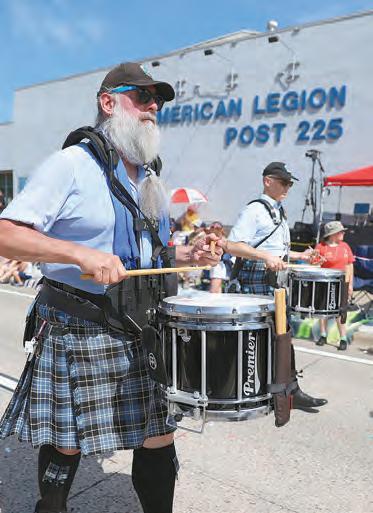
The annual parade is always well attended.
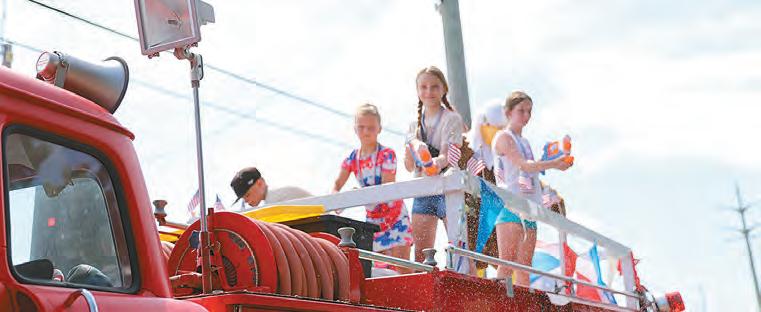
The Forest Lake Fourth of July festivities offer something for all ages.
FOREST LAKE MAP
We install several types of roofing materials including asphalt shingles, cedar shakes, metal, slate and more. STORM DAMAGE REPAIR
We repair roofs and siding damaged by severe weather. We are happy to work with your insurance company as well. SIDING INSTALLATION
We install vinyl, wood or metal siding for your home or business. We can help you determine the best option.
Usually part of a roofing or siding project, soffit and fascia are important feature for a finished home exterior. GUTTER SERVICES
Water damage from poor gutters can lead to expensive repair. We install and repair gutters to keep the water away from your home. WINDOW INSTALLATION
New windows can make a huge difference for your home both in appearance and energy efficiency.
LAKER THE FOREST LAKE
SEARCHING FOR MARITIME TARGETS in depths of Forest Lake
By Debra Neutkens Contributing Writer
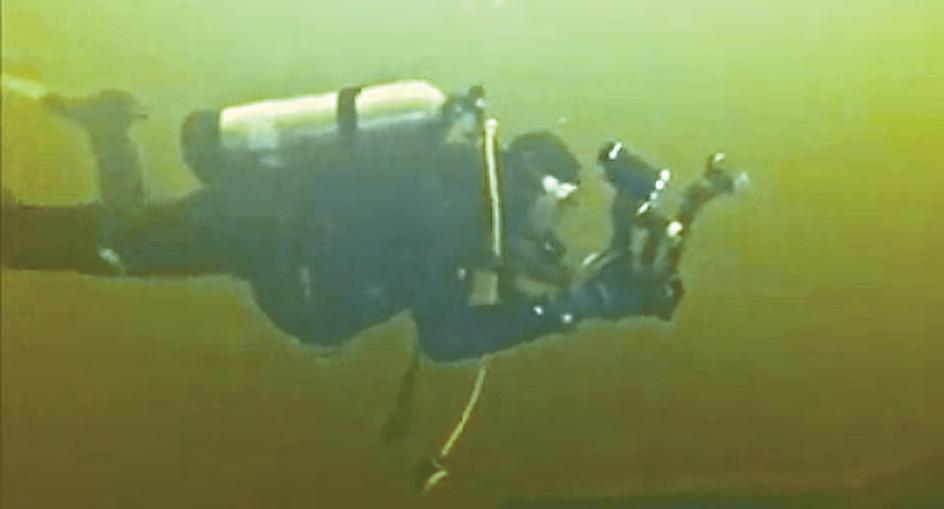
Identifying sonar-detected objects resting on lake and river bottoms is a passion shared by licensed archaeologists Ann Merriman and Chris Olson, who founded the nonprofit Maritime Heritage Minnesota (MHM).
Their mission is to document, conserve, preserve and when necessary, excavate submerged cultural resources, or “anomalies,” that make up the state’s rich nautical history. But don’t confuse what they do with treasure hunters. Merriman does not use words like “treasure,” “hunt” and “adventurers” to describe their work.
“We don’t loot, we don’t ‘hunt’ for anything or seek
‘treasure’ for personal gain,” Merriman stated. “We don’t steal things off wrecks.” They also don’t readily reveal coordinates of their discoveries.
The underwater archaeologists are working on a suburban lakes project in Washington County that included a sonar survey of Forest Lake. Forty-nine anomalies were identified in that initial survey. Six are wrecks, confirmed by divers. One anomaly is a boat lift. Ten are “probably” wrecks due to their acoustical signatures, and an additional 11 “may be” wrecks. A few are what the archaeologists call maritime resources: a fish house, dock boat canopy frame, parts of a boat lift, a single pontoon and a trailer or wagon. Two are cars and two are possible snowmobiles. Three anomalies may be parts of a plane. A series of anomalies are trees and divots and
the rest are “unknowns.”
Eventually, MHM hopes to investigate all the anomalies detected in the survey, which have been prioritized by color according to their nature, condition and historical significance.
Their findings, compiled in an online report on MHM’s website, include historical background on Forest Lake’s early resort years. Tourists would travel by train to stay at lodges, resorts and housekeeping cabins around the lake. Throughout the first half of the 20th Century, establishments included the Euclid Hotel, Forest Home, the Summers Hotel, Finnigan’s Cottages, Forest Lake Country Club, Harrington’s Cottages and Boat Livery, Smith’s Cottages, Lakeside
MARITIME TARGETS CONTINUED ON 2B
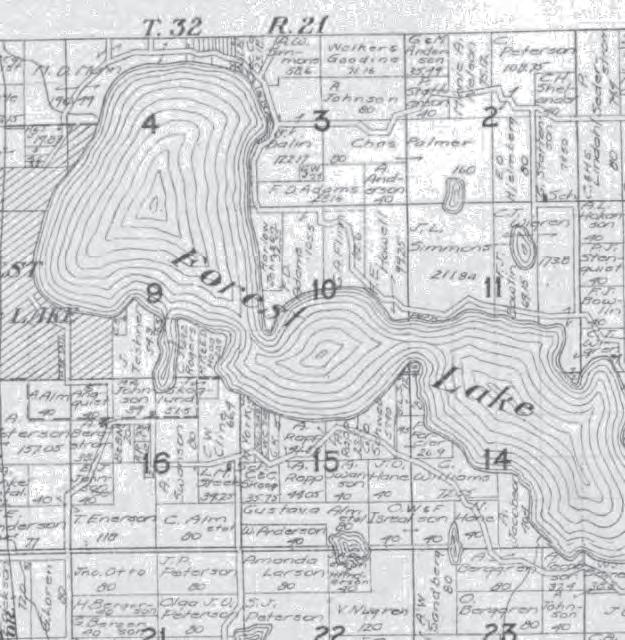
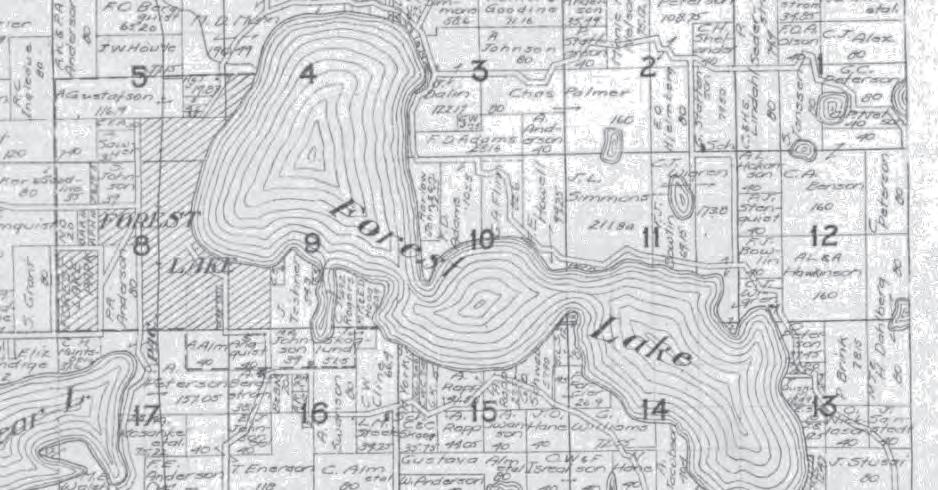
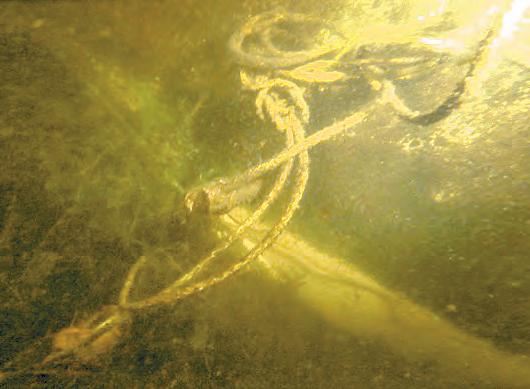
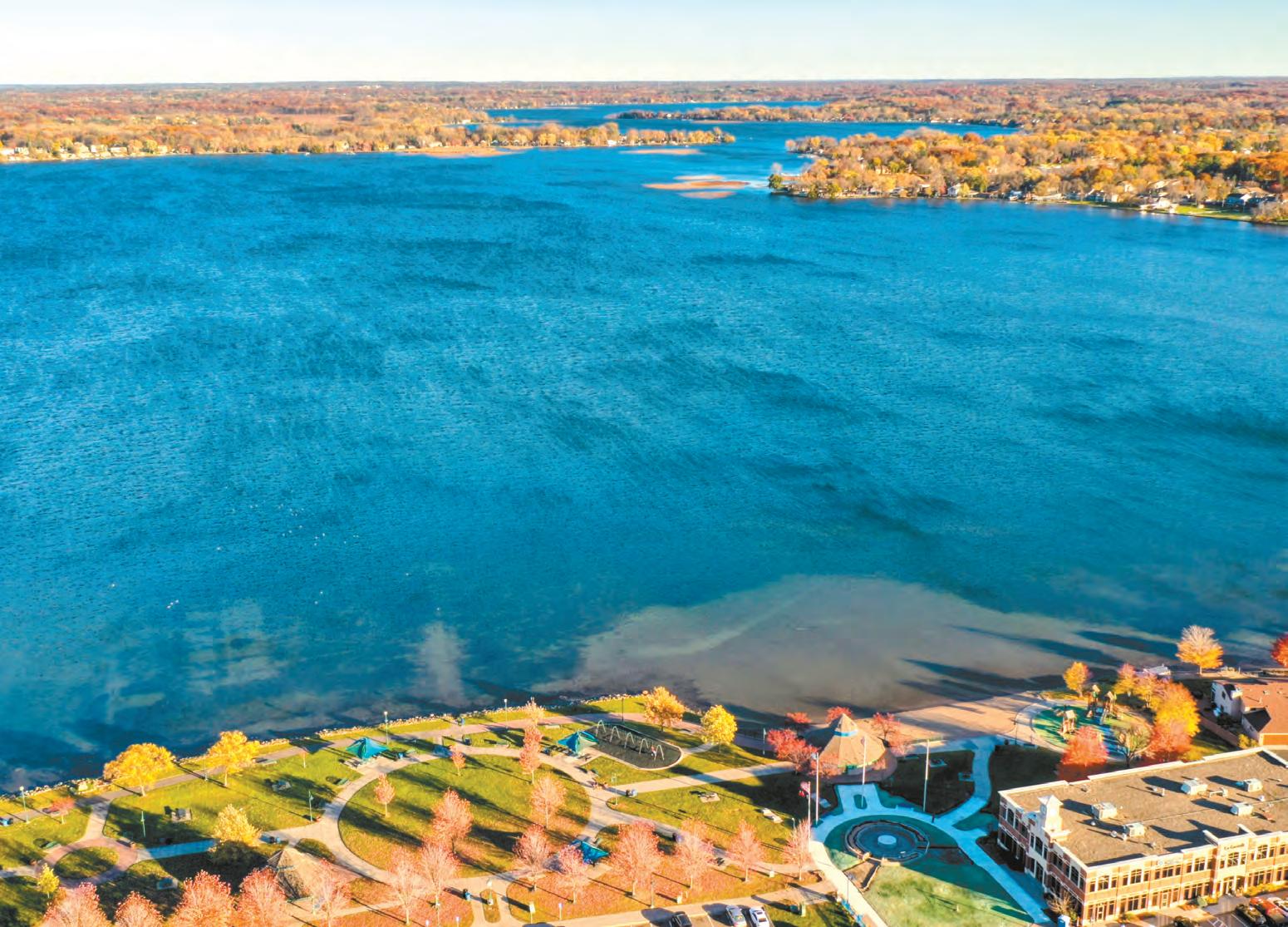
Photos by Maritime Heritage Minnesota | Contributed 1916 plat map of Forest Lake. At 2,270 acres, the lake is comprised of three connected bays, referred to as First, Second and Third lakes. At left: A waterski pull trails over the starboard quarter of the tri-hull.
FISHERY
MARITIME TARGETS | FROM 1B
Cabins, Ran’s Cabins, Bogel’s Inn and Willow Point Resort.
It was because of the thriving rental business and the design of the boats that MHM believes four of the wrecks on the bottom of Forest Lake belonged to resort fleets. Two are personal watercraft.
Wrecks are assigned anomaly numbers and, once categorized, receive an official state site number. They are then considered a protected maritime cultural resource.
In the Forest Lake survey, Anomaly 1 is a fiberglass deck boat, 16 feet long. They believe the boat was scuttled, particularly because of the missing outboard motor powerhead, steering wheel and towing line evidence.
Anomaly 11 is an 11-foot wooden outboard motorboat wreck profusely covered in zebra mussels. It is a typical example of a small craft used by resorts beginning in the ‘30s, according to the archaeologists.
The gunwale is intact throughout the hull and the sharply pointed bow. Blue paint can be seen. MHM contends the craft was constructed around 1930 with a sinking date of 1945. They also think the boat was scuttled due to port side transom damage.
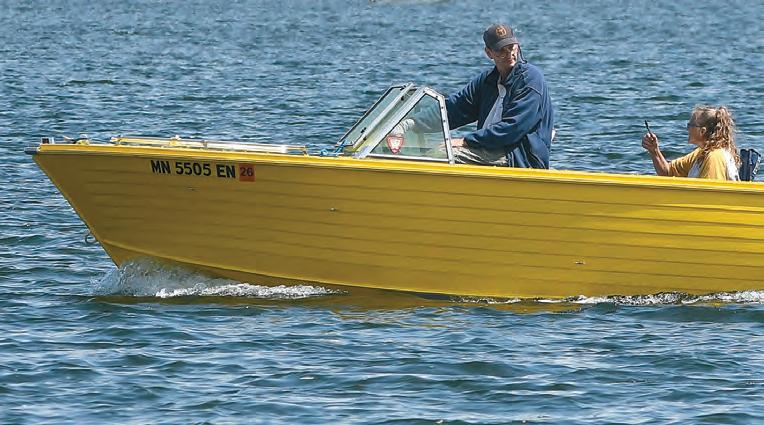
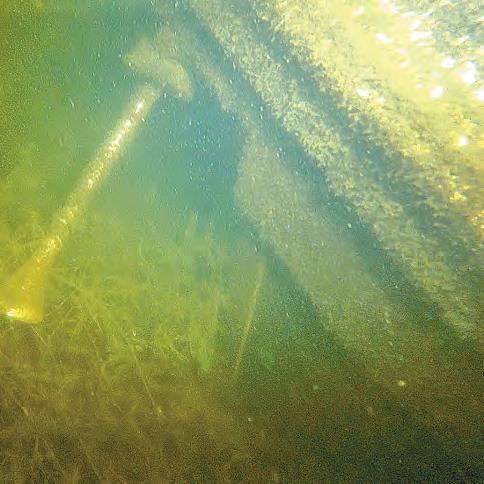
Anomaly 13 is more recent—a capsized Winner International Trihull, manufactured in Hialeah, Florida. The fiberglass wreck is 16 feet long and believed to be from 1972, based on its registration number, which is still legible. When the vessel headed to the lake bottom, she landed on her windshield and her aft quarter gunwales became buried in the silt. The wreck is a bow rider with light blue cushions in place. A long horn survives and a waterski pull, comprised of a handle and polypro line, floats loose outside the hull. The hull is white with blue and red details.
MHM contends the boat sank
accidentally, possibly swamped by a storm or large waves. “Winner International Tri-hulls had low freeboard, so swamping is a reasonable explanation,” Merriman said.
The oldest wooden wreck is a flatbottomed watercraft with slat frame and upright transom, Anomaly 6. Believed to be built around 1915, the flat-bottomed outboard boat is 16 feet in length and mostly buried in silt. MHM estimates a reasonable sinking date of 1925.
A steel wineglass stern wreck, Anomaly 16, is unique in Minnesota and a type of watercraft that represents small recreational craft used from 1890 to 1930. According to the archaeologists, they were popular with resorts and hotels due to an attractive design combined with functionality, so they served well as fishing boats, as well as nice rowboats for quiet trips on the lake.
A wooden homebuilt is Anomaly 9. The 13-foot boat looks to have been scuttled due to large rocks in the hull. It’s thought to be constructed around 1925.
MHM is aware of one site at the bottom-or most likely below the
bottom-of the lake: an F-51 Mustang. According to their online project report, Major Louis M. Walton, World War II Army Air Corps veteran and commander of the 97th Squadron of the 440th Fighter-Bomber Wing out of Wold-Chamberlain Field, crashed his plane into Forest Lake during training exercises on June 27, 1954.
From witness accounts, the F-51 was seen smoking and took a nosedive into Third Lake, “exploding” on impact. Forest Lake police officer James Stokes dove the site to retrieve Walton's body. Papers at the time reported that "the plane was sinking out of sight in the mucky bottom of the lake, 20 feet deep where the ship crashed. The cockpit was empty, and Stokes saw no sign of Walton's body." Further investigations by U.S. Air Force engineers located part of Major Walton's left leg and five feet of lower intestines associated with the plane wreck in 15 feet of water and eight feet of mud (Minneapolis Morning Tribune 1954; St. Cloud Times 1954; United States Air Force Reserve 1954, 2, 8-9). In future fieldwork, if MHM
identifies any section of Walton's plane, a thorough recounting of the historical record will be produced.
Other tragic accidents on the lake mentioned in the MHM report included one involving G. Rahm, who broke through the ice in 12 feet of water in December 1879. It was reported “he saved his own life with difficulty but lost a valuable team.” It can be assumed that the carcasses of Rahm’s horses went to the bottom of the lake and remained there, along with his cart, sleigh or wagon.
In mid-June 1927, during a family outing in a wooden fishing boat on Forest Lake, six people drowned and two were rescued by nearby fishermen. A news clipping from the Minneapolis Morning Tribune in 1927, headlined “Six Drown as Boat Sinks at Forest Lake,” may involve one of the anomalies investigated by MHM. According to the story, two families rented a small boat for an afternoon of fishing. Apparently, a 12-year-old boy tried to raise anchor and could not. One of the adults went forward to help him and capsized the boat. The boy and his mother were pulled from the lake while six others drowned.
The MHM researchers, who selffund the nonprofit, plan to continue to investigate submerged resources in the future and “learn their story.”
“There are bunches more to dive on in Forest Lake,” noted Merriman. “We recorded some really good sonar.” ◼
Photos by MHM | Contributed
Ann Merriman and Chris Olson
Horn and windshield of the tri-hull.
Paul Dols | Press Publications
Underwater archaeologists Chris Olson and Ann Merriman head out in their research/dive boat, Anomaly 51, to survey the bottom of a lake.
THE RIGHT FISHING LURE can help keep your waterways safe
By Emma Masso Contributing Writer
While Minnesota’s numerous lakes serve many uses, fishing is by far one of the more popular activities.
Adam Hjelm, a member of the Comfort Lake Forest Lake Watershed Conservation District (CLFLWD), recently hosted “Build Your Own Lure” at Hardwood Creek Library to educate community members on how the make-up of your lures can affect the environment, while also giving tips on how to create the most effective lures.
“I kinda think I have the coolest job ever. I get to do this every day,” said Hjelm.
Hjelm explained that the CLFLWD’s mission is to improve water quality, increase habitat and educate. Education is where Hjelm works most often. He tries to make people aware that their actions and decisions affect water quality and the environment around them. Hjelm said he prefers fun activities like lure building to get people involved and thinking about the environment.
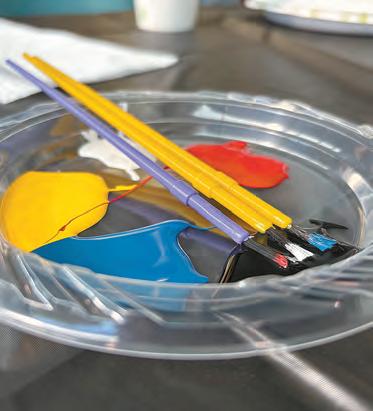
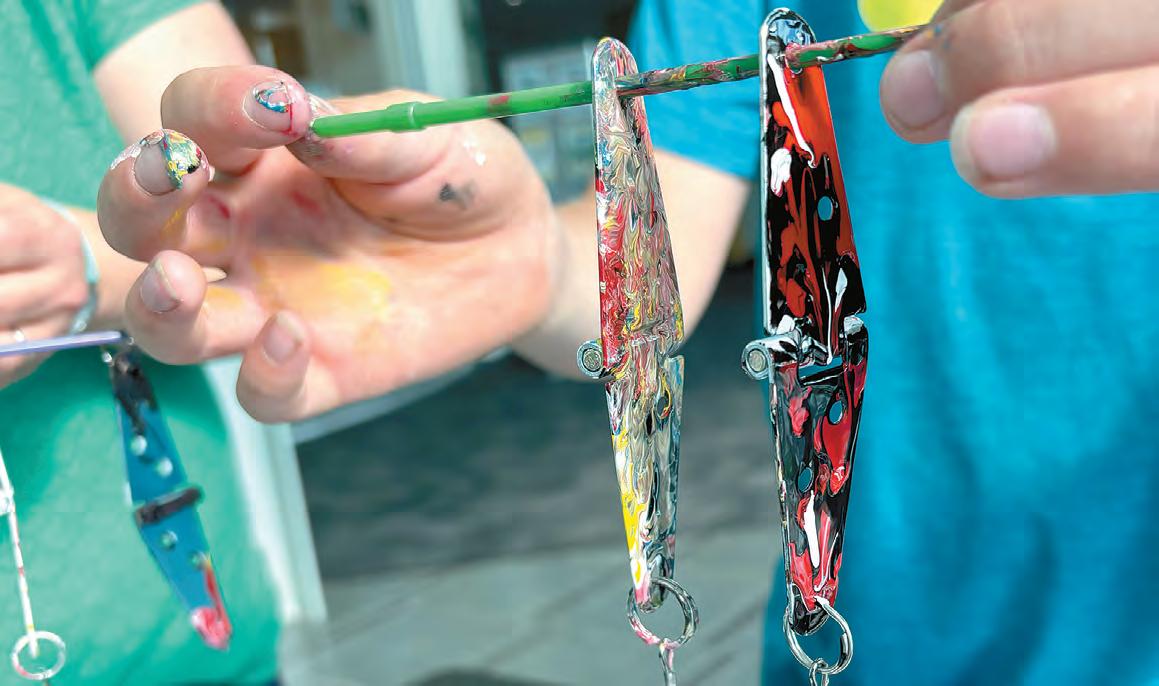
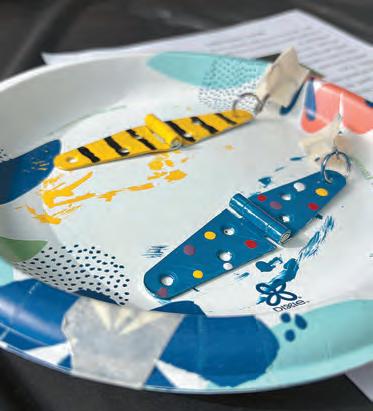
Hjelm's simple lure building technique only takes a few easy-to-buy items, making it so you can do it at home. He used a door hinge, a split ring, a fishhook and paint to decorate it. All you have to do is thread the split ring into the eyelet of the door hinge, like you’re putting a key onto a keyring. Then thread the split ring through the fishhook and you’re set to decorate it with whatever paint colors you prefer.
While it seems too simple to be good at attracting fish, Hjelm explained
how the door hinge actually has all the important components that make up a good lure. Door hinges are shiny, which attracts fish since they look like minnow scales. The paint grabs the attention of fish with its vibrant colors.
The movement of the hinge works well to draw fish to it in. Hjelm explained that fish do not hear noises how human
ears do. Instead, they have lateral lines, which allow fish to feel the vibrations from movements around them.
In his three years working for the CLFLWD, Hjelm says he has found hands-on events to be the most effective way to outreach with the community.
“I’d rather do an event than, you know, send out a flier or mail,” said Hjelm. “Something to get people out, walking around so they can see what's in front of them and identify the plants, the wildlife. Then they can see, 'Oh yeah, I can do that on my own property,' or, 'Oh, I’m interested in this.' It’s getting them to connect it back. You can do this. You can make a difference.”
In addition to collaborating with the CLFLWD, Washington County libraries have partnered with the Minnesota Pollution Control Agency to promote their Get the Lead Out program. Even in small amounts, lead is lethal to many forms of wildlife, especially loons. Lead is the leading cause of
death for adult loons, as 25% of loons die from lead poisoning from eating fish that have lead lures in their stomachs or stuck to them. Lead is also toxic to humans, both when consumers use lead products and when workers manufacture them. And chances are, if you own any older lures, they will likely contain lead, based on the trends of the tackle production industry.
When buying a new lure, the packaging should state if it contains lead. If you are having trouble finding lures without lead, you can visit Get the Lead Out’s website at www.bit.ly/ GTLO_LeadFreeList for a list of leadfree tackle manufacturers. Hardwood Creek library also is offering free exchanges if you bring in your lead or suspected-lead lures to replace them with lead-free lures they have on-site. For more information about the CLFLWD, visit clflwd.org. For a full listing of library events, visit washcolib. libcal.com/calendar/events. ◼
Photos by Emma Masso| Contributed
All you need for a fishing lure is a door hinge, split ring, fishhook and paint.
LAKESIDE MEMORIAL PARK OFFERS SELF-SERVICE BOAT SLIPS
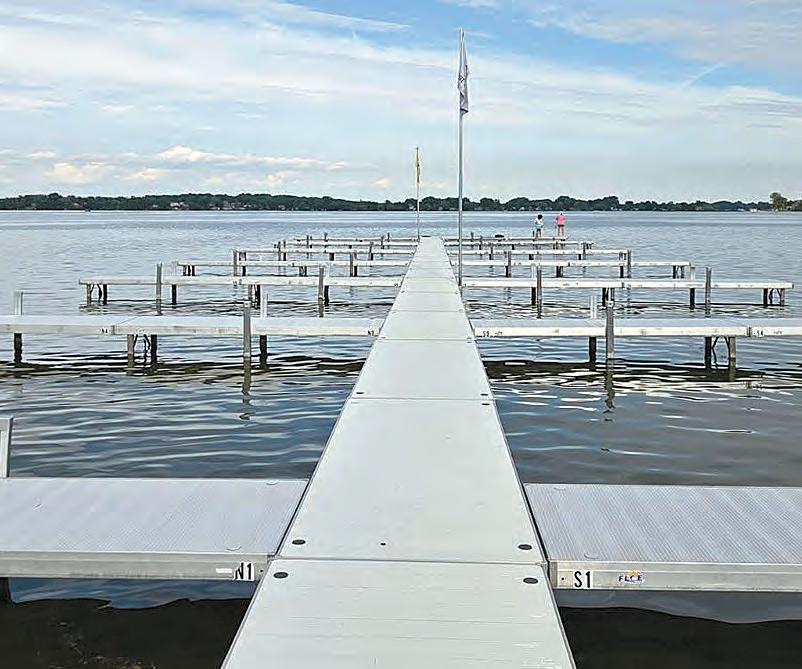
The public dock at Lakeside Memorial Park in Forest Lake includes 24 free, self-service boat slips that are available during park hours on a firstcome, first-served basis. The dock is owned and maintained by the city of Forest Lake.
Joleen Chaika, interim city administrator, says the Forest Lake Lake Association has partnered with the city on past dock expansion projects and “has been a valued community partner in enhancing public access to the lake.”
The public dock is also popular for fishing and has been known as a great spot for children to cast for sunnies.
In addition to the public dock, the city partners with Your Boat Club, so folks visiting the park may also see its dock and slips. These are separate from the public dock. While those slips are reserved for Your Boat Club operations and are not available for public use, the company offers boat rentals to the general public as well as fuel sales for boaters on the lake. More info on Your Boat Club can be found on the city’s website at https://www.ci.forest-lake. mn.us/321/Your-Boat-Club. ◼
HOW TO SELECT AND FIT A LIFE JACKET:
• When selecting a life jacket, make sure to wear your paddling clothes while trying it on.
• To fit the life jacket, tighten the straps and buckles.
• Have another person pull up on the shoulders of the life jacket. If the shoulders move up past your nose, try tightening the straps more. If it still moves, the life jacket is too large.
• Test out your life jacket in a pool or shallow water. It should not ride up on your body or slip while in use.
City of Forest Lake | Contributed
PICKLED NORTHERN PIKE
Ingredients:
• 2-3 Northern Pike fish (decent size)
• Cold Water
• Canning Salt
• White Vinegar
• Sugar
• Pickling Spice
• Sliced Onion
Those who wish to prepare raw pickled fish should first freeze the fish at 0° for 48 hours to avoid broad fish tapeworm, according to the University of Minnesota Extension.
Preparing the Fish:
• In a large bowl, take your fillet of northern and cut into 1 inch cubes.
• Place in a big enough bowl the fish can be covered with water. In the bowl, add fish, canning salt (1-2 cups), and cold water.
• Refrigerate for 48 hours.
• After 48 hours, rinse fish with cold water, clean bowl removing the canning salt.
• Put fish back in bowl and cover with white vinegar.
• Refrigerate for 48 hours.
• After 48 hours, remove fish from vinegar and rinse fish in cold water.
• Cover fish in cold water and set aside while making the brine.
Brine:
• Simmer on stove top - 2 cups of white vinegar, 1/2 - 1 cup of sugar ( pending your sweetness liking), and 2tbsp of pickling spice.
• Simmer and stir until sugar dissolves.
• Remove once sugar is dissolved and completely cool.
Can in Mason Jars:
• In a mason jar, place a layer of sliced onion, then chunks of fish, layer of sliced onion and then fish until jar is packed.
• Fill jar with completely cooled brine.
• Seal mason jar and Refrigerate at least 7 days prior to eating.
Pickled Northern Pike Recipe by: Brittany and Chaz Dobias. They are a part of First City Guide Service and Breezy Pines Resort and Campground. They lead Open Water Fishing
Trips in Bemidji Area, Cass Lake Chain, Leech Lake through First City Guide Service. More information at firstcityguide.com
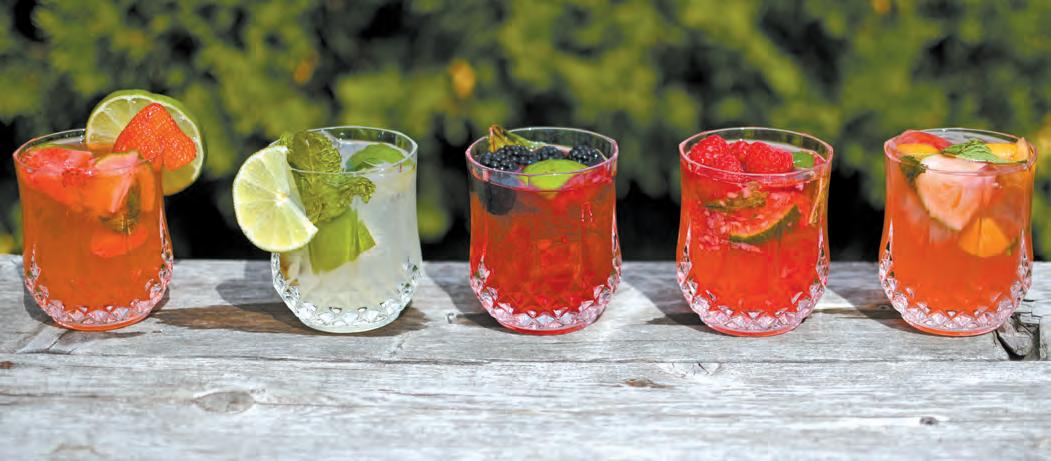
Ultimate Mojito Mocktails
MAKES 4
Ingredients
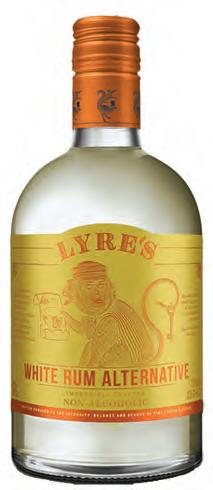
1 cup of Lyre’s White Rum Alternative
2 limes
4 sprigs of mint
1/3 cup of cane sugar
2 cups of tonic water light
10 drops of angostura bitters
1 tray of ice cubes
Tools
Mortar and pestle Pitcher
Directions
1. Pluck mint leaves from sprigs
2. Wedge 2 limes into eighths
3. Add the following to mortar and pestle:
- 12 lime wedges
- All mint leaves
- 1/3 cup of sugar
4. Moderately muddle with pestle. Crunch and press, rather than shred.
5. Pour mortar mixture into pitcher
Add remaining ingredients and stir gently as fizz allows until ice seasons/begins to melt.
6. To serve, pour into lowball tumbler glasses and garnish with remaining lime wedges.
Recipe provided by Logan Gion
Strawberry Version:
Cut out cane sugar. Quarter 12 medium-sized strawberries and add to mortar and pestle mixture.
Blackberry Version:
Sub Lyre’s White Rum Alternative for dark rum. Sub cane sugar for brown sugar. Add 30 blackberries to mortar and pestle mixture.
Raspberry Version:
Add 30 raspberries to the mortar and pestle mixture.
Peach Version:
Sub Lyre’s White Rum Alternative for dark rum. Sub cane sugar for brown sugar. Quarter 2 fresh peaches and add to mortar and pestle mixture.
Blackberry
WASHINGTON COUNTY WATER PATROL
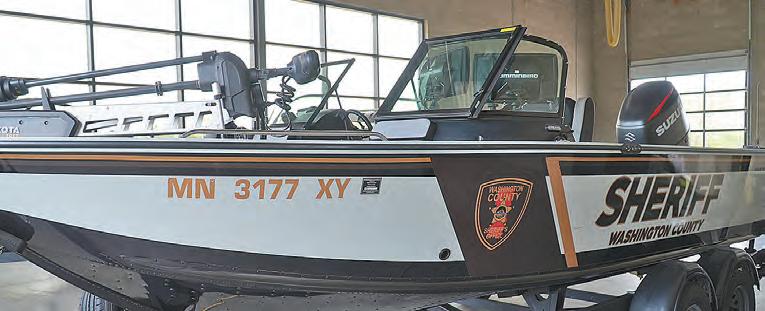
The Washington County Sheriff’s Office Water, Parks and Trials (WPT) Unit has always prided itself with its highly trained team who are prepared to respond to emergencies anywhere on the water. To do their job safely and effectively, they rely on specialized boats, rescue equipment and dive gear designed for a wide range of conditions.
Recently, the WPT Unit added three new river boats to its fleet. The three boats are matching, 24-foot Lake Assault Rigid Hull Inflatable Boats (RHIB) powered by twin 200-horsepower Mercury engines. Designed for durability and maneuverability, the RHIB allows deputies to respond quickly on large rivers and in challenging water conditions.
The Sheriff’s Office currently operates three, 18.5-foot and two, 20.5-foot Aluma Craft patrol boats. The 18.5-foot boats are equipped with 175-horsepower engines and the 20.5-foot boats are equipped with 250-horsepower engines. The 18.5-foot Aluma Crafts patrol boats are primarily used for Washington County lakes. The fleet also includes a jet boat specifically designed for shallow water and hardto-reach backwater areas where traditional propeller boats cannot safely operate.
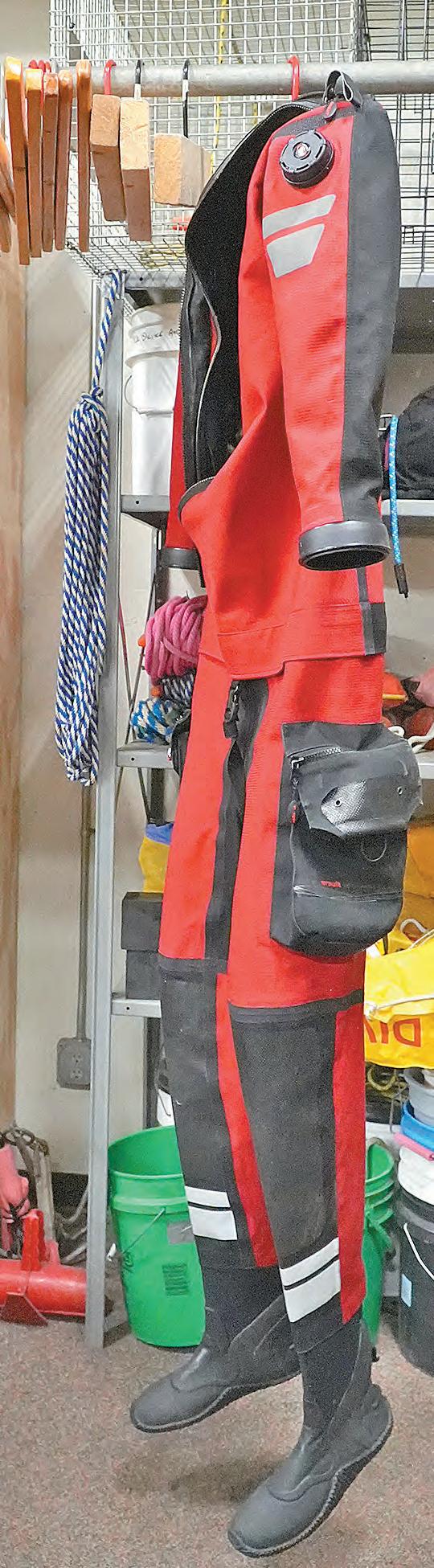
When emergencies turn into searchand-rescue or recovery operations, the Sheriff’s Office Water Recovery Team is called into action. Team members suit up in specialized dry-diving suits that protect them from cold water and hazardous conditions, along with full-face masks, oxygen tanks, fins, gloves and communication equipment that allow divers to stay connected with personnel above the water. Divers may also use underwater lights, sonar technology and tether lines to safely conduct searches in low-visibility environments.
While having the correct gear and equipment is essential, ultimately, it is the team’s disciplined training that ensures they can respond swiftly and safely in the most challenging situations. ◼
Photos Contributed
BURNED, REBUILT, REPEATED:
The story of the Forest View Hotel
By Justin Brink Special to The Laker
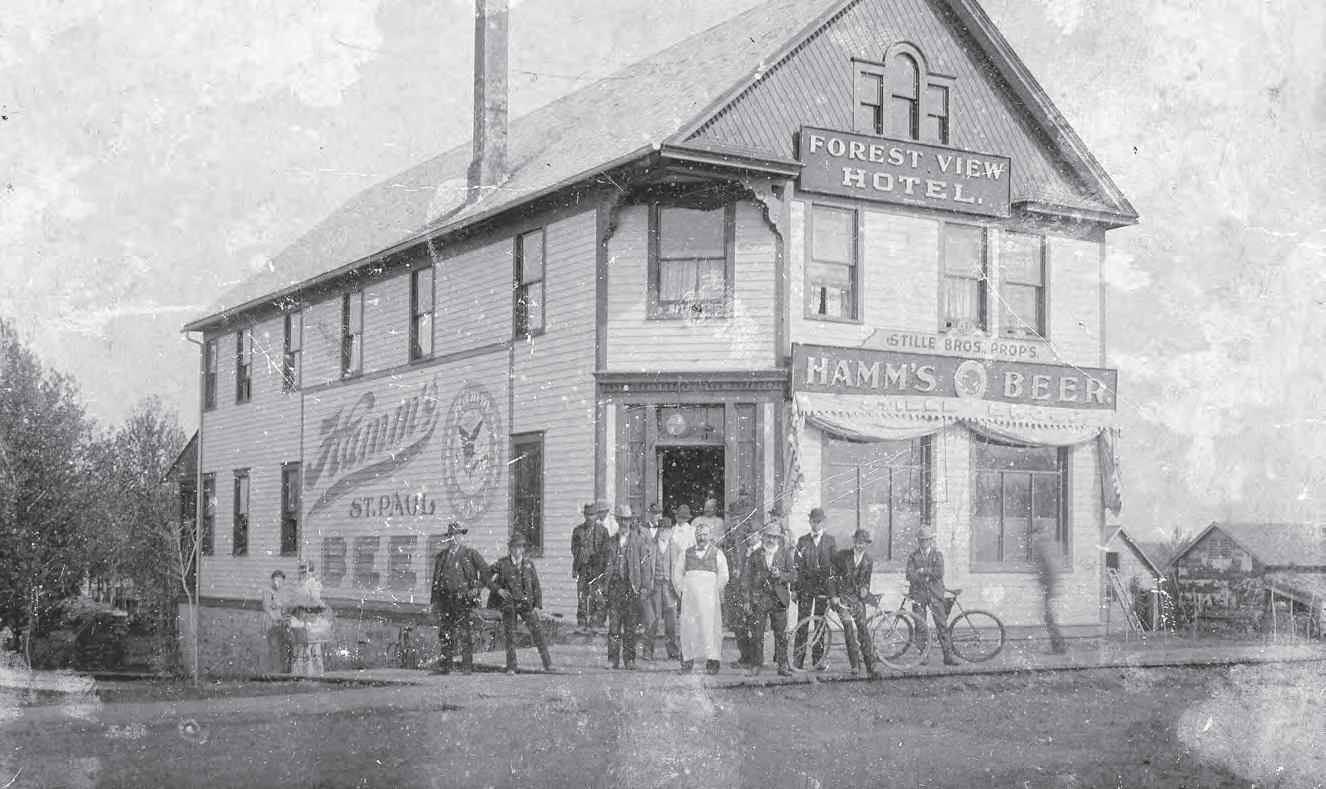
The Forest View Hotel was an iconic building located on the southeast corner of Broadway Avenue and Lake Street. Its unique, chamfered facade was branded with Hamm's beer advertisements and owned by the Theodore Hamm Brewing Company. It was also a doomed building that was plagued by fire, as if the very ground on which it sat was predisposed to burn. Piecing together area newspaper articles, the hotel was once called the Germania Hotel, built by St. Paulite and early Forest Lake sheriff, Fred Richter. The Stille brothers took over the hotel in the spring of 1898, making extensive renovations to the building and the
adjacent annex, which would become the saloon. Both buildings would burn to the ground the following year. Undeterred, the brothers rebuilt the hotel that same year. Instead of three floors, it now had two, with the saloon on the first floor and guest rooms on the second. Several years later, Christian and Fred Stille sold the Forest View Hotel to Phil Fabel, and the building was aptly named "Phil's Place." Christian then formed a partnership with the local marshal, Nels Kloster, and opened a saloon on the northeast corner. In July of 1908, both saloons were fined for selling bottled beer on a Sunday. The charges were later dropped when it was discovered that the so-called "detectives" who purchased the beer had actually obtained it elsewhere. Soon, Prohibition would force
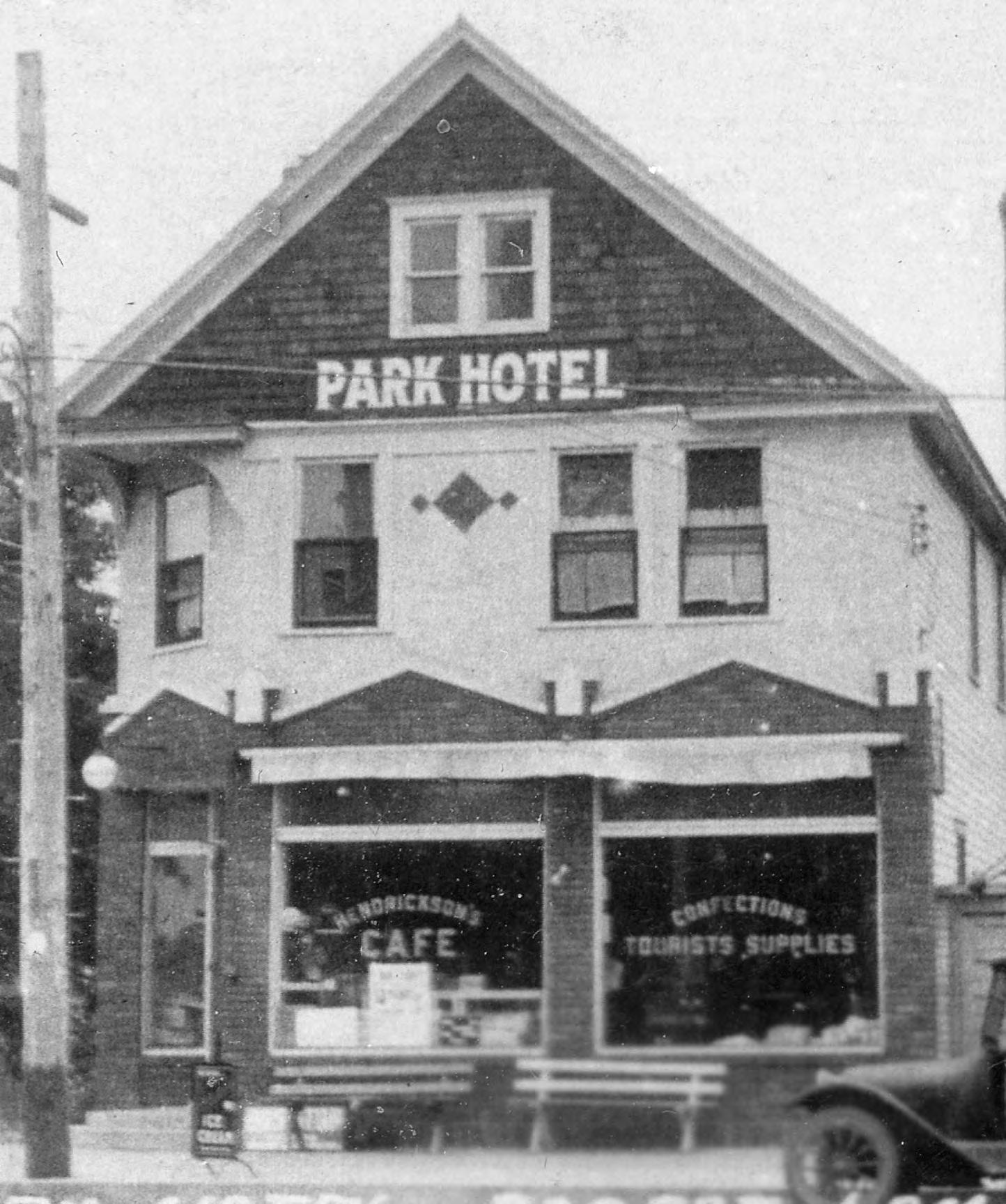
the bar's closure and replacement with a cafe. In the early 1920s, Phil Fabel sold the business to his bartender, Steve Hendrickson. Hendrickson had been working with Fable for more than 10 years and knew the business well, but the cafe venture would be much different than bartending. As if by initiation, the building suffered another fire on Aug. 30, 1922. Around midnight, two men from St. Paul were walking through town when they discovered smoke. Shouting up to the second-floor rooms, they managed to awaken a Mr. and Mrs. Stone, who were able to lower themselves to the pavement by rope. Fire Chief Thomas Rolseth and his firefighters battled the blaze until daybreak.
FOREST VIEW HOTEL CONTINUED ON 2C
Forest Lake Historical Society | Contributed
This photo of the Forest View Hotel was likely taken shortly after it was rebuilt in 1899.
FOREST VIEW HOTEL FROM 1C
The cause of the fire was a broken stove pipe between the first and second floors. The entire top half of the structure was nearly destroyed. Although the building was saved, it received an unexpected facelift. Steve and his wife, Eugenie, got right to work making the business profitable. Within a few years, Hendrickson's Cafe had an ice cream machine, a grocery section for vacationers and a new private dining room for banquets, parties and club meetings. The new "Spanish Room" had a stone fireplace; black, wrought-iron trim and black-lacquered carved chairs. Due to public demand, a ping-pong table was later added, with "a small charge for each game to cover the cost of fuel and lights." The cafe soon became the local Greyhound bus depot, with six buses traveling each way per day. A one-way ticket cost 50 cents. In 1932, Steve Hendrickson died suddenly, leaving behind Eugenie and their four young children. Prohibition was repealed the following year, and Eugenie applied for and received a liquor license. In 1938, she had a separate tap room built just south of the building and leased it to Bert & Elsie Vogel, the next owners. They purchased the building and business in 1945.
Almost like clockwork, a fire broke out; this time, at Cody Hoekstra's Motor Garage to the immediate south. A welding spark ignited some gasoline nearby, and before long, the entire garage was in flames. A strong south wind fanned the flames toward the cafe and hotel, but was stopped before it could reach the building. Although it had smoke and extensive water damage, it survived to see another day. By then, the cafe had been converted to a restaurant and was leased by multiple tenants during the next several years until Bert Vogel decided it was time for Forest Lake to have a supper club. With no expense spared, the interior and exterior were completely renovated, and Vogel's Supper Club opened for business in 1959. Less than two years later, the Vogels decided to sell the business to the Lakeites Corporation, a group of local businessmen who would keep the name and
continue the Supper Club. Fate stepped in one last time on June 6, 1963. Just before closing time, smoke was seen coming from the kitchen. The bartender for the evening, John Saxe, opened the swinging doors and saw a wall of flames. Neighboring fire departments assisted with the blaze, but it was a total loss. Despite all its previous fires, the building
survived for a remarkable 63 years. Its successor lasted just 23 years. It burned down, of course.
Justin Brink is the president of the Forest Lake Historical Society.
Photos by Forest Lake Historical Society | Contributed
This photo of the Park Hotel was likely taken shortly after the fire in 1922.
◼ SHORE LEAVE | EVENTS
ARTS IN THE PARK CONCERT SERIES KICKS OFF
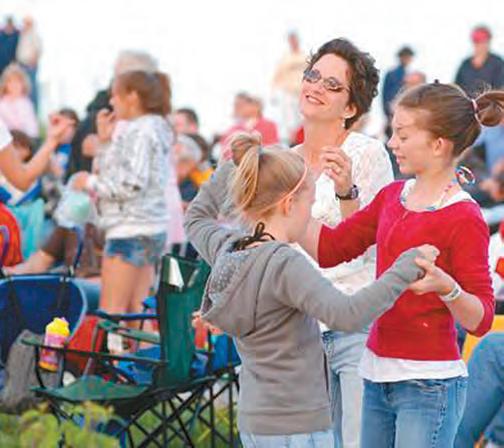
Get your lawn chairs and blankets ready—the Arts in the Park Concert Series is here.
The popular Forest Lake Arts in the Park Concert Series kicked off in June at Lakeside Memorial Park. There will be 12 performances by artists on Tuesday evenings from June through August.
Next up is the Teddy Bear Band and Camille and Co. Band beginning at 6:30 p.m. July 7. Other performances include Mick Sterling, Charlie O Ace’s & 88’s Dueling Pianos, Retro Soul featuring Big Mike and The Rockin’ Hollywoods.
The theme of the July 21 performance is Ladies of Country. The Ladies of the '80s will sing popular county songs performed by well-known female country artists. Church of Cash & Annual Corn Feed, scheduled to perform on Aug. 25, are the United States' number one tribute band to Johnny Cash.
On Aug. 4, make sure to catch Magic Norm and the Forest Lake’s Got Talent Showcase. Kids and Family Night will take place on July 7 and Aug. 4.
Arts in the Park also features a farmers market, a craft fair and food trucks. Lakeside Memorial Park is located at 95 E. Broadway Ave., Forest Lake. ◼
Madeline Dolby
LET’S GO FISHING COMES TO FOREST LAKE
By Madeline Dolby Contributing Writer
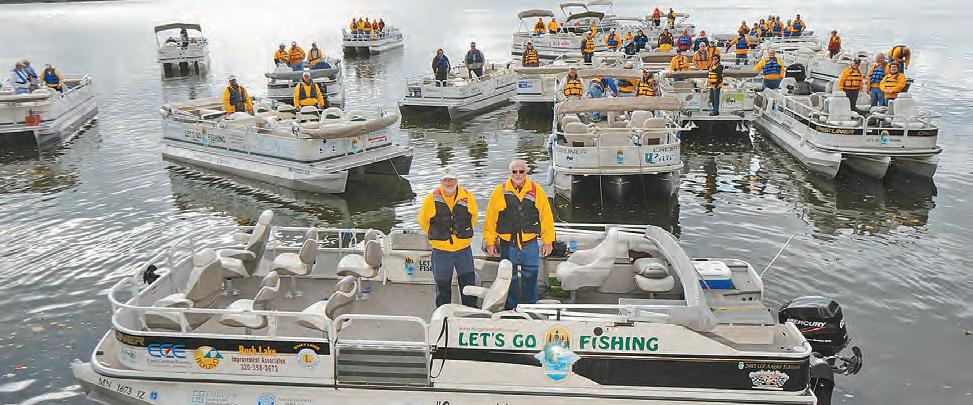
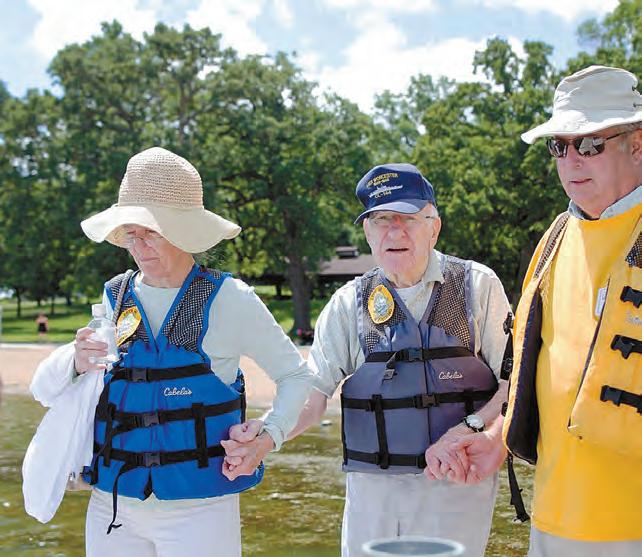
Let’s Go Fishing — Forest Lake is a nonprofit organization dedicated to providing free fishing and boating experiences for seniors, veterans, individuals with disabilities and youth groups during the summer months.
The organization, which was created 20 years ago, provides access to the healing powers and pleasure of fishing and boating for those in the community who may not have easy access on their own. In total, there are 17 chapters in Minnesota and Wisconsin.
“There are studies out there that show there is a very positive correlation between time spent outdoors and those individuals’ mental health,” said Keith Kuhnly, president of the Let’s Go Fishing — Forest Lake chapter. Kuhnly also is member of the Forest Lake Lake Association.
“It also gives them the opportunity to get out on the lake with their friends and form new bonds and create new memories,” Kuhnly added. “That’s really what it’s all about for us.”
The Forest Lake chapter was initiated by Kyle Young, parks
and recreation coordinator for the city of Forest Lake. Kuhnly said the Forest Lake chapter has also connected with community education to include information about the fishing trips in the senior newsletters.
“It’s a great fit for Forest Lake because the philanthropy here is great. (The) volunteerism is strong … It’s a wonderful thing for us overall,” Kuhnly added.
Beginning in June, the chapter will start conducting two-hour fishing trips 10 times a week. These trips will run through
September and be launched from the boat ramp at Lakeside Memorial Park.
Kuhnly said the chapter’s goal is to serve 400 to 550 guests in the first year. So far, 350 guests have signed up for a total of 42 trips. Let’s Go Fishing, as an organization, has been able to serve 250,000 guests.
For more information about Let’s Go Fishing, or to sign up for a boat ride, visit forestlake.lgfws. com. ◼
Photos Contributed
Let's Go Fishing — Forest Lake hopes to serve 400 to 550 guests in its first year of operation.
SHORE LEAVE ◼
NATIVE PLANTS: HARDWOOD CREEK LIBRARY AND CLFLWD
OFFER TIPS FOR LAKESIDE YARDS
By Logan Gion Staff Writer
Caring for a lawn and gardens can be a lot of work, more so for lakeside homes.
“If you don’t protect (your lakeside edge), if you’re mowing all the way down, you start losing shoreline. It starts receding,” explained Comfort Lake Forest Lake Watershed District President Jackie Anderson. Shoreline recession can even affect property values.
Lakeside homeowners must also contend with stormwater runoff. Lawns can develop soggy patches or miss out on rainwater and its nutrients altogether. A homeowner must then use fertilizer treatment on the lawn to keep it green, which leads to chemical and water-quality concerns.
The solution to all of these problems? Native plants.
“We encourage native plants,” said CLFLWD Education and Outreach Coordinator Adam Hjelm at a recent program with the Hardwood Creek Library. “They have amazing root systems, they’re tough and they’re adapted to our weather.” Because native plants have lived in Minnesota for so many generations, they are more drought-tolerant and disease-resistant. They also resist weedy and invasive vegetation.
Native plants, however, still need
some care—comparable to a perennial garden—the first years they are in a yard. “You’ve got to give them a little advantage to start,” Hjelm said, informing that most native plants follow a three-year pattern—year one, they sleep; year two, they creep; year three, they leap. “The first year or two, they’re putting all their energy into roots.” Once established, most native plants do not require fertilizer or regular watering.
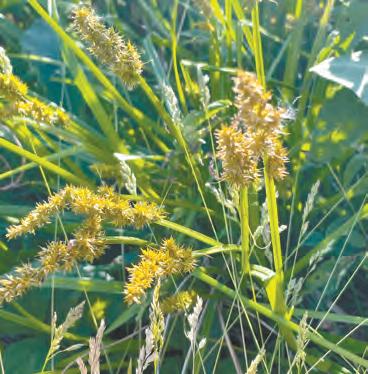
One type of native plant that Hjelm believes is especially helpful for yards with shoreline is the sedge. More than 100 types of sedges are good for Minnesota yards, and they thrive in
wet spots. “A lot of them are low mow, only get three inches tall,” Hjelm said. “Mow them once a month to clean them up if you want.” Hjelm’s favorite is the Tussock Sedge because of its Dr. Seuss-like splay. An easy way to tell the difference between sedges and grass is to feel the stems with one’s fingers. Because sedge stems are triangular, one can easily feel the ridges. “Sedges have edges,” Hjelm said.
Because native plants last for much longer and need less upkeep, many gardeners are putting them in their cabin yards as well. “We have a cabin on Big Marine,” said Washington
CLFLWD Cost-Share Program opportunities for residents:
• Mini-grant—$500 reimbursement to improve water quality through native planting, rain barrels or buffer strips.
• Shoreland habitat incentive—$1,000 reimbursement to improve habitats either directly on or in close proximity to shorelines through tree and shrub plantings and in-lake wood placement.
• Community water cost-share—A competitive grant of up to $8,000 which includes native plantings, shoreline and wetland restorations, rain gardens and approved contract labor.
• Legacy payment program—$300 per year to landowners who meet criteria, including presence of high quality natural resources, compliance with district and local ordinances and shoreline or streambank buffers.
For more information, contact CLFLWD Land Management Specialist Aidan Read at 651-583-6590 or aidan.read@clflwd.org.
County Master Gardener Mary Voss, who found the library program helpful. “I’ve been transforming plants over there that were non-native. I like the sedges. I’ve been adding sedges along the water for erosion.”
Native plants can also ease work and add variety to gardens. Native grass varieties, like Canada Wild Rye, are so hardy that they will survive hungry wildlife and even the first few snowfalls. “Grass has a great aesthetic,” said Hjelm. “Think about color and blooms for the whole year. Grasses look pretty cool in the fall, even into the winter.”
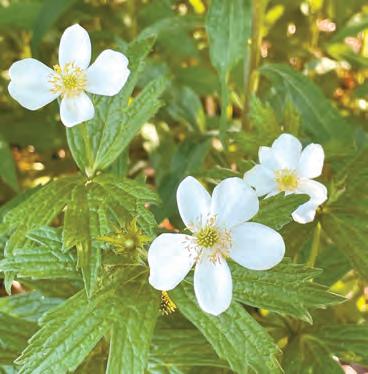
Local flowers—like Canada Anemone, Wild Bergamot and Heath Aster—are resilient yet showy, giving homeowners bright, pollinator-friendly gardens from May to October. Because these plants thrive in their native soil, Hjelm recommends keeping competition in mind. By definition, native plants cannot be invasive, but some can be aggressive. “Aggressive plants aren’t bad,” Hjelm explained. “You’ve just got to put more aggressive plants around them so that they keep each other in check.”
For those interested in buying native plants, Hjelm pointed to many websites run by local, pesticide-free growers, like mnlcorp.com, prairieresto.com and minnesotawildflowers.info. The Hardwood Creek Library also has a
Photos by Logan Gion | Press Publications
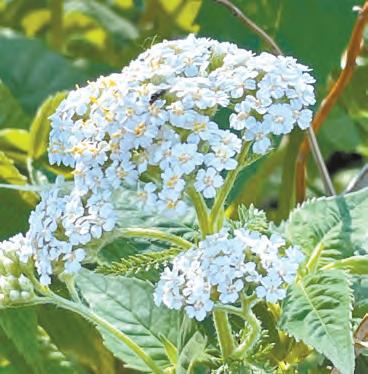
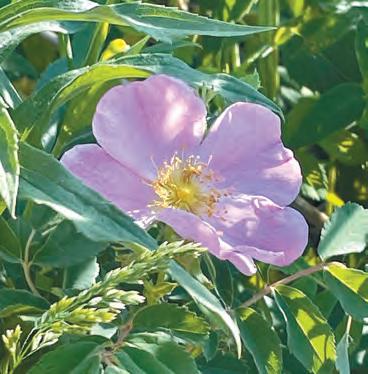
Native plant favorites pictured from left: Yarrow, Foxtail Sedge, Prairie Wild Rose and Canadian Anemone.
seed library where growers can drop off excess seeds and new gardeners can take new seeds home to try out.
“We started it in the spring of 2024,” said Librarian Cristina deSobrino. “We do have native plants and do seed-saving workshops.” Washington County Master Gardeners are putting on the next seedsaving workshop at 5 p.m., Oct. 8. The Hardwood Creek Library often hosts programs about local gardening and ecology. “As information changes, it's great to be able to have professionals that we can put in front of the public,” said deSobrino, “so that (homeowners) can feel empowered to create the changes … in their local environment with the best information that's possible.”
Logan Gion | Press Publications
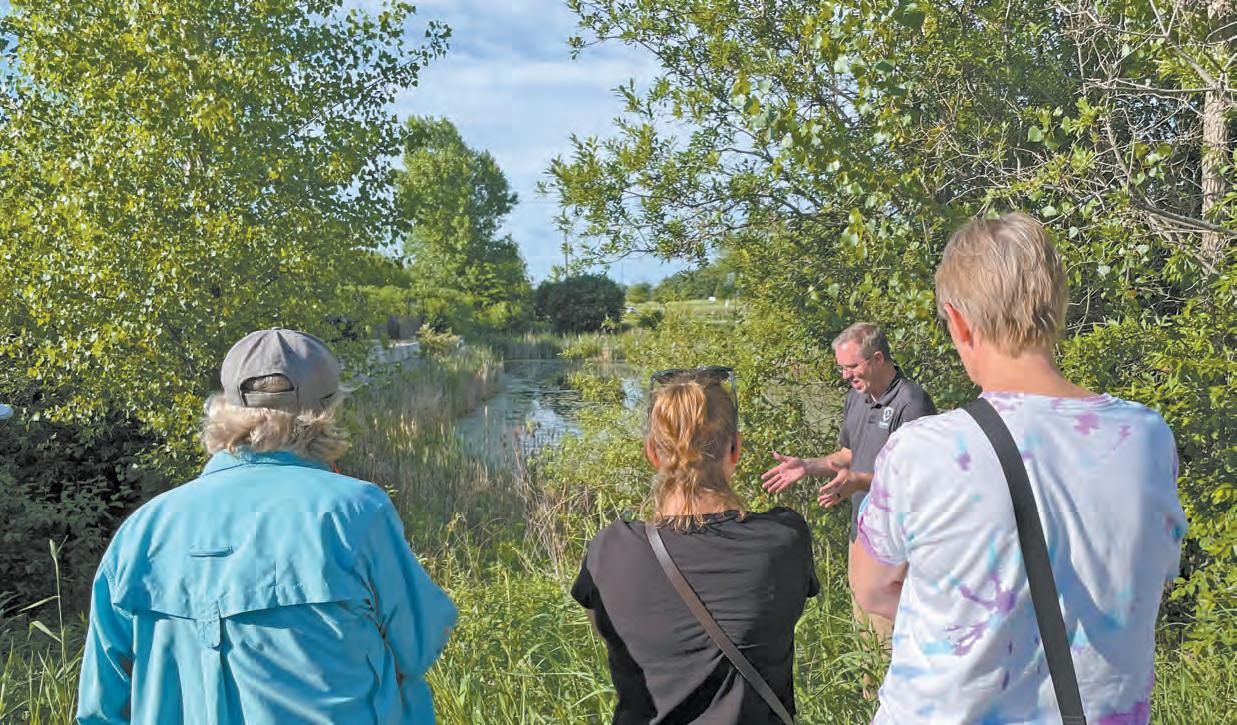
CLFLWD Education and Outreach Coordinator Adam Hjelm explains different native plants during a program at the Hardwood Creek Library.
RESEARCH PROJECT ASKS FOREST LAKE VISITORS
HOW CLEAN THE WATER LOOKS
By Shivam Vashishtha Contributing Writer
For decades, lake water quality has often been measured through numbers: phosphorus levels, chlorophyll concentrations, water clarity readings and other scientific data collected by researchers and public agencies.
A new research project that includes Forest Lake is asking a different question: What do people using the lake think?
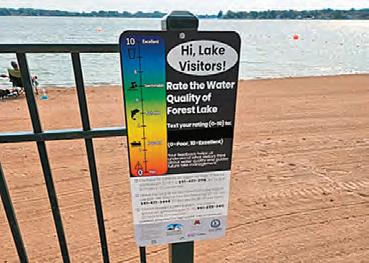
Researchers from the University of St. Thomas and the University of Minnesota are studying how lake visitors perceive water quality at 17 lakes across the Twin Cities metro area, including Forest Lake. The project uses signs posted at beaches, boat launches and public access points that invite visitors to rate the lake’s water quality by text message.
Professor Gaston Small is a biology professor at the University of St. Thomas. His research focuses on aquatic ecology, urban ecology and the effects of human activity on aquatic ecosystems. He said the project is meant to fill a gap between scientific measurements and public perception.
“This project is focusing on how visitors or residents perceive water quality, which may be similar to, but maybe a little different than the metrics that scientists or managers measure in terms of water quality,” Small said.
Minnesota lakes are already monitored and managed in many different ways. Agencies and watershed districts often track factors such as chlorophyll, total phosphorus and water clarity. Those measurements help tell whether a lake needs future management and whether past treatments have been successful or not.
But Small mentioned those numbers do not always explain how people feel when they are standing at the shoreline, launching a boat, swimming, fishing or walking near the water.
“That doesn’t always necessarily align with how people perceive the water quality,” Small said. “That’s what we’re
were rating it two or three,” Small said. “Just such a huge split.”
Understanding what drives those differences could be useful for lake managers, watershed districts, cities and lake associations. Researchers have already met with local partners connected to each of the 17 study lakes and shared summaries from the first year of data. Small said the team plans to continue sharing results with partners as the project moves forward.
Most lake management organizations already have scientific data, but they may not always have a clear picture of how people experience the lake in everyday use.
interested in.”
At Forest Lake, four signs have been placed at public access points. Two are located at Lakeside Park, including one near the swimming beach and one near the boat ramp. Another is located near a public boat ramp on the north-central portion of the lake. The fourth sign is near a boat ramp on the far eastern end.
Visitors who see the signs can text a number and rate the water quality on a scale of zero to 10. A chatbot then asks followup questions to better understand why the person gave that rating and what factors shaped their view of the lake that day.
The approach is similar to an in-person visitor survey, Small said, except that the sign and chatbot make it easier to reach people who are already using the lake.
fishing or launching a boat. A person visiting a lake in Minneapolis may also have different expectations than someone using a larger suburban lake such as Forest Lake.
“What people are doing on lakes in downtown Minneapolis is going to be different than in Forest Lake,” Small added.
“This project is focusing on how visitors or residents perceive water quality, which may be similar to, but maybe a little different than the metrics that scientists or managers measure in terms of water quality,”
Gaston Small Biology Professor
“It’s actually capturing people that are out there to use the lake at a given time,” Small said.
Forest Lake was selected as part of the larger study because researchers wanted to compare a wide range of lakes that differ in size, depth, management history and public use. Small said Forest Lake is especially interesting because of the active water quality management work already taking place there, including alum treatments by the Comfort Lake-Forest Lake Watershed District in 2023 and 2025.
The way people use a lake may also influence how they rate its water quality. Someone sitting at a swimming beach may notice different things than someone
In previous pilot research comparing Como Lake and Lake Phalen in St. Paul, Small said researchers found that perception did not always match the scientific data as clearly as expected. Lake Phalen generally had better water clarity and lower chlorophyll levels than Como Lake, but visitor perception scores were not dramatically different.
The reason, Small mentioned, is that people often judge lake quality based on more than what is measured in a water sample. They may notice trash along a beach, weeds in the water, odor, algae, murkiness or information they have heard from the news, neighbors or social media.
“If the lake is green, if it’s really scummy and lots of algae, people tend to score that low for sure,” Small said. “But if it’s not, then there’s a wide range of possibilities.”
That range is already showing up at Forest Lake. Small said the first year of expanded data collection did not produce many responses from Forest Lake, but the responses the team did receive varied widely.
“There were some people that were rating the lake water quality eight or nine or 10, and there were some people that
“Most of our partners have found that that’s useful data,” Small said. “Most of the time, that’s data that they ... don’t typically have.”
For Forest Lake residents, Small said even a single response can help. The survey is anonymized, but researchers can account for repeat responses in the case if the same person submits more than one rating over time. Regular lake users are welcome to respond more than once, especially if they notice the lake changing from day to day.
“We would love to have more responses,” Small said. “They definitely do matter.”
Although the signs are located at public access points, Small said lake residents are also encouraged to participate if they visit one of the sign locations.
Ultimately, Small said the goal is not to replace scientific monitoring, but to add another layer of understanding. Water quality decisions often involve balancing the needs and expectations of many different groups. Public perception can help explain whether management efforts are being understood, noticed or valued by the people using the lake.
“Just having a better understanding of how stakeholders are perceiving what’s happening, I think, improves the alignment between the conditions that management organizations are using to measure their success and public perception,” Small added.
For a state defined by its lakes, the project brings up a simple but important idea: Water quality is not only about what shows up in a lab result. It is also about what people see, smell, hear, expect and experience when they arrive at the water’s edge. ◼
Contributed
Researchers from the University of St. Thomas and the University of Minnesota are studying how lake visitors perceive water quality in Forest Lake.
AIDEN'S ANGLING:Late summer metro musky magic
By Aiden Johnson Special to The Laker
Locating and catching late summer muskies in the Twin-Cities metro area isn’t always an easy task. Between hot water temperatures that periodically drive musky anglers off the water in order to protect the fish and frequent bright, humid and flat-calm conditions, fishing in the summertime heat can make an already difficult bite even tougher. Despite these challenging forces and weather-related obstacles, musky fishing in the late summer time period can also be one of the most fun ways to target these fish, as their metabolism is peaking and they’re feeding in full swing, looking to angrily chase down baitfish and fishermen's lures across the lake.
The first thing that comes to mind when discussing late summertime fishing is defining exactly what time of year that means. In the minds of a metro musky fisherman, the late summer time period is usually somewhere around the middle or end of August when overnight air temperatures start to noticeably plummet, causing the water temperatures to cool as into the mid/low 70s. This is when anglers pick back up the rods that they set down in July, when the water temperatures were too hot to target these fish, and they begin to cast at muskies again after a well-deserved break. At the same time, muskies that spent most of their June and July out deep in the basin (feeding on baitfish and recovering from going through the motions of spawn) begin to return to structure, and,
are flashy, obnoxious baits that can be reeled in at a fast pace, making a fish have to quickly decide right then and there to either let the bait go by or react fast and eat it. Bucktails like a MuskyFrenzyLures “8/9 stagger” or “ringer 8” excelled in my boat during the late summer season last year and were responsible for a number of catches for both my clients and me. Beyond something like a bucktail, topwater baits also start to come into play during this time of the year, and a topwater/bucktail hybrid bait like a Kramer Bros Tackle “woodtick” can be another excellent bait to trigger a fish sitting on a weed edge or further up on a shallow structure.
oftentimes, they haven't seen traditional musky fishermen for quite a few weeks. This is personally one of my favorite situations in which to be out on the water.
As far as bait selection goes, this time of the year, speed is key. Baits that can be “burned,” or worked fast over the top of weeds and other types of structure, are one of the best ways to catch a musky in the late summertime season. My personal favorite is a bucktail, because they
Although there is a lot to digest between water temperature, bait selection, seasonal musky movements, etc, don’t be overwhelmed by all the information that anglers like me will throw at you about musky fishing during this time of the year. And truth be told, the best advice that I can give anybody chasing “the fish of ten thousand casts” here in the Twin Cities area is to simply put time on the water. Learning from experience and never really knowing when you will get that next bite is what makes musky fishing such a fun and thrilling challenge. The chase is addictive, and there is no better time than late summer to go get that metro giant that is just one cast away. ◼
Aiden Johnson owns Aiden’s Angling Guide Service, LLC. Visit aidensangling.com for more information.
Contributed
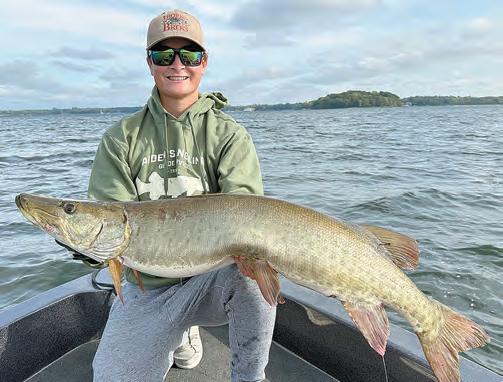
Aiden Johnson of Aiden's Angling Guide Service holding up a chunky metro musky that ate his bucktail at the side of the boat after reeling it in quickly over an underwater weed edge.