
























From ski-town eats to destination dining. - By Alan Forsythe
06 OPENING REMARKS When it comes to protecting Whistler from wildfire, aesthetics should be at the bottom of the list of priorities, writes editor Braden Dupuis.
08 LETTERS TO THE EDITOR This week’s letter writers share thanks for another successful BioBlitz, as well as an update on a new protected conservation area in B.C.
22 RANGE ROVER Researchers are using cutting-edge technology to explore new depths in the Great Lakes, writes Leslie Anthony.
46 PIQUE’N YER INTEREST Don’t underestimate the power of your vote in this fall’s municipal elections, writes Luke Faulks.


10 DELAYED DECISIONS Recreational fishing advocates say delayed federal salmon decisions are costing Sea to Sky guides, visitors and residents fishing opportunities.
11 FOR THE TREES Officials with the Cheakamus Community Forest detailed firemitigation plans at a recent public information session.
30 HIGH FIVE Pemberton Secondary continues to punch above its weight with a fifthconsecutive provincial mountain bike banner.
34 BANNER YEAR Artist Liz Dumontet’s new banners bring Pacific Northwest wildlife to Whistler lampposts.
COVER I’m definitely a ketchup-on-the-table kind of guy. - By Jon Parris // Adobe AI // @jon.parris.art
Publisher SARAH STROTHER - sstrother@piquenewsmagazine.com
Editor BRADEN DUPUIS - bdupuis@piquenewsmagazine.com
Sales Manager KAIJA KNOX - kknox@lodestarmedia.ca
Production Manager AMIR SHAHRESTANI - ashahrestani@piquenewsmagazine.com
Art Director JON PARRIS - jparris@piquenewsmagazine.com
Advertising Representatives
TESSA SWEENEY - tsweeney@wplpmedia.com
ANDREW BUDRESKI - abudreski@piquenewsmagazine.com
Digital/Sales Coordinator KATIE DOUGLAS - kbechtel@wplpmedia.com
Reporters
LUKE FAULKS - lfaulks@piquenewsmagazine.com
DAVID SONG - sports@piquenewsmagazine.com
Classifieds and Reception - mail@piquenewsmagazine.com
Contributors G.D. MAXWELL, VINCE SHULEY, LESLIE ANTHONY, GLENDA BARTOSH, ANDREW MITCHELL, LISA RICHARDSON, LIZI MCLOUGHLIN, TOBIAS C. VAN VEEN
Founding Publishers KATHY & BOB BARNETT www.piquenewsmagazine.com

AS SOMEONE WHO does not own a home, and probably never will (thanks, journalism!), I empathize with homeowners trying to protect their property, their investments, their privacy and their peace-of-mind.

BY BRADEN DUPUIS
These homeowners get such a negative rap we have a handy catch-all phrase for them: the Not In My BackYard
It’s fun to say, and easy to lump every stated concern under the NIMBY umbrella; hand-wave them away as selfish whining. But it never tells the whole story, does it?
If I did own a home, had owned it for many years with lots of tree cover, and gotten nice and used to the way things were, you can rest assured I’d be leading the charge of protest if something threatened to upset my comfy status quo.
It must be the endless frustration of every planner and politician in the country—the idea that no matter what or where the development is, if it changes something near somebody’s home, they’re probably gonna be opposed to it.
At the very least, have some questions.
And so being a decision-maker is not easy. Every choice comes with a trade-off, and keeping the balance is important. You can also never make everyone happy—so best be thoughtful with said choices.
Whistler, like any town, is not immune from NIMBYism. Regular readers of this space will remember a favourite quote of mine, said by a Whistler homeowner
many years ago in response to a proposed development near their house.
“The possibility that our lives may change scares me.”
And doesn’t that just get at the heart of it? Nobody likes change. Especially when said change is thrust upon us with little consultation and people feel unheard.
In recent years, Whistler homeowners have been very outspoken about municipal wildfire prevention efforts. Clearing brush along the highway has ruined sightlines and brought more noise from passing vehicles. Not exactly things people appreciate happening near their homes.
Last year it was along the highway by Emerald Estates. Most recently, residents of Cypress Place, a small neighbourhood opposite Nicklaus North, have been vocal about tree-clearing near their properties.
Like all homeowners just trying to
in extreme danger on this front. Go stand on the dock at Barking Bay and look at the trees spreading far in every direction, bunched tightly together with the roofs of homes poking up amongst them. Then imagine what it would be like if a fire were to break out in the middle of town during a drought.
Then go watch the videos of people trying to evacuate Fort McMurray in 2016. Note how fast the homes are catching on fire.
Whistler’s geography also leaves us uniquely vulnerable. We are a town accessed by one long and winding highway, hemmed in by forest and mountains, with one practical route out. During peak season, tens of thousands of people can be in the resort on any given day. If evacuation ever became necessary under smoky, chaotic conditions, the last
remains clear must be our top priority.
Fortunately, local decision-makers aren’t blind to that fact.
“Getting out of a community that is experiencing a wildfire is an extremely important project for a community, and ensuring that those corridors are usable by the number of people that live in this community is incredibly important,” Mayor Jack Crompton said in response to Cypress Place owners at the May 26 council meeting.
That doesn’t mean residents’ concerns should be ignored outright. Losing mature trees near your home is emotional. More highway noise is annoying. A changed view can genuinely feel like a loss, particularly when people have spent years investing in a neighbourhood.
But some trade-offs are easier to
Go stand on the dock at Barking Bay and look at the trees spreading far in every directon, bunched tightly together with the roofs of homes poking up amongst them. Then imagine what it would be like if a fire were to break out in the middle of town during a drought.
protect their property, I empathize with these Whistlerites.
At the same time, driving to work last week, and seeing the trees coming down along the highway, I found myself immensely grateful for the work the Resort Municipality of Whistler (RMOW) is doing around wildfire mitigation and emergency preparation—particularly along Highway 99.
Having written extensively about wildfires over the past decade, I don’t think it’s at all alarmist to say Whistler is
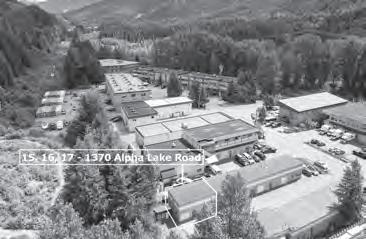
Rare live/workopportunityin Whistler. Thisuniqueproper ty consistsofthreestrata lots combinedinto onefunctional1,286sq. ft.unit. Theupperlevel featuresabrightand updated643sq. ft.one-bedroomsuitewitha privateentrance, modern kitchen,andopen livingarea. Thelowerleveloffersdirectgarage accessandflexiblespaceideal foroffice, storage, workshop,studio,orshowroomuse. An excellentopportunity forentrepreneurs,small business owners,orinvestorsseeking versatile spaceina convenient Whistlerlocation. 15,16&17-1370 Alpha Lake Road Askingprice-$779,000


thing anyone will care about is whether a stand of trees once softened the sound of traffic.
In an emergency, minutes matter. As does access for emergency crews.
It’s not an exaggeration to say the work the RMOW is doing on wildfire is quite literally about life and death.
And to put it bluntly, if a fire were to ignite in the wrong place in the wrong conditions, no amount of fuel breaks are going to stop it here in Whistler—so ensuring our one and only evacuation route
justify than others. And in an era of prolonged drought, worsening wildfire seasons and increasingly destructive fire behaviour, this feels like one we simply have to accept.
It’s not always going to be comfortable, or pretty. But aesthetics should be at the bottom of the list of priorities here.
Whistler doesn’t have time to waste on debating science or appeasing homeowners.
Because if worse comes to worst, there won’t be many backyards left to defend. n

















Thanks to everyone who contributed to making the 20th Whistler BioBlitz last week another species-filled success! BioBlitz scientists presented to elementary school students then blitzed forests and wetlands throughout Whistler.
Our goal is to introduce students to all the fascinating animals, plants, fungi, and other organisms that make Whistler home. This year we presented to 22 classes and about 500 students at Spring Creek and Myrtle Philip Schools. Topics included pollinators, reptiles, food chains, animal tracks, a Wild Things scavenger hunt, and Whistler’s amazing wildlife. Thanks to the visiting and local scientists who volunteered their time to present.
This year’s theme was Beaver Blitz in recognition of the critical importance of beavers in creating wetlands. On Thursday night, Bob Brett presented to almost 100 people about the importance of beaver dams and other reasons to love beavers. We then conducted biodiversity surveys in beaver ponds over the weekend, results of which will be collated over the coming weeks and months.
A huge thank you to the Whistler

“Thanks to the visiting and local scientists who volunteered their time...”
- BOB BRETT AND KRISTINA SWERHUN
Community Foundation and the Resort Municipality of Whistler Community Enrichment Program for the funding that makes BioBlitz possible. We are also incredibly lucky to have such generous local

MountainPsychology andNeurofeedbackCentre
StephenL.Milstein, Ph.D.,R.Psych.BC#765- 604.938.3511
DawnaDixxMilstein ,OT.COTBC#AA0201- 604.938.3523
Squamish:604.848.9273
Whistler:#107-4368MainSt,Whistler,B.C.V0N1B4
Servingseatoskyfor18years
suppliers who provided in-kind support, including Toad Hall Studios, Whistler Blackcomb, Nesters Market, and BC Parks.
Bob Brett and Kristina Swerhun // Whistler Naturalists
In the past weeks we were thrilled to witness a major step forward for several Indigenous nations, the governments of B.C. and Canada, and by extension all of us. Six of the Central Coast Indigenous Nations (Wuikinuxv, Nuxalk, Xia’xais, Heiltsuk, Gitxaata, and Gitga’at) as well as members of the Central Coast Indigenous Resource Alliance and the Hakai Research Institute, all came to the great hall in Klemtu to celebrate and sign an agreement to create an Indigenous Protected and Conserved area.
This agreement took years to advance, and meant that these nations had to forgo overlapping land claims, and instead design ways to protect almost all of the Central Coast from Calvert Island to Gil Island, some 200 miles to the north, as well as stretching east to Bella Coola and west to Hecate Strait.
The Heiltsuk were the hosts of the celebration, and the overall sense from them was that this is a movement beyond reconciliation, toward cooperation and sharing of this precious environment, an environment we all share as Canadians. Indigenous nations gained the rights of BC Parks Rangers and became “guardians” and “watchmen.” Fishing will continue, logging will be negotiated, and tourism will be encouraged, some under Parks
Noticeisherebygiventhat Lil’watForestryVentures,holderof First Nations WoodlandLicense#A19214,isseekingpublic review andcomment on Forest OperationsMap(FOM)ID#3234,whichis covered by Forest StewardshipPlan#1057.Thereviewand comment periodrelated to FOMID#3234is availablefor a30-dayperiodfrom June12th,2026, to July12th,2026.This FOMconsistsofproposed cutblocks,andaccompanyingroadreconstructionandproposednew roadconstructionlocatedintheNorthCreekandBoulderCreekareas intheSeatoSkyNaturalResourceDistrict.
TheFOM canbeviewedathttps://fom.nrs.gov.bc.ca/public/projects, and by searchingLicenseeusingthe‘find’function.Alternatively,the informationcontainedintheFOM canbemadeavailableforin-person viewingduringnormalbusinesshours at KinteraSolutionsLtd.’soffice at#201 –1121CommercialPlace,SquamishBC.
Commentscanbesubmittedanytimeduringthe30-dayperiod throughhttps://fom.nrs.gov.bc.ca/public/projects,e-mailedtoLilwat. FOM@crgl.ca,ormailedtotheaddressnotedabove.Please reference the FOMIDwhensubmitting comments.
Followingthereviewand comment period,thisFOMmayberelied upon to applyfor aRoadPermitorCutting Permit fora 3-yearperiod, endingJune12th,2029.


Canada, and respectful usage of this land will be open to all to enjoy.
Here is an example for our local nations, acknowledging that cooperation and respect when working together can lead to major advancements.
On the coast now, and hopefully in the
we are all residents now, and each of us can be informed and responsible for considerate stewardship of our lands. Of course there need to be restrictions based on how many of us can reasonably access sensitive environments at any given time, without limiting usage to any one cultural group.
“Here is an example for our local nations, acknowledging that cooperation and respect when working together can lead to major advancements.”
- IRENE AND AL WHITNEY
Sea to Sky in the near future, we all share the responsibility of caring for our shared territories, and all can go to places like Joffre Lakes to seek renewal, both spiritual and physical. There should never in Canada be restrictions based on any one unique heritage because
Hopefully the leaders of the Squamish and Lil’wat Nations, and local politicians, can see this new protected conservation area on our Central Coast as an example for moving forward in our own backyard.
Irene and Al Whitney // Whistler n
Write to us! Letters to the editor must contain the writer’s name, address and a daytime telephone number. Maximum length is 450 words. Pique Newsmagazine reserves the right to edit, condense or refrain from publishing any contribution. Letters reflect the opinion of the writer and not that of Pique Newsmagazine. Send them to edit@ piquenewsmagazine.com before 11 a.m. on Tuesday for consideration in that week’s paper.








NickDavies,
andexperiencedfamilylawyer practisingacrossBCandYukon. Callat 604-602-9000 or visit www.macleanlaw.ca
MacleanLawisheadquartered inVancouverwithofficesacross BritishColumbia.



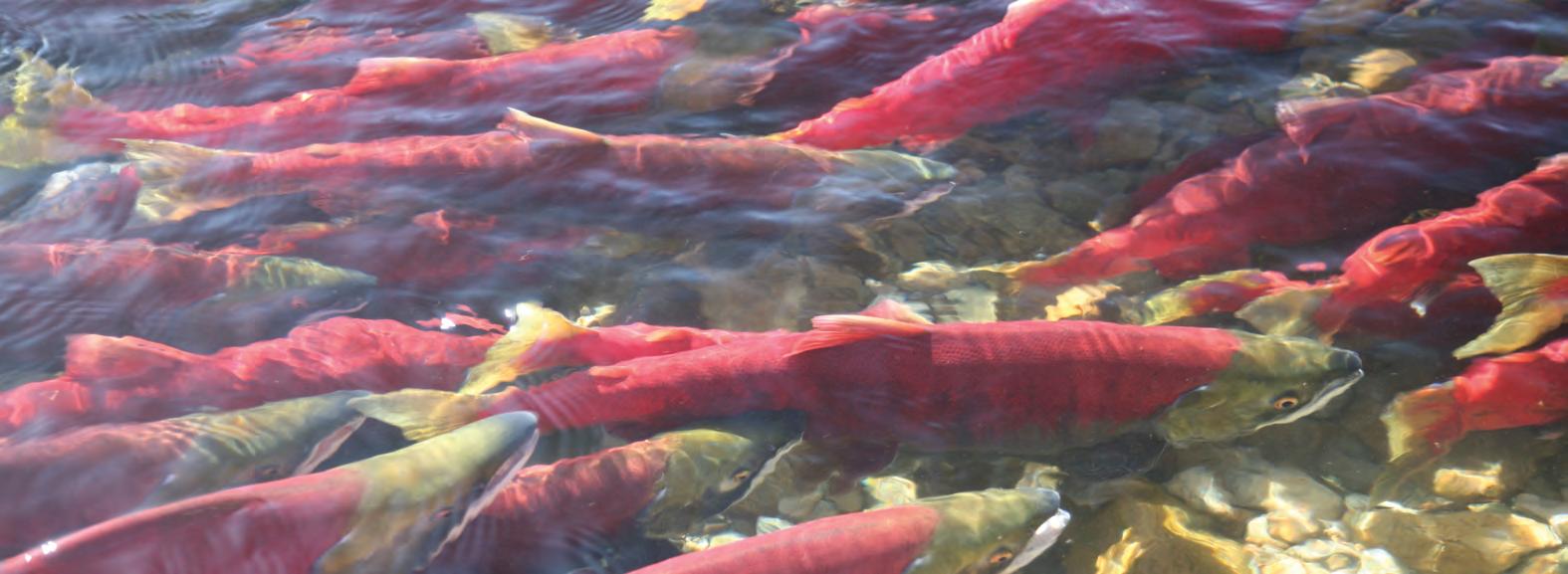
ADVOCATES SAY DELAYED OPENINGS, HOWE SOUND CLOSURES AND A REVIEW OF CANADA’S 1999 SALMON ALLOCATION POLICY ARE CREATING UNCERTAINTY FOR ANGLERS AND BUSINESSES
BY LUKE FAULKS
B.C. RECREATIONAL fishing advocates say delayed federal salmon decisions are costing Sea to Sky guides, visitors and residents fishing opportunities— especially in Whistler, where summer and fall trips are often booked months ahead.
“It makes it very difficult to plan,” said Dave Brown, chair of the SquamishLillooet Sport Fishing Advisory Committee and a representative of the Public Fishery Alliance. “The department has been hearing this for a while, and we haven’t seen a change.”
Brown told the House of Commons Standing Committee on Fisheries and Oceans on April 26 that Fisheries and Oceans Canada’s (DFO) approach to recreational salmon management has become less predictable and less responsive. He said annual salmon forecasts and expected fishing opportunities were once available before the new year, but key stock assessment information may now arrive in late March or April, while southern B.C.’s integrated fisheries management plan is often not finalized until June.
For Whistler-area operators, Brown said the issue is not only whether one fishery is open or closed, but whether they can confidently market salmon trips to visitors planning ahead. Coho opportunities are generally more predictable, he said, while pink salmon can return in large numbers during prime summer months but are often left out of interim fisheries plans, making in-season openings difficult.
“You can’t plan for it,” Brown said. “[Anglers] likely would go somewhere else, or do something else.”
The uncertainty reaches beyond individual anglers, he added.
“It’s the economic loss, disruptions to guides, marinas, tackle manufacturers, retailers, marine services, reduced licence sales,” Brown said. “It all contributes.”
His comments came as MPs studied how DFO sets marine harvesting seasons, and amid a broader federal review of Canada’s 1999 Pacific Salmon Allocation Policy—one recreational fishing advocates fear could further reduce the predictability recreational fisheries depend on.
Brown pointed to Howe Sound chinook as a local example.
Before 2019, he said, chinook fishing there was open year-round. Today, it closes April 1 and generally does not reopen until mid-August or September, with lower retention opportunities.
“The angling community has had such significant reductions in access, has really worked to find ways to adapt, and it’s just dragged on and on,” he said.
Brown said the same problem applies on local rivers.
In Region 2, which includes the Lower Mainland and Sea to Sky, rivers were once assumed to be open to salmon fishing as a baseline. Now, Brown describes them being closed unless expressly opened, leaving systems like the Squamish River without openings even when pink or chum return in fishable numbers.
“We can have a number of rivers that have salmon coming back, and they won’t adapt,” he said.
Layered over those local concerns is a broader federal review of Canada’s 1999 Pacific Salmon Allocation Policy, which guides
how allowable salmon catch is divided after conservation needs, First Nations food, social and ceremonial fisheries, treaty obligations and rights-based fisheries are addressed.
The existing policy gives the recreational sector priority over the commercial sector for directed chinook and coho fisheries. For sockeye, pink and chum, the commercial sector is allocated at least 95 per cent of the combined commercial and recreational harvest on a coast-wide basis, with the remaining five per cent going to the recreational sector.
DFO says the review was launched after the 2018 B.C. Supreme Court ruling in Ahousaht, which found the department’s application of the policy unjustifiably infringed the rights of five Nuu-chah-nulth Nations to fish and sell fish, including chinook and coho.
DFO’s discussion paper says First Nations and commercial-sector representatives have proposed removing the recreational sector’s priority over the commercial sector for chinook and coho. Sport Fishing Advisory Board representatives have argued for maintaining the recreational priority for chinook and coho.
Brown said the current structure helps create predictable seasons for the public fishery. If that changes, he said, the effects would be “devastating.”
The review also touches on the phrase “common property resource.” In plain terms, that means salmon are not owned by one private group or sector. They are managed by the federal government on behalf of Canadians today and in the future, while still recognizing constitutionally protected First Nations rights.
Fisheries’ discussion paper says there is some agreement to remove common property as a stand-alone principle, but disagreement over whether all references to it should be removed. First Nations
representatives have argued the phrase is a colonial concept that has been harmful to First Nations, salmon and ocean ecosystems. Sport fishing representatives argue the principle should remain, either as its own clause or in the policy context, because it supports the public right to fish.
Jesse Zeman, executive director of the BC Wildlife Federation, said the commonproperty issue reaches beyond salmon.
“That’s not just about fish,” Zeman said. “It’s about getting access to rivers and streams and navigable waters and wildlife and parks and Crown land and everything.”
Zeman also criticized the public consultation window. He said the process had been underway behind the scenes for years before DFO released materials in December and initially gave the public roughly a month to respond.
“The consultation period was woefully inadequate,” he said.
SAY Brown and Zeman said reduced recreational opportunity could also weaken salmon conservation work. Licenced anglers, Zeman said, contribute “tens of millions” of dollars’ worth of on-the-ground stewardship.
“If you get rid of anglers’ opportunity to go fish, you lose the jobs, you lose the economics, you lose anglers, you lose the dedicated funding, you lose the people running these hatcheries, you lose the stewardship piece, and then ultimately you lose the fish,” Zeman said.
The concern, he said, is not simply about catching fish. It is about whether Sea to Sky residents, guides, visitors and young anglers will still have predictable access to local salmon fisheries when the data supports it.
“People getting out on the water and recreating is important for your mental health,” Brown said. “All of these things are a concern.” n
BLOCKS AND FUEL-TREATMENT AREAS RUN THROUGH THE CALLAGHAN, BRANDYWINE, FUNCTION JUNCTION AND CHEAKAMUS
BY LUKE FAULKS
THE CHEAKAMUS Community Forest (CCF) is planning what its forester described as a “hockey stick”-shaped landscape fuel break south of Whistler, using a mix of proposed harvesting blocks and fuel-treatment areas to slow potential wildfire pathways into the community.
At a May 26 information session, forester Abe Litz said the CCF’s Strategic Threat Analysis Map identifies “Fire Highway” corridors where modelling suggests fire could move toward Whistlerarea neighbourhoods and infrastructure.
“The idea is to create massive fuel breaks surrounding Whistler,” Litz said. “These are the high-risk fire pathways, these are where the [models] show fire is likely to burn and travel into the community.”
Litz described the overall shape of the planned landscape-level fuel break as a “hockey stick” coming down toward Function Junction.
“The idea is to harvest blocks that have harvest opportunity,” he said. “In between, where there’s younger stands that don’t have a harvest opportunity, we want to go in and do fuel management [prescriptions] to reduce the amount of fuel.”
Proposed work appears along and near the Callaghan Creek FSR and Callaghan Valley Road, around Brandywine and Brew Creek, west and south of Function Junction, and near the Highway 99 corridor leading toward Cheakamus Crossing.
The proposed cuts are planned for fall 2026 and spring 2027.
The CCF is jointly held by the Resort Municipality of Whistler, Lil’wat Nation and Squamish Nation.
Its mandate is broader than timber harvesting alone, with the CCF saying it is guided by ecosystem-based management and the need to balance ecological, cultural, recreational, carbon, wildfire and economic values.
Litz said climate change is shaping both the wildfire planning and the way the CCF intends to treat secondgrowth stands, with earlier springs, hotter temperatures and drier conditions stressing trees and making open sites harder to regenerate.
“The idea really is to manage the temperature in each forest for multiple values while reducing the wildfire risk and increasing the resilience of the forest to the predicted impacts of climate change,” he said.
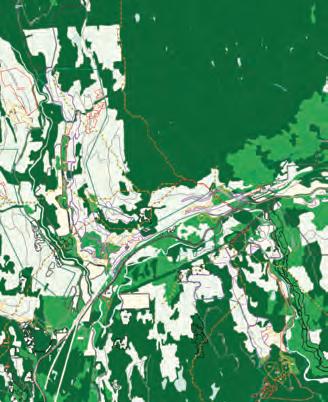
DANCE The forest-cover colours show stand age, with white indicating younger forest, light green mid-aged forest and dark green older forest.
MAP BY CHARTWELL
“We’re seeing these earlier springs, so longer burning seasons, pressure comes earlier, hotter temperatures, less precipitation, all those factors [introduce] stress to the landscape.”
Much of the proposed work is focused on even-aged second-growth stands, rather than old-growth forests. Litz said many of those younger stands are dense and low-diversity, with ladder fuels that could help fire move into the canopy.
He said retention—leaving individual trees or other forest structures standing— is part of that shift.
“So the retention harvesting is a way to sort of offset that, keep a little or a lot of shade on the site, so that we can maintain those cooler, damper soil conditions longer in the year, so that we have a better chance of trees surviving,” he said.
Residents at the session raised questions about whether the proposed work will be enough to protect Whistler from a major wildfire. One resident pointed to strong valley winds on hot summer days and warned that even a fire near Highway 99 could create major economic problems for the resort if smoke or access issues disrupted movement through the valley.
Litz said the modelling considered fuel types, stand types, topography, winds, temperatures and wind speeds before projecting where fire would likely move.
“Most of these treatments aren’t designed to eliminate fire or exclude fire from the landscape,” he added. “But ... if fire does occur, [it] makes it less intense, it has less fuel, it doesn’t explode into conflagration, it stays on the ground.” n














BY LUKE FAULKS
ELDON BECK, an award-winning planner and landscape architect whose work helped shape Whistler Village, died Saturday, June 6, at age 94.
Whistler council opened its June 9 meeting with a tribute to the visionary behind the Village Stroll.
Mayor Jack Crompton said Beck’s influence on Whistler is difficult to overstate, pointing to the way his village design followed the natural landscape, preserved gathering places and views, and helped create a pedestrian-first village at a time when that idea was still rare in North America.
“I think it’s really hard to overstate how truly ahead of his time Eldon was, and what a massive, massive impact he made on our community,” Crompton said. “While today pedestrian villages can be found all across North America, in the late ’70s, they were practically unheard of outside of the Alps.”
Crompton said one of Beck’s early village drawings still hangs over the desk in the mayor’s office, showing blocks of buildings laid out with careful attention to sun, shade and how light would hit
patios in different seasons.
“If you do get the chance to walk the Village with people who worked with Eldon, take that opportunity and enjoy learning a little bit about the history of this great community, and the fingerprints that Eldon left all over it,” Crompton said.
“Whistler today would not be what it is were it not for Eldon, and we will cherish his legacy for generations to come.”
That tribute led into a fitting first report: Whistler’s updated Village Stroll Tree Strategy.
Acting parks planner Connor Eccles told council the strategy is meant to protect, enhance and adapt Whistler Village’s urban forest, while carrying forward Beck’s “village in the forest” idea.
“Trees along the Village Stroll are essential to the village’s identity, livability, and economic vitality,” Eccles said, adding they contribute environmental, social and aesthetic benefits while reinforcing Whistler’s identity as a resort community immersed in nature.
The strategy focuses on the Village Stroll corridor from the base of Whistler
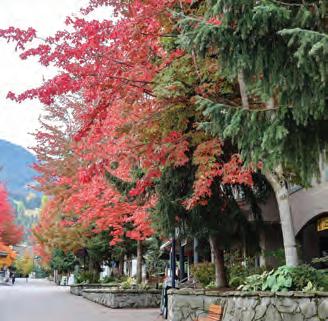
Mountain to Whistler Olympic Plaza. A 2024 inventory documented 354 trees in the study area, with 254, or 72 per cent, located on private property and 100 managed by the Resort Municipality of Whistler (RMOW).
The document notes Village Stroll trees are largely between 30 to 50 years old and are under pressure from redevelopment, storefront visibility concerns, limited soil space, climate change, wildfire risk and water conservation. It recommends
better soil and planter conditions, species diversity, climate-adapted trees, continued irrigation, low-flow systems and better coordination with private property owners.
Council questions focused on how the RMOW can actually move the plan forward when most trees are privately owned.
Councillor Ralph Forsyth asked whether there are incentives to help strata properties improve planters or replace trees. Eccles said the main tool is awareness, with many improvements likely coming through future development permit applications.
Forsyth also asked about the cost of removing a danger tree. Eccles estimated the overall cost at about $1,075, including an arborist report, roughly $500 for removal labour and about $325 for a replacement tree, though he said the total can vary depending on tree size and species.
The timeline for permits drew concern. Eccles said tree-related development permits have taken an average of 118 days over the past two years.
Council unanimously endorsed the updated strategy, which staff said only included minor spelling and technical changes from a version previously endorsed earlier this year.
SEE PAGE 14 >>

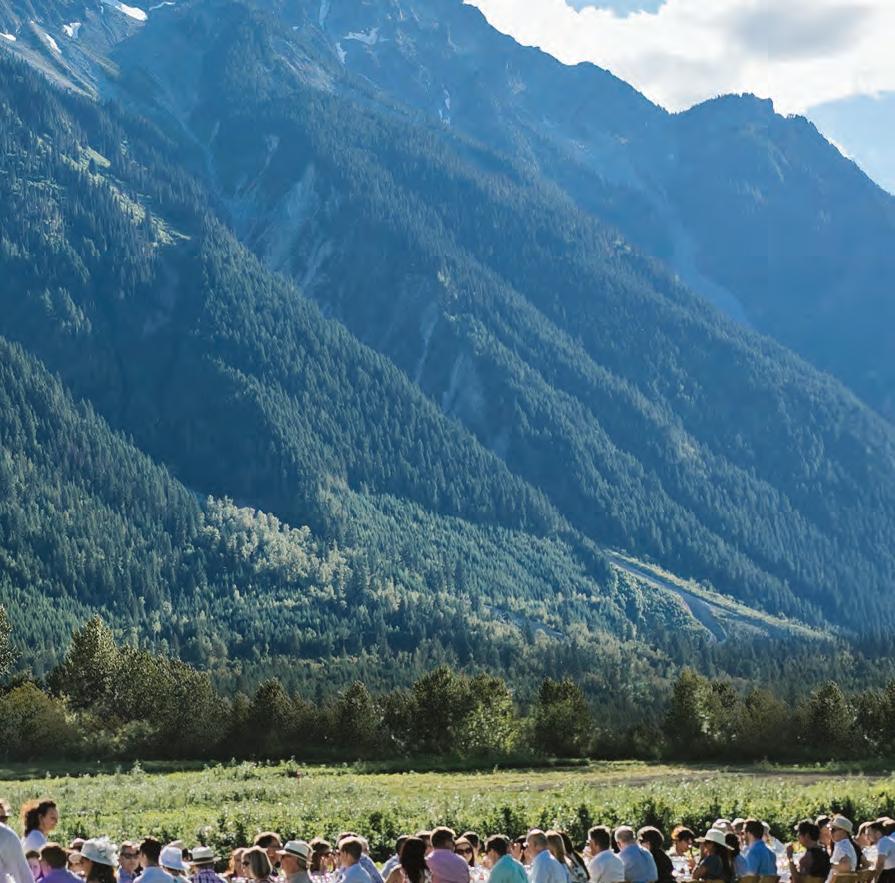
SUNDAY,JULY 26


north arm farm, pemberton
Culinary DirectorJames Waltandhisteamwelcomegueststothe15thannual
Araxi Longtable Dinnerat NorthArm Farm. Festivitiesstartwithacocktail receptionfeaturing canapésandliveentertainment,followedbyafour-coursefamily-styledinnershowcasing seasonalflavoursfromAraxi Restaurant, Il Caminetto, Bar Oso, and Provisions,withwinepairingsfromtop British Columbiawineries.
Scanand Reserveyourspot oraccess www.araxi.com/longtable
We lookforwar d towelcomin g yo u rainorshin e to No rt h Ar m Fa rm !


Council also approved the 2026-27 annual operating agreement for the Whistler Transit System on June 9, a three-way partnership between BC Transit, the RMOW and Whistler Transit Ltd.
Manager of climate and environment Luisa Burhenne said the agreement covers April 1, 2026 to March 31, 2027, and keeps service levels roughly the same as the previous year.
“The operating agreement looks very much the same, or very similar to last year’s operating agreement, because we have not received any expansion funding that we requested,” Burhenne said.
The system is budgeted for 87,914 annual service hours. Total system costs are projected at $17.29 million, up 1.6 per cent from the previous year. The RMOW’s net local government share, after fare revenue, is expected to rise by $408,869, or 7.4 per cent.
Burhenne said the overall increase is lower than staff had expected, partly because of lower fuel costs tied to fleet electrification, a battery electric bus credit, higher fare revenue and lower insurance costs.
The RMOW will use $600,000 from its remaining Local Transit Fund— previously, the COVID-era “Safe Restart Fund”—balance this year, leaving about $400,000 for 2027-28. Burhenne said the
fund is expected to be depleted after that.
Burhenne also gave council an update on fleet electrification.
Installation of 16 battery electric bus chargers is underway and expected to be complete in September. The first five electric buses are also expected in September, though they will need commissioning, testing and driver training before they hit the road. Ten more buses are expected in stages through spring 2027, with the 15 battery-electric buses expected
The most divided discussion came over public washrooms at Market Pavilion, at 4368 Main Street.
Council approved a covenant change to reduce full public access to the secondfloor washrooms. The current policy requires the washrooms to be open to the public from 9 a.m. to midnight every day. The change will require public access
“I feel like there should be some kind of human dignity requirement that there are bathrooms available, and you shouldn’t have to be a paying customer...”
- JEN FORD
to be deployed by fall 2027.
Burhenne noted that ridership is still growing. She said service hours increased about 18 per cent between 2023 and 2025, while annual ridership rose 30 per cent.
Route 10 remains the system’s busiest route and is the main target when staff ask for more service hours.
Council approved the operating agreement with no opposition.
from 9 a.m. to 8 p.m., with key access after 8 p.m. for patrons of businesses in the building that remain open later.
The Market Pavilion strata applied in 2023 to remove the public access requirements, citing vandalism, damage, safety concerns and repair costs. In its application, the strata said it has spent at least $100,000 on washroom-related repairs since 2018, not including daily cleaning, supplies or out-of-
pocket costs paid by owners.
Staff did not support fully removing public access; instead, they worked with the strata on a compromise that keeps daytime public access while ending open access earlier in the evening.
General manager of climate action, planning and development services Dale Mikkelsen said staff recognize the challenges of running late-hour public washrooms, based partly on the RMOW’s own experience.
“We are reducing public access by allowing the businesses to lock the doors at 8 o’clock, but we’re increasing access to the customers of those businesses in a more controlled manner,” he said.
Coin. Jen Ford opposed the change, saying public washrooms are a basic need and people should not have to prove they are customers before using one.
“I feel like there should be some kind of human dignity requirement that there are bathrooms available, and you shouldn’t have to be a paying customer, because anatomy doesn’t work that way,” she said.
Coun. Jessie Morden also said she struggled with the change, recalling how frustrating it was when the building previously used a key code.
Forsyth and Coun. Jeff Murl were more supportive. Forsyth noted the washrooms would still be open to the public until 8 p.m., while Murl said the change is a reasonable adjustment to a building and village context that have changed since the 1990s.
The motion to reduce hours carried. n


WHISTLER BLACKCOMB SAYS THE JUNE 3 MOVEMENT WAS ANTICIPATED AFTER EARLIER INSTABILITY NEAR THE PEAK
BY LUKE FAULKS
WHISTLER PEAK is staying unusually active in the shoulder season.
After incidents on March 12 and May 28, a small rockslide came down from Whistler Peak at 8:04 a.m. on Wednesday, June 3.
In a statement, Whistler Blackcomb (WB) said the area “continues to remain closed,” there is “no risk to guests or staff,” and its operations team is working with geotechnical experts to monitor conditions and finalize a detailed assessment.
UBC professor of rock engineering Davide Elmo explained smaller releases after a larger rock failure are not unusual, depending on the nature of the original collapse.
“It’s not uncommon. It depends on the initial kind of a failure that you had, what kind of a mechanism,” Elmo said, adding that just because you didn’t have a complete failure, “it doesn’t mean that whatever is left is a stable structure. It could be partially stable, or just unstable.”
Elmo said a block or section of slope can appear intact after a failure, while still being part of the same broader process of collapse.
“So even if you still have potential blocks or structures that may look stable because they didn’t move during the original slide, that doesn’t mean that they’re not going to move in a short period of time,” he said.
WB said initial findings indicate the May 28 incident was most likely “hangfire”—an unstable section of rock fractured during the March 12 rockslide that did not immediately release and is now shifting due to melting snow and rising temperatures.
The resort said additional movement, including the June 3 slide, was anticipated as part of that natural process. Assessment of the area is underway.
Elmo said assessing a rockslide area starts with site investigation: looking for signs of instability, including tension cracks above the slide, blocks detached from the slope behind them, open fractures, fresh debris and the extent of the run-out zone.
“You would have to basically approach the area where you have the rock slide, and then you would have like a geotech then assess to see [any] sign of instability, whether you have like tension cracks on the top,” he said.

If experts identify unstable blocks, they may try to remove the hazard by scaling the rock face—dislodging loose blocks so only more competent rock remains. In some cases, Elmo said that can be done with ropes, crowbars or inflatable bladders inserted into fractures.
In other cases, protective measures
like heavy-duty mesh may be considered, though access in steep alpine terrain can make engineering work difficult.
Elmo said Whistler Peak’s geology also matters.
The area includes volcanic and sedimentary rocks, he said, and the contact between different rock types can act as a plane of weakness. Freeze-thaw action, the weight and movement of snow, weathering and erosion all add to the ongoing evolution of the slope.
Still, he cautioned against assuming the current sequence means Whistler Peak will keep “unravelling.”
“This is a continuation of the episode, but it doesn’t mean that now it’s going to continue to unravel,” he said. “Rock likes to go back to kind of a stable state for the time being, and then over time ... years or decades, if not hundreds of years, things still keep evolving.”
Asked whether experts can ever declare an alpine slope safe, Elmo said it is more accurate to talk about reducing risk to an acceptable level.
“It’s very difficult to say what is safe,” he said. “No one knows what is the factor of safety of a slope, so we see it standing, but you don’t know if it’s close to failure, so no one knows that.”
For a resort environment, minimizing risk means keeping people out of the area most likely to be hit if more material comes down, he said. The debris field and run-out zone show where rock has already travelled and where future rockfall could be dangerous.
Visitors should avoid standing below cliffs or on debris to take photos, he counselled.
“When rock fails, it doesn’t give you warning,” he said. “So it’s not that it tells you ‘I’m gonna fail in two hours or three hours from now.’ These are very, we call it brittle failures, so they occur very, very quickly.”
Elmo said climate change can also speed up natural alpine erosion by changing snowmelt, water movement and glacier cover. In warmer conditions, more water can enter fractures, while retreating ice can remove support from cliff bases.
“So there are consequences for the glacier retreat, so it changes basically your morphology of your mountains,” he said. “And what we do as humans, basically, we are speeding up the process, that’s what climate change is doing.”
His safety advice for anyone in alpine terrain was direct: stay away from debris areas and the base of cliffs, particularly near recent rockfall.
“I would just recommend people respect the mountain and stay away from any debris area, because that’s where more rock slides can actually occur,” he said. - with files from Braden Dupuis n













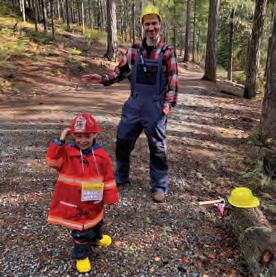
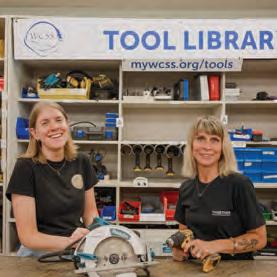
Weoffergrants ofup to $500 foryou to bringyour communityproject to life.WithaNeighbourhoodSmall Grant, youjoinournetworkofthousandsofprojectleaders whohave taken steps to bettertheirneighbourhoods.
Monday,June15,2026|4:30pm-6:30pm
IstkenHall at Sḵwxwú7meshLílwat7úl CulturalCentre ,
We’rebringing togetherourincredible2025granteesand friends foraneveningthat’s equal partsinspiringand energizing. You’llhavethechance to connect withlocal changemakers,learnwheresupportisneededmost,andsee firsthandhow collective generosityfuels realsocial andenvironmentalchange acrossour community.

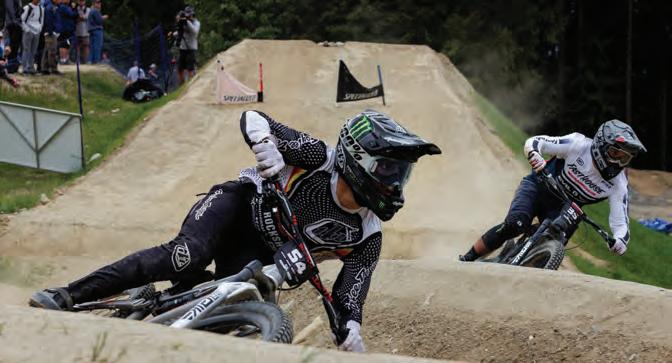
RMOW to spend more than $1M on 2026 festivals and events
STAFF SAY INVESTMENTS ARE AIMED AT SUPPORTING NEED PERIODS, LONGER STAYS AND YEAR-ROUND VISITATION
BY LUKE FAULKS
LET IT NOT be said that Whistler totally shuts down in the time between peak ski and mountain biking seasons.
This year, the Resort Municipality of Whistler (RMOW) is putting more than $1.03 million in Festival, Events and Animation (FE&A) funding toward a mix of major sport events, arts and culture programming, museum exhibits, food and drink festivals, and smaller community events.
“This is not a complete calendar by any stretch,” said Bob Andrea, the RMOW’s manager of village events and animation, while previewing upcoming programming at council’s May 26 meeting.
“I want to highlight that we’re intentionally spreading events out throughout the whole year, and that’s to align with FE&A and Smart Tourism goals and strategies, and with quite a bit of investment in the shoulder periods, which is the time of need.”
The funding is drawn from the Municipal and Regional District Tax, or MRDT, which is collected through shortterm accommodation stays and used to support tourism efforts.
The largest investments this year are Crankworx Whistler and the UCI Mountain Bike Downhill World Cup, at $200,000 apiece, along with the World Ski and Snowboard Festival at $150,000 and Cornucopia Whistler at $97,200.
Andrea told council the RMOW does not simply fund events based on popularity or tradition.
“Proposals are evaluated against rigorous standardized criteria, ensuring consistency and fairness in determining the recommended investment levels, and this also helps remove any personal
bias, tastes, or preferences,” Andrea said.
The process considers how many paid room nights an event can generate, whether it falls during a slower time of year, whether it encourages longer stays or midweek visits and whether it strengthens Whistler’s reputation as a year-round destination.
Andrea said staff also look at whether events reflect community values, build local pride, improve the visitor and resident experience, support sustainability and accessibility, and include Indigenous programming “in an authentic and respectful way.”
Councillor Jessie Morden inquired about the decision-making between a $30,000 investment in the Audain’s Takao Tanabe exhibit and $2,500 for Art on the Lake.
“I know you said bed numbers sold is a big contributor to that,” she said. “I just think about this, the Audain Art Museum money, that this isn’t going to be a reoccurring thing, whereas Art on the Lake is. [It] just seems like we should be giving more to a local event rather than a one-time event.”
Andrea said museum and cultural centre exhibits are evaluated differently because they can run for months, often during slower tourism periods, and provide weather-independent visitor experiences.
He added exhibits can also attract cultural tourists and diversify Whistler’s visitor base.
In light of discussions around waste reduction earlier in the May 26 council meeting, Coun. Cathy Jewett asked whether Zero Waste Heroes—a program where volunteers help visitors sort their waste during events—would be part of summer programming.
Andrea said the program tries to place Heroes where there is enough time for meaningful public education, like Canada Day, rather than short concert programs where audiences are focused on the show. n
WE COULDN'T DO IT WITHOUT YOU!
• AC Petroleum
• All-Terrain Excavating
• Backcountry Motorsports
• Badger Industries
• Bluebird Electric
• Cata Management
• Coastal Mountain Excavations
• Corona Excavating
• DDD Trucking
• Ellmack Excavation & Landscaping
• Furlong Racing
• GFL
• L&A Equipment
• Miller Capilano
• NAPA
• Pemberton Valley Painting
• Reliable Towing
• Sabre Rentals
• Skytech Yarding LTD
• Storex
• Tonka Trucking
• Whistler Welding Services
• XL Audio
• 99 North
• AC Petroleum
• Alpine Motorsports
• Backcountry Motorsports
• Carson Automotive
• Carter GM Northshore
• Copper Kracken Tattoo
• Dandelion and Clover
• Grimm’s Gourmet & Deli
• Ivy Esthetics
• Lizzie Bay Logging Ltd.

• ASM Squamish
• Badger Industries
• Birken Automotive
• Black’s Hot Wheels
• Callahan Automotive
• Carson Automotive
• Cata Management
• Dave Gelz, Snap On
• Fountain Tire
• Greg Gardner GM
• KSC Racing
• Mountain Glass & Mirror
• Pemberton Backhoe
• Pemberton Valley Painting
• Precision Racing Engines
• Red Neck Mama
HILL CLIMB
IST - GAVIN LOW
2ND - SCOTT HALVORSON
3RD - CHRIS DIMMA
MUD BOG
IST - SCOTT HALVORSON
2ND-GAVIN LOW
3RD -KIRK FROST
ALL TERRAIN
IST - SCOTT HALVORSON
2ND-GAVIN LOW
3RD - CHRIS DIMMA
OVER-ALL
IST - SCOTT HALVORSON
2ND - GAVIN LOW
3RD - CHRIS DIMMA
4TH - KIRK FROST
5TH - WADE BRADBURY
ROAD RALLY
IST - JACOB BELANGER
2ND - ELLIOT RIOUX
3RD BRANDON LANGUILLE
HILL CLIMB
1ST - ALEX MCABEE
2ND - QYIYAK BIKADI
3RD - DEVIN MCABEE
MUD BOG
1ST - ALEX MCABEE
2ND - KOLTON GOOCHEY
3RD - QYIYAK BIKADI
ALL TERRAIN
1ST - ALEX MCABEE
2ND - DILLON BIKADI
3RD - QYIYAK BIKADI
OVER-ALL
1ST-ALEX MCABEE
2ND-MATTHEW MCABEE
3RD - BRANDON LANGUILLE
4TH - QYIYAK BIKADI
5TH - DILLON BIKADI
6TH - CLAYTON SUTHERLAND
7TH - DAVE LOTHROP
8TH - KOLT HOYLE
9TH - KOLTON GOOCHEY
10TH - PATRICK FOLEY
• Lordco
• Mountain Glass & Mirror
• Mountain Rose Parlour
• Mynt Salon
• NAPA – RND Auto/Industrial LTD
• No Limits Motorsports
• North Shore Off Road
• Mountain Tire
• Pemberton 4x4 Trucks & Accessories
• Pemberton Valley Supermarket
• Plunge Wellness
• Precision Racing Engines
• Squamish Cannabis
• Squamish Motorsports
• Sunny Chibas
• The Spot Laundromat
• Toad Hall
• Triton Auto/Industrial
• Watershed Grill
• Whiskers Pet Supply
• Whistler Dog Walker
• Whistler Shooting Adventures
Thank you to the Pemberton Fire & RCMP, Traumatech, Canadian EMS and Michael Termuende for your continued support in keeping us all safe. And thank you to Maxine Bruce for drumming in our opening ceremony.
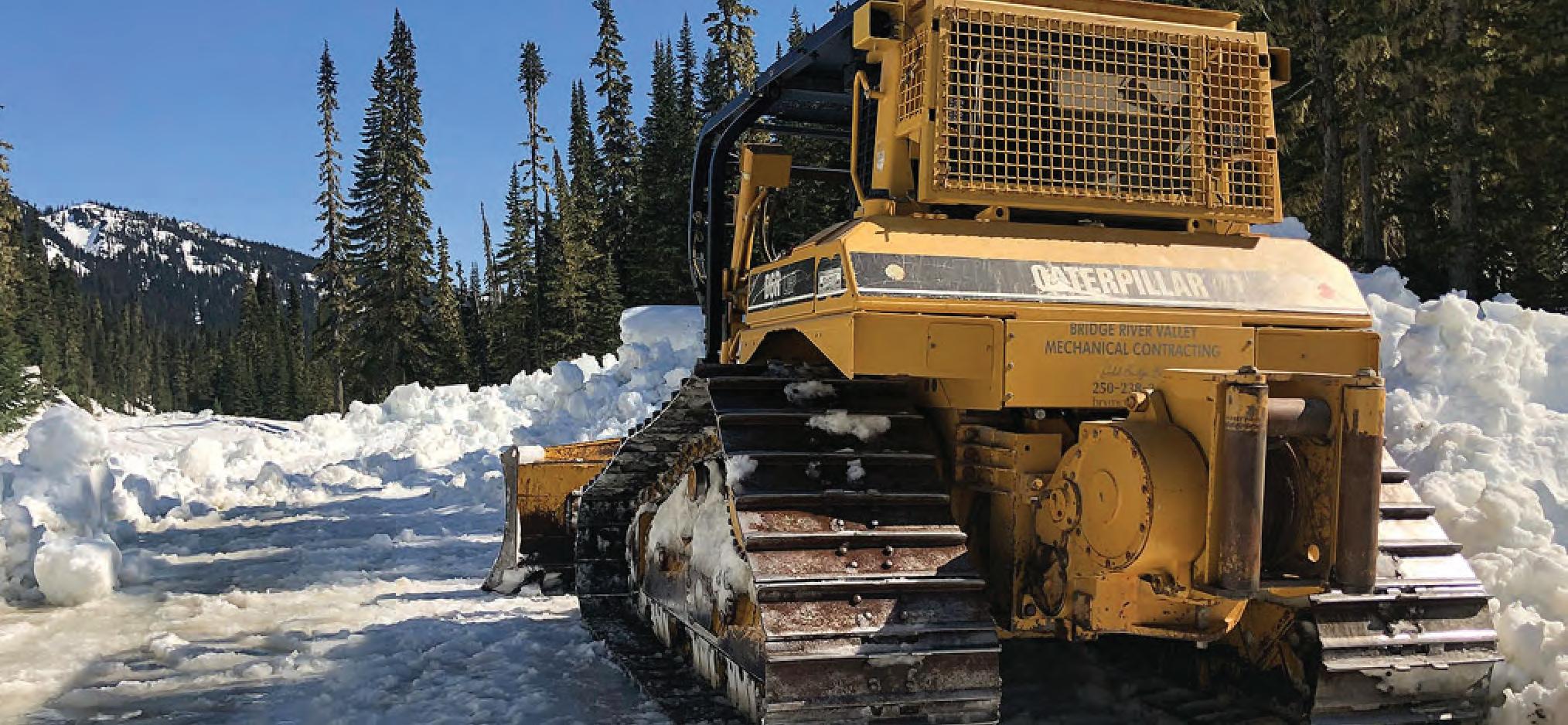
‘We’ve really got no businesses left’: No SLRD funds for Hurley maintenance, board to seek BC Hydro support
BOARD
BY LUKE FAULKS
WHETHER
THE SQUAMISH-LILLOOET Regional District (SLRD) will ask BC Hydro to help fund maintenance on the Hurley Forest Service Road after directors rejected a proposal to use local Area A funds to cover a higher-than-usual spring opening cost.
Area A Director Sal DeMare brought forward two reports on the Hurley during a continuation of the board meeting on May 28, arguing the road is essential for economic development, non-resident property owners, tourism, emergency access and local businesses in Bralorne, Gold Bridge, Gun Lake and surrounding communities.
“As you can see in Bralorne, we’ve really got no businesses left, other than the mine, that’s all that’s left, and we want to maintain what we have left, and hopefully get some of those businesses back,” DeMare said.
BUDGET FROM THE ’80S
The Hurley FSR is one of two main access routes into Area A, along with Road 40. Unlike Road 40, the Hurley is not maintained in winter; instead, a Ministry of Forests maintenance agreement sets aside funding for opening the road for the May long weekend.
Omar Butt, general manager of infrastructure and environmental services, said the funding is based on an agreement from the late 1980s.
“It’s $72,400 that’s set aside, [and] it’s the same number from the late ’80s that they’re working with,” Butt said. “There’s $15,000 for opening, and then the rest is for grading.”
DeMare’s report said that budget has not meaningfully changed in decades, even as costs and road use have increased. This year, high snow levels pushed the
closing and going up for sale, and the relocation of the On The Fly market.
Staff warn of provincial downloading
SLRD staff did not dispute the importance of the road, but warned directors against using Area A Payment in Lieu of Taxes (PILT) funds to cover provincial responsibilities.
Butt said the issue fits a broader pattern of provincial services leaning on regional districts.
“We’re seeing a lot of areas where the province is trying to download costs,” he
“We’re seeing a lot of areas where the province is trying to download costs.”
- OMAR BUTT
May long weekend opening above the traditional $15,000 budget.
“This year, snow levels at the summit and in the upper-mountain sections were especially high,” DeMare wrote in his report, noting the engineering officer estimated “8-9’ of snow at the summit” and at least five full days of plowing to open the road.
At the meeting, DeMare said the concern was not just the spring opening, but preserving enough of the annual $72,400 maintenance budget for summer grading and, if needed, a water truck.
He tied the road directly to Area A’s struggling business base, citing the sale and uncertain future of the Bralorne Adventure Lodge, the Bralorne Pub
said, pointing to recreation sites, forest service roads, bridge work, emergency operations and other files. “With the PILT and amenity funds, that’s one of the ones that SLRD can use for operations … those are really important pieces to keep our services running.”
Directors wrestled with the trade-off. Some said the Hurley is too important to ignore, particularly as recreation pressure increases from the Sea to Sky and Lower Mainland. Others said the move would set a bad precedent.
Director Jenna Stoner said she could support strong advocacy, but not the expenditure.
“There are more tourists out there than ever. It’s critical for economic
development. All those things are true for the Hurley and for many other roads within the regional district,” she said.
“I do not want to start putting any of our operating dollars, which we continuously advocate to the province about how we do not have enough money to fund water systems, fire trucks, all the things that are core to what local governments do.”
DeMare amended his request to make the contribution one-time only, with the figure set at $25,000 and subject to a contribution agreement with the Cascades Forest District. The amended motion failed.
Directors then turned to BC Hydro.
DeMare’s second report noted BC Hydro is planning major seismic improvement work at LaJoie Dam. While Hydro has identified Road 40 and the Gun Lake airstrip as leading access options, its preferred accommodation site is a cut block off the Hurley, near the road to Gwyneth Lake Provincial Park.
“For BC Hydro staff and contractors travelling from the Sea to Sky and Lower Mainland regions, the Hurley FSR would reduce a round trip to the valley by about three hours compared with travelling via Duffey Lake and Road 40,” DeMare wrote.
The report said that could improve productivity, lower travel costs, reduce emissions and support a safer, more consistent level of service for both Hydro users and the public.
That motion passed, with the board agreeing to request BC Hydro contribute to Hurley FSR maintenance while its project moves forward. n
THE CO-FOUNDERS WROTE THAT THE CHALLENGE OF FARMING WITHOUT SECURE LAND ACCESS NECESSITATED THE SHUT-DOWN
BY HILARY ANGUS
PEMBERTON’S Laughing Crow Organics, a mixed vegetable and flower farm located next to The Beer Farmers, has announced its closure.
In a post on their website from late May, farmers and co-founders Kerry McCann and Andrew Budgell said they recently learned the farm would have to move again, and starting again on a new leased site wouldn’t offer the stability the farm needs.
“The cost, labour, and disruption would be significant, and the move wouldn’t resolve the deeper challenge of farming without secure land access,” they wrote. “It’s time to set this version of the farm down.”
McCann and Budgell started the farm on a smaller site in 2013. In 2018, they moved onto their current site, a 15-acre (six-hectare) parcel leased from the owners of the adjacent farm and brewery, The Beer Farmers.
Over the past 14 years, Laughing Crow Organics has grown organic mixed vegetables and flowers, and ran a CSA program while also participating in farmers’ markets.
They also hosted a fan-favourite seasonal
sunflower maze and pumpkin patch.
The Whistler Farmers’ Market posted a tribute to the farm on Instagram on May 22. They wrote that McCann and Budgell “helped shape the spirit of Sundays in Whistler for so many of us.
“You have brought so much more than incredible produce to the market,” the post said. “You became a meaningful part of so many kitchens and family traditions, and made an incredible community impact.”
McCann and Budgell posted to Instagram on May 21 about the farm’s closure, writing that “We’re saying goodbye to something that meant so much to us, and we are here to say thank you.”
They thanked their farming peers in the Pemberton, Lillooet and Squamish Valleys for working in competition “yet also constantly prioritizing support for one another.”
They also expressed gratitude for their crew over the years, the visitors to the maze and pumpkin patch, the teachers and kids who visited on school strips, the customers who lined up at their market stall and their “beloved CSA members.”
“Thank you, Sea to Sky community. We miss you, and we miss farming already,” they wrote. “The connections and relationships we build are the foundation of a meaningful life.” n
THE FAMILY OF Liam and Riva Fisher, two Pemberton locals who tragically passed away in 2017 and 2023, respectively, has created a memorial fund to celebrate and honour their legacy.
Parents Hillary and Hugh Fisher hosted a launch event for the Liam and Riva Fund on Saturday, June 6, at the Pemberton Downtown Community Barn.
“They both had quite a big love for this community,” said Hillary Fisher. “We felt like we wanted to create something in their name as an endowment fund for the future, and giving back to Pemberton seemed like the obvious thing.”
Hillary described both of her children as outgoing, community-minded individuals with a strong love of music, and a knack for bringing people together.
Riva would host parties at her East Vancouver home, where she was just as likely to be playing accordion for the crowd as she was to be wrapped up in the corner deep in conversation.
“She loved things that got community together, anything that brought people together, especially with music,” Hillary said.
After Riva succumbed to brain cancer, Liam threw his considerable athletic talent into fundraising for various

Zoning Amendment (6991 Highway 99 - Tisdale) Bylaw No 1017, 2026
5:00pm Tuesday, June 23, 2026, in Council Chambers, 7400 Prospect Street, Pember ton BC and via Zoom Webinar ID: 840 0997 7920, https://us02web zoom us/j/84009977920)
What is Zoning Amendment (6991 Highway 99 – Tisdale) Bylaw No 1017, 2026 about?
Zoning Amendment (6991 Highway 99 – Tisdale) Bylaw No 1017, 2026 has been prepared to amend Zoning Bylaw No 832, 2018 to allow outdoor storage (for the storage of recreational vehicles and intermodal storage containers) as a permitted use in the M-2 Industrial, Resource zone If approved, the proposed amendment would be site specific to the subject lands The subject lands are Block B of District Lots 4095, 4096 and 8804 Lillooet District (PID: 028-270-304), municipally described as 6991 Highway 99
How do I get more information?
A copy of the proposed bylaw and relevant background documents may be inspected at the Village of Pember ton Office, 7400 Prospect Street, from Friday, June 12, 2026 to Tuesday, June 23, 2026 during the office hours of 9:00am to 4:00pm (closed noon –1:00pm), Monday through Thursday, and online at pember ton ca/government/councilmeetings
How do I provide feedback?
All persons who believe they are affected by the proposed bylaw will be given a reasonable oppor tunity to be heard by Council at the public hearing Alternatively, comments may be provided in writing Written comments must be addressed to “Mayor and Council” and may be submitted at the public hearing or through one of the following methods by noon on Monday, June 22, 2026):
Email: admin@pember ton ca Fax: 604 894 6136
Mail: Corporate & Legislative Ser vices, Village of Pember ton, PO Box 100, Pember ton BC V0N 2L0
In Person: Corporate& LegislativeServices,7400 ProspectStreet,PembertonBC
Gwendolyn Kennedy Corporate Officer

charities, once flipping a 300-pound tire for 10 kilometres over 24 hours to raise money for cancer research.
After Liam died while studying medicine in Grenada in 2023, community members spilled out of a packed gymnasium at Pemberton Secondary School for his memorial.
“They were such talented, creative, dynamic people that had many different interests and passions,” Hillary said.
Though their travels took them around the world, Hillary said both Liam and Riva were very proud to call Pemberton home, and they always envisioned returning to the valley.
To honour their legacy, the Liam and Riva Fund will support organizations and events that are local to the valley and champion health, fitness, the arts, or anything that contributes to Pemberton’s vibrancy.
“As a parent, from the time they’re born … all you hope for is a happy future,” Hillary said. “And when that doesn’t happen, I think you hope that they will be remembered.”
Read more and make a donation at whistlerfoundation.fcsuite.com/erp/ donate.
-Hilary Angus n

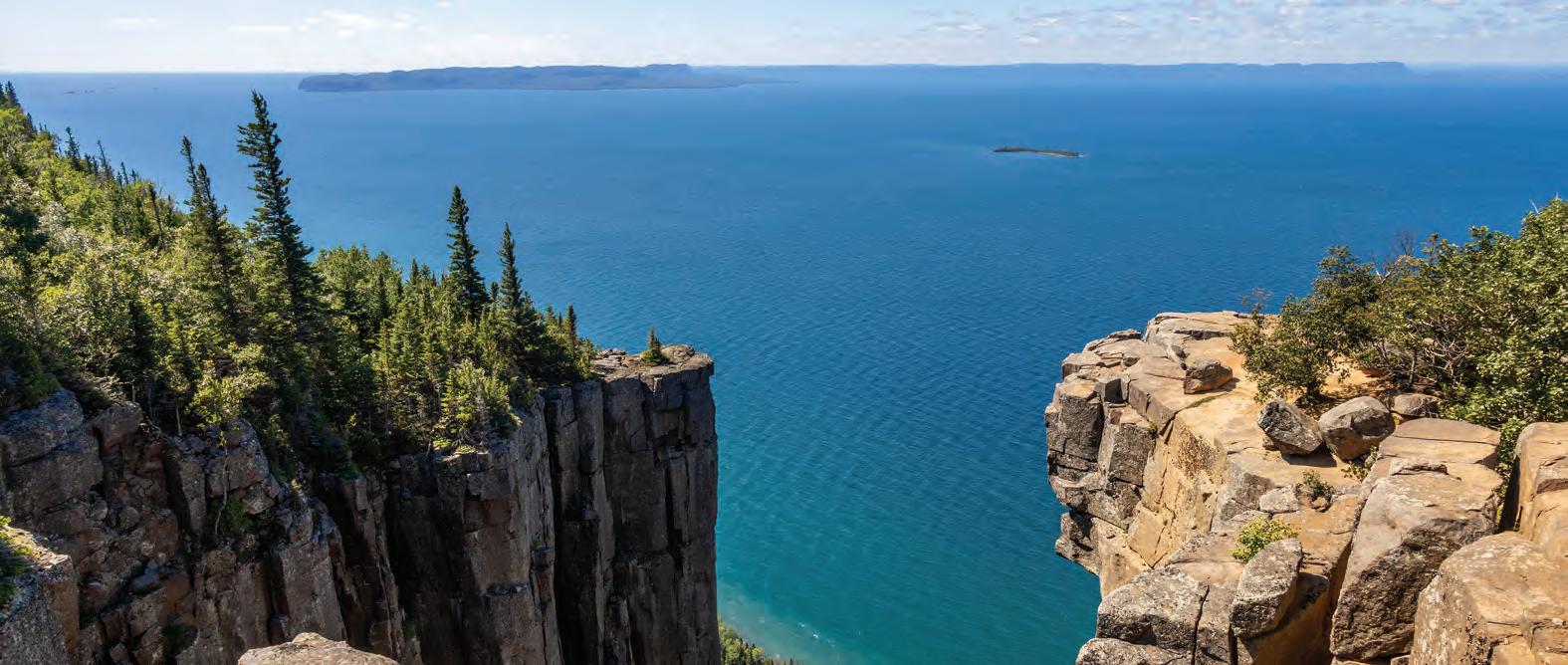
THE OTHER DAY, I woke up early, flicked on my computer, and dove some 400-plus metres to the bottom of Lake Superior. The largest freshwater lake in the world by surface area, holding enough water to cover all of North and South America under 30 cm of the stuff, Superior is a cold, mythical (cue “The Song of Hiawatha” and “The Wreck of the Edmund Fitzgerald”) and generally mysterious place. And “Superior Maximus”—its deepest point— more mysterious still. Completely dark

BY LESLIE ANTHONY
with pressure nearly 40 times that of the surface, and located 55 km offshore, a submersible carrying a few scientists descended to this point some 41 years ago to celebrate the state of Michigan’s sesquicentennial, and didn’t see much— though they did leave a time capsule. The new technologies of today that took myself and others down there were bound to deliver more.
Using a cutting-edge underwater drone equipped with a fibre-optic tether and highresolution imaging systems, Ontario-based filmmakers Yvonne Drebert and Zach Melnick are behind this Superior Maximus redux, exploring this mysterious world for their upcoming documentary Hidden Below: The Great Lakes. Collateral for the live broadcast mentioned “unprecedented detail” and I’d have to concur: on display were ancient rocks, the finest of silt and “snow” (organic debris) falling from above, but also plenty of life—hydras
covering rocks, mysid shrimp (leftovers of Pleistocene glacial-lake ecosystems), and deepwater sculpin hugging the bottom, hiding under woody debris, and, in one case, feeding on the carcass of a large, dead fish. There was even a micro-habitat for microscopic critters made by the confluence of a rock and a beer can (Busch, so obviously American). I won’t go into too much detail—better to leave it all for the eventual doc.
The point is that the fact people can watch such forefronts of exploration live is kind of nuts. But I’d had a previous similar experience at four times the depth in the Pacific Ocean while working on a magazine assignment a couple of years
at the edge of illumination, their size impossible to judge. Ditto a bottomdwelling comb-jelly resembling a pair of fluorescent pink lungs. Above it all, like stars in the firmament, pin-prick creatures floated white against an inky backdrop, gobbling the dross rising from this alien industry.
A vignette both harsh and phantasmagorical, I was acutely aware this was but the tiniest slice of the largest part of the planet on which we dwell. As the world’s most-continuous single environment, the deep ocean is also its largest ecosystem, yet the one we know least about: some 75 per cent of the seabed here is completely uncharted,
I was acutely aware this was but the tiniest slice of the largest part of the planet on which we dwell.
ago. In that case, it wasn’t just discovery I tuned into, but a journey informative of a bigger picture and threat. Some 1,550 metres below the surface on the edge of a large, volcanic caldera in the Galapágos, we’d come upon a rocky tower no person has ever seen. And the scenery along the way was mind-boggling.
First came the pillow lavas, plumped in irregular rows and fissured by time. Then heaps of crumbled rock, like the talus buttressing cliffs. Finally, the narrow tower, rust-coloured and thrust up like a medieval fort, crenellated battlements and parapets hung with wispy streamers.
As we drew closer, these became tangles of microbial filaments. Arrayed on the tower, other organisms came into focus, each fan, polyp, stalk and antenna a lifeform more ethereal than the next. Fish fluttered like ghostly tadpoles
only a small percentage mapped at any resolution, and less than one per cent seen by human eyes.
As in Superior, no one was literally on the sea bottom, but figuratively here courtesy of a live feed from the remote operating vehicle (ROV) SuBastian, deployed from Schmidt Ocean Institute’s research vessel Falkor (too), which was testing new tech for ultra-fine-scale seafloor mapping. On board, an international cadre led by a mostly Canadian mix of oceanographers, geologists, ecologists and biologists eyed banks of high-definition monitors alongside the skilled operators controlling SuBastian.
While the scientists hovered somewhere above SuBastian, the rest of us were scattered around the globe, following on YouTube. Here, in a chat next to the livestream, scrolled deep-sea
aficionados of every description, from professors to graduate students to plain ol’ Neptune nerds, some of whom had woken up in the middle of the night to sit through a nine-hour dive—the ultimate binge-watch. I joined for journalistic reasons, but after hours staring into the literal abyss, I, too, was mesmerized by this descent into the unknown. I also enjoyed the encyclopedic knowledge of my virtual companions; no sooner did a bizarrely spiked white sea cucumber appear than someone noted it must belong to the genus Oneirophanta.
“It’s amazing that technology allows people to join in a communal voyage of discovery,” Cherisse Du Preez, a spatial ecologist with Fisheries and Oceans Canada who was on the expedition told me afterward. “Schoolkids whose class tuned in can say to each other ‘remember when we saw that animal?’ I love when people talk about the we of discovery… they’re taking ownership of the deep sea, making that important connection.”
More importantly, the “tower” was actually an extinct hydrothermal vent, the polymetallic sulphides comprising it deposited by volcanic gasses and magmaheated waters up to 400 C. Such inactive vents, found in undersea volcanic zones the world over, are one of the targets in the emerging and controversial frontier of deep-sea mining, making them a good starting point to explore what we know about the deep, what we’re learning, and what we stand to lose should mining actually begin.
I may circle back to deep-sea mining in another column, but for the time being intend to revel in my most recent voyage of discovery to Superior Maximus, an experience anyone can have online that seems to me the purest form of exploration on such a well-trod planet.
Leslie Anthony is a biologist, writer and author of several popular books on environmental science. n
THE CLIMATE CRISIS is not simply an isolated technological challenge. It’s part of a much larger “polycrisis.” After all, everything is interconnected.
The magnitude of this “system disequilibrium,” as Canadian author, social scientist and Cascade Institute executive director Thomas Homer-Dixon calls it, can cause a sense of hopelessness, but it is resolvable—with major changes in the ways we conduct ourselves on this small planet.
That’s the message of a comprehensive new study. The World Inequality Lab’s (WIL) “Global Justice Report: A Plan for Equality & Prosperity Within Planetary
“At the end of the day we’ll have to come to this kind of cooperative redistribution of resources and power because the alternative will simply lead to disastrous outcomes both on the environment, on the climate, but also on social grounds,” he told the Guardian.
Homer-Dixon argues that, although the interrelated crises may seem dire, they also present opportunities. That requires understanding how they connect, and how feedback loops exacerbate the problems. For example, fossil fuel consumption leads to climate change, which produces economic costs.
BY DAVID SUZUKI
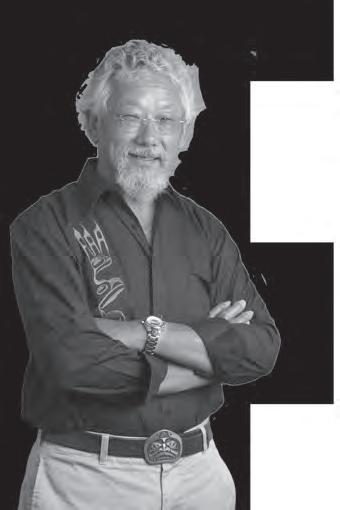
Boundaries”—by 45 authors using databases compiled by more than 200 researchers from around the world—states that “it is possible to reconcile planetary habitability and high well-being for all, but only if the transformation rests on three
The pillars are rapid decarbonization of energy systems, a shift from overconsumption toward “sufficiency” (including reduced labour hours and raw materials use and large changes in food habits, land use and forest cover) and a “drastic reduction in inequality of income, wealth and power” between and within countries.
This will require significantly altering the power structures that now govern our world and that are driving us toward calamity. It would include “hefty wealth taxes on billionaires, sharp reductions in working hours, a change in diets and a shift of investment from materially intense sectors, such as industry and mining, to education and health,” the Guardian reports.
The majority of humans would benefit, as it would double the incomes of 89 per cent of the world’s population by 2100 and keep global heating below 2 C above the preindustrial average. It would also reduce the average workweek to about 2.5 days, increasing leisure time.
Wealth inequality would be sharply reduced, with the poorest half of humanity increasing its portion from two to 30 per cent, while the billionaire class would see its share fall from six to 0.05 per cent.
“Close to 90 per cent of the world’s population would double their income between 2026 and 2100, and once leisure and a habitable planet are counted, more than 99 per cent come out ahead,” WIL co-director and Paris School of Economics professor Thomas Piketty and others wrote in a Guardian article.
Piketty says the ideology of people currently in power or rising in the United States and many other countries can’t deliver what most of humanity needs.
“As people feel less economically secure, they support authoritarian leaders, but that then leads to a backlash against green policies, undermining efforts to reduce fossil fuel consumption.”
The opportunity, he says, is that this “delegitimizes the existing way of doing stuff, the existing vested-interest stakeholders who are hunkered down and don’t want anything to change.”
The Cascade Institute and the WIL report attempt to understand the holistic nature of the polycrisis to find solutions. Given that one underlying cause is wealth hoarding and inequality, the backlash from the ultra-wealthy and their political backers will likely heat up. The “Global Justice Report” notes that average per capita gross national income worldwide would increase for almost everyone but, “The exception would be the mega-rich, who would be highly taxed because they are most responsible for the climate crisis.”
As well as taxing the overly affluent, the report recommends measures such as “a global justice fund to finance
This

the energy transition and oversee an increase in education and health-care spending” and “a world sovereign fund, which would rebalance global holdings of public and private wealth closer to proportions last seen in 1970.”
It concludes that a better, more equal world is materially possible. “What stands in the way is not technical impossibility but political choice and the hard but crucial work of building a coalition behind it.”
It’s a coalition we should all get behind. David Suzuki is a scientist, broadcaster, author and co-founder of the David Suzuki Foundation. Written with David Suzuki Foundation Senior Writer and Editor Ian Hanington. Learn more at davidsuzuki.org. n




BY ALAN FORSYTHE
In the early 1980s, as Whistler Village took shape and Blackcomb Mountain opened, the resort was still finding its identity.
Visitors came for skiing, but a world-class destination required more than lift access and mountain views. For guests paying a premium to visit Whistler, expectations extended beyond burgers and pizza. Over the next four decades, a small group of restaurateurs would help transform the resort into one of Canada’s premier dining destinations—while a new generation now works to carry that culture forward amid rising costs and changing tastes.
Vancouver restaurateur Umberto Menghi was among the first to bring fine dining to Whistler Village, opening Il Caminetto and introducing rustic Italian fare to a town still defining itself. Alongside early staples like the Keg, restaurants such as Il Caminetto laid the groundwork for a dining culture that would eventually become central to Whistler’s identity.


“The restaurant community was always very tight here. Mario, Pascal, Umberto— that crew of
Even institutions such as fine-dining staple Araxi Restaurant + Oyster Bar looked different in those early days.
“We used to laugh that they had ketchup on the table,” says Jay Pare, recalling Araxi’s evolution from a casual skier stop to one of Whistler’s best-known restaurants.
Pare, who has worked in Whistler’s restaurant scene for more than three decades, arrived after a stint in Jasper and learned the business at Il Caminetto under longtime restaurateur Mario Enro.
“It was exciting back then,” Pare says. “The village was still being built, Blackcomb had opened … but there wasn’t much to do in the summer here back then. Just one golf course, no bike park.”
The drop in resort traffic each summer proved challenging, he adds, saying Dec. 20 to April 1 was “pretty much your season,” with a shorter season in July and August.
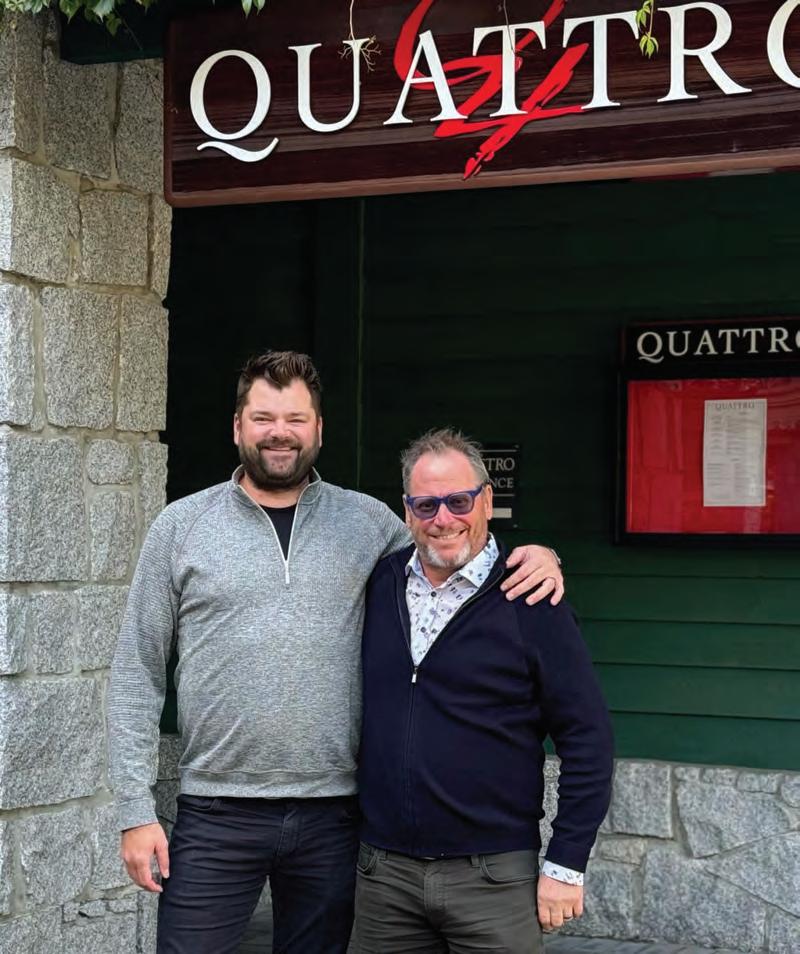
After working his way up to general manager roles at Il Caminetto and Quattro, Pare eventually became an owner himself, taking over Caramba from Enro before adding Quattro and, most recently, Lorette.
His cousin, James, returned from London—where he had been executive chef at the Savoy Hotel—to join him.
“Jay approached me in 2014,” James recalls. “At first, I said no. But I still loved Whistler and was so excited to come home. So eventually I said, ‘let’s do it.’”
Together, the pair have helped expand the Pare Restaurant Group while carrying forward lessons from Whistler’s early restaurant pioneers.
“The restaurant community was always very tight here,” says Pare. “Mario, Pascal, Umberto—that crew of guys all helped each other out.”
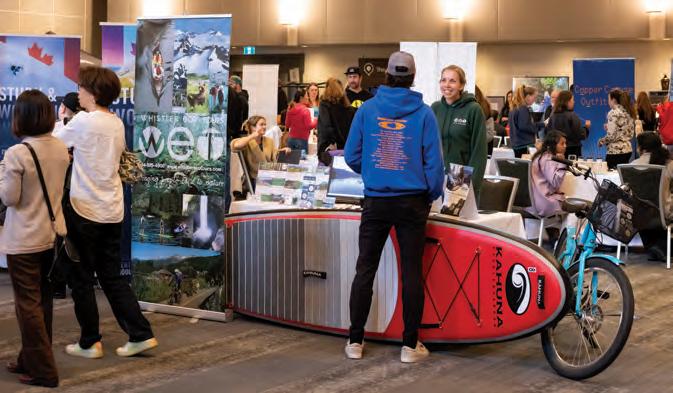



The culture of high standards continues today, reflected in both longstanding institutions, such as the Bearfoot Bistro, alongside newer arrivals to Whistler’s dining scene.
The awards and recognitions are too many to list (for fear of leaving someone out)—a good sign local establishments are doing something right.
One of Whistler’s newest restaurants, Wild Blue, which opened in the summer of 2022, is no stranger to praise.
The restaurant devoted to Pacific Northwest cuisine, sustainable seafood, and locally sourced ingredients is fronted by acclaimed restaurant director Neil Henderson and chef Alex Chen—two heavyweights of the industry.
Henderson—who along with Chen was inducted into the BC Restaurant Hall of Fame in 2024—got his start in the industry when the legendary Jack Evrensel, founder of Araxi, took a chance on him at just 21 years old.
“Jack taught me to have high expectations of those around you, with a firm belief it would be insulting to them if you didn’t. He taught me to walk the talk. Lead by example, try to work harder than anybody else and maintain that mindset of being fair, consistent, and humble,” Henderson said in a 2024 interview with Pique. “If there was ever any point I thought I was working hard, Jack was working harder. There was never any occasion that I outworked or outpaced him.”
In 2003, Henderson took an offer in Vancouver as projects director for

“It’s the most incredible group of fundamentally kind individuals that love looking after people, love caring for people. I’ve really never met a group quite like it.”
-NEIL HENDERSON
That passing of the torch is reflected elsewhere in Whistler’s dining scene.
In Creekside, the Rimrock Café—one of Whistler’s best-known restaurants—has become something of an institution since opening in the 1980s. In 2023, longtime staff members Chris McKinney and Steve Maile took over ownership after spending more than two decades working in the business.
“We’d both worked at the Rimrock for a long time, so it was a natural fit,” says McKinney. “[Founders Rolf Gunther and Bob Dawson] had always said they wanted someone from within to take over one day, and we were both deeply invested in the place. We wanted to protect what the Rimrock is and carry on its legacy.”
While ownership changed, much of the restaurant has remained intentionally familiar.
“If it’s not broken, we’re not fixing it,” McKinney says, noting updates have focused largely on behind-the-scenes systems and minor cosmetic improvements.
For many visitors, dinner at the Rimrock has become part of the Whistler experience itself.
“We’re seeing more second-generation guests now,” McKinney says. “Kids who used to come with their parents are bringing their own families. It’s pretty special.”
Eric Griffith sees himself as part of Whistler’s second generation of restaurateurs.
A Whistler local whose parents began visiting in the 1970s, Griffith got his start at La Rua in the mid-1990s before eventually managing Il Caminetto and opening Alta Bistro in 2010.
“I’m definitely part of that second generation of restaurateurs here in Whistler,” he says.
Today, Griffith also operates Alpha Café and chairs the local restaurant association—an organization founded by Whistler’s early restaurant leaders to maintain standards and collaboration.
“They created a culture here,” Griffith says. “They knew we needed to work together and keep that standard.”
Evrensel’s Toptable Group. That afforded him the opportunity to not only work in and run all four of Toptable’s restaurants (they now count 12), but amass an array of varied experience.
What eventually took Henderson away from Toptable was a chance to reunite with his mentor, Evrensel, to open Wild Blue. And the results four years later speak for themselves—but like any good operation, it’s only as good as the people behind the scenes.
“It’s the most incredible group of fundamentally kind individuals that love looking after people, love caring for people. I’ve really never met a group quite like it,” Henderson said. “The knowledge is very high, their engagement is really high. They have high expectations of one another as well.”










‘It’s fun because it’s hard’
But while Whistler’s dining scene has matured, operating restaurants in the resort remains increasingly difficult.
“Margins are down for everyone,” Griffith says.
Owners point to rising costs, housing pressures and staffing challenges as ongoing concerns.
“It’s not cheap to live in Whistler,” Pare says, noting improved employee housing has helped his business retain staff.
McKinney agrees.
“Housing and cost of living are real challenges,” he says. “But Whistler still attracts great people who want to be here. We’re lucky to have one of the best teams in town.”
The Rimrock has long been known for its passionate, long-serving staff—a familiarity regular guests appreciate.
“In this industry, two years can be long-term, but we have people who’ve been with us five, 10, even 25 years,” McKinney says. “They’re a huge part of what makes the Rimrock special—it’s a real family.”
The guests themselves have changed, too.
“Guests are more educated now, about both food and wine, and they’re very aware of farm-to-table,” says Pare.
Griffith says Whistler has seen shifts in visitor demographics over the years, with fewer weekend Vancouver visitors but a return of European travellers and stronger year-round international tourism.
At the same time, restaurants have increasingly emphasized local sourcing and seasonal ingredients.
McKinney says roughly 95 per cent of Rimrock’s seafood comes from B.C., while Alta Bistro has long leaned into local ingredients and wine pairings.
Despite the pressures, restaurateurs say the passion for hospitality—and for giving visitors a memorable dining experience—remains.
“We’re just going to continue doing our Alta Bistro thing. It’s hard, but it’s fun because it’s hard,” says Griffith. “In the end, it all comes down to people and customers.” n






Comeinforlunch WednesdaythroughSunday before3p.m.toget astamponyourcard. On Wednesday,youget2stampsonyourcard! Howgoodisthat?!
Childrenarewelcomeuntil10pmever yday. (*Somerestrictionsapply)


Resultswill be publishedinour August7th edition. Deadline forsubmissionsis11:59pm onSunday, June 21st,2026. Onlyonlinesubmissionswillbeaccepted. gus th edition.Deadlineforsubmissionsis 11:59pmonSunday, Only onlinesubmissionswill be accep No photocopies, faxesormailed entries. Onlyoneentry peremailaddresswillbeused. Please note we trackuserregistrationfromindividualIPaddresses.We faxesormailedentries. Only oneentryperemailaddresswillbeused. trackuserregistrationfromindividualIPaddresses. We reservetheright to eliminatecontestentrantsiffraudissuspected.Piquemakes everyeffort to create aconcise listof Pembertonbusinesses inthemultiple aconciselistof choiceoptions.Suggested optionsare betweenthe periodofJune 1st,2025toJune1st,2026. If youare abusiness ownerin Pemberton, or feel theoptionsare optionsarebetweentheperiodofJune 1st, 2025 to June 1st,2026. abusinessownerin notvalid, we encourage youtocheck thedetailsandemailuswith correctionsand omissionsuggestions.Email usatkdouglas@lodestarmedia.ca thedetailsand emailuswith correctionsandomissionsuggestions.Emailusat kdouglas@lodestarmedia.ca

BY DAVID SONG
IF ONE WERE TO GUESS, one would likely not assume that a school from Pemberton (with approximately 3,500 residents) would be able to earn five straight BC School Sports Provincial Mountain Bike Championships.
Yet that’s exactly what Pemberton Secondary School (PSS) did on May 22 in Quesnel, B.C. thanks to medal contributions from four athletes and top10 results from seven more.
Downhill savant Mack Manietta, who routinely challenges professional men in that particular discipline, won the junior boys enduro race and put up the secondfastest overall time of six minutes and 19.3 seconds.
Last year’s King of the Mountain, Finley Wood, snatched gold in crosscountry (XC) as the only junior boy to break the 29-minute barrier (28:33.70).
Dash Nicoll clinched silver in bantam boys’ enduro (6:48.00) and Annika Zayac took bronze among bantam girls (8:25.50) to go with seventh in cross-country (28:08.20).
Other notable Pembertonian finishers include Norah Glavas (fourth in junior girls enduro, sixth in junior girls XC), Marie Crowell (fourth in bantam girls XC, seventh in bantam girls enduro), Skylar Rodier (sixth, junior girls enduro), Anja
Taylor (seventh, junior girls enduro), Oscar Tarling (seventh, senior boys XC), Grace Cleland (eighth, senior girls XC) and Emily Wilson (10th, senior girls XC and enduro).
Nicole Benes, who co-coaches the team alongside Kevin Glavas, credits her team’s dynastic success to the passion and athleticism of its members.
“They truly love mountain biking and come out in large enough numbers for us to earn a significant amount of points at every event we attend,” she said. “Having a strong contingent of girls is also a huge
best female riders, Arleigh Kemp, was unable to race due to shoulder surgery, and two Grade 10 boys likewise went down injured during the season.
Regardless, Pemberton excelled in the North Shore Mountain Bike League. Junior and senior girls captured a banner in their division, second-overall finishes went to both the bantam boys and girls, and punching into third overall were the senior boys.
Wood, Norah, Tarling and Cleland garnered MVP honours. Abbie Glavas netted the squad’s peer recognition award,
“Having a strong contingent of girls is also a huge asset as many schools have very few girls participating.”
- NICOLE BENES
asset as many schools have very few girls participating. I believe that coming from a small school in a tiny town, the students feel a real sense of pride and accomplishment from contributing to the team’s success.”
Benes also expressed pride in PSS seniors like her own son Tristan bringing home a trophy in their final high school campaign while enjoying a multi-year run of group dominance.
Eighteen youth joined the PSS bike team this year, initially bringing the roster up to 36 athletes. Many are involved in other sports, however, making it a challenge to coordinate schedules. One of the unit’s
The Goat, for managing communication and equipment and all-round problem solving in a key leadership role.
“I would also like to give a shout-out to all our new members—half the team— who are mostly in Grades 8 to 10,” added Benes. “I believe it took courage for many of them to try something new, mountain bike racing, and show up for a sport that includes kids from Grades 8 to 12. A number of the students had raced enduro previously but very few had XC experience and they all gave it their full effort.”
The rookies had plenty of role models to look up to, including Manietta who was lauded for his good sportsmanship and positive attitude. Manietta’s athleticism
translates fairly well to enduro, and he showed determination in battling to 23rd in XC (an event outside his wheelhouse).
Coaching-wise, Benes and Glavas have established a harmonious relationship across three seasons. The former handles administrative duties as teacher sponsor, while Glavas is more of a mechanical specialist. Both ride with their athletes in practice and facilitate transport to races, where Benes is normally on course and Glavas at the finish to help with technical issues.
“We would be nowhere, however, without our dedicated team of parent volunteers who rally weekly for two months to carpool students, come out to practice rides with the team, offer to marshal at races, contribute snacks and support, as well as help troubleshoot problems. Thank you,” Benes said. “Also: many thanks to PSS athletic director Krista Walden for her mentorship, and to the PSS Alumni Association for their generous contributions to the mountain bike team.”
Twelve newcomers have joined the squad as of this writing, and next year’s outlook is favourable despite the imminent graduation of numerous seniors. Benes will continue to coach them in a way that fosters fun, camaraderie and health on and off the bike.
“We would like to see these young students stick with the team over the years that they are at PSS, so we are encouraging them to ride whenever they can as the only way to improve is through practice,” she remarked. “Safety, respect, and integrity are also emphasized so that everyone enjoys themselves and has a positive experience.”
Visit zone4.ca/event/2026/21ZzJJ for more Provincials results. n
BY DAVID SONG
THE PEMBERTON PEAKS Volleyball Club held its first tryout this year for the purpose of assembling a competitive U15 girls’ roster. Back on May 4, that same team won its very first provincial championship in Abbotsford, B.C. while going undefeated across two days of Division 7 action.
Quite the breakthrough for a group that, according to head coach Elizabeth Thiffault, was shy and emotional at season’s beginning. On-court success was celebrated joyfully, but a few lost points could snowball into lost sets and rampant negativity. It was understandable behaviour from girls new to the sport and to each other, but fortunately it didn’t last.
The Peaks underwent “a complete 180” by way of more practices, more supportive drills and bonding activities that helped its athletes mature. Thiffault had growing to do as well: despite coaching dozens of kids by way of the Whistler Volleyball League, she had never led nor been on a club squad. At first she felt pressured to win, and deployed only her best talent.
Then Thiffault quickly remembered that her kids would never progress without in-game reps. She allowed everyone to see the court, giving her whole roster a fair chance to develop—and that’s what led them to provincial gold.
“Especially for my club team, I wanted them to be sort of like a second family, supporting each other throughout all the stress,” she explained. “A lot of them had just started volleyball and a lot of them had never played a team sport before. At first, we were nervous because there were Whistler and Pemberton girls and there’s always this drama, but it worked out beautifully.
“Some of my best girls are the most coachable on my team, and the same goes for my leagues as well. I tell them right away: if you’re not coachable, you’re not going to become stronger. You can think you have everything going for you, but if you’re not willing to learn, if you’re not willing to put in the effort, then you’re not going to progress.”
Peaks U15s got the message loud and clear, besting the Nelson Elevate 2-1 to secure their title. Captain Naia Becker filled a key leadership role, mentoring each of her peers while playing like “the most driven athlete” Thiffault has ever witnessed—and that’s saying something given she’s coached at least hundreds over the years.
One word that immediately came to Thiffault’s mind regarding the victory is “pride.” She is proud that her athletes seized their moment as underdogs against opponents from larger towns and
cities who were virtually born with a ball in their hands.
“These girls are so motivated, so driven. I have girls asking me after every practice: ‘what can I do to be better?’ and that to me is just so rewarding,” said the Quebec City native. “Provincials were a huge emotional time. I heard from the previous year that all the girls were crying, it was a nightmare, and this year none of the girls cried. They cried tears of joy after we won the gold.
“Even if they weren’t playing every single game, everyone had such a great attitude. Everyone was hustling. These girls at 15 years old, they have probably the most attitude out of everyone but they became so close, so united. They wanted that win, not just for themselves but for everybody.”
‘THERE
The Peaks were formed in 2025 by Ulla Clark, Kirk Becker and Chris Power, locals who heeded their children’s desire to play beyond the two-month high school volleyball season while training close to home. Clark became club director and is described as an administrative powerhouse who sorted out everything from funds to equipment to travel schedules across the Lower Mainland, the Okanagan and the Sunshine Coast.
Meanwhile, Kirk and Power helped out as dedicated and passionate coaches despite their lack of experience. All have supported Thiffault, enabling her to lead the program while maintaining other responsibilities being a French immersion teacher at Spring Creek School.
Volleyball BC reports a 47-per-cent growth in participation since 2022, and the Peaks’ emergence is one of many signs that reflect this trend. Thiffault has seen demand first-hand, with waitlists throughout her Whistler League and summer camps. Pemberton aims to offer three competitive squads next year, and ultimately a boys’ team as well, but potential expansion hinges upon the emergence of more coaches.
“I think there should be a club team for every single age group and gender. I have boys in my classroom who are absolutely gifted in volleyball, and I’m just hurt that there’s not any club team for them,” Thiffault said. “My main goal is just to continue to coach and continue to put the word out there for volleyball … even if they can’t afford it, I’m always open to being supportive and flexible.
For now, the non-profit Peaks are supported by parent volunteers, a Village of Pemberton/Squamish-Lillooet Regional District Grant, and financial aid from the Legion, Gavin Construction, Murphy Construction and Chambers Olsen Ltd. Those interested in playing or coaching are asked to contact pembertonvolleyball@gmail.com. n













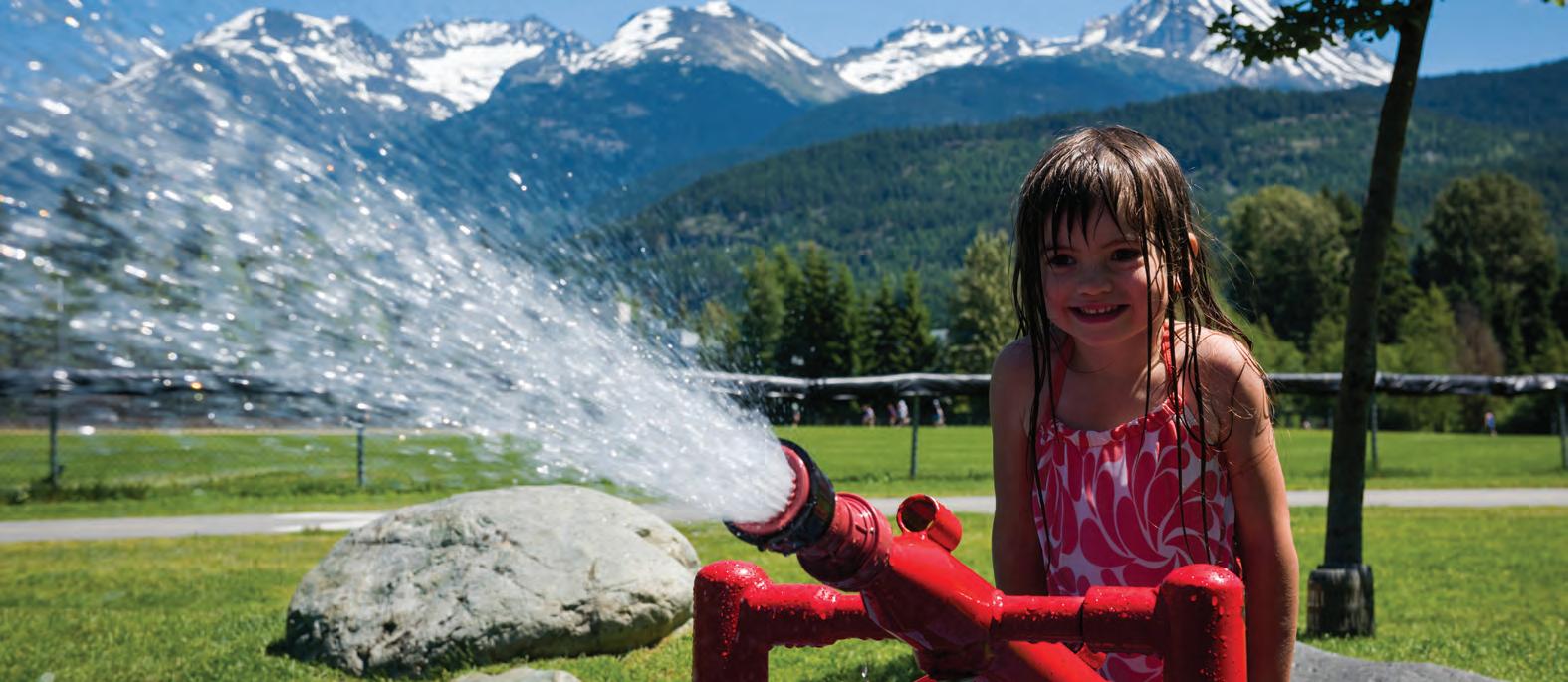
THE WHOLE THING reminds me of psychologist Mary L. Trump’s scathing memoir about her treacherous uncle. You know who I mean. Too Much and Never Enough describes how her family “created the world’s most dangerous man.”
Now we’re facing another dangerous mess of extremes—but in a whole

BY GLENDA BARTOSH
different way. It’s a case of polar opposites happening right here in southern B.C., one that’s ironic, scary—and a reflection of countless polar opposites happening around the world due to the climate crisis we humans have made for ourselves and all life forms on Earth. More and more there’s too much, and/or never enough.
Just as properties around Poole Creek and Gates Lake near Birken were issued evacuation alerts again last week due to potential flooding that could burst from the lake on Place Glacier ( “ place” pronounced à la français, as it was so-named in the ’60s), Okanagan orchardists and farmers in the Vernon area were told they’d have to restrict their water use by 70 per cent due to Stage 3 water restrictions.
Yeppur, those hard-working growers now have 70 per cent less water to irrigate their fields, farmlands and orchards, including some 2,100-plus acres (about 850 hectares) of mature apple and cherry
trees, some of which are more than 100 years old, according to BC Fruit Growers Association president, Deep Brar.
Pique’s sister news service, Castanet Kelowna, reports the potential orchard loss could be around $250 million in direct costs, or over $300 million when you add in the bigger picture, like lost labour, packing, trucking and suppliers.
“Growers understand the seriousness of the drought,” Brar said. “But a 70-per-cent reduction in agricultural water is not just a crop-production issue. At that level, this becomes an orchard-survival issue.”
As Brar points out, and my Okanagan rellies well knew after decades of growing tree fruits, things like lawns can go dry and rebound, and annual crops or plants, like those in your garden, can be replanted. But those gorgeous, mature apple or apricot trees that are decades old? Once they die, it’s a long, long time before that fruit production comes back—if ever.
So any guesses as to how much local B.C. tree fruits will cost this summer, if we even see any? All when we’re still fervently buying Canadian versus U.S. stuff. (Check in next time—I’ll be looking at skyrocketing costs, including food prices, and how the climate crisis fits in.)
Meanwhile, the Greater Vernon Water district’s normal agricultural allocation is about 550 mm of irrigation water per acre per season, so the 70-per-cent cut leaves North Okanagan farmers and growers with only 165 mm (about 6.5 inches) of water per acre to get them through summer! Plus that beautiful local “lake of many colours”— Kalamalka—is at dangerously low levels, too.
Don’t know about your yard or garden, but right now ours is so hydrophobic—a great term I learned from our landscapers the last time Stage 3 restrictions hit southern B.C.—that even if you can water, the soil is so dry, the water rolls off instead of soaking into the ground, where plants can use it. Ergo the need for mulch and ground covers to keep those soil moisture levels—and temperatures—steady.
Speaking of temperatures, check out Environment Canada’s forecasts for Whistler, Vancouver and Vernon. After days of too-low temperatures, at least near the coast, as I write this all three locations are forecast to hit highs of 28-29 C Sunday! Sure, some folks will love it, but I always say my poor bod can barely adjust so quickly, and this from the gal who lived in California and Hawaii for years.
Meanwhile, scientists are sticking to their guns that the El Nino event now forming in the Pacific Ocean— an event that causes too much heat and barely enough water in many regions, including ours—could become the strongest on record. So instead of cooling off, as it usually does now given its location south of the equator, Lima, Peru, has been summertime hot. The Washington Post reports they’re also facing temperatures in the high 20s, and ocean temperatures are as high as 10 C above average. The fish will fry!
It all aligns with what’s been happening for years: 2023, 2024 and 2025 were the warmest years on record, capping 11 consecutive years of the highest global average temperatures. Plus last June, NOAA and the Scripps Institution of Oceanography reported from their Mauna Loa Observatory in Hawaii the highest levels ever of carbon
dioxide concentrations. Those new cheap EVs from China never looked better, especially with the outrageous gas prices arising from that most dangerous man’s warring tendencies devastating the Middle East.
But one little question before I sign off: How much water do you think it took farmers in North America, including here in the Fraser Valley, to grow the pitch-perfect sod needed for this year’s FIFA World Cup?
An art, yes, to deliver the type of excellent turf needed, but given World Cups have been held every four years since they got rolling in 1930, maybe that’s one little thing that’s not going to be even close to business as usual when the really big show—the 100th-anniversary one—rolls around in 2030. As for that 1930s “dust bowl” drought that hit North American prairies and gave rise to the name “the Dirty Thirties,” it was exacerbated by poor farming practices that drained natural wetlands and uprooted huge swaths of the natural, deep-rooted prairie grasses. The soil just—poof! blew away.
So here’s to understanding our natural world better—from all angles. And acting accordingly. That means checking out current water restrictions in Whistler, Vancouver or wherever you live.
BTW, if you want to check out Mary Trump’s great book on how her family “created the world’s most dangerous man,” lots of public libraries have it, including Whistler’s.
Glenda Bartosh is an award-winning journalist who always looks to good farmers for good advice. And if you want to read that WaPo article, email me at gbartosh@telus.net, and I’ll send you a link. n


•
•
OPEN DAILY: 6a.m.to9p.m. *someexceptionsapply



F FLEXIBLEREGISTRATION Flex-reg’classeshavea separatefeeand allowyoutoregisterfor classesonthedaysthatfit yourschedule.
R REGISTEREDFITNESS Registeredfitnessclasses haveaseparatefeeanda definedstartandenddate. Pre-registrationisrequired fortheentire setofclasses.
I INCLUDEDFITNESS Theseclassesareincluded withyourpriceofadmission fornoextracharge.




LIZ DUMONTET’S EIGHT-BANNER SERIES USES SALMON, WOLVES, BEARS AND EAGLES TO REFLECT RESILIENCE, CONNECTION, GUIDANCE AND PERSPECTIVE
BY LUKE FAULKS
FOR LIZ DUMONTET, the appeal of public art is its ability to interrupt an ordinary moment.
“I like to create moments where people are caught off-guard being inspired, seeing something that is beautiful and bright and hopeful, and with good energy,” she explains. “Something that kind of takes them out of the regular day-to-day routines and is a source of inspiration.”
Dumontet’s eight-banner series, now adorned on lampposts throughout the resort, centres on four Pacific Northwest animals: salmon, grey wolf, bear mother and cub, and eagle.
Together, they speak to resilience, connection, guidance and perspective.
“When I was thinking about the banners, I was thinking about what is reflective of Whistler, but also B.C. and
the coast, and thinking about the Sea to Sky highway, and what’s between the land and the people who live in Whistler,” Dumontet says.
“I was thinking of something that would be both vibrant to look at, but also just reflective of the community and the
Dumontet says. “The flowing abstracted line work [was] reminiscent of watercoloured passages, the past, present, future, and layered currents, [and] how it all kind of comes together.”
The wolf reflects “family, connection, communities and soul,” she adds,
“I was thinking of something that would be both vibrant to look at, but also just reflective of the community and the nature that surrounds everybody...”
- LIZ DUMONTET
nature that surrounds everybody when they’re out doing their mountain biking and skiing and snowboarding.”
The salmon, she says, represents “life cycles and streams, pathways of resilience and determination,” while its connection to water points to memory, movement and return.
“Water holds memories of where we came from and where we’re meant to go,”
paired with an abstract nod to the northern lights to suggest teaching and pathfinding. The bear mother and cub represent “nurturing connections, guidance, protection, resilience and strength,” with the Ursa Major and Ursa Minor constellations layered in to evoke ancestral memory and navigation.
“And then the eagle is an icon of wisdom, ambition, freedom, timelines
and perspective,” Dumontet says.
“The surrounding abstracted rays of light and open space is reflecting awakening, dawn, clarity, vision, and connection from earth to sky. And then all together, all four of these animals encompass community bonds, navigating life, learning, teaching and growing.”
That accessibility, Dumontet concludes, is the power of public art: it meets people where they already are.
“I love having work in spaces where people can see it and appreciate it, not necessarily have to go into a gallery or a public art space, but that they can just see it in their everyday, going to get a coffee and they see a beautiful piece of artwork,” she explains.
“It’s inspiring, it’s eye-catching, it’s captivating, and it just gets people kind of out of the mundane routines and into a bit of an inspired, imaginative state.”
Dumontet’s next exhibition, Seeing Things, featuring paintings by Dumontet and Angie Marchinkow, runs June 6 to Oct. 1 at the Rotary Centre for the Arts in downtown Kelowna. An opening reception takes place June 12 from 4 to 5:30 p.m.
More of Dumontet’s work can be found on Instagram at @lizgraceart and at lizgracestudio.com. n
THE NEW MULTI-GENRE PUBLICATION IS SCHEDULED TO DEBUT LATER THIS FALL
BY DAVID SONG
LOCAL WRITERS now have a new platform to direct their creative energy towards: the Sea to Sky Journal.
Founded by longtime Whistler author Colleen MacDonald, the Journal might be viewed as a spiritual successor to the Lupine Review, which MacDonald started in 2023 with journalist Abby Deveney as a manner of showcasing Sea to Sky writing of different genres. The Review wrapped up its run after three years, but a number of people expressed how much they appreciate that magazine and how they wanted something like it to continue.
Spurred on by the feedback as well as encouragement from former Whistler Councillor Tom Thomson (not to be confused with the late famous artist of the same name), MacDonald thought about how she could bottle what made the Review meaningful and refine it.
That’s how the Journal was born.
“What began as conversations with writers, artists and musicians throughout Whistler, Squamish and Pemberton slowly evolved into the idea for a new independent journal rooted in the Sea to Sky community,” MacDonald explains. “The goal is to create a publication that feels visually engaging, locally grounded and creatively open, a place for poetry, short prose, photography, illustration and hybrid work that might not easily fit elsewhere.”
MacDonald loves writing and always has. She has penned a variety of different kinds of works, from children’s stories and poetry to cycling guidebooks. Yet if there’s one thing she enjoys more than writing, it’s connecting people, which is

why this latest undertaking is especially gratifying to her.
The Journal is not intended to be your standard literary magazine, but rather adopt an open posture towards the approach of potential applicants. Its focus is less on genre and category, but more on originality, thoughtfulness and creative voice.
“I’m looking for stuff that’s different, stuff that really marries words and art,” says MacDonald. “They won’t just be words on the page or a picture of art. They’ll be melded together and the poems will be just a little bit more creatively laid out. Already from what I’ve got in, I’m seeing some great things that are really different. For example, I did get a couple of poems that I really think [lend themselves well] to art. I’m going to reach back out to the people who sent them and ask them if they could visualize how they’d like those words to look.”
MacDonald is pleasantly surprised by the number of people who have already told her they feel the Sea to Sky needs a publication like the Journal. She has networked with other writers from various locales: not just Whistler, Squamish and Pemberton but also Furry Creek, Britannia Beach and Lillooet. As a result, she believes there is “a real appetite for creative connection and momentum across the corridor.”
As of now, MacDonald hopes to launch the Journal in September or early October before winter conditions potentially set in and make travel difficult. The maiden issue will then be available for sale at the next Whistler Writers Festival (WWF), which is scheduled for Oct. 30 to Nov. 2 this year.
Submissions for the Journal will be open until June 15. Visit seatoskyjournal. ca to learn more. n
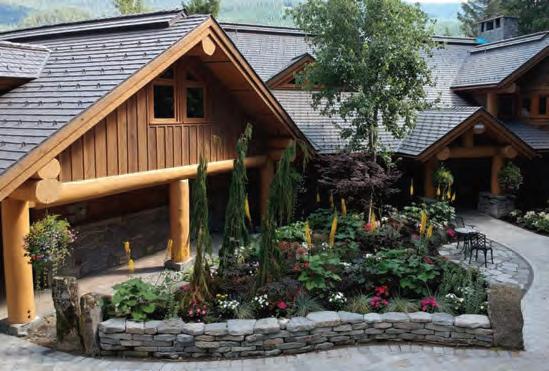
BY BRADLEY NICHOLS






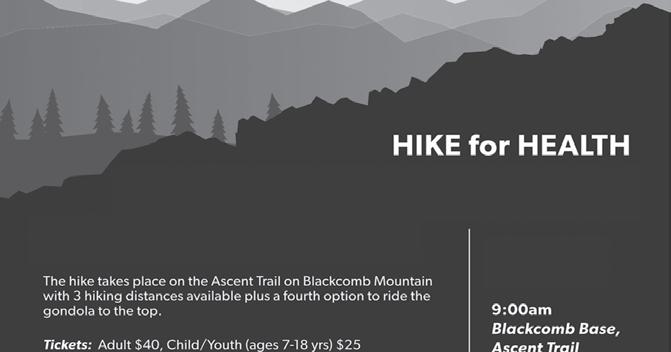
TODAY , mountain bike media and Whistler are almost inseparable. From 1990s freeride films, coverage of Crankworx and viral videos such as I Only Ride Park and Ferda Girls, Whistler has played a central role in how mountain biking is documented, promoted, and experienced.
A key milestone in Whistler’s connection to the mountain bike media landscape came on April 11, 1999, when Kranked II: Trail from the Crypt premiered at the World Ski and Snowboard Festival in Whistler. The Kranked series would become one of the most influential MTB film franchises of its era, helping document the rise of freeride mountain biking and introducing audiences around the world to British Columbia’s trails and riders.
Shot on 16mm film, the early Kranked movies captured a rapidly evolving sport. Their footage showcased everything from Kamloops’ sandy steeps to the wooden ladder bridges and elevated features of North Shore Vancouver, which would go on to influence trail-building around the world. The films helped establish B.C. riders such as Ryan Leech, Wade Simmons, Brett Tippie, and Richie Schley as international stars.


collaborated with Enga on Freak Radical, created most of the distinctive graphics and animation featured in the early Kranked productions.
How audiences consumed MTB media, at the time, was very different from today. Films were distributed through bike shops, first on VHS and later on DVD. Eager mountain bikers often waited for copies to arrive at their local bike shop.
The driving force behind the series was filmmaker Bjørn Enga. Raised in Granthams Landing and North Vancouver, Enga discovered mountain biking in the early 1980s. Seeking adventure, he moved to Whistler in the early 1990s, where he embraced the ski-bum lifestyle and worked as a taxi driver between 1990 and 1992. Although he briefly returned to university, the pull of mountain culture eventually led him back to British Columbia’s mountain towns.
By the mid-1990s, Enga had launched Freak Radical, an interactive journal dedicated to mountain culture. Teaming up with Christian Begin, at age 28 Enga shifted to film production, starting Radical Films. Their first feature-length production, Kranked: Live to Ride, was released in 1998, laying the groundwork for what would become one of mountain biking’s defining film series. This period in the sport’s history is explored in detail in Darcy Turenne’s 2017 documentary The Moment
Whistler played an important role in the development of the Kranked films. The world premiere of Kranked II was held at the Fairmont Chateau Whistler and drew approximately 1,000 attendees. The event was organized by Shauna Hardy, a former North Vancouver schoolmate of Enga’s, who would later found the Whistler Film Festival in 2001.
Another local connection came through Whistler-based artist and designer Stu MacKay-Smith of Toad Hall Studios. MacKay-Smith, who had previously
In 2000, while promoting Kranked III: Ride Against the Machine, Radical Films posted a video trailer online, something virtually unheard of in the action sports industry at the time. While filming in Mexico, Enga received an unexpected message from the company’s internet provider that exclaimed that they could not support the amount of traffic. In short, Kranked III’s trailer was blowing up the internet.
“Apparently they were using more data than the usual high-volume content,” Enga later recalled. “I got this message at a pay phone in a remote place in Copper Canyon, Mexico. Our plan with the internet site did not include that much data… Early days!!!”
The trailer’s popularity suggested there was a strong appetite for online video distribution and viewing. What is taken as a given today was groundbreaking 25 years ago.
The influence of the Kranked films extended beyond riders and audiences. The series also served as a training ground for a generation of filmmakers and photographers who would go on to shape MTB media. Among them was Darcy Wittenburg, who worked on Kranked films before co-founding The Collective with Jamie Houssain and later establishing Anthill Films. Anthill Films is a production company that has continued to push the creative and technical boundaries of action sports cinematography (see Brandon Semenuk’s unReal Segment).
Today, action sports photography and filmmaking have become an important part of Whistler’s cultural identity. The groundwork laid by early innovators such as Bjørn Enga helped transform MTB media from a niche pursuit into a global industry, with Whistler often at its centre. n
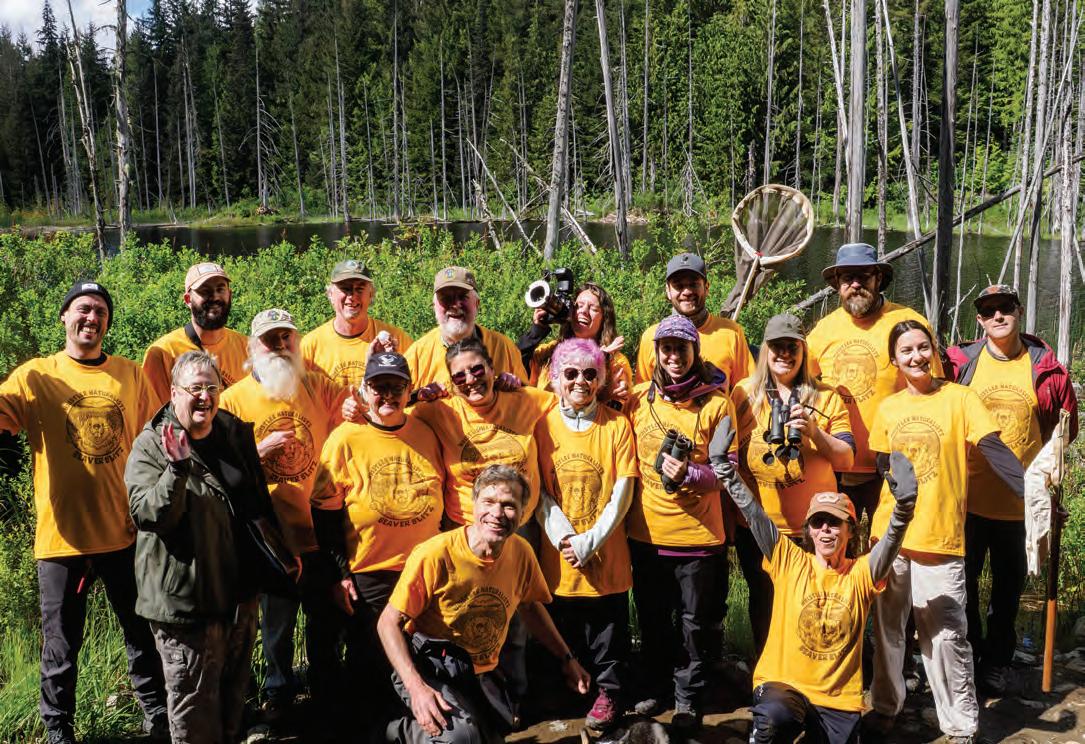
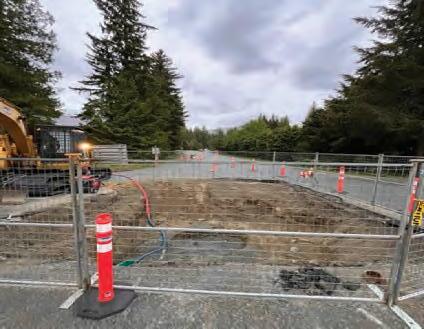
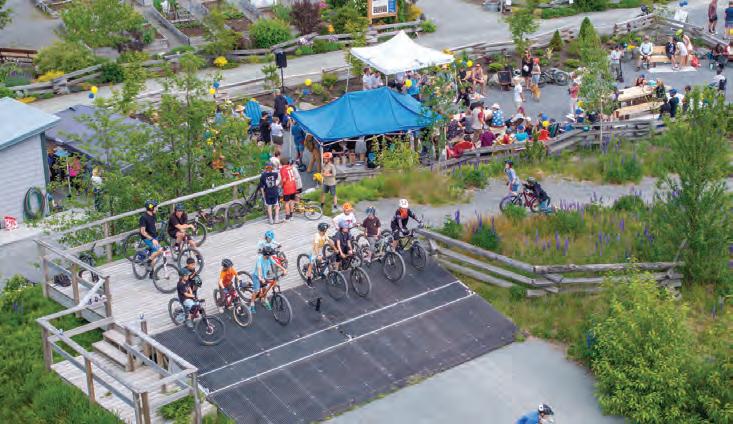
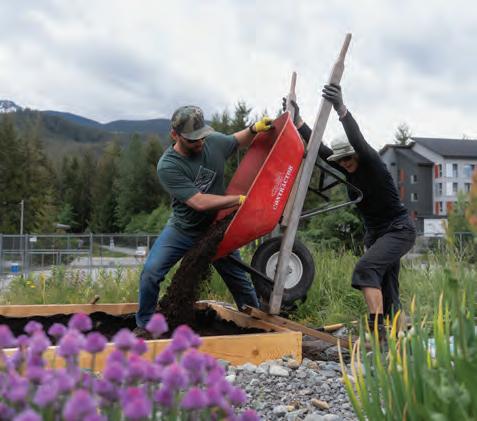
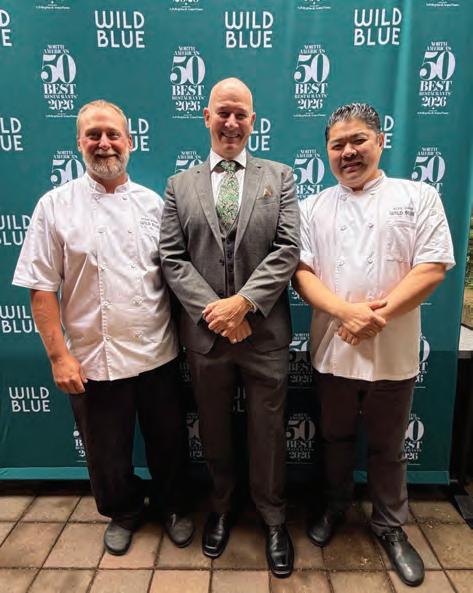

aleadingNorthAmericanindependentinvestmentfirmwithadvisorslicensedinbothCanadaandthe U.S.,givingclientsonepointof contactforallcrossborderneeds.
Reduceunnecessar yforeignexchangecosts
▶ HoldCanadianand U.S.accountsinoneplace
▶ Support forRRSPs/RRIFs,IRAs,RothIRAs,and401(k)sacrossborders ▶ Portfoliomanagementinbothcurrencies(selectedaccounts)
Access to Canadianand U.S.investmentoptions

RecreationSitesand TrailsBCis seekingpubliccommentson theprohibitionofcampingand motorizeduseintheBrandywine Meadowsareafrom June 1st to November 1st annually
Thisrestrictionwillsupport theintentoftheWildlife Habita tArea (WHA)2-281,which ishighvaluehabita tused by grizzlybear sto raisecubs ever yyear
Campingandmotorized usedistur bthesebear s, threatencubsurviva land create asignificantriskfor human-bearconflicts
Thedevelopmentof recreationa linfrastructure (foodcaches,toilets, campsites )whic hwould berequired forbearsafe campingisprohibited withinWHA2-281
Formoreinformationorto providecomments,email theMinistry ofEnvironment and Parks, Recreation Sitesand TrailsBranc h at:RecInfo@gov.bc.caby June21st,2026

Here’s a quick look at some events happening in Whistler this week and beyond. FIND MORE LOCAL EVENT LISTINGS (and submit your own for free!) at piquenewsmagazine.com/local-events

An annual tradition by locals, for locals—celebrating the diversity of both immigrant and Canadian communities. Performances, activities and food are presented by local cultural representatives for residents and their families. Enjoy a day of cultural performances, music, kids activities, food stations and community booths.
> June 12, 4 to 8 p.m.
> Whistler Public Library
Start your weekend on a high note with Whistler’s favourite Friday tradition. Set against the backdrop of the mountains, Fairmont Fridays bring together handcrafted cocktails, live music and a feature food menu designed for sharing and celebrating the start of the weekend. Each week discover a new signature cocktail alongside specially curated culinary offerings, creating an elevated après experience filled with flavour, atmosphere and a little extra magic.
> June 12, 5 to 7 p.m.
> Mallard Lounge
Join local physician and mountain rescue technician, Dr. Renata Lewis, in conversation with emergency room doctor Dr. Brian Goldman about his book The Casino Shift: Stories of an ER on the Edge, an hour-by-hour account of a health-care system at a critical inflection point. The bestselling expert’s new book discusses the frustration and burnout of colleagues, and their passion for saving lives in a system that is on the edge. The conversation will include an audience Q&A and a book signing.
> June 13, 7 to 8:30 p.m.
> Rainbow Theatre
Whistler Off Road Cycling Association (WORCA) is proud to present The OneUp Back Forty, a mass-start mountain bike race inspired by the legendary NIMBY 50’s legacy of good times and wicked riding in Whistler. Registration is $99 and includes a bottle, race plate, dinner, beers, and the
chance to win awesome prizes from the sponsors. All proceeds from the Back Forty go towards new trail construction in Whistler and mountain bike programming for the Líl’wat Ka-xléq-a (Líl’wat Rolling) Indigenous Youth Mountain Bike Program.
> June 13, 10 a.m. to 6 p.m.
> Start in Cheakamus & Finish in Alpine
A feast for your senses, the Whistler Farmers’ Market features local produce, tasty food, local artisans, live entertainment and family activities. Markets happen every Sunday until Thanksgiving on Oct. 11, with the addition of select Saturday markets.
> June 14, 11 a.m. to 4 p.m.
> Upper Village Stroll
An epic mountain bike ride from Whistler to Squamish along the famed Sea to Sky Trail. Starting from the Whistler Athletes’ Centre in Cheakamus Crossing, make your way south on buff, rolling single and double track trail. Experience some of the most spectacular scenery in the province.
> June 14, 8 a.m.
> Whistler Athletes Centre
Come for the ride, stay for the après. The Whistler Off Road Cycling Association’s (WORCA) Thursday Toonie Rides are a great place to mix and mingle with Whistler’s vibrant mountain biking community. Ride hard for the challenge or ride with friends for the fun of it. When the ride is over, meet up at après to share tall tales with friends old and new. However you ride, it’s guaranteed to be a good time.
> June 18, 6:30 to 8:30 p.m.
> Various locations
Renowned Vancouver Drag Queen Carlotta Gurl is movin’ on up to Whistler Public Library for a night of free drag bingo! Whistler Rainbow Connection is excited to join forces with Carlotta Gurl for a sexy, campy, FUN twist on a trailer park classic. This event features six rounds of nail-biting, edge-of-your-seat bingo, plus comedy and incredible drag performances. Get ready to have fun and win some great prizes!
> June 18, 7 to 9 p.m.
> Whistler Public Library
WEEK OF JUNE 12 BY
ARIES (March 21-April 19): Many of you have a fraught relationship with discipline. You recognize you need it if you want a life rich with epic adventures. Yet you sometimes resist planning ahead or organizing your resources, fearing it might dampen your immediate pleasures. The problem is that when you skip the planning and organizing, the short-term fun you default to may turn out to be unsatisfying. That’s the challenging news. The encouraging news is that you’re now in a cycle when you can transform how you relate to discipline. I bet you can render some of those old patterns obsolete.
TAURUS (April 20-May 20): Gemologists evaluate opals less for flawless uniformity than for their mesmerizing play-of-colour. They study how light interacts with a stone’s microscopic internal structure to produce vivid, shifting hues. The most prized opals aren’t necessarily the most perfect in shape, but the ones whose internal pattern and rainbow-like displays are most vibrant, varied, and alive. This is a marvellous metaphor for you in the coming weeks. I hope you don’t obsess on consistency or smooth away your complications. Let the world see your play-of-colour.
GEMINI (May 21-June 20): “Dear Oracle: Why do we always have to start at the beginning? I’d much prefer just jumping into the middle of things. Right now, I would love to bypass all the tedious baby steps I’m being forced to take as I try to get some momentum going. Please slip me a few clues about how to fast-forward directly to the fun stuff. —Bored with the Groundwork.” Dear Bored: Your timing is perfect. The planetary omens say you are now authorized to vault over the preludes and prologues and dive right into the heart of the action.
CANCER (June 21-July 22): Restoration ecologists work to revive damaged prairies. They’ve discovered that seeds of many native plants can lie dormant in the soil for years, waiting for the right conditions to germinate. If they remove invasive species and restore the land’s natural cycle of controlled fire, wildflowers long absent from the landscape spring back to life. With this metaphor in mind, Cancerian, consider what dormant possibilities may lie buried in your own psyche. What seeds did you plant long ago and then forget? What dreams or talents are waiting for you to clear away the choking overgrowth and create space for them to emerge? Old potentials may be patient, not dead.
LEO (July 23-Aug. 22): Better than any other sign, you understand that ego and generosity can be collaborators rather than enemies. Your charismatic radiance is often a public service. When you express your interesting beauty, you give others permission to tap into their own luminosity. The world always craves your unique flavour of audacious joy, and especially now. The rest of us need your intense insistence that flair and flamboyance are forms of resistance against the forces that would diminish life’s splendour.
VIRGO (Aug. 23-Sept. 22): Many people struggle with what could be called “imagined ugliness,” a condition clinicians refer to as body dysmorphic disorder. It usually involves fixating on a supposed physical defect, or even on a flaw that exists only in one’s mind. I suspect that almost everyone carries a trace of this tendency, including you and me. The good news, though, is that the current astrological climate is ideal for you to at least partially shatter its spell. You are poised to transform your selfimage so vigorously that you begin to regard yourself as a flawless exemplar of quirky, one-of-a-kind beauty.
LIBRA (Sept. 23-Oct. 22): The Golden Gate Bridge, which is a few miles from my home, is painted continuously. Painters start at one end, work their way across, and by the time they reach the other side, it’s time to start over. The job is never finished; maintenance is the permanent condition. Some people find this depressing, but I find it oddly liberating. It means the bridge doesn’t have to
ROB BREZSNY
achieve some final, perfect state. It just has to be tended. Similarly, you don’t have to fix everything once and for all, Libra. The relationships, projects, and internal states you’re concerned about aren’t meant to reach completion. You shouldn’t worry about trying to finish what’s meant to be an ongoing practice. Just keep starting the cycle again.
SCORPIO (Oct. 23-Nov. 21): Innovative theater director Viola Spolin was a Scorpio. She taught that the best scenes emerge when the actors avoid trying to control outcomes. Instead, they fully commit to the reality they’re creating together. Spontaneous responses are their gold standard. Let’s make this a keynote for you in the coming weeks. Your assignment is to give yourself heartily to improvisation. The most interesting magic will happen as you relax into the collaborative process, trusting it to guide you toward beauty and meanings none of you could have scripted alone.
SAGITTARIUS (Nov. 22-Dec. 21): Musicologists distinguish between “perfect pitch” and “relative pitch.” A person with perfect pitch can sing or identify a specific note without hearing any other music beforehand. Relative pitch is the ability to recognize musical notes in relation to other notes. In the coming weeks, Sagittarius, relative pitch will be a more useful metaphor for you than perfect pitch. Don’t insist on perfect clarity about what’s right and wrong, beautiful and ugly, worthy and unworthy. Instead of obsessing on fixed standards, practice relational discernment. How does this choice feel compared to that one? How does a person behave in this context versus another? For you right now, truth lives in the intervals and connections.
CAPRICORN (Dec. 22-Jan. 19): The best way to eliminate a bad habit is to replace it with a good one. Now is an excellent time to acquire more expertise in this art. Start by choosing a specific habit that drains your energy, time, or self-respect. Then identify what that habit is secretly trying to give you, like comfort, distraction, or a sense of control. Your mission is to find a healthier behaviour that offers a similar payoff without the damage. For example, maybe you go online and binge-scroll through bad news because you imagine it soothes your anxiety. Instead of that, read an uplifting book or listen to serene music for a while. Be concrete: When the itchy habit hits, what exactly will you do as an alternative?
AQUARIUS (Jan. 20-Feb. 18): In 1905, 26-yearold Albert Einstein worked full-time as a clerk in a Swiss patent office. During his off-hours, he wrote four audacious papers that fundamentally changed how physics understood space, time, light, and matter. He accomplished his revolution without the sponsorship of a renowned university or laboratory. His example suggests that we can perhaps re-imagine and recreate the world even if we’re not supported by glamorous circumstances. I suspect this principle applies to you these days. Breakthrough insights and earth-shaking realizations may arrive while you’re doing ordinary tasks. Be alert for the flashes that arise in seemingly routine and modest situations.
PISCES (Feb. 19-March 20): For linguists, “untranslatable” words are concepts that exist in one language but have no equivalent in others. One example is mono no aware, which in Japanese refers to the tender poignance and appreciation you feel in the presence of fleeting beauty, like cherry blossoms falling. I bring this to your attention, Pisces, because I suspect that you, too, are untranslatable right now. My advice is to forget about trying to get others to grasp what’s going on with you. Here’s a suggestion that might help: Find soulful artists and emotionally intelligent creatives who speak the language of your mystery.
Homework: What gifts do you have that you have never yet given with fullness? https://tinyurl.com/33ss33ss.
In addition to this column, Rob Brezsny creates
In-depth weekly forecasts designed to inspire and uplift you. To buy access, phone 1-888-499-4425. Once you’ve chosen the Block of Time you like, call 1-888-682-8777 to hear Rob’s forecasts. www.freewillastrology.com
forthe2026/27 Season
TheSea to Sky ContractorsDirectory isback! We offerfree listings foralllocal contractorsandtrades. Don’tmissoutonbeing part oftheregion’s go-to resource—simplyfillout thefor mbelow to claim yourspot.






ads@squamishchief.com• sales@piquenewsmagazine.com
In accordance withsection24ofthe Community Char ter, the Resort Municipalityof Whistler(RMOW) hereby givesnotice that: TheRMOWintends to provideassistance throughpartneringagreements for2026in accordance withthe Council Policy A-39- Fee for Service(FFS) to:
• Whistler Ar ts Council(dba Ar ts Whistler)up to theamountof$594,825 to operate Maury Young Ar ts Centre anddevelop,produceandpromoteartsprogrammingin Whistler;
• Sea to Sky Invasive Species Councilup to theamountof$75,705 to provideinvasive species expertise, programdevelopment, trainingandeducationin Whistler;
• Whistler Animals Galore Societyup to theamountof$124,373 to operateananimal shelterin Whistler;
• Whistler Museumand Archives Societyup to theamountof$224,950 to operate the Wh istler Museum;and
• Whistler Off-Road Cycling Associationup to theamountof$290,925 to maintain the existingoff-roadtrailnetworkwithin Whistler(togethertheFFS Recipients).
On February 25,2026 Councilpasseda resolutionapprovingtheabove -listedfunding amounts to theFFS Recipients at a Regular Council Meeting. TheFFS Recipientsare providingimportantservices to the Whistler community and Councilhasdetermined thattheassistance beingprovided by theRMOWfurthersthegoalsofthe Whistler community asidentifiedin Whistler ’s Official Community Plan. Allfundingunder theseagreementsisdue to bepaidin2026subject to theFFS Recipientssatisfying milestonesthroughout2026and continued availabilityoffunding.
Pauline Lysaght Resort Municipalityof Whistler Corporate Officer
Resort MunicipalityofWhistler whistler.c a

GroupFitnessClasses Friday
I7:30-8:30a.m.Strength&Mobility-Anna
I10:30-11:30a.m.Zumba-Susie
I5:30-6:30p.m.Strength&Mobility-Anna
I8:45-9:45a.m.AquaFitDeep-M-A Wednesday
I7:30-8:30a.m.Strength&Cardio-Kelsey Thursday
I7:30-8:30a.m.MTNReady-Francesca
Seeourfullpage

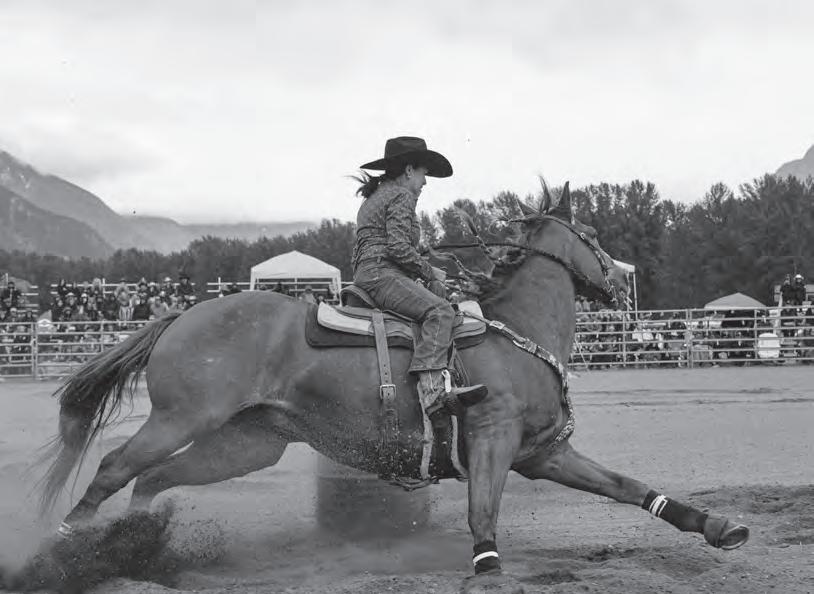


Showroomsales@mariomarbleandtile.com Mario@mariomarbleandtile.com 604-935-8825



Whether you're leading a busi‐ness, nonprofit, First Nation, mu‐nicipality, or growing team, leader‐ship can feel isolating.
Courtney Marchment Coaching helps leaders and teams build stronger communication, healthier workplace cultures, and greater confidence through executive coaching, leadership develop‐ment, and team workshops.
Trusted by organizations including Lil'wat Nation, Tourism Whistler, the University of British Columbia, Whistler Connection, Whistler cooks and Califor nia Life Sci‐ences.
Based in Pember ton and serving Whistler, Squamish, and the Sea to Sky Corridor.
Let's build a workplace where people thrive.
courtneymarchmentcoaching.com hi@courtneymarchment.com
TheMuseumiscurrentlyseeking
Fixed1-yearterm,part-time. 30hoursperweek, Tuesday-Friday. $30.00perhour
Responsibleforsupportingthe Museum’sfundraisinganddonor stewardshipactivities;maintaining thedonordatabase;coordinating logisticsfortheannualgala;and generatingfundraising reportsand collateral.
Thepositionwill remainposteduntilfilled. Applicationswillbe reviewedonanongoing basis,andcandidatesareencouragedto applyassoonaspossible.
ApplyandlearnmoreviatheQRcode, oremailapplicationsto bbeacom@audainartmuseum.com





TheMuseumiscurrentlyseeking
Full-time,permanent. $58,500peryear
Responsibleforproviding administrativeandoperational supporttoensureefficientoperation oftheMuseum,actingasthe technicalleadfortheMuseum’s ticketingandadministrativesoftware.
Thepositionwill remainposteduntilfilled. Applicationswillbe reviewedonanongoing basis,andcandidatesareencouragedto applyassoonaspossible.
ApplyandlearnmoreviatheQRcode, oremailapplicationsto bbeacom@audainartmuseum.com

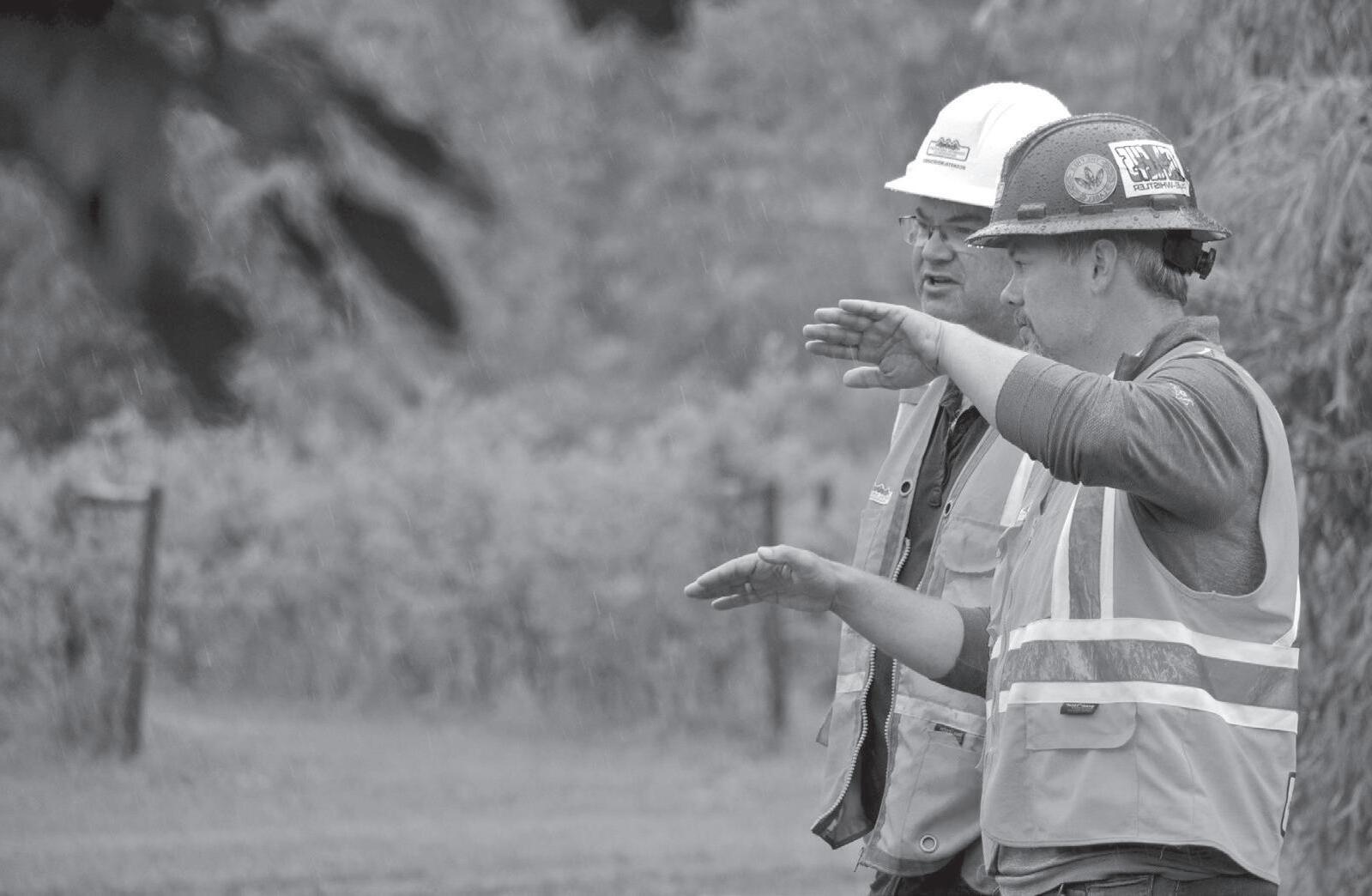

EmployeeHealth &WellnessPlanavailable
HEAVYEQUIPMENTOPERATOR– Minimum 5yearsor5,000hoursoperating experienceonexcavator.CrushingExperiencepreferred. Full-time,Monday–Friday.$33-$46perhour.
CONSTRUCTIONLABOURER– Greatopportunitytolear non-the-job.Staminafor physicallydemandingworkandperseverancetobraveinclementweather required. Previousexperiencepreferredbutnot required.Trainingprovided.$28-$33perhour.
PIPELAYER –Minimum 5yearsexperienceincivilconstruction.
Full-time,Monday– Friday.$33-$43perhour.
TRUCKDRIVER –BCDLClass1 orClass 3withairbrakesrequired.Manualtransmission. 2yearsexperiencepreferred.$35-$41.50perhour.
PROJECTMANAGER –10+yearscivilconstructionPMexperience,Class5licence, strongleadership,scheduling,budgeting&safetymanagementskills.Annualsalary $105k-$125k.
SITESUPERINTENDENT –5–10yrscivil/excavationexp,2–5yrsPMexp,Class5 licence.Leadsiteops,safety,scheduling &qualitycontrol.$40.49-$47.17perhour.



www.whistlerwag.com





EmploymentOpportunities
ÚlÍusCommunityCentre
•SeniorHumanResourcesGeneralist($76,560.00to$105,270.00peryear)Contract–01May2026to31December2026(withthepossibilityofextensionor conversionto apermanentrole
• TransferStationOperator -Salar yRange 1($41,600.00to$54,600.00peryear)
Child &FamilyServices
• OfficeManager($67,040.00to$92,180.00peryear)
• Custodian($35,657.14to$46,800.00peryear)
•FetalAlcoholSpectrumDisorder(FASD)KeyWorker($54,720.00to$71,820.00 peryear)
Health &Healing +PqusnalhcwHealthCentre
•PeerOutreach Worker($47,120.00to$61,845.00peryear)
•CommunityHealthNurse($41.42to$52.81perhour) +$2.15hourlypremium)
•TraumaTherapist($80,160.00to$115,230.00peryear)
CommunityPrograms
•DaycareSupervisor -Infant &Toddler($54,720.00to$71,820.00peryear)
$30-$45+perhour

•AboriginalSupportedChildDevelopment Worker($25.89 -$33.98perhour+ eligibleforwageenhancementtopup)
CommunityDevelopment
• AdministrativeAssistant -YouthJustice($47,120.00to$61,845.00peryear)
Ts’zil,Language &Culture
•SummerStudent($18.25perhour)
Xet’òlacwCommunitySchool
•BusDriver($20.90to$29.45perhour)
Pleasevisitourcareerpageformoreinformation:https://lilwat.ca/careers/

Love agoodchallenge?Passionateabout theplaceyoucallhome?TourismWhistler islookingforcommunity-loving,mountainappreciating,environment-respectingpeople tojoinourteam.Comecollaboratewithus.
We’rehiring forthe followingopportunities:
•Coordinator,Conference Sales
($52,000 -$54,000annually+ incentive bonus)
•Coordinator,Market Development
($52,000 -$54,000annually +incentive bonus)
•TravelConsultant ($21perhour +commission)
WhatWeOffer:
•Schedulesdesignedtoenhance work-life balance
•Comprehensivebenefitspackage
•A commitmenttohealthand wellness
•Funandsupportiveteamenvironment
TO VIEWOURCAREEROPPORTUNITIES, AND TO APPLY, VISITUSONLINE AT: WHISTLER.COM/CAREERS.



































EVERY TWO WEEKS , I sit in council meetings. More often than that, I go through correspondence to the Resort Municipality of Whistler, the Village of Pemberton or (my personal favourite) the Squamish-Lillooet Regional District, looking for more insights into what’s on residents’ minds.

BY LUKE FAULKS
Sometimes it’s a single letter about a road. Sometimes it’s a neighbourhood group worried about wildfire mitigation. Sometimes it’s a parent trying to understand where a school, daycare or playground might fit into the future of
Municipal coverage isn’t always glamorous. It doesn’t often come with the theatre or massive budgets of provincial or federal politics. But it’s where the politics that are most likely to affect our day-to-day lives are decided. That alone makes it consistently exciting to cover.
Which is why, as we head toward another municipal election this October, I’d like to make a simple plea: please don’t underestimate your vote.
Not in the abstract, civic-duty, “people fought for this right” sense— though, yes, that too. I mean in the practical, arithmetic sense. Your vote matters more in local politics than it does anywhere else.
Compare, for example, the total number of eligible voters in Whistler with the number of votes received by the winning mayoral candidate in each election since 2008. The gap is not small.
It is cavernous.
In 2008, Ken Melamed was elected with 1,527 votes, compared with 6,815 eligible voters.
In 2011, Nancy Wilhelm-Morden won with 2,636 votes, again out of 6,815 eligible voters. She was re-elected in 2014 with 2,083 votes out of 6,558 eligible voters.
Current Mayor Jack Crompton ran unopposed in 2018, when Whistler had 10,658 eligible voters, and won in 2022 with 2,153 votes out of 9,152 eligible voters.
Those disparities don’t mean the “wrong” person won. It means a small share of eligible voters made a very large decision on behalf of the whole community.
The point is that, in every contested mayoral election listed above, there were enough non-voters that an entirely different person could have won without the winning candidate losing a single vote. For the last decade-and-a-half, Whistler’s leadership could have looked entirely different.
Mayoral races are only part of the
LeBlanc ultimately won by a draw of lots.
There are plenty of elections where the phrase “every vote counts” sounds like a bumper sticker. But at the municipal level, it’s more than a catchphrase; it’s the honest truth.
And it’s just as well. Because the people elected in these races are not distant figures in Ottawa or Victoria. Local government is where many of the decisions that shape your daily life are made.
And yet, municipal turnout is persistently low compared with provincial and federal elections.
In the last seven elections British Columbians turned out for, voters cast ballots at much higher rates for federal and provincial contests than they did for municipal ones. That means we’re casting more ballots in elections where our individual votes matter less, and fewer ballots in elections where they matter more.
That’s understandable, to a point. Federal and provincial campaigns are louder. They have leaders’ debates, attack ads, national narratives, party brands
Compared to B.C.’s other largest resort municipalities, Whistler’s turnout has been nothing to brag about.
story. Council races can be even tighter.
In 2018, Councillor Ralph Forsyth beat unsuccessful candidate Dawn Titus by 59 votes for the final council seat. In 2014, Coun. Jen Ford beat Michael d’Artois by 12 votes. In 2011, John Grills beat Steve Anderson by four votes.
In Pemberton, the margins have been just as sharp. In 2011, Alan LeBlanc and Niki Vankerk tied at 308 votes, narrowly ahead of Jessica Turner by 19 votes.
and wall-to-wall coverage. Municipal campaigns are quieter. A candidate for council in Whistler is unlikely to interrupt your YouTube video with a moody blackand-white attack ad accusing another candidate of being soft on potholes.
But quieter doesn’t mean less important; in fact, the opposite is often true.
The less attention local government receives, the more power attentive
residents have. A few dozen people writing letters, showing up, asking questions and voting can shape the conversation.
A dozen concerned citizens can, for example, slow down and force a process change for rezoning a section of land off Alta Lake Road. Or get council to host a public information session on a new development going into Pemberton’s sensitive floodplain.
And in light of the fact that we have some wordcount real estate remaining, allow me to toss another challenge your way: Compared to B.C.’s other largest resort municipalities, Whistler’s turnout has been nothing to brag about.
In the 2011 election, at the height of post-Olympic civic pride, voter turnout still fell short of Fernie’s.
Since then, Whistler has largely lagged behind its resort-municipality peers. In 2022, we became middle-of-the-pack among resort municipalities not because our turnout has risen significantly, but because the number of residents casting a ballot in Revelstoke and Kimberly fell.
This October, remember that not only do you have the ability to kick Fernie’s behind, you have so much power to affect change over the people who have the most power to affect your day-to-day life.
Granted, there’s never enough time in the day to be 100-per-cent informed on all the issues. It’s my job to cover municipal politics, and even I have to play catch-up sometimes. So start paying attention now. Read the platforms as they get released. Stand up and talk to council during public comment period. Send an email to a councillor. Talk to your neighbours. Read your local paper, which I’m obligated and delighted to recommend.
And this October, vote.
Not because it’s symbolic. But because it’s practical. Because the margins are small. Because the stakes are local.
Because even a single vote has mattered before, and this election, that one vote could be yours. n

3



4
$2,695,000 (GST exempt)