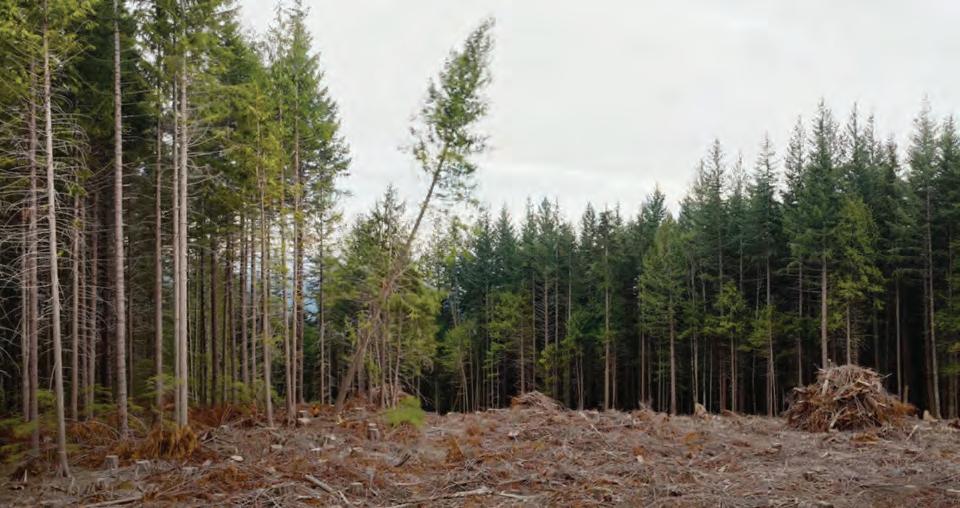
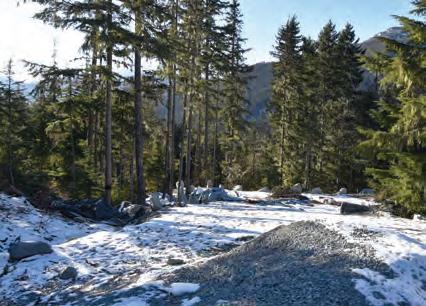
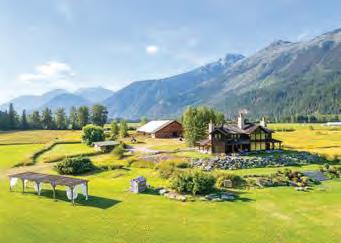
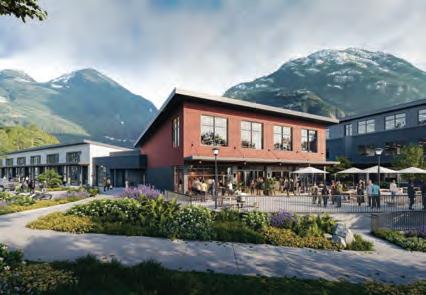
Experts warn B.C.’s forest carbon market hitting a ‘dead end.’ - By Stefan Labbé
06 OPENING REMARKS As May turns to June, hundreds of high-schoolers are being asked the same question, writes editor Braden Dupuis: “What do you want to do when you graduate?”
08 LETTERS TO THE EDITOR This week’s letter writers pick up the call for a break on parking, and weigh in on water metering in the resort.
20 RANGE ROVER Canadian environmental icon David Suzuki’s 90th birthday bash served as a rallying cry to reboot the environmental movement, writes Leslie Anthony.
38 PIQUE’N YER INTEREST The Artemis II moon mission offers hope that humanity may actually have a future, after all, writes Vince Shuley.
10 SPRAY AND PRAY With Western spruce budworm populations continuing to spread through Whistler’s forests, the B.C. government is preparing to act.
13 MEET THE NEW BOSS The Resort Municipality of Whistler has found its new chief administrative officer in the Hilton’s Chris Vick.
24 BUMP, SET, SPIKE Pemberton teenager Charlotte Johnson reflects on her first national-level volleyball tournament.
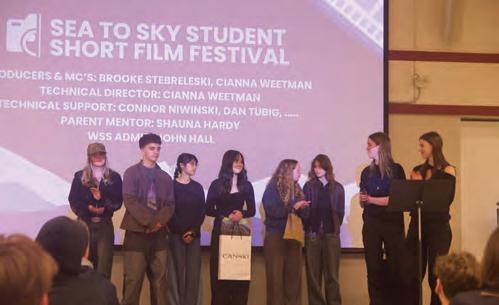
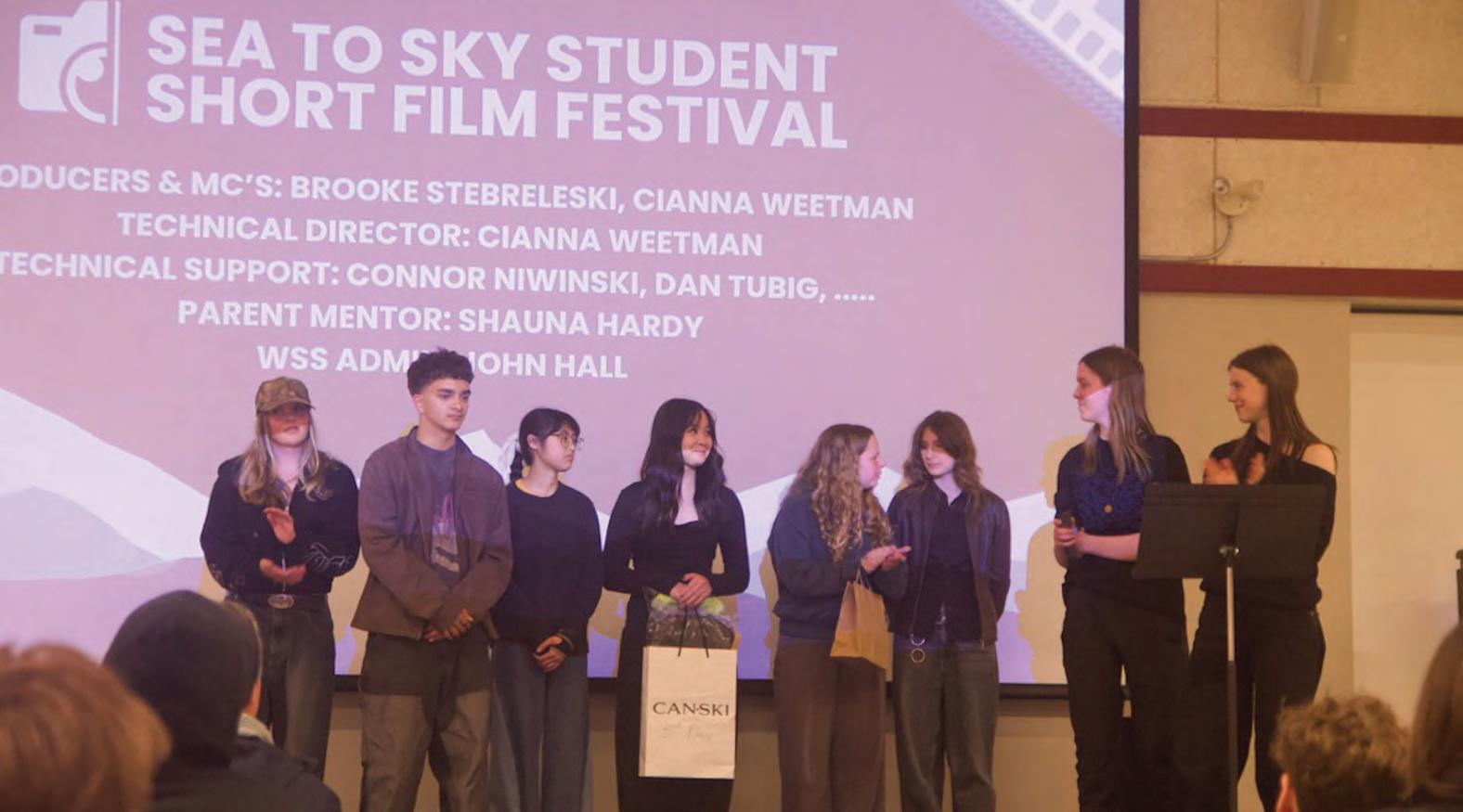
28 POST PRODUCTION The Sea to Sky corridor’s young creatives showed off their filmmaking chops this month while raising money for grad.
COVER Hoping my forest baths don’t all go up in smoke. - By Jon Parris // Adobe AI // @jon.parris.art
Publisher SARAH STROTHER - sstrother@piquenewsmagazine.com
Production Manager AMIR SHAHRESTANI - ashahrestani@piquenewsmagazine.com
Art Director JON PARRIS - jparris@piquenewsmagazine.com
Advertising Representatives
TESSA SWEENEY - tsweeney@wplpmedia.com
ANDREW BUDRESKI - abudreski@piquenewsmagazine.com
Digital/Sales Coordinator KATIE DOUGLAS - kbechtel@wplpmedia.com
Reporters LUKE FAULKS - lfaulks@piquenewsmagazine.com DAVID SONG - sports@piquenewsmagazine.com
Classifieds and Reception - mail@piquenewsmagazine.com
Contributors G.D. MAXWELL, VINCE SHULEY, LESLIE ANTHONY, GLENDA BARTOSH, ANDREW MITCHELL, LISA RICHARDSON, LIZI MCLOUGHLIN, TOBIAS C. VAN VEEN
Founding Publishers KATHY & BOB BARNETT www.piquenewsmagazine.com
What do you want to do when you graduate?
AS MAY TURNS to June, hundreds of fresh-faced, about-to-be-highschool-grads are being asked the same impossible question.
“What do you want to do when you graduate?”
Many will have an answer at the ready, probably seeded years in advance
BY BRADEN DUPUIS
by their parents. They’re going to X school to get a degree in something or other, then they’re going to get a good job in their field and work until they retire.
It’s all laid out in front of them. Easy, right?
If you are one of these students, congratulations, and best of luck in your future endeavours.
But this column is directed at the other kind of grad—the one who has no idea how to answer that awful question, and just wishes people would stop asking.
Because I remember the feeling all too well, being the latter type of student myself.
The feeling that you’re doing something wrong, not following the same path as your peers. The idea that you’re making a big mistake by not taking on untold years of student-loan debt following a career path you’re not even sure is the right fit.
And I remember the looks of concern on all the adult faces when I told them my post-graduation plans.
I was going to be a rock star.
To be fair, the reaction I got most commonly was probably the right one: a look of embarrassment mixed with pity,
of wizened eyes scoffing at the idealism of youth.
In hindsight, it was the opposite of a career plan—one with virtually no chance of ever paying the bills, which drew not-entirely-undeserved derision from the adults in my life.
But there was one person who reacted differently than everybody else. And looking back, his support meant everything to me.
His name was Mark Odnokon, and we first met when he arrived out of nowhere to teach Grade 9 home room. An ex-NHL scout for the Anaheim Ducks who had his own brief stint in the show, Mr. O, as he came to be called, was decidedly out of his element that first year.
We clashed spectacularly, him not much appreciating my laissez-faire approach to my education, and my penchant for disrupting every class I was in.
It was my turn to scoff, reading it at the time—whatever, old man.
It wasn’t until a couple years later, when he didn’t have to deal with me directly every day, that Mr. O became the “cool” teacher, always down to shoot the breeze or share a joke.
And I’ll never forget one of our last in-person interactions, on graduation day 20 years ago next month. When I bumped into Mr. O before the ceremony and he asked about my post-grad plans, and I told him I was going to be a rock star, he didn’t scoff. He didn’t roll his eyes, or laugh in my face. He didn’t take pity, or give me that condescending look that seemed to come from every other adult.
He looked excited. Proud, even. And I remember suddenly feeling just a little less small in that moment—like I wasn’t stupid for wanting more than a boring,
Twenty years later, and I still think about that speech often—about how much it meant to have even one person in my corner at those strange, awkward crossroads between youth and adulthood.
I was reminded of it again this week when a friend from high school sent me a Facebook post announcing Mr. O’s passing, after a short battle with an unspecified illness. I didn’t know he was sick, otherwise I would have sent him a note. I wish I’d kept in touch more regularly.
And I wish I’d taken the opportunity to tell him how much those words meant to me all those years ago, outside the high school gym before graduation.
So if you’re one of countless high schoolers who dreads the big question, who feels lost, or misunderstood as they face the next phase of life, take heart in knowing you’re not alone.
And as much as the adults in your life
Twenty years later, and I still think about that speech often— about how much it meant to have even one person in my corner at those strange, awkward crossroads between youth and adulthood.
When I became too much, which was every day, he would send me to the principal’s office with a “why don’t you head on down” to the big bench to await my latest punishment.
“Intelligent! Creative!” he wrote on my final, mediocre Grade 9 report card so many years ago. “Reach your potential, don’t just talk about it!”
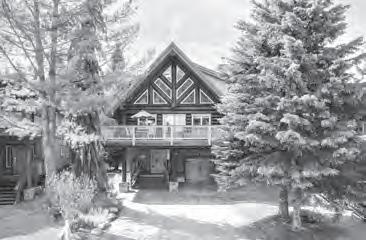
OPENHOUS E• SATURDAY 2 TO 4 PM
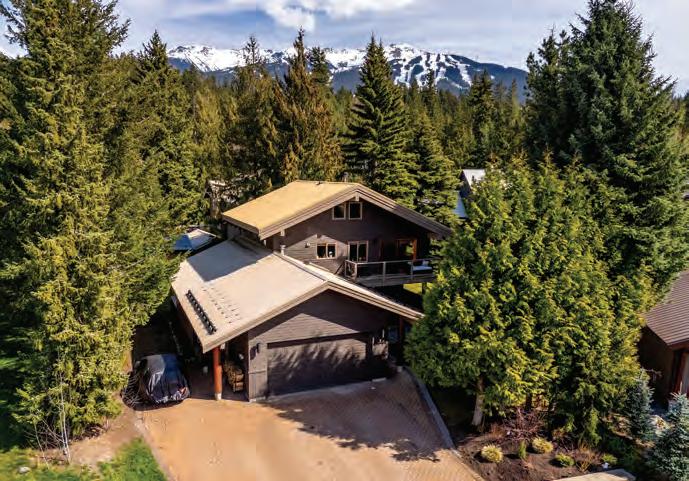
Experiencemountainlivinginthiscustom-built cedarloghomein Whistler ’s sought-afterSpruce Groveneighbourhood. Thistimberframehome features vaulted ceilings, expansivewindows, anopen-conceptlayout,andastunning woodburningstonefireplace. Granite countertops, heatedslate flooring, and expansivefront and reardeckscreatetheper fect setting for entertainingor relaxingafteradayonthetrails. Unwindintheprivatehottubwhiletakingin views toward WhistlerBlackcomb.Ideallylocated nearSpruce Grove Park, LostLaketrails,andonly ashortstroll to Whistler Village.
Asking Price$3,200,000 7270Spruce Grove Circle
average life.
And in the speech he gave later that evening sending off our graduating class of ’06, he made reference to our conversation, and how my headstrong approach to the next stage of life had inspired him.
“Follow your dreams,” he told us. After all: if not now, when?
might want to rush you, you don’t have to have an answer to that big awful question right away.
Go live your life for a bit. Find out what you’re good at, or passionate about. Be weird and fearless and unapologetically yourself, and pay no mind to the scoffers. Follow your dreams.
Please expectheavyrunnertrafficonthe Lost Lake Trail ParktrailsJune6from7amtonoon. registeronlinetosaveyourspot: whistlerhalfmarathon.com/events
Make free parking an election issue
Bravo Bill McCaig! I was going to suggest to the Mature Action Community (MAC) that all Whistler locals over the age of 75 be given free parking passes, and Bill McCaig writes to say ALL locals should be given a break with parking (see Pique, May 22: “Whistler should give locals a break on parking”).
I couldn’t agree more. Could we make this an issue in our next municipal election?
Ruth Buzzard // Whistler
The case for water metering in Whistler
I want to throw my support behind extending water metering to residential users now that we are finally charging commercial users in Whistler. Yes, I say this, even knowing it will likely increase my bill. Go figure. Or will it? I should think my tax bill will be reduced given how I treat water usage.
I have lived in different parts of the world where water was metered, and we paid for what we used... just like power and internet. What I discovered was that I learned very quickly how little water you actually need. Two minutes in the shower turns out to be enough. Baths become a luxury. Running a half-full washing
machine feels almost criminal. Wash my truck? Muh. It will rain soon.
I lived in Central America where water was scarce during the dry season. It was about survival. In Los Angeles and Las Vegas (where I also lived), they were ahead of the curve out of necessity. Here in B.C., we tend to think of ourselves as water-rich, and we are. There are rivers running through our communities. Heck, there’s a river flowing through the Greater Vancouver Regional District called the Fraser. Heard of it?
The problem is not supply. It’s the chronic failure of successive municipal and regional governments to invest in the infrastructure needed to keep pace with growth. Population has exploded; water systems have not. We have the resource today. What we lack is political intelligence and the planning to build it for tomorrow. Metering is one tool that could help us understand demand, reduce waste, and make the case for the infrastructure investment that has been
deferred for far too long.
As a pragmatic first step, could we at least update the building code to require meters in all new residential construction? It’s a modest ask that would plant the seed without requiring a massive upfront investment.
We have a lot of water. Governments just need to stop spending foolishly… and stop increasing our taxes over the cost of living without measurable KPI’s.
Patrick Smyth // Whistler
Protecting Whistler’s freshwater is a ‘shared responsibility’
On behalf of the Whistler Lakes Conservation Foundation, I would like to extend our sincere thanks to Fresh St. Market for their generous and meaningful support during Earth Month and to the community members who contributed so enthusiastically. We are also grateful for the opportunity on Earth Day, April 22, to host an information booth at the store and connect directly with the community about the health and future of our local lakes.
As we reflect on the importance of these community initiatives, it is a timely reminder of why they matter. Our planet is often described as the “blue planet” because roughly 70 per cent of Earth’s surface is covered in water. The condition of our lakes, rivers, and watersheds is
inseparable from the well-being of our communities. Protecting freshwater systems is not only an environmental priority, but a shared responsibility that helps sustain the recreation, tourism, biodiversity, and natural environment that underpin our local economy and quality of life.
Thank you to the Whistler community and the readers of Pique Newsmagazine for helping keep environmental stewardship visible and valued.
Lynn Kriwoken // President, Whistler Lakes Conservation Foundation
“The condition of our lakes, rivers, and watersheds is inseparable from the well-being of our communities.”
- LYNN KRIWOKEN
Thanks for making this year’s May Day a success
On behalf of the Myrtle Philip Community School (MPCS) Parent Advisory Committee (PAC), we would like to sincerely thank our school community and the wider Whistler community for helping make this year’s
LETTERS TO THE EDITOR
May Day event and Silent Auction such a success.
As our largest fundraiser of the year, May Day and the Silent Auction raised more than $17,000 to support enrichment opportunities for MPCS students. These funds help provide valuable experiences that enhance learning beyond the classroom.
This success would not have been possible without the support of many people. Thank you to our volunteers, families, staff, local businesses, and everyone who attended, donated, bid on auction items, or shared the event with others. Your generosity and involvement made a meaningful impact.
PAC funding continues to create opportunities that directly benefit our students. In the past month alone, students participated in art classes with an instructor from the Audain Art Museum, as well as adaptive sports games and demonstrations through Whistler Adaptive. These are just two examples of the programs and experiences PAC fundraising helps make possible each year.
We are incredibly grateful for the continued support of our school families, volunteers, local businesses, and the wider Whistler community. Together, we are helping create meaningful opportunities for our children to learn, grow, and thrive.
Thank you for making it possible.
Jayne Touchet // MPCS PAC, Chair
n
NickDavies, Whistlerlocal andexperiencedfamilylawyer practisingacrossBCandYukon. Callat 604-602-9000 or visit www.macleanlaw.ca
‘A rock and a hard place’: Spruce budworm outbreak prompts planned aerial spraying
around Whistler
PROVINCIAL OFFICIALS SAY SPRAYING A NATURALLY OCCURRING BACTERIUM IS THE BEST OPTION TO REDUCE WILDFIRE RISK AND PROTECT DOUGLAS-FIR FORESTS
BY LUKE FAULKS
AS WESTERN SPRUCE budworm populations continue to spread through Whistler’s forests at historically unprecedented levels, the B.C. government is preparing to spray thousands of hectares around the resort municipality with a biological insecticide to blunt the outbreak before widespread tree mortality sets in.
The Ministry of Forests is planning to aerially treat portions of the Callaghan, Brandywine, Rutherford and Cheakamus areas near Whistler for five days between roughly June 22 and July 1, depending on weather and insect development, using Bacillus thuringiensis var. kurstaki (Btk)—a naturally occurring soil bacterium used for decades to control defoliating insects.
Taylor Holt, the provincial Ministry of Forests’ land and resource coordinator, said large Coastal outbreaks have historically been relatively limited.
“The first Western spruce budworm outbreak was detected in the mid-’50s in the South Coast region,” Holt said. “Back then, the largest year that had damage was around 110,000 hectares. Next outbreak was in the mid-’70s. The highest damage in a year totalled 119,000 hectares of damage.
“Fast forward to the current outbreak last year, the aerial overview surveys in 2025 picked up 275,000 hectares of
remained widespread after the winter.
For Cheakamus Community Forest (CCF) executive director Heather Beresford, the province’s move toward spraying wasn’t surprising.
“We’re going into year three now with a population that appears to be still on the rise,” Beresford said. “So this is really the only viable treatment.”
Still, she acknowledged the decision
“[T]he aerial overview surveys in 2025 picked up 275,000 hectares of damage. [It’s] nearly three times as much damage as noted ever historically.”
- TAYLOR HOLT
damage. [It’s] nearly three times as much damage as noted ever historically.”
Within Whistler and the broader Sea to Sky corridor, egg mass sampling conducted last fall predicted another “moderate to severe” outbreak year in 2026, Holt said, while recent fieldwork confirmed active caterpillar feeding
comes with uncomfortable trade-offs between wanting to prevent dead trees from posing a wildfire risk and protecting local non-budworm species who will be affected by spraying BtK.
“I think that this is a classic situation of being between a rock and a hard place,” she said.
A FAMILIAR INSECT REACHES UNFAMILIAR LEVELS
Western spruce budworm is not an invasive species. The moth is native to B.C. forests, and outbreaks occur cyclically every 15 to 20 years, according to provincial officials.
The insect’s larvae feed primarily on new Douglas-fir needles, turning forests reddish-brown as damaged needles die and fall away.
The outbreak first appeared around Pemberton several years ago before moving south toward Whistler.
“Since then, it’s become very visible, even just from the Sea to Sky highway,” Holt said. “It’s coming closer and closer, and lower elevation.”
Provincial officials stress the red trees visible throughout the corridor are not necessarily dead. Unlike bark beetles, which often kill trees outright, spruce budworm acts as a defoliator. Trees can typically survive several years of moderate feeding before mortality becomes widespread.
But repeated years of severe defoliation can push forests past a tipping point.
Provincial staff previously advised the CCF that larger Douglas-fir trees may withstand four or five years of feeding, while younger trees are significantly
WESTERN WOES Mature larva of Western spruce budworm on a Douglas-fir shoot.
more vulnerable.
In the Chilliwack area—where outbreaks have persisted longer—Holt said officials are already seeing “a lot of mortality.”
Climate change may also be helping populations persist.
“We were hopeful that the winter weather would have been cold enough to perhaps knock down those numbers, but I don’t think it was,” Beresford said. “It was pretty mild this year.”
Holt said warmer winters can allow more larvae to survive into spring, while earlier warming may accelerate feeding cycles.
“Because we had a warmer winter, we’ve got [a] certain population number in the fall, and then potentially a similar number in the spring, because you haven’t had a lot of death in the winter,” she explained.
WHAT THE PROVINCE PLANS TO SPRAY
The province’s notice of intent covers treatment areas stretching from Hope to Pemberton, including portions of the Brandywine, Callaghan, Rutherford and Cheakamus valleys near Whistler.
Officials intend to spray up to 20,000 hectares across the South Coast region in
NEWS WHISTLER
below 20 degrees, low wind, and then high humidity,” Holt said. “Anything out of those thresholds we’re not allowed to spray.”
No trail closures are currently planned, though signage will be posted near treatment areas.
BALANCING FOREST PROTECTION AGAINST ECOLOGICAL IMPACTS
Despite repeated assurances from provincial officials that Btk poses no known risk to humans, fish, birds or mammals, concerns remain about impacts on non-target insects—particularly the larvae of butterflies and moths.
Local naturalists raised alarms about those risks during the early stages of the outbreak last year.
Holt acknowledged those concerns, but said the province was taking steps to minimize the impact on nonbudworm species.
“For minimizing the risk of non-target Lepidoptera species, this is potentially a concern,” she said. “We’ve worked to exclude areas like transmission lines or large open fields to try and minimize the risk to butterflies.”
Officials said they’ve also worked with species-at-risk specialists to identify and
“The concentration that we spray for a native defoliator, like budworm, is 2.4 litres per hectare. That’s like half a milk jug over a hectare.”
- TAYLOR HOLT
total, with roughly half located in the Sea to Sky district.
The product being used—Foray 48B containing Btk—is a naturally occurring bacterium cultured in laboratories before being diluted and aerially applied over targeted forests.
When caterpillars ingest treated needles, toxins activate inside their alkaline digestive systems and kill them.
“It targets the digestive tract of feeding Lepidoptera,” Holt explained, referring to moths and butterflies. “They also have to ingest it.”
The spray itself degrades quickly once exposed to sunlight and moisture.
“It’s anywhere between three to six days,” Holt said. “It gets broken down with UV.”
Officials also emphasize the concentration used is relatively low.
“The concentration that we spray for a native defoliator, like budworm, is 2.4 litres per hectare,” Holt said. “That’s like half a milk jug over a hectare.”
While the province has used similar programs extensively in Interior regions for decades, Holt said this marks the first large-scale native defoliator spray program conducted on the Coast.
The timing of spraying remains highly weather-dependent.
“We need to have low temperatures
remove potential habitat areas for the Johnson’s hairstreak butterfly, a species associated with old-growth hemlock forests in the Sea to Sky corridor.
Still, Beresford acknowledged the ecological tradeoffs remain difficult.
“It only targets moths and butterflies, which is not great for moths and butterfly populations,” she said. “The research I’ve looked at says, more or less, their populations will rebound in a few years.”
For Beresford, however, the alternative may prove more damaging.
“The hard place that I’m deeply concerned about is [if we let] nature run its course and we end up with significant tree mortality over the next few years, that’s going to raise our wildfire risk,” she said.
That concern has become particularly acute in the wake of the devastating 2024 wildfire in Jasper, Alta., where mountain pine beetle-killed forests contributed to extreme fire behaviour that destroyed roughly one-third of the townsite.
Provincial officials say the goal is not eradication, but suppression.
“The insects are still an important part of our ecosystem,” Holt said. “But the current population levels are what’s detrimental to our forests.”
If treatment does move ahead, officials will conduct post-spray larval and eggmass sampling to measure effectiveness. n
Nearly 50 years on, Eldon Beck’s ‘visionary’ philosophy still shapes Whistler planning
MUNICIPAL PLANNERS SAY THE LEGENDARY DESIGNER’S ‘PLACE-BASED’ PHILOSOPHY STILL SHAPES HOW WHISTLER APPROACHES DEVELOPMENT NEARLY 50 YEARS AFTER HE REIMAGINED THE VILLAGE
BY LUKE FAULKS
WHEN LEGENDARY landscape architect Eldon Beck first arrived in Whistler in 1978, the young resort municipality had already spent years planning a town centre at the base of the mountains.
But the plans on the table—a conventional grid layout with vehicle crossings cutting through the pedestrian core—didn’t sit right with him.
Within days, Beck had sketched out an entirely new vision: a winding pedestrian village designed around sunlight, mountain views, gathering spaces and the contours of the natural landscape itself.
Nearly five decades later, Whistler planners say the philosophy behind that redesign still guides how the municipality approaches growth, density and development.
“It was so far ahead of its time for that type of planning in B.C. and in Canada,” said planner Megan Mucignat during a recent roundtable discussion between
current municipal planners and Acting Mayor Ralph Forsyth about Beck’s legacy.
“You look at communities like Banff—they’re trying to completely pedestrianize. Well, we started with a pedestrian village.”
The conversation came after retiring senior planner Mike Kirkegaard organized a call between Beck, now 94, and Whistler’s planning team earlier this month.
Beck remains engaged with the community he helped shape, despite having retired from professional practice years ago.
“Just to have this 50-year history with this visionary of Whistler, that’s very unique,” planning director Melissa Laidlaw said.
INFORMED BY THE LAND
Beck arrived in Whistler after building a reputation through his work in Vail, where he helped pioneer pedestrianoriented resort planning. At the time, Whistler’s proposed village site—then partially occupied by forest, squatters’ cabins and a small dump—was slated for a more conventional North American-style
grid design.
Beck felt the early concepts imposed an urban plan onto the land instead of allowing the landscape to shape development organically.
Laidlaw said Beck’s alternative was to create a village rooted in its mountain setting.
“His vision was to get the parking underground to have a pedestrianoriented village with building heights that allowed sun to penetrate into those important plaza spaces,” she said.
“He speaks to it almost like a stream [of] flowing water; where the water is flowing, that’s the stroll, and then you have these eddies on the side—whether that’s a big plaza or a smaller place where people can sit on benches—always the sun views were very much a part of that.”
Forsyth said the idea of a fully pedestrian village represented a major leap for the era, but resonated with Whistler’s original council, who were so committed to the concept that they reportedly carried resignation letters with them while pitching the village idea to the province.
The push came after Al and Nancy Raine had seen European alpine villages during World Cup travels, Forsyth said, and believed B.C. should have something similar.
THE PRINCIPLES THAT SHAPED WHISTLER
Though Whistler has changed dramatically since Beck first climbed a spruce tree to study sightlines toward Fissile Peak, planners say many of his design principles remain embedded in municipal policy.
Manager of projects planning John Chapman said Beck’s philosophy centred on ensuring Whistler remained unmistakably Whistler.
“A big part of Eldon’s design philosophy was that it should be really place-based, and that Whistler should be clearly identifiable as Whistler, and unique and special—not interchangeable with a mountain resort anywhere else in the world,” Chapman said.
That philosophy still influences
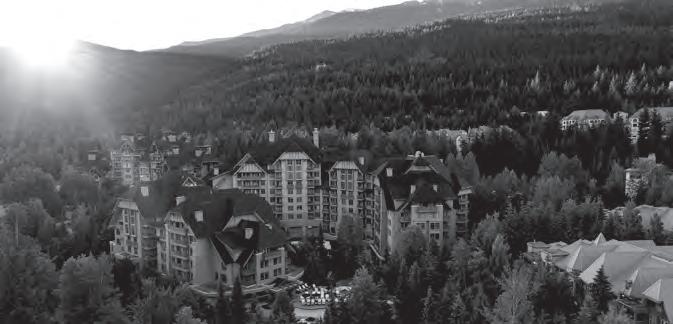
Whistler names Hilton GM Chris Vick as new CAO
VICK WILL TAKE OVER THE MUNICIPALITY’S TOP STAFF JOB AUG. 10 AFTER A FIVE-MONTH
SEARCH TO REPLACE FORMER CAO VIRGINIA CULLEN
BY LUKE FAULKS
THE RESORT Municipality of Whistler (RMOW) has named Hilton Whistler Resort & Spa general manager Chris Vick as its next chief administrative officer, putting a longtime local tourism leader in charge of the municipality’s day-to-day operations.
Vick will become the seventh CAO in RMOW history when he officially steps into the role on Aug. 10. He will report directly to council, which spent nearly five months vetting and selecting the successful candidate, according to a release from the municipality.
“I am grateful and humbled by the opportunity to work alongside the community of RMOW employees as we serve the broader community,” said Vick. “I feel very connected to Whistler, to the environment and the culture, and I am thrilled I will be able to invest my effort, experience, time and energy into delivering on what our community, and the world, expects of Whistler.”
The CAO is one of the most important positions in a B.C. municipality. Under the Community Charter, a CAO’s duties include overall management of municipal operations, ensuring council’s policies and directions are carried out and advising council on the municipality’s affairs.
Mayor Jack Crompton said Vick’s ties to the resort helped set him apart.
“We couldn’t be more excited to have Chris joining the RMOW,” said Crompton. “Who better to help us build a more caring community, and successful tourism economy, than someone who is already such a big part of Whistler?
“Chris is a tourism leader and an innovator. We had many exemplary candidates, from a broad range of
ELDON BECK FROM PAGE 12
everything from rooflines to construction materials, Chapman added.
“There’s direction to use local materials, the basalt, the rock that we have at the pedestrian scale at grade ... and bottom of the buildings, for example, is something that really places the built form where it is in the world,” he said. “We typically prioritize pitched rather than flat roofs, and to Eldon, that was a reflection of the place, the relationship to the alpine and the mountain forms around Whistler.”
Planners said those ideas are increasingly important as the municipality grapples with densification, housing pressures, provincial zoning mandates, wildfire concerns and climate adaptation.
leadership perspectives, but Chris’ strategic approach and his commitment to our town really stood out.”
Vick has served as board chairperson for the Whistler Chamber of Commerce, where he helped lead the organization through COVID-19. He is also vicechairperson of Tourism Whistler, an active member of the Hotel Association of Whistler and, according to the release, is raising his young family in the community.
He replaces Virginia “Ginny” Cullen, who joined the RMOW in 2020 and left the CAO role Jan. 14 to become vice-president of cities and communities for McElhanney Ltd. Cullen’s five-and-a-half-year tenure began during the COVID-19 pandemic and included responding to the municipality’s 2021 cyberattack.
Ted Battiston has served as interim CAO since Cullen’s departure and will remain on to help with the transition until the end of summer. n
‘HE TRULY IS A POET’
For younger planners, Beck’s legacy extends beyond architecture and design.
Chapman recalled visiting Beck in California alongside Kirkegaard several years ago and being struck by how vividly the aging planner still remembered Whistler’s streets and spaces.
“You could see it in his mind’s eye,” Chapman said. “It was really cool.”
Mucignat described the veteran planner as a storyteller whose ability to articulate complex planning ideas remains striking.
“I would say that it’s just such a gift to hear from him,” she said. “He’s so eloquent, and he truly is a poet. He puts these complex design ideas into simple words.”
Read the full story online. n
HEAD OF THE HALL Hilton GM Chris Vick is Whistler’s new top staffer.
PHOTO COURTESY OF CHRIS VICK
Whistler Blackcomb facing mounting pressure to enforce Alpine Responsibility Code
DOCTOR’S
PETITION CALLING FOR CHANGE TOPS 900 SIGNATURES
BY CAROLINE EGAN
A GROWING CHORUS of local skiers and riders is demanding stricter safety enforcement on the slopes of Whistler Blackcomb (WB), pointing to what they call a changing mountain culture marred by dangerous speeds and a lack of accountability.
A recent online petition launched by Vancouver physician Dr. Christina Williams, a longtime skier at WB, has garnered more than 900 signatures in just under a month. The petition calls on Whistler Blackcomb and its parent company, Vail Resorts, to increase safety personnel, mandate safety education and aggressively revoke passes for reckless behaviour.
Williams was motivated to launch the petition after being struck from behind by a speeding rider while skiing out from Whistler Mountain. She said the incident left her with a broken leg and ankle, which subsequently forced her to cancel medical clinics, call shifts and personal travel.
According to Williams’ petition, it was the third time she was hit by another
mountain user this year alone.
“I can understand if I fell on a difficult run but this [accident] was totally avoidable,” Williams said. “I was skiing in my little line and to be sent flying from behind has massive consequences. It’s like a highway that doesn’t have police monitoring.”
Williams expressed deep dismay over the resort’s corporate response, noting that her emails requesting an incident report and inquiring about preventative safety measures were met with automated responses.
“I felt so dismissed. I feel like I’ve just been absolutely brushed off by Whistler safety,” she said, describing the experience as feeling like “a little grain of rice in the middle of a huge shareholder corporation.”
The sentiment is shared by other longtime mountain users. Daniel Friedmann, a corporate tech advisor and seasoned skier who signed the petition, believes Vail Resorts has shifted away from a historically strong safety culture. Friedmann highlighted a distinct rise in high-speed “straight-lining” near the end of the day and criticized the resort’s marketing focus.
Marnie (Marilyn)Simon wasborninAvoca, AustraliaonSeptember 16,1940toElinor Josephineand HarwoodJames Caleb Thomas.She is predeceasedbydaughter Sophie Eleanor, sister Elizabeth, former husbandO ttoSimon andnephewGerald.
Marniehada distinguis hedcareerasanOR nurseand as pres identofthe BCORNG and as anurse educator at BCIT wheres he was instrumental in de veloping theRNFirst Assist Nurses Program.
Shelea vesa legacy of servicecharacterised bythevis ionand steadfas tleaders hips he broughttochairingand servingonmultiple boards.Her dedication to community health greatlybenef ited theWhistlerand Pember ton Health Care Foundations, theRotaryClub andthe Pember tonSeniors'Society
Apass ionate tra veler, Marnie journeyed across the globe on numerous ad ventures and iconicocean kayaking trips.In addition to her lo ve for the outdoors as an a vids kier and tennis player, s hewas a dedicatedpatron of the arts. She played the piano and hada deep appreciationforwriting. Her commitment toa kins hipway of life kept theGreenLakeOutrigger going yearly and ens ured her dinner tablewas s urrounded by thosewhos hared her lo ve of nature, literature and communityservice. She li veda full and purposeful life pro viding ins piration to those around her.
Shewillbe lo vinglyremembered by her many cheris hedfriends, nephewTony, nieces Pippa andIsabella and her daughterRebecca.
“The whole culture of the company used to be very safety-oriented,” Friedmann said. He added that on-hill promotions now frequently push alcohol upsells at lunch rather than safety awareness. “They don’t have the right safety culture in that company. It just stopped.”
Friedmann suggested the affordability of Epic season passes compared to increasing day-ticket prices has significantly increased user density on the slopes, compounding the danger. Both he and Williams argue that the Alpine Responsibility Code has become a mere formality without real consequences.
“In the old days, speeding meant safety would revoke your pass. It was just a fact,” Williams said. She advocated for a return to strict pass revocations to curb reckless behaviour.
The issues raised in Whistler echo historical safety and operational disputes at other Vail Resorts-owned properties including liability issues at Breckenridge Ski Resort in Colorado and a petition started last year regarding security issues at Stevens Pass in Washington state.
Whistler Blackcomb reps declined to directly answer questions regarding this issue. In a statement, Whistler Blackcomb
COO, Belinda Trembath, defended the resort’s track record, stating that safety remains foundational to the mountain’s culture and operations.
“Our mountains welcome skiers and riders of all ages and abilities, and we are deeply committed to ensuring that every visit is enjoyable, comfortable, and safe,” Trembath said. “We ask all guests to adhere to the Alpine Responsibility Code, and safety personnel reinforce this on our slopes.”
Resort officials also confirmed they have been in contact with Williams regarding her concerns.
However, critics argue that the resort’s efforts are failing to keep pace with the reality on the snow where a single collision can take critical community members off the front lines. Friedmann noted that Dr. Williams’ forced absence from her medical practice directly impacts health-care capacity.
“This has to somehow get visibility and be studied,” Friedmann said, while urging the resort to start collecting data to track and mitigate collisions. “If you’re [always] getting hit always at the same intersection, you put a light up. It’s just like car accidents.” n
REMEMBERING BILL BARRATT—A LEADER FOREVER BUILT INTO WHISTLER
BY CAROLINE EGAN
BY
ANY METRIC of leadership, Bill Barratt was a man who left an indelible mark on the history of Whistler. During his three-decade public career he met with many obstacles which challenged him, though he would boast it was never personal. To those who knew him closely, he’s remembered as a “bigger than life” figure with an innate ability to light up any room he walked into.
Barratt passed away May 10 at the age of 73.
His longtime colleague Jim Godfrey, former chief administrative officer of the Resort Municipality of Whistler (RMOW), shared how Barratt’s impact is woven directly into the very foundation of the resort.
“The next time that you take a walk along the Valley Trail or visit one of Whistler’s many parks or step into the Meadow Parks Sports Centre, take a moment and quietly think about Bill,” said Godfrey. “His fingerprints are on all of them.”
For a man who would eventually navigate international politics, global budgets and world-stage events, Barratt’s work ethic was formed in a grittier place.
FROM THE MUSKEG TO THE RMOW
Long before he worked for a global village, Barratt cut his teeth in the literal dirt of British Columbia. His early career was spent in the rugged world of BC Parks construction; doing the heavy lifting of laying sewer and water pipes in West
Vancouver and building out parks in any and all conditions.
His brother, Tom Barratt, remembers back to when Bill first applied for a role with the RMOW. Doug Wiley, the municipality’s engineer at the time, hired Bill and jokingly asked if he was related to his brothers Tom and Chris. Without missing a beat, Bill replied, “Yeah, I taught them everything they know.”
That practical, dirt-under-thefingernails background shaped his entire administrative philosophy. Barratt was fundamentally a doer. As Godfrey explained, Barratt possessed an innate ability to cut through red tape and bureaucracy whenever it was necessary to get things done for the community.
SHARING THE LOAD
Barratt’s tenure, from the early ’80s to his retirement in 2011, coincided with some of the most formative growth periods in Whistler’s history. Former Mayor Hugh O’Reilly, who worked alongside Barratt for nine years, looked back on a partnership forged in a mutual love for the town.
“I always had a lot of time for Bill,” said O’Reilly. “He was passionate about both his work and the community of Whistler, and that passion showed in everything he did. He genuinely cared about making Whistler a better place and he brought energy and commitment to the job every day.”
According to Godfrey, behind every single decision Barratt made lay an ongoing question: “Is this right for the resort community?” He said Barratt’s focus was so sharply trained on the public
LARGER THAN LIFE Former longtime municipal staffer Bill Barratt passed away May 10.
PHOTO SUBMITTED
URBANE NE RGY. SQUA MISH SOUL .
good, yet he was never shy about making the tough choices. Always supporting them with an ironclad, well-thought-out rationale.
CULTIVATING COMMUNITYWIDE LOYALTY
Barratt was known to command fierce loyalty from his staff, as he extended the same to them.
According to brother Tom, Bill didn’t let ego get in the way. If fellow staff were on the right track then he would step back, clear the roadblocks and help them succeed. He supported people to be and do their best. He’d make his team feel comfortable, connected and part of something much larger than a standard day job.
Barratt had a rare gift, say those who knew him. Part of which being he knew what he knew, but perhaps more importantly, he knew what he didn’t know and exactly when to seek help.
For all his administrative sharpness, he remained entirely approachable. This was the other part of his gift. Tom said he had a delicate balance of being able to use his logistical mind alongside his warm heart. Godfrey mentioned greeting Barratt always included receiving a massive bear hug.
THE STRUCTURAL SHIFT
Over his 30 years working for the RMOW, Barratt oversaw the creation and execution
of major park master plans, including Alpha Lake Park, and championed the development of the Meadow Park Sports Centre. His earlier roles included serving first as Director of Parks and Recreation and later ascending to the role of CAO.
“To Bill, true leadership wasn’t about glitz. It was about leaving behind functional assets that made life better for everyday locals.”
- TOM BARRATT
He frequently navigated intense local friction—including the highly controversial asphalt plant dispute— dealing with public backlash and media to protect his professional staff and uphold what he believed was right for Whistler.
Barratt’s personal perspective on his legacy seemed unpretentious. Years after he retired, Tom asked Bill what he thought the greatest point of his public career was. Bill didn’t point to the global prestige of the Olympics.
“He said the best legacy was simply the paved valley parking infrastructure,” stated Tom. “To Bill, true leadership wasn’t about glitz. It was about leaving behind functional assets that made life better for everyday locals.”
HOCKEY, HUMOUR AND HOUSEHOLD
Beyond the arena of civic politics, Barratt lived a life defined by simple joys. Chief among them was an unyielding obsession with hockey. He loved to play it, watch it, coach it and talk about it.
Godfrey said when Barratt was interviewing prospective municipal employees, one of his first questions would invariably be about whether the candidate played “the game” or not. While Godfrey jokingly noted that the answers didn’t influence Barratt’s hiring decisions, he was always shamelessly looking to recruit extra players for his beloved local hockey league.
At the same time, conversations with him could go in any direction, said O’Reilly. “Community issues, sports, travel, life stories… You could always count on a good laugh when Bill got rolling with one of those tales,” he said.
However, no other devotion was said to have come close to his family. Not a day went by where Barratt didn’t talk about his wife Karen and his children. He was known to be profoundly proud of them and looked forward to spending his
LOCAL EVENTS
retirement years watching his growing family thrive.
In a public announcement shared by his children following his passing, they said “he taught us the importance of showing up for the people you love and finding joy in life’s simple pleasures.”
THE OUTLINES OF A MAN STILL FOUND EVERYWHERE
Barratt’s passing has left a void in the town that can never truly be filled. Old friends are left mourning the unfulfilled plans of spending quiet days golfing together up-island in retirement. Brothers crying out over the loss of a lifelong companion.
Barratt’s life impacted countless others in a way most might not even notice. Life in this resort community is undeniably richer because Bill Barratt was in it.
In their public farewell, his children also left the community with an invitation to participate in their grief.
“Please join us in raising a martini tonight to a man who was truly one of a kind,” they wrote.
“To Bill: a consistently great man throughout the good and hard times. Your loss is felt deeply by everyone you’ve parted with, but your presence continues to live on in all the shared spaces you’ve allowed everyone to find home with. Your time in this world was well spent, rest easy now.” n
Bob Brett to facilitate beaver education session on June 4
THE EVENT WILL BE HELD AT MYRTLE PHILIP SCHOOL AND DISCUSS THE VITAL ROLE BEAVERS PLAY IN WHISTLER’S ECOSYSTEM
BY DAVID SONG
THE BEAVER is a quintessentially Canadian animal. It’s on our nickels, it appears frequently in pop culture and marketing, and depending on where you live it may be a common sight. What some may not understand, however, is the critical role these rodents play in keeping ecosystems healthy.
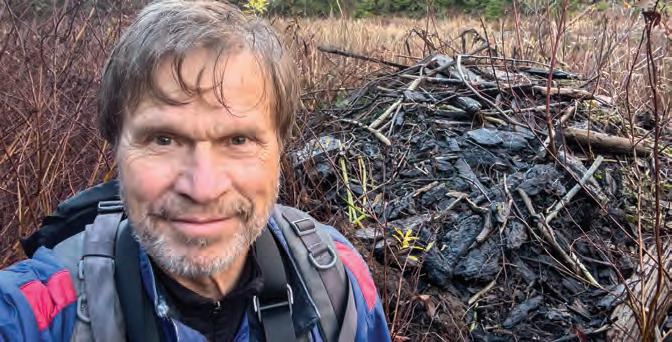
Bob Brett wants to educate people, so he will soon be giving a “Beaver Blitz” talk.
The longtime Whistler Naturalists biologist explains that beavers are the most important ecological contributors at the bottom of Whistler Valley because their dams create and maintain wetlands. These semi-aquatic regions are home to a variety of organisms, from plants to birds to insects.
Wetlands act as massive sponges by absorbing water during snowmelt and heavy rainfall events, then slowly releasing it during dry periods. They also reduce fire risk and carbon emissions by staying moist and preventing the decomposition of organic matter. In other words: beaver behaviour may cause some localized flooding, but overall it facilitates greater resilience against floods and other climate change-related phenomena.
Dams also make human recreation possible in some areas like the River of Golden Dreams, which otherwise wouldn’t be deep enough for rafting.
Human development has negatively impacted both beavers and the regions they’re closely affiliated with. The Whistler area has lost more than 70 per cent of its wetlands after European settlement according to Brett, and an estimated current beaver population of 350 (spread across 59 active lodges located between Alta Lake and Green Lake) pales in comparison to the 1,500 that may have once lived nearby.
“Without beavers in the landscape, we would have much much less wetland in the valley bottom,” Brett summarized.
FINDING MIDDLE GROUND
When humans and beavers experience conflict, often it is due to infrastructure being built in or too close to the animals’ low-lying habitats. Brett advocates for halting or minimizing construction in key areas like the Millar Creek wetlands so beavers have enough room to live healthily.
Needless to say, however, there’s no going back on the urban development that has already taken place.
“We need to approach it with the idea that [beavers] are always going to be here, so how can we set things up so they can do their own thing as much as possible … rather than just having a knee-jerk response,” Brett said. “CN Rail removes dams beside their rail beds once or twice a year and that’s just their policy. In Whistler, I don’t see any reason why they couldn’t let those beaver dams stay because they’ll never rise very high on the rail bed. If there’s a water level that is acceptable when beavers [are left alone] you don’t need to manage them.
“A small beaver dam isn’t a problem, but there’s a height of water above which it does become a problem and then some sort of dam management is necessary—but this can be based on a fairly strict metric. Rather than just taking out the dam because that’s what we do, maybe we can come up with some sort of middle ground.”
Beaver deceivers can be part of the solution. These are pipes that drain ponds to an extent without making the telltale sound of trickling water, circumventing a beaver’s instinctual response to fix its dam. Such flow devices allow a certain water level to be maintained, keeping beavers at ease without threatening human structures or activities.
To learn more, swing by the Millar Room at Myrtle Philip School for Beaver Blitz on June 4 from 7 to 8:30 p.m. Tickets cost $10 for adults and $5 for youth under the age of 18.
Further details are available at whistlernaturalists.ca. n
TheSea to Sky ContractorsDirectory isback! We offerfree listings foralllocal contractorsandtrades. Don’tmissoutonbeing part oftheregion’s go-to resource—simplyfillout thefor mbelow to claim yourspot.
HOT DAM Whistler biologist Bob Brett next to a beaver lodge.
PHOTO BY BOB BRETT
SEATOSKY
Pemberton council weighs retroactive penalties as unauthorized RV storage business seeks rezoning
COUNCILLORS QUESTIONED WHY THE STORAGE OPERATION SOUTH OF THE VILLAGE WAS ALLOWED TO CONTINUE FOR YEARS WITHOUT FINES, DESPITE OPERATING WITHOUT A BUSINESS LICENSE
BY LUKE FAULKS
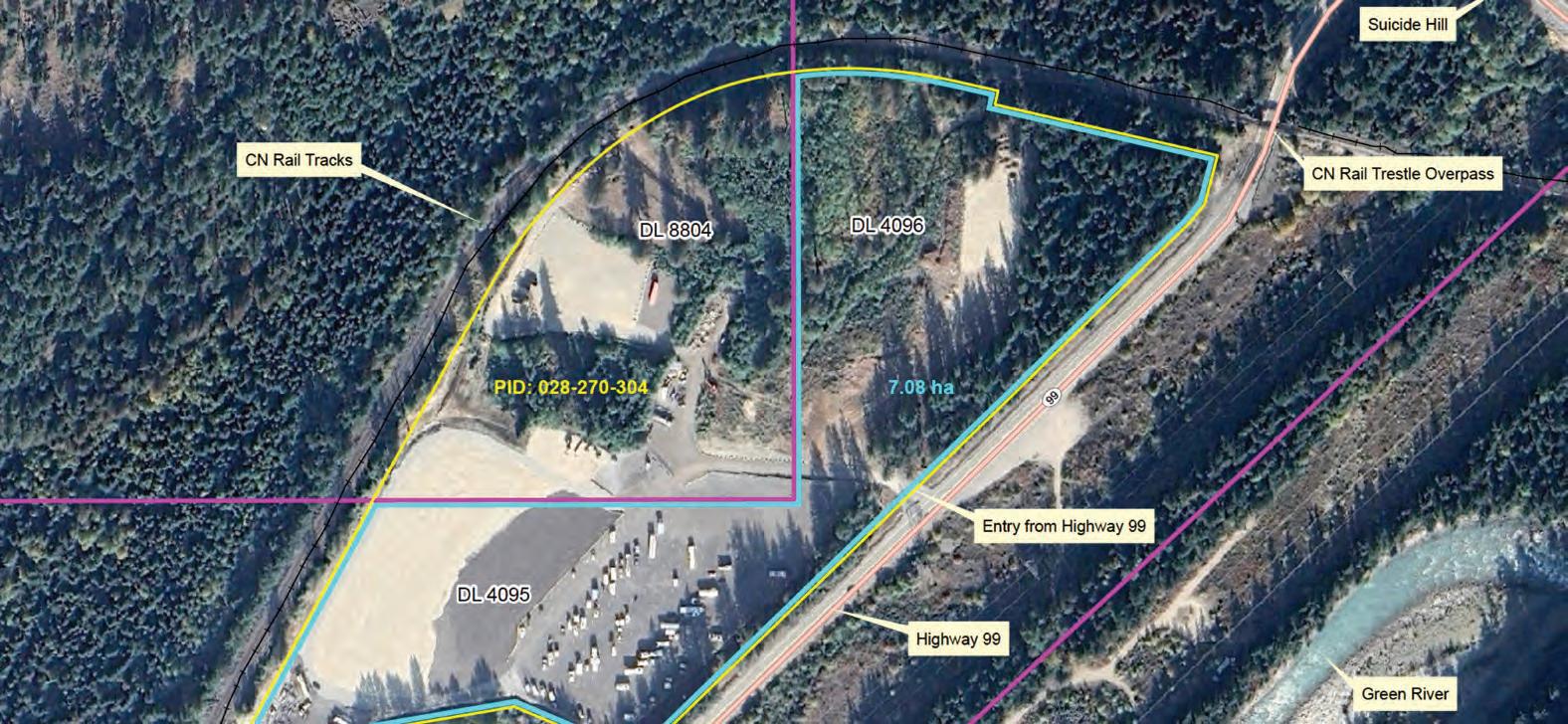
THE VILLAGE of Pemberton is considering a zoning amendment to formally allow an RV and storage-container business that has been operating outside Village bylaws for years—but not before councillors pressed staff on why the operator was never fined and whether retroactive penalties could still be imposed.
At its May 26 meeting, council considered first and second readings for a zoning amendment that would allow outdoor storage as a permitted use on part of a 17.5-acre (seven-hectare) property at 6991 Highway 99 owned by Tisdale Developments Ltd.
The proposal stems from what staff described as “many years of correspondence and work between the Village and the applicant.”
According to a staff report, the Village first became aware in September 2021 that an outdoor storage business was operating and being advertised on the property without the required zoning or business licence approvals.
Village staff contacted the owner and discussed pathways to compliance, including either a temporary use permit (TUP) or rezoning application. The applicant began pursuing a TUP in
October 2021, but eventually abandoned that process in favour of a permanent zoning amendment.
“This is one of those situations where bringing a property under bylaw compliance [initially] looked like it might be a six-month exercise, but it’s turned into a five-year exercise unfortunately,” director of development, planning and climate action Scott McRae told council.
Throughout that period, the business continued operating “in contravention” of zoning and business licence bylaws.
“To support the applicant’s efforts to achieve compliance, staff deferred
they want and then ask us to change it after so it suits your needs?”
Coun. Katrina Nightingale questioned why the Village did not issue a stopwork order in 2021 once staff realized the business was contravening bylaws.
“My concerns stem just from the fact that land was cleared and things were done before there were environmental assessments and things that were required to be done before any land clearing was done,” she said.
McRae said the process became more complicated after the provincial government alerted the Village that
“I don’t want to set the precedent that somebody [asks] for forgiveness rather than permission.”
- LAURA RAMSDEN
enforcement of the bylaws until the bylaw amendment could be brought to council,” a staff report adds.
COUNCILLORS PUSH STAFF ON PENALTIES
That explanation did not sit entirely well with council.
“I don’t want to set the precedent that somebody [asks] for forgiveness rather than permission,” said Councillor Laura Ramsden. “What is the point of having zoning if people can then go and do what
work had occurred within a stream area on the property.
“We were expressly requested to pause our administrative processes while the province investigated and carried out remedial investigations and any penalties on their side for the work done,” McRae said, adding it is unclear if the province levied any penalties.
The Village later resumed processing after remedial works were undertaken and the applicant shifted toward rezoning.
The zoning amendment application
was formally submitted Jan. 8, 2024. Council also questioned whether the Village could still pursue fines or penalties for the years the business operated outside compliance.
Staff said they would need to review the applicable bylaws before answering, but that there could be a penalty for operating without a business licence and for using the lot in ways that are not permitted under the current zoning.
STORAGE FACILITY WOULD EXPAND TO 433 PADS
The site currently contains 147 storage pads, with the applicant proposing another 286 for a total of 433 pads across three phases. The total rezoning area is roughly 70,816 square metres, or seven hectares.
According to the applicant’s rationale letter, the facility is intended for RVs and sea-can containers, with individual pads rented to customers. The property includes fencing, gated access, a 24-hour watchperson and a 20-metre tree buffer along Highway 99.
“At present, 75 per cent of the tenants using the storage facilities have a Pemberton address,” planner Erik Morden told council.
Council ultimately stopped short of giving the bylaw first and second reading, instead directing staff to return with more information on potential fines, taxation implications and other compliance questions before setting a public hearing date.
The new motion directing staff to bring that information back at the next meeting carried without opposition.
DID I GO to David Suzuki’s 90th birthday benefit concert at Vancouver’s Queen Elizabeth Theatre? You bet I did. Was it good? Outstanding. Not to mention an inspiring call to action to help rekindle current malaise in these dangerous days of fascism and separatist traitors to both the country and the environment.
BY LESLIE ANTHONY
Not only were the musical presentations heartfelt and fantastic in a way that went beyond any typical concert performance (and BTW, have you been to the QET lately? I’d forgotten how fantastic the acoustic are), but the sincerity, graciousness and love for Suzuki projected by the musicians cemented for me something I’ve long thought: Canada needs more credible and committed heroes like Suzuki, a man revered the world over, held in particular high esteem by many of British Columbia’s First Nations, and whose accomplishments (40-plus years hosting the CBC’s The Nature of Things, some 50 books and countless other projects, appearances and inspirations) can never be downplayed or disparaged by even the most ardent right-wing pundit or oil-andgas industry attack dog. Political heroes in Canada are few and far between, and not a single one that might be considered
a candidate has the political leanings of modern conservatives, whose tear-it-alldown and smash-and-grab mentalities are the antithesis of contributing to the country or humanity, and offer nothing to be admired. And there are zero—and I mean absolutely Z E R O—business or industry leaders to come along in my lifetime who could legitimately be considered a Canadian hero. Indeed quite the opposite (looking your way Kevin O’Leary and Galen Weston).
Indeed, Suzuki was No. 5 in the top 10 Greatest Canadians of All Time television series produced by the CBC in 2004, beating out Wayne Gretzky (10th and would probably be 100th now) and finishing behind Tommy Douglas, Terry Fox, Pierre Trudeau, and Sir Frederick Banting (the inventor of insulin, for you
Sophie Lui, Janelle Lapointe, and M.C. broadcaster and producer George Stroumboulopoulos—had brilliantly punctuated moments between standout musical performances by Tanya Tagaq (absolutely otherworldy), Danny Michel (fun and funky), Bruce Cockburn (as brilliant as ever and yes, the crowd sang along to “Wondering Where the Lions Are”), Chantal Kreviazuk (who included an acapella love letter from the planet to Suzuki), Snotty Nose Rez Kids (requisite F-bombs dropped), Sarah McLachlan (the consummate ethereal performer), Sam Roberts Band (the right energy), and others—including surprise guest Neil Young, who, as noted by Rolling Stone, was making his first live appearance of 2026, playing “Heart of Gold” (a second singalong), “After the Gold Rush” and
All told, the whole experience was a rallying cry to reboot the environmental movement and fight harder to depose the despots...
kids). And since he’s the only one on that list who is still alive, he’s the current Greatest Canadian.
By the end of the evening, Suzuki, his wife (author and activist Tara Cullis with whom he cofounded the David Suzuki Foundation in 1990), the fearless Jane Fonda and doggedly inconvenient truther Al Gore, had recited bits of the Foundation’s Declaration of Interdependence. Speaker after speaker— including Suzanne Simard, Rick Hansen,
another song on an upright calliope organ/piano (frankly, it was hard to tell).
With stage settings that ran the gamut from subtle light and projection shows to full-blown old-growth forest leitmotif’s, the Suzuki Foundation and whoever their talented producers were made sure the event highlighted Suzuki’s core philosophy and message: that all life is interconnected, that “what humans do to the planet and all living creatures, we do to ourselves,” that despite our foresight
and measurable intelligence as a species we’ve ignored and then blown past critical planetary boundaries, and that to leave behind a better world for our children and grandchildren we must heed the warnings of those who study and understand this. Furthermore, we must embrace the leadership of Indigenous Peoples who have “lived in reciprocity with and responsibility to nature since time immemorial.” Indeed, Suzuki was honoured on stage for decades-long allegiances and liaisons with Indigenous Peoples by the Haida Nation, the Gitg’at, the Haítzaqv (Heiltsuk) and ‘Na_mgis First Nation. David accepted all of it with his usual grace and humility, often at times looking a child himself—but always spry and never looking the 90 years he has accumulated.
Over the decades, I’ve gone on my own Suzuki journey, from a nature-addled kid watching him on TV, mesmerized by the latest episode of The Nature of Things, to meeting him when he visited my lab at the University of Guelph, in Ontario, in the mid-1980s to film one of those episodes, to rafting the Taseko, Chilko, Chilcotin and Fraser Rivers with him on a memorable and fun-filled trip in 2018.
I enjoyed the evening immensely, both for reasons of nostalgia and immediacy. I shed many a tear, felt grief for the world but love for many others. All told, the whole experience was a rallying cry to reboot the environmental movement and fight harder to depose the despots and douchebags, billionaires and bonehead politicians who are making our home on this planet more miserable and difficult, instead of important and wondrous.
Leslie Anthony is a biologist, writer and author of several popular books on environmental science. n
RALLY CRY David Suzuki watches Bruce Cockburn backstage at the Queen Elizabeth Theatre in Vancouver.
PHOTO BY RYAN WALTER WAGNER / COURTESY OF THE DAVID SUZUKI FOUNDATION
How to reduce your landfill waste— and why it matters
BY KIRSTY SMITH
APRIL 22 was Earth Day. Since 1970, this date has been used to celebrate the planet and raise awareness of environmental issues including climate change, pollution, and biodiversity loss. It has grown into a global movement involving more than one billion people across more than 190 countries.
This year in Whistler, a range of businesses and organizations came together for talks, circular economy events, and Pitch-In Day. This year’s Earth Week theme, Our Power, Our Planet, is a reminder that protecting the environment is not solely the responsibility of governments. It is something individuals, families, communities, and businesses all contribute to collectively. Nowhere is that collective power more relevant than when it comes to waste.
WHY IT MATTERS
When we think about sustainability, we often focus on reducing emissions or protecting ecosystems. But the simple act of buying something, using it, and then throwing it away, even if it is recycled, has a significant environmental impact. Reducing waste is one of the most effective actions you can take, here’s why:
Natural resources are finite: Producing goods requires raw materials that are often used once and then sent to landfill;
Waste is energy-intensive: Everything you buy requires energy to produce, transport, and dispose of. Reducing consumption lowers overall energy use. In Whistler, most landfill waste is transported to the Campbell Hill Landfill in Cache Creek. The journey is more than 450 kilometres once routed via Vancouver and requires significant fuel, funded indirectly through taxpayers;
Plastic pollution is widespread: An estimated 19 to 23 million tonnes of plastic waste enter aquatic ecosystems each year, harming wildlife and ecosystems; Waste impacts human health: According to the World Health Organization, about one-third of global waste is not managed safely. Poorly managed waste can contaminate food and water sources and create breeding grounds for pests.
WASTE IN WHISTLER
Whistler’s Zero Waste Action Plan sets a target to reduce landfill waste to 80 per cent of 2019 levels by 2030. Progress has been slow. In 2024, landfill waste totaled 11,577 tonnes, only a three-percent reduction from 2019 levels.
This highlights the scale of the challenge. Reducing waste in Whistler will require action from individuals, businesses, and the broader community. Small changes, applied consistently, add up.
So what can you do? The challenge can feel overwhelming, but there are practical, low-effort actions you can start today.
BUY LESS
The most effective way to reduce waste is to be more intentional about what you buy. In a town where new gear is everywhere, it is worth pausing before making a purchase and asking if you actually need it.
If you are unsure, wait a few days before making the purchase. If you still feel you need the item, try finding it second-hand through Marketplace, the Re-Use-It Centre, or community events like AWARE’s garage sale.
If you are buying new, aim for quality over quantity. Look for durable items or brands that offer repair programs or warranties so your purchase lasts longer. Tools like Good On You can help you understand a brand’s environmental and social impact.
When it comes to food, one of the simplest ways to reduce waste is to notice what you regularly throw away. That is often the clearest sign of overbuying.
REPAIR AND REUSE
Once you have reduced what you buy, the next step is to get more life out of what you already own. Before throwing something away, consider whether it could be repaired, repurposed, or used by someone else.
Worn-out clothing can become cleaning rags. Jars can be reused for storage. Many everyday items can find a second life with a bit of creativity. This approach reduces waste and can also save money. Whistler Community Services Society has a tool library in Function Junction which you could use to repair broken items and the Whistler Public Library has sewing machines available to rent.
Community events can also help. AWARE’s upcoming repair café (May 28) for example, is a practical way to extend the life of items while connecting with others.
RECYCLE PROPERLY
A little extra attention to recycling can make a big difference. If you are unsure where something goes, check rather than guess. Incorrect items can contaminate entire recycling streams. The easiest way to find accurate information is through Recycle BC or the Resort Municipality of Whistler’s website.
At home or work, clear bin labelling can make a big difference. Recycling should be clean and empty. Heavily soiled items may need to go in the garbage or organics if accepted. Compostable packaging rules have also changed in recent years. Look for BPI certification to confirm whether an item can go in organics.
FROM WASTE TO ACTION
Life is busy, and managing waste isn’t always straightforward, especially in shared buildings and workplaces.
This article was written in collaboration by the Association of Whistler Area Residents for the Environment. Read more at awarewhistler.org. n
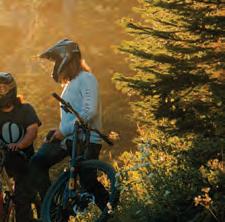
Ridetwomountainsoflift-accessed terrain(89+km!) shaped by decadesoftrailbuilding.Sun PeaksBike Park isbuilt forriderswho wantmaximumtimeonthebike, fromsingletrackclassics toconfidence-buildingflow Locatedjust outsideof Kamloops.
By Stefan Labbé
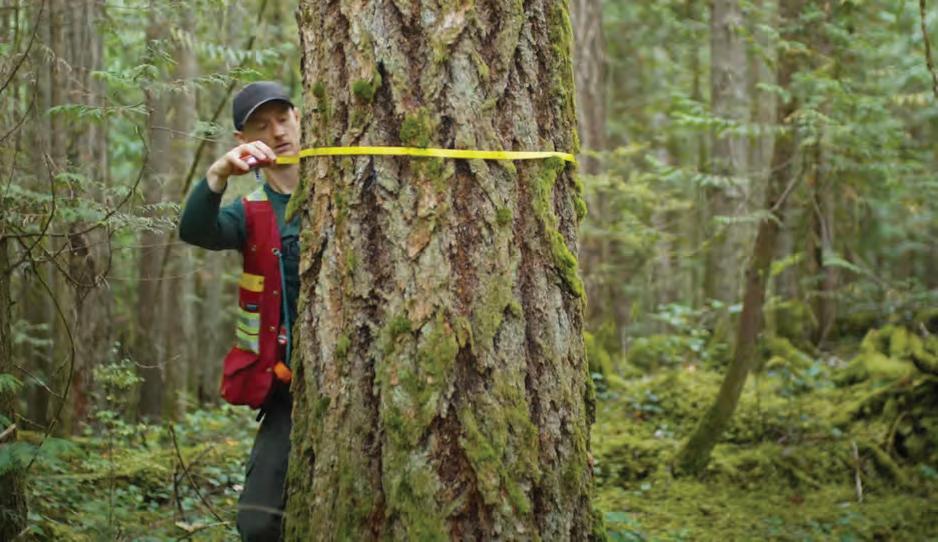
Turn over a fir needle and you’ll find two silver streaks, that under a microscope, reveal thousands of stomata— the tiny, porous mouths of a tree.
On a sunny day, the pores open, allowing the tree to absorb carbon dioxide in a chemical process that transforms invisible gas into trunks, limbs and bark.
Plants first started inhaling carbon in this way more than 400 million years ago. In the years since, forests have colonized land, and today, absorb roughly 7.6 billion metric tonnes of carbon dioxide every year— double what they emit.
That number hides some worrying trends. In Canada, logging and wildfires flipped Canadian forests from a net carbon reservoir to a net source about 25 years ago, according to the federal government.
British Columbia responded by launching one of the world’s first large-scale projects designed to generate revenue for local communities by not logging oldgrowth forests.
The model, which began in the Great Bear Rainforest in 2009 and has since been exported to the Amazon and Africa, created market value by putting a price on carbon locked in and absorbed by trees.
On the surface, the premise appears simple: a company or government pays to protect forests at risk of logging, and in exchange, they receive tradeable carbon credits—known as forest carbon offsets—used to cancel out their own emissions.
After years of operating as a voluntary system often financed by governments, B.C.’s carbon landscape shifted overnight on April 1, 2024. The province’s new mandatory industrial policy now forces big emitters to either offset their pollution or pay a steep price.
After a short delay, the move led to a 2025 windfall for a community forest co-managed by the Resort Municipality of Whistler and the Lil’wat and Squamish nations.
Cheakamus Community Forest (CCF) raised $600,000 in forest carbon offsets in a single sale to a mining company—a six-fold year-over-year increase that would have never been possible without B.C.’s new industrial carbon policy, said executive director Heather Beresford.
But while the CCF celebrates rising demand and higher prices, Gary Bull, a professor emeritus of forestry
at the University of British Columbia, said B.C.’s decision to regulate the carbon market has made it nearly impossible for others to take part.
“We’ve seen very limited carbon income coming into B.C.” Bull said. “Government trying to control a market is just a mistake.”
B.C.’S VOLUNTARY CARBON MARKET SEES LIMITED UPTAKE
Despite their potential, only a handful of forest carbon offset projects have succeeded in B.C. Some of those projects have sought validation through a global voluntary carbon market—private, unregulated systems where corporations like Disney and Shell purchase credits verified by independent third-party firms.
In 2008, the Nature Conservancy of Canada bought and later launched the 54,000-hectare Darkwoods Forest Carbon Project near Creston, B.C. The project sold millions of credits to private companies, but also to the B.C. government.
In 2013, the province’s then auditor general John Doyle investigated Darkwoods alongside a gas flaring carbon credit scheme near Fort Nelson. In both cases, he found the schemes failed to demonstrate that the sale of carbon credits was needed for the projects to go forward.
“In industry terms, these projects would be known as ‘free riders,’” said Doyle at the time. “Together, they received $6 million in revenue for something that would have happened anyway.”
More recent third-party audits show the 100-year Darkwoods project is now largely meeting its goals, issuing millions of carbon credits, and storing enough carbon to offset emissions from about 6,700 British Columbians per year.
On Vancouver Island, Mosaic Forest Management Corp. said in 2022 it would defer logging on 44,000 hectares of land in a project known as the BigCoast Forest Climate Initiative.
A subsequent audit from the U.S.-based company Renoster Systems Inc. found the project suffered from a lack of transparency and accounting problems— including a failure to consider fire risk—that rendered its carbon credits “highly dubious.”
“Most critically, the project’s area appears to us to be gerrymandered,” Renoster concluded.
Mosaic strongly disputed those claims, though in
2024, it temporarily suspended the program to assess what it described as accounting errors.
A spokesperson for the BigCoast initiative confirmed the program is still “on hold” as it worked to “align the project design to the latest best practices and standards.”
Outside of B.C., forest carbon offset schemes have faced intense scrutiny in several U.S. states and multiple countries that make up the Amazon Rainforest.
High-profile investigations have documented a number of programs purporting to protect forest carbon stocks—only later finding they never preserved forest carbon, were used as cover to launder illegal logging, or sold millions of credits to avoid cutting trees when the threat never existed.
Even some of the industry’s biggest auditors have faced controversy. A 2023 investigation by The Guardian newspaper found a significant percentage of rainforest carbon offsets provided by the Washington, D.C., auditor Verra were “largely worthless.”
Verra—which audits Darkwoods and BigCoast— later contested the findings, stating the reporting was based on research that “massively miscalculate” its certified projects.
OTHER COMMUNITY FORESTS FACE CARBON CREDIT ‘DEAD END’
The B.C. government’s efforts to finance forest management through carbon offsets has faced mixed success, experts say.
Advocates often hold up the Great Bear Rainforest as a poster child for how to successfully run longterm carbon credit programs backed by government. Spanning five million hectares along the northwest coast and Haida Gwaii, the project has protected about 85 per cent of the rainforest from industrial logging. The forest carbon offsets have generated more than $85 million for its Indigenous shareholders—largely fuelled by the B.C. government acting as its biggest buyer.
But according to the latest records available through B.C.’s Carbon Registry, only two other locations in B.C.— the Cheakamus Community Forest and a much smaller project on Quadra Island—have sold carbon credits under the government-run market.
After years of researching the sector, Bull said B.C.’s restrictive carbon offset protocols have failed to keep pace with the higher value and standards found in other
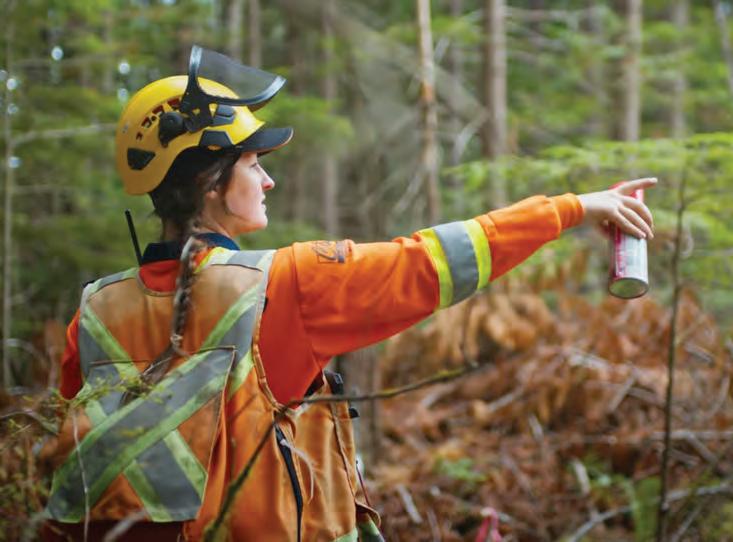
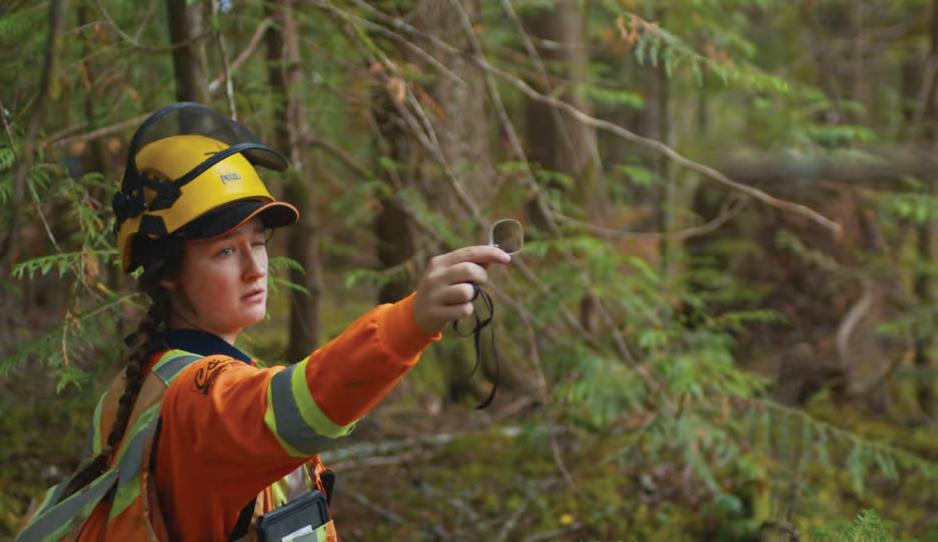
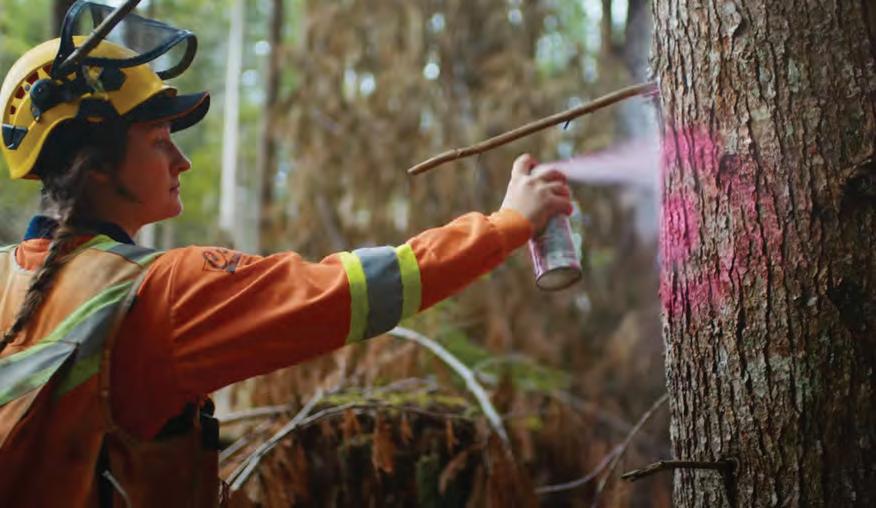
Taylor Hinks, a forester in training with Chartwell Resource Group, works in the Sunshine Coast Community Forest—the latest community forest that has tried and failed to launch a carbon offset program.
private markets.
One of the province’s mistakes, according to Bull, was a decision not to harmonize standards with Quebec, California and a number of other western U.S. states when it had a chance to do so in 2008. In the years since, he said private carbon markets have become “as sophisticated as the Toronto Stock Exchange.”
“There might be a spurt of interest now,” said the economist of the CCF’s recent surge in revenue. “But I’d say it’s still tokenism with what they are getting.”
For Susan Mulkey, a senior manager at the BC Community Forest Association, Whistler’s unique success was driven by Doug Konkin—a former deputy minister of forests who lived in the resort and is widely credited with facilitating its entrance into B.C.’s carbon market.
“I don’t know what he did. All I know is [Whistler] was the first and the last community forest that qualified,” said Mulkey, whose group represents the province’s 62 community forests. “We have invested resources in it at numerous increments over time. And we’ve been slammed every time.
“It’s just such a dead end for us. It’s so frustrating. It does not make sense.”
The Nuxalk Nation explored launching a carbon
“It’s just such a dead end for us. It’s so frustrating. It does not make sense.”
- Susan Mulkey
credit program near Bella Coola a year before the CCF project succeeded. But a 2014 study led by UBC’s Bull identified several barriers, including a provincial requirement that the community forest maintain a steady harvest of timber.
The Sunshine Coast Community Forest is among the latest to try to launch a carbon credit program. In 2021, it set aside 30 per cent of its treed areas for conservation, and would later sign a benefit-sharing agreement with a local First Nation. Over the coming years, managing forester Warren Hansen remembers thinking “how can I leverage that?”
Hansen took a micro-certificate course for carbon accounting at UBC, and altogether spent hundreds of hours trying to launch a carbon offset program on the Sunshine Coast.
But when Hansen spoke to staff in the B.C. government, he said they rejected the idea, claiming that under the Forest Act, provincial land must be used for timber harvesting rather than the preservation of carbon credits.
“It was a flat out no,” he said.
A LEGAL AND FINANCIAL ROADBLOCK
Warren Greeves has spent years at the centre of the B.C. carbon credit debate—serving as a manager across multiple provincial ministries before leaving government in late 2025 to lead policy impact at the Pacific Institute for Climate Solutions.
Both the Great Bear and Cheakamus forests set up their carbon credit programs under the province’s original forest carbon offset protocol. In 2022, Greeves led a B.C. Ministry of Forests team tasked with building a second version of that policy.
He declined to comment on the legality of how Whistler was able to build its carbon credit program while all other community forests have so far failed.
“What I can tell you,” he added, pointing to the Great Bear Rainforest, is that “those projects came out of decades of civil unrest and a big lobbying effort” by environmental groups, non-profits and Indigenous communities.
Greeves acknowledged that the current B.C. model still puts up a lot of barriers—both legal and financial—for proponents looking to start a forest carbon offset program.
The Darkwoods and BigCoast projects were
established on private land. But most of B.C.’s forests— including community forests—grow on Crown land that are subject to the Forest Act.
While that law sets out terms for harvesting trees, Greeves noted that at no point does it mention the word “carbon.”
“The current Forest Act just really isn’t set up to manage for carbon,” he said.
Short of amending the act, he said B.C. needs new regulatory tools or a clear legal process that can provide more certainty.
The relatively small scale of some community forests presents another hurdle. A 2024 report from the firm ClimeCo found that even if the Sunshine Coast and District of Metchosin pooled their community forest lands into a 150-hectare forest carbon offset project, the venture would result in a negative cash flow.
To become financially viable, such a project would require at least 300 hectares of forested land under imminent threat of logging. Increase the area to 450 hectares, and the report found an offset program that combined at least three community forests could generate an annual cash flow starting at $775,000 and rising to $1.75 million in the project’s later years.
A separate 2025 UBC study reinforced those findings, concluding that even if the Sunshine Coast pooled its community forest with others, the process remains so complex and expensive that it would yield very few credits and little “cold hard cash.”
For Hansen, his experience offers evidence that the B.C government has failed to provide the certainty needed to grow forest carbon offsets programs beyond what currently exists.
“I’m not really seeing any leadership from government on what that looks like,” he said. “I think it’s created a lot of cynicism.”
When asked why no other community forest has been able to replicate the CCF’s carbon credit project, a spokesperson for B.C.’s energy ministry said approval under the current protocols depends on “site-specific conditions” that are “not easily replicated using a single model.”
Ministry spokesperson Peter Lonergan also pointed to a complicated list of steps proponents must complete to show their carbon offsets are real, verifiable and permanent.
Such validation, read his emailed statement, “may be difficult for some community forests to demonstrate.” n
Pemberton’s Charlotte Johnson reflects on maiden outing at Volleyball Nationals
THE 16-YEAR-OLD SPLITS HER TIME BETWEEN VOLLEYBALL, SOCCER AND PILOT TRAINING
BY DAVID SONG
A PEMBERTON teenager has reached another milestone in her athletic career.
Charlotte Johnson experienced her first national-level tournament between May 15 and 17: the Youth Volleyball Nationals in Calgary, Alta. (where her mom Jennifer grew up). She and the Sea to Sky Volleyball Club’s U17 girls finished with a record of 1-6, but despite that record Johnson feels her team gave one of their best efforts all season long.
“Because there were some harder teams in this tournament, we learned how to deal with different situations that we hadn’t experienced before,” Johnson opined. “We really grew as a team and supported each other. Whether we lost games or won games, we were always just there and stayed very united throughout the whole tournament—even if someone
wasn’t having their best day, the rest of the team would bring them back up.”
Never before had Johnson participated in a competition of such magnitude, with 26 volleyball courts in a single area in the BMO Centre. She remembers it feeling like “organized chaos” and believes it taught her how to remain focused in a loud, distractionladen environment.
volleyball season, but she kept playing her chosen sports of volleyball and soccer while in Granby, Que. Despite her fluency in French, adjusting to games, practices and classes in a different language made her brain work harder, plus she also learned how to solve problems away from her usual support system (at one point moving to a different household that
“We really grew as a team and supported each other.”
- CHARLOTTE JOHNSON
“It was really such a special experience,” said the middle blocker. “I’m happy I was able to go, even though I didn’t play all that much because I was away for two months. I had so much fun being there for the team, and I was a great cheerleader.”
‘THE LOWS ARE LOWER, BUT THE HIGHS ARE HIGHER’
An exchange program caused Johnson to miss most of her British Columbia
suited her needs better).
“It was not easy at all, but I reminded myself that when you travel, the lows are lower but the highs are higher,” said the 16-year-old.
Back home she continued to commit ample time to both sports: roughly 41 hours a week. Part of that meant helping to coach another goalkeeper on her soccer team, the Division 1 North Shore Renegades. Johnson, who has coached younger kids before and hopes to do
more of that going forward, was tasked with helping her teammate improve from a technical standpoint.
Volleyball-wise, Johnson has trained with the Sea to Sky Club’s Whistler team for two years.
“I love the level at which they play,” she said. “It’s very intense during practices, and they run tough drills that really make you work, but it’s also so much fun. Everyone’s just happy to be there and happy to be learning from these great coaches … I have not stopped learning this entire time, so it’s been really good.”
Skilled volleyball athletes fly high on the court, but Johnson’s long-term goals are set even higher—literally. She hopes to commission into the Royal Canadian Air Force (RCAF) as an officer and a military pilot, spiritually following in the footsteps of her uncle: retired U.S. Navy aviator Charles Theodore “Ted” Johnson.
Currently the younger Johnson is a flight corporal in the 835 Griffin Squamish Air Cadet Squadron. This summer she will train both in the Sea to Sky and in Vernon, B.C. to become an instructor cadet and mentor her fellow aspiring pilots in the near future. n
NATIONAL PRIDE The Sea to Sky Volleyball Club’s U17 girls team at the 2026 Youth Nationals in Calgary, Alta.
PHOTO COURTESY OF JENNIFER JOHNSON
‘Anyone can make a difference if they take action’
FIFTEEN-YEAR-OLD
MERITORIOUS SERVICE MEDAL RECIPIENT
JONATHAN ‘BEAR’ YEUNG BALANCES SPORT AND COMMUNITY SERVICE
BY DAVID SONG
JONATHAN “BEAR” Yeung’s list of philanthropic activities reads like a very impressive resume.
He’s a founding patient advocate for the Canadian FAIT Foundation, helping kids gain access to treatment for food allergies. For six years he has run an annual toy drive for the BC Children’s Hospital and its patients. He raised more than $10,000 to help six-time Paralympic ski medallist Mac Marcoux and guide Tristan Rodgers prepare for Beijing 2022. He led a Canadian Tire campaign to gather new outdoor equipment for Zajac Ranch, a camp in Mission, B.C. for ill and disabled youth. He supported health-care workers during COVID and has picked up garbage all across Vancouver.
For these and other contributions, Bear has been awarded the Meritorious Service Medal (M.S.M.), the BC Medal of Good Citizenship (M.G.C.), the King Charles Coronation Medal and a Canada 150 pin.
He was just five years old when he started cleaning up beaches in Jericho and Kitsilano. Today, he is 15.
“I genuinely believe anyone can make a difference if they take action. I’m not special. I just picked causes I genuinely cared about, I took action and refused to quit. That’s it,” Bear said. “I’ve never really thought much about my age. When something matters to me, it just matters. You figure out the challenges as they come.
“There’s no secret formula or plan to follow. Just stay committed and keep going with what you care about.”
Such humility is befitting for one of the youngest to ever receive the M.S.M. (which is second only to the Order of Canada in terms of prestige). The distinction was conferred to him by Mary May Simon, Governor General of Canada, and he’ll receive his physical medal within the next 18 months at a ceremony in Ottawa.
Kevin Yeung is a blessed man to know that his son finds purpose in life. Since early childhood, Bear has pursued his goals with laser-like focus: he knows how to take rejection in stride and keeps the big picture front and centre.
The youngster once petitioned Bill Gates for support, and the Microsoft co-founder responded with a signed photo of himself. Kevin remembers Bear saying something like: that’s great, but I asked for help—not photographs.
Bear’s driven nature also serves him well athletically. It was love at first sight during his inaugural visit to Whistler as a six-year-old, and now he’s been part of the Whistler Mountain Ski Club (WMSC) for half a decade. Also representing his school Rockridge Secondary, he finished second overall at the BC Provincial Championships this season.
How does a 10th-grader make time for both competition and philanthropy?
“Ski-racing and giving back to my community actually go hand in hand for me,” Bear explained. “Up on the mountain, I learn discipline and build resilience. Over the years, I’ve gotten used to falling and getting back up. I try to carry that mindset into everything I do. Knowing I’ve made a positive difference to someone gives me an extra reason to push harder when it counts.
“Being an athlete matters to me because sports teaches you who you are. It’s never just about winning. You can learn way more about yourself and your abilities by showing up, pushing yourself every day and by taking care of yourself and your teammates around you. That’s what I try to bring to everything else in my life.”
Bear went on to describe Whistler’s community as welcoming and warm. Training here has deepened his love for nature, and each morning he pauses to relish the crisp mountain air and breathtaking views atop Blackcomb or Whistler. He’s also made a number of valuable friendships in the Sea to Sky.
Via his first WMSC coach, Mat Leduc, Bear met Rodgers and eventually several other local athletes. In Bear’s eyes, the likes of Jack Crawford, Reece Howden, Cam Alexander, Brodie and Riley Seger and Marielle Thompson are friends, champions and “genuinely good people.” He also venerated Marcoux, who is legally blind due to Stargardt disease, as “living proof that nothing is impossible.”
That’s why Bear is passionate about working with FAIT. His own peanut allergy is severe enough to have hospitalized him twice, and three million Canadians deal with one allergic disease or another. FAIT backs a variety of groundbreaking research in a bid to discover effective treatments for these conditions.
Yet even as this powerhouse of a young man carries on impacting the lives of other people, he duly recognizes those who have elevated him.
“My parents and my grandmother are my rock. Thank you for always believing in me, you’re the reason I am who I am and I love you more than I know how to say,” Bear remarked. “To my friends, supporters and all the incredible companies in our community who’ve championed my missions with me: thank you from the bottom of my heart, we did it together.
“To my coaches and teammates at WMSC, thank you guys for pushing me to be better on the mountain and off it. To my awesome teachers at Rockridge Secondary, thank you for never making me choose between learning and pursuing my passions. And to all my friends in Whistler and the ski community, your kindness and generosity means so much more to me than you know. I truly treasure your friendship.” n
AS THE MYTHICAL, ALMOST MAGICAL DAVID SUZUKI TURNS 90, WE NEED TO DIG IN MORE THAN EVER—WITH LOVE
IT HAPPENED JUST DAYS ago, but it was definitely one for the ages. Right up there with the best rip-roarin’ rockin’-anda-rollin’ happenings ever—the latest in high-tech, while the vibe was pure ’70s. PreInstagram. Pre-Reddit. Pre-”influencers,” Facebook, bots, Meta, Elon. Pre-, pre-, pre-, pre-, pre-, if you get my drift.
Everything real, in real time, and so warm and alive and authentic we were transfixed—laughing, crying, cheering. Shouting in outrage. Singing along. Feeling the love.
Nearly 2,400 of us lucky souls soaked
BY GLENDA BARTOSH
it all up live in Vancouver’s not-so-pretty but acoustically brilliant Queen Elizabeth Theatre. Thousands more joined online, and I bet the vibe infected them, too. The music, the tributes, the love for one of the most powerful transformers of our times: The one and only David Suzuki, on the occasion of his 90th birthday—a largerthan-life celebration and fundraiser for his namesake foundation that acknowledged the tireless work he and his partner in all things, Tara Cullis, have done pushing for a better, healthier, more connected, sustainable world for us, our planet-
mates, and all the new “sprouts” to come.
It was poetic, powerful. (Thank you, Al Gore! Your G-force pinned us to our seats.) Even four-lettered. (Thank you, Jane Fonda!) Some moments wrapped us in a huge hug. (Thank you, First Nations; Danny Michel, who was born in 1970!; Bruce Cockburn; and the ever-soulful William Prince!) Some made the tears flow. (Neil Young!) And the hairs stand up on the backs of our necks. (Tanya Tagaq!)
When it finally broke up five hours later and an hour and a half overtime, herds of us lingered in the lobby, reluctant to leave. Laughing, chatting, hanging on, even though it was near the witching hour. Kids; teens; tweens; Gen Xers, Ys and Zedders. Even dusty old boomers like me and the ever older, so-called Silent Generation (born 1928-45), many of whom weren’t that silent, and never have been— like David, and Jane, and Neil.
Maybe we were bewitched.
And don’t think for a minute Dr. Suzuki might flinch over descriptors like “mythical” or “magical” or all the expressions of love. After all, one of his recent postings in “Science Matters” is “Love is the secret weapon in facing our collective crises.” And so it was in that Queen E theatre last Friday: The facts, the science, the environmental activism stood shoulder to shoulder with something so moving and touching, I bet I’m not the only one still savouring it.
Love for CBC’s ever-popular The Nature of Things (TNOT) science show he hosted for 44 years especially shone through—and for good reason. Lots of “big people” now realize it was their introduction to science as kids, triggering those ah-ha moments when we finally “get it”: We have to nurture and love—not
greedily destroy—this fair planet that’s home. (The Canadian Encyclopedia has an excellent TNOT backgrounder, including the many faces of Suzuki as host over time in a great CBC clip with Ian Hanomansing.)
David didn’t start the show back in 1960; CBC’s Science and Technology Department did, and the first hosts were physicists! But around the time he decided to retire in 2023, the ever-colourful doctor declared, “I don’t give a s--- what people think about me.” And he doesn’t.
At the birthday bash we learned more about the doctor’s colourful language— and lack of pretense. Ages ago, some journo told me David loved living in Vancouver because he can hang out publicly and people don’t bug him. (Wannabe celebrities and “influencers” take note.)
Something he did care about, though, was not leaving TNOT until he knew the show would go on without him. And so it has. His daughter, marine biologist Sarika Cullis-Suzuki, and Anthony Morgan, a molecular scientist and former host on the Discovery Channel’s Daily Planet, have co-hosted it brilliantly since his retirement.
I’m not sure where his smart intrepidness comes from. (His childhood eye-opener when his family was one of thousands of Japanese-Canadian families locked up in camps in B.C.’s Interior during the Second World War?) Whatever, it’s still driving him to ensure the future of his and Tara’s life’s work, including his aptly named birthday bash, Legacy.
Not that he’s retiring from the David Suzuki Foundation, but in true “Suzuki” style, David saw well in advance that his 90th could be a big fundraising opportunity for the increasingly influential foundation he and Tara
started in 1990 to push for evidencebased solutions to our many global crises: The loss of biodiversity; our climate disaster; our sick and warming oceans.
And so it was. This just in from the foundation itself: Nearly 2,400 people attended the event, and while some seats were comped, the base ticket price went straight to the foundation. Those prices ranged from $247 to $523, so I did my own little unscientific calculation and came up with maybe $770,000 raised that night alone, a number that will only continue to grow via the year-long fundraising campaign.
But there was another cool angle to that magical night the evening’s host, Strombo (a.k.a. George Stroumboulopoulos, another great Canadian institution) alluded to. Musicians, artists, speakers and more, many of whom had collaborated with David and Tara over the years, waived their fees entirely or gave a significant discount. Yes!
So yes, and yes again, folks! Let’s keep those good vibrations going, and follow the good doctor’s prescription for our planet. Let the tech bros and centibillionaires chase their hollow loot. We’ve got the energy, the smarts, the right side of history—and the love. We’ve also got 10+ billion good reasons to keep fighting, politically and otherwise.
As Al Gore reminded us on that memorable Suzuki night, “Political will is a renewable resource.” But I’ll leave the last word to Jane Fonda.
“What the f--- have we got to lose!?”
Glenda Bartosh is an award-winning journalist who reminds us all that world population, now 8+ billion, is projected to peak around 10+ billion in about 50 years. n
LASTING LEGACY Given the great respect and collaborative relationships David Suzuki has had with Indigenous people for decades, there was no end to the mutual joy and love shared on his 90th.
PHOTO BY
‘Everybody went home with a win’
WHISTLER SECONDARY SCHOOL STUDENT PRODUCER CIANNA WEETMAN REFLECTS ON 2026 SEA TO SKY STUDENT FILM FESTIVAL
BY DAVID SONG
MORE THAN 100 guests dropped by Whistler Secondary School (WSS) on May 13 to witness the fourth annual Sea to Sky Student Film Festival (S2SFF).
Hailey Dickinson, an 11th-grader enrolled at Sea to Sky Alternative School, won first prize for her movie Till Death Do Us Apart.
Grade 9 student Eveliina Weaver from Don Ross Middle School placed second with The Door to Acceptance, and WSS 10th-grader Jessica Mayly Dayo rounded out the top three by submitting Come Me Home.
Last but not least, Whistler Waldorf School representative Samantha Shelly— who like Dickinson is a junior—netted the People’s Choice Award for her film Carved Into Me
The event raised more than $1,500 to be split between next month’s graduation festivities and the WSS Parent Advisory Committee (PAC). Sponsors like Whistler Paintball, Arc’teryx, Rocks and Gems, Ziptrek, F as in Frank, Resort Municipality of Whistler, Sewak’s Your Independent Grocer and McCoo’s Whistler united to provide approximately $2,480 worth of
prizes earned by the four award recipients.
Whistler Writing Society (WSS) artistic director Rebecca Wood Barrett joined filmmakers Kris Dontas and Robyn Taylor on the judging panel.
“I think the submissions were really good in terms of quality,” opines Cianna Weetman, who co-produced the S2SFF alongside her fellow WSS attendee Brooke Stebelski. “Actually, our judges had a hard time deciding at the end of the event on who they wanted to win first, second, and third place, because it was
‘SO MANY COOL
CREATIVES’
Cianna has long been interested in filmmaking. She submitted a movie for last year’s S2SFF and wanted the festival to continue, but learned from WSS viceprincipal John Hall that it would not unless a student or two committed to being producers.
She and Stebelski both accepted. They know each other from past theatre productions and are close friends who divided up their workload harmoniously. Despite scheduling
“I met so many cool creatives that I wouldn’t have met if it wasn’t for the film festival.”
- CIANNA WEETMAN
such a competitive group of films this year. Most of our filmmakers attended the event, which is pretty unique.
“Everybody went home with a win because there’s just such cool and amazing creatives all over the district. I think it’s really cool to let the audience choose their favourite film of the night [for People’s Choice] ... maybe something’s not the most technical or the best in the judges’ eyes, but it just hits you and really resonates with you.”
issues that caused the event to move from its usual April date to May, and technical problems that had Cianna scrambling until half an hour before showtime, everything ultimately came together.
Notably, all four S2SFFs to date have been led by brother-sister pairings. Sho Brooks co-founded the festival in 2023 alongside Kenta Tanaka and Jayden Inniss, and his younger sibling Crystal Brooks produced two years later. Soren
Weetman helmed the 2024 event and now it is his sister’s turn.
Sho, Crystal and Soren all provided input for Cianna, who filled the roles of producer, host and technical specialist days after stage managing at WSS’ musical rendition of Mean Girls. The Grade 11 student already intends to helm next year’s festival and hopes it will continue long after she graduates.
“I met so many cool creatives that I wouldn’t have met if it wasn’t for the film festival,” Cianna says. “I literally don’t talk to these people because they come from different schools, but … we actually have so much in common. I definitely think the event is actually a great time to mingle and meet other creatives.”
As for giving back to her school, she remarks: “I’m not of this grad class, but I’m just really happy to be able to donate up to $1,500 to [them] and to the community. The PAC does so many amazing things for us and the grad class, they deserve a great prom.”
Cianna and Stebelski thanked numerous others for helping this year’s S2SFF succeed: Hall and Whistler Film Festival founder Shauna Hardy; tech support group Conor Niwinski, Dan Tubig and Hugo James; student volunteers Luna Sato, Kai Colvin, Olivia Persson and Skye Smith; and parent volunteers Trista Straver, Roger Weetman, Shelley Hansen, Cynthia Yarnold, Cristiana Spooner, Audra Williams, Nenna Farsang as well as Elena Murphy. n
INDUSTRY INSIDERS Teenagers on stage at the 2026 Sea to Sky Student Film Festival in Whistler Secondary School.
PHOTO COURTESY OF CIANNA WEETMAN
Creativity, industry and location: Whistler Film Festival Society director Josh Epstein anticipates his new role
EPSTEIN OFFICIALLY ASSUMES THE EXECUTIVE DIRECTOR POSITION ON JULY 1
BY DAVID SONG
GET JOSH EPSTEIN talking about movies and he can go on for a while. Ask him about Whistler and he’ll call it “one of the greatest places on Earth,” boasting a rare intersection of creativity, industry and location vis-à-vis filmmaking.
Being appointed executive director of the Whistler Film Festival Society (WFFS) isn’t just a dream come true for him. It’s also a full-circle moment.
Epstein and his business partner Kyle Rideout participated in the 2014 WFFS Screenwriters Lab, a long-running script and industry development workshop. In more recent years, he has mentored others in various WFF programs.
“Right now is a special moment,” says Epstein, who graduated from the University of British Columbia’s Sauder School of Business. “The hard work starts soon and it’s going to keep going, but it’s incredibly gratifying. I mean, I get fuel from working with other filmmakers and furthering projects. It’s always been one of my passions.
“One of the visions for the festival and for the Canadian film industry is … how do we connect films with an audience? We have great talent. How do we connect a
Jurassic Park
B Y BRONWYN PREECE
WHISTLER AND BLACKCOMB mountains have very different histories.
Their differing stories far predate the “duel of the dual mountains” that defined the ’80s and ’90s, which played itself out in past battles to access vaster and more expansive alpine ski terrain.
We’re not talking decades-ago differences, here.
We are speaking about epochs, eras, periods… years. Hundreds of millions of them.
We are talking geology and geography: the language of our local landforms.
We are speaking about the background of our backyard rocks: what follows is a barebones breakdown of the basics.
Blackcomb came first. A product of the Jurassic Period, the mountain is about 150 million years old. Blackcomb is formed primarily of hard, saltand-pepper-coloured granodiorite. Granodiorite makes up about 80 per cent of the Coast Mountains: igneous rock, developed from cooled and crystallized magma protons. It would be fair to say when venturing on Blackcomb, one is entering Jurassic Park.
Whistler is about 80 million years
film to an international audience? I want to put my efforts there so that the film doesn’t just play at our festival and then is hard to find. It’s about making things sustainable, making [people’s] careers sustainable, making their films give back to them in a way that they deserve.”
As co-CEO and co-founder of Motion 58 Entertainment, Epstein brings a diverse skill set to the table. He and Rideout are well-versed in every aspect of crafting a movie: writing, development, pitching, legal work, financial reporting, selling and distribution. Their company both produces projects and distributes them, and is approved by official entities like Telefilm Canada and the Canada Media Fund (CMF).
Operating a festival can be similar in principle to making an individual film. The event itself will last for five days (Dec. 2 to 6) but the planning process is year-round, based on collaborating and fostering relationships with many kinds of interest-holders.
BELIEF AND MOMENTUM
Epstein would exhort any young filmmaker to sign up for WFFS programs like the Screenwriters Lab. Some may not feel qualified to be chosen, but he harboured very similar doubts going into his own time at the Lab.
“Having this organization put some resources behind you, believing in your project, that first of all means so much,” Epstein remarks. “The people we have on the juries, on the committees, the people who run the programs are very experienced. Every little piece of momentum is needed when you’re trying to make an indie film in Canada, and this provides you momentum. It provides you with resources, it provides you with mentors who can help guide your journey through the industry as people, but also how to position your project.
“It almost forces you to work and push your project to the next stage because there are deadlines. You might end up in a big pitch meeting on this certain date that you need to be ready for, so it lights a fire in you. It makes you think about your project in new ways. If you’re a writer, you’re going to meet producers [and vice versa].”
Talent development is one of many moving parts associated with the WFF, and few navigate them better than outgoing executive director Angela Heck. Epstein is grateful she’ll remain on board in an advisory role, noting his intention of “being a sponge” and learning from his predecessor in any way possible.
Heck, who is stepping down after five years due to other obligations, praised
Epstein’s entrepreneurial spirit and understanding of the film industry.
When asked to reflect on her tenure as director, Heck expressed pride in partnering with local entities like Whistler Animals Galore (WAG) and the Whistler Adaptive Sports Program (WASP), 2024’s highlight collaboration with Ireland as a Country of Focus, and most of all the talent development initiatives that have become “a gold standard.” For example, Aisha Evelyna made her drama film Seahorse via the Screenwriters Lab and it premiered this March at the SXSW Festival in Austin, Texas.
“We’re projecting a surplus this year for the festival, so it’s on a really stable ground,” Heck says. “It really allows for a good, thoughtful transition to the next leader.”
Epstein won’t try to reinvent the wheel once his directorship begins on July 1. He believes the WFF is already a can’t-miss cultural item in a village where everything is closely and readily accessible, unlike other major film festivals.
“I just want to add to the experience,” he says. “I’m just going to look for all opportunities to bring more industry, tourism and visibility to the region. I want to develop deeper relationships with local businesses and partners. I want to know what Whistler wants … I want to align more closely with that identity.” n
old. It is formed of sedimentary, volcanic rock: shale and andesite, deposited in a marine basin during the Cretaceous Period. Fossils can be found high atop its peak. It was once the ocean floor. During the summer, the famed “Shale Slope” appears as a red streak, visible as one rides the Peak Chair: rising through the stratas of geologic upheaval.
“The reason there is such diverse geology crammed together in the Whistler area is that the rocks are exotic and were actually formed in different geological settings, hundreds or thousands of kilometres west and south of where they are now,” wrote geologist Steve Carney for the Whistler Naturalists in 2023.
“Over time, they were transported by massive oceanic plates like a conveyor belt to the West Coast, until 100 million years ago when they started to ‘accrete’ (stick on) to continental America.”
Blackcomb was (as were Wedge, Weart and Cook) pushed up by the Pacific Plate. Whistler rose up due to tectonic action of the Fitzsimmons Fault: the dividing valley line between Blackcomb and Whistler and “a recurring geologic feature in the valley and around the townsite,” according to fireandicegeoregion.ca, the website for the Fire & Ice Aspiring GeoRegion.
The Fitzsimmons Fault line runs directly through Whistler’s Ego Bowl
and is also clearly exposed along a fourkilometre stretch of Highway 99 between Creekside and Whistler Village. It can be identified by its “mineral-rich rocks whose yellow cast is the result of sulfuric gases circulating over thousands of years deep in the fault zone.”
The Fault, as well as the valley and creek that runs through it (into Green Lake), is named after prospector Jimmy Fitzsimmons. The miner staked copper claims, and dug for metals—in shafts still visible—along the Singing Pass Trail.
Just opposite, on Blackcomb’s lower flanks, prominent “gossans” can be seen. The Fire & Ice Aspiring Georegion describes them as “outcrops of oxidized
and heavily metamorphosed rocks that can indicate the presence of ore deposits.”
Prospecting forms an active part of the area’s more recent history. Whistler was known previously as London Mountain, likely named for the mineral claim “staked for Frederick James Proctor of the London & British North America Mining Co. of Vancouver, in 1903,” according to the B.C. government.
The Horstman Glacier (and hut) on Blackcomb were named after famed prospector Harry Horstman, who arrived in the area in 1913 in search of gold. However, ironically, Horstman did not stake any mining claims on Blackcomb.
Down in the valley, in the rich wetlands of the Fitzsimmons Delta, the Alta Lake Mining Company began mining in 1916 for iron. The metal originated from the towering, mineralrich igneous rocks, and was transported in groundwater and runoff into the lakeside bogs where it oxidized and was deposited as “bog iron.”
At its height, the company was producing 150 tonnes of iron per day, which it transported by railway to Squamish, then onward to Washington state.
From plates to peaks, the local area is one of the most geologically diverse.
Read more at fireandicegeoregion.ca and whistlernaturalists.ca. n
GOLD RUSH Prospector Harry Horstman, pictured in the 1920s.
BROCK COLLECTION
ENTERTAINMENT LISTINGS & ASTROLOGY
RUN COMFY NUMB
This 25k run is arguably one of the most beautiful point-to-point races in British Columbia. The course is mostly run on an internationally-recognized mountain bike route, that is way more fun to run than ride! A few climbs, a few descents, a beautiful bridge crossing, numerous sweeping vistas, and almost 100-per-cent singletrack. For those yearning for a bit more of an adventure and ultra feel, there’s a 50k option.
May 30
Depart from Wedge
THE LISTENING PLACE: SOUND JOURNEY
The Listening Place is an invitation to tune in deeply. Through a carefully crafted soundscape using gong, crystal and Tibetan singing bowls, voice, percussion and more, you will be gently guided to a place of deep rest. As you settle into this restful state, somewhere between wakefulness and sleep, your body’s natural healing systems are activated, supporting the mind and body to restore balance, release tension and inspire the sense of self. This is your time to pause and reconnect.
> May 30, 6:30 to 8 p.m.
> The Bhavana Studio in Function Junction
WHISTLER FARMERS’ MARKET
A feast for your senses, the Whistler Farmers’ Market features local produce, tasty food, local artisans, live entertainment and family activities. Markets happen every Sunday until Thanksgiving on Oct. 11, with the addition of select Saturday markets.
> May 31, 11 a.m. to 4 p.m.
> Upper Village Stroll
PIQUE’S GUIDE TO LOCAL EVENTS & NIGHTLIFE
Here’s a quick look at some events happening in Whistler this week and beyond. FIND MORE LOCAL EVENT LISTINGS (and submit your own for free!) at piquenewsmagazine.com/local-events
WHISTLER FARMERS’ MARKET
YOUNG ADULT ART COLLECTIVE
The Young Adult Art Collective is a welcoming, drop-in creative space for ages 16 to 25 to explore ideas and self-expression through art. Designed to be flexible and low-pressure, participants can come as they are and create at their own pace using a range of materials, no experience needed. Whether you’re looking to unwind, connect with others, or simply carve out time to be creative, this space offers a supportive environment to explore, experiment and reflect through making.
> May 31, 3:30 to 5:30 p.m.
> Audain Art Museum
Free Will Astrology
ARIES (March 21-April 19): In the weeks ahead, simply being right won’t necessarily lead to success. Having strength, intelligence, wealth, or connections might help, though not as much as usual. But a different approach will work well as you strive to overcome challenges: a blend of cleverness and integrity. I invite you to be cunning while remaining honourable. Practice subtle strategy in service of higher aims. And here’s one more secret to ensure victory: Let go of any need to receive full recognition for your efforts.
TAURUS (April 20-May 20): “Dear Horoscope Guy: Two astrologers have assured me that as a Taurus, I’m a naturalborn money magnet. So why am I broke? I keep begging the Divine for cash miracles, and I buy lottery tickets twice a week. Still nothing! Please tell me when I’ll finally hit the jackpot. Better yet, give me the winning numbers. –Taurus Desperate for Dollars.” Dear Desperate: The “luck” you crave will arrive as you diligently pour yourself into building your sweetest dreams, spurning shortcuts and enjoying yourself as much as possible. The Divine prefers to fund eager co-creators, not wishful thinkers. I predict that a slowmotion jackpot will ultimately arrive through your devoted attention to doing what excites you.
GEMINI (May 21-June 20): Among the Dogon of Mali, Sigui so is a secret language. It’s used in a sacred ritual when people gather to retell their beginnings and patch up strains in tribal harmony. I’m borrowing “Sigui so” here as a symbol for a way of talking that I hope you will specialize in during the coming weeks: language that eases tensions, soothes friction, and fosters unity. Start like this: Unleash your trademark wit but spike it with sly blessings and tactful probes. Wield your fluency to burn away confusion and uncover unspoken feelings. If you’re in an extra-bold mood, give everyone tacit permission to be their idiosyncratic selves instead of their polished personas.
CANCER (June 21-July 22): What’s the holiest, most
WEEK OF MAY 29 BY ROB
healing trouble you could rustle up right now? I mean trouble that freshens what’s stale but doesn’t scorch the earth.
Maybe it’s a buoyant disruption, like telling wild truths you usually tend to soften. Or maybe it’s asking for what your future self pines for instead of what your past self regards as polite and reasonable. As a Cancerian soul myself, I dare both you and me to give ourselves permission to rumble. Let’s be brazen as we instigate creative upheavals in service to our cheerful vigour. Let’s instigate at least one concrete action that will rattle the stagnant pattern just enough to make life more interesting.
LEO (July 23-Aug. 22): Sea otters are a keystone species. Their presence is essential to the health of their entire ecosystem. As they eat sea urchins, the kelp forests flourish. Without otters, the urchins overgraze, and kelp forests may collapse, which in turn affects hundreds of other species. One creature’s appetite helps regulate an entire undersea neighbourhood. I suspect you’re serving a similar function, Leo. You’re having more impact and wielding more influence than you realize. No pressure! But please act accordingly: with maximum integrity and robust responsibility.
VIRGO (Aug. 23-Sept. 22): A Dutch woman who died left her grand-nephew an inheritance of 220,000 euros. The only problem is that he’s homeless and constantly on the move, so the executors haven’t been able to find him. This echoes a recurring pattern in your life. Even now, sources of blessings are searching for ways to reach you, but you are slow to notice their approach or to magnetize yourself to their arrival. My prayer: May you figure out what needs to be done to make yourself fully available for these gifts—and then ingrain that capacity in your habit mind.
LIBRA (Sept. 23-Oct. 22): Visualize your fears. Consider how few of them rest on a genuine likelihood that the scary events could ever take place. Then ask yourself how much of your uneasiness springs from vivid fantasies or from a
INTERPRETIVE FOREST TOURS
This tour begins with a traditional welcome song inside the Cultural Centre followed by a short film. Afterwards, guests visit their Interpretive Forest Trail, the Salish Stroll, where a knowledgeable Cultural Ambassador provides insight into the local flora and fauna. Learn how the Nations used them for food, in teas as preventative medicine, and how they transformed some into useful tools. Available Tuesdays through Sundays, tours are weather dependent and included with Museum Admission.
> June 1 to Sept. 13, 3 p.m.
> Squamish Lil’wat Cultural Centre
BREZSNY
practiced tendency to fret. You might also ruminate on how you absorb the background worry that’s amplified by mass culture. After reflecting on all that, I invite you to take one concrete action to lower the level of tension you have come to treat as normal. Take another action to weaken the grip of your deepest dread. The current planetary patterns suggest you now have the bold, creative power necessary to shrink your baseline anxiety.
SCORPIO (Oct. 23-Nov. 21): Even more than usual, you have a sacred duty to celebrate your poignant sweetness and dark intelligence. For the sake of your emotional health, you should pay wild reverence to your deepest, most mysterious yearnings. To be the person we all need you to be, you must tenderly nurture the parts of your inner world that resemble the aurora borealis. I want to support you in these sublime sacraments, which is why I suggest you memorize the following prayer by Rainer Maria Rilke: “Be attentive to what is arising within you, and place that above everything you perceive around you. What is happening in your innermost self is worthy of your entire love.”
SAGITTARIUS (Nov. 22-Dec. 21): Linguists use the term “false friends.” These are words in different languages that seem similar but don’t have the same meaning. For example, the Spanish word embarazada resembles “embarrassed” to English speakers but actually means “pregnant.” I suspect you’re dealing with another type of false friend, Sagittarius: people or situations that turned out to be at variance with what you initially imagined. But rather than feeling unsettled by these revelations, I suggest you treat them as a prod to see with fresh eyes. Your disorientation could be the beginning of more interesting understandings.
CAPRICORN (Dec. 22-Jan. 19): An ISBN (International Standard Book Number) is a code assigned to a book for commercial and cataloging purposes. It contains key information and includes a built-in error-detection notation.
weekly forecasts designed to inspire and uplift you. To buy access, phone 1-888-499-4425. Once you’ve chosen the Block of
OIL AND ACRYLIC PAINTING WITH LACEY JANE WILBURN
Local artist Lacey Jane is offering a four week in depth painting course covering everything from sketching and grisaille to colour theory, depth, texture, expressive movement, and finishing techniques, with all materials provided. Express your creativity in a group setting and advance your skills in the art of painting.
> June 4, 6 to 9 p.m.
> The Point Artist-Run Centre
WORCA TOONIE RIDE
Come for the ride, stay for the après. The Whistler Off Road Cycling Association’s (WORCA) Thursday Toonie Rides are a great place to mix and mingle with Whistler’s vibrant mountain biking community. Ride hard for the challenge or ride with friends for the fun of it. When the ride is over, meet up at après to share tall tales with friends old and new. However you ride, it’s guaranteed to be a good time.
> June 4, 6:30 to 8:30 p.m.
> Various locations
HOMESCHOOL INFORMATION EVENING
Interested in homeschooling? Looking for flexible options for your family? Come and learn more! Join us for an information night with 10-plus year homeschool Grades K-9 support teacher Stephanie Pasiuk from Heritage Christian Online School. Topics include how to get started and choosing curriculum, followed by a Q&A. Email spasiuk@onlineschool.ca for more info.
> June 5, 7 to 9 p.m.
> Whistler Community Church
If you transpose two numbers when entering an ISBN, the last digit will tell you something’s wrong. In this spirit, Capricorn, I heartily recommend that you build more mistake detection into your life. Invest in extra safeguards. Add verification steps. Build in double-checks. The goal is to create systems robust enough to survive oversights and gaffes. I very much want you to give yourself the gift of safety nets that will empower you to take smart risks and intriguing gambles. AQUARIUS (Jan. 20-Feb. 18): You may not yet grasp how richly creative you are right now, nor how much more abundant your generative powers could become. So it’s auspicious that you are reading this horoscope now. Consider this your advance notice: Your capacity to originate ideas, projects, and connections is surging, and it’s crucial to choose with care which possibilities you nurture and which you decline. If you are selective and intentional about what you sow, then about six months from now, you will be far more likely to gather lush, beautiful harvests instead of wrestling with overgrown, unruly tangles.
PISCES (Feb. 19-March 20): Ethnobotanist Wade Davis documented how different cultures perceive entirely different realities despite inhabiting the same physical world. It means that two people can stand in the same forest and see different forests through their cultural lens and personal mythology. This is simultaneously the problem and the opportunity you face, Pisces. You and others in your orbit are inhabiting divergent realities that superficially seem the same. If you hope to reconcile the differences, you must first acknowledge them as real. You’re dealing with fundamentally different ways of constructing meaning, not just small misunderstandings.
Homework: If you knew you would live to 100, what would you do differently in the next five years? https://tinyurl.com/ aaa22aaa. n
www.freewillastrology.com
Where locals look
CALL OR PLACE YOUR CLASSIFIED WITH OUR ONLINE SERVICE FOR EITHER PRINT OR ONLINE...OR BOTH! Get the
Î Secure & scamless
Î Fully searchable
Î Targeted online community
Î Categorised listings
Î No reposting
Î Trusted by locals
Î Make your listing stand out with featured locations
Î Packages start with 4 lines of text.
Î Add one image in print and up to three online as per package level.
Î Bolding ...........................................50¢/word
Î Border ..........................................................$2
* Rates are based on using Pique’s selfserve online application at classifieds. piquenewsmagazine.com
Free ad design, colour options, incentives for ad frequency. Contact a sales rep today.
IndigenousRelationsCoordinator
Full-time |R egular
Thisposition is responsiblefor providingproject management,engagementand administrativesupportacrossa varietyofinitiatives,organizingrelationshipbuilding events,andcoordinating educationandtrainingforSLRDstaff andBoardmembers.
Salary:$87,500 -$98,480annually
Plus acompetitive benefitspackagethatincludescomprehensiveextended health anddentalbenefits, pensionplan,flexiblework options, learning anddevelopment opportunities SLRD.bc.ca/careers
HeadquarteredinPemberton,theSquamish-LillooetRegionalDistrict(SLRD)serves four membermunicipalities—Squamish,Whistler,Pemberton, andLillooet—andfour electoralareas.Located in oneofBritish Columbia’s mostscenic regions, theSLRD offers asupportive, hybridworkenvironmentand anexceptionalplacetoliveand work
Ourteamofpeopleis whatsetsusapartfromotherbuilders.As wecontinue to growasthe leaderinluxury projectsinWhistler,ourteamneeds to expand withus. We are currentlyhiring:
Labourers ($20-$30hourly)
CarpentersHelpers/Apprentices1st to 4th year ($25-$35hourly)
We promotefrom withinandarelooking to strengthenouramazingteam.Opportunitiesfor advancementinto managementpositionsalwaysexistfortheright candidates.Don’t missout onbeingable to build withtheteamthatbuildsthe mostsignificantprojectsinWhistler.
Send your resume to careers@evrfinehomes.com. We lookforward to hearingfrom you!
I GREW UP on free-to-air television. Cable networks didn’t arrive in Australia until some time in the mid-’90s, and even then, it was too expensive for middle-class households. While that meant we only got to watch four or five channels, one desirable aspect was that the news was only reported once a day in the evening hour. Meanwhile in America, the CNN news channel launched in 1980 with the mission to broadcast news around the clock, setting the stage for the 24-hour news cycle.
BY VINCE SHULEY
This non-stop coverage of news events shifted into high gear after Sept. 11, 2001. Every TV station was faced with an overwhelming amount of news to cover in the wake of the deadliest terrorist attack in history, so while the main 9/11-related stories aired, TV stations decided to employ tickers across the bottom of the screen to display the other news headlines of the day. This technique had previously only been used for real-time updates on stock market prices and sports results.
It was fake newsman and comedian Jon Stewart who pointed out how the 24-hour cable news model rewards speed, conflict, and spectacle over careful reporting and public-service journalism.
There is simply not enough genuinely important news to fill 24 hours every day, so networks ended up filling airtime with speculation, partisan shouting and repetitive “analysis.” The “breaking news” culture often prioritizes being first over being accurate, and drowns out the stories that deserve honest reporting. The current American and international news cycles are voraciously dominated by President Trump, often to his own narcissistic delight, or (just as likely) a way to distract from his name appearing in the Epstein files tens of thousands of times.
The result is—day after day—a feeling that any news is bad news. To be fair, in the current state of the world, most of it is. When good news happens, it’s a flashin-the-pan that soon gets drowned out by more missiles launching or how some asshole’s ballroom is going to cost the American taxpayer a bajillion dollars.
were also the first humans to see parts of the moon’s far side with the naked eye. Even better, they all made it back to splash down off the coast of San Diego within 10 days.
Why did I find this achievement so impressive? I happened to be reading James Michener’s 1982 novel Space at the time, which—in great detail— describes the intricacies of rocket and spacecraft systems (the author gained this knowledge as a member of the Advisory Council to NASA from 1979 to 1983).
In our current age of billionaires racing each other to launch themselves and/or celebrities into space as publicity stunts for future commercial flights, I found Space especially humbling. The amount of education and information astronauts have to absorb in the lead-up to their mission is overwhelming, and they have to be in peak physical and
[I]t’s my turn to look up at that white circle in the sky and get inspired that humanity may actually have a future, after all.
The good-news story of the year for me was the success of Artemis II. Four astronauts (including one Canadian) completed a lunar flyby mission, the first crewed flight beyond low Earth orbit since Apollo 17 in 1972. The crew achieved the greatest human distance from Earth, reaching a maximum distance of 406,771 km and breaking Apollo 13’s record 400,171 km. They
psychological condition, which takes many years of training and preparation. For example, the Apollo astronauts had to be able to identify and navigate by the stars themselves (much harder than it sounds when stars surround you in every direction) in the case of a navigation system failure. They couldn’t send up tall, brawny test pilots because those men wouldn’t fit in the extremely
compact spacecrafts of the time
The crew of Orion had a lot more space to cohabitate in and much more modern technology to assist with their flight, but that doesn’t mean they could just climb onto a rocket like Katy Perry. Artemis II crew member Christina Koch became an astronaut by leveraging her backgrounds as an electrical engineer, physicist and an extreme environment field researcher. She served on firefighting teams and ocean/glacier search-and-rescue teams during her three-and-a-half-year stint in the Arctic and Antarctic regions, including a winter-over season near the South Pole where temperatures reached −79 C. Less impressively, but worthy of mention here, is that she’s also an avid rock and ice climber.
The diverse and inclusive crew of Artemis II really did capture the collective consciousness of the world, if only for a few days. But I’m determined not to let it fade with the Earthly nonsense that spills out of the 24-hour news channels. NASA is back in a big way, with Artemis IV and V planning lunar landings and eventually building bases and infrastructure for future (and further) space travel, something I’m excited to see in my lifetime.
The Apollo missions and the first steps on the moon were the watershed moments of my parents’ generation, taking place decades before I was even born. But with Artemis II showing that we can slingshot a can around the moon and back safely, it’s my turn to look up at that white circle in the sky and get inspired that humanity may actually have a future, after all.
Vince Shuley will unlikely make it into space in his lifetime, and he’s OK with that.
MOONSHOT Over the moon about humanity’s renewed vigour for space exploration.