The West’s snow drought meant record dryness—but also record flooding. - By Anna Marija Helt // High Country News
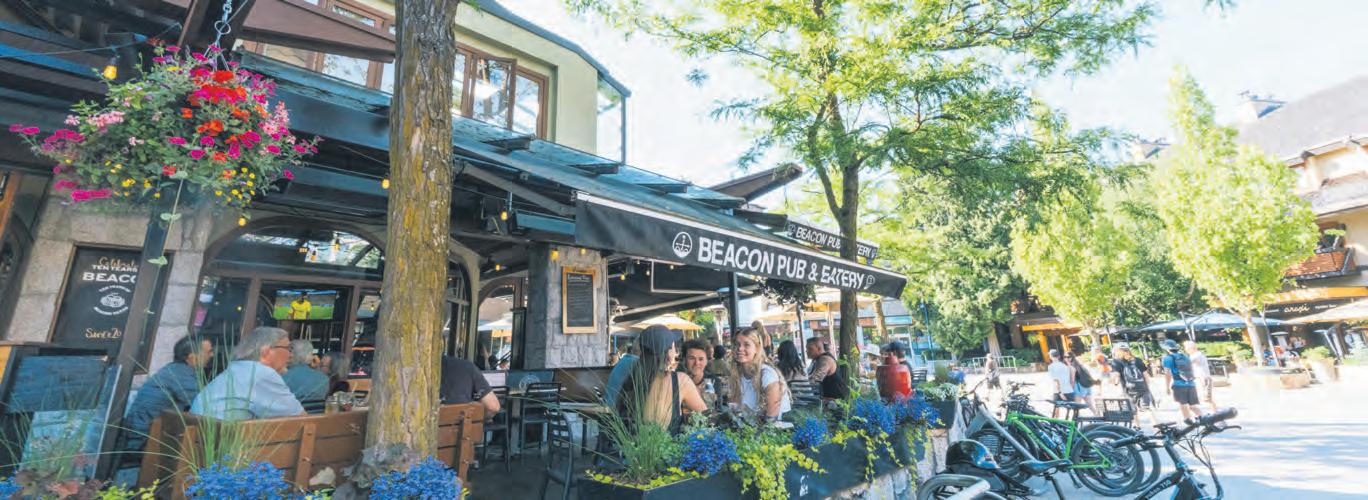
06 OPENING REMARKS As Whistler enjoys an early pre-summer heat spell, editor Braden Dupuis provides a helpful and timely field guide to Whistler’s summer stereotypes.
08 LETTERS TO THE EDITOR This week’s letter writers share thanks for a wonderful birthday celebration, respect for firefighters, and memories of a friend gone too soon.
20 THE OUTSIDER Vince Shuley shares just a few of the lessons he’s learned from a decade of working in the outdoor industry.
46 PIQUE’N YER INTEREST To protect the important ecological roles and ecosystem services provided by old animals, longevity conservation is a necessary pivot, writes Leslie Anthony.
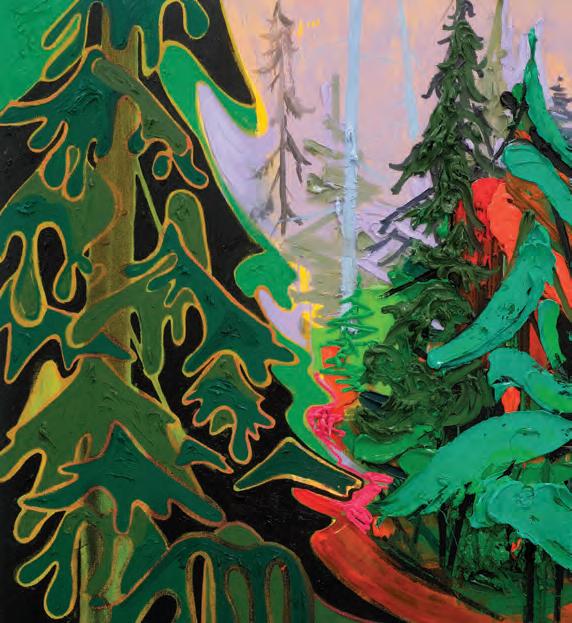
COVER I do not like those apples. - By Jon Parris // Adobe AI // @jon.parris.art
Publisher SARAH STROTHER - sstrother@piquenewsmagazine.com
Production Manager AMIR SHAHRESTANI - ashahrestani@piquenewsmagazine.com
Art Director JON PARRIS - jparris@piquenewsmagazine.com
Advertising Representatives
TESSA SWEENEY - tsweeney@wplpmedia.com
ANDREW BUDRESKI - abudreski@piquenewsmagazine.com
Digital/Sales Coordinator KATIE DOUGLAS - kbechtel@wplpmedia.com
Reporters
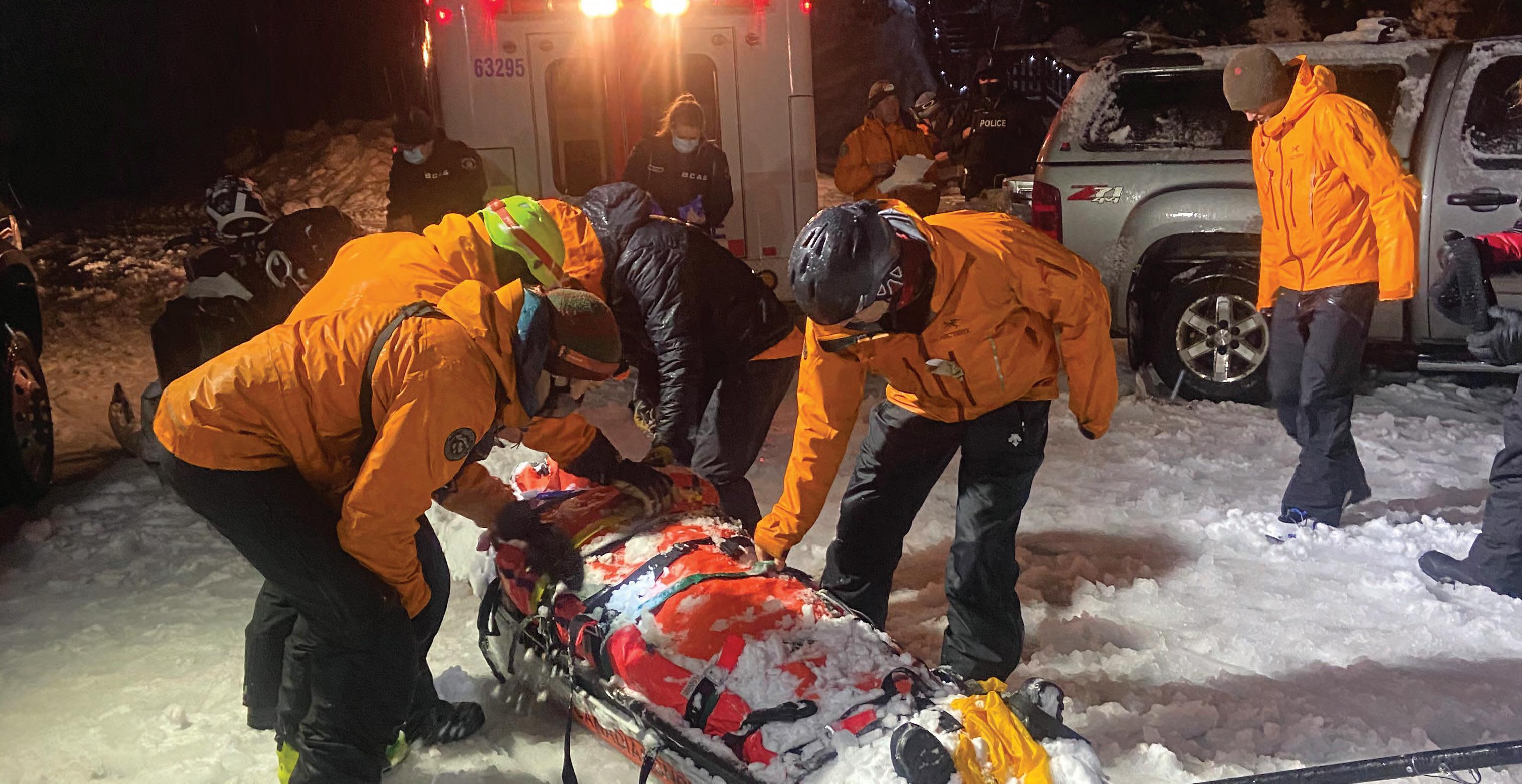
12 CALL AND RESPONSE Calls to Whistler Search and Rescue ticked back up last year, according to the organization’s 2025-26 manager’s report.
14 BRIGHT LIGHT Friends expect a celebration of life for Whistler’s Vicki Tonner, who passed away in a mountain-bike accident last month, will draw hundreds.
28 LATE BLOOMER Whistlerite Kennedy Justinen wants people to know that it’s never too late to change their lives.
32 PARTY IN THE PLAZA Another jam-packed Whistler Summer Concert Series kicks off Canada Day with the Steven Page Trio and String Quartet.
LUKE FAULKS - lfaulks@piquenewsmagazine.com
DAVID SONG - sports@piquenewsmagazine.com
Classifieds and Reception - mail@piquenewsmagazine.com
Contributors G.D. MAXWELL, VINCE SHULEY, LESLIE ANTHONY, GLENDA BARTOSH, ANDREW MITCHELL, LISA RICHARDSON, LIZI MCLOUGHLIN, TOBIAS C. VAN VEEN
Founding Publishers KATHY & BOB BARNETT www.piquenewsmagazine.com
THIS WEEK, Whistler is being treated to a stellar summer preview in the way of early May sunshine and unseasonably high temperatures.
Putting aside the anxiety about what this means for the fast-approaching fire season, it’s been a wonderful change of pace from the seemingly months of rain and overcast skies we’ve endured.
BY BRADEN DUPUIS
The early, unexpected heat also comes with another nice caveat: the true summer crowds have yet to arrive, meaning we hardened locals get all the summer fun with none of the overcrowded nonsense.
So let’s enjoy this quiet respite. Lord knows it’s only a matter of time before the crowds arrive to claim every available inch of green space at Rainbow Park.
But look closely, and you’ll notice Whistler’s summer stereotypes are already starting to materialize…
THE SPEED DEMON
Whistler’s Valley Trail network is an activetransportation marvel, with more than 50 kilometres of paved trail connecting parks, lakes, trailheads and more.
But it gets busier every year, as cyclists, tourists, joggers and dog walkers pound the pavement in all directions.
The Speed Demon has no time for any of them. He (or she—but usually he) has PLACES TO BE and the power of electricity to propel him there.
With some easily ignorable signs the only real method of speed enforcement, the Valley Trail is the Demon’s racetrack, and we lowly walkers mere peasant mortals, sluggish souls ripe for the picking.
You’ll know him from the
unmistakable whir of misplaced urgency speeding up behind you, or the whip of the wind as he rushes past—hopefully he’s riding solo, and not one of the many (and seemingly multiplying) Speed Demons consisting of three helmetless children packed on a single e-bike.
THE TOURIST TRAIN
The Speed Demon’s weird, slow cousin, the Tourist Train inhabits a similar category of Valley Trail clogger. The Yin to the Speed Demon’s Yang, the Tourist Train has nowhere to be, knows not where it’s going, and is in no discernible rush to get there.
Watch as it approaches apprehensively from behind, sometimes in a gang of up to 10 slowly rolling rental e-bikes, all commandeered by smiling, helmetwearing tourists looking like it’s the first time they’ve ever seen a bicycle.
On a busy summer day, a good Tourist Train can push you right off the side of the trail, left helplessly waiting for them
THE FLOATER
Everyone has a Floater in their life.
You know the one: he’s been here almost 20 years, with more injuries than brain cells at this point. He has a job, but is always bumming cigarettes and gas money (though he usually mysteriously has his own beers and weed). His nickname is something like Mudboob or Beavo, used so prevalently many don’t know his real name (and sometimes he doesn’t quite remember it himself).
And when the sun comes out for summer and the lakes start to warm, he lives for only one thing: floating on the River of Golden Dreams.
He has no thoughts about politics, no opinions about the economy. He thinks UBI is something he picked up in the fateful summer of ’09.
The crises and complexities of the world matter not to the Floater—grab some bros, grab some brews, grab your Explorer 200, and float your stress away down the river, is his credo.
you likely know the bears mostly as background scenery. The novelty of seeing them has long worn off, replaced with a healthy respect and learned behaviours like keeping dogs on-leash, managing attractants, and giving bears plenty of space on trails and in parks.
The Bear Destroyers have none of that self-awareness. They sidle up for selfies, stop traffic on the side of highways, get as close as they can for the clout. In some extremely dumb cases, they go so far as to feed the bears, or growl in their faces while drunk.
They can be both locals and tourists. And make no mistake, their behaviour leads directly to bears getting killed.
Not to be confused with their close conspirator, the Trash Goblin, who can’t host a small family gathering at a park without leaving behind a mountain of garbage for the bears to get into.
Be sure to watch for more of the old Whistler summer stereotypes in the weeks and months ahead: the Dirt Merchant and
The Speed Demon’s weird, slow cousin, the Tourist Train inhabits a similar category of Valley Trail clogger. The Yin to the Speed Demon’s Yang, the Tourist Train has nowhere to be, knows not where it’s going, and is in no discernible rush to get there.
to roll on.
They pass one by one, all smiling at you as if this is a fun, shared experience for all involved, standing company included.
You smile back and nod at every second one as you grit your teeth behind your lips.
What happens when you combine a Speed Demon with a Tourist Train? One suspects it’s only a matter of time before we find out.
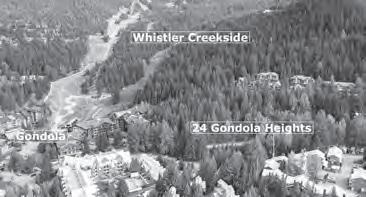
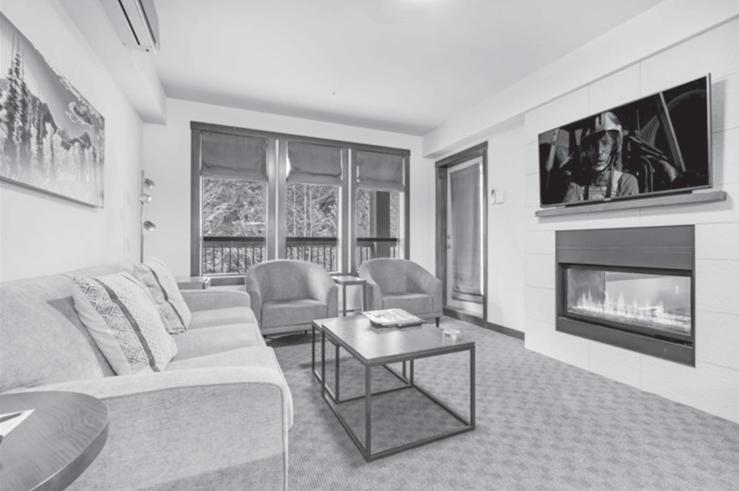
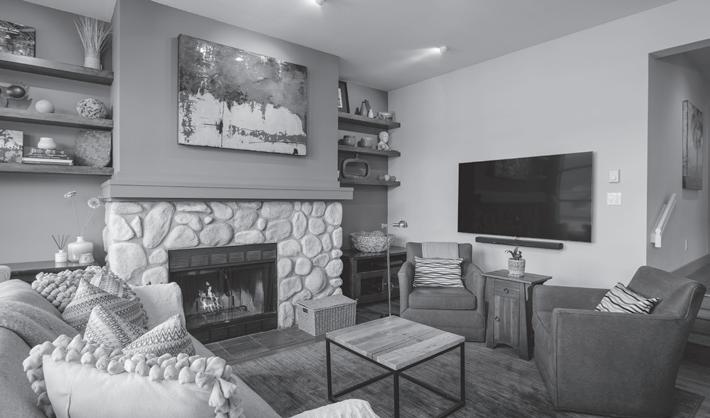
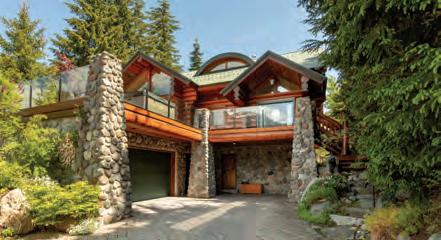
Tastefullyupdated2-bedroom/1.5bathend-unit townhomewithviewsof Whistler Mountain.Bright open-concept livingwith extrawindows, stainlesssteel appliances, granite countertops, heated tilefloors, anda cozy wood-burning fireplace. Over300sq. ft.ofstorage for all your Whistlergear.Easily walk to Creeksidegondola, Dusty’sand Alpha Lake Park.Unlimited ownerusewith nightly rentalspermitted. NoGST
Askingprice$1,299,000 24-2211 MarmotPlace
There’s an obvious, easy metaphor in there, but we could probably all stand to take a page from the Floater instead—to not take ourselves so damn seriously all the time, and remember the wise words of one Jeff Bridges at the end of the 1998 cult classic The Great Lebowski: “The dude abides.”
THE BEAR DESTROYER
If you’re a Whistler local of any longevity,
the Village Looky-Lou; the Patio Squatter and the Shirtless Sixpack Wonder; The Dog Who Has Never Been Happier.
As the season unfolds, they’ll all be out there together, speeding, swerving, floating, gawking, and occasionally learning the hard way. Hopefully not with a cigarette butt and a patch of dry grass.
So enjoy this brief, beautiful window while it lasts.
It won’t stay quiet for long. n
Angell Hasm an &AssociatesRealty Ltd.
LETTERS
Ninety thank-yous!
There were too many people to thank after my 90th birthday at the Whistler Racket Club (WRC) last month, so I decided to send a letter to you all and to the wider Whistler community. The party that was thrown to celebrate my 90th year was beyond my wildest dreams, as I never want anyone to make a fuss about my birthday! But you did, and I am so grateful.
I cannot possibly thank you all personally, but I must give a special mention to Kristi Wells, her daughter Jessica, Sheilagh Martin, Carol Severson, Suzanne Johnston, and John and Gail MacGregor for all the work and effort that went into planning and setting up the event. I can never thank you enough. The day would not have been the same without a wonderful pickleball tournament that was so well organized and run by Bruce Gandosi and Rosie Watson. Thank you.
None of this, of course, would have been possible without the generous support from Jamie Grant and Laurie Grant who contributed their time and provided the use of the WRC to hold the event and supply a wonderful feast, which I know took several days and many more hands to prepare.
Once again, the Whistler Racket Club has proved what an incredibly precious asset it is to our community, even if you don’t play racket sports! It is so wonderful to know that
I can bike down to the club any time, even if I’m not playing pickleball, and will bump into friends, have a drink, play some cards or meet new people. The value of this to me is beyond words; the value to our town is immeasurable. Finally, I want to say that I feel so blessed that nonagenarians like me (and many of my much younger friends in their 70s and 80s!) can still enjoy, thrive and contribute to what makes Whistler such a special place.
Thank you.
Gloria
Ellott // Whistler
Offering ‘deep respect’ for firefighters
We offer deep respect to all our firefighters across the corridor as we recognized International Firefighter Day on Monday, May 4.
Volunteers, career, forestry and private firefighters deserve our support and thanks for all that they do at personal risk during the worst of times—24/7, 365. Stay safe and thank you for all that you do.
B. Buchholz // Tapley’s Farm, Whistler
Thanks for the passenger train reality check
Thank you, Andrew Mitchell, for the reality check about trains! (see Pique, May 1, “The truth about trains.”)
I know I am being a buzzkill, but the long and the short of it is that a train wouldn’t work. People don’t even carpool, let alone take buses. A snail-paced train that leaves from an inconvenient place, only to arrive at another? No way. And the gear? People don’t even want to schlep their gear from lot 4 and 5.
Convenience rules. With that in mind, it would be interesting to see recent data as to the proportion of single-occupant vehicles using the Creekside and Day Lots. We live in Bayshores and just from eyeballing the skibound traffic, the brunt of the cars have one, maybe two people in them.
It would also be interesting to see how many of the underground parking spaces in town are used by visitors who basically arrive, park for several days, and leave. Could Tourism Whistler bundle bus transportation so it is included with hotel stays? If the visitor doesn’t have to make the spending decision, and just needs to sign up for a convenient bus, maybe that would a) make the math on improved bus service better; b) free up parking; c) keep inexperienced snow drivers off the
TheFSPwillbesubmitted for approval fromtheSeatoSkyMinistry of Forests following completionofa60-daypublicreviewandcommentperiod.TheFSPisproposed fora term of5 years, andwhen approved,will form thebasisof forestmanagementplanning withintheFNWLoperatingarea.An approvedFSPisrequiredto allow fortheissuanceof permitsauthorizingroadconstruction,har vestingandother forestdevelopmentactivities. TheFSP hasbeenpreparedtoconformandcomplywith applicableHigher-LevelPlans, the Forestand RangePracticesActandtheassociatedregulatoryframework. AsperSection20ofthe ForestPlanningandPractices Regulation,noticeisherebygiven to allGuides,Outfitters, Trappers, PrivateLandOwners, TenureHolders, Wa terUsers andthe general publicthat the60-daypublicreviewandcommentperiodiscommencing andinputfromstakeholdersandthe general publicisrequestedsothat anyconcerns orcommentsrelatingtotheproposedFSPcanbeaddressedpriortosubmission for approval
TheproposedFSPandmappinginformationis available forviewingduringthe60-day publicreviewandcommentperiodcommencingMay8,2026through July10,2026.
highway; and d) reduce volume on the Sea to Sky. Win, win, win, win.
And while we are winning: what if the train track was paved as a bike path? The possibilities for Euro-style cyclotourism would be amazing. Many train corridors in Quebec have been paved, and it brings exceptional opportunities to all the communities along the track… as in, not just Whistler, but also points north and in between.
If we are indulging in alternative piein-the-sky thinking, maybe a widened bike path could be used for transit, with specific times one way north in the morning and south at the end of the day, or vice versa, location dependent; again including points north, etc. Plus, could an improved, paved track be used as an emergency disaster route?
The lowest number I have heard to put trains back in place is $100 Million, with iffy returns. Improving the track for bikes (and small buses) would be expensive, but offers potential for big-picture benefits on many fronts. The same can be said for improving and promoting existing transit options from YVR and the city (bundling, etc.).
So yes, a buzzkill on trains, but there are lots of alternatives that could align better with people’s reality. Food for thought.
Laura Scully // Bayshores, Whistler
Hugs over handshakes
When asked where I live, I often say Function Junction instead of Whistler. Function Junction has been my home for well over two decades. Community means so many things.
I’m not sure I’ve ever experienced a community with such a friendly vibe,
Not because we all know each other, but because of a familiarity, a bond formed from sharing a special corner of the world where people still wave and smile just because we recognize each other and like walks outside.
I can’t say I knew Kevin as well as many, but we crossed paths many times
“I will miss bumping into you. There are so few people in this world that answer the question ‘How are you?’ with any real measure of honesty and depth.”
- JON PARRIS
while I may not know everyone. I see you all the time and I love you because you’re always happy to smile and wave back. The Function vibe is a unique one.
and for more than two decades. Every single time we bumped into each other we hugged, regardless of moods or states. I’m not sure I ever shook his hand.
Write to us! Letters to the editor must contain the writer’s name, address and a daytime telephone number. Maximum length is 450 words. Pique Newsmagazine reserves the right to edit, condense or refrain from publishing any contribution. Letters reflect the opinion of the writer and not that of Pique Newsmagazine. Send them to edit@ piquenewsmagazine.com before 11 a.m. on Tuesday for consideration in that week’s paper.
Conversation was always open. I will be the first to admit that I’ve given some incredibly awkward hugs in my life. Never awkward with you.
No regrets.
My social misbehaviours have led me to so many honest, caring relationships. I will miss bumping into you. There are so few people in this world that answer the question “How are you?” with any real measure of honesty and depth.
With you I felt connected in this way, never afraid to tell me how it really was going. I hope you left knowing you had meant so much to so many, even if it was in passing.
Some of us just have a whole lot more emotions to deal with.
It’s hard for many to understand. It’s often so overwhelming.
I know you hugged so many, cared so much. I’m sorry it all got the best of you. It’s all pretty hard to make sense of sometimes.
I hope the best of you will not be forgotten. I’m sure I won’t.
I’ll keep smiling, putting my best self forward regardless.
You were such a beaming light in our little, not so dysfunctional community. I’ll miss hugging it out, bud. You always made me smile.
Jon Parris // Whistler n
2BEDBENCHLANDS TOWNHOME
604-905-8855
1-888-689-0070
Dave@DaveBeattie.com
•Fullyrenovated 2bed,2bathtownhome
•Quartzkitchen,stainlessappliances,largeisland
•Wood burningfireplace,brightopenliving
•Hardwoodfloors,twosunnypatios
•In-suitelaundry, secureundergroundparking
•Phase1 zoning,nightlyrentalsallowed
Notice ofIntent
To ConsiderSquamish-LillooetRegionalDistrict ProcedureBylawNo.1899-2026
Inaccordancewithsubsection225(2)ofthe LocalGovernment Act,noticeisherebygiventhattheSquamish-Lillooet RegionalDistrict(SLRD)Boardintendstoconsideradoption of Squamish-LillooetRegionalDistrictProcedureBylawNo. 1899-2026
Whistler Search and Rescue call volumes tick back up as serious incidents climb, 2025-26 report shows
TEAM ASSISTS 123 PEOPLE, LOGS NEARLY 5,000 VOLUNTEER HOURS AS SHIFTING BACKCOUNTRY USE AND DEMOGRAPHICS SHAPE RESCUE TRENDS
BY LUKE FAULKS
WHISTLER SEARCH and Rescue (WSAR) saw call volumes rebound in 2025-26 after a brief dip the year prior, with volunteers responding to more than 105 requests for assistance and mobilizing on 83 incidents over the 12-month period, according to the team’s latest manager’s report.
The figures mark a return to the pre2024 upward trajectory, even as broader provincial statistics showed a temporary decline in calls last year.
Locally, WSAR leaders say the nature of incidents—including the people getting into trouble—continues to evolve in ways that are reshaping how the volunteer-run team prepares for the future.
“Every year it changes a little bit, and the trends are subtle, but that’s why we do [the reports],” said WSAR president Brad Sills in an interview. “It just gives a snapshot in time [of] what the team is facing, so that we can better prepare ourselves [for] what’s coming down the pipe.”
CALL VOLUMES REBOUND, SERIOUS INCIDENTS PERSIST
Between March 1, 2025 and March 1, 2026, WSAR handled more than 105 calls for help, with 83 resulting in full team mobilizations. Another 13 incidents were resolved through self-rescue— an increasingly important tool for the organization.
The rebound follows a quieter 202425 season, when WSAR responded to 90 calls, down from 110 the year prior. That decline broke a four-year trend of rising call volumes.
Two incidents were fatal.
Nearly 5,000 volunteer hours logged
Responding to those incidents required approximately 4,863 volunteer hours across 157 events, underscoring the growing workload placed on the 100-percent volunteer organization.
That pressure is one of several factors driving internal changes within WSAR, including a push to modernize governance and distribute responsibilities more evenly across the
“We’re seeing more people calling for help initially, [and] then finding their own solutions, which is exactly what we want to see.”
- BRAD SILLS
During the most recent reporting period, WSAR reported a “slight rise in serious incidents” in line with neighbouring North Shore and Squamish teams.
The 2025-26 season included 27 medical rescues, 20 search missions, and 17 evacuations, with volunteers credited with saving 23 lives and assisting 13 people in imminent danger.
team’s now 37 members.
“It’s one thing to run an organization of 15 to 20 members, but the team’s 37 now. That model just doesn’t work anymore,” Sills said. “There’s too much work that needs to get done.”
The organization is also grappling with broader shifts in the searchand-rescue landscape, including increased regulatory requirements and
administrative demands. In his annual report, Sills noted those pressures have grown “beyond that what can be reasonably provided by volunteers,” prompting plans to hire a part-time administrative assistant.
SELF-RESCUE PROGRAM CONTINUES
TO EXPAND
One of the more notable trends in recent years has been the growth of WSAR’s selfrescue program, which allows stranded individuals to find their own way out with remote guidance from rescuers.
In 2025-26, 13 calls were resolved this way, with SAR members providing GPS tools, medical advice, and reassurance over the phone.
Sills said the approach reflects a broader shift in how people interact with search and rescue.
“We’re seeing more people calling for help initially, [and] then finding their own solutions, which is exactly what we want to see,” he said.
The trend builds on previous years, when teams increasingly relied on technology to assist lost or fatigued users without deploying crews into the field.
WHO’S GETTING INTO TROUBLE—AND WHERE
WSAR assisted 123 individuals over the reporting period, with a near-even gender split.
That balance reflects a longer-term
shift toward gender parity in outdoor recreation incidents.
“I don’t think it’s a secret that women have taken up adventure sports much more so than in the past,” Sills said. “If they’re doing it at the same volume as men, it’s likely that the statistic is going to be somewhat equal.”
Age distribution is also flattening. While the 26-to-30 cohort remained the largest group at 39 individuals, WSAR reported a much more even spread across age categories than in previous decades, when incidents were dominated by young males.
Geographically, the Garibaldi Lake area once again topped the list with 18 responses, followed by Wedge/Weart with 15 and the Resort Municipality of Whistler itself with 12.
Sills said those numbers reflect both popularity and risk.
“Garibaldi Lake is just an absolutely incredible place to go hiking, so the numbers are huge just because of the visitation,” he said.
Wedge, meanwhile, is drawing a different kind of user—often
NEWS WHISTLER
of [Whistler].”
The team also entered “a whole new era” of operations this year, earning night-vision certification that enables helicopter rescues after dark.
PREPARING FOR GROWING DEMAND
Even as call volumes remain high, Sills said there are signs that education and awareness efforts are having a positive effect on backcountry users.
“I do believe that people realize that they need to be more prepared than they were 15 years ago,” he said, pointing to a broader shift toward better planning and risk awareness among those heading into the mountains.
At the same time, Sills noted those gains are being offset by “exponential” growth in backcountry use.
To keep pace, WSAR has expanded its training programs, including a graduated mountain rescue certification initiative that now counts 15 certified technicians. The team is also developing a specialty crevasse rescue capability.
Those efforts come as new
“[W]e’re getting a lot of very inexperienced people being funnelled into the most challenging of all the terrain.”
- BRAD SILLS
inexperienced hikers funnelled into challenging terrain.
“A lot of people are getting turned away at Joffre or Garibaldi and they’re going, ‘Well, where else can we go?’” Sills explained. “And so we’re getting a lot of very inexperienced people being funnelled into the most challenging of all the terrain.”
ACTIVITY TRENDS SHIFT WITH
CONDITIONS AND USE
By activity, hikers continued to account for the largest share of incidents, with 29 calls, followed by ski mountaineering (seven), climbing (seven) and mountain biking (six).
Ski mountaineering and out-ofbounds skiing incidents declined year-over-year, while snowmobiling remained below older highs but rose from last year.
WSAR noted a “notable rise” in climbing, trail running and mountain biking incidents contributing to major trauma cases.
Those trauma-heavy incidents— often involving high-speed impacts or falls—are one reason WSAR operates primarily as a helicopter rescue team.
“So much of our call volume is trauma, and so there’s a necessity of having to get there very quickly, which is one of the reasons why we’re predominantly a helicopter rescue team,” Sills said. “That, and the fact that there’s only one road out
infrastructure—including the planned Macbeth Hut—opens deeper, more complex terrain to a wider range of users.
“It’s going to beckon a disproportionate number of people that perhaps shouldn’t be in that terrain unguided,” Sills said.
VOLUNTEER MODEL REMAINS STRONG
Even as workloads increase, WSAR leaders remain confident in the longterm viability of the volunteer model in Whistler, where recruitment remains strong and member retention is high.
“The membership longevity averages 18 years [and] when we go out to bring on new members, we get a huge number of strong, qualified applicants,” Sills said.
Still, the organization acknowledges that demand is unlikely to ease; Sills wrote in his president’s report, “It is not likely that the need for our services is going to diminish any time soon.”
The WSAR president was also recently recognized nationally for his decades of service, receiving the national Search and Rescue Volunteer Association (SARVAC) Award for 50 years of volunteer work.
“Oh, you know, it’s pretty corny,” Sills said about his five decades in SAR. “But I love that it’s just about helping people. It’s kind of like a calling. I’ve just always felt the rewards from giving my time to search and rescue [are] immensely gratifying.” n
Abrokeragegroundedin collaboration,mentorship anda real commitmenttoprofessionalgrowth— whereexperiencedagentsactivel ys upporteach othe ra ndth en ex tg enerat ion.Becausehe re,i t’s notjustaboutlearning—it’saboutbeingsupported everystepofthe way.
Lookingtorefine yourcraftalongside other high-performingprofessionals?Ready to learn fromthebest?
WHISTLER
‘She made people feel seen’
CELEBRATION OF LIFE FOR WHISTLER’S VICKI TONNER EXPECTED TO DRAW HUNDREDS
BY BRADEN DUPUIS
FRIENDS OF A Whistler woman who tragically passed away in a mountain biking accident near Pemberton late last month are remembering her as a “bright light” with an adventurous spirit, who “made people feel seen.”
It should come as no surprise, then, that a celebration of life planned for Vicki Tonner is expected to draw hundreds.
“We anticipate a very full house,” said Diane Rothdram, Tonner’s coworker and manager of the Dubh Linn Gate Pub, where Tonner worked since 2018. “The online response to her celebration of life has been tremendous. I would estimate over 300 people will attend.”
Tonner, 41, was born in London, but grew up in Huddersfield, England. She fell in love with the mountains at age 10, and started chasing the mountain lifestyle in 2007 in France before moving to Banff in 2008. Her next few years were spent bouncing between ski towns in Colorado, Banff, Switzerland and Australia.
“She moved to Whistler in 2012, crashing on Cailey and Alex Wilkes’ couch with the intention of getting
residency and making Whistler home, a dream she ultimately accomplished,” Rothdram said, adding there was no shortage of ways to describe Tonner—an adventurous spirit, a perpetual student of the world, the kindest of souls.
“Vicki was constantly learning and seeking ways to better her understanding of how things and people operated,” Rothdram said. “She was quietly fearless, and found solace in exploring her limits, both physically and spiritually. She recently embarked on solo biking adventures through the Yukon and the Kootenays, putting her faith in a sense of adventure and her beat-up truck. Vicki was an incredible athlete, but she was never overt about her abilities, she simply loved to be on wherever the ride would take her.
“Ultimately it was the small moments spent with Vicki that truly defined her. Her hilarious way of laughing at herself, her unreasonable love for Nutella, and her ‘text novels,’ which would be endless, meandering responses to a very simple question. She made the time you spent with her better, and always had a story to share.”
Tonner was biking on the Sea to Sky Trail on April 24 when the incident occurred.
Specific details remain sparse, but BC
SIDECUTSTEAKHOUSE
$68 SPRINGMENU
Availabledaily from 6:00pm- 9:30pm
Emergency Health Services confirmed in an email it received a call at 7:59 p.m. on April 24 about a mountain biking incident on the Sea to Sky Trail in Pemberton.
“Two ambulances with primary care paramedics attended the scene,” said Brian Twaites, BCEHS paramedic public information officer. “Paramedics
provided emergency medical care to one patient who was transported to hospital in critical condition. BCEHS would like to thank our first responder partners with Pemberton Fire Rescue for their partnership on this call.”
A spokesperson with the BC Coroners Service confirmed it is investigating the death, but declined to provide further details.
Rothdram said former Dubh Linn Gate manager Tara Delaney reached out to offer condolences, capturing Tonner’s essence beautifully.
“Vicki was such a bright light. From my very first shift at Dubh, she made me feel welcome, comfortable, and truly part of the team. She had a kindness that seemed effortless and a gentle soul with a smile that could light up a room,” Delaney wrote.
“She had a special gift for knowing when someone was feeling down and needed a quiet chat, a kind word, or simply someone to listen. She made people feel seen. She wore her heart on her sleeve, and if you asked how she was, she would answer with honesty. That honesty was one of the things that made her so remarkable, it created a space where others felt safe to open up, to share what was on their minds too and
SIDECUTinvites youtoexplore BritishColumbiawines at exceptional value.
BRIGHT LIGHT Vicki Tonner was an “adventurous spirit” who had a gift for lifting others up, say friends. PHOTO SUBMITTED
Whistler Half Marathon runner sues after being struck by golf ball near Nicklaus North
VANCOUVER WOMAN ALLEGES INADEQUATE NETTING, SIGNAGE AND ROUTE SAFETY MEASURES LED TO INJURIES DURING 2024 EVENT
BY LUKE FAULKS
A VANCOUVER WOMAN has filed a civil lawsuit in B.C. Supreme Court alleging she suffered serious injuries after being struck in the head by a golf ball while participating in the 2024 Whistler Half Marathon.
The civil claim, filed May 1 in Vancouver, names the Whistler Friends Community Health and Welfare Society and GolfBC Holdings Inc., which operates the Nicklaus North Golf Course, as defendants.
Plaintiff Kylie Vedan alleges the incident occurred on June 1, 2024 while she was participating in the event’s 10-kilometre race route, which included a section of the Valley Trail running behind the Nicklaus North Golf Course driving range.
“While running along the designated route, and while the Plaintiff was positioned on the south-facing side of the Trail by the Golf Course driving range, she was violently struck in the head by a high-velocity golf ball launched from the Golf Course,” the claim states.
According to the filing, Vedan “collapsed immediately to the ground in pain, shock, and distress due to the loud and forceful impact,” and was assisted by race volunteers and bystanders.
CLAIMS OF INADEQUATE SAFETY MEASURES
The lawsuit alleges the area lacked adequate warning signage alerting runners to the nearby driving range, and further claims the netting around the golf course perimeter was “insufficient to contain golf balls and did not extend far enough to protect participants of the Running Event.”
Vedan claims she sustained a range of injuries as a result of the incident, including injuries to her shoulders and upper back, cognitive impairment, visual and balance disturbances, psychological injuries including anxiety, and “disturbed sleep and fatigue.”
The claim further alleges her injuries “have caused and will continue to cause
LIGHT FROM PAGE 14
forge such close friendships with her. The warmth, compassion, and genuine care Vicki gave touched so many people, often in ways she may never have fully realized.”
The pub was closed for three days following Tonner’s passing out of respect for her, Rothdram said.
“Vicki was loved by each and every one of us and our staff also needed some
pain, suffering, loss of enjoyment of life, and functional impairment,” and says she is now “more susceptible to future injury and degenerative changes due to the trauma sustained in the Incident.”
The Whistler Friends Community Health and Welfare Society, which organizes and manages the Whistler Half Marathon, is accused of negligence for allegedly failing to conduct a proper risk assessment for portions of the race route adjacent to the golf course and failing to mitigate “known or reasonably foreseeable hazards, including the risk of stray golf balls.”
The suit also alleges the society failed to coordinate with adjacent property owners regarding participant safety, failed to provide adequate warnings to runners, and failed to ensure the route was safe for public use.
GolfBC, meanwhile, is alleged to have failed to install or maintain adequate netting or barriers to prevent golf balls from entering the Valley Trail and race route.
The claim further alleges the company operated a driving range “in close proximity to the Trail without implementing proper safety measures,” failed to assess and manage injury risks to trail users, failed to adequately warn participants about stray golf balls, and failed to restrict or supervise driving range use during the running event.
SEEKING DAMAGES IN SUPREME COURT
Vedan is seeking general, special, aggravated and punitive damages, along with past and future care costs, past and future loss of income and earning capacity, health-care costs and legal costs under B.C.’s Negligence Act, Health Care Costs Recovery Act and Occupiers Liability Act.
Whistler Friends did not respond to a request for comment before deadline, and Nicklaus North declined to comment on the suit.
None of the allegations have been proven in court, and no response to the claim from either defendant was filed as of press time. n
time to process their grief,” she said.
There are some ideas in the works to further honour Tonner’s memory, though Rothdram said they would like to involve her family, who were en route to Whistler this week.
A celebration of life for Tonner will be held May 10 at 1:30 p.m. at the Dubh Linn Gate. n
Whistler council backs $200K investment for UCI World Cup debut
FUNDING WILL BE DRAWN FROM ACCUMULATED TOURISM TAX REVENUES, WITH THE EVENT PROJECTED TO DELIVER MILLIONS IN ECONOMIC IMPACT
BY LUKE FAULKS
WHISTLER COUNCIL has endorsed a $200,000 investment to support a Union Cycliste Internationale (UCI) Mountain Bike World Cup event this fall, tapping accumulated tourism tax revenues to help deliver what staff say will be a major shoulder-season draw.
Council voted April 28 to approve the funding through its Festivals, Events and Animation (FE&A) program, with the money earmarked to support the Sept. 25 to 27 event in Creekside.
“The event is already looking to be a big draw,” manager of village events and animation Bob Andrea said in a presentation to council.
“The current pace of bookings is very healthy over the event dates, and it’s amongst the highest pace for the entire summer season—and that’s pretty amazing for the end of September.”
The UCI—the global governing body for cycling—sanctions World Cup races that draw elite athletes and international audiences, with Whistler Blackcomb serving as the host venue and lead organizer locally.
The Whistler World Cup stop was first
unveiled in August 2025. Officials at the time emphasized both the global profile and longterm vision behind landing the event.
“Our team built and designed the 1199 Downhill track for the sole purpose of hosting events of this calibre,” said Whistler Blackcomb COO Belinda Trembath in a release. “We are thrilled to be hosting the UCI Downhill World Cup.”
FUNDING OUTSIDE REGULAR EVENT PROCESS
The investment falls outside Whistler’s usual annual FE&A funding cycle, which had already fully allocated its 2026 budget for third-party events earlier this year.
As with previous large-scale events like the Invictus Games, the World Cup required additional council approval due to its scale and funding needs, Andrea said.
Staff recommended drawing the funding from accumulated Municipal and Regional District Tax (MRDT) revenues—hotel taxes collected over decades that exceed past spending commitments—rather than current-year allocations or housing reserves.
“We’ve been collecting MRDT since 1989,” explained interim CAO Ted Battiston. “So between 1989 and 2023 there were years where our revenues exceeded our planned expenses.
Children & Youth Summer Programs
Summer Kid’s Drop -in Ar t Classes
Gr ades Kinder ga rten -2
Mo nd ays& Thursdays*
11:0 0a m- 12:0 0pm
Gr ades 3-6
Mo nd ays& Thursdays* 2:00 pm - 3:30 pm
$5 pe r cl as s Fr ee fo r AA M Memb er s *f ro m Ju ly2, pl ea sese e we bs ite fo r da te s.
Those have resulted [in] accumulated funds within MRDT. The total of that is somewhere around $4 million.
“Since 2023 anytime where we have more MRDT funds received than are planned in a given year, those funds are then transferred to the employee housing reserve,” Battiston added.
“But those historic funds between 1989 and 2023 are currently unallocated, and that is the proposed source for the $200,000.”
ECONOMIC AND TOURISM CASE
Staff and resort partners pitched the event as a strategic boost for Whistler’s shoulder season, with Tourism Whistler estimating more than 18,000 unique visitors, 60,000 attendees, nearly 10,000 paid room nights, roughly $10 million in visitor spending and $16.4 million net economic output.
“The event dates are strategically positioned to boost resort-wide tourism during a need period at the end of September,” Andrea said. “Pre-event and training activities [will] help to drive midweek stays as well as enhance the length of stay.”
The FE&A program, which administers the funding, is designed to support events that diversify tourism beyond peak periods and align with Whistler’s broader “smart tourism” strategy.
Council members largely supported the timing and economic rationale.
“I am excited for this, and this really fits in with the FE&A mandate of going outside the regular high season,” said Councillor Cathy Jewett.
Coun. Arthur De Jong added the lateSeptember window “couldn’t have nailed a better date,” pointing to long-term efforts to diversify Whistler’s economy as the ski season continues to struggle in a warming climate.
BROADER BENEFITS AND NEXT STEPS
Beyond economics, staff highlighted social and cultural benefits, including opportunities for Indigenous engagement, community programming, and showcasing Whistler globally through broadcast coverage.
The funding will support a range of costs, including event programming, temporary infrastructure, operations, and marketing.
Council also directed staff to bring forward an amendment to the municipality’s five-year financial plan to formally incorporate the expenditure. If successful, Andrea said there is already interest in bringing the World Cup back in future years. n
Performing& Visual Ar ts Workshop
Stop Motion Animation Workshop
Architecture& Design Workshop
withthe Sc hool of Dire ct Ente rprise
Ag es 8- 12
July 16 & 17 (2-d ay wo rksh op)
10 :0 0a m- 3:00 pm
$6 0 Memb er s $75 No n- Memb er s
Ag es 9- 14
July 23 , 24 & 25 (3 -d ay wo rksh op)
10 :0 0a m- 3:00 pm
$8 5 Memb er s $9 9 No n- Memb er s
Printmaking& Textile Workshop withthe Sc hool of Dire ct Ente rprise
Ag es 8- 12
Au gus t7 10 :0 0a m- 3:00 pm
$25 Me mb er s $3 5 No n- Memb er s
Ag es 9- 14
Au gu st 19, 20 & 21 (3 -d ay wo rksh op) 10 :0 0a m- 3:00 pm
$8 5 Memb er s $9 9 No n- Memb er s
auda inar tmuseum.com
Backcountry group surveys users as heli-skiing decision looms in Garibaldi Park
GROWING
BACKCOUNTRY USE AND PLANNED HUT EXPANSION ARE RENEWING DEBATE OVER A DECADES-OLD EXCEPTION TO GARIBALDI PARK’S NON-MOTORIZED MANDATE
BY LUKE FAULKS
A RARE CONVERGENCE of easy lift access and rugged alpine terrain have made the Spearhead Range an increasingly popular backcountry destination.
“Often when people envision going out into the mountains, they picture big, glaciated peaks and huge runs you can ski. There’s a lot of that terrain on the South Coast, but it’s really hard to get to,” longtime ski-tourer and author Matt Gunn explained.
“But what the Spearhead represents is this location where, because of the lift system and the way Whistler was developed, access through the resort is permitted into the park. It’s created this really unique situation where there’s unbelievable terrain that’s often hard to reach, but the resort provides that access point so people can get into it without a lot of effort, and then use that effort to explore deeper into the mountains.”
But backcountry advocates suggest a surge in Spearhead use in recent years may be increasingly out of step with a decades-old exception that allows
commercial heli-skiing in an otherwise non-motorized Garibaldi Park.
So, ahead of BC Parks deciding whether to renew that heli-skiing exemption in the Spearhead later this year, the Federation of Mountain Clubs of British Columbia (FMCBC) is surveying users in a bid to help inform the province.
“The focus right now is on whether [heli-skiing] continues or not, or is modified or adjusted in the Spearhead,” explained Monika Bittel, a director with the Federation, and chair of the FMCBC’s Recreation Conservation Committee.
“There are people who will think heliskiing is perfectly fine [and] others who don’t. We want everyone to have their say.”
A LONG-STANDING ANOMALY
The presence of heli-skiing in the Spearhead dates back more than four decades, rooted in a series of compromises between wilderness values and tourism interests.
In 1981, the province issued a heliski tenure in the park. A 1990 park master plan restricted motorized access more broadly, but allowed heli-skiing to continue as an exception tied in part to Whistler’s tourism economy.
BC Parks acknowledged the carve out was “an exception to the overarching vision for Garibaldi Park.”
Subsequent renewals reinforced that compromise between backcountry users and heli-skiing operations.
But public feedback during a shortterm extension in 2011 showed growing opposition to heli-skiing from many backcountry users, who cited noise, emissions, wildlife disturbance and a diminished sense of solitude. At the same time, business and tourism stakeholders continued to support the activity.
A 2014 amendment to the master plan set out the stakes: by no later than 2026, BC Parks would develop a recommendation on the future of heliskiing in the Spearhead—one that could include continuing, modifying, or eliminating the activity altogether.
For Bittel, that history underscores why the activity is often viewed as out of step with the park’s broader mandate.
“It has been non-motorized for eons, with the exception of heli-skiing,” she said. “So that’s really the only form of recreation that we’d see as an anomaly.”
FUTURE GROWTH AND A
LOOMING COLLISION
While the policy framework has remained largely unchanged for more than a decade, the same cannot be said for the number of people using the Spearhead.
In the decade since the last major planning process, backcountry skitouring has surged in popularity across B.C., a trend accelerated during the COVID-19 pandemic.
That rising demand is expected to increase further with the expansion of a hut network in the range. The Kees and Claire Memorial Hut opened in 2019, and two more—Macbeth and Pattison—are planned deeper in the Spearhead.
“We anticipate these two huts will really form what is going to be a worldclass asset for recreationalists,” Gunn said. “But they’re right in the middle of the current heli-ski program.”
That overlap, combined with increasing visitation, is central to the federation’s concern that conditions in the Spearhead today differ significantly from when the issue was last publicly debated, and therefore merit public consultation.
The survey is available through the FMCBC’s website. Read more at piquenewsmagazine.com. n
SUNDAY- FRIDAY 12-5PM WEDNESDAY ALLDAY
TACOTUESDAY ALLDAY
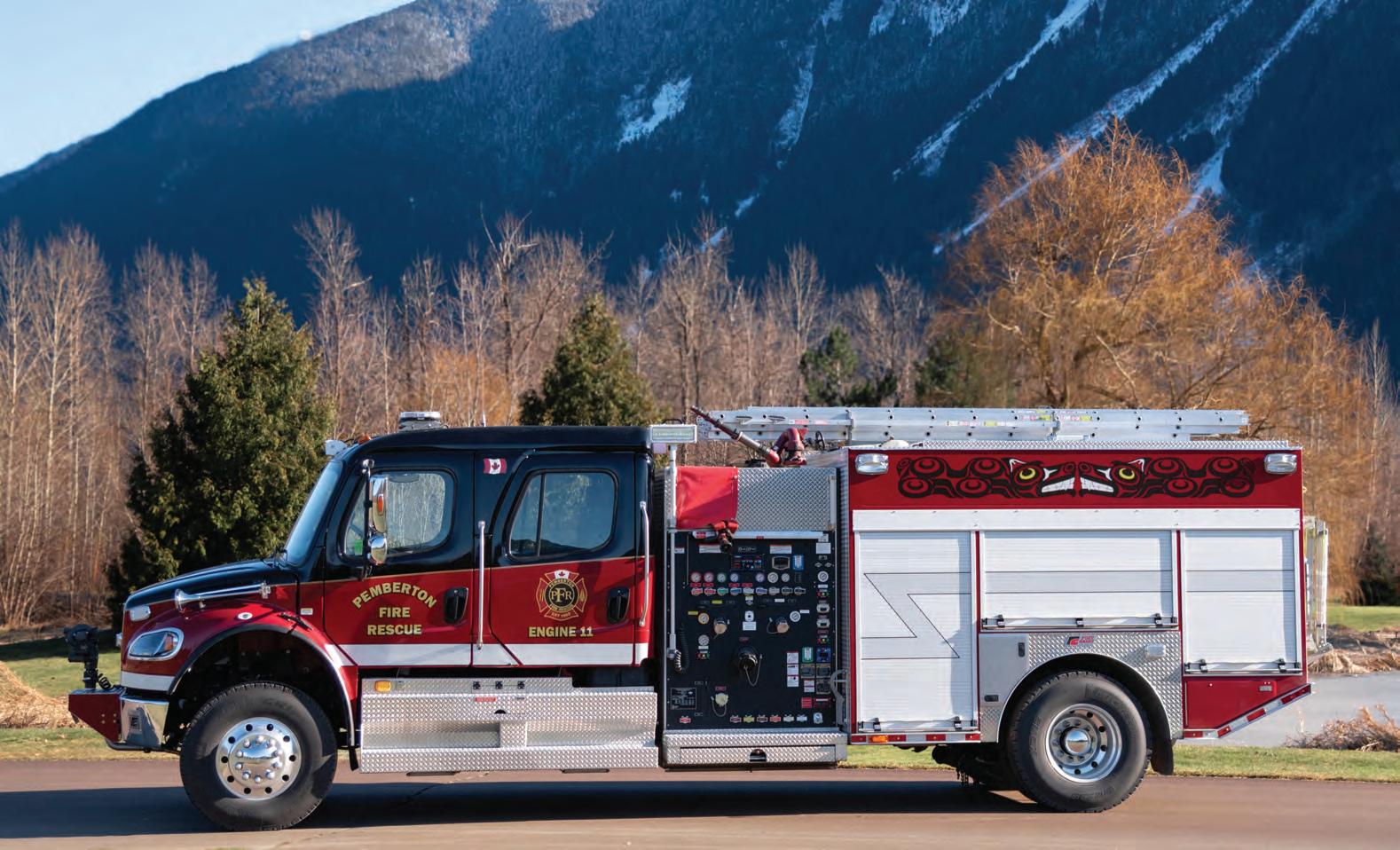
Pemberton Fire Rescue and Líl’wat Nation artist collaborate on new engine art
LEVI NELSON CREATED THE DESIGN OF TWO WOLVES ADORNING ENGINE 11
BY HILARY ANGUS
PEMBERTON FIRE Rescue and the Líl’wat Nation are celebrating the unveiling of an artistic collaboration on a new fire engine, which both say represents the strong partnership between their communities.
Engine 11 is emblazoned with two crouching wolves facing each other in a Coast Salish style, designed by Líl’wat artist Levi Nelson.
“I thought about firefighters and how they work as a pack to save lives,” Nelson said. “I think that there’s something very heroic about that, and I think wolves are a good symbol of that.”
Nelson initially saw the fire department’s call for artists in a social media post, and said he envisioned the design immediately in his head.
“Wolves represent community and protection,” he said.
Nelson, who returned to Mount Currie in 2023 after completing his
master’s in Fine Arts in New York, said the relationship between the Nation and the fire department is valued highly in the community.
“In my experience in emergency situations, the fire department has been the first to show up,” he said. Nelson
the Nation, said the collaboration on the fire engine is a gesture of reconciliation between the two communities.
“We’ve all been in this valley a long time,” Bruce said, mentioning that the longstanding relationship between members of the Nation and the settler community extends back to
“I think this design on the truck is a sort of symblic branch between Pemberton and our community.”
- LEVI NELSON
mentioned a grass fire last year in which Pemberton Fire Rescue worked together with the Nation’s volunteer fire department to put out the blaze.
“It just creates a real sense of community, and I think this design on the truck is sort of symbolic of the branch between Pemberton and our community,” he said.
Maxine Bruce, an elected leader for
her parents’ days.
“To prioritize the relationship is so very important,” Bruce said. “I connect it to the concept of what is reconciliation, it’s just people helping people.”
Roxanne Joe, another elected leader for the Nation, agreed that the collaboration fits the definition of reconciliation—restoring a relationship that was once there.
“In the good old days, the communities connected, and everybody knew each other, families intermarried,” Joe said.
“As the community grows, I feel like it’s important to recognize that we share a lot of the same services in these towns,” Joe said. “Responding to an emergency has no borders.”
Joe also said the engine artwork is “a beautiful reminder” of the critical role all of the local first responders play in keeping the communities in the valley safe.
“I know how hard they work,” Joe said. “I see the sacrifices that they make.”
Pemberton Fire Rescue Chief Cameron Adams said the department is grateful for the opportunity to continue strengthening the relationships between the two communities through this collaboration.
“As firefighters, we’re entrusted to protect people, homes, infrastructure, but we’re also protecting something more. We’re protecting the land, the Lil’wat Nation’s land itself—the forest, the mountains, and the cultural significance that it holds,” Adams said.
“To be able to have that responsibility really is carrying an honour.” n
SYMBOLIC BRANCH The Pemberton Fire Rescue Service’s newly decorated engine.
PHOTO COURTESY OF THE VILLAGE OF PEMBERTON
Pemberton Animal Wellbeing Society appeals to the Village for a bigger facility
PAWS HAS OUTGROWN ITS CURRENT 300-SQUARE-FOOT TRAILER, AND IS REQUESTING A LARGER DEDICATED SPACE
BY HILARY ANGUS
THE PEMBERTON Animal Wellbeing Society (PAWS) is seeking a larger, permanent home to continue its animal rescue operation in the Valley.
PAWS’ executive director Erinne Tapp went before the committee of the whole on April 28 to initiate a conversation with Village council about a potential move.
“The demand for our services has grown. The scope of our services has also expanded based on community needs,” Tapp said. “Ultimately we’re running out of space, we can’t keep up.”
PAWS has been operating out of a 300-square-foot trailer at 1830 Airport Rd. for the past 20 years. The trailer and yard are provided by the Village.
She said meeting with council members last week was “the beginning of the conversation” in what she hopes will be a medium- or long-term acquisition of a larger, permanent space for the organization.
“Our current space, while functional, just isn’t able to sustain even our current capacity. We have to turn animals away almost weekly, if not monthly,” Tapp said.
In 2025, the organization successfully got 122 animals adopted, spayed and neutered nearly 20 animals, supported the RCMP with the rehoming of eight cats from a hoarding situation, and supported pet owners who were being housed in the Líľwat Nation Transition House (Stqaka7stúmc).
Tapp said there are many organizations in the Valley that support humans facing difficult life
circumstances, but none of them are able to support the pets of those individuals.
“PAWS is often called upon to try and assist with pets in those situations, and because of our limited infrastructure, we can’t always,” she said.
As Pemberton continues to grow, Tapp expects the demand for their services to increase as well.
PAWS is hoping to work with the Village on securing a new building with a minimum of 900 square feet of indoor space, compared to their current 300. That would enable them to accommodate isolation protocols for animals that need to be separated, and would provide heated indoor space for dogs.
At the current location, the dogs are kennelled outdoors with minimallysized heated bedrooms.
A larger space would also reduce the logistical burden on the largely volunteer-run organization. PAWS has 32 regular volunteers who contribute 3,000 hours to keep the shelter operating.
Pemberton Mayor Mike Richman said, though officials understand that PAWS has been operating above capacity “for some time,” the Village does not have much available land to move them into.
“It’s a tough one, but we hear you, and we really appreciate what you’re doing out there,” Richman said in the meeting, adding that the Village will keep PAWS in mind if more space becomes available as the town develops.
Richman also encouraged Tapp to reach out to the Squamish-Lillooet Regional District for potential funding, as PAWS’ work extends beyond the borders of the municipality of Pemberton. n
Learnings from a decade of working in the outdoor industry
WORKING AROUND bikes always came naturally to me. In my early teenage years, I was that annoying shop rat, hanging around my local bike shop long enough until the owner let me work building bikes for the Christmas buying rush. The shop
BY VINCE SHULEY
was also the meeting spot for Sunday social rides with the mountain bike club, where we’d all proudly don our bright spandex and ride something resembling singletrack in the backwoods of southeast Queensland. After a few years of uneventful racing, I took a break from mountain biking to travel and made skiing my focus. When I ended up back in Whistler in 2009 (my first real summer here), bikes re-entered my life with guns blazing. From friends and friends of friends, I bought a Kona Kikapu for pedalling and a Devinci Wilson for downhilling in the Whistler Mountain Bike Park. Having learned to mountain bike on steep-angled hardtails, I took to the Whistler trails voraciously and quickly felt comfortable on the advanced and expert trails. I was hooked all over again.
It was around this time that my writing and photography career was getting going. And what was I writing about and taking photos of? Mountain biking, of course. Or more specifically, mountain bike road trips around B.C., and the world.
While the magazine bylines were great for my credibility (and ego), I was still on the periphery of the bike industry. It wasn’t until I got a gig writing for Squamish mountain bike film studio Anthill Films (about 10 years ago now) that I began to see how it all works from the inside. That experience followed me into many other contracts, and eventually to working in-house as a copywriter for a bike suspension brand.
Last week, that 10-year stretch of working in the mountain bike industry came to an end. It was my choice to leave and pursue something new, but I’m thankful for all the employers and clients I’ve had over the years. They have shaped who I am as a creative and have fuelled my passion for the sport even further.
Working in this industry has taught me a few lessons. So for anyone thinking about entering it, staying in it, or (like me) considering some new horizons after a few years, here’s what I got.
THE INDUSTRY ‘IS WHAT IT IS’
Veterans in action sports industries know this one all too well. Building, marketing and selling bike equipment may seem like a huge thing here in the Sea to Sky. But in the global context, it’s a flea on the back of an elephant. Marketing budgets are tight. With some exceptions, salaries are generally lower when compared to
mainstream industries. It was legendary ski photographer Blake Jorgensen who told me once during an interview, “Some people think that after so many years of service, the industry should do more for them. But the truth is, the industry doesn’t owe you anything. It just is what it is. If you want to grow beyond that, it’s up to you to make the change.”
PRO DEALS DON’T PAY BILLS
Anyone who has worked in a bike shop (or any outdoor retailer) knows that the deals you get are pretty awesome. The majority of my garage and gear closet is filled with pro deal gear that I acquired over years of working in shops or knowing someone with a discount code. When you work in-house for a brand, those deals can get even better, to a point where you feel it’s necessary to take advantage of them to validate your employment. However, once you have one of everything, buying new stuff isn’t saving you any money at all. The gear churn slows down, and pro deals become yet another perk that doesn’t pay your cost-of-living expenses.
GROWTH CAN FEEL LIMITED
This follows on from the first point. Outdoor industry professionals tend to stay put once they reach senior positions, which can limit the growth of junior personnel. With so much competition to work in the space, it can feel like employers can view working in the industry as a privilege in itself, leading to less attractive working conditions for less pay. Just because you’ve done your
time in the trenches doesn’t mean you’ll be rewarded with raises and promotions.
COMBINING
YOUR
WORK AND RECREATION ISN’T ALWAYS THE ‘DREAM JOB’
From the outsider looking in (pardon the pun), working for an outdoor brand seems like the perfect way to combine your work and passion. During my early years of outdoor industry work, I wore my job as a badge of honour, thinking it was so much cooler than the typical corporate grind. Some days, it definitely was. But after a few years, I started to see the same cycles repeating with the work (how many different ways can you describe the euphoric feeling you get skiing powder or riding loamy singletrack?). Just because you’re working in front of a computer in B2B sales doesn’t mean you can’t ski and mountain bike as much as everyone else. In some cases, the more mundanelooking jobs offer more pay, more vacation and more freedom to actually enjoy your passions, rather than just be associated with it through your job.
I won’t say I’ll never go back to the outdoor industry. But just like leaving Whistler—even for a couple weeks of vacation—can make you appreciate where you live and play even more, stepping outside of the outdoor industry might reignite the passion down the line.
Vince Shuley is excited for new career horizons. For questions, comments or suggestions for The Outsider, email vince.shuley@gmail.com or Instagram @whis_vince. n
WELLNESS, CL OSETOHOME
Thisspring, recieveacomplimentary treatmentenhancement, welcomebeverage, andpoolaccessatFourSeasons Resort andResidences Whistler when youbooka massage, body treatment,or facial at The Spa.
Exclusiveofferfor BC Residents. AvailableMay 11 to June 12.
Summer camp is much more than a chance for children to spend a week—or several—away from home. It can be a transformative experience for your child. Have you considered enrolling your little one in a summer getaway? Here are some of the benefits holiday camps offer young people.
IMPROVED SOCIAL SKILLS
A little time away from the family environment gives children a chance to meet new people and make friends. They can develop their ability to communicate with others, which will serve them well as they build fulfilling relationships throughout their lives.
EMOTIONAL SELF-REGULATION
When a child is removed from their daily routine, they become more aware of how their actions affect other people. By learning to express feelings of disappointment or frustration without resorting to acting out or insulting others, they can improve their ability to manage their emotions in healthy ways.
The advantage is twofold: your child learns to express difficult emotions effectively, and they also gain an appreciation for positive interactions. Parents often observe increased enthusiasm and sociability in their children after they return home from camp.
HEALTHY INDEPENDENCE
Your child can increase their self-worth from the sense of satisfaction they feel after participating in activities or facing new challenges outside of home or school. Their improved self-esteem can help them feel more self-sufficient, which may prove useful when they shift into post-secondary studies or move away from home.
In short, summer camp can truly help your child move more confidently through the world. Explore the options available to you!
Newspaper Toolbox
June 29 to August 28 2026
Fine Arts, Cooking, Music, Drama, and Wilderness Camps for ages 6-12
Every week features a new activity theme with five different sports to explore!
Based in Cheakamus/Whistler
Have Questions? Contact Tami Mitchell: tmitchell@whistlersportlegacies com or 604-964-0031
The West’s snow drought meant record dryness—but also record flooding
BY ANNA MARIJA HELT HIGH COUNTRY NEWS
Old snow crunched underfoot in mid-January as a dozen people snowshoed near Molas Pass in Colorado’s San Juan Mountains.
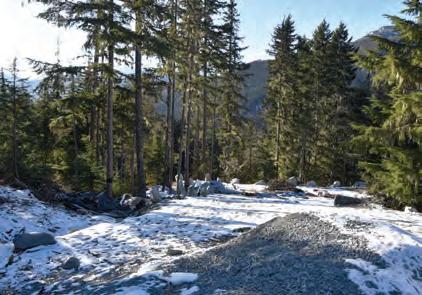
The interpretive hike, hosted by local environmental organizations, covered ecology, climate change and snow. It was the perfect classroom: below an azure sky, bare ground beneath trailside spruces and pines was a local example of what turned out to be a devastating lack of snow across the West.
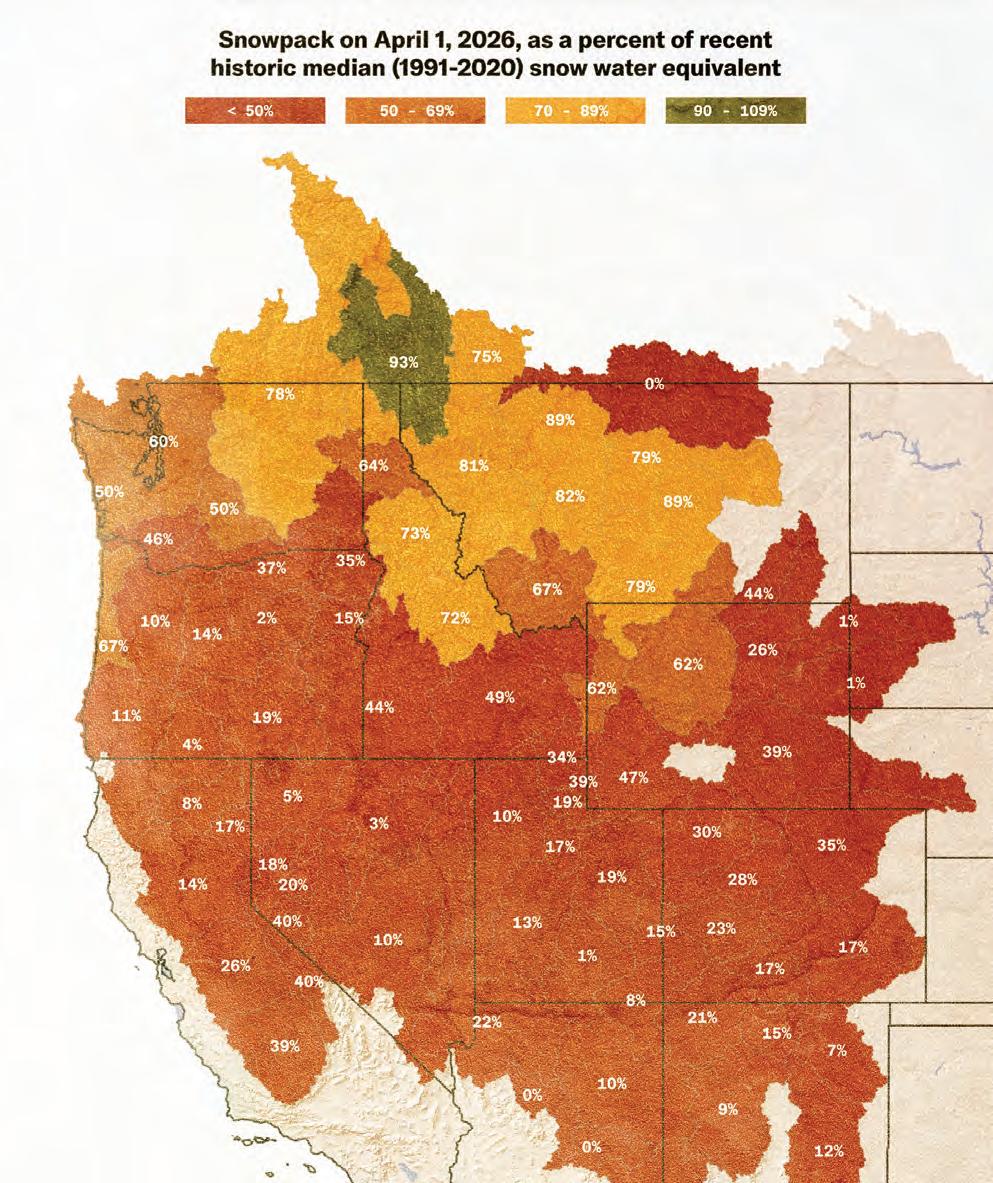
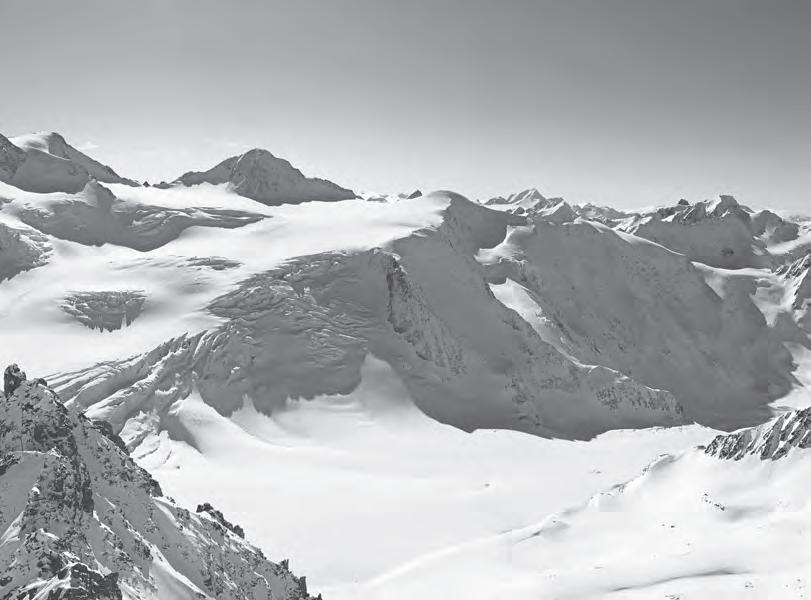
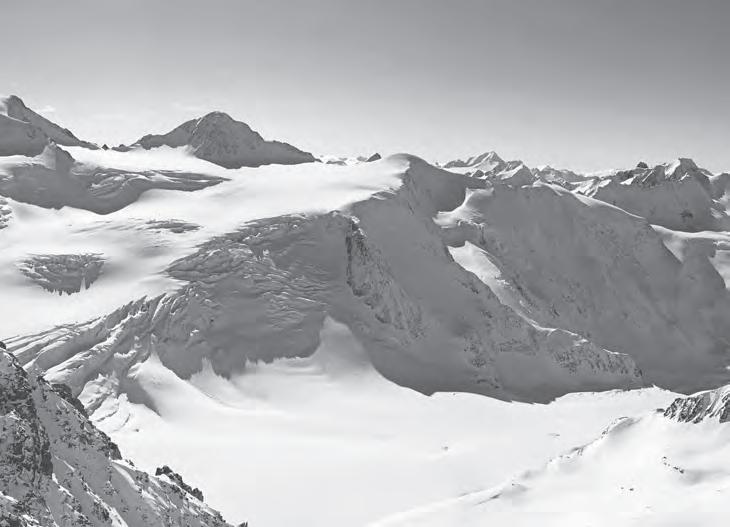
Mountain snowpack is the West’s largest reservoir, providing water for 100 million people and diverse ecosystems. The amount of water stored in the snowpack historically peaks around April 1. But this year, the snowpack in many places was absent, or nearly so, by then—the lowest level in the 45 years since automated measurements began.
A stubborn high-pressure ridge contributed to the snow drought by shunting winter storms north to Canada in January. But the main culprit, according to the non-profit Climate Central, was exceptional heat from climate change, which also caused a spring heat wave that decimated what snow there was at a time when other dry winters have seen “miracle March” snowstorms.
The lack of snow was unusually widespread across the Western U.S. But considering it as a whole makes it easier to miss the regional manifestations and implications of a winter that also brought record flooding and record dryness in addition to record heat. Here’s how the snow drought played out in a few regions that exemplify this winter’s variability:
Whiplash Washington’sinCascades
Winter in Washington’s Cascade Range started and ended in “wet” snow drought—with precipitation falling as rain instead of snow. In December, more than two feet (61 cm) of rain fell in two weeks in some places, melting much of the nascent snowpack and causing catastrophic flooding west of the Cascades. But it also replenished reservoirs in the Yakima Basin, on the drier eastern side of the range, which were only eight per cent full in October, a quarter of their normal volume.
Dry snow drought hit in January, when little precipitation fell. While pockets of Washington’s Cascades saw near-normal precipitation in February, most of the mountains stayed dry, and the range’s snowpack remained well below average. Then, despite several feet of snow landing in March, rain followed and washed it away.
That’s a problem for the Yakima Basin, which lacks the reservoir capacity to store enough runoff to meet the region’s needs. The snowpack typically serves as an additional reservoir, storing water as snow into summer, said hydrogeologist and geochemist Carey Gazis of Central Washington University in Ellensburg.
South of Ellensburg lies the Yakima Valley—the “fruit bowl of the nation”—where snowmelt is essential for irrigating crops, including cherries, apples, grapes, hops and mint. It also supports the Yakama Nation’s efforts to restore populations of culturally important migratory fish. As of March, the Bureau of Reclamation forecasted that many farmers in the Yakima Valley
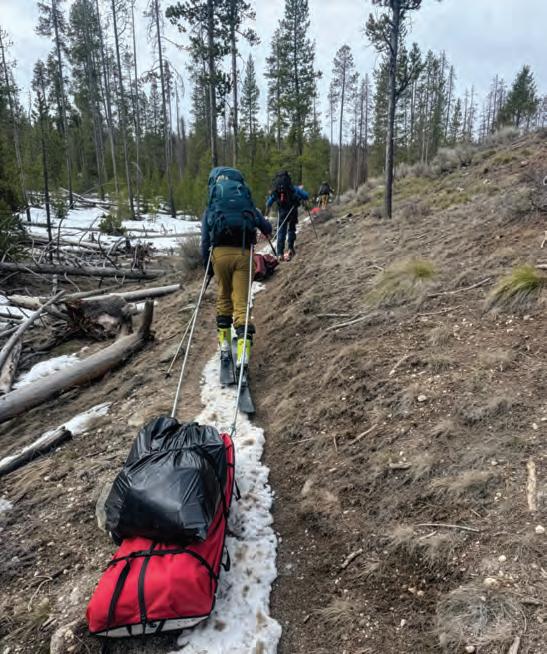
Environmental Resource Center (ERC) employees haul loads of gear and supplies into Bench Hut in late March in Idaho’s Sawtooth Mountains for their annual woodcut over a mix of dirt, rocks and snow.
Courtesy of Ashton Wilson/ Environmental Resource Center
would receive just 44 per cent of their usual water supply this growing season due to the snow drought.
One long-term solution is to create more water storage by augmenting aquifers. “There’s all this space under the surface that can hold more water,” said Gazis, who studies such processes. Projects pumping runoff or enhancing passive water infiltration into the ground are already happening in parts of the basin, including on the Yakama Nation reservation.
Northern Rocky Mountain high
As in Washington’s Cascades, winter in the Rocky Mountains of Idaho, Montana and western Wyoming was bookended by wet snow droughts, with a dry January in between. However, colder temperatures at higher elevations allowed for a near- to above-average snowpack in some areas that persisted into mid-March, leaving them in better shape than most of the West in early April.
That helped places dependent on winter tourism, such as Idaho’s Wood River Valley. “It’s as busy as ever, if not a little busier, because we have snow,” unlike many other winter destinations, such as those in Colorado, said the director of the valley’s Environmental Resource Center, Ashton Wilson, in February.
Additionally, Russell Qualls, Idaho’s state climatologist, speculated that the Wood River Basin and others nearby may do “fairly well” this summer in terms of providing water for the towns and agriculture that depend on them.
But little to no snow at middle and lower elevations in Idaho, Wyoming and Montana—and ongoing unseasonable heat—might mean a long fire season unless sufficient rain arrives in spring and summer. Indeed, while fire season usually starts in May or June in Montana and Wyoming, both states experienced wildfires over 1,000 acres (405 hectares) in March.
But high and dry in Colorado
Colorado also experienced such medium-sized wildfires, but they started much earlier—in December. Both December and January were abnormally dry, and one of the few storms that did arrive dropped rain at up to 11,000 feet—unusually high for winter, and unprecedented in much of Colorado.
This was evident at the January snowshoe hike near Molas Pass, led by the San Juan Mountains Association
and Mountain Studies Institute. Outdoor educator Colin Courtney guided attendees wielding avalanche shovels in digging a snow pit to measure the snowpack’s depth and water content. With a dull thunk, shovel blades hit dirt just two feet down. As he melted snow samples over a camp stove, Courtney noted that the snowpack at the pass held 23 per cent as much water as in an average year—the snow water equivalent, a more meaningful measurement than depth alone when planning for annual water needs and wildfire risk. “It’s a very real thing to be concerned this year,” said Courtney.
There are ecological threats, too. Research in New Hampshire and Finland has shown complicated effects on tree health when root systems lack an insulating layer of snow during winter. The impact on trees here— already stressed from the worst megadrought in 1,200 years—isn’t known.
“This is our worst snowpack on record,” wrote climatologist Allie Mazurek of the Colorado Climate Center in an early April email. She blamed the West’s record-breaking March heat wave for tipping the state beyond its prior historic low, in 1981.
Denver has already initiated water restrictions. But the implications go beyond state lines: Colorado’s snowpack also provides water to 18 other states, dozens
of tribal nations and parts of Mexico. The Colorado River Basin provides drinking water for one in 10 people in the U.S., irrigates more than 5 million acres (or about 2 million hectares) of cropland and generates substantial hydroelectric power. This year’s snow drought is exacerbating an already fraught fight among the seven states in the Colorado Basin over how to manage the dwindling river.
“One caveat to some of this is El Niño,” wrote Mazurek. The climate pattern may bring lots of rain to Colorado, and forecasters expect it to develop in early fall. “Still, rain tends to do much less for our water supply than snow,” she added.
And snow is a resource that will likely be in shorter and shorter supply in the years to come in the West, where researchers expect climate change to shrink snow-supplied water by about a quarter by mid-century. Mazurek summed up the region’s predicament succinctly: “We should probably be preparing for less water to be coming down from the mountain snowpack than usual.”
This article appeared in the May 2026 print edition of High Country News. www.hcn.org/issues/58-5/ the-wests-snow-drought-meant-record-dryness-butalso-record-flooding/ n
SNOWPACK ON APRIL 1, 2026, AS A PER CENT OF RECENT HISTORIC MEDIAN (1991-2020) SNOW WATER EQUIVALENT
This map from the USDA’s Natural Resources Conservation Services shows snow-water equivalent (SWE) as of April 1 (near the typical peak of snowpack in the Western U.S.). The current SWE is shown as a percentage of the recent historical median SWE.
United States Department of Agriculture
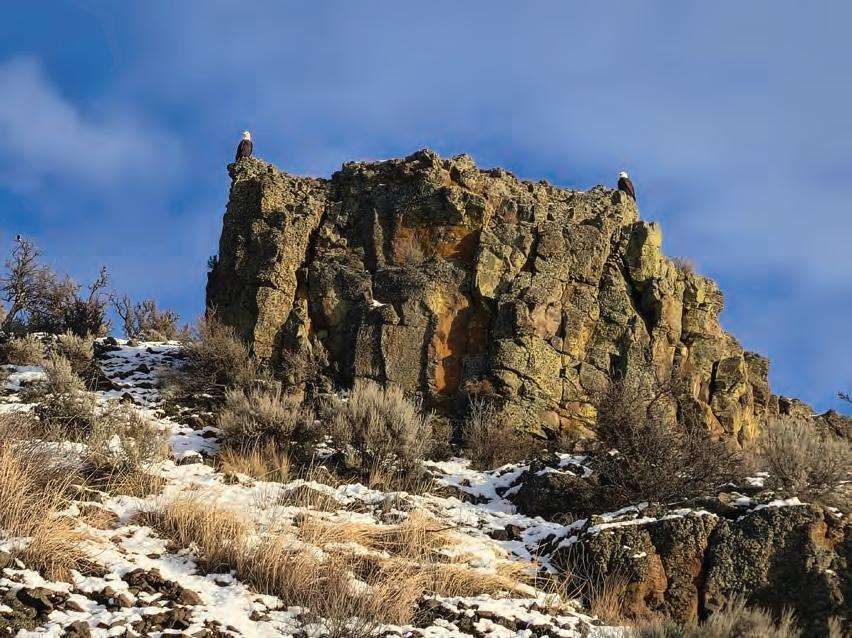
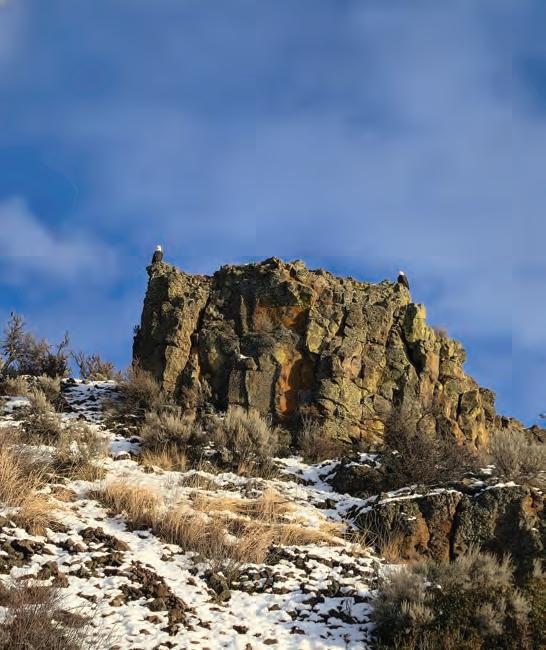
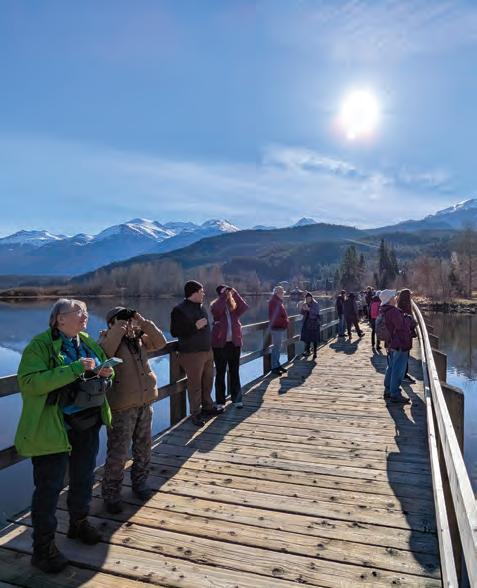
Little snow covers the ground where two bald eagles perch atop a rock near Cooke Canyon about 10 miles northeast of Ellensberg, Washington, last December.
Courtesy of Megan Walsh/ Central Washington University
WHISTLERITE HAS TWO OVERALL NORAM CUP TITLES UNDER HER BELT
BY DAVID SONG
KENNEDY JUSTINEN wants people to know that it’s never too late to change their lives.
She preaches that message because she practiced it, taking up snowboard cross at 21 years old after beating a group of friends in a recreational race. Her dream wasn’t a sure bet, for the Rocky Mountain House, Alta. native focused on other sports as a youth while most of her rivals started competing early.
Yet Justinen beat the odds, achieving two NorAm Cup overall titles (2023, 2026), a third-place NorAm overall (2022) and a top-12 World Cup result this March in Mont-Sainte-Anne, Que. She will turn 30 in June, but intends to continue jockeying for position against more experienced Olympian teammates like Meryeta O’Dine and Audrey McManiman.
“I’d like to really make top-16s a consistent thing for myself and build that into who I am as a rider,” said Justinen. “A lot of the time, I was legitimately
building technical skills to be able to ride with a fairly high risk level … which is necessary to perform at that World Cup level. Now I feel like those things have really solidified for me.”
Speaking of risk: ornery winds buffeted Justinen during a 2024 time trial in Mont-Sainte-Anne, causing her to land short on a jump and wreck one knee.
“I’ve been fortunate to have some support from my family and also sponsors so I was able to completely focus on rehab for the first four months before going back to work … being able to completely treat myself like a pro athlete.”
Returning to competition 10 months after surgery, Justinen had missed most qualification races leading up to Milano
“I think it’s really important for young girls to have people they can look up to in [active] communities.”
- KENNEDY JUSTINEN
A doctor described that particular ACL as “a ropey mess” while informing her that her posterior meniscus was also torn.
Justinen lauds her medical staff for their diligence and care.
“We just took the whole thing super seriously. I have a mindset coach, too, and our main thing was to approach the rehab as if it were going to make me a better athlete,” she elaborated. “I just maintained that mindset throughout every single phase, approaching what the physio had set out for me to my literal best ability.
Cortina 2026 but remained eligible for an Olympic berth. Audaciously she tried to make it happen, fell short, but continues to hold her head high.
‘IT MAINLY COMES BACK TO MINDSET’
Despite begging her parents to switch from skis to snowboarding while young, Justinen once took a cautious approach. Elite training programs were not available in Rocky Mountain House (a farming town and oil field hotspot) and she didn’t want to get injured riding casually because that
would have meant time off her initial sport of choice: basketball.
Now the priorities have shifted.
“It mainly comes back to mindset, how you perceive yourself and where you want to go, then knowing what that version of you looks like at the top,” remarked Justinen. “Then you have to just accept that every phase along the way has to be part of [your journey]. Now I downhill bike in the summer … I do not want to push myself on the mountain bike and get injured. I reserve all my risk for my main sport.”
The pursuit of snowboarding led Justinen to Whistler in 2019, where she linked up with a coach. Two years after that, she moved to the Sea to Sky region and loves being in “an extreme sports mecca” with lots of talented athletes to motivate her development. Now the soon-to-be 30-year-old hopes to galvanize others into action as well.
“Highlighting women in sports is really important right now and a really cool opportunity,” she said. “There’s a huge [driving force] online right now for people to support businesses that are supporting female athletes—we’re seeing this a lot in pro basketball, pro soccer. I just want to help be an advocate for all women in sports.
“I think it’s really important for young girls to have people they can look up to in [active] communities.” n
IN BLOOM Whistler’s Kennedy Justinen during a timed World Cup qualification run in China.
PHOTO COURTESY OF KENNEDY JUSTINEN
PHOTO BY ALEX WEISS / UNIVERSITY OF VERMONT
Sara Stiel completes eye-opening freshman campaign at University of Vermont
THE WHISTLER MOUNTAIN SKI CLUB ALUMNA PLACED 28TH AT THE 2026 NCAA CHAMPIONSHIPS
BY DAVID SONG
SARA STIEL enjoyed a rather whimsical beginning to her ski journey.
Her family home in Pemberton boasts a long driveway. That inspired her dad Phil to erect flower pots along its roughly 200-metre length, marking out an improvised course for Stiel and other neighbourhood kids to traverse before hauling them back up top via snowmobile.
Unorthodox, perhaps, but effective. Stiel joined the Whistler Mountain Ski Club (WMSC) and made her way up to the U16 age bracket before COVID hit. Then she moved to East Burke, Vt. to finish her secondary education at Burke Mountain Academy (BMA).
You may have heard of at least one other BMA alum: Mikaela Shiffrin, the most decorated World Cup skier in history.
“The school was designed as a ski academy, so even if COVID wasn’t going on, they had more support if you were trying to excel in sport and a really great community in general,” Stiel said. “It was a smaller hill, something that I wasn’t really used to. I grew up ski racing, but also doing a lot of big-mountain skiing and [there] wasn’t a lot of big-mountain skiing at Burke. It was train, train, train all the time, and I think that really helped me focus a lot more.
“Honestly, [moving to BMA] was a really great thing for me. It really pushed me out of my comfort zone to be away from home and having to make new friends, new connections.”
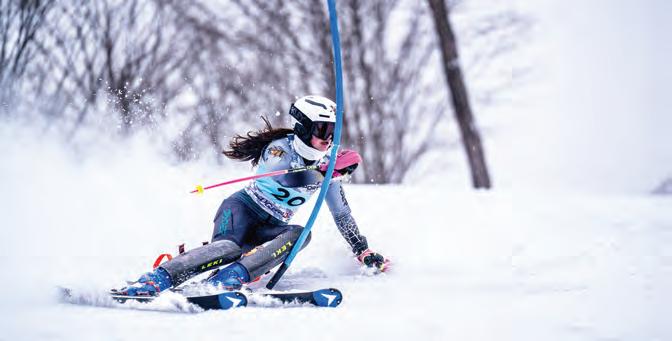
Stiel has obviously grown to like it in New England, for she is now attending the University of Vermont (UVM) as a student-athlete. Recently she was named the Eastern Intercollegiate Ski Association (EISA) Women’s Alpine Rookie of the Year and finished 28th in slalom at the 2026 NCAA Championships.
AdultProgr ms AdultPrograms
Unfortunately, Stiel sprained her ankle in February: three-odd weeks before the Championships took place in Park City, Utah. Coaches put her on the team anyway, perhaps due to her excellent overall body of work as a freshman.
Grappling with warm weather and poor snow conditions as well as her injury’s lingering effects, the Pembertonian lost her balance but was allowed to hike back into the course (a move disallowed in FIS races).
“I definitely would have loved to be 100 per cent for those races because that’s a hill I’ve skied on before,” remarked Stiel. “[The Championships] were scored as a team event with both Nordic and alpine skiers, so every last push matters. Those points, even though I only got two of them, still mattered for our scoring. It’s really all about the team and you just have to try your best … you may not get the results that you want, but if you just keep going, eventually they will come.”
Stiel’s gritty performance helped UVM to a fifth-overall result with 334 points as the University of Utah emerged victorious on home turf (549.5).
When asked to reflect on her first year competing with the NCAA, she said: “Definitely this is one of the greatest teams I’ve ever been a part of—coaches included, physical trainers, everyone has been so amazing. The team spirit is just amazing. I hope that I can bring the amount of support and encouragement that I have here into other aspects of my life for my friends and my family.
“My goals going forward would just be to build off this season. As a freshman, I was very successful and I’m super proud of myself for that, but I would definitely like to keep going.”
With UVM’s Second-Team AllAmerican Cydnie Timmermann graduating, Stiel should have her fair share of opportunities to fill the void and establish herself as a premier talent at the collegiate level. n
NERVES OF STIEL Whistler’s Sara Stiel during a ski race for the University of Vermont.
Whistler ROCKS celebrates 1,000 meals delivered
FOUNDER NATALIE KINGI EXPRESSED GRATITUDE FOR COMMUNITY SUPPORT WHILE EMPHASIZING THE NON-PROFIT’S NEED FOR A PERMANENT VENUE
BY DAVID SONG
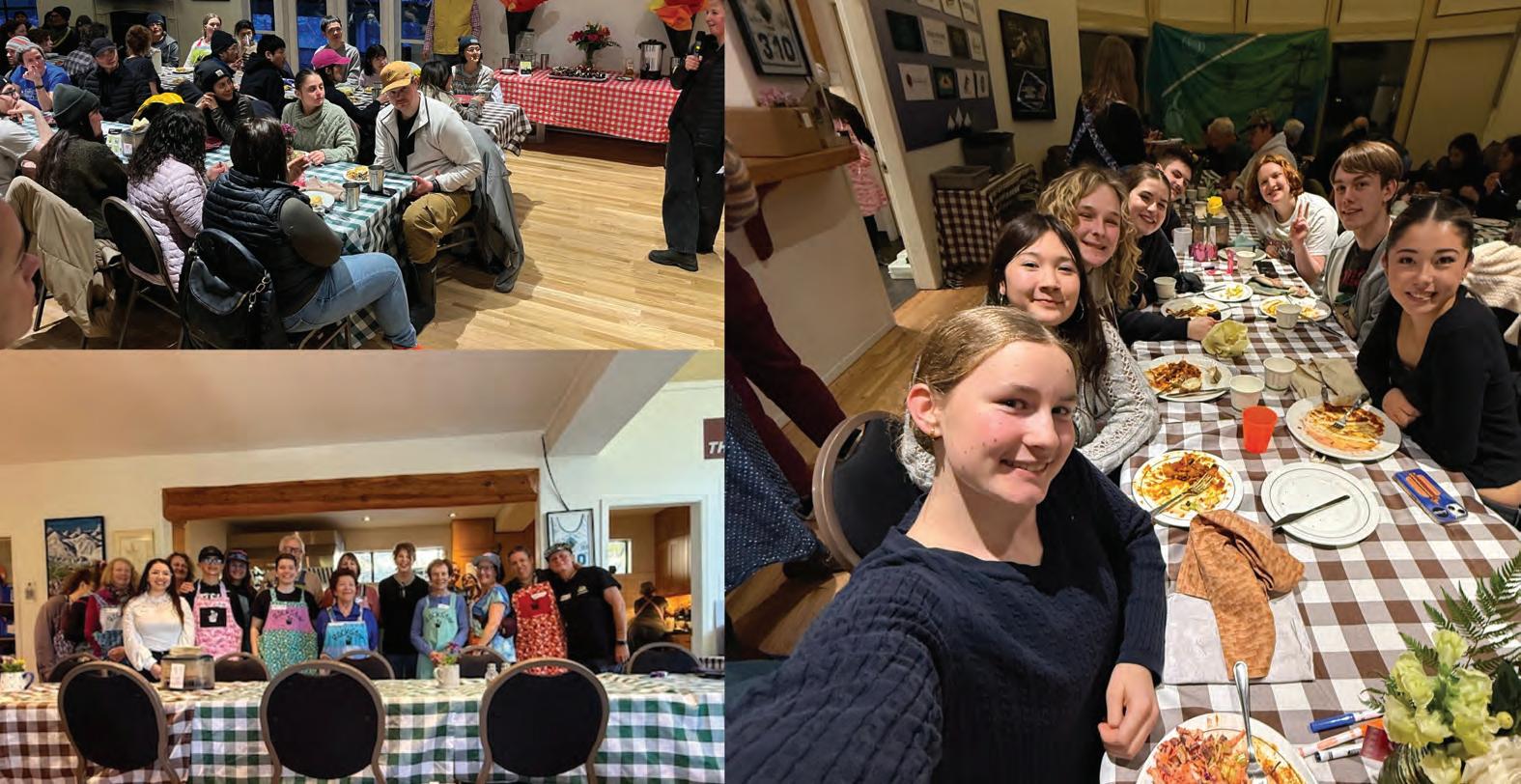
ON MAY 28, 2025, Natalie Kingi and her peers brought an idea before local fundraising group 100 Women Whistler as “a collective bundle of nerves.” They had in mind a goal to serve 1,000 hot meals to people in need by way of their non-profit organization, the Whistler Recreate Our Community Kitchen Society (ROCKS).
100 Women provided funding, but a viable venue remained out of reach until the Whistler Mountain Ski Club (WMSC) agreed to help. Nearly a year later, on April 13, ROCKS fulfilled its promise.
Dinner No. 1,000 went to a man named Olly, an unsuspecting guest in the middle of savouring his butter chicken when ROCKS board members started to party. Surrounding him, they cheered and rang bells to commemorate the milestone. Olly took it in stride, fitting as he has attended 10 out of 11 ROCKS meals to date.
Kingi stressed that the achievement would not have happened without key contributions from various sponsors, partners and other community members.
“So many people are willing to step in, step up, and help in so many different ways,” she remarked. “There’s no surprises about what’s been [going on] with all the stuff that’s been communicated lately in our community … minimum wage, the living wage and the food bank [usage] increases, so our hot meals came in really timely over this winter. All of that has
their community. They meet weekly at the Youth Centre, where Bridgit Muldoon is employed. Kingi had previously discussed ROCKS with Muldoon, who subsequently connected her with the young Rotarians.
Interact then held its annual fundraiser on April 15 in ROCKS’ name at the Whistler Youth Centre, raising $3,100:
“So many people are willing to step in, step up, and help in so many different ways.”
- NATALIE KINGI
given us the energy as a board, and me personally, to keep going.”
ROCKS staff now aspire to hit 2,000 meals. Additional funding from the Whistler Community Foundation ($5,000), donations received over the past year ($5,000) and Resort Municipality of Whistler ($4,000) will help, as well as support from an unexpected source.
KEEPING MOMENTUM
The Interact Club of Whistler is essentially a rotary club for youth aged 12 to 18 who want to make a difference in
enough to cover 300 dinners. Kingi and her organization now have the money to serve an additional 1,300 meals beyond what they’ve already done.
“Oh my goodness, these young kids just did an incredible job,” Kingi gushed. “They organized a silent auction and a bake-off auction for dessert, invited their friends and family, etc. This hasn’t happened for us before, i.e., somebody fundraising on our behalf, so we weren’t quite sure what to expect but these guys just rocked it.”
Unfortunately, the lack of a long-term
venue could threaten to stall momentum. Vancouver Coastal Health recently notified Kingi that her organization has used eight out of an allotted 14 temporary food permits to serve at the WMSC clubhouse. One potential place, the former Le Gros restaurant site near Tamarisk, has already been deemed non-viable.
Kingi is exploring some new options, for instance a mobile kitchen that can be erected in various locations. However, any mobile arrangement would need to accommodate ROCKS’ mission of providing communal, sit-down dinners instead of simply food to go.
“Over the summer, we’re looking at doing a ROCKS-on-the-road kind of style where we go to other venues, but it’s dependent on a lot of extra logistics,” Kingi elaborated. “If we want to do [an event] in between the ski club ones at an outdoor venue, we can maybe use a commissary kitchen and transport the food—but it’s all [a band-aid solution].
“But because of how incredible the response has been from the community, our guests and everyone, the effort is always rewarded. It’s about sustainability now to prove that we can keep up the momentum. We do have a lot of people who keep reaching out to us saying ‘how can we help?’ And our first one is: ‘do you have a venue?’”
Visit whistler-rocks.ca/ to learn more. n
ROCK ‘N’ ROLL A collage of images from various Whistler ROCKS community dinners.
PHOTO COURTESY OF NATALIE KINGI
MEADOWPARKSPORTSCENTRE
SWIM • SKATE • SWEAT •
SQUASH
OPEN DAILY: 6a.m.to9p.m. *someexceptionsapply
F FLEXIBLEREGISTRATION Flex-reg’classeshavea separatefeeand allowyoutoregisterfor classesonthedaysthatfit yourschedule.
R REGISTEREDFITNESS Registeredfitnessclasses haveaseparatefeeanda definedstartandenddate. Pre-registrationisrequired fortheentire setofclasses.
I INCLUDEDFITNESS Theseclassesareincluded withyourpriceofadmission fornoextracharge. POOLHOURS MAY 8MAY 9MAY10MAY11MAY12MAY13MAY14 FRIDAYSATURDAYSUNDAYMONDAYTUESDAY WEDNESDAY THURSDAY LAP POOL
Whistler Summer Concert Series returns with Steven Page Trio on Canada Day
OTHER MUSICIANS LIKE THE TREWS AND SKIITOUR ARE ALSO SCHEDULED ALONGSIDE POPULAR MOVIES LIKE JURASSIC WORLD
BY DAVID SONG
WHEN ASKED how many Whistler Summer Concert Series events he’s attended, Mayor Jack Crompton quipped: “I can’t count that high. I get out to as many as I possibly can every summer.”
He’s far from alone. The Concert Series is one of Whistler’s grandest arts offerings, managing to marshal elite talent like Blackie and the Rodeo Kings, Walk off the Earth and Bahamas in recent years. In 2026 another highly decorated act is poised to light up Olympic Plaza on Canada Day: the Steven Page Trio and String Quartet.
Page, a Canadian Music Hall of Fame inductee, is one of entertainment’s most recognized figures and may best be known as co-founder, vocalist and songwriter with two-time Grammy nominated band Barenaked Ladies. As a solo artist, Page has continued his musical journey of performing and writing whilst appearing in film, theatre and television. He is an acclaimed public speaker on the topic of mental health.
Joining him on stage are Craig Northey from the band Odds on guitar and the multi-talented Kevin Fox using
a cello to bring exquisite three-part harmonies to life. This trio will further be accompanied by a string quartet composed of some of Canada’s finest classical musicians.
“We look forward to welcoming back annual concertgoers while inviting brand new faces to experience the magnetic appeal of the Summer Concert Series,” says Crompton in a press release. “Each year, the Village comes alive with music, connection, and a shared energy that brings
acts on Canada Day I think is pretty special,” Crompton remarks. “This year will be no different as Steven Page really has been the soundtrack for Canada for a long time. One of the major considerations of the lineup is ensuring that it addresses diversity of musical taste—whether you’re a big fan of The Trews or SkiiTour, there’ll be something for you. I think our team’s done a great job this year coming up with something that meets that need for our community
“Year after year, having big Canadian acts on Canada Day I think is pretty special.”
- JACK CROMPTON
our community and visitors together in a truly special mountain setting.”
Rounding out the roster are Ozomatli (July 2), The Trews (July 3), Dirtwire (July 9), The Washboard Union (July 10), SkiiTour (July 16), Amistat (July 17), Pete Murray and Kim Churchill (Aug. 13), Goldie Boutilier (Aug. 14), Galactic feat. Jelly Joseph (Aug. 20), Trooper (Aug. 21), Drag in the Mountains (Aug. 27) and The Hip Abduction (Aug. 28). Opening DJs will kick off the fun each night before the headliner takes the stage.
“Year after year, having big Canadian
and for the people who visit.”
RHYTHM OF SUMMER
Running adjacent to the Concert Series, as usual, is Movies in the Plaza: a collection of Hollywood blockbusters and cult classics to be enjoyed in the open air, similar to a drive-in movie theatre except on foot. It all begins this year with Jurassic World on July 4: a Chris Pratt and Bryce Dallas Howard-led sci-fi adventure boasting iconic dinosaurs, menacing genetic hybrids and bucketfuls of action.
If creature features aren’t your style,
consider instead Queen of Katwe (July 8), Kicking & Screaming (July 11), The Way (July 15), Moneyball (July 18), A Beautiful Day in the Neighbourhood (Aug. 5), School of Rock (Aug. 8), The Secret Life of Walter Mitty (Aug. 12), Raiders of the Lost Ark (Aug. 15), Free Solo (Aug. 19) or McFarland, USA (Aug. 22).
Crompton believes that, when put together, the concerts and Movies in the Plaza give summers in Whistler “a real rhythm” that ebbs and flows around other major events like Crankworx. He also stated that the town is fortunate to have a venue like Whistler Olympic Plaza in which to appreciate globallyrenowned musicians and beloved films against the backdrop of twin mountains Whistler and Blackcomb.
All of these offerings are free due to funding generated by British Columbia’s Municipal and Regional District Tax.
Furthermore, Crompton made sure to recognize ambassadors from the Squamish Lil’wat Cultural Centre, who on behalf of the Sk_wx_wú7mesh and Lil’wat7úl Nations will officially kick off each concert.
“Having the ambassadors open these events is critical to ensuring that this is reflective of what’s important to our community,” says the mayor. “It’s clear that when the ambassadors step on stage, we’re pretty fortunate to have those people do that work in this community.”
Visit whistler.com/events/concerts for more details on the Concert Series and Movies in the Plaza. n
Krystle Dos Santos to bring the History of Motown to Whistler
THE SHOW WILL RUN MAY 14 AT THE MAURY
YOUNG ARTS CENTRE, FEATURING MUSIC BY STEVIE WONDER, OTIS REDDING AND MORE
BY DAVID SONG
ALTHOUGH SOME people think of Motown as a musical genre, it’s actually a specific record label—and a tremendously significant one.
Founded as Tamla Records in 1959, it was incorporated one year later as the Motown Record Corporation. Throughout the mid-to-late 20th century, it played a fundamental role in facilitating the racial integration of popular music by achieving widespread success with white audiences. The Motown moniker, a portmanteau of “motor” and “town,” has become a nickname for Detroit, Mich.
Given that kind of lasting impact, folks can be forgiven for conflating it with an entire genre.
Huge names are associated with the Motown brand: Stevie Wonder, Otis Redding, Etta James, Sam Cooke and even Arethra Franklin who never signed with the label. Krystle Dos Santos and her five-piece band are paying tribute to all of them and more in their new show: A History of Motown.
“It’s so spectacular,” remarks Dos Santos, a Western Canadian Music Awardwinning soul artist. “It’s like I get to be this incredible vessel for these massive, massive superstars that have influenced not only me, but … I don’t think there’s a single person who doesn’t have a connection or a story to a Motown artist or song. The Temptations, The Supremes, Gladys Knight and the Pips, the Four Tops, Michael Jackson and the Jackson Five.
“There’s so many superstars who were on that record label and they did such a great job of doing it. And the songwriting … Smokey Robinson has his own band, but he wrote a lot of those songs.”
UNIVERSAL APPEAL
A History of Motown began, perhaps unexpectedly, as a school show. Dos Santos and her bandmates frequently present the music and its accompanying lore to students from kindergarten to Grade 12: a formula that proved to be an
excellent basis for the all-ages theatre production it is now.
“I didn’t change much, especially in the first set,” explains the Edmontonian. “Basically, I just doubled the show and it was actually kind of fun to dive deeper into some of the stories I was already telling. I only introduced a handful more artists in the second set, mostly … deeper, more personal stories like how The Supremes broke up or how the Four Tops have actually been together for over 40 years. The information and music is all for everyone. It’s quite universal.”
Dos Santos introduces her audiences to the fact that Franklin toured the United States at 19 years of age with Martin Luther King Jr. She covers various other relevant historical anecdotes, like American TV host Ed Sullivan defying expectations by giving many black artists a platform on his popular variety show. (That is, by the way, how the Jackson Five achieved overnight fame).
None of it would have come to fruition without the drive of Motown founder Berry Gordy III, who strove to ensure that his musicians were both talented and ready to appeal to a diverse mainstream audience.
Whistler stands ready to provide one of those. Dos Santos’ last performance here came in the late 2000s alongside fellow Canadian College of Performing Arts alum Carly Rae Jepsen before the latter turned into a household name.
“Whistler is, like, world-class gorgeous,” says Dos Santos. “Any excuse to get down to Whistler, I love it every single time. The drive is one of the most beautiful drives on the Sea to Sky, and when you get there it just feels like you’re in a whole other beautiful world. I just know that the audiences are going to be incredible as well.
“Motown has been successfully quite universal, extremely popular and wellknown. I think that people from all walks of life know and love Motown music, and no matter who it is or where you come from, it’s something that connects us all.
A History of Motown graces the Maury Young Arts Centre on May 14 at 7 p.m. Visit artswhistler.com/calendar/ arts-whistler-live-presents-a-history-ofmotown for tickets and more details. n
HAVE SOME MO Krystle Dos Santos (centre) brings her popular History of Motown show to Whistler on May 14.
PHOTO COURTESY OF ARTS WHISTLER
KimDorland, Nemophilia#1 (detail), 2017. AudainArtMuseum Collection. Purchasedwithfundsfrom the Audain Foundation.
Presenting Sponsor Hotel Partner 4350Blackcomb
Hope for nature and mental health
BY KRISTINA SWERHUN
“Even a wounded world is feeding us. Even a wounded world holds us, giving us moments of wonder and joy. I choose joy over despair. Not because I have my head in the sand, but because joy is what the earth gives me daily and I must return the gift.”
-Robin Wall Kimmerer
2026COMMUNITYENRICHMENTPROGRAM
The Community EnrichmentProgram(CEP)providesfunding to not-for-profitorganizationsor societies that Council considers to be contributing to the general interestand advantage of Whistler community.The categoriesincludeEnvironment,Social Services, Community Services, RecreationandSportorArtsandCulture.
Special OlympicsBC $2,500WhistlerSkatingClub $3,000
I BELIEVE MOST Whistler residents care about our more-than-human neighbours, such as bears, birds, and berry bushes. I also realize humandriven environmental harm is causing anxiety for many of us, especially youth. A 2023 study found that 78 per cent of Canadian youth reported climate change impacts their overall mental
Kelsey’s book helped me understand that “hope is something we do, not something we wait for.” With that in mind, it’s wonderful to see this community helping young people build relationships with the natural world. When youth are inspired to help nature out of love, it transforms anxiety into empowerment.
More good news: small acts of stewardship can create waves of positive change. Hopeful behaviours to model include those in Whistler’s Climate Change Strategy. Also consider advocating for environmental protection at all levels of government; eating plant-based meals— the single biggest way to reduce our impact; and eco-conscious buying.
Finally, it’s encouraging that Whistler’s Priority Habitat Framework, which includes recommendations to help protect important natural habitats,
More good news: small acts of stewardship can create waves of positive change.
health. How might we address this?
“The environmental crisis is also a crisis of hope,” says Elin Kelsey, author of Hope Matters . When people feel hopeless, they become apathetic. It’s deeply unfortunate that the media tends to focus on environmental crises, which fuel eco-anxiety and apathy, rather than on evidence-based solutions currently underway.
What brings me hope is nature’s capacity to heal itself. Examples include the steady recovery of the ozone layer and the comeback of humpback whales in the Salish Sea. I’m also inspired by people tackling today’s environmental challenges head-on (for examples, see happyeconews.com). I believe together, we have the power to heal our planet and successfully advocate for our neighbours who cannot.
is available to guide land-use planning at municipal hall.
This is the last in a 10-article series highlighting nature to mark the Resort Municipality of Whistler’s 50th anniversary. Check online for references. Thanks for reading.
The Whistler Museum will continue its long-running Discover Nature program this summer, running at Lost Lake on weekdays in June and July with free, dropin opportunities to explore Whistler’s unique natural history through handson displays and conversations with interpreters. The Museum is also offering A Whistler Nature 101 & Interpretation, a three-day course on May 21, 22, and 28, combining classroom learning, field trips, and hands-on practice. More information is available at whistlermuseum.org. n
CHILD’S PLAY The author with a Whistler NatureKids Club participant.
PHOTO BY ASHLEY BORDIGNON
MEAN GIRLS THE MUSICAL
Whistler Secondary School students bring an unforgettable night of music, dance, and drama as they perform Mean Girls the Musical! Packed with keen wit, an undeniably catchy pop-rock score, and vibrant dance numbers, this show is an anthem to friendship, loyalty, and being true to yourself. Now in their fourth year of musical productions, the WSS theatre group, led by director Conor Niwinski, will amaze you with their engaging performances and superb talent.
May 8 & 9, 7 to 9:30 p.m.
Maury Young Arts Centre
MOTHER’S DAY BREATHWORK & SOUND BATH
Reconnect and restore this Mother’s Day with a guided Breathwork and Sound Bath, followed by an optional Ice Bath experience. Whether attending with your mother, honouring her memory, or simply seeking connection, this offering creates a supportive space for regulation, release and reflection. For more information contact hello@wedipwhistler.com.
May 10, 11 a.m. to 1 p.m.
Fairmont Chateau Whistler
MOTHER’S DAY LUNCH AT BRAIDWOOD TAVERN
Indulge in a thoughtfully curated Mother’s Day lunch with a three-course menu. Served family-style with home cured salmon, herb crusted sablefish, wild mushroom tagliatelle and more! Enjoy a welcome beverage upon arrival and a curated dessert station to enjoy at leisure. Guests are also invited to create a dried floral bouquet to take home, adding a hands-on touch to the celebration.
May 10, 11:30 a.m.
Braidwood Tavern
MOTHER’S DAY BRUNCH AT THE WILDFLOWER
Treat Mom to the best of spring with a Mother’s Day Brunch at Fairmont Chateau Whistler. Chef Cliff Crawford showcases the season’s finest ingredients in a delicious menu designed to delight. It’s the perfect way to show your appreciation and celebrate mom’s special day!
May 10, 11:30 a.m. to 2 p.m.
Wildflower Restaurant
SEA TO SKY STUDENT FILM FESTIVAL
To celebrate what makes the Sea to Sky region and its students unique, the 4th Annual Sea to Sky Student Short Film Festival is a student filmmaking competition produced by the Whistler Secondary graduating class of 2026, where you could win great prizes! The competition is open to anyone in grades 8 to 12 residing in Squamish, Whistler, Pemberton and Mount Currie, and attending a SD48 public or independent school, with a phone, GoPro, or camera.
May 13
Whistler Secondary School
TREELINE X ALGN PRESENT ICONS REIMAGINED
Treeline Arial and the ALGN Dancers present an unforgettable evening of music, movement and pure creative spectacle as they pay tribute to the icons who shaped generations.
May 13, 7:30 p.m.
Maury Young Arts Centre
OIL AND ACRYLIC PAINTING WITH LACEY JANE WILBURN
Local artist Lacey Jane is offering a four week in depth painting course covering everything from sketching and grisaille to colour theory, depth, texture, expressive movement, and finishing techniques, with all materials provided. Express your creativity in a group setting and advance your skills in the art of painting.
May 14, 6 to 9 p.m.
The Point Artist-Run Centre
WHISTLER NATURALISTS AGM AND GEOLOGY TALK
The Whistler Naturalists will host their annual general meeting (AGM) on May 14 at the Myrtle Philip Community Centre, followed by a presentation from geologist Bob Turner titled When Mountains Talk: The Geological Intrigues of the Garibaldi Lake Area. The meeting runs from 6:30 to 6:45 p.m., with the talk beginning at 7 p.m. Turner, a retired federal geoscientist, author and former mayor of Bowen Island, will explore how landscapes in the Garibaldi Lake area reveal the Earth’s history. The AGM is free. Tickets for When Mountains Talk are going for $10 for adults and $5 for budding Naturalists under the age of 18.
May 14, AGM 6:30 p.m.; geology talk 7 p.m. Myrtle Philip Community Centre
ASTROLOGY
Free Will Astrology
WEEK OF MAY 8 BY
ARIES (March 21-April 19): Secrets and hidden agendas have been preventing you from getting an accurate picture of what’s actually happening. But you now have the power to uncover them. I hope you will also consider the following bold moves: 1. Seek insights that could be the key to your future sexiness. 2. Change an aspect of your life you’ve always wanted to change but have never been able to. 3. Find out how far you can safely go in exploring the undersides of things. 4. Help your allies in ways that will ultimately inspire them to help you.
TAURUS (April 20-May 20): From the early 1910s to the late 1920s, silent films were the only kind of films that were made. The proper technology wasn’t available to pair sounds with images. “Talking pictures,” or “talkies,” finally came into prominence in the 1930s. Sadly, the majority of silent films, some of which were fine works of art, were poorly preserved or only exist now in second- or third-generation copies. I’m meditating on this situation as a metaphor for your life, Taurus. Are there parts of your history that seem lost, erased, or unavailable? The coming weeks will be an excellent time to try to recover them. Remembering and reviving your past can be a potent healing agent.
GEMINI (May 21-June 20): An old proverb tells us, “You must run toward the future and catch it. It is not coming to meet you, but is fleeing from you, escaping into the unknown.” This adage isn’t true for you at all right now, Gemini. In fact, the future is dashing toward you from all directions. It is not shy or evasive, but is eager to embrace you and is full of welcoming energy. How should you respond? I recommend you make yourself very grounded. Root yourself firmly in an understanding of who you are and what you want. Show the future clearly which parts of it you really want and which parts are uninteresting to you.
CANCER (June 21-July 22): Early in his musical career, Cancerian innovator Harry Partch played traditional instruments and composed a regular string quartet. But by age 29, he was inventing and building novel instruments that had never before been used. Among the materials he used in constructing his Zymo-Xyl, Eucal Blossom, and Chromelodeon were tree branches, light bulbs, and wine bottles. I’m inviting you to enter into a Harry Partch phase of your cycle, Cancerian. The coming weeks will be an excellent time to express your unique genius—whether that’s in your art, your business, your personal life, or any other sphere where you love to express your authentic self.
LEO (July 23-Aug. 22): Life’s unpredictable flow will bring you interesting new blessings if you revamp your fundamentals. Listen closely, Leo, because this is a subtle turn of events: A whole slew of good fortune will arrive if you joyfully initiate creative shifts in your approaches to talking, walking, exercising, eating, sleeping, meditating, and having fun. These aren’t necessarily earth-shaking transformations. They may be as delicate and nuanced as the following: 1. adding amusing words to your vocabulary; 2. playfully hopping and skipping as you stroll along; 3. sampling new cuisines; 4. keeping a notebook or recorder by your bed to capture your dreams; 5. trying novel ways to open your mind and heart; 6. seeking fresh pleasures that surprise you.
VIRGO (Aug. 23-Sept. 22): In an old Irish folk tale, the fairies give a queen a crystal cauldron with special properties. If anyone speaks three falsehoods in its presence, it cracks into three fragments. If someone utters three hearty truths while standing near it, the three pieces unite again. According to my metaphorical reading of your current destiny, Virgo, you are now in the vicinity of the broken cauldron. You have expressed one restorative truth, and need to proclaim two more. Be gently brave and bold as you provide the healing words.
LIBRA (Sept. 23-Oct. 22): Let’s review the highlights of the recent months. First, you expanded your perspective, blew your mind, and raised your consciousness. That
ROB BREZSNY
was fabulous! Next, you wandered around half-dazed and thoroughly enchanted, pleased with your new freedom and spaciousness. That, too, was fantastic! Then, you luxuriously indulged in the sheer enjoyment of your whimsical explorations and experimentations. Again, that was marvellous! Now you’re ready to spend time integrating all the teachings and epiphanies that have surged into your life in recent months. This might be less exciting, but it’s equally important.
SCORPIO (Oct. 23-Nov. 21): As a teenager, I loved the music of Jefferson Airplane. I recall sitting on the couch in my New Jersey home and listening to their albums over and over again. Years later, I was performing on stage at a San Francisco nightclub with my band, World Entertainment War. In the audience was Paul Kantner, a founding member of Jefferson Airplane. After the show, he came backstage and introduced himself. He said he wanted his current band, Jefferson Starship, to cover two of my band’s songs on his future album. Which he did. I suspect you will soon experience a comparable version of my story, Scorpio. Your past will show up bearing a gift for your future. A seed planted long ago will finally blossom.
SAGITTARIUS (Nov. 22-Dec. 21): My horoscopes are directed toward individuals, not groups. Yet it’s impossible to provide oracles about your personal destiny without considering the collective influences that affect you. Every day, you are impacted by the culture you live in. For instance, you encounter news media that present propaganda as information and regard cynicism as a sign of intellectual vigour. You live on a planet where the climate is rapidly changing, endangering your stability and security. You are not a narrow-minded bigot who doles out hatred toward those who are unlike you, but you may have to deal with such people. I bring this to your attention, Sagittarius, because now is an excellent time to take an inventory of the world’s negative influences—and initiate aggressive measures to protect yourself from them. Even further, I hope you will cultivate and embody positive alternatives.
CAPRICORN (Dec. 22-Jan. 19): I suspect you will be extra attractive, appealing, and engaging in the coming weeks. You may also be especially convincing, influential, and inspirational. What do you plan to do with all this potency? How will you wield your flair? Here’s what I hope: You will dispense blessings everywhere you go. You will nurture the collective health and highest good of groups and communities you are part of. PS: In unexpected ways, being unselfish will generate wonderful selfish benefits.
AQUARIUS (Jan. 20-Feb. 18): Do you fantasize about being a masterful manager of your world? Have you imagined the joy of being the supreme sovereign of your holy destiny? Do you love the idea of rebelling against anyone who imagines they have the right to tell you what you should do and who you are? If you answered yes to those questions, I have excellent news, Aquarius: You are now primed to take exciting steps to further the goals I described. Here’s a helpful tip: Re-dedicate yourself to the fulfillment of your two deepest desires. Swear an oath to that intention.
PISCES (Feb. 19-March 20): The Liberation Season is here. How can you take maximum advantage of the emancipatory energies? Here are suggestions: 1. Plan adventures to frontier zones. 2. Sing and dance in the wilderness. 3. Experiment with fun and pleasure that are outside your usual repertoire. 4. Investigate what it would mean for you to be on the vanguard of your field. 5. Expand your understandings of sexuality. 6. Venture out on a pilgrimage. 7. Give yourself permission to fantasize extravagantly. 8. Consider engaging in a smart gamble. 8. Ramble, wander, and explore.
Homework: Is there any joy or pleasure you deny yourself for no good reason? Newsletter.FreeWillAstrology.com.
In addition to this column, Rob Brezsny creates
In-depth weekly forecasts designed to inspire and uplift you. To buy access, phone 1-888-499-4425. Once you’ve chosen the Block of Time you like, call 1-888-682-8777 to hear Rob’s forecasts. www.freewillastrology.com
Where locals look
CALL OR PLACE YOUR CLASSIFIED WITH OUR ONLINE SERVICE FOR EITHER PRINT OR ONLINE...OR BOTH! Get
DEADLINE FOR PRINT ADS
Î Secure & scamless
Î Fully searchable
Î Targeted online community
Î Categorised listings
Î No reposting
Î Trusted by locals
Î Make your listing stand out with featured locations
Î
Î
Free ad design, colour options, incentives for ad frequency. Contact a sales rep today. Advertising Options
Ourteamofpeopleis whatsetsusapartfromotherbuilders.As wecontinue to growasthe leaderinluxury projectsinWhistler,ourteamneeds to expand withus. We are currentlyhiring:
Labourers ($20-$30hourly)
CarpentersHelpers/Apprentices1st to 4th year ($25-$35hourly)
We promotefrom withinandarelooking to strengthenouramazingteam.Opportunitiesfor advancementinto managementpositionsalwaysexistfortheright candidates.Don’t missout onbeingable to build withtheteamthatbuildsthe mostsignificantprojectsinWhistler.
Send your resume to careers@evrfinehomes.com. We lookforward to hearingfrom you!
perience that feels personal, warm, and seamless ead Chef ad a culinar y program designed to impress even the most discerning ests This role calls for creativity, consistency, and a passion for deliverin ceptional food in a dynamic, remote environment
He Lea gue ng exc Wh Exp g, brin clos
hat We're Looking For perienced, hands-on leaders who thrive in an authentic hospitality settin ng strong communication and organizational skills, and enjoy working sely with both guests and team in an intimate wilderness environment
June-October
ting at $29/hour
Det Sea Sta Sta ed Wo hos
To apply,sendusyourresumeatemployment@tweedsmuirparklodge.com
If youare interested,pleasesubmityour resumeandcleandriversabstractto admin@coastalmountaindisposal.ca We look forwardtohearingfrom you.
Coastal Mountain Disposaliscurrently seeking aresponsibleandsafety- conscious Frontload, Sideload &Roll Off Driver to joinourteamin Whistler.
Photo:KatMoffat.
BLACKCOMB CHIMNEY PATROL LTD.
Conserving wisdom
RESPECTING THE OGS was one of several thoughts I entertained a few weeks back as I helped a friend tag rattlesnakes at a hillside den in the South Okanagan on a magazine assignment.
From the aerie where we perched, you could see how much of the area surrounding Osoyoos Lake had been developed for recreation and agriculture. Basically everything except where we sat—amidst a 620-hectare parcel of desert protected years ago by the Osoyoos Indian Band. Their idea was to have visitors to their adjacent Desert Cultural Centre, Nk’mip winery, campground or golf course
BY LESLIE ANTHONY
be able to see what endemic desert— the one the band had called home for millennia—was really like. Surrounded by intense development, this set-aside represents an ecosystem unperturbed by non-natural elements, safe haven for numerous nationally listed Species at Risk like the Northern Pacific rattlesnake. Hypersensitive to development, the persistence here of several thousand of these animals could be a semaphore for the too-often-ill-defined concept of wilderness (something I’ve written about before—see Pique, July 5, 2025: “The big question”), but likely has more to offer a conversation about which species we protect and why, and whether we should be rethinking that equation.
Rattlesnakes, for example, turn out to be much longer-lived than the 10 to 25 years typically ascribed wild individuals. Timber rattlesnakes have been shown to
live and continue to reproduce for more than 45 years, which means that the wellknown gregarious communal denning and rookery behaviours of these otherwise scent-trail oriented, sit-and-wait predators could constitute opportunities for trans-generational information transfer— wisdom, if you will.
Given such revelations, the age of various organisms is no longer just a scienceclass factoid or Trivial Pursuit question. It’s a growing two-part science. First of these is the study of senescence—how and (more interestingly) why organisms age. For instance, broadly speaking, both programmed and damage-related cellular processes contribute to our own aging. We experience peak fertility early, then see a sharp increase in mortality as we age. Other mammals from chimpanzees to mice exhibit similar patterns, however, desert
a population: new research, including a study that looked collectively at humans, whales and elephants, shows how important these animals are in terms of passing on everything from experiential wisdom to critical genes. Thus, the axiom of “taking out the old” often floated for hunting and other forms of wildlife management may be entirely misdirected.
On a curiosity note, who among us hasn’t wondered over what holds the record for oldest living animal? No surprise that the currently verified oldest terrestrial animal is a Seychelles tortoise named Jonathan who has racked up 193 years (though another named Adwaita, who passed in 2006, was believed to be 255 years old). The oldest marine animal? If you think it’s a 400-something-yearold Greenland shark that was in the
On a curiosity note, who among us hasn’t wondered over what holds the record for oldest living animal?
tortoises and white mangrove trees, in contrast, have higher likelihoods of death in their youth with mortality rates decreasing as they age. Meanwhile, mortality and fertility in Hydra—a freshwater jellyfishlike animal—stays constant for centuries, showing no signs of biological or physical aging.
The second part of the science of longevity is an emerging focus on understanding what individual lifespans mean ecologically and evolutionarily to populations within species—and why it matters. These findings have relevance for our approach to population ecology, conservation and wildlife management. In some cases, lifespan per se isn’t the issue so much as maintaining a healthy ratio of elders in
news a few years back, well, how about a 507-year-old clam from the Arctic Ocean? Or a glass sponge, like the ones off B.C.’s coast, that scientists estimate can live 15,000 to 23,000 years!
White sturgeon, the giants of Pacific Rim rivers like Russia’s Amur and Canada’s Fraser, can live 200 years; not to be outdone, diminutive spotted turtles in eastern North America chase that same number; a snapping turtle tracked in Ontario’s Algonquin Provincial Park is well over 80 years old. Rubber boas, native to B.C. and common in Pemberton, live over 75 years. Albatrosses can lay eggs and raise young at 70. Hermit crabs—hermit crabs!—can live 50 years. Plants can be equally sage (haha): we marvel at 1,000-year-old red cedar in B.C.,
but the oldest known non-clonal plant is “Methuselah,” a California bristlecone pine ~4,800 years young. The oldest known clonal plant is “Pando,” a colony of quaking aspen trees in Utah, estimated to be ~16,000 to 37,000 years old.
Here’s one reason age matters: longlived animal species often have delayed sexual maturity; for Greenland sharks, that threshold is ~150 years, meaning the loss of even a single female that survives to reproductive age can have a major impact on that population’s capacity to maintain itself. The science of aging informs not only basic ecology, population demography and structure, gene and information flow, but intersects with the growing science of road ecology—which seeks to understand the impacts of roads on animal populations (spoiler alert—the loss of old individuals due to road mortality is far more devastating to longer-lived species).
Also no surprise, Earth’s oldest animals are universally in decline. Despite this, emerging research is revealing the vital contributions of older individuals to cultural transmission, population dynamics, and ecosystem processes and services. Because they’re the largest and most experienced in their respective populations, older individuals make important contributions to reproduction, information acquisition, trophic dynamics, and resistance and resilience to both natural and human disturbance, from development to climate change. They are, sadly, also the most valued by humans for selfish reasons that result in their demise.
To protect the important ecological roles and ecosystem services provided by old animals, longevity conservation is a necessary pivot. And protecting rattlesnakes, which have everything from development and roads to human animus going against them, seems like a good place to start.
Leslie Anthony is a Whistler-based author, editor, biologist and bon vivant who has never met a mountain he didn’t like. n