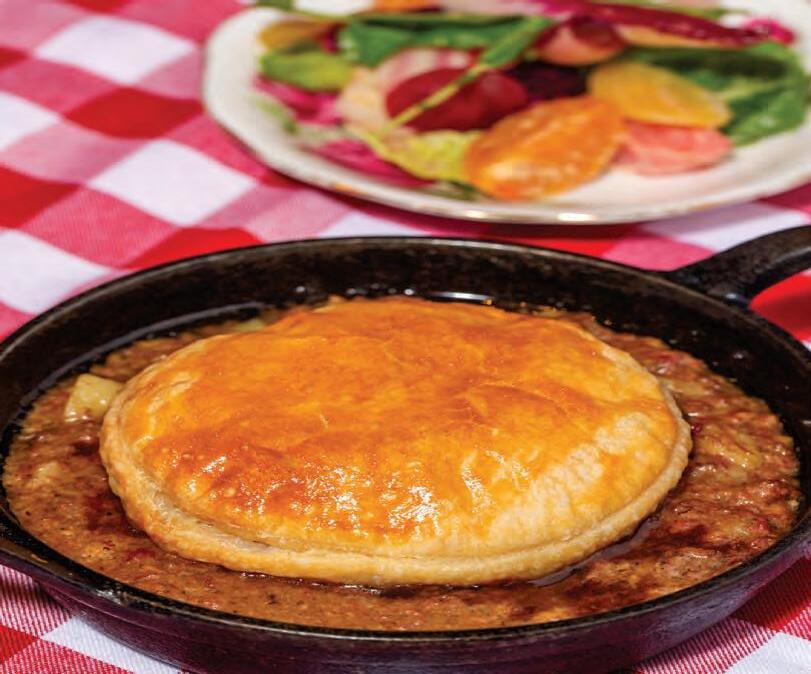
Preheat the oven to 400°F. Spritz a baking sheet with oil Whisk marinade ingredients together.
Add ⅓ cup of honey garlic sauce to the broccoli florets in a large bowl. Toss to coat. Place on baking sheet in a single layer. Roast 15 min, or until the broccoli is caramelized.
Pat the fish dry. Season with coarse salt and cracked black pepper.
Heat a large skillet over medium-high heat with 1 tablespoon grapeseed oil. When the oil is hot but not smoking, add the sablefish with the skin side up. Cook about until seared and golden, about 4 minutes. Flip.
Add the remaining honey garlic sauce to the skillet. Cook about 5 min, until the sauce is reduced by about half and the fish is cooked to 145°F. Baste the cod with the sauce generously. Serve warm broccoli and rice.
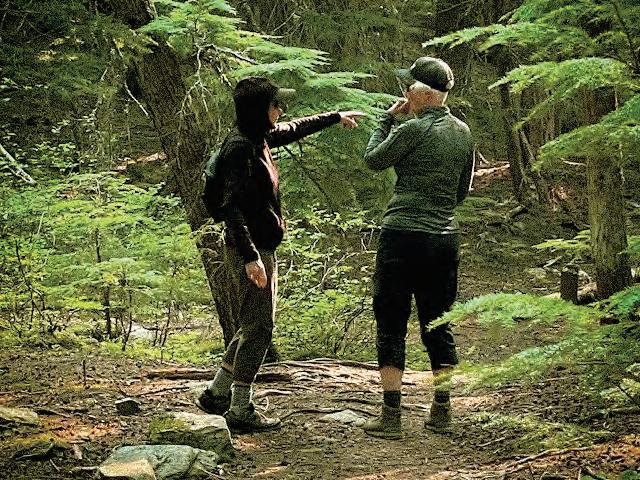
walk in the woods
06 OPENING REMARKS We helped make Whistler a safer place for bears. Now how about birds?
08 LETTERS TO THE EDITOR A developer responds to flooding concerns.
22 THE OUTSIDER Vince Shuley on making the best of the final moments of snow.
50 PIQUE’N YER INTEREST “I couldn’t help but get curious about who really owns us,” writes tobias c. van Veen.
Shinrin Yoku, or forest bathing, spread across the globe, reflecting the acute need we have for the healing ability of nature. - By Mary MacDonald and Monica Sander Burns COVER The best baths I’ve ever taken have come with a heaping dose of pine and I can go straight to bed because my hair isn’t wet. - By
Publisher SARAH STROTHER - sstrother@piquenewsmagazine.com
Production Manager AMIR SHAHRESTANI - ashahrestani@piquenewsmagazine.com
Art Director JON PARRIS - jparris@piquenewsmagazine.com
Advertising Representatives
TESSA SWEENEY - tsweeney@wplpmedia.com
ANDREW BUDRESKI - abudreski@piquenewsmagazine.com
Digital/Sales Coordinator KATIE DOUGLAS - kbechtel@wplpmedia.com
10 KAI SMART’S LEGACY Kai’s parents reflect on fond memories they have of their son.
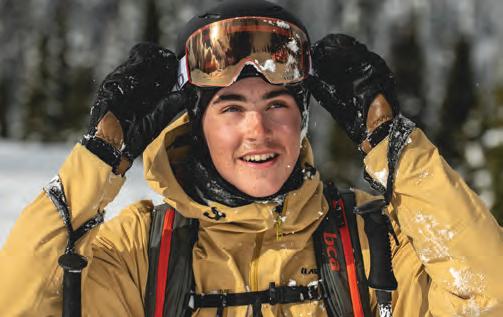
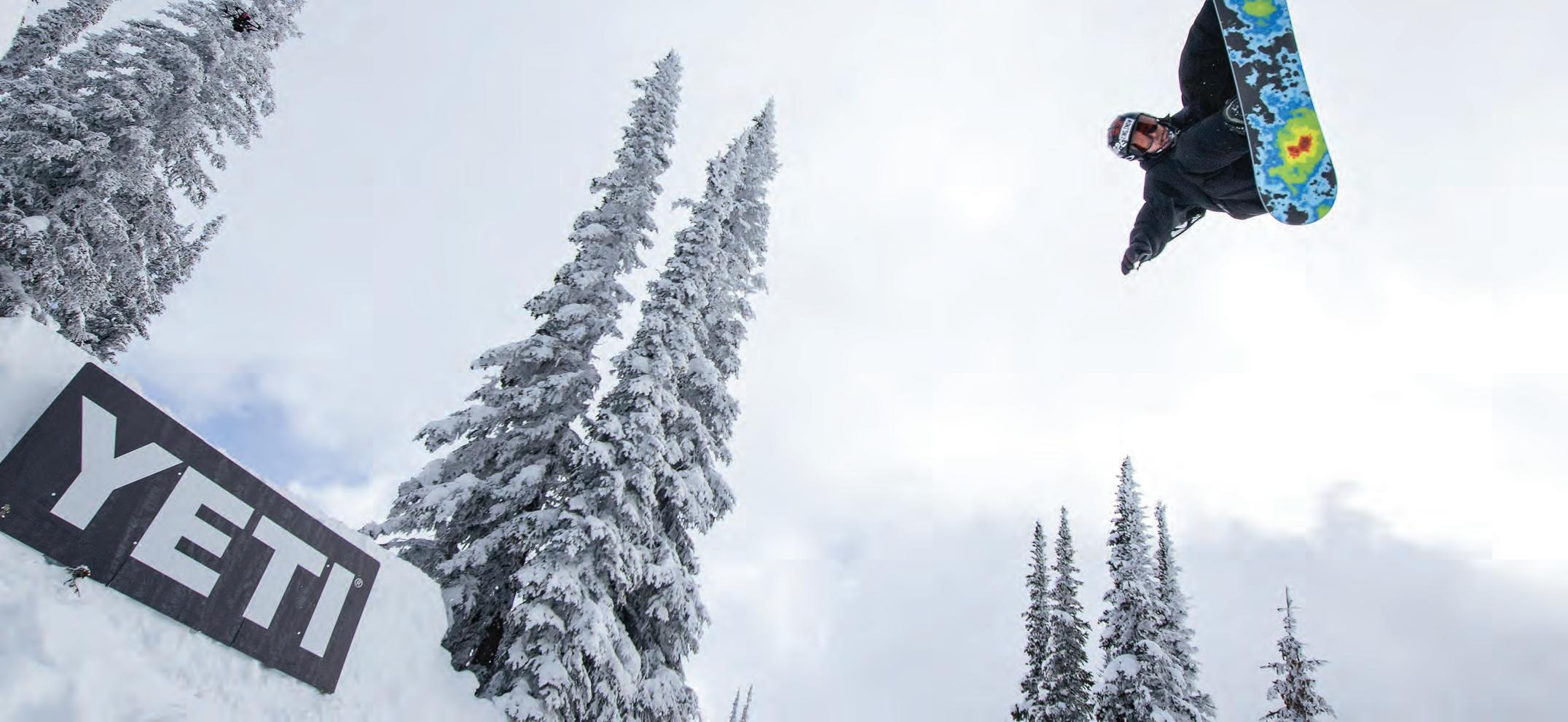
30 STUNT SNOWBOARDER Brin Alexander on merging two passions.
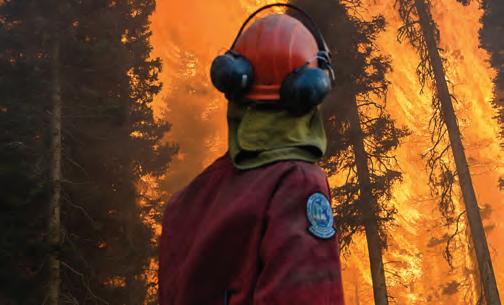
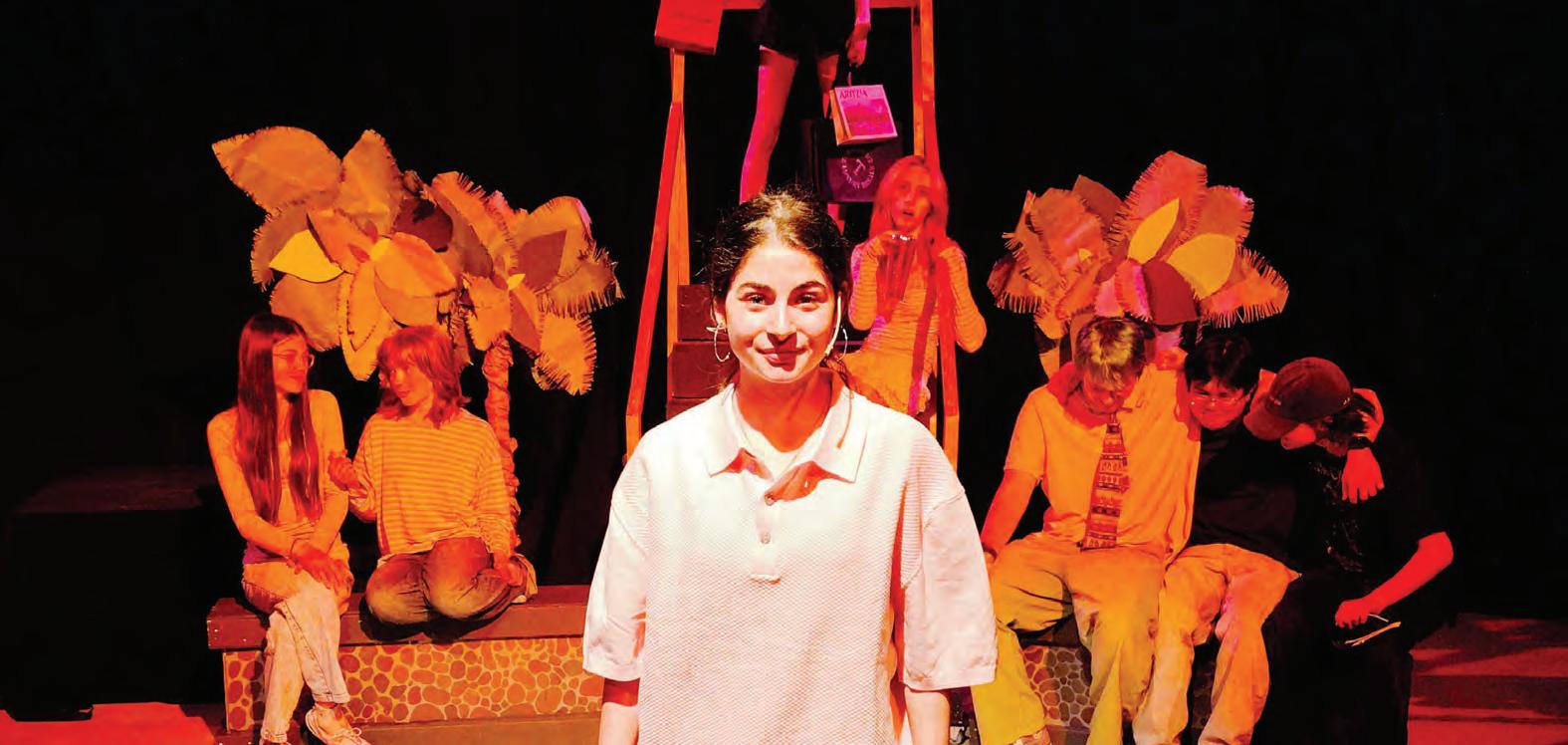
11 WILDFIRE STUDY A study from UBC shows Whisterites are underprepared for wildfire. 34 MEAN GIRLS WSS students’ latest musical is based on a beloved movie.
Reporters LUKE FAULKS - lfaulks@piquenewsmagazine.com DAVID SONG - sports@piquenewsmagazine.com
Office Manager HEIDI RODE - hrode@wplpmedia.com
Classifieds and Reception - mail@piquenewsmagazine.com
Contributors G.D. MAXWELL, VINCE SHULEY, LESLIE ANTHONY, GLENDA BARTOSH, ANDREW MITCHELL, LISA RICHARDSON, LIZI MCLOUGHLIN, TOBIAS C. VAN VEEN
Founding Publishers KATHY & BOB BARNETT www.piquenewsmagazine.com
We helped make Whistler a safer place for bears. Now how about birds?
WE’VE DONE A LOT to save the bears in Whistler. This community earned its Bear Smart stripes. It doesn’t have curbside garbage pickup, because it doesn’t want to take the chance on attractants.
But what if I told you there were tiny little flying critters that could also
BY STEVEN CHUA
use a little bit more of that assistance that we’ve so kindly lent our big furry neighbours?
In this case, I’m talking about birds. Recently, Humane Canada was in town to hold its Summit for Animals, which included a breakoff mini-summit focused on urban biodiversity.
Michael Mesure of FLAP Canada was a speaker at the summit and also hosted a guided walking tour — so I thought it would be a good time to pick his brain.
I found it interesting that he was here because one of FLAP’s big missions is spreading awareness about birds getting killed by window strikes.
Well, that’s something that I — and, I’m sure, many other people — associate with towering skyscrapers in Manhattan or Toronto. And it’s a well-founded association.
Mesure told me that, yes, skyscrapers definitely are a big contributor to the problem. His organization was documenting window strikes at an office complex in the Toronto area. Within six hours, over 500 birds had crashed into the building.
“We stopped counting and documenting the strikes because we just couldn’t keep up with documenting every strike,” he told Pique
Clearly, this is a huge issue in a city. But what many people don’t realize is that it’s also a problem in areas with low-rise buildings as well. Birds are often active at the treeline. There, they are more prone to see the reflections of trees on windows. As a result, they think they’ve found a place to perch, but instead wind up slamming into the glass.
You know a place that has plenty of low-rise, treeline-level buildings? Whistler, for one.
So what’s the answer? Visual markers. Simply just put markers on the exterior of the window. These could be as simple as stickers or dots that you draw with a marker, paint or nail polish.
And don’t bother putting anything on the inside of the window. This does nothing because they are obscured by reflections.
But anyways, if all of this is causing your eyes to roll over in the back of your head, I get it.
The most interaction a lot of us have with birds on a day-to-day basis is avoiding poop and eating chicken. Those who aren’t deep appreciators of nature may not really care, so long as that Nashville hot sandwich is crispy and well-priced.
However, there are legitimate reasons to care about these animals.
They control insects, pollinate plants and spread seeds. From an environmental point of view, they are invaluable. I hate mosquitoes. Birds eat them. Therefore, we are friends.
“From a health perspective, an
One part of that is birding.
Recent figures aren’t available, but an old tourism B.C. report said that in 1996, wildlife viewers injected $6.2 billion into the province. Sixty-three per cent was spent directly on viewing wildlife, while the rest was for spending related to the activity.
I suspect this figure has, if anything, probably grown over the years. Last year, the National Audobon Society reported that one in three adults in the U.S. now go birding. They buy expensive gear, books, accommodations and food.
Finally, if the economic incentives weren’t good enough, there’s always the punitive.
“Here in Canada, it is now illegal under the Environmental Protection Act to harm or kill a migratory bird due to a collision with a window,” said Mesure.
“From an environmental point of view, they are invaluable. I hate mosquitoes. Birds eat them. Therefore, we are friends.”
The important thing is that they are no greater than two inches by two inches apart from each other, or five centimeters by five centimeters.
That way, birds will not try and fly through the perceived gaps.
“The majority of birds that actually collide with windows are very small birds, and they have incredible agile flight, and they can slip through the smallest of openings,” Mesure said.
environmental and personal health perspective, we stand to have great loss if we lose these birds,” said Mesure.
But if even that isn’t enough to convince you, then perhaps the economic impact can. After all, when it comes down to it, money talks. And birds — and many other forms of wildlife — help communities make money.
People travel to B.C. to see the wildlife, the environment and the natural beauty.
This means that property managers do have a responsibility to stop their buildings from hurting birds. All in all, we’ve done a great deal in helping to make our community safer for bears and other wildlife. Why not extend the effort to the birds?
Steven Chua is a longtime Sea to Sky reporter sitting in Braden Dupuis’ chair this week. n
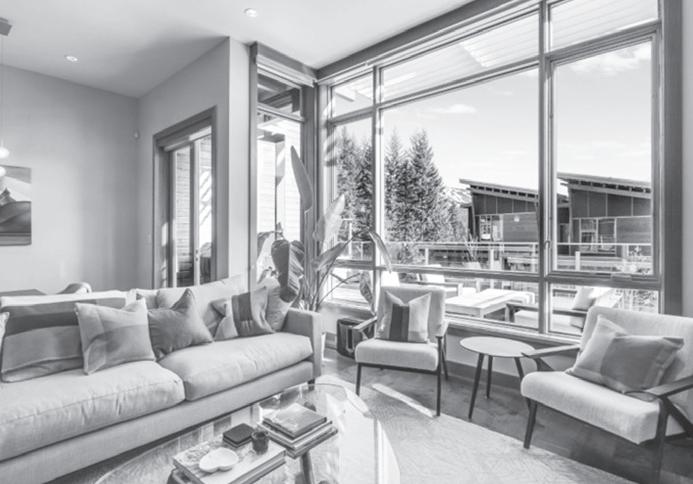
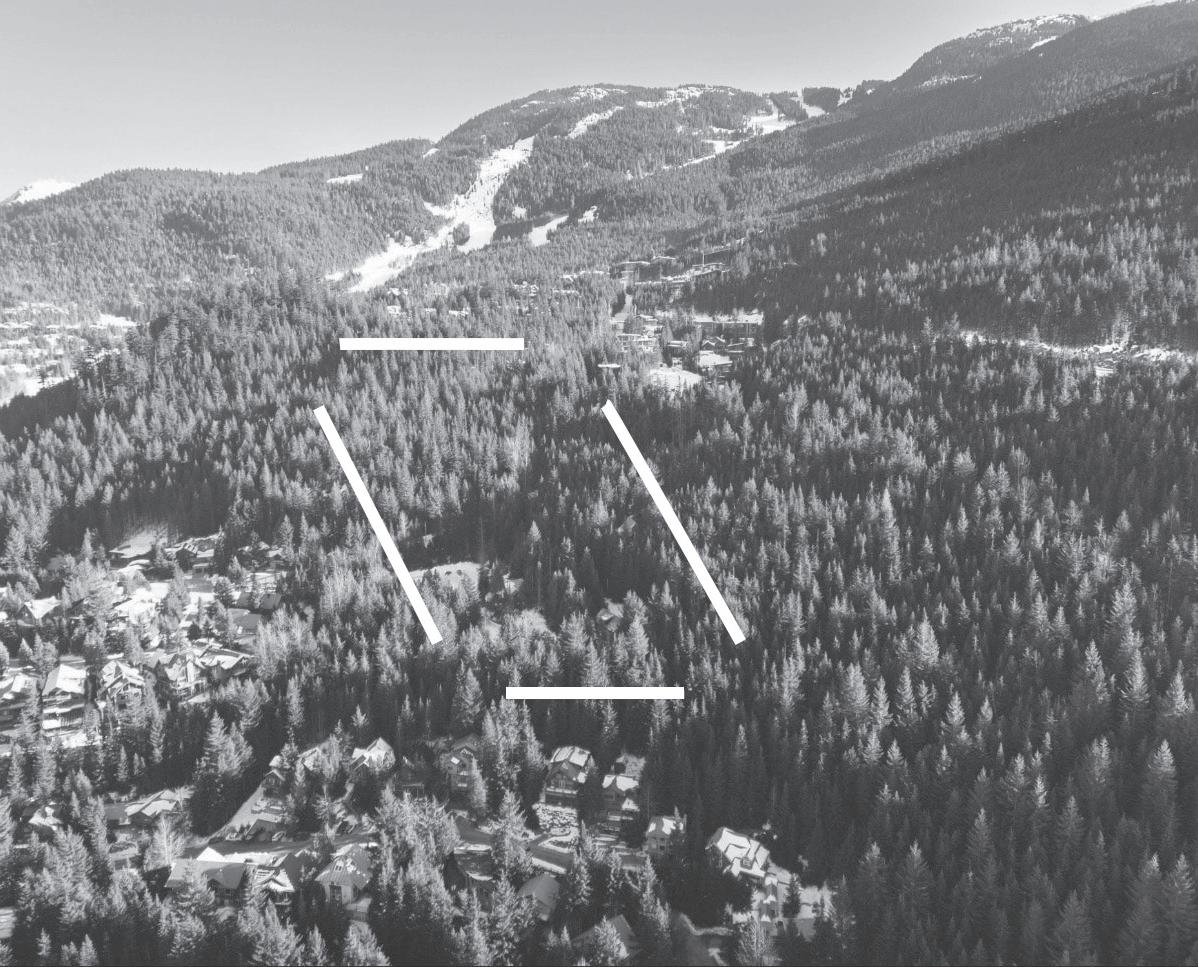
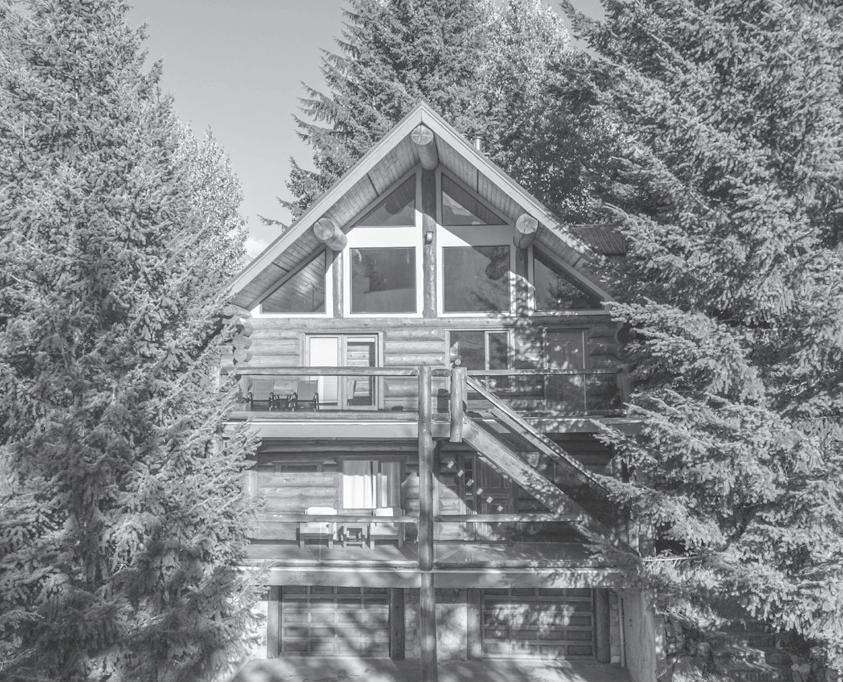
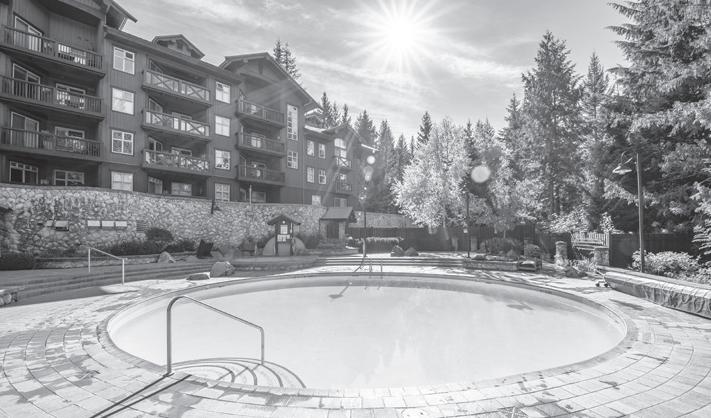
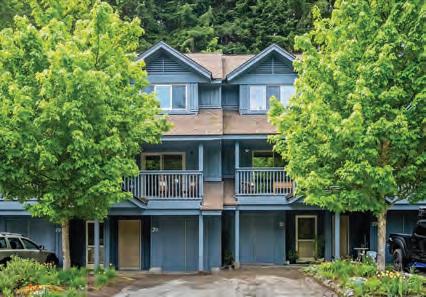
34 RedSky Contemporary 3.5-bedroom,3.5bathroom townhome northofthe village inRainbow. Onsite pool, privatehottub, garage andclose to Independent grocer,liquor storeand gasstation. Of feredat$2,995,000
Robert Meilleur
August 17, 1955 – April 16, 2026
Robert Emery Meilleur, age 70, of Pemberton, BC passed away peacefully surrounded by family on April 16, 2026 at Squamish General Hospital after a courageous battle with Idiopathic Pulmonary Fibrosis.
Robert was born and raised on the family farm in Fisher Branch, Manitoba on August 17, 1955. There, he attended Fisher Branch School and Collegiate and spent his early years working in Manitoba, including for Manitoba Hydro. During this time, the budding entrepreneur Robert also had a music system business and provided the soundtrack for many socials and dances throughout the community.
Then, in the late 1970s, the adventurous Robert jumped on his motorcycle and headed west to British Columbia. After a period working in Vancouver, his love for the outdoors drew him to the Whistler area. While there, he maintained local parks and helped teach students how to build log cabins. It was during these early years in Whistler that Robert met a Danish girl, Susanne, and in 1990, they were married in front of many friends and families traveling from both Manitoba and Denmark. They raised two boys together for many years, and when they eventually parted, Robert proceeded in raising the boys in his same adventurous spirit.
In those early years, Robert became a pioneer in the Canadian tourism industry by starting Whistler Snowmobile, a large successful snowmobile tour operation in Whistler, British Columbia. During that time, he lived in both Whistler and Pemberton before eventually selling the snowmobile tour operation after 20-plus years in business.
Robert then opened a successful gardening, landscaping, and irrigation business for many years in Pemberton until his retirement. It was there in 2008, through friends he met and dated a lovely English gal, Angie whom he affectionately called his "sweetheart." Robert eventually asked her to marry him, and in 2022, Robert and Angie were married, surrounded by their families from near and far along with friends at their new home overlooking beautiful Lillooet Lake and the surrounding mountains.
Robert’s heart for giving was huge. He donated much of his free time to many organizations, including the Legion and the Lions Club where he proudly served as President and spent time helping at a school/orphanage in Africa. Rob's passion was the outdoors, and he was in his element while hiking, fishing, hunting, skiing, and snowmobiling. He was also a lifelong enthusiast of the sport of curling. Robert was a man who lived life on his own terms - a spirited adventurer and a dedicated community and family man whose presence will be deeply missed.
He leaves to mourn his loving wife and sweetheart Angie, his children Denis (Lydia), Jorden, and Lovisa (Erich), his stepchildren Tanya (Scottie) and Neil (Alex), and all the cherished grandchildren. Also left to grieve is his sister, Louise, and his brothers: Gilles (Carmelle), Adrian (Debbie), George (Rose), Aurele (Rita), David (Cheryl), Donald, and Paul (Pam) and numerous nieces and nephews who all immensely loved their uncle. He is also survived by Susanne, the mother of his two boys and will also be deeply missed by many relatives and friends.
Robert was preceded in death by his parents, Maurice Meilleur and Alma Alice Meilleur (nee Bernier).
The family would like to extend their sincere and heartfelt thanks to the staff at Squamish General Hospital and the Pemberton Clinic for the excellent personal care they provided to Robert.
In lieu of flowers, the family requests that donations be made in Robert's memory to the Canadian Pulmonary Fibrosis Foundation.
"Two roads diverged in a wood, and I took the one less traveled by".
British Columbia
Celebrations of Life
A celebration of life will be held at Paul Selina's residence at 1864 Highway 99, Pemberton, BC on Saturday, June 13th between 2:00 pm and 5:00 pm.
Manitoba
A secondary celebration of life will take place in Robert's hometown, Fisher Branch, Manitoba on Sunday, June 28th between 1:00 pm and 4:00 pm at the community hall.
LETTERS TO THE EDITOR
Flood Concerns Deserve Facts
I do not normally comment publicly on our projects. However, the recent Pique article (Pemberton residents say ongoing development near Arn Canal has already worsened flood behaviour) and particularly its headline—creates the impression that development near the Arn Canal is contributing to increased flooding. That is a serious concern, and it deserves to be addressed clearly and based on the available technical evidence.
We understand that many neighbours have legitimate questions about flood risk. Given the well-known floodplain conditions in the Pemberton Valley, those concerns are reasonable and should be taken seriously. We also recognize that most residents and neighbours are not formally trained in flood hazard assessment, and observations made in a backyard setting are not informed by the technical training required to accurately interpret flood behaviour.
For that reason, the Village of Pemberton has a rigorous approval process for development in flood-prone areas. As part of that process, we retained qualified professional engineers and environmental consultants to assess flood behaviour, riparian setbacks, and flood construction levels for this site.
Those independent reports were completed in accordance with provincial
guidelines and reviewed by professional staff at the Village to ensure full compliance with all floodplain management requirements.
The conclusions are clear.
The Arn Canal is a manmade drainage feature with defined environmental setbacks.
Detailed hydraulic modelling of a 1-in-200-year flood event was undertaken to determine appropriate setbacks and flow conditions.
Geotechnical analysis established Flood Construction Levels between approximately 210.1 m and 210.9 m, ensuring all buildings are designed above required elevations.
These studies do not show worsening flood conditions. They indicate that the development can proceed without altering Arn Canal flow behaviour in a harmful way, and that the proposed grading may reduce localized overflow toward existing homes to the west.
This is an example of how development in a floodplain should be approached: through careful study, engineering, and adherence to established standards.
At the same time, Pemberton is facing a significant housing challenge.
An older single-family home on Willow
Drive is currently listed at approximately $1.45 million. A townhome at Crabapple Court is listed at approximately $999,000. By comparison, homes at the Alders are being offered at approximately $799,000 for fourplex homes—directly competing with the townhome market— and $959,000 for single-family homes, both at materially lower prices than current listings.
These homes are not lesser in quality. They are newer, larger, more efficient, and designed for the realities of living in Pemberton, including durable
FOR THE RECORD
We would like to clarify in the story, “Developer files civil claim against the Village of Pemberton over longdelayed rental housing project, citing negligence and misrepresentation,” published on April 3, that the Village of Pemberton is the only defendant in the lawsuit.
For the story “Village of Pemberton clears another hurdle in adoption of Bill 44,” published on April 17, the story incorrectly reported the amount of letters sent to council as three. In fact, six letters were sent before the public input deadline. A seventh letter was sent, but it did not make the deadline. n
As of Wednesday, April 22
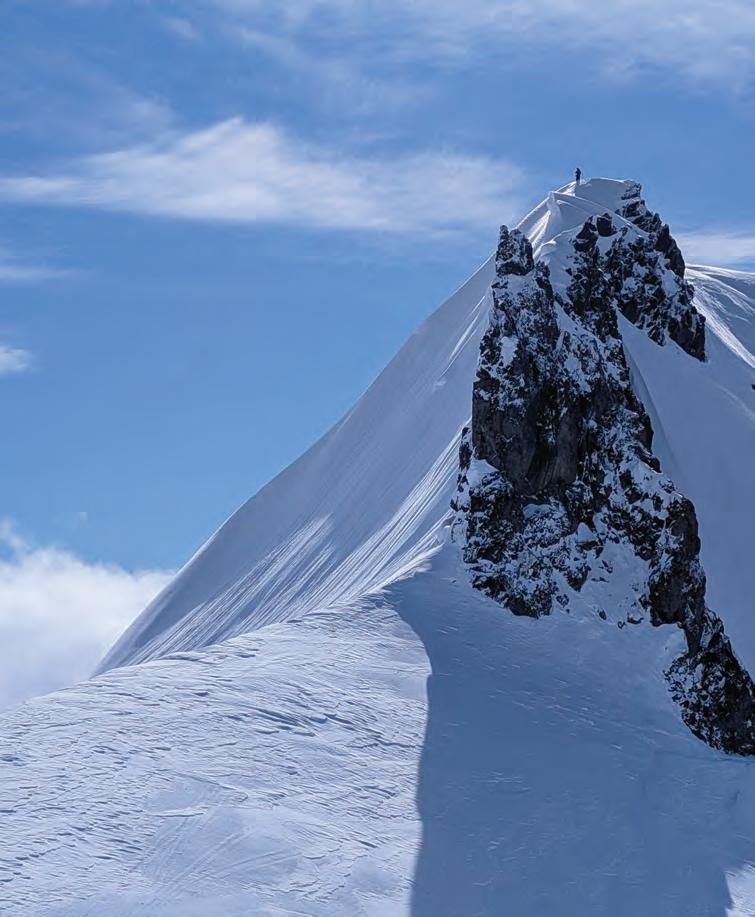
THE SIMPLEST WAY to summarize conditions in the Spearhead Range for our last Pique article of the season is: simple.
Last weekend, freezing levels climbed to 3000m., and numerous wet loose avalanches up to size 2 were reported throughout the region into the first half of the week. A midweek cooling trend followed, and this pattern of rapid warming and slow cooling resulted in a strong and simple snowpack with a crust present on all aspects and elevations (though some dry snow may linger on high north-facing terrain).
This weekend, backcountry users will want to time their travel with softening surfaces from solar input. Chase the corn harvest as the sun makes its way across
construction, lower operating costs, and climate-resilient design that accounts for long-term environmental conditions, including flood risk.
Our goal is to contribute to a solution—delivering family-oriented housing that is more attainable for local residents, while also improving building performance and meeting climate and carbon reduction objectives.
In a valley where flood risk is a shared and well-understood condition, it is important
BACKCOUNTRY UPDATE
the horizon, and plan to finish your day early. Think hard about your exit to avoid travelling on steep, sun-exposed slopes in the afternoon, especially if you are observing a wet, “punchy” upper snowpack. Small wet loose avalanches may still be consequential in extreme terrain or where terrain traps exist in the run out.
Another spring hazard we need to pay close attention to is cornices. We should always try to reduce our exposure beneath these hazards, but in the peak of a warm and sunny spring day, it is often more appropriate to avoid travelling under them altogether.
Spring is a special time on the coast, and the snowpack is well set up for big days in the alpine. n
that discussions distinguish between valid questions and conclusions that are not supported by the technical analysis.
This project has been designed, reviewed, and approved within that framework.
The result is not increased flood risk, but rather responsibly engineered housing that responds to both the environmental realities of the Pemberton Valley and the urgent need for attainable homes.
Rod Nadeau // The Alders // Innovation Building Group n
AN ACCOMPLISHED SKIER AND FILMMAKER, KAI IS REMEMBERED AS A BRIGHT SOUL WHO CONNECTED WITH AND INSPIRED OTHERS
BY STEVEN CHUA
ONE OF THE BEST family memories
John and Julia Smart have is staying out late at Blackcomb’s Horstman Hut with their sons Kai and Luke.
They’d sip hot chocolate with marshmallows, waiting for most people to go home and the mountain to fall quiet.
Then — perhaps with some prodding from the Whistler Blackcomb staff who might’ve been eager to close up for the night — they’d zip down the slopes as the sun set.
“It was just the most magical thing to watch these little rippers, these little Whistler dudes, go way faster than me all the way down the mountain,” said Julia. “That would probably be my most favorite memory of skiing with my boys, for sure.”
It’s a beautiful recollection. And there will be many more during two events that will honour Kai’s memory this weekend.
Kai, 23, passed away in March from injuries he sustained in an avalanche in Japan.
His father, John, remembered his son as an inspiration.
As a child, Kai was a rambunctious, high energy, fun kid. He was born and raised in Whistler and was an accomplished athlete who also made a
name for himself in films.
The son of two Olympians, he took to skiing quickly. Kai and his brother cut their teeth on the ski ramp their family had in the back of their house.
On top of that, his parents are the founders of Momentum Camps, and the ski program that helped sharpen the skills of many athletes also honed his talents.
Over time, Kai began to rack up a number of accomplishments in the sport. His top competitive achievements included being named to the BC Team, finishing 2nd at Junior Nationals, and taking 1st overall in BC for three consecutive years from 2015 to 2017. He also graduated from the UBC Sauder School of Business with honours.
Later, his attention would turn to film. He was featured in The Front Lines, which examined the effect of climate change on the ski and snowboard industry. He most recently co-directed Tien Shan Dream, a ski flick now streaming on Apple TV, Roku, and outsideonline.com.
Both films are about the sport he loved, but they also show his attention to wider social and environmental issues.
It provided a window into a mindset that John said defined his son — constantly learning and looking at the bigger picture.
“He was reading the Guinness Book of World Records from a super young age and was always trying to just add more information to his brain,” John said.
But Kai wasn’t just some brainiac, he said. His son also took the time to make personal connections.
One time when he and Kai went on a trip to Africa, Kai asked to stay in a hostel one night, just so he could really get to know the people.
“He would go into the markets and meet the locals and have drinks with them by himself, because he just wanted to connect,” John recalled.
With a character like that, Kai left a lasting impression on many people.
“We’ve been hearing more and more from his friends [that] Kai would bring them in and so they wouldn’t feel left out,” said Julia. “We’d love to see where he would have gone with this path that he was on. We were excited to see what he could do in the world down the road. And that’s what’s really hard for us.”
It’s a source of both pride and pain.
“The stories we get are just lighting us up, but they’re also tearing us apart because we’re so proud, and yet we’re so devastated because of that,” John said.
Right until the end, Kai was an inspiration.
Julia noted that shortly before his passing, Kai gave a talk at his old high school, Whistler Secondary, where he made quite an impression.
“I heard from a friend who has an exchange student in the class there who said that it was the best day of her high school experience in Whistler, listening to Kai speak,” she said.
Following news of Kai’s passing, the community rallied by launching a GoFundMe to help relieve financial pressure on the Smart family.
As of the morning of April 20, the
fund has more than doubled its goal, raising over $248,000. Organizers had started the initiative with the aim of raising $120,000. More than a thousand people contributed.
The Smart family plans to establish a memorial fund in Kai’s name that reflects who he was and what he stood for.
John noted how the Sarah Burke Foundation commemorated a positive, happy soul who died tragically in a skiing accident.
With it, her legacy continues to inspire the champions of today — Olympic gold medallist Megan Oldham received a scholarship from the fund.
“You know, we would select characters that emulated who Sarah was, and we’ve been so successful with that,” said John. “We want to do that with Kai, because Kai’s story is incredibly interesting from a bigger, worldly perspective. And I think he can be an inspiration to many on just how to approach life.”
On Saturday, April 25, a Ski for Kai Day will be held. Attendees will meet at the Horstman Hut at 11 a.m., or anytime after 12 p.m. at a designated spot in the Blackcomb Park. Look for the DJ cat — it will be hard to miss. The following day, a celebration of life will take place. On Sunday, April 26, those wishing to join can go to the Whistler Conference Centre. The event will take place from 4 p.m. to 8 p.m. Guests are welcome from 4 p.m., with reflections and speaking beginning at 4:30 p.m., followed by drinks and food. If you plan to attend in person, please RSVP here: https://shorturl.at/zkQpE n
KAI’S LEGACY Kai Smart is remembered for his love of adventure and people.
PHOTO COURTESY OF THE SMART FAMILY
UBC study: Whistlerites highly concerned about wildfire, but lag on preparedness
SURVEY FINDS STRONG UPTAKE OF FIRESMART MITIGATION MEASURES, WHILE GAPS REMAIN IN EMERGENCY PLANNING AND RESPONSIBILITY AWARENESS
BY LUKE FAULKS
A NEW UBC-LED study into wildfire risk in Whistler finds residents report nearuniversal concern about wildfire, a level of awareness that is driving high rates of mitigation work on properties—but not the same level of preparedness for an emergency.
The research suggests “strong leadership” in local FireSmart programs is contributing to the uptake of mitigation techniques while pointing to a possible trade-off: residents who have reduced risk around their homes may be less focused on planning what to do if a wildfire occurs.
“It was surprising to see… people are very aware of the risk, but we’re not seeing very high level of preparedness,” said study author Adeniyi P. Asiyanbi, an assistant professor at UBC Okanagan.
“It’s mixed. It’s not as high as one would expect compared to mitigation.”
Part of the reason is that residents hold differing views on who is responsible for managing wildfire risk—a disconnect researchers say is built into today’s “shared responsibility” approach to fire management, and one that often only becomes clear after a wildfire event.
Drawing on 234 survey responses, the study finds high levels of concern across the community, with 91 per cent reporting they are “concerned” or “very concerned” about wildfires in Whistler, and 80 per cent rating overall risk as “high” or “extreme.”
Asiyanbi said the findings reflect strong local awareness efforts alongside ongoing questions around responsibility.
“We’re seeing a shift towards sort of a whole society approach to fire management,” he said. “A diverse range of actors have been invited to come together to help address wildfires, but all actors may not necessarily be on the same page in terms of who does what and how.”
MITIGATION ACTIVITY
HIGHER THAN PREPAREDNESS
That concern comes as wildfire risk is increasing across the region.
Across British Columbia, climate change is already driving longer fire seasons, earlier snowmelt, and more frequent periods of extreme heat— conditions that dry out forests and increase the likelihood and intensity of wildfires.
Local officials have identified wildfire as the community’s “single biggest climate change related risk.
Asiyanbi’s research— Who Does What? Shared Responsibility for Wildfire Management and the Imperative of Public Engagement—examines public perceptions across four phases of wildfire management: mitigation (reducing risk before a fire), preparedness (planning for a potential event), response (actions during a wildfire), and recovery (post-fire support and rebuilding).
The study found a majority of respondents reported completing mitigation measures aligned with FireSmart recommendations, including installing fire-resistant roofing (70 per cent) and clearing vegetation near homes (65 per cent).
Completion of preparedness measures was reported at mixed but generally lower rates.
Twenty-three per cent of respondents described themselves as “prepared” or “very prepared” for a wildfire, while 40 per cent reported having a household evacuation plan.
Other preparedness measures showed lower completion rates, including having a grab-and-go bag (36 per cent) and a fireproof safe for valuables (26 per cent).
RESPONSIBILITY SHIFTS
ACROSS OWNERSHIP, WILDFIRE PHASES
The survey sample was composed primarily of homeowners, who made up approximately 87 per cent of respondents.
The study found that housing status is a factor influencing how respondents take action and assign responsibility across all four phases.
“Those who own homes are likely to be doing more on [mitigation and preparation],” Asiyanbi said. “Those who are renting are likely to say someone else is responsible for those; for instance, the municipality.”
The study also found factors like prior wildfire experience, perceived preparedness and willingness to pay for FireSmart assessments influenced how respondents assigned responsibility.
Municipal government was ranked as the most responsible actor for mitigation, preparedness, and response, while the provincial government was ranked as most responsible for recovery.
Homeowners were ranked as
At St ilh av n, we pairou rd eepunder st an di ngofth e marketwith arelentles sf ocusonclientsatisfaction.
Ou rs ervi ce ex te nd sb eyon dt ra nsactions,creating la st in grel at ionshipsbuiltontrus ta nd re spect. Yo ur goal sa re ou rp riorit y, an dweb ringth eexpertise an dd edic at io ntom aket he ma re alit y.
more responsible in mitigation and preparedness, but less responsible in response and recovery phases.
Asiyanbi said these patterns reflect both experience and expectations.
“This pattern is not just a matter of human behavioural nature,” he said. “These patterns are also informed by what the public has experienced and seen happen in wildfire events… for instance, firefighters and emergency responders take over responsibility for wildfire response.”
IMPLICATIONS FOR LOCAL PROGRAMMING
The study situates its findings within Whistler’s existing wildfire planning framework, which includes fuel management programs, FireSmart initiatives, and community wildfire planning.
Asiyanbi said differences between mitigation and preparedness may reflect how programs are structured.
“There is municipal support for mitigation that includes various practical incentives,” he said. “Those kinds of support may not be currently available for preparedness, as preparedness is often considered to be very homeowner-focused.”
He said the findings could inform future communication or program design related to preparedness activities.
“They need to then focus more awareness campaigns… helping people
complete their preparedness activities,” he said.
More broadly, the findings point to a need for clearer communication of who is expected to do what across each phase of wildfire management.
Digital tool aimed at four phases
Alongside the research, Asiyanbi and collaborators developed WISEC, a mobile application designed to support public
action across mitigation, preparedness, response and recovery.
“You take a survey, [and] based on your response, the app generates a list of tasks for you to do,” Asiyanbi explained.
The app includes task lists, reminders, information links, and emergency contact and recovery resources.
According to Asiyanbi, the first version of the app is currently available
and focused on Whistler, with a second version in development that would expand coverage to other regions in Canada.
The study concludes that improving wildfire resilience will depend not just on individual action, but on making roles and expectations across governments, residents and other actors more explicit.
OTHER WILDFIRE RESOURCES FOR WHISTLERITES
For preparedness materials, visit the provincial government’s emergency management website and the PreparedBC wildfire guide, which offer step-by-step guidance on building emergency plans, assembling grab-and-go kits, and staying up to date on evacuation alerts and public safety information during wildfire events.
To help mitigate the risk of fire, check out the Resort Municipality of Whistler’s FireSmart program, which offers free Home Partners assessments, a Community Chipper Program, and neighbourhood workdays to support vegetation management. Additional guidance is available through FireSmart BC, which outlines practical steps residents can take to reduce fire risk around their homes— including landscaping choices and building materials.
During a wildfire, the BC Wildfire Service also provides real-time updates, including a live incident map. Visit EmergencyInfoBC for evacuation orders and alerts. DriveBC provides real-time highway conditions and closures. n
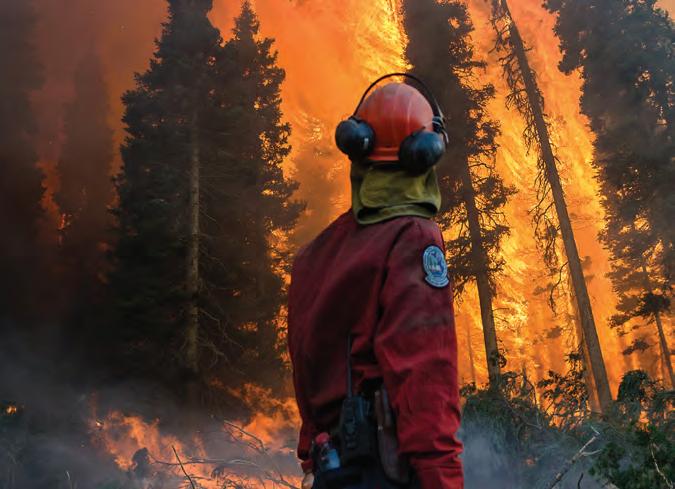
FIGHTING FIRES UBC’s findings come as climate change lengthens fire seasons and raises risk in the Sea to Sky. PHOTO COURTESY OF BCWS
Whistler council advances tax increase expected to raise $4.5M
COUNCIL ADVANCES BYLAWS AS OFFICIALS HIGHLIGHT RELIANCE ON RESIDENTIAL AND BUSINESS TAX BASE
BY LUKE FAULKS
WHISTLER COUNCIL has approved the first three readings of its 2026 tax bylaws, advancing a 6.9 per cent property tax increase expected to generate roughly $4.5 million in additional revenue from residential, business and industrial properties.
The increase, applied to Class 1 (residential), Class 5 (light industrial) and Class 6 (business) properties, forms part of the municipality’s 2026–2030 financial plan and is required to fund municipal services based on budgeted needs and assessment data.
“These classes represent 99.5 per cent of the currently assessed property value in the community,” an April 14 staff report notes, adding property owners in those categories “can still expect to pay 6.9 per cent more in property tax in 2026 compared to 2025.”
Finance staff also emphasized the broader context of property tax bills, noting municipal taxes represent only part of what residents pay.
“Tax notices issued by the resort municipality of Whistler contains more than just municipal taxes. In fact, 42 per cent of residential taxes and 37 per cent of commercial taxes are collected… on behalf of other government agencies.”
Those external charges include provincial school taxes and SquamishLillooet Regional District requisitions, which are collected by the municipality and remitted to other agencies.
COUNCIL DISCUSSES TAX BURDEN ON RESIDENTS
Council discussion also highlighted how the concentration of the tax burden affects locals.
“So that’s 99.5% of the burden leveled on homeowners—and their renters if they’re renting it because that gets
passed on—and local businesses,” Coun. Ralph Forsyth noted.
“And I’m really encouraged [by] how we’re addressing the different classes as we move forward, because that ratio needs to absolutely change as we move forward if we’re going to have balance in the community between business, commercial, [and] tourism.”
The staff report notes the municipality continues to pursue revenue diversification “to minimize the overall percentage of revenue raised from property taxes wherever possible,” including increased reliance on user fees and charges.
At the same time, total assessed property values in Whistler increased by $365 million, or 1.32 per cent, heading into the 2026 tax year, according to BC Assessment data referenced in the report.
How those assessment changes translate into individual tax bills depends on how a property’s value shifts relative to the community average.
As outlined in the staff report, properties in Classes 1, 5 and 6 with assessment increases higher than the average change will likely see tax increases greater than the 6.9 per cent municipal target, while those with lowerthan-average increases will likely see smaller increases.
Properties that track close to the average change can expect tax increases in line with the overall budgeted rise.
Councillors also pointed to the extensive process behind the budget and tax decisions.
“We worked really hard to get to these numbers,” said Coun. Cathy Jewett. “Months and months of work, months of public meetings, [and] a real effort to get feedback and to reduce our spending as much as we can.”
The bylaws are expected to be adopted later this month, with property tax notices scheduled to be mailed to Whistler property owners in May. n
Whistler the first Canadian ski resort where avalanche control drones tested
SEA TO SKY COMPANY DEMONSTRATES A POTENTIAL NEW TOOL FOR AVALANCHE SAFETY
BY STEVEN CHUA
WE SEE DRONES increasingly doing more and more jobs. Film, deliveries and military applications are all things that drones do.
Now, following an event in Whistler, we’re also seeing them become an instrumental tool in the future of keeping our slopes safe.
For the first time in a Canadian ski resort, a drone has been used in an avalanche control demonstration, according to Alpine Solutions, a local avalanche control company.
On March 31, the organization showed the capabilities of the technology in Whistler Blackcomb.
“Drones are moving bombs, creating avalanches,” said Alexi Tessier, operations manager with Alpine.
“This is a new tool right for the industry.”
He said it won’t replace existing in-person methods, but it expands the range of options that crews will have when conducting operations.
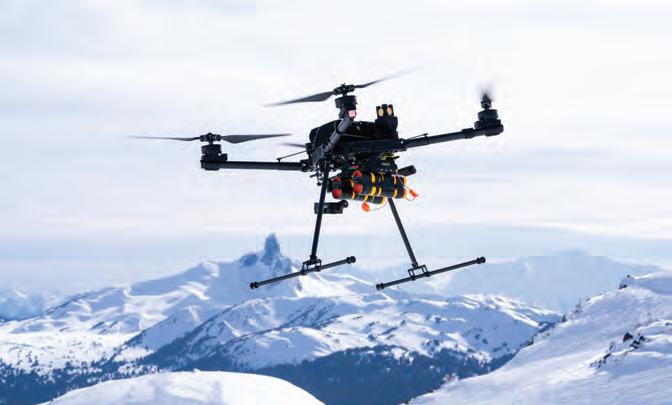
Alpine flew a drone outfitted with a payload delivery system manufactured by Drone Amplified. This allows it to
carry explosive charges, then drop and set them off on snow-filled slopes that need to be cleared.
The system also allows users to time the detonation so that the explosives go off with maximum effect.
“[Other systems may] drop the explosive and it may hit and roll down the hill before the fuse goes off, whereas
He said that his team, based primarily in New Jersey and Nebraska, developed the initial concepts for wildland firefighting. Then, over time, they realized they could modify it for avalanche control.
At the moment, the demonstration has garnered attention, but it’s unclear if it will be used in future Whistler Blackcomb operations.
Spokespeople from the resort declined to comment.
Transport Canada has granted approvals necessary to operate the drones.
When asked for their impressions, a spokesperson from the organization called drones a “new and game-changing generation of aircraft in Canada’s aviation sector.”
we’re able to make it go off right at the right time,” said Carrick Detweiler, CEO of Drone Amplified.
Detweiler said it could save costs in a number of cases. A drone might cost something like $120,000 USD, which may seem like a lot, but a helicopter doing the same job could be far more expensive over time.
“Transport Canada’s approach to drones, like other aviation sectors, is predicated on ensuring a safe and secure airspace system while creating a regulatory environment that is predictable for industry and conducive to innovation,” said senior communications advisor Sau Sau Liu in a written statement.
“Transport Canada regulates drones based on their risk to aviation safety and the safety of people on the ground, not its end use (e.g.,: avalanche control).” n
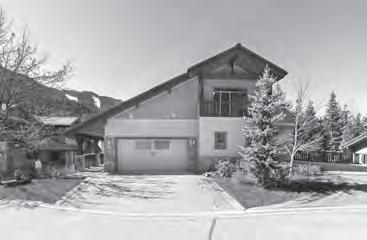
$2,195,000
DRONING ON “Drones are moving bombs, creating avalanches,” said Alexi Tessier, operations manager with Alpine. PHOTO COURTESY OF DRONE AMPLIFIED
Residentsandownersofbusinessesmaycommentbywriting to: PlanningDepartment ResortMunicipalityofWhistler 4325Blackcomb Way Whistler,BCV8E0X5 planning@whistler.ca 604-935-8170
PETITIONSWILLNOTBECONSIDERED.
To ensuretheconsiderationofyourviews,yourwritten commentsmustbereceivedonorbeforeMay16,2026.Your name(s)andresidenceaddress(orbusinessaddressif applicable)mustbeincluded.Pleasenotethatyourcomments maybemadeavailabletotheapplicantandlocalgovernment officialsasrequiredtoadministerthelicenseprocess.
Whistler Blackcomb expands community dinners with hotel partnerships for spring return
PROGRAM BUILDS ON $10 MEALS LAUNCHED IN 2025 TO SUPPORT LOCALS DURING SHOULDER SEASON
BY LUKE FAULKS
WHISTLER BLACKCOMB is bringing back and expanding its low-cost community meal program this spring, adding local hotel partners in a move aimed at scaling up support for residents during the shoulder season.
“The shoulder season can be a stressful time for many people in our community,” said Wolfgang Sterr, Whistler Blackcomb’s director of food and beverage. “This program is about doing what is right, one of our core values, and supporting our neighbors who live and work here.”
The weekly dinners, first introduced in 2025, will return beginning April 30 at Merlin’s Bar and Grill, before extending to participating hotel venues later in May. The 2026 iteration includes new partnerships with Hilton Whistler Resort & Spa, The Westin Resort & Spa Whistler, and Fairmont Chateau Whistler, alongside continued collaboration with the Whistler Community Services Society.
Originally launched following a Whistler Blackcomb town hall, the
program was designed to address a persistent gap in the resort economy: reduced hours and financial strain for workers during the transition between peak seasons.
The concept remains largely unchanged: a $10 meal open to anyone, served weekly in a casual, sit-down setting with takeout options available. Each dinner includes a “well-balanced” plate—protein, vegetables, starch, dessert and a drink—with vegetarian,
vegan and gluten-free options.
The main change, according to Blackcomb, is a bigger scale.
By bringing in hotel partners, WB is aiming to increase capacity, diversify culinary offerings and share operational responsibilities across the resort’s hospitality sector.
“The expansion of this program reflects the strength of collaboration in Whistler,” Sterr said. “Working alongside our hotel partners and Whistler Community Services Society allows us to extend our impact and continue supporting our community when it matters most.”
FROM PILOT PROJECT TO COMMUNITY FIXTURE
The dinners began as a short spring pilot— five Thursday nights at Merlin’s—before returning in the fall amid strong demand.
Attendance climbed, with as many as 260 to 300 people showing up for a single evening meal, drawn by both affordability and atmosphere.
“It’s really rewarding when you’re walking into a room and there is a bunch of like-minded people,” Sterr said during the program’s initial run.
Guests areinvited to create theirowndried bouquettotakehome, alovelyway to mark
am to 2:30pm n e menu, dessert be verage. d floral k the occasion.
From the outset, the initiative has operated on a cost-recovery basis, with no profit taken. Meals are funded through ticket sales and community contributions, while additional tickets are distributed through the Whistler Community Services Society to ensure access for those using the food bank.
“We’re truly inclusive, not just servicing the large population of on-mountain staff,” Sterr previously told Pique.
SPRING SCHEDULE AND NEXT STEPS
The 2026 spring series will run weekly from April 30 through late May, beginning at Merlin’s before rotating through partner hotel venues. Meals will be served from 5:30 p.m. to 7:30 p.m.
As the program enters its second year, Whistler Blackcomb is positioning it as more than a seasonal offering, pointing instead to a broader model of collaboration across the resort’s tourism and service economy.
“This program goes beyond food,” Sterr said. “It’s about connection, collaboration, and supporting the people who make Whistler what it is.” n
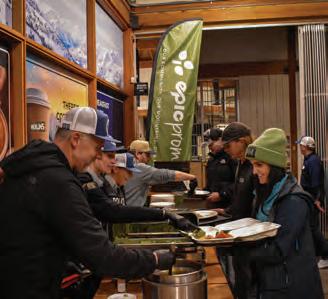
CHOW DOWN WB’s Wolfgang Sterr hands out meals to guests in 2025. PHOTO BY LUKE FAULKS
FOODSERVICETIL9PM• ALLAGESWELCOME •19+AT9:30PM PLUS ARAFFLEWITHSPIRITS &EXPERIENCEBASKETS!
Dr. Mark Jaccard speaks April 30 at Whistler Institute
JACCARD’S SESSION IS TITLED “DECODING GLOBAL CLIMATE POLICY”
BY DAVID SONG
FIVE YEARS AFTER his previous visit, Dr. Mark Jaccard is returning to the Whistler Institute for another presentation under the Global Perspectives Speaker Series umbrella.
Jaccard is currently on a leave of absence from his post as a distinguished professor of energy economics at Simon Fraser University (SFU), but he is also the chair and CEO of the British Columbia Utilities Commission. As an expert on energy sustainability, his upcoming talk is meant to inform climate-concerned people regarding what they can do to advocate for an environmentally friendly future.
Three main subjects will be covered: agenda-hitching, the overly simplistic “good-guy, bad-guy” view that frequently emerges in discourse about environmentalism, and decoding the playbook of stakeholders who oppose contemporary climate policies.
AGENDA-HITCHING
Many individuals and organizations, from private citizens to lobby groups, say they care about the well-being of Earth’s
biosphere. However, some tend to argue that sustainability can only be achieved through various specific goals like vegetarianism/veganism, the abolition of gas-powered cars or even the dismantling of capitalism itself.
“While a lot of objectives that people are trying to talk you into could be really good for us as people, for the planet, they aren’t essential to solve the climate problem and they actually make it seem more difficult than it is,” Jaccard said. “All we need to do—and this is how we solved other problems like local air pollution, acid rain, ozone depleting substances—is focus on our policies.
“In the case of consumers, you have to stop burning gasoline when you move around and you have to stop burning natural gas in your home. Then the government has to make sure that when we make electricity, it’s zero-emission.”
While Jaccard believes that fossil fuels like coal, oil and natural gas can still be used, carbon dioxide emissions associated with these practices must be captured using the relevant technology. Open burning, or the uncontrolled release of pollutants into the atmosphere, is a big faux pas.
GOOD GUYS VERSUS BAD GUYS…OR NOT
When large and complex topics are debated, nuance is often lost. Many people naturally adopt a black-andwhite view of the matter, deeming some things to be inherently good and others inherently bad. Jaccard would argue that such a mode of thinking is detrimental to a fruitful grasp of climate stewardship.
Some folks have assumed that an energy economics professor couldn’t possibly support nuclear power, hydroelectric dams or the harvesting of biomass for energy, but Jaccard feels that there can be a right time and place for all of these controversial methods.
“In Canada, we have some Indigenous people in northern Manitoba that want to do a hydro project on their lands. We have that also in Labrador and parts of Quebec,” he elaborated. “What I’ll be trying to do in a talk like this, and I’ve done it before, is just challenge the audience not to see the world in simple terms of good guys and bad guys. You actually can reduce domestic emissions even while you have gas and oil and people are still consuming it. You’ve got to decide which fights you fight.”
Jaccard brings up Norway as an example. That country still exports part of its vast natural gas reserves, but is a world leader in both zero-emission construction and the adoption of electric vehicles.
DECODING
Undoubtedly there are actors who hold a vested interest in the continued proliferation of fossil fuels. Some of them vehemently oppose any regulation that obstructs their goals, and Jaccard wants Canadians to know how these parties try to influence public policy.
This latter subject was not included in Jacard’s 2021 Whistler Institute session, but he promises to cover new ground.
“Throughout my career, we’ve had ups and downs in the public’s interest in climate,” he remarked. “Of course it hinges on whether or not there are big distractions and priorities that are quite immediate…it could be a pandemic, it could be a financial crisis, it could be a war. My emphasis this time is to help people understand how they can defend certain things that politicians have done and try to prevent those things from getting undermined and destroyed—because this is a time to hang on to good policies.”
Jaccard’s talk will be held on April 30 at 6 p.m. in the Maury Young Arts Centre. Visit https://www.eventbrite. ca/e/decoding-global-climatepolicy-with-dr-mark-jaccard-tickets1645358604879?aff=oddtdtcreator for tickets and details. n
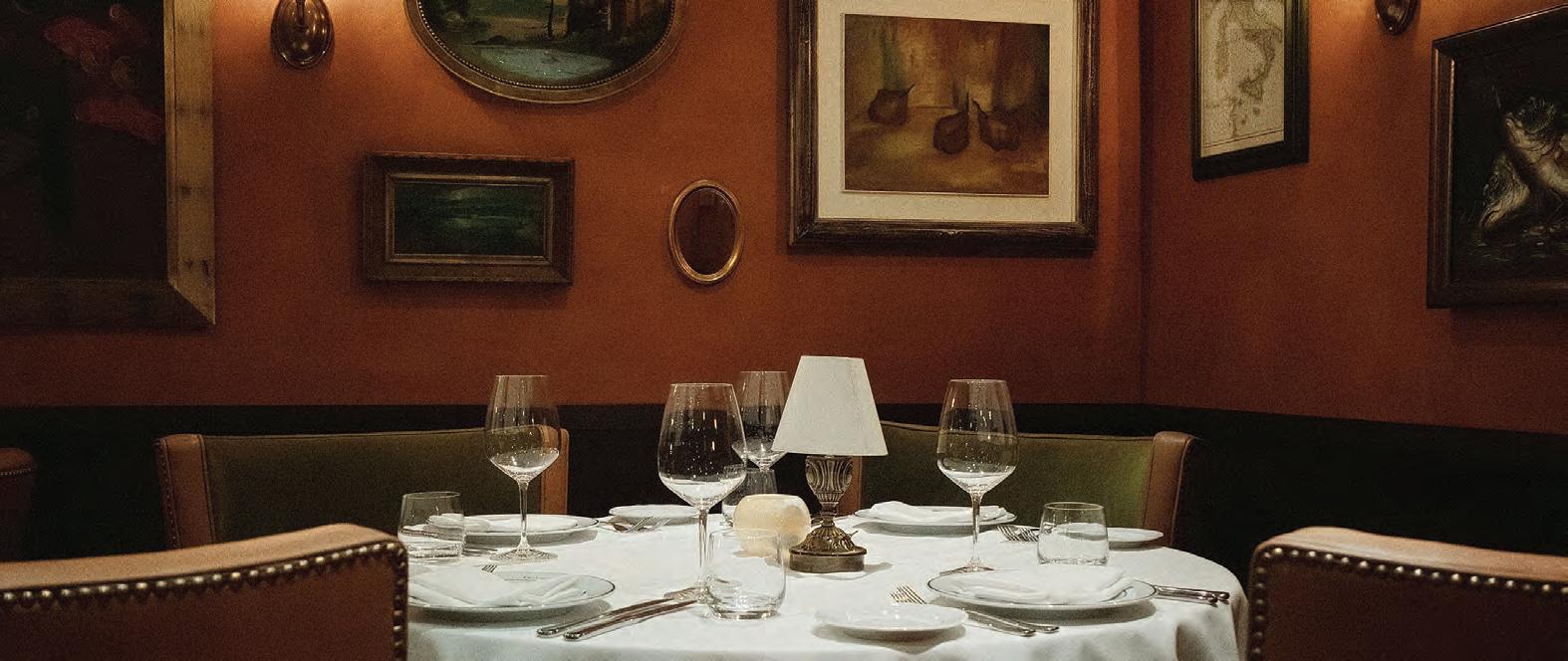
$59 THREE-COURSE SPRINGMENU
Availabledaily at BraidwoodTavern from 5:30pm- 9:00pm
Complimentar y3-hourvalet parking with restaurant reservations
TAVERNTIME| 2PM-5PM AT BRAIDWOODTAVERN
Aselectionof beer,wine, cocktails, and zero-proofbeverages,startingat$10.
Complimentar y3-hourvalet parking with restaurantreser vations
LEARN MORE
‘It’s
been quite the adventure.’
BRALORNE PUB UP FOR SALE AS OWNERS STEP BACK AFTER NEARLY TWO DECADES ON THE JOB
BY LUKE FAULKS
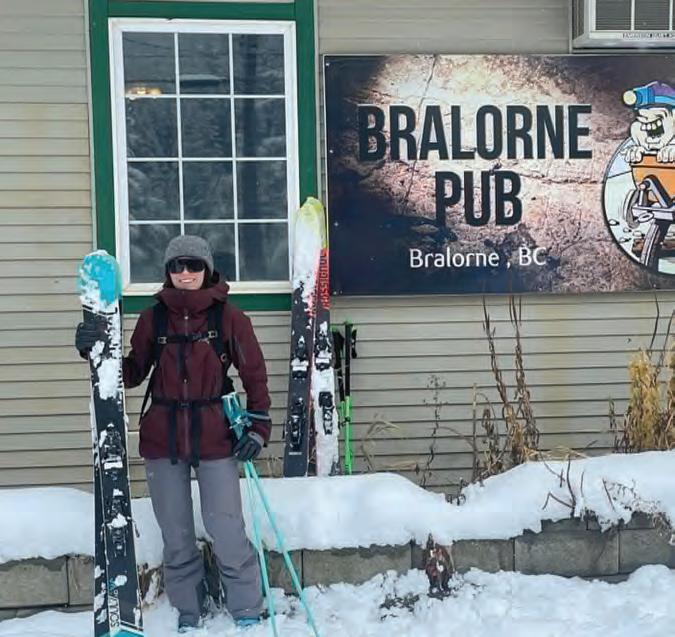
THE OWNERS of the Bralorne Pub have closed the doors of the remote Bridge River Valley gathering place and put the business up for sale, ending nearly two decades at the centre of one of B.C.’s historic mining communities.
Bruce Simon and his wife, Sally Bird, confirmed the decision in a public post, saying the pub will remain closed “until a new owner is found” as they move into retirement after 19 years in the valley.
Simon said the reaction from the community has underscored the role the pub has played in Bralorne’s social life.
“We had some damn good parties up here,” he said. “It’s an incredible journey. We made some world-class friends here that we hope to be friends with forever. Not much I would change. We’ve had the complete support of all the community, and it’s been quite the adventure.”
SHIFT FROM CITY LIFE TO REMOTE BUSINESS
Located 80 kilometres North of Pemberton, Bralorne is a former goldmining hub that has transitioned into a smaller, evolving community with a mix of full-time residents, seasonal visitors and recreation users.
Simon and Bird arrived in Bralorne after leaving city life, initially looking in communities closer to Whistler and Pemberton before being introduced to the area.
“We were both fed up in the city and had to get out. We were looking for someplace that had skiing, sledding, biking, that kind of stuff,” Simon said. “We looked all over B.C. [and] then our realtor told us about this place.”
Bird brought experience in the hospitality industry, while Simon said he learned the business after the move. Over time, the pub became a central meeting place for a changing mix of users in the region.
“It’s more of a get-to place for
mountain bikers and cross-country skiers,” he said. “Now all these people meet in the pub, we’re all becoming friends and getting more familiar with the neighbourhood.”
Simon said the pub has long relied on local support, with business fluctuating depending on the season.
“Without the local support, it’d be dead,” he said. “It is a favourite watering hole, but it’s definitely season-oriented, [with] the summer months are quite a bit busier than the winter.”
In the years leading up to the closure, Simon and Bird reduced operating hours
as they transitioned toward retirement, citing both lifestyle considerations and ongoing labour challenges in the region.
“Help was hard to find,” Simon explained. “Anyone that wants to work up here is getting good paying jobs through the mine. Working here, you’re going to be hands on, hoping and praying that you can enlist some help.”
The couple ultimately operated the business largely on their own.
“It was just me and Sally running the pub. I was the cook, she’s the front end,” he said. “We just didn’t want to work five days a week, six, seven days a week, and we didn’t have to.”
Despite reduced hours, Simon said demand remained steady, with the pub often operating at capacity.
“On the daily basis, we’re pushing the legal limits [and] we’re going home tired.” he said. “It’s a nice problem to have, but it’s for a younger person.”
FUTURE GROWTH TIED TO MINING, INFRASTRUCTURE, RECREATION
Simon said the decision to close was also tied to personal considerations, including relocating closer to family.
“We’re going to spend six months down at our place in Mexico, and six months on the Sunshine Coast,” he said. “Right now, I’m seven to nine hours away from my kids, and I can’t stand it.”
Looking ahead, he said ongoing mining activity and major infrastructure investments are expected to bring new residents and economic activity to the region. Plans to restart gold mining in Bralorne, along with upgrades to nearby hydroelectric facility La Joie Dam, have Simon expecting new residents moving to the area.
At the same time, the Sunshine Recreation Area has begun attracting increased visitation, particularly from mountain bikers travelling from the Sea to Sky corridor.
“We get Squamish, Pemberton, Whistler kids coming up here every weekend with bikes on the back of cars,” he said. “We’re seeing a daily influx through the summertime.”
Simon said those factors point to continued viability for the business under new ownership.
“It’s going to be a going concern for someone going forward, I’m pretty sure,” he said. “We had to cut back, otherwise we’d have been worked to the bone.”
For now, the couple is preparing for the next phase while continuing to field interest from potential buyers following the closure announcement.
The property includes the pub and a small retail space previously used as a convenience market, which Simon said had been well-used by the community.
Simon invites prospective buyers to text him at 778-866-5519. n
BRALORNE BUSINESS The pub is located two hours north of Pemberton up the Hurley River Forest Service Road.
PHOTO COURTESY OF THE BRALORNE PUB
Pemberton Valley Lodge’s David MacKenzie wins Hotelier of the Year
THE LONGTIME HOTEL DIRECTOR WON THE PRESTIGIOUS TITLE AT THE BC HOTEL ASSOCIATION’S ANNUAL AWARDS CEREMONY LAST WEEK IN NANAIMO
BY HILARY ANGUS
THE BC HOTEL Association named David MacKenzie, the managing director and co-owner of the Pemberton Valley Lodge, as the Hotelier of the Year at their annual awards ceremony on April 15.
The Hotelier of the Year award recognizes exceptional leadership, innovation, and contribution to British Columbia’s hospitality industry.
MacKenzie said he was “taken aback” by the recognition.
“Everyone in this industry I think works extremely hard. We’re all very proud of the properties that we operate,” MacKenzie said, adding that he was excited to have even been nominated among his peers. “I’m deeply honored to have been selected.”
MacKenzie has been involved with the Pemberton Valley Lodge since it opened in 2004, becoming a co-owner in 2009. Before getting into the independent hotel business, Mackenzie owned an adventure travel company.
His philosophy of hospitality is simple: treat guests like you’d like to be treated.
“I travel the world, I stay in hotels,” MacKenzie said. “There’s no sense trying to reinvent the wheel. If you see a great idea out there and it can be adapted or would work at your property, then why not? And I think that’s where I’ve always had great success, because being an independent hotel, you have the ability to implement change almost immediately.”
Under his 22-year tenure, a rarity in the hotel industry, MacKenzie has operated with a people-first mentality that resulted in the Lodge winning the Employees First Award at the Tourism Industry Association of BC conference in 2025.
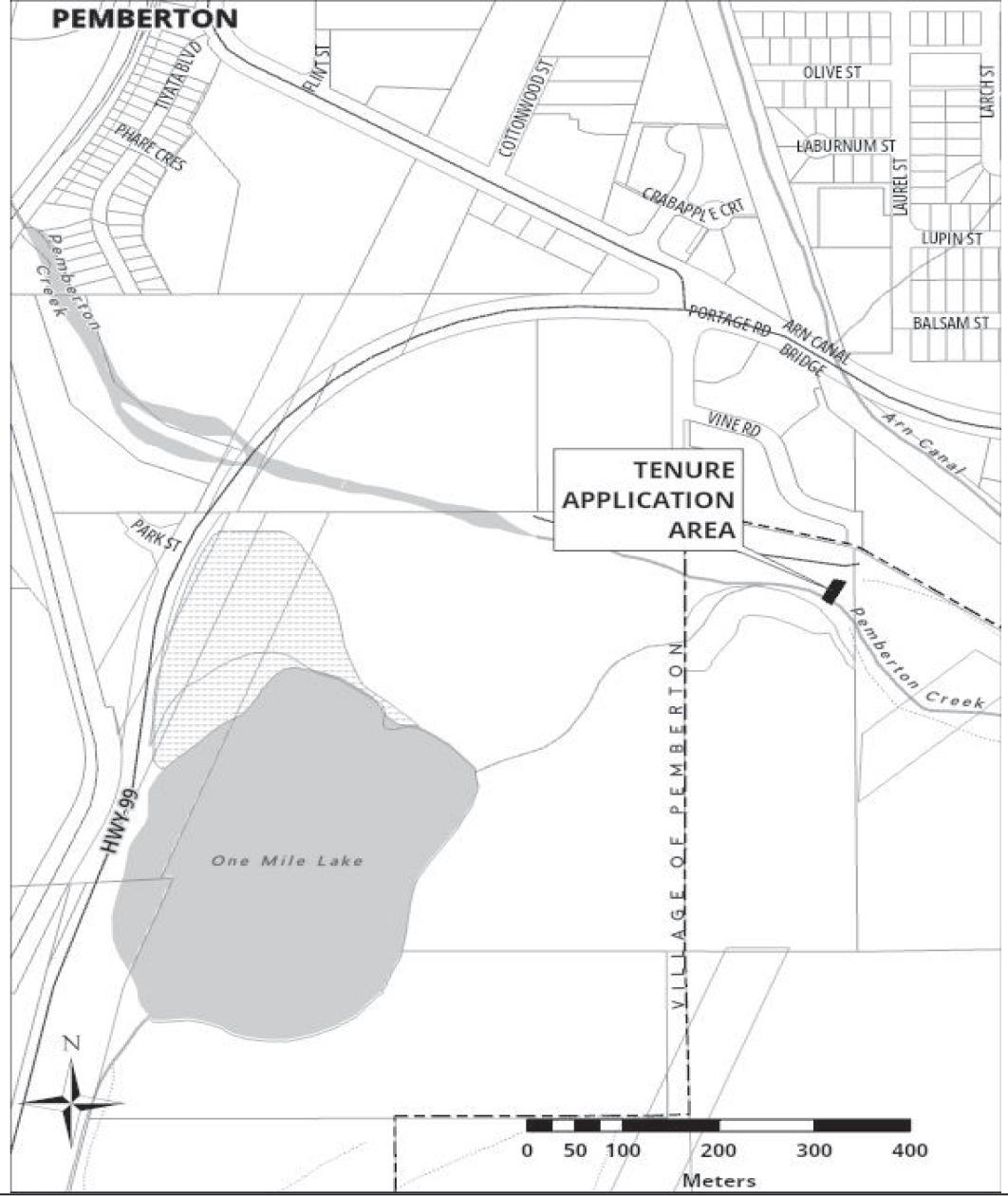
Takenoticethatthe GaribaldiHighlandsLandsLtd. of Pemberton,BC, hasappliedtotheBritishColumbiaMinistryof Water, LandandResourceStewardship(WLRS),Surreyfor atenureforutility waterlinepurposesituatedonProvincialCrownLandlocated atPembertonCreek
“I’m very proud of the fact that we have about a 98 per cent retention rate. Our staff have been with us a long time,” MacKenzie said, adding that wellness programs and other staff-first policies have created a company culture that makes people want to stick around.
“We get a lot of compliments about our staff because, you know, they work here, they live here, they’ve been here a long time, and they’re also, you know, local people that participate in a lot of our outdoor activities,” MacKenzie said.
MacKenzie said he’s also proud of how often guests ask if the hotel, which is in its 22nd year of operations, is brand new.
“I think that’s a testament to how well we take care of the product,” MacKenzie said. “We’re always investing some money back into it, but you know, from our room attendance to our maintenance, everybody, I think, takes a great sense of pride in their job.”
Beyond his work at the Lodge, MacKenzie has played an extremely active role in the provincial tourism industry, and the Sea-to-Sky community more broadly.
He has served on multiple provincial boards and associations including Tourism Pemberton, the BC Chamber of Commerce, and the Canadian Cancer Society.
In 2005 he was elected to a threeyear term on council with the Village of Pemberton, and in his spare time he is a SAR Manager for Pemberton District Search & Rescue and an Auxiliary RCMP Constable with the Sea to Sky Regional Police Service.
“David represents the very best of our industry,” said Paul Hawes, BCHA president, in a press release. “His leadership extends far beyond his property, and his impact is felt across communities and throughout the province.” n
WLRSinvitescommentsonthisapplication.TheLandsFile is 2413090. Writtencommentsconcerningthisapplicationshouldbe directedtotheSeniorLandOfficer,LowerMainland,WLRS,at200–10428153rdStreet,Surrey,BCV3R1E1.Commentswillbereceived byWLRSuptoMay24,2026.WLRSmaynotbeabletoconsider commentsreceivedafterthisdate.PleasevisittheApplications, CommentsandReasonsforDecisionDatabasewebsiteat http://comment.nrs.gov.bc.ca/formoreinformation.
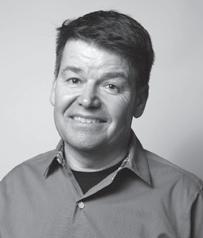
HATS OFF TO THE HOTELIER David MacKenzie, left, has been involved with the Pemberton Valley Lodge since it opened in 2004, becoming a co-owner in 2009.
PHOTO COURTESY OF THE BC HOTEL ASSOCIATION
One last kick at the can
I CONSIDER myself a winter optimist. But if there’s one thing I’ve learned from many a spring backcountry mission, it’s to know when to throw in the towel. But not without one last kick at the can.
Getting more turns out of this season’s backcountry snow is something I liken to driving a compact 2WD car
uphill in the snow, on questionable tires. You can attempt it, absolutely. You may even triumphantly top out and get to where you want to go. But once you’ve gassed into it and realize you’ve got no chance of clearing that steep section, the wisdom of turning around—while you can—will save you from getting really stuck, and wishing you hadn’t attempted it at all.
enough for snow in the valley or anything, but cold enough for good coverage at treeline and alpine. Reports from Creekside base verified it was not really that busy on the hill, a telltale sign that regional Epic Pass holders have more or less moved on from the 2025/26 season. Who turned out for this April surprise?
the access as best as they could with all the volatile rainstorms this winter.)
But last Wednesday, the shit show was well worth it. The road up to Chocolate Bowl had enough coverage to keep the rocks down for the first half, then smooth sailing past where the snowcat groomer was parked. The snow that greeted us
“I…book[ed] a single day of vacation with my employer the day before. There was no way I was missing this.” BY VINCE SHULEY
Mid-week local skiers and snowboarders. And sledders. I was one of the latter, booking a single day of vacation with my employer the day before. There was no way I was missing this.
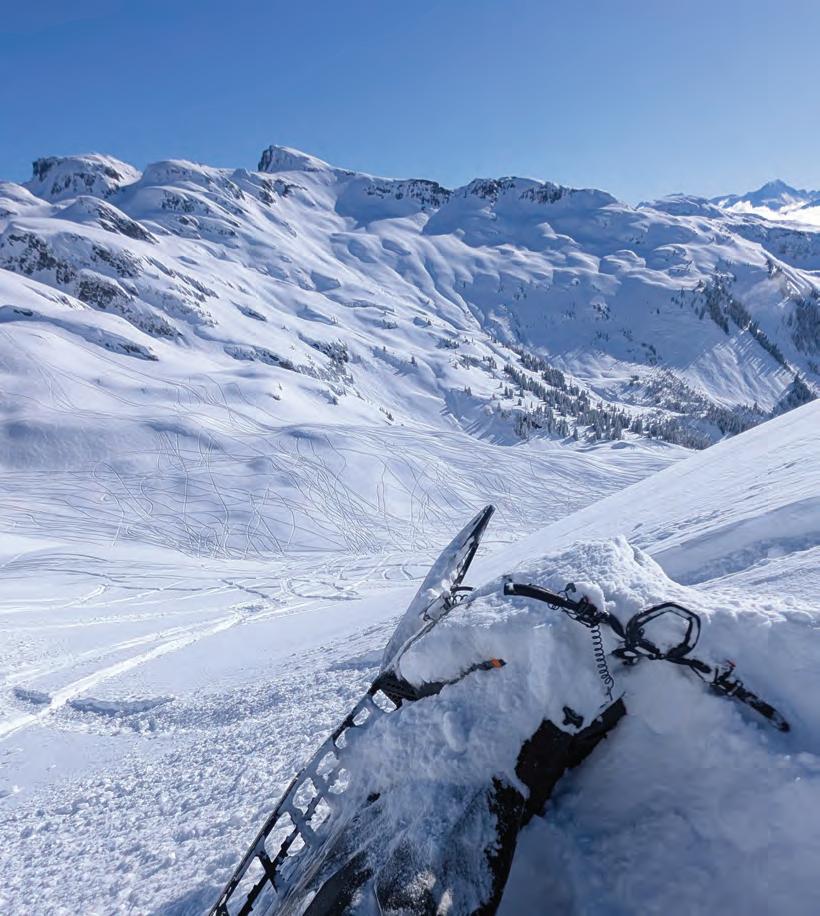
Wednesday, April 15, was my last backcountry pow day for the season. The storm came in hard and fast, drizzled rain at lower elevations, and, most importantly, it stayed cold. Not cold
Spring sledding can be a bit of a hassle. The access roads are not groomed to the bottom anymore, meaning you have to drive your loaded truck up a few more kilometers, and parking all those trucks and trailers becomes somewhat of a free-for-all. The Powder Mountain Snowmobile Club (PMSC) does its best to educate riders and manage the chaos, but when everyone shows up at once, it just ends up being a bit of a cluster. (Shoutout to the PMSC for maintaining
in Chocolate Bowl was some of the best of the season, varying between a few centimetres on the wind-affected ridges to 30 to 40 centimetres in the lower bowls. I lost count of the number of times I disappeared into a whiteroom, only to whip my sled around and throttle back uphill to do it again.
The crew of six I was with was mostly motivated to use their sleds to shuttle for ski laps, but I was happy to keep brapping. With the recent variable weather and family visiting, I hadn’t ridden my sled in weeks. So I was happy to burn some overpriced 91 Octane and get more kilometres on the odometer of my still-quite-new Ski-Doo.
About an hour later, the crew moved over to Grizzly Lake for a handful of longer ski laps, the sled ski traffic thinning out substantially. We had lunch in the bottom of the bowl and watched the afternoon flurries set in before retreating to Chocolate Bowl. A few last ski laps finished the day off before the return to the parking area. With hundreds of sleds travelling up and down that same road and the afternoon sun warming at every elevation, sledding back to the truck was a gravel grind. Mud, rocks and dirt all wearing down your expensive snowmobile components is a part of the sport, but it never feels good doing it.
Loading up for my return drive to Squamish, I relived the day. Deep sledding. Great backcountry pow skiing. Fun times hanging out with friends. If there was a day to finish real winter on, it was this one.
To be clear, I haven’t hung up all the skis for the season. I’ll still ski Whistler Blackcomb a couple more times, and my keener friends may even convince me for another day of ski touring. However, my pow-hunting days are over until November. I know when my winter is beaten, but not without one last kick at the can.
Vince Shuley is readying himself for (hopefully) a great summer. For questions, comments or suggestions for The Outsider, email vince.shuley@gmail.com or Instagram @whis_vince. n
DAVI D JOH A SHT ON
November18,1946- March30,2026
David JohnAshton, age79, passed peacefully at the Sea to Sky Hosp March30,2026.
He isdeeply missed by hisloving wifeof 57 years, Lynn; son John-David(Kate); daughter Jennifer; three cherished grandchildren Sam,Abby,and Lucy; sisters Shirley,Arlene,and Linda(Cy); and many niecesandnephews.
Bornin Torontoasthe youngest of five children, David joined the Royal Canadian Air Force at age20andtrained asapilot. While stationedin Gimli, Manitoba,hemet Lynn,andthe two marriedthe dayafterhis WingsGraduation.
Afterthree yearsof flying, Davidtransferred to the Military Police, a careerthat tookhimona NATO deployment to Cyprus andfamily postings to Oromocto,NB;Lahr, Germany; Shilo, MB; Montreal, QC ; Toronto, ON; Barrie,ON;and back to Lahr again each move anadventureinits own right. It wasduring his timeinLahrthat Davidshared hislove of skiing withhisfamily, a passionthat would stay withhimforthe rest ofhislife. He retiredinOttawa after25 yearsofdistinguished service, holding the rankof Lieutenant Colonel.
Following hismilitary career, David joined the Public Service asDirectorof Security forthePrivy CouncilOffice,wherehe served for11 rewarding years beforeretiring once again.
Agifted woodworker, Daviddesigned and builta beautiful homeforhimselfand Lynnin Gimli, Manitoba —a reflectionof hiscraftsmanshipand patience.They spent summers thereand wintersin Whistler,where Davidtaught skiing atBase Pod. In 2014, Whistler becametheir permanent home.This past winter marked David’s20th seasononthemountain,wherehefound great joyinhis ski schoolfamily andtreasured everyopportunity to sharehislove ofthe sport.
Family,friendsand colleaguesareinvited to the RacquetClubon May22from4-6pm to remember David. In lieu of flowers,donations may be made to the Sea to Sky Hospicein David’s memory.
LOCAL EVENTS
Experience the best of what’s happening around you. Our comprehensive online calendar lists every local market, show and gathering so you can plan your perfect week in seconds.
WHY VOLUNTEERISM IS IMPORTANT—BECAUSE WE ALL BELONG TO SOMEBODY
By Jackie Dickinson
One of the greatest pieces of wisdom I have ever received—both in life and in my work—came from a volunteer more than a decade ago, during my very first shift at the Whistler Community Services Society (WCSS) food bank. At the time, the food bank operated out of a small trailer at the church. I remember watching a mighty group of volunteers support a small staff and a growing line of members waiting outside in the cold, damp weather.
At the entrance of that trailer stood a volunteer who greeted every single person who walked through the door with warmth, a genuine smile, and unwavering respect. She must have welcomed more than a hundred people that day, yet each interaction felt personal, sincere, and grounded in dignity. Despite the long line and the shelves gradually emptying, she remained calm, patient, and fully present with each individual.
New to the role and deeply struck by what I had witnessed, I approached her after the shift and asked, “What’s the secret to helping people that way?” Without hesitation, she replied, “Jackie, remember— every person you meet belongs to somebody. They are someone’s child, and they are part of a family.”
That moment has stayed with me ever since. It not only affirmed my desire to work at WCSS, but it also shaped my understanding of what human-centred care truly means. It reinforced, early in my career, the profound role volunteers play—not just in delivering services, but in modelling compassion, empathy, and respect in action.
Volunteers are often the people who reconnect me to the heart of this work. They show up with optimism and a deep belief in humanity. They lead with connection, offering their time and energy without expecting anything in return. I am often met with the biggest, strongest hugs from our volunteers—simple gestures that carry profound meaning. Especially post-COVID lockdown, when distance and disconnection became the
norm, what I am most grateful for is their unwavering willingness to show care, offer connection, and lean into community when it matters most.
Volunteers are often the first point of human connection. Whether it’s greeting someone at the food bank, helping sort donations, or offering a listening ear, they provide more than assistance—they offer dignity and belonging. For someone experiencing hardship, that interaction can be the difference between feeling invisible and feeling seen.
At WCSS, volunteers extend the reach of every program we offer, while our Board of Directors ensures that this work remains sustainable, strategic, and responsive to emerging community needs. The Board plays a critical role in governance, stewardship, and long-term vision—helping to align resources, guide decision-making, and uphold accountability to the community we serve. Together, volunteers and board members create a powerful partnership that allows WCSS to meet immediate needs while planning for the future.
A single volunteer hour might translate into meals distributed or resources accessed, but beyond these tangible outcomes, volunteers contribute something equally vital: trust. When people see their neighbours showing up with care and consistency, it reinforces the belief that no one is alone.
As author Jennifer Wallace reminds us, “resilience within ourselves comes from deepening relationships with others.” This is what volunteerism makes possible. It strengthens the social fabric of Whistler, particularly for those who may be far from their own support networks.
At its core, volunteerism is not just about filling gaps—it is about defining who we are as a community. It reflects our shared commitment to care, inclusion, and mutual responsibility. At WCSS, we are continually inspired by those who choose to give their time, insight, and compassion. Their actions remind us that community is not just a place—it is something we actively create, together.
HAPPYNATIONAL VOLUNTEERWEEK!
To ourincrediblevolunteers—thankyou! Thisweek, we’recelebratingyou—theheartandsoulbehind theVillageHostandBikeHostPrograms.
Whenyou volunteer youbuild meaningfulfriendships, yousuppor t oneanother, youstrengthenou r community, championour businessesand contribute inwaysthattrulymatter. Itisyourdedication,warmth, an d welcomingsmile s thatcreateunforgettable experiencesforourvisitorsandlastingbondswithin ourcommunity.
VillageHosts
LynnAshton
Mary Beadon
SylviaBrandt
SueBrown
EvaCipera
RosemaryCook
TCCull
SandyCulpitt
EmmaDalSanto
PatriciaDagg
EzrahDavis
MichaelDeschenes
LisaDonahoe
JudithDyer
RitaEynon
MarilynFell
DougFell
BruceHall
HeatherHall
JonHarper
LizHarvey
AnneHibbeln
LornaHill
AdrienneHughes
DavidHughes
JaniceHulse
AlisonHunter
JudyIlles
SueKelly
TimKelly
LeannKleckner
Mary AnnKumli
JinnyLadner
MichelLavergne
MarieLeDuc
JohnstonLo
AudreyLundie
JeanMacDonald
KevinMcFarland
LizMammolite
JaneMathers
ChristinaMerer
Rupert Merer
RobinNichols
BarbOliver
ChrisPatrick
RussPtolomey
MicheleRadnidge
SimonRoussel
JillRowledge
GailRybar
The Audain Ar t Museum ex tendsa sincere thank you to ourdedicated Volunteers, Educator s, Docents, &Commit tee Member s!
Ipull into my driveway. It is almost 5 p.m. I left my house this morning at 7:30 a.m. Bef ore I cross the threshold, the dog races to greet me. He is a puppy, anxious by the late hour, jumping on me, and sometime in the day, he peed on his blanket. He has been left alone too long. What am I going to make for dinner? I don’t know. I’m already exhausted.
On the way into my drive, I say hello to my neighbour Carmen, who is pulling out of her driveway. “Just on my way to pick up my kids from soccer,” she says. “And one’s at dance class.” Carmen is a single mom. She speaks in short, rapid sentences. She’s probably thinking the same about me. What a long day.
I want to go back and ask how my parents, both working, managed with seven kids. For one thing, we didn’t have all those after-school activities and we were sent outside to play after school ended. Other things have changed, too; we walked home from school. Our house backed right up against the forest, and we wandered into the woods until dinner time. I probably did a lot of things I shouldn’t have done in those days—like taking pieces of birch bark to make birthday goodie bag canoes and breaking off branches and gathering them into bundles to take home. In the fall, I would pull maple leaves from the trees, planning to trace them later and paint watercolours. As kids, we were left on our own to be creative, active, and selfreliant until it was time for dinner. No one came looking for us, we made our own way home.
Now, as I stand inside the door, I am tired and more than a little harried. The dog has had enough of being alone in the house all day. Something possesses me to get the leash and instead of just walking around the neighbourhood we walk down the hill where I live and in 15 minutes we will be in the forest. So, despite my fatigue and feeling like my day should be over, I have switched into my boots and the dog and I head out.
As I open the front door, I’m greeted by a
cold wind, and it is starting to rain. I pull up the hood on my winter coat. It doesn’t feel like the first week of spring. My steps are laboured, and beyond my tiredness I am hauling around illness and grief. Every few feet, the dog stops to smell. I’m impatient. Hurry up.
It hasn’t always been like this. I remember arriving home much later and if I was home by 5 p.m., hallelujah, time for a run before dinner. Out of the corner of my eye now, I see a magnolia tree, with its first tiny pink petals opening. At the bottom of the hill, we pass the community centre where there’s a long row of daffodils. They must have bloomed just this week. We pass quite a few people walking briskly, perhaps on the way home from work. I say hello to all of them. No one says hello back. No one even looks at me. That’s when I notice every single person I’ve passed is wearing ear buds or headphones. I’ve walked with ear buds, too. First trying to listen to a podcast, and another day thinking I could listen to an audiobook. But minutes into my walk, I would become distracted. I say hello to people, stop to admire gardens, the funny tilted windows in a house I pass, my birder friend André leaving his house with his gigantic camera.
We walk a little further and there’s an elderly couple walking ahead of us and want to stop to say hello to the dog, ask his name, and comment, what a regal name for a little dog. It’s a Scottish name I say, named after an island in the Hebrides. Then the elderly gentleman starts telling me that he once played the bagpipes. Soon I am embroiled in a whole conversation of how we keep our Scottish heritage alive.
a walkthein
Shortly, dog and I must cross a busy street that leads to the path that will take us into the forest. The path is soggy with mud and enormous puddles as it’s been raining all week. But that’s OK. I have my boots on and the dog loves puddles. As we walk, we don’t see anyone. The woods are quiet. I am surprised by this stillness. Something moves overhead and I look up. There’s a great blue heron, wings spread circling above us. We walk a little further into a grove of Douglas fir trees. I can’t hardly believe it but circling not far from the heron is a bald eagle. By now I’ve forgotten how tired and hungry I was. I’ve forgotten the frenzy of racing home in heavy traffic. And what was I going to make for dinner. And the endless list of jobs yet to do before my evening is over. The weight of sadness has lifted. I wonder how life got so hectic with so little time for respite.
The dog doesn’t seem to care about any of that. He smells where other dogs have been, he spies a field mouse bounding across his path and begins yanking on the leash hoping for a chase. My shoulders have dropped, my breathing is calmer, and I begin to see things. New leaves sprouting on the maple trees, the bigness of the trunks of the Western red cedars, burned-out stumps of old-growth trees. The last of the day’s light streaming through a cluster of tall trees. It’s starting to get dark and we should head for home. I wonder why we don’t come here more often.
As I’m walking back up the hill home I can’t help thinking of this quote by the naturalist John Muir: “Everybody needs beauty. Places to play in and pray and where nature may heal and cheer and give strength to the body and soul alike.” I think about calling my friend Monica. Monica knows the forest, and guides people to forest bath, to experience the sounds, sights, and smells that make up the wisdom and beauty of the natural world. I want to ask her to walk with me, teach me how immersion in the forest nourishes the body and the mind, show me what she experiences, what I, too, can know, and incorporate into my daily life.
- Mary MacDonald
PHOTO BY MARY MACDONALD
the forest as a place of renewal
When I meet up with Mary, it’s the end of a long day and she is tired. Mary is not alone. We are all living in an era that demands more of our energy than ever before. TV, computers, smartphones, social media, all competing in an attention economy, where what you consume can feel like it’s consuming you.
It has been estimated that the average person processes approximately 74 gigabytes (GB) of information daily. To put this into context, 74 GB of information would be what a “highly educated” person living 500 years ago consumed in a lifetime. And this amount is increasing every year, by as much as five per cent.
It is little wonder that we are overwhelmed and fatigued. Biologically, we are attempting to process an aggressively accelerating world using equipment evolved for hunting and gathering in the African savannahs. This is why giving our whole system a break from digesting this information overload is so important.
While the medicinal qualities of forests have long been known to Indigenous peoples the world over, we are beginning to understand scientifically their value in promoting human health.
The modern notion of approaching forests as a therapeutic space began in 1980s Japan, as the country was experiencing a significant post-war shift from their traditional, nature-oriented, rural lifestyle into a more high-octane, indoor urban existence. The Japanese government had noticed a concomitant increase in anxiety and stress-related illnesses, including rates of cancer, heart-disease, and mental illness. However, portions of the population who stayed on the land, and still visited the forests daily, had better health outcomes than their urban counterparts.
This led the Japanese Ministry of Agriculture, Forestry, and Fisheries to come up with a radical proposal, a “green prescription” to encourage people to reconnect with nature by spending time in the forests. The practice became known as Shinrin Yoku, a term that roughly translates to “bathing in the atmosphere of the forest.” The practice draws from ancient Shinto and Buddhist beliefs about the healing power of forests and nature, viewing the natural world as a sacred space for reflection and renewal.
Shinrin Yoku has since spread across the globe, reflecting the acute need we have for the healing ability of nature. I tell Mary that a study reported in the Journal of Environmental Psychology in August 2024 showed exposure to nature in the form of forest can reduce harmful psychological states including self-criticism, rumination, anxiety, and depression, as well as increasing beneficial psychological states such as self-compassion, introspection and mindfulness. Thus, forest bathing can be seen as a promising support to mental health.
Minwoods
The premise of forest bathing, in the beginning, was based on common sense and the intuitive idea that being in the beautiful green forests of Japan would be good for people. “It is simple, really,” I say to Mary. “When we walk in the woods, we are not trying to get to a destination, we are pausing to notice where we already are.”
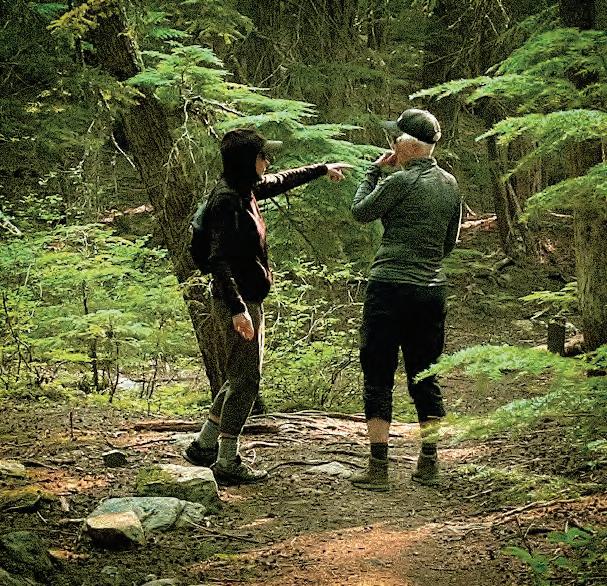
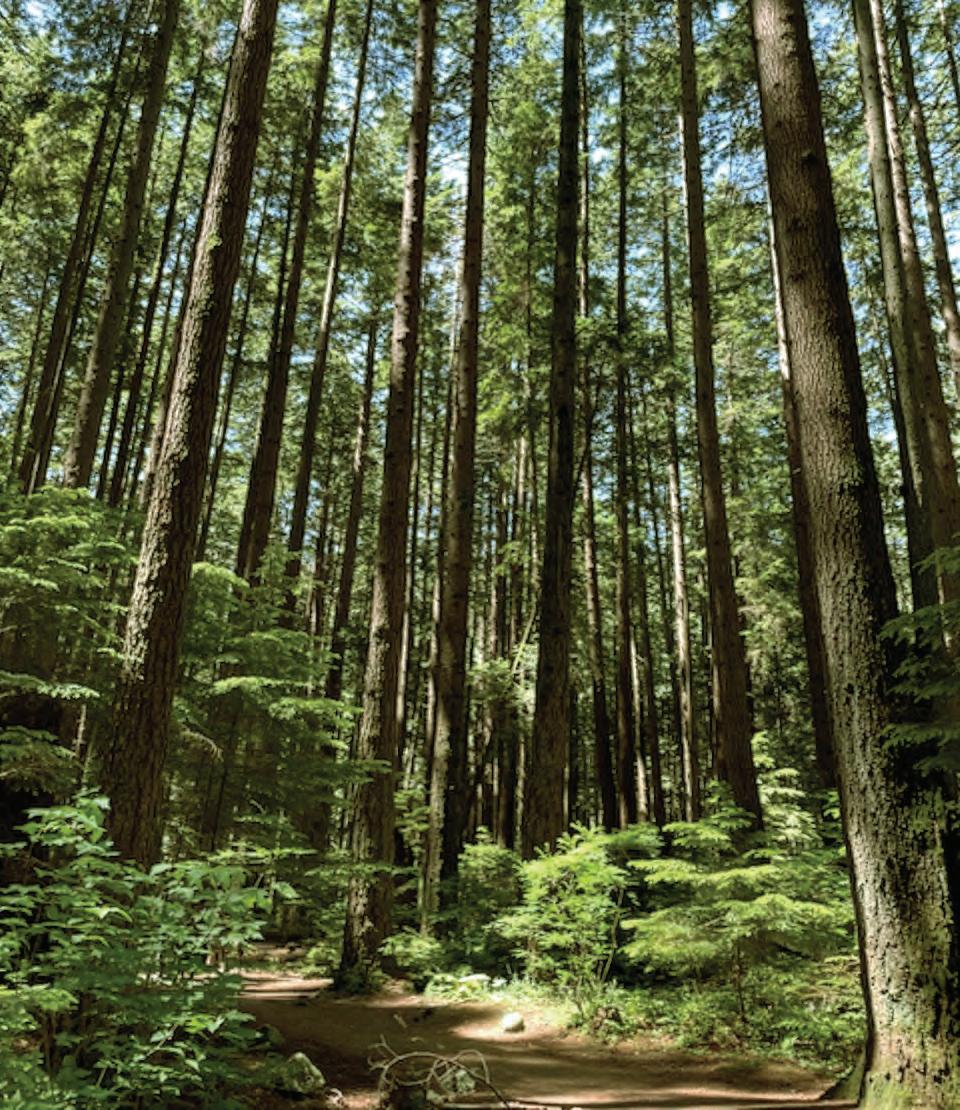
As we enter the forest together, we begin by taking in a 360-degree panoramic view of where we are standing. Together we observe tiny vibrant saplings emerging on the forest floor, among layered pine, fir and spruce need les and last fall’s maple leaves. Above us, the forest canopy sways in a gentle breeze. Around us, we notice the spacing of the trees, some in clusters, some more spread out. Observing the patterns of bark on the tree trunks, we see how the Western red cedars trail the trickling forest stream, next to nurse logs of Western hemlock.
“Let’s close our eyes,” I say. “Let your other senses come online, breathing in the fresh, slightly sweet, oxygenated forest air.” There is a dampness to the air, from last night’s rain. Slowly turning around, we take in the different scents each pocket of the forest has to offer. We linger for a moment as a clean, crisp waft of pine needles floats through.
A raven calls out from deep in the forest. Moments later, another raven, perhaps a mate, returns the call. Mary is a keen birder and wants to listen longer. “Sometimes, they are communicating their territory,” she says. Lingering is the key to forest bathing. We are not in a hurry. We stand with our eyes closed. It’s possible to pick up the softer sounds of the breeze. The wind articulates each needle as it passes through the boughs of the trees, creating a soothing murmur.
ary and I revel in the spaciousness of presence before slowly opening our eyes again. I invite Mary to observe what has shifted from when we first entered the forest. “Well, I’m not thinking about any of my worries,” she says. “And I think I hear a black-capped chickadee. Can you hear the chickadee-dee-dee call?”
In addition to the bird calls, and shift in the light as the sun descends in the sky, she notes how her own physiology has changed. The mental rumination over what to make for dinner, and how tired she is has dissipated, leaving her more restful and at peace. Like sap draining into a tree’s roots, the micro stresses and problems of the day have been absorbed by the quiet of the woods.
We have moved into what is often described as “flow state”—a brainwave pattern in which cortisol declines, stress reduces, and our bodies have the chance to rest and recharge. There are many ways to achieve flow state, but mindful time in nature presents a reliable and effortless pathway. According to Kaplan and Kaplan’s Attention Restoration Theory, our senses and cognition are wired to easily and efficiently process the information offered by the natural world. Unlike the overwhelming data we access in digital domains, the information from nature can be restorative rather than taxing, signalling safety to our overburdened nervous systems, allowing us to relax and let go. But to access these benefits, I remind Mary, we must move slowly and pay attention.
We walk further along the forest path, caressing leaves and the petals of early spring flowers, stopping to admire the patterns of light reflecting off the meandering forest stream, and enjoying the crunch of spent needles underfoot. I think I have found a willing accomplice.
Well, Mary has been doing her homework. She’s read that psychologists Dr. Arielle Schwartz and Dr. Scott Lyons, who have decades of professional experience in trauma recovery and personal journeys of healing, are researching how our nervous systems can be reset by our relationship with the natural world. A study in Environ Health Prev Med. (November 2022) reported the positive effects of forest bathing on the human immune function. While time spent in the woods can regulate our tired bodies and minds, the forest may also be our new medicine.
And so, we walk, slowly and mindfully. And as John Muir said, “I only went out for a walk and finally concluded to stay out till sundown, for going out, I found I was really going in.”
- Monica Sander Burns n
PHOTO BY MARY MACDONALD
Whistler’s Brin Alexander talks snowboarding and stunts
ALEXANDER PLACED SECOND AT THE 2026 NATURAL SELECTION TOUR FINALE IN REVELSTOKE
BY DAVID SONG
WHEN PEOPLE CALL Brin Alexander a stuntman, they aren’t just referring to his fearless snowboarding style.
The man is employed in the film and TV industry because of his father. Dave Alexander is a longtime local and rock-solid outdoorsman who became a stunt coordinator, and Brin’s inaugural experience came at 10 years of age on the series Kingdom Hospital. That day he wore a wig, doubling for a young girl.
Brin now wears multiple proverbial hats. As a stunt specialist, he’s contributed to hits like Supernatural, Percy Jackson and the Olympians as well as Dwayne Johnson’s comedy Tooth Fairy. He also brings athletic prowess to the slopes: for instance on the 2026 Natural Selection Tour (NST) where he finished second overall.
It may surprise external observers to learn that Brin has only ridden professionally for two or three years. Despite being competitive in his youth, stunt work has paid most of the bills. Eventually, people began to notice his impressive riding via social media (his Instagram handle, rather snarkily, is @ betterthanthepolice), which led to a deal with the brand ThirtyTwo.
Now Brin’s able to support himself via snowboarding to a much greater extent. He knows how to stay calm during pressure situations both on set and on-mountain, and he’s also used to having cameras in his face.
‘GOING BIGGER, DOING THINGS BETTER’
What Brin isn’t necessarily used to is competing against some of his heroes on a stage as grand as the NST final in Revelstoke, B.C. last month: Mark McMorris, Blake Moller and Nils Mindnich.
He jumped right into the fire against McMorris, the Winter X Games record holder with 25 medals in Aspen to go with three Olympic bronzes and an equal number of World Championship podiums. McMorris made history in his first quarterfinal run by landing a trick never before seen at NST: a backside double 1080 featuring an Indy grab.
“I thought he won, a hundred percent, being completely honest,” Brin said. “I was at the bottom watching that run and it’s quite an insane venue to be at in person. It really does put a crazy perspective on it, seeing him float through the horizon line. That’s kind of a mellow trick for him because he’s such a talented rider.
“It was insane to be standing in the same booth with him…and that’s what’s so cool about Natural Selection: it brings together all these different aspects of snowboarding. Mark’s a legend. He was in good spirits the whole time. Felt like I was just doing a run with my buddy.”
NST judges look for more than just
big tricks, however. Brin’s creativity and execution, coupled with his own jumps, ended up outscoring McMorris 85.6 to 83.6. That advanced the Whistlerite into a semifinal against ex-Freeride World Tour champ Blake Moller.
It was here that Brin strutted his best stuff: a 92-point run by way of improving his cab 900 while giving fans another taste of elite big mountain pathfinding. Moller wasn’t able to keep up with a high score of only 70.3.
“I didn’t want to undershow for the event…kind of just went for the cab nine,” explained Brin. “Once I put that down, I feel like I got the [experience bar] up in a sense, video game style. The rest of the run just started floating. You have a lot of momentum and speed and everything just worked out, [but] everyone I went against, I wanted to see them continue.”
The final pitted Brin against Mindnich, a Salomon snowboard designer and versatile athlete known for his on-mountain awareness and technical precision. NST broadcasters more or less described that bout as the engineer versus the psychopath—an analogy Brin finds hilarious. He ultimately lost 82 to 60, but is still proud of Mindnich’s effort and his own.
“My entire life has been into going bigger, doing things better,” Brin remarked. “I’ve always wanted human progression to be involved with snowboarding…and having the background of a stuntman, I do a lot of cliffjumping in the summer, I have a lot of skills in certain areas that [tend towards] being a bit of a daredevil. I think
of myself as somewhat calculated, but from the average eye, it definitely looks like I’m just risking it for the biscuit.”
‘PUTTING MYSELF OUT THERE’
So what’s next for Brin Alexander?
The 31-year-old and other NST finalists will return to Revelstoke next year, continuing to live out the reality envisioned by tour founder Travis Rice. Until then he plans to explore the grand mountainous spines of Alaska, heralded by many snowsports enthusiasts as an unrivalled locale. Of course, there will be other TV shows and films requesting his attention as well.
Brin has spent decades walking the road less traveled. Rather than university, he pursued gymnastics and driving courses to become a legitimate stuntman and transitioned to pro snowboarding much later than most of his contemporaries. Hustling to find career opportunities suits him, that’s for sure.
“Be yourself and feel good about what you’re doing,” said the Whistlerite. “It is nice to have the ability to choose what type of work you want to do and who you’re working with. I’m trying to better myself in [communication] and just be consistent, really putting myself out there, knowing who to contact and keeping connections.”
Despite a lack of glamorous accolades outside of NST, Brin evidently stands tall among world and Olympic champions. He’ll likely continue to be one to watch as his brand and reputation expand throughout the snowboarding industry. n
STUNTS AND SNOWBOARDING Brin Alexander has combined his snowboarding skills with stunt work in the film and TV industry.
PHOTO BY CHAD CHOMLACK
Noticeof Intentto Treat:
PEST MA NAGEMENTPLAN –S OUT HCOA STREGION #2025 –2030
TheM inistr yofForests,SouthCoast Region,isplanning to aeriallytreat up to 20,000hectaresof Crownforests to reduce populationsofthe Westernsprucebudwormmoth(Choristoneura occidentallis).
Thebiologicalinsecticide Foray48B containingthebac teriaB.t.k. (Bacillusthuringiensis var. kurstaki)willbeapplied by helicopteronce at eachsiteonorabout June1–July1,2026,dependingon weather conditionsandinsec tdevelopment.Proposedtreatmentareas were selec tedbasedontheseverity of Westernsprucebudworm defoliation, Douglas-firleadingstand types,andproperaccessin forweather monitoringandbiologicalsamplingbefore,during,andafter spray operations.
TheproposedtreatmentsitesarelocatedwithintheChilliwackand Sea to Sk yNatural Resource Districts.
Chilliwack Distric t(Fraser TimberSupply Areas):
• Mt.Mercer, Ford Mtn.,Mt.Hansen,Mt.Hope,andSilver Lakeareas southofHope
• EightM ile Creek ,Peers Creek, and DewdneyCreekFSRseastofHope
Allsitesproposed fortreatmentare coveredbythe SouthCoast Pest ManagementPlan#2025 –2030(PMP). ThePMPandmapsofthe proposedtreatmentareasmaybeviewedonline at: www2.gov.bc.ca/gov/content/industry/forestry/managing-ourforest-resources/forest-health/news orinperson at oneofthe following Ministr yofForestsNaturalResourceDistrict locations:
• 46360 Airpor tRd, Chilliwack,B.C.V2P1A5or
• 101 -42000 LoggersLane,Squamish B.C.V8B0H3
Pleasedirec tallinquiries to cafh@gov.bc.ca
URBANE NE RGY. SQUA MISH SOUL .
Trattoria Di Como revives Umberto Menghi’s unseen vision for iconic Village space
NEW ITALIAN RESTAURANT BLENDS LEGACY STAFF, FAMILIAR DISHES AND A RESTORED DESIGN TO RECONNECT ITS SUNDIAL PLACE LOCATION WITH ITS ROOTS
BY LUKE FAULKS
AFTER CYCLING THROUGH decades of culinary identities, a storied Whistler space is returning to its roots with a new name, a familiar team and a vision closely tied to what might have been.
The Trattoria Di Como, which opened March 5 in the former Sundial Place location long occupied by Trattoria Di Umberto, is positioning itself as both a revival and a continuation of founder Umberto Menghi’s concept.
General manager Michael Graham, who worked for Menghi for more than three decades, said the new restaurant is built around a version of the space few people ever saw before Joe Fortes took over in 2021.
“When we sat down to talk about the look of [Di Como], I had images from the old Trattoria, from Joe’s, and Umberto’s renovations that really nobody saw,” he explained. “We wanted to respect the history of the space and recognize what the people of Whistler were missing.”
According to Graham, Menghi had invested heavily—roughly $4 million over two years—into re-imagining the space before ultimately stepping away from the project after a trip to Italy. The result was a partially realized vision that only operated for a single night before the concept changed hands.
“So, in 2019, we got this open for the
Grand Fondo corporate dinner. Umberto had brought up a bunch of cooks up and chefs, and we had already started hiring to open,” Graham recalled.
“And then on the flight back, he goes, ‘I’m done. I’m not doing it.’ About four million on the project, and then he kind of called it.”
Graham and his team have diligently restored the original aesthetic and ethos: “So this is around where it was going back in 2019. No one saw the whole thing, [so] it’s super exciting for us get to reveal it now.”
The space itself carries unusual weight in Whistler’s dining history.
resonate with locals.
The restaurant closed in 2024. The property was acquired by the Executive Hotels group later the same year with a plan to return the venue to its Italian roots.
The “Como” in the name references Lake Como, located in Lombardy, Italy, signalling a more elevated dining experience while maintaining the accessibility of a traditional trattoria.
“The Trattoria is a trattoria at the end of the day. It’s casual dining, great food, [and] just being at home. No pretentious airs,” Graham said. “It’s welcoming to anyone who wants to come in and enjoy themselves.”
“The Trattoria is a trattoria at the end of the day. It’s casual dining, great food, [and] just being at home. No pretentious airs.”
- MICHAEL GRAHAM
Menghi opened the original Trattoria in the early 1980s as a casual counterpart to his Il Caminetto. The Tratt operated for more than three decades, becoming a cornerstone of the resort’s Italian food scene.
Its eventual closure in 2019 marked the end of one of Whistler’s original village-era restaurants.
The Vancouver-based seafood restaurant Joe Fortes re-opened the space in 2021, redesigning the interior and shifting away from its Italian identity. But Graham said the concept struggled to
That balance is reflected in both staffing and menu decisions.
When rebuilding the staff, Graham reached out to workers with direct ties to the original Trattoria and Menghi’s broader restaurant group—staffers who already know the room and appreciated the vision.
“It’s home for them,” Graham said.
The menu blends legacy dishes with new offerings, with flexibility to reintroduce past favourites over time.
“There’s bits from all those restaurants, there are a few favourites
that people are asking for, and then down the road maybe we bring the specials back once the kitchen kind of gels,” Graham said.
“If you bring someone into the Trattoria, and you’ve made it look like before, [then] you’ve got to get the same food, right?”
Inside the restaurant, the redesign removes structural barriers introduced during the Joe Fortes era, restores sightlines and returns the space to a brighter, more open feel. The entrance has been shifted back to its historic location, and the patio is being rebuilt.
The restaurant is also acting as the tip of the spear for a broader transformation of the building, with ownership planning a full top-to-bottom redevelopment of the hotel around it.
“They’re redoing the entire building, top to bottom, inside and out. [The Como] is the jewel right now, and then the whole thing will become a massive Como,” Graham said. “There’s going to be a spa, there’s going to be a lounge, kind of private members club… the vision is amazing. It’s a passion for them.”
For Graham, the reopening carries a personal weight.
“It’s really...about coming into a room of familiar faces and cuisine and comfort and regaining those relationships,” he said.
The Trattoria Di Como is open five nights a week, with plans to expand service and continue renovations across the property. Graham said the work is exhausting, but fulfilling.
“It’s a lot of 10, 11, 12, 13, 14-hour days,” he remarked. “But it’s absolutely fuelled by excitement, passion, and a belief in the vision.” n
The new restaurant restores a 30-year legacy to the Village.
PHOTO COURTESY OF THE TRATTORIA DI COMO
MEADOW PARK SPORTS CENTRE
SWIM • SKATE • SWEAT • SQUASH
OPEN DAILY: 6 a.m. to 9 p.m.
*some exceptions apply
‘At the end of the day, it relates to us’
WHISTLER SECONDARY SCHOOL MUSICAL THEATRE STUDENTS TALK UPCOMING ‘MEAN GIRLS’ SHOW FROM MAY 6 TO 9
BY DAVID SONG
AFTER PUTTING ON high schoolthemed musicals (Heathers and Carrie) in back-to-back years, Whistler Secondary School (WSS) drama teacher Conor Niwinski hesitated to commit to Mean Girls. He felt that his class had delved into motifs like bullying and teen angst extensively, and didn’t want to risk retreading similar ground.
However, Niwinski doesn’t regret acquiescing to popular demand among his pupils.
Mean Girls is nothing if not a cultural phenomenon. For more than two decades, it has enjoyed remarkable popularity: just look at all the memes and all the irreverent quotes thrown around on a regular basis (“on Wednesdays, we wear pink”). The 2004 comedy movie starring Lindsay Lohan, Rachel McAdams and Tina Fey has generated various adaptations, including a stage musical and a 2024 film remake based on said musical.
WSS students are now getting ready to debut their own version of the iconic story.
“Everyone’s like: ‘oh, you keep picking the same thing’, but at the end of the day it relates to us,” says Kirra Horn, a senior cast as main antagonist Regina George. “As actors, that’s important in
what you’re trying to portray. With [these characters] being in high school and the need to fit in and be cool, I think we definitely can all relate to that on some sort of level.
“We’ve put on some pretty big-name productions…especially Mean Girls— our generation kind of grew up on that. There’s going to be a lot of expectations and meeting those is going to be tricky, but I think we’ll get there.”
Angelina Perizzolo feels the same way. The Grade 10 student joined musical
fun for [my peers] to do and also is going to highlight the main characters,” explains Crute. “What’s been really fun about this year is: I’ve had lots of opportunities to do some cool lifts…something we haven’t done in the past. It’s possibly a challenge for some of the cast members, but also a way that they can grow more confident as dancers—not just actors.”
Regarding what it’s like to operate behind the scenes, she adds: “I perform a lot as well. I actually [shared a role with WSS alum Kiara Felice] in Heathers…but
“...Mean Girls—our generation kind of grew up on that.”
- KIRRA HORN
theatre two years ago and has discovered a love of drama that fuels her in the lead role of Cady Heron: a sheltered girl trying to find her identity amidst a web of social landmines propagated by Regina’s clique.
LIGHTS AND COSTUMES
Mean Girls is physically demanding to an extent, with several notable dance sequences including a tap number. That’s where Baylee Crute comes in.
Crute’s dance background equips her to choreograph WSS shows over the last four years, and Niwinski identifies her as a key piece of the puzzle. She was eager to step up once again, this time with assistance from fellow 12th-graders Horn and Fiona Campbell.
“I’m really trying to make the choreography in a way that’s going to be
it’s fun getting to watch what you created. When you’re dancing you don’t really get to see it from that outside perspective, so getting to watch with all the lights and costumes is a really amazing experience every time.”
Also joining the cast is Darner Tindall, a former bassist in the Carrie band who will play rapper-mathlete Kevin G in his high school acting debut. Yes, that means he’ll get to rap on stage.
“I really connected with the character of Kevin G and I feel like I can embody him pretty well,” remarks Tindall. “I’d say the hardest thing is actually getting the sets right because I’m not in stage crew, but I hear a lot of the stage crew stuff. Honestly, making a blank stage look like a high school hallway to switch straight into a mall and then go into
a Halloween party—they’ve got some crazy skills.”
PERENNIAL COMMUNITY
WSS’ theatre program has been a key part of the school’s fabric, with most speaking positively about their time on board.
Horn has participated since eighth grade, sometimes enjoying friendly competition for roles with her older sister Tia (who was the leading lady in Heathers). Now enrolled at the University of British Columbia, Tia’s attended every show since her graduation and even helps out at the occasional rehearsal.
“She really was the perfect example for leadership in theatre,” Horn remarks. “I think she’s set the bar pretty high for the rest of us, but definitely trying to live up to it. What stands out to me is the community that’s built every year—we always get these new students and we’re all such close friends. [As for me], confidence has really changed a lot because of theatre. I’m kind of a nervous, shy person…but I’ve almost come out of my shell.”
Newcomer Tindall says: “At the start of the year, because it was my first time, I felt a little off but I’ve definitely felt welcomed into the theatre family. Me and my double cast, we get along perfectly and I actually feel like it enhances our ability to play the roles. I’m going to be sad when I graduate and I’m not able to do this, but I’m going to be happy while I am doing it.”
Mean Girls will run from May 6 to 9 at the Maury Young Arts Centre. Visit https://artswhistler.com/calendar/ whistler-secondary-school-presentsmean-girls-the-musical/2026-05-06/ for tickets and details. n
Whistler’s Paul Shore releases second book in ‘Steve and Eve’ graphic novel series
‘BE A MARSHMALLOW’ LAUNCHED GLOBALLY ON EARTH DAY
BY DAVID SONG
INSTALLMENT NO. 2 in Paul Shore’s ecologically-oriented Steve and Eve series has arrived just in time for Earth Day.
Be a Marshmallow continues the tale of a polar bear named Steve and his electric car friend Eve as they travel the world exploring solutions to climate change. Both protagonists are headed to Norway, an electric vehicle hotspot in real life, to help Eve connect with others of her kind.
Paul’s daughter Jashia helped with edits roughly a decade after inspiring the original book, I Can Hear Your Heart Beep, with her childlike remarks about how an electric car has “a heartbeat”. Jashia is now 18, older than the target demographic of 5 to 10, but nonetheless provided a young person’s take on her father’s writing and humour style. Her brother Aaron likewise gave input.
“What’s blown me away the most is how much these kids at a young age already understand,” says Paul. “Either they understand intuitively what’s easier on the planet, or they’ve learned elements of climate change subject matter and are ready to embrace it. That enabled me in the second book to jump right into some things that I might have considered too much for young kids.
“Most of my feedback comes from the school visits I do. I’m just uplifted and blown away by the capability that these kids have to focus on the positives rather than the doom and gloom. We have the technology to make a massive difference already, and by that, I’m talking about things like solar panels, wind farms. These kids know about these things.”
Also contributing to Be a Marshmallow is illustrator Ashley Wong. The Seattle resident inherited a “character Bible” from Prashant Miranda, who illustrated Book No. 1, and used it to faithfully replicate Miranda’s art style.
‘A RARE CHILDREN’S STORY’
The global debut of Be a Marshmallow coincides with a senior officials meeting
by the Fossil Fuel Treaty Initiative (FFTI) held on April 24 and 25 in Santa Marta, Colombia. The FFTI describes itself as “an alliance of nation-states and civil society working to secure a global just transition from coal, oil and gas” and its founder, Tzeporah Berman, is acquainted with Paul.
Berman is a Canadian activist who has worked on environmental policy for over 30 years. The former co-director of Greenpeace International’s Global Climate and Energy Program and co-founder of ForestEthics (now Stand. earth) described Be a Marshmallow in a press release as: “a rare children’s story that doesn’t shy away from the realities of a changing world, yet leaves kids feeling lighter, more resilient and inspired.”
The novel was released in English, Spanish and French to reach a wider audience.
“I do volunteer work for an organization called Ecology Project International that’s very Latin Americabased, and it started to occur to me: if I could expand from the English world, that could be exciting,” Paul comments.
“I spent a year of my life quite a long time ago living in France, so an ability to engage more in the French world is exciting to me too.”
Climate change is a controversial topic that may seem overwhelming, but Paul believes the future may be more hopeful than what is portrayed on newscasts and Internet discourse.
“I really believe that humanity already has the technology to move away from fossil fuels, to move to energy sources and transportation solutions that can solve the problem,” he opines.
“I like to believe that: rather than being at a doom and gloom tipping point, we’re at a tipping point where our solutions actually take hold and we start to see over the next decade or two actual mainstream progress.”
Steve and Eve: Be a Marshmallow is available now on Amazon, as are all editions in the series. n
GRAPHIC NOVELIST “What’s blown me away the most is how much these kids at a young age already understand,” says Paul Shore.
PHOTO COURTESY PAUL SHORE
The Zummers launch maiden album, ‘Distracted’
THE COLLECTION IS NOW STREAMING, AND A MAY 8 SHOW IS HAPPENING IN WHISTLER
BY DAVID SONG
AFTER MONTHS of churning out singles like “Grenoble” and “End of the World”, The Zummers are gearing up for their inaugural album.
Distracted comprises eight songs that address a bevy of diverse subjects, from love and geology to urban development and heartwrenching loss. Both aforementioned tracks are included, along with the catchy sing-along titular earworm “Distracted” and more.
When asked if any particular song stood out to him, lead singer Tom Csima identified “Art in the Country”: which is based on the true story of a senior property owner who lived near his old stomping grounds outside Toronto. This man, identified lyrically as Art, refused to sell his land and was known for displaying his paintings on the lawn. Somewhat more infamously, he composed self-portrait nudes well into his eighties.
Csima’s mom would often recall this eccentric bit of local lore, but he did not end up fact-checking until after “Art in the Country” had been recorded. Turns out, the only major detail he got wrong was the man’s name (which is actually John van der Hart).
It’s been just over a year since The Zummers won a Battle of the Bands in Squamish’s Brackendale Art Gallery. Csima and his bandmates Alex Drapeau, Jessie Richards and Mikey Muscat all knew they were interested in creating new music regardless of the battle’s outcome.
“We often joke that we would never be friends if it weren’t for our band,” Csima says. “We’re all into different things, at different stages of our lives and come from different places, but for some reason it just works. I went from not knowing these guys at all to spending full weekends driving and bunking together and whatnot going on tour. We joke and laugh a lot, which makes those long road trips fun.
“People always remark at how much fun we seem to be having on stage together and in our social media…and it’s true: these guys are like my second family now. Musically everyone contributes as well, which is important. It not only makes us prolific and productive, constantly turning out new material, but also diversifies our sound, utilising our different musical backgrounds and styles.”
‘THE GROOVE’
The Zummers view themselves as a rock band and Distracted is meant to be a rock album, but a few more ingredients went into its composition. Listeners will pick up on folk influences throughout and
most tracks have a funk or soul element that occasionally leans toward disco.
“We also have been told there’s a certain shimmer or twinkle to our recordings, and definitely some trippier psychedelic features,” Csima says. “Most of all, I think the common denominator is the groove.”
The four Pembertonians laboured to make time for a full-length album. Each holds down a day job with various other personal commitments and a busy performing schedule, but they got it done with a little help from their friends.
Emilio Pagnotta runs Holy Cow Studio in Kamloops, B.C., where The Zummers recorded Distracted. Pagnotta is described as virtually a fifth band member and a good friend, while Csima’s partner Cléa Thomas is more or less their creative director. She spends many hours designing and making Zummers merchandise, promotional videos, imagery, and is responsible for a huge part of the group’s aesthetic.
Distracted officially released on April 17 with a show in Squamish, followed by others in Vancouver (April 18 and May 14), Pemberton (April 25), Whistler (May 8), Cumberland (May 15), Ucluelet (May 16) and Victoria (May 17).
“We love playing local shows!” comments Csima. “There’s some people that have been coming to our shows from the start. They sing along and wear our merch and it’s pretty special. We call them ‘Zum Bums’. We usually space out our local shows so that we don’t oversaturate things, but we figured our debut album release had to be special. We’re going to play all of our favourite Sea to Sky spots, and we’re hopeful our Zum Bums come to all of them!”
Five even newer songs will also be played at the upcoming tour, and as of now the plan is for this quintet to feature in the next Zummers album. Yes, they’re already thinking that far ahead.
Visit https://thezummers.com/ for more information. n
BAND OF BROTHERS The Zummers have released their first album and are playing in Whistler soon.
PHOTO COURTESY OF THE ZUMMERS
StartwithourfamousCheese Toast, thenchoosefrom aselection of Hy's favourite appetizers,entrees and desserts.
Sunday -T hursday
HY’SSTEAKHOUSEWHIS TLER 4308MA INST (I NT HEDE LT AH OT EL ) 604.905. 5555 |H YSS TEAKHOUS E. CO M
KimDorland, Nemophilia#1 (detail), 2017.
Collection.
Just because it was documented, doesn’t mean we have it…
THE ARCHIVES DEPEND ON YOU: DISPELLING SOME MISCONCEPTIONS ABOUT THE PROCESS OF BUILDING THE MUSEUM’S COLLECTION
BY BRONWYN PREECE
“ARCHIVES ARE THE documentary by-product of human activity retained for their long-term value. […] Like people, archives are diverse,” explains the International Council on Archives.
In simple terms, the archives is a euphemism for a ‘collection of story parts.’
In a recent Pique article, I, the Whistler Museum’s Events and Community Manager, was quoted as saying, “an archive is a living, breathing, exciting thing. ‘Archive’ is a verb.”
The action of the archive, however, is only expanded by donations of materials; adding chapters, pages, periods and punctuation to the makeup of a place… and herein, lies one of the major misunderstandings on how the broadening of our museum collection works.* Just because an event happened and it was photographed — or a document was produced relating to the town in some way — does not automatically mean that we have it.
In short, the archive is infused by gifting. We are dependent on donations. This can also mean that the archive can be disproportionately reflective of a place’s demographic. This, too, is true for our Whistler archive.
misunderstood element of how the Museum is able to process items received. It’s not instantaneous.
We are a not-for-profit organization that operates with a small staff of three. Currently, we have an additional person added to the team, hired under contract for the sole purpose of inventorying, appraising, processing (arranging and describing) the donation of the Bruce Rowles 70,000+ photographic collection. This entire process has already taken seven months, working full time, and is still ongoing. Ideally, the last step for archivists is to digitize our collections, which is important for preservation of degrading materials and for easy access to these images. The process is time and labour-intensive. A collection of 20,000 images could take one year to digitize, ensuring it meets Canadian archival standards. It is, however, a donation we are exceedingly happy and grateful to receive: a benefit to the entire community.
Bruce wanted to ensure his life’s work would be remembered and appreciated. A selection of his photography will be exhibited at the Whistler Museum from April 24 to June 14.
As further means of perspective, the Whistler Museum’s entire photographic collection currently exceeds 300,000 items. With the addition of the Rowles collection, it will be nearing 400,000. We
The Museum’s archive can be viewed as an ever-expanding puzzle; whilst we try to configure matching pieces and identify those missing. The process is equally as diverse as the people and collections who breathe life into it: a reciprocal exchange between gifting and receiving.
The local archive is only made broader — more reflective of those who have, and still do, live here — by donations of material: from physical elements (text, photographs, video/film assets) to nonphysical ‘oral histories’ that people come in and record. The Museum’s repository is expanded by people contributing to being part of place-making and meaning. Please never underestimate the value of your experience. The Museum does not have an age limit.
Speakers Series are also a valuable way of documenting reflections and past events, recording our stories through the power of conversations — which add to the record — becoming platforms for thought. Again, I was cited in the same March 20 article by Luke Faulks as saying: “…a museum is an exciting place. Your history sheds light on your present, and it’s a springboard for how we inform our future.”
The Museum invites you to become an active participant and co-creator of our storied happenings by attending one of our events, by volunteering to record your tale or by donating relevant items you may have.
This segues into another often
“The Museum’s repository is expanded by people contributing to being part of place-making and meaning.”
have approximately 90,000 of those items digitized. We try to make many of those items available through a variety of means: from special exhibitions to posts on our social media networks, online on our archival database to highlighting them through articles and being featured in events.
The local archives is an expansive and immersive space: infused by your continuous contributions into the building of a pastiche-of-place.
*
*It would be remiss of us not to acknowledge the past wrongs associated with many colonial museum practices: with a legacy of taking, extracting without permission and stealing from Indigenous Peoples. The Whistler Museum has participated in the repatriating of some items that were donated that we did not feel were ours to have. Together, we learn through the past how to co-create collaborative futures…n
ENTERTAINMENT LISTINGS & ASTROLOGY
WHISTLER WELLNESS MORNING & AFTERNOON
Start your day in stillness, not urgency with a calm and restorative morning of yoga, breathwork, energy clearing, meditation and sound healing in a peaceful mountain setting, then experience afternoon reset designed to release tension, restore balance, and leave you feeling grounded and renewed. This immersive wellness experience is designed to support deep release and full-body restoration through breathwork, movement, and sound. Guided by experienced practitioners, you will move through a sequence of practices that calm the nervous system, restore balance, and reconnect you with your body.
> April 25, 9 a.m. to noon and 2 to 5:30 p.m.
> Nita Lake Lodge
FLOURISH COLLECTIVE DINNER AT LORETTE BRASSERIE
This is an opportunity to gather, connect and enjoy a refined 3-course dining experience in a warm and inviting setting designed to bring women together for meaningful conversation, shared moments and genuine connection. Thoughtful touches and special moments, including exclusive giveaways, are woven throughout the evening to make the experience even more memorable. Come as you are and leave feeling inspired, connected and refreshed.
> April 28, 5 to 8 p.m.
> Lorette Brasserie
OIL AND ACRYLIC PAINTING WITH LACEY JANE WILBURN
Local artist Lacey Jane is offering a four week in depth painting course covering everything from sketching and grisaille to colour theory, depth, texture, expressive
PIQUE’S GUIDE TO LOCAL EVENTS & NIGHTLIFE
WHISTLER WELLNESS
movement, and finishing techniques, with all materials provided. Express your creativity in a group setting and advance your skills in the art of painting.
> April 28, 6 to 9 p.m.
> The Point Artist-Run Centre
Free Will Astrology
ARIES (March 21-April 19): The visible lightning bolt we see is actually the return stroke. It’s electricity racing back up from the ground to the cloud after an invisible leader stroke has created a path. So the spectacular display is actually the earth talking back to the sky. I’d love to see you adopt this phenomenon as your power symbol, Aries. In every way you can imagine, be like the earth conversing with the sky. When a hopeful sign crackles overhead, send out a bold message that you’re ready to act on it. If your ideals are vague and wispy, flying high above you, take a brave practical step to anchor them in reality. Proclaim your bright intentions to the clouds and the stars. TAURUS (April 20-May 20): You’re finished with energydraining indulgences. No more seductive perils or cute ailments, either. Once you wriggle free from the tangles that have been hobbling your style, I suspect you will also renounce anything that resembles joyless restraint, naive certainties, pointless cravings, numbing comforts, or misplaced bravery. May it be so! Abracadabra! The emancipations that materialize after these escapes will likely stoke your holy appetite to shine more fiercely than it has in ages.
GEMINI (May 21-June 20): In music theory, the tritone is an interval exactly halfway between octaves. In old church music, it was considered diabolical because of its unstable, unresolved quality. But this “devil interval” is now essential to blues, jazz, and rock. The precariousness that once made it seem outrageous became the source of its potency. What was taboo became foundational. I believe you’re entering into a metaphorical tritone phase, Gemini. Lots of interesting and valuable stuff may be a bit wobbly, irregular, hectic, or ruffled.
CANCER (June 21-July 22): A treasure you have long yearned for has morphed since the day you first set out to claim it. Either it has genuinely altered its shape and flavor, or it has remained exactly what it always was while you have
changed. In either case, the relationship between you and this prize is no longer the same. Its meaning and value have shifted. The strategies you’ve been using to pursue it aren’t entirely relevant. So I suggest you pause and reconsider. Decide whether you need to formulate a revised approach or identify a different version of the treasure altogether.
LEO (July 23-Aug. 22): My radical predictions: You will soon discern truths that have been hidden and unravel mysteries that have resisted your understanding. A limiting belief that has dulled your mind will fade away, and a so-called ally who has confused your sense of self will drift out of your orbit. And that’s just part of the renewal ahead. I foresee that you will emerge from a weird emotional haze, regaining access to feelings you’ve needed to highlight. And with that awakening, you will be blessed with beautiful realizations that until now have lingered just beyond definition.
VIRGO (Aug. 23-Sept. 22): In theater, “blocking” refers to the carefully choreographed movement of actors on stage. Every step is intentional, designed to create meaning and flow. But if an actor forgets the blocking and moves spontaneously in response to what’s happening, sometimes the scene becomes more alive. Let’s apply this idea to your life, Virgo. It may be that you have been following the blocking carefully. You know your role well. But now you’ve been authorized to forget the blocking. You can respond to what’s really happening instead of what’s scripted. I invite you to speak from your heart rather than parroting what’s expected of you. Yes, you might mess up the scene. But on the other hand, you might make it extra real and vibrant.
LIBRA (Sept. 23-Oct. 22): In the future I envision for us all, the prizes that truly matter won’t be the wealth we’ve gathered or the impressive names on our contact list. They won’t be the clever deals we’ve made or the attractiveness of those who walk beside us. What will count most is our ability to transform the messy, selfish, frightened parts of ourselves into strengths.
open mic nights are a place where writers get to let their scribblings loose, often for the first time! It’s raw, intense, intimate and life-affirming. All genres, published or unpublished works, are welcome.
> April 28, 7 to 8 p.m.
> Whistler Public Library
THE PEOPLE’S FILM PRESENTS “JURASSIC PARK”
Step into the adventure that changed cinema forever. “Jurassic Park” is Steven Spielberg’s groundbreaking masterpiece that defined a generation. With its revolutionary visual effects and heart-pounding suspense, this film became a cultural phenomenon that still thrills audiences nearly thirty years later. Guests can snap some photos at the photo booth, enjoy a custom-themed cocktail created for the movie and maybe even win a prize during the intermission activities.
> April 29, 7 to 9 p.m.
> Maury Young Arts Centre
YOGA AT THE AUDAIN
Revel in the stunning architecture as you work through a calming one-hour practice with rotating instructors. Classes emphasize breathing, alignment and ease as you stretch and strengthen your body and mind. Registration includes access to the galleries on the day of the yoga session from 11 AM to 6 PM. Bring your mat (or borrow one from the AAM) and enjoy some mind and body wellness!
> April 30, 9:30 to 10:30 a.m.
> Audain Art Museum
WHISTLER WRITING SOCIETY OPEN MIC NIGHT
Are you curious about the stories local writers are creating? The Whistler Writers Society’s famous
BREZSNY
That’s hard to do! Each of us carries a share of that leaden dross, of course, but some of us are more tirelessly ingenious in our efforts to transmute it into gold. And the coming weeks will be prime time for you, Libra, to make dynamic progress in harnessing this magic.
SCORPIO (Oct. 23-Nov. 21): Is it possible there’s something you really need but you don’t know what it is? Sometimes the soul sends up subtle hints long before it sends clear demands: a vague restlessness, a mysterious sadness, or a boredom that doesn’t match your circumstances. These are often clues that an unnamed or unacknowledged need is summoning your attention. My advice to you: PAY ATTENTION! Ask your deep, sweet, sensitive self to provide unambiguous clues. To expedite the process, say the following sentence out loud, filling in the blank at the end: “I suspect I might be starving for ________.”
SAGITTARIUS (Nov. 22-Dec. 21): You have arrived at the Glorious Grunting Season, my dear Sagittarius. I hope you’re poised to sweat freely and trust the intelligence of strenuous physical effort. Your wise body, more than your fine mind, can best align you with cosmic rhythms. Whenever you throw yourself into work or play that makes you grunt—hauling, scrubbing, digging, lifting, dancing, running, making love—you will harmonize with the deeper pulse of life. I predict that you will invigorate your instinctual vitality as you clear emotional sediment and ground your energy in the earth’s rich rhythms. You will metabolize frustration into focus, inertia into momentum, and abstraction into embodiment.
CAPRICORN (Dec. 22-Jan. 19): What might motivate you to become an extraordinary lover? I’m not suggesting that your romantic and erotic talents are lacking, only that there is delightful room to grow. And the coming weeks will be prime time for you to have fun with this noble experiment. I suggest you follow the clues that life and
intuition will drop in your path. Keep this in mind, too: What makes a person a superb lover has a little to do with sheer technique, but is mostly due to emotional intelligence, imaginative responsiveness, and tender ingenuity.
AQUARIUS (Jan. 20-Feb. 18): This horoscope isn’t composed by me. It’s coming from you. I’m channeling it straight out of your own deep mind. Why now? Because your conscious ego has been so swept up in the constant swirl of tasks and distractions that it has been tuning out crucial communications from your still, small voice. And now that precious Spirit Whisperer has conscripted me as its messenger. Here’s what it wants to say: “Hey you! Remember me? Your inner guide? Also known as your higher self and the voice of your soul? You urgently need to turn your attention back in my direction. I have a backlog of messages for you, starting with how we can and should intensify our devotion to creative self-care.”
PISCES (Feb. 19-March 20): In 1967, Piscean biologist Lynn Margulis proposed a revolutionary idea about life’s evolution: that many of its great leaps occurred through symbiosis. She theorized that distinct organisms have sometimes merged their identities to form entirely new beings. One example is the mitochondrion, the powerhouse within our cells. It began its existence as a free-living bacterium that later entered into partnership with the ancestral cell. Margulis’ formerly controversial idea is now mainstream science. (She was called “science’s unruly earth mother.”) With this as our guide, Pisces, let’s contemplate what separate elements of your life might merge into unprecedented blends. I invite you to consider bold experiments in merging and mixing. Hybrids might be more beautiful and valuable than the sum of their parts.
Homework: What secret have you hidden so well you’ve almost forgotten it yourself? Newsletter.FreeWillAstrology.com
PLACE
EITHER PRINT OR ONLINE...OR BOTH!
Î Secure & scamless
Î Fully searchable
Î Targeted online community
Î Categorised listings
Î No reposting
Î Trusted by locals
Î Make your listing stand out with featured locations
Come buildandgrow withthebestteam.
Ourteamofpeopleis whatsetsusapartfromotherbuilders.As wecontinue to growasthe leaderinluxury projectsinWhistler,ourteamneeds to expand withus.
We are currentlyhiring:
Labourers ($20-$30hourly)
CarpentersHelpers/Apprentices1st to 4th year ($25-$35hourly)
We promotefrom withinandarelooking to strengthenouramazingteam.Opportunitiesfor advancementinto managementpositionsalwaysexistfortheright candidates.Don’t missout onbeingable to build withtheteamthatbuildsthe mostsignificantprojectsinWhistler.
Send your resume to careers@evrfinehomes.com. We lookforward to hearingfrom you!
We are currentl y re cruitingprofessiona l lyminded
I10:30-11:30a.m.Zumba-Carmen
I12:30-1:30p.m.GentleFit-MelK
GFLishiring
Part Time Casual Depot Site Attendants for Nestersand Function Depot Sites.
Applyonlineat www.highcountrylandscaping.ca oremail info@highcountrylandscaping.ca Wellness Studio ~ Pemberton ~ For more info Email; info@therapypemberton.com
PART-TIME BC RMT NEEDED IMMEDIATELY Bonus free rent starting in April
• Work with experienced RMT, Naturopath, & Physiotherapist practitioners (referral base in the area of 25+ years)
HEAVYDUTYEQUIPMENTMECHANIC– Whistler,RedSealCertified,Commercial Truck& Transport, Transport Trailer required.CVSEInspector’s ticket,AirConditioningticket,Class1 or3withairbrakes,andseveralyears’experiencepreferred.$40.19-$42.43perhour.
Whistler’s premier visitor magazine is on stands now! Look for our
Hiring: Program Manager - AWARE Whistler, BC 24 hours per week, 1-year term (potential to become permanent)
$35 per hour
Application Deadline: 5pm on May 1, 2026
The Association of Whistler Area Residents for the Environment (AWARE) is seeking a highly motivated and experienced Program Manager to join our dynamic tea m in Whistler. This 24 hour per week 1-year term position (with potential to become permanent) will allow you to play a key role in driving AWARE’s environmental programs and initiatives. The role is based in Whistler, with occasional travel to events and partner meetin gs in neighbouring communities.
Key Responsibilities:
GROW Community Garden and Greenhouse program
Youth education and engagement programs
Active transportation initiatives
Qualifications:
Education: A Bachelor’s degree in Environmental Studies, Sustainability, Program Management, or a related field is preferred.
Experience: At least 3-5 years of program management experience, ideally within the non-profit or environmental sector. Must have a valid Driver’s License, and be based within the Sea-to-sky corridor to conduct field work as required.
How to Apply: If you are driven by environmental sustainability and have the expertise to manage impactful programs, we invite you to apply! Please submit your resume and cover letter in one file explaining why you would be an excellent fit for the Program Manager position at AWARE Whistler.
Application deadline is: on or before May 1 2026, at 5 pm PST.
WhistlerSearch& RescueSocietyisseeking anAdministrativeAssistant to supportour non-profitsocietywithadministrativeduties as required by theboardandmembership. Dutiesmayinclude,butarenotlimited to, financial tasks,managing volunteer records, processing taskandincident reports,and filing.Thisisa part-time paidposition commensuratewithsimilar rolessupporting SAR communitiesintheprovince.Hoursare flexible; compensationis $28-$35/hour.
Our35+ volunteerssharea passion for supportingour community. FormoreinformationaboutWhistlerSearch & RescueSociety,pleasevisitourwebsite: www.Whistlersar.com
Interestedapplicants,pleasesenda cover letterwith your experience to office@whistlersar.ca. ApplicationdeadlineMay14,2026.
SALES &EVENTS COORDINATOR
FT permanent,Starting$26/hour basedonexperience
Thisrolesupports theplanningand executionofevents& weddingsfrom confirmation to execution.
Involvesassistingthe Chef with serviceset up,foodprep, menu planningandaction stations.
RETAIL ASSISTANT MANAGER
FTSeasonal (May to endofSept),Starting$26/hourbasedon experience
CoastMountainAccountingis agrowingfull-cycleaccountingservices firmbasedin Pemberton. We workwithavarietyof small businesses acrosstheSeatoSkycorridor andprideourselvesonproviding reliable,detail-orientedaccountingsupporttoourclients. We are currentlylookingforanexperiencedBookkeepertojoinourteam, reportingdirectlytotheHeadofBookkeeping.Thisroleiswellsuited for abookkeeperwhoenjoystakingownershipoftheirclientfiles andworkingindependentlywithin asupportiveteamenvironment.
IT’S BECOME SOMETHING of a ritual now, attending the closing party of yet another local venue. Time after time, local owners pour energy and talent into creating a concept that not only succeeds, but wins awards near and far, garnering well-deserved international attention, and putting Whistler on the map with yet another innovative concept.
But there’s often a catch: local business owners rarely own the property. And so the business either has to move out or sell-out should the landlord raise the rents.
Then there’s the takeover twist — when property owners summarily end the lease only to take over the space, often turning it into a watered-down version of what came before.
Perhaps one of the clearest examples of this was the sorry ending of Citta’. As a founding tenant of Whistler Village, it was known for its vibrant patio scene (hacky sack central in the ‘90s!) and saucy bathroom décor. After decades of
BY TOBIAS C. VAN VEEN
crafting the culture and building the biz, in 2014 Vancouver-based Burrard Group announced that Citta’s lease would not be renewed. Ian Lowe, former general manager of the Crystal Lodge, explained at the time that “the plan” was for the owners to “open their own neighbourhood pub” — which they did, the (comparably) sanitized-space known today as the Beacon.
Us Village People were not happy. Citta’s former general manager Scott Gadsby expressed what many of us felt at the time: “Feeling pretty gutted. . . . We’re getting moved out. We didn’t want to go.”
I can’t help but notice how this story repeats itself. The innovators are booted and a commercialized copy reaps the rewards — without doing any of the groundwork.
“Groundwork” is a good word here. It’s a tending to the seeds of our (counter)culture. It’s what local businesses do at their best. They work at the ground level, seeing the foot traffic come and go, cultivating a culture of respect and return. The business owners pull day-and-night shifts to get the thing off the ground. But too often, once the business is going good, it seems that the ground is pulled out from underneath their feet.
Take the award-winning cocktail lounge the Raven Room, which will close “following unsuccessful lease negotiations” with the Pan Pacific.
After reading about the Raven Room, I couldn’t help but get curious about who really owns us. The Pan Pacific Hotels Group, a large, multinational business conglomerate, is owned by Singapore’s
UOL Group Limited.
Of course, Whistler wouldn’t be what it is today without its multinationals. But global investment doesn’t have to mean the loss of local creativity and culture.
Whistler has been an incubator of business innovation since its inception. The Village’s original local grocer, Nesters Market, was bought out by Jimmy Pattison in 2001 and transformed into a boutique chain of 14 stores across BC and Alberta. This seemed alright until we started to see the negative effects of food industry consolidation.
Beginning with the pandemic, food prices have skyrocketed while Canada’s largest grocery chains have reaped recordsetting profits [see “Food Security in the Sea to Sky,” in Pique—published May 2025]. Part of this is market manipulation: grocery giant Loblaws is paying out a $500-million settlement following accusations of pricefixing packaged bread. Both Loblaws and Sobeys have been caught overpricing underweight meat, a dastardly practice that the CBC has uncovered once again at multiple locations across the country.
And double-check that so-called Maple Leaf label—the way I see it, both national chains have been caught taking advantage of the “Buy Canadian” movement to pass off imported produce and house brand products as homegrown. A 2025 CBC investigation prompted renewed attention from the Canadian Food Inspection Agency (CFIA), which recently fined a Loblaws-owned Superstore $10,000 for promoting imported food as Canadian.
Closer to home, with consolidated distribution under Pattison Food Group, we lost much of the “boutique” selection of local suppliers and farmers at Nesters. In short, a cool little grocer concept exported across two provinces now feels like (just another) corporate supermarket in selection and (bright light) aesthetics — a great idea watered down and sold back to us with a profitable mark-up.
Digging into Pique’s archives, it seems
this story is nearly as old as the Village itself. In 2005, Pique reported that “declining revenues, steep rents, and sky-rocketing property taxes are causing some long-term Whistler businesses to close their doors.” Lamenting the closure of Main Street’s Penalty Box, manager Aldo Balzarini claimed then that rents had risen to Robson Street level — downtown Vancouver’s premium strip — albeit without the consistency of the city’s foot traffic.
Of course, just because you run a business doesn’t mean it’s going to remain viable. Some things work over time; some things don’t. But it’s a different story when a business is viable, then effectively kicked out for being so.
GRUNDRISSE: DIRTY DIGGING
It might be that the only constant to late capitalism is the accelerating concentration of wealth. This includes wealth consolidation in global destinations like Whistler.
Back in 2017 Thomas Goda observed in the Cambridge Journal of Economics that “the absolute wealth concentration level” (meaning, in a small number of people) “is most likely higher than has ever previously occured.” Read that one again.
We can thank Naomi Klein for “the shock doctrine” — a term for when environmental and socioeconomic catastrophes are leveraged by the wealthy classes to line their pockets. This kind of “free market” skullduggery was made clear during the pandemic, as we saw who profited the most from the global meltdown. Across the Sea-to-Sky, we witnessed multiple local businesses selling out to corporations at bargain basement prices. Across various industries, we lost local product selection and distribution diversity, as the new norm became something I call corporate blanding.
Some 10 years since Goda’s observation, fewer at the top are hoarding all the more. “Not only has the rate of billionaire wealth accumulation accelerated — by three times — but so too has their power,” wrote Oxfam’s
executive director, Amitabh Behar, in 2025. If you don’t believe it, check what the wealthy themselves have to say. The 2025 UBS Global Wealth Report flatly states that the top 1.6% of the world’s adult population holds ~48.1% of global wealth.
We all know that in today’s world—a world built on yesterday’s conquests— wealth is power. This has prompted Oxfam to issue something of a warning, noting that the “collective wealth of billionaires last year surged by $2.5 trillion,” and that “billionaires are 4,000 times more likely to hold political office than ordinary people.” We are in a historical period of increasing rule by the rich(est), which, according to Behar, is “creating a political deficit that is highly dangerous and unsustainable.” It’s also unsustainable for climate: according to the World Inequality Lab (WIL), the top 10% of wealthy individuals also “account for 77% of global emissions associated with private capital ownership.”
Private capital ownership—as in who owns it (all). With the top 10% owning 75% of global wealth according to the WIL, this means that the “bottom half,” i.e. most of us reading this, scarcely holds 2%. What does that mean, ultimately, here in Whistler?
We don’t own what we build — making it truly difficult to profit from our own success.
And until we meet that reality headon with real change — protected business leases for locals, a collective buy-out strategy, heritage protection — it makes it a struggle to get good business off the ground.
I applaud the local businesses that do. Support them before they’re gone — or better yet, band together and buy it up, because these kinds of leases mean that Whistler is being kept on a short leash
tobias c. van Veen will be selling his limited edition torches outside the Whistler Chamber (not of Commerce—the other one, with the inverted star above the door). n