Going, Going . . . GONE!
A Survey of White House Auctions
SCOTT H. HARRIS
in the normal course of life for many families, things break, become shabby, and simply go out of style. When faced with the need to declutter, Americans typically employ one or more tried and true methods—a yard sale, a donation to charity, or a trip to the dump. A more recent innovation is selling on eBay or another online platform. Whatever the means employed, getting rid of unwanted items is a routine, and usually simple, process for most American families.
While it has never taken an act of Congress to dispose of household goods at 100 Maple Street, Anytown, USA, it was required for 1600 Pennsylvania Avenue, Washington, D.C. Throughout the nineteenth century and into the twentieth, presidential households were periodically authorized by congressional appropriations bills to get rid of old furnishings and acquire new ones. Both the allocated public funds and monies realized from auctions were designated for official purposes, rather than for personal purchases by presidents and their families. According to a summary prepared by the Office of the Curator, The White House, “Furnishings, both historic and utilitarian, were sold primarily at Washington, D.C. auction houses; no sales were held on the White House grounds.”1
The first legislation for disposing of White House furnishings was passed by Congress on March 2, 1797:
Be it enacted by the Senate and House of Representatives of the United States of America in Congress assembled, That after the third day of March next, the President of the United States be, and he hereby is authorized and empowered, to cause to be sold, such articles furnished by the United States, for the President’s household, as may be decayed, out of repair, or unfit for use, and that the proceeds of such sale, and so much of a sum not exceeding fourteen thousand dollars in addition thereto, out of the proceeds of the duties on imports and tonnage which may accrue during the present year, as the President of the United States may judge necessary, be, and hereby are appropriated for the accommodation of the household of the President, to be laid out and expended for such articles of furniture as he shall direct.2
While the act gave George Washington the authority
to dispose of any worn or unwanted items in the President’s House (at that time in Philadelphia) prior to the transition of the capital to the District of Columbia, no records of such a sale are known to exist.3 John and Abigail Adams, the first chief executive and his wife to live in the White House, did so for less than four months before turning the residence over to Thomas Jefferson. During his two terms the polymath from Virginia made many functional and aesthetic changes to the house but sold no furnishings.4
A revision of the 1797 legislation, passed on March 3, 1801, authorized the secretary of the treasury to “appoint a proper person, who shall receive the public property belonging to the household of the President of the United States, and, after taking an inventory of the same, shall deliver it, after the third day of March instant, to the President of the United States.”5 The inventories would be an integral component of the auction process.
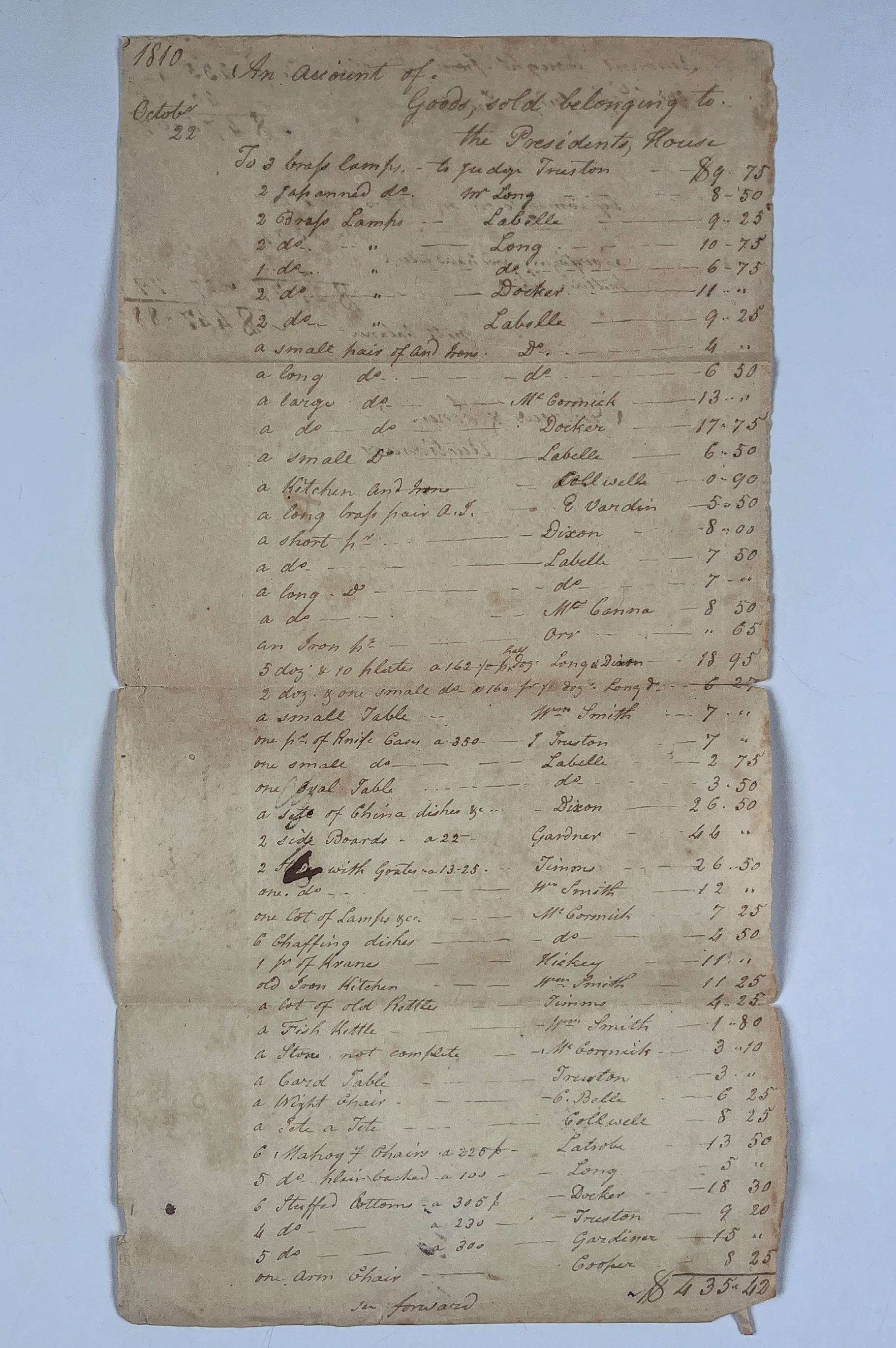
The first recorded sale of White House objects occurred on October 22, 1810, during the administration of James Madison. In addition to lamps, plates, and kitchen utensils, various pieces of furniture were sold, including six mahogany chairs purchased by Architect of the Capitol Benjamin Henry Latrobe. The bill of sale totaled $435.42.6
Madison’s successor, James Monroe, acquired some White House furnishings through auctions, but there is no evidence that any household items were sold during his eight years in office. On January 25, 1825, at the end of Monroe’s term, an inventory was compiled of “useless furniture in the President’s House and estimated value if sold at auction.” The list, which was organized by room, described fireplace implements, curtains, carpets, lamps, and numerous pieces of furniture, including “one gilt piano forte” located upstairs in the “Second Southeast Room.” These items (with an estimated value of $682.87) were part of the full inventory of furnishings presented to John Qunicy Adams at the start of his term two months later.7 Like Monroe, Adams does not appear to have authorized any sales, by auction or other means, during his time in office.
Andrew Jackson holds the all-time record for auctions during a presidential administration. Five times the gavel banged on sales of furniture, tableware, textiles, and sundry other items:8
• December 5, 1833: Auction conducted by P. Mauro and Son, Washington, D.C., included
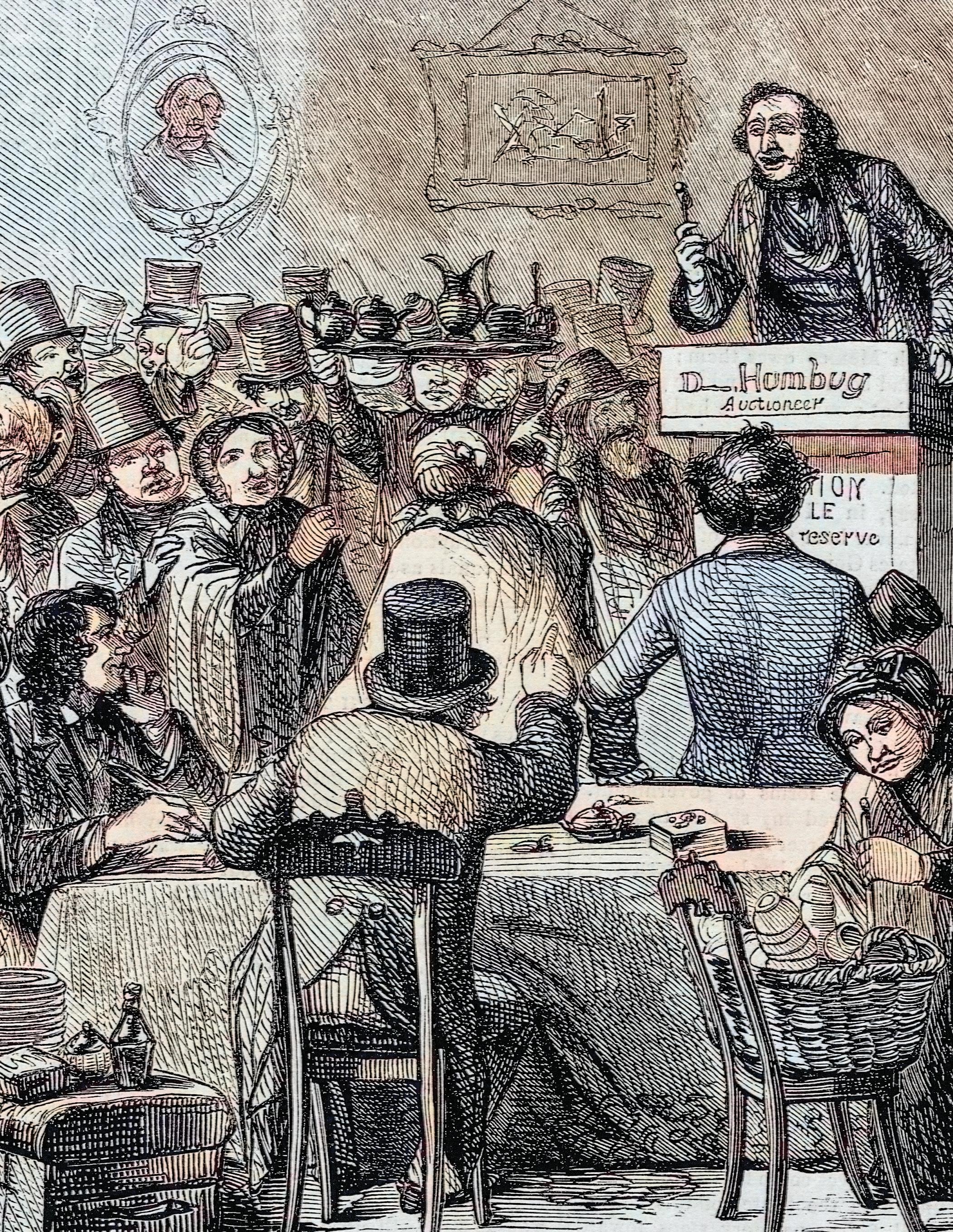
previous spread
An auctioneer calls for bids in this engraving of a midnineteenth-century sale of household furnishings.
right
The results of the first recorded sale of White House furnishings are documented in the handwritten list described as an account of goods sold belonging to the President’s House, dated October 22, 1810. Preserved in the collection of the National Archives and Records Administration, the list includes the items sold, the buyers, and the prices. The auction generated $435.42 in sales.
furniture, ceramics, glassware, and “Franklin Stoves.”
• December 7, 1833: More than 200 sundry silver serving items, 183 pieces of silverware, and 27 pieces of dishware sold through George W. South, Philadelphia, yielding $3,666.05.
• December 23, 1833: Auction conducted by Howard and Shortent, Washington, D.C., including “chairs, mattresses, curtain cornices and eagle ornaments, chandeliers, lamps, and a wide variety of table items, such as decanters, bowls, dishes, and pieces of silver plate that were badly worn or broken.”9
• March 19, 1834: Draperies and other textiles sold by Howard and Shortent.
• March 10, 1835: Gilt mantel lamps sold through L. Vernon and Company, Philadelphia.
Eight months after he succeeded Jackson in the White House, Martin Van Buren exercised the increasingly common option of auctioning off those items that had become, as the 1797 enabling act specified, “decayed, out of repair, or unfit for use.” On November 28, 1837, numerous sets of window curtains, bedclothes, and floor coverings were sold—some, no doubt, discolored by smoke from fireplaces and cigars, or anointed by streams of tobacco juice. Architectural ornamental elements, case furniture, stoves, and a French bedstead rounded out the lot, which fetched $1,078.71. When expenses for labor to remove the items, cartage, the auctioneer’s commission, and advertising were deducted, the net proceeds amounted to $1,000.22.10
Van Buren’s efforts both to dispose of old furnishings and to acquire new ones were the subject of the “Gold Spoon Oration” delivered by Pennsylvania Congressman Charles Ogle, a fierce Whig partisan, in the House of Representatives on April 14, 1840. Ogle’s address, titled “The Regal Splendor of the President’s Palace,” portrayed Van Buren (and others of his party) as elitist and extravagant in comparison to the more sober and responsible Whigs:
Democratic Presidents, Mr. Chairman, sometimes get tired of their furniture. Some change, perhaps, has taken place in the fashion, and then, forthwith, it becomes “old and decayed furniture,” and they send it off to auction and sell it for a whistle. . . . After all,
sir, it may be better occasionally to dispose of the surplus furniture of the palace, otherwise its rich saloons would soon resemble an auctioneer’s room at Bishopsgate, to which noblemen, impoverished by their vices, order the furniture of their castles, for the purpose of “raising the wind.”11
Sales of White House furnishings continued apace during a span of nine years and two administrations.12 John Tyler apparently held no auction, but a Treasury Department auditor’s report documented $57.90 he received for “sale of old furniture handed over to him by the Commissioner of Public Buildings.”13 James K. Polk did not come close to the auction record of his political mentor, Andrew Jackson, but he did garner very respectable returns from two sales—$741.29 in “proceeds of old furniture” in August 1845 and $919.84 from sales in March and November 1849.14 Rounding out the sequence of sales, Franklin Pierce realized just over $200, after expenses, from an auction of stoves, grates, andirons, fenders, and tables conducted by James C. McGuire and Company of Washington, D.C.15 Pierce had an ally in at least one newspaper. The New York Herald, noting the huge Treasury surplus resulting from the California gold mines, opined that “it is high time that the official residence of the chief magistrate of this mighty nation should be put into a genteel state of repair, and with some little outlay in the way of tasteful embellishments and attractive decorations.”16
Among the most consequential of White House auctions (from the standpoint of later preservationists) was that held during the administration of James Buchanan. James C. McGuire and Company again handled the sale, which occurred on January 17, 1860. Almost all of the Bellangé furniture suite acquired by James Monroe in 1817, and other furnishings associated with the Blue Room, were sold for a total of $1,005.94 after expenses. A century would pass before some of these pieces found their way back to the White House.17
The traumas of the Civil War and Reconstruction did not prevent the customary cycles of disposal and replenishment at the White House from continuing. Benjamin Brown French, commissioner of public buildings from 1853 to 1867, was involved in auctions from the administrations of Franklin Pierce to Andrew Johnson. Writing in his journal on Sunday, April 20, 1862, French concluded a
above
A detailed account of the April 14, 1882, auction of White House furnishings was published in the Washington Post the next day.
summary of the previous week’s war news, a card game with friends, and “one of the best oyster suppers I ever ate part of,” with a cryptic statement: “Friday at the President’s all the morning arranging for the sale of some old furniture.”18 Neither official records nor Washington newspapers document any White House sales during this period, and French never mentioned the subject again in his journal.
On April 6, 1867 (five years after French’s reference to a sale that never was), the Washington firm of W. L. Wall & Company conducted an auction of White House items during Andrew Johnson’s presidency. The items offered for sale were 578 yards of carpeting, two tables, a wardrobe, a mahogany bedstead, and a large gilt picture frame.19
When Ulysses S. Grant assumed the presidency in 1869, the White House underwent extensive renovations and redecorating supervised by First Lady Julia Dent Grant. The East Room was embellished “in the lush manner evocative of the room’s earlier, neoclassical decorative schemes.” Part of this process entailed selling its original 1818 furniture suite, mantels added by Pierce in 1853, and chandeliers dating from the Jackson administration.20
The next White House auction occurred during the administration of Chester A. Arthur. On April
13, 1882, the Washington Evening Star advertised an auction to occur the next day at the firm of Duncanson Brothers, located at Ninth and D Streets NW. The large quantity of furnishings included pieces that, in some cases, had been in use for decades. William Seale explains:
The president had gone through every room with [Chief Steward William T.] Crump, pointing out what would stay and what would go. As each sentence was pronounced, Crump affixed a tag to the doomed, which were assembled in the basement. This included a great many obvious things, as well as material of interest, from beds to statuary, old curtains, and gilded chairs. Jackson’s stand-up desk appears to have been among the unwanted, along with some of Polk’s dining room chairs. . . . Possibly only in 1902, when an auction accompanied Theodore Roosevelt’s major remodeling, would a White House sale be quite as large as Arthur’s.21
The Washington Post of April 15, 1882, gave a vivid, if somewhat sarcastic, description of the previous day’s auction:
Twenty-four wagon loads of old furniture and junk from the White House were sent off Tuesday to the warerooms of Duncanson Brothers to be sold, and were auctioneered yesterday. This was the first sale of Executive Mansion effects since President Buchanan’s term [sic], and the curiosity of the citizens attending the sale was in direct ratio to the conglomerated character of the goods and chattels thus exposed. As a rule the articles were much worn, some altogether worthless save as souvenirs, others again of fair value. But the condition of the property was hardly responsible for the immense crowds that attended the sale. Only curiosity and a desire to examine the housekeeping of Presidents could have drawn to Ninth and D streets fully 5,000 people and caused a realization from the auction of such goods of about $3,000.22
The era of nineteenth-century White House auctions ended on the very cusp of the twentieth century, as contents from William McKinley’s Executive Mansion went on sale by James W.
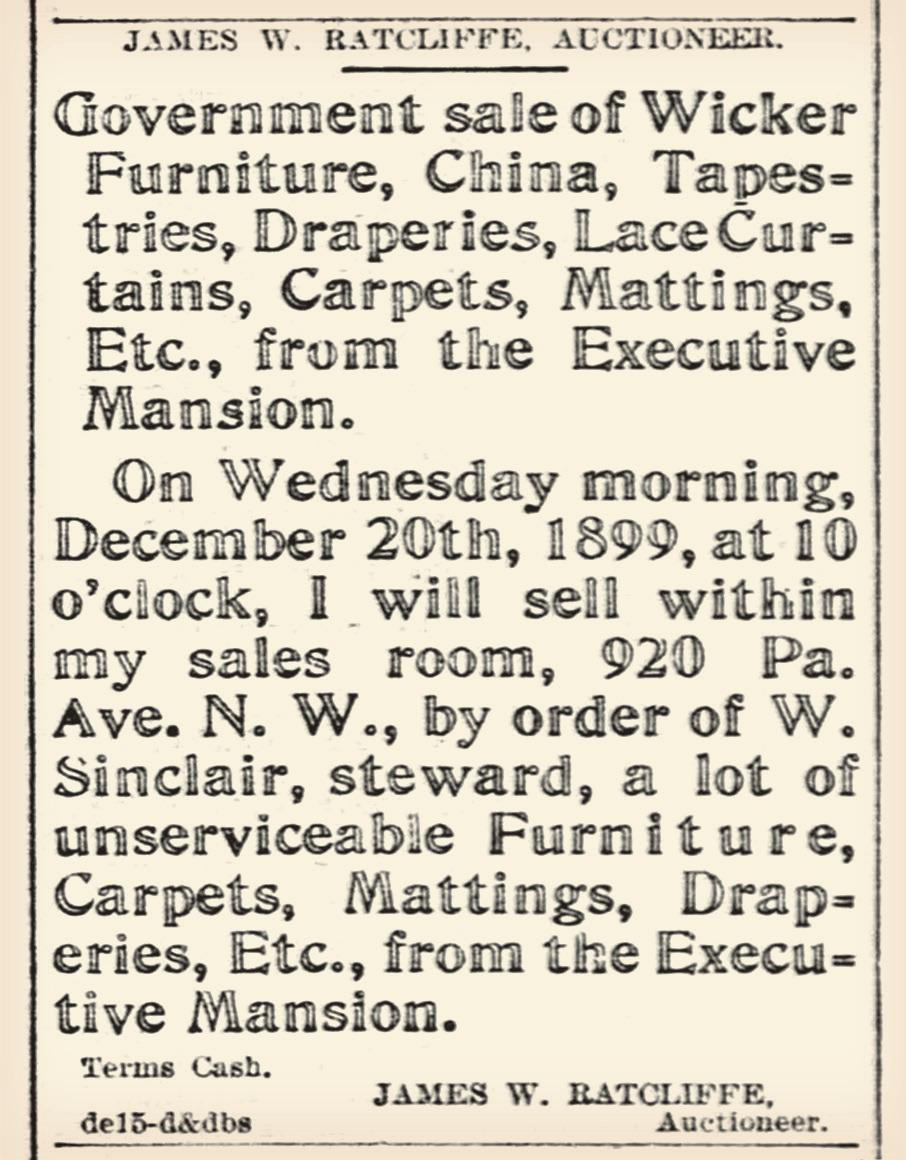
Ratcliffe at 920 Pennsylvania Avenue NW on December 20, 1899. Ratcliffe advertised “Wicker Furniture, China, Tapestries, Draperies, Lace Curtains, Carpets, Mattings, Etc., from the Executive Mansion.” The sale was partly the result of a general refurbishment of the mansion’s State Rooms by the McKinleys, particularly the Blue Room.23
Theodore Roosevelt left an indelible mark on the presidency and on the White House itself. Major renovations were undertaken to make the old house a more comfortable residence for the large Roosevelt family, while construction of the West Wing facilitated better handling of the nation’s business. Two sales of furnishings occurred at Washington, D.C., auction houses: C. G. Sloan & Company on January 21, 1903, and James W. Ratcliffe on January 20, 1906.24
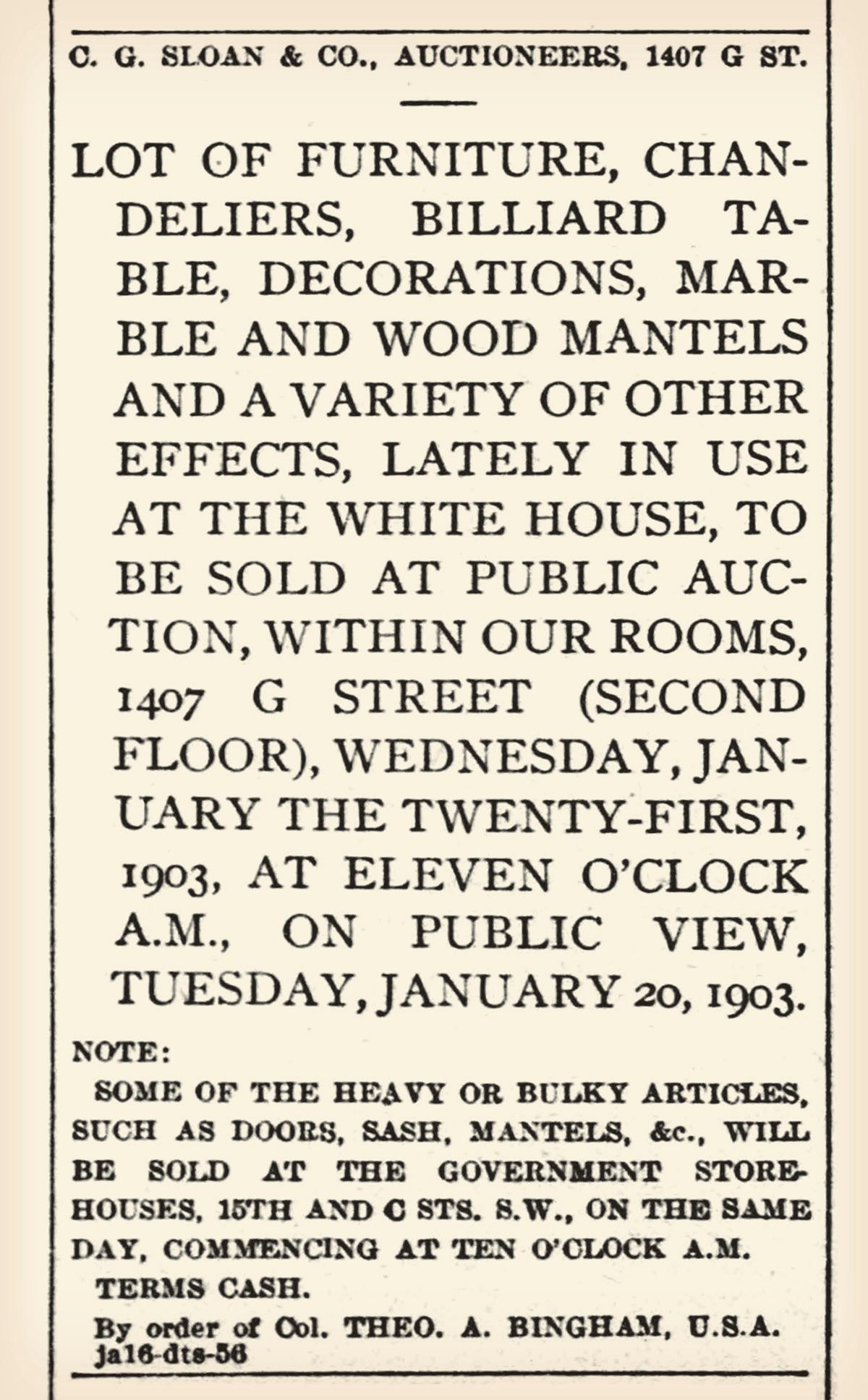
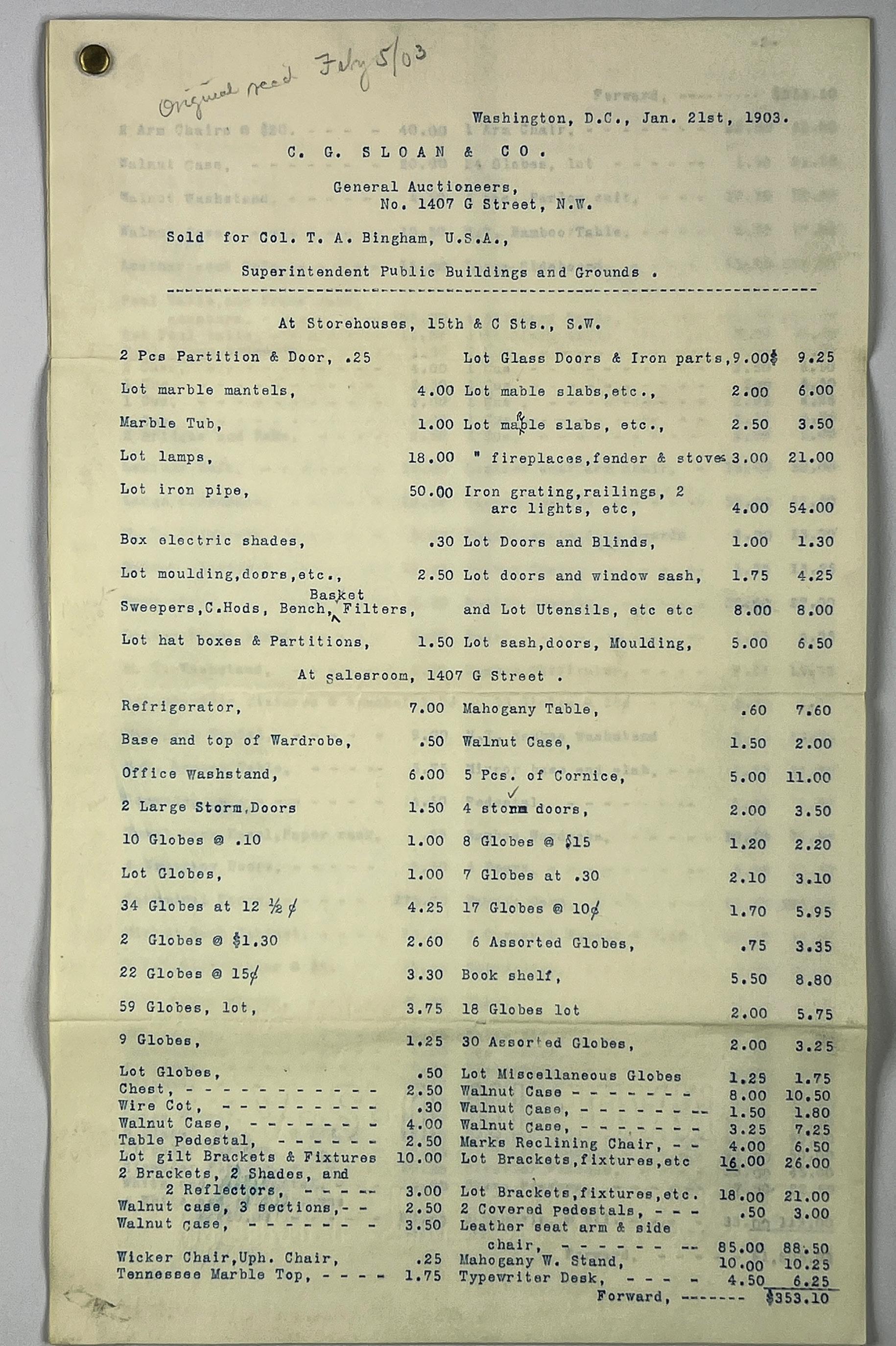
The sale at Sloan’s offered an eclectic mix of items that illustrated the changes in aesthetics, technology, and even leisure activities of first families: crystal chandeliers from the Blue Room, Green Room, and other locations; assorted tables above
In the nineteenth and early twentieth centuries, advertisements in local newspapers provided the public with the details of forthcoming auctions of White House furnishings. The December 19, 1899, edition of the Evening Star carried an advertisement placed by James W. Ratcliffe, Auctioneer. C. G. Sloan and Company, Auctioneers, also announced its January 21, 1903, sale in the Star.
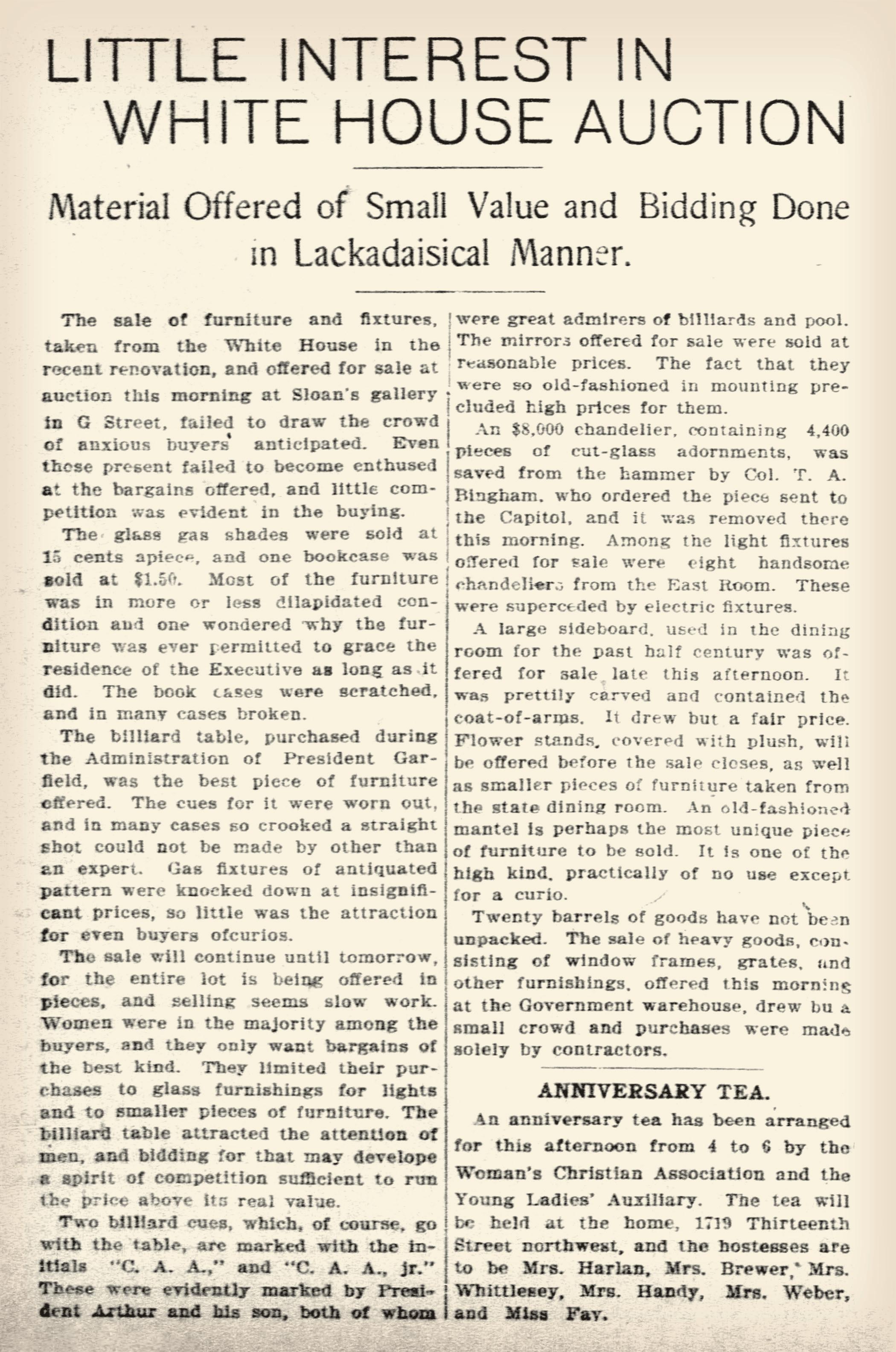
An article in the January 21, 1903, edition of the Washington Times reports that the ongoing auction of White House furnishings at Sloan’s was failing to attract the anticipated crowds. The piece identifies such articles of interest as President James Garfield's billiard table and eight chandeliers removed from the East Room.
left, opposite, and page 16
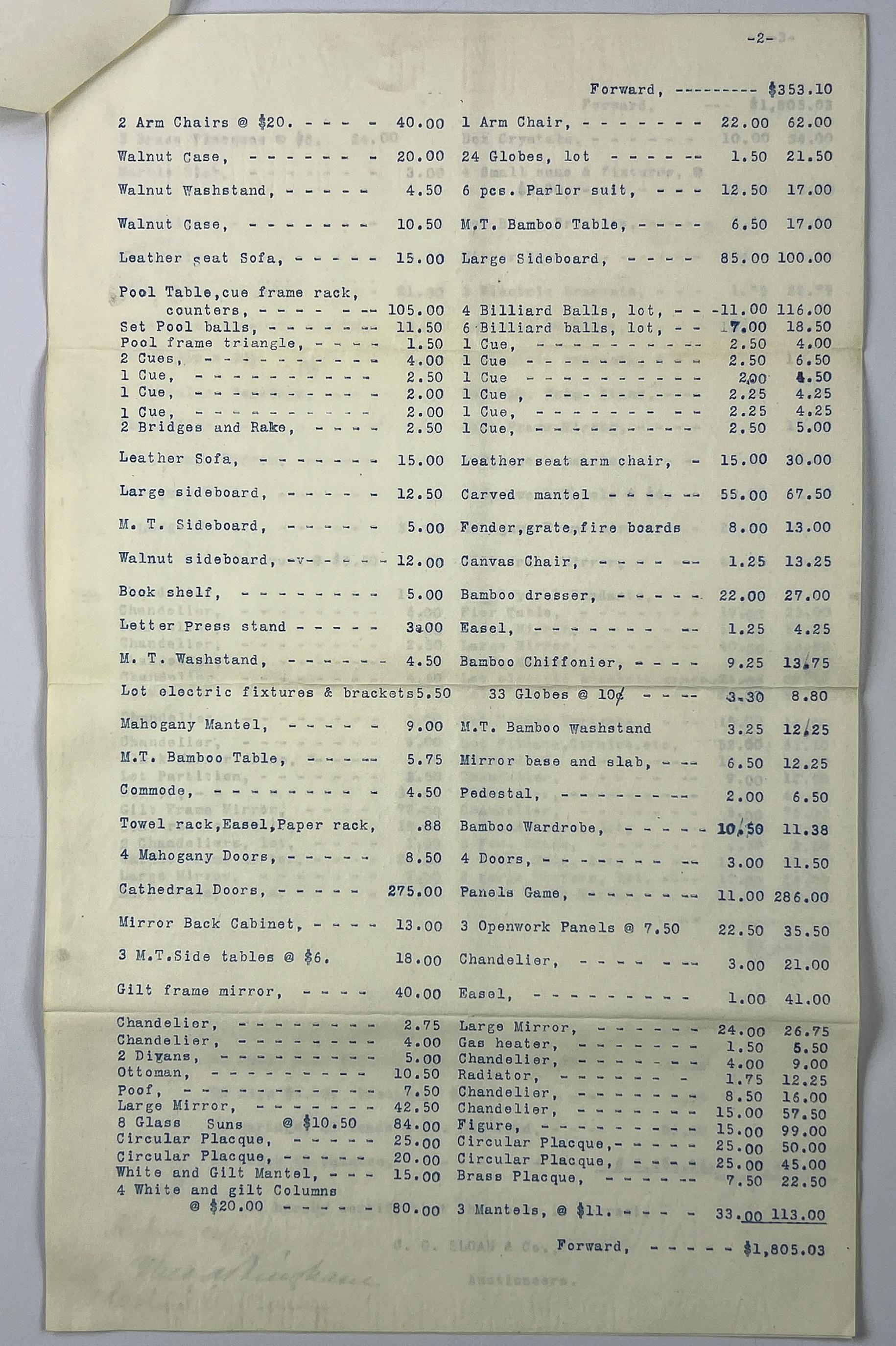
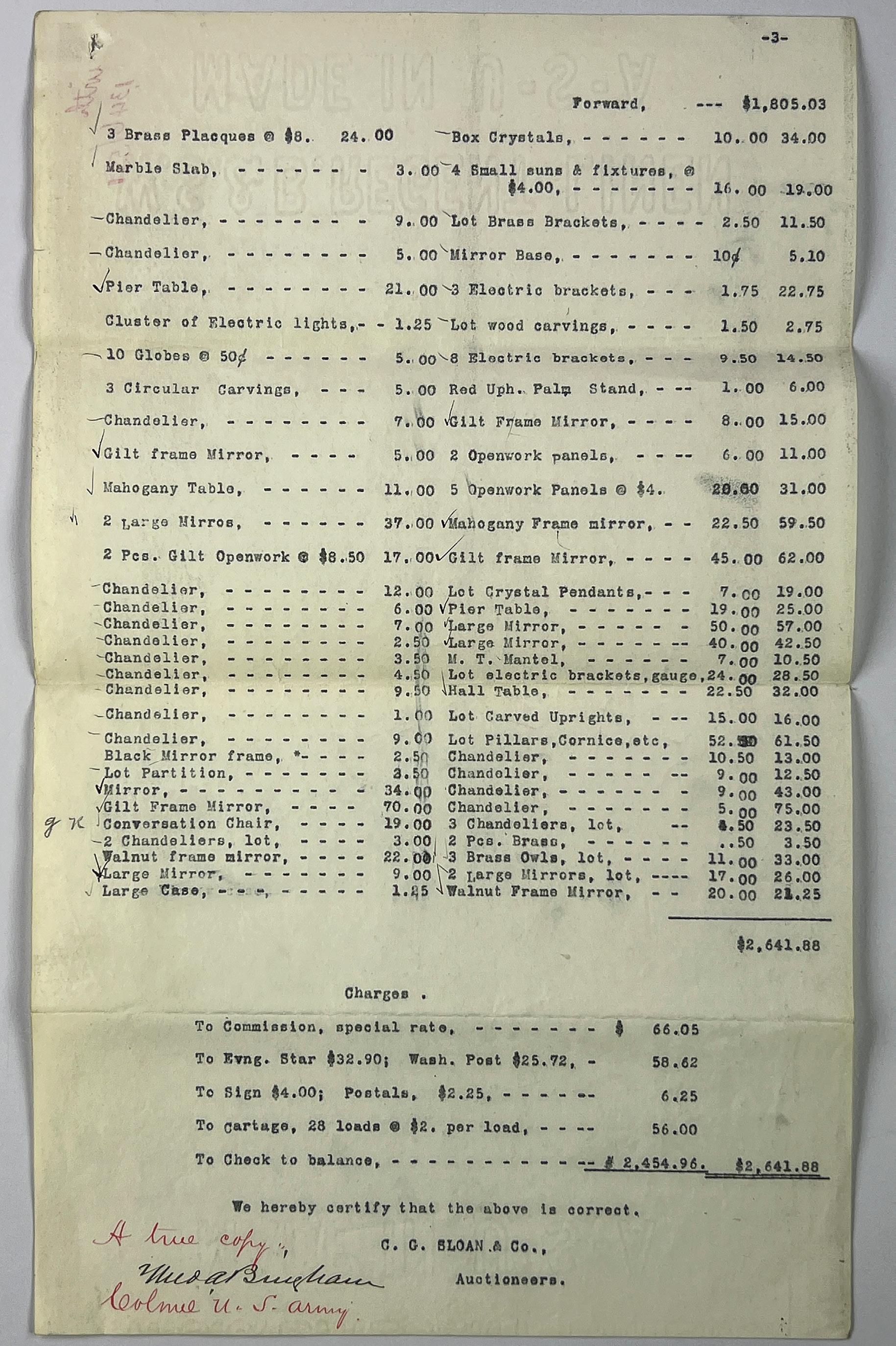
Following the conclusion of its January 21, 1903 auction of White House furnishings, Sloan and Company provided Superintendent of Public Buildings and Grounds
Theodore Bingham with a three-page typed and itemized accounting of sales.
right
Page 2 of the accounting documents a sale price of $105 for the Garfield era pool table. The famous stainedglass Tiffany screen, installed in the Entrance Hall during the presidency of Chester A. Arthur, is listed in the first column as “Cathedral Doors” with a realized price of $275.
left Page 3 of the accounting concludes with a total of the revenue generated by the sale. After the deduction of the auctioneer’s fees and expenses for shipping, advertising, and signage, the sale brought in $2,454.96.
right
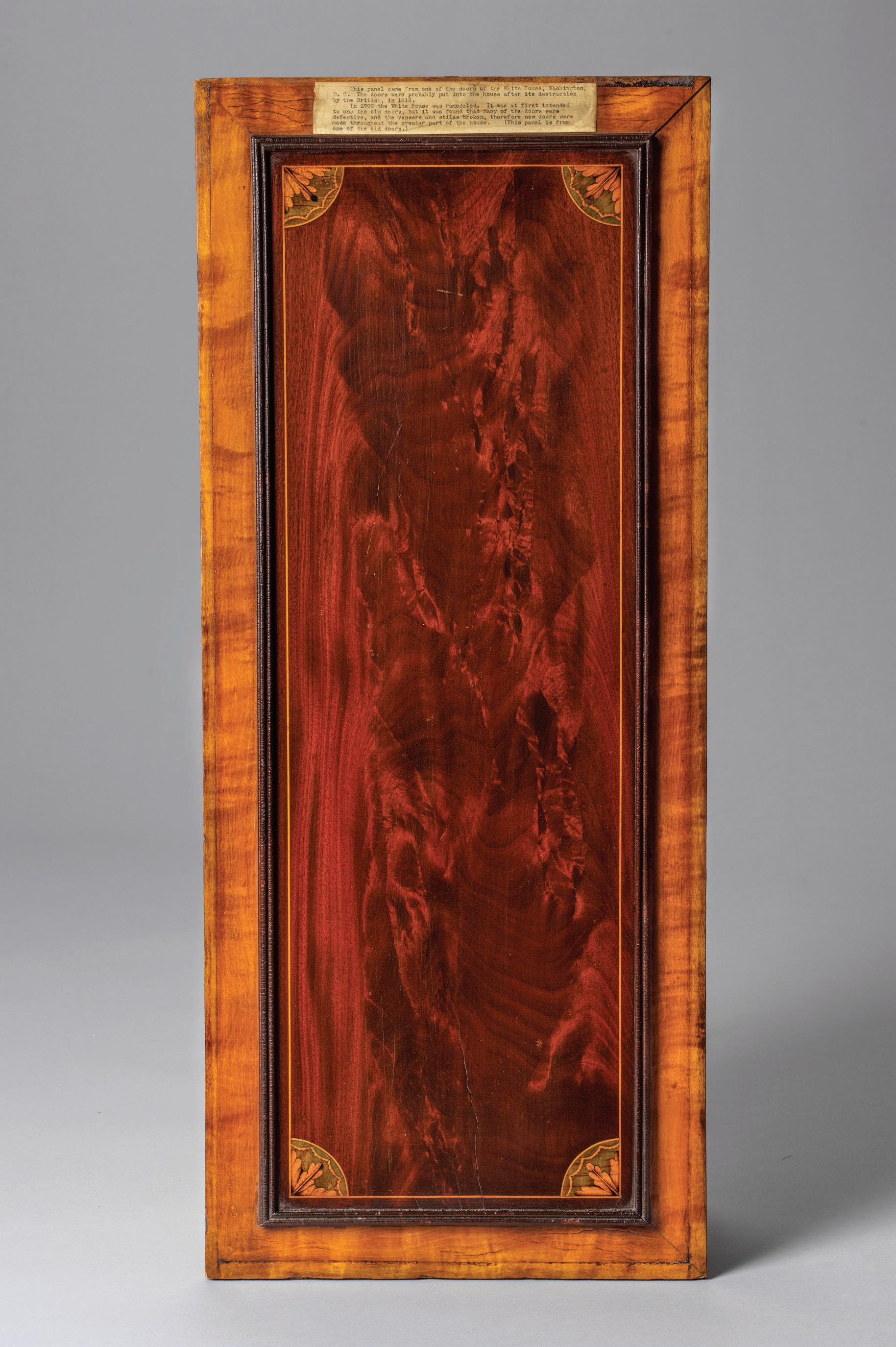
A mahogany panel cut down from a door likely installed on the State Floor when the White House was rebuilt following the fire of 1814. The door was removed during the Theodore Roosevelt renovation and was purchased in 2023 by the White House Historical Association, which donated it back to the White House Collection. It may be a part of one of the four mahogany doors that sold for $8.50, which are listed in the first column of the second page of the accounting of the January 21, 1903, sale (page 15).
(many with marble tops), and other pieces of case furniture; a refrigerator; a pool table; and the iron and stained-glass Tiffany screen that had stood between the Entrance Hall and Cross Hall since the Chester Arthur renovation in 1882.25 A story about the sale (while it was still under way) in the Washington Times on January 21, 1903, observed that it “failed to draw the crowd of anxious buyers anticipated. . . . Most of the furniture was in more or less dilapidated condition and one wondered why the furniture was ever permitted to grace the residence of the Executive as long as it did.”26
The auction conducted by James Ratcliffe in 1906, while of a smaller scale than the one at Sloan’s, still offered a large amount of furniture, including sixty leather-upholstered dining chairs as well as fireplace implements.27
From 1906 on, there were no further comprehensive, large-scale auctions of White House furnishings. In 1911, Theodore Roosevelt’s successor, William Howard Taft, auctioned his beloved seven-passenger White Motor Company Model M steam touring car, in favor of a smaller and more maneuverable Pierce-Arrow limousine.28 President Woodrow Wilson and First Lady Edith Galt Wilson gathered wool from the eighteen sheep that grazed the White House lawn during the First World War, to be auctioned by every state in the Union to benefit the Red Cross. Each state was allocated two pounds of wool. The effort raised $53,823.29
When President John F. Kennedy and First Lady Jacqueline Bouvier Kennedy took up residence in the White House on Inauguration Day, 1961, they ushered in a new era in politics, popular culture, and, with respect to the historic residence in which they now lived, an appreciation for the material culture of the President’s House and its historical significance. As Mrs. Kennedy pursued her vision of finding White House furnishings that had long ago gone to the auctioneers, steps were taken to ensure the conservation, care, and exhibition of the artifact collection. Congress, which had first authorized the sale of unwanted White House furnishings in 1797, now passed legislation to stop such sales while also designating the home a museum. Public Law 87-286, approved on September 22, 1961, mandated attention to the “preservation and interpretation of the museum character of the principal corridor of the ground floor and the principal public rooms on the first floor of the White House.” Section 2 of the law ended the centuries-old auction tradition:
Articles of furniture, fixtures, and decorative objects of the White House, when declared by the President to be of historic or artistic interest, together with such similar articles, fixtures, and objects as are acquired by the White House in the future when similarly so declared, shall thereafter be considered to be inalienable and the property of the White House. Any such article, fixture, or object when not in use or on display in the White House shall be transferred by direction of the President as a loan to the Smithsonian Institution for its care, study, and storage or exhibition, and such articles, fixtures, and objects shall be returned to the White House from the Smithsonian Institution on notice by the President.30
The gavel had fallen for the last time.
notes
The author gratefully acknowledges the kind assistance of the Office of the Curator, The White House, especially Melissa Naulin, associate curator of decorative arts, in the preparation of this article. Heartfelt thanks also go to Heidi Stello, associate editor of the Papers of James Monroe and archivist of the James Monroe Museum, for her indefatigable source-hunting detective skills, and to Nicole St. John, electronic resources librarian at the Simpson Library, University of Mary Washington, for assistance in navigating online archival resources.
The epigraph is from William Seale, The President’s House: A History, 2nd ed. (Washington, D.C.: White House Historical Association, 2008), 1:352.
1. “Auctions or Sales of White House Furnishings,” typewritten summary, May 2002, Office of the Curator, The White House (OCWH). For a succinct summary of congressional appropriations for furnishings, see “Furnishing and Maintaining the White House Collection,” White House Historical Association website, www.whitehousehistory.org.
2. An Act Making Provision for the Further Accommodation of the Household of the President of the United States, 4th Cong., 2nd sess., statute 2, chap. 6, in The Public Statutes at Large of the United States of America, ed. Richard Peters (Boston: Charles G. Little and James Brown, 1845), 1:497.
3. An auction was held in Philadelphia for Washington’s personal furnishings, supervised by the president’s secretary, Tobias Lear. “The furniture of the Green Drawing Room & other Articles sold at Auction went off very low indeed. The numbers attending the Auction was considerable; but they were disappointed in an expectation which they had formed that the Painting, P[r]ints &c. were to have been sold. The Lustres—Stoves & other fixtures in the House will be taken by the President at cost or a fair valuation. There is nothing to be sold of the public furniture.”
Tobias Lear to George Washington, March 15, 1797, The Papers of George Washington, Retirement Series, vol. 1, 4 March 1797 – 30 December 1797, ed. W. W. Abbot (Charlottesville: University Press of Virginia, 1998), 36–37. The “president” referenced by Lear was John Adams, to whom Washington offered to sell the personally owned items listed. According to William Seale, Adams declined the offer. Seale, President’s House, 2:539n21.
4. Thomas Jefferson evinced an appreciation for the historical significance of White House furnishings that would be echoed by such later occupants as Theodore Roosevelt and Jacqueline Kennedy. Margaret Bayard Smith, writer and wife of the editor of the National Intelligencer, observed: “When Mr. Jefferson
took up his residence there, he found it scantily furnished with articles brought from the President’s house in Philadelphia, and which had been in use from the time that Gen. Washington resided in that place; these, though worn and faded, he retained, out of respect to their former service—particularly in his drawing–room, which was fitted up with the same crimson damask furniture that had been used in Mrs. Washington’s drawing-room— it was his wish that it never be parted with, but when no longer fit for service, should be preserved as a kind of relic of past times.” Mrs. Harrison Smith, “The President’s House Forty Years Ago,” Godey’s Lady’s Book, November 1843, 212–13.
5. Public Statutes at Large of the United States of America, ed. Peters, 2:121–22.
6. An Account of Goods Sold Belonging to the President’s House, October 22, 1810, account 28634, no. 14, Miscellaneous Treasury Accounts of the General Accounting Office, 1790–1894, Record Group 217, National Archives and Records Administration, Washington, D.C., copy in OCWH.
7. Inventory of Useless Furniture in the President’s House and Estimated Value If Sold at Auction, January 25, 1825, Records of the House of Representatives, 19th Cong., 1st sess., Record Group 17, National Archives. See also Letter from the Commissioner of the Public Buildings Transmitting an Inventory of Furniture in the President’s House, December 7, 1825 (Washington, D.C.: Gales & Seaton, 1825). John Quincy Adams inspected the items at the White House during visits on March 26, 28, and 29, 1825, accompanied by Commissioner of Public Buildings Joseph Elgar. John Quincy Adams, diary, March 26, 28, 29, 1825, John Quincy Adams Digital Diary, Primary Source Cooperative of the Massachusetts Historical Society website, www.primarysourcecoop.org.
8. Unless otherwise noted, all information on the Jackson auctions is from account 70467 D, E, and F, Miscellaneous Treasury Accounts, copies in OCWH.
9. Seale, President’s House, 1:194–95. Seale notes that the sale, which the auctioneers augmented with pieces of their own, was so successful that it inspired the one that occurred the following March.
10. A. McIntire, auctioneer, Account of Sales of Furniture & Co. Received from the President’s House, Ofc. of the Commissioner of Public Buildings, November 28, 1837, Records of the Office of Public Buildings and Public Parks of the National Capital, Record Group 42, National Archives, copy in OCWH.
11. Charles Ogle, “Speech of Mr. Ogle, of Pennsylvania, on the Regal Splendor of the President’s Palace, Delivered in the House of Representatives,” April 14, 1840, transcription with annotations by William Seale in White House History, no. 10 (Winter 2002): 62–63.
12. It was, actually, three administrations, but William Henry Harrison’s death after one month in office allowed no time to address disposal of furnishings.
13. William Collins, First Auditor, Department of the Treasury, Report of Accounts Between John Tyler and the United States Government, January 22, 1845, account 90526, Record Group 42, National Archives, copy in OCWH.
14. Statement of Account of W. W. Corcoran, Agent for Expenditures at President’s House, April 7, 1846, describes the “proceeds of old furniture” realized on August 26, 1845, account 93470, Miscellaneous Treasury Accounts, copy in OCWH; Account of Sales of Furniture Belonging to the President’s House, Made by the Authority of the President Under the Act of Congress, March 3, 1849, copy in OCWH.
15. Account of Sales Conducted by J. C. McGuire, Washington, D.C., January 16, 1854, account 114325, Record Group 217, National Archives, copy in OCWH.
16. “General Pierce and the White House,” New York Herald, February 19, 1853, 4.
17. Sales for the Commissioner of Public Buildings by James C. McGuire & Co., Auction and Commission Merchants, January 17, 1860, account 136728, Miscellaneous Treasury Accounts, copy in OCWH. See also Seale, President’s House, 1:334.
18. Benjamin Brown French, journal, April 20, 1862, in Witness to the Young Republic: A Yankee’s Journal, 1828–1870, ed. Donald B. Cole and John J. McDonough (Hanover, N.H.: University Press of New England, 1989), 393–94.
19. Auction Sale of Carpeting and Furniture of the Executive Mansion Conducted by W. L. Wall & Co., Washington, D.C., April 6, 1867, May 13, 1867, account 169995, voucher 6, Miscellaneous Treasury Accounts, typescript transcription in OCWH.
20. Seale, President’s House, 1:454–55.
21. Seale, President’s House, 1:519.
22. “From the White House Garret: Sale pf a Varied Collection at Auction Yesterday,” Washington Post, April 15, 1882, 2. At least one other newspaper adopted a more respectful tone when reprinting the Post story. The Southern Herald of Liberty, Mississippi, reprinted the article on April 22, 1882, page 2, changing the opening sentence to “Twenty-four loads of furniture and other household articles [emphasis added] taken from the White House . . .”.
23. James W. Ratcliffe advertised his impending auction of White House furnishings in the Washington Evening Star, December 19, 1899, 15. The McKinleys’ redecorating of the Blue Room and other State Rooms is discussed in Seale, President’s House, 1:611–12.
24. Sloan’s auction was advertised in the Washington Evening Star, January 17, 1903, 32. An ad for the Ratcliffe auction appeared in the same newspaper on January 18, 1906, 20.
25. Colonel Theodore A. Bingham to Messrs. C. G. Sloan and Co., February 15, 1903, Records of the Office of Public Buildings and Public Parks of the National Capital, Letters Received, 1346/451, copy in OCWH; Seale, President’s House, 1:522, 641.
26. “Little Interest in White House Auction,” Washington Times, January 21, 1903, 7. The Times considered the billiard table, which dated from the administration of James Garfield, to be “the best piece of furniture offered.”
27. Old Property Belonging to the White House to Be Sold at Public Auction by James W. Ratcliffe, January 1906, Records of the Office of Public Buildings and Public Parks of the National Capital, Letters Received, 1346/978, copy in OCWH.
28. Seale, President’s House, 2:25; Michael L. Bromley, William Howard Taft and the First Motoring Presidency, 1909–1913 (Jefferson, N.C.: McFarland, 2003), 378.
29. Seale, President’s House, 2:82; Saladin Ambar, “Woodrow Wilson: Domestic Affairs,” University of Virginia Miller Center website, https://millercenter.org.
30. An Act Concerning the White House and Providing for the Care and Preservation of Its Historic and Artistic Contents, 87th Cong., 1st sess., Public Law 87-286, approved September 22, 1961, reprinted in Mary Jo Binker, “In the Beginning: The Founders Remember,” White House History Quarterly, no. 60 (Winter 2021): 19. For a comprehensive account of the Kennedy restoration and evolution of the White House as a museum, see James Archer Abbott and Elaine Rice Bachmann, Designing Camelot: The Kennedy White House Restoration and Its Legacy (Washington, D.C.: White House Historical Association, 2021).