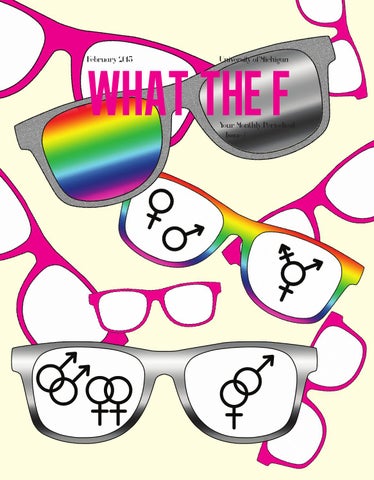
February 2015
University of Michigan
What The F
Your Monthly Periodical Issue 8
Stretch Marks This publication is meant to start conversations—it’s an open channel for all voices. The more voices, the richer the conversation. Because of how we’re raised and who we are, it can be difficult to see past our own experiences. So if, when reading anything in this magazine, you find you have a disagreement, a critique, or another viewpoint, write to us and we’ll publish it. Stretch marks: Stretch past your own head. Talk to us at WhatTheFMag@umich.edu.
President Cosette Kathawa Editors in Chief Essie Shachar-Hill and India Solomon Creative Director / Design Editor HaeJee Yoon Business Managers Tori Wilbur and Jackie Saplicki Social Media Managers Allie Rubin, Hannah Gordon, and Rasna Neelam Blog Editor Hannah Engler
What The F is a non-partisan, non-profit publication operated by students at the University of Michigan. What The F’s purpose is to
encourage discussion on significant issues of campus, national, and world interest. The magazine, the executive board, and our sponsors do not endorse the ideas presented by the writers. We do, however, support and encourage different ideas into our community and into campus discussion.
All writings depicted in this image are real, found in bathrooms on campus. Because sometimes we just need to talk to each other.
February 2015
What The F
Your Monthly Periodcal Issue 8
Letter from the Editors 01 Woman of the Month 02 Health 05 Opinions 06 07 08 10 11 12 14 15 Reviews 18 Poems 21 22
Arundhati Roy Sh*t I’m Afraid to Ask My Doctor Push it Real Good Innovation in Storytelling Adam and Eve: In defense of bisexuality Bad Feminist My Feminism Doesn’t Give A Shit About Men Demystifying The Menstrual Cycle Plan B Periods, Pubes, and Patriarchy VajA2 Origin of the Word Dress to Please Revival
Sources and Sponsors 23
Funny, Fresh, Fearless, Feminist, & Fuck Layout HaeJee Yoon Contributing Illustrators HaeJee Yoon, Angelica Esquivel, Margaret Hitch, Sarah Hong, Tara Lewis, Erica Liao, Mollly Munsell, Sannie Pham, Michelle Sheng Contributing Writers Hannah Engler, Hannah Gordon, Allie Rubin, India Solomon, Sydney Behrmann, Dana Beyas, Eliza Cadoux, Clarissa Donnelly-DeRoven, Katrina Hamann, Gabi Kirsch, Sumana Palle, Sannie Pham, Sahana Prasad Keep the conversation going online! Visit our website at WhatTheFMagazine.wix.com/umich Like our Facebook page at Facebook.com/WhatTheFMag Follow us on Twitter @WhatTheFMag and on Instagram @WhatTheFMagazine Find our Tumblr at WhatTheFMag.tumblr.com
Letter from the Editors
Welcome to What The F, your feminist periodical!
Welcome to a new year of What the F! For our new readers out there, What the F is your fresh, funny, feminist periodical. And we, Essie and India, are your fresh, funny (we think), feminist editors! Thanks for picking up this magazine. We’re pretty freaking proud of it, and we hope you enjoy it as much as we do. We are always working to showcase a variety of voices throughout our magazine and it is important that What the F remains an open, safe space for all. So, if you have anything to add to our ongoing conversation, please send it our way! Feminism tends to manifest itself as a clusterfuck of issues upon which all feminist may or may not agree. Here’s a little taste of what’s on our minds right now:
India: Essie, What the Fuck is up with feminism right now?
Not what Emma Watson is saying, not how flawless Queen B is, not how it is or isn’t disturbing for little girls to say “fuck” over and over, but what actually needs to be addressed?
Essie: Well, I think there’s still a lot of work to be done on
intersectionality. Like, if feminism is believing women are equal to men, what men are we talking about? White men? Privileged men? Because not everyone in our society is treated equally, it seems unhelpful to just focus on one identity at a time.
ally told me I was using the “wrong” bathroom as I entered the women’s! What the Fuck?!
India: Whaaaaatttt. It’s nobody’s business where you do your
business; who the fuck are they to tell you otherwise? I’m sick of people feeling entitled to tell others where they do and don’t belong based on the way they look. We know that assumptions based on appearance are deeply rooted in our atrocious history of oppression, yet it seems that we are incapable of uprooting these assumptions. The adage “don’t judge a book by its cover” is all too familiar yet rarely adhered to.
Essie: *Snaps.*Assumptions are so often at the heart of op-
pression. And it’s because all oppression is connected that I feel so strongly about delving further into intersectionality. We touch on some of these topics in this issue, with articles on sexuality, race and religion. I’m excited to see this conversation grow in What the F over the course of the year. If, after reading this issue, you’re still thirsty for some feminist goodness, please check out our website (WhatTheFMagazine.wix.com/umich), Facebook page, blog, Tumblr, or Instagram.
India: Agreed. Because I keep hearing that women are mak-
ing 78 cents for every dollar that men make, when really, the Black women in my family are making 64 cents for every dollar a White man makes. And is it equality with men that we should be focusing on, or should we be directing our attention towards valuing the feminine and the masculine, regardless of whom these qualities are characterizing?
Essie: Totally. I love that idea because it allows for so much
Essie Shachar-Hill and India Solomon Editors in Chief
fluidity on the gender spectrum. In my head, feminism also seeks to empower other sexual minorities, not just women. And while we’re on the subject, I’m so fed up with this gender binary shit. For example, the other day, someone actu-
P.S. Want to get involved? E-mail WhatTheFMag@umich.edu. We would love your brilliant minds to write and create with us.
1
Woman of the Month
Arundhati Roy by Sumana Palle
A
rundhati Roy is not a perfect advocate. Born Suzanna Arundhati Roy to a Bengali Hindu father and a Syrian Christian Keralite mother, Roy had a difficult childhood following her parents’ divorce and the Syrian Christian community’s shunning of her mother due to her status as a single mother. As a child, Roy went to a boarding school founded by a British Army Officer and moved to Delhi for college, where she studied at the School of Planning and Architecture. During her time at her architectural studies university, Roy’s constant questioning of the very structure of a home led to the blossoming of her political voice. As she states: “What is your sense of aesthetic? Whom are you designing for? Even if you’re designing a home, what is the relationship between men and women assumed in that? It just became bigger and bigger. How are cities organized? Who are laws for? Who is considered a citizen? This coalesced into something very political for me by the end of it.” After graduation, she started a job at the National Institute of Urban Affairs in Delhi, where she met Pradip Krishen, an independent filmmaker who gave Roy the female lead role in “Massey Sahib,” a film set in colonial India where Roy played a goatherd. After her marriage to the affluent Krishen, Roy immersed herself in Delhi’s politically active independent-filmmaking world. Roy first made splashes nationally in her essay “The Great Indian Rape Trick,” which was a response to The Bandit Queen, a mov-
ie about Phoolan Devi, a low-caste woman who became an infamous gang leader and endured gang rape after her imprisonment. “I thought, ‘You’ve changed India’s most famous bandit into history’s most famous rape victim,’” she writes. This bold criticism caused alienation from her filmmaker friend circles but it was only the beginning of her striking, rebellious, and controversial path of political activism. Her first novel, The God of Small Things, which features a set of fraternal twins growing up in rural India, is a stunning commentary on how small things affect lives in profound ways. Though it endured criticism and censorship in India for its graphic depiction of sex and incest, it was a critical and commercial success elsewhere and catapulted Roy into international fame, a pedestal she still continues to use to publicize issues that have been forcefully silenced. After writing The God of Small Things, Roy has published primarily essays and has devoted herself to political activism, despite constant (and often justified) criticism of her actions. She is a vehement supporter of anti-globalization and is outspoken against the neo-imperialistic policies of the West, especially the United States. In response to Bush’s military invasion and occupation of Afghanistan, she penned an article in The Guardian, where she writes, “When he announced the air strikes, President George Bush said: ‘We’re a peaceful nation.’ America’s favourite ambassador, Tony Blair, (who also holds the portfolio of prime minister of the UK), echoed him: ‘We’re a peaceful people.’ So now we know. Pigs are horses.
Girls are boys. War is peace.” Hypercritical of the Indian state, she condemns its nuclear weapons policy as well as its rapid industrialization and privatization, and she constantly endures abuse, both from the Indian government and the Indian populace. Her controversies have ranged from her ardent support of the Kashmiri separatist movement1 and her defense of guerrilla Naxalite-Maoist insurgents2 to her criticism of Anna Hazare, a Gandhi-esque figure who led a non-violent anti-corruption campaign in 20113 and her most recent endeavor, reinvigorating the Gandhi-Ambedkar debates and exposing Gandhi as an anti-black, racist, sexist, and casteist politician as opposed to the Christlike saint that he is perceived to be4. However, make no mistake. Arundhati Roy is not a perfect advocate. She is not the ideal activist. Her book, Walking with the Comrades, about spending a few months in the forest with Naxalites is offset by the fact that her actual residence is in an upscale area in one of India’s wealthiest suburbs. Her fight for the rights of impoverished Hindu Dalits is questionable considering her upper-middle class Syrian Christian background. Her anti-corporatist stances become ironic in the light of her fervent international touring where she sells her books at a relatively expensive premium while also receiving a commission for her speeches and her part in publicizing the re-printing of Ambedkar’s famous Annihilation of Caste. Other notable modern Dalit scholars and intellectuals have denounced her for coopting
Kashmir, currently an Indian province on the border of India and Pakistan, has a complicated history of protests against the Indian state and the resulting Indian government’s increased militarization in Kashmir, as well as the subsequent subjugation and rape of the land and its people, have further complicated the situation. As a result, Kashmir has become a hotspot of Kashmiri separatist terrorism, Pakistani terrorism, and Indian governmental terrorism, a combination that leads to sheer hell and chaos. 2 The poorest of the Indian rural and tribal populations and the most oppressed by the Indian state’s rapid industrialization and landgrabbing policies turn to the Naxal movement to wage war against the Indian government. While Naxalites mostly target government workers and the police, they also commit acts of terror against bystander and innocent tribals and civilians to make a statement. Naxalites control territory (mostly forest areas inhabited by tribals) throughout Bihar, Jharkhand, and Andhra Pradesh. 3 The movement was a series of demonstrations, protests, and hunger strikes across India against endemic political corruption and to call for a more effective government. Anna Hazare, hailed as the common man by the Indian media and masses, led a hunger strike and toured the country to raise awareness and gather support, much like Gandhi. Roy criticized his corporate backing and questioned his political motives. 4 Ambedkar, most known for writing the Indian constitution, was an intellectual revolutionary of Dalit descent who criticized Hinduism’s caste system (especially the sanitizing of Hinduism during India’s independence movement to appeal to the international community) and Gandhi’s active oppression and silencing of the lower-caste population of India. 2 1
their voice for her profit. Her defense of the Kashmiri separatist movement would also be a lot more valid if she had spent more than just a few days in Kashmir. Arundhati Roy does not speak for herself and her own experiences, as Social Justice 101 encourages us all to do. She is guilty of the same crimes she accuses Gandhi of doing: stealing the voice of the oppressed to further one’s own career and one’s own causes. In the realm of political activism, Roy represents the dilemma between the flawed and the necessary. Enveloped in the safety that her privilege grants her, she is free to say what she wishes and the international community will view her as the voice of the Indian activist and of the Indian oppressed, even though the reality is that there is no such monolith and that she is the very personification of the privilege that eats away at the Indian poor. But I cannot bring myself to hate her. What I have for her is a tempered admiration, a grudging respect. The world would not know of the neocolonial effects of capitalism on India if it were not for Arundhati Roy. It would not know that India is currently destroying Herself, hellbent on shredding Herself apart by the very fabric of Her sari and Her skin, if Arundhati Roy did not shed light on it during every step of her career. More importantly, India itself would
have no national conversations or vocal consciences. Without Arundhati Roy, the Indian media would be completely immersed in the propaganda and agenda of the Indian state, with its warring factions and lecherous politicians. All intellectual and political commentary would be dominated by patriarchal upper-caste Hindu men (most of whom idolize Gandhi and follow in his footsteps of self-promotion and aloof cruelty) who insist on returning to “traditional society” for a better India, completely oblivious to the realities of its current standing. Indian political thought and status quo would be singular, without anyone to challenge it and question it adamantly and publicly enough to change the discourse of a billion-large nation. Arundhati Roy is the voice in the silent room that screams for change. It is not perfect. But it is there. 1 Kashmir, currently an Indian province on the border of India and Pakistan, has a complicated history of protests against the Indian state and the resulting Indian government’s increased militarization in Kashmir, as well as the subsequent subjugation and rape of the land and its people, have further complicated the situation. As a result, Kashmir has become a hotspot of Kashmiri separatist terrorism, Pakistani terrorism, and Indian governmental terrorism, a combination that leads to sheer hell
and chaos. 2 The poorest of the Indian rural and tribal populations and the most oppressed by the Indian state’s rapid industrialization and land-grabbing policies turn to the Naxal movement to wage war against the Indian government. While Naxalites mostly target government workers and the police, they also commit acts of terror against bystander and innocent tribals and civilians to make a statement. Naxalites control territory (mostly forest areas inhabited by tribals) throughout Bihar, Jharkhand, and Andhra Pradesh. 3 The movement was a series of demonstrations, protests, and hunger strikes across India against endemic political corruption and to call for a more effective government. Anna Hazare, hailed as the common man by the Indian media and masses, led a hunger strike and toured the country to raise awareness and gather support, much like Gandhi. Roy criticized his corporate backing and questioned his political motives. 4 Ambedkar, most known for writing the Indian constitution, was an intellectual revolutionary of Dalit descent who criticized Hinduism’s caste system (especially the sanitizing of Hinduism during India’s independence movement to appeal to the international community) and Gandhi’s active oppression and silencing of the lowercaste population of India. 3
Health
Sh*t I’m Afraid to Ask My Doctor by Allie Rubin formed or injured nail, or if the area is moist for a long time. No matter how you got it, the best way to get rid of the fungus is by getting a prescription for medicine from your doctor. You can also try some over the counter medicines, soaking the nail in vinegar or dropping on some tea tree oil. To prevent fungi from getting into your nails in the first place, keep nails and skin clean and dry, and avoid sharing mani/pedi tools.
S
ometimes shit happens and your childhood pediatrician isn’t the first person you want to talk to about it. Fear not, readers! We’re here to answer all of your personal health questions, whether you wanted to hear about them or not. Q: Should I be concerned about this mole? A: Here’s a fun way to figure out if your moles are healthy: the ABCDE’s of melanoma! Check your moles for Asymmetry, Borders (are they uneven?), Color (is it more than one color?), Diameter (is it larger than ¼ inch?), and Evolution (has it changed appearance over time?). If the answer to any of these questions is yes, have a doctor take a look. Potential skin cancers can often be cured if you catch them early on. Who knew the alphabet could be so healthy? Q: I think something’s growing under my nails… A: If your nails look dull, brittle, crumbly, discolored, loose, thick, or otherwise abnormal, you may have a fungal friend residing in there. Fungi thrive in warm, moist environments (like underneath your toenails in your sweaty socks) and can often be spread in public pools, gyms, or if you sweat a lot. You might also get fungal nails from some sketchy manicure/pedicure tools, a de4
Q: This ingrown hair hurts literally every time I sit down while wearing jeans. Send help!! A: Ingrown hairs can definitely be a pain in the crotch (or arm pit, leg, face, etc). These annoying bumps form when a hair curls back or sideways and grows into the skin. Usually they are no big deal and go away on their own, but can very rarely lead to infection or scarring. The easiest way to prevent ingrown hairs is to avoid shaving or waxing and allow hair to grow naturally. If that’s not your bag, try moisturizing the area before removing hair, avoid shaving too closely, don’t shave against the grain of the hair, and use clean, sharp razors. To treat an ingrown hair, rub the area in a circular motion with a wet sponge or wash cloth to try to dislodge the hair, or even try a mild exfoliator. If you want to try to remove the hair with a needle or tweezers, be extremely careful and make sure whatever you use is sterile to prevent any further irritation. Q: What does it mean if I have irregular periods? A: First of all, figure out
what’s “regular” for you. A normal cycle can be anywhere from 23-35 days long with periods lasting from 3-8 days. Changes to your usual flow could be caused by poor nutrition, weight changes, overexercise, stress, drug use, excessive alcohol, or smoking. Irregularities might also be caused polycystic ovarian syndrome (PCOS), thyroid problems, or uterine abnormalities like fibroids or cysts. If your irregular periods continue, get yourself checked out! Make an appointment at UHS’s Women’s health clinic (3rd floor, 734-7639184) for a complete physical/pelvic exam to make sure all’s well. Q: I got my braces off and graduated middle school eight years ago. Why do I still have acne? A: Not everyone’s acne disappears as their other awkward features do. Many people even get acne for the first time as an adult. So you’re not alone. Adult acne can be caused by hormonal fluctuations (this is common with menstruation, pregnancy, and changes in birth control), stress, hair or skin products, family history, or medication side effects. You can try using a topical benzoyl peroxide, salicylic acid, and/or tea tree oil product to clear your skin. Be sure to use gentle products and to moisturize well. You can also approach your acne more holistically by reducing stress, eating a well balanced diet, and exercising regularly (three totally simple, easy fixes…am I right?) Additionally, a doctor could prescribe some acne-fighting medication or even birth control pills to manage hormone fluctuations. Q: Is period sex safe? A: As long as you take the right precautions, you’re good to go! Using protection is especially important during menstruation because the cervix is open, giving bacteria an express lane into the pelvic cavity. Additionally, the vagina is less acidic during your period so the chances of developing a yeast or bacterial infection are increased. Finally, it’s still possible to get pregnant so don’t skip the contraception! Bonus: sex during your period can actually reduce symptoms of PMS. Endorphins released during orgasm are the body’s natural painkillers and mood boosters, easing cramps, headaches, and that bad mood that accompanies the best time of the month. Plus, many people report enjoying sex more while on their period!
5
Opinion
Push it Real Good by Katrina Hamann
T
his summer I witnessed a home birth. After taking a women’s health course this past winter I became fascinated with midwifery and holistic birthing methods. After expressing my interest to a close friend of mine, she revealed that her mother was expecting and intended to have a home birth, and said that she would ask if I could attend. Prior to taking the class, I saw birth as a personal, and, for lack of a better word, unsettling experience. It was something painful and unpleasant, something natural yet seemingly unnatural. Why is it that birth, our inevitable gateway into life, has become so highly misunderstood and stigmatized within our society? When it comes to sexual education, the United States is in dire need of a more comprehensive curriculum. It is important to foster conversations that not only explain how things work on a fundamental level, but to include topics that are considered to be outside the “norm.” * Additionally, it is crucial to educate about the resources and support networks available for all things related to sexual health. This conversation should include birth and the various options that women have, in addition to the various risks and benefits associated with each option. Birth is not, has never been, and should not be transformed into a one-dimensional practice, especially because the needs and wants of each woman, emotionally and physically, are not one-dimensional. In the United, States, it is assumed that most pregnant women will seek treatment in a hospital setting for prenatal care and delivery. As a result, holistic birthing methods have garnered a negative reputation from the medical industry for being “unsafe” and “unsanitary.” Interestingly, while only 11.2% of births in the United States occur outside of a hospital setting, holistic birthing methods are much more frequent, if not the standard, in other parts of the world. (This
6
includes developed and underdeveloped nations.) Furthermore, a recent study has shown that women in 35 of 44 developed nations had a lower lifetime risk of maternal mortality than women in the United States. However, the costly price of childbirth in the Unites States has made it easy for the medical industry to condone alternative practices, especially when the average cost of a conventional delivery is nearly $10,000 nationally. Birth has become such an institutionalized practice that the crucial emotional aspects have largely been cast to the side in favor of acquiring a hefty profit. Concurrently, because so many women readily, and sometimes blindly, accept the advising of medical professionals, they don’t explore other options and take charge of their own bodies. It’s important to remember that birth is an emotional as well as a physical experience. I had the privilege of being present at the birth of my friend’s little sister this summer, and it was truly unlike anything I have ever experienced. Her family chose to have a home birth and they were gracious enough to let me live at their house for several days so I could observe the process. While there was a midwife present for the actual birth, in the days leading up to the delivery, it was largely the job of the family and close friends to help reduce stress and make the expecting mother as comfortable as possible. This entailed soothing music, candles, and frequent reassurance that she could (and would) get through the pain of labor. For this particular family, opting for a home birth gave them the emotional experience they wanted. Identifying your personal emotional wants and needs during pregnancy is just as important as assessing the physical facets. Holistic alternatives recognize the critical impact of the mind and spirit; every pregnancy is a unique experience and deserves to be treated as such.
Innovation in Storytelling by Gabi Kirsch
I
t can be very easy to villainize religion; ask my skeptic-identified father about this topic and you’ll understand exactly who raised me. I play my own game of tug-of-war between feeling like religion is a necessary part of my life and catapulting it out the window. Every box I open in religion contains a polarizing concept; the piles labeled “good” reach just as high as the piles labeled “bad.” Through a class I took last semester about Jewish spirituality, I’ve discovered ways to retell traditionally patriarchal stories in order empower women and reframe the way we think about them, moving those stories from the “bad” pile to the “good” pile in my life. Take for example the story of Adam and Eve. God allows Adam and Eve to live in the utopian Eden under the stipulation that they must not eat from the tree of knowledge. They spend their days obliviously in a utopian society until a serpent tricks Eve into eating from the tree. Utopia shatters. Eve becomes the original sinner, acting as the launching point for every other “sin” manifested throughout the world. God punishes Eve with painful childbirth. Adam and Eve begin to feel shame about their bodies and they can only see real peace in their rearview window. Once I analyzed this story, I realized that it doesn’t completely make sense. In the original story, God realizes what Eve has done and feels angry and betrayed. God has created a utopia in Eden, but God has also created the destroyer of the utopia. In a way, God is at fault for Eve’s failure because God missed a step. If Eden were really perfect, it would have been invulnerable to human transgressions. Rabbi Lawrence Kusher reframed this story in a way that empowers women. In this renaissance understanding of the story, eating the fruit becomes a necessity. God enables Eve to overcome the ignorance of the utopian Eden in order to mature. God sets up the disobedience. By eating the fruit, Eve allows both herself and Adam to separate from God, to leave infancy, and to emerge into a world that has the possibility for improvement and progress. Eating this fruit is similar to becoming bat mitzvah-ed, getting your period for the first time, and moving away from home. Eve gets credit for her ability to become aware, to create separation, and to leave the metaphorical womb.
You could call it the manipulation of religion, but it’s also a beautifully simple example of how we can take a traditionally oppressive story and make it empowering. We don’t have to discredit tradition at face value because we have the power to understand it differently. Besides being able to adjust our personal readings of this story, what impact could changing the lens through which we view these traditionally oppressive stories have on our lives? I believe this new interpretation of the story could lend itself to restructuring the paradigm in which we look at pregnancy. As a child, the most striking part of the creation story was learning that God punished Eve with painful childbirth because of her wrongdoing. Because this thought was planted in my head at a young age, I grew up thinking that painful childbirth was something that could have been avoided-- something that isn’t natural. In reality, most Americans grow up with this rhetoric of childbirth as a sickness that needs to be cured. The medicalization of childbirth is when birth -- a natural event-- is treated as a medical condition. OB/GYNs give women pitocin (a form of Oxytocin) to induce labor, strengthen contractions during birthing, and control bleeding after childbirth. When doctors use pitocin during birth, they intend to control the patterns of contractions in order to speed up labor. This usually causes more pain for the mother. These women often desire an epidural to ease the elevated pain during labor. Labors that are aided by pitocin and an epidural lead to a higher rate of cesarean sections, which is correlated with higher infant mortality. The United States has the highest first-day infant mortality rates out of all of the industrialized countries in the world due to these practices, with nearly 11,300 newborns dying before reaching 24 hours of life each year (Castillo 2013). Innovating the story of Adam and Eve will deconstruct the sexist myth that painful childbirth is a punishment and an illness. We are not born sexist. We learn sexism through the stories we are taught and through the systems in which we grow. We can transform our understanding of stories like the creation story and reframe harmful narratives that have tangible consequences in our lives. 7
Adam and Eve:
In defense of bisexuality by Hannah Gordon
L
et’s start out with honesty: I am a “straight” cisgender woman. I say “straight” in quotations because I don’t think sexuality should define a person. I am a cis woman who likes men. But I need to be honest with you, Reader, and tell you that I do find women attractive. It’s hard not to. We’re fucking beautiful. But, when it gets down to the nitty-gritty, I’m not sure I would want a romantic relationship with a woman.
Sometimes I think it would be easier -- can you imagine the absolute power couple I and another feminist would be? Alright, alright, I need to reel this argument back in. I’m here to talk about the “B” word. That’s right: bisexuality. In a recent study, the American Public Health association found that 15% of people believe that bisexuality is not a legitimate sexual orientation. The researchers discovered that men who identified as heterosexual were three times more likely to delegitimize bisexuality as a sexual orientation (but, rest assured, I’m sure they find it totally hot if two girls made out at a frat party). Even amongst members of the LGBTQ sample there were negative attitudes to-
8
ward bisexuality. I’ve heard it all, so I’m sure you have too: Bisexuality doesn’t exist. People who are bisexual are just slutty. It’s a transitioning phase toward homosexuality. They just need to choose one! Or, the good old, The Bible says any form of homosexuality is a sin. Hey. God said Adam and Eve, right? So why not date them both? In her book Understanding Women’s Love and Desire (I know, a cringe-worthy title, but hang in there), Lisa Diamond, associate professor of Psychology and Gender Studies at The University of Utah, found that it is much more common to be a little attracted to someone of the same sex than it is to be exclusively attracted to the same sex. Diamond began to notice tendencies of sexual fluidity when she began studying women’s sexuality in the 1990s. What the argument of bisexuality comes down to is sexual fluidity. Does it exist? Can it exist? My answer: why the hell not? (Not very scientific, I know.) I asked Brie, a good friend of mine, what her take on the issue of bisexuality was. As a self-identified bisexual woman, having dated both men and women, she shed new light on the topic, a light I wouldn’t have seen, being restricted by my own sexual orientation. I was curious, though, as to what her experiences with the B word were like. Brie came out as bisexual in college. Before coming out, she knew that she was attracted to women. “I’ve definitely always felt an attraction to both men and women,” she told me, “but I never really acted on any feelings I had towards
women. I didn’t know how, and I wasn’t sure what the reaction would be.” Brie went to high school in a small town, confined by the community she lived in. She definitely felt pressure from her high school. “I knew people at my school who identified as gay, trans, or lesbian, and some people ridiculed them. It was a really harsh environment. And I never felt comfortable enough revealing the other half of my sexuality until I was in college.” After coming out, Brie encountered the difficulties that other bisexual individuals experience-- the belief that bisexuality equates indecision, that bisexuality is a stepping-stone, or that bisexuality simply does not exist. She told me that the ignorance is what infuriates her the most. Especially the ignorance of dismissing bisexuality as “not real.” “It’s real,” she claimed. “It’s real for me. The person is more important to me than the sex. And if people can’t accept that, then they need to look at themselves. They need to come to terms with it.” When asked if it upset her, she responded, “I’ve felt dismissed by both the gay and the straight community. I feel like I don’t belong to either, sometimes.” That feeling of not belonging plagues many bisexual individuals, who are often ostracized, as Brie said, from both heterosexual and homosexual communities. I asked how this impacted her relationships. Were men more accepting than women? How did her romantic partners react to her sexuality? Interestingly enough, she said that it depended upon the person, but overall, she’d never had a problem with it. “My only ‘serious’ girlfriend identified as a lesbian, and a lot of the women that I pursue identify as lesbian too. They’ve never had an overt problem with it. Sometimes they’re a little hesitant, but over all, I haven’t had any particularly negative experiences. The boyfriends are into it. They think it’s hot, which does bother me sometimes. But mostly people have been cool about it.”
Which comes to the issue of fluidity. When I brought it up, Brie had a lot to say: There are the binaries. You’ve only had straight sex; you’ve only had gay sex. But sexuality isn’t at all controlled by binaries. It’s extremely fluid. There’s a gradient. You know, there’s the girl that gets drunk and has sex with her college roommate once, then there [are] girls who date only girls. And there’s a whole spectrum in between. And how can you say one person’s love experience is different from another person’s love experience based off gender preference? It comes down to the person. Sexy is sexy, you know? I think “Sexy is sexy,” says it best. Sexual fluidity, in the words of Brie, is real, whether you have accepted it or not. Of course, when it comes down to it, Brie agreed with me that she would love if one day sexual labels weren’t necessary. That maybe, one day, “bisexuality” won’t be seen as a confusing label, but instead, people could just date who they wanted to date without being questioned. “I think there are a lot of straight people who have had moments where they consider someone of the same sex, and vice versa with homosexual people. We need to understand sexuality as fluid, not ever set.” Until then, maybe 15% of the population will still view bisexuality as illegitimate, but hopefully you, Reader, don’t view it as such. Hopefully you just view sexy as sexy.
9
Bad Feminist by Hannah Engler
I
have just finished reading Roxane Gay’s Bad Feminist, a book of essays (largely) about her media consumption as it relates to her worldview. To Gay, “bad feminists” fake orgasms, dance to “Blurred Lines,” have maternal aspirations, and love the color pink. Bad feminists also believe that entrenched misogyny is a serious problem, as is institutional sexism, violence against women, and legislation that restricts reproductive freedom. In Gay’s own words, she is “committed to disrupting the notion that there is an essential feminism,” because basically, feminists are human beings, and human beings are full of contradictions and imperfections. “I would rather be a bad feminist than no feminist at all,” she finishes. I am still learning how to be human. As a young woman, I am supposed to be beautiful, thin, and smart enough. I am also supposed to be “cool”: an elusive concept that differs depending on who you talk to, but oftentimes manifests itself as being a chill girl, generally down to “smoke and fuck.” (Maybe “cool” changes, as you get older. Maybe at thirty you should be down to “get brunch and fuck.” You should always be down to fuck.) But as a feminist, I am supposed to be things, too. Things like well-versed in key texts, able to think critically about any/all popular media, and able to make coherent, airtight arguments lest I come off as too emotional. The identity “feminist,” like the identity “Spiderman,” has great responsibilities attached. At any given moment, I am doing everything I can to be taken seriously – and yet, I live in fear of being held totally accountable for every boneheaded comment I might carelessly allow to leave my lips. You can’t be a feminist and say something stupid, because then feminists are stupid. I liked this book because it felt like an exhale of sorts. I am a good feminist because I am dissatisfied. I am a bad feminist because sometimes that dissatisfaction exists without a thesis statement, or gets brushed aside for the simple reason of getting through the day. The monolith we call feminism, Gay asserts, is at once too much and not enough. She does not like the show Orange is the New Black, for example. She does not like it because the Internet wants her to love it, to appreciate its diversity, and yet she, as a woman of color, still sees stereotypes and onedimensional characters everywhere. In Gay’s opinion, the show does not go far enough, but it goes somewhere, so she is supposed 10
to like it. Similarly, she writes of Bridesmaids: “A revolution is a sudden, radical, or complete change-- a fundamental shift in the way of thinking about or visualizing something…Bridesmaids is a good movie…a somewhat realistic portrayal of women in a cinematic wasteland where representations of women are generally appalling.” And yet, Bridesmaids did not right all cinematic wrongs, even though we wanted so badly for it to do just that. As Gay says, “how do we get to a place where a movie, one movie, can be considered revolutionary for women?” We are supposed to be thrilled when something, anything, hints at progress. But hints at progress are not enough. Is it a bad feminist who does not laud works of media for making baby steps? Is it a good feminist who sees the world, with all of its horrific flaws, and celebrates (if only out of shock) when something is slightly less flawed? These are the questions Gay attempts to answer. We know that there are many different feminisms composed of a patchwork of gender identities, racial identities, and religious identities (just to name a few), and each has different goals and desires. But it seems that we have forgotten about each individual feminist. How did we get to a place where what is revolutionary and revelatory for some is expected to be the same for everyone? I am still learning how to be a feminist. Gay’s insights and autobiographical details were funny and true. I am resisting, though, the urge to say I related to this book – the concept of relatability is one that Gay returns to again and again in Bad Feminist. Can I say that I relate to Roxane Gay? For one, I am White, and Gay is Black. I don’t have to look very far to see people like me on television or in movies, and a large part of Bad Feminist is dedicated to the complicated portrayals of Black women in the media. There are things about Gay that I will never relate to or fully understand. The point is, she doesn’t have to be relatable. She deserves respect for being who she is, like all of us do. But Roxane Gay reaches through Bad Feminist and squeezes your hand. She is full of warmth, and she is pissed off. She is content with her world and she is not. She is full of contradictions. Like many of us, she is doing her best to change things for women and maintain her sanity. I think Gay would agree with me when I say that I would rather be human and try at feminism, because trying to be perfect is the only thing I can say for certain at which I would fail.
My Feminism Doesn’t Give A Shit About Men by Sahana Prasad
I
n the wake of the recent traction that popular, white-washed, liberal feminism has gained in the mainstream media, mainly due to what misguided news outlets (I’m looking at you, Upworthy) have been calling Emma Watson’s “gamechanging” speech promoting the UN’s newly launched “HeForShe” campaign, I feel like there’s something that needs to be said. My feminism has run out of fucks to give about men. “But Sahana!” I can hear you whining, “Man-haters like you give feminism a bad name! Not all of us are hairy, man-hating lesbians! Stop making us look bad!” Here’s a question, though: does being hairy, or a lesbian, or hating a group of people that have continuously caused you pain and harm, make you any less of a feminist? (NO. NO IT DOES NOT.) Another question: does throwing other women under the bus for their sexuality, their body hair, or their anger make you anything other than a self-righteous asshole? (I’ll give you the answer to this one too: No! You’re just a giant asshole!) As for “making us look bad” -- why should my feminism, or anyone else’s, seek to cater to the comfort of men? Why should it be my responsibility to assure my oppressor that my struggle for justice will not, in any way, disadvantage him? Why should I have to convince a whole group of people that I don’t hate them when they have historically made it clear that they fucking hate me? Maybe I shouldn’t. Maybe my feminism shouldn’t cater to the fragile egos of men who care more about making sure that dominant systems of power will continue to benefit them than they do about the safety of those against whom that same dominant system continuously perpetuates violence and exploitation. Lately, there has been a push towards a feminism that is more “inclusive” and “inviting” to men, a feminism that more explicitly allows men to be participants in the destruction of patriarchal oppression. Often this push is made by telling men that “patriarchy hurts you too!” This is absolute bullshit. Listen, I’m not denying that constructions of hegemonic masculinity adversely affect men; but is not being able to cry in public in any way the same as, for example, constantly living with the fear of sexual violence? Nah. Especially not when the only reason crying in public, or being emotionally vulnerable in general, is looked upon as “weak” is because it’s associated with femininity. Labeling mainstream feminism’s main problem as the exclusion of men not only completely ignores its much more damaging problems (i.e. the exclusion of trans women, its exclusion of women of color, its singular focus on abortion as the only reproductive justice issue, the list goes on), but also ignores the fact that men
have been invited to the feminist movement. Over and over again, feminists have tried to get men to care about our struggles, to interrogate their own privileges, to help us towards liberation. The problem is that they just don’t care. And when they do care, they center themselves, or use their fake-ass feminism to to center men’s voices and defend their own sexism (“I can’t possibly be sexually coercive, I’m a feminist!”). The bottom line is this: why should we have to convince men that feminism benefits them in order to gain their support? As Mia McKenzie of Black Girl Dangerous puts it, “Telling men that they should care about gender inequality because of how much it hurts them centralizes men and their well-being in a movement built by women for our survival in a world that degrades and dehumanizes us daily.” There also seems to be a growing trend throughout popular feminism -- perhaps partially due to Beyoncé’s sampling of Nigerian feminist Chimamanda Ngozi Adichie in her 2013 track “Flawless” -- to define feminism as being about “social, political, and economic equality,” nothing more and nothing less. This definition is not only reductive and binaristic -- it’s sort of just straight up wrong. Framing the idea of feminism around the question of equality ignores the fact that, within the currently existing hetero-capitalistpatriarchy, a system that unquestioningly bestows privilege upon able-bodied, cisgender, heterosexual White men, there is no way for women to achieve true “equality.” Seeking to be “equal” to men given the existing system means seeking to negotiate a place in the hierarchy of power that is still patriarchal -- a system that still defines power through the lens of masculinity, tells women that they can be “like men” or “as good as men,” instead of asking why hegemonic masculinity sets the bar. Furthermore, access to that kind of power-- to the kind of leverage necessary to make those negotiations-- is only given to those women who can easily assimilate into the dominant structures of power (i.e. straight, White, thin, able-bodied, cisgender women). This frame thus erases the fact that not all women are equal; it erases the realities of lived intersections of identity, and it erases the fact that I, as a woman of color, will never, under the current system, have the same opportunities to access power as a White woman. Celebrating singular advances within the system, while the system itself remains entirely intact, allows patriarchy to maintain its insidious grip -- it gets us to pretend it isn’t even there . The bottom line is this: My feminism does not care about men. My feminism is done trying to men make comfortable. Because honestly, if your activism is making your oppressor comfortable, then there’s something wrong with your activism. 11
Demystifying The Menstrual Cycle by Sydney Behrmann
E
very 28 days (give or take), Mother Nature comes knocking, but throughout the weeks between each period, your body is working hard behind the scenes. It’s called a menstrual cycle for a reason, and it’s governed by “sex hormones” that rise and fall in a similar pattern every month. The main hormones responsible for your period are estrogen and progesterone, but these hormones are regulated by a slew of even more hormones. Estrogen and progesterone (along with a host of other hormones) are derived from cholesterol, so it’s actually quite important to maintain a healthy level of cholesterol to keep things going. HOW DO PERIOD HORMONES WORK? Hormones are chemicals that your body makes and sends through your bloodstream. Since they travel in blood throughout the entire body, hormones can be synthesized in one part of the body –like the brain– yet have a potent effect on another organ somewhere else, such as the ovaries. Hormones that control the menstrual cycle are released in a cascade; the body has lots of checkpoints to ensure that hormones aren’t haphazardly released without regulation. Part of the brain makes a “releasing hormone” that is sent to the pituitary gland. The pituitary gland controls the release of many hormones in your body, not just ones related to your period. The “releasing hormone” triggers the pituitary to release folliclestimulating hormone (FSH) and luteinizing hormone (LH). LH and FSH travel to the ovaries where they cause the ovaries to release estrogen and progesterone. • • • 12
•
FSH stimulates an egg to grow, mature, and prepare for ovulation each month. LH leads to an increase in estrogen and progesterone release and causes ovulation. Estrogen helps to thicken the uterine lining and helps cause ovulation. Progesterone thickens and maintains the uterine lining and
stops ovulation from occurring more than once per cycle. WHAT HAPPENS THROUGHOUT THE MENSTRUAL CYCLE? Each menstrual cycle begins with your period. Hormone levels are at moderate, steady levels. Midway through your cycle, estrogen and LH levels skyrocket, causing ovulation. After ovulation, the ovaries secrete progesterone, which stop another egg from being released, and also help to thicken the uterine wall to prepare for possible pregnancy. If there is no fertilization, the ovaries stop releasing progesterone and estrogen. Without these hormones, the uterine lining cannot sustain itself, and you get your period. Voila! The waning of these hormones prior to your cycle is what some people believe leads to PMS. WHAT ABOUT BIRTH CONTROL PILLS? Birth control pills consist of hormones that mimic the ones our body produces. Most birth control pills consist of a combination of progesterone and estrogen hormones. The hormones in birth control stop the ovaries from releasing an egg each month by suppressing the release of the hormones that cause ovulation. In a sense, the pills “trick” your body to behave differently by manipulating the levels of hormones normally present throughout the menstrual cycle. If you don’t ovulate, there is no egg available for sperm to potentially fertilize during intercourse. The sugar pills commonly taken at the end of a birth control pill pack do not contain hormones, and without the steady surge of progesterone and estrogen, the uterine lining sheds and you get your period, just like people who are not taking a birth control pill. MORE QUESTIONS? A gynecologist or primary care doc can answer additional questions about your period and assist you in addressing any concerns you might have. University Health Service offers women’s health and primary care appointments to enrolled University of Michigan students free of charge!
Luteal Phase
Follicular Phase
FSH LH
Estradiol Progesterone Ovulation
13
Plan B by Dana Benyas
W
hat’s $45 for Plan B if it will calm my nerves? This is a common response I heard when conducting interviews for my honors thesis on sexual behaviors in Greek Life. Though this rationale is not limited to sorority women , this is a rationale of many affluent women after having unprotected sex. I think we commonly have a gut-wrenching reaction to the idea of becoming pregnant. Presumably, college-going women want to postpone pregnancy for a time when they can financially support themselves and have established themselves in the career path that they plan to engage, or maybe pregnancy isn’t part of their plan. We can refer to this expectation of life trajectory more distant from a life with a baby in terms of opportunity cost. In other words, women in college feel as though they would lose out on significant life events in exchange for having a baby at this time. This incentivizes women to use pregnancy prevention measures (i.e. contraception and condoms) more rigorously. Furthermore, many women I interviewed used Plan B when they had sex without a condom, even when they diligently took oral contraceptives. Essentially, women took Plan B, an emergency contraceptive that protects against pregnancy, not STDs, when they were not really at risk for becoming pregnant. Many claimed that their nerves were skyrocketing after engaging in unprotected sex and $45 was worth feeling at ease, a luxury in which only women with financial means can indulge.
82.6%
17.4% 4 out of 23 interviewees were virgins
42.1%
19 out of 23 interviewees were on birth control pills or IUD
Among non-virgins 8 out of 19 interviewees took Plan B
Amount of Plan B taken by a person
4 3
53.8%
2 1
1 14
2
3
Total of 13 Plan B were consumed, however, STIs were mentioned only 7 times.
Periods, Pubes, and Patriarchy by Clarissa Donnelly-DeRoven
I
remember my first pubic hair. Well, I guess I don’t remember the exact hair, but I do remember when I first felt self-conscious about the coarse, black bush peeking out from my underwear. It was the last day of sixth grade, we’d had a half-day of school, and my friend, Holly, was having a pool party. When I went home to put on a white (aka see-through-when-wet) bikini that afternoon, I noticed something peculiar about my vulva : it was really fucking hairy. I could see the new hairs smashed down and woven into each other while the ends crawled out of my suit and stared at the world like clusters of spider legs. I thought back to a couple of years ago and remembered that I’d had a friend, Bethany, who also had the curious spider legs sticking out of her bathing suit. At the time it genuinely concerned me, so I asked: “Why do you have hair coming out of your bathing suit?” “My mom says that when you become a big girl, you get hair in new places,” she said. That sort of made sense, but it also didn’t because I had seen lots of “big girls” in bathing suits—my mom, my Disney Channel idols, my babysitters—and none of them had hair that stuck out. I figured Bethany was stupid and didn’t know what she was talking about, so I moved on with life. But now, pre-pool party, the curly spider legs had reappeared in my life (on my vulva) and I was forced to confront them: what they were, what they meant, and what to do with them. The first two questions required thought, but I had no time for thought—I must act! I must get to my pool party! So, I decided to cut off my pubes (with adult size scissors). Today, I’m a 19-year-old Women’s Studies major; I can’t even remember the last time I bought a razor, and I’m finding this childhood memory strange and upsetting. It’s so fucked up that as an 11-year-old I hid myself in a bathroom and hacked away at my pubes with kitchen scissors because I was so afraid of someone noticing my hair. Why would it have been so embarrassing for people to see that I had pubic hair? Well, it felt embarrassing because I thought I was the only one who had it -- I was “not normal” -- and this weird characteristic of mine would’ve made everyone uncomfortable. Today I’m interested in why visible pubic hair would make someone uncomfortable, and I think the reason is that in having visible pubic hair, you’re forcing the rest of the population to acknowledge that they too have pubic hair. And once we’ve acknowledged that we all have pubic hair, it must then follow that a hairy vulva is a natural vulva. This then calls into question our standards of beauty in relation to female body hair. Specifically, that in order
to be “beautiful” and “clean,” vulvas must be hairless. Such a standard masquerades as benign, self-evident, and natural. It is none of these; it is harmful to people’s self-esteem to tell them that their vulvas are not good enough and that they need to somehow fix them. It is a socially constructed standard with no logical basis; we made it up. And so we can no longer idly accept the status quo of hairless vulvas (weirdly pre-pubescent vulvas) as the most beautiful condition for a vulva. It’s time to confront the idea that a hairy vulva is just as lovely as a hairless vulva, a concept that was entirely inaccessible, but so important, to me as a mid-puberty-mid-breastbudding-and-large-bush-having middle school girl. *************** One year later, the same pool party played out—but with a twist. One of my friends, Rosie, had just recently met Mother Menarche. But Rosie had a problem: she couldn’t figure out The Tampon. Some felt the need to help Rosie, so six 12-year-old girls congregated in the bathroom. Some knew how to insert the elusive contraption and some just had really bad FOMO. I was not one of the six, as menstruation and I were newly acquainted and I’d already failed for numerous hours at my own tampon insertion. Two hours later, all six girls exited the bathroom chock full of innuendos about each other’s vulvas: “Marie has a dense forest!” “Jodie has a dry desert!” “Allie has a dense rainforest and fifty flappies!” And so on. I’d say now is a fine time to ask, “What the fuck?” I later understood that Marie had a dense forest because her vulva was in the middle of the dry/moist spectrum, but it was hairy. Jodie had a dry desert because her vulva was dry and hairless, and Allie had a dense rainforest with “fifty flappies” because it was hairy, moist and she had really large labia minora. While obviously my friends and I didn’t use the anatomically correct terms to describe our vulvas, this was a critical experience for all of us because it was the first time (and maybe the only time) any of us realized diversity among vulva anatomy existed. But even as we remained cognizant of the heterogeneity among our friends’ vulvas, my friends and I still remained insecure and ignorant about everything vulva the summer going into senior year. On one night in particular, four of us sat in a car after a day of not doing much besides eating 20 chicken nuggets (each). About to leave the car to lie in our respective beds and binge on “Sex and the City,” my friend Diana blurted out, “Do you guys have, like, really big dark pink flaps coming out of your vagina? Like they hang out of the skin-colored part? I looked it up online and there are all these forums where girls talk about how after guys fingered them the guys told them that their vaginas were too big, like, their flappies. That’s why I’m nervous to let someone finger me. I figured out that there’s a surgery where they cut off the part that sticks out. I’ve thought about cutting my own off also, but, well, I don’t know. What do you guys think? Do you have them?” I stared slack-jawed -- cut it off? Risa spoke up, “Actually yeah, mine do stick out a little bit -- ” “Mine too,” I interrupted. 15
“Same,” Amy followed. Risa continued: “I don’t think you should cut them off... that would obviously hurt a lot. Your vagina is fine. But also, I have a question: while Jeremy and I are hooking up, my vagina, like, um... I... I don’t know... this is weird. Never mind.” “No, say it,” I demanded. “No.” “Yes.” “Ok, fine. I guess that, um, it like, it like, I don’t know. It does something, it like secretes something. I don’t know, it gets wet. It feels like I peed my pants, or I got my period, or something, I don’t know. I usually go check to see if it’s my period, and it’s not, but I also know I’m not peeing my pants. I just get so uncomfortable, like, what if he touches me and thinks I... like... peed my pants? So after it happens, which I think is like, probably.... almost.... every time, I make us stop hooking up so he doesn’t think I’m weird.” Risa looked at us for a couple seconds, eyes wide, waiting for reassurance that there was something severely wrong with her. She was so serious, and I felt bad, but I couldn’t hold it in, “Pffffffft, are you kidding? You’re kidding, right? That’s supposed to happen.” “It means you’re turned on, you idiot,” Amy added endearingly. “Oh...” relief washed over her face, “so it happens to you guys too? That’s normal?” “Yes,” we replied in unison. Risa continued, “Okay so just one more thing—I’m going to the gynecologist tomorrow. Should I shave first?” *********** My friends and I, and likely many other women, lacked sufficient knowledge about our own bodies: what bodies are “supposed” to look like, what the signs are that our reproductive systems are running smoothly, and what the signs are of it malfunctioning. This is because we really never received a comprehensive education about female bodies (until Women’s Studies 220 -- take it, it’s fantastic). We didn’t learn when to expect pubic hair (but we realized we weren’t “supposed” to have it), we didn’t learn about vaginal discharge (but we learned to hide our underwear, because it’s gross), and we absolutely didn’t learn about diversity among labia (but we did find fountains of knowledge regarding labiaplasty). The lack of open and honest discussions about the nitty-gritty of reproductive health throughout adolescence led my friends, myself, and likely many other young people to feel uncomfortable and embarrassed talking about our vulvas. We learned that vulvas are not things to talk about -- not proper dinner conversation. They are instead things to be kept nice, quiet, timid, and waxed under wraps of lacy thongs. This mandated silence sur16
rounding vulvas can lead to internalized feelings of shame and embarrassment. So, what do we do about this? Do we reject underwear, pants, and the like as patriarchal constructions meant to subdue us? Do we decide to reject all clothing bottoms, opting instead to walk around with giant bushes and colorful vulvas? That way everyone would know about genital diversity. Maybe eventually, but I think a more practical place to start would be in attacking and dismantling the culture of silence and shame associated with our genitals. We need to start asking why it’s embarrassing to have pubic hair sticking out of our bathing suit bottoms and who/what is helping to keep that norm in place. We need to show actual photos of genatalia in high school and middle school health classes so teenagers don’t seriously consider slashing off their labias. It’s imperative that we recognize that genitalia are not “obscene,” but instead they are just body parts, really no different than an arm or a leg. We must recognize these imposed concepts of obscenity and shame we’ve attached to genitals and we must deconstruct them. Only through the deconstruction and analysis of these socially constructed and socially imposed standards of beauty and concepts of shame can we begin to feel liberated and empowered through our bodies; we will become so empowered that we could go to the beach with unshaven vulvas and not worry about the curious spider legs peeking out, gazing at the world.
17
Reviews 2
VajA
estival at Video F Internet C 24th, 2015 February Theater 7pm, State
Dykes, Dads, and Moms to Watch out For: The Comics of Alison Bechdel Until February 25th, 2015 Institute for the Humanities Gallery
Nata lie
Diaz Poet ry R Febr eadi u ng 5pm ary 26t h, 20 , UM 1 MA 5 Helm ut St ern A udit oriu m
Origin of the Word by India Solomon
I
t seems very straightforward to define an African American as an individual born in the United States who can trace their origin back to a country in Africa, just as Asian Americans can trace their ancestry back to nations in Asia. The phrase “African American” is used interchangeably with, and often in preference to, the word “Black.” The two are grouped together on multiplechoice ethnicity surveys and in academic discourse (that which I’ve experienced, at least). However, when I compare myself to someone whose parents are from Kenya or Ghana or elsewhere in Africa, I find that my culture deviates from theirs even more so than it does from White American culture. It is a perceived ancestral commonality that unites the two phrases in this fabricated syn-
18
Re-Imaging Gender A Juried Art Exhibition
TED xUofM
it nth Exhib istory Mo H ’s en m o W 5 March 201 gue ea L an ig h Mic
March 20 th,
Power Cen 2015 te More info r rmation at http://t com/ edxu
onymy; however, these ancestral ties ceased to exist a long time ago. As a result of this professed relationship, the phrase “African American” is used to appeal to a sense of political correctness whereas the word “Black” invokes a sense of discomfort. In relation to the word “Black,” the term “African American” has a more structured, sophisticated tone and is meant to atone for the Niggers, Negroes, Jigaboos, Mammies, and Coloreds we once were. We’ve comfortably replaced “European-American” and, for the most part, “Caucasian” with plain old “White.” However, the word “Black” does not seem to flow as freely as its colorless counterpart. “Most Black people are more American than I am,” my friend Katrina, who is White, so blatantly puts it. “Both of my grandparents from both sides are from Germany.” This reveals a common privilege that Black Americans do not have: the ability to name their ancestors’ countries of origin. As far as I know, my Black ancestors are from Kentucky and my grandparents moved to Detroit back in the ’50s. And before that? My ancestors were slaves who were stripped of their African identities the moment they were stripped of their rights to exist as human beings. Thus, this desire to be politically correct when addressing Blacks is based less on ancestral accuracy than it is on White guilt, manifested here as the desire to restore our mangled identities. However it continues to feed into the oppression and cultural ostracism that we face. This foreign labeling isolates us more as American minorities; it falsely traces our origin elsewhere, disclaiming us as natural citizens in a country that has shaped our traditions more than Africa ever had a chance to. This argument may hold true for many racial minorities raised in the U.S, but the distinction here is the extent of our distance from the motherland and the extent to which our American-based culture is deemed so utterly un-American. Our culture and lifestyle are declared “other,” making it much easier for our lives, our beliefs, and our bodies to be exploited. Our
ofm.
Until June 26th, 2015 lic Monday Free and open to the pub m, Lane -5p 8am through Friday from lery Gal Hall
music, our sexuality, our entertainment and our existence are often considered deviant, exotic and explicit in every way. Our hair is unprofessional, our women are promiscuous, our demeanor is unwelcoming, and our family lives are dysfunctional—but that’s just how it is in the Black community; that’s just how they are, those… Americans? Our culture originates here, but our faults and follies are rooted deeply in the notion that we are foreign-- a notion that has contributed to the persistence of institutional racism. We have not emigrated from other nations in search of a better life, we have not abandoned our culture elsewhere to become integrated into American culture, we do not associate with another language; we were violently uprooted from our land and forced to rebuild the lives that were stolen away from us. Because of this, we are American culture, we originate here. So yes, America. This is the great Melting Pot. People travel here from all over the world to capture the American dream. But there’s a catch: in the melting pot, everything melts into a uniform texture, uniform color, and uniform taste. The heat of the majority permeates even the most resistant cultural anomalies and those that refuse to “melt,” to blend in to that which is acceptable, simply fall to the bottom of the pot-- the part that scalds thoroughly. The Man stirs and stirs, smoothing the lumps, oblivious to that which lies dormant at the bottom. Were he to be a thorough chef, he would run the contents of the melting pot through a strainer, revealing the victims of nonconformity, being forced to assess the wounds of the American citizens who just aren’t American enough. I dream of the day when American culture lies formally undefined and is accepted for the medley it truly is. I dream of the day when Black culture is assessed critically by its basis in America, not blindly by its antiquated, dramatically distant relationship to Africa. We can no longer to hold on to something that has been erased by a brutal, shameful history. Here is the origin of the word, and now is time for its proper use. 19
20
Poems
Dress to Please by Sannie Pham
you were six and you came home crying because you couldn’t wear dresses anymore. snot now woven into her sweater, your mother demanded, why who thought they had the right in a dress, you couldn’t play with the other kids. you weren’t allowed to have friends, in a dress. it’s inappropriate, a girl told you boys will see up your skirt. it didn’t make sense to you, not understanding why someone would care about your pink underwear anyway. it didn’t make sense to your mother, who was then forced to see her daughter already bound by the closed buttons and zippers of society. don’t let others tell you what to do, she told you be strong, stand up for yourself, be brave so the next day, your mother sent you to camp in your favorite, flower explosion of a frock you can’t play with us in a dress, the girl said again. you stood up as tall as a six year old can, envisioned nala when she goes against scar, and said don’t tell me what to do. but you wore shorts underneath.
21
Revival by Eliza Cadoux Joan of Arc- You were only 13 when they took you and made your hands Gods- French and romantic. How your puerile hips become altars And pin prick breasts directional arrows to cardinal conundrums I used to worship you. Not yet knowing that martyrs make macabre models and that nationalism nails the non-prescriber Joan- I was once told that your spirit entered me and called itself recklessAnd when the chancellors burned your body Negative six hundred year old me Howled In me, I was told Laid you etched in prepubescent iron and the weight of chain mail My hymns are pagan and my ribs are the moons Triceps constricted to hold the broad sword of vengeance Maid Virgin ashes sweeter and blessed Mine will lie Inked sacrimonious Another one who they let grow up
22
Sources Cover,
Illustration by HaeJee Yoon
List of Editors,
Illustration by HaeJee Yoon
Bathroom Confessional,
Illustration by Sannie Pham
Woman of the Month, pg. 2-3,
Deb, Siddhartha. “Arundhati Roy, the Not-So-Reluctant Renegade.” The New York Times. The New York Times, 8 Mar. 2014. Web. 5 Feb. 2015. <http://www. nytimes.com/2014/03/09/magazine/arundhati-roythe-not-so-reluctant-renegade.html> “Naxalite–Maoist Insurgency.” Wikipedia. Wikimedia Foundation. Web. 5 Feb. 2015. <http://en.wikipedia. org/wiki/Naxalite–Maoist_insurgency> “2011 Indian Anti-corruption Movement.” Wikipedia. Wikimedia Foundation. Web. 5 Feb. 2015. <http://en.wikipedia.org/wiki/2011_Indian_anticorruption_movement> Web. 5 Feb. 2015. <https://tulaneict4d.files.wordpress. com/2013/12/arundhati_roy_birthday_.jpg>.
Sh*t I’m afraid to ask My Doctor, pg. 4-5,
“Skin Cancer Foundation.” Do You Know Your ABCDEs? Web. 5 Feb. 2015. <http://www.skincancer. org/skin-cancer-information/melanoma/melanomawarning-signs-and-images/do-you-know-yourabcdes> “Jamie M., Age 42.” Women to Women. Web. 5 Feb. 2015. <http://www.womentowomen.com/menstruation/irregular-periods-and-natural-ways-to-maintain-a-regular-menstrual-cycle/> “OnHealth.” OnHealth. Web. 5 Feb. 2015. <http:// www.onhealth.com/ingrown_hair/article.htm> “Sex During Your Period?” EverydayHealth.com. Web. 5 Feb. 2015. <http://www.everydayhealth.com/ sexual-health/101/specialist/berman/sex-duringperiod.aspx> “Adult Acne.” Adult Acne. Web. 5 Feb. 2015. <http:// www.aad.org/dermatology-a-to-z/health-and-beauty/ every-stage-of-life/adult-skin/adult-acne> Derrick, Julyne. “Adult Acne: 9 Common Facts (Plus, How to Treat It).” Web. 5 Feb. 2015. <http://beauty. about.com/od/skinflaws/a/adultacne.htm> “Fungal Nail Infection: MedlinePlus Medical Encyclopedia.” U.S National Library of Medicine. U.S. National Library of Medicine. Web. 5 Feb. 2015. <http:// www.nlm.nih.gov/medlineplus/ency/article/001330. htm> Illustrations by Erica Liao
Push it Real Good, pg.6,
Our Bodies, Ourselves. 40th Anniversary Touchstone ed. New York: Simon & Schuster, 2011. Print.
Sponsors “Epidural Anesthesia - American Pregnancy Association.” American Pregnancy Association. 25 Apr. 2012. Web. 5 Feb. 2015. <http://americanpregnancy.org/ labor-and-birth/epidural/> Illustration by Margaret Hitch
Adam and Eve: In Defense of Bisexuality, pg.8-9, Illustrations by Angelica Esquivel
Bad Feminist, pg. 10,
Illustration by Sarah Hong
East Quad Hall Council Couzens Hall Council Bursley Hall Council
My Feminism Doesn’t Give A Shit About Men, pg. 11, Illustrations by Tara Lewis
Demystifying The Menstrual Cycle, pg. 12-13, Illustrations by HaeJee Yoon
Plan B, pg. 14,
Infographic by HaeJee Yoon
Periods, Pubes, and Patriarchy, pg. 15-16, Illustrations by Margaret Hitch
Sunset, pg. 17,
Photo by HaeJee Yoon
VajA2, pg. 18-19,
Web. 3 Feb. 2015. <http://i.vimeocdn.com/ video/366997984_1280x720.jpg>. Web. 3 Feb. 2015. <http://bookcritics.org/images/ uploads/DIAZ_headshot.jpg>. Web. 3 Feb. 2015. <http://dykestowatchoutfor.com/ wp-content/uploads/2009/09/Alison-Bechdel-photocredit-Elena-Seibert.jpg> Web. 3 Feb. 2015. <http://campusinvolvement.umich. edu/files/campusinvolvement/field/image/Women’s%20history%20month%20exhibit%20flyer.jpg> Web. 3 Feb. 2015. <http://i.vimeocdn.com/ video/241983453_1280x720.jpg> Web. 3 Feb. 2015. <https://events.umich.edu/ media/cache/event_large_lightbox/media/attachments/2014/12/event_20305_original.jpeg>
Origin of the Word, pg. 18-19, Illustration by Erica Liao
Quote, pg. 20,
Illustration by HaeJee Yoon
Dress to Please, pg. 21, Photo by Sannie Pham
Revival, pg. 22,
Illustration by Michelle Sheng
Illustration by Molly Munsell
Innovation in Storytelling, pg.7,
Back Cover,
“U.S. Has Highest First-day Infant Mortality out of Industrialized World, Group Reports.” CBSNews. CBS Interactive. Web. 5 Feb. 2015. <http://www. cbsnews.com/news/us-has-highest-first-day-infantmortality-out-of-industrialized-world-groupreports/> “Side Effects of Pitocin (Oxytocin Injection) Drug Center - RxList.” RxList. Web. 5 Feb. 2015. <http:// www.rxlist.com/pitocin-side-effects-drug-center. htm>
Mary Markley Hall Council
Illustration by HaeJee Yoon
23
y n n u
F
Fearless
&
Fre
sh
Feminist
u F
k c