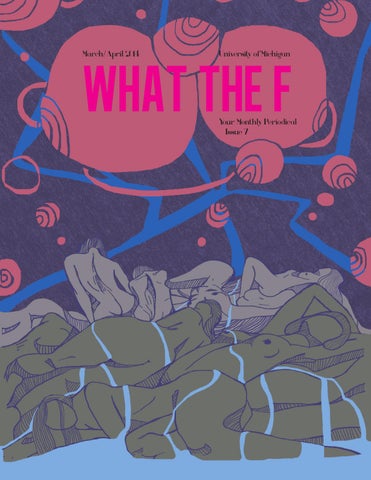
March/April 2014
University of Michigan
What The F
Your Monthly Periodical Issue 7
Stretch Marks This publication is meant to start conversations—it’s an open channel for all voices. The more voices, the richer the conversation. Because of how we’re raised and who we are, it can be difficult to see past our own experiences. So if, when reading anything in this magazine, you find you have a disagreement, a critique, or another viewpoint, write to us and we’ll publish it. Stretch marks: Stretch past your own head. Talk to us at WhatTheFMag@umich.edu.
President Jen Spears Editors in Chief Hailey Burns and Bri Kovan Creative Head Margaret Hitch Layout Editor HaeJee Yoon Business Manager Sumana Palle Public Relations Coordinator Jillian McConville Social Justice Editor Cosette Kathawa Webmaster & Social Media Coordinator Jerusaliem Gebreziabher Campus Coordinator Sydney Behrmann
What The F is a non-partisan, non-profit publication operated by students at the University of Michigan. What The F’s purpose is to
encourage discussion on significant issues of campus, national, and world interest. The magazine, the executive board, and our sponsors do not endorse the ideas presented by the writers. We do, however, support and encourage different ideas into our community and into campus discussion.
All writings depicted in this image are real, found in bathrooms on campus. Because sometimes we just need to talk to each other.
March/April 2014
What The F
Your Monthly Periodcal Issue 7
Letter from the President 01 Woman of the Month 02 Health 05 06
Barbara Niess-May Sh*t I’m Afraid to Ask My Doctor Healthy Living
Opinions 08 09 10 12 14 16 18 19 20 23 24
Two Girls, Fuck Off My Gay Will Gray Dear Daughter Playing the Part Gender Inequality in Film The Pink Golf Ball Women’s Rights Internships Don’t Worry, America. We Fixed It. Why Sexist Assholes Won’t Get My Cherry In Defense of Non-Monogomy The Best Bones
Reviews 26
VajA2 Origin of the Word Why is it Important to Talk About Periods?
28 Poems 29 30
Untitled Size Up
Sources and Sponsors 31
Funny, Fresh, Fearless, Feminist, & Fuck Layout HaeJee Yoon Contributing Illustrators Margaret Hitch, Shane Achenbach, Eliza Cadoux, Alison Cheng, Nicole Dennis, Diana Gage, Erica Liao, Grace Ludmer, Megan Muholland, Alana Weiss Nydorf, Alexandra Pears, Eva Roos, Sarah Schwendeman, Cheryll Victuelles, Edith Zhang, Daphine Zhao Contributing Writers Hailey Burns, Bri Kovan, Cosette Kathawa, Jen Spears, Eliza Cadoux, Carlina Duan, Rima Fadlallah, Samantha Florence, Brianne Johnson, Gabrielle Kirsch, Sonya Kotov, Madeleine Meunier, Essie Shachar-Hill, Colleen Smythe, India Solomon, Connie Zuo Keep the conversation going online! Visit our website at WhatTheFMagazine.wix.com/umich Like our Facebook page at Facebook.com/WhatTheFMag Follow us on Twitter @WhatTheFMag and on Instagram @WhatTheFMagazine Find our Tumblr at WhatTheFMag.tumblr.com
Letter from the President
Welcome to What The F, your irregular periodical!
As President of What the F Magazine, most of my work is behind the scenes. It’s very possible you haven’t heard of me other than maybe seeing my name on the inside cover or getting an email from me – probably with one too many exclamation points. The truth is, I’ve been working with What the F since its creation in 2012, and it has become one of my absolute favorite parts of college. I’ve met so many amazing women from being involved with the magazine, women who are constantly teaching and inspiring me and who – without a doubt – have turned me into a smarter, better person. Since I’m graduating in May, I find myself getting nostalgic at most everything lately. (Hello, tears-when-trying-onmy-black-grad-gown.) What The F is no exception. In a lot of ways, it seems like we had our first meeting at Charley’s just yesterday. But, at the same time, it feels like a lifetime ago since so much has changed. Not unlike the feminism movement itself, What The F is constantly evolving (dare I say, in “waves”?) and improving more than I could have ever imagined. Here is the abridged version of the magazine’s history that will hopefully be making its way into a history/Women’s Studies textbook someday… The idea to start a women’s health mag was birthed in none other than a Women’s Studies class discussion. It was literally the first of its kind at the University. Considering the huge amount of support we’ve received since 2012, I still can’t believe nothing like What The F existed before. When we first started, we had no idea how expensive it would be to print 2000 copies of a glossy magazine or how much (wo)manpower it would take to physically put the magazine together. (We originally had ONE person doing both art and layout… Ha!) We also envisioned literally being “Your Monthly Periodical” and coming out to the world every twenty-eight days. Unfortunately, time and money have prevented that from turning into a reality as of now. We’ve skipped some months here and there, but not to fear: we’re still healthy! What the F’s original mission statement aimed to “empower
the female population of campus by providing them with accurate and honest health information.” While this still rings true today, we are now much more than just a health magazine. With each issue of the magazine, we continue to receive both praise and submissions from authors who have never had a place to share their stories before. The magazine has started a campus-wide dialogue and served as a channel to start conversations, not just about health, but about womanhood and experiences as female college students. Some incredibly strong women have shared their experiences being sexually assaulted with What The F before they told anyone else in their lives. Others have shared what it means to them to be a woman intersected with their other identities, like race, sexuality, or religion. Personally, I have learned so incredibly much from reading these raw accounts, helping me to become more aware of experiences other than my own. Whenever I pick up a completed magazine, I am routinely awed, honored, and proud of the work of our staff. What The F is such an important space to share, learn, and grow, and I honestly cannot wait to see where it goes. In the years that I’ve been a part of it, each issue continues to impress me more than the last, and the articles and artwork get more and more beautiful! I’ll be slightly northeast in Detroit next year, but a part of my heart will always be in Ann Arbor with What The F Magazine and all that it has taught me, as well as with the beautiful women that have worked with me to make it a continuing success. WTF Love 4ever,
Jen Spears President
P.S. Want to get involved? E-mail WhatTheFMag@umich.edu. We would love your brilliant minds to write and create with us.
1
Woman of the Month
Barbara Niess-May by Eliza Cadoux
W
hen I first met Barbara Niess-May, she was congratulating SafeHouse volunteers, who in 2013 accounted for over 15,000 hours of service. She was radiant, surrounded by individuals like herself who are dedicated to making women’s lives better. She is the charismatic Executive Director of SafeHouse Center, an Ann Arbor organization that provides support for those impacted by domestic violence and sexual assault. Barbara has worked for over twenty years with survivors of violence and abuse. I sat down with her in February to talk about social conditioning, the healing process, and the search for accountability. EC: According to RAINN (Rape Abuse Incest National Network), 1 out of every 6 American women has been the victim of an attempted or completed rape in her lifetime, and, according to the World Health Organization, 1 out of 3 women will experience physical or sexual violence in their lifetime. Naturally, there is a huge amount of variance in what these assaults look like, but in your work have you seen any common threads within the reaction to that experience? BNM: Every survivor’s experience is unique unto themselves. One thing that is common for all survivors is that it’s not their fault. It’s never their fault. It doesn’t matter what they wear. It doesn’t matter where they were. None of it matters. It is never their fault. I think it’s really hard for people to understand that. There’s all these things that people can prevent, because we are taught as girls, young women, that there are certain things you don’t do. And the fact of the matter is it is less safe to be a woman in our society than it is to be a man. Sometimes when I’m doing a presentation and it’s to a large audience, men and women, I’ll ask men: say its seven o’ clock at night, getting dusky, you live five, six blocks from the library, and your roommates are being noisy, but you really need to study. What do you do to get ready to go to the library? Backpack, wallet, phone. And you talk to the women, half of them probably won’t even go. The other half will take elaborate measures. The fact of the matter is, most people who were assaulted somehow 2
knew their attacker. So we have this idea that we can prevent it. While it’s good to be mindful and assertive, at the same time, if it’s going to happen, there’s literally nothing you can do to stop it. EC: What do you see as some of the driving societal forces or causes for violence against women? BNM: It’s tough. [Sexual assault and domestic violence] often get lumped together [with their] impact on women. But something we need to be mindful of is that young men experience sexual assault at an alarming rate. The caveat is that people who are most likely to be sexually assaulted are those who have less privilege in our society. This is young children. This is women. The level of accountability goes along with that. The assailants are less likely to be held accountable depending on the privilege the person has. The social conditioning [that leads to violence] starts very early, and some of this happens in our own homes. It is seen [as] acceptable. Those very same people, like you and I, are growing up in a society that, when we really deconstruct it and take a hard look at it, is giving us many messages that women are valued less than men, [and that] children are valued less than men. Accountability is not expected in these situations, and, therefore, the power and control that is involved in sexual assault and domestic violence is perpetuated. EC: If there were to be a change in public policy, locally or nationally, that could alleviate the rate of sexual assault, what do you think that would be? What would it look like? BNM: Greater accountability of the assailants [to] more permissibility for women who are participating in a criminal case [and] not always have to participate every step of the way. Locally, if there is a sexual assault, I couldn’t even tell you how many hearings and motions and appearances the victim is expected to appear at. They have to be there, otherwise it gets dismissed because of the idea that the person gets to face their accuser.
So where are the resources if someone lives elsewhere and has to pay for plane tickets and lodging? There’s a huge burden on survivors. [Public policy] needs to verge away from holding the survivor hostage to this process, allowing them to give a few statements and go on that. It’s frustrating to keep reliving it over and over again. That changes accountability, and if [the assailants] aren’t being held accountable, they get away with it. EC: With the prevalence of abuse of college campuses, many college women are dealing with the aftermath of assault. I think readers of What the F would like to know, what are individual healing processes survivors can embark on? BNM: It runs the spectrum. I’m a survivor myself, and it can go the spectrum from doing nothing and people can be fine – it’s not likely, but it’s possible – to getting involved and doing something about it. There are support groups and counseling. Something I want to say is that healing can happen at any point in your life. It’s been my experience that there are some survivors who come for counseling right away, and it’s very beneficial, and I am so glad they come in for it. Then there are people who come in ten, twenty years after the assault, and woke up that day and realized that day what happened. That was the day that they needed to reach out for help. Then they come to counseling and support groups and they get a lot out of it. Some go through a period of needing to take extreme control over their life, while others let it all fall away. There are some people that don’t change at all because they just want to hide it. EC: It sounds like each coping mechanism is unique to the survivor. BNM: Yes, no way is right or wrong. And it’s often tied to their socio-economic experience, their cultural experience. I knew I couldn’t tell anybody, and I didn’t. I just didn’t tell anybody. I didn’t even realize what it was until I was much older. EC: What do you envision for Safe-
House, and how do you see your role within it? BNM: I’ve been here for almost twelve years, and my role is to provide the leadership so that we have an agency, a place for survivors to go, where they can manifest their hope for their life to be what it is they want it to be after going through what they went through. People come here because they really think their lives could be better. They aren’t thinking, ‘Oh they are going to make my life so crappy!’ They come on their own and with some measure of hope. Some of it is huge [and] some of it is tiny, and we are here to manifest it. We are here to give you the tools and information for that to happen. We understand what you’ve been through. We’ve been around the block. We’ve been in court rooms. We’ve been with thousands of survivors. We have done lots of work here. What do you want for yourself, and how can we help you get there? More than anything, we are arbitors [and] manifesters of hope. We never hear the same story twice, but the commonality is just that. What we wish for survivors of sexual assault is for them to experience some measure of wholeness, despite what happened to them.
***
SafeHouse Center
Location: 4100 Clark Rd. Ann Arbor, MI Hours: Monday-Friday, 9-5pm Phone: (734) 995-5444 Appointment Required: No Services Offered: Confidential support for those impacted by domestic violence or sexual assault, emergency shelter for those in danger of being hurt or killed, counseling, advocacy, support groups, information, and referrals Cost: Free Who is eligible for services? Any person who lives or works in Washtenaw County Website: safehousecenter.org
3
“I will not have my life NARROWED DOWN. I will
not bow down to somebody
else’s whim
or to someone else’s 4
ignorance“.
“
Health
Sh*t I’m Afraid to Ask My Doctor: Breast Cancer Screenings by Hailey Burns Q: So what should I do? A: Doctors recommend that people with breasts should start receiving some form of a breast exam every 1 to 3 years once they reach their 20s. A breast exam is just a way to check for any potential changes or lumps in your breast tissue. This is a fairly standard procedure - if you have a gynecologist or a health care provider, you can ask for a breast exam as part of your routine yearly checkup. Q: But I’ve also heard about self-exams. Do I have to go to a health care provider, or can I just do this at home? A: Actually, doctors recommend self-exams in addition to clinical breast exams. Health care providers and gynecologists are more experienced in evaluating whether a person’s breasts are healthy or if they have any potential lumps. You should have a clinical exam every 1 to 3 years. However, women are also advised to perform more informal self-exams every month or so. Although breast selfexams have not been shown to be very effective in finding breast cancer early, it is important to learn what is normal for your breasts (for example, in terms of the changes they undergo over the course of your menstrual cycle).
University Health Services (UHS)
A
s a supposed “adult,” there are many things about my own body that I don’t know nearly enough about. And while I can identify this lack of information, I rarely take the time to research necessary information about my health. Here’s where What the F comes in! We’ll look up the information for you so that you don’t have to do all of the dirty work alone. Today’s topic: breast exams. When do I need them? How often do I need them? And why are they necessary? Q: So I know that breast cancer is a major health risk for people with breasts, but I’m not sure of the specific risks. What should I know? A: You’re absolutely right. Breast cancer is a serious health concern for people with breasts. Annually, over 200,000 women in the United States are diagnosed with breast cancer, and 40,000 of those cases are fatal. Breast cancer is the second most common cancer for women, following skin cancer. Q: Okay, that makes sense, but I’m only in college. I don’t have to worry about breast cancer yet, right? A: It’s true that college-aged people with breasts are not at the same risk for breast cancer as, say, someone in their 40s, but it is absolutely not true that you should not worry about it until then. College-aged people with breasts should be starting to take preventative (and potentially life-saving) steps to check for any signs of breast cancer.
Location: 207 Fletcher Street, Ann Arbor, MI Hours: MTW: 8:30-5pm, Th: 9-5:30pm, Fri: 8-4:30pm, Sat: 9-Noon, Sun: Closed Phone: (734) 764-8320 Appointment Required: Yes Services Included in Student Tuition: clinic visits (e.g. medical clinics, women’s health, nurse visits), health education, pregnancy testing and options counseling, confidential HIV testing, nutrition counseling, most laboratory tests, advice by telephone Website: uhs.umich.edu
Planned Parenthood
Location: 3100 Professional Drive, Ann Arbor, MI Hours: M: 9-5pm, TW: 9-8pm, Th: 9-6pm, Fri: 9:30-5pm, Sat: 9:30-4pm, Sun: Closed Phone: (734) 973-0710 Appointment Required: No for walk-in services; yes for all others Walk-In: Pregnancy testing and options counseling, emergency contraception (both over the counter and by prescription), birth control options counseling, express STD screenings, HIV testing Appointment Required: medication abortion, in-clinic abortion, birth control implant, birth control shot, IUD (Mirena and ParaGard) insertion, STD testing, HPV vaccination, women’s health services (including Pap tests, breast exams, UTI testing and treatment, vaginal infection testing and treatment, cervical cancer screening, mammogram refferal Cost: Based on a “sliding fee scale.” The cost of services depends on the individual’s income and takes into account unemployment, disabilities, etc. Cost can be as low as donation based. Website: plannedparenthood.org 5
Healthy Living: Student Style by Jen Spears
O
ne of my favorite blogs, Greatist, follows a health mantra that I replay in my head regularly: “Just one healthier choice a day.” Simple, right? Whether it’s taking the stairs or cooking a meal at home instead of grabbing that bowl of orange chicken from Panda Express, making small, conscious choices to be healthy and to better your physical health will positively affect your mental and emotional health, too. Constantly counting calories and measuring food portions may work for some people, but it doesn’t align with everyone’s ideas for how we should take care of our bodies. So what does it actually mean to be healthy? I believe there is a direct connection between healthiness and happiness. Forcing myself to go running or cut back on eating my absolute favorite foods is certainly not making me happy, so it’s
not making me healthy, either. If you only remember one thing from this article, I hope it’s that you should not conform to someone else’s definition of what being healthy means. Make your own choices and you may very well start to feel like a whole new you. Here is a collection of my favorite tips I’ve picked up over the years. Feel free to recycle them as a starting point on your road to becoming a healthier (and happier) you!
Healthy Eating
Superfoods • Raspberries and blueberries. Both are high in fiber and vitamin C, and they make awesome desserts or additions to smoothies. • Avocado. High in healthy fats and fiber, avocados makes a delicious addition to sandwiches, salads, burgers, and most everything! • Kale. Kale has more antioxidants than any other fruit or veggie, including spinach! Try it blanched and pan-fried with olive oil, salt, and pepper. Add it to a green smoothie or – if you’re feeling adventurous – try your luck at making kale chips in the oven. • Kiwi. One of these little green fruits contains more potassium than a banana, but with fewer sugar and calories. They are great on their own or in a fruit salad. • Walnuts and almonds. Full of protein, fiber, minerals and nutrients, these make a great snack and can curb hunger and cravings. • Green tea. Full of antioxidants, choose this common drink over a sugary one. Studies found that green tea consumption may even reduce your risk for diseases, like cancer. • Quinoa. Originating from South America, this grain is a complete protein and one of the only grains that provides all of the nine essential amino acids that our bodies can’t produce themselves. Try it as a side dish, with a stir-fry or pasta, or in a salad!
6
Cheaper Options • Meatless Mondays. Eliminating meat just one day a week forces you to find more creative protein alternatives and will most definitely make your meals healthier. Reducing meat consumption has been proven to reduce heart disease (the number one killer of women) and help you to live longer. It also reduces your carbon footprint - major livestock corporations are among the most environmentally unfriendly of all food producers. Try your luck with these awesome vegetarian proteins: beans, lentils, quinoa, natto, seitan, tempeh, and of course, tofu. • Popcorn! A cheap, filling snack like popcorn can stop cravings that result in reaching for that quick-but-unhealthy option. Using air-pop kernels and salting the popcorn yourself gets rid of unnecessary salts and fats. Fun fact: you can make air-popped popcorn in
the microwave in a brown paper bag if you don’t want to invest in an air popper!
Smarter Drinking
Preventing hangovers • Keep it light. Studies have found that darker alcohol, like whiskey or red wine, often contain congeners (substances produced during longer fermentation) and may cause more intense hangovers. Opting for vodka or white wine can fix that! • Keep it classy(ish). As college students, this one is tough. But it may be worth it to splurge on higher-shelf alcohol for a few extra dollars, as they typically contain fewer hangover-causing congeners. The extra money spent on Absolut vs. Burnetts may be well worth it in the morning! • H2O, all day and all night long. Drinking a glass of water for every alcoholic drink you consume will rehydrate your body to compensate for alcohol’s dehydrating effects. It’s sure to make you feel better in the morning. • Less is more. This is not always the easiest option, but simply drinking less alcohol will drastically reduce the severity of your hangover. Healthier Mixers • Real juice! Those fishbowls at Charley’s are delicious, but no one has any idea what’s actually in them... When making your own drinks, use fresh squeezed juice or 100% fruit juice (cranberry cocktail does not count!) to cut back on added and unnecessary sugars. • Use whole fruits. Using whole fruit to sweeten drinks is even better than juice. Try mixing fruit with seltzer water and your choice of liquor. Plus, whoever turned down a glass of homemade sangria? • Check out the recipes in “60 Healthier Drinks for Boozing” on Greatist’s website for more tasty drink concoctions!
Fresh Exercise
• Get down(dog) with your bad self! A sweaty hour of hot vinyasa will make you stronger and more flexible as you sweat out bodily toxins. There are plenty of studios near campus (like Center for Yoga, Detroit Yoga, or aUM Yoga), and most offer your first class for free so you can test it out. Namaste!
• Hit the gym. There are very few times where a gym membership will ever be free in your life, so take advantage of it while you can! All UMich students have free access to the CCRB, NCRB, and IM Building with their Mcards. Try exploring the elliptical and weight rooms, go for a swim, or play some pick-up basketball with friends. There are also very reasonably priced classes through UMove Fitness at all gym locations. Just make sure to sign up early in the semester – the good ones go fast! • Stairway to heaven. While the elevators in Dennison and Ma-
son Hall are definitely tempting, making the simple choice to take the stairs can make a big difference. • Weights. Those huge dumbbells can be intimidating, but a small kettlebell or set of hand weights can make for an awesome workout in the comfort of your own home. Check out the thousands of How-To videos on YouTube to get started. • Bike! During Ann Arbor’s warmer months, biking is a quick and easy way to zip around campus. A brand-new bike can be a big investment, try checking out garage sales or used stores to find an awesome vintage bike for a steal. Also, Ann Arbor has a bike-sharing program coming soon where you can pick up a bike from various stations around A2. Biking is good for the planet and for your body. Win-win! 7
Opinion
Two Girls, Fuck Off by Colleen Smythe
C
an I see you guys kiss?” I almost drop my rum and coke. My girlfriend and I exchange glances. Mine says, “Help; my life is a cliché.” Hers says, “Are you gonna punch him, or should I?” We turn back to you. You’re still standing there like a drunken puppy waiting for a treat. Listen, buddy, I get it. I get that my girlfriend and I are a smokin’ hot couple. I get that you’re extra-friendly a few drinks in. I get that you’ve probably met girls who like to make out at parties for attention (which is totally their prerogative, by the way). So it’s only natural that you would expect our sex life to be your HDTV OnDemand wank tool, right? I’m flattered, truly, at the compliment. You probably only deign to spectate when the girls performing meet your standards of attractiveness. What an honor to have made the cut! We were just waiting for your permission to kiss – after all, a party trick is only fun if someone asks you to do it first. God knows we don’t kiss because we enjoy it. Okay, let’s cut the crap. I’m not even sure which is stronger at the moment: my anger at the audacity of your request, or my embarrassment on your behalf for making such an ass of yourself. Because, honestly, you should know better. By your casual do-me-a-favor tone, I gather that you thought it was okay to ask because we’re friends. On the contrary, I can’t believe you would do this to anyone you claim to respect. Every other guy at this party is a friend of mine, and not a single one of them has tried to use my girlfriend and me as girl-on-girl porn. Apparently they understand that friendship is not a free pass to make intrusive requests. I’m tempted to assume that you’ve asked other girls to kiss for you before, but maybe this is the first time. I can’t know for sure. But even if this behavior does happen to be out of character for you, it certainly isn’t for the general population. A lot of guys seem to have difficulty accepting that girl-girl relationships have nothing to do with men. And this is not just an issue of invalidating samesex relationships. It’s part of the larger phenomenon 8
of men failing to respect women’s sexuality. You didn’t even stop to consider whether your question might offend my girlfriend and me. It didn’t occur to you because, like most males in this country, you’ve been conditioned to see women’s sex lives as your territory instead of an area that’s theirs to control. You don’t see yourself as an intruder because you can’t even see the line separating my space from yours. Believe it or not, you’re not the first guy to try and use my sexuality for his gain. My college experience has been fraught with guys shoving their tongues down my throat or their hands down my pants totally uninvited. The assumption that you could shove your way into my private life is no better. Furthermore, I’m hurt that you would trivialize an identity that I’ve only recently come to terms with myself. Coming out is no fucking picnic. I’ve fought a years-long battle with my own shame, a battle that left razor scars. So every time I kiss my girlfriend, I explode into a million tiny pieces of relief at finding myself. In a world where guys refuse to believe I don’t want dick and half the planet wants me dead, being allowed to kiss her is motherfucking sacred. And you want me to do it on command so you can get your kicks? Allow me to make this abundantly clear: We are not a novelty. Absolutely nothing about our relationship is an invitation to you. Even if we happen to be fucking in the stacks right next door to you, you should never assume that we want you to join. As I stand here, still holding my drink, all of this rushes through my head. But I’m paralyzed with shock at being fetishized by someone I called a friend, and all I can choke out is, “No.” So this is for everyone who has been hurt in a space they thought was safe, for everyone who has felt violated but couldn’t articulate why, for my girlfriend, for myself, and – yes – for people who think this behavior is acceptable. It isn’t. This behavior is not acceptable. And now that you know, kindly stay the hell out of bedrooms to which you were not invited.
My Gay Will Gray by Gabrielle Kirsch
I
’ve been obsessing over the gay rights nature versus nurture debate since I was six years old. That’s when I realized that my uncle was gay. The nature versus nurture debate centers around two polarizing ideas: seeing homosexuality as a biological characteristic and seeing homosexuality as the result of upbringing. As a child, my parents taught me to side with nature. I heard myself regurgitating phrases like, “Aren’t we all made in the eyes of God?” and “No one would chose to be a minority.” This was my parents’ way of explaining why my uncle was different and why his difference was okay. Now that I’ve had some time to sit with my identity as a queer girl, I see this framework as problematic. I don’t disagree with what I had been saying, but rationalizing being gay with an explanation based on what is “natural” both negates individuals’ ability for self-identification and justifies further oppression. Making definitive statements about what is and is not “natural” in order to justify oppression is not a new phenomenon. We oppress women because it’s “unnatural” for women to be in the workplace; we oppress gay people because it is “unnatural” to love the same sex. As a grandchild of a survivor of Buchenwald, I’ve spent a lot of time talking about the Holocaust. I shy away from comparing anything to the Holocaust because it feels cliché and dramatic, but then I think back on my grandfather’s stories. The Holocaust is a prime example of people eradicating natural difference. It wasn’t until recently that I started to compare the argumentative rhetoric of the Nazi’s platform with the nature versus nurture debate today. When reflecting on my oppression as a lesbian, the tangible irony of the similar argument is haunting. Although our two situations are drastically different, it still makes me want to scream: “Have we learned nothing?” I’m not suggesting that I side with the “nurture” camp. Many people claim that environmental factors create homosexuality through abuse. While this is rarely directed towards me, I’ve had LGBQ friends confronted with this argument. It’s not uncommon for people to assume that men wronged/abused lesbians or that overbearing mothers kept gay boys too close. The Feminine Mystique, a classic feminist manifesto, claims this argument. Luckily, nowadays it is understood as highly homophobic. While traumatic events may influence the way we understand our own sexuality, it’s not acceptable to credit a traumatic event for causing homosexuality; it implies that homosexuality is a product of wrongdoing and therefore needs to be fixed. Although many LGBQ identified people may have experienced distress through internalized homophobia or while coming out, the state of homosexuality in itself does not cause distress, which is a major reason why homosexuality is no longer considered a mental illness.
The LGBT*Q movement in general tries to stay away from the nurture argument partially (from my perspective) to protect kids who are living in homophobic and trans*phobic environments. It gives them legitimacy if others disagree. Gay conversion therapy is an attempt to “fix” gay individuals on the basis that nurture causes homosexuality. If nurture causes it, then certainly nurture can fix it. Growing up in a tiny conservative town, I was naïve enough to think that this practice was a thing of the past. Yet a friend of mine revealed years later that his parents had taken him to Colorado to get gay conversion therapy after they found gay porn on his computer. My friend is still gay (as studies on the ineffectiveness of gay conversion therapy would suggest), and he was deeply traumatized by the three weeks of this “therapy.” The LGBT*Q movement repels from the nurture argument for this reason, but claiming nature doesn’t necessarily eradicate future problems. I also struggle to justify the nature argument because I resist the need to self-identify with any particular label. Recently, I’ve started to call myself queer because I don’t like the idea that my sexual orientation is molded for me. I was not born who I am right now. I believe that my sexual orientation is innate – but innate does not mean unchanged. As hair will gray, my sexuality will mature as I grow older and have new experiences. I tell people I am a lesbian because it makes sense right now, but I call myself queer because I recognize that I may be different in the future. My gay will gray. By pressuring people to identify themselves, it stifles this fluidity. I am who I am, nature or none, and I don’t need a justification. 9
Dear Daughter by Bri Kovan
I’m sitting in a busy Panera, with a long-gone mocha keeping me company next to scribbles of notes and an old, dejected phone. Cover letters fill my computer browser, teasing with possibilities for next year. As I think about my future – where I’ll be, what I’ll be doing, and who I’ll be with – I find myself drawn to reflecting on yours. I hope this note finds you well as you approach your college graduation. You see, I’m approaching mine too. As I write from a place of unease, I hope your future situation is more comfortable – for your sake. I’m extremely uncomfortable with instability. I organize clutter, straighten out curves, and try to find meaning from nonsense. I hate not knowing. But that’s a dreadful way to live. The future will always be uncertain. Books will always sit on my bedside table unread; the sound of your laugh is far out of my reach; even your very existence is uncertain. Without uncertainty, there can be no surprises. I’ve limited the amount of possible surprise from my life, and I hope I don’t pass that along to you. I’m writing to you because I hope you’ve found ways to learn from my shortcomings. My world is a web of self-inflicted fear: fear of failure, fear of disappointing, fear of not having complete control of every aspect 10
of my life. I don’t want you to live like this. I hope you make space in your life for spontaneity, gifting moments for unplanned laughs, unpracticed dinosaur faces, and impromptu recklessness. I hope you’re better than I am at living in the uncertainty – at hiding in the cracks and crevices of the unknown, a constant game of hide and seek. Ultimately, I hope you live gently in this world, interacting with both yourself and others with compassion and patience. While I don’t know many things, I do know how important it is to practce self-love first. In order to be forgiving of others, it’s vital to treat yourself with a similar level of forgiveness. I’ve spent my life scared of my own body. It curves in weird ways, disagrees with most foods, and pales in comparison to others’. Female bodies are taboo. They’re hidden behind layers of judgments and scrutiny, molded into one image of perfection. Your body doesn’t look like this. Mine certainly doesn’t. I’ve spent my life hiding behind clothing, uncomfortable in my own skin. My body isn’t taboo. I know that. But I continue to dress myself in symbolism, in a perpetual state of disappointment. I don’t want you to live like this. Let’s spend mornings staring at our bellies as they jiggle together, paint faces on our goofy-looking toes, and interlock wrinkly fingers after an evening of swimming. I hope I’ve raised you to hug your quirks, your goblin bulges, and your delicate elbows.
Be forgiving of your body. Be kind to your body. And then expand that love outwards to those who surround you. Create connections – honest, loving, uncontainable connections. Share your joys, your successes, your fears, and your failures. Share both your perfections and your imperfections with the people around you. This doesn’t come naturally for me, so I hope you’ve managed to truly, deeply let others in. I spent my teen and young-adult life with so many walls up. I regret that. For me, staying collected meant never being vulnerable. But I wish I’d been open to the possibility of vulnerability – with family, friends, and people important to me. Hidden behind a composed façade, I’ve trained myself to numb emotions. But with each uncomfortable emotion I numb, I also numb a positive one. Maybe you already know this. I’m sure you do. I shouldn’t doubt you. But if, by chance, you’ve acquired this trait from me, perhaps you’ll work on taking down your barriers as well. As you (and I) look forward to post-grad life, it’s important to also look backwards. The woman I’ve become is joined by generations of strong, beautiful women. They lift me up and continue to propel me forward. Whether or not you know them – I hope you know them – they’re with you too. Your grandmother raised me with Indigo Girls tunes, weekend popover breakfasts, and an obsessive relationship with running. But I spent my childhood angry at her, mad the house wasn’t spot-
less, frustrated she was perpetually late, and irritated by how she prioritized running. I swear she existed in her size 8.5 Saucony shoes. You know I’m stubborn. I was ruthless with her. She didn’t conform to my image of maternal domesticity, and I buried a deeprooted bitterness for a long time. But your grandmother was always unapologetic, and I admire her so much for that. I wish I’d shared more with her. It’s terrifying to live each day, to truly live from the bottom of our hearts. It’s dangerous to be vulnerable in this world. But don’t let the anger outside make you forever angry. Don’t let the hate make you forever hateful, or the sadness make you forever sad. If I’ve learned anything from my mother and my grandmothers, it’s that the best weapons to combat these struggles come from within. They come from an internal strength, a refusal to give up, and a comfort with uncertainty. Congratulations on your upcoming graduation. From one angst-filled senior in a nondescript coffee shop to another: be imperfect, be vulnerable, and know that that is enough. That will always be enough. (If I sometimes forget that, please remind me. Gently would be best.)
11
Playing the Part by Essie Shachar-Hill
I
n my first-ever play, I was cast as a male character. As a cisgender woman, I was up for the challenge of personifying a stereotypically masculine male. I told myself, “I’ve already got the short hair; how hard can it be?” As it turns out, it’s pretty damn hard. Before now, I had never really considered myself to be an especially feminine person. I love blazers and bow ties and my legs are hairier than Ron Burgundy’s upper lip. But the moment I stepped onstage, none of that mattered. My shoulders still rolled back to emphasize my chest. My hand still found its way to the curve above my popped-out hip. My ankles still crossed when I sat down (with knees together, of course). My hand still casually swiveled from my limp wrist while smoking a stage cigarette. Clearly, it was going to take more than lowering my voice and binding my chest to make this convincing. Outside of acting class I started monitoring my everyday behaviors, and I became constantly aware of my natural womannerisms. As I sat down next to a male friend, I would find myself comparing our stances and adjusting my body to match his. I would make mental notes: slouch down, knees apart, shoulders forward. “Just relax,” he told me. “Be more of a guy.” This less-than-helpful comment further highlighted the ingrained nature of gendered mannerisms. While he didn’t give a second thought to stuffing his hand in his pocket during conversation, I had to consciously stop myself from running my hand through my hair. The fact that neutral behaviors like walking or standing are performed differently by people of different genders is a bizarre concept to me. But in society’s ongoing tradition of labeling individuals, these cues are used to categorize people as feminine, masculine, or somewhere in between. This is highly problematic for anyone trying to “pass” as a different gender than the one they were assigned. For me, embodying another gender convincingly was just the difference between an A and a B in my acting class. For others, passing as a different gender could be the difference between comfort and self-loathing, acceptance and ostracism, or security and danger. Let me be clear: I am in no way 12
equating my part in a twohour play to the experiences of those individuals who struggle for a lifetime to pass and fit in. I cannot imagine having so much banking on my performance. But mastering a set of behaviors expected of a certain gender is imperative to a believable portrayal, which I find deeply troubling. But there’s a fundamental problem with the idea of passing. For a person to “pass” means pretending to be something they are not. It was used in the mid-twentieth century to describe light-skinned African Americans who could present as White in order to be accepted into White society. Blacks who could pass were not White; they merely appeared so. Thus, to speak of trans* individuals as passing as a gender inconsistent with their biological sex insinuates that they are not really that gender. In other words, for a trans* woman to pass implies that she is not in herself a real woman, but that she must present herself in a certain way for society to accept her as such. It all goes back to the socially constructed nature of gender. The rigid boundaries of masculinity and femininity are ingrained in us from a very young age. If one wants the world to perceive them as a specific gender, they must play by the socially constructed rules of how that gender behaves. It follows that the issue of passing raises a myriad of questions. What does it mean to be a “real” man or woman? Why are cisgender people who fit the binary the ideal that trans* people use to pass? Why are so many people so uncomfortable with non-binary people, or those who don’t fit into the tidy titles of “woman” or “man”? These are the kinds of questions that I will ponder the next time I notice an incredulous stranger judgmentally eyeing my hairy armpits or dapper plaid-and-skinny-tie combination. It’s time for society to break down gender barriers. It’s time to end the practice of assuming someone’s gender from outward appearances or behaviors. It’s time to accept that not all women are feminine, that gender expression and sexuality are separate concepts, that some men wear makeup and heels and still identify as man, that not everyone’s method of gender expression matches yours, that some women have penises, that some people present as butch one day and feminine the next, and that gender bending is OK. If you embrace traditional forms of gender expression for your sex, great. If you reject those norms, great. If you accept them one day and reject them the next, that’s great, too. Let’s stop answering to society’s expectations and start answering to ourselves.
What the F Magazine is dedicated to showcasing the many talents of womyn artists on our campus. If you have art, photos, or designs that you think reflect our magazine’s missions, please send them our way! WhatTheFMag@umich.edu.
13
14
15
The Pink Golf Ball by Samantha Florence
A
s a feminist woman, it’s often difficult to navigate discussions about gender with people who don’t identify as feminists. Take this conversation with my friend Tom, for ex-
ample. Tom and I both enjoy running in our spare time, and he, being the more experienced runner, sometimes gives me pointers. I told him that my feet hurt from pounding the pavement, and he offered to lend me one of the golf balls he uses to roll under his soles to relieve the soreness. When he dropped by, he offered me my choice of a yellow or a pink golf ball. I took the pink one. A few days later, I came by to hang out, and as I sat across from him on the floor, I thanked him for lending it to me. Tom looked nervous. “So… I have a question. And I hope it doesn’t offend you. I’m just curious.” Uh-oh, I thought. “Why’d you choose the pink one?” I considered for a moment. “Novelty, I guess. I’ve seen a lot of yellow golf balls, but never a pink one.” “I brought both of them because I didn’t want to assume which one you’d like. I just thought it was interesting that you were drawn more to the pink one.” “In other words, you were wondering if I chose the pink one because I’m a girl.” “It’s just that – you’ve told me before that you’re a feminist. Now, I’ve heard a lot of stuff about feminists, but I know you’re not like that. Are you just kind of a feminist, like a less radical version, or something?” I cocked my head. “What do you mean, that I’m not “like that?” It’s not a trick question. I really want to know how you’re thinking about this.” He gestured vaguely in front of him. “As in, bra burning and all of that.” Coming out as a feminist, and explaining what it means to be one, can be challenging. I still remember sitting in my living room with Critical Theory Today by Lois Tyson, required reading in my high-school English class. One of the theoretical lenses it outlined was the feminist lens, and the book gave an accompanying explanation of feminism. I was fascinated. There, in my hands, was a way to articulate so many of things I had noticed were wrong with the world. I had never had the vocabulary to do so before. That night, I marched to the dinner table and triumphantly announced to my parents that I was a feminist. They laughed, of course. My best friend, Mel, has accused me of using feminism as an excuse not to put effort into my appearance. “It’s a crutch,” she says. “It makes you feel like you don’t have to try.” Her belief in my laziness has been a major barrier in our communication. I try to show her that patriarchy oppresses her too, but perhaps she can’t see it because she has been successful at meeting patriarchal standards. Regardless, her comments have made me second-guess myself: Was I taking the easy way out? Was I simply choosing an option that would allow me to ignore the consequences of being ugly? Mel’s skepticism mirrors my parents’ arguments that women are the ones holding themselves back. 16
After I came to college and began to understand the reality of societal oppression, I realized that my parents were sexist – and racist, and homophobic, and xenophobic – and these conversations became more heated. Dinner conversations, which used to include the occasional debate, now included the occasional shouting. It was hard to reconcile my perception of them as loving people who raised me and encouraged me to excel with the realization that they also taught me things that undermined my empowerment. My mom takes the biological determinism approach: little girls and little boys act differently because it’s in their genes to do so. She sees any differences in behaviors as signs that those behaviors are hardwired, as opposed to my view that girls are boys are socialized to act differently. Dad, who has many years of experience in the corporate workplace, reminds me that a woman who has a “chip on her shoulder” won’t be seen as likeable or a team player; she’s simply “too uptight.” The solution? Work harder than everyone else to prove my worth. When I argued that I shouldn’t have to – that my credibility should be worth as much as any other employee’s – he shrugged and said that I’d have to learn to play the game if I wanted to gain any respect in the professional world. And he’s got a point. Being “out” as a feminist in the workplace can be very challenging. Heck, being “out” anywhere as a feminist can be challenging, if not frustrating, depending on the context. I thought carefully before I answered Tom’s question. “I don’t see feminism as radical,” I said. “I don’t think expecting social, economic, or political equality is radical. Those are basic human rights. I’m not an angry person, but there are things that I’m allowed to be angry about. I’m allowed to be upset that I may not make the same salary as a man for doing the same job. I’m allowed to be upset that my reproductive rights continue to be legislated by governmental bodies comprised mostly of men. So, when you really get down to it, feminism is me refusing to accept that women deserve less than anyone else.” While that was an oversimplification, it seemed to give him a starting point for what turned out to be a very respectful, insightful, and rewarding discussion. He told me that he’d seen many examples of his own gendered privilege, and I gave examples from my own life. These are the conversations that turn friends into allies. It’s worth acknowledging that the onus is not on feminists to explain their identities or justify themselves; our friends, relatives, and significant others should make an effort to educate themselves. I do believe, however, that having the courage to identify ourselves as feminists will help to destigmatize the movement and dispel the bizarre myths that continue to surround it. I’m still working on my parents, but we’re making progress, and even Mel has come around. As for Tom, we’re still good friends, and it’s not unusual for him to bring up a gender inequality he noticed in the course of his day and solicit my opinion. “You make me question systems a lot more than I used to,” he told me once. “What can I say? I’m a rebel,” I joked. “Nothing radical about you,” he said. And I agree.
17
Women’s Rights Internships by Brianne Johnson
F
or students who long to work under the umbrella of social justice, many organizations interested in advancing equality in an inclusive, progressive, and practical way invite undergraduates to join their offices as interns. From policy to advocacy, publishing to pro-choice legislation, student internship opportunities are as diverse as the organizations’ missions. But no need to be overwhelmed. We’ve highlighted six local and national organizations that offer internships year-round, so you’ll never be short of a little social justice.
1. Meta Peace Team (Lansing, Michigan)
Since 1993, nonprofit organization Meta Peace Team (MPT) has partnered with members of local, national, and international communities to engage in grassroots efforts to promote nonviolent peacemaking across the world. MPT emphasizes cross-cultural partnership, inviting semester-long interns to learn about its global network of ally organizations that specialize in “third party nonviolent intervention,” including Rabbis for Human Rights and the International Women’s Peace Service. Whether you hope to find the fun in fundraising with the Development Committee or connect with like-minded advocates with the Technology and Branding Committee, each of MPT’s five teams offers interns the opportunity to embrace the aspect of outreach about which they’re most passionate. See: www.metapeaceteam.org
2. Bitch Media (Portland, Oregon)
Bitch Media’s magazine, Bitch: Feminist Response to Pop Culture, is a traditional media executive’s worst nightmare and a feminist’s best friend. This nonprofit’s quarterly publication highlights innovative and progressive community members, like author Malinda Lo, who breaks the norms of the predominantly white and heteronormative genre with her young-adult fiction by writing around LGBT*Q characters of color. Bitch also aims a critical lens at the popular media embraced by TV-lovers and cinephiles, feminist or otherwise. For a minimum of three months at a time, the magazine welcomes interns who are determined to hone their editorial skills among a staff of impassioned writers and bloggers, to immerse themselves in critical conversations about media representation, and, of course, to talk endlessly about their all-too-real feelings toward Don Draper. Who could resist? See: www.bitchmagazine.org/internships
3. Equality Michigan (Detroit and Lansing, Michigan)
Equality Michigan is proud to call itself the only statewide nonprofit to advocate for LGBT*Q equality across The Mitten. The organization strives to achieve equal rights and representation for the community through lobbying efforts, fundraising, and awarenessraising events in the hopes of amplifying the often-silenced voices within LGBT*Q communities. These semester-long internships 18
include positions centered on advocacy, fundraising and development, communications, and public policy. They are welcome to students of all majors and identities. See: www.equalitymi.org/internships
4. Choice USA (D.C.)
“Pro-choice” is a concept familiar to the reproductive rights movement, but how about “Bro-choice?” At Choice USA, founded in part by famous activist/author Gloria Steinem in 1992, reproductive justice is not merely a “women’s issue,” but an issue that affects us all. “Bro-choice,” one of Choice USA’s many campaigns to engage youth in a positive dialogue surrounding sexuality and reproductive rights, invites men to act as allies by pledging a commitment to support the pro-choice movement while also reflecting on their own sense of sex, gender, and masculinity. To keep the conversation going, Choice USA invites year-round Communications Interns and Field & Trainings Interns to reach out to communities online and through grassroots efforts. See: www.choiceusa.org
5. Vital Voices (D.C.)
As an organization whose mission strives to touch women’s lives outside the nation’s capital, Vital Voices recognizes the powerful potential and leadership of women across the world. Its culturally sensitive projects include working to increase Latino representation in government and promoting the stories of influential women internationally, like revolutionary Egyptian activist Esraa Abdel Fattah. For students who wish to join Vital Voices in its initiative toward mobilizing “emerging women leaders and social entrepreneurs,” the organization’s semester-long internships are just as diverse as its celebrated women. Vital Voices offers winter, fall, spring, and summer positions exploring international human rights, data evaluation, social media strategies in North Africa, Latin America and the Caribbean. See: www.vitalvoices.org/get-involved/careers
6. Feminist Press (New York City)
Embrace the heat of the country’s ultimate melting pot in NYC, where the Feminist Press has not only promoted the voices of feminist activists and writers since 1970 — it has published them. The nonprofit publishing house stands out in a neighborhood of commercial competitors, dedicated to stocking your bookshelves with literature with a multicultural conscience and a good story. Offering a look into the publishing process from the creative firststeps of the editorial department to the fine-tuning of marketing and development, the Feminist Press’s internship opportunities are ideal for students with a lust for literature that stimulates readers’ imaginations and inspires social justice dialogue. See: www.feministpress.org/about-fp/internships
Don’t Worry, America. We Fixed it. by India Solomon
D
on’t worry, they say. You’re free now. Your heroes and ancestors fought back and did their time, leading to the gargantuan expansion of our nation’s capacity for acceptance that we experience today – we’re equal. Slavery is over. The civil rights movement has passed. You are now free to dwell equally in a society that values your history on the basis of white guilt (not on the basis of its social, philosophical, and political contributions to western culture). But this debris has stubbornly buried itself into the pavement, smudged itself on the roads and claimed its place, hovering eerily in the air we breathe. “I’ve never been in a class with a black person,” the girl from Whitelake, Michigan said. “My school was 67 percent black, but the honors track was 90 percent white,” the girl from Ferndale, Michigan said. I can attest to the eerie subliminal segregations at Ferndale High. Basketball was a Black thing; theatre was a White thing. Dance was a Black thing; marching band was a White thing. Honors and AP were White things without explanation. The disparity between my school’s external diversity and the internal segregations that plagued it occurred to me early on, but my own interests blinded me from seeing the sheer reality of how Blacks and Whites interacted and understood each other in my environment. I had always been on the honors track, and I grew to become the captain of both our dance team and our colorguard. In all of these settings, I was in my element without a shade of discomfort. I was proud to be one of the only Blacks in my classes and on my extracurricular teams – but I never questioned why I was one of the only Blacks. Overall, Ferndale High had a racially balanced administration, which was headed by a Black principal and vice principal. This helped me to feel assured that my education was challenging outdated social norms and stereotypes. But despite our school’s reputation for diversity and acceptance, my classmates and I were subjected to cultural and political censorship in our required U.S. history courses that was silent, ominous, and pervasive. We were taught only that MLK was a civil rights leader, ignoring the meaningful things he had to say about global relations and western culture. We never learned about his abusive past or his notorious philandering. We never learned about the Black philosophers or political theorists whose names still escape me, nor did we value Black history beyond the scope of the civil right’s movement.
What we know as “Black history” is better defined as White involvement in black history – the story of how Blacks were dehumanized and how America finally came to its senses, did the right thing, and fixed it. Everything is fixed, I thought. Whites in the ‘60s changed their minds. Now it was our turn to step up to the plate. The Black community had been given equal rights and equal opportunity – it would be blatantly apathetic to not use these freedoms. This mentality resulted in my detachment from the Black community. I slowly drifted away from Black culture because our history books implied that current disparities in health, socioeconomic status, incarceration rates, and education were all results of Blacks not holding up their end of the deal. Fixated upon the success of the civil rights movement, people often lose sight of the progress that has yet to be made. The prevailing message has become: there is no cause left to fight for. But allow me to redefine the “cause.” The cause is my ease at identifying Socrates, G. H. Hardy, and John Stuart Mill, but not their Black counterparts. The cause is my initial impulse not to question the larger social issues contributing to our University’s shockingly low population of Black students. The cause is the high probability that people will wonder if this article is relevant now that Black History Month is over. The cause is repeatedly being taught the story of Rosa Parks taking a seat on the bus, but not reading a single word she spoke. (She wasn’t just an old lady who grew tired while walking home from work. She was a powerhouse for Black activism who wasn’t even allowed to speak at the March on Washington.) The cause is me: a Black American woman who can identify only a handful of Black figures in American history even though I can rattle off the names of dozens of White men. I’m left blatantly unsure of my place as a Black woman in this movement. The cause, my friends, is a large portion of our population not learning to value Black history beyond the scope of the civil rights movement, beyond the words of Black male religious leaders, or beyond the twenty-eight days of February. There is clearly a cause, and there is clearly a nationwide problem with seeing it. 19
Why Sexist Assholes Won’t Get My Cherry by Rima Fadlallah
J
en is the kind of girl you take on a date. You’re the kind of girl I would want a one-night stand with,” Jay said to me that night at 3 AM as he was indulging in his onion rings at Pizza House. Everyone else on the table laughed as he managed to slur, “You know I’m kidding Meme. You know I love you.” WTF? Did that dumbass seriously think I didn’t know what he meant? Here’s what he really meant that night: “Jen (who is assumed to be white, with blonde hair and big blue eyes) looks like a “good girl,” someone I’d bring home to Mama, whereas you (with thick, dark, and curly hair, dark eyes, tan skin, and a full body), you look like a good fuck.” That night, Jay’s drunken words left a sober expression on my face; what do they say about drunken words again? Somewhere in the world, the Jays of my past who have revealed to me their misogyny and impure intentions are sitting and wondering why I keep ignoring their phone calls. Well, if by some miracle you’ve picked up a feminist magazine and are reading this, here’s my answer: I’m blowing you off because one thing I will always do is respect myself – even if you lack that respect for me. Lose my number, boy – don’t even waste your time. Let me be very clear: I don’t give a shit about Jay. His number wasn’t even saved in my phone (whoops). I am not writing to mourn Jay’s passing in my life. I am writing to shed light on a larger issue at hand: the issue of men who, for some reason that is beyond me, feel that my priorities are to look “good” (read: exotic) and perform even better. I’m talking about the men who genuinely believe that I’m a mysterious creature who evolved to inspire their sexual arousal. The men who see me as a sweet indulgence – topped with whipped cream – homemade especially for them, waiting on the shelf, hoping they’ll pick me out and consume me, praying that I’ll adequately satisfy their craving. Because my ambitions, my degree, my culture, my opinions about our nation’s education policies, my obsession with bubble tea – all of those things are just the cherry on top, completely up to them to appreciate as “extra” or toss aside entirely. I hope you’re starting to understand why sexist assholes like Jay won’t get the cherry. 20
Some history: I’ve always been hyper-sensitive to and analyti-
cal of the impressions I’m making on someone. I can never shut off this part of my personality and I’m not sure I would if I could. This constant reflection of my self-concept and intense analysis of the smallest details of a group dynamic have been the sources of both my biggest insecurities and my most rewarding relationships. With that being said, my self-perception does not align with the image that these pigs of my past had of me. As someone who must spiritually connect with someone’s mind and soul before our bodies will ever be one, this lack of correspondence is a huge issue for me and an even bigger motivator to free myself of these parasites. I’m far too pure to be contaminated by their dirty minds. I wasn’t always this way though. I recently came out of a phase where I blamed myself for the way men (white men and men of color alike) objectified and sexualized me. If my interaction with Jay happened a year ago, I would have sat and wondered where I’d gone wrong. I still would have kicked his ass to the curb because my pride and self-worth were never in question, but everything else about my personality would be up for re-examination. Clearly they’re not behaving this way out of nowhere – what is it about how I’m dressed or my demeanor that made him approach me like this? And worst of all: I should probably change the way I carry myself. My frustration with exoticism and misogyny reached its tipping point two years ago at a bazaar in Athens, Greece. I met an older Arab man who was selling perfume and began to converse with him about school and my Lebanese heritage until he randomly asked me to go home with him. You said what, old man?! Swerve. When I was talking to that creep, I treated him as I would any one of my uncles. How could he ask me such a question? Has he no shame? And worst of all: he must have thought nothing of me if he felt confident that I’d go home with him. All of these self-destructive thoughts were pounding in my head during my eight-hour ferry ride to Santorini. As I tried to figure out what I did wrong, I felt ashamed, demeaned, confused, infuriated, embarrassed, and hurt. So I did what I always do when I feel any of the above: I wrote. I wrote a long poem on that ferry ride about my experiences with and lack of tolerance for misogyny and
exoticism. Something about being able to put my frustrations into words empowered me that day, setting me on the path to becoming the unapologetic young woman I now am. That’s right, I don’t apologize anymore. My interactions with men are a lot different than they used to be. I no longer explain to them that, despite what my voluptuous body and even bubblier personality and overall attractive demeanor may mean to them, I am not and never was interested in casual sex or their cheap offers for a one-night stand. I don’t tell them who I really am because their shocked reactions to my honesty only reaffirm their sexist ideals and unwarranted presumptions. Most importantly, I don’t tell them who I really am because it shouldn’t even matter whether I’m saving myself for marriage, recruiting a new boy-toy to occupy my bed every single night, or something in between. I demand from every interaction that I am treated with the respect I deserve. Otherwise, I will shut that shit down, and fast. Today, I am the only one who can determine how I feel about myself. I’m an intelligent, passionate, confident, and attractive woman; I’m not going to apologize for that. I don’t need to feel guilty that my jeans fit nicely or that my chest sits perky (especially when I don’t hear them apologizing for their wandering eyes – just sayin’). I’m not going to smile a little less or tone down the friendliness because they want to assume it means I’m into them. (If I wanted you, I would tell you.) I have nothing to say to anyone who says that my natural curls and long eyelashes make me look “so exotic,” that the way I walk somehow assures them that “I’m down.” I don’t have to explain any of this shit to anyone because only I know what it means to be me, and it is not my job to spell it out to anyone – especially not to a sexist asshole.
21
22
In Defense of Non-Monogamy by Sonya Kotov
A
ccording to the dominant narrative, if you truly love someone, you will only want to be intimate with them. In the event that you feel attracted to others, you will love that person enough to be “faithful” to them. To me, this sounds ridiculous. Love is about respect and caring for each other. Love is a connection on a deep level, one that manifests itself in endorphin rushes, laughing together, and carefully crafted Snapchats. How does sexual contact with people other than your partner impair your ability to do these things? I don’t see monogamy as being a necessary component of romantic relationships. While I don’t want to impose this practice on anyone, I do want to open up a space for the discussion of nonmonogamous relationships because I believe that monogamy and commitment are not at all synonymous. To begin, I think our society has a lot of inaccurate ideas about love and commitment. These include the assumptions that commitment means monogamy and the ideal partner is “perfect” and can fulfill every desire. But this is simply unrealistic. These ideas render totally normal feelings illegitimate. What if you want to experience different styles of sex? What if you want to have close relationships with multiple people? What if you simply want a variety of partners? The way we understand love and commitment in our society makes no space for the fact that commitment to a person comes in the form of respect and communication, not by having sex only with them. Monogamy has a privileged position in our society – it is seen as the only option for long-term coupling and a variety of unearned benefits are awarded to those is such relationships. There is little talk of the benefits of non-monogamous relationships, like the chance to have very close relationships with multiple people and to appreciate a variety of romantic and sexual relationships side by side. Non-monogamous relationships require a lot of communication about what kind of romantic and sexual relationship each person wants, and some of these difficult conversations can train individuals to both actively listen to someone else and to speak their own discomfort.
When discussing non-monogamous relationships, it is crucial to place emphasis on consensual non-monogamy, as opposed to non-consensual non-monogamy, or cheating.The same, however, also applies to monogamy. Reflecting on my past monogamous relationships, I realize that it wasn’t my choice to be monogamous. How could I have made that choice when I was not aware of other options – when the society I live in presented it as the only option? That being said, I do not believe that monogamy is inherently coercive, especially if the people involved are cognizant of options aside from monogamy. In fact, being aware of polyamorous, open, and swinging relationships makes the decision to be monogamous incredibly empowering; if I decide to be in a monogamous relationship in the future, it will be because I believe it is the best option, rather than the only option. Regardless of the type of relationship I am in, I am passionate about non-monogamy because it brings me personal empowerment. But empowerment is never just personal – it is also political. Sexual relationships are inherently connected to bodily autonomy. Monogamy can be, in many ways, a form of control of the body – of your partners’ body, of your own body, of the bodies of women, men, and people of all genders. At this point, monogamy is not the best option for me. In a world where women’s bodies are constantly being legislated, where women are told to be both virgins and sluts, and where female sexual pleasure is rarely pictured in the media, a woman having agency over her own body is radical. In a society where only some bodies are deemed attractive and worthy of attention or sexual desire, being non-apologetic about your sexual needs, particularly those that break norms, is revolutionary. I deeply believe that regarding monogamy critically is just one way I can assert the agency I deserve, but am not given. It is a way to make more space for myself, for the people I love, and for our friendships. And it is a way to increase choice and power. For this to happen, it is not necessary to participate in a non-monogamous relationship – we simply need to think critically.
23
The Best Bones by Madeleine Meunier
Y
ou look great! You look great!
You look great! You look so fucking great.
My friend: I hate saying this, because I know how it happened, but your legs look amazing. My father: You’re built like a model. My uncle: You know you really are beautiful? My boyfriend: You have the best bones. My cousin grabs my ass at our annual holiday party. My mother, last week, over burgers: Do you think you have an eating disorder? My mother who makes me eat dinner downstairs, my mother whose ears perk at the sound of a flushing toilet, my mother who fears maybe I have become too much like her. “I think every girl does.” A defensive move on my part, but that doesn’t make it any less true. Fifteen minutes later I find the restaurant’s bathroom – a single stall! a bulimic’s dream – and throw up. *** It has been ten years and I have never succeeded.
24
That was, until I became severely depressed and my body refused food. It started in my second stay at an inpatient hospital this past October. After a nurse placed a plate of pasta in front of me, I did not adamantly refuse it as I normally would in a situation like this (a situation I have been in too many times before), as I knew that my body needed sustenance. I was also in mental anguish and wasn’t necessarily worrying about my appearance, or thinking about anything really, besides the fact that I wanted to die. However, I couldn’t eat. The sight of it nauseated me. Hospitals aren’t known for their delicious food – this “pasta” was composed of cold noodles, watered-down marinara sauce, a layer of grated cheese, and topped with a slice of stale garlic bread. But for those who know me, I am not one to be picky. I have scarfed down much less appetizing meals, and often will choose McDonald’s over, say, a steak. And I am wont to eat food off of suspect surfaces (examples:
the floors of my university’s dining halls, counters at fast food restaurants, that dusty nook behind the oven). No, I did not refuse this food because it was unappetizing, not up to my standards, or even because I was trying to “maintain” – as they say (as I say) on those corners of the Internet that are dedicated to eating disorder “lifestyles.” It was because my body, my mind, were in a state that made food my enemy. During my time in inpatient, I pushed salad leaves around my plate, picked the breading off chicken tenders, and pulled crusts off sandwiches, hiding the remains in a paper towel before surreptitiously discarding them in the nearest trashcan. I took small bites of mashed potatoes before pushing the rest to the rim of the plate, something I had done when I was a child to fool the adults around me into thinking I had eaten my vegetables. I gave away my ice cream, my brownies, poured ketchup on my cold fries before slipping them onto someone else’s plate. Since I was not in the hospital for an eating disorder, I wasn’t watched during mealtime. Only once did someone express concern. A friend of mine, Ashley, who was there for self-harm, had a “shadow,” which was a nurse designated to watch her while she slept, took cigarette breaks, and ate. As I sat with her one time at lunch, the shadow looked at me sternly as I picked apart a wrap. I shot her a side-glance, excited that someone cared, afraid that she would tell someone I wasn’t eating (although, I want to reiterate, it was not because I wanted to lose weight). I became more performative, I calculated my every move – I crossed my legs, looked out the window, asked Ashley whether she was going to art group. I used my plastic fork to create divots in my tortilla. I sipped my water demurely. “Is something wrong?” I chirped at her, before getting up to collect my post-lunch cigarette. *** Language is dangerous. The way I am describing my eating disorder, or eating disordered behaviors, is dangerous. My excursions down the hellhole of bulimia, or anorexia, whichever I decided to dabble with at the time, are often braided with figurative language and metaphors. This is how I see many things – suffering, death, love. I adore abstraction. The dangers of this are clear to me. Looking at illness through a metaphorical scope is precarious, as is illustrated by Sontag’s Illness as Metaphor as well as the more-recently-published How to Disappear Completely. In the latter, Kelsey Osgood, a sufferer of anorexia, illustrates how we only succeed in reifying the romantic qualities of eating disorders in our attempts to make them more palpable through writing. Along with this, I want to express that the language we use to describe women’s bodies is dangerous, especially when we are complimenting their bodies rather than degrading them. Why are we so prone to comment on a woman’s weight loss? Do we do it to genuinely make her feel good? Why, after I had suffered from months of depression, incapable of eating rather than choosing not to eat, did the compliments come so quickly, so easily, and so frequently? Did these people, my friends, family, peers, rationalize my
weight loss in the same way I did? “Yes, she suffered – but at least she lost weight. She was owed something.” No, I don’t think so. I think these people in my life genuinely thought my weight loss made me more attractive. Which is, to me, even more horrifying. *** After I lost weight, I decided to lose more. The comments about my body were not only addicting but reinforced my knowledge of the fact that the thinner version of me was prettier. I took dozens of pictures of myself, most of them not shared. I hoarded them, fearful that my sudden waifishness would just as soon disappear. Even if someone did not notice my weight loss at first, which went from approximately 10 pounds to approximately 20, I would hand them the information, waiting for them to notice that, in fact, I had attained a different body, not my own but someone else’s. “I lost some weight, from when I was sick,” was my version of: “Can’t you see, my dear friend, that I am occupying the body of another? How did you not notice?” “Oh!” they would exclaim, “Yeah I see now – your face looks a little thinner. You look great.” I smiled but was irritated that they hadn’t seen such a change, which to me was extraordinary. I realized later that this “change” was, to most, unnoticeable. *** My collarbone has sunk back into my flesh. Each day, I look at my thighs, wishing there was still a gap to admire. I am unhappy with my body. I have been unhappy with my body for so long. I am tired of playing what I call “the game” and have sworn to myself recently that I will quit. “I will eat whatever the fuck I want and be happy with my flabby arms, with a rounder stomach, with legs that chafe.” I have gained weight. Today, I have only had coffee with soymilk. Later, I plan to eat a 90-calorie soup before going to bed. I will not lose weight. Tomorrow I may, and most likely will, binge. It will occur between 1 and 2 a.m., the fridge casting light on my face as I rapaciously pillage its contents. I see my future with food as an ugly game of tennis, a self-reflexive back and forth. It is not a battle between my heart and mind, but one piece of myself with another: the part of me that knows I should value myself as a human being rather than a piece of flesh and the part of me that knows that being thin is the only vehicle with which to garner the attention and adoration I crave. Neither of them is irrational. My drive to be thin, to remain thin, is completely logical, “natural” in fact. I want to be loved. 25
Reviews 2
VajA
ecture, La: Archit s Shangri e’ k u D s ri rt Do ic A and Islam Landscape, 2014 Gallery I April-May d Taubman re lf A . A UMMA
Dexter-Ann Arbor 1/2 Marathon Jun 01, 2014 More information at http://www.dxa2. com
Tast e of
Ann Arb or June 1 , 2 014 Mor e stree inform at tann arbo ion at h ttp:/ r.org /w
ww.
main -
Origin of the Word by Cosette Kathawa
W
henever I talk about the births I’ve attended, people typically make faces that display a combination of confusion and horror. On the rare occasion that people have heard of doulas, it’s usually because of all the hype surrounding documentaries like The Business of Being Born or shows like “Keeping Up with the Kardashians.” (My mom: “Oh, you’re becoming a doula? Didn’t Kourtney Kardashian have one of those?”) The word “doula” is derived from an ancient Greek word meaning “female slave.” It was used to describe the slave holding the highest status in a house, who probably helped the women of the home when they were in labor. In 1969, Dr. Dana Rafael, a medical anthropologist, used the word “doula” in a study, noting that a family member or friend’s presence during birth contributed to successful breastfeeding. Rafael’s phrasing was the official beginning of the western idea of the doula in regards to childbearing. Following this usage, Dr. John Kennell and Dr. Marshall Klaus, two of the founders of DONA International, one of the oldest doula organizations in the world, used the term to describe a person providing labor support in their clinical research on doula-supported birth. For the past few decades, the word “doula” has primarily been used to describe women who assist other women during childbirth – although there are now doulas that also offer support during abortions, after miscarriages, and in the postpartum period. The 26
connotation of the term has undergone a crucial shift. No longer are doulas imagined in complete servitude. Rather, a reconceptualization of the role understands doulas very differently: as people who “mother the mother.” They are the mother’s advocates and guides that assist in the birthing process, as well as at other important events throughout the course of a woman’s reproductive years. Birth doulas are trained professionals who offer continuous non-medical support to women during labor, birth, and immediately after birth. They have been shown to be extremely effective at shortening labor, improving birth outcomes, and enhancing the experience of the mother during labor, to the point that Dr. Kennell once said, “If a doula were a drug, it would be unethical not to use it.” Birth doulas certified by DONA International attend an intensive workshop. Following completion of this workshop, participants must attend and fully document three births, attend a childbirth class and a breastfeeding class, and write essays – among a list of additional requirements. Although I haven’t completed the certification process yet, being trained as a birth doula and attending births has undoubtedly been one of my most formative experiences in college. I was trained as part of a pilot program aimed at making doulas available to mothers in Detroit, where rates of infant mortality and low birth
ek Nickel Cre 14 July 12, 20 Theater Michigan 8pm, The
Ann Arb or Summ er Festival the Park : Top of June 13-J uly 6, 201 4 More info rmation at http://ww w.a2sf.org
weight infants are much higher than the average rates elsewhere in Michigan and in the United States. None of the women I worked with spoke English and the hospital where I was volunteering only had translators available by phone. This complicated communication between healthcare providers and the women. In these cases, my job as a doula was not only to support the women and attempt to reduce their pain and discomfort during labor, but also to focus on advocating for the mothers – making sure that they could give consent to different procedures and translating their concerns to the clinicians. I spent most of my time in the hospital alternating between massaging the mothers and helping them get into more comfortable positions, running into the hallway to get juice and ice chips, getting the midwives and nurses when the mothers needed them, assuring their partners that the baby was going to come out eventually, and getting food for their partners and families. Being a doula can be frustrating – it’s hard to know if what you’re doing is actually helping. There’s a fine line between advocating for the mother (especially when she and the nurse or doctor do not speak the same language) and stepping on the toes of the healthcare providers. But being a doula is also inexpressibly rewarding. You are able to see women when they are simultaneously at their strongest and at their
The Ann Arbor Art Fair July 16-19, 2014 ://www.artMore information at http fairs.visitannarbor.org
most vulnerable, gaining a level of reverence and admiration for women that is difficult to experience elsewhere. My experiences as a doula have more deeply ingrained my belief that women should have full control over their bodies. This includes the ability to to decide if and when they get pregnant. After witnessing the remarkable fortitude of the women I worked with, I cannot imagine going through a pregnancy, labor, and birth that I did not want. With the current state of reproductive rights in this country, the role of a doula seems more important than ever. It takes women’s bodies out of the medical models that have been used to redefine them over past decades, and helps to rebuild ideas of sisterhood and community that carried women through some of the most trying experiences of their lives. Doulas are no longer slaves, thank goodness. Doulas are now quite the opposite. They are givers – giving back the love, age-old wisdom, and camaraderie that once surrounded events like pregnancy, birth, and even miscarriages and abortions. In this article, we have used words typical of birth doula organizations like DONA International – words like ”woman” and “mother.” We realize that these terms are not necessarily inclusive of all experiences and bodies and that they have many shortcomings. 27
Why is it Important to Talk About Periods?
T
his February, What the F Magazine hosted our first-ever Menstruation Celebration. Aimed to destigmatize the menstruation cycle, we broke the taboo by sharing, laughing, and complaining. The blood puns were flying, haikus were shared, and prizes were won. Here’s a sampling of responses to the prompt: “Why is it important to talk about periods?” Leave it to our readers to create the best responses. Thank you to everyone who came out for the period party. You’re bloody brilliant, and we’re proud to be at your cervix.
24
Poems
Untitled by Connie Zuo
I am about four years old, and the only reason I’m not hiding in a rack of clothes or trying on high-heeled shoes is because I’ve found a shirt that I want. Of course, it’s something sparkly. I find my dad on a couch with a posse of husbands and boyfriends sitting outside the fitting room, and luckily he hasn’t slipped into a coma from boredom yet. I clear my throat and make my appeal. He reads the swirling, silver script, “Angel.” Can I spell that? Of course. A-N-G-L-E. I am eighteen years old, and my spelling mistake has followed me into the future. My face has stayed angelic enough. I have chipmunk cheeks and could probably still order the kids’ meal if I really tried. But the rest of me isn’t all angel but rather all angles. My mom thought I would grow out of it, but my big sister stopped picking on me for being underweight and flat chested when she realized I was never going to grow out of her old training bras and slim-fit Gap kids pants from the sixth grade. My diagnosis changed from “late bloomer” to terms like “petite” or “boyish figure.” I prefer “skinny.” My health teacher in high school used to compare being overweight to carrying a huge sack of potatoes with you. And I don’t mind not having any potatoes to carry. My sister corrects my analogy: “You have, like, negative potatoes to carry. You’re like taking potatoes from other people.” More fries for me. I just wish people weren’t weirded out when they can see my ribs. What? You can see my bones? Yeah, I use those. No, I’m not anorexic. I’ve been in the fifth percentile for weight my entire life, and my grandmother only gives me twelve pork buns instead of twenty now that she’s given up on fattening me up. She says I’m still her little angel though, and I would rather be my grandmother’s little angel any day over being a Victoria’s Secret angel. But I wish I didn’t have to stare at models in swimsuits every time I go to the mall, check my mailbox for clothing catalogs, or even when I look at Instagram on a Wednesday. Even worse, when people promote “real” body images, they almost always forget about us – the little ones. Apparently, you have to be curvy to be a “real” woman. We all know that it’s cruel to tell someone to hit the gym and lose weight, but I guess people don’t realize that I hurt too when they tell me to go eat a hamburger and gain weight – to go fix myself. I guess people don’t realize that I am a “real” woman too, that 0 is a size. It’s a size, my size, and please don’t desecrate or, God forbid, discontinue it. Because I am not about to shop at the Limited Too again.
25
Size Up by Carlina Duan this is the taste of shame: jalapenos, a split lip, the body barking, how the belt bites into the skin with brass teeth. mom came into the dressing room with me. I slipped the shirt over my head. What, she said, How could you have gained so much weight? I watched the small freckle on my neck. its dirty, electric brown pixel. when I babysat Ella, she hugged my stomach around its mid-spring bloom. It’s soft, she said, and poked it. I let her. we went to Frita’s for lunch and ordered coconut cream milkshakes & Ella asked why I didn’t finish mine. the summer I lost twenty pounds, I was lighter than my little sister. every limb of me: ticking, close to gone. I ran around & around the neighborhood, mimicking the orbit of a tiny, bitter planet, I sweated bullets of sweat & couldn’t fall asleep without Googling sandwich menus, the hard brine of my body drooling beneath the sheets. mom says, You used to have so much self-control.
30
in the dining hall, everybody chews loudly, I pile everything onto a tray. we talk around the heap because we have nothing better to do with our hands, only know how to graze, how to cover our mouths with the secrets of bread until we bloat & begin to fissure. this is where the shame lands: down the neck, over the chest, in-between the thighs. Should I get you a nutritionist? mom asks, again and again, until I want to yank every part of my muscle off. I begin to consume everything with a heavy eye, my leg & its melon-knee. pieces of me wide, widening. all the shame gets lost in my body, bellowing like an urgent stopwatch. I don’t know how to turn it off.
Sources Cover,
Gender Inequality in Film, pg. 14-15,
List of Editors,
The Pink Golf Ball, pg. 16-17,
Illustration by Margaret Hitch
Photo by Grace Ludmer
Bathroom Confessional,
Illustration by Nicole Dennis
Woman of the Month, pg. 2-3, Illustration by Eliza Cadoux
Quote, pg. 4,
Design by Shane Achenbach
Sh*t I’m afraid to ask My Doctor, pg. 5,
“Breast Cancer Screenings.” Planned Parenthood Federation of America Inc., 2014. Web. 6 Apr. 2014. <http://www.plannedparenthood.org/health-topics/ womens-health/breast-cancer-screenings-21189. htm>. Health Info and Services. Planned Parenthood Federation of America Inc., 2014. Web. 6 Apr. 2014. <http://www.plannedparenthood.org/health-center/ centerDetails.asp?f=3296&a=90630&v=details>. University Health Service. The Regents of the University of Michigan, 2014. Web. 6 Apr. 2014. <http://uhs. umich.edu/>. Illustrations by Daphine Zhao
Healthy Living, pg.6-7,
Fitzpatrick, Kelly. “60 Healthier Drinks for Boozing.” Greatist, 7 Mar. 2012. Web. 6 Apr. 2014. <http://greatist.com/health/60-healthier-drinks-boozing>. Morin, Kate. “22 Cheap and Easy Ways to Eat Healthy.” Greatist, 12 Apr. 2012. Web. 6 Apr. 2014. <http://greatist.com/health/22-cheap-and-easy-wayseat-healthy>. Newcomer, Laura. “7 Proteins for Meatless Mondays (And How to Use Them).” Greatist, 1 Oct. 2013. Web. 6 Apr. 2014. <http://greatist.com/health/7-alternativeproteins-meatless-mondays>. Schwecherl, Laura. “13 Legit Ways to Stop a Hangover.” Greatist, 9 Jan. 2012. Web. 6 Apr. 2014. <http:// greatist.com/health/13-legit-ways-stop-hangover>. Virgin, JJ. “7 Fat Loss Superfoods That Live Up to Their Hype.” HuffPost: Food for Thought. The Huffington Post, 18 Jan. 2014. Web. 6 Apr. 2014. <http://www.huffingtonpost.com/jj-virgin/ superfoods_b_4555731.html>. Illustration by Eva Roos
Two Girls, Fuck Off, pg.8,
Illustration by Nicole Dennis
My Gay Will Gray, pg.9,
Illustrations by Diana Gage
Dear Daughter, pg. 10-11, Photos by Bri Kovan
Playing the Part, pg. 12,
Illustration by Alison Cheng
Bread Suit, pg. 12,
Photo by Alana Weiss Nydorg
Infographic by Megan Muholland
Illustration by Alexandra Pears
Women’s Rights Internships, pg. 18,
“About Us.” Bitch Media, 2013. Web. 6 Apr. 2014. <http://bitchmagazine.org/about-us>. Choice USA: Leadership for a Pro-Choice Future. Choice USA, Web. 6 Apr. 2014. <http://www.choiceusa.org/index.php>. Vital Voices: Global Partnership. Vital Voices Global Partnership, Web. 6 Apr. 2014. <http://www.vitalvoices.org/>. “Identity Heft: A Q+A With Author Malinda Lo.” Bitch: Feminist Response to Pop Culture. Fall 2013: 5. Print. The Feminist Press at the City University of New York. The Feminist Press, 2014. Web. 6 Apr. 2014. <http://www.feministpress.org/>.
php?com=detail&eID=2279>. “Nickel Creek.” The Michigan Theater. Michigan Theater Foundation, 2014. Facebook. Web. 9 Apr. 2014. <http://www.michtheater.org/shows/nickel-creek/>. Outdoor Sculpture: Mark di Suvero. Regents of the University of Michigan, Ann Arbor. Web. 8 Apr. 2014. <http://www.umma.umich.edu/view/outdoor_sculpture/orion.html>. Taste of Ann Arbor. MSAA, 2014. Facebook. Web. 9 Apr. 2014. <https://www.facebook.com/TasteOfAnnArbor>.
Origin of the Word, pg. 26-27,
“DONA International Certification.” DONA International, 2005. Web. 6 Apr. 2014. <http://www.dona. org/develop/certification.php>. “What is a doula?” DONA International, 2005. Web. 6 Apr. 2014. <http://www.dona.org/mothers/>. Illustration by Grace Ludmer
Why is It Important to Talk About Periods, pg. 28,
Illustration by Margaret Hitch
Photo by
Don’t Worry, America. We Fixed It., pg. 19,
Untitled pg. 29,
Illustration by Cheryll Victuelles
Illustration by Sarah Schwendeman
Why Sexist Assholes Won’t Get My Cherry, pg. 20-21,
Size Up pg. 30,
Cartoons, pg. 21,
Back Cover,
Illustration by Erica Liao
Illustration by Alison Cheng
Illustration by Sarah Schwendeman
Illustration by Grace Ludmer
Flower, pg. 22,
Illustration by Nicole Dennis
In Defense of Non-Monogomy, pg. 23, Illustration by Erica Liao
Sponsors
The Best Bones, pg. 24-25, Illustration by Edith Zhang
VajA2, pg. 26-27,
Ann Arbor Art Fair. 2014. Ann Arbor Area Convention and Visitors Bureau, Ann Arbor. Facebook. Web. 8 Apr. 2014. <https://www.facebook.com/AnnArborArtFair/photos/a.427660357267317.102353.1969744 37002578/533785126654839/?type=1&theater>. The Ann Arbor Art Fair. Ann Arbor Area Convention and Visitors Bureau, 2014. Web. 8 Apr. 2014. <http://artfairs.visitannarbor.org/>. “Ann Arbor Summer Festival: Top of the Park.” Ann Arbor Summer Festival, 2014. Facebook. Web. 9 Apr. 2014. <https://www.facebook.com/ pages/Ann-Arbor-Summer-Festival-Top-of-thePark/190239784319789>. “Dexter-Ann Arbor 1/2 Marathon.” Ann Arbor: Doing Life Different. Ann Arbor Area Convention and Visitors Bureau, 2014. Web. 9 Apr. 2014. <http://www. visitannarbor.org/events/detail/dexter-ann-arbor1-2-marathon>. Gutierrez, Brantley. 2014. NICKEL CREEK . Facebook. Web. 9 Apr. 2014. <https://www.facebook.com/ photo.php?fbid=700923673286176&set=a.212474598 797755.71014.212473155464566&type=1&theater>. “LAST DAY ON VIEW: Doris Duke’s Shangri La: Architecture, Landscape, and Islamic Art.” University of Michigan Museum of Art. Regents of the University of Michigan, 2010. Web. 8 Apr. 2014. <http://www. umma.museum/programs-and-tours/events/index.
V.O.I.C.E.S. Baits Multicultural Council North Quad Multicultural Council LSA Student Government
31