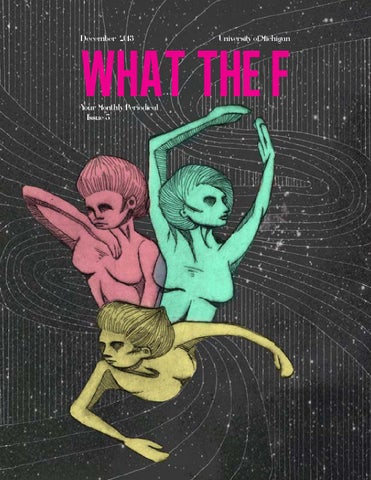
December 2013
University of Michigan
What The F Your Monthly Periodical Issue 5
Stretch Marks This publication is meant to start conversations—it’s an open channel for all voices. The more voices, the richer the conversation. Because of how we’re raised and who we are, it can be difficult to see past our own experiences. So if when reading anything in this vagazine you find you have a disagreement, a critique, or another viewpoint on an idea, write us in and we’ll publish it. Stretch marks: Stretch past your own head. Talk to us at WhatTheFMag@umich.edu.
President Jen Spears Editors in Chief Hailey Burns, Bri Kovan Creative Head Margaret Hitch Layout Editor HaeJee Yoon Business Manager Sumana Palle Public Relations Coordinator Jillian McConville Social Justice Editor Cosette Kathawa Webmaster & Social Media Coordinator Jerusaliem Gebreziabher
What The F is a non-partisan, non-profit publication operated by students at the University of Michigan. What The F’s purpose is to
encourage discussion on significant issues of campus, national, and world interest. The magazine, the executive board, and our sponsors do not endorse the ideas presented by the writers. We do, however, support and encourage different ideas into our community and into campus discussion.
December 2013
What The F
Your Monthly Periodcal Issue 5
Letter from the Editor 01 Woman of the Month 03 Health 04 06 Opinions 08 09 10 12 15 16 17 18 20 Reviews 22 Poems 24 25 26
Lilly Ledbetter Sh*t I’m Afraid to Ask My Doctor Mason Jar Meals What Doesn’t Kill You Makes You … a Feminist? Under the Lights and In the Shadows White-Girl Pretty What Obamacare Means for You I’ve Been a Bad, Bad Girl The Abortion A Prude Awakening Star-Studded F-Words Not Cute VajA2 Origin of the Word So What? My Strength I Dream
Sources and Sponsors 27
Funny, Fresh, Feminine, Feminist, & Fuck Layout HaeJee Yoon, Margaret Hitch, Taylor Landeryou, Alexandra Pears, Eva Roos, Shane Achenbach Contributing Illustrators Margaret Hitch, Nicole Dennis, Grace Ludmer, Erica Liao, Taylor Landeryou, Alexandra Pears, Eva Roos, Sarah Schwendeman, Kit Trowbridge Contributing Writers Hailey Burns, Jillian McConville, Hannah Gordon, Ciarra Ross, Sahana Prasad, Cosette Kathawa, Brooke Gabriel, Sydney Behrmann, Brianne Johnson, Jen Spears, Kellie Halushka, Kaitlyn Schuster, Amber Gustafson, Sumana Palle Keep the conversation going online! Like our Facebook page at www.facebook.com/whatthefmag Follow us on Twitter @whatthefmag and on Instagram @whatthefmagazine Find our Tumblr at whatthefmag.tumblr.com
Letter From the Editors
Welcome to What The F, your campus vagazine!
Welcome back to the feminist hub, the vagina-saavy hotspot of convo and discourse: What the F. As this semester has flown by, we’ve been getting busy (pun intended) with the vagazine, as well as welcoming a new staff of writers, readers, and loyal aficionad@s. After our beloved Lizzie Lane graduated last May, the magazin’es first Editor in Chief passesd the torch onto us. But, before you delve into the fabulous content of Issue 5, we’d like to take a moment to introduce ourselves. Third person, commence: Bri Kovan is a University senior—a dreader of graduation, an obsesser of whimsical words, and an eater of rice pudding. Hailey Burns is a junior—a fighter for equality, a lover of Jezebel, and an ardent admirer of her dog, Dexter.
So, ladies, why care about Feminism? Why now? B: Feminism is as important now as ever. We’ve fallen
into a dangerous slum—where everyone thinks, ‘We’ve made it!’” But as soon as we begin to settle with our status, that’s when I fear we’ll slip back. When we stop pushing for forward progress, we’ll accept the status quo. So, as feminists (and human beings, for that matter), it’s our responsibility to question what we’re taught, how we’re taught it, and continue to place women in a central part of that conversation. H: I completely agree. Feminism—especially modern feminism (or third-wave feminism)—is a movement I will always support. Women’s rights issues, along with intersecting issues like racial inequality, discrimination against the LGBTQ community, and a massively unequal distribution of wealth, haven’t been “solved.” We haven’t “fixed” the gender problem. Of course progress has been made, but women are still underrepresented in politics. We are still largely viewed as sexual objects by the media. We receive unequal pay for equal work.
What’s the biggest issue facing our campus? B: Jesus, don’t get me started … H: We talk about this a lot. B: We’ve felt a growing tension at our campus around
issues of race, class divides, and gender separation. I honestly believe this correlates to a heightened consciousness about these subjects, which is promising— H: But we have so much work to do. We hope that What the F can be a space to continue these conversations. B: To continue them, and then to challenge them. H: Exactly. And with that, we’ll leave you to leaf through our magazine. We know we have big shoes to fill, and we are so excited to continue to put out the best magazine the world has ever seen. (It’s possible that we are slightly biased.)
For Women, With Women. And, as always: Vag on!
Bri Kovan and Hailey Burns Editors in Chief
P.S. Want to get involved? E-mail WhatTheFmag@umich.edu. We would love your brilliant minds to write and create with us.
1
“FEMINISM THE IS
RADICAL NOTION THAT
WOMEN ARE
HUMAN BEINGS” 2
-CHERIS KRAMARAE
Woman of the Month
Lilly Ledbetter by Brooke Gabriel
A
h November, the time of year when we take time to think about the parts of our lives that we’re grateful for and appreciate most. And while we here at What the F have quite a bit to be thankful for this Thanksgiving season, one thing we’re feeling particularly grateful for is Ms. Lilly Ledbetter’s visit to the University this fall. Ledbetter came and spoke about her life and work. What’s more: we all admire everything that Ledbetter has done on behalf of women’s equality, which is why we’ve chosen to name her as this issue’s Woman of the Month. If you’re wondering why Lilly’s name sounds so familiar, let us help you: she was both the driving force behind and the namesake for the Lilly Ledbetter Fair Pay Act of 2009. The law created by the act implemented a 180-day grace period for individuals to file charges with an equal employment commission in response to pay discrimination. The law also aimed to reset the damages of unequal pay for equal work in future paychecks. Also, fun fact: the Lilly Ledbetter Fair Pay Act was the very first piece of legislation that President Barack Obama signed into law after he took office. Ledbetter’s crusade for fair and equal pay began while she was an employee at the Alabama Goodyear Tire & Rubber Co., where she worked as an overnight supervisor for nineteen years and ten months before retiring in 1998. Near the end of her tenure at Goodyear, Ledbetter learned that she was being paid a whopping 40 percent less than four white males doing the exact same job as her, and she was understandably devastated by the news. Ledbetter refused to take this injustice lying down and decided to sue Goodyear. Ledbetter initially won her case, and the courts awarded her a $3 million settlement.
However, Ledbetter’s fight did not stop there. Her case with Goodyear was eventually brought before the Supreme Court in 2006, which ruled in favor of Goodyear and required that Ledbetter return the $3 million. In an interview with Stephen Colbert
in 2012, Ledbetter stated that the court had decided that her suit had arrived too late; Supreme Court Justice Samuel Alito said she should have filed charges after receiving the first discriminatory check. The obvious problem here is that Ledbetter couldn’t have know that her first check was discriminatory without knowing what her co-workers were earning. Mr. Colbert summarized this dilemma beautifully in his interview when he said, “Their logic was that you should have known before you knew?” Sadly, yes. Yes it was. But despite this setback, Ledbetter continued to fight the good fight, which eventually led her to the passing of the Lilly Led-
better Fair Pay Act. And while the signing of this act marked a huge victory for Ledbetter and other victims of pay discrimination, she did not stop her work there. Since the signing of the Lilly Ledbetter Fair Pay Act in 2009, Ledbetter has written a book, titled Grace and Grit: My Fight for Equal Pay and Fairness at Goodyear and Beyond, which chronicles her story and work. She also travels around the country to share her story, which is how she ended up on Michigan’s campus. Ledbetter thinks that having her name become synonymous with women’s ability to right injustice is an “awesome responsibility.” For now, her goal is to get out and share her story so that what happened to her at Goodyear will not happen to any other American family. Both Ledbetter’s determination to fight an unjust system and her empathy for other victims of pay discrimination are motivating to all of us here at What the F. We’re also inspired by Ledbetter’s notable accomplishments, her grace and poise in the face of adversity, and the integrity she brings into her work. This Thanksgiving we’re thankful we had the opportunity to meet Lilly Ledbetter. Her strength and dedication to forwarding the fight for equality will not be forgotten.
3
Health
Sh*t I’m Afraid to Ask My Doctor: The Lesbian Edition by Hailey Burns
A
s a lesbian, I am frequently the envy of my straight friends … when it comes to the topic of safe sex. “You are so lucky you don’t have to deal with birth control,” my roommate used to tell me every time her daily alarm went off to remind her to pop the pill. “I wish I didn’t have to worry about whether or not I should bring a condom every time I go out,” my straight friends frequently say. To be honest, there were years when I felt like I was in the clear when it came to sexual health. Every time one of my
friends stressed about whether or not their period was late, I thanked Buddha that I was the Lucky Lesbian who could not become pregnant without extensive planning. Even though I went to a progressive allgirls’ high school, what I learned in sex-ed was painfully heteronormative, so I tuned it out. Condoms? I guess they could come in handy if my girlfriend and I wanted to make balloon animals. Birth control? Unnecessary. The morning after pill? No need for me! Since most of what I was taught in class didn’t pertain to me, I felt like I was in the clear. I was sexually active, but I didn’t give a second thought to STDs or pap smears or even visits to the
gynecologist. I was so, so
4
wrong. As it turns out, my woefully inadequate sex-ed classes were not an indicator that I didn’t need to prioritize my sexual health. My high school’s failure to acknowledge that we might not all be straight didn’t mean I was home free. It meant that
I had to go digging for answers on my own. Here’s some of what I’ve learned: My gynecologist treats me like my body is a vessel meant to make babies and give blowjobs. Is it even worth making an appointment? To all of my fellow lesbians (and anyone else with a vagina), if you get anything out of this sex lesson, please, PLEASE remember that you still need to make it a priority to see a gynecologist. I understand how uncomfortable it can be to see a gyno who isn’t well-versed in how to engage in safe, lesbian sex. When I explained to my first gynecologist that I was only having sex with women, she responded, “Oh, so no intercourse, then?” and moved on. But do not give up! First, do a bit of research. Contact your health center and ask to see a gynecologist
who is experienced with lesbian sexual health. It might take some digging or a few unsuccessful matches, but do not be easily deterred! You deserve a gyno who can give you relevant information about how to be safe and sexually active. Ugh, fine. Tell me what a gynecologist can do for me. Many of the services offered by gynecologists apply to all women, not just the ones who drool over Ryan Gosling. For one, you have the same risk of developing breast cancer and cervical cancer. Regardless of your sexual orientation, once you turn twenty-one, you should be getting a pelvic exam at least every two years. This includes a Pap smear, which can detect early signs of cervical cancer. Lesbians can also get yeast infections, and your gynecologist is not likely to prescribe you a quick fix (like Diflucan) unless you go in for an appointment. Most importantly, lesbians can transmit many of the same STDs. Hold on a second. Lesbians can get STDs? Unfortunately, yes. Lesbians can transmit STDs like herpes and HPV through
mucosa contact (a.k.a. what happens when you go down on a girl), vaginal fluids, sharing the same sex toys, menstrual blood, and other skin-to-skin contact. Plus, it’s important to remember that not all lesbians have only ever had sex with other women. In fact, most lesbians are not what the L Word dubs a “gold star.” (A gold star is a lesbian who has never had sex with the opposite sex.) Essentially every study focused on lesbian sexuality—including one by the Boston Lesbian Health Project in 2000—have found that the vast majority (80-90%) of self-identified lesbians have had at least one male sexual partner. If your partner has had sex with a guy and hasn’t been tested, you’re at risk to contract an STI or STD just like any other straight girl. You should be aware of both your partner’s sexual history and the STDs and STIs that you may be at risk to contract. Wait, so I should expect that my partners have been tested? I guess that means I should be tested too, right? Absolutely. If you’re sexually active and you haven’t done so already, you should make an appointment to be tested for STDs and STIs. Plus, there are many other screening tests that you may be overdue to schedule. For more information on what you might need, check out womenshealth.gov—there’s a section for lesbian and bisexual women. Okay phew, this is a lot of information. But at least we don’t have to worry about condoms, am I right? Well … not quite. Ever heard of dental dams? Dental dams are like the lesbian equivalent of the condom. Like a condom, a dental dam is used as a barrier to prevent the transmission of STDs like herpes, HIV, and genital warts (HPV). They’re usually made of latex and are used during oral-vag-
inal or oral-anal sex. However, if dental dams aren’t your cup of tea, there is still more you can do to make sure you’re being both safe and sexy. First, make sure you’re washing your hands (and all other body parts) before you jump your newest lady friend. If you do choose to share sex toys, make sure to clean them with soap and water between uses— or use a condom! There was a time when I knew how to give my straight friends advice on
how they should have safe sex, but I had no idea how to protect my own body. Since many of us lesbians haven’t had the luxury of picking up safe-sex practices from sex-ed or from our friends, it is especially important for us to take the time to get educated about our bodies. If this is all new to you, I recommend getting the ball rolling by having an honest conversation with your partner or your doctor about how you can engage in safe sex. Feel free to send us any other sh*t you’re afraid to ask your doctor! We’re here to answer your questions. E-mail WhatTheFMag@umich.edu. 53
Mason Jar Meals by Jillian McConville
H
ave you ever thought about the time you could save if you didn’t have to cook for yourself? Think about how much time (and money) you spend each week grabbing a snack between classes, buying a sandwich or a bagel before you run to a meeting, or picking up takeout before a late-night study session. In 2011, the United States Department of Agriculture found that the average woman over eighteen spends forty-seven minutes each day preparing meals and an additional sixty-six minutes eating. Imagine what you could do with almost two extra hours per day! Enter the Mason jar meal. This new meal-planning fad will help you save time and money—plus it encourages a healthy diet. Planning meals in advance promotes portion control; last minute meal choices are often less healthy and more food than we need. Proponents of this craze are using Mason jars to prepare several days’ worth of meals in convenient, eco-friendly containers. You can eat a Mason jar meal on the go and still subscribe to healthy eating habits. Planning meals in bulk is also a valuable way to save time, waste less food, and simplify the daunting task of maintaining a balanced diet. Try some of the recipes below or use Google, Pinterest, and Tumblr to search for thousands of other “jar meals.” You can get creative and use these ideas to make a quick lunch, orchestrate a dinner party, or even to give as holiday gifts.
Breakfast Apple Instant Oatmeal ½ cup instant oats ¼ cup freeze-dried apples 1 tbsp chopped, toasted pecans 2 tsp brown sugar, packed ¾ tsp cinnamon ½ tsp allspice Pinch of salt 1 (8 oz) Mason jar
Oatmeal Smoothie 1 cup ice ½ cup frozen raspberries ½ cup plain low-fat yogurt 1 banana ½ cup old-fashioned rolled oats 1 tbsp honey 1 cup coconut water (or other juice) 1 (8 oz) Mason jar
Parfait 1/3 cup Greek yogurt 4 tbsp granola 1/4 cup raspberries 1/3 cup Greek yogurt 4 tbsp granola ¼ cup blueberries Dash of cinnamon 1 (8 oz) Mason jar
Add ingredients to your jar. When ready to eat, add ¾ cup water or milk. Microwave for 2-3 minutes or until desired consistency is reached. Stir.
Place ice and raspberries in the bottom of blender, and all other ingredients on top. Blend until completely smooth and add to your jar.
Place all ingredients in a jar in the order listed. *You can also add Chia seeds, which are a great source of antioxidants, calcium, protein, and fiber.
Mediterranean 8 tbsp red wine vinaigrette or Greek-inspired dressing 2 cups red sugar plum tomatoes 2 cups chopped English cucumber 2 cups pitted olives 2 cups fired-roasted red and yellow peppers, thinly sliced 2 cups red onion, chopped 2 cups crumbled feta cheese
Taco 4 cups romaine lettuce, chopped 2 cups tomatoes, chopped 2 cups black beans 2 cups corn 2 cups ground turkey meat 2 cups shredded cheddar cheese 4 tbsp green scallions, finely chopped 8 tbsp fresh salsa
Salads Cobb 8 tbsp red wine vinaigrette, Ranch, or French dressing 2 cups iceberg lettuce, chopped 2 cups chopped, cooked chicken breast 2 cups chopped tomatoes 4 hard boiled eggs, sliced into circles 2 cups crumbled bacon 2 cups chopped avocado (tossed in lemon juice to prevent browning) 4 tbsp green scallions, finely chopped 2 cups iceberg lettuce, chopped 4 tbsp crumbled blue cheese 6
All ingredients are listed in layering order. Divide ingredients evenly among four Mason jars. (12 oz works best, but an 8 oz jar is fine too.) Shake to coat salad items with dressing and enjoy!
Pasta Caprese Pasta Salad 2 tbsp basil pesto 1 cup cherry tomatoes 1 ½ oz goat feta 2 oz cooked penne pasta ½ cup fresh spinach leaves ½ cup fresh basil, chopped 1 (8 oz) Mason jar
Lasagna 12 oz wide egg noodles 1 pound ricotta 1 egg 1 hand full of Parmesan cheese ½ tsp kosher salt 2 cups mozzarella cheese 3 cups favorite marinara sauce 12 (8 oz) wide-mouth Mason jars
The ingredients are listed in layering order. Pesto on the bottom, then the tomatoes, then the feta, and so on until you top the jar off with your fresh basil. Secure the lid and store for later. Shake it up, and enjoy!
Boil noodles according to package instructions. Drain and add back to the pot. Mix in 2 cups of sauce. In a bowl, mix together ricotta, egg, Parmesan cheese, salt, and mozzarella. Fold cheese mixture gently into the noodles. Do not over stir. Place in greased jars, top with the remaining sauce, and sprinkle with more Parmesan cheese. Bake at 350 degrees for 35 minutes.
Desserts No-Bake Oreo Cheesecake 15 Oreo cookies, roughly chopped 8 oz low-fat cream cheese (room temperature) ¾ cup granulated sugar 1 tsp vanilla extract 8 oz low-fat Cool Whip 8 (4 oz) Mason jars Chop the cookies and set them aside. In an electric mixer (using paddle attachment), beat the cream cheese, sugar, and vanilla and set the mixture aside. Gently stir in the Cool Whip and ¾’s of the chopped cookies. Then scoop even amounts of the mixture into the eight jars. Top each one with a little bit of the remaining chopped cookies. Screw the lids onto the jars and refrigerate them for four hours, or until firm.
Cupcake in a Jar Favorite Boxed cake mix 12 (4 oz) Mason jars 1 can of frosting or tube of cool whip Prepare cake mix as directed on box. Divide cake mix into Mason jars, filling each half full. Bake in jars, using the temperature and time designated for cupcakes on box. Check jars frequently. Remove from oven and allow to cool for 5 minutes. Top with desired frosting or cool whip.
7
Opinion
What Doesn’t Kill You Makes You … a Feminist? by Hannah Gordon
W
hen you’re twelve, your biggest concern should be that giant zit on your forehead or the food in your braces after lunch period (which, let’s face it, is probably there). You should be concerned with world history or algebra—not cancer. When I found out, I felt as though I was the last contestant of a spelling bee and my word was in a foreign language. Excuse me, doctor. Can you repeat the word? Cancer. Can you use it in a sentence? I was only twelve. I had bad hair and weird skin and a mouth full of metal. But I couldn’t have cancer. Old people got cancer. Cancer killed. And no twelve year old should be facing death when they have geography homework due the next day. I didn’t cry. I didn’t have time. I was rushed into surgery the next day. Doctors scraped bad cells out of my skull and patched me up with metal plates like I was some kind of robot. Twenty-four hours after finding out I had the “C” word, I was already recovering from my first surgery and hearing words like “radiation” and “chemotherapy” and “metastasizing.” These weren’t the words on my vocab sheet that week. Fast-forward a year, and I’m being rushed into surgery again. This time, the feeling is all too familiar. And, this time, “chemotherapy” is no longer a word that is just spoken but a drug that I receive through a tiny device implanted in my girlish chest. Chemotherapy is no longer an option, but the option. My Thursdays are full of toxic medications and needle pokes and vomit buckets. All the while, people kept telling me I was “so brave.” I was their hero. I was strong, and I could live through this. It became engrained in me that I was c ap abl e of anything because here I was, on the cusp of life and death, straddling the thinnest of lines, and I was surviving. I went to chemo. I got sick. I went to the ER. I went on with my life. Being sick wasn’t an anomaly anymore; it was my life, so I lived it.
8
I survived. I’m still a survivor. I felt strong. Yet, at the start of my senior year of high school, this changed. I went to a Christian school, so I frequently came across some beliefs that were strange to me. These ideas surfaced in a “Marriage and Family” class I took that year. I truly owe all of my feminist ideals to that class. Of course, the teacher’s standpoint on equal marriage rights and cohabitation was enough to make me rip my hair out. But the one thing that really got to me was her stance on what roles men and women should play in the nuclear family. Instead of viewing a husband and wife as equal— because God forbid all humans be equal—she preached that women were subordinate to men. Therefore, men made all the rules, and women had to follow them submissively. Excuse me? Of course I argued. Who in their right mind wouldn’t? The teacher was a woman, for Christ’s sake, and here she was, preaching about how women should be submissive and follow a man’s rules, because “God” said so. A lot of girls believed her. In conversation with my friends, I found that they honestly believed they were subordinate to men. The teachings of my Christian school were sinking into their skulls and poisoning their independence. But I’ve encountered these viewpoints even more recently. Just a few weeks ago, I was discussing marriage with a friend of mine from high school. While I thought of it as an irrelevant institution in my life, she wanted a marriage right away and couldn’t wait to stay home and be with her kids. When I asked why her husband couldn’t be the one to stay home with the kids, she merely laughed, as though the idea was as preposterous as disregarding marriage entirely. I remember bringing it up one day at lunch with my friends. How ridiculous was it that we were learning to see ourselves as inferior to our future husbands? Why were so many of us assuming that every woman would end up with a man in the first place? (Heteronormativity, anyone?) What happened to equality? I was one of few who voiced these objections. Everyone else merely pointed to the Bible. Subordinating yourself to your husband was simply the natural role of woman. I have had a hard time comprehending this both in high school and now. My entire life I’d been told that I could do anything I wanted to. When I got my diagnosis, I was constantly reminded of how strong I was and of how I was going to make it through. I survived on my own, not with the help of a man. If I could survive death, if I could beat cancer, why couldn’t I I make my own rules and be my own protector and leader? Why the hell would I ever need to rely on someone else when I know that I can rely on myself? I’m not afraid to navigate life on my own because I’ve already navigated death on my own.
Under the Lights and In the Shadows by Ciarra Ross
T
he night of the second-ever University of Michigan vs. Notre Dame night game was my very first football game on campus. So many good memories were made before entering the stadium, from designing a head-to-toe maize and blue getup with my roommate to tailgating the entire day down State Street and South Campus. The energy was high, and it was an amazing time to be a Wolverine. But everything took a surprising turn for the worst the moment I ventured alone into section twenty-eight of the student section. As I went to get a closer view during a break, I experienced a lot of what felt like “You don’t belong here”—from long stares to the condescending question, “Are you lost?” to being singled out at random and asked where my seat was (as if there weren’t thousands of students not in a “seat”). With my level of inebriation, I pushed the feelings aside as something I could be reading incorrectly and continued moving, slapping fives with strangers, photobombing groups of smiling friends, and taking pictures with people I’ll likely never see again. This was me still trying to make the best of the moment, despite that unshakable feeling of “This isn’t your space, it is ours” (read: white people’s). Once I made my way as close to the field as possible—about two rows behind the band—a white guy directly behind me began belting some non-Swahili version of the song from the beginning of Disney’s The Lion King. I immediately became overwhelmed with embarrassment and anger. All I could think was, “This is about my hair,” and I could feel myself growing violent. The only thing I could say was, “That’s so racist!” He laughed and sarcastically joked, “What? The Lion King isn’t racist,” followed by his friend asking me to take a picture with them because, “Dude, your hair is awesome!” As he motioned to pose for a picture that I had not consented to taking, he grabbed at my hair. In a swift moment, I ceased to be a woman and was put on display as an exotic object to be gawked and grabbed at. In all of my rage, I fell silent. All I can remember is walking away while another of his friends attempted to grab my hair, grabbing at me as if I were one of the fucking animals in The Lion King—
or much less. At that moment, I wish I could have done to them what a lioness does to her prey. But when I looked up and saw all of the steps I had to walk up and a sea of white people so far removed from my reality to wade through, I felt absolutely helpless. I felt the kind of alone one doesn’t think would exist in the world’s largest football audience. Once I made it back up to the steps with my friend, I just cried. I’ve never felt so unsafe, so devalued, and so completely at the disposal of an unaware crowd. There was not a bone in my body that had school spirit. Nothing in my blood was blue with Michigan pride. I was reminded that my blood runs red with the black womanhood that birthed humanity. I was reminded that my blood runs red with the spilled blood of my ancestors’ battles that have afforded me my opportunities, resilience, and strength. As I cried in the stadium’s stairwell, all I could do was think about how Michigan doesn’t even value the places where I can go to actually feel safe expressing my blackness and the issues I face with being a black woman on this campus (like MESA/Trotter). As the stadium cheered for a win, I was at a loss. It has taken a focused, intentional effort to reach a level of compassion for white people, particularly those blinded by their privilege and operating in ignorance. For so long I resented that they could not only have a hand in oppressing my race, but also be blind to my reality and deny it all in a single breath. After realizing that resentment and anger didn’t serve me well, I shifted my perspective to help me better cope and thrive despite whatever racist, white guilt, white privilege, or white supremacy bullshit occurred. This day shook me to my core because, despite my efforts, I did not know what to do, how to handle it, or where to go. All I had were tears and a story. 9
by Sahana Prasad
I
10
n one of my favorite pictures of me as a kid, I’m dressed like the Statue of Liberty. I’m standing in the middle of the living room rug, backlit by New Jersey sunshine pouring through the window of my great-aunt’s house, seafoam-green Liberty headband perched precariously on the thick curls that baffled the nurses at Henry Ford Hospital the day I was born. At my mother’s insistence, there is a lightbulb clenched loosely in my right fist, raised halfway above my head, a stand-in for the torch that guided the tired, the poor, the huddled masses. My smile takes up most of my face, reigned in only by the chubby cheeks that I didn’t outgrow until fifth grade. To my mother, and my father, and my great aunt, and my grandparents back in India, I was the perfect vision of a happy, quintessentially American child. Except that when you’re a person of color in America, you can’t be just American. In the words of Toni Morrison, “In this country American means white. Everybody else has to hyphenate.” She’s right—as a person of color, you’re not seen as being really American. Your skin marks you as inherently “other,” as “immigrant,” as begging the question, “No, where are you really from?” when the only place you’ve ever been from is Southeast Michigan. I can say with the utmost confidence that every brown person in America has faced these questions. Every single one. Even beauty queens. When Nina Davuluri, an Indian-American, Bollywood-fusion dancing, self-proclaimed nerd (and U of M grad!) was recently crowned Miss America, I was absolutely ecstatic. That is, I was ecstatic for the ten seconds before the internet was flooded with tweets calling Nina “a foreigner,” and “terrorist,” and “Miss Al Qaeda,” lamenting that “an Arab” (which, as a South Asian woman, Nina is not—not that this bullshit would be in any way excusable if she was) could win Miss America so close to the anniversary of 9/11, and that they were “not racist, but this is America” (pro tip: if someone takes great pains to explicitly call themselves “not racist,” chances are they’re a racist). Over and over, I saw people saying that Nina, a desi woman like me, a woman born in the United States to two Indian immigrant parents—one a doctor, the other a software engineer, just like mine—was not fit to be Miss America. The real Miss America, these enlightened social-media users posited, was Theresa Vail—Miss Kansas who “loves her country, loves hunting, loves tattoos.” That’s what the real Miss America looks like, apparently: nationalistic, an endorser of body-mods and firearms, and white-skinned. Honestly, I shouldn’t have been surprised by the racist backlash against Nina Davuluri. It points not only to the racist ideology that a brown person is not fully American, but also to the racialized standards of beauty that permeate all of American culture. It’s no surprise to me that to America, “beautiful” and “white” are synonymous,
that Euro-centric ideals make it impossible for brown bodies to be beautiful unless they are hypersexualized and fetishized. It wasn’t a surprise to sixyear-old Sahana, whose favorite Disney princess was the only one, out of dozens, who looked anything like her; it wasn’t a surprise to middleschool Sahana, who wished on three birthdays straight for pale skin and blonde hair so the first boy she ever had a crush on would like her better; and it’s no surprise to twenty-year-old Sahana, who has to fight herself every day to remember that a blueeyed boy at a party is not the gatekeeper of her self-worth. It’s no surprise to any of us brown girls, who, like my friend Melanie, grew up in a world with “only my parents and their friends telling me I’m pretty, and I made it mean nothing, because of course I was ‘aunty’ pretty, but I was not, and never would be ‘white-girl’ pretty.” Because that’s what we’re taught matters, that’s what we’re taught to seek—validation from white friends, white boys, white culture. Some sign that we’ve assimilated far enough into a whitewashed picture of beauty, erased as much color and culture and history as we can, to become pretty. But we’re learning to fight back, and Nina Davuluri is fighting with us. We’re learning to fight for representation in media, without being homogenized or hypersexualized. We’re learning to find people who love us because of our bodies, never in spite of them. Learning to fight back when we are told to lighten our skin, straighten our hair, when we are whitewashed on magazine covers, learning that radical, unbounded self-love is an act of selfcare, an act of healing, an act of reclaiming the validation and self worth that we should never have had to fight for in the first place. Learning that a brown girl from New York, whose platform promotes “Celebrating Diversity through Cultural Competency,” a desi girl who is proud to promote her heritage and refuses to compromise her identity for a title, can be Miss America. Learning, in Miss America’s own words, that “Miss America is evolving. And she’s not going to look the same anymore.” Regardless of the response, regardless of the backlash, Nina Davuluri’s win is a step forward. Because seeing a desi woman win Miss America is exactly what 13-year-old Sahana needed growing up in a world flooded by whitewashed standards of beauty. And as much as I know that contests like Miss America help further those standards, I just hope beyond hope that there is some little desi girl out there who, instead of a Statue of Liberty crown, is walking around in a plastic tiara and a sash she made out of her mom’s dupatta, pretending to be Miss America and knowing that her skin doesn’t make her worth less.
11
What Obamacare Means for You by Cosette Kathawa
B
y now, you’ve probably heard a lot about the Affordable Care Act, also known as “Obamacare.” There’s been a lot of false reporting on the topic, so here I am with some no-bullshit information to help you figure out how the law affects you as a student, a woman, and/or an LGBTQ individual. President Obama signed the Patient Protection and Affordable Care Act into law in March 2010. Obamacare is the most significant healthcare transformation in our country since Medicare and Medicaid passed in 1965. The law is an attempt to make health insurance more fair and affordable for millions of Americans (both uninsured and insured), and it aims to provide new benefits for all Americans. Despite Republicans’ numerous failed attempts to repeal the law (forty-one by my count), the Supreme Court has upheld the Affordable Care Act as constitutional, and on October 1, 2013, open enrollment began on the health market exchanges. I won’t be getting into this as much, but you can go to HealthCare.gov—if it ever loads—for more information about how to enroll in a health insurance plan. Many of the changes in coverage will go into effect in 2014, but some changes have already begun. Most relevant to you is likely the provision that allows you to stay on your parents’ health insurance plan until you turn twenty-six. Before Obamacare, you could be kicked off your parents’ insurance when you turned eighteen. If you are planning to attend graduate school, have student loans, or are trying to get into a field that sticks you in unpaid internships, this can be extremely helpful. You never know when you’re going to be hit by a rogue bicyclist on South U and State Street. Insurance companies can also no longer refuse to cover you if you have a pre-existing condition. Believe it or not, this impacts all women, because being a woman used to be considered a pre-existing condition. Did you catch that? A preexisting condition. Womanhood is so fun sometimes, am I right? According to The New York Times, “Until now, it has been perfectly legal in most states for companies selling individual health policies—for people who do not have group coverage through employers—to engage in ‘gender rating,’ that is, charging women more than men for the same coverage, even for policies that do not include maternity care.” Last year, 90 percent of the best-selling health plans charged premiums 150-percent higher for women than for men. Insurance companies could even deny coverage to women who have had a Caesarean section or to victims of domestic violence. These “gender ratings” and other discriminatory practices will be banned under the ACA starting in 2014. There are also new benefits for you if you already have insurance, including prescription birth control and annual well-woman exams covered for free without cost sharing (no copays, no deductible, and no co-insurance). This restricts insurance companies from putting limits on how much they will pay for your care over your lifetime. Beginning next year, all plans must also cover preventative care without cost sharing, including: 12
• Human papillomavirus (HPV) testing • Contraceptive methods and counseling • Screening and counseling for interpersonal and domestic violence • HIV screening • Vaccines (including the HPV vaccine) • STI screenings All plans must also cover prescription drugs, hospital stays, emergency services, and maternity and newborn care. Some of the benefits granted by the ACA may not be available to you if your plan was “grandfathered in.” This applies to insurance plans created before March 2010. Check your plan to see if your plan includes
the new preventative-care benefits because all of these (now free!) preventative services are extremely, extremely important. So what’s the deal with birth control? This is probably what you’ve heard the most about if you are in possession of ovaries and a uterus. Under the Affordable Care Act, if you have insurance from your employer, your parents, or from paying the monthly premium and yearly deductible yourself, one of each FDA-approved form of birth control is covered without cost sharing. This includes: • Barrier methods (e.g. diaphragms and sponges) • The pill • The ring • Intrauterine devices (IUDs)
• Implants • Injectables • Emergency contraception • Sterilization procedures Insurance plans are not required to cover drugs that induce abortions, like RU-486, but all services related to contraception— like counseling, follow-ups, side-effect management, and device removal—do have to be covered. But before you start your free birth control dance party, there is one super-important caveat. Like I said before, plans are only required to cover one of each form of FDA-approved birth control, and they may only cover generics when they are available. Brands like NuvaRing will be covered fully since there is no generic form, but other name brands may not. Check to make sure the brand you use is covered. Another caveat: Most of our bosses will be required to provide us with insurance that covers birth control, but certain religious employers are exempt from the birth control mandate. If this loophole applies to your place of work, your insurance company may shoulder the cost of contraceptives themselves. Basically, all you need to know is that one kind (generic or brand name) of each form of birth control is covered unless your employer (or your parents’ employer) is exempt from covering contraception for religious reasons. The birth control mandate is huge for those of us who could be affected by pregnancy, men and women and everyone in between. More than a third of women have struggled to pay for their birth control at some point in their lives. More sex without protection = more unplanned pregnancies. Since copayfree contraception must be covered, women are now not only able to afford their birth control, but can also access forms of birth control that may have been too expensive in the past, like IUDs. The mandate also lowers costs for insurance companies and hospitals because they will presumably have to cover fewer pregnancies and births, making it a win-win for everyone. For all my LGBTQ friends, let me explain how the ACA affects you! Under Obamacare, insurance companies can no longer turn people away because they are lesbian, gay, bisexual, or transgender. LGBTQ individuals have faced discrimination in the healthcare system for years. Although the law doesn’t do much to remedy this, insurance companies will no longer be able to apply lifetime or annual limits on coverage of essential health benefits for LGBTQ individuals. This is extremely important for LGBTQ communities, which have had higher rates of many chronic diseases (partly due to the discrimination they have faced in the healthcare industry). HealthCare.gov’s insurance and coverage finder also now has a “same-sex partner” filter, allowing couples to choose plans that cover both people. Progress! If you have more questions about how the Affordable Care Act will change your insurance coverage, check out HealthCare.gov or flip over your insurance card (if you have one) and call the number on the back. Happy contracepting! 13
14
I’ve Been a Bad, Bad Girl by Brooke Gabriel
Please note: for the sake of protecting my beloved boyfriend’s privacy, I shall be referring to him as “Morpheus.” Also, I’d be lying if I said this didn’t amuse me a teensy bit, so I suppose it serves that purpose as well.
I
’m kind of kinky. I’ve been known to bite lower lips, dig my nails into backs, and love a good smack on my ass when I’m getting hot and heavy with someone special. Sometimes this worries me; I fear that my desire for violence in the bedroom indicates that I’ve been infected by the Grand-Theft-Auto-playing-Chris-Browncelebrating culture that I’ve been resisting since day one, but I always manage to console myself by remembering that I didn’t enjoy rough stuff from all of my partners. For example: I didn’t like it when my now ex-boyfriend pinned me to the bed and called me a dirty slut, because it sounded a little too genuine coming from him. That said, I’ve enjoyed some pretty rough sex with my current partner, Morpheus. The first few months of our relationship were full of great sex that left me thoroughly satisfied, though not without my fair share of bruises. Rest assured, I thoroughly enjoyed getting each and every one of the black and blue spots that dotted my shoulders, hips, and thighs, so much so that I found myself hungry for more, and eager to explore more serious BDSM practices. I’d already fantasized about being dominated in the past, and I felt that I’d finally found the perfect person with whom to try it out. I ran these ideas past Morpheus, and he was understandably apprehensive. He’s a pretty gentle soul, and he told me that he had a hard time wrapping his head around being so aggressive during sex. Looking back, I think that his concerns were like my own; he was afraid that he might find that despite all his efforts to fight it, he too had fallen prey to a culture that promotes violence against women. After numerous discussions about my dominant-submissive fantasy, we decided to give some role-playing a try. What really seemed to seal the deal came in the form of a sex scene from the TV show “Weeds” that I showed to Morpheus, feeling that it showcased what it was I wanted. (In the scene, the female protagonist, Nancy, has very rough, anonymous sex with a bartender.) We first agreed on a safe word: forecastle (his choice). Next, we outlined the scene we hoped to create, loosely basing it off of the scene from “Weeds”;
after getting angry with me for ignoring him and texting my friends while he was trying to get my attention, he was going to “teach me a lesson,” so to speak. After one last check-in with one another, Morpheus and I got down to business. It started out very awkwardly. It was obvious that neither of us really believed in the situation that we’d created, and every word was tinged with an air of contrivance. After a couple minutes of some very forced foreplay, Morpheus pushed me up against the wall, kissing me hard on the mouth in an attempt to “get my attention.” I saw this as an opportunity; I wanted to take what was in that kiss —something familiar and erotic—and blend it with our fantasy. I pulled away from Morpheus and reached for my phone in order to “check it,” expecting that I would be met with some form of discipline. Morpheus responded by grabbing me by the shoulders, pulling me off of the wall, and slapping me in the face. Twice. Even though we had discussed the possibility of him slapping my face beforehand, agreeing that it could have a place in our role-play, the first blow left me stunned and paralyzed by fear. It was after he hit me the second time that I started to cry. “Too far.” As the words passed my lips, I couldn’t help thinking that this was not our safe-word, and wondered if he’d strike me again. I got my point across. Morpheus dropped the act immediately, devastated by what he’d done. He gathered me up into his arms, telling me over and over how sorry he was while I sobbed quietly into his chest, trying desperately to find words that might comfort us both. After we’d both calmed down a bit, Morpheus told me that he was sorry, that he didn’t “know how to be the bartender,” which led me to realize that I didn’t know how to be Nancy either. And while I’m no sexpert, it seems that modeling my sex life on a TV show and a couple of half-baked fantasies was a colossal mistake. In retrospect, I’m not surprised that our foreplay felt so forced, so fake; it was an attempt to recreate something that was never real in the first place. That incident was about two months ago, and I have had tons of fabulous sex with Morpheus since. In fact, right now I’m sporting a couple copies of his dental records in some very choice locations, and I loved receiving all of them. I suppose that being open to experimentation is a great, but being able to move forward after a failed experiment is even better. 15
A good deal of biting, spanking, dirty talk, and strong, rough intercourse
The Abortion by Sydney Behrmann
S
he was lying on the table in the cold sterility of the operating room, heavy tears dropping to the floor like lead. Anesthesiologists monitored her heart rate and blood pressure. A pulse oximeter, a device that measures oxygen in the blood, was clamped around the woman’s finger. Nurses charted health information on computers. But all I could think about was the woman on the table. My job as a clinical research assistant in obstetric anesthesiology was what brought me into the operating room that day. I was working on a protocol to quantify blood loss during routine obstetric surgeries in order to prepare health professionals for massive bleeds that are rare, but potentially life threatening. Dilation and curettage, otherwise known as D&C, is the official name of the procedure that I witnessed, an abortion of pregnancy during the first trimester. The cervix is artificially dilated, providing access to the uterus, and a surgeon removes and discards the contents of the womb. Before the procedure took place, probably during a prenatal checkup or genetic test, doctors had discovered an anomaly, a chromosomal abnormality, in the embryo. Something was wrong with the fetus’s genes, which would affect how the child would grow and develop. If the baby were carried to term, would he or she live? And if so, what would his or her quality of life be like? In cases like these, the patient discusses these questions in depth with physicians before making a decision about whether or not to proceed with the pregnancy. Sometimes fetuses with abnormalities in development will abort naturally as a result of their condition, unable to hold their own in the womb. As a future medical student with an avid interest in surgery, I had always “medicalized” abortion and thought it would be similar to other types of surgeries I had seen before. But witnessing the procedure firsthand was more emotional than I thought it would be. The patient was shaking and heaving as tears continued to streak her face, and I wanted so badly to say something. I don’t know exactly what you’re going through, but I know it must be difficult in every way. I want you to know that I’m here with you if you need a hand to hold. No one was holding her hand! Her pain pierced the room; I could feel it. I didn’t know if, as a research assistant, I was allowed to talk to her at a moment like this. It was hard standing still and silent. I wish I had said something. In my current research position, we are trained to look at the technicalities of a procedure and its medical implications from a clinical perspective. My job is to conduct objective research, but the emotions and the reality of the patient’s experience are what stuck with me. Then, anesthesia was administered. White, milky medication was injected into the woman’s veins, accompanying the electrolyte drip already running into her body. Doctors placed a mask over her face and asked her to breathe deeply. Her eyes closed and the tension in her body was replaced by a sedated limpness. Her eyes were taped shut. Another doctor inserted a tube into her airway and attached it to a machine that pumped air into her lungs. I found 16
myself wondering what it would be like to go to sleep carrying a child and to wake up with an empty uterus. It all happened so fast. In synchrony, surgeons entered the room. They wore green, sanitary gowns and stretched gloves over their hands. Nurses shifted the woman down the table and placed her feet high in stirrups, allowing the surgeons access to her vagina. Her vulva and vaginal opening were cleaned with a brown solution that saturated her skin and dripped into a wastebasket. It was time for the surgeons to begin. I stood near the head of the table with the anesthesiologists, but I could still see blood dripping from between the woman’s legs. The nurses wheeled a suction canister over to the surgeons. The machine buzzed as it powered on. I saw thick clots of red splatter against the inside of the clear canister, and I knew it wasn’t only blood. In the United States, where one out of three women have an abortion by the age of forty-five, abortions continue to be stigmatized and portrayed as highly controversial in the media. Many of us voice an opinion on the topic, labeling ourselves “pro-life” or “prochoice” and making (even subconscious) judgments about who does and does not have the right to choose to pursue an abortion as a medical or personal option. But do we truly know what having an abortion entails? The circumstances that led to the procedure I witnessed are not what normally comes to mind when we think of abortions; the woman on the table chose to terminate a desired pregnancy because her child would likely have had a poor quality of life due to his or her condition. Perhaps terminating an unwanted pregnancy elicits a different set of emotions for a patient, but for all I know, that situation may be just as difficult. I can only imagine that it is one of the most challenging decisions a woman can make. I acknowledge and respect that every woman thinks about and experiences abortion in different ways; maybe the procedure isn’t always as emotionally straining as it was for the woman I observed. But the choice to abort a desired or undesired pregnancy can be a challenging one, and it’s high time that we start openly discussing the realistic implications—both positive and negative—of this procedure so that women do not have to lie on a sterile operating table alone.
A Prude Awakening by Brianne Johnson
I
’m kind of a prude. I hope you understand. Or so goes my first-date dialogue at fifteen years old, cramped into the passenger seat of Mrs. Cameron’s Ford Focus. I laugh—I don’t know why; it’s just that dorky, guttural reflex. I imagine it’s charming in that subtle, funny way. In that hilarious, I-just-told-a-sixteen-year-old-boy-that-I’m-a-prude way. He makes a noise, something between a grunt and a hiccup. A lump of lettuce slips from his Sonic burger and onto the crotch of his jeans. Here, let me get that. My first date with Justin Cameron was also my last date with Justin Cameron. Five years later, I scroll through Twitter on a Tuesday night at the local Espresso Royale. I swipe past Skyler White hate-posts littered with bad grammar, typical college-student complaints, and threads between TV’s Mindy Kaling and Seth Meyers being wonderful, as usual. Then, an old high-school friend, a male, poses a question to the Twittersphere: “How is being called a ‘prude’ an insult?” As a recovered “prude” with more than 140 characters to explain, hear me out on this one. A self-declared “prude” by age fifteen, I understood the word only so far as my fervent belief that my virginity was on reserve for the likes of Edward Cullen. Convinced that I was well past my prime—the average age for a tween’s first kiss is thirteen, according to magazines fusing any combination of the words “Teen,” “Beat,” “Bop,” or “Boop”—I retreated from that whole sex thing. If you’ve seen Catherine Hardwicke’s “Thirteen,” you recognize the extent of adolescent self-exploration that I was missing. It wasn’t just that I was out of practice, fearful that my body wouldn’t remember the mechanics of riding a boy like riding a bicycle. I’d never gone along for the ride in the first place. Training wheels, please. Rather than dive in lips-first, I gleefully adopted the title of “Prude.” I wore it like a tiara, flaunting my don’t-need-a-man status and preaching from the heights of my pedestal like the Superior Queen of Virginityville. But did I really understand it? Like the textbooks tell us, the English language is a slippery slope of social construction and evolution. Words and their uses change as we do, and “prude” is no different. What was once a positive description for the “wise and serious” seventeenth-century woman has shifted into a term that is particularly critical of female sexuality. As a word that has come to connote the frigidly modest woman, “prude” is so subtly negative that someone—including myself—may unknowingly accept it as a compliment. Its subtlety lies in the idea of female purity, celebrated and protected by a culture measured to, and dominated by, male standards. If I’m a “prude,” I’m pure, right? How could that be an insult? But just as this androcentric culture shames “the slut” for having sex, “the prude” receives just as much backlash for not having sex. “Prude” has become a word accompanied by a sneer. “Prude” is the reactive yelp from creeps on the street, insulted that their hey baby’s, their wolf-whistles, and their snickers go unanswered as women shuffle past. “Prude” is not a compliment because its negative connotations—“the bitch won’t put out,” a young partygoer
whines to his friend—make the term another crude judgment of female sexuality. I’m a “skank” if I want sex and a “prude” if I don’t. Why should I embrace a word used to degrade women, even if it is a little sneakier than your everyday, explicitly hostile
sexism? “ B u t no one wants someone who’s been with everyone,” Old-High-School-Friend admits. “‘Prude’ should be more of a compliment.” But it’s exactly this condemnation of the “unpure” woman and this protection of the “prude’s” sexual modesty that are problematic. The “prude” phenomenon can be attributed to what psychologists define as benevolent sexism, a form of discrimination that is not recognized as easily as verbal slurs, physical harassment, and wage gaps. Benevolent sexism places women high on their dainty pedestals, and it emphasizes traditional female stereotypes that characterize women as fragile, nurturing, domestic, and pure. In a 2003 psychological study on sexism and victim blaming, researchers found that participants who had been rated high in this benevolent sexism category were the quickest to attribute blame for acquaintance rape to the survivor rather than to the perpetrator. One in every four female college students will be sexually harassed by the time she graduates. If the prude phenomenon is partly responsible for the benevolent sexism that both leads us to victimblame and to fail to understand female sexuality, you can begin to see how language can have tangible effects. There are over 300,000 words in the Oxford English Dictionary, and I, laughably ignorant, chose “prude.” But there are far better words to compliment one’s lifestyle choices. Pick a new one. 17
Star-Studded F-Words
From Femme-tastic to “What the F?!” by Jen Spears
We’re all familiar with the crazy amount of attention that celebrities get in our country, but how are celebrities’ opinions of what the term “feminist” means changing how we view the feminist movement as a whole? Would people view feminism differently if the hottest celebrities were proudly saying that they were feminists? What if Beyonce were saying “Go Feminism!” instead of “Go Blue!”?
Ellen Page “I don’t know why people are so reluctant to say they’re feminists. Maybe some women just don’t care. But how could it be any more obvious that we still live in a patriarchal world when feminism is a bad word?”
Lena Dunham “The idea of being a feminist—so many women have come to this idea of it being anti-male and not able to connect with the opposite sex—but what feminism is about is equality and human rights. For me that is just an essential part of my identity.”
Rashida Jones “I would [call myself a feminist], yes. I believe in the unadulterated advancement of women. And we have so far to go still. I do think because women are so clever and flexible and such good communicators, it has been hard for men to evolve and keep up. I think we could do a little better to help them out.”
Zooey Deschanel “So I want to be a fucking feminist and wear a fucking Peter Pan collar. So fucking what?”
Janelle Monae “I absolutely have encountered sexism … I think that certain behavior has been passed down and it’s been accepted, and it’s up to us as women not to accept it and lead by example … I won’t allow myself to be oppressed … It’s just important that we set up a better future, a better world, for the next generation, especially of young women.”
18
Lorde “I think a lot of women in this industry maybe aren’t doing so well for the girls. I’ve read interviews where certain big female stars are like, “I’m not a feminist.” I’m like, That’s not what it’s about … it’s so unhealthy for young girls to be listening to, you know: “I’m nothing without you.” This sort of shirt-tugging, desperate, don’t leave me stuff. That’s not a good thing for young girls, even young people, to hear.”
Beyoncé “That word [feminist] can be very extreme … I guess I am a modern-day feminist. I do believe in equality … Why do you have to choose what type of woman you are? Why do you have to label yourself anything? I’m just a woman, and I love being a woman. I need to find a catchy new word for feminism, right? Like ‘bootylicious.’”
Carrie Underwood “I wouldn’t go so far as to say I am a feminist, that can come off as a negative connotation. But I am a strong female.”
Katy Perry “I’m not a feminist, but I do believe in the strength of women … This social revolution of feminism in the ’70s really achieved so many of its goals—not every single one of them, obviously—but I think we should say it’s great that these young women don’t feel like they need to be feminists.”
Taylor Swift “I don’t really think about things as guys versus girls. I never have. I was raised by parents who brought me up to think if you work as hard as guys, you can go far in life.”
Lady Gaga “I’m not a feminist. I hail men, I love men, I celebrate American male culture—beer, bars, and muscle cars.”
What the F? 19
Not Cute by Kellie Halushka
“Cute is very convenient and inoffensive and can make life easy and even fun. Cute is not interesting, smart, or strong, and cute will never change the world.”
I
take issue with the concept of cute. Not necessarily “cute” in its fleeting and complimentary sense, but rather, cuteness as an overarching and definitive trait of mind, body, and spirit. This kind of cute is deferential; it is demure and blandly palatable and giggles affably in want of ever saying, wearing, or doing anything powerful, controversial, or abnormal. It is this idea of cute that keeps women from doing what they should do. Being “cute” rewards itself with the approval and affection of those who adhere to archaic and misogynistic gender standards. A lack of cute is punishable by labels like “weird,” or, god forbid, “masculine” and “aggressive,” which everyone knows are the death knell of happiness. Cute is convenient and inoffensive. It can make life easy and even fun. Cute is not interesting, smart, or strong, and cute will never change the world. In a move labeled by friends, peers, coworkers, and my mother as decidedly “not cute,” I got my septum pierced on my third day of college. A septum piercing is a small metal ring that comes down through the front of the nose. Mine tapers into a small silver orb in each nostril. I originally wanted a septum piercing because a highschool friend had one, and I genuinely thought it looked cool. The boy who accused me of piercing my nose solely to make a feminist statement is therefore wrong, because I never thought of it as a statement until people started giving me their unsolicited, dumbas-f**k opinions. Since even broaching the subject of getting this piercing seemed to evoke in others an irrational yet intense anger, I started bemusedly keeping a list of all the rude things people said to me. I was told that “boys don’t think septum piercings are hot” and I might look “a little dykey,” but most often people widened their shocked little eyes and implored me Not To Do It because It Wouldn’t Look Cute! Besides the fact that these comments represented fragrant misogyny and homophobia, this In Defense of Cuteness argument got on my nerves because it was trying so hard to seem innocent and inoffensive and downright helpful, and yet it was still totally rude. People’s concerns about my cuteness were body policing, they were unsolicited, and they weren’t even genuine. My shocking decision to voluntarily make myself less cute was treated like a disease that might start catching. How long had this
20
been going on? How could they have spent so much time associating with someone who abhorred cuteness? What kind of weird, controversial vibes was I sending out, and would associating with me make them weird and controversial, too? What would other people think? Cuteness has never come naturally to me. Certainly not for lack of wanting—in ninth grade I was not espousing feminist theories or arguing that cuteness was a state of attractive agreeableness that keeps girls quiet and powerless. I just wanted to be the same as everyone else so that I could date one of the dull white boys on my cross-country team like a normal person. When I tried to like and laugh and talk about things that were appropriately sweet and demure, I was miserable, but I fit in just enough to fly under the radar and get along with everyone. As I was neither fond of misery nor prone to cuteness, my façade started to crack around eleventh grade. I stopped pretending that I didn’t have interests and tastes outside of the cute cultural norm. I was consciously deciding to be a real person instead of someone else’s idea of a normal girl. Consequently, I did not date any of the dull white boys from the cross-country team, who all thought I was weird and scary; however, I did learn to welcome other adjectives into my life, like intelligent, witty, open-minded, creative, and interesting. My septum piercing seemed like a natural next step. Nothing ended up cute because cute was something for which I would no longer settle. The problem with cuteness is one of principle rather than content. Please understand that I do not claim to be a superior and special snowflake because I have a nose ring and “alternative” interests. If you’re a girl who likes top-40 pop hits and Vera Bradley bags and dating those dull, white cross-country runners, good for you! We should all partake in what we enjoy! But attempting to make other girls feel bad about liking, saying, and doing different things by casting them off as “not cute” is inherently backwards. Trying to be cute so that the boys think you’re attractive is contrived. Attacking girls who fall outside of the expectation to be cute is harmful and can make them feel powerless. Be boring or exciting or normal or weird or hot or beautiful or strong or scary or funny or smart. Don’t be cute.
21
Reviews 2
VajA
eek urant W r Resta o b r A Ann , 2014 ek.com y 12-17 Januar restaurantwe r o b annar mation re infor for mo
Women’s Gymnastics 2013-14 Free admission More information found online
Mary Siban d
e on Cam Free pus and open Unti l Jan to pu u U of b a M M ry 12, 20 lic useu 1 m of 4 Art
T
22
he last twenty years have left humanity witness to the passage of many linguistic lows. I’m talking bangin’. Word. Phat. Da bomb. Slammin’. Boo ya. May we never forget the Dark Age of communication. I mean, thank God society has progressed to the extent that we now understand “that’s whack” to reflect a much-lesselegant appreciation of English than “that’s totes cray-cray.” That is not to say, however, that the pesky remnants of our bleakest hour are not still a part of our world. Bros still call each other playas and girls still call each other biotches, and—oh yeah—people haven’t stopped calling women’s rights activists feminazis. To the beautiful innocents that haven’t had the displeasure of hearing the abominable word: allow me to shock you for the next few minutes. Rush Limbaugh, a conservative radio personality and political pundit, popularized the term “feminazi” in 1992 in his book The Way Things Ought To Be. Even though he credited his friend Tom Hazlett, a professor of economics at the University of California at Davis, with coming up with the term, Limbaugh quickly adopted the word and gave it a meaning that was all his own. While Hazlett used the term “feminazi” to refer to all “militant feminists,” Limbaugh claimed that it described only a particular sort of feminist. According to Limbaugh, a feminazi is a woman that celebrates abortion itself—not just the right to choose—and “sees to it that as many abortions as possible are performed.” (Keep in mind that Limbaugh is vehemently anti-choice, frequently referring to abortion as “a modern-day holocaust.”) He maintained that there were “probably no more than twenty-five of them in the
g nd Son omen, a Wine, W clude n and in dmissio a l ra e n ! $20 ge ttendee ary 1, 2014 r each a wine fo 4-26, 31, Febru 2 use January n Concert Ho w Kerryto
4000 Years for Choice: by Heather Lecture Ault January 16 , 2014 4pm, 2239 Lane Hall
en’s Center for the Education of Wom on of 50th anniversary: A Celebrati Women and Film Free and open to public January 14, 2014 7-8:30pm, Michigan Theater
Origin of the Word by Kaitlyn Schuster entire world.” I’ve crunched the numbers and this figure seems to fall a bit closer to zero. Human error, I suppose. In any case, his distinction did not take long to evolve. When he introduced the term in 1992, the feminazi label was reserved only for women for whom “the most important thing in life” was to increase the number of abortions performed. In the early 2000s, Limbaugh began equating his construct of the feminazi with all pro-choice activists, and at some point he simply began to use it to label feminists of any creed. Most recently, in a particularly hilarious turn of events, he faulted these feminazis for an affliction distressing our friends with Ychromosomes worldwide. According to an Italian study, the past fifty years have seen the penis shrinking 10 percent on average, a phenomenon that scientists attributed to factors such as obesity and pollution. Limbaugh wasn’t having it. “I think it’s feminism,” he said. “I think if it’s tied to the last fifty years, the average size of a member is 10 percent smaller … it has to be the feminazis.” There you have it, folks. Equality shrinks penises. Nature is amazing. All joking aside, Limbaugh’s rhetoric is ridiculous, and what’s worse is that “feminazi” has really stuck. Limbaugh has used his particularly loud voice in the media to make the term so commonplace that it is an actual word in the Oxford English Dictionary. Case in point, these days it is virtually impossible to abstain from cringing while scrolling though the comments of any online article about Hillary Clinton, where the former First Lady and Secretary of State of the United States is congenially known as “Hitlery, ” and where encountering some variation of the phrase “lol feminazibitch” is so common that it’s expected. Moreover, under the direction of these Internet trolls, feminazi’s definition—though it pains me to ascribe any sense of legitimacy to the word by assuming that it can be “defined”—has lost any semblance of coherency. Just as Limbaugh abandoned a classification of feminazis as only those in the infinitely exclusive Cult of Abortion Worship, so too have these mainstream users opted for a blanket
application of the term. Where one individual may fault so-called feminazis for their rejection of forced traditional gender roles—a sufferer of the endemic “why-aren’t-you-pregnant-and-cooking” syndrome—others may address legitimate concerns about misandry by labeling non-gender-egalitarian extremists as feminazis. The result, in short, is a sweeping misrepresentation of feminism. As an indiscriminate caricature of the feminazi is drafted, it primes observers of the feminist movement with imagery of violence, industrialized genocide, and intolerance, and Limbaugh’s term comes to function as an easy sensationalist derailment of anything a feminist has to say. The goals of the women’s rights movement are reduced to unrecognizable ideals, and we are left with the question of how the words and deeds of any feminist can be taken seriously when they are immediately met with idiotic and crude straw-man arguments. So long as men like Rush Limbaugh are on air, they’ll be vomiting their unique brand of misogyny all over the country’s radio waves; it’s an unfortunate truth. But this does not mean that we cannot and should not do our best to question their absurdity and to correct those that subscribe to it. Well, that, or we can continue to talk about equality until their penises recede into their bodies. That’s how feminism works, right? A third option, as we learn from Gloria Steinem, is to make sexists choke on their own words. “Hitler came to power against the strong feminist movement in Germany,” Steinem said in 1996 in response to the rising popularity of the term feminazi. “[He] padlocked the family planning clinics, and declared abortion a crime against the state—all views that more closely resemble Rush Limbaugh’s.” It doesn’t feel too good to be compared to the most hated man in history, does it, Rush? Oh well. We’re not the ones who brought up Nazism in the first place. boo ya. 23
Poems
So What? by Amber Gustafson when I was growing up my mother told me it wasn’t safe for me to walk a mile home from school by myself in the middle of the day but my brother four years younger had no such restrictions and when I asked her why she said “It’s different for boys. That’s just the way it is.” when my best friend confided in me that while she thinks herself a lesbian she sometimes wants a penis of her own during sex she thought that made her a freak and when I asked her why she said, “Lesbians don’t want a dick; girls don’t. That’s just the way it is.” when a coworker described her aspirations for a new haircut sitting at a stoplight in Detroit she haltingly asked me if I even knew how black women’s hair is different I said no and she looked away 24
and when I asked her why she said “White people don’t care about black people, they don’t want to learn about us in history books. That’s just the way it is.” and I ask you why why we have let it get to the point of society being this way of not listening to and caring about other people of not allowing individuals the freedom to be themselves of complacency and I ask you why it’s still unsafe for me to walk 5 minutes back from the library— is that just the way it is?
My Strength by Sumana Palle You see a frail body and worry that you will break me but my hair is my shield, safeguarding many mysteries my skin is armor that has known many battles my lips are weapons that have never seen defeat my bones are the skeleton of the Goddess my mind contains many universes I am vastness and my words swallow oceans. You see a frail body and worry you will break me I know that my soul cannot be broken
25
I Dream by Amber Gustafson
I dream I dream of excitement exploration exhilaration held together by worldly appreciation but I can see that these dreams are only whimsical wishes as everyone has dreams but few realize them and fewer and fewer paths appear You can’t do this or You aren’t right for this or the lack of any mind at all based on nothing but what is perceived of me and my first-impression abilities and so the paths closed off unnecessary misdirection and overgrown societal roots impenetrable forces exist to make sure I have no means of escape all I want is to with my dying words express happiness at my life not mediocre contentment but happiness but my dream is a mix of intangible ideas because while some dream of direction dream for the knowledge of which path to pursue I dream only for a navigable path
26
Sources Cover,
Illustration by Margaret Hitch
list of Editors,
Photo by Grace Ludmer
health_reform_for_women.pdf http://www.whitehouse.gov/sites/default/files/ docs/the_aca_helps_lgbt_americans.pdf Illustration by Eva Roos Layout by HaeJee Yoon
Bathroom Confessional ,
Illustration by Nicole Dennis
I’ve Been a Bad, Bad girl, pg. 14-15, Illustrations by Nicole Dennis
Quote, pg. 2,
The abortion, pg. 16, Illustration by Sarah Schwendeman
Design by Shane Achenbach
Sh*t I’m afraid to ask My Doctor, pg. 4-5,
http://www.ipgcounseling.com/sites/ipgcounseling.com/files/content/pdf/1sexual_function_in_lesbians.pdf Illustrations by Erica Liao Layout by HaeJee Yoon
Mason Jar meals, pg.6-7,
Karen S. Hamrick, Margaret Andrews, Joanne Guthrie, David Hopkins and Ket McClelland. How Much Time Do Americans Spend on Food? EIB-86, U.S. Department of Agriculture, Economic Research Service. November 2011 Illustrations by Grace Ludmer Layout by HaeJee Yoon
What Doesn’t Kill You Makes You … a Feminist?, pg. 8,
Illustrations by Taylor Landeryou
Unde the Lights and In the Shadows, pg. 9, Illustration by Erica Liao
White-Girl Pretty, pg. 10-11,
Broderick, Ryan. “A Lot Of People Are Very Upset That An Indian-American Woman Won The Miss America Pageant.” Web Sep 16, 2013. Web. www.dailymail.co.uk. “Making a splash already: The new Miss America celebrates her win with a traditional barefoot frolic in the Atlantic City surf.” Web Sep 16, 2013. Web. Macatee, Rebecca.“Miss America 2014: 5 Things to Know About Miss New York, Nina Davuluri.” Web Sep 16, 2013. Web. Illustrations and layout by Alexandra Pears
What Obamacare Means for You?, pg. 12-13,
https://www.healthcare.gov/ what-are-my-preventive-carebenefits/#part=2%3Cbr%3E%3Cbr%3E http://healthreform.kaiserpermanente.org/ http://www.hrsa.gov/womensguidelines/ http://www.nytimes.com/2010/03/30/ health/30women.html?ref=health&gwh=DF820 E2848C8A106308D15222C5E1FCF http://www.plannedparenthoodhealthinsurancefacts.org/ http://www.whitehouse.gov/files/documents/
as Teacher.” Artonissues.com. Art on Issues: Politics, Economy, Tolerance, Healthcare, 20 Nov. 2009. Web. 21 Sept. 2013. Rudman, Chelsea. “”Feminazi”: The History Of Limbaugh’s Trademark Slur Against Women.” Mediamatters.org. Media Matters for America, 12 Mar. 2012`. Web. 21 Sept. 2013. Shapiro, Rebecca. “Rush Limbaugh Blames ‘Feminazis’ For Study Finding About Shrinkage In Male Genitalia.” The Huffington Post. TheHuffingtonPost.com, 21 Sept. 2012. Web. 21 Sept. 2013. Illustration by Nicole Dennis
A Prude Awakening, pg. 17,
Dominic Abrams, G. Tendayi Viki, Gerd Bohner & Barbara Masser, Perceptions of Stranger and Acquaintance Rape: The Role of Benevolent and Hostile Sexism in Victim Blame and Rape Proclivity, 84 J. Personality & Soc. Psych. 111, 121-122 (2003). Feminist Jurisprudence: Cases and Materials. Author: Cynthia Bowman, Laura Rosenbury, Deborah Tuerkheimer, & Kimberly Yuracko. Publisher: Thomson/West 4th ed. 2001 Matlin, M.W. (2011). The Psychology of Women, 7th Edition. Belmont, CA: Thomson Wadsworth. http://www.slc.edu/offices-services/security/assault/statistics.html
So What? pg. 24, Illustration by Sarah Schwendeman My Strength, pg. 25, Illustration by Sarah Schwendeman I Dream, pg. 26,
Illustration by Sarah Schwendeman
Sponsors
Illustration by Kit Trowbridge Layout by Eva Roos
Star-Studded F-Words, pg. 18-19,
http://www.thefader.com/2013/08/08/interview-lorde/#ixzz2fmdk7IKJ http://www.huffingtonpost.com/2013/09/04/ celebrity-feminists_n_3867173.html Illustrations and layout by Margaret Hitch
Not Cute, pg. 20-21, Illustrations by Grace Ludmer VajA2, pg. 22-23,
https://fbcdn-sphotos-a-a.akamaihd.net/hphotos-ak-frc3/c0.0.851.315/p851x315/1009092_10 151915528944343_1371320964_o.jpg
A’Subuhi Multicultural Council
http://art-design.umich.edu/exhibitions/detail/ mary_sibande_on_campus http://www.kerrytownconcerthouse.com/images/uploads/KCHinterior-hires.jpg http://www.heatherault.org/about.html http://www.monstersandcritics.com/people/ features/article_1708254.php/2012-IDADocumentary-Awards-at-the-DGA-Hosted-byPenn-Jillette-Pictures?page=58
CAMEO Multicultural Council
North Quad Hall Council
MOSAIC Multicultural Council Abeng Multicultural Council
Layout by HaeJee Yoon
Origin of the Word, pg. 22-23,
Kamm, Arthur, PhD. “‘National Thinking Courses’ Alive and Well in America: Limbaugh
27
Funny Fresh Feminine Feminist & Fuck