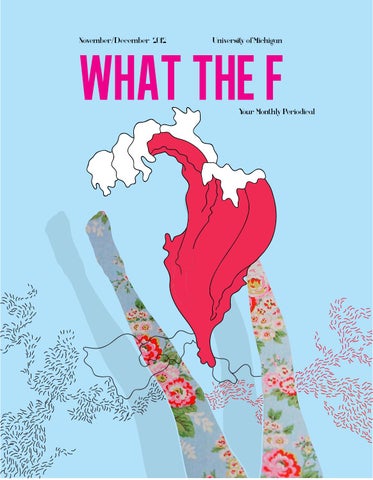
November/December 2012
University of Michigan
What The F
Your Monthly Periodical
Co-President / Editor in Chief Lizzie Lane Co-President Jen Spears Visual Editor in Chief Erica McTurk Chief Advisor Haena Kim Campus Life Coordinator Clancey D’Isa Business Manager Samantha Stewart Public Relations Coordinator Jillian McConville Social Justice Editor Colleen Moran Administrative Officer Sumana Palle Assistant Editor Bri Kovan
What The F is a non-partisan, non-profit publication operated by students at the University of Michigan. What The F’s purpose
is to encourage discussion on significant issues of campus, national, and world interest. The magazine, the advisory board, and our sponsors do not endorse the ideas presented by the writers. We do however, support, and encourage different ideas into our community and into campus discussion.
All writings depicted are real, found in bathrooms on campus, because sometimes we just need to talk to each other.
November/ December 2012
What The F 01
02 04 05
Your Monthly Periodcal Issue 3
Letter from the Editor A Little Period Talk Woman of the Month Jessica Valenti Health Shit I’m Afraid to Ask My Doctor Dinner Decision
Hanne Blank Sara Yufa Emma Maniere Sumana Palle
07 08 10 12
Margaret Hitch Sara Spiller Ashley Cambron
14 16 18
Erica McTurk
19 20 22
Reviews Exercise The Great Wall of Vagina VajA2 Origin of the Word
Anita Dildough Ivana Happycooch Conner Wood
23 24 26
Match That Vibrator! It Happens on This Campus A Poem
27
Sources and Sponsors
Real Women Alternatives to Tampons To Shave or Not To Shave Telling My Best Friend About A Time A Boy Did Things to Me That I Didn’t Want Done How I Learned to Side Part My Hair Dragon Lady, Born Genius, or Little Suzy Wong Minority Status and Self-Doubt
Funny, Fresh, Feminine, Feminist, & Fuck Cover Erica McTurk Layout Erica McTurk, Holly Sterling, and Paula Friedrich Contributing Illustrators Ashley Boudrie, Kit Trowbridge, Stephanie O’Niel, Margaret Hitch, Alexa Borromeo, Grace Ludmer, and Erica McTurk Contributing Writers Samantha Stewart, Jillian McConville, Hailey Burns, Patrick Moran, and Lauren Warshaw Find us on facebook for updates: www.facebook.com/whatthefmag
Letter From the Editor
Welcome to What The F, your campus vagazine!
As a monthly periodical that was hit with Seasonique, What the F is the first student-run woman-centered women’s health publication on campus. We are here to discuss taboos, views, and news on womanhood, recognizing the incredible diversity contained within the word “woman.” This vag aims to speak across sexualities, ethnic backgrounds, religious and political beliefs, sizes, and more. The next pages of our November/December issue come at you with a variety of personal accounts, straight from women (and an awesome dude) around campus. Perhaps you picked us up because of the sexy crimson wave cover, or maybe your partner forced you to read this; either way, my letter to you is about periods. Promise it won’t get any more graphic than the sexy crimson wave cover. There are two things for which I have developed a new love in my college career, though never together: brussel sprouts and periods. I love periods. And I have only come to realize this after years and years of the monthly ordeal. Five years of stained sheets, awkward bathroom-stall pad-ripping, and cramps that make me faint. Periods are a topic that my father will swiftly obliterate with a wave of his hand and a mutter of “…women’s business…” Since I was inducted into womanhood in a middle-school girl’s bathroom stall, periods have been nothing more than “women’s business,” a monthly burden of emotion and mess just to deal with and forget until the next cycle. And I don’t think I am mistaken in saying this is a shared sentiment. But it took a man to tell me any differently.
A couple years ago, my Women’s Studies teacher perched himself on the end of his desk and said, “Periods are the most powerful thing in the world.” At the time, I looked at him like there was a tampon shoved up his nostril. But when I thought about it, how right he was. It’s not a normal perspective to take. Periods are a nuisance – painful at worst and physically and hormonally messy at best. They muddy your white sheets, bloody your favorite underwear, sneak up at the most inopportune times (I’m thinking white high school graduation gown), cost money, and once in a while turn you into Helga from Hey Arnold. It’s a load of blood, cramps, and tears. But if we take the time to think about what periods are, they are (and there’s no denying) the most powerful thing in the world. Periods mark the power to give life, to grow new life and give birth to it. The blood flow from the womb to the world is an incredible sign of fertility. They are the most natural thing in the world. Periods aren’t just women’s business, they are the business of life. And this is something to celebrate. With anything other than Natty Light.
For Women, With Women. Rag on,
Editor-in-Chief Lizzie Lane
P.S. Want to get involved? E-mail WhatTheFmag@umich.edu. We would love your brilliant minds to write and create with us. >>What the F is now seeking a dedicated, passionate Creative Head. Help make a change in women’s health. E-mail WhatTheFmag@umich.edu if interested.
01
02
Woman of the Month
Jessica Valenti
“T
he mainstream media… loves to report about how promiscuous girls are, whether they’re acting up on spring break, getting caught topless on camera, or catching all kinds of STIs. Unsurprisingly, these types of articles and stories generally fail to mention that women are attending college at the highest rates in history, and that we’re the majority of undergraduate and master’s students. Well-educated and socially engaged women just don’t make for good headlines, it seems.” This is an excerpt from Jessica Valenti’s book The Purity Myth: How America’s Obsession with Virginity is Hurting Young Women, which was recently made into a documentary about why it is so damaging to place a woman’s worth solely on her sexuality. Valenti is one of the most inspiring feminist activists of our time. In addition to The Purity Myth, Valenti has authored three other books on women’s issues, including Full Frontal Feminism: A Young Woman’s Guide to Why Feminism Matters and He’s a Stud, She’s a Slut, and 49 Other Double Standards Every Woman Should Know. Valenti was born in Queens, New York, and attended her first pro-choice rally with her mom at just 13 years old. She first referred to herself as a feminist at Rutgers University, where she earned her master’s degree in Women’s and Gender Studies. When Valenti saw that the feminist movement was losing momentum, she decided to dedicate her life to revitalizing public interest in women’s rights. She was awarded the Hillman Journalism Prize in 2011, and The Guardian named her one of the Top 100 Inspiring Women in the world. Valenti is also one of the founders of The Real 100, a list of American women who are fighting gender stereotypes and making an impact on women’s issues in their communities. Valenti’s crowning achievement is Feministing.com, a feminist blog that
she founded in 2004 while working at the National Organization for Women. She believed that young feminists were being left out of the feminist movement of their mothers and grandmothers. Valenti hoped to provide younger women with an introduction to why women need feminism for their education, reproductive rights, health, and relationships. Valenti sees blogging as a 21st century medium that can raise awareness of these issues. Feministing is one of the most widely read feminist publications of all time. The website is an online community where young women can speak out about current issues that impact their lives and their future. Feministing aims to bring attention to women’s issues that the mainstream media too often overlooks. The site’s accomplishments include pressuring Walmart to pull offensive merchandise off of their shelves and getting a misogynistic professor who was sending them hate mail to be fired from a Big 10 university. Valenti wrote about a range of issues on Feministing, from equal pay for women to designer vaginas and sexual violence in Darfur. Though Valenti’s involvement with Feministing has attracted all kinds of positive feedback, she has also received threats of rape and death due to her progressive viewpoints. Valenti left the website in 2011 at the age of 32, saying that she wanted Feministing to be an online medium for younger feminists. Although Valenti’s involvement with the zesty blog has come to an end, the same cannot be said for her career as a women’s rights activist. In 2010, Valenti and her husband Andrew Golis had their first child. Her experiences with motherhood prompted her to publish Why Have Kids?: A New Mom Explores the Truth about Parenting and Happiness in 2012. In addition, Valenti is the editor of the award-winning anthology Yes Means Yes: Visions of Female Sexual Power and a World
Jessica Valenti, age 34.
Without Rape. Valenti has been a pioneer in the new feminist movement and she shows no signs of giving up the fight: “[Here’s] the hope I have for women: that we can start to see ourselves - and encourage men to see us - as more than just the sum of our sexual parts: not as virgins or whores, as mothers or girlfriends, or as existing only in relation to men, but as people with independent desires, hopes and abilities. But I know that this can’t happen as long as American culture continues to inundate us with gender-role messages that place everyone - men and women - in an unnatural hierarchical order that’s impossible to maintain without strife. For women to move forward, and for men to break free, we need to overcome the masculinity status quotogether.” -Hailey Burns Follow Valenti on Twitter @JessicaValenti and on tumblr at http://jessicavalenti. tumblr.com/
03
Health
Shit I’m Afraid to Ask my Doctor
1.
How should I clean my sex toys?
If they’re your thing, sex toys are great. They can greatly enhance your pleasure and sexual repertoire. However, they can also transmit bacterial infections and STIs. To avoid this icky stuff, here’s some tips for cleaning your pleasure machines: • Never submerge any of the electrical parts in water, and always remove the batteries before cleaning. • Some silicone and glass products are dishwasher safe. • For hard plastic and stainless steel, use a damp washcloth and antibacterial soap. • For cyberskin (mostly used on dildos) and vinyl, wash with only warm water. Air dry, and to keep them from getting sticky, sprinkle a little bit of cornstarch on them! • Store your toys in a clean container, located in a dry, cool place. Disclaimer: None of this information should replace instructions from the manufacturer of your toy. Always read cleaning and usage instructions before play. And as a side note, unbeknownst to me, condom use on sex toys is a common and great way to protect yourself from pesky infections and more serious sexually transmitted diseases!
2.
What’s up with the HPV vaccine?
Certain common strains of the human papillomavirus cause many cases of cervical cancer. There are two FDA-approved vaccines for HPV: Gardasil and Cervarix. Both of these are shots that come in sets of three, given over six months. It is recommended for girls AND boys between the ages of 11 and 12, but the 04
CDC (Center for Disease Control) recommends that everyone up to age 26 gets the vaccine. It is most effective when given before someone becomes sexually active and thus could be exposed to the virus, but it can still protect you if you are already getting down/have been exposed to HPV. There are a few mild side effects: a sore arm (where you get the shots), headaches, and some small flu-like symptoms. Cervarix specifically has been known to cause nausea, vomiting, diarrhea, and abdominal pain. Almost no serious side effects have been documented as a direct symptom of the vaccine – only health issues occurred by happenstance around the time of the vaccine. The HPV vaccine is not a replacement for annual pap smears. No slacking ladies – pap smears are still the best way to detect cervical cancer and other sexual health problems early. And here’s a not-so-fun-fact: smoking DOUBLES your risk of cervical cancer. If you love your cervix, stomp out those cigs.
3.
My vagina is dryer than the Sahara. Help!
Vaginal dryness is pretty common during menopause, when a woman’s estrogen levels decrease, but almost 20 percent of young women experience it too. Being a little dry down there does not mean you’re a shriveled up old prune who will never enjoy sex again. There are tons of reasons why your hoo-ha could be feeling a bit like the Sahara desert instead of the
Florida Everglades. If you’ve had your ovaries removed, are breastfeeding, or have undergone chemotherapy, you could be experiencing this. But if you didn’t recently have a child, or a lifethreatening medical condition, you are probably not partaking in enough foreplay, you’re not super aroused, or there are some psychological issues at play (stress, not feeling connected to your partner, etc.). And here’s another zinger: smoking can cause vaginal dryness - one more reason to steer clear of those dang ol’ cancer sticks. Even if any of the reasons listed above don’t apply to you, you might not be as naturally lubricated as you’d like. A woman can be fully turned on but her body may not cooperate – Mother Nature can be a cruel mistress. Lube is an easy, inexpensive, and effective solution. And just like sex, sex partners, and fast-food restaurants, there is a bewildering amount of variety, so here are a few distinctions. Silicone-based lubes stay wettest the longest (up to ten years in laboratory studies), but aren’t necessarily good for silicon sex toys. Water-based lubes are easier to clean up, but dry up faster. Oil-based lubes are a no-no, as they can actually break down the materials of condoms. Beyond that, there are warming lubes, cooling lubes, tingling lubes, orgasm enhancing lubes, and who knows what else. Try one, heck, try ‘em all. Whatever makes you the most comfortable during sex. -Samantha Stewart
Find yo urse decision lf spending exce s fret, we’r making on whe sive amounts o r f ti e e here to to grab Michiga lunch? D me n studen help! If you’re on’t pa ts times a week, ch who deal with t rt of the 60% of h eck out these loc is nuisance sev facts gu e al eateri ide your es and le ral next me t the al choic e.
VS
Price: $4.99 Health:
Price: $2.65 Health:
Little Cheese Burger Calories = 550 Total Fat = 32 g Total Carb = 39 g Protein = 27 g
Double Cheese Burger Calories = 460 Total Fat = 24 g Total Carb = 42 g Protein = 21 g A local favorite and once featured on “Man v. Food,” Blimpy Burger’s Double Cheese burger is served with freshly-ground ground beef on a whole-wheat bun, topped with your choice of condiments. The competition: Five Guys Cheeseburger, is also made with fresh ground beef, and advertised to never see the freezer in any Five Guys franchise.
ICE CREAM
AMERICAN
VS
Price: $3.77 Health:
Price: $3.29 Health:
Half-Baked Ice Cream Calories = 270 Total Fat = 13 g Total Carb = 35 g
Cookie Dough Ice Cream Calories = 210 Total Fat = 12 g Total Carb = 21 g
Both B&J’s and Stucchi’s provide their customers with mouth watering chocolate & vanilla ice creams with gobs of chocolate chip cookie dough. However, B&J’s has one-uped its competitor by adding chunks of fudge brownies to create an irresistible ice cream, but it will cost you a few extra calories.
VS
Price: $6.63 Health:
Price: $2.65 Health:
Chicken Burrito Calories = 990 Total Fat = 39 g Total Carb = 101 g Protein =58.5 g
Chicken Burrito Calories = 1,060 Total Fat = 45 g Total Carb = 112 g Protein = 51 g
SANDWICHES
At Chipotle, a chicken burrito is composed of chicken marinated overnight in spicy chipotle pepper adobo, then grilled and added to rice, black beans, cheese, sour cream and all wrapped up in a lightly fried tortilla. Their competitor, Panchero’s, builds a similar burrito that isn’t necessarily nutritionally superior.
Price: $4.77 Health:
VS Price: $5.57 Health:
Italian Night Club Calories = 984 Total Fat = 51 g Total Carb = 70 g Protein = 44 g Italian Calories = 657 Total Fat = 37 g Total Carb = 56 g Protein = 24 g
ASIAN
MEXICAN
VS
Price: $6.35 Health:
Price: $9.50 Health:
Sweet & Sour Chicken Calories = 380 Total Fat = 17 g Total Carb = 40 g Protein = 15 g
Sweet and Spicy Chicken Calories = 561 Total Fat = 23 g Total Carb = 27 g Protein = 28 g
Panda serves crispy chicken with steamed green bell peppers, onions, pineapple, lightly coated in sweet n’ sour sauce for a fairly balanced meal. Similarly, No Thai! offers battered chicken, green onions served with a sweet and spicy sauce on top of crispy noodles, which is a bit higher in caloric value, yet undeniably delicious.
JJ’s Italian night club is packed with real genoa salami, Italian capicola, smoked ham, and provolone cheese. While they have a reputation for being quick, the 948 calories (and 51 grams of fat) may not be worth the convenience. The similar “Italian” at Pot Belly Sandwich Shop has the same ingredients all on a toasted multigrain wheat bread and adds up less fat and calories.
05
My Two Breast Friends
Breasts Boobs Bosoms Boobies Nunga-Nungas Milkbags Milkshakes Nips Tits Titties Teats Ta-tas Mosquito Bites Melons Cantaloupes Coconuts Nectarines Sugarplums Mangoes Peaches Pears Eggplants Dumplings is anyone getting hungry? Knockers Chesticles Pillows Hooters Bazookas Pokers Pointers Twins Cones
Buds Duds Money Makers Salt Shakers Trouble Makers Pects Jugs Mountains Molehills Cha-Chas Third Base Lady Lumps The Girls: Whatever you call them, they’re as different as the names we come up with. Here’s to all the breasts in this world: past, present, and future.
06
Real Women by Hanne Blank Originally published in Filling a Much-Needed Void, http://www.hanneblank.com/blog/2011/06/23/real-women/
E
xcuse me while I throw this down, I’m old and cranky and tired of hearing the idiocy repeated by people who ought to know better. Real women do not have curves. Real women do not look like just one thing. Real women have curves, and not. They are tall, and not. They are brown-skinned, and oliveskinned, and not. They have small breasts, and big ones, and no breasts whatsoever. Real women start their lives as baby girls. And as baby boys. And as babies of indeterminate biological sex whose bodies terrify their doctors and families into making all kinds of very sudden decisions. Real women have big hands and small hands and long elegant fingers and short stubby fingers and manicures and broken nails with dirt under them. Real women have armpit hair and leg hair and pubic hair and facial hair and chest hair and sexy moustaches and full, luxuriant beards. Real women have none of these things, spontaneously or as the result of intentional change. Real women are bald as eggs, by chance and by choice and by chemo. Real women have hair so long they can sit on it. Real women wear wigs and weaves and extensions and kufi and do-rags and hairnets and hijab and headscarves and hats and yarmulkes and textured rubber swim caps with the plastic flowers on the sides.
Real women have ovaries. Unless they don’t, and sometimes they don’t because they were born that way and sometimes they don’t because they had to have their ovaries removed. Real women have uteruses, unless they don’t, see above. Real women have vaginas and clitorises and XX sex chromosomes and high estrogen levels, they ovulate and menstruate and can get pregnant and have babies. Except sometimes not, for a rather spectacular array of reasons both spontaneous and induced. Real women are fat. And thin. And both, and neither, and otherwise. Doesn’t make them any less real. There is a phrase I wish I could engrave upon the hearts of every single person, everywhere in the world, and it is this sentence which comes from the genius lips of the grand and eloquent Mr. Glenn Marla: There is no wrong way to have a body. I’m going to say it again because it’s important: There is no wrong way to have a body. And if your moral compass points in any way, shape, or form to equality, you need to get this through your thick skull and stop with the “real women are like such-and-so” crap.
Real women wear high heels and skirts. Or not.
You are not the authority on what “real” human beings are, and who qualifies as “real” and on what basis. All human beings are real.
Real women are feminine and smell good and they are masculine and smell good and they are androgynous and smell good, except when they don’t smell so good, but that can be changed if desired because real women change stuff when they want to.
Yes, I know you’re tired of feeling disenfranchised. It is a tiresome and loathsome thing to be and to feel. But the tit-for-tat disenfranchisement of others is not going to solve that problem. Solidarity has to start somewhere and it might as well be with you and me.
07
Alternatives to Tampons Not Just for Hipsters by Sara Yufa
O
nce a month we receive a wonderful gift from our beautiful female reproductive system. Unfortunately, it’s not always so wonderful to deal with. During this time, most of us reach for the traditional pads or tampons stocked at CVS to get us through the next few days. However, there is a growing market of environmentally friendly and natural alternatives to the widely accepted synthetic options that are becoming more accessible as more women embrace them. Here are some of the most popular alternatives, but similar products can be found from other brands as well.
DivaCup
08
What: The DivaCup is a reusable silicone cup that sits outside of the cervix and collects menstrual blood as it flows out. The cup comes in two different sizes: the smaller size is for women under 30 years old, and the larger size is for women over 30 or who have had delivered a baby either vaginally or through a C-section. The company recommends that you replace your DivaCup every year, but that depends on your personal pH level, what cleaning agents you use, and how frequently you clean your DivaCup. It can be used with an IUD or NuvaRight birth control. The website recommends that you talk to your doctor before starting to use the DivaCup. Pros: DivaCup provides an environmentally friendly alternative to disposable feminine products since little waste is involved. It’s cost efficient because it can be reused. Also, as the silicone material naturally warms in the vagina, it conforms to the shape of your body making it more comfortable. Unlike tampons, the DivaCup carries no risk of TSS. Cons: Because using a menstrual cup is more hands on, some women may find it uncomfortable. If you have a very heavy flow, you may have to change it more often and may want to search for a different brand that offers a larger sized menstrual cup. The website www.menstrualcups.org provides a very helpful forum that discusses many different menstrual cups, including a size chart to help determine which brand is best for you. Insertion: To insert the DivaCup, fold it using
one hand, and use your other hand to separate the labia. Insert the folded cup horizontally into vaginal opening until it cannot go further, then rotate the cup 360 degrees. To remove the cup, just pinch the base and pull down. Cleaning: To clean the DivaCup, simply dump its contents into the toilet, wash with warm water, and use a gentle unscented soap. The DivaCup company also offers a product called DivaWash, which is a natural, pH balanced, gentle, fragrance-free formula that is 100% plant-based and safe for the body. Cost: The standard cost for a DivaCup is $39.99. While the price may seem daunting at first, think of the money you’ll save on menstruation products in a year! It’s an investment that is totally worth it. Find it: Hit up Tree City Diapers (down the street from North Quad), the People’s Food Co-op in Ann Arbor, and Whole Foods Market, or go online to drugstore.com or lunapads.com.
Instead Softcup
What: Instead Softcup is a menstrual cup that comes both in a disposable variety and a reusable cup that lasts for one menstrual period. Pros: It can be worn for up to 12 hours and can be worn during sex to avoid mess. That’s right - it can be worn during sex because unlike the DivaCup, Softcup does have a spout hanging in the vagina. Cons: Unfortunately, the disposable Softcups are not more cost efficient or environmentally friendly than traditional pads or tampons, but the reusable kind is cheaper and slightly more environmentally friendly. From personal experience, the product has an unfortunate messy removal process. Insertion: To insert the Softcup, squeeze the opposite sides of rim together and hold the cup so that the bottom faces down. Keeping the rim pressed together, insert the Softcup completely into the vagina and use your fingers to push it as far back as it will go. It should slide into place under the cervix and behind the pubic bone. Cost: A 24-pack of the disposable kind is $10.49 and the resuable kind is $6.19 for a 2-pack. Find it: Go online to www.softcup.com, or locally at the CVS on State street, any Rite Aid, Kroger, or Walgreens.
Lunapads
What: Lunapad is a brand that makes reusable pads, liners, and panties from highly absorbent fleece. The company recommends one pad per day and about 3 liners. The reusable pad attaches to your underwear, and the reusable inner liners should be changed throughout the day. Pros: Lunapads are made from organic cotton and are an environmentally friendly and cost efficient alternative to non-disposable pads. Con: Lunapads involve more mess and cleaning. Cleaning: Lunapads should be machine or hand washed. Depending on how heavily soaked they are, they may need to be soaked in cold water prior to washing. Make sure that they are completely dried before storage. Cost: The cost for 1 pad with 3 inserts ranges from $14.99-$26.99, and Inserts alone range from $5.99$17.99. The panty liners do not have the option of switching out the insert, costing $11.99-$14.99 per panty liner. The panties, which have a built-in, absorbent, and leak resistant panel, can be worn alone, or with an insert for menstrual days. These panties range from $25.99-$35.99 each. Find it: There are no stores in Michigan that carry Lunapads, but they can be ordered online at www. lunapads.com.
Sea Pearls (Sea Sponge Tampons)
What: Sea Pearls are sea sponges that are used like tampons, except that they are reusable and completely organic. Sea Pearls come in three different sizes depending on how heavy your flow is. More than one can be used at a time. The outside of the sponge can be trimmed for personal fit, and you can sew a string or piece of floss to the end for easier removal if desired. Pros: Sea Pearls can be left in during sex, and combined with a spermicide for contraception. There is not risk of developing TSS. Each sponge lasts about a year. This is an environmentally friendly, organic, and cost
efficient alternative to traditional disposable pads and tampons. Con: Like tampons, they are hand-intensive. Insertion: To insert, wet the sponge, squeeze out excess water, squish the sponge, and insert. You can also use a reusable applicator to assist with insertion if desired. The sea sponge should be taken out as often as a tampon, rinsed, and reinserted. Cleaning: After each cycle, the sea sponge should be disinfected by soaking for 15 minutes in one of natural solutions listed on their website. Sea sponges are sea animals that turn into sponges, so be sure to boil them before use. Cost: The cost ranges from $13.00-$15.00 for the Original Sea Sponge product or the Premium Ultra Soft option, respectively. Find it: They can be purchased online at www. jadeandpearl.com.
Seventh Generation Organic Cotton Tampons
What: A more natural alternative to traditional tampons, these tampons are made from organic cotton, whitened without chemicals containing chlorine, and do not contain added fragrances or dyes. This particular brand sells tampons both with an applicator and without applicator. This brand also makes other feminine products such as pads and panty liners. Pro: Organic tampons are safer for your body than regular tampons. Cons: They’re not as cost-effective in the long run, and still add to environmental waste like traditional tampons. Cost: A 20-count box of tampons costs $5.49. Find it: Organic tampons can be found at the Peoples Food Co-op of Ann Arbor, Whole Foods, The Arbor Farms Market, and Plum Market. You can also go online to www.seventhgeneration.alice. com. 09
From the “Bush” to the “School Zone” by Emma Maniere
T
he course guide for Biology 116: Biology of Sex forewarns students they will uncover the “facts and fallacies about sex …insights about our own (and sometimes unconscious) behavior and attitudes about sex.” So what made the entire auditorium of over 200 students so squeamish? The material can get graphic, but what would it take for everyone to give a disgusted gasp? A particularly forthright sexual position? One of those STD pictures you saw in middle school health class? A graphic picture of female circumcision? Nope. Pubic hair. Professor William Fink was initially confused by this stark reaction to such a relatively tame picture when he taught the course three years ago. He soon came to the conclusion, however, that this is a typical reaction to pubic hair, which he said is “unexpected and apparently horrifying” for students. Despite this aversion to pubic hair, Fink states that it is an evolutionary mainstay. Natural selection has retained it on humans, apes, and most mammals. Pubic hair serves two main biological purposes. First, it serves as a focal point for the eye because of the color contrast against the skin, thus serving as a sexual signal. Second, it improves lubrication and eases movements (much like underarm hair) during sexul activity. However, new studies claim that pubic hair removal provides benefits including “increased sexual sensation and satisfaction, possibly due to increased tactile sensitivity, increased aesthetic appearance, and easier identification of anatomic landmarks.” These studies are backed by anecdotal rather than quantitative data. Aside from minor side-effects, like razor burn and increased susceptibility to infection, there are no known long-term risks associated with removal of pubic hair. But, let’s be real; this “evolutionary mainstay” is not necessarily in fashion. Women and men alike remove their pubic hair, and this trend is nothing new. Ancient Egyptian art depicts females with small triangles of pubic hair, and pubes were rarely 10
depicted in European artistic representations of nudes until the late 1800s. Sharia law, from Islamic traditions, advises the removal of all pubic hair. In medieval times, those with means often shaved to prevent lice. Today, pubic hair shaving is more common in partnered women as opposed to single and married women, and in homosexual as opposed to heterosexual men. In a study of American women between the ages of 18 and 24, 38% engaged in total removal, 29.1% in partial removal, and about 20% were hair-free during the previous month. The study also found that pubic hair removal is more common in younger than older women. On the male side, 82.1% of gay men and 66.4% of heterosexual men reported removing their pubic hair at least once. Conversely, heterosexual women are more likely to remove pubic hair than homosexual women, though only slightly. Much like the motivations for shaving pubic hair, the explanation of why pubic hair was absent in European art is likely a product of confounding variables.“We’re looking at this from a long distance and can’t tell whether it’s because most of the people who posed nude for artists were courtesans who shaved or whether [it reflects] the feminine ideal of the time, so the artists just didn’t put it in,” Fink said. “But however that works, at least in some cases it was a desirable feature, so it seems to have gone in and out of fashion.” Of course, idealized depictions of women are no less prominent today. Professor Joanne Motino Bailey, who teaches Women’s Studies 220: Perspectives in Women’s Health, postulates that the increased availability of Internet pornography has influenced the norms of pubic hair grooming habits. “Almost everyone’s first sexual exposure at some level is through pornography at this point – like the first time they see female and male genitalia,” Bailey said. “What is normalized in porn is now becoming normalized in individual lives as well, and I think the dissemination of the norm is much faster.” Before the Internet, Playboy Magazine served as a popular source of porn. A 2009 study examined
the appearance of Playboy centerfold models’ genitalia from 1953 to 2007. Up until 1970, pubic hair was totally unaltered in the images. Substantial grooming did not occur until the 1990s. Total removal of pubic hair was not seen until 2000, which is possibly correlated to the introduction of the Brazilian Wax in the US. Yet here again, confounding variables pose a problem to interpretation of this study’s findings. “Are the women shaving because their boyfriends or mates look at Playboy and say ‘That’s what a woman should look like’ so the woman shaves in order to meet that expectation? Or is the woman doing it because of internal reasons like ‘I want to feel cleaner’ or ‘I want to look smoother’ or ‘I want to please my boyfriend’ or ‘I just feel more comfortable when I don’t have that stuff there?’” Fink said. “There’s so much interaction between social pressure and internal body image.” From her unique vantage point as a nurse midwife, Bailey has also noticed trends regarding pubic hair grooming patterns. A colleague of hers has even noted styles particular to certain cities or counties; for example, a narrow landing strip pattern is common among patients in Jackson, Michigan. “Ten years ago, the only women that were shaving off all of their pubic hair were poor, white women,” said Bailey. “And then it has really expanded. I also care for a recent Latino immigrant population, and ten years ago, nobody shaved their pubic hair at all, and I would say now at least half if not more of these recently immigrated Latinas are. So it’s really been this cultural shift, and then that sort of trend of pubic hair shaving so that there’s no hair at all is, I would say, [prevalent among] at least 50-60%. Women who are less than 25, most [of them] are shaving their pubic hair.” Regional or nationwide, from the nineteenth century or 1990’s, what does submission to these cultural norms say about women? Often, Bailey said, discourse around body modification, like breast augmentation or genital reconstruction, is framed to emphasize the aspect of female empowerment. It gives them control. Whether
or not that is the case, shaving one’s pubic hair is, ultimately, another (minor) form of body modification meant “primarily for the consumption of others.” And this “consumption” has been exploited commercially as well. “Finally …. the answer to a perfect bikini shave” is offered by HairCare DownThere which includes safety scissors, a razor, a double-sided mirror (regular & 3X), a two-sided comb, stencils and stencil pen, and don’t forget, bikini bindi jewels.” The company also sells gels to prevent itching, rash, and in-grown hairs. Is this body modification that may include bedazzling one’s lady parts acceptable? “To me, the fundamental critique [about body modification] is why do you need to do what are ultimately painful modifications to feel attractive or to feel good?” said Bailey. “When body modification becomes what is normal, that’s – to me – problematic.” One idea often associated with pubic hair removal is that it juvenilizes woman, insinuating that men who find this pleasing are attracted to prepubescent females. However, Bailey asserted that this critique is “over-extreme.” Ultimately, the phenomenon has emerged as a normative issue, said Fink. Women want to look like other attractive women, so they emulate what those attractive women are doing, body modifications and all. Shaving one’s pubic hair may not be the most dramatic nor the most harmful form of body modification, but the pattern remains relevant. “Are there huge, life-threatening risks for shaving your pubic hair?” asked Bailey. “It’s kind of a stretch. This is actually a relatively small issue [compared to disordered eating or cosmetic surgery], but it reflects the bigger picture.”
11
Telling My Best Friend About the Time A Boy Did Things to Me I Didn’t Want to Have Done by Sumana Palle
N
o, I will not tell you what I was wearing. It really doesn’t matter, does it?
I won’t tell you how drunk I was or how many friends I had with me because who cares? I will tell you all the numbers that raced through my brain. 105 pounds? 110 pounds? My weight. 170 pounds? His weight. His house number? Didn’t know. My friend’s house number that I was sure was close by? No clue. 5:36 am? When I had fallen asleep, despite my best efforts. Time now? 6 o’clock? Maybe. When I woke up to his hands roaming parts of me I reserved for men I cared for. I will tell you how it started. I was at a party. Dancing. It was fun. A good friend of mine introduced me to a good friend of hers. He asked me to dance. No. I wasn’t interested. I wanted to dance with friends. I was dating this one guy I liked. I had a fuck buddy already. I didn’t know how to dance well. Bottom line: NO. Tired, I sat somewhere in a corner. He came. We talked. He said I was different. He wanted to get to know me. He whipped his phone out of his pocket. I didn’t say anything. He stared. He said it was okay that I didn’t want to give him his number. I left to dance with friends, or date the one guy, or fuck my fuck buddy or whatever. He joined me again. He was playful this time. I didn’t bother responding. I wanted to dance. With friends. My friend left with his housemate who she liked and who liked her. I danced some more. The party ended. He said I should go home with him. Pick my friend up. I said okay. We walked towards his house. He seemed on edge. Nervous. Snapped at me a few times. Drunk.
12
We got to his house. Led me to his room. Where was my friend? I can pick her up later. It was warm inside. I could wait while she finished whatever she was doing. He said he wanted to finish watching “The Social Network.” I said okay. I should text her.
No response. Call her? Didn’t pick up. I’ll wait. I’ll go knock on the housemate’s door after a while. He was fumbling with the movies. He was sobering up. Went through his DVD collection a million times. No clue why. He finally started “The Social Network” over. No clue why. I saw margarita mixes in his room. I wanted to taste some. He said okay. I said no alcohol, though. I was a lightweight and had already had a bit too much. He told me there was no way a little alcohol could affect me. I said just the margarita mixes, please, no alcohol I’m a lightweight. Appletini. I tasted the vodka. Pina colada. I tasted the rum. Coffee. I tasted the whiskey. I said «no more.» He said I HAD to try this imported German liquor. 80 percent alcohol. Huh? No. I didn’t want to. He pulled out a case filled with adorable, irrestible tiny bottles that were wrapped in parchment paper. I couldn’t. I had too much. Just a sip, he promised. I said no. He opened one. I took a sip. It tasted good. Another sip. Enough. I gave it back. My head is woozy. I’m cold. Socks? He gives me warm socks and I kick off my high heels and pull the blanket over me on his bed. He’s a good friend of a really good friend. He said I could stay for a while. I’ll leave as soon as my feet are warm again. He jumps in next to me. I laugh. It’s funny. I start talking. He doesn’t say much. He starts touching me. His hands are warm. Warmth? I say nothing. He’s just hugging. I turn around so I don’t have to face him and cuddle with his thick blanket. He cuddles with me. I say nothing. He’s a friend of one of my closest friends. A good friend. Isn’t that what she said? I should text her again. Where’s my phone? Too far. My eyes are heavy. They close. I feel something. My hand instinctively pushes it away. I feel it again. I open my eyes. I push it away, a
bit harder this time. His hand resists and comes back greedily. This time, it intrudes me. I push it away firmly and hold it away from me. My mind: Good friend of a good friend, why are you doing this? How far away is your house from my room? How do I get back home? I want home. I want sleep. I want warmth. I’m cold. My lips: I’m leaving. I don’t think you understandHis mouth: No, come back. Just go to bed. I won’t do anything else. I promise. My hands: cell phone. keys. shoes. tiny bottle of German liquor that tasted so good? No. I now want to break the cute bottle. Friend? She’s with someone she likes and who likes her. She’ll be fine. She’ll be fine? I need to leave. It’s late. How do I get home? Another number: 10. Percentage of battery left on my phone. Fact: I’m bad with directions. I have the iPhone 5 - worst map app ever. I think of the most random things when I shouldn’t. Another number: 6:02. AM. When I left his house. I was holding my heels. Still wearing his socks. I ran. Straight. Looked for street names I knew. Felt nothing. Tears? Nope. Terror? Nope. Well, maybe a bit. So many alcohol stores on the way home. How many drunk men? Were cars slowing down as they reached me? Home. I’m cold. I want to tell you how it felt. My proud, fierce, and arrogant head, hung in shame. Sprinting home. Cold. I was so stupid tonight. Why did I go over to someone’s house? I was wrong to trust a good friend’s friend. What was I thinking back then? What am I thinking now? Isn’t this the street where someone got raped? If I died on this tiny road, how long would it take someone to realize I was missing? I wanted to go home.
Why did he touch me? Good friend of a good friend, why did you touch me? I said no. Was I ambivalent? No. It wasn’t you - it was me. I didn’t want to dance with anyone. Not you, not anyone. It wasn’t anything personal. I’m sorry. I didn’t mean to hurt your feelings. I should have just danced with you. I should have just let you feel me so that I could have gotten this over with hours ago. Why did I say no? I was so stupid tonight. Why are you laughing at me? It’s hilarious? Why is it hilarious? Oh, I was just being stupid? I don’t think so. He was being a bit forceful. I mean, he was the good friend of a good friend. I trusted him. I thought he was being nice letting me into his room on a cold night to wait for a while. No? I was just being stupid? I don’t think so... I mean, he was the good friend of a good friend. He said he just wanted to talk and watch a movie. No, no, you’re right. I might have been just stupid. Why was I even upset? Why is this important? Isn’t this something that happens all the time to everyone with a vagina? Why am I complaining? Why was I even upset? Why is this even important? Ha ha why am I even telling you this story right now? I’m just being silly. I was so stupid that night. 13
14
15
Dragon Lady, Born Genius, or Little Suzy Wong A Feminist Reflection on Asian-American Representation by Sara Spiller
W
16
omanhood does not hold one definition. According to the concept of intersectionality, many different factors, such as sex, gender, race, class, sexuality, and physical ability all come together, or intersect, to create a specific meaning of womanhood for each individual. This brings me to the topic of race, specifically the experience of Asian American women. When I was in the first grade, I was in the hallway with my class when one kid pointed to an Asian American boy at the water fountain and asked me, “Is that your brother?!” I could provide you with many similar instances of racist comments, like the “are you from China?” question; the “you’re so cute and Asian” statement; and the “she’s probably smart, let’s join her group” suggestion. Just last weekend my high school math teacher and former classmate ridiculed me for not having a math or science major, claiming I am not “Asian enough.” My “favorite” racial offense was from a friend of my mom; he had a very endearing nickname for me: “Mulan Eyes.” The concept of “good stereotypes” is completely flawed. Many would probably ask, what’s wrong with being called cute and smart? Others may suggest that China is a pretty big country in Asia. And hey, maybe they weren’t discriminating when they thought he was your brother. As for my mom’s friend, I kicked him in the groin when I was 5 years old for calling me “Mulan Eyes” one too many times. What if I asked a Latina girl if the first other Latino I saw was her sibling? Would it still be harmless if someone said to an African American boy, “You’re so intimidating,” or “He doesn’t seem smart, let’s not join his group.” Of course you all know these kinds of blinded judgments and stereotyping are awful and are most definitely not true. So why does it still happen? The bottom line is that it even if it comes off as a “nice stereotype,” it is still stereotyping. Taking the attributes of complex individuals who identify with more than 30 Asian countries, and boxing them into a few characteristics is unethical and hurtful. By no means am I describing the experience of all Asian American women, but because of my race and gender, I am often characterized as submissive, smart, asexual, and am treated as a fetish. Submissive: People often that believe Asian women are quiet, shy, and not argumentative. This ascribed trait makes people believe that it is okay
to utilize stereotypes, whether for joking or normal conversation, because who’s going to say anything about it? Personally, it makes me feel as if people underestimate me and feel that I am a weak person. Smart: Some believe that Asians, especially women, are quiet people with strict parents, so naturally, they must study a lot! By ascribing how hard I work to my phenotype, it undermines what I have accomplished and attributes it to my Asianness. However, if I do not succeed, I am still held to that standard and am meant to feel like I have failed my very biology. Asexual: When people often tell me, “You’re so Asian and cute,” it puts me in a box where I cannot be “hot” or “sexy.” Cute is a childish word, and is not associated with sex. Though it is wrong to sexually objectify women, some Asian women do not have the option of rejecting it. I was looking over wedding photos of my high school Physics teacher, when a boy nudged me aside, took a glance at his Vietnamese bride, and said, “She’s pretty for an Asian girl”. Seemingly, she doesn’t fit a standard of beauty that can be applied to all other women; she is not as sexually desirable as women of other races. By remaining confined in her racial category, it seems as if there is a limit of beauty that the Asian woman can never surpass, especially in a culture that values a standard white beauty ideal. His comment made me feel inferior, as though I could not be sexually desired by a man unless he was looking for a specifically Asian woman; and then my beauty (which shouldn’t determine a woman’s worth anyways) can be taken into question. Have you ever noticed how our television shows commonly pair a female protagonist with a studious, shy, and Asian best friend? Often, these sidekicks are single, or they are carted away in what I like to call “Noah’s Ark.” They are separated sexually from the rest of the population by being paired with an Asian male. Their sex lives are seemingly nonexistent or not interesting enough to spark public interest. On MTV’s hit show, “Awkward,” Jenna Hamilton’s best friend, Ming, has no sexual activity, until she kisses an Asian American boy at the Black Hearts Party. In “The Secret Life of the American Teenager,” an intelligent Asian girl, Alice, is paired with another Asian American, Henry. They’ve dated since the third grade and appear to naturally “go
together.” In Noah’s Ark, an Asian woman is monogamously paired with an Asian male because the concept of an interracial relationship like the one being neglected in these shows is taboo. This taboo I will discuss in my next point. Fetishization: Asian women are often seen a fetish. The dictionary defines a fetish as an “object or nongenital part of the body that causes habitual erotic response or fixation.” Asian women are commonly characterized as being exotic, sexually insatiable, mysterious, and skilled at sexually pleasing men. The idea of an Asian woman as both asexual and a fetish is paradoxical. The rare moments in television when you see others take interest in an Asian female, are moments wherein she is in a sexual situation. Throughout cinematic history, an Asian woman is paired with either another Asian man or with a white man. This frequent pairing of white men with Asian women – when Asian men are rarely, if ever, paired with white women – reinforces the idea that white men are allowed to possess and have access to non-white women. This also highlights how women are possessions of men, as explained in the documentary about Asian women stereotypes, Slaying the Dragon. These representations reinforce the stereotype that Asian women are submissive because not only are they possessions of white men, they are willingly their possessions. Television’s focus on an Asian woman’s sex life also reduces her to being defined by her sexuality and a fetish. In “The Secret Life of the American Teenager,” Alice’s sex life is given its own focus. Alice is a very minor character until she broadcasts her sexual aggression with Henry, her beau. She talks about both the quality and quantity of their sex, promoting a stereotype of heterosexual Asian American women who enjoy pleasing men. These dehumanizing stereotypes help to formulate a fetishized, exotic woman. You wouldn’t want her in real life, but you can watch her fictionalized manifestation on TV, and fantasize about her. After attending a house party at the end of September, I discovered there was a group of freshman boys who knew me from my work. To them, I am known as the “Cute Markley Girl.” At the party, they talked about how they see me at work and how cute I am. It was as if I was a female celebrity. Yet, it is important to note that none of
them asked me on a date or expressed a desire to know me further. A female celebrity is often seen as a sex symbol, defined by her image. She is unapproachable on a more intimate level because of the sexuality she exudes and the pleasure gained from purely her aesthetic appeal and watching her from afar. As a result of my interaction with my admirers, I did not feel like an individual, but an image of the title (“Cute Markley Girl”) that they gave me. What does this mean for feminism, and what can be done about it? Many Asian American women’s activism groups exist, such as Korean American Women in Need, The Women of Color Network, and many others similar to these that fight issues like domestic violence in order to work towards improvement of society and empowerment. We must remember the web of intersectionality and acknowledge the significance that race has on an individual’s experience. The feminist movement has to grant attention these racialized experiences. We need to change how Asian American women are represented, especially through media, and be critical of why we say or think the things we do about the topic of Asian American women and stereotypes. 17
Minority Status and Self-Doubt by Ashley Cambron
I
18
believe it is very important never to presume that we fully understand the unique perception of each woman. An individual’s percpetion of the world is relative, and based primarily upon one’s past experiences and social interactions. When we’re in an environment with people who cannot relate to our experiences, who may view the world differently, we find ourselves questioning our perception of our own experience. This often leads to self-doubt, which can inhibit us from speaking out when someone has wronged us. Do you remember the first time a person, whether they were male or female, responded to something you said or did with the question, “Are you PMSing today?” Essentially, the person asking the question is inquiring as to whether or not your thoughts, feelings, opinions, or ideas are to be taken seriously. It may lead you to question your perception of the world around you, and the actions that you decide to take in response to the way you perceive things to be. If you are member of the social majority (whether it’s racial, cultural, sexual, etc.), there is never a need to question your perception of reality, because those around you will support and confirm your view of the world. As a member of the minority, on the other hand, you may find yourself constantly questioning whether or not your perception is accurate. As a black woman in an area as racially divided as the University of Michigan, I find myself constantly second-guessing my initial reactions to certain situations. One such instance occurred when I was approached by a guy at a party, a few weeks after arriving to the Ann Arbor area; this guy was white, and felt that “I’ve always wanted to try being with a black chick” was an appropriate pick-up line. His remark did not come off as hateful, or even intentionally racist; but, as a black woman, I did find it incredibly offensive and obnoxious. The next day, two of my girlfriends (both of whom were white) insisted that I was overacting, and that I should have taken it as a compliment. I certainly did not feel as though I had been complimented, but I figured I should learn to deal with such behavior, and learn not to “overreact” to what the majority seemed to perceive as acceptable behavior. As the year progressed, however, I found myself increasingly
more unable to pretend certain incidents did not bother me. Often, what irritated me even more than the incidents themselves was the way in which my feelings were constantly dismissed and minimized by other women. I once had a Caucasian female housemate eagerly introduce me to her male friend (who was also Caucasian), assuming that I would immediately be interested, due to the fact that she had seen me with white guys in the past. She didn’t bother to tell me his personal attributes, or anything pertaining to his character as a human being; she simply pulled me aside and blurted out excitedly, “Dude, he’s hot AND he’s into black girls…you’d better get on that!” My immediate impulse was to respond by telling her that her and her friend could fuck off. It seemed to me that she was implying that, as a black woman, I should immediately settle for the privilege of being with a white guy whenever the opportunity came along. I was later told by a couple of our mutual friends that I was more upset than I should have been. Once again I was told that I was overacting, and once again I exchanged my view of reality for the perceived reality of the majority. These experiences opened my eyes to the unfortunate fact that racial ignorance does exist within the University of Michigan, despite the constant mantra of diversity and tolerance we hear on a daily basis. As someone who grew up outside of Michigan and the continental United States, these experiences were unfamiliar to me. However, I feel that the more profound lesson I took away from these experiences was that I needed to stop looking to others to validate my thoughts and feelings. Although the aforementioned experiences are based upon my personal identity as a racial minority, I do not doubt that most women reading this routinely question their thoughts and actions. In our society, women are especially susceptible to social fears and self-doubt; those of us who have the added pressure of belonging to a minority group often experience even greater self-doubt. Whether you are black, white, gay, straight, religious, it is important that we, as women, learn to trust ourselves and stop looking to others to tell us how to feel. It is never wrong to have a different point of view and trust the way you see things.
Reviews
Iron Woman by Lauren Warshaw Often when women decide to embark on the path to physical fitness, we neglect the importance of weight lifting and training. Keeping our emphasis on cardio workouts, we spend hours on the treadmill, the elliptical, and other machines, failing to realize that increasing and maintaining muscle mass is essential in improving our overall fitness. We also know that the best way to increase muscle mass is through weight lifting. But which weight lifting exercises are actually effective for women, and which are a waste of our valuable energy? This guide will serve as a helpful tool to transition you from cardio exercise to weight lifting.
Squats: 1. Stand with feet shoulder width apart and weights down at your sides 2. Start the squat by bending at the knees and hips, keeping the back straight 3. Gradually lower to a comfortable position 4. Return back to the start by pushing the ground away 5. Keep the chest lifted and back straight at all times
Bicep Curl: Stand with one foot slightly ahead of the other Slowly raise right arm to shoulder height Lower the arm down to starting position Repeat with the left Perform two to three sets of fifteen
1. 2. 3. 4. 5.
Triceps Kickback: 1. Stand with legs slightly bent, shoulder width apart 2. Bend arms so that upper arms and weights are parallel to the floor 3. Keeping the upper arm parallel to the floor, straighten arms out behind you and squeeze triceps 4. Return to original position
Total Body Workout:
1. Stand with legs a little wider than shoulder width apart 2. 3. 4. 5.
and weights down at your side Lower right arm across body towards left foot, bending at hips Trace a diagonal line across body with right arm, bringing the weight towards your right shoulder Press weight up over head Repeat with left arm
Alternate Dumbbell Press:
1. Stand with legs shoulder width apart 2. 3. 4. 5.
with both weights at shoulder height Extend right arm straight overhead Slowly lower to starting position Repeat with left arm Perform two to three sets of fifteen
19
The Great Wall of Vagina by Erica McTurk
W
ho the hell decided that there is one perfect vulva? Or that a pair of “loose” labia lips need to surgerically corrected? Sure, maybe the vagina isn’t as soft and pink as the genitals of a gentleman, but ya know what? I think vaginas are pretty damn cute, wrinkles, hair, and all. Fortunately for the readers of What The F, and for women and men alike, British artist Jamie McCartney seems to agree with me. His sculptural installation “The Great Wall of Vagina” is composed of 400 plaster casts taken directly from the vaginas of nearly 400 women volunteers. At the top of this page, we show you the eighty casts of panel number five and six, of the ten panels completed. When I first heard of “The Great Wall of Vagina”, from a member of the What The F staff, I naturally assumed that the artist was a woman. “And it’s by a man!” she elucidated, after she had shown me a picture of one of the panels. By a man? Well that seemed to make some difference. Whenever I went on feminist rants to my 20
girlfriends, we were usually all in agreement, but the same conversation with a man typically included some kind of ambivalence or facetious attitude on his end. This fact prompted me to research the artist and his intentions in making this audacious piece. Was he just some womanizing gigolo who happened to be handy with a bucket of plaster, or was a he a feminist like me? My findings took me to the latter, or at least something similar to it. McCartney’s purpose for this five-year-long endeavor was to show men, and particularly women, that there is no “perfect” vagina. These casts are not meant to be titillating or arouse feelings of sexual excitement. They are neither vulgar, nor teasing. McCartney’s goal was to make the “sexual nonsexual,” to show variation, and to rid society of the vision of the ideal. “For many women their genital appearance is a source of anxiety and I was in a unique position to do something about that,” McCartney says. Is this message implicit in the viewing of the piece? Not necessarily. Some critics
view the piece as highly sensual. Juxtapoz, a prominent art magazine, called The Wall, “extremely erotic,” and also commented, “This [piece] is about grabbing the attention, using humour and spectacle...” While I agree that the Wall can be interpreted as erotic, even Juxtapoz couldn’t ignore McCartney’s clear intention of showing the public the truths of the vagina by emphasizing variety. The result of the piece is breathtaking: a montage of female genitalia, each one different from those around it. And not one viewer can argue that there isn’t enough variation. The age range of the women who volunteered their genitals is from 18 to 76. The casts include identical twins, transgendered men and women, a pre and post natal woman, as well as one woman pre and post labiaplasty. When viewing the piece, I can’t help but notice the folds of each labia, the varying textures and sizes. I secretly note which vagina most closely resembles my own, but also that so many do not look like me. Variation is a part of nature. And thank the goodness of vagina for that! Unfortunately
however, many of our views on womanly anatomy are shaped by social constructions. Society teaches adolescents that the size of a man’s penis should play a significant role in his self-esteem and sexual prowess, and that the size of a girl’s breasts is a measure of her sexual desirability. I’m not saying that all guys prefer melons and all girls prefer something that resembles a cucumber, but the media has enforced that standard, nonetheless. Equally, the ideal vagina is virginal and tight. “The Great Wall of Vagina” breaks this construction by showcasing variety and by becoming an example of physical acceptance. McCartney says of his achievement, “It’s time our society grew up around these issues and I’m certain that art has a role to play.” Note: If you want to see more, check out www.greatwallofvagina.co.uk or find “The Great Wall of Vagina” book on amazon.com. The book includes model’s accounts, life-size pictures of selected casts, and some writings by the project’s sexual health adviser.
21
VAJA2
Free Self -Defense Workshop Decembe r 5, 5:00 pm - 6:30 IM Buildi pm ng
days: $3 Yoga Drop-In Tues m c. 4, 11, 4–5p De 27 , 13 Nov. RB 275 CC
Film Series ay Classic Free Holid 23 , 16 9, 1, December eatre Michigan Th
More Events Penny Stamps Art Lecture Series Thursdays at 5:10 Michigan Theatre
Live Music at the Crazy Wisdom Tea Room Fridays and Saturdays 8:30-10:30 PM 114 S. Main Street
Michigan Women’s Basketball 2012-13 mgoblue.com for schedule $7 General Admission Crisler Center
Origin of the Engagement ring it would be another century before they replaced the more common gift of a thimble, which is an old Puritan proposal tradition. That little piece of metal was at least better than a large “No Trespassing” sign on a woman’s hand, while her husband was free to putz around as he pleased. Beyond reasonable pricing, the true launch of the engagement ring is due to legal reasons. Buckle up. There was once a set of laws in the United States called the “Breach of Promise to Marry” actions, which gave full legal right to women to sue any man who proposed to them only to peace out after sleeping with them for the first time. A woman so duped was entitled to half the man’s possessions—quite a punishment for saying “Deuces!” after a night in the sack. These laws were repealed in the 1940s as archaic and unnecessary, leading women to search for some other indicator of a man’s sincerity and commitment. The spike in the use of engagement rings has since risen to about 80% of all proposals today, as woman deemed the financial investment inherent in an engagement ring as the best indicator of a man’s authentic interest. In addition to the repeal of these
laws, a huge marketing campaign with the slogan “A Diamond is Forever” (ironically coined by a long-time unmarried woman) sealed the use of engagement rings. The average investment in proving your love nowadays is a whopping $5,847. Another interesting development alongside the ever-rising price of engagement rings is the symbol’s place in homosexual relationships. Since there are no established traditions, gay couples are free to pick and choose those aspects of heterosexual weddings that appeal to them. To some, like Rosie O’Donnell, an engagement ring is still the right way to pop the question. But which partner should ask, do both wear a ring, and how much to spend are all evolving questions and something to watch for as same-sex marriages become more common (and legalized) in the United States. Although engagement rings have only been around the last 60 years or so, at a time when partners engage in marriage on much more equal footing, we must question whether or not the value of their relationship can be placed in a ring. -Patrick Moran
answers: A(3), B(1), C(2), D(4)
22
The engagement ring has become a formal announcement that you and your partner are sheet shacking (while simultaneously being a dominant cause of mild discomfort on women’s left hands). A modern manifestation of a man “tagging” his wife as his own, the engagement ring is really a lingering symbol of male ownership of their wives, as well as a pervasive form of conspicuous consumption. Hear me out. There is a precedent for the engagement ring in many cultures, from Roman betrothal rings to Egyptian silver bands, but Archduke Maximilian of Austria gave the first known diamond engagement ring in 1477 to Mary of Burgundy. Because of the marriage and with Mary’s death a few years later, Maximilian assumed total control of the Duchy of Burgundy. This historical example perhaps marks the trend of extravagance masking insincerity in a marriage proposal. The price and prestige of such a gift prevented engagement rings from coming into mainstream use for quite a while. The discovery of huge amounts of diamond in South Africa in the 19th century made engagement rings in the United States more affordable, but
Match That Vibrator!
A.
B.
C.
D.
Year: Senior Major: Anthropology and Spanish Obsession: I have an obsession with documenting things in my life via a scrapbook or a word document with dates and a one-liner about whatever happened.
Year: Senior Major: Art & Design Obsession: I kinda have an ear fetish. They are so fleshy, soft, and weirdly shaped. Besides ears, I am obsessed with Marilyn Monroe.
Year: Senior Major: Psychology with Global Media Studies minor Obsession: I’m obsessed with the thousand-times-better version of Bella from Twilight... Buffy the Vampire Slayer.
Year: Senior Major: Women’s Studies with a Peace and Social Justice minor Obsession: JFK.
1.
2.
3.
4.
EZ Bend Bunny Why I love it: I used to have an external vibrator, but my orgasm lasts a lot longer when there is something inside, like with The Bunny. Cons: It goes through the batteries really fast so I have to keep buying more! Bought at: Safe Sex Store, Ann Arbor, $45
Homedics Mini Massager Why I love it: It was cheap and inconspicuous. Technically it’s a foot massager or something, but hey, it vibrates. I’m not big on internal vibrators, so why spend the big bucks? Cons: It goes through AAA batteries like a monkey goes through bananas. Bought at: Wal-Mart, $5
Evolved Diamond Princess Vibrator Why I love it: I love it because I can easily change the speeds by turning the dial on the top. Cons: The material is a tough plastic. It would be better if the tip was silicone or something softer. Bought at: Lover’s Lane in Ypsilanti, $20
California Exotics Butterfly Kiss Why I love it: Because it’s for internal and external stimulation and it’s not veiny or gross looking. Cons: The two highest settings of vibration make a loud noise, so I only use the first setting when the walls are thin and my roommate might be right there. Bought at: Safe Sex store, Ann Arbor, $15 23
Ivanna Happycooch is an anonymous outlet for anyone to tell their story. If you have an experience you would like to share, without having to let everyone on campus know your identity, please send an email to samstew@umich.edu.
It Happens on This Campus by Ivana Happycooch
I
24
am a survivor of sexual assault, but most importantly I am a strong and compassionate woman. I had never been so keenly aware of this aspect of my identity until I realized how someone could choose to violate a part of me that so intently impacts how I interact with the world. I was assaulted two years ago by a male student with whom I was previously romantically involved. I felt violated and powerless every time I saw him on campus and I wanted more than anything to sink into a black hole in the ground or simply evaporate. I struggled with uncontrollable, recurring thoughts and images about what had happened, convinced that there was something wrong with me and that I deserved to feel this way. One of the most difficult obstacles I had to overcome was gathering the courage to talk to someone about what had happened, just to find my voice and realize that it was welcomed to be heard. At the time, I was lost in utter shame and embarrassment. I felt isolated and hid what happened from my parents, my friends, and even my roommate at the time. I grappled for months with the idea that what had happened to me was my fault, that somehow I had asked for it even though I said “no” over and over again, or that I was supposed to have wanted it or enjoyed it. Maybe he did this to me because he loved me. I was dragging myself through life. I had lost all sense of self and empowerment and instead felt worthless and dirty. The magnitude and truth of what had happened to me hadn’t even fully hit me at this point because I was still attributing all the blame to myself. I didn’t understand why someone I had cared about would violate me, and I thought I must have done something to cause it. How are you supposed to feel when you have been sexually assaulted? I wanted someone to tell me what to do, to throw a manual at me or a “How To” book. I couldn’t find myself. At some point, months after the assault, I snapped. I remember calling my mom, crying hysterically, and telling her that someone had hurt me. I still couldn’t find the right words. She told me to go to an assault crisis center. I didn’t even realize until then that SAPAC (Sexual Assault Prevention and Awareness Center), the office hidden on top of the Sushi.com restaurant at the time, was a resource I could utilize. I never thought I would be in such a
situation and I was terrified to face it. It was so hard to head up the stairs to SAPAC for the first time. I suddenly became one of “those girls.” A “victim.” But being brave enough to seek support and finally being honest about had happened was the best decision I could have possibly made. I could only help myself when I finally realized that the assault wasn’t my fault. I found an immense amount of support through my SAPAC counselor and began therapy. Each successive time I walked into SAPAC, I felt stronger and prouder to take the stairs to the office. I began to realize that sadly, I wasn’t the only woman who had had such an experience, even though I still felt like it. According to the U.S. Department of Justice, a college woman has a one in four chance of experiencing a sexual assault or attempted sexual assault during her undergraduate years. Look around you. While this fact made me feel like I wasn’t as alone, I am disgusted by the numbers, and I want to do everything I can to change this reality. Seeking help from SAPAC taught me about the dynamics of controlling relationships and sexual assault. I felt like a pawn that my assailant could move however he chose because he managed to strip my power from me by ignoring my voice and my choice to consent or not. The fact that we were previously in a relationship gave him no right to my body without my consent. Even though we mostly hear about women being raped or assaulted by strangers on streets late at night in campus crime alerts, the U.S. Department of Justice tells us that this certainly isn’t the only setting in which sexual assault occurs: 90% of survivors of campus rape personally know their assailants. Why is this terrifying side of sexual assault so seldom addressed or relayed in crime alerts? Sexual assault extends much farther than we are shown. When I thought about what had happened to me, I started to become acutely aware of the hypersexualized portrayal of women in our media; how as a woman I am sometimes automatically viewed as a mere sexual object. She wants it. Damn girl, you’re a fine piece of ass. I would fuck that. My dick wants you but I don’t. People have said these things to me or about me. I
am not a thing. I am a human being. After seeking help at SAPAC, my emotions oscillated between devastation and anger, but I felt a seed of empowerment growing within me. This is when I chose to report the incident to the University of Michigan. Though I knew at this point that the assault wasn’t my fault, I knew wholeheartedly that I had a responsibility and I owed it to myself to speak up. I was the one who had to take ownership of how this situation had impacted me because I realized that if I didn’t, then who would? When I made this decision, I knew I was part of a very small proportion of survivors to do so (less than 5% of campus rapes are actually reported). Some people told me I was a pioneer and a role model but it took time and strength for me to recognize those things in myself. It was easy for me to see why so many survivors do not report their assaults. The University disciplinary hearing I went through as a result of reporting the incident was the worst part. Looking back I have no idea how I made it through. I had never felt so many strong emotions in such a short period of time. I was drilled left and right about what had happened to my body and had to recount the story again and again in nitty-gritty detail to University authorities. I had to listen to my assailant claim that I had asked for it and that I was a promiscuous whore. I was embarrassed, scared, and vulnerable to say the least, but at the same time I had never had to advocate for myself the way I did that day. While many people supported me, I also faced a large degree of doubt and devaluation. But I did not want pity and instead pursued support, justice, and continued selfempowerment. As a woman and a survivor, I took back my personal control that had always belonged to me. Instead of letting myself continue to collapse and feel dehumanized, I shared my voice by taking a stand, and even provided feedback that helped to shape the recently revised sexual misconduct policy at U of M. Even though the aftermath of the assault strengthened my idea of who I am, it also made me realize how others could try to control my sexuality and disempower me. It was and is still a challenging journey. Despite the time elapsed, some days I still feel numb. Sometimes I feel angry. Sometimes I have a nightmare about it out of the blue or feel
that horrible gut-wrenching sensation when I think I see the student who assaulted me on campus. Sometimes I am scared to be with someone again. In no way am I glad that this happened to me. I can’t change the past and I can’t forget about it. But I want to talk about it. I want to educate, to empower, to inspire, to help, and to be an ally. In light of everything, I choose to be proud of myself everyday for the woman I am and have become. Sexual assault is a crime and is defined as any unwanted sexual contact obtained without consent and/or obtained through the use of force, threat of force, intimidation, or coercion. The University of Michigan offers support to survivors of sexual assault through many resources including the Sexual Assault Prevention and Awareness Center (SAPAC), a completely confidential entity at the University currently located on the ground floor of the Michigan Union. Sexual assault is outlined as a violation of the Statement of Student Rights and Responsibilities at the University of Michigan. Additionally, the revised interim policy for sexual misconduct can be found at http://www.oscr.umich.edu/sexual_misconduct/. If you, or someone you know, need support, please contact SAPAC, located in the Michigan Union. Or call (734)7647771. For 24 hour support, call (734)936-3333 to use their Crisis Line.
25
A Poem by Conner Wood “You can’t get pregnant from legitimate rape. The body has ways of shutting that down.” Or so said a man (so-called) this summer. Legitimate rape. I’m sorry, sir, but I have to ask: Is there any other kind? If my baby sister or my best friend or, god forbid, my daughter someday comes to me and can’t meet my eyes, struggles to find the words, labors to deliver a sentence, should I demand video evidence before making up my mind as to whether I should trust her or not? I mean, she must have been asking for it, right? Her clothes must have been too tight, she was, after all, wearing a short skirt and she likes to sorta flirt. And men are animals with no self-control (as everybody knows) and depending on her fashion sense and clothes some “rape” is the victim’s fault. “It’s only rape if you get caught,” is how that sounds to me. And when I heard this man (so-called) speaking on the TV, I was so pissed off I almost peed. The tacit facet of his point was the excuse that we men are not responsible for the things we might do. I can only speak for me, but personally I felt accused by that excuse. Accused of being one of legion savage beasts roaming streets, sneaking peeks at first and soon, much worse. And with every beat in my chest, with every breath I reject that definition of manhood. You see, when I was but a boy my mama taught me how to act like a man would. I was taught that a man draws a line in the sand, and I was taught that a man meets the battered and bruised with helping hands, and I was taught that a man stands up, eyes front, shoulders back, doesn’t wait to act, and I was taught that a man trusts a woman and a man respects a woman and a man defends consent with his bare hands if he has to because that’s what men do. That’s what real men do. They don’t sit at tables and tell fucking fables about girls who cry wolf.
26
Sources Cover,
Photo (pattern for tights): http:// doyoumindifiknit.typepad.com/.a/6a00e54ef70 4a8883301310f3f8500970c-800wi
List of Editors, Photo by Erica McTurk
Bathroom Confessional,
Illustrations by Ashley Boudrie
Alternatives to Tampons, pg. 8-9, www.softcup.com www.divacup.com www.seventhgeneration.com www.lunapads.com www.jadeandpearl.com
casting-process http://www.greatwallofvagina.co.uk/great-wallvagina-panels
Illustrations by Kit Trowbridge
Origin of the engagement ring, pg. 22, Ogletree, Shirley M. “With This Ring, I Thee Wed: Relating Gender Roles and Love Styles to Attitudes towards Engagement Rings and Weddings.” Gender Issues 27 (2010): 67-77. Print.
To Shave or Not to Shave, pg. 10-11,
Fink, William L. Biology 116 – Biology of Sex. 2012.
Photo by Chiara Seward
Ramsey, Sara, Clare Sweeny, Michael Fraser, and Gren Oades. “Pubic Hair and Sexuality: A Review.” The Journal of Sexual Medicine. August 2009.
woman of the month, pg. 3, Ellison, Jesse. “Jessica Valenti Asks ‘Why Have Kids?’ in New Book.” The Daily Beast. Newsweek/Daily Beast, 05 Sept. 2012. Web. 28 Oct. 2012.
Herbenick, Debra, Vanessa Schick, Michael Reece, Stephanie Sanders, and J. Dennis Fortenberry. “Pubic Hair Removal among Women in the United States: Prevalence, Methods, and Characteristics.” The Journal of Sexual Medicine. October 2007.
Women’s wear, pg. 2,
“Jessical Valenti.” The Huffington Post. Web. Photo: http://www.la.psu.edu/events/images/ Valenti.png
Shit I’m afraid to ask my doctor, pg. 4,
Martins, Yolanda, Markia Tiggemann, and Libby Churchett. “Hair Today, Gone Tomorrow: A comparison of body hair removal practices in gay and heterosexual men.” Body Image: An International Journal of Research. September 2008.
“Sex Toys.” Brown.edu. Brown University: Health Education. Web.
Illustrations by Alex Borromeo
“Cervical cancer vaccine: Who needs it, how it works.” Mayoclinic.com. Mayo Clinic Staff. January 20, 2012. Web.
Telling my best friend about the time a boy did things to me that i didn’t want to have done, pg. 12-13,
“Vaginal Dryness.” Mayoclinic.com. Mayo Clinic Staff. July 1, 2010. Downs, Martin. “Lube Up for Better Lovin’.” Webmd.com. WebMD. 2002. Web.
Minority Status and self-doubt, pg. 18, iron woman, pg. 19,
Real Women, pg. 7, Illustrations by Grace Ludmer
Hallett, Stephanie. “Gay Engagement: Which Etiquette Rules Apply?” December 2011. Web.
Match that Vibrator, pg. 23, Photos by Erica McTurk
It Happens on This Campus, pg. 24, Illustrations by Alexa Borromeo
A poem by conner wood, pg. 26, Illustrations by Margaret Hitch
Sponsors
pg. 16-17, Illustrations by Margaret Hitch
Dinner Decisions, pg.5,
My two breast friends, pg.6, Illustrations by Stephanie O’Niel and Erica McTurk
O’Rourke, Meghan. “Diamonds are a Girl’s Worst Friend.” June 2007. Web.
Dragon Lady, born Genius, or Little Suzy Wong,
Illustrations by Ashley Boudrie
Layout and photos by Paula Friedrich
Photos by Lizzie Lane
Illustrations by Erica McTurk
Illustrations by Ashley Boudrie
www.fiveguys.com www.blimpyburger.com www.pandaexpress.com www.nothai.com www.chipotle.com www.pancheros.com www.jimmyjohns.com www.potbelly.com www.benjerry.com www.stucchisicecream.com
VaJA2, pg. 22,
Student Government Retraction from Issue 2:
Aronson, Lauren. “The Best Strength Training For Women.” Women’s Health. 12 July 2012. Web. Olson, Lottie. “Weight Lifting For Women.” Discovery: Fit and Health. Web.
In the article “Birth Control,” we mistakingly wrote that Mirena lasts for 2 years when it can actually last for up to five (mirena-us. com). The Paragard lasts for up to ten years (www.paragard.com).
Photos by Stephanie O’Niel Model: Lauren Warshaw
The Great Wall of Vagina, pg. 20, “About.” About The Great Wall of Vagina. Web. 04 Nov. 2012. “The Great Wall of Vagina.” Juxtapoz Magazine. Web. 04 Nov. 2012. “The Great Wall of Vagina [Paperback].” Amazon. Web. 28 Oct. 2012. Photos: http://www.greatwallofvagina.co.uk/
27
What's the worst thing you can call a woman?
Don’t hold back now You are probably thinking of words like
Slut,
Whore, Bitch, Cunt. What are the worst things you can call a guy?
Fag, Girl, Bitch, Pussy. Notice Anything? The worst thing you can call a guy is a Girl The worst thing you can call a girl is a Girl
Being a woman is the ultimate insult
Now tell me that’s not
royally fucked up. -Jessica Valenti