
Book of



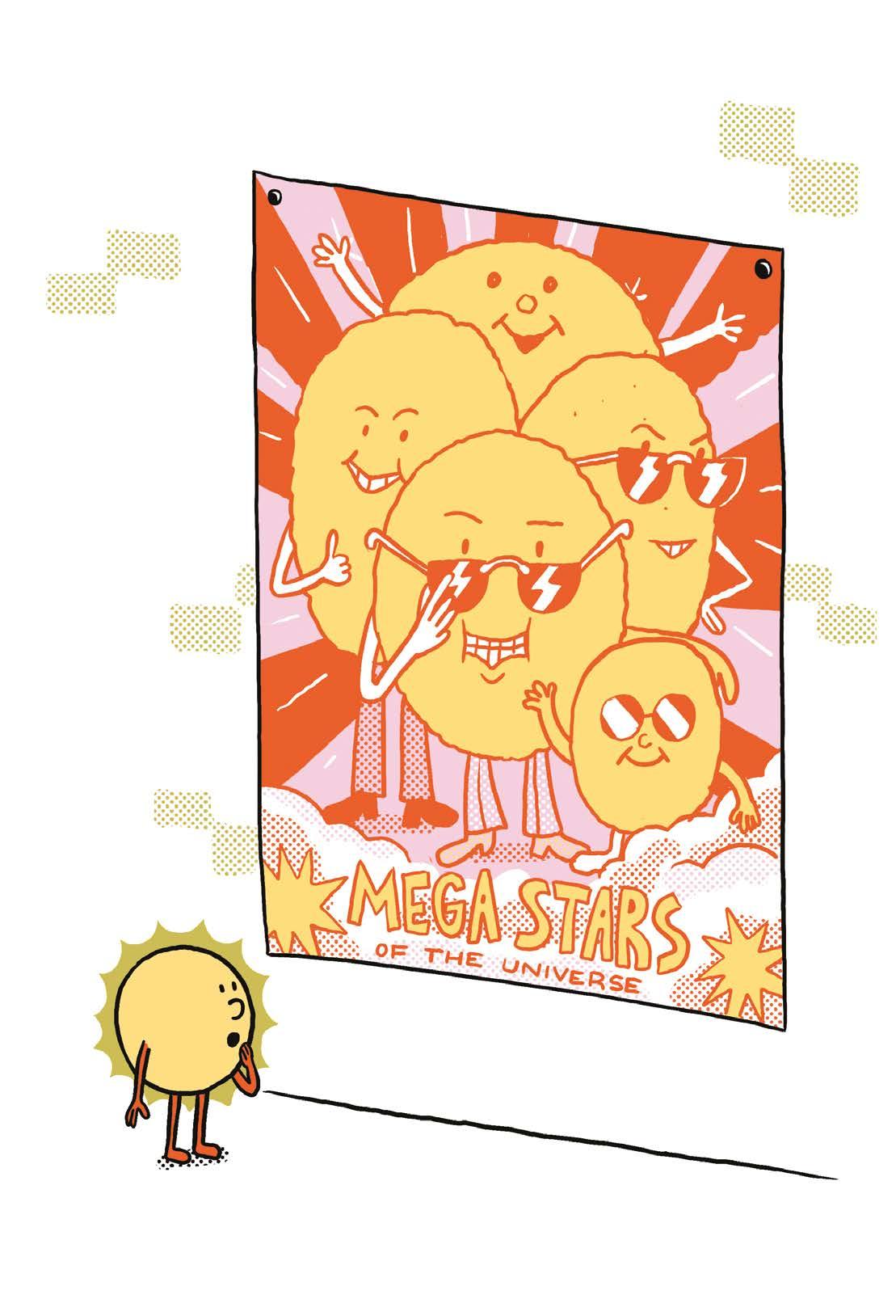

How five of the biggest stars in the universe measure up to the Sun
The Sun is mind-blowingly big, but in cosmic terms it’s actually an average-sized star. The largest stars we’ve found so far are hundreds of times bigger than the Sun, while others are less than a tenth of its size.
1,700 times bigger than the Sun* UY Scuti, Milky Way
1,540 times bigger than the Sun – WOH G64, Large Magellanic Cloud**
1,530 times bigger than the Sun – Westerlund 1-26, Milky Way
1,420 times bigger than the Sun – VY Canis Majoris, Milky Way
890 times bigger than the Sun – Betelgeuse,» Milky Way
How long it takes light from ten famous stars to reach Earth
It can take years for light from the stars to reach Earth. So when you’re looking up at the night sky, you’re really looking back in time, seeing light that stars gave off hundreds, thousands, millions, and, in some cases, billions of years ago.
1. The Sun – 8 minutes and 20 seconds
2. Alpha Centauri – 4 years*
3. Sirius – 9 years
4. Vega – 25 years
5. Aldebaran – 65 years
6. Canopus – 310 years
7. Betelgeuse – 642 years
8. Rigel – 863 years
9. Deneb – 1,500 years
10. Icarus –9,400,000,000 years**
*If the Earth was the size of a volleyball, UY Scuti would be a ball with a 200,000-kilometre diameter. Try playing with that on the beach.
**The Large Magellanic Cloud is a satellite galaxy that orbits around the Milky Way.
» To find out what could happen to Betelgeuse any … moment … now, see page 51.
*The estimated times from Alpha Centauri onwards have been rounded to the nearest year.
**Icarus, whose official name is MACS J1149+2223 Lensed Star 1, is the furthest individual star ever seen. The light we’re seeing from Icarus today was emitted by the star billions of years before the formation of the Earth.
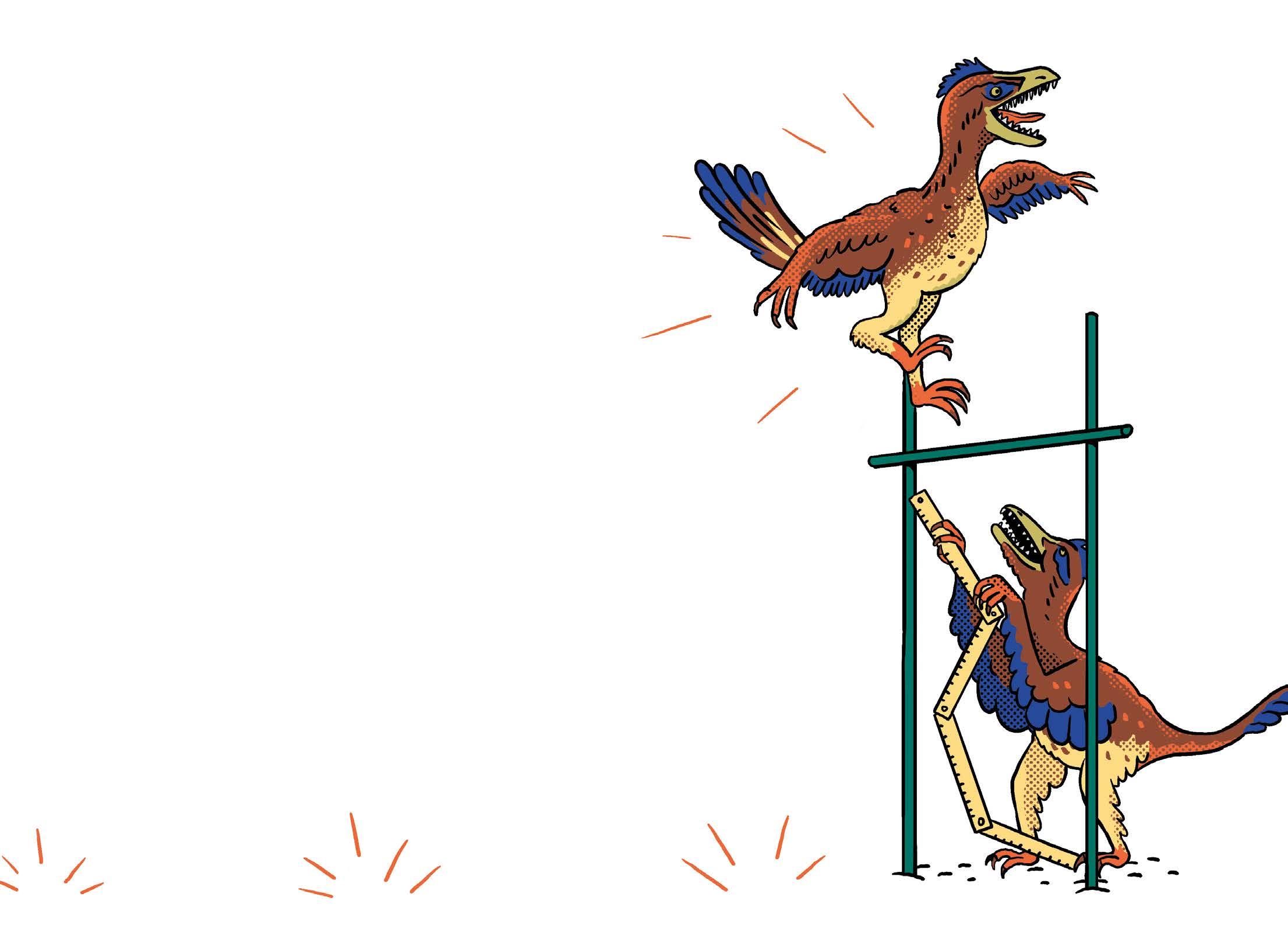
Seven of the deadliest dinosaurs and their killer features
1. Spinosaurus
Killer feature: Its enormous size. Spinosaurus was as big as a five-storey building.
2. Tyrannosaurus rex
Killer feature: The strongest jaws of any dinosaur. Its bite was around 49 times more powerful than a human being’s.
3. Utahraptor
Killer feature: Its agility. It could jump 5 metres into the air.
4. Carcharodontosaurus
Killer feature: Its jaw, which was big enough to swallow a human being in a single bite.
5. Velociraptor
Killer feature: Its large curved claw on each foot, which it used to wound its prey.
6. Mapusaurus
Killer feature: Not only was Mapusaurus one of the largest carnivores, it also had sharper teeth than a T. rex. Its teeth were curved with a jagged edge, ideal for slicing through flesh.
7. Coelophysis
Killer feature: Its speed. Coelophysis was a fast, agile hunter that could run at speeds of up to 48 kilometres per hour. There is also evidence to suggest that it hunted in packs to bring down larger prey.
Ten of the smallest machines ever made
1. Smallest abacus –
0.000001 nanometre*
A team of scientists built a counting machine using ten molecules of the element carbon that can be moved along a tiny groove on a copper surface like the beads of an abacus.
2. Smallest engine –
0.1 nanometre
Made from a single calcium ion (which is an atom with an electrical charge, and in this case a positive charge), the world’s smallest engine converts heat from laser beams into physical movement, which has been used to turn a tiny wheel. It’s around 10 billion times smaller than a car engine.
3. Smallest ‘car’ –
4 nanometres
Mostly built from carbon atoms, this molecular ‘car’ is so small you would need a powerful microscope to see it. Created by scientists as an experiment, it’s slightly wider than a strand of human DNA.
4. Smallest robot –120 nanometres
Tiny machines called nanorobots can be sent inside the human body to repair damaged cells and perform other medical tasks.**
5. Smallest watch –3.4 millimetres
Despite only being 3.4 millimetres wide, 1.4 millimetres thick, and weighing less than a gram, the smallest mechanical watch has 98 individual parts.
6. Smallest fidget spinner –5.1 millimetres
The world’s smallest metal fidget spinner could easily sit (and spin) on the tip of a sewing needle.
7. Smallest electric drill –6.7 millimetres
This scaled-down electric drill is powered by a small 3-volt battery. Its rotating metal head, or drill bit, can make 0.5-millimetre-wide holes in foam and soft wood.
8. Smallest telephone –47.5 millimetres
The smallest telephone that you can still use to make a phone call is 47.5 millimetres tall, 10 millimetres wide, and 21 millimetres thick.
*This stands for nanometre, which is one millionth of a millimetre.
**Doctors control the nanorobots from outside the body using magnets.
80 millimetres
Tom Wiberg from Sweden built the smallest motorcycle to be ridden by a human. The seat is 65 millimetres off the ground.***
280 millimetres
The smallest rideable unicycle is roughly the height of a school ruler. Its wheel has a diameter of just 12.7 millimetres.

***To prove it worked, Wiberg rode his miniature motorcycle, which he named Smalltoe, for a distance of 10 metres. It
has a top speed of 2 kilometres per hour.

• Written by editor-in-chief of the What on Earth! Magazine, in his hilarious signature style.
• Bright and playful illustrations by Andrés Lozano.
• Offers the nostalgia of books such as Schott’s Miscellany combined with the fact-packed excitement of Interesting Facts for Curious Minds.
150 lists you can’t resist.
Author: Andrew Pettie
Illustrator: Andrés Lozano
Pub date: 6 May 2027
Price: £9.99
Size: 216 x 135 mm
Format: Paperback with flaps
Extent: 256 pages
Age: 8+
ISBN: 9781804661857

The world’s most astonishing, hilarious and compelling lists, in a pocket-sized book. Are you a curious kid, who wants to know everything there is to know about, well, everything?! Then you’ve come to the right place! The Curious Kid’s Book of Lists collects the most fascinating and wow-worthy facts about our Universe and organises them into deliciously bite-sized lists. You can discover:
• The largest dinosaurs to have walked the Earth
• The biggest stars in the Universe (and how the Sun measures up to them)
• The smelliest things on the planet
• The smartest breeds of dog
• And the top inventions that changed the world… and how!
Take this compact compendium with you anywhere and amaze your parents, friends or relatives with mind-blowing facts. Written by the brainy editor-in-chief of the What on Earth! Magazine, Andrew Pettie, and illustrated by Andrés Lozano, this book will keep you hooked from start to finish.
Key selling points:
• Packed with 150 lists, perfect for kids who love comparing things, playing ‘Would you rather…?’ and ranking information.
• Pocket-sized format is ideal for reading on the go.
• The Curious Kid’s Book of Lists is a paperback edition of Listified! (ISBN 9781912920747) which has sold more than 71k copies globally.
Author
Andrew Pettie is a writer, editor and journalist who has contributed to The Times, The Sunday Times and the Daily Telegraph, where he was Head of Culture. He is now editor-in-chief of the What on Earth! Magazine. He is the co-writer of the award-winning Encyclopedia Infographica, and also wrote a history of Massachusetts for schools from What on Earth! books. He studied at St Peter’s College, Oxford University.
Andrés Lozano is a Madrid-born artist who divides his time between illustration and painting. As an illustrator he has worked for a wide range of international clients including The New York Times, Google, Virgin Atlantic and McSweeney’s. His work has been shown in exhibitions in Beirut, Los Angeles, New York, London, Madrid and Brisbane. He has co-authored several picture books originally published in the UK and the United States and now translated into more than ten languages.
SALES – Bounce Sales and Marketing Ltd, 320 City Road, London, EC1V 2NZ Tel: 020 7138 3650 | Fax: 020 7138 3658 | sales@ bouncemarketing.co.uk
ORDERS – Macmillan Distribution Limited, Cromwell Place, International Business Park, Lime Tree Way, Basingstoke, Hampshire, RG24 8YJ, UK orders@macmillan.co.uk
WHAT ON EARTH! –
The Black Barn, Wickhurst Farm, Tonbridge, Kent, TN11 8PS Tel: 01732 464621 info@whatonearthbooks.com
linkedin.com/company/what-on-earth-publishing
@whatonearthbook @whatonearth_books
@WhatonEarthPublishing @whatonearth.bsky.social @whatonearth_books
ISBN 978-1-80466-185-7