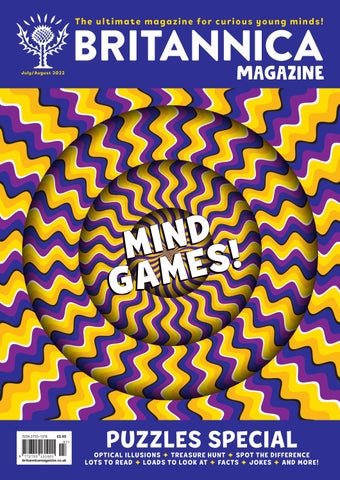
The ultimate magazine for curious young minds!
July/August 2O22
ISSN 2755-1318
£5.99 07> 07>
9 772755 131001 9 britannicamagazine.co.uk 772755 131001
MAGAZINE
PUZZLES SPECIAL
OPTICAL ILLUSIONS : TREASURE HUNT : SPOT T HE DIFFERENCE LOTS TO READ : LOADS TO LOOK AT : FACTS : JOKES : AND MORE!
Page 18
CONTENTS
Page 1O
Page 28
Page 4
A wild and wonderful world awaits you inside!
Page 24
4 Page 22
8 12 2
FACTOPIA! Follow the trail of hilarious illustrations and crazily connected facts. From a recordbreaking dog to the wonders of the human brain! SNAP IT! Eye-popping photos to amuse and amaze. Including a cave full of giant crystals! EUREKA! Fascinating inventions and discoveries. Find out why scientists are turning cabbages into concrete.
14 16
18
FASCINATING FACTS ABOUT JULY Featuring an alligator that fell from the sky and the world’s tallest sandcastle.
2O
LISTIFIED! Find out about 12 of the world’s most unusual jobs – including a water slide tester! – and which are the brainiest breeds of dog.
24
ELECTRIFYING FACTS ABOUT LIGHTNING Did you know that a bolt of lightning is only 2 to 3 centimetres
wide and hotter than the surface of the Sun? HOW TO BE KIND Find out how following the ‘golden rule’ helps you to be kinder to others and makes the world a better place! FASCINATING FACTS ABOUT AUGUST Including a 272-yearold shark, a famous speech that inspired the world and the first ever website published on the internet.
Page 38
47
Page 4O
53 54 56 6O Page 16
Page 1O
61 62 64 66
27 28 32 34
PUZZLES & GAMES SPECIAL Dive in to explore our 16-page pull-out! OPTICAL ILLUSIONS Discover how these 12 mind-bending illusions fool your brain. You will not believe your eyes! PICTURE QUIZ Can you spot all 2O mystery objects and hidden animals? COLOUR IT IN! A special colouring in challenge inspired by science and invention.
36
38
JUMBO PUZZLES & GAMES All your favourites including Animal Word Search, Connect the Planets, SpaceDoku, Word Wheel and Word Morphs. Plus, new games The Impossible Cube and The Lying Pirate. TRUE OR FALSE? Can you tell which of these astonishing ‘facts’ are true and which are made up? Mark your answers in the tick boxes and don’t forget to test your grown-ups!
4O
43 44
TREASURE HUNT Test your powers of observation with our summer treasure hunt. There are 12 objects hidden in the illustration. Plus, find six letters to spell out the secret word! EVERY SECOND Astonishing things that happen around the world each second! TIMELINE A collection of amazing prehistoric creatures. But there’s a twist – none of them is a dinosaur!
67
UNSEEN WORLDS The extraordinary microscopic creatures hiding all around us. Including the ones that are crawling about inside your bed! NODOBY KNOWS One of the universe’s great unsolved mysteries. This month: Cleopatra’s tomb. INFOGRAPHIC A fact-filled look at life in the fast lane. ABSOLUTELY EVERYTHING Tales of the Vikings, Normans and more! SEND IT IN! Readers’ photos and the fact of the month. ASK THE EXPERTS This month’s answers reveal the mysteries of Sat-Nav and the Nazca lines. THE BIG BRITANNICA QUIZ Stretch your brainpower with our deliciously tricky quiz. DO IT YOURSELF How to create amazing animal shadow puppets. SPOT THE DIFFERENCE Can you spot all 2O differences? JOKES & RIDDLES Hand-picked by our jokes editor May!
SEND IT IN! Email us your letters, photos and favourite facts to: editor@britannicamagazine. com Or write to us at: Britannica Magazine The Black Barn Wickhurst Farm Leigh Tonbridge Kent TN11 8PS
bam of
ic
m
i
ag
Follow the trail of crazily connected facts all the way from a record-breaking golden retriever to… the wonders of the human brain!
Dutch scientist Antonie Philips van Leeuwenhoek discovered microscopic life, which he called
By Kate Hale and Paige Towler Illustrations by Andy Smith The world’s shortest dog, Milly the Chihuahua, is only 9.65 cm tall – as a newborn, she could fit in a teaspoon
Teeny-tiny facts!
‘
animalcules’
To train future astronauts for space, NASA uses zero-gravity-simulating planes, one of which made passengers so nauseated they nicknamed it the
Vomit START HERE 4
Finley, a golden retriever from Canada, holds a world record for fitting the most tennis balls in his mouth at once: six
eo
on
Microscop
boo
ZANY FACTS
f a cross-se
ct
i
ct e
tudy, scientists di sc unknown specie over so e fb d a
m
1,OOO han et g in people’s or b livin ell ia yb er u ct
e
p e of ba
ne s
hat
Th
a ty
t ria
’s re
In o
p oos go ld
s on tt
Germy!
The world’s smallest snowperson is made of silica and only three microns tall – that’s so small it would take 25 of these tiny snowpeople to equal the width of a human hair
n ski
im a g e of o pic ni
on
Stom
ach spasms can cause a person to
co
sp e w vo m i t
Mic
ro s
t further
han the length of a small ca
r
a
as tro na u
sf or
er ou
s ir
I need the bathroom!
ns
p
t rip !
th e
ca
ng da e nb
i le i rt wh a f to ts
Let i
at let them pe e in s th s uit
t Beca e, i use gas is flammabl
ac e
lk wa
Comet
ut
special nappies o ns ear w p s
ce
Ast ro na
I’m gonna be sick!
Continued on next page
5
ZANY FACTS
Down on the farm!
One Australian farm is powered almost entirely by the waste from its pigs and cows To keep chicken poo from getting everywhere, some farmers put specially made nappies on their chickens
Gassy!
In one day, a cow can produce enough wind to fill 3O balloons
Continued from previous page
lp To he them float, manatee s have s pouche special that store their gas. they swim When t to deeper, wan they pas sw
ind
6
After he died, Albert Einstein’s brain was stolen by a scientist who wanted to study it
A chicken’s brain is partially inside its neck. Because of this, one chicken survived a whole year without a head
Goats and sheep do not have upper teeth – instead, they have a fleshy bulge called a dental palate
Alpacas can be trained to use litter trays
Feeling brainy?
The human brain is
squishy ,
almost like soft, pink jelly
Surgeons often perform brain surgery while the patient is awake! This is because the brain has no pain receptors, so humans can’t feel pain when it is touched.
7
PHOTOS
SWIM BUDDIES!
Antar is a golden retriever that lives on board a boat in Egypt and loves to go swimming. As Alex Mustard, the photographer who took the picture, says: ‘We were in deep water but Antar was totally relaxed. He was not at all interested in the people around him, and only wanted to get close to the dolphin!’
8
Astonishing photos from around the world
A
!
! H A AA 9
PHOTOS
! W
O
W
CITY IN THE CLOUDS
These tall buildings look as if they’re floating in the sky. But they are actually standing on a cloud-covered mountain in Seoul, South Korea. CREDIT: WONYOUNG CHOI, SONY WORLD PHOTO AWARDS
HOP ! 10
HOP, SKIP AND A JUMP!
Around 1OO rabbits took part in this athletics contest for bunnies in Kromeriz, Poland. Competition events included the obstacle race (below), long jump and sprint (or should that be hop?).
THE CRYSTAL MAZE
!
Up to 12 metres long and 1 metre wide, these giant crystals are made from sulphide chemicals in water. The crystals formed very slowly over the course of 25O,OOO years in a cave at the Naica Mine in Chihuahua, Mexico.
WO
AH!
PEDAL POWER!
Have you ever dreamt of driving in a real Formula 1 race? These young drivers got a taste of the excitement at the Settrington Cup, an annual pedal car Grand Prix held at the Goodwood Motor Circuit, UK. All the pedal cars, which are called Austin J4Os, are built with a dummy engine, working headlights and a horn in case another driver gets in your way! 11
Eureka! Did great white sharks cause the end of megalodons?
The megalodon – a prehistoric animal that swam in the Earth’s oceans between 23 million and 3.6 million years ago before becoming extinct – was the largest shark that ever lived. As you can see from the illustration below, a megalodon was an enormous creature. It grew to lengths of more than 18 metres – which is more than three times longer than a great white shark – and could weigh as much as 60 tonnes, which is more than seven African elephants! However, size isn’t everything, and a new scientific study suggests that great white sharks could have been partially responsible for megalodon becoming extinct. Scientists have for a long time debated what caused these giant prehistoric sharks to die out. So a team of researchers used traces of the element zinc, which is found in shark’s teeth, to find out more about the megalodon’s diet. By comparing the levels of zinc in the teeth of megalodons and
A megalodon’s teeth are bigger than a great white shark’s. great white sharks (examples of both are pictured above), the scientists found that during the period of Earth’s history when the two animals lived alongside each other, they may have competed for the same sources of food, such as dolphins, whales and porpoises. This means that the great white shark, which has lived on Earth for more than 400 million years, could have been a reason for megalodon’s extinction. However, the scientists said that other factors could have also played a role, such as Earth’s changing climate.
HOW MEGALODON MEASURES UP…
Megalodon (16-18 m) Great White Shark (5 m) Diver (1.75 m) 5m 12
1O m
15 m
2O m
The latest astonishing discoveries, inventions and scientific breakthroughs.
NEWS
Why do giraffes have long necks? It was widely thought that giraffes’ long necks evolved so that giraffes could reach and eat leaves at the top of trees. But new research suggests that their necks could have got so long for another reason: to compete with rivals. Male giraffes sometimes wrestle and fight with other males to compete for mates. And the researchers found that having longer, stronger necks gave male giraffes a competitive advantage.
How scientists turned cabbages into cement! Scientists in Japan have developed a new way of turning food waste into cement. The team found that a whole variety of foods – including cabbages, onions, banana peel and orange peel, tea leaves, ground coffee and pumpkins – could be included as part of this environmentally friendly concrete-like building material, which could be used to build houses in the future. To create this extraordinary new material, the scientists dried and powdered the waste
vegetables, which were then heat-pressed in a special mould. Not all the waste food materials they tried were equally effective. But the team
was surprised to find that most were able to create a material which was stronger than concrete. Cabbages turned out to be the best vegetable of them all – producing a building material that was nearly four times stronger than concrete! Amazingly, if the material is no longer needed for building, it can be ground up and mixed with water so that it becomes edible once again. Now that is true recycling!
First picture of the black hole at the centre of our galaxy Did you know that at the middle of the Milky Way there is a black hole? Its name is Sagittarius A* and it has a mass four million times bigger than that of our Sun. This is the first picture ever taken of Sagittarius A*, which is located in the dark central region of the photo. The circle of orange light comes from super-heated gas that is being accelerated by the black hole’s huge gravitational pull. Thankfully, Earth is 26,000 light-years away, so we are in no danger of being sucked in.
This new robot is smaller than a flea! Engineers at a university in the United States have developed the smallest ever remotecontrolled walking robots. Just half a millimetre wide – which means they could fit through the eye of a needle (pictured right) – these tiny robot crabs can bend, twist, crawl, walk, turn and even jump!
The researchers are also developing millimetre-sized robots that look like worms, crickets and beetles. In the future, these micro-robots could perform useful tasks in tightly confined spaces. 13
1957
2O13
After surviving an attack by an extremist group called the Taliban for speaking out against their denying girls in Pakistan an education, Malala Yousafzai was invited to give a speech at the UN on July 12th about the power of learning. It is now known as Malala Day.
On July 6th, Althea Gibson became the first black player to win a tennis championship at Wimbledon, the world’s oldest major tournament. Gibson’s victory in the women’s singles helped to pave the way for other great black tennis champions, including sisters Venus and Serena Williams.
1O fascinating facts 1985
A charity pop concert called Live Aid was held on July 13th to raise money to help people suffering from famine in Africa. More than a billion people around the world watched the concert on TV, as musicians played in both London and Philadelphia, USA. The concert raised more than £1OO million.
1885
The French scientist Louis Pasteur successfully tested his vaccine for rabies on July 6th. His patient was nine-year-old Joseph Meister (left), who had been bitten by a dog carrying the usually fatal disease. 14
1923
In Mongolia on July 13th, a team led by the explorer Roy Chapman Andrews found the first dinosaur eggs known to science. Years later, other experts worked out that the eggs were laid by an Oviraptor.
1843
On July 2nd, an alligator fell out of the sky during a storm in Charleston, USA. It is thought to have been picked up from a nearby river by a whirling column of air called a waterspout.
1913
On July 1Oth, the highest recorded temperature on Earth, 56.7°C, was measured at the appropriately named Furnace Creek, USA.
1913
Patented on July 8th, the Erector Set, a LEGO-style building kit, was known as the ‘world’s greatest toy’. It is still on sale today!
1969
On July 2Oth, astronauts Buzz Aldrin and Neil Armstrong (who took this photo and can be seen reflected in Aldrin’s helmet) became the first people to walk on the Moon.
about July… 2O21
This is the world’s tallest sandcastle! It was built in the village of Blokhus in Denmark on July 2nd and is more than 21 metres tall, which is roughly the height of a six-storey building. It took more than 4,86O tonnes of sand to create. However, the sandcastle makers did cheat a little bit. As well as being built from sand, the castle has been made stronger with glue and clay.
15
LISTS
LISTIFIED! Prepare to be amazed (and amused!) by the unusual facts crammed into these irresistible lists.
16
ODD JOBS Twelve of the world’s most unusual jobs
1
Teddy bear surgeon
Some skilful craftspeople are experts in repairing broken or injured teddies. These ‘teddy bear surgeons’ can be found working in toy shops or specialist ‘medical’ facilities such as the Leith Toy Hospital in Edinburgh, Scotland.
2
Professional sleeper
Hotels in several countries around the world, such as China and Finland, pay people to sleep in one of their rooms for a night and then file a report on how comfy the bed is.
3
Swan counter
All the mute swans* in the UK are legally the property of the reigning king or queen. It is the unusual job of two people – the Warden of the Swans and the Marker of the Swans – to count all the mute swans on the River Thames each year, in a 900-year-old tradition called swan upping.
4
Professional queuer
People who don’t want to
wait in busy lines can pay someone to queue in their place for all kinds of things, from film premieres to the opening of new shops. Once professional queuers approach the front of the line, they give the person who’s paid for their time-saving services a call so they can swap places.
5
Armpit sniffer
Professional ‘odour judges’ have the eyewatering job of sniffing
people’s armpits to test how effective different types of deodorant are in controlling sweaty smells. If you have a sensitive nose, there are similar careers available in sniffing bad breath and pongy feet.
6
Iceberg mover
When icebergs break off from polar ice caps, they usually melt slowly into the saltwater ocean. French engineer Georges Mougin had the ingenious idea of towing the icebergs across the ocean with a tugboat so they can be used in hotter parts of the world as drinking water. In what would be a world first, Mougin and a team of glacier scientists are currently working out how to tow an iceberg from Antarctica to the South African city of Cape Town, which often suffers from water shortages.**
7
Clever Canines Bicycle fisher
Amsterdam in the Netherlands is a city famous for two things: canals and bicycles. So it’s not surprising that more than 10,000 bikes end up in the canals each year. It is someone’s full-time job to sail a boat up and down, fishing them out.
8
Water slide tester
Some travel companies fly a specific person around the world to test how fun the water slides are at different holiday resorts. British water slide tester Tommy Lynch did it for four years, describing it as the ‘best job in the world’.
9
Passenger pusher
At metro stations in Japan, members of staff wearing white gloves and smart uniforms have the job of shoving as many passengers as possible into the carriages of each train.***
1O
Dog food taster
Because dogs aren’t very good at filling in surveys, it’s left to humans to try new flavours of dog food to see how they taste. Pet food tasters are usually experts in food science and write reports on each new recipe’s nutritional value, as well as saying if it’s yummy (from a dog’s point of view).
11
Funeral mourner
Known officially as a moirologist, a professional mourner can be hired to
attend the funeral of someone they don’t know. A moirologist can cry during the service and interact with the other guests. There are many reasons why a moirologist might be called upon, one of which is to make it seem as though the deceased was popular and well-liked.
12
Snake milker
Snake venom is a valuable substance used in a variety of medicines. But aside from asking the snake politely, how can you get venom from it? The answer is to hire a snake milker, who carefully holds the snake’s head while encouraging it to bite down on the edge of a glass beaker. The snake will then release venom into the beaker, as if it’s biting its prey.
*There are three species of swan native to the UK: mute swans, Bewick’s swans and whooper swans. **Mougin estimates that the perfect iceberg for towing would be 1,000 metres long, 500 metres wide, 250 metres deep and weigh 113 million tonnes. An iceberg of this size contains enough fresh water to supply the whole of Cape Town for two and a half months. ***They are known as oshiya, which in Japanese means ‘pushers’ or ‘stuffers’. Oshiya have to politely let the passengers know before they start pushing them and are only allowed to push their backs or shoulders. Training to become an oshiya takes six months.
Ten of the brainiest breeds of dog An expert in dog psychology called Professor Stanley Coren created a series of tests to measure the intelligence of different breeds of dog. Coren’s tests investigated three kinds of doggy intelligence. First, a dog’s ability to perform tasks it was bred for, such as herding animals and fetching objects. Second, a dog’s ability to solve problems on its own, such as retrieving food placed beneath an upturned bowl. Third, a dog’s obedience in following instructions from humans. Overall, these are the dog breeds that came top of the class.* *The three breeds of dog that received the lowest scores on Coren’s tests were the English bulldog, Basenji and Afghan hound. Listified! by Andrew Pettie and illustrated by Andrés Lozano is out now.
1O AUSTRALIAN CATTLE DOG
9 ROTTWEILER
8 PAPILLON
7 LABRADOR RETRIEVER
6 SHETLAND SHEEPDOG
5 DOBERMANN PINSCHER
4 GOLDEN RETRIEVER
1 2
3
BORDER COLLIE POODLE GERMAN SHEPHERD
17
NATURE
Lightning is a bright burst of electricity usually produced by a thunder storm. It works in the same way as the spark you sometimes see (and the small shock you feel) when you rub your feet across carpet and then touch something metal. Except on a much, much bigger scale!
1O electrifying facts 1
Lightning is very, very hot. A bolt of lightning can raise the temperature of the air around it to as high as 27,760°C, which is five times hotter than the surface of the Sun!
2
A flash of lightning can travel at speeds of up to 200,000 kilometres per second, which is two thirds the speed of light, the fastestmoving thing in the universe.
3
A typical lightning bolt carries 300 million volts of electricity and can generate 500 megajoules of energy, which is enough to boil around 1,500 kettles of water.
4
The average lightning flash lasts for 0.2 seconds. However, the longest-lasting recorded single lightning flash lasted for 17 seconds, over Uruguay and northern Argentina in June 2020.
and Texas in the United States on April 29th, 2020.
7
A typical lightning bolt is 2 to 3 centimetres wide, which is roughly the width of a grown-up’s thumb.
When a bolt of lightning strikes a tree, it can cause the tree to explode. The extreme heat from the lightning boils the water and sap inside the tree, creating steam that can cause the tree’s trunk to split and its bark to blast off.
6
8
5
The average lightning flash is between 3 and 5 kilometres long. However, the longest recorded single lightning flash stretched for more than 750 kilometres over the states of Mississippi, Louisiana
Lightning strikes most frequently in Venezuela, where the Catatumbo River enters Lake Maracaibo. In just one night, the sky above the lake can be illuminated with 40,000 bolts of lightning. That’s around 28 lightning strikes per minute!
9
Lightning doesn’t only occur during thunderstorms. It has been seen during volcanic eruptions, hurricanes, forest fires and even snowstorms.
Lightning strikes most frequently on Lake Maracaibo in Venezuela.
18
1O
Around the world, there are more than 3 million lightning flashes every day.
about LIGHTNING!
19
EMPATHY
HOW TO BE KIND
Discover how following the ‘golden rule’ helps you be kinder to others and makes the world a better place. By John ‘The Planetwalker’ Francis Illustrations by Josy Bloggs
F
or centuries, people have been thinking of new ways to show kindness. Incredibly, many religions and cultures have come up with a very similar idea. It is called the golden rule. Each version has the same core message: treat other people as kindly as you would like to be treated. The rule encourages you to feel empathy. This is when you
understand someone else’s feelings. It also helps you know how to act. For example, it tells you not to steal, because you wouldn’t like it if someone stole from you! Here are just a few examples of the many versions of this rule. On the next page, learn about some inspiring stories of kindness.
‘Regard your neighbour’s gain as your own gain, and your neighbour’s loss as your own loss.’
From Treatise of the Exalted One on Response and Retribution, an important Taoist scripture by T’ai Shang Kan Ying P’ien
Continued on next page
‘Do not do unto others what you would not want others to do unto you!’ ‘Each one should do unto others as they would have others do unto them.’
From The Analects of Confucius
Manco Cápac, legendary founder of the Incan empire
‘I will act towards others exactly as I would act towards myself.’
From the Siglovadasutta, a text that sets out the rules that Buddhists should follow 20
‘Love your neighbour as yourself.’ From Leviticus 19:18 in the Torah. This is the first part of the Hebrew Bible, which is also known as The Old Testament and is sacred to people of the Jewish and Christian faiths.
‘One going to take a pointed stick to pinch a baby bird should first try it on themself to feel how it hurts.’ Yoruba proverb (Nigeria)
‘As you regard yourself, regard others as well.’
From the Guru Granth Sahib, the religious scriptures of Sikhism
‘None of you truly believes, until he loves for his brothers what he loves for himself.’ A saying of the Prophet Muhammad, the founder of Islam
‘What you would not find acceptable if it were done to you by another, do not do to them.’ Akan proverb (Ghana)
‘Do not do to another what you do not like to be done to yourself.’
From the Mahabharata, an important text in Hinduism 21
EMPATHY
STORIES OF KINDNESS Standing Up for Others Marcus Rashford is an English professional footballer. In 2O2O, he used his fame to stand up for something beyond sport. He campaigned for many British children to be given food vouchers in the school holidays as well as during term time. Growing up, his family didn’t have much money. This meant that he understood how, for some
people, it can be a struggle to put food on the table. Rashford wanted to stand up for these families. He said that ‘as long as they don’t have a voice, they will have mine.’ This started a wider movement. Now, many restaurants offer free meals to children in need, too.
Access to Education Safeena Husain was a young girl who grew up in poverty in New Delhi, India. She managed to leave behind her tough childhood to study at the London School of Economics, and grew up to be a successful adult. But she never forgot where she had come from, and eventually Safeena went back to India to start a charity that helps girls just like her. Now her organization, which is called Educate Girls, is working to help millions of girls go to school so they can also follow their dreams, just as Safeena did. 22
Helping to Heal There was much suffering during the Second Italian War of Independence in 1863. Swiss businessman Henry Dunant was shocked and saddened by this, so he urged world leaders to do more to help victims of war. It also gave him an idea: to train groups of people to provide help during times of war. The project became The International Federation of Red Cross and Red Crescent Societies. It provides protection and help for victims of war and violence all over the world.
Do Something for Nothing Every day in London, hairdresser Joshua Coombes saw many people who were experiencing homelessness. He decided to do something to help. So he offered them haircuts. By using his skills, Coombes helped people feel good about themselves. This also allowed him to build connections with people who are often isolated. He started the #dosomethingfornothing initiative, to encourage other people to get involved around the world. He was even joined by a vet who cared for homeless people’s dogs.
Animal Assistance It’s not just people who can benefit from acts of kindness and charity – animals can, too! One animal charity is The World Wildlife Fund (which is usually called the WWF). The charity was founded in 1961 to protect animals that were being threatened by human activities. In its first year, the WWF helped to save animals such as the bald eagle in North America. They also established a small nature reserve in Colombia, South America. Now the WWF is one of the world’s most well-known animal charities. One
project is providing funding to study and save endangered tigers in Asia. In 2O16, the WWF announced that the number of wild tigers had increased for the first time in more than 1OO years!
Paying a compliment
How do you feel when you get a compliment? It feels good, right? Telling someone what you like or appreciate about them is a great way to make others feel good, too. You could even write them a note or a letter to tell them how great they are. 23
2O16
79 CE
After years of inactivity, Mount Vesuvius erupted on August 24th, burying the nearby Roman cities of Pompeii and Herculaneum in volcanic ash and killing thousands of people.
Greenland sharks can live to be at least 272 years old according to a scientific study published on August 11th. This makes them Earth’s oldest vertebrate (which is any animal with a backbone). In fact, scientists estimate that Greenland sharks could possibly live to be 5OO!
1O fascinating facts 1963
1227
Genghis Khan, who died on August 18th, was a conqueror who brought together the wandering peoples of central Asia and made their lands into the country of Mongolia. He took his armies beyond Mongolia and built up one of the largest empires in history.
3114 BCE
The Mayan calendar was a dating system used by the Mayan civilisation of central America. Its first ‘Great Cycle’ started on August 11th and continued for 5,125 years, ending in 2O12.
2O12
After an eight-month, 352-million-mile journey through space, NASA’s Curiosity rover landed on Mars on August 6th. It went on to find that early Mars could have supported life. 24
On August 28th, around 25O,OOO people marched on Washington D.C., USA, to demand equal rights for AfricanAmericans and an end to racial prejudice. At the march, the civil rights leader Martin Luther King Jr gave a powerful and moving speech in which he described what the world could be like if people were no longer ‘judged by the colour of their skin but by the content of their character’.
1911
Leonardo da Vinci’s Mona Lisa was stolen from the wall of the Louvre gallery in Paris, France, on August 21st. It was two years before the thief was caught and the painting returned.
1991
British computer scientist Tim Berners-Lee published the first ever website on August 6th. It described the ‘world wide web’, the system he invented to help scientists share information.
about August… 1947
India became an independent country, free of British rule, at the stroke of midnight on August 15th. It was a great victory for Mahatma Gandhi, the pacifist leader of the Indian independence movement.
2O18
Archaeologists identified what could be the world’s oldest cheese in a study published on August 15th. The 3,2OO-year-old cheese was made from sheep and goat’s milk and discovered in an ancient Egyptian tomb. 25
Have you heard about our new Reading Club for schools?
Cut out share t and with yo his page ur teac so the her…
Join the Britannica Magazine Reading Club at your school and not only will you get monthly yc All scho an find out m copies of the magazine, you will be able to do ols can ore. access u p O to amazing activities and other fun stuff to explore 2O ⁄O d iscount a from th the world of Britannica Magazine even more. e cost o f s u b s c r Friends, facts and fun! What more could you want?! iptions ! To find out more, go to:
britannicamagazine.co.uk/reading-club
START HERE
TURN THE PAGE!
16-PAGE PULL-OUT! 27
MIND GAMES
Café wall illusion Look at the lines running horizontally across this pattern. Are they straight or angled? The lines appear to be angled towards each other. In fact, they are all parallel. Use a ruler to check! The illusion is created by the arrangement of yellow tiles between the horizontal lines. This jagged pattern fools your brain.
1
2
12 INCREDIBLE ...AND Sometimes we see things that aren’t really there. This is because the brain has to decode the information that it receives from the eyes. When the brain is confused by something, it can change the way we see it in order to make sense of it. These amazing illusions show some of the ways your brain can be fooled! By Chris Harrison 28
Fraser spiral Look at the circular yellow lines on the left. What shape do they form? It looks as if the yellow lines form a spiral that gets smaller and smaller as it approaches the centre. Now place your finger on one of the yellow lines and follow the shape of its curve around the page. As you will see, each yellow line forms a concentric circle. There is no spiral! This illusion is created by the alignment of the yellow circles and the other, triangular shapes on the pattern. Together, they fool your brain into seeing a spiral which isn’t really there at all!
Adelson Checker Shadow
Ebbinghaus illusion
1
Compare the squares labelled 1 and 2. On the left, 2 appears to be a lighter colour. On the right, the grey line shows that the two squares are in fact exactly the same colour! The shadow cast by the apple fools your brain into making square 2 appear lighter than it really is.
Look at the red circles in the middle of these patterns. Which is bigger? Amazingly, they are the same size! This illusion is created by your brain comparing the blue circles with the red one. Your perception of how big the red circle is changes depending on the size of the blue circles surrounding it.
2
HOW THEY TRICK YOUR BRAIN! Shepard Tables Which of these red tabletops is longer? The top one seems to be longer but they are actually identical shapes. Use tracing paper to check! The drawing of the table legs makes them look like 3-D objects. This tricks your brain into thinking that the end of the table at the top must be further away.
Expanding Hole illusion Look at the large black blob in the middle of this pattern. It seems as if the black shape is expanding, and you
are slowly moving towards it. This illusion works by making the pupils in your eyes dilate (become wider)
and so tricking your brain into thinking you are about to enter a darkened space, like a cave or tunnel. 29
MIND GAMES
Hermann Grid Look at one of the meeting places or intersections where two white lines cross. Smudgy grey dots seem to appear at the other intersections of the white lines, though not at the intersection you are looking at
directly. The contrast between the black squares and white lines fools you into thinking there must be bits of grey in between. When your eyes focus on an intersection directly, they see that nothing is there!
Moving squares illusion Look at this pattern of coloured squares. What do you see? Incredibly, the squares around the edges of the one you are focusing on directly
appear to be gently moving. The illusion is created by the combination of light colours (yellow, orange and white) and dark colours (black
and purple) in each square. The pattern tricks your brain into thinking it can see movement when in fact all the squares are completely still!
Troxler fading illusion Stare at the red dot for 3O seconds. What happens? After a while, the blurry blue circle should gradually disappear. This is because your brain gets used to seeing the blue circle at the edges of what it is focusing on (the red dot). So after a while your brain starts to ignore the blue circle. If you look at the circle directly, it reappears! 30
Light bulb illusion Stare at the black light bulb for 25 seconds. Now immediately start staring at a blank white wall or a white piece of paper. What do you see? The shape of a glowing white light bulb should magically appear. This illusion is created by your eyes getting used
to looking at the black light bulb. When you then look at a white surface, the light receptors in your eyes are briefly overwhelmed by the sharp contrast. This creates a bright white version of the light bulb in your brain called an ‘afterimage’.
Rotating snakes Look at the circular patterns on the left and allow your gaze to move across the page, occasionally stopping to focus on a particular point. What do you see? Incredibly, it looks as if the snakes are moving! And did you notice that some of the snakes are rotating in a clockwise direction and others are rotating anticlockwise? This illusion is created by the ordering of the different-coloured bands in the snake’s ‘coils’, which fool your brain into thinking the coils are moving when in fact they are completely still! The pattern on the cover of this magazine creates a similar optical illusion.
Impossible shapes Look at these shapes. How many rectangular blocks can you see? Which side of the triangle is closest to you? How does the cube fit together? These impossible shapes trick the brain by following some rules of 3-D drawing and breaking others. 31
9
2 1
1O
MYSTERY OBJECTS 7
4 3
8
5
6
Can you work out what you’re looking at in each of these 2O photos? 32
19
12 11
2O
HIDDEN ANIMALS 17
14 13
18
15
16
Did you spot them all? To see the answers, go to: britannicamagazine.co.uk/ picture-quiz 33
To see the answers, go to: britannicamagazine.co.uk/colouring-in
This illustration of a human body, based on a famous drawing by the Italian artist Leonardo da Vinci, is filled with people and objects related to science. Can you find these 1O objects hidden within the body? 1. Calculator, 2. Digital watch, 3. Space Shuttle, 4. Telescope, 5. BBC microphone, 6. Rubik’s Cube, 7. Sputnik satellite, 8. First mobile phone, 9. Microchip, 1O. Gramophone.
COLOUR IT IN!
Stumped? Don’t worry, you can find the answers to all the puzzles on page 42.
ANIMAL WORD SEARCH Can you spot the 26 animals hiding somewhere in our wild and wonderful word search puzzle? Good luck!
Q
U
E
I
K
Z
Q
E
Y
A
K
K
O
U
Q
B
Z
L
I
F
V
Y
L
I
N
G
G W
I
M
Z
F
W
L
W D
A
I
R
R
V
A
R
B
V
Y
X
C W O O
R
A
G
N
A
K
V
N
A
X
G
A
R
B
E
Z
S
P
I
D
E
R
M O
N
K
E
Y
U
EMU
E
S
R
E
D
H
I
P
P
O
P
O
T
A
M
U
S
D
E
G
FLAMINGO
S
H
C
E
E
R
V
U
Y
M
N
C
R
G
X
V
R
N
O
A
P
D
S
V
A
M
I
C
G
I
U
A
I
E
I
H
Z
A
N
J
IGUANA
J
A
O
I
C
T
U
B
H
G
A
Q
D
L
I
A
E
I
A
G
JAGUAR
M
N
G
F
F
J
W
P
A
R
K
F
J
N
X
H
E
N
K
T
V
K
N
C
D
T
L
H
D
L
T
R
O
P
S
T
E
A
E
T
MONGOOSE
A
Z
I
B
E
O O
V
I
Z
L
C
J
I
E
N
N
M
D
P
NAKED MOLE RAT
H
M M
T
D
S
A
R
C
T
E
E
F
R
A
S
K
S
M
K
B
Z
A
P
D
R
O
T
R
R
E
Y
R
F
N
H
T
A
O W
C
Y
L
L
K
C
Z
O O
A
A
S
P
B
L
G
A
T
L
E
B
S
F
A
L
I
L
S
G
R
P
A
H
X
M
T
B
K
E
B
S
B
F
I
F
P
Q W
X
N
R
M
D
A
G
U
M Q
R
A
R
N
A
T
U
G
N
A
R
O O
T
D
O
R
Z
O
S
A
D
VULTURE
M
E
E
Z
N
A
P
M
I
H
C
M
K
O
S
K
W
R
T
G
WOMBAT
S
U
F
E
A
H
S
L
Z
A
Y
A
K
I
G
U
A
N
A
E
C
X
X
V
U
L
T
U
R
E
A
X
C
L
O W A
N
X
R
WORD WHEEL Use the word wheel to help find the answers to the five clues below. All the answers contain the middle letter, and each letter can only be used once. Clue: The first meal of the day (9 letters). Answer: Clue: A person who makes bread (5 letters). Answer: Clue: Used for carrying shopping (6 letters). Answer: Clue: You use them to slow down the wheels of your bicycle (6 letters). Answer: Clue: A martial art developed in Asia (6 letters). Answer: 36
F R
A E A K S T B
AARDVARK BADGER CHIMPANZEE DOLPHIN
GREAT WHITE SHARK HIPPOPOTAMUS
KANGAROO LLAMA
ORANGUTAN PARROTFISH QUOKKA RHINOCEROS SPIDER MONKEY TASMANIAN DEVIL UMBRELLABIRD
X-RAY FISH YAK ZEBRA
WORD MORPHS Change the word RUG to BAT in 3 moves by changing one letter at a time. Each new word you create by changing a letter must be a proper word. Then try changing BACK to DIRT in 4 moves. And FOOT to TALL in 4 moves.
RUG ——— ——— BAT
BACK ———— ———— ———— DIRT
FOOT ———— ———— ———— TALL
CONNECT THE PLANETS
SPACE-DOKU!
Draw a line to connect each pair of planets. You can’t use diagonal lines and the lines can’t cross or touch each other. You must fill the whole grid with lines but only one line is allowed in each square.
Fill all the empty squares so that every row, column and 3x2 box contains a picture of a rocket, an asteroid, a space station, a crescent moon, a satellite and a space shuttle.
THE IMPOSSIBLE CUBE The shape on the left can be folded up to form a six-sided cube. Look at the pattern of symbols on the cubes labelled A to F below. Which of these cubes is impossible to make from the shape on the left? A
THE LYING PIRATE You’ve captured a pirate and his three chests. However, not all the chests contain treasure. If there isn’t treasure in a chest, it contains snakes. The lying pirate gives three statements – and you know he never tells the truth. Can you work out which chest or chests contain treasure?
B
C
D
E
F
A
Only one chest has treasure! B
Chest C is full of snakes! C
Chest A is full of treasure! 37
QUIZ
1
The average cumulus cloud weighs more than 60 elephants.
TRUE
2
FALSE
Boomerangs don’t work in space.
TRUE
FALSE
3
The longest recorded human fart lasted for 42 seconds.
TRUE
4
FALSE
All carnivorous dinosaurs walked on two legs.
TRUE
FALSE
5
There are more stars in our galaxy than there are trees on Earth.
TRUE OR TRUE
Can you tell which of these 3O astonishing ‘facts’ are true – and which are completely made-up? Mark your answers in the tick boxes and then turn the page upside down to find out if you were right. And don’t forget to test your grown-ups, too! By Sarah Hampton
FALSE
6
More people are killed each year by snails than by sharks.
TRUE
7
FALSE
Olympic gold medals are mostly made of silver.
TRUE
8
FALSE
Butterflies taste with their wings.
TRUE
FALSE
9
If you cut off your hair and tied it together into a single cord, it could support the weight of a cow.
TRUE
FALSE
1O
Every other planet in the solar system could fit in the space between Earth and the Moon.
TRUE
11
A human being could outrun a hippopotamus.
TRUE
38
FALSE
FALSE
12
After 1987 the next year to contain four different numbers was 2013.
TRUE
13
FALSE
Goats’ eyes have rectangular pupils.
TRUE
FALSE
14
Human beings have only five senses.
TRUE
FALSE
15
You could swim through the veins of a blue whale.
TRUE
FALSE
FALSE The Eiffel Tower gets taller in the summer.
FALSE TRUE
FALSE
Ants have five lungs.
FALSE FALSE FALSE
TRUE
FALSE
The horned lizard can shoot blood from its eyes.
24
FALSE
TRUE
FALSE
Dung beetles use the Milky Way to navigate at night.
22 TRUE
FALSE
Hippopotomomonstro sesquippedaliophobia is a fear of long words.
21
FALSE
39
Answers
When poured, hot and cold water
FALSE
TRUE
On the planet Venus, a day lasts longer than a year.
23
FALSE FALSE FALSE
TRUE
make different sounds.
1) True. 2) False. In 2OO8, an astronaut threw a boomerang on the International Space Station to see if it would come back. It did. 3) False. The longest recorded fart lasted for 2 minutes and 42 seconds! 4) True. 5) False. Scientists estimate that there are between 1OO billion and 4OO billion stars in the Milky Way, and around 3 trillion trees on Earth. 6) True. Freshwater snails carry a deadly disease called schistosomiasis that kills thousands of people each year. On average, sharks kill just 1O people each year. 7) True. Olympic gold medals are more than 9O per cent silver and plated with just 6 grams of pure gold. 8) False. Butterflies taste with their feet. 9) True. A cord of your hair could support the weight of 18 cows! 1O) True. 11) False. Hippos have been measured running at speeds of up to 48 kph, which is faster than the world record-holding sprinter Usain Bolt. 12) True. 13) True. 14) False. Scientists think humans have more than 2O senses, including the senses of balance, space and time. 15) True. 16) False. It can take as long as 17O,OOO years. 17) True. 18) False. There are no muscles inside your fingers. They are moved by muscles in the palm of your hand and forearm. 19) True. 2O) True. Hot water has a higherpitched sound because the molecules of water in it are moving faster. 21) True. 22) True. 23) True. 24) True. It does this to defend itself from predators. 25) True. 26) False. Dogs were domesticated first, more than 15,OOO years ago. 27) True. 28) False. Ants don’t have lungs at all. They take in oxygen through openings in their abdomens called spiracles. 29) False. More than 85 per cent of the world’s population live in the Northern Hemisphere. 3O) True. Hot weather causes metal in the tower’s base to expand, making it a few centimetres taller.
TRUE
3O TRUE
More people on Earth live in the Southern Hemisphere than in the Northern Hemisphere.
28 29
TRUE
The shape of your bottom when you sit down is unique to you.
27
TRUE
Cats were the first animals to be domesticated by humans.
26
TRUE
A single strand of spaghetti is called a spaghetto.
25
FALSE? 2O TRUE
There is a species of turtle that can breathe through its bottom.
19
TRUE
In total, there are 35 muscles in your fingers.
18
TRUE
There is a world championship of rock, paper, scissors.
17
TRUE
It takes 170 years for light to travel from the Sun’s inner core to its surface.
16
Treasure Hunt!
40
1
2
3
4
5
6
7
8
9
1O
11
12
Can you spot these 12 things hidden in the picture below? Plus, find six letters that spell a word to do with going to the beach. Answers on page 42.
Illustration by Rod Hunt 41
Animal Word Search
Q V V X E S P J M V A H B C B S R M S C
U Y A G S H D A N K Z M Z Y S B N E U X
E L R A R C S O G N I M A L F F A E F X
I I B R E E V I F C B T P L A I T Z E V
K N V B D E A C F D E D D K L F U N A U
Z G Y E H R M T J T O S R C I P G A H L
Q G X Z I V I U W L O A O Z L Q N P S T
Treasure Hunt Hidden word: SUMMER
42
Connect the Planets
E W C S P U C B P H V R T O S W A M L U
Y I W P P Y G H A D I C R O G X R I Z R
A M O I O M I G R L Z T R A R N O H A E
K Z O D P N U A K T L E E A P R O C Y A
K F R E O C A Q F R C E Y S A M T M A X
O W A R T R I D J O J F R P H D D K K C
U L G M A G E L N P I R F B X A O O I L
Q W N O M X I I X S E A N L M G R S G O
B D A N U V H A H T N S H G T U Z K U W
Z A K K S R Z E E E N K T A B M O W A A
L I V E D N A I N A M S A T K Q S R N N
I R N Y E O N A K E D M O L E R A T A X
F R A U G A J G T T P K W E B A D G E R
Word Morphs 1. RUG 2. BACK BUG BARK BAG DARK BAT DART DIRT The Impossible Cube D
Space-Doku!
3. FOOT FOOL TOOL TOLL TALL
Word Wheel 1. Breakfast 2. Baker 3. Basket 4. Brakes 5. Karate The Lying Pirate Chests B and C contain treasure.
STATS
1OO
EVERY
kilograms of cocoa are made into chocolate
5,5OO
SECOND
kilograms of sugar are consumed
Somewhere on the planet this very second, one aeroplane takes off, 48 smartphones are bought, 8,OOO scoops of ice cream are eaten and…
1
2
wedding is celebrated
EXCERPTED FROM EVERY SECOND, WRITTEN AND ILLUSTRATED BY BRUNO GIBERT
people die
4 babies are born
43
2O amazing prehistoric Meet some of the wild and wonderful creatures that were alive on Earth millions of years ago.
485+ mya ANOMALOCARIS: This metre-long arthropod was a top predator in the seas. It had two jointed appendages for manipulating its prey.
485+ mya HALLUCIGENIA: This long, bottomcrawling, worm-like creature had pointy legs and sharp spines on its back to protect it against attack from above.
443+ mya ORTHOCERAS: One of the earliest cephalopods (molluscs), this sea creature had a long, tubular-shaped shell to provide protection against attack.
2O1+ mya PLESIOSAURUS: A 5-metre-long marine reptile with a small head, long neck and turtle-shaped body that fed off fish.
2O1+ mya DIMORPHODON: A big-headed pterosaur that had a wingspan of about 1.5 metres. 2O1+ mya ARCHAEOPTERYX: A primitive bird about the size of a raven which had sharp teeth, threefingered claws and a long bony tail.
66+ mya KRONOSAURUS: A 1O metre-long marine predator that belonged to a family of short-necked reptiles called pliosaurs. 44
443+ mya MEGALOGRAPTUS: A prehistoric species of sea scorpions that preyed on fish and trilobites.
252+ mya SCUTOSAURUS: This massive 2.5-metre-long armour-plated herbivorous reptile had flattened teeth that could grind up leaves.
66+ mya TYLOSAURUS: A giant 15-metre-long predatory marine lizard called a mosasaur, which had razor-sharp teeth.
66+ mya ELASMOSAURUS: This 4-metre-long plesiosaur had 7O bones in its neck.
creatures (that aren’t dinosaurs!) 358+ mya TIKTAALIK: This species of lobe-finned fish had features later found in land-living animals. These included wrist bones (for lifting its body off the sea floor), primitive lungs (for gasping air), a strong rib-cage (for lumbering onto the shore) and a neck (for more versatile hunting on land or sea). 358+ mya GEMUENDINA: With a flat body and wing-like fins, this species belonged to a class of prehistoric fish called Placodermi that had powerful jaws and body armour made up of small bony plates.
358+ mya DUNKLEOSTEUS: A heavily armoured placoderm predator with a beak-like mouth that snapped open in less than a 5Oth of a second, sucking up nearby prey.
252+ mya DIMETRODON: This synapsid predator was more like a mammal than a reptile, with an opening in the skull behind each eye. Its sail-like back may have helped it regulate its body temperature.
298+ mya MEGANEURA: This giant dragonflylike insect with a wingspan up to 75 cm took to the skies and became a top predator.
298+ mya ARTHROPLEURA: A giant plant-eating arthropod from the same family as millipedes and centipedes. It grew to more than 2 metres in length owing to high concentrations of oxygen in the air.
5+ mya MACHAIRODUS: A large, fierce sabre-toothed cat that roamed throughout present-day Europe, Asia, Africa and North America.
66+ mya QUETZALCOATLUS: A toothless pterosaur with an 11-metre wingspan, the longest of any flying animal.
2+ mya TITANIS: A giant flightless bird from what is now North America. 45
Give a FREE COPY of Britannica Magazine to your best friend! The ultimate magazine for curious young minds! 19 2O
12
11
9 1O
2
MAGAZINE
1
July/August 2O22
HIDDEN ANIMALS
MYSTERY JECT! S OBHunt Treasure 1
17 18
14
2
3
4
5
6
7
8
9
1O
11
12
Can you spot these 12 things hidden in the picture below? Plus, find six letters that spell a word to do with going to the beach. Answers on page 42.
13
7 8
4
3
16
15 6
t them all? Did you spo to: answers, go To see the k/ agazine.co.u britannicam picture-quiz
5
k out what Can you wor h ing at in eac you’re look photos? of these 2O
33
32
Stumped?
Can you
Q
U
V
E
Y
V
L
A
R
I I
Don’t wo
rry, you
spot the
K
Z
can find
als hidin
Q
the answe
rs to all
ANIMAL WO
26 anim
g somewh
E
Y
ere in our
A
RD SEAR
wild and
K
CH
wonderf
the puzzle s on page
ul word
sear
42.
ch puzzle? K O U Good luck G W ! Q B I M Z Z L B V Y F W L I F X C W AARDVA X G W D RK A R B O O A I R R A G E Z S BADGER R E S N A K P I D R E D CHIMPAN V N A E ZEE H R M O I P P S H N K E DOLPHIN C E E O P O Y R V U T A M U P D EMU Y M N U S D S V A C R G E G M I FLAMINGO J A C G X V R O I C I U A GREAT WHIT N O A E SHARK T U B I E I M N H G A H Z A HIPPOPO G F TAMUS F J W Q D N J L V K P I IGUANA A R K A E N C D I A G F J N T L H JAGUAR A Z X H E D L T I B E N K T KANGAR R O O OO O V P S T H M M I Z L E A E LLAMA T D S C J T A R C I E N B Z MONGOO A P D T E E N M D SE R O T F R A P NAKED MOL C Y E RAT R R E S K S L L K Y R F M K ORANGU C Z O TAN B S N O A A H T A F A L PARROTFISH S P B O W I L S S B L G A G R P QUOKKA F I F40 T L E A H X P Q W RHINOCE R N M T ROS X N R A T U B K E M D SPIDER MON G N A B A G U KEY M E R O O E Z N M TASM Q ANIAN DEV T D O R A A P M IL S U R Z O I H C UMBRELL F E A ABIRD S A D M K O H S C X L S VULTURE Z K X V U A Y A W R T G L T U K I G WOMBAT R E A U A N X-RAY FISH X C L A E O W A YAK N X R WORD Use the
N
G
WHEEL
word whe el to help answers find the contain answers the middle to the five Clue: The letter, and clues belo first mea each lette w. All the Answer: l of the day r can only (9 letters be used ). once. Clue: A pers on who mak Answer: es bread (5 letters ). Clue: Used Answer: for carrying shop ping (6 letters ). Clue: You use them wheels of to slow dow your bicy n the Answer: cle (6
£5.99 07> 07>
9 772755 131001 9 britannicamagazine.co.uk 772755 131001
Clue: A mar tial art deve Answer: loped in
F R A E K A S T B
36
Asia (6 letters
).
T THE PL
RPHS
——— ——— BAT
BACK ———— ———— ———— DIRT
OPTICAL ILLUSIONS : TREASURE HUNT : SPOT T HE DIFFERENCE LOTS TO READ : LOADS TO LOOK AT : FACTS : JOKES : AND MORE!
FOOT ———— ———— ———— TALL
ANETS
SPACE-DO KU
!
Fill all the empty squa and 3x2 res so box cont ains a pict that every row, a space column ure of a station, rocket, an a crescent asteroid moon, a , satellite a space shuttle. and
Illustration by Rod Hunt 41
THE IMPO
The shap e on cubes labe the left can be fold lled A to ed up to F below. form a six-s Which of ided cube these cube s is impossi . Look at the patt A ern ble to mak B e from the of symbols on the shape on C the left? D E
SSIBLE CU
ZEBRA
WORD MO
Change the word RUG to BAT changing one lette in 3 mov r at a time es you crea . Each new by te proper wor by changing a lette word d. Then try r must be in 4 mov a es. And FOO changing BACK to DIRT T to TALL in 4 mov RUG es.
PUZZLES SPECIAL letters).
ISSN 2755-1318
CONNEC
Draw a line to connect diagona each pair l lines and of planets. the lines You mus You can’ can’ t fill the t use whole grid t cross or touch each othe with lines is allowed r. in each squa but only one line re.
BE
F
THE LYIN PIRATE G
You’ve capt pirate and ured a his chests. How three ever
, not all the ches ts contain treasure . If there isn’t treasure in a ches t, it contains snakes. The lying pira te gives three stateme nts – and you know he never tells truth. Can the you which ches work out t or ches ts contain treasure ?
A
Only one chest has treasu re!
B
Chest C is full of snakes !
Chest A is of treasu full re!
C
37
W
e hope you are enjoying this special puzzle-packed double issue! If you are, here is the perfect way to share your love of Britannica Magazine with your best friend or a member of your family.
Here’s all your friend has to do… Ask their grown-up to visit britannicamagazine.co.uk/free-copy and enter their details. We will then send them a printed copy of our awesome Puzzles Special absolutely FREE!
Conditions apply. For more information, visit: britannicamagazine.co.uk/free-copy
UNDER A MICROSCOPE
UNSEEN WORLDS!
Eyepiece lens The lens closest to your eye picks up the image from the objective lens and magnifies it further.
Meet some of the extraordinary microscopic creatures that are hiding all around us. Illustrations and words by Hélène Rajcak and Damien Laverdunt
B UTT E
RF
Objective lens This lens creates a brighter, enlarged image of the sample.
L
Y
T
W IN GS
SAND
GRA
I
N
OF
Slide The sample is placed on a thin glass slide so that light can pass through.
HT
LIG
Mirror A mirror reflects light onto the sample being observed.
CORO
o start any investigation of the unseen world around us, a great first step is to get hold of a magnifying glass. Take this useful little tool with you in your pocket when you go out for a walk. Look closely through it and a world of miniature creatures will be revealed right before your eyes! But even with a magnifying glass, we can only see a tiny part of the world we live in. All around us are even smaller animals than the magnifying glass reveals. To find these creatures, we can use a more powerful tool: a microscope, which is pictured on the right. The number and variety of microscopic animals is almost unbelievable. Some of them you might know already. But others will be a complete surprise. They include parasites, predators and plant-eaters. Some live and move about freely, while others stay fixed to a single spot. Their ways of life are incredibly varied. On the following pages you will discover where to find them and how to identify them, and learn more about the IR US fascinating ways they live.
NA
V
Scale and magnification The smaller the creature, the stronger the magnification needed to see it. For example, at 5O times magnification, 1 mm in reality appears 5 cm in the image. The smallest creatures in this article are magnified 12O times!
PA R TIC L ES Ant (4–9 mm)
Rotifer (1OO–5OO µm)
1 mm
1OO µm
Bacteria (1–1O µm)
1O µm
1 µm
Virus (2O–3OO nm)
1OO nm
1O nm
Atom (less than 1 nm)
1 nm
O.1 nm
VISIBLE TO THE NAKED EYE µm = micrometre nm = nanometre
VISIBLE WITH AN OPTICAL MICROSCOPE VISIBLE WITH AN ELECTRON MICROSCOPE 47
UNDER A MICROSCOPE
Forest moss
The Hidden Life of a Tuft of Moss X 12O
from their deep sleep. Hungry nematodes and rotifers wriggle and squirm before heading out on their search for food. In the topmost part of the moss, springtails and oribatid mites come back to life and graze on algae and fungi.
A tuft of brown, dry moss hides a huge variety of organisms, lying in wait until rain or dew comes along and brings their home back to life. On contact with water, this miniature world slowly turns green again. Tiny creatures wake
8
4
2
7
1
6
3
5
1 Moss leaf Mosses are a group of plants that grow in damp locations. They don’t have tubes for taking up water and nutrients from the soil the way many plants do. Instead, their leaves are covered in a thin veil of water. Many microscopic aquatic animals live in this ultra-thin skin.
O.2 mm
2 Rotifer 3 Dormant rotifer
When they sense that water is becoming 48
1 mm
mosses looking for rotifers and algae to eat. When the moss is dried out, tardigrades activate their superpower: cryptobiosis. They slow down and dehydrate themselves until they’ve lost 99 per cent of their water. They can remain a shrivelled ball for several days, even years, waiting for wetter conditions to return.
scarce, microscopic aquatic animals called rotifers pull in their head and foot and wrap themselves in a protective film. Once conditions improve, they spring back to life and head out for their favourite pursuit – hunting bacteria. 4 Tardigrade 5 Tardigrade undergoing
cryptobiosis Tiny eight-footed tardigrades pace up and down the leaves of
O.5 mm long
6 Nematode The water layer is also full of these see-through
worms which waggle and move in all directions. O.5 mm
O.5
1 mm
O
O.4 mm
Scale: 12 cm = 1 mm
7 Moss mite
(oribatid mite) The upper layer of the moss is popular with plant-eaters such as moss mites. They enjoy the moist environment. 8 Springtail Springtails don’t eat moss leaves, which aren’t very nutritious for them. Instead they collect other plant fragments, including pollen grains.
Flowing river
The Struggle of the River-Dwellers X 14
clams stick themselves to the gravel. Hidden between two small stones, a caddisfly larvae is covered up by gravel. It watches water mites climb to the tops of plants. Nerita, a tiny snail, gobbles up singlecelled diatoms on top of a rock.
The flowing water of a river passes by at high speed, carrying many things along with it. Microscopic crustaceans don’t have the strength to cling to the bottom. They get caught up in the flow. Others resist the current. River
3
6 1 8
4
2 7
5
7 mm
5
6
7
1 Diatom Diatoms are tiny, single-celled algae. They are the basis for the marine food chain and use photosynthesis to make energy from sunlight, like plants do. 2 Pea clam These tiny clams use their single muscular foot to crawl along the gravel or to bury themselves. 3 Nerita These freshwater snails cling onto rocks to resist
8
9
1O
the current. They eat algae growing on rocks.
adult mayflies only live for a few hours.
their mouths to pull in diatoms and plankton.
4 Mayfly nymphs Mayfly eggs stick to plants or stones thanks to a thin thread. After hatching, young mayfly nymphs shelter in the gravel and feed on diatoms there. They shed their shells several times, and their bodies become flat and develop claws. The whole change from egg to adult can take several years. Once they leave the water, winged
5 Flatworm Hidden under rocks, these worms lie in wait for prey. They trap their victims in the hairs along their bodies, then swallow them with the mouth in the middle of their bellies.
7 Caddisfly larva These larvae produce a sticky saliva and weave it into a sort of sleeping bag. They cover it in gravel, sticks or bits of shell and take this makeshift home wherever they go.
6 Blackfly larva These larvae attach themselves to river rocks using a sticky, silky pad at the base of their foot. They use the fans next to
11 mm
4
1O mm
3
2 mm
1–25 mm
2
5 mm
1 mm
O.1–O.5 mm
O
15 mm
Scale: 1.4 cm = 1 mm
8 Hydracarina These red river mites have hairy legs and strong claws for clinging to plants and stones. 49
UNDER A MICROSCOPE
Bedroom
The Miniature Jungle of Your Bed You head to bed and switch off the light. While you drift off to sleep, a whole miniature ecosystem is just beginning to stir. Among the fibres of your bedsheets, a jungle of microscopic fungi has grown up. Flocks of dust mites are
X 9O
setting off in search of dead skin flakes to eat. But their quiet feasting is interrupted by the arrival of predators. The mite Cheyletus eruditus causes them to flee in terror. Do you dare to join the harsh world of this tiny jungle?
5
3
2
4 1
O
O.3 mm
1 Dust mite Mites are arachnids, a group of animals that also includes scorpions and spiders. There are at least a million mite species with varying shapes, sizes and ways of life. The most familiar are probably dust mites such as Dermatophagoides pteronyssinus. It lives in our house dust, swarming over our carpets, in our curtains, on our sofas and in our beds. A single gram of dust can contain a colony 50
6
1 mm
of thousands of individual mites. A bed is like a dust mite city with millions of inhabitants! 2 Flake of skin
Every day we lose tiny pieces of dead skin, hair and little bits of our nails. A single gram of this human dust can feed several thousand dust mites for months. 3 Microscopic fungus Among the fibres of our mattresses and pillows are great forests of
O.5 (male) and O.6 mm (female)
Scale: 9 cm = 1 mm
Aspergillus. These microscopic mushrooms grow on top of the fallen flakes of skin that cover our beds. They break them down, making them edible for the dust mites. Cheyletus eruditus male 5 Cheyletus eruditus female These larger mites are the main predators of dust mites. They have two powerful pincers that they use for seizing and 4
impaling prey. Then they inject the bodies of their victims with a fluid that paralyses them and liquifies their insides so the predator can suck them down. 6 Mite droppings Unlike some other mites, dust mites do not attack humans with their pincers. But their droppings can provoke allergies. Some people react with sneezes or a runny nose. Others can have asthma attacks.
Kitchen floor
The Invasion of the Mini-Gluttons X 45
around a little lake of jam. In a crack in the wall, a colony of booklice are searching for mould to eat. A pseudoscorpion, a deadly miniature predator, arrives to join the feast. But it’s the other guests that are on its menu.
Have you checked the corners and cupboards of your kitchen recently? Lots of tiny beasts are crawling about in them right now. Dust mites are tucking in to breadcrumbs, hair and dead skin. Not far away, fruit mites are collected
11
2 6 3 4 9
1 12 7 1O
8 5
2
Grain of salt Hair Clothes fibre Pollen grain Flake of skin All of these tiny waste materials provide plentiful food for microscopic animals.
3
short lifespans. But their larvae eat lots. Foods made from grains, such as bread and biscuits, are their favourite. O.4 mm
6 Bread beetle larva 7 Bread beetle
Bread beetles are common in the wild but they can make their way into our homes, too. Adult beetles don’t eat anything during their
O.5 mm
2–4 mm
O.4 mm
1 2 3 4 5
8 Fruit mite Carpoglyphus lactis, a type of fruit mite, is an invader that makes its home in our cupboards. 9 Flour mite The flour mite (Acarus siro) sneaks into our kitchens to devour biscuits and other foods made of flour.
1O Dust mite Piles of dust make up rich food stocks for two species of dust mite: Dermatophagoides pteronyssinus and Dermatophagoides farinae. 11 Booklouse These microscopic creatures hide in cracks and gaps. They also eat the glue used to bind some books, leaving the book to fall apart. That’s how they have earned the name
‘booklice’ from librarians and book collectors. 4 mm
1 mm
O.3 mm
O
1 mm
Scale: 4.5 cm = 1 mm
12 Pseudoscorpion A relative of scorpions, this carnivore uses tiny, sensitive hairs to detect its prey. Once it has seized its prey in its venomous pincers, it injects a digestive fluid into the victim. This turns the inside of its meal into a liquid so it can suck it up. But don’t panic: these microscopic arachnids are harmless to humans. 51
Ever wondered which 10 dinosaurs were the largest, and what they weighed in cats? Enter the Listiverse and get ready to see the world in a whole new way…
‘A treasure trove of fun and fantastic facts.’ Michael Morpurgo
OUT NOW !
Special ffer Reader O
£11.99 valid until
31.12.22
.99) (RRP £18
Brought to you by the team at Britannica Books, Listified! has more than 300 surprising and ingenious lists that will blow your mind!
Scan the QR code to buy your discounted copy or use the website below: www.whatonearthbooks.com/product/listified-reader-offer
MYSTERIES
uried in was b a t om ra at b that h e a r ro t e op t f o w t m e b emera ld ns s w a er, a nd lv los t s ’ t o m ivo ra b is r at l o
ptian quee y g E nC at e r g le cient hist n e A . or Th BCE ia f g o o s l O d, re 3 u s si a e C l e op tr where r o f
s
y.
ca
te
in th ea th wi rd he l led t as r d…
53
fi
Bu
INFOGRAPHIC
LIFE IN THE FAST LANE!
At this very moment you, along with everyone else on Earth, are flying through space at roughly 1O7,OOO kph. So how does this compare with other high-speed objects?
Things in Space Earth has two motions. First, it is orbiting, or revolving, around the Sun. We call this speed Earth’s orbital speed. But Earth is also spinning in place like a giant top. The spinning motion is called rotation, and it’s why we have day and night. This speed is called rotational speed. Because Earth is shaped like a ball, the rotational speed is different depending on where you are standing on the planet. At either pole your rotational speed would be almost nothing because you would basically be spinning in place. At the equator, though, you would be whipping along at about 1,670 kph.
Orbital speed of the International Space Station
28,OOO kph
Rotational speed of the Earth
1,67O kph
EXCERPTED FROM EARTH IS BIG, WRITTEN BY STEVE TOMECEK AND ILLUSTRATED BY MARCOS FARINA
Earth
Sun
Orbital speed of the Moon
3,681 kph
Rotational speed of the Moon
16 kph
The Moon, our closest neighbour in space, orbits the Earth. Like the Earth, the Moon is also rotating on its axis, but at a much slower speed – 16 kph at its equator – about as fast as you ride your bike. It completes one spin every 27.32 days.
Ceres
17,OOO kph
The orbit of Pluto is slightly oval and off-centre.
Orbital speed of Ceres
64,36O kph
Ceres is a dwarf planet located in the asteroid belt between Mars and Jupiter.
Sun
Orbital speed of Pluto
54
1O7,OOO kph
The ISS is suspended in orbit above the Earth. Rockets blast off regularly from Earth to bring supplies and shuttle crew back and forth. On board, scientists run experiments and study life in space.
Measuring Speed Speed is the measurement that shows how fast something is moving. To figure out the speed of an object, you need to know the distance the object travels and the amount of time it takes to get there. You then divide the distance by the time taken. For example, if a car travels 50 kilometres in one hour, then the speed is 50 kilometres per hour (usually written 50 kph). Depending on the speed of the object, you can use different units. High speeds, like the speed of Earth moving around the Sun, can be measured in kilometres per second. Something slow, like the speed of a snail, might be measured in metres per hour.
Orbital speed of the Earth
Pluto
Sun
Top Speeds From the super-fast to the super-slow, Earth is full of animals and vehicles going places at different speeds.
O kph
Snail
Tortoise
O.O5 kph
1 kph
Wildebeest
Lion
Human
8O kph
8O kph
45 kph Top speed (Usain Bolt). Humans can sprint fast over short distances but tend to tire quickly, so don’t even think about trying to outrun a lion.
Passenger jet
Spirit of Australia
Peregrine Falcon
Cruising speed.
Fastest marine vehicle. The current record for the fastest boat was set in 1978 by the Spirit of Australia.
Fastest animal Top speed. (speed when diving).
8OO kph
1,OOO kph
511 kph
38O kph
1OO kph
Formula 1 car
372 kph Marlin
Cheetah
Fastest marine animal.
Fastest land animal.
129 kph
113 kph
1O,OOO kph
Thrust SSC
SR-71 Blackbird
Fastest land vehicle. This super-fast car is powered by two jet engines.
Super-fast military jet.
1,228 kph
3,529 kph
X-15 rocket plane
7,274 kph
Fastest manned aeroplane.
Speed of sound at sea level at 2O°C (68°F)
1,235 kph
Speed of Sound Sound is created when something vibrates, and these vibrations move out as waves through different types of matter. Air temperature, elevation and humidity can affect the speed of sound. Because water molecules are packed closer together, sound travels almost four times faster in pure water than in air.
Speed of sound in water at 2O°C (68°F)
5,332 kph
55
THE BIG READ
Absolutely Everything!
542 CE. There it killed as many as 5,000 people a day, leaving 40 per cent of the population dead. It then spread across much of Europe. There were repeated outbreaks over the next 300 years, killing as many as 25 million people across western Asia, north Africa and Europe. That’s more than the entire population of Australia and New Zealand today. All of this meant the number of people living in Europe was falling fast. There were about 27.5 million in 500 CE. By 650 CE, there were just 18 million. There weren’t enough people to farm the fields, so forests grew
Each month we feature an amazing story from world history taken from the bestselling book by Christopher Lloyd, with illustrations by Andy Forshaw. This month: tales of the Vikings, Normans and more!
O
Focus the camera of a smartphone or tablet on this QR code to listen to an audio recording of the author reading this book extract.
1. NOTHING TO SOMETHING 13.8 billion– 45O million years ago
ne of the joys of zooming out to connect together the dots of the past is that every so often you see interesting patterns. Here’s a perfect example. Over millions of years, the tectonic plates of rock that form the Earth’s crust went through a cycle of converging into one giant supercontinent and then splitting into small fragments. Well, zoom out over hundreds of years of human history and you’ll see a similar cycle. Empires form and split apart. Then new empires form and split apart again. That splitting apart is exactly what happened in Europe following the fall of the western Roman Empire in 476 CE. Everybody was fighting everybody else. Europe was in a mess. About 50 years later, Byzantine Emperor Justinian I began making a huge effort to take back Europe and other parts of the former western Empire. He sent armies and generals to Spain, Italy and north Africa and took lands seized by Germanic
2. LAND AHOY! 47O mya– 252 mya
3. DINOSAURS 252 mya– 5 mya
peoples including the Huns, Vandals and Visigoths. Justinian’s success was short-lived, though. Just three years after his death, another wave of raiders, called Lombards, came streaming down from the north. By 568 they were the new masters of Italy. The real losers in all of these wars were ordinary people. They had to deal with army after army crashing through their homes. Sometimes, they were forced to move to a whole new place. Soldiers destroyed towns and villages, hurt and killed innocent people, and stole food. But that wasn’t all the people had to suffer. A terrible disease called bubonic plague broke out in about 541 and reached Constantinople in
4. HANDS FREE 5 mya–65,OOO years ago
5. YOU AND ME 2OO,OOO years ago–5OOO BCE
6. CIVILISATION BEGINS 5OOO BCE– 15OO BCE
7. MEANWHILE, IN ASIA 3OOO–2OO BCE
8. RISE AND FALL 14OO BCE– 476 CE
Emperor Justinian I (below centre) stands between officials of the church (right) and government and military (left), showing that he is the leader of all three. This mosaic is a reproduction of one in Ravenna, Italy, that was created in about 547 CE. The tiny tiles of the original are made of glass, stone, ceramics, gold, silver and mother of pearl.
up and covered them. There are very few records of new science, art or writing from this time. Some kings and the people close to them were doing fine. But apart from them, life for people in Europe between 350 and 750 CE was nasty, brutish and short. In the north of France, the Carolingians (also known as the Franks) went about attacking their neighbours. By 800 CE, they had conquered and united the central part of Europe. This new empire included what are now Germany, Austria, the Czech Republic, Slovenia, Switzerland, the Netherlands
Above: this is a portrait of Charlemagne painted in 1825. He is seen holding a model of the Palatine Chapel, in Aachen, Germany, which is all that remains of a giant palace he had built for himself.
YOU ARE HERE
and parts of Poland, Belgium, France and Italy. The Franks also pushed the Lombards out of Rome. At that time the Pope was the leader of all Christians. Pope Leo III in Rome had been worried that the Lombards weren’t strong enough to protect his holy city. So he was very happy when the Franks arrived. He crowned their leader, Charlemagne, Holy Roman Emperor on 25 December 800 CE. The idea was that Charlemagne was the heir to the glory of the old western Roman Empire. There were other kings in the lands across Europe, but they were all supposed to unite under Charlemagne. Charlemagne kicked off a new era of learning. Ancient books were copied. Schools were opened. Music was written. When Charlemagne died, there were wars for his crown. But things settled down again in 962 CE, when Otto I became Holy Roman Emperor. The weather perked up around then, too. Cold, harsh winters gave way to what historians call the Medieval Warm Period. Between 950 and 1250 CE temperatures were even milder than they are today. Grapes grew as far north as Britain. Ice sheets melted, opening up routes across the northern seas.
Continued on next page
9. MEANWHILE, IN THE AMERICAS 15OO BCE– 153O CE
1O. INVENTION CONNECTION 57O–1279 CE
11. MEDIEVAL MISERY
476–1526 CE
12. GOING GLOBAL 1415–1621
13. REVOLUTIONS ALL AROUND 1543–19O5
14. WORLD AT WAR 1845–1945
15. TO BE CONTINUED... 1945–Present
THE BIG READ
Norman horses fall on sticks or stones set by the English to trip them
English soldiers defend a hill
Dead soldiers and horses Continued from previous page A milder climate made for better crops. Better crops made for more tax money for kings. Richer kings started making a new kind of deal with their people. It went like this: come and join my army for a fixed number of days a year. In return, I will grant you land so you can grow food and make a living. This bargain is known as feudalism, and the people who farmed the land were called peasants.
B
etter weather helped northern European people expand into new lands. Enter the Vikings, people from what are now Denmark, Norway and Sweden. From as early as the 790s CE, the Vikings were excellent traders with brilliant shipbuilding and sailing skills. Starting in 793 they invaded large parts of England, Scotland and Ireland.
Longships were the secret of the Vikings’ success. These fast vessels allowed the Vikings to attack enemies quickly and nimbly. The thin shape was ideal for travelling on rivers as well as across the seas.
Above: the Bayeux Tapestry is a 7O-metre embroidered timeline, woven by hand in about the 1O7Os. It tells the story of William of Normandy’s invasion of England. The scene above shows part of the Battle of Hastings in 1O66.
In about 1006 the Vikings reached the coast of what is now Canada. There Erik the Red’s son Leif Eriksson built a small town in what is now the Canadian province of Newfoundland. This settlement, established nearly 500 years before Christopher Columbus’s famous voyage in 1492, marks the first attempt by Europeans to make their homes in the Americas. But it failed. No one is quite sure why. Some people think it had to do with an everyday part of the Scandinavian diet – milk. A Saga tells how local people attacked the Viking settlers just one day after buying milk from them. That’s weird, right? One day, you’re trading happily. The next day, one of you attacks the other. Nowadays lots of people don’t digest cow’s milk well.
Rope for raising the sail
Dragon head to terrify enemies Powerful square sail
Steering oar 58
By 839 they had sailed deep along rivers into the heart of Europe and settled in what are now Ukraine, Belarus and Russia. They called themselves the Rus, a word that is thought to come from an old Norse term, rods, meaning ‘men who row’. The name Russia comes from these early Viking settlers. Going the other way, the Vikings discovered a sea passage from Norway to Iceland and settled there in 874 CE. In a little over a hundred years, melting sea ice allowed them to get to Greenland. According to a series of Viking stories, known as the sagas, Erik the Red named the place Greenland because he wanted to make it sound like a great place to live. Actually it was mostly covered in glaciers, and there was very little green about it.
Oars for up to 5O men
Bishop Odo waves a club to encourage Norman soldiers
William of Normandy lifts his helmet visor to show his troops that he’s alive after a fall from a horse ‘poor miserable people’. That wasn’t a very nice name either.
O
In fact, more than 80 per cent of the native people of North America don’t. The people the Vikings met didn’t have cows, so they would never have tasted cow’s milk before. Maybe the milk made them feel sick, and they thought the newcomers had poisoned them. Could that be why they attacked? The Vikings never did permanently settle in North America, but for hundreds of years they continued to visit and cut down trees for wood to bring back to Greenland and Iceland. It’s interesting that lots of
William the Conqueror stamped his authority on England by building a series of massive and intimidating stone castles such as the Tower of London, pictured above. people in history are known by names that other people gave them. The word Viking means ‘pirate’, so you can bet they didn’t call themselves that. And they in turn called the people they met in Canada skraelings, which meant ‘wretches’, or
ne of the biggest Viking settlements in Europe was around Rouen, in western France. Here they became known as Normans, which means ‘people from the north’. (I bet they liked that better than Vikings.) The Normans’ most famous ruler, William of Normandy, invaded England, winning the Battle of Hastings in 1066. Like the Roman Empire before it, feudalism thrived on conquest. A king could give newly captured lands to knights and nobles, who in return provided arms and soldiers for further conquest and war. As a way of trying to stamp his authority on England, William the Conqueror, as William of Normandy became known, ordered a survey of his adopted home. The result was the Domesday Book of 1086, which lists the lands and belongings of more than 265,000 people. It includes farmers, blacksmiths, potters, shepherds, enslaved people and everyone else, too. It’s an amazing snapshot of medieval life. Big data like this allowed William to let loose his tax collectors so they could extract
as much money as possible from these newly conquered people. Domesday means ‘Doomsday’, but William didn’t call it that. The people did. That’s because the book changed tax from something that the lord might or might not remember to collect into something that was as sure as death. Warmer weather brought more food. By 1000 CE, the European population had recovered to more than 37 million. By 1340, it was at 74 million. Such big increases in wealth and people made leaders even more eager to find new lands to conquer and call their own.
Hooked? Then look out for the next instalment in the September issue of Britannica Magazine!
59
NICA
AN
SEND IT IN!
M Y B RI T
YOUR fact of the month! Send your favourite fact to: facts@britannicamagazine.com Some people used to believe that if you were suffering from toothache, you could take away the pain by kissing a donkey!
Submitted by Rosie, age 12. Illustrated by Andy Smith
Your photos Where does your curiosity take you? Tell us by sending your photos and letters to: photos@britannicamagazine.com Newsflash!
Quick on the draw!
I went to a cave in France where 3O,OOO years ago people drew pictures of animals on the walls. My drawing of a reindeer is inspired by them. He’s called Speedy. Constance, age 7 60
We started our comic, The Flamsteed Flash, during lockdown with the idea of sharing it with our neighbours. It includes comic strips, games readers can play, recipes and facts. We also write news stories about things that have happened on our street, like when our cat had kittens. At a Jubilee street party we sold issues and asked for donations for Ukraine. In total we raised over £12O! Isabel, age 11, and Bethan, age 11
Ask the experts
Readers ask. Experts answer. Send your questions to: experts@britannicamagazine.com Answer
DR YINGJIE HU Geographer
Question: How does Sat-Nav always know where you are? From Max, age 1O
A Sat-Nav – or Satellite Navigation – system uses satellites orbiting Earth to calculate the geographic location of an electronic receiver (which could be a smartphone or the Sat-Nav device in a car).
The best-known Sat-Nav system is the Global Positioning System (GPS). It was developed in the United States in the 1980s and 90s. Today, GPS consists of 31 satellites, with each satellite sending out radio signals broadcasting its
location and the time. An electronic receiver in a Sat-Nav device combines the information in the radio signals from at least four of these satellites to work out its current location. It can then show where you are on a map.
DR ALICIA BOSWELL
Archaeologist
Question: Who created the Nazca lines in Peru and what were they for? From Lyra, age 8
Wherever you are on Earth, at least four GPS satellites have you in their sight.
Answer
The satellites transmit data about their position and the time.
The satellites are in constant contact with ground tracking stations.
A satellite signal travels at the speed of light.
The Nazca lines, located in the desert coast of southern Peru in South America, are drawings on the ground called geoglyphs. They are huge, some of them more than 1,000 metres across – that’s 10 times the size of a football pitch! Some of the Nazca lines continue for miles and others feature animals such as a whale, spider and hummingbird. Communities
from the Nazca culture way back before the year 1,000 CE created these drawings by arranging rocks and dirt on the desert’s surface. The Nazca people weren’t able to see the drawings as completely as we can, because they are only fully visible from high above, from an aeroplane or drone, but that didn’t stop them from being very important to their culture. The Nazca walked on the lines during ritual processions. These religious ceremonies were probably connected to planting, growing and harvesting crops. Broken ceramic pots, food remains and offerings, such as precious seashells, have been found along the lines and are evidence of these ancient ceremonies.
The GPS compares the distance and time from each satellite, then works out its position using geometry.
A giant drawing of a hummingbird made by the Nazca people in Peru. 61
QUIZ
SHOW WHAT YOU KNOW
1O
(If you read the whole magazine, these should be a breeze!)
1
A golden retriever called Finley holds a world record for fitting the most tennis balls in his mouth at once. Finley managed… a. 4 tennis balls b. 5 tennis balls c. 6 tennis balls d. 7 tennis balls
2
The painting by Italian artist Leonardo da Vinci that was famously stolen from the Louvre art gallery in Paris in 1913 is called… a. The Last Supper b. Mona Lisa c. The Scream d. Girl with a Pearl Earring
BIG Britan The
Stretch your brain power with our tricky quiz. The first 2O questions are answered in the magazine, but the final five aren’t. Don’t worry if you don’t know them all. Just check out the answers bottom right and test your grown-ups, too!
3
4
The black hole at the centre of our galaxy, the Milky Way, is called… a. Sagittarius A* b. Sagittarius B* c. Sagittarius C* d. Sagittarius D*
8
The hottest recorded temperature in history, of 56.6°C, was measured in 1913 at a place called… a. Dry Creek b. Hot Springs c. Furnace Creek d. Oven Farm
8
5
There is enough energy in a bolt of lightning to boil… a. A kettle b. 150 kettles c. 1,500 kettles d. An egg
Which English professional footballer campaigned for schoolchildren to be given food vouchers in the school holidays as well as during term time? a. Raheem Sterling b. Marcus Rashford c. Harry Kane d. Jack Grealish
6
9
Some people used to believe that kissing a donkey helped to take away the pain of… a. Tummy aches b. Toothaches c. Backaches d. Headaches
62
7
In a day, a cow can produce enough wind to fill… a. 3 balloons b. 10 balloons c. 20 balloons d. 30 balloons
Which of these optical instruments has the greatest powers of magnification? a. Magnifying glass b. Camera c. Electron microscope d. Kaleidoscope
25
1O
Cheetahs, the fastest land animals, can run at speeds of up to… a. 83 kph b. 103 kph c. 113 kph d. 123 kph
11
The Bayeux Tapestry, which tells the story of William of Normandy’s successful invasion of England in 1066, is… a. 7 metres long b. 17 metres long c. 70 metres long d. 170 metres long
12
The word Viking means… a. Invader b. Sailor c. Warrior d. Pirate
13
Which of these animals holds the record for having the largest wingspan? a. Golden eagle b. Wandering albatross c. Archaeopteryx d. Quetzalcoatlus
BONUS ROUND
16
(Now challenge yourself with questions NOT answered in the magazine!)
21
14
What have a team of scientists in Japan turned cabbages and other food waste into? a. Chocolate b. Concrete c. Rocket fuel d. Ice cream
15
The ancient Nazca lines are found in the South American country of… a. Peru b. Chile c. Brazil d. Colombia
16
The International Space Station orbits Earth at speeds of around… a. 28 kph b. 280 kph c. 2,800 kph d. 28,000 kph
17
The official owner of all the mute swans in the UK is… a. The Prime Minister b. The Warden of the Swans
The smallest bone in the human body, which is called the stapes, is found in… a. The nose b. The ear c. The hand d. The foot
22
What type of tree produces acorns? a. Beech b. Ash c. Oak d. Willow
23
In the game of chess, the piece that can only move diagonally is the…
nnica Quiz 18
According to animal psychologist Professor Stanley Coren, the brainiest breed of dog is the… a. Border collie b. Golden retriever c. Poodle d. Afghan hound
19
The NASA space rover that landed on Mars in August 2012 was called… a. Perseverance b. Curiosity c. Opportunity d. Geoff
2O
24
The world’s tallest sandcastle, which was built in Denmark in 2021, was… a. 12 metres tall b. 9 metres tall c. 21 metres tall d. 19 metres tall
a. Castle b. Knight c. Queen d. Bishop
24
The word LEGO is an abbreviation of two Danish words, leg godt, that mean… a. Little bricks b. Coloured bricks c. Play together d. Play well
25
The statue of Christ the Redeemer overlooks the city of… a. Rio de Janeiro b. Buenos Aires c. Rome d. Jerusalem
Answers: 1. c, 2. b, 3. d, 4. a, 5. c, 6. b, 7. c, 8. b, 9. c, 10. c, 11. c, 12. d, 13. d, 14. b, 15. a, 16. d, 17. d, 18. a, 19. b, 20. c, 21. b, 22. c, 23. d, 24. d, 25. a.
c. The Marker of the Swans d. The Queen
63
ACTIVITY
Animal hand shadows! Follow this brilliantly simple guide to discover how to bring five fantastic shadow animals to life in your bedroom.
U
sing shadows to amuse and entertain our friends and families is probably one of the oldest forms of human entertainment. In fact, there are records of shadow puppets being used in artistic performances in China and India more than 2,000 years ago. You can create your own amazing shadow show right now, in your bedroom. All you need is a strong source of light (a bedside lamp is ideal), a white or light-coloured wall to act as your screen and – you guessed it! – your hands. First, turn on the lamp and point its beam of light so that
Shiloh, Jules and Elisha, who created these animal shadows. it is projected onto the wall. Next, turn off all the other lights in the room and close the curtains or blinds. The beam of light should appear big and bright on the wall. Now choose your favourite
2
2. Rabbit
1. Crab
Wiggle your fingers as the shadow moves across the screen to imitate a crab’s scuttling legs. And don’t forget, crabs move sideways!
64
Straighten your small and third fingers at the same time and it will look like your shadow bunny has heard a noise and is pricking up its ears.
1
animal from the five on this page and move your hands and fingers into the position shown in the illustration. Place your hands close to the lamp, and in between the lamp and the wall, and watch your animal hand shadow come alive! Don’t worry if the shape of your shadow animal isn’t perfect first time. It often takes a bit of practice and adjusting the position of your hands and fingers to get it spot on. Once you’re happy with the shape of your animal shadow, it’s time to add movements – and animal noises!
3. Swan
While your shadow swan is calmly floating across a lake, fan out the fingers of your left hand and then close them up again. It will look like the swan is stretching its wings.
4. Elephant
If your shadow elephant is feeling hungry, pick up a peanut with the two middle fingers of your left hand, which form its trunk, and carry the peanut up to the elephant’s mouth. Yum!
5. Stag
It’s important to keep the fingers of your left hand as still as possible because they create the shadows for the stag’s impressive antlers. 4
3
5 65
BRITANNICA MAGAZINE
Published by What on Earth Magazines Ltd, The Black Barn, Wickhurst Farm, Leigh, Tonbridge, Kent, TN11 8PS Editor Andrew Pettie Art & Design Director Mark Hickling Designer Susanna Hickling Picture Editor Tamara Church Production Elizabeth Gregory, Sarah Epton Contributors Kate Hale, Andy Smith, Andy Forshaw, Nicholas O’Neill, Susan Hayes, Ruby Taylor, Andrés Lozano, Bruno Gibert, Steve Tomecek, Marcos Farina, Susanna Rumiz, Emily Cox, Natalia Rojas Castro, Chris Harrison, Rod Hunt, John Francis, Lisa Thomas, David Long, Studio Muti, Liz Kay, Michele Koons With thanks to Andy Forshaw, Natalie Bellos, Casey Neumann, Katy Lennon, Meg Osborne, Daisy Symes, Helen Thewlis, Helen Jones and the whole team at What on Earth Publishing Editorial Consultant Nancy Feresten Business Development David Falzani CEO, What on Earth Magazines Christopher Lloyd For Encyclopaedia Britannica Alison Eldridge, Managing Editor Printing and distribution Warners Midlands PLC, The Maltings, Manor Lane, Bourne, Lincolnshire, PE1O 9PH Digital Marketing Jamie French Editorial enquiries editor@britannicamagazine.com Subscriptions O1778 392479 britannicamagazine.co.uk Picture credits Alamy: Snap It, Fascinating Facts, Unseen Worlds, Eureka, Optical Illusions, Picture Quiz, The Big Britannica Quiz, Electrifying Facts About Lightning, Unseen Worlds. Getty Images: Fascinating Facts. Electrifying Facts About Lightning, Jumbo Puzzles & Games. Shutterstock: Factopia, Picture Quiz, The Big Britannica Quiz. NASA: Fascinating Facts, Big Britannica Quiz. Nature Picture Library: Snap It, Picture Quiz, Fascinating Facts. Science Photo Library: Eureka, Unseen Worlds. Northwestern University: Eureka. Bridgeman Images: Fascinating Facts, Absolutely Everything. The Metropolitan Museum of Art: Absolutely Everything. EHT Collaboration: Eureka. National Geographic Creative: Snap It. iStockphoto: Factopia. Copyright 2O22 What on Earth Magazines Ltd. All rights reserved. No part of this magazine may be reproduced or transmitted in any form, including photocopying, without permission in writing from the publishers. 66
Spot he differ nce
Can you spot all 2O differences between these two zany illustrations?
To see the solution, go to: britannicamagazine.co.uk/spot
Why did the scientist throw his doorbell away?
Tickle your ribs and tease your brain with our favourite gags and riddles, hand-picked by our jokes editor May. Q What is the name for a fear of giants? A A fee-fi-phobia!
Q What is yours but everyone else uses more than you do? A Your name!
Q How do you stop a dog barking in the back seat of a car? A Put it in the front seat!
Q What is a bird’s favourite type of TV programme? A Duck-umentaries!
Q What type of cheese is made backwards? A Edam!
Q What grades did the pirate get at school? A High Cs!
What is a monkey’s favourite ice cream flavour?
Chocolate chimp cookie!
He wanted to win a No-bell prize!
Q Why didn’t the Sun go to university? A Because it already had 15 million degrees!
Q Who invented fractions? A Henry the Eighth!
Q What do you need to enter a haunted house? A A spoo-key!
Q Why do cows lie down when it’s cold? A To keep each udder warm!
Where do killer whales like to play music?
In an orca-stra!
Q What do you call a wizard from outer space? A A flying sorcerer!
Q What time do ducks wake up in the morning? A At the quack of dawn!
Q What has keys but no doors, space but no rooms, and lets you enter but never leave? A A computer keyboard!
Q What do you call an unimportant elephant? A An irrelephant!
Q What bird is always out of breath? A A puffin!
Q Who was the bee’s favourite musical composer? A Bee-thoven!
ILLUSTRATIONS BY ANDY FORSHAW
k es J&oriddles
67
Two amazing special offers! OFFER 1 12-MONTH MAGAZINE PLAN Sign up now for £59.99 to receive: ✓ A year’s worth of printed magazines delivered through your door ES INCLUD OK O FREE B TH R O W £25!
✓ FREE access to our digital editions
✓ FREE Introductory Issue ✓ FREE sign-up gift of Britannica’s All New Children’s Encyclopedia WORTH £25!
OFFER 2 6-MONTH MAGAZINE PLAN Sign up now for £29.99 to receive: ✓ 6 months’ worth of printed magazines delivered through your door ✓ FREE access to our digital editions
✓ FREE Introductory Issue ✓ FREE sign-up gift of Britannica’s FACTopia! Follow the Trail of 4OO Facts WORTH £1O!
INCLU FREE B DES O WORTHOK £1O!
MONTHLY MAGAZINE PLAN Sign up now for £5.99 to receive: ✓ Ongoing monthly printed magazines delivered through your door. You are free to cancel at any time ✓ FREE access to our digital editions
Visit www.britannicamagazine.co.uk, scan the QR code or call O1778 392 479