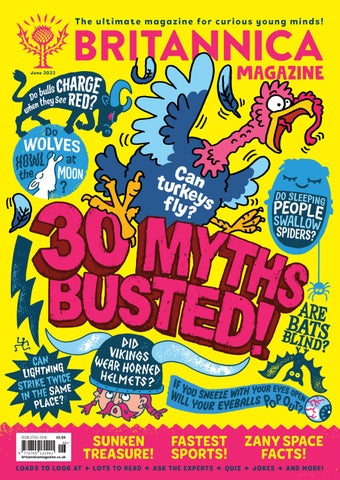
The ultimate magazine for curious young minds!
MAGAZINE
June 2O22
ISSN 2755-1318
06> £5.99 06>
9 772755 131001 britannicamagazine.co.uk 9 772755 131001
SUNKEN TREASURE!
FASTEST SPORTS!
ZANY SPACE FACTS!
LOA DS TO LOOK AT : LOTS TO READ : ASK T HE EXPERTS : QUIZ : JOKES : AND MORE!1
CONTENTS
Page 1O
Page 22
A wild and wonderful world awaits you inside!
Page 3O
4 Page 36
6 1O 2
FACTOPIA! Follow the trail of hilarious illustrations and crazily connected facts. From the smallest living thing to how your brain could power a light bulb! SNAP IT! Eye-popping photos to amuse and amaze. Including a swooping kingfisher snapped in mid-flight! EUREKA! Fascinating inventions and discoveries. Meet
a deadly dinosaur the length of a bus and find out why scientists are watching cow burps from space!
12
14
LISTIFIED! Discover eight brilliant things created by young inventors. Plus, 1O surprising objects that have been sent into space. FASCINATING FACTS ABOUT JUNE Celebrate 1O historic
Page 16
34
Page 8
35
36 38 Page 14
41 Page 12
42 footballs, tennis balls and golf balls travel. And prepare to be wowed by the sporting object that can fly faster than 3OO mph!
anniversaries and events, including the birth of the saxophone and an Inca festival that is still celebrated today!
16
22
COVER FEATURE: 3O MYTHS BUSTED! We reveal the surprising truth behind 3O commonly held beliefs that are, in fact, completely wrong! TEN OF THE FASTESTMOVING OBJECTS IN SPORT Find out how fast
24
27
AMAZING SUNKEN TREASURES Journey to the bottom of the ocean to explore eight of the world’s most famous shipwrecks. EVERY SECOND Astonishing things that happen around
28
3O
the world each and every second! INFOGRAPHIC: HOT STUFF! Enjoy a fact-filled tour of some of the hottest places on planet Earth – and the solar system! ABSOLUTELY EVERYTHING! Our epic serialisation of the true history of the universe continues with the ingenious machines that shaped the modern world.
43
MY BRITANNICA A sticky situation involving a woolly mammoth stars in the illustrated fact of the month. Plus, the latest letters and photos from readers. ASK THE EXPERTS Your chance to test Britannica’s brilliant experts. This month’s answers feature Saturn’s rings, brainy fish and the world’s most followed religions. THE BIG BRITANNICA QUIZ Stretch your brain power with our brilliantly tricky quiz. DO IT YOURSELF Try a delicious 1,5OO-year-old recipe for Roman burgers. Plus, find out why the ancient Romans thought it good manners to burp loudly after eating! PUZZLES & GAMES Featuring Animal Word Search, Word Morphs, Connect the Planets and the Word of the Month! SPOT THE DIFFERENCE Can you spot all 2O differences between our two zany illustrations? JOKES & RIDDLES Hand-picked by our jokes editor May!
SEND IT IN! Email us your letters, photos and favourite facts to: editor@britannicamagazine. com Or write to us at: Britannica Magazine The Black Barn Wickhurst Farm Leigh Tonbridge Kent TN11 8PS
ZANY FACTS
Scientists call some strains of bacteria that swarm together and hunt other types of bacteria a ‘wolf pack’
When sea otters rest, they float together in the water holding each other’s paws or feet. Some sea otter ‘rafts’ are made up of more than 1,OOO otters joined together
s is called a up of pug A gro
MBLE U R G Pack it in!
Follow the trail of crazily connected facts all the way from the smallest living thing to… how your brain could power a light bulb!
sm
OO
The
cou
ld fi
t o n t h e e n d of a h
n uma
ha
ir
By Kate Hale and Paige Towler Illustrations by Andy Smith
al
t 4
in
,O
les
li v
gt
h in
g is
a ty
p e of b
acteria so
ll sma
tha
t
1
5O
e cinemas introduce d In the 195Os, som
Smell-O-Vision Scents were piped in underneath filmgoers’ seats
During the
es ni lo co ,OO er O pid er 5 es v Som to o
Great Stink
O
of 1858, the River Thames in London was clogged with human waste. It smelt so bad that many people left the city – even the British Parliament considered moving
ca sp n b id e h er s ome
A group of owls is called a
Parliament
What’s that smell?
bl00d
Th e po eno h we
Some sharks can smell
tes crea rain ity to b an ectric ht bulb! um h el all lig ug sm ra
from up to 4OO metres away
Scents can trigger memories because your sense of smell is tied to systems in your brain responsible for emotion and memory
5
PHOTOS
IN-FLIGHT MOVIE!
The British wildlife photographer Ivor Ottley took this spectacular sequence of photos to show how a kingfisher flies through the air. Ottley took a burst of photos over a couple of seconds. He then used a computer to place these eight photos of the same kingfisher onto a single image. WWW.IVOROTTLEYPHOTOGRAPHY.COM
WO
AH
6
!
Astonishing photos from around the world
!
7
PHOTOS
JOINING THE HUNT
This young boy, who lives in Mongolia in central Asia, is learning how to handle and hunt with a falcon. Once he has mastered this traditional Mongolian skill, he will learn how to hunt with an even larger bird of prey – a golden eagle!
! H A YE STEPPING OUT
The red-eyed tree frog lives in rainforests in Central and South America. Scientists think that its bright red eyes, orange webbed feet and neon green skin are used to startle and confuse birds, snakes and other potential predators.
DON’T LOOK DOWN…
The Ruyi Bridge was built to allow pedestrians to cross the beautiful Shenxianju Valley in China. Its curved walkways are designed to look like a ruyi, which is an ancient ceremonial object that symbolises power and good luck in Chinese folklore.
OW!
W
8
!
RIVER OF FIRE
This photo of an erupting volcano was taken in Iceland, one of the most volcanic places on Earth. Iceland is home to around 13O volcanoes, 18 of which have erupted since settlers began arriving on the island in 874 CE. LUIS MANUEL VILARIÑO LOPEZ, SPAIN, SHORTLIST, LANDSCAPE, 2O22 SONY WORLD PHOTOGRAPHY AWARDS
! T O H 9
Eureka!
The latest astonishing discoveries, inventions and scientific breakthroughs.
Silencing the supersonic boom… This experimental supersonic (faster than sound) plane, NASA’s X-59 QueSST, is twice as fast as commercial aeroplanes and designed to be quiet as it passes overhead. And that’s a big deal. Today’s supersonic jets are as loud as a dog barking right in your ear, so they aren’t allowed to fly over land. If this one works, it could usher in a whole new era of super-speedy travel.
‘Shadow of death’ dinosaur discovered in Argentina In 2019, just before the COVID-19 pandemic broke out, palaeontologists working in Patagonia, at the southern tip of Argentina, found what is likely to be the largest megaraptor discovered so far. Named Maip macrothorax (which means ‘shadow of death with a huge chest’), it was the length of a doubledecker bus. It was light for its size, with hollow bones a bit like a bird’s, making it a super-fast runner and top predator. It lived about 70 million years ago, towards the end of dinosaur times. Palaeontologist Mauro Aranciaga Rolando, who was 10
one of the people who discovered it, said the thing that sets megaraptors apart is their arms: ‘long, gigantic, topped by claws up to 35 cm (13.8 inches) long, with which we infer that they grabbed and tore their victims to pieces.’
THE FOSSILS FOUND SO FAR…
1m
Left: scientists work with some of Maip’s fossilised bones. Most of the 700+ dinosaurs that have been discovered and named are known from a very small number of fossils. Palaeontologists study these fossils and compare them to other dinosaur fossils and also to living animals in order to understand what kind of dinosaur it was, how big it was and how it lived. The illustration on the left shows which of Maip’s bones have been found so far. The team will be back in the field in 2023 and hope to find more.
NEWS
Cow burps seen from space! Cows on one farm in California, USA, produce enough methane gas to power over 15,000 homes. How do we know? A Canadian satellite measured it from space! Cows eat a lot. They have to because they are huge animals, each one weighing as much as 13 adult humans. Their digestive process makes a lot of methane, which they mostly burp out through their noses. This is a problem because
methane is a powerful greenhouse gas that contributes to global warming. Farmers are trying to figure out if changing the ingredients in cow feed will help to reduce all that burping and help save the planet, but the burps float away and blend with the air so are hard to measure. Now, with information from space, the experiments can go forward. Maybe low-methane cows are in our future!
1O4 marathons in 1O4 days – a world record! When Jacky Hunt-Broersma had to have her leg amputated, she refused to be told there were things she couldn’t do any more. In fact, she decided to take up ultra running, a sport where people (mostly those with able bodies) run very long distances. And then she broke a world record! It takes a lot of food to fuel five hours of running every day for over three months. Jacky posted on Instagram that she ate 100 peanut butter and jelly sandwiches, 200 boiled potatoes, 200 gummy worms, 20 pizzas, and multiple doughnuts to keep herself going.
ALEXIS M. ARANCIAGA ROLANDO
Farmer finds 4,5OO-year-old goddess sculpture Meet Anat, the goddess of love and war from the ancient civilisation of Canaan. Nidal Abu Eid, a farmer in Gaza, which is between Israel and Egypt, found this 22 cm-tall statue of Anat buried in his field. It turned out to be 4,500 years old, sculpted by an artist who lived 1,000 years before King Tut was Pharoah in nearby Egypt. Often shown as a beautiful young girl, Anat was famous for her strength and for being a fierce warrior. In the mythology of the region, she is best-known for helping to bring her brother Baal back from the underworld.
Save hedgehogs – with a hole in your fence! Hedgehogs are great climbers but they get stuck when they come to a solid garden fence, and having fewer places to go makes them less safe. So, the Cornwall Wildlife Trust is asking people to put 13 cm x 13 cm holes though their garden
fences to let hedgehogs roam from garden to garden. The UK hedgehog population has dropped by 75 per cent in recent years, and the Trust hopes giving them more room will stop the decline. 11
LISTS
LISTIFIED! Prepare to be amazed (and amused!) by the unusual facts crammed into these irresistible lists.
CHILD’S PLAY
Eight brilliant things created by young inventors
1
Ice lollies Frank Epperson, age 11
One cold night in 1905, Epperson accidentally left a cup that was filled with sugary soda powder, water, and a stirring stick outside. When he woke up, a refreshing frozen treat – the very first ice lolly – was waiting on his porch.
2
Swimming flippers Benjamin Franklin, age 11
3
Crayon holders Cassidy Goldstein, age 12
As a boy growing up in Boston, USA, in the 1700s, Benjamin Franklin wasn’t a very strong swimmer. To increase his speed, he took two wooden paddles and strapped them to his hands, using them like flippers to push himself through the water. Today, swimmers and divers wear flippers just like Franklin’s on their feet.*
Drawing with crayons is fun, but it can also be frustrating when the crayons become too small to hold or break into pieces. Cassidy Goldstein created her own solution to this problem: a plastic tube that would protect and hold the crayon in place, making it easier to draw with. After winning a patent** for her idea in 2002, Goldstein’s Crayon Holders are now sold around the world.
4
Braille Louis Braille, age 15
Before 1824, people who were visually impaired read by feeling their way over the
12
Frank Epperson
raised outline of letters printed in special books. It was a slow process to read each word, letter by letter. Louis Braille, who had been blind himself since the age of three, created a new alphabet of raised dots, which was much quicker and easier for people with visual impairments to read. Braille based his alphabet on a code that the French army used to communicate at night-time, and he named it Braille.
5
Earmuffs Chester Greenwood, age 15
Out ice skating one day in
1873, Greenwood was fed up with freezing cold ears. So he made a simple wire frame and, with his grandmother’s help, sewed bits of beaver skin to it to keep his ears warm. Initially called Greenwood’s Champion Ear Protectors, they were a big hit with soldiers during the First World War.
6
Christmas lights Albert Sadacca, age 15
In the days before electricity, Christmas trees could be dangerous because they were often decorated with candles, which could set
Space Oddities the trees on fire. In 1917, Sadacca invented a string of small light bulbs, which were much safer, and have been used to decorate Christmas trees ever since.
7
Trampoline George Nissen, age 16
Nissen, a keen gymnast, came up with the idea for the trampoline in 1930 after watching trapeze artists dropping into safety nets at the circus. He wanted to create a net that would bounce the person back up again, so he built his own version from a steel frame and canvas sheet in his parents’ garage. Eventually he perfected his invention by adding springs, and trampolining became an Olympic sport.
8
FreshPaper Kavita Shukla, age 17
FreshPaper looks like a normal square of white paper but is made with a special mix of herbs and spices. If you place a sheet next to fruit or vegetables, it helps them stay fresh for up to four times
George Nissen
longer. Its inventor, Kavita Shukla, was inspired by a healthy spice-based drink made by her grandmother in India. She then researched the antibacterial properties of different herbs and spices as a school science project before winning a patent for her brilliant waste-saving idea in 2002.***
*Benjamin Franklin went on to invent many other things, such as the lightning rod, which conducts lightning strikes away from tall buildings. He was also one of the people to sign the United States Declaration of Independence from England in 1776.
Surprising things that have been sent into space Fossilised bones and eggshells from a duck-billed dinosaur called Maiasaura peeblesorum were sent to space in Spacelab 2, which was on board the Space Shuttle Challenger in 1985. An electric sports car! To mark the first launch of SpaceX’s Falcon Heavy rocket, a car was released in outer space. It is now travelling on a solar orbit that is carrying it towards Mars.
**A patent is an official licence from the government guaranteeing that, for a set period, only its holder can make or sell an invention. ***Approximately 25 per cent of the world’s food goes bad before it can be eaten. Eco-friendly products such as FreshPaper will help stop so much of it from going to waste.
Salami pizza was delivered via space rocket to cosmonaut Yuri Usachov on board the International Space Station. Pieces of wood and fabric from the Wright brothers’ Flyer 1 were placed inside Apollo 11’s lunar module. ‘Flyer 1’ was the name given to the first aeroplane to make a powered flight. Luke Skywalker’s lightsaber – the one from Return of the Jedi – was sent to the International Space Station to mark 3O years of the Star Wars movies. Amelia Earhart’s watch was brought to the International Space Station 82 years to the day after Earhart’s pioneering transatlantic flight. The American pilot was the first woman to fly solo across the Atlantic. Gene Roddenberry’s ashes were sent into outer space in a rocket. Roddenberry created the famous
science-fiction TV and film series Star Trek. Two golden records were carried on the Voyager 1 and Voyager 2 space probes.* A sandwich was smuggled onto NASA’s Gemini 3 space mission by astronaut John Young.** The filling was corned beef. LEGO figures were sent to Jupiter on NASA’s Juno space probe. Three figures were chosen: the mythological god Jupiter, his wife Juno and the Italian astronomer Galileo. *The golden records were intended to introduce the story of Earth to any alien life that found the probes. The sounds on the discs, which could be played like an old-fashioned vinyl record, included natural sounds from Earth, such as wind, thunder and animal sounds, and spoken human greetings in 55 languages. **NASA doesn’t usually approve of astronauts eating sandwiches in space because breadcrumbs could damage the spacecraft’s delicate equipment. Listified! by Andrew Pettie and illustrated by Andrés Lozano is out now. 13
2O16
The Bramble Cay melonmys, a rodent that lived near Australia, became the first mammal to become officially extinct because of climate change on June 14th.
1846
1878
On June 19th, US photographer Eadweard Muybridge took a series of photos of a galloping horse to find out whether all four of a horse’s feet leave the ground at once. They do!
On June 28th, BelgianFrench instrument maker Adolphe Sax patented the saxophone. It was initially made from wood.
1O fascinating facts 1963
On June 16th, Soviet cosmonaut Valentina Tereskhkova, then aged 26, was launched on a solo mission on board the Vostok 6 spacecraft. Tereshkova, who had been selected from more than 4OO applicants for the mission, orbited Earth 48 times in 71 hours before landing safely on Earth on June 19th. She was the first woman to travel into space.
14
1412
The Inca people of South America first celebrated Inti Raymi, which means ‘Festival of the Sun’, more than 6OO years ago. The festival marks the southern hemisphere’s winter solstice, which falls around June 21st. Involving music, feasting and colourful costumes, Inti Raymi is still celebrated in Peru today.
1994
The West Indian cricketer Brian Lara made the highest score in first-class cricket history on June 6th, hammering 5O1 not out. During his epic innings, Lara struck 1O sixes and 62 fours!
about June… 1976
On June 16th, an uprising took place in Soweto, a township near the South African city of Johannesburg. The protest, mostly led by students, criticised the way black Africans were being taught in schools. It was an important milestone in the fight for racial equality in South Africa.
1978
The rainbow-coloured Pride flag was designed by the American artist Gilbert Baker and first flown during a parade in San Franciso, USA, on June 25th. The flag now celebrates the LGBTQ+ community, which includes lesbian, gay and transgender people.
1997
The first book in JK Rowling’s Harry Potter series, Harry Potter and the Philosopher’s Stone, was published on June 26th. First editions can now be worth more than £5O,OOO!
1984
On June 6th, Alexey Pajitnov, a Soviet computer engineer, launched a simple video game that challenged players to fit together differently shaped falling blocks. Pajitnov’s game was called Tetris and it is still played by millions of people today. 15
MYTHS
Prepare to be shocked and amazed as we reveal the truth behind 3O commonly held beliefs that are, in fact, completely wrong! By Sarah Hampton. Illustrations by Andy Smith
quacks don’t echo. 1 Duck
Wrong! A duck’s quack is usually quite quiet, and so its echo can be tricky to hear. But in 2003 a team of researchers at the University of Manchester in England placed a duck named Daisy in a special chamber and recorded both her quacks and their echoes.
and nails continue to grow after death. 2 Hair Wrong! After death, the skin dries out and shrinks, pulling it away from the hair and nails. This can give the impression that the hair and nails have become longer after death. But they definitely haven’t grown.
A goldfish only has a three-second 3 memory. Wrong! In fact, fish have relatively good memories and have been taught by scientists to recognise the presence of their owners and remember the way out of underwater mazes. To find out more clever things that fish can do, turn to Ask the Experts on page 35. 16
no gravity in space. 4 There’s
Wrong! Gravity is the force of attraction between every object in the universe that contains matter (i.e. everything). So gravity is everywhere, even in space. The reason that astronauts float in space is that they are further away from the Earth, so its gravitational pull on their bodies is weaker than it is when they are standing on the ground. People sometimes call this feeling of weightlessness in space ‘zero gravity’ but the correct term is microgravity.
Aeroplanes get rid of toilet waste by 5dumping it in mid-air. Wrong! The toilet tanks on aeroplanes, which hold the passengers’ wee and poo during the flight, can only be emptied when the plane is on the ground, usually using a lever that is on the outside of the plane. However, the toilets in some early trains
did flush directly onto the tracks while the train was moving!
6 Bats are blind.
Wrong! Bats do use a system called echolocation to navigate, in which the bat sends out sound waves and listens for the echoes to bounce off things. However, bats can also see.
Continued on next page 17
MYTHS
places more likely to be struck again. Skyscrapers, for example, are more likely to be struck than shorter buildings – but don’t worry, they have built-in lightning rods to make sure no damage is done to the building.
charge when they see the colour red. 9 Bulls Wrong! This myth is connected to the tradition of Spanish bullfighting, where matadors twirl a red cape in front of the bull. However, bulls are colour-blind to red. Studies suggest that it is the quick movement of the cape, rather than its colour, that causes the bull to charge.
Continued from previous page
On average, humans swallow 1O eight spiders per year
only crow at dawn. 7 Roosters
while they’re asleep.
Wrong! A rooster will often start the day with a cock-a-doodle-do but it also crows at other times, to scare away predators and rival roosters, and to communicate with its flock of hens.
Lightning never strikes twice in 8 the same place. Wrong! In fact, there is sometimes a significant attraction between lightning bolts and a place they have previously hit, making these
Wrong! It can happen, but it’s very unlikely that a spider would want to jump into your mouth while you’re asleep any more than it would while you’re awake. While sleeping, a human’s breathing (or snoring) and beating heart create vibrations through the body that would scare off most spiders.
A bolt of lightning is hotter than the surface of the Sun!
11 Turkeys can’t fly. Wrong! They don’t usually travel further than 90 metres at a time but
turkeys can fly at speeds of more than 50 miles per hour.
Earwigs lay their eggs inside 12 people’s ears. Wrong! Despite the name, earwigs prefer to lay their eggs in moist soil or under the bark of trees.
Water drains in sinks and 13 toilets in one direction in the northern hemisphere and in the opposite direction in the southern hemisphere.
Wrong! The Coriolis effect, which is caused by Earth’s rotation, causes hurricanes to spin in different directions, clockwise in the southern hemisphere and counter-clockwise in 18
Above: the Pyramids of Giza are among the many man-made objects visible from space.
Pyramids viewed from space
are startled by mice, but they’re not scared of them.
The Great Wall of China 16 is the only man-made object visible from space.
Wrong! This myth appeared in several books in the 19th Century before humans were able to travel into space to check if it was true. It’s not. Lots of manmade structures are visible from space including the Pyramids of Giza.
You should tilt your head 17 backwards if you are having a nosebleed.
Wrong! In fact, doctors advise you to do the opposite: tilt your head forwards, pinch your nostrils shut and breathe through your mouth for about 10 minutes or until the bleeding has stopped.
When they’re threatened, 18 ostriches hide by burying their heads in the sand.
Wrong! Ostriches can’t nest in trees, so instead they dig holes in the ground for their eggs. They do stick their heads into the holes to move their eggs around, which is probably where the myth started.
Continued on next page
photo, left). And the pressure released by a sneeze builds up in the blood vessels, not the eyes or the muscles surrounding them.
are afraid of mice. 15 Elephants
the northern hemisphere. But this force is too small to act on the small amount of water in toilets, sinks and baths, which can drain in both directions in both hemispheres.
Wrong! Some people used to think that mice liked to crawl into elephants’ trunks, causing them to sneeze. But they don’t. Plus an elephant’s eyesight is so weak it could barely see a mouse anyway. It’s possible that elephants
If you sneeze with your eyes open your 14 eyeballs will pop out. Wrong! Keeping your eyes open while sneezing is tricky to do because an automatic reflex tries to close them (as in the 19
MYTHS
howl at the Moon. 21 Wolves
Wrong! Wolves do howl at night but simply because they’re most active then.
You can tell a ladybird’s age 22 by counting its spots. Wrong! There are more than 5,000 species of ladybird and the number of spots on their wing cases varies from none to more than 20. If ladybirds did gain an extra spot each year most would only have one or two because they rarely live longer than two years.
wore horned helmets. 23 Vikings
Continued from previous page
carry water in their humps. 19 Camels Wrong! Their humps store fat instead, allowing a camel to survive for days in the desert without eating any food.
All bees die after inflicting 2O a single sting. Wrong! This is true of honey bees but not of other species, including bumble bees. 20
Wrong! In the 19th Century, archaeologists found several ancient horned helmets at several sites around Europe. However, the helmets were too old to have belonged to the Vikings who first appeared in the 8th Century. These horned helmets from other ancient European cultures inspired the idea that Vikings wore horned helmets too, and people have believed the myth ever since.
core is molten. 24 Earth’s
Wrong! The Earth has a solid inner core made from the metals iron and nickel. This solid core is a bit smaller than the Moon and as hot as the surface of the Sun.
People in Europe thought the world was flat until 25 Christopher Columbus sailed across the Atlantic in 1492.
Wrong! Some people in the 15th Century did believe the Earth was flat. However lots of mathematicians and scientists alive at the time thought that it was round. In fact, several ancient thinkers and philosophers wrote about the idea of the Earth being round almost 2,000 years before Columbus set sail.
Left: wolves howling at night (but not specifically at the Moon).
Sharks kill hundreds of 27 people every year. Wrong! We think of sharks as being among the most fearsome and deadly creatures on Earth. But, on average, they only kill 10 human beings a year. In contrast, 500 people are killed on average by hippopotamuses and 50,000 by snakes. The deadliest animal of all is the mosquito, which kills hundreds of thousands of people every year because of the infectious diseases it carries, including malaria.
Your stomach is positioned behind 28 your belly button.
Owls can spin their reads round 3O a full 36O degrees. Wrong! Although it’s easy to see from the photo below how this myth got started. Owls can certainly spin their heads a long way – about 270 degrees at full rotation.
Below: owls have superb eyesight and amazingly flexible necks, which help them to spot their prey.
Wrong! The stomach is higher up inside your body, behind your ribs.
a cat purrs, that means 29 When it’s happy. Porcupines fire their 26 quills at predators. Wrong! When threatened, porcupines do often try to defend themselves by shaking their quill-covered tails. And their quills also detach easily. They do this so that even if a predator only brushes the porcupine’s quills lightly, they will still come off and get stuck in the attacker’s body.
Wrong! Cats do sometimes purr when they’re content. But they also purr when they’re hungry, unhappy or recovering from injury. Scientists think that the low frequency of a cat’s purr may work as a self-healing mechanism that improves the strength and health of its bones. 21
1O OF T HE FAS T ES T- MOVING OBJECTS IN SPORT! 5Omph
1OOmph
15Omph
7 ICE HOCKEY PUCK
114.1 mph
HO
5
8
TENNIS BALL
163.4 mph
BASEBALL
W
1O5.1 mph
H L
ots of games require players to have quick reactions, but did you know that perhaps the speediest sport of all is badminton? That’s right! In the moments after a shuttlecock has been hit by a badminton racquet, it can travel at speeds of more than 300 miles per hour – which is faster than a Formula 1 racing car! Across these pages, you can see some of the other fastestmoving objects in sport. Each object’s world record speed is written alongside it in red. Follow the dotted lines to see how they compare on the speedometer above.
1O
OO
TABLE TENNIS BALL
72 mph
OS 3
JAI AL
19O
6 FOOTBALL
131.1 mph
9 The high-speed ball game jai alai was invented in Spain.
22
CRICKET BALL
1OO.2 mph
4 SQUASH BALL
166 mph
2OOmph
25Omph
O mph
35Omph
SPEEDY COMPARISONS 231.4 mph
Formula 1 racing car The fastest recorded speed by a Formula 1 car during an official race was by the Finnish driver Valtteri Bottas in 2O16.
2 GOLF BALL
233.4 mph
S H!
LAI BALL
3OOmph
198 mph
Peregrine falcon The peregrine falcon is the fastest-moving animal on Earth. It achieves its top speeds when diving down towards its prey, thanks to the force of gravity. 1 BADMINTON SHUTTLECOCK
3O6.3 mph
74 mph
Cheetah The fastest land animal, the cheetah can accelerate from O to almost 6O mph in three seconds – quicker than many sports cars.
27.8 mph
Usain Bolt The Jamaican athlete Usain Bolt, who holds the world record for the 1OO metres sprint, has been recorded running at more than 27 mph.
23
SHIPWRECKS
Amazing sunken treasures!
RMS Titanic Atlantic Ocean Probably the most famous ship of all time, the Titanic sank after hitting an iceberg in 1912. More than 1,5OO passengers and crew died when the luxury liner plunged nearly 4 kilometres to the bottom of the north Atlantic Ocean. Anything connected with the disaster is now a valuable treasure – one photograph of the iceberg later sold for £2O,OOO.
By David Long, illustrations by Studio Muti
A
round the world there are millions of shipwrecks lying on the seabed. Some were sunk in ferocious storms or in battle, others after hitting rocks or icebergs. They range from a few years old to a few thousand. While not all of them were carrying treasure, they have become treasures themselves and more than a few have given up their precious secrets…
North America
Nuestra Señora de las Mercedes Spain
EXCERPTED FROM AMAZING TREASURES BY DAVID LONG AND STUDIO MUTI
Whydah Gally USA Pirate captain ‘Black Sam’ Bellamy (1689–1717) sailed up the Massachusetts coast in the captured ship, Whydah, before it sank in a violent storm that killed most of the crew and their prisoners. The ship lay undisturbed for more than 26O years. Its discovery in 1984 was made with the aid of a genuine map from the 17OOs. It was the first time a real pirate ship had been found and identified by name.
San José Colombia A robotic submarine discovered the wreck of this Spanish galleon more than 3OO years after it was sunk by British sailors. The Colombian government has kept its precise location secret because the wreck is thought to contain gold, silver and emeralds worth billions of pounds.
An incredible 17 tonnes of precious gold and silver coins were found near the wreck of this Spanish warship. It is thought to have been carrying more than half a million silver coins when it was sunk by the British in 18O4 during the Battle of Cape Santa Maria. It had been carrying goods from countries colonised by Spain.
Europe
Mary Rose UK
Nanking Cargo Indonesia
The pride of English King Henry VIII’s navy, the Mary Rose was a successful battleship for more than 3O years but sank in 1545. In 1982 around 6O million people watched on television as the wreck of its hull was raised up from the depths. Since then, the bones of nearly 2OO sailors and thousands of personal objects from the Tudor period have been brought up by divers.
Divers found 126 solid gold ingots and more than 15O,OOO pieces of traditional blue and white china on the wreck of the Dutch ship Geldermalsen, which sank in the 17OOs. Most of the plates, bowls and cups were undamaged, even after more than two centuries underwater. Keen collectors paid around £1O million for them when they were put on sale.
Asia Africa
Belitung Shipwreck Indonesia Caesarea Treasure Israel In 2O15 a scuba diver swimming off the coast of Israel discovered an amazing hoard of more than 2,OOO gold coins. This is by far the largest find of its kind in this part of the Mediterranean. Historians now know the coins are nearly 1,OOO years old. A single one would have been equivalent to a month’s pay for an ordinary soldier.
This Arabian merchant’s vessel, or dhow, sank on a voyage from China to the Middle East nearly twelve centuries ago. Archaeologists have now recovered the largest collection of Chinese Tang-dynasty objects ever found, including spice jars, a jug with a dragon’s head spout and inkwells made more than 1,OOO years ago.
Have you heard about our new Reading Club for schools?
Cut out share t and with yo his page ur teac so the her…
Join the Britannica Magazine Reading Club at your school and not only will you get monthly yc All scho an find out m copies of the magazine, you will be able to do ols can ore. access u p O to amazing activities and other fun stuff to explore 2O ⁄O d iscount a from th the world of Britannica Magazine even more. e cost o f s u b s c r Friends, facts and fun! What more could you want?! iptions ! To find out more, go to:
britannicamagazine.co.uk/reading-club
STATS
EVERY SECOND
trees are cut down
3,15O,OOO
litr es of a
d s are bur p e ws ga farted by co nd
Somewhere on the planet this very second, one aeroplane takes off, four babies are born, 1OO lightning bolts strike the Earth and…
485
158
are replanted
18O,OOO
EXCERPTED FROM EVERY SECOND, WRITTEN AND ILLUSTRATED BY BRUNO GIBERT
litres of oil are extracted from below the Earth’s surface
2O,OOO plastic bottles are produced but only
1,6OO of them are recycled 27
INFOGRAPHIC
HOT STUFF!
There are plenty of places on Earth that are hotter than the average surface temperature of 15°C (59°F), including inside your own body! And when you dig deep, or even travel far out into space, things can warm up even more. Normal body temperature of humans
36–37.2°C (97–99°F)
When you get sick, your body fights the attacking germs by raising your temperature a few degrees, giving you a fever.
Body Temperature Most animals are cold-blooded. This means they rely on their environment to keep their bodies at a healthy temperature. But warm-blooded animals, such as birds and mammals, have bodies that control their internal temperatures automatically.
Three-toed sloth
28°C (82°F)
This slow-moving animal has one of the lowest body temperatures of any mammal.
Chicken
42°C (1O8°F)
Birds have the highest body temperatures of all animals.
Hottest surface temperature on Earth
What Is Heat?
EXCERPTED FROM EARTH IS BIG, WRITTEN BY STEVE TOMECEK AND ILLUSTRATED BY MARCOS FARINA
The atoms and molecules that make up all the matter in the universe are constantly moving, vibrating back and forth, even in solid objects. Scientists call this movement thermal energy. The transfer of thermal energy is called heat. So, when you heat up a substance, its thermal energy increases and the atoms in it vibrate faster. Temperature is different. It shows how much thermal energy something has, meaning how fast the atoms in it are vibrating. The faster the atoms vibrate in a substance, the higher the temperature.
Cold matter (particles are moving slowly)
56.7°C (134.1°F)
The ‘official’ record for highest air temperature on Earth was taken in Death Valley, USA, on 1O July, 1913.
Lightning bolt
27,76O°C (5O,OOO°F) A lightning bolt is 2 cm to 3 cm wide, so roughly the width of your thumb. Wood fire
15O°C (3OO°F) Hot matter (particles are moving fast)
28
Most wood can start to burn at this temperature, but can reach over 538°C (1,OOO°F) if conditions are right.
The Inside Story
Hot Planet
While Earth gets most of its heat from the Sun, it also generates some thermal (heat) energy of its own. Scientists have calculated that for every kilometre you go below the surface, the temperature increases by 25°C (77°F). This steady increase is called the geothermal gradient. Because of it, the temperature deep underground can be much higher than on the surface.
Earth’s surface temperature might be bearable, but below the surface is super-hot rock found in the Earth’s mantle layer.
Hawaiian lava
1,17O°C (2,14O°F) Some rocks below the surface get so hot they melt, forming magma. This liquid rock can erupt from a volcano as lava. Kilauea volcano on the Big Island of Hawaii has been erupting almost continuously since 1983, bringing up a constant stream of magma from below the Earth’s surface. Average surface temperature
15°C (59°F) Mantle
1,OOO°C (1,832°F) to 3,7OO°C (6,692°F)
Core-mantle boundary
6,OOO°C (1O,8OO°F)
Heat In Space Our Sun is only considered an average star when it comes to temperature, but it’s still the hottest object in our solar system. Stars, including the Sun, create light and heat by a process called nuclear fusion. Deep in the centre of our star, hydrogen atoms are squeezed together under such high pressures that they form larger helium atoms. This same process powers a hydrogen bomb, and it releases a huge amount of energy, including heat.
Quasar
1O trillion+°C
(18 trillion+°F)
These super-bright, super-hot objects are found deep in space.
Surface of the Sun
5,538°C (1O,OOO°F)
Convection zone Mponeng gold mine
66°C (15O°F)
This mine in South Africa reaches 4 km underground.
2 million°C
(3.6 million°F) Radiation zone
7 million°C (12.6 million°F)
Solar core
15 million°C (27 million°F) 29
THE BIG READ
1. NOTHING TO SOMETHING 13.8 billion– 45O million years ago
2. LAND AHOY! 47O mya– 252 mya
3. DINOSAURS 252 mya– 5 mya
4. HANDS FREE 5 mya–65,OOO years ago
5. YOU AND ME 2OO,OOO years ago–5OOO BCE
6. CIVILISATION BEGINS 5OOO BCE– 15OO BCE
7. MEANWHILE, IN ASIA 3OOO–2OO BCE
8. RISE AND FALL 14OO BCE– 476 CE
Absolutely Everything! Each month we feature an amazing story from world history taken from the bestselling book by Christopher Lloyd, with illustrations by Andy Forshaw. This month: electricity and the age of invention!
T
Focus the camera of a smartphone or tablet on this QR code to listen to an audio recording of the author reading this book extract.
9. MEANWHILE, IN THE AMERICAS 15OO BCE– 153O CE
housands of years ago ancient Greeks discovered that if they rubbed cloth against a mineral called amber it would produce a series of mysterious shocks or sparks. The word ‘electricity’ is actually based on the Greek word elektron, which means amber. In the 1820s, the English scientist Michael Faraday gave a series of famous demonstrations at a science club called the Royal Institution in London, England. Faraday showed how it was possible to move an object using an invisible force, called electromagnetism, that is created by passing electricity through a wire. This was the world’s first electric motor. Then, in 1831, he showed how to generate electricity by waving a wire through a magnetic field. This is the principle used to produce electricity in a power station.
1O. INVENTION CONNECTION 57O–1279 CE
11. MEDIEVAL MISERY 476–1526 CE
Once the American inventor Thomas Edison perfected his design for cheap, mass-produced light bulbs, it became possible to create the world’s first electrical power grid. In 1882 a steampowered generating station linked 59 customers
Above: Alexander Graham Bell demonstrates his telephone.
YOU ARE HERE
in New York, USA, with electric power for the first time. Electricity also gave rise to the first telegraph system. Then, in 1837, the inventor Samuel Morse showed that it was possible to send messages using his Morse code across a distance of nearly 65 kilometres from Washington, DC, to Baltimore, Maryland. Within 20 years the whole of North America was connected by wires. By the 1860s cables were even being laid under the seas, allowing instant communication between North America and Europe. The first cable ran from Ireland to Newfoundland, Canada. So when Scottish-born Canadian-American inventor Alexander Graham Bell came up with a way of sending voice signals over electrical wires, he got very excited. On 10 March 1876, Bell spoke the first words over a telephone line to his assistant Thomas Watson, who was in the next room. ‘Mr Watson, come here – I want to see you,’ he said.
Continued on next page
12. GOING GLOBAL 1415–1621
13. REVOLUTIONS ALL AROUND 1543–19O5
14. WORLD AT WAR 1845–1945
15. TO BE CONTINUED... 1945–Present
THE BIG READ
Continued from previous page
M
achines were now changing every walk of life. But if you had to choose one that made the biggest difference of all, my guess is that many people might vote for the motor car. Everywhere but in big cities, it’s hard to imagine living in the world today without the freedom of going anywhere you like, whenever you like, in a car. Surprisingly, in 1900 almost all the cars in New York were electric. Edison’s new power
In 1888, Bertha Benz, wife of inventor Karl Benz, publicised her husband’s experimental car – the first to run on petrol – by driving it more than 1OO km to visit her mother. She took her teenage sons along so they could push the car to get it started. When the car broke down on the way, she fixed it herself. This was the very first time anyone had driven a car for more than a few metres.
32
Above: Morse code, invented by Samuel Morse, was used to send longdistance messages via the telegraph system.
transmission system led to a surge in interest for creating cars that could be charged up at home. But by 1915 electric cars were in steep decline, thanks to our next revolutionary invention. German scientists Nikolaus Otto, Gottlieb Daimler and Wilhelm Maybach developed a series of petrol engines beginning in 1876. A few years later German mechanic Karl Benz used one of them to build the world’s first petrol car. Here was a far lighter, faster mobile machine than those powered by either electricity or steam. Of course, motor cars rely on plentiful supplies of petrol, which comes from petroleum, often called crude oil, found deep in the Earth. The first modern oil wells were dug in the late 1850s to provide a source of fuel for lamps. Now, with the development of petrol cars, demand for oil increased very quickly. On 10 January 1901, prospectors at Spindletop in the US state of Texas struck oil that gushed out uncontrollably at a rate of 100,000 barrels a day. And it kept on gushing for the next nine days until someone could work out how to stop the flow. Local farmers were furious that their crops were drowning in oil, but a new age of exploration had truly begun.
Henry Ford applied mass production techniques to cars. His factories built more than 16 million Ford Model Ts between 1908 and 1927. Roads were built by governments keen to support people’s passion to travel wherever and whenever they chose. In 1903, two brothers who owned a bicycle shop had the brilliant idea of seeing if they could fly by putting wings on a bicycle and then mounting a small petrol engine on the
Left: in 1899 an electric car built by the Belgian racing driver Camille Jenatzy became the first road vehicle to travel faster than 1OO kph (62 mph).
The US inventor Lewis Howard Latimer enjoyed a remarkable career, working with Alexander Graham Bell on the first telephone and helping Thomas Edison to develop the light bulb.
back. On 17 December, Orville and Wilbur Wright successfully flew the first controlled, powered flights near Kitty Hawk, North Carolina, in the United States. Their flights lasted only between 12 and 59 seconds, but they proved that it was possible to build a petrol-powered flying machine that could carry human beings. Within 15 years the idea had been developed into sophisticated aeroplanes. World War I (1914–1918) picked up the pace, with nations on both sides of the conflict using aircraft to spy on enemy forces and drop bombs. Mass production techniques were quickly applied to making aircraft. During World War II (1939–1945), almost 800,000 planes were built.
I
magine finding a source of power that would last for ever. This final frontier was approached in 1905 in a series
where E = energy, m = mass (stuff), and c = the speed of light. Einstein worked out that there was enough trapped energy in a single grain of sand to boil a kettle 10 million times. The starting gun had now been fired on a nuclear race, as rival scientists and engineers tried to find ways of splitting atoms and releasing limitless quantities of energy. Giant advances in science and engineering were now shaping and reshaping the world, bringing us within touching distance of how we live today.
Hooked? Bicycle-shop owners Orville and Wilbur Wright invented the first heavierthan-air powered aeroplane.
of scientific papers written by the German physicist Albert Einstein. Newton’s theories of motion and gravity seemed fine for large objects, he said, but they don’t work so well when you zoom right in to look at what’s happening at the level of atoms. Einstein worked out that atoms themselves are held together by an almost unimaginably strong force, which, if it could be unlocked, might provide a massive source of untapped power. The famous equation that shows this relationship is E=mc2,
Then look out for the next instalment in the July issue of Britannica Magazine!
33
NICA
AN
Send your favourite fact to: facts@britannicamagazine.com Neanderthals used an ancient form of glue made from the bark of birch trees.
SEND IT IN!
M Y B RI T
YOUR fact of the month! Submitted by Tamsin, age 11. Illustrated by Mark Long
Your photos Where does your curiosity take you? Tell us by sending your photos and letters to: photos@britannicamagazine.com Cardboard creations!
Brain training!
‘My mum took this photo of me when we were taking the train to visit friends for a BBQ. Luckily I had my Britannica Magazine to read on the journey!’ Robyn, age 7 34
‘I started making things out of cardboard at the start of the first lockdown. I was inspired by images of cool models that other people had made which I saw online. So I got a hot glue gun and thought it would be fun to give it a try. My favourite model is definitely the Star Wars battle droid (on the left) and the hardest to make was the Mandalorian helmet that I’m holding in the photo.’ Evelyn, age 13
Ask the experts
Readers ask. Experts answer. Send your questions to: experts@britannicamagazine.com Question: Why does Saturn have rings and what are they made of? From Polly, age 11
Answer DR TRACY BECKER
Planetary scientist
We know from data taken by NASA’s Cassini spacecraft that Saturn’s rings are made of billions of individual pieces of ice that can be as small as a speck of dust or as large as a house. However, we still don’t know
exactly why or when the rings formed. Some scientists think the rings were created when Saturn formed over 4 billion years ago. Other scientists have found evidence that the planet’s
rings formed as recently as 100 million years ago, perhaps when an icy moon got too close to Saturn and was torn into pieces by the planet’s gravity.
DR WILL SWANEY
Animal neurobiologist
Question: Are fish dumb or clever? From Nina, age 7
Lots of people believe that fish only have three-second memories. However, this is completely untrue. Scientists have shown that some species of fish actually have excellent memories, including some you might find in an aquarium or pond. For example, if two zebrafish meet for only 20 minutes, they recognise each other the next day. Sticklebacks can remember the fish
Social historian
Question: What religion has the most followers? From Shivay, age 12
Answer
Saturn’s rings are huge – the main rings would stretch from Earth to the Moon – but are less than 1 km thick.
Answer
DR GINA ZURLO
from their shoal for several weeks. And guppies are very good at learning from each other. They can learn how to swim through mazes, avoid predators and even lift up a
Tiddlywink to find food hidden beneath, despite having a brain that is just 3 mm long! I have been studying fish for more than 20 years and I am still surprised at how smart they are.
Guppies can learn to swim through mazes!
Christianity is the world’s largest religion with 2.5 billion followers, 32 per cent of the global population. It is also the religion of the majority of people in Europe, North America, sub-Saharan Africa, South America, and the Pacific Islands. The second largest religion is Islam, with 1.9 billion followers (24 per cent of the global population) and majorities of people in several Middle Eastern, Asian and North African countries. The third largest is Hinduism (1 billion followers and 14 per cent), which is practised by the majority of people in southern Asia. Among these three religions, Islam is growing the fastest, mostly because Islamic families tend to have more children. All of these religions (and lots more) are practised all over the globe. Not everyone follows a religion, though. There are 900 million people who are non-religious, which is 12 per cent of people worldwide. 35
QUIZ
SHOW WHAT YOU KNOW (Read the whole magazine and these should be a breeze!)
13
1
Owls can spin their heads round… a. 180 degrees b. 270 degrees c. 290 degrees d. 360 degrees
2
The rings that run around Saturn are made of… a. Ice b. Rock c. Silver d. Cheese
3
Turkeys can fly at speeds of up to… a. 15 mph b. 30 mph c. 50 mph d. 70 mph
BIG Britan The
Stretch your brain power with our tricky quiz. The first 2O questions are answered in the magazine, but the final five aren’t. Don’t worry if you don’t know them all. Just check out the answers bottom right and test your grown-ups, too!
4
To show their appreciation of a good meal, the ancient Romans used to… a. Bow b. Clap c. Sleep d. Burp
5
The brain creates enough electricity to… a. Power a small light bulb b. Power an electric car for one mile c. Boil a kettle d. Boil an egg
6
The name of the first woman to travel into space is… a. Svetlana Savitskaya b. Valentina Tereshkova c. Sally Ride d. Mae Jemison
7
The number of trees cut down on average every second is… a. 48 b. 185 c. 345 d. 485
36
8
15
How many marathons did Jacky Hunt-Broersma run on consecutive days to set a new world record? a. 54 b. 94 c. 104 d. 114
9
Approximately how much of the world’s food goes bad before it is eaten? a. 5 per cent b. 10 per cent c. 25 per cent d. 50 per cent
1O
Which of these things reaches the hottest temperature… a. A bolt of lightning b. The surface of the Sun c. The Earth’s core d. Burnt toast
11
A group of pugs is known as… a. A mumble b. A grumble c. A bark d. A tumble
24
12
The Spanish sailor and navigator Christopher Columbus first sailed across the Atlantic in… a. 1372 b. 1453 c. 1490 d. 1492
13
Which of these sporting objects has been recorded travelling at the fastest speed? a. Baseball b. Golf ball c. Shuttlecock d. Football
14
The first real sunken pirate ship to be found and identified by name is called… a. Jolly Roger b. Black Pearl
c. Queen Anne’s Revenge d. Whydah Gally
15
The famous 18thCentury American inventor, scientist, writer
21
and diplomat Benjamin Franklin invented what at the age of 11? a. Ice lollies b. Swimming flippers c. Earmuffs d. The trampoline
16
In the physicist Albert Einstein’s famous equation E=mc2, the E stands for… a. Energy b. Elasticity c. Einstein d. Eggs on toast
17
The fewest number of spots a ladybird has is… a. None b. 1 c. 2 d. 3
BONUS ROUND (Now challenge yourself with questions NOT answered in the magazine!)
21
Angel Falls, the world’s tallest waterfall, is found in… a. Canada b. Colombia c. Venezuela d. Brazil
22
A millennium contains… a. 100 years b. 1,000 years c. 10,000 years d. 1 million years
17
nnica Quiz In 1965, the American astronaut John Young smuggled a sandwich onto NASA’s Gemini 3 space mission. The filling in Young’s sandwich was made of… a. Ham b. Salami c. Corned beef d. Tuna
19
In 1994, the batsman Brian Lara, who was born in Trinidad & Tobago, broke the world record for the highest first-class cricket score. Lara scored… a. 375 b. 380 c. 400 not out d. 501 not out
2O
The religion with the largest number of believers around the world is… a. Islam b. Christianity c. Hinduism d. Buddhism
23
The famous building that Guy Fawkes tried to blow up was… a. The Houses of Parliament b. Windsor Castle c. Buckingham Palace d. Eiffel Tower
24
A giraffe’s tongue can be longer than… a. 15 cm b. 25 cm c. 35 cm d. 45 cm
25
After cheetahs, which are the fastest, the second fastest big cats are… a. Tigers b. Leopards c. Lions d. Jaguars
Answers: 1. b, 2. a, 3. c, 4. d, 5. a, 6. b, 7. d, 8. c, 9. c, 10. a, 11. b, 12. d, 13. c, 14. d, 15. b, 16. a, 17. a, 18. c, 19. d, 20. b, 21. c, 22. b, 23. a, 24. d, 25. c.
18
37
RECIPE
How to make
Follow this 1,5OO-year-old recipe to enjoy a favourite food of the ancient Romans!
T
he Romans ruled Britain for almost 400 years, between 43 CE and 410 CE. During their occupation, they introduced lots of useful things, including paved roads, public baths and aqueducts. The Romans also brought lots of foods that were new to Britain and which we still eat today. Did you know, for example, that apples, pears, peas, cherries, dates and olives were all introduced to Britain by the Romans? One of the best places to discover the types of dishes the Romans liked to eat themselves is a famous Roman cookbook called Apicius. Containing more than
400 recipes, Apicius is one of the earliest cookbooks in recorded history. One of its recipes is for Isicia Omentata, which looks and tastes a lot like a modern burger. The Roman recipe uses minced pork, which was a popular meat in Roman Britain, and flavours the patties with pine kernels, pepper, coriander and a salty fish sauce called garum which the Romans added to almost every meal possible. Follow the recipe below to make them yourself, remembering to ask a grown-up to cook the patties. You will soon be enjoying a spiced burger fit for a Roman emperor!
The Romans thought it good manners to burp after eating – it showed you had enjoyed your meal!
Ingredients
5OO g of minced pork 6O g of pine kernels B 3 teaspoonfuls of garum, which is a salty fish sauce. Instead of garum you could use one of the fish-based sauces found in supermarkets B Ground pepper B A handful of the herb coriander B B
Instructions
1 Grind up the pine kernels, then mix them with the minced pork, ground pepper, garum and coriander.
The Romans also ate foods we would consider strange, including jellyfish, dormice and flamingo tongues!
2 Shape the mixture into burger patties. 3 Ask a grown-up to cook the patties over a medium heat or BBQ them for five minutes on each side. 4 Serve your Roman ‘burgers’ plain, as they did, or in a bun.
38
Recommend a friend… and we will send you a FREE BOOK about Pluto!
H
ave you been enjoying the first issues of the all-new Britannica Magazine? We certainly hope so! To celebrate our recent launch, we are giving away a FREE COPY of a brilliant and hilarious new book – How to Teach Grown-Ups About Pluto by top astronomer Dean Regas with illustrations by Aaron Blecha – to any subscriber who recommends a friend or family member to try out a subscription to Britannica Magazine.
Here’s all you have to do…
1
When your friend or family member takes out their new subscription to Britannica Magazine, ask them to enter your email address in the box in the britannicamagazine.co.uk online checkout that says: ‘Were you referred by a friend?’ Make sure that this is the same email address that you used to set up your own Britannica Magazine subscription.
2
We will send you a hardback copy of How to Teach Grown-Ups About Pluto worth £9.99 as a free thank you gift! It’s as simple as that!
SUBSCRIPTIONS TO BRITANNICA MAGAZINE NOW START FROM JUST £5.99 A MONTH. PLUS, WE ARE CURRENTLY RUNNING TWO AMAZING SPECIAL OFFERS! TURN THE PAGE TO FIND OUT MORE…
Two amazing special offers! OFFER 1 12-MONTH MAGAZINE PLAN Sign up now for £59.99 to receive: ✓ A year’s worth of printed magazines delivered through your door ES INCLUD OK O FREE B TH R O W £25!
✓ FREE access to our digital editions
✓ FREE Introductory Issue ✓ FREE sign-up gift of Britannica’s All New Children’s Encyclopedia WORTH £25!
OFFER 2 6-MONTH MAGAZINE PLAN Sign up now for £29.99 to receive: ✓ 6 months’ worth of printed magazines delivered through your door ✓ FREE access to our digital editions
✓ FREE Introductory Issue ✓ FREE sign-up gift of Britannica’s FACTopia! Follow the Trail of 4OO Facts WORTH £1O!
INCLU FREE B DES O WORTHOK £1O!
MONTHLY MAGAZINE PLAN Sign up now for £5.99 to receive: ✓ Ongoing monthly printed magazines delivered through your door. You are free to cancel at any time ✓ FREE access to our digital editions
Visit www.britannicamagazine.co.uk, scan the QR code or call O1778 392 479
WORD MORPHS Change Change the the word word DOG CUP to BAT BUS in in 33 moves moves by by changing one letter at a time. Each new word you create by changing a letter must be a proper properword. word.Then Thentry trychanging changingCOLD LOSTto toWARM MINE in 4 moves. And HOPE DART to BUCK BALD in 4 moves.
& games Stumped? Don’t worry, you can find the answers to all the puzzles on page 42.
Can you spot the 2O animals hiding somewhere in our wild and wonderful word search puzzle? Good luck!
S P I D E R J R L M H N V H T
CAMEL DUCK EARWIG ELEPHANT GIRAFFE
R A G I W R A E E E E Q U H N
X K U C E R P Q S T K H I M A
E N I P U C R O P N S P K L H
L E M A C H H E G T P O M W P
F D M Q G K C I T O Y H O O E
C R L Y W H R I P T E O Y R L
HEDGEHOG HIPPOPOTAMUS LADYBIRD LION MAMMOTH
Q I F D H A H O R D O E U T E
D B X G F L T Y G T K A T Y F
M Y B F V A S E C R S I E O Q
D D E S M W H R U E P O W S A
MONKEY OSTRICH OWL PORCUPINE ROOSTER
U A U U I O A T N O I L B J M
C L S F G Y H T O M M A M L V
K K T M O N K E Y H T U K G W
SEA OTTER SPIDER SWIFT TURKEY ZEBRAFISH
WORD WHEEL Use the word wheel to help find the answers to the five clues below. All the answers contain the middle letter, and each letter can only be used once. Clue: a clawed animal that walks sideways (4 letters). Answer: Clue: a type of hat invented in France (5 letters). Answer: Clue: eaten with milk for breakfast (6 letters). Answer: Clue: a type of jewellery worn on the arm or wrist (8 letters). Answer: Clue: something people do on their birthdays (9 letters). Answer:
COLD LOST ———— ———— ———— WARM MINE
HOPE DART ———— ———— ———— BUCK BALD
WORD OF THE MONTH
WORD SEARCH T N H M H S I F A R B E Z A O
DOG CUP ——— ——— BUS BAT
L E
A C R E E T B
Illustrated by Josy Bloggs
AMBIDEXTROUS
(am-bih-DEK-struhss) able to use the right and left hands equally well (adjective) Very few people – about 1 per cent of the population – are born ambidextrous. Still, the ability to use both hands equally well can be learned over time. In a 1919 article, the Serbian inventor Nikola Tesla wrote, ‘I am ambidextrous now’, though he admitted to being born left-handed.
CONNECT CONNECT THE THE PLANETS PLANETS Draw a line to connect each pair of planets. You can’t use diagonal lines and the lines can’t cross or touch each other. You must fill the whole grid with lines but only one line is allowed in each square. 41
BRITANNICA MAGAZINE
Published by What on Earth Magazines Ltd, The Black Barn, Wickhurst Farm, Leigh, Tonbridge, Kent, TN11 8PS Editor Andrew Pettie Art & Design Director Mark Hickling Designer Susanna Hickling Picture Editor Tamara Church Production Elizabeth Gregory, Sarah Epton Contributors Andy Smith (including cover illustration), Andy Forshaw, Andrés Lozano, Chris Harrison, Paige Towler, Steve Tomecek, Marcos Farina, Bruno Gibert, David Long, Kate Hale, Sarah Hampton, Nicholas Stevenson, Sabrina Weiss, Paul Daviz, Mark Long, Josy Bloggs, Dr Tracy Becker, Dr Will Swaney, Dr Gina Zurlo With thanks to Andy Forshaw, Natalie Bellos, Casey Neumann, Katy Lennon, Meg Osborne, Daisy Symes, Helen Thewlis, Helen Jones and the whole team at What on Earth Publishing Editorial Consultant Nancy Feresten Business Development David Falzani CEO, What on Earth Magazines Christopher Lloyd For Encyclopaedia Britannica Alison Eldridge, Managing Editor Printing and distribution Warners Midlands PLC, The Maltings, Manor Lane, Bourne, Lincolnshire, PE1O 9PH Digital Marketing Jamie French Editorial enquiries editor@britannicamagazine.com Subscriptions O1778 392479 britannicamagazine.co.uk Picture credits Alamy: 8, 9, 11, 14, 15, 18, 19, 2O, 21, 22, 23, 24, 25, 3O, 31, 32, 33, 35, 36, 37. AKG: 15, 24, 25, 34. AFP/Culture Ministry: 24. Getty Images: 8, 11, 15, 19, 36, 37, 38. Nature Picture Library: 14. Science Photo Library: 24. NASA: 1O, 35. Ivor Ottley: 6, 7. Jacky Hunt-Broersma: 11. Rachael Lainé: 25 Luis Manuel Vilariño Lopez: 9. Copyright 2O22 What on Earth Magazines Ltd. All rights reserved. No part of this magazine may be reproduced or transmitted in any form, including photocopying, without permission in writing from the publishers.
Spot he differ nce
Can you spot all 2O differences between these two zany illustrations?
Puzzle Answers Word Morphs 1. DOG, DUG, BUG, BUS. 2. LOST, LIST, MIST, MINT, MINE. 3. DART, DARK, BARK, BACK, BUCK. Connect the Planets Word Wheel 1. CRAB. 2. BERET. 3. CEREAL. 4. BRACELET. 5. CELEBRATE.
T N H M H S I F A R B E Z A O
42
S P I D E R J R L M H N V H T
R A G I W R A E E E E Q U H N
X K U C E R P Q S T K H I M A
E N I P U C R O P N S P K L H
L E M A C H H E G T P O M W P
F D M Q G K C I T O Y H O O E
C R L Y W H R I P T E O Y R L
Q I F D H A H O R D O E U T E
D B X G F L T Y G T K A T Y F
M Y B F V A S E C R S I E O Q
D D E S M W H R U E P O W S A
U A U U I O A T N O I L B J M
C L S F G Y H T O M M A M L V
K K T M O N K E Y H T U K G W
To see the solution, go to: britannicamagazine.co.uk/spot
k es J&oriddles Tickle your ribs and tease your brain with our favourite gags and riddles, hand-picked by our jokes editor May. Q What do you call an exploding monkey? A A baboom!
Q What insect is good at counting? A An account-ant!
Q Where do eggs go when they visit the United States? A New Yolk!
Q How do you make a witch itch? A Take away the ‘w’!
Q How do hedgehogs play leapfrog? A Carefully!
Why did the dinosaur cross the road?
The outside!
Q What two things can you never eat for breakfast? A Lunch and dinner!
Q What occurs once in a minute, twice in a moment, and never in a thousand years? A The letter ‘m’!
Q What’s the world’s biggest moth? A A mammoth!
Q Who stole the soap at bath time? A A robber duck!
Which Roman emperor always carried a handkerchief?
Julius Sneezer!
Because chickens haven’t evolved yet!
Q What are the strongest creatures in the ocean? A Mussels!
Q What do you call a hen that can count her own eggs? A A mathema-chicken!
Q Why are snakes difficult to fool? A Because you can’t pull their leg!
Q Why did the music teacher need a ladder? A To reach the high notes!
Q Who’s usually in charge of a pencil case? A The ruler!
Q What kind of lion can never roar? A A dande-lion!
ILLUSTRATIONS BY ANDY FORSHAW
Q What is always in front of you but can’t be seen? A The future!
On what side do swifts have most feathers?
43
OUT N OW ! de Special Rea
r O f fe r
£12.99 va li d u n t il
3 1 .1 2 .22
( R R P £ 2 0.
00)
AGES 4+
does my tummy rumble? do aeroplanes make trails in the sky? can’t I meet a T. rex? is Mars red? Curious kids want to know… everything! And Britannica is here to help. Packed with wacky facts, surprising stories and unsolved mysteries, the Britannica First Big Book of Why is the go-to jumping off point for that joyful adventure that begins with asking…
Scan the QR code to buy your discounted copy, or use the website below: www.whatonearthbooks.com/product/book-of-why-reader-offer