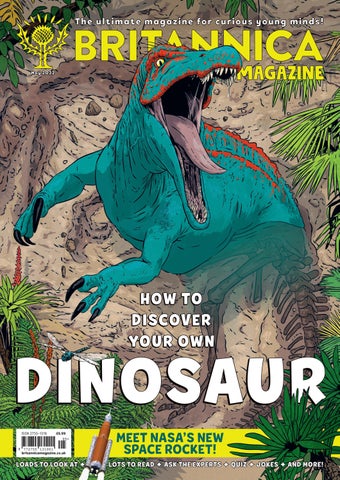
The ultimate magazine for curious young minds!
MAGAZINE
M a y 2 O22
ISSN 2755-1318
05> £5.99 05>
9 772755 131001 britannicamagazine.co.uk 9 772755 131001
LOADS TO LOOK AT :
MEET NASA’S NEW SPACE ROCKET! LOTS TO READ : ASK THE EXPERTS : QUIZ : JOKES : AND MORE!
Page 1O
CONTENTS
Page 16
Page 33
A wild and wonderful world awaits you inside!
4
Page 12
6 1O
FACTOPIA! Follow the trail of hilarious illustrations and crazily connected facts. From a royal ratcatcher to… plastic-eating microbes!
surface of Pluto and meet a moving robot made of slime!
12
SNAP IT! Eye-popping photos to amuse and amaze. Including the world’s tallest statue! EUREKA! Fascinating inventions and discoveries. See ice volcanoes on the
14
LISTIFIED! Find out about 1O world-famous animals, including a military pigeon that won a medal for bravery! Plus, see how long it would take you to drive around the solar system in a car. FASCINATING FACTS ABOUT MAY We celebrate 1O intriguing historical
events and anniversaries, including Mr Potato Head’s birthday!
16 18
MEET NASA’S NEW SPACE LAUNCH SYSTEM! Take a guided tour of this amazing new space rocket. INFOGRAPHIC: EARTH’S STORY The complete history of our planet, from 4.5 billion years ago to the present day.
Page 14
including the story of the Trojan horse and the first Olympics.
Page 8
44
45
46 48 Page 22
Page 45
49 5O 2O 21 22
NOBODY KNOWS One of the universe’s great unsolved mysteries. PICTURE QUIZ! Can you spot the camouflaged animals sneakily hiding in these photos? COVER FEATURE: HOW TO DISCOVER A DINOSAUR! Learn how to find, unearth and put your very own dinosaur fossil on display. Plus, get creative
with the mighty colour-in-osaurus!
28
3O 33
A TIMELINE OF MACHINES ON THE MOVE Extraordinary vehicles from a recordbreaking steam train to the very first hovercraft. EVERY SECOND Astonishing things that happen around the world each second! LITERALLY Amazing words and where they come from
38
4O
– including jaguar, karaoke, kookaburra and ukulele. THE AMAZING WORLD OF LEAFCUTTER ANTS Travel underground to discover the hidden (and brilliantly well-organised) world of the leafcutter ant. ABSOLUTELY EVERYTHING! Our epic serialisation of the true history of the universe continues with the wonders of ancient Greece,
51
MY BRITANNICA A bedtime story for pirates stars in the illustrated fact of the month. Plus, the latest letters and photos from readers. ASK THE EXPERTS Your chance to test Britannica’s brilliant experts. This month’s answers feature galaxies, tsunamis and the Great Wall of China. THE BIG BRITANNICA QUIZ Stretch your brain power with our deliciously tricky quiz. DO IT YOURSELF Try our brilliantly simple home experiment to discover the science magic of oil and water. PUZZLES & GAMES Featuring Animal Word Search, Word Morphs, Connect the Planets and Dino-Doku! SPOT THE DIFFERENCE Can you spot all 2O differences between our two zany illustrations? JOKES & RIDDLES Hand-picked by our jokes editor May!
SEND IT IN! Email us your letters, photos and favourite facts to: editor@britannicamagazine. com Or write to us at: Britannica Magazine The Black Barn Wickhurst Farm Leigh Tonbridge Kent TN11 8PS
ZANY FACTS
A ‘rat king’ is a tangled ball of rats whose tails are knotted together. Experts think most documented rat kings have been hoaxes, but it’s possible rat kings may actually occur in very rare situations – like when rats’ tails get caught in frozen clumps of their pee and poo
Rats breed so
Follow the trail of crazily connected facts all the way from a royal ratcatcher… to tiny microbes that eat plastic rubbish!
q
uic
Squeak!
By Kate Hale Illustrations by Andy Smith
In the mid-18OOs, one ratcatcher in England was so well known that he even worked for Queen Victoria
kly t hat just on
15,O ve up to n ha a c s rat of r i e pa
OO
dbabies and so o n–
in
o
nd ra g ,
ts –
r
s
mischief a ye
including b ab ie
ba
s
re ,g
gran at-
ya nl
bi e
A group of rats is called a
n
The Sumatran bamboo rat can grow to the size of a small dog
In Paris, France, there are about four million rats – they outnumber people by almost two to one! The rats can be seen scurrying on the crowded streets but mostly live underground in the sewers
– by eating it!
ocean the
h du mps
bis ub
ic ru bb ish in
co u
st
at
h
of A, a op re act t n o ually built
t es
rk Yo
US
ob icr ed m over
New Ci ty ,
e disc Scientists hav
f Parts o
buried underground
Beneath the city!
er
da
hu g
descen
ld p
p of d i r ossibl y help get
la
5
PHOTOS
Astonishing photos from around the world
6
!
! H A O W
WINGING IT
The Stratolaunch has the biggest wingspan of any aeroplane. At 117 metres, its wings are longer than a full-size football pitch! The Stratolaunch’s unusual shape is designed to carry a high-speed rocket plane between its two bodies which can then launch from the Stratolaunch in mid-air. CREDIT: MATT HARTMAN
7
PHOTOS
LET’S DANCE!
Verreaux’s sifaka, a species of lemur that lives only on the island of Madagascar, are famous for ‘dancing’. Sifakas mostly live in trees but when they come down to the ground, rather than walking on all fours – which their bodies aren’t able to do – they hop, skip and jump sideways instead. The lemurs have been nicknamed ‘the Dancing Sifakas’ – and you can see why!
SHADY BUSINESS
These beautiful parasols, which are light umbrellas used to give shade from the Sun, are being made by a young woman in an umbrella workshop in the city of Mandalay in Myanmar in Southeast Asia. She is weaving the parasols in a traditional Myanmarese way using bamboo and cotton. CREDIT: SARAVUT WHANSET, THAILAND, SHORTLIST, OPEN, TRAVEL, 2O22 SONY WORLD PHOTOGRAPHY AWARDS
8
! H O O O
YEA
!
H!
SUNNY DELIGHT
This amazing photograph was taken by the European Space Agency’s Solar Orbiter probe when it was roughly 75 million km from the Sun. It’s the best-quality photo ever taken of the Sun’s full disc and outer atmosphere, which is called the corona.
OW!
W STANDING TALL
The Statue of Unity in India is the world’s tallest statue. The towering bronze-plated figure is of Sardar Vallabhbhai Patel, who was once India’s Deputy Prime Minister. Standing at 182 metres, it is more than three times taller than Nelson’s Column in London. The statue took 3,OOO workers more than four years to build and it can withstand winds of up to 18O kph.
Eureka!
The latest astonishing discoveries, inventions and scientific breakthroughs.
Welcome, baby giants! Meet 70-year-old Dirk (right) and his two new babies, the first Galapagos tortoises ever born in a UK zoo. These cuties are small enough to hold in your hand but will grow up to be much heavier than a human adult – about 30 stone, or 190 kg!
The oozing slime robot you might want to swallow Sounds disgusting, doesn’t it? But this is a real invention that one day might change how doctors remove foreign objects from people’s digestive systems. You know how magnets can work at a distance, pulling or pushing metal items around even without touching them. Well, that’s how this invention works. It’s a slime made of magnetic particles, detergent and plastic. When no other magnets are around, it just sits there, an ugly, 10
squishable blob. But when surrounded by a magnetic field controlled by scientists, it becomes a robot. It can change shape, including making itself very skinny or flat to squish through small spaces. It can grab a small object and carry it away. It can move through lots of different environments. And it also conducts electricity, so it can fix a broken electrical circuit that’s hard for a human to reach. Plus, you can cut it into pieces and they can find
THE SLIME ROBOT DOESN’T GO ANYWHERE FAST
Start
After 32 seconds
After 71 seconds
each other and put themselves back together again! As cool as this gloopy robot sounds, it’s not quite ready for action. For one thing, it would be poisonous if it spent too much time in your body, and it might take years to solve that problem. The good news is that scientists have already figured out how to get around the yucky poo look. They say they can change the robot’s colour. If you were going to swallow a slime robot, what colour would you choose?
NEWS
LI ZHANG; MAX WILLCOCK/BNPS
Snakes can recognise their own BO One question scientists have been trying to answer for a long time is whether animals other than humans see themselves as individuals, separate from all the rest of their species. One experiment involves watching how an animal reacts to itself in a mirror. Some great apes, dolphins and birds have passed the mirror test. But not every animal has good vision. Snakes don’t. But they are super smellers. They use smell to locate food and mates and to find their way around. So researchers let snakes smell different bits of bedding from the cages of their siblings and also from their own cage, one at a time. The snakes reacted differently to their own bedding than to other snake bedding. The researchers think this might mean that snakes know they are individuals, but more research is needed to be sure.
Lending a hand: scientists have worked out that children helped to create prehistoric handprint art.
Prehistoric families had fun together, too Scientists have found out something amazing: a lot of prehistoric cave art was made by children. How do they know? The scientists studied hand shapes of modern people and compared them to handprint art found in caves in
Spain. Because hand shape and size are good measures of age, they were able to estimate that a quarter of the people making this art were 12 years old or younger. Even a few toddlers and babies were involved. Was this part of a religious ritual?
Was it a sort of school activity? Or was the whole group – adults and children – relaxing and having fun together? We don’t know. What we do know is that children have been doing arts and crafts for at least 20,000 years!
Yes, eating IS what life is all about! VOLCANO
Slushy ice volcanoes discovered on Pluto! Volcanoes on Earth erupt lava and ash, but looking at pictures of Pluto taken by the New Horizons spacecraft, scientists have found more than ten cryovolcanoes that spew an icy slush, which
In an experiment, scientists took the ingredients we think existed near deep sea vents more than 3.5 billion years ago, heated them to the temperature of those vents, and watched what happened. All by themselves, the ingredients started to work together in a complex chemical process called metabolism, the same process our cells use to turn food into energy. They think this might be how life began.
they think probably has the texture of toothpaste. Maybe even more amazingly, these volcanoes are as much as 7 km tall. That is only 1 km shorter than Mt Everest, the tallest mountain on Earth. 11
LISTS
LISTIFIED! Prepare to be amazed (and amused!) by the unusual facts crammed into these irresistible lists.
Cher Ami the pigeon 12
CELEBRITY CREATURES Ten animals that won a place in history
1
Incitatus the horse (41 CE)
According to some historians, the Roman emperor Caligula tried to appoint his horse Incitatus to the role of consul – one of the most important political jobs in the Roman Empire.
2
Clara the rhinoceros (174Os)
3
Wolfgang Amadeus Mozart’s starling (178Os)
4
Lord Byron’s bear (18OOs)
Given as a pet to the head of a Dutch trading company, Clara later became famous across Europe as one of the first rhinoceroses to be widely seen by the public there.*
The Austrian composer taught the starling to sing some of his pieces of music.
The poet Byron took a tame bear with him to study at Cambridge University because they wouldn’t allow him to bring his dog.
5
Poll the parrot (184Os)
US President Andrew Jackson’s pet parrot was known for repeating rude words.
GRUMPY CAT
6
Mrs O’Leary’s cow (187Os)
For many years this unfortunate animal was blamed for starting the Great Chicago Fire of 1871 by kicking over a lantern and setting its stall on fire. However, historians now think a man called Daniel ‘Peg Leg’ Sullivan was responsible.**
7
Cher Ami the pigeon (191Os)
Cher Ami saved the lives of a stranded group of American soldiers in the First World War by flying a message through enemy lines to US headquarters with details of the soldiers’ location. Cher Ami was awarded the French Croix de Guerre medal for its bravery.
Star Trek How long it would take to drive around the galaxy
Hachikō the dog
9
Unsinkable Sam the cat (194Os)
According to a popular story told during the Second World War, Sam the cat had the misfortune of being on board three different warships that were each sunk by the enemy (the first ship was German, and the other two were British). If you believe the story, Sam managed to float to safety on pieces of wreckage all three times. Sam’s portrait is on display at the National Maritime Museum in London.***
1O
Tardar Sauce, aka ‘Grumpy Cat’ (2O1Os)
This frowning feline became world-famous when her picture was shared millions of times on the Internet. Her expression was actually caused by two medical conditions – an underbite and feline dwarfism. It is likely that she was actually a perfectly happy cat.
8
Hachikō the dog (192Os)
This remarkably loyal Japanese Akita dog would walk to the station each day to meet its owner as he returned from work. After the owner’s death, Hachikō continued visiting the station for the next nine years, hoping to meet him there.
If you were driving a car at 1OO kph (62 mph), this is approximately how long it would take to travel from the Earth to various exciting space destinations.*
*Clara the rhinoceros was so popular she even started a fashion trend in Paris, with women styling their hair à la rhinocéros by adding a ribbon or feathers to look like a rhinoceros’s horn. **And so 126 years later, in 1997, the Chicago City Council officially apologized to Mrs O’Leary’s cow for the mistake. ***After being saved from his third sunken ship, Sam was described by his rescuers as being ‘angry but quite unharmed’.
Into space
1 hour To the Moon
6 months To Venus
45 years To Mars
62 years To Mercury
91 years To the Sun
175 years To Jupiter
72O years To Saturn
1,655 years To Uranus
3,31O years To Neptune
5,135 years To Pluto
6,85O years To the outer edge of the Kuiper belt
8,365 years To the edge of the solar system**
17,OOO years
To the nearest star outside the solar system***
45 million years
Across the Milky Way
1.12 trillion years *However, driving through space in a car is impossible for a number of practical reasons, including the lack of oxygen, gravity or road signs. **One way to define the outer edge of the solar system is to use the heliosphere, which is the area of space affected by the Sun’s magnetic field and solar wind. The edge of the heliosphere is known as the heliopause. ***After the Sun, the nearest star to Earth is Proxima Centauri, which is around 4O trillion kilometres away. So take a snack for the journey.
Listified! by Andrew Pettie and illustrated by Andrés Lozano is out now. 13
1953
1935
In just 45 minutes on May 25th, the US athlete Jesse Owens broke three world records. He tied a fourth in the 1OO-yard (91m) dash!
1952
At 11.3Oam on May 29th, climbers Tenzing Norgay (on the right) from Nepal and Edmund Hillary from New Zealand reached the 8,849-metre summit of Mount Everest, becoming the first people to stand on top of the world’s highest mountain.
The first Mr Potato Head toy was made on May 1st. He went on to star alongside Mrs Potato Head in the animated film Toy Story.
1O fascinating facts 878
1932
Alfred the Great, king of the Saxon kingdom of Wessex in southwest England, won a famous victory over an invading army of Vikings at the Battle of Edington in Wiltshire between May 6th and 12th.
184O
The Penny Black, believed to be the world’s first postage stamp, was issued in the UK on May 1st. It shows a portrait of Queen Victoria. 14
1932
All matter in the universe is made from atoms. Atoms are made from tiny particles called protons, neutrons and electrons. James Chadwick made scientific history on May 1Oth when he proved that neutrons existed.
On May 21st the American aviation pioneer Amelia Earhart became the first female pilot to fly solo across the Atlantic. It took Earhart just under 15 hours to fly more than 2,OOO miles from Newfoundland in Canada before she successfully landed in a field in Londonderry, Northern Ireland (right).
182O
Florence Nightingale was born in (and named after) the city of Florence, Italy, on May 12th. Clever and courageous, she saved thousands of lives in the Crimean War. International Nurses Day is now held on May 12th in her honour.
1963
Africa Day is celebrated each year in Africa and around the world on May 25th. Created in 1963, it is a special day marking independence, freedom and togetherness on the continent. There are more than 5O countries in Africa and on the islands off its coasts. How many African countries can you name?
about May… 1977
STAR WARS: A NEW HOPE (C) & TM LUCASFILM TD. LLC
The first Star Wars film, A New Hope, was released in cinemas on May 25th. R2-D2 and C-3PO (below) have appeared in ten live action Star Wars films so far – more than any other character.
ave you ever dreamt of flying to the Moon? Well NASA’s Space Launch System, or the SLS for short, is the latest and most technologically advanced way of getting there. Taller than the Statue of Liberty (see comparison below), the SLS is also the world’s most powerful space rocket. It will produce 15 per cent more thrust than the Saturn V rocket. (Thrust is the name of the force from a rocket’s engine that pushes it away from the ground and
H
By Chris Harrison
Earth’s gravitational pull and up into the air.) The SLS is still being tested but its first official mission – in which it will send an uncrewed test capsule around the Moon – could happen in the coming weeks. The SLS is designed to carry out a variety of space missions. As well as taking astronauts to the Moon and Mars, the SLS could make it possible to launch robotic missions, without humans on board, to planets as far away as Jupiter and Saturn!
The SLS is the world’s most powerful space rocket. Find out how it is designed to blast astronauts to the Moon – and beyond!
Meet NASA’s new Space Launch System!
SPACE
3. Core stage The core stage is 67 metres tall and holds more than 3,3OO,OOO litres of liquid fuel, which is enough to fill 63 large tanker trucks.
4. Interim Cryogenic Propulsion Stage (ICPS) The ICPS is an engine that propels the Orion spacecraft in space after the core stage and solid rocket boosters have been released.
5. Orion spacecraft Will carry up to six astronauts from Earth to the Moon.
The Orion spacecraft is the crew module that sits at the top of the Space Launch System. It is here that astronauts will live and work as they travel into space. At 5 metres wide, the Orion module is 3O per cent bigger than the crew compartments on the Apollo missions that took astronauts to the Moon in the 196Os and 7Os. Orion
has room for up to six astronauts, along with their food and equipment. Once the SLS’s rocket boosters and the fuel in its core stage have been used up during the launch phase, the SLS releases them, allowing the Orion to continue on its own. The Orion spacecraft is the only part of the SLS that returns to Earth after each mission.
Orion spacecraft
Statue of Liberty
93 metres
Space Shuttle
56 metres
SLS
98 metres
Saturn V
111 metres
How the SLS compares with other rockets
After the SLS uses the fuel in its rocket boosters, it releases them.
2. Solid rocket booster The two rocket boosters on either side of the core stage provide extra thrust during launch. Once the SLS has left Earth’s atmosphere, it releases them.
1. Four RS25 engines (hidden) Thanks to its four powerful engines, the SLS can reach speeds of more than 17,OOO mph in under nine minutes!
The giant vehicle with tracked wheels that you can see carrying the SLS in the photo above is called a crawler-transporter. NASA has two crawler-transporters and these unique machines have been used to carry rockets and spacecraft to the launch pad of the Kennedy Space Center in Florida,
USA, since the 196Os. Each crawlertransporter weighs around 3,OOO tonnes and can carry a load equivalent to the weight of 777 aeroplanes. Crawlertransporters are strong but also very slow. They travel at 1 mph when carrying a rocket and have a top speed of 2 mph without one!
Crawler-transporter
INFOGRAPHIC
EARTH’S STORY Most scientists believe that our Earth formed roughly 4,54O,OOO,OOO (4.54 billion) years ago, give or take 5O million years. That’s when a big swirling mass of gas and dust began to pull itself together under the force of gravity. The big clumps formed the Sun and planets of the solar system. Others became dwarf planets or asteroids. Here’s how Earth has changed since it first formed.
3.5 billion years ago
Cambrian explosion For the first few billion years of Earth’s history, life was very simple. It was mostly made up of single-celled organisms such as bacteria. The first animals we might recognise – such as sponges and jellyfish – appeared during the Cambrian period.
Cyanobacteria develop When did life appear on Earth? Some of the oldest possible evidence for living things are from hematite tubes that could have been made by ancient bacteria. But more well-understood fossils come from a simple life form called cyanobacteria.
We use several different units to measure time. Two important units are the day and year, which are both based on the movement of the Earth. A day is defined as the length of time it takes for Earth to complete one full rotation, or spin around once, on its axis. A year is defined as the amount of time that it takes for the Earth to complete one orbit around the Sun. It takes 365.25 days for the Earth to orbit the Sun. EXCERPTED FROM EARTH IS BIG, WRITTEN BY STEVE TOMECEK AND ILLUSTRATED BY MARCOS FARINA
Earth forms When the Earth first formed it was bombarded by asteroids and comets. The surface was a molten mass of super-hot lava, which eventually cooled to form the solid crust of the planet we know today.
541 million years ago
Time Marches On
1 rotation = 1 day
1 orbit = 1 year
18
4.54 billion years ago
47O million years ago
25O million years ago
Plants take over the land The first plants grew in wetland environments. Known as liverworts, these simple plants still have relatives living today.
Mammals Humans belong to a group of animals called mammals. The ancestors of mammals split off from reptiles around this time. Early mammals lived side by side with the dinosaurs. Most early mammals were quite small, about the size of modern-day mice or squirrels.
NOW
3OO,OOO years ago
Today’s humans Humans continue to change and evolve even today. Can you imagine where we will be in another million years?
Modern humans Modern humans (called Homo sapiens) have only been around for about 3OO,OOO years. The first Homo sapiens lived in Africa, but our ancestors had probably spread around the world by about 7O,OOO years ago.
4.51 billion years ago
4.4 billion years ago
4.3 billion years ago
The Moon forms Most scientists believe that the Moon is only a little bit younger than Earth. The current theory is that the Moon formed when an object roughly the size of Mars, called Theia, slammed into the young Earth. Gravity pulled together the leftover Zircon debris to form the Moon. crystal
Zircon crystals form These minerals from the Jack Hills of Australia are the oldest known on Earth.
Liquid water forms As Earth cooled, a huge amount of a gas called water vapour was released into the atmosphere. Eventually, the water vapour cooled enough to become liquid water and begin filling the oceans.
4.2 billion years ago
4.28 billion years ago
Hematite tubes form Hematite tubes are possibly the first signs of life on Earth.
Nuvvuagittuq Greenstone Belt The oldest Earth rocks found so far come from this rock formation in Canada that was originally formed by a volcano but later changed. The metamorphic rocks are thought to be a leftover chunk of Earth’s earliest oceanic crust.
Crystal containing hematite tubes Close-up of hematite tubes
24O million years ago
13O million years ago
Dinosaurs The first dinosaurs made their appearance around this time and they dominated Earth for the next 175 million years. However, the dinosaurs’ rule came to a sudden end roughly 65.5 million years ago when a large asteroid struck the Earth. The impact helped to create a climate catastrophe that caused all of the non-avian dinosaurs to go extinct.
Birds Most palaeontologists believe that today’s birds evolved from a group of dinosaurs called theropods. Many of these dinosaurs had feathers. Fossils of one early bird ancestor from China, called Archaeornithura, are over 13O million years old.
2.4 million years ago
4.4 million years ago
‘Handy man’ One early species of human is called Homo habilis. They lived in Africa between 2.4 and 1.4 million years ago. Standing about 1.37 m tall, Homo habilis had a bigger brain than earlier species and was an active tool maker. In fact, its name Homo habilis is Latin for ‘handy man’.
Human ancestors Humans are relative newcomers on Earth. There is still a major debate among scientists about who the first true human ancestor is. One problem is that new fossils are being found all the time. Each one adds to the story.
19
MYSTERIES
are bi l lions of g a la ere th x s a u s p i e i r e m 5, one s a y s in s i er v r i u a s t A e *. git b B u l t Sa c k a l a h o s le l b s ra g f o t
scover on p i d l l ag wi u e o f o a e r l y 4 m t n o e s c s t A the ev ’s is ca l l y t a ed W A y lk se cent i e h M t w ho
20
. rse ive he T un e le. or th ho y k wh e… ac er th or
2
3
1
4
PICTURE QUIZ!
6
Can you spot and name the camouflaged creatures sneakily hiding in each of these 1O photos?
7
5
8
9
1O
Did you spot them all? To see the answers, go to: britannicamagazine.co.uk/ picturequiz
DINOSAURS
How to discover a Anyone can find a dinosaur, and lots of people have. All you need is a little luck and a sharp eye. The steps that follow that moment of discovery are a bit harder but also fun (mostly). That’s why palaeontologists love their jobs! By Sarah Hampton Illustrations by Vector That Fox and Jack Tite
FACT!ted
ima An est very ne in e one bo turned is billion ossil. f o int a
Palaeontologists unearth the fossils of two dinosaurs, an Afrovenator and a Jobaria, in Africa. 22
D
inosaurs have been extinct for 66 million years and yet sometimes it feels as if they are still all around us, appearing in popular films and books and as the star attractions in natural history museums. So how do we know so much about them? The answer is fossils. At first glance, fossils – which are the remains or traces of ancient life that have been preserved in rock – don’t sound enormously exciting.
But in the hands of a palaeontologist, whose job it is to find, dig up and study fossils, they can provide clues that reveal extraordinary and fascinating things about the dinosaurs’ lost world. Since 2003, palaeontologists have on average found more than 45 new dinosaur species each year. So there are lots of dinosaur fossils still out there, waiting to be discovered. Will you be one of the people to find them?
dinosaur! 1
WHERE TO LOOK FOR FOSSILS The trick is to start in the right place. Go to an area where rocks that were formed during dinosaur times are now on the surface. Walk back and forth looking closely at the ground, and you might find a bone or tooth sticking out of the rock. That’s because wind and water can wear down the rock around a fossil, exposing it
right on the surface. Areas like this exist all over the world, including in Antarctica and right here in the UK. This is where in 1822 the English geologist William Buckland found Megalosaurus, the first dinosaur ever to be described scientifically. He worked in the fossil-rich Jurassic Coast, which stretches through Dorset and Devon.
Continued on next page
HOW A FOSSIL IS MADE Most animals never become fossils. Their bodies just rot away or get eaten. They are only fossilized if sediment covers their bodies quickly after their death.
Buried whole A creature such as a dinosaur dies and is buried by sediment. Sometimes that sediment is carried by a river, and other times the animal dies in mud and sinks into it.
Bones turn to rock Even though the dinosaur’s flesh rots away, the mud protects its bones. Over a long time, the skeleton gets buried deeper. Minerals from the groundwater fill empty spaces in the bones and replace their original minerals, turning them to rock.
Hidden for millions of years The minerals filling and replacing the bones retain the original shapes of the bones. Over millions of years, the mud turns to rock, encasing the fossil. When the rock is broken the fossil is revealed! 23
DINOSAURS
FACT!
Continued from previous page
a 2D or 3D model of the fossil and where it was found. This technique is called ‘photogrammetry’.
HOW TO UNEARTH A FOSSIL
2
Remove the fossil – it can take days, or even weeks, to excavate a fossil from the rock that surrounds it. Once the dinosaur fossil is separated from the surrounding rock, cover it in a plaster cast to protect it as you remove it from the rock and transport it back to the laboratory. Once there, use brushes and hand tools to help expose each bone. Palaeontologists sometimes use dental picks, the same tools dentists use in your mouth, to delicately remove the last of the stone from the fossil.
Digging up a fossil takes time, patience and expertise. Here are four key things to do: Expose the fossil – once you’ve found part of a fossil, start digging away the surrounding rock so that the fossil is more fully exposed. Palaeontologists’ tools include hammers, drills, chisels and trowels, as well as brushes to sweep away the dust. Be very careful. You don’t want to break the fossil. Map it out – record the position each fossil was found in. You can do this by placing a metre-square grid of strings over the excavation site. With the grid in place, photos of the site will show how big things are and the positions they were found in. Modern palaeontologists also sometimes use a series of digital photographs to create
Palaeontologists use grids to record where fossils are found.
5 EXPENSIVE DINOSAUR FOSSILS SOLD AT AUCTION Complete (or almost complete) dinosaur skeletons are very rare. Their finders can sometimes sell them for millions of pounds. 24
st 2OO Over the la re than years, mo inosaur 1O,OOO d ve been fossils ha d. discovere
Scan the fossil – take X-rays and CT scans of the inside of the fossilized bones. This helps to build a detailed 3D model of the fossil on a computer.
3
WHAT YOU CAN FIND OUT FROM FOSSILS Fossilized bones – by studying fossilized bones, palaeontologists can work out a surprisingly large amount about the dinosaurs they came from. First, the dimensions of a fossil can help you to estimate the dinosaur’s size, weight and strength. You can also calculate roughly how old the fossil is through a process called radiometric dating. Sometimes the clues are subtle: marks on a dinosaur’s fossilized teeth could be
evidence of what it liked to eat. While a fractured or broken bone might reveal how it died. Footprints and tracks – preserved dinosaur footprints, which are known as ichnites, are left behind when a dinosaur walks on mud or soft ground. If conditions are just right, the
footprint hardens to rock and fossilizes. By studying the shape of its footprints, you can estimate how heavy the dinosaur was, whether it walked on two legs or four, and even how quickly it was moving.
Fossilized dinosaur eggs that were found in China.
£5OO,OOO
£1.8 million
Misty the Dinosaur This Diplodocus skeleton was given the nickname ‘Misty’, short for the ‘mystery quarry’ where she was discovered by palaeontologist Raimund Albersdoerfer and his sons Benjamin and Jacob.
The Mystery Dinosaur Scientists first thought this dinosaur fossil was an Allosaurus. When further research proved their theory wrong and they were unable to confirm its identity, it was given the name ‘Mystery Dinosaur’.
Bite marks – dramatic marks in dinosaur bones can give a more detailed understanding of how some dinosaurs fought each other and how strong they were. Bite marks have also revealed that some carnivorous dinosaurs attacked and killed members of their own species.
This illustration shows dinosaurs from the early Jurassic Period in what is now Antarctica, including a group of Glacialisaurus (with the long necks) and a Cryolophosaurus with its baby.
Eggs and nests – the first thing you can tell from a dinosaur egg is the approximate size of the baby dinosaur inside. The number of eggs, and how they were arranged within a nest or burrow, also gives an idea of how dinosaurs behaved as parents and what they did to protect and care for their young. As far as we know, every species of dinosaur reproduced by laying eggs.
Poos – by studying fossilized dinosaur poos, which are called coprolites, you can tell what kind of animal made them. Coprolites also contain clues about the animal’s diet. (Fun fact: George Frandsen from Florida, USA, has 1,277 coprolites, making him the proud owner of the world’s largest collection of fossilized poo. George’s biggest coprolite weighs 1.92 kg. He’s even given it a name: ‘Precious’.)
Feathers – fossilized feathers can give you valuable information: what feathered dinosaurs looked like, how they kept warm and whether they were able to fly. Palaeontologists have also started to study microscopic ‘melanosomes’, which are found inside fossilized feather cells and which hold information on the colour of the feathers. Despite the thousands of dinosaur fossils that have been found so far and all the clever things palaeontologists have worked out by studying them, there’s lots about the dinosaurs that we’re still not sure about. This includes whether dinosaurs hunted together in packs, what they used all of those horns, crests, frills and other unusual and eye-catching body parts for, what their sleeping habits were and how some of them learned how to fly.
4
NAMING YOUR DINOSAUR
Dinosaurs are often named after the place where they were found, a characteristic body feature or – rather excitingly – after a person who played a key role in their discovery. One dinosaur was named by kids at the Indianapolis Children’s Museum in the USA. They called it Dracorex hogwartsia, which means ‘dragon king of Hogwarts’.
5
HOW TO PUT YOUR DINOSAUR ON DISPLAY Mount the fossil – to display your fossil in a museum, you will need to mount it on a strong metal frame called an armature. If there are bones missing from the skeleton, you can make replacement bones to fill in the gaps. Make a model – for some museum displays, you will also need to create model versions of other parts of the dinosaur’s body, such as its muscles, skin, tongue and eyes. You can do this using clues on the dinosaur’s bones, such as where they were attached to its muscles. Congratulations, your very own dinosaur is now ready to go on display!
£2.1 million £6.1 million £9.5 million Battling Allosaurus and Stegosaurus When these fossils were found, the Allosaurus’s jaw was clamped on the Stegosaurus’s leg, leading some scientists to think the dinosaurs killed each other before both were buried in mud.
Apollonia, Prince and Twinky the Diplodocuses This trio of dinosaurs was discovered buried in a quarry. Scientists think that they could have been part of the same herd. They are now on display in a museum in Singapore.
Sue the Tyrannosaurus rex Sue, the most expensive dinosaur fossil ever sold at auction, is named after Sue Hendrickson, the palaeontologist who discovered the beautifully preserved fossil. Carnivorous dinosaurs (like the T. rex) tend to fetch more money at auction than herbivores. 25
THE COLOUR-I
While you’re colouring in our mighty dinosaur, see if you can f 1. Rabbit, 2. Lobster, 3. Lemur, 4. Kangaroo, 5. Dodo, 6.
To see the answers, go to: britan
IN-OSAURUS!
find the shapes of these 1O creatures hidden within its body: Dolphin, 7. Anglerfish, 8. Penguin, 9. Bat, 1O. Seahorse.
nnicamagazine.co.uk/colouringin
Send it in – and win! Once you’ve finished colouring in your dinosaur, we’d love to see it! So please take a picture or scan of your colour-in-osaurus and email it to us at editor@britannicamagazine.com along with your name, age and postal address. Our favourite drawings sent in by readers will each win a copy of the fantastic Nature Timeline Wallbook!
A timeline of machine Join us on a fascinating journey as we celebrate some of history’s most extraordinary motorised machines…
18O1 Richard Trevithick, a Cornish mining engineer, builds the first highpressure steam engine, the Puffing Devil.
1787 American inventor John Fitch and clockmaker Henry Voigt make the first steam-boat using oars powered by a steam engine.
1863 The world’s first underground railway, the Metropolitan Line, is opened in London. It runs from Paddington to Farringdon.
1877 Enrico Forlanini, an Italian engineer, makes the world’s first successful helicopter. The steam-powered, unmanned vehicle rises by 13 metres and stays up for 2O seconds.
1959 The world’s first hovercraft, the SR-N1, invented by Christopher Cockerell, crosses the English Channel.
1964 The Bullet Train gets its nickname by breaking rail speed records carrying passengers from Tokyo and Osaka in Japan at 21O kph (13O mph).
1957 On October 4th the USSR launches Sputnik, the first artificial satellite. Sputnik 2 launches a month later and carries the first living creature into Earth orbit, Laika the dog, triggering a space race with the USA. 1969 Concorde, the world’s first supersonic airliner, makes its first flight. It can travel at more than twice the speed of sound.
1981 Columbia blasts off from Cape Canaveral in Florida. It is the first reusable spaceship and part of a fleet of four US Space Shuttles. 28
1983 American aerospace company Lockheed develops the F-117A Nighthawk, the first aeroplane to use stealth technology to hide from radar.
es on the move! 19O8 Henry Ford’s Model T Ford rolls off the production line – the world’s first affordable car because it is made of standard parts and built in a factory. 188O Traction engines – tractors powered by steam – are produced in factories for the first time, making them less expensive. Farmers use them to get more work done with fewer people. Road builders add rollers and use them to flatten the road surfaces.
1938 Mallard, an A4 steam engine designed by Scottish engineer Sir Nigel Gresley, sets the world speed record for a steam locomotive at 2O2.58 kph (125.52 mph).
1884 Charles Parsons improves on the steam engine by changing to a turbine design, where the steam drives a wheel around and around. He tries it out on his boat the Turbinia.
1918 HMS Argus becomes the world’s first fully operational aircraft carrier with a full-length flight deck.
19O9 French headlamp maker and aviator Louis Blériot wins a £1,OOO prize from the Daily Mail newspaper for being the first person to cross the English Channel in an aeroplane. The journey from Calais to Dover takes 36 minutes.
2O21 The New Horizons space probe reaches Pluto.
1997 Thrust SSC, a British jet-propelled car designed by Richard Noble and driven by Andy Green, sets the land speed record, reaching 1,228 kph (763 mph). It is the first car officially to break the sound barrier. 2O18 To mark the first launch of SpaceX’s Falcon Heavy rocket, a Tesla electric car is released in outer space. The car is now travelling on a solar orbit carrying it towards Mars.
29
STATS
2OO,OOO text messages are sent
3,OOO,OOO emails are sent
EVERY SECOND Somewhere on the planet this very second, one aeroplane is taking off, four babies are being born, 1OO lightning bolts are striking the Earth and…
33O,OOO kilograms of goods are travelling across the sea
pairs of jeans and
O O 5 pairs of shoes are sold 30
packages are shipped
2,3OO
48
smartphones are bought
EXCERPTED FROM EVERY SECOND, WRITTEN AND ILLUSTRATED BY BRUNO GIBERT
4O
Recommend a friend… and we will send you a FREE BOOK about Pluto!
H
ave you been enjoying the first issues of the all-new Britannica Magazine? We certainly hope so! To celebrate our recent launch, we are giving away a FREE COPY of a brilliant and hilarious new book – How to Teach Grown-Ups About Pluto by top astronomer Dean Regas with illustrations by Aaron Blecha – to any subscriber who recommends a friend or family member to try out a subscription to Britannica Magazine.
Here’s all you have to do…
1
When your friend or family member takes out their new subscription to Britannica Magazine, ask them to enter your email address in the box in the britannicamagazine.co.uk online checkout that says: ‘Were you referred by a friend?’ Make sure that this is the same email address that you used to set up your own Britannica Magazine subscription.
2
We will send you a hardback copy of How to Teach Grown-Ups About Pluto worth £9.99 as a free thank you gift! It’s as simple as that!
SUBSCRIPTIONS TO BRITANNICA MAGAZINE NOW START FROM JUST £5.99 A MONTH. PLUS, WE ARE CURRENTLY RUNNING TWO AMAZING SPECIAL OFFERS! TURN THE PAGE TO FIND OUT MORE…
Two amazing special offers! OFFER 1 12-MONTH MAGAZINE PLAN Sign up now for £59.99 to receive:
ES INCLUDOOK FREE B TH WOR £25!
✓ A year’s worth of printed magazines delivered through your door (that’s one issue a month with a double issue in July and December)
✓ FREE access to our digital editions ✓ FREE Introductory Issue ✓ FREE sign-up gift of Britannica’s All New Children’s Encyclopedia WORTH £25!
OFFER 2 6-MONTH MAGAZINE PLAN Sign up now for £29.99 to receive: ✓ 6 months’ worth of printed magazines delivered through your door (that’s one issue a month for 6 months with a double issue in July or December)
✓ FREE access to our digital editions ✓ FREE Introductory Issue ✓ FREE sign-up gift of Britannica’s FACTopia! Follow the Trail of 4OO Facts WORTH £1O!
INCLU FREE B DES O WORTHOK £1O!
MONTHLY MAGAZINE PLAN Sign up now for £5.99 to receive: ✓ Ongoing monthly printed magazines delivered through your door for as long as you wish (that’s one issue a month with a double issue in July and December). You are free to cancel at any time ✓ FREE access to our digital editions
Visit www.britannicamagazine.co.uk, scan the QR code or call O1778 392 479
WORDS
LLY
The story of amazing words and where they come from! By Patrick Skipworth. Illustrations by Nicholas Stevenson
E
very day, we use words to talk about ourselves and the world we live in. But look closely and you will see that words are so much more than ways to describe things. It’s true that there’s a word for almost everything you can see, think, smell, touch or do. Words allow us to tell stories or discuss ideas. They even shape the way we see the universe around us. But every
word also contains a hidden story of its own. It can tell us about a place or a time long ago, or connect us with people on the other side of the world. Some words once meant something completely different to what they mean now. Others have hardly changed at all but might have travelled halfway across the world. Languages are always evolving and developing in exciting ways.
On the following pages we look at eight words that are now used by English speakers that have interesting histories. Look carefully at the artwork that illustrates each word. Each picture shows some of the different meanings the word has been given at different times and by different cultures.
Continued on next page
33
ROYALTY English pronunciation: ROY-ul-tee Origin: French English meaning: family of a king or queen French root meaning: rule by a king or queen In 1O66 CE, England was invaded by knights from northern France called the Normans. Lots of things changed, including the English language. Normans preferred French words such as pork, royal and autumn to the English pig, queen and fall, and many of their words are still used today. 34
COMPANION English pronunciation: kum-PAN-yun Origin: Latin (language of ancient Rome) English meaning: a person or animal you spend a lot of time with Latin root meaning: with bread What makes a good friend? Someone who’s a lot of fun, someone who always listens, or maybe someone you can trust with a secret? For some ancient Europeans, the best companion was a buddy you could share your lunch with.
UKULELE English pronunciation: you-kuh-LAY-lee Origin: Hawaiian English meaning: a stringed instrument like a small guitar Hawaiian root meaning: jumping flea These musical instruments come from Hawaii, USA, in the Pacific Ocean. There, local people saw the small guitars brought by European settlers and developed their own instrument. A ukulele player’s fingers bounce on the strings as quickly as jumping fleas. Continued on next page 35
KARAOKE English pronunciation: ka-REE-oh-kee Origin: Japanese English meaning: recorded music made for singing along to, often played by a machine with a microphone attached Japanese root meaning: empty orchestra
All around the world, people love to sing as if they were performing in a concert with a famous band. The first karaoke machines were developed in Japan so that people could sing along to songs without the need for a live band to play with them.
JAGUAR English pronunciation: JAG-you-uh Origin: Tupi (an indigenous Brazilian language) English meaning: South American big cat Tupi root meaning: large, fierce predator Eyes glinting in the dense jungle leaves, a jaguar is on the hunt. The agile big cat we now call a jaguar is a specific rainforest predator. But to the Tupi people of Brazil, Îagûara was once the general word for any big predator to watch out for.
WORM English pronunciation: WURM Origin: Old English Modern English meaning: one of a group of long, thin animals without backbones Old English root meaning: wriggling creature Worms wriggle beneath the
soil, churning up the dirt. The word worm comes from a very old form of English, and once meant any turning, twisting, squirming, whirling creature. Snakes, maggots and insects could all be worms, and the giant, wingless dragons of legend could too.
KOOKABURRA English pronunciation: COOK-uh-buh-ruh Origin: Australian Aboriginal languages English meaning: a mediumsized Australian bird Aboriginal root meaning: the call of a kookaburra
36
Dogs woof, cats meow and cows moo. Hyenas laugh, wolves howl and kookaburras… kookaburra! These Australian birds were named after the laughing sound that they make to let other kookaburra groups know who’s in charge. This way of naming things after their sound is called onomatopoeia (pronounced on-uh-mattuh-PEE-uh).
CARIBOU English pronunciation: KAH-ri-boo Origin: Mi’kmaq (an indigenous language of eastern Canada) English meaning: a species of large deer, also known as reindeer Mi’kmaq root meaning: pawer, snow shoveller How do animals get their names? Sometimes people name them by copying the sound they make or by describing their distinctive behaviours. Caribou, for example, got their name from their habit of pushing aside thick snow when looking for plants to eat in the cold winter. Literally, written by Patrick Skipworth and illustrated by Nicholas Stevenson, is out now Didyouknowthatthewordcompaniononcemeant ‘with withbread’ bread that ...’ caribouwerenamedfortheirhabitof shovelingsnow or ...thattheancientEgyptiansweren’tthe oneswhofirstcalledpreservedbodies‘mummies’ mummies’? FromFrancetoJapan,IndiatoBrazilEast , AfricatoHawaii, Englishwordsarerichwithglobalconnections. Andthoughmanyofthewordsweuseeverydayhave journeyedfarintimeandspace,theystilcarrywithinthem thestoriesoftheirbeginnings.JoinPatrickSkipworthand NicholasStevensonastheyreveal–quiteliterally–therich historyandculturaldiversityofourlanguage.
AMAZING WORDS AND WHERE THEY COME FROM
£11.99
ISBN 978-1-912920-17-4
9 781912 920174
whatonearthbooks.com
37
L
eafcutter ants live in tropical forests, mainly in Central and South America. You see them trekking across the forest floor and up and down the trunks of trees, carrying pieces of leaves in their jaws and often forming lines of ants that are 30 metres long! But what do the ants want the leaves for? And where are they taking them? Read on to follow the ants underground and explore their fascinating hidden world…
While forager ants look for leaves, other worker ants keep watch over them. These smaller ants may ride on the leaves as the foragers carry them back to the nest. Their job is to chase away any phorid flies that try to land on the forager ants that are busy carrying leaves. The phorid fly is a tiny parasite that lays eggs on the heads of ants. When the eggs hatch, the larvae kill the ants.
Guards
Humans have been farming crops for thousands of years, but ants began farming around 5O million years ago! Leafcutter ants use their large jaws to cut up leaves and carry the pieces – some 3O times their own body weight – back to their underground nest. They don’t actually eat the leaves
Fungus farmers
By Sabrina Weiss, illustrations by Paul Daviz
The amazing world of leafcutter ants
ANIMALS
A forager ant carries a leaf as a worker ant protects it.
but use them to cultivate a ‘garden’ of fungus in their nest. The fungus needs the dead plants to grow and the ants then feed on the fungus. Leafcutter ants come in various sizes and each has a job in the colony, from leafcarriers and guards to tunnel builders and gardeners.
Leafcutter ants carrying pieces of leaves along a branch.
An underground nest has thousands of tunnels and chambers. All of the chambers are built by excavator ants. There is even a refuse chamber where dead ants and old food are left. The ants working here
Excavators
FUNGUS GARDEN
are not allowed to leave to avoid contaminating areas where the fungus garden and queen live. If the queen catches a deadly disease from another ant, the whole colony could collapse.
Leafcutter ants keep their fungus gardens healthy and protect them with chemicals.
Leafcutter ants work hard to keep their fungus healthy and, just like human farmers, use chemicals to protect it. On their bodies they carry bacteria that release antibiotics against pests. The gardeners also feed and care for the eggs and larvae of the colony (collectively called the brood), which are found in chambers of the fungus garden.
Gardeners
REFUSE CHAMBER
QUEEN’S CHAMBER
NURSING CHAMBER
EXCERPTED FROM AMAZING ANIMALS BY SABRINA WEISS AND PAUL DAVIZ
Ants taking care of eggs and larvae in a nursing chamber.
The queen (also pictured above) is up to 5 centimetres long and the only ant in the colony that lays eggs.
Queen
THE BIG READ
Absolutely Everything! Each month we feature an amazing story from world history taken from the bestselling book by Christopher Lloyd, with illustrations by Andy Forshaw. This month: the wonders of ancient Greece!
I
n the ancient world, everyone wanted olive oil. It was as precious as gold is today. Squeeze out the oil from olives, and you could use it for lighting lamps to see in the dark, for cooking food, or even to make soap for scrubbing yourself free of grime. Olives grow very well in Greece, so it was something the Greeks could trade with. Greek civilization became very rich and powerful as a result. In about 594 BCE, a new leader came to power in Athens, one of the Greek
city-states (basically tiny countries). His name was Solon, and according to the stories told about him much later, he was a great warrior and a poet. Solon is famous for making some very big changes. One thing Solon did was to set up a system where all Athenian citizens could vote to decide exactly what the government should do. This is called direct democracy. Other Greek states also set up direct democracies. It was an exciting moment if you were a citizen of Athens.
Focus the camera of a smartphone or tablet on this QR code to listen to an audio recording of the author reading this book extract.
The School of Athens: this 16th-century painting by the Italian artist Raphael features famous Greek thinkers, including Plato.
1. NOTHING TO SOMETHING 13.8 billion– 45O million years ago
2. LAND AHOY! 47O mya– 252 mya
3. DINOSAURS 252 mya– 5 mya
4. HANDS FREE 5 mya–65,OOO years ago
5. YOU AND ME 2OO,OOO years ago–5OOO BCE
But there was one really big catch. You only counted as a citizen if you were free, male, Athenian and rich enough to own property. If you were enslaved (and a lot of people were), female, foreign or poor, forget it. That means most people who lived in Athens couldn’t vote. So, the Athenian system wasn’t one we would think was fair these days, but the idea of elections in which the people had a say – the origins of democracy – did begin right here. Because they were so wealthy and didn’t have to spend much time working, Athenian citizens had something worth even more than olive oil. They had time, bags and bags of it. Free, rich Athenian men could use their time to learn, think,
6. CIVILISATION BEGINS 5OOO BCE– 15OO BCE
7. MEANWHILE, IN ASIA 3OOO–2OO BCE
YOU ARE HERE
8. RISE A 14OO BCE
This drinking cup depicts a school. The cup was made in Athens, a major centre of learning that was home to great philosophers such as Plato, Socrates and Aristotle. Such scenes were often shown on Greek drinking cups, amphorae (jars for storing olive oil and wine) and vases, all of which were traded across the Mediterranean.
write, invent and discover. They even had time to go to giant outdoor theatres to see plays performed and to listen to storytellers. Some of the most famous ancient Greek stories were written by the poet Homer. In his two booklength poems, The Iliad and The Odyssey, he tells of the legendary Trojan wars, which are supposed to have taken place around 1260–1180 BCE in what is now Greece and Turkey. You might know one of the stories. According to Homer, Paris, prince of Troy, kidnapped Helen, queen of Sparta. Sparta was a city-state of Greece, so Greece went to war with Troy to get Helen back, and they came up with a clever trick. They built a huge wooden horse and hid a team of their
Continued on next page
ND FALL – 476 CE
9. MEANWHILE, IN THE AMERICAS 15OO BCE– 153O CE
1O. INVENTION CONNECTION 57O–1279 CE
11. MEDIEVAL MISERY 476–1526 CE
12. GOING GLOBAL 1415–1621
13. REVOLUTIONS ALL AROUND 1543–19O5
14. WORLD AT WAR 1845–1945
15. TO BE CONTINUED... 1945–Present
THE BIG READ
Continued from previous page best troops inside it. Naturally, the Trojans were very curious about this giant horse parked outside their city walls. So they dragged it into the city to take a closer look. In the dark of night, the Greek soldiers snuck out of their hiding place, opened the gates of Troy and let the Greek army flood in to destroy the city and its people. Homer’s poetry and the work of other ancient writers also tell us about Greek religion. The Greeks believed in a group of gods known as a pantheon. There were twelve main gods, or Olympians. Zeus was the king of the gods and the ruler of their heavenly home, Mount Olympus. Hera was queen of the gods and the goddess of women and family. Poseidon was the god of the sea. Demeter was the goddess of nature, farming and the seasons. Athena was the goddess of wisdom, knowledge, science, literature and war. Greek myths tell the stories of these gods and their interactions with humans. Ancient Greek thinkers didn’t always just follow the explanations in these myths, though. Thales was a Greek philosopher who lived in a city called Miletus, on the west coast of what is now Turkey. It is said that in 585 BCE he stunned his neighbours by correctly predicting that the world would be plunged into pitch darkness right in the middle of the day. The obvious explanation back then was that the gods were angry. The not-so-obvious (and correct) explanation was that there had been a solar eclipse. This happens when the Moon passes between the Earth and the Sun, blocking out the daylight for a few minutes. Thales is sometimes called 42
Above: the Parthenon temple in Athens. Hera (above left) and Zeus (above right) were the queen and king of the ancient Greek gods.
the father of science. He believed nature is what makes things happen, not gods such as Zeus or Hera. And he taught that if you observe the world closely and make hypotheses and test them, you can better understand how the universe works. In the ancient world, science and philosophy were closely related. They both have to do with how the world works. One famous Greek philosopher
was Socrates. Socrates thought a person’s soul could be improved over time through problem-solving, discussion and debate.
T
he original Olympic Games started as far back as 776 BCE. The games were a series of athletic competitions among the Greek city-states. Athletes ran and jumped and rode horses in honour of their gods, the Olympians. All wars paused to let competitors pass through battlefields
Above: the original Olympic Games were first held in 776 BCE.
on their way to the games. Poems were written about the winners and statues made in their honour. The most prestigious prize was a crown made from the leaves of that most precious tree of all – the olive. Not all Greek city-states were the same. While Athens was developing democracy and philosophy, Sparta was more interested in military might. There, baby boys were inspected to see if they were strong enough to become soldiers. The weakest were abandoned and left to die on the lonely slopes of a nearby mountain range. If you were a boy who made it to the age of seven, you were sent off to a military training camp to learn how to become a fearless warrior. There, you weren’t fed enough at meals. The idea was that you learnt to steal. However, if you were caught
stealing, you would be punished because you were too clumsy to get away undetected. Girls in Sparta had it better. If you were a girl, you were well fed, given a lot of freedom, and encouraged to take part in sports and ride horses. You were educated at home and were supposed to grow up to be a good mother to strong future warriors. And because men were so busy fighting, grown-up women also had more power than they did in Athens and other places in Greece. They were equal citizens and could own property. The Spartan idea was to create a super-race of strong, intelligent humans that would triumph over every other culture in the world. Despite all their advances and olive oil, the ancient Greek civilisation didn’t last forever. But their legacy lives on. As the Romans rose up, like a hurricane force, many aspects of Greek culture were flung far and wide across Europe, the Middle East and even North Africa. Its impact is still being felt in many Western cultures today.
In ancient Greece, soldiers used wooden devices called siege engines to break down castle walls. A siege engine could be as large as a small house and might be covered in damp horse hides to protect it against flaming arrows. Some experts think these machines were the inspiration for Homer’s story of the Trojan horse.
Hooked? We hope so. Look for the next instalment of our story in the June Issue of Britannica Magazine!
43
NICA
AN
Send your favourite fact to: facts@britannicamagazine.com Pirates had bedtimes too. ‘Lights out’ on Captain Bart Roberts’ ship was at 8pm.
SEND IT IN!
M Y B RI T
YOUR fact of the month! Submitted by Mia, age 1O. Illustrated by Mark Long
Your photos Where does your curiosity take you? Tell us by sending your photos and letters to: photos@britannicamagazine.com Plastic fashion!
Can you dig it?
Budding engineer Rhys certainly can! He’s built a model of a bucket wheel excavator, which is used to scoop up rocks and coal from the ground. The model has nearly 4,OOO pieces! Rhys, age 1O 44
Young designer Laurence and his friend Ayali (on the right) created this stylish turquoise dress from materials they found at home. Look closely and you’ll see that the dress is mostly made from plastic bubble wrap, which is normally used to wrap up and protect fragile items. So Laurence and Ayali’s dress proves that recycling really is the height of fashion! Laurence, age 1O
Ask the experts
Readers ask. Experts answer. Send your questions to: experts@britannicamagazine.com
DR MAN XU
DR TOBY BROWN
Historian
Astronomer
Question: Who built the Great Wall of China and why?
Question: How many galaxies are there in the universe?
From Kalisa, age 8
From Adam, age 12
Answer
The Great Wall of China was built over centuries by as many as 3OO,OOO workers.
Answer Starting in the 5th century BCE, several Chinese states in what is now northern China built border walls to defend themselves from each other and also from their neighbours to the north. In the 200s
Answer
DR ERIK KLEMETTI
Earth scientist
Question: What causes tsunamis? From Daisy, age 11
Imagine jumping into a bathtub. You’d make some very big waves when you push all that water out of the way so fast. That is what happens during a tsunami, which is a giant ocean wave that can move as fast as a jet aeroplane and is formed when
BCE, the First Emperor unified these states into a single country. But this newly united China was still at risk from its northern neighbours. So the Emperor ordered as many as 300,000 workers to build
a giant wall along the northern boundary of the country. The wall connected the old border walls and extended them much further. Over more than a thousand years, sections of the wall crumbled, and new Chinese
rulers had it rebuilt to help keep the northern border secure. If you add together the lengths of all the sections of the wall that have been built over time, the Great Wall of China is more than 20,000 kilometres long.
something really big and powerful moves a lot of water suddenly. The most common causes of tsunamis are earthquakes and volcanic eruptions, which can create giant waves by moving the ocean floor or causing
large underwater landslides. The Tōhoku tsunami, for example, was caused by a huge earthquake that
measured 9 on the Richter scale. The earthquake sent waves up to 40 metres tall crashing onto the coast of Japan and other islands in the Pacific Ocean. That’s a wave about as tall as a 12-storey building!
The universe contains more than a hundred billion galaxies. This number is so large that if you start counting one galaxy every second – not stopping once, even for a moment – it would take you more than 3,000 years to count them all! Astronomers calculate this number by counting many thousands of galaxies in small regions of the night sky. We know that there are roughly the same number of galaxies in every direction that we look, so this gives us a good estimate of the total number of galaxies in the universe. ‘Space,’ as the sciencefiction writer Douglas Adams correctly observed, ‘is big. Really big.’ 45
QUIZ
SHOW WHAT YOU KNOW (If you read the whole magazine, these should be a breeze!)
21
1
Most scientists think that the Earth is… a. 45 minutes old b. 45 million years old c. 4.5 billion years old d. 45 billion years old
2
A group of rats is also known as… a. A gang b. A pack c. A conspiracy d. A mischief
3
In Hawaiian, the original root meaning of the word ukelele is… a. Jumping flea b. Jumping bean
BIG Britan The
Stretch your brain power with our tricky quiz. The first 2O questions are answered in the magazine, but the final five aren’t. Don’t worry if you don’t know them all. Just check out the answers bottom right and test your grown-ups, too!
c. Little strings d. Little guitar
4
On average, how many pairs of shoes are sold every second? a. 5,000 b. 500 c. 50 d. 5
5
Sue the Tyrannosaurus rex, the most expensive dinosaur fossil ever sold at public auction, was bought for… a. £2.1 million b. £6.1 million c. £8.5 million d. £9.5 million
6
A team of scientists have recently discovered that snakes are able to recognise their own… a. Reflection b. Hiss c. Smell d. Shed skin
46
7
9
8
1O
‘Lights out’ on Captain Bart Roberts’ pirate ship was at… a. 8pm b. 10pm c. Midnight d. Pirates don’t have bedtimes! Ice volcanoes have recently been spotted on the surface of… a. Earth b. Mars c. The Sun d. Pluto
25
The Thrust SSC was the first car to travel… a. Into space b. Underwater c. Faster than the speed of sound d. Faster than 500 kph
Leafcutter ants can carry weights up to… a. Twice their own body weight b. Ten times their body weight c. One hundred and fifty times their body weight d. Thirty times their body weight
11
The world’s tallest statue is found in… a. India b. China c. Mongolia d. Thailand
12
At the centre of almost every galaxy is a… a. White dwarf b. Supergiant star c. Supermassive black hole d. Petrol station
13
Tenzing Norgay and Edmund Hillary became the first people to climb Mount Everest in… a. 1924 b. 1947 c. 1953 d. 1959
a. Peeps b. Cygnets c. Pufflings d. Pufflets
13
22
The country in which the largest number of languages are spoken is… a. Brazil b. United States c. India d. Papua New Guinea
14
Coprolites are trace fossils that are made from fossilised… a. Bones b. Footprints c. Feathers d. Poo
15
The queen of the ancient Greek gods was called… a. Hera b. Athena c. Aphrodite d. Juno
16
Verreaux’s sifakas are famous for… a. Singing b. Dancing c. Climbing d. Sleeping
17
The name of the first postage stamp was… a. The Penny Farthing
b. The Penny Black c. The Penny White d. The Queen’s Head
18
Driving the distance from Earth to the Moon in a car travelling at 100 kph (62 mph) would take… a. A day b. A month
23
The only one of the Seven Wonders of the Ancient World that still exists today is… a. The Hanging Gardens of Babylon b. The Great Pyramid of Giza in Egypt c. The Lighthouse of Alexandria d. The Colossus of Rhodes
nnica Quiz c. Six months d. Six years
19
Andrew Jackson, the seventh president of the United States, kept a pet… a. Parrot b. Rhinoceros c. Alligator d. Pigeon
2O
The world record for solving a Rubik’s Cube is… a. 3.47 seconds b. 7.34 seconds c. 13.4 seconds d. 34.7 seconds
24
The largest living organism on Earth is… a. A blue whale b. An African elephant c. A giant sequoia tree d. A mushroom
25
Usain Bolt holds the world record for running the 1OO metres – in 9.58 seconds. Which country does Bolt come from? a. United States b. Bahamas c. Jamaica d. Trinidad & Tobago
BONUS ROUND (Now challenge yourself with questions NOT answered in the magazine!)
21
Puffins are seabirds with brightly coloured triangular beaks. But what are baby puffins called?
Answers: 1. c, 2. d, 3. a, 4. b, 5. d, 6. c, 7. a, 8. d, 9. c, 10. d, 11. a, 12. c, 13. c, 14. d, 15. a, 16. b, 17. b, 18. c, 19. a, 20. a, 21. c, 22. d, 23. b, 24. d, 25. c.
9
47
m g n i i lk! c n a d
Ingredients ilk (whole milk M works best) B A plate or shallow dish B Food colouring B Washing-up liquid B Cotton bud B
g a i c of m e h T
EXPERIMENT
Instructions
1 Pour enough milk on the plate to completely cover the bottom to the depth of about half a centimetre. 2 Add a drop of each of the four colours of food colouring – red, yellow, green and blue – to the milk. Keep the drops close together in the centre of the plate of milk. 3 Place a drop of washing-up liquid on a cotton bud, then gently touch the centre of the milk with it.
How it works… Milk is mostly water, but it also contains vitamins, minerals, sugar, proteins, and tiny droplets of fat. You might have heard the expression ‘they’re like oil and water’ used to describe two people who don’t get along. That’s because oil is a kind of fat, and fat molecules (the tiniest bits of fat) and water molecules (the tiniest bits of water) don’t play well together. They can be near one another, but they would never in a million years hold hands. That’s why when you try to wash greasy hands (grease is just fat) with water, the grease doesn’t come off. So what do you use to get grease off your hands? Soap, of course! That’s because soap is like one of those amazing kids who can be friends with very 48
different people at the same time. Imagine that a soap molecule has two hands. One of them is very good at holding hands with water, and the other one is equally good at holding hands with fat. That’s how soap helps the water pull the grease off your hands. When molecules hold hands in
TOP TIP Don’t drink this milk. It will taste like soap!
this way, it’s called bonding. Now back to our experiment. When the soap hits the milk, it instantly starts reaching out its fat-friendly hand to grab the fat molecules floating in the milk. It grabs water molecules with its water-friendly hand, too, but that part is easy because milk is mostly water. When the soap gets near them, fat molecules spin around, finding and bonding with the soap and pushing the water around in the process. That’s what makes the swirls. This would happen even if there
4 What happens?
was no colouring in the milk, but the colouring that’s riding on the water helps us see what’s going on more clearly. As the soap molecules finish pairing up with the fat molecules, the action slows down and eventually stops. Either all of the soap is paired or all of the fat is paired. Try adding another drop of soap to see if there’s any more movement. If there is, you’ve discovered that there are still more fat molecules that haven’t found a partner at the big colour dance. Keep adding soap drop by drop until all of the fat has bonded to the soap.
WORD MORPHS Change the word CUP to BAT in 3 moves by changing one letter at a time. Each new word you create by changing a letter must be a proper word. Then try changing COLD to WARM in 4 moves. And HOPE to BALD in 4 moves.
& games Stumped? Don’t worry, you can find the answers to all the puzzles on page 5O.
Can you spot the 2O animals hiding somewhere in our wild and wonderful word search puzzle? Good luck!
S N O L E S P I D E R O R J S
E V C D S S Z E X Z R O C V N
ANT BEAR CARIBOU CHAMELEON FROG
A X H P S K I A N E G R A K O
H S A J W N N O C I A O R O W
O U M A C T N O T H E Z I O L
R D E G G V N I O R A R B K E
HORSE JAGUAR KANGAROO KOOKABURRA OWL
S Q L U A I O R F I O U O A O
E M E A H L S O E F B T U B P
F Q O R W E Z O R O U E A U A
Y N N O I F F F S A U P A R R
PARROT PIGEON PUFFIN RHINOCEROS SEAHORSE
DINO-DOKU! Fill all the empty squares so that every row, column and 2x2 box contains a picture of a Megalosaurus, Triceratops, Parasaurolophus and Diplodocus.
P A R R O T O I F J G E G R D
COLD ———— ———— ———— WARM
HOPE ———— ———— ———— BALD
WORD OF THE MONTH
WORD SEARCH O N O E G I P T I K B U S F O
CUP ——— ——— BAT
V V W O R M G U N L N N C A O
D A I P B K N B Q S N X A Z U
O X N K D G Z S I F A K A K M
SIFAKA SNOW LEOPARD SPIDER TORTOISE WORM
Illustrated by Liz Kay
FLUMMOX
(FLUM-uhks) to confuse (verb) It took Ernő Rubik, inventor of the Rubik’s Cube, a whole month to solve his own puzzle. With six sides, each with nine blocks of colour, there are apparently 43 quintillion possible combinations – it’s no surprise people are flummoxed by it. But not everyone. The record for the fastest solving of the cube is held by Yusheng Du at 3.47 seconds.
CONNECT THE PLANETS Draw a line to connect each pair of planets. You can’t use diagonal lines and the lines can’t cross or touch each other. You must fill the whole grid with lines but only one line is allowed in each square. 49
BRITANNICA MAGAZINE
Published by What on Earth Magazines Ltd, The Black Barn, Wickhurst Farm, Leigh, Tonbridge, Kent, TN11 8PS Editor Andrew Pettie Art & Design Director Mark Hickling Designer Susanna Hickling Picture Editor Tamara Church Production Elizabeth Gregory, Sarah Epton Contributors Vector That Fox (including cover illustration), Kate Hale, Andy Smith, Andy Forshaw, Andrés Lozano, Chris Harrison, Steve Tomecek, Marcos Farina, Bruno Gibert, Sarah Hampton, Jack Tite, Patrick Skipworth, Nicholas Stevenson, Sabrina Weiss, Paul Daviz, Mark Long, Dr Man Xu, Dr Erik Klemetti, Dr Toby Brown, Liz Kay With thanks to Andy Forshaw, Natalie Bellos, Casey Neumann, Katy Lennon, Meg Osborne, Daisy Symes, Helen Thewlis, Helen Jones and the whole team at What on Earth Publishing Editorial Consultant Nancy Feresten Business Development David Falzani CEO, What on Earth Magazines Christopher Lloyd For Encyclopaedia Britannica Alison Eldridge, Managing Editor Printing and distribution Warners Midlands PLC, The Maltings, Manor Lane, Bourne, Lincolnshire, PE1O 9PH Digital Marketing Jamie French Editorial enquiries editor@britannicamagazine.com Subscriptions O1778 392479 britannicamagazine.co.uk Picture credits Alamy: 2, 4, 1O, 13, 14, 15, 16, 17, 21, 24, 25, 38, 39, 4O, 41, 42, 43, 45, 46, 47, 48. Getty Images: 12, 14, 15, 22, 47. Shutterstock: 3, 5, 9, 45. NASA: 2, 9, 11, 16, 17. Nature Picture Library: 3, 8, 11, 21, 46. Science Photo Library: 14, 25, 39. Bridgeman Images: 42. Dreamstime: 5. Stratolaunch/Matt Hartman: 6. Sony World Photography Awards: 8. Li Zhang: 1O. Max Willcock/BNPS: 2, 1O. Alamy/Courtesy of Lucasfilm Ltd. LLC: 15. Tamara Church: 48. Copyright 2O22 What on Earth Magazines Ltd. All rights reserved. No part of this magazine may be reproduced or transmitted in any form, including photocopying, without permission in writing from the publishers.
Spot he differ nce
Can you spot all 2O differences between these two zany illustrations?
Puzzle Answers Word Morphs 1. CUP, CAP, CAT, BAT 2. COLD, CORD, CARD, WARD, WARM 3. HOPE, HOLE, HOLD, BOLD, BALD Dino-Doku! Connect the Planets
O N O E G I P T I K B U S F O
50
S N O L E S P I D E R O R J S
E V C D S S Z E X Z R O C V N
A X H P S K I A N E G R A K O
H S A J W N N O C I A O R O W
O U M A C T N O T H E Z I O L
R D E G G V N I O R A R B K E
S Q L U A I O R F I O U O A O
E M E A H L S O E F B T U B P
F Q O R W E Z O R O U E A U A
Y N N O I F F F S A U P A R R
P A R R O T O I F J G E G R D
V V W O R M G U N L N N C A O
D A I P B K N B Q S N X A Z U
O X N K D G Z S I F A K A K M
To see the solution, go to: britannicamagazine.co.uk/spot
k es J&oriddles Tickle your ribs and tease your brain with our favourite gags and riddles, hand-picked by our jokes editor May. Q Why do cowboys ride horses? A Because they are too heavy to carry!
Q What do you get when dinosaurs crash their cars? A Tyrannosaurus wrecks!
Q What kind of music do balloons hate? A Pop music!
Q What is a bird’s favourite type of maths? A Owl-gebra!
What was Alexander Graham Bell’s most important invention after the telephone?
The second telephone!
Q What do you call two spiders that have just got married? A Newlywebs!
Q The further you take me, the more of me you leave behind. What am I? A Footsteps!
Q What is harder to catch the faster you run? A Your breath!
Q What do you get if you cross a centipede with a parrot? A A walkie-talkie!
A stand-up chameleon! Q What type of tree fits in your hand? A A palm tree!
Q What do you call a dog that can tell the time? A A watchdog!
Can a kangaroo jump higher than the Statue of Liberty?
Of course! The Statue of Liberty can’t jump.
Q You see me once in June, twice in November and not at all in May. What am I? A The letter ‘e’!
Q What is full of holes but can still hold water? A A sponge!
Q How do you stop an astronaut’s baby from crying? A You rocket!
Q What do cows use in text messages? A Emoojis!
Q How do you get straight As at school? A Use a ruler!
Q What can you hold in your left hand but not in your right? A Your right elbow!
ILLUSTRATIONS BY ANDY FORSHAW
Which reptile tells funny jokes?
51
A world of 400 facts, all connected in surprising and hilarious ways!
AGES 8+
OUT NOW!
S P EC I A L F E R OF READER
£6.99
2 il 31.12.2 valid unt .99) (RRP £10
• Each of the 400 facts is linked, and you can choose your own path through the book • Connects diverse topics from history and geography to science and nature • Features more than 300 witty colour illustrations and photographs • The second of 8 books in the dynamic FACTopia series Scan here to enter FACTopia in our animated book trailer!
To buy your discounted copy, go to www.whatonearthbooks.com/product/factopia-offer