The ultimate new monthly magazine for curious young minds!
April 2O22
MAGAZINE
S ' H T R A E ! S R E D A V N I GROWN-UPS!
LOTS TO READ : LOADS TO LOOK AT : ASK THE EXPERTS : QUIZ : JOKES : AND MORE!
9 772755 131001 britannicamagazine.co.uk 9 772755 131001
FACTS!
HOW TO TEACH
ISSN 2755-1318
AMAZING
04> £5.99 04>
) Y L L A ET T N N A E L D P I R CC U A ( O R S E E V CI O E P G S N I E TH TA K
CONTENTS
Page 2O
Page 8
Page 14
A wild and wonderful world awaits you inside!
4
Page 32
6 1O
2
FACTOPIA! Follow the trail of hilarious illustrations and crazily connected facts. From the world’s largest bat colony to… a giant seed vault!
the size of a bus and a teenager who flew around the world on her own!
12
SNAP IT! Eye-popping photos to amuse and amaze. Including a high-fiving polar bear! EUREKA! Fascinating inventions and discoveries. Meet a prehistoric reptile
14
LISTIFIED! Find out about some of the unusual things that have fallen out of the sky – including frozen iguanas! Plus some mind-boggling facts about the world’s rainforests. 1O FASCINATING FACTS ABOUT APRIL Ten intriguing historical events.
16
2O
22
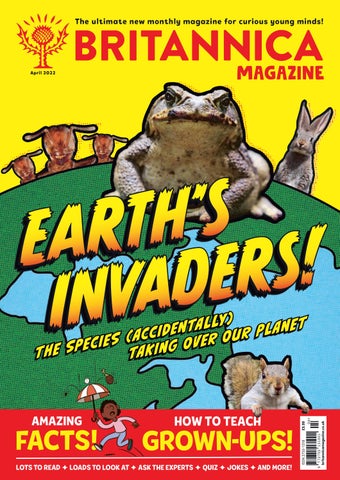
COVER FEATURE: EARTH’S INVADERS! Meet some of the invasive species of animals and plants that are accidentally taking over our planet. MARCH OF THE TREES Did you know that forests move? Find out how they do it – and why they’re now running into a serious problem. SHAKESPEARE’S NEW WORDS An A–Z of words used
the universe continues with the story of how paper was invented in ancient China.
Page 45
44
45 46 48 Page 26
Page 22
49 5O for the first time by William Shakespeare. Plus, invent your own new word and enter it into our competition!
24 25 26
EVERY SECOND Astonishing things that happen around the world each second. NOBODY KNOWS One of the universe’s great unsolved mysteries. WEIRD CREATURES! We celebrate 1O very odd-looking creatures.
29 3O
32
PICTURE QUIZ! Can you identify the objects in our 1O mysterious photos? A TIMELINE OF SPORTING FIRSTS Astonishing moments from the history of sport – including the first person to play golf on the Moon! HOW TO TEACH GROWN-UPS ABOUT PLUTO Discover the extraordinary story of Pluto in our preview
of the brilliant new book by astronomer Dean Regas.
36 38 4O
AMAZING TREASURES A collection of fabulous royal riches. INFOGRAPHIC: HIGHS AND LOWS A fact-filled visual snapshot of the highest and lowest places on Earth. ABSOLUTELY EVERYTHING! Our epic serialisation of the true history of
51
MY BRITANNICA Our readers’ section begins with your latest letters and photos. Plus, a performance by the Vegetable Orchestra in the illustrated fact of the month! ASK THE EXPERTS Your chance to test Britannica’s experts. This month’s answers feature asteroids, bees and Roman wee. THE BIG BRITANNICA QUIZ Stretch your brain power with our deliciously tricky quiz. DO IT YOURSELF Try our brilliantly simple home experiment to see raisins in a whole new light! PUZZLES & GAMES Featuring Word Morphs, animal Word Search, Word of the Month and Connect the Planets. SPOT THE DIFFERENCE Can you spot all the differences between our two zany illustrations? JOKES & RIDDLES Hand-picked by our jokes editor May!
SEND IT IN! Email us your letters, photos and favourite facts to: editor@britannicamagazine. com Or write to us at: Britannica Magazine The Black Barn Wickhurst Farm Leigh Tonbridge Kent TN11 8PS
e
e sp
s of bat can eat cie 1,O
So
m
ZANY FACTS
OO i
ns ec t
s
in
a
Follow the trail of crazily connected facts all the way from the world’s biggest bat colony to a giant seed vault!
sin gl eh ou
r
By Kate Hale Illustrations by Andy Smith
Go batty!
There are over 1.5 million
Bracken Cave in Texas, USA, is home to the world’s largest known bat colony – it can take up to four hours for all 2O million bats to fly out of the cave each night
An avocado is a
berry
The durian is a fruit so smelly that it’s banned on Singapore’s public transit system
Pi n kp
h
4
eb
sh
e a r l a p p l es
av
Farmers test to see if cranberries are ripe by bouncing them
rig h t pink
f le
No ta Som ll b ee at se e
ups
When bats eat a lot of chitin (the shiny material that insect bodies are made of), their poo sparkles
Ju ic y!
Baby bats are called p
. e ct s ins t fruit ea n and e l s l o at ,p ds
Mexican free-tailed bats that live for part of the year underneath a bridge in Austin, Texas, USA
The small ‘seeds’ on the outside of a strawberry aren’t actually seeds at all, they’re fruits! Each one has a tiny seed inside
rld’s The wo largest s ee
d,
, r fruit de Me o c o C the from can weigh more than
l bow two
ow on
!
Gr
s
al l ing b
The Svalbard Global Seed Vault, located inside a mountain in Norway and designed to withstand global disasters, contains more than one million seed samples!
5
PHOTOS
WO
AH!
LOOK AT ME!
Mudskippers are amphibious fish. That means they live part of their time in water like regular fish (breathing through their gills) and part on land (breathing through their skin). A male mudskipper can leap as high as half a metre in the air as it tries to attract a mate. WWW.COMEDYWILDLIFEPHOTO.COM
6
Astonishing photos from around the world
!
7
PHOTOS
GOING UP!
Every year on the first Sunday after Easter, a group of riders parades through the city of Brașov in Romania on horseback. This parade, which is known as Junii Brașoveni or the Youth of Brașov, is intended to celebrate the arrival of spring and the rebirth of nature. There is music, dancing and games. Here the people of Brașov celebrate by throwing one of the riders high into the air.
O
! W W 8
HELPING HANDS
This awesome pedestrian bridge gives tourists spectacular views of the coast of Vietnam around the city of Da Nang, which is famous for its beautiful sunsets. Known as the Golden Bridge, it is designed to look like it’s being held up by two giant hands. Although the hands look as if they’re carved from stone, they’re actually made from two much lighter materials: wire mesh and fibreglass.
!
WA LKI ES! PAW PATROL
No need to be alarmed – no wildlife photographers were harmed in the taking of this photo! This curious young polar bear is reaching its paw towards a remote camera placed on the ice above the Beaufort Sea, north of Alaska, to capture just this kind of moment.
H
ROBODOG
Spot the robotic dog’s four-legged design enables it to go places that robots with wheels cannot – such as up a flight of stairs. It was built by engineers in Boston, USA, and can even run. Although we’re not sure whether Spot likes to chase after a robot stick!
! E V I F I 9
Eureka! The search continues for a famous shipwreck
Finding shipwrecks is one of the most exciting things archaeologists do, but there is one famous shipwreck nobody has yet been able to reach. That’s because not only is it 3,000 metres deep in the ocean, but it’s just off the shore of Antarctica, covered by shifting sea ice. In 1914, Ernest Shackleton and his crew were on their way to cross Antarctica when the ice closed in. When it began to crush the ship, the crew and their dogs got out and camped on the ice, then went by lifeboat to a deserted island, while Shackleton and five crew members rowed 1,300 km to get help. Miraculously, they made it. Every single person survived, but the ship was lost. Explorers have searched before, but the ice has always defeated them. This year, a group is going to try again, sending a submersible vehicle deep into the sea under the ice.
The ship Endurance trapped in the Antarctic ice in 1914. 10
That’s one BIG reptile! Joe Davis was doing his job at Rutland Water Nature Reserve one day in January 2021 when he noticed some enormous bones sticking out of the ground. He thought they were from a dinosaur, but when palaeontologists took a look, they realised Joe had stumbled upon something even cooler – a prehistoric sea reptile called an ichthyosaur. The fossil is almost as long as a bus, meaning this creature, which lived alongside dinosaurs in the Early Jurassic period, was the size of a modern minke whale and is one of the largest of its kind ever found.
The latest astonishing discoveries, inventions and scientific breakthroughs.
NEWS
Drive away on a solar-powered summer holiday Campervan travel is loads of fun. You can be in the great outdoors without having to sleep in a tent on the ground. But there’s a big downside: the larger the vehicle, the more fuel it guzzles and the more carbon dioxide it adds to the environment. So, a group of university students in the Netherlands set out to show that it’s possible to have
comfortable camping and still save the environment. They built the Stella Vita, a tear-shaped vehicle with solar panels on the roof and room for two people to live inside. The van is all-electric and can drive 730 km on a sunny day. Then, while you are
hiking or swimming or otherwise having a great holiday, the vehicle has its extra solar panels extended and
is recharging for the trip home. (If you’re stuck with horrible weather, don’t worry. The van will recharge from the grid.)
Teenager flies solo around the world! Nineteen-year-old Zara Rutherford is now the youngest woman to pilot a plane around the world by herself. Safely home in Belgium after the 122-day adventure, she told reporters about some scary moments, including flying near lightning in Singapore, through smoke from wildfires in California, and in the extreme cold of Siberia.
The coin that takes two hands to carry The Royal Mint has just created their largest coin ever, but you can’t spend it in a shop. It’s called The Queen’s Beasts, is all gold, weighs in at 10 kg, and is bigger than your head. We don’t know how much the buyer paid for it, but it’s probably well over £100,000.
Revealed: the meaning of hippo honks Hippos make lots of different noises, from grunts and groans to growls and roars, and even chuffing and wheezing sounds. Some of these sounds are incredibly loud. One, the wheeze-honk, can be heard from a kilometre away. And those are just the ones above
the water. Hippos also make noises underwater, using a set of dolphin-like sounds. Now, scientists at a nature reserve in Mozambique have figured out that each hippo has a unique voice that other hippos recognise. A hippo can tell friends, neighbours and
strangers apart by their voices alone. The scientists figured this out by making recordings of wheeze-honks made by individual hippos, playing the recordings from the shore of a lake where hippos were hanging out, and watching how each hippo reacted. 11
LISTS
LISTIFIED! Prepare to be amazed (and amused!) by the unusual facts crammed into these irresistible lists.
SKYFALL Nine surprising things that have fallen out of the sky
1
Red rain
The microscopic freshwater algae called Haematococcus pluvialis produces a red pigment or colour when it is under stress. If the red algae mixes with rainwater, it can cause a phenomenon called ‘blood rain’, which has been witnessed in India, Spain and the United States, among other places.*
2
Frozen iguanas
The iguanas that live in Florida, USA, like to make their homes in the branches of tall trees. However, when it gets too cold, their cold-blooded bodies stop functioning properly, and they can no longer hold on to the branches. Freezing iguanas then start falling from above and will stay lying motionless on the ground until the temperature warms up, when they spring back to life.**
3
Mud
In 1902, a huge dust storm formed dust clouds over Illinois. The clouds were blown eastwards across the United States until they met a large group of rain clouds over New York and New Jersey. The dusty and rainy clouds combined to form a refreshing shower of mud.
4
Fish
There are several theories as to why it sometimes rains fish, which it has done in many parts of the world, including India, Australia and Canada. One
12
explanation is that it’s caused by a whirling column of air and mist called a waterspout. When a waterspout forms above water, it can suck fish and other marine creatures up from lakes or the sea before carrying them inland and dropping them on confused people holding umbrellas.***
5
Frogs
The same thing happens to frogs. In 1873, the magazine Scientific American reported a ‘shower of frogs which darkened the air and covered the ground for a long distance’ after a rainstorm in Kansas City, USA.
6
Satellites
There are more than 2,000 working and 3,000 broken satellites currently orbiting Earth. When they stop working, they become space junk. Over the last 50 years, more than 5,400 tonnes of space junk have survived re-entry to the atmosphere to land back on Earth.
7
Meat
In 1876, people in Kentucky, USA, witnessed a flurry of meaty flakes fall from a cloudless sky. Two men who tasted the meat
8
Trees of Life Golf balls
Residents of Punta Gorda, Florida, USA, were left scratching their heads on 1 September 1969, when dozens of golf balls dropped out of the sky. The most convincing theory to explain them is that a passing storm had scooped up water from a lake on a golf course, along with lots of lost balls, before dropping it all on the nearby town.
thought it probably came from a sheep or a deer. Scientists who tested the flakes thought the most likely explanation was that some passing vultures had disgorged, or thrown up, the meat while flying overhead.
9
Spiders
The spooky phenomenon known as ‘spider rain’ is caused by millions of tiny spiders engaging in a behaviour called ballooning. First, the spiders go to an exposed high place. They then release silk threads from their abdomens, which are picked up and carried away by the wind, with the flying spiders coming along for the ride. Ballooning spiders can travel anything from a few metres to hundreds of kilometres. It’s a technique mostly used by baby spiders, which are called spiderlings, to find new territory.
*Dust from the Sahara Desert can also cause red rain; dust from the Gobi Desert can cause yellow rain, while volcanic dust and ash can cause black rain. **To cope with the problem, the National Weather Service in Miami now sends out ‘iguana rain’ warnings if cold weather is approaching. ***Fish fall from the sky so often in Mexico that there is a name for it – lluvia de peces – which means ‘rain of fish’.
Rainforests in numbers Rainforests are one of the Earth’s most amazing and important natural habitats. There are two kinds. Tropical rainforests are found close to the equator and are warm and moist. Temperate rainforests are found in parts of the world with milder temperatures.
39O billion
The estimated number of individual trees in the tropical Amazon rainforest.*
1OO million
The number of years ago that tropical rainforests started to grow.
5O million
The number of people who live in rainforests around the world.
1,3OO
The number of species of butterfly that have been recorded by scientists in a single region of the Peruvian Amazon rainforest.**
19O
The minimum amount of rain in centimetres that must fall in a forest in a year for it to be considered a rainforest.
8O
The percentage of flowers in the Australian rainforests that are not found anywhere else in the world.
5O
The percentage of the Earth’s land animals that live in tropical rainforests.
2.5
The percentage of the Earth’s total surface covered by rainforest today. *The Amazon rainforest is thought to be home to one in ten known species on Earth, including 2.5 million insect species, 4O,OOO plant species and 3,OOO species of freshwater fish. **In comparison, the entire continent of Europe is home to fewer than 5OO species of butterfly.
Listified! by Andrew Pettie and illustrated by Andrés Lozano is out now. 13
1755
Samuel Johnson’s A Dictionary of the English Language was published on April 15th. It took Johnson more than six years to write, and contained almost 43,OOO entries on 2,3OO pages. It’s been estimated that Johnson’s dictionary defined 8O per cent of English vocabulary at that time. His wasn’t the first or biggest dictionary, but many thought it the best.
1896
The first modern Olympic Games were held in April in the home of the ancient Olympic Games, Greece. The 1OO m heat pictured right was won by American Thomas Burke (wearing the red shorts), the only sprinter to start from the modern crouch position.
1O fascinating facts 1874
Impressionist paintings are intended to give an ‘impression’ of what the person, object or landscape in the painting looked like to the artist. The first great Impressionist Exhibition opened in Paris on April 15th. Impression, Sunrise by Claude Monet was on display in the show.
19O4
Ice cream cones were sold to the public for one of the first times at the World’s Fair in St Louis, USA, on April 3Oth. When an ice cream seller ran out of bowls, he started to serve ice cream wrapped in waffles from the stall next door instead. They were an instant hit! 14
1961
On April 12th, Soviet cosmonaut Yuri Gagarin became the first human being to travel into space.
1969
On April 22nd, two surgeons working at a hospital in Houston in Texas, USA, performed the world’s first eye transplant.
16O6
King James I of England and VI of Scotland created this new flag on April 12th. It combined the English cross of St George and the Scots cross of St Andrew.
1973
The first mobile phone call was made on April 3rd on a test model of the Motorola DynaTAC 8OOOx.
1722
On April 5th, Dutch explorer Jacob Roggeveen landed on Easter Island in the Pacific. He was the first European to see the majestic Moai statues carved by the native Rapa Nui people.
about April… 2O19
On April 23rd, the Swedish environmental campaigner Greta Thunberg, then just 16 years old, gave a powerful speech to MPs in the Houses of Parliament about the climate crisis. She said: ‘Humans are very adaptable: we can still fix this. But the opportunity to do so will not last for long. We must start today. We have no more excuses.’
15
INVASIVE SPECIES
Imagine that you are sitting happily in your kitchen eating breakfast when a total stranger barges in the door, knocks you off your chair, and eats your porridge. Yikes, your home has been invaded! Signal Crayfish
By Lisa Thomas
N
ow imagine you’re a fish in a river or a tree in a forest when some new animal or plant shows up and starts crowding you out, so you don’t have room to live or enough to eat. That invader is a member of what’s known as an ‘invasive species’. Sometimes an invasive species gets to a new territory in a natural way (riding on a floating log, for example), but lots of them have been transported by the biggest invader of them all – humans. For most of our history, we have assumed that other living things were put on Earth to make our lives better. So we don’t think twice about transporting them wherever we go. And we don’t worry too much when they hitch a ride in our luggage (think: rats on a ship). But when these species escape our control – which happens all the time – they can wreak havoc and drive native species of animals and plants to extinction. Of course, invasive species are not really evil. They’re just doing the best they can in the situation they find themselves in. But that doesn’t make the damage they cause any easier to fix.
D A V IN
16
Red Imported Fire Ant Cane Toad
CANE TOAD What it is: A warty, poisonous amphibian. Where it is native to: Central and South America. Where it has invaded: Florida in the United States and the islands of the Caribbean, Australia and New Guinea, and parts of Polynesia. How it got there: Cane toads were deliberately introduced by humans to many different countries in the hope that the cane toads would eat insects such as beetles that were harming farmers’ crops. Why it is a problem: The toads failed to control the number of insects but reproduced so fast that there were then too many cane toads. In Australia, for example, the government released 2,4OO cane toads in an area in north Queensland in 1935. Today, there are millions of cane toads in Australia and their numbers are growing all the time.
! S R DE Grey Squirrel
SIGNAL CRAYFISH
What it is: A clawed crustacean that is related to lobsters and crabs. It lives in freshwater rivers and lakes. Where it is native to: Western regions of North America. Where it has invaded: Rivers and streams in the UK and across continental Europe. How it got there: Signal crayfish were first introduced into the UK in the 197Os to be reared in farms so that they could be served as seafood in restaurants and food shops. Why it is a problem: Over time, many signal crayfish have found their way into the wild, where their burrows have damaged river banks. Signal crayfish also breed very fast and eat lots of food, which puts their growing populations in competition with the white-clawed crayfish, which is native to Britain. Continued on next page 17
INVASIVE SPECIES
Continued from previous page
KUDZU Kudzu
GREY SQUIRREL
What it is: The Eastern Gray squirrel, or grey squirrel as it’s commonly known, is a rodent easily recognised by its big grey bushy tail. Where it is native to: Eastern North America. Where it has invaded: Most of the UK and Ireland. How it got there: Grey squirrels were first released into the UK in the 187Os. Why it is a problem: The main threat grey squirrels pose is to red squirrels, which are a species of squirrel native to the UK and Ireland. As well as breeding faster and eating more food than red squirrels, grey squirrels carry an infectious virus that does not appear to affect the grey squirrels’ health. However, it often kills red squirrels. Since grey squirrels have arrived in the UK, the total population of red squirrels has declined from around 3.5 million squirrels to fewer than 14O,OOO.
EUROPEAN RABBIT What it is: A furry long-eared mammal which, despite being considered by many to be fluffy and cute (especially by people who keep bunnies as pets), can still cause major environmental problems when they are introduced to new ecosystems. Where it is native to: Large parts of southern and western Europe, and northwest Africa. Where it has invaded: The European rabbit has now been introduced to countries in every single continent on Earth – except, of course, European Rabbit Antarctica. 18
How it got there: Mostly introduced by traveling humans, who brought rabbits with them when they migrated to new continents, both as a source of food and fur, and to remind them of the countries that they had left behind. Why it is a problem: European rabbits breed very, very
quickly – a single female rabbit can have dozens of offspring in a single year. Rabbits’ sky-rocketing populations can therefore eat their way through native plant populations while also competing with native animal species for space and other natural resources. Wild European rabbits have caused particularly serious problems in Australia. Since European rabbits were first introduced by humans in the 18th century, rabbits have caused millions of pounds’ worth of damage to crops.
RED IMPORTED FIRE ANT What it is: A species of relatively small
red or yellowish ant. The ‘fire’ in its name is a result of the ants’ aggressive nature and its painful bite and sting. Where it is native to: South America. Where it has invaded: Starting in their native South America, red imported fire ants have truly conquered the world, establishing huge colonies in countries as far apart as the United States, Australia and China. How it got there: Mostly traveling, unnoticed by humans, on board ships. The spread of red imported fire ant populations around the world over the last 15O years is closely related to the growth in human travel between different continents over the same period of time. Why it is a problem: Once established in a new territory, red imported fire ants often disrupt local ecosystems by pushing native ant and other insect species out of the way, damaging crops – and stinging people unfortunate enough to step on their mounds.
What it is: A species of vine, which is a type of climbing plant. Kudzu, which is also known as Japanese arrowroot, is a particularly thick and fast-growing species. Where it is native to: Large parts of Asia and some islands in the Pacific Ocean. Where it has invaded: Kudzu is now considered an invasive species in many different parts of the world, and especially North America. How it got there: Thanks to humans again, who brought Kudzu seeds to non-native countries, such as the United States, and planted them there not realising how fast and far the vines would spread. Why it is a problem: Kudzu grows so quickly that it will rapidly overtake and sometimes completely overwhelm other plant species, killing them off by blocking out all their sunlight.
Burmese Python
EUROPEAN STARLING What it is: A relatively small and fast-flying bird that looks black from a distance but also has shades of purple and green in its plumage. Where it is native to: Most of Europe, Asia and North Africa. Where it has invaded: The starling has now been introduced to a variety of countries all round the
world including the United States, Australia, Argentina and South Africa. How it got there: European starlings were first brought by humans to places like United States as way of controlling pests such as insects. Why it is a problem: European starlings are known to form large flocks – called murmurations – which often contain thousands of birds. Starlings can also be aggressive, muscling native species away from their territory – and even taking over other birds’ nests.
BURMESE PYTHON What it is: A species of freshwater snake that is usually found in or near marshes, swamps and
European Starling
canals. Burmese pythons are one of the largest snakes in the world. The python is best known for the way it kills its prey – by coiling its body around the animal and then squeezing tightly so the animal cannot breathe. Where it is native to: Large areas of southeast Asia, including parts of India, Vietnam and China. Where it has invaded: A swampy, coastal area of Florida in the United States called the Everglades. How it got there: Once again, humans are to blame! People first brought Burmese pythons to the USA to keep them as unusual pets. Over time, lots of these pet pythons escaped into the wild. Why it is a problem: There are now tens of thousands of Burmese pythons living wild in Florida, where they
disrupt local ecosystems by preying on native species and competing for their sources of food.
EMERALD ASH BORER What it is: A species of green wood-boring beetle. In the early phase of their development as larvae, wood-boring insects feed on
wood, often destroying the trunks and bark of trees. Where it is native to: Several countries in Asia including China and Japan. Where it has invaded: Europe and North America. How it got there: Again largely thanks to us. For example, emerald ash borers first appeared in North America in the 199Os. They were most likely brought there by accident, hidden in wooden crates transported from Asia. Why it is a problem: Emerald ash borers like to lay their eggs underneath the bark of ash trees. The eggs develop into larvae which munch through the wood. These hungry beetles have killed millions of ash trees in the United States alone.
Emerald Ash Borer
THE ULTIMATE INVADERS Can you see a pattern here? Although invasive species are undoubtedly causing some serious problems around the world, one theme unites their stories. It’s the species that turned them into invaders in the first place: humans. And let’s not forget that we humans have been criss-crossing the globe for thousands of years too, disturbing nature as we go. Human beings must surely be the most dangerous invasive species of them all. 19
CLIMATE CHANGE
March of the tr Did you know that forests move? That’s right! Here’s how they do it, and why today – thanks to some of the problems caused by global warming – the forests are literally running into a problem. By Chris Harrison Illustration by Natalia Rojas Castro
T
dying on the other, then the he first thing to forest as a whole is considered understand about a to be ‘migrating’. ‘migrating’ forest is that It takes many generations the individual trees don’t of trees for the location of a actually move. Each tree has whole forest to move in this a system of roots dug into the way. But it does happen – and ground which keeps it firmly scientists have estimated that in one place for its whole life. some forests can migrate at However, a tree’s seeds are a rate of 1 kilometre per year. sometimes carried by the Forests have been slowly wind – or by animals such as migrating across the birds – beyond the surface of the Earth boundaries of the for tens of forest. If these It takes many thousands of seeds land in generations of years in response a place that trees for a forest to natural provides them to move its location. changes in the what they need But forests really environment. to develop into can ‘migrate’ in However, as you adult trees, then this way. probably know, the forest will human-caused grow into that place. climate change is making At the same time, on global temperatures rise more the other side of the forest, the quickly than before. environment might be In fact, in some places, changing to make it harder for global warming is happening the trees. Perhaps the climate as much as twice as fast as is becoming hotter or colder, the forests can migrate. This drier or wetter. Then the trees could spell disaster for living in that area could millions of trees as deadly struggle to survive and changes in climate catch up even die off. If a forest is to them. And if the trees die growing on one side and
20
Above: baby trees on one side of a forest show the direction the forest is migrating. Right: dying trees on the edge of another forest show an area the forest is migrating away from.
ees off, then so will the other plants and animals that depend on them. Of course, other things can carbon dioxide in the also get in the way of forest atmosphere is one of the migration. A forest cannot causes of global warming, so migrate through a big city, for adding more (a lot more!) trees example, or across a large body to the environment is a great of water or a desert. But it’s amazing to see how much trees way to slow climate change. But as you now know, actually can do to find climate change is their way to places threatening the they can grow and One acre of trees we already thrive. One of the forest can absorb have, which will best examples is then speed how the forests as much carbon in climate change of the far north, a year as two cars up even more. in places give off during What can we do including Alaska, the same time. about it? We can Canada, Scotland, reduce our carbon Scandinavia, and footprint to slow and Russia, are moving stop climate change. We can towards the Arctic, growing ask our governments and in places that used to be too companies to protect cold for them. woodlands. We can help forests migrate by making Can we save the trees? it easier for them to move Trees and other plants breathe across barriers. And we can the opposite way from the way plant new trees – always we animals do. We breathe in making sure that the trees oxygen and breathe out we plant are a type that will carbon dioxide. They survive where we plant them, breathe in carbon even if that area gets warmer dioxide and breathe pretty quickly. out oxygen. Too much
21
WORDS
An A to Z of Shakespeare’s new words! To celebrate National Shakespeare Day on April 23rd, we present 26 wonderful words that were either invented or introduced to the English language by the great playwright William Shakespeare. Plus, invent your own new word and enter it into our brilliant competition! By Chris Harrison Illustrations by Andy Forshaw
Hamlet
22
T
he 16th-century writer William Shakespeare is often praised as the greatest English playwright of all time. During his lifetime, Shakespeare wrote more than 150 poems and around 38 plays, including A Midsummer Night’s Dream, Hamlet, Macbeth and Romeo and Juliet. Shakespeare used more than 20,000 different words to write these plays and poems. Among these words were more than 1,700 ‘new’ words that he is thought to have either invented or introduced to the English language. Language historians sometimes disagree about the origins of words but these 26 are widely thought to have been used for the very first time by Shakespeare. We’ve also included the places in his plays where you can find them.
Alligator
A large reptile similar to a crocodile. Romeo and Juliet, Act 5, Scene 1.
Bedroom
A room for sleeping in. A Midsummer Night’s Dream, Act 2, Scene 2.
Critic
Someone who gives a negative opinion of something. Love’s Labour’s Lost, Act 3, Scene 1.
Downstairs
On a lower floor or down a flight of stairs. Henry IV Part 1, Act 2, Scene 4.
The round part of the eye. Henry VI Part 1, Act 4, Scene 7.
Fashionable
Part of a current, popular style. Troilus and Cressida, Act 3, Scene 3.
Gossip
To talk casually, often about other people. The Comedy of Errors, Act 5, Scene 1.
Hurry
To act or move quickly. The Comedy of Errors, Act 5, Scene 1.
Inaudible
William Shakespeare: Fact File Nickname: the Bard of Avon. Born: the exact date is unknown, but Shakespeare was baptised on April 26th, 1564. His birthday is now celebrated on April 23rd. Home town: Stratfordupon-Avon, England. Family: his wife, Anne Hathaway, son, Hamnet, and two daughters, Susanna and Judith.
Unable to be heard. All’s Well That Ends Well, Act 5, Scene 3.
Nervy
Jaded
Obscene
Bored or lacking enthusiasm, often because you have had too much of the same thing. Henry VI Part 2, Act 4, Scene 1.
Kissing
The act of giving a kiss. Love’s Labour’s Lost, Act 5, Scene 2.
Lonely
Feeling sad because of a lack of friends or company. Coriolanus, Act 4, Scene 1.
Manager
A person responsible for controlling or organising. Love’s Labour’s Lost, Act 1, Scene 2.
Sinewy or strong. Coriolanus, Act 2, Scene 1.
Rude or disgusting. Love’s Labour’s Lost, Act 1, Scene 1.
Puppy dog
A young domesticated dog. King John, Act 2, Scene 1.
Questioning
The act of asking questions. As You Like It, Act 5, Scene 4.
Rant
To speak for a long time in an angry or passionate way. Hamlet, Act 5, Scene 1.
Skim milk
Milk which has had its cream removed. Henry IV Part 1, Act 2, Scene 3.
Desdemona and Othello
Traditional
Existing as part of a longestablished convention. Richard III, Act 3, Scene 1.
SHAKESPEAREAN FACTS AND WORDS SOURCED FROM THE SHAKESPEARE BIRTHPLACE TRUST. TO FIND OUT MORE ABOUT THE AMAZING LIFE AND WORKS OF WILLIAM SHAKESPEARE, GO TO SHAKESPEARE.ORG.UK
Eyeball
Undress
To take off your clothes. The Taming of the Shrew, Induction Scene 2.
Varied
Including several different types or elements. Titus Andronicus, Act 3, Scene 1.
Worthless
Having no real value. The Two Gentlemen of Verona, Act 4, Scene 2.
Xanthippe
A bad-tempered woman, named after the wife of the ancient Greek philosopher Socrates who was said to be bad-tempered. The Taming of the Shrew, Act 1, Scene 2.
Yelping
Giving out a short, sharp series of cries. Henry VI Part 1, Act 4, Scene 2.
Zany
A clown’s assistant, who would imitate the clown in a funny way. Love’s Labour’s Lost, Act 5, Scene 2.
Now it’s your turn!
First, make up yo ur own COMPLETELY NEW WORD that has never existed be fore and spell it ou t below. Then write a short sentence explaining what your word means . YOUR NEW WORD: WHAT IT MEANS:
To enter your new word in our competition, send both your word an d the sentence desc ribing what it mea ns to: editor@britann icamagazine.com . The five winners will each receive a copy of the aw esome Shakespeare Tim eline Wallbook! 23
3
EVERY
d sehol duced u o o f h te are pr
cars leave
SECOND
their factories
6OO,OOO
Somewhere on the planet this very second, one wedding is being celebrated, four babies are being born, 1OO lightning bolts are striking the Earth and…
1
1O,6OO kg o wa s
STATS
km are travelled by car
38 tyres
are made
ae
ro p
la
ne
ta ke so
ff
13O
1
24
aerop
lane la
nds
EXCERPTED FROM EVERY SECOND, WRITTEN AND ILLUSTRATED BY BRUNO GIBERT
air passengers climb aboard
MYSTERIES
f the S e v one o en re W o we n d e e s t d r n o y wer e y e e r d s th b y here is no e a tt v i n d Bu e n gardens R c E A LL e o he Y e
ardens of B G g n gi ab n a yl H e sources m e o o S c la Th r ld. im entury c o t s CE W he 1 . t h t e e r h w t in o t as
xi
t ien nc e e A uak th hq . So rt s of hi ... ea f t ted s
25
Thorn treehopper This unusual insect is disguised to look like a thorn growing on the trees and plants on which it feeds so that it won’t be spotted by predators.
FANTASTIC BEASTS
Naked mole rat These burrowing African rodents live in the very dry regions south of the Sahara Desert. They spend most of their time underground, in colonies of up to 3OO mole rats.
Weird creat
Flapjack octopus This cute species of octopus features in the film Finding Nemo. One of Nemo’s classmates, Pearl, is a flapjack octopus.
Aye-aye The aye-aye is a rare, nocturnal, squirrel-like primate that lives in the rainforests of Madagascar, a large island off the coast of East Africa.
Amazonian royal flycatcher This South American bird only displays its striking and colourful crest on special occasions, including when it is trying to attract a mate.
26
Pangolin The name ‘pangolin’, which means ‘rolling over’ in the Asian language of Malay, refers to this scaly mammal’s habit of curling up into a ball when it is threatened. Glass frog These extraordinary tree frogs have see-through bellies and chests as a form of camouflage. When light from behind the frog shines through its skin, it helps the frog to blend in with its surroundings. Axolotl Scientists are particularly interested in these rare amphibians because they’re able to regrow lost or damaged limbs, hearts and even parts of their brains without leaving behind permanent scars.
tures!
Leafy sea dragon Closely related to seahorses, these beautiful fish are camouflaged to blend in with the seaweed and kelp through which they swim.
We celebrate 1O of the strangest-looking creatures on the planet.
Proboscis monkey These long-tailed monkeys live in the swampy forests of Borneo in Southeast Asia. ‘Proboscis’ is a scientific term for certain mammals’ noses.
Send It In! Send your favourite strange-looking creatures to editor@ britannicamagazine.com and they could feature in a future issue!
27
It's about time the grown-ups got up to speed... After all, Pluto hasn't been a planet since 2006!
AGES 8+ OUT APRIL 7TH!
Special Reader
Offer
£5.99
1. 12 .2 2 vali d u n ti l 3
(RR P £ 9.99)
In Britannica's handy and hilarious guide, astronomer Dean Regas reveals why Pluto was kicked out of the planet club. Faced with even the most stubborn grown-up, you will be able to: Teach them the latest scientific thinking on the solar system. Explain why Pluto is definitely NOT a planet (but is still super cool). Reveal the history of planetary discoveries... and the hunt for new planets. Test that the grown-ups have been paying attention with a helpful quiz at the end!
Scan the QR code to buy your discounted copy, or use the website below www.whatonearthbooks.com/product/pluto-reader-offer
2
3
1
4
PICTURE QUIZ! 6
Can you work out what you’re looking at in each of these 1O photos?
7
5
8
9
1O
Want to find out if you guessed correctly? The answers are on p5O. 29
A timeline of sporti Join us on a thrilling journey through some of the most astonishing moments in the history of sport.
14OO BCE The oldest known ball courts are built by the Olmec in Mexico. Their game, sometimes called ‘ulama’, is played for fun or in place of wars, with the winner taking over a kingdom. Points are won by pitching a solid rubber ball through a goal like a doughnut ring – although it is forbidden to touch the ring with the hands or feet.
2OO BCE The earliest form of football, from China and already thousands of years old, becomes very popular, and the first football handbook is written, by Wang Yuncheng. ‘Cuju’, or ‘zhuqiu’, is more like target practice or keepy-uppy.
19O4 Fred Lorz finishes first in the Olympic marathon in St Louis, USA, but is disqualified because he rode in a car for 11 of the 26 miles.
1956 Althea Gibson wins the French title in Paris to become the first black Grand Slam tennis champion.
1968 Great West Indian cricketer Gary Sobers is the first professional player to hit six sixes in one over.
1963 Australia is the first world champion of netball. The championship is held every four years and the Australians have won ten more titles since.
30
1797 The Gymnasticon, a strange-looking contraption, is the world’s first gym exercise machine, invented by Englishman Francis Lowndes to help people exercise.
1954 Roger Bannister runs a mile in 3 mins 59.4 seconds, becoming the first person to do it in under four minutes.
1976 Romanian gymnast Nadia Comăneci, age 14, earns the first perfect 1O from Olympic judges.
1971 American astronaut Alan Shepard is the first human to hit a golf ball on the Moon. He never picks it up, so the ball is still there!
ng firsts! 1844 Native American swimmers Flying Gull and Tobacco finish first and second in a race in London. They use the crawl, never before seen by British gentlemen, who until the 187Os preferred breaststroke.
1823 William Webb Ellis, a pupil at Rugby School, is said to have been the first player to run with the ball in hand in the version of football then played at the school. The rules of rugby – which takes its name from the school – were written in 1845.
1844 The first international cricket match is held – between the US and Canada. Toronto beat St George’s New York by 144 runs to 122.
1857 Sheffield FC, the world’s oldest football club, is formed by a group of friends. They make the first ‘proper’ rules for football, and play the first ever club match, Sheffield vs Hallam (186O). The crowd thinks it’s hilarious that Sheffield players head the ball – they’ve never seen headers before.
1891 James Naismith, a teacher, is asked to invent a new game to play indoors during the cold winters in Illinois to provide rowdy pupils with an ‘athletic distraction’. He uses peach baskets for goals and calls it ‘basketball’.
2OO9 Usain Bolt of Jamaica sets a 1OOm world record of 9.58 seconds at the World Championships in Berlin.
1884 The whistle is first used to stop a sports match, by William Atack in a game of rugby in New Zealand. 2O21 Argentinian striker Lionel Messi wins the Ballon d’Or, which is awarded each year to the world’s best men’s footballer, for a record seventh time.
2O11 Carlisle hosts the world’s first race meeting where all the jockeys are women – drawing a crowd of more than 1O,OOO. 31
SPACE
How to teach grown-ups about
Pluto Discover the truth about Pluto in this sneak peek at a new book by astronomer Dean Regas, with illustrations by Aaron Blecha. Dean
32
D
o your grown-ups seem to be under the illusion they’re always in the right? Do they think it’s always they who should be doing the teaching, and you who should be doing the listening? Well, it’s time for a fresh approach, especially when it comes to the cutting-edge science of our solar system. Before we begin this important education of your grown-ups on the subject of Pluto, let me introduce myself. I’m Dean and I’m an astronomer. Being an astronomer is the greatest job in the universe. I study everything from the Moon to the stars, planets to galaxies, comets and even the Sun. And by working at an observatory, I get to look through gigantic telescopes.
The telescope dome in Arizona, USA, where Pluto was first seen. My job isn’t all staying up all night and sleeping until noon (although that is a nice perk). My main duty is to teach people about outer space and share the latest discoveries made by astronomers around the world. Each day I learn something new – and then share those cool facts with others. And what I’ve
noticed is that our ideas about space are always changing. That’s what makes astronomy even more fun! One of those changes has upset quite a lot of people. Pluto’s no longer a planet. You know it, I know it, and most of the astronomers around the world know it. But there are some people (mostly older people) who cling to the notion that Pluto should still be a planet. They remember the good old days when Pluto was a planet and there were nine planets in the solar system. Habits are hard to break, and adults’ fascination with Pluto as a planet is a challenge for us. How can we help them move on and enter the 21st century? Well, the idea behind my book is to help you educate grown-ups in all the things that astronomers have found
PLUTO: FACT FILE Diameter
2,376 km
That’s about the distance from London, UK, to Athens, Greece. Discovered 18 February, 193O Average distance from the Sun
5.9 billion km Classification Dwarf planet Colour White with light blue, yellow and brown A Pluto day (the time it takes for Pluto to spin once):
6.4 Earth days Moons
5
(Charon, Nix, Hydra, Styx and Kerberos) A Pluto year (the time it takes for Pluto to circle the Sun once):
248 Earth years out about Pluto since they were at school. After reading it, you’ll be able to tell them:
�
How an exhibit on the solar system at the Hayden Planetarium in New York, USA, caused uproar in 2000 when it did not include Pluto as a planet.
�
Why, since 2006, Pluto has been classed as a dwarf planet – and how both planets and dwarf planets are defined by astronomers.
�
About Pluto’s five moons, four of which have been discovered since 2005. So read on now to hear more of Pluto’s extraordinary story…
How Pluto Got Its Name Venetia Burney, an 11-year-old girl in England, was sitting at the breakfast table when her grandfather read about the new planet in the newspaper. He said, ‘I wonder what they would name it?’ Venetia blurted out, ‘Why not call it Pluto?’ Venetia recalled a lot about that day in 1930. ‘I was quite interested in Greek and Roman legends at the time,’ she said in an interview in 2006. ‘At school, we used to play games in the university park, putting – I think they were lumps of clay – at the right distance
Continued on next page 33
SPACE
NUMBER OF PLANETS THROUGHOUT HISTORY How many planets are there? Depends on when you ask!
Before 1543: 7 Planets Sun, Moon, Mercury, Venus, Mars, Jupiter, Saturn
1543: 6 Planets
Continued from previous page
Mercury, Venus, Earth, Mars, Jupiter, Saturn
1781: 7 Planets
Mercury, Venus, Earth, Mars, Jupiter, Saturn, Uranus
18O9: 11 Planets
Mercury, Venus, Earth, Mars, Ceres, Pallas, Juno, Vesta, Jupiter, Saturn, Uranus
1849: 18 Planets
Mercury, Venus, Earth, Mars, Ceres, Pallas, Juno, Vesta, Astraea, Hebe, Iris, Flora, Metis, Hygiea, Jupiter, Saturn, Uranus, Neptune
186O: 8 Planets
Mercury, Venus, Earth, Mars, Jupiter, Saturn, Uranus, Neptune
193O: 9 Planets
Mercury, Venus, Earth, Mars, Jupiter, Saturn, Uranus, Neptune, Pluto
2OO6: 8 Planets
Mercury, Venus, Earth, Mars, Jupiter, Saturn, Uranus, Neptune Pluto, Roman god of the underworld
Venetia Burney
34
from each other to represent the distances of the planets from the Sun.’ From reading about the planets in books, Venetia knew that they had names from Roman mythology. Pluto was a Roman god of the underworld and as Pluto was so far from the Sun and so dark, it fit. Her grandfather thought Venetia’s suggestion was so brilliant that he told an astronomer friend who, in turn, contacted the Lowell Observatory. Clyde Tombaugh, the astronomer who discovered Pluto, thought it was perfect too. He especially liked that the first two letters, P-L, could pay tribute to the founder of the observatory and the original Pluto hunter, Percival Lowell. And that’s how an 11-year-old girl named a new planet.
Postcard From Pluto So what if Pluto isn’t a planet? It’s still an unbelievably cool world! Astronomers couldn’t tell much about Pluto from Earth. Even using the best telescopes, the view of this tiny world five billion kilometres away was small and blurry. What if they went in for a closer look? Only a few months before Pluto was demoted, NASA launched a robotic spacecraft called New Horizons to fly by Pluto and examine it up close. New Horizons was the fastest spacecraft launched from Earth, leaving the planet at more than 58,000 kilometres per hour. Even so, it still took
9.5 years to travel to Pluto. After an epic journey, New Horizons flew within 12,550 kilometres of Pluto. It sent back some incredible images and remarkable detail of its icy surface. The first thing astronomers noticed was a huge feature on the side of Pluto. Some people think it looks like a heart, a whale’s tail or even the face of Disney’s dog Pluto. This bright area of ice is now named Tombaugh Regio after the discoverer of Pluto, Clyde Tombaugh. Pluto has several craggy, snowcapped mountains. Some
Above: an artist’s illustration of NASA’s New Horizons robotic spacecraft approaching Pluto and, behind it, Pluto’s moon Charon.
On a
FAS T FA CT
n av e the rage da t yo e m bet wee peratu n Pluto , and n minu re is s min us 2 226˚C 4O˚ C.
What Type of Solar System Object Are You? I like to give objects in the solar system a little personality. I know they’re just lifeless chunks of rock, ice, dust and gas, but it’s sometimes fun to look for yourself in the heavens above. The questions below could help you work out what planetary object you are most like – moon, asteroid, planet or dwarf planet. Test your friends and especially your grown-ups. Maybe you will find out that you know some plutoids!
1
What type of matter do you prefer? a. Ice b. Air c. Dirt d. Rock
of the mountains could be cryovolcanoes.Cryovolcanoes shoot out liquids and ices made of water, methane, ammonia and chlorine instead of lava. The material then builds mountains of ice. Although the surface of Pluto is icy, it’s not all frozen solid. It has slow-moving glaciers made of nitrogen ice. These glaciers have carved huge grooves on the surface and left islands of ice behind. Pluto has a glacier called Sputnik Planitia that is about 965 kilometres wide. It may be the biggest glacier in the solar system.
How to Teach Grown-Ups About Pluto, written by Dean Regas and illustrated by Aaron Blecha, is out in April
And some scientists see evidence that Pluto may have an ocean of water just below the mostly frozen surface. Pluto may be small and far from the Sun, but it still has an atmosphere. Now, it’s nothing like Earth and you couldn’t breathe there, but it gives the sky an interesting colour. If you were standing on the surface of Pluto, the sky would be blue! Pluto is a wild, wonderful world, and it just doesn’t matter if it’s not actually a planet – whatever your grown-ups say!
2
What do you think is the most exciting type of weather?
a. Cold and snowy b. Windy c. All types d. Drastically changing every day
3
Which house is the most appealing? a. Ice palace b. House in the clouds c. Big cabin by the mountains d. Small shack with a view of town
4
Which do you find most funny? a. Someone sliding around on ice b. Someone farting c. Someone doing a belly flop into the water d. Someone juggling rocks
5
How do people describe you? a. You are ‘far out’ b. You are ‘the boss’ c. You are ‘down to earth’ d. You are ‘always running around’
If you answered a to most of these questions, you are a dwarf planet like Pluto. If you mainly answered b, you are a gas giant planet like Jupiter. If you answered c a lot, you are a terrestrial planet like Earth. If you answered d most frequently, you are an asteroid or moon. What other questions could you ask to find out what kind of solar system object you are? 35
ROYAL TREASURE
Amazing Treasures #1 Rich Royals
By David Long, illustrations by Studio Muti
F
or most of history, emperors, kings and queens were usually the richest people in their own countries. A single one of their treasures could be worth far more than an ordinary person would earn in a year – or even a lifetime. Here we look at four amazing royal treasures from around the world.
Windsor Castle UK The largest continually inhabited castle in the world is also one of the very oldest. It was built nearly 1,000 years ago, just after the Norman Conquest of England in 1066. It’s been a royal residence for almost as long as that. The medieval King Edward III was born within its thick stone
walls. King Henry VIII came to Windsor to hunt, play tennis and write songs. Even now the Queen, Elizabeth II, spends most of her weekends here. When a part of Windsor Castle caught fire in 1992, nearly 7 million litres of water were needed to save this precious medieval survivor.
The Round Tower This tall building is built on the site of the original castle, constructed by the Normans in the 11OOs.
Lower Ward The western courtyard, called the Lower Ward, includes the main chapel for the castle, as well as the Curfew Tower, which once contained a dungeon. 36
Upper Ward The eastern courtyard, called the Upper Ward, contains apartments and rooms for royalty and visitors. The rooms are decorated in many lavish styles.
Jacob Diamond India St George’s Hall This impressive hall, often used for banquets, was rebuilt after a fire in 1992. The ceiling is studded with the coats of arms of every Knight of the Garter since this order of knights was founded in 1348. There is an armoured statue on horseback at the far end of the hall known as ‘The King’s Champion’. When a new monarch was crowned, a real champion would ride into the celebration banquet at Westminster Hall in London and challenge anyone to deny the authority of the new king or queen.
This enormous gemstone is said to be the fifth largest diamond in the world. It was once owned by the fabulously wealthy Nizam, or ruler, of Hyderabad, an area of central India. The last Nizam found the gem in a shoe in his palace. It had been left there to be forgotten by his father,
who was angry about a dispute that happened when he was buying it. Despite its value, the last Nizam used the diamond as a paperweight to keep the things on his desk in order. Today it is kept in a vault and owned by the Indian government, along with most of the Nizam’s other jewels.
Fabergé Eggs Russia Peter Carl Fabergé was the greatest jeweller of the late 18OOs and early 19OOs. His most famous creations were these elaborate enamelled Easter eggs. He made them for the Russian tsars, or emperors, Alexander III and Nicholas II (pictured right). Each one contained a different ‘surprise’. One egg included a miniature gold clockwork train, while another opened to reveal a tiny mechanical peacock. Only around 46 Fabergé eggs have survived. A single egg can now sell for millions of pounds.
Royal celebration Several of the eggs were made to commemorate special events, such as the coronation of an empress or the completion of the railway from European Russia to the far east of Siberia.
Bust of Nefertiti Egypt
Tiny treasures The royal collection of treasures at Windsor Castle includes many priceless objects, but the most unique may be a doll’s house. The tiny house is complete with
working taps and a flushable toilet, a library stocked with real, miniature books, and a hidden garden that can be pulled out from underneath like a drawer.
One of the most powerful women in ancient Egypt, Queen Nefertiti was the wife of Pharaoh Akhenaten, who ruled from around 1353 BCE. Thousands of years after she was queen, Nefertiti was made famous again by the discovery, in 1912, of this striking painted sculpture. It shows a beautiful woman with strong features and a long, elegant neck. Since its discovery, the sculpture of Nefertiti has become one of the most copied pieces of art from ancient times. 37
INFOGRAPHIC
Highs and Lows
Ruppell’s griffon vulture
around 11,25O m Highest-flying bird
From space, Earth looks like a smooth round ball. But when you get closer, you can see how rough and irregular its surface can be. Here we look at some of the most famous high and low points found on our fascinating planet. Passenger jet
Things Up High
around 1O,OOO m
Earth is loaded with mountains that stick up from the surface. Some, like Mt Kilimanjaro in Tanzania, sit by themselves while others, like the Matterhorn in Switzerland, are parts of large mountain chains.
Cruising altitude Mt Everest
8,849 m Mt Everest is the highest mountain in the world. It is part of the Himalayan mountain range in Asia, which includes all but one of the ten tallest mountains on Earth.
Measurements on this page reflect height above or below sea level.
Chimborazo
6,31O m
Measuring Elevations When scientists measure how high or low a place is, they need to compare it to a reference point on the planet’s surface that is not going to change very quickly. This ‘zero point’ is called a datum. The datum that is most often used to measure elevations on Earth is mean sea level. Mean is another word for ‘average’, and mean sea level was originally defined as the height of the ocean right between high and low tide. At first scientists used the real height of the sea. However, because sea level is always changing, there is a problem with using it as a datum. To solve the problem, a group of scientists called geodesists collected lots of data and agreed on a figure for a worldwide sea level that never changes. Today GPS systems that measure elevations on Earth use this figure to work correctly.
Mt Everest may be the highest place above sea level, but the top of the Chimborazo volcano in Ecuador is furthest from Earth’s actual centre. The reason for this difference is because Chimborazo sits at a point on the planet’s surface that is bulging out due to Earth’s daily rotation.
4,2O5 m While Mt Everest is the highest mountain, the Mauna Kea volcano in Hawaii is the tallest mountain when measured from its base to its top, even though the summit is only 4,2O5 m above sea level.
7,5OO m
While the base of Mt Everest is at sea level, the base of Mauna Kea actually sits underwater, about 6,OOO m below sea level. With a total 5,OOO m height of 1O,21O m, it is roughly 1,361 m taller than Mt Everest.
2,5OO m
O m (sea level) Herbert Nitsch
253 m below sea level Deepest free dive
High point on Earth’s surface
-2,5OO m Mean sea level
Low point on Earth’s surface
RMS Titanic
3,8OO m
below sea level Shipwreck 38
1O,OOO m
Mauna Kea
Steep Drops
El Capitan
2,3O7 m
Mountains can be very high, and valleys can be very low, but when it comes to seeing just how sharp and jagged the surface of the Earth can be, there is nothing like the vertical drop of a cliff. Unlike the side of most mountains, which have a slope, cliffs are sheer drops that go straight up and down.
One of the most spectacular cliffs in the world, El Capitan features a 1,1OO m vertical drop and is located in Yosemite National Park in California, USA. This giant mass of granite rock is a favourite of rock climbers.
White Cliffs of Dover
About 1OO m Located in the UK, these are some of the most famous sea cliffs in the world.
Things Down Low
Angel Falls
979 m
Rivers and glaciers can carve deep canyons and trenches through the Earth’s surface. And there are valleys on the ocean floor, too. Some of the valleys are incredibly deep. The deepest valleys, called ocean trenches, can be found at the edge of continental plates in all the major oceans.
Some cliffs have water flowing over them, producing spectacular waterfalls. Angel Falls in Venezuela has the highest total drop of any waterfall in the world.
Grand Canyon
1,6OO m
Big Buildings
average depth below land surface This 446-km-long gorge in the western USA has been carved into the Earth by the Colorado River.
Natural landforms aren’t the only thing that give our planet a jagged surface. During the last 5,000 years or so, humans have done a good job of creating pretty impressive structures. Some of these can reach incredible heights.
Burj Khalifa Bentley Subglacial Trench
2,555 m
below sea level This is the lowest point on Earth not covered by an ocean. Reaching this point is impossible, though, because it is under several thousand metres of Antarctic ice.
EXCERPTED FROM EARTH IS BIG, WRITTEN BY STEVE TOMECEK AND ILLUSTRATED BY MARCOS FARINA
Challenger Deep
11,O34 m below sea level
The lowest point on Earth is called the Challenger Deep. It can be found in one of the low points in the Earth’s crust called the Mariana Trench, an ocean trench in the Pacific Ocean near the Philippines.
828 m tall As of 2O22, this building in Dubai, UAE, is the tallest building in the world. Records are made to be broken, and construction of even taller structures is already in the works.
Great Pyramid
146 m tall Even by today’s standards, the Great Pyramid in Egypt is a massive structure, and for almost 3,8OO years it was the tallest building in the world.
39
THE BIG READ
Absolutely Everything! Each month we feature an amazing story from world history taken from the bestselling book by Christopher Lloyd, with illustrations by Andy Forshaw. This month: the invention of paper!
I
Focus the camera of a smartphone or tablet on this QR code to listen to an audio recording of the author reading this book extract.
1. NOTHING TO SOMETHING 13.8 billion– 45O million years ago
t’s tricky to imagine a world without paper. We use it today for everything from books and magazines – including the one you are holding right now! – to tea bags and toilet rolls. Yet the story of paper is very old. Human beings have been writing things down for at least 3,000 years. For the first half of that time, they wrote on clay or stone – which is hard to carry around – or silk cloth, parchment (dried animal skin), or papyrus (strips of the insides of reeds pressed together) – all expensive, hard to come by, or both. So only rich people were generally able to read or write. The invention of paper changed all that by making the wonders of writing available to many more people, and not just to the rich and the powerful. The story of how it happened begins almost 2,000 years ago, in ancient China. In 140 BCE, Han Emperor Wu, the ruler of the Han dynasty, ordered that 100 jobs as government officials should be awarded based on how young men performed in a
2. LAND AHOY! 47O mya– 252 mya
3. DINOSAURS 252 mya– 5 mya
written test. But the jobs were open only to rich and wellconnected families. More than 500 years later, in 693 CE, Wu Zetian, one of China’s only female rulers, changed the system so that any adult male could apply, even poor country people. Landing one of these high-paid jobs came to be a huge honour for the successful candidates’ families and villages. But to study for and take these civil service exams meant having to write things down. Fortunately, ingenious Chinese inventors had found a neat way to do this. There’s a legend
4. HANDS FREE 5 mya–65,OOO years ago
5. YOU AND ME 2OO,OOO years ago–5OOO BCE
Above: civil service exams gave ordinary Chinese men the chance to get high-paid government jobs. A good education became the best route into Chinese high society.
6. CIVILISATION BEGINS 5OOO BCE– 15OO BCE
that in about 104 CE a bright court official called Cai Lun came up with a brilliant new cheap material for writing on – paper. According to the story, the emperor at that time was very impressed by Cai Lun’s paper-making system. He awarded Cai with vast wealth and a nobleman’s title. It wasn’t long before Chinese people began to use soft, inexpensive paper for almost everything, from wrapping up precious objects to making umbrellas. Wallpaper, kites, playing cards and lanterns all made their first appearance in China. Even the modern habit of using toilet paper started right here. Wu Zetian was only able to expand the exam system because paper was available for students to use for studying. And the possibility of passing the civil service exams gave poor people more hope for wealth, privilege and prestige. Buddhist monks, originally from India, were paid by local people to pray for and educate their sons. That way people hoped to increase the chances of them passing the civil service exams. The range of subjects included everything from war strategy and law to farming and geography.
P
aper was so simple and so useful that it spread to Vietnam, Korea, Japan and India, but as far as experts can tell, it wasn’t until the mid 700s that people outside east and south Asia knew how it was made. Which brings us to the Muslim Empire, which during this period of history stretched across the Middle East, parts of Asia and North Africa, and into Spain. A wonderful story is told
7. MEANWHILE, IN ASIA 3OOO–2OO BCE
8. RISE AND FALL 14OO BCE– 476 CE
3. Mixing the pulp with water to the consistency of pea soup.
How paper was made in ancient China
4. Dipping a screen into the water and filtering out a thin layer of pulp.
Ancient Chinese paper-makers experimented with many different materials, including grasses, hemp, old rope, silk rags and bamboo. These pictures show the process that made paper out of bark from a mulberry tree. 1. Chopped-up mulberry bark boiling over a fire.
2. Pounding the boiled bark to make pulp.
5. Drying the pulp into a sheet of paper.
about how the Islamic world got the secret of paper. Here’s how it goes. In 751 CE, Muslim forces won a key battle against the Chinese on the banks of the River Talas, in central Asia. In the battle they captured a lot of Chinese prisoners. Well, it turned out that some of the captives were experts in paper making. Islamic forces had a policy of releasing any prisoner who taught at least ten Muslims something important. These captives
bought their freedom by revealing the secret of how to make paper. Islamic inventors changed the process to make it easier, and they designed new machines that allowed them to create a lot of paper at a time. By 794 CE, paper mills were opening in Baghdad, then the capital of the Muslim Empire (now the capital of Iraq). From there, papermaking skills spread all across the Muslim world. Cheaper, easy-to-make paper began to replace expensive
YOU ARE HERE
9. MEANWHILE, IN THE AMERICAS 15OO BCE– 153O CE
1O. INVENTION CONNECTION 57O–1279 CE
11. MEDIEVAL MISERY 476–1526 CE
papyrus, silk and parchment. Paper supercharged the spread of Islam by allowing its message to be received not just by word of mouth, but also through the holy book called the Koran, a record of what the prophet Muhammad learned in his visions. So everyone could know what the angel had said to Muhammad, all Muslims were encouraged to learn to read, and schools were set up to teach them. Muslim rulers valued
12. GOING GLOBAL 1415–1621
learning of all kinds. This set off a blossoming of science and literature known as the Islamic Golden Age. Ancient texts, including works by famous philosophers such as Aristotle, were respected, too. Hundreds of volumes were collected in the House of Wisdom, a huge royal library in Baghdad. The Caliphs ordered that these ancient books be translated into Arabic from their original Greek, Latin and
Continued on next page
13. REVOLUTIONS ALL AROUND 1543–19O5
14. WORLD AT WAR 1845–1945
15. TO BE CONTINUED... 1945–Present
THE BIG READ
Continued from previous page Persian. They summoned translators, philosophers and scholars to their courts to do the work. They even tried to find ways of merging the wisdom of philosophers like Aristotle with the divine revelations of Muhammad. It’s lucky for us that the Muslim Empire cared so much about learning. Over the centuries, many of the original books have been destroyed. But thanks to these learning-loving rulers, Arabic translations of them have survived and we can read important ancient books today. The Caliphs of Islamic Spain, which was called Al-Andalus, were determined not 42
Below: a fragment of one of the earliest examples of the Koran, written on a paper scroll. It was made in the 7OOs or 8OOs CE.
to be outdone by their rivals in Baghdad. They set up their capital city at Córdoba and brought in experts from all over the Islamic world. Arabic knowledge of how to irrigate fields using underground canals and waterwheels transformed the countryside. Oranges, lemons, apricots, mulberries, bananas, sugar cane and watermelons were all crops that had never been grown in Europe before. Muslim traders even introduced rice from India, making the popular Spanish dish paella possible. Traders brought gold and ivory from across the Sahara. Córdoba’s craftspeople turned them into coins, jewellery and luxury goods for the Caliph and his court. Builders constructed a spectacular mosque
called the Mezquita. With more than a thousand columns made of jasper, onyx, marble and granite, this giant house of worship could hold as many as 40,000 Muslim faithful for their five-times-a-day prayers. By about 1000 CE, the number of people living in Córdoba had grown to more than 100,000. It was one of the biggest cities of its day. One enthusiastic chronicler claimed the city had 1,600 mosques, 900 public baths, 213,077 private homes and 80,455 shops. Even if this was a slightly colourful exaggeration, the city of Córdoba sounds like it was a pretty bustling place.
T
he enormous riches of the Islamic world are wonderfully told through the African kingdom of Mali. Its most famous king, Mansa Musa, who is pictured right, riding a camel, was probably the richest man in the world.
Above: the Mezquita was one of the largest mosques in the world. It was converted into a Christian church in the 12OOs, after Christians drove the Muslims out of Córdoba.
In 1324 he went on a pilgrimage to Mecca, taking with him more than eighty camels heavily laden with gold. A devout Muslim, Musa was very generous, making donations to the poor and to governments along his route. He stopped on the way to do some shopping in Cairo, Egypt. According to historians of the time, he spent so much gold and gave so much away that gold was worth less after his visit than it had been worth before. This was because Musa’s remarkable generosity had made gold less rare in the city of Cairo and therefore less valuable. Following his pilgrimage, Musa built an enormous palace in Timbuktu. This Mali city became famous as a centre for learning, with a giant university of 25,000 students and a library of up to 700,000 manuscripts. Islamic courts like those in Baghdad, Córdoba and Timbuktu propelled ideas and inventions around a huge area that connected the Far East with the West. As a result, world-changing ideas from India and China began to filter through to Europe. Modern medicine, for example, owes much to Arabic scholars. Brilliant doctor Ibn Sina was born towards the end
Mansa Musa’s Mali Empire was one of the biggest in the world at the time. He is said to have remarked that it would take a year to travel from one end of it to the other.
Muslim scholars met at the House of Wisdom in Baghdad. They translated ancient texts into Arabic and shared knowledge and scientific ideas. of the 900s in Bukhara, in what is now Uzbekistan. He wrote about 450 books that we know of, many of them on medicine. Ibn Sina’s Canon of Medicine was one of the most important medical textbooks in Europe for more than 500 years and included the first detailed description of how the human eye works. Just stop for a second to think of what it means to write 450 books. Ibn Sina only lived to about the age of fifty-six. If we assume he started writing when he was sixteen and kept it up without stopping until he died, that means he wrote over eleven books per year. That’s almost one book a month for forty years!
Hooked? We hope so. Look for the next instalment of our story in the May issue of Britannica Magazine! Zeus
Athena 43
NICA
AN
SEND IT IN!
M Y B RI T
YOUR fact of the month! Send your favourite fact to: facts@britannicamagazine.com The Vegetable Orchestra from Austria plays musical instruments made from fresh vegetables, including pumpkin drums and a carrot xylophone!
Submitted by Tamsin, age 7. Illustrated by Andy Smith
Your photos Where does your curiosity take you? Tell us by sending your photos and letters to: photos@britannicamagazine.com Everyone’s a winner!
Tower power!
Is Taiga holding up the Leaning Tower of Pisa? No! It’s a clever trick photo. The tower is far away and he is standing closer to the camera. Taiga, age 1O 44
Inspired by the article highlighting 22 things to know about 2O22 in our Introductory Issue, schools in the Shireland Collegiate Academy Trust created a competition for pupils to write and design their own articles all about 2O21. The overall winner was Sahiba from Lightwoods Primary Academy. Well done, Sahiba! You can see all the winners and their brilliant entries at: britannicamagazine .co.uk/22things Sahiba, age 9
Ask the experts
Readers ask. Experts answer. Send your questions to: experts@britannicamagazine.com
CLIFFORD CUNNINGHAM
DUNCAN KEENAN-JONES
Question: What is the biggest asteroid that has ever hit the Earth?
Question: Is it true that the Romans used to clean their clothes and teeth with wee?
Astronomer
Ancient historian
From Usha, age 7
From Andy, age 12
Answer
An illustration of what an asteroid heading towards Earth might look like.
Answer When asteroids hit Earth, they form craters – the larger the asteroid, the bigger the crater. Because the Earth’s surface changes, we can’t
Answer
DINO MARTINS Entomologist*
Question: How many kinds of bees are there? From Katy, age 1O
There are over 20,000 different kinds of bees in the world! Bees include both wild bees and honeybees, which are kept in hives by people. Bees are diverse, colourful and interesting. They range in size from a couple of millimetres long
look for craters that were formed more than 2.2 billion years ago. There are two very large craters dated to 2.2 and 2.0 billion years ago. An asteroid 6.9 km across
made the older one, in Australia. The younger one, in South Africa, is the world’s largest crater. It’s 321 km wide. Due to erosion you can’t see it now. The asteroid that
formed it is the largest known to have hit Earth – it was between 10 and 15 km across! The asteroid that killed off the dinosaurs was 10 km across.
to 5-7 cm. Only female bees can sting, as the sting evolved from the
egg-laying part of their body. Bees, and other pollinators, are
responsible for putting food on our tables. Many fruits, nuts, seeds and things that we like to eat are pollinated by bees. So bees are one of the most important groups of creatures that share our wonderful world.
The bad news is that the Romans used to clean their clothes with wee, and, even worse, they did this by treading on them in a pool filled with old wee! Wee contains a chemical called ammonia, which is still used in cleaning products today. Wee was cheap and there was lots of it! They collected wee by leaving pots in the street for people to wee in. The good news is that the Romans didn’t clean their teeth with wee. Romans said that people from Spain did this, to make fun of them. Who knows if that was true?
*An entomologist is a scientist who studies insects. 45
QUIZ
SHOW WHAT YOU KNOW (if you read the whole magazine, these should be a breeze!)
1
The ancient Chinese invented… a. Kites b. Playing cards c. Toilet paper d. All of the above
2
Forests are able to ‘migrate’ by… a. Creeping along the ground b. Flying through the air c. Expanding on one side and dying off on the other d. Freezing and warming
3
Teen Zara Rutherford is the youngest woman to… a. Win a figure skating gold medal at the Olympics
BIG Britan The
Stretch your brain power with our tricky quiz. The first 2O questions are answered in the magazine, but the final five aren’t. Don’t worry if you don’t know them all. Just check out the answers bottom right and test your grown-ups, too!
b. Fly an aeroplane around the world by herself c. Climb to the top of Mt Everest d. Achieve a 10th-level black belt in karate
4
The explorer Ernest Shackleton is most famous for… a. Crossing Antarctica b. Swimming the Channel c. Saving his crew from a shipwreck d. Eating 423 hot dogs in one minute
5
An Indian ruler found one of the largest diamonds in the world… a. At a charity shop b. In a coal mine c. On the street d. In a shoe
6
The raisins you put in your porridge are really… a. Squeezed-up chocolate b. Nectar of the gods c. Dried-out grapes d. None of the above
46
7
Which of the following English words was NOT first used by William Shakespeare… a. Crocodile b. Bedroom c. Yelping d. Rant
8
Soon after it was discovered, Pluto was named by... a. The American astronomer who discovered it b. An 11-year-old girl c. A panel of experts d. The king of Sweden
9
Mudskippers have an unusual-sounding name. But what are they? a. Fish that can live both in and out of water b. Competitors in the new Olympic sport of mudskipping c. A high-tech pair of wellies that mud won’t stick to d. Flying drones that operate in wetlands
1O
13
11
14
Nadia Comăneci was the first gymnast to… a. Perform a triple somersault b. Score a perfect 10 c. Win an Olympic gold medal d. Represent Romania How many types of bee are there?
a. 20 b. 200 c. 2,000 d. 20,000
12
The people of ancient Rome… a. Lived to be more than 100 years old b. Travelled to the Moon and back c. Regularly washed their clothes in wee d. Loved to eat hamburgers and hot dogs
The loudest sound a hippo makes is called… a. A wheeze-honk b. A horn blast c. A fantastic fart d. A roar What causes it to rain fish? a. Tree migration b. Hippo noise c. Waterspouts d. Mudskippers
15
In an average second… a. More planes land than take off b. More planes take off than land c. The same number of planes take off and land d. None of the above
16
The first baskets used to play basketball were made from… a. Rope b. Wire mesh c. Peach baskets d. Plastic bags
17
Baby bats are known as… a. Pups b. Batlets c. Batties d. Kittens
States live while serving as president? a. 10 Downing Street b. The White House c. Windsor Castle d. The Empire State Building
22
The closest living relative of a Tyrannosaurus rex is… a. A mammal b. A bird c. A reptile d. An amphibian
nnica Quiz 18
The two kinds of rainforest are… a. Tall and short b. Wet and dry c. Tropical and temperate d. Old and new
19
What is a ‘gymnasticon’? a. A special school for athletes in ancient Greece b. An insult meaning ‘nasty’ c. The result of breeding a horse with a zebra d. The first ever exercise machine
2O
The highest flying bird in the world is… a. A vulture b. A nightingale c. A goose d. A sparrow
23
The Great Fire of London in 1666 started in… a. A butcher’s on Sausage Lane b. A shoemaker’s on Shoelace Lane c. A tailor’s on Underpants Lane d. A baker’s on Pudding Lane
24
The hottest planet in the Solar System is…
25
How many legs does a spider have?
a. Mars b. Venus c. Saturn d. Mercury
a. 3 b. 8 c. 10 d. 6
BONUS ROUND
21
Where does the President of the United
Answers: 1. d, 2. c, 3. b, 4. c, 5. d, 6. c, 7. a, 8. b, 9. a, 10. b, 11. d, 12. c, 13. a, 14. c, 15. c, 16. c, 17. a, 18. c, 19. d, 20. a, 21. b, 22. b, 23. d, 24. b, 25. b.
(now challenge yourself with questions NOT answered in the magazine!)
47
th
vo lum e
–a nd t
p ry our brilliantly sim
Y
ou know all about raisins. They come in a packet from the supermarket. They taste sweet, and they go in porridge. But did you know that raisins grow on vines? Or that the vines they grow on are grape vines? How could that be, you say? Well, here’s the funny thing. Raisins are just dried out, shrivelled up red grapes. This experiment might have been about how to make a raisin. After all, all you need is a grape and a lot of dry sunny days (or some other dry environment). But it isn’t. This experiment is about something far more exciting. You are going to learn to make raisins dance!
en rim
x ee om le h
4 Turn on your favourite music (or not – it’s up to you). 5 Add the raisins. Smaller raisins generally work best.
Raisin experts Sophie and Jake
Ingredients
7.5 g bicarbonate of soda 12O ml white vinegar B A handful of raisins (or sultanas – dried out green grapes – will also work) B A tall, clear glass B B
Instructions
1 Put the bicarbonate of soda in the glass. 2 Add the vinegar. 3 Step back and enjoy the show for a minute or so until it calms down a little and looks like sparkling water.
48
t.
s!
s i g Ra
pe
n
up
e
in
Da
n Tur
cin
6 Watch them dance! And keep watching. It can take a little while to really get going.
What’s happening?
When bicarbonate of soda mixes with vinegar, a chemical reaction produces the gas carbon dioxide (the same one that makes the bubbles in sparkling water). Gas is lighter than liquid so the bubbles rise. On their way up, some of the bubbles catch in the raisins’ wrinkles and bring them along for the ride. When the bubbles reach the top of the liquid, they pop and join the air above the glass, and so the raisins fall back down and go for another spin.
WORD MORPHS Change the word CAT to MOP in 3 moves by changing one letter at a time. Each new word you create by changing a letter must be a proper word. Then try changing MICE to RATS in 4 moves. And POUT to PINT in 4 moves.
& games Stumped? Don’t worry, you can find the answers to all the puzzles on page 5O.
Can you spot the 2O animals hiding somewhere in our word search puzzle? Here’s a tip to get you started: all 2O animals can be found somewhere on the pages of this magazine. Good luck!
M A A
P
A N G O
L
I
N
X W Y
R
H
S
P
I
D
E
R
E
P
Z
C
Z O W
E
A
Y
L
E
R
R
I
U Q S
T
T
L
X O
I
B
X
U
X
C
Y
O P
G D U A
Z
N H G
L
R
B
I
T
L
U
C
T
Y
Y
I
I
F
A G
L
C
O H A H A
Y
T
L
A
S
C
S O T
A
T
X
N
I
N
P
L
E
S
B
H
K
U
K
D
L
V A
P
E
A
Y
A
R
V
R
R
E
V
O N O R
P
T
T
L
E
E
F
T
B
V N
T
N W L
L
P
I
I
Y
Z
D
P
P
C A A A O C
C A O O G
E
E
S
B
J A Q V
Y
E
C
F
T
E
D
B
S
D
E
Y
A
E
Y
A D O H
P
K
K
I
G
E
P O
L
A
R
B
E
A
R
Z
X
F
T
E
K G
R
A
F
F
E
H
K
WORD WHEEL Use the word wheel to help find the answers to the five clues below. All the answers contain the middle letter, and each letter can only be used once. Clue: the name of our planet. Answer:
Clue: this river runs through London. Answer: Clue: a rodent with large cheek pouches. Answer: Clue: a subject you study at school. Answer:
Illustrated by Liz Kay
G
B
Clue: a part of your body that beats. Answer:
POUT ———— ———— ———— PINT
R
R
I
MICE ———— ———— ———— RATS
WORD OF THE MONTH
WORD SEARCH
Z
CAT ——— ——— MOP
T H
R A S
M E
EPIPHANY
(ih-PIF-uh-nee) a sudden understanding or realisation of something in a new or very clear way (noun) When asked to define an epiphany, the American poet Maya Angelou said, ‘It’s the occurrence when the mind, the body, the heart and the soul focus together and see an old thing in a new way.’
CONNECT THE PLANETS Draw a line to connect each pair of planets. You can’t use diagonal lines and the lines can’t cross or touch each other. You must fill the whole grid with lines but only one line is allowed in each square. 49
BRITANNICA MAGAZINE
Published by What on Earth Magazines Ltd, The Black Barn, Wickhurst Farm, Leigh, Tonbridge, Kent, TN11 8PS Editor Andrew Pettie Art & Design Director Mark Hickling Designer Susanna Hickling Picture Editor Tamara Church Production Elizabeth Gregory, Sarah Epton Contributors Kate Hale, Andy Smith, Andy Forshaw, Nicholas O’Neill, Susan Hayes, Ruby Taylor, Andrés Lozano, Bruno Gibert, Estelí Meza, Steve Tomecek, Marcos Farina, Susanna Rumiz, Emily Cox, Natalia Rojas Castro, Chris Harrison, Aaron Blecha, Dean Regas, Lisa Thomas, David Long, Studio Muti, Liz Kay With thanks to Andy Forshaw, Natalie Bellos, Casey Neumann, Katy Lennon, Meg Osborne, Nell Wood, Helen Thewlis, Helen Jones and the whole team at What on Earth Publishing Editorial Consultant Nancy Feresten Business Development David Falzani CEO, What on Earth Magazines Christopher Lloyd For Encyclopaedia Britannica Alison Eldridge, Managing Editor Printing and distribution Warners Midlands PLC, The Maltings, Manor Lane, Bourne, Lincolnshire, PE1O 9PH Digital Marketing Jamie French Editorial enquiries editor@britannicamagazine.com Subscriptions O1778 392479 britannicamagazine.co.uk Picture credits Alamy: cover, 2, 8, 9, 1O, 11, 14, 15 16, 18, 19, 2O, 26, 27, 29, 32, 37, 39, 46, 47. Getty Images: 2, 14, 16, 27, 48. Shutterstock: 3, 8, 1O, 11, 14, 15, 16, 17, 19, 26, 27, 39, 45. NASA: 33, 34. Nature Picture Library: cover, 2, 9, 27, 47. Science Photo Library: 26. iStock: 42. Bridgeman Images: 41, 42. www.comedywildlifephoto.com: 6. Flyzolo: 11, The Royal Mint: 11, Bart van Overbeeke: 11, Anglian Water: 1O. Copyright 2O22 What on Earth Magazines Ltd. All rights reserved. No part of this magazine may be reproduced or transmitted in any form, including photocopying, without permission in writing from the publishers.
Spot he differ nce
Can you spot all 2O differences between these two zany illustrations?
Puzzle Answers Picture Quiz Connect the Planets 1. LEAF 2. BIG BEN 3. BUBBLE POP TOY 4. BICYCLE BELL 5. PIZZA 6. SPIDER 7. STRAWBERRY 8. TENNIS BALL 9. ZEBRA 1O. EIFFEL TOWER Word Morphs 1. CAT, CAP, MAP, MOP. 2. MICE, MITE, MATE, MATS, RATS. 3. POUT, PORT, PART, PANT, PINT. Word Wheel 1. EARTH 2. HEART 3. THAMES 4. HAMSTER 5. MATHS M A A
P
A N G O
L
I
N
X W Y
R
P
I
D
R
E
P
Z
C
U Q S
T
E
H
S
A
Y
E
R
Z O W
L
E
R
R
I
L
X O
I
B
X
U
X
C
Y
O P
G D U A
Z
N H G
L
R
B
I
T
L
U
C
T
Y
Y
I
I
F
A G
L
S O T
Z
P
T
P
G
C A A A O C
C
O H A H A
Y
T
L
A
S
C
A
T
X
N
I
N
P
L
E
S
B
H
K
U
K
D
L
V A
P
E
A
Y
A
R
V
R
R
E
V
O N O R
P
T
E
V N
T
L
E
F
T
B
R
B
C A O O G
T
N W L
L
P
I
I
E
E
S
B
J A Q V
Y
Y
Z
D
E
C
F
T
E
D
B
S
D
E
Y
A
E
Y
A D O H
P
K
K
I
G
E
P O
L
A
R
B
E
A
R
Z
X
F
T
E
K G
R
A
F
F
E
H
K
I
To see the solution, go to: britannicamagazine.co.uk/spot 50
k es J&oriddles Tickle your ribs and tease your brain with our favourite gags and riddles, hand-picked by our jokes editor May. Q What do you call a teacher who’s always late for school? A Mr Bus!
Q What do you call a dog magician? A A labracadabrador!
Q What do turtles do on their birthdays? A They shell-ebrate!
Q What has a head, a tail but no arms or legs? A A penny!
Q What starts with a ‘p’ and ends with an ‘e’ and has millions of letters in it? A The post office!
Q Why can’t you trust a maths teacher who uses graph paper? A Because they’re always plotting something!
Because the ‘p’ is silent!
Why can’t you hear a pterodactyl using the toilet?
Q What do you call an alligator wearing a vest? A An in-vestigator!
Q What did the headteacher say to the naughty egg? A You’re egg-spelled!
Q How do scientists freshen their breath? A With experi-mints!
Q What is brown and sticky? A A stick!
Why do you never see giraffes hiding in trees?
Because we’re really good at it!
At launch time!
Q What room is it impossible to enter or leave? A A mushroom!
Q What do Alexander the Great and Winnie the Pooh have in common? A Their middle names!
Q What is a snake’s favourite subject at school? A Hiss-tory!
Q What’s blue and smells like red paint? A Blue paint! ILLUSTRATIONS BY ANDY FORSHAW
When do astronauts like to eat their sandwiches?
Q Why did the chickens cross the playground? A To get to the other slide!
51
The ultimate new monthly magazine for curious young minds!
TWO AMAZING
SPECIAL OFFERS!
N FOREKW! AGEDIDS 7+
OFFER 1 6-MONTH MAGAZINE PLAN Sign up now to our 6-MONTH subscription plan for ONLY £29.99 to receive:
ZI N E MAGCARIPTION SUBS BOOK + FREETH £1O! WOR
✓
6 months’ worth of printed magazines (that’s one issue a month with bumper issues in July or December)
✓ ✓ ✓
Free access to our digital editions Free Introductory Issue Free sign-up gift of Britannica’s FACTopia! Follow the Trail of 4OO Facts WORTH £1O!
OFFER 2 12-MONTH MAGAZINE PLAN Sign up now to our 12-MONTH subscription plan for ONLY £59.99 to receive:
✓ ✓ ✓ ✓
A year’s worth of printed magazines (that’s one issue a month with bumper issues in July and December) Free access to our digital editions Free Introductory Issue
ZI N E MAGCARIPTION SUBS BOOK + FREETH £25! WOR
Free sign-up gift of Britannica’s All New Children’s Encyclopedia WORTH £25!
Visit www.britannicamagazine.co.uk, scan the QR code or call O1778 392479