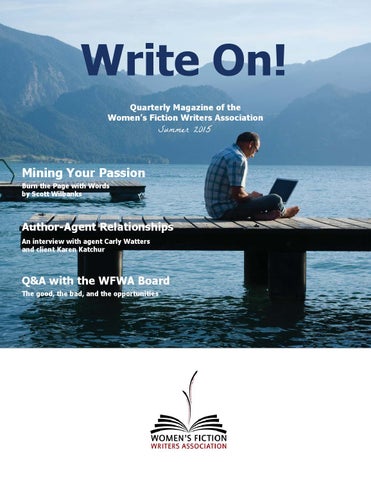
Write On! Quarterly Magazine of the Women’s Fiction Writers Association
Summer 2015
Mining Your Passion Burn the Page with Words by Scott Wilbanks
Author-Agent Relationships An interview with agent Carly Watters and client Karen Katchur
Q&A with the WFWA Board The good, the bad, and the opportunities
Editors FEATURES EDITOR
MANAGING AND COLUMNS EDITOR
HIGHLIGHTS EDITOR
LAYOUT EDITOR
Erin Bartels is a copywriter by day, a novelist by night, and a wife, mother, seamstress, and tireless ambassador for the state of Michigan in between. Erin is a board member of the Capital City Writers Association and the author of The Intentional Writer . You can find her encouraging writers, talking about craft, and sharing beautiful photographs at www.erinbartels.com.
Jessica Ferguson is the author of The Last Daughter , a novella published by The Wild Rose Press. She interviews authors for Southern Writers Magazine and is co-editor of Swamp Lily Review, a Journal of Louisiana Literature and Arts. In her spare time, she plays with her recently retired husband. Jess blogs at www.jessyferguson.blogspot.com.
Write On! is published quarterly by the WFWA. womensϐictionwriters.org facebook.com/WFWritersAssociation twitter.com/WF_Writers
2 Write On! • Summer 2015
Tasha Seegmiller is a mom to three kids and high school English teacher in Southern Utah. She writes contemporary women’s fiction with a dash of magic. Her loves include Diet Coke, owls, chocolate and cinnamon bears. She is a founder of and contributor to Thinking Through Our Fingers, and can be found at tashaseegmiller.blogspot.com.
Sierra Godfrey writes fiction with international settings and always a mention of football (soccer) or two. She is also a graphic designer with a soft spot for magazine layout, and a sports writer covering La Liga for Football.com. She lives in the foggy wastelands of the San Francisco Bay Area with her family and can be found at www.sierragodfrey.com.
Contents 04 11 15 22
In every issue...
Scott Wilbanks Burn the Page with Words
08
Member News
Carly Watters and Karen Katchur
18
Barbara Claypole White Guiding Scribe: The Great Agent Search
21
Tasha Seegmiller Tech Tips to Help Meet Writing Goals
The Inner Workings of the Author-Agent Relationship Erin Bartels Why I’m Attending the First WFWA Retreat (and Why You Should Too) Q&A with WFWA’s 2015 Board of Directors
Summer 2015 • Write On!
1
President’s Note our various roles [page 23]. And we’re all available to chat with anyone who has more speci ic questions. Yes, volunteering will take time away from other things. Yes, it’s a responsibility. Yes, there will be days you wonder at your sanity for signing on. But there is a huge reward of furthering the genre you love. Think about the difference you can make to other writers. And then there’s the sense of pride at being part of such a wonderful, generous group of professionals. Not to mention the amazing friends you’ll make along the way.
Change happens. We’re seeing it in the publishing industry with the consolidation of the New York publishing houses, and we’re seeing it with the new publishing opportunities that a short time ago weren’t necessarily viable options for writers. Change also brought about the formation of WFWA. Since launching in September 2013, we’ve implemented quite a few programs and grown to over 650 members. We’ve become a thriving, supportive community. Now, it’s time to start thinking about changes within WFWA. In August we’ll be of icially kicking off the recruiting process for the 2016 board. Last year, most of the founding board stayed in their positions because we felt the Association was still young enough that change would be better implemented at the program/bene it level. With the amazing growth we’ve seen in membership over the last few months, we’re pretty conident that it’s time to hand over the reins. There are programs to improve upon and new programs to launch. There are inroads to be made with the publishing community and paths to forge with readers of women’s iction. There’s no question that being on the board— or volunteering for any position—is a substantial commitment. The 2015 board answered a handful of questions to help clarify some questions about 2 Write On! • Summer 2015
WFWA depends on its volunteers. We wouldn’t have grown to where we are now without everyone who’s stepped up to help with the programs and member bene its. You don’t have to serve on the board to contribute. But if you want WFWA to continue growing and serving the women’s iction community, then please consider volunteering. I’m excited to see what’s next for WFWA.
Orly
Founding President orly@oklopez.com
About the WFWA We began this organization in 2013 with the idea to create a safe, nurturing place for male and female writers of women’s iction. The publishing industry is morphing—with new opportunities and, as yet, unknown futures. The founders of the Women’s Fiction Writers Association wanted somewhere to amass and disseminate information to and about our chosen genre. De ining Women’s Fiction has proven as subjective as the types of books we prefer. For that reason, our guiding statement is broad and comprehensive: Stories that are driven by the main character’s emotional journey. Our stories may have romance. Or they may not. They could be contemporary. Or historical. But what binds us together is the focus on a woman’s emotional journey.
Write on!
2015 WFWA Board of Directors Orly Konig-Lopez President Kerry Lonsdale Vice President, Programs Laura Drake Vice President, Finance / Treasurer Maggie Marr WFWA Legal Counsel Lisa Collins Mauro Secretary Barbara Claypole White Guiding Scribe Christine Adler Communications Director Nicole Tone Membership Director
If you haven’t already, send them a Friend Request on the WFWA site to stay connected and see their newest posts in The Hub.
Reader Letters
The WFWA Founding Team
Like what you’ve read in Write On!? Send us a letter! We’d love to hear your feedback and reactions on the stories and features. Email them to writeon@womens ictionwriters.org. Submitted letters are considered for publication and may be edited for clarity or space.
Orly Konig-Lopez www.orlykoniglopez.com www.kerrylonsdale.com Kerry Lonsdale www.lauradrakebooks.com Laura Drake www.lindaavellar.com Linda Avellar www.marilynbrant.com Marilyn Brant www.maggiemarr.com Maggie Marr
Summer 2015 • Write On!
3
Burn the Page with Words by Scott Wilbanks
L
ife is created through the exchange of energy. Indeed, the foundational principles of the Universe are predicated upon it. And writing, it can be argued, contains life. So energy and writing are more than sisters; the latter doesn’t exist without the former. It can’t. Through the exchange of energy—and not a little bit of magic (oh, yes, we can’t forget magic)— the void space between neurons in our brains crackle with electrical impulses, formulating ideas that work their way through our ingers and onto the page. (It’s happening right now for me.) The words that result trap that energy, store it. So, the more energy you put into the process, the more those words on the page contain it. Think about that. Now let’s replace the word energy with its writerly synonym. Passion. Writing can’t help itself. It’s nothing without passion, being a perfect re lection of it. It may come in dribs and drabs, as in that work-related email you hardly remember sending out, or it may result in a con lagration that leaves a reader’s hair standing on end, ingers twitching, the neurons in their brain lighting up like a switchboard on Mother’s Day. 4 Write On! • Summer 2015
Case in point: picture Mr. Darcy’s irst proposal to Elizabeth Bennet—the colossal failure. Do you remember how Elizabeth Bennet’s zinger on the heels of his snarky inquiry burned through your brain? “And this is all the reply which I am to have the honor of expecting? I might, perhaps, wish to be informed why, with so little endeavor at civility, I am thus rejected.” “I might as well enquire,” replied she, “why with so evident a design of offending and insulting me, you chose to tell me that you liked me against your will, against your reason, and even against your character? Was this not some excuse for incivility, if I was uncivil? But I have other provocations. You know I have!” Two hundred years later, Jane Austen’s passion is still transferring so much energy through our eyeballs that smoke comes out our ears. But here’s the thing about passion. It’s rooted in our weak spots, those spaces where we’re most vulnerable, having been brewed by the individual ingredients of our life experiences that crash against one another before eventually bonding to create a psychic kerosene that’s just begging for a match.
Take gay rights, for example. Very few are immune to a knee-jerk response on that subject. Don’t believe me? Just read the string of comments that follow any article on same-sex marriage that inds its way into print these days. They’re a troller’s paradise. One of them will invariably throw a lit match on the subject to sit back and enjoy the escalation from people-baiting, to people taking that bait, and on to gloriously, hideously awful ad hominem attacks. The comment section is the reader’s equivalent of a neutron bomb. You can’t help but gnash your teeth. It should come as no surprise, then, being a gay man, that an LGBT theme found its way into my irst book, because, honestly, what could be more personal? Even so, I played it safe, bleeding (and I use that term intentionally) the theme into a secondary story line—a sort of supporting role, as it were. And I had an objective in doing so, though I wasn’t consciously aware of it at the time. If I could successfully weave a storyline with LGBT themes into a manuscript designed for a broader audience that was real, sweet, and poignant, it could, just possibly, change hearts and minds, presenting me as a sympathetic character to someone who’d never before seen me in that light. Having been gay-bashed for the irst time when I was eleven—in the parking lot of a Taco Bell, no less—and with a lifetime of persecution under my belt, I craved to be understood.
My passion was igniting, but only a little bit, and I paid for the lack of commitment. Just about every agent who expressed an early interest in my manuscript suggested, discreetly, that I remove that thread entirely. That left me in a very uncomfortable position: sacri ice either a potential agency offer, or my passion. In the end, I couldn’t do it. Though everyone told me to, from my family to my family of friends, I couldn’t kill off something that intensely personal. I’d have to ind another way. And I did. I fueled it instead, knowing that I would catch hell from the trollers should my manuscript ever see the light of day. It was something I should have done from the beginning—the throwing of more logs onto the lame. I worked, and worked, and worked at that secondary storyline until the oddest thing happened. The feedback from beta readers took a decided twist. I began to get notes on how much they loved this secondary story line, and its two characters—Christian Keebler, my protagonist’s best friend, a man burdened by a situational stutter born from a secret he hides even from himself (his sexuality), and Edmond, a man with a heart of gold, an absolute charmer, who uses his personal demon (drug addiction) as an excuse to keep the former at a distance. I folded the two of them into my primary story—commercial iction designed for women, one with time-twisting, outrageous female leads, and intrigue galore—and something new happened. They gave energy to it. It became bigger. Then something else happened. There came a point where the amount of energy I put into the secondary story line took on so much life that it broke through the wall of prejudice. Agents let go of their concerns regarding the controversial topic and simply enjoyed the ride. Three agents offered representation, because of that secondary story line, as much as for my manuscript’s overall merit. And here’s the point I’m so inarticulately trying to form. As a writer, don’t stray from passion. Don’t write to an audience. And don’t be afraid of the trolls. Summer 2015 • Write On!
5
Examine the ire in your belly. Name it. Then create a world around it. Don’t . . . be . . . shy. Don’t write safely, or by half measures. Your audience will know if you do. Instead, snag their wrists in a steely grip, and take them on the ride that had rocked your world so completely. Whether they go willingly, or kicking and screaming, it’ll be unforgettable. •
The WFWA Online Pitch Session
Sepetmber 9, 2015
What: Do you have a completed women’s iction manuscript ready to pitch? WFWA is hosting our second annual online pitch session dedicated to women’s iction inside our Forum. When: Wednesday, September 9, 2015, 12:00 AM – 11:59 PM Paci ic Where: WFWA Forum. No registration required! ALL WFWA members seeking representation may participate. Scott Wilbanks is an American expat living in New Zealand with his frustratingly perfect husband, Mike. A former national title holder in the sport of gymnastics whose left arm is an inch shorter than his right—the result of a career-ending accident—Scott ditched the corporate world to “see where this writing will take me.” He is the author of The Lemoncholy Life of Annie Aster, a commercial iction novel with a fantasy premise (August 2015, Sourcebooks) that tells the story of two pen pals ighting against the clock to solve the mystery behind the hiccup in time connecting their homes before one of them is convicted of a murder that is yet to happen . . . and yet somehow already did. 6 Write On! • Summer 2015
Details: On Wednesday, September 9th, for a full 24 hours, WFWA members can pitch their women’s iction by posting the title, total word count, sub-genre, 50 word pitch, and the irst 250 words of the manuscript. (Only one entry per member.) Throughout Thursday, September 10th through Monday, September 14th, participating agents will review the posts and respond to the ones they would like to see more of. Additional details and pitch posting instructions will be emailed to all WFWA members a week or so before the pitch session. Please log in to participate.
Member News We’re excited to share these new member releases coming out this quarter.
The Perfect Son by Barbara Claypole White Release Date: July 1, 2015
From a distance, Felix Fitzwilliam, the son of an old English family, is a good husband and father. But, obsessed with order and routine, he’s a prisoner to perfection. Disengaged from the emotional life of his North Carolina family, Felix has let his wife, Ella, deal with their special-needs son by herself. A talented jewelry designer turned full-time mother, Ella is the family rock . . . until her heart attack shatters their carefully structured existence. Now Harry, a gifted teen grappling with the chaos of Tourette’s, confronts a world outside his parents’ control, one that tests his desire for independence. As Harry searches for his future, and Ella adapts to the limits of her failing health, Felix struggles with his past and present roles. To prevent the family from being ripped apart, they must each bend with the inevitability of change and reinforce the ties that bind.
Summer 2015 • Write On!
7
Center of Gravity by Laura McNeill Release Date: July 14, 2015
Her whole life, Ava Carson has been sure of one thing: she doesn’t measure up to her mother’s expectations. So when Mitchell Carson sweeps into her life with his adorable son, the ready-made family seems like a dream come true. In the blink of an eye, she’s married, has a new baby, and life is grand. When her picture-perfect marriage begins unraveling at the seams, Ava convinces herself she can fix it. It’s temporary. It’s the stress. It’s Mitchell’s tragic history of loss. Mitchell is no longer the charming, thoughtful man she married. He grows more controlling by the day, revealing a violent jealous streak. His behavior is recklessly erratic, and the unanswered questions about his past now hint at something far more sinister than Ava can stomach. Before she can fit the pieces together, Mitchell files for divorce and demands full custody of their boys. Fueled by fierce love for her children and aided by Graham Thomas, a new attorney in town—Ava takes matters into her own hands, digging deep into the past. But will finding the truth be enough to beat Mitchell at his own game? Center of Gravity weaves a chilling tale, revealing the unfailing and dangerous truth that things—and people—are not always what they seem.
The Ones We Trust by Kimberly Belle Release Date: July 28, 2015
When former DC journalist Abigail Wolff attempts to rehabilitate her career, she finds herself at the heart of a US army cover-up involving the death of a soldier in Afghanistan—with unspeakable emotional consequences for one family. As the story of what happened comes to light, Abigail will do anything to write it. The more evidence she stumbles upon in the case, the fewer people it seems she can trust, including her own father, a retired army general. And she certainly never expected to fall in love with the slain soldier’s brother, Gabe, a bitter man struggling to hold his family together. The investigation eventually leads her to an impossible choice, one of unrelenting sacrifice to protect those she loves. Beyond the buried truths and betrayals, questions of family loyalty and redemption, Abigail’s search is, most of all, a desperate grasp at carrying on and coping—and seeking hope in the impossible.
8 Write On! • Summer 2015
The Secrets of Lake Road by Karen Katchur Release Date: August 4, 2015
Jo has been hiding the truth about her role in her high school boyfriend’s drowning for sixteen years. Every summer, she drops her children off with her mother at the lakeside community where she spent summers growing up, but cannot bear to stay herself; everything about the lake reminds her of the guilt she feels. For her daughter Caroline, however, the lake is a precious world apart; its familiarity and sameness comforts her every year despite the changes in her life outside its bounds. At twelve years old and caught between childhood and adolescence, she longs to win her mother’s love and doesn’t understand why Jo keeps running away. Then seven-year-old Sara Starr goes missing from the community beach. Rescue workers fail to uncover any sign of her—but instead dredge up the bones Jo hoped would never be discovered, shattering the quiet lakeside community’s tranquility. Caroline was one of the last people to see Sara alive on the beach, and feels responsible for her disappearance. She takes it upon herself to figure out what happened to the little girl. As Caroline searches for Sara, she uncovers the secrets her mother has been hiding, unraveling the very foundation of everything she knows about herself and her family.
The Lemoncholy Life of Annie Aster by Scott Wilbanks Release Date: August 4, 2015
Annabelle Aster doesn’t bow to convention—not even that of space and time— which makes the 1890s Kansas wheat field that has appeared in her modern-day San Francisco garden easy to accept. Even more peculiar is Elsbeth, the truculent schoolmarm who sends Annie letters through the mysterious brass mailbox perched on the picket fence that now divides their two worlds. Annie and Elsbeth’s search for an explanation to the hiccup in the universe linking their homes leads to an unsettling discovery—and potential disaster for both of them. Together they must solve the mystery of what connects them before one of them is convicted of a murder that has yet to happen . . . and yet somehow already did.
Have something being published between October and December? Please send an email to
writeon@womens ictionwriters.org We’d LOVE to get your news in the next issue of this magazine! Summer 2015 • Write On!
9
Come Away With Me by Karma Brown Release Date: August 25, 2015
One minute, Tegan Lawson has everything she could hope for: an adoring husband, Gabe, and a baby on the way. The next, a patch of black ice causes a devastating accident that will change her life in ways she never could have imagined. Tegan is consumed by grief, not to mention her anger toward Gabe, who was driving on the night of the crash. But just when she thinks she’s hit rock bottom, Gabe reminds her of their Jar of Spontaneity, a collection of their dream destinations and experiences, and so begins an adventure of a lifetime. From the bustling markets of Thailand to the flavors of Italy to the ocean waves in Hawaii, Tegan and Gabe embark on a journey to escape the tragedy and search for forgiveness. But they soon learn that grief follows you no matter how far away you run, and that acceptance comes when you least expect it.
A Measure Of Happiness by Lorrie Thomson Release Date: August 25, 2015
Katherine Lamontagne isn’t Celeste Barnes’s mother, but ever since Celeste graduated high school and her parents abandoned Hidden Harbor, Maine, she’s acted the part. At twenty-two, Celeste worked at Katherine’s bakery, and hoped to buy the business once Katherine took early retirement. But when Katherine reconsidered that decision, Celeste fled to culinary school in New York—only to return two months later, a shadow of the girl who’d stormed out the door. Katherine knows the signs of secret heartbreak. Years ago, she gave up her baby son for adoption—a regret she’s never shared with either her ex-husband or Celeste. She longs for Celeste to confide in her now. But it will be a stranger in town—an engaging young wanderer named Zach Fitzgerald—who spurs them toward healing. As both women are drawn into Zach’s questioning heart, they also rediscover their own appetites for truth and for love—and gain the courage to face the past without being imprisoned by it. All The Difference by Leah Ferguson Release Date: September 1, 2015
All it takes is one word—yes or no—to decide Molly’s future. As the clock counts down to midnight and the ball slowly begins to drop, Molly’s picture-perfect boyfriend gets down on one knee and asks her to marry him. She knows she should say yes, especially considering the baby-sized surprise she just discovered she’s carrying. But something in her heart is telling her to say no . . . Now, Molly’s future can follow two very different paths: one where she stays with her baby’s father, despite her misgivings and his family’s unreasonable expectations, and one where she ventures out on her own as a single mother, embracing all the hardships that come with it.
10 Write On! • Summer 2015
The Inner Workings of the Author-Agent Relationship by Carly Watters and Karen Katchur Interview between Carly Watters, VP and Senior Literary Agent at P.S. Literary, and women’s ϔiction author Karen Katchur (THE SECRETS OF LAKE ROAD, August 2015, Thomas Dunne Books/St. Martin’s Press) Carly: Thanks for inding time to chat today Karen! Between watching tennis and writing I know your summer is full! Let’s start off with the story of The Secrets of Lake Road. What’s the story of this book from inception to print? Can you talk about where the idea came from and its journey to St. Martin’s Press? Karen: My pleasure, Carly! Thanks for asking me! To answer your question, I tend to build my iction around either an event I’ve read about or one that happens to be more personal to me. For The Secrets of Lake Road, the event was one of a more personal nature. When I was nine or ten years old, I witnessed the drowning of a young teenage boy at a lake where I spent many summers growing up. The tragedy of that day has never left me; the helplessness I’d felt watching them drag the lake for his body is something I’ve never forgotten. The idea of building my iction around this particular event (in Secrets it’s a seven-year-old girl who goes missing) occurred while I was sitting around the table with my mother and sister and we were talking about the lake, sharing happy memories
and some sad ones too. I’d always thought of the lake where my grandmother owned a cabin as both beautiful and dangerous. The setting was the perfect mix for a suspense story. I remember pitching the idea to you over dinner one night in NYC. I’m sure it was a messy and somewhat incoherent pitch since I never know what the story is about until the irst draft is written. I’m tremendously grateful that you bear with me through my messy process! It took a year to write before I submitted it to you for editorial advice (grateful for this too!), and after a round or two of edits, it was ready for submission. The submission process went quickly. If I remember correctly we had an offer within a week (is that right?) and a few weeks later I signed with SMP. Secrets is the third book I’ve written since you’ve offered representation and the irst to sell. There was a lot of hard work that you put in before making that irst sale which is why taking on a new author is a big decision, and I imagine especially for you since you’re a career agent—an agent who takes on clients for the length of their careers. So how do you know if the chemistry between you and a new client is a good it?
Summer 2015 • Write On!
11
on a few occasions in person. I think combining the face-to-face contact with phone calls as well as emails has been a bene it in terms of communication and building a solid working relationship (and friendship!). My favorite part about our author/agent relationship is the easy low of communication and knowing we’re working as a team toward the same goals. What is your favorite part about our author/ agent relationship?
Carly: Yes, it was a week! Fast, and deserved—it is a special book. That’s a great question. Since I never know whether something will sell I sign clients up on the following factors: their goals (do we have the same vision for this book and your future work?), their passion (do they have the drive that will get them through the tough times?), and their talent (do they have the raw materials to make a career of this?). There are smaller factors like: do we get along? Can I work with this person for the long haul? Can I sell this book or do we have a lot of work to do irst? But I love the polishing process as much as I love selling books. So let’s talk about how we work together. How did I assist in the process from a support/sounding board point of view? Karen: You’ve been a huge support along the way. As you know, my irst book didn’t sell—yet! (I’m still hopeful for that one.) And then after much discussion we agreed to set the second book aside. Through the ups and downs you’ve provided motivational and editorial support, steering me in a direction that allowed me to keep writing and moving forward. Your enthusiasm for my book(s) never waned. It’s your positivity that’s so infectious! And I love the fact that we were able to meet 12 Write On! • Summer 2015
Carly: We are very honest with each other. I am always respectful of your feelings, but we both know when it’s time to get to work and do the best for your career as opposed to whatever is going on emotionally. Writing is very personal, but it’s also a job. You’re one of the lucky ones to have gotten your work this far and able to reach this many people and I know that you take that responsibility seriously. I like that you put your heart into things, but when you get feedback you take a few days to think before coming back to me with solutions. Being able to have a writing hat and a revision hat and know how to keep those separate is what’s going to help you have a long career. So, knowing it’s a competitive market out there to have a successful and long career, what are you doing to promote your book? Karen: This is tough for me because I don’t think marketing is one of my strengths. If I’m not careful weeks could go by where I don’t interact with anyone outside of my family and close friends. I can be an extremely private person. Although when I’m comfortable in my surroundings I can also be the life of the party. Go igure. However, knowing this I am trying to work harder on building relationships in the writing community, attending author signings and conferences when I can. I’m getting to know the local booksellers in my community. I visit their stores often and buy/talk about books. I also participate in conversations on FB pages that are geared toward the local community where I grew up and where my books are set. We share a common interest in the love of the area, and I think inding the people you share a common interest with is a good place to start when you’re
trying to build your readership. Hopefully, if they buy the book and like it, they’ll tell their friends about it and so on. I’m old-school in that I do believe word of mouth is the best marketing tool out there. So it’s no surprise I’m more comfortable with the soft sell kind of approach. You won’t see too many posts on FB or Twitter that are only about my book. You will see some of course, and especially when it gets closer to the release date (August 4th). And of course I’m happy to re-tweet or share FB posts about other authors’ books as well! I did have bookmarks made and I have a few other little things planned for three or four giveaways to help build my list of subscribers for my author newsletter. I’ve also decided to send postcards to friends and family announcing my debut along with information about the events where I’ll be signing books. We’ve gotten so used to emails, and Evites, and FB events that I thought sending a postcard the old way of snail mail would stand out more and add a more personal touch. These are some of the things I’m doing outside of what SMP has planned, which leads me to my next question. Not all agents/literary agencies take an active role in marketing their clients’ books. But you and P.S. Literary Agency work as a team to help spread the word for your clients. Tell me how you go about this and why you decided to add this to your many roles as an agent? Carly: We are very realistic about the state of the industry. We know how tough it is out there for our clients and we never throw them out to sea alone. We are the experts so we take responsibility that our job is more than getting a 15% commission check for selling a book. I take the hand holding of my clients very seriously. Our agency has a digital and social media assistant whose sole job is to promote authors’ works online. She’s smart and savvy and I don’t know what we did without her. (Thank you, Amanda!) Why sell a book just to let it echo out there? Promotion is more than just sharing it with the world and seeing what happens. It’s about engagement: inding those fans and listening to them. It’s about knowing your audience and where they spend time. And speaking of our audience, because dis-
coverability happens so often online these days: Authors hear a lot about platform, what does your author platform mean to you? Karen: My brand is my name and the kinds of books I write. My platform is the way I communicate with my target audience. I like to think of my website as the hub of both my brand and platform. There you can ind a bio, a description about why I write what I do, and of course all the information about Secrets and buy links. I also include a link to sign up for my author newsletter, links to social media pages, and information about upcoming events. FB, Twitter, and Goodreads are the three social media sites I use the most for my platform. I think platform is a very confusing thing for iction writers. It’s a much easier term to de ine for non iction. From an agent’s viewpoint, how would you de ine platform for iction writers? Carly: As I think you’ve highlighted: platform for iction writers is different than non iction authors. For the sake of our women’s iction audience I will focus on iction. Platform is whatever you can do to leverage your message and your name. That could be social media, or it could be writing articles for magazines. If you’re an expert in something, that’s your platform. And for iction writers your expertise is your work and your brand—the ability to have readers come back for more knowing they’re going to get that same voice that they love. Fiction authors should be focusing on honing that voice, not building up a social media platform. Because all the tweets in the world can’t make up for a bad book. Now that you’re knee deep in marketing, metadata, and discoverability (all the buzz words you’re learning!) what did you learn from this experience that you’ll put towards making the next book a success? Karen: Simple! Target audience. You would think this is a no-brainer. But since I straddle the line between two genres, mystery/suspense and women’s iction, it’s not as easy for me as one might think. For now, I’m leaning more towards the women’s iction genre to stay on target with the audience for Secrets. And of course, writing the best darn book I can. I’m super excited about Summer 2015 • Write On!
13
the next book I’m currently working on, and I hope readers will be too. It’s been a long journey to publication, and it doesn’t stop there. It took me eight years to land an agent (Carly!) and another two to sign my irst book deal for The Secrets of Lake Road, a ten-year road to publication. Rejection is part of the business. But sometimes the more rejections you receive, the sweeter the success! My advice is to stay focused on your goal, your dream, and keep writing. Keep moving forward. One word at a time. One reader at a time. From an agent’s perspective, is there anything you’d like to add about the perseverance it takes to be a published author? Carly: I can’t reinforce this enough. Even good writers bow out early because the going gets tough. The top authors make it to the peak not only because of their good writing (there are lots of good writers out there) but also their outlook; those authors on the NYT lists make it to the top because of their good writing and their ability to persevere. You can’t have just one and make it to the top; you need both talent and dedication. We don’t hear about good writers that can’t tough it out—those authors simply never make it to our news feeds. We hear about the authors who are talented and worked, book after book, to achieve their dreams. There are no secrets—there’s just hard won success.
Karen Katchur holds a Bachelor of Science degree in Criminal Justice from West Chester University and a Masters of Education degree in Health and Physical Education from East Stroudsburg University. She lives in Eastern Pennsylvania with her husband and two children. The Secrets of Lake Road is her irst novel. Learn more at www.karenkatchur.com.
I can’t wait for readers to experience The Secrets of Lake Road and enjoy your success with you. •
Carly Watters is a VP and Senior Literary Agent at P.S. Literary Agency. She represents a broad selection of writers and categories, including women’s iction. Her blog, www.carlywatters.com, has been named one of the 101 Best Websites for Writers from Writer’s Digest magazine for three consecutive years. Find Carly on Twitter @carlywatters and at writer’s conferences around North America in 2015 including PNWA, DFWCon, and Florida Writer’s Conference. 14 Write On! • Summer 2015
Why I’m Attending the First WFWA Retreat (and Why You Should Too) by Erin Bartels
I
ve been to a few writers conferences. I’ve taught at a few writers conferences. Hell, I’ve helped plan and actually managed to pull off a writers conference with my local writers association. And I’m in the middle of planning another one right now. So why on earth would I feel the need to go to another conference? The short answer is: I don’t. Followed closely by this: a retreat is not the same thing as a conference. What Makes the WFWA Retreat Different
Retreat, conference . . . isn’t that just semantics? No. Here’s the difference. A conference is designed to stuff as much learning as possible into a short span of time, largely through workshops taught by industry professionals who stand in the front of a room dispensing knowledge and ielding questions if there’s time. At a conference, there is little to no time to actually work on your writing, and that’s not really the frame of mind most people are in at a conference anyway. Mostly they are thinking about illing their toolbox with new tips and tricks and networking with people who might help their career.
There is nothing wrong with any of this. As I said, I’m involved in the conference world and, as a lifelong nerd, I love anything that smacks of school. If there were tests at the end of writing conferences, I would be even happier. A retreat is similar in some ways. If you attend the WFWA retreat in September, you will learn things about your craft and the business of publishing. You will get questions answered. You will make some professional and personal connections that will help your career and your boost your spirit. But a retreat is qualitatively different. Think of it this way: if a conference is school, a retreat is summer camp. A retreat gives you time to be you and not worry about putting on a front of I’ve-got-thiswriting-thing-under-control. It gives you time to actually write. Its focus is more on building relationships with those who are on the same journey as you are and less on getting some face time with that famous author or dealing with the informational overload of back-to-back classes for three days straight. Here are some speci ic reasons I am willing to put money and time into this retreat.
Summer 2015 • Write On!
15
I want to meet other people writing in my genre and learn from others at different stages of the journey. I’m a board member of a local writers association in Lansing, Michigan, called Capital City Writers Association. I love being part of a local group of writers who come together in person for writea-thons, workshops, special events, and our own writers conference, Write on the Red Cedar, which we put on during the glacial days of late January when everyone’s depressed about winter and needs something to take their minds off it. But within my local group, I have found that I’m in a minority when it comes to writing women’s iction. Most of my fellow CCWA members write romance, sci- i, fantasy, YA, and the like. While we can all learn together, I haven’t found within that group a solid critique partner who knows the conventions of WF or even necessarily enjoys reading it. At the retreat, I’d love to make some personal connections with people who might want to trade work with me. Beyond that, I’ve been lucky to have online friendships with a number of WFWAers with whom I want to be real life friends. I’ve been reading your blog posts or your updates on Facebook. We’ve discussed important issues on social media. We’ve laughed at the same cat and pygmy goat videos. Now I want to take the next step and really get to know each other. I want real hugs and high ives instead of emojis and gifs. The writing life is one that a lot of people don’t understand. But me and you? We understand each other. So let’s be real friends and help each other through our struggles, no matter what stage of the journey we’re on.
I want to get away from home, family, and responsibilities and focus on me. We all love our families. But we know that in order to write, we need time to ourselves—to think, to notice, to imagine, to dream, to focus in on our art. When it’s been too long since I’ve had some concentrated time alone, I get anxious and irritable.
16 Write On! • Summer 2015
Not only am I looking forward to some quiet time at the retreat to focus, I’m even excited about my time in the air and waiting in Dallas for my connecting light. With nearly eight hours of travel time there and six hours for the return trip, that’s a nice chunk of time with no responsibility beyond getting into my seat before the plane takes off. I plan to use that time. While I’m in New Mexico (my irst time ever in the Southwest) I’m going to enjoy myself, enjoy good company, enjoy a respite from Michigan’s summer humidity, and enjoy the absence of things like laundry, dishes, cooking, my “real” job, shuttling my son to school and karate, and even just letting my geriatric dog in and out a hundred times a day. Getting away from those things rejuvenates me and invites creativity that can otherwise be sti led by the business of living.
I need to invest in myself as a writer. I’m sure many of you saw the irst announcement of the retreat and thought, “How fun! I have to do this.” Then maybe you began researching light costs and hotels costs and the cost of the retreat itself and thought, “I don’t know if I should spend this much money on myself.” In fact, I know you did, because I did. Most of us probably have pretty tight budgets. And most of us probably feel a little bit (or a lot) of guilt spending money on ourselves. This can be especially true if you have been working at this writing thing with less than enthusiastic support from a person with whom you share a bank account. Or if you have just started writing and are wary of investing money in something you’re not sure you’ll see through. Or if you have kids who have a zillion activities you need to pay for. Or any number of other reasons! I happen to have a supportive spouse who is also a writer. He could easily see how this trip would bene it me. The will to make it happen was there. But that doesn’t mean the money was. We need to replace a car, pay for summer daycare, pay our mortgage, etc. Despite that, and before we really knew how we would pay for it, my husband “gave” me the retreat as my Mother’s Day present.
It’s way more than we would ever spend on a gift for each other. But he made the commitment to ind the money somewhere. As tends to happen in my very blessed life, God picked up where our faith left off. Almost immediately I found a fellow WFWAer looking for a roommate at the hotel to share the cost of the room. At my annual review the next week (I work in publishing) my boss told me I needed to ind some sort of enrichment activity that would reinvigorate me and keep me from getting bored, even if it didn’t directly impact my job as a copywriter. I told him about the retreat. He offered to cover my airfare on the spot. Suddenly, my total cost for the trip was cut in half. “Well, lucky you,” you might say, “but that’s not going to happen in my case.” Maybe not. But the point is we were ready to pay the full cost of the retreat because my writing is worth investing in. I am worth investing in. You and your writing are worth investing in. Did you go to college? That was an investment in your future career, even if you don’t work in exactly the same industry as you thought you would back when you chose your major. Have you ever taken a class on how to play guitar or how to appreciate ine wines? That was an investment in a skill you want to have or an art you want to practice.
scads more fabric and supplies. I got sucked into the world of vintage clothing patterns on eBay. And fourteen years after I got that sewing machine, I have made forty quilts and one hundred pieces of clothing that have earned me more compliments than anything else in my entire life. I have people wanting to pay me to make things for them. If I counted up all the money I have spent over the years on sewing, I would probably faint. It would be many times the cost of one writing retreat. Writing, thus far, has cost me nothing beyond the cost of books on craft and a couple magazine subscriptions. So I’m thinking of the cost of attending the WFWA retreat in terms of the money I’ve already spent in my life on hobbies. Writing is not just a hobby for me. It’s a passion. I could go the rest of my life and never sew another scrap. But I could never stop writing. So if I’m willing to invest in a fun hobby, I need to be willing to invest in a personal passion that I’d sorely like to do as a living some day. See you in Albuquerque! •
If you’re serious about writing, you’ll need to invest in that career choice, even if it’s never something you’ll do full time. Writing is an incredibly economic activity in that, as long as you have paper and a pen, you can do it. But to improve and excel at something, we have to do more than the bare minimum. In 2001, I got a sewing machine. Though I had good intentions, it didn’t get used much in those early years. I made a couple easy clothing patterns that looked terrible on me because I didn’t know what I was doing, and then I stopped sewing. I didn’t sew because I wasn’t very good at it. No one in their right mind would pay me for anything I made. Sewing is a skill that requires some investment in time and money to learn. Then I bought some books and fabric and patterns. I started making simple quilts. I joined a quilter’s guild. I bought a quilting frame. I bought
Erin Bartels is a copywriter, a freelance editor, and the author of The Intentional Writer and This Elegant Ruin: and other stories. She’s beyond excited about meeting you all in person in New Mexico! You can ind her at www.erinbartels.com.
Summer 2015 • Write On!
17
Guiding Scribe
The Great Agent Search by Barbara Claypole White *Spoiler alert: this story comes with an HEA.
I
’ve been asked to talk about how I found my agent, so I’m scrolling through my iPod for my rejection song and pouring a glass of wine. If I’m going to relive the trauma of amassing forty-seven rejections over two years, I need alcohol. Forty-seven isn’t a huge igure. You have to kiss hundreds of frogs to ind your prince, but each of my query letters was individualized and based on weeks of research. The whole process was extremely slow and drove me loopy, but you know what? It worked. A long time ago, in a galaxy far, far away, I had a manuscript called Dogwood Days. It wasn’t my irst, but it would become my debut novel, The Unϔinished Garden. I’d done my homework; I knew my chance of getting an agent was 0.01%, and I was determined to not make the rookie mistake of submitting too early. (Yeah right, like I took that advice.) I’d worked with a freelance editor for about a year, and when she deemed the manuscript done, she recommended me to an agent. My gut told me the manuscript wasn’t ready, but I igured I had an opportunity and should take it. The agent rejected me very, very nicely. Yes, nice rejections exist; I remember all of mine fondly. Ignoring that little voice that whispered, “It’s not ready,” I started querying in earnest. Using Agent Query, Publishers’ Lunch, Writers’ Market, and acknowledgements in similar novels, I cre-
18 Write On! • Summer 2015
ated a list of agents actively seeking WF and then learned everything I could about them. I sent out a small batch of queries that lead to nothing. And another small batch, which also led to nothing. Clearly something wasn’t working. I pulled back and did another draft of the manuscript and entered the irst thirty pages into the Carrie McCray Memorial Literary Awards, which used to be announced at the South Carolina Writers’ Workshop Annual Conference (SCWW). I scored second place in the category of novel, irst chapter, and felt as if I’d won an Oscar. As I skipped out of the conference with my framed award, a major agent stopped me and asked for a full. I drove home convinced my moment had come.
This agent’s rejection was devastating because (a) I was pruning my banksia rose when the mailman delivered her envelope, and that poor baby took a year to recover from my subsequent butchery and (b) she basically told me the novel would never get published. She declared James Nealy, who has OCD, too dark to be a romantic hero. This was a double whammy because James had come from my deepest fear as a mother: What if, when my young son grew up, no one could see beyond his obsessions, compulsions, and never-ending anxiety to love him for the amazing person he is?
set up a time to talk about representation. That was pretty much it for this girl, even though I went through the motions of contacting several agents who had partials. Nalini and I talked on the Saturday and I assumed she would have a long list of edits for me. But she loved the manuscript and thought it was ready to go. I remember she also said, “What’s the point of me asking for edits when your editor will have her own vision?” I loved that comment. It made so much sense to me.
But her rejection turned out to be pure gold. I had held James back, too scared to show readers his dark corners. That changed overnight, when I let him out of his box. I igured I had nothing to lose, right? James, by the way, is how I found my very own, dimly lit corner of the writing world: hopeful family drama with a healthy dose of mental illness. I stopped querying and spent a year pulling the manuscript apart to include James’s POV. Up until that point, The Unϔinished Garden, which is classic women’s iction, only had one voice: my heroine’s. October came around, and I returned to SCWW. I pitched to a big editor, who asked for the full, and I waded back into the querying arena. This time I got requests, but I wasn’t sure if the agents were genuinely interested, or if it was because the manuscript was out with an editor. Then Nalini Akolekar of Spencerhill Associates popped up on Chuck Sambuchino’s Agent Alert. She was new to agenting—not the business—and was actively seeking to build her WF list. Plus she used to work at Duke University, which is down the road. I stalked her on the Internet and then spent two weeks composing a query letter that was written exclusively for her. I sent it on a Friday. As per the website guidelines, I attached a partial and a synopsis. Almost immediately I had a reply. Could I resend the attachment because it wouldn’t open? I was devastated but also hopeful. She had seen beyond my screw-up! (The irst of many.) On the Wednesday, she sent me an email asking for the full, and on the Friday afternoon, as I was running out the door to pick up my sister from the airport, she called and asked if we could
I called her on the Monday and accepted her offer—even before I’d heard back from one of the other agents. What I loved about Nalini in our irst conversation has never changed: she makes everything easy. There’s no fuss, no dramatics, and she’ll tell me the blunt truth. More importantly, she understands how I work. She knows that I like to do one book at a time and that family comes irst for me. When my son was in bad shape with his OCD after The Unϔinished Garden launched, I had to ask for an extension on The In-Between Hour. When I told her I was considering this, she said simply, “Do what you have to do, Barbara.” You don’t want just any agent. You want the right agent, the one who believes in your work and understands what you want from your career. Searching for an agent is like speed dating. Just because you have a drink with someone, doesn’t Summer 2015 • Write On!
19
mean you have to marry him or her. I’m always appalled when other writers tell me their agents don’t respond to their emails. If I have a problem, Nalini is there, dealing with it. Boom! The Perfect Son had a traumatic third trimester, but thanks to Nalini, its birth was painless. She had a vision for it, and that led to Lake Union and my book baby being an Amazon Kindle First Pick and being selected for placement in Wal-Mart and Sam’s Club. I used to describe querying this way: Imagine a stranger kicks you to the ground, and then you have to leap up and say, with a big smile, “Can I have some more please?” I describe my agent as a fairy godmother, because she got me to the ball. •
WFWA Member Query Resources The WFWA website has some excellent resources for you when you’re ready to query. Queries that Worked ( ind it in the Resources > Aspiring Authors section) has a list of real queries that netted agents. Then, when you’re ready to write yours, try our query critique forum i the Forum > Critique and Reviews > Query Critiques section.
20 Write On! • Summer 2015
English born and educated, Barbara Claypole White lives in the North Carolina forest with her brilliant professor husband and, when he’s home from college, their equally brilliant poet/musician son. An avid woodland gardener inspired by her son’s courageous battles against an anxiety disorder (OCD), Barbara writes stories that ind light through the trees and hope in the darkness of invisible disabilities. Her debut novel, The Unϔinished Garden, won the 2013 Golden Quill Contest for Best First Book; The In-Between Hour was chosen by SIBA (Southern Indie Booksellers) as a Winter 2014 Okra Pick. Her third novel, The Perfect Son, was published in July 2015. Connect with Barbara at barbaraclaypolewhite.com.
Tech Tips
Tech Tips to Help Meet Writing Goals by Tasha Seegmiller
W
hether you are still lingering in the dog days of summer or gearing up for the fast-paced start of a new school year, this tends to be a time for many when writing productivity can start to slip. There are several technology tools to help the writing hold its position as a progressing priority.
1. Schedule an appointment – with your book. I’m guessing that most everyone in this day and age has a calendaring plan of some sort. To negotiate my household, I have a digital calendar, with each member of my family having their own color. That includes myself. When I can tell that my writing is slipping, when there are times that my frustration with my dear loved ones starts climbing, it’s often because I’ve left myself off the calendar. I add the event, set it to repeat, invite my husband to the event and let everyone in proximity know that for that hour (or two if things go really well), I’m writing. Just as I make my kids keep their appointments, just as I keep my appointments with coworkers and bosses at my day job, I force myself to keep my appointments with myself.
2. Set a goal, and meet it. There are so many goal-tracking tools available for writers! Scrivener allows writers to set goals for the whole project, by chapter, scene or session. A bar appears, transitioning from red to yellow and then green as progress is made. One of my favorite goal tools is the spreadsheet system set up by our own Jamie Raintree. It allows writers to put in both word count goals, and how many words were written in a day. Not only that, but Jamie’s spreadsheet also has a place for tracking revisions. This tool isn’t just for drafting.
3. FOCUS. I do not have an of ice, a spare bedroom, or even a closet within which to lock myself. I have a desk in the center of my house, along with three children, their friends (six at the time of writing this article), a dog, busy husband and the like. When I have scheduled time to write, I honor that, but I also have to make accommodations because my family keeps living as well. I am the kind of person who can write with music (always classical) but it’s not helpful when I can’t hear it over the noise of the aforementioned life. Last year, I bought a pair of headphones that cuts out a good amount of the noise, turn on the music, and work. If writing with music distracts Summer 2015 • Write On!
21
you, consider trying rainymood.com, and enjoy the calmer, steadier white noise to allow for better concentration. Sometimes, though, the external technology can be perfectly in place and inspiration still lingers. In those cases, setting a timer (I use my phone) or an app like pomodorotime.org will force focus. Go ahead and try to not be productive when there is a clock ticking down. If you are still struggling with motivation, try writeordie.com, where there is a timer, simulated punishments and celebrations depending on your productivity. I promise kamikaze mode will get your adrenaline and ingers moving in speedy synchrony.
critique group yet, consider checking in with the Critiques and Reviews forum on the WFWA website. You can ind people to exchange pages, and maybe ind your future accountability partner as well. •
4. Accountability partners I irst heard about this while taking a class taught by WFWA member Annette Lyon. She explained some of the concepts included in her book about accountability. I took the ideas, created a Facebook group message with my critique partners. Throughout the day, ive of us check in, citing our progress with everything from writing goals, itness goals, throwing birthday parties, confusing plot points in our stories, and whatever else arises, threatening to force writing, revising, editing, querying progress off track. There is something powerful about knowing I’m going to be reporting my progress of the day to four people, and that at any point in time, they could check in on me, ask how I’m doing on my goals, and vice versa. If you haven’t had the opportunity to form a 22 Write On! • Summer 2015
Tasha Seegmiller is a mom to three kids and high school English teacher in Southern Utah. She writes contemporary women’s iction with a dash of magic. Her loves include Diet Coke, owls, chocolate and cinnamon bears. She is a founder of and contributor to Thinking Through Our Fingers, and can be found at tashaseegmiller.blogspot.com.
Q&A with WFWA’s 2015 Board of Directors
W
e’re of icially kicking off the nomination process for the 2016 board of directors. And to help our members with the decision of whether to run for a position, the 2015 board agreed to answer a few questions. First, your 2015 board and a quick run-down of each position. Orly Konig-Lopez, President The President acts as the spokesperson for the Association and oversees all communications and activities. Kerry Lonsdale, Vice President-Programs The Vice President, Programs has oversight for all Association special programs. Laura Drake, Vice President-Finance/ Treasurer The Vice President, Finance/Treasurer maintains the Association bank accounts, prepares the annual budget and oversees the membership and renewal applications. Lisa Collins Mauro, Secretary The Secretary keeps the minutes for all meetings of the Board of Directors, maintains Association documents, and oversees all membership applications.
Christine Adler, Communications Director (appointed, non-voting position) The Communications Director is responsible for the Association’s communication strategies, fostering awareness about WFWA, maintaining the Association’s social media presence, and overseeing the WFWA newsletter. Nicole Tone, Membership Director (appointed, non-voting position) The Membership Director oversees all phases of the membership process and works closely with the rest of the board members to ensure that WFWA is meeting member needs. Barbara Claypole White, Guiding Scribe The Guiding Scribe serves as the respected guiding voice within the Association. S/he is published in Women’s Fiction and provides advice to members and the board about topics related to the genre of Women’s Fiction.
1. Why did you decide to volunteer for the WFWA board? Orly Konig-Lopez: I’m not sure I actually ever “volunteered” for this. When the founding members began work on WFWA, I was leading the discussions and keeping us organized. Somehow that led to being the founding president. :-) So for me, Summer 2015 • Write On!
23
maybe it’s more a question of why did I decide to jump in with the founding members? I wanted an organization that supported what I write. The idea of being able to help shape that organization was exciting. How often do you have the opportunity to build the exact “house” you’ve been dreaming about? Kerry Lonsdale: My original decision to volunteer for the WFWA Board of Directors wasn’t a decision per se, but more like an action that evolved with the evolution of the association. As a founder, I’ve been with WFWA since the beginning. Like many of us, I came from the Women’s Fiction chapter of the RWA as the VP of Programs. My position was a natural transition to WFWA. However, I did decide to run for re-election last year because we’d launched so many great programs. Remaining in the position ensured these programs had a solid foundation and continued success. Laura Drake: I was excited to get in on the ground loor of a new venture, to have a hand in guiding a new organization—one I believed in passionately! Lisa Mauro: I had just joined the organization and was really looking for a better way to get to know people than by hoping others were checking into the forums. For me, it was a quick introduction to as many members as possible.
I’ve learned so much about
connecting with readers as a writer, and I’ve gotten to work with some talented
and inspiring women. I really
enjoyed being able to contribute to
an organization I value so highly.
Christine Adler: I wanted to be more involved with this great organization and also wanted to “meet” as many members as possible. Nicole Tone: I’ve been an Industry News Coordinator for almost a year now, and I wanted to become more involved in the WFWA. When Orly sent the email out asking for volunteers, I thought that stepping up to be the Membership Director would not only help her out, but I’d be able to become a more active participant in the WFWA. 24 Write On! • Summer 2015
Barbara Claypole White: I’m a big fan of pay-itforward. So many published authors were good to me when I was an author-in-waiting, and I wanted to try and return the cosmic favor. I hope that people at my funeral stand up and say, “Oh, I remember when she did this for me,” and not, “Glad that miserable old trout’s popped her clogs. She never returned my emails.”
2. What’s been the best part of serving on the board? Orly Konig-Lopez: Hands down, the friends I’ve made. I’ve been absolutely blown away by the generosity and commitment among the members of this association. When we launched WFWA, the board was chewing their nails hoping we’d have 200 members. As we’re talking, WFWA is nearly 650 members strong and we haven’t hit our two year anniversary yet. That’s pretty darn impressive. But beyond the numbers, I’ve thoroughly enjoyed getting to know so many wonderful people. Kerry Lonsdale: Annoying Orly. Seriously though, the comradery. Plus, it’s thrilling being able to witness irst hand how programs we implement help launch and/or enhance our members’ writing careers. Laura Drake: Getting to know more amazing women’s iction writers and feeling like I’ve made a difference. Lisa Mauro: Having an opportunity to really watch it grow and to see our collective ideas come to fruition. I loved being part of the discussions about creating a Facebook group for WFWA, for instance, and then watching how quickly that took off. There is a lot of behind the scenes work that the Board does and it’s really great to see and hear the feedback from our members. Christine Adler: Getting to host the quarterly Facebook launch parties, by far! It’s fun to bring together so many great readers and so much love and positive energy for the authors and their books. Nicole Tone: Everyone is really nice and really helpful! Plus, there are so many things going on behind the scenes that I get to help with before we
share them with the rest of the WFWA. Barbara Claypole White: The sense of community. We need our writing communities! And besides, we’re a funny, smart, entertaining bunch. How great is that?
3. Why should someone consider volunteering their time for a board position? Orly Konig-Lopez: To make a difference in women’s iction. How’s that for a helpful reason? :-) Seriously though, there’s been so much discussion about women’s iction, where we it in the industry, where are we going as a genre, etc., and being part of the board is a way to help in luence that. As a new organization, WFWA is starting to gain recognition. There’s a lot more work we can do to become a player within the industry. Serving on the board would be an opportunity to reach out to editors and agents, to more authors and writers, and to help mold the future for our genre. On a smaller (perhaps less frightening scale)— to strengthen WFWA. I truly believe WFWA has a lot of great bene its. Can we do more? Absolutely. And if you’re someone who’s been sitting at your desk thinking, “why aren’t they doing this” or “they should do that,” then you’re the perfect candidate for a board (or other volunteer) slot. Fresh ideas and new energy are the only ways WFWA will continue to grow. Kerry Lonsdale: Industry connections. Friendships. The rewards of giving back/paying-it-forward. You can’t put a price tag on things like this, yet they are rich. Laura Drake: Why not? All it takes is a little of your time and a few brain cells. I’ve gotten much more than I’ve given. Lisa Mauro: Aside from how great you’ll feel by doing something to help others (who will more often than not, actually appreciate it!), the folks I’ve gotten to know while I’ve served on the board have been inspirational to me. I’ve learned a lot about the business (as a new author, I felt very lost until I found WFWA) and what it takes to bring value to our members.
Christine Adler: I think being involved with the ‘inside workings’ of an organization can help you not only get more out of it as a member, but also be part of making it a better organization overall. Nicole Tone: Giving back to such a supportive group has really been great. Plus, you get an inside scoop of what’s going on behind the scenes, and you’re able to give input on new events, workshops, etc. Basically, you get to help make a great community even better. Barbara Claypole White: Because they want to be an active part of the community. Also, networking is a huge part of succeeding as an author. Hell, it’s how you get big names to blurb your book baby. :)
4. What have you gotten back from serving? Orly Konig-Lopez: Friends. I’ve met so many amazing people through WFWA. And I’ve learned a lot about myself. When we started talking about launching WFWA, I thought, “wow, great opportunity, no way in hell I can do it.” Guess what . . . here we are almost three years later. I’ve learned I CAN do it. As a card-carrying introvert, being part of the board pushed me out of my comfort zone. There’s no such thing as “I can’t do it” anymore. Kerry Lonsdale: This is the same as my previous response: Industry connections. Friendships. The rewards of giving back/paying-it-forward. You can’t put a price tag on things like this, yet they are rich. I’ll also add credibility within the industry, peer respect, and amazing resume-worthy experience. Laura Drake: The satisfaction of seeing the organization grow and the members succeeding and supporting each other. There has needed to be an organization for Women’s Fiction for a long time. How will it happen if those who bene it aren’t willing to support it by volunteering? Lisa Mauro: I’ve made a lot of new friends and, like I said earlier, I’ve learned a lot about the business side of being an author. And while I probably could have done that as a regular Summer 2015 • Write On!
25
member, being able to have a hand in the growth we’ve experienced as a group is incredibly satisfying to me on both a personal and professional level.
Barbara Claypole White: Well, I didn’t know I had to write something regularly for the e-magazine, but that’s been strangely fun. (Anything to avoid my WIP.)
Christine Adler: I’ve learned so much about connecting with readers as a writer and I’ve gotten to work with some talented and inspiring women. I really enjoyed being able to contribute to an organization I value so highly.
6. Are there any specific qualifications for your board position?
Nicole Tone: I like that I’m able to spend more time helping with a group that I really enjoy being a part of. Barbara Claypole White: I feel as if I’m contributing, in some small way, by sharing information and offering support. Writers need each other.
5. What do you wish you’d known about your board position before stepping in? Orly Konig-Lopez: So, SO many things. But honestly, I’m not sure it would have changed my mind. I hope the foundation put in place by the original board members will make it easier for the next board to step in. Kerry Lonsdale: Ummm . . . (Orly told me not to scare anyone away.) Laura Drake: Since I was a career CFO, I had the skills I needed to be treasurer coming in. Being on the founding board, I expected a large outlay of time. It’s taken less than I’d expected. Lisa Mauro: When I irst signed on I thought “Wow, there’s not much to do as secretary” but I was wrong! There is as much work as you have the ability to handle (and then some!). There is always something else to do and other committees that need help. We’re a strong team and we all step in to help each other out. Christine Adler: Any questions I had were answered by other board members or members of WFWA, so no regrets! Nicole Tone: Nothing comes to mind at the moment. I was pretty informed on what the position entailed before I accepted the role.
26 Write On! • Summer 2015
Orly Konig-Lopez: Patience, which is rather amusing for anyone who knows me well; organization skills; a desire to make a difference; and an inability to take no for an answer. Kerry Lonsdale: Self-motivated. Organized. Leader. Innovator. Laura Drake: Yes. You should have, if not an accounting background, at least a working knowledge of budgeting and accounting software. It helps to be cheap, too. ;) Lisa Mauro: Not particularly, no. I was interested in this role as I had over a decade of administrative experience so I knew that from that standpoint, some of this would come naturally to me. If you’re organized, a fast typist (to transcribe those minutes) and passionate, that’s all you need to be successful in this role! Christine Adler: The Facebook Parties require a lot of scheduling of emails communications with authors, Tweets and FB posts to get the word out, and coordination of information (author bios and blurbs, photos, questions for authors, contact info, etc.). Anyone who’s detail-oriented and organized can handle it. Nicole Tone: None that I’m aware of, but being outgoing and tech-savvy is de initely helpful. Barbara Claypole White: I think you have to be a people person. I’m actually an introvert, but I like being part of people’s journeys. I ind other people’s lives far more interesting than my own . . . We’d like to offer a huge thanks to these board members, not only for sharing what working in the WFWA organization is like, but also for their stellar service throughout the year! •
Summer 2015 • Write On!
27