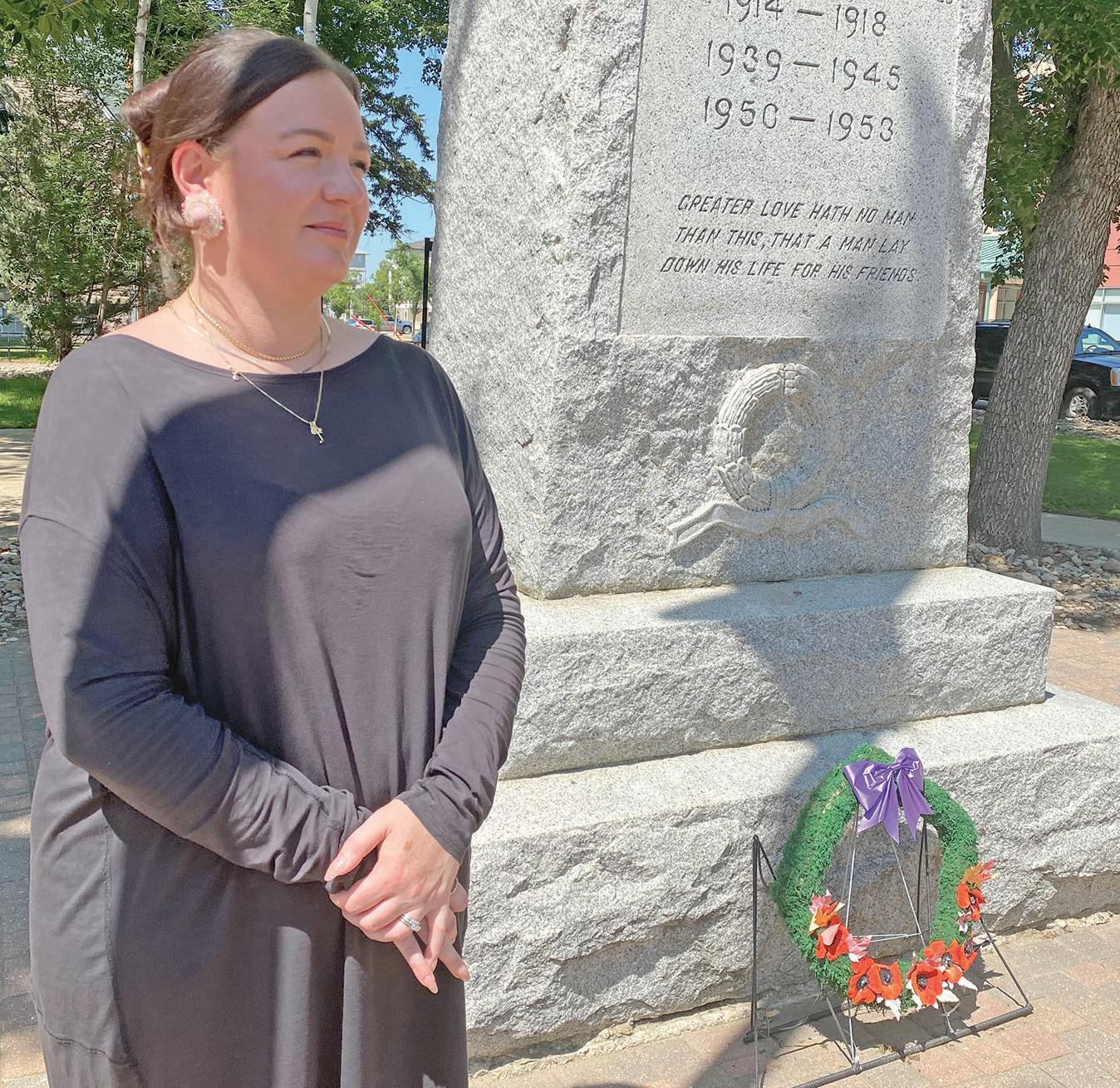
Weyburn Chamber of Commerce president, Jordan Szczecinski, volunteered during the 24-hour Honour Guard at the Memorial Park Cenotaph. The event was in celebration of the 100th anniversary of the Canadian Legion on July 17.
Submitted
Approximately 850 households in Weyburn will be randomly selected to participate in the Canadian Health Measures Survey (CHMS), a national survey conducted by Statistics Canada.
The CHMS knows that having accurate information about the health of Canadians is a vital part of improving health care in Canada. That’s why, 18 years ago, Statistics Canada partnered with the Public Health Agency of Canada and Health Canada on the Canadian Health Measures Survey.
The data from this survey are used by researchers to further understand the relationship between disease risk factors and risk conditions such as obesity, hypertension, cardiovascular disease and more.
It also sheds light on illnesses and enables health professionals to be better prepared for public health challenges.
The CHMS is now conducting its eighth cycle and 16 locations across Canada have been selected to participate in the survey.
As a part of this survey, a temporary examination centre will be set up in the parking lot of the Tom Zandee Sports Arena in Weyburn from July 22 to August 26, 2026, for respondents to participate in direct physical measures (i.e., blood pressure, biospecimen collection, etc.), after they have completed an interview at their home. They encourage the participation of all those selected, to help us complete an accurate portrait of the health of Canadians. Confidentiality and security Statistics Canada takes the privacy of Canadians very seriously. All personal information they collect is strictly protected and anonymized; making it impossible to connect data that is made public to survey participants.
Provincial Health Ministry monitoring rabies cases, exposures
Jon Perez SaskToday.ca
A bat in a bedroom, home or workplace may seem like a quick problem to remove. Still, Saskatchewan health officials are reminding residents that any potential exposure should be taken seriously.
The Ministry of Health said residents should take every bat encounter seriously and immediately seek medical assessment after a potentially dangerous exposure, as rabies can be fatal once symptoms appear.
The ministry issued the warning as public health officials continue to monitor human exposures to bats and maintain prov -
ince-wide access to rabies prevention and treatment.
This is in relation to a recent report published in the Canadian Medical Association Journal about a death caused by rabies.
The incident happened in 2024, when an unnamed 11-year-old boy was sleeping while his family was staying at a cottage on vacation, and he woke to find a bat on his nose and mouth. The child swatted the bat off his face, and his father caught it and released the animal outside.
The Canadian Medical Association Journal reported that the child’s parents did not have their son checked by a medical professional, since he did not
show symptoms of being infected by the virus. After almost three weeks, the boy experienced numbness and swelling on his face.
The boy’s parents did not immediately seek medical attention because their son had no visible injuries and did not think the bat behaved erratically, the journal states. But 19 days later, the boy began experiencing numbness and swelling on his face, and died more than a week later.
The Ministry of Health said it received 13 reports across the province in 2025 involving people who had contact with bats that later tested positive for rabies. No information was provided on what happened to
those who were exposed to bats that tested positive for rabies.
The Ministry of Health added that while human rabies cases remain extremely rare, bats continue to be the primary source of potential exposures in the province. If anyone wakes up to find a bat in their bedroom, they should have themselves checked, even if they cannot determine whether they had physical contact with the animal.
“If a person is unable to determine whether contact with a bat occurred , because they were sleeping, medicated, intoxicated or are a young child, they should see their family doctor, local emergency
room department or call HealthLine 811 for assessment as soon as possible,” said the Ministry of Health.
Health officials also advised against touching a bat with bare hands. They stressed that treatment may be necessary even when there are no visible injuries, as the animal’s bites and scratches are small and difficult to detect, making it impossible in some cases to rule out an exposure.
The ministry said bat exposures are treated as high-risk situations because rabies can be prevented if post-exposure treatment is started before symptoms appear. Access to treatment is available across Sas -
katchewan, including smaller communities.
The ministry said provincial guidance and assessment tools are provided to health-care professionals through the Communicable Disease Control Manual, and that physicians consult local medical health officers when determining whether rabies post-exposure prophylaxis is required.
Communities across the province are equipped to begin treatment without significant delays, and rabies vaccine and rabies immunoglobulin are stocked year-round in urban, rural and northern communities, and are accessible in public health offices and hospitals.
Photo by Sabrina Kraft/Weyburn This Week
COMMUNITY
and youth
recently.
Wheatland game results
In Spades held on July 13, Marge Schultz won first, Stan Hubick finished second and Gladys Lokken placed third.
Playing Trump Whist on July 13, Cindy Remas and Fran Long won first, Fay Johnson and Marge Schultz finished in second and Elaine Frasz and Gladys Lokken took third.
In Kaiser on July 14, Marge Schultz and Fay Johnson won first, Jeanne Molnar and Elaine Frasz took second and Norma Kapusanick and Melba Bent placed third.
Submitted
As boating season continues across Saskatchewan, the Ministry of Environment is reminding residents and visitors that stopping for a watercraft inspection is one of the simplest and most effective ways to help prevent the spread of aquatic invasive species.
The presence of invasive zebra mussel has been confirmed in Lake of the Prairies. While this finding reinforces that aquatic invasive species remain an ongoing threat to Saskatchewan waters, it also highlights the importance of early detection and prevention efforts to help limit their spread.
In response to the confirmation of these mussels, containment orders have been issued by both Saskatchewan and Manitoba, requiring all watercraft and equipment used at Lake of the Prairies to be decontaminated before being moved to any other waterbody. Decontamination ensures watercraft or equipment from Lake of the Prairies are not unintentionally spreading invasive zebra mussels elsewhere.
The containment order applies to the entirety of Lake of the Prairies, as well as the Assiniboine River from the highway 357 crossing west of Togo, Saskatchewan, to the confluence of Lake of the Prairies.
Aquatic invasive species can be unintentionally transported between waterbodies on boats, trailers and water-related equipment. Once established, many invasive species can be extremely difficult or impossible to eliminate and may cause significant environmental, recreational and economic impacts.
Throughout the summer and early fall, watercraft inspectors and conservation officers operate inspection stations and roadside check stops.
If you are transporting a watercraft, including boats, jet skis, kayaks, canoes or paddleboards, and see an open inspection station, you must stop - it is the law.
“Protecting Saskatchewan’s lakes and rivers starts with prevention,”
Environment Minister Darlene Rowden said.
“The recent detection of zebra mussels demonstrates exactly why all
boaters need to be aware of the risks related to their activities and the movement of Aquatic Invasive Species. When enjoying time on the water, be sure to follow Clean, Drain and Dry practices and stop at inspection stations when required to help prevent the further spread of aquatic invasive species.”
What can you expect during your inspection?
Officers will ask where the watercraft was last
used and conduct a visual inspection of the boat, trailer and equipment. Think of it as a check-up before your next launch. Officers look for standing water, aquatic plants, mud and invasive species that could be transported to another waterbody. For watercraft that have been properly cleaned, drained and dried, the inspection process typically takes only a few minutes.
Boaters can further re-
In Hi-Low Whist on July 15, Marge Schultz and Fay Johnson won first, Willa Mae Donald and Ruth Boren finished second and Dave Frayn and Brenda Paul took third.
During Thursday crib on July 16, Cheryl Vogel and Emily Zyla won first, Stan Hubick and Garth White took second and Shirley Hubbs and Chris Carter finished third.
In Fun Crib on July 17, Jeannie Molnar won first, Lucie Nickel finished second and Dave Frayn took third place.
New players are welcomed to join the Wheatland for weekly games.
During Canasta on July 15, Elaine Frasz won first, Sheila Wendel took second, Ione Schnell placed third, Shirley Cherpin finished fourth and Heather Carter took fifth.
Watercraft inspections help protect from aquatic invasive species
duce the risk of spreading aquatic invasive species by following the Clean, Drain and Dry guidelines after every use. A few minutes spent preparing your watercraft and stopping for an inspection can help protect Saskatchewan’s lakes and rivers from the spread of aquatic invasive species.
If you plan to move watercraft or equipment that has recently been used within the Lake of the Prairies containment
order area and require decontamination, contact our inspection and decontamination program at aiswatercraftinspection@ gov.sk.ca to schedule a decontamination.
For more information about Saskatchewan’s Watercraft Inspection Program and aquatic invasive species prevention, visit: Watercraft Inspection Program | Aquatic Invasive Species | Government of Saskatchewan.
Families
summer camps escaped the heat at the Weyburn Leisure Centre outdoor pool
Photo by Sabrina Kraft/Weyburn This Week
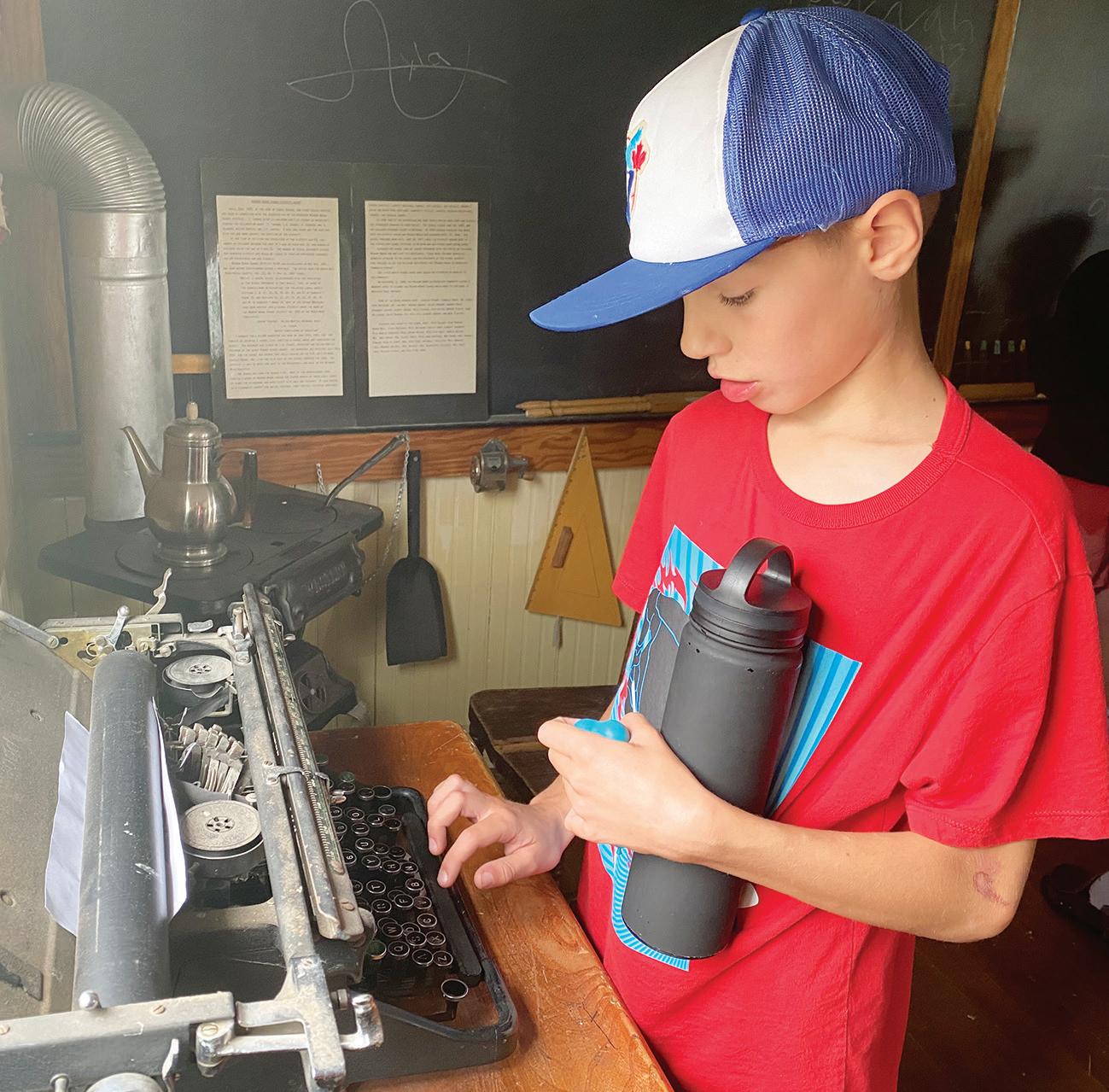
Kyler tested out an old typewriter during a tour of the school house at Heritage Village.
Photo by Sabrina Kraft/Weyburn This Week
EDITORIAL
Op-Ed: Canada Post and the shuttering of newspapers
Paul Deegan
The shuttering of Winnipeg’s Community Review means 200,000 households will no longer get the benefit of a free community newspaper delivered to their door. It also means that more than 800 people who deliver the paper and their families will be affected.
This is an unforced error that never should have happened. How did we get here? The answer is complex.
First, there is a high degree of concentration in the flyer printing market in Canada. Montreal-based TC Transcontinental enjoys the dominant position in the marketplace thanks, in part, to a 2012 Competition Bureau-approved asset swap.
Second, municipal and provincial politicians have passed environmental regulations, however well-intentioned, have unintended consequences. Former Montreal Mayor Valérie Plante passed a municipal bylaw that led to the end of distribution of Publisac (a plastic bag with flyers and a community newspaper). Several provinces, including Manitoba, have imposed extended producer responsibility levies on printed newspapers. Ontario’s Premier Doug Ford made the wise decision to exempt newspapers from this kind of stealthy journalism job-killing tax in his province.
Third, Canada Post is the biggest culprit. TC Transcontinental, which had distributed Publisac door-to-door in Quebec, formed a strategic partnership with Canada Post, which as a Crown corporation was not beholden to municipal bylaws. They bypassed Mayor Plante’s new regulation by distributing a curated bundle of flyers called Raddar through the national postal service. Unlike Publisac, Raddar did not include a community newspaper. On the sidelines of this saga, news publisher Métro Média and its more than 30 hyperlocal publications — including 17 print newspapers – shut down.
In partnership with Canada Post, TC Transcontinental recently expanded its Raddar offering across Canada. It is understood that Canada Post – which has a mandate to “charge postage rates that are fair and reasonable” – is offering TC Transcontinental rates below what it is offering to community newspapers. To its own benefit, the Crown corporation has effectively shut community newspapers – their private sector rivals – out of flyer distribution, lessening competition substantially in that market.
This is not the first time community newspaper publishers have felt the squeeze of Canada Post in the flyer distribution market. As of January 2024, community newspapers with commercial inserts were no longer exempt from Canada Post’s Consumers’ Choice program, which allows Canadians to opt out of re-
ceiving ‘junk mail’. Canada Post made that decision without stakeholder consultation or economic/social impact analysis and failed to recognize that community newspapers – with or without an insert –are not ‘junk mail’; they are a social good.
The juxtaposition of the shuttering of Winnipeg’s Community Review at the same time as the revelation of $30.8 million in bonuses at Canada Post has not been lost on community newspaper publishers across Canada.
What should Ottawa do about it?
First, Joël Lightbound, the Minister responsible for Canada Post, should ensure the Crown corporation is treating community newspapers fairly and offering them comparable pricing to what it offers to TC Transcontinental.
Second, the House of Commons Standing Committee on Canadian Heritage should conduct hearings into the role Canada Post can play in the sustainability of community newspapers – ensuring the relationship is one of partnership, rather than predatory and parasitic.
When a community loses a newspaper, like Winnipeg’s Community Review or Métro Média’s publications in Quebec, the information vacuum can lead to people getting their news from less than reliable sources – like AI and social media – which can create division that drives people apart. Without a check on local government, corruption, mismanagement, and wasteful spending often flourish, which can result in higher municipal taxes and borrowing costs.
It was not foreign Big Tech monopolists like Google and Meta that caused Manitoba’s largest community newspaper to shutter. It was Canada Post.
And it’s not like we weren’t warned…
Thirty years ago, in his review of Canada Post’s mandate, George Radwanski recommended that postal service get out of delivering unaddressed junk mail (i.e., flyers), concluding that the Crown corporation engaged in inappropriate practices that created unfair competition for private businesses like community newspapers.
As a former Toronto Star editor-inchief, Radwanski knew the news business. He noted that Canada Post was actively siphoning advertising revenue away from the news industry and adroitly cautioned that the state-granted mail delivery monopoly should not be in the business of crippling the financial health of newspapers.
A healthy democracy demands a healthy community news media ecosystem. Let’s level the playing field and restore competition in the flyer distribution market before more community newspapers shutter.
Paul Deegan is president and CEO of News Media Canada.
Spending time in Revelstoke
By Trudy and Dale Buxton, Publishers of The Independent
We continue our journey into British Columbia and our stay in Revelstoke.
We have all know this nice city of 8,300 people as Revelstoke, but when the settlement first began the community was named Farwell after Arthur Farwell who was a surveyor. Initially the town be laid out in 1884, built around the Canadian Pacific Railway. However, during this time the railway and Mr. Farwell were in dispute over the price of land and doing business, so much so that the railway built another community near Farwell, naming it Revelstoke after Lord Revelstoke who was a British banker that was part of the banking system that saved the railway from bankruptcy.
Farwell still exists as a part of Revelstoke, an area that is closest to the highway.
Did you know that Revelstoke is located in the world’s only inland temperate rainforest? This inland temperate rainforest is a rich ecosystem of red cedar, some of these trees are over 1,000 years old, and hemlock trees hosting a wide variety of animals and plant life. British Columbia is the only place in the world to have this type of forest.
The average snowfall in Revelstoke is about just shy of 40-feet. That is a lot of snow, the community is surrounded by the Selkirk and Monashee mountain ranges which helps with the amount of snow that drops each year. Revelstoke holds the record in Canada for the most snowfall in a single winter at just over 80-feet.
Revelstoke is noted as the ‘Birthplace of Canadian Skiing.’ The Revelstoke Ski Club was established in 1891, which was mainly started by Scandinavian miners who introduced the Norwegian snowshoes to the area. The first winter carnival was in 1915 featuring ski racing and ski
jumping.
For many years Revelstoke was internally famous for the ski jumping and people all over the world came to Revelstoke to try out the hills. A world record 183-foot ski jump was accomplished in 1916. Today Revelstoke still maintains an ultimate in different types of skiing and snowboarding.
If you are in for some hiking, the rainforest offers some spectacular waterfalls and awesome scenery along the way.
Along with all the snow of the winter, there is also the chances of an avalanche. Revelstoke is the home to the deadliest avalanche in Canada, when a slide claimed the lives of 58 men, and buried over 400 metres of railway. With all of the avalanches that have taken place, Revelstoke is an innovator in preventative measures, some of which are still used today.
Revelstoke has the most powerful dam on the Columbia River. It is also a great place to film a movie, featuring a number of movies that were shot in or near Revelstoke. It is a haven for many species of wildlife including the mountain caribou that thrive in the rainforest environment, and bears which at one time were such a nuisance that many were destroyed.
The railway still serves as a major divisional point for the Canadian Pacific, while tourism and the natural resources serve as the main economic factors.
One interesting fact (or fiction!) is that the Courthouse Square located in Revelstoke has been noted as one of the most haunted locations in Canada with eerie sounds and the sighting of various apparitions.
Stay tuned next week with more adventures of The Saskatchewan Traveller.
Revelstoke is noted as the ‘Birthplace of Canadian Skiing.’
Angus Reid poll reports wide support for pipeline projects
John Cairns SaskToday.ca
A new Angus Reid poll out this past week is showing broad support for pipeline projects in this country.
According to their online survey conducted from July 10 to 14 of 2,649 people across the country, it found 63 per cent support for the much discussed proposed new pipeline from Alberta to B.C., while 55 per cent supported the more recent announcement from Alberta Premier Danielle Smith and Ontario Premier Doug Ford for a proposed Northern Shield pipeline from Alberta to Sarnia, Ontario.
The institute found that the main reasons driving the support for the Albertato-B.C pipeline are economic. 55 per cent pointed to diversifying Canada’s oil markets away from the U.S. while 51 per cent pointed to the general importance of oil to Canada’s economy. As well, 45 per cent believed the pipeline would mean more jobs.
But the survey also reports that only about half of Canadians say they have truly made up their minds on the projects. Angus Reid said that for the Alberta to B.C. pipeline, 27 per cent say their support for the project is immovable but 33 per cent say they currently support the project, but could be convinced otherwise.
Among the 21 per cent opposed, it splits 11-10 between those who made up their minds and those who could be convinced to support the pipeline.
As well, 41 per cent say Canada should be investing in renewable energy instead, while 34 per cent worry that Canadians may not see an economic benefit that would outweigh the cost of construction along the Trans Mountain corridor.
Jon Roe, Senior Research Associate at the Angus Reid Institute, said it was those underlying factors beyond the support for the pipelines that were most interesting about the poll results.
“What’s interesting about this poll is that we kind of decided to take a look and see how firm that support was,” said Roe, “whether or not Canadians said ‘okay, yeah, I support the pipeline, but maybe I’m
open to changing my mind,’ or ‘I oppose the pipeline, and I’m very firmly entrenched in that opposition.’ And overall, Canadians… are somewhat split between saying, yeah, I’m open to change my mind on this pipeline,versus saying, ‘yeah, my mind is made up about it.’”
He said the arguments pushing Canadians towards supporting the pipeline “are very economic in nature,” pointing to helping sell Canada’s oil outside the USA, or the ability to create more jobs.
“Those are kind of the arguments right now that Canadians are looking at, saying, yeah, those are really compelling reasons to build the pipeline,” said Roe.
On the other side of it, it’s environmental issues that are “kind of maybe giving Canadians a bit more pause,” or more likely to “have them oppose the pipeline.”
Not surprisingly, there are differences in the levels of support for a pipeline depending on the region of the country. Roe noted that Saskatchewan and Alberta see the highest levels of support, with three-quarters of respondents in favour in both provinces.
It is somewhat lower in Manitoba at 58 per cent, and lowest in Quebec where half support the pipeline and 31 per cent are opposed.
But Roe notes that “even in Quebec, and it’s kind of true across the country, support is higher than opposition.”
Even in British Columbia, which has seen some opposition to pipeline projects, the poll found 62 per cent support for the new pipeline project proposed by Alberta, with 40 per cent saying the fact that the new pipeline will instead follow the existing Trans Mountain path is a compelling reason to support it.
As for why support for the pipeline to BC was higher than the proposed route to Ontario, Roe noted the latter project “seemed like it hadn’t really been on the radar” of most people.
When they asked if Canadians had heard of that project, “only 41 per cent say they hadn’t heard of it,” which compared to only eight per cent who hadn’t heard of Alberta to
B.C. pipeline. “There’s a lot less knowledge about it, and people are following that story a little bit less closely.”
Interestingly, with all the separatism talk coming out of Alberta lately, the need for national unity is not the biggest factor driving support for pipelines.
“Yeah, that is one of the interesting findings from this poll, I’d say, is that when we ask Canadians of compelling reasons in favour of building the pipeline, only 13 per cent say this is a project that will help boost national unity,” Roe said.
He acknowledged a lot of the discussion around
the pipeline is to address some of Alberta’s concerns with Confederation. But when they ask Canadians if this was a good reason to build the pipeline, he said Canadians are “more likely to say those economic reasons are the reasons why it’s compelling to build the pipeline and not necessarily improve national unity.”
Even in Alberta, he said, only 16 per cent say addressing national unity is a good reason to build this Alberta-BC pipeline.
“I think it kind of speaks maybe that, that the economic arguments are, are just much more compelling to Canadians, uh,
than, than that whole national unity piece.”
As for what policy makers and government leaders should read into the poll results, Roe said he thought it “really just speaks to the level of economic concern that Canadians have,” noting a shift over the past couple of years when it comes to the trade-off between economic concerns versus the environment.
Roe noted that around 2018, when there was more opposition to pipelines, “more Canadians were saying, yeah, you know what… environmental concerns should
take the priority, that should be the primary concern.”
“Now it’s more about the economy. More Canadians are saying that ‘yeah, you know what, we should be concerned about developing the economy more so than protecting the environment.’… I think what the takeaway is, is that that’s kind of been the shift in the conversation, and while we’re seeing Canadians more likely to support this pipeline than not, is that there are concerns about the economy. They want to see more jobs. They want to see the economy built.”
A group of children escaped the summer heat by swimming at the Don Mitchell Tot Lot.
Photo by Sabrina Kraft/Weyburn This Week
SPORTS
Weyburn Silver Seals hosted the South Semi-Finals
Mira McKenzie, Ava
Bryan Fleck wins most deserving official award
Submitted
Weyburn hockey official Bryan Fleck received recognition from Hockey Saskatchewan, as the recipient of the Most Deserving Official Award for Zone One.
Hockey Saskatchewan’s Officiating Development Program (ODP) credited the continued strength of officiating across the province to the individuals who dedicate their time to working games, mentoring officials, administering programs, and supporting development opportunities at all levels of the game.
Hockey Saskatchewan
Randy Palmer SaskToday.ca
Team East turned out to be the beasts at the Western Canadian Baseball League All-Star Game on Sunday afternoon in Saskatoon.
Playing at Cairns Field on a beautiful day for baseball, East scored five runs in the fifth inning, added another three in the sixth and never looked back in their way to a 9-2 victory over Team West.
As one might expect, Saskatchewan players were all over the win on both sides of the ball.
Saskatoon Berries’ first basemen Gavin Panks led the Land of the Living Skies contingent, coming into the game in the fifth and promptly hitting a single before later scoring
Silver Seals host South Semi-Finals
The Weyburn Silver Seals hosted the Swim Saskatchewan South Semi-Finals at the Leisure Centre on July 18.
The following are results for top three finishes:
Females aged 7 to 8
Ayza Manzoor won first in the 25 m butterfly, 50 m breaststroke, second in the 25 m breaststroke and 100 m individual medley, and third in the 25 m freestyle.
Ellie Roysuum won third in the 50 m backstroke.
Males aged 7 to 8
Lucho Martija won third in the 50 m backstroke.
Males aged 9 to 10
Beau Gateman won third in the 100 m backstroke.
Hudson Muhr won second in the 100 m backstroke and 50 m butterfly.
Ishanne Kir Subna-en won first in the 100 m backstroke, 50 m butterfly, 100 m breaststroke; second in the 100 IM and third in 100 m freestyle.
Females aged 11 to 12
recognized four officials from southern Zones One through Four as recipients of the Most Deserving Official Award for the 2025-26 season. The award recognizes individuals whose long-term contributions have helped strengthen officiating within their communities and throughout the provincial development pathway. In addition to earning their respective zone honours, all four recipients have also been nominated as Saskatchewan’s representatives for Hockey Canada’s Most Deserving Official Award, which will be announced later this year.
After spending time as
one of East’s five runs in the frame. His at bat in the seventh was even better, as Panks would hit a solo home run to plate East’s final run of the game. He’d finish 2-for-2 with two runs and two runs batted in.
Weyburn Beavers outfielder Joe Madill had an impressive outing of his own, hitting a double in the fifth and later scoring when Medicine Hat’s Carter Roth hit a two-run home run. He’d score his second run of the game the next inning on a single by the Swift Current 57’s outfielder Lucas Geisler. All told, Madill ended up 2-for-2 with two runs and two RBI.
Regina Red Sox second baseman Justin Simard did his part by knocking home
both a player and coach, Bryan Fleck transitioned into officiating in 2019 and has quickly become one of the most respected officials in Zone 1. Fleck has consistently made himself available to work games at all levels throughout Weyburn and surrounding communities while continuing to develop as an official. He credits much of his growth to the officiating partners he has worked alongside over the years, but he has also embraced a leadership role in mentoring younger officials in the area. Whether through coaching, guidance, or simply leading by example on the ice, Fleck
teammate Wil Togher in the fifth and then scoring on Madill’s double. Simard plated Togher again in the sixth, and scored his second run later in the inning on a hit by Weyburn Beavers catcher Robert Gurney. Simard’s final stat line was 2-for-3 with two runs and two RBI.
Moose Jaw Miller Express shortstop Thomas Soto and Saskatoon Berries outfielder Ethan Murdoch also had hits in the contest.
On the mound, Keagan Baker of the Regina Red Sox got the All-Star Game start and tossed a scoreless first, striking out one. Saskatoon’s Adam Korte pitched the second and struck out a pair, Moose Jaw’s Jacob Glazener took
has helped younger officials develop both their skills and passion for officiating. That influence has extended throughout the region, including to his daughter Marlie and many other developing officials in Weyburn and surrounding communities.
The Hockey Saskatchewan Officiating Development Program (ODP) is committed to enhancing officiating standards across all levels of hockey in the province. Through recruitment, education, and support, opportunities are provided for officials to excel and contribute to the vibrant hockey community in Saskatchewan.
over in the third and allowed a single run on a single hit.
Weyburn’s Logan Lynch gave up a hit and struck out one in the fourth; Swift Current’s Max Noto and Regina’s David Gordon combined for a shutout fifth. Saskatoon’s Dallen Rude gave up a single hit and struck out two in the seventh, Swift Current’s Koufax Cranmer pitched a perfect eighth and Moose Jaw’s Nathan Pisio finished things off, allowing a single hit in the ninth.
Sylvan Lake’s Elijha Hammill was 3-for-4 with an RBI to lead the West. Roth was named the All-Star Game MVP after his 2-for-3 outing that included the round tripper, a run and two RBI.
Milly Ho won first in the 50 m backstroke and third in the 100 m freestyle.
Elizabeth Wig won third in the 100 m backstroke and the 100 m breaststroke.
Females aged 13 to 14
Kassandra Madriaga won first in the 50 m breaststroke.
Elin Mia won third in the 100 m butterfly.
Sakoda Seitz won second in the 200 m freestyle and third in the 50 m butterfly.
Alexandra Jose won second in the 100 m backstroke, third in the 200 m freestyle.
Breanna Torkelson won third in 100 m backstroke.
Shay Warren won first in the 50 m butterfly and 200 m individual medley, and second in the 100 m freestyle, 200 m breaststroke and 50 m freestyle.
Males aged 13 to 14
Russell Brock won second in 50 m backstroke and 100 m backstroke; third in the 200 m freestyle.
Nikolas Niolin won first in the 100 m backstroke, second in the 100 m breaststroke and 100 m freestyle and third in the 50 m butterfly and 50 m freestyle.
Zane Warren won first in the 200 m freestyle, 100 m freestyle, 50 m butterfly and 200 m individual medley and second in the 25 m butterfly.
Females aged 15 to 17
Avryelle Molnar won first in the 100 m butterfly and 50 m freestyle, second in the 50 m butterfly and 100 m freestyle and third in the 50 m backstroke.
Males aged 15 to 17
Jacob Gill won first in the 50 m butterfly, 100 m breaststroke, 50 m backstroke, 50 m freestyle and 50 m breaststroke.
Nash Warren won second in 200 m backstroke.
Matthew Dutchak wins promising official award
Sybmitted
Weyburn hockey official Matthew Dutchak was recognized by Hockey Saskatchewan with receiving a Southern Zone most promising official award.
Hockey Saskatchewan’s Officiating Development Program (ODP) continued to prioritize the development of officials and support their advancement through the officiating pathway. Each season, the program recognizes four officials with the Most Promising Official Award, presented to younger officials who demonstrate the potential to advance to higher levels of hockey.
The provincial recognition alternates annually between northern Zones Five through Eight and southern Zones One through Four. The four award winners have also been nominated as Saskatchewan’s representatives for Hockey Canada’s Most Promising Official Award.
Hockey Saskatchewan is pleased to recognize the
2025-26 recipients and looks forward to following their continued development within the officiating pathway.
Dutchak has steadily progressed through the minor hockey ranks in recent seasons and was rewarded with several league playoff and provincial assignments during the 2025-26 season. His strong performance also earned him his Saskatchewan Junior Hockey League (SJHL) debut. Now 23 years old, Dutchak began officiating in 2016 and continues to play senior hockey as a goaltender while remaining active as an official throughout Weyburn and the surrounding area. A product of the strong mentorship and support network within the local officiating community, Dutchak has consistently demonstrated that he is ready for new opportunities and increased responsibility. His growth and commitment to development position him well for continued advancement in the years ahead.
The
at the Leisure Centre on July 18. Pictured, l-r, Ellie Roysum,
Skjerdal, Izadora Wilson, Mrya Muhr and Kali Bernard.
Photo by Sabrina Kraft/Weyburn This Week
Women’s Field Lacrosse
coming to Weyburn
The Weyburn Rattlers Women’s Field Lacrosse Program is launching this August, giving girls and young women an exciting opportunity to learn, play, and grow in one of the fastest-growing sports in the world!
What to Expect:
• Skill development in a fun, supportive environment.
• Learn the fundamentals of women’s field lacrosse.
• Small-area games and team concepts.
• Intersquad scrimmages and game play.
• Opportunities to compete against athletes from Regina and Moose Jaw.
Competition Nights
Put your skills into action by joining athletes from across southern Saskatchewan for exciting game nights:
Regina –
Friday, August 21. Moose Jaw –Friday, September 4. Weyburn –Friday, September 18. Practices will be held in Jubilee Park every Tuesday and Thursday from August 18 to September 17. Age Groups include: 2009–2011, 2012–2014, 2015–2017, (Age groups may be adjusted based on registration numbers.)
No previous experience? No problem! Whether you’re picking up a stick for the first time or looking to continue your lacrosse journey, this program is built to help athletes develop confidence, skills, and a love for the game.
Equipment Needed:
• Women’s field stick
• Eye goggles
• Mouthguard
• Cleats or athletic shoes
(Helmets and gloves are not required in women’s field lacrosse.)
Interested? Reach out to us for more information!
This is a fantastic opportunity to learn the game, make new friends, and be part of building women’s field lacrosse right here in southeast Saskatchewan. Follow Weyburn lacrosse on Facebook for more information.
Other Lacrosse News
Local Weyburn players
Ryder Stepp and Cohen Baumgartner are competing Oshawa this week for the National Development Team Program. They will be evaluated for selection to play for Canada Futures in the U15 division.
Both lacrosse players will be representing our Weyburn Rattlers by competing with size, skill and determination.
The Gladmar Braves repeated as the Borderline Men’s Fastball League champions and were undefeated through the two-day tournament.
Gladmar Braves repeat as Borderline Men’s Fastball champions
Submitted by Richard Wick
The Gladmar Braves repeated as the Borderline Men’s Fastball League championship playoff tournament held at Ceylon Regional Park on July 19. The Braves went undefeated through the two day playoff tournament defeated the Plentywood/Midale Jays 107 in the final game.
Ryder Tessier of the Gladmar Braves repeated
Congratulations to the Canada Day flag winners:
* Josephine Martin
* Colleen Duke
* Jerry Ponto
* Janet Morris
* Val Bauche
* Claudia Sterling
as top pitcher of the tourney by pitching three complete games in each of his team’s victories on the weekend.
Josh Woitas of the Braves hit three home runs in the final game and was named the tournament’s most valuable player. A special thank you is extended to the judges who attended all the games at the tournament and selected those two tournament award winners.
Dustin Pingert of the
Ceylon Angels, as voted on by the teams, was awarded the 2026 Most Sportsmanlike Player of the league for the season.
The Ceylon Angels, who went undefeated through the regular season and finished first place in the 2026 league standings, were awarded the 2026 Borderline League Pennant Trophy. The Angels did an outstanding job of hosting the two day event at the Ceylon Regional Park
and the league extends congratulations and thanks to them and to their many volunteers for their efforts.
With the 63nd consecutive season of the league now complete, the league would like to thank the teams and their players and coaches, the umpires, and the fans for another great season of fast-pitch softball. We hope to see everyone again, and maybe more, for season number 64 in 2027.
Ava painted a clay art palette during the Spark Summer Camp held at the Credit Union Spark Centre.
Photo by Sabrina Kraft/Weyburn This Week
Back row, l-w, Eric Fettes, Jett Woitas, Dane Tessier, Isaac Woitas, Joseph Woitas, John Hlvaka, Ryder Tessier and Josh Hlvaka. Front row, Jace Woitas, Gavin Doud, Brayden Fladeland, Dax Floer (bat boy), Rylan Fladeland, Josh Woitas and Mike Floer.
Photo courtesy of Richard Wick
Stop by the office and pick up a gift certificate courtesy of Welsh Kitchen & Bakery!
Estevan artist proud to have first solo exhibit in nearly 20 years
David Willberg SaskToday.ca
Estevan artist Amber Andersen has a couple of exhibits in Weyburn – her first solo art displays in nearly 20 years.
Touch Grass is in the Weyburn Art Gallery at the Credit Union Spark Centre from July 10-Sept. 28. Grounded appears at the Get Out Gallery, which is outdoors at Jubilee Park behind the Spark Centre, from June 15-Sept. 28.
“These two shows I created are complimentary indoor and outdoor exhibits that explore how we, as people, are experiencing nature, leisure time, and how we are experiencing each other, but increasingly through screens, our domestic spaces and digital technologies,” said Andersen.
“I feel that the phrase has changed, and it’s a little bit more gentle and soft, because I think in an increasingly digital world, it is important to have those experiences grounded in reality and to step away from your screens,” she said.
The exhibits use wallpaper, craft-based processes and cyanotypes – a former of printmaking, using photo-sensitive emulsion, put on paper, fabric or another surface, and then exposed to ultraviolet light. She went outside her condo, took a photo of a patch of grass, and created a beautiful shade of cobalt blue. “I’m actually going outside and using a medium that was dependent on the environment,” said Andersen.
The message for her work in the Get Out Gallery is simple: the best way to experience nature is to
Touch Grass is a phrase born out of snark, she said, in which people who are chronically online would tell others to “touch grass” to tell them to calm down.
be outside.
She described it as a play-specific installation to investigate how people construct spaces, and she invites viewers to consider how they experience and relate to the world around them.
Andersen is pleased to return to her art practice. She was nervous about the project, but the Weyburn team was great to work with. She stepped away from creating art when she was an administrator in various art galler-
ies for most of her career, including her tenure at the Estevan Art Gallery and Museum. When she left her job at the EAGM for a job that focused on leisure with Southeast District - Sport, Culture and Recreation, she started working on art again. She been part of group shows that toured through the Organization of Saskatchewan Arts Councils, with the most recent coming in 2013, but she said this is her first solo show since around 2008.
Council denies request for tax relief for two Estevan properties
David Willberg SaskToday.ca
A request for property tax relief has been denied by Estevan city council.
In a report to council filed at the July 13 meeting, corporate services director James Lainton said administration received a request from Son Van Nguyen for relief for the 2026 taxation year for two properties, located at 905 Fourth Street and 1132 Fifth Street. According to Lainton, the request asks council to consider temporary assistance, which
might include a reduction, deferral, waiver of penalties and interest, or another form of tax relief.
“The property owner has advised that both properties have remained vacant during 2026 and have not generated income while awaiting the necessary building permits and approvals,” Lainton wrote. “The owner has indicated that the intent is to redevelop the properties, improve the surrounding area, and create future economic benefit through investment, construction activity, and increased prop-
erty tax revenue.”
Both properties were purchased through a tax title sale in August 2025, Lainton said. Prior to the sale, the properties were held in the name of the city and were exempt from taxation.
“As a result, the purchaser already received the benefit of no property taxes being incurred or passed on for the balance of the 2025 taxation year, despite taking ownership partway through the year,” Lainton said.
For 905 Fourth Street,
the 2026 property tax levy is $10,744.13, Lainton said. The outstanding 2025 taxes and fees totalled $88,834.05, and the property was sold for $20,800, resulting in a loss to the city of $68,034.05.
As for 1132 Fifth Street, Lainton wrote the 2026 property tax levy is $4,569.54. The outstanding 2025 taxes and fees totalled $21,260.50, and the property was sold for $10,390, resulting in a loss to the City of $10,870.50. The combined 2026 property tax levy for the two
properties is $15,313.67.
The combined loss to the city through the 2025 tax title sales was $78,904.55, Lainton said. He added administration’s available timeline indicates that the permit application for 905 4th Street was only made on Feb. 16. Drawings and paperwork were received on May 13, and Saskatchewan Assessment Management Agency and building permit fees were paid on May 25. Lainton added there has been no applications for 1132 Fifth Street.
As property tax relief would affect municipal tax revenue and might create expectations for similar requests, Lainton said the matter was brought forward to council.
In denying the request, Councillor Shelly Veroba said these properties were purchased from the city.
“For us to give an abatement now would be ridiculous, because it would be setting a precedent for everyone to just pick up a property and not worry about doing anything with it,” said Veroba.
Amber Andersen’s exhibit inside the Weyburn Art Gallery at the Credit Union Spark Centre.
Photo courtesy of Amber Andersen
Members of the Estevan Golden Eels Summer Swim Club attended the South Semi-Finals held in Weyburn on July 18.
Street Dance brought hundreds of revelers to downtown Estevan
David Willberg SaskToday.ca
The annual Street Dance made its return to downtown Estevan on July 18, to the delight of the Estevan Downtown Business Association (DBA), the performers and the hundreds of revelers who packed the 1100-block of Fourth Street for the bash.
Robert Godfrey with Lemon Wedge Marketing and the DBA said Street Dance was a perfect night in terms of weather, and the performers delivered lots of entertainment. Just under 800 people were in attendance, Godfrey said, and he added the total was up from last year.
Two local acts, Conner Piche and Ten Mile High, served as the opening acts, and Godfrey said they helped energize the crowd. The headliner was Saskatchewan country-rock musician Adam Johnson.
“Once Adam hit the stage, the party really took off. From all accounts, and talking to everyone there, everyone had a really, really great time. We’re happy to be back on Fourth Street,” said Godfrey.
This year marked the first time Street Dance was in the 1100-block of Fourth Street since 2023. It was moved to the Affinity Place parking lot two years ago due to the downtown revitalization project. The event was supposed to return to Fourth Street last year, but had to be moved to the Power Dodge Curling Centre at the last minute due to weather.
“To finally be back on
Fourth Street and hosting the event in the newly revitalized downtown core was just fantastic. It looked beautiful, and it was just great to see a space that was designed for this purpose being used,” said Godfrey.
Some fixtures were added downtown that it easier to host a big event, he said, including power connections that save them bringing in generators.
“You could tell from everyone in attendance that they were happy to be part of this type of event, and it definitely changes the atmosphere when you’re having this type of event in downtown Estevan,” he said.
Godfrey said he hopes to see attendance grow in future years now that Street Dance is back downtown, and the DBA was happy with the size of the crowd.
He said the crowd was well behaved. Everyone was there for a good time. Thanks to the conduct of the crowd in past years, the DBA went with volunteer security, which he said went well, while the Estevan Police Service had officers in highly visible areas.
Street Dance is also the main fundraiser for the DBA each year. The funds raised support initiatives throughout the year, including the monthly Thursday night markets, which Godfrey said have been a success since they returned this year. Street Dance also helps with winter events like Miracle on Fourth Street and Moon -
light Madness, and other promotional activities and beautification activities throughout the year.
“It’s really important to the association to have this fundraiser every year, and the more money that we raise, the more events and activities we can bring to the community.”
The DBA is thankful for the people who came to the event, he said, and for the businesses from throughout Estevan who support Street Dance each year.
Kiauna Cote selected to compete in Miss Indigenous Canada
SaskToday
Kiauna Cote has been selected as one of 20 delegates from more than 100 applications nationwide to compete in Miss Indigenous Canada.
Representing Ochapowace First Nation, Cote is a law student, coach and advocate. Supporters say she has a deep love for her nation, territory and people. She has contributed to national boards and youth initiatives while continuing to support young people and communitybased leadership.
Cote says she is proud to bring forward the strength, values and voices of Ochapowace First Nation and Treaty 4 territory on a national stage. She says her participation reflects her commitment to education, kindness, relationships and creating positive opportunities for Indigenous communities.
The annual Street Dance made its return to downtown Estevan on July 18, to the delight of the Estevan Downtown Business Association (DBA)
Photo courtesy of Robert Godfrey/Lemon Wedge Marketing
Kiauna Cote was selected as one of 20 delegates to compete in Miss Indigenous Canada.
Photo submitted
This is Debbie... I come to you with words from me and to give you an opportunity to think about what friendships and what our family members have done and what we have cared about and to tell you how much our relationships have helped me through thick and thin.
I bless you, I love you and I wish you a full and happy life and a way to live better and more intimately with family members, build each other up, love each other, support each other and I know we will meet again. I ask you to have peace and to be blessed by me and God, so thank you for everything you have meant to me and to our relationship so go in peace, love each other, support each other, care for each other and remember me.
So, I bid you farewell, not goodbye but farewell because I know we will meet again.
Love Debbie.
Love Stan & Kalie
types considered. No credit checks done. Deal direct with lender and get quick approval. (403) 543-0927 www.firstandsecondmortgages.ca
Advertisements and statements
Seeking dependable, hardworking pre-engineered building personnel northern Yukon. IMP panel experience preferred; will train the right candidate. Call 780-902-3951.
The
is hiring a Local Journalism Initiative (LJI) Reporter to produce original civic journalism for Kamsack; Cote, Keeseekoose and The Key First Nations; and surrounding towns. Job is a term position until March 31, 2027. Apply with cover letter and three writing samples to Devan Tasa at dtasa@tasamedia.ca.
Nature Saskatchewan: Watch out for Shrikes!
July is in full swing and that means Saskatchewan’s birds are busy raising their families and feeding hungry mouths! This includes one of our most unique songbirds, the Loggerhead Shrike! Nature Saskatchewan is urging residents of Saskatchewan to keep an ear out for the shrieking begging call of Shrike fledglings this month.
Loggerhead Shrikes are a threatened predatory songbird, and they make their home in Saskatchewan over the summer months to breed and raise their families. They are unique on our prairie landscape for their predatory behaviour. Lacking the sharp talons of other birds of prey, shrikes instead rely on sharp thorns to impale their prey. “One of the best ways to check if you have Shrikes around is to keep an eye out for the impalements,” Emily Putz, Habitat Stewardship Coordinator for Nature Saskatchewan’s Shrubs for Shrikes program explains, “look for caterpillars, beetles, grasshoppers, mice, even frogs and snakes, if you see one impaled you have a shrike nearby!”
Shrikes will look for areas to nest that can support their unique behaviours. They prefer thorny shrubs such as Buffaloberry and Hawthorn, though they will use introduced shel -
terbelts like caragana in place of their natural habitat. They also use nearby barbed wire to hang their prey. “With Shrikes using mature shelterbelts more and more, it’s important to slow down around this time of year near shelterbelts that run parallel to grid roads,” Putz continues, “The young fledglings will be leaving their nest soon and are often attracted to roadways to hunt insects, they can’t fly well yet and road mortality is a large risk to them.”
If you are looking for ways to help this threatened species, recommendations include planting native thorny shrubs, keeping mature shelterbelts on the landscape in cropland, and of course, reporting all sightings to the Shrubs for Shrikes program. Every sighting is kept anonymous and goes towards helping recovery by informing population and range year to year. If you are a landowner with Loggerhead Shrikes on your land, we would love to have you participate! The program runs an annual “census” to monitor known nesting locations.
If you have any questions about the Shrubs for Shrikes program or would like to learn more about the Loggerhead Shrike, please contact Emily Putz at 306780-9832 or outreach@naturesask.ca.
General Employment
Kamsack Times
Farm Implements
In Memoriam
In Memory of Debbie Hubick 1955 – 2025
created a pom-pom otter with assistance from program facilitator
for
Photo by Sabrina Kraft/Weyburn This
Time
to solve the weekly crossword
SEDA course will teach businesses, groups about economic impact
SaskToday
Organizations across southeast Saskatchewan are invited to participate in an opportunity to better understand, measure and showcase their impact on the economy.
The Saskatchewan Economic Development Alliance (SEDA), in partnership with the Shorefast Institute for Place-Based Economies, is bringing the Economic Nutrition CM Certification Program to southeast Saskatchewan – one of the first regional cohorts in Canada. This initiative is sponsored by Community Futures Sunrise.
A press release said CM helps organizations uncover the story behind their spending. Modelled after a food nutrition label, the certification translates complex financial and supply chain data into a simple, credible format that shows where an organization’s spending goes and how it supports local businesses, jobs and communities.
Over a three-month facilitated cohort, participating organizations will receive hands-on support to analyze their spending patterns, identify opportunities to strengthen supplier relationships, and earn a certified Economic Nutrition CM Label based on their actual spending data.
“The choices organizations make every day about where they spend their dollars can have a significant impact on local economies,” said SEDA CEO Verona Thibault. “Economic Nutrition CM gives businesses and organizations a practical way to understand that impact while providing a powerful tool to communi-
cate their commitment to community prosperity.”
The press release stated participants will gain valuable insights into their purchasing and supply chains while earning a certification they can proudly showcase on their websites, social media channels, marketing materials, proposals and community communications.
The news release said the program is open to businesses, non-profit organizations, municipalities and public sector organizations interested in strengthening their operations, demonstrating their impact and building stronger connections within their communities.
Benefits of participating Include:
• Understanding where organizational spending goes;
• Identifying opportunities to strengthen supplier relationships;
• Gaining insights to support business resilience and decision-making;
• Earning a certified
Economic Nutrition CM Label;
• Demonstrating commitment to local economic impact; and
• Differentiating the organization through a credible, data-driven story.
The press release stated the cohort represents a “rare” opportunity for organizations in southeast Saskatchewan to join a growing movement focused on building stronger, more resilient local economies.
Applications are open now, with limited spaces available. Funding support is also available for eligible participants.
The application deadline is August 14.
SEDA aims to inspire community leaders and professionals to create new solutions and partnerships to support local and province wide prosperity. We have a collaborative spirit and believe that successful economic development requires participation by all levels of government, non-governmental organizations and local citizens.