Rainbow Trout eggs were delivered to the Fish in Schools (FINS) program, a partnership between the Weyburn Wildlife Federation and St. Michael School.
Many of the Grade 4 students were part of the Kindergarten class, as FINS marked five years at the school. As the eggs has transformed into the larvae stage before the winter break, students spoke about why they enjoyed participating in the program.
“I like that we get to go all the way to Marine Prize to release the fish,” said Hayz.
“I like this program because I like learning about animals,” said Noah.
“My favourite part about the program is seeing the fish and all their scales,” said Olivia.
“I like first seeing the
fish as eggs,” said Fiona.
As the students are older this year, they will take on additional responsibilities, including weighing the food, measuring the chemicals and changing the water.
“I think the most responsible thing we have to do for the fish is clean their tank and feed them,” said Heidi.
“I learned that about being responsible to take care of the fish, that the egg feeds them before like we have to feed them first,” said Tryphena.
The students will head to Mainprize Regional Park to release the fish into Rafferty reservoir the first week of June.
It is also an opportunity for the students to learn about nature and other wildlife.
“Whenever I see a frog, I think of the fish, because I see them like tadpoles and they kind of look like fish,” said Ellie.
“Something we learn is how big they’ll get, and we learn how many days they spend in an egg,” said Hayz.
“The other thing we learn about is that they have to stay, the tank has to stay dark when they’re in the tank and then when we let them out they go to the bottom so when it’s, because it’s dark and it’s cold,” said Heidi.
The Weyburn Wildlife Federation initially applied to the Saskatchewan Federation to take part in the program, and provided two 100-gallon aquariums and the related supplies.
The eggs were provided by the Saskatchewan Wildlife Federation’s hatchery in Fort Qu’Appelle. They provided the supplies and expertise so the classroom teachers know what they have to do to take care of the fish from eggs to fingerlings.
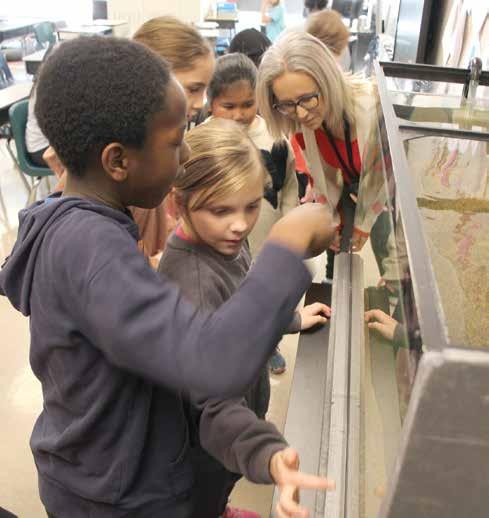
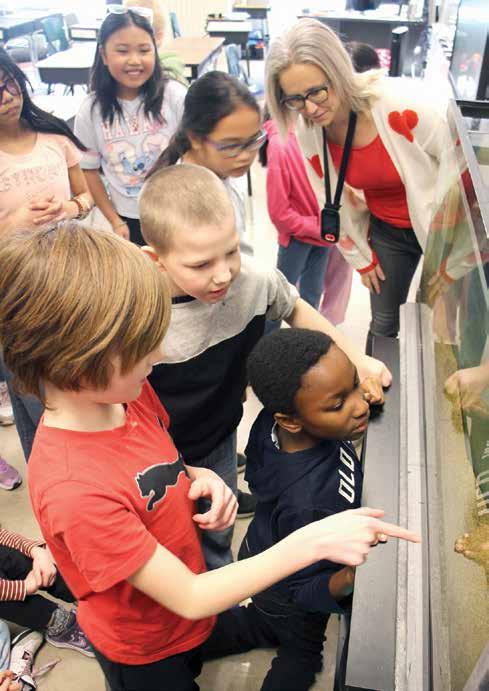
Grade 4 students Ola and Fiona tried to count all the rainbow trout larvae that recently matured from the egg stage. Their classroom participates in the Fish in Schools program, partnering with the WWF.
Photo Sabrina Kraft/Weyburn This Week
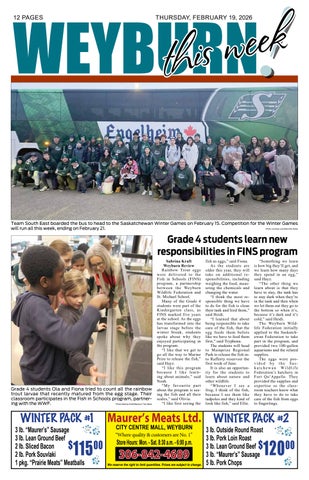
Team South East boarded the bus to head to the Saskatchewan Winter Games on February 15. Competition for the Winter Games will run all this week, ending on February 21.
Photo courtesy Lise Marcotte-Soles
COMMUNITY
Little Lions Playhouse offers
The Little Lions Playhouse held their grand opening on February 14.
The before and after school program will be operated at 291 Coteau Avenue West, Weyburn.
Owners Kristen Buck and her daughter Jade Kiraly believed there was a need for the program in Weyburn. Little Lions is open from 7 a.m. to 6 p.m. on weekdays, and will also offer activities on nonschool days.
To assist with transportation, there is a St. Michael School and Legacy Park Elementary School bus stop located by the Lit-
tle Lions Playhouse.
“We will go to the bus with them and make sure they know their way back to our location. We encourage independence here, so we really encourage the kids to really learn their way and know how to cross the street safely,” said Buck.
“I also started a budgeting program, so we can learn basic financial skills with all the school-age kids,” she added.
Local families who want to register for the program, or find out more, look for the Little Lions Playhouse page on Facebook.
Public Notice
Public notice is hereby given that the council of The Village of Heward intends to adopt a bylaw Pursuant to Section 199 of The Planning and Development Act, 2007 for the sale of dedicated lands
INTENT
The proposed bylaw will allow for the sale of a Municipal Reserve parcel.
AFFECTED LAND
Municipal Buffer – Title Number 152991513
Land Description – Blk/Par MB1-Plan 102278583 Ext 0 With the sale proceed to be deposited to the dedicated lands account for future expenditure on other dedicated lands
PUBLIC INSPECTION
Any person may inspect the bylaw at the municipal office by appointment at 448 Main St., Heward, Sk Copies are available by contacting heward@sasktel.net
PUBLIC HEARING
Council will hold a public hearing on March 9, 2026 at 7:30 p.m. at the office of Village of Heward,448 Main Street, Heward to hear any person or group that wants to comment on the proposed bylaw. Council will also consider written comments received at the hearing or delivered to the undersigned before the hearing.
Weyburn Comp. SRC students Chantal and Jersey assessed the Edmonton Oilers Heritage Fair display created by Assiniboia Park Elementary School student Charlie.
Photo Sabrina Kraft/Weyburn This Week
A ribbon cutting was held for the grand opening of Little Lions Playhouse, located at 291 Coteau Ave. West. Pictured, l-r, Chamber executive director Monica Osborn, Little Lions owners Kristin Buck and Jade Kiraly, and Weyburn Mayor Jeff Richards.
Photo Sabrina
EDITORIAL
OPINION: CANADA LOST THE RESPECT OF THE WORLD
Byline Michael Taube SaskToday.ca
Most experts agree that Canadian foreign policy experienced a golden age a few generations ago. Today, it’s probably fair to say that its golden hue has turned to pewter.
Why did our country experience this fall from grace? The last two Liberal governments, in particular, are largely to blame.
Let’s go back a few steps.
Prime Minister Mark Carney’s recent speech at the World Economic Forum in Davos, Switzerland suggested that middle powers like Canada should work together to create a counterbalance to “great powers” in dealing with the “rupture in the world order.” Some Canadians appreciated this remark, but they shouldn’t have. It’s actually a far cry from the position that Canada once held on the international stage.
“While this notion of middle powerdom may seem like a novel approach in an era dominated by two superpowers,” the National Post’s Simon Tuck wrote on January 27, “it’s in fact an echo from more than a couple of generations ago, an era that many international affairs specialists refer to as ‘the golden era of Canadian foreign policy.’” That’s often depicted as a “two-decade stretch from the end of the Second World War to roughly the mid-1960s” and is “nostalgic for
many Canadians who were around at the time, or have studied foreign policy from that period.” North America was often viewed as the “envy of the world” due to significant prosperity, high quality of life and the strong leadership from our closest friend and ally, the U.S.
Tuck also pointed out that the golden era “reached a zenith in 1957 when then foreign affairs minister
Lester B. Pearson won a Nobel Peace Prize for his role in preventing war during the Suez Crisis a year earlier and in creating the first United Nations peacekeeping force.” Indeed, that was a high point for this country. It enhanced Canada’s stature, relevance and voice among most western democracies for several decades.
Alas, that moment in time has disappeared. Why? The dissolution of our relationship with the U.S. “The golden age was very different,” Fen Osler Hampson, a foreign affairs specialist and co-chair of the Expert Group on Canada-U.S. Relations at Carleton University, told Tuck. “We’re not in the middle — we’re on the menu.”
That’s a very good way of putting it.
Two Conservative prime ministers worked hard and succeeded in building up our foreign policy. Brian Mulroney fought to end apartheid in South Africa opposed anti-semitism and defended Israel’s right to selfpreservation, became the first country
to recognize an independent Ukraine, and took immediate action to provide aid to Ethiopia during its terrible famine. Stephen Harper also strongly supported Israel and opposed antisemitism, but he went even further and turned Canada into a foreign policy leader when it came to our involvement in Afghanistan, Libya’s civil war, military assault in Syria, criticizing Russia’s military aggression in Ukraine-and more.
Foreign policy during the Jean Chretien and Paul Martin tenures were a mixed bag. The former refused to join the War in Iraq, supported NATO’s bombing campaign in Yugoslavia, treated China with kids’ gloves and had a tenuous relationship with the U.S. at certain stages. The latter repaired a bit of the damage that his predecessor had left behind with the U.S., and focused on Sudan, Haiti and the Middle East in terms of safety and security. Both Liberal Prime Ministers may have had imperfect foreign policy agendas, but they would have been more desirable than what we’ve experienced in recent years.
Trudeau had a litany of foreign policy mistakes and blunders, including: icy relations with two U.S. presidents, Donald Trump and Joe
Biden, enormous problems with China (Meng Wanzhou affair, Two Michaels, Chinese election interference in the 2019 and 2021 federal elections), disintegration of relations with India, and tense relations with Saudi Arabia. Carney followed suit with his significant role (along with Trump) in the disintegration of CanadaU.S. relations, increasing trade with China, an unreliable trade partner at the best of times, supporting an arms embargo in Israel during the Gaza War and recognizing the Palestinian state. He’s also established closer ties with Europe and improved relations with India, which are both better than anything Trudeau did, but the negatives still far outweigh the positives.
Carney and Trudeau have destroyed the foreign policy achievements of their predecessors and shattered our country’s legacy on the international scene in roughly eleven years. They’ve shifted Canada from a “golden era” into a “pewter era,” and it will be difficult to ever regain its former lustre. That’s nothing to be proud of. Michael Taube is a political commentator, Troy Media syndicated columnist and former speechwriter for Prime Minister Stephen Harper.
Robot-assisted surgeries are strengthening patient care
Saskatchewan patients are benefiting from a newly added robot-assisted surgical (RAS) system located at the Royal University Hospital (RUH) in Saskatoon.
This is now the fourth robotic system operating in Saskatchewan - one of the highest per capita of any Canadian province. Two other systems are located at St. Paul’s Hospital in Saskatoon and another was introduced to the Pasqua Hospital in Regina last fall.
“With the continued expansion of our robot-assisted surgical program, more patients will have access to minimally invasive surgical procedures that result in quicker recoveries close to home,” Health Minister Jeremy Cockrill said. “I want to extend a sincere thank you to our surgeons and health care teams for continuing to work together to help expand surgical access in our province.”
Since the fourth robotic system was launched in December 2025, nearly 20 surgeries have been performed at RUH in Saskatoon using the da Vinci Surgical System, including colorectal (partial or full removal of the colon) and hepatobiliary (affecting the liver, gallbladder, bile ducts and pancreas) surgeries.
“The surgical robot at Royal University Hospital represents a major advancement in
surgical innovation for Saskatchewan, enabling safer, more precise procedures and faster, more effective recovery for certain patients,” Saskatchewan Health Authority Provincial Head of Surgery Dr. Michael Kelly said. “Robotic-assisted surgery strengthens surgical capacity, expands access across the province and reinforces Saskatchewan’s leadership in advanced surgical care. With four robotic systems now in operation, three in Saskatoon and one in Regina, this cuttingedge technology is helping attract and recruit highly skilled surgeons and other team members. This will reinforce the province’s surgical workforce and ability to deliver cutting-edge care.”
In the past 12 months, 438 robot-assisted procedures have been performed in Saskatoon and 58 in Regina, which includes everything from common general surgeries, such as hernia repair, to specialized cancer treatment procedures for both male and female reproductive organs, such as proctectomies (prostate removal) and hysterectomies (uterus removal).
The Royal University Hospital Foundation contributed $150,000 to purchase the specialized patient bed required for the new surgical system at RUH.
Weyburn Oil Show board announces award recipients/ inductees
Submitted
The Weyburn Oil Show Board announced the distinguished recipients of the 2026 Southeast Saskatchewan Legends Award, the Laurence M. Woodard Southeast Saskatchewan Oil Person of the Year Award, the Ron Jeffery Friend of the Show Award, and the newest award Southeast Saskatchewan Keystone Award.
These accolades, highlighting outstanding contributions to the oil and gas industry, associations, and communities in Southeast Saskatchewan, will be presented during the 21st biennial Saskatchewan Oil and Gas Show.
Shane Pollock, chair of the Weyburn Oil Show
Board, remarked, “The Southeast Saskatchewan Legends Award is a testament to the dedication and impact of individuals who have significantly shaped the oil and gas industry in our region. These esteemed individuals have devoted at least 25 years to the industry, with the majority of that time spent right here in Southeast Saskatchewan.”
The 2026 Southeast Saskatchewan Legends inductees are: Dale Ziegler, Ken Cugnet (posthumous), Don Spearing, Hugh Borgland, Bruce Miller and Mel Trobert (posthumous).
In addition, the prestigious Laurence M. Woodard Southeast Saskatchewan Oil Person of
the Year Award will be bestowed upon Doug Martens, recognizing his substantial contributions to the growth and success of the industry in Southeast Saskatchewan in recent years.
Furthermore, the Ron Jeffery Friend of the Show Award, presented to individuals who have shown unwavering dedication to the Saskatchewan Oil and Gas Show, will be awarded to Pat Maloney, and Jerry Mainil Ltd.
A new award will also be presented during the 2026 Saskatchewan Oil & Gas Show by the Weyburn Oil Show Board as part of recognizing a business that may or may not be in operation today but has made a tremendous impact on the
oil and gas industry. The Southeast Saskatchewan Keystone Award will be presented for the first time to PanCanadian Petroleum.
In addition to the Southeast Saskatchewan Awards presented by the Weyburn Oil Show Board, a separate entity, the Saskatchewan Oil and Gas Hall of Fame Committee have announced the recipients of their awards. Dean Potter, Chairman of the Saskatchewan Oil and Gas Hall of Fame Committee, added, “For over 30 years, the semi-annual Oil Person of the Year award has recognized someone that has contributed significantly within any or all of the active areas of Saskatchewan oil industry.” The 2026
Saskatchewan Oil Person of the Year Award will be bestowed upon Paul Colborne.
Moreover, the Saskatchewan Hall of Fame Awards, presented semiannually to individuals born and educated in Saskatchewan who have made noteworthy contributions throughout their career to the Canadian and international oil industry, will honor Craig Lothian, Randal Smith, and Andy Mah as the 2026 Hall of Fame inductees.
All these awards will be presented during the Saskatchewan Oil and Gas Show’s 21st biennial event.
The Southeast Saskatchewan Legends and Saskatchewan Hall of Fame
Awards will be presented during the luncheon on Wednesday, June 3, while the Laurence M Woodard Southeast Saskatchewan Oil Person of the Year, the Saskatchewan Oil Person of the Year, and the Ron Jeffery Friend of the Show Awards will be presented during the supper on Wednesday, June 3. Then on Thursday, June 4 during the luncheon the presentation of the Southeast Saskatchewan Keystone Award will take place prior to the guest speaker. For more information about the schedule of events and the Saskatchewan Oil and Gas Show, visit www.oilshow.ca or contact the show office at 306-842-3232.
CONTINUING
Estevan|Whitewood
HAIRSTYLIST
Weyburn
HEAVY EQUIPMENT AND TRUCK AND TRANSPORT TECHNICIAN
Estevan
Estevan WELDING
Estevan
PLUMBING
Estevan
Estevan HEAVY
Photo courtesy Bill Allen Photography
Agreement simplifies administrative hurdles for service rig operators
The provincial govern-
Previously, all Saskatchewan service rig drivers were required to get specific endorsements on their licence. They were also required to submit periodic medical fitness reports, similar to drivers licensed to operate other heavy vehicles. Amendments to The Driver Licensing and Sus-
OILFIELD DIRECTORY
pension (Mobile Mounted Service Rigs) Amendment Regulations will:
• Eliminate the G-Endorsement requirements for Canadian Association of Energy Contractors (CAOEC) member drivers.
• Remove the requirement for CAOEC service rig drivers to submit periodic medical reports to SGI.
Service rigs spend approximately 95 per cent of their time performing well servicing operations, with little time spent in transit. When they are on roads,
they are driven in convoys, at speeds not exceeding 80 km/h, and largely on secondary or rural roads.
“By eliminating the G-Endorsement and periodic medical reporting requirements, these changes significantly improve regulatory efficiencies, particularly for cross-border service rig operations, allowing our industry to align standards and reduce barriers,” said Canadian Association of Energy Contractors President and CEO Mark Sholz.
“This smart red tape
reduction will enable our crews and equipment to focus on safely and responsibly producing Saskatchewan’s oil and gas resources. Safety on the road is paramount, and by adopting the high industry training standards set by the CAOEC, we will ensure that this unique and critical industry in the province continues to uphold, as we have always done, our strong safety record on Saskatchewan roads.”
Service rig operators receive highly specialized training through a train -
ing program and certification process delivered by CAOEC, which is recognized by the provinces of Saskatchewan and Alberta. The regulatory changes also harmonize Saskatchewan’s standards with those in Alberta. In 2019, the premiers of Saskatchewan and Alberta signed a memorandum of understanding to help remove provincial barriers to the movement of service rigs. This would build upon the progress the two jurisdictions have already made on harmonization.
Photo courtesy Bill Allen Photography
SaskPower begins formal review of large nuclear options
John Cairns
SaskToday.ca
SaskPower and the province of Saskatchewan have announced they will begin the process of formally evaluating large nuclear technologies for use in Saskatchewan.
At an announcement in Saskatoon, Minister Responsible for SaskPower Jeremy Harrison noted there had been some less formal discussions up to now, but now they were “formally initiating that technology selection process.” He said he was excited about the potential this has for the future of power generation in the province.
“This really is an enormous opportunity for this province. And as we move towards nuclear baseload generation, the home
of over a quarter of the world’s uranium supply here in this province, we want to see value added to that commodity from that mine site to the reactor that is actually going to be producing power. And I think there is enormous, enormous opportunity for Saskatchewan, which we have been working with partners on already. And I think we are already adding some value there. But there is a lot more that we can be doing. So we really look forward to the next number of months and years.”
SaskPower CEO Rupen Pandya said this “builds on the energy security strategy and will leverage our natural uranium resources to prepare for rising electricity demand and future export opportun -
ities, which could generate revenue for our province.”
According to SaskPower, the technology selection process will take place in parallel with work already underway on SaskPower’s small modular reactor project.
Pandya called SMRs an “important first step towards adding more reliable baseload power,” but added that planning for large reactors “must begin now and prepare for the future.”
“It is important to recognize that large reactor projects typically take between 15 and 20 years from early planning to operation. That is why this work needs to begin in earnest today.”
Pandya said the process will begin by “learning from recent technology
CCS facility has productive year
SaskToday staff
The carbon capture and storage (CCS) facility at SaskPower’s Boundary Dam Power Station had one of its most productive years yet.
According to numbers released by the Crown corporation January 27, the facility captured 721,239 tonnes of carbon dioxide (CO2) last year. The numbers came despite a planned overhaul of Unit 3 and CCS that spanned from April 11 to July 8.
Since CCS came online in October 2014, 7,327,868 tonnes of CO2 have been captured.
The fourth quarter numbers for 2025 have also been released. From Oct. 1-Dec. 31, SaskPower said the CCS fa -
cility captured 232,826 tonnes of CO2. CCS was available 99.3 per cent of the time, and while online, it had a daily average capture rate of 2,826 tonnes.
Unit 3 at Boundary Dam was available 92.3 per cent of the fourth quarter, which exceeded the target of 80 per cent.
The 99.3 per cent rate for the connected CCS site was the highest number recorded in the past five reporting periods, according to SaskPower’s data, and exceeded the targeted number of 75 per cent.
The connected acid plant was available 70.8 per cent of the third quarter, which was also the best number in the past 15 months. The fourth-quar-
ter number exceeded the target of 70 per cent. The acid plant produced 1,511 tonnes of sulphuric acid, which exceeded the target of 1,250 tonnes.
SaskPower noted the acid plant produced a monthly record amount of 805 tonnes in December, and the quarterly acid production rate was the secondhighest since startup.
The acid plant is integrated into the CCS process, functioning as part of the post-combustion cleanup process, converting sulfur dioxide captured from the coalfired unit into commercial-grade sulphuric acid.
Emissions intensity was at 296 tonnes of CO2 per gigawatt hour, below the carbon tax threshold of 549.1 tonnes.
evaluations taking place in Ontario and the United Kingdom and around the world.” He also said SaskPower plans to work closely with Bruce Power in Ontario to “learn from their recent major planned expansions and their proven experience in delivering nuclear projects in comparable jurisdictions.”
He said the first step is to shortlist large nuclear reactor designs to determine the best fit for Saskatchewan. This evaluation could include what he called “proven technologies,” such as Westinghouse’s AP1000, EDF’s European Pressurized Reactor and CANDU reactor designs.
“All of these reactor designs are the latest the world has to offer,” Pandya said. “They incorporate modern safety systems and are held to
the most stringent regulatory standards across the globe. This technology evaluation will be built on lessons learned from our recent SMR technology down-select process. Safety, cost, proven project delivery and technical fit such as water supply, site footprint and nuclear fuel supply will be taken into consideration as part of this evaluation.”
Equally important, he said, is “how this project could deliver lasting economic benefits to Saskatchewan, including building a local workforce and supply chains right here at home.”
Pandya said the target is to identify a preferred reactor design later this year. After that, he said, years of siting, regulatory work and “extensive engagement” with Indigenous rights holders and the
public would be required before construction could begin.
Pandya reiterated that this work is happening alongside SaskPower’s existing small modular reactor project, “not instead of it.”
SaskPower remains fully committed to the SMR project and plans to choose a site near Estevan later this year for further detailed evaluation.
“SMRs are our first step while large reactors evaluation will support our long-term regional solution to power in Western Canada,” said Pandya.
“By taking the time now to carefully assess large reactor technologies, SaskPower is ensuring Saskatchewan has the information needed to make informed decisions about the future of power for all of us.”
A sun dog shined brightly behind two drilling rigs, located in the southeast area of Weyburn.
Photo courtesy Brian Pederson
Oilfield Technical Society donate to local organizations
Amanda Payne, Weyburn Big Brothers Big Sisters, accepted a $1,000 donation for the organization from the OTS committee.
The Weyburn Skating Club accepted a $1,000 donation from the OTS committee, accepted by Sara Woodard, Rehaam Manzoor, Brooklyn Hay and Clare Crooks.
SaskToday staff
The Government of Saskatchewan’s latest Crown oil and natural gas rights public offering, held February 3, generated $7,009,225 in revenue, with most of that coming from bids in southern Saskatchewan.
The offering was the final one of the 2025-26 fiscal year, and it received 90 successful bids covering a total area of 16,911.832 hectares.
The Estevan area brought in $3,456,833 for one exploration licence and 24 leases totalling 4,189.7 hectares. The Swift Current area generated $2,101,648 for 24 leases totalling 5,446.066 hectares.
Cougar Creek Land Ltd. made the highest bid for an exploration licence, offering $1,667,888 for an average of $853.43 per hectare. This licence is for a 1,954.336-hectare lease north of Gainsborough in the southeast.
Saturn Oil & Gas Inc. had the highest bid for a lease, offering $1,223,391, or an average of $1,711.08 per hectare, for a 714.982-hectare area east of Redvers, also in the southeast.
The February Crown oil and natural gas public offering closes out the fiscal year. Through six public offerings, the Government of Saskatchewan raised $67,256,180 in rev-
The Weyburn Beavers Baseball Club accepted a $1,000 donation from the OTS committee/ Pictured, l-r, are Beavers head coach Cam Williams, president of Weyburn Beavers Garnet Hansen and volunteer John Prette.
tion
accepted a
enue. This represents a 29 per cent increase from the $51,814,614 generated in 2024-25.
The August 2025 public offering accounted for much of this increase, due to that month’s total of $24,312,738, the most such revenue generated in a public offering since 2014.
The first public offering for the 2026-27 fiscal year is scheduled for April 7.
Leases are offered with five-year terms and are issued to drill for and produce oil or natural gas. Exploration licences have terms of two to five years and are issued in less developed areas for exploration and production.
a
dona
Amy Woodard accepted
$1,000
tion made to Weyburn Junior Curling from the OTS committee.
Photos Sabrina Kraft/Weyburn This Week
Laura Wood received $500 as the recipient of the Kim Brady/Michael Mainil True Grit Award, presented by the Weyburn OTS committee.
Dave Edgerton
$1,000 dona-
made to the Weyburn Silver Seals from the OTS committee.
GREGORY VI NC EN TN IKKEL
September18, 1961 –Februar y22, 2025
Youshouldstill be here We weren’tready to saygoodbyenotevenclose. Your absencewas sudden, anditcut deep Onemoment, youwerepartof theday-to-day The next, ever ythingchanged
We’restill tr ying to make senseofit. Youbrought humour andinsight to even thebusiestdays. Youleft fartoo soon,but theimpact youmade will last You’ ll always be part of ourstory
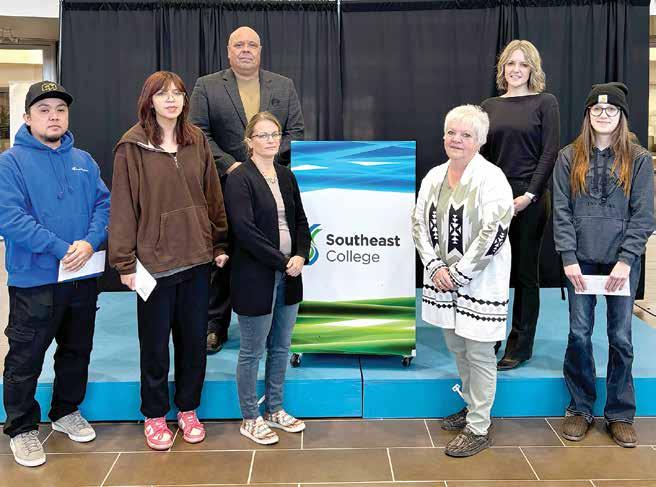
Southeast College students in Adult Basic Education and various post-secondary programs received $21,000 in financial bursary awards.
Students apply for and awards are distributed at the midpoint of their programs to ensure they have access to funds when they need support the most.
Award presentations took place in Whitewood and Indian Head on February 10, Estevan on February 11, and Weyburn on February 12. A total of 22 awards were given to 18 different students throughout the Southeast College Region.
“We are incredibly proud of our students and everything they have achieved and continue to work towards,” said Jody Holzmiller, President and CEO. “We are so grateful for the ongoing support that our College and our students receive and we are looking forward to a
renewed and re-energized focus on increasing the dollar amount of awards in 2026-2027 with a new and improved donor engagement and recognition strategy.”
Applications for academic-based scholarships will open in March, with distribution occurring as part of our annual graduation ceremonies.
Southeast College bursary donations are made possible thanks to community organizations, businesses and individuals, as well as various fundraising events such as the College’s Swing for Scholarships Golf Tournaments. Eligible funds are matched by the Ministry of Advanced Education through the Saskatchewan Innovation and Opportunity Scholarship (SIOS) program.
Southeast College is proud to offer innovative and flexible programming that encourages students to learn where they live.
Southeast College students at the Estevan campus received financial bursary awards, presented on February 11. Back row, l-r, Estevan Mayor Tony Sernick and SE College
Vice President of Human Resources and Organization Development Jenn Logel. Front, l-r, Gerardo Cabasa (Steel Reef Enhancing the Community Bursary in the heavy equipment, truck and transport program), Caitlyn Sheppard (City of Estevan Bursary and the Conquest Equipment Bursary in the heavy equipment, truck and transport program), SE College program coordinator, Melanie Mantei, Steel Reef representative Charlene Pilliout and Sydney Madsen (Steel Reef Enhancing the Community Bursary, electrician program).
Long-time volunteer dedicates nearly five decades to TeleMiracle
David Willberg SaskToday.ca
Bill Morrell doesn’t know if he’s been involved with TeleMiracle more than anyone else, but it’s hard to imagine many people have been part of the beloved Saskatchewan fundraiser as often or more than him.
Morrell, a former Estevan resident now living in Moose Jaw, has participated in 46 of the 49 editions of the Saskatchewan Kinsmen Foundation’s broadcast that raises millions each year for Saskatchewan residents. He’s looking forward to being part of the milestone 50th edition that runs from 7
p.m. February 28 to 5 p.m. March 1 at Prairieland Park in Saskatoon.
Morrell said he joined the Estevan Kinsmen Club after the first TeleMiracle in 1977. He also missed it once a few years ago for personal reasons, and another edition during the COVID-19 pandemic.
“I’m going to try to make 50 [TeleMiracles],” he said, noting he would need three more shows after this year.
He remembers Canadian country music singer Blake Emmons was part of the national cast at Morrell’s first TeleMiracle in 1978. Morrell also remembers the excitement of be-
ing part of something so special.
“It was really eye-opening to see the work and the dedication that was being done when there’s six to eight hundred people working towards a common goal. It renews the faith in humanity,” he said. “Neighbours helping neighbours –that’s one of the things that really strikes me as being an important thing.”
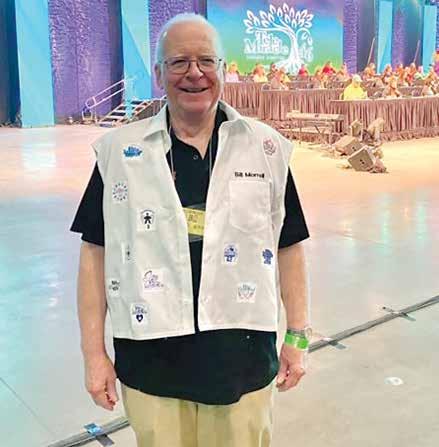
In 2022, he was presented with a special jacket on air by members of the Estevan Kinsmen and Kinette Clubs in honour of his service.
A TeleMiracle jack of all trades
Over the years, Morrell has done just about everything imaginable. He dressed as the TeleMiracle Teddy mascot and was also Teddy’s handler. Morrell worked in treasury, the post office, blue room, souvenirs and food services; helped with manpower, transportation and local talent; answered phones; provided security; and even pulled wires for camera operators.
“It has all been all kinds of fun,” Morrell said.
He’s never looked after setup for the event, and he’s never been a singer or a dancer at the event, saying he prefers to work behind the scenes.
“The motto back then was ‘Serving the Community’s Greatest Need,’ and
today’s slogan is ‘Helping People Every Day.’ I thought it was a fantastic way of helping people, far greater than what I could do myself,” he said.
This year Morrell said he will be a messenger, so he will be running messages from one point to another, leading performers from the back door to the stage room, taking VIPs into the green room, delivering pledges to the treasury, bringing food to where it needs to go and more – a “jack of all trades”, as he described it. Messenger work was a frequent task when he was a member of the Estevan club.
“The Estevan club was very, very, very active, and we were asked to provide at least 16 members to be messengers, so that we could be depended upon to have that many people. I just carried on from there, and said ‘Hey, I enjoy doing messenger work. I enjoy doing my 10,000 steps.”
In the early years, he remembers he was awake at 6 a.m. the Saturday of TeleMiracle when it started, volunteer throughout the event, leave at 8 p.m. Sunday after the broadcast and the post-show supper were finished, and then be at work on Monday morning, which he admits wasn’t smart. Now he gets to sleep for a few hours during the broadcast’s overnight hours.
Morell’s not alone with dedication
A lot of other people have been to many editions of the event, he said. Famed Saskatchewan musician Jack Semple, who is a staple with the TeleMiracle band, has been to the fundraiser many times. Morrell remembers a member of the production crew was there as often as Morrell.
And, of course, there was the late Bob McGrath of Sesame Street fame, who was part of the national cast for the first TeleMiracle in 1977 and was a perennial fixture until 2015. He made a surprise appearance in 2018.
“He was absolutely fantastic. All of the national cast has been very good,” said Morrell, praising the efforts people put in every year.
Morrell said he continues to help out at TeleMiracle because he was raised with the idea that it’s important to “pay it forward”.
“You never know when you’re going to need it, with that being an extension of ‘Do unto others as you would have them do unto you,’” he said, echoing the Golden Rule.
Morrell said he has made many friends through TeleMiracle over the years that he only sees once a year.
“It’s easy to make more friends when you’re there,” he said.
He recalls seeing 1,700-plus volunteers and approximately 200 technicians in the years when a supper was served after the broadcast. He doesn’t believe the number of volunteers has diminished over time.
Fifty years flew by Morrell said it’s hard to believe that this is TeleMiracle 50. In those early years, he never knew how long it was going to last, but he hoped it would be around for a long time.
TeleMiracle has raised more than $171 million since its inception, including more than $1.7 million last year.
Morrell recalls hearing a story in which the organizers of the Jerry Lewis telethon for muscular dystrophy paid the organizers of TeleMiracle a “huge compliment”, when the Lewis telethon group marvelled how TeleMiracle, at the time, raised $3 per person in a province of one million people. Now it’s over $5 per person a lot of years.
Morrell said he is looking forward to this year’s TeleMiracle, although no more than any other year. But he knows it’s going to be special, and he hopes to see a lot of the long-time contributors, and he looks forward to people of Saskatchewan “ringing those phones” and the fundraising total going higher.
Courtesy Sophie Engel/Southeast College
Bill Morrell with the vest provided by members of the Estevan Kinsmen and Kinettes Clubs.
Indigenous storyteller shares tales of Métis upbringing
David Willberg SaskToday.ca
Students in numerous southeast Saskatchewan communities heard tales of a Métis upbringing as part of February’s Indigenous Storyteller Month.
Tekeyla Friday started her tour at Hillcrest School in Estevan on February 9, and then went to Midale, Weyburn, Carlyle, Stoughton, Lampman, Bienfait, Oungre, Pangman, Ogema and finally Bengough on February 12.
“The Indigenous storytelling session that I’ve been doing has been very well received, and the students have been very, very awesome,” said Friday.
The presentations start with an oral story of how butterflies were created, complete with a prop she calls the great beans magic bag. When she opens the bag at the end, little paper
butterflies emerge. Friday also does a series of puppet shows, including some she wrote herself and another she borrowed from an old library book named Little Blue Riding Hood. She also tells another story about when her father tried to make beaver tail when Friday’s mother was a child.
Most of her presentations were co-ordinated between schools and libraries in the region. With the involvement of the schools, she sad it guaranteed an audience. The librarian often introduced her. She added the kids have been quite excited to hear her stories, especially when she uses props for the oral stories.
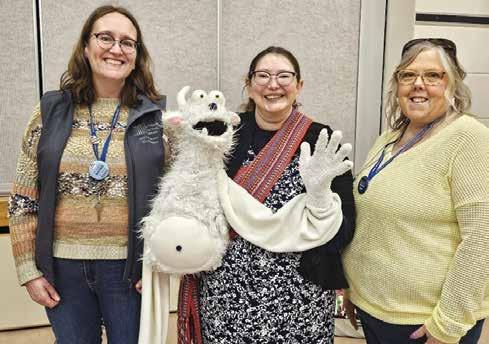
“They really like Freddy the Yeti, who is a puppet that I created. I had made him about seven years ago. He was my first ... puppet
that I had created, so he’s got this big wide mouth and he has a gloved hand that I can put my hand into, and it makes him look like he’s very much alive and moving when he’s talking,” she said.
The kids have had all kinds of questions at the end of the presentation, as she said they want to know about the puppets and the Métis sash that she wears.
At the Estevan presentation, she was showing off her book Prince Prickly Spine, and one of the students wanted a copy of the book to read. She happily obliged with the request.
Friday also gave her contact information to teachers so students could send in more questions. She has a presentation at the end of the month in which she will discuss the engineering and science of the Red River cart, the
EPS still hopes its police/ crisis team can expand
David Willberg SaskToday.ca
The Estevan Police Service wants to expand its Police and Crisis Team (PACT), but first it needs another social worker.
The EPS provided an update on the unit at the Feb. 11 meeting of the Estevan board of police commissioners, explaining why PACT continues to have just one EPS officer and a social worker.
Deputy Police Chief Warren Morrical said that when the provincial government announced funding for the EPS through the Safer Communities and Neighbourhoods (SCAN) program in September 2024, the EPS wanted one of the three funded positions to be a second PACT officer to work alongside a second social worker from the Saskatchewan Health Authority (SHA).
When PACT first came to Estevan in 2022, an EPS officer was teamed with two social workers, but Morrical noted that one of those SHA employees relocated after about a year in the position, and the post has been vacant since.
“The SHA has been diligent in posting for that second SHA social worker position. They’ve done so multiple times, however, they’ve been unable to identify a suitable applicant with the required background in education and social work.”
Rather than assigning a second EPS officer to work in PACT without an SHA counterpart, the EPS reassigned one of the
SCAN-funded positions to a community engagement officer.
“It’s our vision at this time that for this position, the individual is really going to do a number of different things,” said Morrical.
“They’re going to enhance our relationship with community stakeholders. They’re going to work with the community to promote crime prevention, highlight awareness and put forward some of the educational programs that we engage in, engage with the students in our local schools, and really just be a dedicated point of contact for our community to advance our programming goals and really to build solid relationships,” said Morrical.
Once the SHA is able to fill the second social worker position, the EPS would likely look at using alternate officers to support that work, without assigning a dedicated second police officer.
PACT remains a significant contributor to the EPS’s ability to respond to individuals experiencing mental health and addictions-related crises, he said, and providing follow-up connection and resources.
Const. Michelle Beaulieu is the current EPS PACT officer and Stacy Murphy is the social worker. Morrical said PACT can continue to function with its current arrangement, but it is limited in the work it can do because it does not have around-the-clock coverage.
fiddle and other parts of Métis culture. She also spoken about her Métis history through claymation art, plasticene pictures and 3-D stop-motion animation characters that she shows the students to inspire them to create their own art.
“It’s a lot of fun being able to share one’s culture, and to be able to inspire kids to use their imagination,” she said.
Indigenous storytelling is important because she believes it preserves First
Nations and Métis culture together, and Indigenous people in Canada gather to tell stories, especially in winter.
“The belief around it was because the animal spirits were all sleeping, so it was a good time to tell stories about tricksters, and your cultural heritage and lineage, and that sort of thing. A lot of oral stories taught lessons and helped the children learn things such as don’t go near the lake because there’s a lake
monster there, or don’t wander off into the forest alone, so that they could teach their kids survival skills.”
Storytelling is a time of getting together and just having the warmth of the fire and family around as people listen to stories.
“Even today, I think stories are very important. It’s part of our language, it’s part of our culture. It’s part of preserving our history when we tell stories,” she said.
“Right now we’re certainly trying to maximize the usefulness of PACT by both having an assigned dedicated member, and then supplementing where we need to with other police officers to support Stacy’s role in that PACT,” said Morrical.
Beaulieu is on a modified work schedule that might be 8 a.m.-8 p.m. or noon to midnight, Morrical said.
“The hours she works are different to align with, statistically, where we see the majority of our mental health issues coming up,” said Morrical.
When Murphey and Beaulieu are on the same shift, they work together, Morrical said. If Murphy is working and Beaulieu is not, then Murphy is partnered with another officer. If Beaulieu is working and Murphy isn’t, then Morrical said the PACT team doesn’t have the social work aspect; Beaulieu follows up and attends all mental health calls.
Morrical said PACT is busy enough to have a fulltime schedule and to need the second tandem.
“They are very proactive, so there are times where both Michelle and Stacy will be reaching out to individuals that we have identified through other calls for service or observations.”
The number of frontline responses to mental health issues in the EPS quarterly reports does not represent the full scope of the work PACT performs in Estevan, Morrical said.
Indigenous storyteller Tekeyla Friday, middle, with Estevan Public Library adult programmer Jennifer Howie, left, and children’s programmer Lyn Vilcu.
Photo courtesy from the Estevan Public Library’s Facebook page
SE Cornerstone facilities report received by board
Submitted by Norm Park, Contracted Reporter for SECPSD
Jim Swyryda may have been on the job as the facilities manager for the South East Cornerstone Public School Division for just over seven months, but he has arrived with a knowledge base of several years within the southeast sector.
Swyryda was in the Cornerstone head office conference room Feb. 11 to deliver a presentation on the current status of the public school division’s facilities, which currently involves a 19-member team of technicians and journeypersons who take lead roles in the construction, maintenance and caretaking world.
FARM PHOTOS WANTED!! NTED!!
Weyburn This Week is in search of farm photos for our annual ON THE FARM edition coming out in MARCH!
Receive the credit you deserve for the beautiful photos you have taken around your farm. Email your pictures to acorrigan@glaciermedia.ca by March 2nd, along with a description of the photo and your name. YOUR PICTURES COULD VERY WELL BE CHOSEN FOR OUR NEXT EDITION OF ON THE FARM!
Please send photos as a high resolution jpg or pdf.
preventative maintenance service requests have been decreasing thanks to earlier diagnosis and action plans. The 2,160 requests made in the 2023-24 school year declined to 2,060 in 2024-25 and are at 980 for the current school year that wraps up in late June.
An ongoing upgrade project to improve lighting in all schools is nearing completion, he said, and should be concluded by August of this year. Four schools had received upgrades to LED systems so far this year.
Problems still exist with aging equipment, truck fleet and a few older HVAC systems, plus a parts and supply timeline.
The overall current operating budget stands at just over $4.7 million to cover utility costs, contracted maintenance issues, snow removal, grass cutting, service requests and property taxes.
A preventative maintenance and renewal budget currently sits at just over $3.5 million, he told the board members during their regular open business meeting held in the division’s head office in Weyburn.
Those items include such things as roof replacements or repairs; accessibility needs; heating, ventilation and air conditioning (HVAC) upgrades; and other structural issues.
On the operations side, he said there is the need to maintain and keep safe a total of 46 buildings that include 35 schools, the division office, six shops and four teacherages.
There are currently three out-of-scope foreman positions filled, along with three journeyman carpenters, five technicians and two more out-of-scope journeyman electricians.
On the caretaking side, Swyryda said equipment has been purchased on a lower cost package plan, and all hardwood gymnasium floors had been recoated in the past year. All staff caretakers have been trained on all the equipment they use, and a current transition to a new organizational structure is going smoothly following his assuming the role as facilities manager from former manager Andy Dobson, who recently retired.
There are always emerging problems or issues, Swyryda said, including the fact that casual/temporary caretakers are increasingly hard to find; recent extreme weather conditions have led to challenges with cold, rain, snow and ice mixtures; and there is a current aging staff issue with a few pending retirements.
The manager discussed upgrades to HVAC systems that have taken place at nine schools, as well as four roof replacements.
On the positive side, the
“What we used to be able to get in four to six weeks, now takes eight to 10 weeks,” he told the board members.
Projects completed included a childcare expansion plan at Hillcrest School in Estevan, a $254,000 exterior upgrade at Alameda, a $252,000 main access renovation at Stoughton, and a Gladmar School exterior refresh where Phase 1 has just been completed.
A major capital design phase is also a part of the plan for a new prekindergarten to Grade 12 school in Carlyle, as is a three-year major and minor capital project planning system.
The Carlyle school topic brought a host of inquiries and concerns from board members.
But before that began, Swyryda noted some minor capital projects being applied for that include a McNaughton School refreshment for just under $10 million, as well as a $6 million to $8 million project at the Estevan Comprehensive School to replace an aging HVAC system. This includes the replacement of two 58-year-old boilers and a fan array, plus replacement of failing steam traps and circulation lines. A major refurbishment of ECS has been stalled in the planning stages for the past several years.
When discussing the Carlyle school project, the facilities manager noted the project was approved in the fall of 2023 and that included the pre-k to Grade 12 structure and a 51-seat childcare centre.
Since then, general and sub-contractor pre-qualifications have gone into effect and are in progress.
Swyryda said that the original plan for a $34 million project that included about another $4.5 million addition to be financed by the Carlyle community had not yet proceeded to tender. He said the objective now is to prove to the Ministry of Education that the final numbers and the project should get the final green light to go ahead with a revised design, drawing and timeline.
Saskatchewan Roughriders defensive lineman Micah Johnson, right, signed a football for Finn Neilmeter, Calder Campbell and Jordan Campbell. Rider fans had a chance to pose with the Grey Cup during its stop in Weyburn on Family Day.