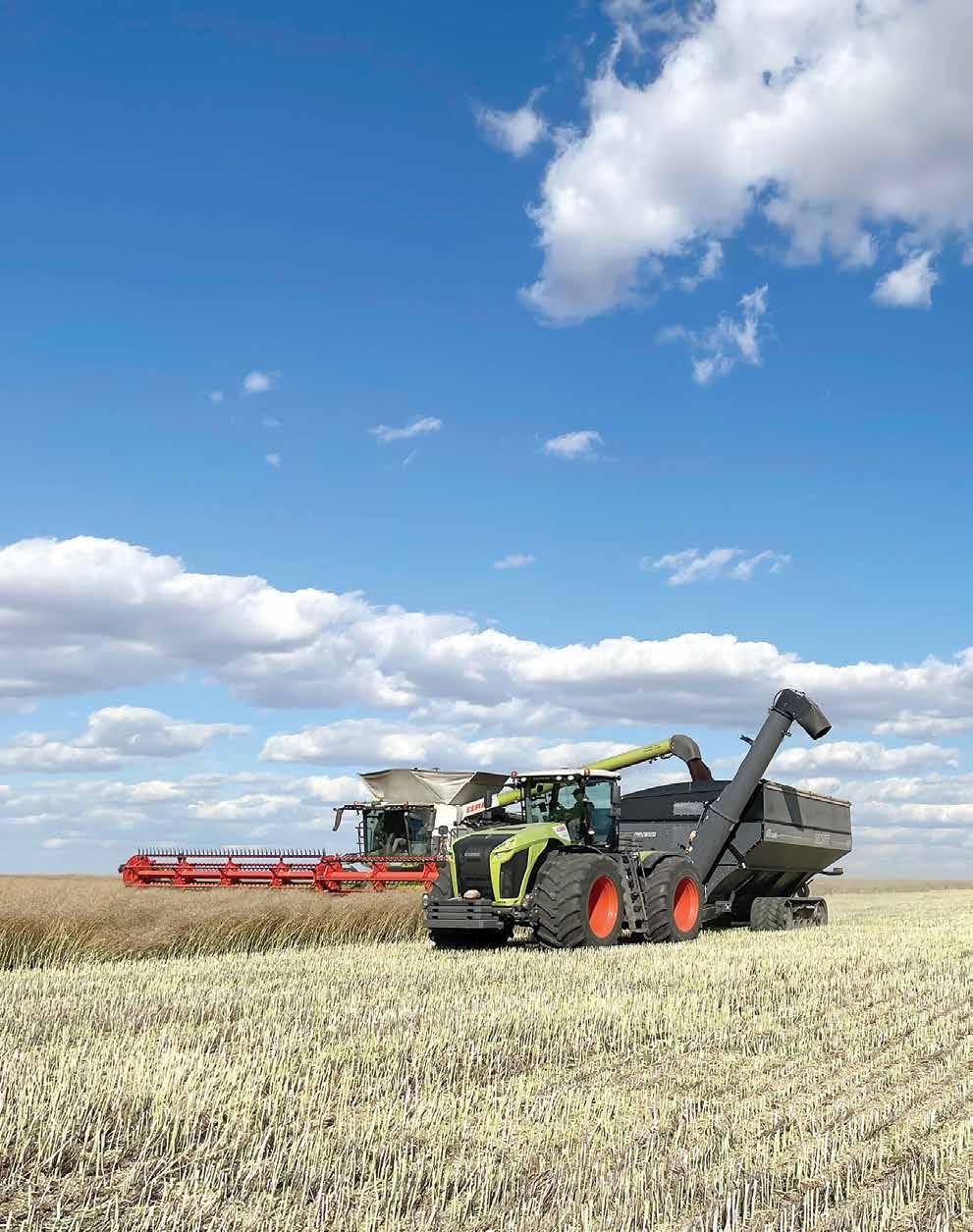
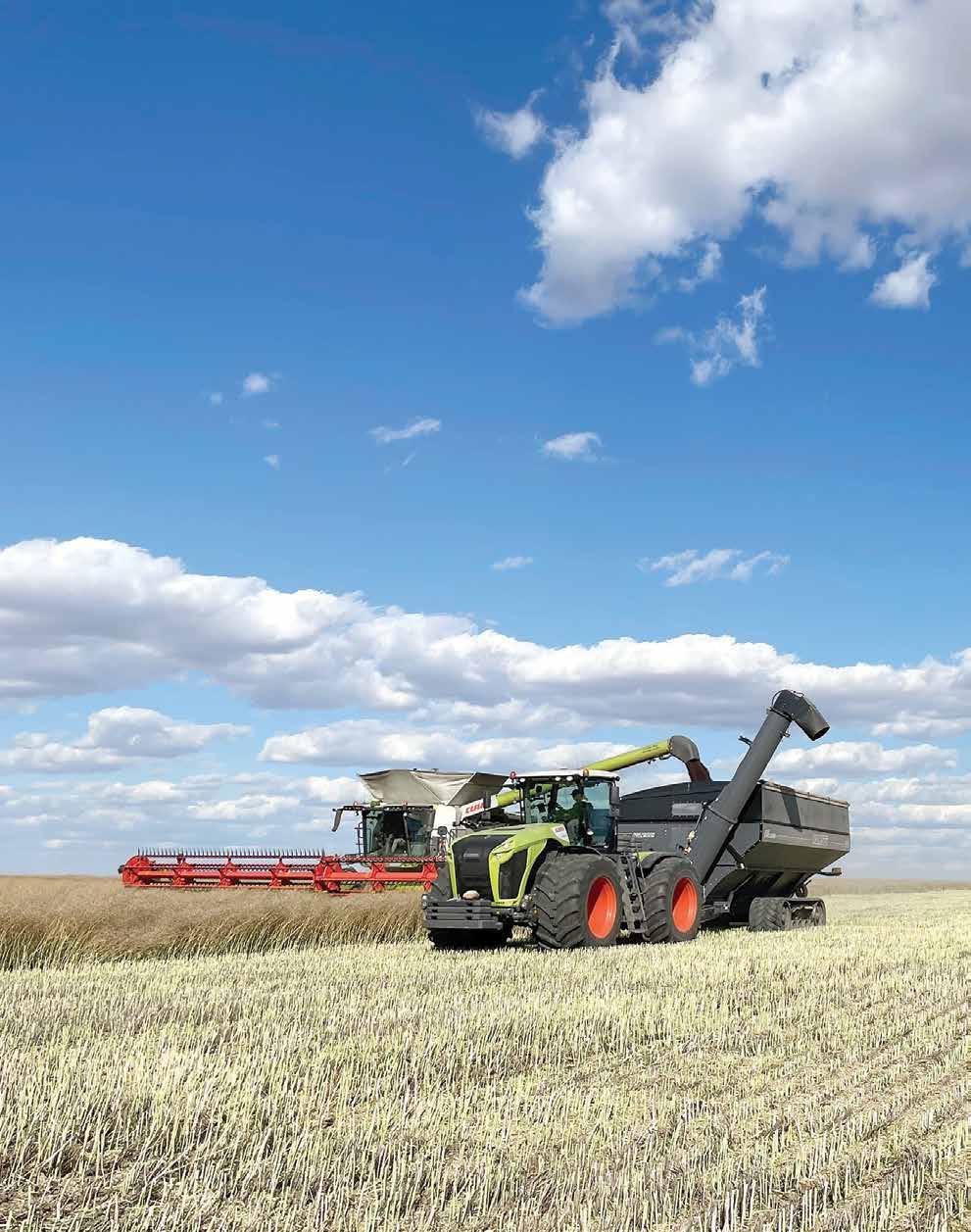
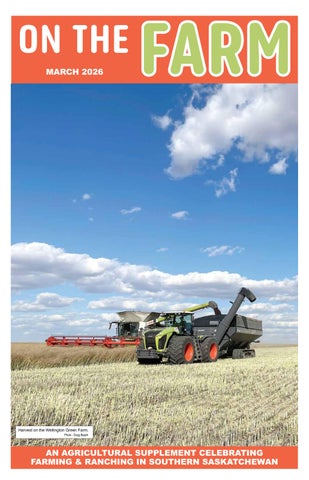
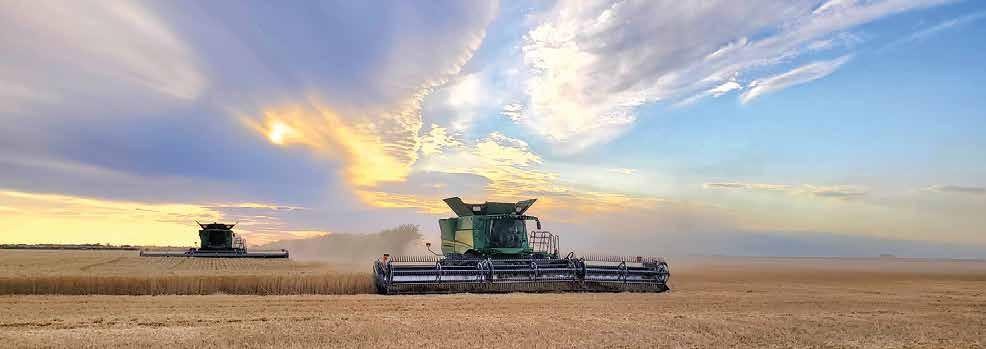
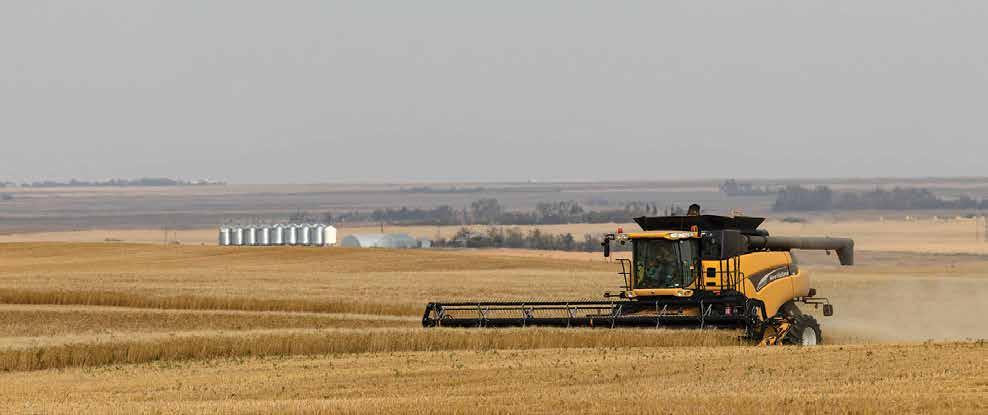
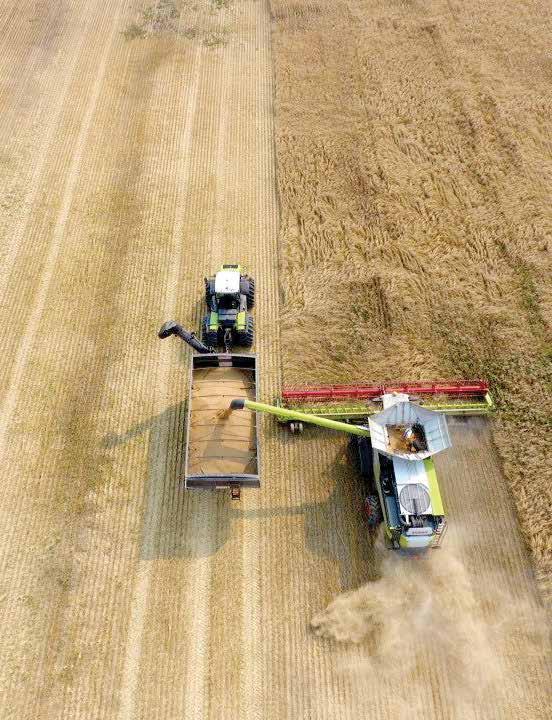
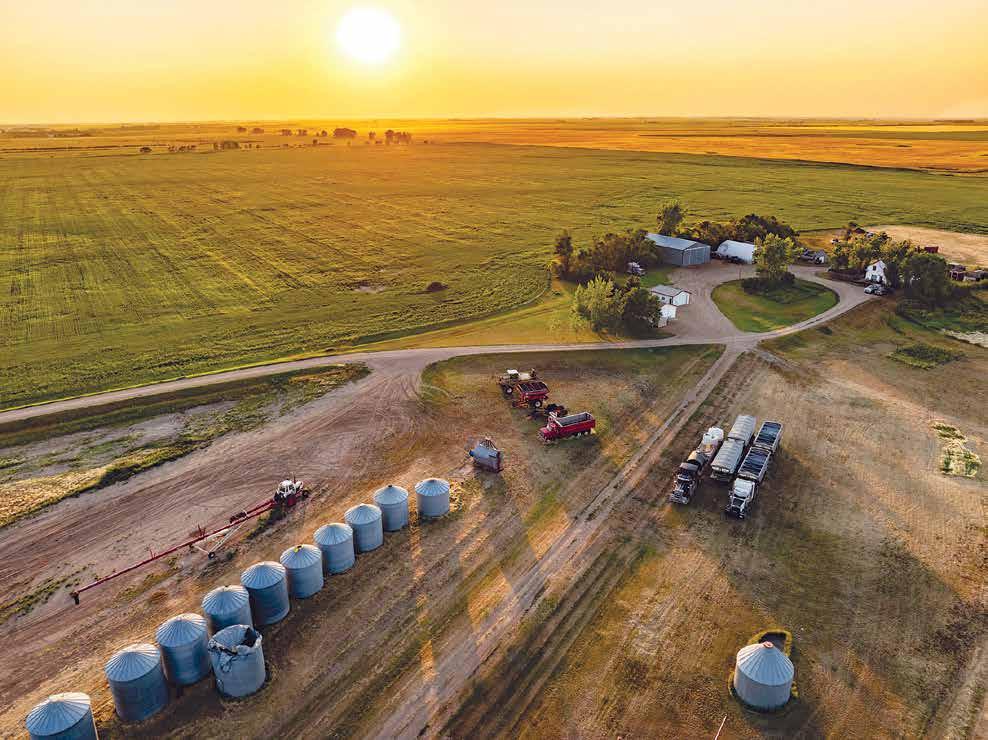
Harvest on the Wellington Green Farm.
Photo - Doug Beach
George Lee Local Journalism Initiative Reporter
A return to strychninelaced battles against Richardson’s ground squirrels would generate more drawbacks than first meets the eye, a conservationist said last week.
Harms caused by the powerful neurotoxin would ripple beyond the farm and ranch, said Ruiping Luo, a conservation specialist with the Alberta Wilderness Association.
And producers themselves could face unintended consequences down the road, she said.
Gophers appear to be a keystone species with an important role in the entire prairie ecosystem, Luo said.
Richardson’s ground squirrels are “ecosystem engineers,” she said.
“We’re learning more and more about this as we start to study what their impact is.”
Richardson’s ground squirrels, ubiquitous in much of southern and south-central Alberta, serve farmers by loosening and aerating soil, allowing it to soak up water for plant growth. They create homes taken over by other animals, like burrowing owls and badgers. And they’re a food source for predators like the ferruginous hawk.
Health Canada’s Pest
Management Regulatory Agency decided February 2 to reject an emergency use application for two per cent liquid strychnine by producers, saying risks to non-target species like the swift fox and the burrowing owl are too great for approval.
For similar reasons, Luo’s organization supports the federal rejection.
“Given the proven harmful effects of strychnine on non-target species, AWA doesn’t believe any mitigating measures would be enough to ensure the safe use of this poison,” Luo said.
“We support the continued ban of this pesticide.”
The oldest conservation group in Alberta, AWA is a not-for-profit dedicated to the protection of the province’s wild spaces and biodiversity.
Today, with about 7,500 members and supporters, the organization has since 1965 advocated for protected areas to preserve habitat for species at risk in areas like the Eastern Slopes of the Rockies and the native grasslands of the Palliser’s Triangle.
In their joint application to the PMRA, Alberta and Saskatchewan said a gopher crisis has unfolded on farms, pastures and ranch lands since strychnine was banned three growing seasons ago.
Since the recent ruling, the office of Alberta Agriculture and Irrigation Minister R.J. Sigurdson has called on the feds to “immediately reinstate” strychnine for farmers and producers to deploy against ballooning gopher populations.
Rejection of the emergency-use proposal is “devastating for many in the agriculture sector,” the minister’s office said in an emailed response to Macleod Gazette questions.
“We are urging the PMRA to reconsider this decision and immediately reinstate the use of strychnine as a practical solution for our farmers and ranchers.”
Health Canada, meanwhile, has acknowledged “significant agricultural impacts from ground squirrels, including damage to farm fields, risks of injury to cattle and crop losses, particularly in canola.”
An emailed response from the department’s media relations staff continued: “Health Canada considered this information, but under the Pest Control Products Act, environmental and health safety requirements take priority.”
The department said: “In this case, the environmental risks of strychnine, including secondary poi -
soning of non-target animals and species at risk, could not be mitigated to acceptable levels.”
The Role of Resilience
Environmentally safe approaches to gopher control are important —ones that work within a larger and longer-range view, Luo said.
“This is more of a personal opinion than an employer opinion, although I don’t think AWA would be that opposed to it,” she clarified.
“But I think it’s important to build resilience so that we don’t have these emergencies and we don’t have conditions that mean ground squirrel populations explode and cause this much damage.
“I think that’s a much better approach than constantly falling back on a pesticide that we know is toxic and harmful to the rest of the ecosystem.”
Richardson’s ground squirrels are notorious in the agriculture industry for the damage they cause pastures, crops, equipment and livestock.
About the size of a pudgy rat — but beige and often considered cute — gophers dig elaborate burrows and create mounds that put equipment and livestock at risk. They clear neighbouring vegetation at their burrow entrances so they can see predators.
“We do acknowledge and understand that ground squirrels can be a huge problem for farmers,” said Luo. “But I’d also like to point out that a lot of the time when ground squirrel populations really explode, there are environmental causes like drought and loss of control from predators.”
The Need for Predators AWA is also concerned about the effects of hunting and predator removal. “We feel that there’s been a lot of targeted removal of predators, of wolves and coyotes, but also of cougars and bears.
Often they’re what control ground squirrel populations in the first place.”
Although resistance among strychnine’s target species hasn’t shown up yet, it’s not uncommon with other pesticides. Also, predators die from eating poisoned gophers, and it
can take a longer time to recover than it takes gophers.
“So then you have this effect of needing more and more strychnine to control the population, until that’s the only thing that you know of that’s effective,” said Luo.
Alberta and Saskatchewan did propose mitigating measures like no surface baiting and requiring the deep burial of carcasses. They proposed a limited baiting window and mandatory user training, combined with chain-ofcustody measures for the poison itself, like registration, reporting and tracking. But Health Canada was unconvinced that the measures were improvements over what it had seen in the past and didn’t think they’d be effective in preventing poisonings from going up the food chain.













Delaney Seiferling SaskToday.ca
Farmers generally don’t spend a lot of time thinking about their data.
But they should, says an agronomist, because it holds great potential to help them make incremental improvements on their farms and enhance gross margins, especially in a low-price, high-cost environment.
That was a key message from Mike Palmier, a partner in agronomy services for MNP, at the recent Convergence agricultural conference in Regina.
Palmier, who works across west-central Saskatchewan and currently advises roughly 475,000 acres, told farmers that the biggest mistake he sees isn’t a lack of data — it’s failing to use it to make incremental improvement and to connect agronomy to profitability.
Why don’t farmers think about their data more?
“Farmers generally don’t spend a lot of time thinking about their data because they don’t know how to use it. If you can’t build insights off it, it’s not worth anything. Incremental improvement … should be the focus for everybody within the room.”
Palmier says he himself came to this realization
after years of focusing primarily on agronomic recommendations, deciding instead to spend more time helping farms interpret what their numbers actually mean and how small changes can add up.
“Agronomy is business,” he said.
“That’s how you get your revenue insights.”
Using multi-year benchmarks compiled from 318,000 acres across 57 Saskatchewan farms, Palmier showed that even in a record-yield year like 2025, profitability varied widely.
The average difference in gross margin between the top- and bottom-performing farms was $187 per acre, he said, while field-to-field differences within the same region averaged $329 per acre.
Opportunities
He says while most farmers would say they had a really good year, there were substantial differences in gross margins, which is where he believes the opportunities lie.
One of the clearest examples came from canola seeding rates.
By comparing seeding rates across farms, Palmier found some operations were consistently planting above the benchmark without gaining yield.
For example, lower -
ing canola seeding rates by $15 an acre on 5,000 acres could offer savings of $75,000 for one farm, without sacrificing yield.
Palmier also challenged long-held assumptions about fertilizer spending.
In 2025, his data showed no correlation between higher nitrogen rates and higher yields, largely because favourable weather allowed crops to use nutrients more efficiently.
“If we were just looking at that as a benchmark, like how efficient you were with nitrogen expenditure this year, the least you applied, the better you did,” he said.
He cautioned that this isn’t a long-term rule, but a reminder that history and efficiency matter more than blanket rates.
“We have to be careful with the data.”
He said that nitrogen use efficiency across benchmark farms averaged about 2.4 pounds of nitrogen per bushel, far lower than many planning assumptions, and that identifying where nitrogen was over-applied helped farms reduce waste and avoid carryover risks.
“Anything above that, over the long term, over that 2.75 lb. of nitrogen per bu., I would expect
that they would be leaving nitrates behind in the soil,” he said.
Rethinking crop mix
But perhaps the biggest financials gains can come from rethinking crop mix, he said.
For example, on a hypothetical 6,000-acre Saskatchewan farm that shifted acreage modestly by swapping crops based on performance data, that single change could gross margins by $108 per acre, adding roughly $650,000
in revenue.
“I’ve always felt that there’s a cost of the easy button,” he said.
“The easy button on a farm, in regards to crop mix, is just putting in canola and wheat. It’s simple, it’s easier, but there’s a cost to that.”
Palmier stressed that the goal isn’t dramatic change but incremental improvement, repeated year after year.
By reviewing data regularly, including yield maps, soil tests, fertil -

ity rates and financial results, farms can identify strengths, address weaknesses and steadily improve.
“Incremental improvement is what we’re after,” he said, adding this belief now defines much of his work.
“Diving into your operation like this gives you the opportunity to move from good to great,” he said.
“That’s what separates the farms that last from the ones that struggle.”




As the global community prepares to recognize the vital contributions of women in agriculture, Canada’s Farm Show (CFS) Regina, presented by Bunge, announces strategic alignment with the United Nations’ declaration of 2026 as the International Year of the Woman Farmer (IYWF).
To celebrate this milestone and amplify the voices of women in the sector, Canada’s Farm Show will integrate IYWF themes into its upcoming programming, headlined by the Powering Prosperity: Canada Powered by Women National Tour 2026, presented by Deloitte.



2026 Chevrolet 1500 LTZ
3.0L DURAMAX, HEATED/COOLEDLEATHER,HEATEDSTEERING,




“Canada’s Farm Show has always been a platform for the ideas and people shaping the future of agriculture in this country,” said Trent Fraser, acting president and CEO of the Regina Exhibition Association Limited. “Aligning with the International Year of the Woman Farmer is both a natural fit and an important step forward. Women are driving innovation, strengthening rural economies, and leading across every part of the agrifood system, yet structural barriers continue to limit opportunity. Through initiatives like the Powering Prosperity tour, we are elevating

these voices and helping turn dialogue into tangible outcomes that expand opportunity and strengthen growth across the sector.”
The Food and Agriculture Organization (FAO) of the United Nations officially launched IYWF 2026 in December, highlighting the essential role women play in advancing sustainable agriculture, strengthening rural communities, and shaping the future of the agri-food sector. Despite these contributions, women farmers continue to face significant barriers in accessing resources, opportunities, and decision-making roles.
Throughout 2026, the Powering Prosperity tour will travel across the country, fostering critical conversations about the intersection of women’s leadership, energy and agriculture. The programming is designed to move beyond discussion into actionable policy development.
Canada’s Farm Show Regina runs from March 17 to 19, bringing together industry leaders, innovators and producers for three days of insight, connection and momentum ahead of the growing season. Visit www.canadasfarmshowreginask.ca to learn more.


Delaney Seiferling SaskToday.ca
Human health and plant biology might seem like two separate worlds.
However, according to one Canadian entomologist, many of today’s chronic health problems stem from ignoring the basic biological rules plants have followed for billions of years.
“The body knows what to do, just like plants know what to do,” Mike Dolinski, director of science and innovation with Taurus Ag, said at the recent Convergence agricultural conference in Regina.
We are dependent upon plants
“Our life depends on plants. We either eat plants or eat animals that eat plants.… The difference between you and these plants is you have a brain.”
This message is especially important for the farming community at a time when an estimated 44 per cent of Canadian adults suffer from at least one chronic disease and when the majority of Canadian farmers are in age groups most at risk.
The modern epidemic of chronic diseases, including diabetes, heart disease, cancer and neurodegenerative disorders,– is closely tied to how humans fuel their bodies, said Dolinski.
And although he cautioned that he’s not a doctor, he has spent decades studying insects, crops and plant systems and worked as an entomologist with Alberta Agriculture for more than three decades.
Food is medicine
“The food you eat is your medicine, the most important decision you
make every day,” he said.
And one central aspect of this is the one powerful structure found in nearly every living organism: the mitochondria, he said.
“Disease all comes down to mitochondrial health.”
Mitochondria, often described as the cell’s power plant, convert food into energy that keeps cells functioning, in both plants and people.
When they work properly, cells have the energy they need to repair themselves and regulate inflammation. When they don’t, the body becomes more vulnerable to chronic disease, Dolinski said.
And one major threat to mitochondrial health is oxidative stress, which is damage caused when unstable oxygen molecules overwhelm the body’s natural defences.
The evolution of plants
Plants face similar threats every day, from heat and drought to pests and disease, but over billions of years, they’ve developed sophisticated systems to manage that stress, producing antioxidants that neutralize damage before it spreads.
Humans rely on many of the same antioxidant compounds, but unlike plants, we can’t make enough of them ourselves. Instead, we have to consume them, primarily through whole, plant-based food.
“Your medicine is unprocessed food, the food that doesn’t have a label,” Dolinski said, adding that highly processed food and excess sugar can overwhelm the body’s ability to manage oxidative stress.
He also pointed to insulin resistance, often driven
by diets high in refined carbohydrates, as a key driver of metabolic disease.
Practices such as intermittent fasting (which Dolinski said he does regularly), regular exercise and better sleep give mitochondria time to recover and improve the body’s ability to use energy efficiently.
The importance of mitochondria
“If the mitochondria are not functioning properly, nothing works — in the plant and in you and in every other animal and bug and earthworm.”
The same micronutrients plants need to protect their cells — including zinc, manganese, copper and sulfur — are also essential for human health, Dolinski said.
And as nutrients leave farms through harvested grain and livestock, longterm soil depletion could have implications not just for crop yields, but for food nutrition as well.
Overall, Dolinski said there’s much value in remembering that human biology is rooted in the same natural systems that sustain agriculture and that this knowledge offers sound guidelines for living and eating in ways that support mitochondria and minimize chronic oxidative stress.
This includes primarily eating real, plant-centred, unprocessed food, managing insulin and visceral fat, and prioritizing sleep and exercise and minimizing stress.
At age 78, he says he himself follows much of this advice.
“I don’t plan on dying from any of those diseases. I plan on dying because I just wore out.”







Ryan Young, SaskToday.ca
The Canadian Wheat Research Coalition (CWRC) released results of a review into the Canadian wheat breeding innovation system.
Conducted last fall prior to the cuts made at Agriculture and Agri-Food Canada (AAFC), the review was done by the Synthesis AgriFood Network. The scope of the review included analysis of reports and studies related to wheat research, as well as interviews with 29 stakeholders, including AAFC, universities, and the private sector.
In summary, the review concluded that AAFC’s “wheat breeding program is an integral part of the western Canadian wheat variety development”, the current system “is at risk from recent and historic budget cuts, especially at the variety development and pre-market evaluation stages”, and that “wheat breeding is a longterm process and decisions made today will impact agriculture decades into the future.”
Chair of the CWRC Jocelyn Velestuk says there are many benefits to funding public research, such as the return on investment.
A news release from CWRC states “farmers received $33 in benefits for every dollar they invested in wheat breeding from 1995 to 2020, according to a recent
study from the University of Saskatchewan. Since 2020, the CWRC has committed $70.5 million to western Canadian wheat breeding programs.”
Those programs involve AAFC and universities, added Velestuk.
“Over 80 per cent of wheat acres planted in 2025 were planted with varieties developed by (AAFC), so farmers have a huge stake in that we’re big funders of public funding,” she said, “So that’s a really important factor to take into consideration when we’re huge players as well and we can gain a lot from the system working well.”
She said the cuts made by Agriculture Canada will result in a loss of expertise and research capacity, adding the impact to wheat breeding programs are unclear but does expect them to be significant. With this information, Velestuk says discussions on a long-term solution with stakeholders and Ag Canada are underway. She says the status quo is not a viable path forward.
“This public report is a point in the system and a point in the process that we’re working towards. So through the discussions, we hope that we will figure a lot out and we are serious about looking at a long-term solution and that farmers are the ones to take the lead on this.”









Delaney Seiferling SaskToday.ca
Farmers are doing their job well, but the sector remains vulnerable because of existing systems and geopolitical factors at play, says a farm economist.
That was one of the main messages delivered by Sylvain Charlebois, a professor at Dalhousie University, during a recent appearance in Regina.
Charlebois, who leads Dalhousie University’s Agri-Food Analytics Lab and regularly advises governments and industry on food policy, told farmers that Canada’s agricultural challenges are no longer rooted in how efficiently food is produced but in how the system around farmers functions.
Charlebois said Canada’s reliance on exporting raw commodities leaves farmers especially vulnerable to forces beyond their control, including trade disruptions, currency volatility and geopolitical disputes.
Creating value
“At the end of the day, it’s about creating value,” Charlebois said.
“You do your work as farmers, you produce commodities, but at the end of the day, they’re commodities. They’re trading on world markets. You’re still vulnerable.”
Recent trade tensions with China were a reminder
of how quickly market access can be disrupted, he added, and why farmers need more insulation from external shocks.
Charlebois believes Canada needs more people willing to take risks and invest in farming, especially to bolster value-added investment across the sector, because without a stronger domestic processing capacity and scaled agri-food companies, farmers remain exposed when markets shift.
“Globalization has made Canada rich,” he said.
“It’s going to continue to make Canada rich.”
However, he said Canada is losing competitiveness at home — not just abroad.
Food prices
Charlebois pushed back against the idea that rising food prices are driven by farmers or grocery stores, arguing instead that Canada’s own policies and structural barriers are making the food system more expensive than it needs to be.
“The cost of living has gone up.”
He pointed to Canada’s failure to scale food companies as a central weakness.
“Canada is good at creating companies,” he said.
“Canada is great at launching companies. It does a poor job scaling them.”
He said interprovincial trade barriers are another selfinflicted problem that limits
growth and raises costs.
“If you don’t want to scale up companies, the first thing you do is put barriers between provinces,” Charlebois said.
Policy costs layered onto food — without improving competitiveness — are also squeezing the system, he warned, including the impact of carbon pricing on farmers and processors.
“All these things are putting more pressure and stress on our ag industry,” he said.
The result, Charlebois said, is that costs move quickly through the supply chain, leaving farmers caught
in the middle.
Competitiveness is the problem
“Our problem is competitiveness,” he said.
“That’s really what the problem is.”
However, despite all these challenges, he believes farmers have a strategic advantage on the global stage that they’re under-using: trust.
“When you say you’re Canadian and you’re in ag, the first thing they think about is trust and safety and quality,” he said.
“The Chinese wanted our canola. The Americans want our products as well. Why?
Because it’s Canadian. It’s quality, it’s proven and it’s safe.”
In international comparisons of ag-food systems, Charlebois said Canada consistently ranks at or near the top for food safety.
“Food safety … ranks number one … our greatest strength.”
That reputation, he emphasized, has real economic value, but only if it’s actively leveraged.
“The reputation is there,” Charlebois said. “We have to capitalize as much as possible.”
He warned that if farm-
ers and agricultural organizations don’t tell their own story, others will do it for them, often inaccurately.
“We have a lot of confused media folks conveying confusing messages to the public,” he said, adding farmers should get out in front of this.
“Tell your story. Get your message out.”
Charlebois challenged farmers to look beyond the field gate and engage more actively in policy and public discussions about food.
“People need you,” he said. “They need your message to get better policy.”





Sean Pratt SaskToday.ca
Pea supplies are heavy but there are some bright spots in the market, says an analyst.
Chuck Penner, president of LeftField Commodity Research, is forecasting 1.24 million tonnes of carryout at the end of 202526, a 154 per cent increase over last year.
The stocks-to-use ratio is forecast at a bloated 38.9 per cent.
The breakdown is estimated to be 943,000 tonnes
of yellow peas and 300,000 tonnes of greens.
While supplies are up, exports have been below average through the first four months of the 2025-26 campaign due to China’s 100 per cent tariff on imported Canadian peas.
Russia has largely usurped the Chinese market, although some Canadian product has still been moving to China despite the massive tariff.
Russia harvested a record 5.2 million tonnes of peas in 2025.

“They’re a major player now in the pea market and have been for a few years,” Penner told farmers attending Saskatchewan Pulse Growers’ Swift Current Winter Pulse Meeting.
The good news is that China’s tariff is being removed on March 1, 2026, at least until the end of the calendar year.
Penner thinks there will be significant pent-up demand for Canadian peas.
“Pea inventories in Chinese warehouses are the lowest they’ve been in
many years,” he said. Why it Matters
China’s return to the pea market is a big deal.
The other thing that has been happening in that market is that pea prices have fallen to a level where they are competitive with a composite of soybean meal and corn values.
He expects China to continue importing Russian peas for feed and to start purchasing Canadian peas for the fractionation market.
“We’re going to see some decent volumes moving March forward in this year,” said Penner.
Canadian pea exports to India also took off in October and November after a poor stretch from February through September 2025.
Yellow pea prices started to rise in India after the government implemented a 30 per cent tariff on imports from all countries in November. Desi chickpea prices are also moving up.
“It’s positive that prices are rising in India,” said Penner.
“It does give us a little bit more optimism for the yellow pea market going forward.”
Canadian yellow pea bids have been slowly rising, and he thinks there could be more appreciation this winter due to the improving export prospects in China and India.
He is forecasting 2.35

million tonnes of exports to all destinations in 202526, up from 2.17 million tonnes the previous year.
Penner is forecasting 3.15 million acres of peas in 2026, a 15 per cent drop from last year.
Using average yields, that would result in 2.94 million tonnes of production in 2026-27, which would be about one million tonnes less than the current crop year.
“That in itself would fix some of the heavy supply situation,” he said.
Penner is forecasting 826,000 tonnes of carryout in 2026-27, a 34 percent drop.
As a result, there should be some price recovery next year but no “screaming rally” unless there is a crop failure.
Canada’s chickpea production exploded in 2025 to 482,000 tonnes, a 68 per cent increase over the previous year.
The big problem with the 2025 harvest is that it includes an estimated 230,000 tonnes of No. 3 or sample chickpeas.
“We’re finding homes for those in the U.S., but they only need a certain amount for their pet food,” said Penner.
It doesn’t help that farmers in the United States produced their biggest chickpea crop since 2017, harvesting a little more than 300,000 tonnes.
Russia produced about 750,000 tonnes of small calibre chickpeas last year, while Mexico could harvest a record crop of large calibre chickpeas in 2026. Argentina harvested its biggest crop since 2019-20 and could export 140,000 tonnes in 2025-26. It competes directly with Canadian product.
Canada’s exports have been above average for each of the first four months of the 2025-26 campaign as low prices buy demand in markets such as Pakistan and Bangladesh.
Penner is forecasting a record 240,000 tonnes of exports for the year.
“The problem is that’s not enough,” he said. “Prices are still dropping.”
He thinks prices are close to bottoming out, but he hopes farmers will plant fewer chickpeas in 2026.
Even if growers reduce plantings by 12 per cent and yields return to average, total supply in 202627 will be 616,000 tonnes, nearly identical to this year due to the huge carryover. Ending stocks in 202627 are forecast at 286,000 tonnes, similar to his 202526 estimate of 294,000 tonnes.
The stocks-to-use ratio would be 87 per cent next year, down slightly from 92 per cent this year. Both of those ratios are extremely high.

Karen Briere SaskToday.ca
Canada’s agriculture minister said he hopes the federal government will do as much agricultural research as it did before, even as the department is cutting programs and facilities.
However, Heath MacDonald said it’s too expensive to keep all the facilities open.
“The operational cost of these facilities is something that our government of the past, the opposition government of the past, really let get out of hand,” he said during testimony at the House of Commons agriculture committee earlier this month.
“We have almost $700 million in deferred maintenance sitting on the books. Now you’re getting close to $1 billion.”
He said he sympathized with the employees affected by the closures of research centres and farms, and the department is working to help everyone involved. However, he didn’t offer any hint the decisions would be reversed.
“We have some properties, and I won’t mention which one, but we’re up to near 45 per cent of their budget is going into maintenance,” the minister said later.
“That’s not a business. You can’t succeed with
that, so we have to make changes.”
MacDonald said he challenges his department to do as much research as possible and better co-ordinate it with stakeholders so the work being done is what farmers need. He has already met with three universities to talk about how to incorporate federal research into their facilities.
“It’s going to take a little time to iron this out, but we do have what we think is a year, so we’ll move forward,” he said.
MacDonald mentioned several times he thinks the future includes more collaboration with universities.
“Without a doubt there’s a lot of silo research going on,” he said.
“I think it’s important to note that we want to do more research. We don’t want to do less. This is, without a doubt, a stumbling block to get through this process, but we’re going to try to do it to the best of the ability of what we have.”
Assessments
Quebec Conservative MP Jacques Gourde asked if the department had done an impact assessment of the cutbacks. In his riding, forage research is critical to support the dairy sector.
MacDonald said the focus was on internal as -
sessments to see how research could be consolidated.
Research accounts for more than 50 per cent of the agriculture budget, the minister said, and even with the cuts, the department will still be the largest agricultural research organization in the country.
Assistant deputy agriculture minister Alain Legace told an earlier meeting the research farm at Indian Head, Sask., cost $3.8 million to operate, and that costs would continue be -
cause it could take years to divest of the facilities and land.
Some of its research will move to Outlook, Sask., where the federal government partners with the province in an irrigation research centre.
MPs pointed out there are various soil types across the country, and research conducted at one place won’t fit elsewhere. Beef research done at Lacombe, Alta., which is closing, will be consolidated elsewhere.
Deputy minister Law -
rence Hanson said 27 research scientists are affected by the changes, and some will be offered equivalent positions elsewhere.
Alberta Conservative MP John Barlow suggested the department could have kept research facilities open if it had not committed another $300 million to the On Farm Climate Action Program, particularly after the auditor general found several shortcomings in it in a 2024 audit.
MacDonald said that
could be a discussion at the national policy framework table, and that the additional funding to OFCAF was announced before the spending reductions were mandated.
The extra OFCAF funding was announced in January 2025, while Prime Minister Mark Carney implemented the 15 per cent spending reductions a few months later.
The committee is expected to hear more testimony on the cuts during at least two more meetings.

Crop Supplies
• AllInCropchemical
•Fertilizer Sales
•Co-op lubricants
•BulkOil

• NEW Caliber Horse feed or mineral
•RolledHorse Oats
• NEW ALFA TEC Horsepellets or cubes
*Experienced,knowledgeable, TrustedAdvisorscan help with all your cropping needs
•Boots on theGround Scouting Livestock& Poultry
•Feed& Mineral
•Tubs& blocks
• New supplyofFeed
• New PetFood Supply
•WoodShavings
BinPkg ’s &Augers
•Westeel Bins
(3000- 72,000 Bu Bins Available)
•MeridianBins
•WestfieldAugers
•Batco Conveyors

*Stopbytoviewavailability or call fora quote

Lumber,Cattle Equip. & Hardware
Tanks& Storage
•Fertilizer Tanks
•Lumber& BuildingSupplies
• NEW 2W panels & gates
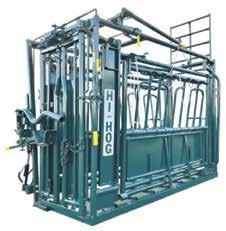
•Hi-Hog& TuffEquip.
•Farm/Auto Hardware
•Cattle watering systems

EquipmentRentalscv
•Grain Vac
•PostPounder
•BalePicker
•3500 PSIWasher
*Availableatall locations

•FuelTanks
•Water Tanks
•FuelPumps &Accessories
*Wecan orderany size needed foryourfarm







Sean Pratt
SaskToday.ca
India is likely going to increase its import duty on lentils, said an analyst.
Gaurav Jain, analyst with AgPulse Analytica, expects the Government of India to hike the existing 10 per cent duty to 30 per cent as of April 1, 2026.
The government has repeatedly told farmers that it will purchase up to 100
per cent of their 2026 lentils, pigeon peas and black matpe at its minimum support prices (MSP).
“If there is a need, they will buy all of it,” said Jain.
The government is already actively buying pigeon peas and black matpe and will soon be acquiring lentils.
The MSP for lentils equates to US$771 per tonne, while imported len-
tils are selling for about $600 per tonne after the 10 per cent duty.
That means the government would be losing about $171 per tonne if it purchased lentils from farmers at the MSP and then sold the crop at the prevailing market price.
That is why Jain and many other industry officials in India believe the government will increase the duty to 30 per cent af-

ter the existing 10 per cent duty expires on March 31.
That would increase the price of imported product to about $710 per tonne after additional expenses to clear customs and transport the product from port to inland markets.
That would still be below the MSP, but many Indian farmers would choose to sell to private traders because it is less hassle.
That would ease the burden on the government while raising prices for farmers.
Jain thinks a duty hike is inevitable.
“That is why you see a lot of shipments happening in January and early February,” he said.
Vessel lineups of ships destined for India have been strong since December in Canada and Australia as exporters try to take advantage of the 10 per cent duty while it is still in place.
He anticipates movement to slow down substantially in March.
Exports to Pakistan, Bangladesh and United Arab Emirates are also expected to subside in late February and March
because Ramadan demand from those markets has already been fed and they are entering the postRamadan lull.
AgPulse is forecasting 1.78 million tonnes of Indian lentil production as the crop approaches harvest. That would be up from the five-year average of 1.51 million tonnes.
Stat Publishing is more optimistic, forecasting 1.99 million tonnes of production.
Either way, it is expected to be a big crop, and that is pushing down lentil prices in the country.
Chuck Penner, analyst with LeftField Commodity Research, said with red lentil prices at multiyear lows, he too worries that the government will increase import tariffs beyond the existing 10 per cent.
He told farmers attending Saskatchewan Pulse Growers’ recent Swift Current Winter Pulse Meeting that anything above 30 per cent would not be good for export prospects.
The good news out of India is the country’s short pigeon pea crop, which is sending prices higher and
creating an opportunity for imported green lentils.
Green lentil prices had been significantly higher than pigeon pea prices in India since late 2023.
“Now that we have this thing flipped around, I think we’re going to open the door for more movement of green lentils,” he said.
Jain is forecasting India will import one million tonnes of all types of lentils in 2026-27, down from 1.25 million tonnes this crop year, 1.22 million tonnes the previous year and 1.68 million tonnes in 2023-24.
This year’s big crop, the anticipated increase in import duties and good carryover from previous years will all combine to limit imports.
Jain thinks Kazakhstan will grow more lentils in 2026-27, while Turkey’s production should rebound, which could also limit Canada’s exports in the coming year.
“If Canada has an average crop, it may find it difficult to market,” he said.
The Indian government had still not made a decision on lentil tariffs as of February 26.

Doug Falconer SaskToday.ca
The Wheat Growers Association is welcoming China’s final ruling to sharply lower the antidumping tariff on Canadian canola seed to 5.9 percent, plus the standard 9 percent import duty, alongside the suspension of 100 percent tariffs on canola meal effective March 1.
The decision marks a positive step forward for prairie canola farmers who have faced prolonged uncertainty in one of Canada’s key export markets.
“This is a positive development for prairie canola farmers and a welcome sign of improved market access,” said Daryl Fransoo, Chairman of the Wheat Growers Association. “For many growers, canola is a cornerstone of crop rotation alongside wheat and other grains. Restoring more predictable access to China provides needed relief on prices and cash flow at a critical time.”
While today’s an -
nouncement is encouraging, the Wheat Growers caution that past disruptions underscore the importance of long-term market stability.
“China has restricted or closed its canola market several times in the past, often tied to broader political tensions rather than technical trade issues,” Fransoo added. “These repeated interruptions are a clear reminder of why our relationship with the United States remains essential.”
The United States is Canada’s largest and most stable market for canola, offering tariff-free access under the United States-Mexico-Canada Agreement. With the 2026 review of the agreement approaching, the Wheat Growers emphasize the importance of protecting and strengthening that partnership.
“Our number one market is the U.S., and it provides our most reliable outlet,” said Fransoo. “As we approach the USMCA review, safeguarding agri-
culture within that agreement must be a national priority.”
Beyond trade relationships, the Wheat Growers are urging Canada to accelerate development of its domestic biofuels sector as a means of building resilience against global volatility.
“Canola oil is an exceptional feedstock for renewable diesel and biodiesel,” Fransoo said. “By expanding domestic processing capacity and strengthening biofuel mandates, Canada can create new demand at home, diversify our markets, and reduce our exposure to sudden export disruptions.”
The Wheat Growers stress that long-term security for farmers will come from diversification, strong continental partnerships, and strategic investment in value-added opportunities within Canada.
“This weekend’s decision is worth welcoming,” Fransoo concluded. “But real stability comes from
The Government of Saskatchewan proclaimed March as Agriculture Literacy Month, creating opportunities for students across the province to learn about the role agriculture plays in their daily lives. Throughout the month, Agriculture in the Classroom Saskatchewan coordinates classroom visits from volunteer presenters as part of Canadian Agriculture Literacy Month (CALM).
“Agriculture continues to be one of Saskatchewan’s greatest strengths, and helping young people understand the work that goes into producing the food they rely on is key to supporting the future of the sector,” said Agriculture Minister David Marit. “Hearing directly from producers and industry professionals, students gain valuable insight into the care, expertise and innovation behind Sas -
katchewan’s world-class agriculture industry.”
It is anticipated that around 7,500 students across the province will learn from 144 volunteers throughout the month. Those volunteering are passionate producers and industry professionals who are there to educate young students and spark interest in the agriculture industry leveraging the 2026 CALM theme:
“From Plows to Precision.”
“Exploring the evolution of agriculture helps students see how tradition and innovation work together to support our province,” said Education Minister Everett Hindley.
“By hearing from producers and industry experts, they gain real world insight into the skills and opportunities shaping one of Saskatchewan’s most important industries.”
Agriculture in the

Classroom is a well-established advocate for the industry in Saskatchewan. For the past 30 years they have played a key role in developing high-quality and engaging programming, inquiry-based educational resources and coordinating volunteer presenters from across the sector.
“From pitchfork to precision, agriculture in Canada reflects resilience, ingenuity and progress,” Agriculture in the Classroom Saskatchewan Executive Director Sara Shymko said. “As we celebrate Canadian Agriculture Literacy Month, we recognize the volunteers who bring real-world experience into schools and the teachers who partner with us to ensure students understand the vital role agriculture plays in their daily lives and in our country’s future.”


strengthening our U.S. relationship, diversifying our markets, and investing
in homegrown opportunities like biofuels. Canadian farmers stand ready
to collaborate with government and industry to secure that future.”






















Karen Briere
SaskToday.ca
Alex McPhee is convinced most people think of him as “the Val Marie map guy.”
He may not even have a name, he jokes.
But people do know his large-scale, detailed wall maps, which he does indeed produce in tiny Val Marie, Sask,. where he has lived for several years.
Pronghorn Maps is located in his house. There, he prints maps of all kinds — election maps, historical
farm maps, Hutterite colony maps, cemeteries, cities, the list goes on. But why set up in a small southwestern Saskatchewan town?
McPhee is originally from Alberta and wanted to live in a national park community.
“I realized that Banff and Jasper probably weren’t going to happen on a cartographer’s income,” he said during an interview at Canadian Western Agribition.
He visited Grasslands
National Park — Val Marie serves as its gateway — as a tourist. The prairie historian in him told him to stay.
“There’s really no better place to go out and see what the first homesteaders would have experienced,” he said.
“Once you go past the final fence line going into the park … I knew all this stuff intellectually but if you actually go into the middle of Grasslands and get out of sight of a road, you realize, like, good luck.”

Photo by Karen Briere/SaskToday

McPhee has rooted his own life in history. His university education is in geophysics. However, he worked as a grain elevator tour guide at the Ukrainian Cultural Heritage Village outside of Edmonton through school.
“I was a museum guy from the beginning, and I learned very fast that the homesteading era on the Prairies just uniquely captures people’s imagination,” he said.
“The world of branch lines and whistle stops has a stranglehold on the popular imagination, and people would start asking me hard questions.”
Those included where all the 5,000 grain elevators the Prairies once claimed actually were.
McPhee soon found himself immersed in railway history and old Saskatchewan Wheat Pool maps. He began formulating the idea to produce historic railway maps of Alberta and Saskatchewan. The huge maps include what many call ghost towns and numerous almost-forgotten community names.
After they were released, the “Val Marie map guy” became better known.
“Mostly I started working on this project because I was personally obsessed, but I tried to justify to my-
self the business case was that there is a lot of public interest in how the Prairies looked 100 years ago,” he said.
He has done local history projects, producing maps for books. He has worked with rural municipalities and museums that are amassing better information. The RM of Waverley, for example, commissioned a first homesteaders’ map that also included such places as schools, post offices and churches.
McPhee said he does a lot of community mapping, where he works with longtime locals to translate their knowledge into maps.
At Agribition he debuted a new type of map.
A neighbour asked if he could produce a historical map of his farm. McPhee knew where to obtain the names of the first homesteaders. He could find old rural postal directories to help fill gaps for those who rented land and people who purchased their land from the Hudson’s Bay Co. and the then-Canadian Pacific Railway.
As well, he knew where to get good aerial photos the federal government had taken.
“A lot of people might be familiar with air photos of their yard, but back in the day, different levels of
government would pay for systematic surveys, just going back and forth over the whole land mass of Saskatchewan,” said McPhee.
Those archival photographs, taken mostly in the 1950s, are only available to technicians like him, he said.
Concentrating so deeply on a single piece of property took him right through history. The roads weren’t straight. There were no dugouts and there was a yard on every quarter.
The prototype map he displayed at Agribition once had 31 buildings on it and none of them are left today.
McPhee hopes other families will want detailed looks at their properties.
“I’ve been doing historical mapping projects since I graduated five years ago, and for the last three years now I really have been freelancing full time,” he said. He has confidential contracts he is unable to talk about, but he is working with several RMs to produce historical maps such as the one he did with Waverley.
Public meetings are usually held to gather information and view historical documents that can help develop as accurate a map as possible.











Alexis Kienlen SaskToday.ca
Sheep markets in Saskatchewan and Alberta can’t keep up with the demand for lamb.
The sheep market is quite strong, said Gord Schroeder, executive director at the Saskatchewan Sheep Development Board.
“You know if you consider the freight and cost to get them to other markets in Ontario and stuff, our prices are good here. We have a limited supply available right now. The old crop is basically gone, and the new crop is not ready for market yet,” he said.
“Demand is good and prices have been good for producers. The cost of production is up, but producers are in a good place where they can make money now.”
Prices have been quite strong over the past couple of years, he said.
In 2025, the Canadian Food Inspection Agency reported high slaughter volumes for Western Canada and Ontario. The slaughter volumes were 11.9 per cent higher in 2025 compared to 2024.
Lamb prices started strong this year, an indication for a favourable spring season.
“Generally, Alberta lamb prices entered 2026 on a
high note. The average price of market lamb for slaughter in 2025 was 9.53 per cent higher than in 2024. Average prices for 2026 were 6.8 per cent higher than January 2025,” wrote a spokesperson for Alberta Agriculture and Irrigation.
“Spring is a key seasonal market for lamb due to an array of upcoming ethnic holidays where lamb is part of the preferred celebrative meal,” wrote the spokesperson.
Easter, Passover, Ramadan, Eid-al-Fitr and Eidul-Adha are all holidays where lamb is often served.
Schroeder said he hopes there will be enough lamb available for these holidays but can’t really say.
Canadian lamb consumption was an estimated 2.4 pounds per person in 2024 (retail yield), an increase of 16 per cent from 2023.
The level of consumption is still modest compared to some Middle Eastern, European and Asian regions, where lamb has been a diet staple for centuries.
Human population growth in Alberta and Saskatchewan has affected overall market demand in both provinces.
Alberta is not selfsufficient in lamb production, said the government
spokesperson.
“Consumption is on the rise, but Alberta consumers are reliant not only on domestic production, but on imports. In 2025, western Canadian federally inspected slaughter volume increased, but provincially inspected slaughter volume in Alberta remained relatively stable,” said the spokesperson.
Growing lamb production involves expanding the ewe breeding herd base, improving lambing rates and reducing death and predator losses.
Alberta did not export live sheep, but it periodically imports sheep from the United States. Some of the imported sheep and lamb meat go to the food service sector, and some finds its way into Alberta retail stores.
There are currently about 2,000 producers in Alberta and about 700 registered with the Saskatchewan Sheep Development Board in Saskatchewan. Alberta is the second largest sheep producer after Ontario.
Cache Valley disease
Last year, most of Canada lost large numbers of sheep to Cache Valley disease, which is carried by mosquitoes.
“If the animal is bit by a mosquito carrying the virus, then the animal could



abort or have lambs that don’t survive or malformed lambs,” said Schroeder.
The disease spread across Western Canada to Ontario but hasn’t yet appeared this year.
“This will help the supply chain because right now we are short of animals,” said Schroeder.
“It had an impact on the spring of 2025 because a lot of lambs didn’t survive that season. And since it was a short supply, everybody was scrambling for what was available. We
probably sold lambs that were lighter than normal, just to try and meet some demand. This spring we’re trying to catch up.”
Declining inventories
Prairie provinces are all experiencing declining inventories due to depleted soil moisture conditions, feed availability and pasture conditions.
However, eastern provinces reported a 2.4 per cent increase in total sheep inventory as of July 1, 2025, with Quebec gaining 2.2 per cent and Ontario in-
creasing by three per cent. Due to lack of supply, it’s hard to get lamb into large retailers.
“We’re seeing an uptake in what I call small retail outlets and farmgate, depending on province,” said Schroeder.
He said there has been an increase in predation pressures, especially from coyotes, because the pelts are no longer worth anything in Saskatchewan. As a result, there’s less trapping and snaring, and sheep are more at risk.





Steven Sukkau Local Journalism Initiative Reporter
Excessive regulation is threatening the future of the agriculture sector, with nearly seven in 10 agri-businesses across Canada advising the next generation not to take over or start a business because of red tape, according to the Canadian Federation of Independent Businesses.
A new snapshot from
CFIB says heavy regulatory demands are discouraging entrepreneurship, undermining competitiveness and slowing innovation in agriculture.
The CFIB says nearly nine in 10 agri-businesses surveyed said they worry about their future in the industry because of regulatory pressure, while 90 per cent said red tape is cutting productivity and limiting growth.
“Excessive red tape is
putting the future of agriculture and our food supply at risk,” said CFIB economist Laure-Anna Bomal. “If farmers and producers walk away because of overwhelming regulations, who will grow our food? From municipal building permits to provincial environmental regulations, and lengthy federal survey requirements, these top irritants are draining time and resources from the



very businesses that keep Canada fed.”
CFIB estimates Canadian businesses face about $51.5 billion in compliance costs each year, with nearly $18 billion classified as red tape. Agri-businesses are among the most heavily regulated industries in the country, and CFIB says the burden is especially hard on small and family-run operations common across rural Manitoba.
The findings come as CFIB’s annual Red Tape Report Card ranked governments on regulatory accountability, regulatory burden and political priority. Manitoba received the only failing grade in the country.
Alberta, Ontario and Nova Scotia received “A” grades, while Brit -
ish Columbia and Quebec earned “B-plus” grades and Saskatchewan received a “B.” The federal government was graded “C-plus,” Prince Edward Island and New Brunswick received “C” and “C-minus,” and Newfoundland and Labrador was not graded.
CFIB said regulatory accountability, which accounts for 40 per cent of the overall grade, has improved nationally, while regulatory burden, also weighted at 40 per cent, remains difficult to measure and continues to pose challenges for agriculturebased economies. Political priority, which makes up the remaining 20 per cent of the score, shows few governments clearly treat red tape reduction as a core policy goal.
To ease pressure on

farmers and agri-businesses, CFIB is urging municipal, provincial and federal governments to measure and publicly report regulatory burden, reduce the total number of regulations through a “two-for-one” rule, simplify existing rules and guidance, and create permanent channels for producers to suggest red tape reductions.
CFIB is also calling for more flexible compliance systems and clearer examples of what constitutes compliance and non-compliance.
“Reducing the regulatory burden and red tape has been the top priority of agri-businesses for years,” said Juliette Nicolaÿ, CFIB’s bilingual policy analyst. “With rising costs, global uncertainty and trade pressures, this is now a matter of survival for the industry. Governments must act now to protect agriculture and food production.”
CFIB warned that without meaningful action, regulatory strain on agri-businesses could ripple through the food supply chain, contributing to higher food prices and long-term risks to domestic food production.
































Miranda Leybourne Glacier FarmMedia
Soil moisture is one of the key building blocks of a successful crop — but it can be hard to tell what’s going on deep in the ground.
A national network of soil moisture monitoring stations is giving farmers and researchers a clearer view of underground conditions, helping them manage risk in dry years and make more informed decisions about crops, fertilizer and water use.
The Real-Time In-Situ Monitoring for Agriculture (RISMA) network uses field-based sensors installed across agricultural regions to track soil moisture from the surface down to one metre, with readings taken every 15 minutes. The data is used to support drought monitoring, satellite calibration and longer-term research into crop growth and greenhouse gas emissions.
The RISMA network was developed in collaboration with the Canadian Space Agency, NASA and the European Space Agency to help calibrate satellite-based soil moisture readings for Canadian agricultural landscapes.
Stations are located across a range of soil types, from sandy to heavy clay, to capture how moisture behaves under different conditions.
Partner farmers who host stations have access to the data and can use it alongside weather forecasts and field observations.
“There’s a lot of the precipitation data that ends up being used … for some of the surface things, like seeding decisions on timing,” said Kayla Moore, a federal research scientist who works at the Brandon Research and Development Centre.
On the farm
Warren McCutcheon, who farms near Carman, hosts two RISMA stations on his operation. While the data hasn’t replaced day-to-day decision-making, it has added valuable context, particularly during prolonged
dry periods.
“The soil moisture is kind of a neat tool to see where we’re at throughout the season,” he said.
Watching how moisture moves through the soil profile has helped him better understand how long crops can stay viable during dry stretches, McCutcheon added.
“It’s really interesting to monitor,” he said. “It kind of gives us an idea of how long the crop can hold on without moisture, without precipitation, and it’s very different on different soil.”
During mid-summer dry spells, surface layers can be completely depleted, while deeper zones still hold usable moisture.
“In the middle of July, we were looking at these weather stations and seeing that the top 10 cm or 20 cm was tapped out … but the 30 to 50 cm range was still basically at water holding capacity,” McCutcheon said.
That information has reinforced crop rotation choices, particularly planting corn after edible beans, which rely more on surface moisture and leave deeper reserves intact.
“We’ve always kind of known it’s there, but
now you can actually see it on the station and see that growing corn after edible beans is a great move because the ground is full of moisture,” McCutcheon said.
Fertilizer and climate research
The data is also being used to support research into fertilizer efficiency, greenhouse gas emissions and irrigation planning, Moore said.
“Soil moisture is a major contributor or controlling factor in how those fluxes occur,” she said.
“So we’re looking at what difference there is between carbon sequestration based on soil moisture, as well as support with nitrogen, fertilizer, things like that.”
While the network now has nearly 14 years of data, Moore said it is only beginning to reach the point where longterm trends can be identified.
For McCutcheon, the biggest value of RISMA is as a risk management tool. It’s one more piece of information to consider in an increasingly unpredictable climate.
“It’s just another tool in the toolbox,” he said. “It’s just something that’s good to see.”
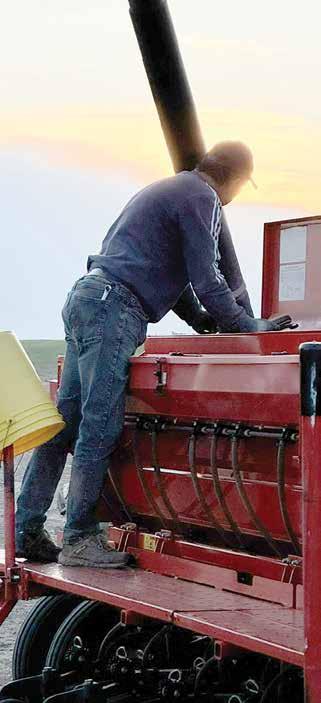













Technology has revolutionized global agriculture. Automation has changed the agricultural sector, and those changes might have arrived in the nick of time.
The global population is projected to reach nearly 10 billion by 2050, and the Food and Agriculture Organization of the United Nations estimates that food production has to increase by at least 70 percent to keep up with demand. In order to address the deficit without exhausting the Earth’s finite resources, many farmers are seeking help from artificial intelligence (AI). AI offers farmers additional perks as well.
Precision agriculture
Precision is a notable benefit of utilizing AI within the agricultural sector. By using AI-powered


sensors and satellite imagery, farmers can monitor crop health by looking at each and every plant instead of inspecting by the acre. According to a report by MarketsandMarkets, a revenue impact and marketing consulting firm, the market for AI in agriculture is expected to grow from $1.7 billion (the figure in 2023) to $4.7 billion by 2028.
Precision helps to keep plants strong and weedfree. AI-driven “see-andspray” technology utilizes computers to identify weeds among crops and apply herbicides only to those weeds. This reduces blanket-spraying an entire field, which is a waste of resources. Research published in the Journal of Agriculture and Food Chemistry indicates that

this AI-guided tool can reduce herbicide use by up to 90 percent. This reduces costs to farmers and benefits local ecosystems.
Risk management
Weather across the planet has featured an uptick in volatile, unanticipated conditions. This can make planting even more challenging for farmers. AI models can process decades of historical weather data, soil conditions and atmospheric changes to offer predictive analytics that help the agriculture industry. By using predictive AI tools, farmers can determine optimal planting windows to maximize yield, according to the International Food Policy Research Institute. In addition, AI algorithms can predict outbreaks of pests and diseases before farmers notice them on their own. Multispectral imagery from drones can detect crop stress caused by nutritional deficiencies or fungus days before a human might recognize such indicators. By catching things early, farmers can reduce risk of a poor crop and financial losses. Automation Agricultural labor shortages are forcing farming operations to seek alternatives to get the job done. The American Farm Bureau Federation notes that farm labor has become more expensive and it’s harder to find workers who want to do the arduous tasks often required of them. AI-driven robotics and autonomous tractors guided by GPS can help fill the void. These devices can work through the night, preparing soil, harvesting crops and performing other vital tasks.

AI continues to be integrated into the agricultural sector. In order to maintain food security and mitigate labor shortages, farming operations are using technological tools to
Ryan Young SaskToday.ca
Details of the 2026 Crop Insurance Program were announced from the Saskatchewan Crop Insurance Corporation (SCIC) head office on February 23.
Crop insurance is a federal-provincialproducer cost shared program “that helps producers manage production quantity and quality losses”, states a news release from the provincial government. Government support of the program is provided through the Sustainable Canadian Agricultural Partnership (Sustainable CAP).
One of the main enhancements to the program for this growing season is the inclusion of the Satellite Forage Insurance Program.
The program will allow producers to get coverage by township, as opposed to the program its replacing - the Forage Rainfall Insurance Program - which provided coverage by the nearest weather station, which in some cases could be more than 30 kilometres away and may not accurately represent rainfall or soil moisture levels.
Provincial Agriculture Minister David Marit said the Satellite Forage Program started out as a pilot project last year.
“Hopefully, we’ll see a good uptake on that through the program and through the ranchers here in the province.” Marit said.
Over 85 per cent of seeded acres in the province were insured last year.
Asked if they expect one region to file the majority of claims than others, Marit is hopeful for a good season for all.
“I don’t know if we ever really anticipated coming from one specific area. We’re hopeful. We’re always hopeful that we don’t have any claims,” he said. “We’re still hopeful that we’ll still see some good spring moisture come yet. Obviously, in anticipation, you would probably assume that that would be the area of concern. It always is. We’re hopeful that this year, the folks out there can pull off a crop.”
Marit said crop insurance information will be distributed to producers across the province by mail.
President and CEO of Sask. Crop Insurance Jeff Morrow said as of mid2025, there were approxi -

mately $675 million in claims and $1.2 billion in premiums. Morrow stated those are mid-year numbers and the final total for the previous year are still being finalized.
Asked if premiums have gone up for this year, Morrow said it depends on the individual producer.
“The coverage is based on the producer’s own yield history that they’ve proven to grow on their farm. Then the premium, there’s a couple of components to it, what’s happened in the area that they farm, but also their individual claim history impacts the premium cost. It is very individualized, and it will change depending on where they grow and what their history has been like in the program.” Morrow said.
The deadline to apply, reinstate, or cancel coverage is March 31, 2026. Producers need to choose crops to insure and coverage levels by that date.
The new insured prices and information can be found at scic.ca.
SARM and APAS react
The Presidents of the Saskatchewan Association of Rural Municipalities (SARM) and Agricultural Producers Association of
It is common knowledge that most of the pre-sorted sales in Weyburn are usually full. We generally have a waiting list!
Why are we full and others always have room?
Could it be we are getting more money for the cattle?
Could it be we sort more evenly and accurately than anyone else? Could it be the fact that we are well organized and both buyer and seller benefit?
Could it be that our regular following of major order buyers are here at every sale?
Could it be that our management team has more experience than anyone else? (4 million head and counting!!)
Could it be that we feed and water the cattle in big spacious pens immediately after weighing? (They arrive at their destinations in far better health.)
To book your cattle at the Weyburn Livestock Exchange call well in advance, we recommend 2 weeks in advance!
Phone 306-842-4574
Website www.weyburnlivestock.com
April 8
a.m. (Internet)
Cull Cows & Bulls Sale 9 a.m. Followed by Bred Cows & Hfrs. 11 a.m.
April 13 Presorted All Breed Calf & Yearling Sale 11 a.m. (Internet)
April 22 Regular Cull Cows & Bulls Sale 9 a.m
April 27 Presorted All Breed Calf & Yearling Sale 11 a.m (Internet)
Saskatchewan (APAS) were present for the announcement.
Bill Huber with SARM and Bill Prybylski with APAS are both grateful for the continued funding by the federal and provincial governments and for the stability crop insurance provides in challenging times. However, both noted there is still room for improvement.
“As producers, we can all be somewhat critical sometimes if coverage
isn’t high enough, but we have to remember that we can’t farm and survive on insurance. That’s not our initiative. So even though we’d like some premiums to go down and coverage to go up a little bit, we have to be realistic,” said Huber. “So we’d always like to see better improvements, but we’re sure fortunate to see what we have in a program that’s maintained and obviously working well for producers.”

“Obviously, as Bill (Huber) mentioned, we’d always like to see lower premiums and higher coverage. But for the most part, I think producers are quite satisfied with the coverage that they have, for the price that they have, they’re seeing the value for the money that they’re investing. So it’s nice to see the stability in the program and I look forward to continuing to work with the government to make improvements going forward.” said Prybylski.
Kevin Hursh felt it was underwhelming overall.
“Not really much there for a news conference because the Satellite Livestock Insurance Program for forages had already been announced and people knew it was coming. And they really didn’t spend a lot of time talking about price levels for the various crops under insurance for 2026. But that’s really what producers will look at coming out of this announcement. And they’re now posted on the Sask Crop Insurance website. And I would venture to say that the crop insurance prices will, if they don’t change seeding intentions, they will certainly reinforce seeding intentions.” Hursh said.







Water scarcity is a global concern. Water scarcity may be common even in countries with adequate water resources, and it has the potential to impact various industries, including the agricultural sector.
Despite water covering 70 percent of the Earth’s surface, only about 3 percent of it is freshwater, advises the World Wildlife Fund. Of this 3 percent, less than 1 percent of that water is accessible for human use.
Pressures like pollution and over-extraction
are depleting the world’s water resources faster than it can be replenished.
It’s important to note that climate change can intensify scarcity of water. When temperatures rise across the planet, drought becomes more frequent and severe.
Coupled with unpredictable rainfall patterns that can make water management challenging, climate change has a very real hold on the availability of water resources.
Agriculture accounts
for 72 percent of global water withdrawals, and is a large contributor to water scarcity.
Learning how farming operations can conserve water more readily can make a difference in the availability of water. Foodwise reports that farmers can use drip irrigation to save up to 80 percent more water than conventional irrigation.
Capturing and storing water is another way that farmers can manage water usage without relying exclusively on municipal water or wells.
We specializeinmetal roofing, wall cladding, and relatedbuildingproducts forresidential, agricultural and commercialapplications.All of ourproducts are designedfor useinthe harshest Canadian weather.



Metal panels starting at $125 sq.ft.


Sean Pratt SaskToday.ca
The weak Canadian dollar will support Canada’s agricultural exports in 2026, says a farm lender.
Desmond Sobool, deputy chief economist with Farm Credit Canada, expects the loonie to continue trading in the US$0.72 to $0.74 range in 2026.
The weak dollar is tied to Canada’s poor gross domestic product, faltering labour market and high household debt.
“When we’re looking at diversifying our trade away from the U.S., this actually opens up opportunities,” Sobool said during a webinar hosted by the Canadian Agri-Food Policy Institute and RealAgriculture.
It should help provide a boost to what is otherwise a pretty grim 2026 outlook for the grains and oilseeds sector.
“If you’re in crops, it’s going to be a very tight year margin-wise,” he said.
Farm expenses are likely to remain high, while commodity prices continue to languish.
The U.S. dollar is also weakening due to trade deficits, immigration policy and tariffs. Uncertainty is causing investors to move away from the U.S. dollar.
Canada’s efforts to diversify away from the U.S. market appear to be paying dividends.
Agriculture and food sales to the U.S. were down three per cent through the first 11 months of 2025, while sales to the rest of the world were up 25 per cent.
“Our products are finding those alternative markets,” said Sobool.
The bad news is the overall Canadian economy is sluggish.
Gross domestic product grew by 1.7 per cent in 2025, down from two per cent each of the previous two years.
FCC’s forecast for 2026 is one per cent growth,
which is dismal.
“The economy is slowing,” he said.
Last year was one of the worst years for job creation in over a decade as tariffs and trade disruption weigh on the economy.
FCC is hoping for a rebound in 2027 as trade diversification efforts start to materialize and investments in railways and ports boost the economy.
The lender is forecasting that the Bank of Canada will cut its policy rate in the second half of 2026 to help stimulate the economy.
“If you have debt, it’s going to become more affordable,” said Sobool.
At least that will be the case for variable rate debt.
Five-year fixed rates are likely to remain unchanged because the bond market is building in a risk premium due to the uncertain economic environment.
In general, there is plenty of uncertainty and pessimism in the 2026 Canadian economic outlook.

However, Sobool thinks things will calm down once the Canada-United States-Mexico Agreement (CUSMA) review is complete in July. If Canada comes out of that review “unscathed,” then there should be more economic certainty heading into the second half of 2026.
In the meantime, Sobool encouraged producers to focus on finding efficiencies and cost-savings in their operations. He also encouraged the federal government to invest more heavily in eastwest trade corridors to help get products to tidewater and continue with efforts to diversify trade.