THe
BAROMETER SEPTEMBER - OCTOBER 2026
HAlF TERm 1
Contents Welcome back from the Head
Rex - Alexander M, Year 10
Year 7 Short Stories - Aarush
How to Play Chess - Sebastian
T, Daniel P, Chimadika N,
M G, Year 13
Elias K, Paulo M S, Wynn B,
Boy - Jay J, Year 13
Yosef K, Arlo B, Year 7 The Aftermath, a short story by
Borneo’s Peatlands: A Carbon Time Bomb in the Heart of
Owen M, Year 9
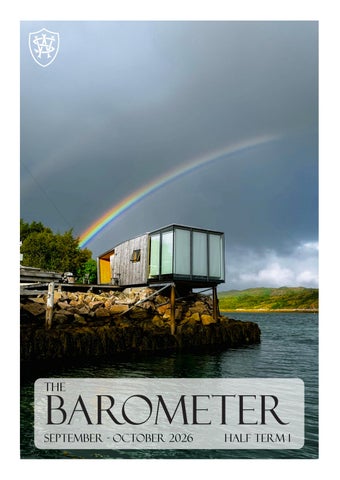
Cover photograph - Albert C, Year 11
Indonesia’s Palm Oil Frontier Ethan G, Year 12 Dangling Above Nothingness: Trekking Europe’s Largest Glacier - Emerson L B, Year 8 My World Cup Prediction Henry Cr, Year 9 My Summer Holiday - Josh L
Write for the Barometer
Contributing to the Barometer is a great way to earn gold notes, improve your writing, and it looks great on your CV
E, Year 9 Beyond the Bell Launches with a Glimpse into the Future of Tech - Breck R, Year 12 Strange Energy - Jack A, Year 11 Year 7 Isle of Wight Residential - Aarush T, Year 7 Building the Perfect Society Dylan S, Year 11 Procrastination - Sebastian H-H, Year 13Tyrannosaurus
To submit articles or cover photos, join the Barometer club at Friday lunchtimes (B11) Or, you can email Mrs Bradley at nicola.bradley @wetherbysenior.co.uk Read the latest issue at https://issuu.com/wetherbysenior
WELCOME BACK FROM THE HEAD BOY Jay J, Year 13 writes... A very warm welcome back to you all! I hope you all enjoyed a restful holiday and have returned ready to make the most of the year ahead. A particularly warm welcome goes to our new pupils and families. We look forward to helping you settle in and become part of the Wetherby community. It is a pleasure to introduce this year’s senior prefect team with both Tommy and Antonio supporting as Deputy Head Boys, and Niran as Head of Mentoring. Leading our tribs are Ihsan for Fleet, Theo for Tyburn, Giorgio for Wallbrook, Sammy for Ravensbourne, and Graydon for Effra. Together with the wider prefect team, we are excited to take on our responsibilities and contribute to school life. Being a prefect isn’t just about the role title but it means setting an example through the way we treat others and the way we respond
when someone needs support. From helping at school events to being an approachable face around the corridoors, we want younger pupils to feel comfortable coming to us with questions, suggestions or concerns. We as a team also encourage everyone to get involved, as I had mentioned in my first assembly of this academic year, whether that’s through Trib competitions, mentoring or the many other opportunities available at school. If there was one message that I could keep saying to younger years about school life it would be to keep getting involved in everything because there will soon come a day when you look back and will re-think and regret not taking part in that competition, or volunteering for that role. The opening weeks have already brought several opportunities to put this into practice. The Year 7 and Year 9 information evenings offered a chance to welcome families and support the
important start of their transition year groups at Wetherby. Peer mentor training helped us to support younger pupils by providing key advice to the newly appointed peer mentor team that we as a year group learnt from our peer mentoring last year. The Sixth Form Taster Day was an opportunity to share a pupil’s perspective on the next stage of school, while the Prep Head’s Conference provided another occasion to represent Wetherby and meet new members of our community. Thank you to the staff and pupils whose time and effort made these events possible. As the year continues, our aim is to be a team you can rely on. We want to build on the example of previous prefects while bringing our own ideas and enthusiasm to the role. Above all, we hope everyone feels able to play a part in school life.
Borneo’s Peatlands: A Carbon Time Bomb in the Heart of Indonesia’s Palm Oil Frontier Ethan G, Year 12 writes... For the past three weeks, I have had the rare opportunity to explore Indonesia—one of the most culturally rich and ecologically diverse nations on Earth. My journey took me deep into the rainforest landscapes of Central Kalimantan, the Indonesian sector of Borneo, where the tension between economic development and environmental protection is visible in every cleared field, every drainage canal, and every fragment of remaining forest. Palm Oil’s Dominance in Kalimantan Kalimantan is one of the world’s most intensive palm oil production regions. Across its provinces, 17.5–18.2 million metric tons of palm oil were produced in 2023 alone, according to Statistics Indonesia. If Kalimantan were an independent nation, its output would make it the second largest palm oil
producer in the world, surpassing the combined production of Thailand, Colombia, and Nigeria. This scale is driven by Indonesia’s status as a rapidly emerging economy. Palm oil offers a powerful route to income generation because global demand is enormous—its derivatives appear in everything from pharmaceuticals to fuels to everyday consumer goods like Nutella. But behind this economic success lies a profound environmental cost. Why Peatlands Matter To understand the sustainability crisis, we must first understand peatland—a scarce, carbon dense type of wetland. Peat forms in anaerobic environments, where dead organic matter accumulates faster than it decomposes. Because microbes cannot break down material without oxygen, carbon becomes locked underground for millennia. Despite covering only 3% of
the Earth’s surface, peatlands store twice as much carbon as all the world’s forests combined. Indonesia alone contains 34% of the world’s peat reserves, making it one of the most critical carbon sinks on the planet. When peatlands are drained, cleared, or burned, this carbon is released in catastrophic quantities. Investigations in Central Kalimantan Indonesian environmental NGOs Kaoem Telapak and Pantau Gambut recently examined several palm oil concessions in Central Kalimantan. Their findings highlight a pattern of peatland disturbance within areas that should be protected under Indonesian law. In one concession, 2,753 hectares of land were identified as protected peatland. Field inspections in 2024 documented extensive drainage canal networks, which lower the water table and dry the peat. Once dried, peat loses its natural fire resistance and becomes highly flammable, releasing vast stores of carbon when fires occur. These fires contribute significantly to regional haze events and global greenhouse gas emissions. The Enforcement Gap Indonesia’s environmental laws are robust on paper, but enforcement remains inconsistent. The national sustainable palm oil scheme, ISPO, has struggled to regulate peatland clearance or ensure compliance among concession holders. Economists often describe this dynamic using the Kuznets
Curve, which illustrates how environmental degradation increases during early economic growth before eventually declining as nations strengthen governance and prioritise sustainability. Indonesia appears to be at the peak of this curve—caught between the drive for economic expansion and the urgent need to protect its ecosystems. A Critical Turning Point My time in Borneo made one thing clear: Indonesia is standing at a crossroads. The decisions made today—by policymakers, companies, and international buyers—will determine whether Kalimantan’s peatlands remain one of the world’s most vital carbon stores or become one of its greatest sources of emissions. Protecting peatland is not simply an environmental issue; it is a global climate imperative.
DANGLING ABOVE NOTHINGNESS: TREKKING EUROPE’S LARGES GLACIER unluckily I did not see it and fell into it! Fortunately, I was double roped to my dad and Ewan so I would not fall any further down the endless crevasse and get stuck. After dangling above nothingness for a couple of minutes, I managed to scramble out and got back to my feet -crampons helped a lotand continued hiking towards Konkordia Hut, a high-altitude mountain refuge, which was where we would be staying for the
Emerson L B, Year 8 writes... The alarm was set early, before the crack of dawn. The cuckoo clocks had not even started cuckooing but we were up and ready for a long, long day of walking. My dad and I sneaked into the breakfast buffet pretending to be part of a group that was already there. After having breakfast, we headed to the train station to catch our three trains to go to Jungfraujoch (a.k.a. the “Top of Europe”). We met Ewan, our guide, next to a café called Pikantus Lounge located at 3,454 m, and after getting roped up together we headed onto the Aletsch glacier and began our adventure. Over the next two days, we would hike nearly 22 miles across ice, mountains and valleys. The snow was like a blanket enveloping the landscape in a cold wintery hug and everywhere we looked was covered in white and blue. We trudged down to the beginning of the glacier and encountered our first obstacle: a deep crevasse that we had to cross. Luckily it was not that wide but
night. As we got closer to Konkordia Hut we saw a river on the glacier blocking our path and walked along it until it suddenly disappeared into a large hole in the ice. It was then we learned that crevasses can stretch to over 100m in depth, much deeper than the length of rope tying us together! Incredibly, at its deepest, the glacier is 800 metres deep! After passing the freezing river, we had a climb to reach Konkordia Hut. When the mountain hut was first built on the cliff back in 1877, it sat just 50 metres above the glacier’s surface. Since then, the
glacier has been thinning by over a metre every year, causing the ice level to drop drastically. Today, the hut is stranded roughly 200 metres above the ice – all because of climate change. Because the glacier keeps shrinking away from the cliff face, caretakers must constantly add new sections to a giant steel staircase just so hikers can climb up and reach the hut. 500 stairs and a very frightening climb later, as the clock struck 3pm we were at the Konkordia Hut and could rest and prepare for the next day. The hut’s facilities were, surprisingly, amazing - the toilets were clean and the rooms basic but had all we needed for a night’s stay. After having a nap my dad and I went down to the cafeteria for dinner with the other hikers. Dinner was Fleischkäse – which translates as “meat cheese”, although it doesn’t contain cheese! Meat loaf is probably the closest and given we were starving it was delicious. As I looked around, I realised that I was the youngest person in the refuge by decades! However, I did not feel out of place as I had been on dozens of climbs with my dad before. After finishing dinner, we headed to bed and prepared for an even earlier start the next morning. Day 2 started early. Very early. It didn’t feel right – our alarm startled us at 4am and in the early morning darkness we stumbled down for breakfast in the cafeteria with our guide. After wolfing down some traditional Swiss breakfast: homemade cheese with flat round almost stale-like bread and some porridge (supplies are really limited in mountain huts!), we began to go down to the base of the glacier but to mix things up instead of using the stairs from
more peaceful than avoiding 100m deep crevasses. During the walk we had to go through a large tunnel that led us through a mountain that would have taken us a couple of hours to climb over. After going through the tunnel there was just a short walk to get to the cable car. Once we reached the cable car we rode it down to Fiesch and said goodbye to Ewan at the bottom and headed off to our hotel for some much-needed rest. On the train journey back to the airport, my dad and I reflected on our time on the glacier, and it dawned on me that in my lifetime, it might not even be there anymore. It was another epic adventure with my dad an extreme, exciting trip to the Aletsch Glacier that I will cherish forever.
yesterday, we zigzagged down a path that hugged the cliff face to where the ice met the base of the mountain. Once on the ice we began our trek to the valley - to greenery. The surface of the glacier was like a labyrinth with crevasses as the walls. We had to walk around dozens of crevasses to get to the valley but after a couple of hours we finally made it off the glacier and began the second part of the trek that day, walking through a lush valley towards a cable car that took us down to where we would be staying for the night. This part of the trek was much
MY WORLD CUP PREDICTION Morrocco who along with Norway and maybe Switzerland were the real underdogs of the tournament. Lastly, I tried to predict the best player of the World Cup and I said Mbappe who was definitely a contender because he ended the
Henry C, Year 9 writes... In April I made some World Cup predictions for who I thought would be the best player, best team and who I thought would be the biggest underdog of the World Cup so I’ll see if they were accurate and who was really the best in this category . The first category was best team, and I said France which was all right as they finished 4th and lost to England 6-4 in the third-place match so that Was quite good. My other prediction for best team was Spain and that was perfectly accurate because they ended up winning, so Spain was the best team I could have picked, and I did pick them which is good. The next category was tournament underdogs first I said turkey which was the worst team I could have picked because they lost in the group stages and they only had one win which was a 3-2 victory over the USA. The second team i picked was Canada and i think this pick was alright because they ended up getting to the round of 16 but ended up losing 3-0 to
torment with 10 goals and 4 assists in 8 games and won the golden boot which than award for the top goalscorer. My second pick was Harry Kane which was also a great pick because he scored 6 goals and 1 assist and was England second best player of the campaign.
MY SUMMER HOLIDAY fish in the pond But it was actually very fun and safe because there were no fish or any wild animals that would be strong enough to hurt me. Hong Kong (China)
Joshua L E, Year 9 writes... Chengdu (China) First, I went to Chengdu a city in China and the capital of the Sichuan province I went there to see my family and relatives this includes my grandparents my uncles and aunties and my cousins I ate lots of good food went to different places such as historical monuments, live performances, and restaurants It was enjoyable to see all my family relatives and friends living in China Long Quan (directly translating to dragon mountain) I went to the Long Quan mountain in China To see even more of my relatives living in the houses in a mountain After the very long car journey I spent a week in the house with my grandparents’ cousins I absolutely loved it as I really
found it fun to play in the woods by myself and hurtled small rocks in ponds with a net which sounds very lonely sad and painful for the
I went to Hong Kong for all the touristy things because I don’t have family there, so it was fun to try the food there Aswell as buying figures and merchandise of fiction.
BEYOND THE BELL LAUNCHES WITH A GLIMPSE INTO THE FUTURE OF TECH Breck R, Year 12 writes... The Beyond the Bell Lecture Series got off to a strong start on Tuesday 22, when Year 12 students from Wetherby Senior and Queen’s College London gathered to hear from tech entrepreneur and author Jo Wimble-Groves. Jo, co-owner of the telecoms company Active Digital, shared her career trajectory and her advice on making your way in the business world. Her journey began at just sixteen, when she left sixth form college to run a business with her brother. Since then, the company has grown into
a multimillion-pound business, becoming one of the leading partners of Virgin Media O2 across the UK and Ireland and one of only nine Apple partners in the country. She is also the author of Rise of the Girl. The lecture then turned to the future. Jo offered her insights into where technology is heading, and students were invited to ask about the possibilities of tech and AI and how they will shape the world around us. The questions explored how quickly the technology is developing and what it could mean for the careers of the very students asking them.
A central theme was the impact of AI on work. It is easy to assume that automation will simply take jobs, but the discussion showed a more balanced picture. AI and new technology will remove some roles, but they will also create new ones and bring real utility to everyday life. Overall, the talk was a fascinating look into the future of AI and tech. It answered many of the questions I went in with about jobs being both lost and created, and it left me thinking about how to prepare for a world that is changing so quickly.
STRANGE ENERGY Jack A, Year 11 writes... Clean electricity is in plentiful quantities nowadays with many countries making the shift from fossil fuels to cleaner sources like wind, solar power and hydro power. However fossil fuel usage and energy demand across the globe is still a major issue with many countries looking to solve that issue with more conventional coal and fossil fuel usage. Despite in many cases, being more effective than energy from oil and fossil fuels clean energy is still seen as a luxury by many counties. To promote this shift into clean energy and alternative energy sources is vital to tackling climate change and the way to achieve this shift is clear, to improve or create clean energy sources more efficient, effective, versatile and cheaper to install than current ones so countries can no longer ignore clean energy. With demand for electricity increasing globally it is not surprising that many scientists have made some significant breakthroughs in producing clean energy from many unlikely sources in the last decade. Below is a list of a few exiting new developments in the field which, at least in theory, could make a big difference to the power output of many countries Magnetic field of Earth Scientists have found that it’s possible to generate electric power from Earth’s rotation by using the earth’s magnetic field. using a magnetic tube resting in a stationary position scientists were able to record a small amount of
electricity, the electricity their experiments generated was far too small to be useful however scaled up this source of electricity could have some promise if made more efficient. Energy from DNA Organic molecules can convert solar energy into electricity. In 2021, German scientists managed to synthesise a supermolecule (a more complex than a regular molecule) system based on DNA. The basis of the system is a fullerene; a ball made of 60 carbon atoms. A dye is attached to it, which absorbs sunlight and gives the resulting energy to the fullerene. However, here’s the challenge: if these supramolecules are not in an ordered pattern, the current between them will not flow. Scientists have proposed a solution: they used supramolecules based on fullerenes and a dye to a DNA helix. This way, the electron movements become ordered, and the electric current did not die out. According to researchers (although solar panels made of DNA will not appear on our roofs anytime soon) work is actively going on in this direction. Based on their estimates, the technology could be cheaper, stronger, and more durable than silicon-based solar panels. Fusion power Fusion energy remains one of the most well-known and enticing potential sources of clean energy,
offering potentially unlimited power via the same thermonuclear prosses as the sun. In order for thermonuclear fusion to work atoms have to be heated to temperatures at which atoms are stripped of their electrons in order to make a plasma where nuclei and electrons move around freely at very fast speeds (due to the high temperature increasing the kinetic energy of the particles) due to this speed nuclei and electrons are able to merge and fuse forming heavier nuclei and releasing energy in the prosses as these nuclei repel each other (due to being positively charged) it is this energy which scientists plan to harness however there are a few major issue, how do you replicate the gravity and heat of a sun to keep the plasma hot enough and not spill everywhere ? The prospect of clean energy with no great negative drawbacks sounds amazing and although a few successful fusion attempts have been made by using magnetic fields to hold the plasma and by firing Lazers at fuels for a long time we were not able to gain more energy from the plasma than we put into making it happen however recently Researchers at the Lawrence Livermore National Laboratory in California used powerful lasers to trigger a fusion reaction. And got more energy output from the fusion than they used to trigger the fusion with Lazers however developments still need to be made and are being made into this field to make It a more viable source of energy.
YEAR 7 ISLE OF WIGHT RESIDENTIAL Jacob’s Ladder, where we had to climb an enormous ladder. I only managed six steps because the gaps became so huge that, even standing up, my head couldn’t reach the next one!
Aarush T, Year 7 writes... The new Year 7 class visited the Isle of Wight on Wednesday 16th September 2026 for three days and two nights. I was really excited about the trip, but on the way there I was also curious, imagining what our house and rooms would be like. My first impression was our house because we had a large three-storey house, while lots of the other schools were staying in wooden cabins. Sadly, we weren’t allowed to go onto the third floor. To me, it was like the threeheaded dog in Harry Potter was up there guarding something! The coach journey was really fun. My friend and I listened to music for almost the whole journey, and then at the ferry terminal we had our packed lunches. When we arrived, we were split between four rooms. On the first evening, we were divided into three groups and I was in Group 2. Our first activity was Survivor, where we had to build a shelter that we could survive in. After that we did
We also played Ambush, which was basically a giant game of hideand-seek. At first it sounded easy because we could hide anywhere around PGL, but the difficult part was that all 16 people in our group had to hide together. Over the next two days we did loads more activities, including the giant swing, archery, rock
climbing, trapeze and my personal favourite: axe throwing. I loved axe throwing because it felt so satisfying when I managed to throw the axe properly. It eventually turned into a competition and I came second. I think I might have come first if the teacher hadn’t joined in! Rock climbing was probably one of the hardest activities. There was barely anything to hold onto and I spent ages stuck on the rocks trying to reach the top. Just when I thought I might make it, I slipped
at the last second and smashed back into the climbing wall. I couldn’t believe how some people managed to get all the way to the top. The giant swing was another experience I won’t forget. When it dropped, I genuinely felt like I was about to pass out because we were falling from such a huge height. The trapeze was terrifying too because I had to jump from high up onto a bar. Although the activities were brilliant, one of the best things about the residential was getting to know everyone better. We had so much time to talk on the coach and during the trip, and I became much closer to one of my friends,
who I would now call my best friend. I think going away together helped us all get to know each other better at the start of Year 7. When it was finally time to leave, I felt sad that the trip was over, but I was also really happy to see my parents again! My advice to next year’s Year 7 would be to have as much fun as possible, but don’t spend the whole trip only talking to the friends you already know. Talk to people you don’t normally speak to because a residential is a great chance to make new friends. I hope I get to return someday, but for there was only one thing left to say: “Goodbye PGL and hello parents!”
BUILDING THE PERFECT SOCIETY Dylan S, Year 11 writes... Imagine you have been given the chance to create your own country. It is 500 BC. You have land, people and resources, but nothing else has been decided. You must create the rules, decide how the economy will work and choose how your country will deal with other societies. There is only one problem: what would a perfect society actually look like? A society is more than just a group of people living in the same place. It is the rules, relationships, institutions and shared ideas that allow people to live together. So, if we were starting from scratch, where would we begin? What should a perfect society provide? At the most basic level, everyone needs food, water, shelter and safety. But a successful society needs more than survival. It needs to provide opportunities, produce enough to support its population and use its limited resources carefully. This creates our first major problem. How should a society deal with limited resources? There is only so much land, food, money and energy available. If one person takes more, there may be less available for someone else. One approach would be to distribute resources as equally
as possible. This is connected to communist ideas, particularly those associated with Karl Marx, who criticised societies where wealth and power become concentrated among a small group.
The chain can become: Family wealth → opportunities → education → employment → income → wealth for the next generation.
But this creates another difficult issue.
Willy Russell’s Blood Brothers explores this idea through two brothers who grow up in very different circumstances. Their different backgrounds affect the opportunities available to them and the paths their lives take. So equality might not simply mean giving everyone exactly the same thing. It could mean making sure people have a genuinely fair chance to succeed.
Should people who produce more get more?
But perhaps we could design an even more fundamental system.
If someone works extremely hard and produces twice as much as someone else, should they receive twice as much? If everyone receives exactly the same reward, would people still have the same incentive to work, invent and take risks?
Do we even need money?
Another approach is capitalism, where individuals can own property, start businesses and keep the rewards from what they produce. The argument is that this encourages people to work, invest and innovate.
Yet large differences in wealth can create another problem: wealth can buy opportunities. How can we make opportunity genuinely fair? Imagine two children. Both are legally allowed to apply for the same job when they grow up. On paper, they have the same opportunity. But one child grows up in a wealthy family. Their parents can afford better education, books, tutors and other opportunities. The other child has far fewer resources.
In our new country, we could try to organise society without money. People could receive what they need rather than buying everything. But who decides what people need? Who decides how much food should be produced? What happens when there is not enough? Money provides a way of exchanging goods and rewarding production, but it can also create large differences in wealth. The real challenge is deciding whether our economic system creates enough prosperity without allowing those differences to become unfair. And our country would not exist in isolation. How should our society deal with
other countries? We would have neighbours with their own interests, resources and ambitions. We could trade with them, form alliances or prepare to defend ourselves. But what if another country has resources that we need? Does a successful society need to expand? Throughout history, powerful societies have expanded their territory. More land can mean more resources and greater political power. But expansion can also mean war, destruction and the loss of freedom for the people being conquered.
Perhaps, then, success should not be measured by how much land a country controls. Perhaps it should be measured by how well the people within it live. Every system involves compromises. Greater equality may require limits on how much wealth people can accumulate. Greater economic freedom may create greater differences in wealth. Protecting the country may require spending resources on defence instead of other priorities. These are not just problems for a fictional country in 500 BC. They are questions that governments still have to answer today. They shape political arguments, influence elections and help us understand why different leaders have made such different choices
throughout history. In conclusion, there is no single answer to what makes a perfect society. Every system has advantages and disadvantages, and every choice creates new problems to solve. A society must decide how it will share resources, reward people, create opportunities and deal with other countries. While no one will ever agree on exactly what a “perfect society” looks like, thinking about these questions helps us understand the choices societies make today. So, if you were given a country in 500 BC, what would you build? What would your ideal society look like?
PROCRASTINATION
Sebastian H-H, Year 13 writes... Have you ever had that one task and thought, “I’ll do it later”? But let me tell you a secret “Later” here usually means never. This is actually a very common mechanism when you have to do a task but can’t start. This is also known as procrastination, and everyone puts these tasks off at one time or another. Whether it’s a piece of homework, going to the gym or even as basic as doing a quick chore. It goes much deeper than simple laziness. The main reason behind why we procrastinate is because of low motivation. You may as well ask, how does motivation have to do with procrastination. Well, motivation is caused by 4 main factors arranged in a formula; Expectancy multiplied by value divide by your impulsiveness multiplied by delay. Firstly, your expectancy refers to how confident you are in your own ability to succeed at something. If this is low, you are more likely to be unmotivated and more likely to procrastinate against it. This is pushed further if the task is too hard. For example, a student is doing an English essay for homework but will avoid it as they don’t think they will do well. The second factor is value. This refers to how rewarding or meaningful the task feels. If the task doesn’t have a benefit or a reward for completing it, you are
more likely to put it off further. This ties into how boring the task is. An example of this is a person who can’t be bothered to take out the trash. The third value is Impulsiveness which refers to how easily one gets distracted. This is probably the biggest factor affecting procrastination. You have a real probability of starting revision but get distracted by your phone because it is really easy to start doomscrolling or anything except the work. For instance, you will easily get sidetracked by a new video you want to watch. This is choosing short term pleasure into long term regret. Finally, there is delay, this is how far away the deadline is, the further away the more likely to put it off. For example, you may avoid a piece of homework as the deadline is due late next week. With all these factors contributing to motivation. So here are a small handful of solutions to counter procrastination. These work on myself but can work for anyone. The way I often do it is called “just 5 minutes”. This is if the task lasts less than or equal to 5 minutes, you can do it then and there.
This can be done with any simple household chore. Based on the concept, you can also use it to do 5 minutes of something you don’t want to do. Then you get to decide after those 5 minutes whether you wish to continue or stop. More than 95% of the time you will think “this is not that bad” or “this is easier than I thought” and will have the momemtum to continue. Even in the rare case you decide to stop then, at least you have done something rather than nothing at all. Sometimes, the hardest bit of a task is starting it. This can be done with revision too, for example I will do 3 questions then you can decide to stay with.. If you are working on a big project or revising for gsces or a levels, you can adopt the well-known pomodoro technique. Work for 25-30 minutes before taking a 5-minute break 4 times. The important thing here is not to use your phone during these short breaks. Go for a short walk or eat a biscuit. If using your phone is an absolute necessity, then set a very precise stopping time (eg 11:23 instead of 11:25) then turn it off in another room.
TYRANNOSAURUS REX While the carcharadontosaurids attacked with many slashing bites, Tyrannosaurus had a bite force so strong it could break the bones of its prey in one attack.
Alexander M, Year 10 writes...
as Parasaurolophus.
Easily the most recognisable and well-known dinosaur in the world, Tyrannosaurus is made famous due to its many appearances in media, for example its appearances in all the Jurassic Park films. Science writer Riley Black even described Tyrannosaurus as the “ultimate dinosaur”. But the T. Rex is the overall favourite for a reason, and this article will help explain why.
In the time of the late Cretaceous, the world was split in dominant predators. Tyrannosaurids such as Tyrannosaurus, the Canadian Albertosaurus, and the Chinese Tarbosaurus and Quianzhousaurus, the latter often dubbed the “Pinocchio Rex” due to its particularly long snout, all have been found in the Northern Hemisphere. The Southern Hemisphere was ruled by the carcharadontosaurids, including the fearsome Giganotosaurus.
Tyrannosaurus lived in the Late Cretaceous period, around 70 million years ago. Its fossils have been found across the USA and Canada, with the first specimens of T. Rex fossils found in Colorado in 1874. Its name means ‘tyrant lizard king’, due to it being the apex predator of its time. Tyrannosaurus would have fed on a variety of other dinosaurs, including ceratopsians such as Triceratops and hadrosaurids such
Tyrannosaurus could have hunted in many ways. Some say that it hunted in packs, similar to the smaller Albertosaurus. However, others argue that Tyrannosaurus hunted with stealth. This could also be true because of how palaeontologists believe it was able to run. Tyrannosaurus could reach around 25mph with its strong legs. However, it’s most likely that Tyrannosaurus didn’t run and chase for extended periods of time, because if the animal lost its balance or fell in some way, it could be lethal. This means that this dinosaur most likely had to creep up on its prey in some way, before making a final, speedy lunge when it was close enough.
In the end, this article proves why T. Rex is so popular in T. Rex wasn’t quite as big as media, due to its immense size, Giganotosaurus, but it had a early discoveries, and fearsome much stronger bite, and bite character. Anyone reading force was the main difference this article will already have between the two predator groups. prior knowledge of T. Rex, and Carcharadontosaurids had evolved hopefully you now understand from Jurassic era dinosaurs such why. as Allosaurus, and they kept their sharp, stabbing teeth. However, the tyrannosaurids evolved their jaws in a different way.
HOW TO PLAY CHESS Sebastian M G, Year 13 writes... The board and pieces
completing its L-shaped journey is free, then it can land on that square.
The chess board has 64 squares with half being dark and half being white. The squares on the board are labelled from A-H horizontally and 1-8 vertically. The black pieces have their pieces set up on 7 and 8 while the white pieces have theirs set up at 1 and 2. There are 32 total pieces but only 6 difference pieces. These pieces are called the knight, king, queen, rook, bishop and the pawn.
The movement of the bishop The bishop is only on one colour for the whole game. The chess board has a checkered pattern which forms diagonals of a single colour. This is the bishop’s sole method of transportation. The bishop can only move on the diagonals of a single colour so due to this it cannot switch the colour it is on, if the bishop begins the game on a white coloured square it will remain on that colour for the whole game. Just like the rook the bishop cannot jump over pieces.
The movement of the rook The rook is a more powerful piece than the knight as it can move horizontally and vertically, but only one at a time. However, the rook cannot jump over enemy or own pieces like the knight can, if the rook’s path on one side is blocked by a piece, then the rook cannot go beyond that piece for that turn. The movement of the knight The knight moves in an L-shape, from its starting square the knight moves one square forward or backwards then two squares perpendicular to its first direction of motion. The same applies if the knight begins with two squares forwards or backwards as it then has to go one square perpendicular to its original direction of motion. The knight is the only piece that can jump over enemy pieces. If the square the knight will end up at the end of its turn after
The movement of the queen The queen is a combination of the rook and the bishop. This makes the queen the most powerful piece on the board. If placed in the centre of the board the queen could control almost have the squares on the whole board.
behind the pawn then the pawn can capture this enemy piece and travel to the square that piece was on.
knight, bishop, rook, or queen on the square of the promotion. This is called promotion in chess, and it counts as one move.
Special rule for pawns
Movement of the king and how to win the game
Since pawns cannot move backwards, they could eventually reach the other side of the board. A special rule exists for this, when a pawn reaches the end of the board the pawn can transition to a
The movement of the pawn The pawn can only move one square forwards at a time but if the pawn has never moved that game, then the pawn can move two squares forwards. Pawns cannot jump over pieces and if there is a piece in the square the pawn wants to move to then the pawn cannot move to that square. All pieces can move backwards except for the pawns which cannot move backwards, only forwards. Pawns are the only piece which don’t have the same movement pattern for only moving and capturing of enemy pieces. If an enemy piece is on the same diagonal of a pawn, only 1 square in front and not
The king is the most valuable piece as if you lose it, you lose the game. The king can move one square in every direction but not simultaneously. When the king is attacked by an enemy piece one of three things must happen next. Firstly, the attack from the enemy piece onto the king must be intercepted or blocked by one of the king’s own pieces, this means the piece physically standing in the way of the enemy piece and the king. This is not possible for a knight as the knight can jump over pieces. Secondly to get out of an attack the king could move out of it. Thirdly the piece which is attacking the king could be captured. If none of these are possible then this is called checkmate and the game is over. If the king is being attacked but can do one of the three things to get out the attack then it is not a checkmate but only a check.
THE AFTERMATH A short story by Owen M, Year 9 It was the year 2385 central London, in the future cars don’t fly overhead and robots don’t do our jobs for us. We destroyed our world all of it, people live in domes hundreds of them stretch for miles not concocted by road or thing just domes. Our air is polluted by carbon and fumes, taking a step outside means death without a suit. The surface tempter is over 100 degrees day and night. London is made up of 3 states, steam punks, the rich and the farmers. I live in the steam punk state the biggest state of London. With over 100,000 people so a good chunk of the remaining population. My job is a delivery driver though the states even though I’m 14 I’m stuck riding old dirtbikes form the 2000s century. Today I’m going from steam punk state to the rich state I’ve been doing this job since I was 10 so I’m quite confident with the route. I’m not allowed to know what I travel with sometimes its big sometimes small but no matter I must get there and back, even if your bike dies or if you run out of fuel you must make it there. Older men have trucks that work well off-road compared to my bike slower but can carry more, they don’t like the bikes like me they think we should grow up and drive a real engine. I think there full of it. Theres always one man though in his late 50s probably 30 but he looks 50 who gives us fuel halfway. when we are out in the land, we must wear masks because of the smoke and constantly be driving or else we and our bikes overheat.
The rain burns hot in outside because of the heat, but we are all fitted with gas mask and cooling systems that help with the 3-hour journey. Hour 1 Ive been driving for around an hour haven’t seen much maybe a few rats but besides that quite empty, old highways are the best to find because there so much smoother compared to the dirt, mud and rocks. Hour 2 I found a highway in the end, but I saw a few bandits along the way their cars are to slow compared to hour bikes but still worried I might run out before the fill up point. Hour 3 They removed the halfway point for some reason, but I made it I don’t have enough fuel to get back so ill have to stay in the motel. As I lie in my bed thinking about the journey back, I hear a knock on my door. “hello” the person says. I get up reluctantly and walk to the door “hi can I help you” I said trying not to show how angry I am that they made me get up. “I was just wondering if you could deliver this package” his posh voice made me sick “sir you will have to do that though our website”. he looked at me with a snarl “that is not how you speak to me boy”, I step back and apologise and take his package and I say ”ok sit that will be £600” he gives me that package and wires the money to me.” “I’ll be on my way then” he leaves before I can thank him, not that I meant it anyway but still. The next day I get up and walk my
bike to the fuel station because we are not allowed to run cheap bikes in such a posh place and I can’t be bothered to get in trouble. I fill up my bike for the price of £134 a bargain now adays, and then I see it the guards, coopted men for one thing and one thing only to belittle people like me. So, I finish up filling my tank and walk out. Because I could get hurt. Hour 1 I’m on my way back and I have made it to the highway now that I know where it is. I have a full tank, and I can’t see any bandits. Hour 2 Just passed the bandits they where all asleep so I’m fine for now. The highway is just coming to a end and the rest of the path is just dirt. Hour 3 Ive been riding in the dirt for a hour now and I can see the steam punk dome coming up. I should have enough fuel to get back. I reach the dome and head back to my house looming at the package that man gave me as I lie down looking at the address I see that its my address…
Year 7 Short Stories: THE Titonomachy
Aarush T, Year 7 writes... At the start, there was chaos. The Titans ruled the Earth after the mighty Uranus had been murdered by his youngest son Cronus. Cronus had loved being the ruler but there was just one problem, Cronus had always feared that one of his very own kids would take the thrown of them and the Titans would be long, lost and forgotten, so in order for that not to happen, Cronus swallowed each of his newborn children. Rhea his wife felt bad for her children, so she hid baby Zeus in a cave on an island called Crete. She waited for Zeus to become a fully grown God then went to war with Cronus. Zeus punched Cronus’s
stomach so hard that all five of his brothers and sisters came out of his stomach all fully grown gods. After 10 years, Zeus felt like no one could win so Zeus freed a hundred handed giants who crafted the Olympians weapons as a thank you. Zeus got a lightning bolt, Hades got an invisibility helm and Poseidon got a trident. With the weapons, the Olympians managed to beat the Titans and became the new gods of the Earth. The three brothers decided to split the world into sections. Zeus took the heavens, Poseidon took the seas and Hades took the underworld. Daniel P, Year 7 writes...
Long before the Olympians ruled the world it belonged to the mighty titans. There was a prophecy which always scared Cronus. The prophecy was that his own children (the Olympians) would overthrow him. But Cronus had a wife called Hermera she saved on of her children from being swallowed whole by Cronus . And when Zeus was grown up he gave Cronus a potion and made him throw up the Olympians now fully grown gods . And then Titanomochy began and endless war began between the mountains cracked all you could here was bangs it was chaos. Then the Olympians set free the cyclops that the Titans trapped then the cyclops rewarded the olympias with strong weapons .Then with the weapons the olympians were unstobabble and won and the olypians sent the titans to the underworld where you could here the cries for help. Chimadika N, Year 7 writes... Long ago in the desolate depths of the underworld, lived Kronusa cruel and heartless Titan who ruled in complete fear of his own children (Poseidon, Hades and Zeus) eventually overthrowing him. This fear caused Kronus to devour each one of his children mercilessly. As an act of pure pity, he decided to spare Zeus as he was the weakest son which is a decision he would later regret. Enraged, Zeus spent years planning revenge on his father. Zeus later forced a disgusting and unclean drink down Kronus’ huge throat, making him throw up uncontrollably for 5 whole
minutes, causing his two now fully grown sons to be let fee after all these years. Still not satisfied, Zeus and his brothers declared war on their father. The war began...
Who knows what Kronus could be planning?
Zeus used his thunderbolts to smash the ground causing thousands of mountains to crack in an instant. Kronus swung back by using his razor-sharp claws to scratch through hades’ helm of invincibility with ease. Poseidon commanded the sea and his creatures to assist him in battle as Kronus’ fellow titans gave traumatizing glares to get into their enemies’ heads.
The stars in the sky shone in the black emptiness as the millions of titans bowed down to King Cronus. He was an evil mastermind who made sure that he was most powerful and no one could challenge him. However, secretly inside he lived in fear knowing that there was a prophecy that his own child would overthrow him. Since he was king of the world, he had to make sure it stayed like that. To make sure of this he ate all his children; Hestia, Demeter, Hera, Hades and Poseidon. For years they were to lay in the gaping emptiness of his stomach. As all of this happened his wife Rhea couldn’t stand it.
Ten disastrous years later, Zeus’ team named the Olympians had won. Kronus was banished into the Underworld as Poseidon let out shouts of victory. Hades took control of the Underworld, Zeus created Mount Olympus as a place for him to live happily and Posideon created the 5 oceans of the world. Everyone was full of joy but... Kronus escaped the Underworld filled with absolute anger for Zeus and his brothers.
Elias K, Year 7 writes...
Rhea couldn’t let Cronus eat another baby, so she stood her ground and made sure went as far as she could from him, when she stopped, she hid baby Zeus in a cave on Crete. As Zeus slowly
aged into a man, he was ready to free his siblings and defeat the evil Titans. As all the siblings reunited, the earth knew the time was right for them to fight Boom! Crack! Crash! The earth rumbled while the giant mountains cracked. The Titanomachy had begun. Who would win. As they went into battle, no matter what the titans threw; the Olympians would never give up. As the battle went on for months non-stop the Olympians came on top. Now that Zeus was ruling, he wanted the Titans to suffer the consequences. He sentenced them into Tarturas a pit of endless darkness and Atlas was condemned to carry the sky on his shoulders for eternity. Now that the titans were gone it was now time for the era of the Olympians. Paulo M S, Year 7 writes... It all began, long ago, when the MIGHTY, RUTHLESS Titans ruled. Their king Cronus living a cold-blooded life there all
begins. In the mist Cronus all by himself spontaneously screamed until his throat burst open “HELL RIESE FROM THE DEAD”, silence grew loud. With a sinister smile Cronus chuckled. Out of nowhere hideous vile disorientated monsters rose while on the other hand Zeus was getting his tactics ready. The moment you have all been wating for...
sprawled in a corner of his palace rethinking life. Every day he would wake up flooding his palace with his terrified screams all because of a deep dark truth that one day his very own kids would overthrow him. Cronus being his greedy self-did what he thought was right. To stop this, Cronus swallowed his newborns whole. Every time he ate a child would gag, nearly vomiting them back out. He was proud of what he did. He didn’t even care about the fact he ate newborn innocent babies. But little did he know that Rhea (his wife) was playing his cruel game. Thinking outside the box Rhea hid one baby in a cave not knowing that one day the baby Zues would save her life. While on the other hand Cronus thought he was the safest person alive. Life was so good for Cronus but a little too good that life had to hit him hard in the face. Life crumbled before he realised. Love was no longer a word only hatred built more every day in Zeus’s eyes craving for revenge. Every second Cronus’s prophecy began to assemble. When Cronus realises then life will all feel like needles piercing though his heart of fear. Time started slowing down every day like as if something big
was going to end or even begin. THEN IT HAPPENED CRASH! BANG! HELP! NOOO! AHH! Clouds came dashing from every direction blocking all light .... then in the nothingness of the fog shined a blinding light. Cronus knew that this was the end of his chapter, but he wasn’t going to die without a fierce fight. Zeus the god with leadership humbleness tactics love compaction but once in a fight dead bloody thirsty god devastated to get what he came for but most of all able to consume all energy turning you into ash. Cronus the god who is cocky strong powerful terrifying starting worlds with peace just to destroy them in a blink. Asid run through his veins razor sharp teeth can cutting your hand clean off. Lazer eyes but most of all his intimidation that lets him control your mind. GOD WHO RULES VILONCE OR THE GOD WHO RULE TACTICS WHO WILL WIN? Two divine gods only one survives. Suddenly an epic battle
ATTAKKKK!!!! Zeus confidently alarmed with his deep voice. Down back at earth life fell without Zeus. Everyone woken up by treacherous screams of death, but they knew Zeus was doing it for them. Cronus gouged their enemies’ eyes out to whoever came in his way. Zeus not wanting to hurt anyone just pushed them aside. Zeus knew that if he used his most powerful secret, he would wipe out the entire worlds. This battle went on for decades until there was only left on top of all the dead corpses were Zeus and Cronus. Cronus tried to get in Zeus’s head with his beady eyes but didn’t work. BANG! Cronus mortally injured on a dead rotten body. As delicate as paper Cronus said his last words “love you son had great fun seeing you last say to your mum I’m sorry for everything but most of all to you I ‘m sorry I dissevered to suffer in hell for the rest of my life “Cronus died in Zeus’s trembling weak arms. Zeus dropped to his knees and for the first time in his life he cried out storms hugging his dad and not letting him go. “I....I..I forgive you “he said with the words nearly not coming out of his mouth. Moral all you need to do is talk and say sorry without causing any violence.
Olympians were getting badly beaten. Cronus and the other Titans fought with strength and hits powerful enough to smash mountains. The Olympians fought with desperation and hate with very little hope. 10 years went on as the war kept going. The war went on as the battle fields were evenly matched. The chaos continued until the world was engulfed in the plage the war had become.
Wynn B, Year 7 writes... In the beginning the world was ruled by titans. Cronus, a titan, was the son of Uranus, god of the stary nights. Cronus was married to another titan named Rae. Rae and Cronus had three children, Zeus, Poseiden and Hades. Cronus lived in fear from a prophecy that his kids would one day overthrow him. He believed this prophecy because when he was young, Cronus and his siblings overthrough and slayed their own father. Cronus lived in fear of this and eventually decided to send him children away to avoid his fate. He came up with a plan to send them far away to a distant land. There he hoped they would be eaten by other hungry Titans. He believed these hungry titans to be hungry enough to eat a mountain. Rae knew that Cronos was going to send their children away. She
made a plan to save Zeus. She was able to save Zeus by giving Cronus a rock covered in cloth, pretending that it was Zeus. From this point she raised Zeus in secret. Zeus grew up with a rage for his father because of what he did. When Zeus got older he confronted the titans that ate his siblings and slayed them. The siblings were reunited and together they became known as the Olympians. They made a plan to confront their father, Cronos. Eventually they found their father. Chronos chuckled at the sight of them but inside he was afraid when they arrived. He was disappointed in himself for being afraid of his children. He knew the prophecy was coming true. With a load roar, Cronos leapt out at his children and a great war began. The world was thrown into chaos. In the beginning of the war, the
Together the Olympians freed a cyclase, who was a skilled blacksmith. The cyclase made three weapons. He made thunderbolts and lightening for Zeus, a trident for Poseiden and a helmet of invisibility for Hades. With these weapons, the battlefields finally turned to the favor of the Olympians. Eventually Hades snuck through the battlefields causing mayhem. Poseidon killed with his trident, and eventually Zeus struck Chronos with a thunderbolt to end the war. After the war the world was then split into three to honor the Olympians. The oceans went to Poseidon. The underworld went to Hades and the heavens to Zeus. Yosef K, Year 7 writes... In the beginning way before the Olympians ruled were the mighty Titans who ruled over the world. Kronos their king had cruelly stolen power from his father Uranus and now he was the titan’s king. He married the beautiful Rhea, and she gave birth to Hestia, Demeter, Hades and Poseidon. But Cronos was afraid of a dark prophecy, that one day his
children would defeat him and claim the throne. So he swallowed each child whole one by one until they disappeared into the darkness of his cavernous stomach. Rhea saved her youngest son Zeus and cleverly gave Cronos a stone wrapped in a cloth to eat. Now that Cronos was sure he had eaten all of his children he could rule over the land in peace, but Zeus grew up in secret and away from all the other Titans. When Zeus was grown up and came back only to trick his cruel and evil father into drinking a magic potion making him think it will make him powerful. Then with a terrible groan Cronus vomited up all his own children who were now fully grown gods. Zeus and his siblings revolted against their father and the evil Titans. Then the Titanomachy began a huge devasting war between the gods and the Titans. Chaos as armies grew and fought the beastly Titans who wouldn’t stop. They were huge, vast and terrifying striking with the force of earthquakes making earth tremble while the Olympians fought with courage and hope. Zeus freed the Cyclops, skilled smiths who created weapons: for Zeus, a lightning bolt, for Poseidon, a trident and for Hades a helm of invisibility. Now the war changed, Zeus split the sky with lightning and Poseidon crushed the earth and sea and Hades struck fear into the enemy. The Olympians were victorious and they then divided the world, Zeus the skies, Poseidon the seas and hades the underworld.
Zeus cast all the Titans into Tartarus, a pit of endless darkness, never to be seen again. Arlo B, Year 7 writes... Long ago, there were two sets of rulers: the Titans and the Olympians. The Titans had ruled for a long time, so were old and weak, but they were very wise and had lots of power. On the other hand, there were the Olympians. They wanted to be the new rulers, but they didn’t have a lot of experience, though they were young and very agile. The Titans were powerful. They had the power of earthquakes and the skies, and had monsters the size of mountains hurling rocks, while the Olympians had courage and had demigods on their side like Hercules. Skipping back to before everything began, Zeus, an Olympian, stole power from his father Cronus, a Titan. Then the fury rose. Zeus was selfish and wanted to kill his father. Then he was so greedy that he chained his seven children and sank them to the bottom of the pitless ocean. For five years they sat there, until the war began. The Titans were huge and terrifying. The ground shook beneath them, while the Olympians were small but feisty. They fought with courage, bravery and hope. Both sides fought for years. Little did they know that,
beneath the endless body of water, Zeus’s children were now grown up and powerful. They planned revenge and broke free of their chains. Up they swam at the speed of light. A beam exploded down from the sky through the middle of the battlefield. Seven figures rose up like angels, light beaming through them. Seven gods, seven powers: lightning, water, air, thunder, the sea, earth and mountains. There were now three sides to the battle: the Titans, the Olympians and the new gods. But Zeus didn’t realise that these were his children, nor did anyone realise the immense power they had. They moved through the battlefield like shadows. Then they got to Zeus. They seized him, but while ripping him apart, two arrows shot them in the back. They all turned around and there was Cronus. They charged, tackling him to the ground like a swarm of mosquitoes racing for blood. Down he went, into the ocean where the new gods once were. Then they looked for Zeus, who was now running up a mountain. They teleported in front of him and banished him to the deep waters. Everyone now bowed before them, and that was the end of the war and the start of a new beginning.
E T I R W S U R O F Do you have something you’d like to write about? Is there a passion or interest you’d like to share with others? Is there a cause you would like to draw attention to? Would you like to report on school events? Are you a great photographer or artist?
Send your articles (and images to go with them) to nicola.bradley@wetherbysenior.co.uk, or ask to be added to the team on Teams where you can submit it directly. A submission deadline will be set each half term, so get writing so your article can be included!