November 2026 | Vol.21 No.1
PP 100007391
COVER TO COME
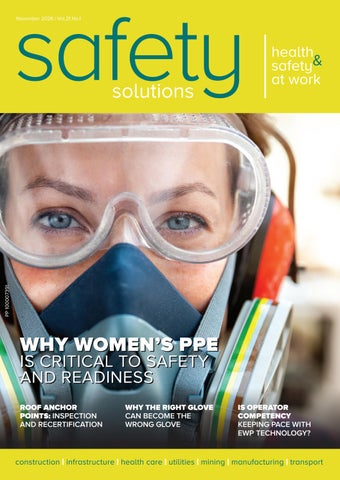
WHY WOMEN’S PPE IS CRITICAL TO SAFETY AND READINESS ROOF ANCHOR POINTS: INSPECTION AND RECERTIFICATION
WHY THE RIGHT GLOVE CAN BECOME THE WRONG GLOVE
IS OPERATOR COMPETENCY KEEPING PACE WITH EWP TECHNOLOGY?
The Sun Doesn’t Know You’re At Work.
SAFETY SOLUTIONS NOVEMBER 2026
FROM THE EDITOR XXXXXXXXXXX
CONTENTS 4 15
Roof anchor points: getting inspection and recertification right The day after certification: why the right glove can become the wrong glove
20
Is operator competency keeping pace with EWP technology?
24
Why women’s PPE is critical to workplace safety and readiness
26
2026 | Vol.21
No.1
PP 10000 7391
November
WHY W
IS CRIT OMEN’S PP E AND REICAL TO SAFETY ADINESS
ROOF ANC HOR POINTS : INSPECT AND REC ION ERTIFICATIO N
WHY THE CAN BEC RIGHT GLOVE OME THE WRONG GLOVE
IS OPERAT COMPET OR ENCY KEEPING EWP TEC PACE WITH HNOLOG Y?
This time in Safety Solutions, we have a height and PPE focus. On the height front, starting us off is Jaime Gunton, Director of Height Safety Central, running us through roof anchor points and how to get inspection and recertification right. Also with his sights on heights is EWPA
The air receiver registration duty most sites don't know they have
National Training Manager Nicolas Chiew, posing
28
Beyond the survey — what psychosocial risk management is becoming
outlining why EWP competency is not a one-
30
Top 4 tips to improve occupational exoskeletons
the question of whether operator competency is keeping pace with EWP technology and off achievement. Turning their expertise to PPE, we have Damione Wright, Managing Director APAC at Mechanix Wear, talking gloves and why safety leaders need to manage retained protection from issue to retirement; as well as Barb Newby, Manager, QHSE & Auditing Services at Avetta, who, on the topic of women’s PPE, explains that too many women in Australia are still issued equipment designed on a male default, resulting in poor fit, reduced protection and avoidable risk. Also in this issue, we hear about one of the quieter compliance gaps in Australian industry: air receivers, as Byron Raal, founder of Compressed Air Solutions, outlines what the duty is and a two-line check you can run this week. We also have an opinion piece from organisational culture researcher, consultant and founder and Director of Mind Culture Life Australia Dr Anna Kiaos, on what psychosocial risk management is becoming — timely with the October closure of the free government-backed workplace as-
Cover image iStock.com/GKV. Stock image used is for illustrative purposes only.
November 2026 | Vol.21 No.1
FREE SUBSCRIPTION! PP 100007391
For free registration of the Safety Solutions magazine, visit:
WHY WOMEN’S PPE IS CRITICAL TO SAFETY AND READINESS ROOF ANCHOR POINTS: INSPECTION AND RECERTIFICATION
WHY THE RIGHT GLOVE CAN BECOME THE WRONG GLOVE
IS OPERATOR COMPETENCY KEEPING PACE WITH EWP TECHNOLOGY?
www.safetysolutions.net.au/subscribe
sessment platform that around 5000 Australian organisations have used since 2020. Plus, much more, including some interesting recent case studies and product innovations. Happy reading. Dr Joseph Brennan, PhD Editor, Safety Solutions ss@wfmedia.com.au
www.safetysolutions.net.au
XXXXXXXXXXX
ROOF ANCHOR POINTS:
GETTING INSPECTION AND RECERTIFICATION RIGHT 4 SAFETY SOLUTIONS - NOVEMBER 2026
www.safetysolutions.net.au
HEIGHT
Falls from a height killed 24 Australian workers in 2024, making falls the second largest contributor to workplace deaths at 13% of all worker fatalities. Behind those deaths sit around 7800 serious workers compensation claims for falls from a height in a single year.1 The numbers have barely moved in a decade, and they explain why the roof anchor point deserves far more attention than it usually gets. Taking a deep dive into the topic, JAIME GUNTON — Director of Height Safety Central — covers revised standards, annual inspections, the problems that slip past a visual check, and some practical steps for workers to take before clipping on — together with those a building’s owner should take to bring a neglected system back into compliance.
A
iStock.com/rattanavan Baunoi. Stock image used is for illustrative purposes only.
www.safetysolutions.net.au
n anchor point is the one component of a fall protection system that cannot be swapped out on the morning of the job. Harnesses and lanyards travel with the worker and are inspected as personal equipment. The anchor stays on the roof through summers, hailstorms and coastal winters, and it is only as good as its last inspection. Yet on real buildings, anchors are routinely installed, signed off and then forgotten. Ask anyone who inspects roofs for a living: it is common to walk onto a roof where the anchors are years overdue for recertification, or where nobody can produce a record showing the system was ever certified at all. The duty here is not ambiguous. Under the model WHS Regulations, a person conducting a business or undertaking must manage the risk of falls and must maintain the equipment provided to control that risk so it remains effective. Safe Work Australia’s code of practice on managing the risk of falls makes the same point in plain terms: a fall arrest system is only a control measure while every component of it, anchorage included, > remains in serviceable condition.2
NOVEMBER 2026 - SAFETY SOLUTIONS 5
HEIGHT
Two revised standards have just raised the bar
In late 2025, Standards Australia published new editions of both documents that govern this space. AS/NZS 1891.4:2025, now titled ‘Personal equipment for work at height, Part 4: Selection, use and maintenance’, replaces the 2009 edition that most inspection regimes were built on.3 AS 5532:2025 replaces the 2013 manufacturing standard for single-point anchor devices.4 Two changes matter most for building owners and facility managers. First, the inspection clock is now firmly annual. The old edition allowed a manufacturer to specify extended intervals between formal inspections of installed fall arrest devices, in some cases up to five years. That provision is gone. Installed systems now sit on a 12-month formal inspection cycle carried out by a competent person, and any system still riding on a longer manufacturer-approved interval needs to be brought back to an annual baseline. The six-monthly inspection regime for harnesses, lanyards and other personal equipment has not changed.3 Second, anchor ratings are now more precise. AS 5532:2025 formalises four rating levels, 12, 15, 18 and 21 kN, in place of the single baseline of the 2013 edition, and it explicitly addresses two-person anchors, which must achieve 21 kN and pass two drop tests on the same device. Proof load procedures have been tightened as well, with load applied in increments and anchor displacement measured both during and after the test.4 Anchors certified under the 2013 edition do not need to be pulled out, but at their next scheduled test they should be assessed against the current procedures, and any new installation should be specified against the new rating framework.
iStock.com/batuhan toker. Stock image used is for illustrative purposes only.
The documentation a worker should see before clipping on
Before anyone connects to an anchor, four things should be available and current.
1 2 3 4
Identification
Each anchor should carry a durable label or tag with a unique identifier and its rating, matching the system layout plan.
Installation certification
A record of who installed the system, to what specification, and confirmation that it was proof loaded or otherwise verified at handover.
A current inspection record
Dated within the last 12 months, identifying the competent person who carried it out and stating that the anchor passed.
System documentation
The layout drawing, the number of users each anchor or line supports, the equipment required to use it, and rescue considerations. If any of these cannot be produced, the anchor should be treated as unverified and not used. On a roof, ‘probably fine’ is not a rating.
What a proper annual inspection covers
A competent inspection is organised around the type of anchor, because each type fails in its own way. Mechanical anchors, the surface mounted and bolt-through units found on most metal roofs, are checked for deformation of the body and eye, cracking around fixing points, corrosion on and beneath the base plate, loose or missing fasteners, and damage to the roof sheeting that the anchor loads when it arrests a fall. Purlin fixed units also need fastener condition and tension verified, not just glanced at.
6 SAFETY SOLUTIONS - NOVEMBER 2026
Chemical anchors, the adhesive set eyebolts common on concrete structures, are checked for rotation or movement in the socket, the condition of the adhesive line, and cracking or spalling in the surrounding concrete. Webbing and other soft anchorage components, along with the static lines that link anchors into horizontal systems, are checked for ultraviolet degradation, abrasion, cut strands, stitching damage, chemical contamination and correct line tension at the indicators.
Beyond the hardware, the inspection covers the system as a whole: end terminations, intermediate brackets, signage, identification tags and the documentation that ties it all together.
Why corrosion and substrate problems slip past a visual check
The uncomfortable truth about anchor inspection is that the most dangerous defects are the ones that cannot be seen from
www.safetysolutions.net.au
HEIGHT
A COMPETENT INSPECTION IS ORGANISED AROUND THE TYPE OF ANCHOR, BECAUSE EACH TYPE FAILS IN ITS OWN WAY.
the roof surface. The structural interface, where the anchor meets the building, is usually concealed: under flashing, beneath the base plate, inside the roof space or set into concrete. That is exactly where damage concentrates. Dissimilar metals are a standing hazard on Australian roofs. A stainless steel anchor fixed through coated steel sheeting, with moisture present, sets up galvanic corrosion that attacks the sheeting or fasteners around the fixing point while the anchor itself still looks new. Coastal chloride exposure and industrial atmospheres accelerate the process. On older buildings the substrate itself deteriorates: timber battens and rafters rot around bolts, and concrete cracks and spalls. The margins involved leave no room for optimism. Fall arrest equipment is designed around limiting the force transmitted to the body during arrest to 6 kN, yet peer-reviewed drop testing has shown that energy absorbers can exceed 7 kN when arresting heavier workers.5 Those forces assume the anchor delivers its full rated strength. An anchor weakened at a concealed interface may hold a worker’s weight during a casual pull and still fail under arrest loading. This is why recertification cannot be reduced to a walk past with a clipboard. Where the history of an anchor is solid, the 2025 revision takes a sensible documentationled approach: an anchor fixed by multiple fasteners that was proof loaded at installation, installed to the manufacturer’s specification over a structure verified as adequate, and maintained since, may not require annual proof loading.3 Anchors that rely on a single fixing are not covered by that concession and still need pull testing every 12 months. Where that paper trail does not exist, load testing and physical verification come back into the picture, because there is nothing else to rely on. None of this is onerous next to the alternative. An anchor point is the one asset
www.safetysolutions.net.au
iStock.com/ultramansk. Stock image used is for illustrative purposes only.
Bringing a neglected system back into compliance
A building owner who discovers undocumented or overdue anchors has a manageable problem, and solving it usually runs in five steps.
1 2 3
Audit
Walk the roof and register every anchor and line: location, type, apparent condition, markings.
Recover the history
Original installers, building files and past maintenance contractors often hold certification that the current owner has simply never seen.
Inspect and test
A competent person carries out a full inspection, and where installation records cannot be reconstructed, proof testing is used to establish the integrity of what is there.
4
Decide what stays
Some anchors will recertify cleanly. Others are better decommissioned and replaced, and on older undocumented systems replacement is sometimes cheaper than the engineering effort needed to validate the existing hardware, particularly where the layout would not meet current practice.
5
Tag, record and repeat
Every surviving anchor is tagged, the register is completed, and the system enters the annual cycle with a named owner who holds the records, schedules the inspections and requires contractors to sight the documentation at induction.
on a building bought specifically for the worst day of someone’s working life. Treating its inspection and recertification as routine asset management, on a firm annual cycle, with documentation a worker can actually see, is the difference between a fall protection system and a row of decorative eyebolts. 1.
3. Standards Australia. AS/NZS 1891.4:2025, Personal equipment for work at height, Part 4: Selection, use and maintenance. Sydney: Standards Australia; 2025. https://www.standards.org.au/standardscatalogue/standard-details?designation=asnzs-1891-4-2025 4. Standards Australia. AS 5532:2025, Manufacturing
Safe Work Australia. Key work health and safety
requirements for single-point anchor device used for
statistics, Australia 2025. Canberra: Safe Work
harness-based work at height. Sydney: Standards
Australia; 2025. https://data.safeworkaustralia.gov.
Australia; 2025. https://www.standards.org.au/
au/insights/key-whs-statistics-australia/latest-release
standards-catalogue/standard-details?designation
2. Safe Work Australia. Managing the risk of
=as-5532-2025
falls at workplaces: model code of practice.
5. Goh YM, Love PED. Adequacy of personal fall
Canberra: Safe Work Australia; 2021. https://www.
arrest energy absorbers in relation to heavy
safeworkaustralia.gov.au/doc/model-code-practice-
workers. Saf Sci. 2010;48(6):747–754. doi:10.1016/j.
managing-risk-falls-workplaces
ssci.2010.02.020
NOVEMBER 2026 - SAFETY SOLUTIONS 7
STUDY
CASE
Lone worker solution drives on agentic workflows Supplied
rest of the business runs on. Action still depends on someone watching a separate dashboard or basic email alerts and the value of the data too often stops at the vendor’s UI. “Zetifi Marshal extends the value of fleet and worker data into the customer’s own Microsoft 365 tenant, where it can be used to drive automated and agentic workflows. Duress, checkins, location and incident events flow into Teams cards, SharePoint records and Power Automate escalations, alongside the compliance, ops and safety processes already running there. The customer owns the data and the workflow, and safety events connect directly to the systems where action actually happens.” The solution is designed to accept inputs from any source and to work with third-party platforms and devices. Regardless of where the event came from, the same policy and workflow apply and an acknowledgement loop confirms each event was actioned in workflow, not just delivered, Zetifi said, adding: “Manual triage collapses to seconds. Where workflows fail to respond, backup communications fire automatically.”
Australian wireless technology company Zetifi has launched a Microsoft-native connected fleet technology solution for lone worker safety. Developed with insights from Telstra about the needs of enterprise customers, including Telstra’s own field services fleet, the solution — Zetifi Marshal — is for Microsoft-native workflows around lone worker duress alerts and automated check-ins. The API-first solution is engineered to connect via cellular or Wi-Fi, integrate Icom UHF radios, and feed lone worker duress, check-ins and incidents from any source into the customer’s own Microsoft 365 tenant. Zetifi Marshal is now being deployed to beta customers around the country, including with integrations to Geotab telematics. “We chose Geotab and Zetifi together because they fit the way we operate,” said Peter Braneley, General Manager of Big Springs Water. “Zetifi’s integration with Geotab means our safety alerts flow straight into the Microsoft tools our team already uses, and we can tailor what we see to suit our needs. That alignment is what made it the right choice.” Regarding the solution, Zetifi said: “Telematics, cameras and lone worker apps generate constant streams of safety data, but that data lives in vendor portals, separated from the Microsoft systems the
8 SAFETY SOLUTIONS - NOVEMBER 2026
Dan Winson, founder and CEO of Zetifi, said that the solution means no safety event is silently dropped. “Marshal produces a continuous evidence trail (event, policy, action, acknowledgement, outcome) which means no manual chasing and being audit-ready for records from day one,” Winson added. Zetifi www.zetifi.com
Supplied
www.safetysolutions.net.au
Safety eyewear range Designed for Australian worksites and everyday trade environments, the CARVE Safety Eyewear range is intended to combine compliant eye protection with the style and comfort to be worn on and off the jobsite. The range is designed to cater to a variety of industries, including building and construction, mining, health care and other environments where compliant eye protection is required. CARVE’s Safety range includes four styles — Volley, Vendetta, Smoko and Chippy. Each style is made from shatterproof, high-grade polycarbonate frames and lenses designed to meet Australian and New Zealand AS/NZS
Battery cable lockout
1337.1:2010 safety standards, and US ANSI Z87.1+.
The Cirlock Battery Cable Lockout is used to securely
A selection of lens options is available, including clear, yellow, rose, grey,
lockout various battery cables. Made from high-impact
iridium and photochromatic, allowing workers to choose eyewear suited
plastic, this product is a battery cable isolator with two
to different lighting conditions and applications. All lenses provide UV400
entry points. Simply place cable into case, close and
protection, blocking 99.9% of UVA and UVB rays.
lock with padlock.
For many workers, safety glasses are worn for long periods across
To use the product: shut down equipment and remove
demanding conditions, making fit, durability and wearability critical. The
key; identify the correct terminal (usually the negative terminal
range has been developed to offer a more fashion-forward alternative to
unless site procedures state otherwise); disconnect the
traditional safety eyewear, intended
battery terminal using the correct tools; fit the lockout device
to help bridge the gap between
over the battery terminal or cable end, ensuring it completely
standard PPE and lifestyle eyewear
covers the contact point to prevent reconnection; apply a
that is not designed or certified for
padlock and tag to secure the lockout device; and finally,
workplace use.
test to confirm the battery has been successfully isolated.
CARVE Eyewear Australia
Cirlock
www.carve.com.au
www.cirlock.com.au
TO PROTECT YOU. YOUR PEOPLE. YOUR PROCESS. Machine & Automation Safety • • • • • • •
Perimeter guarding of machines Interlocks & access controls Safe control systems & PLCs Emergency stop controls Radar imaging sensors Safety sensors High voltage & distribution interlocking
Process & Pressure Safety • • • •
Toxic & flammable gas detection Control panels & safety systems Valve interlocking systems Safe sequence control of manual valve operations • Rupture & bursting discs
Operations & Maintenance Safety • Dropped object prevention • Toxic & flammable gas detection – personal monitors • Hazard & facility identification • Lockout & energy isolation • Valve operator aids • Industrial First Aid supplies • Technical & support services
teksal.com.au | sales@teksal.com.au
www.safetysolutions.net.au
NOVEMBER 2026 - SAFETY SOLUTIONS 9
Wireless staff safety and location system EkoTek by Multitone is a wireless staff safety and location system designed to help organisations create safer working environments. When an emergency occurs, EkoTek is designed to enable users to quickly raise an alarm while providing precise location
Powered air purifying respirator The Sundström SR500 Powered Air Purifying Respirator (PAPR) is designed to combine high-performance airflow, exceptional comfort and a uniquely versatile modular design. Approved to AS/NZS 1716, the SR500 delivers airflow rates of up to 240 L/min in boost mode, helping reduce breathing resistance and heat stress in demanding workplace
information down to room level, helping responders identify where assistance is required. The system can support a range of alerts, including emergency, fall and inactivity alarms, providing an additional layer of protection for lone workers and staff working in environments where a rapid response is critical. EkoTek is also designed to operate as a completely standalone
environments. The SR500 PAPR is for protection against particle and
system, independent of Wi-Fi, mobile networks, GPS or an
gas/combination contaminants.
organisation’s existing network. It can also integrate with alarm
A key feature is the product’s fully integrated respiratory protection
monitoring, security and other onsite systems where required.
platform. The unit is compatible with a range of approved head-tops,
With no ongoing subscription or licence fees, EkoTek is intended
including face shields, hoods, helmets and the SR200 full-face respirator,
to provide organisations with a practical and cost-effective staff
allowing safety managers to tailor protection levels to specific hazards
safety solution.
without investing in multiple standalone systems.
Key features include: precise positioning down to room level;
A key benefit is the use of the SR510 P3 particle filter across the
emergency, fall and inactivity alarms; that it is independent of
broader Sundström respiratory range. The same high-efficiency filter
Wi-Fi, mobile networks and GPS; no subscription or licence fees;
can be used with the SR500 PAPR, SR700 PAPR, SR100 half mask
and connection to an alarm centre for coordinated response.
and SR200 full-face respirator, simplifying inventory management,
Multitone Communications Australasia Pty Ltd
reducing training requirements and lowering ongoing operating costs.
www.multitone.com.au
This common-filter approach is designed to allow organisations to standardise respiratory protection across their workforce while maintaining consistent, high-level particulate protection. Designed and manufactured in Sweden, the SR500 is designed to deliver the durability, flexibility and long-term value required by modern safety professionals. Safety Equipment Australia Pty Ltd www.sea.com.au
Machine lifecycle software package Staying compliant shouldn’t be a scramble when an audit is around the corner. Yet for many manufacturers, critical machine information is scattered across spreadsheets, paper records, training files and disconnected systems. The result? Time-consuming document searches, compliance gaps, uncertainty and increased operational risk. MYZEL by Pilz is designed to bring together machinery, documentation, workflows, safety information and employee qualifications in one secure digital environment. By connecting data across the entire machine lifecycle, MYZEL is designed to provide a single source of truth that makes compliance status, safety documentation and operational records visible, accessible and traceable at any time. With real-time access to critical information, operators, machine builders, maintenance teams and safety professionals can quickly verify machine status, demonstrate compliance requirements and respond confidently to audits, inspections and safety reviews. Instead of reacting to missing records or chasing documentation, organisations can proactively manage compliance, reduce administrative effort and maintain clear accountability across their operations. MYZEL is designed to help ensure that the right people, with the right qualifications, are authorised to work on the right machines, while maintaining a transparent record of activities and decisions. Built on a secure cybersecurity foundation and designed for the evolving demands of modern industry, MYZEL is intended to transform fragmented data into actionable insight, turning compliance from a burden into a competitive advantage. Pilz Australia Industrial Automation LP www.pilz.com.au
10 SAFETY SOLUTIONS - NOVEMBER 2026
www.safetysolutions.net.au
Laser positioning system Warehouses and warehouse vehicles are becoming more flexible, more compact and increasingly hybrid, and that places new demands on positioning sensors. The Leuze AMS series of linear laser positioning systems seeks to respond to this with the AMS 100i, a compact, modular positioning system now available with a PROFINET interface. Designed for positioning tasks of up to 120 m in intralogistics, the AMS 100i suits stacker cranes, automated guided vehicles (AGVs) and
Prescription safety glasses RAINE plastic frame prescription safety glasses are designed
lift systems. Measuring just 105 x 68 x 75 mm, it is designed to be the
to be high-performance balanced frames built for comfort,
most compact positioning sensor currently on the market with the smallest
clarity and all-day protection.
dead zone (100 mm), making it easy to fit into tight installation spaces.
Product features include adjustable nose pads for a
A model with integrated device and window heating extends the
personalised fit, curved temples with rubber tips for secure
operating range from -30°C for cold-store applications up to +60°C in
comfort that stays put, and integrated clear sideshields for
hot environments. The PROFINET interface allows the AMS 100i to be
uninterrupted peripheral vision.
used in any application based on a Siemens PLC, while an integrated
With Sensity photochromic lenses that adapt instantly to
web server is designed to support convenient remote diagnostics and
sunlight or polarised lenses for all‑day glare control, the product
efficient remote maintenance.
is available in multiple frame colours to suit workforce preferences.
Leuze electronic Pty Ltd
All Australian Safety
www.leuze.com.au
www.allaustraliansafety.com.au
Making Lockouts since 1992
www.safetysolutions.net.au
NOVEMBER 2026 - SAFETY SOLUTIONS 11
SPONSORED CONTENT
WHY EXPOSURE LIMIT CHANGES DEMAND A RETHINK OF RESPIRATORY PROTECTION Workplace health and safety is not static. As scientific understanding evolves, regulators review exposure limits for airborne contaminants, often lowering acceptable thresholds to better protect workers from both acute and long-term health effects. The forthcoming transition in Australia to Workplace Exposure Limits (WELs) from December 2026, alongside ongoing updates to New Zealand’s Workplace Exposure Standards (WES), highlights a significant shift in occupational health practice. These changes are more than administrative updates — they require organisations to critically reassess how they protect workers from respiratory hazards. For many businesses, respiratory protective equipment (RPE) has long been a cornerstone of exposure control strategies. However, a lower exposure limit can fundamentally alter whether an existing respirator still provides sufficient protection. A respirator that was entirely suitable under a previous standard may no longer reduce exposure to an acceptable level under a revised limit. As a result, organisations must move beyond a simple compliance mindset and adopt a more strategic approach to respiratory protection. At the heart of this process is the concept of the Assigned Protection Factor (APF),
12 SAFETY SOLUTIONS - NOVEMBER 2026
a numerical value indicating the level of protection a properly selected, fitted, maintained, and used respirator can provide. APFs allow safety professionals to compare workplace exposure levels against applicable exposure limits and determine the minimum level of respiratory protection required. This relationship becomes increasingly important when exposure limits are lowered. As standards become more stringent, the respirators used in the workplace may need to deliver a greater level of protection than previously required. Yet respiratory safety cannot be reduced to a mathematical exercise. While APFs
are essential, they represent only one component of an effective respiratory protection program. Standards such as AS/NZS 1715 and SA/SNZ TS ISO 16975.1 emphasise that respiratory protection must be supported by a broader framework that includes exposure assessment, fit testing, training, maintenance, user competency, and ongoing program evaluation. Without these supporting elements, even the most technically appropriate respirator may fail to deliver the protection expected in realworld conditions. The challenge for employers is that exposure limit changes often expose
www.safetysolutions.net.au
Images: Supplied
weaknesses in existing control strategies. A review may reveal that workplace ventilation is no longer adequate, that exposure monitoring data is outdated, or that workers are relying on respirators with insufficient protection factors. Importantly, respiratory protection should not be viewed as the first or only solution. The hierarchy of controls remains the foundation of occupational health management. Engineering controls, process redesign, substitution of hazardous substances, and administrative measures must all be considered before increasing reliance on personal protective equipment. A structured reassessment process is therefore essential. Organisations should begin by understanding exactly how exposure standards have changed and what those changes mean for specific contaminants and work tasks. Existing exposure data should then be reviewed to determine whether it remains valid under the new limits. In many cases, updated occupational hygiene monitoring may be required to accurately quantify current exposures. Only once this information
www.safetysolutions.net.au
is available can businesses calculate the Required Minimum Protection Factor (RMPF) and determine whether current respirators continue to meet the required level of protection. The practical implications of these reassessments can be significant. A workplace that previously relied on disposable or half-face respirators may discover that revised exposure limits now require full-face respirators, powered air-purifying respirators (PAPRs), or even supplied-air systems. Such changes affect purchasing decisions, worker training programs, maintenance requirements, and operational procedures. They also highlight the importance of considering not only protection levels but also comfort, usability, compatibility with other personal protective equipment, and worker acceptance. This broader perspective is increasingly recognised through the concept of holistic respirator selection. Effective respiratory protection depends on understanding the interaction between the hazard, the worker, the task, the environment, and the equipment itself. Factors such as communication requirements, heat stress, facial hair, maintenance capabilities, and the duration of wear can all influence the success of a respiratory protection strategy. A respirator that delivers excellent laboratory performance but is uncomfortable or impractical may ultimately fail because workers do not use it consistently or correctly. The transition toward the AS/NZS ISO suite of respiratory protection standards further reinforces the need for informed decision-making. Future respiratory protection classifications will increasingly
focus on product-specific performance rather than traditional respirator types alone. This evolution reflects a broader industry trend toward evidence-based respiratory protection and greater accountability for selection decisions. Organisations that begin developing robust assessment processes now will be better positioned to adapt as these standards become more widely adopted. Ultimately, exposure limit changes should be viewed not as a regulatory burden but as an opportunity to strengthen worker protection. Reassessing respiratory protection provides a chance to review exposure data, validate control measures, improve worker training, and ensure respiratory protection programs remain fit for purpose. When approached systematically and holistically, these reviews help organisations move beyond minimum compliance and toward a culture of proactive health protection. As workplace health science continues to evolve, so too must the strategies used to safeguard workers. Respirator selection is not a one-time decision; it is an ongoing process that must respond to changing risks, new evidence, and updated standards. Organisations that embrace this reality will not only maintain compliance but also create safer, healthier workplaces for the people who depend on them every day.
Download the White Paper Are your current respirators still providing adequate protection under the new exposure limits? The 3M white paper, A Practical Guide to Re-evaluating Respirator Selection After Exposure Limit Changes, provides practical guidance on assessing respiratory protection requirements, calculating protection factors and implementing a holistic respiratory protection program. Download the white paper today and ensure your workforce is prepared for the changing respiratory protection landscape: engage.3m.com/ ANZ_RPDELChange.
3M Australia Pty Ltd www.3m.com.au NOVEMBER 2026 - SAFETY SOLUTIONS 13
STUDY
CASE
Machine offers hope for earlier silicosis diagnosis
Supplied
The PExA machine is being used to investigate whether silicosis can be identified before irreversible lung damage occurs.
Supplied
iStock.com/CasarsaGuru. Stock image used is for illustrative purposes only.
Mostly associated with occupations such as construction, mining, tunnelling and stonemasonry, silicosis is an incurable chronic lung disease caused by breathing in fine silica dust. It remains one of the most serious occupational lung diseases, which can be fatal, the inhaled dust causing inflammation and scarring in the lungs, which can lead to symptoms such as shortness of breath, persistent cough, fatigue, chest pain and an increased risk of lung infections. Introduced in Australia in 2024 and unlike current invasive diagnostic methods, the PExA (Particles in Exhaled Air) machine uses a simple breathing test to capture microscopic particles naturally exhaled from the very deepest part of the lung and is being used by researchers at The Prince Charles Hospital (TPCH) to investigate whether silicosis can be identified before irreversible lung damage occurs. The proteins expressed in the particles captured could, researchers believe, reveal the earliest biological changes associated with silicosis, long before the disease can be detected through existing testing. “Our research has the potential to reshape how these conditions are identified, monitored, treated, and ultimately prevented,” said TPCH Senior Thoracic Physician and Queensland Lung Transplant Service (QLTS) Head of Research Dr Dan Chambers. The project is supported by The Prince Charles Hospital Foundation through its Tradie Health Institute initiative. “What
14 SAFETY SOLUTIONS - NOVEMBER 2026
The PExA machine compares breath samples, bronchoalveolar lavage (BAL) and blood-based biomarkers.
excites me is not just better diagnosis, but the possibility of earlier intervention,” Chambers said. “If we can identify disease at a much earlier stage, we have a real opportunity to change outcomes for workers and their families.” Until now, researchers have relied on a machine on loan from Sweden. However, industry investment will enable the purchase of Australia’s first dedicated PExA machine, ensuring ongoing access to the technology and allowing the research program to expand. Support has included a grant from Brisbane construction company CPB Contractors, which has contributed $300,000 over three years to this next phase of research. “Support from industry has allowed us to explore the full potential of the PExA technology and accelerate research that could ultimately benefit workers across Australia,” QLTS Researcher Kiara Knuckey said. “This could completely change what early detection looks like in practice.” Silicosis is frequently diagnosed only after significant and irreversible scarring has developed within the lungs, despite stronger workplace protections and growing awareness. “The idea that we may one day identify disease before symptoms appear is incredibly powerful,” Knuckey said. The Prince Charles Hospital metronorth.health.qld.gov.au/tpch
www.safetysolutions.net.au
HAND PROTECTION
iStock.com/milanvirijevic. Stock image used is for illustrative purposes only.
THE DAY AFTER CERTIFICATION:
WHY THE RIGHT GLOVE CAN BECOME THE WRONG GLOVE A glove may be certified once, but it is tested by the work every day. DAMIONE WRIGHT, Managing Director APAC at Mechanix Wear, explains why safety leaders need to manage retained protection from issue to retirement.
T
he glove that passed the laboratory test is not necessarily the glove a worker is wearing three weeks later. That glove may have been flexed thousands of times, dragged across rough surfaces, soaked in sweat, exposed to oil or chemicals, left in a hot vehicle, washed, dried and returned to service. Its certification marking has not changed. Its condition may have. This is a blind spot in many hand-protection programs. Organisations invest considerable effort in selecting a compliant glove, trialling it with workers and making it available. But once it is issued, the product can be treated
www.safetysolutions.net.au
as though its protection remains fixed until a hole appears. Certification is essential, but it is a starting point. It demonstrates that a new glove met a defined requirement under specified test conditions. It does not automatically tell an employer how much of that protection remains after a particular pattern of use. The distinction concerns the condition of the in-service pair, not the validity of the certification scheme. Safe Work Australia says businesses should periodically assess whether PPE “is and continues to be effective”, as well as provide instruction in storage and maintenance.1 That
turns glove safety from a purchasing event into an operating responsibility.
Failure can begin before it becomes visible
Some glove failures are obvious: a torn seam, worn coating, hole, exposed reinforcement or loss of grip. Others are harder to see. Chemical permeation can occur at a molecular level through material that appears intact. Degradation may cause a glove to swell, soften, harden or become brittle, but harmful movement through the barrier can begin before the wearer sees an opening. Australian >
NOVEMBER 2026 - SAFETY SOLUTIONS 15
HAND PROTECTION
iStock.com/Jean-philippe WALLET. Stock image used is for illustrative purposes only.
guidance reinforces the need to match gloves to actual exposure. WorkSafe Queensland advises considering the specific chemical’s breakthrough time, task duration, splash or immersion contact, and expected glove life, using manufacturers’ selection guides to inform the choice.2 The UK’s Health and Safety Executive provides complementary technical guidance, explaining that chemical protection is neither universal nor indefinite. It distinguishes breakthrough time, permeation rate and degradation, and cautions that data for pure chemicals may not represent workplace mixtures.3 For Australian workplaces, these considerations should inform glove selection, inspection and task-specific replacement criteria. Movement also matters. In one controlled study using ethyl alcohol and selected disposable gloves, simulated hand movement reduced breakthrough time by 23% for the latex model and 31% for the nitrile model. Under those specific test conditions, cumulative permeation through the nitrile glove at 30 minutes increased by 111%.4 Those figures should not be applied to every glove or chemical. They demonstrate a more important principle: a barrier can behave differently when it is flexing on a hand. Cleaning and reuse are equally productspecific. A 2025 study found that repeated disinfection affected latex, nitrile and PVC medical gloves differently. Some tested
16 SAFETY SOLUTIONS - NOVEMBER 2026
combinations remained comparatively stable; others showed significant changes in tensile properties.5 Research on laundered cut-resistant gloves has also found that yarn properties and surface condition can deteriorate even where the tested cut classification remains stable.6 The lesson is not that every used glove is unsafe. It is that appearance and original certification cannot, by themselves, prove continuing effectiveness.
The missing measure is retained protection
Many organisations track pairs purchased, pairs issued, unit cost and stock on hand. Those measures say little about the condition of the control in service. A more complete hand-protection model is: Realised Protection(t) = Certified Capability × Task Fit × Adoption × Availability × Retained Condition(t)
This is a leadership concept, not a numerical formula. “Retained condition” represents what movement, abrasion, contamination, temperature, cleaning, storage and time have done to the protective function. The addition matters because even the right glove can become the wrong glove in three ways:
1. the glove changes through wear, exposure or care; 2. the task changes while the approved glove stays the same; or 3. the system makes timely replacement difficult. A new chemical, sharper component, faster production rate or change from splash to immersion can invalidate the original selection basis without changing the glove itself. Likewise, a sensible retirement rule will fail if replacement stock is remote or workers are challenged whenever consumption rises.
Five controls from issue to retirement
Lifecycle assurance does not mean tracking every low-risk glove like an aircraft component. It means matching the assurance effort to the consequence and detectability of failure.
1. Define what must be retained For each task family, identify the protective function that matters: cut, puncture, impact, grip, heat or resistance to a named chemical. A faded logo may be irrelevant; loss of oil grip may be critical. Condition only becomes meaningful when it is tied to the hazard.
2. Map what the work does to the glove Observe where wear concentrates and what exposures occur. Include movement, abrasion, sharp edges, chemicals and mixtures,
www.safetysolutions.net.au
HAND PROTECTION
Certification gets the glove approved; lifecycle assurance keeps it protective The case for lifecycle assurance is not that glove standards are inadequate. Standards create the common language that makes defensible selection possible. The issue is that work continues after the laboratory test. Safety leaders should be able to answer five questions:
MANY ORGANISATIONS TRACK PAIRS PURCHASED, PAIRS ISSUED, UNIT COST AND STOCK ON HAND. THOSE MEASURES SAY LITTLE ABOUT THE CONDITION OF THE
1 2 3
What protective function must this glove retain?
CONTROL IN SERVICE.
temperature, ultraviolet light, perspiration, cleaning and storage. Returned gloves can reveal failure patterns that specifications cannot predict.
3. Give workers usable retirement criteria
Combine the rules appropriate to the hazard: 1. visible condition triggers such as holes, coating loss, swelling or exposed yarns; 2. exposure limits and mandatory changes after contamination; 3. event triggers following significant heat, impact, cut or electrical exposure; and 4. validated laundering or decontamination limits. There should be no universal replacement interval for every glove. The criteria should reflect the product, task and consequence of failure.
4. Treat reuse as a controlled process
Cleaning that makes a glove look better does not prove that it is safe. A valid process must show that contamination is adequately removed and the required protection is retained. Supplier instructions are the starting point; high-consequence or commercially significant reuse may require competent validation.
5. Learn from field condition
Record why gloves are changed, where they fail, whether replacement is premature or delayed, and whether work conditions have changed. Use the information to revalidate the glove, care process and retirement rule. Do not use consumption data to punish legitimate replacement.
Sustainability needs safety evidence
Pressure to reduce PPE waste makes lifecycle assurance more urgent. Replacing gloves prematurely creates unnecessary cost and environmental burden. Keeping them too long transfers risk back to the worker.
www.safetysolutions.net.au
4 5
What exactly triggers replacement or retirement? What evidence tells us that those rules remain valid?
If the answers are unclear, the
organisation may have an approved glove but not a complete hand-protection system. The glove that passed the test deserves confidence. The glove in service deserves
What does the real work do to that function?
attention.
How would a worker know that protection may have changed?
approved list. Lifecycle assurance keeps
The better question is not, “How can we make gloves last longer?” It is:
Certification gets a glove onto the the worker protected.
2.
WorkSafe Queensland. Skin disorders and exposures. Queensland Government; accessed 15 September 2026. https://www.worksafe.qld.gov.
How can we obtain the longest verified safe life from the least resourceintensive protection system?
au/safety-and-prevention/hazards/hazardousexposures/skin-disorders-and-exposures 3.
Health and Safety Executive. Choosing the right gloves to protect skin: a guide for employers. Updated 16 June 2025. https://www.hse.gov.
Emerging materials, zoned construction and better traceability may help. Researchers are developing seamless gloves that place cut, impact, grip and breathable structures in different hand zones, as well as ultra-thin nitrile composites reinforced with bio-based cellulose nanofibres.7, 8 The European Union’s Digital Product Passport initiative also points towards more standardised information about materials, safety, reuse and recycling, although it is not currently a blanket glove requirement.9 For Australian workplaces, the relevance is practical: reliable product information can support suitable PPE selection and safe use throughout its life. Safe Work Australia emphasises selecting PPE for the worker and task, periodically assessing its continuing effectiveness, and providing instruction in use, storage and maintenance.1 Although the EU initiative does not itself establish an Australian WHS obligation, it offers a useful model for improving traceability and access to product-specific material, care, reuse and disposal information. 1.
uk/skin/employ/gloves.htm 4.
permeation of disposable latex, nitrile, and vinyl gloves exposed to simulated movement. J Occup Environ Hyg. 2014;11(11):716–721. doi:10.1080/15 459624.2014.908259 5.
Luo M, Chen Z, He X, et al. Evaluation of the effects on the tensile properties of medical gloves after repeated disinfection. Sci Rep. 2025;15:5266. doi:10.1038/s41598-025-86934-8
6.
Dhyani H, Sinha SK, Kumar N. Effect of repeated laundering on cut resistance performance of hybrid UHMWPE protective gloves. Journal of Textile and Clothing Science. 2020;3(4):15–26.
7.
Li X, Yin H, Shen Y, et al. Development and evaluation of multifunctional knitted protective gloves. Sci Rep. 2026;16:21586. doi:10.1038/ s41598-026-52814-y
8.
Low DYS, Mintarno S, Supramaniam J, et al. Scalable fabrication of ultrathin high-strength gloves using oxidized cellulose nanofiber-filled acrylonitrile butadiene rubber. Journal of Industrial and Engineering Chemistry. 2025;150:300–307. doi:10.1016/j.jiec.2025.03.016
Safe Work Australia. Personal protective equipment (PPE) — WHS duties. Accessed 28
Phalen RN, Le T, Wong WK. Changes in chemical
9.
European Commission. Digital Product Passport.
July 2026. https://www.safeworkaustralia.gov.
Updated July 2026. https://single-market-
au/safety-topic/managing-health-and-safety/
economy.ec.europa.eu/single-market/digital-
personal-protective-equipment-ppe/whs-duties
product-passport_en
NOVEMBER 2026 - SAFETY SOLUTIONS 17
SPONSORED CONTENT
READY FOR THE NEW WEL ENVIRONMENT: PROTECTING WORKERS STARTS WITH THE RIGHT RESPIRATORY PROTECTION PARTNER From 1 December 2026, Australia’s revised Workplace Exposure Limits (WELs) will place greater emphasis on how organisations identify, assess and control airborne hazards. For safety managers, this is more than a compliance update. It is an opportunity to review respiratory protection programs and ensure workers are receiving effective protection against the long-term risks associated with airborne contaminants and chemical exposure.
Across industries including construction, manufacturing, mining, utilities, waste management, remediation and industrial maintenance, workers are routinely exposed to dusts, fumes, mists, gases, vapours and biological contaminants. While many of these hazards are invisible, their impact can be significant. Unlike acute injuries, respiratory illnesses often develop gradually over years of exposure, making prevention critical. As awareness of occupational lung disease grows and regulatory expectations increase, respiratory protection can no longer be viewed as a simple purchasing decision. The focus must be on ensuring workers return home healthy today while protecting their long-term wellbeing.
The Cost of Cutting Corners When budgets are under pressure, it can be tempting to treat respirators as a commodity purchase. However, not all respiratory protection solutions deliver the same level of performance, comfort, durability or support.
18 SAFETY SOLUTIONS - NOVEMBER 2026
Lower-cost alternatives may provide shortterm savings, but they can also introduce uncertainty around protection levels, user compliance and long-term reliability. For safety professionals, the question should not be “What is the cheapest option?” but rather “What is the most effective solution for protecting our workers?” The answer matters because we only get one set of lungs. With the revised WEL framework raising expectations around airborne hazard management, organisations need confidence that their respiratory protection programs are capable of meeting both current and future requirements.
Why an Integrated Respiratory System Makes Sense Many organisations have accumulated multiple respirators, filters and accessories over time to address specific workplace hazards. While each solution may perform adequately on its own, managing several respiratory platforms can create unnecessary complexity.
Dif ferent filters, maintenance requirements, spare parts inventories and training programs can increase costs and create opportunities for mistakes in equipment selection and use. Sundström addresses this challenge through a modular, integrated respiratory protection platform. Rather than offering standalone products, the Sundström range has been engineered as complete systems where half masks, full-face respirators, powered air-purifying respirators (PAPRs), hoods, helmets, airline systems and filters work together seamlessly. This system-thinking approach allows organisations to standardise respiratory protection across multiple applications while maintaining the flexibility to adapt to changing hazards. Instead of purchasing entirely new systems as requirements evolve, businesses can often reconfigure existing equipment using compatible components, reducing complexity and lowering lifetime ownership costs. A key example is the Sundström SR510 P3 particulate filter, which can be used
www.safetysolutions.net.au
Image: Supplied
Sundström addresses this challenge through a modular, integrated respiratory protection platform. becomes increasingly valuable. Selecting an inappropriate respirator or fi lter can compromise protection and leave workers vulnerable to exposure. SEA’s technical support helps safety managers navigate these complexities with confidence, ensuring respiratory protection programs align with workplace risks and regulatory expectations. SEA also provides ongoing af tersales support, including assistance with maintenance, repairs, replacement parts and troubleshooting. Because Sundström products are designed to be repaired rather than discarded, components such as valves, membranes, harnesses and seals can be replaced individually, extending product life and maximising return on investment.
Protecting What Matters Most
across the SR100 Half Mask, SR200 Full Face Respirator and Sundström SR500 PAPR and SR700 PAPR systems. This cross-platform compatibility simplifies inventory management and training while delivering high-performance protection where it is needed most. The benefits also extend to long-term cost savings because components are designed to work across multiple configurations, businesses can avoid purchasing separate respiratory systems for every application. Existing equipment can often be upgraded or reconfigured using compatible filters, accessories, facepieces or powered air systems rather than being replaced entirely.
More Than a Product: Expert Guidance Every Step of the Way While quality equipment is essential, effective respiratory protection requires expert support before and after purchase. In Australia and New Zealand, Sundström is supported by Safety Equipment Australia (SEA), the authorised wholesaler and respiratory protection specialist behind the
www.safetysolutions.net.au
brand. SEA works closely with distributors, safety managers and end-users to help ensure workers are equipped with the most appropriate respiratory protection for the hazards they face. Sundström products are available through an extensive network of authorised resellers across Australia and New Zealand, allowing organisations to source respiratory protection locally. Customers can find their nearest authorised reseller using the Store Locator on the SEA website. Importantly, SEA’s support extends well beyond product distribution. For example, when products are purchased through a reseller, customers continue to have access to SEA’s technical expertise and respiratory protection knowledge. SEA specialists can assist with identifying suitable respiratory systems, selecting the correct filters, understanding contaminantspecific requirements and ensuring equipment is matched appropriately to workplace exposures. As organisations prepare for the revised WEL environment, expert guidance
The upcoming WEL changes serve as an important reminder that respiratory protection is ultimately about protecting people. Behind every respirator is a worker relying on that equipment to safeguard their health, both now and in the years ahead. By combining Sundström’s integrated respiratory protection platform with SEA’s technical expertise, ongoing support and commitment to helping customers select the right solution for every application, organisations can build respiratory protection programs that deliver confidence, compliance and long-term worker protection. Because when it comes to respiratory health, there are no shortcuts. We only get one set of lungs. To find your nearest authorised Sundström reseller or learn more about respiratory protection solutions, visit www. sea.com.au.
Safety Equipment Australia Pty Ltd www.sea.com.au NOVEMBER 2026 - SAFETY SOLUTIONS 19
XXXXXXXXXXX
IS OPERATOR COMPETENCY KEEPING PACE WITH EWP TECHNOLOGY?
When it comes to workplace safety, it’s easy to think of EWP operator competency as a box that can be easily ticked: the worker has completed the required training, holds the relevant evidence of competency, and is therefore ready to operate. But, as EWPA National Training Manager NICOLAS CHIEW explains, EWP competency is not a one-off achievement. 20 SAFETY SOLUTIONS - NOVEMBER 2026
F
or elevating work platform (EWP) operator competency, ongoing evaluation is necessary — there are factors such as changes in machine types and configurations, increasingly sophisticated safety features, developments in work practices and updates to the standards that guide their design and safe use. So, it is important for employers, supervisors and operators to know if their understanding of competency is keeping pace.
Competency is more than operating the controls
A competent EWP operator needs practical knowledge and judgement, not just familiarity with the control panel — and this skill starts before the machine is switched on. Operators need to understand whether the equipment selected is appropriate for the task
www.safetysolutions.net.au
HEIGHT
They need to know how these features affect operation and what action is required when a warning or fault occurs. This is where familiarisation becomes critical. An operator may have extensive experience with one machine type but still require familiarisation before using a different model or configuration. Knowing how one machine behaves does not necessarily mean knowing how another machine will respond. This is why the operator’s manual remains an essential source of information for the equipment being used.
Getting across changes to standards
iStock.com/shotbydave. Stock image used is for illustrative purposes only.
and the environment. They need to recognise the machine’s capabilities and limitations, including rated capacity, operating envelope (where, how and under what conditions the machine can safely operate), ground conditions and wind restrictions. They also need to understand the hazards associated with the specific worksite. An operator who can competently manoeuvre a scissor lift in one environment cannot automatically be assumed to have the same level of competency when presented with a different machine, a different worksite or a substantially different task. This is particularly important because EWPs are not a single category of machine. Different types require different knowledge and skills. The training framework used by the Elevating Work Platform Association (EWPA), for example, distinguishes between machine types including vertical lifts, scissor
www.safetysolutions.net.au
lifts, self-propelled boom lifts, trailer lifts, truck-mounted lifts and advanced booms. Essentially, operator competency needs to match the equipment, the task and the environment.
How technology changes the competency calculations
Modern EWPs incorporate increasingly sophisticated safety systems and controls. These can provide important additional layers of protection, but they also mean operators need to understand what the technology is designed to do, and what it’s not. A safety feature should never replace operator judgement. As new technologies are introduced, operators need to understand new warning systems, interlocks, sensors, loadmanagement functions, secondary guarding systems and other machine-specific features.
The operating environment is also changing, including updated Australian Standards. In 2025, AS/NZS 1418.10 was revised, addressing requirements for the design, construction and maintenance of mobile elevating work platforms (MEWPs). AS 2550.10:2025, covering the safe use of MEWPs, was also released. The latter includes requirements and guidance relating to safe systems of work, planning, selection, operation and maintenance. The significance of these changes is not that operators suddenly need to become standards experts, but it does reinforce a broader point: that the knowledge underpinning safe operation is not static, it’s evolving. When standards, equipment and accepted work practices are updated, organisations need mechanisms for identifying what has changed and to determine whether their people need additional information, familiarisation, training or assessment. The EWPA’s own training program has evolved for precisely this reason, with updates in response to changes in equipment, technology and the revised standards, with greater emphasis on machine categorisation, major hazards and newer safety technologies.
Employers and supervisors play a key role
It’s important not to place the entire burden of competency on the operator. Safe EWP operation is a shared responsibility. Employers, for example, are responsible for ensuring people are appropriately trained, familiarised and supervised. They also need to consider whether workers’ skills remain appropriate when equipment, tasks or workplace conditions change. Supervisors have a particularly important role. They need to understand the equipment being used, the risks associated with the work and whether the people involved have >
NOVEMBER 2026 - SAFETY SOLUTIONS 21
HEIGHT
the knowledge and skills required for the job. This includes being able to identify unsafe work practices on live worksites in, often times, complex environments. A Verification of Competency (VOC), when appropriately designed and conducted, can provide evidence that a person’s practical ability remains suitable for the equipment and task. However, a VOC should not be confused with training or treated as a replacement for appropriate formal training. Training providers also have an important role in keeping content current and ensuring assessment reflects real-world risks and the latest equipment.
Make competency a living process
iStock.com/ Kaspars Volonts. Stock image used is for illustrative purposes only.
6
questions to ask to ensure ongoing EWP competency
For employers and supervisors, maintaining competency should be an ongoing process rather than an event. There are several practical questions worth asking:
1 2 3
Is the operator trained for the machine type?
Evidence of training should be appropriate to the equipment being operated. Different categories of EWP have different operating characteristics and hazards.
Has the operator been familiarised with the specific machine?
Even experienced operators need machine-specific familiarisation. Controls, layouts, emergency systems and safety features vary between machines.
Can the operator identify and manage hazards before starting work?
Competency includes the ability to assess the work area, identify hazards and implement appropriate controls. This can include overhead obstructions, electrical hazards, ground conditions, traffic, weather, other plant and people working nearby.
4
Can the operator conduct an effective pre-start inspection?
A pre-start inspection should not be treated as a box-ticking exercise. Operators need to understand what they are checking, identify defects and know when equipment should be removed from service.
5
Does the operator understand emergency procedures?
Knowing how to operate an EWP in normal conditions is only part of the job. Operators and relevant personnel on the ground need to understand emergency lowering and rescue arrangements. A workplace must have a plan for what happens if the operator becomes incapacitated or the machine cannot be operated normally.
6
Can the activities around the machine be safely managed?
Competency extends beyond the actual operation of the EWP. Loading and unloading, transportation, positioning, setting up and securing equipment can all introduce hazards and require appropriate knowledge and procedures.
There is a simple change that workplaces can make: instead of asking, “Has this person been trained?”, ask, “Can we demonstrate that this person is currently competent for the equipment, task and environment they are being asked to work in?” This encourages workplaces to consider refresher training, familiarisation, competency verification and supervision when appropriate. It also encourages operators to recognise that experience alone does not guarantee competency. T h e E W PA G o o d P ra c t i c e G u i d e recommends regular refresher training, with the interval between training sessions not exceeding five years.1 But competency should not simply be revisited when a card expires or a scheduled refresher becomes due. Changes in machinery, worksite conditions, roles or procedures can create a need for additional learning well before a formal renewal point. The safest approach is to treat competency as something that must be actively maintained. Technology will continue to change. Standards will continue to be reviewed. Workplaces will change. The challenge for industry is to ensure the people operating and supervising EWPs continue to develop their knowledge base along with them. Genuine competency is not demonstrated by having operated a machine before; it’s demonstrated by having the current knowledge, practical skills and judgement to operate the right machine, in the right way, for the task and conditions at hand. 1.
EWPA Good Practice Guide https://ewpa.com. au/resources/good-practice-guide
22 SAFETY SOLUTIONS - NOVEMBER 2026
www.safetysolutions.net.au
STUDY
CASE
AI system seeks to prepare firefighters for megafire conditions “Megafires can behave in ways that defy established expectations and response procedures,” said Scientia Professor Dennis Del Favero, Director of the iCinema Research Centre at UNSW Sydney. “iFire 2.0 lets users rehearse their response to these unpredictable conditions in a safe, immersive environment. By selecting variables such as wind speed and temperature, users can generate and explore extreme fire scenarios, rehearse their preparedness and develop the confidence and resilience needed when conditions become catastrophic.” The technology is designed to support operational planning, incident management
UNSW Sydney
training, community preparedness and post-
iFire pine plantation.
Part of a five-year partnership between UNSW Sydney and Fire and Rescue NSW, a system combining AI, immersive visualisation and advanced simulation has been launched. Called ‘iFire 2.0’, the system is designed to allow firefighters and communities to experience and prepare for megafire conditions before they occur. Modelling fastmoving, unpredictable fires like those seen during Australia’s Black Summer and current European seasons, the system uses advanced machine-learning trained on a large fire-behaviour data sets.
event review, and is intended to complement established practical training by providing a safe, repeatable environment to rehearse responses to uncertain and rapidly evolving fire conditions. The system builds on iFire 1.0, showcased earlier this year. You can learn more about the intelligent fire visualisation system iFire 1.0 and 2.0 at www.unsw.edu.au/research/icinema/ our-research/projects/ifire. UNSW Sydney www.unsw.edu.au
Dual hazardous location cabinet cooler systems The EXAIR Dual Hazardous Location Cabinet Cooler Systems are designed to provide a powerful, maintenance-free solution for protecting large electrical enclosures in hazardous environments. Designed for classified areas, including Class I Div 1, Groups A, B, C and D; Class II Div 1, Groups E, F and G; and Class III, these high-capacity cooling systems are designed to prevent overheating of sensitive electronics while eliminating the need for costly air conditioners or vortex fans. With cooling capacities up to 5600 Btu/h, Dual Hazardous Location Cabinet Coolers are suitable for oversized control panels, motor control centres and other electrical enclosures exposed to explosive gas or combustible dust atmospheres. Dual Hazardous Location Cabinet Cooler Systems use two engineered Cabinet Coolers working together to evenly distribute cold air throughout large enclosures, which are designed to maintain safe operating temperatures for critical electrical components. The systems are UL tested for hazardous locations and are designed to preserve the enclosure’s integrity by mounting through standard electrical knockouts. Each system includes an automatic drain filter separator to prevent moisture from entering the enclosure, while optional electronic temperature controls are also available. With no moving parts to wear out and no refrigerants to maintain, the systems are engineered to provide longlasting protection in the harshest industrial environments. Dual Hazardous Location Cabinet Cooler Systems are part of EXAIR’s family of Cabinet Cooler Systems, offering solutions for NEMA 12, 4, 4X and ATEX-rated enclosures ranging from 1000 to 5600 Btu/h. Compressed Air Australia Pty Ltd www.caasafety.com.au
www.safetysolutions.net.au
NOVEMBER 2026 - SAFETY SOLUTIONS 23
XXXXXXXXXXX
WHY WOMEN’S PPE IS CRITICAL TO WORKPLACE SAFETY AND READINESS PPE is not one size fits all. Yet, as BARB NEWBY — Manager, QHSE & Auditing Services at Avetta — explains, too many women in Australia are still issued equipment designed on a male default, resulting in poor fit, reduced protection and avoidable risk.
U
nder Australia’s model Work Health and Safety Regulations, this is not a grey area.1 Regulation 44 requires that a person conducting a business or undertaking ensure PPE is suitable for the hazard, a suitable size and fit for the worker, reasonably comfortable, and used correctly. In practice, PPE that doesn’t properly fit a worker isn’t considered suitable. The responsibility is about each individual worker, not a one-size-fits-all approach. Women aren’t a special case to be accommodated; they are workers who must be protected under the same legal standard as everyone else. Despite this clarity, ill-fitting PPE remains a long-standing and normalised risk in many industries, driven by default procurement practices and legacy design assumptions. The result is that women are often forced to ‘make do’ with equipment that compromises both safety and performance. Some are left with no option but to wear PPE that
is too large, requires constant adjustment, or creates additional safety risks, including snag or entanglement hazards around machinery. Others may only have access to respirators that do not properly seal, increasing exposure to airborne contaminants or hazardous particles.
The hazards of improper protection
Poorly fitting PPE undermines its function as a last line of defence and introduces avoidable exposure to hazards. These include electricity, radiation, noise, temperature extremes, air and water pressure changes, oxygen deficiency, traumatic or stressful events, and chemical exposure. Appropriate PPE is particularly critical in respiratory protection. Where respirators are required, they must comply with AS/ NZS 1716:2012,2 and their selection, use, fit
24 SAFETY SOLUTIONS - NOVEMBER 2026
testing, training, maintenance and storage must align with AS/NZS 1715:2009.3 Tightfitting respirators must be fit tested before first use and at least annually, supported by a documented respiratory protection program. If a respirator does not seal properly to the wearer’s face, it does not provide the intended level of protection. That is not a user issue; it is a system failure. Similarly, poorly fitting hard hats, gloves, eyewear or body protection can create secondary hazards such as reduced visibility, impaired dexterity, snag risks or exposure gaps. In these cases, PPE can shift from a protective control to a contributing risk factor.
A systemic issue, not an individual one
Women’s PPE is not an emerging issue, but it is a long-standing risk that has been normalised through default design and procurement practices. In many workplaces, PPE is still sourced on the assumption of a standard male body shape, with women expected to adapt. This includes equipment that is too large, requires constant adjustment, or fails to provide adequate coverage or seal.
www.safetysolutions.net.au
PPE
iStock.com/sturti. Stock image used is for illustrative purposes only.
The consequences are well documented in practice: equipment that shifts during use, respirators that do not seal correctly, gloves that reduce dexterity and protective clothing that increases entanglement risk in certain environments. These are not minor inconveniences — they are failures of risk control. This is not about individual behaviour. It is about whether the control measures provided by an organisation are actually effective for the workforce using them.
Beyond the physical impact
Women have historically accepted wearing ill-fitting PPE, increasing their risk of harm, simply because it was the least-worst option available. But it doesn’t just increase their risk for injury; it also sends an unspoken message: ‘You don’t belong here.’ Workplace environments need to be built with inclusion in mind from the start, not as an afterthought, which must include PPE and other equipment being used by women. Women are hiding or suppressing their biological differences and the psychological realities that result, simply because they don’t want to risk being perceived as unable to do the job they were hired and paid to do.
www.safetysolutions.net.au
Inclusion in workplace safety must therefore extend beyond policy statements. It must be reflected in the tools, equipment and systems used every day on the job. This ultimately hits on the final impact of PPE for women: efficiency. In a workplace where PPE needs to be modified, continually adjusted or is simply not functioning as intended, it not only fails to provide protection but also reduces efficiency. Large gloves slow jobs that require fine motor skills. Misaligned vibration protection elements on gloves may necessitate more frequent breaks during the task. Adjusting uniforms, hard hats, glasses and respirators takes time and focus away from the task at hand. While safety comes first, efficiency matters to organisations and may be the catalyst needed for change in some instances.
Getting an entire workforce ready to work
1
The first step is pretty simple. Ask female workers if their PPE fits, meets their needs or if there is anything that can be done to make it easier to work safely while using PPE. Find out if there are specific instances when adjustments are always needed, if it seems to become an inconvenience or ultimately fails. The employees wearing PPE will know what works and what doesn’t.
2
A secondary approach is to observe how people are working in PPE. Often, if the PPE doesn’t look like it fits, is constantly being adjusted or does not seem to be functioning properly, it probably isn’t. Look at a variety of situations and across all tasks. This will also give you an idea of where PPE may be missing, not identified or not being used, which is a chance to really explore why.
3
Finally, review fit testing outcomes, incident reports, workers compensation claims and worker feedback to identify recurring fit issues or patterns that may indicate PPE is not functioning as intended.
WOMEN'S PPE IS NOT AN EMERGING ISSUE, BUT IT IS A LONG-STANDING RISK THAT HAS BEEN NORMALISED THROUGH DEFAULT DESIGN AND PROCUREMENT PRACTICES.
Lifecycle changes and the need for adaptable PPE
It’s also important to note that women may need multiple sizes and styles of PPE to support natural life-cycle events, which have an outsized effect on women in the workplace. Pregnancy, mastectomy, hysterectomy and menopause can all lead to meaningful physical alterations to a woman’s measurements, weight and distribution of composition. The historical approach of ‘shrink it and pink it’ may be an initially ‘cheap’ or ‘easy’ approach an employer could take, but it’s unacceptable, ultimately failing to safeguard employees, reduce risk or even meet legal compliance. PPE for women needs to be designed for women, not just men’s gear made in smaller sizes. A compliant system is one that anticipates variation and provides options that remain suitable across different body types and changing needs. Women, like their male counterparts, show up to work each day to complete the task at hand, be efficient members of their organisations, and contribute to the achievement of safety, quality and production. Lack of appropriate gear and fear of othering or retaliation are standing in the way and putting their health and even lives at risk. Unfortunately, it seems that many employers are waiting for a similar hands-on experience — seeing a female employee in an ill-fitting male harness or trying to figure out why a fit test keeps failing — to finally make a change. Instead, organisations need to proactively ensure their PPE systems, procurement practices and safety processes are meeting existing WHS obligations for all workers. 1.
https://www.safeworkaustralia.gov.au/doc/ model-whs-regulations
2.
https://www.standards.org.au/standardscatalogue/standard-details?designation=asnzs-1716-2012
3.
https://www.standards.org.au/standardscatalogue/standard-details?designation=asnzs-1715-2009
NOVEMBER 2026 - SAFETY SOLUTIONS 25
COMPLIANCE
MOST SITES DON'T KNOW THEY HAVE
iStock.com/ProfessionalStudioImages. Stock image used is for illustrative purposes only.
THE AIR RECEIVER REGISTRATION DUTY
Air receivers are one of the quieter compliance gaps in Australian industry. BYRON RAAL, founder of Compressed Air Solutions, outlines what the duty is and a two-line check you can run this week.
T
here’s a good chance the compressor sitting in your plant room is running a pressure vessel that legally has to be on a register, and that nobody at the site has ever registered it. Air receivers are so ordinary that people stop seeing them. They sit in the corner, they hiss occasionally, and they get treated as plumbing rather than as what they actually are: a steel vessel holding a large volume of gas under pressure, with enough stored energy to do real damage if it fails. The law recognises that. A lot of sites don’t.
Why a receiver counts as registrable plant
Under the harmonised Work Health and Safety Regulations, which now apply in every state and territory except Victoria (Victoria runs its own OHS Regulations with equivalent pressure equipment provisions), certain pressure vessels are “items of plant” that must be registered. Whether yours makes the cut comes down to its hazard level, worked out under Australian Standard AS 4343. AS 4343 sorts pressure vessels into five hazard levels, A through E, where A is the most hazardous. The level is driven by how much energy the vessel stores and how dangerous its contents are. For plain
compressed air, which is a non-harmful gas, the maths comes out unusually clean. The standard’s hazard number is pressure multiplied by volume, adjusted by factors for the type of fluid. For compressed air those factors collapse to a single rule of thumb you can do in your head: Hazard number = working pressure in bar × receiver volume in litres. That’s it. A receiver’s data plate gives you both numbers. Multiply them. • Over 1000: Hazard Level C or higher. The vessel needs design registration and item registration. • Between roughly 316 and 1000: Hazard Level D. The design needs registration, the item does not. • Under about 316: Hazard Level E. No registration duty. Put that against a typical workshop compressor running at 8 bar. Multiply 8 by the tank size and you cross 1000 at about 125 litres. So a run-of-the-mill 8-bar receiver of 150, 270 or 500 litres is squarely a registrable Hazard Level C vessel. A small 40- or 50-litre reciprocating unit usually isn’t. The line sits lower than most people assume, which is exactly why so many mid-sized receivers slip through. One point worth being precise about: the boundary values fall to the lower hazard level,
26 SAFETY SOLUTIONS - NOVEMBER 2026
so a receiver landing exactly on 1000 is a Level D, not a C. It’s the ones clearly above the line you need to worry about.
The inspection duty that comes with it
Registration is only half the obligation. A registrable receiver also carries a standing in-service inspection duty under AS/NZS 3788, and this is the part that tends to lapse quietly once the vessel is a few years old. For a receiver above roughly 150 megapascal-litres of stored energy, which covers most compressed air receivers past about the 200-litre mark at normal working pressures, the standard sets an external inspection every two years and an internal inspection every four years, with a hydrostatic test on an extended cycle. Smaller vessels are inspected at an interval a competent person determines rather than on a fixed clock, but “no fixed interval” is not the same as “no inspection”. A registered vessel with no inspection history is a live compliance gap and, more to the point, an unverified pressure vessel that people work next to every day. Corrosion on the inside of an air receiver, where condensate collects, is not visible from the outside. That’s the whole reason the internal inspection exists.
www.safetysolutions.net.au
COMPLIANCE
Who is actually allowed to sign it off
CASE
STUDY
This is where sites get caught out, because the answer is not “our maintenance team”. In-service inspections have to be carried out and certified by a competent person as defined in AS/NZS 3788, which in practice means a suitably qualified, independent pressure equipment inspector, not in-house fitters signing their own work. Design registration likewise rests on a competent person verifying the design before it’s lodged. The registration itself is lodged with your state WHS regulator, SafeWork, WorkSafe or the equivalent in your jurisdiction, by the person with management or control of the plant. Victoria is the one genuine exception to keep in mind. It abolished item registration for plant back in 2014, so Victorian sites deal with design registration only. Everywhere else, both apply.
The two-line check for this week
You don’t need a consultant to find out whether you have a problem. You need five minutes and a torch.
1
Walk to the compressor and read the receiver’s data plate. Note the working pressure in bar and the capacity in litres. If there’s no legible plate, that’s your first finding.
2
Multiply the two. If the answer is over 1000, that vessel should be on your plant register and should have a current inspection record. Pull both. If either is missing, you’ve found a gap worth closing before your next audit does it for you.
iStock.com/Handsome Bob. Stock image used is for illustrative purposes only.
Run that across every receiver onsite, including the forgotten one behind the packing line and the standby unit nobody’s turned on since 2019. It’s the cheapest risk sweep you’ll do all year, and for a category of plant that fails rarely but fails hard, it’s the one worth doing properly.
Workforce medical assessment services provider expands operations WHA Botany, 2025.
WHA Botany, 2025.
Supplied
Supplied
As part of a strategic national expansion, Workforce Health Assessors (WHA) — an Australian provider of comprehensive occupational health services — has opened its latest owned and operated clinic in one of Melbourne’s critical industrial hubs, Laverton North. Over the last year, WHA has launched seven new owned and operated clinics, including WHA Dandenong. It brings the tally of owned clinics nationally to 11. As of May 2026, there were an additional 10 clinics scheduled for opening in coming months. “Expanding into Laverton North allows us to better serve our clients in the industrial and logistics sectors,” said Mitchell Harvey, WHA’s General Manager Client Services.
www.safetysolutions.net.au
“Our focus is on delivering strategic alignment between health outcomes and operational efficiency, ensuring that every worker is fit for their specific role and every employer has the data they need to maintain a safe work environment and protect their most valuable asset, their people.” Commencing operations in mid-May, services offered by WHA Laverton include drug and alcohol screening, health surveillance screening, health and wellbeing programs, pre-employment medicals, statutory assessments and vaccination services. Workforce Health Assessors www.wha.net.au
NOVEMBER 2026 - SAFETY SOLUTIONS 27
XXXXXXXXXXX
BEYOND THE SURVEY — WHAT PSYCHOSOCIAL RISK MANAGEMENT IS BECOMING
T
he Australian conversation about psychosocial risk has changed. From 1 July, businesses in NSW have been operating under an enforceable Code of Practice for managing psychosocial hazards, and the underlying duty to identify, assess, control and review psychosocial risk applies nationally under model work health and safety laws. In October, the free government-backed workplace assessment platform that around 5000 Australian organisations have used since 2020 will permanently close. Those two shifts, arriving within months of each other, expose something that has been true for a long time and that the availability of a familiar tool has helped many organisations avoid noticing. A once-a-year survey was never really what the law was asking for. It was a starting point that many organisations mistook for the whole answer.
What regulators are now looking for is not a score. It is a system.
The signal that gets misread
I spend a lot of my professional life sitting with executives and boards who genuinely want to do the right thing on workplace psychological health. When those conversations don’t land well, it is very rarely a matter of bad faith. It is almost always a matter of misreading the signal in front of them. My own peer-reviewed field research — most recently an eight-month study of a large NSW public sector organisation, involving 74 interviews across six organisational levels — found something that is uncomfortable but consistent. Well-intentioned organisations tend to respond to the visible symptoms of psychosocial risk with the wrong instrument. Exhaustion is interpreted as a motivation
28 SAFETY SOLUTIONS - NOVEMBER 2026
problem and answered with an engagement program. Rising errors are interpreted as a capability gap and answered with training. Falling morale is interpreted as a culture problem and answered with values workshops. None of those responses are wrong in isolation. They are simply wrong in relation to what the evidence in front of the organisation is actually saying. In the case I studied, the underlying hazard was not motivation, capability or values. It was workload and working conditions that had drifted well past what the organisation had been designed for. The people working under those conditions were doing their best. What they needed was not another engagement initiative. They needed the cultural pressure taken out of the system. That is a difficult conclusion for organisations to arrive at without a structured way of looking. To be clear, a single, organisation-wide annual
www.safetysolutions.net.au
OPINION
iStock.com/Patamaporn Umnahanant. Stock image used is for illustrative purposes only.
The regulators are not asking whether an organisation can produce an annual score. They are asking whether an organisation can identify where its psychosocial hazards are, decide what to do about them, do it, review whether it worked, and evidence the whole loop.
What ‘assessment’ is becoming
Dr Anna Kiaos*
survey is not that structure. It is a temperature reading. It tells you that something is warmer than usual. It does not tell you where the fire is.
Where the risk actually lives
One of the consistent findings in my research is that psychosocial risk does not distribute itself evenly across an organisation. It accumulates. It accumulates in particular teams, under particular leaders, at particular interfaces between functions, and in the gap between what an organisation formally says it values and what it actually rewards in practice. Two teams reporting into the same executive can have very different psychosocial risk profiles. One can be running at a healthy pace while the team next to it is quietly disintegrating. An organisation-wide engagement score will average those two experiences into a number that is not really true of either. The consequence of that averaging is that the risk becomes invisible until it does not. It surfaces as an unusual pattern of unplanned leave, an unusual rate of turnover in a particular team, a complaint that turns out not to be isolated, or, in the worst cases, a psychological injury claim that the organisation was not expecting.
www.safetysolutions.net.au
If a single survey is not the answer, what is? The answer is not another tool. It is a different way of thinking about the work. The Code of Practice and the underlying regulations describe a hazard-management process that would be familiar to anyone who has worked in physical safety. You identify the hazard, you assess the risk it poses, you put controls in place, you review whether those controls are working, and you keep records of your decisions. The novelty is not the process. The novelty is applying it seriously to hazards like unreasonably high job demands, low job control, poor support, poor workplace relationships, poor organisational change management, poor recognition and reward, poor role clarity, poor organisational justice, and exposure to traumatic events, violence and aggression. Those are the hazards listed by regulators, and every one of them is capable of causing serious psychological injury. A serious approach to those hazards has three features that a single annual survey does not. 1. It is local. It examines the shared culture of an organisation, the subcultures inside it, and the microcultures at team level, because those are the layers at which psychosocial cultural pressure actually accumulates. 2. It is hazard-specific. It asks about the hazards that regulators have named, in language that reflects those hazards, rather than translating them into generic engagement questions. 3. It is ongoing. It treats the identification and control of psychosocial hazards as a continuing part of organisational cultural governance, not an annual event that produces a document.
The boardroom question
The other shift that the last 12 months has produced, in my experience with clients, is that psychosocial risk is now a genuine boardroom conversation. It has moved from human resources into enterprise risk. Directors are asking their executives three
questions that were rarely asked in this form even two years ago. Where does psychosocial risk exist in our organisation, and how do we know? What are we doing about it, and how do we know it is working? If a regulator asked us to demonstrate what we have done, what would we show them? Organisations that can answer those three questions with confidence — with local, hazardspecific, ongoing evidence rather than a single score — are in a very different position from organisations that cannot. That is not a matter of documentation for its own sake. It is what good governance of a real risk has come to look like.
A chapter ending
The retirement of the widely used PAW assessment platform is being read in some quarters as bad news. I think it is more usefully read as the end of a chapter. The chapter that is closing is one in which many organisations sincerely believed a well-run annual survey discharged their psychosocial risk obligations. That was a defensible position five years ago. It is not a defensible position now. The chapter that is opening asks organisations to do something harder and more useful. It asks them to see the risk where it actually lives, to act on what they see, and to be able to show the working. That is not a bureaucratic burden. In every organisation I have worked with where it has been done well, it has also been the point at which the workplace stopped feeling as though it was quietly running its people into the ground. *Dr Anna Kiaos is an organisational culture researcher, consultant and founder and Director of Mind Culture Life Australia. She holds a PhD in Management and qualifications in psychology and is affiliated with UNSW Sydney’s Discipline of Psychiatry and Mental Health. Kiaos advises boards, risk and assurance functions, and peopleand-culture leaders across nearly every sector, including government, financial services, health, professional services and hospitality. Her advice is grounded in peer-reviewed field research into organisational culture, psychosocial risk and mental health, including published studies on workplace burnout in the NSW public sector. She is a regular speaker on organisational culture, psychosocial safety and Australia’s evolving workplace health and safety landscape.
NOVEMBER 2026 - SAFETY SOLUTIONS 29
MANUAL HANDLING
TOP 4 TIPS TO IMPROVE
OCCUPATIONAL EXOSKELETONS Texan engineers evaluated four occupational exoskeleton systems currently in the marketplace. Informed by their research, here are four top tips to designers.
W
earable exoskeletons have the potential to reduce workplace physical strain and protect employees from injury, especially in high-strain industries like construction, manufacturing and health care. Yet, the technology has yet to achieve widespread adoption. Intent on using their findings to help guide the next generation of exoskeleton design for manufacturers seeking to bring
UTEP
UTEP student Juliana Guevara Mendoza, left, wears a grip strength support device (Ironhand) and the sit-stand suppor t exoskeleton (Chairless Chair), while Jessica Sanchez-Balandran works with a shoulder support exoskeleton (Skelex).
Top 4 tips for designers
1 2 3 4
Reduce the number of steps. Eliminate the need for special tools and body measurements.
Build in self-aligning connections and provide clear ‘you got it right’ feedback. Make sure one person can do the whole thing alone.
exoskeleton technology from the research lab to the workplace, a team of engineers from The University of Texas at El Paso (UTEP) evaluated four occupational exoskeleton systems currently in the marketplace — the Ironhand, Chairless Chair, Skelex and Laevo. As part of the study, the team examined the amount of time it took participants to assemble, don, remove and disassemble each device. The number of procedural steps, the number of parts involved and usability issues that users encountered during set-up were also examined. What they found was that the simplest device took 39 steps to set up, while the most complex took 110 steps. With assembly time ranging from six-and-a-half minutes to 25 minutes, each additional step increased completion time, while usability problems further slowed performance — with failure rates of up to 49% for one device. Even if an exoskeleton effectively reduces physical strain, workers may be reluctant to use it if set-up is time-consuming, confusing or prone to errors, they said. As a result, usability represents a critical barrier to workplace adoption, the team concluded. “A device that’s helpful to wear from a biomechanics standpoint is useless if it takes half an hour to assemble or needs a second person to put on,” said Associate Professor Priyadarshini Pennathur from the Department of Industrial, Manufacturing and System Engineering. Pennathur leads a UTEP lab focused on human performance and behaviour, one of its goals being to help workers in high-strain industries. This study was completed in a lab setting, with engineering students serving as participants. Its findings were published open access in PLOS One and you can read it at doi.org/10.1371/journal.pone.0348001.
30 SAFETY SOLUTIONS - NOVEMBER 2026
Westwick-Farrow Media A.B.N. 22 152 305 336 www.wfmedia.com.au Head Office: Unit 5, 6–8 Byfield Street, (Locked Bag 2226) North Ryde BC NSW 1670, AUSTRALIA Ph: +61 2 9168 2500 Editor: Dr Joseph Brennan, PhD ss@wfmedia.com.au Publishing Director/MD: Janice Williams Art Director/Production Manager: Linda Klobusiak Art/Production: Kate Atkinson Circulation: Alex Dalland circulation@wfmedia.com.au Copy Control: Ashna Mehta copy@wfmedia.com.au Advertising Sales Manager: Sandra Romanin Ph: 0414 558 464 sromanin@wfmedia.com.au If you have any queries regarding our privacy policy please email privacy@wfmedia.com.au
ISSN 1447-8277 PP 100007391 Printed and bound by IVE Group
Westwick-Farrow Media is committed to using environmentally responsible print services to produce our publications. This edition is printed on paper 30% recycled and made up from elemental chlorine free bleached pulp which is FSC certified from sustainably managed sources. It is delivered in a totally degradable plastic wrapper. All material published in this magazine is published in good faith and every care is taken to accurately relay information provided to us. Readers are advised by the publishers to ensure that all necessary safety devices and precautions are installed and safe working procedures adopted before the use of any equipment found or purchased through the information we provide. Further, all performance criteria was provided by the representative company concerned and any dispute should be referred to them. Information indicating that products are made in Australia or New Zealand is supplied by the source company. Westwick-Farrow Pty Ltd does not quantify the amount of local content or the accuracy of the statement made by the source.
www.safetysolutions.net.au
XXXXXXXXXXX
Upgrade to Premium – it’s free Vital information and resources for industry and business professionals, with complimentary membership for qualifying applicants.
www.WFMedia.com.au/subscribe
premium members receive print & digital publication best practices
+ +
enews white papers
+ +
online platform case studies
+ +
videos events, roundtables & webinars
12 industry media mastheads
www.safetysolutions.net.au
NOVEMBER 2026 - SAFETY SOLUTIONS 31