August 2026 | Vol.20 No.4
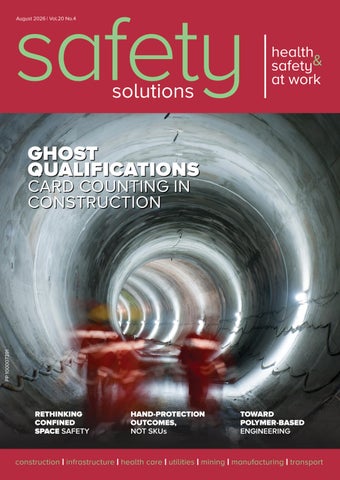
GHOST QUALIFICATIONS
PP 100007391
CARD COUNTING IN CONSTRUCTION
RETHINKING CONFINED SPACE SAFETY
HAND-PROTECTION OUTCOMES, NOT SKUs
TOWARD POLYMER-BASED ENGINEERING
SAFETY SOLUTIONS AUGUST 2026
FROM THE EDITOR XXXXXXXXXXX August 2026
CONTENTS 12 14 16
No.4
GHOST QUALI
7391
FICATIO CARD CO NS CONSTRUUNTING IN CTION
Ghost qualifications: the high cost of card counting in construction Managing hazards, not just controls: rethinking confined space safety Staying alive: how technology can minimise the risks of distracted driving
PP 10000
6
| Vol.20
RETHIN KING CONFIN ED SPACE SAF ETY
HAND-P ROTECT ION OUTCOM NOT SKU ES, s
TOWARD POLYME R-BASE D ENGINEE RING
This time, Brendan Torazzi, CEO of RTO provider AlertForce, outlines an influx of ‘ghost qualifications’ in construction; credentials that appear perfectly authentic, but are actually entirely void,
Safety at work is a serious job — using creativity and data to shift behaviour in South Australia
out-of-date or legally non-compliant — a situa-
20
The glove paradox: why procurement should buy hand-protection outcomes, not SKUs
at Height Association CEO Scott Barber talking
23
The shift toward polymer-based engineering in Australian industrial safety
26
tion that’s due to a simple but little-known rule. Also onboard for our August issue is Working confined space; it remains one of the highestconsequence activities undertaken across Australian industry and — despite comprehensive legislation, Australian Standards and well-
Why the future of HSE depends on how we integrate it into business strategy
established permit systems — serious incidents
28
How technology is improving onsite sanitation and productivity
Glenn Farrell; in April, the regulator launched its
30
IMARC 2026 will bring mining world to Sydney
continue to occur: Barber offers a rethink. We also hear from SafeWork SA’s Executive Director first major public awareness campaign in more than 15 years — ‘Safety at work is a serious job’. Farrell takes us through it. Plus, there are many more guest insights, including Damione Wright — Managing Director APAC at Mechanix Wear — explaining that, for procurement leaders, hand protection should be treated as a risk-engineering decision, not a consumable purchase, and Stuart McGill — Product and Industry Specialist at FSP Oz Products — on the benefits of polymer-based solutions. We also have a suite of case studies, from a mining and smelting complex implementing a pedestrian alert system to temporary fencing service supporting Tier 1 contractors and major infrastructure, and a university’s move to make
Cover image: iStock.com/baranozdemir. Stock image used is for illustrative purposes only.
VR violence training mandatory for nursing students. Of course, there’s also our usual
August 2026 | Vol.20 No.4
FREE SUBSCRIPTION!
GHOST QUALIFICATIONS CARD COUNTING IN CONSTRUCTION
PP 100007391
For free registration of the Safety Solutions magazine, visit: RETHINKING CONFINED SPACE SAFETY
HAND-PROTECTION OUTCOMES, NOT SKUs
TOWARD POLYMER-BASED ENGINEERING
www.safetysolutions.net.au/subscribe
breadth of coverage, including news, events and product innovations. Happy reading.
Dr Joseph Brennan, PhD Editor, Safety Solutions ss@wfmedia.com.au
www.safetysolutions.net.au
SafeWork SA
$1.1M WHS PENALTY SETS COMMONWEALTH RECORD National waste management company Cleanaway Operations Pty Ltd was sentenced on 28 May for two offences under the Commonwealth Work Health and Safety Act (WHS Act). The sentencing, which has seen the largest ever penalty imposed under federal WHS laws, was over an 18 August 2014 Adelaide truck crash that killed two motorists. The company was fined the record $1.1 million over the crash that happened on Adelaide’s South-Eastern Freeway, with the Commonwealth Director of Public Prosecutions filing charges in 2016. The incident occurred when a loaded Cleanaway vacuum truck collided with three cars at the Cross Road intersection, killing two motorists. The driver of a third car involved in the collision suffered serious injuries including a fractured neck and back, while the truck driver had a leg amputated and suffered a broken neck. Comcare’s investigation found Cleanaway’s driver training was inadequate, exposing the driver and other road users to the risk of serious injury or death, Comcare CEO Colin Radford said. “The company’s failures had devastating consequences,” Radford said. “This was the driver’s first week in the job, and he was only trained on relatively flat roads in a truck with an automatic transmission. On the day of the collision, he was driving a manual heavy vehicle for the first time and had to navigate the steep descents of the Adelaide Hills. “This created a clear and significant risk of injury or death. The obvious safeguard was for Cleanaway to have enforced a system of work that ensured the driver was supervised until he was experienced in operating a manual heavy vehicle in these conditions.” Comcare acknowledged the difficulties associated with the lengthy legal proceedings, Radford said, caused by multiple legal challenges, and the impact this had on the victims and their families. “This penalty comes more than a decade after the incident,” Radford said. “We sincerely thank everyone involved for their patience and understanding — especially those injured and the loved ones of those lost.” The two charges are Category 2 offences under the WHS Act, each carrying a maximum penalty of $1.5 million. As a licensed national employer in the Comcare scheme, Cleanaway Operations Pty Ltd is subject to regulation under Commonwealth WHS laws. iStock.com/sourabhj. Stock image used is for illustrative purposes only.
4 SAFETY SOLUTIONS - AUGUST 2026
The men’s shed with Moira Wright (centre), sister of the late Jeffrey Wright.
COURT-ORDERED MEN’S SHED OPENS IN WORKER’S MEMORY As part of a court-imposed penalty, a men’s shed has opened in Pennington, South Australia, dedicated to the memory of a worker who died when he fell 6.5 metres onto a concrete floor. According to SafeWork SA, its construction was the first time a court has imposed this type of penalty following a breach of the work health and safety laws. Jeffrey Wright, 51, was replacing roofing sheets at the offices of his employer, a garages and sheds manufacturer, at the time of the fall in December 2019. Wright did not have any formal training or a licence for working from heights at the time of his death. Additionally, he was not provided with any safety equipment. For breaches of the WHS laws, SafeWork SA investigated and prosecuted the company, which pleaded guilty in the South Australian Employment Tribunal to all three counts of breaching its duties under section 32 of the Work Health and Safety Act 2012 (SA). According to the judgement delivered in 2022, a $100,000 fine was imposed. The company was also ordered by the court to install a shed for the community at Sinclair Square, Pennington, and a plaque dedicated to Wright; Wright’s sister, Moira Wright, had advocated for the shed to be built as a way of honouring his life. Located near where the workplace incident occurred, the shed has been built at Aboriginalcontrolled community organisation Kura Yerlo Inc and offers a fully-equipped workshop for between 40 and 60 local participants. “For me, this moment has been years in the making. It is the fulfilment of a quiet promise I made to my brother that his tragic death would not be in vain and that something genuinely good would come from our personal heartbreak,” Moira Wright said. “We are here to transform a workplace tragedy into a community triumph, creating a living, purpose-driven legacy for Jeffrey.”
www.safetysolutions.net.au
GHOST QUALIFICATIONS: THE HIGH COST OF CARD COUNTING IN CONSTRUCTION 6 SAFETY SOLUTIONS - AUGUST 2026
www.safetysolutions.net.au
COMPLIANCE
Construction is battling an influx of what can only be termed ‘ghost qualifications’; credentials that appear perfectly authentic, but are actually entirely void, out-of-date or legally non-compliant. A situation that, as BRENDAN TORAZZI — CEO of RTO provider AlertForce — explains, is all thanks to a simplebut-little-known rule.
C
onstruction sites across Australia are riding the wave of an infrastructure boom and workers who saw jobs dry up in 2024 are returning to sites, excited to be able to wave their white card at the gate. For lead contractors and safety professionals, relying on simple ‘card counting’ at the site gate is turning a simple administrative task into a minefield of potential health and safety litigation and negligence claims.
The delayed impact of insolvencies
iStock.com/Jacob Wackerhausen. Stock image used is for illustrative purposes only.
www.safetysolutions.net.au
To understand how ghost qualifications have become such a concern, we need to look at the macroeconomics of Australian construction over the last 24 months. Data from the Australian Securities and Investments Commission (ASIC) paints a bruising picture of the 2024–25 financial period. Hit by a toxic combination of legacy fixed-price contracts, severe supply chain spikes and escalating material costs, nearly 3000 construction firms collapsed into administration in a single year. Tens of thousands of workers were impacted. When a construction firm collapses, its workforce does not simply vanish. Instead, thousands of subcontractors, carpenters, labourers and plant operators disperse rapidly. Many ended up having to take their transferable skills into other sectors, migrating into booming parallel fields like transport, automated logistics or hospitality. Now, however, with industry activity surging again, many of these workers are returning to commercial and civil sites. The problem is, the safety qualifications they have cards for, may not actually be valid. Many are returning with a paper trail that has silently expired while they were gone. >
AUGUST 2026 - SAFETY SOLUTIONS 7
COMPLIANCE
iStock.com/MTStock Studio. Stock image used is for illustrative purposes only.
The inactivity void
Legacy training and cancelled RTOs
A clamp down on low-quality training and a drive to standardise qualifications are more-obvious-but-also-often-missed risks to compliance.
8 SAFETY SOLUTIONS - AUGUST 2026
Brendan Torazzi.
Supplied
Something that many people seem to be unaware of is that under the national Work Health and Safety (WHS) Regulations, a white card (or its historical regional equivalents) is not a lifetime licence. The regulations state that if a worker has not performed any construction work for a continuous period of two consecutive years, the card ceases to be valid. The worker is legally required to retake the general induction training. Consider the thousands of labourers who transitioned into warehousing or delivery driving during the peak of the 2024 building downturn. As they return to high-risk environments, they present a physical white card issued years prior. On its face, the card displays a valid number and name. In the eyes of the law, however, the card is dead. This inactivity void means that a site manager who waves that worker through the gate is deploying an un-inducted person into a high-risk zone.
Workers still holding historical blue cards or certification from low-quality training providers are also a risk to safety compliance. While the current national unit ‘CPCWHS1001 Prepare to work safely in the construction industry’ is the benchmark,1 thousands of older workers still carry out-of-date regional cards or credentials minted by Registered Training Organisations (RTOs) that have since been shut down. In recent years, the Australian Skills Quality Authority (ASQA) has aggressively weeded out RTOs operating as ‘card factories’ over concerns that these providers issued white cards via rapid online courses without robust identity verification or authentic assessment. If an incident occurs and the subsequent regulatory investigation traces a worker’s qualification back to a deregistered, noncompliant RTO, the head contractor’s safety management system will be heavily scrutinised. The ultimate test of any qualification is whether the knowledge translates to behaviour. Safe Work Australia data highlights the ongoing, sobering reality of workplace danger and construction remains one of the deadliest fields, consistently logging dozens of lives lost annually, alongside more than 17,000 serious workers compensation claims per year. A card proves a fee was paid and a test was clicked; it does not prove the worker
understands dynamic risk management on a live site. The standardisation of training and qualifications is there to provide assurance to all parties that a card holder understands how to maintain the right safety standards.
Insurance risks and industrial manslaughter
Why should a commercial project manager or HR director care about a lapsed two-year rule if the worker ‘knows what they are doing’? The answer lies in the evolving, high-stakes legal framework governing Australian workplaces. With industrial manslaughter laws active across almost all states and territories, the threshold for criminal negligence has never been lower for corporate officers. If a supervisor or director fails to maintain an
www.safetysolutions.net.au
COMPLIANCE
iStock.com/Jacob Wackerhausen. Stock image used is for illustrative purposes only.
ON ITS FACE, THE CARD DISPLAYS A VALID NUMBER AND NAME. IN THE EYES OF THE LAW, HOWEVER, THE CARD IS DEAD.
airtight verification system and a fatal accident occurs involving an unqualified or out-of-date worker, the defence of “we checked his card” will be worth as much as the piece of plastic the card is printed on. It won’t stand up in court and it could invalidate your insurance. Regulators do not look at a physical card as a shield. They look at it as an entry point. If a worker’s general induction is found to be legally void due to the two-year inactivity rule, the business can be found to have breached its primary duty under Section 19 of the WHS Act — failing to provide the necessary information, training and instruction to ensure safety. The insurance implications are also pretty severe. Most commercial general liability and workers compensation policies contain strict exclusions regarding unlicenced or uninducted personnel. Discovering a ghost qualification after a major structural failure or injury can result in an insurer walking away from a multi-million-dollar claim, leaving directors personally exposed to catastrophic financial damages. Putting safety over paper compliance Meeting demand for staffing during a construction boom demands speed, but that cannot be as a result of shortcuts. As thousands of workers shift back into highintensity environments after a bruising couple of years of industry disruption, the risk of the ghost qualification will continue to escalate. A business that relies solely on physical card counting is building its safety culture on quicksand. By stepping up to an assertive, verification-first model, lead contractors do more than just protect themselves from regulatory prosecutions and ruined insurance policies, they ensure that when a worker steps onto a site, they possess the genuine, active competency required to go home safely at the end of the day. 1.
CPCWHS1001 Prepare to work safely in the construction industry. Training.gov.au. Accessed June 22, 2026. https://training.gov.au/training/
5 1
ways to mitigate risk
There are some simple measures that can be put in place to keep on top of ghost qualifications and ensure that anyone contracted to work on site have the right level of compliance.
Prioritise verification
Contractors and construction companies must completely dismantle the traditional gate-check mentality. Instead, moving to an active verification-first framework. Site managers and HR professionals should implement a systematic protocol to filter out ghost qualifications before a boot ever touches the site.
2
Conduct mandatory audits for inactivity
Do not just photocopy a white card during onboarding. Update your digital enrolment forms to include a mandatory, signed declaration from the worker stating the date and location of their last active construction role. If a prospective hire has not been in a qualifying role for at least 24 months, make sure they are signed up to undertake the required training before they start. Most reputable training providers will offer a number of opportunities a month to complete training on the most needed courses.
3
Mandate red-flag filters for older units
Ensure your digital vendor management systems and site gatekeepers explicitly look for the current national unit CPCWHS1001. Older or state-specific legacy credentials should be treated as high-risk anomalies. If a worker presents a card older than five to 10 years, even if they claim continuous employment, prioritise them for an updated training assessment.
4
Audit the issuing RTO against ASQA Registers
Ensure your compliance team cross references the RTO code printed on the worker’s card against the current training.gov.au database. If the issuing provider was closed due to regulatory sanctions or non-compliance, the credential must be flagged for internal review.
5
Invest in robust site re-inductions and practical gateways
Never treat a site induction as a quick box-ticking exercise or a video a worker watches on their phone for 10 minutes before turning up for work. Use your site re-inductions to conduct brief, practical verbal competency checks. Ask targeted questions about common risk scenarios on topics such as exclusion zones, scaffolding tags and line-of-sight principles for heavy plant machinery. If a worker holds a card but struggles with basic spatial hazard identification, keep them off the site until they complete an official training session — many can be done via online webinars. It is a worthwhile investment in half a day of their time, and yours.
details/CPCWHS1001/unitdetails
www.safetysolutions.net.au
AUGUST 2026 - SAFETY SOLUTIONS 9
Duress badge
Respirator in-mask communication device
The CenTrak Bluetooth
Clear communication is essential on any worksite — but in hazardous
Low Energy (BLE) Multi-
environments where respiratory protection is mandatory, it often comes at a
Mode staff badge is
cost. Traditional respirators can muffle speech, forcing workers to remove their
a real-time location
masks just to be heard, undermining safety in the process. The SmallTalk in-
system (RTLS) duress
mask communication device is designed to change that dynamic, delivering
solution designed for reliability in high-pressure environments.
clear, amplified speech without compromising protection.
RTLS duress solutions are designed to deliver instant alert
Designed for seamless integration with Sundström SR100, SR900 and
acknowledgment, confirming help is on the way and providing
SR200 respirators, SmallTalk is engineered to support 100% wear-time by
critical peace of mind in high-risk situations.
ensuring workers can communicate effectively without removing their masks.
The badge features a dedicated, recessed duress button designed to prevent false alerts, while also allowing for rapid activation, and is complemented by two other configurable buttons to support custom workflows. The badge is engineered for enhanced durability (IP67 rating), extended battery life, easy over-the-air maintenance, and user notifications such as diagnostic LEDs and an audible buzzer. CenTrak’s RTLS safety solution is designed to deliver realtime, map-based visibility across healthcare environments, enabling teams to quickly locate staff, patients and incidents as they unfold. Intelligent alerts are triggered instantly when the button is pressed and safety is at risk, designed to ensure rapid, coordinated response.
A lightweight electret microphone sits discreetly within the respirator’s speech diaphragm, housed in the protective cap with no drilling or permanent modification required. A compact external amplifier and Mylar-cone loudspeaker deliver natural, high-clarity voice projection, easily clipped to clothing for hands-free use. New features — including push-to-talk functionality and an integrated volume control button — are designed to give users greater control over communication in varying noise conditions. The system also offers expanded compatibility, working with various Sundström head-tops connected to SR500 and SR700 PAPR systems, enhancing its versatility across respiratory platforms. Engineered for demanding environments, SmallTalk is resistant to dust, vibration, impact, spray and temperature fluctuations. Thin, flexible cabling reduces snag hazards, while a standard 9V battery is designed to ensure reliable, long-lasting power with easy field replacement.
Comprehensive event logs capture alarm type, severity,
From construction and mining to chemical
timestamps and key details, while robust reporting tools are
handling and emergency response, SmallTalk
designed to support trend analysis, compliance and continuous
is designed to deliver a practical, technically
safety improvement. Designed for use across hospitals, clinics
advanced solution — bridging the critical
and broader care settings, the solution is designed to enhance
gap between respiratory protection and
security both inside and beyond facility walls.
clear, consistent communication.
CenTrak
Safety Equipment Australia Pty Ltd
www.centrak.com
www.sea.com.au
SCBA platform for mining The M1 SCBA (Self-Contained Breathing Apparatus) platform for mining is engineered to reduce fatigue, speed cleaning and improve fleet uptime, across underground, shutdowns, emergency response and confined space entry. Across underground, open-cut and contractor environments, legacy SCBA fleets are becoming a constraint. Uptime is harder to maintain, hygiene is more difficult to manage and maintenance demands are increasing; just as ERT, CSE and shutdown activities put more strain on limited equipment. Features of the M1 SCBA platform for mining include: comfort that lasts a shift — with ergonomic, S-shaped padded harness that reduces pressure points and shoulder pinch, heightadjustable backplate that shifts weight to the hips for less fatigue and better mobility, suitable for long underground wear and rapid ERT callouts — and streamlined hygiene — with machine-washable harness and backplate for faster turnaround; water and dust repellent materials to speed mechanical cleaning; and helps easy to disassemble, clean and disinfect. Other features of the platform include: built-in safety, end to end with CleanConnect (patented) that helps clear coupling debris, guided hose routing to reduce snag risk; reflective elements for visibility and robust analogue gauge — lower total cost, proven longevity — with extended service intervals, simplified sub assemblies (no special tools) and 10-year warranty on manufacturing defects providing confidence for long-term fleet decisions — and future-ready communications — with seamless integration with C1 headset for clear comms today, and modular platform architecture, designed to be ready for what’s next. MSA Australia Pty Ltd au.msasafety.com
10 SAFETY SOLUTIONS - AUGUST 2026
www.safetysolutions.net.au
Safe change housing system Camfil CamSafe 3 Housing is a modular, high integrity safe change housing system designed to ensure maximum containment and operator safety when handling contaminated air. It is engineered for exhaust air applications in critical environments including biosafety levels L1 to L3+, pharmaceutical and chemical processing, hospitals, laboratories, and animal research facilities. The system is highly configurable, available in single or multi module designs to suit a wide range of airflow requirements and filtration stages. It supports both particulate and molecular filtration, offering flexibility for diverse contamination control needs. CamSafe 3 incorporates a patented clamping mechanism with a single action lever and dual safety interlock, designed to ensure correct filter positioning and consistent gasket compression. Its integrated service bag collar is engineered to enable fully contained Bag In Bag Out (BIBO) filter changes, allowing safe removal and replacement of filters without exposure to hazardous contaminants. The housing is designed for high pressure integrity and has been rigorously tested at ±6000 Pa, meeting stringent international standards including EUROVENT 2/2 Class C, EN 1886 Class L1, ISO 10648-2 Class 3, and EN 12237 Class D. For performance verification, CamSafe 3 supports Manual Integrity Probe scanning within the housing and optional ducted injection modules for efficient leak testing using reduced aerosol volumes. A wide range of accessories, including dampers, supports, collectors, and decontamination options, further enhances system adaptability. CamSafe 3 is designed to deliver a robust, flexible and highly secure containment solution tailored to critical air filtration environments where safety and reliability are essential. Camfil Australia Pty Ltd www.camfil.com.au
Making Lockouts since 1992
www.safetysolutions.net.au
AUGUST 2026 - SAFETY SOLUTIONS 11
iStock.com/gooutsight. Stock image used is for illustrative purposes only.
MANAGING HAZARDS, NOT JUST CONTROLS:
RETHINKING CONFINED SPACE SAFETY Confined space work remains one of the highest-consequence activities undertaken across Australian industry. Despite comprehensive legislation, Australian Standards and well-established permit systems, serious incidents continue to occur. Working at Height Association CEO SCOTT BARBER considers why.
S
erious confined space incidents continue to occur, not because organisations lack procedures, nor because they don’t understand the importance of permits, gas testing or standby personnel. More often, it’s because the focus has shifted from managing hazards to managing controls. While permits, atmospheric monitoring, isolation procedures and rescue plans are all critical components of confined space work, they are controls — they are the mechanisms used to manage risk. They are not the hazards themselves. When organisations begin treating completion of those controls as the objective, rather than continually understanding and managing the hazards they are intended to control, confined space safety can become dangerously oversimplified. A confined space is not a hazard, it is an environment. One of the most common misconceptions is to think of confined spaces as presenting a single, predictable risk. In reality, a confined space is simply an environment where multiple hazards may
12 SAFETY SOLUTIONS - AUGUST 2026
exist, often simultaneously, and often changing throughout the work. These hazards can include: • oxygen deficiency or enrichment • toxic or flammable atmospheres • hazardous dusts and airborne contaminants • engulfment by liquids or free-flowing solids • mechanical, hydraulic, pneumatic or electrical stored energy • moving plant and equipment • biological hazards • heat stress • restricted access and egress • communication difficulties • challenging rescue environments Importantly, these hazards rarely occur in isolation. The work itself frequently creates new hazards. Welding changes atmospheric conditions. Cleaning introduces chemicals. High-pressure water mobilises contaminants. Maintenance activities alter ventilation, isolation and energy states. Every confined space entry therefore presents a unique hazard profile.
The controls should be designed around those hazards, not simply repeated because they were effective on the previous job. However, critical risk work demands a different approach. As confined space work becomes more routine, there is a temptation to standardise not only the administrative process but also the thinking behind it. Permits are completed
When productivity simplifies complexity;
Modern industry rightly strives for efficiency.
Shutdowns are carefully scheduled.
Maintenance windows become shorter.
Production targets continue to increase.
Standardisation improves
consistency and productivity across many operational activities.
www.safetysolutions.net.au
HAZARDOUS AREAS
because permits are always completed. Gas tests are conducted because they are required. Rescue equipment is staged because the procedure demands it. Gradually, organisations can find themselves measuring whether the controls have been completed rather than asking whether the controls remain appropriate for today’s hazards. This is where oversimplification begins. Controls only work when they match the hazard. A permit does not eliminate toxic gases. A gas monitor does not prevent atmospheric change. Ventilation is ineffective if it is designed for yesterday’s task rather than today’s. Respiratory protection cannot compensate for poor hazard identification. Every control has limitations. Its effectiveness depends entirely on how well it addresses the specific hazards present during the work. That requires continual hazard identification and dynamic risk assessment, not simply procedural compliance.
Safety leaders should therefore encourage a simple but powerful shift in thinking; Rather than asking, “have all the controls been completed?”, ask, “have we identified every hazard these controls need to manage?” It is a subtle distinction, but one that fundamentally changes decision-making. Leadership means managing uncertainty. No permit can predict every changing condition inside a confined space. Materials vary. Processes change. Weather influences atmospheric behaviour. Equipment ages. Human behaviour adapts. Effective organisations recognise this uncertainty and build flexibility into their systems. They empower supervisors and workers to question assumptions, reassess hazards as work progresses and modify controls whenever conditions change. This represents genuine critical risk m a n a g e m e n t , n o t s i m p l y p ro c e d u ra l compliance. Australian Standards and WHS legislation establish the framework for safe confined
space work, but compliance should never become the end goal. The objective is not to complete permits, conduct gas tests or wear respiratory protection. The objective is to understand and control the hazards those measures exist to manage. For safety leaders, this distinction matters. Because organisations rarely experience catastrophic confined space incidents because a form wasn’t completed. They experience them when hazards evolve, assumptions go unchallenged and controls are no longer matched to the risks they were designed to address. The most mature organisations understand that critical controls are only ever as effective as the hazard identification that underpins them. When safety leadership remains focused on hazards first, and controls second, confined space management moves beyond compliance and becomes what it was always intended to be; a system for protecting people from high-consequence risk.
HP - MYZEL.pdf 1 3/7/2026 1:24:56 pm
Your Machine Safety Data, Always within Reach C
Your all-in-one digital platform for Machine Lifecycle Management.
M
Y
CM
MY
Risk Assessments Compliance Evidence Validation Reports Maintenance Records and more
CY
CMY
K
Explore MYZEL
www.safetysolutions.net.au
AUGUST 2026 - SAFETY SOLUTIONS 13
TRANSPORT
iStock.com/Photon-Photos. Stock image used is for illustrative purposes only.
STAYING ALIVE:
HOW TECHNOLOGY CAN MINIMISE THE RISKS OF DISTRACTED DRIVING Having drivers on your team who don’t keep their full attention on the road is dangerous on multiple fronts. GEORGE HOLT, Compliance Manager at Zetifi, sets out how technology may be able to help.
T
widdling with the sound system, sipping on a hot or cold drink, surreptitiously scrolling or messaging on a phone… There’s a plethora of ways drivers can have their attention taken away from the road, manually, visually and mentally. And when that happens, the chances of a road accident or incident increase significantly. So much so that distracted driving is the main contributing factor in about 16% of serious casualty road crashes, according to the Australian Automobile Association. In recent years, mobile phones have emerged as one of the chief causes of driver distraction, here in Australia and around the world.
Your brand and business reputation may take a hit too, if driver distraction has led to a worker causing serious harm, or worse, to other road users or pedestrians, as well as themselves. And in today’s times, the legal responsibility for that harm may not fall on the perpetrator alone. Your organisation could be deemed responsible, as could the individuals who lead it. There’s an onus on directors to mitigate known risks and that means those who don’t take steps to address the danger posed by distracted drivers could potentially find themselves held personally liable for any adverse outcomes that ensue.
Taking responsibility for workers’ behaviour on the road
Turning to technology to tackle driver distraction
If one of your employees is involved in an incident or accident while they’re on the job and driving a company vehicle, it’s not only a problem for them and the individuals they’ve endangered or injured; it’s a serious risk for your business. Damage to company vehicles can disrupt operations and push up your insurance premiums; putting a dent in your profitability and bottom line.
14 SAFETY SOLUTIONS - AUGUST 2026
Responsible businesses will already have policies in place to keep their employees safe. Typically, these will preclude eating, drinking, vaping and using devices while driving. Policies should also mandate regular breaks when workers are travelling long distances. But setting strict rules is one thing; enforcing them can be quite another matter. That’s where technology has an important role to play. It can help ensure that when
workers are behind the wheel they’re not zoning out or turning their attention to text messages and social media feeds on their phone when they should be keeping their eyes on the road. D ev i c e s t o d a y c a n s e n s e wo r ke r environments, deliver precise location awareness and create intelligent connections between devices, systems and people, via connectivity, telematics and applications, including vehicle-mounted camera arrays. The signals they detect and transmit can be swiftly and seamlessly interpreted and forwarded to key personnel responsible for instigating an immediate and appropriate response. Smart antennas seamlessly integrated with third party applications, such as telematics, can be a game changer. There are several compelling use cases, from context aware tracking to enhance lone worker safety via the use of a smart antenna, to detecting mobile phone usage with a dash camera integrated with edge AI. The latter can provide accurate, up-tothe-second intelligence on how employees are conducting themselves behind the wheel, along with the ability to correct aberrant behaviour immediately, via alerts, nudges and messages that remind distracted drivers to focus on the road. Implemented across your company fleet, this technology can be an effective means of reducing the risk of an accident in the moment, and the catalyst for positive changes to your organisation’s driving and workplace culture over the longer term.
Taking smart steps to protect the public and your business
Whatever the nature of your business, ensuring your employees act in a safe and responsible manner when they’re on the job and on the road is critical. Implementing platforms and processes that demonstrate you’re serious about doing so can help you protect the public, your organisation’s assets and its reputation and bottom line. Having access to technology that allows you to monitor and manage worker safety and on-road behaviour means you can be secure in the knowledge you’re doing all you can to mitigate the risk posed by driver distraction when your workers are behind the wheel. If having a mobile workforce that’s an asset not a liability is important to your business, it’s an investment that makes excellent sense.
www.safetysolutions.net.au
Supplied
“Avoid a mistake, engage the brake.”
SAFETY AT WORK IS A SERIOUS JOB
— USING CREATIVITY AND DATA TO SHIFT BEHAVIOUR IN SOUTH AUSTRALIA In April 2026, SafeWork SA launched its first major public awareness campaign in more than 15 years — ‘Safety at work is a serious job’. The regulator’s Executive Director GLENN FARRELL takes us through it.
W
ork health and safety (WHS) regulators are often challenged to find the right balance between enforcement and education. While compliance activity remains essential in deterring unsafe practices, sustained improvements in workplace safety depend equally on influencing attitudes, awareness and everyday decision-making. Running through to December, the campaign represents a strategic shift towards a more integrated approach to harm prevention, combining targeted messaging, behavioural insight, data-led priorities and traditional regulatory activity. The campaign has so far been well received by the WHS community, according to early analytics. For WHS professionals,
16 SAFETY SOLUTIONS - AUGUST 2026
the campaign offers a compelling case study in how communications can be used alongside compliance to drive meaningful safety outcomes.
A campaign grounded in evidence
At the heart of the campaign is a simple premise: focus on the hazards causing the most harm. SafeWork SA identified three priority risks — falls from heights, roll-away vehicles, and slips and trips (particularly ones resulting from spills) — using a combination of regulator notifications and compensation claims data from ReturnToWorkSA. Together, these hazards have contributed to 21 deaths
and 496 serious injuries in South Australia over the past four years, underscoring their persistent and often preventable nature. The broader economic and human cost is significant. ReturnToWorkSA data shows: • About 3600 injury claims annually in South Australia related to falls, slips and trips • These claims cost approximately $105 million each year Falls alone account for roughly 1100 claims per year costing $32 million, while slips and trips contribute 2500 claims costing $73 million annually. These figures reinforce what WHS professionals already understand: common h a z a rd s , w h e n u nm a n a g e d , p ro d u c e disproportionate harm.
www.safetysolutions.net.au
COMPLIANCE
“You know the drill, clean up that spill.”
Supplied
“Check it’s fine before you climb.”
Repetition and recall are key drivers of behavioural change. Traditional safety messaging can blend into the background, particularly for experienced workers. By contrast, distinctive creative devices — like a talking traffic cone — create a “pattern interrupt”, increasing the likelihood that the message will be noticed, remembered and acted upon. Importantly, the campaign does not trivialise risk. Instead, it uses accessible storytelling to reinforce practical controls: • Verifying work surfaces are suitable and implementing effective controls before working at height • Ensuring vehicles are immobilised and secured against unintended movement before exiting or undertaking work nearby • Maintaining housekeeping standards to eliminate slip hazards The goal is not to replace formal training or systems but to reinforce them in everyday decision-making.
The hazards in focus Falls from heights
Supplied
While the number of incidents related to roll-away vehicles are lower than other hazards, the result can be catastrophic in terms of death, severity of injuries and resultant property damage Roll-aways can occur with any type of mobile plant and can occur on worksites, car parks, maintenance yards or when a vehicle is parked on the side of the road.
Translating risk into relatable messaging
A key challenge in safety communication is cutting through familiarity. Workers know the risks — yet incidents still occur. SafeWork SA’s campaign addresses this by reframing well-known hazards through a creative lens. Enter Stanley, an animated talking traffic cone. Using a universally recognised symbol of safety, the campaign delivers practical advice
www.safetysolutions.net.au
across the three hazard areas through short, memorable messages: • Falls: “Check it’s fine before you climb.” • Roll-aways: “Avoid a mistake, engage the brake.” • Spills: “You know the drill, clean up that spill.” While the tone is light, the intent is serious. Stanley’s character — gruff but knowledgeable — was designed to resonate with workers, particularly in higher-risk industries such as construction, transport and manufacturing. Independent market testing with target audiences confirmed the approach was effective. Participants found the concept novel, engaging and easy to recall — critical components in influencing behaviour in high-risk environments.
Why creativity matters in WHS
For seasoned WHS professionals, the idea of using an animated cone may seem unconventional. But behavioural science supports the approach.
Falls remain one of the leading causes of workplace fatalities nationwide, accounting for approximately 13% of worker deaths between 2022 and 2024. In South Australia alone, SafeWork SA recorded 300 notifications involving serious falls between 2022 and 2025, resulting in: • 12 fatalities • 288 serious injuries Notably, about half of fatal falls occur from heights of three metres or less, highlighting that even low-level work presents significant danger. The construction sector remains the most affected, followed by transport, manufacturing and agriculture. Regulatory response has included strengthened compliance campaigns and legislative reform. A key change is the reduction of the high-risk construction work threshold from three metres to two metres, aligning South Australia with national model WHS laws. This change came into effect on 1 July this year and reflects the reality that risk is not confined to extreme heights.
Slips, trips and spills
Often underestimated, slips and trips are the second leading cause of workplace injury after hazardous manual tasks. Between 2022 and 2025, SafeWork SA received 196 notifications related to slips and trips, resulting in: • 5 fatalities • 191 serious injuries >
AUGUST 2026 - SAFETY SOLUTIONS 17
COMPLIANCE
FOR SEASONED WHS PROFESSIONALS, THE IDEA OF USING AN ANIMATED CONE MAY SEEM UNCONVENTIONAL. BUT BEHAVIOURAL SCIENCE SUPPORTS THE APPROACH.
The causes are typically mundane but persistent: • Poor housekeeping • Wet or uneven surfaces • Inadequate lighting • Obstructed walkways These incidents occur across a wide range of industries, from construction to health care, and frequently involve simple, preventable failures.
Roll-away vehicles Although less frequent, roll-away incidents can have catastrophic consequences. SafeWork SA recorded 42 roll-away incidents over five years, leading to: • 4 fatalities • 17 serious injuries • 13 cases of significant property damage These incidents highlight critical failures in basic controls: • Not engaging park brakes • Inadequate maintenance • Failure to use wheel chocks • Unsafe parking on inclines The severity of outcomes reinforces the importance of procedural compliance and system design in mobile plant safety.
Integrating communication with compliance
The campaign does not operate in isolation. It complements a significant uplift in SafeWork SA’s compliance and enforcement activity. In 2024–25, the regulator: • Conducted 7715 site visits (up from 5122 in 2022–23) • Issued 5238 statutory notices • Achieved 18 convictions, the highest in 10 years • Secured $2.37 million in fines from court prosecutions This increased presence is correlating with improved safety outcomes. Over the same period, serious injury notifications have declined from 766 in 2022–23 to 356 in 2024–25.
18 SAFETY SOLUTIONS - AUGUST 2026
For WHS professionals, this demonstrates the value of a dual approach: visible enforcement combined with proactive education and communication.
The role of workplaces
Reaching workers where they are
The campaign reinforces core legal duties
The campaign uses a multi-channel strategy to maximise reach and engagement: • Social media and digital platforms • On-demand television • Print advertising • Outdoor billboards and bus shelters • Industry engagement and events including the AIHS National Health & Safety Conference in June A dedicated campaign hub on the SafeWork SA website provides access to resources, guidance and reporting channels, while stakeholder kits allow businesses to share campaign materials internally. This approach recognises that safety messaging must extend beyond the workplace and into everyday contexts where workers consume information.
A broader lesson for WHS practice
The ‘Safety at work is a serious job’ campaign highlights an important evolution in WHS practice: safety is not just about rules and enforcement — it is also about influence. For WHS professionals, the campaign offers several key takeaways:
1. Data should drive priorities
Targeting the hazards that cause the most harm ensures resources have maximum impact.
2. Communication matters
Clear, memorable messaging can reinforce safe behaviours at scale.
3. Creativity can enhance engagement
Distinctive campaigns can cut through complacency and make safety messages stick and be used by those that can influence.
4. Integration is critical
The most effective strategies combine communication, compliance and education.
5. Consistency builds culture
An “always on” approach keeps safety front of mind.
While the regulator can set expectations and raise awareness, workplaces remain the frontline of safety. For businesses: • Identify hazards and control risks so far as reasonably practicable • Provide safe systems of work and adequate training and supervision • Maintain equipment and ensure safe access and egress For workers: • Follow procedures and use PPE • Report hazards • Take reasonable care for their own safety and others In practice, this means embedding safety into routine operations — from pre-start checks to housekeeping, vehicle immobilisation and working at heights protocols.
Early results and future potential
Although still in its early stages, the campaign is showing strong engagement metrics across digital and media channels. Feedback indicates that Stanley’s character and the campaign’s tone are resonating with target audiences. This level of engagement is significant. Awareness is the first step toward behaviour change, and sustained exposure over the campaign period is expected to reinforce safer practices.
Keeping the focus on what matters
Ultimately, the campaign’s message is simple: Safety at work is a serious job. Behind every statistic is a person — a worker who did not return home, or whose life changed in an instant. By focusing on common but high-impact risks, and delivering practical advice in an engaging way, SafeWork SA is working to ensure fewer South Australians experience those outcomes. For WHS professionals, the campaign reinforces a shared goal of embedding safety into every task, every decision and every workplace. Because when safety becomes second nature, everyone benefits.
Watch the campaign Credit: SafeWork SA
www.safetysolutions.net.au
STUDY
CASE
Mining and smelting complex implements pedestrian alert system
Supplied
Seeking a practical solution for improving awareness around personnel working near heavy equipment, a northwest Queensland mining and smelting complex implemented pedestrian alert system (PAS). Designed to improve operator awareness, the RCT — Powered by Epiroc PAS was deployed across a range of equipment including forklifts, skid steer loaders, cranes and backhoes. Using advanced camera intelligence to identify human-like forms without the need for wearable devices, the PAS features configurable detection zones that are able to be tailored to different applications, with escalating visual and audible alerts based on a person’s proximity to the machine. “The main reason for installing the PAS is to manage interactions between people and mobile equipment,” a site representative said. “The system alerts operators when someone enters a 3 m exclusion zone, as required by our site procedures,” the representative added. The PAS was adapted to suit site operating conditions, RCT said, with external audio and visual alarms installed on selected machines to ensure alerts remain effective in high-noise environments. “The system has been adapted as we’ve learned what works best in our environment,” the representative said. RCT www.rct-global.com
DEXION AD - NOT IN
www.safetysolutions.net.au
AUGUST 2026 - SAFETY SOLUTIONS 19
THE GLOVE PARADOX
WHY PROCUREMENT SHOULD BUY HAND-PROTECTION OUTCOMES, NOT SKUs
Choosing a work glove is never a single-variable decision. The lowest unit price, highest laboratory rating and most familiar product can each fail if the glove is not matched to the hazard, task, worker and point of use. As DAMIONE WRIGHT — Managing Director APAC at Mechanix Wear — explains, for procurement leaders, hand protection should be treated as a risk-engineering decision, not a consumable purchase.
A
large organisation can buy gloves in good faith and still buy the wrong outcome. A tender may require recognised standards, credible suppliers, national distribution and a competitive price, yet the glove may still fail where exposure occurs. It may be too hot, bulky, slippery, short for splash exposure, loose near moving equipment or unavailable when work starts. In that moment, the purchase order can look controlled while residual hand risk remains uncontrolled. This is the glove paradox. Gloves are bought as SKUs, but they operate as risk controls. The real question is not, “Which glove is compliant?” It is, “Which hand-protection system produces the lowest residual hand risk at an acceptable
20 SAFETY SOLUTIONS - AUGUST 2026
total cost, with the least operational friction, across the real workforce?”
Why hand protection deserves procurement attention
Safe Work Australia’s 2025 national WHS statistics reported 188 traumatic worker fatalities in 2024 and 146,700 serious workers compensation claims involving at least one week of working time lost in 2023–24. Upperlimb injuries accounted for 48,700 serious claims. In Western Australia, WorkCover WA recorded 4615 hand injury claims in 2020–21. For large employers, gloves influence more than injury prevention. They affect productivity, supervision burden, worker trust, inventory control, waste, claims experience
and due-diligence evidence. Procurement sits at the centre.
The perfect glove does not exist
The first principle is uncomfortable but essential: every glove is a compromise between price, performance and protection. Increase cut, puncture or impact resistance and the glove may need denser yarns, overlays, guards or thicker coatings. Protection may rise, but tactility, heat release and dexterity may fall. Increase chemical or liquid-barrier performance and breathability often declines. Choose a thinner glove for precision work and the protection envelope narrows. Prioritise the lowest unit price and the organisation may pay through shorter wear life, higher consumption, non-wear, rework or injury exposure. This is not an argument for trading safety down. It is an argument for making the tradeoff visible: set the hazard threshold first, then optimise for work enablement, consistent wear, appropriate life and availability.
www.safetysolutions.net.au
HAND PROTECTION
iStock.com/zoff-photo. Stock image used is for illustrative purposes only.
21420 general requirements; and AS/NZS 2161.3 adopts EN 388 for mechanical risks. ANSI/ISEA 105 is also relevant in multinational supply chains. Standards create a common language. They support comparison, evidence gathering and minimum thresholds. But they do not decide the whole procurement question. A glove can be compliant and still be wrong for the task. A glove can be popular and still be underprotective. Mature procurement governance has to hold both truths at once.
cost should include wear life, failure mode, consumption, disposal, inventory burden, stockout risk, substitution controls, training and productivity effects. This does not mean buying the most expensive glove. It means understanding whether the price difference buys lower residual risk, better adoption, longer life, stronger task performance or improved supply resilience.
The missing specification is behavioural
A defensible procurement file should show more than a price comparison. It should show the hazard assessment, standards threshold, supplier evidence, field-trial scores, worker consultation, total-cost model, rollout plan and review data. Five gates help: segment by task and risk; set standards and hazard thresholds; shortlist by total cost of ownership; run structured field trials; then roll out, measure and review. Field trials should test required sizes, realistic shifts and actual conditions such as heat, wet work, oil, dust, abrasion and interaction with tools or other PPE. They should measure task performance, fit, comfort, failure mode and observed glove-off moments, not just whether workers ‘like’ the glove.
People do not comply with gloves in the abstract. They wear or remove gloves during a task, under pressure, in a specific environment and social setting. That makes behaviour a performance variable. Workers make repeated micro-decisions: wear the glove, remove it for dexterity, change gloves, keep using a damaged glove, or work around the rule. Those decisions are influenced by risk perception, task friction, social norms, comfort, trust and access. A glove that slows the job, reduces feel, increases heat load or signals “procurement bought cheap again” will invite non-wear. Comfort and fit are not luxuries; they help determine whether protection is used during exposure.
Specify by task family
Protection collapses when any factor is weak. A glove with strong certified performance may deliver poor real-world protection if it does not fit the task, is removed for dexterity, or stockouts drive unapproved substitution. Conversely, a lower-rated glove that still meets the hazard threshold may deliver a safer outcome if it enables the job and is worn throughout exposure.
Large organisations often rationalise glove ranges by business unit, site or supplier catalogue. Rationalisation can reduce complexity, but only when it follows task-risk families rather than administrative convenience. A maintenance fitter, scaffolder, drilling offsider, emergency responder and warehouse picker may all ‘need gloves’. They do not need the same glove. Task-family segmentation asks what can cut, puncture, crush, burn, contaminate or chemically harm the hand; whether contact is brief, repeated or immersed; whether exposure is dry, wet, oily, hot, cold or sharp; whether entanglement risk exists; and what other PPE must integrate with the glove.
Standards are the floor, not the operating system
Unit price is visible; failure costs are hidden
Protection is realised, not declared Realised Protection = Certified Protection x Task Fit x Adoption x Availability
For Australian and New Zealand buyers, the AS/NZS 2161 series provides the central reference for occupational protective gloves. AS/NZS 2161.1 addresses selection, use and maintenance; AS/NZS 2161.2 adopts ISO
www.safetysolutions.net.au
The cheapest glove is rarely cheap if it is consumed rapidly, removed frequently, substituted during stockouts or distrusted by the workforce. A better commercial lens is price per productive use, not price per pair. Total
A five-gate model for better outcomes
Procurement as risk engineering
The strongest sourcing conversations happen when procurement, WHS, operations and workers treat the glove range as a system. Procurement brings commercial discipline and supplier governance. WHS brings hazard logic and due diligence. Operations brings task reality. Workers bring the evidence no catalogue can simulate. In hand protection, compromise is unavoidable. The wrong compromise is accidental: a cheap glove that gets removed, a high-rated glove that slows the task, a single-SKU policy that ignores task diversity, or a compliant glove that is unavailable when exposure occurs. The right compromise is designed: set the hazard threshold, test against real work, listen to wearers, measure adoption and cost, and keep the approved range available. The best glove is not simply the highestrated option or the lowest-priced option. It is the lowest total-risk solution that meets the hazard, enables the work and gets worn consistently. Procurement teams that understand this will not just buy better gloves. They will buy safer work.
AUGUST 2026 - SAFETY SOLUTIONS 21
STUDY
CASE
Temporary fencing service launches to support Tier 1 contractors and major infrastructure
Supplied
22 SAFETY SOLUTIONS - AUGUST 2026
Supplied
Supplied
To better support Tier 1 contractors and major infrastructure projects, Kennards Hire has launched its dedicated Temporary Fencing Solutions. The service is designed with dense urban sites in mind, where space constraints, public interface and wind exposure require a more engineered approach than traditional temporary fencing. The company said their new compliance-led, end-to-end site service responds to increasing demand across construction, civil and rail sectors for temporary works that meet stringent safety and regulatory requirements, particularly in metro and pedestrian-heavy environments where fencing performance is critical. “Temporary fencing is often treated as a commodity, but on today’s complex worksites it plays a critical role in safety, compliance and public protection,” said Ben Hitchen, Specialist General Manager at Kennards Hire. “We know that compliance isn’t a one-size-fits-all solution. Wind exposure, site layout and pedestrian interaction all influence what’s required. “We work with contractors to ensure the right rating and configuration is in place from the outset, removing uncertainty and reducing risk, while still delivering the reliable equipment and service that has always been at the heart of Kennards Hire. By working with project teams early, we can align the fencing solution to site conditions from the outset rather than retrofitting compliance later.” The move into temporary fencing solutions takes Kennards Hire beyond traditional dry hire to deliver certified wind-rated systems,
advisory support and integrated installation tailored to site-specific conditions, the company said. Forming part of Kennards Hire’s broader approach to provide specialist, project-aligned solutions, while maintaining its core hire services, the company added that by integrating fencing with other site services, the organisation aims to enable contractors to consolidate suppliers, simplify mobilisation and gain greater certainty across long-term projects. Key components of the service include: • certified wind-rated fencing provided as standard — to support compliance assurance; • advisory-led planning — to help determine appropriate system design for each site; • integrated delivery and installation — to streamline mobilisation and reduce coordination risk; and • flexible pricing models — suited to long-duration infrastructure and civil works. To reflect growing industry recognition that temporary works must meet the same scrutiny as permanent infrastructure, Kennards Hire said the service will support large-scale projects nationally, with deployments across metropolitan and regional worksites. Kennards www.kennards.com.au
www.safetysolutions.net.au
HAZARDOUS GOODS
STUART McGILL — Product and Industry Specialist at FSP Oz Products — sets out benefits of polymerbased solutions, including in the storage and handling of hazardous goods, electrical infrastructure, and fire exposure and containment planning.
C
orrosion starts eating infrastructure long before damage appears on the surface. A cabinet door still opens. A mounting frame still holds. A junction box still looks stable during inspection rounds, while months of chemical exposure, moisture, heat and salt air continue weakening the structure underneath. Australian industrial sites are now rethinking the materials used across safety infrastructure because older assumptions no longer match modern operating pressure. Facilities handling chemicals, wastewater, mining operations, food production, transport systems, renewable energy equipment and electrical infrastructure face conditions that punish traditional materials daily. Polymer-based engineering has moved into that gap because it responds differently to corrosion, electrical exposure, washdowns and environmental stress. This shift is changing how industrial safety gets planned across Australia. Material selection now affects maintenance schedules, fire-exposure planning, electrical separation, operational continuity and worker protection at the same time.
www.safetysolutions.net.au
Australian sites now design around corrosion exposure
Australian industrial environments place constant pressure on exposed infrastructure. Coastal regions carry salt-heavy air that accelerates oxidation. Processing plants expose surfaces to chemical splash and vapour residue. Outdoor installations absorb prolonged UV exposure. Washdown routines trap moisture around seams, hinges and mounting points. That combination creates long-term structural deterioration, even inside equipment that still appears functional. Safe Work Australia states that hazardous chemicals can create corrosion, fire, explosion and health risks across workplaces handling chemical substances.1 Those conditions directly affect the lifespan and reliability of industrial infrastructure. This is one reason many facilities have started moving away from relying entirely on painted or coated metal systems in corrosive environments. The issue extends far beyond appearance. Corrosion can affect:
• Door alignment • Emergency equipment access • Electrical separation • Structural stability • Locking systems • Mounting integrity • Inspection access Small failures often stack slowly across months until maintenance teams face a much larger operational problem.
Polymer-based engineering changes how facilities approach material failure
Traditional metal systems usually depend on external coatings for protection. Once coatings crack, chip or degrade, moisture and chemicals begin reaching the material underneath. Polymer-based systems operate differently because corrosion resistance exists throughout the material itself rather than only on the outer surface. That difference matters heavily in environments exposed to: >
AUGUST 2026 - SAFETY SOLUTIONS 23
iStock.com/Smederevac. Stock image used is for illustrative purposes only.
THE SHIFT TOWARD POLYMER-BASED ENGINEERING IN AUSTRALIAN INDUSTRIAL SAFETY
HAZARDOUS GOODS
POLYMER-BASED SYSTEMS OPERATE D I FF E R E N T LY B EC AUS E CO R RO S I O N RESISTANCE EXISTS THROUGHOUT THE MATERIAL ITSELF RATHER THAN ONLY ON THE OUTER SURFACE.
• Chemical handling • Wastewater processing • Coastal humidity • Food manufacturing washdowns • Fertiliser storage • Mining operations • Heavy outdoor exposure Facilities are now evaluating infrastructure based on operational lifespan instead of focusing only on upfront purchase cost. Repeated replacement cycles create downtime, labour pressure, inspection demands and operational delays that continue for years after installation. Many industrial planners now view longterm material reliability as a workplace safety issue instead of treating it strictly as a maintenance issue.
Electrical infrastructure is driving faster material changes
Australia’s industrial sector is rapidly expanding electrical infrastructure across transport systems, renewable energy projects, battery storage facilities and automated production environments. That expansion has increased attention around conductive materials in high-exposure environments. Metal conducts electricity. Certain polymerbased materials provide non-conductive properties that support electrical separation in areas exposed to moisture or chemical residue. That characteristic has pushed polymer engineering further into industrial electrical planning. Comcare identifies fire, chemical reaction and corrosion exposure among major workplace chemical concerns.2 When electrical systems operate inside those conditions, infrastructure planning becomes far more demanding. Facilities now examine several factors together during material selection, including: • Electrical insulation properties • Chemical exposure resistance
24 SAFETY SOLUTIONS - AUGUST 2026
• UV stability • Moisture absorption • Structural performance • Maintenance frequency That wider evaluation process is reshaping procurement decisions across Australian industrial projects.
Australian weather punishes weak material decisions fast
Australian environmental conditions create pressure that many imported infrastructure designs fail to anticipate properly. UV exposure alone can weaken poorly selected materials over time. Remote industrial regions create additional strain because replacement work may involve transport delays, labour shortages, shutdown planning and extended operational disruption. Coastal exposure creates another layer of pressure. Salt air speeds up oxidation across exposed metal infrastructure. Once corrosion reaches internal hardware, deterioration often spreads faster around joints, hinges, mounting sections and fasteners. This has forced many operators to rethink the old habit of selecting infrastructure based mainly on initial cost. A cheaper installation can become far more expensive after years of corrosion management, repeated inspections, shutdown coordination and replacement work. That operational reality is one reason polymer-based engineering continues gaining attention across Australian industrial safety planning.
Key questions
Instead of focusing only on upfront pricing, planners increasingly ask: • How will this perform after repeated washdowns? • What happens after prolonged UV exposure? • Can chemicals penetrate vulnerable sections? • How often will inspection work increase? • What maintenance pressure develops after five years? • How difficult will replacement become in remote locations? Those questions often reshape procurement outcomes completely.
Fire exposure is reshaping industrial material planning
Industrial facilities handling chemicals, fuel systems, combustible dust and electrical equipment now face tighter scrutiny around fire exposure and containment planning. Material behaviour during extreme heat events has become a larger part of infrastructure discussions. This includes examining: • Flame spread characteristics • Smoke generation • Structural stability during heat exposure • Chemical interaction during fire events • Long-term environmental degradation Engineers are now evaluating infrastructure through connected operational categories. Fire exposure, chemical resistance, moisture protection and electrical safety influence each other during planning decisions. That broader approach has shifted attention towards advanced polymer formulations developed for demanding industrial environments. The discussion has become much more detailed across Australian industrial sectors during the past decade because material failure now carries operational consequences far beyond replacement expense alone.
Maintenance teams are influencing infrastructure decisions earlier
Many maintenance departments have spent years dealing with preventable material deterioration inside aggressive industrial environments. Corroded frames create alignment issues. Seized hinges slow equipment access. Damaged enclosures complicate inspections. M o i s t ure i n t r us i o n a ff ec t s e l e c t r i c a l reliability. Surface degradation increases cleaning demands, while maintenance workloads continue increasing across aging infrastructure. Those problems consume labour hours continuously. As a result, maintenance teams are now participating earlier during infrastructure planning and procurement discussions. That has changed the questions facilities ask before installation begins.
Industrial safety planning has shifted towards failure prevention
Australian industry has gradually moved from reactive infrastructure management towards earlier failure prevention.
www.safetysolutions.net.au
HAZARDOUS GOODS
CASE
STUDY
That shift affects how facilities approach material selection from the beginning of project planning. Infrastructure decisions now connect directly with: • Worker exposure reduction • Fire containment planning • Electrical separation • Chemical handling systems • Operational continuity • Inspection access • Maintenance scheduling S a f e Wo r k Au s t ra l i a co n t i n u e s emphasising chemical risk control through stronger workplace systems, monitoring practices and infrastructure management.3 Material selection now sits inside that wider discussion instead of existing as a separate purchasing decision. This is one reason polymer-based engineering has expanded across sectors
facing aggressive environmental conditions and rising operational pressure. Facilities are now asking what condition infrastructure will remain in after years of chemical exposure, washdowns, UV exposure, moisture, electrical pressure and operational strain. That question is changing industrial safety planning across Australia.
This shift reflects a larger change across industrial safety planning. Facilities are placing greater focus on preventing infrastructure failure before exposure develops instead of reacting after deterioration spreads through critical systems. In environments shaped by chemicals, moisture, heat, salt air and electrical exposure, material selection now influences operational stability every single day.
Final word
1.
Australian industrial infrastructure is entering a major material transition driven by corrosion exposure, electrical expansion, environmental pressure and tighter operational expectations. Polymer-based engineering has gained momentum because facilities now expect infrastructure to withstand aggressive conditions without creating constant maintenance pressure or increasing operational risk.
Safe Work Australia. Hazardous chemicals. Accessed May 11, 2026. https://www.safeworkaustralia.gov. au/safety-topic/hazards/chemicals
2. Comcare. Chemical hazards. Accessed May 11, 2026. https://www.comcare.gov.au/safe-healthywork/prevent-harm/chemical-hazards 3. Safe Work Australia. Model Code of Practice for Managing Risks of Hazardous Chemicals in the Workplace. Accessed May 11, 2026. https://www. safeworkaustralia.gov.au/doc/model-code-practicemanaging-risks-hazardous-chemicals-workplace
High-risk underground safety prototype in 48 hours
iStock.com/Olga Kostrova. Stock image used is for illustrative purposes only.
Supplied
In a 48-hour hackathon, Monash University students created a wearable tracking and navigation system for high-risk underground settings such as caves and mines. The solution, called Antrum, sees its user strap a palm-sized device to the leg before entering underground environments where external signals such as GPS or standard radio waves cannot penetrate through solid rock to cover the distance. Antrum seeks to bridge the gap by using a technique called Dead Reckoning paired with zero velocity updates (ZUPT). To continuously calculate the user’s relative position, leg-mounted motion sensors track footsteps, allowing the system to track and record a route even when all external communication signals fail. Antrum includes a web dashboard, Antrum Dash, which records movement data during use.
www.safetysolutions.net.au
Once users return to the surface, the data uploads to the cloud, allowing them to review and analyse their route. The fully functional proof-of-concept, complete with integrated hardware, software, electronics and a 3D-printed casing, was developed during UNIHACK 2026 — where Antrum won first prize. The students are now hoping to develop a waterproof version that could support underwater cave divers. “We were inspired by the story of the Thai youth soccer team cave rescue and wanted to explore whether technology could help prevent people from becoming stranded in the first place,” said Maria Demina, project team member and a third-year Bachelor of Electrical and Computer Systems Engineering student. You can learn more about Antrum at devpost.com/software/antrum-mk-1. Monash University www.monash.edu
AUGUST 2026 - SAFETY SOLUTIONS 25
WHY THE FUTURE OF HSE DEPENDS ON HOW WE INTEGRATE IT INTO BUSINESS STRATEGY In the context of mining and construction, JACKIE HEGGER — Director of Health, Safety and Environment, APAC/Africa at Ausenco — explains the need for HSE professionals to understand the business just as deeply as risk management.
T
he strongest safety cultures I’ve seen in mining and resources aren’t built on fear, paperwork or compliance checklists. They’re built on trust, good decision-making and giving people the confidence to speak up and solve problems safely. After more than 15 years working across the resources sector, I believe one of the biggest challenges facing health, safety and environment (HSE) today is that many
26 SAFETY SOLUTIONS - AUGUST 2026
organisations are still treating safety as a separate function rather than embedding it into the way the business operates. Safety has always mattered in our industry. But as projects become more complex, the environments we operate in become more dynamic, and pressure around cost and delivery intensifies, our approach to HSE needs to evolve too. In my experience, compliance alone doesn’t create safer workplaces.
I’ve worked with organisations that had excellent procedures, detailed systems and extensive reporting frameworks, but where people still felt hesitant to make decisions or raise concerns because they were afraid of getting something wrong. Somewhere along the way, some businesses have unintentionally created environments where workers feel disempowered, despite often being the people closest to the risks and best placed to understand how work can be performed safely. That’s where I believe the industry needs to shift its thinking. The conversation can’t just be about what people can’t do. It needs to focus on how work can be done safely, efficiently and effectively. When organisations create space for those
www.safetysolutions.net.au
LEADERSHIP
iStock.com/agnormark. Stock image used is for illustrative purposes only.
Jackie Hegger.
Supplied
SAFETY MATTERS. COST MATTERS. TIME MATTERS. TOO OFTEN IN INDUSTRY, THESE PRIORITIES ARE FRAMED AS COMPETING FORCES WHERE ONE MUST BE SACRIFICED FOR ANOTHER TO SUCCEED.
discussions, people become part of the solution rather than simply the recipients of rules. One of the most important lessons I’ve learned throughout my career is that multiple things can be true at the same time. Safety matters. Cost matters. Time matters. Too often in industry, these priorities are framed as competing forces where one must be sacrificed for another to succeed.
www.safetysolutions.net.au
I don’t believe that has to be the case. The best outcomes happen when organisations understand the drivers behind each stakeholder’s priorities and learn how to connect safety to broader business value. When people speak the same language, safety stops being viewed as an obstacle and starts becoming part of operational success. I saw this firsthand early in my career while working as an HSE Advisor at a power station. At the time, maintenance crews were manually cleaning fly ash from inside air heaters using hoses. It was dirty, confined and high-risk work that required people to spend long periods inside hazardous environments before maintenance could even begin. A new high-pressure water rig had the potential to dramatically reduce the amount of time workers spent inside the air heaters. The safety benefits were obvious. But the equipment came with a significant upfront cost, and initially, that made it difficult to gain support. What ultimately changed the conversation wasn’t focusing solely on safety. It was demonstrating the broader operational value. We showed through data that the equipment would not only reduce risk exposure, but also improve efficiency, reduce downtime and lower overall work hours. By reframing the discussion around both business performance and safety outcomes, we were able to secure support for the investment. That experience shaped the way I think about HSE leadership today. People rarely reject safety because they don’t care about it. More often, they struggle to see how it connects to the operational realities and pressures they’re managing every day. That’s why I believe HSE professionals need to understand the business just as deeply as they understand risk management. This is particularly important in industries like mining and construction, where safety
policies are often developed far removed from where the work is being performed. Workers are focused on highly specialised tasks, changing site conditions and operational pressures. If safety messaging feels disconnected from those realities, it becomes far harder to embed meaningful behaviours. Most organisations I’ve worked with have robust safety processes in place that meet their duties under legislative requirements and engineering best practices. Leading organisations are taking this further by embedding safety into how we plan, how we lead and how we make decisions. This means identifying hazards and operational risks early, before assets are built or systems are locked in, and considering how they will be managed across the full lifecycle, from construction through to operation, maintenance, modification and eventual decommissioning. I’ve seen how this mindset not only improves safety outcomes, but also reduces rework, avoids delays and gives both the business and our clients greater confidence to progress projects, ultimately improving long-term operational performance. I also believe organisations benefit enormously from looking outside their own industries for fresh ideas and perspectives. Every sector has different risk profiles, but the fundamentals of strong HSE leadership, including communication, governance, culture and human-centred decision-making, are remarkably similar. Some of the most valuable insights I’ve seen have come from people entering the industry with experience from adjacent sectors or from independent perspectives challenging longstanding assumptions. Particularly with older assets, organisations can become so focused on known issues that they overlook broader opportunities for improvement. In some cases, what initially appeared to be a safety concern has ultimately revealed opportunities to extend asset life, improve operational performance or reduce capital costs. For me, that’s what making HSE matter really means. It’s about making safety relevant to the business, grounded in evidence and integrated into decision-making at every level. It’s about recognising that people perform best when they feel trusted, informed and empowered to contribute. When safety, culture and business strategy are aligned, the outcomes are better for everyone.
AUGUST 2026 - SAFETY SOLUTIONS 27
XXXXXXXXXXX
iStock.com/kzenon. Stock image used is for illustrative purposes only.
HOW TECHNOLOGY IS IMPROVING ONSITE SANITATION AND PRODUCTIVITY For too long, portable sanitation on construction and mining sites has been considered as simply a box-ticking exercise — a health and safety issue that ensures the necessary facilities are available on site and operational. Yet now, as SCOTT RAWSON — founder and Managing Director of portable facilities provider Instant Products Group — explains, portable facilities are increasingly being considered an on-site amenity, contributing not only to health and safety requirements, but playing a role in maintaining productivity.
28 SAFETY SOLUTIONS - AUGUST 2026
F
or decades, portable sanitation was fairly crude, especially in remote areas where access and ability to service the facilities as needed was often an issue. Facilities were present on site — box ticked — but no real thought was given to servicing, operation or functionality. The issues went beyond aesthetics; facilities of the past had separate waste tanks, required manual checking of waste, and servicing was reactive, often occurring only once facilities were full or unusable.
www.safetysolutions.net.au
BIOLOGICAL HAZARDS
The design and operational elements left significant room for human error, and meant when something went wrong, it often resulted in a spill or hygiene issue, which in turn became a health and safety hazard. But these issues also impact productivity. Extra admin, reduced access to facilities and call out costs all have an effect on site operations, whether it’s taking staff away from other tasks or adding to project budgets. It is a requirement that portable facilities are serviced regularly to remain clean1 and the Hire and Rental Industry Association Code of Practice outlines best practice and acceptable standards for portable toilet servicing.2 However, as the growth of the industry continues, so too does the investment in advanced, integrated technology, lifting sanitation standards higher to the benefit of workplace safety, hygiene and ultimately, productivity. Improved design, reduced touch points and the integration of monitoring technology have all contributed to improved hygiene outcomes, reduced potential for spills and overflow events, and better user experience. The introduction of sensor technology has been one of the most significant advancements of recent years, allowing servicing to move away from being reactive or set to a rigid schedule, in favour of a proactive system that is based on actual use. Portable facilities can now be monitored accurately, remotely and in real-time, providing information on usage, waste generated, water levels and fault conditions such as leaks and ventilation. Data is used to make evidencebased decisions around servicing and logistical elements such as location, rather than relying on guess work or a schedule set to the calendar. Combined with automated alerts to replace manual, time-consuming visual checks and flashing lights, the technology has significantly reduced overflow events, environmental risks and reduced costs by minimising emergency call outs and unnecessary servicing. In construction and mining environments in particular, this allows amenities to be treated in the same way as other critical on-site assets — monitored and maintained based on real conditions, which can change significantly from site to site. The integration of renewable technology is also having an impact, creating the ability for facilities to be completely self-sufficient in terms of water and power supply. This is
www.safetysolutions.net.au
particularly beneficial on remote sites, where availability and reliability of facilities is essential. In high-risk environments — such as construction and mining — poor sanitation is far more than an uncomfortable situation, it can present genuine health and safety, compliance and productivity risks.
The challenges
The challenge for industry now is to encourage widespread adoption of available technology. Some worksites are embracing it, but others are still using outdated systems simply because that’s the way it’s always been done. In many of these cases, the true benefits of the advanced technology are not yet understood, or toilet facilities are still treated as an uncomfortable conversation, hidden at the back of site. It’s true that toilet technology is not as attention-grabbing as automation or electrification, yet the potential benefits to safety, compliance and operational efficiency are there. It’s a trend we’re already seeing globally, with the United States in particular already a few steps ahead of Australia. US contractors are increasingly viewing sanitation as part of their overall safety system
The benefits
Reduced downtime If facilities are blocked or unable to be used for whatever reason, that impacts workers’ ability to go about their dayto-day tasks.
Reduced costs A reduction in emergency call outs and unnecessary servicing and cleaning has a positive impact on budget, freeing up capital for other areas.
Admin Spills, blockages and additional servicing or cleaning can all result in extra paperwork, costs and time, taking site managers and staff away from other tasks.
Environmental Environmental accountability is increasingly important, and toilet facilities are not immune. Improved technology can contribute to reductions in water use and reduced
and not a standalone hire item. There’s an increased demand for data-driven servicing, tighter environmental controls and a greater focus on user experience with features such as touch-free operation and improved ventilation. In the near future, we’re likely to see a continued shift toward predictive servicing, increased use of data to support company ESG reporting, and higher expectations around reliability and presentation. These items are no longer on wish lists or considered ‘nice to have’. The modern technology and design elements are available now to provide cleaner, higher-standard facilities that contribute to a satisfied, strong workforce. Improved sanitation doesn’t have to be complex or onerous. It’s about reducing risk, improving hygiene and creating safer, more productive worksites. The opportunity now is to ensure it becomes the norm, rather than the exception, lifting expectations for the industry as a whole. 1.
https://www.safeworkaustralia.gov.au/system/files/ documents/1702/managing_work_environment_ and_facilities2.pdf
2. h t t p s : // h r i a . c o m . a u /w p - c o n t e n t /u p l o a d s / sites/3/2023/11/Code-of-Practice-Portable-ToiletsNov-2021.pdf
vehicle movements through optimised waste removal schedules. While minor adjustments, they can have a significant impact on overall environmental outcomes.
Improved morale Potentially the most underestimated aspect of any site is the impact of facility standards on worker morale. Everyone deserves clean, high-quality facilities to use, regardless of location or job title. Providing sub-par facilities that are constantly overflowing or not fit for purpose makes workers feel underappreciated and impacts on-site culture.
Staff retention As well as boosting morale, high-quality onsite amenities can make a difference in a competitive labour market, demonstrating a company’s commitment and care with its workforce.
AUGUST 2026 - SAFETY SOLUTIONS 29
EVENT
IMARC 2026 WILL BRING
MINING WORLD TO SYDNEY
Mining’s critical delivery and sustainability challenges will be examined from all angles at the International Mining and Resources Conference + Expo (IMARC), which returns to ICC Sydney from 27–29 October after a record 2025 event.
I
MARC’s 2026 program, featuring speakers such as Australia’s resources minister Madeleine King, Agnico Eagle director Felicia Binks, BHP innovation strategy head Marley Palin, Fortescue integrated operations director Katie Charuga and Perenti CEO Vanessa Torres, will give attendees unique insights into: • A rapidly changing global mineral processing and refining landscape • US and Europe resources and supply chain resets • Crucial mine and downstream funding trends • Markets and policies altering the future of mineral supply • Leaders in permitting and regulatory reform • Project pipeline opportunities and constraints “When global competition for mining investment is intensifying and our critical minerals are in hot demand for energy, electrification and strategic strength, IMARC 2026 is a tremendous opportunity for MCA members and the broader industry to connect with other mining companies, capital markets, governments, technology providers and industry leaders from more than 120 countries,” Minerals Council of Australia CEO
30 SAFETY SOLUTIONS - AUGUST 2026
Tania Constable said. “Now is the time for robust conversations and new thinking as we seek solutions to support mining in creating national resilience and global prosperity.” More than 500 mining, finance and government leaders from all over the world will gather at IMARC 2026. NSW Minerals Council CEO Stephen Galilee said in a climate of global economic uncertainty it was vital governments supported industries such as mining that delivered stability. “It is crucial we come together at an event such as IMARC to understand what that support should look like today and into the future,” Galilee said. Workshops, networking platforms and complimentary transport to and from key NSW mining centres will ensure mine site leaders typically stationed a long way from the event venue can profit from IMARC. “As mining professionals it’s easy to become focused on the challenges and processes within our own operations,” said NSW Southern Coalfield mine superintendent and IMARC Advisory Committee member Garrick Alden. “IMARC provides an opportunity to step back, see what is happening across the broader industry and learn about new technologies, innovations and approaches being used elsewhere. Attendees can take those learnings back to site and evaluate what could improve safety, efficiency and overall performance at their own operation,” Alden added. “With free entry and transport available through the NSW Delegate Mining Initiative, it’s an opportunity that shouldn’t be missed.” Safety Solutions is a media partner of IMARC 2026. To register, visit imarcglobal.com/register.
Westwick-Farrow Media A.B.N. 22 152 305 336 www.wfmedia.com.au Head Office: Unit 5, 6–8 Byfield Street, (Locked Bag 2226) North Ryde BC NSW 1670, AUSTRALIA Ph: +61 2 9168 2500 Editor: Dr Joseph Brennan, PhD ss@wfmedia.com.au Publishing Director/MD: Janice Williams Art Director/Production Manager: Linda Klobusiak Circulation: Alex Dalland circulation@wfmedia.com.au Copy Control: Ashna Mehta copy@wfmedia.com.au Advertising Sales Managers: Richard Austin Ph: 0401 400 866 raustin@wfmedia.com.au Sandra Romanin Ph: 0414 558 464 sromanin@wfmedia.com.au If you have any queries regarding our privacy policy please email privacy@wfmedia.com.au
ISSN 1447-8277 PP 100007391 Printed and bound by IVE Group
Westwick-Farrow Media is committed to using environmentally responsible print services to produce our publications. This edition is printed on paper 30% recycled and made up from elemental chlorine free bleached pulp which is FSC certified from sustainably managed sources. It is delivered in a totally degradable plastic wrapper. All material published in this magazine is published in good faith and every care is taken to accurately relay information provided to us. Readers are advised by the publishers to ensure that all necessary safety devices and precautions are installed and safe working procedures adopted before the use of any equipment found or purchased through the information we provide. Further, all performance criteria was provided by the representative company concerned and any dispute should be referred to them. Information indicating that products are made in Australia or New Zealand is supplied by the source company. WestwickFarrow Pty Ltd does not quantify the amount of local content or the accuracy of the statement made by the source.
www.safetysolutions.net.au
Writable Surfaces
Magnetic Bases
Weatherproof & Rigid Boards
Removeable or Permanent
Any size, Any shape
Design & Installation services