PP100007393
SEP/OCT 2026 VOL.13 No.6
ON THE COVER
Inside
September/October 2026
6
The 5G radio fog: why traditional spectrum analysers miss modern RF interference
14
A stellar list of speakers planned for Comms Connect Melbourne
26
How the right antenna can deliver critical insights into wastewater
30
Turning operational technology cyber risk into operational resilience
40
Interoperability: the foundation of effective emergency management in ANZ
42
47
From battlespace to workplace: how veterans can find rewarding careers through critical wireless technologies
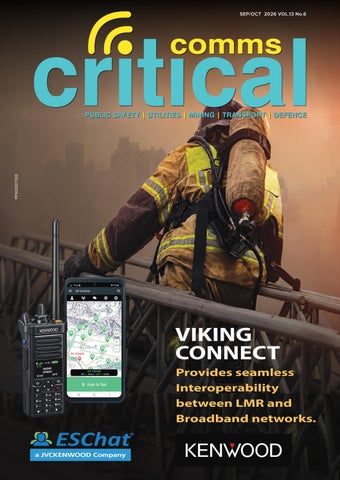
KENWOOD takes mission-critical connectivity to the next level with Viking Connect, powered by ESChat — a best-in-class push-to-talk (PTT) solution trusted by emergency responders worldwide. By seamlessly connecting LMR and broadband networks, Viking Connect delivers a familiar push-to-talk experience across devices, helping teams communicate wherever the mission takes them. It extends coverage beyond traditional radio infrastructure, keeping critical information moving when
Radio telescopes enable real-time tracking of orbital threats
and where it is needed most.
51
Closing the loop: what AI adds after the duress button is pressed
VP8000 and VM8000 radios to operate across
56
Best of both worlds: charting the hybrid future in Australia
58
After 600 days of Trump 2.0, how has telecom been impacted?
Viking Connect enables KENWOOD Viking LMR and broadband networks, including WiFi, Ethernet and, with the right infrastructure, LTE, 4G, 5G and satellite. When LMR coverage is unavailable — or broadband is the preferred connection — Viking radios can seamlessly switch to broadband, helping users stay connected without changing their familiar push-to-talk experience. With ESChat technology embedded directly into the Viking radios, LMR talk groups can connect seamlessly with broadband users on radios, consoles, smartphones and PCs. This interoperability helps teams communicate across networks while maintaining secure, encrypted communications designed for mission-critical operations. Designed to scale with the evolving needs of public safety, government, utilities and transportation, Viking Connect provides secure communications built for demanding,
FREE digital subscription
This bimonthly magazine is free for industry professionals in digital format. Subscribe at: www.criticalcomms.com.au/magazine www.CriticalComms.com.au
mission-critical environments. Because when every second counts, staying connected can make all the difference. JVCKENWOOD Australia Pty Ltd au.jvckenwood.com
Do you read me? Hello reader, this is Critical Comms editor Lauren Davis reporting, writing these words almost nine months to the day since I went on maternity leave. Unfortunately, while much has changed in my life over the course of 2026, it appears that Australia is still experiencing the same old telco problems, with both Telstra and Optus experiencing outages of late. Details on the Telstra outage of 8 July are reported in our news section on page 10, while Optus’s 75-minute voice outage on 11 September — which was blamed on a hardware failure at an Optus exchange — was particularly poorly timed, coming almost a year after the company’s 13-hour outage of September 2025. The 2025 outage was in fact considered so severe that the ACMA recently commenced proceedings against Optus in the Federal Court, alleging that during the outage, Optus breached two separate legal obligations more than 1000 times — and seeking an order that Optus pay substantial pecuniary penalties to the Commonwealth for these contraventions. On a happier note, another thing that’s stayed the same is the presence of Comms Connect in the radio industry calendar, returning to Melbourne once again this October. While parenting duties will prevent me from attending this year, I was thrilled to receive so many contributions from Comms Connect presenters and exhibitors — including articles, case studies, product editorials and more. The event highlights begin on page 14 with our conference preview article, after which point you’ll find them scattered throughout the magazine. Elsewhere in this bumper issue, you’ll find tips on improving operational technology cybersecurity (page 30); a look at how emergency management organisations can achieve interoperability (page 40); and a call for ADF veterans to consider a career in the comms industry (page 42). There’s also a fascinating piece on our Spectrum page (page 58) about the effect of the second Trump presidency on the telecom industry. So, while it’s true that the big telcos have not exactly been in the headlines for the best reasons, we can at least take comfort in the knowledge that the critical comms industry as a whole continues to work together to innovate, evolve, and quite literally stay connected. It’s good to be back.
Calendar October Comms Connect Melbourne 2026 14–15 October 2026 Melbourne Convention & Exhibition Centre melbourne.comms-connect.com.au ARCIA 2026 Gala Dinner & Excellence Awards 14 October 2026 Sofitel Melbourne on Collins arcia.org.au/events/arcia-gala-dinner2025-melbourne Techritory 2025 21–22 October 2026 ATTA CENTRE, Riga, Latvia www.techritory.com 5th Annual Australian Beyond 5G Connectivity Summit 27–28 October 2026 Sydney www.connectivityinnovationnetwork.com/ b5g2026/ Critical Control Rooms World Congress 2026 27–29 October 2026 Hyatt Centric The Liberties Dublin, Ireland events.criticalcontrol.org/event/congress/ summary
November PMRExpo 2026 24–26 November 2026 Koelnmesse, Germany pmrexpo.com/en
December APCO Public Safety Innovation Summit Featuring 5x5 1–2 December 2026 Hyatt Regency Orlando, USA apcosummits.org/innovation/
Lauren Davis, Editor cc@wfmedia.com.au
Westwick-Farrow Media A.B.N. 22 152 305 336 www.wfmedia.com.au Editor: Lauren Davis cc@wfmedia.com.au Publishing Director/MD: Janice Williams Art Director/Production Manager: Linda Klobusiak Circulation: Alex Dalland circulation@wfmedia.com.au
Copy Control: Ashna Mehta copy@wfmedia.com.au Advertising Sales Tim Thompson Ph 0421 623 958 tthompson@wfmedia.com.au Liz Wilson Ph 0403 528 558 lwilson@wfmedia.com.au Head Office Unit 5, 6-8 Byfield Street, North Ryde Locked Bag 2226, North Ryde BC NSW 1670 Ph: +61 2 9168 2500
Print Post Approved PP100007393 ISSN No. 2202-882X Printed and bound by Ive Group
Westwick-Farrow Media is committed to using environmentally responsible print services to produce our publications. This edition is made with a mixture of materials from FSC-certified forests, recycled materials, and/ or FSC-controlled wood. While controlled wood doesn't come from FSC-certified forests, it mitigates the risk of the material originating from unacceptable sources. It is delivered in a totally degradable plastic wrapper.
IEEE Global Communications Conference (GLOBECOM) 2026 7–11 December 2026 Macau S.A.R., China globecom2026.ieee-globecom.org/
January 7th IEEE International Symposium on Joint Communications & Sensing 25–29 January 2027 Munich, Germany jcns-symposium.org Further event information can be found at criticalcomms.com.au/events.
All material published in this magazine is published in good faith and every care is taken to accurately relay information provided to us. Readers are advised by the publishers to ensure that all necessary safety devices and precautions are installed and safe working procedures adopted before the use of any equipment found or purchased through the information we provide. Further, all performance criteria was provided by the representative company concerned and any dispute should be referred to them. Information indicating that products are made in Australia or New Zealand is supplied by the source company. Westwick-Farrow Pty Ltd does not quantify the amount of local content or the accuracy of the statement made by the source. If you have any queries regarding our privacy policy please email privacy@wfmedia.com.au
4 Critical Comms - September/October 2026
www.CriticalComms.com.au
THE 5G RADIO FOG
WHY TRADITIONAL SPECTRUM ANALYSERS MISS MODERN RF INTERFERENCE Meryem Berrada, Product Marketing at Keysight Technologies*
iStock.com/koksikoks
6 Critical Comms - September/October 2026
www.CriticalComms.com.au
SPECTRUM ANALYSIS
M o d er n 5G network te sting depends on real-time spectrum analysis to detect transient RF interference that traditional swept spectrum analysers often miss. As RF environments become denser with 5G, IoT, radar systems and autonomous infrastructure, engineers increasingly rely on handheld spectrum analysers and spectrum management software to identify, localise and mitigate interference in real time.
T
he wireless world is not just getting faster. It is getting denser. As global infrastructure shifts toward 5G, massive IoT and autonomous systems, the RF spectrum is becoming an increasingly crowded and contested space. What once appeared as occasional interference is now evolving into something far more consequential: an invisible gridlock forming across the airwaves. This shift fundamentally changes the nature of the problem. Interference is no longer a minor inconvenience behind a dropped call. It is a systemic risk capable of disrupting critical operations. Maintaining network integrity now requires more than simply detecting signals. It demands real-time, intelligent awareness of spectrum behaviour as it unfolds. Several key shifts show just how much the RF landscape has changed.
Why Is RF interference detection critical for safe 5G network testing?
The transition to 5G does not just improve performance. It raises the stakes. Networks are moving from human-driven communication towards machine-to-machine ecosystems, where reliability is directly tied to physical outcomes. In this environment, RF interference detection affects far more than connectivity. It can directly impact systems such as autonomous vehicle navigation, public safety communications, and radar and defence infrastructure. In these contexts, failure is not measured in inconvenience. It is measured in consequence. A momentary disruption can cascade into a critical system failure, leaving little to no margin for error. Interference is no longer something networks can simply tolerate. It is something they must actively anticipate and mitigate during 5G network testing and deployment.
Why do traditional spectrum analysers miss modern RF interference?
Conventional swept-tuned spectrum analysers were designed for a very different RF environment — one where signals were relatively stable, predictable, and easier to isolate. Today’s signals behave differently. They are often transient, lasting only milliseconds. They can be intermittent in nature
www.CriticalComms.com.au
and increasingly dense, overlapping within the same spectral space. Traditional swept spectrum analysers measure frequencies sequentially. That sweep-based approach can provide useful snapshots of RF activity, but it can also miss short-duration events that occur between sweeps. Real-time spectrum analysis changes that perspective. Instead of sampling the spectrum in slices, it continuously captures and processes RF activity across a defined bandwidth without gaps in observation. This makes it better suited to detecting transient, burst and intermittent signals that are common in modern 5G and dense RF environments. With modern tools, engineers can visualise RF behaviour using spectrograms and waterfall displays. These views reveal short-duration transients, overlapping emitters and time-varying interference patterns that would otherwise remain invisible. Capturing this kind of wideband, time-sensitive activity is no longer a specialised capability. It is becoming a baseline requirement for modern RF interference detection. Understanding the difference between traditional and real-time spectrum analysis is thus critical for engineers performing RF interference detection and 5G network testing in modern environments.
How are real-time spectrum analysis workflows changing field testing?
The traditional model of RF troubleshooting, dispatching teams to investigate issues onsite, is rapidly becoming unsustainable. Historically, diagnosing problems in the ‘last mile’ required manual drive testing, consuming significant time, labour and operational resources. That model is now shifting towards centralised, software-driven workflows. By combining ruggedised handheld spectrum analysers with centralised analysis platforms, engineers can remotely control distributed test assets, monitor multiple sites simultaneously, and stream live measurement data back to centralised teams. This creates a fundamentally different workflow: capture, stream, analyse and act. Engineers no longer need to be physically present at every field location. Instead, units can remain deployed at the edge while analysis happens centrally, powered by high-fidelity, wideband IQ data delivered in real time. >>
September/October 2026 - Critical Comms
7
SPECTRUM ANALYSIS
Figure 1: Distributed field measurements combined with TDoA processing enable rapid, wide-area localisation of interference sources.
How does real-time RF interference detection use TDoA localisation?
The classic ‘fox hunt’, tracking interference sources with directional antennas, was built for a slower and simpler RF environment. In today’s dense 5G deployments, where interference sources can appear and disappear in milliseconds, manual methods struggle to keep pace. The modern approach shifts the problem from physical pursuit to mathematical computation. Time Difference of Arrival, or TDoA, techniques use multiple GPS-synchronised receivers to measure the precise arrival time of a signal across different locations. Because RF propagation speed is constant, software can calculate the
emitter’s position based on the difference in arrival times. This approach reduces reliance on slow, manual triangulation and enables rapid, wide-area localisation that scales with the complexity of modern networks. RF interference detection is no longer only a field exercise. It is increasingly a datadriven problem solved through coordinated measurement and computation.
How are handheld spectrum analysers closing the gap between field and lab testing?
For years, RF engineers had to choose between portability and performance. Handheld spectrum analysers offered convenience in the field but often lacked the depth required
Aspect
Traditional spectrum analysis (swept)
Real-time spectrum analysis (RTSA)
Measurement method
Sweeps across frequencies sequentially
Captures entire frequency span continuously
Signal visibility
May miss intermittent signals
Detects transient and burst signals
Time resolution
Limited by sweep speed
Continuous time-domain capture
Detection of transient signals
Poor
Excellent
RF environment suitability
Stable signals
Dense dynamic RF environments
Interference detection
Limited capability
Accurate interference analysis
Visualisation
Static trace
Spectrogram and waterfall views
Overlapping signals
Difficult to separate
Visualises overlapping emitters
Bandwidth coverage
Narrow instataneous bandwidth
Wideband capture
Use case
Basic signal analysis
5G and interference hunting
Field testing performance
Mostly lab-based
Portable field testing
Data capture
Snapshot-based
Continuous IQ streaming
Operational impact
Reactive troubleshooting
Real-time monitoring
Table 1: Comparison of traditional swept spectrum analysis and real-time spectrum analysis for modern RF interference detection and 5G network testing.
8 Critical Comms - September/October 2026
for advanced analysis. Benchtop instruments delivered precision, but at the cost of mobility. That trade-off is now changing. Modern handheld analysers can enable wideband real-time IQ streaming, representing a significant leap from previous limitations and changing what can be achieved outside the lab. This capability is especially important for 5G New Radio, where channel bandwidths can reach up to 100 MHz in sub-6 GHz bands. Without wideband capture, engineers may be forced to stitch together narrower measurements, losing critical time-domain behaviour in the process. With wideband streaming, entire 5G channels can be captured in a single acquisition, preserving signal behaviour and enabling integration into centralised analysis workflows. In practical terms, the boundary between field and lab is becoming less rigid. More advanced analysis can now be brought closer to where the RF problem actually occurs.
Why real-time spectrum analysis is becoming essential for 5G network testing
Spectrum management is undergoing a fundamental transformation. Detecting signals is no longer sufficient. Engineers must now be able to capture transient, wideband RF activity in real time, stream and classify that data within centralised systems, precisely locate interference sources, and act before disruptions escalate into failures. The wideband reality is already here. With 5G NR channel bandwidths reaching up to 100 MHz in sub6 GHz bands, real-time wideband capture is not just a forward-looking requirement. It is an immediate need for modern 5G network testing. The question is no longer whether interference will occur. The question is whether your tools can see it in time.
*Meryem Berrada, PhD, specialises in RF test and measurement solutions within Keysight’s portfolio, including handheld analysers such as the FieldFox, as well as network analysis, noise figure and phase noise measurements. Keysight Technologies will be exhibiting at Comms Connect Melbourne from 14–15 October on Stand 33.
www.CriticalComms.com.au
News Image credit: Queensland Government
ERICSSON TO BRING PRIVATE 5G TO QUEENSLAND’S RAIL NETWORK Ericsson has announced that its technology has been selected for the first stage of Queensland’s next-generation rail communications network ahead of the Brisbane 2032 Olympics. The company will provide the 5G-enabled digital radio system (DRS) technology in partnership with rail engineering firm UGL Transport and mission-critical communications company Frequentis, following the Queensland Government’s selection of the team to deliver the first phase of a next-generation rail communications network across South-East Queensland. Awarded by the Queensland Government, the contract will see the new DRS deployed as part of Stage 1 of The Wave, a public transport and rail infrastructure program being delivered to connect Brisbane and the Sunshine Coast in Queensland. The DRS will provide the communications foundation to support rollout of European Train Control System (ETCS) Level 2, a next-generation signalling technology that enables continuous digital train control being delivered by Alstom.
As part of the project, Ericsson will deliver the 5G communications platform underpinning the solution. The technology is designed to support mission-critical rail operations and provide a pathway towards Future Railway Mobile Communications System (FRMCS) capabilities, helping improve safety, operational efficiency and network capacity. UGL Transport, Ericsson and Frequentis will deliver the first operational section of the DRS to the Sunshine Coast line, which is a key corridor in the broader upgrade plans for Queensland’s rail network. The system will be ready to support passenger services ahead of the Brisbane 2032 Olympic and Paralympic Games. “This is a significant moment for digital rail in Australia,” said Ludvig Landgren, Head of Ericsson, Australia and New Zealand. “Ericsson’s mission-critical private 5G platform will underpin Queensland’s nextgeneration rail communications network. We are proud to be part of the team delivering this critical infrastructure for Queensland and for the Brisbane 2032 Olympic and Paralympic Games.”
ACMA CRACKDOWN DELIVERS DROP IN ILLEGAL RADIO DEVICE SALES
www.CriticalComms.com.au
iStock.com/Supatman
The ACMA says its campaign to tackle the online supply of illegal radio communications devices has helped drive a significant drop in the number of devices advertised for sale on online platforms in Australia. The non-compliant devices include two-way radios, illegal jammers, mobile phone boosters and unauthorised cellular mobile repeaters. These devices can interfere with communications services and networks, including access to emergency services. The ACMA undertook an audit over five weeks during April and May 2026, following an extensive education and compliance campaign, and examined listings on Amazon Australia, eBay, Facebook Marketplace, Gumtree, Kogan, Temu and Shein. The audit identified 361 non-compliant and illegal listings, down from 1162 in the ACMA’s 2024–25 audit, a 69% decrease. The listings identified included: • 292 non-compliant two-way radios • 55 unauthorised cellular mobile repeaters and mobile phone boosters • 14 jammers. All 361 listings were removed after the ACMA contacted the platforms, with most platforms acting within 24 hours. Since 2022, the ACMA has run a sustained campaign to tackle the online supply of dodgy devices. The campaign has combined targeted advertising and consumer education, proactive engagement with online platforms, audit and removal activity, and the launch of
the Equipment Safety Pledge. The pledge sets out voluntary commitments for participating platforms to detect and prevent listings, cooperate with the ACMA, educate sellers and help consumers report non-compliant and illegal communications devices. The audit results indicate the ACMA’s campaign is driving change. Notably, platforms that have signed the Equipment Safety Pledge demonstrated significant reductions in non-compliant and illegal listings and improved response times. The ACMA is encouraging all online sites that supply communications devices to sign up to the Equipment Safety Pledge and help protect Australians from illegal and non-complaint radio devices. September/October 2026 - Critical Comms
9
News iStock.com/FG Trade Latin
TELSTRA OUTAGE SPARKS CALL FOR ENFORCEABLE RELIABILITY STANDARDS
10 Critical Comms - September/October 2026
New portable connectivity kits, nimble internet-enabled forward command vehicles and satellite vessel tracking are being rolled out by the NSW State Emergency Service (SES) to enhance community response during disasters, thanks to $7.7 million in funding from the state government. The connectivity kits will provide smaller teams in the field with access to internet, phone and radio services, while larger connectivity trailers will support more than 100 users during major incidents and can be shared with partner agencies. Eight of the kits will be allocated to SES drone operators, allowing them to securely transmit live vision from the scene of an incident directly to Incident Management Teams or the State Control Centre. The kits mean drones can remain onsite delivering vital vision when operating in an area with limited connectivity or where communication infrastructure is impacted. In order to maintain constant contact between incident controllers and SES field teams, three specialised forward command vehicles are also being delivered to support on-scene communications and coordination. The vans are designed to be agile so they can get to restricted locations that larger mobile command centres cannot reach. SES vehicles will also receive improved connectivity, with 230 vehicles receiving fast, high-speed internet enabling them to better access live information. Five new internet connectivity trailers will also be deployed to SES zones, providing high-capacity internet access for SES members, partner agencies and communities during major floods, storms and other emergency operations where networks are limited, overloaded or down. Finally, vessels will be trackable for the first time, with satellite technology installed across the SES fleet to allow real-time monitoring during flood rescue response and onwater operations, helping direct resources, monitor teams and make effective decisions during tasking. In total, the connectivity upgrades include: • $1.5 million for Generation 2 internet-enabled forward command vehicles; • $1.4 million for internet connectivity trailers; • $1.3 million for vehicle improvements; • $915,000 for internet connectivity upgrades at SES units including Starlink; • $900,000 for internet connectivity kits; and • $500,000 for satellite vessel tracking.
Image credit: NSW SES
The report into Telstra’s nationwide outage on 8 July, recently completed by Technology Audit Partners (TAP), has emphasised the need for enforceable reliability standards to be established, according to the Australian Communications Consumer Action Network (ACCAN). As detailed by Telstra CEO Vicki Brady, Telstra staff completed in-person maintenance on a device called a Network Time Protocol server at 2.50 am on 8 July, as part of work to address a backup power fault. This server helps different parts of the mobile network stay in time with each other. According to Brady, the team followed the relevant procedure — including restarting the server — but because of an underlying software configuration, the server restarted with the wrong date. This is significant because parts of the mobile network rely on accurate timing to work properly — and so as the incorrect date spread through the network, some mobile voice and data services began to fail. At its peak, the issue impacted approximately 45% of all calls and data sessions on the Telstra mobile network. By that afternoon this issue had been addressed, Brady said — but further investigation identified a subsequent issue affecting some calls to Triple Zero, which was linked to the same software configuration that caused the original outage but required a separate fix. As a result, 611 callers to Triple Zero received an error message, and their phones may have attempted to connect to an alternative mobile network. A solution addressing this issue was not implemented until late morning on 9 July. TAP’s investigation found the outage was primarily a result of Telstra not treating network timing as a sovereign function requiring the highest levels of oversight and protection, Brady admitted. In regards to the network timing system, TAP identified the following: • Ownership for this function was not sufficiently defined, which led to weakness in this area and not treating it as a high-risk function of the network for the purposes of design, operations and resource prioritisation. • The architecture supporting network timing had evolved over time without adequate end-to-end oversight. • There was insufficient technical expertise for network timing systems and the need for stronger competency and more curiosity to investigate when something looked wrong. • There were shortcomings in process discipline including c h a n g e m a n a g e m e n t , co n f i g u ra t i o n co n t ro l , i n c i d e n t management, documentation and follow-through. ACCAN CEO Carol Bennett said, “This [report] confirms, again, that we must see clear and enforceable reliability standards in this sector… At this point it is clear we have a systemic failure of sector governance, and the government must step in to address this problem by setting clear reliability requirements before the next avoidable outage hits.”
IMPROVED FRONTLINE CONNECTIVITY FOR NSW SES
www.CriticalComms.com.au
Configurable outdoor cabinets The Cable Ways Silver Star outdoor equipment cabinet series is manufactured in New Zealand from marine-grade aluminium or optional 316 stainless steel, and is designed to provide a standardised yet highly configurable solution for outdoor network infrastructure. Cabinet dimensions, mounting configurations, thermal management systems, locking arrangements and equipment mounting options can be selected within a predefined platform, reducing engineering lead times while maintaining application flexibility. The series supports 19″, 21″ and 23″ EIA/ETSI equipment
DC power system
mounting and includes thermal management options ranging
The Samlex 12V Advanced N+1 DC Power System provides re-
from sealed IP65 plain door configurations to natural convec-
dundant, scalable DC power for critical infrastructure in a compact
tion and forced convection cooling systems.
1U rack-mount system.
Designed for telecommunications and remote infrastruc-
Combining N+1 redundancy, advanced remote monitoring,
ture environments, Silver Star cabinets are suitable for fibre
integrated battery back-up capability and comprehensive system
distribution nodes, GSM base stations, traffic management
protection, the SEC-HCP Series has been designed to provide the
systems, remote monitoring sites, water management infra-
reliability and flexibility required for telecommunications, network
structure and battery storage applications.
infrastructure, public safety communications, industrial automation
A key advantage of the Silver Star series is its ability to
and other mission-critical environments. Scalable modular archi-
provide configurable solutions with faster delivery compared
tecture supports the parallel connection of up to two systems for
to fully custom-built cabinet projects, helping network opera-
increased capacity and redundancy, and provides comprehensive
tors and integrators respond more efficiently to rollout and
protection against overvoltage, overcurrent, short circuits and
upgrade requirements.
overheating. The integrated two-stage battery charger operates
Cable Ways Ltd
independently of the power modules, preserving full system
www.cable-ways.co.nz
output capacity (12 and 28 V models now with 24 V to follow). Note that SEC-HCP systems require compatible SEC-HSM Hot-Swappable Power Modules for operation. Modules are sold individually to allow custom system sizing and future expansion. Modules are available in 12, 24 and 48 V DC configurations to suit a wide range of applications. The Samlex 12V Advanced N+1 DC High Power DC System is available only from AceComms. AceComms www.acecomms.com.au
Military comms system Savox Communications has announced Savox MissionCore, an open and interoperable mission platform designed for battlefield networks to modernise with limited disruption. Based on a software-defined modular, IP-based architecture, it integrates voice, video and data into a scalable C4ISR solution. Modern defence operations are being constrained by fragmented system landscapes and outdated legacy technologies undermining interoperability, stalling scalability, and preventing the timely integration of actionable data. The solution addresses these challenges with an open, modular architecture that orchestrates mission data feeds into a unified operational environment. It allows for the fusing of fragmented data streams into coherent, actionable awareness, reducing cognitive burden, simplifying integration and enabling modernisation without replacing existing systems. The platform supports a multi-sensory user interface that uses both audio and visual elements to provide critical information and reduce cognitive load in demanding operational environments. Unlike closed or system-bound solutions, the software-defined IP-based architecture supports VoIP, broadband and narrowband military networks, video feeds and sensors to facilitate integration into battle management and AI systems, aligning with NATO Generic Vehicle Architecture (NGVA) standards and enabling scalability and long-term adaptability. The product has been designed to give defence forces a unified platform to integrate existing assets, accelerate decision-making, and modernise on their own terms without being locked into closed architectures. It is supported by Savox system components including data processing units (DPUs) and data routing units (DRUs), which enable low-power, efficient processing routing, and integration of mission-critical voice, video and data across battlefield environments. Savox Communications www.savox.com
12 Critical Comms - September/October 2026
www.CriticalComms.com.au
ENHANCE YOUR MISSION CRITICAL COMMUNICATIONS Upgrade to Etherstack >
Australian designed, manufactured and supported P25 infrastructure, cores and terminals
Etherstack Pty Ltd 64 Rose Street Chippendale NSW 2008 Australia
+61 2 8399 7500 info-au@etherstack.com www.etherstack.com
A STELLAR LIST OF SPEAKERS PLANNED FOR COMMS CONNECT MELBOURNE Lauren Davis
The 2026 edition of Comms Connect Melbourne, taking place at MCEC on 14–15 October, is expected to welcome over 1600 guests — including more than 450 conference delegates — with the event regularly attracting attendees from industries including marine, aviation, utilities, mining and emergency services.
R
ecognised as the major conference and expo for critical communications and public safety professionals in the Southern Hemisphere, Comms Connect Melbourne will see over 60 local and global critical comms leaders speak across three dedicated conference streams: Public Safety, Technology and Industry. Across the two days of the conference, this stellar line-up of speakers will share their expertise and insights on topics including interoperability, smart cities, PSMB, marine communications, remote communications, P25, drone tech, private networks for mining, 5G and ISAC, AFC in 6 GHz and much more. Keynote speakers include Bradley Creevey, NEMA’s PSMB Taskforce Assistant Coordinator General, who will open day one with a detailed update on the rollout of Australia’s
Public Safety Mobile Broadband platform. Kylie De Courteney, Managing Director of the NSW Telco Authority, will follow with an update on the Authority’s latest public safety deployments and their role in the PSMB rollout. The TasGRN project will also feature on day one, with the CIO of the Department of Police, Fire & Emergency Management Tasmania, Tim Rutherford, on stage with Telstra’s Wireless Engineering Principal, Andrew Johns. Day two will open with a presentation by Hamad Alnuaimi, ICT Advisor for Abu Dhabi Police, who will share his insights into how 5G and smart cities are enhancing citizen safety. Shane Fitzsimmons, former NSW Fire Commissioner and current Board Chair of the Connectivity Innovation Network (CIN), will share practical outcomes where collaboration is driving innovation in critical
14 Critical Comms - September/October 2026
communications, including a recent Wi-Fi antenna development involving the NSW SES, CIN and The University of Sydney. And Louise Francis, Ecosystm’s NZ Country Manager, will draw on real-world use cases from several countries to explore how the challenges of AI are being overcome to build next-generation emergency communications fit for the future. AI is in fact set to be the big discussion point of the event, as the subject of multiple presentations. Matt Ingersole, CIO for Surf Life Saving NSW, will reveal how groundbreaking AI tech is being used for drowning prevention, while Derek Madden, CEO of Moorabool Shire Council, will teach the practical lessons any mission-critical organisation can apply to introduce AI safely and responsibly. Dan Winson, founder and CEO of Zetifi, will meanwhile explain how agentic AI is moving into decision chains that used
www.CriticalComms.com.au
Events for critical communications users and industry
to be entirely human, including safety-critical ones (see the article on page 50 for more information on this). Winson will join Francis and other experts in the panel discussion ‘AI in Critical Comms — insights from local and global leaders’, while a second panel discussion will explore how AI is becoming part of a hybrid ecosystem, coexisting alongside LMR, LTE/5G, private networks, Wi-Fi, LEO and cloud platforms. Hybrid systems are of course already here, with Italy’s Adolfo Ferraro, VP of Critical Communications Sales for Leonardo, set to reveal how his company delivered a hybrid mission-critical comms network to the Milano Cortina 2026 Winter Olympic Games — a challenging task that required resilient, secure communications across geographically dispersed venues, transport corridors and Olympic villages. Simon Hill and Matt Wroughton, respectively CTO and Group Sales Director of Excelerate Technology Group in the UK, will meanwhile reveal how European emergency service organisations are utilising hybrid connectivity solutions that intelligently bond satellite and terrestrial networks to deliver resilient, always-on communications in mission-critical environments. And David D’Souza, ICT & Operational Technology Leader at Powercor, will outline the hybrid comms solution that’s ensuring continuous connectivity to rural and remote Australia. There will as always be plenty of news from our friends across the ditch. Matthew Hansen, Senior Project Manager for the PSN Program at SafetyNet (formerly Next Generation Critical Communications), will discuss the introduction of a new shared voice console
www.CriticalComms.com.au
for New Zealand’s emergency services, as part of the transition to a new P25 network from later this year. Telecommunications consultant Neal Richardson, Director of Otarise Services, will explain why Australia and New Zealand have not yet implemented a technology initiative along the lines of Europe’s eCall — which enables a vehicle to automatically contact emergency services, establish a voice connection and simultaneously transmit critical incident information. And Matt Ellingham, ICT Manager for Land Search and Rescue New Zealand, will reveal the three lessons his organisation has learned from the last 7–8 years of search-and-rescue communications innovations. Four pre-conference workshops will take place at MCEC on 13 October, prior to the commencement of the main conference on 14 October, conducted by Comms Connect Association Partner ARCIA and Supporting Partner ACCF/TCCA. ARCIA’s morning workshop explores the cybersecurity challenges facing modern mission-critical radio and communications systems, while its afternoon workshop will give attendees an overview of the latest ACMA spectrum developments, licensing changes, and emerging areas of interest for radio system planners and licence
WHAT: Comms Connect Melbourne WHEN: 14–15 October 2025 WHERE: Melbourne Convention and Exhibition Centre (MCEC) WEB: melbourne.commsconnect.com.au
managers. The ACCF/TCCA workshops will meanwhile address how the latest technology developments and 3GPP releases will drive changes in the critical communication ecosystems globally. All four workshops include a morning or afternoon tea break for networking with other delegates, and can be booked as part of conference attendance or on their own. Over 100 leading critical comms vendors will feature as part of the event’s largest ever exhibition showcase on 14–15 October, including Innovation Partner Telstra as well as Platinum Sponsors Hypha, JVCKENWOOD, L3Harris, RFI Technology Solutions and Tait Communications. With a wide range of technologies on display, this will give attendees plenty to see and do in between conference sessions — and for those who don’t have time to commit to the conference, free exhibitiononly passes are available. The exhibition hall will also host networking drinks on the evening of 14 October, with attendees then invited to make their way to ARCIA’s Gala Dinner & Excellence Awards at the Sofitel Melbourne on Collins. Featuring plenty of food, drinks and entertainment, the dinner provides the opportunity to celebrate all that is great about a critically important industry, including some of its most outstanding individuals and organisations. Flexible attendance options are available for Comms Connect, including one- or twoday conference packages, with or without workshops, or expo-only passes. For more information and to register now, visit melbourne.comms-connect.com.au.
September/October 2026 - Critical Comms
15
2026 New Product Showcase
STAND
75
Programmable monitoring and control platform The Decon Smart Controller (DSC100 Series) is a programmable monitoring and control platform designed for telecommunications, energy and critical infrastructure environments. The controller integrates power systems, generators, batteries, HVAC equipment, environmental sensors and alarm systems into a single software-based management platform. Designed for deployment at remote and distributed sites, the controller provides real-time monitoring, automation and diagnostics through either cloud-connected
or local operation. The system supports a range of industrial communication protocols including Modbus RTU, RS485, CANBUS, SNMP and API integration, enabling interoperability with existing infrastructure and third-party equipment. Standard features include generator control, battery and power system monitoring, environmental management, HVAC control, alarm integration and custom automation logic. The platform is available in multiple configurations and incorporates expandable I/O capability for integration with site-specific devices and sensors. The controller can be used to improve visibility of remote assets, centralise operational data, and automate routine site functions across telecommunications shelters, renewable energy systems and other critical infrastructure facilities. Decon Corporation www.deconcorp.com.au
Low-power SCADA radio Ubiik’s Zephyr multipoint radio is designed for
STAND
STAND
RF infrastructure components
10
an expanded portfolio of Telstra Approved
53
RFI Technology Solutions has announced
sites where power availability is constrained.
products, giving network operators,
Consuming only 1.8 W during RX idle
system integrators and installers access
makes the radio suitable for isolated loca-
to infrastructure that has met Telstra’s
tions where sites are powered by solar and
technical approval requirements for de-
battery. It offers 64 QAM modulation and up to
ployment within approved applications.
50 kHz channel bandwidth to boost throughput, supporting up to 250 endpoints per
Choosing Telstra Approved infrastructure
base or running multiple polling systems on a single network.
helps simplify project planning by pro-
With 5 W transmit power and up to 100 km in range, the device is designed as a
viding confidence that products have
network upgrade or plug ‘n’ play replacement for legacy SCADA radios for electric, water
been assessed against Telstra’s techni-
and wastewater utilities, irrigation automation, and oil and gas wellheads and pumps.
cal requirements, reducing deployment
Ubiik
risk and supporting consistent network performance.
www.ubiikmimomax.com
The approved portfolio spans key passive RF infrastructure components,
STAND
65
Drone range extender kit
including selected cellular and RF antennas, RF couplers, RF splitters, loads and
ZCG Scalar is launching its Drone Range Extender
jumpers. These products are designed to
Kit, designed to enhance the RF performance of a
support a broad range of telecommunica-
drone controller. Compact and easy to set up, the kit
tions applications, including in-building
connects externally and provides dedicated amplified
coverage, distributed antenna systems
RF paths for both 2.4 and 5.8 GHz, combining high-
(DAS), carrier infrastructure and enterprise
performance omnidirectional antennas, bidirectional RF
connectivity projects.
amplifiers and low-loss cable assemblies.
Customers can identify eligible prod-
Available in 5, 10 or 15 m runs, the external anten-
ucts by the Telstra Approved designation
nas can be positioned away from the controller, giving
on RFI product information and can
operators flexibility when selecting an optimal antenna
contact the RFI team for assistance
location. The amplifiers connect directly to the controller via 30 cm cable assemblies
selecting approved solutions for their
and are powered via USB.
next deployment.
With emergency services and critical communications increasingly relying on UAVs for situational awareness, search and rescue, and incident response, the kit is built to keep operators connected further from base, in the environments where strong RF
RFI Technology Solutions www.rfi.com.au
performance matters most. ZCG www.zcg.com.au
16 Critical Comms - September/October 2026
www.CriticalComms.com.au
SPONSORED CONTENT
Elyssa Rollinson, CCO at BAI Communications.
An effective PSMB network needs crossdomain experience Exclusive interview with Elyssa Rollinson, CCO, BAI Communications
for other industry sectors, predominantly in mining, rail and energy where those networks are considered mission-critical to those businesses.
Australia has talked about implementing a national public safety mobile broadband network for some years without landing on a model. What’s actually been missing? In terms of deploying PSMBs, different countries
In her role as Chief Commercial Officer, Elyssa Rollinson is responsible for supporting strategy development and execution and for engagement across the broadcast, telecommunications and government sectors for BAI Communications, which operates and monitors the New South Wales Public Safety Network (PSN) and is delivering critical systems and passenger connectivity for the Sydney Metro West project. With plans for a national public safety mobile broadband (PSMB) network a live topic of discussion, Critical Comms recently spoke with Elyssa about the cross-domain experience that will make it work.
are addressing it quite differently. The largest problem in Australia is the vast geographical reach that our emergency service operators require, which means that we need to balance the aim of covering the entire country with broadband with the realities of the cost of doing so. Building a PSMB is complex on a couple of levels. The connectivity challenge is there, but there is also our national fabric of states and territories that are independently responsible for emergency management, with each state and territory approaching their communications networks for their police, fire, ambulance and other service organisations slightly differently. In NSW, the Telco Authority is a single point of accountability for those communications
Can you tell me a little of the history of BAI Communications? For nearly 30 years BAI has operated a national broadcast network, providing TV and radio services to over 99% of the population. We deliver a ‘network as a service’ for the broadcasters, where we design, build, own and operate all of the infrastructure required to take content from those broadcasters and connect communities with that content through a portfolio of around 750 sites
that we either own or manage around the country to an always-on level of service. The second thing that we do is that we operate and maintain the NSW PSN on behalf of the Telco Authority to a mission-critical SLA standard, and ensure that the network’s always on and always operating. That network has grown to more than 600 sites and counting, and we have been a trusted partner to them now for about 13 years. We also provide private and public networks
18 Critical Comms - September/October 2026
networks and has been down a path of aggregating a common radio communications platform for the emergency service organisations. Some other states and territories have taken a different approach where they rely on separate networks that serve individual agencies. In my view, our North Star is to think about how to best support frontline emergency responders, particularly when natural disasters occur, which clearly don’t respect borders.
www.CriticalComms.com.au
Image courtesy of NSW Ambulance.
A review in 2022 found the preferred solution would be to use a dedicated PSMB core connected to all three mobile networks. How do you see your company’s role in that? It would be uneconomical for this country to build a standalone emergency service radio access network throughout the entirety of the nation, so it makes sense for a PSMB network to utilise existing mobile network operator (MNO) networks and supplement with a PSMB core. The standalone core needs to provide a point of interconnect to the MNO networks, emergency service organisation (ESO) user management (including profiles), and overall visibility of user devices. This gives real-time insight into the coverage and quality ESOs are actually experiencing, measured against what’s expected. Managing these ESO users, analysing expected versus experienced network performance, and building a dynamic view of potential interruptions — one that can be communicated clearly to ESOs along with the expected impact — is where we see a role for an independent service provider. A service partner who is independent of the various network components needs to sit hand in hand with government across all of those networks. This is where we see ourselves because we’re independent of the MNOs, and because we are already trusted by governments to deliver mission-critical safety communications networks. It’s a natural extension of what we do already.
What do you think it would take to scale the NSW example of a single shared network to a single national broadband network?
www.CriticalComms.com.au
It is a big job, and the complexities associated with a PSMB can’t be overstated. The first complexity is the network architecture. That’s a matter for the MNOs and for government, through the National Emergency Management Agency, and working with state and territory counterparts, to determine the best architecture. The second complexity is the commercial arrangements that need to be put in place between the public MNO networks and state and federal governments for access and roaming throughout those networks. And then there are operational challenges, and it’s those that I think BAI Communications can help address. Another key challenge, of course, is spectrum. And this is where I think there’s an opportunity to look at the way that we’re using spectrum as a national resource and how much of that spectrum is being allocated to national public safety outcomes.
How will experience with projects like Sydney Metro West help in your endeavours with a PSMB?
So you see BAI Communications as a neutral operator that works between the ESOs and the MNOs?
If you think about what you need in a metro underground rail tunnel, you have three separate connectivity needs: you need the public cellular systems that give your commuters connectivity; you need a public safety system; and then you need a third layer, which is your private 5G network that’s going to be the communications platform that underpins your rail operations. The optimal approach is to design and implement all three elements as a single coordinated project. It’s more cost-effective and gives better design outcomes, but also gives better whole-of-life outcomes for how you maintain and keep those networks performing. The public mobile networks in Australia tend to be pretty good at serving outdoor coverage, but not so great at penetrating indoor environments. I anticipate there’s going to be a need to ensure that our ESOs have adequate coverage and capability for communications in those environments as well. And that’s something we’re really good at doing.
Yes, we do that today in broadcast and public safety, and we’re also an independent operator of telecommunications networks in other areas such as in-building systems. We provide coverage in hard-to-reach spaces, like buildings and tunnels, that all the telcos can share and we do that as an independent network operator. Being independent of the existing players in the market can be a real advantage because it is in many cases easier for them to work with an independent neutral operator who does this as their core business than with competitors dealing directly with each other.
BAI Communications www.baicommunications.com
September/October 2026 - Critical Comms
19
CASE
STUDY
2026 New Product Showcase
TETRA network supports security during World Cup iStock.com/FamVeld
Airbus Public Safety and Security has revealed that its TETRA communication network successful ly supported security in Mexico City during the 2026 FIFA World Cup, with the Mexican capital having hosted one of the opening ceremonies and five matches during the course of the event. Mexico City’s Estadio Banorte stadium welcomed more than 400,000 fans across the five matches, with an average attendance of 80,000 spectators per game. 19 official fan zones were also set up in the capital, bringing together more than 7 million attendees over 39 days — with 2.5 million people concentrated in the main area of Mexico City’s Zócalo alone. Significantly, a record 1.4 million attendees gathered in the city centre for the fourth match, expanding to 1.8 million people when including the surrounding areas. Ensuring order and tranquillity during an event of this magnitude
STAND
52
represented an inter-institutional coordination challenge, with the efficient integration between public safety, emergency medical services, civil protection, local authorities and traffic control being key to operational success. The Airbus TETRA network, one of the largest mission-critical infrastructures in Latin America, was found to demonstrate reliability and resilience, backed by its proven capabilities as part of large-scale events. T h e T E T R A t e c h n o l og y successfully facilitated communications and collaboration among public safety and emergency personnel. Thanks to the Airbus platform, coverage was ensured both inside and around the stadium, the 19 fan zones, and every strategic point in Mexico City throughout the 39 days of the tournament. Airbus Defence & Space Oy criticalcommunications.airbus.com/en
STAND
Bluetooth communications and hearing protection headset
STAND
Intelligent DC-UPS with Ethernet
35
ries is an all-in-one DC-UPS
36
The ADELSystem CBI600 sedelivering up to 600 W of
Workers in construction, agriculture, maintenance and industrial settings
backup power for industrial
often need to stay connected while working around hazardous noise.
automation, security and video surveillance applications. The
The 3M PELTOR WS ALERT X+ Headset is designed to combine
series is available in 24 VDC (25 A) and 48 VDC (12.5 A)
Class 5 hearing protection with hands-free communication and audio
models and accepts a wide 110–240–277 VAC input.
streaming, helping workers remain reachable without routinely removing their hearing protection.
The integrated Ethernet connectivity supports SNMPv3, Modbus TCP/IP and HTTPS, which enables real-time remote
Bluetooth MultiPoint technology enables connection to one or two
monitoring, configuration, event logging and alarm notifications
compatible devices, while the noise-cancelling boom microphone
through SCADA and IoT platforms. It features an internal web
helps transmit clear speech in noisy surroundings. Level-dependent
server that provides convenient browser-based configuration.
ambient listening helps promote auditory situational awareness, and
ADELSystem’s Battery Care technology supports charging
push-to-listen allows users to pause streaming and hear surrounding
profiles for lead-acid, AGM, GEL, NiCd, NiMH, Li-ion and
sounds with a double press.
LiFePO4 batteries, with temperature compensation, deep-
The headset connects with the 3M Connected Equipment App, where users can adjust settings, check power status and receive over-the-air
discharge protection, charging-current limitation and battery health diagnostics.
firmware updates. Available in headband and safety helmet attachment
The series also provides automatic fuse-free protection
models, the product offers up to 68 h of operating time with streaming
against reverse battery polarity, short circuit, overload and
and is suited to applications where hearing protection, communication
overvoltage, while seamless battery-to-charger switching
and awareness must work together throughout the day.
helps maintain 24/7 operational continuity.
3M Australia Pty Ltd
ADM Systems Pty Ltd
www.3m.com.au
www.admtech.com.au
20 Critical Comms - September/October 2026
www.CriticalComms.com.au
Experts in the field. With decades of experience, Kordia are experts in designing, building and maintaining critical communications infrastructure. We deliver broadcast transmission, maritime safety of life radio networks, and critical communications for businesses and emergency services. From high-site and mast installations to connectivity projects across the Pacific and in-building mobile coverage (DAS), our engineers, technicians and riggers keep your critical communications connected.
Design. Build. Maintain. Talk to us about your next mission critical project today.
0800 kordia | kordia.co.nz
2026 New Product Showcase
STAND
5G antenna In an increasingly connected world, reliable communications can mean the
74
difference between success and disruption. The Excell 5G Antenna has been engineered to deliver dependable, long-range connectivity in the environments where traditional mobile devices often struggle. Combining the reach of a directional antenna with the flexibility of omnidirectional technology, the product maintains connections to multiple 5G masts simultaneously, helping users stay connected even at the edge of network coverage. Designed for critical sectors including emergency response, transport, defence, maritime and offshore operations, the compact and rugged antenna provides high-speed data, real-time video and clear voice communications wherever they are needed. Field testing has demonstrated good performance, delivering speeds comparable to many fixed fibre broadband services in challenging locations. With organisations demanding greater resilience and operational awareness, the 5G antenna is a powerful solution designed to help teams stay connected, informed and mission-ready wherever their work takes them. Excelerate Technology Ltd www.excelerate-group.com
STAND
77
Mobile connectivity platform Hypha has launched the HyphaONE Mini S, the latest addition to its HyphaONE range and a compact, low-profile connectivity solution designed for vehicles and mobile field teams. The unit combines Starlink Mini, 5G and Wi-Fi 6, turning a vehicle into a communications hub for up to 150 connected devices. Built around Hypha’s Vehicle-as-a-Node technology, the product can use satellite and cellular networks to support voice, data and operational applications as teams move between coverage areas. Its IP69-rated enclosure, low power requirements and double-skin heat-management design suit emergency services, utilities, mining, energy and other demanding deployments. A key feature is the edge compute, which allows applications and data processing to run locally within the vehicle instead of relying entirely on a remote cloud connection. This can reduce latency and keep critical tools such as mapping, situationalawareness platforms and local data processing closer to the teams using them in the field. Hypha Solutions Pty Ltd www.hypha.world
STAND
63
PC-based dispatch and radio management platform Icom Australia has introduced the RC-FS20, a PC-based dispatch and radio management platform designed to bring multiple communication systems together into a single operational view. The product is designed to seamlessly integrate IDAS digital radios and Wi-Fi radio systems into one intuitive platform, eliminating the need for separate consoles and helping to keep the entire team connected through a centralised interface. When paired with the VE-PG4 RoIP Gateway, the RC-FS20 extends connectivity beyond IDAS to virtually any communication system, including P25, LTE radios, marine VHF, aviation, satellite PTT and analog radios. This enables operators to monitor and manage communications across multiple networks from one unified platform. With a scalable, licence-based structure, the product can be configured to meet a wide range of operational requirements — from simple dispatch solutions to complex multi-network communication environments. Icom Australia Pty Ltd www.icom-australia.com
STAND
Broadband communications platforms
73A
for mission-critical and business-critical operations that are aligned with 3GPP MCX standards. They bring together instant
STREAMWIDE has released Team on mission and Team on the run — two broadband communications platforms designed
and secure voice communications, messaging and video (MCPTT/MCData/MCVideo), along with emergency management, lone worker protection, geolocation and operational management tools, within a unified environment. Designed for public safety and emergency services, utilities, transportation and other mission-critical sectors, the platforms help teams improve situational awareness, speed up information-sharing and coordinate operations more effectively. They are built to maintain operational continuity across diverse environments, from routine field activities to demanding emergency situations. Interoperability with legacy radio systems via 3GPP IWF further enables a smooth, progressive transition to broadband critical communications. STREAMWIDE S.A. www.streamwide.com
22 Critical Comms - September/October 2026
www.CriticalComms.com.au
Trusted communications today. Broadband confidence tomorrow. RUGGED BROADBAND AND LMR SOLUTIONS
DEVICES TRUSTED WHEN COMMS CANNOT FAIL
FLEXIBLE DEPLOYMENT OPTIONS
Visit us on Stand 28 at this year’s Comms Connect Melbourne, 14-15 October.
sepura.com
CASE
STUDY
2026 New Product Showcase
Closing the interoperability gap: how Surf Life Saving SA modernised its dispatch
24 Critical Comms - September/October 2026
50
Image: Supplied
Surf Life Saving SA (SLSSA) operates a safety-critical communications network supporting volunteer and professional lifesaving crews across an extensive coastline, coordinating rescues, patrols and large-scale incidents with technology that must be reliable, flexible and interoperable with external agencies. An Omnitronics customer since 2012, SLSSA has progressively evolved its communications capability, moving from early RediTALK and RediTALKFlex dispatch deployments to a modern omnicore Express dispatch environment that today sits at the heart of its State Operations Centre (SOC). SLSSA’s vast coastline is served by a distributed radio network, and incident response often extends beyond its own coverage, demanding interaction with external agencies under time pressure. SLSSA previously relied on console-level audio patching to bridge networks, which was functional, but prone to audio dropouts and inconsistent performance on short transmissions as operations grew more complex. The SOC includes highly technical users alongside other users who operate the system intermittently. SLSSA needed a solution that could scale in capability without adding operational risk or training overhead, while supporting remote access outside normal staffed hours. The requirements were clear: • Network-level interoperability across the Tait DMR Tier II, Motorola Phase 1 and 2 trunked P25 government networks, and VHF Marine channels; • An interface flexible enough for advanced users and intermittent users alike, without compromising reliability or situational awareness; • Integration with Esri ArcGIS and external recording platforms; and • Resilience without a dedicated backup control room, built on secure remote access and network-centric architecture, protecting existing Omnitronics investment. The implementation was designed and commissioned by CartGIS, and now runs across four permanent operator positions, forming the operational hub for radio, mapping, recording and interoperability. It integrates SLSSA’s coastal DMR Tier II network with the P25 network and VHF Marine channels via Omnitronics gateways, with an Eventide recorder handling voice recording and Esri ArcGIS visualising realtime location data. A key decision saw the removal of physical radios from operator desks: operators now connect directly into the radio networks via IP, improving reliability and simplifying workstation design. Touchscreen consoles, foot pedals and wireless headsets via an omnihub2 media dock support different operating styles, while the network-centric design means the SOC can be relocated quickly if required. omnicore Express dispatch lets SLSSA dynamically patch disparate radio networks in real time, proven when an on-call officer outside surf
STAND
radio coverage patched a P25 government talkgroup into the coastal Tait DMR network, maintaining full operational control from home. Consolidating dispatch control and moving away from tablet-based workflows has cut response times: operators now establish patches, access audio and manage incidents in a single action. The system flexes to the operator: advanced users customise screen layouts and workflows, while other users rely on simple, tactile controls, with one-touch switching between speakers and headsets reducing friction during escalation. SLSSA relies on instant recall playback, text messaging to radios, and remote radio stun and revive — the latter supporting lost, stolen or stuck-PTT radios without permanent deactivation, while text messaging helps identify unknown radios detected via AVL. Rather than maintaining a dedicated backup control room, SLSSA relies on omnicore’s IP-based architecture and secure remote access to re-establish dispatch operations quickly from alternate locations with minimal hardware, aligning with its broader business continuity strategy. omnicore dispatch’s intuitive interface reduces the initial training burden for staff and volunteers, and dedicated intercom channels allow realistic scenarios without impacting live operations. SLSSA is also exploring Omnitronics’ omniacademy online training resources for operator refreshers and technical upskilling. “We don’t see Omnitronics as just a dispatch system — it’s a critical part of our entire operational ecosystem,” said Lachlan Larven, Coordinator of SLSSA’s SOC. “omnicore gives us the flexibility to work across networks, support our volunteers, and respond faster when it matters most.” Cal Silcock, Manager of SLSSA’s SOC, will be presenting a more in-depth version of this case study at Comms Connect Melbourne on 15 October. Omnitronics will also be exhibiting at the event from 14–15 October on Stand 50. Omnitronics Pty Ltd www.omnitronicsworld.com
www.CriticalComms.com.au
Satellite PTT
P25
Aviation
LTE Radio IDAS Digital
Wi-Fi Radio
Analog Marine
One Console. Seamless Interoperability. Powered by VE-PG4.
HOW THE RIGHT ANTENNA CAN DELIVER CRITICAL INSIGHTS INTO WASTEWATER Robert Jesman, Commercial Director at Panorama Antennas
Wastewater monitoring gives utility providers the opportunity to optimise their systems, reduce maintenance costs, and locate and solve potential problems ahead of time, but it’s only possible with the right antenna solution.
T
hanks to modern IoT technology, wastewater monitoring can offer valuable real-time insights into issues such as water levels, pipe blockages and maintenance factors, with continuous and resilient connectivity via a high-performing antenna a non-negotiable for utility networks looking to analyse and enhance their systems. Without accurate and consistent data collection and communications, utility networks risk undetected failures, costly disruptions and
public health hazards, making wastewater monitoring a critical aspect of the industry.
What is wastewater?
Put simply, wastewater is any water that has been used by humans, before it’s treated and returned to the environment. Households produce domestic wastewater from sources like toilets, showers and kitchens, while industrial wastewater comes from a range of industry sources including manufacturing businesses and food processing plants.
26 Critical Comms - September/October 2026
Once collected, wastewater is transported via expansive underground sewer networks to treatment plants where contaminants are removed so it can be safely returned to the environment. In 2021, the UN World Water Development Report estimated that more than 380 billion cubic metres of wastewater are recovered as water every year, with this figure set to rise to 470 billion cubic metres by 2030 and to 574 billion by 2050. With roughly one trillion litres of wastewater recovered every day and rising, it’s a significant industry for both our environment and the world economy.
Why is wastewater important?
The impacts that wastewater-related incidents can have on our environment, public health
www.CriticalComms.com.au
MONITORING
How is wastewater monitored?
iStock.com/Marc Dufresne
and economy are wide ranging and significant. If allowed to run directly into waterways, wastewater can pollute rivers, lakes and oceans, harming ecosystems and water quality, while failures in wastewater systems can lead to major flooding events for homes and businesses. At a public health level, untreated wastewater can also have major impacts on our society. Wastewater can contain harmful pathogens and contaminants that can spread viruses and bacteria if it is not treated properly. Alongside the environmental impact, wastewater overspills present considerable financial and reputational risks for utility networks, exposing operators to substantial regulatory fines while potentially damaging brand reputation, public trust and stakeholder confidence.
www.CriticalComms.com.au
As a resource with the ability to have significant impacts on our world, wastewater monitoring is critical. Thanks to wireless IoT solutions, utility networks can now monitor a range of data to optimise their functions and predict and solve challenges in advance. By deploying connected sensors throughout sewer networks, utility providers track operational and environmental conditions remotely and in real time, optimising processes and spotting problems before they become major issues. Manhole sensors track the flow of water in gravity pipes, detecting blockages and abnormal conditions, while also allowing providers to measure key indicators such as vibration, temperature and usage to predict future maintenance requirements. In the lift stations that pump water uphill through pipes, sensors monitor water levels, pump status, flow and pressure, further optimising processes, mitigating flood risks, and reducing maintenance visits and operational costs. These sensors also enable the function of the system, whether it be signalling for a pump to turn on when water reaches a desired level or triggering an alarm when levels fall outside operating limits.
The role of the antenna
Our range of IP68-certified antennas is designed specifically for wastewater applications and have faced stringent tests to ensure their suitability for the industry. Regarded as the industry benchmark for protecting against water ingress, IP68 requires protection against at least one metre of water submersion for at least 30 minutes, with the exact depth and duration determined by the manufacturer. Our LPBSC-6-60 and B4BSC-6-60 omnidirectional antennas have been tested well beyond these minimum requirements, with both certified to remain fully functional in five metres of submersion for seven days. The range has also survived Severe Wastewater Analysis Testing (SWAT) to ASTM-G210, which simulates the hostile environments the antennas can face when deployed. The antennas are exposed to contaminants and hazards such as sewer gases, sulfuric acid, high temperatures and humidity over a 28-day period, with the adverse conditions amplified to simulate long-term impacts. Designed to be installed either above or below ground, an anti-rodent sleeve can also be added to ensure they remain functional in the face of vermin damage. Wastewater monitoring is an important opportunity for the utility industry to optimise processes, solve problems and predict issues ahead of time. However, none of this important data collection is possible without the right antenna solution.
All of this data can provide valuable, practical information for utility providers and the public, but without strong, reliable and continuous connectivity between sensors and monitoring systems, the value of these insights is severely limited. This is where the role of a high-performing and durable antenna becomes paramount. Antennas operating in wastewater monitoring scenarios face a range of connectivity hurdles, including difficult and remote installation locations such as metal enclosures or underground reinforced concrete structures. Unsurprisingly, their ability to operate in wet or submerged conditions is also key, with all of these factors meaning antennas that can perform in difficult deployments over long periods of time are a must-have for utility providers.
Solutions
At Panorama Antennas, we understand the demanding nature of wastewater monitoring and design and manufacture antennas to provide high-performing, resilient and longlasting solutions for utility networks.
Panorama Antennas can provide highperforming and resilient connectivity for the wastewater industry. To find out more, get in touch with the team at https://panoramaantennas.com/local-sales-contacts/, or visit Stand 11 at Comms Connect Melbourne from 14–15 October.
September/October 2026 - Critical Comms
27
TURNING OPERATIONAL TECHNOLOGY CYBER RISK INTO OPERATIONAL RESILIENCE Fortinet
Improving operational technology (OT) cybersecurity starts with visibility; however, knowing what is connected is only the first step. Organisations also need to understand how assets communicate, which systems are critical to operations, where vulnerabilities exist, and what controls can contain an incident without disrupting production or essential services.
T
his is increasingly important as industrial environments combine legacy operational assets with modern applications, remote connectivity, cloud services and artificial intelligence (AI). The resulting attack surface means that organisations should move beyond individual security products towards a coordinated approach to cyber resilience. As noted by Michael Murphy, Director, Operational Technology and Critical Infrastructure, APAC, Fortinet, “OT cybersecurity must start with understanding the environment. Organisations can’t effectively protect or segment assets they don’t know exist. However, visibility only creates value when organisations use that information to make better decisions about access, segmentation, vulnerabilities and incident response.” Industrial environments can contain programmable logic controllers (PLCs), human–machine interfaces (HMIs), engineering
workstations, sensors, servers, networking equipment and other specialised systems. Some assets can remain operational for decades, creating environments where multiple generations of technology coexist. Building and maintaining an accurate asset inventory is therefore an important first step. However, organisations need more than a list of devices. Security and operational teams need context around what each asset does, how important it is to the process, which systems it communicates with, and whether known vulnerabilities affect it. This context lets teams prioritise security according to operational risk rather than treating every device and vulnerability equally. “OT teams need to understand normal behaviour across the environment,” Murphy said. “Which devices should communicate? Which protocols should they use? Who should have access? Establishing that baseline gives organisations a stronger position for identify-
30 Critical Comms - September/October 2026
ing unexpected activity and applying controls without unnecessarily affecting operations.” Once organisations understand their assets and communications, segmentation becomes an important control for reducing exposure. Flat networks can let an attacker or compromised device move between systems more easily. Segmentation and micro-segmentation can restrict communication according to operational requirements, creating boundaries between systems and helping limit lateral movement. The challenge in OT is implementing those controls without interrupting processes that depend on reliable, predictable communication. Understanding existing traffic patterns helps organisations identify which communications are necessary before enforcing more restrictive policies. “Access controls are equally important,” Murphy said. “Employees, contractors, vendors, original equipment manufacturers (OEMs) and service providers may require remote access to industrial environments. That access should be limited according to role and operational need, with activity appropriately controlled and monitored.” Patching remains a fundamental cybersecurity practice, yet OT environments create practical constraints. Taking a critical indus-
www.CriticalComms.com.au
OT CYBERSECURITY
iStock.com/gorodenkoff
trial asset offline to apply a patch may not always be possible, and patches can require extensive testing to make sure they don’t affect sensitive processes or unsupported legacy technology. Organisations therefore need compensating controls where immediate remediation isn’t practical. Virtual patching can help protect vulnerable systems against known exploits at the network layer without directly changing the asset. This can provide additional protection while operators test, schedule or otherwise manage permanent remediation. “The answer to an OT vulnerability can’t always be to patch immediately,” Murphy said. “Operational availability and safety requirements need to be considered. Security teams need options that help reduce exposure while giving operators the time required to manage remediation appropriately.” Effective OT security also depends on understanding what attackers are doing and translating that information into controls relevant to industrial environments. Threat intelligence can help organisations identify malicious activity, known vulnerabilities, suspicious communications and emerging attack techniques. Its value increases when that information is combined
www.CriticalComms.com.au
with knowledge of the organisation’s assets and operational priorities. “Lessons from real incidents also reinforce the importance of fundamentals, including network segmentation, secure remote access, multifactor authentication, vulnerability management and visibility across the environment,” Murphy said. “These measures can help contain malicious activity before it spreads more broadly through an operational network.” AI has a growing role in helping security teams manage complex environments. The role of AI isn’t to replace established security controls or human decision-making. Instead, AI can support teams by analysing large volumes of information, identifying unusual behaviour, helping investigate events, and bringing relevant security contexts together faster. “AI is most useful when it strengthens the security practices organisations already need,” Murphy said. “Visibility, segmentation, access control, vulnerability management and incident response remain fundamental. AI can help teams work with that information faster and identify where attention is needed; however, it shouldn’t become a substitute for the underlying controls.” No individual control can address every OT security challenge. Visibility without segmentation can make organisations aware of risk without giving them the controls needed to contain an incident. Segmentation without accurate asset information can create operational problems. Threat intelligence without environmental context can add noise rather than improve decisions. An integrated approach can help connect asset visibility, network controls, secure access, threat intelligence, vulnerability management and security operations so teams can make decisions using a consistent view of the environment. “Cyber resilience comes from layers,” Murphy said. “Organisations need to know what they have, understand how it communicates, restrict unnecessary access, protect vulnerable systems, and be prepared to respond when something goes wrong. Bringing those capabilities together helps turn visibility into practical risk reduction while maintaining the reliability OT environments demand. “For critical infrastructure operators, the objective extends beyond preventing incidents. Organisations need to maintain essential operations when disruption occurs and be able to detect and contain incidents, recover from disruption, and protect operational availability. Combining visibility with layered controls, threat-informed defence and effective security operations provides a stronger foundation for doing so.”
2026 New Product Showcase
Push-to-talk over cellular technology
STAND
62
Tait PTToX for Tait P25 Trunked Networks is a push-to-talk over cellular technology that seamlessly connects a Tait TN9400 P25 core network with broadband communications. The solution extends the reach of an existing Tait P25 trunked radio system without replacing infrastructure. The technology offers public safety agencies an opportunity to integrate their Tait P25 trunked networks with commercial or private LTE networks, extending coverage and supporting important LMR features on broadband devices. This enables public safety agencies of any size to access broadband data capabilities while maintaining their mission-critical voice communications. The technology links radios, smartphones, dispatch consoles and remote users into shared talk groups, allowing agencies to improve interoperability, enhance coordination and maintain communications. Public safety professionals can extend communications to broadband users while preserving existing P25 investments. TAIT AXIOM provides a portfolio of software applications and devices to suit a range of different teams and the way they work. Tait PTToX can be used on Android and iOS smart devices, Tait AXIOM wearables and Tait AXIOM mobiles. Broadband-only devices can connect to Tait P25 trunked networks via Tait TN9550 software connected to Tait’s PTToX platform. Tait PT ToX also connects TN9400 P25 trunked networks with broadband networks, supporting Group, Individual, Emergency and LMR Encrypted Calls. High availability is provided by TN9550 software. When Tait PTToX is connected to a Tait P25 trunked network, any Tait P25 device can communicate to a Tait PTToX device. The Tait PTToX service can be deployed in the cloud or on premises. The PTToX solution supports 1500 groups with 1500 members. The total number of registered users can be up to 3000, with no minimum number of devices and 100 simultaneous calls. Tait Electronics (Aust) Pty Ltd www.taitcommunications.com
September/October 2026 - Critical Comms
31
2026 New Product Showcase
PoC radio Global-PTT has launched the G5 PoC radio, the latest addition to its portfolio of professional push-to-talk over cellular (PoC) communication solutions. Designed in the USA, the radio has achieved a broad range of internationally recognised certifications, including FCC, CE, PTCRB, GCF, TDRA and GSMA, underscoring its compliance with global standards for quality, safety and network interoperability. The device was designed to simplify the transition from conventional two-way radios to modern broadband PoC technology while preserving the familiar operating experience that frontline workers rely on. Featuring an ultra-minimalist design and familiar radio operation, it requires virtually no additional training for existing two-way radio users, reducing deployment time and accelerating user adoption across enterprise fleets. One of the radio’s standout innovations is its automatic group recognition, which intelligently identifies communication groups as channel numbers, allowing users to switch between groups quickly and naturally — just as they would on a conventional two-way radio. The device
STAND
enabling seamless communications across mixed fleets and supporting
Data network technology solutions
organisations as they modernise their communications infrastructure.
DuxTel is a data network technology solutions special-
Built for demanding business environments, the radio is suitable
ist, supplying, engineering and supporting networking
for logistics, transportation, commercial operations, warehousing, re-
platforms for carriers, service providers, enterprises
tail, security and field service organisations that require dependable,
and specialist communications applications. Its portfolio
always-connected communications. Its rugged, practical design makes
includes MikroTik routing and switching platforms and
it ready for daily operations from the moment it is deployed.
high-performance Mimosa fixed wireless systems, backed
also offers full interoperability with PoC radios equipped with displays,
by DuxTel’s experience in network design, integration,
GLOBAL-PTT global-ptt.com
81
STAND
2
deployment and technical support. A major current project is DuxTel’s ACMA-licensed 6 GHz Automated Frequency Coordination (AFC) trial at Burra, South Australia. Using Mimosa A6 access points, C6x client radios and Comsearch AFC service, the trial is examining how standard-power outdoor 6 GHz networks can dynamically share spectrum while protecting incumbent licensed microwave services. The project demonstrates the kind of emerging technology DuxTel brings from concept into practical deployment. DuxTel Pty Ltd www.duxtel.com
Portable connectivity kit Pivotel has launched the OneTouch Mini — a rugged, self-contained satellite connectivity solution designed for teams that need to get connected quickly in the field. Combining Starlink Mini with integrated battery power in a portable, protected case, the product provides rapidly deployable connectivity without relying on fixed power or existing communications
STAND
71
infrastructure. One-touch operation makes it simple to deploy, while 24+ h of runtime and hotswappable batteries support extended operations in remote and challenging environments. Designed for emergency response, public safety, remote field teams, temporary worksites and other critical operations, OneTouch Mini can be used wherever reliable connectivity is needed, from planned field activities to rapidly changing operational environments. A range of accessories will also support portable, vehicle and maritime applications. Pivotel Satellite Pty Ltd www.pivotel.com.au
32 Critical Comms - September/October 2026
www.CriticalComms.com.au
CASE
STUDY
2026 New Product Showcase
DC-UPS supports mission-critical underground comms
36
iStock.com/rusm
An Australian communications industry leader, renowned for its work in underground and remote communications systems, recently approached ADM Systems in search for a DC-UPS back-up power system to support a ‘leaky feeder’ communication system within a large underground mining installation. A leaky feeder communication system, also known as radiating cables, is the RF communications backbone of underground mining and tunnelling environments because solid rock and ore bodies effectively prevent line-of-sight systems from functioning. Leaky feeder systems consist of cables run along an underground tunnel that emit and receive radio waves, effectively operating as a continuous, distributed antenna along declines, drifts and slopes in these environments. The cable is ‘leaky’ because it has gaps or slots along its outer conductor that allow the radio signal to leak in or out along its entire length. Leaky feeder systems are a mission-critical communication element of mining and tunnelling operations and, in turn, require a robust and reliable DC-UPS system to ensure these communications maintain operation in the event of an unplanned power outage. For this installation, the ADM team recommended the ADELSystem CBI1210A DIN rail-mounted DC-UPS for its all-in-one capability, combining power supply, battery charger and back-up power management in a single module. The key capabilities of the CBI series enable zero-switchover capability from AC mains to DC battery, also enabling continuous battery connection and load testing at user-set intervals, with alarms, warnings and sensors all enabled to be monitored remotely — everything to ensure back-up power systems remain prepared for an unplanned outage during operations. The series is backed by
STAND
ADELSystem’s 35+ years of producing robust, reliable and responsive DC-UPS for mission-critical systems. ADM Systems prides itself on helping customers in their times of need, with a team of technical experts to ensure they have the right tool for the job and ready technical support when required. The company will be exhibiting at Comms Connect Melbourne from 14–15 October on Stand 36. ADM Systems Pty Ltd www.admtech.com.au
Feature packages Airbus Public Safety and Security has announced Agnet Extensions, new feature packages
STAND
52
designed to add enhanced capabilities to the company’s Agnet MCX platform. The optional feature packages allow organisations to enhance their critical collaboration environment based on specific operational needs. Agnet Extensions will be available to all Agnet customers globally. The initial rollout includes two functional feature packages designed to integrate seamlessly with the existing Agnet environment. The Agnet Settings Pack focuses on daily operational efficiency and flexible team management. It introduces a predefined text message feature, enabling Agnet users to instantly send standard messages to individual users and conversation groups without retyping. It also allows organisations to add up to five custom attributes to contact cards — such as specialised roles or qualifications — for more efficient contact searching. Additionally, the package provides an administrative role for mobile users, allowing field personnel to manage talk groups dynamically, and supports the import of static map overlays to give dispatchers better situational awareness. The Agnet Advanced Geolocation package is a separately licensed tier that delivers enhanced situational awareness including centralised geofencing. Dispatchers can create virtual boundaries on a map to track team movements, automatically triggering notifications or talk-group updates when a user enters or leaves a zone. For areas where GPS coverage is unavailable, such as tunnels or underground metro facilities, the package features Cell ID positioning to determine locations via network signals. It also includes dynamic map overlays and cross-organisation geolocation sharing to coordinate resources efficiently during large-scale operations. To utilise these extensions, Agnet MCX release 25.1.10 is required as a basis. The extensions will become available for Agnet as a Service (Agnet SaaS) customers in Q4, while Airbus will coordinate installations for larger enterprise environments. Airbus Defence & Space Oy criticalcommunications.airbus.com/en
34 Critical Comms - September/October 2026
www.CriticalComms.com.au
2026 New Product Showcase
Industry Talking iStock.com/FrankRamspott
STAND
Counter-UAS solution
44
Rohde & Schwarz has introduced THORIS — the cornerstone of a fully integrated, sovereign counter‑UAS (uncrewed aerial systems) capability. The system combines the company’s expertise in sensors, electromagnetic warfare and systems integration into a single, modular architecture that delivers high‑resolution detection, tracking, identification and disruption of drone threats across the full spectrum of operating modes. THORIS is built on a layered architecture that fuses RF detection, radar surveillance and electro‑optical/infrared (EO/IR) imaging into a single, real‑time picture. RF antennas provide rapid identification of radio‑controlled drones, radar supplies range, velocity and bearing information even when emissions are weak or absent, and EO/IR cameras deliver high‑definition visual confirmation and precise tracking. All three data streams are processed within a unified command‑and‑control environment, giving operators high‑resolution situational awareness and a common picture that can be handed off to any effector, whether it is RF jamming, electromagnetic attack or, when those measures are unsuitable, the THORIS Laser Combat System (LCS), which uses a high‑energy laser to close the short‑range and overhead engagement gap. The system is platform‑agnostic, with a modular design that allows users to scale the solution from compact, vehicle‑mounted packages to larger, fixed‑site installations, adapting sensor counts and processing power to mission requirements without redesign. It also supports a common interface for downstream effectors, enabling seamless hand‑off to any chosen mitigation technology — whether RF jamming, electronic attack or other non‑kinetic options — while preserving human‑in‑the‑loop
A number of ARCIA representatives attended the recent biannual RadComms conference, held in Melbourne from 25–26 August, to hear about the ACMA’s spectrum program across all sectors, as well as to add our sector’s voice when and where necessary. The ARCIA spectrum team have recently commented on a pricing review and were able to add some interesting international examples to inform the debate. This year’s conference was very interesting, particularly regarding the imminent changes for satellite direct-to-device spectrum and policy. The annual general meeting of the association took place on 27 August, and we are pleased to report that all positions were filled with great representation from right around Australia. The industry is very fortunate to have so many passionate and committed people and organisations willing to share their time. On 5 August the association held the first Victorian State Networking Dinner for many years, as a separate event from the Annual Gala Dinner. After feedback suggested there was interest, a poll of members to gauge support was carried out and the committee decided to run based on the results of the poll. Members gathered for an evening of local stories and entertainment from the MC and host for the evening, Col Cameron, and based on the very positive outcome, this event will continue in 2027, earlier in the calendar, so please keep an eye out. It also gave the association a platform to properly recognise the ARCIA State Professional of the Year, which was awarded to Josh Way for his work with Tait Communications. The association continues to provide training around the country and, more recently, in New Zealand as part of our cooperation with RFUANZ. Thanks to Chris Stevens for all the preparation and for running the session, which is hopefully the start of stronger collaboration with our sister organisation. I know from our own experience that local technicians are getting a lot out of the training, with approximately 80 having attended this particular Antenna & Line Testing fundamentals course around the country in the past 12–18 months. As we approach Comms Connect Melbourne in mid-October, I am sure everyone is looking forward to a busy week with the conference, associated events and of course the ARCIA Annual Gala Dinner & Excellence Awards, and I look forward to seeing many of you there.
decision-making and compliance with national and international rules of engagement. Rohde & Schwarz (Australia) Pty Ltd www.rohde-schwarz.com.au
www.CriticalComms.com.au
Hamish Duff President (Hon), ARCIA – Australia’s Radio & Critical Communications Association
September/October 2026 - Critical Comms
35
2026 New Product Showcase
Mission-critical comms platform Frequentis’s 3020 LifeX unifies voice, radio, multimedia and opera-
STAND
46
tional information in one mission-critical platform for public safety. By connecting channels, systems and operational domains, it helps control-room operators access relevant information and build a clearer understanding of an incident. Its open, software-based architecture supports a progressive path to next-generation communication. Organisations can introduce new capabilities in line with operational priorities while maintaining established technologies and familiar workflows. LifeX has supported mission-critical public safety operations for more than a decade and powers over 4000 operator positions worldwide. Experience the platform at Comms Connect Melbourne on 14–15 October 2026. At the Frequentis booth (#46), visitors can see LifeX and the Companion App, automated drone dispatch, AI-supported live translation and MCX communication in action. Meet the Frequentis Australia Public Safety team and explore what the next step beyond voice could look like for your organisation. Frequentis Australasia www.frequentis.com
STAND
26 STAND
13 Satellite asset tracker Satellite connectivity is already helping critical industries keep their most important assets connected. Myriota’s AssetHawk extends that visibility across the wider asset base, while adding a satellite redundancy layer when cellular networks go down. Its hybrid cellular + satellite connectivity automatically switches between networks, making it easy to track remote assets such as response trailers, generators, pumps, water tanks, lighting towers and containers, across different operating environments. Ruggedised for demanding environments, the product is IP68-rated, UVresistant and offers long field life with battery operation, reducing maintenance and TCO. Bluetooth connectivity also enables monitoring of asset condition, including temperature, humidity, fuel levels and engine hours. With straightforward platform integration, flexible configuration and usagebased data plans, AssetHawk is designed to help critical industries connect more assets without complexity. Myriota Pty Ltd www.myriota.com
Wireless intercom system Bicom introduces the CrewLink A1, a hands-free wireless intercom system specifically designed for industrial, field service and critical communications environments. Operating on the licence-free 900 MHz band, the product delivers full-duplex voice communication for up to 16 simultaneous users without requiring any base stations or external infrastructure. Engineered with high RF output power (up to 1 W) and a robust housing, it offers line-of-sight range up to 1000 m and signal penetration through dense obstacles. Featuring passive noise-attenuating earcups and a DSP noise-cancelling microphone, the system effectively filters out heavy machinery and drilling sounds while preserving critical situational awareness. With versatile form factors including dual-muff, single-muff, helmet-mount and neckband options, it is designed to enable maximum speech clarity and safety. Bicom Inc. www.bi-com-co.kr
36 Critical Comms - September/October 2026
www.CriticalComms.com.au
CASE
STUDY
2026 New Product Showcase
Aging antenna replaced at remote broadcast site
STAND
65
Images: Supplied
When a major Australian broadcaster identified the need for a replacement antenna at one of its broadcast sites in NSW, its RF engineering team approached ZCG Scalar to discuss a suitable solution. The antenna being replaced was an RFS 4UD-LP digital television antenna, one of an aging fleet still in service at broadcast sites around Australia. The broadcaster advised ZCG Scalar that there is no direct replacement for the RFS unit currently available, with a significant number of these antennas still in use at broadcast sites across Australia, many having been in service for more than 20 years. The unit at the remote NSW site had failed due to water ingress. In developing a replacement, ZCG Scalar looked to address this issue directly, rather than simply replicate the existing design. The project presented ZCG Scalar with a specific set of technical and operational requirements, including compatibility with the existing broadcast infrastructure and feeder system, as well as the physical and environmental demands of an outdoor installation. Following discussions between the two engineering teams, ZCG Scalar’s inhouse RF engineering, antenna design and manufacturing capabilities were drawn on to develop a new solution around the broadcaster’s current and future requirements, engineered as a like-for-like replacement for the RFS 4UD-LP. The result was the Z4UD-520650, a new UHF broadband antenna designed for broadcast applications. In developing the replacement, ZCG Scalar reviewed the antenna’s construction, manufacturing process and component selection to address the water ingress issue identified with the original unit. The resulting design exceeded all requirements, including improved environmental protection for outdoor broadcast applications. Housed within a robust fibreglass radome, the 2.6 m antenna is rated to withstand wind speeds of up to 160 km/h and features integrated DC grounding, a four-bay dipole array, VSWR of less than 1.2:1, 8 dBd gain,
www.CriticalComms.com.au
a maximum TV power rating of 2 kW and a 7/8″ EIA flanged connector for straightforward integration with the existing feeder systems. The antenna was designed and manufactured solely at ZCG Scalar’s East Gippsland facility in Lindenow, Victoria, drawing on the company’s inhouse RF engineering, design and manufacturing capabilities. ZCG Scalar first received the enquiry in September 2025. Once the required specifications were confirmed and the project approved, the engineering team completed the design of the Z4UD-520650 in just 11 days before progressing to manufacture. The completed antenna has since been installed at the broadcaster’s remote NSW site and is now operational, providing a locally designed, manufactured and supported replacement for its existing broadcast infrastructure. For ZCG Scalar, the project reflects the broader value and commitment of maintaining RF engineering, design and manufacturing capability onshore. When aging infrastructure has no direct like-for-like replacement available, having a local team with the capability to engineer a solution around the original requirements means the specification does not have to be compromised. This can make the difference between a straightforward upgrade and a prolonged outage. With many RFS 4UD-LP units still in service nationally, some approaching or exceeding two decades of operation, the Z4UD-520650 provides Australian broadcasters with a locally supported option for replacing aging/legacy infrastructure before failure occurs. With more than five decades of experience in RF communications, ZCG Scalar continues to support Australian broadcasters and critical communications organisations with locally designed, manufactured and supported RF solutions. The company will be exhibiting at Comms Connect Melbourne from 14–15 October on Stand 65. ZCG www.zcg.com.au
September/October 2026 - Critical Comms
37
CASE
STUDY
2026 New Product Showcase
Improving firefighter readiness through modern station alerting
59
Images: Supplied
Fire stations around the world have traditionally relied on audible tones, overhead paging systems and station lighting to alert responders to emergency incidents. While these systems have served the fire service for decades, they can leave gaps in both alerting effectiveness and firefighter health. Depending on sleep stage and fatigue levels, responders may wake slowly, miss portions of dispatch information or, in some cases, sleep through station tones altogether. As departments seek to improve alerting reliability, many are looking beyond traditional systems designed around a station, towards more responder-focused approaches that utilise multiple forms of notification. At the same time, sleep health has become an increasingly important topic across the fire service. Growing research continues to connect sleep quality to firefighter health, performance and overall wellness. Poor sleep has been linked to impacts ranging from cognitive performance and decision-making to cardiovascular health, mental health, cancer risk, eating habits and long-term wellbeing. As a result, alerting systems have become an important area of focus for departments seeking to improve the station environment and better support firefighter health. Across the United States, fire departments are increasingly adopting multimodal alerting systems that combine tactile, visual and audible notifications. Rather than depending primarily on loud tones and hardwired infrastructure, these modern systems deliver incident information through multiple pathways simultaneously, helping ensure critical alerts are received regardless of where personnel are located within the station or how deeply they may be sleeping. A significant component of this evolution is zoned alerting. Traditional station alerting systems frequently wake an entire station regardless of which crew or apparatus has been assigned to the incident. Modern alerting systems allow departments to wake only the firefighters assigned to a specific call, reducing unnecessary sleep interruptions for crews who are not responding. EaseAlert is one example of this shift towards responder-focused alerting. Fire departments throughout the United States are using wireless tactile and visual alerting technology to enhance the alerting process and improve notification reliability. Through zoned alerting, only the personnel assigned to an incident are woken up, while crews not associated with the call can continue resting. Responders receive vibration-based notifications through bunkroom and wearable devices,
STAND
BunkAlerts at Camino Station.
while visual indicators throughout the station provide additional awareness that an incident has been dispatched. The system’s wireless architecture allows it to be deployed in virtually any environment, whether retrofitting an existing station or being incorporated into a new station design. Departments can modernise alerting capabilities without the extensive wiring, conduit installation and facility modifications often associated with traditional hardwired alerting systems. The growing interest in responder-focused alerting is also supported by emerging research. An NIH-funded clinical study conducted by researchers from the Center for Fire, Rescue & EMS Health Research (CFREHR) and Embry-Riddle Aeronautical University evaluated firefighter responses to traditional audible alerting systems and EaseAlert. The study involved 48 firefighters from five fire stations in the Midwest United States. Researchers found that heart-rate spikes during the first 30 seconds following an alert were as much as 38.3% lower when using EaseAlert compared with traditional alerting methods. The same study found that participating firefighters reported a 169% improvement in perceived health impact after transitioning from their traditional alerting system. Across the fire service, the conversation is shifting from simply ensuring firefighters hear an alert to ensuring they receive it in the most effective way possible. By combining tactile, visual and audible notifications with targeted zoned alerting, departments are creating more reliable alerting environments that support operational readiness while promoting firefighter health and wellness. As agencies continue to modernise communications infrastructure and prioritise responder wellbeing, responder-focused wireless alerting systems are becoming an increasingly important component of the modern fire station. The future of station alerting is not simply about waking firefighters. It is about helping the right firefighters receive the right information, at the right time, in the healthiest and most effective way possible. TPL Systems Asia-Pacific is an EaseAlert Partner. The company will be exhibiting at Comms Connect Melbourne from 14–15 October on Stand 59. TPL Systems Asia-Pacific Pty Ltd www.tplsystems.com.au
38 Critical Comms - September/October 2026
www.CriticalComms.com.au
INTEROPERABILITY:
THE FOUNDATION OF EFFECTIVE EMERGENCY MANAGEMENT IN AUSTRALIA AND NEW ZEALAND
When emergencies occur, information moves just as quickly as the incident itself. Whether responding to bushfires, floods, severe weather events or other large-scale emergencies, agencies across Australia and New Zealand must be able to share information, coordinate resources and make decisions in real time.
Y
et interoperability remains one of the most persistent challenges facing emergency management organisations today. Despite significant advances in technology, many agencies continue to operate across different systems, processes and jurisdictions. The result is often fragmented information, inconsistent situational awareness and increased complexity during critical response operations. As incidents become more frequent, complex and multi-jurisdictional, improving interoperability is no longer simply a technology objective. It is an operational necessity.
The growing challenge of coordination across agencies and jurisdictions
Emergency management has always been a collaborative effort. A single incident may involve emergency services, public safety agencies, local government, utilities, transportation
providers and community organisations. Each organisation plays a critical role, but many operate within separate systems designed to support their individual missions. These environments can create information silos that make it difficult to maintain a common understanding of evolving situations. Critical operational data may reside in multiple systems, requiring personnel to manually consolidate information before decisions can be made. During fast-moving incidents, these delays can affect resource allocation, response coordination and overall operational effectiveness. The challenge becomes even greater when incidents extend across regional, state, territorial or national boundaries. Agencies may follow different operational procedures, use different technologies or maintain separate data standards. While each system may effectively support its own organisation, connecting information across multiple agencies can require significant effort at precisely
40 Critical Comms - September/October 2026
the moment when speed and coordination matter most. The increasing scale and complexity of disasters across Australia and New Zealand has highlighted the importance of overcoming these barriers. Effective response depends not only on having accurate information, but also on ensuring that information can be shared, understood and acted upon consistently by everyone involved.
What interoperability looks like in practice
Interoperability is often discussed as a technical challenge, but its true value is operational. At its core, interoperability enables agencies to create and maintain a shared operating picture. Decision-makers across organisations can access current information about incident status, resource deployment, operational priorities and emerging risks from a common source of truth. Rather than spending valuable time reconciling conflicting reports, personnel can focus on coordinating actions and supporting communities. A shared operating picture does not require every agency to abandon existing systems. Instead, it allows information from multiple operational platforms to be connected and presented in a way that supports collective decision-making. Incident data, situational
www.CriticalComms.com.au
INTEROPERABILITY
Image: Supplied
iStock.com/gorodenkoff
updates, resource availability and planning information can flow between organisations while allowing each agency to continue working within its established operational environment. This approach also improves resource coordination. During major events, emergency management teams must frequently shift personnel, equipment and specialised capabilities across jurisdictions. Interoperable systems help agencies understand where resources are available, where they are needed most and how requests can be fulfilled efficiently. Equally important is the ability to support coordinated planning. When multiple organisations have access to the same operational information, they can develop response strategies based on a shared understanding of priorities, risks and objectives. This strengthens collaboration throughout the incident life cycle, from preparedness and response to recovery and after-action review.
Building the capabilities that enable interoperability
Achieving interoperability requires more than connecting systems. Success depends on establishing the operational capabilities, governance structures and informationsharing processes that allow agencies to work together effectively.
www.CriticalComms.com.au
Many organisations are focusing on modern planning and response platforms that serve as a central coordination environment for incident management activities. These capabilities can help unify information from multiple sources, provide greater visibility into operational activities and support consistent decision-making across organisations. Modern platforms also enable agencies to standardise workflows, improve information exchange and reduce reliance on manual processes. When incident reporting, planning, resource management and situational awareness are connected, organisations gain a more comprehensive view of operations and can respond more effectively as conditions change. Importantly, interoperability should be approached as a continuous capability rather than a one-time project. New technologies, evolving threats and changing organisational requirements mean that systems and processes must continue to adapt over time.
Sustaining interoperability through managed services
While technology provides the foundation, maintaining interoperability requires ongoing attention. Systems must remain available during critical operations, integrations must continue to function reliably and organisations need support to adapt as operational requirements evolve. This is where managed services play an important role. Managed services help agencies sustain the interoperability capabilities they have established by ensuring platforms remain secure, resilient and operationally effective. Rather than focusing internal resources on infrastructure management and system maintenance, organisations can concentrate on mission-critical activities while maintaining confidence that essential planning and response capabilities are supported. Managed service providers can assist with platform monitoring, performance optimisa-
tion, security management, system administration and ongoing enhancement initiatives. This operational support helps ensure agencies can continue sharing information, coordinating resources and maintaining situational awareness when it matters most. Equally valuable is the ability to support continuous improvement. As agencies refine operational processes, introduce new technologies or strengthen collaboration with additional partners, managed services can help ensure these changes are implemented efficiently and with minimal disruption.
Moving forward together
The interoperability challenge facing emergency management organisations in Australia and New Zealand is significant, but it is also increasingly achievable. By focusing first on the operational outcomes that matter most, including shared situational awareness, coordinated planning, effective resource management and seamless information sharing, agencies can create the foundation for more effective multi-agency response. Technology then becomes an enabler of these outcomes rather than the objective itself. Managed services further strengthen this foundation by helping organisations sustain and evolve critical capabilities over the long term. As emergencies continue to grow in scale and complexity, the agencies best positioned for success will be those that can move beyond organisational boundaries, connect information across systems and operate from a truly shared understanding of the situation. Interoperability is not simply about connecting technology. It is about enabling coordinated action when communities need it most. Learn how emergency management organisations are using managed services to strengthen resilience, improve operational readiness and reduce the burden on internal teams. Download the ebook ‘Managed Services for Public Safety’: https://go.octave. com/l/71752/2026-08-27/d4bzyb
September/October 2026 - Critical Comms
41
iStock.com/Zeferli
FROM BATTLESPACE TO WORKPLACE
HOW VETERANS CAN FIND REWARDING CAREERS THROUGH CRITICAL WIRELESS TECHNOLOGIES Dave Cox*
Many Australian Defence Force (ADF) veterans have successfully made the challenging transition from military service to the critical communications industry sector in Australia, bringing with them unique skill sets, project expertise, leadership, teamwork and a quiet task focus. But historically, the concept of vets in technology is not a new idea and is in fact a well-trodden transition pathway.
F
or example, global critical communications industry technology giants such as Motorola and Tait Communications were actually founded by veterans; Motorola’s Paul Galvin, following military service, established a new company pioneering emerging radio technologies into vehicles, providing a dream of instant connectivity with new wireless mobility and safety to business and public safety teams. Similarly, Sir Angus Tait created and built Tait Communications out from a small New Zealand company to a worldwide success designing, building, manufacturing and perfecting cutting-edge wireless design and technology for high-demand users in the
most hostile environments. Clearly the skills, vision and leadership of these leaders motivated them to harness and innovate the power of wireless technologies into the business sector. The legacy of their determination and future vision is embedded globally today in all forms of government, transportation, utility, mining, public safety and business operations. These examples serve to illustrate the potential of veteran experiences in these technologies and the application into the wider community. Veterans bring a wealth of skills and expertise to the business community workplace and critical wireless ecosystems. Their focus, specialist training and team leadership
42 Critical Comms - September/October 2026
experiences are invaluable in the definition, deployment, integration and support of complex communication platforms. Typically, veterans experience unique exposure to mission-ready, groundbreaking, hardened battlespace technologies during their service, equipping them with unique insights into current and emerging technology platform trends and their mission-critical applications. Today, for example, throughout our country, trains won’t roll, aircraft won’t fly and emergency services will not turn out without a connected critical radio device, simply because instant communications means instant, lives are at stake, and systems failure is not an option. However, the pathway for ADF veterans to the broader business community is not always straightforward and can be difficult to navigate. Veterans struggle with limited access and personal connectivity to the business community, private companies and broad-ranging industry job opportunities. Many generic defence-style transition programs are designed to reveal broad-based, general and standard job potentials, without clear
www.CriticalComms.com.au
CAREER DEVELOPMENT iStock.com/Chaiwat Trisongkram iStock.com/Mariia Vitkovska iStock.com/.shock
www.CriticalComms.com.au
and leadership. ARCIA recognises members annually for their achievements and contributions, fostering appreciation of individual and team success. Paul Davis, CEO of ARCIA, said he is proud of the organisation’s long history and positive engagement of veterans. “Today many veterans are delivering valued experience, leadership and team building expertise to the sector,” he said. “We continue to encourage veterans to consider joining the radio and critical communications industry, where employees are valued and long-term career development opportunities exist.” ARCIA member organisations are diverse and located in every state of the country, throughout rural communities and often embedded in remote mining operations. Within the ARCIA member community, many veterans have moved across organisations seeking job advancement and career opportunities. Many ARCIA member businesses have multiple offices throughout the country and vary in size. ARCIA members can be as small as a threeperson business and up to many thousands across leadership, business, technical, support, project management, customer engagement and marketing. Over recent years, there have been many conversations, initiatives and programs developed specifically for veterans and correctly driven by the disproportionate and tragic statistics relating to veteran suicide. Veteran programs and transition management is a critical component, and sharp focus here matters. Mistakenly misunderstood by some, it is not the ADF’s responsibility to find new roles for former members; clearly its role is to recruit, train and make ready a professional force, always ready to be called for the defence of the nation. This means transition remains primarily the veteran’s role, together
with the many veteran organisations working to help veterans make this move. What we have learned is that simply leaving the boots at the gatehouse one day and beginning a new commercial career is daunting and, for some, impossible. However, an industry that speaks the language of missioncritical, understands the importance of teams, and has mutual respect for colleagues exists in the critical communications space, and openly welcomes discussion with veterans to explore suitable roles and opportunities across trades, engineering, management, sales, marketing and leadership. If you’re a communicator, I encourage you to connect with ARCIA at arcia.org.au. *Dave Cox is a former Army Signals Officer who transitioned to a long career in the Australian radio and critical communications sector, including senior executive roles at Motorola, and also helped establish a specialist critical communications company. Dave was one of the founding team of executives who established ARCIA in 2007. He is currently Executive Director of Guitars For Veterans Australia, supporting veterans with PTSD and transition challenges. Dave also leads the VetsNTech Australia initiative as an industry advocate for veterans to the business-critical communications space.
September/October 2026 - Critical Comms
43
iStock.com/Все предоставленные изображения являются моими работами
or specific pathways or streams to ensure success. Veterans by their service are usually not historically connected to business, are unfamiliar with the corporate sector, and require guiding support structures to assist them to establish new relationships and networking opportunities for potential career directions and options. ARCIA (Australia’s Radio & Critical Communications Association), the peak body representing the sector, is a nationwide professional association with members from all areas of the broader community, including commercial and government user organisations, software and hardware designers, equipment manufacturers, system integrators, solution providers and installation specialists. Every critical radio device today has been deployed through this broad range of professional organisations within ARCIA. The association provides specialist enhanced technology training to its members, with a focus on current technologies and emerging trends. The association also has a long history of supporting public safety professionals with special membership consideration, and is now looking towards extending this to veterans to help them discover new opportunities and a path forward. ARCIA drives networking events in each state, allowing members to meet and develop collaborative approaches where possible. Veterans are welcome at these events to find out more about the association and how they might join, and in many cases other veterans will be there. A founding industry pioneer in Australia, Ian Hyde, who is himself a veteran and national serviceman, brought great leadership to the business teams he led, together with establishing the annual Jonathan Livingstone Seagull award for individuals showing outstanding commitment
2026 New Product Showcase
Intelligent monitoring for critical communications
STAND
45
In the critical communications market, reliability, resilience and rapid response are essential. When communications infrastructure supports
STAND
emergency services, public safety, transport, utilities or other essential
17
operations, even a small fault can have significant consequences.
Ethernet services test set The VeEX MTX150x is a rugged, portable Ethernet services installation test set designed for field technicians installing, verifying, maintaining and troubleshooting Carrier Ethernet, metro, access, business services, fibre backhaul, microwave links and packet-based services up to 10 Gbps. With native dual RJ45 support for 10/100/1000BASE-T, 2.5GBASE-T, 5GBASE-T and 10GBASE-T, plus dual SFP+ optical interfaces for 100/1000BASE-X, 10GBASE-R and Fibre Channel testing, the MTX150x helps reduce the need for additional adapters and multiple instruments in the field. For critical communications environments, the MTX150x provides test capability for validating network performance, confirming service turn-up and identifying faults quickly. Key Ethernet test functions include throughput, BERT, IPv4/IPv6, loopback, ping, trace route, RFC2544, ITU-T Y.1564 V-SAM, VLAN/Q-in-Q, MPLS, MPLS-TP, L2CP transparency and Layer 4+ performance testing including RFC6349 V-PERF and Ookla Speedtest Powered V-TEST for Internet access speed verification. Its user-defined test profiles, remote access capability, VeSion R-Server workflow and results management, and automated reporting support consistent testing across field teams. TelecomTest Solutions www.telecomtest.com.au
Davicom’s Axon and Neuro platforms provide powerful tools to help operators maintain visibility, control and confidence across their critical infrastructure. Davicom Axon provides comprehensive remote monitoring and control, giving operators real-time awareness of equipment and site conditions. It can monitor multiple systems and devices, identify faults and trigger automated responses, helping reduce manual intervention and address issues before they become major outages. Davicom Neuro takes this further with intelligent automation and advanced control capabilities, helping operators manage complex sites and respond quickly to changing conditions. By combining monitoring, control, alarms and automation, Neuro simplifies the management of distributed critical communications infrastructure. For remote or unmanned sites, this capability is particularly valuable. Operators can monitor system health centrally, receive alerts when attention is required and, where appropriate, automate corrective actions. Together, Axon and Neuro deliver uptime, operational efficiency and resilience — providing the intelligence and control needed to keep essential communications infrastructure operating when it matters most. Agile Broadcast is Davicom’s Australian agent, providing local sales, technical expertise and customer support to organisations across Australia. Agile Broadcast Pty Ltd www.agilebroadcast.com.au
STAND
16
4G radio
The i.safe MOBILE IS380.1 4G radio is certified for Zone 1/21 hazardous areas. It runs on Android-based ISM-OS 16 while keeping the physical interface professionals already know: a side-mounted PTT button, a rotary switch for channel or volume selection, and a front-facing amplified loudspeaker that is audible against background noise. Existing headsets and accessories connect directly via the 13-pin ISM interface. On LTE networks, the IS380.1 supports Push-to-Talk over Cellular and Mission Critical PTT, alongside conventional telephony. Via RoIP gateways, it also bridges legacy VHF/UHF radio systems with broadband PTT platforms, meaning teams on older infrastructure stay in the conversation during a phased migration. Rated IP68 and MIL-STD 810H, the device is built for reliable communication in harsh environments. i.safe MOBILE Australia Pty Ltd www.isafe-mobile.com/en
44 Critical Comms - September/October 2026
www.CriticalComms.com.au
Modernise without disrupting what already works
Beyond voice. Ready for what comes next. Designed for public safety, 3020 LifeX™ brings voice, radio, multimedia and operational communication into one mission-critical environment. Its open architecture supports progressive modernisation, helping organisations introduce new capabilities without disrupting trusted workflows. Experience LifeX and the Companion App, explore automated drone dispatch and AI-supported live translation, and discover how MCX can connect control rooms with responders. Meet the Frequentis Australia Public Safety team at Comms Connect Melbourne, 14–15 October 2026, booth #46.
More
www.frequentis.com
Channel emulator for 6G and Wi-Fi 7/8 VIAVI Solutions has announced the latest version of its Vertex channel emulation platform. With 400 MHz instantaneous bandwidth and support for carrier frequencies up to 23.6 GHz, Vertex 6.0 has been designed for next-generation 6G and Wi‑Fi 7/8 testing, natively supporting newly defined 6G waveform requirements and surpassing Wi‑Fi 7/8 bandwidth requirements. It extends VIAVI’s wireless
AI assistant for retail worker safety Motorola Solutions has announced SafetyCam, a wearable AI assistant designed to protect, connect and actively assist retail and other frontline teams. The company says it converges enterprisegrade video security, two-way voice communications, a dedicated panic button and the company’s conversational Assist AI into a single device that moves beyond passive recording to proactive threat detection and deterrence. The front-facing, active feedback display lets subjects see themselves being recorded, and a remote talk-down feature allows for off-site intervention in customer conflicts. The product is designed to transform first-person, floor-level data into connected intelligence for greater operational clarity across a store. It flows live video, voice transcripts and location data from on-duty workers into a seamless, real-time incident narrative, so remote supervisors and security teams can provide prompt situational support. It further helps local management verify compliance, protect assets and rapidly resolve operational claims. The built-in voice assistant drives daily productivity by allowing associates to coordinate operations via 1:1 and group calls, query complex workplace policies, look up product details and bypass communication barriers via real-time translation in more than 50 languages.
portfolio by bringing real-world RF propagation into the lab, complementing the TM500 network emulation platform and TeraVM application and security validation solutions. Available in field-replaceable RF modules that integrate seamlessly into an existing 6U Vertex chassis, the product builds on the 5G FR1/FR2 capabilities of the previous generation and now includes emulation for complex cellular, Wi-Fi, military and aerospace RF technologies. Combined with the VIAVI FR3 MIMO converter and raytracing with Integrated Sensing and Communication (ISAC), the platform acts as a digital twin for RF propagation for use cases including FR3, Wi-Fi 7, AI-RAN and ISAC. Each 6U Vertex chassis supports 36 RF ports, 256 digital links and up to 1.6 GHz of bandwidth. For cellular technologies, the platform supports FR3 bands with up to 1 GHz of bandwidth to meet the increased requirements of 6G networks. This includes multi-user (MU) MIMO with phase alignment and support for both TDD and FDD modes. For Wi-Fi 7/8, it includes native support for 320 MHz and 4096 QAM, supporting 2x2 up to 8x8 configurations. The channel emulator also includes a wide range of modes for land-to-land, land-to-air and air-to-air transmissions,
Motorola Solutions
including for anechoic and reverberation OTA chambers,
www.motorolasolutions.com.au
as well as for NTN (LEO, MEO and GEO), mesh, drone and ISAC networks. VIAVI Solutions Inc www.viavisolutions.com.au
EMC • EMR • RADIO • SAFETY • ENV Accredited testing and global product approvals since 1992
EMC Technologies Pty Ltd
Melbourne: +61 3 9365 1000 Sydney: +61 2 9624 2777 Bayswater: +61 3 9761 5888 Auckland (NZ): +64 9 360 0862
www.emctech.com.au 46 Critical Comms - September/October 2026
www.CriticalComms.com.au
RADAR TRACKING The Lovell Telescope at Jodrell Bank Observatory.
RADIO TELESCOPES
iStock.com/nailzchap
ENABLE REALTIME TRACKING OF ORBITAL THREATS Lauren Davis
An international research team, led by the University of Birmingham, has successfully demonstrated how existing radio telescopes can be repurposed as independent radar receivers to improve our ability to detect, track and characterise satellites and space debris in orbit — and all in real time.
T
raditional radar systems can track objects in low Earth orbit (LEO) — but detecting satellites and debris in geostationary orbit (GEO), some 36,000 km from Earth, requires extremely powerful transmitters. GEO hosts many of the world’s most critical space assets — including military, government and commercial communications, navigation and weather satellites — and protecting these high-value systems requires a clear and continuous picture of what is happening in space. This means being able to spot, track and identify all objects nearby, so that operators can make informed decisions and respond quickly to potential risks. The good news is, radio telescopes like the 76 m Lovell Telescope, which is part of the e-MERLIN array operated by The University of Manchester at Jodrell Bank Observatory, are designed to detect the faint natural radio emissions from stars and galaxies, while large deep-space communications antennas routinely receive extremely weak signals from distant spacecraft. By using these assets as geographically distributed radar receivers, the sensitivity of existing radar systems can be increased by more than tenfold, enabling the detection of smaller objects at much greater distances. To make this capability useful for space operations, the radar echoes received at the radio telescopes need to be collected, processed and analysed in real time. This is the goal of the Long Baseline Multistatic Radar (LBMR) project, funded by the UK Space Agency. “So in the last few years, we’ve developed … this technique of combining powerful space radars with radio astronomy antennas — but it was taking us a while to capture the data and process it, to make measurements of these objects in space or to even make images of them,” said Simon Garrington, e-MERLIN Director at The University of Manchester. “But the people who want to know about what satellites are doing in space, what threats there might be to them — whether those are hostile threats or natural threats like space debris — they want to know right now what’s happening. So the push of this project was to be able to do that bistatic radar and get those results in real time.” The project brought together partners from the UK, the US and Australia to overcome key challenges in synchronising, distributed sensing and real-time processing — and their work finally came
www.CriticalComms.com.au
to fruition in July, during a live event held at the European Space Agency’s ECSAT facility in Harwell, in South East England. Here, key stakeholders from the government, defence and industry in the UK and Australia observed radar detections and measurements being processed in real time, thanks to the repurposing of major scientific infrastructure including the Lovell Telescope and e-MERLIN. “We had transmissions from radars in the US, received by radio telescopes here in the UK, and we’re capturing that signal, processing in real time, and showing it to the stakeholders here in real time on the screen,” Garrington said. “And that’s the first time that’s ever been done.” According to Professor Marco Martorella, Chair in RF and Space Sensing at the University of Birmingham, the successful demonstration of LBMR marks an important step towards using this technology to monitor satellites and debris around our planet. “LBMR also provides a unique platform to advance radar technologies, validate new sensing concepts, and train the next generation of RF and radar engineers,” Martorella said. “Building and retaining this expertise is key to developing the capabilities needed to detect, track and identify space objects. This will help to protect critical space infrastructure, ensuring the safe and sustainable use of space for the future.” Garrington added that LBMR currently uses one antenna at a time as the receiver, “and that gives us very precise measurements of the distance of the object and the rate at which that distance is changing”. The next goal for the project partners, he said, is to use multiple antennas simultaneously as receivers — a task for which the e-MERLIN radio telescope network would be ideal. “If we can use those simultaneously, then we can get measurements of where things are in 3D in space,” he said. Unfortunately, the future of e-MERLIN is currently in doubt, with the UK’s Science and Technology Facilities Council (STFC) recently announcing plans to withdraw its funding for the network at the end of the current contract period in March 2028. Jodrell Bank is currently working with its partners to explore alternative sources of funding, and UK Prime Minister Andy Burnham has vowed to find a way to save the site.
September/October 2026 - Critical Comms
47
2026 New Product Showcase
Radio Matters iStock.com/Thx4Stock
Wi-Fi test solution
STAND
17
The VeEX WX90 is a nextgeneration handheld WiFi test solution designed for today’s demanding wireless environments, including the latest IEEE 802.11be Wi-Fi version 7 deployments. Built for
When we talk about the communications industry, it’s easy to focus on the technology. The radios. The networks. The antennas. The coverage. But in a country where landscape, distance and demands of essential services can make reliable communications particularly challenging, it is the people behind these systems that really matter. A technician has solved a problem another organisation is facing. An experienced engineer has knowledge that can benefit someone entering the industry. A supplier may be seeing a technology trend that users have not yet considered. These are the conversations that create connections, share knowledge and strengthen an industry. Creating more opportunities for those conversations is an important part of what we do. This spring, we’re bringing back ‘Sips ‘n’ Snacks’, our member networking evenings in Christchurch this October and Auckland this November. These relaxed events bring you together with local committee representatives, fellow members and others working across our industry, all over a few drinks and some nibbles. For RFUANZ members, attendance is free. Simply register through our website. It’s an opportunity to get off the tools, get away from the office and strengthen connections that keep our industry moving. That same spirit of communication and collaboration extends beyond New Zealand’s borders. This October, members of the RFUANZ committee will be heading across the ditch for Comms Connect Melbourne and the ARCIA Gala Dinner. It’s a chance to catch up with colleagues, meet new people and continue the conversations that connect our industry across the Tasman. After an eventful Comms Connect Wellington in May, with ministerial speakers, a new venue and the largest exhibition floor yet, Melbourne is shaping up to be another highlight on the annual communications industry calendar. Keep an eye out for the RFUANZ team as we join colleagues, share stories and celebrate the achievements that make this industry what it is. We are a resilient industry. Providing a highly technical service that is essential to modern life doesn’t come without its challenges, but the requirements remain the same: people need communications they can depend on. As technology continues to evolve, it’s our people who put it to work, drawing on the knowledge, skills and connections built across the industry. We don’t need to predict the future. We need to prepare the people who will build it. He aha mea nui o te ao? (What is the most important thing in the world?) He tāngata, he tāngata, he tāngata. (It is people, it is people, it is people.) Protect. Promote. Preserve.
modern network deployments, it is designed to offer robust Wi-Fi testing coverage with a spectrum analyser covering 2.4, 5 and 6 GHz. With Internet QoE validation, it helps technicians to validate, diagnose, optimise and maintain high-speed wireless access and local area networks. Built for field engineers, network technicians, service assurance teams and IT, the WX90 helps validate wireless coverage, performance, connectivity and user experience across modern Wi-Fi networks. With support for advanced Wi-Fi analysis, spectrum visibility, connectivity testing and performance validation, the WX90 gives teams the insight they need to identify interference, confirm service quality, troubleshoot access issues and prove network readiness. Its portable form factor makes it suitable for site surveys, installation verification, maintenance and fault isolation in operational environments. For critical communications, wireless reliability is not just a convenience — it is part of operational resilience. The WX90 enables technicians to move beyond guesswork and make informed decisions based on measurable network conditions. VeEX says the WX90 is a practical tool for organisations deploying or maintaining highperformance 802.11a/b/g/n/ac/ax/be wireless access networks in mission-critical settings. TelecomTest Solutions www.telecomtest.com.au
Trinity Matika Secretary and Marketing, Radio Frequency Users Association of New Zealand (RFUANZ).
48 Critical Comms - September/October 2026
www.CriticalComms.com.au
Spectrum Analysers, Electronic Countersurveillance Systems, Software-Defined Radio and general Test & Measurement
Signal Generators • Tracking generators to 12.4GHz • Vector Signal Generators for arbitrary • waveform generation to 20GHz
Spectrum Analysers • Models for 1Hz – 43GHz • USB and SFP+ models • TeraHertz sampling speeds! EXCLU SIVE DISTRIB UTOR F OR AUSTR ALIA A N D NEW ZE AL AND .
The PCR4200, 4-channel, phase coherent receiver • 100kHz – 20GHz • Simultaneous multi-band spectrum monitoring • Emitter detection and geolocation • Multi-channel transmitter testing • SIGINT/COMMINT/ELINT • Drone detection • MIMO channel testing
Aaronia antennas and accessories
• • • • • • • •
FULL FUNCTION SPECTRUM ANALYSER ON YOUR PC OR LAPTOP WINDOWS AND LINUX SOFTWARE SUPPLIED FULL API SUPPORT FOR CUSTOM APPLICATIONS 5G/LTE TESTING SPECTRUM MONITORING INTERFERENCE TESTING WORKSHOP, LAB AND HOBBYIST APPLICATIONS GOVERNMENT AND DEFENCE USERS
DS Instruments – RF control and measurement devices via USB 1/21 Nagle Street Wagga Wagga NSW 2650 Phone (02) 6931 8252 contact@silvertone.com.au silvertoneelectronics.com FULL SPECIFICATIONS ON OUR WEBSITE.
CLOSING THE LOOP:
WHAT AI ADDS AFTER THE DURESS BUTTON IS PRESSED
For industries built on distributed teams — mining, agriculture, utilities, transport, telecommunications and local government — the goal is simple: everyone gets home safe.
T
echnology has made raising the duress signal straightforward now — cellular networks, apps and wearables have made it easy for a worker to flag a problem. What’s harder, and what connectivity gaps and process breakdowns can still get in the way of, is guaranteeing that signal reaches someone who acts on it, promptly and without doubt. Vehicle incidents account for roughly 42% of Australian workplace fatalities 1, a reminder of how much rides on that handoff between alert and action. That handoff depends on connectivity holding up, and coverage gaps aren’t only a bush highway problem. A technician in a city basement can lose a signal or have a dead
battery just as someone hours from the nearest town, which is why a resilient approach treats cellular as one layer among several, backed by smart antennas, UHF radio or satellite. A worker who can’t get a call out is in a fundamentally different situation to one who can. That principle is live today through a joint project between Zetifi and Telstra Field Services, whose technicians often work in genuinely isolated conditions while helping deliver universal service obligations across regional and remote Australia. Because a duress signal there can’t depend on a single network, the two companies built a system where the signal travels over more than one path at once — cellular, satellite or UHF radio — and lands directly inside the systems
50 Critical Comms - September/October 2026
Telstra’s own operations team already uses to manage safety, not a separate console someone has to remember to check. It’s built for the worst case, not the average one. This is where AI is starting to change the equation, not by replacing the phone call or the duress button, but by closing the loop after it’s pressed. A workflow tuned to a company’s own rules can route a signal straight to a named responder, confirm it was received, and escalate automatically if no one acknowledges it in time, rather than leaving it to sit in a shared inbox. For a lone worker, the value isn’t only a faster response. It’s the assurance that someone, not just something, has been told, and that the outcome will be confirmed rather than assumed. That matters because isolation is a recognised driver of poor mental health, which costs the Australian economy an estimated $220 billion a year2 and remains the leading cause of workplace absence. Knowing help is genuinely on the way, not just that a message went out, is what
www.CriticalComms.com.au
LONE WORKERS
iStock.com/24K-Production
A WORKFLOW TUNED TO A COMPANY’S OWN RULES CAN ROUTE A SIGNAL STRAIGHT TO A NAMED RESPONDER, CONFIRM IT WAS RECEIVED, AND ESCALATE AUTOMATICALLY IF NO ONE ACKNOWLEDGES IT IN TIME
turns a piece of technology into something a worker can actually rely on. It’s also where Dan Winson, founder and CEO of Zetifi, will pick up the thread at Comms Connect Melbourne this October. His presentation ‘Building for Agents, Not Chatbots’ looks at how what the industry calls agentic AI — systems that can read a policy, decide, and act — is moving into decision chains that used to be entirely human, including safetycritical ones like this. It’s already showing up in lone worker deployments where an agent reads an organisation’s own escalation policy and acts on it directly, trading the unpredictability of a person watching a screen for a new class of failure that has to be engineered for in advance and explained to a regulator after the fact. Winson puts the wider shift this way: “The question is no longer whether AI works, it’s whether your data does. An agent is only
as good as what it can reach and how well it reflects the way your business actually operates.” Increasingly, he argues, that logic is being programmed in-house by the fleet controller or the service lead, not a developer, because they’re the ones who know what should be escalated and what shouldn’t. For operators managing people and vehicles across Australia, the fundamentals haven’t changed: get people connected, know where they are, and know someone will answer. What’s changing is who builds that certainty. Dan Winson’s presentation will take place at Comms Connect Melbourne on 15 October. 1.
Safe Work Australia, ‘Behind the numbers: what’s causing harm at work’, 2025.
2. Productivity Commission, Mental Health Inquiry Report, 2020; as reported by ABC News, ‘Mental illness costs economy $220 billion a year, report finds’, 16 November 2020.
High-power SAW filters for mission-critical RF applications Spectrum Control’s High-Power SAW Filter portfolio has been designed to address the demanding requirements of high-power, high-reliability RF applications. The filters support aerospace, defence, electronic warfare, critical infrastructure, and communications systems where precise filtering and robust signal integrity are essential. As electromagnetic spectrum congestion continues to increase, RF systems require filtering technologies capable of operating in challenging environments while maintaining exceptional performance. Spectrum Control’s SAW filters utilise an advanced manufacturing process that enables high power handling, tight bandwidth performance and expanded package options. With more than 50 years of SAW filter expertise, the company has advanced its technology portfolio to support input power levels up to +35 dBm CW at +125°C. The product family spans frequencies from 20 MHz to 2.6 GHz and includes narrow, wide and fractional bandwidth options. The filters combine low insertion loss with enhanced power handling to support systems operating in high input-power environments. Evaluation boards are available for select devices to support design evaluation and accelerated development. Richardson RFPD www.richardsonrfpd.com
www.CriticalComms.com.au
September/October 2026 - Critical Comms
51
CASE
STUDY
2026 New Product Showcase
Automated Frequency Coordination trial underway in SA
STAND
81
goyderCONNECT, based in Burra, SA, is an ideal rural WISP network to run the AFC trial. Australia’s lower 6 GHz band offers an important opportunity for high-capacity fixed wireless, but outdoor standard-power operation must coexist with licensed point-to-point microwave services already using the spectrum. DuxTel recently received an ACMA scientific apparatus licence for a 12-month field trial of Automated Frequency Coordination (AFC) at Burra, South Australia, commencing on 24 August 2026. Working with local WISP goyderCONNECT, Mimosa, AFC provider Comsearch and spectrum specialists Erkmar Australia, the non-commercial project will put AFC into operation in a representative regional Australian environment. The licence enables this specific controlled trial; it does not represent approval of AFC for general outdoor standard-power use in Australia. ACMA is still considering whether, and under what framework, AFC-assisted spectrum sharing should be introduced. The Burra project is intended to provide practical field evidence to help inform that decision. AFC replaces broad static restrictions with location-aware coordination. An AFC-controlled access point supplies its geographic location and installation parameters to an AFC system. The AFC references protected incumbent services and applies propagation and interference calculations to determine which frequencies can be used at that location and the maximum permitted power on each channel. The result is effectively a location-specific spectrum and power map. Frequencies presenting no material risk may be authorised at full permitted power, while others can be power-restricted or unavailable. Modelling for Burra already demonstrates this behaviour: across the trial’s 5925–6585 MHz range, a test AFC response permits the proposed maximum 36 dBm EIRP across most of the band, while selectively reducing power in two ranges where additional incumbent protection is required. The trial uses two Mimosa A6 access points, each with an integrated 90° sector antenna, serving C6x subscriber radios approximately 1.5, 2.5 and 7.5 km away. Integrated GNSS provides the location data important to AFC operation, while modular high-gain C6x antennas concentrate energy towards the access point and minimise unwanted radiation. Mimosa’s A6 is a 5 and 6 GHz fixed-wireless platform with production-ready AFC capability. Based on Wi-Fi 6E technology, it supports 1024-QAM, 8-stream beamforming and channels up to 160 MHz, with aggregate throughput up to 4.5 Gbps. The C6x client
52 Critical Comms - September/October 2026
The Mimosa C6x CPE delivers 1.75 Gbps in PTMP operation, with modular antenna options for different path lengths and deployment requirements.
supports up to 1.75 Gbps in PTMP operation, with modular antenna options for different path lengths and deployment requirements. For AFC operation, the A6 can obtain location-specific spectrum and power authorisation from an AFC provider and apply those constraints to the network. This production-ready AFC capability was considered an important factor in selecting Mimosa for the Australian trial. The Burra network will be monitored using automated alarms and SNMP. If connectivity to the AFC service is lost, the system reverts to compliant 5 GHz operation rather than continuing uncontrolled operation in 6 GHz. DuxTel has also established direct contact and interference-resolution procedures for incumbent licensees. The Burra trial will be actively gathering field data from the beginning of September, with the most important measure of success being not simply broadband performance, but demonstrating that an AFC-controlled network can dynamically share 6 GHz spectrum without causing an adverse effect on existing licensed microwave services. If successful, the project could provide valuable Australian evidence for a future sharing model that increases spectrum utilisation and unlock substantial new capacity for regional fixed-wireless networks while protecting licensed incumbent services. To find out more, and to see the A6 system in action, visit DuxTel at Comms Connect Melbourne from 14–15 October at Stand 81. You can also attend DuxTel Managing Director Mike Everest’s presentations on the topic of 6 GHz band AFC on 15 October. DuxTel Pty Ltd www.duxtel.com
www.CriticalComms.com.au
TIMING. COVERAGE. RESILIENCE. PRECISION TIMING
MONITORING & ASSURANCE
MADISON PASSIVES
SPONSORED CONTENT Images courtesy of AirBridge Networks via LinkedIn.
Technology in Government, Canberra.
Connectivity resilience emerges as a defining priority for government agencies Conversations with emergency services, government agencies and critical infrastructure operators at the recent Technology in Government event in Canberra reinforced a clear shift in how public sector organisations are thinking about connectivity.
T
he focus is no longer simply on bandwidth, coverage or the next network upgrade. Increasingly, the discussion is about operational resilience, continuity of service, cyber security, data sovereignty and the ability to maintain communications when communities need them most. Across discussions held during the event — which brought together public sector leaders and technology providers around themes including cyber security, service delivery, critical infrastructure and data analytics — one conclusion stood out: government and
emergency response organisations are seeking communications architectures that are more flexible, rapidly deployable and able to operate independently of fixed infrastructure when required. Whether the scenario is a bushfire response, a flood event, a major public gathering or a remote infrastructure project, agencies are looking for ways to take connectivity to the incident rather than rely solely on what is already in place. Traditional models are being tested A consistent theme from the conversations in Canberra was that traditional communications
54 Critical Comms - September/October 2026
models are no longer sufficient on their own. Agencies are operating in more demanding environments, with networks expected to support not just voice communications but video, telemetry, operational applications, and situational awareness systems from virtually anywhere. Emergency services need connectivity at disaster scenes. Utilities need reliable links in remote and difficult terrain. Local councils need temporary communications for community events, infrastructure works, and field operations. At the same time, agencies are planning for situations where fixed infrastructure is unavailable, overloaded or damaged. The result is a more pragmatic conversation about resilience. Organisations are not necessarily looking for a single technology to solve every problem; they are looking for architectures that can adapt to the operating environment, maintain service continuity and meet government expectations around security, procurement, and trusted supply chains. Practicality is driving technology decisions The requirements raised by agencies and emergency services were notably practical. Several requirements came up repeatedly in discussions: • Communications availability and uptime. • Power efficiency and battery operation. • Signal propagation and coverage in difficult terrain.
www.CriticalComms.com.au
• Integration with existing networks and security frameworks. • Compliance with government procurement requirements. • Onshore support and service level agreements. • The ability to rapidly establish communications in remote or hard-to-reach locations. These are not theoretical requirements. They are operational needs that can directly affect an organisation’s ability to protect communities, maintain essential services and coordinate response activities during disruptive events. Connectivity needs to move with the mission One of the clearest conclusions from the event was that portable and vehicle-based communications are becoming more important to public sector operations. Rather than waiting for connectivity to be restored or extended, agencies want the ability to establish communications wherever the mission takes them. That could mean a vehicle responding to an emergency incident, a trailer deployed into a disaster zone, a temporary command post established near a major event or a work crew operating at a remote critical infrastructure site. In each case, connectivity needs to be treated as part of the operational toolkit, not simply as a fixed network service. This is where ruggedised, rapidly deployable connectivity platforms have an important role. Australian-designed AirBridge Rapid Network Infrastructure (ARNI) solutions from AirBridge
Networks (www.arni.net.au), combined with enterprise wireless and private network connectivity from Ericsson Enterprise Wireless Solutions, provide organisations with a flexible architecture that combines multiple access technologies in a single managed solution, while ensuring integration with existing government environments, security frameworks, and operational workflows. Designed for tactical, mobile, and rapidly deployable operations, ARNI enables resilient communications through a combination of 5G, LEO satellite, Wi-Fi, and SD-WAN technologies, ensuring connectivity can move with the mission whenever and wherever it is required. Hybrid networks are becoming the preferred approach Another important conversation we had in Canberra was talking to agencies about how different connectivity technologies can be complementary rather than competing. Cellular, private 5G, satellite, Wi-Fi and existing radio systems each have strengths, but no single network technology is ideal for every environment. A resilient communications strategy is therefore likely to be multi-layered. It should be capable of using the best available connection at any given time, shifting between access technologies as conditions change and maintaining service continuity when one path is degraded or unavailable. For government organisations, the benefit is clear: improved availability, greater flexibility
Ericsson Enterprise Wireless Solutions and AirBridge teams at Technology in Government, Canberra.
www.CriticalComms.com.au
and reduced risk of communications loss during critical operations. In a public safety context, continuity of communications can directly influence operational effectiveness, situational awareness, and community outcomes. Trusted supply chains and local support matter The conversations also made clear that technical capability is only part of the decision-making process. Government agencies are placing greater emphasis on data sovereignty, cyber resilience, trusted suppliers, and local support. This is particularly important for emergency services and critical infrastructure environments, where solutions must meet procurement requirements, integrate into existing security frameworks and be supported by teams that understand Australian operational conditions. As an Australian company, AirBridge brings local engineering and integration expertise to this challenge, while Ericsson contributes enterprise wireless, private 5G, SD-WAN and cloud management capabilities. Together, the partnership reflects the direction many agencies appear to be moving towards: flexible architectures that combine multiple wireless connectivity technologies in a secure, manageable, and locally supported model. The conclusion: resilience must be designed in If there was one conclusion to draw from the discussions at Technology in Government, it is that communications resilience can no longer be treated as an add-on. It needs to be designed into public sector operations from the outset. For emergency services, government agencies and critical infrastructure operators, the ability to stay connected in unpredictable environments is becoming central to service delivery and public safety. Solutions that are ruggedised, rapidly deployable, secure, and able to combine multiple network connectivity paths will be increasingly important as organisations prepare for more complex operating conditions. The message from Canberra was pragmatic rather than theoretical: governments and emergency response teams need communications that work when conventional infrastructure is constrained, unavailable or under pressure. The organisations that plan for that reality now will be better placed to respond when it matters most.
Ericsson Enterprise Wireless Solutions Australia Pty Ltd cradlepoint.ericsson.com
September/October 2026 - Critical Comms
55
BEST OF BOTH WORLDS: CHARTING THE HYBRID FUTURE IN AUSTRALIA Con Balaskas*
When you serve in Australia’s emergency services, you quickly learn to appreciate the value of reliable and secure communication during a crisis. For several decades, our public safety agencies have depended upon the Project 25 (P25) standard for two-way radio communications.
W
hen the chips are down, responders need instant connection to their teams and control rooms. P25 remains the globally trusted platform for mission-critical voice, offering unmatched reliability, security and the rugged, purposebuilt performance that our emergency services need every day. But as the operational landscape continues to shift, we must consider how to build on the proven performance of radio communications with the latest broadband and data capabilities.
we have witnessed a clear and undeniable trend: natural disasters are becoming more frequent, more complex and more severe. From unprecedented bushfires that sweep across vast territories to widespread, prolonged flooding events. Our front-line responders must constantly adapt their strategies to keep our communities safe. As their operational needs grow, so too must their tools. The goal isn’t to replace the proven, life-saving durability of P25 networks, but to supplement them with flexible technologies that give responders a clearer picture of incidents as they unfold.
Meeting the challenge of a changing climate
Resilient, fit-for-purpose communications
Anyone who calls Australia home knows that our environment can be as unforgiving as it is beautiful. Over the past decade,
Globally, public safety agencies continue to invest in standards-based land mobile radio (LMR) technologies — a commitment
56 Critical Comms - September/October 2026
reflected in our deployment of over 13,000 networks and five million radios worldwide. Here in Australia, multiple states and territories are now refreshing their investments in mission-critical communication networks for the decade ahead. LMR remains the vital voice platform — the global benchmark for ensuring communication works reliably, even in the ‘worst day possible’ scenario. Its network resilience, supported by dedicated backhaul and power backups, ensures availability even when commercial networks fail. To drive further innovation, the public safety industry is bolstering LMR systems with broadband, integrating networks with software to create a more resilient and functionality-rich whole. Take the innovative work being done by the NSW State Emergency Service (SES)
www.CriticalComms.com.au
HYBRID COMMS
combined with broadband LTE, represents the most practical, effective and resilient path forward. Think of P25 as the unbreakable foundation. It provides robust, mission-critical voice for any operation — even when commercial networks are congested or compromised. Broadband LTE is a complementary high-speed system built on top of that foundation. In parallel to LMR, it delivers rich data, high-definition video streaming, precise location tracking and connectivity to diverse devices. Importantly, the integration of secure LMR technologies with broadband need not increase cyber risk; in fact, many agencies are proactively strengthening their critical infrastructures and cybersecurity posture with advanced, 24/7 threat detection and monitoring services.
Australia’s public safety future
iStock.com/Julia Gomina
alongside other state agencies. They embraced broadband push-to-talk (PTT) services to bolster emergency communications, connecting thousands of volunteers and personnel directly to the state’s Public Safety Network, even in remote areas. While first responders focus on their mission, this solution advances multi-layered network resilience, extending coverage and trusted connectivity by automatically switching channels between LMR and broadband networks. Imagine a major storm scenario where a logistics coordinator can communicate instantly via a secure smartphone app with rescue teams using P25 radios hundreds of kilometres away. This eliminates communication silos and delayed messages, enabling seamless, real-time collaboration. Agencies can rapidly scale operations during major
www.CriticalComms.com.au
incidents, bringing non-radio users, volunteers and inter-agency partners into the fold instantly and securely. Similarly, multiple Australian states are now using innovative software to bridge different radio networks together when natural disasters occur across state borders. This is achieved using smart software that translates signals between disparate radio systems, creating a single, cohesive command channel. This further enhances incident awareness and collaboration, helping to protect communities when it matters most.
The hybrid evolution of public safety
Where does this leave the future of public safety communications in Australia? The answer lies in a thoughtfully designed hybrid approach. The enduring strength of P25,
The hybrid LMR-LTE strategy is not just theoretical; it is a reality unfolding right now. It enables agencies to leverage the significant, ongoing investments being made in robust P25 networks while securely embracing the data-driven capabilities of the future at their own pace. This pragmatic evolution helps to ensure that every responder is connected to voice and data communications to form the same unified operational picture. First responders who continue to put their lives on the line to protect our communities deserve technologies that deliver exactly what they need, when they need it. By following a hybrid approach, we can maintain the communications backbone for public safety while charting a path that is more capable and better connected than ever before.
*Con Balaskas is Managing Director and Country Manager for Motorola Solutions’ A/ NZ business. In his more than 25-year career with Motorola Solutions, Con has held many senior leadership roles, and began his career as a network engineer at Optus. He holds a Masters of Business Management degree from Monash University.
September/October 2026 - Critical Comms
57
Spectrum After 600 days of Trump 2.0, how has telecom been impacted?
during Trump’s first presidency and continued under subsequent administrations: telecom infrastructure is now viewed not only as a commercial asset but also as a critical national security concern. For telecom providers, this means compliance, procurement and vendor risk management are increasingly becoming board-level strategic issues rather than purely operational considerations.
US–China technology competition continues to shape telecom
iStock.com/E4C
D
onald Trump’s second presidency reached its 600th day on 12 September. While the political debate around the administration often focuses on tariffs, immigration and geopolitics, telecom has quietly become one of the sectors most affected by the policy shifts of these 600 days. For telecom operators, messaging providers, equipment vendors, cloud platforms and digital identity companies, the impact has not been defined by a single headline policy. Instead, it has emerged through a combination of spectrum reform, renewed trade tensions, a more assertive Federal Communications Commission (FCC), and a growing focus on technology supply chain security. As the administration hits the symbolic 600-day milestone, several themes are becoming clear.
Spectrum is back at the centre of telecom policy
Perhaps the most significant development has been the renewed activity of the FCC’s spectrum auctions. Following years of uncertainty after the agency’s auction authority expired in 2023, legislation signed by President Trump in July 2025 reopened the path for new spectrum allocations and established a pipeline for future releases. For US mobile operators, this represents a tangible policy win. The administration has broadly signalled that commercial access to spectrum should remain a national priority, even as debates continue between telecom operators, the military and other federal spectrum users.
touching telecom and digital infrastructure supply chains. More broadly, increased trade barriers have reinforced concerns about equipment costs, vendor diversification and supply chain resilience. Telecom networks remain heavily dependent on globally sourced components, from fibre and routers to semiconductors and data centre equipment. Higher import costs inevitably create pressure on network economics, particularly at a time when operators are already facing slower revenue growth and rising capital expenditure requirements. For many operators, the challenge is no longer simply building networks. It is building them efficiently in an environment where geopolitical considerations increasingly shape procurement decisions.
The FCC has become a strategic security agency
One of the more surprising developments of Trump’s second term has been the increasing role of the FCC in national security and technology policy. Traditionally associated with spectrum allocation and communications regulation, the agency has become more active in addressing perceived supply chain risks linked to foreign technology suppliers. Reporting by Reuters noted that the FCC has moved to restrict a range of Chinese technology products and has become an important vehicle for broader US technology security objectives. This reflects a broader trend that began
Trade policy has increased costs across the supply chain
The Trump administration’s tariff strategy has affected a wide range of imported goods and has included consideration of measures
58 Critical Comms - September/October 2026
Beyond specific regulations, perhaps the most lasting telecom impact of Trump’s second presidency may be the continued fragmentation of the global technology ecosystem. The US and China remain deeply interconnected markets, yet policy in Washington increasingly prioritises domestic manufacturing, trusted supply chains and restrictions on technologies considered strategically sensitive. Recent FCC actions against Chinese equipment suppliers underscore the direction of travel. This has implications far beyond the United States. Global operators, infrastructure vendors and CPaaS providers increasingly face a world in which technology decisions are influenced not only by price and performance, but also by geopolitics, regulation and national security requirements. The risk is not necessarily a complete technological split. More likely is the emergence of parallel ecosystems, with different compliance frameworks, supply chains and strategic priorities.
The view from Day 600
At 600 days, Trump 2.0 appears neither wholly pro-telecom nor anti-telecom. Instead, it has created a more interventionist environment than many expected, albeit focused on security, industrial policy and strategic competition rather than traditional telecom regulation. Operators have welcomed progress on spectrum. Equipment suppliers face a more challenging trade environment. Policymakers continue to balance investment incentives with security concerns. And across the industry, the geopolitical dimension of telecom has become impossible to ignore. We await the remaining 800+ days of this presidential term. The most significant impact for the telecom sector may be ahead of us.
Dario Betti is CEO of MEF (Mobile Ecosystem Forum) a global trade body established in 2000 and headquartered in the UK with members across the world. As the independent voice of the mobile ecosystem, MEF focuses on cross-industry best practices, anti-fraud and monetisation.
www.CriticalComms.com.au
Upgrade to Premium – it’s free Vital information and resources for industry and business professionals, with complimentary membership for qualifying applicants.
www.WFMedia.com.au/subscribe
premium members receive print & digital publication best practices
12 industry media mastheads
+ +
enews white papers
+ +
online platform case studies
+ +
videos events, roundtables & webinars
Built for the next generation of emergency call services. Every Triple Zero call carries enormous responsibility. Yet today's call-takers are being asked to manage more information and greater complexity, often with technology designed for a different generation. It's time for a better approach. Purpose-built for emergency call-taking, Allerium Guardian delivers a modern, proven call handling experience designed around the way emergency services work. It gives call-takers greater confidence, clarity, and control throughout every interaction. Because when technology gets out of the way, people perform at their best. Discover Allerium Guardian go.allerium.com/guardian000 Solacom is now Allerium. A new name. The same trusted foundation.
WHEN EVERY CONNECTION COUNTS
© 2026 Comtech Telecommunications Corp.