PP100007393
JAN/FEB 2026 VOL.13 No.2
ON THE COVER XXXXX XXXXXXXXX
Inside
2026 VOL.1
3 No.2
PP100007393
JAN/F EB
January/February 2026
6
A guide to aquatic survival this summer
14
5G drones deliver live images from emergencies
19
Customised rugged technology: shaping the next era of defence comms
23
Australians are ready for AI-powered emergency response
27
It is possible to beam up quantum signals, scientists find
28
Wi-Fi can enhance emergency services comms, says WBA
32
NZ extends PSN Cellular Services, progresses on LMR network
34
What British Airways’ Starlink deal says about the future of connectivity
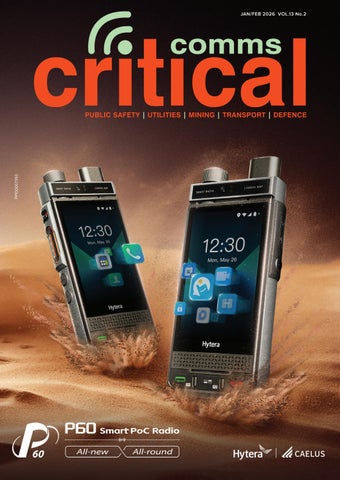
Built to MCX standards, Hytera’s P60 Smart PoC Radio delivers prioritised voice, video, and data with ultralow latency. Dual nanoSIM, eSIM and WLAN keep teams connected, while intelligent network switching ensures the strongest signal to maintain smooth, uninterrupted communication. Dependable communication means being heard clearly; the P60 features a 3 W speaker capable of 105 dB output, combined with AI-based noise cancellation to deliver crisp, intelligible audio even in high-noise or high-speed environments. Instant recording for reliable evidence capture The P60 doubles as a professional recording device for on-scene documentation. In unpredictable or fast-moving situations, such as unfolding incidents or emergency responses, the slide-to-record function instantly activates the 50 MP rear camera, while a pre-record feature captures the preceding 120 seconds of video — meaning no crucial detail is missed. Captured photos and videos can be seamlessly uploaded to the Hytera Digital Evidence Management (DEM) platform for centralised review and archiving. Intuitive operation and enduring performance Every aspect of the P60 is designed for quick, confident use in the field. The 3.5″ highbrightness touchscreen remains responsive to gloves or wet hands. Programmable keys and rotary knob allow fast access to essential functions and precise control. Powered by a 4000 mAh removable battery, the P60 delivers up to 24 h of operation per charge, and the chip-level power management
FREE digital subscription
This bimonthly magazine is free for industry professionals in digital format. Subscribe at: www.criticalcomms.com.au/magazine www.CriticalComms.com.au
significantly reduces power consumption. With IP68-rated protection, it provides resistance to dust, water and accidental drops. Caelus Wireless Pty Ltd www.caeluswireless.com.au
Do you read me? In last issue’s editor’s comment, I made mention of the so-called Senate inquiry into Triple Zero service outage, which was sparked by Optus’s 13-hour outage back in September. But as I write these words in December 2025, it appears the inquiry has placed another company under scrutiny — TPG Telecom, alongside Samsung. Back in October, it was discovered that a number of older Samsung mobile devices were not correctly connecting to TPG’s Vodafone network when the Telstra and Optus mobile networks were unavailable — which is a problem as the ability to ‘camp on’ to other networks is a requirement by law to ensure Triple Zero calls can be made when a primary network is unavailable. But while the ACMA advised that Telstra, Optus, TPG and Samsung were working on remediation plans for customers with affected devices, it was later revealed that at least two Samsung customers had died following issues getting through to Triple Zero on the TPG mobile network — one person in November, based in Sydney, and another back in September in Wentworth Falls. The September death was particularly controversial due to the fact that it was not publicly disclosed until December, apparently due to various communication problems between Telstra (aka the Emergency Call Person), the Department of Communications and Minister Anika Wells, the ACMA, and TPG itself. And so, with public safety and emergency response very much in the headlines, it seemed appropriate for this issue to feature several articles on the above topic. On page 23, we reveal clear public sentiment for modernising the emergency call handling services to keep pace with rapid technological advancements. One such advancement, albeit not discussed in the above article, is the use of drones for transmitting live images direct from disaster sites, which we cover on page 14. And for those of you who are planning aquatic activities this summer, the lead article on page 6 features some key steps and essential equipment to have on hand in case things go wrong. As for me, my summer will be looking quite different to the usual state of affairs, as at the time of writing I am mere days away from commencing maternity leave (which is of course the reason I was unable to make Comms Connect Melbourne this year). I hope to be back in my editor’s chair later in 2026, but until then, stay safe and stay connected!
Lauren Davis, Editor
Editor: Lauren Davis cc@wfmedia.com.au Publishing Director/MD: Janice Williams Art Director/Production Manager: Linda Klobusiak Circulation: Alex Dalland circulation@wfmedia.com.au
Copy Control: Ashna Mehta copy@wfmedia.com.au Advertising Sales Tim Thompson Ph 0421 623 958 tthompson@wfmedia.com.au Liz Wilson Ph 0403 528 558 lwilson@wfmedia.com.au Head Office Unit 5, 6-8 Byfield Street, North Ryde Locked Bag 2226, North Ryde BC NSW 1670 Ph: +61 2 9168 2500
March WONS 2026 2–4 March 2026 Les Roches Crans-Montana, Switzerland 2026.wons-conference.org MWC Barcelona 2026 2–5 March 2026 Fira Gran Via, Spain mwcbarcelona.com IWCE 2026 16–19 March 2026 Las Vegas Convention Center, USA iwceexpo.com SATShow Week 2026 23–26 March 2026 Walter E. Washington Convention Center, USA satshow.com The BAPCO Annual Event 25–26 March 2026 Coventry Building Society Arena, UK bapco-show.co.uk WA Critical Communications Conference and State Networking Dinner 25–26 March 2026 Aloft Perth Hotel arcia.org.au/events/critical-communications-conference-perth-2026
April EENA Conference & Exhibition 2026 15–17 April 2026 Radisson Blu Latvija Conference & Spa Hotel, Latvia eenaconference.org Critical Communications Asia 22–23 April 2026 Kowloon Shangri-La, Hong Kong critical-communications-asia.com
May
cc@wfmedia.com.au
Westwick-Farrow Media A.B.N. 22 152 305 336 www.wfmedia.com.au
Calendar
Print Post Approved PP100007393 ISSN No. 2202-882X Printed and bound by Ive Group
Westwick-Farrow Media is committed to using environmentally responsible print services to produce our publications. This edition is made with a mixture of materials from FSC-certified forests, recycled materials, and/ or FSC-controlled wood. While controlled wood doesn't come from FSC-certified forests, it mitigates the risk of the material originating from unacceptable sources. It is delivered in a totally degradable plastic wrapper.
NSW Critical Communications Conference and State Networking Dinner 13–14 May 2026 NSW Teachers Federation Conference Centre arcia.org.au/events/critical-communications-conference-sydney-2026 Comms Connect New Zealand 2026 27–28 May 2026 Tākina Wellington Convention and Exhibition Centre comms-connect.co.nz
Further event information can be found at criticalcomms.com.au/events
All material published in this magazine is published in good faith and every care is taken to accurately relay information provided to us. Readers are advised by the publishers to ensure that all necessary safety devices and precautions are installed and safe working procedures adopted before the use of any equipment found or purchased through the information we provide. Further, all performance criteria was provided by the representative company concerned and any dispute should be referred to them. Information indicating that products are made in Australia or New Zealand is supplied by the source company. Westwick-Farrow Pty Ltd does not quantify the amount of local content or the accuracy of the statement made by the source. If you have any queries regarding our privacy policy please email privacy@wfmedia.com.au
4 Critical Comms - January/February 2026
www.CriticalComms.com.au
A GUIDE TO AQUATIC SURVIVAL THIS SUMMER Images courtesy GME.
6 Critical Comms - January/February 2026
www.CriticalComms.com.au
MARINE RESCUE
While most Australians (65%) are planning aquatic adventures this summer, from recreational boating to snorkelling or diving, less than a third (32%) are confident they could rescue themselves in an aquatic emergency. That’s according to new research commissioned by radio comms manufacturer GME in conjunction with Pureprofile.
T
he research further finds that only one-fifth (20%) of the nation is confident in reading tides, swells and weather conditions, and nearly half (48%) would rely on their mobile phone to call for help on the water. This is a particularly risky move given that offshore coverage can be patchy at best. “Many people rely on smartphones to call for help,” noted survival expert and adventurist Michael Atkinson (aka Outback Mike). “Whilst many smartphones these days are satellite-capable, they don’t emit a continuous signal that rescue authorities can home in on. So if you’re adrift in a life jacket you’re unlikely to be found, particularly at night.” Outback Mike knows better than most that a few gear choices can make all the difference for a safe trip on the water, and has now partnered with GME to create a survival preparation guide featuring five key steps to safe aquatic-related adventures. From boating to diving, these essentials could make all the difference if something goes wrong.
1. Pack the right gear and keep it protected
Every trip on the water should start with preparation, and the gear you pack can be the difference between a close call and tragedy. Phones and satellite messengers aren’t built for aquatic rescues — they can’t transmit the kind of continuous distress signal that rescue services can home in on. That’s why it’s essential to carry specialist emergency equipment, keep it in working order, and know where it is at all times: • Emergency Position-Indicating Radio Beacons (EPIRBs) are the gold standard of emergency signalling for offshore boating and a legal requirement in most states when operating more than 2 nautical miles offshore in open water. • Personal Locator Beacons (PLBs) are lightweight and compact — ideal for kayaking, paddle sports or coastal boating. These should be attached to your life jacket in case you fall overboard. Note that a PLB won’t satisfy mandatory carriage requirements in most states of Australia (some states allow a PLB in lieu of an EPIRB for jet ski riders). • Check expiry dates (and set an expiry date reminder in your mobile phone), test strobe lights (essential at night), protect from corrosion and store in an easy-to-reach spot. • Life jackets, flares, radios and first-aid kits all need regular checks — salt water is unforgiving, so your gear can deteriorate fast. • Dress for the conditions. In cooler climates, thermal layers or spray jackets can delay the onset of hypothermia if you end up in the water. In warmer environments, lightweight but protective clothing can reduce sunburn and heat exhaustion. Ideally, every inch of skin should be shielded from the sun. • Carry an emergency supply of fresh water and high-energy snacks. Dehydration and fatigue can set in quickly at sea, especially under the sun. >>
www.CriticalComms.com.au
January/February 2026 - Critical Comms
7
MARINE RESCUE Before you set out, practise deploying your equipment in safe conditions. For instance, try rehearsing with your PLB in a swimming pool (without activating it) while wearing your life jacket. Make sure it stays attached by a lanyard, that you can easily deploy the antenna, and that it’s mounted securely in a way that allows the antenna to remain upright. Run a quick safety briefing with your passengers, walking them through where the safety gear is stored and how to use it. Just two minutes of explanation could save precious time in a crisis. Think beyond technology, too. Carry visual signalling aids like sea dye, reflective strips or mirrors — and practise using them. These can dramatically cut down rescue times by making you easier to spot from the air or sea.
5. Keep calm in an emergency Images courtesy GME.
2. Know the water and the weather
Even the most expensive equipment won’t help if you don’t respect the conditions you’re heading into. Before each trip, take the time to understand the environment you’ll be navigating. Check the forecast in detail, including wind, swell and storm warnings, and keep monitoring throughout your trip. Remember that conditions on the water can shift far more quickly than they do on land. For divers, carrying a PLB in a waterproof case is increasingly common. It’s a precaution that could be life-saving if you surface far from your boat.
3. Communication is key
Always log your journey, either by registering with local marine rescue services (many of which have apps) or by telling a trusted contact your departure point, intended route and expected return time. Make sure your contact knows exactly what to do if you don’t check in when expected: call 000. On the water, mobile coverage is often patchy, which makes VHF marine radios a far more reliable tool for staying in touch with nearby rescue crews and vessels. Keep yours dry in a clear, waterproof soft case that allows voice communication. If you’re venturing further offshore, an EPIRB is a worthy addition (and usually a legal requirement) alongside your radio. Mobile phones
8 Critical Comms - January/February 2026
should never be your only connection — even satellite-capable phones and smartwatches can struggle to connect when wet and don’t emit a continuous signal that rescue authorities can home in on.
4. Practise before your departure
Confidence in an emergency doesn’t just come from having the right gear — it comes from knowing how to use it.
If something goes wrong, your state of mind will be just as important as the equipment you carry. Panic burns energy, clouds judgement and reduces your chances of survival. Instead, focus on conserving energy: stay afloat, keep warm and signal for help. Make yourself as visible as possible with strobes, reflective gear, and flares or dye markers, ready to use the moment you see or hear rescuers nearby. “Being on the water is one of the most vulnerable places for a human,” Outback Mike said. “When conditions deteriorate or things go wrong, having the right gear and knowing how to use it is often the difference between life and death. Surviving depends on prior preparation and good decisions made in the moment. “Rescue starts before you hit the water, with the right mindset, knowledge and gear.”
Equipment checklist
• An EPIRB (for offshore boating) and/ or PLB (for in-shore/individual use) • Life jackets for all passengers (check condition and fit) • Waterproof case for PLB if diving • Flares, strobes or sea dye for visibility • VHF marine radio or satellite communicator for backup communication • First-aid kit • Adequate water supply (minimum 4 L per person per day) • Navigation tools (map, compass, GPS device) • Weather-appropriate clothing and thermal protection where needed • Light sources for night-time signalling (such as flares or flashlights) • Food supplies and emergency rations (if relevant to the journey)
www.CriticalComms.com.au
News
XXXXX XXXXXXXXX
ORBITAL TRAFFIC SURGES, AS 13,000 ACTIVE SATELLITES RECORDED iStock.com/yucelyilmaz
Look Up, a French space situational awareness company, has partnered with weekly magazine Le Point to publicly release largescale figures on orbital traffic. With the continuous growth in launches and active satellites, the deployment of mega-constellations, the evolving balance of power among spacefaring nations, and rising geopolitical tensions, the Look Up × Le Point Space Barometer — based on data collected and processed by Look Up’s SYNAPSE digital platform — highlights the major trends shaping orbital activity today. “Earth orbits have become a strategic domain where orbital traffic reflects the technological race, economic competition, and geopolitical, sometimes even military, power struggles,” said Michel Friedling, co-founder and CEO of Look Up. “With our Look Up × Le Point Barometer, we aim to reveal the data behind these dynamics and showcase tangible examples of the new race for space.” As of 1 October 2025, there were 15,965 satellites catalogued around Earth, including 13,026 active satellites, marking a 23% year-on-year increase (with 2477 net new satellites, ie, launches minus deorbiting). This surge illustrates the
accelerating deployment of commercial constellations delivering telecommunications and Earth-observation services, and continues a long-term trend: just six years ago, fewer than 2000 satellites were operational. The country breakdown shows clear US dominance, with 9641 active satellites — nearly three-quarters of the total — driven primarily by SpaceX’s Starlink mega-constellation with 8366 satellites (1963 in 2024 alone). China is catching up with 1102 active satellites (+25% in a year), notably deploying Starlink-like constellations such as QianFan (90 sats) and GuoWang (57 sats). Europe ranks third, mainly with Eutelsat OneWeb’s 651 satellites, but lags far behind in terms of new launches. While 3664 satellites were launched in the past 12 months, 2165 space objects (including 1182 satellites and 109 rocket bodies) were deorbited. However, these efforts have not curbed overall orbital population growth: there are now 31,019 catalogued objects, including 12,833 pieces of debris over 10 cm. “Space has never been as crowded and contested as it is today,” Friedling concluded.
UK HOME OFFICE AWARDS ETHERSTACK CONTRACT FOR ESN
www.CriticalComms.com.au
January/February 2026 - Critical Comms
9
iStock.com/georgeclerk
The UK Home Office has awarded a critical communications contract to wireless technology company Etherstack as part of its plan to transition UK public safety communications to its next-generation 5G network, known as the ESN (Emergency Services Network). The ESN will be used by the primary emergency services — police, fire and ambulance — as well as other critical government and public safety bodies across Great Britain. IBM is providing User Services (US) for the ESN, while BT and EE are providing Mobile Services (MS). Etherstack will meanwhile deploy its 3GPP LMR-IWF (InterWorking Function) into the ESN to allow public safety agencies to communicate from their existing TETRA digital radio network (known as Airwave) to the new LTE cellular-based ESN. The LMR-IWF switching platform is software that acts as a bridge between the traditional digital radio network to the new network, allowing hybrid operation across both networks and eventual migration to the new ESN. “We are thrilled to have been chosen by the Home Office for such a prestigious and essential project for the safety of the public and the dedicated officers who serve them,” said Etherstack CEO David Deacon. “This win demonstrates our ability to deploy and provide 24/7 support to our highly complex, resilient public safety solutions on multiple continents around the world.” This announcement follows a recent contract valued at more than US$20 million with US cellular giant AT&T for similar technology which had an initial term of seven years. The two deals mean that both organisations’ public safety networks will be fully compliant to the new 3GPP standards for MCPTX.
News ACOUSTIC SENSOR TECH DETECTS DRONES OUTSIDE LINE OF SIGHT
Image: Supplied
AUST TO HOST GLOBAL WORKSHOP ON EME EXPOSURE TESTING
10 Critical Comms - January/February 2026
©Fraunhofer IDMT/Leona Hofmann
Following the success of Australia’s rooftop technology trials in 2025, Standards Australia’s TE-007 committee on Human Exposure to Electromagnetic Fields will host an international electromagnetic energy (EME) workshop from 29 June to 1 July 2026. The event will be held at a mobile supercell site in Labrador on the Gold Coast. The hands-on workshop will bring together Australian and global experts to test the latest methods outlined in IEC 62232 Edition 4. These methods are used to assess radio-frequency fields near mobile base stations to evaluate human exposure. Real-world case studies will also be presented. The site includes a 25 m tower operating across all mobile bands currently in use, with equipment from all major national network operators. Its open layout and nearby playing fields provide a suitable environment for field testing. With 6G standards in development, live testing at the workshop will help ensure that current methods are accurate, practical and adaptable to future technologies. Participants will have access to the latest tools for measuring 5G Advanced signals, contributing to the development of consistent and reliable testing methods as mobile networks evolve. The event will also align with the upcoming IEC Technical Report 62669, expected in early 2026, which will include updated case studies to support practical application of IEC 62232. “This workshop will help ensure Australia remains at the forefront of mobile technology and EME safety standards,” said Kareen Riley-Takos, Chief of Engagement, Standards & International Relations at Standards Australia. “With 5G Advanced rolling out and 6G development underway, validating the latest test methods in real-world conditions is essential to staying ahead.”
German researchers have developed an intelligent solution that uses acoustic sensor technology to detect drones even when outside the line of sight. Furthermore, the technology can be combined with radar, camera and LiDAR to form a complete system. When a drone (also known as an unmanned aerial system, or UAS) approaches a security-critical area without permission, it poses a potential threat — and as optical sensors, radio and radar can be disrupted by terrain, weather or technical measures, they cannot always reliably detect approaching drones. Now, researchers at the Fraunhofer Institute for Digital Media Technology IDMT have developed an integrated acoustic sensor solution for drone detection and localisation that fills a crucial gap: it ‘hears around corners’. Unlike purely optical and radar-based methods, which rely on line of sight, the technology enables drone operations to be detected even in built-up or forested areas. Furthermore, acoustics can be combined with radar, camera and LiDAR to form a robust sensor data network. Fibre-optic-controlled drones or autonomous flying objects often remain hidden from radio reconnaissance, while high-resolution radar and camera systems require high costs and energy-intensive computing power. The acoustic solution from Fraunhofer IDMT, on the other hand, operates with low energy consumption, enabling autonomous operation with rechargeable batteries. The ability to wake up additional sensor components after acoustic contact also offers advantages. The technology can achieve 360° coverage. Depending on the noise environment, the detection and localisation ranges are between 50 and 200 m, with a temporal resolution of one second. An extension to other acoustic events, from vehicles to gunshots, is conceivable. Thanks to their high availability, the acoustic sensors can be deployed across large areas. “With our acoustic technology, we offer an inexpensive and low-maintenance addition to existing drone detection systems,” said Christian Rollwage, Head of Audio Signal Enhancement at Fraunhofer IDMT. The target customers for the new technology are primarily companies in the defence and security sector that are already developing drone detection systems based on radar, optics or LiDAR, as well as system integrators who want their own sensor technology and drone manufacturers who want to detect signals from the air.
www.CriticalComms.com.au
News COMMS CONNECT NZ HEADS TO WELLINGTON IN 2026 Wellington City Council.
The 2026 edition of Comms Connect New Zealand will take place in the new Takina Convention and Exhibition Centre, Wellington, from 27–28 May 2026. This will be the first North Island edition in four years and marks a return to the major city rotation the event ran with prior to COVID. Early response from the market has been very positive, with over 75% of exhibition space sold in the early-release promotion sent to past exhibitors and sponsors in late 2025. The event team are now working with the venue to allocate some expansion space to cater for expected further growth. A call for papers for the conference program will go out mid to late January, with international speakers expected to join the event soon. For more details, go to https://comms-connect.co.nz; if you are interested in exhibiting or sponsoring, email events@wfmedia.com.au or ghird@wfmedia.com.au.
SMARTPHONE MICROPHONES USED FOR DISASTER SEARCH AND RESCUE When a natural disaster strikes, time is of the essence if people are trapped under rubble. While conventional search-and-rescue methods use radar-based detection or employ acoustics that rely on sounds made by victims, Shogo Takada is working on a way to use smartphone microphones to assist in locating disaster victims. Takada’s method combines two types of sound sources: monopole and dipole. Radiating out equally in a circle, monopole sources create sound waves around the source, whereas dipole sources radiate sound from the front and back but cancel out on the sides. Dipole sound sources are directional, which can help researchers estimate the azimuth angle of the sound source, giving them information about the source’s location. In a disaster situation, a rescuer would emit two dipole sounds, which would be received by the microphone of a trapped victim, and then an electromagnetic wave would be sent from the victim’s phone to broadcast their location. In the presence of soundreflecting debris, a monopole sound can also be emitted by the rescuer to help reduce the effect of the debris. All of the sound sources can be incorporated into a formula to help estimate the location of the trapped person.
“This method is effective for locating victims buried under debris or soil caused by earthquakes or landslides because sound waves can propagate through them,” said Takada, a student at The University of Tokyo. “It could also be used to locate rescuers affected by secondary disasters.” Takada’s technique has already proved highly successful in a field test on a disaster training site. The method achieved an error of 5.04° away from the hypothetical victim, when searching over an area of 10 m2. “One limitation is that the method assumes the victim should possess a device equipped with a microphone,” Takada noted. “This is a more restrictive condition compared to traditional techniques that detect sounds or voices emitted by the victim.” However, given the widespread use of smartphones, Takada believes that this technique is promising and plans to refine it further. “In future work, we plan to develop a method that can estimate not only the azimuth angle but also the elevation angle of the sound source,” Takada said. “Additionally, we aim to expand the system to use two sound sources to achieve three-dimensional localisation.” Takada presented his results as part of the Sixth Joint Meeting of the Acoustical Society of America and Acoustical Society of Japan.
iStock.com/EvgeniyShkolenko
12 Critical Comms - January/February 2026
www.CriticalComms.com.au
5G DRONES DELIVER LIVE IMAGES FROM EMERGENCIES
Every second counts for emergency services and rescue personnel in the event of a disaster, yet at the start of an operation, precise information about the situation on the ground is often scarce — especially in complex terrain or areas that are difficult to access.
F
or this reason, Vodafone, Frequentis and the Rostock Fire Brigade — led by the German Aerospace Center (Deutsches Zentrum für Luft- und Raumfahrt, or DLR) — have joined forces through the ADELE project to improve conditions for emergency responders. They are now testing the deployment of automated drones immediately following an emergency call, with the idea that these drones can transmit high-resolution live images from the incident site directly to the emergency control centre even before rescuers arrive. Timely images allow emergency responders to gain an early impression of the situation and provide targeted assistance more effectively — saving valuable time when it matters most. ADELE stands for ‘Automated Drone Deployment from the Control Centre’ (Au-
tomatisierter Drohneneinsatz aus der Leitstelle). As part of the project, Vodafone is providing 5G technology for real-time data transmission along with a new end-to-end encryption technology for maximum security. Frequentis is providing the connection to the control centre, and the Rostock Fire Brigade is testing the application in real-life operations (a complex exercise scenario took place near Rostock on 23 September 2025). The result of this collaboration is automatic planning of drone flights as soon as an emergency call is received. “Alongside coordinating the project, we are also responsible for the system architecture, providing the drone itself and contributing the tools for planning and executing flight routes,” said Andreas Volkert, ADELE project manager and uncrewed aerial vehicle expert at the DLR Institute of Flight Guidance. “Our
14 Critical Comms - January/February 2026
rescue drone combines high-resolution camera sensors with optimised, low-risk flight control components based on real-time motion data. We ensure compliance with all legal regulations and full GDPR conformity to safeguard safety and data protection.” DLR’s drone launches automatically towards the incident location and streams high-resolution video footage to the emergency services control centre in real time — before the first emergency vehicle has left the station. Via the 5G network, emergency personnel receive key information at a very early stage, including information about how a situation is developing, access routes, potentially hazardous material storage locations and the distribution of people in the affected area. “With ADELE, we are bringing greater speed and clarity to the daily work of the police, fire brigade and other rescue services,” said Chris von Wrycz Rekowski, Senator for Finance, Digitalisation and Order for the Hanseatic and University City of Rostock. “The live images provide emergency responders with valuable information that not only offers a better overview but also saves valuable time.
www.CriticalComms.com.au
DRONES
Image courtesy DLR under CC BY-NC-ND 3.0
Close-up of the highresolution camera on the emergency response drone.
Image courtesy DLR under CC BY-NC-ND 3.0
A drone takes off on an automated flight as part of the ADELE project.
This allows for faster and better decisionmaking, and an even faster response.” To ensure the seamless integration of drone flights, communications and control centre coordination, Frequentis and DLR are connecting drone control directly with the ASGARD and LifeX control centre systems — established communication systems used by the fire brigade and police respectively. The Automated Drone Dispatch System (ADD) is connected via a special interface; when an emergency call is received, the control centre software transmits the incident location, determined from emergency call data, to the ADD in the form of geocoordinates. The ADD evaluates the geodata and suggests a possible drone deployment, with the operational planning team deciding whether a drone mission is appropriate. If the deployment is approved, the system automatically
plans the optimal flight route and sends the rescue drone directly to the destination. To streamline the approval process, Vodafone has developed the DroNet Hub — a platform that gathers anonymous live data from mobile phones within a mobile radio cell, providing a realistic assessment of the actual ground risk. Anke Kaysser-Pyzalla, DLR Executive Board Chair, concluded, “With the ADELE project, we are bringing modern drone technology directly into rescue operations. This will enable emergency services to reduce their response time to just a few minutes on average. “Every second gained is valuable — to save lives in emergency situations, protect infrastructure, safeguard assets and to preserve the environment. We are delighted to contribute DLR’s extensive expertise in the field of uncrewed aerial systems to this endeavour.”
5G tactical radio Nokia has announced its upgraded Banshee 5G Tactical Radio — now enhanced with 5G capabilities — expanding its defence portfolio and reinforcing its commitment to providing a comprehensive, secure, high-performance system for modern military operations. Delivering good bandwidth and mobility at the tactical edge, the product enables real-time battlefield intelligence and mission-critical communications in demanding environments. The rugged, portable mobile ‘network in a box’ is designed for quick set-up, strong security and easy transport. With 5G, it offers higher bandwidth, faster speeds and lower latency than the previous version, enabling ongoing communications in challenging conditions. It gives teams a powerful tactical network anywhere it is needed, enabling instant coordination, fast data sharing and good situational awareness in the field. Nokia Solutions and Networks Australia Pty Ltd www.nokia.com
www.CriticalComms.com.au
January/February 2026 - Critical Comms
15
Vector network analyser Designed to combine precision and speed in a scalable platform, Rohde & Schwarz’s R&S ZNB3000 vector network analyser helps engineers and researchers accelerate innovation in high-performance RF applications and signal integrity testing. By extending the product’s maximum frequencies up to 32 GHz, 43.5 GHz and 54 GHz, the company addresses even more applications. For example, the analyser can be used to enable precise characterisation of high-speed PCBs, cables and interconnects used in AI data centre infrastructure. The analyser range offers good RF performance with a high dynamic range of up to 150 dB, high output power and low trace noise of less than 0.0015 dB RMS. These attributes enable fast measurements, even at higher frequencies. The new models retain the series’ characteristic features, including: ultrafast measurement speed, to maximise throughput and reduce the cost of testing; low start frequency of 9 kHz, enabling precise time-domain analysis for signal integrity and high-speed testing; and a flexible frequency upgrade concept, so users can start with a base unit and expand the maximum frequency later by purchasing upgrade options. The high-frequency models support advanced RF component testing for SATCOM applications in the Ka and V bands, such as filters, mixers, amplifiers, switches and beamformers, which operate at these high frequencies. They also enable RF component testing for 5G, 6G and Wi-Fi applications. This makes the analyser useful for both production environments and research labs working on next-generation technologies. Rohde & Schwarz (Australia) Pty Ltd www.rohde-schwarz.com.au
ISM 6 dBi collinear antenna RFI’s ISM 6 dBi collinear antenna delivers high gain and optimised operation through advanced construction methods and band-specific
Digital evidence management system m-View’s Altitude Digital Evidence Man-
tuning. It is a high-performance choice for IoT gateways and standalone
agement System (DEMS) is a secure sys-
base devices where isolation or distance requires best-in-class antenna
tem that maintains full chain-of-custody
optimisation.
records from the moment footage is
The CDR2795-ISM900 is tuned specifically to the ISM 900 MHz band,
captured.
providing good radiation pattern performance and signal efficiency.
Designed to move evidence from the
Unlike wideband antennas that must compromise across a broad fre-
field to the operations centre with its
quency range, its narrowband design focuses energy precisely where
integrity preserved, the system is easy
it is needed, achieving 6 dBi of usable gain.
to manage, simple to share and fully
This increased gain enhances system efficiency, improving signal
traceable. It can be deployed in cloud,
strength and stability even under low-power conditions. In situations
on-premises or in hybrid environments
where every decibel counts, the product provides maximum power
and integrates with existing records and
transfer and consistent radiation patterns.
case management systems, meaning
Central to the antenna’s performance is RFI’s Meander Flexible PCB
that evidence can be reviewed, shared
construction, a precision-engineered solution that combines electrical
and retained according to legal and
consistency, mechanical strength and long-term performance. Key
operational requirements.
advantages include: optimised impedance control for reduced signal
The system also offers an optional
loss and high efficiency; enhanced mechanical durability to withstand
AI-powered redaction feature, allowing
vibration and environmental stress; and consistent manufacturing re-
users to automatically identify and redact
peatability for dependable field performance.
faces, sensitive information and private
With versatile mounting options — including spring or bulkhead con-
data before footage is shared. This feature
figurations — the antenna can be used across a variety of deployment
assists organisations in meeting privacy,
scenarios, including vehicle and bracket mounting.
duty-of-care and disclosure obligations
RFI Technology Solutions
while maintaining the evidentiary integrity
www.rfi.com.au
of original recordings. Tait Communications www.taitcommunications.com
16 Critical Comms - January/February 2026
www.CriticalComms.com.au
Modem for Industrial IoT applications D-Link A/NZ has launched the DWM-311 4G LTE M2M VPN Modem, a robust and secure connectivity solution designed specifically for remote machine-to-machine (M2M) deployments across Industrial IoT applications. Built to withstand harsh environments while delivering high-speed connectivity, the product is suitable for mission-critical applications including industrial monitoring systems, vending machines and remote infrastructure management. The device combines Cat.4 4G LTE mobile broadband connectivity with a Gigabit Ethernet port, enabling fast and stable connections essential for M2M applications. Its industrial-grade design features a corrosion-resistant zinc-plated steel casing and operates across a wide temperature range, meaning it can be deployed in challenging outdoor and industrial environments where conventional networking equipment would fail. With a plug-and-play set-up — simply insert a Micro-SIM card and power up — the modem instantly connects M2M devices to the high-speed 4G cellular network. Its compact (77 x 69 x 26 mm), rugged design is purpose-built for harsh conditions, while the integrated OpenVPN client enhances security and protects data integrity across the network, making it useful where quick set-up and robust connectivity are crucial. D-Link Australia Pty Ltd www.dlink.com.au
Dual-mode radio Hytera’s PDC690 is a rugged dual-mode radio engineered for the demands of frontline professionals. Combining smartphone versatility with a two-way radio, the product unifies mission-critical voice and data in one device and keeps teams connected, informed and mission-ready in the field. The device works with narrowband trunking, WLAN, and public and private LTE networks, intelligently selecting the optimal network based on signal strength and operational context. Working with Hytera’s fast-deployment solutions, including onscene ad-hoc networks and direct-mode operation, it preserves real-time voice and multimedia links even under degraded conditions. It also interworks with third-party systems, enabling mixed-system operations and safeguarding institutions’ existing investments. Built for modern emergency workflows, the product combines mission-critical voice with on-device photo and video capture for immediate situational reporting and evidence collection. Outdoor positioning uses multi-constellation GNSS (GPS, Galileo, GLONASS, QZSS, BDS and A-GPS), while indoor location is supported via LBS and WLAN, providing fast and precise location data to improve coordination and safety. Purpose-built for harsh conditions, the device meets MIL-STD-810G standards for drop and shock resistance and carries an IP68 rating for dust and water protection. Lightweight and ergonomic, it features a responsive touchscreen, USB Type-C fast charging, and power-bank compatibility for extended missions. Audio performance is optimised for noisy environments through AI-based noise cancellation, wind suppression, and a 30 cm near-field anti-howling feature that eliminates feedback when personnel speak in close proximity. Running on a full Android operating system, the product supports both Hytera and third-party applications, enabling native dispatch, GIS, incident management and other customised workflows. A comprehensive accessory ecosystem, including wireless PTT, remote speaker microphones and other peripherals, enables flexible integration. Hytera’s MDM Pro streamlines fleet administration with remote programming, OTA firmware updates, permission management, device health monitoring and fault alerts, reducing operating costs and maximising uptime. Hytera Communications Co. Ltd www.hytera.com.au
18 Critical Comms - January/February 2026
www.CriticalComms.com.au
DEFENCE
iStock.com/Chainarong Prasertthai
CUSTOMISED RUGGED TECHNOLOGY SHAPING THE NEXT ERA OF DEFENCE COMMS Yahya Sacma*
Modern defence communication networks carry the weight of strategic consequence. As threats diversify and operational environments grow less predictable, the systems that support command, control, communications and intelligence (C3I) must function without interruption.
O
f course, hardware failures, cyber compromise or disrupted data flow can weaken decision cycles and harm situational outcomes. Against this backdrop, rugged computing platforms are becoming central to how armed forces protect communication integrity across theatres and timeframes. A key shift now emerging is the growing emphasis on customisation. Defence communication requirements are rarely standardised; they shift between units, missions and operating domains. Off-the-shelf devices
www.CriticalComms.com.au
often struggle to meet the exact needs of specialised teams working at the tactical edge. Tailoring hardware to suit specific operational scenarios strengthens continuity, sharpens data accuracy, and removes points of compromise. Defence communication systems face a dual challenge: harsh field conditions and a fast-moving cyberthreat landscape. Dust, vibration, shock, moisture and extreme temperatures can degrade conventional devices, while persistent attempts to intercept or corrupt data place constant pressure on security
layers. Rugged hardware designed from the ground up to withstand environmental and adversarial disruption gives defence organisations a stable foundation for mission-critical communication. Customisation supports mission assurance in several ways. For example, defence agencies can standardise connectors and ports across units to streamline integration with radios, sensors or encryption modules. Power configurations can be designed to match vehicle systems, ground equipment, or extended deployments away from supply lines. Antenna and module placement can be adjusted to reduce interference, increase signal quality, or support multi-network operation. These modifications help maintain clean, stable communication paths even as frontline conditions fluctuate. >>
January/February 2026 - Critical Comms
19
DEFENCE
Image: Supplied
Security remains another priority. Communication hardware forms part of a broader defence cybersecurity posture, particularly when used at the tactical edge where sensitive information moves quickly and often under pressure. A customised rugged device can incorporate hardware-based authentication, tamperresistant components, advanced encryption support, or restricted-access configurations aligned with defence security protocols. Tailoring the architecture in this way raises the threshold an adversary must overcome to compromise or manipulate communication streams. The operational value of rugged, customised devices becomes most evident in distributed environments where personnel rely on digital platforms for real-time coordination. Whether mounted in armoured vehicles, fixed at command posts or carried by units on the move, devices need to maintain consistent connectivity across radios, satellite channels, secure networks and data-sharing systems. When these devices suffer physical or cyber disruption, communication gaps can emerge at the worst possible moment. Ruggedised platforms engineered to suit specific communication architectures help defence forces maintain uninterrupted flow of situational information. Another important trend is the convergence of edge computing with defence communications. As units demand more intelligence at the point of action, rugged devices are taking on greater processing loads in the field. This shift reduces reliance on central systems and sharpens response times. Yet it also means devices face greater exposure, and any weakness in their resilience can hinder the broader communication network. Customised rugged hardware capable of supporting local analytics and secure edge processing strengthens both autonomy and communication reliability. The result is a more responsive, distributed communications ecosystem that supports faster and more accurate operational decisions. Interoperability also shapes future defence communication strategies. Forces increasingly operate alongside partners during joint operations or humanitarian tasks, where communication systems must align despite differences in equipment or doctrine. Customisation bridges these gaps by fine-tuning devices to work with a variety of radio platforms, encryption suites and network structures. This flexibility
supports smoother coordination, reduces translation errors in the field, and builds trust across coalition operations. Long-term sustainability is another consideration. Defence organisations often maintain communication hardware for many years, requiring consistent performance across evolving mission sets. Rugged devices built with maintenance planning, component longevity and upgrade pathways in mind support smoother capability cycles. When reinforced through custom engineering, these devices can remain relevant far longer than standard off-the-shelf options. This reduces downtime, lowers life cycle costs, and strengthens capability continuity. Looking forward, the role of rugged, customised computing in defence communications will only grow. Future C3I systems will lean further into distributed architecture, multi-layered security, and rapid information exchange. They will operate against adversaries who adapt quickly and target communication networks as a means of disruption. Defence organisations will need hardware they can shape around their communication doctrine, not the other way around. Rugged computing customised for purpose positions forces to meet these challenges directly, contributing to a broader lift in communication resilience and supporting the next generation of secure, reliable and mission-ready C3I capability. *Yahya Sacma is National Business Development Manager – Defence, Public Safety, Health & Government, Australia and New Zealand at Getac.
Personal locator beacon For Australian adventurers setting out to explore remote parts of the country — often far beyond mobile reception — the right safety tech can be life-saving. GME now introduces the MT620GR, a personal locator beacon (PLB) equipped with a range of cutting-edge features. The product includes Return Link Service (RLS) technology, so users receive confirmation once their distress signal has been received and processed by the satellite system. It also connects to the GME Accusat Connect App via NFC, helping users check their beacon status quickly before heading out. In addition, it features GNSS for improved global positioning and a 121.5 MHz homing signal to aid search and rescue. The product is approved for worldwide COSPAS-SARSAT operation, meaning it offers distress alerting and RLS globally. With a seven-year battery life, it is designed to offer long-lasting performance and peace of mind for users — whether they are hiking, 4WD touring, trail running or heading off-grid. GME Pty Ltd www.gme.net.au
20 Critical Comms - January/February 2026
www.CriticalComms.com.au
Industry Talking Smart body-worn camera with PoC Inrico’s BC680 combines advanced video compression, power efficiency and PoC all-day HD recording and real-time transmission for professional use. The device supports PoC push-to-talk communication with a powerful 3 W speaker and AI noise cancellation. This enables loud and clear voice delivery up to 110 dB, even in high-noise law enforcement or emergency settings. The front camera enables smooth video calls, while the HD rear camera records continuously. This supports simultaneous communication and documentation, for complete, real-time field coverage. A removable 3400 mAh battery delivers up to 10 h of continuous recording or 5 h of dual-stream audio/video transmission. The double-lock battery design enables stable operation during movement and impact. The product also features intuitive onetouch video recording and a quick-switch knob for easy volume and channel control. Dual mics with smart DSP capture voices clearly at up to 10 m, while a 6-pin interface supports external accessories and charging. Inrico Technologies Co Ltd www.inricosolutions.com
iStock.com/Ratsanai
communication in one device. It enables
Whilst we may be well into January by the time you get to read this article and issue of Critical Comms, I hope you had a good break and I wish you all the best for 2026. As we collectively start to think about the year ahead, and what it may deliver, I would urge you to continue to engage and collaborate at every opportunity with the wider market, both locally and nationally, as many of you did throughout 2025. The opportunities that gatherings such as Comms Connect and ARCIA’s state conferences, dinners and networking events offer, cannot be underestimated, and we will again see a busy year, with a calendar packed full of various gatherings for you to take advantage of — visit arcia.org.au/events to see what we, and others, have in store for 2026. With our Hobart sundowner moving to 5 March this year, the first and one of the most enjoyable get-togethers will be the Spurious Challenge charity regatta, organised by RFI Technology Solutions, setting sail from Sydney’s Middle Harbour on 20 February. With a 34-year history, RFI has made this year a ‘Sail for a Cause’, with the Black Dog as this year’s chosen charity, and ARCIA as supporting Association. The updated format now means that you can book an individual person entry, or an entire boat for 10 people, with every single dollar generated going to charity. If you haven’t booked your spot, go to bit.ly/4qHAaRl for more info and bookings — it really is a great day out, with a very worthy cause. As is the case each year, the committee will gather for our annual planning day in February, with discussions around training, spectrum, member value and of course ARCIA events. I see this as an essential day, with the committee coming together face-to-face to reflect on the year gone by, as well as, more importantly, to map out what we hope to be an even better year ahead for all those in the radio and critical communications community. The commitment to attend is not to be underestimated, with many travelling interstate to join in, and we are very grateful for the time and effort of the attendees and the companies behind many, that support this initiative. As ever we will discuss our wireless workforce shortages and training initiatives, continuing the discussions that were held during panel sessions at Comms Connect. What is evident is that these are not uniquely Australian problems — panel members from Europe and the USA talked of the same issues. The training, both face-to-face and online, that ARCIA has been offering and developing over the last few years is an important part of the solution, and our courses have seen solid attendance these past 12 months. We will continue to develop and deliver more courses this year, with the aim of continuing to grow attendance and improve the skills base where required. As always, please reach out if we can help you and your teams. Finally, what is clear and where ARCIA will be focusing some of the committee’s expertise in 2026, is in the area of spectrum use and management. There is an apparent and growing need for collaboration across various industry groups such as public safety, utilities, rail and industry in general, so that there is equitable access to modern spectrum across Australia, with ARCIA in a position to advocate for better spectrum outcomes. The growing demands of these sectors cannot be meet solely by public carriers and our industries need to be part of the solution.
Hamish Duff President (Hon), ARCIA – Australia’s Radio & Critical Communications Association
www.CriticalComms.com.au
January/February 2026 - Critical Comms
21
Quad-band GNSS receiver
Rugged, corrosionresistant omnidirectional antennas
The Quectel LR700A smart connected GNSS receiver is an all-inone high-performance quad-band
The Mobile Mark MOD-MOD2 Series
base station solution — capable
is the next-generation model of the
of connecting to the cloud to deliver
vibration-resistant OD-MOD2 antenna,
GNSS correction data and usable either
engineered for high-vibration perfor-
standalone or within an RTK station network.
mance and enhanced corrosion protection in challenging environments. These rugged antennas are suitable
The modular design integrates the GNSS receiver with cellular, Wi-Fi and antenna systems, while providing extension slots for Zigbee shortrange communication.
for applications where heavy equipment
Cellular connectivity makes the system versatile enough to be deployed anywhere
is used in mining, quarrying and ore
without requiring existing infrastructure, making it suitable for establishing RTK correc-
processing, delivering uniform omni-
tion services in remote locations. The integrated short-range communication capabilities
directional coverage for Wi-Fi 2.4 GHz
mean it can be paired directly with nearby rovers, creating a complete RTK solution for
systems, with four models offering a
localised high-precision applications.
range of 3–12 dBi gain. For extended
The quad-band GNSS receiver enables simultaneous reception of signals from GPS,
durability in corrosive environments,
Galileo, BDS, GLONASS, QZSS and NavIC constellations across the L1, L2, L5 and E6
the base and mount assembly of the
frequency bands. It supports 1040 channels, enabling flexible data transmission and
series is powder-coated and features
remote management with cellular, Ethernet and Wi-Fi networks. Easy monitoring and
external mounting hardware made from
configuration over local networks are enabled via an intuitive web-based interface.
316L stainless steel. This provides an
The device is designed to deliver precise GNSS corrections and positioning for high-
enhanced layer of corrosion resistance to
accuracy applications including smart agriculture and precision farming use cases, sur-
survive the corrosive environments typi-
veying and mapping, autonomous vehicles and outdoor robotics, such as lawnmowers.
cal of copper and rare earth processing.
Its ultra-low power consumption makes it suitable for power-constrained use cases with
The series also features Mobile Mark’s
typical consumption of up to approximately 2.1 W and ultra-wide range voltage support
patented conformal foam dampening,
from 9–36 V.
which protects internal elements from
Weighing just 2.1 kg, the compact device has a diameter of 220 mm and height of
the stress associated with high-vibration
149 mm and operates in the –40 to +85°C temperature range. Support for local Wi-Fi
environments. The antennas are built
web user interfaces and remote cloud configuration enables simplified field installation.
to withstand high mechanical stresses,
Featuring an IP67-rated, industrial-grade design, the product is resistant to shock,
meeting EN 300 019-2-4 and IEC 60068
impact, drop, lightning and ultraviolet light damage, for long-term durability in outdoor
specifications for shock and vibration.
conditions. Certifications for CE, FCC, RoHS and REACH compliance are in progress.
Step Global has been supplying the mining industry for more than a decade and has
Quectel www.quectel.com
partnered with Mobile Mark to create an antenna that is suited to the harsh conditions of mining and processing. Step Global is the authorised Australian dealer of Mobile Mark antenna solutions, offering training, after-sales support and service for each product. Step Global Pty Ltd www.stepglobal.com
Body-worn cameras m-View’s Matrix body-worn cameras are purpose-built for frontline environments, offering high-clarity recording, extended shift-length battery performance and rugged durability. This makes them suitable for a wide variety of operational roles. In addition to law enforcement, the demand for body-worn cameras is growing in multiple industries all around the world, driven by a need to help frontline workers mitigate physical harm and false allegations by capturing the truth. The cameras help to improve investigative clarity, incident resolution efficiency, and community transparency outcomes. Tait Communications www.taitcommunications.com
22 Critical Comms - January/February 2026
www.CriticalComms.com.au
MARKET ANALYSIS
AUSTRALIANS ARE READY
FOR AI-POWERED EMERGENCY RESPONSE
‘T
he Future of Emergency Call Handling in Australia and New Zealand’, conducted by independent market research firm Researchscape on behalf of Motorola Solutions, consulted more than 2500 residents across Australia and New Zealand in September 2025. It finds clear public sentiment for modernising the emergency call handling services to keep pace with rapid technological advancements, including the widespread adoption of smartphones and applications that offer more ways to contact emergency services. The research informs emergency services agencies as they seek to close the gap between public expectations and their own capabilities and plan for new and improved emergency call handling and computer-aided dispatch deployments. “The Triple Zero and 111 hotlines have provided a lifeline for the public in times of crisis for more than 60 years, but the need to modernise emergency call handling technology has never been greater,” said Craig Anderson, Executive Chair of the National Emergency Communications Working Group. “These research findings show that communities expect emergency services to keep pace with rapid technology change, as well as clear generational shifts among younger users to
www.CriticalComms.com.au
iStock.com/seb_ra
Australians and New Zealanders want to share their personal data with emergency services and see them use AI and advanced technology to improve the delivery of their vital services, according to an independent research study.
provide more ways to contact emergency services in addition to voice calls.” Key findings from the report cover the following: • The data-sharing expectation gap: Although the public is comfortable with sharing their exact location data (86%), personal information about medical conditions/allergies (75%) and wearable health data from smartwatches, rings and other devices (54%) to facilitate better emergency response, they have lower expectations that emergency services are actually capable of receiving and using that data to improve emergency response (by 1%, 20% and 16% respectively). • Different communication preferences: While phone calls dominate the preferred way to contact emergency services (88%), respondents pointed to SMS (41%), smartphone apps (38%) and video calls (15%) as their top alternatives. • AI awareness and trust: While 78% of respondents were unaware that AI technology is currently being used or developed for emergency call handling, trust in its use increases significantly with awareness. Those aware of AI usage were almost three times more likely to trust it (56% trust vs 19% trust). Support for AI is particularly strong for
detecting critical keywords in emergency calls, such as ‘knife’ or ‘collision’ (58%); ranking emergency calls by urgency (55%); automatically identifying potential safety threats in live video footage (52%); and enabling live translations of callers speaking foreign languages (52%). • Changing generational needs: Preferred methods for contacting emergency services differ across generations. Older residents prefer traditional voice calls, but smartphone apps are the preferred contact method among millennials, highlighting the need for media-rich data streams to serve the next generation of emergency callers. “In an era where we can track the arrival of rideshare services and use AI to deliver faster insights and improve our decision-making, it’s not surprising that the public wants to see their emergency services make use of these innovations to help keep our communities safer,” said Con Balaskas, Managing Director of Motorola Solutions Australia and New Zealand. “These findings provide valuable insights to help public safety agencies align their technology modernisation strategies with community needs and expectations, fostering stronger collaboration, better emergency management and a pathway to a safer future.”
January/February 2026 - Critical Comms
23
STUDY
CASE
Powering the future of mining with a private 5G network
Images: Supplied.
Nokia and Boldyn Networks have deployed a private 5G network at the Callio FutureMINE site in Pyhäjärvi, Finland, transforming one of Europe’s deepest mines into a next-generation testbed for mining innovation. Formerly a fully operational copper mine for over 60 years, Callio now provides a real-world mining environment where technology companies can test and validate their equipment. Underground mines pose some of the most extreme challenges for connectivity. Their depth, complex tunnel networks, harsh environmental conditions, and the constant movement of people and machinery make stable communication difficult. “Mining is one of the toughest environments on Earth for connectivity, and private 5G is proving to be a game changer,” noted Michael Aspinall, Head of Enterprise Campus Edge sales in Europe at Nokia. “Together with Boldyn Networks, we are enabling Callio to demonstrate how secure, reliable and high-performance networks can transform underground operations.” The private 5G solution, designed by Boldyn to scale and adapt to the most demanding environments and delivered by Nokia Modular Private Wireless (MPW), provides seamless, high-performance connectivity across multiple underground levels and a vast tunnel network stretching several kilometres and reaching depths of up to 1.5 km. With high bandwidth and ultralow latency, the network supports advanced mining applications, enabling smarter and more efficient operations. “We have designed and deployed a seamless private 5G network, based on Nokia technology, at the Callio site,” said Jaakko Kuukka, Country Manager Nordics at Boldyn Networks. “The network delivers seamless connectivity and full coverage across multiple underground mining levels. It’s the backbone of Callio’s vision for a fully automated
24 Critical Comms - January/February 2026
test mine, supporting everything from tele-remote vehicles to real-time control of underground machinery. We’re enabling mining companies to test and develop next-generation solutions against a reliable network in realistic conditions, without disrupting live operations.” “With the right technology, operations can be fully managed from the surface, making mining not only smarter, but significantly safer,” added Henrik Kiviniemi, Managing Director of Callio Pyhäjärvi. “Our mission is to transform this unique 1.5 km-deep site into a world-class testbed where the next generation of automation and safety solutions can be developed and validated.”
www.CriticalComms.com.au
Next-generation technology is already being tested at the facility. For example, the network enables the remote operation of autonomous vehicles and machinery from the surface, reducing the need for personnel to work in hazardous underground conditions. This shift improves worker safety and increases productivity by minimising downtime and maximising equipment utilisation. It also supports the development and testing of next-generation mining technologies in realistic, controlled environments. The private 5G network also replaces outdated walkie-talkie systems with always-on mobile connectivity. Workers can now communicate clearly and instantly across all mine levels, even in the most remote areas and from above ground. This significantly improves safety, coordination and response times in critical situations. Finally, powered by private 5G networks, software company Cybercube is testing its integrated 3D mapping, real-time positioning and operational control. It creates a digital twin of the mine, allowing teams to monitor the location of personnel, vehicles and equipment in real time. This unified view enhances situational awareness, safety and operational efficiency — especially in environments where GPS is unavailable. Evacuation alerts can be dispatched while keeping track of users and providing instant routes to safety zones. “With our software platform, we can visualise and control everything in real time — from people and vehicles to equipment and sensors,” said Aki Ruotsalainen, Director and Partner at Cybercube Oy. “It’s a huge leap in safety and operational awareness. Being able to test this in real conditions on a dedicated network has been transformational in the development of our solution.” Mining technology manufacturer Normet is also testing autonomous vehicles at Callio. As explained by Mark Ryan, VP of Equipment Offering & New Technology at Normet, “The technical challenges of mining are increasing as companies go deeper. The safest and most efficient path forward is removing people from those environments and enabling remote operation. A fully automated future could see 90% of underground workers operating from the surface — but that requires dedicated 5G networks.
Open Wi-Fi and shared networks just don’t work reliably underground. You get latency issues, performance drops — so having a private network built for these processes is a must.” “In mining, connectivity is critical,” Kiviniemi concluded. “Our private 5G network delivers real-time data and ultralow latency, ensuring every person and asset is visible and protected. Downtime is expensive. Manual processes are risky. With private 5G, we’re solving both.” Nokia Solutions and Networks Australia Pty Ltd www.nokia.com
Images supplied
www.CriticalComms.com.au
January/February 2026 - Critical Comms
25
Compute sled The Dell PowerEdge XR8720t compute sled is designed to transform edge and telecom infrastructure by delivering high performance and connectivity, especially for Open RAN and Cloud RAN deployments. The product integrates seamlessly with the Dell PowerEdge XR8000 platform, and is purpose-built to address the performance challenges that have historically hindered infrastructure adoption in challenging environments. As a single-server solution for Cloud RAN, it helps to streamline infrastructure, boost performance and efficiency, and reduce total cost of ownership for modern network and edge deployments. The device eliminates the performance gaps between Cloud and traditional RAN architecture, offering more than double the processing power compared to the previous generation — supporting up to 72 cores and 24 SFP28 connectivity ports in a compact 2U configuration. The single-server consolidation reduces deployment time, operational complexity and maintenance requirements compared to multi-server architectures. With PTP, PTM and SyncE support and a compact 430 mm depth designed for space-constrained cell site deployments, the device delivers the processing power, port density (24x SFP28) and network bandwidth (600 GbE) required for demanding Cloud RAN workloads. Engineered for extreme conditions, it operates in temperatures ranging from -5 to 55°C, with a modular design that allows for easy maintenance and upgrades no matter its environment. The Network Equipment-Building System (NEBS) Level 3-compliant server also includes features like front-accessible I/O that reduce downtime and operational complexity. Built for extended durability for telecom, edge and military applications, the system’s intelligent cooling design optimises cooling performance in tight spaces. The product makes it easy for telecommunications providers to support performance-intensive applications, reduce costs and conduct AI at the edge. Enterprises across telecom, retail, defence and manufacturing will find this useful to drive AI, ML and other compute-intensive workloads, as well as precision-driven tasks that require advanced synchronisation.
End-to-end critical communications platform Zetron’s SALUS is an end-to-end critical communications technology and services platform offering customer choice, interoperability, standards-based architecture and flexible deployment options. It brings radio, telephony, MCX and data from across the entire communications continuum together onto a single platform, enabling users in emergency response and critical services to easily scale capacity, capability and interoperability according to their current and future requirements. Many emergency response and mission-critical organisations rely on outdated, legacy systems that lead to communication gaps, inefficiency and time delays when seconds count. The platform unifies the critical communications continuum into a single, continuous and secure user experience, designed to simplify upkeep, reduce costs, expedite innovation delivery and adapt as needs change. The product extends advanced cloud capabilities to on-premise and hybrid environments, removing legacy limitations on scale and capacity to optimise resources. It permits operations to flex in critical moments with secure data sharing and a streamlined, central management hub to simplify oversight. Built-in safeguards and automatic failovers mean that SALUS solutions stay up through demand spikes and emergencies, meaning operations can continue uninterrupted. The product features a foundation that adapts as
Dell Technologies
needs evolve by breaking free from vendor lock-in
www.delltechnologies.com
and rigid, one-size-fits-all bundles. It futureproofs current Zetron solutions by providing a seamless migration for customers whenever they move to the
EMC • EMR • RADIO • SAFETY • ENV
platform, giving organisations the flexibility to decide
Accredited testing and global product approvals since 1992
their control room technology. This should enable
how and when they finance, deploy and maintain greater responsiveness, resilience and customer-led technology decisions. Core Zetron command and control solutions are being developed to be fully SALUS-powered, for seamless integration and collaboration on the
EMC Technologies Pty Ltd
Melbourne: +61 3 9365 1000 Sydney: +61 2 9624 2777 Bayswater: +61 3 9761 5888 Auckland (NZ): +64 9 360 0862
www.emctech.com.au 26 Critical Comms - January/February 2026
platform. All core Zetron command and control solutions are SALUS-ready, to futureproof and streamline customer migrations as the platform is iteratively released across the company’s solutions portfolio. Zetron Australasia Pty Ltd www.zetron.com
www.CriticalComms.com.au
QUANTUM COMMS
IT IS POSSIBLE TO BEAM UP QUANTUM SIGNALS, SCIENTISTS FIND
D
escribed in the journal Physical Review Research, the project brought together experts from the UTS Faculty of Engineering and IT and the Faculty of Science, combining strengths in quantum networking, systems modelling and photonics. It also paves the way for stronger quantum communication networks in future. China launched the Micius satellite in 2016, which enabled the first experiments with the transmission of quantum-encrypted information from space. In 2025, the Jinan-1 microsatellite extended this progress with a 12,900 km quantum link between China and South Africa. “Current quantum satellites create entangled pairs in space and then send each half of the pair down to two places on Earth — called a ‘downlink’,” said study co-author Professor Alexander Solntsev. “It’s mostly used for cryptography, where only a few photons (particles of light) are needed to generate a secret key.” The reverse idea, where entangled photon pairs are created on the ground and sent upward to a satellite, hadn’t been taken seriously. This is because it was thought that an ‘uplink’ approach wouldn’t work due to signal loss, interference and scattering. “The idea is to fire two single particles of light from separate ground stations to a satellite orbiting 500 km above Earth, travelling at about 20,000 km/h, so that they meet so perfectly as to undergo quantum interference. Is this even possible?” said study co-author Professor Simon Devitt. “Surprisingly, our modelling showed that an uplink is feasible. We included real-world effects such as background light from the Earth
www.CriticalComms.com.au
iStock.com/NicoElNino
Quantum satellites currently beam entangled particles of light from space down to ground stations for ultra-secure communications. Now, researchers at the University of Technology Sydney (UTS) have found that it is also possible to send these signals upward, from Earth to a satellite — something once thought unfeasible.
and sunlight reflections from the Moon, atmospheric effects and the imperfect alignment of optical systems.” The researchers suggested the uplink concept could be tested in the near future using drones or receivers on balloons, paving the way for future quantum networks across countries and continents using small low-orbit satellites. “A quantum internet is a very different beast from current nascent cryptographic applications,” Devitt said. “It’s the same primary mechanism but you need significantly more photons — more bandwidth — to connect quantum computers. “The uplink method could provide that bandwidth. The satellite only needs a compact optical unit to interfere incoming photons and report the result, rather than quantum hardware to produce the trillions upon trillions of photons per second needed to overcome losses to the ground, allowing for a high-bandwidth quantum link. That keeps costs and size down and makes the approach more practical.” The work overcomes significant barriers to quantum satellite communications as ground station transmitters can access more power, are easier to maintain and could generate far stronger signals, enabling future quantum computer networks using satellite relays. “In the future, quantum entanglement is going to be a bit like electricity: a commodity that we talk about that powers other things,” Devitt said. “It’s generated and transmitted in a way that is often invisible to the user; we just plug in our appliances and use it. This will ultimately be the same for large quantum entanglement networks. There will be quantum devices that plug into an entanglement source as well as a power source, utilising both to do something useful.”
January/February 2026 - Critical Comms
27
SAYS WBA iStock.com/natatravel
The Wireless Broadband Alliance (WBA) — the global industry body dedicated to driving the seamless and interoperable service experience of Wi-Fi across the global wireless ecosystem — has launched three reports providing a framework for how Wi-Fi, Passpoint and OpenRoaming can facilitate and sustain emergency calling and priority communications around the world.
D
eveloped by WBA’s Mission Critical & Emergency Services Program, the framework demonstrates how across indoor venues, dense public spaces and other challenging environments, Wi-Fi further enhances the availability, reliability and performance of communications networks between the public, first responders, public safety organisations and emergency services.
Wi-Fi has already proved a critical line of communications in emergency situations, such as Hurricane Katrina when cell towers were affected. Equally, in densely populated public spaces and indoor environments, Wi-Fi can be a lifeline for communication between the public, emergency services and first responders, where other methods may be limited by signal strength, connection density and bandwidth. The new papers provide a framework and practical advice to the emergency services, public safety organisations, mobile operators, device manufacturers and Wi-Fi providers. They explain how Wi-Fi extends traditional mobile services to enhance public safety responses, while also helping mobile operators manage the signal challenges of indoor
28 Critical Comms - January/February 2026
spaces, densely populated public spaces and weak or dead spots. Crucially, the papers also demonstrate how enhanced mission-critical communication services can be delivered for emergency services personnel, ensuring they are able to manage and coordinate responses through robust two-way communications in large operations such as disaster recovery and crowd control. Collectively, the papers share a vision for the delivery of emergency communications that covers six areas: • Wi-Fi as mission-critical infrastructure — Highlighting Wi-Fi’s evolution to a standards-compliant, resilient infrastructure capable of supporting emergency and public safety services. • Emergency services access — Ensuring support for E-911/E-112 calls over Wi-Fi regardless of mobile subscription status. • Priority access for NS/EP users — Wi-Fi allows real-time prioritisation of first responder traffic during network congestion. • OpenRoaming and Passpoint integration — Enabling secure, seamless and policy-based access across federated Wi-Fi networks.
www.CriticalComms.com.au
WI-FI
• Advanced location handling — Shared emphasis on accurate, standards-based location delivery using RFC 5580, IEEE 802.11mc round-trip time (RTT), and location configuration information (LCI) or emergency call routing to local PSAPs. • Regulatory and legal readiness — Clear legal frameworks and alignment with 3GPP, IEEE, FCC and global emergency standards.
Emergency Calling over Wi-Fi Networks Industry Framework
This report defines an end-to-end framework for emergency calling over Wi-Fi, enabling users without cellular coverage or credentials to place calls, while ensuring secure, authenticated and location-aware communication through credential-free WiFi access. The framework covers network discovery, secure connection to the network and location identification, and has been developed to ensure both operational and legal requirements around the world are met. Strategically, the report expands the availability of emergency services access to unconnected and Wi-Fi only users, calling on device manufacturers to embed emergency profiles into their devices.
Cellular Emergency Calling over OpenRoaming Wi-Fi Networks
As a mobile operator, understanding how to cost-effectively extend Voice over Wi-Fi (VoWi-Fi) to improve coverage in weak sig-
RELIABLE COMMUNICATIONS NETWORKS ARE CRITICAL TO DISASTER RECOVERY, CROWD CONTROL AND OTHER EMERGENCY SITUATIONS.
nal areas or dead spots is key to enabling emergency services communications. This report outlines how OpenRoaming can be used as a global extension of traditional mobile voice services, combining SIM-based authentication, emergency call routing and accurate location detection to deliver lowercost roaming-friendly emergency Wi-Fi calling. It also demonstrates how OpenRoaming’s bronze performance tier supports VoWi-Fi with sufficient quality of service (QoS) to support emergency calling, as well as providing international emergency fallback when a cellular service is not available.
National Security & Emergency Preparedness (NS/EP)
For organisations and government agencies performing in NS/EP roles, reliable communications networks are critical to disaster recovery, crowd control and other emergency situations. Networks must be robust, prioritise emergency traffic, and be resilient in high-load scenarios. Increasingly, IoT devices have a crucial role to play in
emergency situations. From access control to CCTV and critical national infrastructure control systems, uninterrupted connectivity must be maintained. This report shows the performance improvements, such as QoS in high-load scenarios, that Wi-Fi enables for government agency and emergency service users, validating its suitability for approval by policymakers and adoption by service providers for use in safety-critical sectors. “Emergency communications must be seamless, secure and dependable — indoors, in dense public spaces and during crises,” said WBA CEO Tiago Rodrigues. “These reports show how Wi-Fi and OpenRoaming enhance cellular network emergency communications to deliver seamless resilient, standards-based services for the public, first responders and emergency services teams coordinating emergency responses.” To learn more about the WBA’s Mission Critical & Emergency Services Program and download this set of reports, visit https:// wballiance.com/mission-critical-emergencyprogram/.
Unmanaged industrial Ethernet switches HMS Networks has launched the N-Tron NT110-FX2, NT111-FX3 and NT112- FX4 unmanaged industrial Ethernet switches, designed for applications needing dependable performance for mission-critical applications under harsh conditions. The rugged, plug-and-play switches offer good performance for data acquisition, Ethernet I/O and process control. Compact in size with eight high-performance copper ports (10/100BaseTX RJ45) and two (NT110), three (NT111) or four (NT112) 100BaseFX fibre ports, the switches are housed in rugged industrial metal enclosures and offer high shock and vibration tolerance. The RJ45 ports have built in ESD and surge protection. Fibre ports are available with SC or ST connectors in multimode or single-mode configurations. Users benefit from a 1.2m hour MTBF rating, in slim, space-saving designs that operate in temperatures from -40 to 85°C. For robust network support, the unmanaged switches support full wire speed communication. Each model employs store-andforward technology with support for full- and half-duplex operation. Two 10–49 VDC power inputs are provided for redundancy. The switches carry UL Ordinary and Hazardous locations as well as ATEX and IECEx certification in addition to IEEE 802.3 compliance and marine, railway and rolling stock certifications. The switches are designed to make critical performance data easier to gather. Their rugged and hardened designs provide the durability needed to withstand the extreme conditions found on factory floor control networks and in oil and gas, utilities, water/ wastewater treatment, alternative energy, rail, intelligent traffic control and transportation applications. HMS Industrial Networks hms-networks.com
www.CriticalComms.com.au
January/February 2026 - Critical Comms
29
Radio Matters
Hello everyone and welcome to what will soon become another busy year. There has been plenty going on with RFUANZ and here are a few of the key things our members will be interested in.
Radio Spectrum Management
We recently met with RSM to discuss various industry topics and our collaboration on future projects such as the G-band, Register of Radio Frequencies (RRF), training and more. At present, the Fees Review is going through the Cabinet process and more will be known in the early part of 2026. Thank you to those who provided feedback which formed a key part of our submission on this topic. One of the key areas of concern from our members is the RRF and some of the challenges with onboarding clients, RealMe login, etc. RSM is aware of these issues and has done a lot of work over the past year to make for a more usable platform while dealing with key security and other considerations. Onboarding new licence holders is a key issue for our members, and RSM has this on their backlog. We are hoping to work with them this year to get visibility of the issues as they see it and help prioritise on behalf of our members. If there are particular areas of the RRF that are causing issues for you or your clients, please reach out. At our recent meeting, RSM commented on the relatively low number of land mobile issues they are called to investigate, and how quickly issues that do come to their attention are dealt with. Everyone reading this will be aware of our obligations to ensure sites are suitably licensed and operated in accordance with those licences (not to mention the legal implications of non-compliance). This is a positive reflection of the industry, so well done.
RFUANZ Awards
Firstly, congratulations to Ian Gardiner who won our Lifetime Service Award and to all of those who were recognised at our sold-out 2025 gala dinner and awards evening. There is a real depth of talent in our industry, and we are humbled to be able to honour this at our annual event. Nominations are now open for our 2026 awards and you can find details of the categories and how to nominate on our website. If you know someone in
30 Critical Comms - January/February 2026
the industry who you believe would be deserving, please take the time to nominate them. And a note for nominators: while the process is not onerous, please take the time to make sure you do the nominee justice. In some cases, we have seen nominations that assume the judges know the nominee as well as the writer, which makes it very difficult to objectively assess. Please reach out to events@rfuanz. co.nz if you would like some pointers.
2026 Gala Dinner
And that brings us on to the 2026 Gala Dinner and Industry Awards. This year Comms Connect is moving from Christchurch to Wellington and we are looking forward to the opportunity to host our dinner in the capital city — full details and booking information will soon be available on our website. 2026 is the 35th year of RFUANZ and we look forward to celebrating this with you.
Sips ‘n’ Snacks
Following on from the successful Roadshow events early in 2025, RFUANZ has started to host after-work Sips ‘n’ Snacks. We held two events toward the end of 2025 — one in Christchurch and the other in Auckland — where members could come together to enjoy a social chat accompanied by snacks and a beer or lemonade. This is a great opportunity to network and discuss industry (and other!) matters. Thank you to everyone who came along, and to Bart Rushton from Storm Spectrum, our 2025 Platinum Sponsor, who came to both events. Thank you to everyone who has made 2025 such a successful year for RFUANZ, and we look forward to catching up with you again during 2026.
Soren Low Chairman, Radio Frequency Users Association of New Zealand.
www.CriticalComms.com.au
STUDY
CASE
Melbourne Metro Tunnel officially opens, featuring CBTC
Images: Supplied.
On 30 November 2025, after a decade of work by thousands of Victorians, the Melbourne Metro Tunnel officially opened for service. The Metro Tunnel has been dubbed the biggest transformation of the city’s public transport system in 40 years, more than doubling the size of Melbourne’s underground rail network. It is particularly significant as it is understood to feature Australia’s first communications-based train control (CBTC) system on an existing network, delivered by Alstom — a multinational rail transport systems manufacturer. With over 30 years’ expertise in CBTC, Alstom’s state-of-theart Urbalis signalling system is used on over 190 metro lines in 32 countries, including 74 that operate on a completely automatic, driverless basis. Its Urbalis Flo CBTC is now working in sync with conventional signalling as part of the Metro Tunnel, enabling thousands more weekly passenger trips and reduced headway between trains, allowing the network to run more trains more often. The opening represents the culmination of several years of effort, with the project having featured collaboration of Alstom teams from Australia, Thailand, the USA, Sweden, Finland, Germany, Poland, the UK, India, Canada and Spain since contract signing in 2017. Driver onboard Automatic Train Operation is a key project feature, enabling autonomous train operation; Alstom also delivered custom-built Platform Screen Doors enabling precision platform stopping, as well as core component technologies for the Sunshine Signal Control Centre. Alstom, as part of the Rail Network Alliance, carried out more than 4000 hours and 70,000 km of dynamic testing on the network prior to
www.CriticalComms.com.au
opening. Benefits delivered include reduced headway between trains, increased precision of train speed profile, increased station stopping accuracy and reduced turnback times. “The system that we have installed is bespoke for Melbourne’s rail network, operating in a brownfield environment, which is an Australian first,” said Pascal Dupond, Managing Director of Alstom Australia and New Zealand. “If ever an Australian signalling project stood for the coming together of global expertise with local network knowledge, the Metro Tunnel Project is it. We are proud of the role that we have played on a truly city-shaping project.” Melbourne now joins Sydney in having CBTC technology on its rail network, with Alstom also delivering high-capacity signalling for Perth. The company says it is the only rail technology provider to have delivered urban CBTC technology in Australia. ALSTOM Limited www.alstom.com.au
January/February 2026 - Critical Comms
31
PUBLIC SAFETY NETWORK
NZ EXTENDS PSN CELLULAR SERVICES, PROGRESSES ON LMR NETWORK
S
ince 2023, government entity Next Generation Critical Communications (NGCC) has been rolling out its ‘best in breed’ cellular services to emergency responders in Police, Hato Hone St John, Wellington Free Ambulance, and Fire and Emergency New Zealand as part of the NZ$1.4bn PSN. NGCC will extend its PSN services to eligible organisations from mid2026 as a new limited liability company listed in Schedule 4A of the Public Finance Act 1989. NGCC Director Steve Ferguson said the government’s decision to increase the organisation’s mandate is good news for the sector, with benefits flowing on to community safety and New Zealand’s socio-economic wellbeing. “As we saw in Cyclones Gabrielle and Tam, there is a very wide network of central and local government, not-for-profit, and infrastructure and utilities organisations who activate in emergencies, often working alongside the emergency services,” Ferguson said. “They all need to use their mobile phones and other tools to get good information to do their jobs, coordinate with each other and stay safe. We can now help them with that.” The PSN Cellular Services — developed through Hourua (a Spark and One NZ joint venture) — include PSN-enabled mobile phones, tablets and other emergency equip-
ment roaming across both Spark and One NZ networks to extend coverage and provide a backup network if one is down. PSN-enabled cellular devices also get priority access to coverage ahead of the public when there is network congestion and degradation, as can happen in large emergencies. The PSN’s cellular network visibility tool means the emergency teams coordinating responses and operations can see in real time whether there are cellular coverage outages at a location. “We know continuous communication is vital for organisations responding to emergencies,” Ferguson said. “PSN Cellular Services will help ensure they can get the right information when and where they need it to make good decisions for people in need. The news follows good progress on delivering the PSN’s Land Mobile Radio (LMR) network, which is set to support around 30,000 emergency services personnel and the communities they serve. For the first time, the four emergency service agencies will share the same radio network, making it easier to communicate and work together for everyday public safety and on large-scale events like natural disasters. The LMR network’s vendor, Tait Systems New Zealand (a wholly owned subsidiary of Tait Communications), has acquired more than half of the 500 sites required for the
32 Critical Comms - January/February 2026
iStock.com/inkoly
Hundreds of public safety and emergency management organisations across New Zealand will soon have access to the emergency-grade Public Safety Network (PSN) Cellular Services already being used by 25,000 frontline responders to increase communications coverage and reliability.
network, with 93 sites now ready for testing and a further 72 sites under construction. All radio transmission sites have been built for Wellington, Canterbury requires only two more sites to be built, and Auckland is on track for the first quarter of 2026. Work on sites to cover the rest of New Zealand is underway in the eight remaining LMR network regions. Once tested, each region will be handed over to the emergency services throughout 2026 and 2027 to begin their final testing and progressive transition to using the new radio network in each region. Tait Communications is also well underway with the manufacture and installation of more than 22,000 radio terminals for emergency services vehicles, stations and buildings, and personnel that are needed to use the new radio network. “NGCC, Tait Systems NZ and the emergency services are entering a six-month period of extensive testing on a fully-functioning scale LMR network environment in Canterbury,” Ferguson said. “This includes using emergency services operational scenarios to test technology, coverage, resilience, inter-agency communication, and all associated systems, processes and change management approaches. “This phase is about making sure that when our emergency responders push the button on their radios using the new network, it works every time.”
www.CriticalComms.com.au
STUDY
CASE
Fleet comms enhanced for Alaskan fishing company
Inrico, a global provider of professional pushto-talk over cellular (PoC) solutions, has delivered a customised communication system to an Alaskan fishing company, addressing the unique challenges of distant-water operations in high-latitude environments. The tailored solution has been found to significantly improve multi-vessel coordination, voice coverage and operational efficiency, while offering high levels of resilience in harsh maritime conditions. It thus highlights Inrico’s ability to deliver flexible and user-centric communication technologies across industries such as marine, logistics and public safety. The project integrated Inrico’s TM-7Plus intelligent mobile radios with Starlink satellite connectivity and the iConvNet dispatch platform, providing stable, wide-area communication even in remote sea regions. By leveraging its deep understanding of field requirements, Inrico delivered a compact yet powerful solution that overcomes space constraints, communication interference and environmental stress on board.
Intelligent hardware for harsh maritime environments
At the core of the solution is the TM-7 Plus, Inrico’s professionalgrade smart mobile radio designed to meet the demands of offshore industries. Operating on Android 11, the device supports a wide range of applications, from dispatching and positioning to navigation, enabling seamless system integration and long-term scalability. Key features include: • a high-power 5 W speaker for clear audio in noisy environments like engine rooms or open decks; • remote microphone extension (up to 6 m) for hands-free use
in wet, confined or hazardous areas; and • 40 V input protection to maintain operational stability amid power surges caused by frequent engine startups.
Full-crew coordination through PA system integration
To further strengthen onboard collaboration, Inrico enabled integration between the TM-7 Plus and the vessels’ public address (PA) systems, allowing real-time voice dispatch to reach the entire crew simultaneously. This feature means that all team members receive mission-critical instructions instantly — enhancing safety, response time and workflow synchronisation. “At sea, communication is more than just convenience — it’s a lifeline,” said Chike Mbanefo, Marketing & Sales at Inrico Canada. “This deployment underscores our commitment to designing mission-critical systems that adapt to real-world needs and extreme environments.” Inrico Technologies Co Ltd www.inricosolutions.com
Data management platform Datalink Systems is considered a pioneer in multi-network GPS and data communication, blending mission-critical communications and IoT in a seamless, scalable platform. Trusted by high-stakes users — including military, government agencies and emergency services — the company has delivered bespoke solutions for clients such as the UK Ministry of Defence and the US Embassy, and played a role in major missions like the MH370 search. Datalink’s flagship DataGate platform integrates a vast array of tracking devices — across LMR radios, cellular networks and satellites — into a single, hardware-agnostic SaaS ecosystem. This inclusive architecture empowers organisations — from fleet managers to first responders — to monitor assets in real time, with features like GPS tracking, SOS alerts, and encrypted voice and data channels. The company’s WebLink meanwhile enables real-time push-to-talk (PTT) voice and video over Starlink, 4G/5G, Iridium satellite, and traditional LMR networks. Its RedAlert app underpins lone-worker safety, offering SOS activation and live location updates via smartphone or radio. Current projects include a multi-network cloud-based communications network to combat climate change on a global basis. 31 South 31south.au
www.CriticalComms.com.au
January/February 2026 - Critical Comms
33
Spectrum What British Airways’ Starlink deal says about the future of connectivity
iStock.com/Suwaree Tangbovornpichet
W
hen British Airways announced that every passenger on its flights would soon enjoy free Starlink-powered Wi-Fi, it was widely regarded in the media as a customer experience upgrade. But there’s something deeper at play here. It’s just the latest in a long line of deals and innovations that reinforce the idea that connectivity is becoming an expectation — or even a necessity — rather than a luxury. Whether at home, in the office, in a remote part of the world or 38,000 feet in the air, people expect to remain continuously connected to the internet. And every step towards achieving ubiquitous connectivity is quietly transforming the way our global networks are designed and interlinked. Satellite connectivity is still mostly considered a niche or back-up solution. It can deliver extensive coverage and bring connectivity to underserved areas, but it’s expensive to deploy and still struggles to deliver the low-latency connections required to facilitate modern and increasingly common applications like real-time AI inference. But steps like the British Airways–Starlink deal raise the profile of satellite technology and
point to a future where the lines between terrestrial and space-based networks will start to blur, potentially creating a new layer in our global connectivity stack. DE-CIX recently commissioned a representative survey in Germany which showed that 70% of people would use satellite internet if it were stable and widely available, which reflects what we’re actively seeing in the market. The technology is ready, and so is public demand, though cost remains a consideration for many consumers. Latency remains one of the key obstacles to make it a viable alternative to fibre and mobile connectivity. That might not matter for someone streaming a film on a long-haul flight or checking their emails as they fly from one business meeting to another, but for an increasing number of applications, the distance between orbit and Earth introduces delay that can make or break functionality.
ing the right interconnection pathways, both on Earth and above it. Only by intelligently integrating satellite constellations with terrestrial networks can we bring latency down to levels suitable for real-time workloads like AI inference and autonomous systems. Through DE-CIX’s Space-IX initiative and the European Space Agency’s OFELIAS project, we are exploring how this might take shape. OFELIAS is studying the use of laser-based optical communication links to connect satellites directly to ground stations, instead of using traditional radio frequencies. These optical links can transmit far more data, with reduced latency, potentially bringing spacebased connectivity closer to the fibre-like performance we’re used to on the ground. That will create the possibility of an interconnected ecosystem that spans the Earth and orbit to deliver first-class connectivity wherever humans happen to be.
British Airways’ decision to partner with Starlink is a huge vote of confidence in satellite technology and will do much for its reputation. But for it to become core to our global connectivity infrastructure, the next steps must be addressing latency and build-
Soon, the ‘internet in the sky’ may become an essential part of our connectivity backbone, linking people, businesses and intelligent systems everywhere — but only if we invest in the technology and infrastructure to make it happen.
Ivo Ivanov has been Chief Executive Officer at DE-CIX and Chair of the Board of the DE-CIX Group AG since 2022. Prior to this, Ivanov was Chief Operating Officer of DE-CIX and Chief Executive Officer of DE-CIX International, responsible for the global business activities of the leading Internet Exchange operator in the world. He has more than 20 years of experience in the regulatory, legal and commercial internet environment. Ranked as one of the top 100 most influential professionals of the telecom industry (Capacity Magazine’s Power 100 listing, 2021/2022), Ivo is regularly invited to share his vision and thought leadership in various industry-leading conferences around the globe.
34 Critical Comms - January/February 2026
www.CriticalComms.com.au
Upgrade to Premium – it’s free Vital information and resources for industry and business professionals, with complimentary membership for qualifying applicants.
www.WFMedia.com.au/subscribe
premium members receive print & digital publication best practices
+ +
enews white papers
+ +
online platform case studies
+ +
videos events, roundtables & webinars
12 industry media mastheads
www.CriticalComms.com.au
January/February 2026 - Critical Comms
35