


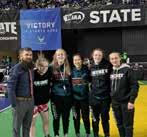


By Nina Culver Stream contributor
Regular visitors at the Medical Lake Post Office have been noticing improvements in the last couple of years. Fresh paint went up on the walls in the lobby lined with post office boxes. Decorations appear on various holidays. And last year, plants and flowers were added to the brick flower beds in front of the building in the 300 block of East Grace Street.
The changes are thanks to the efforts of Postmaster Lonnie Townsend, who arrived in Medical Lake in the spring of 2022. He said he wants to make the post office welcoming for people who come to check their mail, run into a neighbor or friend and stay to chat for a while.
“It’s kind of an impromptu meeting ground,” he said. “We try to keep it clean and festive so people want to come in and visit.”
The current décor is a mix of Valentine’s Day and a few items left over from Christmas. When asked, Townsend jokes that he has to leave them up because Punxsutawaney Phil saw his shadow and six more weeks of winter means he can’t take down the Christmas decorations yet.
“We’ll probably go big for St. Patty’s day because I have a ton of stuff in the storage unit,” he said.
Townsend grew up as a self-described military brat, spending a lot of time in Texas and Germany. He then joined the Army himself and served on active duty for 13 years and then four years in the National Guard. He started working for the United
States Postal Service about six years ago.
“I’m big on giving back, so it was still a way to serve, just a different aspect,” he said.
He started as a clerk, working in Cheney and then taking a job as acting postmaster in Reardan before coming to Medical Lake. While he’s never officially had a delivery route, he has delivered the mail.
“I still do that, too,” he said. “As a postmaster, you do a little bit of everything. You clerk, you deliver mail, you talk to customers.”
Townsend enjoys chatting with the people who come into his post office. “I get to talk to everybody,” he said. “I get to hear about what’s going on. It’s how I hear about all the good food events. You’re integrated into the community.”
The most important part of his job is making sure the mail gets delivered, Townsend said. “You never know when somebody is waiting for medications or checks,” he said. “I feel like if we don’t get it delivered, we’re doing a disservice to the customer.”
One of the perks of working in a small town post office is that people can usually get their mail even if the address isn’t quite right. Townsend said it’s not uncommon for an extra number to be added, a number be missing, or an address to say west instead of east. But small town mail carriers know their customers and the mail usually finds its way to its intended destination. “Most of the carriers on the routes, they’ll say ‘I know that name,’” he said.
That’s one of the things Townsend likes about working in small town post offices. It was

that way in Reardan, as well. “I could probably tell you every single person and their box,” he said. “To me, a small town is more personable. You can know more of your people.”
It was in Reardan that Townsend embraced decorating for the holidays. It was something he did on his own, using items he purchased himself. One year for Christmas, he purchased and put up an inflatable Christmas decoration. Soon, local residents were offering theirs to help decorate.
“I started with one inflatable,” he said. “By Christmas I had a whole yard (full). It was the yard of the town to come see. It helped you find the post office.”
Townsend returned the borrowed inflatables, but he began buying and using other decorations for various holidays. “It’s just something I do,” he said. “I like it. I think it should be festive.”
Before he left Reardan, one of the local residents created a painting showing the outside of the post office and presented it to Townsend. It hangs on his office wall, along with pictures of his time spent in previous post offices.
One of his favorite holidays to decorate for is Christmas, just because there are so many options. He can use Christmas trees or wreaths, but also snowflakes and stars and other decorations. “I can do so much with Christmas,” he said.
St. Patrick’s Day is his second favorite to decorate for. “I don’t know, there’s something about green,” he said. “We’ll probably go all out for St. Patty’s Day because I have a ton of stuff in the storage unit.”
He also enjoys the Fourth of July and Veteran’s Day. “I do a lot more patriotic stuff,” he said. “That’s why the walls are red, white and blue.”

Sam is honest and someone whom the whole choir can rely on. She welcomes every student to choir, going out of her way to make every student feels welcome. Sam encourages everyone to do their best and finds positive qualities in each person with sincerity. Sam works hard to sell various things for our fundraisers and make positive suggestions for the group as a whole. She is an incredible leader.
Townsend wanted to paint the interior lobby and the original plan was to make it all blue. “We just went with it,” he said. “We went out and got paint and started painting it ourselves.”
They discussed adding red and white to make it more patriotic, but didn’t have time to finish the work themselves. They put in a request and USPS paid to have a local contractor finish the red and white walls. USPS also paid for a new floor and new carpets inside the building. Towsend likes to put fresh flowers in the lobby and makes sure there is always a nice smelling air freshener appropriate for the season.
His efforts have been noticed by customers, but they don’t always mention it directly to employees. Townsend said he hears people talking about how they like the new paint and how clean and nice smelling it is inside. “You hear them talking in the lobby,” he said. “It’s fun to hear them.”
One of the more noticeable changes is the addition of flowers out front. “We’ve added flowers on the walkway in front of the post office,” he said. “The flower



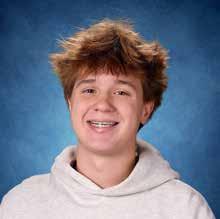
Dylan recently earned 5th place at the State All-Around Gymnastics event, and placed 3rd in with a PR in floor.
beds are a big one.”
Townsend bought some flowers himself and planted them last spring. However, he was new to gardening and planted too early.
Rural carrier Chris Howe, who has worked out of the Medical Lake Post Office since 2004, is a gardener himself and has found himself in the position of giving planting advice to his boss. “He might have planted a few flowers too early and they got a little frostbite,” he said.
He has also given lawn care advice to Townsend. “He accidentally put a full bag of fertilizer in the yard and burned it,” Howe said. “He had no idea.”
Howe has also contributed his expertise in other areas, including putting in a lattice for an ivy Townsend planted to climb. Gardening is not a skill set he expected to use while working for the Postal Service, he said. “I may have fixed a sprinkler head that was busted and moved a few sprinklers,” he said. “I worked at a golf course a long time ago, so I learned a lot from that. I just help make things pretty.”
Thanks you for all you do in our community
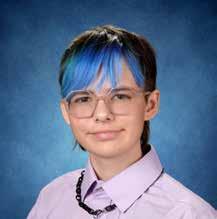
Gabe’s efforts during basketball season earned him recognition as CoMVP of the NEA League.
As the flower bed grew, Townsend started noticing plants that he hadn’t put in. Members of the community had taken it upon themselves to contribute flowers and Towsend spotted others tidying the flower beds. “It’s almost like it’s become a small community garden,” he said. “It was super nice last year, the way it turned out.”
Townsend was happy that the deer left the flower beds alone. That is, until he planted some purple kale for color toward the end of the season. Townsend soon noticed evidence of snacking. “They love purple kale,” he said. “They didn’t mess with the mums or anything, just the purple kale.”
Like the customers, Howe is appreciative of what Townsend has done to make the post office attractive and welcoming. “Most of the postmasters here never seemed to care about the appeal before Lonnie got here,” he said. “He just makes it pretty.”
Townsend is already making plans for this year’s flower crop, while incorporating what he learned last year. He’ll plant later and be sure to consult with Howe
Faolan is a very intelligent student and is an excellent AP Biology student. His answers in AP Biology are always complete and well-thought out. He is quiet and humble, but when he contributes to discussion, you can tell that he knows what he is talking about. His lab work is always well done.
about what flowers will do best.
Townsend isn’t only making things nice for his customers, he also does it for his employees. For Christmas one year, Towsend bought each carrier a waterproof jacket with a custom emblem created by Steps Custom Print Shop on the back, which lists the local zip code and the words “Proud to serve Medical Lake” below an American Flag and a red, white and blue bald eagle. Again, the purchase price came from his own pocket.
Townsend also got himself a jacket with “Medical Lake Postal Life” written on the back along with the numbers 022, a reference to the 99022 zip code in Medical Lake. The jackets help show community pride, Townsend said.
There are more improvements on the way, including plans to improve the parking lot and paint the exterior of the building. He’ll do whatever he can to make the post office welcoming, Townsend said.
“It just makes us more a part of the community,” he said. “We know it’s a visiting ground.”
By Matthew Stepohens Stream conttributor
The City of Medical Lake is preparing to implement a new street restriping project along a section of Lefevre Street, a move city officials say will improve safety, enhance mobility for pedestrians and cyclists, and reduce hazardous driving behavior along one of the community’s central corridors.
City Administrator Sonny Weathers said the project represents the next phase in the city’s broader effort to improve transportation infrastructure and create safer streets
for everyone who uses them.
“The City of Medical Lake continues to invest in streets, sidewalks, trails and transit connections that improve safety, accessibility and everyday mobility for all users,” Weathers said via email.
The restriping effort follows the completion of a major improvement project along Lefevre Street last year that focused on pedestrian infrastructure. That project replaced aging sidewalks and filled several sidewalk gaps on both sides of the roadway. It also included the installation of new pedestrian lamps and street lighting designed to improve visibility and safety during evening hours and darker winter months.
City leaders say the upcoming restriping is intended to build upon those improvements by addressing traffic flow issues and improving conditions for cyclists and pedestrians.
One of the primary issues city planners hope to address involves left-turn traffic along Lefevre Street.

Currently, vehicles attempting to make left turns off the roadway often come to a complete stop while waiting for oncoming traffic. According to city officials, this has led to an unsafe pattern in which other drivers attempt to bypass stopped vehicles by passing on the right.
That behavior has resulted in several near-miss incidents involving pedestrians and other vehicles.
“Vehicles brought to a stop while making a left turn has resulted in other vehicles illegally passing on the right,” Weathers said. “This creates many near-miss situations with pedestrians and other vehicles.”
To address the problem, the city plans to install a center lane dedicated to protected left turns. The addition of the center lane will allow vehicles to move out of the main traffic flow while waiting to turn, preventing traffic backups and discouraging drivers from attempting unsafe passes.
City officials say the change should significantly reduce the risk of collisions and improve overall traffic flow along the corridor.
The bike lane will be separated from vehicle traffic by painted buffers and on-street parking, creating a barrier that helps shield cyclists from moving vehicles.
Weathers said this design has already been successfully implemented elsewhere in Medical Lake.
“This style of bicycle lane is the same as what was done in 2023 on Barker Street in front of the high school,” he said.
That project introduced a similar configuration with buffered bicycle lanes and adjusted parking placement, and city officials say it has proven effective in improving safety for cyclists while maintaining access for drivers.
The Lefevre Street design aims to replicate those benefits by providing a more comfortable and protected environment for people traveling by bicycle.
Pedestrian safety remains a major priority for the city as well.

In addition to improving turning safety, the restriping project is also designed to slow traffic speeds along Lefevre Street.
Research in traffic engineering has shown that narrower travel lanes often encourage drivers to reduce speed. The redesigned striping will shift the travel lanes slightly closer to parked vehicles and pedestrian areas, visually narrowing the roadway.
The change is expected to naturally calm traffic without the need for additional signage or enforcement.
By bringing vehicle travel lanes closer to the parked cars and pedestrian spaces, city planners hope drivers will be more aware of their surroundings and travel at safer speeds.


Another major component of the project is the addition of protected bicycle lanes.
Under the proposed design, parallel-parked vehicles along Lefevre Street will be repositioned slightly farther away from the curb. This adjustment will create space for a protected bike lane between the curb and a buffer zone.
The earlier Complete Streets improvements along Lefevre Street added sidewalks and new lighting designed to improve walkability. The upcoming restriping will complement those changes by slowing traffic and adding additional separation between moving vehicles and pedestrian spaces.
Painted buffers between bicycle lanes and parking areas also create additional distance between sidewalks and vehicle travel lanes, providing an extra layer of protection.
City officials say these combined improvements align with the city’s broader goal of creating streets that safely accommodate a wide range of users.
The Lefevre Street project is part of Medical Lake’s ongoing Complete Streets strategy, which focuses on designing roadways that work for drivers, pedestrians, cyclists and public transit users alike.
Rather than prioritizing vehicle traffic alone, Complete Streets policies emphasize balanced transportation planning that improves accessibility and safety for all modes of travel.
In recent years, the city has invested in a number of
By John McCallum Stream contributor
Airway Heights’ water supply featured prominently in City Council actions at meetings in late February through early March.
At its March 2 meeting, the council adopted an ordinance changing how the city measures water demand when it comes to new development. The “Water Concurrency” ordinance increases the number of ERU’s — equivalent residential units — that would be available to developers at the time of submitting building permits and on an annual basis for water consumption.
According to the ordinance, concurrency means “land use approval is supported by the development of adequate public facilities, which have the capacity to serve development without decreasing levels of service below the established minimums.” The ordinance also notes the city has entered into a development agreement with the city of Spokane for completion of capital projects to help bring additional water to Airway Heights between 2026 – 2046.
Airway Heights is looking at purchasing more water from Spokane due to several factors, including restarting two wells idled since they were discovered in 2017 to be contaminated by firefighting chemicals likely emanating from Fairchild Air Force Base and Spokane International Airport.
Restarting the wells would have resulted in Airway Heights not having to purchase up to 300 million gallons of water annually from Spokane beginning this year. In an ordinance adopted by council in December increasing water rates, the city stated it “now expects to purchase all the water its needs from the City of Spokane.”
Among several steps, the ordinance passed at the March meeting increases “single family
residential ERU’s from 20 per calendar year to 25 for January to June and 25 for July to December of each year for a total of 50 ERU’s per developer per year.” It also includes “Missing Middle Housing” units in that ERU allocation, updates the multifamily definition and increases those ERUs from 16 to 30 and increases the commercial and industrial allocations to 20 units.
“We measure our water because we are giving our water to projects, new development and we are also buying our water from an outside source, which is the city of Spokane,”
Airway Heights Principal Planner Heather Trautman said.
Council approves water plan contract
At its Feb. 17 meeting, council unanimously approved a contract with Community Engineering and consulting to include work requested by the state Department of Health into the city’s water plan. Some of the work is required due to the department’s delay in completing its review of the city’s plan while other parts are due to Health’s additional requirements not included in the original scope of work.
Two major components not included in the original scope is the department’s requirement for the city to prepare a new Water Use Efficiency (WUE) report, the one from 2021 was not accepted, that is in compliance with the Municipal Water Law. The second component is preparation of an asset management plan (AMP) for the water system, with the department agreeing to a “truncated AMP” meeting Health’s requirements “with the understanding that the City may want to invest in a larger scale AMP for all of the City’s infrastructure.”
The $33,430 contract for the plan work will be covered by water utility funds.
Council accepts CHIP awards
Also at the Feb. 17 meeting, council unanimously approved acceptance of two Connecting Housing to Infrastructure (CHIP) grants totaling $1,495,344. The city applied for the grants from the state Department of Commerce in September, 2025, after it was approached by two nonprofit affordable housing organizations — Habitat for Humanity and Community Frameworks.
The nonprofits asked the city to partner with them on the grant applications to help offset costs to their Highland Village low-income

Airway Heights received over $1.43 million in two separate grants that will cover connection fees for Highland Village phases 3 and 4. The funding comes from joint applications with the city and nonprofits Community Frameworks and Habitat for Humanity.
housing development: Phase 3 by Community Frameworks and Phase 4 by Habitat for Humanity. The grants will pay for what are referred to as “general facility charges.”
General facility charges (GFCs), also known as “connection fees” are one-time required costs on new or expanded developments to cover their equitable share of the associated water and wastewater infrastructure costs to the system. The fees pay for additional capacity for the developments, and often cover system expansion funding.
Community Frameworks receives $495,344 while Habitat for Humanity receives $1 million, with both amounts requested by the organizations. Council also passed updates last October to the city’s municipal code required by the grant to make sure the GFCs can be waived from the developer’s responsibility so long as another funding source is obtained to cover the costs.
Originating Agency Number (ORI) follow up
A story in the February issue of the West Plains Stream noted the City Council passed an ordinance at its Feb. 2 meeting establishing a Prosecutor’s Office within the Municipal Court, a move that helps the court get reimbursed for fees and costs associated with prosecutions. The Washington State Patrol requires an Originating Agency Number (ORI) from an agency in order to reimburse it for these costs.
In a March 6 interview on another issue, City Manager Albert Tripp said the move also allows the Prosecutor’s Office to obtain access to specific
criminal information as well.
Airway Heights Prosecutor Laura House said they use a system known as JABS — Judicial Access Browser System — to obtain past criminal data on an individual from most jurisdictions in Washington state. When it comes to crimes such as domestic violence, or driving under the influence, House said it is “vital for me as a prosecutor” to also access national criminal history quickly, something the ORI will now enable the office to do.
House said this information is necessary to assess the risk of a person charged, a specific victim’s risk if it is a domestic violence crime as well as release information for crimes if it is the first charged infraction for that individual or if there are multiple previous charges or convictions.
House said she usually relies on the Police Department to obtain this information from the National Crime Information Center (NCIC), which also lists factors such as an individual’s aliases to “anything a person has been charged with in every state in the U.S.” House said this isn’t a problem relying on the department for the information, but a problem can arise when there is a delay getting the information from “from anyone else and you need that information immediately.”
“Now that the process is complete, I’ll always be able to access that information in time to make the proper recommendations, particularly at first appearances, in order to protect victim safety in particular and community safety in general as much as possible,” she added.
By Nina Culver Stream contributor
As testing for wells contaminated with PFAS chemicals moves forward on the West Plains, residents are expressing concerns about how long it might take to get their wells tested and whether or not it is safe to eat the food grown in their gardens or livestock raised on their land.
The frustration was particularly evident during a meeting hosted
last month at the Shriner’s Event Center to discuss work being required by the City of Spokane and Spokane County to address PFAS contamination from fire retardant foam used at the Spokane International Airport for decades.
Jeremy Schmidt, a site manager for the Department of Ecology, said all airports were required by the Federal government to have AFFF, a type of firefighting foam. “They were required to have it,” he said. “They were required to test it.”
Schmidt said most of the contamination was caused by training with and testing the firefighting foam, not using it to deal with airplane crashes. “It takes a cup of product to contaminate an aquifer,” he said. “It doesn’t take much. That’s the problem.”
Washington State couldn’t regulate PFAS, a family of chemicals known as forever chemicals because they don’t break down in the environment, until they were declared a hazardous substance in 2021. Fairchild Air Force Base publicly identified PFAS contamination on and off base in 2017 from the same AFFF foam.
The Spokane International Airport did not disclose its contamination to the Department of Ecology until 2023, though initial testing at wells
contamination in 2017.
Last summer the City of Spokane and Spokane County, which jointly own the airport, were added as responsible parties in the clean-up effort. In January, the city and county submitted a draft PFAS investigation plan spelling out where and how they would perform testing and, eventually, clean up.
In mid-February, Ecology told the city and the county they had two weeks to come up with a plan to provide clean drinking water to people affected by contamination that originated at the airport. That can be done via providing bottled water or installing home water filtration systems. That deadline has since been moved to March 13, Schmidt said.
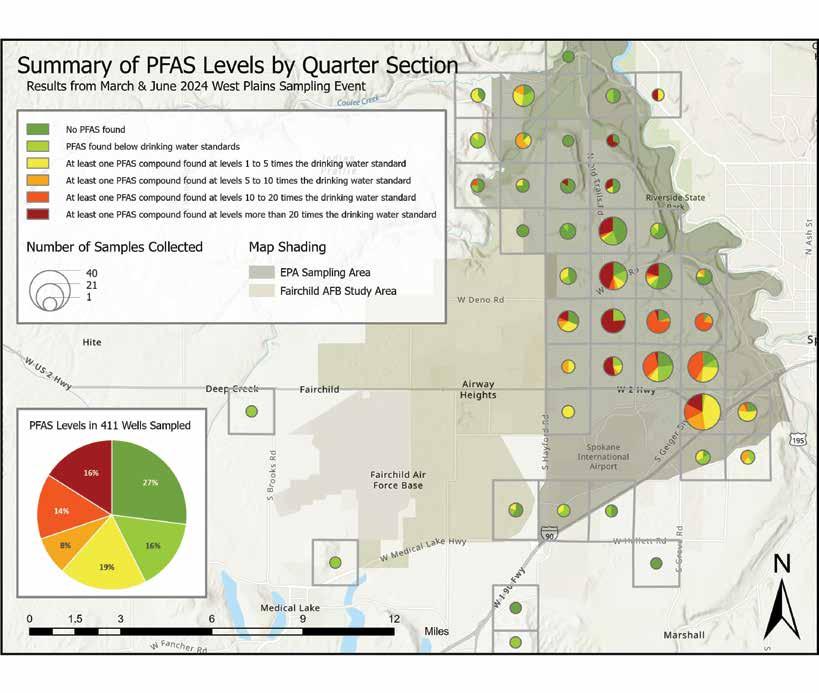

The city and county are operating under an agreed order that spells out testing to be done to determine the spread of contamination, identify interim actions that should be taken, identify possible methods of removing the contamination and then do a feasibility study of different clean-up options.
“It’s a long process,” Schmidt said. “We’re years from that.”
Despite Ecology ordering the City and Council to provide emergency relief by providing residents with contaminated wells with clean water, it will take time for well testing to be done to identify who needs that relief, Schmidt said.
Several of the 100 people who packed into the Shriner’s Event Center didn’t like that answer. “We’re drinking it, we’re showering in it, we’re feeding it to our animals,” one woman said. “What the hell are we supposed to do?”
Others asked about getting their blood tested for PFAS levels. “There’s not much you can do if it’s in your system except to stop ingesting it,” Schmidt said.
One man noted that he raised cattle and that it was impractical to buy bottled water for them to drink. “What am I supposed to do?” he said.
Another man said he paid to have his well tested. “It’s so contaminated,” he said. “We can’t even grow flowers. They die. We don’t dare grow anything to eat.”
He said he researched home filtration systems after getting his test results. “They wanted $8,000 to install a filtration system,” he said. “I can’t afford that.”
Another woman said she was concerned about the time it will take to test everyone’s wells and then provide drinking water. She also said she can’t afford the $400 it would cost to test her well.
Schmidt said that timeline will be part of the plan submitted to Ecology later this month, but acknowledged the urgency of the issue. “We need to get people’s wells tested and get them to stop drinking the water today,” he said.
Someone asked what the airport had done with their PFAS contaminated AFFF foam. Schmidt
said it was still sitting at the airport in trucks, available for emergency use only. Several gasps were heard and someone said “They’re still using it.”
Schmidt said a new type of firefighting foam, which does not include PFAS, was recently approved for use. “SIA has the new product,” he said. “They have not transitioned to it yet.”
Another woman referenced the issues the Spokane International Airport has had, including not disclosing their PFAS contamination when required and at one point refusing to sign an agreed order to move forward with the clean-up process.
“Clearly the airport has flipped you the bird before, what happens if they don’t cooperate?” she asked.
Schmidt said progress has been made since the City of Spokane and Spokane County were added as responsible parties along with the airport. “I’m confident that between the three responsible parties, we’ll
get this done,” he said.
Testing at the airport has shown PFAS contamination in four primary areas: the current fire house, the historical firehouse, the fire training area and the stormwater recovery area on the northeast end of the airport property.
Schmidt said the geology of the West Plains is unique in that most of it is a thin layer of soil on top of basalt. The exception is old paleochannels, which are deep canyons carved by ancient floods. “Another flood came through and filled them with rocks and dirt,” Schmidt said.
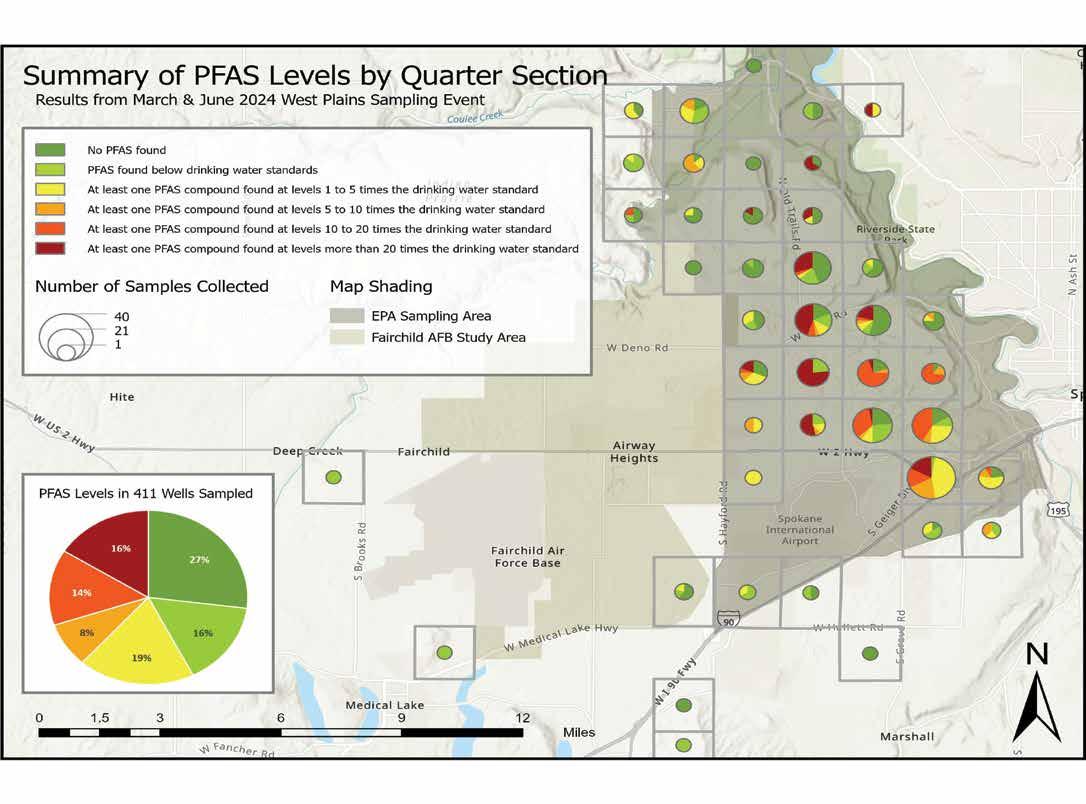
Groundwater is able to move quickly through those paleochannels. Contaminated groundwater flows generally northeast from the airport. That area had some well testing done by the U.S. Environmental Protection Agency in 2024. The EPA tested 411 wells, 236 of which were contaminated above allowed levels. No contamination was found in
111 wells and very low levels were detected in 64 wells.
The problem with PFAS chemicals, in addition to them staying in the environment, is that studies are still underway to determine its effects on people, livestock and produce. The chemicals are thought to be tied to certain types of cancer, thyroid issues and low birth weight in babies.
If solid information is lacking on the effect of PFAS on people, there’s even less research on its impact on food. The Washington State Department of Health has been doing small amounts of testing on meat and eggs as their budget allows, said Department of Health Toxicologist Barbara Morrissey.
“We have been looking at homeraised livestock,” she said.
Their testing and research done at other contaminated locations around the country has shown that high levels of PFAS contamination
See PFAS, Page 8
Continued from page 7
does get into eggs and meat, Morrissey said. There is less data in regards to lower levels of contamination.
People have been asking about contamination in food since PFAS was first discovered on the West Plains, Morrissey said, and in the beginning the Department of Health had even less information than they do now. “At that point, the best we could advise was ‘It might be a problem,’” she said.
It costs $550 to analyze one sample and there was no budget for testing. DOH was previously able to get enough funding to test 30 samples and completed the first round of testing in December 2023 of meat and eggs from the West Plains and East Selah, another contaminated site. Some of those households had samples retested in November 2024 after homeowners made changes and more samples were tested in April 2025. A team just finished collecting additional samples to be analyzed.
“We were surprised at how much PFAS we found in the eggs,” she said. “We didn’t see as much in the meat.”
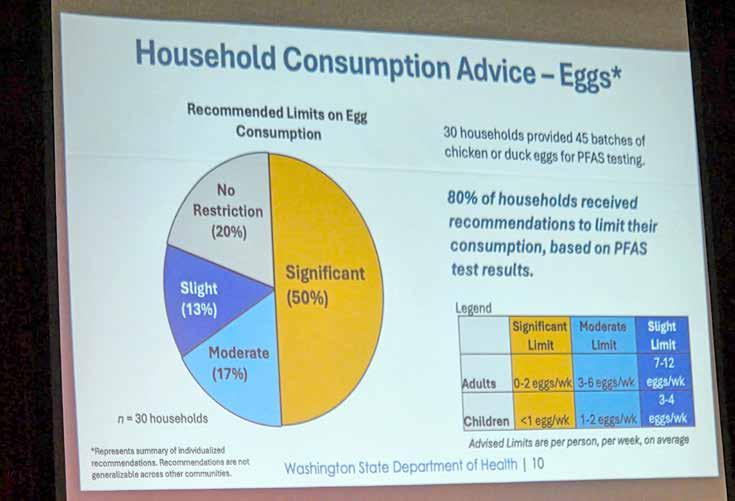
Thirty households supplied 45 batches of chicken and duck eggs for testing. Nearly 80 percent of them had PFAS levels high enough that the Department of Health recommended either limiting the number eaten or not eating them at
all. In the most contaminated batch, one egg had enough PFAS in it to equal the amount a person would consume by drinking contaminated water for 200 days, Morrissey said.
What has become clear is that switching to clean drinking water for chickens and other livestock does make a difference. One home that had high levels of contamination in their eggs started giving their chickens filtered water and also made changes to their chicken coop, moving it and reducing access to the dirt by putting down a thick layer of shavings. When the eggs were retested after the changes, the level of PFAS contamination had dropped sharply.
“We think there might be a soil pathway,” Morrissey said of the importance of moving a chicken coop. “We do think that is probably one of the factors.”
There are also many different types of PFAS chemicals and only certain ones were found in eggs, Morrissey said. “Not all of the PFAS in your well water are bioacummulative in eggs,” she said.
There are other things people can do to reduce contamination as well. People should avoid feed made with fish meal, since that could be an additional source of contamination. When eating farmraised animals, people should avoid eating their organs and manure from contaminated animals should not be used in a garden, she said.


Sixteen households provided 28 samples of meat, including beef, chicken, pork and turkey. Most tested clean, with only 25 percent of households advised to either severely or moderately restrict their intake.
The good news is that if sources of contamination are removed, animals are able to clear the chemicals from their system relatively quickly, Morrissey said. “They actually excrete PFAS faster than people can,” she said.
Health Educator Claire Nitsche said there are a wide variety of variables that can affect the safety of fruit and produce, including the levels of contamination in the water and soil as well as the soil type. The type of contamination also plays a role, with long-chain chemicals like PFOS and PFOA lingering in plant roots and short-chain chemicals like PFBA settling in stems, leaves and fruits.
“It’s because of where the PFAS gets stuck,” Nitsche said. “We have only had science around PFAS and gardening for two years. We have enough information to know that PFAS can move into garden produce.”
Nitsche said she knows that people are worried about the safety of the food they grow and has had some people tell her they have stopped gardening completely. “This is a big issue,” she said. “It really impacts people’s sense of well being in their homes.”
Higher risk items to eat include leafy greens like spinach and lettuce, green beans, celery, rhubarb and roots like radishes, beets and carrots. Foods that are a lower risk include onion, garlic, potatoes, tree fruits and nuts, tomatoes, cucumbers, melons, peppers and corn. In the case of corn, contamination has been found in the leaves of contaminated plants, but not in the ear itself. There are steps people can take to garden more safely, including using filtered water. Adding organic matter such as compost, peat and biochar helps because the PFAS binds to the organic matter. Bringing in clean soil to use in raised garden beds is also effective, though it’s not cheap. “This is very expensive and hard for people,” Nitsche said.
Produce should be scrubbed of all dirt before eating and root vegetables, such as potatoes, should be peeled.
It’s clear that the food we eat can be a source of PFAS contamination, not just the water, Morrissey said. “This is an important pathway of exposure that needs to be investigated further and mitigated,” she said.
Morrissey said she is hoping to get funding to do testing of garden produce this summer. West Plains residents interested in providing produce for testing can contact Morrissey at barbara.morrissey@ doh.wa.gov.
By Margo Buckles West Plains Beekeepers Association
People come to beekeeping for a variety of reasons. Some are interested in the natural environment and the honeybees’ role in pollination. Some are fascinated by these small creatures and how they work together. Many just want to harvest the bees’ sweet honey. No matter why people are interested in beekeeping, they often seek knowledge through beekeeping clubs and associations.
The West Plains Beekeepers Association (WPBA) is one of three beekeeping clubs in the Spokane area. Formed in 2010, WPBA meets monthly to allow beekeepers to socialize, share their experiences, learn more about bees and other pollinators, and to conduct club business.
A year in the life of WPBA mimics the beekeeper’s year. Spring is a busy time as the club holds Washington State Beekeepers Association-approved Beginning and Apprentice beekeeping classes in anticipation of flowers blooming and nectar flowing. Then, in April, WPBA installs two packages of 10,000 bees each in two hives at its local apiary so beginning and experienced beekeepers can work with bees firsthand. Hands-on days in the WPBA apiary throughout spring and summer help people overcome their fears, question their assumptions, and receive mentorship from more experienced beekeepers. WPBA also provides a community service on its website by listing swarm catchers. The public can call a beekeeper and know that the bees have been rehomed to a new hive.
In summer, WPBA shares its knowledge with others through community events like Medical Lake’s Founders’ Day and the Poindexter Farm visit for Cheney first graders. In June 2025, WPBA held the first Pollinator Week event in Eastern Washington (the second will be June 13, 2026, at Mobius Discovery in Spokane). WPBA also mentored other groups interested in bees, beekeeping, and pollination.
Contributed photo
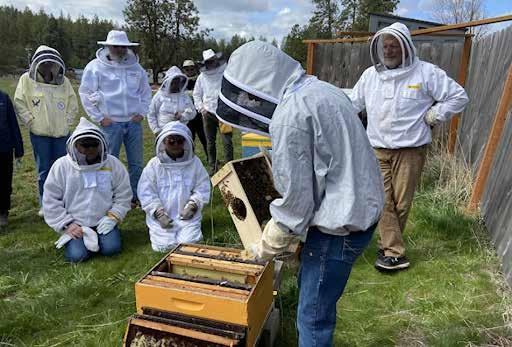
The West Plains Bee keepers hold Washington State Beekeepers Association approved Beginning and Apprentice beekeeping classes at their local apiary so that people can get hands on experience working with bees.
Last year, WPBA advised Eastern Washington University’s newly formed beekeeping club on keeping hives, which are on display in the PUB’s rooftop garden. WPBA also partnered with River City Youth, which wanted pollinators in its
urban garden. A few members also guide Airway Heights Correctional Center inmates in beekeeping as part of a state-wide sustainabilityin-prisons project.
Fall begins mid- to late-August when we harvest honey from the club apiary. WPBA assists its members by providing a honey extraction rental service. In addition, we hold a club-wide extraction day, where club members gather to extract their own honey as well as the club’s honey. Club honey is sold to support other club activities. In late September or early October, the club holds its final hands-on in the apiary to prepare hives for the winter months.

Contributed photo
West Plains Beekeepers can also be found educating the public during community events such as Founders Day in Medical Lake, EWUs Pollinator week, and even at the Airway Heights Correctional Center.
Winter is the slowest season for the beekeeper, but that does not mean that there is nothing to do. WPBA members often gather with other beekeepers from throughout Washington at the Washington State Beekeepers Association’s annual beekeeping conference where beekeepers network and receive updates in the latest research related to honeybees and beekeeping, often from WSU entomology researchers.
The West Plains Beekeepers Association meets monthly on the third Wednesday at 6pm at the Pizza Factory, 123 S. Broad, Medical Lake. For more information about the club or beekeeping classes, check out the club website at wpbeekeepers.org.













By John McCallum Stream contributor
Boys swimming


CHENEY HIGH SCHOOL
One Blackhawk swimmer qualified for state 3A competition Feb. 20-21 at the King County Aquatic Center in Federal Way.
Sophomore Carson Bentley earned the single Eastern Washington allocation to state in the 100-yard breaststroke with a first- place finish at the District 6 meet Feb. 6-7 at Richland High School. Bentley turned in a time of 1 minute, 39/100ths of a second, setting a new meet record in the event by 32/100ths of a second.
At state, Bentley missed the A Finals in the event by about 1.5 seconds, but turned in a prelim time of 1:00.97 qualifying him for the B Final. His finals time of 59:98 earned him a 10th-place finish overall.
Boys Wrestling
The Blackhawks advanced nine wrestlers from District 6 competition to Mat Classic XXXVII at the Tacoma Dome, Feb. 19-20. Of those, three reached the podium: Cooper French, Kaden Rasmussen and Wyatt Wells, with all nine advancing to Day 2 of competition. Wells reached the highest podium step, placing third at 215 pounds with a 9-5 decision of Foueti Unga of Lincoln High School (Tacoma). Rasmussen lost to Isaiah Ramirez of GSL 3A foe University by technical fall to place fourth at 157 pounds while French sixth after a loss to the Titan’s Jaxson Leffler at 190 pounds.
“His (French) losses were to


the third, fourth and fifth place wrestlers,” head coach Brian Skaff said. “Cooper wrestled as well as he has in his career as a Blackhawk and did it at the right time.”
Also competing at state were Aiden Carr, Mason Bridges, Chazz Gray, Hank Ghering, Ethan Guske and Macade Munro. After losses on day two, all battled to advance through the consolation brackets but coming up short of a medal — with seniors Carr, Guske and Bridges wrestling their final matches for the Blackhawks.
“All have had great careers and we are so proud of them,” Skaff said. “But they did their jobs and scored points which helped Cheney to a 11th place team finish.”
Cheney finished with 115 points. District 6 champion Hermiston (Ore.) emerged as the state champion as well, 61.5 points ahead of second-place University.
The Blackhawk girls advanced 13 wrestlers from districts to Mat Classic XXXVII including three state placers from last year: Jalisca Holmgren, Jennifer Tian and Paige McGee.
At the Tacoma Dome, five of the 13 made it to the medal podium: Addison Lathrop, Holmgren, Tian, McGee and Skylar Buckner. McGee and Holmgren both earned fourthplace finishes, with Buckner sixth, Tian seventh and Lathrop eighth.
Holmgren won her first three matches at 125 pounds before losing to eventual state runnerup Olivia Engel of Kelso in the semifinals. In the match for third and fourth she lost via fall to Shelton’s Adell Anderson.
McGee also won her first three matches at 135. In the semis, she lost via fall to Walla Walla’s Kylie Whitaker. In the match for third and fourth, she lost via fall to Ridgeline’s Zoe Grishko.
At 145, Buckner lost a 10-2 major decision to AuburnMountainview’s Hayden Roth to

finish sixth. Tian pinned Everett’s Lucy Dalseg for seventh at 120 while Lathrop lost via fall to Jayanna Ivory of Gig Harbor to finish eighth at 115.
Cheney tied Everett for seventh place with 119.5 points, the highest finish for the three 3A GSL schools at state. Kelso emerged as state champion, with Hermiston (Ore.) runner-up.
Boys basketball
After finishing second in the Northeast A League standings to Lakeside, losing twice to the Eagles in the regular season, the Cardinals got a measure of revenge on the regular-season champions in the playoffs.
Medical Lake got 15 points from 6-foot-4-inch sophomore forward Grant Moffat and outscored Lakeside 18-11 in the fourth quarter to knock off the Eagles 6249 in the District 6 championship game and advance to the crossover tournament with District 5 for a berth to the 1A state tournament.
Unfortunately, the Cardinals came up short against the South Central Athletic Conference’s fifth-place Wapato, who earned District 5’s third-seed with an upset of third-seeded Chelan. The Wolves outscored Medical Lake 22-9 in the fourth quarter enroute to a 72-59 win, with Moffat leading the Cardinals with 22 points while Owen Moffat added 16.
Medical Lake ended its season at 14-9 overall.
Girls basketball
The NEA third-seeded Cardinals made a good run at advancing in the playoffs and a shot at the 1A state tournament. Medical Lake knocked off fourthseeded Riverside 63-30 in the District 6 opening round.
Needing a win over secondseeded Colville to advance to crossover competition with District 5, the Cardinals couldn’t
quite close a six-point gap in the fourth quarter, losing 39-36 to the Crimson Hawks to finish the season at 6-15.
Dylan Stoltz turned in a 9.40 in the floor exercise on Day 2 of competition to claim third-place in the state 1A/2A /3A state meet Feb. 19-21 at Sammamish High School. The sophomore was in a five-way tie for ninth heading into the second day of competition, and bettered her score by one-10th of a point to reach the podium.
Stolz also advanced to secondday competition in the bars, placing 15th.
Junior Makalia McKenney made the finals in the floor exercise. One of the five tied with Stoltz on Day 1, McKenney turned in a Day-2 score of 9.150 for eighth place.
Stoltz placed fifth and McKenney placed 87th in Friday’s all-around event out of 140 girls in the competition, helping Medical Lake to a 20th-place team finish.
Boys wrestling
Nine Cardinals advanced out of district’s to Mat Classic XXVII: Abelino Feliciano, Abram Kane, Bewiller Paul, James Oliver, Liam Horn, Markus Bowman, Mason Pierce, Robert Carson and Walker Hays.
Oliver was the only wrestler to made the medal stand, placing third at 126. He won his first two matches before losing a 1716 decision in the quarterfinals to eventual 1A state runner-up Michael Bustos of Wapato.
In the consolation round, Oliver notched three straight wins to advance to the medal match against Elma’s Aidyn Johnson, winning in a second period pin for third.
Girls wrestling
Angelica Bowman was the only Cardinal girls wrestler to advance to state at the Tacoma Dome, losing both her matches at 105.
The Stream is committed to serving the West Plains area through excellent community journalism. We can’t do it at all without you, our readers, and we can’t do it for long without support from our advertisers. Please thank our business partners and look to them when offering your patronage.
Our sincere appreciation to the following businesses for their foundational partnerships withThe Stream and its partner publications:





Following are the local advertisers in this issue of The Current.
Continued from page 4
infrastructure improvements that reflect this philosophy, including trail connections, sidewalk expansions and improved lighting along pedestrian corridors.
The Lefevre Street restriping represents another step in that continuing effort.
Funding for the project is largely being provided through a grant from the Washington State Transportation Improvement Board (TIB).
The grant was formally authorized by the Medical Lake City Council through Resolution No. 26-791 during the council’s Feb. 3 meeting.
Under the terms of the grant, the Transportation Improvement Board will cover 90 percent of eligible project costs, with a maximum grant award of $767,700.
The project is also receiving financial support through Washington’s Climate Commitment Act, a statewide initiative that funds projects designed to reduce carbon emissions and improve sustainable transportation infrastructure.
By investing in pedestrian and bicycle infrastructure, city officials say the Lefevre Street improvements align with those statewide goals.
City officials say the project reflects a long-term commitment to improving transportation infrastructure in Medical Lake while maintaining the community’s smalltown character.
While construction timelines and final implementation details will be announced as the project moves forward, the city expects the restriping work to take place soon.
When completed, officials believe the changes will make Lefevre Street safer and more accessible for everyone who uses it — from drivers and cyclists to pedestrians walking through one of the city’s busiest corridors.
Weathers said projects like this are part of the city’s broader vision to ensure Medical Lake remains a safe and connected community.


EDITOR/PUBLISHER Ben Wick
ben@westplainsstream.com
CO OWNER Danica Wick danica@westplainsstream.com
CONTRIBUTORS
Nina Culver, John McCallum, Matthew Stephens
West Plains Stream
www.westplainsstream.com
The Stream is published monthly by or near the 15th of each month. It is distributed free of charge to every business and home in Airway Heights, Fairchild Airforce Base, and Medical Lake area. Copies are located at drop-off locations in Airway Heights, Medical Lake and the surrounding area.
The Stream is brought to you by
Publishing House
Submitted materials
Announcements, obituaries, letters to the editor and story ideas are encouraged. Submit them in writing to publisher@westplainsstream.com. Submissions should be received by the 1st of the month for best chance of publication in the following month’s Stream.
Subscriptions
Subscriptions for U.S. postal addresses cost $20 for 12 issues. Send a check and subscription address to P.O. Box 363, Liberty Lake, WA 99019. Subscriptions must be received by the 1st of the month in order for the subscription to begin with the issue printed the end of that month.
Correction policy
The Stream strives for accuracy in all content. Errors should be reported immediately to 509-2427752 or by email to editor@westplainsstream.com. Confirmed factual errors will be corrected on this page in the issue following their discovery.
Advertising information
Display ad copy and camera-ready ads are due by 5 p.m. on the 1st of the month for the following month’s issue. Call 509-242-7752 for more information.
Advertising integrity
Inaccurate or deceptive advertising is never knowingly accepted. Complaints about advertisers should be made in writing to the Better Business Bureau and to advertise@westplainsstream.com. The Stream is not responsible for the content of or claims made in ads.
Of note: This thank you message was produced by The Stream’s advertising team, which works its tail off on behalf of partner businesses, helping them share their messages through advertisements. This is an independent function from The Stream’s editorial team, which has its own evaluation process to determine the community news stories and features it pursues. For more information about a win-win partnership that expertly markets your business to thousands of readers (while making this home-grown community newspaper possible), email advertise@westplainsstream.com. With story ideas, contact editor@westplainsstream.com.
“Investments like these help improve everyday mobility for residents while making our streets safer and more accessible for all users,” he said.
Copyright © 2026
All rights reserved. All contents of The Stream may not be reproduced without written permission of the publisher.
By Janet Hacker-Brumley Spokane County Library District (SCLD)
This year celebrates America’s 250th anniversary. When discussing local history with a customer at Argonne Library, they recommended the history books by Ty Brown, local author and teacher. Based on that suggestion, we were able to bring Brown to the library to discuss two different topics.
Two presentations, “Byron Riblet: Forgotten Engineering Genius with Ty Brown” and “Along the Little Spokane River: A Sense of Place,” take place at SCLD libraries in March, April, and May. Learn more at scld.org/ty-brown.
To learn more about these topics, I asked Ty Brown some questions, and he shared the following answers about himself, local history, and his books.
Janet: Could you tell us a little bit about yourself?
Ty: I have lived in Spokane most of my life, especially on the north side of town. My passion has been history, mostly local Spokane history. I’ve taught high school history and English for the past 20 years and love my job.
My wife, daughter, and I like to travel and enjoy the great outdoors.
Janet: What were some of Byron Riblet’s early contributions to Spokane? How did the growth of Spokane factor into his work on chairlifts?
Ty: He was one of Spokane’s original planners. As a civil engineer, he platted most of the early additions, contributed to electric railways that serviced Spokane, and engineered the Upriver Dam, which provides Spokane with drinking water.
In the late 1800s, Riblet got into designing aerial trams in Canada that transported ore from rugged landscapes to transportation hubs. Eventually, his Riblet Tramway Company, based in Spokane, was the largest in the world. During the Great Depression, mining interests decreased, and Riblet converted production to ski chairlifts. At the time, only one chairlift was functioning in America. His company established the second lift and, from there, dominated the industry for decades.
Janet: The subtitle of your book “Along the Little Spokane River” is “A Sense of Place.” What are some distinctions that make the river unique?
Ty: The Little Spokane River Valley has the unique distinction of being close to the urban environment of Spokane yet removed enough to give it its own sense of place. The lower end of the river is becoming increasingly open to public use, while the middle
section is dominated by residential development, including two golf courses. The upper portion is rural and was once home to turn-of-the-century lumber mills. Each section has its own identity.
Janet: How did the river interest you as a topic of research?
Ty: I have lived in the Little Spokane River area for the majority of my life and have grown to appreciate its beauty. My family developed Wandermere Golf Course in the 1930s, and I became interested in its origins. My first book was about Wandermere, and this led me to researching all things Little Spokane River.
Janet: What’s a fact about each of these topics that might spark interest in people looking to attend your upcoming presentations?
Ty: The Riblet family is interesting in that most people don’t realize the company was not one person but three brothers who were involved with the business. Byron Riblet, the engineer, was the brain behind one of Spokane’s most successful businesses. Yet his brother Royal, who built what is now Arbor Crest, gets most of the credit. Royal worked for his brother as a salesman until he was fired by Byron for fraud and other issues. The two brothers never spoke again.
In addition, the Little Spokane River story is one of history, human connections, and conservation of a beautiful, natural place.