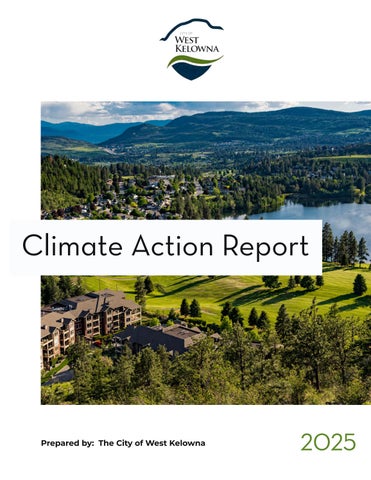
Climate Action Report
Prepared by: The City of West Kelowna
2025
About the City of West Kelowna The City of West Kelowna is a vibrant and growing community of more than 40,000 people. With stunning scenery, parks and trails, orchards, recreational amenities and more, West Kelowna is truly the place to be. Situated on the traditional territory of the Syilx Okanagan People, on the central, western hillsides of Okanagan Lake, our community is recognized for its outstanding outdoors and can be enjoyed by paddle boarding or kayaking on Okanagan Lake, mountain biking on best-in-class trails, and hiking and snowshoeing through centuries-old pine forests. Visiting award-winning wineries and local shops, indulging in local produce at farms and farmers markets, and soaking up the atmosphere at cafes, artisan studios and seasonal events make West Kelowna a memorable community to live, work and play. The City offers 130 athletic fields, beaches, boat launches, parks, sports courts and trails. Other facilities and amenities include two arenas, an air-supported multi-sport dome, skateboard park, children’s water park, inclusive playground and indoor aquatic centre.
Table of contents About West Kelowna 2 Table of contents 3 Introduction 4 West Kelowna: 2025 and beyond 5
Council's 2022-2026 Strategic Priorities 6 2024 by the numbers 7 Corporate emissions data 7 Broad planning, policy and land use 8 Building and lighting 10
Energy generation 11 Green space 12 Solid waste 13 Transportation 14 Water, stormwater and wastewater 15 Adaptation and resilience 16 Local climate partnerships 18 Contact us 19
Introduction The Climate Action Report is a requirement of all BC municipalities that have become signatories to the BC Climate Action Charter and provides a means of tracking the progress our municipality has taken in meeting our commitment to reducing emissions, and in adapting to climate change.
About the reporting Corporate actions are those that directly reduce emissions in City operations. A community action, while city-initiated, reduces emissions in a specific area, neighbourhood or the entire municipality.
About the BC Climate Action Charter The BC Climate Action Charter is an agreement that the Province of British Columbia, Union of BC Municipalities and local governments have signed to commit to act on climate change. The City of West Kelowna has been a signatory since 2007. The City’s community climate action goals, as stated in the Official Community Plan, are aligned with provincial emissions reduction targets and include: • A 40 per cent reduction in GHG emissions by 2030 from 2007 levels; • A 60 per cent reduction in GHG emissions by 2040 from 2007 levels; • An 80 per cent reduction in GHG emissions by 2050 from 2007 levels. The City’s corporate climate action goals are outlined in the Corporate Climate Action Plan, which was completed in 2023. This guiding document compiled an energy and emissions inventory on all corporate assets and identified targets and recommended actions for adaptation and emissions reductions across all municipal operations, including facilities and fleet.
4 4
West Kelowna: 2025 and beyond When we think of what our community could look like in the future, we must consider how to get there, what goals we might establish and how to achieve them. In thinking of the City of West Kelowna’s future with respect to climate change, we must satisfy our commitments as a BC Climate Action Charter signatory, remain adaptable and resilient and ensure our community grows in a sustainable and desirable way.
Collaboration and joint action The City of West Kelowna works closely with a variety of community and business stakeholders and senior and local government partners including Westbank First Nation, District of Peachland, City of Kelowna and the Regional District of the Central Okanagan. All play a vital role in the development of the Westside. We share businesses, facilities, natural areas, and common resources. Together, we can consider how to move forward, adapt and mitigate the effects of climate change. Steps may involve information and knowledge sharing, working together to plan our communities, and strategizing how best to utilize facilities and infrastructure to serve residents and businesses and strengthen our resiliency. The City of West Kelowna also thanks the Province of British Columbia for providing dedicated funding under the Local Government Climate Action Program and the Government of Canada for reliable, semi-annual allocations through Canada's Build Communities Strong Fund to assist in various climate change initiatives.
5 5
Council's 2022 - 2026 Strategic Priorities Pursue Economic Growth and Prosperity We will work with stakeholders throughout the region to advocate for and support efforts aimed at helping West Kelowna businesses prosper. With a focus on the future, we will advance opportunities to expand our economy, increase employment, and develop the community in ways that contribute towards prosperity for all.
Invest in Infrastructure We will invest in building, improving and maintaining infrastructure to meet the needs of, and to provide a high quality of life for, current and future generations.
Foster Safety and Well-being We will pursue through direct action, advocacy, and collaboration with local and regional service providers, investments in community health, needs-based housing, emergency preparedness, policing, and other services that foster safety and well-being in West Kelowna.
Strengthen our Community We will provide opportunities for the residents of West Kelowna to build connections, celebrate successes, embrace the community’s strengths and diversity, address shared needs, and contribute to shaping the community’s future. 6
2025 by the numbers
20 7.7 5
active or completed infrastructure projects
71
kms of roads resurfaced
plans with climate related strategies
FireSmart Home Assessments completed by West Kelowna Fire Rescue
253
new urban trees planted
38 10 4.5
wildfires actioned and/or supported
wildfire mitigation projects active or completed
kms of new sidewalks and bike lanes
Corporate emissions data Service Type
2024 Reported Numbers (tonnes 2025 Reported Numbers of carbon dioxide equivalent or (tonnes of carbon dioxide tCO2e) equivalent or tCO2e)
West Kelowna operations
2,145
2,598
Services delivered by city contractors
411
724
Total emissions
2,556
3,322
7
Broad planning, policy and land use Land use plans and policies that focus on smart growth principles – compact, complete, connected, and centered – play key roles in protecting the environment, conserving energy and reducing emissions.
2025 actions • Council approved the Accessibility Plan, which includes three goals, 16 actions and considers staff resources, time, and financial capacities to improve accessibility in the community. The 10-year capital plan provides $51,500 every three years for audits and $51,500 annually for improvement projects. • Council supported UBC Okanagan’s application to the Intact Municipal Climate Resiliency grant to examine wildfire coexistence and seek solutions to help communities predict, plan and prevent destructive wildfires. Please read staff’s report to Council for more details. • Development of the Transportation Master Plan continued. The plan will provide long-term direction for an accessible, multi-modal, connected transportation network. See Transportation section on Page 14. • The City continued implementing Official Community Plan policies that encourage compact development, protect environmentally sensitive areas and support climate-resilient growth. • Council adopted the 2025 to 2029 Financial Plan Bylaw with a budget increase of 7.31 per cent for municipal taxes to fund current operations, requested and required service increases in bylaw, policing, fire protection, technology and other areas, and capital improvement in parks, active transportation, facilities and other infrastructure. • The City began planning efforts to update the Westbank Urban Centre Plan, which will guide future growth, investment, mobility, and public realm improvements in West Kelowna’s downtown. The plan will include recommends to support a climate-adapted and fire smart street tree network alongside design measures to improve pedestrian comfort and safety. • Council adopted a new West Kelowna Cemetery Bylaw, which included increased user fees, to support sustainable operations of the memorial gardens such as urban tree care. • Comprehensive updates to the Zoning Bylaw, to include Urban and Neighbourhood Centre Zones and density bonus policies, were adopted to meet provincial housing legislation and promote compact growth, infill housing, smaller lots, urban containment and regional growth strategies to reduce sprawl and preserve natural spaces. • The City engaged the community in developing a Community Safety & Well-Being Plan, which recognizes that equitable, safe, accessible public spaces are essential to community resilience. Actions include improving accessibility through municipal planning, pedestrian infrastructure, barrier-reducing features, lighting and greater usability. 8
Key plans help address climate change In 2025, the City of West Kelowna advanced several key plans and initiatives that support climate action, sustainable growth and community resilience. Together, these efforts help reduce greenhouse gas emissions, protect natural assets and prepare the community for the impacts of a changing climate. Council began updates to the Transportation Master Plan, providing long-term direction for active transportation and accessible public spaces. The City also continued implementing Official Community Plan policies that encourage compact development, protect environmentally sensitive areas and support climate-resilient growth. Federal Housing Accelerator Fund initiatives were implemented to encourage diverse housing options and to help create a more complete, compact, connected, sustainable and resilient community for current and future generations. Three rounds of public engagement helped to inform West Kelowna's first Community Safety and Well-Being Plan. The plan supports resilience by promoting accessible public spaces, environmental enhancements and stronger community connections, and helping to create neighbourhoods that are healthier, more inclusive and better prepared for climate-related challenges. West Kelowna continued implementing its Community Wildfire Resiliency Plan and updated its Wildfire Mitigation Policy to reduce wildfire risk and strengthen climate resilience. Through annual fuel reduction activities, FireSmart initiatives and strategic management of the wildland-urban interface, the City works with residents, contractors and staff to help protect homes, infrastructure, natural areas and the community from the increasing impacts of wildfire driven by a changing climate.
9
Building and lighting Low-emission buildings, efficient lighting and LED streetlights use the least energy and natural resources to provide comfort and safety and reduce operating expenses. Green buildings use renewable energy sources, such as solar and geothermal, for heating, cooling, and power.
2025 Community Actions • Renovations to the Mount Boucherie Community Centre will create a more sustainable and efficient community facility while adding 80 centrally located childcare spaces. City investments in multi-use community infrastructure support complete communities by improving access to services closer to where people live, helping reduce travel distances and supporting long-term climate resilience. • All new construction in 2025, including Mt. Boucherie Community Centre, Fire Hall 32 Replacement and Community Centre, Operations Centre and City Hall have LED lights, low flow faucets, and occupancy sensors for water and lights. • The City continued LED conversions on more than 1,700 streetlights. • Council adopted Zoning Bylaw No. 320 to support housing needs. Updates include: ◦ Updating endpoint facility requirements in multi-family residential buildings; and ◦ Clarifying electric vehicle charging requirements, including a mandate for 10 per cent of required parking spaces to include energized EV outlets in apartments and townhouses, excluding the RP1 - Residential Flex Zone. • The community celebrated the opening of the new Fire Hall 32 Replacement Project. The three-level, 1,579-square-metre complex provides required safe operations for firefighters, which the former 50-year-old facility lacked, and has four bays, large gear room, hose tower, SCBA room, workshop and living quarters. The building includes a community centre. • An LED light replacement project was completed at Jim Lind Arena; in Royal LePage Place, an Energy Retrofit Project will reduce corporate greenhouse emissions by 17 per cent. Roof replacements at Jim Lind Arena, and at Fire Halls 33 and 34, will improve insulation R-factors resulting in energy savings.
2025 Corporate Actions • The City celebrated the opening of its purpose-built Operations Centre. The facility provides centralized, efficient operations for more than 80 staff who maintain and operate critical infrastructure, including roads, sidewalks, parks, water, and sewers. The centralized fleet reduces emissions from movement between multiple sites. • In support of improved energy performance in civic buildings, four energy retrofit projects began at Royal LePage Place: Controls optimization; dehumidifier operations optimization, 100-ton heat pump; and desuperheater. 10
Energy generation Renewable and low-emission energy for heat, air conditioning and power achieve significant GHG reductions. Renewable sources include recovery from waste such as biogas and biomass, geothermal and solar thermal, micro hydroelectricity, heat pumps and wind. Systems can be implemented to varying degrees ranging from individual homes to entire neighborhoods via district energy.
2025 Community Actions • Council continues to advocate for the Government of British Columbia and BC Hydro to provide a second transmission line to provide power reliability and strengthen our community's resilience. The only current power source runs through wildfire-prone forests from the Nicola substation in Merritt to the Westbank substation.
2025 Corporate and Ongoing Actions • Staff continues to operate and maintain the geothermal energy system at Royal LePage Place arena. • The City continues to purchase carbon offsets, as part of the annual operations at the LED® Silver-Certified West Kelowna RCMP Detachment, through Bullfrog Power. • The City continues to partner with BC Hydro with hopes of securing a funded Energy Manager for a two-year term. 11
Green space Green spaces are essential to planetary climate regulation and carbon dioxide and oxygen cycles and can be protected through urban plating programs, the creation and preservation of parks, green ways, land conservancy trusts, community forests, covenants, and regulations. Brownfields, contaminated sites, and clear cuts can be re-mediated, while wetlands and other natural assets can be protected to support healthy ecosystems and climate regulation.
2025 Community Actions • The City continued to secure trails and parkland and protect green space as part of our development processes. • Anders Park improvements were completed and included three pickleball courts, a sport court, and an upgraded and expanded playground for families to enjoy, conveniently located beside an improved community centre. • The City applied to the Province of B.C. seeking 30-year licences of occupation for existing public swimming areas and boat ramps/launches for Pebble Beach, Marina, Pritchard and Casa Rio Parks and for Casa Loma Beach, Dupuis Boat Launch, Casa Loma Dock and Casa Loma Waterfront Access and for public recreation and park use for 47.9 ha of Okanagan Lake foreshore in Gellatly Bay. • Two pilot projects,one at City Hall and the other along the Shannon Lake Active Transportation Corridor, are testing the use of wildflowers instead of sod to support urban biodiversity and reduce water consumption. • Park upgrades included gazebo replacements in Rotary Trails Park and Marina Park to provide shade, playground safety repairs, and basketball court resurfacing. • Tennis/pickleball court resurfacing at Anders and Shannon Lake Parks and improvements at Ranch Park were planned for completion in 2026. • The Urban Re-Leaf Program continued to encourage tree planting on private property to expand our community’s tree canopy and to mitigate climate change by enhancing air quality, reducing greenhouse gases, and alleviating urban heat. • The City planted shade trees at Wildhorse and Shannon Woods Dog Parks with support from BC Hydro’s Community ReGreening Program. • Several irrigation system renewals and replacements were completed in municipal parks to improve the City's water use efficiency and reduce consumption during drought.
2025 Corporate Actions • Several irrigation system renewals and replacements were completed in municipal parks to improve the City's water use efficiencies and reduce consumption during drought. 12
Solid waste Solid waste refers to everyday materials that are discarded by homes, businesses and institutions, including garbage, recyclables, compostable organics and construction waste. Reducing waste, increasing reuse and recycling, and diverting organic materials from landfills help lower greenhouse gas emissions by reducing methane production and conserving resources.
2025 Community Actions • The City installed 12 bear-safe garbage bins to support wildlife coexistence, reduce human-wildlife conflicts and promote responsible waste management in the community. • Staff undertook next steps in the Bear Smart Community Program, including the submission of a funding request for creating a Human-Bear Conflict Management Plan, which will offer recommendations such as enhanced education, solid waste management, and bylaws.
2025 Corporate Actions • Staff actively participate in the Solid Waste Technical Advisory Committee (SWTAC) which reviews regional service delivery and initiatives. • Agendas, annual reports, seasonal recreation guides and other traditionally paper-intensive products are now produced digitally for the public, with print versions only available upon request. • The City continues to participate in the Commercial Waste Diversion Program. • The City encourages going paperless across the organization to reduce waste in municipal operations.
Ongoing Actions • The City continues to partner with the Regional District of Central Okanagan to provide curbside residential collection of recycling, waste and yard waste and the centrally-located Asquith Road Transfer Station to ensure sustainable solid waste management services within the community and reduce round trips of up to 70 km to the Glenmore Landfill in Kelowna. In 2026, curbside gray and pink boxes will accept non-deposit glass and flexible plastics to keep more of these products from the landfill. 13
Transportation Cycling, e-bikes, electric, hybrid and alternative fuel source vehicles, public transit, ridesharing, and walking significantly reduce emissions and create more livable communities. Efficient transportation networks, active transportation corridors and reliable connections between neighbourhoods and trip generators are also key to reducing emissions.
2025 Community Actions • Development of our new Transportation Master Plan continued. The three-phase, multi-year process has involved technical studies, community engagement, and partnership collaboration. The plan will support safer streets, better transportation options, and a more connected community. Its comprehensive, future-focused framework will guide how the City plans, manages, and invests in walking and cycling routes, transit services, and road networks for the next 20 years and beyond. • The City finished upgrades to the Old Okanagan Highway and Butt Road Intersection to improve safety and more efficient flow for all users and enhance connections to key destinations including 640 metres of new dedicated bike lanes. • Shannon Lake Road Active Transportation Corridor Section 2 between Golf Course Drive and Tallus Drive was completed to include new sidewalks, bike lane and lighting. • Pedestrian Improvement Program investments created a more connected and accessible community by providing new sidewalks, crossings and accessibility upgrades in targeted locations to support active transportation and reduce vehicle dependence. • The Road Rehabilitation Program helped improve pedestrian and cycling connections, where feasible, especially in areas without existing shoulders, sidewalks, or bike lanes. • Work progressed on the new active transportation corridor on Horizon Drive to improve safety, visibility, accessibility and connectivity. • Improvements on Elliott Road from Reece to Smith Creek Roads were designed to add a multi-use pathway, improve road safety and create safer connections between transit stops. • The City renewed its Annual Operating Agreement with BC Transit. Transit is a vital component of the City’s climate mitigation efforts, helping reduce single-occupant vehicle use and lowering carbon emissions. • City staff will continue to promote and participate in GoByBike Weeks to shift to cycling as a sustainable transportation alternative.
2025 Corporate Actions • Civil and electrical engineering designs were completed for EV charger installations at Mount Boucherie, the Operations Centre fleet facilities City Hall. • Civil and electrical engineering designs were completed for EV charging station installations. Seven units are being installed for fleet charging; five at the Operations Centre and two at the Mt. Boucherie Recreation Complex. • Proposed corporate transportation policies, programs and actions include: ◦ Programs to increase high-occupancy (two or more people) vehicle trips (i.e. carpooling). ◦ Active transportation education and encouragement programs. ◦ Electric vehicle charging studies/planning. ◦ Electric vehicle charging infrastructure investments.
14
Water, stormwater and wastewater Efficient and sustainable water, wastewater and stormwater systems provide the necessities of life in ways that encourage conservation, guard public health, protect watersheds and watercourses and reduce emissions. Sustainable systems draw water from undisturbed watersheds, which require less treatment, and are fed by gravity and natural hydrology, requiring less equipment and energy than those that must pump water.
2025 Community Actions • The City continued investing in improvements to protect water quality and build climate resilience in the Rose Valley Reservoir. A new permanganate pre-treatment system at the dam and modern aeration system in the reservoir will help manage manganese, algae and total organic levels, which can be affected by rising temperatures and more frequent, intense wildfires associated with climate change. • Reservoir and provincial drought levels were monitored and Stage 2 Watering Regulations, which permit outdoor sprinkling only two days per week. were implemented. • Upgrades to the Powers Creek Water Treatment Plant were completed, including a new intake screen and conversion to hypochlorite gas, which is safer to transport and store than chlorine. • The City remained an active partner in the Okanagan Basin Water Board's Make Water Work conservation campaign. The initiative encourages residential water conservation through practical actions such as watering during cooler hours and selecting drought-tolerant landscaping. • Critical water and wastewater infrastructure upgrades were advanced. These included the Pritchard/Green Bay lift station, Horizon Drive watermain replacement and updates to the sewer system model. • The City upgraded stormwater drainage on Menu Road to better manage runoff during extreme weather events and support climate adaptation by improving infrastructure resilience.
2025 Corporate Actions • Water-saving energy efficiency fixtures and devices, including automated taps and appliances, were installed in the new Operations Centre and Fire Hall 32 Replacement Project. • Approximately 50 certified operators continued to operate and monitor West Kelowna’s Powers Creek and Rose Valley water systems, supporting climate resilience by ensuring reliable water quality, regulatory compliance and the ongoing protection of water resources.
15
Adaption and resilience Resilient and adaptive communities are equipped to withstand and recover from climate-related impacts while protecting people, infrastructure and ecosystems. Effective adaptation reduces risks from extreme weather, wildfires, and shifting environmental conditions by integrating climate foresight into planning, design and operations. By embedding flexibility and redundancy into built and natural environments, adaptation efforts safeguard public health, support social equity, and reduce long-term costs.
2025 Community Actions • West Kelowna Fire Rescue's FireSmart/Wildfire Mitigation Specialist conducted Home Ignition Zone Assessments, encouraging private property owners to take preventative actions to reduce wildfire risks around their homes. Community outreach initiatives included a well-attended FireSmart Family Day to build fire safety and emergency preparedness awareness. • To strengthen regional emergency preparedness, Council supported the Regional District of Central Okanagan’s joint application, on behalf of local governments, to the provincial 2025 Emergency Operations Centre (EOC) Training and Equipment Supports grant program, seeking $240,000 to enhance staff training and acquire technology and equipment for the region’s EOC, which is activated during States of Local Emergency to coordinate response and recovery. • The City advanced two resolutions at UBCM, requesting provincial support and funding for FireSmart initiatives and community accessibility improvements to support resilient infrastructure and disaster risk reduction. • The City began implementing recommended actions of the Community Wildfire Resiliency Plan. • Thirty-eight wildfires were supported and 10 wildfire mitigation projects were completed. • West Kelowna Fire Rescue crews completed Ice & Swiftwater Rescue Training in February and March, in preparation for threats faced within our community.
Ongoing Actions • The City of West Kelowna continues to install emergency backup power generators in new facilities, including the Fire Hall 32 Replacement Project and will explore the creation of a strategy going forward to fund further installations at existing facilities to provide added community resiliency should power disruptions occur due to emergencies.
16
West Kelowna improves community wildfire resiliency In response to increasing wildfire risk and the impacts of a changing climate, the City of West Kelowna continued to invest in emergency preparedness, wildfire mitigation and firefighter readiness in 2025. These initiatives strengthen the City’s ability to respond to emergencies, protect critical infrastructure and support community resilience. At Fire Station 33 (Rose Valley), the City completed gear room upgrades to create a safer and more functional space for firefighters, allowing crews to access equipment and respond more efficiently during emergencies. The $1.1 million project also included roof replacements and living quarters upgrades, supporting the long-term reliability of emergency services. Following lessons learned from the McDougall Creek Wildfire, the City added two new 15-passenger vans based at Fire Station 33 and Fire Station 34 to improve firefighter transportation to emergency scenes and training activities. These vehicles enhance operational readiness and support future growth and emergency response needs. The City also completed the Shannon Lake Road Wildfire Mitigation Project, a five-hectare fuel management project near Brookhaven Care Centre. Completed by Ntityix Resources in partnership with Westbank First Nation, the project included vegetation management, chipping and debris removal to reduce potential wildfire intensity and improve response conditions to better help emergency crews suppress fires. The project was made possible through the Crown Land Wildfire Risk Reduction Program, which the Ministry of Forests administers in collaboration with the BC Wildfire Service and BC Parks. Together, these investments in wildfire mitigation, emergency response infrastructure, training and partnerships demonstrate the City’s commitment to building a safer, more resilient community in the face of increasing climate impacts.
17
Local climate partnership highlights Regional District of Central Okanagan and area local governments - partnerships include the Kelowna Regional Transit System, the Westside Regional Wastewater Treatment Plant, the Asquith Road Transfer Station and the Central Okanagan Emergency Management. Westbank First Nation - partnerships include West Kelowna Fire Rescue and an agreement to provide parks and recreational facilities and services to all residents living on the Westside. Emergency Management BC, BC Wildfire Service and FireSmart BC - worked with provincial ministries and agencies to aid the community during times of emergency (i.e. flooding and wildfire) and provide support and education on reducing fire hazard risks. Okanagan Basin Water Board (OBWB) - the City is a member of the OBWB, which helps promote conservation through the Okanagan WaterWise and Make Water Work initiatives. Interior Health - collaborate on opportunities to improve community health and wellness, including work on city plans, policies, and initiatives and issuing water quality advisories and boil water notices, as necessary.
18
Contact us
Call 778-797-1000
Email info@westkelownacity.ca
Website westkelownacity.ca
Engage OurWK.ca
Subscribe westkelownacity.ca/subscribe
Service request westkelownacity.ca/servicerequest
Mail or in-person 3731 Old Okanagan Highway West Kelowna, B.C. V4T 0G7 @westkelownacity @cityofwestkelowna @westkelownacity
2025
Climate Action Report Prepared by West Kelowna Communications and Engagement