
LEGIONELLA AND WATER MANAGEMENT POLICY
This policy was approved by the Committee of Management on 22 July 2026 It should be reviewed again no later than 30 June 2029
The policy has been assessed through the organisational impact assessment process.
We can, if requested, produce this document in different formats such as larger print or audioformat We can also translate the document into various languages, as appropriate.
SCOTTISH STANDARD 1
HOUSING
The governing body leads and directs the RSL to achieve REGULATOR good outcomes for its tenants and other service users. STANDARDS
STANDARD 2
The RSL is open about and accountable for what it does. It understands and takes account of the needs and priorities of its tenants, service users and stakeholders. Its primary focus is the sustainable achievement of these priorities.
STANDARD 3
The RSL manages its resources to ensure its financial well-being, while maintaining rents at a level that tenants can afford to pay.
STANDARD 4
The Governing body bases its decisions on good quality information and advice and identifies and mitigates risks to the organisation’s purpose.
STANDARD 5
The RSL conducts its affairs with honesty and integrity.
STANDARD 6
The Governing body and senior officers have the skills and knowledge they need to be effective.



1.0 PURPOSE
The aim of this procedure is to ensure the effective inspection, maintenance and management of all water systems within properties controlled by WGHC. The procedures detailed within this section have been written to ensure all reasonable steps have been taken to comply with:
the Health and Safety at Work etc. Act 1974,
the Control of Substances Hazardous to Health Regulations 2002, as amended,
the Management of Health and Safety at Work Regulations 1999,
the Water Supply (Water Fittings) (Scotland) Byelaws 2014, as extended to 12 May 2029 by the Water Supply (Water Fittings) (Scotland) Byelaws Extension Order 2024, and all other relevant legislation and guidance.
2.0 DEFINITIONS
Legionella - “a potentially dangerous type of bacteria when inhaled with water vapour. Bacterium grows best in warm, nutrient rich water.”
Legionella Risk Assessment – “a specific risk assessment carried out to determine the risk level of Legionella Assessment proliferation, and exposure from a specific water system.”
Logbook – “a record book provided to record all local checks and tests carried out, as specified by legionella risk assessment.”
Legionnaires’ disease - “a potentially fatal form of pneumonia caused by the legionella bacteria.”
3.0 REFERENCES
BS 8580-1:2019 – Water quality. Risk assessments for Legionella control. Code of practice
HSE ACoP L8, Fourth edition – Legionnaires’ disease: The control of legionella bacteria in water systems
HSG274 – Legionnaires’ disease: Technical guidance, in three parts, including Part 1, Second edition, published March 2024
HSG220, Second edition – Health and safety in care homes
INDG458 – Legionnaires’ disease: A brief guide for duty holders
Public Health etc. (Scotland) Act 2008
The Building (Scotland) Regulations 2004, as amended
The Control of Substances Hazardous to Health Regulations 2002, as amended
The Health and Safety at Work etc. Act 1974
The Housing (Scotland) Act 2006, as amended
The Management of Health and Safety at Work Regulations 1999, as amended
The Private Water Supplies (Scotland) Regulations 2006, as amended, where applicable
The Reporting of Injuries, Diseases and Dangerous Occurrences Regulations 2013
The Water Supply (Water Fittings) (Scotland) Byelaws 2014, as extended to 12 May 2029 by the Water Supply (Water Fittings) (Scotland) Byelaws Extension Order 2024
The Water Supply (Water Quality) (Scotland) Regulations 2001, as amended
Document Name:
Created:
Owner:
Location / Path:
Legionella and Water Management Policy, 2026
David Mills / WGHC
David Mills / WGHC
Version:
Version Date: Review Due: Pages: 1.0 22/07/26 30/06/29
4.0 LEGAL DUTIES
WGHC has several specific legal duties which relate to water safety and legionella risk management. These include:
Preparing a scheme for preventing or controlling the risk;
Identifying and assessing sources of risk;
Implementing and managing the scheme;
Keeping records and checking what has been done is effective.
5.0 LEGIONELLA INFORMATION
Legionella bacteria is common in natural water (such as rivers and ponds). However, legionella can grow in other water systems such as cooling towers, evaporative condensers, showers, spray apparatus and hot and cold water systems.
Legionnaires’ disease is a potentially fatal form of pneumonia caused by the inhalation of Legionella bacteria. This includes the most serious Legionnaires’ diseases, as well as the similar but less serious conditions of Pontiac Fever and Lochgoilhead Fever. The bacteria are normally contained within fine water droplets (aerosol) that may be caused by operating a cooling tower, shower, spray apparatus, running a tap outlet or operating a humidifier.
Legionnaires’ disease has the potential to affect anybody. However, those more susceptible are normally in the age range of 45 and above, smokers, heavy drinkers, or suffer from chronic respiratory or kidney disease or have impaired immune systems.
Legionella bacteria can survive at low temperatures and can grow where water is allowed to stagnate and where nutrients are present, such as rust, sludge, scale or other organic matter. Growth is most likely between 20°C and 45°C. Control measures should therefore aim to avoid water stagnation, keep cold water below 20°C where reasonably practicable, and maintain hot water at temperatures that control the risk.
6.0 LEGIONELLA POLICY
WGHC will aim to minimise and control the risk from Legionnaires’ disease and, to this end, will:
Appoint a responsible person who will have a duty to put in place an action plan to minimise the risk of Legionella and to manage and monitor the necessary work systems and procedures;
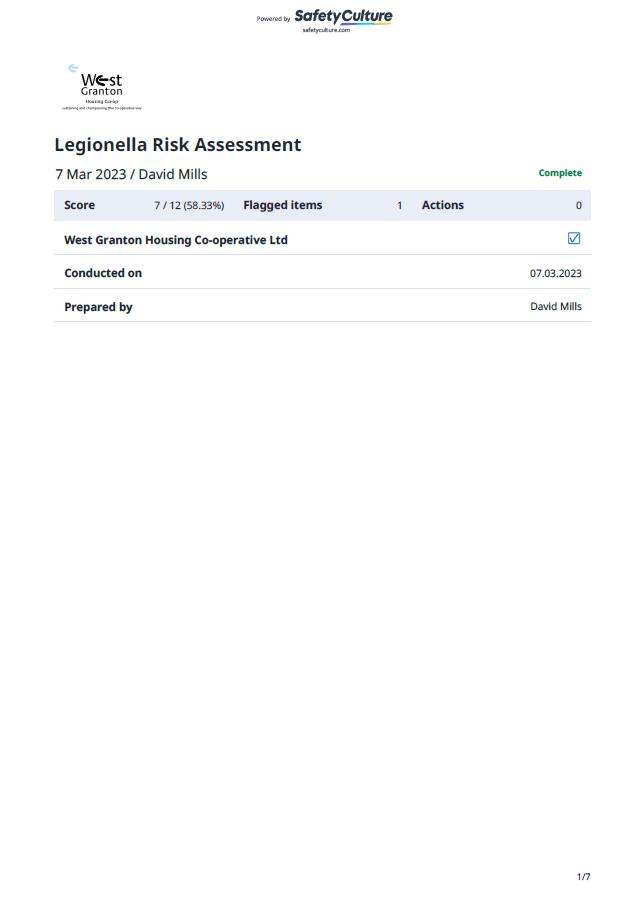
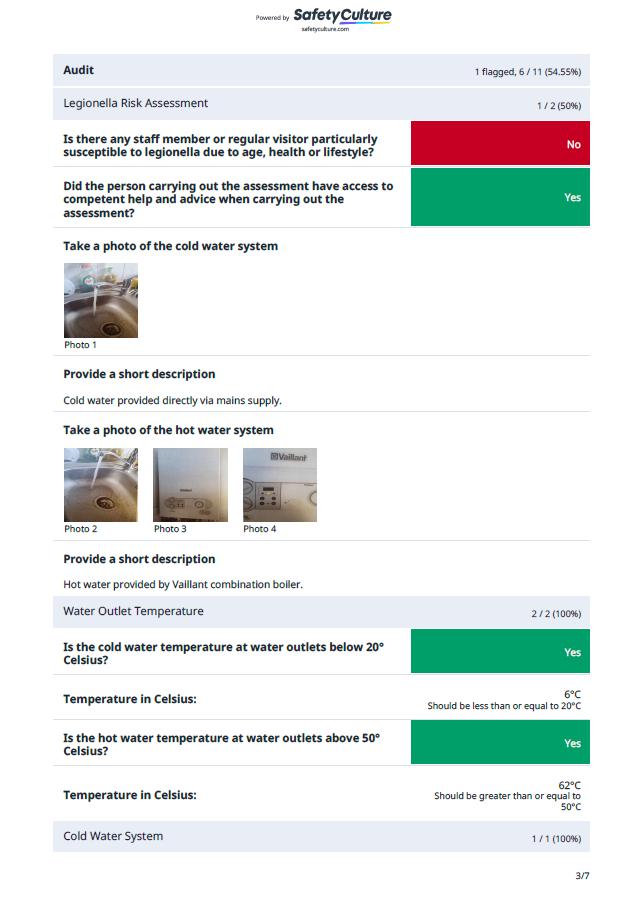
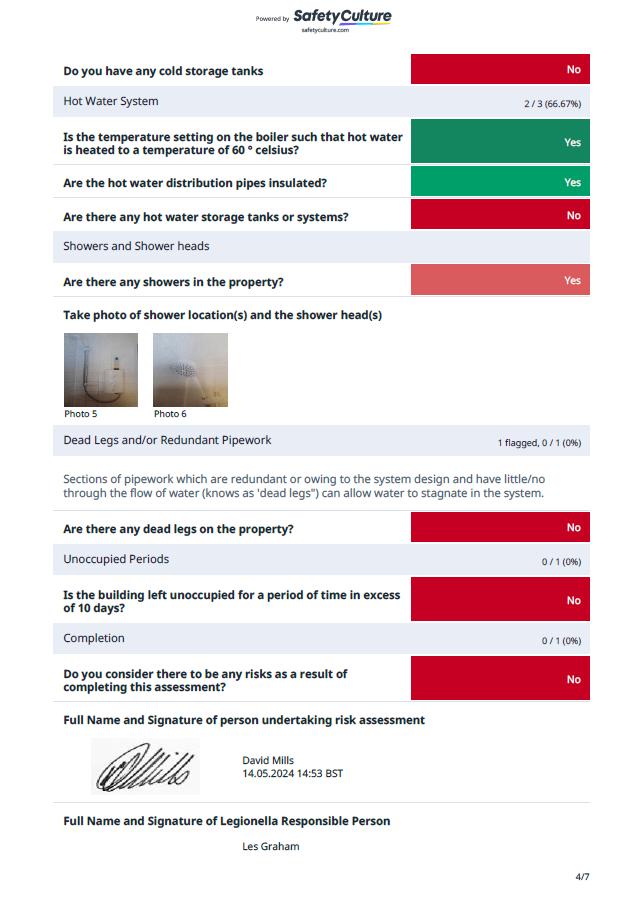
Assess the level of risk through a structured Legionella Risk Assessment programme (IAuditor), and aim to eliminate or reduce the risk to an acceptable level;
Arrange for routine inspection and maintenance of water systems, and where needed, a programme of disinfection;
Retain records of maintenance, inspection and testing for a minimum of 5 years.
Document Name: Created:
Owner:
Location / Path: Legionella and Water Management Policy, 2026
David Mills / WGHC
David Mills / WGHC
Version:
7.0 RISK ASSESSMENT
WGHC will arrange for a suitable and sufficient risk assessment programme to be carried out (and regularly reviewed) to identify and assess the risk of exposure to Legionella bacteria from all water systems across its property portfolio. I-Auditor shall be used for risk assessment. See Appendix 1
All recommendations and remedial action will be recorded in a logbook. The recommendations should also highlight the management control actions that may be carried out in-house and those which would require an external contractor.
The risk assessment will be reviewed regularly and whenever there is reason to believe that it is no longer valid, including following changes to the water system, building use, occupancy, control measures, monitoring results, relevant guidance or legislation, or following an incident or suspected case. Where no such changes occur, WGHC will review risk assessments at least every 2 years as a local management standard.
8.0 WATER FITTINGS AND SYSTEM REQUIREMENTS
WGHC will ensure that all water fittings comply with relevant legislation and recognised product approval requirements, including the Water Supply (Water Fittings) (Scotland) Byelaws 2014 and relevant British or equivalent standards. Specialist advice will be obtained in the selection of water system fixtures and fittings. WGHC will ensure that all water fittings are suitable for the intended purpose and are installed, commissioned and maintained so as to prevent contamination, waste, misuse and undue consumption of water.
Hot water shall be stored in tanks at a temperature of at least 60°C (degrees Celsius).
Water pipes shall be as short and direct as possible and pipes and tanks will be effectively insulated. Tanks will be protected against contamination and materials used which do not encourage Legionella growth.
Hot water shall reach taps at temperatures greater than 50°C within 1 minute of running
Cold water shall be stored at a temperature of less than 20°C. Cold water shall reach taps at temperatures less than 20°C within 2 minutes of running. All little used outlets shall be routinely flushed through.
Where water is used or stored for consumption in any devices, e.g. water coolers, tea urns, drinks machines etc., an effective system of regular cleaning and disinfecting shall be introduced, in accordance with manufacturer’s instructions.
9.0 DISINFECTION
Water services will be disinfected when any of the following situations occur:
If a routine inspection or risk assessment shows it necessary to do so;
After any prolonged shutdown of a month or longer (a risk assessment may indicate the need for cleaning after a period of less than one month, especially in summer where temperatures have been high);
Document Name:
Created:
Owner:
Location / Path:
Legionella and Water Management Policy, 2026
David Mills / WGHC
David Mills / WGHC
Version:
Version Date:
Review Due: Pages: 1.0 22/07/26 30/06/29
If the system or part of it has been substantially altered or entered for maintenance purposes in a manner that may lead to contamination;
Following an outbreak or suspected outbreak of Legionnaires’ disease or any other waterborne infection or disease.
10.0 VOID PROPERTY ACTIONS
It is recognised that all void properties have the potential to exhibit increased risk of Legionella due to the possibility of stagnant water remaining undisturbed within pipework for prolonged periods.
To mitigate the increased potential risk associated with voids, the contractor appointed to carry out repair and re-decoration works on all standard properties will carry out and record the following:
Thoroughly flush all taps;
Clean and disinfect, or replace, all shower heads;
Inspect and report on water storage tank (where present).
All Special Lets becoming void will be assessed individually and on their own merits.
11.0 CONTRACTORS
A competent external contractor will be appointed to carry out legionella preventative monitoring and water hygiene services. As a minimum requirement, contractors are required to be a registered member of the Legionella Control Association (LCA) or the Water Management Society (WMSoc). Contracted works may include legionella sampling, tank inspections, water sampling, (for all bacteria) and other associated services, as identified in the Legionella Risk Assessment programme.
12.0 NOTIFICATION REQUIREMENTS
If it is suspected or confirmed that a tenant, employee or visitor has contracted Legionnaires’ disease, WGHC will report the incident to the HSE where required under the Reporting of Injuries, Diseases and Dangerous Occurrences Regulations 2013 (RIDDOR), and will co-operate with any relevant public health, local authority or regulatory investigation.
13.0 TENANT RESPONSIBILITIES
Tenants will be provided with information on good water management and Legionella control through the website and/or by means of information leaflets.
Tenants are advised to clean shower heads, descale and disinfect them at least every two months.
For showers that are only occasionally used, tenants are advised to flush the shower through by running the water for at least 2 minutes once a week.
Where a property is left vacant for any time (e.g. when on holiday), tenants are advised to flush both hot and cold water systems by running all outlets for at least 2 minutes.
Tenants should inform WGHC immediately if there are problems, debris or discolouration in the water.
Document Name: Created:
Owner:
Location / Path: Legionella and Water Management Policy, 2026
David Mills / WGHC
David Mills / WGHC
Version:
Version Date: Review Due: Pages: 1.0 22/07/26 30/06/29
14.0 IMPLEMENTATION AND REVIEW
The Chief Operating Officer is responsible for ensuring that their staff implement this procedure. The Maintenance Officers will ensure that this procedure is reviewed at least every 3 years.
Further information can be obtained here: https://www.hse.gov.uk/legionnaires/legionella-landlords-responsibilities.htm This policy should also be reviewed when there are material changes to relevant legislation, HSE guidance, Scottish Water Byelaws, property portfolio risk profile, or WGHC’s water management arrangements.
15.0 APPEALS AND COMPLAINTS
WGHC is committed to valuing complaints and ensures that the organisation benefits from feedback to identify areas for change and improvement. If anyone is dissatisfied with the service they have received because of this Policy, they will be encouraged to use our Complaints Procedure. Similarly, any individuals dissatisfied with decisions made in the operation of the Policy are entitled to appeal against these.
The WGHC Complaints Policy details the way in which complaints can be made, the timescales for responding and the appeals process. Anyone dissatisfied with the outcome of their complaint having exhausted WGHC’s complaint procedure has the right to refer the matter to the Scottish Public Services Ombudsman.
16.0 EQUALITY, DIVERSITY AND INCLUSION
WGHC will ensure that in implementing this Policy it will not unfairly discriminate against any individual, household or group on the grounds of sex or marital status, on race grounds, or on the grounds of disability, age, sexual orientation, language or social origin, other personal attributes, including beliefs or opinions such as religious beliefs or political opinions. (See Section 16.0 for an Equalities Impact Assessment)
17.0 UK GDPR (GENERAL DATA PROTECTION REGULATION)
WGHC will treat all personal data in line with its obligations under the current UK General Data Protection Regulation and The Data Protection Act 2018.
Information regarding how data will be used and the basis for processing data is provided within the WGHC Privacy Notices (available on the WGHC website, or, upon request).
Document Name: Created:
Owner:
Location / Path: Legionella and Water Management Policy, 2026
David Mills / WGHC
David Mills / WGHC
Version:
Version Date: Review Due: Pages: 1.0 22/07/26 30/06/29