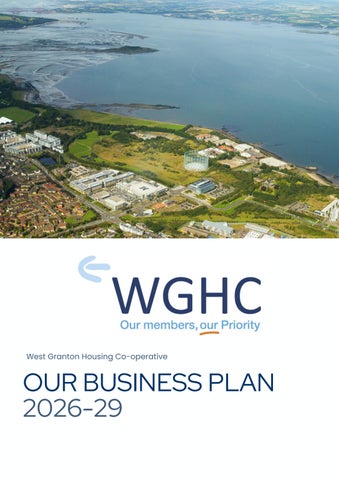
West Granton Housing Co-operative
OUR BUSINESS PLAN 2026-29
table of contents
www.westgrantonhousing.coop
welcome
3
about us
4
what a difference a co-op makes
5
organisational structure
6
our memberships
7
summary strategic plan
8
our vision
9
our mission
10
our strategic priorities summary
11
strategic priorities in detail
12-14
our core values
15
SWOT analysis
16
PESTLE analysis
17
risk and risk register
18-19
value for money
20-21
treasury management
22
private finance
23
financial planning
24
asset management
25-27
strategic options appraisal
28-30
Page 2
Our members are our priority and their needs shape the strategic priorities in this plan
Welcome to our Business Plan for 2026-2029
We are delighted to present our new Business Plan for 2026-2029, along with our updated logo and new strategic objectives for the Co-op. This Plan has been written in accordance with the Scottish Housing Regulator’s Advisory Guidance on Business Planning. As a fully mutual co-operative, the views of our tenant members are of the utmost importance to us. We consulted our members and staff to ask if we were building a plan which aligned with their needs, and if they agreed with the new strategic priorities planned for the Co-op. 97% of those who responded, agreed unanimously with the Plan. Following this successful consultation, our Committee of Management approved this Business Plan at its meeting on 20th May 2026. A key element to ensuring the successful delivery of this plan is: Ensuring we have sufficient funds and resources to complete our objectives Our strategic objective to remediate the cladding at our Forthquarter Development is heavily dependant on funding from Scottish Government. WGHC was awarded “Pathfinder” status under the Scottish Government’s Remediation Programme in in 2025. We will continue fulfilling our grant funding obligations to help ensure this objective is achieved. Other than the above funding, rents are our only source of income. It is important to us that our rents remain affordable to our tenant members, whilst generating the cash flow necessary to fulfil our financial, legal and regulatory obligations. Our Tenant Satisfaction Survey Results continue to evidence that our Tenant Members believe their rents represent good value for money (99%). Our loan debt per housing unit is low (£4,761) compared with the sector average and our financial projections continue to evidence this is the case, when we seek to increase our borrowing by an additional £500k in 2027-28. An electronic or hard copy of our 30 Year Financial Projections are available on request.
Larke Adger CEO
Colin Fraser Chair Page 3
ABOUT US West Granton Housing Co-op is: Our registered office is: 26 Granton Mill Crescent, Edinburgh EH4 4UT.
a fully mutual housing co-operative a Registered Social Landlord with the Scottish Housing Regulator
Our office is community based; owning 372 general needs properties sited over 17 local streets.
our registration number is HAC225
WGHC is a not-for-profit organisation.
a Society registered under the Cooperative and Community Benefit Societies Act 2014- registration number 2357 RS
We are not a member of a group nor a subsidiary company and WGHC, itself, has no subsidiaries.
designated as a Scottish Public Authority under Section 5 of the Freedom of Information (Scotland) Act 2002
West Granton Housing Co-op was established in 1990 We are situated about 3 miles from the city centre, based along the beautiful coastline of the Firth of Forth.
Page 4
What a difference a co-op makes... WEST GRANTON 1990
WEST GRANTON HOUSING CO - OP TODAY
Page 5
Our Committee of Management (our Board) As a fully mutual co-operative we are 100% tenant governed COMMITTEE OF MANAGEMENT 2026-27
Elizabeth Robertson
George Thomson Vacancy
Alan Lamont
Amanda Aitchison Vacancy
Lynn Jameson Vice Chair
Jim Hemphill Vacancy
Colin Fraser Chair
Morag Orr
Cheryl Miller
Vacancy
Elizabeth Stewart
Vacancy
Our Staff All our staff are permanent and directly employed by the co-op
9 WGHC STAFF Donald Martin Housing Manager Grade 8 (35 Hrs)
Sheena Farrell Housing Officer Grade 7 (35 Hrs)
Fiona Dodds Housing Officer Grade 7 (35 Hrs)
Laura Flynn
Larke Adger
CEO Grade 10 (35 Hrs)
Housing Assistant Grade 5 (35 Hrs)
David Mills
COO
Les Graham
Grade 9 (35 Hrs)
Reactive Maintenance Officer Grade 7 (35 Hrs)
Fiona Stewart Senior Finance Assistant
Jim Bernard
Grade 6 (20 Hrs)
Planned Maintenance Officer Grade 7 (35 Hrs)
Page 6
BUSINESS PLAN
Our Memberships ARCHIE (Alliance of registered co-operatives and housing associations in Edinburgh) Confederation of Co-operative Housing Co-ops UK Employers in Voluntary Housing
Glasgow & West of Scotland Housing Forum Investors in Excellence
Scottish Federation of Housing Associations
SHARE (Corporate Members)
Scotland’s Housing Network
Scottish Procurement Alliance Page 7
BUSINESS PLAN
STRATEGIC PLAN Our Vision To provide service which exceed all others
Our Mission Our Members, Our Priority
Our Strategic Priorities Complete cladding remediation by 2029
Strengthen our Contractor Management Implement an effective Asset Management Strategy Create opportunities to improve the lives of our members and the wider community Actively support and promote the co-operative model Continue our commitment to Investors in Excellence
Page 8
1. Our Vision 2026-2029 To provide services which exceed all others
To provide services which exceed all others Our vision is to consistently provide high levels of service delivery, and “added value” services which will distinguish our co-operative model from other models in the sector. We will look to achieve this through rapid response times and a deeply personalised approach whereby we anticipate needs and proactively resolve problems for our tenant members. Examples of “added value services” using a deeply personalised approach include continuing to credit every new tenant’s utility meter with £50; and helping those in need by paying annual standing fuel charges, reducing or paying off existing fuel debt, carpeting homes, replacing broken white goods, furniture & lawnmowers, and providing supermarket gift cards as an alternative to food bank vouchers.
Page 9
2. Our Mission 2026-2029 Our Members, Our Priority
Our Members, Our Priority Our new mission statement is a declaration of our core purpose and who we serve: our tenant members. Being a fully mutual housing co-operative, our business purpose is to stay true to our model, and what it stands for: “our Members are Our Priority” Our mission is to meet our tenant members’ common housing, social and economic needs by providing affordable, well maintained, safe, attractive housing within a thriving, sustainable community. The community includes the wider community in which we operate, and to support local agencies, charities and local groups/clubs.
Page 10
BUSINESS PLAN
3. Our Strategic Priorities 2026-2029
Complete cladding remediation by 2029 Strengthen our Contractor Management Put in place an effective Asset Management Strategy Create opportunities to improve the lives of our tenant members and the wider community Actively support and promote the co-operative model Continue our commitment to Investors in Excellence
Page 11
BUSINESS PLAN
3.Our Core Values
Complete cladding remediation by 2029 This means we will seek to: -continue to work with Scottish Government in relation to our “Pathfinder” status as part of the Government’s Cladding Remediation programme until this building has been fully remediated and re-assessed as a tolerable risk. -continue monitoring and reviewing our Fire Risk Safety Actions Plan to ensure the safety of our tenants -continue to provide transparent and clear communications with our tenants in relation to fire safety measures, and all cladding remediation works.
Strengthen our Contractor Management This means we will seek to: -improve repair outcomes by providing more detailed scopes of works in our works orders to our contractors -actively audit invoices to ensure they align strictly with the works raised to prevent overcharges and deliver value for money -improve communication between staff, contractors and our tenants regarding appointments and follow up works, establishing clear points of contact and regular feedback loops -ensure regulatory and statutory compliance at all times, as our minimum standard
Page 12
BUSINESS PLAN
3.Our Core Values Implement an effective Asset Management Strategy This means we will seek to: -Ensure all our stock continues to meet the Scottish Quality Housing Standards and all other regulatory and standards -Complete a data integrity exercise for all asset management data -Prioritise investment to reduce reactive maintenance costs through well informed planned and cyclical maintenance programmes -Adopt and implement statutory compliant management response to condensation, damp and mould -Where practicable, seek and explore opportunities relating to retrofitting and improving the energy efficiency of our existing stock (avoiding the approach of forcing decarbonisation too quickly which may lead to poorer outcomes longer term).
Create opportunities to improve the lives of our members and the wider community This means we will seek to: -Continue to identify ways in which we can help our tenants to deliver new services or initiatives and consider all donation/sponsorship requests from the local community -Adopt a standard “Ask and Act” practice to help identify all tenant member needs, followed by actively offering individual support where possible (including emergency financial support, fuel vouchers, purchasing essential white goods or furniture items) preferring supermarket gift cards over foodbank referrals (where practicable) and making referrals to external agencies as required Page 13
BUSINESS PLAN
3.Our Core Values
Actively support and promote the co-operative model This means we will seek to: -Continue to raise awareness about the co-operative model and quantify the positive impact of WGHC as co-op and registered social landlord -Continue to partner work with the 6 remaining social housing co-operatives, Scottish Government, other external agencies, stakeholders and leverage sector bodies such as Co-ops UK and the Confederation of Co-operative Housing -Where practicable, seek out and explore opportunities for future growth of WGHC’s housing stock, with a view to increasing housing opportunities for our ageing population whilst releasing existing larger family homes
Continue our commitment to Investors in Excellence This means, along with the support of Investors in Excellence, we will seek to: -Work on transforming our organisation to achieve Operational Excellence for our tenant members -Focus on clear, strategic objectives, rooted in outcomes -Ask the key questions of ourselves as to what works well, what could be better and what should be done differently, then work on the solutions to move us forward -Consistently perform and deliver to the standards set out for us in our Tenants Charter
Page 14
BUSINESS PLAN
3.Our Core Values 4. Our Core Values 2026-2029 Service Consistency Accountability
CORE VALU ES
Learning Excellence
Our Core Values Lorem ipsum dolor sit amet, consectetuer
Our core values are ourcommodo guiding principles adipiscing elit. Aenean ligula eget which ourmassa. co-operative identity. dolor. form Aenean Cum sociis natoque penatibus et magnis dis parturient montes, nascetur ridiculus mus. Donec quam felis, They guide our behaviour, our decisions and ultricies nec, pellentesque our actions, acting as oureu, moral compass. pretium quis, sem. Nulla consequat massa We aim to align our core values, with our quis enim. Donec pede justo, fringilla vel. culture, to achieve a sense of purpose and Aliquet nec, vulputate eget, arcu. In enim “team”. justo, rhoncus ut, imperdiet a, venenatis vitae, justo. Nullam dictum felis eu pede.
Page 15
BUSINESS PLAN
r
t
e
,
,
a
.
m
,
5. Our Operating Environment WGHC uses both SWOT and PESTLE frameworks to analyse the internal and external forces impacting our operating environment. Assessing our strengths, and weaknesses is a way of auditing our organisation’s internal workings. These are easier to control than outside factors. Examining our opportunities and threats allows us to carry out an audit of the external environment, over which we have lesser control. Together, they provide WGHC with a tool to create strategies which can help to create a competitive advantage for our business, or conversely allow us to try to proactively address any challenges, before they become a crisis. Both SWOT and PESTLE analysis help us identify risks, and are therefore an important part of our Risk Management function.
SWOT ANALYSIS STRENGTHS
WEAKNESSES
Democratic control of members in decision making
Always at risk of member apathy Reliance on Scottish Government Funding for essential Cladding Remediation works
High levels of tenant engagement and tenant satisfaction Strong Performance Culture
Limited opportunities to grow our stock within our local community
Good reputation of being more than ‘just a provider of housing’
Limited opportunities to grow our stock within our local community
Senior Management who understand the co-op values and culture
Lack of specialised staff roles
OPPORTUNITIES OPPORTUNITIES
THREATS
Rule changes to align more with co-op principles and SHR Framework
Scottish Government not funding our cladding remediation works
Increasing wider recognition of our model opening up doors for further partnerships Further organisational improvements through our commitment to Investors in Excellence Growth of the Co-op model in Scotland
Increasing demands on Governing Body Members, which could have a negative impact on recruitment andretention Loss of Senior Management Pension Deficit Climate change affecting how stock will cope/react/behave
Page 16
BUSINESS PLAN
r
t
e
,
,
a
.
m
,
PESTLE ANALYSIS Political, economic, social, technological, legal, environmental
POLITICAL
ECONOMIC
Potential Future Scottish Referendum
Economic uncertainty Pension Scheme Performance
Ongoing impact of Brexit
Material and labour shortages
Net Zero targets and lack of Scottish Government funding
Limited opportunities to grow our stock within our local community
Landlord Health & Safety Legislation
Procurement costs
Ongoing changes to Welfare Benefits
Cost of Living/Rising Energy prices
TECHNOLOGICAL
SOCIAL OPPORTUNITIES
Aging population/independent living Rising demand for additional services (social care, etc)
Increasing trend for online services currently at odds with an aging population Improvment of innovatinos in energy efficiency performance
Increasing demand for social housing Increased isolation owing to loss of nuclear families
Increase use of mobile technology and social media
Widening inequality Increasing expectations from service users
Speed of techonological advances
Approcahes to particpation
ENVIRONMENTAL
LEGAL Increasing regulation and legislation within the sector
Net Zero legal obligations and 2050 targets (gas central heating)
Extension of the Freedom of Information (Scotland) Act
Climate change - more heavily insulated homes - increase in cases of damp and mould
Employment Law
Projected loss of UK and global oil reserves within 50 years
Definition of Affordability
Increase of extreme storms damage to stock
Increasing financial regulation (antilaundering money, etc)
Pollution and impact on health
Page 17
BUSINESS PLAN
6.
Risk
West Granton Housing Co-op faces a complex mix of financial, operational, and regulatory risks, as identified in both our SWOT and PESTEL analysis on pages 16 and 17. Some of our primary challenges include: Cladding on our Forthquarter Building refinancing debt at higher interest rates maintaining and improving aging housing stock adhering and rising to the challenge of new building and health and safety standards. rising costs cyber security There are of course, many more. Change is a constant within our sector Some changes present us with more risks than others. It therefore, is a necessary part of governance and business planning, that we regularly scan both the internal and external environments in which we operate.
Our Risk Register The tool we use to keep a record of these risks, is our Risk Register, which is formally reviewed, quarterly, by our Committee of Management. How we assess and score our Risks: A risk score is calculated by multiplying the “Likelihood of it happening” score by the square of the “Impact it would have on us” score. On the next page (page 19) we present to you an abridged version of our Risk Register. To see the full version of our Risk Register and to learn more about how we manage our Risks, visit our webiste at https://www.westgrantonhousing.coop/aboutwghc/information-publications/
Page 18
BUSINESS PLAN
Page 20 19
7.
Value for Money
West Granton Housing Co-op’s only source of income is rents. We use this income to achieve our objectives; fulfil our statutory and legislative requirements and be both efficient and cost effective in our business processes. However, our rents still have to remain affordable, representing value for money, whilst ensuring they generate sufficient income to cover our costs. Over the past 15 years, we have worked hard to keep our annual rent increases to a minimum, and pre-Covid this was financially viable. This is demonstrated in the table opposite. Prior to the cost of living crisis, the WGHC Committee of Management had decided that the level by which our rents increase should generally be no higher than the Consumer Price Index (CPI). However, CPI only measures the average change in price of a basket of ‘consumer goods and services’ like food, clothing, restaurants and cafes, furniture, jewellery, hairdressing, etc CPI does not take into account many of the costs that WGHC has to pay for such as contractor labour costs or the cost of large-scale improvement projects such as updating boilers, kitchens or bathrooms.
Year 2026 2025 2024 2023 2022 2021 2020 2019 2018 2017 2016 2015 2014 2013 2012 2011 2010
WGHC Rent Increases
5.50% 6.75% 7% 6% 4% 0.70% 2% 2.50% 1.70% 1.60% 0% 2.40% 3.20% 2.50% 5% 5% 0%
CPI reached a high of 11.1% (during Covid in October 2022). More recently, we are looking at a much more “normal” and reasonable level of 2.8% (May 2026), however, the goods and services which WGHC has to buy in, to provide its services, have not fallen in the same way. Since 2022, WGHC has experienced a rise in costs of 25%, on average. The Rent Increase table (above) reflects a correlation in our rent increases with our increase in costs.
Page 20
BUSINESS PLAN
In balancing our revenue and expenditure, the ongoing affordability of our rents remains a key concern. Our rents remain the 3rd lowest amongst the City of Edinburgh 19 social landlords (including the Council) ~ ref: SFHA Affordability Rent Tool. As a fully mutual co-op we make significant efforts to engage with our tenant members in our annual rent consultation process. When consulting, we are open about our costs and financial situation and clearly explain the rationale behind our decisions. For 2026-27 we consulted on two rent increase options – 5.5% and 6%. In addition, we provided a simple affordability analysis showing tenants what impact these increases would have for both our weekly and monthly payers.This helped our tenant members understand the affordability impacts of any such increase. In addition to being asked to “opt” for either the 5% or 5.5% rent increase, we invited tenant members to share their views. Every comment received, reported anonymously to Committee, before they make any decision regarding rent increases. To make a fully considered decision, Committee asked for a breakdown of: the numbers of preference for each option, whether they were self-payers, along with all comments/views received. In the last 2 years, the majority of our self-payer tenant members have voted for the higher rent increase. This year, however, Committee decided to opt for the lower increase of 5% given the higher increase option was applied last year. This helps to ensure we are continuing with our efforts to keep our rents affordable, whilst having enough income to continue with the delivery of our services. In our large scale Tenant Satisfaction Survey (undertaken in 2025) we commissioned an independent market research company to undertake face to face surveys of 200 tenants (we have 372 tenants in total). 99% of the tenants surveyed, reported they felt their rent represented good Value for Money.
Page 21
BUSINESS PLAN
8.
Treasury Management
In alignment with the Chartered Institute of Public Finance and Accountancy (CIPFA) Code of Practice, WGHC defines its treasury management activities as: “The management of WGHC’s cash in bank and cash flows and its banking transactions; the effective control of the risks associated with those activities; and the pursuit of optimum performance consistent with those risks”. WGHC acknowledges that effective treasury management will provide support towards the achievement of its business objectives. The successful identification, monitoring and control of risk are the prime criteria by which the effectiveness of its treasury management activities will be measured.
WGHC seeks to retain a minimum cash balance of £850k, at all times, to ensure it comfortably meets its ongoing operational costs, liabilities, cash liquidity and interest loan cover ratio (loan covenants) of 110%.
At their monthly meetings, Committee are provided with an up to date “cash in bank balance” along with the cash balances over the preceding 12 months. Additionally, they are also presented with that month’s cash balance over the last 5 years. Both are provided to give the Committee context and a baseline of our cash performance, helping to separate internal budgetary controls performance alongside large areas of component replacement spend from external market factors such as inflation and rising costs.
Page 22
BUSINESS PLAN
9.
Private Finance
WGHC has 5 mortgages with Nationwide Building Society. 300 of our 372 properties are being used as security for these mortgages. Nationwide is a mutual co-operative financial institution and its ethos is very much aligned with West Granton Housing Co-operative as a fully mutual. 2 of the mortgages are on a variable rate (SONIA COMPOUND) and expire 2031 and 2033. 3 are on a fixed rate of 1.21% (including margin) and expire 2036, 2038 and 2039 respectively. Our total outstanding loan balance as at 1st April 2026 was £2,006,807. The existing loan agreements carry with them a 110% Interest Ratio loan covenent. and we monitor these closely to ensure ongoing compliance. Interest cover remains strong at *752%. (* figure correct as at 20th May 2026).
Page 23
BUSINESS PLAN
10.
Our Financial Planning
At WGHC, rents are our only source of income. Financial planning is therefore critical to our long term viability. Continuing to invest in our stock is key, but this costs alot of money and we therefore need to plan how we spend this money and when. We do this by using the economic life of components and plan forward to determine when they are next to be replaced. (see Section 11- Asset Management- page 27, for this information). This is worked out on a larger scale by stock type, streets and areas. Using detailed, costed works programmes and building in financial assumptions (such as inflation, interest rates and rental income) allows us to determine when we will need to pay out large amounts of money. This can result in considerable and uneven spend in peak years, especially given the volatility of the current economic environment. WGHC looks to even out any such peaks by practising zero year budgeting and where required, run replacement programmes over a 2 or 3 year period to ensure its cash flow is protected. The key financial objectives underpinning our financial projections are to: Secure the long term financial viability of WGHC Sustain our strong financial reputation Ensure compliance with loan covenant requirements Meet the costs of our corporate objectives Note regarding Pensions: As participants in the Scottish Housing Association Pension Scheme (defined contributions scheme) we have once again have been assessed as “low risk”. However, it is recognised that our Pension Provider has reported there is a deficit in its funding, and like all other members of this scheme, we are once again making additional payments over the next 3 years to clear this deficit. If you would like a copy of our 30 Year Financial Plans please contact our office on 0131 551 5035 or email us at mail@westgrantonhc.co.uk
Page 24
BUSINESS PLAN
11.
Asset Management
As a registered social landlord, we are an organisation that owns properties to rent within the social housing sector. These properties are our assets and provide us with our only source of income. We therefore need to ensure that these assets (our properties) are fit for purpose and should be at all times: · Managed efficiently and generating demand · In good condition with a costed, affordable maintenance programme
· Making a positive contribution to our business plan · Delivering value and amenity Planning investment in our housing stock is key As is adopting a more strategic approach to asset management and recognising the importance of integrating this across our business. One of ongoing strategic objectives within this plan is to continuing with our increased focus on Asset Compliance and Maintenance. We have now fully implemented our bi-annual (once, every 2 years) asset management visits to each of our properties to undertake both an internal and external condition survey. These are in addition to our rolling programme of Stock Condition Surveys. Scottish Housing Quality Standard (SHQS) Currently, 93.5% of our stock meets the SQHS standard. The main reason for us not meeting the SQHS standard in all our properties relatesis for “social reasons” owing to the storage space in some kitchens. When some of our properties were built the Scottish Housing Quality Standard had not yet been introduced and our kitchens were designed to meets tenants needs. For example, some tenants asked for a space for tumble dryer or dishwasher. This was done at the cost of cupboard space. Where our properties do not meet the SHQS for this reason, they are categorised as abeyances. When a property becomes empty we try to include the extra cupboard space. However, we are committed to striking a balance between achieving SHQS and accommodating the needs and preferences of our tenants’ who wish to install various white goods in their kitchens.
Page 25
BUSINESS PLAN
11.
Asset Management
Energy Efficiency Standard of Scottish Social Housing (EESSH) 100% of WGHC properties meet the EESSH standard. We re-let all our properties, fitted with energy efficient lightbulbs thourghout, as standard. and top up every utility meter with £50 credit.
Energy Efficiency Standard of Scottish Social Housing 2 (EESSH 2) It is expected that the Scottish Social Housing Net Zero Standard (SHNZ) will eventually replace EESSH2, sometime around Spring 2027. One of the new proposed targets within SHNZ, is that all social housing stock will meet the equivalent of the current EPC Rating ‘C’, by 2033. 100% of WGHC properties currently meet the 2033 ‘C’ rating target. SHNZ then further proposes that by 2044, all our stock would have to achieve the equivalent of an EPC ‘B’ rating. Currently, 61 out of our 372 properties meet this rating. One of the challenges WGHC will face, is the proposed prohibition of the use of fossil fuel heating, as the primary heating system in all buildings, by 1st January 2046. This is what is currently being proposed in the Heat in Buildings Bill. Air source heat pumps are increasingly being installed in a number of properties within the sector; but they are more costly for tenants to run (in comparison to a gas boiler) and there is a recognised shortage of qualified heating professionals specialising in heat pumps across the UK, resulting in extended wait time for non-emergency call-outs. This obviously would have a significant impact on our Repairs Performance timescales and our Right to Repair obligations, and ultimately impact on our standards of service delivery levels we provide to our tenants. Given the above, and that technologies in this area are still rapidly developing, WGHC sought advice and thereafter, decided to hold off in making any significant investment in respect of achieving the 2046 target, for now, however this will remain under review. Our focus currently remains on addressing the more urgent issue of cladding remediation.
Page 26
BUSINESS PLAN
11.
Asset Management
Housing Components and Useful Economic Lives Some works to houses are treated as capital expenditure. For accounting purposes, the cost is added to the value of the housing stock and spread over the useful economic life of the component through depreciation. The “useful economic life” or “UEL” is the time it is expected to last before needing replaced again. Cost divided by UEL is the annual depreciation charged to operating costs. It is up to each social landlord to identify components and assess UELs based on analysis of its own housing stock. Estimates of UEL are also important in planning ahead. We use them to estimate when components will be replaced and to try to ensure resources (mainly cash and staff time) are in place to carry them out. Land is not depreciated.
The components we use and their estimated economic lives are shown in the table below:
Component
Component
UEL (yrs)
UEL (yrs)
Land
n/a
External doors
25
Structure
50*
Bathroom
20
External render
35
Kitchen
15
Heating (excl. boiler)
30
Boiler
15
Windows
25
Lift
15
* Structure UEL for West Pilton Drive flat is 25 years from 2002 (i.e. until 2027).
Page 27
BUSINESS PLAN
12.
Strategic Options Appraisal
The need to carry out an options appraisal may come from a variety of “triggers” such as: the departure of the CEO poor service performance organisation re-structure policy direction legislative change (e.g. Housing (Cladding Remediation) (Scotland) Act 2024 Any key decisions which have been carefully considered in discussion with others (e.g. Committee, Expert Advisors, Senior Management, stakeholders, etc) and are informed by a robust scenario planning process, are always more likely to be successful. WGHC has adopted the Options Appraisal process, shown in the diagram below:
Define objectives
Gather information
Develop the options
Filtering
Assess and analyse the options Select preferred option
Implement option Monitoring performance and objectives Source: Capital Planning and Option Appraisal - A Best Practice Guide for Councils, CIPFA Local Government Directors of Finance, October 2006, adapted by Audit Scotland
Page 28
BUSINESS PLAN
Strategic Options Appraisal - Live Case example: Cladding - Our Forthquarter Flatted Development
Above: the Forthquarter where WGHC owns 45 flats
The Housing (Cladding Remediation) (Scotland) Act 2024 came into effect on 6th January 2025. WGHC acted swiftly and prior to this date, and identified that one of its buildings came within scope of this new act. WGHC identified its objectives were to: ensure the health and safety of its tenants within this building make the building safe ensure that WGHC was compliant with legislation ensure the long term financial viability of the organisation (it was expected that any remediation works would incur significant costs) In order to gather the required information, WGHC: met with Scottish Government’s Cladding Directorate to discuss the requirements of the new legislation and the availability of funding arranged for a Single Building Assessment to be carried out in February 2025 to determine the risk level of the building established the works required to be undertaken to reduce the risk of the building to a tolerable level, in line with legislation determined the costs of remediation The options open to us were identified as follows: leave the building as is (i.e. take no action) remediate the building sell the building demolish the building and sell the land demolish the building and re-build within scope of the new Act opt for a transfer of engagement due to susbtantial remediation costs Page 29
BUSINESS PLAN
Filtering the Options (making the list of options shorter using “rule in & “rule out”) left us with 2 preferred options: remediate the building (with the possibility that the works might be funded by Scottish Government) demolish the building and re-build within scope of the new Act (no funding) (Note: it was decided that a transfer of engagement was not a realistic option as it was deemed highly unlikely that any other RSL would want to take on the cladding liability and associated costs, along with WGHC’s existing debt portfolio).
Select the Preferred Option: Committee opted to remediate the building and retain the stock within the co-op (early ongoing discussions with Scottish Government’s Cladding Remediation Directorate, the Housing Minister and cross-party MSP support for WGHC to receive funding for remediation, were heavily ongoing at this point)
Implement the Option: WGHC continued discussions with Scottish Government in respect of funding and was awarded ‘Pathfinder’ status in October 2025, with a view to receiving funding for the cladding remediation works Monitoring performance and delivery of Option Objectives: To date WGHC has received Scottish Government funding of £38k for its Single Building Assessment; £143k to temporarily upgrade its Smoke Alarm System to allow a formal Simultaneous Evacuation Policy to be put in place in the event of a fire; and £8.4k for associated legal costs WGHC continues to work with Scottish Government as a Pathfinder member of their Social Housing Cladding Oversight Assurance Group WGHC is currently awaiting receipt of the Grant Offer Letter for the Cladding Remediation Work (currently delayed owing to May 2026 elections and setting up of the new Scottish Parliament in the post-election period) Running parallel to the above, WGHC has carried out and self funded a number of remedial works to the inside of this building, as recommended in our Single Building Assessment Committee (our Board) receive monthly updates in relation to all areas of this work The Scottish Housing Regulator receives regular updates, as the cladding on this building and the finance related element have been both been raised as Notifiable Events Close monitoring of the delivery of this objective is ongoing, as is the actual work to ensuring its delivery NOTE: if at any point, it becomes apparent that the delivery of this objective is not achievable, then it will result in a return to the start of the Options Appraisal process. Page 30
BUSINESS PLAN
Thank you to eveyone who has supported us throughout 2025-26
Our Tenant Members
Members of Scottish Parliament Thank you to all our Tenant Members for your ongoing support.; without you, WGHC would simply not exist. It is a privelege to work for you. Left to right
RBS-Natwest Thank you to Lynne Mantle and Gary Hunter (RBS Branch Managers) for delivering the excellent Financial Foundations Workshops to our Tenant Members. Page 31
Miles Briggs; Ben Macpherson; Sarah Boyack; Paul McLennan, Ariane Burgess, Paul Sweeney, Mairi McAllan, Lorna Slater
A very special and personal thank you, to each of the MSPs above, all who actively supported West Granton Housing Cooperative in 2025-26. We thank each of you, for giving your time and effort in both supporting and championing WGHC.
West Granton Housing Co-operative 26 Granton Mill Crescent Edinburgh EH4 4UT
0131 551 5035 mail@westgrantonhc.co.uk www.westgrantonhousing.coop