



Our members are our priority and their needs shape the strategic priorities in this plan
Our members are our priority and their needs shape the strategic priorities in this plan
We are delighted to present our new Business Plan for 2026-2029, along with our updated logo and new strategic objectives for the Co-op
This Plan has been written in accordance with the Scottish Housing Regulator’s Advisory Guidance on Business Planning
As a fully mutual co-operative, the views of our tenant members are of the utmost importance to us. We consulted our members and staff to ask if we were building a plan which aligned with their needs, and if they agreed with the new strategic priorities planned for the Co-op. 97% of those who responded, agreed unanimously with the Plan. Following this successful consultation, our Committee of Management approved this Business Plan at its meeting on 20 May 2026. th
A key element to ensuring the successful delivery of this plan is:
Ensuring we have sufficient funds and resources to complete our objectives
Our strategic objective to remediate the cladding at our Forthquarter Development is heavily dependant on funding from Scottish Government WGHC was awarded “Pathfinder” status under the Scottish Government’s Remediation Programme in in 2025 We will continue fulfilling our grant funding obligations to help ensure this objective is achieved.
Other than the above funding, rents are our only source of income. It is important to us that our rents remain affordable to our tenant members, whilst generating the cash flow necessary to fulfil our financial, legal and regulatory obligations. Our Tenant Satisfaction Survey Results continue to evidence that our Tenant Members believe their rents represent good value for money (99%).
Our loan debt per housing unit is low (£4,761) compared with the sector average and our financial projections continue to evidence this is the case, when we seek to increase our borrowing by an additional £500k in 2027-28. An electronic or hard copy of our 30 Year Financial Projections are available on request

Larke Adger CEO

Colin Fraser Chair
West Granton Housing Co-op is:
a fully mutual housing co-operative
a Registered Social Landlord with the Scottish Housing Regulator
our registration number is HAC225
a Society registered under the Cooperative and Community Benefit Societies Act 2014- registration number 2357 RS
designated as a Scottish Public Authority under Section 5 of the Freedom of Information (Scotland) Act 2002
West Granton Housing Co-op was established in 1990
We are situated about 3 miles from the city centre, based along the beautiful coastline of the Firth of Forth.
Our registered office is: 26 Granton Mill Crescent, Edinburgh EH4 4UT
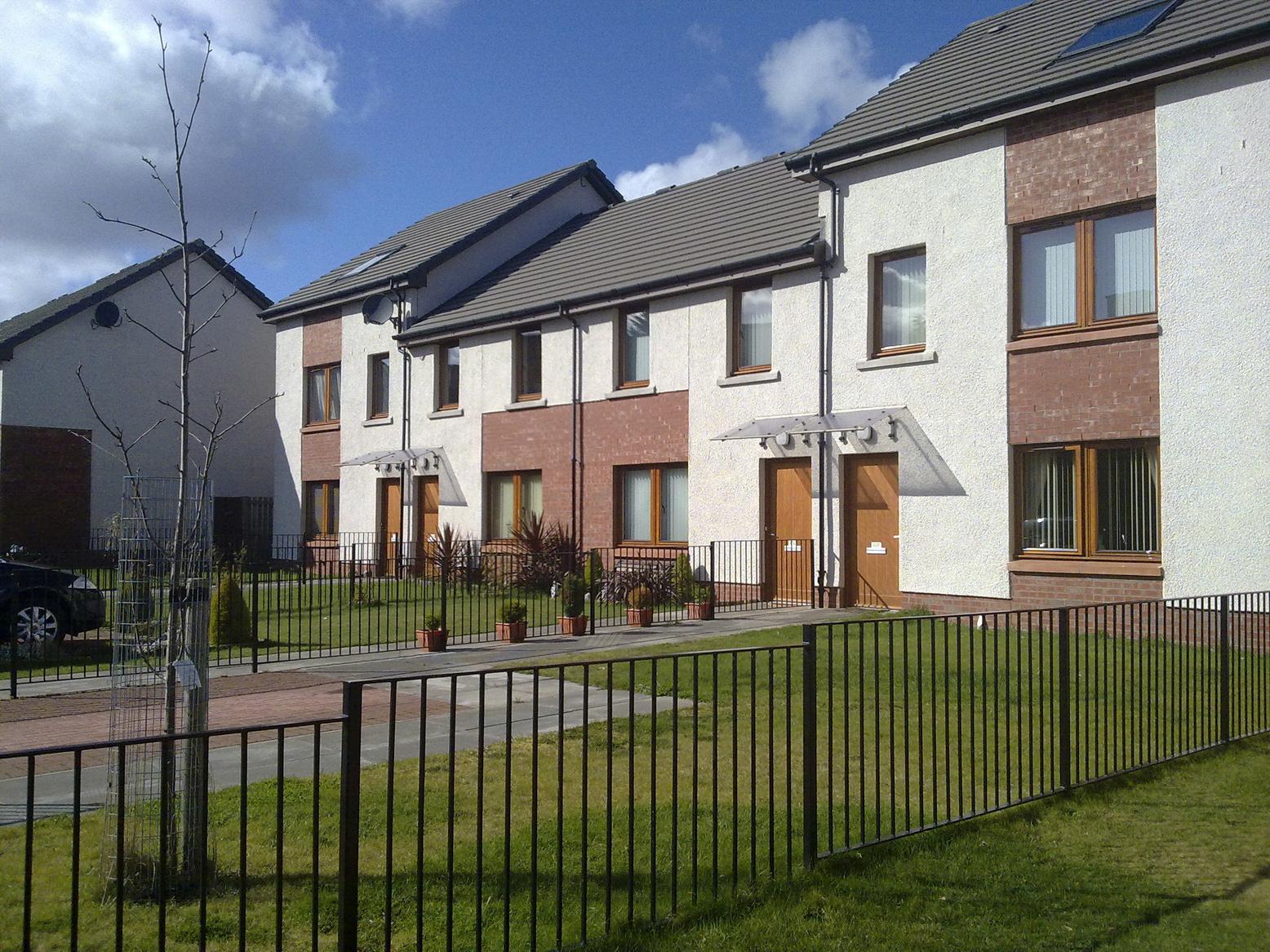
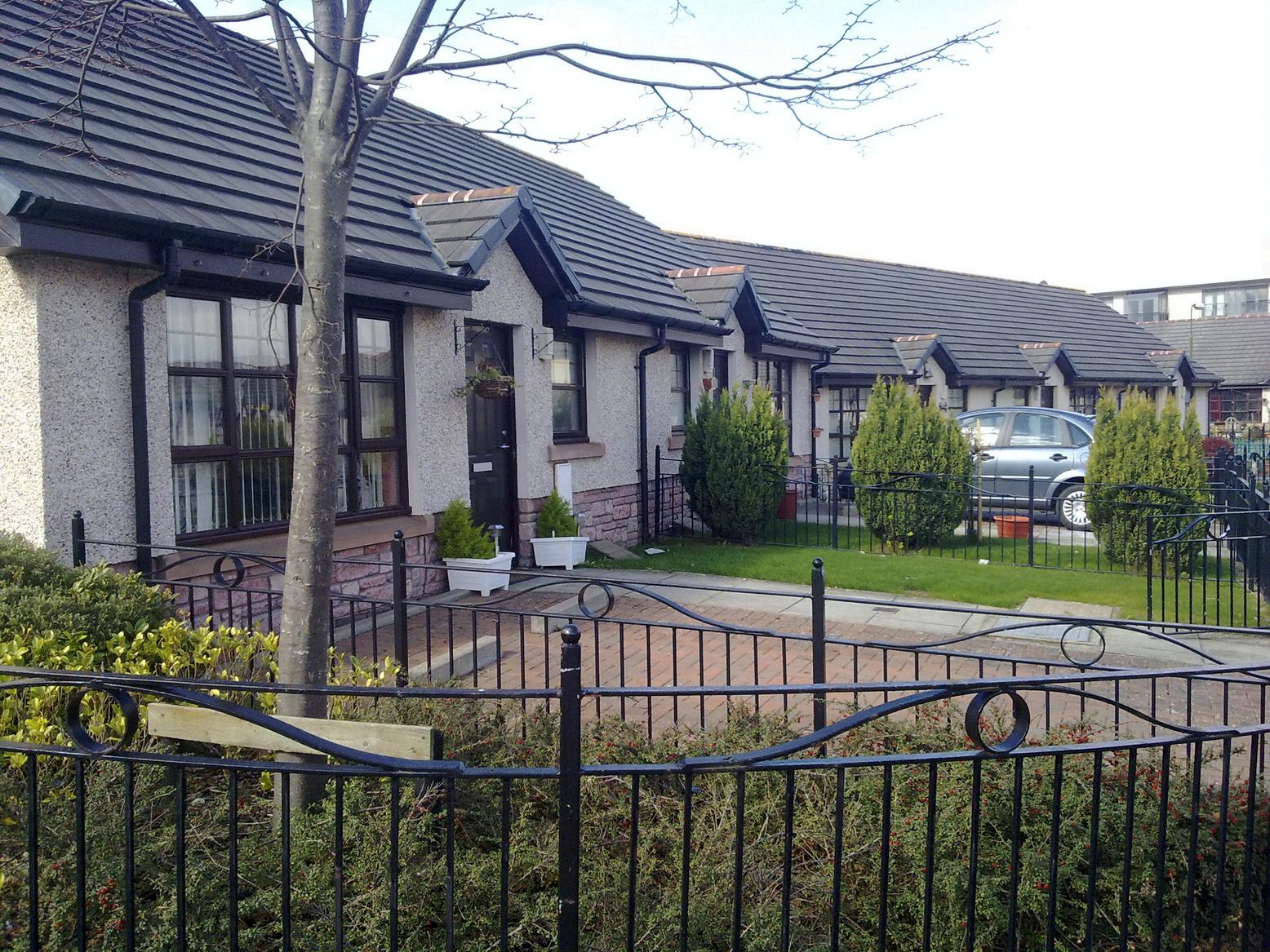
Our office is community based; owning 372 general needs properties sited over 17 local streets.
WGHC is a not-for-profit organisation
We are not a member of a group nor a subsidiary company and WGHC, itself, has no subsidiaries.
As a fully mutual co-operative we are 100% tenant governed
All our staff are permanent and directly employed by the co-op
ARCHIE
(Alliance of registered co-operatives and housing associations in Edinburgh)
Confederation of Co-operative
Housing
Co-ops UK
Employers in Voluntary Housing
Glasgow & West of Scotland Housing Forum
Investors in Excellence
Scottish Federation of Housing Associations





SHARE (Corporate Members)
Scotland’s Housing Network
Scottish Procurement Alliance




To d all others y
Complete cladding remediation by 2029
Strengthen our Contractor Management
Implement an effective Asset Management Strategy
Create opportunities to improve the lives of our members and the wider community
Actively support and promote the co-operative model
Continue our commitment to Investors in Excellence

Our vision is to consistently provide high levels of service delivery, and “added value” services which will distinguish our co-operative model from other models in the sector.
We will look to achieve this through rapid response times and a deeply personalised approach whereby we anticipate needs and proactively resolve problems for our tenant members.
Examples of “added value services” using a deeply personalised approach include continuing to credit every new tenant’s utility meter with £50; and helping those in need by paying annual standing fuel charges, reducing or paying off existing fuel debt, carpeting homes, replacing broken white goods, furniture & lawnmowers, and providing supermarket gift cards as an alternative to food bank vouchers.

Our new mission statement is a declaration of our core purpose and who we serve: our tenant members.
Being a fully mutual housing co-operative, our business purpose is to stay true to our model, and what it stands for: “our Members are Our Priority”
Our mission is to meet our tenant members’ common housing, social and economic needs by providing affordable, well maintained, safe, attractive housing within a thriving, sustainable community.
The community includes the wider community in which we operate, and to support local agencies, charities and local groups/clubs.

Complete cladding remediation by 2029
Strengthen our Contractor Management
Put in place an effective Asset Management Strategy
Create opportunities to improve the lives of our tenant members and the wider community
Actively support and promote the co-operative model
Continue our commitment to Investors in Excellence

-continue to work with Scottish Government in relation to our “Pathfinder” status as part of the Government’s Cladding Remediation programme until this building has been fully remediated and re-assessed as a tolerable risk.
-continue monitoring and reviewing our Fire Risk Safety Actions Plan to ensure the safety of our tenants
-continue to provide transparent and clear communications with our tenants in relation to fire safety measures, and all cladding remediation works.
This means we will seek to:
-improve repair outcomes by providing more detailed scopes of works in our works orders to our contractors
-actively audit invoices to ensure they align strictly with the works raised to prevent overcharges and deliver value for money
-improve communication between staff, contractors and our tenants regarding appointments and follow up works, establishing clear points of contact and regular feedback loops
-ensure regulatory and statutory compliance at all times, as our minimum standard
This means we will seek to:
-Ensure all our stock continues to meet the Scottish Quality Housing Standards and all other regulatory and standards
-Complete a data integrity exercise for all asset management data
-Prioritise investment to reduce reactive maintenance costs through well informed planned and cyclical maintenance programmes
-Adopt and implement statutory compliant management response to condensation, damp and mould
-Where practicable, seek and explore opportunities relating to retrofitting and improving the energy efficiency of our existing stock (avoiding the approach of forcing decarbonisation too quickly which may lead to poorer outcomes longer term).
This means we will seek to:
-Continue to identify ways in which we can help our tenants to deliver new services or initiatives and consider all donation/sponsorship requests from the local community
-Adopt a standard “Ask and Act” practice to help identify all tenant member needs, followed by actively offering individual support where possible (including emergency financial support, fuel vouchers, purchasing essential white goods or furniture items) preferring supermarket gift cards over foodbank referrals (where practicable) and making referrals to external agencies as required
This means we will seek to:
-Continue to raise awareness about the co-operative model and quantify the positive impact of WGHC as co-op and registered social landlord
-Continue to partner work with the 6 remaining social housing co-operatives, Scottish Government, other external agencies, stakeholders and leverage sector bodies such as Co-ops UK and the Confederation of Co-operative Housing
-Where practicable, seek out and explore opportunities for future growth of WGHC’s housing stock, with a view to increasing housing opportunities for our ageing population whilst releasing existing larger family homes
This means, along with the support of Investors in Excellence, we will seek to:
-Work on transforming our organisation to achieve Operational Excellence for our tenant members
-Focus on clear, strategic objectives, rooted in outcomes
-Ask the key questions of ourselves as to what works well, what could be better and what should be done differently, then work on the solutions to move us forward
-Consistently perform and deliver to the standards set out for us in our Tenants Charter

Our core values are our guiding principles which form our co-operative identity.
They guide our behaviour, our decisions and our actions, acting as our moral compass
Lorem ipsum dolor sit amet, consectetuer adipiscing elit Aenean commodo ligula eget dolor. Aenean massa. Cum sociis natoque penatibus et magnis dis parturient montes, nascetur ridiculus mus. Donec quam felis, ultricies nec, pellentesque eu,
We aim to align our core values, with our culture, to achieve a sense of purpose and “team”.
pretium quis, sem. Nulla consequat massa quis enim Donec pede justo, fringilla vel Aliquet nec, vulputate eget, arcu. In enim justo, rhoncus ut, imperdiet a, venenatis vitae, justo Nullam dictum felis eu pede
WGHC uses both SWOT and PESTLE frameworks to analyse the internal and external forces impacting our operating environment.
Assessing our strengths, and weaknesses is a way of auditing our organisation’s internal workings. These are easier to control than outside factors.
Examining our opportunities and threats allows us to carry out an audit of the external environment, over which we have lesser control.
Together, they provide WGHC with a tool to create strategies which can help to create a competitive advantage for our business, or conversely allow us to try to proactively address any challenges, before they become a crisis.
Both SWOT and PESTLE analysis help us identify risks, and are therefore an important part of our Risk Management function.
SWOT ANALYSIS
Democratic control of members in decision making
High levels of tenant engagement and tenant satisfaction
Strong Performance Culture
Good reputation of being more than ‘just a provider of housing’
Senior Management who understand the co-op values and culture
Always at risk of member apathy
Reliance on Scottish Government Funding for essential Cladding Remediation works
Limited opportunities to grow our stock within our local community
Limited opportunities to grow our stock within our local community
Lack of specialised staff roles
Rule changes to align more with co-op principles and SHR Framework
Increasing wider recognition of our model opening up doors for further partnerships
Further organisational improvements through our commitment to Investors in Excellence
Growth of the Co-op model in Scotland
Scottish Government not funding our cladding remediation works
Increasing demands on Governing Body Members, which could have a negative impact on recruitment andretention
Loss of Senior Management
Pension Deficit
Climate change affecting how stock will cope/react/behave
Political, economic, social, technological, legal, environmental
Net Zero targets and lack of Scottish Government funding
Landlord Health & Safety Legislation
Ongoing changes to Welfare Benefits
TECHNOLOGICAL
Projected loss of UK and global oil reserves within 50 years
Increase of extreme stormsdamage to stock
West Granton Housing Co-op faces a complex mix of financial, operational, and regulatory risks, as identified in both our SWOT and PESTEL analysis on pages 16 and 17
Some of our primary challenges include:
Cladding on our Forthquarter Building
refinancing debt at higher interest rates
maintaining and improving aging housing stock
adhering and rising to the challenge of new building and health and safety standards.
rising costs
cyber security
There are of course, many more.
Change is a constant within our sector

Some changes present us with more risks than others.
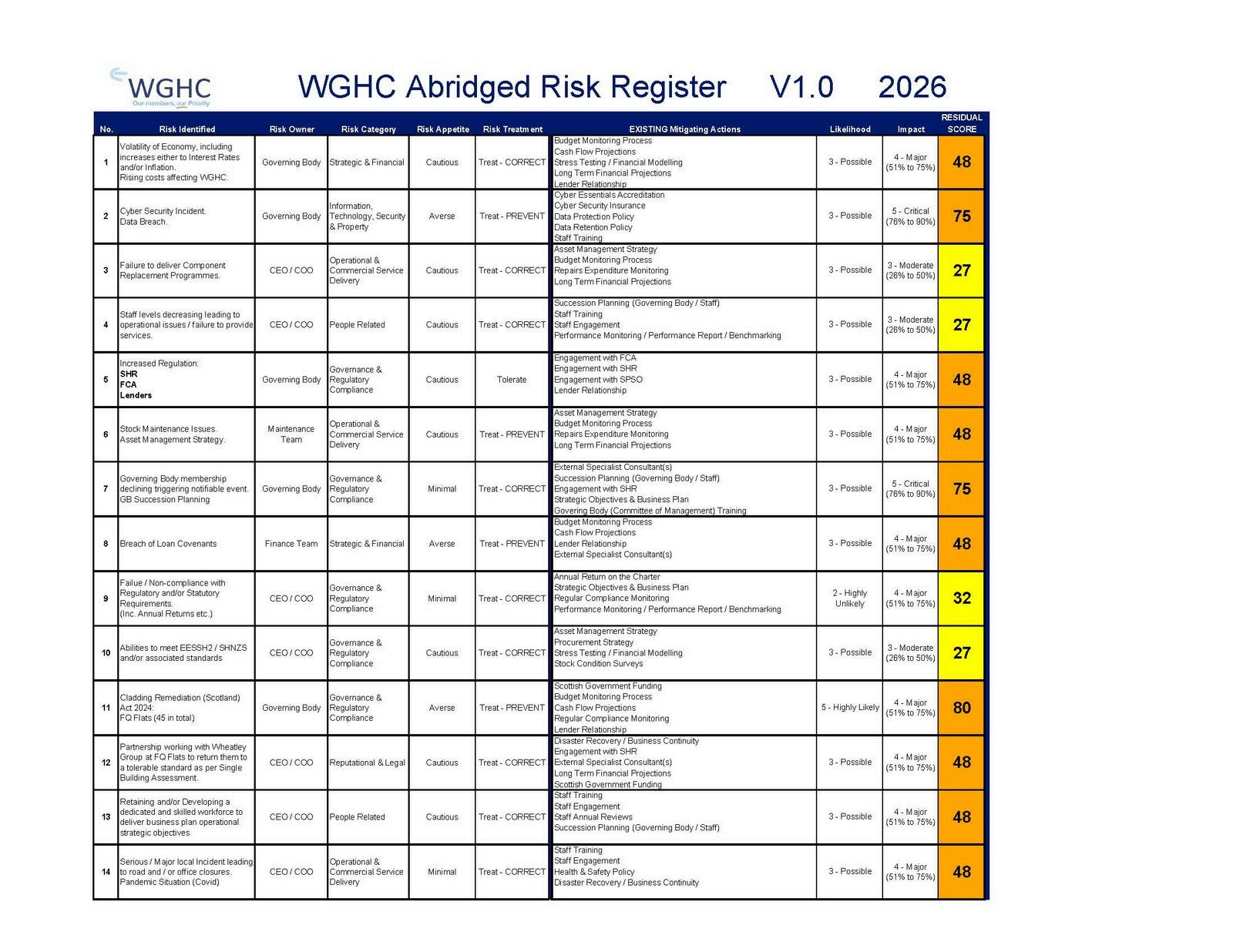
The tool we use to keep a record of these risks, is our Risk Register, which is formally reviewed, quarterly, by our Committee of Management.
How we assess and score our Risks:
A risk score is calculated by multiplying the “Likelihood of it happening” score by the square of the “Impact it would have on us” score
On the next page (page 19) we present to you an abridged version of our Risk Register.
To see the full version of our Risk Register and to learn more about how we manage our Risks, visit our webiste at https://www westgrantonhousing coop/aboutwghc/information-publications/
West Granton Housing Co-op’s only source of income is rents.

We use this income to achieve our objectives; fulfil our statutory and legislative requirements and be both efficient and cost effective in our business processes.
However, our rents still have to remain affordable, representing value for money, whilst ensuring they generate sufficient income to cover our costs
Over the past 15 years, we have worked hard to keep our annual rent increases to a minimum, and pre-Covid this was financially viable. This is demonstrated in the table opposite
Prior to the cost of living crisis, the WGHC Committee of Management had decided that the level by which our rents increase should generally be no higher than the Consumer Price Index (CPI).
However, CPI only measures the average change in price of a basket of ‘consumer goods and services’ like food, clothing, restaurants and cafes, furniture, jewellery, hairdressing, etc
CPI does not take into account many of the costs that WGHC has to pay for such as contractor labour costs or the cost of large-scale improvement projects such as updating boilers, kitchens or bathrooms.
CPI reached a high of 11.1% (during Covid in October 2022).
More recently, we are looking at a much more “normal” and reasonable level of 2.8% (May 2026), however, the goods and services which WGHC has to buy in, to provide its services, have not fallen in the same way.
Since 2022, WGHC has experienced a rise in costs of 25%, on average. The Rent Increase table (above) reflects a correlation in our rent increases with our increase in costs.

2 of the mortgages are on a variable rate (SONIA COMPOUND) and expire 2031 and 2033.
3 are on a fixed rate of 1 21% (including margin) and expire 2036, 2038 and 2039 respectively.
Our total outstanding loan balance as at 1 April 2026 was £2,006,807.
The existing loan agreements carry with them a 110% Interest Ratio loan covenent. and we monitor these closely to ensure ongoing compliance.
Interest cover remains strong at *752% (* figure correct as at 20 May 2026). th

At WGHC, rents are our only source of income
Financial planning is therefore critical to our long term viability.
Continuing to invest in our stock is key, but this costs alot of money and we therefore need to plan how we spend this money and when
We do this by using the economic life of components and plan forward to determine when they are next to be replaced (see Section 11- Asset Management- page 27, for this information).
This is worked out on a larger scale by stock type, streets and areas. Using detailed, costed works programmes and building in financial assumptions (such as inflation, interest rates and rental income) allows us to determine when we will need to pay out large amounts of money.
This can result in considerable and uneven spend in peak years, especially given the volatility of the current economic environment. WGHC looks to even out any such peaks by practising zero year budgeting and where required, run replacement programmes over a 2 or 3 year period to ensure its cash flow is protected.
The key financial objectives underpinning our financial projections are to:
Secure the long term financial viability of WGHC
Sustain our strong financial reputation
Ensure compliance with loan covenant requirements
Meet the costs of our corporate objectives
Note regarding Pensions:
As participants in the Scottish Housing Association Pension Scheme (defined contributions scheme) we have once again have been assessed as “low risk” However, it is recognised that our Pension Provider has reported there is a deficit in its funding, and like all other members of this scheme, we are once again making additional payments over the next 3 years to clear this deficit.
If you would like a copy of our 30 Year Financial Plans please contact our office on 0131 551 5035 or email us at mail@westgrantonhc.co.uk