Carson River
CONSERVED! Tributary of the Upper Rio Grande Western Rivers Conservancy completed its first project in New Mexico this spring when we permanently conserved 470 acres along a tributary to the Rio Grande in partnership with the Pueblo of Pojoaque, one of the Eight Northern Pueblos in the upper Rio Grande basin. Working together with WRC, the Pueblo of Pojoaque purchased the property in May, protecting a half-mile stretch of lush riparian habitat in the high desert and placing an important piece of the Pueblo homeland back into Pojoaque’s stewardship. Though the stream disappears from the surface at times, year-round underground flows sustain a vibrant corridor of willow and cottonwood that provides important habitat for desert species like jackrabbit, coyote and bobcat. More than 80 bird species, including the federally endangered Southwestern willow flycatcher, live in or migrate up and down the upper Rio Grande corridor. Above the creek is an arid landscape of rolling hills, low cliffs, native grasses, desert shrubs and pinyon pines with spectacular views of the Sangre de Cristo Mountains. For the Pueblo of Pojoaque, the significance of this land extends far beyond its natural values. The property is historically important and reflects centuries of connection between the Pueblo and their home waters. Placing the property back into tribal stewardship ensures these culturally important lands will be protected for generations to come, a benefit for people, place and wildlife alike. g
TEDDY MILLER
SUMMER 2026
six-week residency requirement for divorce. Local lore holds that women discarded their wedding rings into an old well on the property after they were granted a divorce. Lower Carson Ranch sits between Dayton State Park upstream and Fort Churchill State Historic Park downstream, adding an important new link in Nevada State Parks’ conservation management of the lower Carson. The property is also linked by river to WRC’s project at Park Ranch, 45 miles upstream on the East Fork Carson in California. Together, these efforts help bolster the Carson River system’s ability to sustain life in this arid region between the Eastern Sierra and the Great Basin. g
NEWS FROM WESTERN RIVERS CONSERVANCY
ISSUE 61
New State Park Protects Over Four Miles of Nevada’s Carson River
This Issue: Carson River, NV TEDDY MILLER
New Mexico
and brown trout. And due to its location just a few miles upstream of the Carson River Delta Important Bird Area—a critical stopover for birds migrating to and from the Carson Sink—this stretch of river is a haven for wild turkey, waterfowl, raptors and migratory songbirds. Nevada State Parks is currently developing a master plan to open the property to the public, which will create new opportunities to fish, paddle, hike and picnic along one of western Nevada’s great rivers. In a state with limited access to water, this new park, which is near the fast-growing communities of Reno, Carson City and Dayton, will provide a rare opportunity for people to recreate on the river. The park also preserves some Nevada history, including portions of the California and Pony Express national historic trails, which date back to the 1800s. In the 1940s, a portion of the property—then known as Break-aHeart Ranch—operated as a “divorce ranch,” part of a uniquely Nevada industry made possible by the state’s
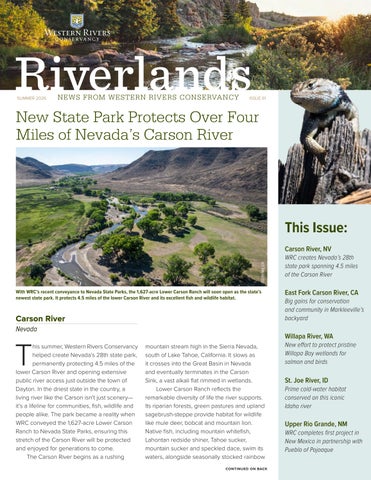
With WRC’s recent conveyance to Nevada State Parks, the 1,627-acre Lower Carson Ranch will soon open as the state’s newest state park. It protects 4.5 miles of the lower Carson River and its excellent fish and wildlife habitat.
Carson River Nevada
T An angler fishes the lower Carson along a stretch of river that is crucial for birds like killdeer (above), raptors and migratory songbirds.
Conserving rivers like these depends on people like you who know that healthy rivers are critical to us all. Please support WRC’s efforts to save the great rivers of the West by visiting us at westernrivers.org/give.
TEDDY MILLER
CHRISTI BODE
CONTINUED FROM COVER
his summer, Western Rivers Conservancy helped create Nevada’s 28th state park, permanently protecting 4.5 miles of the lower Carson River and opening extensive public river access just outside the town of Dayton. In the driest state in the country, a living river like the Carson isn’t just scenery— it’s a lifeline for communities, fish, wildlife and people alike. The park became a reality when WRC conveyed the 1,627-acre Lower Carson Ranch to Nevada State Parks, ensuring this stretch of the Carson River will be protected and enjoyed for generations to come. The Carson River begins as a rushing
WRC creates Nevada’s 28th state park spanning 4.5 miles of the Carson River
East Fork Carson River, CA
Big gains for conservation and community in Markleeville’s backyard
Willapa River, WA mountain stream high in the Sierra Nevada, south of Lake Tahoe, California. It slows as it crosses into the Great Basin in Nevada and eventually terminates in the Carson Sink, a vast alkali flat rimmed in wetlands. Lower Carson Ranch reflects the remarkable diversity of life the river supports. Its riparian forests, green pastures and upland sagebrush-steppe provide habitat for wildlife like mule deer, bobcat and mountain lion. Native fish, including mountain whitefish, Lahontan redside shiner, Tahoe sucker, mountain sucker and speckled dace, swim its waters, alongside seasonally stocked rainbow CONTINUED ON BACK
New effort to protect pristine Willapa Bay wetlands for salmon and birds
St. Joe River, ID
Prime cold-water habitat conserved on this iconic Idaho river
Upper Rio Grande, NM
WRC completes first project in New Mexico in partnership with Pueblo of Pojoaque
Protecting a Refuge for Salmon and Birds at Willapa Wetlands Willapa River Washington
Located southeast of Lake Tahoe, near the town of Markleeville, Park Ranch spans 1.6 miles of the East Fork Carson River and three miles of cold, fish-bearing tributaries.
A New Era for Park Ranch: Habitat, Access and Wildfire Protection in California’s Eastern Sierra East Fork Carson River California
W
estern Rivers Conservancy stands at the cusp of permanently protecting a special stretch of the East Fork Carson River by conveying the 1,688-acre Park Ranch to Alpine County. We purchased the property in two phases beginning in 2025 and intend to transfer it to the county in the coming weeks. The project represents an extraordinary opportunity to deliver habitat conservation for fish and wildlife, recreational access for people and wildfire protection for the community of Markleeville. The East Fork is the largest of the Carson River’s tributaries and one of the few major undammed rivers in the Eastern Sierra. It’s a scenic gem that draws recreationists from all over, with trophy trout waters, a statedesignated wild and scenic segment, hot springs and exciting whitewater.
Our efforts will conserve 1.6 miles of the East Fork Carson and three combined miles of its tributaries Markleeville Creek, Pleasant Valley Creek and Hot Springs Creek. The river and creeks together are home to federally threatened Lahontan cutthroat trout, as well as other native fish like Paiute sculpin, mountain whitefish, mountain sucker, Tahoe sucker, Lahontan redside shiner and speckled dace. Park Ranch provides vital habitat for a variety of wildlife. Its intact stands of cottonwood and willow, mixed conifer forests, sagebrush-steppe and expansive mountain meadows make up a key link in a migratory corridor that mule deer, black bear, western monarch and numerous other species rely on for survival and seasonal movement. During our ownership, WRC has removed extensive fencing that blocked wildlife movement, making it easier for migrating animals to move freely across the landscape.
Conserving Park Ranch will also expand access for fishing, hunting and birding, while connecting the property to Markleeville Campground and hiking trails that begin at Hangman’s Bridge, just upstream of the ranch. The portion of the East Fork Carson that runs through Park Ranch is also cherished among anglers and whitewater enthusiasts who seek out its feisty trout and lively Class II-III rapids. One of the key benefits for the nearby community of Markleeville is the property’s potential to serve as a bulwark against catastrophic wildfires. Once in county ownership, the ranch will continue to be managed for conservation and recreation, with compatible grazing playing a role in both improved habitat and wildfire fuels reduction. Park Ranch will remain a haven for fish and wildlife, while exemplifying the open space and ranching legacy that make this corner of eastern California so special. g
WRC is working to protect a bounty of wetlands along the lower Willapa River by conveying the 393-acre Willapa Wetlands property to the Chinook Indian Nation.
DANIEL CRONIN
This stretch of river is essential for salmon. All fish migrating up the Willapa to spawn, or down to the Pacific as smolts, pass through this reach. Fall Chinook, chum and coho rear here, alongside winter steelhead and coastal cutthroat trout. The property’s fluctuating salinity helps these fish regulate the transition between fresh and salt water. In fact, NOAA has designated Willapa Wetlands as Essential Fish Habitat for fall Chinook and coho. Unlike many wetlands in the bay that are cut off by berms and tide gates, these remain fully accessible to fish. The property, which lies along the Pacific Flyway, also supports a wide array of both migratory and coastaldependent birds, including band-tailed pigeon, dusky Canada goose and bald eagle. All of these are state-listed Species of Greatest Conservation Need. Now that we own Willapa Wetlands, we are working to secure funding to convey it to the Chinook Indian Nation. WRC’s work here builds on our recent conservation of 2,366 acres along the nearby Bear River (which flows into the bay to the south), expanding protection across one of the Pacific Northwest’s great estuarine landscapes. g
Idaho
CONSERVED! St. Joe River
TYLER ROEMER
DAVID DINES
A
t the northern end of Washington’s Willapa Bay, Western Rivers Conservancy has purchased a 393-acre property of nearly pristine wetlands along 2.2 miles of the Willapa River. We plan to convey the property, called Willapa Wetlands, to the Chinook Indian Nation, conserving lush riparian forests and returning ancestral lands to the Chinook Tribe. Willapa Bay is one of the largest, most ecologically vibrant estuaries on the West Coast. Tidal mudflats, salt marshes, coastal forests and wetlands create a nursery for salmon and a haven for birds and other wildlife. The Willapa River flows 44 miles from the Willapa Hills through a working landscape of small-scale agriculture, forestry and commercial shellfishing. Its lower reaches are wider, slower and tidally influenced, winding past the communities of Willapa, Raymond and South Bend before entering the bay. The Willapa Wetlands property sits just upstream of Raymond, where the river’s fresh water mixes with the tidal salt water of the bay. The property—which is almost entirely wetlands—includes 4.5 miles of inlets and sloughs lined with Sitka spruce, creating a mosaic of freshwater, estuarine and riverine habitat.
Western Rivers Conservancy has permanently protected a mile of Idaho’s storied St. Joe River and 0.6 miles of Fishhook Creek—a key tributary—by conveying a 585-acre property to the Idaho Panhandle National Forests. The Fishhook Creek property was an inholding in the national forests and contains some of the best remaining unprotected coldwater habitat in the basin. Rising in the northern Bitterroot Mountains and flowing 140 miles to Lake Coeur d’Alene, the St. Joe River is renowned for its crystal-clear waters, dramatic canyons and abundant wildlife. It also supports the last self-sustaining bull trout population in the greater Lake Coeur d’Alene watershed. Protecting the Fishhook Creek property will safeguard critical habitat for this vulnerable species, while complementing ongoing restoration efforts just upstream. The property’s towering stands of Douglas fir, larch and pine are home to grizzly bear, Rocky Mountain elk, and Canada lynx. Our efforts also open the property to public access, expanding opportunities to boat, hike, fish, hunt, birdwatch and otherwise explore these forests along one of Idaho’s most treasured rivers. Because the Forest Service already manages nearly all the land bordering the property, this conveyance closes a key gap in protection and improves conservation management along the river. It’s a meaningful step toward keeping the St. Joe pristine and thriving for fish, wildlife and people alike. g
Protecting a Refuge for Salmon and Birds at Willapa Wetlands Willapa River Washington
Located southeast of Lake Tahoe, near the town of Markleeville, Park Ranch spans 1.6 miles of the East Fork Carson River and three miles of cold, fish-bearing tributaries.
A New Era for Park Ranch: Habitat, Access and Wildfire Protection in California’s Eastern Sierra East Fork Carson River California
W
estern Rivers Conservancy stands at the cusp of permanently protecting a special stretch of the East Fork Carson River by conveying the 1,688-acre Park Ranch to Alpine County. We purchased the property in two phases beginning in 2025 and intend to transfer it to the county in the coming weeks. The project represents an extraordinary opportunity to deliver habitat conservation for fish and wildlife, recreational access for people and wildfire protection for the community of Markleeville. The East Fork is the largest of the Carson River’s tributaries and one of the few major undammed rivers in the Eastern Sierra. It’s a scenic gem that draws recreationists from all over, with trophy trout waters, a statedesignated wild and scenic segment, hot springs and exciting whitewater.
Our efforts will conserve 1.6 miles of the East Fork Carson and three combined miles of its tributaries Markleeville Creek, Pleasant Valley Creek and Hot Springs Creek. The river and creeks together are home to federally threatened Lahontan cutthroat trout, as well as other native fish like Paiute sculpin, mountain whitefish, mountain sucker, Tahoe sucker, Lahontan redside shiner and speckled dace. Park Ranch provides vital habitat for a variety of wildlife. Its intact stands of cottonwood and willow, mixed conifer forests, sagebrush-steppe and expansive mountain meadows make up a key link in a migratory corridor that mule deer, black bear, western monarch and numerous other species rely on for survival and seasonal movement. During our ownership, WRC has removed extensive fencing that blocked wildlife movement, making it easier for migrating animals to move freely across the landscape.
Conserving Park Ranch will also expand access for fishing, hunting and birding, while connecting the property to Markleeville Campground and hiking trails that begin at Hangman’s Bridge, just upstream of the ranch. The portion of the East Fork Carson that runs through Park Ranch is also cherished among anglers and whitewater enthusiasts who seek out its feisty trout and lively Class II-III rapids. One of the key benefits for the nearby community of Markleeville is the property’s potential to serve as a bulwark against catastrophic wildfires. Once in county ownership, the ranch will continue to be managed for conservation and recreation, with compatible grazing playing a role in both improved habitat and wildfire fuels reduction. Park Ranch will remain a haven for fish and wildlife, while exemplifying the open space and ranching legacy that make this corner of eastern California so special. g
WRC is working to protect a bounty of wetlands along the lower Willapa River by conveying the 393-acre Willapa Wetlands property to the Chinook Indian Nation.
DANIEL CRONIN
This stretch of river is essential for salmon. All fish migrating up the Willapa to spawn, or down to the Pacific as smolts, pass through this reach. Fall Chinook, chum and coho rear here, alongside winter steelhead and coastal cutthroat trout. The property’s fluctuating salinity helps these fish regulate the transition between fresh and salt water. In fact, NOAA has designated Willapa Wetlands as Essential Fish Habitat for fall Chinook and coho. Unlike many wetlands in the bay that are cut off by berms and tide gates, these remain fully accessible to fish. The property, which lies along the Pacific Flyway, also supports a wide array of both migratory and coastaldependent birds, including band-tailed pigeon, dusky Canada goose and bald eagle. All of these are state-listed Species of Greatest Conservation Need. Now that we own Willapa Wetlands, we are working to secure funding to convey it to the Chinook Indian Nation. WRC’s work here builds on our recent conservation of 2,366 acres along the nearby Bear River (which flows into the bay to the south), expanding protection across one of the Pacific Northwest’s great estuarine landscapes. g
Idaho
CONSERVED! St. Joe River
TYLER ROEMER
DAVID DINES
A
t the northern end of Washington’s Willapa Bay, Western Rivers Conservancy has purchased a 393-acre property of nearly pristine wetlands along 2.2 miles of the Willapa River. We plan to convey the property, called Willapa Wetlands, to the Chinook Indian Nation, conserving lush riparian forests and returning ancestral lands to the Chinook Tribe. Willapa Bay is one of the largest, most ecologically vibrant estuaries on the West Coast. Tidal mudflats, salt marshes, coastal forests and wetlands create a nursery for salmon and a haven for birds and other wildlife. The Willapa River flows 44 miles from the Willapa Hills through a working landscape of small-scale agriculture, forestry and commercial shellfishing. Its lower reaches are wider, slower and tidally influenced, winding past the communities of Willapa, Raymond and South Bend before entering the bay. The Willapa Wetlands property sits just upstream of Raymond, where the river’s fresh water mixes with the tidal salt water of the bay. The property—which is almost entirely wetlands—includes 4.5 miles of inlets and sloughs lined with Sitka spruce, creating a mosaic of freshwater, estuarine and riverine habitat.
Western Rivers Conservancy has permanently protected a mile of Idaho’s storied St. Joe River and 0.6 miles of Fishhook Creek—a key tributary—by conveying a 585-acre property to the Idaho Panhandle National Forests. The Fishhook Creek property was an inholding in the national forests and contains some of the best remaining unprotected coldwater habitat in the basin. Rising in the northern Bitterroot Mountains and flowing 140 miles to Lake Coeur d’Alene, the St. Joe River is renowned for its crystal-clear waters, dramatic canyons and abundant wildlife. It also supports the last self-sustaining bull trout population in the greater Lake Coeur d’Alene watershed. Protecting the Fishhook Creek property will safeguard critical habitat for this vulnerable species, while complementing ongoing restoration efforts just upstream. The property’s towering stands of Douglas fir, larch and pine are home to grizzly bear, Rocky Mountain elk, and Canada lynx. Our efforts also open the property to public access, expanding opportunities to boat, hike, fish, hunt, birdwatch and otherwise explore these forests along one of Idaho’s most treasured rivers. Because the Forest Service already manages nearly all the land bordering the property, this conveyance closes a key gap in protection and improves conservation management along the river. It’s a meaningful step toward keeping the St. Joe pristine and thriving for fish, wildlife and people alike. g
Carson River
CONSERVED! Tributary of the Upper Rio Grande Western Rivers Conservancy completed its first project in New Mexico this spring when we permanently conserved 470 acres along a tributary to the Rio Grande in partnership with the Pueblo of Pojoaque, one of the Eight Northern Pueblos in the upper Rio Grande basin. Working together with WRC, the Pueblo of Pojoaque purchased the property in May, protecting a half-mile stretch of lush riparian habitat in the high desert and placing an important piece of the Pueblo homeland back into Pojoaque’s stewardship. Though the stream disappears from the surface at times, year-round underground flows sustain a vibrant corridor of willow and cottonwood that provides important habitat for desert species like jackrabbit, coyote and bobcat. More than 80 bird species, including the federally endangered Southwestern willow flycatcher, live in or migrate up and down the upper Rio Grande corridor. Above the creek is an arid landscape of rolling hills, low cliffs, native grasses, desert shrubs and pinyon pines with spectacular views of the Sangre de Cristo Mountains. For the Pueblo of Pojoaque, the significance of this land extends far beyond its natural values. The property is historically important and reflects centuries of connection between the Pueblo and their home waters. Placing the property back into tribal stewardship ensures these culturally important lands will be protected for generations to come, a benefit for people, place and wildlife alike. g
TEDDY MILLER
SUMMER 2026
six-week residency requirement for divorce. Local lore holds that women discarded their wedding rings into an old well on the property after they were granted a divorce. Lower Carson Ranch sits between Dayton State Park upstream and Fort Churchill State Historic Park downstream, adding an important new link in Nevada State Parks’ conservation management of the lower Carson. The property is also linked by river to WRC’s project at Park Ranch, 45 miles upstream on the East Fork Carson in California. Together, these efforts help bolster the Carson River system’s ability to sustain life in this arid region between the Eastern Sierra and the Great Basin. g
NEWS FROM WESTERN RIVERS CONSERVANCY
ISSUE 61
New State Park Protects Over Four Miles of Nevada’s Carson River
This Issue: Carson River, NV TEDDY MILLER
New Mexico
and brown trout. And due to its location just a few miles upstream of the Carson River Delta Important Bird Area—a critical stopover for birds migrating to and from the Carson Sink—this stretch of river is a haven for wild turkey, waterfowl, raptors and migratory songbirds. Nevada State Parks is currently developing a master plan to open the property to the public, which will create new opportunities to fish, paddle, hike and picnic along one of western Nevada’s great rivers. In a state with limited access to water, this new park, which is near the fast-growing communities of Reno, Carson City and Dayton, will provide a rare opportunity for people to recreate on the river. The park also preserves some Nevada history, including portions of the California and Pony Express national historic trails, which date back to the 1800s. In the 1940s, a portion of the property—then known as Break-aHeart Ranch—operated as a “divorce ranch,” part of a uniquely Nevada industry made possible by the state’s
With WRC’s recent conveyance to Nevada State Parks, the 1,627-acre Lower Carson Ranch will soon open as the state’s newest state park. It protects 4.5 miles of the lower Carson River and its excellent fish and wildlife habitat.
Carson River Nevada
T An angler fishes the lower Carson along a stretch of river that is crucial for birds like killdeer (above), raptors and migratory songbirds.
Conserving rivers like these depends on people like you who know that healthy rivers are critical to us all. Please support WRC’s efforts to save the great rivers of the West by visiting us at westernrivers.org/give.
TEDDY MILLER
CHRISTI BODE
CONTINUED FROM COVER
his summer, Western Rivers Conservancy helped create Nevada’s 28th state park, permanently protecting 4.5 miles of the lower Carson River and opening extensive public river access just outside the town of Dayton. In the driest state in the country, a living river like the Carson isn’t just scenery— it’s a lifeline for communities, fish, wildlife and people alike. The park became a reality when WRC conveyed the 1,627-acre Lower Carson Ranch to Nevada State Parks, ensuring this stretch of the Carson River will be protected and enjoyed for generations to come. The Carson River begins as a rushing
WRC creates Nevada’s 28th state park spanning 4.5 miles of the Carson River
East Fork Carson River, CA
Big gains for conservation and community in Markleeville’s backyard
Willapa River, WA mountain stream high in the Sierra Nevada, south of Lake Tahoe, California. It slows as it crosses into the Great Basin in Nevada and eventually terminates in the Carson Sink, a vast alkali flat rimmed in wetlands. Lower Carson Ranch reflects the remarkable diversity of life the river supports. Its riparian forests, green pastures and upland sagebrush-steppe provide habitat for wildlife like mule deer, bobcat and mountain lion. Native fish, including mountain whitefish, Lahontan redside shiner, Tahoe sucker, mountain sucker and speckled dace, swim its waters, alongside seasonally stocked rainbow CONTINUED ON BACK
New effort to protect pristine Willapa Bay wetlands for salmon and birds
St. Joe River, ID
Prime cold-water habitat conserved on this iconic Idaho river
Upper Rio Grande, NM
WRC completes first project in New Mexico in partnership with Pueblo of Pojoaque