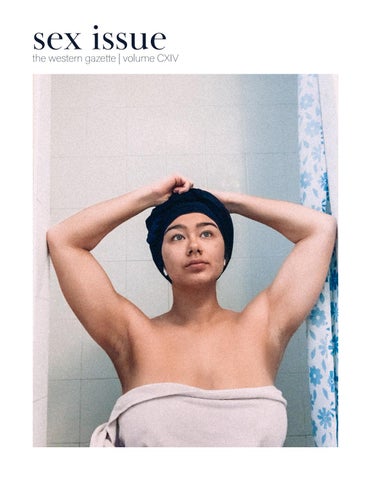
sex issue
the western gazette | volume CXIV
3
sex issue the western gazette | vol. CXIV Editor-in-Chief Emily Tayler Managing Editor Rania Osman Creative Director Liam Afonso Coordinating Editors Taniya Spolia Hope Mahood Writers Ashley Goveas Kirat Walia Elan Pedersen Rebekah Rodrigues Taniya Spolia Sarah Wallace Mudia Iyayi Samantha Bloom Catherine Danko Bella Pick
Gabby Glasier Alex McComb Jordan Bloom Hope Mahood Lucas Arender Lauren Medeiros Danielle Pineda Catrina Tang Sheetal Vemannagari Copy Gabby Glasier Bella Pick Hope Mahood Joey Siy Elizabeth Hart Bridget Forget Graphics Taniya Spolia Anastasiia Fedorova Erin Grace Rebecca Streef
Video Nyren Mo Laura Seidelin Layout and Design Liam Afonso Models Alison Lengyell Kamryn Philippe Kristen Le Alexandra Baer Xin Zhou Sarah Shelley Tamsen Long Veronica Botnick Sarah Herlick Charlotte Rolfe Fizza Ali Homa Vahidi Shengrui Zhang Emily Kleiber
All of the photos in this issue were taken by the models themselves or with the help of roommates to follow social distancing regulations. The Gazette offered remote support where needed and edited the images. While these images are a departure from the Gazette’s usual photoshoot, these photos show how sexuality has changed in today’s pandemic-ridden world, to become more comfortable, distanced and effortlessly charming. Thank you to all the models who participated in this issue.
cont 09
Overcoming the irony of online dating
10
The rise of sexting
12
Keep your distanced sex lilfe alive using the phone
15
Your guide to non-essential travel with Tinder passport
18
Queer students on their dating app experiences
20
The tragedy of the Tinder catfish
25
How to keep your relationship flourishing during quarantine
26
You can date during the pandemic
27
You don’t need to find the ‘the one’ in 2021
28
Maintaining a post-grad relationship
32
A blind date, but worse
34
Find your love language
35
How to escape the eternal talking stage
36
In defence of floorcest
40
Dating fat is hard enough; it’s even harder in a pandemic
tents 41
Sex positions: Western edition
42
Autoeroticism and owning your orgasm
Sex survey 44 46
Lingerie for all sizes
49
Nude modeling helped me reclaim my body
54
Big boobs can go braless too
56
The experience of sex and sexuality for South Asian women
60
Deconstructing Black fetishism
61
Yellow-fever: Sexualizing anti-Asian racism
62
Black sexuality and experiences with love
65
Microlabels within the LGBTQ2+ community
66
The rise of OnlyFans
68
Gender-based violence conversations forefront for the Mustangs
71
Does having sex affect your sport performace?
72
How identifying as a feminst changes your dating life
8
Overcoming the irony of online dating By Elan Pedersen Between platforms like Tinder, Grindr and Plenty of Fish, the number of dating apps available — and people looking for the right match — are endless. It’s a never-ending cycle of continuous swiping, looking for anything that sparks your interest and then realizing, 20 minutes in, that you don’t even believe in love. It becomes a sort of game, and while dating apps may feel discouraging, they may be more harmful than expected. Studies now show there are more effects to doom swiping than a bruise to your ego — it may decrease your chances of finding someone to ever swipe right on. Tila Pronk and Jaap Denissen, professors from the University of Tilburg and University of Utrecht, both in the Netherlands, have an explanation for this. “The paradox of modern dating is that online platforms provide more opportunities to find a romantic partner than ever before, but people are nevertheless more likely to be single,” their study reads. “The continued access to virtually unlimited potential partners makes people more pessimistic and rejecting.” Entitling their theory the “Rejection Mindset,” they argue that when presented with an abundance of options, people are less likely to critically consider hypothetical partners and resort to swiping. “Our findings suggest that people gradually ‘close off ’
from mating opportunities when online dating,” the study says. After conducting three studies throughout 2019 and 2020, Pronk and Denissen found the more options someone is presented with, the more likely they will develop a poor perception of their own dating success and an increased likelihood of rejecting. This phenomenon of choice overload is present in everyday life — choosing which type of pasta to order at a restaurant or which lamp you want from Ikea — when options are in abundance. But, this dating fatigue can be overcome. Denissen and Pronk believe there are ways to maximize your dating experience without burning out. “[People] may benefit from restricting their search,” their study reads. “[Or] at least the amount of rejections during their search.” Instead of taking five seconds to evaluate a picture and swiping left, the article suggests considering one person or a small group of people, with a period of rest to “dehabituate” — or return to normal after responding to a stimulus — before jumping back on the app. So the next time you start swiping on Tinder, convinced that there is no one for you on the app, remember you may just need a break. While online dating undoubtedly has its benefits, it is important to take a step back and swipe a bit slower.
9
The rise of sexting By Ashley Goveas
L
ong gone are nights spent jumping between Cousin Vinny’s Pizza and side door entrances at the Barking Frog, or walking up Richmond Row in the cold to see if the line is shorter at The Ceeps. And as the province rides out the second wave, students have also said goodbye to nights where they could invite strangers home from the bar for one-night stands. With current stay-at-home restrictions in Ontario, intimacy-related difficulties are exacerbated. Everywhere we’d originally go to “get some” has been closed off, and it comes as no surprise that students are turning to their devices to fill in the gaps and reestablish a sense of normalcy. According to the New York Times, sexting is on the rise for young people — catalyzed by the absence of in-person socializing. While the Times article focuses on teenagers, other reports suggest university students are engaging in similar online intimacy as well.
Students are practising caution during the pandemic to avoid breaking public health guidelines and instead are spending more time on their devices — even for sexual intimacy.
In effort to keep sexual intimacy alive online, students are turning to sending and receiving explicit messages and images. And that comes as no surprise to Mandy Doyle, a fourth-year actuarial science student.
“[At] the beginning of the pandemic, everyone was leaving London and a huge wave of loneliness came over and [I figured] … I might as well go on a dating app and see what's there,” she said. “Everyone's lonely, no one can really see people, people will get horny that's nothing new … I'm not surprised that [other] people sexting would increase.” Doyle advises Western University students to be careful when deciding to sext during the 10
pandemic.
“If you are sexing — in my personal humble opinion of someone who doesn't sext — please do not [show] your face,” Doyle said.
Young people are using this form of communication to maintain a level of intimacy in their lives and to reaffirm the validation usually received from nights out on Richmond row.
“Sex tech” — a term that often pops up in conversation surrounding intimacy and the pandemic — ranges from “interactive, immersive and connected erotic experiences,” which usually entail virtual reality, dating apps, erotic video games, sex robots or other platforms to exercise one’s sexuality safely. These are a few of many outlets students have been using to keep their sex lives afloat from afar. “You’re not in a club where you can see everybody and gauge your options, merely just who's in the vicinity approximate to [you online],” Doyle said, noting it is reasonable that students are turning to their devices to adhere to the social distancing guidelines — despite how isolating it can be. “[Dating apps are] really easy, especially when we can't go to clubs where we meet a lot of people,” Doyle said. “It's just easy to like go on an app and materialistically judge someone.” Despite concerns, the overwhelming consensus seems to be that sexting — when practised with trusted partners — helps students and adults alike mitigate loneliness and stress that have come about with social distancing guidelines.
Regardless of the route students take to regain control of their desire for intimacy, doing so online has become a popular — and relatively safe — way to do it.
11
keep your distanced sex life alive using the phone by taniya spolia
We can all agree that distanced love has zero perks. That being said, it doesn’t have to be miserable. Sexual compatibility and pleasure are a considerable aspect of relationships — something the coronavirus pandemic has made impossible for many couples. While you can’t meet your partner face-to-face, you don’t have to completely forgo your sex life. Instead, here are some tips to maintaining distanced love — sex, but over the phone.
establish boundaries
The most important part of engaging in any type of sexual activity is establishing boundaries between yourself and your partner. Consent is key. Before actively engaging in phone sex — be it on text, audio only or video chat — it’s worthwhile to come up with a “yes, no and maybe” list. This outlines what is safe territory for you and your partner and what's off limits. Establish a safe-word to use if things go too far or if you’re uncomfortable with where the conversation is going. It’s easy to get carried away over the phone, so being able to quickly vocalize your discomfort will keep the experience enjoyable and safe.
research 12
Think back to when you first started having sex — you probably had a lot of questions and realized that not everything happened exactly the way you thought it would.
Similarly, phone-sex can also surprise you. The internet, in this case, can be your best friend. Research tips and tricks to maximize the experience or read through candid experiences to prepare yourself for your individual journey.
start with sexting
We can all admit it’s easier to hide behind a screen, so when you start ramping up your sex-life from a distance, sexting can be a great way to begin. Once you're comfortable expressing yourself through text and are able to find the appropriate words to vocalize your thoughts and feelings, you can try to migrate to phone calls.
get out of your head
Are you going to have awkward moments? Will you laugh at something your partner says?
be vocal
Not being able to touch your partner means that you’ll have to rely on voice interaction much more than you’re used to. A good way to overcome silences is to ask a lot of directed questions and supply clear and descriptive answers.
One hundred per cent. It’s all a part of the experience and there’s no such thing as “messing up.” Sex isn’t always a movie reel and neither is phone sex. Both you and your partner will have a better time if you let these inhibitions go and simply live in the moment.
For example, instead of saying “what do you want to 13
do,” perhaps say “where should I touch you first?” Once they respond with a location, follow-up and ask “would you like me to touch you with my hands or my mouth?” From there, you can just get into it.
listen, respond build on memories explore
Listen for vocal cues to see what your partner likes and doesn't like. Once you’ve asked them a series of questions to understand what they want, narrate what the experience would be like if you two were face-to-face. This will require a little imagination from both parties and a back-and-forth to keep the tempo consistent. If you find yourself at a loss of where to start, reminisce old sexual experiences you’ve had with your partner. “Remember that one time you...” and from there you can paint the picture to establish a mood. Talk about what you liked, ask them what they liked and what you’d both enjoy doing again. Once you’ve established a rhythm with your partner and have gotten comfortable over the phone, use this opportunity to try out new fantasies. As most of phone-sex relies on active imagination, you can use it to sample fantasies without committing to them. This can be role-play or describing a position you’ve never tried before — perhaps engaging in BDSM. The sky is the limit!
pillow talk
Just like real sex with your partner, it’s important to wind down after phone sex. During the first few times you try it out, take this time to reflect on the experience. Talk about what you liked, didn’t like and if phone sex is even something you’d want to try again. Try out “virtually cuddling” with your voices — it sounds odd, but just means talking to each other until you’re able to reconnect past your orgasms. Distanced love isn’t easy and maintaining a sexually driven relationship is even harder. These tricks are just a few of the ways to keep your sex life fruitful and alive.
14
your guide to non-essential travel with tinder passport
by Catrina Tang 15
Unless you’re Western chancellor Linda Hasenfratz, you probably haven’t been travelling during the pandemic. While Canada issued an advisory to avoid non-essential travel, those looking to escape their local environment can still find ways to get out online. For those looking to cure their travel bug, Tinder’s got your back: Tinder Passport is a feature that allows users to change their location to any city in the world and match with others in their destination of choice. If you’re tired of getting rejected in London, then simply set your location to Paris or Dubai and start experiencing heartbreak from around the world. Passport is a premium feature usually only available to Tinder Plus, Gold or Platinum subscribers, but was made free to all users for a month during April 2020. While most were practising social distancing at home, Tinder Passport was a fun and free cure to quarantine boredom. Wendi Huang, a first-year Ivey Business School student, “travelled” to major cities in the U.S. using Passport after getting sick of the local meat. “There’s too many people I’m matching with that are intertwined. Like for example: my ex’s friend — I, by mistake, matched with him and didn’t know he was my ex’s friend. You know, everyone is like a cesspool.” So she decided to explore else16
where. Passport was her opportunity to keep swiping for fun while avoiding awkwardly matching with mutuals. “There’s this one guy I met in L.A., he’s actually really nice and we talk to each other still. I feel like it’s a quality not quantity thing,” Huang says. While any real travelling has to be saved until post-pandemic, Passport offers a fun escape and a glimpse at different parts of the world, in a time where most of us are stuck at home. A premium Tinder membership ranges from $9.99 to $39.99 per month, depending on which tier. For Huang, it’s not a feature worth paying for outside of the one month free trial. “It was pretty liberating. But did I need it? No. Could I have probably read a book? Yeah. Did I choose not to? Yeah.” Overall, Huang found that using Tinder Passport wasn’t all that different from her regular Tinder use — more for entertainment value rather than any serious connection. Huang mostly gained an opportunity to couch surf after a month of swiping across the world. “If I went to L.A., I would have a place to crash at, cause I have a friend.” Any students looking for a getaway mid-pandemic — or potentially a Western University chancellor looking to keep their job — should consider trading in for Tinder Passport.
18
I
By Gabby Glasier n the absence of in-person coffee dates and classes staring at a crush that you will probably never actually speak to, many students have turned to Tinder and Hinge to find solace in the virtual presence of another. While dating apps have always been popular, they never quite blew up to this extent. While more and more Tinder-newbies join the online dating scene, many queer people find themselves stuck with dating apps made without lesbian, gay, bisexual or trans folks in mind and distanced from queer spaces in the city. But even with the lucklustre online options to swipe through, many LGBTQ2+ students find online dating easier, as it’s easy to tell a potential partner’s sexuality. “Especially for somebody like me that looks super femme, no one ever thinks I am queer, no matter how much I say it … I feel like I have to use dating apps or I’m not going to meet anyone,” Kate Peters says, an Ivey Business School and English literature student. “The people I talk to are surprised that queer people use Tinder more as a true dating app, not just a hookup app.” Kate’s name has been changed to protect her privacy.
Peters says organic “meet-cutes” that romantic comedies typically portray aren’t often an option for the LGBTQ2+ community. “I think a lot of queer people really get that sense of missing out when it comes to dating and wanting to have those organic connections. It’s really frustrating to be like ‘I don’t know if she’s gay or not,’” Peters says. Anywhere between 1.5 and 10 per cent of young Canadians identify as LGBTQ2+, according to extremely limited census numbers — meaning queer students are picking from a smaller pool than their straight counterparts. Dating apps create an environment where everyone’s photos also come with a label, taking the guessing game out of meeting potential partners. Brendon Davidson, a third-year management and organizational studies student, says that most of his straight friends rarely use dating apps. “They just meet people when they’re out and about, or through friends,” Davidson explains. Another problem that arose for Peters on dating apps is “undesirable” accounts. By that, she means girls looking to make friends, girls looking for a fake ID and couples looking for a third person to join them in the
bedroom. After navigating through all of these red-herrings, the options in London seem far from bountiful. Davidson agrees, saying “oftentimes, when I’m looking for dates exclusively on Tinder or Bumble, there aren’t very many options, especially in London.” Tinder is one of the largest dating apps used by young people across North America, but Peters says its reach in London’s queer community is limited. But, many queer-focused apps, such as Lex, aren’t popular enough yet to draw in a larger community. Although dating apps such as Tinder were created with straight users in mind, the platform is slowly becoming more queer-friendly. Recently, the app has made it so that users may include their gender and sexual orientation right on their profile — Peters points out that it is nice to have these as a formal, optional statistic and not just a line in a bio. “One thing I like about Tinder is that [it allows me to] see my sexuality first — I can set it to show me bi people first,” says Peters as an example. Navigating the dating scene as a queer person can be frustrating, but slowly, apps like Tinder are adapting for a wider audience.
19
the tragedy of
THE TINDER CATFISH
by lucas arender
W
hile Tinder can be fun, there is a dark side to swiping.
It was a typical Tuesday night for Mustang — a second-year management and organizational studies student whose name has been changed — watching hockey and basketball with his roommates over a couple of pints. During a commercial break, he began to swipe through Tinder and received a match. He began to Google good pickup lines and confidently decided on “do you want to be my Tinderella?” He began to get ready for bed and by the time he had gotten out of the shower, he had a few messages from his match. The two added each other on Snapchat and exchanged flirtatious messages. She was only sending pictures of her eye and the corner of her head, something that did not concern him at the time. “I did realize the next morning that it was a red flag, let’s just put it that way,” he explains. Mustang had never met up with a woman from Tinder before, and didn’t plan on doing so this particular night. But she was persistent. At around 1:30 a.m. she messages him asking him to come over to her house. Although Mustang liked what he’d seen on her profile, it was late, he was in bed and had to be up at 9 a.m. He politely declined. She countered with, “that’s too bad, we would’ve had a good time.” It was 2 a.m. on a Wednesday morning, but Mustang was starting to consider the offer. She sends another message saying “I want you right now.” At this point, Mustang called two of his roommates into his room to help evaluate his options. His roommates convinced him there would not be a better opportunity to have his first real Tinder experience. The pitch to
get him to embark on the adventure included a junior chicken sandwich and the song “Let’s Get it On” by Marvin Gaye. By 2:30 a.m. he was convinced but still nervous. “I’m a friggen rookie. This was my first time, I didn’t know what I was getting myself into, didn’t really know how these things go. I don’t know how two strangers who have never met before or spoken in-person within three minutes of meeting each other for the first time, hook up.”
He walked into the house, afraid that, at 2:45 a.m., he was out of options. The two exchanged some awkward pleasantries and then the woman b-lined towards the bedroom. Mustang said he felt as though he should just get it over with and reluctantly followed. “Yeah, so we start making out, you know, as two young bucks would in a bedroom.”
Although the student was meeting this girl for the first time, he did feel the need to dress to impress. He donned a pair of black H&M sweatpants and a baggy Reebok hoodie.
The attraction, however, was simply not there. Mustang apologized to the girl, confessing that he really just wasn’t into it. He spent a couple of minutes complimenting her house decor while he waited for his Uber to arrive.
“It was 2:30 am and I knew I was not going over there to simply converse with this woman.”
According to the Uber receipts, Mustang’s round trip was under 30 minutes.
He hopped in his Uber at 2:39 a.m. and was en route to the house of a woman he had been talking to for less than two hours. He began chatting with his driver to calm his nerves. At one point during the ride, they began talking about Indian cuisine. Mustang explains that he knew the butterflies were fluttering “out of control” when he asked his driver if India had good butter chicken.
He stumbled through an awkward goodbye and solemnly walked to his Uber. This time around, there was no conversation with the driver. He put on his Airpods, played “More Than My Hometown” by Morgan Wallen at full blast and stared up at the London sky.
He arrived at the house and waited outside for the woman to meet him. He began to tap his foot uncontrollably, seriously questioning his decision to follow through with this. A woman walks out of the side door, a woman that Mustang did not recognize.
“I looked out the window questioning a plethora of life decisions that led to this moment.” The two have since become friends and exchange occasional messages. If there is a standing offer to meet up with a Tinder match after 2 a.m., go to sleep. It likely won’t be worth it.
She approaches him, introduces herself and gestures towards the house. At this moment, Mustang realizes he probably should’ve stayed in bed. The woman was a stark contrast to the woman he had agreed to meet up with. “I felt as though I’d been catfished. I did not see the resemblance to the pictures I saw on Tinder.” 21
quarantine How to keep your relationship flourishing during
By Danielle Pineda
Most relationships — whether they be new or old — have been affected by the coronavirus pandemic one way or another. With prolonged isolation, the strain on relationships has tightened even more, making it harder to remain optimistic and in sync. Follow these tips to alleviate some of that stress, so you can keep those sparks flying and your heart racing.
Communication One of the most important parts of a relationship is maintaining clear and open communication with your partner. Be attentive to your partner's needs and vocalize your own. After all, you can’t expect to know what’s bothering your partner when it’s wrapped up in their head — and vice versa. Make sure that you’re both communicating in ways that the other understands More often than not, relationship fights and downfalls are caused by miscommunication.
"A" for effort! Make an extra effort to keep the romance alive. It goes a long way. As a distanced couple, there are several date night ideas still at your disposal. You can plan Zoom date nights, stream shows and movies together, have presents delivered to your partner’s home through
online or call-in orders, engage in consensual virtual or phone sex or other crafty ideas.
Patience and empathy The pandemic has presented everyone with unique problems, so make sure to exercise patience and empathy. If you or your partner lives with mental health issues, try establishing rules and boundaries that can make coping with it easier — whether that means asking for more affirmations or giving your partner more space, it doesn’t matter. Make sure you clearly express your needs and don't forget to also ask your partner what you can do to help them as well.
Boundaries, please Even though in-person bonding time is cut down, some space might still be needed even when you’re not physically together. Some people don’t like texting or Facetiming around the clock, so make sure that you and your partner are on the same page about your needs and limitations. Boundaries also apply to those who have decided to quarantine together. Spending more time indoors may mean you need space from those around you and that’s perfectly fine. It’s important to spend some alone time to do things you love and practice self-care. 25
You can get a date during the pandemic By Ashley Goveas
For those of us quarantined without a significant other, physical distancing regulations have forbidden physical contact and put extra space — at least two metres to be exact — between us and any chance of intimacy. While meeting new people seems impossible now, more of us are seeking ways to combat loneliness brought on by the past year — and there are ways to dial up the heat or find “the one” without breaking any laws. So while it’s important to be careful, it’s okay to date during the pandemic. Despite hours of Zoom calls and social media interaction, current coronavirus restrictions mean we are meeting far fewer people. Even when we do — probably through a sleazy dating app — we’re making far fewer connections without the intimacy of in-person gatherings. Humans are social creatures and prioritizing our health — physical, mental and emotional — has been especially necessary over the last year. The companionship offered by a romantic partner is decidedly different from that of a friend or roommate. While both are extremely important for our mental health, a partner offers unique emotional and sexual intimacy. And, we’re seeing that in the data. Dating apps like Hinge and OKCupid skyrocketed in popularity as early as October according to experts and we can only assume those numbers have grown since. With the rollout of new features like Tinder’s video chat, it’s tempting to download any possible — albeit fleeting — version of intimacy. Being social is important for our health, according to experts, and there are ways to prioritize our well-being without breaking COVID-era restrictions. In fact, research reveals loneliness brought on by the 26
pandemic can have grave consequences for Canadians, including declining immune systems and lasting negative effects on memory and reasoning. The Middlesex-London Health Unit emphasized that students should limit their contact to their households and significant others when the first COVID-19 outbreak happened on campus, recognizing the importance of combating the growing loneliness epidemic. While the MLHU’s fall guidelines have changed with Ontario’s current stay-at-home order and cautious dating should be practised with significant consideration for the health of the community, as long as it’s within the guidelines of public health experts, you should keep at it. Even if it means Zooms dates and socially distanced walks. The growing use of dating apps could actually force us to scrutinize our matches even more closely, giving us better options for a potential partner in the end. And, if we learn our match isn’t as firm on adhering to public health guidelines as we are, it’s easier to weed out the incompatibilities. Plus, when we do find someone who seems to check off all the boxes and it becomes tempting to take the budding relationship offline, it involves a calculated risk — just like seeing our parents over Christmas — which forces us to think more seriously about our relationships and whether they are worth pursuing. It also becomes important to wait at least two weeks in total isolation before meeting someone you really want to develop a relationship with — and make sure they’re willing to do so as well. While we have all certainly had enough of the pandemic, it’s important to remember to keep cautious — especially when it comes to dating. But, do it right and you just might find something worth waiting for.
You don’t need to find ‘the one’ in 2021 By Hope Mahood
The pandemic has thrown a wrench in a lot of key university experiences: from sitting outside an exam room frantically reviewing your notes to bar nights on Richmond Row. One of the few things left unscathed are dating apps — at least on the surface. The Pew Research Centre found that, in February 2020, almost half of young adults looking for love used dating apps and a Standford study from two years ago found almost 40 per cent of heterosexual couples met online — with the Pew study suggesting the number is higher for LGBTQ2+ couples. In short, we’re used to the drill of swiping and DMing to find romance. With dating apps and the know-how to use them at our fingertips, the temptation swipe away the void of pandemic loneliness is real — but before you pick up your phone a re-download Tinder for the fifth time this month, consider what it means to date during the coronavirus. Even if you’re lucky enough to find match that clicks on these dating apps — or even if you’re one of the rare few to pull off a miracle and meet someone during lockdown — that initial meeting is only the tip of the iceberg. Maintaining relationships online is hard. In normal circumstances, most of us use dating apps to make initial introductions then quickly agree to go out for coffee or a drink to actually get to know each other — that’s not our reality in the pandemic. Dating in the time of coronavirus looks like a lot of trading DMs back and forth, the occasional awkward FaceTime call and, if you’re lucky, maybe a socially-distanced walk. As much as our ways of meeting people haven’t drastically changed, our ways of dating and bonding have.
need to put into dating online shows admirable commitment — it’s energy some just can’t afford in an already taxing year. For some, it might be more rewarding to invest that time and effort into maintaining existing relationships with friends and family. Searching for new romantic partners that you mostly interact with through screens likely won’t do much to alleviate the isolating strain of the pandemic long-term. Sure swiping is fun, but you shouldn’t be searching for love as a stop-gap self-care solution — you’re bound to hurt yourself and someone else. And if you’re considering a potential romantic partner to be someone you could meet up with, there are plenty of hurdles to overcome. Under the current stay-home order, you and your partner would need to fully isolate for two weeks before seeing each other, meaning stocking up on groceries, supplies and anything else. It’s a huge investment of time and effort that risks raising the expectations of both parties so high that, by the time you meet, everyone is let down. Plus, if you live with roommates, meeting up with a partner who doesn’t live in your household brings on a whole new level of coordination and cooperation, adding more stress in an already tumultuous year. You don’t need to find the love of your life in a global pandemic. Your social and dating life don’t end when you finish undergrad — there’s no ticking clock to outrun. So, it’s OK if you’re not feeling the Zoom romance — Richmond Row will still be there after we’re vaccinated.
It takes energy to reply to messages and arrange FaceTime calls — and while some might say the effort you 27
maintaining a post-grad relationship By Catherine Danko For many students, the light at the end of the pedagogical tunnel is near — but as graduation inches closer, those in relationships are questioning what will become of their college romance after they get their degrees.
Although maintaining a relationship under your parents' roof isn’t ideal, it is the reality for Olga Nova, a fourthyear medical science student on track to graduate in April.
Finishing university is an exciting milestone — it’s a time to pop champagne and toast to your achievements, the memories you’ve made along the way and the beginning of a new chapter. But, as celebrations fade and realities of full-time jobs and moving back in with parents set in, the dynamics of a relationship start to change.
Nova met her boyfriend on the Western University fencing team and they've been dating for just over a year. She says that university culture has helped them maintain a strong relationship.
Young adults between the ages of 20 to 24 were most likely to be in a long distance relationship, with nearly one in three or 31 per cent reporting “living apart together” with a significant other, according to a study by Statistics Canada. Young people are most likely to see financial constraints from post-secondary schooling while facing high housing costs, leading many couples to be together, but not living together. 28
“On the team, we were just flirting back and forth, then we discovered we both loved badminton so we played a bit together and went for sushi after ... eventually I was like okay, you can ask me out now,” Nova reflects. “Living in London has definitely been convenient for us because we can just meet up on campus or hop on a bus or walk to each other's houses, and there’s so much to do around the city together — like go out to eat or hangout with mutual friends.”
Although her boyfriend isn’t expected to graduate until 2022, Nova is hoping to maintain their relationship post-graduation when she moves back in with her parents. While optimistic, she says her plan is to take it day-by-day and ensure lines of communication between the two stay open.
ic really helped us in that department. At the beginning of [the pandemic] we would watch movies on Netflix Party together and FaceTime each other a lot. Once things started to re-open we had more dates in person, but until then the lockdown really put our relationship to the test.”
“You definitely need to be transparent and let your partner know how much time you’ll dedicate to the relationship and how much you expect in return,” says Nova. “If you’re not open with your schedule, it can create conflict because the other person’s expectations or needs won’t be met. When we both move back home and our families are involved, there will be a lot less freedom and we won’t get to spend time together like we are now.”
While Nova is hoping to maintain her relationship, the reality for many graduating couples will be to go their separate ways.
Fortunately, long-distance couples now have the added luxuries of video-calling, texting and snapchatting to maintain contact with one another, something that was not viable for many couples as recent as 20 years ago. Due to the coronavirus pandemic, it will not be the couple’s first time with long distance video calls. “Both of us feel comfortable enough in this relationship to make it work long distance,” says Nova. “The pandem-
If your convocation date is nearing and you’re confused about what to do in your relationship, ask yourself whether your goals are in-line with your partner’s. If you would rather work on Bay Street or live in a big city while your partner wants a quieter lifestyle, think about what you’re willing to sacrifice for them. You never want to find yourself holding resentment for a dream you gave up to satiate your partner. If long distance doesn’t work in your favour, recognize the effort it took for trying and accept the fact that it’s not necessarily a failure — it might be the universe pulling you in the right direction.
29
a blind date,
but worse By Sarah Wallace Zoom blind dates? Super awkward — or so I thought. Every year, the Gazette bribes a poor, single editor and an unsuspecting friend-of-a-friend with a free meal in exchange for a blind date and a column. This year, I was that poor, single editor. I hadn’t been on a date in a while — a global pandemic will do that to you — and I was tired of re-downloading dating apps just to delete them half an hour later. I wanted to step out of my comfort zone, even if that meant sitting at my desk on a Zoom call with a stranger on a Saturday afternoon. At least I would get free UberEats. My Coordinating Editor, Taniya Spolia, found the guy. She told me I had to turn my camera off when I joined the Zoom call — after connecting the two of us, she would leave the call and we would do the grand reveal ourselves. She prepared a game for us to play to make the situation less awkward and left me wondering what I had gotten myself into. After badgering my other co-workers to tell me who my mystery date was to no avail, I gave up and decided to start getting ready for the date. My anxiety was through the roof. I said a silent prayer, hoping that my WiFi wouldn’t go out, ordered my lunch — chicken parmesan from Spageddy Eddy’s — and settled in for a truly pandemic-inspired date. I joined the call at exactly 2 p.m., with Taniya already there and ready to explain how the date would work. My date — whose screen name was Albi – joined a few minutes later. Taniya explained that she would put the game — Honest Dating Questions — in a Facebook Messenger chat for us and left, leaving Albi and I to figure the rest out for ourselves. Counting down from three, we turned on the cameras and as we exchanged our first impressions I thought 32
"damn, he's cute." We did our introductions, before one of my worst fears was realized: my WiFi went out. Of course it would. Quickly, I switched my laptop to hotspot with my phone’s data and hoped that I had enough data to last the date. Albi was a great conversationalist — we went from laughing over his soph story to chatting about our siblings, religion and public schools. We talked about his love of cooking and my cooking inexperience — the date almost ended in disaster when I said I ate steak well-done and not his version of perfection, medium-rare. It wasn’t until halfway through the date that we started eating, because we had forgotten our food was even there. We didn't even glance at the Honest Dating Questions — we talked about anything and everything; it felt extremely natural. It didn’t feel like two hours had gone by but before we knew it, we had to part ways. We exchanged numbers right before leaving and started texting that evening. So, would I recommend a blind Zoom date? I’m not going to lie, you’re going to feel weird about sitting in the same spot for a date that you would for a lecture. But, I can’t say it’s more awkward than any other blind date — it just has the added stress of your WiFi giving out. Overall, it was a great date and a second is likely in our future. After all, he has to prove that medium-rare steak is better than well-done.
33
Find Your Love Language
Results
Which is more meaning ful to you? A. My partner does my chores while I study for Calc 1000 B. My partner waits in the Starbucks line and unexpectedly gets me my favourite drink C. My partner gives me a shoulder rub before I write my physics exam D. My partner joins me for Wednesdays with Rick McGhie E. My partner responds to my OWL forum post and praises my points
Inspired by Gary Chapman’s book The Five Love Languages: How to Express Heartfelt Commitment to Your Mate, the Gazette put together a quiz to help Mustangs narrow down their love language — with a purple twist of course. So sit back, pour a glass of wine and find out what makes you feel the most loved.
Which is more meaning ful to you? A. My partner does my iClicker for me because I wasn’t paying attention B. My partner buys me a bottle of wine at McCabes and it’s not even Wednesday C. My partner holds my hand while we climb up University College Hill, ice or no ice D. My partner turns down “Saturdays with the boys” to hang out with me E. My partner tells me I look attractive while I eat Burger Burger Which is more meaning ful to you? A. My partner makes me coffee in the morning before going on Zoom B. My partner orders me UberEats out of the blue C. My partner spoons me while we watch Grey’s Anatomy together instead of studying D. My partner and I watch the geese together on UC Hill E. My partner compliments my MIT paper, even though they have no idea what neoliberalism is Which is more meaning ful to you? A. My partner shares my BUS2257 survey on "’Must Knows’ for Courses at UWO" B. My partner makes me a “hangover survival kit” after I woke up from having too many dollar beers at Jack’s C. My partner gives me their jacket to keep me warm while we wait in line at Frogs D. My partner pays the $10 club fee knowing we won’t attend a single event E. My partner encourages me and doesn’t interrupt when I talk about something I’m passionate about, even if it's super boring, like USC politics Which is more meaning ful to you? A. My partner fends off someone trying to steal my seat at Weldon Library B. My partner makes me a personalized Ceeps playlist to get hyped to C. My partner and I cuddle watching a virtual USC concert D. My partner and I take a walk along the Thames River together E. My partner comments on how good I look in my pyjamas while I wait to get on my Zoom call Which is more meaning ful to you? A. My partner didn’t complain while holding my hair back as I threw up after a long night of drinking B. My partner bought me tickets for Purple Fest C. My partner leans their head on my shoulder as we watch a movie at Western Film D. My partner waits in the Tim Horton’s line at the UCC with me even though they don’t want anything E. My partner leaves me a “you’re doing great” note after I failed my organic chemistry exam Which is more meaning ful to you? A. My partner offers to cook me dinner after a long day of lectures B. My partner gets me a Western shot glass C. My partner puts their hand on my thigh while I try to find a parking spot close to our classes D. My partner works out with me at the Rec Centre E. My partner tells me I inspire them to work harder at their classes Which is more meaning ful to you? A. My partner brings my empties to the Beer Store B. My partner unexpectedly gets me a Spoke bagel C. My partner caresses my hair after I get rejected from an internship D. My partner helps me study for my physiology exam, even though they’re a classics major E. My partner tells me they love me while walking home from class
how to escape the eternal talking stage By Mudia Iyayi
The feeling is all too common — finding yourself slumped in the middle of your sixth talking stage of the month. You’ve already asked them about their siblings, their major and their hobbies. At this point, you don’t know how many more talking stages you can make it through. Is finding “the one” even worth all that? Fret not Mustangs, not all hope is lost. Here are a few ways to keep the conversation alive and to make it past the dreaded talking stage.
don’t limit yourself to texting While communication is key for any prospective relationship, texting does not have to be the only method. Calling over the phone is a much better way to get to know someone through candid and natural conversation. Not to mention, you can save yourself from spending hours analyzing the existential meaning of your prospective partner sending you “lol.” If that's too nerve-wracking, start by exchanging voice notes — this provides the intimacy of hearing each other's voices while still giving you time to craft the perfect response. Once you’re comfortable, you can take this to the next step and video call them too.
avoid small talk It may be easy to ask “what’s up?” or “what did you do today?” as conversation initiators, but the depth of those conversations often do not amount much. The purpose of a talking-stage is to get to know someone better. The questions you ask influence the depth of the answers you receive from your prospective partner. It’s always important to ask meaningful questions like: “are you looking for a relationship right now?” or “what are your future goals?” And, if you’re not in the mood to deep dive into your partners psyche, you can always take a more casual approach. Share funny tweets with each other or talk about your favourite TV shows. Any kind of conversation in the talking stage works, as long as they do not seem circular and meaningless.
make your intentions clear It is always important to know what you want in a re-
lationship. Are you looking for a long-term partner or a short-term fling? It's not fair for your prospective partner to be vague about your future intentions with the relationship. This type of misleading conversation only hurts both parties. Always be clear with what you want out of a relationship and know what your prospective partner wants as well. It is better to know if your intentions align sooner rather than later.
take it slowly This is probably the most important piece of advice — slow down. The talking stage is just that: a stage to talk. There is no need to rush into anything you are not comfortable with, nor is it a time to start wedding planning or making honeymoon reservations. While a talking stage shouldn't last multiple months, you shouldn’t feel pressured to start a relationship in a matter of days. Take your time and get to know your prospective partner, whether that takes you a few days or weeks — move at your own pace. 35
In defence of floorcest by Danielle Pineda
36
Floorcest is a controversial topic when it comes to life in residence. Students — especially the residence advisors — often frown upon the hook ups that could lead to all sorts of awkwardness or unwanted tension in a floor community. But sometimes, it’s worth taking that leap of faith.
residence floor. Just imagine having to attend a floor meeting with a terrible ex or sharing a long, awkward walk down the hallway with someone who didn’t return your calls the day after, and then living down the hall from them for the rest of the year— yikes.
In part, floorcest may deserve its bad reputation. Floorcest, or "floor incest," refers to any romantic or sexual action between people on the same
Even I can’t deny things can easily go awry with floorcest. When I was a frosh, a certain “Chad” on my floor separately hooked up with two girls
who were friends. The situation could have blown up terribly but thankfully they decided to remain friends.
late night rendezvous and tip-toeing around, I realized I truly wanted to be with this guy.
So, floorcest doesn't always end badly.
Testing the waters allowed me to experience different types of flirting and hook ups, which made me more confident in making definitive choices about my love life. Since I was able to learn how to differentiate between flings or when it’s the real deal, I knew when I was willing to sacrifice my lonesome comfort to risk heartbreak and pain.
There are so many instances where the risk that comes with floorcest — in non-coronavirus times of course — is worth it. University is all about learning and personal growth it’s hard to achieve that without a bit of risk and some dumb mistakes here and there. Being able to fool around with the convenience of floorcest, I figured out what I value in relationships. I was — and in some ways still am — terrified of relationships and commitments, but my experiences with floorcest gave me both the confidence and reassurance to shoot my shot with my current beau who lived right next door from me. After numerous
At first, the sneaking around did make it tough. Even worse, it made for awkward chit chat with my previous flings after they found out and the hallway was looking more and more like a landmine I had to carefully walk through to evade these cringe-worthy encounters. So yes, things could end terribly. You
— and the rest of the floor — might be sentenced to a year-long debacle of uncomfortable gossip or face the dilemma of people having to pick sides. But, what’s most important is that you are able to live through these experiences and grow from them. It might make for a tougher year but hopefully one day you’ll be able to tell the tale and laugh about it. University students should be given the benefit of the doubt, most of us are mature enough to be amicable or handle things properly when things start to get sour. If not, there’s always the classic forced morning-after breakfast to help out with that. So as long as it’s consensual and you’re being responsible, then you should be free to get your floorcest on. Take it from the girl who took a chance on her Ontario Hall boy-next-door.
37
dating fat is hard enough; it's even harder in a pandemic by Bella Pick
E
xisting as a fat person is hard enough — whether it’s accessing transportation, healthcare or employment, it can feel like the world is stacked against you. Dating as a fat person is no different. It’s easy to say that, in an era of body positivity, looks shouldn’t matter in the dating world. But the reality is, they do. As the majority of dating takes place online now, it feels harder than ever to find love as a fat person. There are few options aside from online dating in the pandemic, and dating app algorithms control the system so that as soon as you swipe left on a person, it’s unlikely you’ll see someone who looks like them again for a while. As a fat person in an image-based dating world, it’s hard to make any matches, regardless of how nice your photos or bio are, since beauty norms dictate that most people will swipe left on anyone who looks bigger. While most people ask, “does this picture make me look fat?” before posting anything on a dating app, I have to ask, “does this picture make me look fat enough?” in an attempt to avoid accusations of catfishing, which only makes the problem worse. There’s a fine line that I constantly have to walk between explicitly stating that I am a plus-sized person and losing any potential interest someone might have in me. Not only that, but the moment someone is interested, the question “do they like me for me, or do they just have a fat fetish?” swirls in my head. Partners have said I’m not their usual type, which I know means that they don’t normally date fat people. It’s reassuring in one sense and terrifying in another; I constantly feel I have to make up for being fat in my relationships. I’m aware of the way people look at me and any partner
40
I have in public. It’s clear that they think my partner has settled for me, solely because of my weight. I feel obligated to avoid eating on dinner dates, so people think I am on my way to becoming thin, that my fatness is temporary and nothing more. It isn’t — it’s something that I’ve always lived with and always will — but I feel obligated to keep up that illusion. With virtual dates, that pressure feels even greater. There’s nothing to look at but your own face and the other person’s face; because of that, I’m hyper aware of my appearance. When, eventually, I will have to meet someone in person, I’m worried that my comparatively thin face will be misleading. I carry most of my weight in my midsection that isn’t visible on a webcam. It isn’t that I don’t love my fat body, I do. It’s taken me a long time to get there. It isn’t being fat that I dislike, it’s the way other people perceive me. Living in this body is hard enough; when you mix the systemic disgust for fat people into a society with an image-based dating world, it’s hard to feel loved. Not only that, but it’s rare to find any representation of fat people happy and in love in the media. In most cases, a thin love interest is seen as settling for a fat character — and it’s rare to find a storyline where the fat person’s weight isn’t the butt of the joke. Maybe if I’d seen people who looked like me happy and in love when I was growing up, it wouldn’t be so hard to imagine myself the same way. The fact is, the world isn’t built for fat people, and the dating world is no different, especially when dating is now all about your profile pic.
Western sex positions
JW’s favourite If you want things done properly you have to hold the reins yourself. This position is perfect when you need your partner to hit the spot they just keep missing, all the while pleasuring them too. They also get to watch you and that should be enough.
Therapy dog It feels great, works both ways — they see your shape from behind and you don't have to look at their face. Works for guys with guys, guys with girls, girls … maybe strap-ons enter the game here, too?
Dollar Beers Let's see what that mouth do. Foreplay, but make it fun: see who makes the other orgasm first from this. Get creative with your fingers. Ready, set, go!
LTC backdoor Perhaps one of the most intimate, this position is comfortable if you just woke up from spooning and don’t want to move. It also offers great leeway to try out that backdoor — and not the one on an overcrowded LTC bus.
Club Weldon They say teamwork makes the dream work. This position works for all the parts you want pleasured. Don’t get lazy — be creative, lean in forward to meet your partner in front, chat about your interests, among other exciting things.
Everything Bagel Let's also call this the “It’s 7 a.m. in the morning.” Traditional, but so, so good. This position works for everyone doing it, throw in some fingers, maybe some toys while watching each other’s expressions. 41
autoeroticism and owning your orgasm by lauren medeiros
T
he norms of sexual relationships are often constructed through a heteronormative lens, which fails to account for other expressions of sexuality. These norms are shaped by a combination of social and cultural conditioning, leading to the commonly-held belief that love always involves another person, that having sex with someone provides a validation you are unable to achieve on your own and that someone gives you an orgasm, not that you give yourself one. These beliefs don’t account for autosexuality.
Autosexuality, a term coined by sex therapist Dr. Bernard Apfelbaum, refers to people who are unable to attain pleasure in a partner's company. Autosexuals have difficulty responding to someone else sexually, but can respond fairly or very well to their own touch. Apfelbaum’s research served as the starting point in facilitating more discussion around self stimulation and the range of sexual attitudes individuals can have. Clinical sexologist and psychotherapist, Carlen Costa, says the term autosexuality is being reclaimed.
“People who are autosexual, as in sexual orientation, do not seek sex with other people. They only seek self-pleasuring sexual behaviour — 42
they are only sexually responsive to themselves,” says Costa.
These behaviours can include being aroused from looking at oneself in the mirror and fantasizing about oneself while self pleasuring. Similar to asexuality, autosexuals do not always pursue other partners.
“Very much like hetero or homosexuality, asexuality has a spectrum, as well as autosexuality, with that as a sub topic of it,” says Costa. “Autosexuality, as we are trying to reframe the understanding, is about being attracted to some really great notes about yourself.” Costa explains that someone who is exclusively attracted to themselves would be at the very end of the spectrum — a relatively rare occurrence. This is where the distinction between autosexuality and autoeroticism arises.
Masturbation, erotic fantasies and self rituals that include physical self-contact are among the behaviours that encompass autoeroticism. Autoeroticism simply is a practice of being turned on, by turning yourself on.
Costa explains that rebuilding arousal and discovering enjoyment in sex comes down to spending time alone, self-pleasuring and not externally fantasizing about other people. “But that’s why this whole autosex-
uality thing is really tricky ... most people, I don’t think, actually are autosexual. Most people hate themselves,” says Costa. “And all we do is externally search and try to validate through what other people think is sexy.”
Treating yourself and your body with judgement and hatred is the opposite of what autoerotic individuals strive for. Instead of putting others’ sexual needs and desires before your own, try practicing autoerotic activities that make you feel good. It really all comes down to nurturing the relationship you have with yourself.
“When you can turn yourself on, when you can accept that you allow your body to orgasm, that is the ultimate connection with yourself,” says Costa. “Nobody gives you an orgasm. You show up and allow someone the privilege of experiencing the power of your orgasm.” You don’t have to rely on other people for a stimulating and satisfying sex life — it’s time we stop thinking about sex in such a linear way. Making yourself feel good for the sole reason of finding personal pleasure can build a deeper confidence within yourself. Having that self love serves as the perfect foundation for all your other possible sexual endeavours. Now, that's the ultimate autosexual experience.
Sex Survey
Results from the Gazette’s annual survey. Comprised of 846 responses.
8. What is the worst pick-up lines you’ve recieved on a dating app? “I had stated that I started embroidery. He asked to be choked with the thread.” “I’m jealous of your heart...why? Because it’s pumping in you and I’m not.” 2. What is your sexual orientation? “You’re so hot I’d suck off the last guy that 73% straight fucked you.” 16% bi-sexual “Do you like your eggs fried, scrambeled or 7% gay fertialized?” 2% pansexual “Wanna go halfzy’s on a baby?” 1% asexual “Are you jingle bells? Because you look 1% other like you’d go all the way.” 3. How has your relationship status “I bet you taste like my sister.” changed since March 2020? 10. What is your worst dating app story? 38% still single “I went on a date with a girl that 32% still taken was just using me for a ride to 15% newly taken her boyfriends place across town.” 8% broken up “I married him lmao.” 7% it’s complicated “When I showed up to his house to 4. How many dates have you been hangout, he had a sign on his door on since the first lockdown? that said ‘The Sex Palace’ ... he didn’t 35% said zero even have a bed frame.” 40% said one to five “I was on a socially distanced date with 11% said six to 10 this guy and I said ‘I love your accent! 2% said 11 to 15 Where is it from?’ and he said 12% said more than 15 ‘it’s not an accent. I’m deaf, I have cochlear implants.’” 5. How many times have you had 1. What is your gender? 69% female 29% male 1% non-binary 1% other
sex since March 2020? 29% said zero times 13% said one to five times 7% said five to 10 times 5% said 11 to 15 times 6% said 16 to 20 times 40% said more than 20 times 6. How many nudes have you taken since March 2020? 41% said zero 22% said one to five 10% said five to 10 7% said 11 to 15 4% said 16 to 20 16% said more than 20
7. How many nudes have you sent since March 2020? 48% said zero 20% said one to five 7% said six to 10 6% said 11 to 15 4% said 16 to 20 15% said more than 20
11. What is the most amount of money you’ve made on OnlyFans (in one month)? 1. $1666 2. $750 3. $625 4. $330 5. $108
56% of people have not had phone sex
79% of people would not consider being a sex worker
44% of people have had phone sex 35% of people prefer Tinder
9% of people prefer Bumble
40% of people have no dating app preference
21% of people would consider being a sex worker
42% of people keep their pubic hair trimmed
4% of people prefer other apps
12% of people prefer Hinge
4% of people use literotica 46% of people shave their pubic hair 20% of people masturbate to other options
4% of people use social media
23% of people do not masturbate
12% of people keep their pubic hair natural
50% of people use Pornhub to masturbate 20% of people have not sexted before
80% of people have sexted before
3% of people are not sure if they have had a STI
6% of people have had a STI
91% of people have not had a STI
Lingerie for all sizes
By Bella Pick
Finding a bra that fits is hard — but living with on-going back pain, underboob sweat and shirts fitting weird is even harder.
Lingerie brands are working hard to keep up with the ever-changing demands of the lingerie world; however, many shopping mall staples have yet to hit the mark.
While most average lingerie stores carry sizes 32AA to 40DD, the average cup size in Canada is on the larger end, at a C. With rampant size inflation at a number of popular brands, folks have a hard time finding a bra that fits, let alone one that fits their breast shape or their ribcage size.
Big brand names aren’t your only option for comfortable support. If you venture a little ways off the beaten path, there are plenty of wonderful and accommodating brands.
We find ourselves wearing bras with boring colours, unsupportive fits and more underwire than any person could reasonably need. 46
While Aerie certainly isn’t the first company that comes to mind for size inclusive lingerie — their typical lineup is average at best — they do have one shining star. The Aerie Seamless Padded Bralette runs from size XS to XXL, and folks as large as H cups boast about its support and comfort.
The famous Rhianna-owned lingerie company, Savage X Fenty is on the more expensive side of lingerie but has a large range of sizes, from 30A to 42H. While many straight size brands shy away from offering fun patterns and sexy shapes for their larger offerings, Savage X Fenty doesn’t compromise on style or comfort for big busts. THIRDLOVE is the first lingerie company to offer half cup sizes, which opens up many possibilities for people that fall just short of a certain size. Their range runs from 32AA to 46H, with a few offerings in rib sizes as small as 28 and as large as 48. Rebirth Garments is run by LGBTQ2+ and disabled
folks, and not only is their sizing inclusive, but so is their mission statement. Their products are affordable and many are made-to-order, meaning that anyone of any size can find the perfect piece. Rosalie-Wynne, a Canadian brand based in Hamilton, is committed to providing bralettes for people of all sizes. Their offering is made to fit from 30AA to 40H; the brand runs sales often and focuses their business messaging on individual empowerment. A little bit of digging and you can hit the jackpot — with plenty of size-inclusive lingerie brands out there, it’s time you banish your boob-based back pain once and for all. 47
letter to the editor:
nude modeling helped me reclaim my body
H
ave you ever wondered what it would be like to be Rose in that iconic scene from Titanic? You know the one: Rose says "Jack, I want you to draw me like one of your French girls." She then lies down on a sofa wearing only a diamond necklace so Jack can draw her. Well I got to be one of those "French girls," except it was in front of not one but 50 people, on a stage in the spotlight. When I was on exchange at the University of St Andrews in Scotland last year, a couple of my friends attended weekly life drawing sessions 49
where they would sketch naked students in a theatre. I was impressed by the fact that a student-run society successfully orchestrated a popular event surrounding nudity that was completely normalized. I also discovered that models make £10 lying naked on a sofa for an hour, so I thought I’d give it a try. It seemed like an easy way to make money, but it surprisingly required a lot of stamina. I had to come up with poses on the spot that I could hold still in for 10 to 20 minutes at a time. The coordinator told me that the best poses to choose are often the ones that look the most natural and comfortable for the model. I learned that life drawing does not concern an observer’s preferences, it’s focused on accepting and appreciating the human body through art.
Once I took my robe off and sat on the sofa, the calming music enhanced my focus in the moment, which cleared my mind of all nerves and apprehension. The spotlight prevented me from seeing the artists which gave me the sense that I was completely alone. I did not feel judged for how I looked. I found a renewed understanding and appreciation for my body because I was not expected to present myself to please someone — I could just be real.
Women learn to be ashamed of our bodies and sexuality because they are constantly dictated over by others. I have been taught through the media that I need to look like what is considered beautiful to be accepted and well-treated. As a woman, I can show skin, but not too much skin depending on my size and shape which takes away the agency I should have over my body, which limits my authentic self-expression.
To combat feelings of shame and discomfort regarding sexuality and our bodies, I believe it is important to reestablish control over ourselves by exploring our bodies on our own terms — without being sexually objectified by others. I made the decision to be vulnerable and expose every inch of my physical self to a group of people — and I’m so grateful I did. Looking at the artwork I modelled for made me realize people were able to see something beautiful about me and my body. Being a life drawing model empowered me to reclaim and embrace every bit of myself.
—
Emily Kleiber,
fourth-year Huron student
These images were painted of Emily during her time as a life model. Sketches by Ava Benbow, Eleanor Milner, Victoria Annett and Eleanor Milner.
Big boobs can go braless too By Taniya Spolia
Growing up large-chested, I blindly ascribed to the “big boobs need bras” rhetoric, believing that, to be comfortable and not look like I had two papayas hanging from my chest — I would need external support. And so, I always wore a bra. I’ve been through the horrors of sports bras, underwire and looking for those with the least amount of padding but the most structure. Bralettes rarely fit and “cute designs” are non-existent in my size. I was tired of having strap indents in my shoulders, rogue wiring poking my cleavage and paying $60 for a piece of fabric. So I decided it was time to overthrow the boob-iarchy. While I was relieved to say goodbye to the days of wearing bras to sleep and hello to front-tie tops and backless dresses, I will admit — it wasn’t an easy transition. I was used to the support bras gave me and I had internalized the body shape they created as how I was “supposed” to look. I had back pain and sometimes felt like they were “too much,” for public settings. Not to mention, at first, my tatas refused to stay in place — shifting in tops, swinging 54
when I walked and hanging low. But I didn’t care. I eventually came to terms with the fact that this is my body. It looks exactly the way it was meant to and I don’t need to entrap parts of it to make others more comfortable. As for my own comfort, I took to practising yoga and using stretching techniques to strengthen my chest and alleviate back pain. I wanted to give my body the best opportunity to support itself, especially since it was missing years of practice. Overtime, what was once natural became unnatural — I went from living in booby-traps to setting them free. I wore the clothes I wanted with zero inhibition and I felt far more confident in my appearance. My experience is obviously not the end of the bra or no bra discussion, and I will always understand the sentiments of the pro-bra community — especially those with even larger sizes than my own and unique health conditions. However, for the vast majority, I say “be gone bras!” It’s time to extend #freethetitty to the big-boobed community.
The experience of sex and sexuality for South Asian women By Rebekah Rodrigues
56
S
outh Asian culture is rich with music, art, delicious food and beautiful languages. The diaspora has clung tightly to these cultural elements no matter where they are in the world. But while many South Asian-Canadian students bring their culture with them to Western Unvieristy, they also learn which elements they wish to leave behind, including the stigma surrounding sex and sexuality. Stemming from a tradition-bound, conservative culture, conversations on sex and sexuality within South Asian communities have long been marked by shame, blame and at the very best, neglect. While experiencing sex and discovering one’s sexuality is often a crucial part of growing up, the experience is very different for South Asian women, who are often subject to shame and blame. Women and girls are often told to cover up, stay inside and act a certain way to prevent unwanted attention, creating negative connotations of sex, dating and intimacy for women in the culture. So instead, many brown women feel they must take on a new identity when away at university to fully enjoy the experience and revert back to an identity more suitable to their families’ standards when they’re home. Sara Khan, a third-year political science and governance, leadership and ethics student, says her university life is very different from her home life. She has never told her parents about any of the relationships she’s been in — despite their curiosity. “I know there’s still a stigma put on [sex] even though my parents are not openly saying it,” said Khan. “You grow up in this sexually repressed environment where everything is taboo, not just sex, but the way girls dress and everything that is related to this sexual culture.”
Khan’s name has been changed to protect her privacy as a result of the stigma surrounding sexual expression.
to begin with. South Asian women believe it. We’ve internalized this idea that we are not sexy and we’re not supposed to be sexy,” says Khan.
She can’t imagine broaching the topic with her parents, nor does she see it having any positive reactions.
Constantly being told to cover up often leads to a perception in the community that women are at fault for being abused, assaulted or harassed when they are not dressed “appropriately.” This poses a serious threat to the health and safety of South Asian women.
“I think in their minds, I’ve never even kissed a boy.” The sexual repression that many South Asian women experience often affects the way they both perceive their own bodies and how comfortable they are exploring and accepting their sexualities. In contrast to race fetishization, brown women are rarely seen as sexy or wanting sex. “This is rooted in South Asian culture
Many women choose not to share their experiences with abuse and sexual violence with their families or close friends in fear of being judged for having sex, attending parties, getting drunk or being in a relationship. When Hanna Gomes was sexually assaulted in her first year at Western, she chose not to tell her parents.
“As a brown girl I know that if any of this got to my family I would be fully blamed for being drunk, inappropriately dressed, at a party, etc.,” Gomes wrote in an Instagram post after the incident. “That is the culture I live with.” Gomes’ name has also be changed. Gomes, a second-year medical sciences student, defines her family’s conservative views as a combination of cultural and religious influences. She admits that, as a bisexual woman, it continues to affect her perception of her own sexuality. “The Christianity I was raised with is very homophobic and transphobic,” said Gomes. “I think I have internalized some of that … even about myself.” She has yet to come out to her family and says the looming fear of being outed will always hinder her ability to explore and accept her sexuality. “Because my parents are pretty conservative, it’s scary to navigate [my sexuality],” says Gomes. “I’m afraid to date women because I’m like ‘Oh my God, what if I fall in love with one of them and want to marry her’ but I can’t because my parents will not be on board with it.” Gomes’ family seldom spoke of heterosexual sex when she was growing up, let alone queer sex, so much of her sexual education came from friends, television shows and social media. An alarming amount of South Asian women learn about sexual health, contraceptive methods, consent and sexual violence in the same way. Sheetal Vemannagari recalls how shocked she was when she came to university and interacted with people who openly talked about sex. “My friends and I have always pretended like [sex] didn’t exist,” says 58
Vemannagari, a third-year Ivey Business School student. “Coming to Western and interacting with people who didn’t grow up with this mindset allowed me to embrace it myself.”
accepting South Asian culture was before British arrival, however historians do know that sexual minorities were tolerated and expressions of sexuality were fluid.
South Asian interpretation of sexuality is often mistaken as alien to Western ideology, however, it is a product of it. A brutal history of colonialism shaped the way societies in South Asia perceive sex, gender and sexuality.
While colonialism might not have created the problem, according to Baruah, British laws made certain practices, like homosexuality, illegal.
Bipasha Baruah, a gender, sexuality and women’s studies professor at Western who has done extensive research on issues that influence gender inequality in South Asia, was shocked when the decriminalization of homosexuality in India was chalked up to Indian society becoming more “Westernized.” “Certain conservative sexual norms and mores were actually introduced by the colonizer,” Baruah says. “The [criminalization] of homosexuality happened under the British. They brought very Victorian ideas about gender and sexuality to South Asia.” Baruah says prudish British colonialists were met with a sexual openness present in India at the time. “[The British] saw these statues in the Kama Sutra and other explicit depictions of sexuality which made them very nervous,” says Baruah. “They found [these images] quite offensive to their sensibilities.” In her research, Baruah notices an increasing amount of LGBTQ2+ and women's movements in the subcontinent. While she recognizes that countries in the region have struggled to let go of certain colonial ideals, she rejects the conviction that any progress made is a result of Westernization. “I saw it more as decolonization.” No one knows exactly how open or
“It introduced these legal codes, not just for sexual minorities but also for women.” Understanding the context in which stigmas originated provides a sense of hope for those affected — that change is possible. For generations, the stigma surrounding sex has put unrealistic and unhealthy burdens on women in the South Asian communities and even more so the those who identify as sexual minorities. While the effects of colonialism are apparent, Baruah expresses how important it is to reclaim acceptance by taking internal strides towards reformation, within countries on the subcontinent and in the diaspora. The South Asian community must normalize having conversations about sex and sexuality in order for both women and men to have healthy and safe sex, according to Vemannagari. “There are a lot of things that are repressed and go against our natural instinct, which historically have been [perceived as] more liberal,” says Vemannagari. “So if we don’t have these conversations, we’ll just end up repressing a lot of healthy and natural feelings and actions.”
59
fetishiz R
elationships often begin out of mutual interest or desire in a potential partner, whether that desire comes from someone’s good looks or their rich personality — everyone has preferences.
But, it is important that these preferences do not enter the realm of fetishism, as the line between the two is often blurred. Racial fetishism is not limited to the Black community but offensive stereotypes create problems for Black people seeking potential partners.
Flipping through Tinder, profiles that read “I only date Black guys” makes it difficult to determine the sincerity of romantic pursuits and then receiving messages that solely focus on the man’s endowment only furthers that discomfort. Black women face similar issues, like when men aimlessly ask them to be their “Nubian queen,” without considering that she may not be East African. “My experience with fetishism has been kind of different because I lived in Barbados up until 2019. I only came to Canada recently,” explains second-year BMOS student Adje Eversley. “It wasn't until I came to Canada that I became more aware of my Blackness.” Eversley notes that on platforms like Tinder, fetishization is all too common. She opened a profile to gather anecdotes for a podcast and quickly noted that the messages she received were often sexually charged, even as none of her profile pictures were sexually suggestive. “It plays a predator-prey relationship that is really not good. And I even had one guy he said straight up; ‘I've never been with a Black girl before and I would really like it if you could be my first.’ And it's like, why are you then going and seeking this out from a person,” she says. While these issues are exacerbated with the popularity of online dating, facets of racial-based romantic fascination have existed for centuries. Many historical accounts show primitive examples of Black fetishism. The story of Sarah Baartman, a Black woman in the 1800s who was objectified and paraded in 60
circuses due to her large posterior and curvy stature is a clear example of the historical undertones of Black fetishism. Her body, along with the body of other enslaved Black women at the time, were described as “savage” and drew comparisons to those of “orangutans.”
More recently, covert fetishism has taken the place of overt racist remarks. Common phrases like “I want to marry a Black man, just to have mixed babies,” or “I like to mess around with Black girls, but I would never settle down with one,” are prominent examples of festishization seen daily on dating apps. Black fetishism is engrained in society and is a direct reflection of attitudes towards anti-Black discrimination. “I think [the media] plays a huge role. Even in something as simple as cartoons like the darker characters would have curvier bodies and are made to accentuate cleavages, and so on, and I think that Black women are just very hypersexualized in the media,” notes Eversley. She explains that media and other influences have conditioned people to objectify Black bodies and belittle them to trophies or prizes. It is not romantic when a Black man is only valued for what he has down there. Nor is a Black woman's only value her “exoticness” or her Afrocentric features. Black people are people first, not sexual objects or goals to attain.
By Mudia Iyayi
zation Content warning: This article contains quotes describing sexual harassment.
C
olloquially, the term “yellow fever” has been tossed through social circles, dating apps and even at clubs as a phrase to define a “preference for Asian women.”
At its root, however, it is a phenomenon in which the Western world has sexualized racism as East and southeast Asian people are fetishized to an uncontrollable degree — akin to contracting an illness, or a “fever” of sorts. The difference between preferences and fetishization in the 21st century has straddled a thin line as more voices join the conversation to speak on behalf of ignored or underrepresented communities. Yellow fever — drawn from sweeping generalizations about the Asian community — proliferated in a world that lives on the expected passivity of minorities.
inine,” explains fourth-year health science student Derrick Ho. “It’s always ‘oh, Asian guys are smaller, shorter, skinnier.’” Feminized along the same standards as Asian women, the Western world paints East Asian men as emasculated. Navigating a heteronormative dating world often puts Asian men at the bottom of the tank. “I get to live in a higher standing in the dating game because of this fetishizing nonsense,” notes third-year health science student Amanda Yuen. “Compared to Asian men who are just seen as less appealing because they don’t always fit the traditional image of masculinity. They have it hard there.” Yan says a number of men have approached her at bars downtown solely because she is Asian.
East Asians are instantly othered in North America through stereotypes that paint them as “submissive” or “weak” — held parallel to the beauty standards of a child.
“He comes up to me on the dance floor and goes ‘oh you’re the hottest Asian girl I’ve seen here.’ … Then he goes like ‘oh you know I have a really big thing for Asians — you’re exactly what I’m looking for’ … I just walked away but then he found me again and — this is kind of explicit — but he told me ‘yeah, Asians just have the tightest pussies, like I need to get in with you, I only fuck Asian girls’ — I just didn’t know what to say.”
“You’ll hear things like ‘oh, Asian girls are so small’ — childlike things … they’re so innocent, they’ll do what you say and they're quiet,” says fourth-year BMOS student Justyne Yan.
Despite continuously being forced into similar uncomfortable situations, many outside the East Asian community still don’t acknowledge yellow fever as a problem worth paying attention to.
It’s a perception built on stereotypes — one that asserts male dominance and race-based ostracization.
“There’s a fine line between preference and fetishization. You can find certain features beautiful — like full lips or a prominent nose … but once you start associating those things with personality traits or who the person is, that’s a problem,” explains Yuen.
“It goes back to the idea of East Asians being perpetual foreigners in North America,” says Jessica Ip, a gender, sexuality and women’s studies master’s student.
“[Yellow fever] makes me feel like the only reason [a nonAsian guy] is talking to me is because I’m Asian … which is true, it’s probably the reason they swiped right,” admits Yan. Yellow fever can be linked back to early East Asian immigration to North America and the European colonization of East and Southeast Asian countries. This led to a duality that still exists — while Asian women are hypersexualized, Asian men are desexualized.
“People just seem to excuse racism against Asian people,” Yan adds.
By Taniya Spolia
“To a certain point, we’re seen as undesirable — too fem61
black sexuality and experiences with love by sheetal vemannagari
“Colourism,” “mixed,” “interracial” and “fetishized” are words often thrown around when discussing Black identity, especially when it comes to love. And while colourism is often perpetuated by external forces, it also stems from deep rooted struggles with internal identity and sense of belonging for Black men and women. Fauzia Agbonhin, a second-year criminology student, says Black women are often left behind when it comes to love. “If Black women ever get attention, they’re going to be mixed or light-skinned. Dark-skinned Black girls with 4C hair and not Eurocentric features are not the standard of beauty,” she explains. These societal perceptions of dark-skinned Black women, views that are deeply rooted in racial stereotypes, are internalized and accepted by many. Agbonhin describes it as self-sabotage, as Black women are overwhelmed with feelings of inadequacy. Divine Nwaokocha, a first-year Ivey Business School student, explains that colourism is an aspect of discrimination predominantly enforced by the Black community itself, specifically by Black men. “The lighter skinned girls are the ones they [Black men] go for, and everyone else is settled for,” he says. Nwaokocha says Black men perpetuating these colourist attitudes can be indicative of internalized self-hatred, as they place lighter skin on a higher pedestal. The effects of these beauty standards go further than people’s chances at love. Agbonhin explains how simple things done to “fit in,” such as wearing a wig every day, can severely impact one’s sense of self-worth. “The first time I ever showed my natural hair was in Grade 11. I got negative comments about it afterwards too,” she said. “It’s like society telling you that you are not accepted as you really are, and that you have to change yourself.” According to Agbonhin, these esteem issues can often lead to toxic and abusive relationships, feelings of desperation and a willingness to accept less than one deserves. “You are in essence, without trying, never good enough. This is the mental demon plaguing every Black woman,” Agbonhin says. Racial stereotypes also play a huge role in the problems
62
surrounding Black sexuality. “There are these ideas of a loud and angry, masculine Black woman. People don’t see you as a love interest. You have the right to be angry for many reasons but you have to repress yourself so you don’t come across as that person,” says Agbonhin. Nwaokocha explains that Black men are hypersexualized in all aspects of society. “You are supposed to be a sex-crazed animal or specimen for sex. It impacts the way you see yourself,” he says. He describes hearing his peers make remarks such as, “I hooked up with five white girls today because they told me they had never been with a Black guy before.” It saddens him to see that Black men accept their own stereotyping. “Once you see yourself as a human being capable of a wide range of emotions, and as a person, rather just a means for sex, people around us will see us in that same light.” The intersectionality of being both Black and a woman can also create overlapping systems of discrimination, specifically when it comes to hypersexualization. Zindzi Azubuike, a fourth-year philosophy student, describes being sexualized since the age of 12, making her the victim of gender-based violence at a young age. Both in her adolescence and even now, she often receives aggressive and overly-objectifying comments, often related to her race, that her peers were not subjected to. Azubuike explains that the over-sexualization of her body often forces her to repress her self-expression. She even describes pulling her shirt down over her leggings to hide some of her curves when she was younger. “The sexualization of Black women has colonial roots and is perpetuated by Black men too. We rarely have the platform to talk about it,” says Azubuike. The excessive stereotyping of Black people also creates
social barriers for relationships, especially interracial ones. Nwaokocha, who is currently in a relationship with his girlfriend of South Asian heritage describes his experiences in an interracial relationship. “People will stare at you walking down the street like ‘what are you doing to that poor brown girl?’ My friend couldn’t even take his girl to prom once her mom found out he was Black. How do you feel human after something like that?” In addition to external social barriers, there are barriers to overcome within the Black community, particularly for those who are members of the LGBTQ2+ community. Azubuike, a bisexual woman, is grateful for her accepting family. However, it is not always as easy for those in the Black community. Agbonhin agrees and says that her Nigerian and Muslim household would not be supportive of her if she questioned her sexuality. “The Black community is not receptive to LGBTQ2+ members and neither is the Muslim community. Sometimes I would get scared about what would happen if I did feel attracted to a girl. It [would] not end up well in any possible scenario,” she explains. Anti-Black discrimination can make it hard for Black people to enter and maintain relationships, as well as view themselves as potential romantic partners. Colourism and Eurocentric beauty standards leave Black women behind, damage their self-worth and lead to toxic relationships. Although many of these issues are perpetuated by societal discrimination, Nwaokocha is concerned about changes that need to be made within the Black community on the topics of homophobia, colourism and hypersexualization. “The biggest threat is posed from within and that has to change.”
63
64
Putting a name to the feeling:
Microlabelling in the LGBTQ2+ community by Kirat Walia
M
icrolabels are not a new concept, but more members of the LGBTQ2+ community are embracing specific labels to better describe their identity and make the community more inclusive.
Microlabelling can also be used to better understand and define an individuals’ own identity, Fairall believes microlabels give a voice to people who want to more specifically describe who they are.
Microlabels are hyperspecific labels within the queer community that often fall under the umbrella of lesbian, gay, bisexual, trans, queer and Two-Spirit. People within the LGBTQ2+ community can choose to use a microlabel to convey a more specific identity.
Despite these positive outcomes, many people within the LGBTQ2+ community believe microlabels are harmful and unnecessary to queer discourse, as hyperspecific labels don't always represent sexuality as a spectrum and allow for fluidity. But, Fairall believes microlabelling can be useful in certain situations
For example, the term apothisexual refers to individuals who are repulsed at the idea of engaging in sexual activity. While this term exists under the umbrella of asexuality, apothisexuality can provide more specific term for those who may be uncomfortable identifying as asexual. There is confusion over what microlabels mean and discussions over their important place within queer discourse in the LGBTQ2+ community and outside of it. According to Jeremy Fairall, a Western University professor currently teaching the course Gay Life and Culture in the 21st Century: Beyond Adam and Steve, microlabels give the LGBTQ2+ community the opportunity to describe extra or additional information about their sexuality or gender identity. He believes microlabelling originated from people having more opportunities to learn about queer issues and discourse. “People have easy access to discuss sexuality with other people," explains Fairall. "So, they have online communities where they can further define these things."
“Microlabelling is something that allows for more specificity in terms of language within a community,” Fairall says. “So, people are able to identify themselves much more in communities. So, within communities, it’s absolutely not trivial at all.” While microlabelling is useful within the LGBTQ2+ community, it also has space to become normalized outside of it. This means more heterosexual people can learn about the diverse range of microlabels and their importance to LGBTQ2+ peoples. Education about LGBTQ2+ labels has been on the rise, especially among younger demographics, as more people are being educated on different sexualities and gender identities. Still, education is only the foundation working towards acceptance. “It’s something we’re still developing the language of," says Fairall. "So, it has a way to go in terms of specifying the language, which is appropriate, because it’s about finding more specific language."
65
the rise of onlyfans Lucas Smith first became familiar with OnlyFans while flipping through TikTok videos. He watched as creators flaunted thirst trap videos, and noticed they all had OnlyFans accounts linked in their bios. It wasn’t until Smith went through a breakup that the third-year BMOS student officially joined the creator pool in February 2020. “I guess this [was] my opportunity, while I’m single I might as well give it a shot,” he explains. Smith's name has been changed to protect his privacy. OnlyFans is a subscription-based social media site where users can produce and buy original, often pornographic, content. Creators can charge a minimum of $4.99 a month for access to their personal site, with a maximum 66
By Sarah Wallace
subscription of $49.99. Creators can also make content on a case-by-case basis, with users paying extra for individual requests. The website has seen a spike in users since the onset of the pandemic and subsequently deteriorating job market. In November 2019, there were 7.5million users and 120,000 creators. In March 2020 alone, there were 3.5 million sign-ups, with 60,000 of those new accounts for creators. By December 2020, there were 90 million users and 1 million creators. The platform paid out around US$2-billion to creators last year alone. As Smith’s chances for a summer job seemed slim, he decided to use the site as his primary source of income. “It seemed like something I was comfortable doing and it was easy money,” Smith says.
He charged $8 a month for access to his content, going fully nude and focusing on fetishes.
ers take unauthorized screenshots or recordings and share them.
“I thought that [fetish content] was where the money was,” Smith explains. “I thought that if you were going to be charging people, it has to be something that they can’t get easily. I advertise myself as someone who will do a lot of unusual things.”
“The knowledge that an individual has been involved in the sex industry has and can be used to discriminate against them in other work environments,” Dawthorne writes. “Teachers, bankers, police officers, restaurant workers and real estate employees are public examples of people who have been fired from their jobs because of their current or former involvement in sex work.”
One of the most unexpected requests he got was from a customer with a giant fetish, who wanted Smith to pretend that he was stomping on the customer. And Smith is not the only one. More students are joining the platform as creators. In England, a survey found that 22 per cent of students polled had tried OnlyFans while at university, and in the United States, several nursing students turned to the platform in order to pay for food and rent.
There can also be a stigma around sex work, which can leave workers in a difficult position. “Multiple layers of stigma exist, depending on, for example, sexual identity versus sexual act, types of activities a person engages in, who one's clients are, why a person is engaging in sex work or how much money a person earns,” Dawthorne explains.
“Virtual platforms to conduct sex work, such as OnlyFans, are prevalent in a pandemic environment,” Eva Cupchik, a gender studies assistant professor at Western University, wrote in an email to the Gazette. “[They are] bridging public and private spaces.”
“It is critical to destigmatize virtual and tangible spaces to practice sex, where LGBTQ2S+ bodies can safely engage virtual consumers as interactive participants,” says Cupchik. “I don’t believe sex work laws have caught up to the pandemic and in virtual spaces yet.”
Over the four months he was on the platform, Smith made $560. He quit in June 2020 after securing a job, but says it was a lot more work and stress than he anticipated.
“[Sex work is] here in London, and it’s all around us. People don’t realize that this is a very normalized part of interaction, selling sex.”
“You have to be fairly constant so people are getting what they paid for,” Smith says. “It can be difficult depending on your living circumstances … [it was challenging] when I was doing it because I was living with my parents, so getting some time away where you could do things — especially if they’re really bizarre — can be difficult.”
While sex work is not taxed, sex workers are also not unionized or protected by law, meaning that there’s nothing they can do if they lose customers as a result of the pandemic.
“You are [also] kinda focused on the numbers and making sure your fans don’t leave, because when they leave, you can get stressed out.” Nathan Dawthorne, a research associate for Western’s department of anthropology, considers sex workers to be comparable to actors. “They act a role, performing a certain persona and presenting themselves in certain ways to fulfill a special niche,” he wrote in a statement. “If they are convincing enough, they could get more views, more success, more clients, more money.” While the platform can be seen as making easy money, it doesn't come without risks. Creators can be at risk for “doxxing” — a form of online harassment that involves users posting personal information about someone without their permission — and “capping,” which is when us-
“To apply for any sort of benefit is to be under the scrutiny of our bureaucracy,” writes Dawthorne. “This means facing stigma from government workers or fears of police surveillance. Those on social assistance or who receive disability payments often work in the sex industry to supplement what little they already receive. If they claimed their additional income, their government support would be clawed back.” Although there can be stigma around sex work, Smith found his experience on OnlyFans empowering. While he did not enjoy the work and found some customers creepy, he wouldn’t be opposed to going back “if [he] was in a pinch.” “It almost makes you feel like ‘aw shit’ because people are willing to pay to see you because they’re so attracted to you,” Smith says. “It’s kinda a compliment in a way.”
67
Gender-based violence conversations forefront for the Mustangs By Jordan Bloom
M
ustang athletes are finding ways to make social change on campus and bring attention to issues that may have previously sat on the back burner.
“If we can get people to walk away from these sessions thinking ‘wow I’ve never actually considered that’... those are the kind of the takeaways we’re looking for,” said Lewis.
The Mustangs Athlete Student Council’s Allies on Campus program looks to educate its athletes on dealing with gender-based violence by bringing awareness not just to physical violence but to the impacts of language as well.
Allies on Campus has been around for a few years with a focus on educating men. The group has expanded to include seminars and sessions for women as well in the past year.
“I think [for] a lot of people .. their basic understanding of it is that it’s all about sexual assault,” said team lead Theo Lewis, fourth-year BMOS student at Huron University College and hockey player. “But there’s so much more to it.” The club holds around one seminar for men and one for women separately in each semester. This year, the men participated in a program called “Man Made” run by the London Centre for Sexual Assault. The four-week program saw a modest attendance with 20 male athletes, even as it running through Reading Week. A training session for first-year students had an attendance of 40.
68
The female sessions have an added focus on empowerment, especially in sports. A session for female athletes last semester invited people of all ages and saw 90 people attend. “Female empowerment is beautiful and you should be confident as a female to be an athlete,” said team lead Katarina Kranjc, a fourth-year Ivey student and swimmer for the Mustangs. Both Kranjc and Lewis attribute their leadership in Allies on Campus to the sessions they attended as younger Mustangs. Run by Danielle Carr, Western’s gender-based violence education coordinator, these sessions have created a trickle-down effect in the Mustangs community
where older Mustangs have been inspired to encourage younger ones to attend as well. “I know at least for my team, all the upper-years were telling the firstyears ‘if there’s one seminar you’re going to go to, or one extra-curricular that you’re gonna take time out of your Sunday to go to, it’s this one,” said Kranjc. Gender-based violence training was mandatory for male Mustangs last year. The goal for this year was to extend that to all athletes, but the pandemic threw a wrench into their plans. Lewis and Kranjc hope next year in-person events can be provided for the Mustangs. The club hopes to continue growing in the athletic community to bring conversations about gender-based violence to the forefront. They hope for a brighter future for present and future Mustangs by reducing the stigma surrounding the issue.
Does having sex affect sport performance? By Alex McComb
I
t was Rocky Balboa’s trainer, Mickey Goldmill, who told the young boxer that “women weaken the legs.” But, does sex actually impair athletic performance? These questions have been raised many times over the last century — even earlier if you consider athletes who would practice abstinence for the perceived benefit of increased aggression in ancient Greek sports. But even with a history of high demand for a logical answer, there isn’t much research on the topic. A systematic review of nine studies on the subject was published in Frontiers in Physiology in June 2016. The review used the Population, Intervention, Comparison and Outcome standard to find papers that include studies on athletes, at any level and sport, having sex before competition. The studies also compared athletes who reported being sexually active to athletes who reported being sexually inactive before competition. Ultimately, the researchers were trying to determine if there was a relationship between sex and athletic performance.
papers. Most studies agree that abstinence before competition does not yield a significant benefit. Also, “most studies identified support the absence of negative effects of sexual activity on sports performance.” Some even reported that maintaining an active sexual lifestyle is conducive to a successful athletic career. There is, however, some disparity between studies on the subject of abstinence before competition. According to the review, a paper written by G. J. Fischer reports that abstinence could have a “possible influence” on athletes’ frustration that could potentially result in “maintaining high level sports performance.” Another area of controversy is the principle of having sex before competition and whether coaches should be permitting any related extracurricular activities. Ultimately, the review concludes that having sex before athletic competition has no significant impact on athletic performance and “the data available do not really support the misconception that sex activity can produce a negative effect on the athlete's performance.”
Studies disproportionately focused on male participants, so the findings are not applicable to the entire population.
So, Mustangs, as long as you use protection, stay safe and act responsibly, the present scientific literature suggests athletic performance won't be harmed by having sex before the big event.
As is characteristic of many reviews, there are both areas of agreement and controversy among the reviewed
So rest assured, you can, as the kids say, do the “four-legged frolic” without losing a podium spot. 71
How identifying as a feminist changes your dating life By Gabby Glasier
T
here have always been those that push against gender norms, but the term feminist first emerged from French philosopher Charles Fourier in the 1830s. Since then, feminists have defined the fight for gender equality, from women’s suffrage to the recent #MeToo movement. To be a feminist today, however, is not clearly defined. Many are conflicted over what the term truly means — including students. While many Mustangs associate feminism with equality and strength, there are many differing opinions. In an anonymous Gazette survey, one student simply wrote, “annoying," when asked what comes to mind when they think of a feminist. Another expressed that it was “LGBTQ+, gender nonconformity, hipster culture." As a divisive word, feminism can add to our social identity and impact our desirability, for better or worse, in the eyes of a partner. “If we look at some of the research on stereotypes attributed to feminists we see that angry, ugly, aggressive, egotistical, bra burners, lesbians … these are some things that people think about when they think of ‘feminist,’” says Jaclyn Siegel, a doctoral fellow for the Network for Economic and Social Trends and a PhD candidate in social psychology. Nicole Paldino, a fourth-year English language and literature and women’s studies student, agrees that for some, feminism conjures the notion of “radical feminism.” “They only think about that small group within [feminist] identity,” she says. But these stereotypes are just that — they don’t represent
72
the majority of feminists. “Interestingly enough, virtually all research done on feminist identification on women and men suggests that people who identify as feminists have healthier and more satisfying romantic and sexual relationships,” says Siegel. Feminist women are more sexually assertive and confident in their abilities to use a condom compared to women who are not, and similarly, men that identify as feminists are more likely to engage in oral sex and breast stimulation compared to non-feminist men, according to Siegel. But many, men in particular, don’t feel as though they belong in this movement. “Men often have an ambivalent relationship with feminism, it’s not necessarily suggestive of the fact that they don’t support the principles of equality or gender egalitarianism,” says Siegel. “They may feel that they are appropriating themselves into the feminist movement by using that label." She elaborates, saying that feminists in general don’t subscribe to heteronormative ideas and that can be unnerving for some men. It is this discomfort, not necessarily a disregard for feminist beliefs, that may cause some to feel detached from the label of feminism. The definition of feminism has been convoluted in society. While some truly see it as a movement for equality, others still envision aggressive women, which can impact the dating life of women who identify as feminists. But as the women's movement grows and shifts every day, trending towards intersectionality and inclusion, the label and perception changes as well.
The Western Gazette Western University's student newspaper since 1906
Website westerngazette.ca Email editor@westerngazette.ca