MASTER of the MURAL MASTER of the MURAL MASTER of the MURAL
Also in this issue:
■ Women’s Senior Health Issue
■ Health: Aging well
■ Sarasota’s mural art program
Editor and Publisher
Louise M. Bruderle
Email: westcoastwoman@comcast.net
Contributing Writer
Carol Darling
Contributing Photographer
Evelyn England
Art Director/Graphic Designer
Kimberly Carmell
Assistant to the Publisher
Mimi Gato
West Coast Woman is published monthly (12 times annually) by LMB Media, Inc., Louise Bruderle, President. All contents of this publication are copyrighted and may not be reproduced. No part may be reproduced without the written permission of the publisher. Unsolicited manuscripts, photographs and artwork are welcome, but return cannot be guaranteed.
HOW TO REACH US:
Email: westcoastwoman@comcast.net
Here are our columns:
■ Out & About: includes fundraisers, concerts, art exhibits, lectures, dance, poetry, shows & performances, theatre, film, seasonal events and more.
■ You’re News: job announcements, appointments and promotions, board news, business news and real estate news.
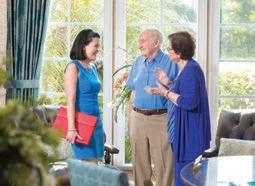
Women live longer than men, typically 5 to 7 years more. And women prefer to age in place in their own homes as they grow older. Check out our useful articles and features in this issue starting on
MAY 2026 contents departments
Sarasota’s mural arts program
Notice all those colorful murals around downtown Sarasota? They didn’t get there by accident. For now, enjoy our colorful feature on some of the murals also in this issue.
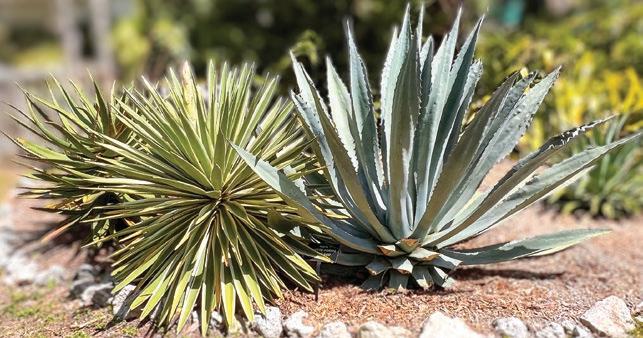
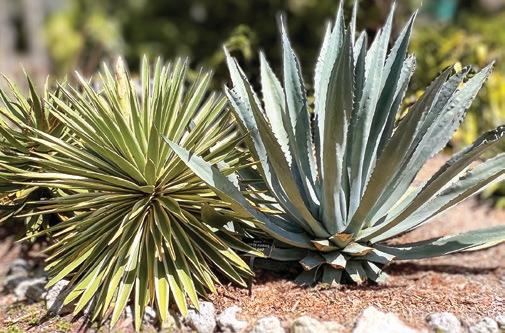
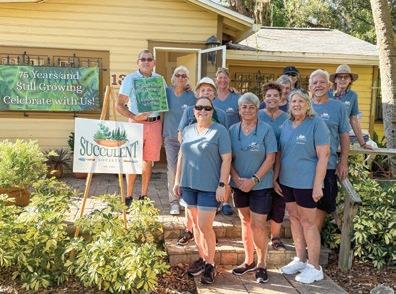
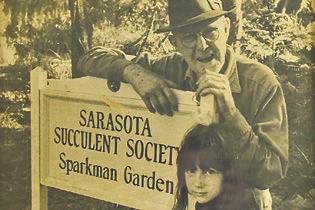
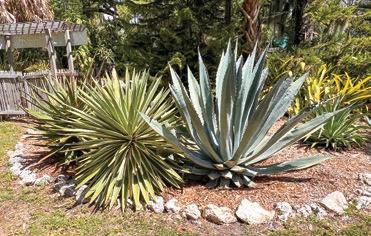
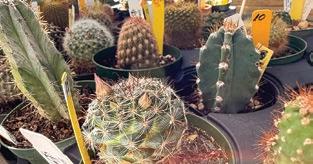
Have you visited yet? Explore dazzling succulents from around the world and they have their big plant sale on May 9 - don’t miss it!
Louise Bruderle Editor and Publisher
just some thoughts
West Coast Woman
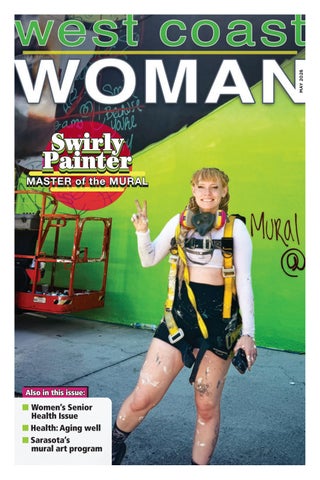
This Month’s profile: Swirly Painter
Sarasota muralist Swirly Painter has been hard at work creating beautiful - and very large - artworks adorning exterior walls throughout the city of Sarasota.
Her most recent murals can be seen in the Rosemary District. I have viewed them several times and they are impressive for their quality, design and, most importantly, story-telling.
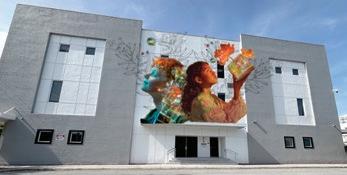
At Sarasota School of Arts and Sciences (SSAS) you’ll see "Creative Seeds”, her most recent work that’s on the north exterior wall of the SSAS campus. The mural serves to inspire students to look ahead and use their creativity and imagination with imagery such as seeds, flowers, books, and musical instruments.
On Central Avenue you’ll find the mural Swirly completed of Reverend Lewis and Irene Colson who lived in what was once called Overtown and is now the Rosemary District. Lewis Colson was among Sarasota’s earliest Black and most prominent settlers. Their graves lie nearby in Rosemary Cemetery.
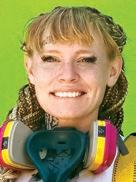
Swirly, aka Kaitlin Ramirez, came to Sarasota in 2020 with the goal of painting full time. She learned her craft studying graffiti artists - not in art school. These two recent works are part of the city of Sarasota’s Public Art Program. Swirly’s also done murals for commercial clients like Toastique, Brewster’s and, prior to last year’s hurricane season, downtown Sarasota’s O’Leary’s. Meeting with her, I had many questions on how she actually gets her art from a digital “sketch” to a wall that is sometimes two stories high. Also amazing, she works by herself and relies on spray cans - not an air brush machine or paint brushes.
Read her profile in this month’s issue and head out to see her work. I went on an early Sunday morning and enjoyed walking the area (and getting a parking space).
Sarasota’s Mural Arts Program
Have you noticed all those colorful murals around downtown Sarasota? They didn’t get there by accident. It was through the hard work of the Public Art Program of the City of Sarasota and its director, Ciera Colman.
She’s the one who works with the artists, scouts locations and supervises installations. She’s backed by a committee and each mural is vetted to make sure it fits in with the city’s vision.
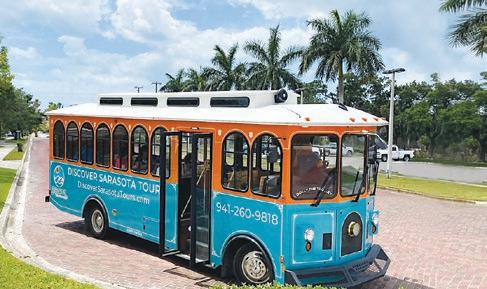
One way to experience the mural art as well as public art in the city, is by hopping on board Discover Sarasota Tours
“Explore Sarasota Art” trolley tour. On their 90-minute tour, you’ll visit more than 50 of the city’s public art sculptures, statuary, and murals in various neighborhoods located in and around downtown Sarasota. www.discoversarasotatours.com/
For now, enjoy our colorful feature on some of the murals also in this issue.
Women’s Senior Living Issue
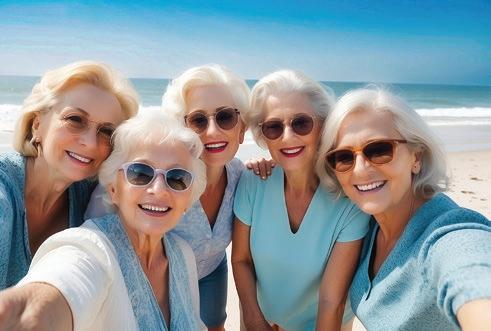
It’s Mothers’ Day in May and we decided it would be great issue to explore the unique needs of women who may be moms and now grand-moms and their unique needs as they get older and seek options for staying active and empowered.
There’ no one-size-fits-all approach. Some women like to stay in their own homes; others due to health concerns, choose one of the many options available in our area from assisted living facilities to nursing care.
And, don’t forget that women are often the ones who care for themselves, but also for their partners with the added responsibility of caring for elderly parents. Why a Women’s Senior Living Issue?
• Women generally live longer than men, with the average lifespan difference ranging from 5 to 7 years.
• Women often take on the majority of caregiving responsibilities for aging partners
• Women are more likely to choose assisted living facilities because they tend to live longer than men, with about 70% of residents being female.
• Women face unique aging challenges, including higher risks of osteoporosis, heart disease, and Alzheimer’s
• Women, like most older adults, often prefer to age in place, with nearly 90% expressing a desire to remain in their own homes as they grow older
Congratulations Herrig Center
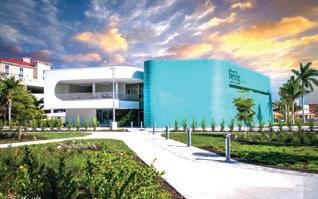
On March 30, Herrig Center for the ARTS CEO Carla Nierman, alongside Rob Moran, Herrig Center for the ARTS Board President, Linda Enberg, Capital Campaign Board Chair, Steve & Natalee Herrig, Mayor Gene Brown and Brando Fetzek, cut the ceremonial blue ribbon marking the grand opening of the newly constructed Herrig Center for the ARTS.
“The journey to this day has been remarkable – and what a beautiful outcome it has been,” said Carla Nierman, CEO of The Herrig. “From the very beginning, we set out with a bold vision: to create an iconic building that would transform the landscape of downtown Bradenton. Today, standing here together, we can proudly say that vision has been realized,” she said at the event.
Following an 18-month transformation, the reimagined center features nine state-of-the-art classrooms, three expansive gallery spaces, and expanded programming for artists and art lovers of all ages.
I wasn’t able to make the ceremony but have toured the new Center - it is really striking on the outside and very beautiful inside. It was recognized even before its completion with pre-construction design awards. It’s also a great boost to downtown Bradenton.
Visit them at 888 3rd Ave W., Bradenton. www.herrigcenter.org.
Louise Bruderle | Editor and Publisher | westcoastwoman@comcast.net
We welcome your thoughts and comments on this column and on other columns and features in this issue. You can reach us at westcoastwoman@comcast.net. We’re on the web at www.WestCoastWoman.com.
Swirly Painter Image: Louise Bruderle
The Creative Seeds mural at Sarasota School of Arts and Sciences
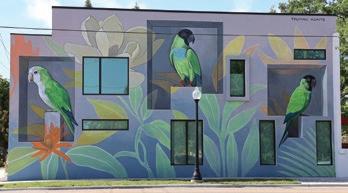
Niche ArT by Truman Adams
dining in
This burgundy-red, mildly chocolate layer cake, much in demand from the 1940s through the 1960s, has made a 21stcentury comeback.
INGREDIENTS : Cake
8 tablespoons unsalted butter, at room temperature, at least 65°F
1-1/3 cups granulated sugar
Make your someone special a beautiful cake on May 10
2 large eggs, at room temperature
2 tablespoons liquid red food color
3 tablespoons Dutch-process cocoa
1 teaspoon table salt
1 teaspoon baking soda
1 teaspoon cider vinegar or white vinegar
2-1/4 cups Unbleached All-Purpose Flour
1 cup buttermilk, or low-fat plain (not Greek) yogurt, at room temperature
INSTRUCTIONS :
Frosting
8 tablespoons unsalted butter, softened*
1/2 cup vegetable shortening*
scant 1/4 teaspoon table salt
2 tablespoons meringue powder, optional, for a smoother icing that holds its shape a bit better
6 cups confectioners' sugar
3 tablespoons (milk, or enough to make a spreadable frosting
2 teaspoons Vanilla Extract
*Or substitute an additional 8 tablespoons butter for the shortening.
To make the cake: Preheat oven to 350°F. Lightly grease two 8" pans, then line bottom with parchment rounds, and lightly grease parchment, too.
Beat butter and sugar until well combined. Add eggs one at a time, beating after each addition.
Stir in food color, cocoa, salt, baking soda, and vinegar.
Beat in flour alternately with the buttermilk or yogurt, beginning and ending with the flour. Keep the mixture smooth, which is more easily accomplished if you add the flour and yogurt in portions.
Scoop stiff batter into pans; wet a rubber spatula, and spread to cover bottom of the pans, smoothing the top a bit in the process.
Bake cakes 25-30 minutes, until tops feel set and a cake tester inserted into the center comes out clean.
Remove cakes from the oven, and allow to cool for 10 minutes before turning them out of the pans onto a rack to cool.
For frosting: Beat together butter and shortening until fluffy. Stir in salt, meringue powder, and vanilla.
Add confectioners' or glazing sugar and milk, and beat thoroughly.
Scrape the sides and bottom of the bowl. Adjust consistency of the frosting as needed by adding more sugar or milk. When cake is cool, slice each layer horizontally, to make a total of four layers. Spread each layer with frosting, stacking them as you go.
This old-fashioned chocolate sheet cake is incredibly moist, and can be stirred together by hand if need be. The fudge frosting is also stir-together simple, and creates a thick layer on top. You can line the pan with parchment or foil before baking, grease it, and lift the cake out of the pan once it's cool before frosting. This makes cutting the cake easier to do, and individual portions nestle nicely into muffin papers.
INGREDIENTS : Cake
16 tablespoons unsalted butter, cold
1/2 cup unsweetened cocoa, Dutchprocess or natural
1 cup water, hot
2 cups Unbleached All-Purpose Flour
2 cups granulated sugar
1 teaspoon baking soda
1/2 teaspoon table salt
1/2 cup buttermilk or yogurt, at room temperature
INSTRUCTIONS :
This sweet potato sheet cake is not just for Thanksgiving. Adding puréed sweet potato to the batter yields an incredibly tender cake, and a touch of cardamom and cinnamon brings warm, cozy flavor. Add swoops of brûléed, fluffy meringue that deliver all the sweet satisfaction of toasted marshmallow.
2 large eggs, yolks separated from whites, at room temperature
INSTRUCTIONS :
1 teaspoon Vanilla Extract
6 drops yellow natural food coloring, optional
4 drops red natural food coloring, optional
Marshmallow
Frosting
1-1/4 cups granulated sugar
6 large egg whites, room temperature
1 tablespoon Vanilla Extract
1/2 teaspoon table salt
1/8 teaspoon cream of tartar or lemon juice
Nut topping (optional) 1/4 cup pecans or walnuts, diced; toasted Yields one 9" x 13" cake
To make sweet potato purée: Preheat the oven to 400°F with one rack in the middle and one in the upper third. Using a paring knife or fork, pierce sweet potatoes several times. Place on a baking sheet lined with parchment or foil and bake for 45-60 minutes, until tender. Carefully slice baked potatoes in half lengthwise and set aside until cool. Reduce oven temperature to 350°F.
Remove skin from sweet potatoes and transfer flesh to a food processor. Add water and process until smooth, @1 minute. Pause food processor and scrape bowl so mixture is combined. Measure 1 3/4 cups of purée for use in the recipe and set aside.
Lightly grease 9" x 13" pan. Line with a parchment sling and lightly grease the parchment. In a medium bowl, whisk together flour, baking powder, baking soda, spices, and salt. Set aside.
In a large bowl, place melted butter. Whisk in sugar until well combined, then add sweet potato purée. Whisk until well combined.
Add orange juice, egg yolks, vanilla, and food coloring, and whisk until well combined. Add the ingredients to wet ingredients in two additions, using a spatula to fold the thick batter together gently after each addition.
2 large eggs, at room temperature
1 teaspoon Vanilla Extract
Frosting
8 tablespoons unsalted butter
1/4 cup unsweetened cocoa, Dutch-process or natural
6 tablespoons buttermilk or yogurt
4 cups confectioners' sugar Makes one 9" x 13" cake
Preheat the oven to 350°F. Grease and flour a 9" x 13" pan.
To make the cake: Melt butter; stir in cocoa and hot water. In a separate bowl, combine flour, sugar, soda, and salt.
Pour cocoa mixture over dry ingredients, stirring to blend. Beat in buttermilk or yogurt, eggs, and vanilla. Pour batter into the prepared pan.
Bake cake for 30 minutes, or until it tests done. You'll smell the chocolate aroma, and the cake will begin to pull away from the edge of the pan. Remove the cake from the oven and cool it on a rack.
To make frosting: Melt butter in a medium-sized saucepan. Stir in cocoa and buttermilk or yogurt. Bring mixture to a boil, then remove from the heat and mix in confectioners' sugar, beating until smooth.
Pour frosting over cake while frosting still warm. Serve cake right from the pan.
In a small bowl, vigorously whisk egg whites until foamy; no liquid egg should remain at the bottom of the bowl. Gently fold the beaten egg whites into the batter until well combined and no streaks of egg white are visible.
Transfer batter to the prepared pan and spread it into an even layer. Bake sweet potato sheet cake on the middle rack for 35-40 minutes, or until knife comes out clean and the top feels set. Remove cake from the oven and let cool on a rack for 30 minutes. Use parchment sling to carefully transfer the cake from the pan to a rack to cool completely.
To make marshmallow topping: In a large heatproof mixing bowl or the bowl of a stand mixer, whisk together sugar, egg whites, vanilla, salt, and cream of tartar or lemon juice until combined. Place bowl over a saucepan of simmering water and whisk constantly until mixture measures 161°F on a digital thermometer, 5-10 minutes. The egg whites will be very warm to the touch, and the sugar should be fully dissolved. (Test to see if the sugar is fully dissolved by dipping your fingertip into the mixture and then rubbing your fingertips together; you should not be able to feel any grains of sugar.) Remove the bowl from the heat and beat the mixture using whisk attachment until stiff peaks form, 10-13 minutes on medium-high speed.
To assemble sweet potato sheet cake: Transfer marshmallow topping to top of cake. Use the back of a spoon to spread it evenly over the top, creating decorative swirls. Toast the marshmallow topping with a baker's torch or carefully broil the cake in the upper third of the oven until the edges of the topping are golden brown. (If broiling, watch the cake carefully: It can burn quickly) Sprinkle with toasted nuts and serve.
For the best results, take the time to make your sweet potato purée from scratch, as directed, and avoid using a canned product in this recipe.
• Serving fewer people? Make a smaller 8" square cake by halving all the ingredients in the recipe. Prepare the batter as described and bake it in a parchment-lined 8" square pan for 25-30 minutes. The marshmallow topping will take about half the time to heat to the proper temperature and whip to stiff peaks.
Sweet Potato Sheet Cake with Marshmallow Frosting
Sweet Potato Sheet Cake with Marshmallow Frosting
Red Velvet Cake Red Velvet Cake
Fudge Cake Fudge Cake
out & about
Artist Series Concerts of Sarasota
▼ They have Baroque Treasures on Mother’s Day, May 10, 4 pm at First Presbyterian Church featuring Bobby Nunes, oboe and Phoebe Powell, harp, bringing the spotlight to the sounds of these ancient instruments.
Nunes and Powell will each perform a concerto for their instrument by baroque master G.F. Handel, accompanied by special guests Paolo Bordignon, harpsichord; Katherine Baloff, violin; Leah Latorraca, violin; Stephanie Block, viola; David Bender, cello; and John Miller, bass. Bordignon is harpsichordist of the New York Philharmonic, and organist/choirmaster of St. Bartholomew’s Church, Park Avenue.
He has performed organ recitals at venues such as St. Thomas Church Fifth Avenue (New York) and St. Eustache (Paris) and has been a frequent recitalist at the Metropolitan Museum of Art. The concert will begin with Bordignon performing Bach’s Prelude and Fugue in C-sharp minor from “WellTempered Clavier,” and “Eighteenth Order” by Francois Couperin. Nunes and Powell together will perform Debussy’s Album of Five Pieces for Oboe and Harp.
For tickets, visit ArtistSeriesConcerts.org or call (941) 306-1202
Bookstore1 Events
▼ Best of the Backlist Book Club:
“The Shipping News” by Annie Proulx is on May 18, 2-3. Led by Georgia Court, this book club reads what lasts, not just the latest. This month: a magical portrait of the North American family.
The Shipping News by Annie Proulx is a darkly funny, salt-soaked tale of loss, renewal, and the strange ways people find their way home.
After his wife’s death, hapless newspaperman Quoyle relocates with his daughters to the stark coast of Newfoundland, where rough weather and rougter locals teach him how to begin again. Winner of both the Pulitzer Prize and the National Book Award, Proulx’s novel is an unforgettable portrait of resilience and reinvention.
Location: The Mark, 117 S. Pineapple Ave. The book club is $18.99, which includes a copy of The Shipping News to be picked up at Bookstore1 any time before meeting.
The Banned Book Club has “Dreaming in Cuban” by Cristina Garcia on May 26 from 11 am to 12 pm . A novel often challenged for its politics and sexuality, exploring exile, memory, and three generations of women divided by revolution.
The Banned Book Club is led by Bryn, dedicated to reading and protecting the most important and threatened books for our generation.
Dreaming in Cuban by Cristina García is a lyrical, multigenerational novel about exile, memory, and the ways history fractures a family across borders. Moving between Cuba and the United States, García traces three generations of women whose loyalties, longings, and identities are shaped by revolution and distance.
The novel has been removed from curricula for its depictions of sexuality, political critique, and its frank portrayal of Cuban identity.
Location: The Mark, 117 S. Pineapple Ave. The book club is $18, which includes a copy of Dreaming
in Cuban to be picked up at Bookstore1 any time before meeting. Visit www. sarasotabooks. com/
Contemporary Dance
▼ Sarasota Contemporary Dance’s SCD + WBTT May 15-16 the Manatee Performing Arts Center. Ending their season, they have West Coast Black Theater Troupe collaboration of a spirit-filled song and dance experience highlighting Gospel and Motown favorites. Directors Nate Jacobs and Leymis Bolaños Wilmott shared the vision of coming together for a production, and this is the result of that encounter.
At the Galleries
Tickets: www.sarasotacontemporarydance.org or call 941-260-8485
Ensemble SRQ
▼ On May 22, 7:30 p.m. they’ll have Matthew Aucoin’s “Music for New Bodies” created in collaboration with director Peter Sellars. It’s a bold operatic meditation on humanity’s shifting place in the natural world.
Premiered in 2024, this one-act visionary operetta fuses the poetic texts of Jorie Graham with visceral soundscapes for five singers, an 18-piece chamber orchestra, lighting, and electronics.
Aucoin crafts a work that is at once urgent and transcendent, while Sellars’ visionary staging brings the music into striking visual focus. Presented in a historic collaboration with Artist Series Concerts, this Sarasota premiere at the Sarasota Opera House invites audiences to imagine new forms of life, connection, and transformation.
For tickets, visit www.EnSRQ.org
At Fogartyville
▼ Fogartyville has TAE & The Neighborly on May 10, 7 p.m. Hailing from Green Bay, Wisconsin, TAE & The Neighborly seamlessly blends the best of soul, R&B, pop, and rock through vibrant instrumentation and TAE’s unforgettable vocals.
Reggie “King” Sears is on May 23. King Sears is a Contemporary R&B vocalist, producer, and songwriter whose work centers on voice, authorship, and modern Southern Black storytelling. A singer-producer at his core, Sears builds records from the ground up with a studio-driven approach that prioritizes vocal performance, emotional realism, and rhythmic authority. His sound exists at the intersection of Contemporary R&B, Neo-Soul, Dirty South Hip Hop, Gospel-rooted vocal tradition, Pop songwriting mechanics, and modern Southern Soul culture — a Southern ecosystem he formalized and named Ghetto Soul. Visit www.wslr.org/fogartyville
▼ “Now You See Us,” an art display by the Petticoat Painters , has all-new artwork. The updated exhibit features 46 new artworks throughout the lobby at City Hall, 1565 First Street. The Petticoat Painters, an all-female art group founded in 1953, is one of the oldest continuously exhibiting women’s art groups in the country. The collective was formed at a time when women struggled to find venues to display their art, seeking to showcase the talents of female artists despite the challenges of the time. From their first show, held at a local Sarasota gallery, through today, the Petticoat Painters provide a platform for women to display and be celebrated for their artwork.
The refreshed “Now You See Us” exhibit is free and open for public viewing at City Hall during regular business hours: 8 a.m. to 5 p.m., Monday-Friday Information: visit sarasotafl.gov/PublicArt
▼ At Art Center Sarasota: On View : to May 9 North Sarasota County Schools Spring Art Show:
The Spring Art Show is a testament to the creativity, imagination, and dedication of students across Sarasota’s northern region, including public and charter schools. For many, it offers a first opportunity to exhibit their work in a professional gallery setting—an empowering experience that draws hundreds of family members, educators, and community supporters.
A highlight of the exhibition is the high school awards ceremony, where local organizations generously contribute over $20,000 in scholarships and prizes. Elementary students are also celebrated with two evening award ceremonies that honor their artistic accomplishments.
May 21 - August 1, 2026, Anja Palombo: Architects Who Art: Designing the Cultural Coast.
Location: 707 N. Tamiami Trail, Sarasota. Info: www.artsarasota.org
▼ At SPAACES: The Body, Space, and Acts of Transformation is a small group exhibition with local visual artists and performers running through May 16
Object/Subject: The Body, Space, and Acts of Transformation is a multimedia exhibition featuring painting, drawing, video, sound, and immersive installations. The featured works explore the relationship between body, space, and identity—examining how physical presence, gesture, and objecthood can be used to reclaim space and challenge social constructs. Across diverse media, the artists investigate the tension between appearance and meaning, perception and empowerment, ultimately positioning creative expression as a catalyst for reclaiming agency, reshaping community, and imagining transformative futures. SPAACES, 2051 Princeton St., Sarasota. Tickets: www.spaaces.art/
▼ Sarasota Art Museum of Ringling College of Art and Design (SAM) has these exhibits:
Jillian Mayer: Slumpies to August 19. Mayer explores our ever-increasing relationship with technology and the impact device usage has on our bodies through her interactive sculpture series, Slumpies. Slumpies invites viewers to sit, climb, slump and curl up, using the sculptures much like furniture. In doing so, visitors explore how Mayer’s objects provide support for the various postures we assume while using technology.
The 2025-2026 Season will come to a close with Beautiful Ideas: The Prints of Sol LeWitt, opening May 17, 2026. Regarded as one of the founders of both minimalism and conceptual art, Sol LeWitt (19282007) generated more than 350 print projects during his 40-year artistic career. This exhibition, organized by the New Britain Museum of American Art, features over 100 of those prints, beginning with LeWitt’s earliest works and extending through his mature expressions in abstraction.
Beautiful Ideas: The Prints of Sol LeWitt May 17-October 25, 2026 Regarded as one of the founders of both minimalism and conceptual art, Sol LeWitt (1928-2007) is best known for his large-scale wall drawings and modular structures. Alongside these works, LeWitt generated more than 350 print projects during his 40-year artistic
career, including thousands of lithographs, silkscreens, etchings, aquatints, woodcuts and linocuts. Printmaking proved to be the perfect medium for LeWitt’s brand of conceptual art, in which the “idea becomes a machine that makes the art.” Beautiful Ideas: The Prints of Sol LeWitt is organized in four thematic sections— “Lines, Arcs, Circles, and Grids,” “Bands and Colors,” “From Geometric Figures to Complex Forms,” and “Wavy, Curvy, Loopy Doopy, and in All Directions”—the exhibition reflects the bold geometric shapes and precise lines that defined LeWitt’s artistic style.
Something Borrowed, Something New features works by such modern and contemporary Louise Bourgeois, Chuck Close, Yoko Ono, David Hockney, Ai Weiwei and more, this never-before-seen exhibition offers a rare glimpse into private collections held throughout Southwest Florida. From paintings, sculptures and prints to photographs and video works, Something Borrowed, Something New showcases a diverse range of artworks produced by some of the most prominent artists of our time. Complementing these borrowed selections, this show also features exciting new pieces and creates a dialogue between the works of late 20th-century trailblazers and today’s leading global artists. Together, this curation celebrates our region’s passion for the visual arts with extraordinary artworks never to be exhibited sideby-side again.
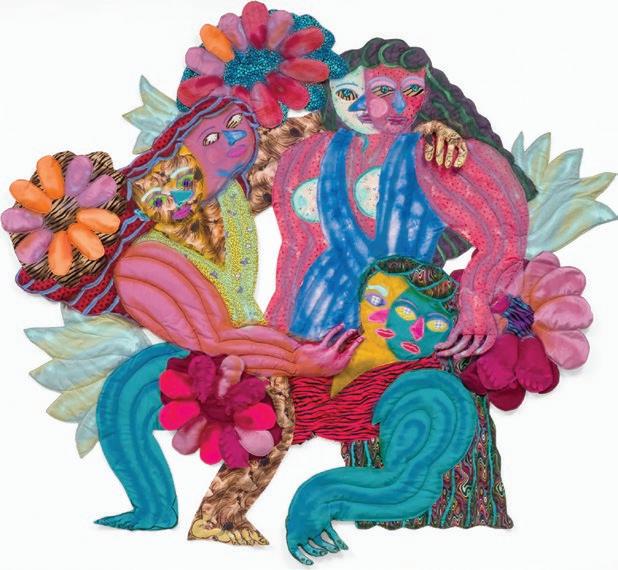
Maria A. Guzmán Capron: New Works to September 27, 2026 Maria explores the complexities of identity through her vibrant figurative textiles in a new solo exhibition. Born in Milan, Italy, to Peruvian and Colombian parents and later relocating to Texas as a teenager, the California-based artist understands first-hand the challenges of toggling between different cultures and geographies. Capron channels these personal experiences into her artwork, creating layered portraits of exuberant, multi-faceted characters. Common materials like cotton join with luxurious fabrics such as silk to explore power dynamics and hierarchies within society today. Through her use of various fabrics, Capron asks viewers to consider the way our own identities have been stitched together over time— beautiful, ever-evolving collages of ancestry, culture and life experiences. Capron’s plush, flowing figures merge, embrace and spill into one another, inviting us to recognize ourselves in others, see others within ourselves, and find comfort and beauty in being “in between.”
Info: https://www.sarasotaartmuseum.org
▼ Sarasota Orchestra’s Harmony Gallery has its Booker High school student exhibition to May 15 Booker High School is home to the Visual and Performing Arts (VPA) program, which offers pre-professional training in the arts in five disciplines: Dance, Digital Film & Motion Design, Music, Theatre, and Visual Art.
In collaboration with Sarasota Orchestra, Booker VPA visual art students will present a collection of
Maria A. Guzmán has Capron: New Works September 27, 2026 at Sarasota Art Museum
two-dimensional artwork from various genres. The Harmony Gallery is located at 709 North Tamiami Trail, Sarasota.
▼ The Arts Advocates’ collection of Sarasota Art Colony and Florida Highwaymen works is on permanent display in the Arts Advocates Gallery, which is open every Saturday from 2-4 p.m. Admission is free. To register, visit ArtsAdvocates.org
▼ Art Ovation Hotel is showing six sculptures in the main lobby until May 31
• On exhibit: PICARDO running through May. He’s an AfroCaribbean artist whose vibrant murals and live painting performances breathe life into walls and public spaces. For over two decades, his art has woven together tradition and modernity, transforming places like the Grand Rapids Children’s Museum and Miami’s cultural scene into dynamic stories of identity and community.
• THE FLAG runs to May. The American flag occupies a unique position in the national consciousness—simultaneously universal and deeply personal. This exhibition brings together works by nine artists who engage with this iconic symbol through diverse visual languages and material approaches, revealing the multifaceted ways contemporary Americans relate to their flag.
• MIMI LEONE runs to May. Miyoun (Mimi) is a Korean-born painter whose work seeks beauty beyond the surface—beauty that heals, uplifts, and connects. Drawing from both Asian and Western traditions, her visual language blends the stillness and simplicity of Eastern art with the emotional freedom and boldness of the West.
• JOHN MCCASKILL runs to May. McCaskill is a celebrated mixed-media artist and master printmaker based in St. Pete Beach, Florida. Blending traditional printmaking with painting and contemporary design, his work reflects a lifelong dedication to creative exploration and craftsmanship.
• PAMELA OLIN runs to May. Olin transforms industrial materials like steel into deeply emotional and contemplative sculptures. With over 30 years of experience, she explores the relationship between raw material, human emotion, and craftsmanship, creating works that invite viewers to engage in a delicate dialogue between light and shadow, strength and vulnerability. They’re located at 1255 N Palm Ave., Sarasota. Visit www.art.artovationhotel.com
At The Hermitage
▼ The Hermitage Artist Retreat has a new program on May 6 as part of its Hermitage Sunsets @ Selby Gardens: “The New Generation of Musical Theater,” featuring two writers and performers. Adam Chanler-Berat, a celebrated Broadway and television actor as well as a playwright, is known for originating leading roles in Next to Normal, Peter and the Starcatcher, and Amélie, as well as appearing as Jordan Glassberg on HBO’s Gossip Girl. Returning Hermitage Fellow Julian Hornik has developed work with Academy Award-winning Hermitage Fellow Mark Sonnenblick and is a recipient of the Jonathan Larson Grant from the American Theatre Wing. These two talents are frequent collaborators and rising
stars in the New York musical theater world.
They are at the Hermitage developing a new musical together. Join them for this program and hear these artists talk about their creative process and share original songs Hermitage programs are free and open to the public (with a $5/person registration fee). Due to capacity limitations, registration is required at HermitageArtistRetreat.org
Key Chorale
▼ The season concludes on May 10 with Beethoven’s “Ode to Joy.” Like a thunderbolt, the finale to Beethoven’s immortal Ninth Symphony was unleashed into the world. 200 years later it has become an anthem for unity and joy. Beethoven’s uplifting Choral Fantasy, featuring soloist Glenn Priest, and his rarely performed Calm Sea and Prosperous Voyage round out a season finale showcasing music by classical music’s most well-known rebel.
Visit www.keychorale.org or call (941) 552-8768
Outdoors
▼ May 16—Rain Barrel Workshop
Learn how the use of rain barrels can conserve water, save money by reducing the use of potable water in landscapes (lower utility bills), and reduce stormwater runoff by storing and diverting runoff from impervious surfaces (like roofs).
Practical tips on the construction and installation of rain barrels will be provided. After the workshop, there’s a Q/A session with the instructor, a Florida-Friendly Landscaping community educator, and a Sarasota County Air & Water Quality representative. Register for this event ONLY at ufsarasotaext.eventbrite.com. Each rain barrel is made of recycled, food grade-plastic barrel, holds up to 55 gallons, and measures 2 feet in diameter and 3 feet tall. Barrels ordered prior to the workshop will be available for pickup until 11:30 a.m. the day of the workshop. For questions or further information, call 941-861-5000 or email sarasota@ifas.ufl.edu
May 17—Clothing Swap To Save The Drops! Bring donated clothing items to participate in the Clothing Swap to Save the Drops! All ages welcome. Did you know it takes over 2,000 gallons of water to produce just one pair of jeans? Fast fashion has a major impact on our planet, especially our water resources. Join UF/IFAS Extension Sarasota County for a Clothing Swap that helps you reduce your water footprint while refreshing your wardrobe. Bring your clean, gently used clothing items to trade with others in the community. It’s a fun, eco-friendly way to save money, reduce waste, and conserve water. Drop clothes off at the front counter to be sorted “Shop” for new-to-you pieces brought by others Discover sustainable fashion tips from UF/IFAS educators. 2-4 p.m. Clothes drop off beginning at 1 p.m. at UF/IFAS Extension Sarasota County Office, Twin Lakes Park, 6600 Clark Road, Sarasota. For questions or further information, call 941-861-5000 or email sarasota@ifas.ufl.edu Register: www.eventbrite.com/e/ 517-clothing-swap
May 18 - Demonstration Garden Tour at Twin Lakes Park 10 a.m. to noon . Join Sarasota County Master Gardener Volunteers the third Monday of the third Monday
On May 22
Ensemble SRQ has Matthew Aucoin’s “Music for New Bodies” created in collaboration with director Peter Sellars Visit www. EnSRQ.org
of every month for a free tour of the demonstration garden at Twin Lakes Park in Sarasota. The garden integrates beautifully into the natural environment, using Florida-Friendly Landscaping techniques that you can adopt for your home or business landscape. There is no charge for this tour, but register at ufsarasotaext.eventbrite. com to RSVP and receive notice of any changes. For questions or further information, call 941-861-9901 or email sarasota@ifas.ufl.edu
May 20—Florida-Friendly Landscaping: Planting For The Bees. 9-10 a.m. Learn how to landscape for, attract and identify bees found on the Florida Suncoast. Then learn about what plants you can place in your landscape to help them thrive. Register for this event at ufsarasotaext.eventbrite.com
INSTRUCTOR : Forest Hecker, Florida-Friendly Landscaping Specialist, Sarasota County. For questions or further information, p call 941-861-5000 or email sarasota @ifas.ufl.edu
May 21—Meditation In The Parks - Urfer Family Park, 9-10 a.m. Meet next to historic Dr.’s house adjacent to bathrooms. Join in for a contemplative walk where you can practice mindfulness, breathwork, and using all the senses to connect with nature. Marvel at one of Sarasota County’s natural areas during a mostly silent, meditative walk. In studies conducted around the world, researchers have found an association between spending time in nature and positive benefits to mental and physical health. Join a UF/IFAS Extension Sarasota County educator for an exploration of finding peace within nature and get healthier along the way. Register at ufsarasotaext.event brite.com . No prior experience needed. Recommended to wear comfortable, loose clothing and bring water and a portable chair or blanket to sit upon. For questions or further information, call 941-861-5000 or email sarasota@ifas.ufl.edu
May 25—EcoWalk: Unique Preserves Of Sarasota CountyLemon Bay Park. 9-11 a.m. Meet at Environmental Center. Join in to learn more about amazing and unique Florida ecosystems. Take a leisurely stroll through beautiful and environmentally sensitive lands that have been preserved in Sarasota County and learn more
about what makes these areas so unique and important, the plants and animals that inhabit them, how to be watershed wise, and the management issues faced when trying to preserve these lands for future generations. Register at ufsarasotaext. eventbrite.com
For questions or further information, call 941-861-9900 or email sarasota@ifas.ufl.edu
May 27—Demonstration Garden Tour: Visitor Center At Osprey Junction Trailhead 9:30 -10:30 a.m.
Join Sarasota County Master Gardener Volunteers the fourth Wednesday of the month to explore the Florida-friendly gardens at Sarasota County’s Osprey Junction Trailhead Visitor Center.
The garden integrates beautifully into the natural environment, using Florida-Friendly Landscaping techniques that you can adopt for your home or business landscape. There is no charge for this tour, but register at ufsarasotaext.eventbrite. com to RSVP and receive notice of any changes.
For questions or further information, call 941-861-9901 or email sarasota@ifas.ufl.edu
The Pops Orchestra
▼ They have Organ-ized Pipes & Pops on May 2 at SCF Neel Performing Arts Center. Enjoy the majestic sounds of the Elizabeth M. Eaton Memorial Pipe Organ.
The organ, installed in the SCF Neel Performing Arts Center, will be on full display for this performance of orchestra and organ music. Featuring local acclaimed organists and the Pops Orchestra, this concert will delight all who have asked to hear this amazing instrument. Tickets: www.thepopsorchestra.org
At The Ringling
▼ The John and Mable Ringling Museum of Art has:
Juana Romani: Forgotten No More to May 31, 2026. This small exhibition, drawn from The Ringling’s permanent collections, highlights the newly acquired painting by Juana Romani, Woman on a Red Background, and situates it within a group of closely related works from the museum’s collection of late-nineteenth-century French art.
The Ringling has In the Flesh: The Nude in Modern Japan, on
view to August 23, in the recently dedicated Charles and Robyn Citrin Gallery, named after long-time generous museum patrons. Spanning from the 1920s to the 1980s, the exhibition features prints and a magnificent painting by Ishikawa Toraji, exploring how Japanese artists reimagined the nude over the twentieth century.
Almost all of the works are images of women, reflecting the conventions of the genre, as well as the preferences of male artists and their audience. The assimilation of the modernnude into the Japanese canon is distinct in Japan, where, historically, representations of nudity had been largely limited to pornographic prints that flourished during the Edo period (1615–1868). However, in modern Japan, the artistic merit of the nude gained respectability and entered the repertoire of Westernand Japanese-style painting, printmaking, sculpture, and beyond.
In the exhibition’s singular painting, Before the Mirror (1935), by Is hikawa Toraji, the subject’s bobbed hairstyle, the fashionably bohemian interior she inhabits, and her cool, self-appraising gaze mark her as a “modern girl,” or moga—Japan’s version of the flapper in the 1920s and 1930s.
Shin hanga (New Prints) artists of the 1920s–30s, almost exclusively male, drew from the themes and sensibilities of eighteenth- to nineteenth-century ukiyo-e, catering largely to Western audiences. While artists like Torii Kotondo created serene images of demure young women, Ishikawa Toraji’s racy paintings and prints of confident “modern girls” tested the limits of decorum. In the postwar era, life drawing sessions invited new explorations of form and surface texture in the work of Saitˉo Kiyoshi, while Maekawa Senpan reclaimed the nude in a multi-series ode to Japan’s hot spring resorts.
Finally, Kobayashi Donge reprised the femme fatale Salome as a symbol of female desire and agency during the rise of the postwar feminism movement.
Tickets: ringling.org The John and Mable Ringling Museum of Art, 5401 Bay Shore Rd., Sarasota.
The Sarasota Ballet
▼ Foundations of Royalty is on May 1-2 Program Seven presents a triple bill of masterpieces by choreographers Sir Frederick Ashton, Dame Ninette de Valois, and Sir Peter Wright. Sir Frederick Ashton’s Birthday Offering opens the Program.
Created in 1956 to celebrate The Royal Ballet’s 25th Anniversary, Ashton choreographed the piece on the company’s seven legendary ballerinas. A grand, sumptuous affair, Birthday Offering takes seven couples through a series of variations set to Alexander Glazunov’s music, arranged by Robert Irving, culminating in an ensemble waltz. The Program continues with Checkmate, presented in honor of Dame Ninette de Valois, founder of The Royal Ballet, marking the 25th anniversary of her passing. Checkmate is regarded as the cornerstone of British ballet and is an example of de Valois’s dramatic choreography.
The ballet brings a chess game to life, infusing the pieces with human emotion. As the ballet unfolds, the ruthless Black Queen hunts her prey—the aging Red King—in a gripping battle of power and fate. A breathtaking end to the
out and about continued
Program is Wright’s Summertide, which will celebrate the choreographer’s 100th birthday as of November 25, 2026. An abstract expression of Felix Mendelssohn’s Piano Concerto No. 2, this work captures the brilliance of a radiant day in a one-act ballet.
Choreographed in 1976 for the Sadler’s Wells Royal Ballet, with the principal role created for The Sarasota Ballet’s very own Margaret Barbieri, Summertide found a perfect home in Sarasota with its 2015 revival.
Info: www.sarasotaballet.org
Sarasota Opera
▼ Area residents and visitors can once again enjoy Sarasota Opera productions outdoors as Sarasota Opera and The Bay partner to present Opera at The Bay, a free series of recorded opera screenings at The Bay Park in downtown Sarasota. Opera at The Bay brings Sarasota Opera’s 2026 Winter Festival to the bayfront through large screen presentations with English surtitles, offering audiences the chance to experience these world-class productions in a relaxed and welcoming open air setting. All screenings are free, and attendees are encouraged to bring lawn chairs or blankets to ensure a comfortable seat on the green space. Register for one or more of the screenings at: Opera at the Bay: Il trovatore May 2, 7:05–9:30 p.m.
Verdi’s dramatic masterpiece is filled with serenades, sieges, and family secrets in 15th century Spain. Count di Luna’s quest for vengeance, fueled by a mysterious childhood event, entangles the fates of Leonora, Manrico, and Azucena in one of opera’s most gripping and passionate works. Register: Opera at The Bay Finale: Il trovatore Tickets, Saturday, May 2 from 7:05 pm to 9:35 pm RSVP: Eventbrite
Sarasota Orchestra
▼ The Discoveries series features bite-sized programs delighting both devotees and newcomers to great chamber orchestra repertoire. The series concludes with a powerful finale pairing Schubert’s famed “Unfinished” Symphony with works by Haydn and Julia Perry. Discoveries performances take place at the Sarasota Opera House.
Unfinished Business – May 16 with Giancarlo Guerrero, conductor. Program: Schubert – Symphony No. 8 (Unfinished); Perry – Short Piece for Orchestra and Haydn –Symphony No. 45 (Farewell).
Great Escapes is one of Sarasota Orchestra’s most popular series, offering a diverse mix of fan-favorite tunes, light classics and conductor commentary at Holley Hall. Starry Night is on May 6-9 with Christopher Confessore, conductor. For information, visit www.sarasota orchestra.org
At Selby Gardens
▼ Robert Louis Stevenson: A Child’s Garden of Verses runs to August 30, 2026 at the Historic Spanish Point campus. The exhibit celebrates childhood and the imagination of youth through the words and images of A Child’s Garden of Verses, the beloved book of poetry for children by the celebrated Scottish writer, Robert Louis Stevenson. The exhibition has photographs of
lives. From the epic storytelling of “American Pie” to the carefree whistle of “Don’t Worry, Be Happy,” this revue shines a light on the artists who left a lasting mark on popular culture.
Birthday Candles, an exploration of what makes a meaningful life.
Written by Noah Haidle, this portrait closes FST’s Winter Mainstage Series with warmth and reflection. Performances running through May 17, in FST’s Gompertz Theatre. In this Broadway play, Ernestine Ashworth spends her 17th birthday agonizing over her insignificance in the universe. Soon enough, it’s her 18th birthday. Even sooner, her 41st. Her 70th. Her 107th. Five generations, an infinity of dreams, and one cake baked over a century. Variety calls this journey “a true gift” and “a bold reminder to live each day with zest and adventure.” BroadwayWorld hails the show as “tender” and “timeless” while the New York Post declares it’s filled with “tremendous humor and energy.”
Experience the timeless story of Birthday Candles to May 17
pages from a vintage edition of the book, combining Stevenson’s poetry with illustrations by the notable American artist, Alexander Dobkin Accompanying the photographs are simple interactives that draw their inspiration from Stevenson’s poems and enhance the visitor experience. An audio element will enable visitors to hear the poems read by Selby Gardens’ artist-in-residence, Patti Smith
Lynn Goldsmith and Patti Smith: Flowers and Friendship runs to September 13, 2026 at the at the Downtown Sarasota campus. The exhibit celebrates the collaboration between two longtime friends, photographer Lynn Goldsmith and singer-songwriter Patti Smith, who is Selby Gardens’ artist in residence.
The exhibition has Goldsmith’s photographs of Smith, past and present, in the Richard and Ellen Sandor Museum of Botany & the Arts. The images offer a portrait of an iconic artist over the course of her career. Supplementing the photographs in the museum is a selection of Goldsmith’s art photographs of flowers set in the gardens of the Downtown Sarasota campus.
Alexander Calder: The Nature of Movement is on view to May 31 at the Downtown Sarasota campus.
The Calder exhibition highlights the artist’s use of abstract forms rooted in nature and emphasize his interest in science and engineering.
The exhibition also explores Calder’s enchantment with the circus, stemming from his studies of performers and animals at the Ringling Bros. and Barnum & Bailey Circus in 1925. Downtown Sarasota Campus, 1534 Mound Street Sarasota.
Info: 941-366-5731
Historic Spanish Point Campus, 401 North Tamiami Trail, Osprey. Info: 941-366-5731
Special Events
▼ Uncover the daily life, architectural detail, and lasting legacy of the Ringlings and Sarasota in this guided experience through Ca’ d’Zan . This tour includes the primary rooms on the first floor and select spaces on the 2nd and 3rd floors of The Ringling’s 1920’s waterfront mansion, along with a visit to the Belvedere Tower (weather permitting), which offers one of the best views in Sarasota.
From the bustling kitchen staff preparing meals to the guests discovering the playroom, each space
has its own story. Guides will share how the house functioned during the Ringlings’ time in residence— highlighting its design, social atmosphere, and the role it played in shaping Sarasota’s cultural identity. Though the mansion still shows visible effects from hurricane damage sustained in 2024, this tour offers a rare opportunity to experience Ca’ d’Zan during an ongoing period of care and stewardship. Ticket includes access to the Bayfront Gardens for the day. Tour is 60-70 minutes long.
Tickets: www.ringling.org
Theatre
▼ The Sarasota Players has ASSASSINS running to May 10 Assassins is a haunting, darkly satirical look at those who sought infamy instead of glory—challenging the idea of the American Dream and who gets to define it.
HELANE BLUMFIELD: INVISIBLE TO INVINCIBLE is on May 7. Part reflection, part rediscovery, this cabaret tells the story of a woman navigating what comes next. Through powerful songs and intimate storytelling, it explores identity, aging, connection, and the courage to keep showing up — fully, honestly, and unapologetically. The Sarasota Players: www.theplayers.org
▼ Westcoast Black Theatre Troupe closes its season with “Lies, Spells and Old Wives’ Tales,” a new, original musical comedy, adapted and created by Nate Jacobs and his writing partner (and brother), Michael Jacobs. Director is Nate Jacobs. Runs to May 17
Held at: The Donelly Theatre at WBTT, 1012 N. Orange Ave., Sarasota. Visit: westcoastblacktheatre.org
▼ At Urbanite Theatre:
The sharp-witted, glamorous, incomparable Eartha Kitt commands the spotlight. But backstage in her dressing room, in the quiet between songs, she peels back the glitz to reveal Eartha Mae: a girl from the South Carolina cotton fields, orphaned by her mother until an audience adopted her.
Told through both story and song, Urbanite Theatre’s first-ever musical production unearths the complex truth behind the icon: “I’m a dirt person. I trust the dirt. I don’t trust diamonds and gold.”
In WHO IS EARTHA MAE?, Jade Wheeler, playwright and perform-
er, brings to life a powerful woman in search of happiness and the roots she never forgets.
www.urbanitetheatre.com/season
▼ The Asolo has Fiddler on the Roof to May 24, Mertz Theatre. Based on Sholem Aleichem’s stories, by special permission of Arnold Perl. This classic has delighted audiences across the globe for over six decades. Tevye, the village milkman, is trying to provide his wife and their five daughters with a life filled with prosperity, faith, and tradition.
The story of the Mother of Rock ‘n Roll Marie and Rosetta is playing in the Cook Theatre May 6-31. A huge influence on Elvis Presley, Ray Charles, Johnny Cash and Jimi Hendrix, Sister Rosetta Tharpe was a legend in her time, adding fierce guitar and swing to traditional gospel music, becoming the mother of Rock ‘n’ Roll. Marie and Rosetta chronicle her first rehearsal with a young protégée, Marie Knight, as they prepare to embark on a tour that would establish them as one of the great duos in music history.
Visit AsoloRep.org
▼ Venice Theatre, Inc., has these shows:
• Winnie-the-Pooh, to May 3
• Emma, to May 10. Jane Austen’s Emma gets a witty, high-energy makeover in this screwball comedy. Confident matchmaker Emma meddles in love lives—until she discovers her own heart may be the one most in need of guidance.
• Pinky’s Players, May 20-24 Performances are at: 140 W. Tampa Ave., Venice. Tickets: VeniceTheatre.org
▼ Florida Studio Theatre (FST) has Grandma Gatewood Took a Walk by Catherine Bush. In her golden years, Emma “Grandma” Gatewood called her family and said she was “going for a walk.” Conveniently, she forgot to mention her walk was over 2,000 miles and passed 14 states. She became the first woman to hike the newly formed Appalachian Trail – alone.
FST concludes its winter cabaret season with One Hit Wonders, an original revue created by Richard Hopkins and Rebecca Hopkins, with musical arrangements by Jim Prosser, with performances through June 21 in FST’s Court Cabaret.
Experience a toe-tapping celebration of unforgettable songs that lit up the charts and became part of our
Visit FloridaStudioTheatre.org
▼ At Manatee Performing
Art Center :
To May 10, they have BIG FISH, a magical and deeply moving musical that celebrates the power of storytelling, the love between father and son, and the extraordinary hidden in the everyday. As Edward Bloom’s fantastical life unfolds—featuring witches, giants, mermaids, and more—his skeptical son embarks on a journey to separate myth from memory. Based on the novel and Tim Burton film.
MPAC is located at 502 Third Avenue, West, Bradenton. www.manatee performingartscenter.com
At the Van Wezel
▼ May 2—Jerry Seinfeld
• May 8—Almost EAGLES
• May 9— Herbie Hancock
• June 2—Vince Gill
Tickets at VanWezel.org , by calling the box office at 941-263-6799
Venice Symphony
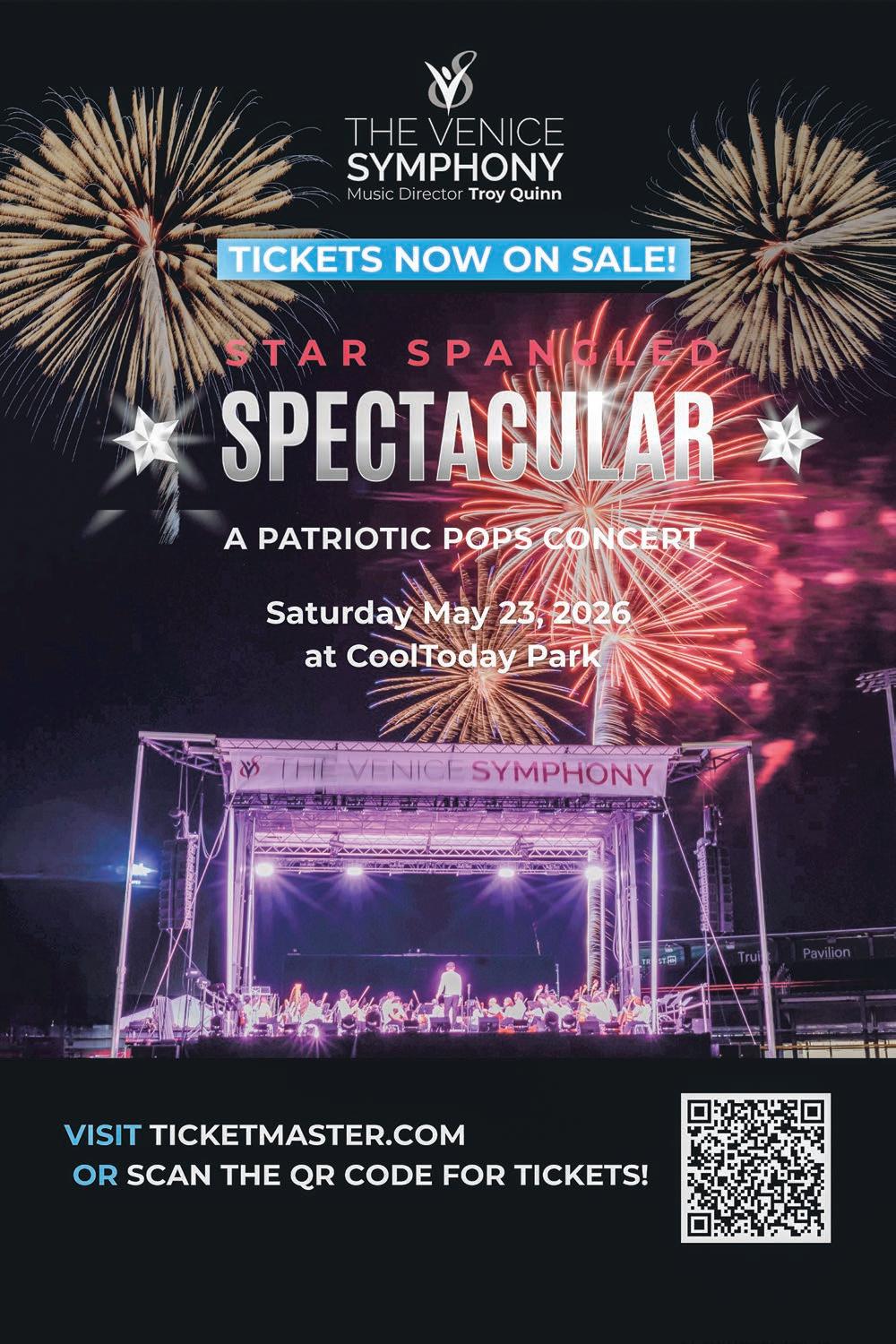
▼ On May 23 they have their Star Spangled Spectacular: A Patriotic Pops Concert—a thrilling, family-friendly celebration of America’s 250th anniversary filled with symphonic favorites, thrilling flyovers and inspiring music honoring the heroes of the Revolution and the signing of the Declaration of Independence in 1776.
Led by Music Director Troy Quinn and with special performances by The Key Chorale Tickets www.ticketmaster.com/ the-venice-symphony
ATTENTION ARTS ORGANIZATIONS:
Have you sent your season schedule yet?
We’ve received lots of them so far, but do we have yours?
If you want coverage in West Coast Woman, make sure to send your schedule to: westcoastwoman@ comcast.net
The Hermitage Artist Retreat has a program on May 6 featuring Adam Chanler-Berat and Julian Hornik Registration required at HermitageArtistRetreat.org
focus on the arts
The City of Sarasota is getting more
c o l o r f u l every day
Murals abound on once blank walls adding beauty to streetscapes, alleys - even a parking garage
Ifyou’ve been downtown Sarasota, you’ve probably seen some colorful murals adorning walls large and small.
The latest mural was unveiled by the city on March 31 at the northeast corner of 10th Street and Osprey Avenue in the Gillespie Park Neighborhood.
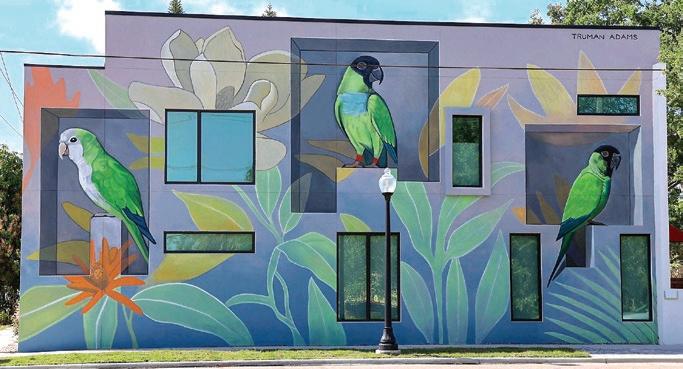
Entitled Niche ArT, it was created by local artist Truman Adams, a Ringling College of Art grad. Selected after a national Call for Artists and installed as part of the City’s Call for Walls initiative, the mural highlights the playful character of the neighborhood and its wildlife including parakeets such as one Monk parakeet and two Nanday parakeets, both well-known “residents” of the neighborhood.
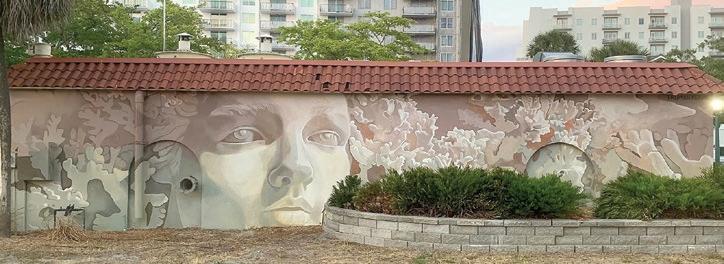
Truman also painted Amphitrite, a mural also commissioned by the City of Sarasota in 2024 as the inaugural work in Sarasota’s Florida Legacy Arts Mural Series which highlights Sarasota and Florida’s history and culture.
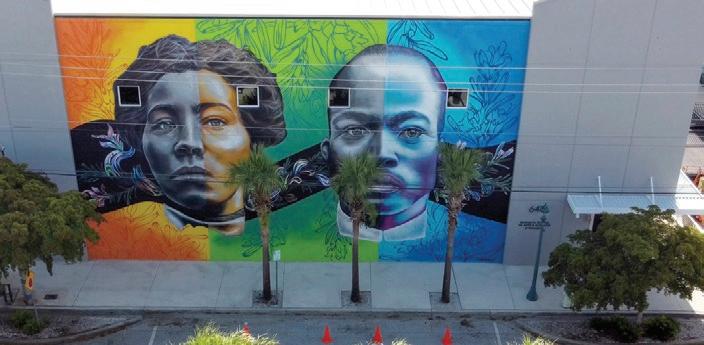
Back in July of last year, a dedication was held to mark the completion of Swirly Painter’s (Kaitlin Ramirez) mural of Sarasota pioneers Irene and Rev. Lewis Colson also part of the Florida Legacy Arts Mural Series.
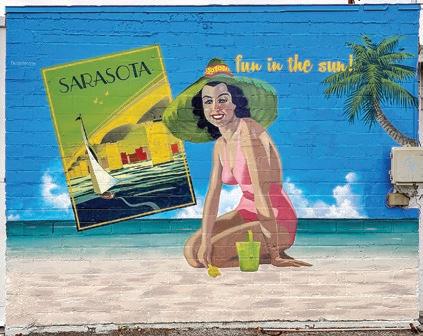
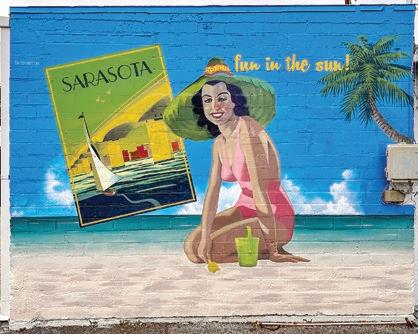
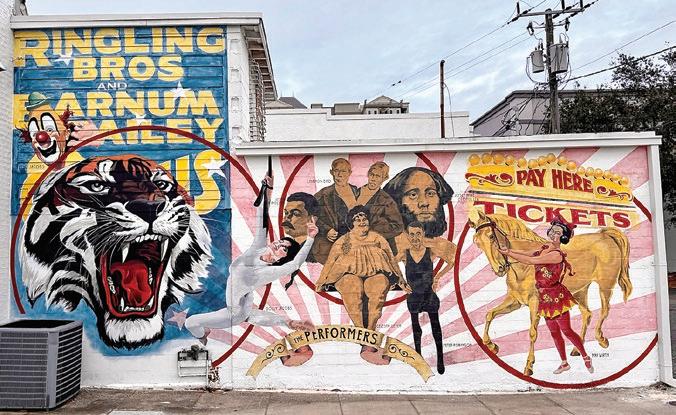
The Colsons are of course a part of that history, but you’ll also see murals that look like old tourism ads or show posters for the Ringling Brothers Circus.
Niche ArT, created by local artist Truman Adams
Irene and Rev. Lewis Colson, created by Swirly Painter (Kaitlin Ramirez)
Amphitrite, by Truman Adams
murals continued
A few months ago Swirly’s mural outside the Sarasota School of Arts and Sciences “Creative Seeds” was completed. It was also part of the Public Art Program’s Call For Walls Initiative.
The Call for Walls Initiative is a clever way to add color to some otherwise plain, unadorned spaces. Private property owners can work with the city by applying to be a part of the program, according to Ciera Coleman, the City of Sarasota’s Public Art Administrator.
“We evaluate it and then it’s vetted through a neighborhood association” and approved. Artists to apply for the mural commission then the city’s Public Art Committee reviews the artwork and approves it.
According to Ciera, the city’s Public Art Plan “is the guiding document” for the murals and that 90% of them are located within a one-mile radius of the city.
The Public Art Committee (PAC) “plays a key advisory role in shaping Sarasota’s vibrant public art landscape,” according to the city’s website.
They provides insight and recommendations on the selection, placement, installation, and removal of public art throughout the city.
The PAC meets regularly and people are welcome to attend their meetings and offer input.
According to the city’s website, the murals are “Supported entirely by developer public art contributions, without using taxpayer dollars, the program supports the installation and care of artworks throughout the city.”
“This partnership with local developers plays a vital role in bringing public art to life across Sarasota, ensuring it remains a meaningful and lasting part of the community.”
The public reaction “has been positive” Ciera reports, and she works closely with neighborhoods and attends numerous neighborhood association meetings. After all, they’re the ones who will “live” with the artwork and thus get a say when deciding on the artwork.
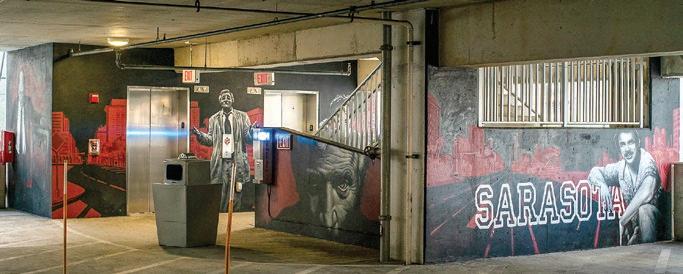
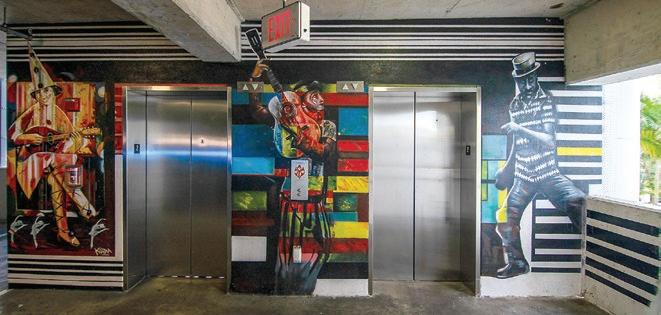
Parking garages can be pretty boring visually. But the Palm Avenue garage murals, painted in 2010, create a five-story series celebrating Sarasota’s cultural life.
Each level features a large-scale artwork themed around Dance, Film, Music, Opera, or Theatre, arranged alphabetically to help visitors remember where they parked. Created by local, national, and international artists, the murals showcase the city’s profound and enduring connection to the arts.
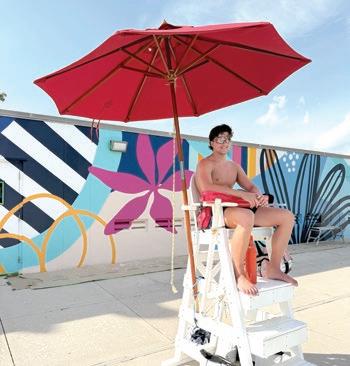
A mural that is not downtown is “Rhapsody in Bloom” by Alissa (Liss) Silvers which was unveiled this past January and is located at the Arlington Park & Aquatic Complex at their Lifeguard Headquarters. The mural was brought to life during a Community Paint Day led by the artist, with over 100 residents helping to paint sections of the artwork.
Dance by Eduardo Kobra is on the first floor on the Palm Ave. Parking garage. There are lots more murals and more are in the planning stages for 2026.
The city has made it easy to view the art with an audio guide on their website under “Public Art Program” which has over 100 pieces of art catalogued including the murals at www.sarasotafl.gov/Public-Art
A virtual tour gives you the option of an online map, gallery or audio guide. Wander through Sarasota’s streets and parks while exploring the City’s expansive collection of sculptures, murals, and installations. With the Otocast audio tour, you can listen to artist-narrated stories behind each piece, view photos and videos of the artwork up close and access additional resources and links for deeper insight.
ARTICLE: Louise Bruderle • IMAGES: City of Sarasota
Dance, by Eduardo Kobra
Palm Avenue parking garage mural
Rhapsody in Bloom, created by Alissa (Liss) Silvers
The Sarasota muralist’s creative work can be found in many places - most recently in the Rosemary District where she has two large murals.
Swirly Painter Swirly Painter Swirly Painter
of the MURAL MASTER of the MURAL MASTER of the MURAL
MASTER
Michelangelo painted his Sistine Chapel starting with transferrable charcoal sketches. Then, atop scaffolding high up, he added the paint, stroke by stroke, in a laborious and often uncomfortable process that involved many hours that was exhausting to his body
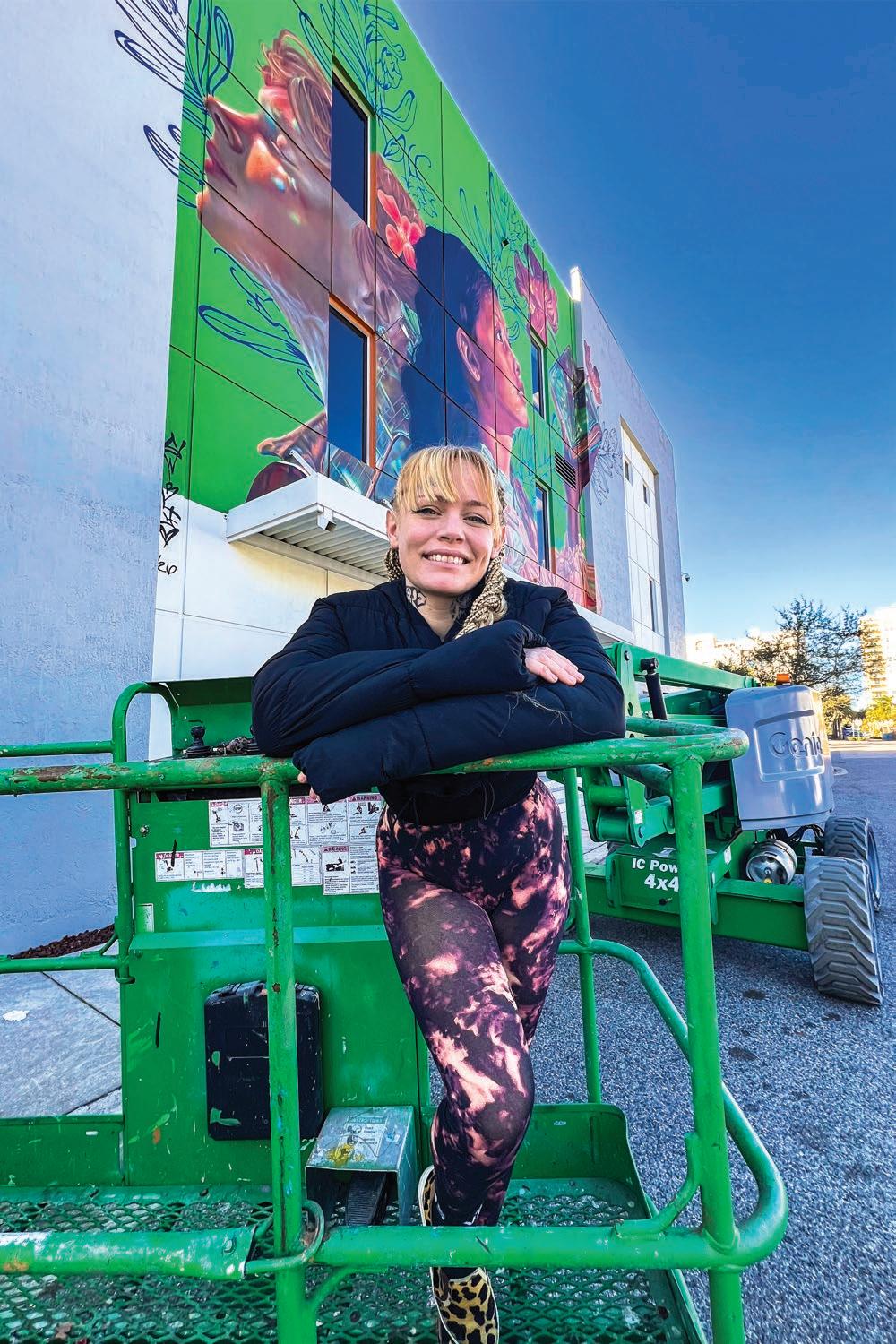
Sarasota muralist Swirly Painter (aka Kaitlin Ramirez) some five centuries later, climbs into a lift and paints from images on her phone, square by square, spray can in hand, exposed to the elements in the cold and in the heat to create her masterpieces.
Her most recent murals can be seen in the Rosemary District. At Sarasota School of Arts and Sciences (SSAS) you’ll see “Creative Seeds” that’s on the north exterior wall of the SSAS campus. The mural serves to inspire students to look ahead and use their creativity and imagination with imagery such as seeds, flowers, books, and musical instruments.
That mural’s content was her idea in collaboration with the school. It took three weeks to complete and, she recalls, “It was cold. That was tough.” It was also tough when she was working way up on the lift and it almost ran out of gas. “I thought I’d be stuck way up there.”
While the SSAS mural was large and it was cold, she was inspired by the kids who attend the school. “They’re so open, so free and not afraid of judgment.” There are flowers in the mural because “They [children] grow like flowers.” One of her sons attended SSAS. Kids in turn love murals, she notes, and she did a spray paint class there.
Not that far away on Central Avenue you’ll find the mural Swirly completed of Reverend Lewis and Irene Colson who lived in what was once called Overtown and is now the Rosemary District. The Colsons were among Sarasota’s earliest Black and most prominent settlers and their graves lie nearby in Rosemary Cemetery.
There is only one known photograph of the Colsons which Swirly brought to life with vibrant colors while also showing the original photo’s black and white.
Also a large project, the Colson mural was completed last year. “This wall is 4 1/2 stories tall, and I painted it in recordbreaking heat.” The mural, completed over a month back in May and June, took about 170 hours and spans roughly 1,700 square feet done by one person, on a lift.
Swirly would start her painting there early, working from 6-10 a.m. because “By 10 the sun was too intense.” To stay on schedule, she’d sometimes paint in the evening. On the positive side, people would come by and talk to her, which she enjoyed. And, at the dedication, she got to meet the great granddaughter of the Colsons.
It should be noted that with her murals there are no airbrush machines, no buckets of paint, and no slew of brushes to complete these works. Today’s muralists rely on spray paint - coming from its roots in graffiti art.
So how is it done - taking a sketch and transferring it to a wall? She explains that she uses something called doodle grid that allows her to superimposes her art over a grid.
She then works square by square working from the grid on her phone. “I’m on the phone all the time,” she explains, as she shows me her paint-spattered phone as proof.
Since there are heavy metals in paint she wears a mask and can paint 5-10 squares in about three hours, but it still involves one finger pressing down on a can. “It’s hard on the body, hard on your hips. And you have to keep your equilibrium because the platform [on the lift] moves.”
Swirly’s work on these two murals is part of the city of Sarasota’s Call for Walls initiative, a program under the city’s Public Art Program designed to “seek out blank walls with public visibility, especially outside the downtown core.”
Murals liven up neighborhoods, making them more attractive and inviting. And inviting neighborhoods draw, rather than turn off visitors. Murals can also act like landmarks - reminding people where a business it located and they also do their part in contributing to Sarasota’s cultural tourism.
Artists submit proposals and through an involved process, the work is vetted and approved by the city’s Public Art Committee. Swirly then worked with Ciera Coleman, City of Sarasota’s public art manager, as the project moved along.
It’s interesting that the two works are so close to each other and one honors the past with the Colsons and the other honors the future with young people.
Swirly came to Sarasota in 2020 from Chicago with the goal of painting full time. She learned her craft studying graffiti artists - not in art school - and is self-taught starting her mural career in 2019.
In 2020 Chicago was pretty much shut down due to COVID and Swirly didn’t want to stay inside - also not a great thing for a muralist.
She quickly picked up commissions then went to back to Chicago, packed up, got her kids and drove down to Sarasota. Her first mural was one she learned about on Craigslist - a huge sign that paid $600 for three weeks work.
“But that’s how it started. I wanted to be a painter,” she says, and it had to be making “big stuff.” To supplement her mural work, she has created two teams who have begun painting houses - Miami, Bradenton and other places and she says it’s doing really well.
Swirly has also done commercial work including murals at Toastique, Brewster’s and, prior to last year’s hurricane season, at downtown Sarasota’s O’Leary’s. Closer to ground, you may have seen her work at last year’s Chalk Festival. She chooses her work carefully, painting only those murals that are “meaningful and impactful.” She has17,000 followers on Instagram as “Traveling muralist”. So far she has painted over 200 murals all over the Midwest and Florida.
Swirly started her family early and has two sons, one of whom attended Sarasota School of Arts and Sciences. They’re also biracial and she relays they’ve been called derogatory names based on their race. So it was perhaps meaningful to paint the mural of the Colsons who managed to thrive even in segregated Sarasota. “Just be nice to people,” is her message.
In one of her murals there’s a smiling fellow wearing a hat. That’s her husband who is a BMX rider from Costa Rica who competes all over the world. “He’s awesome,” she says with a smile.
Consider a walk through the Rosemary District to see these and other murals. They’re close together and the city has a guide to finding them www.sarasotafl.gov/ Public-Art/Public-Art-Murals
STORY and IMAGES: Louise Bruderle
Mission Green — The Importance of Both Local and Global Forests with Margaret “Meg” Lowman, Ph.D. Thursday, May 21 10-11:20 am We Must Talk! (And Why It’s Important) with Bill Woodson, Ph.D. Thursday, May 28 1-2:30 pm
• Steve Arvey Presents: The Sounds of Cigar Box Guitars
• Wellness Trends 2026: Good, Bad, and Questionable
• The Lady of Larkspur Lotion by Tennessee Williams
• ChatGPT— Your Brainstorming and Reflection Partner
• History of Musical Theater
Amelia Earhart’s Disappearance: Facts and Theories About the 20th Century’s Greatest Mystery with Robert Jacob Wednesday, June 3 1-2:30 pm
Using AI on Your Smartphone with Deshjuana “Desh” Bagley Thursday, June 18 11 am-12:30 pm
• Newtown’s Women of the Movement: Stories of Strength and Sacrifice
• Genius Women Erased from History
• Gardens That Give Back: Designing for Pollinators in Florida
• The Best Mel Brooks Films
• Can You Tell When a Financial Panic is Coming?
women’s senior living
News, Trends and Helpful Tips
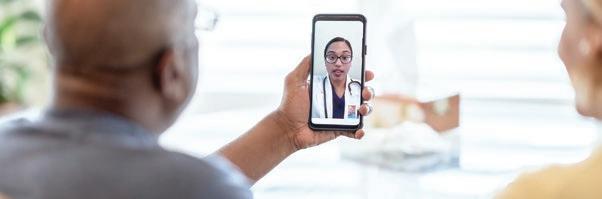
Telehealth widely used by older adults, new research shows
Americans age 65 and older who are insured by Medicare logged about 60 million telehealth visits annually between 2021 and 2023 – about 31 million for mental health and 29 million for other health issues according to a study in the journal Annals of Internal Medicine.
The study also found that people with Medicare coverage who used telehealth services were generally in poorer health and faced more physical and functional limitations in their daily life, compared with their counterparts who only had medical appointments in person.
To get at these numbers, they analyzed a national survey called the Medical Expenditures Panel Survey, which provides a national snapshot of how different groups of Americans use and receive health care. Based on their analysis, they generated national estimates of telehealth visits that reflect care patterns for everyone insured through Medicare as well as some younger people with disabilities.
In just a few years, telehealth has become a central part of how health care is delivered in the United States – and it is likely to continue to play an important role in the health care system.
Before 2020, patients rarely got their health care virtually. About 1.7% of Medicare patients – 910,490 people – used telehealth for medical appointments in 2019. These were mostly patients in rural areas, and only certain clinics were authorized to offer it.
But during the COVID-19 pandemic, the federal government expanded telehealth coverage for people insured by Medicare to make it easier for patients to maintain access to health care. Many insurance companies did, too. The number of Medicare patients using telehealth services jumped to 53% in 2021, corresponding to nearly 28.3 million telehealth users at the peak of the pandemic
Source: Terrence Liu Assistant Professor,
University of Utah
Most older adults want to age in place, but aren’t entirely confident they’ll get to
The vast majority of U.S. adults 65 and older (93%) say they currently live in their own home or apartment. Within this group, 9% say someone provides care for them in their home, according to a new Pew Research Center survey that covered topics related to aging and caregiving.
Small shares of older adults say they live in the home of an adult child (2%) or another family member (1%), live in an assisted living facility (1%), or have some other arrangement (3%).
The Pew Research Center surveyed 8,750 adults from Sept. 2 to 8, 2025, including 2,582 adults ages 65 and older.
Older adults who live in their own home without a caregiver were asked what they’d want to do if they could no longer live alone. Most (60%) say they’d want to stay in their home and have someone care for them. Much smaller shares say they’d want to:
Move into an assisted living facility (18%)
Move in with a family member (11%)
Move into a nursing home (1%)
Have some other arrangement (8%)
Upper-income older adults are the most likely to say they’d prefer to move to assisted living. About three-in-ten (28%) say this, compared with 19% of those with middle incomes and 13% of those with lower incomes.
Among those who say they’d want to stay in their home with a caregiver, 37% say
this is extremely or very likely to happen. Another 18% say it’s not too or not at all likely. Those who say they’d rather move to assisted living answered similarly: 35% say this is highly likely to happen, while 16% say it’s not likely. Older adults who say they’d like to move in with family are more optimistic: 58% say this is highly likely, while 9% say it’s not likely.
Some of the uncertainty surrounding future living arrangements may be related to cost, especially for options like in-home care and assisted living. The survey found that only 21% of adults ages 65 and older have long-term care insurance that would help cover the expense of ongoing living assistance.
According to the 2020 U.S. decennial census, 3% of U.S. adults ages 65 and older and 10% of those ages 85 and older live in group settings.
The oldest Baby Boomers turn 80 in 2026
Baby Boomers will soon reach another milestone: In 2026, the oldest members of this generation will turn 80.
level until 1965. The annual number of births would not surpass 4 million again until 1989.
Besides marking the end of the Baby Boom generation, 1964 also marked the peak of the generation as a share of the total U.S. population. The Census Bureau estimated that there were 72.5 million Baby Boomers on July 1, 1964, accounting for 37% of the population.
While Boomers peaked as a share of the population in 1964, their absolute number peaked at 79 million in 1999. This increase was due to increased immigration to the U.S. in the second half of the 20th century.
Source: PEW RESEARCH CENTER
Americans ages 100 and older projected to more than quadruple
The number of Americans ages 100 and older is projected to more than quadruple over the next three decades, from an estimated 101,000 in 2024 to about 422,000 in 2054 according to projections from the U.S. Census Bureau. Centenarians currently make up just 0.03% of the overall U.S. population, and they are expected to reach 0.1% in 2054.
The number of centenarians in the United States has steadily ticked up since 1950, when the Census Bureau estimates there were just 2,300 Americans ages 100 and older.
The Baby Boom generation refers to adults born between 1946 and 1964. The name reflects the sharp and prolonged increase in fertility that occurred in the wake of World War II.
The postwar baby boom has fundamentally changed U.S. society in many ways, from the political to the economic, social and demographic.
The United States saw a total of 76 million births during the boom, with the annual number surpassing 4 million in 1954 and remaining above that
Today, women and White adults make up the vast majority of Americans in their 100s. This trend is largely projected to continue, though their shares will decrease.
In 2024, 78% of centenarians are women, and 22% are men. In 30 years, women are expected to make up 68% of those ages 100 and older, while 32% will be men.
77% of today’s centenarians are White. Far fewer are Black (8%), Asian (7%) or Hispanic (6%). And 1% or fewer are multiracial; American Indian or Alaska Native; or Native Hawaiian or other Pacific Islander. By 2054, White and Asian adults are projected to make up smaller shares of centenarians (72% and 5%, respectively), while the shares who are Hispanic (11%) or Black (10%) will be larger. (All racial categories here are single-race and non-Hispanic. Hispanics are of any race.)
The U.S. population overall is expected to trend older in the coming decades as life expectancies increase and the birth rate declines. There are currently roughly 62 million adults ages 65 and older living in the U.S., accounting for 18% of the
population. By 2054, 84 million adults ages 65 and older will make up an estimated 23% of the population.
Even as the 65-and-older population continues to grow over the next 30 years, those in their 100s are projected to roughly double as a percentage of that age group, increasing from 0.2% of all older Americans in 2024 to 0.5% in 2054.
The world is home to an estimated 722,000 centenarians, according to the United Nations’ population projections for 2024. The U.S. centenarian population is the world’s second largest – the UN estimates it at 108,000, slightly larger than the Census Bureau’s estimate.
Japan is the country with the greatest number of people in their 100s, at 146,000. China (60,000), India (48,000) and Thailand (38,000) round out the top five.
Eye Exams Become More Important with Age
Your vision changes with time. This is why regular eye exams with an ophthalmologist are crucial for preserving healthy vision in your senior years.
Presbyopia begins in mid-life with obvious symptoms. But more serious eye disease, like glaucoma, can steal vision without noticeable symptoms. Ophthalmologists look for subtle changes to your vision during regular eye exams. They can see signs of glaucoma or other vision-threatening eye disease before it’s too late.
Even those who see well and are without age-related eye disease may have vision changes that might not be obvious. As we age, it can be harder to distinguish an
object from its background when they are close to the same color.
This might happen when a white coffee cup is on a white table. This is called loss of contrast sensitivity. Lower contrast sensitivity complicates daily activities. It also raises the risk of falls or car accidents.
A mild reduction is normal with age.
But loss of contrast sensitivity can be a symptom of more serious eye disease like cataract or age-related macular degeneration (AMD)
For seniors, the ability to see well in different lighting may change. When going from a well-lit area to one with poor light (or the other way around), your eyes may take longer to adjust and focus, or they don’t adjust very well.
Problems adjusting to light and dark can make driving more difficult, especially at night or in the rain. Driving can be even more challenging when eye diseases affect your peripheral (side) vision, or increase your sensitivity to glare.
Tips for safer driving:
Keep your windshield clean inside and out. Make sure your eyeglasses are not scratched or dirty.
Keep your eyeglass or contact lens prescription up to date with regular eye exams.
Use night-driving glasses if you experience glare while driving at night.
You should have a complete eye exam with your ophthalmologist every year or two after age 65.
Keeping up with regular eye exams allows your ophthalmologist to catch problems early. The sooner a problem is detected, the more likely it can be treated.
During regular eye exams, your ophthalmologist checks for age-related eye diseases, including: age-related macular degeneration, diabetic retinopathy, glaucoma and cataracts.
Ophthalmologists can identify other health problems such as diabetes or stroke through eye exams.
An ophthalmologist can also help detect age-related vision changes that complicate your life. Simple adjustments around the house can improve quality of life despite moderate vision changes
How
Older Adults Use and Think About AI
5
5% of people age 50 and older said they have used AI technologies that you speak or type to for a variety of purposes, including for health information and social connection.
96% of older adults who used AI-powered home security devices and systems and 80% who used AI-powered voice assistants in the past year said these devices help them live independently and safely in their home.
reported interest in using AI in their dayto-day lives. Older adults who rated their physical health as fair or poor were less likely than those who rated their physical health as good to excellent to express interest in using AI in their day-to-day lives (29% fair or poor physical health vs. 36% good to excellent physical health).
Senior for Seniors Adoption Program
H92% of adults age 50 and older agreed they want to know if the information they receive is from a person or generated by AI, and 81% said they want to learn more about the risks of AI. 46% of older adults said they have very little to no trust in AI-generated information. Artificial intelligence (AI) refers to computers, devices, or machines that use data to make predictions and complete tasks such as learning new things, solving problems, and making decisions.
AI technologies can be useful to older adults in many ways that relate to health, including improving home safety, providing information about health conditions, and helping people age in place.
However, AI technologies also raise concerns about privacy, data security, and inaccurate information. In February 2025, the University of Michigan National Poll on Healthy Aging asked a national sample of adults age 50 and older about their experiences with and views on AI technologies.
umane Society of Sarasota County’s Seniors for Seniors Program was developed to help older adults enjoy pet companionship while providing a loving home to an animal in need. The program places senior cats and dogs (ages 7+) into permanent homes with older adults who are age 65 or older. HSSC has a client experience team that will help you select a companion that fits with your home and lifestyle. The adoption fee will be waived thanks to a grant provided by the Wenk Family Charitable Foundation. What are the benefits of adopting a senior pet? Senior pets are often already trained, gentler, and calmer.
They are ideally suited to an older adult’s quieter lifestyle.
Overall, 55% of people age 50 and older said they have ever used AI technologies that you speak to (like Amazon Alexa, Siri, or Google Assistant) or type to (like ChatGPT, Gemini, or Copilot) for one or more of the following purposes:
For entertainment (37%)
To receive non-health information (30%)
To receive health information (14%)
For social connection (12%)
To create text or images (11%)
To plan an activity (such as a trip) (9%)
Overall, 35% of people age 50 and older
Cats and dogs provide companionship and opportunities for interaction with others. Research shows companion animals can improve physical and mental health by lowering blood pressure and stress levels. They can also reduce feelings of depression or loneliness.
Visit HSSC to meet with one of their client experience counselors who will help you pick out a pet for you and your lifestyle. There is no appointment needed. Once an adoption match is made, their team will provide tips to help you transition your pet into your home. As your cat or dog gets settled, their team will follow up with helpful information. Go to www. hssc.org/pets/seniors for more information or call 941.955.4131.
women’s senior living
Aravilla in Sarasota
The area’s only all-female Memory Care Community
Google “memory care facilities for women” and plenty show up - just none of them are womencentered.
According to the National Institute for Health (NIH) dementia disproportionately affects women including persons living with dementia and caregivers. Almost two thirds of Americans living with Alzheimer’s are women.
They go on to say “Personcentered care, rather than disease-focused, is recommended to improve care for affected persons including caregivers.”
Opened this past February, Aravilla for Her and, as the name implies, is designed for women and is very much person-centered.
“Women make up the majority of individuals living with dementia, and they often have specific emotional and social needs that deserve specialized attention,” said Tracy D’Andrea, President of Aravilla Sarasota.
“Aravilla for Her is built around the belief that memory care should do more than support cognitive health. It should protect dignity, foster calm, and honor the life story behind every resident.” Within their campus, which also offers Independent Assisted Living, their dedicated women’s floor has an all female care staff—staff who understand the unique journey of women with dementia.
Rooms are attractively decorated but you can bring your own items if you like.
Arriving on the floor, you don’t see anything resembling a hospital or clinical setting. As you walk the corridor, you pass what looks almost like cottages as each unit has its own distinct “homey” look and feel.
There’s soft lighting throughout and the circular layout of the floor means women can easily walk - as many do- all the way around and back to their rooms.
Rooms are attractively decorated but you can bring your own items if you like. They utilize the Amba system that gently supports each woman’s well-being through discreet in-suite sensors that monitor patterns like sleep and movement—never cameras or wearables—so staff can respond quickly and thoughtfully if something changes.
The walls have artwork familiar to these residents - Life magazine covers, ‘50s memories and the like. And there’s plenty to do. Tuesday they have non-denominational church services and arts groups like Key
Chorale come and performs for residents.
Walking the corridors there are groups doing chair exercises while another group is having a tea party - complete with fancy hats and a tea service. These thoughtfully designed programs not only help reduce anxiety and restlessness, but also create a strong sense of belonging and sisterhood among residents.
There’s also a “lunch bunch” that heads out for meals with friends or for sight-seeing. “From leisurely walks in beautiful surroundings to engaging local adventures, each trip provides opportunities for social interaction, cognitive stimulation, and physical activity—all of which enhance overall health and well-being,” according to their website.
Activities can be high or low activity levels, but the goal is to have residents out of their rooms. Families are encouraged to
visit and one popular activity is when they offer root beer floats.
And yes, you can spend the rest of your life here if you so wish. They are fully licensed to provide for that.
Music is also a part of the lifestyle at Aravilla. In addition to visiting arts groups, they have musicians performing at meals. “We provide a higher level of specialty care designed to support every woman’s health and dignity. Music often awakens cherished memories, sparking joy and emotional connection, while art, movement, and social activities provide meaningful ways to express individuality,” says their website.
The best way to learn more about Aravilla for Her is to come in for a tour. They offer so much to women needing their services and make the transition as smooth as possible.
Aravilla for Her 3251 Proctor Rd, Sarasota Call 941-770-4373 to arrange a tour Assisted Living Facility License #12551
Exteriors of the rooms look like cottages as each unit has its own distinct “homey” look and feel.
Walls have artwork familiar to these residents - Life magazine covers, ‘50s memories and the like.
Music is also a part of the lifestyle at Aravilla. They have musicians performing at meals.
Aravilla for Her is located within the Aravilla campus which also offers Independent Assisted Living.
Get to know
The Sarasota Succulent Society
Explore dazzling succulents from around the world
2026
got off to a shaky start for the Sarasota Succulent Society. If you recall, it went down to 34 degrees in early February and volunteers scrambled to cover plants in case a frost moved in Thankfully, they didn’t lose any plants. 2024 was the more challenging year with all those storms taking place and they were forced to close.
But like the sturdy plants that grow on their grounds, this organization is strong, and according to Sarasota Succulent Society President Diane Sanguedolce, “We came out even stronger. It [the storms] forced us to clean out a lot of plants and debris.”
and built a home in Sarasota in 1938 where he and his wife lived and raised a family. His 688 squarefoot cottage was ordered from a catalogue and is now the society’s clubhouse to which extra space has been added on over the years. In 2004 it was granted Historical Designation by the City of Sarasota. Sparkman loved gardening - particularly with succulents and began researching the plants and starting many gardens in his yard, finding out what
A fence that blew down was paid for by a donation and while the gardens were exposed, neighbors in Bayou Oaks “babysat” the gardens until the new fence went up. Another donor gave them a portable speaker system which helps with the talks they offer. And, she adds, momentum has carried forward with a new logo, brochure, Facebook page, website and better results in Google search.
Add to that, they raised $4500 through the Giving Challenge which they hope to use to pressure wash and paint their building and replace the front door. There’s no extravagance to this organization - it’s all about the plants.
Not everyone knows of this nonprofit that sits tucked away off Myrtle Street on 38th Street just west of the train tracks in the Bayou Oaks neighborhood. It’s a labor or love and an equal love for plants that keeps the organization going. And they’ve been going for 75 years.
Walter G. Sparkman and his wife, Mary Olive Howse, moved to Sarasota
grew and what did not in Sarasota. He began heading out to local garden clubs, bringing his succulents with him, and by 1950, his enthusiasm had spread, with a group of individuals now working and studying alongside him. He started many individual gardens in his yard and carefully filled them with succulent plants from around the world–which he studied and watched carefully to see if they could grow in Sarasota.
Over the years, Sparkman suggested they form a club and buy more property and added the lot next door. A drainage ditch was dug, along the site of the creek that runs by
the property, and the rock and sand removed was left in piles on the bank later to be incorporated into the garden.
The Society formed in 1950 when Sarasota County had around 28,000 people and was experiencing a post-war boom. It has been run by volunteer members and board ever since. Sparkman created an experimental garden that would be open to kids and to this day, education is a major goal of the society.
What are succulents? Well, you likely have them in your yard or have seen some such as aloe vera, agave, crown of thorns, snake plants, jade plants, hens and chicks, Christmas cactus and snake plants.
They like sun and humidity, but don’t like “wet feet” meaning they need well-drained soil. Considering the drought that has taken hold in Sarasota, you don’t have to run outside every day to water your succulents
They’re also easy to grow if you’re like Sparkman and have a curiosity for them. Coming to the society will give you a greater appreciation for their beauty and variety. There you’ll see large cacti that you probably imagine in Arizona - not Floridabut also unique plants you simply won’t see anywhere else. Their collection is extensive and since they’ve been around for 75 years, the mature plants are amazing to behold.
on the 3rd Saturday of every month also from 9:00 am to noon. Hours are limited due to the fact they are all volunteer and are not in the business of trying to be a full-time botanical garden. But they do faithfully carry on Sparkman’s love for succulents and sharing them with others.
#5 Their next plant sale is on May 9, 9-1 - timed for Mother’s Day, May 10 Don’t miss their plant sales. The next one is on May 9, 9-1. Others are on Labor Day and around President’s Day in February. You’ll find a variety of specimens, all carefully grown as single plants or in beautiful dish gardens. You won’t find this kind of selection (and prices) in those big box stores. Plus you’re helping a great organization. If you’re so inclined, you can become
You can visit the gardens on one of their gardening workdays, held from 9:00 am to noon every Monday and
a member even if you don’t have a depth of knowledge about succulents. Given the friendly nature of members and other volunteers, your learning curve will be fast.
And there’s no cost to visit. “It’s a educational garden so there’s no fee,” Diane explains. Donors help to keep the society going - and you can, too.
Coming Up:
Do not miss their Mother’s Day Sale on Saturday, May 9, 9 am to 1 pm Free admission. Tour the grounds, buy a plant for Mother’s Day (and one for yourself) and attend any talks they have that day.
The Sarasota Succulent Society marked its 75th anniversary last year.
Walter G. Sparkman was instrumental in the founding of the Society.
Some examples of succulents are agave and aloe.
The Society is all volunteer and they make the gardens beautiful. At right is President Diane Sanguedolce.
Peace of Mind for the “What Ifs”
Six Ways to Take Care of Mom –and All Loved Ones
Planning for the future—for yourself or your loved ones— shouldn’t feel like a solo journey. In today’s evolving landscape of aging, whether remaining at home or transitioning to a senior living community, individuals and families are often faced with complex decisions, unexpected changes, and emotional conversation
Take Care Advisor’s RN Geriatric Care Management team serves as a professional compass and dedicated advocate, guiding clients with clarity, compassion, and clinical expertise.
Specializing in proactive “what if” planning, these experienced registered nurses offer more than oversight—they provide a trusted partnership to help navigate whatever health changes or challenges may arise, now or in the future.
Whether planning ahead or responding to an immediate need, Take Care Advisor’s RN Care Managers ensure each client’s preferences are understood, respected, and thoughtfully carried out.
Here’s how having an established relationship with Take Care Advisor can support you at every stage.
Take Care Advisor’s RN Geriatric Care Management team serves as a professional compass and dedicated advocate, guiding clients with clarity, compassion, and clinical expertise.
in care—having a knowledgeable advocate is invaluable.
RN Care Managers attend medical appointments, ask thoughtful and informed questions, take detailed notes, and ensure that each client’s wishes are clearly communicated and honored. They also help interpret complex medical information so clients and families can make informed decisions with confidence.
Why it matters:
1. Planning Begins with a Personalized Assessment
Every journey begins with understanding the full picture.
An RN Care Manager conducts a comprehensive assessment of medical needs, cognitive status, home safety, support systems, and personal preferences. This creates a clear foundation for decision-making and helps families anticipate potential challenges before they arise.
Why it matters:
A professional, objective assessment ensures nothing is overlooked—and provides peace of mind that decisions are guided by both clinical insight and personal priorities.
2. Create a Proactive “What If” Plan Life rarely follows a predictable path. Planning ahead makes all the difference.
RN Care Managers help families thoughtfully explore scenarios such as:
• What if there’s a sudden hospitalization?
• What if care needs increase over time?
• What if living at home is no longer the safest option?
Why it matters:
When facing stressful moments, instead of reacting in moments of stress, a personalized plan can help you move forward with confidence.
3. Coordinate and Simplify Healthcare
Managing multiple providers, appointments, medications, and follow-up care can quickly become overwhelming.
Take Care Advisor facilitates care across all providers—coordinating appointments, arranging and following up on labs and physician orders, and bridging communication between the client, medical teams, and, if desired, family members. RN Care Managers serve as the central point of coordination, ensuring continuity, clarity, and accountability across every aspect of care.
Why it matters:
This level of coordination reduces the risk of miscommunication, improves outcomes, and alleviates the burden on a client or family member trying to manage it all alone.
4. Advocate During Critical Moments In times of change—whether an ER visit, a hospital stay, new diagnosis, or transition
Families gain reassurance knowing a clinical professional is present, engaged, and focused on protecting their loved one’s best interests.
5. Navigate Senior Living Options
When a move is being considered, Take Care Advisor will guide families through evaluating options, understanding levels of care—including independent living, assisted living, and memory care—and identifying the best fit based on medical needs, lifestyle preferences, and financial considerations.
RN Care Managers also provide ongoing support for clients residing in senior living communities ensuring continuity of advocacy and oversight.
Why it matters:
Having an experienced guide transforms a complex and emotional process into a thoughtful, well-supported transition.
6. Provide Ongoing Guidance and Peace of Mind
Planning isn’t a one-time event—it’s an ongoing process.
As needs evolve, RN Care Managers remain a consistent, trusted resource— adjusting care plans, coordinating services, and supporting clients and families through every stage of aging.
Why it matters:
You and your RN Care Manager navigate changes together. There is always someone to call, 24/7—someone who knows your story and is ready to help.
A Partner for the Road Ahead
At its core, Take Care Advisor’s RN Care Management is about more than logistics or having a nurse on call—it’s about peace of mind.
It’s knowing that no matter what the future holds, you have a partner who understands the complexities of healthcare, respects your values, and is committed to helping you or your loved one live with dignity, safety, and confidence. SOURCE: By
Susanne S. Wise, RN, MBA
For more information on Take Care, call 941-927-2292 or visit takecarehomehealth.com to learn more about their personalized home care, nursing, and RN care management services.
Erika Wise Borland, MA, Vice President
Susanne S. Wise, RN, MBA, CEO & Owner Courtney Wise Snyder, MSG, CMC, President
Championing Health—For Yourself and Those You Love
Fof 45 and 70, life is a delicate balancing act. You may be managing your own health while also caring for aging parents, supporting a spouse, or helping with grandchildren. It’s a role rooted in love—but it can also be overwhelming, and too often, your own needs fall to the bottom of the list.
This May, in recognition of National Older Americans Month and its theme, “Champion Your Health,” I invite you to pause and consider what it truly means to care for yourself while caring for others. Because the truth is simple: your health is not separate from the well-being of those you love—it’s foundational to it.
According to AARP, nearly 60% of family caregivers are women, many reporting high levels of emotional and physical stress. At the same time, the Centers for Disease Control and Prevention (CDC) notes that regular physical activity, social connection, and preventive care can reduce chronic disease risk and improve quality of life. Yet these are often the very things caregivers sacrifice first. So how do you begin to shift that pattern?
Start by reframing self-care not as an indulgence, but as a responsibility. Championing your health doesn’t require drastic changes—it begins with small, consistent choices.
A walk with a friend. A nourishing meal enjoyed at a table. A moment of laughter. A conversation where you are supported, not just the supporter.
Equally important is recognizing that you don’t have to do it alone. At Senior Friendship Centers, we see every day how connection and access to resources can transform lives—not just for older adults, but for the families who care for them.
Our programs support healthy aging in a way that is holistic, dignified, and community centered.
Our congregate dining programs offer more than nutritious meals—they create space for connection and reduce isolation.
For caregivers, knowing a loved one is safe, social, and well-nourished brings peace of mind. We also offer wellness and fitness activities tailored to a range of abilities, from gentle yoga and balance classes to more active options that keep both body and mind engaged. These programs can be an invitation for you, too—to reconnect with your own health goals and model lifelong wellness.
Adult day programs, and other supports provide practical assistance while giving
caregivers something invaluable: time. Time to rest, attend appointments, or simply breathe.
And perhaps most importantly, Senior Friendship Centers fosters a sense of belonging. Because health is not just physical—it’s emotional and social. Feeling seen, valued, and connected can be just as vital as any medical intervention.
As you navigate your caregiving journey, consider this: what would it look like to truly champion your health this month? Maybe it’s scheduling that overdue checkup. Maybe it’s accepting help—or seeking it out. Maybe it’s carving out an hour each week that is just for you, without guilt.
At Senior Friendship Centers, caregivers can connect with free services designed to support both practical needs and emotional well-being. From caregiver support programs and educational resources to welcoming support groups where you can share experiences and learn from others on a similar path, you are not alone.
There is strength in being a caregiver. There is grace in showing up for the people who matter most. But there is also strength in honoring your own needs.
This National Older Americans Month, let’s redefine what it means to care. When you champion your health, you’re not just investing in yourself—you’re strengthening the entire circle of care around you. And that is something worth celebrating. For more information on Senior Friendship Centers programs and services for caregivers and those they care for, call (941) 955-2122
SOURCE: Tracie T. Cardwell, Director of Marketing & Communications, Senior Friendship Centers
Rodney D Gerling, Esq
Danna Laggannella Gerling, Esq
Marla Stewart Owczarek, Esq
women’s senior living
Adult educationis it good for your health?
Here’s what the research suggests
Some adult education activities appear to have health benefits. These beneficial activities include learning a language, involvement in the arts, and exercise classes.
Exercise classes
TLanguages
Arange of studies suggests that being bilingual delays the onset of dementia. For example, a 2019 study found that bilingualism delayed the onset of dementia by an average of four years, while a 2020 meta-analysis of published research concluded that, ‘We have demonstrated converging evidence that bilingualism is indeed a protective factor against the symptoms of Alzheimer’s dementia’.
Attending adult education language classes doesn’t necessarily mean people will become bilingual, but the process of learning another language (and its different grammar, pronunciation and vocabulary) is likely to help build a cognitive reserve to help delay the onset of dementia. Cognitive reserve is the brain’s ability to resist or delay the effects of damage or aging of the brain.
The arts
‘
How the arts affect your health’ was the focus of the US government’s NIH News in Health in 2008. It reported that “Scientists are finding that the arts can benefit both your mental and physical health. Many scientists agree that the arts can help reduce stress and anxiety, improve well-being and enhance the way we fight infection.”
Creative arts adult education and art therapy are of significant value to a ‘mutual’ wellbeing agenda involving practitioners and adult learners. This was the verdict of Research Council funded research published in 2016.
According to the researchers at Oxford University, both group-singing classes and craft classes appeared to have positive benefits for physical and mental health and for satisfaction with life.
Together, these examples suggest that adult education arts classes – for example art, music, dance and drama – are likely to have health benefits.
he health and economic benefits of exercise are well known. For example, many billions are spent treating diseases such as type 2 diabetes, which could be prevented with 30 minutes of physical activity five times a week.
Adult education programs are well placed to contribute to improved health, as they typically include a range of different exercises, from badminton and fitness classes to Tai Chi and a range of dance classes.
Does
it matter where we learn: at home or in a class?
One advantage of attending a class is the opportunity for social interaction and to make new friends. This has a number of potential health benefits. This matters because conversely, loneliness and social isolation increase a range of health risks, including dementia, heart disease and stroke.
From early adulthood through older age, lifelong learning has been linked to better mental health, greater adaptability, and a stronger sense of purpose. Women outpaced men in educational engagement across nearly all age groups
The Benefits of Being a Lifelong Learner
Self-esteem and confidence: adult learning has been shown to increase self-esteem, confidence, and self-efficacy throughout the lifespan, but may be most effective when the concepts or skills are meeting a need for the learner. It also increases confidence in our ability to learn and to share the information with others, and gives us a sense of purpose.
Cognition and memory: as we age, it is common to experience a mental decline which may affect our memory. Research shows that continuing to learn throughout the lifespan may reduce our risk of dementia as we age and keep the mind sharp.
Social connection: research shows that most people are likely to find connections with like-minded people that share similar interests. Engaging in lifelong learning can present opportunities to develop new relationships with other learners, or to nurture existing connections by sharing or exchanging knowledge.
Positivity and accomplishment: some experts suggest that setting and achieving goals and learning new skills can lead to positive feelings of accomplishment. People engaged in learning report feeling better about themselves and a greater ability to cope with stress, as well has feeling a greater sense of hope and purpose.
In some cases, doctors even prescribe education as part of treatment plans for mental health challenges. It’s more than learning — it’s healing.
Meeting Your Core Needs Through Learning
According to psychology experts, every human thrives when three key needs are met: Relationships – Meaningful connections
Independence – A sense of autonomy and self-direction
Capability – Mastering new skills and feeling competent
Language learning in particular checks all three boxes. It’s a transformative way to build confidence, connect with others, and gain a practical skill you can use daily — from travel to the workplace.
Adults who learn just for enjoyment report stronger links to happiness and emotional balance than those who pursue it purely for credentials.
Language learning offers immediate real-world application, which strengthens this effect. Whether you’re practicing Spanish over coffee or joining a cultural exchange, you’re building new brain pathways and social ones.
Tips to Sustain Your Lifelong Learning Habit
Here’s how to nurture your inner student while protecting your wellbeing:
Set personal goals — Goals aligned with your values are more motivating than imposed ones.
Make learning manageable — Stretch yourself, but don’t overwhelm.
Choose the right environment — Look for warm, engaging, and supportive settings.
Seek community — Join language meetups, online forums, or study partners. Have fun with it — Gamified apps, cultural exchange events, and interactive classes all make a difference.
Lifelong learning is no longer a luxury — it’s a core element of emotional and
psychological wellbeing. When you make learning a regular part of your life, especially through language, you’re not just expanding your mind — you’re boosting your health, happiness, and sense of purpose.
How does lifelong learning power your brain?
Exposure to new learning helps keep your brain healthy. Neuroplasticity enables continued learning and challenges to foster positive brain changes and the formation of new neural pathways.
Cognitive reserves influence the brain’s resilience to damage or disease. Increased cognitive reserves can help prevent or delay symptoms of dementia and brain injury. Lifelong learning helps build up cognitive reserves and increase the chances of staving off cognitive decline.
Cultivate your curiosity by exploring new hobbies (or forgotten passions.)
Identify gaps in your knowledge and experience and find ways to fill them.
Evaluate the credibility of information, like the purpose and accuracy of a news story. Ask objective and analytical questions, and then seek out high-quality sources of information that address varied points of view.
LOCAL RESOURCES: ACE (Adult & Community Enrichment)
ACE knows senior living—in fact, ACE (Adult & Community Enrichment) is over 50 itself. Taking a class at ACE isn’t just “something to do to fill the time”; it’s a chance to forge new nerve pathways in those little gray cells, leaving you feeling brighter, healthier, and more relaxed—better able to face the challenges of everyday life. Then there’s the social component: Besides learning new skills, taking a class is a chance to forge new, long-lasting connections.
Take your pick from a menu of choices this spring, from hands-on cooking to deep relaxation, the arts, languages, music, film, games, sports, tech help, and much more.
HERE ARE SOME HIGHLIGHTS : When History Comes Alive
If you belong to a book club, you already know the heightened anticipation of finding a new book and the thrill of sharing it with friends. Now imagine that the book you are reading is grounded in historical fact, and it becomes even more interesting! The ACE book club version centers on historical fiction—stories about relatable people navigating significant historical events. One class will examine Philadelphia’s “purple death” as seen in the book As Bright as Heaven. Another will see Mao’s 1948 Chinese Revolution through the lives of one family in the book Daughters of Shandong.
Culinary Adventures
Experience is a fun—and potentially powerful—course in which you cut out images and place them in interesting ways to see what they tell you.
In Fused Glass: Ocean-Inspired Suncatcher, you place bits of glass in a pattern that becomes a transparent solid when fired. If you want to work more closely with glass and tile, try Creative Mosaics: Learn how to cut and shape glass and tile and make a birdbath, a tray, wall art, or anything else. Palette Party: Acrylics in a Day requires no experience! In just a couple of hours you’ll have a finished acrylic painting!
Take a Breath
WWho wants to cook the same old thing when there’s a world of great food out there? Culinary offerings for Spring-into-Summer include Basic Knife Skills, Summer Appetizers, Salads and Salad Dressings, Fun With Phyllo, and Easy Bread Baking. Our fantastic chefs have created a unique series on Global Cuisine—this term featuring Greek, Vietnamese, Thai, Portuguese, and Korean cuisines. Still hungry? There’s 4th of July Potluck, Vegetarian Dinner Party, and New Orleans Dinner Party to tempt you, among others. Most of these courses are a combination of demonstration and hands-on— participation encouraged!
Art Rules
Creative endeavors are the cornerstone of ACE course offerings, and you’ll find arts courses to fit any artistic passion. Most course fees include some or all materials. Intuitive Collage
e all know that the older we get, the more we need to pay attention to our physical and mental health. ACE knows this too, and their roster of classes includes a full lineup of courses designed to help keep you at your best.
Exercise classes include Feel Good Yoga; Ageless Fitness: Low Impact, High Results; and Facial and Upper Body Yoga for Healthy Aging and Rejuvenation. Preventing Cognitive Decline With Yoga and Mind-Body Practices faces the issue of aging head-on, combining the ancient techniques of yoga with modern science to improve brain health, circulation, and memory. For the best mental health, try Meditation and Breathwork for Healing and Well-Being. To register for Adult & Community Enrichment (ACE) classes or to get additional information, visit ace-sarasota.com or call 941-361-6590
Osher Lifelong Learning Institute (OLLI) at Ringling College
The mission of the Osher Lifelong Learning Institute (OLLI) at Ringling College is to enrich the lives of mature adults in Sarasota and Manatee counties by providing education-
al programs and social interactions that cover a broad spectrum of topics and are rich in intellectual stimulation and often interactive in scope.
OLLI is a division of Ringling College Continuing Studies Department. OLLI operates year-round and their courses are non-credit and primarily based on a liberal arts curriculum.
OLLI offers classes in person and on Zoom. Course topics include art appre-
ciation, arts and entertainment, music, finance, history, science, current events, health and wellness, psychology, and more. There are no tests, grades, or credits. Classes are offered for the joy of learning. OLLI at Ringling College is located at Sarasota Art Museum on the Ringling College Museum Campus, 1001 S. Tamiami Trail, Sarasota. Call 941-309-5111 or visit www.olliringlingcollege.org
Could Birdwatching Rewire Your Brain and Help Keep it Young?
In the US, almost 100 million people report being birdwatchers, according to data on the U.S. Fish & Wildlife Service website.
Around the world, the pandemic is believed to have furthered spikes in interest, driven by the massive number of people affected by lockdown measures. But beyond obvious skills like learning to identify a cardinal by its song or gaining the ability to see subtle differences in seagulls, is it possible that birdwatching is substantially rewiring our brains? A published study in the Journal of Neuroscience provides some of the best evidence to date that this popular hobby could change our brains for the better.
In Toronto Canada, researchers were curious about the differences in the brains between expert birdwatchers and novices. To study this topic, they recruited 58 adults across a large age range. Half the participants were expert bird identifiers, while the other half were less adept.
Then they sent all participants into specialized brain imaging machines using diffusion weighted MRI to study brain structure, and functional MRI to look at brain activation while having them identify birds. Compared with the novices, expert birders showed more compact brain structure in regions involved attention and visual perception (frontoparietal and posterior cortical regions).
The more compact the brain structure, the better the ability to identify birds. Interestingly, these same regions of the brain lit up on brain imaging when bird experts were identifying less familiar birds.
While this was a small non-interventional study, it suggests that the act of birdwatching to the point of developing expertise may rewire and restructure the brain.
This builds on another recent study
entitled “Creative experiences and brain clocks,” published in October of 2025 in Nature Communications. In this paper, researchers showed that people who engaged in more creative experience had more youthful looking brains, and that this was directly related to the degree of creative expertise.
More generally, it’s known that participating in cognitively enriching activities (aka., lifelong learning) may help to delay the onset of dementia, with a just-published Neurology study showing that people who had more engagement in enriching activities had a 38% lower chance for developing Alzheimer’s disease and an average 5 year delay for those who were diagnosed.
Returning more specifically to the effects of birdwatching, there are additional reasons the hobby could help improve brain health. With social connections at the top of the list for brain health, joining a social birdwatching group could provide a direct positive brain effect. Birdwatching can promote physical activity, an obvious good vote for the brain.
Spending more time in nature is increasingly linked to improved overall brain health, as is getting off of our digital devices. Finally, birdwatching may help people to destress, a key tool given that chronic stress is linked to cognitive impairment and harm to healthy brain wiring.
You can observe Florida birds yearround in Sarasota County—from Gulf beach shores to mangrove flatland and brackish estuaries.
Resources: Sarasota Audubon Society offer an online guide to bird watching and points our various birding “hot spots’ such as the Celery Fields. www.sarasotaaudubon.org/online-guide/ From October through April, guided walks led by experienced Sarasota Audubon Society birders are scheduled at many of the Sarasota birding Hotspots so in the fall, you can sign up and bird watch with other people.