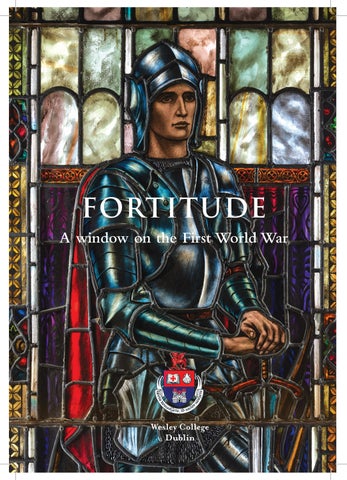
FORTITUDE A window on the First World War
Wesley College Dublin
Detail of Fortitude Commissioned to honour Wesley Past Pupils who died in the Great War, Fortitude is typical of AE Child, an excellent craftsman and teacher of a generation of Irish stained glass artists.
Christopher Woods, Wesley College Dublin, 2024
Wesley College and the First World War Situated in the heart of the city, Wesley College Dublin was attended by 311 students in 1914. Boasting its purpose-built school premises on the corner of St Stephen’s Green and Harcourt Street, it had taken in its first girls in 1911 and had secured a sound reputation, attracting both day pupils and boarders. As the academic year drew to a close in the summer of that year, all appeared well. By the autumn, however, Europe was at war. In 1914 alone, 44,000 Irishmen enlisted in the British Army. Wesley College staff and pupils were as caught up with the fervour of the time as the rest of the island of Ireland. Past pupils enlisted in the Army, Navy and Royal Flying Corps. Others served as doctors, surgeons or chaplains. Illustrating the significant impact of the war on the College, the entire Senior Cup Rugby Team from the previous year signed up together after the summer break1. The Wesley College Quarterly Magazine from December 1914 lists all of the past pupils who signed up to fight. In total, 600 past pupils served in the armed forces in some capacity; 84 died.
The Senior Cup Rugby Team from the 1913-14 school year. The entire team enlisted together in 1914. Four did not return.
84 War Dead Throughout the war, the names of past pupils known to have died were regularly announced at Assembly. At the war’s end, the College sought further details. Fathers, mothers and siblings responded to the call for information. A detailed record of all those who died survives in the College archives.
Families returned details of those who had died, most born in the 1890s. Parents often added further information on the forms they sent back. Echoing words used later, the form returned by Herbert MacMahon’s father refers to “honour, self-sacrifice and faithfulness to death”.
The Building of a College Chapel At the end of the war, the Principal of the College, Dr Irwin, was determined that a “Memorial Hall” be built. The Wesley College Quarterly Magazine, as part of the fundraising effort, put out the call “in tribute ...to the old boys of the College who so gallantly fought for us, and of whom eighty-four made the supreme sacrifice.” Fundraising for a memorial began in earnest with the call to the whole community to contribute. Details of those who made donations were published as contributions arrived. A site for the new Chapel at the rear of No.99 St Stephen’s Green was donated by a Miss Powell; she later bequeathed the remainder of this property to the College. Plans for the new building were drawn up in 1925. Designed by the College architect, Mr George F Beckett (a past pupil of the College and a cousin of the playwright Samuel Beckett), it was constructed from granite in the Irish Romanesque style at a cost of £8,500.
A call to assist with funding went out to the wider Wesley community.
The completed Memorial Chapel Close examination shows that a planned porch was not built.This was omitted to reduce costs.
The original drawings for the interior of the Chapel showing a window to be placed above a memorial board.
Fortitude, over the Memorial Board in the Chapel in Wesley College, St Stephen's Green.
The Memorial Hall Interior Later referred to as the “Memorial Chapel,” the building was opened on Saturday 2nd April 1927. At the head of the Chapel, behind the altar, were placed the Memorial Board and a newly commissioned stained glass window, Fortitude, by Alfred E Child. While the Chapel itself was only to remain until 1969, the memorial board and window would survive in the new Wesley College buildings in Ballinteer.
The Wesley College Memorial Board records the names of past pupils who died in the First World War. Originally positioned below Fortitude and above the altar in the Memorial Chapel, it was moved to its current location outside the Myles Hall in the new Administration Block in 1969.
Wesley College pupils file into the Memorial Chapel from the main school building. The purpose-built school on the corner of Harcourt Street and St Stephen’s Green was opened in 1879.
Fortitude In 1926, AE Child was commissioned to create the main window over the altar in the Memorial Chapel. It would comprise three windows with the central panel a figure representing Fortitude. The knight in armour, with sword and dragon, was typical of figures produced by Child in the 1920s. Such symbols of heroism, complemented by the words “Faithful unto death”, reflected a desire to honour the war dead. The centre panel of Fortitude before cleaning and restoration. Simple and calm, the Wesley College window is typical of AE Child. The reference to the war is subtle: the dates 1914-18 appear under the point of the sword.
The new window created an impact when the Chapel opened. A description at the time reads: “On entering the chapel one is attracted by the stained-glass window opposite to the entrance door, with its knight in armour, and the inscription: ‘Faithful unto death,’ designed and executed by Mr A. E. Child, Dublin. Under this window is a marble tablet bearing in letters of gold the names of those who gave their lives in the war."
AE Child Born and raised in England, Alfred Ernest Child came to Ireland in 1901 to take up an appointment as Instructor in Stained Glass at the Dublin Metropolitan School of Art. A little later, on 1st January 1903, a new co-operative stained glass workshop opened with Child as its manager. This was An Túr Gloine (The Tower of Glass), part of the Celtic Revival movement. Against a background of growing Irish nationalist fervour, AE Child’s remit was to train Irish stained glass artists in the hope that Irish commissions would move away from mass-produced imports.2 An excellent craftsman himself, Child was “solely responsible for instructing a generation of Irish stained glass artists in the craft including Harry Clarke, Michael Healy and Wilhelmina Geddes.”3
AE Child designed and made around 130 windows during his career in Ireland. Following the First World War, he completed a significant number of war memorial commissions. David Caron notes that “these, and allegorical figures generally suited him as they offered the opportunity to paint idealised, heroic figures, often in suits of armour, which he was adept at rendering, with backgrounds filled with beams of celestial light, something at which he also excelled.”⁴
Signature Detail The artist’s signature can be seen at the bottom of the left panel.
The Move to Ballinteer In 1969 Wesley College moved to its current site in Ballinteer. The window was removed from the Chapel prior to demolition and taken to the new Wesley College campus. There were some discussions at the time regarding the possibility of building a new College Chapel. The Myles Hall in the Administration Building, however, could accommodate the whole school and became the centre for major gatherings. While the Memorial Board was placed outside this new hall, there was no obvious location for the window, a piece of artwork originally commissioned for a building of considerable height. In 2023 a location was found in the GB Shaw Auditorium where once again “...on entering... one is attracted by the stained-glass window opposite to the entrance door”.
Restoration The glass was cleaned and pieces on the edges of the window were re-leaded. New glass, hand-painted by Alan Tomlin, was added to replace a two-inch “sacrificial border” that was not possible to remove when the window was taken from the old chapel. Fortitude, pictured 2023 (un-cleaned) and a panel, 2024 (cleaned). Note the additional border on the cleaned panel; the original was lost when the window was removed from St Stephen’s Green.
Left: Openings in the existing panelling were cut to fit the restored window exactly. The College maintenance team kept the variation to 2mm.
Right: It fits. Each of four sections from the three windows was positioned, one on top of the other. Held in place with T-Bars, each section is further secured with copper wire to cross supports, replicating the original fixings required for an external window. Set into the wood panelling opposite the main entrance, the restored window is positioned at a height, as it would have been seen in the original Memorial Chapel. It is braced to the blockwork wall behind to take the considerable weight of glass and lead. Modern low-wattage lighting allows the window to be seen throughout the day and evening.
A part of our past restored In his Preface to the Gazetteer of Irish Stained Glass (2024), David Caron writes of “the high number of places built for religious worship which have shut their doors” in recent years, and with this “stained glass windows have been relocated, sometimes put into long-term storage... left to languish, and sometimes simply abandoned to a very uncertain future.” AE Child’s Fortitude, produced in 1927 for the Wesley College Chapel in St Stephen’s Green, was left without an obvious home with the move of the College to Ballinteer in 1969. Restored in 2024 and placed in its new location, this magnificent window can be enjoyed once again.
An Architect’s Vision A drawing from the office of architect George Beckett shows the plan for the location of the AE Child window in the new chapel.
The Commission of a Window An image from the original records of An Túr Gloine (Tower of Glass) details the entry “for the Wesley College Memorial Hall” (order no. 610). Noted here are the sizes of the three panels and that they would be placed in a wall to the west. Also noted is the original cost of £125.00 and an additional £5 when a “larger figure” was requested.
The Dr Crook Window
As a further point of interest, a second window, featuring a portrait of Rev Dr Robert Crook, was erected in the entrance hall of Wesley College, St Stephen’s Green, in 1917. He had been Headmaster, Governor and Chaplain of Wesley College, Dublin (1857 to 1862). As Dr Crook had moved to become the first Headmaster of Methodist College, Belfast (1871-73), this window was given to Wesley’s sister school at the time of the move to Ballinteer in 1969. An interesting reflection, nonetheless, is that this window features panels bearing the Wyvern of Wesley College, Dublin.
Footnotes ¹ Details of the team, the rugby cup campaign, and details of the four who died can be found in the Wesley College Yearbook 2014, p 179, article by Niall Sisson. ² Among those who decried the quality of stained glass that prevailed in Ireland in the early 1900s was GB Shaw. (Noted by Nicola Gordon Bowe: Intoduction to Gazetteer of Irish Stained Glass). Shaw might have appreciated an AE Child window re-instated in the Auditorium named after him in his old school. ³ David Caron, the Gazetteer of Irish Stained Glass, revised edition 2024, p 254. ⁴ ibid, p254.
“One is attracted by the stained-glass window opposite to the entrance door”
Wesley College Dublin