


We’ve published this edition of Even Better Together so that we might introduce ourselves to you. We’re the Alliance for Academic Internal Medicine, or AAIM, a consortium of five organizations working together to promote the advancement and professional development of our members—the people who prepare the next generation of internal medicine physicians and leaders.
Inside these pages, you’ll find stories that offer insights into who we are, what we do, and how we support our members. Along the way, you’ll meet a few AAIM members—some with us for decades, others for just a few years—who speak clearly about the strength and benefits of the Alliance.
As you’ll discover, AAIM is a powerful advocate for diversity, equity, and inclusion. In fact, those principles are part of everything we do. We can only truly meet the needs of our members and the patients they serve when we ensure everyone has access and is included.
Thank you for reading Even Better Together.
Sincerely,

Polly E. Parsons, MD, MACP, FCCP, ATSF President and CEO Alliance for Academic Internal Medicine


We Are the Alliance Shaping the future of academic internal medicine
Taking leadership seriously
Strategies for Success Strategic planning keeps us focused
Helping Members Lead & Succeed Fostering effective change Even Better Together A consortium with a powerful voice
Representation for All Diversity, equity, and inclusion inform everything we do


More physicians in the United States practice internal medicine than any other medical specialty, according to the 2022 Physician Specialty Data Report published by the Association of American Medical Colleges. In Canada, internal medicine represents a similarly large percentage of the total number of practicing physicians. When internal medicine’s subspecialties are added to the mix—gastroenterology, cardiology, and infectious disease, to name a few—the field becomes even larger.
Academic internal medicine includes not only patient care but also medical education and research. And it’s the people working in the field of academic internal medicine who are primary drivers of change within the overall health care system.
That’s where AAIM comes in.
We’re the Alliance for Academic Internal Medicine, or AAIM, as some know us. We call ourselves the Alliance, in good part because it’s a name that suggests both collaboration and significant power. As the largest organization of its kind, the Alliance represents more than 12,000 members in the United States and Canada, offering education, information, connections, and influence.
We provide opportunities to enhance career paths, helping to ensure academic internal medicine remains healthy as it cares for today’s patients and prepares professionals to care for tomorrow’s.
Before the Alliance was formed, the five founding organizations worked separately to support their unique constituencies. These organizations—AIM, APDIM,


“AAIM is a salon for big ideas, where passionate and informed individuals can learn from one another and then return to work prepared to train the next generation of leaders in internal medicine.” – Mark E. Anderson MD, PhD, Dean, University of Chicago Pritzker School of Medicine
APM, ASP, and CDIM—represent the people working in academic internal medicine as physicians, researchers, educators, administrators, and other positions of leadership.
After careful evaluation, we determined that the members of each organization would be best served if we consolidated efforts—and the Alliance was born.
Today, we offer our membership even greater opportunities to influence change, affect policy, and grow their careers. AAIM President and CEO Polly E. Parsons, MD, MACP, FCCP, ATSF, puts it this way: “Once, each founding member spoke with its own voice; now we speak collectively, with the strength of one unified voice.”
That voice is informed by the years of expertise the AAIM staff has garnered as it collaborates with other stakeholders, including the Association of American Medical Colleges (AAMC), the Accreditation Council of Graduate Medical Education (ACGME), the American Board of Internal Medicine (ABIM), and the American College of Physicians (ACP), to name a few.
There is power in collaboration. Working together, we shape outcomes within the field of academic internal medicine.
The Alliance for Academic Internal Medicine promotes the advancement and professional development of its members who prepare the next generation of internal medicine physicians and leaders through education, research, engagement, and collaboration.
Academic internal medicine, as the home of medical education and research, is the generator of innovation for health care, now and for the future.
To learn more about how the Alliance was formed, read the story on Page 14.
Read Even Better Together online


Academic internal medicine is an important instigator of change in the field of medicine. As we strive to support those working in this arena, the professionals who advocate for innovation and improvement, we take our own governance and fiscal responsibility seriously. When there’s so much at stake, trust and accountability matter.
The work we do to support our membership and shape the field of academic internal medicine aligns with our strategic plan and is guided by our Board of Directors. Additional committees, councils, and task forces work with the Board to help execute the activities that align with that plan.

“As someone who has built three residency programs in three states, I can say that the collegial exchange and advice I’ve received through AAIM have been valuable to my work and personal mission.”
– James A. Kruer Jr., MD, Internal Medicine Residency Program Director, Northeast Georgia Medical Center


“AAIM helps address the challenges in academic internal medicine by hosting relevant programming that allows members to identify and share best practices.” – Lisa M. Bellini, MD, MACP, Senior Vice Dean for Academic Affairs, Raymond and Ruth Perelman School of Medicine, University of Pennsylvania
Our Board of Directors assumes fiduciary responsibility for the Alliance. It performs that responsibility in part through the work of various committees, which oversee fiscal resources and audits, compensation levels, and other measures that ensure our fiscal health.
We are careful stewards of our financial resources, understanding that monies raised through dues, conferences, grants, and other revenue streams belong, in a very real sense, to our members. We spend carefully and in alignment with our strategic plan, and we invest wisely and ethically. For example, our portfolio of investments includes those that reflect ethical, social, and corporate governance issues (ESG). Good citizenship matters at every level.
The Alliance for Academic Internal Medicine (AAIM) is a professional society dedicated to the advancement and professional development of its members who prepare the next generation of internal medicine physicians and leaders through education, research, engagement, and collaboration. To achieve this purpose, it is imperative that we adhere to the highest ethical standards in all professional activities, therefore, AAIM expects its leaders, members, staff, affiliates, and vendors to honor our code of conduct.
Read AAIM’s code of conduct online
We’ve accomplished a lot since the work of building our consortium concluded in 2013. As we face a future that will require even more of our members—and, thus, of the Alliance—we are undertaking a full assessment of our own governing structure. We want to be prepared to meet the challenges ahead.
“We are eager to discover what we’ll learn in this important review,” says Shobhina G. Chheda, MD, MPH, Chair of the 2024 AAIM Board of Directors and Associate Dean for Medical Education at University of Wisconsin School of Medicine and Public Health.
Polly E. Parsons, MD, MACP, FCCP, ATSF, AAIM President and CEO, adds: “Our role in supporting and advancing academic internal medicine will become even more important as the field adapts to meet new needs. We must be prepared; our governance assessment and any resulting changes will make the Alliance a more efficient and effective leader.”
Read Even Better Together online Learn more


Greek philosopher Heraclitus (c. 540 BCE to 480 BCE) wrote, “Everything changes and nothing remains still.” Evidence suggests he was onto something. His bit of truth seems particularly accurate when applied to the practice of medicine, a continuously evolving art and science that responds to myriad catalysts. Patient need alters protocols and drives research. Medical education adjusts to meet the needs of practitioner and patient. Social and political challenges engender adaptation.
The Alliance recognizes that academic internal medicine is the generator for innovation and evolution in medicine and health care. We exist to support the people working in internal medicine as physicians, researchers, educators, administrators, and other positions of leadership. These professionals—our members—guide the field of medicine as it responds to the challenges and opportunities that change brings.
“In 2019, the Alliance Board of Directors agreed that the organization should develop a strategic plan that reflects the efforts of each of our original five organizations, while harnessing the power of the Alliance,” says Shobhina G. Chheda, MD, MPH, Chair of the 2024 AAIM Board of Directors and Associate Dean for Medical Education at University of Wisconsin School of Medicine and Public Health.
The resulting strategic plan has two areas of focus that, in combination, are designed to help internal medicine move forward as it faces new challenges. And each of these two goals are supported by three initiatives that guide all of the Alliance’s activities in supporting its membership and in guiding change within the education system that prepares future internal medicine specialists. In short, our strategic plan ensures that, as Polly E. Parsons, MD, MACP, FCCP, ATSF, AAIM President and CEO, says, “we’re at the table, helping to shape policy that will safeguard the health of this vital field of medicine.”


“Given the state of change in internal medicine, it’s easy to get lost in the weeds. AAIM helps members stay on track, giving us a learning environment, a place to advocate, a place to come together and collaborate.” – Paul B. Aronowitz, MD, MACP, Faculty, Internal Medicine Residency Program, University of California, Davis School of Medicine
Provide transformational professional development to physician and administrative leaders in academic internal medicine.
Initiative One
Develop a new AAIM Executive Leadership and Professional Development Program.
Initiative Two
Create the AAIM Business of Medicine Education Portfolio.
Initiative Three
Develop and disseminate best practices to improve undergraduate and graduate medical education faculty performance.
Redesign the transitions across the continuum of internal medicine education.
Initiative Four
Promote innovation in medical education research.
Initiative Five
Develop and disseminate best practices designed to ensure the expansion of opportunities for underrepresented faculty to be part of a physician-scientist workforce that is diverse, equitable, and inclusive.
Initiative Six
Develop robust evaluation and trustable communication processes for transitions during internal medicine training.
To learn more about AAIM programs and initiatives, see Page 8.




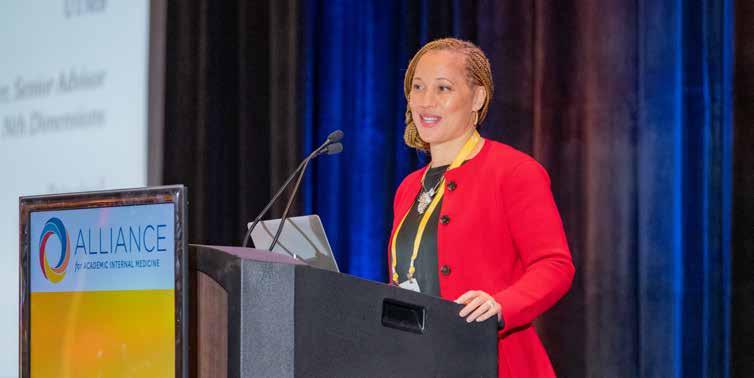
Members of the Alliance train and support the largest percentage of the future US physician workforce. The Alliance supports them by offering career and skill development opportunities, as well as opportunities to collaborate with peers and engage in meaningful projects, including research and publication. All the work we do is aimed at helping our members shape the future of academic internal medicine.
“We offer members the tools they need to be effective leaders in their chosen careers,” says Talia D. Austin, MSM, AAIM Senior Director of Member Engagement, Diversity, and Inclusion. “When people are fully engaged in the work they do, they are much more likely to find satisfaction and rewards in their professional lives.” And academic internal medicine benefits.
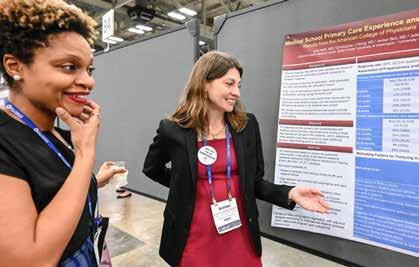



“We launched the Digital Learning Center in 2022, after time spent determining what would best serve our membership,” says
Steven M. Humphrey, AAIM Senior Director of Conferences, Meetings, and Technology Services. Wanting to ensure diversity of educational offerings for members, which are predominantly physicians, our first two, 12-week courses were designed for administrative professionals working in the field of academic internal medicine:
• Foundations of Academic Internal Medicine for Education Administrators
• Foundations of Academic Internal Medicine for Department and Division Administrators
Enrollment for both courses was nearly double the projected number, indicating members are eager for these opportunities. We are now building an internal team to support the Digital Learning Center and create additional courses. As we add new offerings for additional career paths, we will continue to focus on education our members aren’t able to find elsewhere.
The AAIM Digital Learning Center also serves as the portal to the Alliance’s webinar series, and it provides access to recordings of past meetings and conferences.
Learn more

Margaret A. Breida, MS, AAIM Senior Director of Education and Research, and her team—working in partnership with our survey committees—develop and execute a robust schedule of periodic research surveys that are sent to AAIM members.
The results of these surveys help us understand what challenges our members are facing, the kinds of support they need to succeed, and the ways we can provide education and other resources they will value.
Survey responses are kept confidential to protect privacy and encourage candor, but the summarized results are collected, analyzed, published online, and made available to members. Ms. Breida notes: “Members use this data to advocate for themselves, for their students, departments, and institutions.
And we use it to advocate for change on their behalf with outside organizations.” Additionally, many members partner with the survey committees to use collected data in materials they publish in scholarly journals.
Learn more

Physician-scientists, those who spend the majority of their time immersed in medical research projects, help define academic internal medicine as a driver of innovation. Our work in this space helps ensure that this career path continues to attract the physician-researchers needed to help move academic internal medicine forward. To that end, we have initiated programs and activities that foster scientific inquiry while helping address problems of work-life balance and career fatigue.
Recent initiatives aimed at building and supporting this career path include, among others:
• Annual workshops for research-pathway directors
• Webinar: “So You Want to Be a StARR?”
• Publications, including AAIM’s “Best Practices for Physician-Scientist Training Programs”
Because we believe medical research itself must be inclusive to be effective and representative, much of our effort to date in the physicianscientist path is intended to emphasize diversity, equitability, and inclusivity. Further, we are working to create opportunities for underrepresented faculty within this workforce.
Learn more

Alliance Women L.E.A.D.
Our Alliance Women Leadership Empowerment Advancement and Development (L.E.A.D.) program promotes and facilitates professional development and educational opportunities that help further the careers of women working in academic internal medicine
“We launched this initiative in September 2021 with the intention of providing the tools, education, and connections women need to master their professions and prepare for next steps in their careers” says Ms. Austin.
Now with more than 3,500 participants, the program offers support and education in several formats, including:
• Town hall meetings
• Book club discussions
• Online discussions
Learn more

Since the Alliance Innovation Grants program began in 2015, it has awarded funds to support a variety of initiatives, including patient care and access to care, health care disparities, wellness and resilience, and curriculum development, among others. To date, AAIM has made a total of 180 Innovation grants to 116 institutions.
In FY 2021, the Alliance began co-sponsoring an initiative called Building Trust Through Diversity, Health Care Equity & Inclusion in Internal Medicine. Aimed at building a more trustworthy health care system, the program has granted over $1,000,000 and 76 projects to date.
“These grant programs are one more way the Alliance supports members and their careers. Many of the funded initiatives lead to publication, an important part of a career path in academic internal medicine,” says Ms. Breida.
Our grants program is sponsored by the following organizations:
• American Board of Internal Medicine (ABIM)
• ABIM Foundation
• AAIM
• American College of Physicians (ACP)
• The Gordon and Betty Moore Foundation
Learn more
In addition to these programs, the Alliance serves members by providing a full menu of valued opportunities. For example, our mentoring initiative gives seasoned professionals the chance to share their expertise with a mentee. And our annual series of in-person conferences offer education, professional networking, fresh challenges, and time for renewal. The Alliance also hosts member-only online discussion communities and supports several member-recognition programs.

“I’ve seen first-hand AAIM’s successes as it convenes stakeholders to discuss challenges and create opportunities—and shares its information with others.” – Cheryl W. O’Malley, MD, MACP, FHM, Designated Institutional Official, University of Arizona College of Medicine - Phoenix



Collaboration concentrates our strength

Before the Alliance was formed, each of our five founding organizations was engaged in meeting the professional needs of its members—the professionals working within the field of academic internal medicine. Collaboration and communication existed between these five entities, and all were successful in helping to shape policy and advocate for change by supporting the career paths of their members.
The impetus for a merger, says Polly E. Parsons, MD, MACP, FCCP, ATSF, President and CEO of the Alliance, “was to become more efficient, to consolidate our influence, and offer resources to members they weren’t able to find elsewhere.”
The power of the consortium that exists now, through the Alliance, is only possible because of the strength of each founding member.
Founded in 1979, AIM is the organization of business administrators in departments of internal medicine at medical schools and affiliated teaching hospitals in the United States and Canada. The association represents chief administrative officers, division administrators, administrative directors and managers, and other senior business administrators in departments of internal medicine.
Founded in 1977, APDIM is the international organization of accredited internal medicine residency programs. The association represents program directors, associate and assistant program directors, core faculty, program administrators and coordinators, fellowship coordinators, and other key faculty and staff involved in the internal medicine residency program.
Founded in 1954, APM is the organization of departments of internal medicine represented by chairs and appointed leaders at medical schools and affiliated teaching hospitals in the United States and Canada. The association represents department chairs of internal medicine at medical schools, vice chairs, chairs at affiliated teaching hospitals, and other departmental leaders who are full professors of medicine.
Founded in 1994, ASP is the organization of specialty internal medicine divisions at medical schools and community teaching hospitals in the United States and Canada. The association represents fellowship program directors, division chiefs, and any physician faculty involved in an accredited internal medicine subspecialty fellowship program or its division.
Founded in 1989, CDIM is the organization of individuals responsible for teaching internal medicine to medical students. The association represents third-year clerkship directors, intensive-care management course directors, subinternship directors, clerkship administrators and coordinators, clinical preceptors, and other faculty and staff involved in undergraduate medical education.
The work of merging five distinct, albeit interrelated, associations into a single consortium took time and a good deal of careful planning internally. And the membership of each entity needed time to understand the motivation of the merger and the value of representation by a single entity that could speak about their critical issues with a single, unified voice.


“The most important role AAIM plays in the field of academic internal medicine is to offer thoughtful administrative, budgetary, and strategic input in the research, clinical, and education missions of departments of medicine.” – Rania Omar Burke, MPH, DrPH, Vice Chair, Finance and Administration, Boston University Chobanian & Avedisian School of Medicine
Founding associations begin first concurrent meetings
Staff merges 2004 2008
Branding begins for a combined annual conference: AIM Week
First AIM Week to include all five member organizations
AAIM is incorporated
Phase 1 of merger: includes ASP and AIM
“We continue to be grateful for the ways in which the AAIM staff have adjusted and adapted to the merger,” says Dr. Parsons. “Their dedication to our mission and to the success of the consortium has allowed the Alliance to offer even greater support to our members through the execution of a collaborative strategic plan.”
Phase 2 of merger: includes APM, APDIM, CDIM

AAIM becomes the sole entity
“I co-chaired an AAIM work group— populated with members from each of AAIM’s five founding members— to help improve the transition from undergraduate to graduate medical training. We were able to reach solutions to issues that have challenged us for years.”
– Susan Lane, MD, MACP, Program Director & Vice Chair, Renaissance School of Medicine at Stony Brook University
Today, AAIM is a successful and forward-looking, member-driven organization. That’s not surprising, given the years of experience each founding organization brings to the table and the various points of view that contribute to the Alliance’s vision. Working together as one, we engage in four important areas of focus:
• Supporting the highest principles of the medical profession
• Uniting, preserving, and promoting academic internal medicine
• Ensuring that academic internal medicine is a leader and maintains its excellence in educating the next generation of physicians and providing high-quality care to patients
• Developing faculty and staff leaders in departments of internal medicine
“After the merger, we were rather big and a little lumpy,” says Shobhina G. Chheda, MD, MPH, Chair of the 2024 AAIM Board of Directors and Associate Dean of Medical Education at University of Wisconsin School of Medicine and Public Health. “Now we’re working on developing further efficiencies as a refinement of what we’ve already achieved,” Dr. Chheda says. “When we become even more nimble, we’ll have an even greater impact.”

The Internal Medicine Education Advisory Board (IMEAB) was formed in 2011 as a forum for discussion, collaboration, and consensus-building around issues affecting the education of internal medicine physicians. Initially, IMEAB addressed a variety of issues, though gave considerable time and attention to the development and implementation of internal medicine milestones and the assessment of competence in residency training.
The feedback provided by IMEAB and the collaboration among its members proved invaluable at furthering the work of the internal medicine education community around this and other important issues. Reflecting upon this initial work, IMEAB members strongly believed that the relationships between the stakeholder organizations were strengthened. The IMEAB then recognized the need to examine and further define the scope and purpose of its work to continue providing meaningful guidance to the internal medicine education community.

“Membership
in AAIM gives us a voice when important decisions are being made that impact physicians, residents and fellows, and medical students.” –
John H. Choe, MD, MPH, Associate Program Director, Internal Medicine Residency, University of Washington School of Medicine
IMEAB’s current activities include:
• Focus on items and issues related to the professional education of internal medicine physicians
• Serve as a forum for discussion about specific issues related to internal medicine education with the goal of providing guidance, and, when possible, consensus recommendations to the internal medicine education community regarding that issue
• Serve as a “think tank” to identify and consider emerging issues related to internal medicine education and appropriately frame that discussion to facilitate advocacy, research, or communication within the internal medicine community
• Communicate directly with leadership from key stakeholder organizations, with the goal of strengthening this emerging learning community
• Facilitate collaboration and communication among IMEAB member organizations
• Establish a culture of mutual accountability necessary to further the collective work of the internal medicine education community as a whole
IMEAB’s member organizations are:
• Alliance for Academic Internal Medicine
• Accreditation Council for Graduate Medical Education
• American Association of Colleges of Osteopathic Medicine
• American Board of Internal Medicine
• American College of Osteopathic Internists
• American College of Physicians
• American Medical Association
• Association of American Medical Colleges
• Educational Commission for Foreign Medical Graduates, now Intealth
• National Board of Medical Examiners
• National Board of Osteopathic Medical Examiners
• Society of General Internal Medicine
• Society of Hospital Medicine



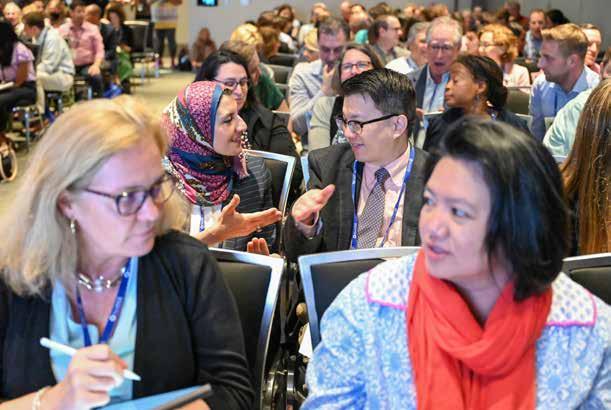
The workforce in health care is changing rapidly. For example:
• According to the AAMC, in 2021, one in five physicians in the United States graduated from medical schools outside the United States and Canada.
• Over the past three decades, the American Osteopathic Association notes, the total number of DOs and osteopathic medical students in internal medicine has more than quadrupled.
• Per the AAMC, university teaching hospitals make up just 5% of the total number of hospitals in the United States, or about 1,700. By contrast, there are more than 5,000 community hospitals in the country.
And these are just a few of the statistics that point to the important and urgent work needed to address issues of inequity in academic internal medicine and its subspecialties. We must develop a health care system that reflects the rich diversity of our communities in terms of ethnicity, gender, physical ability, immigration status, sexual orientation, and socioeconomic status.
One in five
physicians in the United States graduated from medical schools outside the United States and Canada.
If we are to adequately represent AAIM members, we must also address the inequities that hinder them. Margaret A. Breida, MS, AAIM Senior Director of Education and Research, notes: “Our members tell us about the issues that are important to them, including equity in pay and in representation, issues of promotion and matriculation. We listen, and we respond. We’re here to support the physician chairs of medical schools and the assistants who help run clerkship programs. All voices deserve to be heard.”
In the past three decades
the total number of DOs and osteopathic medical students has more than quadrupled.


“AAIM has been an important part of my professional identity—from giving me the opportunity to meet collaborators and mentors to giving me a seat at the table.” – Lonika Sood, MBBS, MHPE, Interim Vice Dean for Education Affairs, Elson S. Floyd College of Medicine, Washington State University
To ensure we keep DEI issues front of mind, the Alliance has developed a comprehensive set of standards and procedures.
The Alliance for Academic Internal Medicine (AAIM) is committed to promoting and championing diversity, equity, and inclusion as a strategic imperative in support of academic internal medicine physicians, administrators, and physicians-in-training.
AAIM will:
• Facilitate the professional development, continuing education, support, and growth of physicians, administrators, and physiciansin-training in academic internal medicine from diverse backgrounds within AAIM and departments of medicine nationally
• Support physicians, administrators, and physicians-in-training in academic internal medicine to work collaboratively with colleagues of diverse backgrounds within and across institutions to advance high quality and equitable care for all patients
• Recognize academic internal medicine physicians, administrators, and physicians-in-training whose work substantially advances diversity, equity, and inclusion through systems which ensure high quality care for all patients
• Create an inclusive environment and welcoming home for all committed physicians, administrators, and physicians-in-training, and work to promote similar environments for members and learners within departments of medicine nationally
• Equip internal medicine medical educators with the ability to prepare the next generation of physicians with the knowledge, skills, and attitudes required to effectively care for our diverse population
• Stimulate research that supports high quality care and mitigation of health disparities
• Partner with other internal medicine organizations to develop tools, resources, and best practices
• Develop outcome-based metrics to assess diversity, equity, and inclusion efforts in academic internal medicine
How have these precepts been translated into the programs and initiatives the Alliance offers? Plans for conferences—their speakers, panels and topics—are carefully evaluated to ensure they align with DEI goals. Newsletters, surveys, grants, webinars, online courses—and all other initiatives and programs— must also align.

“We’ve established a number of safeguards that serve to keep us on track and accountable,” says Talia Austin, MSM, AAIM Senior Director of Member Engagement, Diversity, and Inclusion. Those safeguards include, among others:
• Two DEI-dedicated staff members: our Assistant Director of DEI and the Senior Director of Member Engagement, Diversity, and Inclusion
• An appointed DEI liaison from the AAIM Board of Directors
• Our AAIM DEI strategic plan
• The AAIM DEI Advisory Group and the AAIM DEI Task Force
• Collaborators outside the Alliance
Additionally, Ms. Austin adds, the Alliance uses a quarterly newsletter, Diversity Now, to highlight relevant news and resources for our members—and to help keep DEI issues in focus in the work they do every day.
To encourage and support DEI efforts undertaken by members, the Alliance offers several programs and tools, including:
• The Alliance Women L.E.A.D. program, focused on empowering women working within the field of academic internal medicine
• AAIM Health Disparities Toolkit, offering a peer-reviewed collection of resources and teaching tools to help instructors create curriculum
• Application and recruitment resources, providing evidence-based recommendations to address inequities in learning environments and news about the Alliance’s work in this space
• Bias resources, a collection of member-developed tools to help identify, address, and mitigate myriad biases in medical education
In addition to these resources, the Alliance promotes DEI through these efforts:
• Diversity, Equity, and Inclusion Award, given annually to an individual or team who champions DEI in their department of medicine
• Building Trust Through DEI Grants, a program that awards funding to projects designed to integrate diversity, equity, and inclusion, as well as diagnostic excellence, into internal medicine education and training
“The Alliance has a long way to go—as we all do—to ensure diversity, equity, and inclusion for all,” says Polly E. Parsons, MD, MACP, FCCP, ATSF, the Alliance’s President and CEO. “But we have taken these important issues to heart and are working to inculcate DEI principals in everything we do, internally and externally.”
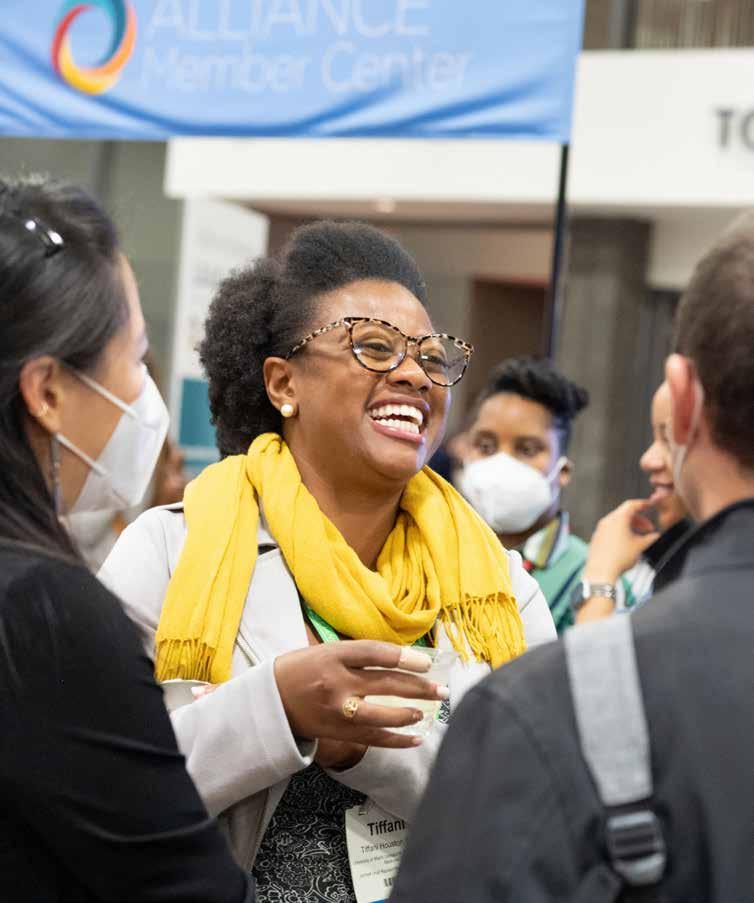
“AAIM

Peter Cram, MD, MBA Chair & Professor of Internal Medicine