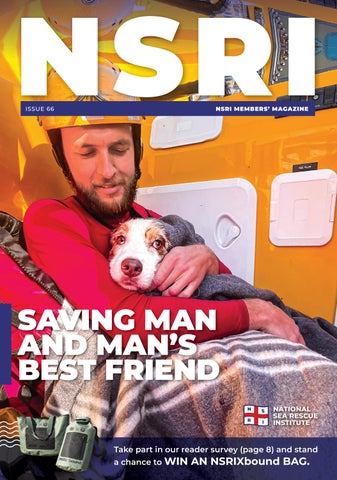
NSRI ISSUE 66
NSRI MEMBERS’ MAGAZINE
SAVING MAN AND MAN’S BEST FRIEND Take part in our reader survey (page 8) and stand a chance to WIN AN NSRIXbound BAG.
ICE-SAR 1080 Series Official Watch For Search & Rescue www.luminoxwatches.co.za
I S S UE 66
CONTENTS 19 42 14 27 2
LETTERS
COVER PHOTOGRAPH: KYLE NEL
10 THE NAMES WE CARRY... The Spirit of Shoprite Sixty60 comes home to Station 4 Mykonos.
27 A CAUTIONARY TALE Even when you’re prepared, things can go wrong on the water. Paddler Peter Hobday shares his story. 30 AGM AND AWARDS EVENING Honouring bravery and service.
14 THE ORC PROJECT COMES FULL CIRCLE This year marks the end of an incredible journey as the last two ORCs were delivered to their bases.
34 STRONGER STATIONS, SAFER WATERS Reflections from the 2026 Station Commanders’ Conference.
19 FAMILY TIES Answering the call to service runs in these ‘NSRI families’.
37 STATION AND SPONSOR NEWS Station and Volunteer Support Centre news, and sponsor updates.
24 SIMPLY MAKING A DIFFERENCE St Lucia Station Commander Melinda Snyman on leadership, volunteering, community and teamwork.
42 HERE BE (LITTLE) DRAGONS Meet the stingers of the sea. 46 NSRI BASE LOCATIONS ISSUE 66 | 1
FROM THE HELM
O
nce a year, we come together as an organisation. Our Annual General Meeting, Awards Evening and Station Commanders’ Conference bring together volunteers and staff from across the country, alongside strategic partners and supporters who are part of the NSRI story. While the AGM gives us a chance to reflect on the year and the impact we have made, the awards that follow are a powerful reminder of the people behind the organisation. We recognise exceptional acts of bravery and leadership, distinguished service to the NSRI and long service. This year, we celebrated two remarkable members marking 55 years of service. Today, the NSRI is a far broader organisation than the one established almost 60 years ago. As the NSRI grows in size and complexity, coming together as one organisation matters more than ever. It keeps us connected to each other and to our purpose. Our journey towards greater integration continues: our prevention and rescue services reinforcing each other, stations learning from one another, volunteers and staff working as partners across the organisation, understanding how their contribution connects to the whole. The Station Commanders’ Conference brought much of this to life. Leaders shared experiences, listened to and learnt from each other. Conversations crossed
the boundaries between operations, community programmes and support functions. It was a reminder that our collective strength lies in what each part does well, and what becomes possible when those parts work together. Different roles. Different teams. One organisation. One purpose: Saving lives, changing lives and creating futures. Our donors, partners and supporters are part of that. While their contribution may look different from that of a water safety instructor, lifeguard or rescue crew, their connection is the same. Their trust, generosity and belief make our work possible and allow us to invest in the people, equipment, training and programmes that ultimately save and change lives. Perhaps what struck me most about seeing the NSRI together was the diversity of people, roles and perspectives, all connected by something much bigger than any one part of the organisation. That sense of shared purpose becomes especially important as we head into the demands of our peak summer season. I want to recognise our volunteers for the time and commitment they give, and thank their families and loved ones for the support that makes it possible. Looking ahead to our 60th anniversary, this matters more than ever. Our strength lies in working together as one organisation, united by one purpose.
MIKE VONK, NSRI CEO
CAPE TOWN: NSRI, 4 Longclaw Drive, Milnerton, Cape Town, 7441; PO Box 154, Green Point 8051 Tel: +27 21 434 4011 Email: magazine@searescue.org.za Web: www.nsri.org.za facebook.com/SeaRescue
2 | NSRI MAGAZINE
@nsri
youtube.com/@NSRISeaRescue
@searescuesa
@nsrisouthafrica
C
M
Y
CM
MY
CY
CMY
K
NSRI_A4 ad_July 2026_print.pdf 3 2026/07/06 13:41:21
UNITED BY MORE THAN A LOVE FOR THE WATER. We're united by a shared responsibility to protect every person who ventures onto it. Whether you're fishing offshore, exploring the coastline or enjoying time with family and friends, safety is everyone's responsibility. That's why Yamaha Marine South Africa proudly supports the NSRI in promoting responsible boating, proper preparation, and safer experiences on South Africa's waterways. C
M
Y
CM
MY
CY
CMY
K
THE CREW THE PUBLISHING PARTNERSHIP MANAGING EDITOR Wendy Maritz ART DIRECTOR Ryan Manning COPY EDITOR Deborah Rudman ADVERTISING EXECUTIVE Bernice Blundell MANAGING DIRECTOR Susan Newham-Blake PRODUCTION DIRECTOR John Morkel ADDRESS PO Box 15054, Vlaeberg 8018 TEL +27 21 424 3517 FAX +27 21 424 3612 EMAIL wmaritz@tppsa.co.za NSRI OFFICE +27 21 434 4011 WEB www.nsri.org.za FUNDRAISING AND MARKETING DIRECTOR Janine van Stolk janine@searescue.org.za HEAD OF COMMUNICATIONS Andrew Ingram andrewi@searescue.org.za COMMUNICATIONS AND MEDIA RELATIONS Kylie Dawn Hatton kylie.hatton@searescue.org.za PRODUCED FOR THE NSRI BY The Publishing Partnership (Pty) Ltd, PO Box 15054, Vlaeberg 8018. Copyright: The Publishing Partnership (Pty) Ltd 2026. All rights reserved. Reproduction in whole or in part is prohibited without the prior permission of the editor. Opinions expressed are those of the authors and not of the NSRI. Offers are available while stocks last.
PRINTING Novus ISSN 1812-0644
WINNING LETTER
Congratulations to Riaan Rijsbergen for writing this issue’s winning letter. Your book and hoodie are on their way to you. To NSRI management, Station Commanders, crews and members, I would like to sincerely thank you for inviting me to attend the awards ceremony and for honouring me with the Bravery Silver Award. Receiving this recognition was an incredibly special and humbling experience for me. What meant just as much as the award itself was the way I was welcomed, acknowledged and appreciated by the NSRI. Being congratulated and personally thanked by the Station Commanders, management and members of the organisation made me feel truly valued. It was a moment that I will remember with great pride. When I accompanied the rescue crew at Grootdraai Dam on that evening, I simply wanted to assist where I could and use my knowledge of the dam to help the crew reach those who were in danger. I never expected that this would one day result in such a meaningful recognition. The award therefore means a great deal to me, not only because of what it represents, but because it reflects the appreciation of an organisation whose members dedicate themselves to helping others. I would also like to express my deepest appreciation to Travis Clack and the NSRI Witbank and Gauteng duty crews, and to everyone involved in the rescue operation. The work that the NSRI does is noble and selfless. The countless hours of training, preparation, travelling, responding to emergencies and putting your own safety
F L
C D
Habot Marine Services (Pty) Ltd
are the Authorized Distributors of ExxonMobil Marine Lubricants in South Africa.
Full range of ExxonMobil Marine Lubricants are readily available at: Cape Town | Port Elizabeth Durban | Mozambique
Tel: +27 (0) 31 534 6000 Fax: +27 (0) 31 534 6020 Mail: sales@habotmarine.com www.habotmarine.co.za Unichem Services, 47 Jeffels Road, Prospecton, 4133 Habot Marine Services Proprietary Limited Reg. No. 2017/203690/07 | Vat Reg No. 4340278045
LET T ER S
on the line for the sake of others deserve the highest respect. I have an even greater appreciation for the organisation after having had the opportunity to experience a small part of a rescue operation alongside your crew. Thank you for what you do, thank you for the recognition, and thank you for making me feel like part of the NSRI family, even if only for one very memorable rescue. With sincere appreciation and respect, RIAAN RIJSBERGEN Recipient – NSRI Bravery Silver Award (Please turn to page 30 to read more about the NSRI AGM and Awards Evening.) INCREASING SAFETY VISIBILITY I was out of the country for some time, and when I returned recently, I was pleasantly surprised by the increase in the NSRI’s presence on the Brenton-on-Sea walkway. The rip current sign is up and, more often than not, I see beachgoers standing next to it, looking out at the sea, trying to visualise the rips. I trust that, at the same time, they are applying the guidelines captured on the sign in their minds. Thank you very much for your team’s excellent contribution to this sign – I trust that it will have a positive impact and assist swimmers to act in the appropriate manner should they land in a rip. Then the emergency oxygen and CPR kit – what a great initiative! 6 | NSRI MAGAZINE
WRITE TO US AND WIN! The writer of the winning letter published in the next issue of NSRI Magazine will receive an NSRI hoodie and a copy of Into a Raging Sea. Email your stories to magazine@ searescue.org.za. It has been neatly installed just underneath the shark bite kit, and in easy view of beachgoers as they walk down the walkway. Again, both these kits draw much attention from beach visitors, with the result that awareness is created. This is our first prize – to circumvent trouble and danger, but if it does happen, how to go about mitigating its effects is vital. Many thanks. Apart from the intentional value of the sign and two kits, it is also reassuring to have the NSRI emergency numbers available and clearly visible in case of an emergency. With much appreciation, AMANDA LOUW Chair, Brenton-on-Sea Ratepayers Association
LET T ER S
HONOURING RELATIONSHIPS I would like to extend my sincere thanks to you, the NSRI Board and the wider NSRI community for the honour of presenting Oceana Group with the Alric Simpson Award. It was a privilege to attend the awards evening and to receive the award on behalf of the Group. I was deeply moved by the recognition of our longstanding partnership with the NSRI, and by the generous way in which Oceana’s contribution to the organisation and its mission was acknowledged. For Oceana, our relationship with the NSRI reflects a shared commitment to the safety and wellbeing of those who work at sea, the communities connected to the ocean and the volunteers and responders
who dedicate themselves to saving and positively impacting lives. The bravery, professionalism and commitment recognised on the night were truly inspiring, and it was humbling for Oceana to be included among those honoured. Please extend my appreciation to everyone involved in arranging such a memorable and meaningful event. I would also like to wish you, the Board and all NSRI volunteers every success for the year ahead as you continue this vital work. Oceana is proud of our association with the NSRI, and we are grateful for the opportunity to continue supporting the important work you do. NEVILLE BRINK CEO, Oceana Group Limited
Take our
READER SURVEY for a chance to
WIN a waterproof NSRIXbound bag. The winner picks:
Waterproof Tote Bag (worth R749) Grab Bag (worth R649)
Your feedback helps us shape the magazine. Take the reader survey
Bound Reader Survey Ad 148x105.indd 1
2026/09/23 15:53:32
NSR
3:32
bag collection
Engineered for the elements. Made to make a difference. 100% waterproof, lightweight and easy to carry, this durable, practical design delivers reliable performance for beach days and outdoor adventures. Every bag is packed with purpose - combining the functionality you need with meaningful support for the NSRI’s mission to save lives on South African waters.
SHOP NOW shopNSRI.com
NSRI Mag Bound Bag Ad - 148x210.indd 1
2026/09/23 15:35:01
CEL E BR AT E A L I F E
THE NAMES WE CARRY AND THE PLACE WE CALL HOME Rescue 4 is named and blessed along with Station 4 Mykonos and its crew.
A
t Club Mykonos, Langebaan, on Saturday 17 October, families, volunteers and corporate supporters gathered for the blessing and naming of Rescue 4. The occasion brought together the many people whose generosity supports the National Sea Rescue Institute’s lifesaving work, from individual donors to a major corporate sponsor. Through the NSRI’s Celebrate a Life campaign, donors helped fund the new Offshore Rescue Craft’s construction by placing loved ones’ names within her RESCUE lettering. The 626 names carry 10 | N S R I M A G A Z I N E
stories of love, gratitude, celebration and remembrance. One gift celebrated a couple’s wedding anniversary. Another honoured a mother whose family discovered, after her death, that she had supported the NSRI. Her children spent much of their lives around the ocean; continuing her support became a way to remember the care she had always shown them. For another donor, placing his wife’s name on the vessel recognised her support through recovery from a serious accident. She had encouraged him through
PHOTOGRAPHS: ANDREW INGRAM
It was a special day, says Kylie Dawn Hatton.
LEFT Station Commander Nic Stevens, Chief Marketing Officer of the Shoprite Group Ilze Bylos and NSRI CEO Mike Vonk.
PHOTOGRAPHS: ANDREW INGRAM
‘It’s a big day for Station 4 Mykonos. We’ve come from our beginnings in 2004, with a container and a second-hand 5.5-metre boat, to where we are today with this world-class vessel and station.’ Nic Stevens, Station 4 Station Commander
rehabilitation and helped him find a goal to work towards. His tribute celebrated a life they continue to share. Alongside these personal contributions, a new sponsorship from the Shoprite Group will support Rescue 4 and the NSRI’s lifesaving work. Together, these contributions help equip the volunteers who go to sea to help strangers. Blessed by Chaplain Maryke Venter and formally named Spirit of Shoprite Sixty60 by Ilze Bylos, Chief Marketing Officer of the Shoprite Group, Rescue 4 will serve Station 4 Mykonos and the West Coast, carrying these personal tributes every time her crew launch. ‘Each name represents someone very special. Some celebrate a life still
being lived; others remember someone deeply missed. Thank you for your generosity and for sharing the stories behind those names. You have helped build a vessel that will carry those tributes every time our crew go to sea,’ said NSRI Chief Executive Officer Mike Vonk. ‘Today brings together the generosity of many individual donors with the support of a major corporate partner. Individuals, families and businesses contribute in different ways because they recognise the value of our work and its importance to South Africa. Together, your support equips our volunteers, strengthens our rescue service and helps more people stay safe around water.’ For Station Commander Nic Stevens, the day also marked how far Station 4 Mykonos has come. I S S U E 6 6 | 11
‘It’s a big day for Station 4 Mykonos. We’ve come from our beginnings in 2004, with a container and a second-hand 5.5-metre boat, to where we are today with this world-class vessel and station. ‘It was unthinkable. This is only possible through everyone in this room, everyone across the country who donates, big and small, and Shoprite Checkers and everyone involved. ‘On top of that, we have the wonderful Celebrate a Life campaign, with the names of loved ones on this vessel. It’s an absolute honour, every time we go to sea, to know that these names are coming with us as we go out to rescue people and hopefully save another life,’ said Nic, as he welcomed everyone to the event. 12 | N S R I M A G A Z I N E
ABOVE NSRI Head of Fleet and Facilities Graeme Harding (centre) hands over the keys of Rescue 4 to Station Commander Nic Stevens. TOP The official boat-naming ceremony with Ilze Bylos and Nic Stevens.
Rescue 4 will carry Checkers’ teal branding during December after which it will be replaced with NSRI’s familiar red colours. The Celebrate a Life names will remain visible and legible for her operational life.
PHOTOGRAPHS: ANDREW INGRAM
CEL E BR AT E A L I F E
PHOTOGRAPHS: ANDREW INGRAM
‘At the Shoprite Group, we know that when disaster strikes, the people on the front line need support too. It’s an honour to support the NSRI leadership, volunteers and crew, who put themselves on the line to save lives and keep our waters safer.’ Ilze Bylos Shoprite Group Chief Marketing Officer ‘At the Shoprite Group, we know that when disaster strikes, the people on the front line need support too. It’s an honour to support the NSRI leadership, volunteers and crew, who put themselves on the line to save lives and keep our waters safer. ‘As the Spirit of Shoprite Sixty60 begins her service, we wish her and her crew safe passage. May she always deliver you home safely,’ said Ilze Bylos, Chief Marketing Officer of the Shoprite Group.
Later, the official opening and blessing of Station 4 Mykonos added another important chapter to the day. The station provides a place to house and care for Rescue 4 and the station’s fleet, maintain equipment and train. It also gives volunteers somewhere to build the relationships that matter when they must trust one another in difficult conditions. Over time, the station will hold memories of rescues that end well. It will also offer somewhere to return when they do not: a place to debrief, support one another and prepare for the next call. Club Mykonos’s support for the new base and throughout its development was also recognised. The two ceremonies showed what support makes possible: a rescue vessel equipped to serve the West Coast and a home where her crew can train, prepare and support one another. For the families whose tributes are carried on Rescue 4, that connection continues beyond the blessing. Every time the volunteer crew launch, their loved ones’ names will go with them. I S S U E 6 6 | 13
N SR I FL EET
THE ORC PROJECT COMES FULL CIRCLE Cherelle Leong describes the incredible nine-year journey of NSRI’s ORC project.
I
PHOTOGRAPHS: SUPPLIED
stood at the railing as the cradle was launched, surrounded by the just-built smell of the base. The ORC sat idling in the harbour. I was shoulder to shoulder with my fellow Station 8 crew and the excitement was palpable. For those of us who had been around a little longer, it was something more. We’d waited many years for the moment Rescue 8 would come home. Finally seeing the Hout Bay insignia on the bright-red hull was surreal. For years there had been debates whether an ORC was really needed at Station 8
Hout Bay, with Station 3 Table Bay and Station 10 Simon’s Town being so close, and sometimes the dream had seemed out of reach. So, seeing the ORC edge her massive bulk onto the cradle was an emotional, full-circle moment. I’ve never had ambitions of becoming a Class 1 coxswain; that isn’t why the ORC is so special to me. But I’ve sat on the sidelines from the very beginning and to see the vessel arrive at the base where I volunteer was incredibly meaningful.
14 | N S R I M A G A Z I N E
PHOTOGRAPHS: SUPPLIED
E
I remember sitting in the office of the previous Operations Director, Mark Hughes, watching him talk animatedly about the ORC design as I interviewed him. He’d just returned from an investigative trip to Europe, where he and Clifford Ireland (past Station Commander at Station 5 Durban) had visited several rescue services. As a consulting engineer, Clifford had drawn up the 77-page specification document for the new Class 1 fleet, which detailed everything from range and towing ability to fuel efficiency. The objective of the trip was to see what was new and what was working in rescue. Different hulls, different vessels, different capabilities and, most importantly, cost and build considerations. The upgrade of the NSRI Class 1 fleet would be one of the biggest investments made in the history of the NSRI, yet the board agreed that it was necessary. The Class 1 fleet was ageing, the refitted RNLI Brede class vessels had served us well,
ABOVE Alick Rennie (built in France) was delivered to Station 5 Durban in March 2019. LEFT The last ORC delivered to Station 8 Hout Bay in 2026 completes the picture.
but they were more than 40 years old. The cost of maintaining them was climbing, while the capabilities remained the same. Delaying the upgrade had multiple implications, including crew safety, rescue capability and cost. After investigations, specifications and negotiations, the NSRI board agreed that it would be worth it, signing off on building eight new Class 1 vessels as well as rebuilding bases to accommodate them. Nine years later this investment totals around R300 million. The fact that it was even possible as a non-profit to achieve this is a testament to the incredible support that the NSRI has from supporters. Graeme Harding, NSRI’s Head of Fleet and Facilities, took over from Mark Hughes after he retired. He’d personally delivered six ORCs to stations around the country, I S S U E 6 6 | 15
N SR I FL EET
DHL Deliverer is stationed at Station 3 Table Bay.
16 | N S R I M A G A Z I N E
ABOVE Rescue 6, ready to launch from Two Oceans Marine in Cape Town.
Simon’s Town nearby, he organised regular training sessions for crew and the station’s Class 1 coxswains over several months. It was during these sessions that they saw first-hand what a different vessel she would be, compared to what they were used to. The complex engine systems require specific operating protocols and it’s not something that crew can become familiar with overnight. The navigation systems are more advanced and the helming and manoeuvring
PHOTOGRAPHS: SUPPLIED
from Table Bay to Richards Bay and almost everywhere in between. Then he was involved in the completion of ORC 7 for Station 4, as well as the build for Station 8, from the moment the hull came out of the mould. It takes one glance at the 14,8m ORC to be impressed by her sleek lines and unique shape. But what many people don’t know is what a technically complex vessel she is to operate. She requires a minimum of four crew, designated as bosun, navigator, helmsman and coxswain. And deck crew need to be competent in managing tow and mooring lines, anchoring and recovering objects from the water. Hout Bay Station Commander Spencer Oldham was well aware of this, which is why the moment it was confirmed that Station 8 was getting an ORC, he started planning how to get crew up to speed. Fortunate to have both Table Bay and
PHOTOGRAPHS: SUPPLIED
ABOVE Donna Nicholas was delivered to Station 10 Simon’s Town in early 2021. The hull, deck and bulkhead were imported from France and the vessel completed by Two Oceans Marine in Cape Town.
are an entirely new experience. Repetition and practice are vital in order to attain a good level of competence. Being able to get a head start on training while the vessel was still being built has given Station 8 a huge advantage. There’s now a core crew complement familiar with the workings of the ORC, able to help train up the rest of the station crew. So, while it’s easy to get excited about the arrival of Station 8’s ORC, there’s also the realisation that it’s a massive responsibility. Essentially every donor and supporter has entrusted us with operating and maintaining a R25 million rescue vessel, something not to lose sight of. Another big change that has come with the upgrade of the Class 1 fleet is how
the coxswains operate. Now there’s a greater focus on division of responsibility. Previously the coxswain was at the helm, taking on the bulk of tasks themselves – including communicating on the radio. With the ORC, it’s a much bigger vessel, so not everything is within arm’s reach. In fact, one of the design requirements was looking at the cabin layout. Could the helmsman reach the right buttons in rough seas without bumping the wrong ones? The two duplicated radar and GPS screens from the navigator’s desk, located at the helmsman and coxswain’s seats, enable better flow of information; however, clear communication still needs to be deliberate. There’s also a greater level of awareness required. Engine checks are completed at regular intervals when underway. Cameras give visuals of what’s happening on the fore and aft decks. The coxswain needs to oversee all of this, in addition to running the rescue operation. I S S U E 6 6 | 17
The amazing thing is that the NSRI volunteers do all of this with a smile. For Graeme, that’s what stood out when he delivered many of the ORCs to their new homes. At Station 8 this is especially true. Operating out of a temporary base for more than a year, it was challenging to keep crew morale high. In winter, it was freezing cold, and there were no hot showers to warm up after a call. In summer, the containers became a sauna, where controllers had to sweat it out while operating the radios. The new base is a palace in comparison,
ORC OPERATIONS
From November 2019 to 17 October 2026, the Offshore Rescue Craft (ORC) fleet was involved in the following callouts:
499 rescue operations 751 people assisted 191 vessels assisted assisted, including whale 14 animals disentanglements and three seal pups searching for, or 10 operations recovering, people lost at sea 18 | N S R I M A G A Z I N E
Ocean Guardian arrived at Station 19 Richards Bay in June 2023 after a 1 068nm voyage from Cape Town.
with everything planned according to what might be needed in operations. And yet through all the building and transitions, volunteers willingly took on the additional workload and inconvenience and simply adapted. The Class 1 fleet upgrade project wouldn’t have been a success without the buy-in from crew. There’s also the countless hours put in by NSRI staff, including the call centre operators who phone close to 100 people a day in order to secure donations. With the project drawing to a close, there’s much to be proud of. In the space of nine years, Sea Rescue has greatly expanded and upgraded its rescue capabilities. The ORCs are not just beautiful vessels; they perform exceptionally well in South Africa’s stormy seas, enabling greater safety and seafaring ability of crew. Enhanced rescue capabilities mean more lives saved and greater safety for crew while on operations. That’s worth every hour and every cent spent. Thank you to all the volunteers, staff, operational partners, donors and supporters who made it possible. Here’s to many more years of saving lives at sea.
PHOTOGRAPH: SUPPLIED
N SR I FL EET
VOLU N TE E R STORIE S
FAMILY TIES The irresistible lure of the sea is passed down from generation to generation, as these families can attest! By Cherelle Leong
F
or some volunteers, the passion for Sea Rescue starts long before they’re old enough to volunteer, and even if they live nowhere near the ocean. This was the case for Cássia Mildner Brönner, a Class 4 coxswain at Station 23 Wilderness. Growing up in the Northern Cape, some of her fondest memories were the stories her dad, Hartmuth, would tell of his NSRI days. He’d been based at Walvis Bay during the 1980s. After he left Walvis Bay and moved to Durban, his passion for Sea Rescue never waned. Hearing how her dad had sat at the navigation desk on 36-
hour callouts, and then still had to wash, pack and check the boat for the next call, she was riveted. By the time Cássia was a teenager, she just knew the NSRI would be in her future too. When the family moved to Hermanus, Cássia and Hartmuth were eager to join Station 17. However, Cássia’s mom, Sonia, wasn’t quite ready to allow her teenage daughter to become involved in rescue work. In 2014, they moved to Kleinbaai and a month before her 19th birthday, Cássia, Hartmuth and Sonia all joined Station 30 Agulhas. While Hartmuth and Cássia immersed themselves in knots, first aid and all things boat related, Sonia focused more on shore controller activities. For Cássia, it meant everything to have her family involved. When practising knots in front of the TV, there were never any TOP Cássia Mildner Brönner. LEFT A family affair: Cássia, Hartmuth and Sonia. I S S U E 6 6 | 19
questions why she was doing it. Instead, Hartmuth would patiently tutor her, as they recapped what they’d learnt during training. Sonia became shore crew, while Cássia and Hartmuth both qualified as sea-going crew. The family served at Agulhas for eight years. It was therefore natural that when she moved to Station 23 Wilderness in 2022, Cássia joined there. Her parents joined her the following year. While Hartmuth was unfortunately past the age allowance for the 5,5m RIB, Cássia became the first female at Station 23 to qualify as a Class 4 coxswain. Hartmuth and Sonia now serve as shore controllers at Wilderness, where Hartmuth spends most of his time on the tractor, launching and recovering boats.
Cássia was just starting her journey to become a Class 4 coxswain when she moved to Wilderness. Being at a surf station really placed her out of her comfort zone as she admits surf work hadn’t been her strong point before – but it is now. So much so that she’s currently a designated Class 3 trainee coxswain. She’s been inspired, in part, by her husband, Hermann Brönner, who qualified as a Class 3 coxswain in 2024. They’d met and become friends at Agulhas. Hermann had joined in 2018 and moved to Wilderness in 2021. After Cássia moved to Wilderness, the relationship developed into a romantic one and the couple married in October 2025. For Cássia, having her immediate family as part of her broader Sea Rescue family is exactly what she wants as her legacy. Cássia is not the only young woman in the NSRI following in her father’s footsteps. At Station 15 Mossel Bay, Michelle Roos (24) is the station’s only female Class 3 coxswain. Her father, JC, an active Class 1 coxswain, was Deputy Station Commander and Station Commander of Mossel Bay, and her mom, Charlene, served as a shore controller for 10 years. JC, Charlene and Michelle’s sister, Dunay, relocated to Mozambique, where JC actively assists the Mozambican Sea Rescue Institute with LEFT Michelle’s mom Charlene (far left) and sister Dunay (middle) both volunteered at Station 15 Mossel Bay before they relocated to Mozambique with JC.
20 | N S R I M A G A Z I N E
PHOTOGRAPHS: SUPPLIED
LEFT Cássia with her husband, Hermann Brönner, who she met while serving at Agulhas.
PHOTOGRAPHS: SUPPLIED
training and hopes to continue contributing to its growth. Michelle’s journey hasn’t been an easy one. She’s the first to admit that’s not a bad thing. Volunteering requires resilience and determination and at a young age she’s been exposed to both. Michelle joined the station when she was 15, and volunteered for most of her high school years. After becoming seagoing crew, the learning never stopped. She continued her training, qualifying as a Class 4 coxswain and then Class 3. She was recently appointed as a Class 1 trainee coxswain and will pursue her Class 1 qualification (another first for a woman at the station). This, while also working fulltime as a project manager, studying and
Holding a number of ‘firsts’ at the station is not something Michelle shouts from the rooftops; rather, she sees it as a way to inspire female volunteers to pursue leadership roles and realise there are no limitations on what they can do.
TOP LEFT Mossel Bay volunteers after a callout. TOP Michelle and her dad, JC Roos.
working part-time as an open-water scubadiving instructor. Hard work, passion and the ability to think clearly under pressure (a trait she attributes to her dad) have served Michelle well. Holding a number of ‘firsts’ at the station is not something Michelle shouts from the rooftops; rather, she sees it as a way to inspire female volunteers to pursue leadership roles and realise there are no limitations on what they can do. For Michelle, volunteering is a natural extension of who she is. She simply loves being involved in rescue work. And JC couldn’t be prouder. He’s confident that she’s building her own legacy her way. A little further up the Garden Route is a station where family is also central. Plettenberg Bay is a close-knit community, so it’s natural that many of the longserving members at Station 14 have passed on their passion for the NSRI to the next generation. Many family members have served together over the years, including Brian and Matthew Brink, Andre and Connor Jerling and Meyer and Rederick van Rooyen. I S S U E 6 6 | 21
VO LU NT E ER STO RI E S
RIGHT Meyer and Rederick van Rooyen. BELOW Andre and Connor Jerling. As kids both Rederick and Connor grew up around boats.
For Rederick, it’s no secret that his father inspired him to join the NSRI. He did his Class 4 coxswain assessment in October, and Meyer will be doing his next year. The idea of serving alongside his father is something Rederick values immensely. Growing up in Nature’s Valley, he had the privilege of being introduced to the ocean at an early age. He recalls doing beach patrols with his dad as a fiveyear-old. As he grew older, he admired how his dad knew how to treat injuries or heat exhaustion – always in a calm and collected manner. What made it even more 22 | N S R I M A G A Z I N E
inspiring was knowing that his dad had grown up in the Free State and yet he’d learnt to operate in the surf like a pro. In Plettenberg Bay, navigating the surf is a basic requirement, as all the station’s vessels launch from the beach. Andre Jerling and Brian Brink have both served at Station 14 for more than 30 years. At one stage, Brian was one of four brothers who were all volunteering at different stations. Andre and Brian’s families have grown up together, and now their sons have joined and are working their way towards qualifying as crew. For Andre, who has been deeply involved in training crew and coxswains in boat handling at Station 14, it’s gratifying to take a step back and see those who he’s trained now training others. His son, Connor, grew up on boats on the ocean, so boat handling was learnt at an early age. But, for Connor,
PHOTOGRAPHS: SUPPLIED
Andre Jerling and Brian Brink have both served at Station 14 for more than 30 years. At one stage, Brian was one of four brothers who were all volunteering at different stations.
FAR LEFT Luke and Connor Jerling as boys, with mom Lisa and dad Andre. INSET Connor’s love for being out on the water is obvious.
PHOTOGRAPHS: SUPPLIED
it was seeing how his dad operated and how much experience he gained through the NSRI that inspired him to join. Being the person who can help when needed, who knows what to do and can keep calm throughout – those are the qualities he hopes to emulate. Matthew Brink has a similar sentiment. He’s grown up being adventurous and, for him, volunteering is just another part of that. His father Brian jokes that he joined Sea Rescue the day he was born, because he’d take every opportunity to be down at the base. During family days and boat
rides, he was always first in line and getting him off the boats was always a challenge. But it was the aspect of saving lives that drew Matthew to volunteering. Growing up in Plett, fun on the ocean was an everyday occurrence; however, seeing the crew camaraderie, respect and trust that exists among the volunteers was something unique. It’s adventure with a purpose, inspired by a legacy of service.
Matthew Brink’s father, Brian, jokes that Matthew joined Sea Rescue the day he was born, because he’d take every opportunity to be down at the base.
ABOVE Matthew Brink was practically born wearing a life jacket. RIGHT With dad Brian, out on the water.
I S S U E 6 6 | 23
PROFI L E
SIMPLY MAKING A DIFFERENCE
We caught up with Melinda Snyman, Station Commander of Station 40 St Lucia, to chat about leadership, volunteering, community and teamwork.
FROM LEFT Melinda Snyman, Fiona Hofman and Penny Orban.
24 | N S R I M A G A Z I N E
3 coxswain in 2024. ‘Every step taught me something different, not only about rescue and the sea, but also about leadership, teamwork and making decisions under pressure,’ she adds. Any NSRI volunteer will tell you the learning never stops: each rescue is different and comes with its own set of challenges; every training scenario adds something new to the skills set; and each time you launch, you can plan a strategy but you can’t predict outcomes. Which is why being part of a dedicated team – where everyone has each other’s back – is so important. When Melinda was elected Station Com-
PHOTOGRAPHS: SUPPLIED
W
hen Melinda Snyman joined the NSRI in 2021 at the age of 33, it was with the intention of giving back to the community she loves. She grew up in St Lucia, and her strong connection with the sea and townspeople was the driving force behind her decision to volunteer at Station 40. ‘The ocean is such a big part of our community and I wanted to be in a position to help people when they need it most,’ she says. She literally dived in, starting out as a trainee crew member, and taking every opportunity to learn and grow that she was afforded. Her journey, she says, was ‘one of learning, training and constantly challenging myself to improve’. She worked her way through the various levels of training and responsibility, eventually qualifying as a Class 4 coxswain, then progressing towards becoming a Class
PHOTOGRAPHS: SUPPLIED
LEFT Penny Orban and Melinda Snyman. BELOW FROM LEFT Riaan Burrel, Mariette Myburgh (now at Hartbeespoort Dam), Melinda Snyman, Xander Crouse, (back) Ethan Ahlers and Fiona Hofman.
mander in May 2025, after serving at the base for just four years, it was the people around her who helped make the transition into this vital leadership role a little easier. ‘Leading a station and crew comes with its own challenges,’ she says. ‘But I think the most important thing is to recognise that you don’t have to know everything. You have a strong team around you, and you learn from the people who have been there before you. I’ve tried to approach the role with an open mind, to listen, learn and make decisions that are in the best interests of the station and our community.’ One of the people who filled the role before her is Jan Hofman, now Deputy Station Commander. ‘You don’t reach a position like Station Commander on your own,’ Melinda acknowledges. ‘I’ve been very fortunate to have people who were willing to guide, teach and challenge me along the way.’ Jan was one of those people. ‘He was particularly important in my development. His mentorship and
willingness to share knowledge helped me grow in confidence and understand what leadership at station level involves.’ Another person Melinda is grateful to is Graeme Harding. ‘His experience, particularly in his previous role in the Training Department and now as NSRI’s Head of Fleet and Facilities, has given me exposure to and a much broader understanding of the organisation as a whole and has guided me in so many ways.’ And then there are the crew members and community they serve. St Lucia has a tight-knit qualified crew complement of 10 and eight trainees. ‘We’re so fortunate to have such a dedicated group of volunteers, people who put their own lives on hold to help others,’ Melinda says. Callouts vary enormously – from assisting vessels, I S S U E 6 6 | 25
PROFI L E
26 | N S R I M A G A Z I N E
With friend and mentor and former St Lucia Station Commander Jan Hofman in Table Bay.
proud of our crew and proud that we can serve the community we call home.’ She is also proud to be a woman in a leadership position at the station, but adds that she hopes this won’t be seen as something unusual in the future. ‘It’s fantastic to see more women becoming involved at all levels of the NSRI, including in operational and leadership roles. Women bring different experiences and perspectives, and there is absolutely no reason why we cannot perform at the highest level in rescue operations or leadership. What matters ultimately is your ability, your commitment, your training and your willingness to put in the work. ‘I’d like young women looking at the NSRI to see that there is a place for them here, whether that’s as a crew member, coxswain, medic, skipper or Station Commander. ‘For me, it’s about opening the door and showing that if you’re willing to learn, work hard and serve others, there are no limits to what you can achieve.’
PHOTOGRAPH: SUPPLIED
rescuing people in distress at sea, drownings and non-fatal drownings. ‘You never really know what the next callout will bring.’ The ‘making a difference’ part of her original reason to join NSRI hasn’t changed. ‘You give your time because you know that one day someone’s worst day could become your callout. Knowing that you can be part of a team that arrives when people are frightened, in trouble or facing a life-threatening situation is incredibly meaningful.’ Melinda recalls a rescue off Cape Vidal involving a small fishing vessel that was taking on water. ‘The situation could have ended very differently,’ she explains, ‘but we managed to get to the vessel and, most importantly, we got everyone off safely. Those rescues stay with you. It’s not about recognition; it’s about knowing that because everyone worked together and did their job, people can go home to their families that day.’ What makes St Lucia special, she says, is the support the station receives from the community. ‘NSRI is built on volunteers, but a station cannot operate without the support of the people around it. Whether it’s through fundraising, donations, businesses assisting us, or simply people supporting our crew. All of that makes a difference. Being Station Commander is a responsibility I take very seriously, but it’s also something I’m incredibly proud of. I’m
RE SCU E
A CAUTIONARY TALE What started out as a day on the water with a buddy turned into quite the adventure for avid paddler Peter Hobday: a turn in the weather, a broken leash, a spell in cold water, and a chance to see a group of whales breaching nearby. Peter shares what he calls his ‘cautionary tale’, because even when you do everything right, things can still go wrong out on the water. By Wendy Maritz
PHOTOGRAPH: SUPPLIED
P
eter Hobday was bitten by the paddling bug relatively late in life, but the now-retired 75-year-old describes the pastime as the thing he loves the most. And he enjoys a Miller’s downwind on the False Bay coast, which was where he and his paddling partner chose to spend some time on the water on Tuesday 25 August. ‘For safety, I always paddle with a partner,’ he says. ‘There are about five different types of surf skis, some are heavier, others lighter. The heavier ones are more stable. That day I took the lighter boat, my paddling partner the heavier one, the idea being that we would swop boats if I started struggling.’ All seemed to be going well, until about 2km off the lighthouse. The wind picked up and the swells grew. ‘This was when we swopped boats,’ Peter explains. Comforta-
bly ensconced in his more stable boat, Peter was able to enjoy some good paddling with his partner until they got within about 100m of the lighthouse. ‘This might have been too close,’ he says in hindsight. ‘There are rocks and reefs around it. A freak wave came off those rocks and just sent me flying. I didn’t see it coming. I’d actually been paddling quite fast at the time. Next thing, I was in the air, the boat was in the air, but my leg leash was still attached. So, I still had the boat. But, as we all know with waves… They come in waves. Big ones, followed by smaller ones, followed by bigger ones, and I’m in the air again and the boat is off I S S U E 6 6 | 27
28 | N S R I M A G A Z I N E
‘But, as we all know with waves… They come in waves. Big ones, followed by smaller ones, followed by bigger ones, and I’m in the air again and the boat is off like a rocket.’ ‘It was the right thing to do,’ Peter says. ‘We were both freezing at that stage.’ Station 10 Simon’s Town crew launched Donna Nicholas and responded to the callout that came in via SafeTrx, and found the pair of paddlers 1nm off Roman Rock. The wind had reached 30 knots and the swells were around two metres. Two rescue swimmers entered the water and Peter and his boat were recovered and brought onboard the rescue vessel, where he was treated for mild hypothermia. Peter’s paddling partner was able to paddle back to shore. Peter and the crew headed back to the NSRI base while the breaching whales continued their spectacular show. ‘The crew was fantastic,’ Peter says. At the time, his family was visiting from the UK, and the plan was for them to
PHOTOGRAPHS: CHARLES BOOYSEN (WHALES), SUPPLIED
like a rocket. The force of the waves had ripped the leash off. (I still have the bruise on my leg.) ‘My paddle partner raced off after my boat and soon I lost sight of him. At this stage, the swells were huge and the wind was mad. We’d had the privilege of seeing whales that day on our paddle. There were five of them breaching about 50 yards away.’ Peter pauses, then adds, ‘Actually, it would have made a better story if one of them had knocked me off my ski.’ Watching the whales was a welcome distraction as Peter was still not sure if his friend had recovered his boat and how much longer he’d be floating in the water. This was when he decided to call the NSRI. ‘I took my phone out of my life jacket, and then I saw him paddling towards me. My first thought was that both of us were not going to fit into one boat, but then I saw he was towing mine. He had managed to recover it, which was quite something considering the drift and swells.’ Peter promptly got back in his boat, eager to continue paddling. But his friend was having none of it. ‘I’ve called the NSRI,’ he said. They held on to each other’s boats to safely wait for help.
RE SCU E
PHOTOGRAPHS: CHARLES BOOYSEN (WHALES), SUPPLIED
A beautiful morning for a paddle. LEFT The photo Peter framed.
meet him on the beach after his paddle. Instead, they met up with him at the base. ‘I was wrapped up in about eight blankets. The crew really took care of me; I’m very thankful for that.’ Peter is also grateful to his paddling partner, who had paddled back to keep moving and get warm. ‘We met for coffee later that day,’ says Peter. ‘I owe him a huge debt of gratitude. When you’ve been in the water for any amount of time, there’s a real danger of hypothermia. And he recognised that and activated SafeTrx. When you go into the ocean, there’s always an element of risk. I try to minimise that by always paddling with a buddy, using SafeTrx, having leg and paddle leashes and wearing a life jacket. Now that the weather is changing, and the southeaster is upon us, it’s also a
good idea to check your rudder cables and carry an emergency set,’ he urges. Peter has been paddling actively for just two years. ‘I might be one of the oldest members at the paddling club,’ he grins. ‘But I love it and try to go out about four times a week.’ Despite previous health challenges and operations, Peter is the picture of health, and he attributes this to being able to paddle. ‘Many people my age struggle with stairs or have bad backs; paddling has been a lifesaver for me. It’s keeping me strong. Also, the energy of the ocean is something special. And being able to observe dolphins, seals, penguins and funny little birds is wonderful. About a year and a half ago, I was out paddling and two Bryde’s whales came and rubbed themselves against my boat… One spouted right next to me. But that’s a story for another day.’ For now, he’s grateful for his friend’s foresight, the NSRI crew who recovered and looked after him, and the incredible privilege of being able to live in a city he loves and being able to enjoy the ocean and its gifts as often as he can. He has, incidentally, framed the image of his rescue with the whales in the background and hung it on his wall as a reminder of the incident, a cautionary tale, to always put safety first.
The NSRI recommends that all paddlers and water users install SafeTrx on their phones, paddle with a buddy whenever possible, wear a life jacket, carry pencil flares, and inform a friend or family member of their plans. If you come off your ski and are unable to get back on after three attempts, activate SafeTrx. Help will get to you faster.
I S S U E 6 6 | 29
AG M AND AWA RD S EVE N I N G
A CELEBRATION OF SERVICE AND BRAVERY
On Friday 14 August, the NSRI hosted its 59th Annual Awards Evening and AGM at Club Mykonos in Langebaan. The evening paid tribute to our dedicated volunteers and courageous individuals who risk their lives to save others on South African waters. It was a celebration of their unwavering commitment and remarkable bravery, recognising the vital role they play in safeguarding lives at sea.
T
he evening’s top honours went to the crew and a civilian involved in a dramatic rescue at Grootdraai Dam, Mpumalanga, on 29 December 2025. Four men on a leisure outing found themselves in mortal danger when their ski-boat suffered engine failure and was blown onto the dam wall, trapping them on the spillway edge. The men entered the water and clung to the ski-boat, held in place only by its motor, as rapidly flowing water, driven by recent heavy 30 | N S R I M A G A Z I N E
rains, threatened to sweep them over the 40-metre drop. NSRI Witbank responded, towing the rescue craft Harvey’s Fibreglass 140km to the scene. On arrival, the crew found the South African Police Service, Delta 1 Search and Rescue, Police K9 Search and Rescue, Mpumalanga Fire and Rescue Services and Government Health EMS already on scene, but were unable to reach the casualties. The Department of Water and Sanitation opened sluice gates to reduce the flow of water, helping stabilise the vessel and buy crucial time. With no local knowledge of the dam and launching in darkness, strong wind and fast-flowing water, the NSRI crew turned to Riaan Rijsbergen, a member of the public who knew the dam well. Riaan did not hesitate, guiding the crew roughly four kilometres upstream to the spillway and helping navigate the unfamiliar terrain throughout the operation. Coxswain Travis Clack, NSRI Witbank’s Station Commander, adapted his approach under pressure and made the critical call to recover all four men simultaneously
PHOTOGRAPHS: ANDREW INGRAM
‘Tonight we honour extraordinary courage and lifelong commitment. Every award represents not only individual bravery but also the collective spirit of the NSRI, volunteers, families, partners and supporters working together to save lives.’ Jonathan Velloza, NSRI Chairperson and awards presenter for the evening
Jacoline Enslin
PHOTOGRAPHS: ANDREW INGRAM
Travis Clack
using a single throw line and rescue tube, then used controlled reverse thrust to pull them clear of the spillway. Deputy Station Commander Francois du Randt and trainee crew member Jacoline Enslin managed the line at the bow throughout the extraction. All four casualties, who had been in the water for more than four hours, were brought safely ashore, hypothermic but uninjured. NSRI’s Station 27 Gauteng crew also responded in support, towing the rescue craft Rotary Endeavour 170km from their Benoni base, standing by throughout the operation. For his leadership, decisive decision-making and skilled boat handling in extreme conditions, Travis Clack was awarded the NSRI Gallantry Gold Award. Francois du Randt and Jacoline Enslin were each awarded the NSRI Gallantry
Silver Award for their composure and skill throughout the high-risk extraction. For stepping forward and risking his own safety to guide the rescue crew, Riaan Rijsbergen was awarded the NSRI Bravery Silver Award. A SURFER’S QUICK THINKING AT WILDERNESS BEACH On 13 January 2026, local surfer Cade Harris saw two swimmers get into difficulty in rough seas and dumping shore-break waves at Lientjiesklip, Wilderness Beach. Cade paddled out on his surfboard and reached a 29-year-old man from Upington who was exhausted and barely conscious, getting him onto the board and keeping him afloat until NSRI rescue swimmers and lifeguards could assist him to shore. The man was treated for non-fatal drowning symptoms and discharged from hospital the following morning. For his willingness to act, Cade was awarded the NSRI Bravery Award. Bronze Award See the Grootdraai Dam rescue video here: youtu.be/Nc8NrtY0slI
Riaan Rijsbergen (right) I S S U E 6 6 | 31
AG M AND AWA RD S EVE N I N G
NSRI STATION AWARDS ■ Most Improved Station: Station 9 Gordon’s Bay. ■ Best RIB (Rigid Inflatable Boat) Station: Station 11 Port Alfred. ■ Pat O’Sullivan Trophy (Best Class 1 Station): Station 19 Richards Bay (This year Station 19 celebrates its 50th anniversary.)
Most Improved Station Award, received by Station Commander Ryan Holmes
Mark Bayly received the Marmion Marsh Trophy
SPECIAL SERVICE AWARDS The Marmion Marsh Trophy, awarded annually for distinguished service to the NSRI and named in memory of Marmion Marsh, the late Managing Director of Safmarine and a great supporter of the NSRI, was presented to Mark Bayly. Mark has been part of the NSRI family for two decades, first as an ambassador for the WaterWise water-safety education programme and, since 2017, as master of ceremonies at the NSRI’s Annual General Meeting and Awards Evening, a role he has fulfilled at no charge every year since. 32 | N S R I M A G A Z I N E
The Alric Simpson Floating Trophy, a maritime-themed knot board commissioned by Eleanor Simpson and her sons in memory of her husband and awarded annually for distinguished service to the NSRI, was presented to the Oceana Group. The trophy recognises Oceana’s 24-year partnership with the NSRI, which began in 2002 and grew into a Platinum Partnership in 2013. Oceana’s support has kept volunteer crews equipped and trained, extended drowning-prevention education to vulnerable communities, and helped deliver safety-at-sea and first-aid training to small-scale fishing cooperatives across the country.
PHOTOGRAPHS: ANDREW INGRAM
The Alric Simpson Floating Trophy, received by Oceana Group CEO Neville Brink
From left to right: Kevin Pirzenthal (East London), Bernard Schäfer (Volunteer Support Centre), Yvette du Preez (Simon’s Town), Mthetheleli Kweyama (Volunteer Support Centre) standing in for Eoudia Erasmus, Jean du Plessis (Still Bay) and Penelope Guy (Volunteer Support Centre).
NSRI also conferred its Honorary Life Governor honour on David James, in recognition of his selfless contribution to the cause of sea rescue in South Africa.
PHOTOGRAPHS: ANDREW INGRAM
Clifford Ireland received the Meritorious Service Award on his retirement as NSRI’s KwaZulu-Natal representative on the Operations Support Committee, the Committee’s Chairperson and NSRI Governance Board Director. Over 34 years of service, including five years leading the Committee, his contributions included a Gallantry Silver Award in 2022 for his leadership during the catastrophic KwaZulu-Natal floods. LONG SERVICE AWARDS The NSRI honoured volunteers and staff who have served for 20 years and more, including two members marking an extraordinary 55 years of service: Patrick van Eyssen of Station 3 Table Bay, and Ian Hamilton of Station 15 Mossel Bay. ■ 20 Years: Eoudia Erasmus (Volunteer Support Centre), Penelope Guy (Volunteer Support Centre), Bernard Schäfer (Volunteer Support Centre), Kevin Pirzenthal (Station 7 East London), Yvette du Preez (Station 10
■
■
■
■
■
■
Simon’s Town), Jean du Plessis (Station 31 Still Bay). 25 Years and Honorary Life Membership: Busisiwe Guga (Volunteer Support Centre), Jacobus Smit (Station 9 Gordon’s Bay), Declan Nurse (Station 12 Knysna), Grant van Staden (Station 12 Knysna), Jerome Simonis (Station 12 Knysna), Marc Rodgers (Station 14 Plettenberg Bay), Neal Stephenson (Station 14 Plettenberg Bay), Robert van Helsdingen (Station 23 Wilderness), Reinard Geldenhuys (Station 30 Agulhas). 30 Years: Rhine Barnes (Station 18 Melkbosstrand), Deon Langenhoven (Volunteer Support Centre), Pieter Zaayman (Station 15 Mossel Bay). 35 Years: Darren Zimmerman (Station 10 Simon’s Town), Antonie de Klerk (Station 17 Hermanus). 40 Years: Andy Connell (Volunteer Support Centre) Mark Thompson (Station 2 Bakoven). 45 Years: Andrew Ingram (Volunteer Support Centre), Keith Burchell (Volunteer Support Centre). 55 Years: Patrick van Eyssen (Station 3 Table Bay), Ian Hamilton (Station 15 Mossel Bay). I S S U E 6 6 | 33
STATCOM S’ CO N F E RE N CE
STRONGER STATIONS, SAFER WATERS
Reflections from the 2026 Station Commanders’ Conference.
T
he annual Station Commanders’ Conference gives the NSRI something increasingly rare: time together. It creates space to step back from the immediate operational and organisational demands that occupy so much of the organisation’s attention, listen to others and consider where the NSRI is going. At this year’s conference, held at Club Mykonos on the doorstep of Station 4 Mykonos, Station Commanders, staff and stakeholders reflected on how much the organisation continues to change. When immersed in the work, it can be difficult to see the progress. The conference reconnected attendees with the NSRI’s shared goal: building stronger stations, support-
34 | N S R I M A G A Z I N E
ing its people and strengthening its ability to save lives and change futures. One of the weekend’s simplest messages was conveyed by the NSRI’s Chief Operating Officer, Brett Ayres, when he described what strong stations need: ‘To train, have fun and get salt on your face.’ Training builds competence and confidence. Time on the water turns knowledge into practical experience. Fun, friendship and camaraderie keep volunteers connected and make people want to remain part of the crew. All three matter in an organisation that asks a great deal of its people. Station leaders must balance training, equipment, administration and operational readiness, while volunteers balance service with family and professional responsibilities. Strong stations need more than reliable rescue craft and sound procedures. They need engaging training, clear development pathways, supportive leadership, honest expectations and a shared sense of purpose. The programme did not shy away from difficult or practical issues. Conference attendees discussed volunteer retention and training pathways; progress on the Basic Emergency First Aid Responder Skills Programme; the standardisation of the Responsive Rescue Swimmer programme; communications; flood response; equip-
PHOTOGRAPHS: ANDREW INGRAM
By Kylie Dawn Hatton
PHOTOGRAPHS: ANDREW INGRAM
ment; and lessons from significant rescues, incidents and near misses. One of the most powerful features of the weekend was the honesty with which people shared some of their hardest experiences. These were not abstract case studies. They involved real people returning to difficult rescues and tough decisions, explaining what happened, what they were thinking at the time and what, with hindsight, they might or might not have done differently. NSRI Chief Executive Officer Mike Vonk acknowledged the tremendous courage shown by station commanders who shared some of their toughest moments in a room full of their peers. ‘To everyone who shared so openly, thank you. At an incident or post-operation debrief, the station learns. At the Station Command-
ABOVE A chance to share and reflect as a group. LEFT Chief Operating Officer, Brett Ayres.
ers’ Conference, the organisation learns. A difficult experience at one station may help another coxswain recognise a developing danger earlier, give another station commander the confidence to intervene or prevent another crew from facing the same risk,’ Mike noted. ‘This is the culture we must continue to build, one in which difficult conversations happen openly and constructively; decisions can be examined; and acknowledging what could have been done better is understood as an act of leadership, not a sign of weakness. Rescue work is never without risk. Our responsibility is to understand that risk, prepare for it and learn continuously from experience,’ he added. I S S U E 6 6 | 35
STATCO M S’ CONFE R E NC E
36 | N S R I M A G A Z I N E
Regional Representative and Agulhas Station Commander Reinard Geldenhuys and station leadership from the stations that responded to the May 2026 flooding address the conference.
inspired and renewed in the knowledge that you are part of a national organisation united by a vital purpose. Second, strengthen your network: the person you met over breakfast or sat beside during a session may already have solved a challenge your station is facing. Third, learn and contribute, because our collective experience becomes organisational knowledge only when we share it. Finally, be deliberate about what you take home. Identify the ideas and actions that can make the greatest difference to your crew and carry them forward.’ Charl Maritz, NSRI Head of Operations concluded: ‘A conference has lasting value only when its conversations lead to action: stronger training, better-supported volunteers, safer operational decisions and deeper connections between stations and the communities they serve. Thank you to everyone who presented, asked difficult questions, shared experience or listened.’ The strength of the NSRI lies not only in its rescue craft, equipment and systems. It lies in its people, the relationships they form and their willingness to keep learning and improving together.
PHOTOGRAPH: ANDREW INGRAM
There was also much progress to celebrate. The work on first aid, rescue swimmers and closer integration between stations and the NSRI’s lifeguarding, survival swimming and community programmes shows how individual initiatives are beginning to form a stronger whole. The NSRI’s work is not only about responding when someone is already in danger. It’s also about helping people recognise risk, teaching children how to survive an unexpected fall into water, placing trained lifeguards where they are most needed and building rescue capability within communities. Prevention, education and rescue reinforce one another. ‘Progress can feel like knocking over dominoes: addressing one challenge enables the next piece of work to move, until separate initiatives begin to create a more integrated organisation. Each becomes a force multiplier for the next,’ said Mike. The regional discussions were equally valuable. Station commanders shared what is happening on the ground and learnt from others facing similar challenges. The NSRI’s regional representatives and Regional Operations and Training Managers have quietly resolved many everyday frustrations. That enabled the conference to move beyond recurring concerns and engage with larger questions facing the NSRI. In his closing remarks, Mike Vonk returned to the four hopes he had set out at the start of the conference: ‘First, leave
STATION AND SPONSOR NEWS
PHOTOGRAPHS: SUPPLIED
A DAY IN THE DUNES For the past 24 years, Koeberg Nature Reserve has opened its gates to Station 18 Melkbosstrand for its annual 4x4 Family Day. What began as a community awareness initiative has grown into one of the station’s biggest annual fundraising events, bringing together 4x4 enthusiasts, families, supporters and friends for a memorable day on the dunes. Held on Saturday, 5 September 2026, the 4x4 Family Day brought the community together for an adventure that combines off-road driving, conservation and support for NSRI Melkbosstrand. Participants enjoy the rare opportunity to explore parts of Koeberg Nature Reserve that are not normally accessible to the public, allowing them to test their off-road driving skills in a unique environment. For families and nature lovers, it’s a chance to experience the reserve’s remarkable wildlife, indigenous fauna and flora, and beautiful landscapes. The day also provides Koeberg Nature Conservation with an opportunity to showcase the important conservation work taking place within the reserve. Our sincere thanks go to Koeberg Nature Reserve and its dedicated team for their continued partnership and for making this special experience possible. A special acknowledgement goes to the Land Cruiser Club, whose members have supported Station 18 year after year. We would also like to express our sincere gratitude to Mitsubishi Motors for their generous sponsorship and support of the 2026 NSRI Melkbosstrand Family 4x4
Day. Their contribution helped make the event possible and demonstrated the value of businesses partnering with their communities to support a meaningful cause. While the day is filled with adventure, its purpose extends far beyond the dunes. Funds raised will contribute towards the ongoing upgrading and renovation of Station 18 Melkbosstrand. These improvements will help provide our volunteer crew with the facilities they need to remain rescue-ready and respond effectively to emergencies at sea and along our coastline. Every ticket purchased and every contribution received helps support the ongoing work of our volunteers, who give selflessly of their time and skills to protect lives and serve our coastal community. Together, we are making a difference – on the dunes and out at sea. I S S U E 6 6 | 37
BEAN’S LUCKY DAY
‘It really helped being able to see Luke on his board,’ Mike says. ‘It can be very difficult to find a casualty in the water, especially if there are swells.’ 38 | N S R I M A G A Z I N E
TOP Station 6 Gqeberha Class 4 coxswain Mike Vermeulen warms Bean up. ABOVE Mark Bester and Luke Erasmus.
could end badly, and mobilised quickly. Luke ran down to the lifeguard hut, told the lifeguards what he and Mark had just seen, grabbed a malibu board and paddled off after the dog, which, at this stage might very well have been caught in a rip. Mark, in the meantime, called the NSRI, not knowing whether his cousin would be able to rescue the dog on his own. With help from beachgoers who had eyes on Bean, Luke paddled as fast as he could in the direction everyone was pointing to.
PHOTOGRAPHS: KYLE NEL, SUPPLIED
Just before 3pm on Saturday, 15 August, Station 6 Gqeberha received an alert from the NSRI’s EOC that a dog and possibly a person were in trouble off Pollock Beach, a popular walking and swimming beach in Gqeberha. The crew had just been on a training exercise and were busy washing down their boats, which ensured a quick response time as they were practically just out of the water. Four crew responded, including rescue swimmer Mike Vermeulen, led by Patrick Brown on Rescue 6. The dog, a male Australian shepherd named Bean, had decided to take himself off on an adventure. Avid surfer Luke Erasmus and his cousin Mark Bester were fishing off the rocks near the beach when they saw Bean run past them and jump into the water. Luke remembers thinking how strange it was to even see a dog on the rocks, let alone watch it dive into the sea. ‘We watched him swim off, and both wondered what was going on,’ Luke recalls. But the cousins realised this
STATION AND SPONSOR NEWS
PHOTOGRAPHS: KYLE NEL, SUPPLIED
‘That malibu flies, so I got to him quite quickly, maybe five minutes,’ Luke says. In the meantime, two lifeguards had also launched from the beach, and Rescue 6 and her crew were on their way, too. ‘It really helped being able to see Luke on his board,’ Mike says. ‘It can be very difficult to find a casualty in the water, especially if there are swells.’ The crew reached Luke and Bean, Mike jumped into the water, and the canine casualty was lifted into the rescue vessel, where he was warmed up with blankets and human body heat, ‘like one would do with a person’. ‘We were around 400m offshore, so that’s quite a distance,’ Mike explains.
Bean was identified from information on his collar, and once the crew returned to base, they called his worried owners. He was taken home, given a warm shower and has made a full recovery. Luke says he and Mark felt quite ‘stoked’ to be part of the rescue; their quick thinking and prompt actions assisted greatly in Bean’s rescue. It really was a matter of being in the right place at the right time. And for the crew of Station 6, already having their boats in the water after training saved precious minutes, allowing them to set off quickly. It really was Bean’s lucky day. Our thanks to all involved, including our two Good Samaritans.
For 20 years, Island View Shipping (IVS) has proudly hosted an annual charity golf day in support of NSRI Richards Bay. What began as a single golf day has grown into a valued tradition. The day brings together colleagues, clients, business partners, friends and supporters with one common goal: to give back to an organisation that plays such an important role in saving lives along our coastline. The golf day has always been more than ‘just another corporate function’. It’s an event that carries deep investments from both the organisers and the participants. In 2025, DS Norden, a global shipping company based in Copenhagen, acquired the IVS parcel team. Fortunately, Norden’s leadership recognised the importance of the longstanding tradition and relationships built through the golf day and fully supported the newly acquired team in continuing to organise and host the event. That support was about more than keeping an annual event on the calendar.
Norden’s arrival in South Africa created an opportunity to strengthen the connection between an international shipping group and the local maritime community. With a growing presence in international trade, Norden understands that shipping is not simply about moving cargo from one port to another. It is an industry built around people, ports, vessels and communities. The NSRI’s work is fundamental to the safety of everyone who works, lives and operates along our coastline. For Norden, the golf day offers a natural platform to bring that community together and lets the maritime sector collectively support an organisation that protects the very environment the industry depends on. With 160 golfers, the 2026 golf day was more than the continuation of a 20-year tradition. It laid the foundation for the next 20 years, with Norden joining the South African shipping community and helping to unite the industry in support of the NSRI. An incredible R283 626 was raised.
THANK YOU FOR DONATIONS RECEIVED IN MEMORY OF: Dr L Snyman, Mark Koen. TO HONOUR: Paul McLaughlin (70th birthday), Mark and Emma Rob (wedding). 40 | N S R I M A G A Z I N E
PHOTOGRAPHS: SUPPLIED
IVS GOLF DAY: 20 YEARS OF GIVING CARRIED ON BY DS NORDEN
PINK RESCUE BUOYS FOR NORTH END LAKE On Friday, 24 July, the first Pink Rescue Buoys were installed in Nelson Mandela Bay, marking the start of a drowning prevention initiative for the metro’s inland waters. The buoys have been installed at high-risk points around North End Lake. The initiative was made possible through the sponsorship of the North End Business Cluster, a member of the Nelson Mandela Bay Business Chamber, whose advocacy was instrumental in bringing the programme to the metro. A further two Pink
ABOVE Station 6 Station Commander Mark Dawson, North End Business Cluster Chairman Geoff Mendelowitz and Cay-Lin Liberty from the PE Business Chamber.
Rescue Buoys are set to be installed at Van Stadens River Resort in the coming weeks, sponsored by Buhlebendalo Properties. Our thanks to everyone who made this life-saving equipment available to inland communities who need it most.
NSRI’S INTEGRATED ANNUAL REPORT NSRI’s Integrated Annual Report covers our rescue operations, drowning prevention work and the development of our people, and the governance and financial stewardship behind it all. It also looks ahead to the challenges and opportunities facing the organisation. Every rescue, every water safety lesson and every hour our volunteers spend training is made possible by you. Thank you for your support. See nsri.org.za/who-we-are/annual-report-downloads-1.
PHOTOGRAPHS: SUPPLIED
PLATINUM PARTNERS STRATEGIC PARTNERS GOLD PARTNERS A&M Logistics (Pty) Ltd / Barpro Storage SA (Pty) Ltd / Life Health Solutions / Marine Solutions (Pty) Ltd / Ruwekus Fishing (Pty) Ltd / Shosholoza Workplace Wellness
I S S U E 6 6 | 41
ENVI R ONM ENT
HERE BE (LITTLE) DRAGONS They may not breathe fire, but sea swallows aka blue dragons are not to be messed with. Naturalist Georgina Jones sheds light on these surface-dwelling creatures.
Y
es, dragons are real. But the ones that live in the sea don’t breathe fire or fly. Blue dragons float, though not like butterflies, and sting like... bluebottles rather than bees. They have long slender blue and silver bodies with what look almost like many-fingered hands extending in pairs down the body’s length and they pack quite a punch, courtesy of their prey 42 | N S R I M A G A Z I N E
animals. Blue dragons are free-swimming or rather free-floating sea slugs, known by many names: sea swallows, blue glaucus, blue angels or blue sea dragons. Like many sea slugs in their group, they defend themselves by using the stinging cells of their prey: in most cases these stinging cells come from relatively (to humans) harmless anemones, corals or hydroids. In the case of the blue dragons, their prey, among other less potent animals, is bluebottles, and as many of us know to our cost, these are animals that have a truly powerful sting. Blue dragons also prey on other animals that live in the marine neuston – the floating community of animals living
PHOTOGRAPHS: CAREL VAN DER COLFF, JENNY STRÖMVOLL
Blue dragons gulp air into their stomachs to enable them to float upside down on the ocean’s surface.
PHOTOGRAPHS: CAREL VAN DER COLFF, JENNY STRÖMVOLL
on the surface of the open ocean – such as by-the-wind sailors, blue buttons and violet snails. They float by gulping air into their stomachs and then live their lives on their backs, rasping at their prey with their toothed tongues. When their digestive systems get to the unfired stinging cells of bluebottles however, something extraordinary takes place. The digestive system seems to recognise these cells and guides them, undigested and still active, to a special sac at the very tips of the ‘fingers’ – technically known as cerata – where they are stored for use in the blue dragon’s own defences. It is also thought that the digestive system somehow recognises the most potent of the stinging cells and digests the less powerful ones. All of which goes to suggest that picking up a blue dragon found washed up on the beach is not a good idea. At least, that is, for blue dragons washed up on either side of the Atlantic Ocean. Though it was initially thought that there was one species of blue dragon that lived in the neuston of all sub-polar seas, recent research has shown that the blue dragons living in the Indo-Pacific are part of a species complex that includes four different species. Reports from researchers working on the Mozambican coast suggest that these dragons don’t sting. They are much smaller, growing up to 20mm in total length, while the Atlantic blue dragons are more than double in size. Possibly their smaller size makes their stings less potent to humans.
Indo-Pacific blue dragons have ‘fingers’ extending in multiple rows.
I S S U E 6 6 | 43
ENVI R ONM ENT
afloat on the surface and in the same environment as their prey. They drift with the wind and ocean currents and detect their prey using short blue chemosensory tentacles, their rhinophores. Their widely spread pairs of cerata also aid them in floating. When it comes to making more blue dragons, like all nudibranch sea slugs, the reproductive organs are on the righthand side of their bodies. Also, like all nudibranch sea slugs, blue dragons are hermaphrodites. For mating to occur, reciprocal sperm transfer must take place. In floating animals, this requires a rather complicated dance, because they have to make sure that they align right side to right side, so, head to tail. And without their cerata getting in each other’s way. Videos show that occasionally somersaults are involved. Each participant stores the received sperm until their eggs are ready to be fertilised, after which they produce a long thin string of blue eggs. This is either attached to floating debris or simply floats Blue dragons feeding on a bluebottle. on the surface until the embryos hatch into free-swimming larvae. The larvae eventually metamorphose into the adult shape to continue their life cycle of hunting down floating prey, taking up their stinging cells, evading predators and mating. Blue dragons are most often encountered washed up on beaches after storms. Apart from the east coast species, treating them with anything other than extreme caution is ill-advised.
44 | N S R I M A G A Z I N E
PHOTOGRAPH: JENNY STRÖMVOLL
The Indo-Pacific blue dragons found on our east coast are known as Glaucus marginatus although some researchers prefer to put the species in a different genus, Glaucilla. They look slightly different to the Atlantic blue dragon (Glaucus atlanticus), in that the ‘fingers’ extending from the ‘hands’ are in multiple rows, while in the Atlantic blue dragon the ‘fingers’ are in single rows. The other three species in the Indo-Pacific complex, though physically indistinguishable, are genetically distinct. Like most open ocean animals, blue dragons use countershading to blend into their environment. Seen from below, they are pale coloured, merging almost to invisibility to a predator looking upwards to the bright sky. From above, their blue shades merge with the blue of the open ocean. Physiologically, blue dragons are superbly adapted for their open ocean lives. They use a swallowed bubble of air to stay
FISH TALES
Quiz
Sea swallows, also known as blue dragons, are amazing creatures. They have what look like many-fingered hands that extend down their bodies. They are beautiful to look at but their stings are deadly. Test your knowledge and see how many of the questions you can get right. Don’t peek at the answers.
Have some fun and colour the sea swallow in your favourite colours! 4. How do blue dragons hide from predators? 5. How do they detect prey? 6. What colour are their eggs?
A
B
C
G
Z
P
O
H
N
D
H
I
E
F
N
I
K
O
F
R
L
A
R
V
A
E
T
D
I
A
Y
J
A
B
X
S
T
I
N
G
M
N
T
E
U
R W
I
G
O
E
L
A
E
C
B
G
Y
E
N
B
R
N
S
F
Q
B
D
R
I
M
U
G
C
O
R
A
L
S
J
A
G
V
C
K
T
F
P
E
S
E
F
L
O
A
T
I
N
G
U
Find the words See if you can find the following words: Sting Dragon Floating Corals Neuston
Cerata Fingers Air bubble Eggs Larvae
Answers: 1. The ocean’s surface, known as the marine neuston. 2. By gulping air into their stomachs. 3. The very tips of their ‘fingers’, the cerata. 4. They use countershading to blend into their environment. 5. Chemosensory tentacles called rhinophores. 6. Blue.
1. Where do blue dragons live? 2. How do they float? 3. Where do blue dragons store undigested stings?
I S S U E 6 6 | 45
NSRI BASE LOCATIONS The NSRI is manned by more than 1 500 volunteers at 106 service locations including 56 rescue bases, satellite or auxiliary stations, inland dams and seasonal lifeguard units around the country.
Rescue Base Locations
Port Nolloth
43
NORTHERN CAPE
Strandfontein, West Coast (Aux) 45 Lambert’s Bay 24
St Helena Bay 44 Mykonos 4 Yzerfontein 34
WESTERN CAPE
Plettenberg Bay
Knysna Melkbosstrand 18 29 Air Sea Rescue Mossel Bay Table Bay 3 2 23 16 Bakoven 12 15 9 8 Hout Bay 10 26 42 31 Kommetjie 33 Wilderness 17 Hermanus Simon’s Town Herolds Bay Fish Hoek (Satellite) 30 (Satellite) Still Bay Sedgefield Kleinmond Strandfontein Agulhas (Satellite) Muizenberg (Satellite) Gordon’s Bay Witsand (Satellite) Monwabisi (Satellite) Strand (Satellite)
46 | N S R I M A G A Z I N E
14
46
LIMPOPO
Hartbeespoort Dam
35
25 27
Witbank Dam
Gauteng
GAUTENG MPUMALANGA
NORTH WEST
22
Vaal Dam
Cape Vidal (Satellite) 40 St Lucia
FREE STATE
KWAZULUNATAL
19 Richards Bay
41
Ballito Club Med (Satellite)
5 Durban 39
Gariep Dam 51
20 32
28
EASTERN CAPE
Rocky Bay
Shelly Beach
Port Edward
Port St Johns (Auxiliary)
49 Mdumbi 47 Kei Mouth (Auxiliary)
7 East London
Bay
Storms River 11
14
46
36 36
21
37
6 Gqeberha
Port Alfred Kenton-on-Sea (Satellite)
Noordhoek (Satellite)
Jeffreys Bay St Francis Bay Oyster Bay Eersterivier (Satellite)
I S S U E 6 6 | 47
GENERAL NEEDS PLEASE CONTACT RENÉE LEEUWNER IF YOU CAN ASSIST WITH THE FOLLOWING: › Data projectors and speakers or flatscreen TVs for training › GoPros or similar waterproof devices to film training sessions › Good-quality waterproof binoculars › Prizes for golf days and fundraising events › Towels for casualties › Groceries such as tea, coffee, sugar and cleaning materials
› Long-life energy bars › Wet and dry vacuum cleaners › Dehumidifiers › Small generators › Good-quality toolkits › Top-up supplies for medical kits › Waterproof pouches for cellphones › Tea cups/coffee mugs/glasses for events
TEL 067 425 1019 OR EMAIL RENEE@SEARESCUE.ORG.ZA
RESCUE BASES NORTHERN CAPE 43 063 698 8971 Port Nolloth WESTERN CAPE 45 066 586 7992 Strandfontein, West Coast (Aux) 24 060 960 3027 Lambert’s Bay 44 082 757 2154 St Helena Bay 04 082 990 5966 Mykonos 34 082 990 5974 Yzerfontein 18 082 990 5958 Melkbosstrand 03 082 990 5963 Table Bay 02 082 990 5962 Bakoven 08 082 990 5964 Hout Bay 26 082 990 5979 Kommetjie 29 082 990 5980 Air Sea Rescue 10 082 990 5965 Simon’s Town 16 082 990 6753 Strandfontein 09 072 448 8482 Gordon’s Bay 42 063 699 2765 Kleinmond 17 082 990 5967 Hermanus 30 082 990 5952 Agulhas 33 082 990 5957 Witsand 31 082 990 5978 Still Bay 15 082 990 5954 Mossel Bay 23 082 990 5955 Wilderness 12 082 990 5956 Knysna 14 082 990 5975 Plettenberg Bay
EASTERN CAPE 46 076 100 2829 Storms River 36 082 990 5968 Oyster Bay 21 082 990 5969 St Francis Bay 37 079 916 0390 Jeffreys Bay 06 082 990 0828 Gqeberha 11 082 990 5971 Port Alfred 49 071 371 3709 Mdumbi 47 076 092 2465 Kei Mouth (Aux) 07 082 990 5972 East London 28 082 550 5430 Port St Johns (Aux) KZN 32 082 990 5951 Port Edward 20 082 990 5950 Shelly Beach 39 072 652 5158 Rocky Bay 41 063 699 2687 Ballito 05 082 990 5948 Durban 19 082 990 5949 Richards Bay 40 063 699 2722 St Lucia MPUMALANGA 35 060 962 2620 Witbank Dam GAUTENG 27 060 991 9301 Gauteng NORTH WEST 25 082 990 5961 Hartbeespoort Dam FREE STATE 22 072 903 9572 Vaal Dam 51 082 757 2206 Gariep Dam
EMERGENCY OPERATIONS CENTRE DUTY PHONE: 087 094 9774 48 | N S R I M A G A Z I N E
MAKE A DIRECT DONATION ON OUR WEBSITE OR USE ONE OF THE OPTIONS BELOW. FOR DEPOSITS AND EFTS ABSA Heerengracht Branch code: 506 009 Account number: 1382480607 Account holder: National Sea Rescue Institute Swift code: ABSAZAJJ PAY ONLINE: nsri.org.za/support-us/ donate If you choose to do an EFT, please use your telephone number as a unique reference so that we are able to acknowledge receipt, or email your proof of payment to info@searescue.org.za.
DONATE BY SNAPSCAN
DONATE BY ZAPPER
Scan this QR code or visit the link below to pay using SnapScan. https://pos.snapscan.io/qr/ STB4C055 Please use your cellphone number as base/project reference so we can acknowledge your donation.
Scan this QR code or visit the link below to pay using Zapper. https://www.zapper.com/ url/KU1oB Please use your cellphone number as base/project reference so we can acknowledge your donation.
nsri.org.za
www.seikostore.co.za