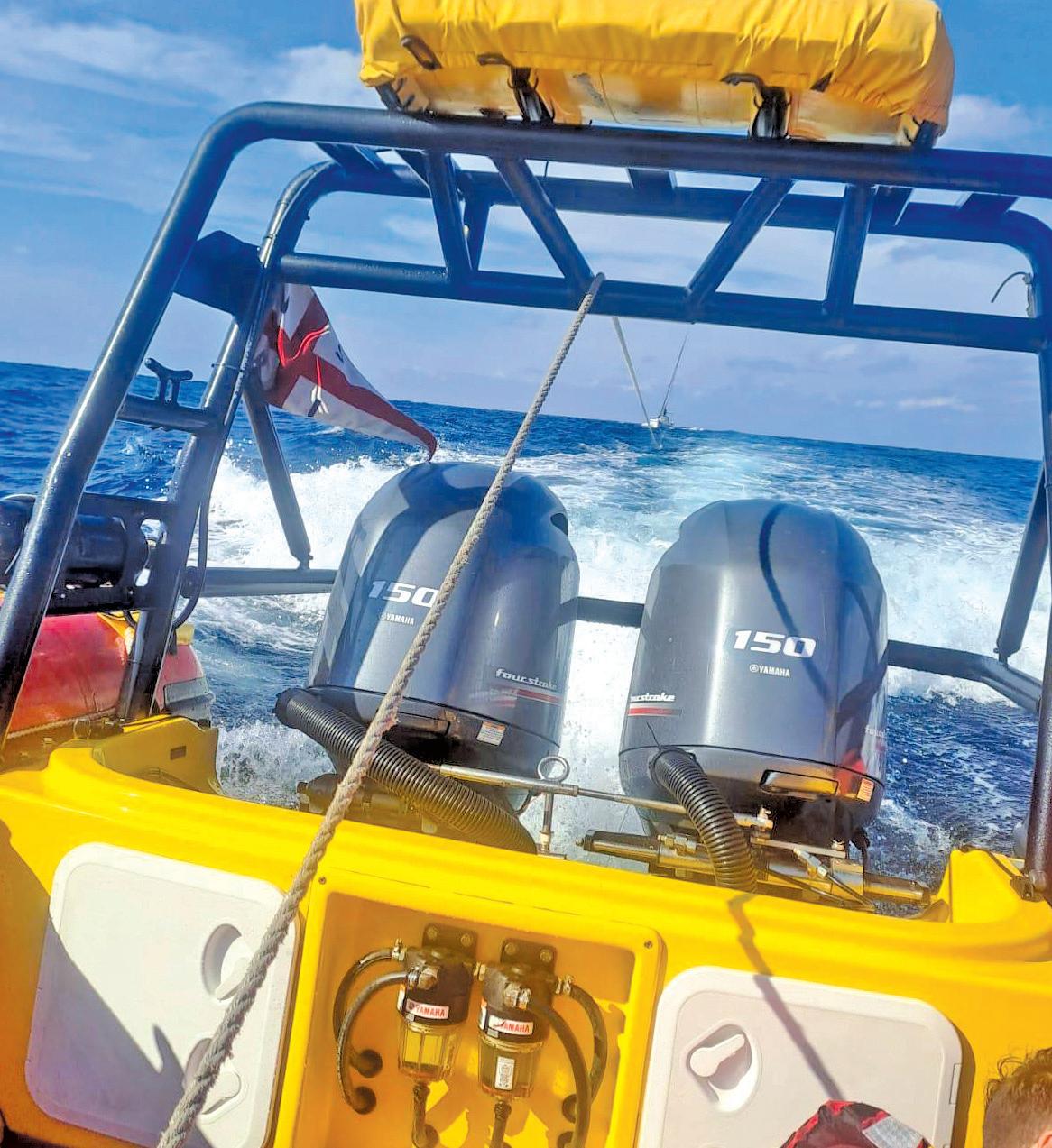
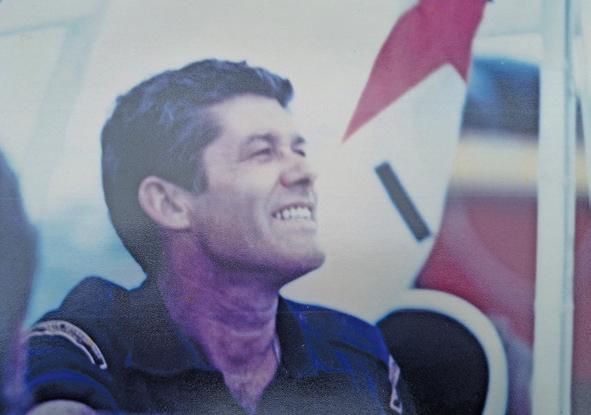
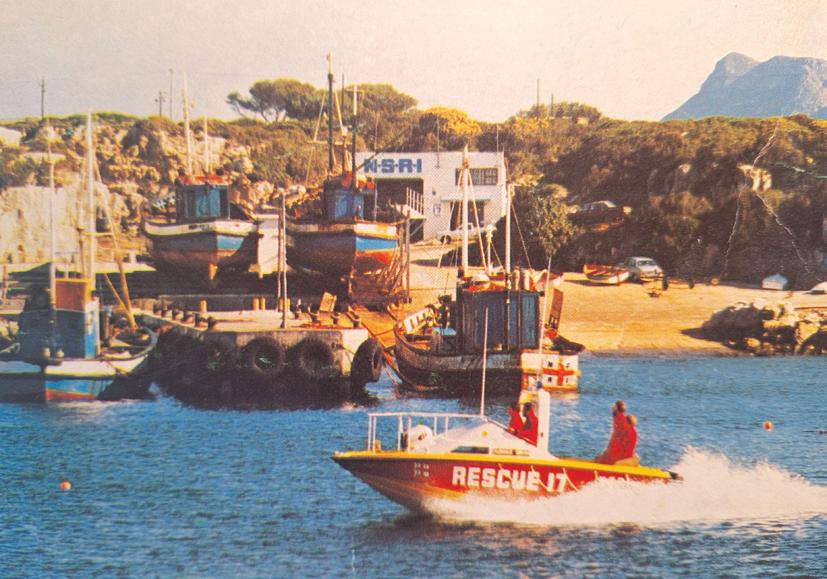
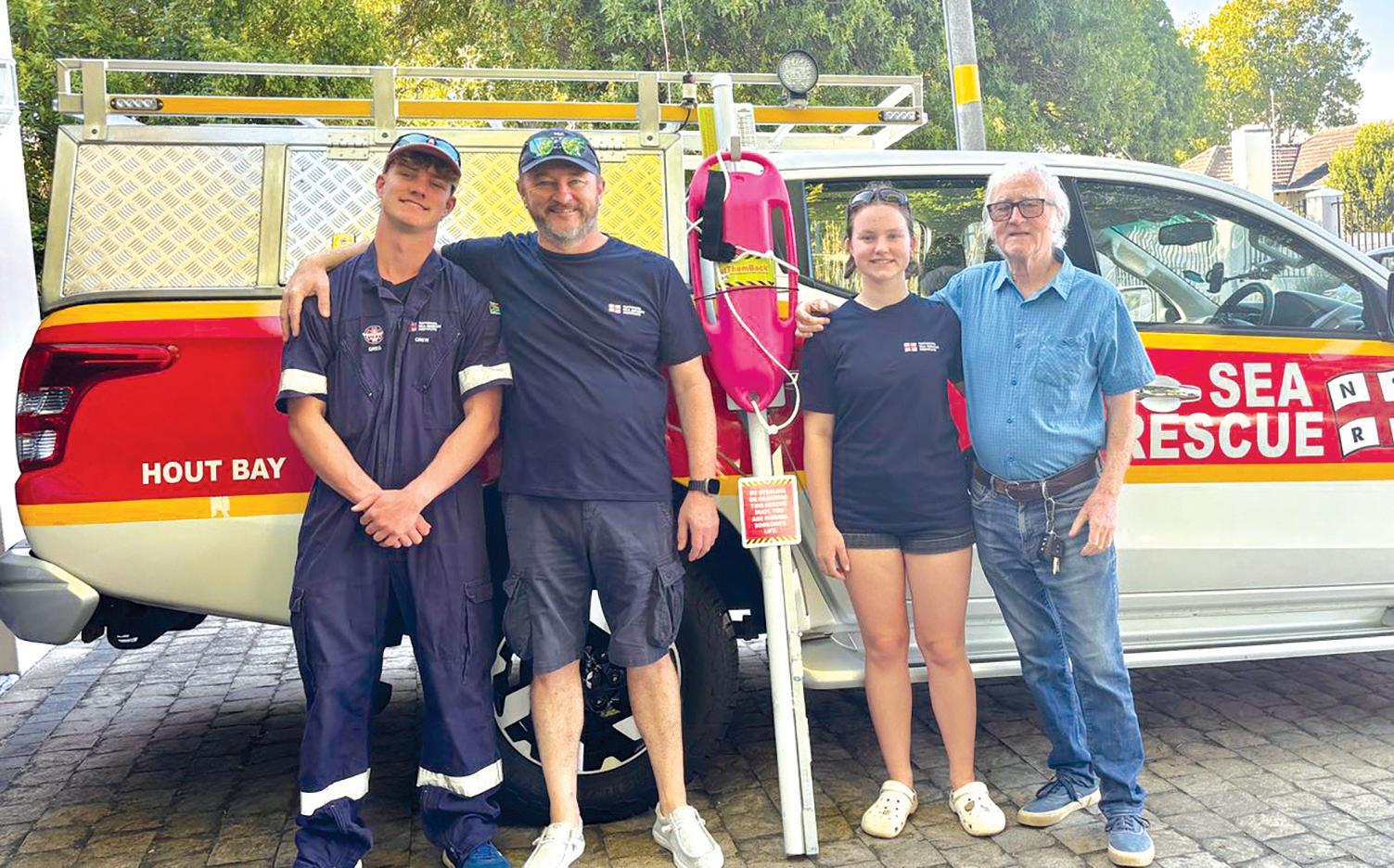
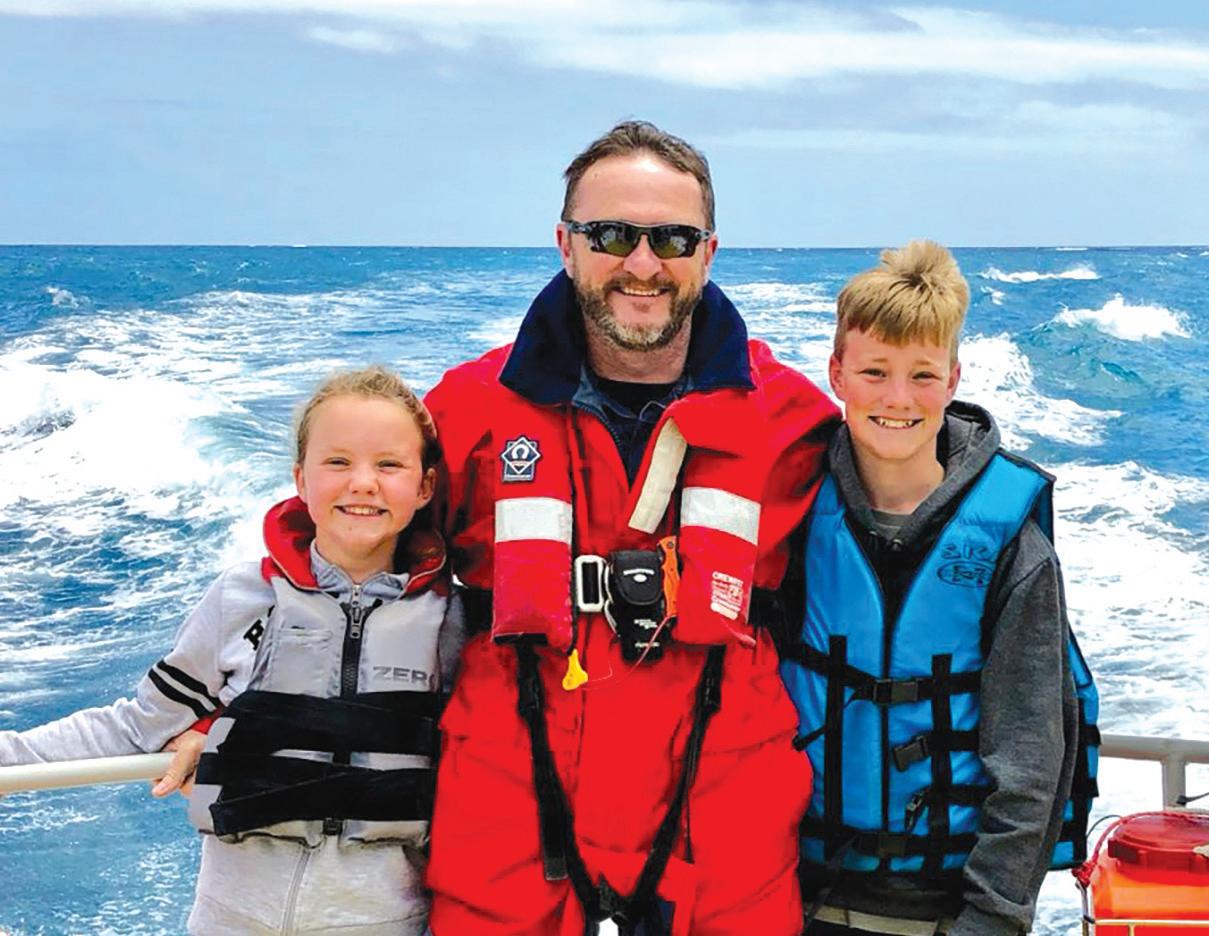
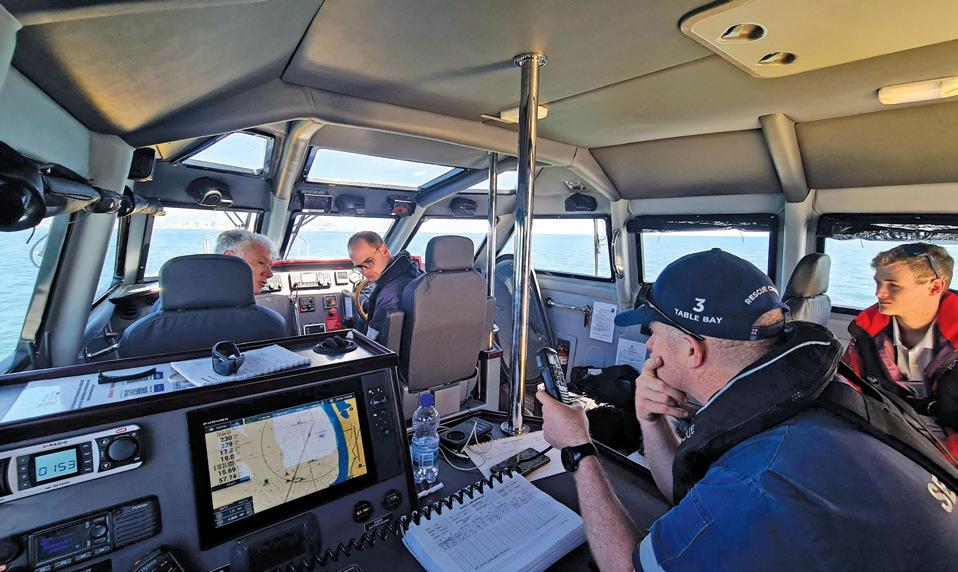
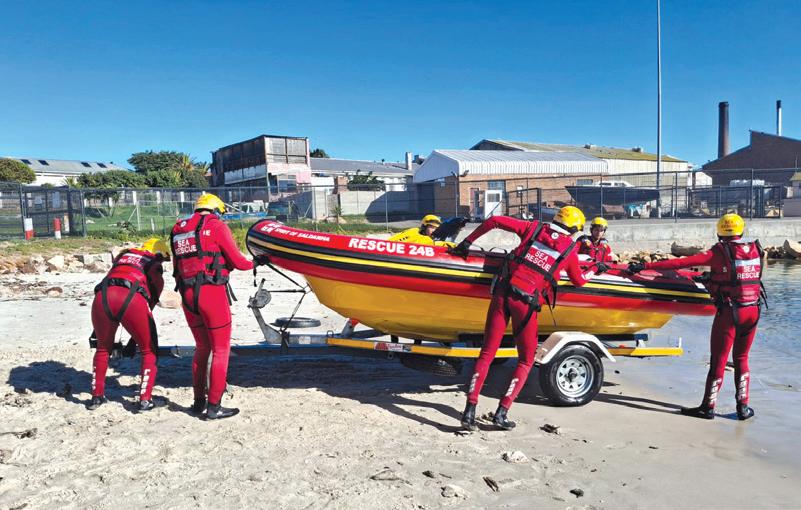
Shelly Beach shares the long, gruelling rescue of a Vasco da Gama race participant.
Meet
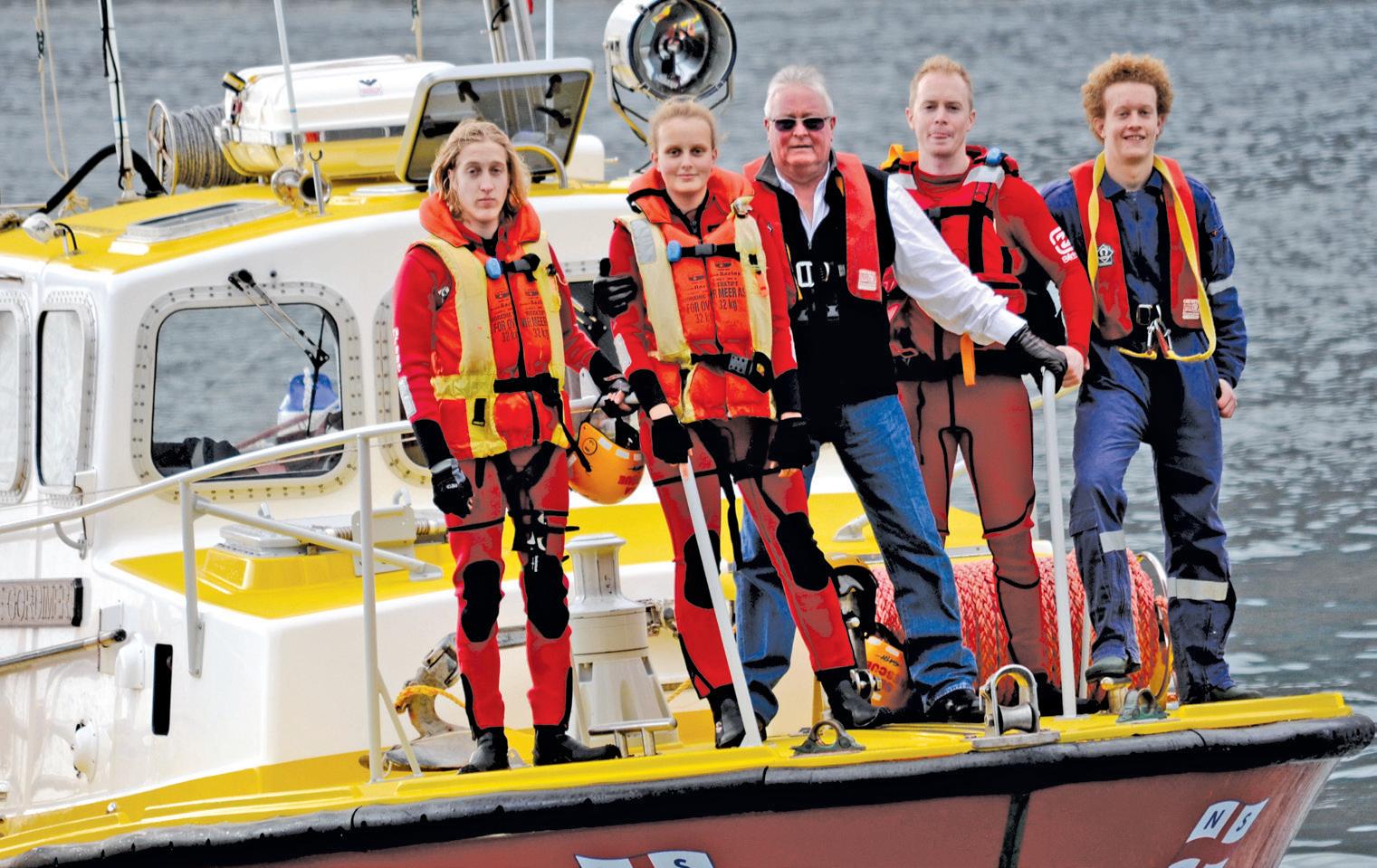
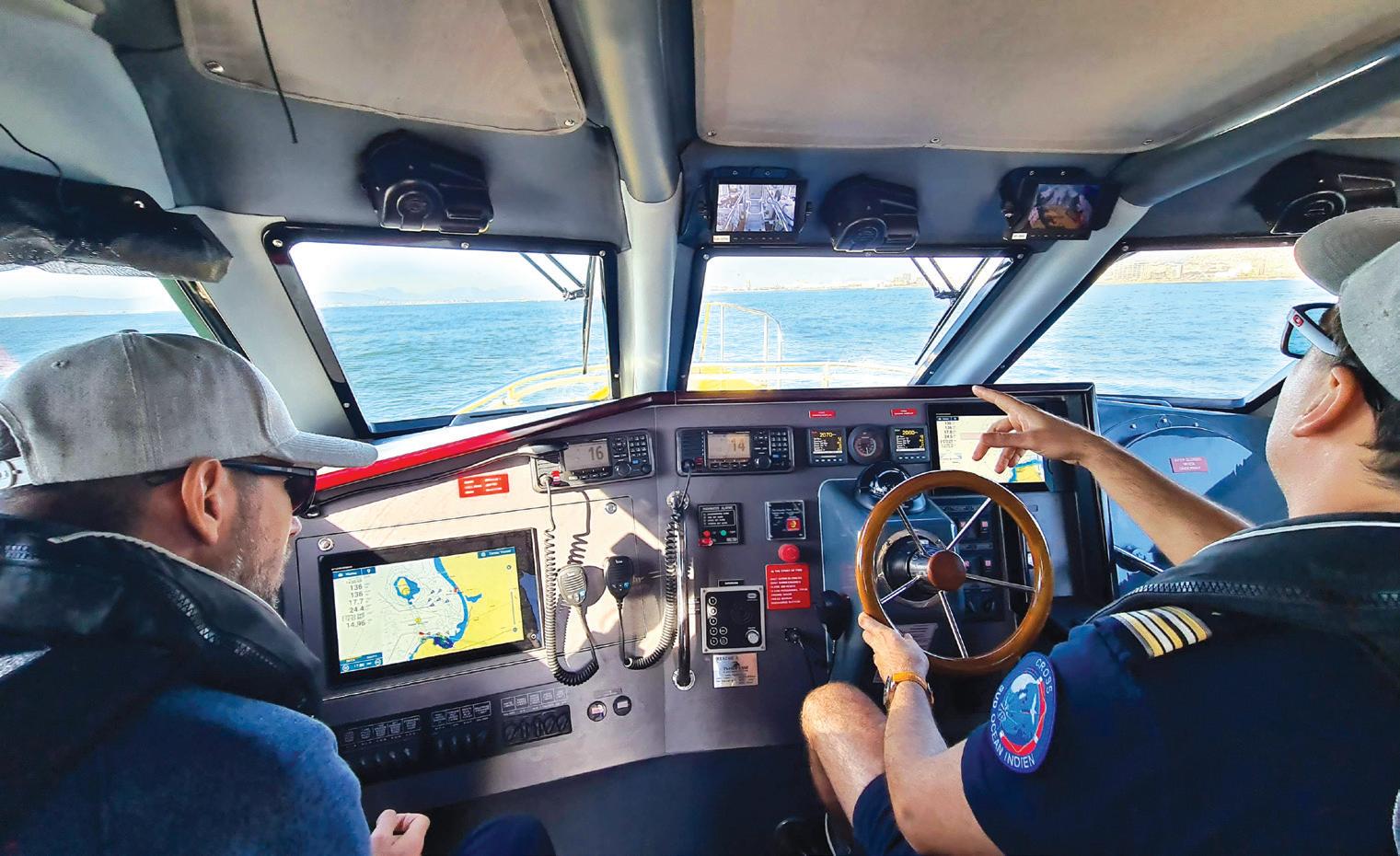
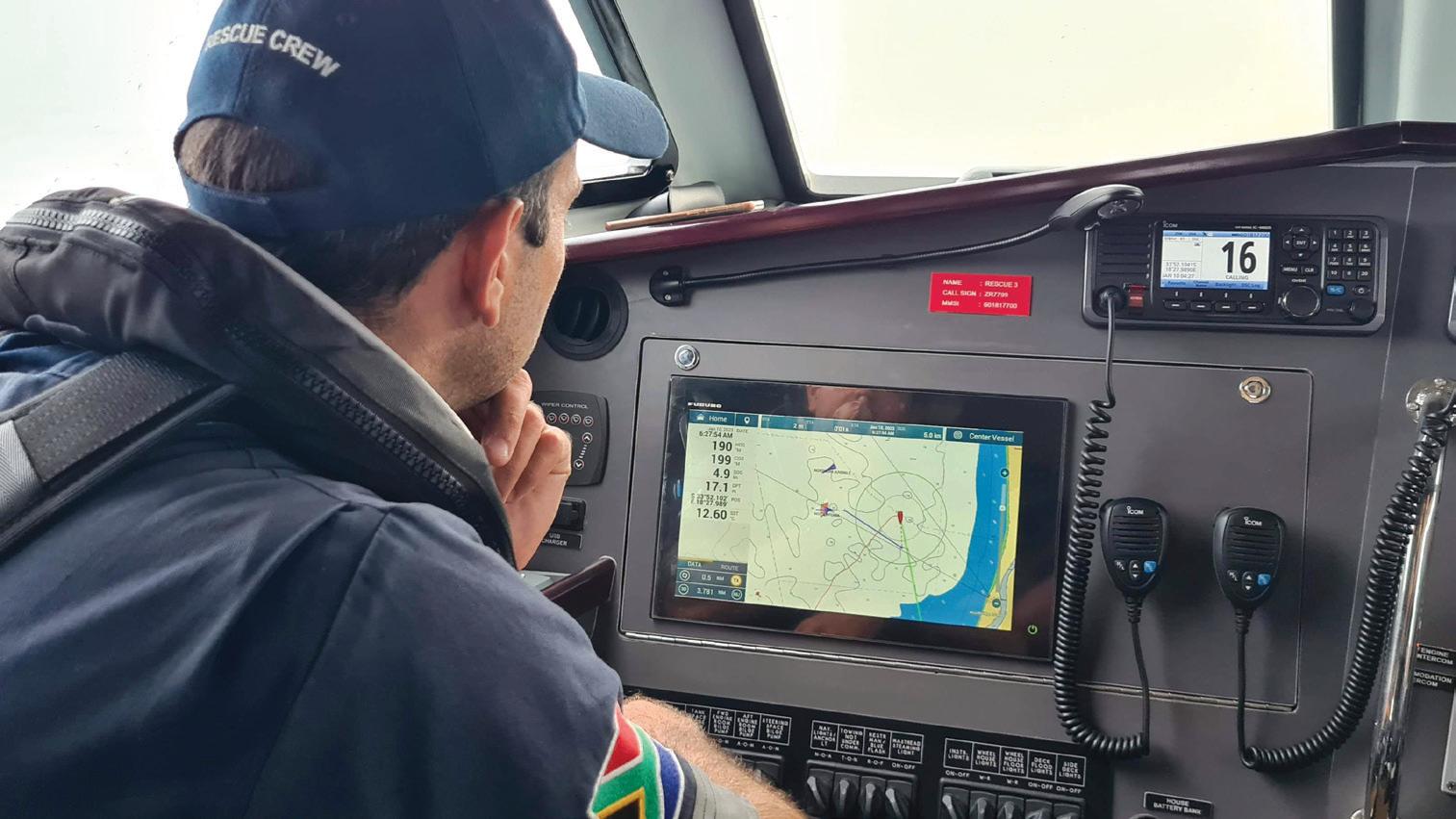
How navigation technology and human capacity work together to streamline search and rescue.
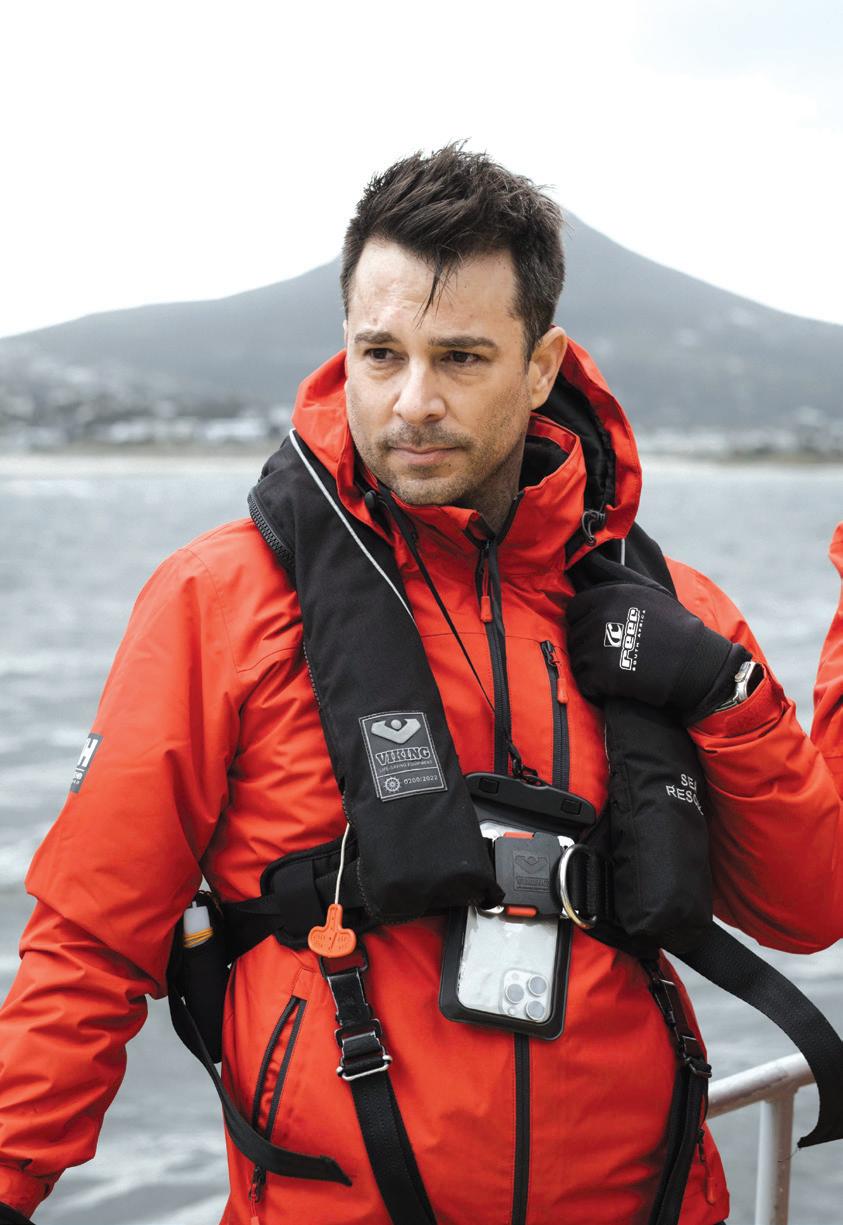
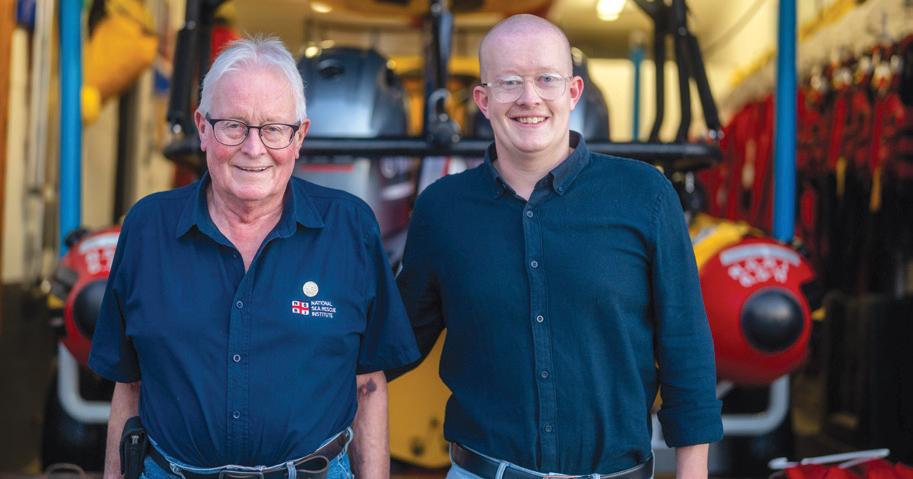
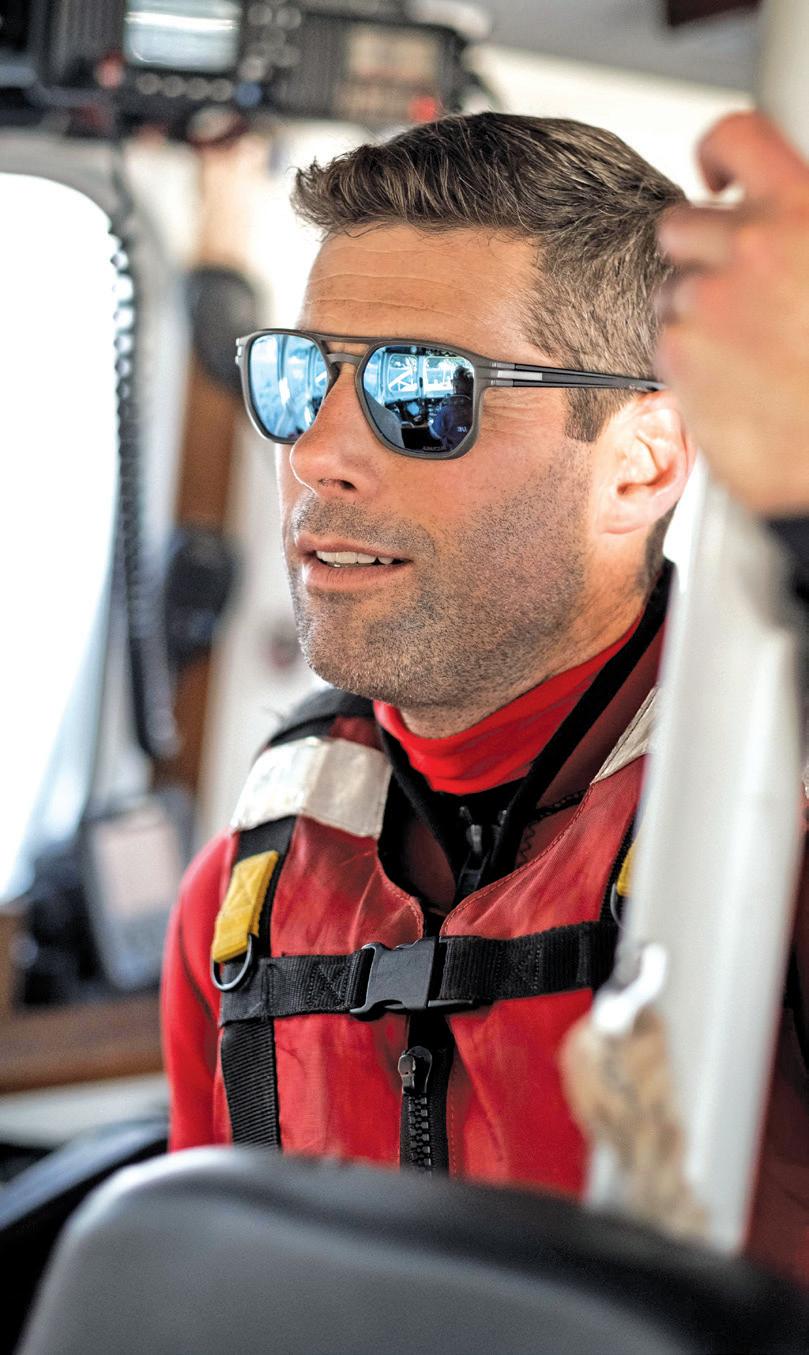
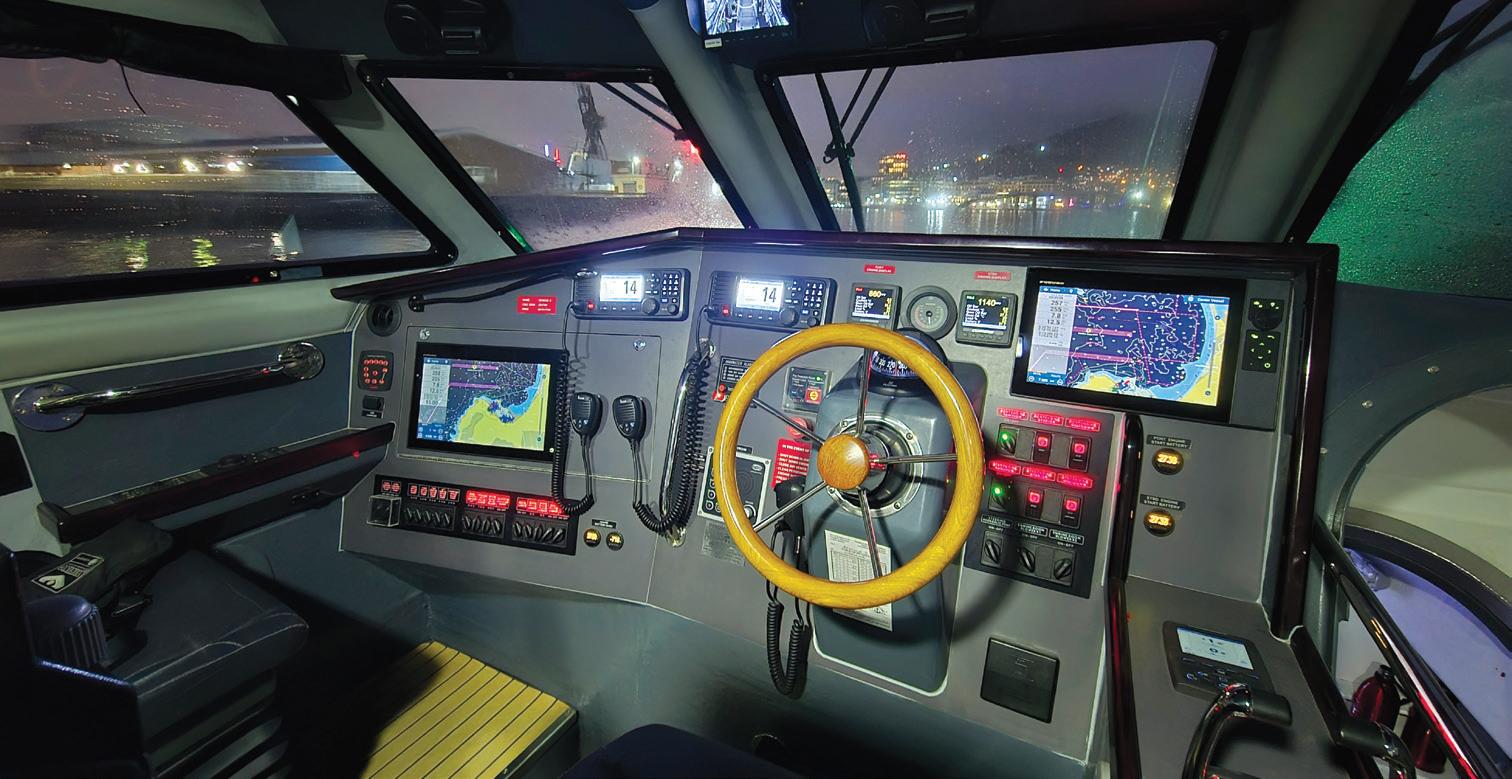
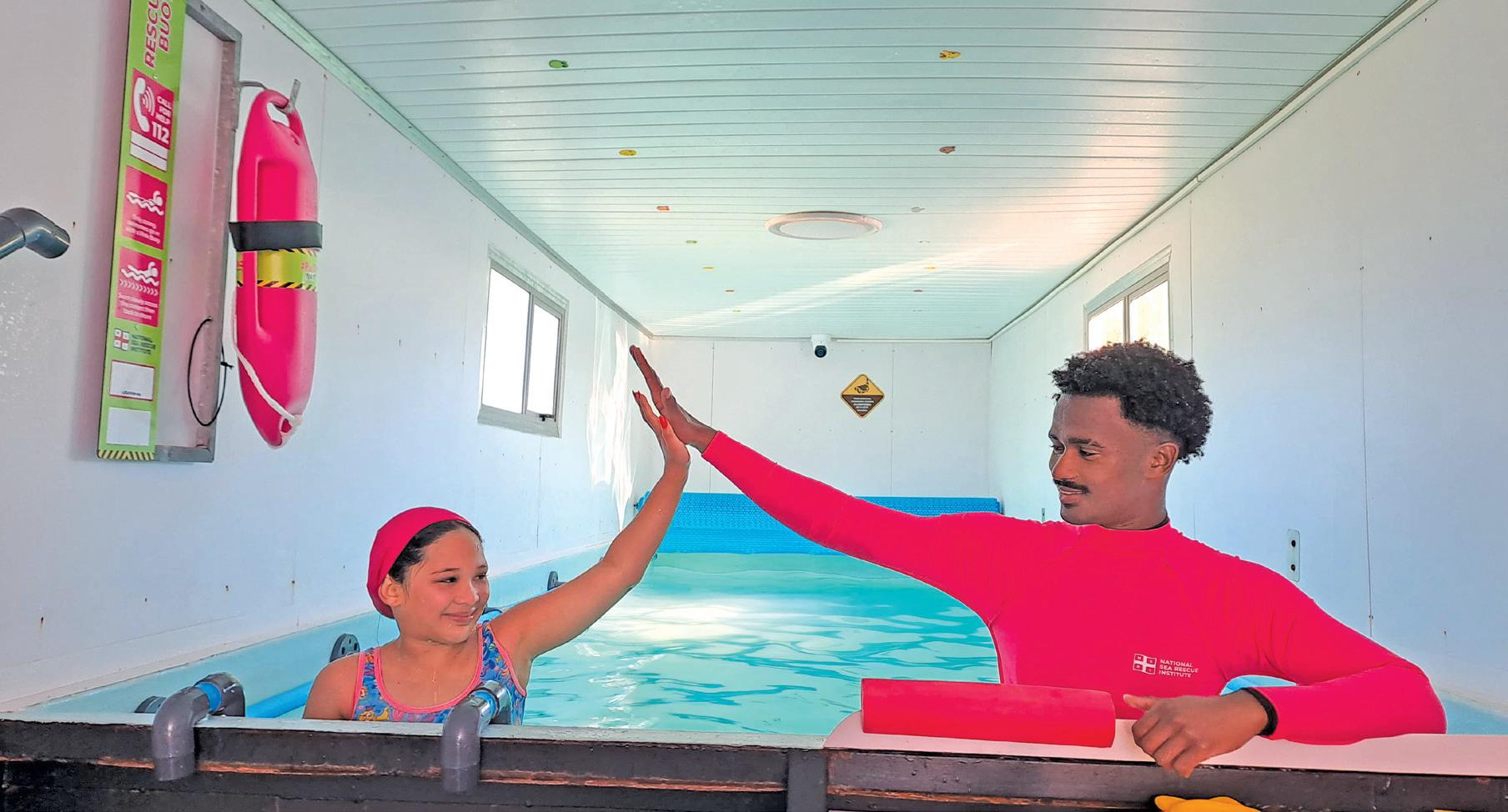
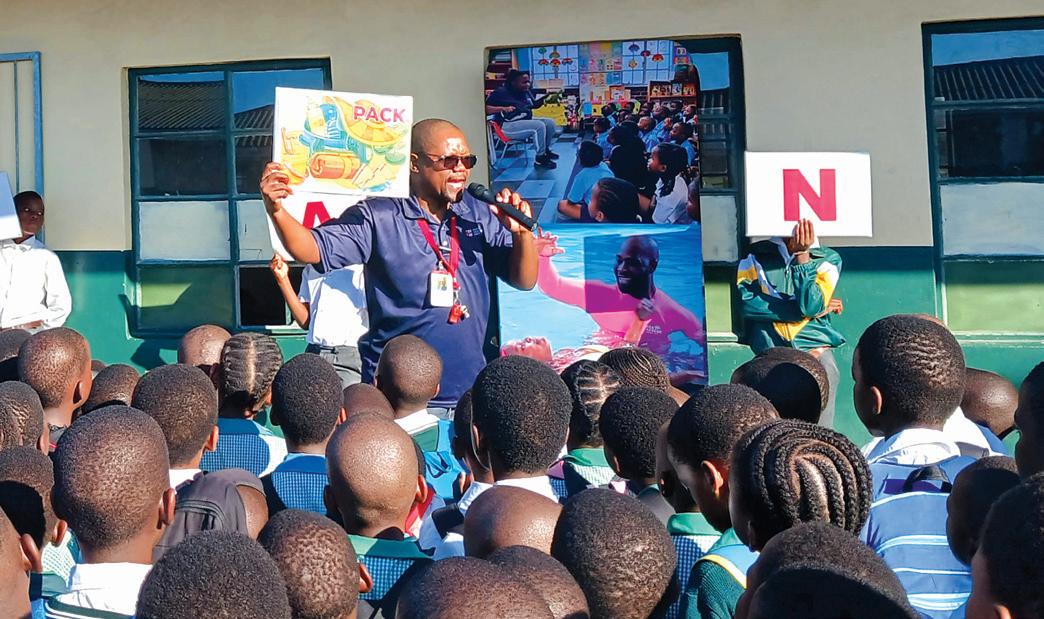
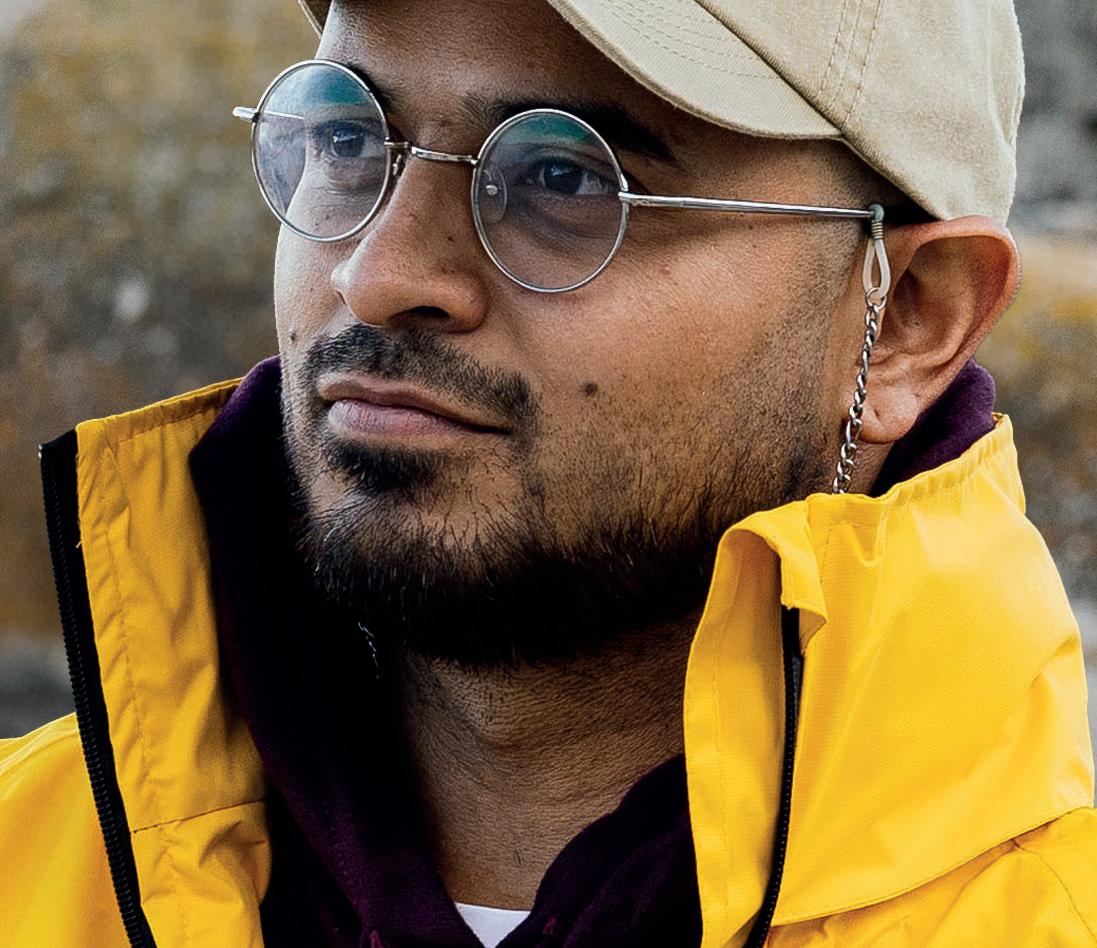
Meet 21-year-old Charlton Coetzee whose life has been changed and shaped by his work with the NSRI.
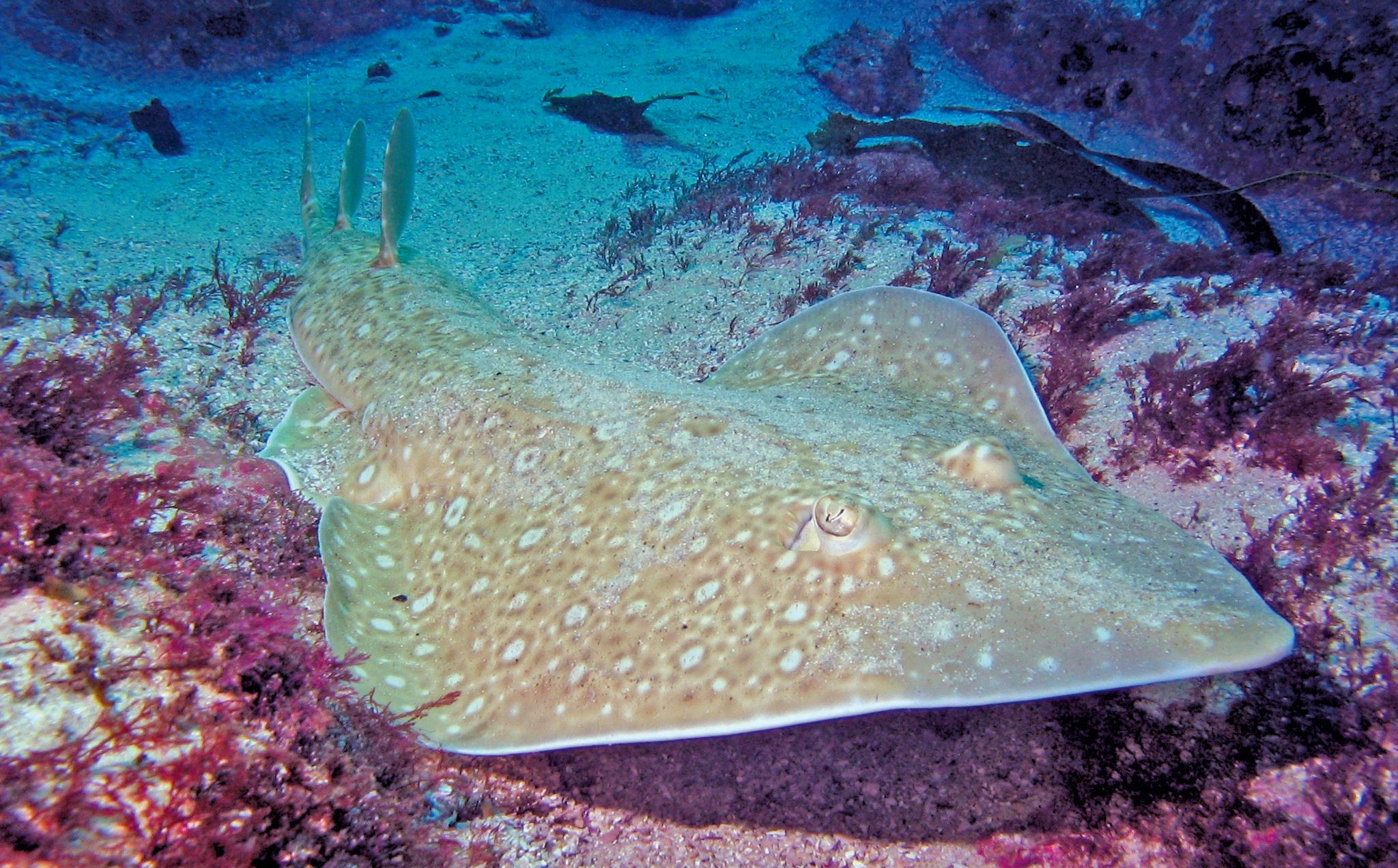
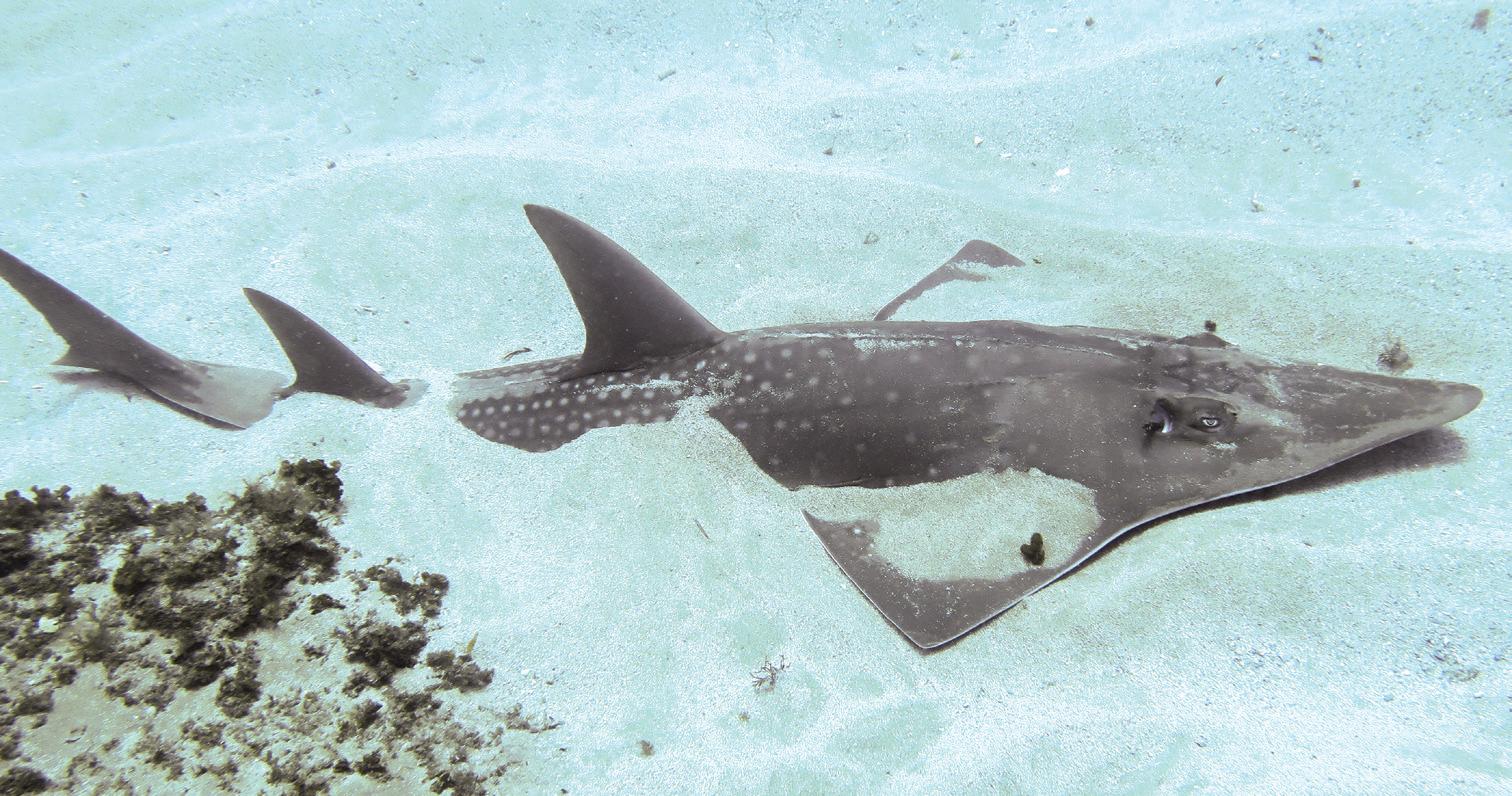
We explore the ocean’s sandy depths to find out more about guitarfish, a most curious member of the shark family.
FROM THE HELM
The NSRI was born out of disaster, nearly 60 years ago, when 17 fishermen from Still Bay in the Southern Cape lost their lives in a storm. For most of that time, our identity has been shaped by the sea: by surf launches and offshore rescues, by the call of a distress signal and the rush to respond. But the NSRI of today is not the NSRI of our founding years. It is constantly evolving.
We have grown from a coastal rescue service into an organisation that trains communities in water safety, deploys seasonal lifeguards at more than 50 beaches and inland dams, and runs water safety education programmes in schools and communities across all nine provinces. Our rescue capability has evolved too. Sometimes that means rethinking our fleet entirely, as we did when we introduced JetRIBs to replace the craft that had served our surf rescue operations so well, or commissioning a new fleet of Offshore Rescue Craft (ORC). Progress often looks like that: learning, adapting and building confidence in a different way of working.
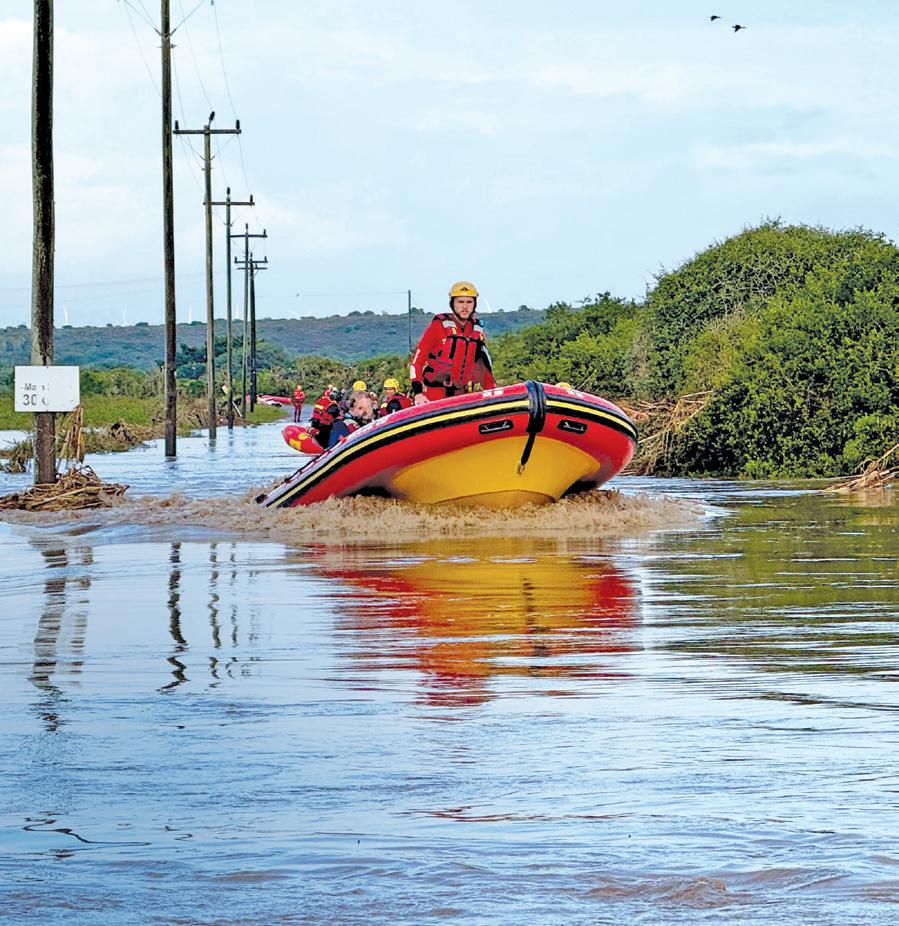
The recent wave of devastating floods that struck the Western and Eastern Cape is a powerful reminder of that growing need. What began as training for swiftwater rescue for our crews has become something far more complex: urban flood response in streets and homes, informal
settlements and rural areas, with difficult access, unpredictable hazards and no clear perimeters. Our volunteers worked in conditions where traditional cellular communication platforms failed across a widely dispersed area, making coordination with other rescue services a challenge. The scale of destruction has been devastating, with people losing homes and livelihoods across a geography stretching from Gouda to Gqeberha. We are seeing a clear trend in the frequency and scale of such events. And we know that with growing need comes the obligation to grow with it: to evolve our training, our equipment and our thinking. What does not change is the call. And the people who answer. Ordinary people giving up their time, comfort and sometimes their safety, in service of others and in the belief of a shared vision: a water safe nation. That call takes many forms. For some, it means stepping into genuinely dangerous and unfamiliar environments, as our flood response crews did recently. For others, it means something quieter but no less vital: coaching a child to swim, running a workshop or community education session. Different situations. Same commitment. None of this is possible without those who answer the call, staff who enable them, and the donors and partners who stand behind both. Together, we are the NSRI.
MIKE VONK, NSRI CEO
CAPE TOWN: NSRI, 4 Longclaw Drive, Milnerton, Cape Town, 7441; PO Box 154, Green Point 8051 Tel: +27 21 434 4011 Email: magazine@searescue.org.za Web: www.nsri.org.za facebook.com/SeaRescue youtube.com/@NSRISeaRescue @nsri @searescuesa @nsrisouthafrica
A LOVE FOR THE WATER. UNITED BY MORE THAN
We're united by a shared responsibility to protect every person who ventures onto it. Whether you're fishing offshore, exploring the coastline or enjoying time with family and friends, safety is everyone's responsibility.
That's why Yamaha Marine South Africa proudly supports the NSRI in promoting responsible boating, proper preparation, and safer experiences on South Africa's waterways.
THE CREW
THE PUBLISHING PARTNERSHIP
MANAGING EDITOR
Wendy Maritz
ART DIRECTOR Ryan Manning
COPY EDITOR
Deborah Rudman
ADVERTISING EXECUTIVE
Bernice Blundell
MANAGING DIRECTOR
Susan Newham-Blake
PRODUCTION DIRECTOR
John Morkel
ADDRESS
PO Box 15054, Vlaeberg 8018
TEL +27 21 424 3517
FAX +27 21 424 3612
EMAIL wmaritz@tppsa.co.za
NSRI
OFFICE +27 21 434 4011
WEB www.nsri.org.za
FUNDRAISING AND MARKETING DIRECTOR
Janine van Stolk
janine@searescue.org.za
HEAD OF COMMUNICATIONS
Andrew Ingram andrewi@searescue.org.za
COMMUNICATIONS AND MEDIA RELATIONS
Kylie Dawn Hatton kylie.hatton@searescue.org.za
PRODUCED FOR THE NSRI BY
The Publishing Partnership (Pty) Ltd, PO Box 15054, Vlaeberg 8018.
Copyright: The Publishing Partnership (Pty) Ltd 2026. All rights reserved. Reproduction in whole or in part is prohibited without the prior permission of the editor. Opinions expressed are those of the authors and not of the NSRI. Offers are available while stocks last.
WINNING LETTER
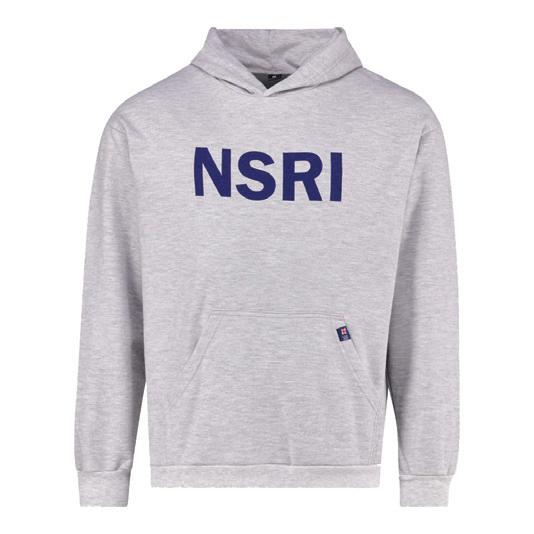
Congratulations to Vish Govender for writing this issue’s winning letter. Your book and hoodie are on their way to you.
RESCUE ACCOMPLISHED
I am writing to express my sincere gratitude to NSRI Station 40 and Wetland Water Rescue teams for the rescue operation carried out at Mission Rocks, St Lucia, on 25 April 2026. The professionalism, compassion and swift response of your teams in those critical moments made all the difference. Words are inadequate to capture what your service means to me and my family. As a small token of my heartfelt gratitude, I have arranged a donation to the NSRI. It is the very least I can do, and I hope it goes some way towards supporting the vital work you carry out each day. You are true heroes.
VISH GOVENDER
HELPING OUT IN A PREDICAMENT
PRINTING Novus
ISSN 1812-0644
My wife and I would like to express our gratitude to the team members of Station 15 in Mossel Bay. On a recent trip back home, our vehicle got a flat tyre and we stopped at the Total Garage at Groot Brak to change it. Station 15 crew members were also at the garage, noticed our predicament and without hesitation volunteered to help change the tyre for us. We were overwhelmed by their friendliness and kind-hearted assistance. Please convey this message to the team and know that it made a massive impression on us. Thank you for the excellent work that you guys do!
FREDDIE AND RENCHE RORICH
LIMPOPO FLOODS
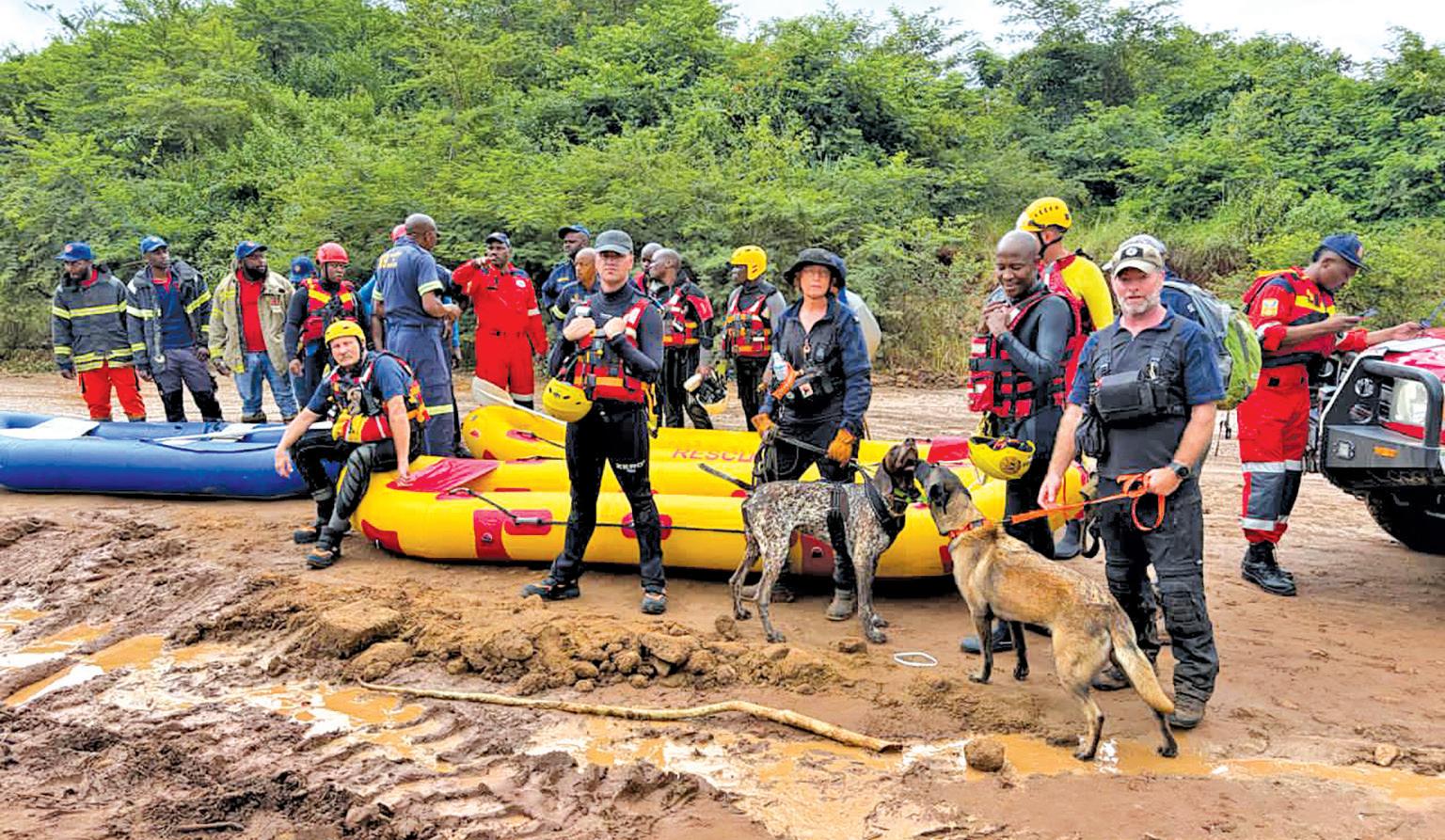
A big thank you to the NSRI for kindly assisting us with life jackets to keep our K9 handlers and field ops safe while on deployment to the floods in Limpopo. We hugely value your kind support and response to our last-minute requests. Without such support between volunteer organisations, our work would be so much more challenging.
K9 SEARCH AND RESCUE ASSOCIATION OF SOUTH AFRICA
WHAT COLLABORATION CAN DO
The writer of the winning letter published in the next issue of NSRI Magazine will receive an NSRI hoodie and a copy of Into a Raging Sea. Email your stories to magazine@ searescue.org.za.
On behalf of Kleinvlei Community Police Forum and Radio Eersteriver, I would like to express our sincere gratitude to Andrew Ingram for taking the time to join us on Radio Eersteriver for the Kleinvlei CPF’s Show interview on 15 April 2026. By sharing your expertise, you not only educated the community on critical safety measures but also highlighted the incredible, selfless work of the NSRI. We have received an overwhelming amount of positive feedback from listeners. Your insights into water safety and emergency response added immense value to the broadcast. By combining our resources and voices, we are better equipped to foster a culture of safety and vigilance. Thank you for your professionalism and ongoing commitment to saving lives. We look forward to many more successful collaborations in the future. SHIREÉ STEYN
Project Manager and Radio Eersteriver Host, Kleinvlei CPF
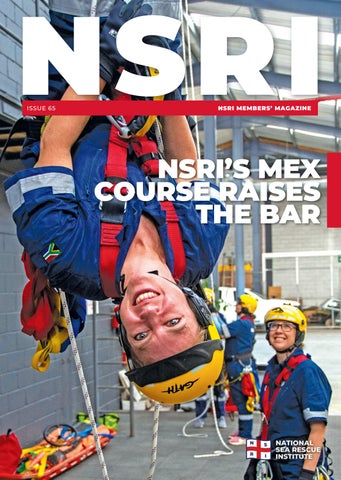
TRAINING THE TRAINERS: MEX COURSE BUILDS CAPACITY, AND CONFIDENCE
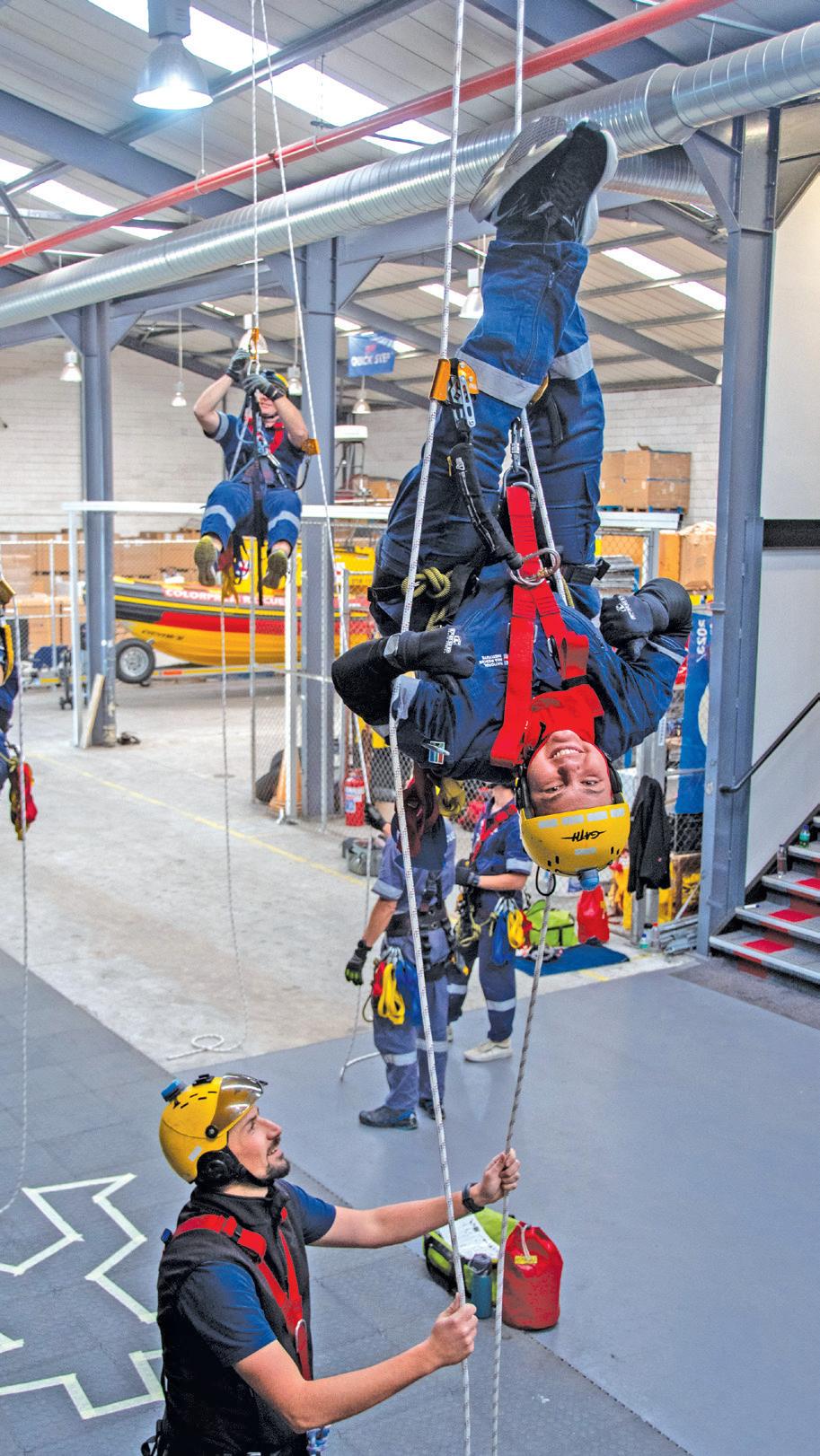
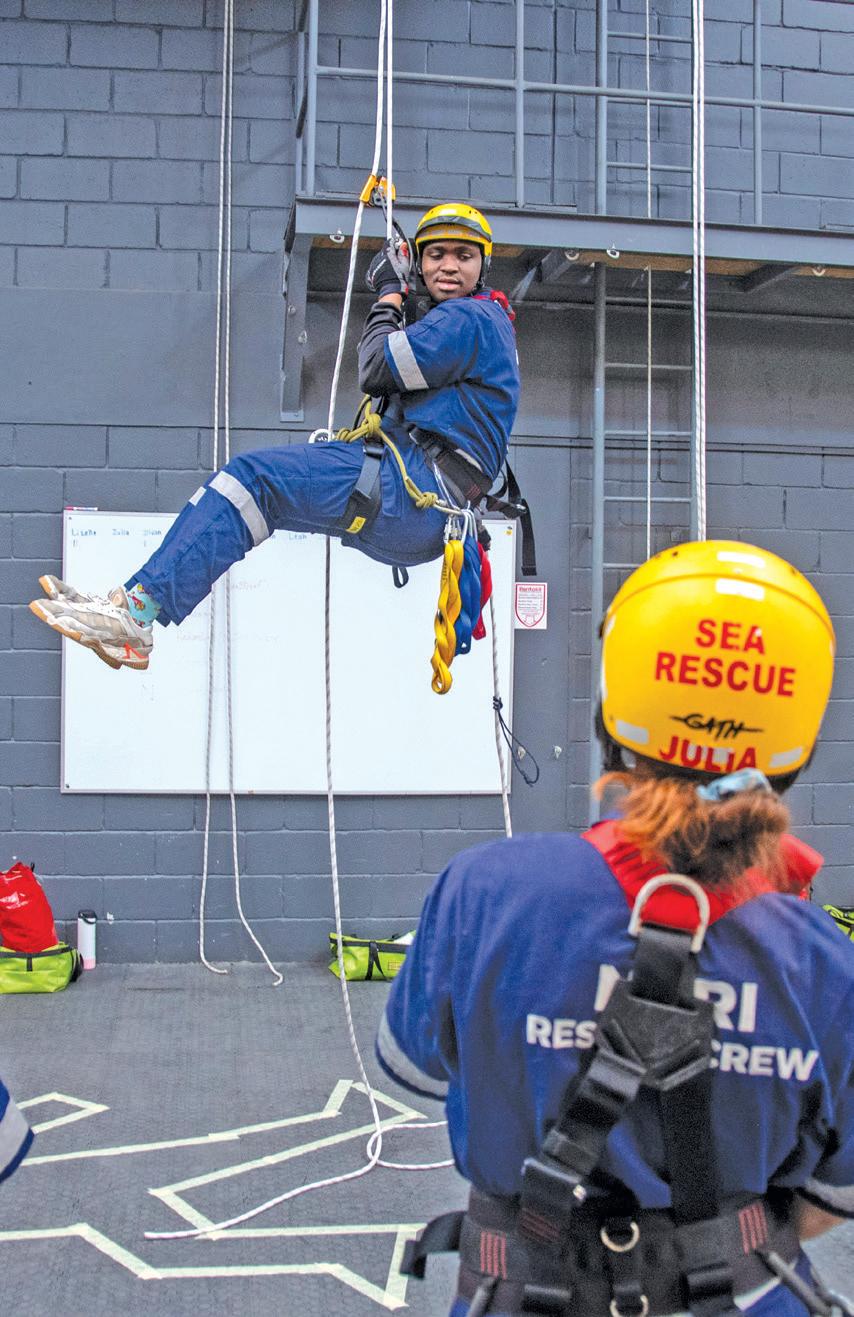
In June this year, nine volunteer crew attended a maritime extrication (MEX) course. The training had a dual purpose. Teach MEX skills to trainees and give them the opportunity to learn valuable training skills themselves. By Kylie Dawn Hatton
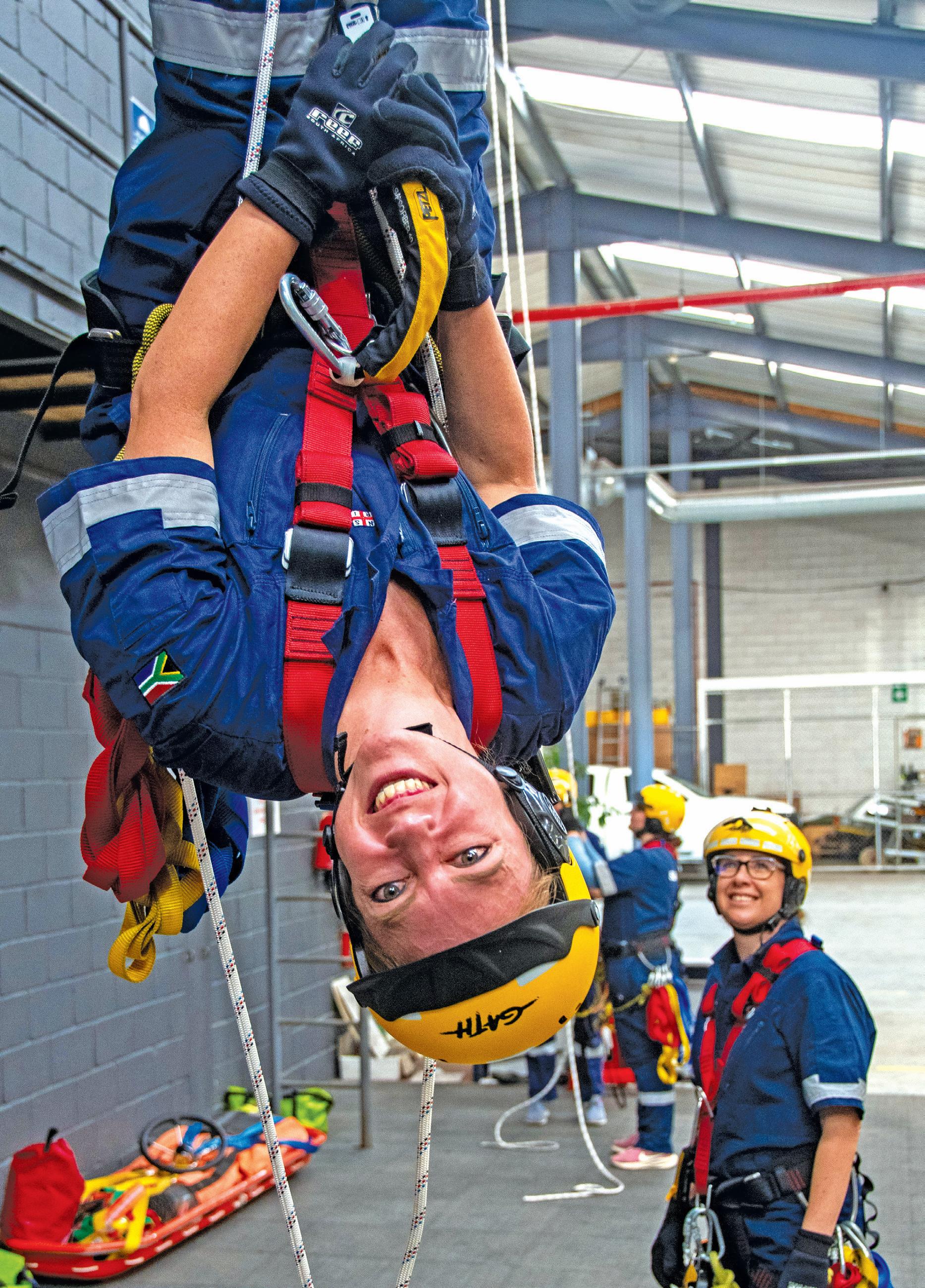
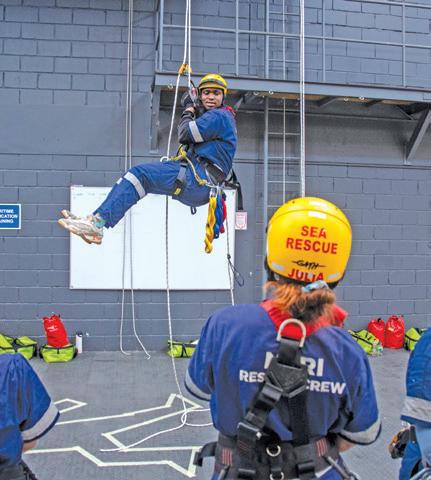
When volunteer crew from four rescue stations arrived at the Volunteer Support Centre (VSC) on 4 June, they knew they were in for an intense few days. The Maritime Extrication (MEX) course teaches some of the most demanding skills at the NSRI: working at heights, rigging hauling and lowering systems, and transferring an injured casualty safely off a vessel. What the candidates from Station 17 Hermanus, Station 19 Richards Bay, Station 15 Mossel Bay and Station 10 Simon’s Town may not have expected was the icing on this particular course. Woven into the four days were elements of a train-the-trainer programme. Level 2 candidates worked alongside Level 1 candidates, equipping them not only with the skills to perform a maritime extrication, but also with the knowledge
and confidence to teach others. It is an approach that speaks directly to the NSRI’s commitment to building capacity across the organisation: every course should produce not just newly qualified crew, but the next generation of trainers.
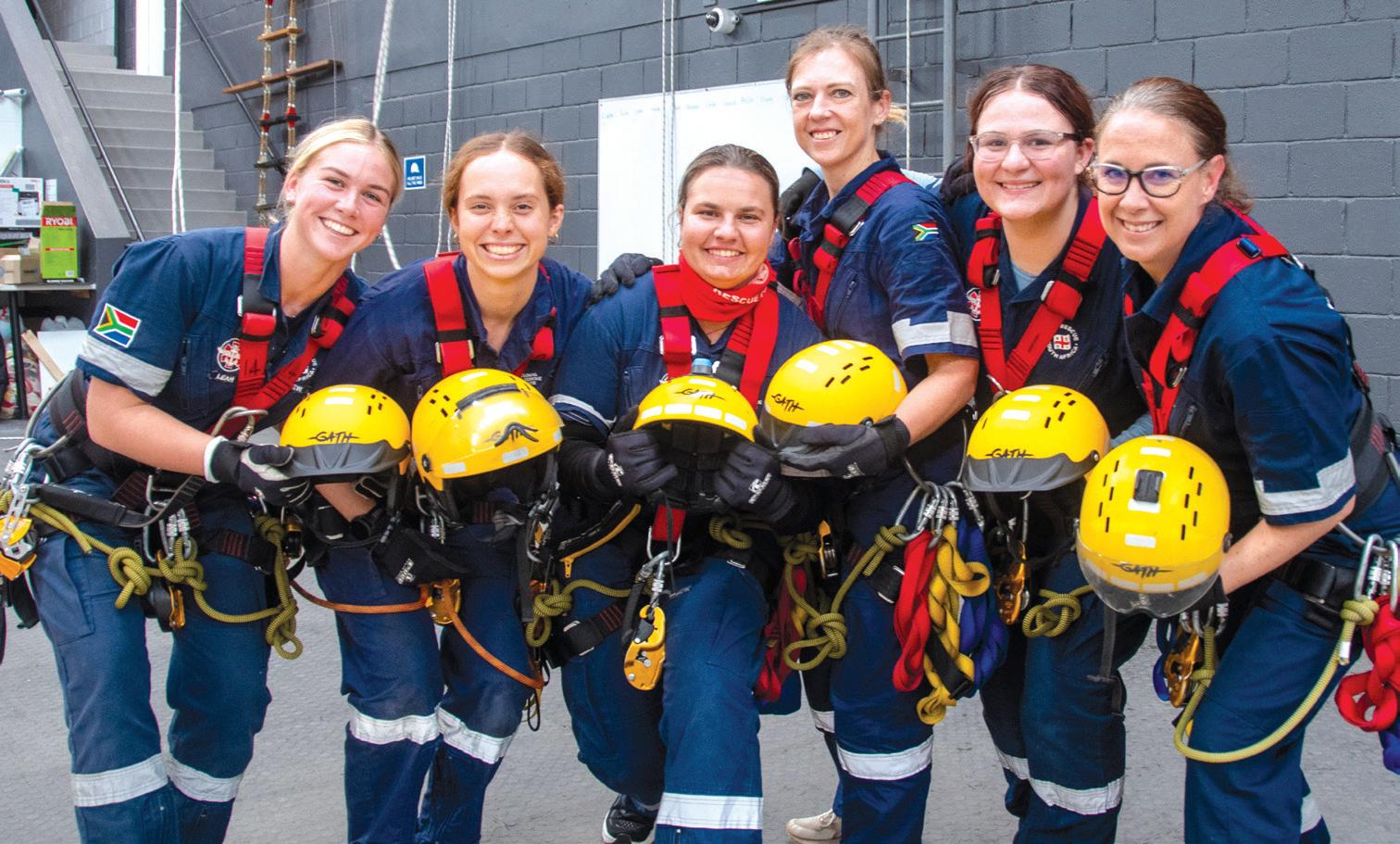
And the train-the-trainer element was only half the icing. On this course, women outnumbered men: five of the nine
On this course, women
outnumbered men: five of the nine candidates were women. For an event as physically demanding as MEX, long seen as a man’s domain, it was a signal of how the face of the NSRI is changing.
candidates were women. For an event as physically demanding as MEX, long seen as a man’s domain, it was a signal of how the face of the NSRI is changing.
The timing could hardly be better. As shipping activity around the South African coast increases, our crews are called on more often to perform maritime extrications. In 2025 the NSRI conducted 63 medevac operations, consistent with the trend of recent years (64 in 2023 and 62 in 2024). Increased traffic along our sea routes, from passenger liners to commercial vessels and fishing operations, has escalated the need for medevacs at the major ports of call at Gqeberha, Richards Bay, Cape Town and Durban.
The busiest stations tell part of the story: Station 5 Durban carried out 15
medevacs in 2025 and Station 6 Gqeberha 11.But smaller stations are increasingly active too. Station 14 Plettenberg Bay responded to eight medevacs, Station 37 Jeffreys Bay to six, and stations from St Helena Bay to St Francis Bay all answered the call. Wherever a ship passes our coastline, a crew somewhere needs the skills to reach a patient on board, stabilise them and bring them home. That is precisely what MEX teaches.
For Danie Verwey, one of the Regional Operations Managers at the VSC, the course was an opportunity to grow more than the candidates. Danie used the four days to develop his colleagues as trainers, handing the reins to Mawaxole Nkumanda, who recently joined the training team at the VSC. Mawaxole comes from Station 6 Gqeberha, a station with deep experience in maritime extrications, and he ran the course under Danie’s direction.
‘Running a course is a skill in its own right,’ says Danie. ‘Mawaxole is trained and has experience in maritime extraction from his time at Station 6, so my job was to step back, guide him and show him how to lead. That is how we build depth in the training team, by giving people the room to teach.’
For Mawaxole, training someone in a skill is like teaching them to tie shoelaces. ‘Tying the laces on someone else’s shoe looks very different from tying your own,’ he says. ‘So, when I train, I ask myself: how do I take a skill that comes unconsciously to me and teach it in different ways, so that others can learn it?
‘We all learn in different ways, and what makes a good trainer is finding the way that best suits your candidates,’ he adds.
‘Every candidate must go away having understood 100% of the course content, because what we do is dangerous and technical. But it is hugely rewarding to bring an injured sailor off a vessel safely and reunite them with their family.’
Mawaxole was joined by Melodie Herrmann, also from the VSC training team, who returned often to the theme of capacity, and to one dimension of it in particular.
‘Every course like this grows our capacity as an organisation, but what excites me most is growing the capacity of our women volunteers,’ she says. ‘When women see other women climbing, hauling and leading on a course like MEX, it changes what they believe is possible for themselves.’
Proof was everywhere on this course: Lizelle Oosthuizen and Julia Milachowski from Station 17 Hermanus, Carlien van der Bank and Kristen Dreyer from Station 15 Mossel Bay and Leah Abbott from Station 10 Simon’s Town.
A majority-women MEX course would have been hard to imagine not so long
LEFT TO RIGHT Leah Abbott (Simon’s Town), Julia Milachowski (Hermanus), Carlien van der Bank (Mossel Bay), Lizelle Oosthuizen (Hermanus), Kristen Dryer (Mossel Bay), Melodie Herrmann (Volunteer Support Centre).
ago. Today it reflects the growing strength and diversity of the NSRI’s volunteer base, and the vital role women are playing in keeping South Africa’s coastline safe. They are not simply making up the numbers; they are climbing the lines, building the systems and doing the work.
Few sum that up better than Lizelle. ‘This was one of the best courses I have ever taken,’ she says. ‘The knowledge I take away from this can be used in more ways than just at the station. It is life knowledge.’
She admits the course came with nerves attached. ‘It was nerve-wracking to think I was entering this course as a woman, when the belief is that men are more capable. This course proved that wrong.’
Pressed for a favourite part, she struggles to choose. ‘Everything flowed into the next. But if I must pick, it would be realising that
Mawaxole Nkamanda demonstrates technique to the students on course.
I, as a woman of 42, am still capable of a lot of things, with the right help, guidance and support from awesome people.’
For Leah, the course was a chance to face something that had always felt intimidating. ‘MEX has always been something I have found a bit daunting,’ she admits. ‘Working at heights and being given the huge responsibility of performing an extrication using equipment that felt very unfamiliar to me.’
Four days later, she came away with a different view. ‘The MEX Level 1 course is packed with knowledge, skills and application, taught in a calm, enriching environment. It left me feeling far more confident in myself, not only in applying what I had learnt in real-life sessions, but in learning to trust yourself and your equipment.’
Asked about her favourite part of the course, Leah resists the obvious answers.
‘You are immediately drawn to say it was climbing up and down lines or creating hauling and lowering systems. But for me it was the people and the environment we got to work in. The volunteers from the other stations truly made the course what it was, simply by being like-minded people who want to learn from one another and uplift each other. It had a huge impact on my experience throughout the whole course.’
That, in the end, is what set this course apart. It produced nine newly skilled crew members who will return to their stations ready to respond when the next medevac call comes. But it also produced something harder to measure: trainers who have
learnt to teach, women who have learnt to lead, and volunteers from four stations who have learnt from one another.
For Lizelle, what the NSRI builds runs deeper than skills. ‘The NSRI kind of saved my life in a way. I found purpose and meaning there. It teaches you that you’re more capable than you ever thought.’
The train-the-trainer model means the benefits do not stop when the course ends. Each candidate carries the skills back to their own station, and each new trainer makes the next course possible. With shipping traffic along our coast continuing to grow, that multiplying effect is exactly what the organisation needs. Capacity that builds capacity, built the way every MEX candidate learns the ropes: one climb, one knot and one moment of trusting yourself at a time.
WATER, WATER, EVERYWHERE
May 2026 will be long remembered for the devastating floods that brought such destruction and loss across the Western and Eastern Cape. NSRI joined forces with other rescue organisations to assist. By Cherelle Leong
EASTERN CAPE
During the first week of May 2026 rescue teams were on alert. The South African Weather Service had issued an orange weather warning with forecasts of heavy rain and potential flooding. For an area that has been experiencing a severe drought for an extended time, one might think the risk was lower. However, the NSRI stations of Gqeberha, Jeffreys Bay, St Francis Bay and Oyster Bay have had to deal with floods before. They know that it’s better to be prepared. So, between them, they coordinated a plan, making sure that each station had a swift-water response crew ready to activate.
At Station 6 Gqeberha, this meant preparing the rescue vehicle and JetRIB and moving it off site. Sometimes, during heavy rains, the Port of Gqeberha becomes flooded, cutting off access to the station.
The previous day, Oyster Bay crew had visited communities on the Gamtoos River, giving residents an option to evacuate. However, no one really wants to abandon their home and, as a result, almost all residents opted to stay.
It was in the early hours of the morning that Simon Williams, Deputy Station Commander of Station 6 Gqeberha, got the call from regional director Ian Gray. Ian had been co-ordinating with Station 36 Oyster
Bay, Station 21 St Francis, and Station 37 Jeffreys Bay. By 3am all the duty phones had started to receive calls from residents whose homes were being flooded.
Heavy rains caused the Kouga Dam to rise by 40% and it was overflowing within 12 hours. The Groot River was bursting its banks, pushing even more water down the Patensie Valley and the Gamtoos River was a fast-flowing torrent that had submerged surrounding farmlands. The floodwaters were filled with debris – pumpkins, mielies, broken branches and whatever else the floodwaters captured. It would take a coordinated effort to evacuate everyone to safety.
Simon’s team had the furthest to drive and wasted no time getting on the road, arriving at the Gamtoos River just after 4am. Most of the rescue services were already on scene, including Eastern
Cape Disaster Management, the South African Police Service Water Wing, South African Search and Rescue, and Fire and Rescue. Between the four NSRI stations and additional services, they had three JetRIBs, multiple inflatable crocs and enough crew to set the rescue in motion.
The main focus of the evacuation operation was the Klipriver Resort. A Joint Operations Command (JOC) was set up at the closest access point, which was approximately 1,6km away. There, NSRI volunteers Ian Gray and Marcus Oshry stepped in to help coordinate rescue efforts between the various teams.
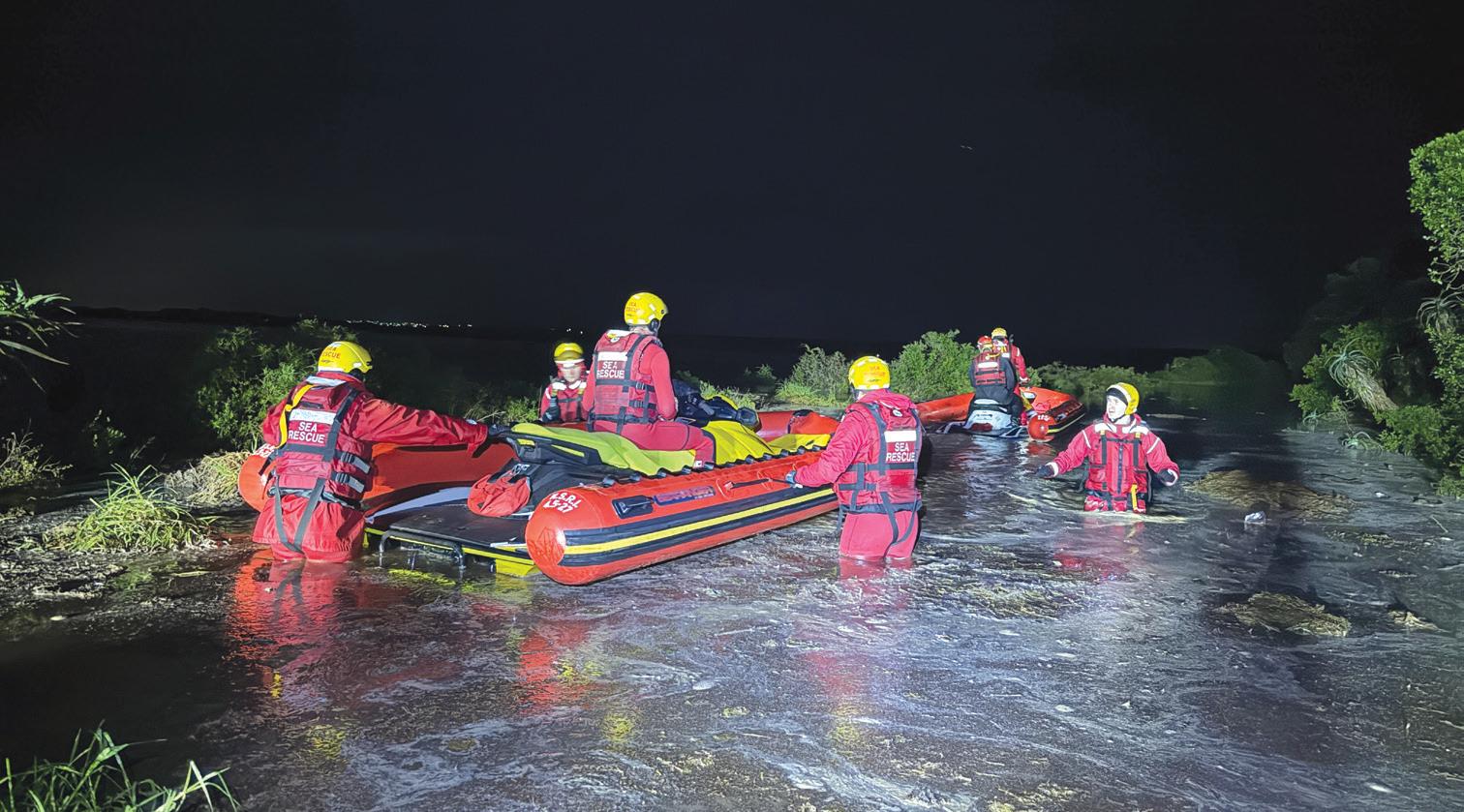
The entire area was 2m underwater and fast flowing, so it was decided to use the JetRIBs to get across the floodwaters. For the coxswains helming the JetRIBs, the challenge was not just the debris or the current, it was not knowing exactly
LEFT AND THIS PAGE
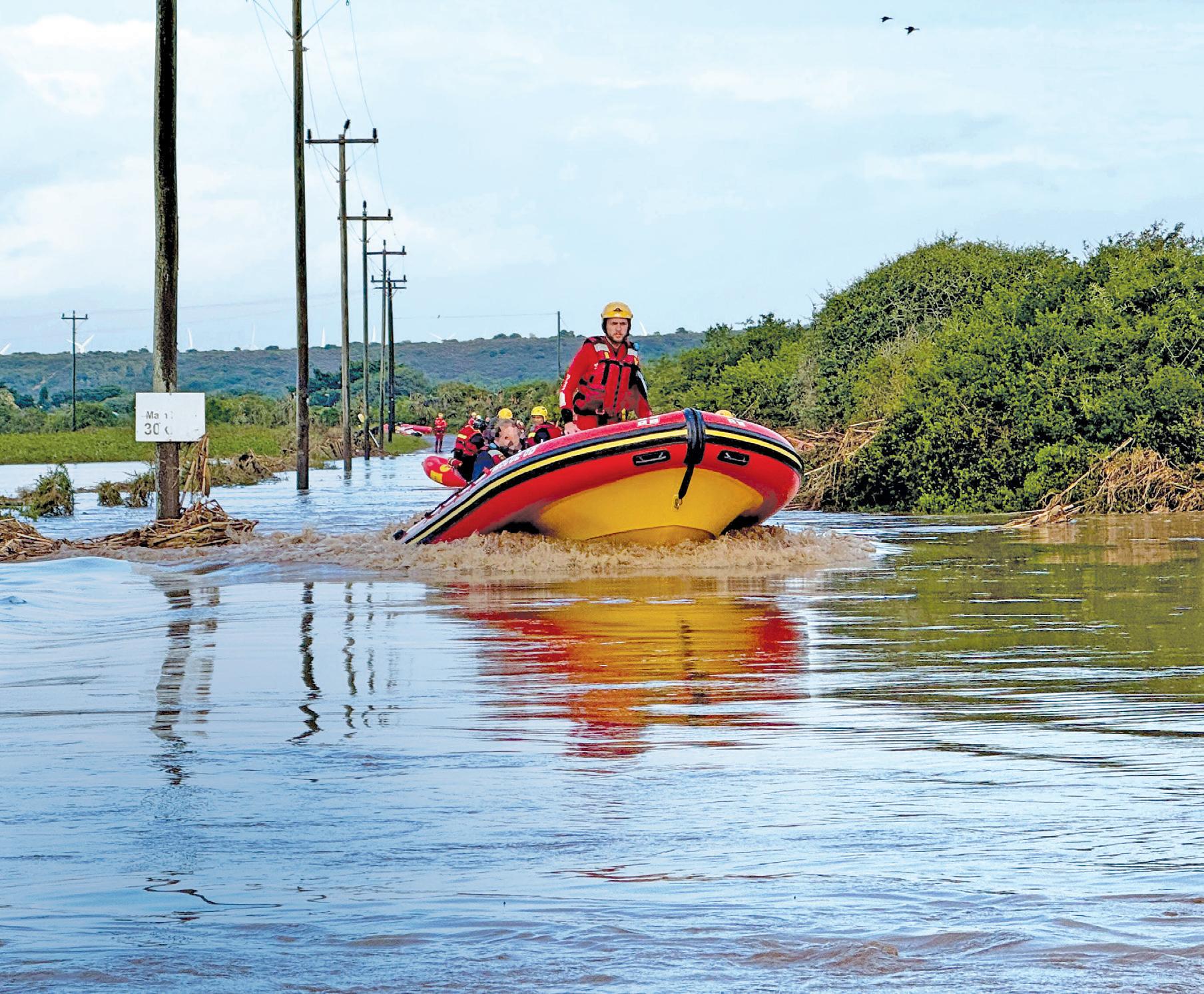
As day dawned, rescue crews were able to navigate the swollen Gamtoos River a little better, assisting stranded residents to get to safety.
where they were going because everything was under water and it was still dark. They carefully navigated their way to the Klipriver Resort where they found approximately 40 people of all ages needing assistance. For the elderly, it was determined that the safest way to extract them would be by air at first light. A call was put through to the JOC requesting air support and, a short while later, it was confirmed that a helicopter was available.
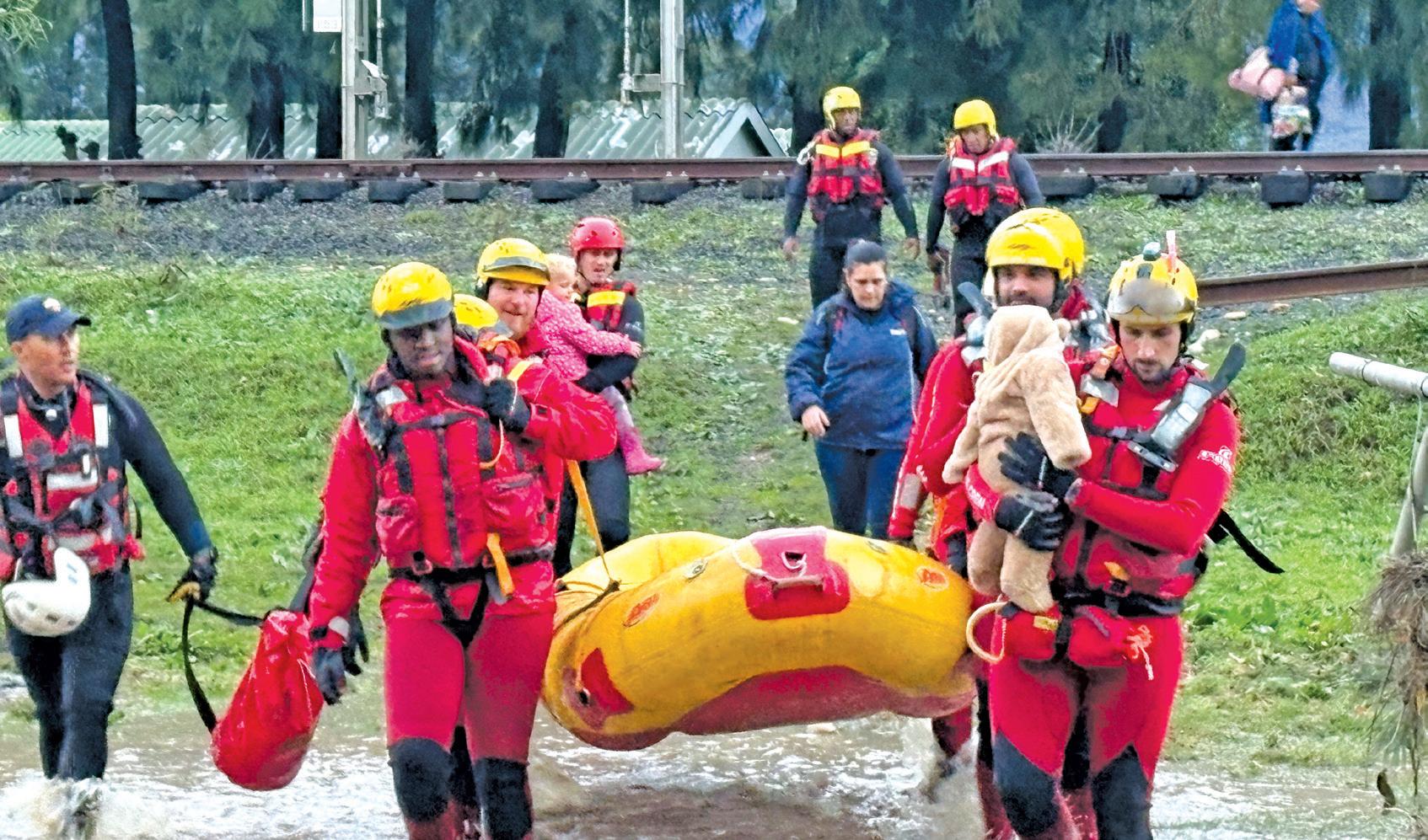
In the meantime, the water was starting to recede as quickly as it had arrived. It was still pre-dawn and as the JetRIBs ferried people to safety, the landscape was already changing. Fence posts and stranded tractors appeared and navigating the waters became even trickier. However, the one benefit of the receding water was that rescue crews were able to wade through shallower sections towing inflatable crocs. This helped speed up the
For the coxswains helming the JetRIBs, the challenge was not just the debris or the current, it was not knowing exactly where they were going because everything was under water and it was still dark.
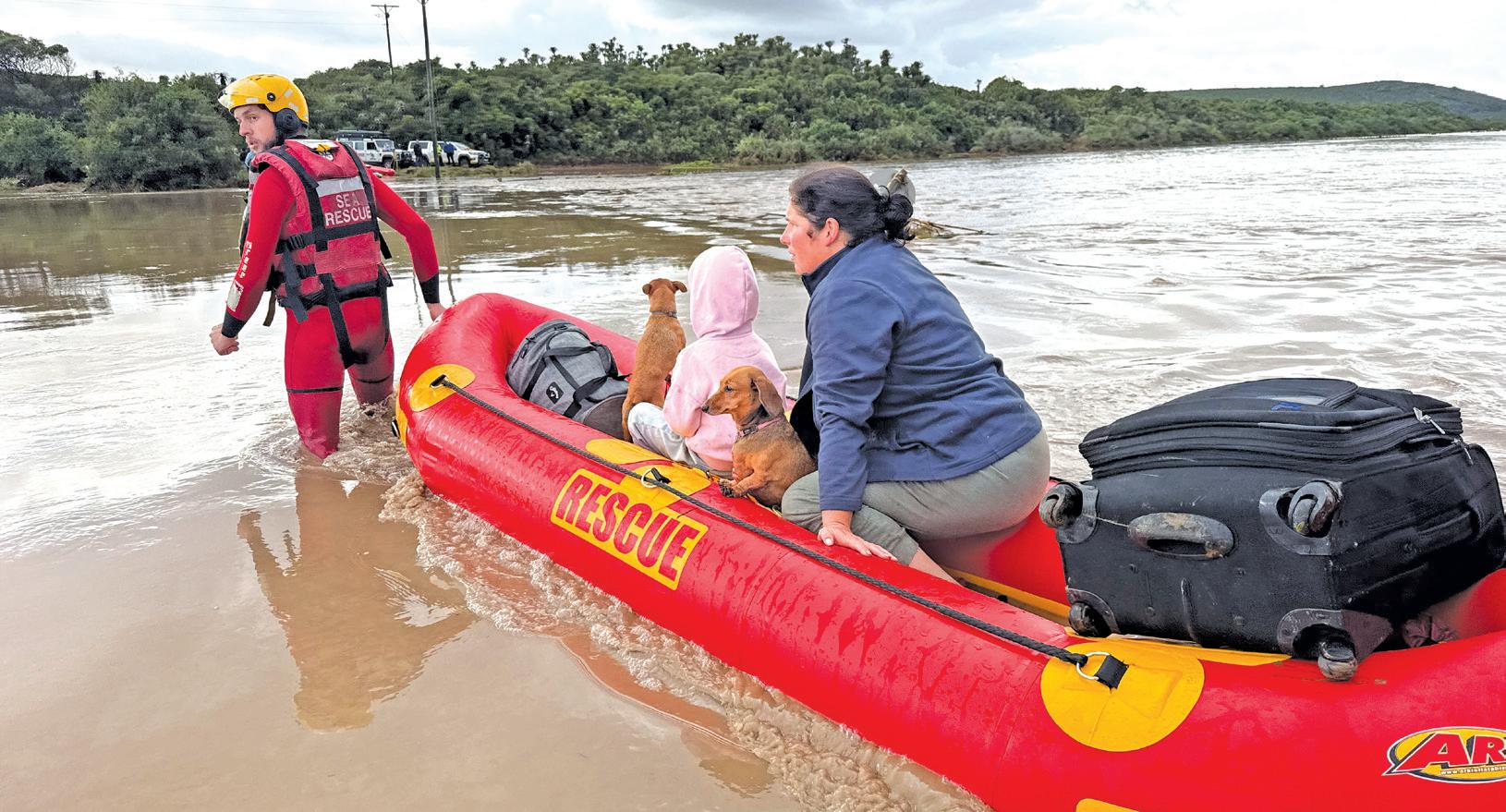
evacuation of families, many of whom had pets with them. It’s much easier to keep dogs, cats and parrots calm on a croc that’s being pulled quietly through the water, than on a noisy JetRIB.
It soon became apparent that the crocs were the best way to navigate the flood waters as first one, then a second JetRIB got stranded as the water levels dropped rapidly. At first light, the helicopter arrived and assisted with ferrying the elderly and less mobile casualties to safety. One by one, as they arrived at the staging area, each person
Navigating the swollen Gamtoos River was made more difficult by the darkness, trees and debris.
was medically assessed, given warm food and blankets and taken to a place of safety.
While the evacuation operation was still underway, a call came in from further upriver where a family was stranded on their roof. Crew from Oyster Bay and St Francis Bay, together with Search and Rescue South Africa crew and SAPS divers, diverted with their rescue vehicles and crocs to assist the family.
It was close to midday before all the evacuation operations were completed and the rescuers themselves were able to enjoy a warm drink and some food. What seemed like the whole community had rallied around, providing vital support –blankets, food and words of comfort –and all were received graciously.
A structured and coordinated plan meant communication and roles were clearly defined with on-scene commanders coordinating efforts between rescue crews and the JOC.
This was possible because these organisations have worked together before. This was the third major flooding incident in the area in just two years. While this time the floods had hit a different area, the lessons learnt from previous operations ensured there were always resources available when needed.
It was exactly this planning that enabled Gqeberha to respond to another call that came through at around 11am. A barge on the flooded Sunday’s River was having engine trouble and had become lodged on a submerged object. While the station’s rescue vehicle and JetRIB were still in use on the Gamtoos River, there was a backup crew at the ready to respond. Station
Commander Mark Dawson, activated the crew, arranging for the the 5,5m RIB, Eddie Beaumont II, to be collected from Gqerberha’s satellite station at Noordhoek with a private vehicle, while he responded directly to the scene. On arrival, it was confirmed that the casualties were all wearing life jackets and weren’t in imminent danger, they were simply stuck about 600m upriver.
Eddie Beaumont II arrived about 40 minutes later and was launched with Mark as coxswain and two crew on board. The barge was located upriver and a tow set up.
These rescues were successful primarily due to detailed preparation. Gqerberha crew had learned from previous flooding callouts and adapted their planning accordingly.
It took a little maneuvering to get the twotonne barge free, especially with so much flood debris and having to work against the fast-flowing current. Once free, it was an easy tow back to the slipway and then, with some more careful maneuvering, the barge was brought to shore where it was tied up. The operation concluded with recovering the rescue vessel and preparing to tow it back to Noordhoek.
These rescues were successful primarily due to detailed preparation. Gqerberha crew had learned from previous flooding callouts and adapted their planning accordingly.
It’s this ongoing learning that helps rescue crew become more effective. >
WESTERN CAPE
Meanwhile in the Western Cape, a similar scene was unfolding with flooding across a large area. By midmorning, it became apparent that more resources were needed. VSC (Volunteer Support Centre) employees, also trained in swift-water rescue, loaded two vehicles with the necessary equipment and headed out to the small community of Wolseley. At the time they had no idea they’d be out there all day, without communication to the outside world as cellphone towers were down.
After almost six hours of wading through flood waters to evacuate more than 27 people, the team was finally able to head home. They were tired, cold and hungry as all the shops and roadside garages were closed due to the flooding.
When they were finally able to get cellphone signal and check in, they got an unexpected question: ‘How far are you from Gouda?’ ‘About five minutes, why?’ ‘There are people stranded on rooftops. Can you divert to help them?’ It was already dark, radio batteries were low, so too were the crew’s own energy reserves, but saying no
Volunteer Support Centre training officers help to evacuate a farm near Wolseley as darkness was falling.
wasn’t an option. The result was 19 more people brought to safety.
Graeme Harding, who was leading the crew, reflects that there were several lessons to be learnt from the day. Moving forward, there’s consideration to create a backup crew, one that brings in logistical support for remote areas. Spare radio batteries, torches, food, extra blankets, as well as the ability to coordinate temporary places of safety for those who have been evacuated. This would provide much needed support where there aren’t sufficient community resources so that rescue crews can focus on reaching those who need to be evacuated.
With increased flooding incidents across South Africa, swift-water rescue capabilities are an important part of NSRI’s response. Training and capacity are continually being built, ensuring that each rescue is well coordinated and supported to help stranded communities get to safety.
ALONE AND ADRIFT
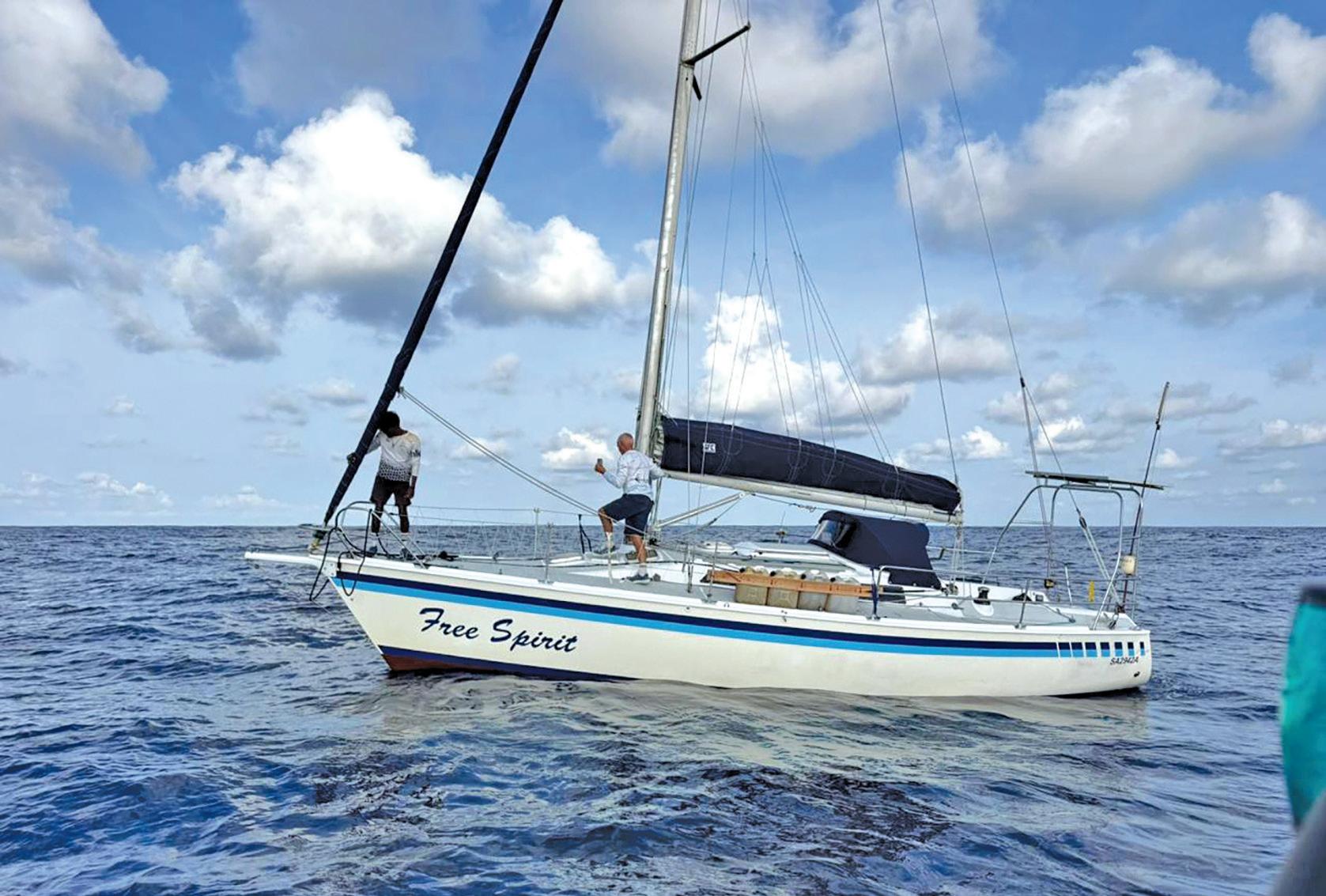
In a mammoth search, rescue and towing effort, NSRI stations on KZN’s South Coast assisted the stricken vessel Free Spirit, whose crew members had been drifting further and further out to sea for five hours.
By Wendy Maritz
The rescue of Tipsy during its return voyage to Durban after the 2024 Vasco da Gama Ocean Race by Station 32 Port Edward goes down in the annals of historic callouts (with the mission covering an incredible 158 nautical miles, the most ever for an NSRI RIB). But the recent callout for a yacht adrift can live alongside that with the number of hours it took to locate and return the vessel and its occupants to safety.
It was flanking station Shelly Beach that launched. The yacht, Free Spirit, also a Vasco da Gama race participant, had begun broadcasting its EPIRB
(Emergency Position Indicating Radio Beacon) in the early hours of Monday 25 May. Initial reports suggested she was around 20 nautical miles offshore of Ifafa, part of Shelly Beach’s operational area. Station 32 Port Edward and Station 5 Durban were placed on alert.
‘Our stations back each other up,’ says Shelly Beach Station Commander Glen Preston. (Shelly Beach had assisted in the Tipsy rescue by rendezvousing with extra fuel, and this time round, Port Edward did the same for the Free Spirit callout.)
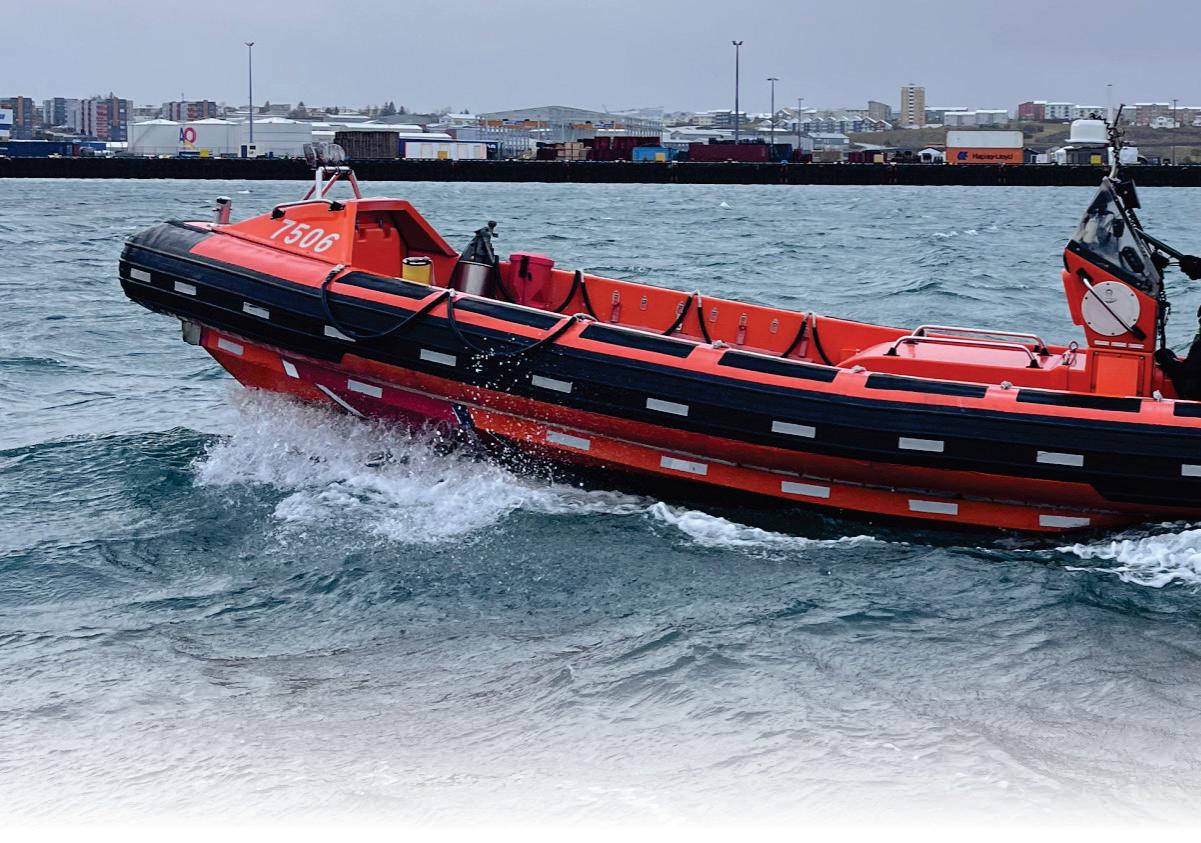
‘We launched our 7,3m Spirit of Dawn just before 6am with me and six other crew onboard. The idea was to reach the casualty vessel, get her under tow and then hand over the tow to Station 5 Durban.’
And with that Spirit of Dawn headed to the last known coordinates of Free Spirit, only to discover she was nowhere in sight.
‘We were then given a second set of coordinates, which was another 20 nau-
tical miles north from where we were.
Communication had been patchy and, in some areas, non-existent.’ At one point, Glen was able to establish direct comms with Port Edward Station Commander John Nicholas, who said they were planning to launch with extra fuel and a satellite radio, heading 41 nautical miles offshore of Port Edward. ‘So, we proceeded to that area.’
This would have meant Free Spirit had drifted 20 nautical miles southeast of her last known position. ‘It was a bit like looking for a needle in the haystack. In searches like this, you keep your eyes out for that “needle” – the casualty vessel’s mast.’ It didn’t help that radio communications continued to be patchy, but useful information was received about the possible drift pattern from Station 26 Kommetjie’s Marilyn Wells’ SearchWell marine search software.
‘The estimates were that the vessel had drifted about 2 nautical miles between 7 and 7.30am, and when we got this information at 8am, we realised we were roughly 5 nautical miles away from the last set of coordinates that we had.
‘And then we saw the needle on the horizon! It took us about 15 minutes to reach them.’
Free Spirit had been drifting for five hours; the two crew onboard were safe and very relieved to see help had arrived. During the early hours of the morning, the keyway on the yacht’s steering broke and the autopilot had been damaged as a result. They tried to rig emergency steering but the engine wouldn’t activate from neutral. At that point, with no power and no steering, they were unable to
sail, and the vessel began to drift. After multiple May Day calls went unheeded, they activated the vessel’s EPIRB, which was picked up by the MRCC, which then alerted the NSRI’s EOC (Emergency Operations Centre).
It seems it had been a bad night for communications for everyone, as Glen and his crew discovered for themselves during the course of the callout. Exactly why, Glen can only surmise that perhaps there were issues with emergency Channel 16 (which all ships should have open in case of May Day calls), or perhaps the distance from shore. ‘By the time we found Free Spirit, she was almost past the shipping lanes,’ he explains.
Which brings one to the rather sobering reality that had they continued to drift, there may have been a different outcome.
Once the tow was secured, it was time to head back to shore. Glen recalls that when they started the search, conditions had been good, even though they launched in the dark. Their return journey, towing a vessel three metres longer than their own, and a tonne heavier, was somewhat more challenging. ‘We ground to a maximum towing speed of about 5 to 6 knots,’ he says. ‘We had crossed three different current patterns on the way out to them, and coming back we were fighting the current,
and the wind had come up. We hit increasingly heavy seas offshore of Margate.
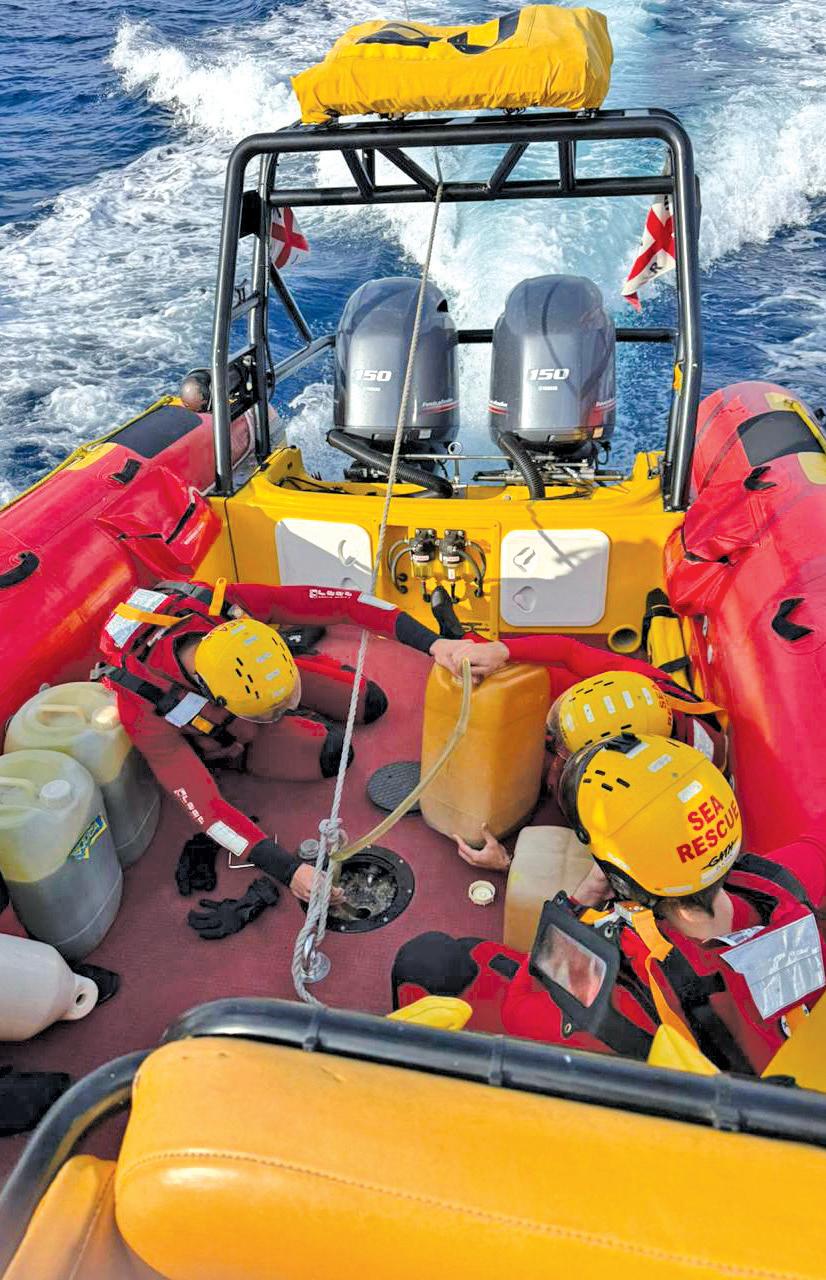
‘A decision was made to divert closer to shore, and we’d been at it for about an hour, when we picked up comms with Port Edward who rendezvoused with us to hand over fuel. And then we continued, keeping about 30 nautical miles offshore for another four to five hours. Then I decided we should divert further inshore to Shelly Beach. Fuel was running low, and one of our crew had been injured. So, we arranged with a fishing charter company to meet us with more fuel and some food and to take onboard our injured crew member.’
Spirit of Dawn met up with Station 5 Durban’s ORC, Alick Rennie, just off Port Shepstone Lighthouse, and the tow was transferred. Shelly Beach crew arrived at their base just before 4pm, and Durban crew arrived at their base at 2am the following morning.
For a seasoned coxswain like Glen, whose been a Sea Rescue volunteer for two decades and involved in rescue services for even longer, it was definitely a case of staying focused and changing strategy as needed during a challenging search thwarted by communication issues. For some of the newer crew, some with less than four years’ experience, it was a bit more hair-raising. But this is what Sea Rescue operations are like. ‘You launch for what you think is a onehour callout, and then you’re out there for eight hours. The guys did well, it was good experience for them,’ he says.
TOP LEFT Crew of Spirit of Dawn refuel for the next leg of towing. ABOVE Towing the much larger casualty vessel meant speeds were averaging 5 knots in rough seas.
CREW MEMBERS: Coxswain Glen Preston and crew members Kyle Robertson, Jacey Bekker, Arno van Zyl, Liam Gallagher, Bjorn Thaumuller and Gideon Joubert.
ALL IN THE FAMILY
In the water, in their DNA – participation in the NSRI often spans many generations. By Cherelle Leong
Family in the NSRI means many things. Sacrifice. Support. Belonging.
But there’s something else that runs deeper, and it’s noticeable to everyone involved. When there’s an emergency, they’re the people who calmly step in. They know what to do and who to call for help, and they have seemingly heroic abilities.
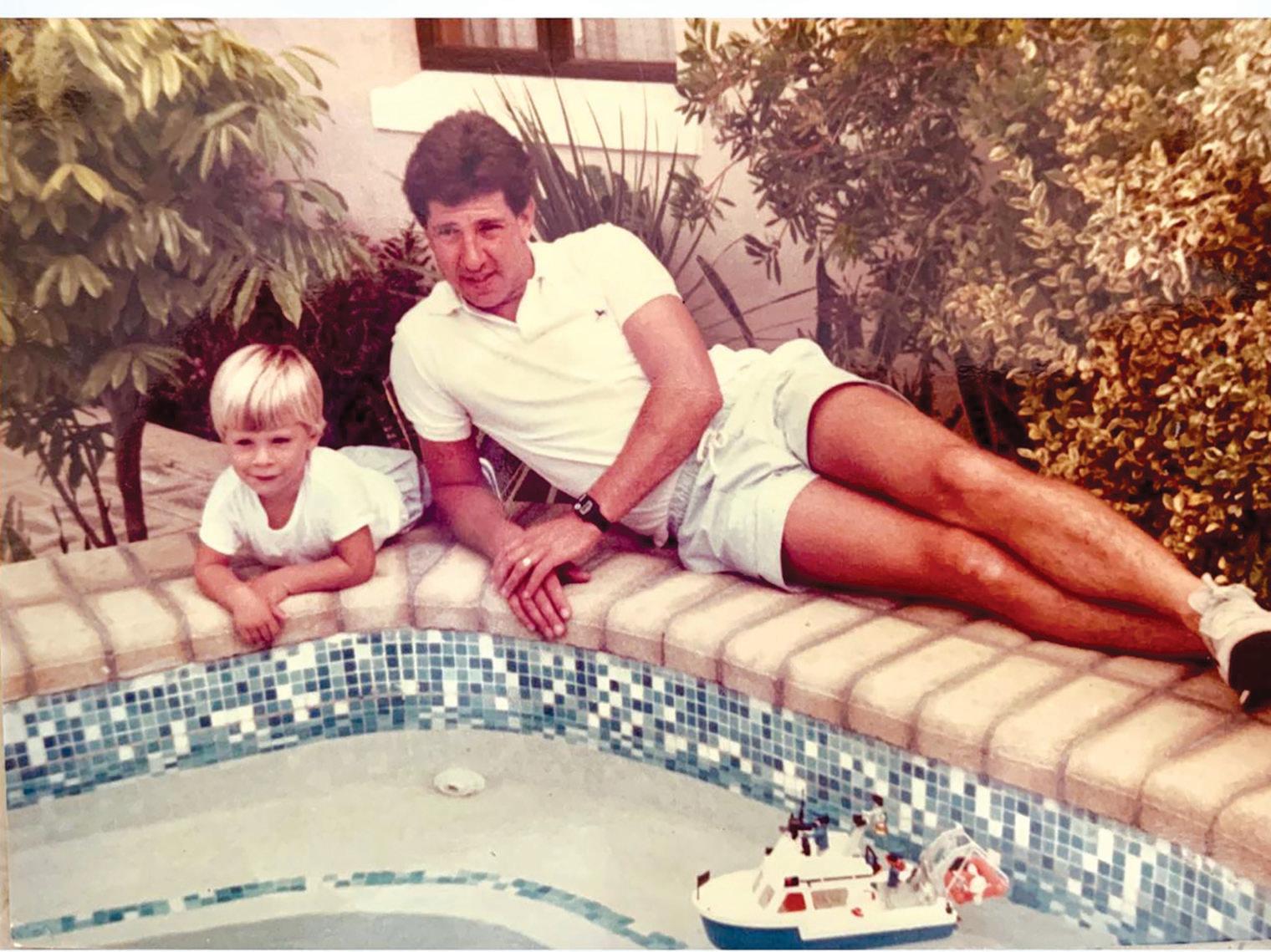
Growing up, this was the impression that Rory Mitchell had of his father. Spiro Mitchell joined Station 2 Bakoven, in 1976. Living in Camps Bay, he was a mere three minutes’ jog from the base. By the time Rory was born, Spiro was a seasoned crewman and the station had become a huge part of family life – weekends away in Clanwilliam or Robertson, braais on
Bakoven Beach. Sometimes Rory and his brother would watch Rescue 2 recover and help wash the boat once it was back on the cradle. As a child he was in awe of the skills that his father had. Helming the boat at sea, talking on the radio, tying knots … it all seemed so effortless. There’s a certificate commendation (signed by Nelson Mandela) that is proudly displayed in the Mitchell home, celebrating 25 years of Spiro’s service at Bakoven.
Almost two decades later, when Rory joined Station 8 Hout Bay, Spiro couldn’t have been prouder. Rory is now another Mitchell family member who has the skills to handle emergencies. For Rory, it’s just the beginning. As a qualified crew member, he is working towards becoming
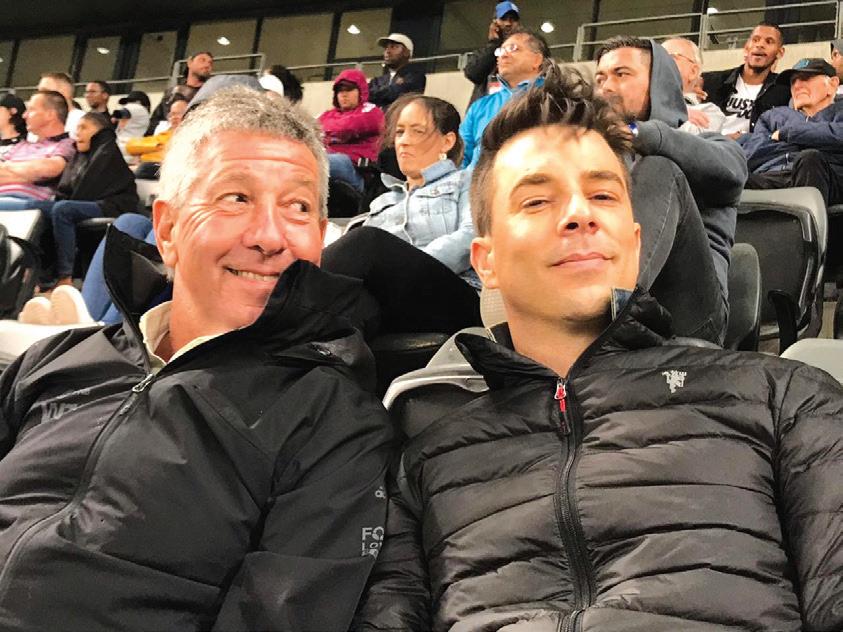
LEFT TO RIGHT A young Rory Mitchell with his father, Spiro; Rory has qualified as crew at Hout Bay and hopes to emulate his dad’s 25 years with the NSRI; father and son enjoy time together off the water.
a Class 3 Coxswain, possibly matching his father’s 25-year service record.
Another family that’s served across two generations and these two stations is the Geyser family. Brad Geyser served alongside Spiro Mitchell at Bakoven and later took on the role of Station Commander there and later at Hout Bay. His eldest son, Sean, served as crew and Class 3 Coxswain at Bakoven before emigrating to the USA. His daughter, Dee, served as crew at Hout Bay, and his twin sons Bevan and Cullam have served at both Hout Bay and Bakoven.
As a Class 3 Coxswain and current Station Commander at Bakoven, Bevan appears to be following in his father’s footsteps (although, when they were
teenagers keen to join, Brad was emphatic that they should forge their own path). Growing up, the NSRI was always in their lives, but it was somewhat mysterious. While the family would often visit the base and there were many Christmas celebrations watching Father Christmas arrive on Rescue 2 and hand out presents, Brad rarely talked about rescues or operations at home.
However, one thing was certain: the NSRI elevated Brad to really cool Dad status the day he made a rescue boat fly! Bevan and Cullam were about three
BELOW Brad Geyser (left) and his son, Bevan. Brad’s work with the NSRI elevated him to ‘cool Dad’ status.
years old, and a massive winter storm was brewing. Brad had left early for the base and, later, their mother announced they were going there to watch something cool. Standing on the stairs at Bakoven in their matching outfits, they suddenly heard a very loud noise. A huge helicopter appeared out of the clouds, hovering above the slipway as it lowered a winch cable. The cable was attached to strops holding Rescue 2, which promptly shot upwards and disappeared into the sky.
Bevan and Cullam joined Hout Bay at the age of 16, bringing with them a
While Brad was helping manage the JOC, Bevan and Cullam worked in the background supporting the crew and casualties, doing literally anything that was needed.
ABOVE The Geyser family, from left: Cullam, Dee, Brad, Bevan and Sean. Father and children have spent time crewing at both Bakoven and Hout Bay.
tireless energy. If there were bilges to be cleaned, they simply got on with it. They were always eager to respond to a call (even if it meant riding their skateboards down the hill in the middle of the night to get to the base). Hout Bay was a second home with extended family, and the Geyser twins were always eager to be part of the action. During the Miroshga mass casualty incident, they pitched up at the base. Controller, Margie Benson, asked them: ‘What are you doing here? You’re trainees!’ Their response was: ‘We’re here to do the sh*t jobs!’ So, while Brad was helping manage the Joint Operations Centre, they worked in the background supporting the crew and casualties, doing literally anything that was needed.
This is a common thread in the NSRI family legacy: the willingness to serve
in whatever capacity is needed. When Bakoven was short of crew and coxswains, they asked flanking stations if any crew would be willing to help out, and Bevan and Cullam both volunteered, Bevan stepping in as a duty coxswain shortly after qualifying.
One of his crew members was Chris Westcott, who was training for his Class 3 Coxswain qualification. Chris had joined Bakoven in June 2014, when nudged by his brother to put his open-water swimming
to good use. Chris was no stranger to the NSRI. In fact, the first eight years of his life were filled with memories of boat rides and Christmas events at Station 17 Hermanus. Chris’s father, Graham, was one of its founding members.
Graham Westcott owned a Mariner outboard business in Hermanus and was a member of Rotary. He’d grown up in Hermanus, swimming, diving and spearfishing. He knew the sea and he knew boats, so when discussions came
TOP AND ABOVE Graham Westcott was a founding member of the base at Hermanus, and served as its Station Commander for 10 years; Graham on Rescue 17 in Hermanus. RIGHT Graham’s son, Chris.
up in 1977 among the Rotarians to start a rescue base, Graham volunteered to be part of the steering committee. A 7,5m ski-boat hull was found and a sponsor, the Florence Carter Trust, helped purchase it. For several months the 11 inaugural crew members gathered in the Westcott’s home garage to fit out Rescue 17, named Florence Carter, as a rescue vessel. In 1978, Station 17 was formally founded
For Spencer Oldham, the imprint of Sea Rescue spans more than 80% of his life. He first joined Station 22 Vaal Dam, together with his father, John, when he was 16.
with Graham stepping up as Station Commander, a role that he held for 10 years.
Graham joined the NSRI when he was 34, and ironically Chris was the same age when he joined Bakoven, although it was 26 years later. It was a month after Graham passed, so, sadly, they never got to share their NSRI experiences as adults. Chris reflects that his father was a natural seaman – adventurous, skilled and highly proficient in rescue work. Chris was a strong swimmer, but never thought he was skilled enough to join the NSRI. In the 12 years he’s been volunteering, that belief no longer holds true. Having grown in skills and confidence, he now serves as a duty coxswain at Hout Bay, and recognises the legacy his father imprinted on his life through the NSRI.
From left: Greg, Spencer, Chloe and John Oldham.
For Spencer Oldham, the imprint of Sea Rescue spans more than 80% of his life. He first joined Station 22 Vaal Dam, together with his father, John, when he was 16 years old. They’d trained together as volunteer medics at Benoni Fire Department. Then got involved in the NSRI after assisting as medics for a Formula 1 boat race. On relocating to Cape Town, they joined Station 10 Simon’s Town, as trainees. They later moved to Hout Bay where John served as crew for 25 years.
Spencer became first a Class 3 Coxswain, then advanced to Class 1, and is now in his second tenure as Station Commander.
John has long since retired from the NSRI, but his Whiskey Bar in Montagu is filled with memorabilia.
It’s no wonder then, that after turning 16, first Greg and then Chloe (Spencer’s children) were eager to sign up.
Many families have their own traditions. Some cycle, some run, some go fishing. For the Oldhams, it’s the NSRI, and Spencer wouldn’t have it any other way. Learning medical and rescue skills alongside his father from a young age forged a very close bond between them.
The Oldham children, Chloe and Greg, when they were younger. Pictured with their dad, Spencer.
It taught him life skills unlike he’d learn anywhere else – how to work as part of a team, command rescue vessels and manage emergencies. That desire to learn the skills to be able to help someone is truly part of the family legacy. And it’s not considered hard work either. It’s fun!
On a school hike, after one of Chloe’s classmates hurt themselves, Chloe wasted no time unpacking her medical kit and attending to the injury. For Greg, joining the NSRI was about expanding his rescue skills. He’d been involved in Lifesaving SA’s Nipper programme and was a duty lifeguard at Fishhoek and Llandudno beaches.
Greg is now a trainee rescue swimmer and trainee Class 4 Coxswain and Chloe is close to achieving her crew status. For both of them the NSRI is a natural activity, one they look forward to on weekends.
The Oldham, Westcott, Geyser and Mitchell families are by no means the only multi-generational volunteers in the NSRI. They’re prime examples of how deep the passion goes to save lives and help people.
The legacy in these families is a testament to the life of an NSRI volunteer. As much as they sacrifice their time to serve others, their overriding belief is that, in return, they gain so much more.
PLOTTING AND PLANNING
Technology advancements have played a vital role in streamlining navigation and communication equipment for Sea Rescue operations. By Cherelle Leong
As the build of the eighth and final Offshore Rescue Craft (ORC) nears completion, there is one feature of the vessel that has Station 8 Hout Bay really excited: the navigation and communication systems. They are the most advanced in Sea Rescue’s fleet with interfacing systems, multiple screens and search pattern overlays that make a significant difference in search and rescue capabilities.
There’s an argument that, while equipment has advanced, the basics of navigation remain the same. Plotting a waypoint and calculating a compass bearing are the fundamentals. No matter
how advanced the navigation equipment, one still needs to understand how to do basic navigation calculations. It’s one of the reasons NSRI crew still write navigation exams by hand.
The difference is that in an exam you have time to calculate, but in a rescue scenario every minute is another minute that casualty spends wondering when help will arrive. Technological advancements have changed that. More accurate data available in real time means getting to casualties faster, and keeping rescue crew safer.
To understand just how much has changed, we chatted to Hout Bay’s Station Commander Spencer Oldham. Having
PHOTOGRAPHS: PAULA LEECH
volunteered for the NSRI for almost 40 years, he’s one of the few people who has experienced, first hand, the evolution of navigation and communication equipment over the years.
In the late 1980s Hout Bay operated with an 8,5m Cape craft ski boat – Spirit of Mobile. The navigation system was rudimentary: a chart, compass, slide rule and sextant. The Global Positioning System (GPS) and Automatic Identification System (AIS) didn’t exist back then, and while rolling out a chart on an open deck to plot a course seems crazy, there was no alternative. Dead reckoning was as accurate as it got, and calculating directions and search patterns was a near-impossible task when underway.
OPPOSITE AND THIS PAGE The ORC’s cockpit provides plenty of room for various navigation tools and the volunteer crew who operate them.
In the early 1990s a fire gutted the station, resulting in the loss of the Cape craft. It was replaced with the Spirit of Rotary, a 12m cabin boat with a wooden hull. Having a chart table inside the cabin sheltered from the elements was considered a big improvement. But working head down, staring at a chart, was a sure recipe for seasickness.
Spirit of Rotary came with a Decca Navigator System. This was a pre-GPS
hyperbolic radio navigation system developed in the early 1940s. It picked up low-frequency signals from land-based stations and then classified them into red, blue or green depending on their location relative to the vessel. Using a lattice overlay, the vessel’s position could be triangulated, accurate to approximately 1 mile, but it was very complicated and took an average of 10 minutes to get a fix on the vessel’s position.
The next upgrade to the navigation equipment on Spirit of Rotary was a Yeoman plotter, which was developed when GPS came out. It was a desk-mounted system, used to transfer GPS coordinates and radar echoes onto a paper chart. The chart would be mounted to a magnetic base plate and locked into position on the chart table. The plotter would be used to triangulate a GPS position and match it to a position on the chart. Once crew were familiar with the system, a fix could be obtained within two or three minutes, making it a significant
upgrade on the Decca system. However, crew still often got seasick from staring down at the chart table.
In addition, the Spirit of Rotary was fitted with a Furuno radar. It was very basic compared to the radars of today –a simple green monochrome screen with magnetron tubes at the back. It was large and bulky and looked like something from a 1970’s TV lounge. Crew rarely voluntarily took up the radar station, as it had a cover under which they had to put their heads in order to monitor the radar, and once again, seasickness was inevitable.
In 2006, the Spirit of Rotary was retired and replaced with Nadine Gordimer – a 10m Breede from the RNLI that, until recently, served as Station 8’s deep-sea rescue vessel. This had an upgraded Furuno radar and an old Radio Direction Finder (RDF). The challenge was that the aerials of the RDF had to be manually tuned. Also, while the radar was a more
Station 8 Hout Bay enjoyed a night training session on Station 3 Table Bay’s ORC.
PHOTOGRAPH: PAULA LEECH
The ORC is equipped with long-range antennae and an omnidirectional high gain GSM antenna base set. This enables communications 40 nautical miles out to sea.
modern version, Automatic Radar Plotting Aid (ARPA) and AIS were not integrated. The radar had a very basic digital chart, integrated with a first-generation digital GPS. AIS was only added as a separate unit at a later stage. Compared to earlier navigation systems, it was quite an improvement and functioned well enough in the many deep-sea rescues crew undertook over the years.
However, with the ORC, the stepup is significant – not surprising when you consider how much technology has evolved in the past 20 years.
While on the Breede, the navigator had to squeeze into a corner next to the helmsperson, on the ORC there’s a large-screen MFD (multifunction display) unit at the navigation desk at the rear of the cabin. To ensure the coxswain and helmsperson have easy access to navigation information, there are two MFD screens at the front of the cabin, one for the coxswain and another for the helmsman. This configuration ensures that all operational areas can operate independently while sharing information in real time. There is also a separate MFD unit on the external upper helm station, making four MFD units on the vessel.
In terms of radar, the ORC is equipped with the Furuno Navtech TZT3 touchscreen
that integrates with AIS, digital RDF, echo sounders and the vessel’s onboard smart command centre. The set-up is fully customisable and comes with a dedicated tablet so that additional information can be easily input or recorded. The radar also comes with ARPA, has AIS integrated and links to the engine information, making engineering checks significantly easier than going down to the engine room. Even the vessel’s aft and foredeck cameras can be brought up onto the navigation display so that operations can be monitored at all times.
In addition, the ORC is equipped with long-range antennae and an omnidirectional high gain GSM antenna base set. This enables communications 40 nautical miles out to sea. The systems are set up so that when low orbit satellites such as Starlink come into operation in South Africa, the ORC can link up to them for navigation and communication.
What this means for rescue crew, and especially commanders, is that all the information they need to successfully conduct an operation is a click of a button away and easily displayed. Even VHF and Kavikom communications are digital, enabling greater clarity. This is quite far removed from the 29 Meg CB trucker’s radio with which the original Rescue 8 –Spirit of Mobile – was fitted.
There’s been a huge evolution in technology, which makes a significant impact on rescue operations. While the spirit of volunteers was never daunted by what they had to work with, the new generation systems go a long way towards making rescues even more effective.
GROWING SKILLS AND IMPACT
Survival Swimming instructor
Charlton Coetzee embodies the idea that what we do now to spread the water safety message will influence generations to come.
By Wendy Maritz
Charlton Coetzee is just 21 years old. He’s a Class 4 Coxswain, Survival Swimming and Water Safety instructor, has qualified as a rescue swimmer, received his training officer’s certificate, and has completed the NSRI’s whale disentanglement course. He’s embraced so many aspects of the NSRI, one wonders if he’s hiding a superpower. But Charlton insists it all boils down to one thing: making an impact. He’s determined to reach as many members of the community as he can – in whatever
way he can – to ensure people stay safe around water.
It started when he was a child.
Charlton grew up in Lambert’s Bay on the West Coast and attended PW De Bruin Primary School. His first introduction to the NSRI was when Water Safety instructor Nicole Anthoney visited the school to deliver a lesson to the children. When he was older and attending Hoërskool Lambertsbaai, he was assisted by lifeguards at Lambert’s Bay beach after getting into trouble in the water. ‘That moment impacted me so much because I understood first-hand what it feels like to need help in the water,’ he says.
About a year later, at age 16, a group of NSRI lifeguards visited his high school looking for volunteers willing to be trained as rescue swimmers. Charlton and a friend jumped at the opportunity.
After qualifying, he decided to join Station 24 Lambert’s Bay as a trainee crew member. As a 17-year-old, Charlton remembers thinking, ‘I’m just going to stick with this station and keep learning everything I can.’ And he did. Within three years, he had completed first-aid, whale-disentanglement and training-officer courses, and in 2025, at the age of 20, completed his Class 4 Coxswain qualification. In the same year, he applied to become a Survival Swimming instructor at Survival Swimming Centre (SSC) 5 in Vredendal, and was successful. ‘That was an amazing moment for me,’ he says, recalling the incident at Lambert’s Bay beach. ‘Being in a position to help people not get into those kinds of situations meant so much to me.’
Charlton believes each opportunity within the NSRI arrived at the right time for him. ‘Everything evolved organically. Opportunities came, and one step led to
another.’ He’s had good experience working as a training officer at both Station 24 Lamberts Bay and Station 45 Strandfontein (also situated on the West Coast). This usually involves planning training sessions with the Station Commanders that cover, among others, towing scenarios, rescue swimming, navigation and identifying which crew members need more hours on vessels and filling in the gaps.
What was particularly fulfilling for Charlton was that he recently fitted in a session with both stations sharing the work Community Programmes is doing. ‘It’s a way to interlink,’ he says, ‘to integrate what I’m do with Community Programmes with the Sea Rescue side of things.’
Charlton is a great example of how this can work. He has developed skills across various pillars of the NSRI, and his aim is to be available to other volunteers and members of his community in as many different ways as possible – from teach-
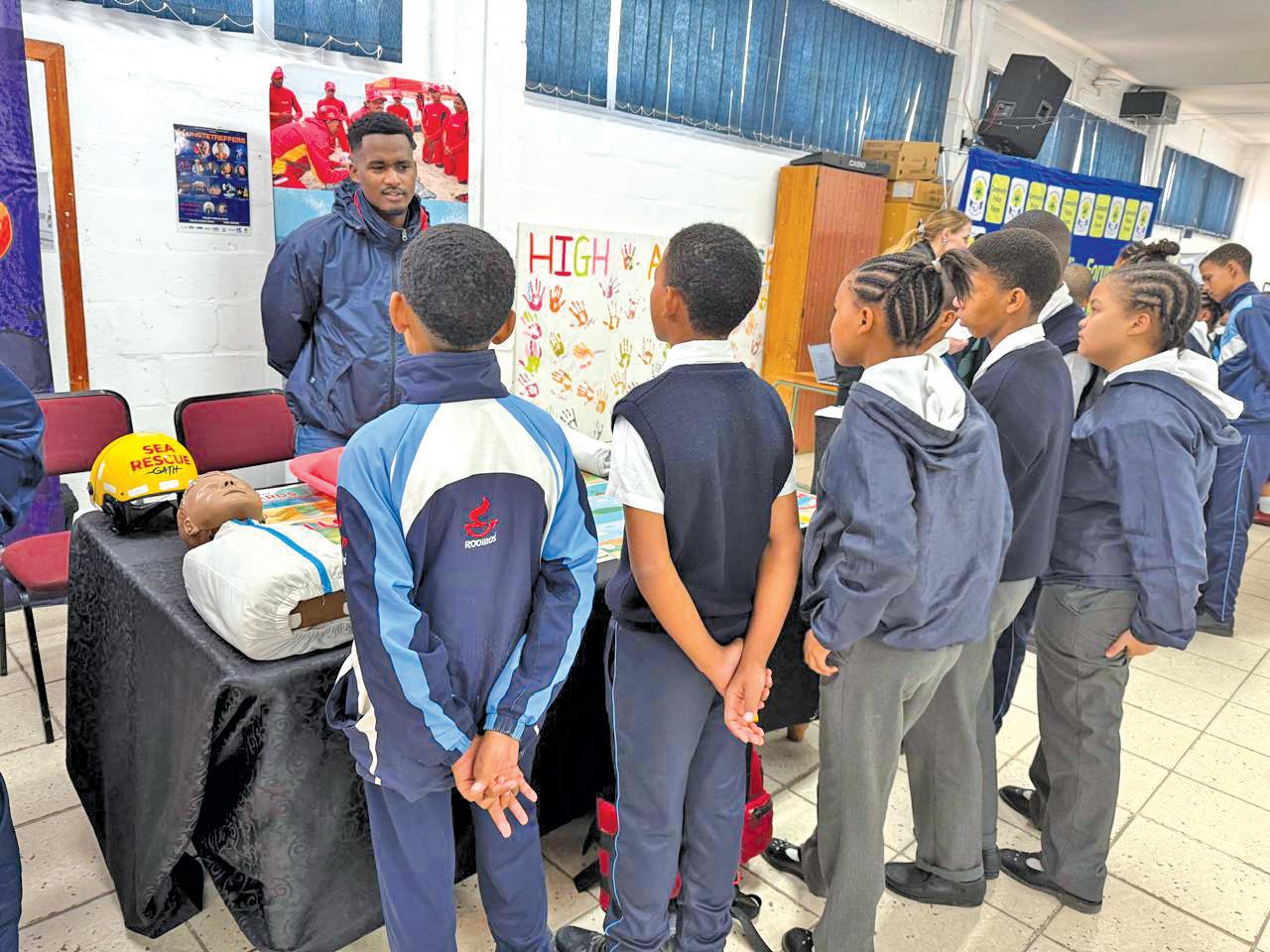
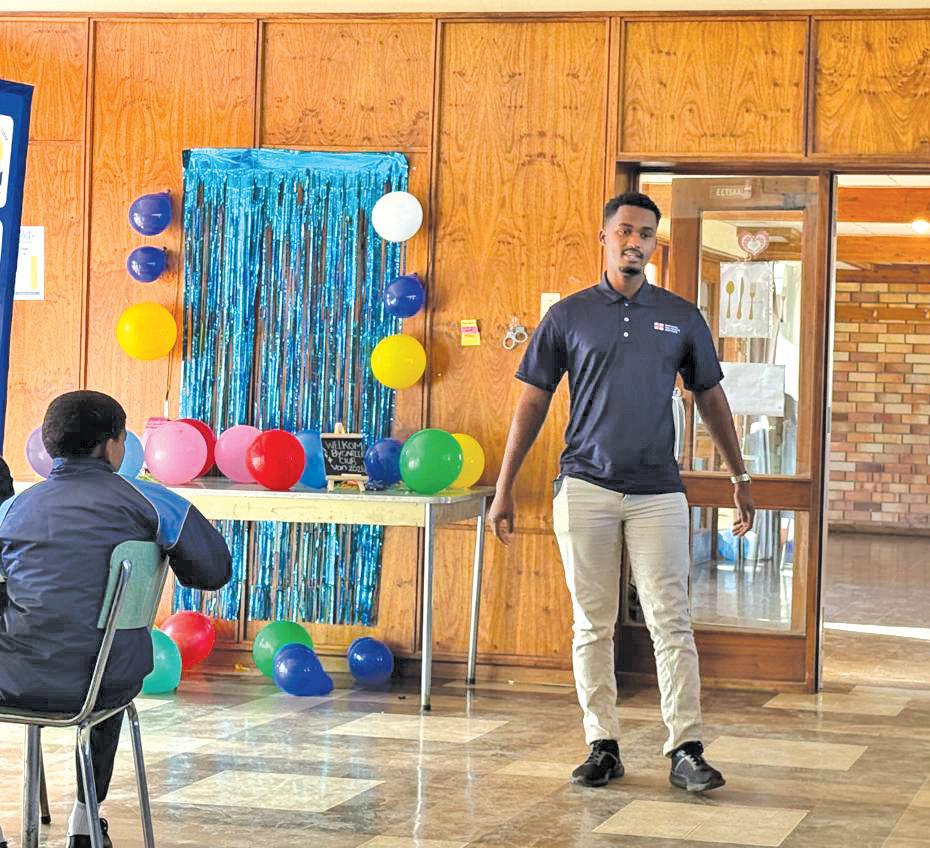
LEFT TO RIGHT Aside from teaching Survival Swimming, Charlton regularly visits schools in his community to attend career expos and talk to learners about the NSRI.
ing Survival
Swimming skills (for which he is employed)
to responding to callouts at sea. He also happily attends career expos at schools and goes on roadshows to inform members of the broader community about the NSRI, and what the organisation does. ‘I also want to be an example, and show people that anyone can become involved in the NSRI. If I can, they can, too.’
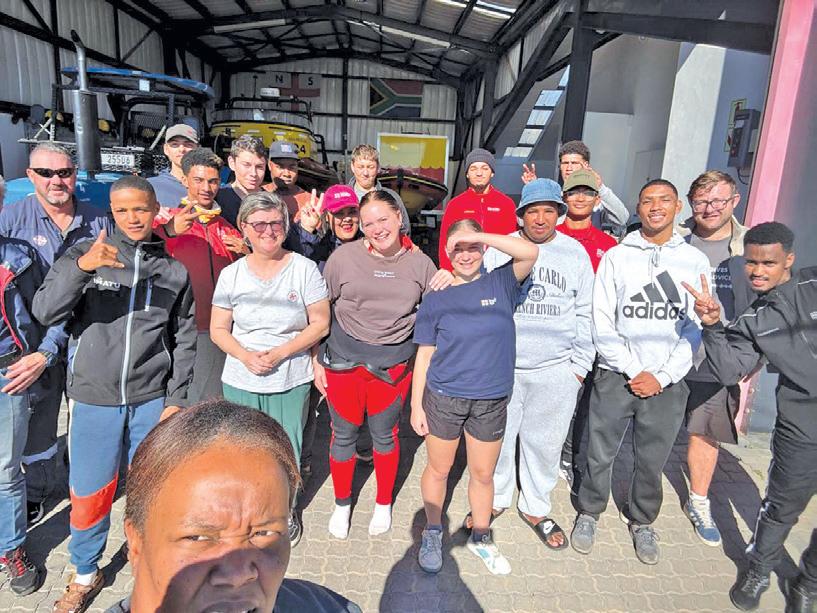
LEFT Lambert’s Bay and Strandfontein crew work closely together. BELOW Launching for training at Lambert’s Bay.
But, the most rewarding and fulfilling aspect for Charlton is what is achieved at SSC5 at Steilhoogte Primary School in Vredendal. ‘I have seen the fear on the children’s faces,’ he says. ‘And you never know if it’s because they’ve lost a loved one through drowning. Then they come into the SSC and see all this water and they’re expected to get into it!
‘It’s very rewarding when they get over that fear,’ Charlton says. ‘We have an autistic learner at the school and in the beginning, he was very scared. His carer had to get into the water with him initially. After three or four lessons, he said to the carer, “You can go now.” And then after one more lesson, he wasn’t interested in me either,’ Charlton laughs. ‘He didn’t want me supporting him, and moved freely through the water on his own. I was surprised, but it gave me great joy in my heart to see this happen.’
When Charlton reflects on his five years with the NSRI, he says the organisation has really helped shape him. ‘It’s taught
me discipline, responsibility, teamwork, leadership and the importance of serving others. The NSRI has given me the opportunity to grow from a young person, learning about water safety, into someone who can teach, respond and lead. It means I can give back to my community and help people become safer in and around water. So, it’s not just about rescue for me; it’s also about prevention, education and building safer communities.’
Charlton wears his skills and accomplishments like badges on the inside of his jacket. No one can see them, and he doesn’t flaunt them. He’s humble in his thanks to people like Grant Grove and Danie Verwey from the Training Department at the Volunteer Support Centre, former Lambert’s Bay Station Commander Avril Mocke, and Nicole Anthoney, who arrived at his school all those years ago to teach his class about water safety and, unknowingly, set him on his path.
NEWS & SPONSOR NEWS
BUILDING FUTURES TOGETHER THROUGH EDUCATION
A powerful new partnership is helping to turn the tide for drowning prevention in KwaZulu-Natal. The Victor Daitz Foundation and World Relief Australia have joined forces with the NSRI to fund a dedicated Drowning Prevention Instructor in Richards Bay for the next three years – a collaboration set to strengthen water safety education in one of South Africa’s highest-risk coastal regions.
The programme’s impact extends far beyond the water. Survival swimming improves coordination, strength and confidence, while supporting cognitive development through enhanced decision-making, awareness and discipline. Equally important are the social and emotional benefits, with children developing resilience, teamwork and self-esteem through the training experience.
With its warm Indian Ocean waters and expansive beaches, KwaZulu-Natal attracts high levels of aquatic activity year-round. Yet the province also records some of the country’s highest drowning rates, highlighting the urgent need for accessible water safety education and survival skills training.
Through this partnership, the NSRI’s Drowning Prevention Programme will expand its reach across local schools and communities, delivering free Survival Swimming and Water Safety Education training to children in under-resourced areas. Beyond teaching practical survival techniques, the initiative aims to build long-term awareness among families and foster a stronger culture of water safety throughout the province.
By supporting the NSRI’s work in KwaZulu-Natal, the Victor Daitz Foundation and World Relief Australia are helping to address inequalities in access to drowning prevention education and equipping vulnerable communities with life-saving skills.
With continued support, the initiative will be able to deepen its impact, reach more at-risk communities, and play an even greater role in reducing preventable drownings along South Africa’s coastline.
The Victor Daitz Foundation and World Relief Australia have joined forces with the NSRI to fund a dedicated Drowning Prevention Instructor in Richards Bay for the next three years.
NEWS & SPONSOR NEWS
OCEANS 8
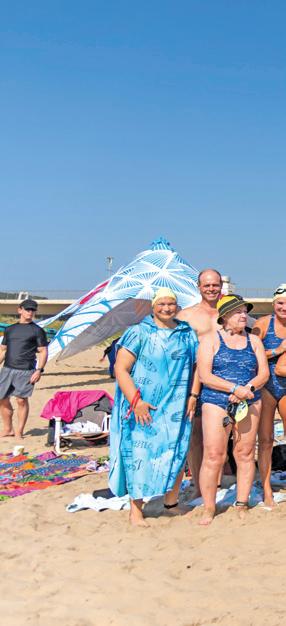
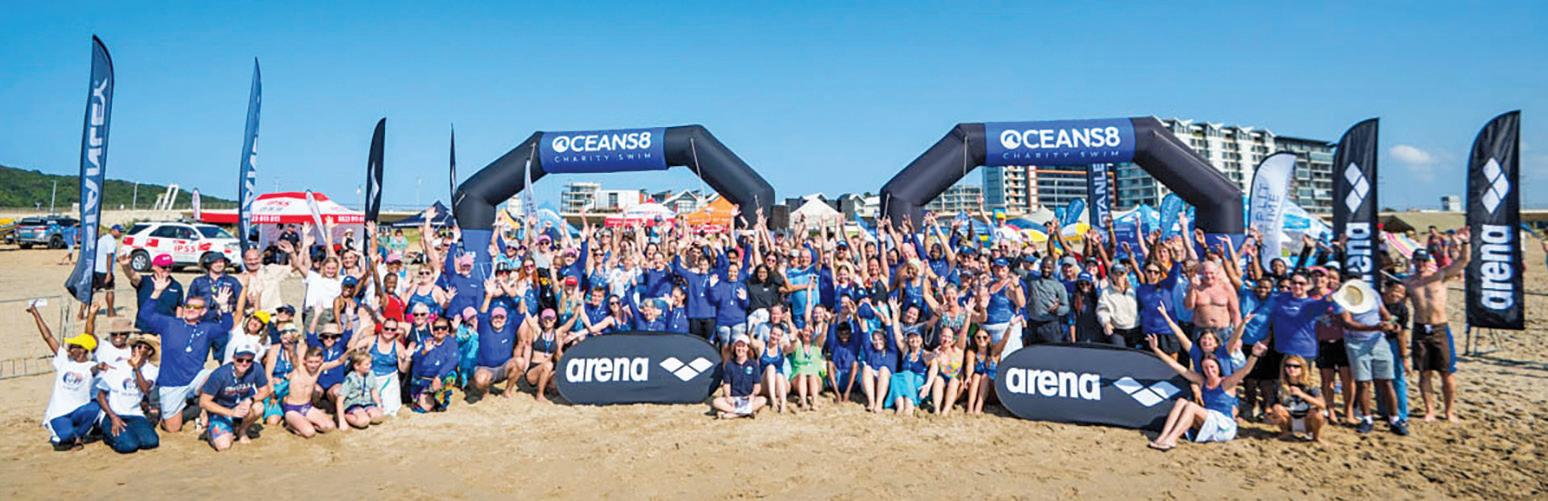
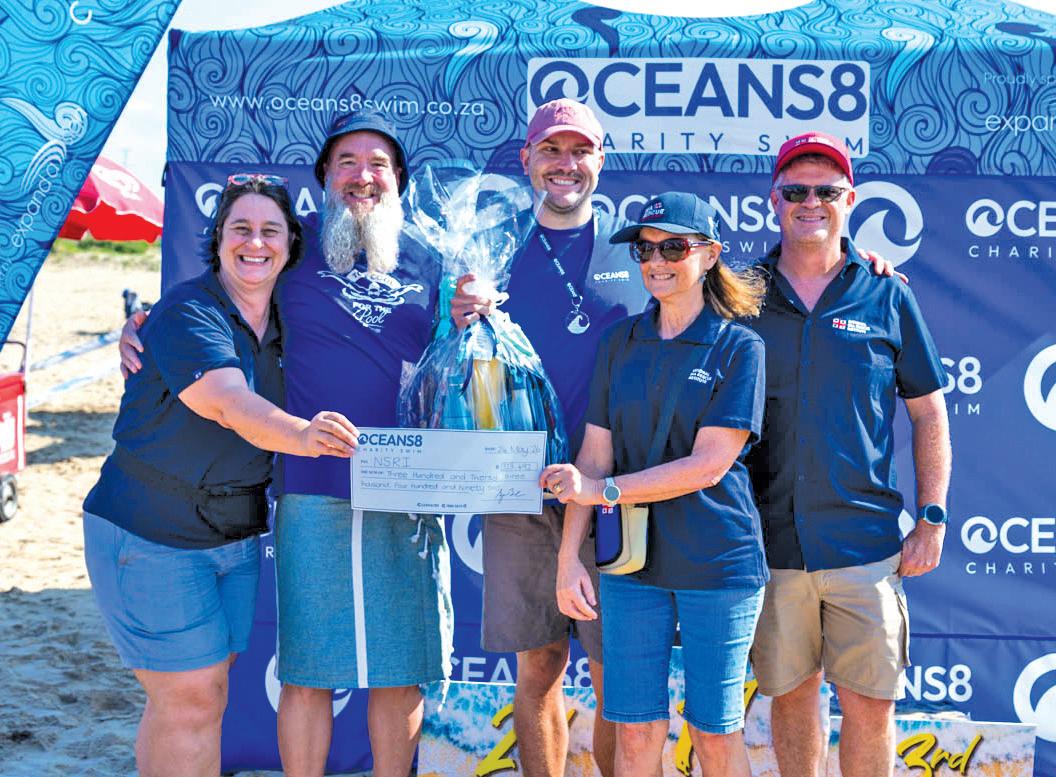
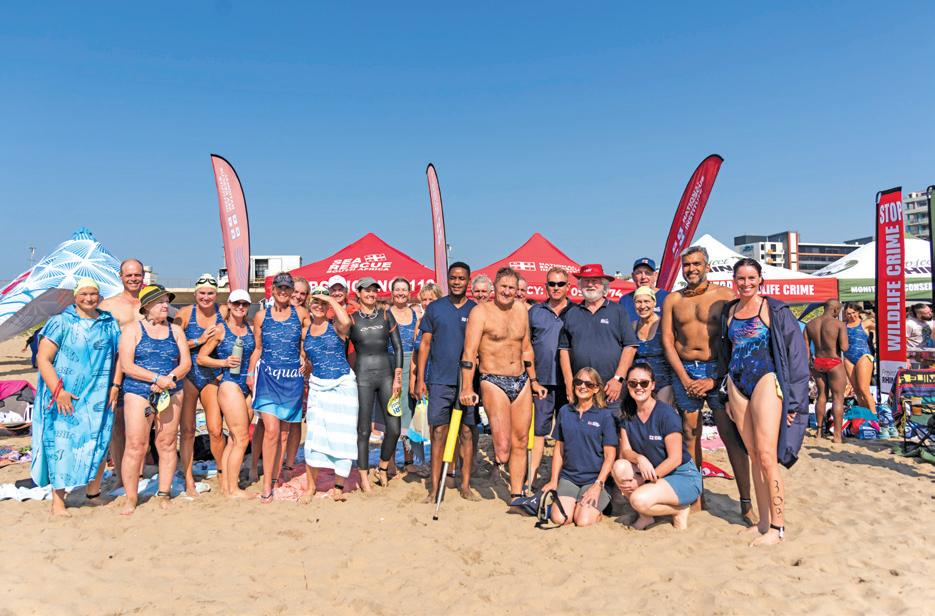
Durban’s coastline came alive as hundreds of swimmers, volunteers and supporters gathered at the Durban Undersea Club for the fourth annual Oceans 8 Charity Swim, an event that continues to grow into one of South Africa’s most inspiring open-water fundraising challenges. Held on Saturday 23 and Sunday 24 May, the event saw participants taking on distances of 1, 4, 8 and 16 miles in support of a range of South African charities, including the NSRI. As proven over previous years, the event provided scenes of determination, celebration and camaraderie as swimmers pushed through multiple races in warm but testing ocean conditions.
Hosted at Vetchies Beach, Oceans 8 has quickly established itself as a unique event on the South African swimming calendar, not only because of the endurance required, but because every kilometre swum translates directly into support for charitable causes. Oceans 8 has become particularly significant for the NSRI, which remains one of the organising beneficiary charities. This year the swimmers raised a phenomenal R324 492 for the NSRI, with Rob Tout
LEFT TO RIGHT Renée Leeuwner (NSRI), Kevin Banks (Kevin and his son Kyle were the top fundraisers for the NSRI 16-mile), Rob Tout (the top 8-mile fundraiser and overall top fundraiser), Helen Wienand and Clifford Ireland (NSRI).
being the top fundraiser overall, securing R101 185 for ‘Team NSRI’. The entire event raised an incredible R1 557 292 for 14 charities with footprints in KwaZulu-Natal.
Over the weekend, swimmers of all ages entered the water in staggered race categories, with younger swimmers, veteran ocean athletes and first-time charity participants all sharing the same course and spirit of camaraderie. Support crews, volunteers and charity teams lined the beachfront from early morning, contributing to the community-driven atmosphere.
were supported by crews from Station 5 Durban and Station 41 Ballito, and water safety teams, ensuring that swimmers could take on the demanding distances in a controlled environment.
Beyond the distances and fundraising totals, Oceans 8 once again highlighted the power of sport to bring people together around a common cause. From elite swimmers chasing ambitious mileage goals to families participating in single-mile events,
the weekend showcased an extraordinary combination of endurance, generosity and community spirit.
The growing legacy of Oceans 8 continues to make waves far beyond Durban’s shores, proving that every mile swum has the power to positively affect lives.
Without incredible sponsors like Arena, Stanley, Alu Direct, LED Urban, RCVR Electrolytes, C&H Communications and Hospital Systems and Hutz Medical, this event would not be possible.
If you would like to become involved with the Oceans 8 Charity Swim as a swimmer or as a sponsor, please email renee@searescue.org.za.
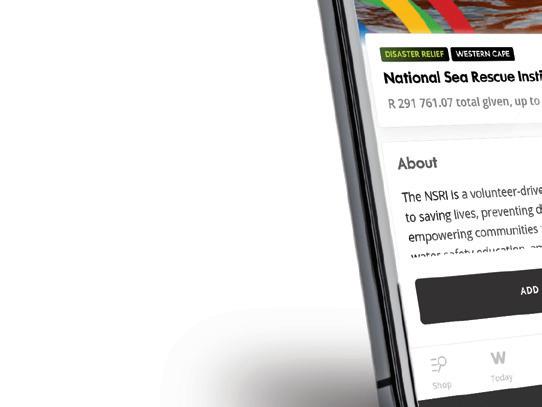
DONATE THROUGH WOOLWORTHS MYDIFFERENCE
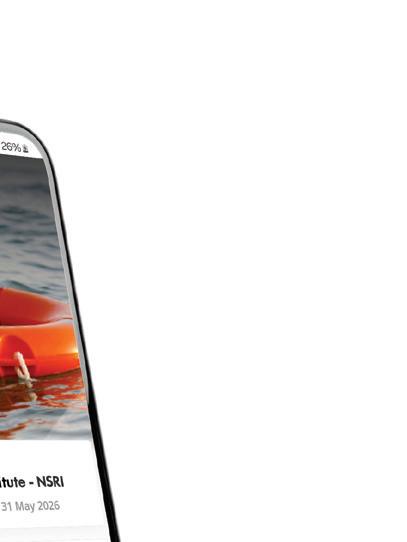
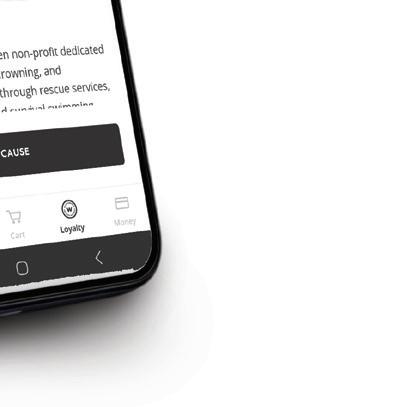
You might have noticed that your MyScool card is no longer accepted at Woolworths. You can still support the NSRI by switching to the digital MyDifference app. This new loyalty programme replaces Woolworths’ MySchool, MyPlanet, MyVillage programmes. It’s a simple, free way to support the causes you care about, like the NSRI, every time you shop.By choosing us as your cause, you can help raise funds for our rescue and drowning prevention work at no cost to you.
Here’s how to support the NSRI:
1. Download the Woolies app
2. Join MyDifference
• New customers: register on the app.
• Existing Woolies customers: sign in to your profile. Go to your Loyalty hub and tap
3. ‘Causes’. 4.
5. 6.
Select ‘Choose My Own’. Search for National Sea Rescue Institute (NSRI). Shop as usual at Woolworths and scan your digital MyDifference card at the checkout.
Every donation raised through MyDifference supports the NSRI’s mission to save lives on South African waters and teach children and adults how to stay safe around water. With your help, we can continue to expand our rescue services and prevention programmes – from our volunteer rescue crews to our survival swimming and water safety initiatives.
THANKS TO ROYAL CAPE YACHT CLUB
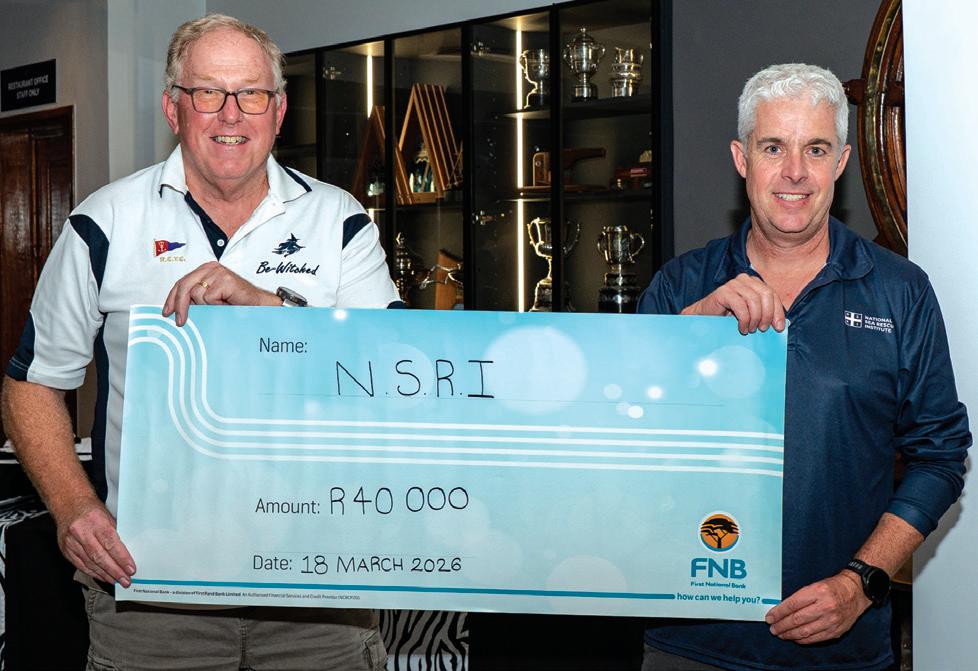
Thanks to our friends at the Royal Cape Yacht Club for the donation received from members’ entry fees for the Club’s Twilight Series. From left are Commodore David Garrard and NSRI CEO Mike Vonk.
MULTIPLE BOAT BLESSINGS FOR PLETT
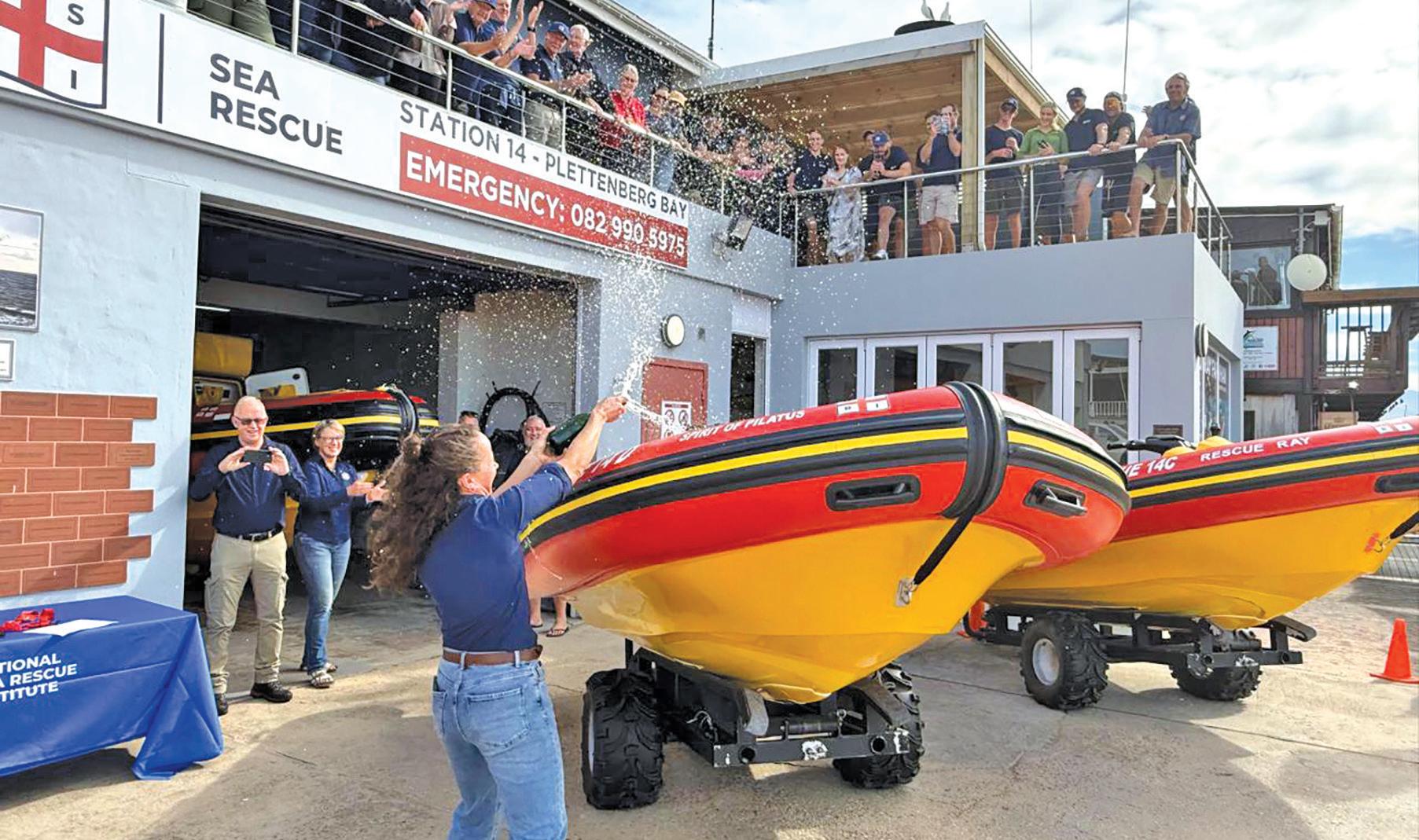
Station 14 Plettenberg Bay marked a rare and meaningful milestone when three rescue vessels were officially blessed in early May. For Station Commander Jaco Kruger, the ceremony represented the people, partnerships and shared commitment behind every rescue callout. ‘A boat blessing ceremony is actually a celebration of saving lives,’ he said. ‘It's not only to bless the vessel, but also to thank the crew, the sponsors and the supporters – everything that makes a rescue boat a rescue boat.’ The three vessels blessed were Rescue Plett, Spirit of Pilatus and Rescue Ray. Each will play a unique role in the station’s operations.
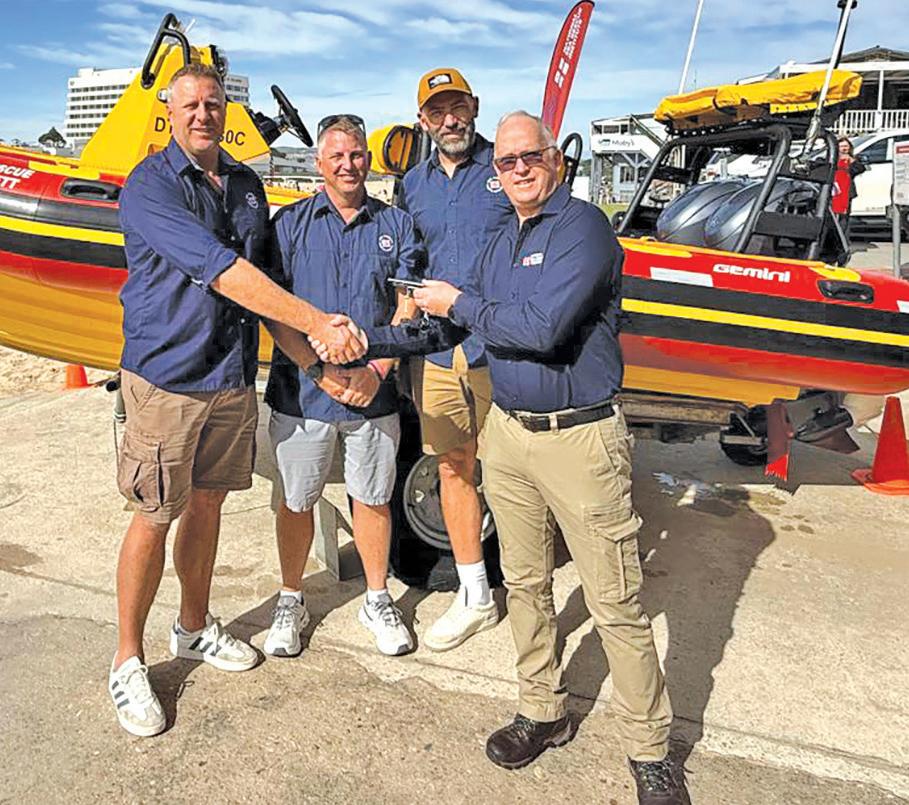
FROM LEFT Station Commander Jaco Kruger, Deputy Station Commanders John Bozman and Ross Badenhorst and NSRI Head of Fleet and Facilities Graeme Harding.
PREMIER ALAN WINDE THANKS NSRI
On 22 May, Premier Alan Winde visited NSRI’s Volunteer Support Centre to address NSRI volunteers and staff and thank them for the swift response from multiple stations to the flood disaster that wreaked havoc along the Breede River, the Overhex Valley and other inland areas. In his address he said the visit was an opportunity to honour the people behind this unprecedented emergency response: ‘The heart of the NSRI is its volunteers. To see volunteers from so many stations willing
‘The heart of the NSRI is its volunteers. To see volunteers from so many stations willing to respond is something I deeply appreciate. As a former NSRI volunteer myself, I know the hours that the teams put in to train, prepare and be on standby.
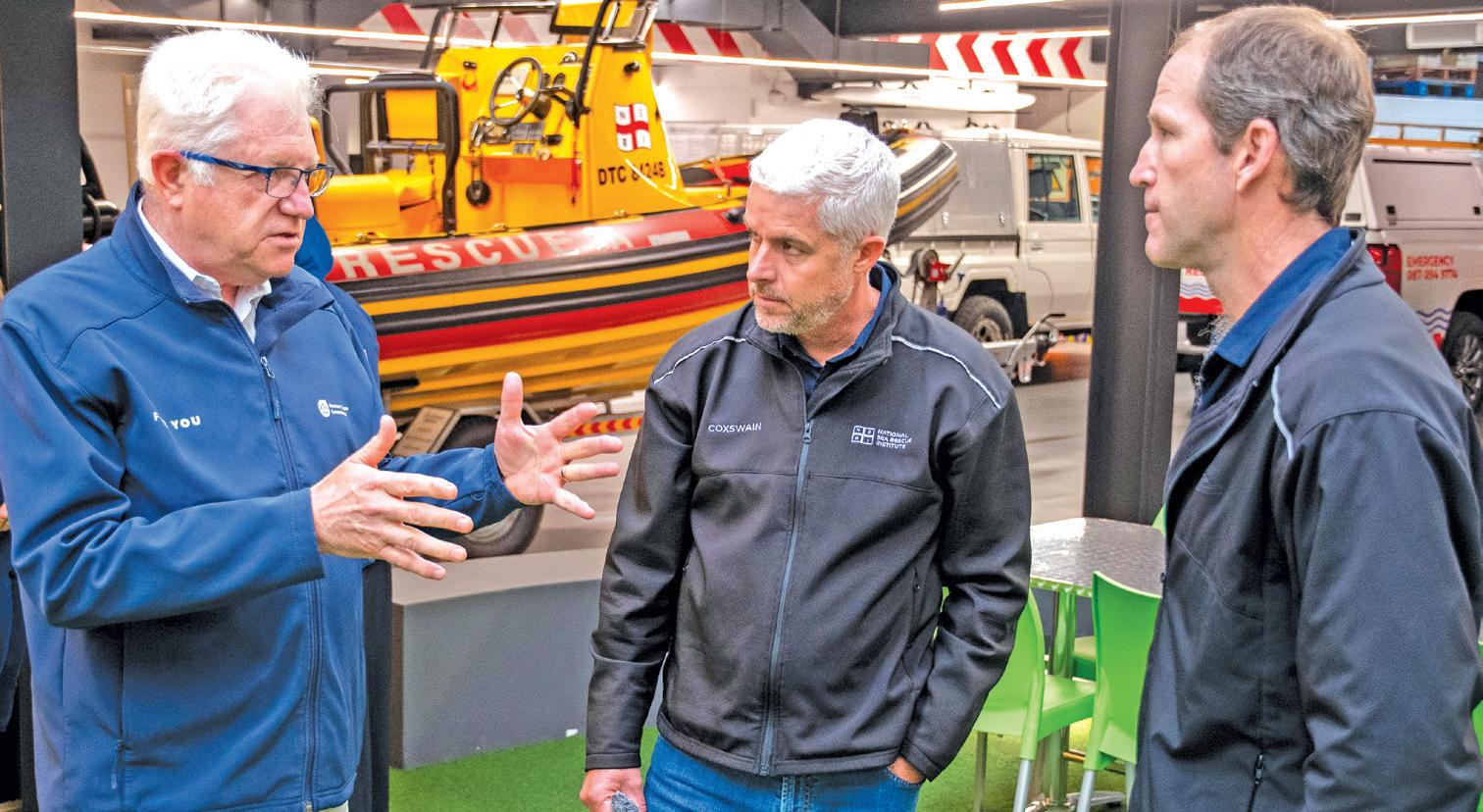
Western Cape Premier Alan Winde with NSRI CEO Michael Vonk (centre) and COO Brett Ayres
to respond is something I deeply appreciate. As a former NSRI volunteer myself, I know the hours that the teams put in to train, prepare and be on standby. Some of you were already packing and preparing for this on the Sunday before the storm hit, in the event that you would be called upon. I am so proud of the work that you do, and of how our residents across the province are reaching out to support one another and demonstrate such kindness and compassion.
‘As we begin the long task of rebuilding after one of the province’s most destructive recent weather events, the response of the NSRI and our partner agencies has been a powerful reminder of the courage, teamwork and resilience that emerge in times of crisis.’
Thank you to the Premier for his visit and his heartfelt acknowledgement.
THANKS TO FALSE BAY YACHT CLUB
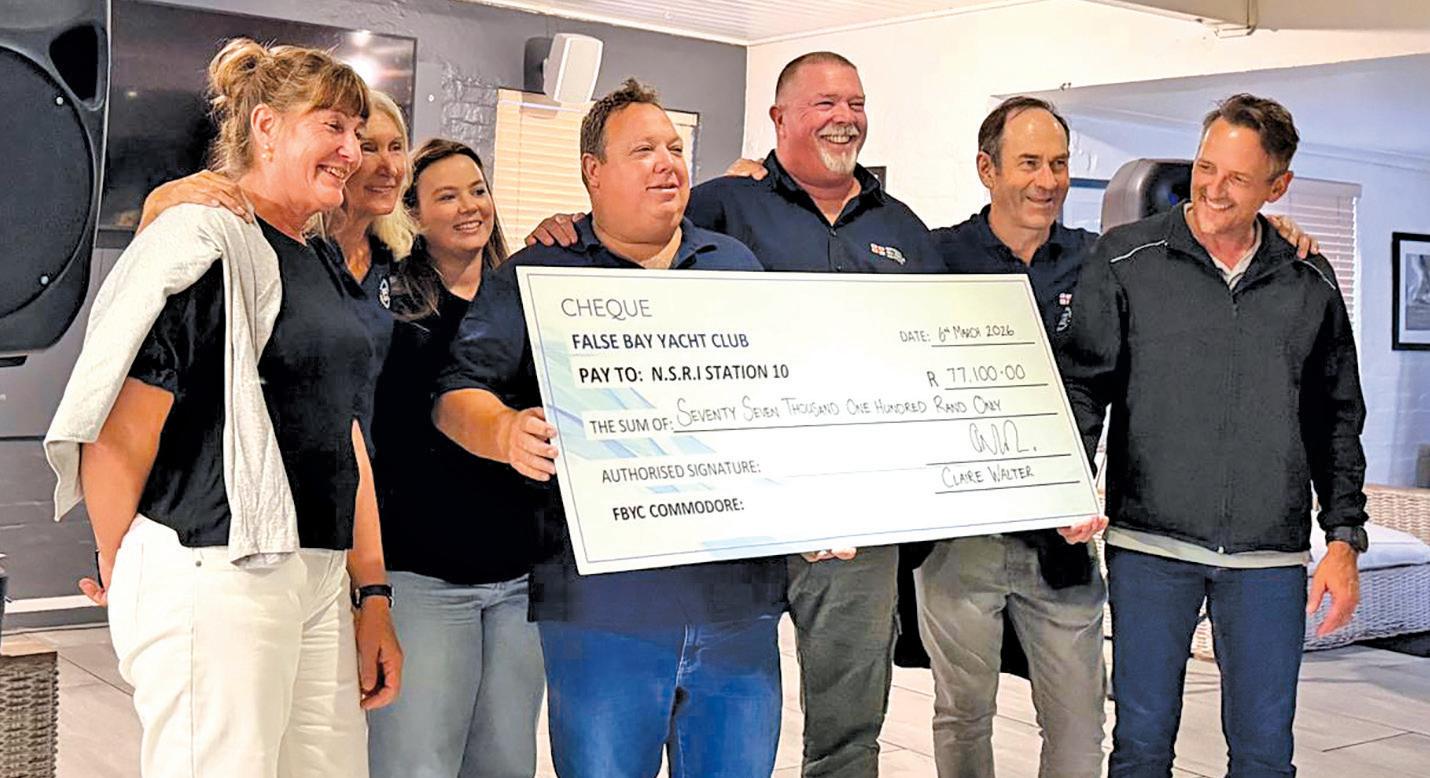
Each year Station 10 Simon’s Town receives a donation from False Bay Yacht Club members. We thank them for their continued support, which goes towards the station’s fuel expenses. From left: FBYC Commodore Claire Walter, with Station 10 crew members, Sharon Crowther, Mia Leisegang, Darren Zimmerman, Simon McDonnell, Peter Eggeling and Philip Fouche.
THANK YOU FOR DONATIONS RECEIVED IN MEMORY OF: Dr L Snyman, John Mowbray, Peter Chaplin, Peter Constable, Eldrid Bradfield, Florian Scheiber. TO HONOUR: David Robins (birthday), Irvine Eidelman (80th birthday), John Davison (80 birthday).
PLATINUM PARTNERS
STRATEGIC PARTNERS
GOLD PARTNERS
A&M Logistics (Pty) Ltd / Barpro Storage SA (Pty) Ltd / Life Health Solutions / Marine Solutions (Pty) Ltd / Ruwekus Fishing (Pty) Ltd / Shosholoza Workplace Wellness
HIDING IN PLAIN SIGHT
Guitarfish are known to enjoy the sandy depths of the ocean. Naturalist Georgina Jones identifies the most common varieties and reveals fascinating facts about what is possibly one of the most curious members of the shark family.
Sometime around 200 million years ago, a group of the ancestral sharks inhabiting the ancient oceans began to adapt to living on the surface of the shallow subsea slopes. Their cylindrical bodies became flattened, the better to hug the bottom, and their pectoral fins fused with their heads, giving them a distinctive guitar-like shape: and this, so far as we know, was the beginning of guitarfishes.
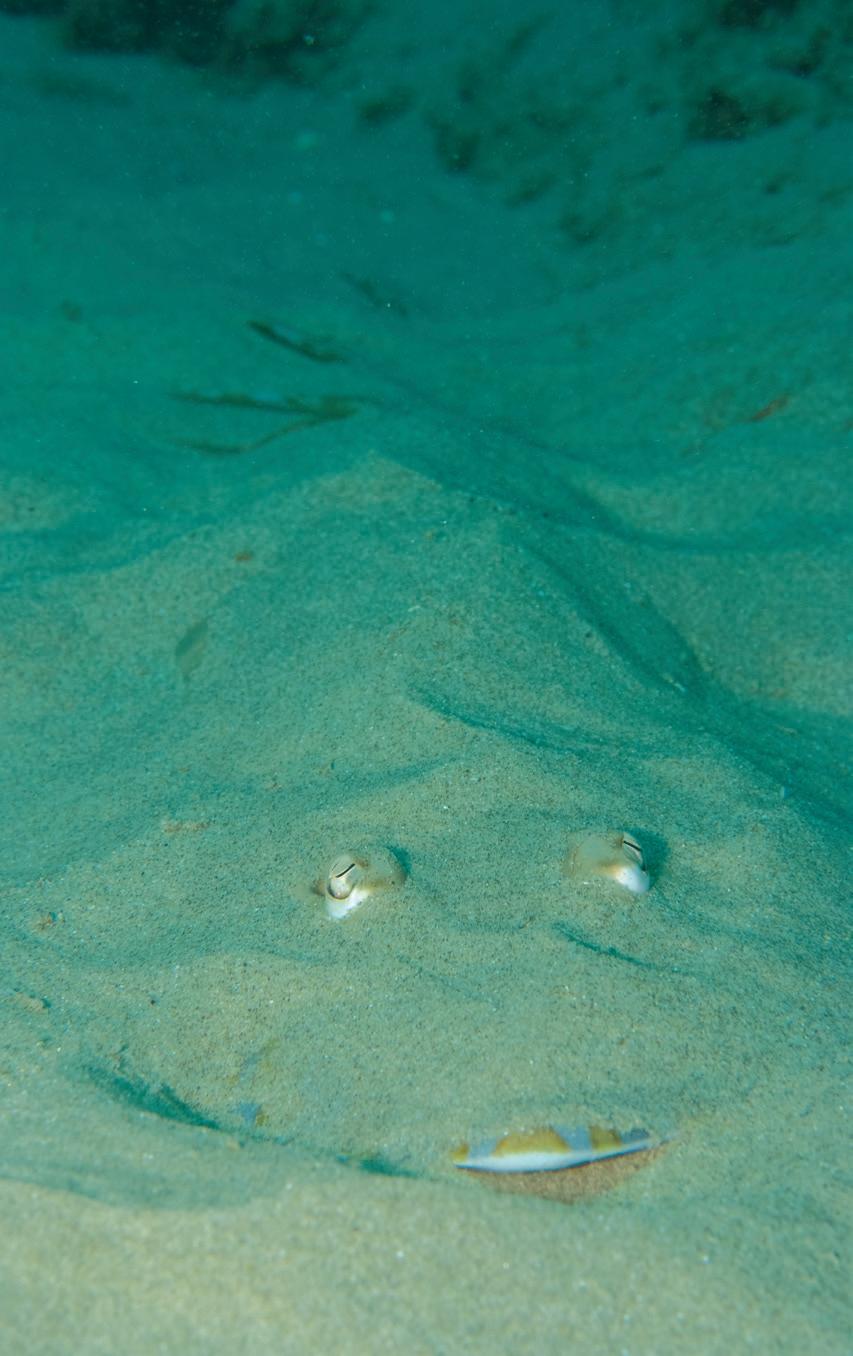
They are generally brown or sandy coloured and may have spots or bars that help with camouflage for their ocean floor-adapted life. They use their snouts to scent out subsurface animals such as crabs, shrimp clams and worms, burrowing into the surface muds and sand to hunt, sometimes burying themselves under a layer of sand or mud for ambush hunting and protection from predators.
Their teeth have become rounded and arranged in a tile-like pattern, effective
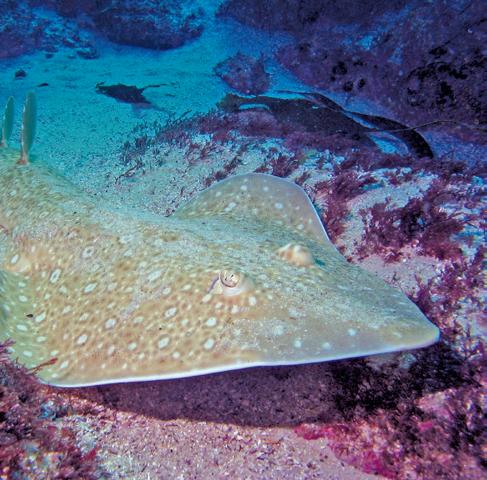
The grey-spotted guitarfish is classified as endangered due to overfishing by both trawl and gillnet fisheries.
for crushing the hard shells of their prey. Perplexingly, this lack of impressive teeth apparently doesn’t stop today’s giant guitarfish from targeting stingrays, one individual being found with over 20 stingray barbs in its jaws. Exactly how the species manages this, given that some stingrays are large and their barbs are venomous is still a mystery. Perhaps, though, the fact that giant guitarfish grow up to 3m in length and weigh over 200kg is a partial explanation.
Most guitarfish are smaller, growing to between 1 and 2m in total length and though they may take small fishes as prey, subsurface-dwelling invertebrates form the majority of their diets.
As a result of their mostly bottomdwelling lifestyle, guitarfish have developed eyes on top of their heads and though their gill-slits are underneath their bodies, they also have spiracles on their upper sides, structures that function like nostrils, to take water into their gills.
Like sharks, they have a muscular tail and a well-developed caudal fin. Also like sharks, they swim using the tail for propulsion, flicking it from side to side. They are capable of achieving pretty decent speeds, as anyone who has tried to keep up with them along the bottom knows to their cost, and can sometimes take pelagic fish as prey.
Four species are known from South Africa, in two separate biological families, the Rhinidae (bowmouth guitarfishes and
wedgefishes) and the Rhinobatidae (guitarfishes). One is the previously mentioned giant guitarfish, that alone among the South African guitarfishes has ovoviparity: all local guitarfish have internal fertilization and give birth to live young, but in the giant guitarfish, the embryos are first nourished by the yolk and then, rather gruesomely, the mother’s uterus produces a mucus-rich fluid similar to milk that is secreted from tendrils that grow from the lining of the uterus and extend into the embryo’s mouth and gills and feed the developing embryo until the pups are born at about 60cm in total length. There are usually only four pups born per litter. In the other three species, the yolk is large and nutritious enough to feed the developing embryos until birth.
The lesser guitarfish is only known from Southern Africa, ranging from Namibia round our coast and possibly into Mozambique.
The other local member of the Rhinidae family is the bowmouth guitarfish. This is also a big fish at 2.7m in maximum length, but it is comparatively light, weighing around 135kg. It has a W-shaped jaw for maximum efficiency of crushing its mostly benthic prey, and thorns in rows along its dorsal surface. It gives birth to up to 11 pups, born at about half a metre in total length.
The Rhinobatidae family is locally represented by the greyspotted guitarfish, which lives only in the western Indian Ocean and grows to just under a metre in total length. It gives birth to relatively large pups at a quarter of a metre in total length.
Also in Rhinobatidae is the lesser guitarfish, known from all around the coast. This is a slightly bigger species at 1.4m in total length. It gives birth to between two and 10 pups in summer. It has been observed stalking its prey with ambush-style slow movements.
Predators of guitarfishes include the larger sharks and stingrays, although in the case of the giant guitarfish, presumably all but the larger stingrays do their best to avoid them.
Like sharks, Batomorphs (guitarfshes and rays) are cartilaginous fish, meaning they have a boneless skeleton made of a tough, elastic cartilage. That’s great for sudden changes of direction but very bad for fossilization. This means that fossils in this group are both rare and hard to interpret. In one version of the evolutionary relationships, all rays and guitarfishes are shown to have evolved from ancient sharks. In another, it has been suggested that all modern rays were derived from primitive guitarfishes but it is unclear exactly where the families are linked.
Possibly those guitarfish, pottering around on the early Jurassic slopes, were the ancestors of all today’s rays: the mantas, electric rays and stingrays.
PHOTOGRAPH: ROBYN SCOTT
Giant guitarfish feed their developing young with a kind of milk supplied by tendrils that grow into the embryos’ mouth and gills.
Scan the QR Code to shop now, or visit our Supporter Store at the V&A Waterfront.
NSRI BASE LOCATIONS
The NSRI is manned by more than 1 500 volunteers at 106 service locations including 56 rescue bases, satellite or auxiliary stations, inland dams and seasonal lifeguard units around the country.
Rescue Base Locations
NORTHERN CAPE
WESTERN CAPE
Plettenberg
NORTH WEST
LIMPOPO
FREE STATE
MPUMALANGA
EASTERN CAPE
NATAL
Port St Johns (Auxilliary)
Kei Mouth (Auxilliary)
Jeffreys Bay
› Data projectors and speakers or flatscreen TVs for training
› GoPros or similar waterproof devices to film training sessions
› Good-quality waterproof binoculars
› Prizes for golf days and fundraising events
› Towels for casualties
› Groceries such as tea, coffee, sugar and cleaning materials
GENERAL NEEDS RESCUE BASES
› Long-life energy bars
› Wet and dry vacuum cleaners
› Dehumidifiers
› Small generators
› Good-quality toolkits
› Top-up supplies for medical kits
› Waterproof pouches for cellphones
› Tea cups/coffee mugs/glasses for events
NORTHERN CAPE
43 063 698 8971 Port Nolloth
WESTERN CAPE
45 066 586 7992 Strandfontein, West Coast (Aux)
24 060 960 3027 Lambert’s Bay
44 082 990 5966 St Helena Bay
04 082 990 5966 Mykonos
34 082 990 5974 Yzerfontein
18 082 990 5958 Melkbosstrand
03 082 990 5963 Table Bay
02 082 990 5962 Bakoven
08 082 990 5964 Hout Bay
26 082 990 5979 Kommetjie
29 082 990 5980 Air Sea Rescue
10 082 990 5965 Simon’s Town
16 082 990 6753 Strandfontein
09 072 448 8482 Gordon’s Bay
42 063 699 2765 Kleinmond
17 082 990 5967 Hermanus
30 082 990 5952 Agulhas
33 082 990 5957 Witsand
31 082 990 5978 Still Bay
15 082 990 5954 Mossel Bay
23 082 990 5955 Wilderness
12 082 990 5956 Knysna
14 082 990 5975 Plettenberg Bay
EASTERN CAPE
46 076 100 2829 Storms River
36 082 990 5968 Oyster Bay
21 082 990 5969 St Francis Bay
37 079 916 0390 Jeffreys Bay
06 082 990 0828 Gqeberha
11 082 990 5971 Port Alfred
49 071 371 3709 Mdumbi
47 076 092 2465 Kei Mouth (Aux)
07 082 990 5972 East London
28 082 550 5430 Port St Johns (Aux)
KZN
32 082 990 5951 Port Edward
20 082 990 5950 Shelly Beach
39 072 652 5158 Rocky Bay
41 063 699 2687 Ballito
05 082 990 5948 Durban
19 082 990 5949 Richards Bay
40 063 699 2722 St Lucia
MPUMALANGA
35 060 962 2620 Witbank Dam
GAUTENG
27 060 991 9301 Gauteng
NORTH WEST
25 082 990 5961 Hartbeespoort Dam
FREE STATE
22 072 903 9572 Vaal Dam
51 082 757 2206 Gariep Dam
FOR DEPOSITS AND EFTS
ABSA Heerengracht
Branch code: 506 009
Account number: 1382480607
Account holder: National Sea Rescue Institute
Swift code: ABSA-ZA-JJ
PAY ONLINE: nsri.org.za/support-us/ donate
If you choose to do an EFT, please use your telephone number as a unique reference so that we are able to acknowledge receipt, or email your proof of payment to info@searescue.org.za.
Scan this QR code or visit the link below to pay using SnapScan. https://pos.snapscan.io/qr/ STB4C055
Please use your cellphone number as base/project reference so we can acknowledge your donation.
Scan this QR code or visit the link below to pay using Zapper. https://www.zapper.com/ url/KU1oB
Please use your cellphone number as base/project reference so we can acknowledge your donation.