YO U R M AG A Z I N E F R O M T H E W E N D T & K Ü H N WO R K S H O P S
1 1 TH E D I T I O N
2 0 1 7/ 2 0 1 8
D E A R F R I E N D S O F T H E C O M PA N Y,
SELECTED CONTENT
4 Melodious and personalized Gift idea
5 Greetings from on board the ship A find
H for Home Grünhainichen Lexicon
6 Colorful and imaginative 2017 collection additions
12 Hardworking kindly spirits The legend of the gnomes
14 Everything comes from the mine Cover story
18 Once around the world … A look inside the Grand Sample Cabinet
20 A wedding cake with “little friends” Living tradition 21 Open house days 2017/2018 Special days
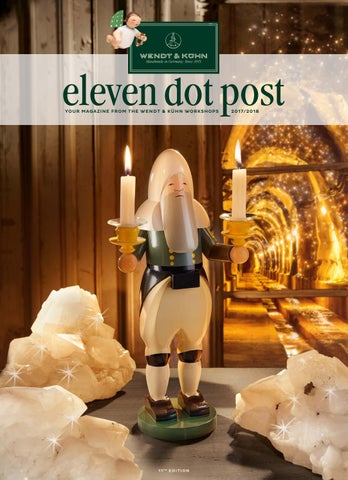
I am sure you will agree with me that wherever we live in the world, we need every now and then to stop and consider what we most associate with the word ‘home’. Is it memories of the family home and the place we grew up in? Or perhaps the place where we have put down new roots? Somewhere we are always pleased to return to because we feel particularly at home there? Perhaps it is a bit of all of these. It is not easy to define what we understand by the concept of home as it is always a very personal matter. And then there is the question of what truly endures and which of our beloved traditions continues. Through the cover story in this eleven dot post, we invite you to get to know our home, the Erzgebirge, a little better. It is a region in the south-east of Germany that has been shaped above all by mining, and it is home to a unique woodcraft tradition of international renown. Motifs such as candle arches, candle-bearing angels and miners can all be traced back to this past. Even though the foundation of our workshops has no direct connection to it, but originates from the artistic talent of the two young women Grete Wendt and Grete Kühn following their studies in Dresden, we are committed to our Erzgebirge heritage. We hope to bring you a little closer to it, starting on page 14. I am certain you are curious to see our new additions for 2017 and which items are returning to the collection. These include the Miner pictured on the cover of this edition. It is said to have been on a beautiful summer’s day in 1912 that my great-aunt Grete Wendt – inspired by a splendid miners’ parade – designed this strikingly handsome figurine. After sixty years, this “Curiosity” makes a welcome return to our collection. We are also a little curious to know if you were already familiar with the legend of the gnomes, who are known throughout Germany as busy little helpers. You can find out more on pages 12 and 13. I hope you will enjoy reading this year’s magazine. Kind regards
From our readers Personal messages
22 Farewell Leaving the collection at year’s end
Claudia Baer, née Wendt
GIFT IDEA
Melodious and personalized “The universe without music would be madness” is not only a sentiment uttered by the German philosopher and poet Friedrich Nietzsche, but one recognized by the founder of the company Grete Wendt herself.
A
nd so, in addition to numerous music boxes, in 1951 she designed a majestic-looking organ, initially without a musical movement. Three years later Grete Wendt gave it a beautiful voice, courtesy of a mechanical musical movement made in Switzerland. A wonderful gift to mark the birth of a child or a baptism, which with its clear, polyphonic sound will soothe the new arrival and send it to sleep. As a wedding gift it resonates
and keeps alive the memories of that special day, and at Christmas it brings moments of peace to an otherwise busy time. Through the “My Wendt & Kühn” personalization service, the Organ can be turned into a very special one-off piece by adding a personal inscription in beautiful hand-painted lettering. Our specialist retailers will be happy to help you with this service. For further information visit www.wendt-kuehn.com. YO U R H E A R T- F E LT M E S S A G E can be immortalized in a maximum of six lines with up to 18 characters each.
A FIND
GREETINGS FROM ON BOARD THE SHIP “Dear Mr and Mrs Wendt, and Miss Wendt. My wife and I shall shortly be arriving in Europe. I am very much looking forward to seeing you all again and to my wife making your acquaintance. This will probably be around the middle of September. Before that I may see you at the trade fair. Many thanks for your kind letter and please send my best wishes to your brother in Berlin, whom I would like to visit. J. D. Holtzermann”
J
acob D. Holtzermann (1902-1969) owned a store in Minneapolis, in which he sold goods from Europe, among them figurines from Wendt & Kühn. It is likely that the angels and Blossom Kinder from Grünhainichen had captured his heart on one of his many trips.
He had studied in Geneva and Munich and clearly had an excellent command of the German language, as can be seen from the postcard which is written in faultless German. His greetings were sent from on board the “New Mauretania” which on 4th August 1939 was sailing from the USA to Europe. His friendly tone and the planned visits – to the trade fair and even to the brother in Berlin – testify to a trusting and valued relationship between the retailer and the Wendt family. An excellent foundation for close cooperation across national borders.
GRÜNHAINICHEN LEXICON
H FOR HOME
H
ome for the world-famous angels with the eleven dots on their green wings is where they have always lived: in Grünhainichen, not far from Dresden and Seiffen in the German state of Saxony. The village has a population of 3,500, and it is here that Wendt & Kühn was founded more than 100 years ago and where its workshops are still to be found to this day. Firmly embedded in the Erzgebirge region which is the home of a unique type of handicrafts. Locals and visitors alike value its traditional wooden craftsmanship as an integral part of the region. The Erzgebirge without its Candle Arches, Angels and Miners? Inconceivable! They bring a romantic, homey flair to houses and apartments, particularly during the festive Christmas period. And thus our figurines remain just as popular in their own home as they are in the rest of the world, where they bring joy to enthusiasts and collectors of all ages, and not just at Christmas.
COLLECTION ADDITIONS
Colorful and imaginative Each year, a handful of figurines are selected from the Grand Sample Cabinet at our Grünhainichen headquarters to be reintroduced into our collection. Faithfully reproduced according to the historic designs of Grete and Olly Wendt, their nostalgic charm and unmistakable appeal still captivate today. We hope you enjoy this overview of our 2017 returnees.
E AS T E R J OY
Dressed in her prettiest Sunday clad and full of excitement, the little girl with braids in her hair skips through the fresh spring meadow. Has the Easter Bunny already hidden something for her? Amidst the delicate blades of grass she suddenly spies an undisturbed nest of Easter eggs. Beaming with joy she crouches down and can hardly believe her luck – there are three brightly painted eggs. She stares in astonishment at her truly wonderful find. This figurine with her radiant charm, aesthetic design and harmonious coloring joins the range of Easter figurines designed by Grete Wendt.
ANGEL WITH CONTRABASS CLARINET
650/76
TUNEFUL SOUNDS
This year the Angel with Contrabass Clarinet has been awarded a permanent place in the large Grünhainichen Orchestra. The warm tones of this instrument enrich the sound of any ensemble, whether in classical pieces, jazz or folk music. The small Angel Musician coaxes from his woodwind instrument a broad spectrum of deep, very soft yet full sounds that give exceptional expression to lyrical and vocal passages. A treat for all the senses.
Please note: While our products are available for purchase at your local specialist retailer or at the Wendt & Kühn outlets in Grünhainichen and Seiffen, Germany, we cannot accept individual mail orders.
GIRL FINDING EASTER EGGS
5240/8 B OY W I T H T U L I P
5248/23
F U L L O F C O L O R A N D FA N TA S Y
He has been waiting for quite a while to make his grand entrance. Now, with great determination, a proud bearing and a spring in his step, the Boy with Tulip carries his red tulip with its delicate flamelike petals before him. He is the youngest member of the Blossom Kinder family from Wendt & Kühn, which has gained a new figurine every year since 2013. A truly wonderful selection to help you bring spring into your home.
Decorative options
D I S P L AY S H E L F W I T H S E V E N SLIDING DISKS, SMALL
Dimensions: 50 x 11 x 5.5 cm 551/k/dunkel 551/k/gruen 551/k/natur
D I S P L AY S H E L F W I T H S E V E N SLIDING DISKS, LARGE
Dimensions: 50 x 18 x 5.5 cm 551/g/dunkel 551/g/gruen 551/g/natur
IN THE SPOTLIGHT
Would you like to display your favorite handpicked figurines in a contemporary setting? Do you want your Blossom Kinder to be part of your decor? Or do you want to give greater prominence to individual figurines in your collection? In that case you will be thrilled with the design possibilities offered by the new wall-mounted display shelves from our Grünhainichen workshops. Available in two different sizes and three different colors, they provide a wide variety of decorative options. The seven sliding plates of the wall display, available in pale green, and natural and dark wood, can be positioned individually or all together. This gives your favorite figurines a new stage on which to shine, and you can mix and match your figurines to suit the season, the special occasion or simply because you want to.
PERSONAL GREETINGS
Whether for a birthday, for Christmas or simply to say thank you – there are always occasions when we want to bring joy to those we love. And now our premium gift tags bring the perfect finishing touch to your present. With Marguerite Angel, heavenly messengers and Richly Painted Angels they are all ready for the big day. Simply add a personal message that will make the heart of your loved one beat just a little faster even before they unpack their gift.
G I F T TA G , 4 M O T I F S
GA2017/M
AT T E N T I O N T O D E T A I L
Among the ranks of the Blossom Kinder it is the Girl with Cherry Blossom who heralds the spring and enchants all who see her. Taking its cue from nature, the delicate blossom on the branch is beginning to open. Its color and delicateness are the perfect match for the beautifully decorated dress the girl is wearing. The many steps and the precision required to make this expressive figurine are shown in the beautiful framed display “Becoming a Blossom Child” (in English Language). Perfect for enthusiasts and collectors of the fine handcrafted items that come from our workshops. BECOMING A BLOSSOM CHILD
5248/Wk/Eng – Wallpicture or Display Stand Dimensions: 46 x 28 x 6 cm
COLLECTION ADDITIONS
MARGUERITE ANGEL, SITTING,
ANGEL WITH CONCERTINA, O N S M A L L P E D E S TA L
650/200/8
CONTEMPORARY AND PERSONALIZED
Created as a tribute to Grete Wendt, a modernist designer of her time, the White Timbre Edition has formed part of the collection since 2015. And just one year on, the quartet is on the winners’ podium by taking third place in the competition “Manufactory Product of the Year 2016” in Germany. It also received the special prize in the “Design” category. In May 2017, the violin, saxophone, gong and tuba players were joined by the Angel with Concertina. Understated elegance, once again, from this latest musician in the series.
ANGEL WITH BASKET OF FLOWERS
WITH TELEPHONE
AND BIRD
634/70/37
650/156a
A S O N E H O L I D AY E N D S
STRAIGHT FROM THE HEART
ANOTHER BEGINS
While his friends in the large orchestra strike up festive tunes, this Grünhainichen Angel® delivers a colorful arrangement of delicate hand-picked flowers. Whether you want to convey birthday greetings or wishes for a speedy recovery, to say thank you or simply to give someone pleasure – no occasion is too small for this Angel with Basket of Flowers and Bird. It makes itself at home with the recipient right away and will long remain a memento of that happy occasion.
Many a task is easier to handle with a small angel at your side. And the youngest member of Santa’s multi-talented little helpers is already in the midst of preparations for the next big holiday. Diligently the Marguerite Angel with Telephone communicates with her fellow helpers far away so that at the end everyone is happy and contented.
GNOME WITH ROLL
GNOME WITH BOOT
O F FA B R I C
5243/6
5243/2
Whether for an engagement, a wedding, the move to a new home or an academic achievement, “My Wendt & Kühn” enables you to use selected messengers to convey your own personal greetings. Now all the figurines in the “White Timbre” Edition are also able to deliver your message straight from the heart.
BUSY LITTLE HOUSE GNOMES
In Germany everyone knows about these hard-working, invisible helpers: Gnomes. With their broom and bucket, boot and brush, roll of fabric and scissors they are ready to vigorously tackle any household task. This year three of our gnomes have returned to the collection with their traditional red pointed hats and white
GNOME WITH BROOM AND BUCKET
5243/21
beards. First created around 1926, the catalog featured 18 of these industrious folk by 1937. The perfect gift for a house warming, a wedding or simply as a decoration for your own home. You will find the story of these secret helpers, who are welcome in every household, on pages 12 and 13 of this magazine.
G o l d E d i t i o n N o– 1 0
L i m i t e d G o l d E d i t i o n N o– 1 0
READER, ANGEL WITH BOOK,
READER, ANGEL WITH BOOK ON
G O L D - P L AT E D
A M E TA L B A S E , G O L D - P L AT E D , IN A SPLINTER BOX
650/123
650/123/LE
ages every viewer to think and dream. But what is it that is being read aloud? Is it fairy tales, poems or perhaps stories written by life itself? This is left entirely to our imagination.
WORDS FOR ETERNITY
One good reason to celebrate this year is the release of the Gold Edition N°– 10, produced in our traditional workshops, as this brings us to a modest anniversary. We have put a great deal of thought into what is the tenth design in this range, and the result is a wonderful handcrafted figurine. Holding a golden book open in its hands, the Reader encour-
Made with loving attention to detail, this precious figurine from the Grünhainichen workshops is yet another example of skilled craftsmanship creating an exclu-
Dezember 2018
29 8 15 22 Sa 1 30 9 16 23 So 2 24 31 17 10 Mo 3 25 11 18 Di 4 26 12 19 Mi 5 27 13 20 Do 6 28 21 14 Fr 7
sive work of art. The book in the Reader’s hands is plated with 24-karat gold, as is the metal base on which the figurine stands. In a strictly limited edition, only 22,222 of these figurines are available to spread joy. The individual serial number is printed on the underside of each figurine, on the base of its attractive splinter box, and also in the lovingly designed leaflet that accompanies it. This makes every angel a valuable and unique piece. The Reader is also available on a grey base – not as a limited edition.
ber hn 2. De zem t & Kü 1. und e bei Wend Advent) tag Schau hainichen (1. in Gr ün
YO U R CO M PA N I O N FO R
Juli 2018
So
1 8 15 22 29 2 9 16 23 30 Di 3 10 17 24 31 Mi 4 11 18 25 Do 5 12 19 26 Fr 6 13 20 27 Sa 7 14 21 28 Mo
März
Feine Handarb Seit 1915 eit. .
deutsche
2018
29 8 15 22 Do 1 30 9 16 23 Fr 2 31 24 17 Sa 3 10 25 18 So 4 11 26 19 12 Mo 5 20 27 Di 6 13 21 28 Mi 7 14
Feine arbeit. e Hand deutsch 1915. Seit
THE WHOLE YEAR
Hard-working Gnomes, cheerful school beginners and fairy-tale companions await you in the 2018 Calendar. Looking at the imaginative images you will encounter old friends as well as some of the figurines that will be joining the collection in the coming year. A small Angel with Doll sitting on the frame completes the ensemble. This and the Calendar Sheets are also available separately.
1. April rz und 31. Mä der elt alen in Schaum Kühn-Figurenw & ) Wendt (Ostern in Seiffen
Feine eit. Handarb deutsche 1915. Seit
CALENDAR 2018, COMPLETE
2018
COLLECTION ADDITIONS
MINER WITH CANDLE HOLDERS
582
THE MINER
D O U B L E FA I RY TA L E M A G I C
After more than 60 years, this traditional figurine from our legendary grand design legacy has been brought back to life once again: the Miner. With his impressive height and his smart black and green ceremonial uniform, this “Curiosity” will enrich our collection and will be manufactured exclusively to order. Tradition has it that it was on a particularly beautiful summer’s day in 1912 that Grete Wendt designed the Miner, three years before she founded Wendt & Kühn. Her inspiration had come from the Miners’ Festival in Freiberg, Erzgebirge, with its magnificent parade of miners. In what was the summer house of the vocational school in Grünhainichen she produced the designs for three smaller examples before she finally created this 30-centimeter-high Miner with his two candle holders. His presence and grace make him a stand-alone decorative piece that draws the eye of everyone who sees him.
Which of us is not familiar with this? As the days become shorter and the light of summer fades we like to lose ourselves in the magic of stories and fairy tales. Grete Wendt, too, loved the world of fairy tales and used her fascination with them to create a whole series of delightful figurines. P U Z Z L E “ C I N D E R E L L A”
24 pieces, 9 x 15 x 3.5 cm MP/5283
One of them is Cinderella who, from now onwards, has once again become part of the collection. And without giving away too much, we can already reveal that over the next few years we shall be releasing a new fairy tale figurine every fall to spread joy. To pave the way for a fairy-tale fall we have created a 24-piece jigsaw puzzle featuring a picture of our Cinderella, which is available immediately. An enchanting gift, particularly for young fans of fairy tales.
ANGEL WITH HEADLESS
A N G E L W I T H S O N G B O O K , I N S TA R
TA M B O U R I N E ,
650/80/12a
SUSPENDED
LITTLE SUSPENDED ANGEL, WITH LANTERN
6307/37
650/130/57
ANGEL WITH BANJO, ON CLIP
650/90/59
CHRISTMAS TREE ANGEL IN RING, WITH VIOLIN
6308/2
FESTIVE TOUCHES
Full of grace, they float down to bring much-admired touches to your festively trimmed branches – the Christmas tree angels from Wendt & Kühn. With their green wings matching the color of the sprigs of spruce, the Grünhainichen Angels® settle themselves down on the branches. Sitting in stars with a recorder or a song book, on a clip with a banjo, or suspended on a thread holding a headless tambourine. With their sophisticated elegance they bring a festive glamour to any arrangement. They are joined by two small Marguerite Angels with a violin and a lantern, sitting inside a golden ring or suspended on thread, to swell the heavenly host on boughs of spruce, fir and holly. Always certain to catch the eye!
A N G E L W I T H R E C O R D E R , I N S TA R
650/70/42
U N D E R S T AT E D A N D S T Y L I S H
The smaller siblings of the Grünhainichen Angels® with their green wings and eleven white dots are just four centimeters high. But they are in no way inferior to their larger relatives – they radiate just as much joy when they look at you. Settled down comfortably on a bench, the small angel takes its violin and with a joyous expression starts to play a beautiful ser-
ANGEL, SMALL, WITH VIOLIN
650/k/2a
enade, straight from the heart. This small heavenly messenger brings felicitations, thanks and solace with its tender tune, and also speaks of great love – a wonderful little gift for a loved one.
T H E FA M O U S P O E M “DIE HEINZELMÄNNCHEN” BY A U G U S T K O P I S C H
is published by Beltz with beautiful illustrations by Fritz Baumgarten. ISBN 978-3-407-77303-6
Hardworking kindly spirits Is there anyone who is not familiar with the chore of having to clean a house or apartment? Dealing with the small and rather larger repairs, and all the preparations a celebration requires – a seemingly endless succession of tasks. Wouldn’t it be lovely if you didn’t have to do them all yourself?
I
n Germany help is at hand for these necessary, but generally unloved chores and at times like these we welcome a visit from the “Heinzelmännchen” or Gnomes. This age-old fantasy was put into words back in 1836 by the poet and painter August Kopisch, born in Breslau (now Poland). “Here in Cologne life used to be with little people calm and free!” So begins his famous poem, which offers a simple solution to all those vexatious tasks, large and small: busy little house gnomes who through the night take care of all manner of work for people, silently and secretly. A wonderful idea that many of us still cherish today. According to the Cologne legend, by the time the sun came up all the tasks were done and the gnomes had vanished into thin air. No-one had ever seen these busy little helpers. In the poem it is said that the wife of the tailor could not let the matter rest. One night curiosity got the better of her and she set a trap for them. A trick that was to have dire consequences. Angered by such mistrust the gnomes disappeared, and since that day people have once again had to do all their work themselves. When in 1925 Grete Wendt created a number of busy little figures of small stature wearing traditional red pointed hats, her inspiration probably came from August Kopisch’s ballad. By 1937 there were already 18 gnomes in
the catalog, including a handyman with a saw and a gardener with a rake. Later she designed two music boxes with gnomes on them. This spring the first three gnomes returned to the collection, exactly as Grete Wendt originally designed them. Holding a broom and bucket, a boot and a roll of fabric, and wearing a permanent mischievous and yet cheerful smile, they are always ready for duty. Best of all, they no longer need to hide themselves away. And here we would like to let you into a little secret. Yet more gnomes are already preparing to take their place in the collection over the next few years. These diligent workers are the perfect gift for anyone who needs a little help around the house – perhaps because they have started a new job or because their invaluable cleaner is on holiday. As a house-warming gift these secret helpers will also be most welcome in any home. Were you already familiar with the legend of the Cologne gnomes? Did our story give you new hope that one day these gnomes will turn up on your doorstep – quietly and in secret? Perhaps you know from your own experience some real-life “kindly spirits” who are always there when you need help around the house? If so, please write to us and tell us (by post, or email to info@wendt-kuehn.de) of someone who would be thrilled to receive these three gnomes. We will select three winners from all the entries received.
Here in Cologne life used to be With little people calm and free, For were you lazy it was best To go to bed and take a rest. In the dark of the night To keep out of sight The little men came out swarming And clapping and storming And plucking and tugging And trotting and rubbing And skipping and scrubbing. And ere a new day had begun A loafer’s daily task was done.
T
he designer who poured all her energies into the current reissue of the gnomes is Marlen Tröger. After her training at Wendt & Kühn to become a toymaker, she decided to go on to study at the Faculty of Applied Arts in Schneeberg, part of the renowned Westsächsische Hoch schule Zwickau College in Germany. A work experience placement brought this talented young woman back to Wendt & Kühn and to what she herself describes as “a really fascinating subject”: the gnomes, and one she approached with great caution. With meticulous care and patience, she researched colors and shapes in order to identify minor changes and deviations to the original design in the figurines manufactured in earlier years. Returning to their origins, the reissued figurines are true to Grete Wendt’s original designs. With this in mind, Marlen Tröger has also created a fitting stage for these little helpers. The new display shelves with sliding disks were inspired by her ideas and have joined the collection for the first time. They are available in two different sizes and three different colors. Talking of returning: Marlen Tröger has now graduated and is back at Wendt & Kühn contributing her knowledge and talent to product design.
F R O M “ D I E H E I N Z E L M Ä N N C H E N ” BY A U G U S T KO P I S C H
COV E R S TO RY
E V E RY T H I N G CO M E S F RO M
the mine
The Erzgebirge and mining are inextricably linked. The ore (“Erz” in German) that lay hidden in the depths of this region gave the mountain range its name. Iron and tin, copper and cobalt, and above all precious silver brought prosperity and prestige to the region. Magnificent mining towns flourished and adorned themselves with fine churches and grand buildings.
he miner as a symbolic figure representing mining itself is deeply rooted in Erzgebirge culture. In folk art he is often accompanied by an angel. She represents the faithful loving wife of the miner who waits for him to return home from the deep, dark tunnels of the mine, greeting him with a bright light – his ray of hope, in the truest sense of the word. To this day the people of the region have a tradition of placing Miners and Angels in their windows during the Christmas period – just as many Angels as there are girls in the house and as many Miners as there are boys. Grete Wendt, too, was familiar with this custom – after all she had grown up in Grünhainichen, a well-known village in the Erzgebirge. From here, large wholesalers sold folk art to the rest of the world, and the vocational school where Grete Wendt’s father Albert was the principal imparted craftsmanship and cultural traditions to its students. Grete Wendt took this knowledge to heart and honed her artistic skill studying art at the Royal Saxon Academy of Applied Art in Dresden. In Professor Margarete Junge’s classes she became acquainted with folk art as one of the pillars of the modern Reform Movement, and trained her artistic and aesthetic eye on the traditional crafts of her homeland. Furnished with this special knowledge and exceptional artistic skills, she was able to integrate traditional folk art into her designs and at the same time to develop them further and raise them to a new and hitherto unprecedented level. Thus Grete Wendt’s Miner both reflects the traditions of the Erzgebirge and yet also displays a completely new quality in its design: the deliberate placement of the arms at an angle, the detailed trousers and hood, and the unmistakable face give an almost lifelike character to her
charming design. In 1912 – three years before the foundation of Wendt & Kühn – Grete Wendt first designed three smaller miners before she finally created the magnificent 30-centimetre-high Miner with his two candle holders. After resting for 60 years in the Grand Sample Cabinet, this traditional figurine returned to the collection in May as one of our “Curiosities”.
R A I S I N S , D R I E D F R U I T A N D A B U T T E R C R U S T thickly strewn with sugar are traditional features of German Stollen.
The personal life of the inhabitants of the Erzgebirge also revolved around mining. It has produced numerous traditions and customs still treasured by young and old to this day, including miners’ parades and “Hutzenabende” – cozy pre-Christmas evenings spent singing, lace-making and wood-carving – special dishes and festivals, and handcrafted items that are made nowhere else in the world. The miners’ parades are particularly splendid occasions and are the highlight of many Christmas Markets in the Erzgebirge. During Advent, miners’ fraternities dressed in traditional costume march to rousing music through the
FESTIVE LIGHTING
illuminates the Christmas market in Annaberg-Buchholz. It is one of the oldest markets in Germany.
illuminated streets of many towns – from Annaberg to Freiberg, from Schneeberg to Seiffen. Major miner’s parades are attended by more than 500 marchers dressed in regional costume, proud to show off their heritage. The costumes of the miners are ornate and richly decorated. The color and cut of the jacket, trousers and cap show the wearer’s job and his seniority. These elaborate uniforms are made-to-measure at a tailor’s in the mining town of Marienberg, one of the very few in the whole of Germany that still has the high level of skill required to produce them. Every Advent weekend, splendid parades of miners, marching to the festive music of different miners’ bands, draw thousands of visitors to the mining towns – the large miners’ parade in Annaberg-Buchholz, just before Christmas Eve, is watched by up to 30,000 visitors every year. After all the hustle and bustle you can find peace and quiet in the miners’ churches of the Erzgebirge. These include large, impressive churches such as St. Wolfgang’s Church in Schneeberg, also known as the “Miners’ Cathedral” and also small, tranquil ones like the Miners’ Church of St. Marien next to the market square in Annaberg, built in 1502 with funds raised by the miners of the Annaberg district. Its greatest treasure is a nativity scene made up of 32 carved wooden figures, some 1.20 meters high, depicting characters from the mining community. The miners’ churches preserve the mining traditions of the region – for example with services in the local Erzgebirge dialect. The most famous miners’ church is in the toy-making village of Seiffen. The late Baroque church with its striking octagonal floor plan was based on the Frauenkirche in Dresden and was at one time used by the Seiffen miners for their quarterly church services. Today this little sister of the Dresden Frauenkirche is among the best known churches in the
Toy making became an important source of income in the region. Whole toy-making villages grew up, of which Seiffen remains one of the most important to this day.
world – thanks in no small part to the many toymakers of the region who have immortalized it in countless Candle Arches, Pyramids, Christmas settings and scenes of carol singers gathered around the church. Wooden folk art, for which the Erzgebirge is famous around the globe, is unique to this region. It is inextricably linked to mining. Legend has it that miners turned to wood carving and turning in order to support themselves and their families following the decline of the mining industry. In fact, the development of woodworking and mining ran parallel to one another for hundreds of years. Strong wooden beams were needed to support the tunnels, and many of the tools and utensils used by miners were made of wood. Even the glass blowing industry that grew up because of the abundance of timber in the region contributed to the emergence of wood turning: the molds used by glass blowers were made of wood, hollowed out inside – a great skill, still employed to this day, for hollowing out music boxes on the lathe at Wendt & Kühn, too. When it became clear that the reserves of ore were coming to an end, many people in the Erzgebirge turned to the woodworking skills they had acquired through
working in the mining industry. Toy making became an important source of income in the region. Whole toy-making villages grew up, of which Seiffen remains one of the most important to this day. The technical expertise that the inhabitants of the Erzgebirge had cultivated for hundreds of years was transferred to the production of wooden figurines. Thus, for example, the art of ring turning was developed, which is unique to the Erzgebirge and not practiced anywhere else in the world. With a trained eye and steady hand, the ring turner cuts a profile into a wooden ring using a wood turning tool. The ring is then split into small slices – like slicing up a loaf of bread – which reveals the shape of the turned profile: sheep or goats, cows, horses and elephants – the famous Seiffen ring-turned animals. Carved by hand and often painted in natural colors, just as they have been for centuries, they are still sent all over the world. Today you can experience a demonstration of the unique art of ring turning at the Seiffen Open Air Museum, nearly every day.
The technical expertise that the inhabitants of the Erzgebirge had cultivated for hundreds of years was transferred to the production of wooden figurines. Thus, for example, the art of ring turning was developed, which is unique to the Erzgebirge and not practiced anywhere else in the world.
Hundreds of craftsmen and women in the Erzgebirge are not only continuing this ancient tradition, they are giving it new life. It is such an integral part of their lives that traditions are not only preserved, but are developed and carried forward. Many of the figurines hand-crafted in the Erzgebirge have their roots in mining: in addition to the Miner and his Angel companion, Candle Arches and “Buckelbergwerke” – automated models of working mines – can trace their origins back to mining traditions. The most famous Candle Arch motif is the Schwarzenberg Arch which features two miners, a woodcarver and a lace-making woman under a candelabra, a traditional Erzgebirge ceiling light just like the ones Wendt & Kühn are making once again as part of
their “Curiosities” collection. More sophisticated mechanical Candle Arches use countless components to show numerous figurines at work in miniature mines, and Pyramids also sport miners and miners’ bands. The pointed shape of the Pole Pyramid is also based on a piece of mining equipment – the horse gin, usually driven by two horses and used to raise ore and water to the surface. You can still see one of these horse gins in action in Lauta near Marienberg.
Mining dominated life in this region for 800 years – and its influence is still so great today that the mountainous region of the Erzgebirge has applied to be recognized as a UNESCO World Heritage Site. Its mining traditions and continuing customs make the Erzgebirge unique, with its cozy “Hutzenabende” where people gather together during Advent for an evening of woodcarving, chat and storytelling; the famous “Neunerlei” feast of nine festive courses including lentils and bratwurst, dumplings and goose, celery and roasted apples, symbolizing nine good wishes for the New Year; the delicious Erzgebirge Stollen – a typical German Christmas cake with raisins and thick sugar crust; miners’ parades and special services in miners’ churches, lace making and hand-crafted items. All these have a direct connection to the mining traditions of the Erzgebirge, and Grete Wendt paid a unique tribute to them with the creation of her large Miner.
A UNIQUE SKILL:
Ring turning is practiced only in the Erz gebirge, and nowhere else in the world. The profile of an animal is cut into a ring of wood on the lathe and when this is cut into “slices” it is revealed, for example, as a sheep or a goat.
Once around the world … … in Grünhainichen you do not need to catch either a plane or a train to achieve this. Nor do you need 80 days like the hero of the Jules Verne novel. A visit to the historic gallery of the World of Wendt & Kühn with its Grand Sample Cabinet is enough to enable you to travel right around the globe and encounter figurines that are not in the current collection. You will find here numerous figurines depicting different nationalities and wearing regional costumes that were designed by the founder of the company, Grete Wendt, and her long-term fellow designer Olly Wendt, née Sommer. Through their training at the Royal Saxon Academy of Applied Art in Dresden, they were well versed in fashion and costumes, fabric design and pattern drafting. The multifarious regional costumes were not just products of the imagination of these cosmopolitan designers – their inspiration came from a colorful collection of postcards, photos, drawings, art prints and books. Knowing full well that not every inhabitant of Holland wears clogs and not every Japanese woman wears a kimono, we would like you to accompany us on an entertaining journey. Read on and discover how, around 1920, both designers came up with their “typical” representatives of the different countries and regions. The route our journey takes could easily be extended by further stages, after all the planned stops are just a selection of steps along the way. But then we would almost certainly spend more than 80 days on the road …
Many of the figurines shown here are expected to remain on show until spring 2018 at the World of Wendt & Kühn in Grünhainichen. The special exhibition “From Japan to Bavaria – figurines in national and regional dress” has been curated by the Dresden art historian PD Dr. habil. Cordula Bischoff.
GREENLAND
In the far North: The Greenlander proved to be a particularly popular member of the collection – the figurine was actually female, but was only classified as such in 1955. What was it that made this group of figurines so popular? It probably had to do with the intricate painting of their colorful national costumes and their exotic appearance. The Greenland figurines were there to help in every area of domestic life – as candle holders, containers for smoking requisites, and place card holders.
HOLLAND
Of windmills and wooden clogs: The Dutch figurines were also popular souvenirs and genuine bestsellers. By 1928 there were already 21 different Dutch figurines in the collection. As reference material, both designers brought back from their trips to Holland postcards of children dressed in traditional clothing. That their Dutch boys and girls wear the wellknown wooden clogs is as unsurprising as the fact that windmills also formed part of the collection.
SWITZERLAND
Alpine horn, accordion and yodeling: Whether Grete Wendt’s Swiss boys really mastered all three skills we cannot say. But one thing is certain, they are virtuoso accordion players. It is not just the lantern in their national colors that reveals their heritage, also their national costumes and their characteristic black caps show them to be truly Swiss.
SWEDEN
DENMARK
The hustle and bustle of the market: With their voluminous skirts and special head scarves that fall to the side in folds, the Danish fisherwomen from “Gammel Strand”, the old beach in the harbor of Copenhagen, served as the inspiration for Grete Wendt’s designs. Photos from her travels and of her acquaintances at that time have been preserved to this day. On one of them is written the name, “Mrs Ohlsen”.
Music and dance: Curt Wendt, Grete Wendt’s elder brother, often traveled to Sweden and his sister sometimes accompanied him. They made a point of attending the great midsummer celebrations. Inspired by the cheerful activity of the colorful crowds of children, in 1930 Grete Wendt designed a group of Swedish children wearing their traditional national costume. With accordions, violins and posies of flowers, the boys and girls celebrate the summer solstice.
RUSSIA
Grace and splendor: It was probably Olly Sommer (later Wendt) who in 1929 designed the “Russian Lady” figurine for the 1930 catalog. She had grown up in Riga, spoke Russian as a second language and was influenced by Baltic culture. Her candleholder wears a kind of golden crown and radiates a folkloric elegance.
J A PA N
CHINA H U N G A RY I TA LY
Bella Italia: The Italians were designed by Grete Wendt in 1922 as souvenirs – reflecting the romantic image of Italy held by many travelers – and were exhibited at a trade fair in Milan. Afterwards, the Italians were manufactured in Grünhainichen and then exported to Italy where they were sold to holidaymakers. In this way some of these figurines made their way “back home” again.
A one-off: The large Hungarian lady with her folkloric costume never actually went into production. The idea for this design probably comes from a colored etching by the Hungarian artist István Pekáry (1905-1981), which has been preserved in the company archives. It is thought that Olly Wendt acquired it on one of her trips as the artist principally enjoyed a regional reputation. Captivated by the etching, she must have transferred it to wood.
Metamorphosis: Chinese and Turk were sometimes used as almost synonymous terms. Similar shapes were painted differently – and hey presto a Chinese figurine turned into a Turk and vice versa. Chinese figurines holding receptacles for matches were also produced. Demand for these must have been high, as for the first time smoking requisites were also greatly sought after by women. They wanted stylish and amusing storage options for their salons.
In the land of smiles: We can only surmise that Olly Sommer (later Wendt), too, smiled to herself as in 1924 she designed her Japanese ladies with their very fragile robes made from paper. And she let her imagination run wild, as no two kimonos are the same. The hairstyles and almost mask-like faces set the Japanese ladies apart from the otherwise predominantly childlike designs in the collection.
LIVING TRADITION
| Pa r t 6
W H AT A “ W O W ” W E D D I N G C A K E !
Libba and her husband Will are cutting the cake adorned with Wendt & Kühn figurines from the family collection. Even the baker was totally on board with letting the figurines overshadow her fantastic cake skills. After all, the figurines are so special to the Barksdale girls that they had to play a major role in this celebration.
A wedding cake with “little friends” A wedding cake with a very special topping: Mr and Mrs Goose, two historical figurines, accompanied by tiny little birds. On the layers below, flower girls and boys and sweet little ducklings – all from the Grünhainichen workshops of Wendt & Kühn, Germany. The bride and groom, Libba and Will Guza, live on the other side of the globe: in Richmond, Virginia, USA.
T
he idea for the cake came from the bride’s mother Lea Barksdale: “The wedding cake idea evolved from a family love of the figurines. When we were celebrating our youngest daughter’s wedding, we knew that the figurines had to have a prominent role in the celebration,” she says. “I have an ongoing love affair with wedding cakes, so I immediately knew this is where they would preside.” Lea’s mother-in-law started giving her Wendt & Kühn figurines 30 years ago, when Lea was newly wed. Later, Lea’s husband would find them for her or she would buy them herself. She started with all the angels, later flower girls and other cuties were added to the collection.
They are proudly displayed at Christmas with all the others, in what Lea calls her “Christmas village”. “My absolute favorite is the angel pulling the little wagon,” the collector confesses. “I must say each one tugs at my heart because they bring back such memories. I absolutely love bringing them all together at Christmas – the flower girls fall right in line next to the littlest angels. I know they are having one big party once I am sound asleep! One of my friends even says I would probably live in a Wendt & Kühn world if I could.” Her three daughters have all grown up cherishing their “little friends”. They have been giving and receiving Wendt & Kühn fig urines for more than 20 years. Lea fondly recalls: “I would instruct my three young daughters to ‘just look and not touch
them’. Without fail, every night after they were tucked in bed I would notice that my treasures were all rearranged and I knew they had been playing with them. I must say now I look at those figurines with their little flecks of paint missing and it is the sweetest sight!” The now grown-up girls are following in the tradition, all three of them have their own collections. The Wendt & Kühn figurines star on various occasions. Lea relates: “I started giving them away for special birthdays, baby pres ents and truly for any celebration. I often times would take the tiny flying angels and attach them to the center of a baby pillow for a wonderful baby gift.” Following Lea’s obsession with cakes, the figurines have also been adorning cakes for bridesmaid luncheons, baby showers and christenings ever since. Just recently, the family started a goddaughter and niece on her own collection. The lucky recipient is just 18 month old and can already call three Wendt & Kühn figurines her own. Most certainly the beginning of a new collecting passion in the Barksdale family.
YO U
YO U R
M AG A
ZINE
F RO M
THE
T & WEND
KÜHN
WO R K
SHOP
R M AGA
ZIN
E F RO
M T HE
WE
NDT
& K
ÜHN
WO
RKS
HOP
S
201
6
2014
S
OPEN HOUSE D AY S 2 0 1 7/ 1 8
FROM OUR READERS 1 0 TH
T
wice a year the workshops in Grünhainichen open their doors to interested visitors. You get to see inside the very workshops in which skilled men and women craft the collection that is so highly sought-after by collectors and enthusiasts from all over the world.
8
TH
EDIT
EDI
TIO
N
ION
BY N U M B E R S
53
The open house days at The World of Figures in Seiffen give you an unforgettable chance to look over the shoulders of our staff from the gluing and paint shops. And you will be certain to take home with you one or two ideas for gifts and inspiration for tasteful decorations in your own home. D AT E S I N G R Ü N H A I N I C H E N
10am to 5pm daily 2 & 3 December 2017 10 to 13 May 2018 1 & 2 December 2018 D AT E S I N S E I F F E N
31 March & 1 April, 10am to 5pm 20 & 21 October 2018, 10am to 6pm Please note: We are refurbishing the Wendt & Kühn World of Figures in Seiffen. The sales gallery is expected to be partially or fully closed from June 2018 until the end of September 2018. Before you visit, please consult our website www.wendt-kuehn.com. Click on the “Experience” header and select “Wendt & Kühn World of Figures Seiffen”.
We currently send the English version of our customer magazine, the eleven dot post, to 53 different countries. This means that the stories from our traditional workshops are enjoyed by readers all around the world, from Argentina to Australia, Belgium to Brazil, Chile to China, Finland to France, Great Britain to Greenland, Italy to India, Thailand to Turkey and the United States to Uruguay – to name just 16 of the 53 nations. The original 16 pages quickly became more. Today, news, historical recollections, portraits, photographs and letters from the legendary company archives fill up to 28 pages of magazine. With stories that recall memories and touch our hearts. Just as soon as one magazine is published, planning begins in Grünhainichen for the next edition, bringing together writers, photographers, graphic designers and translators. The cover story must be chosen, the company archives searched for previously unpublished contemporary testimonies, and hundreds of letters scanned to make up the “From our readers” section. And now that everything is finally accounted for we also wish to take this opportunity to send our thanks to all the 53 countries for their interest shown in our magazine. By the way: We are always delighted to receive letters and emails from all over the world – to discover what you think of the eleven dot post, where and how you encountered Wendt & Kühn figurines for the first time and what stories, memories and emotions you associate with them. Please let us know. Write us a letter or send an email to info@wendt-kuehn.de.
I
received my first Wendt & Kuhn angels on my 16th birthday (in 1976) from my aunt, who lived in Germany (my parents are both from Hamburg but immigrated to the US in 1956). I was immediately in love. Luckily, Mama and Papa made yearly trips to visit their parents while they were still alive and so with each trip I received a new angel or flower girl. In 1980, after I married, I found a retailer locally who sold your angels. I began to purchase every angel I could. I quickly had a small collection. It was apparent that there were some that were only sold in Germany so those were the ones I asked my parents to find and bring home. I also made several trips with them, and would seek out unusual or large Wendt & Kuhn items. I traveled to the Erzgebirge the first time over 20 years ago and visited the factory in Gruenhainichen. I was lucky enough to see the Schatzkammer. It was there that I first saw the large angel I purchased last year. I had already exceeded my luggage allotment, for I purchased the two unique angels you have in your windows, which I display at Christmas. M. BOOS
| Edmonds, USA
I
was born in 1929, so I have grown up with the Grünhainichen Angels. My love of them has already been passed down to the next generation; at Christmas your musicians strike up in every one of our families. One of my granddaughters was particularly taken with the Angel with Harp. At the age of three she was already convinced that the harp would be her instrument. And so it has come to pass. The impact the Angels have had on her life is remarkable. R. ZIESCHANK
| A a l e n , Ge r m a n y
L E AV I N G T H E C O L L E C T I O N AT Y E A R S ’ S E N D
| 2017
Farewell The figurines shown here have been on sale through our retailers this year for the last time. They will now return to the workshop’s historic Grand Sample Cabinet for at least five years. As this eleven dot post goes to print, some of these items have already been completely bought up by our Wendt & Kühn specialist retailers. It is only through them that you will be able to find out whether they are available.
MARGUERITE ANGEL,
B OY W I T H
GIRL WITH
GIRL WITH
FLOWER GIRL
RIBBON
WHIP
PINK CAP
541/7
541/0/4
541/0/5
541/0/6
L A DY B U G
B OY W I T H
GIRL WITH
5218/1
SMALL TRUMPET
DOLL STROLLER
GIRL WITH BALLOON
541/0/1
541/0/2
541/0/3
MARGUERITE ANGEL, SITTING,
SITTING, WITH BOOK
WITH APPLE BASKET
634/70/1
634/70/4
MARGUERITE ANGEL, SITTING, WITH LAMB
634/70/5
B OY W I T H
CRADLE,
A N G E L , P R AY I N G ,
ANGEL ON SKIS
B U T T E R F LY N E T
SMALL
KNEELING
650/60
541/0/8
5232/8
650/5
KNITTING ROCOCO
M U S I C B O X “ WA N D E R I N G
ORGAN WITHOUT
5272/1
C H I L D R E N ”, W I T H 3 6 - N O T E
MUSICAL MOVEMENT
AND CANDLE HOLDERS
MUSICAL MOVEMENT
650/Or
6205/8
A D V E N T W R E AT H W I T H A N G E L S
5336/22A
I M P R I N T e l e v e n d o t p o s t · 1 1 t h E d i t i o n · G r ü n h a i n i c h e n , Ge r m a n y, O c t o b e r 2 0 1 7 Publisher: Wendt & Kühn KG, Chemnitzer Straße 40, 09579 Grünhainichen, Germany · Telephone: +49 37294 86286, Telefax: +49 37294 86129, www.wendt-kuehn.com Editors: Lena Sabotta, Wendt & Kühn · Design: schech.net | Strategie. Kommunikation. Design. · Translation: Dr. Sternkopf media group · Text: Sylva-Michèle Sternkopf (14-17, 20) · Photography: Marcus Heilscher (1, 23), Rümmlerfotografie (2, 4, 5, 6, 10), Stadt Freiberg/Ralf Menzel (14), Tourismusverband Erzgebirge e.V. (16, 17), Rainer Weißflog (21), fotolia.com/htpix (15), fotolia.com/mimacz (21), private (20)
W W W.W E N D T- K U E H N . C O M