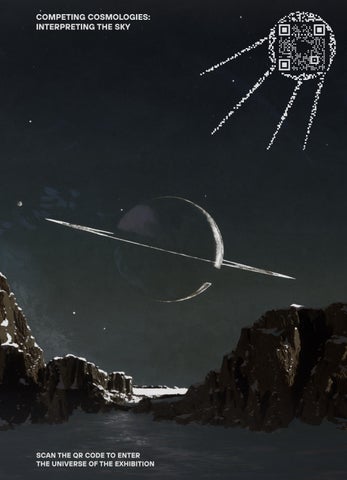
COMPETING COSMOLOGIES: INTERPRETING THE SKY
SCAN THE QR CODE TO ENTER THE UNIVERSE OF THE EXHIBITION
Copyright 2026 © Wende Museum
COMPETING COSMOLOGIES: INTERPRETING THE SKY
David Van Eyssen, Cosmo-Nought, 2026, augmented reality experience Courtesy of the artist
HOW TO VIEW: Scan the QR code on the front cover to download Hoverlay, a free augmented reality app. Once the app is installed, scan the code again to launch the experience. If Hoverlay is already installed on your device, scanning the QR code will automatically open the exhibition. Be sure that your phone’s volume is turned on and follow the on-screen prompts. At the conclusion of the experience, you can interact with an AI guide represented by a black disc featuring the Wende Museum logo. Tap the disc to ask questions about the exhibition, artworks, artists, and the Museum. To speak with the guide, press and hold the center button along the lower edge of your phone’s display while recording your question.
Designed for mobile devices, Cosmo-Nought is an augmented reality experience that extends the Wende Museum’s 2026 exhibition catalog, Competing Cosmologies, beyond the printed page. Works from the exhibition unfold in a directed, interactive audiovisual sequence set against an evolving field of deep space imagery and images from the show. Embedded in the experience, the Wende Museum’s AI agent responds in real time to voice-driven questions— offering insight into the Museum, its curators, the artists, and the ideas shaping the exhibition. Directed by: David Van Eyssen Producer: Anita Chang Technical Design and Animation: Hunter Wengilowski Music: Damir Price A Production of Auteur Studio, 2026
CURATED BY: JOES SEGAL EMMA DIFFLEY LOIS ROSSON
NOVEMBER 7, 2026 – OCTOBER 17, 2027
TABLE OF CONTENTS
Explore the Wende Museum with Bloomberg Connects, the free arts and culture app. This digital/mobile guide takes you behind the scenes with exclusive multimedia perspectives from the artists in Competing Cosmologies: Interpreting the Sky. Free to download and free to use, the app was created by Bloomberg Philanthropies to help make the art and offerings of cultural organizations more accessible—not just to those visiting in person, but to people around the world. Download the app from BloombergConnects.org or by scanning the adjacent QR code and then searching for or scrolling to the Wende Museum. After you have the app, you can scan the QR codes in this catalog to listen to the audio tour, featuring in-depth interviews and conversations with artists in the exhibition.
Introduction: Art and the Universe.....................................8 Joes Segal and Emma Diffley Astronomy................................................................................32 Totality!..................................................................................... 66 Lia Halloran Space Race..............................................................................84 Frederick C. Durant III’s Interplanetary Art Emporium............................................164 Lois Rosson Futurisms................................................................................ 212 Aliens.......................................................................................252 Contributors............................................................................................ 282 Image Credits.........................................................................................284 Acknowledgments...............................................................................286
ARTISTS IN EXHIBITION
Anna and Tatiana Andreeva..................................................... 154
Leonid Lazarev............................................................................ 106
Chelle Barbour............................................................................ 232
Li Tianbing.................................................................................... 250
Alan Bean...................................................................................... 146
Alexei Leonov.............................................................................. 152
Pyotr Belenok.............................................................................. 226
Georgiy Lukashov....................................................................... 264
Nuotama Frances Bodomo....................................................... 236
Bill Mauldin................................................................................... 148
Solomon Boim.............................................................................. 105
Aaron Samuel Mulenga............................................................. 238
Chesley Bonestell....................................................................... 34
Lowell Blair Nesbitt.................................................................... 38
Beatriz Cortez.............................................................................. 246
Konstantin Prokhorov................................................................ 104
Ekaterina Danilovna Ivashinina............................................... 102
Trương Minh Quý........................................................................ 248
Viktor Dorokhov and Valentina Dorokhova.......................... 156
Leo Raudys................................................................................... 52
Bettina Forget............................................................................. 44
Jan Ságl......................................................................................... 230
Chitra Ganesh............................................................................. 244
Sun Ra........................................................................................... 231
Mark Steven Greenfield............................................................ 242
Ionel Talpazan.............................................................................. 260
Lia Halloran.................................................................................. 48
Fedir Tetianych............................................................................ 214
Jitish Kallat................................................................................... 42
Alexander Vaganov.................................................................... 159
Paul Laffoley................................................................................ 254
David Van Eyssen........................................................................ 270
INTRODUCTION
ART AND THE UNIVERSE JOES SEGAL AND EMMA DIFFLEY
The Whirlpool Galaxy, M51, NGC 5194, as observed by the Hubble Space Telescope in 1995 and 1999
NASA and The Hubble Heritage Team (STScI/AURA); Acknowledgment: N. Scoville (Caltech) and T. Rector (NOAO)
9
ART AND THE UNIVERSE
INTRODUCTION
In The Interpretation of Dreams (1899), Sigmund Freud observed that humanity has suffered three consecutive humiliations: the knowledge that we are not the center of the universe (Copernicus, Galilei); the discovery that we are not unique, but an evolutionary product of the animal kingdom (Darwin); and the realization that we are not in conscious control of our thoughts and emotions (Freud himself). 125 years later, humanity’s embarrassment has exponentially deepened as subsequent and ongoing discoveries in cosmology and astrophysics have significantly further undermined ideas about our privileged place in the universe, subverting notions of progress and perfectibility. Competing Cosmologies: Interpreting the Sky encourages viewers to reflect on our connection with the cosmos by focusing on how it has inspired art and visual culture, influenced the political agendas of space exploration, acted as a projection screen for cultural fears, hopes, and aspirations, and continues the debates about extraterrestrial spaces and life forms. It takes stock of the various ways our ever-changing interpretations and understandings of the cosmos have inspired and continue to inspire artistic expression, and vice versa — how artistic
10
SEGAL & DIFFLEY
expressions have informed and inspired a more complete understanding of the universe. In 1924, Edwin Hubble discovered that there are other galaxies beyond our Milky Way, and five years later he was able to prove that the universe is not static but expanding.1 Due to immensely improved instruments,2 we now know that we are a small planet within an insignificant solar system halfway down one of the spiral arms of an average galaxy. It has been calculated that there are more stars in the universe than grains of sand on Earth. Our galaxy, the Milky Way, which contains some 200400 billion stars, is one amongst trillions of galaxies within our visible universe. 3 We acknowledge four dimensions (three spatial dimensions plus one temporal dimension) in our daily lives, but according to string theory, which attempts to reconcile quantum physics 1. Gale E. Christianson, Edwin Hubble: Mariner of the Nebulae (New York: Farrar Straus & Giroux, 1995). 2. For instance, the Hubble Space Telescope, the James Webb Space Telescope, the Vera C. Rubin Observatory, the Chandra X-ray Observatory, the Multi Unit Spectroscopic Explorer, and the Dark Energy Spectroscopic Instrument. 3. Neil deGrasse Tyson and Lindsey Nix Walker, To Infinity and Beyond: A Journey of Cosmic Discovery (Washington, DC: National Geographic, 2023).
ART AND THE UNIVERSE
The exhibition Competing Cosmologies is built around four sections: Astronomy, Space Race, Futurisms, and Aliens. It explores how new insights about our place in the cosmos have impacted visual artists during the Cold War period and beyond in the East, the West, and the Global South. It illuminates our complex and multifaceted interaction with the cosmos through artistic eyes. Astronomy shows the interplay between art and science. Through Space Race, we perceive moments of competition and collaboration between the Soviet Union and the United States, while appreciating and juxtaposing the unique art of both countries that was produced in this period. Futurisms highlights the diverse artistic visions developed by Latinx, Black, Asian, and queer communities that challenge earlier perceptions of science, space, and history, and qualifies the clichéd Cold War divide between East and West by featuring perspectives of artists from the Global South. Finally, Aliens documents artists’ representations of extraterrestrial spaces, devices, and beings in experienced reality or in fantasy. As a whole, the exhibition shows how art and science are often used as outlets to push social reform, challenge conventions, 4. Brian Greene, The Elegant Universe: Superstrings, Hidden Dimensions, and the Quest for the Ultimate Theory (New York: Vintage Books, 2005). 5. Quoted in Neil deGrasse Tyson with James Trefil, Cosmic Queries: Star Talk’s Guide to Who We Are, How We Got Here, and Where We’re Going (Washington, DC: National Geographic, 2021), 274.
ART AND THE UNIVERSE
and propel human imagination. From the time when our ancient ancestors first pondered the night skies and charted our closest planets, to the modern era of space exploration and new technologies, the universe has been both extremely close and inconceivably far, both familiar and yet unknown to us all.
INTRODUCTION
with the principle of gravity, we might actually exist in a ten- or elevendimensional universe with a potentially infinite number of parallel universes. 4 As American physicist Edward Tryon aptly put it: “Perhaps our universe is simply one of those things that happen from time to time.”5
ASTRONOMY Long before the conscious notion of “art,” human knowledge of the cosmos has been translated into visual artifacts, more often than not of the highest aesthetic quality. And while these artifacts were informed by careful observation and interpretation, they also have served as sources of inspiration for new research and subsequent discoveries. Throughout the centuries, art and science have not only informed but also inspired and propelled each other. 6 In the United States, the “father of modern space art” Chesley Bonestell (1888-1986) was instrumental, beginning in the 1940s, in popularizing astronomy and space exploration through his scientifically informed but imagined extraterrestrial landscapes, which were endlessly reproduced in popular scientific magazines and other publications.7 Organized by administrator James Webb in 1962,
the National Aeronautics and Space
6. See for instance Nia Imara, Painting the Cosmos: How Art and Science Intersect to Reveal the Secrets of the Universe (Dallas, TX: BenBella Books, 2025); Peter Sachs Collopy and Claudia Bohn-Spector, eds., Crossing Over: Art and Science at Caltech, 1920-2020 (Los Angeles, Getty Publications, 2024). 7. Ron Miller and Frederick C. Durant III, The Art of Chesley Bonestell (Marelin, MO: Walsworth Publishing Company, 1983); Lois Rosson, “America’s Astronomical Illustrator: Chesley Bonestell and the Problem of Seeing Outer Space,”
in The Astronomical Realists: The Social Mechanics of Visual Documentation, Art, and the American Space Age, 1944-1987, manuscript in preparation. See for Frederick Durant’s role as an astronomer, administrator, and art dealer in space art Lois Rosson’s essay in this catalog.
SEGAL & DIFFLEY
11
INTRODUCTION
INTRODUCTION
Chesley Bonestell, Saturn as Seen from Titan, 1940, mixed media on paper, United States On Loan From the Adler Planetarium, Chicago, Illinois.
Administration (NASA) developed its own Art Program, granting artists unprecedented access to research facilities, astronauts, and spacecraft to document and inspire space research and exploration. Participating artists included Norman Rockwell, Andy Warhol, and Annie Leibovitz. 8 Currently, “The Studio” at the Jet Propulsion Lab (JPL) consists of artists, designers, and thinkers who help scientists and engineers imagine the future, while also finding new ways to express the grandeur of the universe.9
8. https://www.nasa.gov/collaborating-with-nasa/nasa-artprogram/, accessed February 23, 2026. See also Piers Bizony, The Art of NASA: The Illustrations that Sold the Missions (Beverly: Motorbooks, 2020). 9. https://www.jpl.nasa.gov/thestudio/, accessed February 23, 2026.
12
SEGAL & DIFFLEY
As images of the surface of Mars were not yet available before the Viking 1 lander arrived on the planet on June 20, 1976, artists had to fill in the knowledge gap by using other sources. As visual culture researcher Elizabeth Kessler has shown, many artists strongly focused on the American Southwest, with its spectacular landscapes—such as the Grand Canyon, Yosemite, and Death Valley—as inspiration. These landscapes also evoked a metaphorical association with “manifest destiny,” the exploration and colonization of so-called “virgin lands” and the Western frontier, despite the fact that indigenous peoples had already resided in the areas for over 20,000 years. The cosmos was thus presented as the new frontier to be conquered.10 In her groundbreaking
Above: Joseph Mallord William Turner, Snow Storm - Steam-Boat off a Harbour’s Mouth, exhibited 1842 Tate, Accepted by the nation as part of the Turner Bequest 1856. Photo: Tate
book Picturing the Cosmos: Hubble Space Telescope Images and the Astronomical Sublime (2012), Kessler also points out how the translation from digital information conveyed by modern space telescopes into visible images goes through a process of stylistic choices, which are often inspired by American and British nineteenth-century “sublime” landscape paintings, such as the more dramatic works of Joseph Mallord William Turner.
The Whirlpool Galaxy, M51, NGC 5194, as observed by the Hubble Space Telescope in 1995 and 1999
10. Elizabeth Kessler, Picturing the Cosmos: Hubble Space Telescope Images and the Astronomical Sublime (Minneapolis: The University of Minnesota Press, 2012).
ART AND THE UNIVERSE
NASA and The Hubble Heritage Team (STScI/AURA); Acknowledgment: N. Scoville (Caltech) and T. Rector (NOAO)
ART AND THE UNIVERSE
SEGAL & DIFFLEY
13
Lia Halloran (b. 1977) is an artist who has closely collaborated with scientists to produce her work, which spans from painting and drawing to video installation and long-exposure photography. Together with Kip Thorne, joint winner of the 2017 Nobel Prize in Physics, she published The Warped Side of Our Universe, a book exploring scientific concepts such as black holes using poetic verse and otherworldly paintings.11 In the exhibition she is represented by her monumental work The Sun Burns My Eyes Like Moons (Positive), which combines contemporary satellite images with photographs she took of a solar eclipse in 2017, as well as turn-of-thecentury images of the Sun taken by George Ellery Hale, the inventor of the spectrohelioscope. Two other works from the series Your Body Is a Space that
Lia Halloran, Andromeda, After Mollie O’Reilly, Your Body Is a Space that Sees, 2017, cyanotype, United States Courtesy of the artist and Luis De Jesus Los Angeles
Sees: The Global Cluster, After Helen Sawyer, and Andromeda, After Mollie O’Reilly reflect on the largely forgotten history of the women who worked at the Harvard College Observatory from the late 1800s to the early twentieth century, known as “Pickering’s Harem” or “Harvard Computers,” whose work has significantly supported revolutionary discoveries in astronomy and cosmology.12 Another artist directly inspired by astronomical science is Leo Raudys (b. 1962), who began his career as a biologist. Raudys is fascinated by the phenomenon of black holes, referenced in several of his paintings. We present one of his most recent works, Mu Cephei, named for a massive red supergiant star that is expected to turn into a black hole at the end of its life cycle. Raudys explores artistic means of expressing the unimaginable scale of the universe and its mysterious forces.
INTRODUCTION
Artworks in the exhibition include the screenprint series Moon 69 by Lowell Blair Nesbitt (1933-1993), inspired by the lunar mission of Apollo 9. Nesbitt was the official NASA artist for the Apollo 9 and Apollo 13 space programs. Bettina Forget (b. 1965) is a German artist living in Canada, and is the Director of the SETI (Search for Extraterrestrial Intelligence) Institute’s Artist in Residence program. Her series Women With Impact portrays thirty-two Moon craters named after women, a mere 2% of the total 1,578 catalogued craters on the Moon. This series highlights the underrepresentation of women both in scientific and historical narratives. In his video The Eternal Gradient, Indian artist Jitish Kallat (b. 1974) demonstrates the lunar phases using 365 rotis, a staple round flatbread of Asian and African cuisines.
SPACE RACE The first artificial satellite orbiting Earth (Sputnik 1, 1957), the first space dog (Laika, 1957), the first manned space flight (Vostok 1, manned by Yuri Gagarin, 1961), the first woman in space (Valentina Tereshkova, 1963), the first spacewalk (Alexei Leonov, 1965), and the first man on the Moon (Neil Armstrong, 1969) define some of the pivotal moments of the Space Race.13 For the first time in our planetary history, humans left Earth and reached celestial bodies. It might not be a coincidence that the Club of Rome, an international think tank on global issues, 12. See Lia Halloran’s essay in this catalog.
11. Kip Thorne and Lia Halloran, The Warped Side of Our Universe: An Odyssey Through Black Holes, Wormholes, Time Travel, and Gravitational Waves (New York: Liveright, 2023).
14
SEGAL & DIFFLEY
ART AND THE UNIVERSE
ART AND THE UNIVERSE
13. See for instance Deborah Cadbury, Space Race: The Epic Battle Between America and the Soviet Union for Dominion of Space (New York: Harper, 2006).
SEGAL & DIFFLEY
15
partnership among the space programs of the United States, Russia, Europe, Japan, and Canada.17
INTRODUCTION
Sputnik 1, ca. 1960-1961, spacecraft model, Soviet Union On loan from The Walker Library of The History of Human Imagination
published its first report The Limits to Growth in 1972, only three years after the first Moon landing; the report warned readers of the depletion of natural resources and the unacceptable levels of pollution following unlimited economic growth.14 For the first time, people had looked back from space and seen our planet, without its artificial borders, as a vulnerable sphere that needs care and attention. Despite the fierce and hostile competition between the Soviet Union and the United States, the Space Race witnessed significant moments of détente and collaboration. In 1975, an American Apollo spacecraft docked 14. Donella Meadows et al., The Limits to Growth: A Report for the Club of Rome’s Project on the Predicament of Mankind (New York: Universe Publishers, 1972).
16
SEGAL & DIFFLEY
with a Soviet Soyuz capsule, where astronauts Thomas P. Stafford, Vance D. Brand, and Deke Slayton met with cosmonauts Alexei Leonov and Valery Kubasov, exchanging the first U.S.-Soviet handshakes in space.15 Leonov, the first person to accomplish a spacewalk — on March 18, 1965 outside his Voskhod 2 capsule — and who also made a name for himself as a space artist, and David Scott, commanding officer of Apollo 15 and the first man to drive on the Moon in a Lunar Roving Vehicle (LRV), became close friends and later published a joint autobiography entitled Two Sides of the Moon.16 Moreover, 1998 saw the launch of the International Space Station, a 15. Edward Clinton Ezell and Linda Neuman Ezell, The Partnership: A NASA History of the Apollo-Soyuz Test Project (Mineola, NY: Dover Publications, 2011). 16. David Scott and Alexei Leonov, Two Sides of the Moon: Our Story of the Cold War Space Race (New York: St. Martin’s Press, 2004).
ART AND THE UNIVERSE
Official Soviet space art followed a slightly different path because it was influenced—much like the Soviet space program itself—by the philosophical concept of cosmism that harkened back to the writings of Nikolai Fedorov (1829-1903).19 Fedorov aspired to unite humankind in one collective endeavor: aiming for eternal life and resurrecting all humans that have ever lived before. He understood this not in a religious but in a material sense, using the latest developments in science to accomplish his vision. As Fedorov realized that Earth would be too small to carry and feed all 17. Brazil was invited to participate as well but had to drop out of the project. See David Baker, International Space Station: An Insight into the History, Development, Collaboration, Production and Role of the Permanently Manned Earth-Orbiting Complex (Sparkford, Somerset: Hayes Publishing, 2016). 18. Lois Rosson, “The Frontier Proxy: Why Space Looks Like the American West,” Alta Journal 29 (September 2024), 96-97. 19. George M. Young, The Russian Cosmists: Nikolai Fedorov and His Followers (Oxford: Oxford University Press, 2012); Boris Groys, ed., Russian Cosmism (New York: e-flux and Cambridge, MA and London: The MIT Press, 2018).
ART AND THE UNIVERSE
INTRODUCTION
Another instance of rapprochement was the meeting of American and Soviet space artists and illustrators in October 1987, when members of the International Association of Astronomical Artists were invited by the Soviet Artists’ Committee on Science and the Cosmos to present their work at the Soviet Space Future Forum in Moscow.18 The meeting highlighted the different pictorial traditions in the space art of both countries; whereas the Americans aimed for objective precision in their artwork, the Soviets emphasized the emotional and spiritual dimensions of space exploration. Despite these purported differences, the Soviet and American artwork also had quite a lot in common.
of humanity for all time, he envisioned interplanetary travel and colonization of other planets as a necessary development. It was his utopian dream of eternal life and unlimited space exploration that inspired the research of Konstantin Tsiolkovsky (1857-1935), the legendary “father of cosmonautics.” Tsiolkovsky would achieve groundbreaking theoretical work on rocket propulsion and space travel, which he published in “Exploration of Outer Space with Rocket Propelled Vehicles” (1903).20 Tsiolkovsky’s work would later influence rocket engineers including Wernher von Braun (1912-1977), who developed the V-2 rocket for Adolf Hitler’s National Socialist regime and who became one of the leading rocket engineers in the United States after WWII, and Sergei Korolev (1907-1966), the lead Soviet space rocket engineer and spacecraft designer during the early years of the Space Race that culminated in the establishment of the Soviet space program. During his lifetime, Korolev was only publicly known as “Chief Designer,” due to the top-secret nature of the Soviet space program. The program maintained such intense secrecy in its early years that even Andrei Sokolov, one of the most esteemed Soviet space painters, was not allowed access to the rockets he was supposed to paint, forcing him to imagine them instead. One of Sokolov’s works was ironically censored because he unwittingly painted a spaceship that bore too much resemblance to an actual Soviet rocket.21
20. Daniel H. Shubin, Konstantin Eduardovich Tsiolkovsky: The Pioneering Rocket Scientist and His Cosmic Philosophy (New York: Algora Publishing, 2016). 21. Asif A. Siddiqi, “Cosmic Contradictions: Popular Enthusiasm and Secrecy in the Soviet Space Program,” in: James T. Andrews and Asif A. Siddiqi, eds., Into the Cosmos: Space Exploration and Soviet Culture (Pittsburgh: University of Pittsburgh Press, 2011), 47-76, here 72.
SEGAL & DIFFLEY
17
INTRODUCTION
INTRODUCTION
Left: Konstantin Tsiolkovsky, Sketch of a greenhouse in space, 1933, facsimile, Soviet Union
Sketch of the monument to the first woman cosmonaut, n.d., watercolor, gouache on cardboard, Soviet Union
In the exhibition we show a variety of Soviet space ephemera, highlighting the enormous popular appeal of the Soviet space program and the immense popularity of its cosmonauts. Yuri Gagarin (1934-1968), the first man who flew into space — aboard Vostok 1 on April 12, 1961 — is featured in several large and small commemorative sculptures and a ceramic plate. A painting by Solomon Boim (1899-1978) documents the hero’s welcome Gagarin received in Moscow upon his return. Konstantin Prokhorov (1924-2022) depicts him during a visit to a Soviet Young Pioneers camp in the Crimea. Russian photographer and “Kodak Master” Leonid Lazarev (19372021) captured Gagarin’s meeting with Soviet leader Nikita Khrushchev and the Soviet press. The first woman in space, Valentina Tereshkova (b. 1937), flying on
Vostok 6 in June 1963, is depicted on a commemorative vase and in an anonymous painting of the monument dedicated to her that is located in the Altai region of Siberia, close to where Tereshkova landed back on Earth.
Image courtesy of public domain
18
SEGAL & DIFFLEY
ART AND THE UNIVERSE
ART AND THE UNIVERSE
Collection Wende Museum, 2025.020.001
From artist and cosmonaut Alexei Leonov we present the work Lift-Off! Soyuz-19, depicting the spacecraft manned by Leonov himself and Kubasov in 1975 that docked with the (unnumbered) Apollo spacecraft carrying American astronauts Stafford, Brand, and Slayton. The style of Leonov’s paintings comes close to that of popular Soviet space painter Andrei Sokolov and adheres to the principles of socialist realism, the officially sanctioned art style of the Soviet Union which depicted a positive and optimistic perspective on SEGAL & DIFFLEY
19
INTRODUCTION
However, the Space Race was featured in unofficial and countercultural Soviet art as well. Whereas Alexander Vaganov’s (b. 1951) To the Twenty-First Century in Peace and Consent celebrates the future of space exploration as a harbinger of international peace and understanding, Dense in the Cosmos, Empty on the Table! by Viktor Dorokhov and Valentina Dorokhova ironically references the fact that the Soviet Union spent large amounts of money on the space program but neglected to provide basic consumer products for its citizens.
FUTURISMS Russian Futurism was a broad artistic movement of the 1910s, inspired by Filippo Tommaso Marinetti’s Futurist Manifesto from 1909. Artists associated with the movement included Kazimir Malevich and Vladimir Mayakovsky, among many others. A different kind of futurism in the tradition of Nikolai Fedorov and Konstantin Tsiolkovsky’s cosmism was developed by Ukrainian artist Fedir Tetianych (1942-2007), who started his career as a member of the Union of Soviet Artists of Ukraine and the Union of Artists of the USSR, specializing in public art projects. While he approached these projects in a highly original way, using scrap materials for his mosaics and reliefs, he soon completely retreated into his own art practice,
20
SEGAL & DIFFLEY
developing his personal philosophy or religion which he called Frypulia and which would inform his subsequent art practice. Tetianych engaged in public performances wearing his own homemade, futuristic costumes made out of reflective and noisy repurposed materials, and designed his own invention motivated by his ecological concerns: the biotechnosphere, a module designed as a human habitat that could extend life on Earth and then into outer space.
INTRODUCTION
socialist society. Leonov is one of several cosmonauts and astronauts who felt the urge to translate their experiences in space into artwork. The Apollo-Soyuz project is also celebrated in the official commemorative design by textile artists Anna and Tatiana Andreeva.
Another Soviet artist who radically deviated from the official Soviet style of socialist realism in spite of being a member of the Union of Artists of the USSR was Pyotr Belenok (1938-1991). In his private works, which he shared with his friends in a basement studio, he highlighted the loneliness and vulnerability of humans in an immeasurable, meaningless, and hostile universe. With a keen sense of irony, Belenok categorized his artwork as “panic realism,” a complete reversal of “socialist realism.” Science fiction has been used by NASA and U.S. government space programs to popularize the idea of expanding humanity’s presence into the universe beyond Earth, but artists of color and queer artists have questioned the inclusivity and motives of these stories. The words “space” and “alien” serve as significant cultural metaphors in different artistic futurisms, including Afrofuturism, Latinx Futurism, Queer Futurism, and Asian Futurism(s). Among these, Afrofuturism was the first to develop. Mark Dery defined the term “Afrofuturism” in his essay “Black to the Future” (1994), using it to describe the radical possibilities of science fiction and futurist art through a Black Atlantic lens,
ART AND THE UNIVERSE
Fedir Tetianych in a handmade suit for an outdoor performance in Kyiv, 1998, photograph, Ukraine
Courtesy of the Tetianych Family Collection & Archive
ART AND THE UNIVERSE
Fedir Tetianych in a handmade suit for an outdoor performance in Kyiv, 1998, photograph, Ukraine
Courtesy of the Tetianych Family Collection & Archive
SEGAL & DIFFLEY
21
Fedir Tetianych in a handmade suit, near his house in hometown Kniazhychi, Brovaryskyi district, Kyiv oblast, ca. 1997-1998, photograph, Ukraine Courtesy of the Tetianych Family Collection & Archive
Pyotr Belenok, Composition, 1980, gouache, mixed media on paper, Soviet Union Collection Darsalia Art and Design
In Sun Ra’s pivotal film Space is the Place (1974), the artist presents himself and his entourage as aliens who visit planet Earth to rescue people of color from hatred and discrimination by taking them in their spacecraft to another planet without oppression and exploitation. Other artists on view with links to Afrofuturism are Chelle Barbour, whose collages connect past, present, and future in emancipatory and empowering ways; Nuotama Frances Bodomo (b. 1988), whose film Afronauts uses a historical event as inspiration for a fantasy about the Zambian space program, Aaron Samuel Mulenga, (b. 1990) whose works referencing space travel reflect on questions of identity and representation; and Mark Steven Greenfield (b. 1951), who highlights African American narratives and historical and mythological Black figures that are too often sidelined or erased in mainstream history.
Latinx Futurism—or Chicanafuturism, a term introduced by Catherine S. Ramirez in 2004—critiques the violent, racist discourse surrounding “illegal aliens” that has defined US immigration policy for decades. 25 Latinx and Chicana(o)futurisms address marginalization, displacement, and alienation, as well as strategies of survival and resistance. Like Afrofuturism, they often incorporate ancient and ancestral indigenous myths and rituals. Salvadoran American artist Beatriz Cortez (b. 1970) explores elements of indigenous Mayan culture in a futuristic setting. Her sculpture The Argonaut, After Pakal takes the form of an over-tenfoot-tall spaceship capsule that reimagines the sarcophagus lid of the Mayan ruler Pakal (603–683 CE).
INTRODUCTION
particularly following the work of artist Sun Ra (1914-1993), arguably the first “Afrofuturist” avant la lettre. 22 Dery uses the word “alienation” when discussing the African American experience in U.S. society. 23 The term “alien” has been reclaimed by Afrofuturists to instill a vision where Africans and African Americans play an equal or leading role on Earth and in space exploration. 24
25. Catherine S. Ramirez, “Deus Ex Machina: Tradition, Technology, and the Chicanafuturist Art of Marion C. Martinez,” Aztlán, A Journal of Chicano Studies 29 (2004) no. 2, 55-92. See also Jade Taylor et al., “Diasporic Latinx Futurisms,” in: Mark Bondel, Andrew M. Butler, and Sherryl Vint, eds., The New Routledge Companion to Science Fiction (London: Routledge, 2024), 263-272.
22. John Szwed, Space is the Place: The Lives and Times of Sun Ra (Durham and London: Duke University Press, 2020). 23. Mark Dery, “Black to the Future: Interviews with Samuel R. Delany, Greg Tate, and Tricia Rose,” in Flame Wars: The Discourse of Cyberculture (Durham and London: Duke University Press, 1994), 179-222. 24. See for instance Ytasha L. Womack, Afrofuturism: The World of Black Sci-Fi and Fantasy Culture (Chicago: Lawrence Hill Books, 2013); Reynaldo Anderson and Charles E. Jones, eds., Afrofuturism 2.0: The Rise of Astro-Blackness (Lanham, MD: Lexington Books, 2016).
22
SEGAL & DIFFLEY
ART AND THE UNIVERSE
ART AND THE UNIVERSE
SEGAL & DIFFLEY
23
ALIENS Extraterrestrial life forms have always provoked human fantasy and speculation. Historically, stories about alien creatures descending from the sky and impacting humans have been recorded throughout religious practices—with these creatures mostly characterized as angels, demons, or spirits. To the secular world, such experiences are considered to be symbolic or fictional. But secularism did not end the discourse on extraterrestrial encounters; since the twentieth century, several artists have created works based on their alleged firsthand confrontations with extraterrestrial beings.
INTRODUCTION
In the tradition of Queer Futurism, Brooklyn-based artist of Indian descent Chitra Ganesh (b. 1975) is inspired by South Asian mythology and art traditions, modernized through the exploration of feminist and queer subjects. In her work she incorporates influences from Asian comics to contemplate the fluidity of identities in the context of the larger cosmos. Rooted in the unique experiences, traditions, religions, and histories of people across Asia and the Asian diaspora, Asian Futurisms reimagine Asian experiences and perspectives to define their own futures. Set in the year 2045, the film The Tree House by Vietnamese filmmaker Trương Minh Quý (b. 1990) reclaims and reconciles intergenerational trauma linked to the Vietnam War through a cosmic lens.
Korosten Porcelain Factory, Statue of USSR cosmonaut with alien being, ca. 1960s-1970s, porcelain, Soviet Ukraine
Chitra Ganesh, Ancestral Visit, Architects of the Future, 2024, archival digital print, United States
Collection Daniel Wojcik
Courtesy of the artist, Hales London and New York, and Gallery Wendi Norris, San Francisco © Chitra Ganesh
ART AND THE UNIVERSE
SEGAL & DIFFLEY
25
INTRODUCTION
In the post-World War II era, paranoia surrounding unidentified flying objects (UFOs) was on the rise. Between the 1940s and 1950s, the entertainment industry began to produce more science fiction television and film, increasing the public’s interest in extraterrestrial life and space travel, according to Keith Mitchell, a UFO records specialist at the UK’s National Archives. Sci-fi television shows like The Twilight Zone, which premiered at the end of the 1950s, were playing on black-and-white televisions in the living rooms of many American households. This uptick in sci-fi media correlates with the gradual increase in reports of UFO sightings at this time. The first documented sighting of a UFO occurred on June 24, 1947, when American pilot Kenneth Arnold reported seeing nine crescent-shaped objects near Mount Rainier, Washington. 26. See Stephen Webb, If the Universe Is Teeming with Aliens … Where Is Everybody? Seventy-Five Solutions to the Fermi Paradox and the Problem of Extraterrestrial Life (Heidelberg: Springer, 2015 [2002]). 27. Other more mainstream explanations point to the short lifespan of biological creatures and the limits of the speed of light; to the fact that the conditions for developing “intelligent” life on Earth were extremely rare; to the circumstance that (microbial) life on Earth is more than four billion years old, but our attempts to reach out to other planets only date back a few decades; or to the consideration that advanced alien civilizations who are able to reach out are not much interested in our primitive state of development.
James Murphy, Identified Flying Object, a Hubcap, 1967, gelatin silver print, United States
The media described the aircraft as “flying saucers”—a term that traces back to the American clay pigeon shooters of the 1880s who threw discs or saucers in the air when shooting pigeons, and which came to be part of the permanent vocabulary of the UFO phenomena. According to the U.S. Department of Defense, modern-day UFO sightings began in 1952 in Washington, D.C. when the Washington National Airport (now Ronald Reagan Washington National Airport) and Andrews Air Force Base (now Joint Base Andrews) reported radar contacts, mysterious blips, and sightings of “an orange ball of fire and fast-moving light” that alarmed the U.S. government. This launched the U.S. Air Force’s investigation into UFOs, called “Project Blue Book,” based on concerns about threats to national security and safe airspace. Project Blue Book often identified UFO sightings as misinterpreted aerial phenomena. J. Allen Hynek, astronomer and head scientific consultant for Project Blue Book, introduced the term “close encounter” to describe UFO sightings. 28 Photographs depicting alleged UFOs have been widely used both by UFO enthusiasts as evidence of extraterrestrial contact and by skeptics to unmask them as hoaxes. These close encounters of various kinds have furthered speculation surrounding encounters with extraterrestrial life—and even alien abductions.
INTRODUCTION
The sheer size and complexity of the universe have provoked what has come to be known as the Fermi paradox (as expressed by physicist Enrico Fermi in 1950): if there are so many galaxies, stars, and planets in the universe, then there must be countless other intelligent life forms elsewhere; why don’t we see any evidence of them?26 One of the many possible answers to this question is that these life forms are already in touch with humans without most of us realizing it. 27
In 1957, Brazilian law student Antônio Villas Boas reported that he was taken into a UFO spacecraft, where he underwent a series of physical procedures such as the taking of blood 28. J. Allen Hynek, The UFO Experience: A Scientific Enquiry (New York: Ballantine Books, 1977); Brad Steiger, Project Blue Book (New York: Ballantine Books, 1987).
Courtesy of Archive of Modern Conflict
26
SEGAL & DIFFLEY
ART AND THE UNIVERSE
ART AND THE UNIVERSE
SEGAL & DIFFLEY
27
INTRODUCTION
INTRODUCTION
TV Times, A Flying Saucer over London, n.d., gelatin silver print, United Kingdom Courtesy of Archive of Modern Conflict
and was forced twice to undergo intimate relations with an extraterrestrial female who looked “half-human” and “half-creature.”29 Arguably the most infamous case of an alien abduction occurred in 1961, when American couple Barney and Betty Hill claimed that aliens abducted them from their car while they were driving through a rural and remote area in New Hampshire. They reported being levitated into a UFO, where they experienced “physical examination” and “reproduction interest” by the aliens. 30 Upon returning, they forgot everything that had happened to them—later characterized by ufologists as a concept called “missing time”—but they were 29. David M. Jacobs, “A Brief History of Abduction Research,” Journal of Scientific Exploration 23 (2009) no. 1, 69.
traumatized. Eventually, psychiatrist and hypnotist Benjamin Simon uncovered their forgotten memories of the abduction, using regressive hypnosis. From this point forward, regressive hypnosis would become the main instrument for retrieving “missing time” from abductees by ufologists. The Cold War was undeniably responsible, at least in part, for this new anxiety about UFOs. The U.S. Air Force’s Project Blue Book was designed to guard airspace from a possible nuclear threat from the Soviet Union and other Warsaw Pact states. The Space Race was putting more human-made satellites into orbit. The building of the Berlin Wall in 1961, the 1962 Cuban Missile Crisis, and the Vietnam War all came with increased international anxiety and potential threats of nuclear war and human annihilation. In the 1960s
Georgiy Lukashov, Scene Sketch for the 1967 film Туманность Андромеды (The Andromeda Nebula), ca. 1965, gouache on paper, Soviet Ukraine Courtesy of Archive of Modern Conflict
especially, media and entertainment industries experimented with their own creations of UFO spacecrafts and alien life. The U.S. saw the emergence of TV shows such as Star Trek, Doctor Who, Lost in Space, and The Invaders. In the Soviet Union, artist Georgiy Lukashov (1913–2000) produced set drawings for the 1967 film The Andromeda Nebula surrounding space exploration and alien life. By the 1970s, the American media began to pay more attention to what was becoming known as the “abduction phenomena.” By 1975, the Barney and Betty Hill case was converted into a sci-fi film, The UFO Incident.
Budd Hopkins (1931–2011), who made his career as an Abstract Expressionist painter and witnessed his first UFO in 1964, was one of the leading figures of UFO abduction research. He wrote several books on alien encounters—his most notable Missing Time (1981) and Intruders (1987), which would later be converted into films—and held support groups and free hypnotic sessions for abductees, traveling to lecture on the subject as well. 31 John E. Mack (1929– 2004), the head of psychiatry at Harvard Medical School from 1977 to 2004, was in attendance at one of Hopkins’ lectures in 1990, which sparked his interest in abduction research. His affiliation with Harvard brought extra attention to the concept of abduction phenomena. 31. Missing Time was a milestone in abduction research and drew serious attention by researchers; Intruders follows a family beset by abductions, which uncovered accounts of fetuses implanted in women and removed weeks later, and of human-alien children, called “hybrids.”
30. Jacobs, “A Brief History,” 70.
28
SEGAL & DIFFLEY
ART AND THE UNIVERSE
ART AND THE UNIVERSE
SEGAL & DIFFLEY
29
INTRODUCTION
However, this incited scorn from his colleagues, who did not accept the idea. Alongside Hopkins’ research, Mack began conducting his own regressive hypnosis sessions with abductees, and gathered abductee accounts that “did not match any conventional psychological models.”32 Mack began to push against mainstream Western science and promoted the idea that alien abductions were a new cosmology that exists in a “marginal place between the physical and nonphysical,” one that blends Eastern spirituality and Western science. However, towards the end of Mack’s career, he abandoned the subject completely. In the exhibition, we present works by Paul Laffoley (1935–2015) and Ionel Talpazan (1955–2015), artists who were profoundly influenced by their perceived personal connections to extraterrestrial life. Laffoley, a trained architect, was deeply inspired by Frank Lloyd Wright and his UFO spacecraft design for The Day the Earth Stood Still (1951). He briefly worked and lived with Andy Warhol in his studio, “The Factory,” and was strongly influenced by East Asian philosophy and religion. Following a routine CAT scan of his head, he came to believe that he had an alien chip implanted in his brain, which gave him access to extraterrestrial knowledge. He claimed that through his work, the viewer could gain access to time travel and to the fifth dimension. Romanian artist Talpazan had a UFO encounter as a young child that informed his artistic career. He fled his communist country and eventually settled as a political refugee in the U.S., where he drew alien spacecraft, with notes in Romanian and English on their mysterious technology
and how they operated. He created hundreds of works of art, which he sold on the streets of New York City, achieving international acclaim only after his death. Multimedia artist David van Eyssen’s virtual sculpture of an alien abduction represents a more symbolic approach to the subject matter, motivated by his own experience of medical treatment for a disease that took hold of his body and made it a site of intervention. At the same time, the abduction scene also references the history of religious narratives — including ascensions to heaven — as well as extraterrestrial abduction stories and immigration raids in the United States. Competing Cosmologies: Interpreting the Sky aims to show that reflections about the cosmos are directly related to our political, economic, social, and cultural context. Studying the cosmos widens our perspective and provides us with critical distance to reflect upon ourselves. As the artists in the exhibition have shown, the universe can serve as a powerful metaphor for our individual and collective hopes, fears, and dreams. Competing Cosmologies: Interpreting the Sky shows that art and astronomy share a common trait: they both push the boundaries of what can be expressed, known, and understood.
SEGAL & DIFFLEY
Courtesy of Kent Fine Art, New York
Ionel Talpazan, UFO: Art & Science, Future to Peace the Earth, 2003, poster paint, marker, pencil, and ink on paper, United States
32. Jacobs, “A Brief History,” 73.
30
Paul Laffoley, Thanaton III, 1989, oil, acrylic, ink, and vinyl press type on canvas and wood, United States
Collection Marianne Diorio
ART AND THE UNIVERSE
ASTRONOMY
Chesley Bonestell
ASTRONOMY
Chesley Bonestell, Sandy Wastes on Mars, 1967, oil paint on paper board, United States
On Loan From the Adler Planetarium, Chicago, Illinois.
Previous spread: Chesley Bonestell, Galaxy NGC 4216 from a Hypothetical Planet Type SB, 1950, oil paint on paper board, United States On Loan From the Adler Planetarium, Chicago, Illinois.
34
BONESTELL
Chesley Bonestell (1888–1986), known as “the father of modern space art,” was a vital popularizer of space imagination and space research, and through his art he inspired the American space program. Bonestell initially had a successful career in architectural illustration, working on projects such as the Chrysler Building in New York and the Golden Gate Bridge in San Francisco. He then worked as a motion picture special effects artist for films such as The Hunchback of Notre Dame (1939) and Citizen Kane (1941), as well as space-themed films such as Destination Moon (1950), When Worlds Collide (1951), and War of the Worlds (1953). His artwork was featured in various popular
publications such as LIFE, Collier’s, Scientific American, and Astounding Science Fiction. In 1944, Bonestell created his best-known piece, Saturn as Seen from Titan, for LIFE. Imagining how the planet might look based on the information available at the time, Bonestell utilized clay models, photography, and painting to create this extraterrestrial landscape. The piece became one of the most iconic works in American space art. Bonestell later collaborated with German American writer Willy Ley on The Conquest of Space (1949), a speculative scientific book envisioning future space exploration, contributing Saturn as Seen from Titan along with other illustrations.
BONESTELL
35
ASTRONOMY
Chesley Bonestell, Saturn Twelve Hours Before Encounter, 1950, oil paint on paper board, United States On Loan From the Adler Planetarium, Chicago, Illinois.
Chesley Bonestell, Saturn as Seen from Titan, 1940, mixed media on paper, United States On Loan From the Adler Planetarium, Chicago, Illinois.
Pavel Klushantsev (dir.), Road to the Stars, 1957, film excerpt, Soviet Union
Road to the Stars is a 1957 Soviet film about the life and ideas of Konstantin Tsiolkovsky, which was groundbreaking at the time for its use of special effects to depict life in space. While the first half is historical and educational in nature, the second half is speculative, with various scenes showing crewed space flight (four years before Yuri Gagarin’s flight on Vostok 1), a large space station, a person on the Moon (twelve years before Neil Armstrong’s “giant leap for mankind”), and interplanetary colonization. This scene from the very end of the film clearly shows how Bonestell’s influence worked even beyond the Iron Curtain.
Chesley Bonestell, Jupiter Four Hours Before Encounter, 1950, oil paint on paper board, United States
On Loan From the Adler Planetarium, Chicago, Illinois.
36
BONESTELL
BONESTELL
37
ASTRONOMY
ASTRONOMY
Lowell Blair Nesbitt
Lowell Blair Nesbitt (1933–1993) was an American painter, sculptor, draughtsman, and printmaker who is best known for his vivid floral pieces—but he was also NASA’s official artist who documented the Apollo 9 and Apollo 13 space missions. At the time Nesbitt joined NASA as an artist, James E. Webb— NASA’s administrator—believed that the United States space program would determine the future direction of space-related art. Instead of only focusing on photographs taken from spacecraft, Webb hoped for NASA to document missions through the perspectives of artists.
38
NESBITT
This led to the launch of NASA’s Artist’s Cooperation Program. As part of this program, Nesbitt was allowed to view missions beforehand and document both the space center and the launches, from early preparations to the aftermath. Andy Warhol and Robert Rauschenberg were other notable NASA artists. Drawing on his experience creating photorealistic depictions of flowers, Nesbitt drew detailed images of the Moon and its craters.
NESBITT
39
ASTRONOMY
ASTRONOMY
All: Lowell Blair Nesbitt, Moon 69, 1969, from a series of five paintings, oil on paper, United States
Collection Wende Museum, donated by Norm and Lisette Palley, 2017.013.001
40
NESBITT
NESBITT
41
Jitish Kallat
ASTRONOMY
Jitish Kallat, The Eternal Gradient, 2015, short film, duration 2:59 minutes, India Courtesy of Sperone Westwater Gallery LLC
42
KALLAT
Indian artist, curator, and artistic director Jitish Kallat (b. 1974) combines science, history, and analysis of the natural world to reflect on the cosmos and the role of humans within it. With a focus on natural elements, time, dates, and juxtaposing the everyday with the cosmic, he focuses on shifting focal lengths to reframe and comprehend the immediate and the imminent. The Eternal Gradient is a short film demonstrating the Moon’s cycle with 365 rotis, a type of round, unleavened bread that is a staple of Asian and African cuisines. Kallat’s video of the Moon’s rotation shows time as a continuous almanac.
In this piece, rotis morph with the waxing and waning images of the moon as if they were passing through the annual lunar almanac. The rotis transform slowly and as each one completes its life cycle, the entire lunar year will also have transformed.
Listen to the audio guide with Jitish Kallat for more information. Bloomberg Lookup Number: 1407
KALLAT
43
ASTRONOMY
ASTRONOMY
Bettina Forget
Bettina Forget, Women with Impact, 2016–2019, thirty out of a series of thirty-two drawings, acrylic and graphite on paper, Canada Courtesy of the artist
Bettina Forget (b. 1965) is a German artist and educator based in Canada. She is Director of the Search for Extraterrestrial Intelligence (SETI) Institute’s Artist-in-Residence (AIR) Program where she facilitates collaboration between artists and SETI researchers, foregrounds art-science research practice, and establishes a network of institutional partners active in art, science, and technology. Her creative practice and academic research examine the re-contextualization of art and science, and how transdisciplinary education may disrupt gender stereotypes. Forget works with
44
FORGET
traditional as well as new media arts, focusing on astrobiology, sci-fi, and feminism. Her series Women with Impact confronts the underrepresentation of women in the sciences, using the Moon as a metaphor. The Moon craters that populate the lunar surface carry the names of philosophers, mathematicians, and astronomers such as Plato, Aristarchus, Kepler, Galileo, Newton, and Planck. However, out of the 1,578 named craters on the Moon, currently only thirty-two are named after women. Forget researched the locations of lunar craters named after women using NASA’s Lunar Reconnaissance Orbiter.
After capturing the most detailed images of the craters possible, she created a series of thirty-two drawings on paper using acrylic paint and graphite. A crater is void, a depression in the regolith, mirroring the lack of female representation in leadership, science, and history. Yet this void also implies its counter-part: every crater is born from a violent collision, a disruption of an otherwise undisturbed surface, symbolizing the groundbreaking impact these women made in their respective fields of research.
Listen to the audio guide with Bettina Forget for more information. Bloomberg Lookup Number: 1406
FORGET
45
ASTRONOMY
ASTRONOMY
From left to right, top to bottom; Bettina Forget, Bruce Crater, Cannon Crater, Maunder Crater, Resnik Crater, Earhart Crater, Fleming Crater, Sklodovska Crater, 2016; Tereshkova Crater, 2019; graphite and acrylic on paper, Canada Courtesy of the artist
46
FORGET
FORGET
47
Lia Halloran, The Sun Burns My Eyes Like Moons (Positive), 2021, cyanotype on paper from painted negative, acrylic and ink, United States Courtesy of the artist and Luis De Jesus Los Angeles
Lia Halloran (b. 1977) is an American artist who merges science and history in her art. Many of her projects are science-based, and she has closely collaborated with scientists, including Nobel Prize–winning physicist Kip Thorne, with whom she published The Warped Side of Our Universe: An Odyssey Through Black Holes, Wormholes, Time Travel, and Gravitational Waves (2023). In the exhibition, we show her monumental work, The Sun Burns My Eyes Like Moons (Positive) (2021), as well as two works from her series Your Body is a Space that Sees: The Global Cluster, After Helen Sawyer (2017) and Andromeda, After Mollie O’Reilly (2017). Halloran’s cyanotypes are created through a process of painting and printing, beginning with visual cues from her research in astronomy. Translations
48
ASTRONOMY
ASTRONOMY
Lia Halloran
HALLORAN
of stellar objects are painted on semitransparent film, then placed on top of paper coated with light-sensitive emulsion. Next, the film and paper are exposed to direct sunlight. This process results in the production of a cyanotype print of the positive image in equal scale to its matching painted negative, both which are created without the use of a camera. In The Sun Burns My Eyes Like Moons (Positive), Halloran combines contemporary satellite imagery of the sun, photographs she took of a total solar eclipse in 2017, and turn-of-the-century solar images taken by George Ellery Hale—the inventor of the solar telescope and founder of Mount Wilson Observatory in Los Angeles. This work is a homage to the sun and is part of a larger series of large-scale cyanotypes
and painted negatives that engage it as both subject and collaborator. The cyanotype process—created through exposure to sunlight—becomes central to the work’s conceptual framework, emphasizing the sun’s direct role in producing the image. Through layered photographic and painted interventions, Halloran merges scientific observation with abstraction, evoking the shifting visual and conceptual presence of the sun over time. In the series Your Body Is a Space that Sees, Halloran uses cyanotype prints made from painted negatives to highlight the contributions of women in astronomy. Drawing on visual languages of computers, painting, and print, her woman-centric work combines imagery of craters, galaxies, and comets with historical accounts of women astronomers at Harvard University, known as “Pickering’s Harem” or the “Harvard Computers.” These women worked at the Harvard College Observatory from the late nineteenth through the early twentieth century, using photographic glass plates to develop classification systems for the
size, brightness, and chemical composition of stars, yet many have been largely overlooked in historical narratives. Halloran is particularly inspired by how women in the nineteenth century were able to participate in solar studies because eclipse observation required no specialized technology, opening access to scientific travel and research. Across the series, she continues to honor women’s contributions to space science, and brings together research on solar eclipses, ancient Egyptian temple reliefs, mythology, and the archives of Mount Wilson Observatory.
Listen to the audio guide with Lia Halloran for more information. Bloomberg Lookup Number: 1405
HALLORAN
49
ASTRONOMY
ASTRONOMY
Lia Halloran, Andromeda, After Mollie O’Reilly, Your Body Is a Space that Sees, 2017, cyanotype, United States Courtesy of the artist and Luis De Jesus Los Angeles
Lia Halloran, The Global Cluster, After Helen Sawyer, Your Body Is a Space that Sees, 2017, cyanotype on paper from painted negative, United States Courtesy of the artist and Luis De Jesus Los Angeles
50
HALLORAN
HALLORAN
51
Leo Raudys
ASTRONOMY
Leo Raudys, Mu Cephei, 2025, acrylic on canvas, United States Courtesy of the artist
52
RAUDYS
Leo Raudys (b. 1962), a biologist-turnedartist, is represented in this exhibition by one of his most recent paintings, Mu Cephei. Mu Cephei is one of the largest known stars in the cosmos and with its nearing death, astronomers speculate it may turn into a black hole relatively soon. Like all of Raudys’ paintings, Mu Cephei is inspired by the desire to look beyond the limitations of telescopes and to adequately and artistically express what the galaxy looks like, while acknowledging its mysterious character. Raudys uses a combination of pointillism, splatter, and spray techniques to create the piece. The result is an artwork that balances a
mixture of order and chaos. Raudys focuses on the limitations of science to impress upon us the incomprehensible scale of the universe and the abundance of endless possibilities of artistic creation.
Listen to the audio guide with Leo Raudys for more information. Bloomberg Lookup Number: 1404
RAUDYS
53
ASTRONOMY
ASTRONOMY
Edwin Hubble
This photograph from January or February 1931 documents Albert Einstein’s meeting with Edwin Hubble at the Hale Library in Pasadena. It was Einstein’s second time in the United States and his first visit to the California Institute of Technology. Einstein had already gained popularity through his theory of general relativity, and crowds in San Diego and Los Angeles eagerly assembled to greet him. In Pasadena, Einstein and Hubble discussed Hubble’s recent observations at Mount Wilson Observatory. In 1924, Hubble had demonstrated the existence of other galaxies in the universe, using the observatory’s 100-inch Hooker Telescope. Five years later, he was able to prove that the universe was expanding by studying the redshifted light emitted from galaxies. Before they met, Einstein had maintained his own theory of a static universe. The discussions in Pasadena were meaningful because after at first resisting Hubble’s theory of the expanding universe, Einstein declared his change of mind and announced that his former view had been “the greatest blunder of [his] life.”
54
HUBBLE
In his groundbreaking publication, which originally appeared in the Proceedings of the National Academy of Sciences of the United States of America in 1929, American astronomer Edwin Hubble (1889–1953) demonstrated that galaxies beyond the Milky Way are speeding away from us with a velocity that increases with their distance. This correlation, now known as “Hubble’s Law,” indicates that the universe is not static but expanding, confirming a theory brought forward by physicist Alexander Friedmann in 1922. Hubble’s measurements of galactic and extragalactic distances were made possible because of a discovery by astronomer Henrietta Swan Leavitt in 1908, who studied the changing luminosity of regularly pulsating (“Cepheid”) stars. Hubble’s Law formed the basis for the Big Bang theory.
Edwin Powell Hubble, Albert Einstein, and five others gathered at the Hale Library, Pasadena, 1931, photograph, United States
Image courtesy of the Observatories of the Carnegie Institution for Science Collection at the Huntington Library, San Marino, California
Edwin Hubble, “A Relation between Distance and Radial Velocity Among Extra-Galactic Nebulae” in Vol. 15, No. 3 of the Proceedings of the National Academy of Sciences, 1929, journal, United States Courtesy of Dr. Randii R. Wessen Space Collection
HUBBLE
55
ASTRONOMY
ASTRONOMY
Georges Lemaître
Georges Lemaître, The Primeval Atom, 1950, book, originally published in the scientific journal Nature, Belgium Courtesy of Dr. Randii R. Wessen Space Collection
56
LEMAÎTRE
Georges Lemaître (1894–1966) was a Belgian priest, theoretical physicist, and mathematician who became known for his theory of the “primeval atom,” first developed in 1931, stating that the universe originated from the explosion of a highly compressed particle, releasing all the matter and energy of the cosmos in the process — a forerunner of the Big Bang theory. Throughout his life, Lemaître combined his religious functions with his scientific endeavors. The Primeval Atom (1950) summarizes and expands on his earlier theory.
LEMAÎTRE
57
Don Davis
ASTRONOMY
Don Davis (b. 1952) is a space artist who illustrated several books by worldfamous astronomer Carl Sagan and accepted commissions from NASA. He painted interiors of large space colonies, inspired by the ideas of physicist Gerard O’Neill, who developed plans to create human settlements in outer space and funded the Space Studies Institute with that specific aim. These images depict what a resident of a twenty-first-century space colony might see from inside his quarters. This colony was envisioned as a human settlement between Earth and the Moon. All building materials would come from the Moon or from the asteroid belt between Mars and Jupiter. 58
DAVIS
These colonies were conceived as self-sustaining, using solar power and a closed-loop life-support system for air and water. Sunlight flowing through glass windows would be controlled by outside mirrors to create the suggestion of day, night, and seasonal changes. Opposite page, top and bottom: NASA, Blackand-white photograph of a painting by Don Davis of a twenty-first century space colony, 1975, gelatin silver print, United Kingdom Courtesy of Archive of Modern Conflict
NASA, Black-and-white photograph of a painting by Don Davis of a cylinder interior of a twenty-first century space colony, 1975, gelatin silver print, United Kingdom Courtesy of Archive of Modern Conflict
DAVIS
59
Moon Rock #15418, collected 1971 on the Moon by Apollo 15 commander David Scott, mineral rock On permanent loan to the Wende Museum from NASA, courtesy of David Scott
60
SPACE ROCKS
This Moon rock is on permanent loan to the Wende Museum from NASA at the instigation of astronaut David Scott, the commander of the Apollo 15 mission and a member of the Wende Museum’s Council of Advisors. Scott collected this piece during his stay on the Moon from July 30 through August 2, 1971. He was the seventh person to walk and the first person to drive on the Moon. Prior to working at NASA, he attended West Point in 1954 and served as a pilot in the Air Force. He helped supervise the development of the Apollo Guidance Computer at MIT and worked as a flight controller for both the Gemini IV and Gemini V missions. He later flew on Gemini VIII, Apollo 9, and Apollo 15. Scott co-authored Two Sides of the Moon (2004) with cosmonaut and artist Alexei Leonov, in which each shared his experience of the Space Race in the United States and the Soviet Union, respectively. Throughout his career, Scott received many accolades, including three NASA Distinguished Service Medals, the NASA Exceptional Service Medal, two Air Force Distinguished Service Medals, the Air Force Distinguished Flying Cross, the David C. Schilling Trophy, and the Robert J. Collier Trophy.
ASTRONOMY
ASTRONOMY
Space Rocks
Moon rock #15418 is considered an important lunar sample due to its unique combination of features. It was collected from the summit of the subdued rim crest of Spur Crater, and has been dated at 4.04 billion years old, with an exposure age of 250 million years. #15418 may be representative of a portion of the original lunar crust. It is believed to have been initially formed as the magma ocean of the young moon cooled, sending lighter minerals to the surface to form the crust. The surface of the Moon was subject to meteoric impacts that blasted out craters and large basins and formed breccias, fragmental rocks made up of irregularly shaped pieces of other rocks. #15418 is a highly-shocked breccia, as evidenced by the glassy material that is a result of impact shock melting. The rind of #15418 features prominent vesicles, small cavities formed by gas bubbles frozen in partially-melted rock. The surface features zap pits, tiny impact craters caused by small, high-velocity particles that commonly appear on the exposed faces of lunar rocks.
SPACE ROCKS
61
Campo del Cielo (“Field of the Sky”) meteorite, uncut fragment, discovered in 1576, mineral rock, Campo del Cielo, Argentina Courtesy of Dr. Randii R. Wessen Space Collection
Martian shergottite meteorite slice from a meteor that impacted at Sherghati, Gaya district, Bihar, India on August 25, 1865, discovered in 2019, mineral rock, Algeria
ASTRONOMY
ASTRONOMY
Courtesy of Dr. Randii R. Wessen Space Collection
The Campo del Cielo (“Field of the Sky”) meteorite is a renowned iron meteorite that fell to Earth approximately 4,000– 5,000 years ago in the Chaco Province of Argentina. It originated from the asteroid belt between Mars and Jupiter and is famous for being discovered in 1576 by Spanish explorers who were investigating reports of iron masses known to the indigenous inhabitants.
62
SPACE ROCKS
This Martian peridotite shergottite slice, discovered in 2019 in Algeria, is an igneous rock originating from Mars, ejected by a massive impact. It is approximately 200-500 million years old. As a shergottite, it is a rare type of volcanic rock hardly found on any other meteorites, characterized by iron-rich, oxidized minerals. Scientists know that it is from Mars based on the trapped gases found within it.
SPACE ROCKS
63
Northwest Africa (NWA) 11237, discovered in 2017, mineral rock, Northwest Africa
ASTRONOMY
ASTRONOMY
Courtesy of Dr. Randii R. Wessen Space Collection
Northwest Africa 11237 is a lunar feldspathic breccia meteorite discovered by locals in the Sahara Desert in January 2017. It is a rare, high-value type of extraterrestrial rock, often appearing as a slice featuring a gray matrix with light-colored, angular clasts. Apollo astronauts brought back 842 pounds (382 kg) of lunar material, whereas 2,400 pounds (1,090 kg) have fallen to Earth naturally.
64
SPACE ROCKS
SPACE ROCKS
65
I. The Humiliation of Language
LIA HALLORAN
66
HALLORAN
THE HUMILIATION OF LANGUAGE
TOTALITY!
TOTALITY!
In the introduction for Competing Cosmologies, curators Joes Segal and Emma Diffley invoke Sigmund Freud’s “three humiliations”: the Copernican displacement of Earth from the center, the Darwinian tethering of man to the animal, and the Freudian discovery of the untamable subconscious. Yet, there is a fourth humiliation that occurs when one stands within the narrow path of a total solar eclipse. It is the humiliation of language.
cheering myself on. These two experiences share one commonality: they are outside of language. You can circle around them. You can try to name the thing, but—much like staring into the sun itself—you can never look directly at the center of the experience. Language does not suffice. The experience is the experiencing.
A total solar eclipse is a phenomenon that shares the same psychological architecture as falling in love or witnessing the birth of a child. It is an experience of the sublime—that specific, overwhelming cocktail of beauty and terror where the more one speaks of it, the more one retreats into the hollows of cliché. In 2017, I witnessed a total solar eclipse for the first time. I can only liken the internal shift to two other moments in my life: the second I laid eyes on my eldest daughter, Jasper; and when, after about 9 months of flying lessons, my instructor stepped out of the plane and told me to take a lap around the small airport alone, and I completed my first solo flight. When I pulled the yoke back and lifted off the ground, I found myself simultaneously crying, giggling, and
This collapse of the familiar is what author Dava Sobel describes as “the closest thing to witnessing a miracle.” Sobel has chased this alignment for three decades, traveling across Siberia, out to Easter Island, and to the Galapagos to stand in the shadow of totality ten separate times. She explained to me that the attraction to witnessing an eclipse isn’t just the sight, but the complete surrender to the environment: the sudden chill, the eerie silence of the animals, and the atmospheric color shifts that exist nowhere else in nature. Because these phenomena emerge and evaporate in a matter of minutes… it’s never enough. It becomes an expensive addiction fueled by the desire to catch what escapes us; to stand in that brief, supernatural theater where the universe performs a miracle that language simply cannot hold.
THE HUMILIATION OF LANGUAGE
HALLORAN
67
Annie Jump Cannon, Eclipse, ca. 1896-1941, photograph Courtesy of the Harvard University Archives (HUGFP 125.82 Box 3)
68
HALLORAN
THE HUMILIATION OF LANGUAGE
THE HUMILIATION OF LANGUAGE
HALLORAN
69
From the archives of Annie Jump Cannon, Eclipse, ca. 1896-1941, photograph Courtesy of the Harvard University Archives (HUGFP 125.82 Box 3)
70
HALLORAN
THE HUMILIATION OF LANGUAGE
THE HUMILIATION OF LANGUAGE
HALLORAN
71
II. Solar Blessings and Moon-Eyes
TOTALITY!
TOTALITY!
The genesis of The Sun Burns My Eyes Like Moons is inextricably tied to the measurement of time through the bodies of my children. During the 2017 eclipse, my wife Felicia was pregnant and my favorite photograph from that expedition is not of the sky, but of a tree acting as a natural camera obscura, casting thousands of crescent projections of the eclipsing sun through its leaves and onto Felicia’s belly. I saw them as little solar blessings for our unborn daughter. The Sun Burns My Eyes Like Moons was created while I was pregnant with our son, Atlas, nearly four years later. I completed the 10 by 25 -foot piece just two weeks before he was born, crawling across giant cardboard protectors laid over the work to paint the final details. The title, however, belongs to Jasper. When she was three, I showed her the
Felicia with the partially eclipsed sun, August 21st, 2017, Salem, Oregon Courtesy of Lia Halloran
72
HALLORAN
SOLAR BLESSINGS AND MOON-EYES
SOLAR BLESSINGS AND MOON-EYES
moon through a telescope for the first time. She pulled away, exclaiming it was “too bright.” I explained that while she could see the moon’s craters, she must never look directly at the sun. The next morning, as we walked outside, she accidentally caught a glimpse of the sun and cried out, “Ah, the sun is burning my eyes like moons!” This child-logic hit upon a profound truth: we only understand the magnitude of the sun through the proxy of the moon. The piece serves as a homage and a temple to our closest star, a reverence perhaps only felt by those of us living and working under the relentless warmth of the Southern California sky.
HALLORAN
73
III. The Glass Universe: Expedition
Women Astronomical Computers [“Harvard Computers”], Williamina Fleming (center, standing); Mabel Stevens, Imogen Willis Eddy, Antonia Maury, Evelyn Leland, Louisa Wells, unidentified writing in a book looking right, and Florence Cushman (left to right, seated), 1891, photograph, United States Harvard Plate Stacks, Center for Astrophysics | Harvard & Smithsonian
74
THE GLASS UNIVERSE: EXPEDITION
For women of the era, these expeditions were a rare permit for freedom. According to the book The Glass Universe by Dava Sobel, a group of women from the Harvard College Observatory traveled to Washington, Georgia, for the total solar eclipse in May of 1900. This adventure included the curator of astronomical plates at the Observatory, Williamina Fleming, along with Anna Palmer Draper and Annie Jump Cannon; Cannon is credited as the person who came up with the classification system of stars still used today. Together, the group traveled to Washington with the Harvard Observatory Director, William Pickering, and his wife Elizabeth, to bear witness to the total solar eclipse of May 28, 1900.
THE GLASS UNIVERSE: EXPEDITION
Sobel writes: “When the partial phase of the eclipse began... Mrs. Draper and the others avoided looking directly at the Sun in order to protect their eyes from injury, but at the cry of ‘Totality!’ about an hour later, they all looked up to drink in the sight. Where the midday sun had blazed, an eerie reversal now deepened the color of the sky and cast a sudden chill over the observers. The dark face of the new Moon hung like a great black hole overhead, surrounded by the glimmering fringe of the Sun’s corona... the strange, beautiful vision commandeered the senses for a full minute.”
TOTALITY!
The curators of this exhibition note that science and art often collide in the translation of data into the “sublime.” My work finds its lineage in the historical solar expeditions of the late 19th and early 20th centuries. These journeys were unique “Competing Cosmologies” of their own; they were global explorations of the sublime defined not by landscape or city, but by a surface location on Earth where a celestial alignment would occur.
These women became known as the “Harvard Computers,” and spent their lives cataloging over 500,000 astronomical glass plates at the Observatory, establishing the classification systems for the heat and chemistry of stars that we use today. The two artworks Andromeda, After Mollie O’Reilly and The Global Cluster, After Helen Sawyer appear in the exhibition and draw from the fragmented history of the “Harvard Computers,” a group of over eighty women who began cataloging the plates in 1879. These women, including Henrietta
HALLORAN
75
TOTALITY! 76
Swan Leavitt, who decoded a way to measure distance among the stars using a nearby galaxy, as well as Fleming and Cannon, were the human processors for the Harvard Observatory and set up the groundwork for contemporary astrophysics by decoding the chemistry and classifications of the stars for half the wages of their male counterparts. Denied the right to observe at telescopes, they instead became masters of the shadow- and inverted image, finding the universe within the silver emulsion on a photographic plate of glass. These two cyanotypes serve as a visual conversion and account of the group’s labor, translating their data into a femalecentric catalog of nebulae and galaxies. The works assert that the act of seeing is not reserved for the eye at the lens, but belongs to those who painstakingly mapped the heavens from photographic plates.
HALLORAN
The Sun Burns My Eyes Like Moons, which draws on the archives of the Mount Wilson and Harvard Observatories, is also a celebration of their legacy. It mirrors the journey of Cannon, who in 1923 traveled from Harvard to Mount Wilson, then down to Catalina Island, chasing the path of totality with Mount Wilson’s equipment.
Astronomer Walter S. Adams standing in the entrance to the Hale Solar Laboratory, Pasadena, ca. 1947, photographed by Edison Hoge
Image courtesy of the Observatories of the Carnegie Institution for Science Collection at the Huntington Library, San Marino, California.
IV. Materiality: The Solar Selfie
TOTALITY!
TOTALITY!
The process of creating The Sun Burns My Eyes Like Moons is a nod to the art-historical transition from drawing to photography. I utilize the cyanotype, a medium invented by astronomer Sir John Herschel, which relies on light-sensitive emulsion. In a literal sense, this work is a “solar selfie.” The work is an image of the sun but created by the sun’s own power. I begin by painting translations of stellar objects onto semi-transparent drafting film. This film is then pressed over paper coated with light-sensitive emulsion and exposed to direct sunlight. This process, known as cliché verre, involves using a painting as a negative to produce a photographic positive. The technique was used by nineteenth-century French
78
HALLORAN
painters like Corot and Daubigny, but here it serves as a scientific metaphor. The sun acts as the developer of its own portrait. When creating the piece, I was fascinated by the duality of observation: the corona is only visible when the surface is blocked; the surface is only visible when the corona is gone. The shadow of the moon makes a whole new physical component of the star visible to the naked eye. The center of the work anchors itself in a void, to pull the viewer into what Sobel describes as a “great black hole” and to create a haunting sensation that the sun has been replaced by an absence of light.
MATERIALITY: THE SOLAR SELFIE
The resulting 25-foot work merges contemporary satellite imagery, nineteenth-century solar photographs, my own pictures of a total solar eclipse taken in 2017, and carvings from King Tut’s tomb translated from the facade of the backyard observatory of astrophysicist George Ellery Hale. In 1923, Hale headed to Egypt to recover from a nervous breakdown—landing there serendipitously when British archaeologist Howard Carter opened King Tut’s tomb. Hale was in the very small group who got a first look at the treasures and, as a solar astronomer, was inspired by the Egyptians’ obsession with the sun, especially the young Pharaoh Akhenaten’s worship of the “Aten” sun disc.
He didn’t just take photos; he wanted to bring that iconography home. When he got back to California, he had sculptor Lee Lawrie (the same artist who carved Atlas in NYC) recreate the Egyptian artwork as a bas-relief for the entrance of his personal solar lab in San Marino. In keeping with the imagery Hale saw in Egypt, each sun ray terminates in a human hand grasping different symbols—one of them, the symbol of the ankh, representing eternal life. These sunbeam hands are embedded in the extended rays of the piece The Sun Burns My Eyes Like Moons.
MATERIALITY: THE SOLAR SELFIE
HALLORAN
79
Lia Halloran, The Sun Burns My Eyes Like Moons (Positive), 2021, cyanotype on paper from painted negative, acrylic and ink, United States Courtesy of the artist and Luis De Jesus Los Angeles
V. The Watcher’s Location
TOTALITY!
Ultimately, the artwork is about the alignment of three bodies: the sun, the moon, and the “watcher.” It is a study of how the mundane landscape—the trees, the dirt, and even the pregnant belly—is transformed into a supernatural theater. It is an exploration of “liminal time,” where day becomes night, time comes to a standstill, the earth turns a steely gray, and animals cease all sounds, turning the landscape silent. The scale of the work is intended to overwhelm, much like the 1919 expedition of Sir Arthur Eddington off the coast of Africa, which used an eclipse to prove Einstein’s theory of relativity, overwhelmed its participants. It is a reminder that as much as we prepare, as much as we study the archive and the tools, the actual experience of nature
82
THE WATCHER’S LOCATION
will always transform into something else. Witnessing events such as this returns you to childhood, where experiences are embodied and sit outside of language. To the viewer standing before this 25-foot span of blue and void: do not trust my words. Descriptions are merely circling around a fire. The universe is both extremely close and impossibly far. Go find the path of totality. Stand where the shadow falls. Bear witness to the moment when the sun burns your eyes like moons.
Opposite, detail: Lia Halloran, The Sun Burns My Eyes Like Moons (Positive), 2021, cyanotype on paper from painted negative, acrylic and ink, United States Courtesy of the artist and Luis De Jesus Los Angeles
HALLORAN
83
SPACE RACE
Konstantin Tsiolkovsky
SPACE RACE
SPACE RACE
Tsiolkovsky Cosmonaut Day, 1986, poster, Soviet Union
Collection Wende Museum, 2025.091.001
Previous spread: Sketch of the monument to the first woman cosmonaut, n.d., watercolor, gouache on cardboard, Soviet Union
Konstantin Tsiolkovsky (1857–1935) was a Russian amateur scientist who is known as the father of spaceflight and as one of the leading figures of Russian Cosmism. Tsiolkovsky wrote over five hundred works on science and space travel over his career, and constructed various space rockets and boosters. Tsiolkovsky’s impoverished family sent him to study in Moscow at sixteen. Because he couldn’t afford a formal education, Tsiolkovsky went to the city’s libraries, where he encountered Nikolai Fedorov and was greatly inspired by him, as well as by the writings of Jules Verne. After Tsiolkovsky passed the qualifying exams to become a science teacher, he began teaching in the Kaluga region and spent his spare time sketching rocket
designs and developing new formulas. His early calculations and models paved the way for the Soviet space program. After decades of rejection by the Russian government, he finally received a small grant that allowed him to build the first wind tunnels for aerodynamic studies in Russia. In 1879, Tsiolkovsky invented a tool that measured the effects of gravity and acceleration on the human body. Later, in 1890, he devised scientific and mathematical formulas for spaceflight. His theories were documented and later published in 1932 in his “Album of Space Travel.” The album consists of sketches demonstrating how humans could prepare for and survive in outer space, considering food storage, weightlessness, and airlocks on a spacecraft.
Collection Wende Museum, 2025.020.001
86
TSIOLKOVSKY
87
Kaluga Tsiolkovsky monument model, n.d., metal, bronze, Soviet Union Collection Wende Museum, 2006.900.242
Although Tsiolkovsky’s most influential works on human space travel were made during the end of the Tsarist period (before 1917), he did not receive national recognition until after the Bolshevik Revolution. Because Tsiolkovsky came from modest beginnings, he became a perfect model for the Soviet narrative of ordinary people rising from humble backgrounds to academic and social greatness. His ideas inspired new science fiction books in the Soviet Union, which ultimately influenced the next generation of scientists who worked on the Soviet space program.
SPACE RACE
SPACE RACE
Konstantin Tsiolkovsky, First space ship draft, 1883, facsimile, Russia Image courtesy of public domain
88
TSIOLKOVSKY
TSIOLKOVSKY
89
SPACE RACE
SPACE RACE
Konstantin Tsiolkovsky, Drawing of an astronaut in a space suit using an airlock, 1933, facsimile, Soviet Union Image courtesy of public domain
90
TSIOLKOVSKY
Konstantin Tsiolkovsky, Drawing of people and objects floating around weightless, 1933, facsimile, Soviet Union Image courtesy of public domain
Konstantin Tsiolkovsky, Drawing of floating people looking at stars through a window, 1933, facsimile, Soviet Union
Konstantin Tsiolkovsky, Greenhouse in space, 1933, facsimile, Soviet Union Image courtesy of public domain
Image courtesy of public domain
TSIOLKOVSKY
91
Tsiolkovsky, living in a small town, was a self-taught high school teacher and wrote more than 400 works on spaceflight and aeronautics. His topics ranged from airlocks, multi-stage launch vehicles, liquid propulsion, steerable thrusters, space elevators, and space stations. This is one page of his notes, signed by Tsiolkovsky on the bottom.
92
Courtesy of Dr. Randii R. Wessen Space Collection
TSIOLKOVSKY
Konstantin Tsiolkovsky, Investigation of World Space by Reactive Vehicles [Исследование Всемирного пространства Реактивная транспортных средств], 1914, pamphlet, self-published in Kaluga, Russia Courtesy of Dr. Randii R. Wessen Space Collection
TSIOLKOVSKY
SPACE RACE
SPACE RACE
Konstantin Tsiolkovsky, Handwritten journal entry, 1903, paper, written in Kaluga, Russia
Tsiolkovsky, a Russian, was one of the three fathers of astronautics, next to Robert H. Goddard of the United States and Hermann Oberth from Germany. This is one of approximately 90 journals which he self-published, as he was ignored by the scientific community of his time. His work set the technical foundation for the field of astronautics and many of his principles are still in use today.
93
Sergei Pavlovich Korolev statue, 1975, stone sculpture, Soviet Union
Sergei Pavlovich Korolev
Collection Wende Museum, 2008.006.006
SPACE RACE
SPACE RACE
Sergei Korolev is widely known as the founder of the Soviet space program. Born in Ukraine in 1907, Korolev spent his early years fascinated by aircraft technology. When he was 17, he created his first glider and went on to attend the Kyiv Polytechnic Institute before enrolling in the University of Moscow, specializing in theories of rocket propulsion. He and his colleague, Valentin Glushko, created the RP-318 (the first Soviet manned rocket-powered aircraft). Later, during the Great Purge under Stalin in the late 1930s, Glushko was arrested. In an attempt to shorten his own sentence, Glushko condemned Korolev, who was then sent to the Gulag on false allegations of sabotage. Korolev was sentenced to forced labor until he was requested to design and test rocket boosters for the military during World War II. Working in a special Gulag camp for scientists and engineers who had to 94
KOROLEV
work on secret programs (a “sharashka”), Korolev helped design the Tu-2 bomber, which was used by the Soviet Air Force. He was then sent to Germany, still under arrest, to evaluate A-4 ballistic missiles. Later in his career, Korolev and his team launched Sputnik 1 on October 4, 1957. Korolev then paved the way for various “firsts” in the Space Race, including Yuri Gagarin’s flight to space. He hoped to send cosmonauts to the Moon, but died of cancer before he could complete his vision. As the Soviet space program was considered top secret, during his life Korolev was only referred to as “Chief Designer” but his name was never published. After his death, the Soviet space program gradually fell apart, losing funds and lagging behind the U.S. space program, which successfully sent astronauts to the Moon three years later.
KOROLEV
95
Space Dogs
SPACE RACE
SPACE RACE
Prisiazhniuk porcelain factory, Laika - First Traveler to Space, 1960s-1970s, porcelain, Soviet Union Collection Wende Museum, 2008.131.001
96
SPACE DOGS
Laika was a Soviet space dog and the first living creature to orbit the globe. After the successful launch of Sputnik 1, Soviet engineers wanted to explore whether living organisms could travel in space and specifically sought stray dogs from Moscow, believing, given their apparent tolerance of harsh outdoor conditions, that they would be able to better withstand the extreme environmental factors of space. Laika’s voyage was always meant to be a one-way trip. The technology to bring a living creature safely back did not yet exist. Furthermore, Sputnik 2 was hastily engineered because General Secretary Nikita Khrushchev had requested Laika’s launch to coincide with the 40th anniversary of the
Bolshevik Revolution. On November 3, 1957, Laika was launched into space. Sensors showed that Laika was deeply agitated, with her heart and breath rate extremely elevated. She died, during her fourth orbit, of hyperthermia. Laika’s tragic mission provided significant information for space travel, proving that organisms were able to withstand the launch into the atmosphere and zero-gravity. Laika’s legacy lives on in a great deal of ephemera celebrating the first canine traveler in outer space.
SPACE DOGS
97
Rocket vessel with space dogs Belka and Strelka, 1961, porcelain, Soviet Union Collection Wende Museum, 2017.028.001
SPACE RACE
SPACE RACE
Christmas-themed tin drum with Belka and Strelka, 1961, tin, Soviet Union Collection Wende Museum, 2011.404.001
98
SPACE DOGS
Belka and Strelka were the first two Soviet dogs who survived a space mission, traveling with Sputnik 5 in August 1960.
SPACE DOGS
99
Soviet Man in Space: Astronaut Gagarin and Sputnik, 1976, poster, Soviet Union
SPACE RACE
SPACE RACE
Yuri Gagarin
Collection Wende Museum, 2025.090.001
Yuri Gagarin was the first person to travel into space. As a teenager, he worked at a steel plant and joined an AeroClub where he learned to fly planes, before entering the Soviet Air Force Academy. Gagarin’s flight was aboard Vostok 1 (vostok meaning “east”) on April 12, 1961. Launching from Kazakhstan, Gagarin completed one orbit around the Earth in 89 minutes. After his flight, he became a national hero and a global celebrity. He was
awarded various honorable titles and the Order of Lenin. Streets and monuments were dedicated to him. Gagarin later served as deputy to the Supreme Soviet and continued flying aircraft. He died in March 1968 when his plane crashed during a training flight.
Gagarin plate, n.d., ceramic, Soviet Union Collection Wende Museum, 2008.005.006
100 GAGARIN
GAGARIN 101
At the Rocket Launch Stand: Cosmonaut Yuri Gagarin, First Person in Outer Space, n.d., wood and metal, Soviet Union
Yuri Gagarin statuette, n.d., ceramic, paint, Soviet Union Collection Wende Museum, 2020.004.019
SPACE RACE
SPACE RACE
Collection Wende Museum, 2025.021.001
Ekaterina Danilovna Ivashinina, Gagarin Bust Statue in a Garden, n.d., tempera on cardboard, Soviet Union Collection Wende Museum, 2025.020.002
102 GAGARIN
GAGARIN 103
Konstantin Prokhorov
Solomon Boim Solomon Boim, Moscow Greets the First Cosmonaut Yuri Gagarin, 1961, watercolor and gouache, Soviet Union
SPACE RACE
SPACE RACE
Collection Aleksander Smukler
Konstantin Prokhorov, Yuri Gagarin in Artek, n.d., oil on canvas, Soviet Union Collection Wende Museum, 2007.900.100
Konstantin Prokhorov (1924–2022) was a Soviet Ukrainian painter. He studied painting at the Palekh Art School before serving in World War II and then returning to his art, specializing in landscapes and portraits. In this painting, Yuri Gagarin is dressed in uniform, adorned with honors, and surrounded by children at a Young Pioneer camp in the Crimea. In addition to the many streets and monuments dedicated to him, various paintings of Gagarin visiting cities and speaking to members of the Komsomol were commissioned.
104 PROKHOROV
Upon returning from his historic space flight, Gagarin received a hero’s welcome in Moscow. He was warmly welcomed by a large crowd at Vnukovo Airport, which included General Secretary Khrushchev, who awarded him the title Hero of the Soviet Union. Millions of Soviet citizens filled Moscow’s Red Square, with reporters documenting the parade as being 12 miles long, with people watching from the roofs. Reportedly, this celebration was not a planned event, but spontaneous. Students, laborers, and government officials alike stopped work to celebrate
Gagarin’s return. Cold War historian Tom Ellis maintains that it was the largest celebration held since the end of World War II. Solomon Boim (1899–1978) was a Jewish Soviet artist who specialized in watercolor, posters, drawing, gouache, and engraving. After studying at Vkhutemas (Russian State Art and Technical School), Boim became a member of the Union of Artists of the USSR in 1932.
BOIM 105
Leonid Lazarev
SPACE RACE
Leonid Lazarev, TV Crews and Photojournalists, 1961, photograph, Soviet Union Courtesy of Kolodzei Collection of Russian and Eastern European Art
106 LAZAREV
Leonid Lazarev (1937–2021), also known as the “Kodak Master,” was a Russian photographer and filmmaker. In 1957, he won second prize in an international competition for young Moscow-based photographers. This encouraged him to pursue his passion for photography and he graduated from the All-Union State Institute of Cinematography. He often worked with leading newspapers and with the Department of Cultural Affairs of the City of Moscow, and has captured photos across the Soviet Union. In 1961,
Lazarev captured cosmonaut Yuri Gagarin’s meeting with the Soviet government, led by Nikita Khrushchev, after Gagarin’s historic trip to outer space. Lazarev’s images embody the excitement and heroic symbolism of Gagarin to the Soviet people as the first man in outer space.
LAZAREV 107
SPACE RACE
SPACE RACE
Leonid Lazarev, Nikita Khrushchev with Yuri Gagarin, 1961, photograph, Soviet Union Courtesy of Kolodzei Collection of Russian and Eastern European Art
Leonid Lazarev, Yuri Gagarin, 1961, photograph, Soviet Union Courtesy of Kolodzei Collection of Russian and Eastern European Art
108 LAZAREV
LAZAREV 109
SPACE RACE
SPACE RACE
Christmas ornament, ca. 1960s, papier-mâché and porcelain, Soviet Ukraine
Christmas ornament, ca. 1960s, papier-mâché and porcelain, Soviet Ukraine
This Christmas ornament is in the conical shape of a rocket with a male face looking out of the viewport. The text indicates that this is Yuri Gagarin in his Vostok spacecraft, marking the first human flight into space on April 12, 1961.
This Christmas ornament is in the shape of a woman cosmonaut in a space suit, most likely representing Valentina Tereshkova, the first woman in space on June 16, 1963.
Courtesy of Archive of Modern Conflict
110
Courtesy of Archive of Modern Conflict
111
Valentina Tereshkova
SPACE RACE
SPACE RACE
In 1961, Nikolai Kamanin, the director of cosmonaut training for the Soviet space program, learned that American women were training to become astronauts. Determined to ensure that the first woman in space was from the Soviet Union, Kamanin began selecting women cosmonauts. Out of 58 candidates, Valentina Tereshkova (b. 1937) and four others were selected for the female cosmonaut corps. Tereshkova was viewed as an ideal candidate because her father was a war hero and she came from a proletarian background. She was selected to fly on Vostok 6 in June 1963, with her call sign being “Chaika” (meaning “seagull”).
112 TERESHKOVA
COSMONAUTS
Tereshkova made 48 orbits around the world in 71 hours, becoming the first woman in space. She is represented in this exhibit with a watercolor sketch of a monument dedicated to the first woman cosmonaut. Bettina Forget’s Women on Impact series also includes a drawing of the crater that was named in her honor, and the Pervomaisky Porcelain Factory vase serves as an example of the many artifacts celebrating her accomplishments. Opposite page: Detail from Commemorative scrapbook showing Valentina Tereshkova, n.d., Soviet Union Collection Wende Museum, 2023.078.001
TERESHKOVA 113
Pervomaisky Porcelain Factory, Portrait of Valentina Tereshkova, 1965, porcelain, gold paint, Soviet Union
Sketch of the monument to the first woman cosmonaut, n.d., watercolor, gouache on cardboard, Soviet Union Collection Wende Museum, 2025.020.001
SPACE RACE
SPACE RACE
Collection Wende Museum, 2018.070.001
After Valentina Tereshkova’s spaceflight, making her the first woman to travel into space, she was greeted as a national hero in the Soviet Union, going on world tours and later becoming an active politician. Similar to the ones named after Yuri Gagarin, various streets and monuments were dedicated in her honor. The monument in Siberia in the Altai Territory was placed in the Bayevsky District, near where Tereshkova had landed after her space flight at 53°N, 80°E in the farmlands. This watercolor and gouache sketch depicts Valentina’s monument. The inscription at the top of the monument reads, “Dedicated to the 22nd Congress of the CPSU,” while the bottom reads, “To the first woman cosmonaut.”
114 TERESHKOVA
TERESHKOVA 115
Pavel Popovich vase, n.d., metal, Soviet Union
Pavel Popovich
SPACE RACE
SPACE RACE
Collection Wende Museum, 2008.006.011
Pavel Popovich (1930–2009) was the sixth man to orbit the Earth. Born in Ukraine, he was a herdsman in his youth before he attended technical school for carpentry. He later joined the army, graduating from Stalingrad Air Force College. Popovich was originally the first to be selected among the original twenty cosmonaut candidates for the Soviet space program and was under consideration to become the first man to fly to space aboard Vostok 1. Ultimately, Yuri Gagarin was chosen instead, with Popovich working as ground support staff. Popovich was later selected to fly Vostok 4, alongside Andriyan Nikolayev, who was chosen to fly Vostok 3.
116 POPOVICH
Popovich’s flight launched a day after Nikolayev’s in August 1962 and it was the first time that two men were in space at the same time, orbiting Earth. At one point during the flight, the two men came within 5 kilometers (3 miles) of each other, so each could see the other’s spacecraft. Following this mission, Popovich became a cosmonaut instructor and helped train the next generation of cosmonauts. He was also chosen to command the Soviet Union’s mission to the Moon, and spent two years in training for the flight, before the plans were eventually canceled.
POPOVICH 117
Commemorative scrapbook showing (top) Gherman Titov, Andriyan Nikolayev, Pavel Popovich, Valery Bykovsky, Valentina Tereshkova, and Yuri Gagarin; (bottom) Valentina Tereshkova, n.d., Soviet Union
118
Collection Wende Museum, 2023.078.001
119
SPACE RACE
SPACE RACE
Space suit design in an espionage album, ca. 1970-1979, photograph, paper, Soviet Union Courtesy of Archive of Modern Conflict
First Space Suit, 1953, gelatin silver print, United Kingdom Courtesy of Archive of Modern Conflict
Developed by the Goodrich Company of Akron, Ohio, this high-altitude pressure suit was meant to help bail astronauts out of pressurized spacecraft and help them survive in outer space.
120
The suit carries its own supply of oxygen and helps pilots to withstand altitudes as high as 100,000 feet. The rubber suit automatically inflates as soon as the cockpit becomes uninhabitable.
121
SPACE RACE
Collection Wende Museum, 2008.014.001
Lunar Bride, 1962, gelatin silver print, United Kingdom Courtesy of Archive of Modern Conflict
Lunar Bride, a futuristic dress designed for the bride of an astronaut living on the Moon, is modeled by actress Arlette Dobson, accompanied by male model John Richard wearing a matching space costume. The photo was taken on Park Lane in London on March 8, 1962.
122
The space-age bridal outfit was created by a London-based firm exporting wedding dresses throughout Europe and Africa.
This perfume, labeled “To the Cosmos,” is a green-colored fragrance inside an opaque bottle with carved imprints of the Moon, stars, and a spaceship, most likely produced to commemorate the launch of Vostok 1. The top of the bottle is adorned with red stars. Even before the Bolshevik Revolution, perfume production was prominent in Russia. A. Rallet & Co. was a preeminent perfume house founded in 1843 in Moscow; its technical director, Russian French perfumer Ernest Beaux, would later go on to create Chanel No. 5. Novaya Zarya (meaning “New Dawn”) was
SPACE RACE
Novaya Zarya, To the Cosmos, n.d., perfume, Soviet Union
another popular perfumery of this period that purportedly sold to the Romanov family. The Novaya Zarya perfume factory continued manufacturing perfumes in Soviet Russia throughout the twentieth century. Throughout the Space Race, many souvenirs were made to commemorate and celebrate certain voyages. After the Apollo-Soyuz mission in 1975, Novaya Zarya and U.S. cosmetics company Revlon worked together to create a limited-edition cologne to celebrate the joint project between the two superpowers.
123
Soviet cosmonaut lamp, n.d., plastic, metal, Soviet Union
124
This red Soviet lamp, topped by a metal spacecraft, features a base with black plastic panels depicting various images including a profile of Lenin, a warship and the year 1917, horses, a tractor, electrical wires, a figure giving a speech, a sword, a city skyline, a ship, an astronaut with a rocket, the Kremlin, three figures with outstretched hands, and a hammer and sickle.
SPACE RACE
SPACE RACE
Collection Wende Museum, 2018.005.002
125
Rocket ashtray, 1959, aluminum, copper, Hungary
Space globe, n.d., wood, wood veneer, metal, plastic, Soviet Union
Rocket, n.d., metal, plastic, Soviet Union
Commemorative Space Race globe containing miniature bottles of alcohol, n.d., Soviet Union
Collection Wende Museum, 2023.078.005
Collection Wende Museum, 2023.058.001
Collection Wende Museum, 2023.050.002
SPACE RACE
SPACE RACE
Collection Wende Museum, 2013.883.002
Rocket, 1974, metal, Soviet Union Collection Wende Museum, 2008.088.008
126
127
Soviet Life
SPACE RACE
SPACE RACE
Soviet Life, 1988, magazine, Soviet Union Collection Wende Museum, L.1.2016.04.37
128 128
Established in 1956, Soviet Life (now Russian Life) was a monthly magazine that promoted Russian culture. Earlier that year, the United States and Soviet Union agreed to allow each other to create and distribute magazines to each other’s citizens. Soviet Life was printed in English and sold on newsstands in American cities, while the United States’ counterpart, Amerika, was printed in Russian and distributed in major Soviet cities. Enver Mamedov (1923-2023), a multilingual Soviet diplomat and translator, was in charge of the Soviet Union’s radio broadcasts to the Americas and was the editor of Soviet Life.
Following spread: Soviet Life, 1988, magazine, Soviet Union Collection Wende Museum, L.1.2016.04.37
Pages 132-133: Soviet Life, 1967, magazine, Soviet Union
Collection Wende Museum, 2014.343.001
Pages 134-135: Technology for the Youth, 1959, no. 7, magazine, Soviet Union Collection Wende Museum, 2013.1112.003
129
SPACE RACE
SPACE RACE 131 130
SPACE RACE
SPACE RACE 133 132
SPACE RACE
SPACE RACE 135 134
Sputnik 1 spacecraft model, ca. 1960-1961, Soviet Union On loan from The Walker Library of The History of Human Imagination
136
Sputnik 1 was launched by the Soviet Union into an elliptical orbit around the Earth on October 4, 1957. Sputnik, which means “satellite” or “fellow traveler,” was the world’s first artificial satellite. It was roughly the size of a beach ball, with a diameter of 58 centimeters (23 inches) and a weight of 83.6 kilograms, and had four antennas that were up to 2.9 meters (9.5 feet) long. The satellite took around 98 minutes to complete one orbit around the Earth. Sputnik’s satellite transmitters were designed to operate for three weeks before it would fall back and burn up in the Earth’s atmosphere. Sputnik completed 1,440 orbits before reentering the atmosphere on January 4, 1958. During its months in orbit, the satellite sent radio signals back to Earth. The Soviet space program picked the date of Sputnik’s launch to correspond with the International Geophysical Year, which was a period scientists deemed ideal for studying solar activity. The launch of
Sputnik heralded the official start to the Space Race. Several years earlier, on July 29, 1955, the United States had declared that it would launch artificial satellites, closely followed by the Soviet Union’s announcement on August 2 that they too would accomplish that feat. Sputnik’s successful launch two years later greatly shocked Americans, many of whom believed their nation was more scientifically advanced than the USSR, and further propelled the Space Race as the United States then aimed to catch up with the Soviet Union. Sputnik’s launch also bolstered the Soviet Union’s status as a superpower and raised fears about the country’s potential ability to launch missiles and nuclear weapons across the Atlantic Ocean. Concerns about the Soviet Union’s prowess in space technology inspired the establishment of the National Aeronautics and Space Administration (NASA).
SPACE RACE
SPACE RACE
Soviet and U.S. Spacecraft
137
Spacecraft model of Vostok, 1966, Soviet Union
Spacecraft model of Luna 9, 1966, Soviet Union
The Vostok was a class of single-pilotcrewed spacecraft built by the Soviet Union. Vostok 1 made history on April 12, 1961, with cosmonaut Yuri Gagarin aboard; this mission was the first human orbital spaceflight in history, consisting of a single orbit around the Earth. The flight skimmed Earth’s upper atmosphere and took nearly two hours from launch to landing. Gagarin ejected himself at 23,000 feet and safely parachuted back to the ground, separate from the capsule.
The Luna 9 was the first spacecraft to achieve a soft landing on the Moon, or any other celestial body, and return imagery from its surface. It was launched at the Baikonur Cosmodrome in Soviet Kazakhstan on February 3, 1966. Seven hours after landing, the probe began sending the first of nine images of the surface of the Moon. The photographs allowed for a panoramic view of the lunar surface. These photos were not immediately released to the public, but
On loan from The Walker Library of The History of Human Imagination
On loan from The Walker Library of The History of Human Imagination
SPACE RACE
SPACE RACE
138
the images were decoded and released by the Daily Express and published worldwide. This custom handmade model, created by the manufacturer of the Luna 9 spacecraft, stands at 19.5 inches tall.
139
Spacecraft model of Mars 3, 1987, Soviet Union
Spacecraft model of Lunokhod 2, ca. 1970s, metal, Soviet Union
The MAPC-3 (“Mars 3”) was a robotic space probe, a spacecraft built with the intention of exploring outer space rather than orbiting Earth, which became the first spacecraft to attain a soft landing on Mars. Despite its successful landing the Mars 3 data transmission to Earth lasted less than 20 seconds before communications halted for unknown reasons.
The Lunokhod 2 was a lunar rover that was deployed on the Moon on January 15, 1973 by the Luna 21 spacecraft. This was the second of the uncrewed lunar rovers that the Soviet Union launched to the Moon for their Lunokhod (“moonwalker”) program. The Lunokhod 2’s task was to collect images and study the Moon’s surface. It performed laser ranging experiments and studied light levels and lunar mechanical properties. Standing at 135 centimeters (53 inches) tall and weighing 840 kilograms, it carried cameras to help it navigate and
On loan from The Walker Library of The History of Human Imagination
Collection Wende Museum, 2008.006.014
SPACE RACE
SPACE RACE
140
record data. Five people from Earth were able to control the rover and drive it. The rover operated for about four months, spanning 37 kilometers of terrain, until a small crater scraped the lid with dust and caused the radiator to overheat. Although the Lunokhod 3 corrected all these drawbacks and had new cameras that could rotate independently, it never made its way to the Moon. By the time of the new rover’s completion, the Soviet space program had lost state support.
141
SPACE RACE
SPACE RACE
This promotional booklet, produced in Germany in the mid-1960s, features eight color-printed acetate pages showcasing 118 numbered components of the Lunar Excursion Module. It was used as a detailed visual guide, providing a cutaway view of the Lunar Excursion
142
Module which allowed for the inspection of internal components, and copies are frequently found to be signed by Apollo astronauts. It was used as a public relations piece to excite the general public.
NASA/Grumman, Apollo Lunar Excursion Module Transparencies Brochure, ca. 1967, West Germany
Courtesy of Dr. Randii R. Wessen Space Collection
143
SPACE RACE
SPACE RACE
The Voyager program was an American scientific program that launched Voyager 1 and Voyager 2 in 1977. These spacecraft were meant to fly near planets, collect data, and transmit back to Earth. They took advantage of a rare Solar System alignment that happens once every 175 years, which allowed a single spacecraft to visit all of the outer planets in one mission. Voyager 1 completed its prime mission of visiting Jupiter and Saturn. This success allowed Voyager 2 to complete the riskier “Grand Tour,” encountering Jupiter, Saturn, Uranus, and Neptune. After the flybys were complete, it was decided to keep both probes in operation to explore other regions of the Solar System. As of 2026, the Voyagers are still in operation beyond the outer boundary of the heliosphere in interstellar space.
NASA, Spacecraft model of Voyager, 1:10 scale, ca. 1970s, plastic, United States Courtesy of Dr. Randii R. Wessen Space Collection
144
145
Alan Bean
SPACE RACE
Alan Bean, Moon Rovers: The Plain at Hadley – July, 1971, 1990, lithograph, United States On loan from the Pritzker Military Museum & Library
Alan Bean (1932–2018) was an artist and astronaut—and the fourth person to walk on the Moon. He studied aeronautical engineering before training at the United States Naval Test Pilot School. In 1963, he was selected to be part of Astronaut Group 3 and later placed on the backup crew for Apollo 9. He made his first flight to space on the Apollo 12 mission, as part of which he completed lunar surface activity for over a day alongside Commander Charles “Pete” Conrad Jr. He later commanded the second crew of Skylab, the U.S.’s first space station. After working as an astronaut for 18 years, Bean resigned from NASA to pursue his passion for art. Before his space career, Bean was enrolled in night school at St. Mary’s College of Maryland, where he took beginning art classes,
while working as a test pilot during the day. He later created various paintings as he tried to document his early experiences working for NASA. His space paintings are unique in that he incorporated real Moon dust from the lunar landscape, printed the soles of his Moon boots into the surfaces of his canvases, and made marks with the hammer he used to chip off fragments of the Moon. Bean’s lithograph of his painting Moon Rovers: The Plain at Hadley – July, 1971 portrays astronaut James Irwin holding a camera on the Moon, with the Earth floating distantly in the background. A reflection in Irwin’s space helmet shows Apollo 15 commander David Scott piloting the Lunar Roving Vehicle, the first lunar rover driven on the Moon. BEAN 147
Bill Mauldin, Maybe it’s the Good Humor Man, n.d., pen and ink, United States
Bill Mauldin
Bill Mauldin, Astronaut Ladder, 1986, pen and ink, United States
SPACE RACE
SPACE RACE
On loan from the Pritzker Military Museum & Library
On loan from the Pritzker Military Museum & Library
Bill Mauldin, Those Earthling Tourists Would Look Naked Without their Cameras, 1966, pen and ink, United States
On loan from the Pritzker Military Museum & Library
Bill Mauldin (1921–2003) was an American political cartoonist and a two-time Pulitzer Prize winner. He is considered one of World War II’s most famous cartoonists, known for his anti-authoritarian stance and his defiance of oppression. After serving overseas in North Africa, he was later assigned work in Sicily to cover events of the war for the U.S. Army newspaper Stars and Stripes, earning him his first Pulitzer Prize at the age of twenty-three, the youngest recipient at the time. After the war, he focused on domestic issues in the United States, including McCarthyism, racism, and the Ku Klux Klan. Mauldin later worked 148 MAULDIN
as an editorial cartoonist at the St. Louis Post-Dispatch, creating cartoons that depicted American soldiers readjusting to regular life after the war. His work earned him a second Pulitzer Prize in 1959. In 1962, Mauldin joined the Chicago Sun-Times newspaper as a freelance writer and created cartoons about the suppression of civil liberties in the Soviet Union. Some of his works humorously address the Space Race, as seen in Maybe it’s the Good Humor, Man; Astronaut Ladder; and Those Earthling Tourists Would Look Naked Without Their Cameras.
MAULDIN 149
Apollo-Soyuz
SPACE RACE
SPACE RACE
Apollo-Soyuz, ca. 1960s-1970s, lacquered woodcut, Soviet Union Collection Daniel Wojcik
150 APOLLO-SOYUZ
The Apollo-Soyuz mission marked the end of the Space Race, as well as a shift to collaboration instead of competition between the Soviet Union and the United States. This was the first cooperative mission between the two nations, where the Apollo and Soyuz spacecraft—launched from Florida and Kazakhstan, respectively—docked together and the first international handshake, both literally and symbolically, was exchanged in space. To ensure that this complicated mission was a success, the Soviet and U.S. space programs worked together as partners in their calculations. The crew included three American astronauts (Thomas P. Stafford, Vance D. Brand, and Deke Slayton) and two Soviet cosmonauts (Alexei Leonov and Valery Kubasov). Prior to the mission, the crew trained together in Houston and in Moscow.
On July 17, 1975, the two spaceships docked above France, with the handshake broadcast on television. The crew exchanged gifts, conducted experiments, and dined together. After the spacecraft landed on Earth, the mission was deemed highly successful and it paved the way for future space partnerships, like the International Space Station that is still in use today.
APOLLO-SOYUZ 151
Alexei Leonov
SPACE RACE
SPACE RACE
Alexei Leonov, Lift-Off! Soyuz 19, 1986, oil on canvas, Soviet Union
On Loan From the Adler Planetarium, Chicago, Illinois.
152 ALEXEI LEONOV
Alexei Leonov (1934–2019) was one of the first Soviet cosmonauts. He is famous for making the first spacewalk, from the Voskhod 2 spacecraft in 1965; for participating in the first-ever crewed international space mission, ApolloSoyuz, in 1975; for publishing the joint autobiography Two Sides of the Moon (2004) together with American astronaut David Scott, the commander of Apollo 15; and for his work as a visual artist. After joining the Soviet Air Force in 1957, Leonov was selected to train as a cosmonaut in 1960. His spacewalk in 1965 was especially notable because it allowed the Soviet Union to once again upstage the United States in space, following the launch of Sputnik in 1957 and the spaceflight of Yuri Gagarin in 1961. Following his space flights, Leonov became the deputy director of the Gagarin Cosmonaut Training Center
in Star City, not far from Moscow. Throughout his life, he received honors including the Order of Lenin and the title Hero of the Soviet Union. He was inducted into the International Space Hall of Fame and the International Air and Space Hall of Fame. By his death in 2019, Leonov had created around 200 space-themed paintings. Soyuz 19, depicted in this painting, was the Soviet spacecraft that locked with the Apollo craft for the 1975 Apollo-Soyuz project.
ALEXEI LEONOV 153
Anna and Tatiana Andreeva
SPACE RACE
SPACE RACE
Anna and Tatiana Andreeva, Apollo-Soyuz, 1975, ink and tempera on paper, Soviet Union Collection Wende Museum, 2020.056.001
154 ANNA AND TATIANA ANDREEVA
Textile artist Anna Andreeva (1917–2008) has a special place in Soviet art history. Born near Tambov, Russia in 1917 to an affluent family, Andreeva studied at the Textile Institute, which introduced her to avant-garde themes that included abstract and geometric shapes. As one of the lead designers at the prestigious Krasnaya Roza (Red Rose) textile factory, which was named after German communist and feminist Rosa Luxemburg (1871–1919), Andreeva specialized in designing patterns for fabrics, both for the working classes and as diplomatic gifts representing the Soviet Union at international events. These events included the 1958 Brussels World’s Fair, Soviet cosmonaut Yuri Gagarin’s state visit to London in 1961, the 1963 World Congress of Women in Moscow, the 1967 World’s Fair in Montreal, and the 1970 World’s Fair in Osaka. Andreeva was known for her
radical experiments in abstract design —a style that was dismissed in Soviet painting but was accepted in the decorative arts. Andreeva played with themes of various algorithmic designs and the Constructivist avant-garde. She notably broke out of the polka-dot and floral patterns that women were expected to wear during Stalin’s rule, and worked as part of the Red Rose silk factory’s design collective from 1944 to around 1987. Andreeva managed to become a successful artist without becoming a member of the Communist Party. Her daughter, artist and mathematician Tatiana Andreeva (b. 1951), helped her mother with the formulas for her designs and was actively involved in the creation of this piece, Apollo-Soyuz, which celebrates the collaboration between the Soviet and American space programs in 1975.
ANNA AND TATIANA ANDREEVA 155
Reflections on the Space Race
SPACE RACE
Opposite: Viktor Dorokhov and Valentina Dorokhova, Dense in the Cosmos, Empty on the Table!, 1989, tempera on fiberboard, Soviet Union Collection Wende Museum; The Ferris Russian Collection, donated by Tom and Jeri Ferris, 2009.053.122
This painting shows a large block of “Orbit” brand processed cheese on a black background with pink and blue sparks streaming out of it like a shooting star. Beneath the cheese is the tagline, “Dense in the cosmos, empty on the table!”—a reference to the fact that, beginning in the 1950s, space-focused technology had received more state support than the production of basic consumer goods.
157
SPACE RACE
SPACE RACE
Sketch for a monumental painting of cosmonaut with surrounding figures, 1970s, gouache on cardboard, Soviet Union Collection Wende Museum, 2025.020.003
Alexander Vaganov, To the 21st Century in Peace and Consent, 1990, tempera on fiberboard, Soviet Union Collection Wende Museum; The Ferris Russian Collection, donated by Tom and Jeri Ferris, 2009.053.034
The title of this work references the new era of space-travel technology that began with the 1957 launch of Sputnik. In the painting, a satellite is represented as a white outline, with the Earth at its nose, and multicolor paint at its rear in place of flames. The peaceful message 158
across the top of the painting, in conjunction with the protected circle around the Earth, promotes the idea of the whole world working together in the name of progress and peace.
159
China National Space Administration
SPACE RACE
SPACE RACE
Jingdezhen Sculpture Factory, Catch Up with the U.S.A. and Surpass the U.K. in Rocket Power, 1960s, porcelain, glaze, paint, People’s Republic of China Collection Wende Museum, 2022.052.001
160
While the United States and the Soviet Union were competing to show off their technological prowess during the Space Race, China also had its eyes on exploring the cosmos. Inspired by the Soviet Union and hoping to win the two superpowers’ respect, in the 1950s leader Mao Zedong launched what would become the China National Space Administration (CNSA), which was managed by the Fifth Academy of the Ministry of National Defense at the time. Two years after the launch of Sputnik 1, China followed with its own artificial satellite, Dong Fang Hong 1 (东方红, “The East is Red”) in 1970, created with assistance from the Soviet Union. After Mao accused the Soviet Union and its leader Nikita Khrushchev of revisionism and deviating from true Marxism-Leninism, relations between
the two nations soured. In 2003, China became the third nation to send humans to space with its first manned space flight, flown by astronaut Yang Liwei, on the Shenzhou 5 spacecraft. In 2004, the CNSA launched the Chinese Lunar Exploration Program. This sculpture propagates the idea that through the labor of its workers and peasants, China would eventually be able to surpass Western nations in the fields of defense and space technology. It features a worker, wearing blue overalls, and a farmer, holding a sickle and bundle of grain, riding a rocket into space. The scroll in the worker’s hands urges the viewer to “catch up with the U.S. and surpass the U.K.” in rocket power.
161
Ethiopian Space Science and Geospatial Institute
SPACE RACE
SPACE RACE
Ethiopian space program relief, 1972, metal, Ethiopia Courtesy of Archive of Modern Conflict
162
Aspirations for an Ethiopian space program began as early as the midtwentieth century, commencing when the country established the Addis Ababa Geophysical Observatory to observe the Sun and unveiled its first four-inch optical telescope in 1957. The idea of space exploration in Ethiopia gained a new impetus when NASA established a deep space communication antenna in Asmara, Eritrea in 1965. In 2004, the Ethiopian Space Science Society (ESSS) was organized as a public-initiative scientific NGO, followed by the government-
funded Ethiopian Space Science and Technology Institute (ESSTI) in 2016, which launched its first satellite, ETRSS 1, in 2019. In 2021, ESSTI merged with the Ethiopian Geospatial Information Institute to form the Space Science and Geospatial Institute (SSGI), which focuses on Earth observation, the creation of new technologies, and satellite development.
163
DURANT’S EMPORIUM
DURANT’S EMPORIUM
FREDERICK C. DURANT III’S INTERPLANETARY ART EMPORIUM LOIS ROSSON
Frederick C. Durant III, 1970s, photograph, United States
Smithsonian National Air and Space Museum (NASM 00157579).
164 164 ROSSON
ROSSON 165
I. The Objects of History
Courtesy of Ron Miller, arranged by Lois Rosson
I first encountered Frederick C. Durant III in the archives of the Smithsonian’s National Air and Space Museum, where I was working on a history of American astronomical illustration. The museum is one of very few major institutions with a dedicated space art collection, and I soon discovered that many of the artworks I was interested in had passed directly through Durant’s hands, first in his capacity as a Smithsonian curator, and then later as a private collector. When my attention turned to Soviet space art, Durant appeared again,
166 ROSSON
THE OBJECTS OF HISTORY
THE OBJECTS OF HISTORY
this time as the primary conduit between American and Soviet artists during the Cold War. Other unexpected sightings soon followed: Durant as president of the American Rocket Society, and then later the International Astronautical Federation; Durant as organizer of the government-sponsored Robertson Panel, one of the most important UFO studies of the 1950s; Durant as confidant of Arthur C. Clarke; Durant as introductory handshake between Wernher von Braun and the militarysponsored team that eventually launched the first U.S. satellite in space. He was a test pilot. He maintained a lifelong membership to the Society of American Magicians. One day, while I was having lunch with an Air and Space Museum curator, they casually mentioned that in the 1950s, Durant had also spent time as an aerospace consultant—but that it was largely a cover for work he did with the CIA.
DURANT’S EMPORIUM
Frederick C. Durant III photographed with artist and Soviet cosmonaut Alexei Leonov, the first person to perform a spacewalk, digitized archival film from the slide collection of Frederick C. Durant (ca. mid-1960s–1999), United States. The pair are examining Andrei Sokolov’s painting Across the Horsehead Nebula (ca. 1960s-1970s).
On occasion, history reveals itself the way photographs do in old detective films. Images are pulled from chemical baths in the darkroom and clipped to a clothesline for side-by-side examination. At first they appear unrelated—snapshots of different places or moments— but then the detective notices a minor figure in the background who has started to recur. Eventually, the detective realizes this marginal presence is in nearly every photograph, silently threading the images together.
ROSSON 167
Like the film noir detective in the fictional darkroom, I kept spotting Frederick Durant in the background of some of the best-known stories about the American Space Age. While his paper trail never resolved into a single climactic revelation, and sadly, I uncovered no concrete evidence he was the secret protagonist of some conspiratorial Cold War network—Durant’s professional life revealed much about how global politics and cultural heritage work fit together.
Andrei Sokolov, Landing on a Planet of the Blue Sun (1975), digitized archival film from the slide collection of Frederick C. Durant (ca. mid 1960s–1999), United States. Sokolov was a famous Soviet artist represented by Durant’s dealership, Space Art International, in the 1980s. Durant eventually collected the painting, and donated it to the Smithsonian’s National Air and Space Museum in 1999. The painting remains in the art collection there, where it is listed as a gift of Pip and Frederick C. Durant III. Courtesy of Ron Miller, arranged by Lois Rosson
168 ROSSON
THE OBJECTS OF HISTORY
The version of Frederick Durant I stumbled on first was the bow tie-clad museum curator, part of the National Air and Space Museum’s founding workforce in the 1960s. Despite having no formal training in the arts, Durant was a primary driver behind the museum’s early art collection, which sought to preserve artistic engagement with astronautical subjects. In 1980, Durant left the museum and struck out on his own as a private art dealer, representing some of the same artists he helped
THE OBJECTS OF HISTORY
Frederick Durant’s role in establishing astronomical art as a legible category is undeniable. The extent of his reach became fully apparent in 1999, when he donated many of the artworks he accumulated privately to the same collection at Air and Space he helped set up in the 1960s. Because most mid-century American fine arts institutions treated astronomical illustration as outside their scope of interest, the Smithsonian still holds what is likely the largest publicly accessible collection of space art in the United States.1
DURANT’S EMPORIUM
This essay offers up the working life of Frederick Durant III as an artifact to be contemplated alongside the physical objects contained within Competing Cosmologies. Durant’s trajectory bears direct fingerprints of broader, more nebulous historical conditions: his story threads the politicization of outer space in the 1950s, the enshrinement of space artifacts as cultural heritage in the 1960s and 70s, and finally, a market-oriented turn towards international exchange characteristic of the 1980s. Tracing the process by which a former Navy test pilot and CIA analyst became one of the primary brokers of Soviet space art illustrates how the immense sweep of history is expressed through individuals and inscribed on the material artifacts they engage.
collect as a Smithsonian curator. With his new venture, dubbed “Space Art International,” Durant campaigned to frame visual art depicting outer space as a human enterprise undertaken worldwide. But it also represented an attempt to create a new market for Space Age artifacts, borrowing strategies from the fine art world to legitimize a genre that remained marginal to most American art institutions. By 1984, Durant had been to the Soviet Union seven times, and emerged as an important conduit for American artists looking to collaborate with counterparts in the USSR.
1. National Air and Space Museum Accession Memorandum for NASM 008335 A1999-0076-000 through A1999-0138-000, August 9, 2000. Frederick C. Durant III, Bonestell Folder, Artist Files, Aeronautics Department, Smithsonian’s National Air and Space Museum, Washington, D.C.
ROSSON 169
The story of Frederick Durant’s “interplanetary art emporium” unfolds in three acts: the first traces his integration into the Cold War political machine that shaped the field of rocketry in the 1950s. The second examines his transformation into an expert on the cultural heritage of American spaceflight. The third focuses on his work as an international art dealer and his influence on space art as a viable category of historical artifact.
170 ROSSON
Though Durant’s cosmic art emporium never existed as a physical place, his efforts to monetize and elevate the genre of space art produced an extensive paper trail of artworks created during human spaceflight’s most frenzied period. He collected thousands of film slides from artists—like Lucien Rudaux, Chesley Bonestell, Luděk Pešek, Ron Miller, Robert McCall, Andrei Sokolov, and Alexei Leonov—because they could be easily circulated in mail-order catalogs, shown in public lectures, or sent to art directors at popular magazines. All were mechanisms that allowed him to cultivate a domestic market for global space art. The physical footprint left by Durant’s efforts represents a focused record of artistic attempts to make sense of the Cold War cosmos, visually and scientifically, from both sides of the Iron Curtain. At the same time, his work as the proprietor of Space Art International reflects a distinctly American model of entrepreneurial cultural exchange, one shaped by the late Cold War’s turn toward market liberalization and the early formation of a globalized cultural economy.
THE OBJECTS OF HISTORY
II. Space Age Cold Warrior
Frederick C. Durant III fit neatly into the social profile that composed most Cold War science and cultural institutions. He was a white man, born to a wealthy Pennsylvania family in 1916, and received a college education at a time when undergraduate instruction was reserved for a privileged few. 2 When Durant entered adulthood, aviation and engineering had rapidly expanded as instruments of state power. He earned a bachelor’s degree in chemical engineering in 1939 and joined the U.S. Navy as an aviation cadet after t he outbreak of World War II, eventually flying dozens of aircraft as both test pilot and instructor. While a chronic stomach condition kept him from overseas combat, his technical expertise and proximity to aviation research placed him squarely within the wartime militaryscientific establishment. 3 Durant had been fascinated with flight since Charles Lindbergh’s 1927 journey across the Atlantic, and at the onset of the Cold War Space Age, this interest expanded to include the prospect of interplanetary flight.
Durant’s entry into the field of rocketry came in 1947, amid the rapid deterioration of U.S.–Soviet relations. He joined Bell Aircraft as a rocket engineer, but was quickly alarmed at how little American engineers had kept up with the ballistic advancements made by the German military during the war. 4 To better stay apprised of developments himself, in 1948 Durant joined the American Rocket Society (ARS), the country’s first professional organization devoted to the advancement of rocketry and space-flight. The ARS was formatted like any other learned society, functioning as a platform for intellectual exchange with a refereed journal in a pre-NASA America. Durant’s gregariousness propelled him quickly through the organization’s ranks. Just five years after joining, he was elected president of the entire society. 5
2. Randy Liebermann, “Frederick C. Durant (1916 – 2015),” The Space Review, November 2nd, 2015.
4. Tom D. Crouch, Rocketeers and Gentlemen Engineers: A History of the American Institute of Aeronautics and Astronautics… and What Came Before (Reston, VA: American Institute of Aeronautics and Astronautics, 2006), 131.
3. Liebermann, “Frederick C. Durant (1916 – 2015).”
5. Crouch, Rocketeers and Gentlemen Engineers, 113.
SPACE AGE COLD WARRIOR
DURANT’S EMPORIUM
DURANT’S EMPORIUM
Rather than casting Durant as an exceptional historical agent, however, he can be better understood as a product of mid-century institutions that conferred authority, mobility, and trust on men of status. As the Cold War gave way to a more financially liberal international order, he was particularly well positioned to take advantage of the new opportunities created by expanding cultural exchange. His seemingly scattershot résumé enabled him to move fluidly among military, scientific, and cultural domains at precisely the moment when the boundaries between them were beginning to loosen.
ROSSON 171
The American Rocket Society was the product of early enthusiasm for spaceflight at a moment when such ambitions remained largely speculative. Throughout the Space Age, the organization would continue to navigate a persistent tension between cultivating scientific credibility and sustaining excitement around the exploration of the cosmos. Originally founded in the 1930s as the American Interplanetary Society, it drew inspiration from European advocacy groups that sought to promote human spaceflight as a technologically feasible endeavor. 6 In 1934, the group was renamed the American Rocket Society in an effort to assert greater legitimacy and to distinguish itself from the glut of science fiction beginning to saturate pulp magazines.
Smithsonian Institution Archives. Acc. 11-008 [OPA-1703-12]
In the years between 1948 and 1955, while Frederick Durant was ascending the ranks of the ARS, the field of rocketry underwent a profound transformation spurred by the conclusion of World War II. The development of ballistic missiles shifted rocketry from an activity undertaken primarily by hobbyists into a professionalized field of engineering addressing technical questions with serious national defense implications. During Durant’s tenure as ARS president, the organization attracted new types of members, adding industrialists interested in government defense contracts to the society’s preexisting ranks of human spaceflight enthusiasts.
6. Crouch, Rocketeers and Gentlemen Engineers, 127. See also, Asif Siddiqi, “Making Spaceflight Modern: A Cultural History of the World’s First Space Advocacy Group” (Societal Impact of Spaceflight, edited by Steven J. Dick and Roger Launius, Washington, D.C.: National Aeronautics and Space Administration Office of External Relations, History Division, 2007), 536.
172 ROSSON
SPACE AGE COLD WARRIOR
SPACE AGE COLD WARRIOR
DURANT’S EMPORIUM
Durant’s tenure at the American Rocket Society helped establish him as a well-connected member of the field of rocketry. Photograph of Frederick C. Durant III with Wernher von Braun, first director of NASA’s Marshall Space Flight Center, and Apollo 11 Command Module Pilot Michael Collins (left to right). General Collins was the third director of the National Air and Space Museum. January 18, 1971, digitized 120mm black and white film, United States
By the early 1950s, the connotations of the word “rocketry” began to resemble those conjured by “interplanetary” in the 1930s. The United States still did not have a formal space program, and for many new members, human spaceflight represented a risky investment without a clear long-term business case. In 1954, physicist Martin Summerville, the college roommate of Frank Malina, one of the founders of the Jet Propulsion Laboratory (JPL), persuaded Durant and the ARS Board to change the name of the organization’s journal from the Journal of the American Rocket Society to the Journal of Jet Propulsion.7
7. Crouch, Rocketeers and Gentlemen Engineers, 137.
ROSSON 173
support of his work—in the 1930s, the Chinese engineer helped lay the foundational groundwork for the Jet Propulsion Laboratory alongside Frank Malina, and was so useful to the United States in World War II that the Air Force promoted him to the assimilated rank of colonel.12 Ironically, after his 1955 deportation, Xuesen revolutionized the Chinese ballistic missile program and helped create the Chinese space program.13
In 1954, during Durant’s tenure as president, the ARS began purging members of the organization from communist nations as part of a broader McCarthyist turn.9 This new political climate altered how knowledge circulated in the field of rocketry and who was granted access: in 1950, ARS member Qian Xuesen, a Chinese Caltech professor and a protégé of Theodore von Kármán, was accused by government officials of harboring communist sympathies and imprisoned for two weeks.10 Despite an outcry from the field of physics, Xuesen’s security clearance was revoked, and he was deported in 1955.11 The humiliations Xuesen suffered during this five-year investigation represented a dramatic reversal of the government’s earlier
Jingdezhen Sculpture Factory, Catch Up with the U.S.A. and Surpass the U.K. in Rocket Power, ca. 1960s, porcelain, glaze, paint, People’s Republic of China Collection Wende Museum, 2022.052.001
Durant typified the high Cold War years of the American Rocket Society’s history—he was sociable, educated in a technical field, and increasingly embedded in Washington, D.C.’s overlapping science, policy, and defense landscapes. He supported international collaboration in scientific and technical fields, and maintained that the exploration of space would eventually benefit the entirety of the human race. But he also quietly functioned as an extension of the government surveillance apparatus invested in keeping tabs on the technical advancements made by the Soviet Union. In March of 1951, Durant set up a D.C. “consulting office” that served as cover for his work as a Central Intelligence Agency analyst. As a well-connected member of the rocketry community, his task was to keep tabs on foreign rocket activity and the experts driving these discoveries.14
DURANT’S EMPORIUM
DURANT’S EMPORIUM
Debates over the extent of the American Rocket Society’s support for spaceflight unfolded against an increasingly tense international backdrop, prompting concern about the circulation of technical information. Structured like a conventional learned society with an international membership, the organization drew new scrutiny from military personnel alarmed at the risk of leaking classified or strategically valuable knowledge. Material routinely published in the ARS journal now appeared potentially sensitive, and there were additional fears that sensitive information was being disclosed at meetings to attendees who lacked appropriate security clearance. 8
8. Crouch, 114. 9. Crouch, 115. 10. Evidence of Xuesen’s purported membership in the Communist Party was never produced. Iris Chang, Thread of the Silkworm (New York: Basic Books, 1995), 161 – 163.
12. Chang, 112.
11. Decades later it was revealed that Xuesen and other Chinese scientists were exchanged for Americans held captive in China. Chang, Thread of the Silkworm, 189.
174 ROSSON
13. Chang, 191. 14. Crouch, Rocketeers and Gentlemen Engineers, 131.
SPACE AGE COLD WARRIOR
SPACE AGE COLD WARRIOR
ROSSON 175
DURANT’S EMPORIUM
At the same time Durant was conducting secret intelligence work on behalf of the U.S. government, he was engaged in a public campaign to make human spaceflight as visible and legitimate as possible. On occasion, these aims were mutually beneficial: when the American Rocket Society was invited to participate in the 1951 London meeting of the Second International Congress of Astronautical Societies, Durant convinced the CIA to fund his trip, framing it as an opportunity to connect with foreign rocket experts and learn more about their research.17 Upon hearing about the London meeting, Wernher von Braun, the German rocket scientist leading the development of the Redstone ballistic missile for the U.S. Army, announced he wanted to present a paper on his ideas about human Mars exploration. Von Braun, however, was a national security asset forbidden from leaving the United States; a former member of the Nazi party, he belonged to a cohort of German scientists and engineers metabolized into U.S. missile development efforts at the end of World War II.18 Von Braun had overseen the development of the German V-2 rocket, the first man-made object in space, using concentration camp labor sourced from Mittelbau-Dora.19 Unlike Qian Xuesen, whose contributions to the
U.S. war effort in the 1940s weren’t enough to establish his loyalty, von Braun had his immigration to the United States expedited despite his recent service to an enemy state. 20 Von Braun’s enthusiasm for space travel was well-known, if not always popular. One critic emphasized that von Braun had “lost the war for Hitler,” and instead of focusing on practical weapons for the United States, was “trying to sell the U.S. a space flight project disguised as a means of dominating the world.”21 This was precisely the subject von Braun wanted to present at the 1951 London meeting of the Second International Congress of Astronautical Societies: his paper, “The Importance of a Satellite Vehicle as a Step Toward Interplanetary Flight,” discussed the military utility of space stations as surveillance tools and bomb carriers, but focused on their potential use as a stepping stone for human spaceflight to Mars. 22
Fred Durant, a kindred space booster, offered to read von Braun’s paper at the 1951 meeting, kicking off a lifelong friendship between the two men. Durant read the German rocket scientist’s paper in his U.S. Navy Reserve uniform, which so impressed the conference’s attendees that he was immediately elected the secondever president of the International Astronautical Federation (IAF). 23
DURANT’S EMPORIUM
Durant’s integration in Cold War science and defense infrastructures is most vividly illustrated by his classified work on the Robertson Panel, one of the most significant government-sponsored studies of the unidentified flying objects (UFOs) of the 1950s.15 In January of 1953, Durant and his other associate panel member, J. Allen Hynek, brought together five nonmilitary scientists to review material gathered by the Air Force as part of Project Blue Book. For four days, these experts—including future Nobel Prize recipient Luis Alvarez —examined the claim that UFOs captured on film were extraterrestrial in nature. While the panel concluded that the objects were not alien in origin, they argued that UFOs did represent a serious national security risk—not as physical threats, but as potential instruments of psychological warfare that could clog reporting channels and be exploited by hostile powers like the Soviet Union to stir public hysteria.16 Durant’s hand in shaping this outcome underscores both his proximity to the intelligence apparatus informing Cold War space activities and his lasting impact on the field; by formally linking UFOs to national security, the Robertson Panel helped entrench UFOs as a symbol of conspiratorial government activity.
17. Crouch, Rocketeers and Gentlemen Engineers, 131.
15. David M. Jacobs, The UFO Controversy in America (Bloomington: Indiana University Press, 1975), 81.
18. This program was originally called Project Overcast, then Project Paperclip, but is now most commonly referred to as “Operation Paperclip.” Michael Neufeld, “Project Paperclip and American Rocketry After World War II,” Smithsonian National Air and Space Museum, March 31, 2023. https://airandspace. si.edu/stories/editorial/project-paperclip-and-americanrocketry-after-world-war-ii
16. Office of Scientific Intelligence, Central Intelligence Agency, Report of Meeting of Scientific Advisory Panel on Unidentified Flying Objects, January 14–18, 1953, CIA Doc. No. CIA‑RDP81R00560R000100030027‑0 (Declassified June 5, 2001), CIA FOIA Electronic Reading Room, https://www.cia.gov/readingroom/document/ cia‑rdp81r00560r000100030027‑0.
19. Von Braun later claimed that his membership in the SS was necessary to continue his rocketry work. The V-2, a ballistic missile developed as a Nazi terror weapon, informed the later development of the Saturn V, the launch vehicle that carried the Apollo astronauts to the lunar surface. Michael J. Neufeld, Von Braun: Dreamer of Space, Engineer of War (New York: Vintage Books, 2008).
176 ROSSON
SPACE AGE COLD WARRIOR
20. He was welcomed into the field, and also into the white, predominantly Christian area of Huntsville Alabama in which he eventually settled. In 1970, Huntsville’s biggest newspaper dubbed von Braun the city’s “first citizen.” Monique Laney, “Operation Paperclip in Huntsville, Alabama” in Remembering the Space Age: Proceedings of the 50th Anniversary Conference, (Washington, DC: National Aeronautics and Space Administration, Office of External Relations, History Division, 2008. NASA SP-2008-4703), 93. 21. Crouch, Rocketeers and Gentlemen Engineers, 134 - 135. 22. Michael J. Neufeld, “Wernher von Braun’s Ultimate Weapon,” Bulletin of the Atomic Scientists, 63(4), 2007, 50-78.
SPACE AGE COLD WARRIOR
23. Crouch, Rocketeers and Gentlemen Engineers, 131.
ROSSON 177
Chesley Bonestell, Saturn as Seen from Titan, 1940, mixed media on paper, United States On Loan From the Adler Planetarium, Chicago, Illinois.
Chesley Bonestell, Saturn as Seen from Titan (1944), illustration for LIFE magazine, from the slide collection of Frederick C. Durant (ca. mid 1960s–1999), United States Courtesy of Ron Miller, arranged by Lois Rosson On Loan From the Adler Planetarium, Chicago, Illinois.
DURANT’S EMPORIUM
178 ROSSON
SPACE AGE COLD WARRIOR
SPACE AGE COLD WARRIOR
ROSSON 179
Bonestell’s stylistic output was attractive to von Braun because it boasted a near-photographic realism. This was not coincidental: Bonestell was trained as an architectural draftsman in the 1920s, but when building work dried up at the onset of the Great Depression, he pivoted to work in Hollywood special effects during the Golden Age of Hollywood. Bonestell worked as a matte painter on some of the most famous films of the 1930s and 40s—including The Hunchback of Notre Dame (1939) and The Swiss Family Robinson (1941). His job was to produce painted backdrops of exotic locations for films that looked spatially continuous with film footage of real actors. One of the most widely seen paintings Bonestell ever produced was also one of the most anonymous—in 1941, Bonestell’s matte paintings of Xanadu debuted behind Orson Welles in the film Citizen Kane.25 24. Neufeld, Von Braun: Dreamer of Space, Engineer of War, 268. 25. Mark Cotta Vaz and Craig Barron, The Invisible Art: The Legends of Movie Matte Painting (San Francisco: Chronicle Books, 2002), 22.
180 ROSSON
In the mid-1940s, Bonestell turned his attention to space subjects, illustrating an article about Saturn for LIFE magazine.26 Because Bonestell was trained to mirror the spatial grammar of film footage, his paintings recalled photography for audiences newly acclimated to a commercial film industry. More importantly, when applied to technical subjects, Bonestell’s seemingly mechanical naturalism suggested scientific accuracy. This was invaluable to men like von Braun and Fred Durant, who were still actively trying to distinguish spaceflight from the genre of science fiction. Bonestell’s approach to depicting outer space represented an important technical turn in the history of astronomical illustration. Bonestell provided von Braun with illustrations the rocket scientist could defend as scientifically accurate, while von Braun helped elevate Bonestell’s reputation as a painter with real scientific expertise on the look of outer space. By the end of the 1950s, Bonestell was known as “America’s Foremost Astronomical Illustrator,” a new professional category made legible by the onset of the Cold War Space Age. 27
Nearly a decade later, Fred Durant would use Bonestell and von Braun’s working relationship to help establish “Space Art” as a culturally significant outcome of the American Space Age. But there was still one more important development that needed to happen: two years after the first Collier’s collaboration, Durant introduced Wernher von Braun to Lieutenant Commander George Hoover, a member of the Air Branch of the Office of Naval Research who was working on a proposal to put a U.S. satellite in space. 28 They were beaten in October of 1957 by the Soviet Union’s Sputnik 1, but their initial satellite design, which had by this point developed into Explorer 1, launched on January 31st, 1958.29 The United States had its first pathway to outer space, and just seven months later, Dwight D. Eisenhower established the National Aeronautics and Space Administration.
DURANT’S EMPORIUM
DURANT’S EMPORIUM
Following on the success of his 1951 paper, von Braun began an aggressive campaign to convince the public that human exploration of space was not just possible, but imminent. Advancements in ballistic missile technology amplified excitement around the possibility of rocketry as a vehicle for human spacefaring, but the United States still did not yet have a formal space program capable of coordinating any sort of scientific expedition. In 1952, von Braun explained his space station concepts in a special issue of Collier’s Magazine titled, “Man Will Conquer Space Soon.”24 To showcase his ideas visually, von Braun and the Collier’s team enlisted the help of Chesley Bonestell, an artist who had received considerable attention for his illustrations of Saturn in the 1940s.
26. “Solar System,” LIFE, May 29, 1944, LIFE Online Archive, 1944 – 1949, Google Books, https://books.google.com/books/ about/LIFE.html?id=N0EEAAAAMBAJ 27. “Panorama of the Moon,” Press Release from the Boston Museum of Science, March 29, 1957, Bonestell Folder, Artist Files, Aeronautics Department, Smithsonian’s National Air and Space Museum, Washington, D.C.
SPACE AGE COLD WARRIOR
28. Crouch, Rocketeers and Gentlemen Engineers, 145. 29. Crouch, 142.
SPACE AGE COLD WARRIOR
ROSSON 181
Chesley Bonestell, The Earth is Born (1952), illustration for LIFE magazine, from the slide collection of Frederick C. Durant (ca. mid 1960s–1999), United States Courtesy of Ron Miller, arranged by Lois Rosson On Loan From the Adler Planetarium, Chicago, Illinois.
Chesley Bonestell, The Earth is Born (1952), illustration for LIFE magazine, from the slide collection of Frederick C. Durant (ca. mid 1960s–1999), United States Courtesy of Ron Miller, arranged by Lois Rosson On Loan From the Adler Planetarium, Chicago, Illinois.
DURANT’S EMPORIUM
182 ROSSON
SPACE AGE COLD WARRIOR
SPACE AGE COLD WARRIOR
ROSSON 183
III. The Curatorial Turn
Smithsonian National Air and Space Museum (NASM 72-6055).
When Durant took a permanent position at the museum as its new Associate Director of Astronautics, he joined at 30. Joanne Gernstein London, “A Modest Show of Arms: Exhibiting the Armed Forces at the Smithsonian Institution 1948 – 1965,” (Doctoral dissertation, George Washington University, 1999), 30.
184 ROSSON
THE CURATORIAL TURN
THE CURATORIAL TURN
formative moment for both the institution and government spaceflight. NASA, the program spearheading the activities NASM was meant to commemorate, was only seven years older than the museum itself. 31 The Apollo 11 Moon landing was still a full four years away, and the museum hadn’t even yet moved into its permanent home— the boxy pink structure that houses NASM today wouldn’t open until 1976, and for the beginning of Durant’s tenure, the institution operated out of the Smithsonian’s red brick Arts and Industries Building. In other words, Durant joined the Air and Space Museum before the United States had done very much spaceflight. To help fill the galleries, Durant leaned on fine art depicting the cosmos, a formal collecting area of the new museum. In the buildup to Apollo, two-dimensional artworks that could be easily hung on gallery walls became one of NASM’s most reliable groups of displayable spacerelated artifacts.
DURANT’S EMPORIUM
Exhibition of Chesley Bonestell paintings displayed at the National Air and Space Museum, when it still operated out of the Arts and Industries Building, May–July 1972, photograph, United States
Durant’s transition from rocket society socialite to arbiter of cultural artifacts formally began in 1964, when he was hired as a consultant for the newlyforming National Air Museum. The museum was conceived as a monument to the aircraft that helped the United States win World War II, and was to be constructed on the National Mall as part of the Smithsonian. By 1965, however, the involvement of U.S. troops in Vietnam sparked a significant anti-war backlash, and the perceived belligerence of the United States made the Johnson administration sensitive to accusations that they were about to open a war museum in the nation’s capital. 30 In 1966, the focus of the new museum was widened to include humanity’s expansion into the cosmos, and was renamed the National Air and Space Museum. Artifacts related to NASA, a new civilian space program, was seen as a temper to the militarism of the museum’s original scope.
31. Jieun Shin, “Displaying Cold War Technology: The National Air and Space Museum, 1946-1976” (Doctoral dissertation, University of Minnesota, 2018),122.
ROSSON 185
DURANT’S EMPORIUM
One of the artists who benefited most directly from Durant’s efforts to establish space art as a legitimate collecting category was none other than Chesley Bonestell, the painter who had helped propel Wernher von Braun’s campaign for a manned spaceflight program in the United States. By the 1970s, Bonestell had cultivated a celebrity reputation as the father of American astronomical illustration. Paradoxically, the success of 32. Frederick C. Durant III, “Astronautics and Art,” typed presentation, Box 24, Space Art Folder, Frederick Clark Durant Collection, NASM.XXXX.0084, National Air and Space Museum Archives, Smithsonian Institution, Chantilly, VA. 33. NASM acquired artworks produced for the NASA Artist’s Cooperation Program in 1975. “We were aided greatly by the Curator of Painting of the National Gallery of Art, the late H. Lester Cooke, and James Dean, head of the space art program at the National Aeronautics and Space Administration. Jim Dean later joined the Museum to become Curator of Art. By that time, I had the fun of educating myself on the subject and had acquired about 150 works for the Museum.” Frederick C. Durant, “Astronautics and Art,” typed presentation, Box 24, Space Art Folder, Frederick Clark Durant Collection, NASM. XXXX.0084, National Air and Space Museum Archives, Smithsonian Institution, Chantilly, VA.
186 ROSSON
that reputation had hinged on Bonestell’s distance from the realm of fine art. He was celebrated by his collaborators precisely because his images could be framed as scientifically grounded rather than as products of subjective artistic interpretation. This positioning was reinforced by von Braun’s growing preeminence within the U.S. space program, a relationship that lent Bonestell’s work an aura of technical legitimacy. For Durant, too, this association was invaluable: as he worked to argue for the cultural significance of space art, Bonestell’s reputation, co-produced with von Braun in the 1950s, offered a powerful bridge between scientific authority and aesthetic value. When Durant published his first book on Bonestell in 1983, he underscored this connection by featuring a von Braun endorsement on the back cover: “Chesley Bonestell’s pictures… present the most accurate portrayal… that modern science can offer.” 34 Durant’s campaign to elevate space art also, in turn, helped secure Bonestell’s legacy within a national cultural institution. By 1976, the National Air and Space Museum had moved into its permanent home on the National Mall and accessioned a substantial body of work produced through the NASA Art Program, significantly expanding the collection Durant had started. Within this growing institutional framework, Bonestell’s work could be reframed not merely as technically persuasive illustration, but as foundational to the visual culture of the Space Age.
34. Ron Miller and Frederick C. Durant III, Worlds Beyond: The Art of Chesley Bonestell (Norfolk, Virginia: Donning Company Publishers, 1983).
THE CURATORIAL TURN
IV. Fred Durant in the Soviet Union
Over the course of Durant’s time at the Air and Space Museum, Cold War hostilities softened considerably. Beginning in 1969, a series of foreign policy decisions, known collectively as détente, eased tensions between the United States and Soviet Union. One of the biggest immediate advantages was increased intellectual exchange with the Soviet Union, and easier collaboration across the international space science community. Durant’s position at the nation’s flagship space museum allowed him to cultivate the same types of relationships with international members of the scientific community as had his participation in the field of American rocketry. When luminaries from abroad came to visit Washington, D.C., the Air and Space Museum functioned as a staging ground that emphasized the U.S.’s triumphs in space. 35
Durant retired from the museum in 1980, continuing to collect space art as a private dealer and capitalizing on the relationships he had cultivated over the past three decades. He formed Space Art International, listing Chesley Bonestell as one of the company’s advisors. When Bonestell died in 1986, Durant became the conservator of Bonestell Space Art, overseeing the artist’s collection as its conservator and soliciting buyers who were often adjacent to the field of spaceflight. 36 Durant was interested in cultivating an international profile for his new business—under Space Art International’s banner, he became the primary art dealer for Luděk Pešek, a renowned Czech space artist living in Switzerland, and by the late 1980s, for Soviet artist Andrei Sokolov. 37
35. In 1970, Durant hosted a contingent of Soviet Cosmonauts at the Arts and Industries building. Smithsonian Institution Archives, Acc. 11-008, Box 16, Image No. OPA-1665. https:// siarchives.si.edu/collections/siris_arc_372709
36. Fred Durant sold a Bonestell depicting the Surface of Venus to Carl Sagan for $7,500 in 1989. Durant, Frederick C., Box: 57. The Seth MacFarlane Collection of the Carl Sagan and Ann Druyan Archive, MSS85590. Manuscript Division.
DURANT’S EMPORIUM
Durant’s early reliance on space-themed art not only filled the museum’s galleries but also exposed enduring tensions over the status of “space art” within the Smithsonian’s broader fine art hierarchy. Writing in the 1970s, Durant lamented that the Air and Space Museum knew “of no other gallery with a continuing show of astronautical art,” nor did he understand why. “To us, the accomplishment of man and machine in the realization of orbital flight and lunar and planetary exploration are so momentous and exciting that depiction other than by photography should be encouraged.”32 Institutional prejudices that deemed space art unworthy of inclusion at a fine art institution did not appear to slow Durant down. By the time the National Air and Space Museum hired its first art curator in the mid-1970s, the museum had already collected 150 works of space-related artwork. 33
37. Liebermann, “Frederick C. Durant (1916 – 2015).”
FRED DURANT IN THE SOVIET UNION
ROSSON 187
By 1984, Fred Durant had traveled to the Soviet Union seven times. While it’s unclear when Durant’s first trip to the USSR occurred, it’s likely he visited as early as 1971, as part of the 13th International Congress on the History of Science in Moscow, a commemoration of Johannes Kepler’s 400th birthday that included a special committee meeting on the history of rocketry and astronautics. 38 Durant’s initial visit was probably not unlike his other international excursions to meetings of professional scholarly societies, but it’s clear that during his ensuing visits his attention turned to the Soviet space art he saw as a counterpart to the artworks he collected in the United States.
Courtesy of Ron Miller, arranged by Lois Rosson
38. Box 1, 13th International Congress on the History of Science Folder, Frederick Clark Durant Collection, NASM.XXXX.0084, National Air and Space Museum Archives, Smithsonian Institution, Chantilly, VA. 39. McCall painted murals at both NASA and the National Air and Space Museum. He also designed the mission patch for Apollo 17. Ben Bova, Vision of the Future: The Art of Robert McCall (New York: Harry N. Abrams, 1982).
188 ROSSON
FRED DURANT IN THE SOVIET UNION
In addition to his importance to the history of human spaceflight, Alexei Leonov was also a talented artist. Shortly after performing his historic 1965 spacewalk, Leonov produced the first-ever sketch made in orbit, a coloredpencil drawing of the sunrise as it looked from aboard Voskhod 2. Recounting the experience in the 1990s, Leonov recalled that as the sun began to rise, the light produced a red triangle above it with rays emanating downward. “The crews of other ships flew lower and did not observe this kind of crown on the sun.”42 Leonov brought only colored pencils on his flight because of the challenge of using water-based paints in orbit, but
DURANT’S EMPORIUM
Andrei Sokolov photographed with Alexei Leonov, examining Leonov’s artwork, digitized archival film from the slide collection of Frederick C. Durant (ca. mid 1960s–1999), United States
For his 1984 visit, Durant solicited an invitation from the USSR’s Union of Artists in Moscow, not just for himself, but for American space artist Robert T. McCall, an active participant in the NASA Artist’s Cooperation Program whose glittering space landscapes emerged as a clear favorite of NASA administrators. 39 McCall was a fixture of the program’s early days, and in 1969, his illustrations were used to promote Stanley Kubrick’s 2001: A Space Odyssey. By the 1980s, McCall was well-known as a space artist, and members of the Union of Artists were interested in getting acquainted.
By the time Durant and McCall traveled to Moscow together, Durant had already cultivated relationships with the Soviet Union of Artists. One of Durant’s most important connections was Alexei Leonov, the Soviet cosmonaut who was the first human to venture outside of a spacecraft while in orbit. 40 Leonov had met Durant on one of his visits to Washington, D.C., in his official capacity as a representative of the Soviet space program. Of all the Soviet cosmonauts, Leonov was the clearest ambassador of a new era of cooperation in space. In July of 1975, Leonov commanded the Soviet side of the Apollo-Soyuz test project, the first-ever international space mission. A photograph of his handshake with Apollo commander Thomas P. Stafford became a potent symbol of Cold War détente, and the two eventually became close friends. 41
40. On March 18th, 1965, Leonov spent 12 minutes outside of the Voskhod 2. See Prologue to David Scott and Alexei Leonov with Christine Toomey, Two Sides of the Moon: Our Story of the Cold War Space Race (New York: Macmillan, 2004). 41. David Scott and Alexei Leonov, Two Sides of the Moon, 340. 42. Alexei Leonov, “An Artist in Space,” In the Stream of Stars: The Soviet/American Space Art Book (New York, Workman Publishing, 1990), 100.
FRED DURANT IN THE SOVIET UNION
ROSSON 189
Alexei Leonov, Lift-Off! Soyuz 19, 1986, oil on canvas, Soviet Union
On Loan From the Adler Planetarium, Chicago, Illinois.
Alexei Leonov, Orbital Sunrise (1965), digitized archival film from the slide collection of Frederick C. Durant (ca. mid 1960s–1999), United States. This watercolor and tempera painting was adapted from the drawing Leonov produced on board Voskhod 2, documenting the color and shape of a sunrise seen from space. Leonov’s observations were made outside the spacecraft during his historic EVA. Courtesy of Ron Miller, arranged by Lois Rosson
190 ROSSON
Andrei Sokolov, Over the Caspian Sea (Sketch) (ca. 1970s), digitized archival film from the slide collection of Frederick C. Durant (ca. mid 1960s–1999), United States. Sokolov produced dozens of studies imagining Earth from different vantage points in orbit. To help correct his depictions, Soviet cosmonauts carried the artworks into space and made notes on the white space Sokolov left on the paper. This work was taken aboard the Salyut-6 orbital station. The diagram on the left shows the Caspian Sea and indicates a vantage point just above Tehran. Cosmonauts V. Lyakhov and V. Ryumin wrote: “This sketch is very close to the real picture of the twilight when the sun goes down. But the cloud shadows seem to be missing.” Courtesy of Ron Miller, arranged by Lois Rosson
FRED DURANT IN THE SOVIET UNION
FRED DURANT IN THE SOVIET UNION
ROSSON 191
Andrei Sokolov, Explosion of Magnetic Field (ca. 1974-84) (left), Black Star (ca. 1970s) (right); Andrei Sokolov and Alexei Leonov, Off to Reach New Worlds! (ca. 1967) (center), from the slide collection of Frederick C. Durant, United States Courtesy of Ron Miller, arranged by Lois Rosson
made notes describing the levels of color saturation he saw. After returning to Earth, Leonov used his observations to paint the orbital sunrise he had witnessed and further describe the curious rays of light it had produced. Leonov and Durant became friends over the course of Durant’s visits to the USSR, and this was how he was introduced to Andrei Sokolov, a celebrated Soviet artist and one of Leonov’s primary collaborators. Like Chesley Bonestell, Sokolov had been trained in architecture, and was similarly adept at using perspective to create angles that looked natural to the human eye. The two also overlapped—Sokolov was inspired to paint space subjects full-time after Yuri Gagarin’s historic 1961 spaceflight. While Leonov’s paintings were informed by his from-life observations of the space
192 ROSSON
environment, Sokolov became wellknown in the 1960s for his fantastical space scenes, producing a number of stamps and postcards with imagined Soviet space hardware. 43 Sokolov was fascinated by Leonov’s naked-eye observations of the Earth from space because of the difficulty of capturing true color on film with cameras. In 1972, Leonov and Sokolov collaborated on Kosmicheskie Dalie, or Cosmic Distances, a joint publication of their space artworks intended to 43. Sokolov relied on his imagination in the production of many of his artworks because of Soviet censorship practices. Once, an image of a rocket in flight was censored for no reason. He later learned it was because it approximated real hardware too closely. James T. Andrews and Asif Siddiqi, “Cosmic Contradictions: Popular Enthusiasm and Secrecy in the Soviet Space Program,” in Into the Cosmos: Space Exploration and Soviet Culture (Pittsburgh, University of Pittsburgh Press, 2011), 72 - 73.
FRED DURANT IN THE SOVIET UNION
In the United States, scientific accuracy was upheld as a hallmark of quality space art, even though this impulse was precisely what disqualified it as “fine art” by many cultural institutions. The market Fred Durant cultivated through Space Art International drew largely from the world of spaceflight itself—engineers, administrators, astronauts, and aerospace contractors— rather than from traditional art collectors. Many of the exhibitions he organized for the artists on his roster were staged in science museums rather than commercial galleries or fine art spaces. For Durant, emphasizing space art’s international scope was not only an aesthetic or philosophical gesture, but also a strategic one: global exchange became a means of elevating the genre’s cultural legitimacy while expanding its marketability.
Following his 1984 visit to Moscow with Robert McCall, Durant sent a formal letter to Tadir Salakhov thanking the Union of Artists for its hospitality and outlining his vision for future collaboration. The letter also reveals the entrepreneurial logic underpinning Space Art International’s operations: “In the course of the visit, Space Art International expressed interest in continuing and strengthening our relationship with Soviet space artists…. It is our firm belief, from experience, that space art as a genre is emerging rapidly and becoming an established field of art. The spirit of adventure, exploration, scientific discovery, and new views of the earth and cosmos, is universal, international. Space Art International represents space artists of many countries… Through illustrated lectures and published articles we are making their works known.” Durant then moved quickly from rhetoric to logistics, proposing a traveling exhibition that would showcase Soviet and American artists together as a reflection of détente-era cooperation: “May we have your concurrence in such plans? Meanwhile, we shall be exploring possible sponsors and sources of funding for such an international traveling exhibition.”44
DURANT’S EMPORIUM
DURANT’S EMPORIUM
commemorate the 15th anniversary of Sputnik 1. Their collaborations inspired Sokolov to experiment with new strategies for accurate depiction. From the ground, Sokolov would calculate the appearance of Earth from an orbiting spacecraft, making a preliminary painting on paper. Then, he would send the artwork up with cosmonauts so they could offer corrections on the sections of paper Sokolov left blank. Once the cosmonauts returned to Earth, Sokolov would incorporate their notes into the final painting.
44. Fred Durant to Mr. Tadir Salakhov, First Secretary, U.S.S.R. Artists’ Union, August 8th, 1984, Box 28, Folder 386, Archive of Visual Arts, MS 001, Robert McCall Papers, University of Arizona Art Museum Archive, Tucson, AZ.
FRED DURANT IN THE SOVIET UNION
ROSSON 193
Robert McCall, Master study for mural, A Cosmic View, 1975, acrylic on canvas
DURANT’S EMPORIUM
Smithsonian National Air and Space Museum (NASM 79-826).
View of the horizontal portion of the mural by Robert McCall, A Cosmic View (1976), for the Smithsonian National Air and Space Museum (NASM), 1976, photograph, Washington, D.C.
Robert McCall at work painting a section of the horizontal portion of mural, A Cosmic View (1976), for the Smithsonian National Air and Space Museum (NASM), 1976, photograph, Washington, D.C. Smithsonian National Air and Space Museum (NASM 9A11995).
Smithsonian National Air and Space Museum (NASM 9A11991).
194 ROSSON
FRED DURANT IN THE SOVIET UNION
FRED DURANT IN THE SOVIET UNION
ROSSON 195
The 1984 Moscow visit proved especially consequential for McCall, who soon began collaborating with Andrei Sokolov on a monumental 6 x 11–foot triptych titled Starway of Humanity. McCall returned to the Soviet Union in 1987 alongside several other American space artists, and later hosted Sokolov at his studio in Arizona—exchanges that mirrored Durant’s broader efforts to liberalize the circulation of space art across Cold War boundaries. In 1991, McCall and Sokolov’s triptych was displayed at the National Air and Space Museum as part of Art of the Cosmic Age, an exhibition that explicitly foregrounded collaboration between “Western and Soviet artists.” By that point, space art had become legible not only as a genre shaped by Cold War competition, but as one increasingly structured by transnational markets, sponsorship networks, and institutions eager to reframe geopolitical rivalry as cultural exchange.
In 1999, Frederick Durant donated the space art he had collected privately back to the National Air and Space Museum, where it was accessioned into the very art collection he had helped establish three decades earlier. The gesture closed a remarkable institutional loop. Durant’s transformation over time, from a Smithsonian curator whose authority was rooted in Cold War rocketry networks to a private art dealer interested in global legitimacy, mirrors the broader cultural shifts that shaped space art between the 1950s and the fall of the Soviet Union in 1991. What began as a state-adjacent effort to visualize and legitimize American space ambitions gradually absorbed the logics of private enterprise and international exchange.
One enduring artifact of this history is the emphasis its champions placed on scientific accuracy as a measure of artistic value. Across Durant’s career, space art was repeatedly framed as a way of seeing the extraterrestrial environment as it really was. This scientific plausibility hinged on the assumption that outer space—a subject inherently difficult to represent visually— could be rendered with objective credibility. In this sense, the works Durant preserved did not just reflect Cold War cosmologies, but helped reify the look of outer space in both public and scientific imaginaries.
DURANT’S EMPORIUM
DURANT’S EMPORIUM
Writing in his notes during one of the meetings with the Union of Artists, Robert McCall was more blunt: “Who’s got the money? First thing is the publication of articles to make Russian artists known in the U.S. [Durant] hopes to obtain color transparencies, resumes, and photos of artists for articles…. [Dyuzhev, suggested] For sponsors what about Control Data, International Petroleum, National Geographic Society, Smithsonian Institution?” McCall registered Durant’s gestures towards internationalism as a practical strategy. Increased visibility through publication would lead to legitimacy through institutional affiliation, which could then be spun into financial backing from corporate and quasi-public sponsors. 45
45. Robert McCall, notes from meeting with Artists’ Union, Leningrad, June 18, 1984. Box 28, Folder 386, Archive of Visual Arts, MS 001, Robert McCall Papers, University of Arizona Art Museum Archive, Tucson, AZ.
196 ROSSON
FRED DURANT IN THE SOVIET UNION
FRED DURANT IN THE SOVIET UNION
ROSSON 197
Andrei Sokolov photographed with Salyut 6 Over Baikonur Cosmodrome (1978), and The Morning of Take-Off (1978), showing Salyut 6 illuminated by sunlight, ca. 1978, digitized archival film from the slide collection of Frederick C. Durant (ca. mid 1960s–1999), United States. Salyut 6 Over Baikonur Cosmodrome was taken into orbit aboard Soyuz 28 on March 2, 1978 for cosmonauts to review and annotate for the artist, and later returned to Earth on Soyuz 30 on July 4, 1978.
Andrei Sokolov photographed with artworks, from the slide collection of Frederick C. Durant (ca. mid 1960s–1999), United States Courtesy of Ron Miller, arranged by Lois Rosson
198 198 ROSSON
DURANT’S EMPORIUM
DURANT’S EMPORIUM
Courtesy of Ron Miller, arranged by Lois Rosson
FRED DURANT IN THE SOVIET UNION
FRED DURANT IN THE SOVIET UNION
ROSSON 199
Lia Halloran’s work, which follows in this catalog, makes that condition explicit. Rather than erasing the human observer in pursuit of objectivity, Halloran foregrounds the experiences of historically situated individuals. Her practice suggests that representations of the cosmos that acknowledge their point of view may be more honest—and perhaps more accurate—than images that aspire to authorless neutrality. Like a textbook written in the third person, ostensibly objective images of space still speak from somewhere. Taken together, the works in Competing Cosmologies reveal that the history of space imagery is not a steady march toward detachment, but an ongoing negotiation between scientific ambition and the irreducibly human act of looking.
200 ROSSON
Sokolov photographed with cosmonaut Andriyan Nikolayev (top), Sokolov photographed in his studio (bottom), from the slide collection of Frederick C. Durant (ca. mid 1960s–1999), United States Courtesy of Ron Miller, arranged by Lois Rosson
Unless otherwise noted, the images reproduced in “Frederick C. Durant’s Interplanetary Art Emporium” are sourced from two large boxes filled with hundreds of 35mm film slides mailed to the author in early 2025. Durant compiled the slides over a roughly 30-year period, documenting his early interests in astronomical illustration and eventually his collecting efforts as the steward of Space Art International. The materials are on loan from Ron Miller, a well-known space artist in his own right, who was a longtime friend and collaborator of Fred Durant. The slides reflect the infrastructure of a dispersed, transnational “exhibition space,” which this essay calls Durant’s “Interplanetary Art Emporium.” Durant emerged as an advocate for space art at a moment when the genre lacked institutional recognition within U.S. fine-arts circles. Film slides, which are portable, reproducible, and easily sent in the mail, allowed him to circulate images internationally, construct lecture programs, assemble catalogues, and present space art to editors, curators, and collectors who might otherwise never have encountered it.
DURANT’S EMPORIUM
DURANT’S EMPORIUM
Competing Cosmologies asks what it has meant, historically and culturally, to picture the universe at all. The space art Frederick Durant helped preserve emerged from a Cold War faith in scientific visualization and an insistence that accuracy, technical rigor, and proximity to spaceflight could offer a neutral window onto the cosmos. Yet even these works, grounded in engineering knowledge and institutional authority, were shaped by human vantage points: by pilots, artists, curators, and viewers positioned within particular political moments.
Competing Cosmologies treats the slides Durant collected as evidence of the mechanisms through which space art gained visibility and legitimacy. Their material qualities, including visible color calibration charts, worn paper frames, and marginalia, testify to the practical labor of advocacy that underwrote the genre’s emergence.
ROSSON 201
Lia Halloran, Space Station, 2001, graphite on graph paper, from the slide collection of the artist, digitized film, United States
202 202 ROSSON
Courtesy of Lia Halloran, arranged by Lois Rosson
DURANT’S EMPORIUM
DURANT’S EMPORIUM
Courtesy of Lia Halloran, arranged by Lois Rosson
Lia Halloran, Space Station, 2001, graphite on graph paper, from the slide collection of the artist, United States
ROSSON 203
DURANT’S EMPORIUM
DURANT’S EMPORIUM 205 204
DURANT’S EMPORIUM
DURANT’S EMPORIUM
206 ROSSON
ROSSON 207
DURANT’S EMPORIUM
DURANT’S EMPORIUM 209 208
DURANT’S EMPORIUM
DURANT’S EMPORIUM
210 ROSSON
ROSSON 211
FUTURISMS
Fedir Tetianych, Handmade suit, ca. 1980-1990s, discarded materials, Soviet Ukraine, Installation view from Everywhere Is My Endless Body, CCA Berlin, 2022
Fedir Tetianych
214 TETIANYCH
Fedir Tetianych (1942–2007) was a Ukrainian artist who was born in the Kniazhychi countryside village near Kyiv. At a young age, Tetianych’s left leg was injured by a piece of shrapnel. His subsequent limp made him feel like an outsider. As an adult, he used his art to create an imaginary world radically different from Soviet reality as a way to escape it. In the late 1960s, he received his first state commissions for monumental public art projects and officially became a member of the Union of Artists of the USSR in 1973. At the core of Tetianych’s art practice was ecological preservation, as he was committed to using recycled waste materials, such as broken glass, to repurpose into large-scale mosaics for shopping malls, hotels, lobbies, factory checkpoints, educational institutions, public transport stops, and other public buildings across Soviet Ukraine and parts of Russia. Despite his status as a government-sanctioned, official Soviet artist, Tetianych devised an unconventional spiritual belief system that he called Frypulia, a deliberately
enigmatic term. Tetianych expressed Frypulia as immortality at the infinite “level of light” and, more privately, as a coded formula associating himself with what he called “the crystal” (containing computational processors, or futuristic quartz-glass data storage) and “the pulsar” (electromagnetic signals for interstellar communication). In simpler terms, Tetianych envisioned that humans could transform into waves of light while still carrying their essence and memories across spacetime. Through Frypulia, Tetianych projected himself—and all humans—as infinite beings at the center of the universe. Tetianych never gained a following for Frypulia, which was silenced or disregarded by his peers within the Union and then ignored after the Soviet period.
FUTURISMS
FUTURISMS
Courtesy of the Tetianych Family Collection & Archive and CCA Berlin
Previous spread: Nuotama Frances Bodomo, Afronauts, 2014, short film, duration 14:06 minutes, United States Courtesy of the artist
TETIANYCH 215
Fedir Tetianych performing in Kyiv, wearing a handmade suit, ca. mid-2000s, photograph, Ukraine
Tetianych saw his life as one continuous performance. For his public performances he created patchwork costumes by sewing together scrap material—often with a reflective surface of tinfoil, cans, and various found materials that made noises—which he wore with a shining helmet in public spaces, while walking through crowds wearing stilts, or when attending official Soviet party meetings and official exhibitions about revolutionary leaders, yelling, “Frypulia!” He called himself an “alien,” and when he was asked when he would return to space, he would answer, “We are in space every moment of our lives.”
Courtesy of the Tetianych Family Collection & Archive
Fedir Tetianych with his arm extended to the crowd, during performance “City of Immortal People,” 1990, photograph, Soviet Ukraine
FUTURISMS
FUTURISMS
Courtesy of the Tetianych Family Collection & Archive
Fedir Tetianych performing outdoors, wearing a handmade suit, 1998, photograph, Ukraine Courtesy of the Tetianych Family Collection & Archive
216 TETIANYCH
TETIANYCH 217
Fedir Tetianych dance performance with art installation, wearing a handmade suit, on Andriivskiy Descent in Kyiv, ca. 1980s, photograph, Soviet Ukraine
Fedir Tetianych inside a biotechnosphere, part of “City of the Future,” a complex project of architectural, monumental decoration for the entrance to village Peremoga, Kyiv Oblast, ca. 1984, photograph, Soviet Ukraine
Courtesy of the Tetianych Family Collection & Archive
Fedir Tetianych near installation that resembles the biotechnosphere and other elements of “City of the Future,” during performance “City of Immortal People,” ca. 1988-1989, photograph, Soviet Ukraine
Fedir Tetianych in a handmade suit, ca. late 1990s, photograph, Ukraine
Courtesy of the Tetianych Family Collection & Archive
In the 1980s, Tetianych began retreating more and more from official assignments and focusing instead on Frypulia’s teachings. He developed an artistic invention that would become his primary vehicle to communicate Frypulia: the “biotechnosphere,” in which he blended his recycling craft with architecture, drawing on his experience creating monumental and official Soviet public artworks. Tetianych envisioned the biotechnosphere as a standardized spherical capsule to house a sustainable environment for a human being’s autonomous existence. Measuring approximately 8 feet in diameter, Tetianych thought of the biotechnosphere’s structure as similar to that of the satellites that orbit Earth and described them as “interconnected robot dwellings.” Inspired by cybernetics and the Space Age, the biotechnosphere
was a utopian project, which he called a “City of the Future,” designed to help humans survive and adapt to drastic changes on Earth by combining man and machine. While the biotechnosphere originates on Earth, Tetianych imagined the sphere as being capable of leaving Earth and transitioning into outer space, where it could enter the orbits of other planets. He also imagined how it could feed off of solar energy.
FUTURISMS
FUTURISMS
Courtesy of the Tetianych Family Collection & Archive
Courtesy of the Tetianych Family Collection & Archive
218 TETIANYCH
TETIANYCH 219
Fedir Tetianych, Biotechnosphere near the entrance of Peremoga village, ca. 1980s, series of photographs, Soviet Ukraine Courtesy of the Tetianych Family Collection & Archive
Fedir Tetianych, Biotechnosphere in a vegetable patch in Kniazychi, ca. 1980s, photograph, Soviet Ukraine
FUTURISMS
FUTURISMS
Courtesy of the Tetianych Family Collection & Archive
Tetianych built over nine biotechnospheres in total throughout the 1980s and 1990s. He installed his first in a vegetable patch in the village of Kniazhychi, outside of Kyiv. This structure was made of branches, wooden planks, and found objects. Other biotechnospheres were installed next to a welcome sign of
220 TETIANYCH
the Peremoga village in the Kyiv region, on the street, and even in the artist’s kitchen. Due to the organic nature of the biotechnospheres, none of them have survived today.
Tetianych envisioned his biotechnospheres as technological organisms that merged humans and machines into a single integrated system. Each biotechnosphere was conceived as a compartmentalized structure that could separate into interconnected sections linked by what he called “human wires.”
Multiple biotechnospheres could then be connected by tunnels, allowing people to travel between them at high speeds.
TETIANYCH 221
Fedir Tetianych, Biotechnosphere on the rails at the Popasna railway car depot, ca. 1986, photograph, Soviet Ukraine Courtesy of the Tetianych Family Collection & Archive
Fedir Tetianych in costume acting inside “segment of a biotechnosphere” installation, ca. late 1980s, photograph, Soviet Ukraine
FUTURISMS
FUTURISMS
Courtesy of the Tetianych Family Collection & Archive
Fedir Tetianych standing at the entrance to the Popasna railway car depot with his “Biotechnosphere,” with the “Frypulia” symbol on its facade, ca. 1986, photograph, Soviet Ukraine Courtesy of the Tetianych Family Collection & Archive
A single biotechnosphere was designed to divide into twelve motorized segments, each serving a distinct function. These segments could be further subdivided into seventy-two smaller “modules” tailored to the everyday needs of the biotechnosphere’s “pilot.”
222 TETIANYCH
Following spread: Fedir Tetianych, Biotechnosphere Unwrapped, sketch for the Popasna railway car depot State commission, ca. 1986, cardboard, pencil, tempera, Soviet Ukraine Courtesy of the Tetianych Family Collection & Archive
While most of Tetianych’s biotechnospheres were constructed out of found objects, some were produced industrially. The largest biotechnosphere Tetianych created was for a state commission at a railroad depot in the town of Popasna in the Luhansk region of Ukraine; he produced a biotechnosphere cast in metal and installed on railroad tracks, with the symbol of Frypulia engraved on one side.
This biotechnosphere was destroyed by the Russian invasion of Ukraine in 2022 and was recreated in 2024 by Tetianych’s son, Bohdan Tetianych, in collaboration with artist and architect Bogdana Kosmina and artist Nikita Kadan at the Ruhr Museum at the Zollverein World Heritage Site in Essen as part of an initiative to preserve endangered Ukrainian public art projects.
TETIANYCH 223
FUTURISMS 225
Pyotr Belenok, Composition with Circle, 1989, mixed media on masonite, Soviet Union Collection Darsalia Art and Design
226 BELENOK
Pyotr Belenok (1938–1991) was a Ukrainian artist who graduated as a sculptor at the Kyiv Art Institute before moving to Moscow and joining the Union of Artists of the USSR. He combined official artwork with his unofficial, private work, which he coined panic realism, an ironic take on the official Soviet style of socialist realism ordained by the state. Whereas socialist realism focuses on a happy collectivist utopia, Belenok’s panic realism, inspired by Fyodor Dostoevsky, Franz Kafka, and James Joyce, reflects on the existential
loneliness of man in an infinite and meaningless cosmos. He showed these private works in his studio basement while playing music by his favorite composer, Krzysztof Penderecki, as well as in unofficial art spaces such as the Blue Bird cafe in Moscow, famous for its jazz performances, and in scientific research institutes that offered space to unofficial and countercultural artists.
FUTURISMS
FUTURISMS
Pyotr Belenok
BELENOK 227
FUTURISMS
FUTURISMS
Pyotr Belenok, Composition, 1980, gouache, mixed media on paper, Soviet Union Collection Darsalia Art and Design
228 BELENOK
Pyotr Belenok, Composition, 1980, gouache, mixed media on paper, Soviet Union Collection Darsalia Art and Design
BELENOK 229
Sun Ra
Jan Ságl, The Plastic People of the Universe, ca. 1968-1970, gelatin silver print, Czechoslovakia Courtesy of Archive of Modern Conflict
Jan Ságl (b. 1942) was a key photographer and documentarist of Czechoslovak counterculture of the 1960s and 1970s. His works give a unique and authentic account of the concerts, happenings, author’s readings, and daily events of the semi-illegal underground arts scene in communist Czechoslovakia. Ságl photographed the artistic circles of his wife, the artist Zorka Ságlová; the art theorist Vera Jirousová; and bands such as the Primitives Group, DG 307, Aktual, The Plastic People of the Universe, and others. For several years he contributed
230 SÁGL
Sun Ra, Space is the Place, 1974, film excerpt, duration 10 minutes, United States Courtesy of Janus Films, The Criterion Collection
to the artistic direction of The Plastic People of the Universe. When the police cracked down on the scene around these bands in the spring of 1976, searching homes, interrogating suspects, and making arrests, Ságl returned home just in time to hide his photographs. They remained hidden and were eventually thought lost, until 2012, when Ságl unearthed the images.
Sun Ra (1914–1993), the artist name of Herman Poole Blount, was a jazz musician, poet, and philosopher. He was inspired by Egyptian mythology (hence his name “Ra,” after the Egyptian sun god) while also focusing on outer space in the context of the Black American experience. His jazz band was one of the first to use electronic instruments. Along with a group of musicians referred to as “tone scientists,” he created the Sun Ra Arkestra. Together, they produced almost 200 albums on his Saturn label. Sun Ra’s 1974 film, Space is the Place,
was an adaptation of his 1973 album of the same name. The storyline includes a call for African Americans to abandon Earth and relocate to a colony in outer space without violence and discrimination. The film was inspired by Sun Ra’s lectures at UC Berkeley from his course, “The Black Man in the Cosmos.” Music is essential to the film’s narrative, as it relates to Ra’s philosophy that the sounds of Earth reverberate anger and violence whereas space radiates sounds of peace and hope.
FUTURISMS
FUTURISMS
Jan Ságl
RA 231
This work presents a Black feminine presence at the heart of a visionary universe. The convergence of portraiture, planetary symbols, and Afro-Surrealistic space imagery transforms the subject’s profile into both a celestial body and a sovereign mind. As a mythic being, she is not only present in the future but shapes it. The luminescent planet, Saturn, glows above her head as a crown of power while astronauts, spacecraft, and floating helium spheres traverse the scene, embodying the totality of space discovery.
Saturn Queen in a Vermilion Cosmos conjures a performative tableau around vermilion sand dunes, where outer space becomes a realm of ancestral memory. Rather than depicting exploration as a remarkable NASA legacy mission, this work reframes it. It becomes a sacred encounter with feminine wisdom, enduring cosmic energy, and the creation of cosmic identity.
FUTURISMS
FUTURISMS
Chelle Barbour
Chelle Barbour, Saturn Queen in a Vermilion Cosmos, 2026, collage, United States
232
Courtesy of the artist
BARBOUR 233
FUTURISMS
FUTURISMS
In this work, the Pacific Ocean, where Artemis II has landed, is replaced with a vast Namibian desert. Through Afro-Surrealist transformation, a wellestablished NASA recovery scene dissolves into a dreamscape where the sea shifts to sand, the ocean morphs into a desert, the Artemis II landing drifts into a dream, and the terrain becomes a site of disruption. At this moment, time floats untethered, memory escapes the confines of chronology, and the observer lingers between what is and what could be.
Chelle Barbour, Artemis II Descent on Vermilion Dunes, 2026, collage, United States Courtesy of the artist
234
BARBOUR 235
Nuotama Frances Bodomo
Courtesy of the artist
236 BODOMO
In the film, 17-year-old Matha is chosen to be Zambia’s first person to land on the Moon. Through a series of space training experiments led by Nkoloso’s space program, a group of Zambian exiles plan to beat the U.S. to the Moon. Matha deals with the expectations and responsibility placed upon her while her aunt warns Matha that she is being used as a disposable sacrifice. The video offers a critical reflection on colonialism, exile, and religion. The black-and-white film aesthetic of Afronauts replicates the look of many photographs and videos of Africa from the 1960s.
FUTURISMS
Nuotama Frances Bodomo, Afronauts, 2014, short film, duration 14:06 minutes, United States
Nuotama Frances Bodomo (b. 1988) is a Ghanaian filmmaker based in New York City. Her short science fiction film Afronauts (2014) portrays the idea of African space travel as a means of seeking freedom and resisting colonization. Inspired by the true story of Zambian schoolteacher and activist Edward Mukuka Nkoloso who trained 17-year-old Matha Mwamba and two cats for space travel by rolling them down hills in oil drums to become astronauts, Afronauts was Bodomo’s pre-thesis film for NYU’s Tisch School of the Arts Graduate Film Program.
BODOMO 237
238
Aaron Samuel Mulenga, Afronaut Chintelelwe, 2021, acrylic, wax, cloth on burlap, United States Courtesy of the artist
The artwork of multimedia artist Aaron Samuel Mulenga (b. 1990) is inspired by his Zambian heritage and upbringing. Like Nuotama Frances Bodomo’s film Afronauts, Mulenga’s Afronauts series draws from schoolteacher and activist Edward Mukuka Nkoloso’s vision of Zambian space travel. The figures in The Afronauts, Traverse the Land, and Afronaut Jojo wear golden helmets that appear as halos, thereby placing them in the canon of Christian iconography, a visual language commonly used as Christian propaganda in many African countries. The batik print or chitenge of the Afronaut costumes ground them
within the domain of Zambian traditional regalia. The theme of transcendence is central to Mulenga’s work and is made visible in Meditate, which draws from African spirituality through the Chokwe mask and its invocation of ancestors.
FUTURISMS
FUTURISMS
Aaron Samuel Mulenga
Listen to the audio guide with Aaron Samuel Mulenga for more information. Bloomberg Lookup Number: 1403
MULENGA 239
Aaron Samuel Mulenga, The Afronauts, 2021, printed digital image, United States Courtesy of the artist
Aaron Samuel Mulenga, Traverse the Land, 2019, coffee, wax cloth, acrylic on burlap, United States
240 MULENGA
Aaron Samuel Mulenga, Afronaut Jojo, 2021, acrylic, wax, cloth on burlap, United States Courtesy of the artist
Aaron Samuel Mulenga, Meditate, 2024, iron, bronze, wood, raffia rope, United States Courtesy of the artist
FUTURISMS
FUTURISMS
Courtesy of the artist
MULENGA 241
242
Mark Steven Greenfield, Balthazar, Halo, 2021, gold leaf and acrylic on wood panel, United States Courtesy of the artist
Mark Steven Greenfield (b. 1951), a Los Angeles-based artist, is the son of one of the Tuskegee Airmen, the United States’ first Black military aviators who served during World War II. Greenfield spent most of his early years living abroad on military bases, from Germany to Taiwan, before returning to Los Angeles. His Catholic upbringing and experience of growing up as the only Black student in a Catholic school in Taiwan inspired his take on religious iconography. His art references ritual, spirituality, stereotyping, and healing by portraying African American figures as the protagonists of his icons. Having grown up during the civil rights movement in America, Greenfield positions African American stories and
Black religious figures, who are often erased in dominant Western narratives, at the forefront of his artworks. His work Balthazar depicts King Balthazar, one of the Three Wise Men who gifted myrrh to Jesus at his birth, highlighting the Star of Bethlehem, which brought the Three Wise Men to the manger.
FUTURISMS
FUTURISMS
Mark Steven Greenfield
Listen to the audio guide with Mark Steven Greenfield for more information. Bloomberg Lookup Number: 1402
GREENFIELD 243
Chitra Ganesh
Courtesy of the artist, Hales London and New York, and Gallery Wendi Norris, San Francisco © Chitra Ganesh
244 GANESH
scene that combines deep history with a far-away future. Ganesh wants to reorient and subvert narratives in the realms of history, mythology, fantasy, and science fiction to open up new perspectives and inspire to think outside the box.
FUTURISMS
Chitra Ganesh, Ancestral Visit, Architects of the Future, 2024, archival digital print, United States
Chitra Ganesh (b. 1975) is a South Asian American artist based in Brooklyn. She works in video, sculpture, computergenerated imagery (CGI), collages, and animations. Her art is inspired by her studies in literature, critical theory, and South Asian mythology and art traditions. She reinterprets South Asian iconography and science fiction by turning women and queer subjects into protagonists with agency, subverting traditional, patriarchal narratives, often using American, Indian, and Japanese comics as visual references. Ancestral Visit integrates science fiction comics aesthetics in a representation of a woman in a process of transition in correspondence with an ancestral voice, represented by the smaller figure, in a
Listen to the audio guide with Chitra Ganesh for more information. Bloomberg Lookup Number: 1401
GANESH 245
Beatriz Cortez, The Argonaut, After Pakal, 2018, steel and lacquer marker, United States Courtesy of the artist and Commonwealth and Council Gallery
246 CORTEZ
Beatriz Cortez (b. 1970) is a Salvadoran American artist and educator based in Los Angeles. Her work examines modernity, memory, and loss, with a primary focus on the history of the Americas. The Argonaut, After Pakal alludes to Mayan ruler Pakal of Palenque’s sarcophagus, which depicted astronomy and images of the cosmos. The inscription was long disregarded by historians and archaeologists, as they assumed the Mayans had no concept of astronomy. Cortez plays on this blind spot by connecting Mayan architecture,
Indigenous cosmology, and modern astronomy to create her futuristic spacecraft. The piece includes woven metal as a reference to the Mesoamerican petate, a traditional handwoven mat, and its symbolic significance to the community.
FUTURISMS
FUTURISMS
Beatriz Cortez
CORTEZ 247
Trương Minh Quý
present and the past coalesce. Telling the stories of the Ruc and Kor people, whose cave homes and tree houses were destroyed by American forces during the war, Quý probes questions of displacement and of how space holds ancestral memory.
FUTURISMS
Trương Minh Quý, The Tree House, 2019, 16mm film with archival American military footage, duration 84 minutes, Vietnam
Trương Minh Quý (b. 1990) is a Vietnamese filmmaker whose feature films include The City of Mirrors: A Fictional Biography, The Tree House, and Việt and Nam. The Tree House, set in the year 2045, tells the story of a filmmaker-astronaut on Mars who tries to correspond with his father on Earth about Vietnam’s past. The film explores the destruction and aftermath of the Vietnam War, as the filmmaker on Mars reminisces about life on Earth and his father who still lives in Vietnam. As he speaks to his father, millions of miles away in the Central Highlands, the
Courtesy of the artist
248 QUÝ
QUÝ 249
Li Tianbing, The Great Escape, 2020, acrylic on canvas, United States Collection Wende Museum, 2023.060.001
250 LI
Li Tianbing (b. 1974) is a Paris– and Los Angeles–based Chinese artist. Born in the city of Guilin in Guangxi Province, China, Li studied at the Institute of International Relations and was set on pursuing a career as a diplomat. However, at twenty-two, Li decided to transition from his original career ambitions and pursue his passion for art. Born two years before the end of the Cultural Revolution, Li was shaped by the turbulent period, and many of his works focus on childhood memories of China in the 1970s. His art aims to confront Chinese social history and connect the cultural traditions of the
East and West, as he bridges Eastern art practices with the training he received at the École des Beaux-Arts in Paris. Li’s painting on display, The Great Escape, represents a mass exodus. Beneath a star-filled sky, thousands of people march into the great unknown, pushing into the horizon where earth and sky meet.
FUTURISMS
FUTURISMS
Li Tianbing
LI 251
ALIENS
Paul Laffoley
Previous spread: Georgiy Lukashov, Scene sketch for the 1967 film Туманность Андромеды (The Andromeda Nebula), c. 1965, watercolor on cardstock, Soviet Ukraine
Boston native Paul Laffoley (1935–2015) has been a key figure in the history of the visionary art genre. Although his father was against his pursuit of a career as an artist, Laffoley was influenced by his religio-philosophical beliefs, including aspects of Buddhism and Hinduism, and what he called “Mind-Physics.” Laffoley’s father, who dabbled in the occult and spiritualism, became close to a number of pioneers in psychic research, including Harvard professor of optics Leonard T. Troland, who developed the mathematical concept of “Mind-Physics,” also known as the “Physics of Consciousness,” which Laffoley associated with the technology of “psychotronics” he later researched in New Age newspapers and alternative media sources. In addition, during his youth, he underwent psychiatric treatment for what he self-described as a “mild state of catatonia”—a mental condition typically related to schizophrenia—and underwent eight electroshock sessions. Following these treatments, Laffoley experienced vivid dreams where he saw portals to other worlds.
254 LAFFOLEY
Laffoley’s interest in extraterrestrials developed in 1946 when, while he was attending an architecture camp for youth at Frank Lloyd Wright’s Taliesin West studio in Scottsdale, Arizona, Armenian mystic philosopher George Ivanovich Gurdjieff visited the camp and told Laffoley about sightings of flying saucers and dream architecture. The following year, pilot Kenneth Arnold would see nine crescent-shaped UFOs near Mount Rainier that launched an era of UFO paranoia—the gardener at Laffoley’s childhood home, an Italian immigrant, once told Laffoley that he and his son had been abducted into a disco volante (Italian for “flying saucer”) where they were shown “other planets, glowing people, and new inventions.” In 1951, the film The Day the Earth Stood Still was released, which Laffoley watched 873 times; it featured a flying saucer envisioned by Frank Lloyd Wright as part of its set design.
By the late 1950s, Laffoley was studying art and philosophy at Brown University, where he completed his bachelor’s degree in 1958, before expanding his studio practice while enrolled in the Department of Architecture of the Harvard Graduate School of Design. However, he dropped out because he felt he did not fit in. Laffoley moved to New York, where he apprenticed with Austrian American architect, theoretician, theater designer, artist, and sculptor Frederick Kiesler before founding the Boston Visionary Cell in 1971, which was Laffoley’s own artist association and studio for producing and promoting “visionary art” based on mystical, technological, and scientific themes. He briefly roomed at Andy Warhol’s firehouse studio between 1962 and 1963 and, upon Warhol’s request, would watch television from 2 a.m. to 5 a.m. to report what he saw to Warhol. On television during these early morning hours, broadcast companies would show “test cards” used to calibrate black-and-white televisions from the 1930s to 1960s. One of the most
widely used of these test cards, created originally by RCA, featured the image of a Native American person wearing a headdress, surrounded by graphic elements on a patterned, rectangular grid. This visual, the diagrams and floor plans of Laffoley’s architectural practice, and his interest in East Asian religious images and philosophy all inspired his extraterrestrial paintings, which he called “Earth-works.” In 1992, after a routine CAT scan of his head, Laffoley stated that a miniature metallic implant was discovered in his brain near the pineal gland. A local group from MUFON (Mutual UFO Network) described the implant as having the ability to either accelerate or slow down his brain activity, likening it to a benign tumor. Laffoley believed that the implant was “extraterrestrial in origin” and it inspired his theories about alien life. Based on his earlier dreams, Laffoley felt the urge to create art about what he had seen, which he continued to do for the rest of his life.
ALIENS
ALIENS
Courtesy of Archive of Modern Conflict
LAFFOLEY 255
Thanaton III (1989) was informed by Laffoley’s experienced encounters with an alien named Quazgaa Klaatu. This alien implanted in Laffoley’s mind extraterrestrial knowledge on how to “move the entire universe into the fifth-dimensional realm.” The painting features an all-seeing eye, two upraised palms, pinwheel forms, and a uniformed alien. Laffoley created this painting as a portal for viewers, who could, if they viewed the work correctly, communicate with extraterrestrial beings. Of his futuristic blueprints, Laffoley declared: “Stare at them long enough and an entirely new cosmos is revealed.” As part of this work, Laffoley wrote about his close encounter:
Courtesy of Kent Fine Art, New York
256 LAFFOLEY
Laffoley was deeply influenced by science fiction. After reading H.G. Wells’ novel The Time Machine (1895), he was interested in producing a time machine himself. In his writing, Laffoley lamented that most people consider the time machine by nature impossible and absurd, based on elements of superstition, fantasy, and even “primordial myth.” Referencing the horrors of the nineteenth and twentieth centuries, such as repression, global wars, the mechanization of life, and moral decay, Laffoley described that the idea of the time machine has been thought of by most people as a “crank” that can turn back or forward time to escape the problems of the present. He notes that literary critics described Wells’ time machine as a device to demonstrate his ideas about utopia. He connects this concept to Edward Bellamy’s novel Looking Backward
ALIENS
Paul Laffoley, Thanaton III, 1989, oil, acrylic, ink, and vinyl press type on canvas and wood, United States
“On December 31, 1988, at 10:37 p.m., while giving a talk on the sidewalk outside 500 Boylston Street in Boston, I was visited by the alien Quazgaa Klaatu, who manifested as a body of light. In a photograph taken by Steve Moskowitz, who was attending the New Year’s Eve event, a bright nimbus covers my entire body and my seven chakras. This was the third visitation of Quazgaa Klaatu. The first was on September 13, 1951, in Los Angeles; the second was on January 25, 1967, in South Ashburnham, Massachusetts. In both earlier arrivals, Quazgaa Klaatu appeared in a humanoid mode, as a one-meter-high reptilianfeatured hermaphrodite who communicated telepathically. On its third arrival, Quazgaa Klaatu communicated with me by making direct contact with my chakra system. I was left with the knowledge of how to 1) link life to death in a continuous experience; 2) utilize the resulting thanatonic energy to travel faster than the speed of light, turn matter into consciousness and back again, alter
evolution at will, and exist simultaneously at every moment of time; and 3) move the entire universe into the fifth dimensional realm and say when in history it is possible for this to happen. I also received other information that I could not understand. Since this information was given to me directly but not for me per se, it must be communicated to others who may be better prepared than I to receive it, which is why I was also shown how to make this painting. The Thanaton III is a psychotronic—or mind-matter interactive—device. It is activated by approaching the painting, stretching out your arms, touching the upright hands, and staring into the eye. When you do this, new information will come to you through the active use of the divine proportion, which is the proportion of life connecting to death.”
LAFFOLEY 257
(1888), where the main character Julian West falls asleep in 1887 amid “industrial chaos” to wake up in the year 2000 in a “socialist utopia complete with order, equality, and prosperity.” Moreover, Laffoley credits the origin story of the time machine to Einstein and the general theory of relativity, and mentions that since the 1940s various theoretical physicists have been offering solutions to Einstein’s equations that postulate the possibility of time travel. In particular, Laffoley references the “famous special solution to Einstein’s equations” by logician Kurt Gödel, who described a “weird rotating universe which looks nothing like the one we live in.” The idea of rotation would become an important characteristic of Laffoley’s research on time machines, and would appear in his painting, Homage to H.G. Wells, which he later renamed Geochronmechane: The Time Machine from Earth (1990).
Courtesy of Kent Fine Art, New York
258 LAFFOLEY TETIANYCH
ALIENS
Paul Laffoley, Geochronmechane: The Time Machine from the Earth, 1990, acrylic ink serigraph, United States
In his writing, he notes that the first person to “accept Wells’ challenge” to build a time machine was playwright Alfred Jarry, father of the “Theater of the Absurd,” who wrote How to Construct a Time Machine (1899). In it, Jarry described that the time machine must be a “machine of absolute rest” that includes three gyroscopes (rapidly spinning wheels) placed on “three mutually perpendicular axes, along with quartz crystal fittings.” In 1972, a friend lent Laffoley a copy of Psychic Discoveries Behind the Iron Curtain (1970), which featured Nikolai Kozyrev’s thoughts on “time as a form of energy” and his experiments with gyroscopes. This inspired Laffoley to invent his own gyroscope, which he called the “Levogyre.” This Levogyre would become the central concept behind Geochronmechane.
Laffoley’s model of the Levogyre was inspired by the photon, with its “infinite internal spin and its external finite velocity.” Laffoley believed that everything in the universe is subject to a gyroscopic spin. He explains, “Every time you spin something on its axis, you are altering the spacetime around it slightly. When you multiply it, you have a time dilation. Eternity has energy, but it doesn’t involve motion. Time has no energy, but it involves motion. This device is the connector between time and eternity.” In this painting, Laffoley displays the different levels of chakras as “dimensional portals,” which he likened to black holes and wormholes in space. He developed the idea of the “Chronon,” which he defined as a time measurement that equals “one billionth of the first instant of time at the birth of the physical universe” and contains “all qualitative aspects of time,” such as duration, fate, and freewill. Laffoley’s time machine is designed to provide the time traveller with a series of experiences on the “edge of conscious control,” similar to those induced by “lucid dreaming, psychedelics, intoxicants, extreme sensory deprivation, or the current state of virtual reality technology.” In his own words, “It is said that if the Time Machine really existed, we would already know of it. I say it has always been here, and we are beginning to become aware of it.”
LAFFOLEY 259
Ionel Talpazan
Ionel Talpazan, Diagramă Interioare si Exsterioară, Conceptie Personală...for PACE [Interior and Exterior Diagram, Personal Design...for Peace], 2001, poster paint, marker, pencil, and ink on paper, United States
Born in communist Romania, artist Ionel Talpazan (1955–2015) devoted his life to portraying UFO spacecraft technology, based on an early childhood encounter in 1963. Talpazan had been given up to foster parents at a young age; when he was eight years old, after a beating from his foster mother one night, he ran away to hide in an orchard field and it began to rain. Suddenly, the rain stopped, and Talpazan was covered by a swirling blue light, which he later came to believe indicated the presence of a UFO spacecraft. While he never visibly saw the spacecraft, the experience triggered Talpazan’s obsession with spaceships and extraterrestrial technology. At the age of twelve, Talpazan began to draw hundreds of UFOs and he created more
260 TALPAZAN
than one thousand works during his lifetime that showed the details of UFO propulsion systems, UFO technology, and the “inner workings” of spacecraft. In 1987, Talpazan escaped the harsh conditions of communist Romania by swimming across the Danube River to Yugoslavia and nearly drowned in the process. He woke up on the riverbank and wandered into the countryside, where he was captured, imprisoned, and sent to a refugee camp. He was eventually granted asylum in New York City as a political refugee, where he struggled to survive and was at times homeless. Talpazan sold his artworks on the streets of New York, sometimes wheeling them around on a hand truck.
In 1990, he was discovered by art dealer Henry Tobler, who saw him selling his art outside of the Museum of Modern Art and wrote about him in a 1990 edition of the Folk Art Messenger. Talpazan’s technical UFO drawings reveal cross sections of the mechanical and interior layouts of the spacecraft. The flying saucer drawings feature hybrid language descriptions scribbled in cursive in Romanian and English, along with some indecipherable words, which described how UFOs flew and speculated about how extraterrestrial technology could be associated with cosmic principles and some sort of universal spirituality to promote world peace. Talpazan hoped that, one day, NASA would confirm his findings.
Permanently impacted by his mysterious blue light experience, Talpazan was largely disconnected from the broader American subculture of people interested in UFOs, and was guided by his own singular visions, possibly influenced by the underground UFO culture in communist Romania. Toward the end of his life, Talpazan legally changed his name to “Adrian DaVinci,” as he envisioned himself in the tradition of Leonardo da Vinci—a visionary artistscientist.
ALIENS
ALIENS
Collection Daniel Wojcik
TALPAZAN 261
Ionel Talpazan, UFO: Art & Science, Future Peace on Earth, 2003, poster paint, marker, pencil, and ink on paper, United States Collection Marianne Diorio
262 TALPAZAN BELENOK
Ionel Talpazan, UFO: Art & Science, Future Peace on Earth, 2003, poster paint, marker, pencil, and ink on paper, United States Collection James Wojcik
TALPAZAN BELENOK 263
Georgiy Lukashov, Scene sketches for the 1967 film Туманность Андромеды (The Andromeda Nebula), ca. 1965, watercolor on cardstock, Soviet Ukraine Courtesy of Archive of Modern Conflict
264 LUKASHOV
Georgiy Lukashov (1913–2000) was a Russian artist and filmmaker. He studied at both the Artillery Technical School and the Academy of Fine Arts in Leningrad, then fought with the Soviet army during World War II before moving to Kyiv to work as a graphic designer and set designer for several popular Soviet science fiction films. Lukashov continued to work for various film studios throughout the Soviet Union—from Russia and the Baltic republics to Central Asia—and assisted in the creation of up to thirty-five films. One such film was The Andromeda Nebula (1967), based on Ivan Yefremov’s 1957 novel of the same name and produced at the Dovzhenko Film
Studios in Kyiv, which follows the story of a group of humans on the spaceship Tantra who are tasked with investigating the home planet of an alien race. Along with children’s literature, science fiction was one of the genres that were less strictly censored in terms of ideological purity in Soviet times, especially during Nikita Khrushchev’s “thaw,” a period of liberalization from the mid-1950s to the early 1960s.
ALIENS
ALIENS
Georgiy Lukashov
LUKASHOV 265
Georgiy Lukashov, Scene sketch for the 1967 film Туманность Андромеды (The Andromeda Nebula), ca. 1965, watercolor on cardstock, Soviet Ukraine
Courtesy of Archive of Modern Conflict
ALIENS
ALIENS
Courtesy of Archive of Modern Conflict
Georgiy Lukashov, Scene sketch for the 1967 film Туманность Андромеды (The Andromeda Nebula), ca. 1965, watercolor on cardstock, Soviet Ukraine
Georgiy Lukashov, Scene sketch for the 1967 film Туманность Андромеды (The Andromeda Nebula), ca. 1965, watercolor on cardstock, Soviet Ukraine Courtesy of Archive of Modern Conflict
266 LUKASHOV
Georgiy Lukashov, Scene sketch for the 1967 film Туманность Андромеды (The Andromeda Nebula), ca. 1965, pencil on paper, Soviet Ukraine Courtesy of Archive of Modern Conflict
LUKASHOV 267
Georgiy Lukashov, Scene sketch for the 1967 film Туманность Андромеды (The Andromeda Nebula), ca. 1965, pencil and colored pencil on paper, Soviet Ukraine
Georgiy Lukashov, Scene sketch for the 1967 film Туманность Андромеды (The Andromeda Nebula), ca. 1965, gouache on paper, Soviet Ukraine
Georgiy Lukashov, Scene sketch for the 1967 film Туманность Андромеды (The Andromeda Nebula), ca. 1965, gouache on paper, Soviet Ukraine
Georgiy Lukashov, Scene sketch for the 1967 film Туманность Андромеды (The Andromeda Nebula), ca. 1965, gouache on paper, Soviet Ukraine
Courtesy of Archive of Modern Conflict
ALIENS
ALIENS
Courtesy of Archive of Modern Conflict
Courtesy of Archive of Modern Conflict
268 LUKASHOV
Courtesy of Archive of Modern Conflict
LUKASHOV 269
David Van Eyssen, Abduction, 2026, augmented reality installation, United States Hunter Wengilowski, Technical Design Damir Price, Sound Composition
David Van Eyssen
Courtesy of the artist
BELENOK
intervention. For him, abduction was no longer a metaphor but described the experience of being removed from daily life, acted upon by mysterious forces, and sent back transformed. The installation also resonates with the intensified actions of U.S. Immigration and Customs Enforcement (ICE) in 2025 and 2026—the detaining of undocumented individuals, and in some cases permanent residents and U.S. citizens, often described as “kidnappings” or “abductions.” ALIENS
Abduction explores two versions of visionary experiences, separated by centuries. In the pre-scientific era, Western religious visions often took the forms of angels, demons, and the Madonna. Some five hundred years later, in an age shaped by science and technology, witnesses describe very different visitations. Accounts of extraterrestrial beings and spacecraft replace saints and angels, but the narrative remains familiar: sighting, encounter, abduction. This extended reality (XR) artwork brings both traditions into direct contact, focusing on what they share: the idea of an encounter that disrupts ordinary life and removes the subject, only to return them altered. Drawing equally from science-fiction tropes and Renaissance imagery—including figures from Michelangelo’s Last Judgment—the work is also shaped by several years of experimental medical treatment undergone by the artist himself. Scans, probes, and invasive procedures altered his body, turning it into a site of
Listen to the audio guide with David Van Eyssen for more information. Bloomberg Lookup Number: 1400
VAN EYSSEN 271
Korosten Porcelain Factory, Statue of USSR cosmonaut with alien being, ca. 1960s-1970s, porcelain, Soviet Ukraine Collection Daniel Wojcik
272 KOROSTEN PORCELAIN FACTORY
ALIENS
ALIENS
Produced by the Korosten Porcelain Factory in Soviet Ukraine, this ceramic figurine depicts a Soviet cosmonaut standing next to an extraterrestrial figure. The cosmonaut, shown wearing a space suit and helmet and accompanied by the otherworldly being, reflects Cold War-era fascination with extraterrestrial life, as well as how space exploration was translated into decorative objects that circulated utopian visions of humanity’s future beyond Earth.
KOROSTEN PORCELAIN FACTORY 273
ALIENS
ALIENS
This brochure for the 1967 low-budget Bollywood science-fiction film Wahan Ke Log (People from Out There) features the tagline, “The strange visitors from Mars are on their way.” The film’s plot involves a murder case, a private investigator, and a threat from aliens intending to rob the rich of their diamonds. It includes musical moments with guitarists, spacesuits, death rays, and UFOs flying over the Taj Mahal, culminating in a fight between flying saucers and fighter planes. The cover depicts actors Pradeep Kumar and Johnny Walker looking up at a plane that is burning in mid-air, having been struck down by a UFO. The brochure consists of a synopsis, cast and crew list, and song lyrics in English, Hindi, and Urdu.
Hind Printing Works, Wahan Ke Log (People from Out There), 1967, India Courtesy of Archive of Modern Conflict
274 HIND PRINTING WORKS
HIND PRINTING WORKS 275
ALIENS
ALIENS
James Murphy, a camera salesman, created this “IFO” (Identified Flying Object) with the help of his son, who threw an automobile hubcap into the air in his backyard while Murphy took a picture. He claimed that many people fell for the hoax.
James Murphy, Identified Flying Object, a Hubcap, 1967, gelatin silver print, United States Courtesy of Archive of Modern Conflict
276 MURPHY
MURPHY 277
TV Times is a prominent British weekly television listings magazine, which was launched on September 22, 1955 to coincide with the start of the broadcast television network ITV, acting as the primary guide for ITV and later for Channel 4. This photograph of unknown origin was apparently used in the listing for a television documentary about UFOs.
ALIENS
TV Times, A Flying Saucer over London, n.d., gelatin silver print, United Kingdom Courtesy of Archive of Modern Conflict
278 TV TIMES
TV TIMES 279
This photo from the Peruvian Press Archive shows two pictures of a man-made flying saucer, on view in a fabrication hall or large exhibition space.
Peruvian Press Archive, Photograph of flying saucer images on view, n.d., gelatin silver print
280 PERUVIAN PRESS
ALIENS
ALIENS
Courtesy of Archive of Modern Conflict
PERUVIAN PRESS 281
CONTRIBUTORS
Joes Segal is Chief Curator and Director of Programming at the Wende Museum, where he has organized more than forty exhibitions and numerous programs. He has published widely on German cultural history, Cold War cultural history, and art and politics worldwide. He is the co-author, with Marieke Drost, of Counter/Surveillance: Control, Privacy, Agency (2024), author of Art and Politics: Between Purity and Propaganda (2016), and co-editor, with Peter Romijn and Giles Scott-Smith, of Divided Dreamworlds?: The Cultural Cold War in East and West (2012), and has published numerous essays in academic book publications, journals, and exhibition catalogs.
282
Emma Diffley is Associate Curator at the Wende Museum, where she has supported curation and designed more than ten exhibitions since 2022. She co-curated Vietnam in Transition: 1976–Present (2023) and Visions of Transcendence: Creating Space in East and West (2023) at the Wende Museum, as well as curated Hyperobject: Art in the Age of YOLO at the Fellows of Contemporary Art in 2024. She received a BFA in Painting with a minor in Entrepreneurship from Otis College of Art and Design in 2021 and is currently completing an MA in Art History and Visual Culture at Lindenwood University, expected in 2027. In addition to her curatorial work, she has contributed to developing an exhibition curriculum for Prison Arts Collective, served as a Getty Marrow Learning Community Leader, and worked as an artist mentor with Blue Roof, which supports women artists in South Los Angeles.
Lois Rosson is a historian of science and technology based in Los Angeles, where she is a field historian in the NASA History Office. Her current book project traces the impact of Los Angeles’ art and special effects industry on the look of the space environment in planetary science and popular culture. She has held the Guggenheim Predoctoral Fellowship at the Smithsonian’s National Air and Space Museum, and the Octavia E. Butler Fellowship at the Huntington Library. Her work has been supported by Lawrence Livermore National Laboratory, the Berggruen Institute, the University of California at Berkeley, and the University of Southern California.
Lia Halloran is an artist who often incorporates science and nature to create projects that draw from scientific materials, flying, skateboarding, historical influences, and identities. She has participated in a wide range of interdisciplinary collaborations with scientists and architects, including a book with Nobel Laureate Kip Thorne about the ‘Warped Side of the Universe.’ She lives in Los Angeles where she is represented by Luis De Jesus Los Angeles, and is a Professor in the Art Department at Chapman University, where she teaches painting and courses that explore the intersection of art and science.
283
IMAGE CREDITS
PHOTOGRAPHERS Dorian Hill Peter Jacob Alicia Mara Diana Pfammater Anna Pomykalska Christopher Stach Angel Xotlanihua
On Loan From the Adler Planetarium, Chicago, Illinois....... Cover, 12, 32-34, 36-37, 152, 178, 190
Harvard Plate Stacks, Center for Astrophysics | Harvard & Smithsonian...........................................74
NASA and The Hubble Heritage Team (STScI/AURA); Acknowledgement: N. Scoville (Caltech) and T. Rector (NOAO)................................................................................................................................................ 8, 13
Aleksander Smukler, Photo: Peter Jacob..........................................................................................................105
Tate, Accepted by the nation as part of the Turner Bequest 1856. Photo: Tate............................... 13 Lia Halloran and Luis De Jesus Gallery Los Angeles........................................................ 14, 49-51, 80-82 The Walker Library of The History of Human Imagination, Photo: Christopher Stach................................................................................................................. 16, 136, 138-141 Public domain................................................................................................................................................18, 37, 89-91 Wende Museum................................................................................... 96, 99, 104, 123, 156, 159, 160, 175, 250 Wende Museum, Photo: Angel Xotlanihua and Dorian Hill.................................................19, 38, 40-41, 84-86, 88, 94, 98, 100-103, 114-116, 124, 126-127, 154, 158 Tetianych Family Collection & Archive, Photo: Anna Pomykalska................................................. 21, 217 Tetianych Family Collection & Archive................................................................ 22, 214, 216-220, 222-225 Image courtesy the Artist, Hales London and New York, and Gallery Wendi Norris, San Francisco © Chitra Ganesh. .................................................................................................................. 24, 244 Archive of Modern Conflict..............................................................................26, 28-29, 58, 110-111, 120-122, 162, 230, 252-253, 264, 266-269, 274, 276, 278, 280 Kent Fine Art, New York............................................................................................................................ 31, 256, 258 Marianne Diorio, James Wojcik, and Daniel Wojcik.....................................................................31, 261-263 Sperone Westwater Gallery, LLC........................................................................................................................... 42 Bettina Forget............................................................................................................................................................45-47 Leo Raudys................................................................................................................................................................2-3, 52 Observatories of the Carnegie Institution for Science Collection at the Huntington Library, San Marino, California................................................................................................55, 77 Dr. Randii R Wessen Space Collection, Photo: Angel Xotlanihua and Dorian Hill......................................................55-56, 62-64, 92-93, 142-144 NASA, courtesy of David Scott................................................................................................................................60 Harvard University Archives........................................................................................................................ 66, 68-71 Lia Halloran..........................................................................................................................................................................72
284
DIGITIZATION OF FREDERICK C. DURANT SLIDES Sarah Richardson
Unless otherwise noted, images are courtesy and copyright of the artist. Every reasonable effort was made to identify and acknowledge rights holders.
DIGITIZATION OF FEDIR TETIANYCH SLIDES Fotovramci, Ukraine
Kolodzei Collection of Russian and Eastern European Art.................................................. 106, 108-109 Pritzker Military Museum & Library....................................................................................................146, 148-149 Daniel Wojcik, Photo: Angel Xotlanihua and Dorian Hill.......................................................... 25, 150, 272 Smithsonian National Air and Space Museum.................................................................. 164, 184, 194-195 Smithsonian Institution Archives...........................................................................................................................172 Ron Miller, arranged by Lois Rosson, Photo: Angel Xotlanihua and Dorian Hill....................................................................... 179, 183, 192, 199, 201 Ron Miller, arranged by Lois Rosson, Digitization: Sarah Richardson....................................................................... 166, 168, 182, 188, 190-191, 198 Ron Miller, arranged by Lois Rosson, Photo: Alicia Mara................................................................. 204-211 Collection Wende Museum, Photo: Alicia Mara....................................... 112, 118-119, 127-128, 130-135 Lia Halloran, arranged by Lois Rosson, Photo: Angel Xotlanihua and Dorian Hill....................... 203 Lia Halloran, arranged by Lois Rosson, Digitization: Sarah Richardson........................................... 202 Tetianych Family Collection & Archive and CCA Berlin, Photo: Diana Pfammater/CCA Berlin...................................................................................................................214 Tetianych Family Collection & Archive, Digitization: Fotovramci, Ukraine.......................................221 Darsalia Art and Design, Photo: Angel Xotlanihua and Dorian Hill..........................22, 226, 228-229 Janus Films, The Criterion Collection..................................................................................................................231 Chelle Barbour..................................................................................................................................................... 232, 234 Nuotama Frances Bodomo................................................................................................................... 212-213, 236 Aaron Samuel Mulenga.........................................................................................................................238, 240-241 Mark Steven Greenfield.............................................................................................................................................242 Beatriz Cortez and Commonwealth and Council Gallery........................................................................246 David Van Eyssen......................................................................................................................................................... 270 Trương Minh Quý...........................................................................................................................................................248
285
ACKNOWLEDGMENTS
Published on the occasion of the exhibition Competing Cosmologies: Interpreting the Sky, Wende Museum, November 7, 2026–October 17, 2027, curated by Joes Segal, Emma Diffley, and Lois Rosson.
286
Special thanks to Nicole Blue, Matthew Jones, Ellen Lu, Danielle Taylor, and Lisandra Stebner, who supported curatorial research, writing, and interviews. Additional thanks to Jordan Bimm, Katie Boyce-Jacino, Erica Clark, Dustin DePue, Daniel Goods, Skylar Grayson, Mahmoud Jalloh, Andrew Johnston, Parker Kay, Elizabeth Kessler, David Levine, Asif Siddiqi, Marina Shishkina, Bohdan-Ljubomir Tetianych-Bublik, Skip Victor, Douglas Walla, Jay Walker, Randii Wessen, Daniel Wilson, and Daniel Wojcik for their contributions to the research and development of this exhibition. The Wende Museum also gratefully acknowledges Kathryn Ung and Christine Rank of the Collections Department for coordinating the preparation of objects for display, as well as Alfredo Hernandez and Julian Banks for their invaluable support with exhibition fabrication and facilities, with special appreciation to Andrew Hartwell for his communications support of the exhibition, to Gina Segall for her careful editing of the exhibition catalog texts, to Deputy Director Cara Megan Lewis for her editorial guidance and managerial support, and to Executive Director and Founder Justinian Jampol for his leadership.
We extend special gratitude to Apollo 15 commander David Scott for his advice, expertise, and generous gift to the forthcoming Wende Research Institute, which will serve as the permanent home of the David & Mag Scott Space Research Library & Collection. We are also deeply grateful to Skip Victor, the visionary behind and underwriter of The Sputnik Project, which inspired the creation of a modern-day homage to Sputnik by students from Stanford University’s SSI Club—now orbiting in space.
Publication of this book has been aided by a grant from the Wyeth Foundation for American Art Publication Fund of College Art Association (CAA).
This exhibition is made possible by support from the Andy Warhol Foundation for Visual Arts.
287
Design: Malaya Malandro Editor: Gina Segall Interior pages are printed on 80 lb Lynx Digital Smooth Book and cover on 130 lb Classic Stipple Cover Epic Black 30% PCW FSC Printing by Paper Chase Press Printed in Canada
288
[Front and back cover, interior and exterior] From Chesley Bonestell, Saturn as Seen from Titan, 1940, mixed media on paper, United States, On Loan From the Adler Planetarium, Chicago, Illinois with printing and graphic treatment applied. [Interior frontispiece] detail of Leo Raudys, Mu Cephei, 2025, acrylic on canvas, United States, Courtesy of the artist
Published by Wende Museum 10808 Culver Boulevard Culver City, CA 90230 wendemuseum.org
ISBN 979-8-234-16593-0
© 2026 Wende Museum All artworks © of the artist. Unless otherwise noted, images are courtesy of and © of the artist. Every reasonable effort was made to identify and acknowledge rights holders. All rights reserved. No part of this book may be reproduced or transmitted in any form or by any means, electronic or mechanical, including photocopy, recording, or any other information storage and retrieval system, or otherwise without permission from the publisher.
289
Copyright 2026 © Wende Museum
David Van Eyssen, Cosmo-Nought, 2026, augmented reality experience Courtesy of the artist
HOW TO VIEW: Scan the QR code on the front cover to download Hoverlay, a free augmented reality app. Once the app is installed, scan the code again to launch the experience. If Hoverlay is already installed on your device, scanning the QR code will automatically open the exhibition. Be sure that your phone’s volume is turned on and follow the on-screen prompts. At the conclusion of the experience, you can interact with an AI guide represented by a black disc featuring the Wende Museum logo. Tap the disc to ask questions about the exhibition, artworks, artists, and the Museum. To speak with the guide, press and hold the center button along the lower edge of your phone’s display while recording your question.
Designed for mobile devices, Cosmo-Nought is an augmented reality experience that extends the Wende Museum’s 2026 exhibition catalog, Competing Cosmologies, beyond the printed page. Works from the exhibition unfold in a directed, interactive audiovisual sequence set against an evolving field of deep space imagery and images from the show. Embedded in the experience, the Wende Museum’s AI agent responds in real time to voice-driven questions— offering insight into the Museum, its curators, the artists, and the ideas shaping the exhibition. Directed by: David Van Eyssen Producer: Anita Chang Technical Design and Animation: Hunter Wengilowski Music: Damir Price A Production of Auteur Studio, 2026
ARTISTS
CONTRIBUTORS
ANNA AND TATIANA ANDREEVA
JOES SEGAL
CHELLE BARBOUR ALAN BEAN PYOTR BELENOK NUOTAMA FRANCES BODOMO SOLOMON BOIM CHESLEY BONESTELL BEATRIZ CORTEZ VIKTOR DOROKHOV AND VALENTINA DOROKHOVA BETTINA FORGET CHITRA GANESH MARK STEVEN GREENFIELD LIA HALLORAN EKATERINA DANILOVNA IVASHININA JITISH KALLAT PAUL LAFFOLEY LEONID LAZAREV LI TIANBING ALEXEI LEONOV GEORGIY LUKASHOV BILL MAULDIN AARON SAMUEL MULENGA LOWELL BLAIR NESBITT KONSTANTIN PROKHOROV TRƯƠNG MINH QUÝ LEO RAUDYS JAN SÁGL SUN RA IONEL TALPAZAN FEDIR TETIANYCH ALEXANDER VAGANOV DAVID VAN EYSSEN
EMMA DIFFLEY LOIS ROSSON LIA HALLORAN