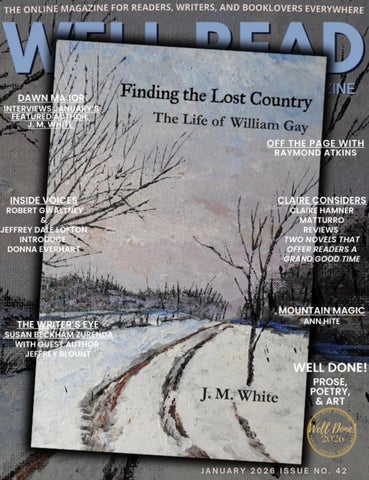
Finding the Lost County: The Life of William Gay by J. M. White Born in 1939 and raised in the rural south, other than his time in the Navy and a brief sojourn working in the factories in Chicago, he spent his whole life in middle Tennessee. He was raised in a sharecropper's shack with no electricity and no running water. His father never owned a car or a house. Tennessee ranks near the bottom of all the states in the union in terms of education and Lewis County ranks very low among the 92 counties in the state. He graduated from the Lewis County High School but was completely self-educated as both a writer and a painter. He was inspired by the writings of William Faulkner, Thomas Wolfe and Cormac McCarthy. He studied and wrote until he could match the great writers in the Southern literary tradition in the aesthetic power and intensity of their prose. He passed away at the age of 71 in 2012. William Gay was born to be a writer. For as long as he could remember he was fascinated by the written word and wanted nothing other than to write. He faced incredible odds but there was simply nothing else that he wanted to do and nothing else that he would do. He lived a hardscrabble earthly life, rugged and simple. He served his art and let his art serve him. He was creating something original, something high energy, cut to the bone, coming out of the dark with an element of danger, exploding on the page. He wrote prose that is heartfelt and melancholy, imbued with beauty and concern for all living things. In a world that didn't seem to care, he was an earth angel singing from some imaginary corner of the universe. His life and the books he created are a master class in the art of writing.
J. M. White did graduate study in Phenomenology at Duquesne University and holds an M.A. in philosophy from Vanderbilt. His poems, interviews, essays and book reviews have appeared in Exquisite Corpse, Sewanee Review, Parabola, Janus Head, and The Mirror as well as in magazines and journals in Canada, England, Romania, Italy, Japan and India. He has eighteen books in print including biographies of Keith Dowman, Khenchen Palden Sherab Rinpoche and now William Gay. He has a small independent press that specializes in works by William Gay and by himself. He published two books of short stories by William Gay while William was alive and oversaw the publication of five posthumous works from the William Gay Archive. His newest book of poetry is titled The Phenomenology of Nondual Awareness.
Did you miss last month’s issue? No worries, click here to find it as well as all the past issues.
HELLO READERS! LETTER FROM THE EDITOR
7
January’s FEATURED AUTHOR, J. M. White interviewed by Dawn Major
9
WHY YOU SHOULD ADVERTISE IN WELL READ
57
INSIDE VOICES Robert Gwaltney & Jeffrey Dale Lofton introduce Donna Everhart
59
MOUNTAIN MAGIC with Ann Hite
69
WELL DONE! PROSE, POETRY, AND ART
THROUGH THE LOOKING GLASS by Catherine Shields
77
LIFE SIGN by Deborah Z Adams
87
THE LIGHT MAN by B. A. Brittingham
95
HOW EDWIN BECAME STUBB by Mike Ross
101
IF SOMEONE ASKED… by Fhen M.
111
THE BRIGHTNESS OF YOUR SOUL by J. B. Hogan
115
CALL FOR SUBMISSIONS
119
JANUARY 2026 ISSUE NO. 42
5
LET’S REVIEW! CLAIRE CONSIDERS Two Novels that Offer Readers a Grand Good Time 121 THE WRITER’S EYE with guest author Jeffrey Blount
127
Cover design, interior formatting, and more
139
WHAT’S YOUR STORY?
145
OFF THE PAGE WITH RAYMOND ATKINS
147
If you enjoy this issue, and would like to support this online literary journal, please consider leaving a tip @wellread on Venmo’s site or PayPal-www.wellreadmagazine.com.
LETTER FROM THE EDITOR
JANUARY 2026 ISSUE NO. 42
7
“It’s been a long odyssey, but this ride isn’t over yet…”
Dawn Major interviews this month’s Featured Author, J. M. White 8
WELL READ MAGAZINE
January’s FEATURED AUTHOR, J. M. White interviewed by Dawn Major
Southern author, William Gay, hardly needs an introduction; he remains a valued figure in the world of Southern writing. What may need an introduction, however, is the effort devoted to preserving his legacy. A considerable portion of that work was taken up by Michael White, who has now chronicled Gay’s life in the biography, Finding the Lost Country: The Life of William Gay, by J. M. White. Gay’s legacy lives on not only through his works but also through the story that unfolded after his passing in 2012. I am honored to interview Michael White and to offer WELL READ readers a preview of the forthcoming biography.
Dawn Major: Readers and fans of William Gay not only get to learn more about William’s life and writing background, but also get to read passages from William’s memoirs, short stories, and novels. Would you describe your process and why you decided you write the biography in his manner? Michael White: William’s brother and his ex-wife both emphasized that much of William’s fiction was based on situations in his life. As I got to know the biographical details of his life and reread the novels and short stories, I began to see episodes in his fiction that were autobiographical and used them, paraphrased, in the biography. I changed the names and sometimes changed the
JANUARY 2026 ISSUE NO. 42
9
January’s FEATURED AUTHOR, J. M. White interviewed by Dawn Major
tense structure of the sentences but the material in the biography that is in italics is lifted from William’s writing, paraphrased to transform it from the fictional mode to the biographical mode. Each of these paraphrased sections is footnoted to reference them to their source in his books. As the story of his life unfolds, I included excerpts from his books to show what, and how, he was writing at each phase of his life. These quotes are indented and footnoted. These include materials from the William Gay archives that have not been previously published. DM: In 2017 when I was writing my critical thesis on William and interviewed you at the time you mentioned you planned to write his biography. Eight years later you did it. While William’s life ended in 2012, his legacy continues. Can you describe some of the ways in which you and Team Gay have kept his legacy alive? MW: It has been an incredible collaborative project that has resulted in the posthumous publication of four novels and a short story collection. The great majority of the manuscripts were handwritten in William’s scrawl, he didn’t cross his t’s or dot his i’s so we had to learn to decipher his handwriting. Many thanks are due to Susan McDonald and Sheila Kennedy who did the great bulk of the typing. Once we got everything typed Susan and Sheila helped with the editing and then Lamont Ingalls and Paul Nitsche came on board and helped immensely with every aspect of
10
WELL READ MAGAZINE
January’s FEATURED AUTHOR, J. M. White interviewed by Dawn Major
preparing the manuscript. Then as more time passed George Dilworth and Brodie Lowe, Randy Mackin, Matt Snope and Jon Sokol all contributed in one way or another. And I have to say that Dawn has been a long-standing member of the team. This team has promoted William’s work tirelessly. Paul Nitsche set up a very helpful webpage and Dawn and I have honored William’s legacy as a painter with a great month-long gallery show in Decatur, Georgia and made presentations at the Lost Southern Voices conference. DM: How did you structure the biography and what were your primary sources? MW: William died in 2012 and during the next few years I was working with a nonprofit organization in Hohenwald and was in and out of town nearly every month. Any time I was in Lewis County I would go by and visit with the family members. I said very early on that I wanted to write a biography of William, and they got used to me sitting around with a notebook on my knees writing while they were talking. They had seen William with a notebook on his knees writing for many years, so I guess they weren’t too surprised. I got to visit repeatedly with his ex-wife and his brother. Cody, his younger brother, has been a great help sharing stories about growing up together and reading the manuscript. I knew all William’s children and they all helped with memories of their childhood and sharing pictures. Then I was
JANUARY 2026 ISSUE NO. 42
11
January’s FEATURED AUTHOR, J. M. White interviewed by Dawn Major
really lucky to find “Tex” who was William’s best friend in the Navy, and he shared many stories of their times together on Naval destroyers off the coast of Vietnam. Then William’s literary friends, like Sonny Brewer and Ron Rash, shared a lot of stories of being on the literary circuit with William. DM: You were William’s friend and already knew a good deal about his background, but were there any big surprises of which you were unaware? No spoiler alerts, but maybe a teaser. MW: Yes, it was shocking to learn about his Navy experience. Even as a child William didn’t want to have anything to do with a gun or hunting and wouldn’t even kill a bug. He seemed to have a natural reverence for all life. When he went in the Navy they gave everyone a basic IQ test and William scored through the roof and they trained him to work with the very early computers they were using to aim the damn eight-inch guns on the boat. He ended up sitting in a little room deep in the bowels of the ship feeding data into the computer which gave him back the coordinates where they should aim the guns so he would set the guns and then push a trigger to fire the guns. When the guns fired it shook the whole ship and the paint would flake off the ceiling and rain down. They were off the coast of Vietnam providing cover for the Marines and Army guys who were in combat and they would get daily reports of the number of people killed and villages destroyed. I have wondered how William was able to handle that and he was definitely ready to
12
WELL READ MAGAZINE
January’s FEATURED AUTHOR, J. M. White interviewed by Dawn Major
get out after serving his four years. And then the stories of his sexual adventures during the Navy years are quite wild. DM: It never seems to quite end when it comes to William Gay. I know there’s some news about future publications. Would you care to share what fans can look forward to? MW: It’s been a long odyssey, but this ride isn’t over yet. William was a remarkable person and a remarkable writer so it seems very possible that he will have a legacy and could find a place in the canon of American literature. William started writing as a teenager and never stopped. He wrote his first novel at age twenty-five and it survived. It is scheduled for publication in 2026. There is also a collection of short stories that he wrote while he was in the Navy and soon after he got out. But all this material is his “early works” while he was evolving his style. The material dates from the 1960s. By the late 1970s his style had matured and he was writing at the top of his game. Ironically, it wasn’t until 1998 that anything got published and fame followed quickly on its heels. William was a painter as well as a writer, and painted all of his life, primarily landscapes, so it would be great to have an art book someday. DM: It’s been almost thirteen years since William passed away. How does it feel to finally put the biography out now?
JANUARY 2026 ISSUE NO. 42
13
January’s FEATURED AUTHOR, J. M. White interviewed by Dawn Major
MW: As a writer I typically have several projects in various stages of completion and as one of them gets close to the finish line it gets more attention. It feels great to get this biography in print; these things take many years to research and write. This was my fourth biography, so I enjoy this kind of writing, and it seems like a natural outgrowth of studying the works of the great writers and digging into their lives. I like to provide a lot of secondary information as well and this biography includes a series of appendices that include an interview with William, his correspondence with Cormac McCarthy, a bunch of pictures, a few examples of his unpublished prose from the archive, and a bibliography. DM: On behalf of myself and WELL READ Magazine thank you for the interview and also for your dedication to preserving William Gay’s work. We wish you all the best with the biography and future projects.
14
WELL READ MAGAZINE
January’s FEATURED AUTHOR, J. M. White interviewed by Dawn Major
Excerpt from Finding the Lost Country: The Life of William Gay As children William and his little brother had a path through the woods from their house to their grandparents’ home. As they walked between the two houses, William would make up stories and tell them to Cody. He had a fascination with Westerns and would tell Cody stories about the adventures of the Cowboy Kid. When they got to their grandparents’ house they would come through the back door: …into the long narrow kitchen, enthralled by the myriad smells of the kitchen, the coffee and cloves and cinnamon, the heavy fruity odor of basketed apples and the faintly sour smell of dried peaches and other odors, rich and dark and mysterious. It was the odor of time itself, of days the old couple had stacked into years as carefully as a mason lays one stone atop another. Their grandmother claimed Cherokee blood and William studied her and had no reason to doubt it. The thin gray hair pulled tightly into a bun behind her head had once been as black as shoepolish, her eyes fiercely alive, her tiny body barely containing the energy that animated her every waking moment. With her leathery face and beaked nose she looked less like an Indian
JANUARY 2026 ISSUE NO. 42
15
January’s FEATURED AUTHOR, J. M. White interviewed by Dawn Major
woman than some old chief, the repository of the summed knowledge of all his forebearers had passed on by the flickering light of council fires. (Provinces of Night) By the time William was in second grade his two brothers had been born, Cody had been born in 1943 and then Bradley in 1946. The schoolhouse was a simple one-room affair. It didn’t have electricity or running water and had two outhouses by the creek. The schoolhouse served all the families living on Grinder Creek Road. There were sixteen students in the one room with little more than the desks and a wood-burning heater. The schoolteacher knew all the kids and had helped to deliver many of them, including William. They were learning how to read and write and that was about it. The rest of the time they could play outside. They didn’t have school buses; all the kids walked to school. William lived just down the creek from the schoolhouse, so it was an easy matter walking to school. While they were at school, if a wagon drove by, all the kids would run to the window and watch. It was the only show in town and all the kids would stand at the window and stare and wonder who it was and speculate about what they were up to. There was a girl in class named Berlene and when she didn’t know a word in her schoolbook she would ask William. Once she pointed to the word “smoke” and William, in a mischievous mood, told her it was the word “monkey.” Later that day the teacher asked Berlene to
16
WELL READ MAGAZINE
January’s FEATURED AUTHOR, J. M. White interviewed by Dawn Major
read from her book and she talked about the monkeys coming out of the chimney. Because William was such a dedicated reader, they let him use the library before he got to high school. He had a special feeling in the library: On one visit the librarian gave him an old beat-up copy of Huck Finn that had the cover torn off. The library was discarding it and she gave it to William. It was the first book he loved so much he rationed the pages when he was nearing the end, allowing himself ten pages a day. The book thrilled and amazed him. It was as if he was there with Jim and Huck on the sunrimpled Mississippi. He could almost smell the hot torpor of the river and see the country sliding past, until he was hopelessly snared by Twain, forced to seek out the book in surreptitious moments during the day. He was enthralled by the wild humor of Pap’s drunken monologues, the doings of the Duke and the King’s Royal Nonesuch, the moment of revelation when Huck says, Alright, I’ll go to hell then. In later years he felt like the book falls off toward the end once Tom Sawyer shows up, but it’s still a great book. Hemingway said that all American writing came from Huckleberry Finn. Even as an adult he saw no reason to dispute that. (Stories From The Attic)
JANUARY 2026 ISSUE NO. 42
17
January’s FEATURED AUTHOR, J. M. White interviewed by Dawn Major
He also found an old copy of Tarzan of the Apes. These were some of his first books and he treasured them and read them over and over. He would read anything he could get his hands on. It didn’t matter if it was a comic book, a magazine or a book. In the fourth grade he got a cheap paperback copy of a used dictionary. He started reading on the first page and immediately loved it. He sat up at night reading it page after page, A to Z, until he had read the whole thing and then started over again, memorizing words that he didn’t know but somehow knew that he wanted to use. He would spend his lunch money buying books at the local drugstore where they had a revolving rack of paperbacks. He was reading all the popular writers who showed up there like Earle Stanley Gardner, Rex Stout, Nero Wolfe and Ross Macdonald, along with Zane Grey. At school William stayed to himself. The teachers hardly knew he was there, he wasn’t disruptive and didn’t play sports. His love of reading was apparent to his teachers. In the seventh grade he had a teacher named William Johnson who realized that he had a special talent and started working with him. Mr. Johnson could see William beginning to blossom. Mr. Johnson had a literary side, and he began to show William some of the books that he would fall in love with. He was a patient dedicated teacher who inspired William and opened doors for him. William got so inspired after Mr. Johnson gave him a copy of Look Homeward, Angel that he went to the local drugstore and got a three-ring binder filled with lined pages. At home, the family had
18
WELL READ MAGAZINE
January’s FEATURED AUTHOR, J. M. White interviewed by Dawn Major
no interest in pens or paper, but William found an old refillable fountain pen. It had a lever on the side that, when you put the point of the pen in an inkwell and lifted the lever it drew ink up into the bladder in the pen and you could write until you emptied the bladder and had to return to the inkwell. The only problem was he had no ink and no place to find any. There were walnut trees growing by the side of the creek in front of the house and he took the hulls of the walnut and soaked them until the water took up a dark brown stain. He sieved the dark stained water through a cloth and found it made a good substitute for ink. He loaded the pen and posed it at the top of the first blank page and wrote the word, Novel, below that he wrote East of the Sun, West of the Moon. It gave him a great sense of satisfaction as he watched the words form on the page. He wrote: In a scant few minutes a column of smoke lifted from the butte to the north. The blue smoke rose slowly in the warm air and hung motionless. Then another small cloud arose following the last. For a moment he was struck dumb. Then he turned and stared at his partner. His voice shook slightly as he spoke, ‘Do you know what that means? Apache!’ (Unpublished, William Gay Archive) He continued writing the adventures of the Cowboy Kid that he had been telling his brother Cody on their walks. He eventually
JANUARY 2026 ISSUE NO. 42
19
January’s FEATURED AUTHOR, J. M. White interviewed by Dawn Major
filled the notebook on one side of the page. When he got to the end, he turned it over and wrote on the back side of the paper and filled those pages until every page was filled. It was a habit he maintained for the rest of his life, filling one notebook after another on both sides of the page. It took him a couple of years to fill the notebook and he put a date at the end, 1956. He cherished that old notebook and carried it with him through all the moves he made and had it in his papers when he died. Growing up in rural Tennessee knowing he was going to be a writer, he was especially interested in authors who were chronicling the American South. Caldwell and some of the others seemed to be writing about shoddy caricatures devised solely to titillate and sell books: He came upon Faulkner in his early teens. Someone who recognized William’s love of reading had given him a bag of paperbacks, most of which had lurid covers that enticed you inside. There was a copy of Sanctuary in the bottom of the bag with the cover depicting a young woman, presumably Temple Drake, sprawled backward on a pile of hay. Her clothes partially ripped open and a man looming in the foreground, his back to the reader’s eyes. His intentions seem clear. William could see that the genius of these books was that, while people read them for the sex scenes promised by the covers, reading them actually gave them an education in literature. The
20
WELL READ MAGAZINE
January’s FEATURED AUTHOR, J. M. White interviewed by Dawn Major
ghosts of Anse Bundren and the other characters in Faulkner’s novels gave him the template and became like echoes that showed up in the work of many of the writers he was reading, and later in his own. The wry comments and ironic humor of storekeepers and country doctors that Faulkner seems to have invented and patented was immediately recognizable, William knew people who talked and acted like the characters in Faulkner’s books. (Stories From the Attic) William could see that if Faulkner were able to create this panoramic vision of his little postage stamp of earth, that he could do the same with the area where he was growing up. Faulkner had named his county Yoknapatawpha and its county seat Jefferson, which was his stand-in for Oxford, Mississippi: Stories Faulkner told about the residents of Yoknapatawpha took on the quality of myth, where real events are turned to legend by the alchemy of their constant retelling. The characters were able to take the world as it is and accept it on its own terms with a stoic bemusement. Misfortune and ill luck are recounted with an almost bland equanimity. Fate is treated with a kind of rueful acceptance. (Stories From The Attic) This resonated with William. It was exactly the way he felt about life, or at least the way he wanted to feel about life, and the way he trained himself to feel. He felt like when the tab is added up for the outrage and folly of most lives, the sum will be enormous. It is
JANUARY 2026 ISSUE NO. 42
21
January’s FEATURED AUTHOR, J. M. White interviewed by Dawn Major
indeed hard to pay the toll, impossible, and that impossibility was simply the circumstances of his life and, now that he knew it, he wanted nothing more than to express it in his writing. It was only when he started reading Faulkner that he found a depiction of country people who seemed as real as the neighbors and family members: …he was growing up around Faulkner never stooped to characterize them, Faulkner’s characters felt like actual people. They were like the people around him, he felt like he had known people like them, heard their voices. Though Faulkner wrote at times about depraved people doing depraved things, he never denied his characters their basic humanity. He wasn’t condescending to them, and he always allowed them whatever modicum of dignity they were entitled to. His humor and compassion were always in evidence, and it set the bar for William. (Stories From The Attic) When he read As I Lay Dying he thought it was Faulkner’s most perfect novel. He read every word of every one of Faulkner’s books. He was enthralled with The Sound and the Fury, but he read As I Lay Dying over and over and would return to it every year, rereading it for the mythic sweep of the story and the sheer beauty of the language. William recognized moments in Faulkner when
22
WELL READ MAGAZINE
January’s FEATURED AUTHOR, J. M. White interviewed by Dawn Major
his rhetoric evokes Shakespeare, or Homer, or the Old Testament. And yet he managed to do it without his narrators ever stepping out of character as they spoke or thought in letter-perfect dialogue that is always true to who they are. He was most happy when he was in the barn loft by himself, writing in a notebook. Other times he would go out in the fields around the house and just sit and read a book. There was a place he liked where the woods ended abruptly, and the fields began. He could sit under the thick viney undergrowth awash with bird-song, feeling lazy in the sun. He marveled at how new grass shades the rolling slopes with the palest of green. He watched blackbirds burnished by the noon sun gleaming like silvered contrivances. He worked on his first stories for a long time. He recognized that the writing wasn’t any good, but something told him that he would have to do a lot of bad writing before he could do any good writing. Even then he started out using his own brand of punctuation. He quickly came to the conclusion that writers should be allowed no exclamation points, three semi-colons, no quotation marks, and very few commas for a lifetime. He wrote and wrote and wanted nothing else but to sit and write.
JANUARY 2026 ISSUE NO. 42
23
January’s FEATURED AUTHOR, J. M. White interviewed by Dawn Major
About J.M. White: J.M. White is a dues-paying member of the underground, a literary outlaw with jail time to prove that he is not as smart as he thinks, a multiple divorcee, hardheaded, incorrigible, contentious, cantankerous, and contrary, guilty of everything, he is a patently anti-authoritarian, anti-religious, antiestablishment currently hiding out on the back roads of middle Tennessee.
Dawn Major’s book, The Bystanders, was a finalist for 2024 Georgia Author of the Year for Best First Novel. Major is an associate editor at Southern Literary Review and a co-editor at WELL READ Magazine and serves on the board at Broadleaf Writers Association. In addition, Major is a member of the Horror Writers Association and a member of M’ville, an Atlanta-based artist salon. Major is also part of Team Gay, a group dedicated to preserving the legacy of the late author William Gay. She lives in Atlanta, GA with her family and is currently working on a horror novel called Chronicles in Dandy Land. For a list of publications and to learn more about Major visit www.dawnmajor.com.
24
WELL READ MAGAZINE
January’s FEATURED AUTHOR, J. M. White interviewed by Dawn Major
JANUARY 2026 ISSUE NO. 42
25
If Bookshop.org is your preferred way to purchase books online check out WELL READ’s bookshop.
You can find books from past issues as well as current books to add to your reading list. Happy reading!
WHAT ARE YOU READING?
Small Town Witch Deborah Z Adams
by
Small Town Witch, a new chapbook from awardwinning author Deborah Z Adams, is a collection of spell-binding tales about the witches we meet every day. Written with warmth, humor, and a little bite, Small Town Witch is packed with more substance than meets the eye. “Adams’s witches may inhabit a small town, perhaps your small town, but they are not small women. They are powerful and empowering. You’ll root for these women, these coven leaders and elementary school teachers. Two parts poetry, two parts prose, with a healthy pinch of feminist indignation, Adams’s tales will surely charm you and remind you that you’re “not in this fight alone.’” —Joanna Grisham, author of Phantoms (Finishing Line Press, 2023)
30
WELL READ MAGAZINE
ADD TO YOUR TBR LIST
Available from your favorite bookseller! All proceeds from sales of Small Town Witch are donated to organizations that do good in the world.
You can sample Small Town Witch stories here.
“I’ve lived my life surrounded by women who wield their powers quietly but effectively,” says Adams. “They’re everywhere, but especially prevalent in small towns.” Deborah Z Adams is an awardwinning author of novels, short fiction, CNF, and poetry. She served as executive editor of Oconee Spirit Press for ten years, and is currently a reader for Boomerlit. Her writing has appeared or is forthcoming in Roanoke Review, Litmosphere: a journal of Charlotte Lit, WELL READ Magazine, Dead Mule and other journals.
JANUARY 2026 ISSUE NO. 42
31
Someone or something lurks around every corner, but K.P. Davis's characters have come prepared. These are women carrying on their daily struggles in a dangerous world, striving and searching for safety. They include Nell, an antisocial, nomadic, shade-tree mechanic and getaway driver; 'Bula, an odd girl who talks to animals; and a whole host of others who follow lonely paths spreading empathy while kicking ass. The endings aren't always happy, and these women have plenty of reasons to be afraid, but they keep on going. The twenty sharp, poignant, and biting stories in Trust Issues comprise a stunning beacon for hard-headed folk fighting to be heard when nobody listens.
Trust Issues: Stories K. P. Davis
WHAT ARE YOU READING?
The Wildes: A Novel in Five Acts by Louis Bayard In this singularly powerful novel, bestselling author Louis Bayard brings Oscar Wilde's wife Constance and two sons out from the shadows of history and creates a vivid and poignant story of secrets, loss, and love. In September of 1892, Oscar Wilde and his family have retreated to the idyllic Norfolk countryside for a holiday. His wife, Constance, has every reason to be happy: two beautiful sons, her own work as an advocate for feminist causes, and a delightfully charming and affectionate husband and father to her children, who also happens to be the most sought-after author in England. But with the arrival of an unexpected houseguest, the aristocratic young poet Lord Alfred Douglas, Constance gradually--and then all at once--comes to see that her husband's heart is elsewhere and that the growing intensity between the two men threatens the whole foundation of their lives. "Wonderfully researched, beautifully crafted, movingly told, The Wildes is a treasure to read." --Andrew Sean Greer, Pulitzer Prize-winning author of Less and Less Is Lost
34
WELL READ MAGAZINE
ADD TO YOUR TBR LIST
Gap Year: A Novel by Lindsey Goldstein Escape with Jane in a heartfelt and hilarious women’s fiction book about a woman redefining herself. It’s her turn to have the adventure of a lifetime… Jane’s life is turned upside down within forty-eight hours: her only child leaves for a year abroad, her husband abandons her for another woman, and her boss issues her an ultimatum. She makes a bold, impulsive choice—she’s leaving it all behind for an adult version of her daughter’s “gap year.” Once a hopeful young ecologist, Jane dreams of climbing a volcano and working in the Galapagos—but life got in the way. Now, nothing stands between her and the adventure she abandoned years ago. Sleeping in a hostel bunk bed surrounded by people at least twenty years younger, she befriends Laura, a fellow traveler determined to scale the volcano. Together, they doggedly train for the summit. Jane also meets Mark, a charming tour guide whose quick wit and sparkling eyes threaten to derail her identity quest. As Jane pushes her physical and emotional limits, she seeks answers to the burning question: “What the hell should I do with the rest of my life?”
JANUARY 2026 ISSUE NO. 42
35
Silence has a way of settling in after tragedy. It arrives quietly—through unanswered questions, closed doors, and systems that protect themselves rather than the people they serve. In Who Turned Up the Silence, Andy Turner invites readers to step inside the moment where personal grief collided with institutional failure—and where choosing silence was no longer an option. Read it. Share it. Talk about it.Because silence protects no one.
WHAT ARE YOU READING?
Andre and Rax can’t wait for their work-study in Alaska, but everything falls apart when their plane crashes. With their bosses critically injured, the boys must face Alaska on their own. But it isn’t the wildlife that threatens them. For Andre, it is a mysterious woman from his past with a dire warning about his daughter. Rax must face his toxic, abusive partner and be forced to choose between obeying his lover or risking a provocative video being leaked. Amid the chaos, Andre encounters strange, new feelings toward Leo’s niece and Rax must plan a fast wedding. When a friend confesses she had the urge to pray for them, Andre wonders if this God, and his friend's love, is legit. But when a trafficking gang comes after his daughter, he realizes he needs something bigger than himself to fight this battle.
Andre Collinger, a teen heroin addict, is marked as disposable by the gang that trafficked him for profit, so he goes on the run, abandoning his infant daughter in hopes that she can remain safe. Leaving Charlotte, he finds himself in Atlanta where he befriends Leo, a hardened veteran with a heart for struggling youth, and Rax, who has chosen to leave his faith to enjoy his life. When two detectives show up, asking Andre about a dead prostitute and a missing baby, he is forced to make some hard decisions while Rax comes to realize that in some situations, God is the only answer.
38
WELL READ MAGAZINE
ADD TO YOUR TBR LIST
Sokoras. A frigid, icy region of endless winter where weakness invites death, or worse, undeath. Leif, a Sokoran Ranger has a choice to make against a creature he barely understands. But with every decision, subversive shadows nip at his heels, calling him towards death. Mangarmyr, an ancient wolf spirit, fights a world plagued by darkness. He is alone... searching for a love powerful enough to save him. Finn, a Sokoran Ranger, is trapped behind enemy lines fighting for his life. Hunted for sport, he must use all his knowledge and skill to make it across the border to safety.
At Colorful Crow Publishing, our mission is to amplify diverse voices and champion stories that resonate across communities. We believe every story matters, and we are dedicated to creating a welcoming, supportive platform for authors to share their unique perspectives. By fostering a collaborative environment, we aim to publish works that inspire, connect, and make a lasting impact on readers everywhere.
JANUARY 2026 ISSUE NO. 42
39
An experienced adventurer partners with an innocent nineteen-year-old to plan a journey on the most dangerous river in the world. What starts as one man’s dream ends up as another man’s nightmare. It was a time when pushing our limits knew no boundaries and being nineteen had no restrictions.
Bob Kunzinger as an especially gifted writer who is able to engage and keep his reader’s thoughtful attention from beginning to end. —Midwest Book Reviews
WHAT ARE YOU READING?
Bringing Gills’ Go Love novel sequence to a fiery close, BC1 lays down the Harvell grudge of Mountain Meadows and aims, finally, at healing for all involved. Lara Luce Harvell has been charged with carrying her late father’s prized Martin D-28, handmade in Nazareth, Pennsylvania in 1998, the same year she was born, to Mr. Edgar Paris in Dinnehotso, Arizona. Such is repayment to him for saving Joey’s right index finger when it got bit off in an Arkansas fight. The resulting journey, part dynamite, revenge, and the tenderness of love, wanders into the lands of the woolly-headed Washers, a whole tribe of wandering relatives who “…inhabited the desert, living in trailer parks from Tuba City to Las Vegas, pumping five dollars’ worth of regular at a time into jalopies that overheated and ran on threadbare tires.”
Dreaminations is a collection of prose poems in haibun or tanka prose style. Haibun or tanka prose links prose and haiku or tanka to complement each other through juxtaposition to gain a new sensibility, an insight into a significant moment. The linked forms also stand independently with their complete meanings that present two views of each moment, inviting the reader to leap in between for an aesthetic appreciation. That’s the uniqueness of haibun and tanka prose and the fascination of writing them. This collection explores the self and the world through the working of the senses. It is a quest about where to posit the self and how a human being gains learning from nature and human nature.
42
WELL READ MAGAZINE
ADD TO YOUR TBR LIST
Twenty Years of PoemoftheWeek.com is a compilation of the best of the poems that have been featured by PoemoftheWeek.com over the course of the past twenty years. Each celebration includes interviews with the poet, reviews of the collection, readings from the book, and other supplementary material that broadens the scope of the conversation between the poet and their work with the general public. PoemoftheWeek.com is an essential resource for writers, teachers, and anyone interested in contemporary American (mostly) arts and letters. For more information, contact Andrew at Andrew@PoemoftheWeek.com.
MADVILLE PUBLISHING seeks out and encourages literary writers with unique voices. We look for writers who express complex ideas in simple terms. We look for critical thinkers with a twang, a lilt, or a click in their voices. And patois! We love a good patois. We want to hear those regionalisms in our writers’ voices. We want to preserve the sound of our histories through our voices complete and honest, dialectal features and all. We want to highlight those features that make our cultures special in ways that do not focus on division, but rather shine an appreciative light on our diversity.
JANUARY 2026 ISSUE NO. 42
43
WHAT ARE YOU READING?
In the Best of 2024 Volume One, you’ll find fifty-one submissions written by a fantastic mix of awardwinning authors and poets plus new ones to the scene. Three submissions in this volume were nominated for a Pushcart Prize: The Hanging by Doug Gray, Sandy Tells Me About Dead Pine Trees by J.D. Isip, and Wilma by Phyllis Gobbell. The cover art is by artist, Lindsay Carraway, who had several pieces published in February of 2023.
Contributors: Carolyn Haines, Doug Gray, Angela Patera, Kimberly Parish Davis, Michael Spake, Jennifer Smith, Ashley Tunnell, Ken Gosse, Dr. Elizabeth V. Koshy, Ann Hite, Ellen Notbohm, Micah Ward, Malcolm Glass, Katie Crow, Lorraine Cregar, Patricia Feinberg Stoner, John M. Williams, Michael Lee Johnson, J.D. Isip, Casie Bazay, Jacob Strunk, Ann Christine Tabaka, Joan McNerney, Fhen M., Steven Kent, Peter Magliocco, Mark Braught, Rita Welty Bourke, Loretta Fairley, Barbara Anna Gaiardoni, S. Dodge, DeLane Phillips, Candice Marley Conner, Arvilla Fee, J. B. Hogan, Ramey Channell, Hope Kostedt, John Grey, Martha Ellen Johnson, Nancy Chadwick-Burke, Mike Coleman, Margaret Pearce, Nicole Irizawa, Donald Edwards, Janet Lynn Oakley, Mandy Jones, Phyllis Gobbell, and Suzanne Kamata
44
WELL READ MAGAZINE
ADD TO YOUR TBR LIST
In the Best of 2024 Volume Two, you’ll find fifty-two submissions written by a fantastic mix of awardwinning authors and poets plus new ones to the scene. Three submissions in this volume were nominated for a Pushcart Prize: Hanging Pictures by Micah Ward, The Lone and Level Sands by James Wade, and American Chestnut by Candace Connor. The cover art is by artist, Lindsay Carraway, who had several pieces published in February of 2023.
Contributors: Candice Marley Conner, Kaye Wilkinson Barley, Mike Ross, Will Maguire, AJ Concannon, Patricia Feinberg Stoner, Gregg Norman, Robin Prince Monroe, Ramey Channell, April Mae M. Berza, Anne Leigh Parrish, B. A. Brittingham, Mike Austin, Sara Evelyne, Jennifer Smith, Loretta Fairley, J.L. Oakley, Celia Miles, Kris Faatz, Ed Nichols, Linda Imbler, Annie McDonnell, Mike Turner, Micah Ward, James Wade, Ashley Tunnell, John M. Williams, Robb Grindstaff, Stevie Lyon, Laura McHale Holland, Saeed Ibrahim, Nancy Julien Kopp, Julie Green, DeLane Phillips, Shayla Dodge, Edilson Afonso Ferreira, Chris Wood, Jasna Gugić, Fhen M., Hubert Blair Bonds, Ellen Birkett Morris, Margaret Pearce, Ellen Notbohm, Kimberly Parish Davis, J. B. Hogan, and Royal Rhodes
JANUARY 2026 ISSUE NO. 42
45
WHAT ARE YOU READING?
In Volume One, you’ll find thirty-eight submissions written by a fantastic mix of awardwinning authors and poets plus new ones to the scene. Three submissions in this volume were nominated for a Pushcart Prize: Miller’s Cafe by Mike Hilbig, Sleeping on Paul’s Mattress by Brenda Sutton Rose, and A Hard Dog by Will Maguire. The cover art is by artist, Lindsay Carraway, who had several pieces published in February’s issue. Contributors: Jeffrey Dale Lofton, Phyllis Gobbell, Brenda Sutton Rose, T. K. Thorne, Claire Hamner Matturro, Penny Koepsel, Mike Hilbig, Jon Sokol, Rita Welty Bourke, Suzanne Kamata, Annie McDonnell, Will Maguire, Joy Ross Davis, Robb Grindstaff, Tom Shachtman, Micah Ward, Mike Turner, James D. Brewer, Eileen Coe, Susan Cornford, Ana Doina, J. B. Hogan, Carrie Welch, Ashley Holloway, Rebecca Klassen, Robin Prince Monroe, Ellen Notbohm, Scott Thomas Outlar, Fiorella Ruas, Jonathan Pett, DeLane Phillips, Larry F. Sommers, Macy Spevacek, and Richard Stimac
46
WELL READ MAGAZINE
ADD TO YOUR TBR LIST
In Volume Two, you’ll find fortythree submissions written by a fantastic mix of award-winning authors and poets plus new ones to the scene. Three submissions in this volume were nominated for a Pushcart Prize: A Bleeding Heart by Ann Hite, A Few Hours in the Life of a Five-Year-Old Pool Player by Francine Rodriguez, and There Were Red Flags by Mike Turner. The cover art for Volume Two is by artist, DeWitt Lobrano, who had several pieces published in November’s issue. Enjoy!
Contributors: Ann Hite, Malcolm Glass, Dawn Major, John M. Williams, Mandy Haynes, Francine Rodriguez, Mike Turner, Mickey Dubrow, William Walsh, Robb Grindstaff, Deborah Zenha Adams, Mark Braught, B. A. Brittingham, Ramey Channell, Eileen Coe, Marion Cohen, Lorraine Cregar, John Grey, J. B. Hogan, Yana Kane, Philip Kobylarz, Diane Lefer, Will Maguire, David Malone, Ashley Tunnell, Tania Nyman, Jacob Parker, LaVern Spencer McCarthy, K. G. Munro, Angela Patera, Micheal Spake, George Pallas, Marisa Keller, Ken Gosse, and Orlando DeVito
JANUARY 2026 ISSUE NO. 42
47
WHAT ARE YOU READING?
They All Rest in the Boneyard Now by Raymond L. Atkins (Author), Evelyn Mayton (Illustrator) “Raymond Atkins writes with intuitive wisdom, as he channels those from beyond the grave. His poetry gives voice to those who once mattered, those who time wants us to forget. In They All Rest in the Boneyard Now, Atkins wrestles death from the dusty clay and breathes life into dry bones while reminding us that every soul who once had breath is worthy of being remembered. These saints, sinners, socialites, and the socially inept are all victims of time, or circumstance, as we too shall one day be. Atkins offers salvation to all who are tormented, and solace to those who seek eternal rest.” – Renea Winchester, Award-winning author of Outbound Train
48
WELL READ MAGAZINE
ADD TO YOUR TBR LIST
The Cicada Tree by Robert Gwaltney The summer of 1956, a brood of cicadas descends upon Providence, Georgia, a natural event with supernatural repercussions, unhinging the life of Analeise Newell, an eleven-year-old piano prodigy. Amidst this emergence, dark obsessions are stirred, uncanny gifts provoked, and secrets unearthed. During a visit to Mistletoe, a plantation owned by the wealthy Mayfield family, Analeise encounters Cordelia Mayfield and her daughter Marlissa, both of whom possess an otherworldly beauty, a lineal trait regarded as that Mayfield Shine. A whisper and an act of violence perpetrated during this visit by Mrs. Mayfield all converge to kindle Analeise’s fascination with the Mayfields. Analeise’s burgeoning obsession with the Mayfield family overshadows her own seemingly, ordinary life, culminating in dangerous games and manipulation, setting off a chain of cataclysmic events with life-altering consequences—all of it unfolding to the maddening whir of a cicada song.
JANUARY 2026 ISSUE NO. 42
49
WHAT ARE YOU READING?
Haints on Black Mountain: A Haunted Short Story Collection by Ann Hite Ann Hite takes her readers back to Black Mountain with this haunted short story collection. An array of new characters on the mountain experience ghostly encounters. The collection took inspiration from her beloved readers, who provided writing prompts. Wrinkle in the Air features Black Mountain's Polly Murphy, a young Cherokee woman, who sees her future in the well's water. Readers encounter relatives of Polly Murphy as the stories move through time. The Root Cellar introduces Polly's great grandson, who tends to be a little too frugal with his money until a tornado and Polly's spirit pays the mountain a visit. In The Beginning, the Middle, and the End, readers meet Gifted Lark on an excessively frigid January day. This story moves back and forth between 1942 and 1986 telling Gifted and her grandmother Anna's story. This telling introduces spirits that intervene in the spookiest of ways. 50
WELL READ MAGAZINE
ADD TO YOUR TBR LIST
Red Clay Suzie by Jeffrey Dale Lofton A novel inspired by true events. The coming-of-age story of Philbet, gay and living with a disability, battles bullying, ignorance, and disdain as he makes his way in life as an outsider in the Deep South—before finding acceptance in unlikely places. Fueled by tomato sandwiches and green milkshakes, and obsessed with cars, Philbet struggles with life and love as a gay boy in rural Georgia. He’s happiest when helping Grandaddy dig potatoes from the vegetable garden that connects their houses. But Philbet’s world is shattered and his resilience shaken by events that crush his innocence and sense of security; expose his misshapen chest skillfully hidden behind shirts Mama makes at home; and convince him that he’s not fit to be loved by Knox, the older boy he idolizes to distraction. Over time, Philbet finds refuge in unexpected places and inner strength in unexpected ways, leading to a resolution from beyond the grave.
JANUARY 2026 ISSUE NO. 42
51
WHAT ARE YOU READING?
The Smuggler's Daughter by Claire Matturro Ray Slaverson, a world-weary Florida police detective, has his hands full with the murders of two attorneys and a third suspicious death, all within twenty-four hours. Ray doesn’t believe in coincidences, but he can’t find a single link between the dead men, and he and his partner soon smash into an investigative stonewall. Kate Garcia, Ray’s fiancée, knows more than she should. She helped one of the dead attorneys, just hours before he took a bullet to the head, study an old newspaper in the library where she works. Kate might be the only person still alive who knows what he was digging up— except for his killer. When Kate starts trying to discover what’s behind the murders, she turns up disturbing links between the three dead men that track back to her family’s troubled past. But she has plenty of reasons to keep her mouth shut. Her discovery unleashes a cat-and-mouse game that threatens to sink her and those she loves in a high tide of danger.
52
WELL READ MAGAZINE
ADD TO YOUR TBR LIST
The Bystanders by Dawn Major The quaint town of Lawrenceton, Missouri isn’t sending out the welcoming committee for its newest neighbors from Los Angeles—the Samples’ family. Shannon Lamb’s “Like a Virgin” fashion choices, along with her fortune-telling mother, Wendy Samples, and her no-good, cheating, jobless, stepfather, Dale Samples, result in Shannon finding few fans in L-Town where proud family lines run deep. Only townie, Eddy Bauman, is smitten with Shannon and her Valley Girl ways. The Bystanders is a dark coming-of-age story set in the 1980s when big hair was big, and MTV ruled. In a quiet town of annual picnics and landscapes, the Samples’ rundown trailer and odd behaviors aren’t charming the locals. Shannon and Wendy could really use some friends but must learn to rely upon themselves to claw their way out of poverty and abuse if they want to escape Dale. The Bystanders pays homage to Americana, its small-town eccentricities, and the rural people of the Northern Mississippi Delta region of Southeast Missouri, a unique area of the country where people still speak Paw Paw French and honor Old World traditions.
JANUARY 2026 ISSUE NO. 42
53
WHATWHAT ARE YOU READING? ARE YOU READING?
The Girl from the Red Rose Motel: A Novel by Susan Beckham Zurenda Impoverished high school junior Hazel Smalls and privileged senior Sterling Lovell would never ordinarily meet. But when both are punished with in-school suspension, Sterling finds himself drawn to the gorgeous, studious girl seated nearby, and an unlikely relationship begins. Set in 2012 South Carolina, the novel interlaces the stories of Hazel, living with her homeless family in the rundown Red Rose Motel; Sterling, yearning to break free from his wealthy parents' expectations; and recently widowed Angela Wilmore, their stern but compassionate English teacher. Hazel hides her homelessness from Sterling until he discovers her cleaning the motel's office when he goes with his slumlord father to unfreeze the motel's pipes one morning. With her secret revealed, their relationship deepens. Angela-who has her own struggles in a budding romance with the divorced principal-offers Hazel the support her family can't provide. Navigating between privilege and poverty, vulnerability and strength, all three must confront what they need from themselves and each other as Hazel gains the courage to oppose boundaries and make a bold, life-changing decision at novel's end.
54
WELL READ MAGAZINE
ADD TO ADD TO YOUR TO YOUR TBR LIST TBR LIST
The Best of the Shortest: A Southern Writers Reading Reunion by Suzanne Hudson (Author, Editor), Mandy Haynes (Editor), Joe Formichella (Author, Editor) “Some of the happiest moments of my writing life have been spent in the company of writers whose work is included in these pages. They all brought their A-game to this fabulous collection, and at our house it is going on a shelf next to its honored predecessors. The only thing that saddens me is that the large-hearted William Gay is not around to absorb some of the love that shines through every word.” ―Steve Yarbrough “The Best of the Shortest takes the reader on a fast-paced adventure from familiar back roads to the jungles of Viet Nam; from muddy southern creek banks to the other side of the world, touching on themes as beautiful as love and as harsh as racism. However dark or uplifting, you are guaranteed to enjoy the ride.” --Bob Zellner “I had some of the best times of my life meeting, drinking and chatting with the writers in this book, times matched only by the hours I spent reading their books. This collection showcases a slice of Southern literature in all its complicated, glorious genius. Anyone who likes good writing will love it.” --Clay Risen
JANUARY MARCH 2025 2026ISSUE ISSUENO. NO.32 42
55
WHAT ARE YOU READING?
Walking The Wrong Way Home by Mandy Haynes Spanning nearly twenty decades, the struggles and victories these characters face are timeless as they all work towards the same goal. A place to feel safe, a place to call home.
Sharp as a Serpent's Tooth: Eva and other stories by Mandy Haynes Each story features a female protagonist, ranging from ten to ninety-five years of age. Set in the south, you’ll follow these young women and girls as they learn that they’re stronger than they ever thought possible.
56
WELL READ MAGAZINE
ADD TO YOUR TBR LIST
Oliver by Mandy Haynes “Dear God…and Jesus and Mary…” Even though eleven-year old Olivia is raised Southern Baptist, she likes to cover her bases when asking for a favor. Unlike her brother Oliver, she struggles with keeping her temper in check and staying out of trouble. But Oliver is different, and in the summer of ’72 he proves to Olivia there’s magic in everything - it’s up to us to see it.
Mandy Haynes spent hours on barstools and riding in vans listening to great stories from some of the best songwriters and storytellers in Nashville, Tennessee. After her son graduated college, she traded a stressful life as a pediatric cardiac sonographer for a happy one and moved to an island off the east coast. She is a contributing writer for Amelia Islander Magazine, Amelia Weddings, and editor of Encounters with Nature, an anthology created by Amelia Island writers and artists. She is also the author of two short story collections, Walking the Wrong Way Home, Sharp as a Serpent's Tooth Eva and Other Stories, and a novella, Oliver. She is a co-editor of the Southern Writers Reading reunion anthology, The Best of the Shortest. Mandy is the editor-in-chief of WELL READ Magazine and the editor of four WELL READ anthologies. Like the characters in some of her stories, she never misses a chance to jump in a creek to catch crawdads, stand up for the underdog, or the opportunity to make someone laugh. At the end of 2024, Mandy moved back to middle Tennessee and now spends her time writing and enjoying life as much as she can.
JANUARY 2026 ISSUE NO. 42
57
WHY WHY YOU SHOULD ADVERTISE IN WELL READ YOU SHOULD ADVERTISE IN WELL READ
If you’d like to feature your work in the reading recommendation section with live links to your website and purchase link, and personalized graphics of your ad shared to WELL READ Magazine’s social sites, click here to see examples of the different options and more information. Click here for more information on purchasing a cover. Don’t let the low prices fool you - WELL READ was created by an author who understands how much it costs to get your book in the best shape possible before it’s ready to be queried by agents, small presses, or self-published. Showing off your book and getting it in front of readers shouldn’t break the bank. WELL READ Magazine receives approximately 8,000 views each month on Issuu’s site alone (the world’s largest digital publishing and discovery platform available). Your book will be included with the featured authors, great interviews, submissions, essays, and other fantastic books inside each issue. There is strength in numbers. Let’s get our books seen!
58
WELL READ MAGAZINE
WHYWHY YOUYOU SHOULD SHOULD ADVERTISE ADVERTISE IN WELL IN WELL READ READ
Ad rates for Special Holiday Pricing through January 31, 2026: $50 - $25 - One FULL PAGE AD $75 - $37.50 - TWO-PAGE SPREAD $100 - $50 - TWO HIGH IMPACT - FULL COLOR PAGES - (this is NOT a standard two page spread) $100 - $50 - FOR PUBLISHERS ONLY (limit 3 months of ads)Advertise up to THREE books with one live link that takes viewers to your website. $75 - $37.50 - BOOKSTORES, PUBLICISTS, AUTHORS - two-page spread to promote book events $550 - $275.00 - FRONT COVER - includes TWO full color interior pages for book description, author bio, and/or blurbs. $350 - $175.00 - INTERIOR COVER or BACK COVER - includes TWO additional full color interior pages for book description, author bio, and/or blurbs. *All covers include a one page ad in the next three consecutive issues following the month your book is featured on a cover. Prices include creating the graphics for the magazine pages and all social sites. Everything is taken care of for you.
JANUARY 2026 2025 ISSUE NO. 42 30
59
INSIDE VOICES
“…all I had to do was follow the history as I wrote the story and the parallels were simply there.”
Robert Gwaltney and Jeffrey Dale Lofton introduce author, Donna Everhart
60
WELL READ MAGAZINE
Robert Gwaltney & Jeffrey Dale Lofton introduce Donna Everhart
Donna Everhart is a USA Today bestselling author known for vividly evoking challenges of the heart and the complex heritage of the American South in her acclaimed novels When the Jessamine Grows, The Saints of Swallow Hill, The Moonshiner’s Daughter, The Forgiving Kind, The Road to Bittersweet, and The Education of Dixie Dupree. A finalist for the Southern Book Prize, she is the recipient of the prestigious North Carolina Society of Historians Award of Excellence, the SELA Outstanding Southeastern Author Award from the Southeastern Library Association, the Lucy Bramlette Patterson Award from the General Federation of Women's Clubs of North Carolina, and her novels have received a SIBA Okra Pick, an Indie Next Pick, and three Publishers Marketplace Buzz Books selections. Her latest novel, Women of a Promiscuous Nature, releases January 27, 2026. Born and raised in Raleigh, North Carolina, she now lives with her husband in the small town of Dunn, North Carolina where she is currently working on her next novel. Jeffrey: Share with us a little background about the American Plan. What first drew you to the buried history of the American Plan, and when did you realize it had the makings of a novel? Originally I was exploring the reasons why young women or girls might find themselves in some type of detention facility. Strangely, or maybe fortuitously, I looked up the word prostitution. That led me to a law passed in 1918 by Congress called the Chamberlain-Kahn Act which eventually became known as the American Plan. Shockingly, it allowed local officials, the military
JANUARY 2026 ISSUE NO. 42
61
Robert Gwaltney & Jeffrey Dale Lofton introduce Donna Everhart
and local law enforcement to detain and imprison women if suspected of prostitution, immoral behavior, or if they simply looked “suspicious.” From the beginning of uncovering this law I knew it would be something to write about, mainly because I’d never heard of it, or about the mass incarceration of women without due process by the government. Robert: The novel resonates chillingly with contemporary conversations about women’s bodily autonomy. Did these parallels influence how you framed the story? It was interesting, at least to me, that all I had to do was follow the history as I wrote the story and the parallels were simply there. Any writer of historical fiction will take into account what was going on and for me, it was not only about the choices and decisions made by authorities, it was what society thought about women and their place in it. There was certainly less independence and a set way of thinking with regard to female behaviors and morality. I also think what is true for any period in time is there will always be this looking back and comparing – which can be disconcerting if we spot a repetitive pattern. Jeffrey: Let’s talk about women within the book. Superintendent Dorothy Baker begins the story and is one of the most complex figures in the book. How did you navigate writing a character who believes she is helping even as she harms? The old adage “truth is stranger than fiction” has never been
62
WELL READ MAGAZINE
Robert Gwaltney & Jeffrey Dale Lofton introduce Donna Everhart
more accurate than it is with this book and maybe with the character of Dorothy Baker. Baker and Mrs. Maynard (a housemother at the Colony) are loosely based on real people. It’s unfortunate my research supports Baker’s approach toward reform, meaning the harsh, oftentimes brutal acts are historically accurate. While no real person had her particular background, women superintendents, or reformers as they were called, of the day, truly believed in what they were doing. Account after account I read about revealed that inmates were expected to comply and a superintendent or housemother’s regimented schedule and guidelines were expected to be followed, or they would suffer the consequences. Robert: The women at the Colony come from diverse backgrounds—social, economic, emotional. How did you build each character’s story so that they felt distinct while still part of a collective experience? I think what led to the collective experience was the shared dismay and shock many women felt if they ended up at the Colony – no matter where they came from. Most felt it was unfair and didn’t understand how they could be in such a place. The fact I was able to look at different, but actual historical cases based on real letters in one of my resources showed me the uniqueness of the women who found themselves detained and undergoing harsh medical treatments as well as rigid reform. I used this history to create characters who could portray a few of them because what it revealed was no one was excluded, not even those who were married.
JANUARY 2026 ISSUE NO. 42
63
Robert Gwaltney & Jeffrey Dale Lofton introduce Donna Everhart
Jeffrey: Ruth is a woman with little experience of intimacy yet finds herself targeted as “promiscuous.” What about her made her the right lens through which to explore this world? Ruth is the perfect example of the type of woman the local authorities would target, despite her blamelessness. Ruth was guilty of living alone, having a job, and something of a social life. She was guilty of not fitting in with society’s mold of how a “proper” young woman lived. In society’s view, she should have been married, or at least planning to get married and on her way to creating a family. In other words, she was guilty of independence, independent thinking, and outside the purviews of what was considered “normal.” Jeffrey: Stella, at only fifteen, represents a heartbreaking intersection of innocence and institutional cruelty. What was most important to you in portraying her? Stella was truly an exceptional character to create. Although extremely smart, she led a shadowy existence at school and even at home - until her father turned her into a victim. What I really wanted to get across with Stella is that counter to what we’ve learned about the Colony, for her it was a refuge, a place where she felt seen and recognized for what she could contribute. She also allowed me to reveal another side of Baker readers might find surprising. Robert: The novel incorporates elements of survival, solidarity, and resistance. How did you keep hope alive in a story centered on such bleak circumstances? 64
WELL READ MAGAZINE
Robert Gwaltney & Jeffrey Dale Lofton introduce Donna Everhart
Hope from the wrong ones, the staff, was dangled in front of these women as a way to control them. If you follow our rules, accept your treatments, then you can obtain parole. And that’s what most of these women wanted, their freedom. Eventually, it becomes clear it’s not so easy, so the women lean on one another for support and for companionship. They could commiserate with one another since they were all in the same bucket. That comradery was key. They looked out for each other, and Ruth, in particular, was someone they admired for her stoicism and panache. She went through sheer hell, and still had spirit. She became someone they looked up to, and this in turn gave them their own sense of strength. Jeffrey: What do you hope readers carry with them after closing the final chapter? When I decide to spend time with a book, what I personally love is to enjoy the story and to have learned something from it. That’s what I’d hope for readers of this book. Robert: What is next for Donna Everhart? I recently signed a three book deal with Kensington which means I’m going to be busy for some time. I’ve been working on book eight, while also preparing to promote Women of a Promiscuous Nature.
JANUARY 2026 ISSUE NO. 42
65
Girl, Interrupted meets The Handmaid’s Tale in 1940s North Carolina, as a young woman is accused of “promiscuity” and unjustly incarcerated at The State Industrial Farm Colony for Women… Based on the long-buried history of the American Plan, this powerful and shockingly timely story of resistance and resilience exposes the real government program designed to regulate women’s bodies and sexuality throughout the first half of the 20th century. *A Publishers Marketplace BUZZ BOOKS Selection*
Women of a Promiscuous Nature Donna Everhart
68
WELL READ MAGAZINE
Click above to go to the BETWEEN THE PAGES YouTube channel, or on one of the links below to listen to the podcast. Please take a second to like and subscribe if you enjoy the channel - we appreciate you!
JANUARY 2026 ISSUE NO. 42
69
MOUNTAIN MAGIC with ANN HITE Synchronicity 70
WELL READ MAGAZINE
MOUNTAIN MAGIC with Ann Hite
Synchronicity
Early June of 2013 was the tail end of a tough and scary time for my family. My husband had been diagnosed with cancer earlier and went through an operation to remove his prostrate. Healing had begun and he was able to accompany me to an event in Boone, North Carolina, the heart of Southern Appalachia. We decided to camp one night near Grandfather’s Mountain off the Blueridge Parkway before heading home. The ride to the campground was twisty with the road hugging a steep drop-off and amazing views for those who could look away from the road. Believe it or not, dear readers, this woman who was raised by an Appalachia granny woman is afraid of mountain roads, but that’s another story to be told at another time. The trees seemed to reach taller, scraping the blue sky, greener somehow. The parkway ran through the campground that spread out, leaving each camper with plenty of room. We set up our tent and explored surrounding area. My first destination was to the restroom sitting on the embankment above our camp, a steep climb. A small cabin structure built out of round rocks that resembled those scattered over the rise. The inside was dark with spiderwebs here and there. No power. This was not a positive for
JANUARY 2026 ISSUE NO. 42
71
MOUNTAIN MAGIC with Ann Hite
me. What if a bear pushed in the door and waited for someone in the dark? The good news was daylight would last until 8:30. No trips after that until dawn. Dear readers, I never thought of bears waiting on me in the daylight, which was really silly. I checked my phone and the service I had in Boone had turned into the dreaded SOS Only. Well, at least I had emergency service. I refused to think about how long it would take for responders to arrive. My fourteen-year-old daughter, Ella, voiced her disgust with the bathroom and the fact that she couldn’t charge her phone that was halfway dead. Not that she could use it for anything, but that didn’t seem to matter. The trip didn’t improve as my husband attempted to light a fire that flat out refused to burn. Who knew there was an art to starting a fire. I did of course but had left the starter at home. We cooked chicken noodle soup and grilled cheese sandwiches on the camp stove. We ate the feast as if it was the best food we had ever eaten. The dark crept in through the forest. With big mugs of coffee, we relaxed and watched the sky that was dotted with more stars than I had ever seen. Husband decided to walk to the road to capture the full moon he glimpsed through the trees with his camera. The flashlight didn’t work or maybe I forgot that too. Ella and I stayed behind, which sounded like the safest idea at the time, but this faded soon after Husband disappeared out of sight. A huge urge to scream for him to come back attacked me, but Ella distracted me by pointing at the tree line.
72
WELL READ MAGAZINE
MOUNTAIN MAGIC with Ann Hite
“Look, the lightning bugs are keeping rhythm with their flashes.” And she should have known being a musical theater student. The lightning bugs kept time with some magical unheard tune, hundreds of them glowing and blinking. Though dark had swallowed us, the light show dazzled us, leaving us speechless. On the Tennessee side of the Smokey Mountains, hundreds, maybe thousands, enter a lottery each year to go on a trail hike to see synchronized lighting bugs. Yet there we were in our pitchdark enjoying a private viewing. Ella and I sat in awe, both understanding what we were experiencing was a gift, a sign of the adventures that awaited us. Mountain magic brought us together in synchronicity. For the rest of my life, I will remember that night in the deepest of dark, where I learned that the best gifts catch you unaware and all one should do is absorb the beauty. May the New Year give all my dear readers the beauty and pleasure of Mountain Magic.
Happy New Year
JANUARY 2026 ISSUE NO. 42
73
WELL DONE! Memoir
78
WELL READ MAGAZINE
THROUGH THE LOOKING GLASS by Catherine Shields
Through the Looking Glass Catherine Shields
I stood beside my mother’s grave watching the coffin being lowered into the ground, I pictured Dorothy and her companions huddled together in shock, witnessing the Wicked Witch as she slowly melted into a dark puddle of nothingness. Others may have seen me as the grieving daughter, but I knew the truth. How often I had imagined her as the Wicked Witch. Shame washed over me. I should feel guilty for thinking of this on the day we were burying her. What did it mean? Was I like the character Dorothy, the vanquisher of evil? Would I sing “DingDong! The Witch Is Dead"? No. It wasn’t something to celebrate. My mother was more complicated than she appeared to the rest of the world. I wondered whether my dark fantasy held a deeper meaning. Was I experiencing the conflicting nature of grief, and the uncomfortable sense of liberation? Yet was I truly free? I lost someone who had been my mother for nearly seventy years. Ten of us gathered beside the grave; me and my husband, two of
JANUARY 2026 ISSUE NO. 42
79
THROUGH THE LOOKING GLASS by Catherine Shields
my daughters, a friend, a few cousins, the rabbi. Across the parking lot, a hunched figure walked toward us. A woman. A mourner who knew my mother? She stooped and touched one of the tall granite headstones. Then, she was gone. I tugged my husband’s arm and pointed. “Did you see that woman? I thought she was coming here. Were you expecting anyone else?” He shook his head and told me he hadn’t seen anyone. The service ended. We lined up and filed past the coffin. Each of us took turns with the shovel, throwing clumps of clay over the top of the coffin, and offered a final farewell before heading for the parked cars. The funeral director handed me a white paper bag. I glanced at the contents inside. A tall white candle in a blue-tinted glass cylinder, a box of condolence cards and a prayer book. “Light the candle when you return home and recite kaddish.” I had no intention of observing the weeklong shiva. Still, I nodded in appreciation. There was so much to process. The past. It is always whispering to the future, tugging at a sleeve, doing a little dance. -------------That night, I had a dream. The woman I had seen standing just beyond the gravesite appeared. She came closer. I recognized it was my grandmother. My mom’s mother. She’d been dead for twenty years, yet she stood before me as her image flickered from
80
WELL READ MAGAZINE
THROUGH THE LOOKING GLASS by Catherine Shields
young to old, from hair in braids to coke-bottle glasses. Reyzel to Rose. She stared at me, not saying anything. After a moment, she spoke haltingly and said the name she always called me. “Catrin,” she began, “I am here to help you. Please forgive her. She was your mother, but long before that, she was my child.” The image shifted. It was mid-day, and she squinted in the new American sun, lips a dark slash against a face made of stone. She peered at me through giant owl eyes. “Look,” Reyzel’s image grew sharper, her voice crisp, no longer a low whisper. “So many stories you don’t know. I must tell you the story of our past.” The next thing I remember is waking up. Why had I dreamt about my grandmother, what could it possibly mean? There was so much to decipher about my mother, her secrets, and her family’s history. She had always seemed reluctant to talk about her life, although I peppered her with questions, she never said much. It felt like I never really knew her, or if I myself had a solid place in her life. I wondered if my mixed emotions were a way to understand her, or if grief obscured my perspective. For such a long time, I had imagined her as the Wicked Witch, but is it possible that I myself related to Dorothy because the symbolism revealed unresolved feelings? It occurred to me that she had always kept part of herself deeply hidden. Maybe the conflicted feelings were my way of attempting to understand her. -----------
JANUARY 2026 ISSUE NO. 42
81
THROUGH THE LOOKING GLASS by Catherine Shields
Glancing at the clock, I saw it was 3:18 a.m. I laid awake and thought back to those early years. I was around four. The year was 1955, and we lived in Miami, on Southwest Fifth Street, a residential neighborhood with lots of families scattered up and down the block. This day was difficult for me because my paternal grandfather, Philip, had died and I distinctly recall feeling bewildered. I could not understand why our parents were leaving us with our neighbor, Mrs. Gordon. Kindly Mrs. Gordon, with her benevolent smile and pouf of blonde curls. Their family lived across the street from us, and I recall my brother and I being taken to their house early one morning. Our parents said their goodbyes and were about to depart. Mrs. Gordon kept her arm wrapped tightly around me as the car pulled out of the driveway, but I wiggled away from her. I tried to run after them, but the retreating car sped away. “What if you don’t come back?” I cried out. The next thing I knew, Mrs. Gordon was beside me. Inconsolable, I cried into her yellow dress, and the tears clung to the pattern of tiny, white peonies decorating the fabric. She coaxed me into the living room where her kids had spread blankets on the floor. Stevie, one of her sons, handed me a bowl of popcorn. He beckoned to me, patting the spot beside him. “We’re going to watch The Wizard of Oz,” he said, as he handed me my own bowl of popcorn. Distracted, I wiped my eyes and panic subsided as the opening credits for The Wizard of Oz that rolled across the television
82
WELL READ MAGAZINE
THROUGH THE LOOKING GLASS by Catherine Shields
screen. Margaret Hamilton, the actress who performed the dual role of the nasty neighbor and the Wicked Witch, reminded me so much of my mother. I caught the way she narrowed her eyes. She wore the same sly-eyed glance my mother had when she demanded to know what was wrong with me. When the witch’s cackling laugh filled the room, I shrank back and cowered along with Dorothy, and while I never told my mother, to this day, I still remember how frightened I felt. Granted, my mother didn’t own a crystal ball, but she did have her own set of supernatural powers. The way she looked at me, and without speaking, she’d show me how angry she was because I had not listened. She never spanked us when we misbehaved. Instead, she would wait for our father to come home and complain to him. Right away, we knew what he was going to do. The leather belt. He walked into their bedroom, then came out, folding the belt in half, ready to strike. “Please Daddy, don’t spank me. I won’t do it again. I promise!” I’d plead as he chased me around the bed. Maybe at that point, he was so filled with rage, he couldn’t stop. I screamed as he chased me around, slapping me at the back of my legs, leaving red welts. My brother Eric ran from room to room when he was confronted. “Get away from me,” he’d scream. The entire neighborhood could hear him. One time, a neighbor actually came to the door to see what was going on, and that marked the end of the spankings. At least for a little while. No wonder I always felt afraid of him. We were not close.
JANUARY 2026 ISSUE NO. 42
83
THROUGH THE LOOKING GLASS by Catherine Shields
I do not recall the scene when my parents returned from my grandfather’s funeral, but they were not gone long, maybe two days. When they came back, they did not talk much about the funeral, or who was there. However, I distinctly remember experiencing a sense of abandonment. Over time, that sense of abandonment grew larger and bloomed inside of me. And I became more and more withdrawn. Throughout my childhood, I wondered if there was something wrong with me. Something that made me unlovable. But I don’t think my mother ever questioned why I acted the way I did. If she did, she never told me. Over our years together, I secretly longed for her to try to understand me, to talk to me about my fears, or about the things I dreamt about, but it never came to pass. And for years, I worried. What if I turned out to be just like her? I grew older. I became a mother. And that is when I began to perceive my own mother altogether different. It happened as I sat in a darkened theater watching the musical Wicked. For the first time, I glimpsed what might have been a version of her story. Appearance had always been vital to my mother, and watching the play offered a connection. I began to gain a better understanding of the reasons my mother took so much pride in maintaining her image. Although she never said much about her experience as a child, I’d heard bits and pieces from her mother. Raised in a tiny Arkansas farming community; the only Jewish family within a hundred miles; Mom and her two older brothers grew up poor. They all lived behind the family store
84
WELL READ MAGAZINE
THROUGH THE LOOKING GLASS by Catherine Shields
before her parents saved enough to buy a house. It made sense why Mom took so much pride in maintaining her image. It had to do with being raised as the daughter of an immigrant, and her longing to be something else. It dawned on me there was something I never realized; there was hardly ever a smile on my mother’s face. I think I mentioned she was born just before the Great Depression era, in 1925. Four years later, a severe global economic downturn would begin in 1929 and last until 1939. The period was characterized by high rates of unemployment and poverty, drastic reductions in industrial production, and widespread bank and business failures around the world. Mom was probably about four years old when this downturn took place. It had to have shaped her. What about growing up behind the store, where they had to live until she was like how old? Ten? I don’t know the exact date when they bought their house. I wish I knew more. Was Becky longing for a way out? Was she desperate? I have tried hard to think of what else I’ve learned about her. Nothing comes to mind. I confess, now I no longer picture my mother as the Wicked Witch, but for most of my life, I did. To me, she was scary. As a child, that was simply how I perceived her. My mother was like the character of Elphaba, a lonely, misunderstood child who stood out. She didn’t have to be green to be different, just a poor, Jewish girl in the midst of the Bible Belt. Gradually, I learned how to
JANUARY 2026 ISSUE NO. 42
85
THROUGH THE LOOKING GLASS by Catherine Shields
develop powers of my own. I learned to fill those empty spaces inside myself, to comfort that scared little girl; to love myself. And the one remaining question I have is, what was she afraid of? Back then, I was perplexed, but as an adult, I realized that she’d probably always seen herself as an outsider. Perhaps she needed to prioritize survival over emotional vulnerability. In the years to come, this realization gave me a clearer understanding of her, that her emotional distance was like a defense mechanism. Perhaps that silence was not an omission but a testament to the resilience that defined her. Mom has been dead for several years now. The legacy she left behind is complicated and incomplete. Although she never revealed much, perhaps my truth is hidden behind the mask of grief. Mourning isn’t always black and white—it’s a tapestry of emotions, memories, and unanswered questions. The mystery of those who came before me—and the legacies they bore, for better or worse—that is what I intend on discovering.
86
WELL READ MAGAZINE
THROUGH THE LOOKING GLASS by Catherine Shields
Catherine (Cathy) Shields writes about parenting, disabilities, and selfdiscovery. Her debut memoir is The Shape Of Normal: A Memoir Of Motherhood, Disability And Embracing A Different Kind Of Perfect. Her writing has appeared in NBC Today. Newsweek, Bacopa Literary Review, Grown and Flown, Brevity Blog, Mother Magazine, U Revolution, and Write City Magazine.
JANUARY 2026 ISSUE NO. 42
87
WELL DONE! Creative Nonfiction
88
WELL READ MAGAZINE
LIFE SIGN by Deborah Z Adams
Life Sign Deborah Z Adams
Susan and Katie call me forward from my sweep position at the end of the single-file hikers. It’s your specialty. Susan laughs, so I know they’ve found a pile of poop. Scat. Droppings. Guano. Excrement. My friends think it’s peculiar that I always stop for sign on the trail. All the same, they’ll gather ’round to ask me What is it? They mean What animal left this vulgar mess? Like a sleazy psychic, I read it cold to delight my audience. Coyote, I declare, noting the slender cylinder, twisted like rope with a curly taper at one end. Or Turkey, I tell them, a tom. The J-shaped tube is the clue. Deer and rabbit pellets look like peanut M&Ms without the hard candy coating. Fox scat resembles coyote poo. Both of them may be brownish and full of seeds if the animal has only caught plants lately, or nearly black with feathers or fur tufts if there’s been meat on the menu. Brazen raccoons happily leave their calling card on a raised area—a rock or a log. Beaver scat floats, eagle dung will strip the paint off your car, and turtle poop is almost odorless. It’s true that I’ll always stop to investigate animal sign. Wild
JANUARY 2026 ISSUE NO. 42
89
LIFE SIGN by Deborah Z Adams
animals tend to avoid contact with humans, so I seldom encounter mammals or reptiles when I saunter. I’m only sure of what lives in and around the wooded places I love because of the waste they leave behind—stray feathers, outgrown skin, and excrement tell the story of my wild neighbors that I can’t view firsthand. When choosing a trail, I look for mild elevation changes, scenic views, and lots of trees. I’ll leave the challenging routes to thrill seekers, thank you very much. There are loads of trails in Tennessee, but few that meet my criteria. In a state as wide as this—it spans nearly 450 miles from east to west—the landscape changes drastically. Tennessee is divided into three Grand Divisions, each with its distinct geology and culture. East Tennessee is where they keep the mountains (think Dolly Parton and Appalachia) with hardcore, often rocky terrain; foothills and ridge-and-valley geology make up most of Middle Tennessee (Nashville, country music) with rolling trails through woodlands; and West Tennessee (Memphis, Elvis, the blues) is coastal plain, mostly flat except for the steep hills at its northeastern-most edge. Today we’re on my favorite of all trails, Buttercup, which is within the borders of Johnsonville State Historic Park. The park lies on the eastern bank of the Tennessee River that divides West from Middle Tennessee, and was once the site of the Union Army’s Fort Johnson. Directly across the water from where we’re hiking, Confederate forces launched a strike on Fort Johnson in 1864. There were no casualties on either side, so we won’t bump into any lingering spirits of dead soldiers, but the corpses of a few
90
WELL READ MAGAZINE
LIFE SIGN by Deborah Z Adams
scuttled Union supply ships still litter the riverbed. When the war ended in 1865, the fort evolved into a town— Johnsonville—that thrived for the next eighty years despite the seasonal flooding that plagued it and other river towns.. Like the ships, much of Johnsonville now lies under the water, flooded finally and permanently in 1944 by the Tennessee Valley Authority (TVA). The TVA was created in 1933, and tasked with, among other things, controlling the river to prevent erosion and property damage to the dozens of towns along the river’s 652 mile length. Dams were built, flooding was put under human control, and the resulting reservoirs inundated farms and towns. The project also created a hydroelectric system that made electricity available and affordable for even the most rural communities around the state. Residents of these towns were forced to evacuate, but their stories are still alive and well. The park staff, in keeping with their mission, continues to “preserve, protect, and share the story of Johnsonville.” They’re also careful to point out that the residents of Johnsonville who were forced to leave their homes and the lives they’d built there “paid for our progress.” As we make our way along the trail, we’ll spot the remains of ghosted homesteads: tilted concrete steps leading to nothing, Mason jars, crockery shards, a rusted metal coffee pot. Some of the people are still here, too, underneath headstones. Animal scat and ghost town remnants aren’t the only waste we’ll find on the trail today. A miles long creek flows through the
JANUARY 2026 ISSUE NO. 42
91
LIFE SIGN by Deborah Z Adams
county, ending here in the park where it meets the river. When that creek floods—which is often—it gathers up everything in its path then dumps it in scrub brush along the river’s edge. Neon-colored plastic sprouts in every season, Walmart bags bloom from privet branches, beer cans decorate the shoreline. Today my friends have found the good kind of waste. Slick, black, and oozy, with no seeds or berries, no plastic, paper, or metal—it can only be the remnants of a Great Dane’s meal. That’s Black Bear, I say. My friends believe me. Their eyes go wild, their mouths drop open, they giggle with relief when I confess, Just kidding. I wish I’d told them it was Sasquatch poo and made a show of scanning the woods for that elusive hominid that leaves no trace beyond blurry photographs and grainy film. Organic waste decomposes within a few days, after all, and who’s to say Bigfoot doesn’t police his scat? Birds carry away nestlings’ poop and deer eat fawn droppings so the smell won’t attract predators. Humans are at the top of the food chain, and we hide our poop via a complicated system of pipes and tanks. On one late summer hike with a friend, we encountered the mystery of the empty caulk tubes, thousands of them huddled together where the creek had risen and receded, tangled in the button bush that grows in shallow water. Plastic tubes sprawled alongside the parking lot, swirled in backwater, and bobbed on the river’s surface looking like a flock of American Pelicans at a distance. The solution to the mystery was simple, but tragic: a truck loaded with caulk tubes was caught in the recent flood and
92
WELL READ MAGAZINE
LIFE SIGN by Deborah Z Adams
ended up here, miles away from where it started. This wasn’t the usual flood that sees Trace Creek rise up to and just above its banks every few years; this was our third once-infive-hundred-years flood in the past decade. In August 2021, fifteen inches of rain fell in under twelve hours. Tons of trash logjammed behind a railroad’s raised bed; experts estimate that 48 million gallons of water breached the ersatz levee. Twenty lives were lost, hundreds of homes were destroyed, thousands of people were made homeless. By the time the swollen creek relieved itself in the river, the foundations and ephemera of those lives had been strewn for miles. In the years since, my friends and I have collected trash that no one threw away: a mug that belonged to the World’s Best Teacher, a child’s plastic kitchen set, pieces of broken furniture, tiny pink house shoes, and a plastic bin that once held— according to the handwritten label on its side—Mama’s winter clothes. There are archaeologists who study midden, human-generated rubbish, to learn how our ancestors lived. Humans have always tried to preserve and spin our personal and cultural histories, from signing cave drawings with handprints to writing carefully crafted autobiographies to filtering social media selfies. Historians who depend solely upon the Sunday clothes we present as truth have only our curated version of ourselves to draw upon. The archaeologists who excavate privies and rubbish heaps are the ones who best understand our species. They know that what’s left behind tells the unedited story of the animals it came from—
JANUARY 2026 ISSUE NO. 42
93
LIFE SIGN by Deborah Z Adams
what we’ve been eating, our state of health, what we valued and what we discarded without a backward glance, what was taken from us, and what we don’t even realize we’ve thrown away.
Deborah Z Adams is an award-winning author of novels, short fiction, CNF, and poetry. She served as executive editor of Oconee Spirit Press for ten years, and is currently a reader for Boomerlit. Her writing has appeared or is forthcoming in Roanoke Review, Litmosphere: a journal of Charlotte Lit, WELL READ Magazine, Dead Mule and other journals.
94
WELL READ MAGAZINE
LIFE SIGN by Deborah Z Adams
JANUARY 2026 ISSUE NO. 42
95
WELL DONE! Nonfiction
96
WELL READ MAGAZINE
THE LIGHT MAN by B. A. Brittingham
The Light Man B. A. Brittingham
“We added seven more names this year,” he told me. I nodded, uncertain whether this was a good or bad thing. Bad because they were dead, or good since they'd been found. Recovery? Recognition? On a crisp Washington morning in October, I was there—the fourth time in two days—to burn a few final images of The Wall in preparation for a pending book of short stories about that era. In deference to the unseasonably cool air, his dark blue sweatshirt was covered by a tan thermal vest, but the phrase “Vietnam Veterans” remained obvious. Not that I needed any assurance following his announcement about new names on that granite, after-the-fact duty roster. “We were the first to build our own memorial,” he added with justifiable pride. The first. The boys of 'Nam: a generation of “point men” who found their way around the divisiveness of a nation that seemed to
JANUARY 2026 ISSUE NO. 42
97
THE LIGHT MAN by B. A. Brittingham
despise them for doing what it called them to do. Now, it appears they are showing others the way. When I first went to The Wall in the late1990s, it stood alone in its matchless design as a war monument. Today there is a notable new addition on the opposite side of the Reflecting Pool—the Korean War Memorial. Like its “brother” across the way, it wears another of the many sad human faces of battle. The fathers of Vietnam era soldiers fought a different kind of war, one where the enemy was unambiguous, where evil had a specific face, be it of Mussolini or Hitler or even the Japanese Emperor. Consequently, they could not understand the sons who so often seemed filled with anti-patriotic attitudes. “They called us cry-babies,” he said referring to those earlier servicemen. “Now we're helping them build their own memorial.” The book was a work of fiction, unequivocally and undeniably. None of the individual stories were factual. Yet, because fiction is always rooted in reality—why else would we indulge in narrative if not to understand?—the stories are also true. They were intended as a distillation of those extraordinary years, now swiftly slipping into history; a reminder of the divergence of American opinion on many subjects within a single, narrow time frame. If I have failed, or have offended the survivors, it is inadvertent. That period harbors many unpleasant memories. Yet, controversy fuels progress, and without progress democracy will die. “We come here two, three times a year. To replace the lights
98
WELL READ MAGAZINE
THE LIGHT MAN by B. A. Brittingham
along the base of The Wall.” I had the sense he and the others looked forward to it. A giving of their time as they had given of their youth. Only now it was to honor those who never got as far as middle age. Afterwards, when I knew that somewhere in three rolls of film there would surely be book cover material, I closed my camera bag and headed home. Crossing in front of the Lincoln Memorial, it came to me that I hadn't thanked him for his spontaneous comments. So, to all the point men of the nineteen fifties, sixties, and seventies, to the grunts, ground-pounders, jarheads, gyrenes, gunbunnies, cherries, chopper jocks, snipers, snake-eaters, tread heads, and to all their comrades at arms who bear witness by carrying the light to this and future generations: a salute and a much-belated “Thank-you.” -----I wrote these words almost a quarter of a century ago and still stand by them. But like most human endeavors we have grown but little in the passing years. And now the half century mark since the end of the Vietnam conflict is upon us. The frizzy haired, gunpowdered faces of nineteen-year-olds (psychiatrists called it the “Teenage War” due to the youth of so many sent there) have been replaced by silver locks and walking canes. And many, many residual wounds, both physical and emotional.
JANUARY 2026 ISSUE NO. 42
99
THE LIGHT MAN by B. A. Brittingham
There are some who will say that Life brings wounds to all of us and that is true. But there is nothing like the sights, smells, sounds and lasting remnants of that despicable human fault known as ‘combat’ to make one’s older years even more difficult. One image that still sits in most American minds is that of Vietnamese civilians trying to get out of the South as it began its fall to the Communists April 30, 1975. That Huey hovering above the American embassy exhibits to many the awful cost this country paid for what was then considered a prospective Communist-free future. The sprightly little mosquito-shaped copters changed overnight from medevac’ing bloodied American boys from the battlefield to a Deus ex Machina conclusion attempting to save those who had aided the powerful US war machine. And the last hours were so pressure-filled that, without realizing it, we painted a picture of desolation, confusion, and the ongoing disregard for our fighting men. When the hardworking little Hueys had deposited their cargos of desperate refugees on the decks of American ships, they were shoved into the ocean because there was no room for them. The subliminal comment for both men and machines was, “We don’t need you anymore.” But the boys of the ‘Nam have still managed to teach us a great deal even if we did our damnedest to ignore and blame them for all the errors this country made. Their resilience in taking all that early abuse (“Baby-killer!”, the spitting on them by those who had refused their nation’s draft call, etc.) have managed to educate us
100
WELL READ MAGAZINE
THE LIGHT MAN by B. A. Brittingham
about the mental health problems and individual heartbreak that live on long after the weapons fall silent. In other wars it was called Shell Shock or Battle Fatigue. After returning home and finding it difficult to stop the revolving mental cycle of appalling memories, many Vietnam Vets ended up jobless, homeless, and eventually those who became the basis for PTSD studies. This was hardly something they wanted to do, but by helping to medically define the symptoms they began finding ways to deal with it. So beyond helping their fathers and other WW II vets build their own monuments they became the movers & shakers of an entire new phase of psychology, one that so many paid for with their lives. Even long after their war was finished. The price, as usual, was astronomical. It always is. But we never learn.
BA Brittingham is a novelist, essayist, and poet living near the tumultuous shores of Lake Michigan. She is the author of Journeys, Pilgrimages in the Aftermath, a collection of short stories focusing on the Vietnam experience from a state-side perspective.
JANUARY 2026 ISSUE NO. 42
101
WELL DONE! Fiction
102
WELL READ MAGAZINE
HOW EDWIN BECAME STUBB by Mike Ross
How Edwin Became Stubb Mike Ross
“That there’s old Stubb,” said the guy who’d sauntered up behind me and pointed at the photo on the wall. I had been wandering the dark bar, surveying the walls and ceiling, all plastered with rusty saws, old radios, miners’ boots, sledgehammers, and whatnot Stubb took when a guy couldn’t pay his tab. I’d come across an old black-and-white of a man dozing, one arm ending short of a hand. At the top of the photo someone had penned Sober as a judge. He pointed at the dozing man. “Yup, Stubb Nelson. Nicest guy you’d ever want to meet, eh?” The old guy ended a lot of his sentences with eh. “And that’s what he named this bar, that is, after the townsfolk finally gave him a nickname.” The white-haired guy tucked some chewing tobacco into his cheek and took an old, wrinkled photo out of his wallet. A young fellow stood in front of a sign that read Ethan’s Bar. His middle finger was raised to the photographer.
JANUARY 2026 ISSUE NO. 42
103
HOW EDWIN BECAME STUBB by Mike Ross
“My Grandpa Henry—this here’s him—used to tell us tales of this place. Back then they called Grandpa Henry ‘Bones,’ ’cause he was so lanky. All the guys had nicknames, that is, if they was liked. Well, Bones was here back then, drinkin’, but not with Edwin. Ain’t nobody would drink with Edwin. An ornery, mad pig of a guy, if there ever was one, eh? My Grandma Mathilda said, once ornery, always ornery. Ain’t never can change. Impossible.” The old guy introduced himself as Alfred, sipped his beer, and nodded. “All the men hereabouts were miners or loggers. Nothin’ else really up here to do, but they made good money. Hard workin’, hard livin’, hard drinkin’. Edwin—well, he was a logger, eh?” A bit confused, I pointed to the photo and said I thought Edwin and Stubb were the same man. Alfred gazed at the black-and-white for a while before he said, “Nah. They was two different guys, they was, eh?” That only confused me more. “Ya see,” Alfred continued, “there was this asshole named Edwin, a logger for the Ontonagon Lumber Works, and then there was Stubb, the nice guy who owned this bar. Two different guys, they was. The change came after the accident, it did, eh?” Alfred looked down at his photo and smiled, smoothed it out, carefully slipped it back into his wallet, and slid that into his back pocket. “Let me tell ya how it happened. Leastways, what Bones told me.”
104
WELL READ MAGAZINE
HOW EDWIN BECAME STUBB by Mike Ross
I waited while he took a long draft of his beer and sipped a whiskey. “Edwin was workin’ the big saw that day, the one that sliced oaks into long pieces easy as wind through a willow. That big ol’ saw made a godawful noise—screamed like a giant bee with laryngitis—made most of the guys deaf. Edwin was pushin’ a trunk like it was somethin’ he wanted to kill. He always wanted to kill somethin’.” Alfred took a fighter’s stance and punched the air in imitation of Edwin. “It happened real fast-like. Ya know, one minute you’re cookin’ somethin’ all calm-like, ya blink, and the whole house is on fire.” He snapped his fingers. “That fast.” He raised his hand to the barmaid and ordered two more beers, one for each of us. “The trunk jammed, so Edwin pushed real hard, gruntin’ and groanin’. In an eye-blink the damned thing gave way and took him with it, headed right toward the cutters. He stuck out an arm to stop from fallin’ into it, and the hand went flyin’. Bones was right there—said that hand popped a good ten feet in the air and landed all bloody and twisted on the floor, covered in sawdust, just a useless chunk of meat. “Edwin was like to bleed to death, but Bones ripped his shirt off and tied it tight around the stump. Saved Edwin, but none of the crew was much grateful. Leastways, that was the feelin’ then. It all changed later.”
JANUARY 2026 ISSUE NO. 42
105
HOW EDWIN BECAME STUBB by Mike Ross
For weeks, according to the story, no one went near the Nelson house now that Ed had a genuine reason to be ornery. His four kids were sent off to relatives in Wisconsin while May, Edwin’s wife, tried her best to help him. If the townsfolk had thought he was cantankerous before, they sure as hell didn’t want to mix with him now. Mrs. Cather, who lived across Minnesota Street from the Nelsons, told Ella Ann at the dry goods shop that she heard dishes smashing and screams most nights. Once she found Edwin asleep on the front lawn; another time, May slept in the old woodshed out back. The lumber works fired him—no use for a mostly illiterate, onehanded logger—and people up and down Minnesota Street all agreed this was the beginning of the end for Edwin. May would throw him out, take the kids, and go to Wisconsin to live with her people. Edwin would end his days like all the guys who’d lost a hand or a foot: behind the railroad yard with the bums, drunk as a saloon roach, freezing to death some January night. He had to get work. “A guy could be a miner and an asshole, or a logger and an asshole,” Alfred added, “but at other jobs he couldn’t be an asshole anything.” Ed’s asshole days were numbered. “By the end of October,” Alfred said, “Mother Cather—that’s what people called her—didn’t hear no dishes crashin’ in the night no more. Edwin and May slept in the house and the kids came
106
WELL READ MAGAZINE
HOW EDWIN BECAME STUBB by Mike Ross
back. Mother Cather figured Ed had had a come-to-Jesus moment the likes of which no one could conceive. “Some thought he was afraid of losin’ May. Others said he was too crotchety to give up. No one ever knew for sure what caused the change, but one morning this side of Halloween, Ed banged open his front door and trekked on down to the Ontonagon Savings and Loan.” Alfred slammed his fist on the bar. “He marched in there big as Paul Bunyan,” Alfred said, “and demanded a loan for $2,000—a fortune in 1923, especially for a guy who barely had an outhouse to sit in. The manager asked what for, and Ed refused to tell him. Told Mr. Rickman, the bank manager, it was none of his damned business, but that the bank could take the house if he didn’t pay it all back by next June, just nine months off, which was stupid impossible!” Alfred laughed. “Edwin was puttin’ his butt on the line, he was. Lose that house and May would end his days for him. Once she was done, there wouldn’t be nothin’ but scrap pieces in a grave—minus that hand, mind ya. Now Mr. Rickman was a skinny little white-haired old guy, ancient, and he’d seen a lot of money come and a lot of money go. But somethin’ in him made him believe Ed, eh? Either that, or he feared Ed would put him through the saw machine. He gave Edwin the money—cash—and Edwin walked right over to Ethan’s Bar. Old Rickman saw this through the bank’s front window and
JANUARY 2026 ISSUE NO. 42
107
HOW EDWIN BECAME STUBB by Mike Ross
must’ve thought Ed was gonna drink himself to death. Course, back then that would’ve only cost about twenty bucks.” By this time several others in the bar had gathered around us to hear Alfred tell the story. They’d heard it all before but wanted to be part of the action, nodding and chuckling at all the right cues. “Ed slapped that money on the bar”—here Alfred pounded the bar—“and told Mr. Ethan, the owner, to ‘take the two thousand and get the fuck out.’ Grandpa Bones was sittin’ two stools down and heard the whole thing. Ethan wanted to dump the bar and move to Green Bay. He scooped up the cash, snatched the deed off the wall, signed it, and stuffed it in Ed’s shirt pocket. That was it. All over in a few seconds, it was, eh?” Except that was just the beginning. Ed closed the bar, bolted the door, and sat down in a rocker in the back corner. According to legend, he rocked for five days. May brought him food, but he left the bar only to take a piss. After five days, the bar door banged open. Ed marched out, tore down the old Ethan’s Bar sign, and put up a piece of plywood. On it he’d scrawled ED’S BAR. Nothing unusual there—but underneath it was BEER 5 CENTS…WHILE IT LASTS. At the Superior Bar up the street, beer was ten cents. A nickel saved was another nickel of beer, and money was more powerful than fear of Ed. Alfred figured these guys would’ve bought half-priced beer from Beelzebub himself. Inside of half an hour the place was ablaze with drinkers, the
108
WELL READ MAGAZINE
HOW EDWIN BECAME STUBB by Mike Ross
floor sticky with spilled beer. The line stretched nearly out the door and money rolled in. By closing, there was enough cash to pay for the beer he’d gotten on credit and buy a couple more kegs. At that rate, he’d pay back the $2,000 by New Year’s. “Grandpa Bones watched Ed pullin’ beer,” Alfred said. “When Ed talked to a customer or smiled, that guy bought more beers, sometimes paid for rounds. More talk meant more money. Ed started talkin’ and smilin’ regular-like, eh? He pulled so many pints that the one arm he had must’ve ached by closin’ time.” Alfred laughed, and one of the other guys ordered a round of whiskeys. “The guys forgot ornery Ed, eh?” Alfred said. “And one day one of the loggers yelled, ‘Hey, Stubb, another round for the table!’ and the name stuck. Ed finally had a nickname—a good one. It meant he was one of the guys.” The next day the bar was renamed STUBB’S. Ed had arrived, so to speak. But not everyone believed it. “One morning in the kitchen,” Alfred said, “Grandma Mathilda told Grandpa Bones that Ed was still Ed to her—just as nasty as ever. His bein’ nice was an act, she said. Ornery stays ornery. Well, Grandpa Bones thought about this a bit. Said he couldn’t creep inside Ed’s head to see what was really in there. ‘So, Tilda,’ he asked her, ‘how do ya know all the nice folk in town just ain’t pretendin’ to be nice? Don’t real nice and fake nice work out the same?’ She stared at him a long minute, she did, turnin’ it over and over.
JANUARY 2026 ISSUE NO. 42
109
HOW EDWIN BECAME STUBB by Mike Ross
Finally she reckoned it was the same, since there’s no way of tellin’ ’em apart. Stubb stayed Stubb right to the end,” Alfred said. “Maybe deep down inside he was still a son of a bitch. But to Bones, that don’t matter. What he saw was a nice guy, and that was good ‘nuff for him.” Alfred pondered this a moment. “We can’t crawl inside anyone’s head and see what’s really workin’ there, can we, eh?” The knot of men broke up. Alfred grabbed his cane, nodded to me, and walked out. I sat by myself for a moment, then walked over to the photo of the man with the stump—the man who had pulled off the impossible—and raised my glass to him.
The author, Michael Ross, has flipped burgers at Burger Chef, been a County Jail administrator, a German teacher for 35 years, and a tour guide for 45 years. He lives in Michigan, with his wife, Dianna (an awesome editor), and has loads of kids and grandkids. He is a traveler, runner and skier but his first love is writing.
110
WELL READ MAGAZINE
HOW EDWIN BECAME STUBB by Mike Ross
JANUARY 2026 ISSUE NO. 42
111
WELL DONE! Poetry
112
WELL READ MAGAZINE
IF SOMEONE ASKED… by Fhen M.
If someone asked me which sphere of heaven I wanted to stay in Fhen M.
If someone asked me which sphere of heaven I wanted to stay in I'd seek the Sun, where such a sphere streams smart light. Aquinas sits with a solid presence — his hands folded calmly in his lap. He wears a tunic of unbleached linen, pale as sunlight through clouds. There’s no ornamentation, just clean, comfortable fabric that lets him move freely as he gestures with one hand to emphasize a logical step, his fingers spreading wide to encompass the structure of thought itself. I can picture him lighting up at the chance to dive deep into pure reasoning —
JANUARY 2026 ISSUE NO. 42
113
IF SOMEONE ASKED… by Fhen M.
talking about how reason helps us distinguish between opinion and knowledge. Maybe we’ll sound a sharp call — we’ll bid bright Averroes — drawing him from dark shadow’s depths to join our radiant realm of light.
Fhen M.'s published works include "Bamboo House" (Horseshoe, Spring 2024), "Bookcase in the House of My Ancestors" and "Spending the Night on Planet Mars" (Well Read Magazine's Best of 2024 Vol. 1), "The Eleventh Disney Princess" (The World of Myth Magazine, 20 Year Anniversary Edition), and "Tetrapod" (Poetica #15). The poem " If someone asked me which sphere of heaven I wanted to stay in” was conceived after reading Etienne Gilson's 'The Primacy of Reason' from Reason and Revelation in the Middle Ages (The Scribner Library).
114
WELL READ MAGAZINE
IF SOMEONE ASKED… by Fhen M.
JANUARY 2026 ISSUE NO. 42
115
WELL DONE! Poetry
116
WELL READ MAGAZINE
THE BRIGHTNESS OF YOUR SOUL by J. B. Hogan
The Brightness of Your Soul J. B. Hogan
You came to the place where I studied, quiet and reserved, a gift unexpected, a present undeserved. It took no effort to win me, your beauty and your charm, my empty life easily fulfilled. I lived for the time I was with you wished only to be at your side. But my needs were too strong, too wild and too free, you pulled back quickly yourself to protect and defend. I lost the shining moment your beauty I could not hold. I became just a shadow fleeting across the brightness of your soul.
JANUARY 2026 ISSUE NO. 42
117
THE BRIGHTNESS OF YOUR SOUL by J. B. Hogan
J. B. Hogan has been published in a number of journals including the Blue Lake Review, Crack the Spine, Copperfield Review, Lothlorien Poetry Journal, Well Read Magazine, and Aphelion. His eleven books include Bar Harbor, Mexican Skies, Living Behind Time, Losing Cotton, and The Apostate. He lives in Fayetteville, Arkansas and was recently inducted into the Arkansas Writers Hall of Fame.
118
WELL READ MAGAZINE
THE BRIGHTNESS OF YOUR SOUL by J. B. Hogan
JANUARY 2026 ISSUE NO. 42
119
120
WELL READ MAGAZINE
CALL FOR SUBMISSIONS
HELLO WRITERS & ARTISTS CALL FOR SUBMISSIONS IS OPEN! *No prompts or themes - no boundaries*
WELL READ is looking for submissions from writers and artists who have stories to tell – through words and art. We combine new and established voices from diverse backgrounds and celebrate different perspectives. We want people who aren’t afraid to shake things up, speak their mind, and share their humanity. Click here for SUBMISSION GUIDELINES
JANUARY 2026 ISSUE NO. 42
121
LET’S REVIEW!
CLAIRE CONSIDERS Chasing Stardust & Happy People Don’t Live Here 122
WELL READ MAGAZINE
CLAIRE CONSIDERS Two Novels that Offer Readers a Grand Good Time
Two Novels that Offer Readers a Grand Good Time by Claire Hamner Matturro
When I recently did an internet search asking why people read fiction, the answers confirmed my own theory: we read primarily for entertainment and escape. That may seem obvious, but it also explains why I am recommending these two novels. Each is grandly, wildly entertaining, and each builds a rich fictional world into which readers can happily disappear. In short, these two books are just plain fun to read. The novels are “CHASING STARDUST” (Lake Union Publishing 2025) by Erica Lucke Dean, an exuberant, delightful rom-com with a clever musical twist, and “HAPPY PEOPLE DON’T LIVE HERE” (Liveright 2025) by Amber Sparks, a wickedly charming ghost story intertwined with more than one love story. Beyond being old-fashioned good entertainment, the two books share another notable strength: each features a compelling mother-daughter storyline, though the relationships unfold very differently on the page. Both novels are also well written, with a dry wit that adds to their appeal. “CHASING STARDUST” has all the elements of a classic romcom, including an adorable but naïve young woman on a quest who stumbles into a series of misadventures. Of course, there is
JANUARY 2026 ISSUE NO. 42
123
CLAIRE CONSIDERS Two Novels that Offer Readers a Grand Good Time
also the hunky young man with a few too many secrets. Mutual attraction? Yes. But obstacles keep piling up. Perhaps he betrays her one big secret. Within this familiar framework, the story feels fresh, bursting with quirky characters and inventive plot turns. Zoey, the heroine, forgoes college—unlike her older sister—and stays home to care for their terminally ill mother. The caregiving has left Zoey unworldly but still plucky and resourceful. Just how resourceful? Wait until you reach the laugh-out-loud scene in which she saves herself from a bear attack on a camping trip. As the cover promises, a “crazy promise is still a promise.” Zoey has vowed to retrace David Bowie’s 1972 Ziggy Stardust Tour, and she sets out alone in her eccentric grandmother’s ancient Cutlass vehicle with her mother’s ashes to scatter them along Bowie’s path. Along for the ride are her mother’s journal, a handful of photographs, and a Ziggy Stardust 8-track. Why make such a promise? Because the grandmother claims Zoey’s mother was conceived on this very tour—and fathered by David Bowie himself. Naturally, things go wrong almost immediately. Zoey is stranded with a wrecked car and no money after making some bad choices. Enter Dash, aptly named and seemingly eager to help. Having just trusted the wrong man, Zoey is wary. Still, Dash is charming—and undeniably handsome. The mother-daughter thread is woven beautifully throughout the novel as Zoey reads her mother’s journal and discovers a side of the woman she knew only as a loving, yet conventional parent. Her
124
WELL READ MAGAZINE
CLAIRE CONSIDERS Two Novels that Offer Readers a Grand Good Time
mother had a rebellious, risk-taking streak Zoey never witnessed firsthand. These discoveries deepen Zoey’s love and respect for her mother and ultimately help her better understand herself. The result is a fast-paced, cross-country journey that is charming, heartfelt, and thoroughly entertaining. “HAPPY PEOPLE DON’T LIVE HERE” blends gothic ghost story, tender romance, mother-daughter tale, and an exploration of enduring sisterly love, all layered within an intricate mystery. At its center is Fern, a precocious ten-year-old who sees ghosts and may—or may not—have witnessed a dead body in a dumpster. No one believes her, and the body disappears before anyone else can verify her story. Both the police and Fern’s mother dismiss her claim as imagination or a bid for attention. While the alleged body anchors the mystery, numerous other questions ripple through the narrative in artful and surprising ways. Like Fern herself, the novel is irresistibly charming. The setting—an old tuberculosis sanitarium—is perfectly suited to a ghost story. One ghost nearly steals the show when she is revived into corporeal form and takes up residence with Fern and her mother, Alice. In life, the ghost had been a flapper-era con artist, and she soon begins teaching Fern a few questionable tricks. It is refreshing to encounter a mother-daughter story in which both characters genuinely adore, protect, and support one another, without the relationship feeling sentimental or simplistic. That is not to say the story lacks tension. Alice is on the run, hiding from a past her daughter does not understand. A shy but sincere
JANUARY 2026 ISSUE NO. 42
125
CLAIRE CONSIDERS Two Novels that Offer Readers a Grand Good Time
professor falls in love with her. A ghost searching for her deceased sister is returned to physical form by a female handyman who accidentally discovers she is a medium. A grumpy writer in a wheelchair guards a secret, while a retired taxidermist with an even bigger secret takes Fern and Alice under her wing—or does she? The novel’s richly imagined cast elevates the story from clever to memorable. The ending neatly brings all the threads together, resolving the mysteries without resorting to graphic violence or disturbing scenes. It is, quite simply, a deeply satisfying and enjoyable read. So dive in, settle back, and enjoy the escape as we begin 2026. Happy New Year.
126
WELL READ MAGAZINE
CLAIRE CONSIDERS Two Novels that Offer Readers a Grand Good Time
JANUARY 2026 ISSUE NO. 42
127
Finding Inspiration in Unexpected Places
THE WRITER’S EYE with Susan Beckham Zurenda and guest author, Jeffrey Blount 128
WELL READ MAGAZINE
THE WRITER’S EYE with guest author Jeffrey Blount
Each month, I am enriched by the various ways authors receive unexpected inspiration for writing. This month my good friend and award-winning author Jeffrey Blount gives us insights on inspiration that stem from the soul. Jeffrey’s excellent novels, The Emancipation of Evan Walls and Mr. Jimmy From Around the Way, are deeply heartfelt, and it’s easy to see why when you read about some of the sources of his inspiration: When I was a youngster, I often played basketball with a boy we nicknamed Lucky because he always seemed to be in the right spot at the right time for the perfect rebound, the correct defensive maneuver or the clutch shot. It was years later that I realized he wasn’t particularly lucky and his success was no accident. He was simply a better student of the game than the rest of us. Most of us relied purely on instinct and he did some of that as well, but he also understood where he should be on the court in crucial situations. He would make the steal or the crucial shot, and we would throw up our hands in disbelief and shout, “Man, you’re so lucky.” It felt like he was always in the zone, as they say, while the rest of us plodded along. Looking back, I decided that those who put themselves in the right position by study or by happenstance often become magnets for moments of inspired creativity. That’s how it has happened for me. I was born into the right place and moment. I was a farm boy and
JANUARY 2026 ISSUE NO. 42
129
THE WRITER’S EYE with guest author Jeffrey Blount
I loved it. When I was old enough, I joined my father and older brothers in the field. We might be chopping weeds out of the peanut or soybean crops, and my father would be on the tractor off in the distance. After some time, my brothers and I would separate because we worked at different speeds. As the youngest, I was often left behind and spent a lot of time alone. But we all spent a lot of time alone. That was a part of farm life. I try to calculate the time my father spent alone on the tractor and wonder what it would add up to in years. Well, what happens when you spend so much time alone? You end up thinking a lot. You reflect on everything. You think about yourself, your friends, your family, what you’re reading, even your minister’s sermons. You learn to ponder all of that and in time, that reflection opened my mind to many different possibilities about life. It opened my mind to simple wondering. I started to ask questions and those questions produced intellectual inspiration. I felt as though I saw and felt the world differently from many of my friends who didn’t spend so much time inside their heads the way I did. When I lay down in the field, I didn’t just see animal shapes in the clouds. I was inspired to wonder beyond them. Because I was alone, I thought. I reasoned. I questioned. I learned to care about what I contemplated. My amazing parents raised us to believe that we were not here on this earth just for ourselves. They required us to see our neighbors’ struggles, and they required us to step in alongside them to help. They would ask, “What would you do to help?” That
130
WELL READ MAGAZINE
THE WRITER’S EYE with guest author Jeffrey Blount
question deep in my heart led to beautiful moments of inspiration that helped to affect the lives of others. In high school, I started my journalism career working for my hometown paper as a cub reporter. I received my college degree in broadcast journalism and spent 34 years at NBC News. Through the years, I learned to identify or to feel a good story. Many of the stories were disturbing and asked questions of me at the soul level. For years, I held on to the issues raised in those stories and my feelings around them would become the inspiration for my novel Mr. Jimmy From Around the Way. My dear friend Joe Cortina has one of the most creative minds I’ve ever witnessed. He owned a company that produced art, films and interactives for museums. He is also a painter whose work is shown in galleries from Washington, DC, to NYC. He has been wildly successful. Recently, after delivering a keynote address, he was asked where his genius inspirations came from. His answer made me smile because it was who I had become and how I lived my life. I share his experience, but he put it beautifully into words. “You have to approach life with empathy.” It is impossible to be empathetic and not be inspired to move, to do, to help, to see, to paint, to write. Or to inspire others. So, I am like Lucky from my childhood backyard basketball days. The solace of a farm boy, the empathetic family missions, and the learned observations of journalism put me repeatedly in the perfect position to acknowledge and receive inspiration. In the quiet, which I still love, I can act on that inspiration with words that
JANUARY 2026 ISSUE NO. 42
131
THE WRITER’S EYE with guest author Jeffrey Blount
I hope will in turn inspire others. Having been educated in empathy, I see and feel the sparks of inspiration which I turn into works of what I consider literary activism. I am not surprised by moments of inspiration. I close my eyes and take them in. I open my eyes and tell stories. Jeffrey is the award-winning author of four novels — Almost Snow White, winner of the 2013 USA Best Book Awards. Hating Heidi Foster, winner of the 2013 Readers Favorite Book Award for young adult literature. The Emancipation of Evan Walls, winner of the 2020 National Indie Excellence Award for African American fiction, winner of the 2019 Readers Favorite Book Award, winner of the 2019 American Bookfest Best Book Award and a Shelf Unbound 2019 Notable Book. Jeffrey's latest novel is Mr. Jimmy From Around the Way, winner of the 2025 IPPY Gold Medal Award South - Best Regional Fiction, the 2024 Next Generation Indie Book Awards for African American Fiction, the 2024 National Indie Excellence Award for African American Fiction, the 2024 NYC Big Book Award for General Fiction, and the 2024 American Book Fest Best Book Award for African American Fiction. He is also an Emmy award-winning television director and a 2016 inductee to the Virginia Communications Hall of Fame. During a 34-year career at NBC News, Jeffrey directed a decade of Meet The Press, The Today Show, NBC Nightly News, and major special events. He was a contributor for HuffPost and has been published in The Washington Post, The Grio.com and other publications, commenting on issues of race, social justice and writing. He is also an award-winning documentary scriptwriter for films and interactives that are now on display in the Smithsonian Museum of African American History and Culture. America I AM: The African American Imprint at the National Constitution Center, The Museum at Bethel Woods, at the site of the 1969 Woodstock Music and Arts Fair, and others. These projects have won Cine Golden Eagle Awards, Muse Awards and a Thea Award. In 2017 and 2018, Jeffrey served as Journalist in Residence and Shapiro Fellow at the School of Media and Public Affairs at The George Washington University.
132
WELL READ MAGAZINE
THE WRITER’S EYE with guest author Jeffrey Blount
Recently, Jeffrey earned his university’s alumni achievement award – the VCU Alumni Star - for his professional achievements as a director at NBC, script writer and author. He also served as a member of the advisory board at the Richard T. Robertson School of Media and Culture at Virginia Commonwealth University, his alma mater. He also served as a member of the national board of the non-profit Reading Partners, dedicated to the mission of child literacy. Born and raised in Smithfield, Virginia, he now lives in Washington, DC.
JANUARY 2026 ISSUE NO. 42
133
2024 National Indie Excellence Award for African American Fiction 2024 Next Generation Indie Book Awards for African American Fiction 2024 NYC Big Book Award for General Fiction 2024 American Book Fest Best Book Award for African American Fiction
Mr. Jimmy from Around the Way Jeffrey Blount 134
WELL READ MAGAZINE
JANUARY 2026 ISSUE NO. 42
135
HELLO READERS!
136
WELL READ MAGAZINE
GOOD NEWS GROUP
JANUARY 2026 ISSUE NO. 42
137
SUBSCRIBE TO WELL READ’S YOUTUBE CHANNEL
138
WELL READ MAGAZINE
BETWEEN THE PAGES - INTERVIEWS, READINGS, AND MORE
JANUARY 2026 ISSUE NO. 42
139
Life Support for Authors
I’m an indie author of two short story collections – Walking the Wrong Way Home and Sharp as a Serpent’s Tooth – Eva and Other Stories, and a novella, Oliver. I’m the editor, designer, and publisher of WELL READ Magazine’s Best of 2023, and Best of 2024 anthologies, editor of the Encounters With Nature anthology, and co-editor of The Best of the Shortest: A Southern Writers Reading Reunion. I’m also a freelance writer for Amelia Islander Magazine, and the Editor in Chief and Publisher of WELL READ MAGAZINE. I’ve learned so much about formatting, interior design, cover design, and self-publishing since my first short story collection came out and oddly enough, I’ve had fun doing it! But it can be frustrating and overwhelming trying to figure it all out on your own. I’d like to use what I’ve learned to help you. Whether you’re thinking of self-publishing, querying agents or small presses, I can get your manuscript ready to send out without costing a fortune or waiting for months for a finished product. Cover Design Pricing starts at $250 - Price include covers for both your print and ebook with unlimited tweaks until it’s perfect. See the next page for a few examples of covers I’ve created. Interior formatting for print - $2 per page (for edited manuscript ready to go), $3 per page if photos and/or images are included in your manuscript.If you’d like to include an epub file there’s an additional $1 charge for page. If you need help with minor edits let’s talk. Professional Critique - $2 per page
For more information, click here, or contact me at mandy@mandyhaynes.
140
WELL READ MAGAZINE
Cover design, interior formatting, and more
com for a free consultation.
JANUARY 2026 ISSUE NO. 42
141
NETWORKING
142
WELL READ MAGAZINE
NETWORKING
You come to the city because your passion called you here. Whatever that passion may be. That thing you love. And you wander out into the streets searching for a place to pull up a stool, order a drink, chat with the bartender about all things divine. Welcome to God On The Rocks. Serving up great drinks and soulful conversations since time began. JANUARY 2026 ISSUE NO. 42
143
144
WELL READ MAGAZINE
Click here to subscribe to our mailing list and never miss a singe issue!
Follow us on social media
JANUARY 2026 ISSUE NO. 42
145
I’m looking for Authors Interviewing Authors and would love to shine a spotlight on your favorite Independent Bookstores, Book Sellers, Libraries, and Librarians. These pages are a great way to let readers know who you are and they are FREE.
146
WELL READ MAGAZINE
WHAT’S YOUR STORY?
Send orders for ads, interviews, or the stories mentioned above, as well as any questions about the magazine to:
wellreadmagazine@gmail.com
JANUARY 2026 ISSUE NO. 42
147
OFF THE PAGE
A monthly column that takes us off the page and into the life of
Raymond Atkins 148
WELL READ MAGAZINE
OFF THEWITH PAGERAYMOND WITH RAYMOND ATKINS OFF THE PAGE ATKINS
New Year’s Resolutions for 2026
It’s the time of year again when I share with you all of my New Year’s resolutions. I have to admit that, historically speaking, I have always been more adept at making resolutions than keeping them, but I think I may have finally identified the problem. It is a matter of scale, you see. I have come to realize that the larger the resolution, the less likely I am to complete it. Take “walk the Appalachian Trail” as an example. This one is a perennial favorite of mine that has shown up on my list several times, and it sounds great, but realistically it is never going to happen. The Appalachian Trail is too long, I am too old, my tent has a hole in it, and there are bears out there. So this year I am thinking small. You will notice that most of this year’s batch share a common theme: retirement. I finally got around to doing that during the past year—except here, because Mandy the Slave Driver won’t let me—and I just know that I can get better at it if I change a few things around. I am not failing at retirement, you understand, but I am also clearly not as happy and fulfilled as all of those old folks I see in the drug commercials I am now forced to watch on Netflix, and I believe that with a little work
JANUARY 2026 ISSUE NO. 42
149
OFF THE PAGE WITH RAYMOND ATKINS
I can up my game. So without further ado, here are my New Year’s Resolutions for 2026. Many of my resolutions center around Medicare and its various parts. I had an epiphany this year about Medicare when I realized that the success and economic viability of the program centers around me (and you) kicking the bucket before they spend too much money on us. This clarified both my thinking and my expectations, and in 2026 I will not let Medicare outwit me, because I have coffee, persistence, a healthy disrespect for bureaucracy, and time enough to stay on hold through all four of Medicare’s smooth jazz tracks if I have to. This year, I aim to understand at least 60% of my Explanations of Benefits, even though in my heart of hearts I know this is unrealistic. I will accept that comparing Part D plans is a waste of time, and that if I manage to have some coverage from somebody, that is about the best I can hope for. Furthermore, I will not assume that every letter from Medicare is bad news, even though they format everything like an Italian parking ticket, and even though thus far the correlation has been high. Moving on, I will not scream when the pharmacy says they need prior authorization, but I reserve the right to sigh, especially when the drug in question was covered last month with no difficulties. I will not let a $3 copay discrepancy ruin my entire afternoon. I will remember that the person on the phone is not personally responsible for the drug hell I’m trapped in and that if we could actually understand each other, perhaps we could solve my
150
WELL READ MAGAZINE
OFF THE PAGE WITH RAYMOND ATKINS
problem. I will celebrate small victories, like successfully logging into a portal on the first try. I will stop arguing with appliances, even when they start it. The exception to this is my coffee maker, which will find itself out in the yard if it runs that electronic mouth just one more time. I will read all of the books I already own before buying any new ones. Failing this, I will at least move them around a bit, so it looks like I did. The exception to this resolution is Ulysses by James Joyce. Y’all, I have really tried, but I am just going to give up on that one and toss it out. When I walk into a room, I vow to try a little harder to remember why I’m in there. On a related note, I will stop saying “I’ll remember that” when there is a pretty good chance that I won’t. I will remember my children’s names every time I see them, and I will recall my grandchildren’s names at least half of the time. I will keep a binder, folder, or digital vault of documents, instead of my current system of tossing unopened official-looking mail into my desk drawer to be dealt with by others after I die. I will discontinue my practice of treating Amazon’s Buy It Now button as a challenge. I will immediately cease doomscrolling, unless the doom is particularly juicy. On a related note, I will not get emotionally invested in strangers on the internet, unless they’re baking something impressive or they have a cute puppy. I will not start a new hobby until I’ve completely forgotten about the last one.
JANUARY 2026 ISSUE NO. 42
151
OFF THE PAGE WITH RAYMOND ATKINS
When it comes to food and drink, I will only buy produce I actually intend to eat rather than stuff I ought to eat because it is good for me. I will not judge—out loud—anyone who orders unsweet tea. I will drink more water, ideally before my body sends a formal complaint. And finally, I will accept that meal planning does not mean heading to Publix and checking out the BOGOs. Well, that is my list for the upcoming year. Will I keep all these resolutions? Just between us, I give me about one chance out of three. But if I keep even one of them, or if I simply avoid being mauled by a bear while not hiking the Appalachian Trail, I’ll count that as personal growth. Retirement is a journey—preferably one with indoor plumbing, reliable Wi‑Fi, and no tents with holes in them.
152
WELL READ MAGAZINE
OFF THE PAGE WITH RAYMOND ATKINS
JANUARY 2026 ISSUE NO. 42
153
Mandy Haynes, Editor-in-Chief, Designer, Publisher, & Founder Mandy Haynes is the author of two short story collections, Walking the Wrong Way Home, Sharp as a Serpent's Tooth Eva and Other Stories, and a novella, Oliver. Her stories have appeared in several anthologies and literary journals. She is the editor and designer of Encounters with Nature, a collaboration of Amelia Island Writers and Artists, The WELL READ's Best of 2023 anthologies, and also the co-editor of The Best of the Shortest: A Southern Writers Reading Reunion.
Raymond L. Atkins, Contributing Editor for OFF THE PAGE Raymond L. Atkins resides in Rome, Georgia, on the banks of the Etowah River in an old house with a patient wife and a lazy cat. His hobbies include people-watching, reading, and watching movies that have no hope of ever achieving credibility. His first novel, The Front Porch Prophet, was published in 2008 and was awarded the Georgia Author of the Year Award for First Novel. Camp Redemption, was awarded the Ferrol Sams Award for Fiction and the 2014 Georgia Author of the Year Award for Fiction. Sweetwater Blues was a Townsend Prize nominee, the 2015 Georgia Author of the Year runner-up for fiction, and the 2016 selection for One Book, Many Voices. South of the Etowah, his first creative non-fiction book, was released in 2016. It was nominated for a Push-cart Prize and was the 2016 Georgia Author of the Year Award runner-up for essay. In 2017, he was awarded the Lifetime Achievement Award by the Georgia Writers Association.
Robert Gwaltney, Contributing Editor for INSIDE VOICES Robert Gwaltney, award winning author of southern fiction, is a graduate of Florida State University. He resides in Atlanta Georgia with his partner, where he is an active member of the Atlanta literary community. Robert’s work has appeared in such publications as The Signal Mountain Review and The Dead Mule School of Southern Literature. His debut novel, The Cicada Tree, won the Somerset Award for literary fiction. In 2023, Gwaltney was named Georgia Author of the Year for first novel.
Meet the staff Ann Hite, Contributing Editor for MOUNTAIN MAGIC In September of 2011 Gallery, an imprint of Simon & Schuster, published Ann Hite’s first novel, Ghost on Black Mountain. In 2012 this novel was shortlisted for the Townsend Prize, Georgia’s oldest literary award. In the same year, Ghost on Black Mountain won Hite Georgia Author of the Year. She went on to publish four more novels, a novella, memoir, and most recently Haints On Black Mountain: A Haunted Short Story Collection from Mercer University Press. In December 2022, Haints On Black Mountain was one of ten finalist for the Townsend Prize. The collection was a Bronze Winner in Foreword Indie Award 2023 and Georgia Author of the Year Second Place Winner for Short Stories 2023. Ann received a scholarship to the Appalachian Witers Workshop Hindman Settlement in the summer of 2020 and was invited back in 2021. Her passion for history influences all her work.
Jeffrey Dale Lofton, Contributing Editor for INSIDE VOICES Jeffrey Dale Lofton hails from Warm Springs, Georgia. His years telling the stories of playwrights and scriptwriters as a stage and screen actor taught him the pull of a powerful story arc. Today, he is Senior Advisor at the Library of Congress, surrounded by books and people who love them. Red Clay Suzie is his debut novel, a fictionalized memoir written through his lens—gay and living with a disability—in a conservative family in the Deep South. It was longlisted for the 2023 Center for Fiction First Novel Prize and awarded the Seven Hills Literary Prize for Fiction, among other distinctions.
Dawn Major, Contributing Editor for TRIPLIT with D Major Dawn Major’s debut novel, The Bystanders, was named finalist for 2024 Georgia Author of the Year for Best First Novel. Major is an associate editor at Southern Literary Review and advocates for southern authors via her blog, Southernread. Her literary awards include the following: the Dr. Robert Driscoll Award, Reinhardt University’s Faculty Choice Award, and the James Dickey Review Literary Fellowship. Major is a member of the William Gay Archive and has edited and helped publish the works of the late author. She serves on the board for Broadleaf Writers Association and is also a member of M’ville, an Atlanta-based artist salon. Major lives in the Old Fourth Ward in Atlanta, GA and is working on her next novel, The Dandy Chronicles.
Claire Hamner Matturro , Contributing Editor for CLAIRE CONSIDERS Claire Hamner Matturro is a former attorney, former university writing instructor, avid reader, and the author of seven novels, including four published by HarperCollins. Her poetry appears in various journals including Slant and Lascaux Review. She is an associate editor of The Southern Literary Review and lives happily in Florida with her cross-eyed rescued black cat and her husband.
Annie Mondesir, Contributing Editor for ANNIE ASKS Founder of The Write Review Literary Community, Podcaster, Book Reviewer, Author Consultant and Matchmaker. She also teaches workshops on top of all of this! Annie has been introducing us to books and authors since 2006, when she began reviewing books for Elle Magazine. Proud Stiff Person Syndrome Warrior, and several other illnesses.
Susan Beckham Zurenda, Contributing Editor for THE WRITER’S EYE Susan Beckham Zurenda taught English for 33 years on the college level and at the high school level to AP students. She is author of the award-winning Southern literary novel, Bells for Eli, and the recipient of numerous awards for her short fiction, including the South Carolina Fiction Awards, twice. Her second novel, The Girl From the Red Rose Motel (Mercer University Press, September 2023), was the recipient of the 2024 Patricia Winn Award in Southern Fiction, Gold Medal winner in the 2024 IPPY Awards for Southeast Fiction, a 2024 Pushcart Prize nominee, a Shelf Unbound 2023 Notable 100 books, and a finalist in the American Book Fest Awards. Susan lives in Spartanburg, SC.
Junebug Fischer by Mandy Haynes
Junebug Fischer will be ninety-six come June. She's ready to set the record straight and let you know what really happened the summer she turned fifteen. It’s true, she killed someone, but she never killed nobody on purpose. That was purely accidental. “I don’t know what caused me to shoot the arrow. I didn’t think about it. I just did it. Was it fear or was it pride?”
5.0 out of 5 stars One of the most compelling story/book writers in America. “Outstanding book. Intelligent, and yet creative, in the best sense of the word. The story/book keeps you engaged right up until the final page. Great, great book!!!” 5.0 out of 5 stars Will leave you wanting more! “Junebug Fischer is the kind of strong, feisty young lady hero we love, and Mandy's writing of her story draws you in from the start. You'll feel like you're sitting on that porch with her, and I guarantee you'll want more. Her characters come to life in all of her stories, and I recommend you read everything Mandy has written, and will write! You won't be disappointed.” 5.0 out of 5 stars A Southern Voice to Remember “There's an echo of 'To Kill a Mockingbird' in the voice of the central character here, and I mean that as a high compliment. You'll like her after the first two sentences and root for her the rest of this short but powerful book. I don't want to give anything away. Buy it and read for yourself. 5 stars.”