LETTER EDITOR last month’s issue? No5 DidFROM youTHEmiss THE WRITER’S EYE worries, click here to find it as well as7 all the past issues. 2
WELL READ MAGAZINE
HELLO READERS! LETTER FROM THE EDITOR
5
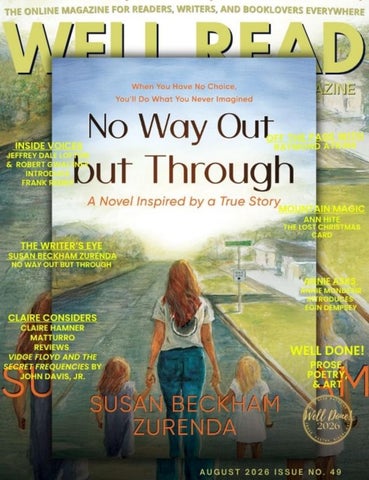
THE WRITER’S EYE Finding Inspiration in Unexpected Places with Susan Beckham Zurenda
7
WHAT ARE YOU READING?
40
WHY YOU SHOULD ADVERTISE IN WELL READ
57
INSIDE VOICES Robert Gwaltney & Jeffrey Dale Lofton introduce Frank Reddy
59
MOUNTAIN MAGIC with Ann Hite
69
CALL FOR SUBMISSIONS
81
LET’S REVIEW! Vidge Floyd and the Secret Frequencies
82
CLAIRE CONSIDERS Vidge Floyd and the Secret Frequencies
83
ANNIE ASKS Eoin Dempsey
89
Cover design, interior formatting, and more
99
WHAT’S YOUR STORY?
105
OFF THE PAGE WITH RAYMOND ATKINS
107
AUGUST 2026 ISSUE NO. 49
3
If you enjoy this issue, and would like to support this online literary journal, please consider leaving a tip @wellread on Venmo’s site or PayPal-www.wellreadmagazine.com.
AUGUST 2026 ISSUE NO. 49 5
Finding Inspiration in Unexpected Places
THE WRITER’S EYE with Susan Beckham Zurenda
6
WELL READ MAGAZINE
THE WRITER’S EYE
My new novel, No Way Out but Through, comes out Aug. 18 with Post Hill Press, and is the product of the most unexpected inspiration I’ve experienced as a writer. Especially since I initially tried not to be inspired by my subject. I’ll be honest: I came to this story kicking and screaming (figuratively anyway). It didn’t happen exactly like the beginning of the novel depicts, but what is similar in the novel is at one of my reallife book events, I met an older, elegant woman insistent I meet a young woman in her employ whose story in the older woman’s words, “must be told.” Writers get this sort of entreaty from time to time because the truth is we humans are hardwired biologically for telling and listening to stories, and we all have important stories to tell. Still, you can’t turn every story you hear into a novel. I tried to dodge the request by writing down my email address instead of making a commitment to meet the young woman. I figured a follow up wasn’t likely, and I’d be off the hook. I was wrong. She was determined. The upshot is that after an exchange of emails and phone conversations, I somehow agreed to meet the woman from my book event and the woman who inspired this novel for lunch in South Carolina between my hometown and theirs. When I met Grace (my character’s name inspired by my real-life subject), she quickly handed me a tightly rolled document that turned out to be a marriage license showing she was married in 1995 at age 15 to a man a decade her senior. Her hand was shaking a little, and it all felt very awkward. I didn’t know what to say. Sure, a century ago, sometimes women
JULY 2026 ISSUE NO. 48
7
THE WRITER’S EYE
married before they were adults, but in the 1990s? I handed the certificate back to Grace who quietly said, “I had no other choice.” I didn’t know it then, but now I think that unconsciously it was at that early moment I felt inspired to listen to Grace’s story. I sensed in her seemingly shy yet composed demeanor the presence of courage and heart and grit. I wanted to know what happened to Grace and how she endured her ordeal. Then once I did know, my subject’s experiences haunted me. As you’re well aware, the quickest connection between you and another person is a story. At its core this novel is a story about the transformative power of storytelling. If you think about it, stories are data with emotions attached and emotions are how we make meaning and catalog memory. We remember stories far better than we recall lists, information, or raw data. Stories help us to think about viewpoints beyond our own as well as express our experiences to others. They help us learn and connect us with others. In fact, the human instinct for story is nothing short of a survival skill, a truth that my main characters Grace and her interviewer Shannon discover when they reveal their untold stories to each other. Grace has never fully come to terms with her harrowing childhood marriage, and Shannon comes to realize this is the underlying reason Grace needs to tell her story. Toward the end of Chapter 12, Grace asks her interviewer, “What made you want to hear my story?” Shannon thought about the answer and decided to tell mostly the truth. “I didn’t want to. Not at first. Margaret Stevenson convinced
8
WELL READ MAGAZINE
THE WRITER’S EYE
me. She has a way, as you know. And I’m still not sure, but you are… that’s why we’re here…isn’t it? For me to understand.” What she didn’t tell Grace was that something in the young woman’s need to tell her story was what mostly attracted her. Grace closed her eyes. Shannon didn’t know whether in release or disappointment. Maybe she’d said it wrong, but she had to be honest. Unfortunately, a lot of women endured dysfunctional homes and abusive men. Even if Shannon had never experienced the gore of a rattlesnake roundup or grown men kidnapping an eighth-grade girl, those sad facts alone wouldn’t be enough to warrant a book. Shannon had said it best she could. What mattered was how Grace had become the woman in front of her, how she’d gotten from there to here. As the days pass in their idyllic beach setting and Grace exposes her grim life with Rafe, revealing staggering truths she has never told, with Shannon’s help, she begins to exorcise her deep-set trauma. Grace’s story isn’t easy for either woman to bear. Grace sometimes becomes overwhelmed with anxiety and can’t continue talking. Shannon is often shocked, and in distress, she sometimes interrupts to comment about and sympathize with the pain the younger woman endured. Grace’s story also engenders Shannon’s guilt about her own daughter Millie as Shannon grapples with memories of her former marriage to Millie’s father, an alcoholic. By telling their stories, these two very different women begin to heal each other.
AUGUST 2026 ISSUE NO. 49
9
THE WRITER’S EYE
I am grateful that my real-life subject inspired me to write No Way Out but Through. Composing this novel of resilience and hope has stretched me in ways I never knew. And if I’ve successfully told the story my subject inspired, readers will be immersed in the characters I’ve created, not from any real people, but from real human struggles and triumphs. I hope you’ll read it to find out!+ / Susan Beckham Zurenda taught English for 33 years on the college level and at the high school level to AP students. Her debut novel, Bells for Eli (Mercer University Press, March 2020; paperback edition March 2021), was selected the first place winner for Best First Book—Fiction in the 2021 IPPY (Independent Publisher Book Awards), a Foreword Indie Book Award finalist, a Winter 2020 Okra Pick by the Southern Independent Booksellers Alliance, a 2020 Notable Indie on Shelf Unbound, a 2020 finalist for American Book Fest Best Book Awards, and was nominated for a Pushcart Prize for 2021. Her second novel, The Girl From the Red Rose Motel (Mercer University Press, September 2023), was the recipient of the 2024 Patricia Winn Award in Southern Fiction, Gold Medal winner in the 2024 IPPY Awards for Southeast Fiction, a 2024 Pushcart Prize nominee, a Shelf Unbound 2023 Notable 100 books, and a finalist in the American Book Fest Awards. Susan has won numerous awards for her short fiction, including winning the South Carolina Fiction Prize twice. Her new novel, No Way Out
10
WELL READ MAGAZINE
THE WRITER’S EYE
but Through (Post Hill Press), will be published in August 2026. The author lives in Spartanburg, SC. Learn more at www.susanzurenda.com.
AUGUST 2026 ISSUE NO. 49
11
“An author nearing retirement age and consumed with her own family problems, reluctantly agrees to chronicle the life of a cleaning service owner with a horrific story and a desperate need to share it. Although the two women come from vastly different worlds, they develop an unlikely but tender bond once they’re sequestered on beautiful Pawley’s Island to complete the book. With lyrical prose and keen insight into the struggles of two very different women, Susan Zurenda explores the power of story to bring healing and redemption to even the most damaged life. No Way Out but Through will haunt you long after you’ve turned the final page.” – Cassandra King, author of Tell Me a Story: My Life with Pat Conroy
12
WELL READ MAGAZINE
AUGUST 2026 ISSUE NO. 49
13
If Bookshop.org is your preferred way to purchase books online check out WELL READ’s bookshop.
You can find books from past issues as well as current books to add to your reading list. Happy reading!
WHAT ARE YOU READING?
The Redux of Sam Murdoch by Mary Kendall Sam Murdoch fractured his life into bits and is in dire need of a redux. While stuck in a midlife meltdown with a broken marriage, angry offspring and a crumbling career, Sam stumbles upon a long-buried family secret: the grandfather he idolized once shot a man. Desperate for an escape (and some answers), he hits the open road in a beat-up Volvo station wagon with his eccentric college buddy, Godfrey, on a quest for truth. After some meandering through a throwback America of old-time general stores, small-town square dances, vintage diners and quirky characters, the journey takes an unexpected and dark turn in a town called Middlevale. Thrown into a face-off with superstitious and maybe unhinged townsfolk, Sam's little adventure to solve riddles about his family history has shifted to something else altogether. Amid Middlevale's corn shocks and scythes, Sam must fight to find his path forward. "Sam is going through a painful divorce when he learns his beloved grandfather once shot and killed a man. An overweight, eccentric, genealogical fanatic joins him on a road trip to a small Virginia town where everyone is related to everyone by blood, shared secrets, or both. What follows is part National Treasure, part Wicker Man, until Sam finds the truth about his ancestry, and himself." Bradley Harper, author of A Knife in the Fog and Maiden Voyage
18
WELL READ MAGAZINE
ADD TO YOUR TBR LIST
Death By Mistake: A Josiah Reynolds Mystery 22 by Abigail Keam In a world of oak-cured bourbon, antebellum mansions, and Thoroughbred farms, secrets buried in the deep earth are never hidden long. Josiah has resigned herself to being alone. Her boyfriend, Hunter left her for an old flame, and Josiah vows not to interfere in his life. She cares for the man and wants him to be happy. So, it comes as a shock when Detective Drake informs her that Hunter has been arrested for the murder of his wife, Kathy Wickliffe. Josiah simply can’t believe Hunter would harm another human being. She must uncover the truth— and fast. There’s the law, and there is Josiah’s justice!
AUGUST 2026 ISSUE NO. 49
19
WHAT ARE YOU READING?
RUNNER-UP FOR THE 2024 ARTHUR SMITH POETRY PRIZE In her debut collection, No Lace Fronts in Iowa City, Meghan Malachi explores how community, desirability, and notions of home influence the journeys by which girls come of age. These poems celebrate a South Bronx childhood and navigate a complicated womanhood in the Midwest through confessional musings on Black Latinx identity and intimate epistolary interludes. Favorite wigs, main character moments, and reimagined anti-heroines are all vessels for exploring girlhood in this love letter to female kinship. No Lace Fronts in Iowa City is ultimately a testament to the desires for belonging and tenderness that we all harbor.
The witchy goddess of rock has been casting a spell on music lovers for more than 50 years as a solo artist and a member of the iconic Fleetwood Mac. In this anthology, poets explore the myth, the music, and the enduring legacy of Stevie Nicks. From haunting ballads of heartache to empowering anthems of liberation, this collection of poems in White Winged Doves embraces the wild spirit and introspective depth synonymous with Nicks’ artistry. Poets channel her iconic imagery and fierce individuality, crafting an homage that resonates with both tribute and innovation. This book invites readers to wander through the witchy realms of dreaming and desiring, exploring the mystical landscapes and emotional depths that continue to define Nicks’ legendary career. Each poem weaves a tapestry of resilience and enchantment that mirrors the timeless muse herself.
22
WELL READ MAGAZINE
ADD TO YOUR TBR LIST
Arts and Sciences is, a unique poetry collection in that all the poems in it deal with figures, works, or events in literature, music, painting, film, or the sciences. Its poems cover a wide range, from Hamlet and Emily Dickinson to Sinatra and Bessie Smith, from Edward Hopper and Invasion of the Body Snatchers to gene therapy and quantum entanglement.
MADVILLE PUBLISHING seeks out and encourages literary writers with unique voices. We look for writers who express complex ideas in simple terms. We look for critical thinkers with a twang, a lilt, or a click in their voices. And patois! We love a good patois. We want to hear those regionalisms in our writers’ voices. We want to preserve the sound of our histories through our voices complete and honest, dialectal features and all. We want to highlight those features that make our cultures special in ways that do not focus on division, but rather shine an appreciative light on our diversity.
AUGUST 2026 ISSUE NO. 49
23
24
WELL READ MAGAZINE
AUGUST 2026 ISSUE NO. 49
25
COLORFUL CROW PUBLISHING
Publishing with Heart At Colorful Crow Publishing, every story begins with connection—between author and reader, past and present, truth and imagination. Rooted in a legacy of honoring diverse voices and carried forward with a deep commitment to care, we champion books that matter—stories that stay with you long after the final page. From literary fiction to children’s adventures, from heartfelt memoirs to imaginative journeys, our titles reflect the beauty, complexity, and resilience of the human experience.
FEATURED FORTHCOMING TITLES: CROOKED LINES (Historical Fiction) by Kristine Anderson A journalist returns to the Deep South to investigate the disappearance of a childhood friend—only to confront grief, addiction, and the tangled lines of race, loyalty, and truth in 1960s America. SARAH THE SEED (Picture Book) by L.G. Bridges When a strong wind carries Sarah far from everything she knows, she discovers that being lost may be the very thing that helps her grow into something extraordinary. THE ELDDIR CHRONICLES (Middle-Grade Series) by L.G. Bridges In a richly imagined world of mystery and magic, young heroes must discover who they are—and what they’re willing to risk—to protect the future of Elddir.
WORK IS A FOUR-LETTER WORD: MY CRAZY CAREER, COWORKERS, AND CLIENTS (Memoir) by Bobbie Christmas From outrageous clients to unbelievable workplace moments, this candid and often hilarious memoir reveals the hard-earned wisdom—and wild stories—behind a lifetime in the world of work. MORE STORIES TO DISCOVER: THE MOUNTAINS DON’T FORGET (Historical Fiction) by Pat Walker Johnson After escaping an abusive marriage, Pru Massey builds a new life—but love, loss, and a haunting crime force her to reckon with the past she cannot outrun. EXPLORE NATURE (Picture Book Series) by MaKayla Rodriguez Join a curious little snail as he journeys through the natural world, discovering friendship, wonder, and the beauty of exploring one small step at a time. THE FOARK RIVER SALON AND BAIT SHOP (Literary Fiction with Humor) by Barbara G. Tucker When a small-town bait shop becomes the center of a reality TV show, three employees must confront their secrets—and decide whether they’re ready for the truth to come to light. NED FLETCHER AND THE LAST CRACIAN (Sci-Fi Adventure) by Travis Williams A space pilot with the soul of the Old West navigates danger, mystery, and sharpwitted dialogue in a futuristic tale that blends frontier grit with interstellar stakes. AND MORE TO COME… Some stories are still taking shape—but we can’t wait to share them with you. Discover more at Colorful Crow Publishing. Follow along for new releases, author features, and behind-the-scenes glimpses into the stories we’re proud to bring into the world.
28
WELL READ MAGAZINE
ADD TO YOUR TBR LIST
Letting Grief Speak: Writing Portals for Life After Loss by Diane Zinna Society doesn’t always make it easy to tell stories about loss. Grief can make us feel that we have crossed over to another side, where people can’t reach us and we can’t reach others. We’re encouraged to move quickly through the often-misunderstood “stages of grief”; we fear that we are burdening others with our pain. But pain can feel more manageable when we find ways to describe it—and writing about grief can help us connect with others who have felt pain of their own. Letting Grief Speak is a creative writing craft book on the art of telling our hardest stories. Based on a class called Grief Writing Sundays that Diane Zinna has led for several years, it provides ninety writing prompts with accompanying craft techniques to help people find language for their grief. By turns gentle, unexpected, rebellious, and wonderfully strange, these prompts open portals: entryways into spaces where difficult emotions can become meaningful narratives. Warm, sensitive, and honest, Letting Grief Speak is a memoir of the craft, interwoven with stories from the author’s own life. It also includes pieces from acclaimed writers and more than forty of her Grief Writing students, inviting readers to find their own ways to tell vulnerable stories. A tool for writers and a companion for grievers, this book meets writers of all levels where they are, no matter what kind of grief they hold.
AUGUST 2026 ISSUE NO. 49
29
What does a war correspondent do when the assignment ends? In Sean Carberry’s case, he came home from Afghanistan wired for danger and found civilian life in D.C. unbearably small. So, he sought refuge from the alienation and PTSD in a casino. Doubling Down: A Memoir of War, PTSD, and the Dangerous Bets We Make traces Carberry’s unlikely transformation from NPR Kabul correspondent to Maryland Live Chairman—the casino’s highest tier—and the years of jackpots, decadence, and creeping ruin that followed. Droll, unsettling, and bracingly honest, it’s a dispatch from a world even most casino-goers never see, and a reckoning with the seductions of danger, the grief of a lost identity, and the demons of a man who knew exactly what he was doing and couldn’t stop anyway. It’s the epilogue his memoir, Passport Stamps: Searching the World for a War to Call Home, only hinted at.
Doubling Down Sean Carberry
WHAT ARE YOU READING?
Los Angeles, Dark Corners by Francine Rodriguez Against the January 6 capitol riots, a young FBI agent, Josh, works undercover to infiltrate neo-Nazi group in Los Angeles. He becomes involved with Novena, the on/off girlfriend of the group’s leader, blurring the lines between investigation and romance, and placing them both in a situation which threatens to explode into violence when a top-ranking official is murdered. Told in dual narration, the novel opens with Novena in prison awaiting sentencing for two murders. Novena’s position in the movement was largely shaped by her perception that she is overlooked and discriminated against by the system of government in the U.S. even though she is white. A few months earlier, after an argument with her boyfriend, Drew, head of the local chapter of the White Knights, she meets Josh at a rally, and the two become close, Josh pressing Novena for information on the Knights’ preparation for January 6 and beyond, and her looking to him for the stability and direction she lacks in her own life as she begins to become distant from Drew and the Knights. But Drew brings Novena back into the fold, convincing her that one of the top men in the organization, Norwood, is a traitor. On January 6, while many of the Knights are away, participating in the insurrection at the capitol, Novena and Drew break into Norwood’s home to find information to use against him so Drew can replace him as head of the Knights. The break in turns violent when the owner unexpectedly returns home, and Novena shoots Norwood, killing him. Lost and alone in the aftermath of the robbery, she turns back to Josh, eventually confessing the murder to him. Blindsided, Josh’s reaction will determine both of their fates.
32
WELL READ MAGAZINE
ADD TO YOUR TBR LIST
AUGUST 2026 ISSUE NO. 49
33
WHAT ARE YOU READING?
Madville Publishing is an American nonprofit corporation registered in the state of Texas. It has been in operation since 2018. Madville is not an academic press but adheres to the same rigorous standards when evaluating manuscripts. Madville’s reviewers hold advanced degrees in literature and creative writing.
Mission Statement: The mission of Madville Publishing is to produce, publish, and market literary works of the highest quality that reflect the diversity of the modern English-speaking world. We seek to publish poetry, fiction, and creative nonfiction by notable and emerging authors who display diversity in ethnicity, gender, age, and worldview, and whose work exhibits the full range of this diversity. Our goal is to discover and showcase works that might otherwise be overlooked, to provide opportunities for voices that might otherwise be unheard.
34
WELL READ MAGAZINE
ADD TO YOUR TBR LIST
What we like: We love language, dialect, and regionalisms. We yearn to know other cultures and other worlds. From poets’ philosophies and introspections, to essayists examinations of the world and all its foibles, to imaginary worlds, our authors deal in snapshots of time, slivers of memory, and flashes of inspiration. English is our first language, but we adore code switching and idioms from around the world. Our books straddle borders. While our authors generally hail from English-speaking communities, our audience extends beyond those narrow confines.
Contact Us: Kimberly Davis info@madvillepublishing.com MadvillePublishing.com 1.936.581.2676 Madville Publishing PO Box 358 Lake Dallas, Texas, 76208 USA
AUGUST 2026 ISSUE NO. 49
35
WHAT ARE YOU READING?
Small Town Witch Deborah Z Adams
by
Small Town Witch, a new chapbook from award-winning author Deborah Z Adams, is a collection of spell-binding tales about the witches we meet every day. Written with warmth, humor, and a little bite, Small Town Witch is packed with more substance than meets the eye. “Adams’s witches may inhabit a small town, perhaps your small town, but they are not small women. They are powerful and empowering. You’ll root for these women, these coven leaders and elementary school teachers. Two parts poetry, two parts prose, with a healthy pinch of feminist indignation, Adams’s tales will surely charm you and remind you that you’re “not in this fight alone.’” —Joanna Grisham, author of Phantoms (Finishing Line Press, 2023)
36
WELL READ MAGAZINE
ADD TO YOUR TBR LIST
Available from your favorite bookseller! All proceeds from sales of Small Town Witch are donated to organizations that do good in the world.
You can sample Small Town Witch stories here.
“I’ve lived my life surrounded by women who wield their powers quietly but effectively,” says Adams. “They’re everywhere, but especially prevalent in small towns.” Deborah Z Adams is an awardwinning author of novels, short fiction, CNF, and poetry. She served as executive editor of Oconee Spirit Press for ten years, and is currently a reader for Boomerlit. Her writing has appeared or is forthcoming in Roanoke Review, Litmosphere: a journal of Charlotte Lit, WELL READ Magazine, Dead Mule and other journals.
AUGUST 2026 ISSUE NO. 49
37
Order your copy today!
Order your copy today!
WHAT ARE YOU READING?
In the Best of 2025 Volume One, you’ll find forty-one submissions written by a fantastic mix of awardwinning authors and poets plus new ones to the scene. Five submissions in this volume were nominated for a Pushcart Prize: Why I Said What I Said to the Bartender by Alaina Hammond, The Easter Dress by Dawn Major, Montecito by Leslie Zemeckis, Dream Merchant by Francine Rodriguez, and Stagnation by Rachid Toumi. The cover art is a photograph by author and artist, Malcolm Glass, who had several pieces published in October of 2024. List of Contributors: J. B. Hogan, Steve Putnam, Gregg Norman, Deborah-Zenha Adams, Rita Welty Bourke, B.A. Brittingham, Mike Turner, Leslie Zemeckis, Micah Ward, John Drudge, Jennifer Susan Smith, DeLane Phillips, Julie Green, Ann Hite, Mary Kendall, John M. Williams, Alaina Hammond, Jake Sheff, JoyAnne O'Donnell, Aaron Goodman, Dawn Major, Souad Zakarani, Zoé Mahfouz, Don Edwards, Celia Miles, Malcolm Glass, Neth Williams, Hubert Blair Bonds, Rickie Zayne Ashby, Francine Rodriguez, Rachid Toumi, Mike Ross, James Garrison, Mike Nemeth, and Robin Prince Monroe
40
WELL READ MAGAZINE
ADD TO YOUR TBR LIST
In the Best of 2025 Volume Two, you’ll find forty-three submissions written by a fantastic mix of award-winning authors and poets plus new ones to the scene. One submission in this volume was nominated for a Pushcart Prize: Burtrell’s Pieces by Jeff Clemmons. The cover art is a photograph by artist, Malcolm Glass, who had several pieces published in October of 2024. List of contributors: Janet Clare, Mike Ross, Mike Nemeth, Patricia Feinberg Stoner, Colette Lynch, Karen Miller, Linda C. Rehkopf, Jeff Clemmons, Mike Coleman, Micah Ward, LaVern Spencer McCarthy, J. B. Hogan, Fhen M., Ken Gosse, Celia Miles, Cindy Sams, Robin Prince Monroe, Beverly Fisher, Rickie Zayne Ashby, Maria Mackas, Jim Cherry, Martha Ellen Johnson, Michael Lee Johnson, Donald Edwards, Alex Poppe, Janet Oakley, John M. Williams, Hubert Blair Bonds, Ellen Notbohm, Steve Putnam, Souad Zakarani, Mike Turner, Nancy Dillingham, and Saeed Ibrahim
AUGUST 2026 ISSUE NO. 49
41
WHAT ARE YOU READING?
In the Best of 2024 Volume One, you’ll find fifty-one submissions written by a fantastic mix of awardwinning authors and poets plus new ones to the scene. Three submissions in this volume were nominated for a Pushcart Prize: The Hanging by Doug Gray, Sandy Tells Me About Dead Pine Trees by J.D. Isip, and Wilma by Phyllis Gobbell. The cover art is by artist, Lindsay Carraway, who had several pieces published in February of 2023.
Contributors: Carolyn Haines, Doug Gray, Angela Patera, Kimberly Parish Davis, Michael Spake, Jennifer Smith, Ashley Tunnell, Ken Gosse, Dr. Elizabeth V. Koshy, Ann Hite, Ellen Notbohm, Micah Ward, Malcolm Glass, Katie Crow, Lorraine Cregar, Patricia Feinberg Stoner, John M. Williams, Michael Lee Johnson, J.D. Isip, Casie Bazay, Jacob Strunk, Ann Christine Tabaka, Joan McNerney, Fhen M., Steven Kent, Peter Magliocco, Mark Braught, Rita Welty Bourke, Loretta Fairley, Barbara Anna Gaiardoni, S. Dodge, DeLane Phillips, Candice Marley Conner, Arvilla Fee, J. B. Hogan, Ramey Channell, Hope Kostedt, John Grey, Martha Ellen Johnson, Nancy Chadwick-Burke, Mike Coleman, Margaret Pearce, Nicole Irizawa, Donald Edwards, Janet Lynn Oakley, Mandy Jones, Phyllis Gobbell, and Suzanne Kamata
42
WELL READ MAGAZINE
ADD TO YOUR TBR LIST
In the Best of 2024 Volume Two, you’ll find fifty-two submissions written by a fantastic mix of awardwinning authors and poets plus new ones to the scene. Three submissions in this volume were nominated for a Pushcart Prize: Hanging Pictures by Micah Ward, The Lone and Level Sands by James Wade, and American Chestnut by Candace Connor. The cover art is by artist, Lindsay Carraway, who had several pieces published in February of 2023.
Contributors: Candice Marley Conner, Kaye Wilkinson Barley, Mike Ross, Will Maguire, AJ Concannon, Patricia Feinberg Stoner, Gregg Norman, Robin Prince Monroe, Ramey Channell, April Mae M. Berza, Anne Leigh Parrish, B. A. Brittingham, Mike Austin, Sara Evelyne, Jennifer Smith, Loretta Fairley, J.L. Oakley, Celia Miles, Kris Faatz, Ed Nichols, Linda Imbler, Annie McDonnell, Mike Turner, Micah Ward, James Wade, Ashley Tunnell, John M. Williams, Robb Grindstaff, Stevie Lyon, Laura McHale Holland, Saeed Ibrahim, Nancy Julien Kopp, Julie Green, DeLane Phillips, Shayla Dodge, Edilson Afonso Ferreira, Chris Wood, Jasna Gugić, Fhen M., Hubert Blair Bonds, Ellen Birkett Morris, Margaret Pearce, Ellen Notbohm, Kimberly Parish Davis, J. B. Hogan, and Royal Rhodes
AUGUST 2026 ISSUE NO. 49
43
WHAT ARE YOU READING?
In Volume One, you’ll find thirty-eight submissions written by a fantastic mix of awardwinning authors and poets plus new ones to the scene. Three submissions in this volume were nominated for a Pushcart Prize: Miller’s Cafe by Mike Hilbig, Sleeping on Paul’s Mattress by Brenda Sutton Rose, and A Hard Dog by Will Maguire. The cover art is by artist, Lindsay Carraway, who had several pieces published in February’s issue. Contributors: Jeffrey Dale Lofton, Phyllis Gobbell, Brenda Sutton Rose, T. K. Thorne, Claire Hamner Matturro, Penny Koepsel, Mike Hilbig, Jon Sokol, Rita Welty Bourke, Suzanne Kamata, Annie McDonnell, Will Maguire, Joy Ross Davis, Robb Grindstaff, Tom Shachtman, Micah Ward, Mike Turner, James D. Brewer, Eileen Coe, Susan Cornford, Ana Doina, J. B. Hogan, Carrie Welch, Ashley Holloway, Rebecca Klassen, Robin Prince Monroe, Ellen Notbohm, Scott Thomas Outlar, Fiorella Ruas, Jonathan Pett, DeLane Phillips, Larry F. Sommers, Macy Spevacek, and Richard Stimac
44
WELL READ MAGAZINE
ADD TO YOUR TBR LIST
In Volume Two, you’ll find fortythree submissions written by a fantastic mix of award-winning authors and poets plus new ones to the scene. Three submissions in this volume were nominated for a Pushcart Prize: A Bleeding Heart by Ann Hite, A Few Hours in the Life of a Five-Year-Old Pool Player by Francine Rodriguez, and There Were Red Flags by Mike Turner. The cover art for Volume Two is by artist, DeWitt Lobrano, who had several pieces published in November’s issue. Enjoy!
Contributors: Ann Hite, Malcolm Glass, Dawn Major, John M. Williams, Mandy Haynes, Francine Rodriguez, Mike Turner, Mickey Dubrow, William Walsh, Robb Grindstaff, Deborah Zenha Adams, Mark Braught, B. A. Brittingham, Ramey Channell, Eileen Coe, Marion Cohen, Lorraine Cregar, John Grey, J. B. Hogan, Yana Kane, Philip Kobylarz, Diane Lefer, Will Maguire, David Malone, Ashley Tunnell, Tania Nyman, Jacob Parker, LaVern Spencer McCarthy, K. G. Munro, Angela Patera, Micheal Spake, George Pallas, Marisa Keller, Ken Gosse, and Orlando DeVito
AUGUST 2026 ISSUE NO. 49
45
WHAT ARE YOU READING?
They All Rest in the Boneyard Now by Raymond L. Atkins (Author), Evelyn Mayton (Illustrator) “Raymond Atkins writes with intuitive wisdom, as he channels those from beyond the grave. His poetry gives voice to those who once mattered, those who time wants us to forget. In They All Rest in the Boneyard Now, Atkins wrestles death from the dusty clay and breathes life into dry bones while reminding us that every soul who once had breath is worthy of being remembered. These saints, sinners, socialites, and the socially inept are all victims of time, or circumstance, as we too shall one day be. Atkins offers salvation to all who are tormented, and solace to those who seek eternal rest.” – Renea Winchester, Award-winning author of Outbound Train
46
WELL READ MAGAZINE
ADD TO YOUR TBR LIST
The Cicada Tree by Robert Gwaltney The summer of 1956, a brood of cicadas descends upon Providence, Georgia, a natural event with supernatural repercussions, unhinging the life of Analeise Newell, an eleven-year-old piano prodigy. Amidst this emergence, dark obsessions are stirred, uncanny gifts provoked, and secrets unearthed. During a visit to Mistletoe, a plantation owned by the wealthy Mayfield family, Analeise encounters Cordelia Mayfield and her daughter Marlissa, both of whom possess an otherworldly beauty, a lineal trait regarded as that Mayfield Shine. A whisper and an act of violence perpetrated during this visit by Mrs. Mayfield all converge to kindle Analeise’s fascination with the Mayfields. Analeise’s burgeoning obsession with the Mayfield family overshadows her own seemingly, ordinary life, culminating in dangerous games and manipulation, setting off a chain of cataclysmic events with life-altering consequences—all of it unfolding to the maddening whir of a cicada song.
AUGUST 2026 ISSUE NO. 49
47
WHAT ARE YOU READING?
I Am a Georgia Girl: The Life of Lucille Selig Frank, 18881957 by Ann Hite Twenty-five-year-old Lucille Selig Frank's whole life changed on April 26, 1913, as the Confederate Memorial Parade marched through Atlanta, Georgia. Lucille was attending the opera matinee with her mother. Her husband, Leo Frank, sat in his office in the National Pencil Company, where he was superintendent, working on a financial report. The brutal murder of fourteen-year-old Mary Phagan, an employee of Leo's, took place in the pencil factory that day. Lucille's husband would be the last known person to see Mary alive. While much has been written about Mary Phagan's murder and Leo Frank's subsequent trial over the past 115 years, very little has given voice to Lucille Selig Frank and other women connected to the horrific events that took place between 19131915. Lucille was part of a mission to make Governor John Slaton aware of the antisemitism being shown to Leo during his arrest and trial. She paid a heavy price for her courage. The story of Lucille and the women connected to this case is as timely today as it was in the early 1900s. This book has many diverse characters, including place which influences the outcome. Within this complexity, Hite's telling of Lucille's story will help others see that antisemitism, the marginalization of women, and mobs taking justice into their own hands cannot be tolerated. How many people were complicit in Leo and Lucille's journey? Was justice truly served? This book leaves the reader to answer these questions.
48
WELL READ MAGAZINE
ADD TO YOUR TBR LIST
Red Clay Suzie by Jeffrey Dale Lofton A novel inspired by true events. The coming-of-age story of Philbet, gay and living with a disability, battles bullying, ignorance, and disdain as he makes his way in life as an outsider in the Deep South—before finding acceptance in unlikely places. Fueled by tomato sandwiches and green milkshakes, and obsessed with cars, Philbet struggles with life and love as a gay boy in rural Georgia. He’s happiest when helping Grandaddy dig potatoes from the vegetable garden that connects their houses. But Philbet’s world is shattered and his resilience shaken by events that crush his innocence and sense of security; expose his misshapen chest skillfully hidden behind shirts Mama makes at home; and convince him that he’s not fit to be loved by Knox, the older boy he idolizes to distraction. Over time, Philbet finds refuge in unexpected places and inner strength in unexpected ways, leading to a resolution from beyond the grave.
AUGUST 2026 ISSUE NO. 49
49
WHAT ARE YOU READING?
The Smuggler's Daughter by Claire Matturro Ray Slaverson, a world-weary Florida police detective, has his hands full with the murders of two attorneys and a third suspicious death, all within twenty-four hours. Ray doesn’t believe in coincidences, but he can’t find a single link between the dead men, and he and his partner soon smash into an investigative stonewall. Kate Garcia, Ray’s fiancée, knows more than she should. She helped one of the dead attorneys, just hours before he took a bullet to the head, study an old newspaper in the library where she works. Kate might be the only person still alive who knows what he was digging up— except for his killer. When Kate starts trying to discover what’s behind the murders, she turns up disturbing links between the three dead men that track back to her family’s troubled past. But she has plenty of reasons to keep her mouth shut. Her discovery unleashes a cat-and-mouse game that threatens to sink her and those she loves in a high tide of danger.
50
WELL READ MAGAZINE
ADD TO YOUR TBR LIST
The Bystanders by Dawn Major The quaint town of Lawrenceton, Missouri isn’t sending out the welcoming committee for its newest neighbors from Los Angeles—the Samples’ family. Shannon Lamb’s “Like a Virgin” fashion choices, along with her fortune-telling mother, Wendy Samples, and her no-good, cheating, jobless, stepfather, Dale Samples, result in Shannon finding few fans in L-Town where proud family lines run deep. Only townie, Eddy Bauman, is smitten with Shannon and her Valley Girl ways. The Bystanders is a dark coming-of-age story set in the 1980s when big hair was big, and MTV ruled. In a quiet town of annual picnics and landscapes, the Samples’ rundown trailer and odd behaviors aren’t charming the locals. Shannon and Wendy could really use some friends but must learn to rely upon themselves to claw their way out of poverty and abuse if they want to escape Dale. The Bystanders pays homage to Americana, its small-town eccentricities, and the rural people of the Northern Mississippi Delta region of Southeast Missouri, a unique area of the country where people still speak Paw Paw French and honor Old World traditions.
AUGUST 2026 ISSUE NO. 49
51
WHATWHAT ARE YOU READING? ARE YOU READING?
The Girl from the Red Rose Motel: A Novel by Susan Beckham Zurenda Impoverished high school junior Hazel Smalls and privileged senior Sterling Lovell would never ordinarily meet. But when both are punished with in-school suspension, Sterling finds himself drawn to the gorgeous, studious girl seated nearby, and an unlikely relationship begins. Set in 2012 South Carolina, the novel interlaces the stories of Hazel, living with her homeless family in the rundown Red Rose Motel; Sterling, yearning to break free from his wealthy parents' expectations; and recently widowed Angela Wilmore, their stern but compassionate English teacher. Hazel hides her homelessness from Sterling until he discovers her cleaning the motel's office when he goes with his slumlord father to unfreeze the motel's pipes one morning. With her secret revealed, their relationship deepens. Angela-who has her own struggles in a budding romance with the divorced principal-offers Hazel the support her family can't provide. Navigating between privilege and poverty, vulnerability and strength, all three must confront what they need from themselves and each other as Hazel gains the courage to oppose boundaries and make a bold, life-changing decision at novel's end.
52
WELL READ MAGAZINE
TO ADD ADD TOTO YOUR YOUR TBR TBR LIST LIST
The Best of the Shortest: A Southern Writers Reading Reunion by Suzanne Hudson (Author, Editor), Mandy Haynes (Editor), Joe Formichella (Author, Editor) “Some of the happiest moments of my writing life have been spent in the company of writers whose work is included in these pages. They all brought their A-game to this fabulous collection, and at our house it is going on a shelf next to its honored predecessors. The only thing that saddens me is that the large-hearted William Gay is not around to absorb some of the love that shines through every word.” ―Steve Yarbrough “The Best of the Shortest takes the reader on a fast-paced adventure from familiar back roads to the jungles of Viet Nam; from muddy southern creek banks to the other side of the world, touching on themes as beautiful as love and as harsh as racism. However dark or uplifting, you are guaranteed to enjoy the ride.” --Bob Zellner “I had some of the best times of my life meeting, drinking and chatting with the writers in this book, times matched only by the hours I spent reading their books. This collection showcases a slice of Southern literature in all its complicated, glorious genius. Anyone who likes good writing will love it.” --Clay Risen
AUGUST MARCH 2025 2026 ISSUE NO. 32 49
53
WHAT ARE YOU READING?
Walking The Wrong Way Home by Mandy Haynes Spanning nearly twenty decades, the struggles and victories these characters face are timeless as they all work towards the same goal. A place to feel safe, a place to call home.
Sharp as a Serpent's Tooth: Eva and other stories by Mandy Haynes Each story features a female protagonist, ranging from ten to ninety-five years of age. Set in the south, you’ll follow these young women and girls as they learn that they’re stronger than they ever thought possible.
54
WELL READ MAGAZINE
ADD TO YOUR TBR LIST
Oliver by Mandy Haynes “Dear God…and Jesus and Mary…” Even though eleven-year old Olivia is raised Southern Baptist, she likes to cover her bases when asking for a favor. Unlike her brother Oliver, she struggles with keeping her temper in check and staying out of trouble. But Oliver is different, and in the summer of ’72 he proves to Olivia there’s magic in everything - it’s up to us to see it.
Mandy Haynes spent hours on barstools and riding in vans listening to great stories from some of the best songwriters and storytellers in Nashville, Tennessee. After her son graduated college, she traded a stressful life as a pediatric cardiac sonographer for a happy one and moved to an island off the east coast. She is a contributing writer for Amelia Islander Magazine, Amelia Weddings, and editor of Encounters with Nature, an anthology created by Amelia Island writers and artists. She is also the author of two short story collections, Walking the Wrong Way Home, Sharp as a Serpent's Tooth Eva and Other Stories, and a novella, Oliver. She is a co-editor of the Southern Writers Reading reunion anthology, The Best of the Shortest. Mandy is the editor-in-chief of WELL READ Magazine and the editor of four WELL READ anthologies. Like the characters in some of her stories, she never misses a chance to jump in a creek to catch crawdads, stand up for the underdog, or the opportunity to make someone laugh. At the end of 2024, Mandy moved back to middle Tennessee and now spends her time writing and enjoying life as much as she can.
AUGUST 2026 ISSUE NO. 49
55
WHY WHY YOU SHOULD YOU SHOULD ADVERTISE ADVERTISE IN WELL IN WELL READREAD
If you’d like to feature your work in the reading recommendation section with live links to your website and purchase link, and have personalized graphics of your ad shared to WELL READ Magazine’s social sites, click here to see examples of the different options and more information. Click here for more information on purchasing a cover. Don’t let the low prices fool you - WELL READ was created by an author who understands how much it costs to get your book in the best shape possible before it’s ready to be queried by agents, small presses, or self-published. Showing off your book and getting it in front of readers shouldn’t break the bank. WELL READ Magazine receives approximately 8,000 views each month on Issuu’s site alone (the world’s largest digital publishing and discovery platform available). Your book will be included with the featured authors, great interviews, submissions, essays, and other fantastic books inside each issue. There is strength in numbers. Let’s get our books seen!
56
WELL READ MAGAZINE
WHY WHY YOU SHOULD YOU SHOULD ADVERTISE ADVERTISE IN WELL IN WELL READREAD
Ad rates for 2026: $50 - One FULL PAGE AD $75 - TWO-PAGE SPREAD $100 - TWO HIGH IMPACT - FULL COLOR PAGES - (this is NOT a standard two page spread) $100 - FOR PUBLISHERS ONLY (limit 3 months of ads)- Advertise up to THREE books with one live link that takes viewers to your website. $75 - BOOKSTORES, PUBLICISTS, AUTHORS - two-page spread to promote book events $450 - FRONT COVER - includes two full color interior pages for book description, author bio, and/or blurbs, plus an additional one page ad in the next three issues. Also included is the Featured Author spot in the issue your book is on the cover. $350 - INTERIOR COVER or BACK COVER - includes TWO additional full color interior pages for book description, author bio, and/or blurbs. *Prices include creating the graphics for the magazine pages and all social sites. Everything is taken care of for you.
JANUARY AUGUST 2026 2025ISSUE ISSUENO. NO.49 30
57
INSIDE VOICES
“I like the juxtaposition of lofty spiritual ideals and stark realities…”
Robert Gwaltney & Jeffrey Dale Lofton introduce Frank Reddy 58
WELL READ MAGAZINE
Robert Gwaltney & Jeffrey Dale Lofton introduce Frank Reddy
Frank Reddy writes fiction and nonfiction. He is the author of the critically-acclaimed novel Eyes on the Island, published in 2016 by Fiction Advocate. As a veteran journalist, he writes freelance articles for a wide range of mostly Atlanta-area publications. He has won multiple awards from the Associated Press and Georgia Press Association for business writing, feature writing, and hard news coverage. He grew up an hour north of Atlanta, in the poultry capital of the world, Gainesville, Ga., where the chicken trucks clog thoroughfares and Volkswagen-sized catfish swarm the depths of Lake Lanier. Now an Atlanta resident, he still feels the pull of the lake from time to time. Inside Voices (Jeffrey): The novel opens with an unforgettable premise—a church bus full of teenagers disappearing on the way to a Pentecostal conference. Do your stories typically begin with a "what if?" scenario like this, or did Ghost in the Grove begin somewhere else entirely? I think they’ve all got a what if element about them … this one perhaps more “unforgettable” (your kind words) than others. I do like to have a good setup. I like a central, intriguing, overarching question that keeps someone turning pages. If my stories didn’t have that, I feel like I’d lose interest in writing them, and when I’m not invested in the story, it shows in the writing. The premise for Ghost in the Grove came from an idea I had about my time in smalltown churches as a child. It seemed the vetting process for church leadership in these places of worship was
JULY 2026 ISSUE NO. 48
59
Robert Gwaltney & Jeffrey Dale Lofton introduce Frank Reddy
oftentimes all but nonexistent. I can think of situations in fact where these leaders admitted to having done hard time. In the teachings of Jesus, we learn these were the types he often associated with – the sinners. But letting people with a documented criminal past inside the doors of a church where they’re allowed to interact and even chaperone youth outside sanctuary doors is a dangerous affair. I had this thought … what if a schizophrenic psychopath with a plan were allowed to become youth pastor for an unsuspecting congregation? Inside Voices (Robert): South Georgia isn't simply the backdrop for this novel—it feels like another character. What is it about that landscape—the swamps, pecan groves, forgotten roads, and small towns—that makes it such fertile ground for suspense and Southern storytelling? I was born and raised in North Georgia, but my paternal grandparents lived in Central Florida. Our family didn’t have much money when I was a child, but once a year we’d take a trip to central Florida (our only “vacation”). As a kid who never ventured further than his own backyard, this was like a journey to an exotic place. I watched the landscape change as my father drove south, specifically as we entered South Georgia, me in the backseat witnessing the flora transforming: Spanish moss, palm trees, and more, as well as the prospect of gator sightings in every pond we passed … it gave South Georgia a distinctive mystique for me. I think the suspense of this landscape is inherent in my mind because
60
WELL READ MAGAZINE
Robert Gwaltney & Jeffrey Dale Lofton introduce Frank Reddy
as a kid it always felt like I was entering a whole new, dynamic world. I felt like Indiana Jones exploring strange, forgotten civilizations. Inside Voices (Jeffrey): Special Agent Michael Webb is investigating a kidnapping, but he's also confronting his own childhood experiences with snake handling and religious ritual. How important is it for you that your protagonists are emotionally entangled in the mysteries they're trying to solve? I think it makes for a much more interesting story if the protagonist has a stake beyond just doing their jobs or doing the right thing. If it’s personal, they might go beyond the call of duty, you know? In Webb’s case, it’s very, very personal. When it’s personal, they’ll do things that surprise you. They’ll push the boundaries. Webb is the closest thing to a purely good protagonist I’ve written in a long time, but he’s not perfect. Perfect would be boring. He’s got baggage. He’s got trauma. And armed with that, he’s a protagonist to be reckoned with. Inside Voices (Robert): One of the things that intrigued me is how the novel explores faith alongside fanaticism. That's delicate territory. How did you approach writing about religious belief with authenticity while also examining its darker distortions? I was raised very religiously. Especially as a child, I spent a great deal of time around people who followed the teachings of Christ (i.e. love thy neighbor) as well as those who considered themselves AUGUST 2026 ISSUE NO. 49
61
Robert Gwaltney & Jeffrey Dale Lofton introduce Frank Reddy
fire and brimstone crusaders of some sort of spiritual war. The common thread was that both kinds of people believed wholeheartedly – the former with a message of compassion and the latter with fury and guilt. Without giving away too much, the character Mason Green was forged as a hybrid of these … with a touch of vengeance and an undiagnosed mental health condition that really ignites his passion for serving God. Inside Voices (Jeffrey): The Ripley estate and its pecan orchard seem almost haunted by history. Southern fiction often reminds us that the past is never really past. What interested you about exploring buried family secrets and inherited guilt through this story? “Inherited guilt” is a great phrase and very appropriate. I feel like for some families in the South there’s this element of “this thing happened but we don’t speak about that.” Throughout my childhood I was fascinated by urban legends and folkore. There were so many stories where the spiritual intersected with the real world in ways nobody could explain. Many of these involved mental illnesses. Others, hateful acts someone committed that came back to haunt families. All of it rarely spoken about above a whisper because… “we don’t speak about that.” What’s more interesting than that? Inside Voices (Robert): Readers love thrillers that keep them turning pages, but the best ones also linger because of their characters. When you sat down to write Ghost in the Grove, were you
62
WELL READ MAGAZINE
Robert Gwaltney & Jeffrey Dale Lofton introduce Frank Reddy
more interested in constructing the mystery or in exploring the people trapped inside it? It all started with Mason Green. A post-it note on my kitchen counter contained the words “youth pastor with a past kidnaps youth group on their way to a church conference.” Mason is one of the most interesting characters I’ve had the honor to pull from the ether and put on the page. For readers, trying to discern the reason for Mason’s actions makes the pages turn, as well as wanting to know what becomes of his “victims.” But I think I was most interested in what made Mason tick: the real mystery was what was inside the mind of Mason Green – not whether or not Special Agent Michael Webb would catch him before he did what readers feared he might. Inside Voices (Jeffrey): Your novels blend crime fiction with unmistakably Southern Gothic elements. What draws you to that combination, and are there writers who helped shape your sense of what Southern suspense can be? Two books of this genre that blew my mind: The Devil All The Time by Donald Ray Pollock and Night of the Hunter by Davis Grubb. Also, if I might discuss non-book inspirations, True Detective, season one, has been a huge influence for me. And of course, the ultimate old school Southern Gothic influences of Flannery O’Connor have made an impression. What draws me to this combination? I like the juxtaposition of lofty spiritual ideals and stark realities. I am intrigued by the dualAUGUST 2026 ISSUE NO. 49
63
Robert Gwaltney & Jeffrey Dale Lofton introduce Frank Reddy
ity. Religion is alive in the South where I was raised. It is an all but tangible force. You’re taught from a young age there’s an eye in the sky watching you. You’re taught to feel guilty for your sin. There are demonic spirits lurking in the shadows trying to ensnare. If you believe in the almighty God, you must believe in the devil, making the evil that men and women do even more sinister … and spooky. Inside Voices (Robert): Suspense depends on knowing exactly when to reveal information and when to withhold it. How do you manage that balance while drafting? Do you outline meticulously, or do you allow the story to surprise you as you write? I like a good, solid outline. Not too detailed, but a nice map of the story. However, I leave room for improvisation. I feel like you need to know the ending of the story fairly early on … but the route to get there can change a bit. It’s fun to surprise yourself with some twist and turns. If you’re lucky, it ends up even better than the story you’d initially set out to write. I feel like I’ve found this formula to work: You have one or two big, overarching questions or riddles you present to the reader fairly early on. These are the story’s central questions. Within those main riddles are smaller riddles that come about organically as the story unfolds. You are dropping breadcrumbs for the reader as they turn pages. Answering little questions, presenting new questions along the way, all the while piecing together answers to those big, overarching mysteries, until the ultimate reveal.
64
WELL READ MAGAZINE
Robert Gwaltney & Jeffrey Dale Lofton introduce Frank Reddy
Inside Voices (Jeffrey): Without giving anything away, what do you hope readers are still thinking about a week after they finish Ghost in the Grove? I hope readers are still thinking about whether Mason Green was truly guided by a higher power. I want readers to think about the empathy or lack thereof they have for those with mental health issues. I want them to think about who they were rooting for by the end of the book. Inside Voices (Robert): Finally, I'd love to step away from the book for a moment. What has your writing journey taught you about yourself—not just as a novelist, but as an observer of people and the South you write about? My stories are fiction. The worlds I create, while inspired by real life, are wholly from the imagination. That being said, I’m heavily influenced by my upbringing, and a lot of that influences the fictional universe I’ve created whether I want it to or not. Some have dubbed my fiction “redneck noir.” It’s kind of funny. It isn’t offensive to me at all. I’m from a struggling working-class home. We were outright poor for much of my childhood. That painted my worldview. This is the aperture from which I perceived the world as a young person. I have learned that this perspective has given my writing a distinctive flavor others find interesting. I wouldn’t change a thing about my upbringing or how it’s influenced my writing. I’m happy to bring something hopefully unique to readers.
AUGUST 2026 ISSUE NO. 49
65
"A kudzu-spun tapestry of gothic grotesquerie, Ghost in the Grove weaves in the likes of such gritty Southern voices as Harry Crews, Donald Ray Pollock, and Michael McDowell. Frank Reddy adds an extra thread of his own distinctive lyricism to the mix, making this novel one hell of a humid humdinger." -Clay McLeod Chapman, author of Wake Up and Open Your Eyes, Devil Inside, and What Kind of Mother
Ghost in the Grove Frank Reddy
MOUNTAIN MAGIC with ANN HITE The Lost Christmas Card 68
WELL READ MAGAZINE
MOUNTAIN MAGIC with Ann Hite
The Lost Christmas Card
By the time I turned twelve, Dad had been gone from our family for three years. Mother called his absence, abandonment. I saw him the last time two days after Thanksgiving shortly before my nineth birthday. Mother and him stood in Granny’s front room yelling. Mother grabbed his arm trying to keep him from taking the car keys, which she succeeded in doing. I wanted to say Mom, you know he loves his pea green Plymouth Valient more than anything. He had shipped it to Germany when we were stationed there and back to the states when we went home. That car wasn’t leaving his sight. Of course, maybe that was her point. “I’m keeping the car, Glover. It’s just as much mine as yours.” Mother held tight to the keys in her fist. I stood in the door of the living room. Granny stood in the door of the kitchen “Give me the keys, Jeanette!” I think Dad used a curse word, but I would like to think he didn’t. It’s hard to see anything bad about Dad even now thirtyplus years after his death. The floor furnace switched on and heat pushed into the room, comforting me in a weird way. My parents were finally splitting,
JULY 2026 ISSUE NO. 48
69
MOUNTAIN MAGIC with Ann Hite
and I was in a safe place, close to Granny, who at that moment watched Dad with a look that could kill. Dad reached and grabbed Mother’s hand, prying the keys from her clenched fingers, raking them across her arm in the process. Red dots popped out on her skin, blood. He pocketed the keys and went to the front door. “You need to leave.” Granny stated the obvious. “Glover, don’t you care about the kids?” Mother sobbed. An odd vacant feeling pulled through my chest. In this image, I can’t see my little brother. I don’t know if he was close by or in the back of the small house asleep. My world crashed before me. Dad was leaving. He knew how Mother felt about me. He knew what would happen to me. That Mother liked my brother better. ^^^ Children are more resilient than adults can ever guess. At first there was a peace that allowed me to take the first real breath since we had returned to Granny’s from Germany. She cooked real meals of fried chicken, ash potatoes soaked in butter, peach cobbler, and fried corn. Mother isn’t in these memories. Probably she was in bed in the little room where she lived as a child. Jeff slept with her at night, and I had a twin bed close to them. Christmas came and went without a word from Dad. Mother and him always loved Christmas. Where was he? I began school after holiday vacation at a school within walking distance of Granny’s house. Mother got a job at an answering service for doctors. This was before answering machines, pagers, or
70
WELL READ MAGAZINE
MOUNTAIN MAGIC with Ann Hite
cell phones. Her job was to screen calls for a list of doctors at night when everyone was asleep. She came home right before I left for school and Granny left for her job at Rich’s Department Store. Jeff, who was eighteen months old, stayed home with Mother. God Knows what he did when Mother drifted off to sleep in a chair with the TV playing. But he never seemed worse for the wear. We managed. ^^^ By the time three years passed, I had a routine. Mother had taken a job at the Atlanta Gaslight Company during the day as a customer service rep. Jeff went to nursery school. And I had the house to myself after school. No word from Dad. Three years. Abandonment. These were the words that echoed through my mind. Some days I forgot he even existed, as if he had left the world. Granny gave me my own key to the backdoor because she believed I was plenty old enough to keep it safe. She was my rock. Mother was the shifting sand that couldn’t be counted on to help me stand straight and fearless. Granny told me stories about her childhood and took me to visit my great aunts in Appalachia once a month. “There’s this thing called mountain magic up here. All those from the hills know it.” “What is it? I’m not from the mountains.” “You are from me, Annie. That’s all you got to know. The rest will come natural. This is your blood, your home, whether you have set one foot there or not.”
AUGUST 2026 ISSUE NO. 49
71
MOUNTAIN MAGIC with Ann Hite
“That’s why Aunt Stella can see her dead husband sitting on the porch in the evenings?” “That’s it exactly. We Hawkins women have a knowing. Mountain magic is part of this gift. You got it. The magic runs in your blood. It helps us through tough times. We don’t always understand its reasoning, but mountain magic always teaches us something important.” These words stayed with me from that moment forward. ^^^ While Mother remained the same, stuck in the anger and pain caused by Dad’s leaving, I grew. Granny trusted me to walk home from school alone and check the mailbox. After all, I was twelve. One crisp November day that bit my fingers and nose with a frosty wind, I pulled open the cold metal handle on the black mailbox. A single yellow envelope sat in the darkness, shining like a light. My fingers tingled as I pulled it from the box. A card of some kind. I flipped it over and the writing seemed familiar. My name was written on the front with Granny’s address underneath. In the return address corner was the following: Master Sergeant Glover Allen Swafford. The address was Langley Air Force Base in Newport News, Virginia. Dad! You would have thought I would jump for joy, but instead I held the letter in my hand. A letter addressed to me from my father who had abandoned me. A bit of anger wandered around my mind. Why now? After three years? This moment was the time to place the en-
72
WELL READ MAGAZINE
MOUNTAIN MAGIC with Ann Hite
velope back in the mailbox and pretend I had never seen it. Sometimes knowing too much is worse than not knowing at all. What if letters had been coming since he left? What if this was hidden from me? These words sat in my chest. I ripped into the letter like most twelve year olds would, not thinking about what would happen if others had been hidden? Wouldn’t it be just like Mother to keep them from me? She didn’t want me to have anything to do with Dad. How did I know that? The same way I knew she would hide them. Instinct. Silence pulled around me as I eased the card out. To this day, I can’t remember what was on the card, only the check that dropped in my hand made out to me in the amount of one hundred dollars, a small fortune in 1968, especially to a twelve-year-old. A note written on a small piece of white paper came out next. Hope you have a good birthday and Christmas. Split the money with your brother and enjoy. It’s okay for you to write me anytime. I’ll be watching for your letter. Love you guys Dad The cold seized my fingers as the wind swirled around me in the driveway. Now what? What would I do with a hundred-dollar check? Twelve-year-old girls couldn’t get checks cashed. Could they? Part of me struggled with a rage locked away for three years that was finally pressing to escape. Every time Mother kept a card
AUGUST 2026 ISSUE NO. 49
73
MOUNTAIN MAGIC with Ann Hite
from me, it was a lie not only to me but to Dad, who thought I didn’t care anymore like I had thought he didn’t care. I went into the house and placed the card in my round white straw purse for safekeeping. If Mother found it, she would throw a complete hissy fit. The card sat there for days. It belonged to me. You can’t steal what is already yours. The most important part of the card was not the check. It was useless. The return address gave me hope. I wrote it down in my diary with a lock. One day I would use it, find him, see him. After a week, I began to breathe easier. Maybe I had been wrong. Maybe Dad had never sent a card before. Maybe I was being unfair to Mother. Guilt filled my chest, but not bad enough to admit what I had done. Then one evening when Mother got home from work, she called my name. “Did you see anything from your dad in the mailbox?” She asked this as if I found letters from him all the time. Granny came out of the kitchen. “No. Has he been sending letters?” “No. But you’re sure you haven’t seen a letter from him?” “No. Why would I? He left us. We haven’t heard from him.” “Okay.” Disbelief rang in Mother’s voice. But what else could she say without giving away that she had been lying? Two days passed before I pulled the card from my purse and shoved it in my book satchel. As I left for school, I pushed the card in the mailbox. The night before I had heard Mother whisper to
74
WELL READ MAGAZINE
MOUNTAIN MAGIC with Ann Hite
Granny that Dad must have decided not to send the Christmas money that year. “It’s just like him to keep the money now that he’s married to that woman.” “Talk lower, Jeanette. You don’t want the kids to hear,” Granny fussed. So, there it was. One of us had to do the right thing. The day turned out warm, one of those crazy Georgia days when it was more like spring than Christmas. I checked the mail, nothing but the yellow envelope with the check hanging out that I placed in there that morning sat there. Mother beat Granny home from work. “Ann, did you mess with the mail today?” “No.” I called from my homework at the kitchen table. “I forgot to check it. I have so much homework.” Granny came in the back door. Mother held up the yellow envelope. “Look what I found in the mail today, torn open and the check hanging out.” Granny stood close to Mother. “Is that what you’ve been waiting for?” “Yes, and someone opened it.” Mother looked at me. Granny took a breath. “I bet the mailman delivered it to the wrong house, and the neighbors opened it by accident. At least they brought it back to us.” Mother studied the envelope. “Well, opening a letter is a federal crime.”
AUGUST 2026 ISSUE NO. 49
75
MOUNTAIN MAGIC with Ann Hite
“People open the wrong mail sometimes, Jeanette.” Granny placed her purse on the sofa. “Who is the letter from?” I held my breath. “Finish your homework so we can eat supper.” And that was that. Except, Mother, Granny, and I were all liars. The letter was never talked about again. But I always knew Dad had tried to reach out. Sometimes at night, in bed, I would think about how many letters he tried to get to me. What did they say? Why would Granny and Mother tell me such big lies if they loved me? Four years later, I would use that address to call Dad. I was sixteen and stood on the street corner in front of my favorite record store and used a pay phone to call him collect. He answered the phone and never once acted like we hadn’t spoken in years. When I became a mother, I began to understand how raising children isn’t black or white with clear-cut paths. No life isn’t like that. Maybe this was the lesson mountain magic taught me. Forgiveness and moving forward without dilly-dallying in the past.
76
WELL READ MAGAZINE
MOUNTAIN MAGIC with Ann Hite
AUGUST 2026 ISSUE NO. 49
77
78
WELL READ MAGAZINE
Click above to go to the BETWEEN THE PAGES YouTube channel, or on one of the links below to listen to the podcast. Please take a second to like and subscribe if you enjoy the channel - we appreciate you!
AUGUST 2026 ISSUE NO. 49
79
80
WELL READ MAGAZINE
CALL FOR SUBMISSIONS
HELLO WRITERS & ARTISTS CALL FOR SUBMISSIONS IS OPEN! *No prompts or themes - no boundaries*
WELL READ is looking for submissions from writers and artists who have stories to tell – through words and art. We combine new and established voices from diverse backgrounds and celebrate different perspectives. We want people who aren’t afraid to shake things up, speak their mind, and share their humanity. Click here for SUBMISSION GUIDELINES
AUGUST 2026 ISSUE NO. 49
81
LET’S REVIEW!
CLAIRE CONSIDERS Vidge Floyd and the Secret Frequencies by John Davis, Jr. 82
WELL READ MAGAZINE
CLAIRE CONSIDERS Vidge Floyd and the Secret Frequencies
Vidge Floyd and the Secret Frequencies (Aphroditois Books, 2025) by Florida poet, author, and educator John Davis, Jr., is an utterly charming, clever, readable, and sensitive novel about a neurodivergent young teenager with a penchant for solving crimes— sometimes accidentally and other times through deliberate, thoughtful investigation. It is a middle-grade/young adult novel, but one I read with sheer enjoyment and appreciation for the valuable lessons the book will convey to its target audience of young readers. While I am clearly past the middle-grade/young adult era of my life—and not yet into my second childhood—I was a devoted fan of the Nancy Drew, Hardy Boys, and Bobbsey Twins novels. Reading a contemporary mystery with that familiar spirit, yet written with today's sensibilities and attuned to contemporary issues, proved a genuine pleasure. Knowing John Davis, Jr. first as a poet whose work I have long admired also made me eager to read his first novel. In every respect, I am glad I did. In Vidge Floyd, the young hero is Harrison Floyd, like Harrison Ford, as he often says. But do not call him Harry. The nickname Vidge comes from his CB handle Vigilante, or Vidge for short. He is obsessed with CB radios, scanners, transceivers, and all such things as they existed in the 1990s—the time period of the book. While readers will see Harrison mature over the course of the
AUGUST 2026 ISSUE NO. 49
83
CLAIRE CONSIDERS Vidge Floyd and the Secret Frequencies
novel, giving it a definite coming-of-age quality, the young protagonist retains his sense of wonder and his vulnerabilities. Harrison is, in fact, spying on his neighbors, but rather innocently so and certainly with no untoward reason. Rather, though he does not express it in great detail, Harrison is lonely. Perceived as a nerd at best and a freak at worst, Harrison is largely ignored or ridiculed at school. But on his CB and within his circle of "other local radio guys," he finds companionship. Of these guys, he writes that they "are the only friends I have. We've never met in person, but they know me better than anyone, even my parents." Brilliant in his talents for all things electronic, Harrison will soon shine at a ham-radio summer camp. Long before that camp, though, in introducing himself to readers, Harrison writes: "The end shelves in my bedroom closet are loaded down with heavy black electronics. Their pulsating green LCD panels glow eerily at night, reminding me of the bedtime dragons I used to fear." The story is told entirely from Harrison's point of view and in entries that mimic a diary or radio log. Readers only see the world as Harrison sees it—and that took great talent, insight, empathy, and sensitivity on the author's part. To the author’s great credit, John Davis Jr. does not shy away from the difficulties and messiness of Harrison's neurodivergent condition. Harrison does not understand most social cues. He has "episodes," in which he acts out physically, even to the point of punching a hole in a wall. His hands shake from the medicines he takes against his wishes. He does not like to be touched. He has trouble looking someone in the eyes. He
84
WELL READ MAGAZINE
CLAIRE CONSIDERS Vidge Floyd and the Secret Frequencies
can't say he is sorry when he needs to apologize for his many inappropriate words or actions because apologizing "makes me feel like a million fire ants are stinging my insides." He adores his mother—and rightfully so as she is always loving and protective of him. Yet he has a dim view of his stepfather Larry. Harrison always figured Larry was dumb unless Larry was dealing with "sports or something that required grunting." Yet Larry will prove himself better than Harrison's disdainful view of him suggests as the plot progresses. Though the sharp, expansive details that one might expect in an adult mystery or thriller are gently rounded off in this middlegrade/young adult book, there is, nonetheless, tension, danger, and suspense—and not just one mystery but several. For instance, why did the new neighbor's house burn down for no obvious reason? And why did the neighbor only save a hope chest full of computer disks while ignoring other valuable items? Why is an older man infiltrating the radio guys' group and promising to buy equipment for one of them? And why has his spying summoned government officials, leading to the dramatic climax that endangers Harrison's very life? Whether Harrison is foiling criminals, graffiti artists, or even a local hate group, his adventures take him into the dark underbelly of his small town, and the social lessons he learns there are equally valuable: dealing with danger, understanding others' emotions, and facing the consequences of knowing too much are just a few of the challenges he confronts as he follows his police scanner's inter-
AUGUST 2026 ISSUE NO. 49
85
CLAIRE CONSIDERS Vidge Floyd and the Secret Frequencies
cepted signals. His favorite librarian also helps him decipher some clues and leaves him believing the library’s poster is correct: "Knowledge is the ultimate superpower." And if all that action isn't enough, he has moments of empathy and emotional growth regarding a pretty but snooty girl who has ridiculed him at school, tagging him as "antenna boy." Readers will also see Harrison mature as he learns to deal with a new friendship with another teen, face to face, as they have a few adventures together. All in all, Vidge is entertaining, delightfully clever, compassionate, and sympathetic. This is a book that will make a delightful gift for a young person, and parents can also enjoy the novel as a quick read. It is well written, carefully crafted, fun to read, and promotes understanding and tolerance, as well as champions the value of bricks and mortar libraries. Bouts of humor balance some of the more serious moments, and Harrison's point of view and voice remain "in character" at all times. A worthy and engaging novel.
86
WELL READ MAGAZINE
CLAIRE CONSIDERS Vidge Floyd and the Secret Frequencies
The poetry collections of John Davis Jr. include “The Places That Hold” (EastOver Press, 2021), “Hard Inheritance” (Five Oaks Press, 2016), “Middle Class American Proverb” (Negative Capability Press, 2014), “Growing Moon, Growing Soil: Poems of My Native Land” (Outskirts Press, 2005), and the chapbook, "The Boys of Men.” He is an 8th Generation Floridian, the recipient of many literary awards including the Sidney Lanier Poetry Prize (First Place), 2021, and teaches in the Tampa Bay area of Florida. Visit him at www.poetjohndavisjr.com.
AUGUST 2026 ISSUE NO. 49
87
“Don’t talk about it—do it!”
Annie Asks Eoin Dempsey 88
WELL READ MAGAZINE
ANNIE ASKS Eoin Dempsey
What is your idea of perfect happiness? Freedom and relaxation. Fun with the most fun people.
What is your greatest extravagance? Travel, but I consider that vital for happiness.
What or who is the greatest love of your life? My wife, Jill.
When and where were you happiest? On a beautiful evening on the 9th tee of a golf club called Delgany with my father in August 1996. He died three months later.
What do you consider your greatest achievement? Other than becoming a professional author, my wife and family. It was a long, hard road. She is from USA, I am from Ireland.
AUGUST 2026 ISSUE NO. 49
89
ANNIE ASKS Eoin Dempsey
If you were to die and come back as a person or a thing, what would it be? A hawk.
Where would you most like to live? Dublin, Ireland.
What is your most treasured possession? My hair! I still have it!
What is your favorite occupation? Mine—being an author. Although, I’d like to start writing for TV.
What is your most marked characteristic? Being different. I’m a foreigner.
What do you most value in your friends?
90
WELL READ MAGAZINE
ANNIE ASKS Eoin Dempsey
Loyalty. Who are your favorite writers? Me, because I support my family.
Who are your heroes in real life? The heroes who created our society. The people who had hard lives so ours could be easy.
How would you like to die? Happy.
Eoin Dempsey is the author of the Amazon Charts bestselling novel White Rose, Black Forest as well as Finding Rebecca and The Bogside Boys. Born in Dublin, Ireland, Eoin is living his dream: writing full time and waking up to his wife and two sons every morning. Eoin and his family reside in Philadelphia, Pennsylvania. To learn more, visit www.eoindempseybooks.com.
AUGUST 2026 ISSUE NO. 49
91
92
WELL READ MAGAZINE
This WWII historical fiction series follows Monika Ritter and her team of OSS operatives conducting espionage missions across Nazi-occupied Europe from 1942 to 1945. German-born Monika, haunted by her father's death at Nazi hands, works alongside her husband Michael, an Army Air Force pilot who flies both combat and covert missions, her cousin Sarah, and Oliver, a former Wehrmacht soldier. Operating from Switzerland and undertaking missions into Germany, Austria, France, Norway, and Czechoslovakia, they infiltrate Nazi operations, gather intelligence on secret weapons programs, and evade relentless Gestapo pursuit. The series explores survival behind enemy lines, moral dilemmas inherent in wartime espionage, and family bonds tested under extreme circumstances. Missions involve sabotage, prisoner rescues from POW camps and labor facilities, and investigations into classified Nazi projects. The narrative alternates between multiple character perspectives as team members undertake separate but interconnected operations across the European theater. For readers seeking espionage-driven WWII fiction with dangerous missions and characters navigating morally complex scenarios.
AUGUST 2026 ISSUE NO. 49
93
HELLO READERS!
94
WELL READ MAGAZINE
GOOD NEWS GROUP
AUGUST 2026 ISSUE NO. 49
95
SUBSCRIBE TO WELL READ’S YOUTUBE CHANNEL
96
WELL READ MAGAZINE
BETWEEN THE PAGES - INTERVIEWS, READINGS, AND MORE
AUGUST 2026 ISSUE NO. 49
97
Life Support for Authors
I’m an indie author of two short story collections – Walking the Wrong Way Home and Sharp as a Serpent’s Tooth – Eva and Other Stories, and a novella, Oliver. I’m the editor, designer, and publisher of WELL READ Magazine’s Best of 2023, and Best of 2024 anthologies, editor of the Encounters With Nature anthology, and co-editor of The Best of the Shortest: A Southern Writers Reading Reunion. I’m also a freelance writer for Amelia Islander Magazine, and the Editor in Chief and Publisher of WELL READ MAGAZINE. I’ve learned so much about formatting, interior design, cover design, and self-publishing since my first short story collection came out and oddly enough, I’ve had fun doing it! But it can be frustrating and overwhelming trying to figure it all out on your own. I’d like to use what I’ve learned to help you. Whether you’re thinking of self-publishing, querying agents or small presses, I can get your manuscript ready to send out without costing a fortune or waiting for months for a finished product. Cover Design Pricing starts at $250 - Price include covers for both your print and ebook with unlimited tweaks until it’s perfect. See the next page for a few examples of covers I’ve created. Interior formatting for print - $2 per page (for edited manuscript ready to go), $3 per page if photos or images are included in your manuscript. If you’d like to include an epub file there’s an additional $1 charge per page. Professional Critique - $2 per page
For more information, click here, or contact me at mandy@mandyhaynes. com for a free consultation.
98
WELL READ MAGAZINE
Cover design, interior formatting, and more
AUGUST 2026 ISSUE NO. 49
99
NETWORKING
100
WELL READ MAGAZINE
NETWORKING
AUGUST 2026 ISSUE NO. 49
101
102
WELL READ MAGAZINE
Click here to subscribe to our mailing list and never miss a singe issue!
Follow us on social media
AUGUST 2026 ISSUE NO. 49
103
I’m looking for Authors Interviewing Authors and would love to shine a spotlight on your favorite Independent Bookstores, Book Sellers, Libraries, and Librarians. These pages are a great way to let readers know who you are and they are FREE.
104
WELL READ MAGAZINE
WHAT’S YOUR STORY?
Send orders for ads, interviews, or the stories mentioned above, as well as any questions about the magazine to:
wellreadmagazine@gmail.com
AUGUST 2026 ISSUE NO. 49
105
OFF THE PAGE
A monthly column that takes us off the page and into the life of
Raymond Atkins 106
WELL READ MAGAZINE
OFF THE PAGE WITH RAYMOND ATKINS
Cats
It will come as no surprise to you if you are familiar with my column that I have a cat problem here at the Atkins domicile. It began small about ten years back with the arrival of my first cat, Jake, also known around here as the Republican cat, and it has grown over time with one unexpected arrival after another until this morning, when my cat situation officially became dire. There were eight cats waiting for me this morning when I stepped out onto the porch with my coffee. I am almost always an early riser— sixty years of working for the man have all but ruined me for sleeping in—but I was running a bit late this morning, and the sun was already up. I was greeted by a few annoyed meows as I opened the door, as if they were asking me what kind of porch was I running around here, anyway? It is, if you will pardon the bad pun, a categoric catastrophe out there. Cats come and go. They are wanderers by nature. But they also know a good deal when they see one, and when they do find a friendly porch, they tend to stick around. I also suspect that they publish a newsletter, because word gets out. I knew all of the cats this morning, but that is not always the case. Sometimes there are strangers out there, one-offs if you will, who have just meandered by for a mouthful of the good stuff and a drink of fresh water beAUGUST 2026 ISSUE NO. 49
107
OFF THE PAGE WITH RAYMOND ATKINS
fore they are gone again, seeing about their mysterious feline business. Other times there are varmints visiting the food bowl. A small raccoon drops by on occasion—assumedly when times have gotten hard out in the wild—and we have a mama possum visit every now and then, who is often accompanied by one of her joeys. A collection of cats is called a clowder. I don’t know who came up with that name—an annoyance of cats might be more descriptive—but I am almost never consulted on these matters of grammar, and I have learned not to take it personally. The clowder of cats on my porch this morning was led by Jake, my Republican cat. We call him that because, even though he is a big fan of a full food bowl, he is not 100% certain that the other cats are deserving of being fed, so he keeps a close eye on them. Jake is a fiscal conservative but a social opportunist. He firmly believes every other cat should pull itself up by its own bootstraps, patrols the porch as though he owns it, and views every unfamiliar feline as possibly an illegal immigrant until properly vetted. He believes in law and order, except when it comes to the bird feeder out in the yard, where he reserves the right to interpret the rules creatively. Then there was Grumpy, who earned his name because he is. He has been around here a long time, and I think he may actually be immortal. He has a notched ear, which in these parts means he has been neutered, and it is apparent to all who know him that he has never quite gotten over this procedure. Every morning he surveys the porch with deep suspicion. He does not purr, he does not frolic, and if he has ever experienced a moment of joy, he has kept it to
108
WELL READ MAGAZINE
OFF THE PAGE WITH RAYMOND ATKINS
himself. Someday, hopefully many years from now, I will pass, and Grumpy will be the cat who eats me if I am not discovered in time. I don't think he'll do it out of hunger. I think he'll consider it settling an old score. Merry was out there. She showed up on a Christmas Eve a couple of years back, so Merry Christmas to us. She was a half-starved shivering kitten, and I hope I never meet the individual who put her out on my porch, because I already know that they will not be the kind of person I might wish to know. She was so small she could have curled up in a coffee mug, yet somehow she had enough determination left to march right up to the front door and announce that she had decided to live here now. Of all my cats, Merry is the biggest eater. She is the resident Scarlett O’Hara, and she has apparently vowed to the cat deities that as they are her witness, she will never be hungry again. If another cat wanders away from the food bowl, Merry considers that a formal declaration of abandonment and is happy to step in. Pink was in the crowd. She arrived last year in an embarrassed condition with no boyfriend in sight, so I guess he got what he was after, and shame on him. Pink is actually yellow, by the way, but when grandkids name cats, you keep those names. Pink is a sweet cat, but bless her heart, she is dumb as a brick. These two attributes no doubt contributed to her above-mentioned misstep, but that is all water under the bridge now. She greets every living creature as though they are an old friend who has just dropped by for a visit. Her favorite pastime is to run into the house when the front door is
AUGUST 2026 ISSUE NO. 49
109
OFF THE PAGE WITH RAYMOND ATKINS
open. She performs this maneuver several times a day, and every single trip appears to be an exciting new adventure. Once inside, she sits by that same door and yowls to be let back out. Black Jack was waiting for me, as well. He is the blackest cat I have ever seen, and he has a scar on his face, a reminder to all cats everywhere about what can happen when you get deep into the catnip and then run that mouth to the thuggish Maine Coon that lives up the street. Dingus was out there. He is my neighbor’s cat, and she feeds him just fine, but he is a social cat, and I think he just likes the sense of community on my porch. An unnamed as of yet black cat was patiently waiting with the rest. Unnamed cats around here are Kitty by default. I like this cat because he talks to me every day. The big red cat from up the street had also joined us this morning. She has a collar and belongs to someone, but I guess she just likes my food better. Maybe her owner cheaps out and buys store brand. Cats can tell. Anyway, that was my porch this morning. It occurs to me that my porch has become socialist in spirit. Jake insists it's a republic, but judging by who gets fed around here, I'm beginning to suspect he's losing the vote. Everyone who wanders by gets a meal. Nobody fills out an application. There is free healthcare for any cat I can catch, and while I appreciate the occasional dead rodent or bird left in payment, it is not mandatory. The only flaw in the system is that one taxpayer keeps footing the bill. But I don't mind. There is always enough money to feed one more hungry cat. It's a budget-
110
WELL READ MAGAZINE
OFF THE PAGE WITH RAYMOND ATKINS
ing philosophy I wish Congress would apply to people and try on for size.
Above: Jake, my Republican cat
AUGUST 2026 ISSUE NO. 49
Below: Pink
111
Mandy Haynes, Editor-in-Chief, Designer, Publisher, & Founder Mandy Haynes is the author of two short story collections, Walking the Wrong Way Home, Sharp as a Serpent's Tooth Eva and Other Stories, and a novella, Oliver. Her stories have appeared in several anthologies and literary journals. She is the editor and designer of Encounters with Nature, a collaboration of Amelia Island Writers and Artists, The WELL READ's Best of 2023 anthologies, and also the co-editor of The Best of the Shortest: A Southern Writers Reading Reunion.
Raymond L. Atkins, Contributing Editor for OFF THE PAGE Raymond L. Atkins resides in Rome, Georgia, on the banks of the Etowah River in an old house with a patient wife and a lazy cat. His hobbies include people-watching, reading, and watching movies that have no hope of ever achieving credibility. His first novel, The Front Porch Prophet, was published in 2008 and was awarded the Georgia Author of the Year Award for First Novel. Camp Redemption, was awarded the Ferrol Sams Award for Fiction and the 2014 Georgia Author of the Year Award for Fiction. Sweetwater Blues was a Townsend Prize nominee, the 2015 Georgia Author of the Year runner-up for fiction, and the 2016 selection for One Book, Many Voices. South of the Etowah, his first creative non-fiction book, was released in 2016. It was nominated for a Push-cart Prize and was the 2016 Georgia Author of the Year Award runner-up for essay. In 2017, he was awarded the Lifetime Achievement Award by the Georgia Writers Association.
Robert Gwaltney, Contributing Editor for INSIDE VOICES Robert Gwaltney, award winning author of southern fiction, is a graduate of Florida State University. He resides in Atlanta Georgia with his partner, where he is an active member of the Atlanta literary community. Robert’s work has appeared in such publications as The Signal Mountain Review and The Dead Mule School of Southern Literature. His debut novel, The Cicada Tree, won the Somerset Award for literary fiction. In 2023, Gwaltney was named Georgia Author of the Year for first novel.
Meet the staff Ann Hite, Contributing Editor for MOUNTAIN MAGIC In September of 2011 Gallery, an imprint of Simon & Schuster, published Ann Hite’s first novel, Ghost on Black Mountain. In 2012 this novel was shortlisted for the Townsend Prize, Georgia’s oldest literary award. In the same year, Ghost on Black Mountain won Hite Georgia Author of the Year. She went on to publish four more novels, a novella, memoir, and most recently Haints On Black Mountain: A Haunted Short Story Collection from Mercer University Press. In December 2022, Haints On Black Mountain was one of ten finalist for the Townsend Prize. The collection was a Bronze Winner in Foreword Indie Award 2023 and Georgia Author of the Year Second Place Winner for Short Stories 2023. Ann received a scholarship to the Appalachian Witers Workshop Hindman Settlement in the summer of 2020 and was invited back in 2021. Her passion for history influences all her work.
Jeffrey Dale Lofton, Contributing Editor for INSIDE VOICES Jeffrey Dale Lofton hails from Warm Springs, Georgia. His years telling the stories of playwrights and scriptwriters as a stage and screen actor taught him the pull of a powerful story arc. Today, he is Senior Advisor at the Library of Congress, surrounded by books and people who love them. Red Clay Suzie is his debut novel, a fictionalized memoir written through his lens—gay and living with a disability—in a conservative family in the Deep South. It was longlisted for the 2023 Center for Fiction First Novel Prize and awarded the Seven Hills Literary Prize for Fiction, among other distinctions.
Dawn Major, Contributing Editor for TRIPLIT with D Major Dawn Major’s debut novel, The Bystanders, was named finalist for 2024 Georgia Author of the Year for Best First Novel. Major is an associate editor at Southern Literary Review and advocates for southern authors via her blog, Southernread. Her literary awards include the following: the Dr. Robert Driscoll Award, Reinhardt University’s Faculty Choice Award, and the James Dickey Review Literary Fellowship. Major is a member of the William Gay Archive and has edited and helped publish the works of the late author. She serves on the board for Broadleaf Writers Association and is also a member of M’ville, an Atlanta-based artist salon. Major lives in the Old Fourth Ward in Atlanta, GA and is working on her next novel, The Dandy Chronicles.
Claire Hamner Matturro , Contributing Editor for CLAIRE CONSIDERS Claire Hamner Matturro is a former attorney, former university writing instructor, avid reader, and the author of seven novels, including four published by HarperCollins. Her poetry appears in various journals including Slant and Lascaux Review. She is an associate editor of The Southern Literary Review and lives happily in Florida with her cross-eyed rescued black cat and her husband.
Annie Mondesir, Contributing Editor for ANNIE ASKS Founder of The Write Review Literary Community, Podcaster, Book Reviewer, Author Consultant and Matchmaker. She also teaches workshops on top of all of this! Annie has been introducing us to books and authors since 2006, when she began reviewing books for Elle Magazine. Proud Stiff Person Syndrome Warrior, and several other illnesses.
Susan Beckham Zurenda, Contributing Editor for THE WRITER’S EYE Susan Beckham Zurenda taught English for 33 years on the college level and at the high school level to AP students. She is author of the award-winning Southern literary novel, Bells for Eli, and the recipient of numerous awards for her short fiction, including the South Carolina Fiction Awards, twice. Her second novel, The Girl From the Red Rose Motel (Mercer University Press, September 2023), was the recipient of the 2024 Patricia Winn Award in Southern Fiction, Gold Medal winner in the 2024 IPPY Awards for Southeast Fiction, a 2024 Pushcart Prize nominee, a Shelf Unbound 2023 Notable 100 books, and a finalist in the American Book Fest Awards. Susan lives in Spartanburg, SC.
Junebug Fischer by Mandy Haynes
Junebug Fischer will be ninety-six come June. She's ready to set the record straight and let you know what really happened the summer she turned fifteen. It’s true, she killed someone, but she never killed nobody on purpose. That was purely accidental. “I don’t know what caused me to shoot the arrow. I didn’t think about it. I just did it. Was it fear or was it pride?”
5.0 out of 5 stars One of the most compelling story/book writers in America. “Outstanding book. Intelligent, and yet creative, in the best sense of the word. The story/book keeps you engaged right up until the final page. Great, great book!!!” 5.0 out of 5 stars Will leave you wanting more! “Junebug Fischer is the kind of strong, feisty young lady hero we love, and Mandy's writing of her story draws you in from the start. You'll feel like you're sitting on that porch with her, and I guarantee you'll want more. Her characters come to life in all of her stories, and I recommend you read everything Mandy has written, and will write! You won't be disappointed.” 5.0 out of 5 stars A Southern Voice to Remember “There's an echo of 'To Kill a Mockingbird' in the voice of the central character here, and I mean that as a high compliment. You'll like her after the first two sentences and root for her the rest of this short but powerful book. I don't want to give anything away. Buy it and read for yourself. 5 stars.”