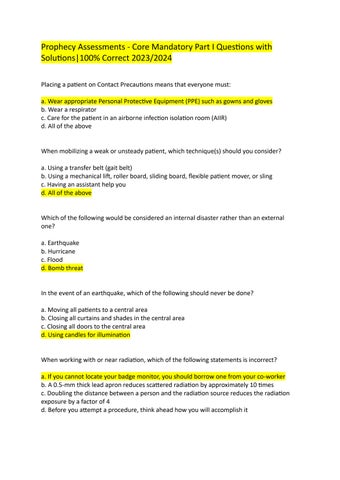
Prophecy Assessments - Core Mandatory Part I Ques7ons with Solu7ons|100% Correct 2023/2024 Placing a pa*ent on Contact Precau*ons means that everyone must: a. Wear appropriate Personal Protec*ve Equipment (PPE) such as gowns and gloves b. Wear a respirator c. Care for the pa*ent in an airborne infec*on isola*on room (AIIR) d. All of the above When mobilizing a weak or unsteady pa*ent, which technique(s) should you consider? a. Using a transfer belt (gait belt) b. Using a mechanical liI, roller board, sliding board, flexible pa*ent mover, or sling c. Having an assistant help you d. All of the above Which of the following would be considered an internal disaster rather than an external one? a. Earthquake b. Hurricane c. Flood d. Bomb threat In the event of an earthquake, which of the following should never be done? a. Moving all pa*ents to a central area b. Closing all curtains and shades in the central area c. Closing all doors to the central area d. Using candles for illumina*on When working with or near radia*on, which of the following statements is incorrect? a. If you cannot locate your badge monitor, you should borrow one from your co-worker b. A 0.5-mm thick lead apron reduces scaSered radia*on by approximately 10 *mes c. Doubling the distance between a person and the radia*on source reduces the radia*on exposure by a factor of 4 d. Before you aSempt a procedure, think ahead how you will accomplish it
When moving a pa*ent from bed to wheelchair, which technique should you avoid at all *mes? a. Bending at your knees to lower the pa*ent to the chair b. Having the pa*ent hold onto your neck or shoulders c. Placing yourself in front of the pa*ent and blocking the pa*ent's leg closest to the chair with your foot and leg d. Posi*oning the wheelchair at a slight angle close to the bed
Hazards associated with compressed gases include: a. Oxygen displacement b. Explosions c. Toxic gas exposures d. All of the above Which of the following statements regarding the use of gloves is correct? a. You do not need to wash your hands before pu[ng on gloves b. Turn gloves inside out when removing them c. It is acceptable to reuse gloves if you wash them first d. It is acceptable to wear mul*ple layers of gloves and peel off each layer between tasks If a person is injured at the hospital during a natural disaster, a correct ac*on to take is: a. Turn a person with a head injury onto his or her back b. Use a wheelchair or a stretcher to take the person to the Emergency Department for treatment c. Report the accident only if the person had to go to the Emergency Department d. Try to move the person yourself Before you use a chemical product, you must know certain important informa*on about it. Which of the choices below is informa*on you do NOT need to know? a. Proper use of the product b. What chemicals the product contains c. Treatment if accidentally exposed to it d. Precau*ons for safe handling Healthcare workers who must comply with HIPAA privacy requirements are: a. Doctors, nurses, and others providing direct pa*ent care
b. Environmental Services staff c. Engineering staff d. All of the above Which of the following is NOT required on a chemical label? a. A signal word b. Your facility's name c. A hazard statement d. A pictogram The acronym P.A.S.S. is used to help remember: a. How to use a fire ex*nguisher b. How to evacuate pa*ents c. How to spread the word about a fire d. None of the above When liIing something off the ground, which part of your body should you always use? a. Back b. Abdominals c. Arms d. Legs Which of the following statements regarding electrical safety is correct? a. Do not roll equipment over electrical cords because it can damage the cord b. It is acceptable to use a plug with a loose or broken pin as long as the device works c. Adaptors that convert three-pin plugs to two-pin plugs are safe to use d. Equipment should be unplugged by pulling the cord, not the plug If pa*ents need to be evacuated, it should be in this order: a. Ambulatory pa*ents, then wheelchair pa*ents, then bedfast pa*ents b. Whichever pa*ents you can get to first c. Ambulatory pa*ents, then bedfast pa*ents, then wheelchair pa*ents d. Bedfast pa*ents, then wheelchair pa*ents, then ambulatory pa*ents Under the Safe Medical Devices Act, your responsibility as a healthcare worker is to: