November 25, 2026
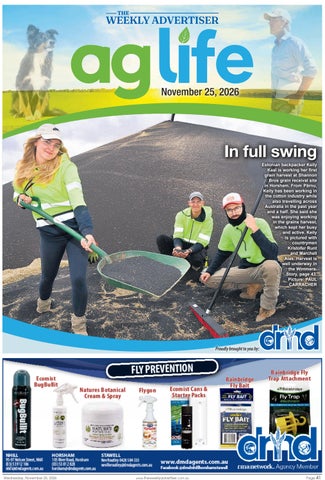
In full swing Estonian backpacker Keily Kaal is working her first grain harvest at Shannon Bros grain receival site in Horsham. From Pärnu, Keily has been working in the cotton industry while also travelling across Australia in the past year and a half. She said she was enjoying working in the grains harvest, which kept her busy and active. Keily is pictured with countrymen Kristofer Runt and Marchell Alas. Harvest is well underway in the Wimmera. Story, page 43. Picture: PAUL CARRACHER
Proudly brought to you by:
95 Nelson Street, Nhill CALL 03 5391 2106
Wednesday, November 25, 2026
www.theweeklyadvertiser.com.au
Page 41
Proudly brought to you by: This Weeks Special DogPro Working Dog
$25.00 20kg Bag
“Like” Us On Facebook
95 Nelson Street, Nhill CALL 03 5391 2106
IT’S SPRAY TIME!
We have Hardi units in stock and are making room in the yard for units arriving in 2027 HARDI RUBICON 2019 6500LT
HARDI COMMANDER 8500LT
IN STOCK AND READY TO ROLL 48m Pommier Boom, Cummins 330 HP, H Select, Ace 650 Pump. Groeneveld self-greasing
42M Terraforce Boom, ISOBUS, Norac height control, Activair
Call in and speak to the team – make us an offer and WE MIGHT JUST SAY YES!
6” x 26’ GX200 Honda Motor
C/w hydraulic wheel drive & lift incl. ram. 33hp Vanguard motor, dual motor wheel drive and light kit.
C/w hydraulic wheel drive & lift incl. ram. 33hp Vanguard motor, dual motor wheel drive and light kit.
WAS $9995
5 WAS $40,75
5 WAS $45,92
$44,990
inc. GST
$39,795
inc. GST
inc. GST
$9,500
NOW
Grainline GMP1050V 10” x 50’ Auger
NOW
Grainline GMP1036V-SP 10” x 36’ Auger
NOW
Grainline GMP626H-C Mini Mobile Auger
8 Hamilton Road Horsham 3400 Phone: (03) 5382 6103 www.wimmeramalleeag.com.au Page 42
www.theweeklyadvertiser.com.au
Wednesday, November 25, 2026
Proudly brought to you by:
Th
D
Tumultuous start for farmers 95 Nelson Street, Nhill CALL 03 5391 2106
H
BY LAUREN HENRY
arvest has begun in the Wimmera with farmers hoping for the same high yields that have been reported in the Mallee – albeit without the thunderstorm damage.
Isolated thunderstorm damage has plagued Mallee crops throughout November, with the most recent on Friday. A late afternoon deluge fell in some spots across the Wimmera on Friday, with Horsham, Longerenong and Murtoa recording about 15mm in half an hour. Crop insurance assessor Marty Colbert told Country Today a hailstorm went through the Mallee, north of Hopetoun, earlier this month, followed by smaller weather events throughout November. “That was just topped off on Friday when that cell came through,” he said. “We’d been following that cell from when it started hitting in Western Australia, where our group is dealing with more than 70 claims, then it unloaded as it came through the Eyre Peninsula, and we’ve got about 30 claims out of that. “Then it unloaded on us in the Victorian Mallee again on Friday afternoon about five o’clock. “Unfortunately, that circumstance or instance has seen it unload pretty much on the same path as the earlier November event, so quite a number of farmers have been hit the second time in the same place in that zone, sort of from Birchip to Lake Boga.” Mr Colbert said the storm in early November had affected about 60,000 hectares, with some areas losing 100 per cent in individual paddocks, but the average loss was about 30 per cent. “The thing is that the yields are very high this year, which has been great,” he said. “There’s been a lot of hard work put into these crops. So 30 per cent of a six-tonne crop is clearly more than 30 per cent of a three-tonne crop, so the financial impact is significantly larger this year.” Mr Colbert said standing canola had been hardest hit, with some paddocks of barley and wheat also damaged. He said farmers who were insured for storm damage were stoic about the situation.
FULL STEAM AHEAD: Work is underway at Ben Crouch’s property in West Wimmera, near Kaniva. “We’re always hoping for an uneventful hail season, but this is the season for it,” he said. “Are they becoming more intense? Definitely. “It just seems that they’re getting a lot more severity in the actual cells these days, and the financial impact is even more severe because the margin in primary production is so slender that there’s less of a margin to lose – it’s a double whammy.” The storms in the Mallee have also resulted in about 30 fires in the past three weeks, burning 120 hectares of lentil crops. The Country Fire Authority, CFA, has urged farmers to prioritise firesafe practices and machine maintenance before they start cutting this season. Harvest contractors have reported a challenging past fortnight with wet weather and cold starts. Cereals and lentils are being harvested across the Mallee, while canola is being harvested around Warracknabeal. Since sowing, rainfall amounts and their timing has held the cropping season in good stead in 2026. Victoria is still expected to produce the standout yields this harvest with Queensland and New South Wales
MANY HANDS: Lucy Moate and Rory Hallinan-Johns get to work at Scott Johns’ Dooen farm. results below par. Wimmera farmers have reported hay volumes to be exceptional, but quality not ideal. Matthew Sparke, of Sparke Agricultural and Associates in Horsham, said a lack of dry heat following rain could affect harvest in the Wimmera. Mr Sparke said farmers had told him they were concerned weather condi-
tions would cause mould, particularly in baled hay. “Harvest is now the problem in front of us and baling hay on the ground,” he said. “Logistically it just becomes more truncated and drawn out, and harder for them to see where they are going to get a good run at harvest.
“That’s what they really want to do – get the crops off before we do see weather damage.” Mr Sparke said his clients north of Horsham had all their canola harvest finished, while south of Horsham most have only just started.
Pick up an unwanted ‘passenger’ out the road? Contact Horsham Auto Glass today to organise prompt repair or replacement.
60B Darlot St, Horsham (Next to Horsham Bearings) Wednesday, November 25, 2026
www.theweeklyadvertiser.com.au
0427 977 336 Page 43
Proudly brought to you by: This Weeks Special DogPro Working Dog
$25.00 20kg Bag
“Like” Us On Facebook
95 Nelson Street, Nhill
SERVICING THE WIMMERA MALLEE
CALL 03 5391 2106
QUALITY PARTS, QUALITY SERVICE
KEEP YOUR RIG
ON THE ROAD. TRUCK PARTS, ACCESSORIES, FLUIDS, FILTERS, FITTINGS & MORE.
FILTERS
FITTINGS
WEIGHING
LUBRICANT
Genuine Fleetguard & Donaldson Filters for every machine.
Custom built kits to suit your exact setup.
Bluetooth Scales. Check your load from the cab.
A range of quality caltex lubricants and fluids.
24/7
EMERGENCY BREAKDOWN SUPPLY Parts that get you back on the road. Part supply only
5 Urquhart St, Horsham 0447 413 928 parts@mtparts.com.au
MY27 Early Order Program on now Choose Choose the the best best combine combine for for your your operations operations and and order order it it your your way. way.
TOTAL TOTAL HARVESTING HARVESTING SOLUTIONS SOLUTIONS
John Deere’s combine and John Deere’sprecision combineautomation and front-end front-end equipment, equipment, precision automation technology, and data technology, and real-time real-timeahead. data keep keep your your operation operation one one step step ahead. With connected support and With connected dealer dealer support and your operations data, you get more your operations data, you get more uptime, less stress, and smarter uptime, less stress,automatically. and smarter decisions decisions applied applied automatically.
Your Your local, local, Australian-owned, Australian-owned, John John Deere Deere dealership dealership 1300 628 596 emmetts.com.au 1300 628 596 emmetts.com.au Page 44
www.theweeklyadvertiser.com.au
Wednesday, November 25, 2026
Proudly brought to you by:
Th
D
‘A solution in search of a problem’ 95 Nelson Street, Nhill CALL 03 5391 2106
T
BY LAUREN HENRY
he Victorian Farmers Federation, VFF, says while the Federal Government’s revised working holiday-maker visa changes are an improvement on its original plan, it is still not clear what problem the government is trying to solve.
Following pressure from the agricultural, hospitality and tourism sectors, the government backflipped from its original announcement in July to restrict working holiday visas in a bid to cut migration. Last week Home Affairs Minister Tony Burke announced third-year visas would be capped at 25,000 – an increase from the original 5000 set in September. The current level sits at 31,000. The government will also introduce a ballot system called the Next Year Regional Work Guarantee next year, and change the requirement for working holiday-makers who will now need to complete 120 days of regional work, up from 88 days, to qualify for a second-year visa. From March 1, 2027, backpackers seeking a second or third visa will need to register and be invited to apply. Second-year places will be capped at 45,000, and third-year places at 25,000, up from the 5000 first proposed. VFF president and Minyip farmer Ryan Milgate said the concessions were welcomed, but targeting this visa remained a misfire. “This is a solution in search of a problem. The working holiday program wasn’t broken, and farmers have spent the past two months dealing with the uncertainty of the government trying to fix it,” he said. “This whole thing has been completely unnecessary and a major
“Growers are already managing the day-to-day demands of running a business, meeting compliance requirements and responding to seasonal conditions”
– Ash Brooks, right
source of disruption heading into peak season. “These are temporary visitors. They pick fruit, work in packing sheds and spend their wages in regional towns and tourism businesses, and then they go home. “They’re not settling here, and they shouldn’t be counted in net overseas migration figures in the first place.” Mr Milgate said rationing a program regional Australia depended on, just to hit a migration target, was still the wrong call. “The simple fact is that when farms need workers, we need them urgently. Spreading numbers of staff over a period of time can be problematic when it’s all hands on deck and the work needs to get done,” he said. “Our message is simple, talk to farmers and work with us on our workforce needs, rather than just lobbing out half-baked ideas and causing uncertainty.” To address the concerns on the eve of harvest, state farming bodies were left to co-ordinate the processing of farmers’ urgent workforce applications with the Department of Home Affairs. While the National Farmers’ Federation, NFF, also welcomed the changes, president Hamish McIntyre said there were still many unanswered questions, and required more details on the logistical realities before it could throw its full support behind it. “We’ve been clear with the government just how important backpack-
ers are to keeping Australian farms running and food on supermarket shelves,” he said. “Working holiday-makers fill roughly one in seven farm jobs nationally and contribute an estimated $726-million directly to regional economies each year. Getting these visa settings right is important beyond the farm gate.” While welcoming the government’s engagement with industry on workforce reforms, GrainGrowers says the current arrangements remain unnecessarily complex and still do not give certainty the quantity of skilled workforce required by the grains industry would be able to enter Australia. GrainGrowers deputy chair, Victorian Farmers Federation grains councillor and Dimboola farmer Ash Brooks
said growers had consistently raised concerns about reducing access to established working holiday-maker visas before alternate pathways were in place. Ms Brooks said without it, the industry was unable to ensure workforce sourced through overseas, temporary labour, could continue to arrive. The working holiday-maker program has long provided grain growers with access to reliable workers that have the experience to support critical seasonal work, helping businesses maintain productivity and supporting regional communities. Ms Brooks said workforce policy must reflect the practical realities of running a farm business. “Growers are already managing the day-to-day demands of running a
business, meeting compliance requirements and responding to seasonal conditions,” she said. “What growers are asking for is certainty that they can get the workers they need when they need them to ensure they can plant and harvest.” Federal Member for Mallee Anne Webster said Wimmera and Mallee farmers had been planning months ahead to bring back experienced operators from countries such as the United Kingdom, Ireland and Canada to operate their machinery for harvest – but were hit with significant delays, sometimes placing financial and emotional strain. “I took that evidence directly from our farmers and contractors to Parliament and the Minister repeatedly. The Albanese Labor government failed to listen and instead tried to shoehorn farming peak bodies into the process because Labor just has no clue about agriculture,” she said. “Instead, Labor deliberately slowed the pipeline of working holiday makers while trying to massage its own migration numbers.” Dr Webster said Mr Burke had admitted the visa-processing ‘go-slow’ created ‘head room’ for the government to adjust its working holiday maker reforms while still pursuing a lower overall migration figure. “Labor let migration surge and then – yet again – went looking to regional Australia for what they thought were politically ‘safe’ targets, rather than tackling migration pressures concentrated in our capital cities and their own seats.” The government is renegotiating the Australia-UK Free Trade Agreement, AUKFTA, where eligible Australians and Brits gained reciprocal access to working holidays for up to three years without compulsory specified work.
WHERE VISION MEETS PRECISION. 0436 434 353 STEEL FABRICATION • MACHINING • CUSTOM BUILDS 10 JERVIS STREET, HORSHAM
LIVESTOCK
workshop@sbengservices.com.au
WOOL
PROPERTY
Last Horsham Market 2026 Weds 9th December First Horsham Market 2027 Weds 13th January Wednesday, November 25, 2026
www.theweeklyadvertiser.com.au
Page 45
Proudly brought to you by: This Weeks Special DogPro Working Dog
$25.00 20kg Bag
“Like” Us On Facebook
Stay on the move with Wimmera Bearings
95 Nelson Street, Nhill CALL 03 5391 2106
> Belts > Pulleys > Bearings
> PTO > Hubs > Uni Joints
your hay & slasher specialists
et, Horsham
14B Sloss Stre
Call us on 5381 0800 for 24 hour breakdowns!
MARSHALL MULTISPREAD
The versatile range of trailing spreaders for all types of granular fertilizers and seeds as well as heavy rates of gypsum, lime, compost and manures. 2.5 Tonne to 16 Tonne models available Available with i4M Variable Rate Controller, Weighing Systems, 3 Metre Axle & wheel options - Spare Parts and Workshop Service and Repairs available -
Contact your Eastern States Distributor:
EASTERN SPREADERS PTY LTD 9508 Murray Valley Highway, KERANG, Vic 3579
-
Page 46
Ph: 03 5450 3077 Mob: 0409 691 226 or 0429 480 337
easternspreaders.com.au www.theweeklyadvertiser.com.au
-
Wednesday, November 25, 2026
Proudly brought to you by:
Th
D
Rising concerns
A
new survey by Roy Morgan found 48 per cent of farmers list rising costs as their main concern, the highest result recorded for any single issue since the survey began five years ago.
Survey results show nearly 60 per cent of farm businesses say they are worse off than they were a year ago, with input costs emerging as a major concern. A year ago, one in 50 farmers identified fuel as a major concern, but that figure has now climbed to almost one in five. In June, the Australian Bureau of Agricultural and Resource Economics and Sciences, ABARES, predicted average broadacre farm profits would fall by 70 per cent this financial year, from about $216,000 to $65,000. Federal Member for Wannon Dan Tehan said the figures should be a wake-up call for the Federal Government to reduce the compliance and regulatory burdens, which were adding to the financial pressure on farming families across regional Australia. “When fuel, fertiliser and wages all go up at once, without a corresponding increase in income, farm businesses become far less financially viable,” he
said. “Farmers know only too well the challenges of managing rising input costs, while also dealing with the uncertainty and risks that come with running an agricultural business. “On top of that, they are being tied up in red tape and illogical bureaucracy, including changes to the EPBC Act, which are adding to costs, and the flawed Working Holiday Maker ballot system. “Farmers cannot simply pass those additional costs on to customers or absorb them indefinitely. “Every extra dollar comes out of their own pockets and puts further pressure on the viability of their business. “Farming families are going backwards under Labor, and the Prime Minister needs to understand that when farmers can no longer afford to keep producing food, it’s not just their livelihoods at stake, it’s Australia’s food security.”
Pressure
Shadow minister for agriculture, fisheries and forestry Darren Chester said farmers already carried ‘enormous risks’, from droughts and floods to volatile global markets, but they should not have to carry the risk of poor government decisions. “Global disruptions are not
going away. This won’t be the first or last international crisis to put pressure on Australian agriculture, and the government needs a plan to shield our farmers from the worst of these shocks,” he said. “Instead, Labor is making life harder for farming families through more regulations and changes to capital gains tax and family trusts, which threaten to complicate succession planning and make it harder to pass family farms on to the next generation. “There are also concerns these changes could force some farmers to restructure their businesses in ways that jeopardise access to Farm Management Deposits, one of the most important tools available to build financial resilience and prepare for drought. “Farmers need certainty and a government that understands the realities of running an agricultural business. “Instead, they are facing rising costs, growing regulatory pressures and uncertainty about the policies that affect their livelihoods. “The Coalition will keep fighting for the people who grow our food and fibre, because our national food security depends on the viability of Australian farming.”
95 Nelson Street, Nhill CALL 03 5391 2106
Report activity
With the first round of spring hatching complete and grain harvest underway, landholders and public land managers in the Mallee and Wimmera are urged to keep monitoring and reporting Australian plague locust activity. Agriculture Victoria incident controller Jo Cameron encouraged landholders to continue reporting what they were seeing to Agriculture Victoria. ‘With the first round of spring hatching complete, further breeding and new generations of locusts remain possible,” she said. “As we move into the next phase, uncontrolled bands could develop into flying swarms, and public observations and reports will help us understand where further action is needed.” Ms Cameron said the Mallee and Wimmera were the main areas where locust activity had been detected. She said ongoing community reporting helped identify new activity to support further action to protect farms, parks and neighbouring communities. “Locusts can cause contamination and affect grain receival. Before delivery, check
the relevant Grain Trade Australia and grain buyer receival standards for limits on live or dead grasshoppers and locusts,” she said. Annual targeted surveillance during autumn indicated higher-than-usual spring locust activity, prompting increased surveillance and preparedness before reports of locust bands in spring subsequently triggered intensive ground surveys by Agriculture Victoria and Australian Plague Locust Commission. Ms Cameron said the best time to control locusts was about two weeks after hatching, when they formed into bands and before they started flying. She said land managers should follow treatment guidance from Agriculture Victoria and APLC, and keep watching for new generations and uncontrolled locusts forming bands or swarms, reporting activity at every stage including egg laying, hatching, banding and swarming. For current information, monitoring and control advice or to report locust activity online people can visit agriculture.vic.gov. au/locusts or call 136 186 or email plague. locusts@agriculture.vic.gov.au.
NAVIGATOR TITANIUM THE NEXT GENERATION OF SPRAYERS IS HERE
SPEAK TO YOUR HARDI DEALER TODAY
Wednesday, November 25, 2026
www.theweeklyadvertiser.com.au
Page 47
Proudly brought to you by: This Weeks Special DogPro Working Dog
$25.00 20kg Bag
“Like” Us On Facebook
95 Nelson Street, Nhill CALL 03 5391 2106
DONALD .................................. 5497 1203 BALLARAT ............................... 5336 4145
MOAMA ................................... 5480 0731 TRARALGON...................... 0499 957 007
3 SIDES ENCLOSED – GABLE SHED
Width 15m 18m 21m
24m
Length 24m 32m 40m 32m 40m 32m 40m 40m 48m 64m 80m
Bays 3 4 5 4 5 4 5 5 6 8 10
UB Column 31OUB40 36OUB45 41OUB54
41OUB60
Bale Capacity 648 864 1080 1080 1350 1224 1530 1800 2160 2880 3600
READY TO TAKE A 6m AWNING
ORDER NOW & RECEIVE
Full Zinc Price $58,095 $71,270 $84,683 $81,987 $96,435 $110,325 $124,866 $132,345 $154,369 $193,993 $234,516
5% DISCOUNT
Prices are ex-factory and include GST
FOR MORE INFORMATION OR A QUOTE CONTACT RICHARD & TAYTEN TODAY
HORSHAM
RURAL SHED • INDUSTRIAL SHED • ANY SHED Page 48
Phone (03) 5382 4140
horsham@eurekagarages.com.au www.theweeklyadvertiser.com.au
EUREKA Wednesday, November 25, 2026
Proudly brought to you by:
Th
D
Report puts ‘full picture on the table’ 95 Nelson Street, Nhill CALL 03 5391 2106
H
igh sheep-meat value, progress in the areas of animal welfare and biosecurity, and productivity pressures were key themes of a sixth Sheep Sustainability Framework, SSF, annual report, released last week.
Led by Sheep Producers Australia and WoolProducers Australia, with support from Meat and Livestock Australia and Australian Wool Innovation, the 2026 SSF report compiles data across Australia’s sheep industry, outlining animal care, environment and climate, people and communities, and financial resilience. Independent chair of the SSF board Angus Gidley-Baird said the report showed an industry making progress in some areas while confronting structural challenges in others. “The value of the report is that it puts the full picture on the table,” he said.
“It shows where the industry is moving forward, but it is equally clear about the areas that need continued attention.” According to the report, the proportion of Merino wool declared as nonmulesed or ceased mulesing increased from 18.6 per cent to 21 per cent. Australia also maintained its freedom from 12 major sheep diseases, but an economic picture was more mixed. The gross value of Australian sheep meat production reached $5.617billion in 2024-25, up 37.5 per cent on the previous year, but Sheep Producers Australia chief executive Bonnie Skinner said a good market alone would not make the industry resilient. “Strong prices are welcome and give producers an important incentive to invest. But tight supply is a doubleedged sword,” she said. “Competition for fewer sheep has driven livestock prices to a record
high. That’s good news for producers, but every part of the supply chain relies on a steady flow of stock for industry sustainability. “Our long-term sustainability rests on continual improvement, responding to change and keeping enough sheep to serve our customers,” she said. WoolProducers Australia chief executive Jo Hall said the report was important to businesses and organisations seeking reliable information about the sustainability of Australian wool and sheepmeat. “This one being the sixth report means that we’re starting to get a nice body of data to show trends, both positive and negative, and that enables us to do a couple of things,” she said. “It enables us to keep focusing on areas that we’re doing a really good job on and the ones that we can proudly show … where we’re excelling at, and there are many of those areas.
“But secondly, and perhaps more importantly, it also enables the industry to identify areas that probably need a bit more attention.” Ms Hall highlighted the increase in non-mulesed wool as a step in the right direction. “I think when we’re looking at the issue of mulesing, which is such a contentious issue, we are starting to see progress,” she said. “Of course, that progress in terms of addressing this issue isn’t quick enough for many people. “But … then you look at pain-relief usage, and I know in Victoria and Tasmania it’s a requirement to use pain relief. But the rest of Australia is still at that voluntary phase of using it, and when we have nearly 90 per cent of producers who mules using pain relief, I think that’s a great story to tell. “There are some positives in this space to be highlighting, and it’s something as an industry we’re not
Carbon credit success A grazing property near Lake Bolac has emerged as one of the biggest success stories of Australia’s carboncredit scheme. Chatsworth House was announced as the highest Victorian earner under the Australian Carbon Credit Unit, ACCU, program, which awards credits for every tonne of carbon dioxide equivalent a registered project avoids releasing or removes from the atmosphere. Registered ACCU projects can sell the credits to private buyers, allowing them to offset their own carbon emissions, or sell them to the Federal Government. Since registering for the scheme, Chatsworth House has earned 18,864 units – a figure co-owner Sarah Whinney said she and her husband Tom were proud of. Ms Whinney said the couple undertook research before deciding to join the scheme. “Just before we moved to the property back in 2020, we went to a conference to learn about how we might be able to farm in a way that was building our soil health and hence our soil carbon,” she said. “One of the things we came away from that conference with was that if we’re going to be doing these things
anyway, then it was worth investigating a soil-carbon project. “We researched lots of different options and came up with the conclusion that the money it was going to cost us to set up the project, register it, baseline the soil, do the audits and so on, was worth it if we were truly committed to farming in this way.” Ms Whinney said the benefits of the program outweighed the costs. “Over the last five years we have spent – and it does sound like a lot of money – around $200,000 on all of that process and retesting soil carbon levels,” she said. “As it sits at the moment, based on the current ACCU prices, we have earned just over $600,000 worth of ACCUs. So I guess that’s a net $400,000 gain, which is significant and we’re really proud of that.” Ms Whinney said she and her husband aimed to take a ‘soil-friendly approach’ to all on-farm decisions, guided by principles laid out by US farmer and author Gabe Brown. “The principles include always trying to keep the soil covered, minimising disturbance, either through tillage or chemical use. We do still use chemicals and fertilisers from time to time, but just trying to minimise the effect of that,” she said.
great at. We don’t tell our stories as well as we could be.” Ms Hall said declining productivity, workforce pressures and falling wool supply were areas of concern. “Sheep production competes with every other use of land, labour and capital. Securing its future means creating the conditions for sustained investment, higher productivity and the capacity to adapt, so sheep and wool remain a viable choice,” she said. Mr Gidley-Baird said the framework’s role was not to set policy or prescribe how individual businesses should operate. “Its role is to report the evidence clearly and consistently, so industry, government and markets can make informed decisions from a shared understanding of the facts,” he said. The 2026 Sheep Sustainability Framework Annual Report is available online at www.sheepsustainability framework.com.au/resources/reports.
“The principles include always trying to keep the soil covered, minimising disturbance, either through tillage or chemical use. We do still use chemicals and fertilisers from time to time, but just trying to minimise the effect of that” – Sarah Whinney, left, pictured with husband Tom
“Trying to have a diverse range of plants growing in the soil at any one time, and keeping those plants as living roots to keep that soil biology active throughout the year. “Then of course the livestock, which is really the key factor, and focusing on our rotational grazing management. “We’ve done a lot of learning in all of these fields, particularly around how to manage our livestock in a rotational grazing system that focuses on the rest of the pastures to allow them to regrow and build those root masses and build that soil health.” Ms Whinney described the couple’s approach to soil management as ‘a lot
of science and also a bit of art’. “We did the RCS Grazing Clinic course, which was really helpful,” she said. “The amount of rest a pasture needs depends on the growth rate of the pasture. “So during spring when it’s growing quickly, you rotate through the pastures quicker and there’s slower rest periods. But when you get into the non-growing season, it’s a much slower rotation.” Ms Whinney encouraged other farmers to consider joining the ACCU scheme, saying the benefits were myriad. “The financial reward is definitely an incentive, but I think the main goal is
building soil health and soil carbon in your farming system,” she said. “There’s a lot of other production benefits that come with that in terms of the water-holding capacity of the soil, soil function, and better plant growth and animal growth along with that. “So yes, the carbon credits are significant and we’re really excited by that, and I think it shows that there is potential to build soil carbon in this part of the world. “But getting ACCUs shouldn’t necessarily be the end game. It’s a nice bit of cream on top for trying to do the right thing.”
L A W Y E R S The team at OʼBrien and Smith Lawyers look forward to assisting with your legal needs.
Patrick Smith
LL.B. (Hons), B. Int. St., B.Ec., GDLP
Helen Thomson
LL.B., B.A., GDLP
Lauren Emblem
LL.B., B.A., GDLP M.App Law (Family Law)
Rachel Meulendyks LL.B., GDLP
64 McLachlan Street, Horsham VIC 3400 | 178 Main Street, Stawell VIC 3380 | 45 Victoria Street, Nhill VIC 3418 info@obsl.com.au | (03) 5381 2222 Horsham & Nhill | (03) 5381 2220 Stawell | www.obsl.com.au Wednesday, November 25, 2026
www.theweeklyadvertiser.com.au
Page 49
Proudly brought to you by: This Weeks Special DogPro Working Dog
$25.00 20kg Bag
“Like” Us On Facebook
95 Nelson Street, Nhill CALL 03 5391 2106
THINK IN
SIDE TH
E BOX FO IT’S WHA T YOU MA R ONCE KE OF IT
AILABLE V A S R E IN G CONTA PAINTED Y L L A N R SHIPPIN E , INT EET HIGH F 9 , G N 40 FEET LO
$4,400
ADDITIONAL SIZES AVAILABLE ON ENQUIRY, CALL FOR OFFER!
CONTACT US: 0427 021 542
*IMAGE PROVIDED FOR ADVERTISING PURPOSES ONLY, CONTAINERS SOLD EMPTY.
MINIMUM REST LIQUID
Vanguard
THE NEW READY FOR THE FUTURE OF SUSTAINABLE AGRICULTURE
MORE HECTARES PER HOUR
The Vanguard series is the logic evolution that builds on the legacy of the successful Agrifac Condor. It combines better manoeuvrability and a perfect machine balance with increased capacity and the highest level of operator comfort. With tank capacities of 5.500 or 6.700 liter and an all new user experience this machine is the perfect fit for the future of farming. VANGUARD SERIES All Agrifac self-propelled sprayers are based on the 4E’s for growers principle: Efficient, Economical, Ergonomic and Ecological from design to development as well as in use. The new Vanguard 55 and 67 models combine a new design with an all new operator experience, increased tank capacity, high output plumbing system and the ability to fit larger tires. The Vanguard fitted with J-booms stays within 2,55m with road transport. (max tire width: 580mm) MORE COMFORT The new cab offers more comfort with a new ladder for improved access, an swiveling leather seat (option), footpegs, a 7l fridge, further reduced noise levels, Apple Carplay/Android Auto wireless connection, auxiliary display mounting rail and standard fitted with cat. 4 filtering.
The cab also offers new features with the all new EcotronicPlus control system with a 18,5” display combined with a newly designed armrest and comfortable joystick.
SPEEDS UP PERFECT BALANCE
VANGUARD 55 The smallest model in the Vanguard range combines a 5.500l main tank with a large platform that enables the storage of products. The platform can be loaded with a forklift or similar even while the boom is in folded position. The Vanguard 55 comes with two engine options: 157 kW/ 212 HP or 212 kW/284 HP. VANGUARD 67 The Vanguard 67 offers a 6.700l tank that gives the machine a perfect 50/50 weight balance with fully loaded tanks and unfolded boom (36m). The Vanguard 55 comes with two engine options: 212 kW/284 HP or 243 kW/326 HP.
COMFORTABLE RIDE
LITRE
TRACK WIDTH 180-325 CM
30CM
COMFORTABLE RIDE
LESS COST, MORE YIELD
TRACK WIDTH
150 Golf Course Rd, Horsham. Phone: (03) 9956 8897 AG R IFAC T EC HNICAL
Page 50
6700 LITRE
PERFECT BALANCE
Available options
14
LESS DOWNTIME
www.theweeklyadvertiser.com.au
www.agrifac.com/au/ 15 YOUR FUTURE DELIVERED TODAY
Wednesday, November 25, 2026
Proudly brought to you by:
Th
D
Reflection of what might have been 95 Nelson Street, Nhill CALL 03 5391 2106
BY COLIN MacGILLIVRAY
T
he forgotten legacy of Wimmera inventor and agricultural pioneer Fred Schache has been brought to light by Warracknabeal historian John Schubert.
Mr Schubert said Australia’s agricultural history was full of innovators, but few parts of the country had benefited more from inventions than the Wimmera and Mallee, where early European colonisers contended with ‘limited rainfall, thick native vegetation and varying soils with deficient natural fertility’. “The stories of these innovative pioneer inventions are deeply ingrained in the Australian rural psyche: machines such as Ridley’s Stripper, the Smith brothers’ stump-jump plough and Mullen’s Mallee Roller,” Mr Schubert said. “In many instances these inventions found their genesis in crude country workshops, with little more than unschooled mechanical skill and a blacksmith’s forge. “What is less recognised, however, is the fact that for each inventor whose names are still remembered, there were many others whose skills never resulted in success and renown.” One of those forgotten inventors was Fred Schache, the son of German settlers who was born near Murtoa in 1878 and lived most of his life in the Wimmera. After receiving basic education at a local rural school, Mr Schache trained as a blacksmith at Murtoa, working for his uncle Gottfried Schache on a horse-powered threshing plant and becoming the chief supervisor. In 1903 he took up share-farming at St Helens Plains, south of Murtoa, before moving back to Murtoa in 1916, after which he developed and patented two agricultural innovations. Patent 1181-16, dated June 2, 1916, specified ‘improvements in and relating to combined sowing drills and scarifiers’. Patent 14,870-20, dated March 24, 1920, was for ‘improvements in and relating to stump-jump scarifiers, or the like, combined with sowing means’. Mr Schache described his 1916 patent for an improved invention in the following specifications: “The object of my invention is to provide improvements in and relating to seed or-and manure sowing drills having scarifiers, such that in one
Wednesday, November 25, 2026
“Fred, it would seem, was the unfortunate victim of the fierce historic competition of Australian farming at that time”
– Historian John Schubert
journey land is opened or furrowed, and seed or-and manure deposited in the furrows, and covered by earth which is raised by shares or feet and then falls into the furrow. I am aware of other combination drills and scarifiers, but my construction has improvements.” Mr Schubert said Mr Schache’s invention was ‘almost certainly the first combine in operation in the Murtoa district, if not the Wimmera’. “Undoubtedly it was the first with his innovative and sophisticated improvement,” Mr Schubert said. “Local interest was soon aroused and the following year he won first prize in a special implement section introduced into the Murtoa Agricultural and Pastoral Society Show.” Mr Schubert said Mr Schache was reputed to have built two prototypes of his combine at his father-in-law’s property near Shanty Corner at Coromby, north of Murtoa. “As he was trialling one of his machines in a paddock, a stranger
PIONEER: Above, Wimmera inventor and agricultural pioneer Fred Schache, and top, Mr Schache preparing to repair machinery in the 1920s. on horseback rode up and expressed interest, questioning Fred in some detail,” Mr Schubert said. “With his trusting nature, Fred was perhaps too open in his explanation and within a short time the horseman’s interest had become clear; a large manufacturing business in Melbourne started mass-producing a similar machine, which operated in the same way, while introducing some design changes to overcome the restrictions of Fred’s patents.”
www.theweeklyadvertiser.com.au
Mr Schubert said Mr Schache’s story was a common one. “In the agricultural boom of the early 20th century, machinery agents frequently travelled the Wimmera and Mallee,” he said. “It was common practice for companies to look for modified equipment on farming properties to determine what worked in the harsh Australian conditions. “These modifications were sometimes introduced into their own ma-
chines, by lawfully designing around existing patents where that was necessary. Fred, it would seem, was the unfortunate victim of the fierce historic competition of Australian farming at that time.” With no business or financial backing, Mr Schache’s dream of manufacturing his own combines quickly evaporated. His obituary in the Murtoa newspaper years later referred to his ‘disappointment’ that he was unable to benefit from his invention. His daughter recalled how in the evenings, even in later life, Mr Schache would often sit quietly for hours, thinking about inventions and drawing preliminary sketches. Mr Schache spent the remainder of his life working on agricultural machinery, working for agricultural implement company T Robinson and Co until 1925, when he moved to Warracknabeal. Mr Schache and his family retired to Murtoa in 1946, where he died in 1955. “A kind and unassuming man, and a faithful member of the Lutheran Church, he carried a quiet sadness all his life about what might have been,” Mr Schubert said.
Page 51
Proudly brought to you by: This Weeks Special DogPro Working Dog
TRUCK
$25.00 20kg Bag
Spanner in the works
“Like” Us On Facebook
95 Nelson Street, Nhill
TALK
CALL 03 5391 2106
P
rime lamb producers must be scratching their heads wondering when the stellar prices for cross-bred ewes start to show signs of easing.
WITH HORSHAM TRUCKS
KEEPING YOU MOVING THROUGH HARVEST Harvest is in full swing, and we know how important it is to keep your trucks on the road during one of the busiest times of the year. Long days, dusty conditions and plenty of kilometres can take their toll, and sometimes things don’t go to plan.
WE’RE HERE WHEN YOU NEED US
YOUR LOCAL TRUCK PARTS EXPERTS
From truck parts to Omikron products and everyday maintenance supplies, we’re here to support you throughout the busy season.
From pre-harvest checks to everyday maintenance and parts, we’re here to help keep you moving throughout the busy season.
Keep our number handy this harvest. We’re only a phone call away!
Keeping you moving through harvest
IF SOMETHING GOES WRONG, GIVE US A CALL! The last thing you need during harvest is unexpected downtime. Whether you’re chasing a replacement part, maintenance essentials or just need some advice, the team at Horsham Truck Company is here to help. We understand that during harvest, every minute counts. If something happens, you’ve got our number. Give us a call and we’ll do what we can to get you moving again.
SAM BARNES & BRENDAN WILLS HORSHAM TRUCK COMPANY
TALK TO THE LOCAL TRUCK PART EXPERTS. PH: 5381 1413
32 HAMILTON STREET HORSHAM
A line of about 100 Border Leicester-Merino cross ewes sold for $650 a head at Naracoorte recently. Not a bad pay cheque of $65,000 for a mob of sheep, though it must be said that along with other recent record-breaking sales, these sheep come from cross-bred sheep producers who’ve had skin in the game – some for generations – and the sheep were beautifully presented. Wise words from the vendor who said ‘it’s not the top prices that’s so important but the average across the sale’. So what could be a spanner in the works for prime lamb production? None other than one Donald Trump, who probably doesn’t even know what a prime lamb is. He must make the final decision on whether to increase tariffs on sheep meat imports to the United States. The American Sheep Breeders Association lodged a formal request with the Office of the US Trade Representative for higher tariffs, arguing imports mainly from Australia and New Zealand were undercutting 90 per cent of domestic production. They successfully lobbied more than 30 Republicans to support the tariff increase, which I had understood to be to raise the current tariff from 12.5 per cent to more than 20 percent. I could have choked on my cornflakes when highlyregarded GlobalAgritrends analyst Simon Quilty told Country Today it could be double that. “The tariffs are actually likely to increase to 42.5 per cent. The reason is because the proposal put forward by the Sheep Industry Association in America and R-CALF has been for 30 per cent additional tariff on the current 12.5 percent,” he said. “So that would lead to a 42.5 percent tariff
Country Today with Libby Price
overall. The impact is likely to be felt, I think in the short term, by the consumer in America. “And this is not just me saying that; we had a public statement by Walmart only last week that reiterated that.” The damage should not be underestimated as the US has recently become our single largest export market valued at $1-billion a year, closely followed by China. Our high domestic sheep prices are seeing an unprecedented demand for breeding ewes so farmers can take advantage of the boom. If that growth is too quick, this could start to tumble. If you are tempted to think a tariff of this measure is highly unlikely, it has a precedent. Former Democrat President Bill Clinton. “Back in July 1999 under the Clinton administration, tariffs were set at 40 per cent in the first year, in the second year 32 per cent, and the third year 24 per cent. That was found by the WTO to be illegal three years after it was introduced and was disbanded,” Mr Quilty said. The timeline on this is that President Trump is presented with the findings of the USTR, which were split three against three on the tariffs proposal. Hence the President both literally and metaphorically having the Trump card. The Australian sheep industry lobby groups were loathe to talk to Country Today, no doubt for fear what they say might backfire. So, as they say, let the sheep shenanigans begin. It will be mid-January before we know what the United States’ next step will be.
GET HARVEST READY The right moisture. The right time. Every time.
2166
THE ESSENTIAL GRAIN MOISTURE METER
✓ Measures moisture and temperature
✓ 40 grain scales ✓ Fast, simple moisture testing
✓ Backlit display ✓ ±0.5% accuracy in the normal stored-grain range
PRICE
$632.50 INC. GST
2167 PLUS THE PROFESSIONAL CHOICE
✓ Measures moisture, test
weight (hectolitre mass) and temperature
Introducing the new
2189
2188
ADVANCED DIGITAL PROBE for Hay, Straw & Silage
DIGITAL MOISTURE PROBE Simple, Durable & Reliable
• Simple, durable, reliable
• Simple, durable, reliable
• Easy to read backlit display
• Easy to read backlit display
• Moisture Range 8% 72%
• Moisture Range 8% 44%
• Temperature Range 0oC 70oC
• Temperature Range 0oC 107oC
✓ 20 grain scales ✓ Large sample size for improved accuracy
✓ Fast results – under 7 seconds ✓ Automatic temperature compensation
✓ ±0.3% repeatability in the
normal stored-grain range
RRP
$1270.50
• HAY • STRAW • SILAGE RRP
$781.00 INC. GST
BALER MOISTURE TESTER PLUS
RRP
INC. GST
The next generation of moisture meters is here, with the introduction of the Navigator® series and EDGE® app from Delmhorst.
• Mounts in te cab of the tractor providing a direct readout for % moisture while baling hay • Advanced dual-
sensor technology • Calibration for greater overall Clip for easy re-calibration accuracy in the field • Compatible with square or round balers • HAY • STRAW • SQUARE BALERS • ROUND BALERS
$682.00
FX-20 & FX-30
2178
RRP
$1501.50 INC. GST
INC. GST
Take the guesswork out of hay making this season with our trusted moisture testers
Product Features: • Large, customer display with auto backlight – easy to read under all conditions • On-screen statistics for up to 100 readings saved to the meter - High, Low Average, standard Deviation • Moisture Range:
FX-20: Hay 6%-40% FX-30: Hay 6%-23% • Bluetooth® connectivity (FX-30) • Color-coded LED’s – adjustable through EDGE® app (FX-30) • Alarm set point – alerts to userselected MC level • Internal calibration check
8 Hamilton Road Horsham 3400 Phone: (03) 5382 6103 www.wimmeramalleeag.com.au Page 52
www.theweeklyadvertiser.com.au
Wednesday, November 25, 2026
Proudly brought to you by:
Th
D
Chance to swap seats
A
paddock of wheat looks different depending on which side of the fence you are on.
From a car on the Western Highway, it might be the loveliest stretch of gold you have seen all morning. From the farm ute, you are looking at the result of a hundred decisions, checking the forecast and wondering whether the part you ordered for the header has arrived. Sharing that exchange of information and insight is not something we should assume occurs naturally these days. Bridging that gap is the very reason that days like National Ag Day on Friday last week are so important. This year’s theme ‘Our Farmers, Our Future’ was an invitation to swap seats for a moment and see what the other person sees. There’s a particular pleasure in seeing a crop come off after months of work. Around the Wimmera, plenty of people have a hand in that moment. And they all deserve a share of the celebration. This new digital era has only
AgVocate with Paula Doran
amplified the power we can create when we pull focus like last Friday. Indeed, harnessing the power of digital media to celebrate a national industry, in all its many iterations, commodities and aspects is something we do well in Australia. And it’s only getting better. An August 2026 survey commissioned by Norco found that 17 per cent of the 1014 Australian parents surveyed said their child had never visited a farm or they were unsure whether their child had visited one. Building that understanding and knowledge can only build more momentum as we move steadily into a new age where every farmer is their own advocate, marketer and brand champion through their social media account. Let’s all harness that power so we can build understanding not just on national days that celebrate ag, but every day.
Author shares climate risk forecast 95 Nelson Street, Nhill CALL 03 5391 2106
Risks and opportunities for future farmers in the wake of Australia’s first National Climate Risk Assessment were the subject of lead author Andrew Watkins’ talk at the fifth annual BCG chair’s breakfast in Birchip last month. Attendees from across western Victoria heard Dr Watkins’ insights for the next generation of farmers. Dr Watkins is an adjunct professor at Monash University’s School of Earth, Atmosphere and Environment, a member of the Climate Council, and a Fellow of the Australian Meteorological and Oceanographic Society. He also has a longstanding connection with BCG, having presented climate outlooks at past BCG events and field days as the Bureau of Meteorology’s head of climate prediction for more than a decade. BCG chair Brett Hosking said the purpose of the event was to highlight the value of creating opportunities for connection in rural communities. “It’s a chance to look after ourselves and also to learn,” he said. “When it comes to climate science and climate change, I think it’s important we learn about the challenges and opportunities, and about the steps we can take to respond.” Dr Watkins’ talk ranged from the definitions and history of weather, climate, greenhouse effect, climate variability and climate change, through to a current outlook and future projections. He discussed the National Climate Risk Assessment, focusing not only on agriculture, but on adjacent areas including considerations for local councils, rural healthcare providers, finan-
Andrew Watkins cial institutions and rural communities as a whole. Dr Watkins said atmospheric carbon dioxide levels had risen from 280 parts per million 200 years ago to more than 430ppm today, with the past 10 years the hottest on record. He said 2024 was the hottest year recorded so far, with 2026 shaping up to be either the hottest or second hottest by its conclusion. “Every single year since 2011 has been hotter than the hottest year of the 20th century,” he said. Dr Watkins said growers had made big breakthroughs in curbing carbon emissions through technology and farming practices, and would form a large part of efforts to curb climate change. Dr Watkins described a ‘three way battle’ between activity in the Pacific Ocean, currently at near-record El Niño levels, changes in the polar winds high in the stratosphere above Antarctica,
and a warm Indian Ocean as having conflicting influences on south-eastern Australia. “Every model in the world is struggling at the moment to predict the season outcomes,” he said. Dr Watkins said his work on the National Climate Risk Assessment centred on a question: what would Australia look like if the world was two or three degrees hotter than the past? He said hazards such as heatwaves, drought, bush and grass fires, and large hail events were likely to increase in intensity, frequency and area impacted, and were likely to compound when two or more hazards occurred at once. “All aspects of Australian society are already being affected by the changing climate,” he said. “This includes primary industries and food, health and social support, economy, trade and finance, and communities. The risks are interconnected.” Dr Watkins said a focus of the study was changes to the distribution of crop diseases, pests and weed infestations, with northern crop issues shifting south. He also highlighted the vulnerability of communities relying on agriculture. “Strong communities are more resilient. It’s critical to have places where everyone can get together, talk, swap ideas and pitch in,” he said. Dr Watkins said a National Adaptation Plan – an outcome of the National Climate Risk Assessment – outlined how governments could support every community to adapt to the challenges of a changing local climate. “Birchip is as important as Bondi,” he said.
1-Pa 1-Pass asss
Two One ne Two Jobs. Jobs. O O One ne Pass Pass WEEDETECT
Weeds Detected Weeds Detected
WEEDETECT
1500L FRONT TANK
Spot Spray Spot Spray
1500L FRONT TANK
8000L PRODUCT TANK
Blanket Spray Blanket Spray
8000L PRODUCT TANK
Stop spraying the same paddock twice.
with 1-Pass, blanket spraying & precision spot sprayingthe can same be donepaddock simultaneously. Stop spraying twice. Save time, reduce input costs & cover more hectares in a day. with 1-Pass, blanket spraying & precision spot spraying can be done simultaneously. Save time, reduce input costs & cover more hectares in a day. LOCATIONS: LOCATIONS: St Arnaud | Bordertown
St Swan ArnaudHill| Bordertown | Griffith Swan Hill | | Griffith Murray Bridge Renmark Murray Bridge | Renmark Wednesday, November 25, 2026
www.theweeklyadvertiser.com.au
Page 53