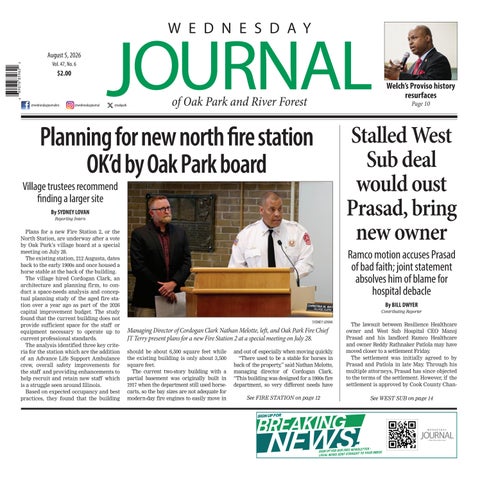


By SYDNEY LOVAN Reporting Intern
Plans for a new Fire Station 2, or the North Station, are underway after a vote by Oak Park’s village board at a special meeting on July 28.
The existing station, 212 Augusta, dates back to the early 1900s and once housed a horse stable at the back of the building.
The village hired Cordog an Clark, an architecture and planning firm, to conduct a space-needs analysis and conceptual planning study of the aged fire station over a year ago as part of the 2026 capital improvement budget. The study found that the current building does not provide sufficient space for the staf f or equipment necessary to operate up to current professional standards.
The analysis identified three key criteria for the station which are the addition of an Advance Life Support Ambulance crew, overall safety improvements for the staf f and providing enhancements to help recruit and retain new staf f which is a struggle seen around Illinois.
Based on expected occupancy and best practices, they found that the building

should be about 6,500 square feet while the existing building is only about 3,500 square feet.
The current two-story building with a partial basement was originally built in 1917 when the department still used horsecarts, so the bay sizes are not adequate for modern-day fire engines to easily move in
and out of especially when moving quickly.
“There used to be a stable for horses in back of the property,” said Nathan Melotte, managing director of Cordogan Clark.
“This building was designed for a 1900s fire department, so very different needs have
FIRE STATION on pa ge 12
By BILL DWYER Contributing Reporter
The lawsuit between Resilience Healthcare owner and West Sub Hospital CEO Manoj Prasad and his landlord Ramco Healthcare and owner Reddy Rathnaker Patlola may have moved closer to a settlement Friday.
The settlement was initially ag reed to by Prasad and Patlola in late May. Through his multiple attorneys, Prasad has since objected to the terms of the settlement. However, if the settlement is approved by Cook County Chan-
WEST SUB on pa ge 14






















By BOB SKOLNIK Contributing Reporter
The less than three-year-old outdoor track at Oak Park and River Forest High School is shut down for two weeks as workers from the company that installed the track resurface and re pair parts of the track that had broken of f. The track was shut down on July will reopen Aug. 9. Signs on the fence around the track state the track is closed due to “track re placement and routine turf field testing” but an OPRF official said the track is just being surfaced.
The track was opened in January 2024 and putting in the track in late fall and winter caused problems.
“It had been unseasonably warm the fall they poured the track surface, so they decided to pour in late October/November, but then a cold snap caused the track to cure to itself too fast, not to the concrete -- that’s why big chunks are breaking loose,” said Stephen Traphagen, an assistant boys cross country coach at OPRF, in a recent post to the Polite Politics Oak Park Facebook page

Amy Guralnick, the mother of a child who at tended a track camp at OPRF this summer, said that chunks of the track near the pole vault area had broken off.
A worker for Track Surfaces Company, the Elbu rn-based company working on the track, also told Wednesday Journal that cold weather after the track was poured caused problems
The repair and resurfacing work is being done at no cost to OPRF because the track is still under warranty. The worker told Wednesday Journal that after the current work is completed the track should be good for at least another 10 years.
Anthony Arbogast, the assistant superintendent for business services at OPRF, said that the work being done on the track is just standard resurfacing and upkeep. Karin Sullivan, OPRF’s chief spokesperson, said the track was neve unsafe and questioned whether “big chunks” of the track were breaking loose.
“It was nothing eg re gious,” Sullivan said. Sullivan described the work being done on the track this summer as “nothing unusual.”



By SYDNEY LOVAN Reporting Intern
In a marathon of a meeting that lasted past 1 a.m. Wednesday, Oak Park’s village board unanimously referred a consultant’s proposal on zoning changes to the Plan Commission to continue the conversation over coming months
Jennifer Settle, principal at Opticos, and Marisa Schulz, principal at the urban planning and communications collective All
Together, led a presentation at the meeting on July 28 explaining each step of the process to change the single-family zoning ordinance and what the changes could mean.
“Single-family homes in Oak Park stay, and homeowners keep the right to live in, to sell, to expand, and to rebuild their homes just as they can today,” said Shulz. “What does change is the zoning map, residential districts, and what we are recommending consolidate into neighborhood zones, allowing additional home types like two flats and
duplexes that already exist.”
There were 28 speakers during the public comment portion of the meeting reflecting a range of opinions from tabling the conversation all together, continued calls for a referendum and full support in moving the proposed changes forward. One common theme among many speakers was questions on how the board can ensure these changes actually lead to affordable housing options and not just paving the way for more expensive developments.
“How confident are you that this will not lead to the wealthy, white, historically protected neighborhoods, becoming more expensive, more unattainable, enriching those homeowners even more while increasing population?” asked Oak Park resident Matt Millman.
Trustee Jenna Leving Jacobson shared that she has been “very critical” of the proposal despite her overall support.
“Zoning changes in and of itself do not guarantee affordability, nor maintain or retrieve some of our lost diversity, so that’s why I’ve been very loud and probably annoying about some of those things, particularly the inclusionary housing ordinance,” said Leving Jacobson.
She also said the board should take responsibility for some of the deficiencies in community outreach that may have led to confusion on what is being proposed.
Trustee James Taglia has remained an opposing voice on the board, pushing for a referendum in the previous weeks and continuing to advocate for “voters to have a voice.”
“I support refer ring the proposal to the plan commission because it is a necessary next step in the village’s review process,” said Taglia. “My yes vote tonight should not be interpreted as an endorsement of the proposal itself, nor does it change my belief that a decision of this magnitude deserves an advisory referendum.”
Opticos will continue with four public engagement efforts both in-person and virtually before the plan commission’s public hearing tentatively set for Sept. 17. The first outreach meeting is projected to be on Aug. 27 at 6:30 p.m. at the Community Recreation Center on Madison Street.
Opticos is also working on building online tools such as a zoning comparison map that could go live as early as next week and possibly a Frequently Asked Questions page with the questions proposed during the public comment.
By SYDNEY LOVAN Reporting Intern
One of the two passenger elevators in The Emerson Apartments in downtown Oak Park has been in and out of service for several months and has remained out of service for the past few months according to village staff. A current resident of the high rise told Wednesday Journal the second elevator has been down periodically leaving residents stuck with the stairs
The 20-story building with 270 units, at 1135 Westgate St., officially opened in 2017. Resident Martin Brown, who moved there in December 2025, said the one elevator has been down for at least four months. He shared he has noticed the second elevator not working for several hours on a handful of occasions in that same time frame
Oak Park’s village code requires only one working elevator, so the building remains in compliance with the second elevator working. However, the village can issue a ticket if an elevator has not been fixed within 30 days of nonuse
Village staff performed a site visit on July 31 to confirm the elevator remained out of service and issued a citation to property management and the elevator vendor. An adjudication hearing has been scheduled for Oct. 8, according to the village
When both elevators are not functional, Brown has to walk up 19 flights of stairs to get to his apartment. Brown also shared witnessing an elderly couple waiting on the bottom floor as both elevators were down within the past week.
“I’m not getting what I paid for,” said Brown. “I paid for a building that had two elevators, and it’s just causing a lot of hassle and delay.”
Brown said he has been withholding 10% of his rent as he believes is his tenet tight under the village code, but the money still remains on his account as owed to the building.
The code outlines that a “tenant shall have the right to a dwelling that materially com-
plies with habitability and shall have the right to a remedy when the property is not in material compliance with habitability standards.”
One of the habitability standards is “elevators with structural integrity, in sound condition, and maintained in good repair.”
Withholding rent is listed as a tenet remedy in the code requiring the tenet to deliver a written notice to the landlord specifying the noncompliance and that payment will be withheld if the issue is not fixed within 14 days of the notice
According to village staff, the elevator failed its inspection by Thompson Elevator on March 19 and reported that both elevators could be in need of replacement although it is not mandated. The failure was due to the emergency alarm not working on normal power and neither the alarm nor lighting working on the backup battery.
The property owner, however, is responsible for maintenance and replacements. The Emerson is owned by VA8 Emerson, LLC tied to the California-based investment fir m FPA Multifamily, and the property is managed by Trinity Property Consultants
Although Brown said he feels safe using the one elevator when it is working, he is concerned about the issue causing the delay in repair for the other
“To have an elevator that can’t be repaired over four months, to me, is an indicator there’s something very, very seriously wrong with it,” said Brown.
In an email to Brown shared with Wednesday Journal, the Midwest Regional Director of Trinity Property Consultants Bill Van Senus, said the final repairs were to be made over the weekend of Aug. 1. He wrote on Monday that the elevator was fixed and just awaiting third-party companies Thompson Elevator and Schindler, a Switzerland-based manufacturing company, to test the car before going back in servic e.
As of Monday afternoon, the car was still out of service, and there has not been an update since.
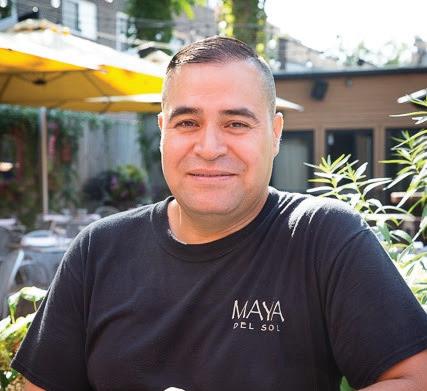
How did you end up at Maya Del Sol? A friend I’d worked with for years at different restaurants recommended me for a food running opening on the team, and I was happy to join.
What do you love most about the job? The people I work with. They’re good people, and that makes the hard work worth it.
A favorite memory from your time here? Our annual potlucks for Thanksgiving and Christmas. The whole team comes together and celebrates like family.
Outside of work, what keeps you busy? Working around the house on different projects, and spending time with my wife and kids — that’s what matters most to me.
Your go-to order at Maya — one dish, one drink. The Roasted Chicken — the mole that comes with it is my favorite item at Maya. For drinks, a cold Pacifico after a long day, shared with the team.
One thing guests would be surprised to know about you? I’ve worked at Maya for 11 years and I genuinely enjoy taking care of our guests


By SYDNEY LOVAN Reporting Intern
Putting pen to paper is what set the new writer-in-residence at the Ernest Hemingway Foundation of Oak Park apar t from other applicants, but not just for her storytelling. It was a good old-fashioned handwritten thank you card that made Amelia Estelle Dellos stand out to Executive Director Keith Strom.
The for mal Writer-in-Residence program was introduced to Hemingway’s Oak Park birthplace in 2012 to further serve the organization’s mission to share Hemingway’s history and impact while also encouraging the importance of reading and writing to support current artists.
“It’s one thing to talk about an artist’s le gacy, but then how does that impact people of today?” said Strom. “What we’ve been trying to do is also have a parallel mission in terms of supporting artists of today and tomor row.”
The Writer-in-Residence is an “ambassador for the foundation” and mentor for the winner of its high school writing contest according the foundation’s website. The writer also gets to use the attic space of the birth home at 339 N. Oak Park Ave. for their work.
Dellos was named the 2026-2027 Writer-inResidence and brings a wide array of storytelling experiences to the role. She has strong ties to Oak Park having moved here right after college and immersed herself in the community. In addition to being an award-winning writer, she has written, directed and produced films that have aired on PBS and Amazon Prime. She is also the managing editor of Unwoven Literary & Arts Magazine
“Being a writer has just exponentially made my life more interesting and rich. The people I’ve met, the experiences I’ve had, the films that I’ve made, the stories, the books that I’ve written, just doing that research, I feel like it’s added to my life in ways that I can’t even begin to quantify,” said Dellos. “I just can’t imagine not telling stories.”
She earned a Masters of Fine Arts from Columbia College Chicago in creative writ-
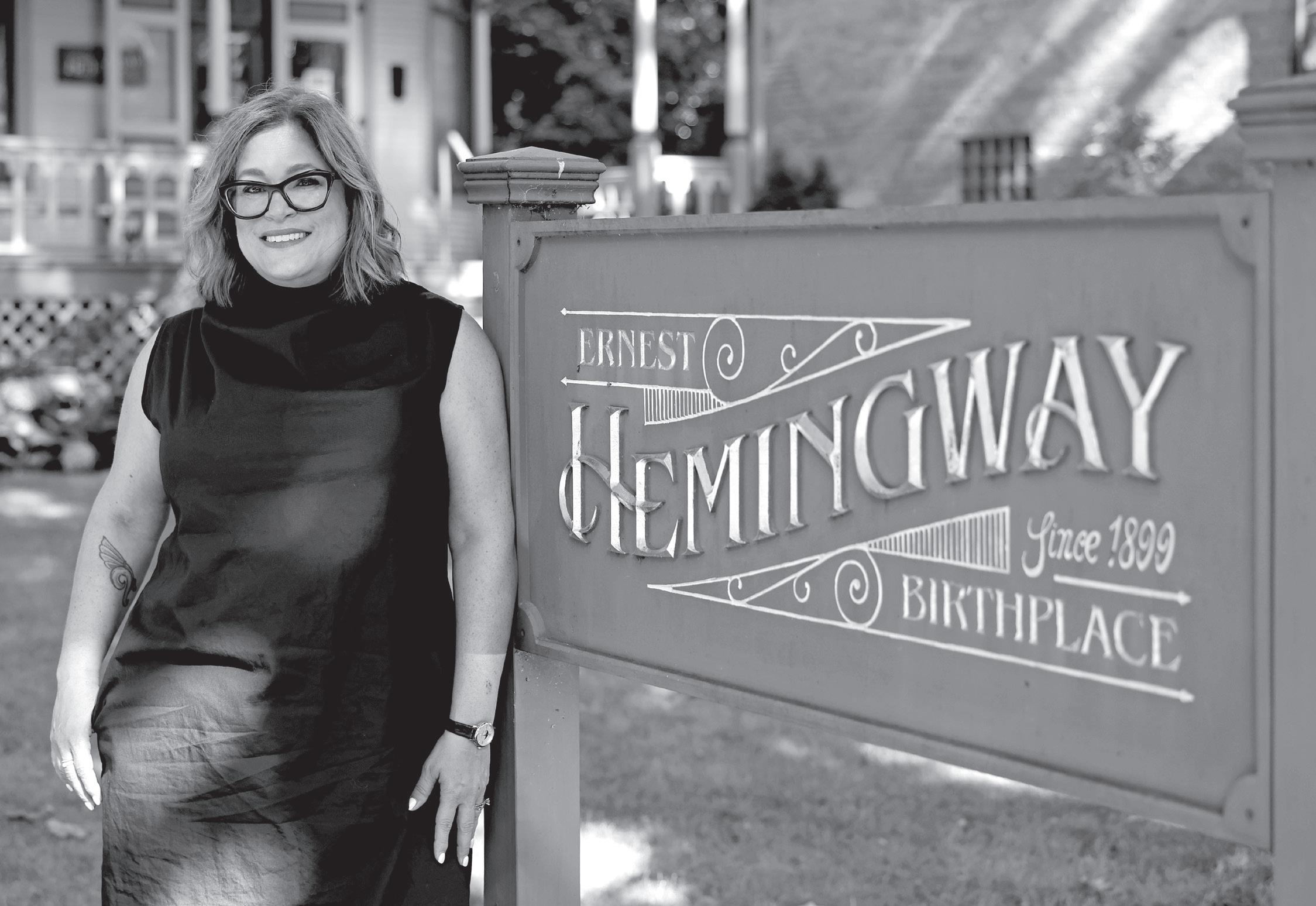
e new writer-in-residence for the Er nest Heming way Foundation of Oak Park, Amelia Estelle Dellos, in front of Heming way’s Birthplace on Aug. 3.
ing and will continue working on her thesis project during her time in this position. The project is a novel exploring death and grief using her own experience in serving as her mother’s death doula in her last few days.
Dellos shared that she loves being able to compare the themes and struggles present in historical literature to what is still relevant in today’s world in ways that young people can understand and relate to.
“Storytelling is what makes us human. It’s what gives us empathy, it’s what gives us sympathy, and it’s what makes us under-
stand other people,” she said. She also has a back ground in education as a for mer professor of writing and rhetoric at Columbia College and Roosevelt University. She said she loves to work with young adults and finds their curiosity inspiring. She is excited to step into her role as a mentor and get to work with the student writer
As Writer-in-Residence, she will help in the process for the Hemingway Foundation Student Scholarship and the Allan O. Baldwin Memorial Student Scholarship which is open to juniors and seniors, respectively, in
districts 200, 201, 208, 209 and 401. One of her biggest goals is to increase the number of applicants to these scholarships specifically students outside of the Oak Park and River Forest area.
“She’s bringing a new energy, some new perspective in some ways,” said Strom. “I’m looking for ideas so we can create some content and programming that people will find valuable, and they’ll come in and participate, and hopefully build upon us being an asset in the community.”
By SYDNEY LOVAN Reporting Intern
Federal and state laws on intoxicating hemp products are changing this November, and Oak Park’s village board updated its current ordinance to align while also bringing kratom into the conversation.
The federal FY2026 Agriculture appropriations act signed in 2025 changed the definition of hemp to consider total THC for products that use cannabinoids like Delta-8 in an ef fort to close the loophole the 2018 Farm Bill created. The new definition will ban any intoxicating hemp products
that have over 0.4 milligrams of total THC. The Illinois Hemp Act, or SB 3222, requires any products over that limit to be sold in state licensed cannabis stores. Both changes will go into effect on Nov. 12.
These new re gulations will impact most products on the market. Wake-N-Bakery, which has a location in Oak Park on 1012 Lake St., shared “What you need to know” about these changes in March stating a 10 milligram gummy “which is standard today — would exceed the limit by 25 times,” and urged customers to stock up now.
The village board amended the ordinance restricting and taxing these products to comply with the federal and state rules effective immediately while also adding more restrictions on kratom products at its meeting on July 28. Stores selling kratom products must pay a $300 licensing fee and there will be a $1.31 tax per unit sold.

President Vicki Scaman led the discussion at the meeting to explore banning these products entirely. Despite the market being smaller for kratom, there are concerns around the safety of these products, especially the concentrated version called 7-OH.

“In the past decade, there has been a 1,200% surge in calls to the poison control center specifically for kratom products,” said Oak Park Public Health Director Greg Olsen at the village meeting. “The issue with kratom products, and initially with intoxicating hemp, is we don’ t know what’s in those products. T here’s been studies that show that they can contain heavy metals, pesticide residue, and a lot of times the potency that’s labeled on the bag, or the packag e, is not what’s actually in the product.”
For local tobacco and smoke shops like Tobacco Zone, 6638 W. Roosevelt Rd., which has been serving Oak Park for about 16 years, hemp and kratom products are a lifeline to keeping the store successful.
“That’s the source of income for smoke shops,” said Ishaak Hamdan, an employee at the store. “Cigarettes you don’t make money on, so the delta and the kratom stuff are a big reason why half the smoke shops are still open. If they took away those two things, I think most smoke shops would shut down.”
Hamdan said the store only sells kratom products they get from licensed wholesalers but ag rees that clearer packaging and possible limitations on the dosages sold could be a better alternative to banning.
“They’re going to get it either way. They’re not going to go to the dispensary because the dispensary is too high, they’ re going to go to the streets. I think doing that will actually make it worse.” said Hamdan. “Smoke shops save people from that now.” There are currently 24 municipalities that have banned kratom products according to Olsen. The closest being Rolling Meadows with a complete retail ban, and Naperville is currently working on a ban as well.
Trustee Brian Straw shared his opinion that a ban would not be effective unless the immediate surrounding areas also joined in the ef fort and that education on kratom should be the first priority.
Tobacco Zone is an example of a store that is located in Oak Park, however, a smoke shop just across the street is located in Berwyn, therefore, a village ban would not apply and the products could still be easily accessed
“By not banning it and adding the public education piece, there’s more likelihood that people come to learn and understand the issues of the variability, the issues of the dangerous effects of an overdose,” said Straw. He said he would be in favor of a ban if the neighboring governments were on board as well. The majority of trustees ag reed that more education is needed before they are ready for a full ban.
“I’ll vote for this one because it’s all I can do at this time, and support coming back with a ban,” said Scaman. “I guess I’ll be calling my colleagues.”

By JACKIE PISANO Contributing Reporter
Strolling through Oak Park, it’s easy to see how the blending of nature, design, art and small businesses gives the village its distinct aesthetic.
So when Oak Park resident Emily Neumann was on the hunt for the ideal location to open a brick-and-mortar plant workshop and gift shop specializing in earth-friendly goods, planting her business’ roots in the village was the most natural choice.
Nestled in a small building in the village’s historic Pleasant District, EcoWilde, located at 1046 Pleasant St., has called Oak Park home since February, selling flowers, houseplants and one-of-a-kind botanic-
themed gifts.
From flowers grown in Oak Park and blooms sourced from independent Midwestern farms, to unique houseplants and gifts made by local artists, Neumann describes EcoWilde as the ideal sustainable alternative for shoppers looking for curated finds while bypassing the heavy ecological impact that often comes from shopping at big box stores or ordering imported plants.
“Oak Park has such a strong rewilding movement, and so many people here are genuinely passionate about plants and nature — I’m one of them,” Neumann said. “Opening this space felt like a natural way to expand that part of EcoWilde and connect with friends and neighbors who share the same

passion, and to offer more people opportunities to connect with nature and art.”
Alongside in-store sales, EcoWilde specializes in decorating for interior spaces and weddings, and candle refilling and delivery — specifically, through a service called “recandling,” in which Neumann collects and refills candle vessels, giving their original containers a second life.
“At the heart of it all, EcoWilde is a place to connect with nature and art, and to be part of something that existed long before us and will carry on after us,” they said.
EcoWilde’s public-facing storefront is new, but Neumann’s business actually stretches back to 2018 when she first started the business out of their apartment — right down the block from where the business is today.
In between then and establishing the Oak Park storefront, Neumann also operated a production studio on Elgin Avenue in Forest Park, where they handled large event orders and delivered them directly to venues
“This space feels like it’s come full circle — right back to where it all started, eight years later,” she said.
At EcoWilde, Neumann brings in expertise from her de grees in sustainability and performing arts and years of wo rking in sustainable event design, setting herself apar t from typical flower shops and greenhouses through her sustainabilityminded business model.
“It’s a field that’s still very new, so I’m constantly inventing new ways of doing things as I go — there’s not really a road map for this,” they said. “When I was building out the store, I wanted to carry genuinely beautiful things without contributing to the waste and landfill problem
that a lot of retail creates — and I wanted to stay conscious of my own carbon footprint. So, I kept asking myself, ‘What would the Lorax do?’ And the answer was that the Lorax would gather things from local artists rather than mass-produce or import.”
Neumann says that since opening their doors, patrons and passersby have shown great enthusiasm and appreciation for EcoWilde.
“I’ve watched folks stop just to admire the mural or stop and say ‘hello’ to Pawlie (Neumann’s cat who roams through the store) through the window, even if they don’t come inside,” they said. “Visitors on vacation in Oak Park, or in town seeing friends and family, have made stopping by part of their trip, which has connected us with people from all over who are excited about plants and handmade crafts. And our neighbors have been thrilled too, just happy to see more life on this block and to see a space filled that had sat empty for so long.”
Whether you’ re a long-time plant parent, someone looking for event design or just wandering through the neighborhood, Neumann shares that at EcoWilde, both eco-conscious shopping and neighborly camaraderie abound.
“It’s not just about the products — it’s a place to slow down and feel connected to your neighbors and to nature, right in the middle of town,” she said. “We’ re proof that you can grow something good for the planet and good for the community at the same time — and we’d love for our neighbors to be part of that.”
For information about EcoWilde’s services and to inquire about design, visit





























By BILL DWYER
Contributing Reporter
On Nov. 12, 2001, young Hillside attorney Emanuel “Chris” Welch was sworn in as new member of the Proviso District 209 high school board.
The week before, the D209 board had signed an agreement to purchase a 9-acre parcel open land in Melrose Park for $2.8 million, with plans to build a magnet high school on the site.
Following the new board’s organizational meeting, Welch and another newly elected board member joined two sitting board members in voting Mike Manzo out as D209 board president and installing Teresa Kelly as president and Welch as vice president.

for the district, with another 28% agreeing a magnet school was “very necessary.”
The new board then voted to fire D209 lawyer Stanley Kusper and replace him with attorney Burt Odelson’s firm, Odelson and Sterk.
It then voted to void the prior board’s agreement to buy the 9-acre property, a golf driving range on 5th Avenue, immediately west of the Kiddieland Amusement Park.
Melrose Park Mayor Ron Serpico, a mentor and key Welch political supporter, had adamantly opposed a school on the property
“Whatever we have to do on the village level, we’re not going to let this happen,” Serpico said in an October 2001 news article. “We’re not going to let them rob the village of Melrose Park of a valuable piece of property.”
In a 2011 interview, Manzo, a staunch political opponent of Serpico, said that Welch opposed the magnet school in Melrose Park because Serpico didn’t want it interfering with plans for a Costco store that was eventually built nearby.
The motion to rescind the purchase agreement was voted on despite being placed on the agenda as “new business,” which Manzo angrily pointed out could not, under Illinois law, be acted upon at the same meeting at which it was introduced
Welch brushed aside that inconvenient
Almost 9 out of 10 people thought a magnet school was necessary or very necessary, and 80% said they believed it would enrich the learning experience throughout the district.
That July Welch opined that while the magnet school concept was a good idea, building a separate school building “is not a wise decision at this time.”
“Do the majority of the voters in Proviso Township support building a magnet school?” Welch asked rhetorically in a letter to the editor. He noted that Melrose Park voters had rejected a third high school by a 2-1 margin in November 2000, and Maywood voters said the same in April 2001, by the same margin.
“We also know that only 28% of the respondents in Mike Manzo’s poll say that a magnet school is very necessary,” Welch said, conveniently ignoring the other 61% who stated they believed a magnet school was “necessary.”
Manzo said the price tag for both the land acquisition and a newly constructed school would have been “about $18 million.” He said those figures were far more certain than renovating an existing building.
“With a new building, the costs are pretty predictable. There’s few surprises,” Manzo said. “With renovation of an old building, there are all sorts of surprises
now board president, pivoted 180 degrees and led the charge for issuing $40 million in bonds to purchase and renovate a vacant medical office building in Forest Park as the new Proviso Math and Science Academy
The D209 board passed a resolution approving a $40 million bond issue to purchase the building at Roosevelt Road and First Avenue Opponents mounted a referendum campaign and gathered more than 7,500 signatures to place the issue before Proviso township voters. Welch fought the referendum, arguing that it would cause a delay in the purchase of the building and effectively kill the purchase contract.
In December 2003, the D209 electoral board, chaired by Welch, threw out 3,000 of the 7,500 signatures. Some signers, Welch ruled, were not registered voters, other signatures were ruled forgeries, and several hundred were rejected due to “invalid notary signatures.”
That left bond issue opponents 2,000 signatures short of qualifying for the ballot. Welch accused the leaders of the referendum drive of sour grapes and contended Manzo and others “would like to be back in office and have their friends and cronies build this school.”
Instead, Welch and his allies purchased and renovated the for mer Loyola Medicine office building. Along the way there were, as Manzo had predicted, numerous additional costs, which added up to millions of additional public dollars spent.
In September 2005 the new Proviso Math and Science Academy, at least $10 million
pico liable for $1 million in punitive damages and the D209 board liable for $140,000 in the firing of D209 janitor Gino Trombetta. He sued after being terminated, claiming it was the result of his political opposition to Serpico.
The school district had absolutely no legal obligation to pay Serpico’s settlement, since he was neither an elected D209 official nor an employee. But Welch forced through a $1 million taxpayer-funded payment for his political patron.
In Au g ust 2005, a local blo gger and newspaper c olumnist, Ca rl Nyberg , p osted that Welch’s brother, Billy Welch, had b een ar r ested with a drug d ealer and then was indicted . Welch filed a lawsuit against Nyberg , alleging defamation, accusing Nyberg of “insinuation and c onjecture and guilt- by association type tactics.”
A 2006 de p osition documented how Chris Welch handled his brother ’s c riminal arraignment. Welch’s testimon y raises q uestions, de p ending on how one r eads the de p osition, about either his leg al competence or his honesty.
“(Billy) Welch had neve r been indicted for the c rime of drug d ealing and had N yberg c hec ke d the a ccura cy of hi s statements, this info rm ation would have b een r eadily discove rabl e, ” Welch’s lawsuit argued
“… my brother is not a hoodlum; he d oes not hang around with drug d ealer s, ” Welch insisted in his de p osition.
But Nyberg had c hec ke d the record , wh ich showe d that Billy Welch was with a drug d ealer on Sept. 3, was ar r ested , and was later indicted on drug charges.
On Sept. 3, agents of a joint DEA/ Chicago p olice task force obser ve d an alle ged cocaine d ealer in the Rive r Fo rest Town C enter, handing a du ff el f ull of money – as much as $140,000 – to an alle ged wholesale co ke supplie r.
Law enforcement f ollowe d d ealer and another man in a Cadillac Escalade to an apar tment building on the 5500 b loc k of W. Gladys on the West Side of Chicag o and watched as the d ealer took 22 p ound s of cocaine from the trunk of the wholesaler ’s ca r.
Agents stopped the d ealer ’s car on the 3800 b lock of Harrison, and when the two men we re r emove d from the ca r, they discove red his passeng er was Billy Welch. T he DEA affidavit stated that Bill y Welch was within arm’s r each of a loaded 40 c aliber handgun, two baggies c ontaining 240 gr ams of crack cocaine with a street v alue of $29,766, and $23,500 in c ash.
Chris Welch was his brother ’s a ttorney at his Sept. 4 arraignment. T he record shows Ju dge Kevin M. S heehan f ound probable c ause to d etain Bill y, set a $30,000 b ond and c ontinued his c ase to Oct. 14.
On Sept. 26, Welch and the dealer we re indicted by a C ook C ounty Grand Ju ry, Welch for f elony p ossession of a c ontrolled substance with intent to delive r.
Chris Welch recalled those events quite differently when de p osed, when he c ould recall anything at all.
“You we re Billy Welch’s a ttorney beginning Sept. 3, 2003, right?” Chris Welc h was asked under oath. “Beginning and ending Sept. 3, 2003,” Welch answe red.
“You we re his a ttorney for one day?” he was asked .
“Yes, I stepped up, the c ase was dismissed Sept. 3, 2003 against Billy Welch, ” Welch answe red.
Welch was shown E xhibit 6 from the lawsuit and asked if it was a Grand Ju ry indictment of Billy Welch and the d ealer, dated Sept. 26, 2003.
“Exhibit 6 says wh at it says,” Welc h answe red.
“You said that the c ase was dismissed on that day?” Welch was asked. “That’s my recollection,” Welch answe red.
“W hy is there an indictment naming Billy Welch?” he was asked
“I do n’ t know, ” Welch answe red.
“You have no idea why there would be an indictment against him if the c ase was dismissed?” Welch was asked .
“I do n’ t know, ” Welch answe red.
As ke d if he’d talked to anyone in the State’s A ttorney ’s office other than at the hearing, Welch answe red, “N o.”
As ke d if he’d ever inquired “with an y gover nment agency to d etermine whether or not Bill Welch had b een indicted ” Welch answe red, “N o.”
D id you ask Bill Welch whether he had ever b een indicted?” Welch was asked “Yes.” He answe red.
“What did he tell you?” He was asked . “He said no,” Welch answered.
Welch quietly dropped his lawsuit against Nyberg
‘Without factual basis’
Sometime around 2006, a new blog called the “Proviso Insider” went online. It called itself “A beacon of light in the Proviso darkness.”
The majority of posts either lambasted Chris Welch’s critics or praised his allies. The blog posts would put a positive spin on D209 news, however negative the actual situation might be. In March 2010, Welch posted “Proviso High Schools Removed From Financial Watch List!!!”
“This feat is especially remarkable considering the financial crisis many schools are facing in the state of Illinois,” Welch stated, ignoring the fact that less than 1% of all high schools in Illinois were under state supervision.
Welch went on touting his successes and taking shots at his political enemies. On July 19, 2007 the Proviso Insider accused two lawyers who previously worked for D209 of having suborned perjury.
Melrose Park police commander Ric Cervone had been named in a federal indictment.
The Insider posted, “Sources tell the Insider that Burt Odelson and Mark Sterk …. will be indicted next by U.S. Attorney Patrick Fitzgerald. Sources tell the Insider that Mark Sterk was the attorney advising SD89 Board member Ric Cervone on how to lie to a grand jury.”
“Are Burt Odelson and Mark Sterk crooks?” The Proviso Insider asked. “Will they be indicted next?”
On Aug. 21, 2007 Odelson and Sterk filed a libel/slander suit in Cook County Circuit Court.
The Insider hadn’t always been so hard on Odelson and Sterk. In December 2006 an Insider headline trumpeted, “D209 Lawyer Burton Odelson Respected By All.”
“The Insider has learned that Proviso School District 209’s lawyer, Burton S. Odel-
son, is also the lawyer for the stars,” the website fawned. “Many think, without Odelson, Proviso would not have been able to secure and negotiate a deal for the Proviso Math and Science Academy.”
Welch denied any involvement or responsibility for the posts. That is, until a forensic examination determined the posts had been made from a computer at his law fir m.
Odelson’s attorney, Michael Wall, said Welch had attempted to avoid liability for the Proviso Insider posts by alleging they were done by his law clerk Emily Robinson.
“She was told by Mr. Welch that he would take care of everything,” Wall was quoted in a March 18, 2012 news article. Robinson denied posting the defamatory comments, saying, “I didn’t do it at all.” She was not found liable for any actions.
Welch filed for summary judgment, but Judge Eileen Mary Brewer denied his motion, and ruled he had committed “defamation per se.”
Welch faced with paying a $400,000 settlement demand, did for himself what he’d done for Serpico; used his role as D209 board president to successfully pry around $50,000 from taxpayers to cover his ongoing legal bills.
But when he later attempted to have D209 foot another $40,000, as well as the $400,000 settlement, the state appointed Financial Oversight Panel blocked him, and he was forced to negotiate a new settlement using his own money
Welch also had to admit publicly that he had lied. Or in his lawyerly wording, that he had made “statements … which were made without factual basis.”
“The Subject Statements made on the Proviso Insider … are hereby unconditionally and unequivocally retracted and the Proviso Insider regrets the publication of those statements on the blog which were made without factual basis.”
By law, members of school boards do not have any direct authority over district employees or the daily operations of the schools outside of their authority to cast votes at board meetings.
But by August 2010, Welch saw himself, according to numerous people associated with D209 or Proviso Township politics, as a major authority figure in and of himself, to be respected and obeyed
“He wants to be the Prince of Proviso,” one source told this reporter at the time.
Welch reportedly became angry after two sisters who worked in senior positions at Proviso West high school rebuffed his attempts to hug them at a football game. He responded with an angry text.
Alexis Wallace, the for mer principal at Proviso West before Welch had her transferred, sat down with the Forest Leaves in March 2012 to discuss her experience with Welch as D209 board president and a threatening text she’d received from him.
Wallace said she saved the text, making certain her phone was charged even after she got a new phone. The saved text confirms allegations made by Wallace’s sister, Dylester Palm, a dean at Proviso West, in her federal lawsuit against Welch for complaints similar to Wallace’s. (Palm later dropped the lawsuit, citing her inability to pay for the cost of legal representation.)
Wallace held out her old Blackber ry for the reporter to photograph. The phone number on the text was the same cell number that Welch had listed on his campaign filing documents
“I allowed them to be employed!” Welch’s text read. “And I’m the board president! Period! End of conversation. Things better change now. I won’t tolerate disresepect.”
Welch then left no doubt that he saw himself as the primary authority at D209.
“I had a direct hand in helping them b here including u. No one else,” he said. “At the minimum, I deserve respect.”
In 2012 a FOIA was filed with the Hillside Police Department seeking any re ports related to Welch’s alle ged arrest in 2002 for an oft-rumored domestic battery.
That FOIA was denied by Hillside officials, who claimed that Welch, who’d been handcuffed and placed in the back seat of a squad car, had nonetheless not been placed under arrest.
A subsequent appeal was successful, and Hillside was ordered to release the documents. But the release arrived 90 minutes too late, after the primary election issue of a local newspaper had gone to print.
In that moment, Welch was working to move up oliticallys and was in a contested race for the Democratic nomination in the 7th Illinois House District. On election day Welch led Forest Park Commissioner Rory Hoskins by just 36 votes out of more than 40,000 cast in the 7th Illinois House Democratic primary. That nar row margin held.
As has happened in numerous cases related to alle gations concerning questionable behavior by Welch, the story made a splash – nearly 10 years later as Welch was seeking to re place Mike Madigan as the Speaker of the House. A handful of people expressed concern and vowed to get answers and hold people accountable.
The splash was followed by silence.
from page 1
evolved over the life of the building.”
There are also health concerns presented with the living space on the second floor being located above the apparatus bay with the possibility of carcinogens being transferred. The building does not have enough room for a standard decontamination flow for firefighters returning from calls adding to health risks for the staff.
From these findings, three design options for new buildings were presented to the village board. The trustees all leaned towards the third option, a two-story building that would be located at a different site. It was agreed that a new building on the same plot of land would not be the best course of action.
“I think option three gives the most flexibility for a growing fire department, but also just giving some more flexibility when it comes to room, space concerns, and just making sure that we’re not putting ourselves in a similar situation in the near future and
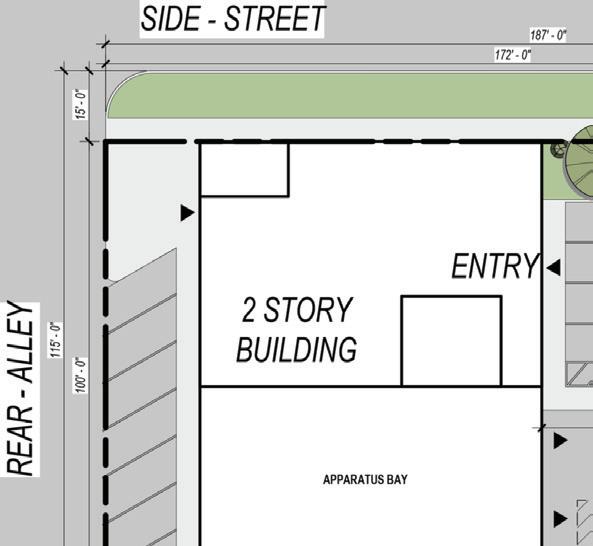

Option 3 preliminar y design f rom Cordogan Clark presentation on space needs of Fire Station 2 shown at Oak Park’s v illage meeting on July 28.
rather building something out that grows with this fire department and lasts for a longer period of time,” said Trustee Chibuike Enyia at the meeting.
The board’s recommendation of option three will now go before the board’s finance committee to review and discuss, likely at a meeting in August according to Chief Financial Officer Kevin Bueso
The total cost estimate for option three is

$12.7 million, but there are many variables that could change once a piece of property is identified and purchased and more concrete design plans are created.
The village board voted on a long-term financial framework for structuring debt on major capital improvement projects over the next 30 years at its meeting on July 21, however, the new fire station was not accounted for in these plans. Under the cur-
rent financial projections, there is no additional debt capacity until about 2032.
Bueso outlined a few possible options to explore with this project, the main consideration being whether this project should be included in the next five years or after.
If the village wants to proceed before there is more capacity for funding, options include using untouched reserves or moving other projects currently outlined to make room. Bueso said in terms of “best practice,” another option would be to look at ways to reduce costs and finance through surpluses
“If we can count on surpluses year over year, we can get authorization or guidance from the board to move those funds, those surpluses, to the capital fund to fund these specific projects,” said Bueso.
Trustee James Taglia shared his opinion that the village should be looking now for a site as it’s “the most inexpensive part of what we’re looking at,” and finding available, adequate land can be difficult.
“We have to maybe look at shifting things potentially but also looking for the future and options of land don’ t come along very often, so I think that we should be actively looking with our economic vitality people for property and secure that now,” said Ta glia.
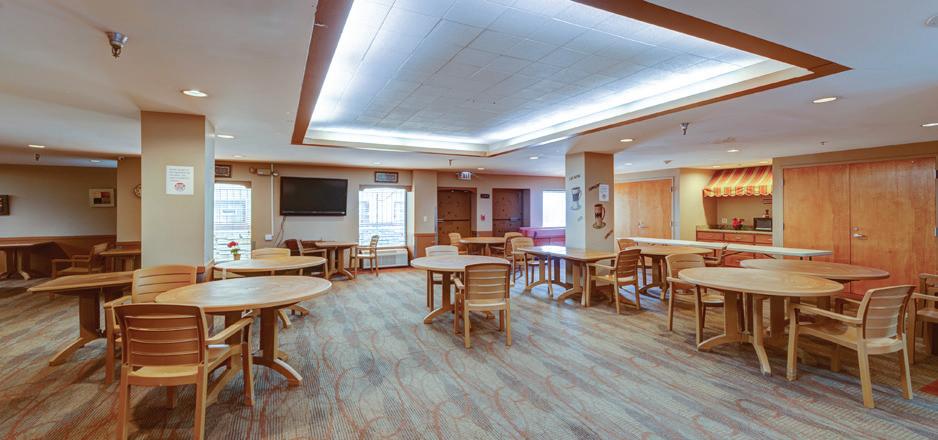
“Enjoying life - making connections - maintaining independence”
Our beautiful 6-story building provides quality, a ordable, independent housing for seniors. We o er 75 studio and one-bedroom apartments. Amenities include an award winning interior landscaped atrium, central meeting room, library, laundry facilities, computer learning center, internet access, electronic key entry system, parking, onsite management, and 24/7 emergency maintenance service. e Oaks is funded by the Department of Housing and Urban Development through HUD’s Multifamily Housing Program. Monthly rent is based on the resident’s income, with individuals paying approximately 30% of their monthly income toward rent. For more information, please visit us at www.oakparkha.org or contact us at 708-386-5812.



‘There isn’t any room for questioning the Holocaust … no margin for error’
By GREGG VOSS Contributing Reporter
Flying into Warsaw on July 5, Julie Klein knew her first-ever trip to Poland would be challenging emotionally.
The Fenwick social studies teacher has studied and taught about the Holocaust for many years, but for the first time, she would see many of the sites that defined the World War II era.
“I was flying on (Poland’s) LOT Airlines, so I was flying in with a lot of Polish nationals,” Klein said. “I was very nervous because I knew the content the 10 days in front of me would be very heavy and emotional, but I was also very excited.
“I have studied this for so long and to actually be in these physical places with scholars and with people who are committed to Holocaust education like them, I knew it was going to be powerful.”
It was. Klein was one of 14 U.S. middle and high school teachers from across the country to participate in the Jewish Foundation for the Righteous 2026 European Study Program in Poland. They were accompanied by historian Robert Jan van Pelt, one of the world’s leading experts on the Holocaust.
ever devastating – was made, with names that have become infamous over time … Treblinka, Chelmno, Auschwitz-Birkenau, Lopuchowo Forest and the for mer Warsaw Ghetto.
It was a carefully choreographed trip, she said. Stanlee Stahl, the executive vice president of the Jewish Foundation for the Righteous, gave each teacher a re porter’s notebook so they could record what they saw, and who they met.
“I have studied this for so long and to actually be in these physical places with scholars and with people who are committed to Holocaust education like them, I knew it was going to be powerful.”
JULIE KLEIN Fenwick social studies teacher
She was there because she had earned an Alfred Lerner Fellowship, nominated by the Illinois Holocaust Museum and Education Center in Skokie. In January, she participated in the foundation’s 2026 Advanced Seminar on Holocaust Education, held Jan. 17-18 in Newark, N.J.
But this would be different, much different. She would see where history – how-
On that first day, that included three of the Righteous, or people who had saved Jews during those years.
“We were in the presence of people who saved Jews and are in their 90s, who demonstrated the best of humanity. It was a powerful way to start the seminar. There were people who resisted this. It was almost like being in the presence of this otherworldly greatness,” she said. Make no mistake, though. The places themselves and knowing what happened there decades ago was hard to process.
The most difficult day for Klein was the visit to Chelmno, a small village in the middle of lush Polish far mland. During the war, people arrived at a single-track train station, were forced to undress in the basement of a for mer mansion, before being taken to their deaths via vans.
“You walk right next to the foundation of the mansion and there is kind of a walking path and you’ re walking basically the same path,” she said. “I was devastated. The magnitude and barbarity … how does a society get to this point?”
The presence of van Pelt brought much
From
scholarship and context to the situation, especially with relation to the hope and resilience of prisoners, and their individual stories. In addition, there was a guide named Pawel, Klein said, “who wanted us to know there is no single story of the Holocaust. We have to maintain the humanity of the people. Otherwise, it becomes this monolith.”
In a similar vein, van Pelt emphasized the importance of teaching this histor y, which Klein said can overwhelm any teacher.
“The majority of people who are tasked with teaching the Holocaust often don’t have a deep understanding of it,” she said,
“and if you’ re not confident in what you’ re teaching, it can be intimidating.
“What the JFR does is ensure they have the best professors and access so our knowledge is very intellectually based and evidence based. There isn’t any room for questioning the Holocaust. There is no margin for er ror there,” said Klein.
In other words, Klein’s goal is to make sure her Fenwick students don’ t leave her classroom wondering if the Holocaust happened.
“My role is to build confidence in my students,” she said.
cery Court Judge Patrick month, it would result in Prasad as CEO of the shuttered hospital. It would also allow him to save the disastrous West Sub debacle.
Prasad and Patlola joint statement included in the stalled settlement that they “are committed to their plan to sell Resilience Healthcare to Insight who will ensure West Medical Center and We pital re-open to serve the communities that depend on them.”
At Friday’s hearing Stanton said he didn’t believe the settlement needed to be confidential, and Resilience did not object.
Under the settlement terms, AUM, the corporate entity through controls Resilience, will enter into an ag reement with Insight Health Systems for the sale of its interest in both West Sub and Weiss Memorial hospitals Insight will assume “all of the rights and liabilities of AUM…”

Insight Healthcare will then immediately take over management of the hospital and Prasad will step down as CEO of AUM and both West Sub and Weiss Memorial Hospital.
Prasad will continue to own AUM, but have no management rights. Insight will not be able to liquidate AUM or take it into bankruptcy.
Prasad will continue to be paid his re gular salary and all insurance benefits up to the sale closing date. He also gets to keep a 2022 Range Rover Sport vehicle.
For up to six months following his resignation, Prasad “will be available on reasonable notice as a consultant for Insight,” for which he will receive a total of $100,000 in six equal installments.
On July 28, Ramco attorney Scott Kaplan urged Stanton to enforce a settlement he said was ag reed to in principle on May 29. After another hearing three days later Stanton told Kaplan to file his final settlement enforcement motion.
Kaplan said he wrote up a draft settlement ag reement and provided a copy to Resilience on June 3. He has alle ged that Ramco’s good faith ef for ts to finalize an ag reement have “been met with delay and
Manoj
bad faith ef for ts by the Resilience parties.”
Resilience, Kaplan alle ged, “have expended considerable ef for ts in an attempt to walk away from key terms previously ag reed to during the May 29 settlement conference…”
Kaplan noted that Prasad fired his first attorney, who was involved in the negotiations, and hired a new attorney who, he said, “has worked to undo the settlement.”
Saying “time is of the essence,” Kaplan said that if the settlement is not enforced soon, there is a legitimate threat that West Sub and Weiss would never reopen, causing “ir re parable harm” to Ramc o.
Kaplan asked the judge to force Prasad and Resilience to c omply with the terms of the settlement, enter i nto a Membership I nterest Ag reement and co rresponding Management Ag reement with Insight, pay all p ast d ue utility bills and “take all necessary and reasonable steps to restore elevator service to West Subu rban Medical C enter” in order to allow the l ifting of a no-occupancy order by the Vi llage of Oak Pa rk
Kaplan said the May 29 settlement was reached in the judge’s chambers after
ross mismanagement’ alleged has said millions of dollars Prasad has collected in past billing since West Sub closed in March have gone to Prasad. Asked, “Do you have any knowledge as to whether or not West Suburban Medical Center is still receiving payments medical procedures that previously Patlola answered, “Absolutely. receiving closer to $700,000 a week. $680 to $700,000 per week they’re receiving
Friday’s filing also disclosed yet another bank with another account controlled by Prasad, one only disclosed to Patlola during a May 11 settlement conference. At that meeting with a court appointed special master, Prasad disclosed four transfers totaling $2,190,100 between Oct. 10, 2025 and Jan. 2, 2026. The transfers were from the LLC bank account to a company called ME & B Consulting, LLC. thin seven days of the execution of the assets sale, Prasad’s Westlaw LLC must cause all funds held in any of its banks to red back to AUM and/or the hospitals. Westlaw must then be dissolved within 60 days.
more than four hour s. “This c ourt pe rsonally presided over the … settlement c onference and obser ve d the pa rt i es neg otiate and ag ree to the terms of the settlement,” he said, stressing that “particular we ight is given to settlements reached in the presence of the judg e. ”
Kaplan included d etails of a Te rm S heet outlining the settlement, a document he called “valid and enforceable.”
“I f necessar y, this c ourt should appoin t a rece iver over (Resilience) to effectuate the settlement.” He named K ansas Cit y attor ney Mike F lanag an as the requested rece iver. F lanagan, he said, has extensive experience serving as a rece iver in the healthcare industr y, and is “willing and able to act … to effectuate the settlement” and wo rk toward allowing I nsigh t Healthcare to manage West Sub p endin g the sale of assets to Insight.
S tanton gave Resilience attorney Howard Brookins and Prasad ’s personal attorney Travis Richardson two weeks to wo rk things out b etween them, and Ramco a week after that to go over the details of wh at Prasad and Resilience ag reed upon.
T here is a non-disparagement clause in which both sides ag ree to not bad mouth each other. In fact, a joint statement to be released within five days of the enforcement of the ag reement has a “let byg ones be byg ones” tone. It reads in part:
“In r uling on Ramco’s … emergency motion for appointment of a rece iver, Judg e Stanton stated that “(a)s to the most serious charge that Dr. Prasad misappropriated money by transferring funds from Resilience to Westlaw, Ramco failed to provide credible evidence that these transfers resulted in any losses to Resilience and that “the main thrusts of the motion that Dr. Prasad had misappropriated vast sums of money was not proven.
“Stanton further stated that, as to the “implied claim that the hospitals failed due to Dr. Prasad’s performance as CEO, there is no evidence of fered that Dr Prasad caused any of these problems or that he failed or refused to address them.
However, court records show that Ramco presented no evidence of those claims at the May 8 hearing because they opted not to expend the time needed to extend discovery and then hold a required second evidentiary hearing.
T he next court hearing is Aug. 25 at 9:30.
By GREGG VOSS Contributing Reporter
Bureaucratic changes built into the Trump administration’s One Big Beautiful Bill Act will, starting in January, make it harder for people to keep their Medicaid coverage in tact. Local nonprofits working with clients with mental health issues, housing and food insecurity are busy now to keep marginalized neighbors covered.
The Medicaid changes will place more onus on local residents to demonstrate they are meeting new requirements and will create more paperwork to process, not only for the state but organizations like Oak Park’s Thrive Counseling Center.
“We’ re preparing and anticipating what’s to come,” said Jenni Rook, Thrive’s president, noting that the Af fordable Care Act (ACA), a subset of Medicaid, is going to require a six-month renewal, not annual as in the past.
“It’s twice as frequent as before, which unfortunately allows an opportunity for greater loss of coverage,” added Rook’s colleague, Tyler Alvare z, Thrive’s assistant director of referrals and coordination.
“With the changes for 2027, there is a subset in the Medicaid population that is being impacted,” Alvarez said. That’s those who became eligible for Medicaid under the ACA, also known as the “ACA expansion plan.”
sage from the federal government, re peal the benefits low-income people should be entitled to,” Schueler said, “then adding the extra layer of having to reapply.
“They want to kick people of f by creating this additional layer of administrative burden, so there is a level of savings that comes out of this.”
For Jennie Hull, CEO of Oak Park’s Beyond Hunger, the changes are eerily similar to those of Supplemental Nutrition Assistance Program (SNAP) benefits through the U.S. Department of Agriculture.
As of May 1, any ablebodied adult without dependents had to start lo gging 80 hours of work per month, or they would lose their SNAP benefits. SNAP is a program that is designed to work with food pantries like Beyond Hunger.
Every six months, residents on SNAP must renew their benefits by re porting their working status.
“It’s the same people getting hit Hull said of the Medicaid changes. “I think there are people who are still reeling from SNAP. Some people give up on these benefits programs. I can see that locally happening.”

“For those clients there will be additional items that will be required to provide that eligibility piece,” Alvarez said.
That’s the whole point of the changes that were part of the One Big Beautiful Bill Act that became law last year, according to Lynda Schueler, CEO of Housing Forward.
“That seems to be the undergirding mes-
“You miss a piece of mail or lose a piece of mail because you lost your housing,” she said. “You ha no way of getting access to that mail. The burden and hardship this is going to cause for people who are unhoused is going to wreak havoc on our population be cause of having to refile and that missed first or second follow up.
“If you miss that notification or an email or what have you, you’ re going to lose your benefits if you’ re not submitting your paperwork in a timely way.”
Schueler said Housing Forward is taking steps right now to help mitigate that eventuality for many.
“We’ re preparing our case managers,” she said. “We are updating our own case management system to be able to put reminders in for our clients so then we can anticipate when a client is renewal so we can help them get that filed in a timely way.”
Thrive’s Rook said a major issue is people who don’t realize they have Medicaid.
Alvare z said that Medicaid’s ACA expansion plan has that 80-hour monthly work requirement, which could include a combination of school enrollment or volunteering.
Someone with a chronic illness or a mental health impairment would hypothetically be exempt but must be able to prove that they qualify for an exemption, which would include a doctor’s diagnosis, for example
That means more paperwork and legwork, which is a major burden for those whose health is compromised.
Or, Schueler said, are housing insecure.
“They have a plan that says Blue Cross Blue Shield and they don’t realize it’s a Blue Cross Blue Shield community plan, which is a Medicaid managed care plan,” she said. “There’s all this education that needs to happen … what insurance (do) they have, and what are they going to have to do.”
To that end, Thrive is distributing flyers in waiting rooms and lobbies, using social media and other communications levers to let people know the reality of the situation.
Rook credited Oak Park Township and its communications strate gy to get the word out in the community. Mary Anne Ojeda, the township’s assistant director for senior and disability services, said it is using its website and social media accounts to that end, along with e-newsletters and print-
ed newsletters and direct outreach to senior-centric buildings and events to help that population understand the coming changes and to pay attention to their mail.
Ojeda is also a member of the Rush Oak Park Community Eng agement Council, which is working with many partners, including Thrive, to plan Medicaid redeter mination events this fall.
“Any resident, really, they need to check their mail re gularly,” she said. “Just make sure they have read every notification thoroughly and if they don’t understand, go to a place that you can get help, at the township or someplace else.”
Schueler said Housing Forward’s case managers can help, but she also pointed to the Cook County’s GetMedicaidFacts.com and ABEIllinois.com, the state’s website where one can apply for benefits. Beyond Hunger has dedicated a page on its website as well.
“Our population is experiencing housing insecurity and the last thing on their mind is gathering paperwork and they don’t have a mailing address,” she said.
Rook said that Medicaid is Thrive’s biggest source of funding, “so there is a lot of risk to Thrive if people lose their healthcare.” That’s why her organization is placing even greater emphasis on their population.
“We’ re not just going to discharge them from services because they no longer have Medicaid,” she said. “We’ re going to dramatically reduce the sliding-scale fees in January, the same time this rolls out, because we want to be able to continue their coverage.” That, she said, will likely involve more fundraising and philanthropy.
Ojeda said the changes are in a way g alvanizing community services to help its most vulnerable
“I would say yes, we’re working really closely to gether to help educate people to get the assistance they need,” she said. “It takes a village to navig ate.”
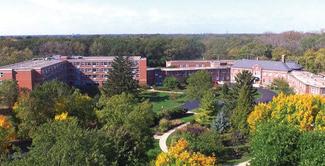
Moving to a senior living community may not be your first choice, but waiting too long can mean missing out on opportunities to enhance your quality of life.
Senior living communities offer support, engaging activities, convenient services, and meaningful social connections that promote independence and well-being. Additionally, waiting too long might make the transition more challenging. Making the move sooner also allows you to transition on your own terms, while you can comfortably settle in, build friendships, and enjoy everything the community has to offer.
Delaying the decision can make the move more stressful and limit your options in the future.
Choosing senior living isn't about giving something up—it's about embracing a lifestyle that offers greater support, connection, and peace of mind for the years ahead.

By JACKIE PISANO Contributing Reporter

A trailer, a dream and a passion for tea.
That’s all Max Blessen needed last summer as he rolled into Oak Park and River Forest, introducing locals to Joy Tea and promising customers the best tea they’ve ever tasted.
Rain or shine, Blessen was situated outside in his tow-hitch trailer serving up his unique spin on ancient Chinese teas.
And now, after spending a year parked across various locations, Blessen has officially opened Joy Tea’s first brick-and-mortar spot, serving up crowd-favorites from inside the new location at 7773 Lake St. in River Forest. He hopes it will eventually be one of many stores.
Situated between neighboring small businesses along a Lake Street brick building business strip, Joy Tea’s first storefront is a chic, grab-and-go beverage stop
With natural light beaming through a large picture window, the store’s interior boasts bright digital displays, a warm wood aesthetic, and bar-style, on-tap beverage service.
From jasmine and grapefruit silk teas to green mango and aged pu’erhs with buttercream, in just over a year, Blessen turned Joy Tea from a curious mobile business into an in-demand, oft sold-out enterprise, keeping customers coming back for more of his oneof-a-kind hot and cold teas
Joy Tea and its drinks have been in development for over a year, the result of years of both experimentation by Blessen and customer preferences.
What Blessen says sets Joy Tea apart from coffee shops selling tea and other mass-produced teas on the market is his special, seventimes scented jasmine green tea grown 1,800 meters above sea level in Fujian, China (the
years ago). Blessen has tasted hundreds of teas and worked with dozens of farms all over China, experimenting with time, temperature and concentrations
“Joy is unlike any other tea product, brand or experience you have ever had,” he said “We make simple things wonderfully — there’s no flashiness to the brand or products, but there is care. I think a lot of brands spend a lot of time on presentation, and it’s beautiful and I love it, but I think the taste is really the only thing that matters. And, we want our products to be memorable for a lifetime.”
At Joy Tea, Blessen’s passion is serving delicious, health-conscious beverages while safeguarding the rich heritage of ancient Chinese tea.
“Our tea is picked, processed and packaged for us,” he said. “Compare this to almost every other tea you purchase in a cafe, store or anywhere else where tea has been packaged and stored for who knows how long. This freshness we can offer with our partnership with our farms creates a superior flavor that just can’t be matched by a tea that was picked, processed and packed six-plus months ago.”
For the River Forest native, basing Joy Tea’s first physical location in the village was something undoubtedly instinctive
“Joy believes tea is for everyone, and people in River Forest deserve great tea, don’t they?” he said. “I grew up here but lived in Asia running our other tea company for several years prior to moving back here. When I decided to pursue this path with the store, the logical decision was to come back to my hometown.”
With a steady flow of customers — something Blessen was used in the trailer — each day in store is nonstop for him. Managing both operations and branding, he now has a
ing 12 total by summer’s end.
“I’m extraordinarily grateful to all of our customers and loyal fans,” Blessen said. “The overwhelming support of the community has helped drive this to fruition more than I ever could myself.”
In addition, the opening of this first storefront signifies the step along a journey of future expansion.
“We will be the Starbucks for tea,” Blessen says. “Starbucks has about 17,000 stores in the U.S. — I think we have a long way to go. We’ll open them as fast as we can, and I’m sure our cadence will grow quicker as we get the hang of it. Right now, we are going to focus on the small walk-in store layout while we develop our drive-thru concept, which will eventually be our focus.”
Blessen’s beloved trailer — where he spent nearly 400 consecutive days in launching the business — will move to Elmhurst this fall. There, he will introduce his teas in preparation for opening store number two in town soon after.
“We really do mean it when we tell people it will be the best tea they’ve ever had,” he said. “The communities built around Joy are so beautiful, and that is the original purpose of tea — a small, symbolic gesture and ritual to bring people closer together. We want to focus on continuing to do that, no matter where we go.”
Blessen said this landmark of opening his first store has left him feeling very happy, fulfilled and grateful.
“I can’t imagine a better community to call home for the Joy brand,” he said. “As we grow all over the city, the state, the country and even potentially the world, River Forest will always be home. We’ll remember all the people who have become friends truthfully.”
dhaley@newswellchicago.org
By LACEY SIKORA Contributing Reporter
Designer Rachel Alcorn knows Oak Park. Now based in Glen Ellyn, she began her career during the decade that she lived in Oak Park, and she has deep ties to the community. Through her firm, Two Hands Interiors, she has worked with many homeowners of historic homes
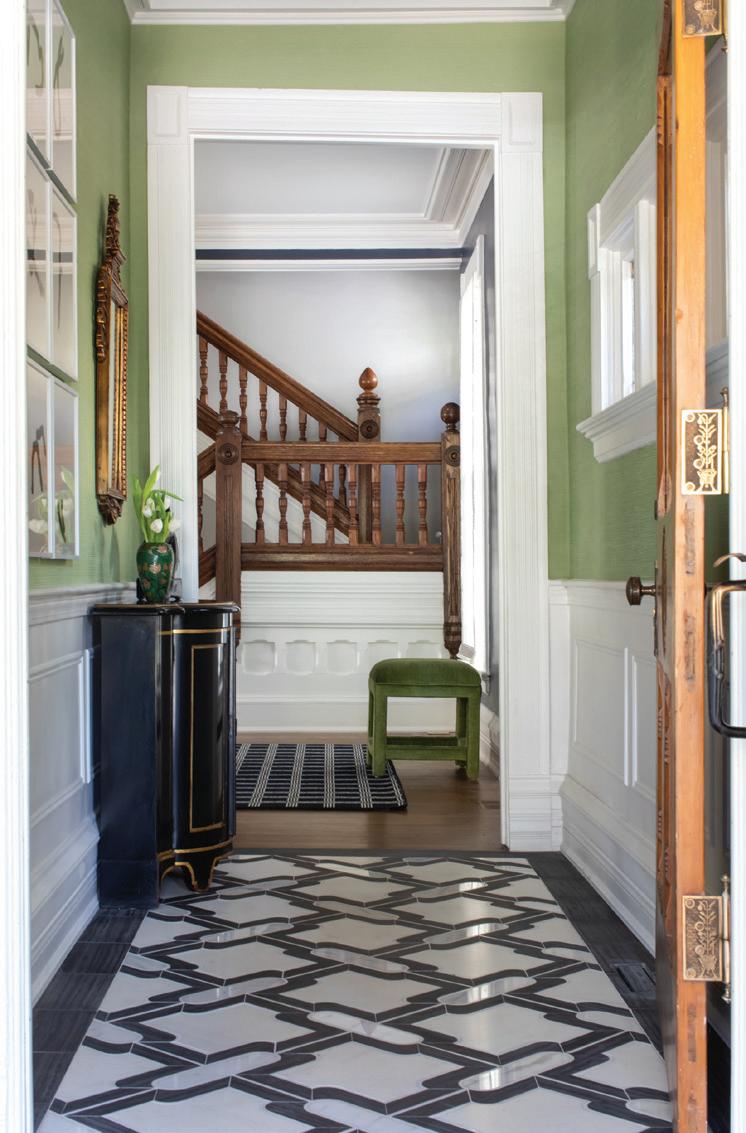
Her work on an Oak Park home on Forest Avenue stands as a good re presentation of why clients call Two Hands Interiors: they love the charm and history of their historic homes but want to bring a sense of modern design into their spaces.
Alcorn’s clients on this project called her when they purchased their home just down the street from Frank Lloyd Wright’s Home and Studio roughly 10 years ago. At that time, the young f amily was looking to put their own spin on the home, which Alcorn says probably be gan life as a Victorian but was remodeled with


a Tudor spin early in its lifespan.
Like a lot of her clients who have purchased a new-to-them home, Alcorn says these clients wanted to live in the home before making major changes.
“We cleaned up the Tuscan red walls and put a Band-Aid on the kitchen. T hen, we did a lot of decorating for a few years before jumping into renovations,” Alco rn said.
When they jumped in, they did so feet
first. Working with Jacknow Construction, the couple embarked on a renovation to create a new kitchen, mudroom, powder room, keeping room and primary suite. During the process, they removed the back stairs, reconfigured the kids’ bathrooms and renovated the basement too
Alcorn noted that their earlier work decorating the home paid of f. They established a design ver nacular with the clients that guided the renovation, and many of
the elements they’d used to decorate the home during the first phase remained and inspired the rooms’ directions.
One overarching theme? Color.
“As a firm, we love color,” Alcorn said. “Sometimes, what people don’t have a reference point for is that historic homes did use a lot of color. Victorian and Arts and Crafts homes used saturated color.”
from page 17
In the kitchen, the husband wanted function. He was interested in a space that would work well for the family of five. Alcorn says the wife was focused on fun and color. Alcorn knew they didn’t like how dark their old kitchen was, so she used mostly white cabinets but punched up the color with fabric in the window shades and counter stool cushions. A wall of walnutstained cabinets reads as a furniture in the room.
A key part of the space is what Alcorn calls the keeping room. Next to the kitchen, it allows family and friends to be in the heart of the home but in a more comfortable chair.
A nother important piece for the f amily and their kids is the adjacent mudroom. Alco rn chose Schumacher ’s Citrus Gar d en wallpaper for the room.
“It’s an historic print revitalized for modern production. We started with that and pulled the cabinet color from there.”
In the primary suite, Alcorn ran with the directive to create a bathroom that felt like a high-end hotel. The room has plenty of modern amenities like a steam shower and a separate toilet room, but the marble, subway tile and trim profiles were inspired by the era the home was built.
The entire process took roughly a year and a half to complete and wasn’t without its share of surprises. Some surprises, like a buried cistern in the yard, were confusing, and others, like a prohibition-era license plate and an old black and white photo of the home, were treasures
Alcorn says that it’s always much harder to renovate a historic home than it is to build new. “Like any old home renovation, we pull the threads of the sweater very carefully to not unravel the rooms and items we didn’t want to touch.”
T he goal was to give the f amily modern function in a bespoke way that also respected the home. Alcorn concludes, “It makes us happy as a firm to see these historic homes get a lot of love and carry on for the next g eneration. ”









































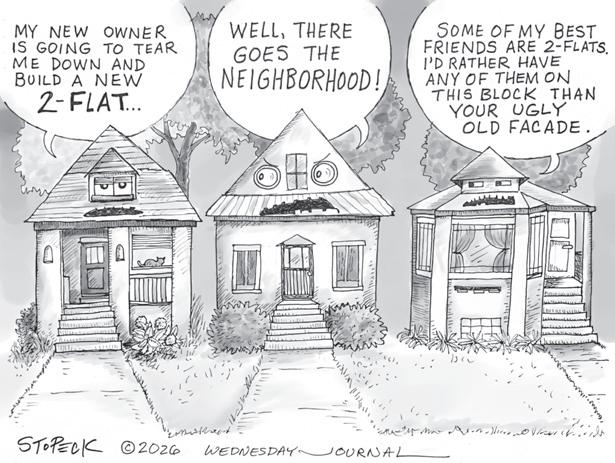
For generations, we’ve organized our lives around a familiar sequence: school, work, retire We spend our youth preparing for adulthood, devote our middle years to building careers and/or raising families, and then, if we’re fortunate, retire and hope to enjoy the time we have left.
That life script may have worked in the 20th century. It doesn’t fit the 21st.
Many of us will live 20 or 30 years longer than our grandparents. Yet while our lives have expanded, our assumptions about aging have not. We still imagine life as a three-act play, even though the final act has become an entirely new chapter

The problem isn’t simply that we’re living longer. It’s that we’re trying to fit longer lives into an outdated framework. Again, I ask, how do we design lives worth living longer?
Instead of school-work-retire, imagine a life of lear ning, contributing, renewing, and beginning again — not as stages, but as ongoing practices
In a world transformed by technology, demographic change, and new discoveries, curiosity has become one of the most valuable qualities we can cultivate. Lear ning keeps us intellectually alive, and it also keeps us humble, adaptable, and open to surprise. Every decade of life offers new questions worth exploring.
In our current outdated model, we equate work with a paycheck. Yes, economic stability is important. And in an updated life-design, contributions can frequently come through entrepreneurship, mentoring, caregiving, volunteering, creating, teaching, and strengthening our communities
As our lives lengthen, our capacity to contribute doesn’t disappear — it evolves. Experience becomes an asset rather than a relic.
A recent study found that 84% of working people don’t expect to stop working at retirement age. Today, most working people believe work continues past the point that the whole system was built to end. People are working in a structure that never accounted for them to still be here.
Renewal may be the missing ingredient. For too long we’ve believed that life peaks in middle age and then it’s all downhill after that. But “conscious aging” is filled with cycles of renewal. We pause, reflect, acquire new skills, shift directions, and discover fresh purpose. A career break at 50, an encore career at 65, or a new passion at 80 are no longer exceptions. They are becoming the new normal.
This shift also invites us to rethink retirement itself. Retirement need not mean retreat. The question is no longer, “What are you retiring from?” but “What are you moving toward?”
Conscious aging asks us to see every season of life as an opportunity for growth, to embrace aging as a process of becoming more fully ourselves
Longevity is not merely about adding years to life; it’s about adding life to our years.
We’ve already begun extending the human lifespan. The greater challenge is redesigning the human life course so those added years are filled with lear ning, purpose, connection, and contribution.
Maybe the first thing we should retire is the idea that retirement is the destination.
DEADLINE FOR SUBMISSIONS IS FRIDAY 5 P.M.
Call Viewpoints editor Ken Trainor at 613-3310 Email: ktrainor@newswellchicago.org

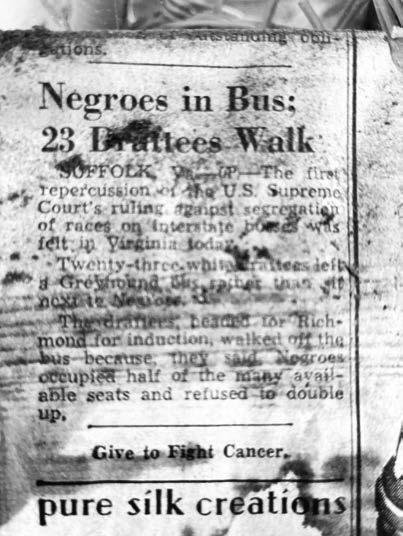
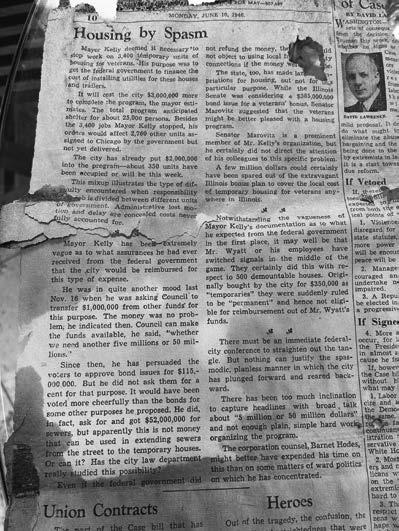
A glimpse into the past shows that the issues haven’t changed that much
e more things stay the same
This summer, I replaced some rotting wood siding on my 1910 worker’s cottage. Finding an old newspaper in the wall was a reminder of how inflation, lack of af fordable housing, and race relations were issues in Chicago then as much as today
Now the village code requires house wrap, a thin plastic weather bar rier such as Tyvek, under clapboard siding. But in the old days, contractors used tar paper for wind and moisture resistance. And sometimes, as at my house, a poor man’s sheathing was a newspaper
shared the downstairs bathroom with her tenants.
She also added a screened porch of f the back of the house — where I found the newspaper in the wall. A 1946 editorial cartoon featured a wor ried-looking chicken sitting on a “savings nest egg” which was being shrunk by post-war inflation. An editorial titled, “Housing by Spasm,” criticized then-Chicago Mayor Ed Kelly for suspending construction of 3,000 units of temporary housing for retur ning soldiers unless the federal government picked up more of the costs
That’s what I found under my rotting siding, a newspaper dated June 10, 1946. It tur ned out to be a time capsule of stories about life in Chicago in the immediate post-World War II period.
Most stories focused on the disruptions caused by returning soldiers after WWII ended. In the 1940s, Oak Park’s population was 66,000, higher than today’s 54,000. People had doubled up in existing housing, especially before the suburban building boom took of f later in the decade.
So in 1946, the owner of my little worker’s cottage subdivided her small single-family home into a two-flat. She was Alma Banthin, a longtime employee of Frank Lloyd Wright’s family as nanny and cook.
Banthin divided the house so that a tenant could live in a one-bedroom apartment on the first floor. She moved into three small rooms on the second floor. Her unit had no bathroom or kitchen. She cooked on a hot plate and
The editorial said, “Nothing can justify the spasmodic planless manner in which the city has plunged forward and reared backward” on its housing plan.
There were advertisements about real estate lots for sale in a new suburb called LaGrange Park. “Select your site now. Build your home later.”
And race relations were in the news. An article said that the first repercussions were felt from a new U.S. Supreme Court decision holding that a Virginia law requiring racially separate seating did not apply to interstate bus travel.
The plaintiff had been re presented by an attorney, and later U.S. Supreme Court Justice, named Thurgood Marshall. The ar ticle described how 23 white ar my draftees would not ride in a Greyhound bus with black passengers who refused to give up their seats.
We may see the turmoil and issues of our day as unique. News clippings in a wall tell a dif ferent story.
In the spirit of your “I believe that our mission is to do whatever we can to preserve the planet,” [My non-rational beliefs, Ken Trainor, Viewpoints, July 29] I submit the following:
Northwest Passage: A Meltdown (Might be sung to the tune of “The Wreck of the Edmund Fitzgerald”)
Sought for in vain over centuries, the Northwest Passage was a dream, but warm waters have loosened up the ice in the frozen Arctic stream.
Arctic shipping is now a possibility, going from the west or the east.
Prez and Vlad applaud the melting, and block effor ts to slow down the heat.
He obstructs the use of alternative fuels, wants to stop the wind-power gains. Is this solely to support his big oil friends or to open those cold shipping lanes?
He wants to own all of Greenland; It has shipping lanes of f both shores. Trump’s war with Iran slows shipping of oil; northern routes would enable much more.
He needs a solution for Mideast blockades, without admitting defeat.
Prez is buying icebreakers from Finland; they say he’s bought a whole fleet.
Seems the ice isn’t melting fast enough, yet smoke through our streets still churns; the war over oil goes on and on and the world continues to burn.
O the Norther n Passage is no longer a dream; It might be bought for a price. And oil would stay less expensive to those, those few who will remember the ice
David DeMarais Oak Park
Afew weeks back, I spent an enjoy evening at the Er nest Hemingway Bir thplace on Oak Park Avenue listening to Scott Schwar talk about his new book, My Journe y with Hemingwa which documents his personal and professional association with Oak Park’s most famous author. Scott was a co-founder and executive director of the Ernest Hemingway Foundation of Oak Park (EHFOP) and a fine tour guide to Papa’s haunts in Cuba.
During the Q&A following the talk, a longtime Hemingway aficionado mentioned an intriguing fact: Ernie wasn’t the only futurefamous member of the youthful ambulance corps during Disney (who Kroc (who for the Re although Kroc and Disney both lied about their ages (15 and 16 respective

re “just” (arguable at best), it is an incalculable loss for humanity, no matter the nationality, no matter the ethnic or socio-economic oup. Genius is more widespread than we’ve been conditioned to believe.
And most of those war casualties, if they had survived, would have produced offspring, some of whom would have had an enduring impact for the good of society.
A fascinating historical footnote for sur another consideration. Hemingway nearly died during his stint when a shell exploded near and I couldn what if all three of these major cultural figures had died during that war? A very real possibility, given the soaring casualty figures of the Great gaping hole it would ha can cultural landscape: No Golden Arches, no Happy Meals, no Disney animation (no Fantasia, no and Disney World, no best-selling novels by the iconic American literary figure of the 20th century.
All three of these super-influentials have detractors to be sure, but like them or not, it’s hard to imagine American culture without them.
all the arguments against war, this might be the most powerful: Armed conflicts first and foremost, a waste of human brilliance, short-circuiting the potential of humankind, generation upon generation, depriving millions, military and civilians alike, of the opportunity to influence our world for
And not just war. If a madman hadn’t cut Abraham Lincoln’s life shor t, imagine how our reunited nation might have changed for the better in the aftermath of the Civil War. If a lone wolf hadn’t assassinated Kennedy a century later, our polarized country likely would not now be in the hands of a Cultural Destructive instead of a Cultural Creative. History ve followed a different we would certainly be
I also couldn’t help wondering how many other cultural creatives might have been among the casualties, on both sides, who never got the chance to actualize their potential — same goes for the dead during World War II and Korea and Vietnam and the Middle East, and all the other armed conflicts of the last century worldwide. England alone, it has been said, lost an entire generation of promising poets and scholars in the trenches of WWI.
How many creative geniuses did we lose? How many did our “enemies” lose? Plenty, no doubt, though we’ll never know the full extent. Not all were identifiable as geniuses at the time. Think of how many were sacrificed to questionable causes in our lifetime. Even if the causes
All the victims of gun violence across America these past decades force us to me of “What if?” We live d’s most violent culture, which rse with the sale of every unregulated firear m. What if it were not so?
Wars worldwide, and gun violence nationwide, accompanied by the racism and economic inequality that reduce opportunity and life expectancy, dilute and diminish our cultural vitality. We delude ourselves into thinking we can throw away young lives and in general, we don’t do nearly enough to develop youthful potential. What is the price we pay for that neglect?
Creative potential exists in all people, and we can’t af ford to waste any of it. A myriad of Disneys, Krocs and Hemingways were among the many who have died in our foolish wars and because of our criminal failure to sensibly re gulate firearms.
It’s hard to imagine a world with no Hemingway, Disney and Kroc.
Even harder, it seems, to imagine a world with no wars and no gun violence, a world that respects every human being’s creative potential and gives everyone a chance to fully develop it.
One of my “Favorite Things” about Oak Park is discovering creative and unique places and spaces in our community
Many readers are familiar with Little Free Libraries, weatherproof boxes on posts with books that people can donate or take. Sidewalk Joy, meanwhile, expands from book exchanges to art, puzzles, toys, mugs, seed swaps, do g stick libraries, and other free and whimsical items. It began in Portland, Oregon and has spread across the U.S. and to other countries. According to their website, worldwidesidewalkjoy.com, the map has more than 2,100 Sidewalk Joy installations around the world.
munity during the pandemic,” she said. On the same block across the street and several houses north, there is also a Sidewalk Joy Kenilworth Car Library. My 3-year-old grandson, Sam, and I recently checked it out. Sam told me he had never seen anything like this before. He said, “I’m happy to donate my toy bulldozer to other children because I’m more interested in insects and reptiles now.”
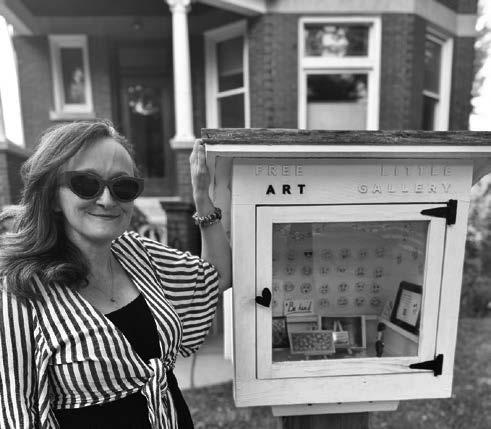
PROVIDED
Megan Spillman, le Sam and Joy, right
Thanks to local resident Megan Spillman, we get to take part in and enjoy Sidewalk Joy in our own community. Me gan first discovered and was captivated by Sidewalk Joy when she visited Portland. She started Free Little Art Gallery Oak Park (1046 S. Kenilworth Ave.) in 2021.
“I loved the idea of sending a friendly signal to the com-
In addition to art and toy car Sidewalk Joy, there are also mug exchanges in both south and north Oak Park: mugs and trinkets at the Nor th Oak Park Mug Exchange, 715 N. Taylor Ave. and the Oak Park Swap Spot at 714 S. Oak Park Ave. Other Sidewalk Joy installations are being developed.
Since this series is called “Favorite Things,” I asked Megan about her favorite local Sidewalk Joy. She said, “That is so hard to nar row down. I love that the artwork in the gallery is contributed by people of all ages. One of
The Oak Park Village Board advanced the Opticos Design zoning report on July 28, by authorizing staff to refer the missingmiddle housing recommendations to the Plan Commission. The action moves the initiative forward to public hearings without enacting final code changes yet.
Opticos’ design can be found at EngageOakPark.com/Shape. As an approximately 80-year resident of Oak Park and a 53-year owner of what used to be a single-family home, I have read the entire report. It has a lot of technical jargon as would be expected from a report recommending a step-by-step change to Oak Park’s complex housing zoning.
I now live in a single-unit dwelling unit close to Beye School on a block consisting of other single-unit dwelling units and two-unit dwellings. Our block would be re-zoned Residential N-2. That means that any “complying lot” in our area could now have a 4-unit dwelling built on it that was 3 stories tall, not to exceed 35 feet. However, the “Notes for Table 4-1” state:
“In the N-2 and N-3 Districts, zoning lots that are at least 50 feet wide and 125 feet deep may contain up to six dwelling units, provided the development complies with all applicable bulk, setback, design, and site development standards,” which the Opticos report has considerably shortened and narrowed.
My lot is 50 by 171 feet. My dwelling was built before 1890 and is a very well maintained Victorian dwelling unit. In the past, the village would have encouraged a buyer of my dwelling to maintain and even possibly improve my dwelling through renovations.
However, the village board unanimously voted to send
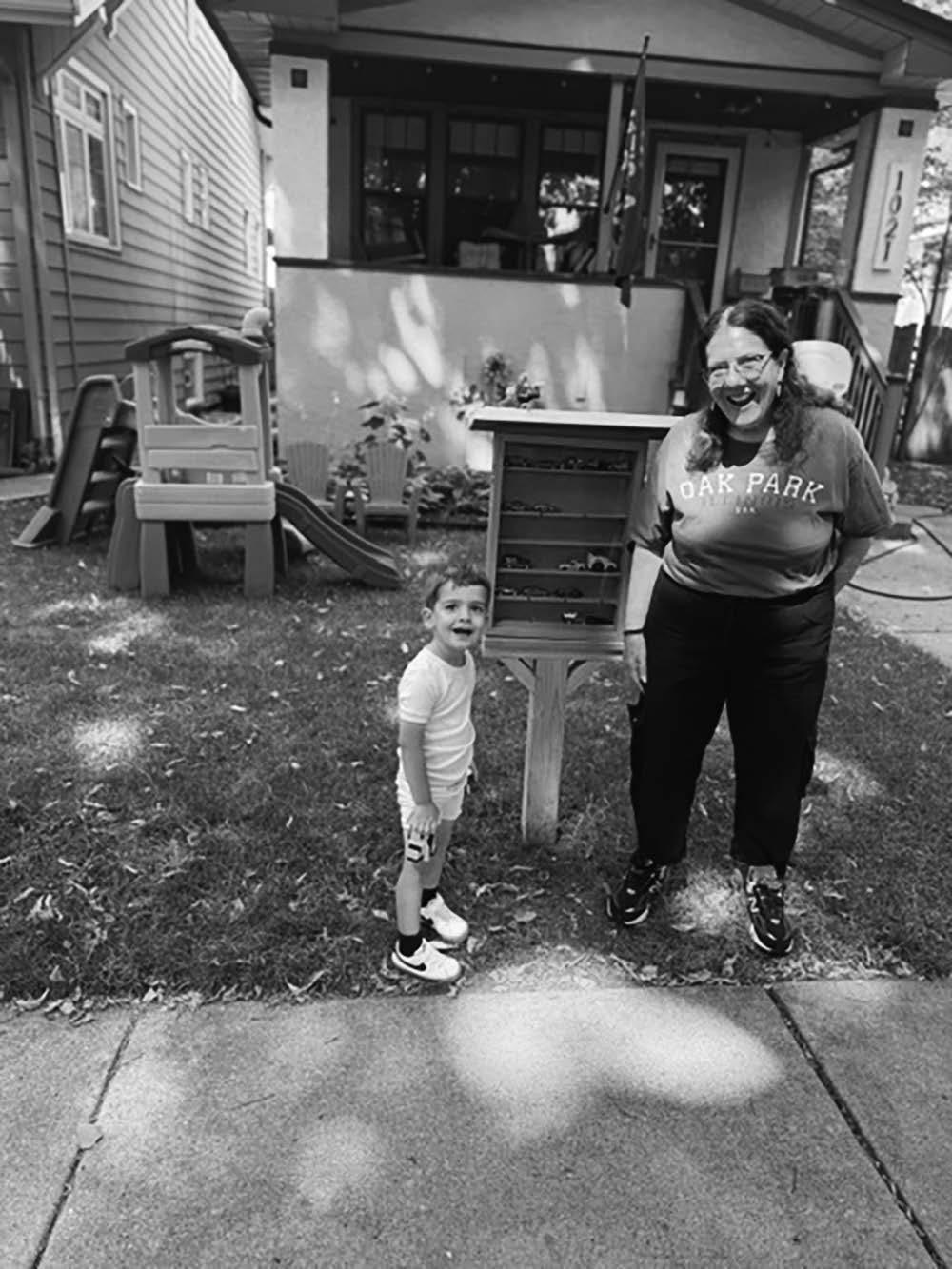
my favorites was a drawing that a kid made of her parents. In Sidewalk Joy spot that featured buttons and small ca paintings with affirmations next to a magnetic word display.”
For more information, readers can go to Me gan Spillman’s Instagram page @freelittleartgalleryoakpark.
Joy Aaronson is an Oak Park resident who writes stories for Wednesday Journal/ Newswell about her favorite things in the village
the zoning report to the Plan Commission, thus supporting the idea that whoever buys my dwelling, or any of the surrounding dwellings with the same lot size, should build one or more six-flats on our block.
Along with these six-flats would come up to 12 cars for the residents of the six-flats, which would have to be parked on the street. The Opticos report has not ignored this fact and states: “Overnight permit parking is available in designated multifamily areas and other limited locations. The Strategic Vision for Housing previously identified the over night parking regulations as an issue warranting review.”
So it appears the Village Board is basically planning to eliminate over night parking wherever a developer decides to build a four- or six-unit dwelling in what used to be single-family zoned housing
The Opticos report goes on to state: “Historic districts cover a significant portion of Oak Park, including several larger lots that may be able to accommodate additional housing, as well as properties with more modest or newer homes that may not be central to the village’s preservation goals.”
What does this mean? How about putting a nice 8-unit dwelling on the south end of the Cheney Mansion, and replace all those useless flowers with affordable housing? The above statement also recommends slicing up all the historic district properties and building 4-, 6-, and 8-unit dwellings between each of those historic buildings. And our village president and all our trustees say none of these changes will affect the basic character of what makes Oak Park such a wonderful place to live Alan Krause is an Oak Park resident.
Reading all the letters/comments pertaining to MadisonAshland Development is almost word-for-word what we heard at the Lake/Lathrop hearings. We attended and participated with neighbors at three public meetings, responded to letters and other discussions
What we are seeing here is a repeat of strong opposition to this kind of development. If we could roll back to that time when the neighbors were voicing reasons why Lake & Lathrop was an unsound project and the developer was certainly shady and did not represent as responsible partners, we would hear the same words from our neighbors now. If we could replay the words spoken and defensive responses by Village President Adduci and others at that time, it would sound almost like the same responses we are hearing today
Back in May 2024, a developer did approach the village with a very preliminary proposal to build 15 to 18 detached prairiestyle homes as a senior community on the village-owned Madison and Ashland site – but apparently was not the favored developer of this board. This proposal also seemed to be architecturally suitable to our picturesque village.
The village leadership is not showing any leadership as they listen with token interest and do not respond to the calls for not going along with their chosen developer, as they did with Lake & Lathrop … and we all know how that worked out.
And we are still looking across the street at that failed development!
SHRUB TO WN by Marc Stopeck
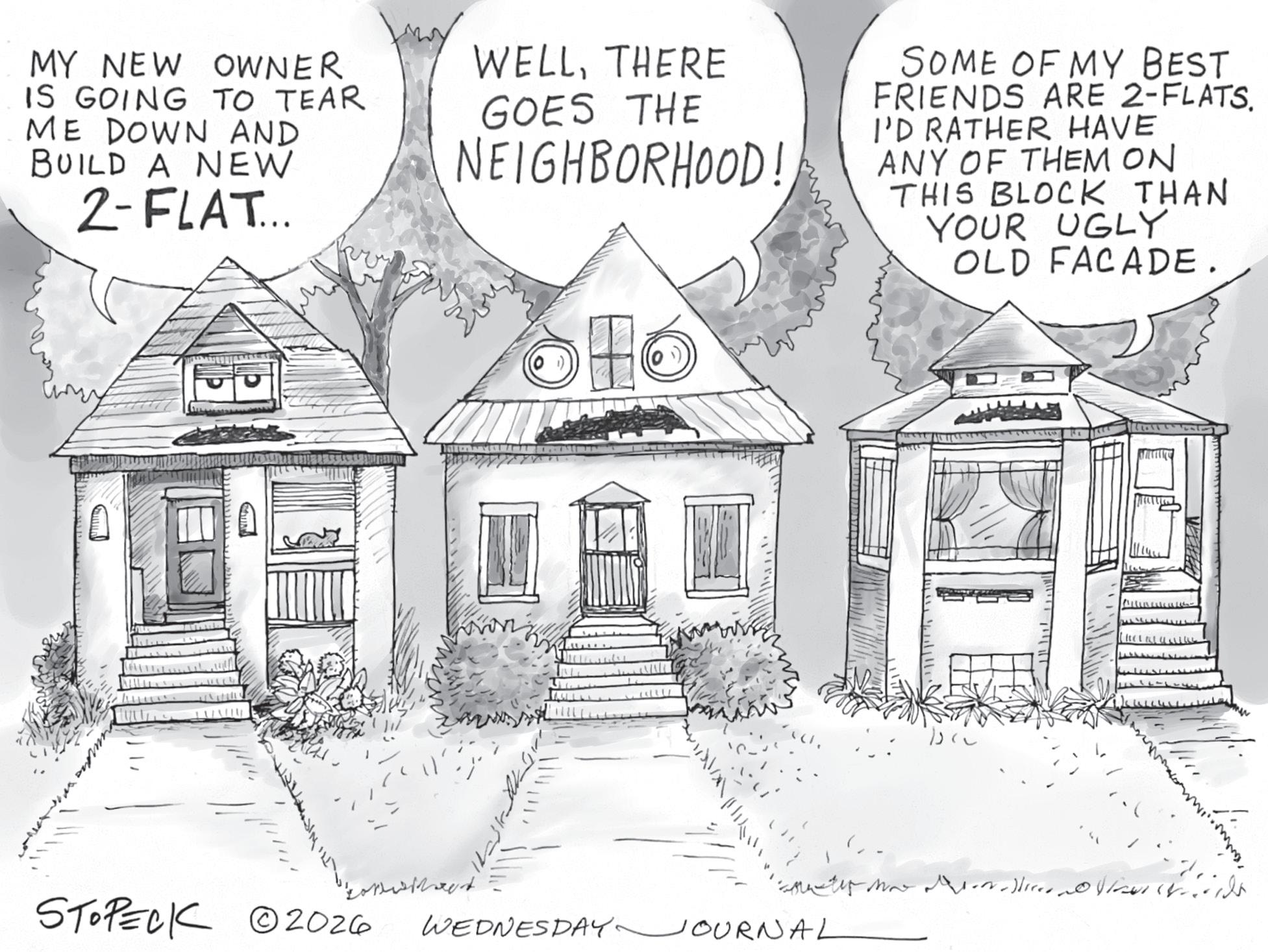
Newton’s Third Law of Physics states that every force is met with an equal and opposite force. Adopting a significant zoning change is a major change for any community to absorb. All significant change generates some resistance. The Oak Park Village Board can reduce that resistance by slowing the process down and giving the public confidence that its input will genuinely be considered.
Experts in public-sector change management emphasize that building public trust is essential to successful change. That trust is built as much through the process as through the policy itself. [1]
Two trustees, seeing a moral imperative for immediate action, urged that this proposal be adopted by the end of the year. While that moral imperative may motivate people who agree, it will cause people who do not see themselves as racist to become defensive and less receptive to the proposal. Heavy moral persuasion makes it harder to have an honest discussion about tradeof fs and concer ns — or to take seriously the consultant’s other recommendations, such as rolling it out as a pilot.
With an aggressive timeline, people will perceive that the Plan Commission process is a mere formality rather than a meaningful opportunity for input into how this policy is
shaped.
The board could tone down resistance and gain support by acknowledging residents’ concerns, recognizing that every policy involves tradeoffs, and allowing public input to meaningfully shape the proposal. Demonstrating the humility to acknowledge that reasonable people can view this issue differently would go a long way toward building public trust.
Since 2022, when the zoning code was amended to allow ADUs, only 12 have been built. The consultant’s report, the stakeholder input and the public feedback have consistently said this will not create affordable housing. New construction is expensive. Change will not happen over night.
I urge the board to use every effort to build public confidence so that whatever policy is adopted rests on a stronger foundation of public trust.
[1] Outcomes, Process, and Trust of Civil Servants, Gregg G. Van Ryzin, Rutgers School of Public Af fairs and Administration. Jour nal of Public Administration Research and Theory, Volume 21, Issue 4, October 201, https://doi.org/10.1093/jopart/muq092
Simone Boutet Municipal law attorney Former village trustee
of Oak Park and River Forest
e goal of the Viewpoints section is to foster and facilitate a community conversation and respectful dialogue. Responsible community voices are vital to community journalism and we welcome them. Space is at a premium and readers’ attention is also limited, so we ask that Viewpoints submissions be brief. Our limit for letters to the editor is 350 words. For One View essays, the limit is 500 words. Shorter is better. If and when we have su cient space, we print longer submissions, but when space is limited — as it o en is — we may ask you to submit a shorter version or hold the piece until space allows us to print it.
We reser ve the right to edit submissions. We do not have time to allow the writer to review changes before publication. We also do not have time to do more than super cial fact-checking, and because of our national epidemic of misinformation and conspiracy theories, when writers include statistical evidence to support their opinions, we require them to include the source of that information, such as credible websites, print publications, titles of articles and dates published, etc. Be as speci c as possible so that we and our readers have some way of assessing the credibility of your claims. Links may also be included for the online version. We follow the Society of Professional Journalists’ code of ethics: seek the truth and report it and minimize harm. As a result, we will do our best not to publish pieces that espouse doubtful or debunked theories, demonstrate harmful bias, or cross the line into incivility. While we will do our best not to engage in censorship, we also do not intend to be used as a platform for misinformation. Your sources for fact-checking are a critical step in keeping the discourse honest, decent and respectful.
All submissions must include your rst and last name and the municipality in which you live, plus a phone number (for veri cation only). We do not publish anonymous letters. One View essays should include a sentence at the end about who you are.
If we receive your submission by 5 p.m. on Sunday, you can expect your opinion to be included in that week’s paper (and online), space permitting.
Pieces can be submitted through our online form at oakpark.com or directly to Viewpoints editor Ken Trainor, ktrainor@newswellchicago.org. For the latter, we prefer attached Word les or plain text included in the email.
■ 350-word limit
■ Must include rst and last names, municipality in which you live, phone number (for veri cation only)
‘ONE VIEW’ ESSAY
■ 500-word limit
■ One-sentence footnote about yourself and/or your connec tion to the topic
■ Signature details as at lef t
I want to congratulate Karen Tardy on her retirement as program coordinator for the OPRF Community Foundation’s Future Philanthropists Program (FPP). Karen joined FPP as a mentor in the program’s second year and took over as program coordinator in 2013. She has managed FPP’s growth from 16 high school juniors and seniors annually to 70 in 2025, as well as coordination with mentors, parents and grantee organizations Her dedication to FPP and passion for its mission will be dearly missed
This program, which I created with my wife, Cheryl, would not have happened without Karen and the kind of effort she puts into the nuances and details. Working with teenagers is not everybody’s cup of tea, particularly as a mentor trying to influence their future behavior. We relied on Karen and our mentors to show that passion every day — and that has proven to be the case over and over again. Alumni from 15 years ago still keep in touch with her.
“Karen Tardy is the glue that binds the teens, mentors and the Future Philanthro-
pists Program together,” says FPP mentor Wendy Will. “Her leadership is on display whether it’s planning and implementing the teaching modules, organizing the volunteer opportunities, collecting the grant requests and so many other details that keep us all together. Her positivity and encouragement work to bring confidence to the teens as they grow as leaders.”
“It’s been said that it’s not what we have in life, but who we have in our life that matters most — and Karen Tardy is one of those people,” says Jane Erickson, an FPP mentor.
“I have known her for over 20 years and we have worked together in FPP and other organizations. She is that person you can always count on and she sees what needs to be done even before you realize it.”
Thank you, Karen, for teaching the art, science and business of philanthropy to the next generation of community leaders.
Rick King Future Philanthropists Program Oak Park
Oak Park is considering a major zoning change that would allow duplexes, triplexes, and fourplexes in areas currently zoned for single-family homes — a decision that could per manently reshape residential neighborhoods deserves careful review, transparency, and meaningful public participation.
The village has described this proposal as an effort to expand housing options through “missing middle housing.” Expanding housing choices may be a worthwhile goal, but residents deserve to understand what outcomes this proposal is expected to achieve. Is the goal increased housing supply, affordability, housing choice, or all of the above? How will success be measured?
Oak Park has demonstrated a commitment to affordable housing through its Housing Trust Fund, which has supported projects such as the Keystone Apartments, the Clinton Avenue conversion, rehabilitation and preservation efforts, and emergency rental assistance. Those ef forts deserve recognition.
The question is how this zoning proposal fits into that broader housing strategy. Smaller developments such as duplexes, triplexes, and fourplexes would not be required to include affordable housing units
The recent Development Review Board’s recommendation to approve the Madison & Ashland development raises a question that extends beyond one building. It raises questions about the integrity of River Forest’s planning process.
Just months ago, residents spent countless hours participating in the village’s discussion of proposed zoning changes that would have allowed larger, denser development. Those proposals were rejected, based on concer ns about neighborhood compatibility and overdevelopment.
Now the village is considering approving a 5-story, 72-unit building through variances that exceed the very standards that were recently affir med
If the village can grant variances for what it declined to adopt through its zoning code, residents are left wondering what purpose the zoning debate served. Why ask the community to spend months shaping development policy if those standards can simply be set aside, project by project?
Equally concerning is what this process says about public engagement. Meaningful public participation is not measured by the number of meetings held or comments
collected. It is measured by transparency. Residents deserve to know what the village heard, how public input influenced the recommendation, and why certain concer ns were accepted while others were rejected.
Listening alone is not enough. Good gover nance requires demonstrating how that listening infor med the final decision.
I understand that not every resident will agree on this project, nor should every public comment deter mine the outcome But every resident who participates in good faith deserves confidence that the process was more than an exercise in checking procedural boxes.
Development and neighborhood preservation are not competing values. River Forest can welcome investment while also honoring the planning process, respecting its own zoning decisions, and demonstrating that public participation genuinely matters.
If we lose confidence in those principles, we lose more than a debate over one development — we lose trust in how our village makes decisions
Angie Grover River Forest
If affordability is a goal, residents deserve to understand what evidence shows these changes will achieve that outcome
The village has commissioned a feasibility study, which is an important step. However, the proposed zoning amendments have already moved forward to the Plan Commission, while the study is not expected until the end of August. With a public forum scheduled for Aug. 27 and a Plan Commission vote expected on Sept. 17, will residents and commissioners have enough time to review and understand the findings?
A feasibility study should help guide decisions. Residents deserve the opportunity to consider that information before recommendations are made.
The study should also address the practical impacts of increased density, including parking, infrastructure, traffic, and municipal services. These are not arguments against housing or change; they are the questions responsible planning requires us to answer.
Taking additional time to fully evaluate the proposal is not a barrier to progress — it is part of responsible planning
Audrey Strode Oak Park
I am an Oak Park retiree living in a 40-unit condo building near the main library. Recently I engaged a local, family-owned, Oak Park-based business to do a one-day job: moving my electric panel from inside a closet to an adjacent wall 2-3 feet away. This project is being required of all residents not currently code-compliant, meaning that these panels can no longer be located inside closets
T he highly recommended vendor I chose and am happy with, who has done work in our building and many others in the Oak Pa rk area, estimated the cost of a permit at $175 to $200, based on similar previous work and information on the villa ge’s website. However, I was infor med on the day before the work was done, the actual cost will be $425. I also lear ned that VOP has for the last several years been outsourcing permitting to a third pa rty called SafeBuilt.
That seems way out of line: $425
for reviewing and approving a simple per mit application. Forest Park charges considerably less, and as recently as last year, Oak Park was charging under $200. I would sure like to know who is pocketing that extra cash, and how on ear th the village trustees justified the use of a third-party company to do the review instead of the Oak Park Building De par tment.
My taxes and those of all Oak Park residents pay the salaries of VOP employees, right? And now we have to cough up almost twice as much, with a hefty chunk going outside Oak Park Why?
It’s a reasonable question that no one at VOP seems to have a reasonable answer for. So, like with many other projects and expenditures around town, our village gover nment is proving not to be responsible stewards of our resources. They need to do much better
The issue at hand is whether Oak Park should eliminate single-family zoning
Having lived and worked in this community my whole life, I see nothing wrong in keeping it as a single-family zoning. Oak Park has always been in the forefront of diversity. Bobbi Raymond did an excellent job in ensuring that. Did you know that Oak Park had an African American church before the tur n of the century? Have any of the board members been to our History Museum to lear n of Oak Park’s past?
Having been a past commissioner of the Landmarks Commission, I have always had an appreciation of single-family dwellings. The whole nature of Oak Park is its architecture. Did you know there was a surge in population in Oak Park, after the Chicago Fire?
Oak Park was incorporated in 1902. I was on the committee to celebrate that
milestone, along with Elsie Jacobsen, in 1977. My business took me to rehabbing and preserving historic structures in the village for many years.
What would happen if we were to do away with single-family zoning? Cer tainly it would have a much different atmosphere than what we are experiencing today. This is not a racial issue although I do believe that future developers would like to use this tactic so as to have people shy away from this issue and thus further their development plans.
Oak Park is a community of old and new ways and should be celebrated as such. But to raze its history is not the answer. The future of Oak Park should be celebrated with its past, which includes its singlefamily zoning
Bob Proko Oak Park
Last week, the Oak Park Village Board had a choice: let residents vote directly on one of the biggest zoning changes Oak Park has considered in decades. Instead, by a vote of 5-1, that choice was taken away.
More than 20 residents spoke at the meeting. The overwhelming majority asked for one thing — a referendum. Not a veto, not a blockage, just a chance to be heard on the record, on a ballot this November. The board said No
I understand the arguments: that zoning is legally the board’s responsibility, that a yes-or-no question can’t capture something this nuanced, that we elected representatives to make hard calls so we don’t have to. Those arguments aren’t unreasonable. But they miss something important — no one on this board ran on a platform of eliminating single-family zoning village-wide
This isn’t a small thing to skip. It’s about
Wednesday Jour nal’s story on Heritage House [News, July 29] illustrates why Oak Park needs to improve how it deals with problem properties
The process is too slow. Per the article: “It has been plagued for years by issues like filthy floors, rats and bedbugs, inadequate garbage dumpsters and … outsiders entering the building unfettered.”
The process is too timid. “Oak Park began issuing citations this spring instead of the usual war nings.” One or two war nings should suffice before citations are issued
The penalties are too minor. “Pacific Management was assessed a $50 fine for each citation.” The fines totaled $500, a drop in the bucket compared to the money saved by failing to keep the property clean,
safe, and vermin-free over the years.
We have experienced similar commercial and residential property issues in the North Avenue District. For example, the long-vacant IHOP at North and Elmwood has been an eyesore and a health/safety hazard for years. When asked about this property last summer, a village employee said: “We’re working with the owner.” Really? After years of neglect? There are several other North Avenue examples
Nothing is a greater impediment to revitalization efforts than problem properties like this one
An inadequate approach to problem properties has been an Oak Park issue for a long time, long predating Kevin Jackson’s tenure as village manager, due to some
combination of municipal code insufficiencies and the village’s generally laissez-faire culture toward the owners of these properties. I would like to see the village take direct action on serious problems, bill the owners, and file liens against the properties. HUD hired a temp agency to clean Heritage House. The village should take a page from its book. Had it done so, the serious fire at 1239 N. Taylor in February could have been prevented
It’s my understanding that village staff is studying how its approach to problem properties can be improved, including by direct action. It’s about time. I hope the study process can be expedited.
Judith Alexander Oak Park
density, parking, traffic, and the character of the blocks we’ve built our lives on. Thousands of families in this village bought their homes understanding they were single-family zoned. That understanding has value — financial, yes, but also the simpler value of knowing what your neighborhood is and will be. To be fair, affordability is real. Oak Park is losing people who can’t afford to live here, and that needs to be addressed. I don’t think anyone disagrees with that goal. But a good goal doesn’t excuse skipping the people who will live with the outcome
So the ask is simple: slow down. There’s no urgency to implement this immediately. Let residents have their say in the upcoming zoning meetings, and let the board get the details right.
Public trust is what’s at stake here.
Chip Popa Marion Street resident
What is happening with the absurd parking rules in Oak Park? I cannot park my car in my driveway without some neighbor calling me in for “blocking” the sidewalk. Many homes in Oak Park have short driveways and garages which do not fit modern-day vehicles. So now I must pay parking tickets because I have neighbors targeting me. We must have a vote to moder nize outdated parking laws in this village. Enough is enough.
We are better than this
Last week I attended my first ever village board meeting to express my support for re zoning to legalize homes. The public comment period included remarks from two renters, both of whom favor legalizing rental units, and over 20 homeowners who were split. Around midnight, trustees were finally allowed to speak. As soon as Trustee [Cory] Wesley began explaining the racist history of exclusionary single-family zon-
ing, he was shouted down by an angry old white male homeowner who already had his tur n at the podium.
The derisive energy flowing off many of the anti-zoning-change (and overwhelmingly white) homeowners was something I never expected to see in my beloved Oak Park. Also, bizarre claims from many older residents that multi-unit housing will overwhelm the schools and other
infrastructure, when anyone reading this paper knows District 97 and District 200 are losing students and laying off teachers, were depressingly detached from objective reality.
Fellow Oak Parkers, we are better than this! We can let a Black trustee talk about racism. We can also read enough to acknowledge basic facts. Noel Stringham Oak Park Send letters
Ken Trainor, Wednesday Journal ktrainor@newswellchicago.org
Fax: 708-524-0047
Please include name, address and daytime phone number for verification.
Our village board members were elected to represent us, the citizens, in the running of our village. When they assert that referendums, whether for leaf bagging or overhauling zoning, will not be put on the ballot, they seem to forget that this is a cooperative venture. We are all in this together.
But Jim Taglia was the only trustee in favor of the referendum.
I can think of only one reason to refuse a referendum: our board does not want to know how many Oak Parkers are in favor of demolishing our zoning ordinances In blissful ignorance, they will march ahead
Shelly Uslenghi Oak Park
Oak Park residents concer ned about the assessed values of their properties may appeal them with the Cook County Board of Review between Aug. 3 and Sept. 1. Residents should know that the Oak Park Township Assessor’s Of fice is available to assist those who wish to file appeals. Just call 708-383-8005 to set up an appointment.
In May of this year, the Cook County Assessor’s Office sent reassessment notices to all Oak Park property owners. These notices proposed new assessed values for each property that would impact the taxes paid by local residents from 2027 through 2029. Taxpayers unhappy with the proposed values had a right to appeal them to the county assessor’s of fice, and appeal results were released in mid-July.
I very much appreciated your last column on your beliefs [My nonrational beliefs, Ken Trainor, Viewpoints, July 29]. You are a Universalist in your soul, in my opinion.
Your words are so close to those I want to share with you, that I suspect you may have read them at some time or another. They were given by Augusta Chapin, Unity Temple’s first — and up until a week ago, only — woman minister, delivered sometime during her ministry (1885-1891), the occasion lost to history:
The greatest names will perish from human history, the finest monuments crumble into dust, and the time will come when our places know us no more.
Yet we shall survive in the memories of our friends as long as the remembrance will serve any good purpose; and then our work and thought and influence will mingle with the great ocean of human achievement, and the sum total of that will be something more, something different, from what it would have been without us
Ron Moline Oak Park
Taxpayers dissatisfied with the results from their appeals, as well as taxpayers who did not file an appeal with the Cook County Assessor, now have the right to appeal to the Cook County Board of Review. There are some dif ferences in the way the two county agencies review tax appeals, such that one agency sometimes denies an appeal while the other grants it. Thus, if you thought you had a good case but lost your first appeal, don’t give up!
My of fice has many experienced staffers who can help local residents quickly and easily file appeals with the Board of Review. Call before the Se pt. 1 deadline and we will work together to get your appeal filed
I have worked as the Lear ning Edge Tutoring Marketing coordinator for just over two years. You may be thinking, “She’s paid to promote them.” It’s true! But I wouldn’t do this work if I wasn’t a super-fan. In fact, initially I didn’t know if I had the bandwidth to do the work, but I attended a single tutoring night and I was hooked.
I wish you could feel, as I did, the energy as dozens of students eagerly greet their mentor-tutors and get right down to work – and after a long day at school, no less! At one session, I watched a student come through the doors, squeal, run toward her mentor-tutor, and throw her ar ms around her.
Lear ning Edge is a nonprofit, community-based organization that provides Chicago-area students free one-to-one tutoring and academic enrichment, enhanced by caring, mentoring relationships. Many of our students join tutoring when they’re young so they have an additional adult to keep tabs on them, to notice when they are struggling in certain areas. Like medical preventive care, proactively creating this culture of accountability and structure makes for stronger students
Here are some things our mentor-tutors have said about this work: Barb says, “It’s so much fun to see the lightbulb go on.” Lloyd says his student brings out the best in him. Karen says, “The human connections go such a long way; I love the combination of ages – it works beautifully!”
As we approach a new school year, we are seeking additional adults to do this meaningful volunteer work Our mentor-tutors do not need experience; we provide training and materials. While we do have educators in our ranks, we also have mentors who work in retail, textiles, medicine, IT, banking, etc We also have high school students!
If you give it a try, we think you might just stick around. Our average tutor is with us for four years. There’s a theory that five caring adults in the life of a child can make the difference between surviving and thriving. Are you willing to help kids in our community thrive?
lear ningedgetutoring.org/volunteer
Nancy Schroeder Oak Park
I attended the marathon village board meeting on July 28 to lear n more about the proposed elimination of single-family zones in Oak Park. My thanks go out to trustees and staff who stayed late to hear all public comments. Many questions were asked by citizens, and we got a few answers. Here is a list I compiled:
Q: Will all lots zoned today for single-family homes change to multi-unit zones? Is the change village-wide?
A: Yes and yes.
Q: Can any single-family home be tor n down for a multi-unit building?
A: Yes. Current single-family zones will be consolidated into three zones, with 3- or 5-story multi-unit buildings allowed depending on the zone
Q: Has there been any analysis conducted to evaluate potential population increase and resulting impact on shared resources (e.g. parks, CRC, library, fire/police schools) or infrastructure (e.g. trash, utilities, roads, sewers)?
A: No
Q: Will property values decrease for adjacent single-family homes when a large multi-flat is built next door, or will developer
demand raise values?
A: TBD
Q: Will you change setback and height rules to accommodate larger edifices?
A: Standard setbacks apply, but allowed height is increased.
Q: Will parking rules change?
A: Yes, the over night parking ban will be eliminated
Q: Will property taxes be impacted?
A: TBD
Q. Can coach houses be built?
A: TBD
Q: How does the village ensure new multi-
units constructed will actually be affordable and not high-end?
A: TBD
Q: Does the proposal include support for current Oak Park residents struggling with housing affordability?
A: No
There are more questions than answers. I advocate slowing the process down to better inform, discuss, and refine the proposal to ensure it delivers desired results without unintended consequences
Grant Johnsey Oak Park
To me, it seems the most common sense of conclusions: if you keep dumping any single thing into a confined space, eventually you’ ll create a problem. Water is necessary for the human body. But drinking water to excess produces “water intoxication,” which causes drowsiness, muscle weakness, and in extreme cases, death.
Oxygen is necessary for us to breathe But an overly-oxygenated environment is highly flammable, resulting in danger to anyone who is present. And so it seems fairly self-evident that emitting too much carbon dioxide into the atmosphere would eventually create a problem. Scientists understood that excess carbon dioxide in a confined space would produce war ming by the mid-1800s, and they made quantitative predictions about climate change before the tur n of the 20th century. Fossil fuel companies studied climate change and predicted its current ef fects 50 years ago.
This is not new science. It is not an outlandish idea. But in the face of punishing heat waves, tor rential stor ms, and destructive wildfires, it is still contested. By some, its veracity is contested. By others, its degree. By still others, its remedy.
A famous quotation whose authorship is disputed tells us, “It is dif ficult to get a person to understand something when their salary de pends upon them not understanding it.” This is most especially true for fossil fuel corporations, their executives, their boards, and their shareholders. For the rest of us, we can alter this quotation slightly: “It is difficult to get a person to understand something when their worldview depends upon them not understanding it.” And it is that intersection of pecuniary interest for corporations and preservative interest for everyone else that creates our current stasis. Everyone
As I have listened to Oak Park’s debate over single-family zoning, I have become convinced that we are arguing about much more than zoning. We are often looking at many of the same facts, yet reaching very dif ferent conclusions. Facts alone do not tell us what they mean. We filter them through our own experiences, histories, values, and beliefs, connecting them into stories that help us make sense of the world. Those stories shape how we understand our community and what we believ e should happen next.
Every resident who speaks at a village board meeting or writes a letter to this newspaper brings a perspective shaped by experience. For some, the defining experience is exclusion — the memory and reality of families denied housing oppor tunities because of race, discrimination, income, or unequal oppor tunity. When Trustee Cory Wesley says that in some neighborhoods he does not see many
fears change. Wealthy elites fear losing power. We fear losing everything. Or if we can’t conceive of that, we fear losing comfort. And those in fear react in a few common ways: They fight. They flee. They free ze. Our communal survival depends on us finding another way.
If we process our fears healthily, we can react dif ferently. We can use less but feel more. We can connect with one another rather than collecting more possessions. We can forgo accumulation and value relaxation. Rather than believing the cor poratist lie that we are all alone and falling behind, we can create the truth that we are all together in having what we need. But this cannot just be a shift in mindset; it also must be a shift in power. This new way of thinking must allow us to come to gether in rejecting wealthy elites’
people who look like him, he is expressing a lived experience that deserves to be heard and taken seriously.
For others, the defining experience is dif ferent. It is the story of saving for years to buy a home, raising a family, investing in a neighborhood, and building stability. When these residents ask how zoning changes may af fect neighborhood character, housing values, infrastructure, schools, taxes, or parking, they are expressing concer ns rooted in their own experiences. Those questions should not automatically be interpreted as opposition to inclusion or denial of Oak Park’s history
The challenge is that people often attach very dif ferent meanings to the same facts and symbols. One person sees justice; another sees uncer tainty. One sees oppor tunity; another sees disruption. That helps explain why this debate has become
so emotionally charged. Reco gnizing dif ferent perspectives does not mean all policy conclusions are equally persuasive. Our experiences deserve respect, but public policy must ultimately rest on evidence. We should be able to acknowledge Oak Park’s history of exclusion while also asking practical questions about whether a proposed policy will meaningfully increase affordability, who is likely to benefit, how many homes may actually be built, and what unintended consequences might result.
The responsibility of democratic gover nment is not to choose one nar rative over another. It is to listen respectfully to every perspective and then make decisions grounded in evidence, law, and the public interest. Listening does not guarantee ag reement, but it should leave residents confident that their voices were genuinely heard.

control of our economy, gover nment, and society We must take back our common power to eliminate their undue influence, eliminate their ability to buy elections, tax back their money into our shared coffers, and use our common wealth for the common good.
As we do this, addressing the excessive emission of carbon dioxide and other substances becomes a matter of exercising that common power. When corporations no longer control either the power or the nar rative, we can re gulate pollution. We can ensure quality education for our youth. We can ensure that all people have adequate food, shelter, and health care. Common-sense conclusions. Commonsense actions
Jim Schwartz is an Oak Park resident, an educator, and a blogger at Entwining org.
One way to strengthen that confidence would be an advisory referendum. Such a vote would not transfer the board’s le g al responsibility to govern, nor would it dictate the outcome. Trustees would still have the responsibility to exercise independent judgment. But on an issue involving history, identity, neighborhood character, and the future of Oak Park, an advisory referendum would allow every resident to be heard while providing the board with valuable information before making its final decision.
Oak Park’s diversity includes more than race, income, and housing. It also includes diversity of experience and perspective. If we can respect those dif ferences while remaining committed to evidence-based decision-making, we will not only make better policy — we will strengthen the trust that allows a community to move forward to gether.
Bob Milstein is an Oak Park resident and a former villa ge trustee.



I am bothered that some people have equated opposition to eliminating single-family housing to racism. If I were to use a single word to describe this complex issue it would not be race. It would be density.
If you don’t believe that, think back to the vivid opposition to the high-rise buildings that were built in Downtown Oak Park a few years ago. No one thought it would bring in low income minorities. That wasn’t the issue. They were objecting to the greater density I view increased density as a negative, with its impact on traffic, schools, etc. One speaker at the board meeting said that if people want an area with single-family homes, there are plenty of suburbs with them. I have no desire to move. I did not want to move to a suburb that only has single-family houses. Nor did I want to move someplace that only had multiple units. One of the reasons we chose Oak Park was that we wanted to live in, and raise our child in, a community with a mixture of housing types and a diversity of residents
Also, who says that only whites want to live in single-family homes? There are entire suburbs, such as Bellwood or Country Club Hills, that are predominantly black families living in single-family homes. Our block is diverse. So how is wanting a singlefamily home a race issue?
Another issue is the historic districts in Oak Park So many people have worked so hard over the years to protect them and our historic architecture that is world-famous. Could they be tor n down to make way for multi-unit buildings? If the answer is no, then those of us in bungalows are being discriminated against.
The village really should do a mailing to every home in Oak Park explaining the issues and notifying people about opportunities for discussion. I have not seen anything directly from the village. I sometimes hear about the meetings and comments after they have happened. I know there are more meetings planned. I’ve seen a list from a neighbor but hope there will be something directly from the village. Affordability is cer tainly an issue, but it is not an issue exclusive to single-family homes. Look at the price of condos. Some of them cost more than my house. Rentals rates are hardly cheap either, so building more buildings might not help. It is an issue all over, not just here. The village has built some af fordable buildings. How has that gone?
There was a much greater outreach for community involvement for a less consequential plan several years ago to redo Downtown Oak Park. In the almost 44 years that I have lived in Oak Park this is the most consequential issue ever, and the village really needs to reach out directly to all its residents
Joyce Porter
Oak Park

John Albert Muhlenberg, 94, of aGrange Park, for merly of Oak Park, died peacefully on Aug. 1, 2026 at Lightways Hospice in Joliet. He had ved with Parkinson’s for many years. onetheless his sudden decline shocked everyone. His wife of nearly 30 years, Elisabeth Muhlenberg, was by his side throughout and particularly during his hospice stay. Lightways was instrumental in making John’s last days comfortable and peaceful.
Bor n in Reading, Pennsylvania, he attended Wyomissing High school and served in the U.S. Ar my after the Korean War (19531955), spending much of those two years in Fort Hood, Texas He deeply disliked the ar my, but made lifelong friends and achieved a kind of fame in the Signal Corps by slyly resisting authority enough to avoid getting promoted, but not too much to get court-martialed. His independence and rebellion against authority affected his entire life, including his educational career. He switched universities repeatedly, eventually receiving a bachelor’s degree in Psychology from the University of Illinois Chicago (UIC)
With the support of his first wife, Alba Muhlenberg, John finally found his niche at the Illinois Institute of Technology (IIT). He graduated as a mechanical engineer in the 1970s and accepted a job at the Assocation of American Railroads (AAR), testing railroad equipment. He loved his job and retired in 1995 when the AAR moved operations to Colorado.
He loved the outdoors, and relaxed, particularly after Alba’s death, by walking 5 miles after work. The greatest damage Parkinson’s inflicted on him was losing his ability to walk. He canoed wildwater races competitively with his cousin Ferd Thun, and spent years instructing sailing for Sail Chicago, passing the tough test to become a US Sailing Association instructor. With Parkinson’s, he discovered the wonderful Judd Goldman Adaptive Sailing program.
Throughout his adult life he subscribed to the Chicago Symphony and the Lyric Opera of Chicago. For their first date he took his future wife Elisabeth to a performance of the Chicago Symphony. John and Alba did not have children. She died in 1989 of a chronic lung disease. John adored his two step-children Stephanie (Mathew) Hein and Martin (Terese) Broerman. He took special pleasure in all five grandchildren, Tim, Annelise and Erik Hein and Charlotte and Fritz Broer man.
John was the fourth child of the late Charles Muhlenberg and Wilhelmina Thun Muhlenberg. His siblings, Nick, Mimi, Philip and Jerry all predeceased him. He was especially close to his sister’s family, her three children, the late Christopher Cherney, Mary Cher ney and Kaethe Cher ney and the children, Tim Cherney and Charlotte Grillot.
John chose to donate his body to science through the Anatomical Gift Association. A memorial service is planned for a later date at Plymouth Place.
In lieu of flowers, gifts can be made to the Judd Goldman
Adaptive Sailing Foundation https://juddgoldmansailing.org/ donate/ or Lightways Hospice https://lightways.org/make-adonation.
Arrangements were handled by Inclusive Funeral Care, www InclusiveFuneralCare.com.

Patrick Kevin Newton, 67, died of natural causes after a brief illness in San Diego on July 8, 2026. Bor n on Jan. 31, 1959, in Evanston, the ninth child and youngest son of the late Walter and Mary Eileen Newton, the family moved to Oak Park when he was just 7 months old
He graduated from St. Edmund School, Oak Park and River Forest High School, and earned his degree from the University of Portland in Oregon wing graduation, he worked as records manager in various law fir ms in Portland, San Diego, and Los Angeles before eventually making San Diego his home.
An avid walker and jogger who loved staying active, his true passion was swimming. Beyond his active lifestyle, he possessed a remarkable mind and a lifelong obsession with dates. He served as the family’s unofficial historian, recalling names, family events, milestones, and shared memories with an unmatched, keen sense of detail and humor.
His profound fondness for his nieces, nephews, and great-nieces and -nephews was touching; he took immense joy in watching them grow and celebrating their lives. He also for med deep, enduring friendships over the years.
Patrick is survived by his loving siblings: Diane (Richard) Van Grunsven, Don, Rev. Steve CSC, Mary Pat (Ron) Hestbeck, Jerry, Mike, Sheila Slifka, and Maureen (Dave) Winfrey. His nieces and nephews, Gregory (Christianne) Van Grunsven, Michelle (Kyle Marcus) Van Grunsven, Cheryl (Thomas Fondano) Van Grunsven, Erin (Jeff) Mielke, Laura (Jordan) Nelson, Kelly (Michael) Terranova, Terry (fiancée Alexis) Newton Jr., Kristin (Julio) Ruiz, Kyle (Stephannie) Slifka, Shannon Slifka, Megan (Kyle) Michelsen, Brandon (Tori) Slifka, Kayla Winfrey, and Mara Winfrey. He is also survived by several grand-nieces and grand-nephews, all of whom will deeply miss his love, laughter, and remarkable memory.
Patrick was preceded in death by his parents, Walter and Mary Eileen Newton, his brothers Terry and Tim, and his brother-in-law Steve Slifka.
Visitation will be held on Friday, Sept. 18 from 10 to 11 a.m. at St. Edmund Catholic Church, 188 S. Oak Park Ave, in Oak Park. The funeral Mass will be celebrated at 11.
Memorial donations may be made to Er na’s Roadside Farmstand, established to assist with the ongoing expenses related to Patrick’s niece, Erin, as she battles her six-year fight against lung cancer
Details for contributing are available on: Erna’s Roadside Venmo or Er na’s Roadside Facebook.
By GREGG VOSS Contributing Reporter
Baseball is beautiful, simply due to perfect execution of plays like a delayed steal of home. Picture it: Runners on first and third bases with one out in the bottom of the first inning of a scoreless game. Push a run across, and you’ suddenly got all the momentum in a Little League state championship game
That was the position the River Forest 11U baseball team found itself July 29 at Hinsdale – a team the locals lost to in the 2025 10U title game.
With Nate Kardosh on first and Dawson Przyborowski third, at bat was Jack Hanley, and all three knew what to do Kardosh broke for second in an attempt to get into a rundown, thus allowing Przyborowski to score. Hypotheticall anyway
The Hinsdale catcher threw the ball across the field to hi shortstop and Kardosh froze within feet of second base. Simultaneously, Przyborowski broke for the plate. Hanley’s role was simply to get out of the way.
It worked. Przyborowski beat the throw and Kardosh was safe at second
“Once I saw the catcher was throwing it down to second base, I knew I had to start running because the shortstop had a good ar m,” said Przyborowski, son of coach Josh Przy borowski. “It was exciting. I knew it was going to help us settle in with the lead and it would calm down our pitcher so he wouldn’t have to be perfect.”
The pitcher was Hanley, who was nothing short of stellar in his team’s 3-2 state championship win over Hinsdale. Despit the fact that Hinsdale was hosting the finals, No. 2-seeded River Forest was designated the “home” team and Hanley threw a complete game, giving up just those two runs

River Forest 11U State Champions Team
to beat them back.”
He also got out of a major jam in top of the sixth inning to seal the victory with a ton of help from his catcher – Przyborowski.
With two outs and the bases loaded, there is no margin for er ror, and Hanley knew it.
“I was thinking that I couldn’t leave the ball over the middle,” he said. “I would have to pick corners and Dawson definitely helped me.”
At the moment of truth, neither player flinched. Hanley painted the corner, nestled the ball neatly in Przyborowski’s mitt and Hinsdale’s best hitter was called out on strikes. Bring on the pandemonium.
“At the time, I was thinking we’ve been waiting for this for a year,” said shortstop Michael Berger, son of pitching coach Ian Berger. “Last year we got second and it was great
And how. River Forest went 22-2 this season, including winning their last 19 in a row – eight in the state tournament. But July 29 was the big day, as the locals drubbed Moline 12-0 in the semifinals at 5:30 p.m. before beating Hinsdale at 7:30 p.m.
“We made the state tournament last year and felt like we were underdogs,” Josh Przyborowski said. “We left last year believing we belonged there and came into this tournament with much more confidence.”
This is about the age that travel ball begins to beckon, and Przyborowski said his group is different because they’ve been friends for essentially their whole lives and want to play together. They’ll do that next year in 12U, which is when the opportunity to advance to the Little League World
Series comes about.
But let’s not get ahead of ourselves. Przyborowski said there are several things he and his coaches emphasize to their young charges.
“We remind them that baseball is a tough game and it’s a game where you have to learn to deal with adversity,” he said. “Nobody should feel like they are out there by themselves. They should rely on the strength of their teammates.”
But these guys aren’t alone and they won’t be as middle school bleeds into high school baseball. You’ll be reading their names in Wednesday Journal a few years from now.
“I think it’s everyone in the neighborhood and the talent and the coaches,” Berger said. “We work so well together and we’re best friends.”
By MELVIN TATE Contributing Reporter
Back in the ’90s, Michael Jordan and Scottie Pippen led the Bulls to six NBA titles in eight years. Last decade, Jonathan Toews and Patrick Kane were the linchpins in the Blackhawks’ run of three Stanley Cups in six seasons.
The Elmhurst/River Forest 14U baseball team has now joined those local spor ts dy nasties following a 10-0 run-rule rout of Whitefish Bay, Wisconsin in the Junior League Central Re gion finals, Aug. 2, in Midland, Michigan. The victory punches the team’s ticket to the World Series for the fourth consecutive year
“I’ve known about this team for a long time and wanted to play,” said River Forest resident and incoming Fenwick freshman Will Bar tolucci. “Winning the re gional means a lot and it feels very good.”
“It’s good to see all the hard work has paid of f,” said River Forest resident Jimmy Madden. “It’s a good oppor tunity to play some really good competition.”
Elm-RF, which had squeaked out a 4-2 vic tory over Whitefish Bay in its tour nament opener on July 30, took care of business ear ly in Sunday’s rematch, scoring four runs in the bottom of the first inning. Madden and fellow River Forest resident Danny Goggin each had run-scoring singles in the frame.
“When the top of our lineup star ts well, it gets the morale of the team really high,” Go ggin said. “Scoring those early runs gave us the momentum.”

Then Elm-RF sealed things with six r uns in the four th. Bar tolucci had a r unscoring double during the rally; he was 2-fo r-2 at the plate for the day along with Go ggin. He had missed the state tour nament the previous week due to a thumb injury and was glad to make a major contribution in the re gional.
“I wasn’t 100 percent sure if I was going to play,” he said. “Playing baseball agai n felt awesome; it’s my favorite thing to do.”
“They saved their best two pitchers for (Sunday), but our guys are hitting the ball so well, we we re ready,” said Elm-RF head coach Rob F leming. “We came out strong , got on the board early, and never looked back.”
In Elm-RF’s 11-0 semifinal victory over Ne g aunee, Michig an, Aug. 1, Bar tolucci
and Madden each delivered RBI singles. The team had advanced to the semifinals with a 7-6 victory over Bullock Creek, Michigan.
The four River Forest players on the team, Bar tolucci, Jon Ellis, Go ggin, and Madden, have meshed well with the Elmhurst players Go ggin feels the quicklydeveloped chemistry between the two leagues has led to this year’s success.
“Through state it was a little if fy,” he said, “but once we got to re gionals, we stayed over night (to gether). We ate dinner to gether and got to know each other We brought a g ame of bags along and star ted to bond; now it feels like we’re a family.”
“When we played (Elmhurst) in 12U, I
couldn’t have imagined being friends with them,” Bar tolucci added. “Being in the same hotel brought us closer to gether and it’s been really great.”
To a man, the players know about the high expectations of the 14U team and were ea ger to make their mark.
“I remember watching them last year on TV and thought it was so cool. I really wanted to get (to the World Series),” Madden said. “I realized it comes with a lot of hard work and dedication. I’m very proud of everybody.”
Ellis has missed the state and re gional tour naments with a hamstring injury, but he’s scheduled to retur n for the World Series And he’s eager to help out his team-
mates.
“It’s been kind of hard sitting on the bench,” Ellis said. “I like supporting everyone, but I’m really excited to retur n and help out the team as much as I can.”
“Super-excited because Jon’s one of our best players and pitchers,” Bar tolucci said. Elm-RF faces Murfreesboro, Tennessee in the opening round of the Junior League World Series, Aug. 9, in Taylor, Michig an. F leming is optimistic about his team making a strong run.
“The hitting and fielding are at top level and the pitching’s been amazing,” he said. “These guys want to win, they’re hot. They deserve our best ef fort that puts them in the best position to be successful.”



LEGAL NOTICE
NOTICE OF PUBLIC INFORMATION MEETING
Notice s hereby given that the Village of Oak Park will hold Public Information Meeting #2 for the Bridging the Ike project in an open house format welcoming all community members to learn about the study and participate in the planning process. The project is examining opportunities for expanded bridge decking over I-290, which could accommodate new development, public plazas, and park spaces over the expressway
Date: Thursday August 20, 2026; Time: 5:30-7:30 p.m.; Location: Veterans Room at the Oak Park Public Library, 834 Lake St, Oak Park. This meeting is ADA accessible
For more information about the public information meeting and ways residents can share their priorities for future bridge crossing improvements, visit https://engageoakpark.com/ike
Published in Wednesday Journal August 5, 2026
LEGAL NOTICE
The Village of Oak Park—Office of the Village Engineer, 201 South Boulevard, Oak Park, IL 60302—will receive PDF proposals via email, at aspentzouris@ oak-park.us until 4:00 P.M. on Tuesday, August 18, 2026, for the following: Professional Engineering Services for Construction Engineering (Phase III) for the Ridgeland Avenue Improvement Projects. The Village is in need of phase III engineering services for two separate construction projects on Ridgeland Avenue in Oak Park, IL, planned for 2027 construction. One project (Project A) is the locally funded Ridgeland Avenue Sewer Replacement Project, and the other project (Project B) s the federally funded Ridgeland Avenue Improvements Project (Section 24-00268-00-RS)
The Request for Qualifications may be obtained from the Village’s website at h ttps://www.oak-park.us/BuildingBusiness/Reques t- fo r- Pr oposal s starting on Thursday, July 30, 2026
For questions, please email Abby Spentzouris, at aspentzouris@oakpark.us.
THE VILLAGE OF OAK PARK Bill McKenna Village Engineer
Published in Wednesday Journal August 5, 2026
NOTICE OF PUBLIC HEARING
You are hereby notified that a Public Hearing has been called by the Housing Authority of the Village of Oak Park, Oak Park, Illinois to be held at the Village Hall of Oak Park at 123 Madison Street, (Lombard and Madison), Oak Park, Illinois in Village Hall Council Chambers at 10:00 A.M. on Wednesday, August 19, 2026, for the purpose of considering the following item of business:
To hear comments from the Public on the Public Housing Agency Plan.
The draft of the OPHA Annual Plan for 2027 along with the public’s comments will be considered by the Authority before adoption of the Annual Plan to be submitted by Wednesday, October 15, 2026, to the U.S. Department of Housing and Urban Development.
The draft plan is available for inspection at the following locations during normal hours of operation, Monday through Friday, 8:30 A.M. to 5:00 P.M.:
Oak Park Housing Authority, 21 South Boulevard Oak Park, IL 60302
Mills Park Tower, 1025 Pleasant Place Oak Park, IL 60302
Written comments will also be accepted prior to the hearing for inclusion n the public record
Address all comments or inquiries to:
Oak Park Housing Authority
Executive Director Re: PHA Annual Plan 2026 21 South Boulevard, Oak Park, IL 60302
Published in Wednesday Journal August 5, 2026
All real estate adver tising in this newspaper is subjec to the Fair Housing Act, which makes it illegal to adve tise any preference, limitation or discrimination based on age, race, color religion, sex, handicap, familial status or national origin, or intention to make any such preferences, limitations or discrimination.
The Illinois Human Rights Act prohibits discrimination in the sale, rental or adver tising of real estate based on factors in addition to those protected under federal law.
This newspaper will not knowingly accept any adver tising for real estate which is in violation of the law.
All persons are hereby informed that all dwellings adver tised are available on an equal opportunity basis
Restrictions or prohibitions of pets do not apply to ser vice animals
Notice is hereby given by the President and Board of Trustees of the Village of River Forest, Cook County, Illinois, that sealed Proposals will be accepted for: 2026 Washington Blvd Phase II Design Engineering Services
The Village of River Forest is requesting proposals for professional engineering consultant services, for completion of Design Engineering for the development of construction plans and specifications of Streetscape improvements, traffic calming installations, bicycle and pedestrian improvements, and roadway resurfacing along Washington Boulevard from Thatcher Avenue to Lathrop Avenue. Respondents must be able to demonstrate expertise with all aspects of roadway related engineering tasks and bicycle and pedestrian mprovements, as well as familiarity with Invest in Cook grant funding along with ITEP grant funding requirements and their often required design, billing, and permitting procedures in consideration to similar projects. Submittals should include the firm’s qualifications, project team, resumes, project approach, and recently completed related engineering work (high value will be placed on experience assisting municipalities with Phase II design engineering for improvements similar in scope)
The RFP is available for download starting Monday, August 3, 2026, at:
www.vrf.us/bids
Proposals must be submitted by Tuesday, August 25, 2026, at 10:00 a.m. to:
Village of River Forest
Attention: Jack Bielak P.E., CFM Director of Public Works & Engineering
400 Park Avenue River Forest, IL 60305
Proposals will be considered based on the criteria set forth in the RFP
No Proposal shall be withdrawn after the opening of the Proposals without the consent of the President and Board of Trustees of the Village of River Forest for a period of thirty (30) days after the scheduled deadline.
The Village of River Forest reserves the right in receiving these Proposals to waive technicalities and reject any or all Proposals
PUBLIC NOTICE
Notice is hereby given, pursuant to “An Act in relation to the use of an Assumed Business Name in the conduct or transaction of Business in the State,” as amended, that a certification was registered by the undersigned with the County Clerk of Cook County. Registration Number: M26001868 on July 23, 2026
Under the Assumed Business Name of MARGOO & CO. with the business located at: 9035 27TH ST., BROOKFIELD, IL 60513. The true and real full name(s) and residence address of the owner(s)/ partner(s) is: BRIDGET MASSENGILL 9035 27TH ST BROOKFIELD, IL 60513, USA.
Published in RB Landmark July 29, August 5, 12, 2026
PUBLIC NOTICE
Notice is hereby given, pursuant to “An Act in relation to the use of an Assumed Business Name in the conduct or transaction of Business in the State,” as amended, that a certification was registered by the undersigned with the County Clerk of Cook County Registration Number: M26001868 on July 23, 2026
Under the Assumed Business Name of MARGOO & CO. with the business located at: 9035 27TH ST., BROOKFIELD, IL 60513. The true and real full name(s) and residence address of the owner(s)/ partner(s) is: BRIDGET MASSENGILL 9035 27TH ST BROOKFIELD, IL 60513, USA.
Published in RB Landmark
July 29, August 5, 12, 2026
LEGAL NOTICE
NOTICE OF PUBLIC HEARING
Notice is hereby given by the Board of Education of Riverside Brookfield High School District 208, Cook County, Illinois, that a tentative budget for said school district for the fiscal year beginning July 1, 2026, will be on file and conveniently available at the school district’s administrative offices at Riverside Brookfield High School District 208, 160 Ridgewood Road, Riverside, Illinois, from and after 8:00 a.m. on July 1, 2026.
Notice is hereby given that a public hearing on said tentative budget will be held at 7:00 p.m. on September 8, 2026, at Riverside Brookfield High School District 208, 160 Ridgewood Road, Riverside, Illinois.
Published in RB Landmark August 5, 2026
IN THE CIRCUIT COURT OF COOK COUNTY, ILLINOIS COUNTY DEPARTMENT - CHANCERY DIVISION Select Portfolio Servicing, Inc Plaintiff, -v.Derrick T. Broadway; Lesli Broadway; Defendants 2025CH08611 1028 MAPLETON AVENUE, OAK PARK, IL 60302 NOTICE OF SALE PUBLIC NOTICE IS HEREBY GIVEN that pursuant to a Judgment of Foreclosure and Sale entered in the above cause on 5/18/2026, an agent of Auction com, LLC will conduct the Online Only auction at www.auction.com, with the bidding window opening on 8/24/2026 at 10:00 AM CDT and closing on August 26, 2026 at 10:00 AM subject to extension, and will sell at public sale to the highest bidder, as set forth below, the following described real estate.
Commonly known as 1028 MAPLETON AVENUE, OAK PARK, IL 60302
Property Index No. 16-05-116009-0000
2025CH08611 NOTE: PURSUANT TO THE FAIR DEBT COLLECTION PRACTICES ACT, YOU ARE ADVISED THAT PLAINTIFF’S ATTORNEY IS DEEMED TO BE A DEBT COLLECTOR ATTEMPTING TO COLLECT A DEBT AND ANY INFORMATION OBTAINED WILL BE USED FOR THAT PURPOSE. I3291045




To complain of discrimination, call HUD toll free at: 1-800-669-9777.







Published in Wednesday Journal August 5, 2025

The real estate is improved with a Residential Property. The judgment amount was $124,548.83 Sale Terms: Full Sale Terms are available on the property page at www.auction.com by entering 1028 MAPLETON AVENUE into the search bar. If sold to anyone other than the Plaintiff, the winning bidder must pay the full bid amount within twenty-four (24) hours of the auction’s end. All payments must be certified funds. No third-party checks will be accepted. All bidders will need to register at www.auction.com prior to placing a bid. The subject property s subject to general real estate taxes, special assessments, or special taxes levied against said real estate and is offered for sale without any representation as to quality or quantity of title and without recourse to plaintiff and in “AS IS” condition. The sale is further subject to confirmation by the court. Upon payment in full of the amount bid, the purchaser will receive a certificate of sale that will entitle the purchaser to a deed to the real estate after confirmation of the sale. The property will NOT be open for inspection and plaintiff makes no representation as to the condition of the property, prospective bidders are admonished to check the court file to verify all information. If this property is a condominium unit, the purchaser of the unit at the foreclosure sale, other than a mortgagee, shall pay the assessments and the legal fees required by the Condominium property Act, 765 ILCS 605/9 (g)(l) and (g)(4). If this property is a condominium unit which s part of a common nterest community, the purchaser of the unit at the foreclosure sale other than a mortgagee shall pay the assessments required by the Condominium Property Act, 765 ILCS 605/18.5(g1). IF YOU ARE THE MORTGAGOR (HOMEOWNER), YOU HAVE THE RIGHT TO REMAIN IN POSSESSION FOR 30 DAYS AFTER ENTRY OF AN ORDER OF POSSESSION, IN ACCORDANCE WITH SECTION 15-1701 (C) OF THE ILLINOIS MORTGAGE FORECLOSURE LAW. For information, contact Plaintiffs attorney: CODILIS & ASSOCIATES PC (630) 794-5300 please refer to file number 14-25-05043. Auction.com, LLC 100 N LaSalle St., Suite 1400, Chicago, IL 60602872-225-4985 You can also visit www.auction.com. Attorney File No. 14-25-05043 Case Number:



Submit events and see full calendar at oakpark.com/events