JOURNAL



By SYDNEY LOVAN Reporting Intern
After an almost year-long wait, the new Barnes & Noble location is set to officially open on Wednesday, July 1, 10 a.m., in the historic but long vacant Marshall Field & Company building 1144 Lake St
This is the third of four new Barnes & Noble locations opening in the Chicagoland area this year as the company expands rapidly after a 15-year decline in bricks and mortar stores. The new location offers two-stories filled with books and a unique cafe with an atrium.
The bookstore chain’s CEO called the Oak Park store “extraordinary” and compares it favorably to the chain’s well received store in Wicker Park
“We have one of the most beautiful bookstores in the United States in Wicker Park and now challenge it for sheer drama with this extraordinary bookstore in Oak Park,” said James Daunt, the CEO, in a press release. The Wicker Park store is housed in an architecturally significant for mer bank on Milwaukee Avenue.
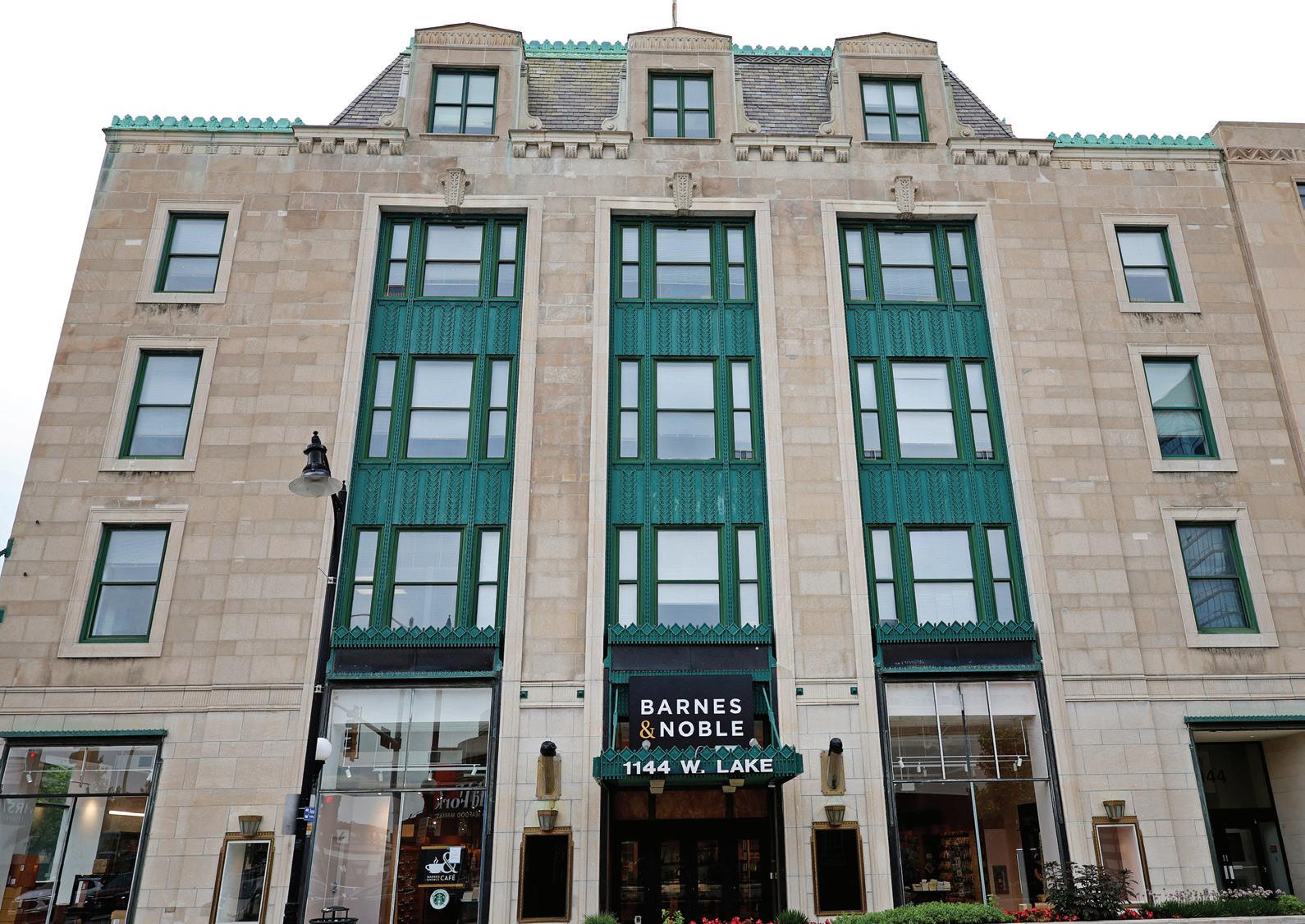
e new Barnes & Noble sign is up on the historic building as the company readies for the grand opening in Oak Park
By BOB SKOLNIK Contributing Reporter
Reacting to a frustrated school board, pointed criticism from a member of the Oak Park and River Forest High School Community Finance Committee and mounting anger from equity advocates, OPRF Supt. Greg Johnson has switched course and will bring a recommendation to the school board by mid-July to hire additional tutors or academic support staf f at OPRF for the upcoming school year.
The school board will vote on the recommendation at a newly scheduled July 16 special meeting. The school board was not originally scheduled to meet in July
The Marshall Field’s department store building is no stranger to selling books as it was once home to Borders. It will not be the only bookstore on Lake Street as the locally owned Book Loft is just a block to the east.
Janine Flanigan, Barnes & Noble vice president of store design, said store managers at the chain are encouraged to connect with the community to make the store more specific to the area. Having
two booksellers on the same street just offers more to give different customer experiences, she said.
Johnson made the announcement at the beginning of last week’s June 25 school board meeting. At the May 28 school board meeting Assistant Superintendent for Student Learning Jen Hester made a presentation that did not include increased tutoring and a new instructional coaching program until the 2027-28 school year. That timeline did
TUTORING on pa ge 14








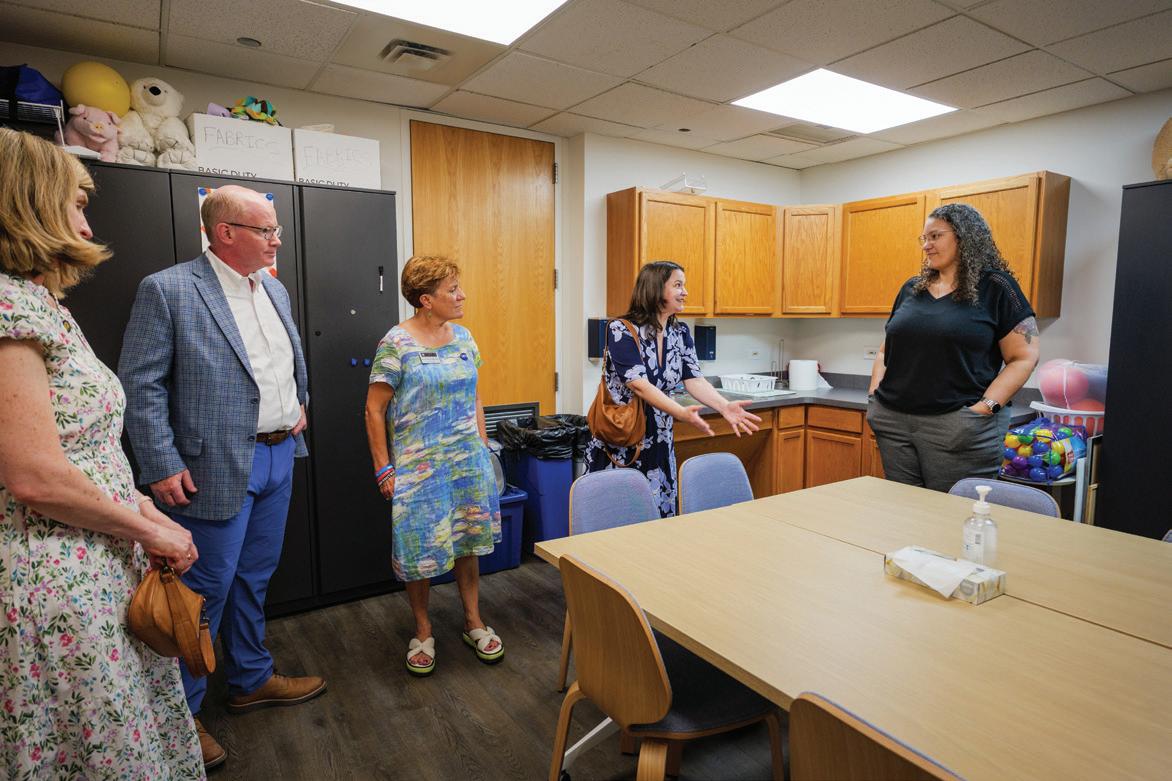
By JONAH CLARK Contributing Reporter
As America approaches its 250th anniversary in a time of political turmoil and deep division, the Oak Park and River Forest community will be hosting July 4 celebrations centered around unity within the community.
Community events in the works include the annual Oak Park July 4 parade, with Grand Marshal Emery Lehman. Lehman is an Oak Park native who re presented the United States in speed skating at four Olympic games. Lehman won a silver medal for men’s team pursuit at the 2026 Olympic games in Milan.
The parade will start at 10 a.m. on July 4 at Longfellow Park at Ridgeland Avenue and Adams Street. Paraders will walk toward Whittier School along on Ridgeland.
T he event will include perfor mances from Kaotic Drumline, Jesse White Tumblers, Medinah Shriners Mini Chop pers, South Shore Drill Team and New Generation Fancy Drill Team. Many other local businesses and organizations will also be walking in the pa rade
“It’s a great tradition,” said Dan Yopchick, Oak Park’s chief communications officer. “It’s a great way to bring community members throughout the village to celebrate the village, to celebrate the United States ... and being with each other.”
The reading starts at 5 p.m, but 4:30 p.m arrival is recommended. Some 18 community members will take turns reading the document. Scheduled readers include incoming District 97 Supt. Terri Bresnahan.
The Oak Park and River Forest Historical Society is partnering with the League of Women Voters and the Collaboration for Early Childhood Education to host this event.
The reading is part of a larger simultaneous reading of the Declaration of Independence across the nation. Groups in every state and territory will be reading the
pecially during construction on Oak Park Avenue.
“It’s something to bring the community together,” said Cheri Bentrup, the society’s community outreach coordinator.
The reading will also feature somebody playing Uncle Sam, the famous figure often used as a personification of the United States, and an enlarged declaration, which readers can choose to sign onto if they stand by the values listed in the declaration.
Frank Lipo, executive director of the historical society, views this event as a call for unity in a time of political division, as well as a call for a totalistic view of history and a reinstatement of the American ideals that unite us all.

“People in Illinois in Alabama and in California and Texas are deciding to look back the founding document and say ‘wow, that means a lot to me,’” said Lipo.
Lipo also highlighted the not many Americans have recently read the Declaration of Independence from front to back.
“Let’s hear the actual words were ag reed to on July 4, 1776,” said Lipo. “There will be some things that sound very relevant, and some things that feel very ancient.”
Lipo talked about the relevance of the declaration, both for the role it has played in our country’s past and the role it can play in its future.
Oak Park and River Forest are not hosting July 4 fireworks displays this year.
A “red, white and blues” themed Thursday Night Out event is also taking place along Marion Street in Downtown Oak Park on July 2.
The Oak Park and River Forest Historical Society is participating in the festivities by hosting a reading of the Declaration of Independence on July 8 in Scoville Park
Declaration of Independence at the same time throughout the nation.
While the Declaration of Independence was famously signed on July 4, 1776, this year’s reading event will take place on July 8, since July 8, 1776 was the first day the American public around the country read the Declaration.
The Historical Society encourages people to stay in the area for dinner after the event to help promote local business es-
“It’s not like the issues in the declaration are some ancient thing,” said Lipo. “It is the responsibilities and rights of the citizens.”
The Oak Park and River Forest Historical Society is a non-profit organization, founded in 1968, that manages the Oak Park River Forest Museum, and Jeanette S. and Ellis K. Fields Research Center and archives
Lipo posed a question he hoped to be central to the event: “How can we make the country better moving ahead?”
By JESSICA MORDACQ Staff Reporter
On May 31, an Oak Park police officer fatally shot 38-year-old Chicago resident Christian Wallace during a traffic stop near Austin Boulevard and Harrison Street.
Nearly a month later on June 30, the Village of Oak Park released footage from police body cameras, gas station security cameras and a dashboard camera. Footage shows how Wallace was shot four times by the police officer after a struggle ensued when police discovered during a protective pat down that Wallace was carrying a concealed firearm.
The footage also reveals that Wallace was stopped by the officer for failing to signal a lane change while driving on Austin Blvd.
“We reco gnize this video may be difficult to watch, and our thoughts remain with everyone affected by this incident,” Oak Park Police Chief Shatonya Johnson said in a statement released at the same time as the footage. “As the independent
investigation continues, we ask the community to remember that the video is one piece of evidence and that all facts must be carefully reviewed before conclusions are reached.”
The Illinois State Police Public Integrity Task Force is investigating the incident, the first fatal shooting by an Oak Park police officer in nearly 40 years. Though the timeline of the investigation is unknown, once it’s completed, it will be submitted to the Cook County State’s Attorney’s Office, which will conduct its own review and decide whether to file charges against the police officer.
The still-unnamed officer remains on medical leave from the Oak Park Police Department for an injury sustained during the incident.
“Until now, the video was withheld so that the Public Integrity Task Force could maintain the integrity of its investigation,” Oak Park President Vicki Scaman said in a statement. “Today, we can take an important step toward transparency owed to those family and friends, and to the entire community, with the release of the footage.”
This is a de veloping story.


is ‘criminal illegal alien’
Visa from 2005 was false but acquired in a di erent Albania, uncle says
By GREGG VOSS Contributing Reporter
As far as Frank Shemitraku is concerned, his ne phew is an honest person and not a criminal.
U.S. Immigration and Customs Enforcement (ICE) confirmed Friday that Oak Park barber Besnik “Nik” Shembitrasi, Shemitraku’s ne phew, was apprehended May 17 and claimed that he entered the country illegally from Albania in 2005.
Shemitraku said Tuesday it’s important to remember what Albania was li ke in the early 2000s, after the fall of Communism.
“They promise, ‘I get visa for you,’” Shemitraku said. “There were a lot of guys like that. But the visa was false. It wasn’t his fault. He paid the money to come to the U.S.”
According to a statement from ICE public af fairs:
the United States.”
ICE previously confirmed that Shembitrasi is currently in immigration hold in Brazil, Indiana, in Clay County, just east of Terre Haute and about 150 miles southwest of Indianapolis. After he was apprehended by ICE, he was transported to its Broadview facility before being moved to Indiana.
Wednesday Journal requests for an interview or statement from Shembitrasi’s attorneys at Chicago-based Davidson & Se seri were declined .
“He worked hard and paid the money. He wa s vic timized by criminals.”
FRANK SHEMITRAKU
“On May 17, 2026, ICE arrested Besnik Shemitrasi (sic), a criminal illegal alien from Albania, in Chicago. His criminal history includes fraud. This criminal illegally entered the U.S. on March 16, 2005, in Miami, using a fraudulent Italian passport.
“Shemitrasi (sic) was issued a final order of removal by an immigration judge on May 5, 2008, but failed to depart the country, in violation of our laws. This criminal illegal alien will remain in ICE custody, pending his removal from the U.S.”
The statement added that under President Donald Trump and U.S. Secretary of Homeland Security Markwayne Mullin, “criminal illegal aliens are not welcome in

But Shemitraku said that his ne phew “was victimized,” though not by orga nized crime elements. It was instead people who saw an opportunity to make money, perhaps as much as $20,000 in U.S. dollars to acquire a fake passport.
“It was separate people to do this kind of work,” he said, confirming that Shembitrasi did stop in Miami when he first came to the country. “He worked hard and paid the money. He was victimized by criminals.”
About seven years ago, Shemitraku purchased his Oak Park barber shop at 416 S. Oak Park Ave., which complements his 100-year-old location in Elmwood Park. Shembitrasi started working for him shortly afterward, following acquiring his licensure in cosmetology
Since then, he said, Shembitrasi has put for th ef fort in the U.S., often working two jobs. He got married, and he and his wife –a U.S. citizen – had a daughter who is now eight years old. They purchased a home in Elmwood Park about a year ago.
“I say you can’t call this guy (a) criminal,” Shemitraku said. “You go someplace in trust … ‘I want to go to United States.’
Someone says, ‘Don’t worry.’
“You’ re talking about 20 years ago. There was government, but they couldn’t control this kind of people. Today it’s different.”
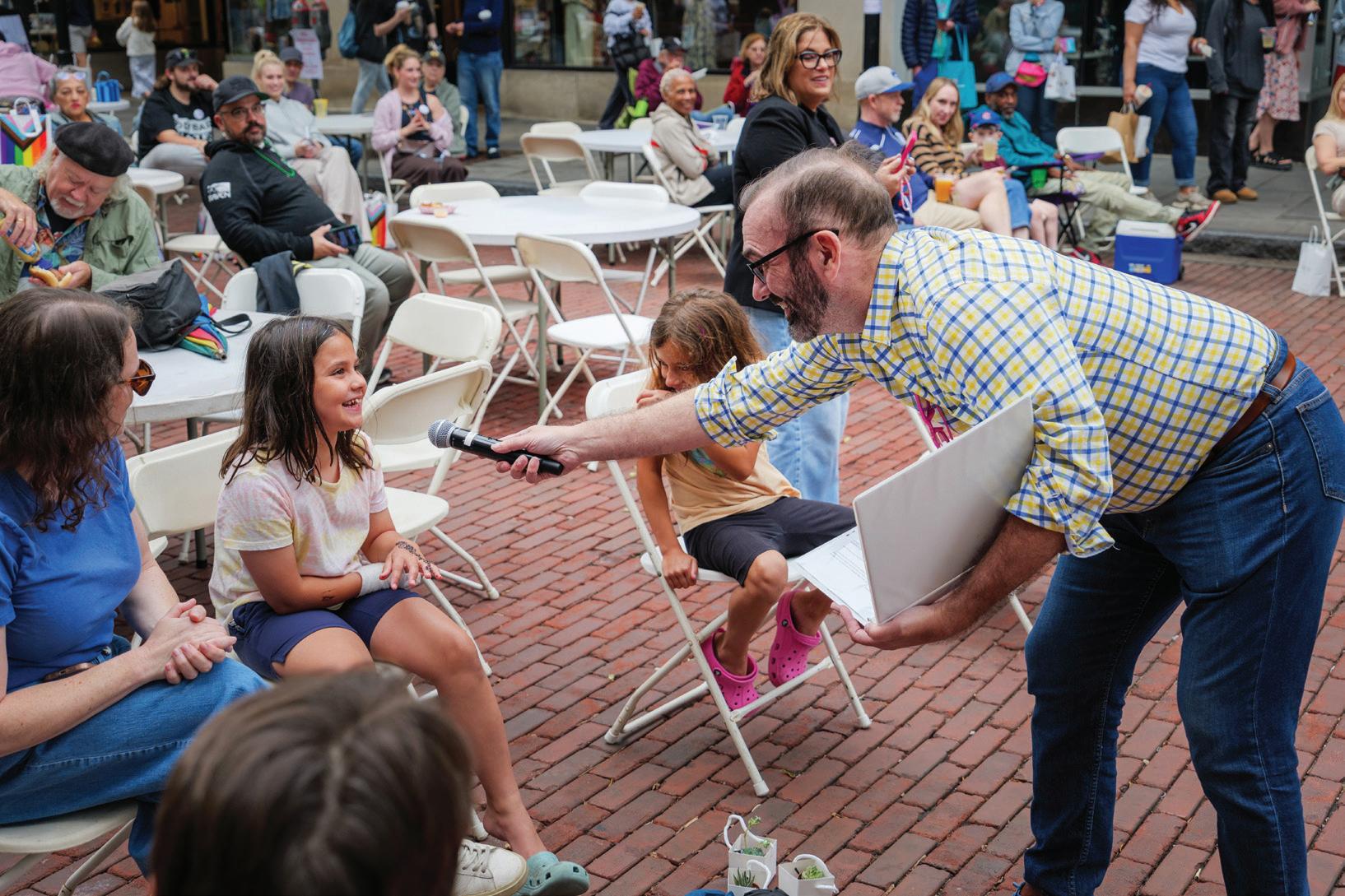
By IGOR STUDENKOV and LACEY SIKORA Contributing Reporters
Austin Coming Together led a coalition of nonprofits to purchase the dilapidated J. Walser House, a Frank Lloyd Wright-designed home at 42 N. Central Ave., hoping to revitalize the structure after years of severe deterioration and legal uncertainty.
ACT announced the purchase on June 24. Darnell Shields, executive director of ACT, told Austin Weekly that the immediate goal is to stabilize the severe structural problems facing the building. Shields said those fixes are expected to cost $575,000. The goal is to raise that money in time for the home to be buttoned up before another “fierce winter.”
The timeline for completing all those foundational issues is 8 to 14 months if “all the resources are there,” he said. Fundraising is currently underway.
Completely refurbishing the Wright home will take from two to four years, said Shields. “It’s expensive and time-consuming, but we’re up for it,” he said. “We’ve seen it happen and know it can happen.”
Over the last few years, ACT has been working with the Frank Lloyd Wright Building Conservancy to clear the legal hurdles to the acquisition and raise money to restore it.
Wright designed the house in 1903 for printing company executive Jospeh Jacob Walser and his wife, Grace Walser. At the time, Austin was predominantly white, and the area around Central Avenue was one of the more prestigious parts of the neighborhood.
John Waters, the conservancy’s preservation programs director, previously told Austin Weekly News that the house was notable in the context of Wright’s other designs because it’s a smaller version of a more typical Wright Prairie school design. The co-axial design allowed for flow of light and air.
Shields said ACT’s goal is for the home to be put to a public use. He said the full cost of salvaging and then restoring the home will reach $2 million to $3 million. In a neighborhood where fully rehabbed homes now sell for $300,000 to $400,000, Shields said, it is not likely the house will again be a singlefamily home
A planning process involving the Austin community will commence, he said, and be modeled on the effort to convert the long vacant Emmet School on Central into the Aspire Center
“The community is best positioned to say what this development could become,” he said. “We see this as a site for enrichment and education, for all of the things that community members value, young and old. This community is on a trajectory of community-led change. Like the Aspire Center, like 40 Acres. Things are being developed by us, for us. This is something similar,” said Shields.
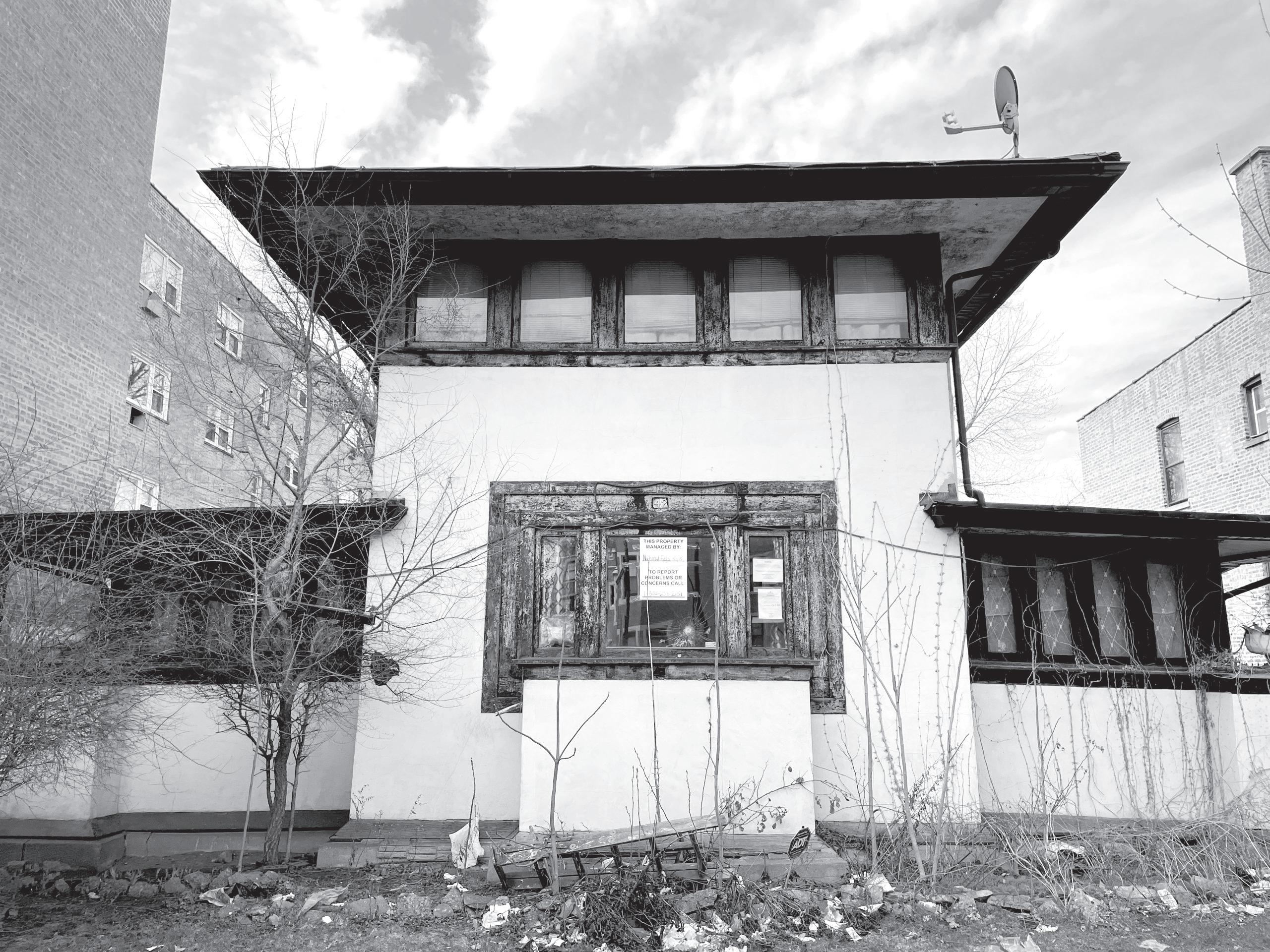
The house has gone through several owners. In 1970, it was purchased by Anne and Hurly Teague, who worked to shore up the building and did their best to restore its historical features. With their support, the Walser House was named a Chicago Landmark in 1984. In 2013, the home was added to the National Register of Historic Places
But after by then widowed Anne Teague died in 2019, the house became vacant, and Fannie Mae ended up taking possession of the property
ACT has been pushing to revitalize the Central Avenue corridor, describing it as a connector to various parts of the Austin community. The November 2024 ACT Central Avenue Action Plan named the Walser House as one of corridor’s “major cultural and natural assets.”
Shields described the array of local, state and federal entities which have helped ACT gain control of the home. He cited the conservancy, Landmarks Illinois, Preservation Chicago, the City of Chicago, local elected officials, community residents, and the Teague family
Fannie Mae and CIC are partners as well, said Shields. “They helped us figure out how to get a residential property that was in foreclosure. They will continue to be partners.
They want to see the building put back into use.”
In a statement to the media, Conservancy Executive Director Barbara Gordon described ACT as a good steward for the property
“ACT understands the potential waiting to be unlocked by revitalizing this landmark Frank Lloyd Wright design, celebrating Austin as a destination for notable architecture,” she said. “The organization’s deep roots in the community mean they know the rich stories the house can tell about how it has changed over time, and what Austin residents envision for its future.”
“The J.J. Walser House is part of Austin’s story, and we believe its next chapter should be shaped by the people who call this community home,” he said. “ACT stepped in because this house is critically important, not only as a Frank Lloyd Wright design, but as a piece of Austin’s history. Our first responsibility is to stabilize this treasured landmark and protect it from further deterioration. From there, we will work with residents and partners to envision a future that honors both the house and the community.”
To find out more, and sign up for updates, visit https://austincomingtogether.org/walser/
By ELIZABETH SHORT Contributing Reporter
For decades, a ginkgo tree stood inside Frank Lloyd Wright’s Home and Studio on Forest Avenue. The architect built his home and studio around the tree, using nature as his guide
Chicago-based musician Neal O’Hara gave tours of the home as a teenager growing up in Oak Park. Decades later, O’Hara, stage name Neal Francis, is headlining the American Music Festival at FitzGerald’s on July 5, the fourth and final day of the nightclub’s 43rd annual event.
Giving tours of the home and studio, O’Hara learned to identify Wright’s influences within his architectural style In the ginkgo tree, he could see the influences of Japanese architecture and the shapes and patterns of nature.
As a young Oak Parker, O’Hara also fell in love with music. When he was four, his parents enrolled him in piano lessons at the Language and Music School on Oak Park Avenue When he was in middle school he took lessons from jazz and blues musicians
Attending OPRF, O’Hara grew his hair to his shoulders and wore his dad’s vintage band T-shirts from his time working for Jam Productions during the 1970s. With friends from his neighborhood, O’Hara for med the Whitewater Stills, a classic rock band. O’Hara played the piano and sang in his friend’s basement, covering classic rock songs from The Loop, WLS-FM, and his dad’s record collection, alongside original songs reminiscent of ZZ Top, Led Zeppelin and Electric Light Orchestra.
O’Hara was also in the Reverend Funk Connection, where O’Hara played with James Krivchenia, now drummer for Big Thief. With the jazz ensemble, O’Hara also had the chance to
play at FitzGerald’s multiple times. Coming back to headline at FitzGerald’s after playing there as a teenager, O’Hara feels “this embrace from the community,” he said. “FitzGerald’s was always such a place that had a re putation for taking care of musicians.”
When he was a teenage r, O’Hara wanted to be a pr ofessional musician, but his father encouraged him to explore architecture instead. He had been in the rock business during the 1970s, and he had seen people struggle to sustain a career in the industry and ruin their careers with drugs and alcohol. So the fall after graduating from OPRF, O’Hara enrolled at the University of Illinois at Chicago to study architecture. After enjoying his freshman year, O’Hara lost his academi drive, left school, and struggled with substance abuse.
He played with big-name blues and R&B musicians, includ ing Mud Morganfield and Omar Coleman. O’Hara was almost fired from some of these jobs, and he said the experience of playing alongside experienced musicians “professionalized” him. He even traveled to Switzerland to play at a music festival in Lucerne. “I got to learn the style at a molecular leve – really pick apart what the piano player was doing on those old Muddy Waters recordings” he said.

At 27, O’Hara got sober, which fueled his creativity and gave him the chance to reconsider what he wanted to do with his life. While renting a place on Maple Avenue in Oak Park and working at a UPS store in Lincoln Park, he recorded what would become Neal Francis’s first album, Changes, released in 2019 and inspired by rock, funk, and soul from the early 1970s.
Since then, O’Hara has seen success as a solo musician. He has played at Lollapalooza, Bonnaroo and Red Rocks. His music has brought him to places like Japan and the Netherlands, where the Amsterdam streetscapes, designed for people first, reminded him of Forest Avenue in Oak Park
O’Hara’s music has “blossomed” since Changes, said Brendan O’Connell, O’Hara’s manager. “I think he’s really continued to evolve and chase whatever sounds he’s hearing in his head,” said O’Connell.
Side by side mausoleum crypts available in the Sanctuary of Remembrance. Paid $7000 $2000 each or $3500 for both
O’Hara is currently working on several new albums in his Chicago studio. Over the last few years, he said he has focused on his personal journey of creation and expression. “This should be about awakening. This should be about movement and community. This is about expressing emotion and freedom to be a human being and to express yourself artistically,” he said.
Recently on this journey, O’Hara said his band has taught him to “let go of perfection” and to move away from imitation, allowing him to grow even more into his own style. “I’ve done a lot of imitating over the years,” he said. “That’s a good way to learn, but I think being true to what I’m able to do, test my limits, obliterate my limitations in ter ms of what I think I’m capable of, and just be free in my creation, and make more, and not be precious – that is my path to salvation.”
Lights are on but no one is home, Pete’s pays village for
By SYDNEY LOVAN Reporting Intern
Despite hanging its new sign last week, there is no official opening date set for Pete’s Fresh Market’s second Oak Park location village gover nment wrote in an email June 29.
The grocery store has still not received a Certificate of Occupancy from the village even though it was supposed to have one by Feb. 15. Pete’s has paid $137,280 in fines or lost opportunity costs to the village for failing to meet the project schedule. These fines are
meant to reimburse the tax revenue, alcoholic enue and lost increases in property taxes
Until a Certificate of issued, Pete’s will ha $45,760 monthly or a po sis village officials stated pre
The grocery story recently tricity and dry goods ha however, tests on refrigeration completed and additional site
The continued delay in opening Project Manager Eugene Grzynk the village board last J open months ago.
The new sign hung abov lows the sign code variance approved by the Oak Park Zoning Board of Appeals on May 6.

The store is located on the lot at 640-728 Madison St.

e
e
from page 1
“I think we complement each other,” said Flanigan. “We think that there is always room for more bookstores. The more bookstores you have, the more people you have reading, the more people that are gathering and sharing ideas.”
Oak Park locals Heather Nelson and Sophie Schauer Eldred opened The Book Loft about nine months ago and witnessed the community’s interest and demand for reading first-hand. They offer a cozy atmosphere to be a home away from home with personal touches such as their own dining room tables now used as centerpieces in the store.
Although their business has been a success in the first year, Schauer Eldred expressed some concerns about what is to come with a big corporation moving in down the street.
“We know it’s going to impact business,”
said Schauer Eldred. “They have a lot of money to do what they do best, which is sell in volume, and we don’t have that.”
She hopes that people will be drawn to Oak Park by the Barnes & Noble name but will decide to stay for small-business comfort and community. Nelson and Schauer Eldred make an ef fort to connect with the people of Oak Park and tailor the store to their needs with special events and even having a specific display with the books on local school summer reading lists.
“We have personality, we have hospitality, we have books and we are community driven,” said Schauer Eldred. “We are hoping that people go visit that new store but then come back here to appreciate the atmosphere and two local businesswomen creating a beautiful environment.”
Author Mia P. Manansala will be performing the ribbon cutting ceremony to kick-of f the event with an additional special guest, The Cat in the Hat. There will be exclusive deals for anyone attending such as discounts on NOOK devices and movies according to a Barnes & Noble press release.
Co lin F ane, A gent
212 S Marion Street Fl G
Oak Park, IL 60302
Bus: 708-383-3163 www.colinfane.com
Monday & Friday 9am-5pm
Tue s/Wed/Thurs 9am-7pm Saturday 9am-12pm

Like a good neighbor, State Farm is there.®
Colin Fane, Agent
212 S Marion Street Fl G
Oak Park, IL 60302
Bus: 708-383-3163
www.colinfane.com
Monday & Friday 9am-5pm
Ow ners Nelida and Roberto Quinones in front of Q6 Banquet Hall on Roosevelt Road in Oak Park on June 28.
Colin
Fane, Agent
212 S Marion Street Fl G Oak Park, IL 60302
Bus: 708-383-3163
www.colinfane.com
Like a good neighbor, State Farm is there.® Co
By GREGG VOSS Contributing Reporter
Breathing new life into an old building is a lot of work, but more manageable if it’s attached to a dream.
That’s why Oak Park residents Roberto and Nelida Quinones are looking forward to the rest of this summer and the fall as they renovate the building at 6136 Roosevelt Rd. to launch a new banquet hall venture called Q6 Events that will host private events like graduations, corporate parties and even quinceaneras. Activities like yo ga and arts classes may also be in the offing.
The business – which is known as Q6 because the Quinones’ are a family of six
– will feature a warming kitchen and seating for up to 150 people at round tables. Q6 Events will work with caterers for food because there will be no cooking on site. Alcohol will not be sold.
The Quinones’ received special use permit approval from the Oak Park village board in early June to commence the work, which will be managed by ZEB Development LLC, with work to be completed by Fix It Chicago, Inc. They own both firms.
“It’s something we always wanted to do,” Nelida Quinones said. “Sometimes homes aren’t big enough (for parties). It’s emotional for me. I’m excited.”
The building, which the Quinones’ bought two years ago, for merly housed a carburetor shop for cars, lawn mowers and the like, and before that, it was a furniture store.
“It was packed with carburetors,” Roberto Quinones said of what awaited him
Here’s the deal. The right insurance should help you feel confident and comfortable. I’m the right good neighbor for that. Call me today.
Monday & Friday 9am-5pm Tues/Wed/Thurs 9am-7pm Saturday 9am-12pm
Here’s the deal. The right insurance should help you feel confident and comfortable. I’m the right good neighbor for that. Call me today.
Like a good neighbor, State Farm is there.®
With safe driving discounts and options to personalize your policy, I can help you get an auto rate that fits your budget. Call, click, text or stop by for a
The Village of Oak Park is hosting a public information meeting to present potential Home Avenue Bridge replacements. The project is studying potential alternatives to the Home Avenue pedestrian bridge over I-290, the CTA Blue Line, and CSX railroad tracks. This is a federally-funded project, and the Public Information Meeting is being held in compliance with NEPA requirements and IDOTs public involvement policy. The public is invited to review bridge replacement alternatives and provide feedback on walking and biking access, accessibility, ramps, lighting, safety, security, bridge appearance, and the user experience. Project personnel will be present to receive input, provide information, and answer questions.
Wednesday, July 8, 2026 | 6:00 pm – 8:00 pm
The meeting will be held in an open house format. All interested persons are invited to attend and participate. Attendees may arrive at any time. For more information or to submit comments, visit: engageoakpark.com/homeavebridge
Comments can also be mailed to: ATTN: Abby Spentzouris, Village of Oak Park, IL 201 South Blvd. Oak Park, IL 60302 Comments received by July 22, 2026 will become part of the official public meeting record.
By BILL DWYER Contributing Reporter
Brian Straw, an Oak Park village trustee, recalled standing with fellow youth baseball parent and attorney Chris Parente at a ball game a year ago.
At one point, Straw said, he asked Parente for his cell number, “just in case” he ever needed it. He said Parente replied, “I think you’re being a little paranoid.”
“This guy’s never going to get in trouble,” Parente recalled thinking. But last October, after participating in a protest outside the Broadview ICE detention facility during September, Straw found himself in genuine trouble. He thought the phone call from the FBI was a prank or a scam, until they emailed him the indictment.
He was suddenly part of what came to be called the Broadview 6.
Straw and Parente would find themselves front and center in a riveting drama that unfolded over the next seven months. As Chicago, and eventually the nation and the world watched, the prosecution of the so-called Broadview 6 roll out to great fanfare, and then slowly unraveled as the defense took the fight to prosecutors.
On June 25, Straw joined Parente and moderator Charlie Meyerson for a discussion in a packed room at the 19th Century Club. The event was sponsored by Wednesday Journal.
Straw shared both his thoughts and feelings as Meyerson guided him and Parente through a review of events
“I have never felt so under the microscope of the state,” Straw said of that September day in Broadview. “Cameras in every direction, multiple helicopters overhead. We were shot with pepperball rounds, and baton rounds, and they tear gassed us
“I couldn’t stop crying most of that day,” he said. His fear and dismay only deepened when he later read a gover nment press release describing “200 violent rioters” at the Broadview protest.
“We’re in a moment where we can’t trust the federal gover nment,” Straw said. “That’s a scary moment for us to be in.”
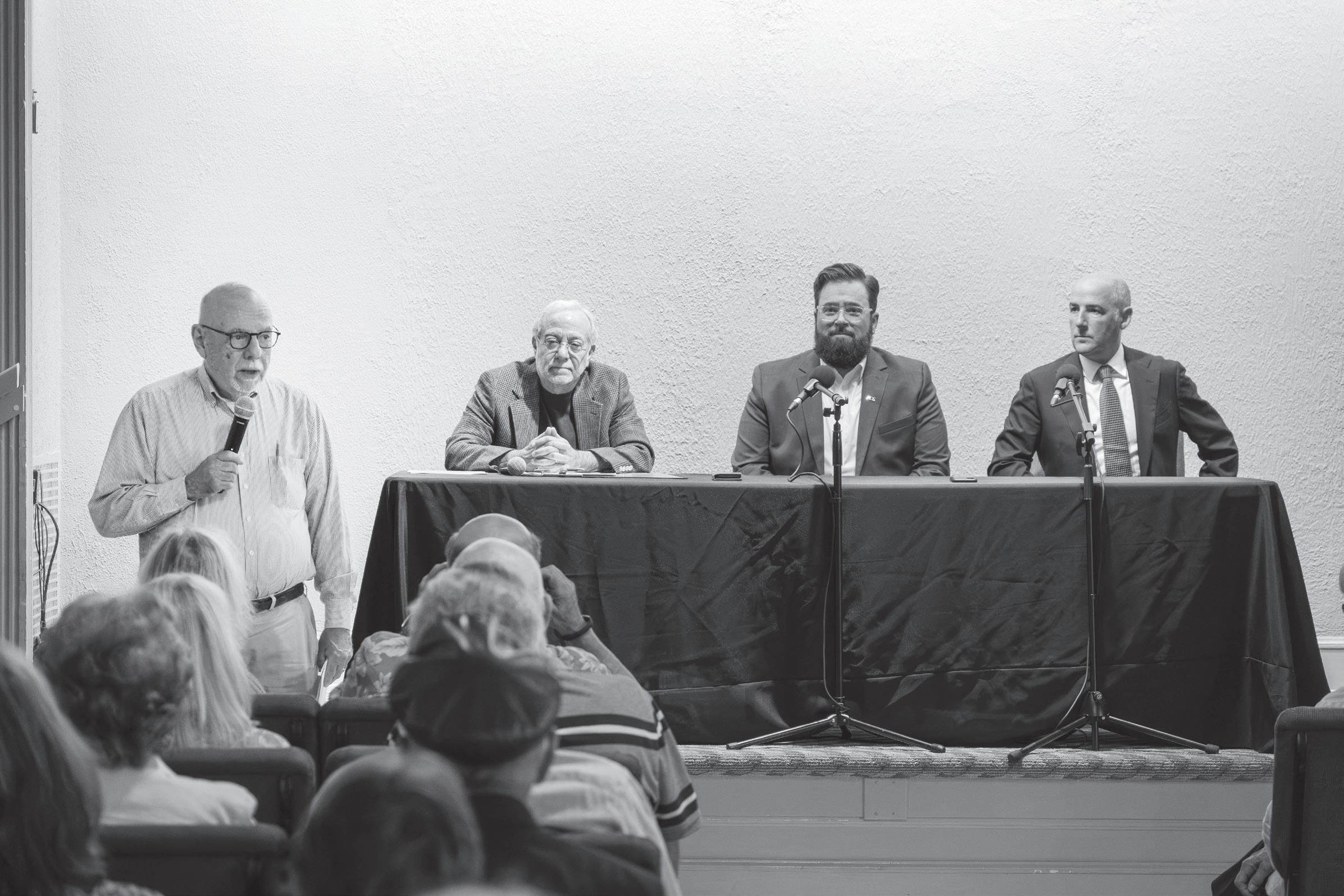
Newswell Chicago Interim Editor Dan Haley introduces panel at Life A er the Broadv iew 6 event on June 25.
Straw, an attorney, stressed the indictment of the Broadview 6 was an assault on not just 1st Amendment rights of free speech, but the 5th Amendment right to assemble peacefully and protest the gover nment.
“We’re painted as being not truly patriotic if (we’re) on the (political) left,” Straw said, making the argument that defending the Constitution is patriotic.
Straw said the fear he experienced is the point of it all. The federal gover nment is using criminal indictments as a warning to others not to show up at civil protests. It is, he suggested, about “the other,” that is, other groups that threaten the peace.
But Straw is not among any group that can be characterized as “the other,” who are demonized by the American right wing. Not brown or black or poor or criminal or an
immigrant or any other type. None of the Broadview Six are the sort of marginalized individuals some seek to vilify and blame fo r society’s problems
Straw is reflective — in appearance, at least — of the once upon a time political and legal power structure: white, male, married with children, a church goer, a local elected official.
“I’m a white lawyer from Oak Park,” Straw said. “It’s about those people who can’t make the argument I can make.” He made it clear that his commitment to serving others does not end at Oak Park’s border or exclude others who are superficially different from him.
“I think it’s an extension of my responsibilities,” Straw said. “I don’t just serve homeowners, I serve everyone, who lives in Oak Park and who passes through Oak Park
They are constituents too.”
“They truly picked the wrong person when they picked Brian,” Parente said. “He’s got a hat that literally says, ‘Do Good.’ That is not somebody out there to injure an ICE agent.”
“It’s been about revealing how flawed the process was,” Parente said. “That 5th Amendment right we’ve taken for granted has been repeatedly violated for the last year in Norther n Illinois.”
“We don’t spend a lot of time talking about the right of assembly,” Straw said. “This conspiracy charge was a violation of our right of assembly.”
In late spring the Department of Justice’s case unravelled and all charges were finally dropped.
“How did it feel to have the charges dropped,” Meyerson asked Straw.
“It was a relief,” he acknowledged. “But it never felt like the end of the line.”
While there was never any question that he would fight the charges at trial and win, he found himself at a crossroads once the charges were dropped.
“We got the charges dismissed, and we could have said ‘We won’ (and walked away),” Straw said. Instead, he said, “I had a glass of champagne, and then I said, ‘We have to go after them.’”
The tables began turning on May 18, when Judge April Perry finally granted defense requests that she review the grand jury transcripts.
“Chris did a fantastic job of being such a nuisance that the judge finally said, ‘Fine, I’ll do it,’” said Straw.
Perry surmised at the time that the redactions were likely due to IT issues. They weren’t, and there weren’t just 30 pages with redactions, as prosecutors claimed.
“It was 215 pages,” Straw said. It also was clear why prosecutors had redacted so extensively; the misconduct was extensive Grand jurors who questioned the feds’ case were excused from the jury, and prosecutors improperly “vouched” — that is, put their personal credibility behind the indictment, rather than the evidence. And on at least two occasions, a prosecutor spoke with grand jurors outside of the jury room.
“That was the crack in the said. “Getting the judge to look the transcripts.”
“How did you know?” Meyerson asked of Parente’s initial about improper conduct with the grand jury. Parente said he initially suspected an honest mistak was involved.
“In the 160-year history of (Northern Illinois) district, never used this law,” he said. “I there was going to be a mistake in how they explained the la
“Then there’s the way they turned over redacted transcript he said. “You never redact ing to the judge.”
Straw said prosecutor Hogan kept the option of the conspiracy charge “in his pocket.” When it appeared would review the unredacted transcripts, Hogan moved to drop the felony conspiracy charge.
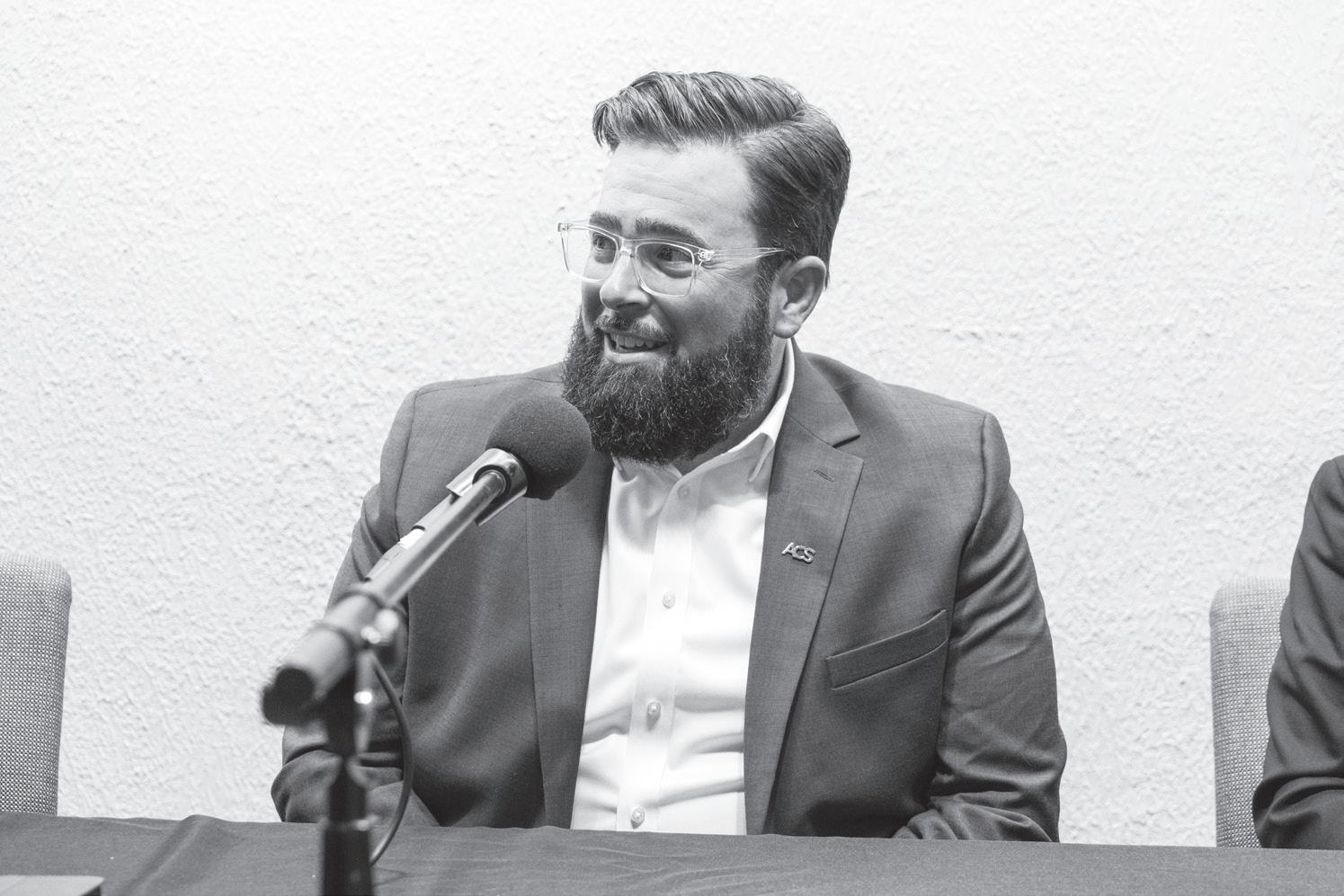
Broadv iew 6 member and Oak Park Village Trustee Brian Straw speaks at Life A er the Broadv iew 6 event.
Straw said. “(So) you won’t blow a whistle when ICE agents are on your block.”
At one point the protest group Antifa, which is a label and not an actual organization, came up in the discussion. Antifa, which simply means “anti-fascist,” has been demonized on the right as violent and seditious, and targeted for criminal prosecution.
“I’m Antifa!” a woman in the audience at
never say no.”
He expressed sadness and concern at the manner in which some law enforcement and prosecutors are conducting themselves. He said he wants his children to suppo rt law enforcement but not blindly.
“I want them to grow up respecting law enforcement but also questioning law enforcement,” Parente said. “The FBI, the DEA (and others) — those people do good work.” said it hasn’t been easy eople who he considincluding both US for Northern Illinois Boutros and ASUA Sheri
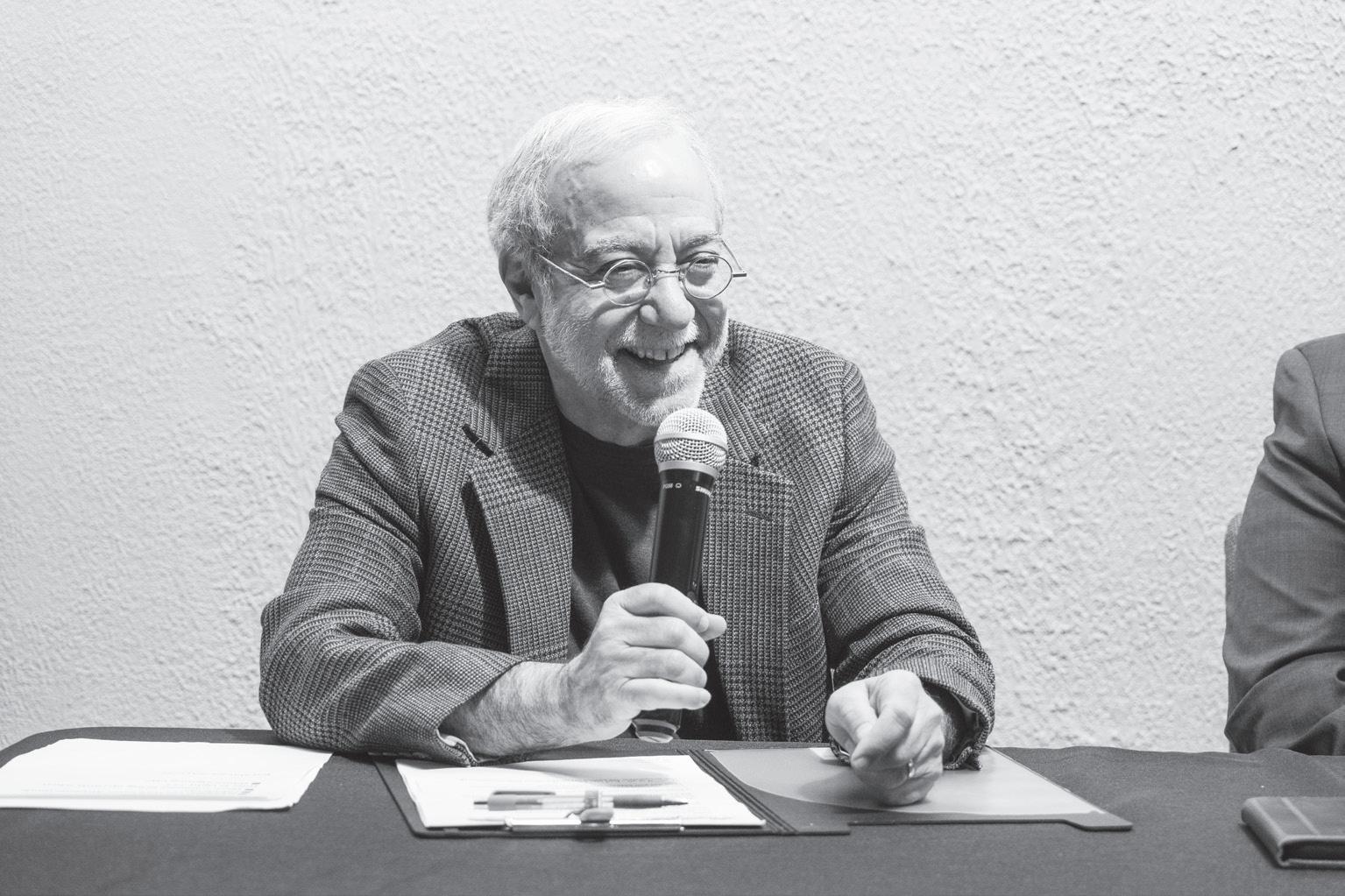
“That’s when we knew there had to be something really bad in those transcripts,” Straw said. “The reason we kept going was the cover-up.”
“This administration is trying to scare you, so you won’t go to a Broadview protest,”
Parente, who spent 14 years as a federal prosecutor, said that in his handling of more than 100 indictments, “I never had a ‘No true bill.’ That is incredible. (Grand juries) almost
transcripts,” Straw said. “We almost didn’t get those grand jury transcripts. They almost got away with it, they really did. We were ready to go to trial.”
Parente said grand jury refor ms “are definitely something that can be taken out of this.”
“We definitely need something,” he said. “For the deterrent value, knowing that someone is going to be looking at this.”
Straw acknowledged several people in the room who he said he saw in court, silently supporting him. “This community stood beside me and stood behind me. It wasn’t just to get myself off, but to fight for bigger issues.”
Straw also thanked the many people who donated to his legal defense fund, including Oak Park’s State Senator Don Harmon. He said he intends to return larger donations to the donors and give the rest to “non-profit organizations working for rights issues.”
Asked who he thought should portray him “in the movie,” Straw focused the attention on others.
“If this were to be made into a movie, one of the group of heroes was a grand jury that was trying to fight against a ridiculous case brought by the prosecution,” he said. He suggested a remake of the classic film “12 Angry Men.”
“These were men and women from across the Chicago area that took their job seriously,” Straw said. “It takes some real courage to tell an AUSA that you believe their case is a crock of shit.”
But no law or legal system can protect people who cannot or will not stand up for their rights
“It makes me so sad to see what (Boutros) has done to the office,” said. “These people are not doing the job the way it should hey’re just charging
ou get that close to I think you do things the Boutros I know wouldn’t
and others have filed a motion asking Judge Perry to ppoint a special prosecutor to inte the alleged misconduct by Boutros, Mecklenburg, Hogan and others. A ruling on the motion isn’t expected until late July or August.
Both men agreed there should be changes to the system allowing stronger judicial oversight of grand jury proceedings
“I do think that a judge, as a matter of course, should have access to grand jury
“Courage isn’t a lack of fear, courage is standing up despite the fear,” Straw said. “What we’ve shown here is that when people stand fast and fight, they win.”
The Journal’s conversation with Brian Straw and Chris Parente is available in two forms. Moderator Charlie Meyerson has created a podcast for his Chicago Public Square site. Here’s a link: John Roberts filmed the event for the Journal. That link is here:
PODCAST: https://open.spotify.com/ episode/6Gy79aNEe0bx9MNPLqFCOO
VIDEO: https://www.youtube.com/ watch?v=50s9SdHhCz8
‘Really, it’s combatting all this fear and educating people’
By GREGG VOSS Contributing Reporter
would lose their SNAP benefits.
Senior living communities offer a myriad of benefits that enhance the quality of life for older adults. One of the primary advantages is the opportunity for social interaction. Residents can participate in a variety of activities, from arts and crafts to group outings, fostering friendships and reducing feelings of isolation.
Senior living communities also free residents from the burdens of home maintenance and chores. Housekeeping, laundry services, and meal preparation are typically included, giving residents more time to enjoy their hobbies and interests. Moreover, senior living communities often provide various levels of assistance, from independent living to full-time care, allowing residents to age in place comfortably. This flexibility ensures that as needs change, the appropriate level of care is always available.
Visit Cantata.org for more senior living advice or call (708)387-1030. for friendships and reducing feelings of comfortably. This flexibility ensures

The impact offederal cuts to SNAP and changes in the bureaucratic processes to stay in the food security program are starting to hit. Beyond Hunger, the largest food pantry serving the West Side and near west suburbs, is offering one-on-one coaching for those who have fear they will be cut from SNAP.
“There are certainly bors that say they ha benefits, and then there are some clients that don’ t tell us,” sai Lorena Alvare z, Beyond Hunger community eng agement efits coordinator.
“I think that they do us know just because they ma think there isn’ t something they can do,” she said. “Is it it to apply and g et exemptions? Some people have said they ca provide documentation. one who has a physical barrie to working and it’s they choose not to cause they think it’s be approved.”
Helping to overcome the and the newly built to SNAP access is now a Alvare z and her colleague Ida Ayala. T he pair work as benefits coordinators at Beyond Hunger.
Yes, there are opportunities for exemption from the r ule, such as household size, number ofde pendents and income, but a major challenge for many is retaining benefits. Every six months, residents on SNAP must renew their benefits by report ing their working status. Work could
lost their benefits, we help them make a request for an exemption and with the paperwork for the Illinois Department of Human Services.”
T he federal progr am is administered at the state level.
Hull said the state has done an admirable job through its Job Ready Illinois ould-be SNAP benrequirements. Its ove of work and volunteering opportunities, approved education oppor tunities and other resources. requirement for SNAP ly vexing for

Beyond Hunger CEO Jennie Hull speaks at the organization’s groundbreaking in their new North Avenue building in Oak Park on March 19.
T he implications ofnew requirements to qualify for the federal Supplemental Nutritio n Assistance Progr am (SNAP) through the U.S. Department ofAgriculture have been substantial for area residents
Funding for SNAP benefits was cut completely last November for about a w eek in wake ofthe passage ofthe One Big Beautiful Bill Act, which caused panic. But on May 1, the double whammy was when SNAP benefit requirements changed.
As ofthat date, any able-bodied adult without de pendents had to start lo gging 80 hours of work per month, or they
That has placed the Oak Park food pantry in a unique position , said Jennie Hull the organization’s CEO. She said her agency had 183 new households come forward for food in May, up from the usual 100-120.
“Really, it’s combatting all this fear and educating people how they can keep their benefits,” she said, “making sure people don’ t miss oppor tunities and re port ing.”
“The purp ose ofme and Ida is that we are here to reduce that barrier,” said Alvare z. “Someone expresses to us they
ules, it wasn’t enough to be homeless to be exz said. “You need a mental or physical barrier or anof exemption.”
Being homeless in and of i tselfis , she said. Hull said there is the perc eption who rece ive enefits through an ElecTransfer (EBT) simply want a simply not true, ho are affected by ho don’ t want to work,” she said. “Some ofthese people are transiently housed. T hey’d like to be able to work and not go to a food pantry. T hese are people with so many things happening in their lives.”
T he key for residents who have lost SNAP benefits or are fearful they will is to understand where they stand, which is how Beyond Hunger can help.
“If they are local, come to Beyond Hunger and r each out to our benefits services team,” Alvare z said. “We can screen them to see ifthey are eligible for SNAP and if they’ve lost their benefits but are still eligibl e, we can screen them to see if they can g et an exemption, and we can refer them to a place that has work.”

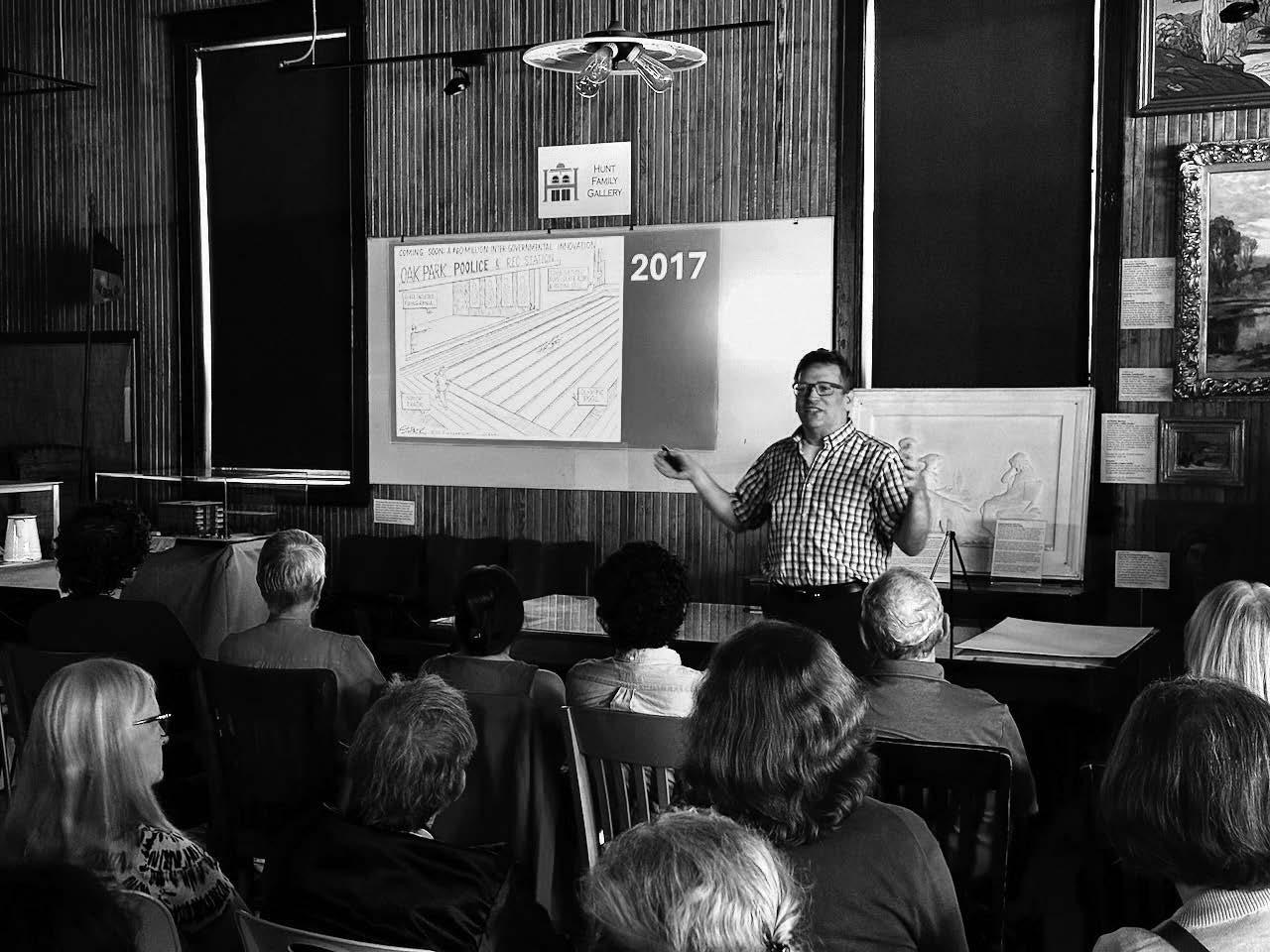
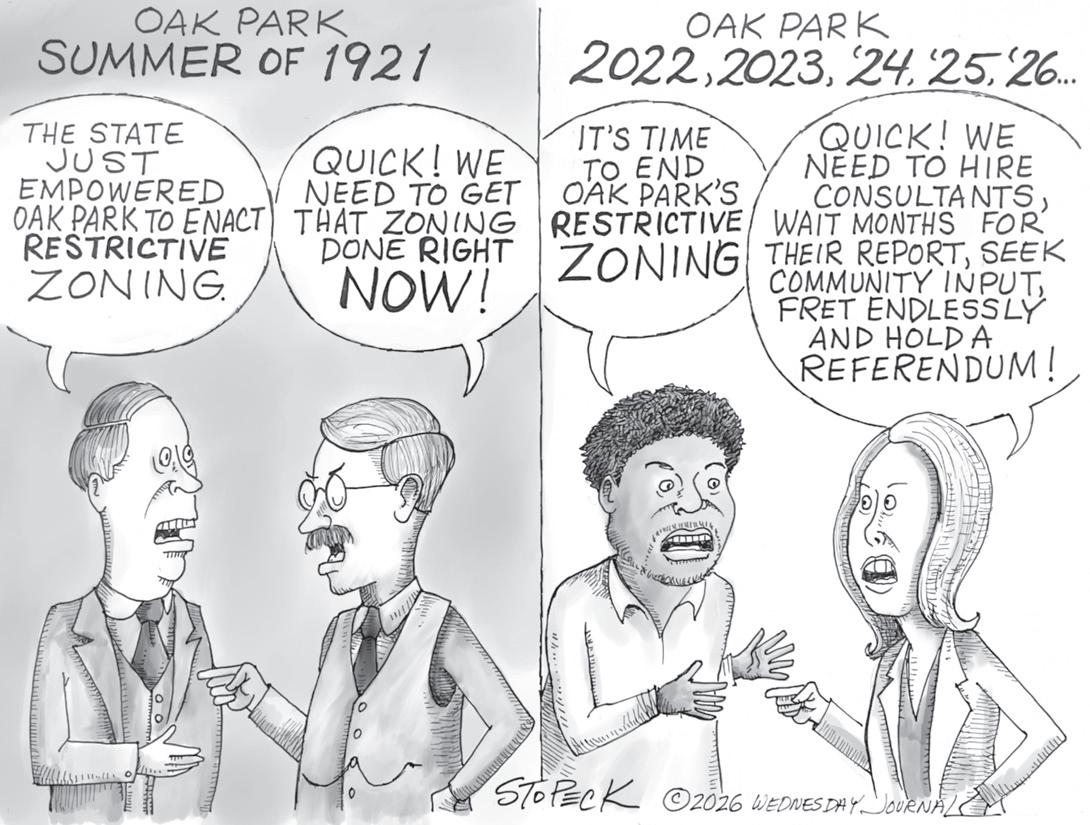
Marc Stopeck speaks about his cartoons and reactions to them at the History Museum of Oak Park River Forest on June 25.
from page 9
and his wife upon building purchase. “By the time we cleaned it out, we probably (removed) almost $20,000 worth of scrap.”
He credited Bob Bernhart, a village urban planner, for helping him and his wife marshal forward the special use permit process, which beg an in March Bernhart said he helped the couple prepare what they needed to present to the village zoning board of appeals.
“They did their homework,” Bernhart said. “One of the things from the staf f review was parking. In response to that, they did their own parking analysis, what spaces were available in the Roosevelt corridor. They came prepared as best they could.”
Added Nelida Quinones: “I had to come every hour, mostly weekends. They were afraid people parking in the street would overwhelm the community. I took pictures every hour and (it) kind of shows we have
at least 50 to 60 parking spaces only on Roosevelt and not the residential areas.”
She said the surrounding community has been supportive, in part because it will bring in business to the area.
“It’s definitely been a rollercoaster of emotions, from commencement of the project until now,” Roberto Quinones said. “I’m really excited about it, but at the same time, I’m keeping my emotions at bay, because what’s coming next needs a lot of finessing, for scheduling and finances.”
That includes addressing a roof that was in disre pair, along with adding fire safety apparatus, like sprinklers and fire alarms
T he Quinones’ also live in Oak Park, just a few blocks away from Q6 Events, so they ave a vested interest in ensuring the business is a success. With a new website coming in July, along with the Insta gram profile @Q6Events, they are planning to star t booking for October.
Bernhart thinks they are on the right path.
“They are still working on their permits,” he said. “I know they are eager to get going.”
























By BOB SKOLNIK Contributing Reporter
Without any further discussion on June 25 the school board at Oak Park and River Forest High School voted 6-1 to approve the scope of what school officials are calling Act 3, the demolition and rebuildin g of the southwest corner of the OPRF building, at a currently estimated cost of $84.6 million. T he schematic design, and the estimated cost was extensi the school the Whole meeting Josh Gertz, a school cast the sole new and expanded music and arts spaces
as well as some new physical educatio n spaces to re place the West Gym. School officials say the current music spaces and classrooms are cramped, outdated and even sometimes dangerous. In a telephone interview the morning after the vote Gertz explained why he voted against the scope of Act 3.
“I don’ t think $85 million is an appropriate amount of money to spend on something like that at this time,” Gertz
and gym as well as other new spaces, is almost finished and will cost approximately $102 million. T he ribbon cutting and official opening of the new Project 2 spaces is scheduled for Aug. 22.
While the school board approved the scope of Act 3 last week the vote to officially accept the schematic design for Act 3 was put of f until a July 16 special meeting which was scheduled to vote on a new proposal to add some tutoring or aca-
not please some school board member nance committee member Michelle Mangan and equity a pushing for and instructional supports sooner rather than later to wide gap in test scores and academic pe for mance between Black and dents at OPRF
In a telephone interview the morning after the June 25 school board Johnson said the details of the proposal he will bring to the school board are still being developed and he could not yet say how many people the administration will be looking to hire.
Johnson said tutoring is a catch all phrase and can look like a different things and take a variety of different shapes.
BOB
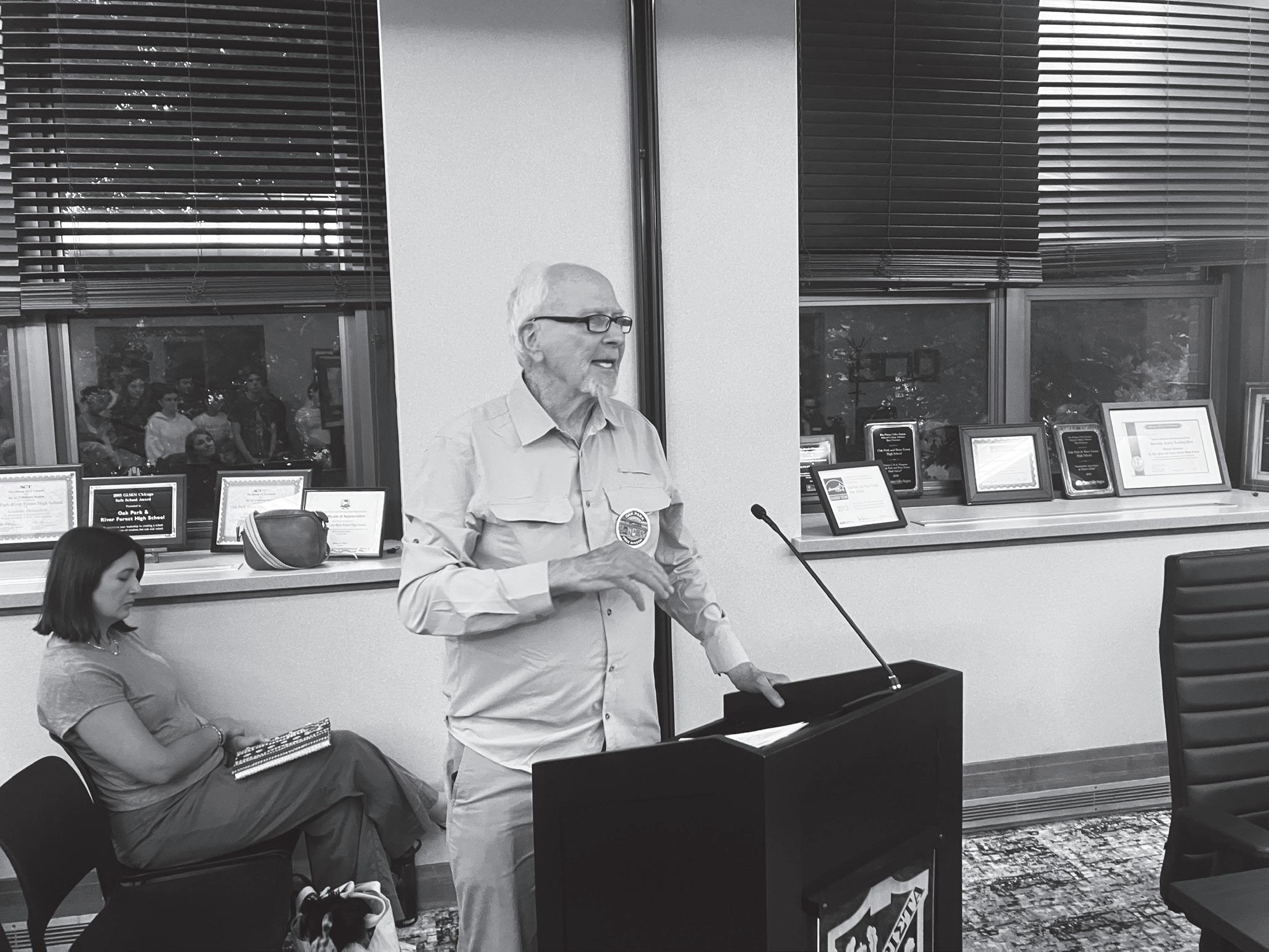
John Du y speaks during a D200 school board meeting.
ccept the sche-
start date for DD (design development) but now that we know we will be having a July meeting we have the time to rework the timeline to see that the DD is fully completed before the board would need to vote for a potential referendum, if you choose to do so, by the December deadline,” Johnson told the school board. School officials are targeting an April 2027 referendum in which the school would ask voters to approve issuing bonds to pay for the Act 3 project. The funding for Project 2 was obtained without a referendum by spending down cash reserves and issuing a kind of debt, debt certificates, which are paid out of the school’s operating budget.
16 e, before
He said what will be proposed in July will likely not be the entire instructional support changes the school implements over the next few years as they try to figure out how to incorporate more tutoring and instructional supports into the school day.
“I do not anticipate what we do in July will be the whole thing,” Johnson said. “We’ re going to have work throughout next year to figure out broader, systemic issues
cannot get a reexamine of how the master schedule functions at the drop of a hat. That’s going to take a little bit more work.”
A number of school board members were frustrated that the May presentation did not include any immediate extra staffing for tutoring or academic support.
“Several board members requested that the administration clarify their plans in this area for the upcoming school year, and
need to see the evidence. Trust but verify, right. It’s an old expression.”
spending at OPRF between equity focused spending and spending on bricks and mortar.
Duffy challenged the school board and Johnson.
“Our greatest investment should always be in student learning. If we can move with urgency on buildings we should move with urgency on closing the achievement gap.”
CHRIS THOMAS Co -chair Alliance for Black Youth
Then Duffy launched into the comments he had intended to make. He called for Johnson and the school board to live up to their rhetoric on equity and criticized the lack of action.
“For four years we’ve brought evidence that students needed things you weren’ t giving them,” Duffy said.
Duffy said there needs to be a balance of
“We know you believe in it; you’ve got to just do it,” Duffy said.
Chris Thomas, the co-chair of the Alliance for Black Youth, also called for putting equity orientated academic support as at least as high a priority, or higher, than physical improvements to the OPRF campus.
“Our greatest investment should always be in student learning,” Thomas said. “If we can move with urgency on buildings we should move with urgency on closing the achievement gap.”
Johnson told Wednesday Journal the decision to change the timeline and hire some additional tutoring and academic support workers this year was not driven by school board members unhappy that Hester’s re port did not include any recommendations for additional tutoring in the 2026-27 school year
“No, this is all driven by what we understand and is right for kids,” Johnson said. “That’s what we’re focused on here. That’s what’s driving us completely.”
By LACEY SIKORA Contributing Reporter
Summer is prime wedding season and across the city and suburbs, couples are taking advantage of the Chicago area’s warmest season for their nuptials. One local family has an unusual way of keeping wedding memories alive: three generations of women have all worn the same wedding dress.
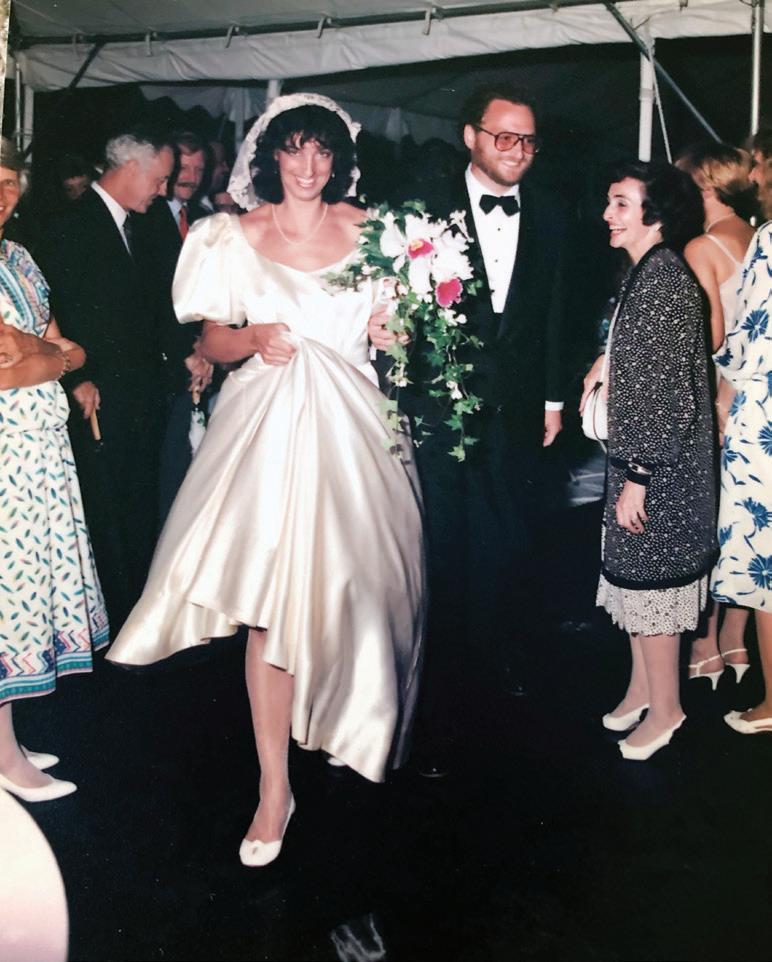
When Irene and Angelo Geocaris married on December 30, 1948, they had been engaged for only seven weeks. The couple and her restaurant-owning parents planned an elaborate wedding for 500 guests in record time.
The couple got married in the Rockefeller Chapel at the University of Chicago. Their daughter Connie Geocaris recalls, “My dad used to sweep the aisles there when he was a full scholarship student, right before the war, and said he wanted to get married there one day.”
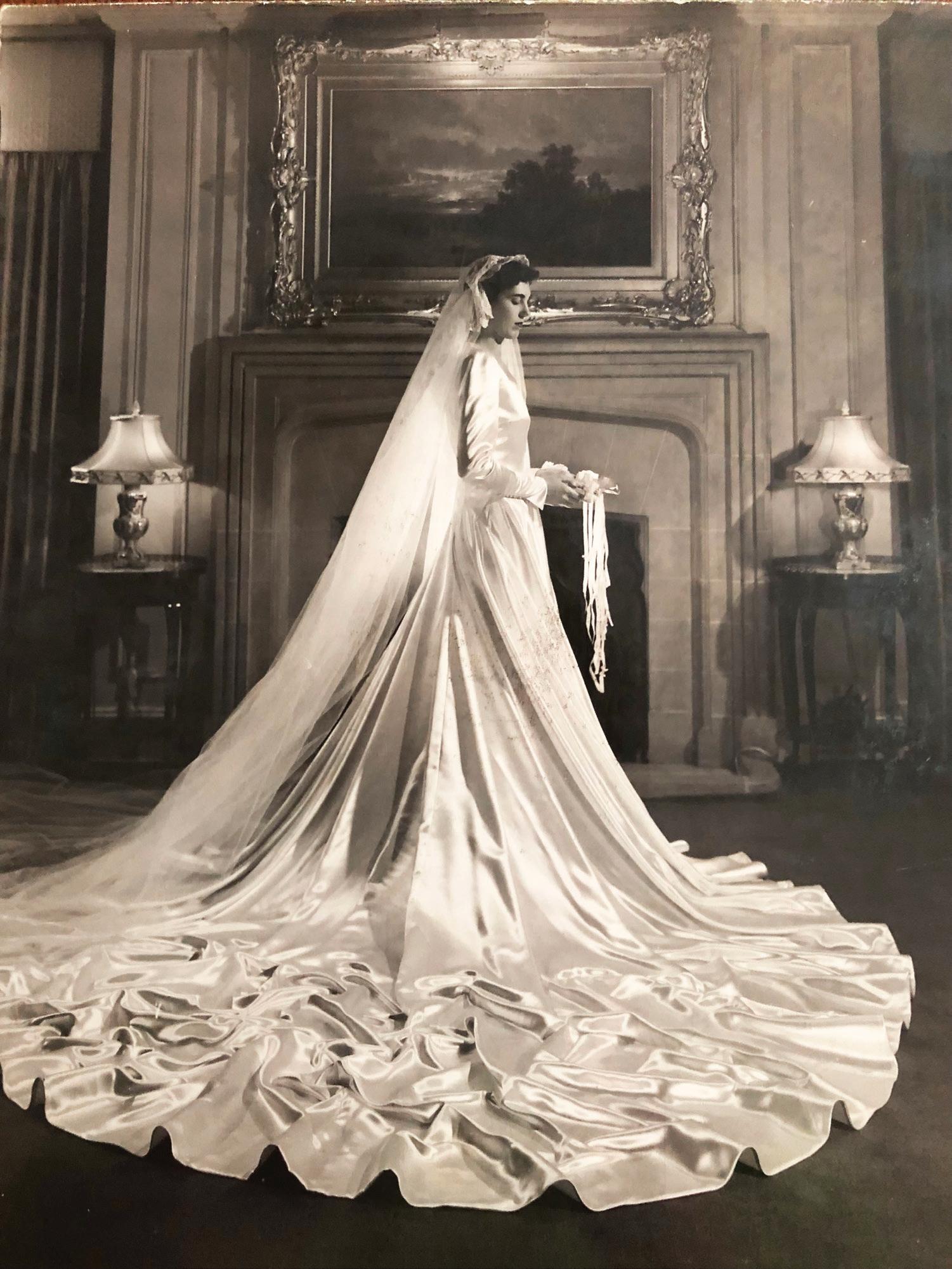
Irene had a custom-designed satin wedding gown, complete with long sleeves and a train so elaborate that the wedding photo grapher used a broom stick to create waves in the train for for mal portraits.
Connie Geocaris recalls loving to look at photos of her mother’s wedding day when she was growing up. Her mother inherited the house in Winnetka where she grew up. One of Connie’s favorites was the photo of her mother as a bride in front of the fireplace. She would often look at the dress, stored in black tissue paper in the family attic.
When Connie Geocaris got married in 1987, it was her dream to wear the heavy satin dress that her mother wore. She laughs that this was the Princess Diwedding era, and that style infor med her choice of alterations. She found a seamstress in Winnetka who took of f the long sleeves and created large puffy sleeves in the style of the day. The seamstress also shortened the train and opened up the neckline of the dress.
Even though her wedding day was rainy, Geocaris managed to get photos in her family ’s backyard overlooking Lake
Michigan. She and her husband, Mark Frank, had 300 guests at the wedding at her family home
Geocaris and Frank, a native Oak Parker, eventually moved to River Forest, where they raised their daughter, Tina Frank.
Mother and daughter were avid watchers of the television show, Say Yes to the Dress. When Tina got eng aged, they unwrapped the f amily dress to see if it could be used for one more wedding.
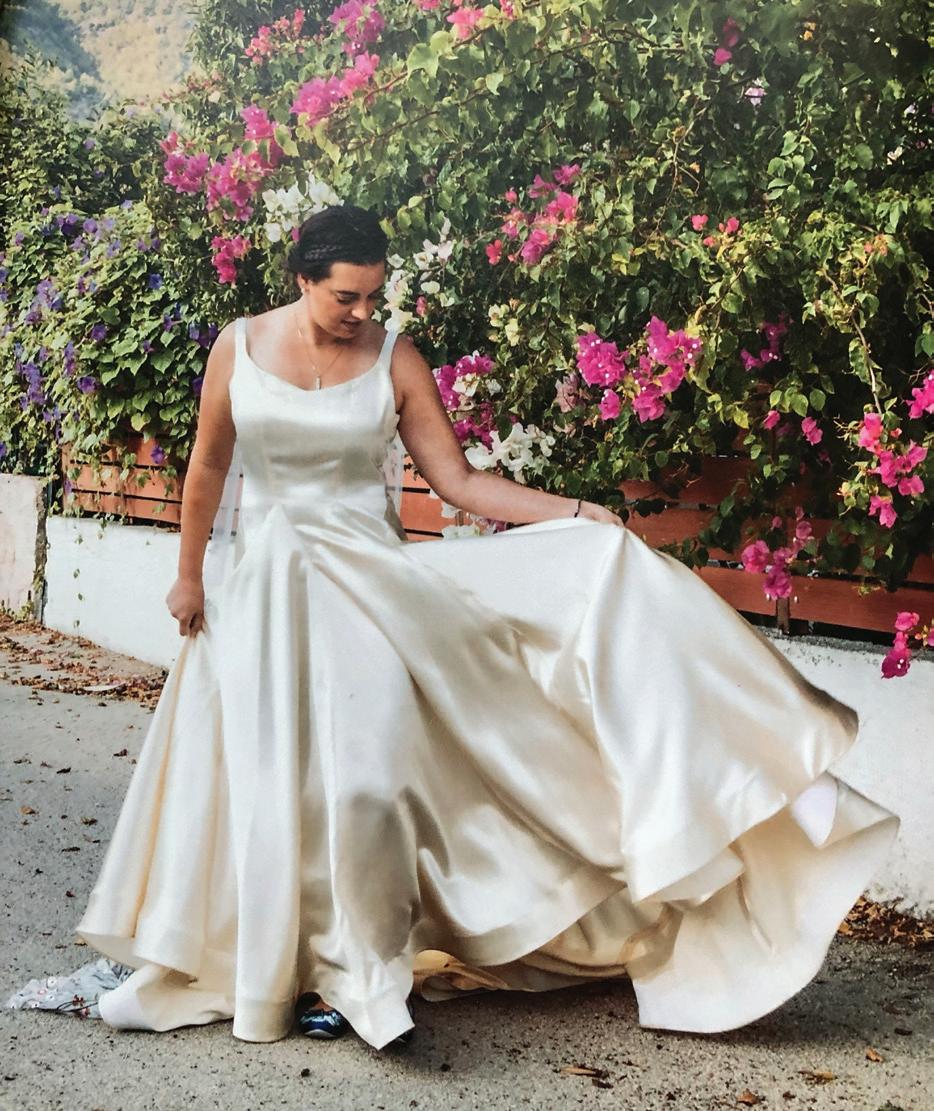
Just like her mother, Tina wanted a dress that was more indicat ive of her era, and she turned to Oak Park seamstress Linda Hill to help remake the dress. Hill, who has been a seamstress for 35 years, says it’s not unusual for brides to want to wear a family dress.
There are two main considerations, Hill says, “First, is the condition of the dress. Will it stand up to being worn again or is it too fragile? And then, it’s figuring out the bride’s vision. Is it possible to get there given the current state of the dress?”
She says the Geocaris dress proved to be perfect for transformation. The large, puffed sleeves provided plenty of material for alterations as did the remainder of the train. During her alterations, Hill found labels sewn into the dress, one from Saks Fifth Avenue and one with a name inscribed. She believes the name was the signature of the seamstress who made the original dress for Connie’s mother.
Tina had four fittings with Linda during the alterations process before her wedding in Greece. Connie says Linda made them a carrying case, complete with a doll in the middle, so that the dress’s folds would drape correctly and make the trip in good condition.
Tina married Ian Blackburn in Greece, near the family’s ancestral villages, and Connie says, “She looked beautiful. She looked like a Greek goddess.”
Connie and Mark are celebrating their thirty-ninth anniversary this summer. And as for the dress? It’s been cleaned and carefully packed away, waiting for another generation to enjoy
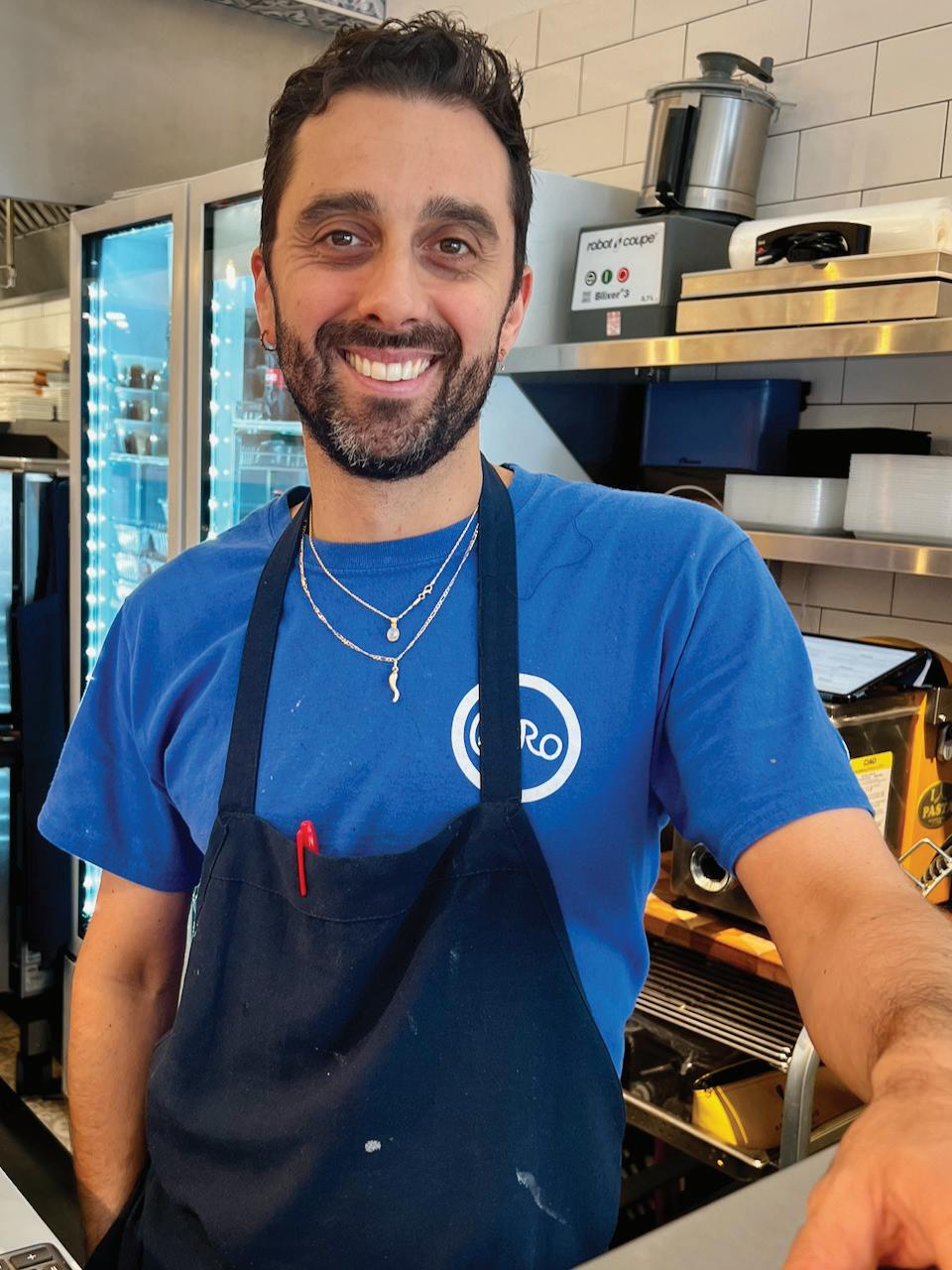
‘Arrivederci” to Ciro Parlato, owner of the self-named restaurant Ciro that was at 1048 Pleasant St. in Oak Park. I stopped on its final day, June 20. He wants everyone to know how happy he was to be a pa of this community. “Grazie mille a tutti voi,” he said. He also said if you find yourself near the Amalfi Coast re gion of Italy, please look him up. He hopes to reimagine his restaurant concept there, near his hometown of Corbara. One Instagram post said it best, “Coraggio, Ciro.”
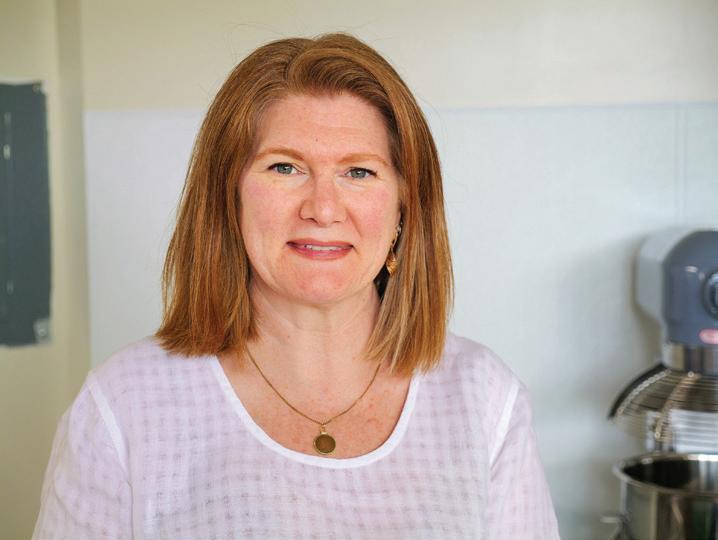

Hopefully it’s not good-bye for Jay’s Backyard BBQ at 5604 W. Division St. In Austin. The restaurant was devastated by fire in the early morning of June 19. According to owner Jay Young, the fire started when an employee turned the grill on. Interviewed by Block Club Chicago, Young said, “People don’t understand how much I had to go through
this place, just trying it going. And for it to … I got a lot of emotions tied into that building, that restaurant, the people I emthe customer base, just the whole community.” are to welcome Oak Prime Steak at 1122 Lake St. in Oak Park. Its estimated opening date is later this year. This venture is from the same owners as Hinsdale Prime Steak, Ignacio Martine z and Antonio Monroy. Nice to see you Joy Tea! Their new brick-and-mortar location just opened at 7773 Lake St. in River Forest. This business first saw success as a mobile tea stand. Touting itself as “The Modern Tea House” and promising, “Tea in America is horrible, we fixed it,” the focus is on simplicity, using tea from estates in Fujian, Yunnan, and Sichuan China. Twisted Cookie, 7401 Madison St. in Forest Park, has a deal for you – if you are a Costco member. On sale at the stock-up store’s Melrose Park, North Riverside and West Loop locations are two $25 gift cards for $39.99. “This past year one of their team members asked if I would cater their employee Christmas party,” owner Joana Fischer said. “They continued to order for their employee events. Shortly after, the general manager asked if I would like to offer Twisted Cookie gift cards in their store.”


Though some blocks on Oak Park Avenue in Oak Park are open again, it’s still construction season for the 100 North and 100 South blocks. I lingered over lunch with old friends at Café Cubano, 113 N. Oak Park Ave., last week and in the 2.5 hours we sat catching up, we were the only customers who sat down to eat.
Please support the restaurants on these blocks. If there was no construction, you were going to have to park in the Avenue Garage (entrance at 720 North Blvd.) anyway! The first 90 minutes is free and just $2 for the next hour.
July 18 is National Sour Candy Day. Candycopia is celebrating by attempt-
ing to set a Guinness Book of Wo rld Records’ “World’s Largest Sour Candy Tasting.” T hey will host the free, public event at 1:30 p.m. at Ridgeland Common, 415 Lake St. in Oak Park. It will be a synchronized tasting of three intensely sour candies. Sign up to join in on their website.
In other somewhat bitter and sweet news, this is the last column for Small Bites , at least its cu rrent version. I’ ll be saying “see ya” to leading Eats re port ing at the end of July. More details will be for thcoming, but in the meantime, I’d like to of ficially welcome two new Eats re porters, Adam Siemer and Alicia Sams. They both wrote wonderful pieces for Eats Magazine that came out last week. I look forward to reading more from them!
Got news, questions or ideas for this column? Email them to us at Eats@oakparkeats.com.

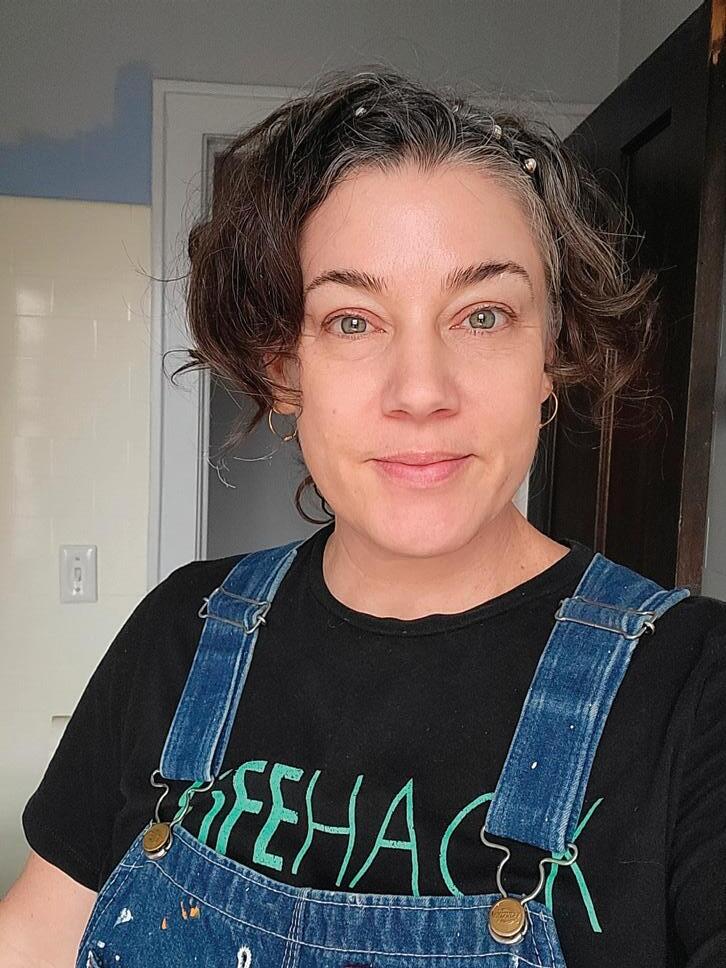

Oak Parker mixes and matches interests and talents into a good day’s work
By LACEY SIKORA Contributing Reporter
Oak Parker Missy Weimer has always been involved in the arts. She studied art in colle ge and graduate school, worked as an artist and wrote about the arts for much of her early career. After living abroad for more than 8 years, she knew she wanted a new career when she returned to the United States.
Organization as a calling
“I thought long and hard about what I wanted to do,” Weimer says. “I’m trained as an artist. I have a masters in art. I wanted to do something creative, and I wanted to be around people.”
Looking for inspiration, she found it in her own life circumstances. She had moved four times, each time getting rid of everything she owned. “I never missed it,” she confesses of her possessions.
Once back in the states, she realized that many Americans were struggling with too many possessions. “We’ re lucky here because we have places to put it: basements, closets, and attics, but that’s a blessing and a curse,” she says.
With her training as an artist, Weimer says she has always been process-based and organized, so she set her sights on becoming a home org anizer. Her business,
See MISSY WEIMER on pa ge 18
from page 17
Life Hack Organizing (lifehac com) filled a niche in Oak Park
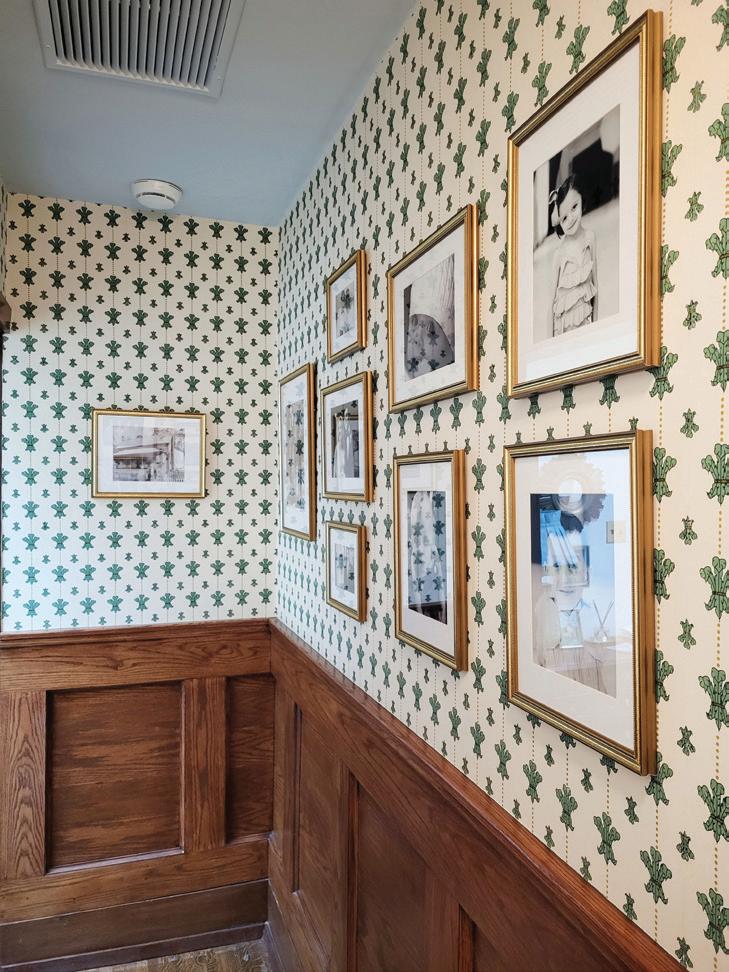
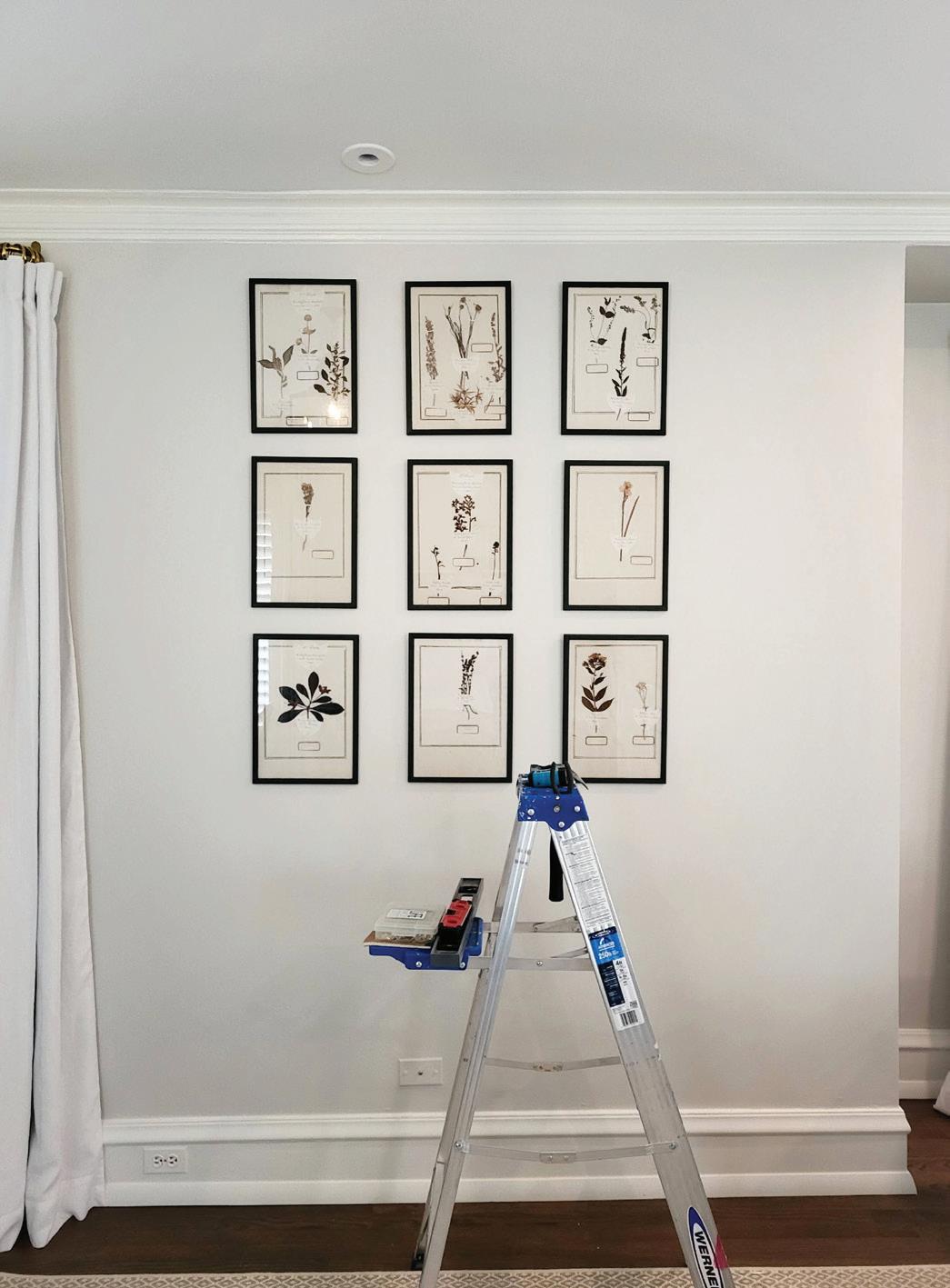
As she be gan to help people org homes and find a place for all of ings, Weimer hit upon another job: many people need help organizing and hanging their artwork. It was the perfect combination of two of her skill sets
Her clients run the gamut: some are whelmed with stuff and others are not, all benefit from bringing We enced eye into their homes. “I see the spectrum of homes and how people are living,” she says.
Weimer’s other job is acting as an inde pendent art curator, something she be doing in 2001, around stints in the film in dustry and working as a photo art installer for an auction house. Since moving to Oak Pa hosted local shows at the F Laura Maychruk’s Arts District and the Hinsdale Public Library, among other venues
A recent curation project started with a personal connection. Jill Jeannide


artist’s work. One of those shows was held at Maychruk’s gallery.
After the show, Maychr uk, who is a Realtor, texted Weimer to says she was showing a home and saw one of Jeannides’ paintings in the home. Weimer had never seen the painting before.
“I thought I’d seen every painting she’d produced, but obviously, that’s not true. What are the odds that we would come across her painting in a house in Oak Park?”
She advises clients to buy what they love “If you’ re still thinking about a piece, you should buy it.”
“But you can buy an original work instead. There’s great work out there, really close to us.”
MISSY WEIMER Designer
Weimer has curated five shows in the last three years. Beyond large-scale shows, she also assists clients in choosing art for their homes.
She calls this side of her career “very niche,” noting that it’s ar t for the people.
People often turn to her after looking through art selections at big box stores.
For Weimer, working as an organizer and a curator has turned out to be the ideal career. “I really love being able to curate and show art, as well as org anize and do handywork. It’s so satisfying. I love going into peoples’ homes and helping.”
No two jobs are the same. Whether it’s hanging a wall of plates, helping find the right placement for artwork or helping someone get through their clutter, she has a tangible result at the end of each project.
“At the end of the day, my son and I talk about our days, and I show him pictures of my work.”
DEADLINE FOR SUBMISSIONS IS FRIDAY 5 P.M.
Call Viewpoints editor
Ken Trainor at 613-3310
Email: ktrainor@newswellchicago.org
Last month, I asked the question here, “How do we design lives worth living longer?” One impetus for this question is the fact that we are in a new stage – we’ve added more longevity to our species in the last 125 years than all previous humanity. If we’re going to consciously design new lives, we need an accurate reading of reality.
“Facts” that may appear self-evident to us humans often turn out to be no more than prejudices. Appearances are not always what they seem.
Humans used to believe that the Earth was flat. Then, as scientific evidence of a round Earth accumulated to change minds, we still believed the sun rotated around our planet. Time is a key aspect of both longevity and of our fears about aging.
Many of us believe the duality that old is bad and young is good. This “self-evident fact” is nothing more than prejudice. Life is change. All existence is change. In order for us to consciously design lives worth living longer, we must view life as change not permanence, as becoming not being, as events not things.
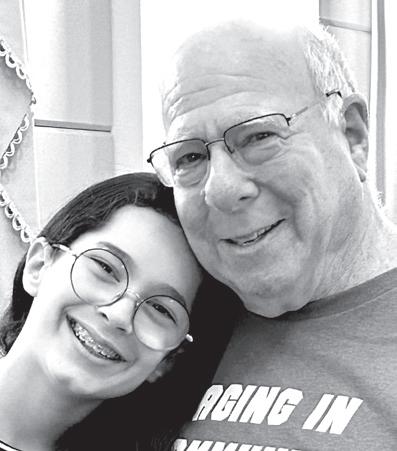
Last weekend, I met up with a group of childhood friends I hadn’t seen for 25 years. Re-connecting was great! My friend Joe and I grew up together. He told me about his father Peter who, in his mid-60s, after his second business went bankrupt, decided to become a portrait painter, his passion. He has supported himself and built a re putation for over 35 years. Peter turns 100 next month.
At the age of 69, my friend Fiona was “DOGED” – forced to retire by Elon Musk after 25+ years as a federal employee. She recently got her real estate license and has started a successful business.
Yes, life is change. Designing lives worth living longer demands not just recognizing the ubiquity of imper manence, it also demands Wabi Sabi – the Japanese aesthetic that recognizes the beauty of imper manence.
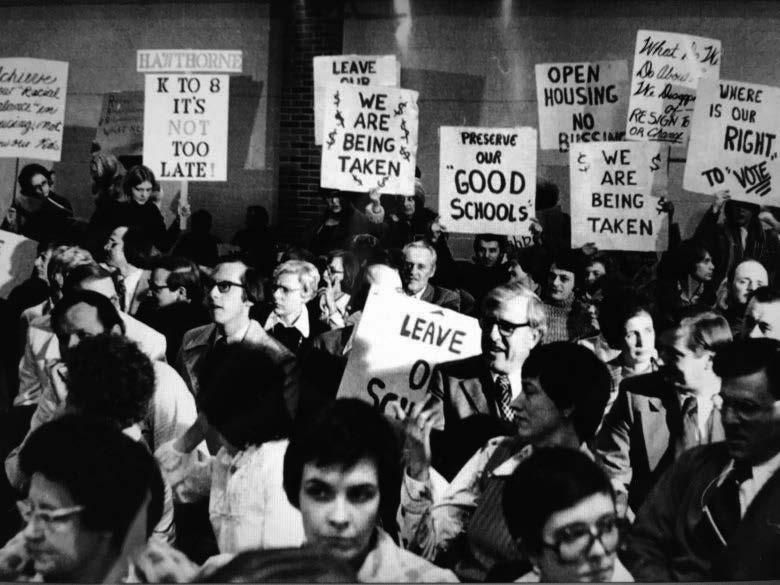
Suppor
opponen
packed the March 1975 meeting.
Wester n science is based on disciplined rebellion – the refusal to accept the present order of things. Advancements in our understanding of aging begin by questioning assumptions once thought to be selfevident. Scientific progress depends on the honesty and courage to challenge inherited beliefs – including our beliefs about growing older.
We understand the world by studying change, not by studying things. If we design longer lives as a thing (“old age”), we will categorize and stereotype. If we design it as a process, we notice continual development, difficulties, adaptation, lear ning, loss, creativity, and meaning-making
Aging becomes less about reaching a static state and more about participating in an ongoing evolution.
The ninth installment in a series on Oak Park housing history as it relates to diversity and equity:
In a span of 10 years, with bursts of intense political division, the Oak Park community crafted a set of housing strategies that would, over time, test the strength of our humanity to live differently and overcome generations of exclusionary housing and economic discrimination. The strategies were imbedded in ethical, religious commitments and traditional property interests.
The overall plan came to be called the Oak Park Strategy, a label that came from Carol Goodwin’s doctoral dissertation at the University of Chicago, which was published as a book in 1979. National media soon adopted the branding as they covered Oak Park’s volatile change process (1).
Housing Center (HC) - Renamed the Oak Park Regional Housing Center (OPRHC) in the early 1990s, the HC worked closely with realtors, apartment owners, home buyers and renters to integrate housing across the village. The center prioritized
convincing whites that the East side of town was a desirable and safe place to live. To this day the OPRHC still marks its local success with what it calls “affirmative moves.” These moves were personal decisions by newcomers to reject an unwritten but widely spoken guideline that has circulated for generations among whites coming to Oak Park: “Don’t look at homes east of Ridgeland.” In that effort, the center’s annual reports of the 1970s and 1980s show that their clients were overwhelmingly white, professional and highly educated, and its Black clients of all demographics were very small in number (2). Conversely, the center encouraged Blacks to live in areas of the village where they were under-represented. Village trustees strongly funded the work of the HC until 2023. Then trustees’ concer ns about the effectiveness, and perhaps the ethical appropriateness of the HC efforts, combined with shaky accounting practices of the center, led the village to drastically cut the HC budget until remediations were effectively in place (3).
I am writing to share a community event that combines music with a meaningful cause. On July 12, a benefit concert will be held at the Nineteenth Century Club in Oak Park to raise funds for Ann & Robert H. Lurie Childrens Hospital of Chicago.
88keystocure is a youth led Illinois-based nonprofit organization dedicated to enhancing the lives of others through music. Through our benefit concerts and other fundraising events, like craft fairs, we have raised over $60,000 for various charitable causes, such as the American Society for Suicide Prevention, the Lurie Childrens Hospital NICU, and the Monster Education Foundation. This year, our benefit concert focuses on fundraising for Lurie Children.
Lurie Childrens Hospital provides lifesaving care to thousands of children and families throughout the Chicago area each year. Many families rely on its physicians, nurses, researchers, and support staff during some of the most difficult moments of their lives. Through this concert, we hope to support the hospital’s mission while bringing members of our community together through music.
The event will feature local student musicians who are volunteering their time and talents to make a difference for children in need.
We invite members of the Oak Park and River Forest communities to join us on July 12 at the Nineteenth Century Club.
Thank you for helping spread the word about this community effort
Freya Pang Oak Park Co-Director, 88keystocure
Fighting on the lawn, Blue skies torn.
On brutal claw, millions spent, Will Grandpa sleep through his event?
Schoolboy fisticuffs in the yard, Rubber neckers thrilling hard. Where roses bloomed, chaos reigns, The Constitution scorched in flames.
A reality show of manic force, A bloody, snotty man-child course Liberty closes her eyes in sor row, Justice blind to a lawless tomor row.
‘Tis truly the hour of our discontent, Epstein, murders, to war we’re sent. Buying islands where billionaires play, While taxpayers foot the bill each day.
Yet, I believe, deep in my hear t, America will make a brand-new start. Stand up, join hands across every aisle, To gether ag ain in resolute style. Spend on people, on hope and re pair, Health, education, and the future we share.
Val Gee Oak Park
Mend a quarrel. Search out a fo ten friend. Dismiss suspicion an replace it with trust. Write a love Share some treasure. Give a soft answer Encourage youth. Manifest your loyalt in a word or deed. Keep a promise. Fin the time. Forego a grudge. Forg enemy. Listen. Apologize if you we wrong. Try to understand. Flout envy Examine your demands on othe Think first of someone else. Appr ate, be kind, be gentle. Laugh a littl more. Deserve confidence. Take against malice. Decry complacen Express your gratitude. Worship your God. Gladden the heart of a child. Take pleasure in the beauty and wonder of the Earth. Speak your love. Speak it again. Speak it still again. Speak it still once again.
OHoward W.
Hunter
ur country goes by two names: “USA” and “America.” I think of “USA” as who we actually are and “America” as who we aspire to be. I am deeply in love with America. The USA? A work in progress — lately a work in regress
I am an unabashed lover of America. Teetering on the precipice of our 250th birthday, however, I am deeply disillusioned with the USA. Coincidentally, that is exactly how I feel about the Catholic Church (which I grew up in) and the state of Israel (which I admired from afar). And the White Sox. I’ve been rooting for a long time for the first three to come to their senses and get back on track. That looks unlikely in my lifetime, but I keep rooting nonetheless. As for the White Sox, well, I’m keeping my fingers crossed.
Essentially I’m an optimist … or a masochist. Probably both. After watching the new Steven Spielberg film, Disclosure Day, I’m beginning to think our only chance may be intervention by wise and more highly evolved aliens from elsewhere in the cosmos
Pending the results of our midterm elections, if that doesn’t work out then, Aliens, if you’re reading this, if not now, when?
When it comes to this country and its often disappointing citizenry, I can say with certainty that we have the potential to right our own ship of state. Unfortunately, I can say with equal certainty that we also have the potential to not live up to our potential. I’ve seen both (and too much of the latter).
This July 4th, meanwhile, we have to grit our teeth and endure an orgy of self-congratulation, orchestrated by those who have hijacked America and tur ned the USA into a circus of shame.
While we prepare for our midter m mutiny, I find
focusing more on the bicentennial — 200, that is, not 250. In other rds, the bicentennial of our country’s thday.
y? Because something happened ly 4, 1826 that was such a mindending coincidence, it’s impossible to e it could be mere coincidence.
On that day, the two foremost surviving founders of this nation, Thomas erson (83) and John Adams (90) died within hours of one another. Extraor-
And to have that astonishing coincidence coincide with the 50th anniversary of the Declaration of Independence — “The greatest sentence ever written” as historian Walter Isaacson calls it in his short book (by that title), which every American should read — is a mystery beyond comprehension. (If you want to be further gobsmacked, our fifth president, James Monroe, also died on July 4th, five years later). Three of our first five presidents. And James Madison died on June 28.
Just in case you need to refresh your memory, here is the greatest sentence ever written:
We hold these truths to be self-evident, that all men are created equal, that they are endowed by their Creator with certain unalienable Rights, that among these are Life, Liberty and the pursuit of Happiness. Adams and Jefferson, our second and third presidents respectively, were partners in drafting, then fighting to pass, this declaration, and they became friends in the process. They turned into bitter enemies when they ran against each other to succeed George Washington, ushering in the political polarization that haunts us to this day. After the election of 1800, they didn’t speak to each other for 12 years, then began a correspondence of reconciliation that included more than 150 letters.
They were an unlikely pair. One from the North, the other from the South. One argued for a strong central gover nment, the other emphasized states’ rights. One was anti-slavery, the other a slave owner Yet they became frenemies — and perhaps a model for our times
The USA has never lived up to America’s founding principle: that every person is created equal. Every … single … person. In fact, on this, our 250th birthday, the USA and America have never been further apart, so it’s not possible to “celebrate” our country in the conventional sense. Better to live out our ideals, refusing to view anyone as superior or inferior. Seeing the best in everyone and, where possible, helping one another become better Americans
And on this day, our 250th July 4th, taking to heart the directives from the quote preceding this column. Especially the final four.
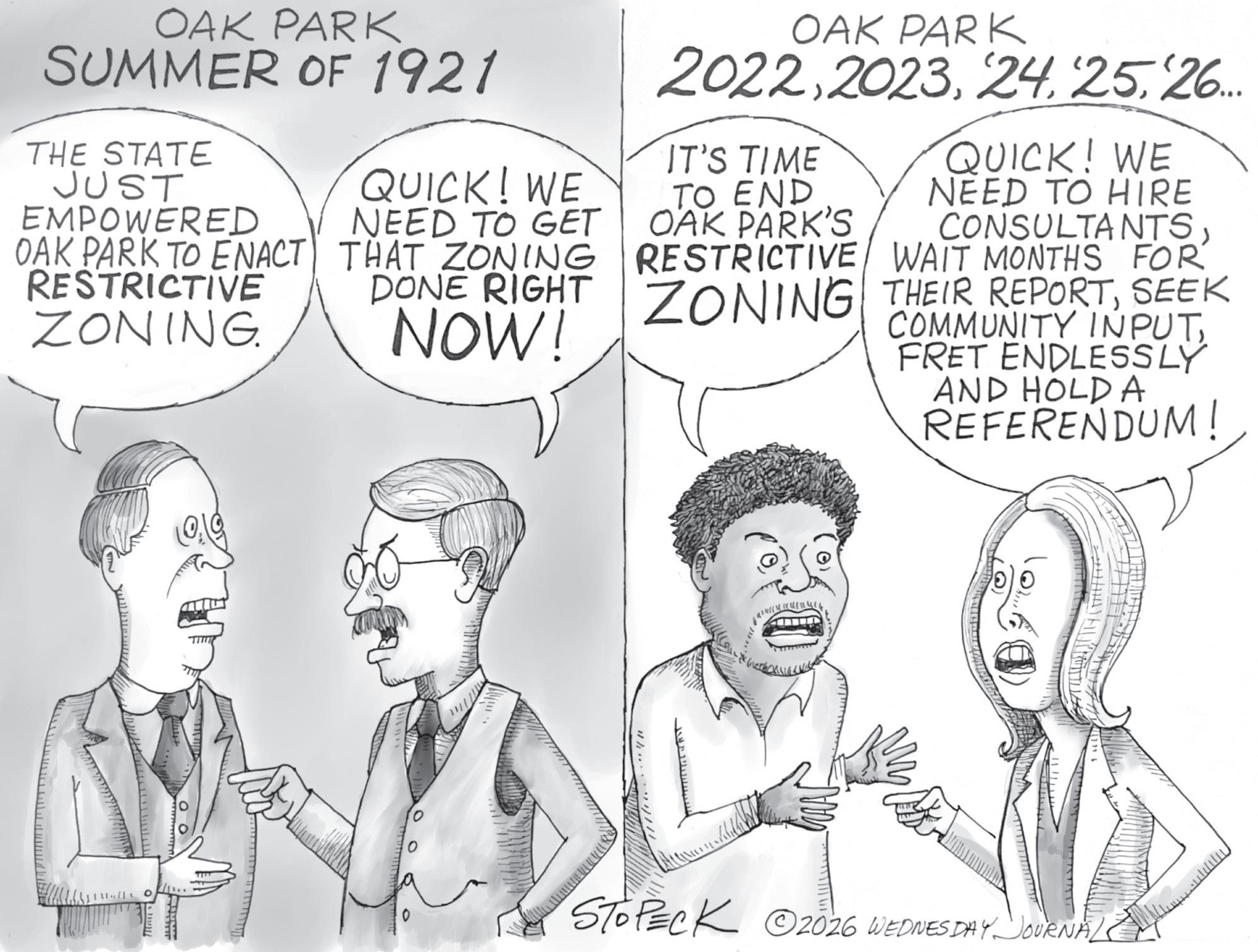
SHRUB TO WN by Marc Stopeck
I actually ag ree with Frank that the tone of Josh’s ar ticle against Oak Park conservatism was harsh [Au contraire, contrarians, Viewpoints, June 24]. But I also think what Josh’s trying to get at is the stance that Frank is taking. Josh is saying that left/liberal identity is important to many Oak Pa rkers, but wealthy people who live in Oak Park tend to vote their (conservative) class interests. This seems to have struck a nerve because Oak Parkers want to be able to support conservative policies while still calling themselves leftists/liberals because they see that as core to their identity/being a good person.
It’s not “a libertarian streak” to ban people from building a duplex. Frank wants to conserve large-lot, expensive homes in Oak Park and keep other people from building so more people can live here. It’s a normal political position. It’s just not a particularly lefty one. It’s similar to the position that noncitizens should not be allowed to move to the U.S. It’s just a conservative one.
Frank quotes one of my citations’ conclusions, but he ellipses out the middle. Here’s the full quote with what he
removed in asterisks:
“While lowering housing costs through zoning reforms may help first-time homebuyers and lower-income renters, it comes at the expense of — *and thus will likely generate substantial political opposition from*— current homeowners.”
The part he left out is the point: people who are wealthy and for whom a lot of that wealth is tied up in a home oppose measures that seek to lower housing prices. People support their own interests. It’s just not a liberal or leftist position to support the interests of entrenched capital over the interests of lower- and middle-income people. If you’ve lived in an owner-occupied, single-family home in Oak Park for 50 years, the value of which has likely increased 20x, it makes sense that you’d want to block steps that would make housing in the village more plentiful and af fordable. But traditionally, leftists and liberals support policies that benefit poor and working class people, who need more af fordable homes, not wealthy people.
Blaise Denton Oak Park
of Oak Park and River Forest
e goal of the Viewpoints section is to foster and facilitate a community conversation and respectful dialogue. Responsible community voices are vital to community journalism and we welcome them. Space is at a premium and readers’ attention is also limited, so we ask that Viewpoints submissions be brief. Our limit for letters to the editor is 350 words. For One View essays, the limit is 500 words. Shorter is better. If and when we have su cient space, we print longer submissions, but when space is limited — as it o en is — we may ask you to submit a shorter version or hold the piece until space allows us to print it.
We reser ve the right to edit submissions. We do not have time to allow the writer to review changes before publication. We also do not have time to do more than super cial fact-checking, and because of our national epidemic of misinformation and conspiracy theories, when writers include statistical evidence to support their opinions, we require them to include the source of that information, such as credible websites, print publications, titles of articles and dates published, etc. Be as speci c as possible so that we and our readers have some way of assessing the credibility of your claims. Links may also be included for the online version. We follow the Society of Professional Journalists’ code of ethics: seek the truth and report it and minimize harm. As a result, we will do our best not to publish pieces that espouse doubtful or debunked theories, demonstrate harmful bias, or cross the line into incivility. While we will do our best not to engage in censorship, we also do not intend to be used as a platform for misinformation. Your sources for fact-checking are a critical step in keeping the discourse honest, decent and respectful.
All submissions must include your rst and last name and the municipality in which you live, plus a phone number (for veri cation only). We do not publish anonymous letters. One View essays should include a sentence at the end about who you are.
If we receive your submission by 5 p.m. on Sunday, you can expect your opinion to be included in that week’s paper (and online), space permitting.
Pieces can be submitted through our online form at oakpark.com or directly to Viewpoints editor Ken Trainor, ktrainor@newswellchicago.org. For the latter, we prefer attached Word les or plain text included in the email.
■ 350-word limit
■ Must include first and last names, municipality in which you live, phone number (for verification only)
‘ONE VIEW ’ ESSAY
■ 500-word limit
■ One-sentence footnote about yourself and/or your connection to the topic
■ Signature details as at left
This is just a quick thank you for such a wonderful evening. There were some pleasant surprises at the book talk for My Journey with Hemingway at the Hemingway Birthplace Museum (339 N. Oak Park Avenue) on June 18. Among the capacity crowd were some early Er nest Hemingway Foundation of Oak Park (EHFOP) volunteers including: Kevin Harrington (board member and Hemingway Centennial Birthday Humanities Festival chairman), Elaine Harrington (Facilities Committee), Anthony Gargiulo (board member), and Mary Ann Rusinak (executive director). Nancy Hlavacek (wife of Roy Hlavacek) came with her daughter, Carrie Felix. Roy was a founding and longserving board member and noted in the foundation’s history for initiating the 7-day “Hemingway Film Festival” in 1987 at the Lake Theatre, our first major national publicity event outside of the annual birthday celebrations, which was a huge success
Ken Trainor, Wednesday Journal Viewpoints editor and author of Our Town, Oak Park excellently introduced the book and moderated the detailed question-and-answer session, which included questions and comments from the guests, some of whom talked about their own “journey with Hemingway.”
It was noteworthy to see Kathleen Spale, manager and curator of the Hemingway Archives and Special Collections at the Oak Park Public Library, with two staff members Joel Javier and Carrie Vacon in attendance. The evening session was recorded and can be viewed on the Hemingway Birthplace website with discussion content centering on the foundation, the artist Ernest Hemingway and the Oak Park community I also want to thank the foundation’s executive director, Keith Strom, his wife Lisa and staff member Carla Mayer, and the other volunteers who made this a delightful evening. Thanks also to longtime EHFOP
For nearly 50 years, Heritage House has been an impor tant component of the village of Oak Park’s affordable senior housing During its early years, Heritage House provided racially diverse, decent, safe, and sanitary housing. However, over the last two decades, the owners and their affiliated property management company have allowed the building to deteriorate significantly. Today, the building is almost exclusively occupied by minorities. A village of Oak Park housing inspection in 2023 found over 400 violations of the village’s housing code. Current residents complain about bedbugs, roaches, vermin, other unsanitary conditions, and unresponsive management. The building’s manager is scheduled to appear in Housing Court in July to answer for several 2026 summonses about conditions in the building. Arbor West Neighbors and its Social Action Team strongly support the residents of Heritage House and ask the village of Oak Park to use its inspection authority to address the residents’ concerns. We also thank Village Trustee Jim Taglia for his efforts in bringing this issue forward for public attention.
Sources:
Senior Citizen building racks up code violations, Wednesday Journal, June 14, 2023
Residents complain, its manager defends, Wednesday Journal, June 2, 2026
Residents air Heritage House frustrations to Manager, Wednesday Journal, June 8, 2026
Ed Solan for Arbor West Neighbors
Chair man John Berry and Vice-Chair Nancy Sindelar (a published Hemingway scholar). And thanks to my family and friends who were able to be present, including my two young granddaughters. Happy Birthday, Ivy!
Earlier in the week, I toured the Birthplace with Keith and appreciated again the beauty of this house museum, so meticulously restored and now maintained in its 1890s Victorian splendor. Many of our early Hemingway board members also worked closely with the Frank Lloyd Wright Foundation and it’s worth noting again the value of these two trailblazers: Ernest Hemingway, who produced a style and literary approach that broke the Victorian mold and ushered in the modern novel and set a model for clear expository writing, while Frank Lloyd Wright rebelled against the Victorian structure by pioneering his organic Prairie School-style architecture. The Hemingway
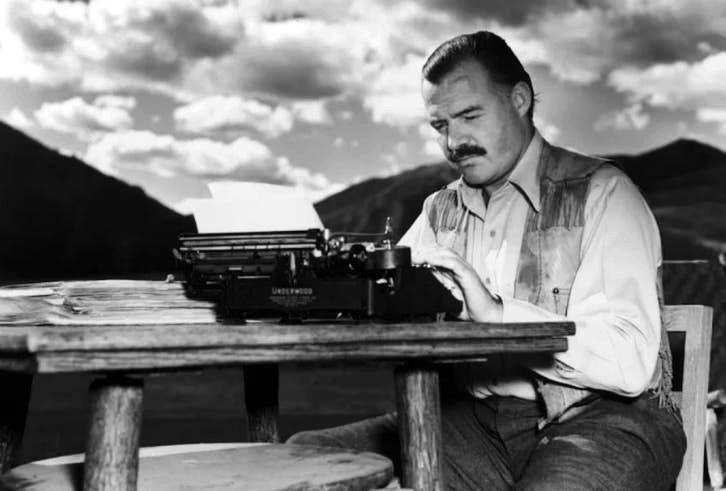
Birthplace offers all Oak Park residents and guests an opportunity to lear n more about our native literary artist and experience the Victorian style that Wright changed with so many outstanding building examples in our community. Take a look!
Thank you again for a fun and hopefully informative evening for those in attendance. I’m hoping that it opens the door to more questions about Er nest Hemingway the artist. His birthday is July 21. Check on the foundation’s plans to celebrate at ehfop.org. Scott Schwar My Journey with Hemingway
We got to talk about this birthday party of yours, America.
July 4th, as holidays go, is fine. That being said: I think at 250 years old it’s high time for America to outgrow throwing itself the same party every year. I am no longer sure how I feel about celebrating anything by giving the sensory impression that we are taking heavy enemy fire. Rockets’ red glare and bombs bursting in air and all that other outdated horsecrap is a lot less funny when a firework goes off when you’re standing on the train platform and everyone thinks, “Is this it? Is it time to take shelter? Is it some kid with a black cat? If you heard the shot, it didn’t hit you, right?”
The risk of injuring oneself from fireworks would seem to take some of the excitement and joy out of the whole thing. Interspersed with all of the exploding around July 4th is a lot of sirens and some very crowded emergency rooms
All right, I’m going to confess that this is the part that makes me maddest. Fireworks are inhumane. A decent country should not celebrate its birthday with lavish and prolonged acts of animal cruelty. The number of tranquilizers I had to pour into my friend Leia so she could survive the July 4th weekend with anything approaching sanity — even by the standards of a Staffy — is a dose that should give anybody pause. Hunter Thompson wouldn’t take this many drugs passing a couple weeks in Vegas.
The degree of misery that we visit on beloved friends who do not have the slightest idea what is going on, what America is, and why we celebrate its birthday by being mean to them is beyond even my ability to describe in metaphor. I understand that this is a nation that gives annual thanks for all of the blessings visited upon us by engaging in the greatest ritual animal slaughter in the history of the world (a slaughter in which I enthusiastically and greedily participate, mind you, this is not some sort of PETA screed), but doing something entirely optional that makes dogs beyond miserable is increasingly something I find unconscionable. I should not have to coax my trembling bestie out from under the bed with cookies after a holiday weekend so we can go to the park. This is — there is no other expression for it — not OK. I don’t want to be shrill at people who are setting off fireworks over their lack of safety or sense. Those frailties are their business. But I do want to go to them with video footage of cowering pets and say, “I just want you to know, this is what your ‘har mless fun’ is doing to my friend.”
This being America, of course, I am pretty confident most of them wouldn’t care. But we do what we can. Happy birthday, America. Grow up
The invitation was extended to all: Come sit with neighbors to learn about the transfor mative work of United Power for Action and Justice. Come share a bit about where you yearn to see change in our city and our country.
On June 17, Good Shepherd Lutheran Church graciously hosted 50 or so folks who came to connect. Oak Parker Nick Brunick described United Power as a nonpartisan community organization made up of 38 religious cong re gations, nonprofit groups, hospitals, health centers, and civic groups. It works to turn problems into actionable issues, to identify practical solutions that can deliver concrete progress on these issues, and then relentlessly organizes people and money to bring these solutions to reality.
United Power brings people together across worldly boundaries of race, class, faith, geography, and ideolo gy. It has
worked successfully over the years on a diverse array of issues, such as housing, health care, public safety, homelessness, reclaiming and rebuilding neighborhoods and gun violence.
United Power’s Reclaiming Chicago initiative, for example, has built new and rehabbed energy-efficient homes in Back of the Yards, Roseland, Chicago Lawn, and Lawndale with the ultimate goal of building 2,000 homes in disinvested communities. We broke into small listening groups and took turns responding to two prompts: “Why are you here? Tell a story that explains why you get involved in public issues?” and “What gives you hope? Or what keeps you up at night? Tell a story that explains why you care about a particular issue that you would like to help address.” We heard stories about af fordable hous-
ing, education, protecting and welcoming our immigrant neighbors, protecting and expanding our democracy, access to health care, and rising property taxes.
Oak Parker Celine Wo znica provided a powerful illustration of citizens harnessing their hope – the remarkable evolution and impact of interfaith Migrant Ministries (now housed at St. Bernardine’s in Forest Park), fueled and organized by folks deeply committed to caring for mig rant families.
We closed with words by the late Joanna Macy, co-author of the book Acti ve Hope: How to Face the Mess We’re in without Going Crazy. This passage from her poem “Grace and the Great Turning” beautifully invites each of us into the work … Our true power comes as a gift, like grace, because in truth it is sustained
T he WJ coverage of the West Suburban Hospital (WSH) mess has seemed to me just a bit odd. Always we see a photo (often the same one) of WSH’s CEO, Manoj Prasad, looking perplexed. If he’s quoted at all, his statements are not wor th the reading. What’s missing in the coverage is the underlying truth of the hospital’s closure: just like Weiss Memorial Hospital and Westlake Hospital, West Suburban was the victim of private equity ownership. Manoj Prasad is an MD. He is also CEO of Resilience Healthcare and executive vice chairman of Que Capital Limited (DIFC). He has an extensive background in international finance, corporate restructuring, and distressed assets He is what is known as a vulture capitalist.
T he Chicago Sun-Times ran an article by Matt Parr on April 24 titled, “Private equity dismantled West Suburban Medical Center and other area hospitals.” In it he notes that “private equity fir ms were involved in 44% of the largest health-care bankruptcies in 2025.” One of them, Steward Health Care, “repor ted more than $9 billion in liabilities, including $6.6 billion in long-term lease obligations tied to real estate deals.”
T he vulture capital strateg y is to acquire a hospital or hospital system using a heavy load of debt, then to cut essential services
while charging fees, extracting dividends, and selling assets. The main assets for a hospital are its real estate and its equipment. The hospital real estate is sold of f to parties that lease it back to the hospital at rates it cannot sustain; and key equipment is spirited away, requiring the closure of whole medical depar tments and the loss of staf f.
Too often a dank smokescreen is generated by the owners of the facility: billing systems are screwed up, Medicaid payments are “in ar rears,” elevators don’ t work, diagnostic equipment is “broken,” and the like
T he fact of the matter is that the private equity firm has sold of f what’s possible to sell of f, made a hug e profit from the sale of assets, and left the hospital a skeleton.
Don’t be fooled. The loss of West Suburban Hospital was a planned event. I’m sure Dr. Prasad is biding his time so that he can slip out, stage left, no applause for his perfor mance. Meanwhile, let’s not fool ourselves that the vulture capital owners are planning in any way to bring West Suburban back.
Were an autopsy to be perfor med, the body would prove to be without org ans.
Ed McDevitt River Forest
by others. If we practice drawing on the wisdom and beauty and strengths of our fellow humans and our fellow species we can go into any situation and trust that the courage and intelligence required will be supplied.
United Power for Action and Justice is an independent, self-funding organization of churches, synagogues, mosques, civic, neighborhood, and health institutions from across Cook County. People are involved in the work of United Power through one of these organizations. To lear n more about how you can get involved, contact one of United Power’s existing members in Oak Pa rk or explore how your organization can become involved. Amy Totsch is the lead organizer (Amy.totsch@gmail.com).
Tara Me yer Dull is an Oak Pa rk resident and member of United Power for Action and Justice.
The village’s Oak Park Energy Navigator (OPEN) program, launched in March, has been met by an overwhelming response from residents. For owners of Oak Park condominiums and smaller multi-unit buildings, as well as single-family homes, OPEN offers a free home energy assessment to identify energy-saving opportunities. Participants also receive a personalized re port outlining steps toward energy improvements and available financial resources to help complete energy-saving projects that can save money while improving comfort.
But the Climate Coaches program star ted more than two years ago by Oak Park Climate Action Network (OPCAN) isn’t going away with the advent of OPEN. While OPEN’s tech experts assess a building’s entire energy picture, Climate Coaches offer their personal experience in free neighbor-to-neighbor conversations on particular topics. Coaches
can answer questions like, “How has switching your home’s heating from gas to electric affected the comfort of your interior?” “What are the pros and cons of cooking with induction versus gas?” “How did you decide whether to buy or lease rooftop solar panels?” or “What contractor did you use and did you like them?”
In addition, Climate Coaches can advise on topics not covered by OPEN, such as landscaping with native plants to reduce flood risk and promote biodiversity; buying, charging, and road-tripping in an EV (electric vehicle); composting kitchen and yard waste to reduce landfill and create nutrient-rich soil “food” and also getting started with bicycling. OPEN and Climate Coaches complement each other in helping Oak Parkers on their journeys toward greater climate sustainability, and many Oak Parkers will find value in using both. Pamela Tate Oak Park
As Project 2 construction at Oak Park and River Forest High School nears completion in August, bringing a plethora of top-of-the-line physical education facilities, the district turns toward the future: What comes next?
The proposed Act 3 design plans will set in motion a host of renovations and new construction in the southwest corner of the high school to begin in the fall of 2028. Act 3 will be largely dedicated to the creation of brandnew performing arts facilities, necessary to accommodate the quickly growing program, home to over 535 students enrolled in curricular classes alone. This would more than double the size of current outdated rehearsal spaces, classrooms, storage, and practice rooms, which were built to align with the standards and much smaller enrollment of the 1960s
As avid members of the performing arts program at OPRF, the two of us have experienced the impact of these facilities firsthand. We participate in well over a dozen different ensembles – including the award-winning Marching Band, Wind Ensemble, and Jazz Ensemble –pursuing music to the highest level we can while simultaneously balancing rigorous academics Performing arts students are increasingly chosen to represent our school at the state level, along with our top ensembles receiving recognition from the Illinois Music Education Association each of the past three years.
This coming fall, the Marching Huskies will reach a record number of members –nearly 150 students. While this growth is exciting, the realities presented force us to
acknowledge the constraints of our facilities that hold us back. At a capacity like that, rehearsals can be overwhelming, difficult to navigate, and at times, quite unsafe due to the levels of sound produced and the sheer amount of students present.
Despite these constraints, we and our dedicated directors and peers continue to push for excellence at the highest level. This is just one of many examples – imagine what would be possible if the quality of all our facilities matched the caliber of our directors and our students.
Furthermore, these rehearsal spaces are not just “rooms,” they provide so much more for us students than one may think. Through both curricular and extracurricular activities, we have spent countless hours in every corner of the current facilities, working together to refine our abilities and help each other. They are safe and inclusive spaces that foster meaningful growth and community. These programs teach us valuable skills of discipline, leadership, and perseverance – all of which extend far beyond musical pursuit. We would not be who we are today without them.
The approval of these renovations will have a profound impact on future generations of musicians. They deserve facilities that will support their needs and ambitions rather than limit them, that will inspire and enable them to grow into the best versions of themselves in our community’s long tradition of excellence.
Rowan Lingenfelter & Nathan Kralik Oak Park
On this Juneteenth 2026, the Alliance for Black Youth and the Committee for Equity and Excellence in Education (CEEE) stated our commitment to supporting all students, and particularly Black students, at OPRF High School.
We express our grave disappointment with the OPRFHS administration for prioritizing capital investments without designating funds to provide recommended supports for students who need them.
We appreciate the District 200 board members who have spoken up on behalf of students’ academic needs, including the need to provide high-impact tutoring and to provide essential services with urgency.
In the context of the history of this country, this suburb, and of OPRF, we call on the administration to prioritize student learning, and to recommit to their stated goal of equity by initiating appropriate academic supports for students for school year 2026-2027.
Over the last four years independent freshman all honors program evaluations, parent requests, school in-
structional and support services administrators, and the Historical Harms to the Black Community and Suggested Repairs inquiry have all recommended significant new equity-centered student resources.
Finally, in April the Board Community Finance Committee recommended immediate action around neglected instructional resources that are essential to fulfilling the racial equity goals of D200.
We urge the D200 board to direct Superintendent Johnson and the administration to provide these critical services.
The Alliance for Black Youth exists to improve outcomes for Black youth across Oak Park and River Forest by centering youth voice, fostering collaboration, and advancing meaningful action. CEEE is a multiracial group of Oak Park and River Forest residents advocating for racial equity at OPRF High School.
Jim Schwartz on behalf of the Alliance for Black Youth and CEEE
Recently, a few different viewpoint pieces were filed to attack the development project at Madison & Ashland. I thought some of the arguments g rasped at straws, including how far it would take to walk to the Metra or grocery stores? Incremental traffic because of an additional 72-unit building. Really?
The principal argument seems to be that, given the village’s history at Lathrop and Lake, we can’t trust the board to do anything.
I ag ree that, over the years, that project started out looking pretty good, but has now turned into a train wreck. Recently, I encouraged the village president to have our lawyers get the village much more involved in this court case because I believe the judge would be much more attuned to an issue involving the town’s finances, as opposed to just a suit between a developer and a bank. The reality is that this is likely costing significant tax revenue that would be split between the village and the county and schools.
I’d like to provide a different perspective on the development Madison and Ashland:
I had a couple of friends who had interest in developing a project along that site, and had plenty of capital and experience to pull it of f. They worked their way through the village process for a couple years. They pointed out that the development has to be put together in a way that would provide an adequate economic return, after paying all of the costs associated with the building, including taxes, along with interest and principal. Their proposal looked very similar to this one, but they pulled out because they grew fr ustrated with the process.
The new developer, from my perspective, has gone through a very rigorous process to get to this point, and what is on the table is approximately $600,000 a year of tax revenue overall, of which the village and schools (D90, D200, and Triton) will get about half through the TIF. We know that our local D90 schools – of which we are very proud – are operating at an operating deficit, so the schools have a lot at stake in this.
I have reviewed the village website, and think that this proposal is well put together. My guess is that if this project doesn’t get pushed through, it will be a long time (five years and potentially much longer) before any developer gets to the same point again, and will likely face the same kind of objections that certain citizens are raising now. Therefore, what the village will lose over the next five years, is roughly $1.5 million of lost tax revenue.
Given the fact that those are the stakes and we are dealing with a piece of property along highly commercially developed Madison Street, I think this is a no-brainer. Jim Lynch River Forest
The following petition, signed by 28 residents and staf f of Oak Park Arms, has been submitted to our local, state and national elected: We, the undersigned residents, staf f and friends of Oak Park Arms Senior Living Community, request your assistance in securing the immediate release of Besnik (Nik) Shembitrasi from ICE detention in Brazil, Indiana. Nik was working two jobs, including at the Oak Park
Arms barbershop, when he was detained by ICE.
He is a respected member of our community. His wife is a U.S. citizen and his daughter was born here. There is absolutely no reason that this hard-working husband and father should be taken away from his family and community George Vlasits
Oak Park
The origins of single-family zoning in many American communities are intertwined with a history of exclusion. Zoning policies were at times used to separate populations by race and class. Those trustees who have characterized the origins of single-family zoning as racist are making an argument supported by a substantial body of historical research.
However, acknowledging history and agreeing on public policy are two different things. Yes, the historical roots are real. But that does not establish that eliminating single-family zoning today is the most effective remedy. The question is not whether past discrimination occur red; it did. T he question is whether the proposed policy change will meaningfully advance af fordability, opportunity, and inclusion in Oak Park. That is a question that deserves evidence, debate, and ultimately the judgment of the voters themselves.
The question before Oak Pa rk is whether eliminating single-family zoning today is the most effective way to achieve the goals we all share: af fordability, opportunity, diversity, and inclusion.
On that point, I believe Trustee Jim Taglia is cor rect in calling for a binding referendum. The elimination of single-family zoning is not a minor technical amendment. It is a significant public policy decision that could affect density, traffic, parking, school enrollment, infrastructure demands, neighborhood character, and property values for decades. Such a consequential decision deserves the direct participation of the residents who will live with its effects.
Village President Vicki Scaman has argued that the board was elected and is paid to make these decisions. While that statement is technically true, it is also incomplete. Re presentative
government does not require elected officials to decide every major issue without direct voter input. Referendums exist precisely because some decisions are so significant that they benefit from direct democratic legitimacy.
The debate should remain grounded in evidence rather than assumptions. While zoning reform may play a role in expanding housing opportunities, research has generally found that eliminating single-family zoning alone is unlikely to produce dramatic changes in af fordability or significantly reduce racial and economic disparities. Housing costs are driven by numerous factors, including land values, construction costs, financing, labor shortages, interest rates, and market demand.
If the goal is greater af fordability, expanded opportunity, and reduced inequality, policymakers should focus their attention on a broader range of tools, including af fordable housing initiatives, down-payment assistance programs, fair housing enforcement, workforce development, transportation access, and educational opportunity. These measures may have a more direct impact on the underlying causes of inequality than zoning reform alone.
Reasonable people can disagree about the merits of eliminating single-family zoning. What should not be controversial is allowing the people of Oak Park to decide such a consequential issue for themselves.
Trustee Taglia’s proposal deserves serious consideration, and Oak Park residents deserve the opportunity to make their voices heard at the ballot box.
Trusting the people is not an obstacle to democracy. It is democracy
Robert Milstein
Former Oak Park Villa ge Trustee
JOHN DUFFY
from page 19
Oak Park Residence Corporation - ResCorp was created in 1966 in collaboration with, and operational funding from, the village. It continues its mission today to provide quality rental housing that supports economically affordable, racially diverse, rental units throughout the village. It did this from the 1970s through today by purchasing and rehabbing deteriorating buildings, then designating 30 percent of the units as affordable for village residents or those who worked in Oak Park. ResCorp today owns 30 buildings and administers close to 500 federal housing choice vouchers through the Oak Park Housing Authority (4).
Media marketing - The HC promoted the village’s racial integration ideal while pitching the community’s unique appealing features in liberal national publications to attract middle-class whites and Blacks to Oak Park. The strategy was highly successful, especially with new white residents.
For sale sign ban - The ordinance was adopted to avoid the appearance of a concentrated sale of houses that might feed white homeowner panic-selling. The Illinois Supreme Court declared the ordinance unconstitutional, but the practice has continued on an individual, voluntary basis to this day.
Equity Assurance Ordinance - This legislation was aimed to stem white flight without adopting the le gally and morally dubious Black residential quotas under consideration in 1974, introduced by village trustee Robert Var nes to limit Black home buying in Southeast Oak Park and to direct Blacks elsewhere. After many religious and civic leaders questioned its legality and morality, it was abandoned. In its place in 1978, the village passed the Equity Assurance Ordinance which protected participating home buyers against loss in market value of their home caused by integration or its failure. Not a single claim has been made to this day.
Hundreds Clubs - These arrangements were block-by-block social networks established in 1968 to personalize what the vision of racial inclusion would look and feel like. The clubs launched the village’s block party tradition, encouraged pride in property maintenance, fostered a local ethos of welcoming new residents, especially Black neighbors, and nurtured a culture of inclusion necessary for the success of managed integration. Interracial dinners were a spin-off of the Hundreds Clubs.
Redistricting - The overall goal of school redistricting was to create racially integrated schools and ensure no school became too Black or too white and that students would attend integrated schools across the village. The strategy aimed to prevent the dreaded “tipping point” when whites became uncomfortable with too many Blacks in a school or neighborhood and then moved elsewhere. Redistricting was the inseparable flip side of inclusionary housing (5).
The courageous District 97 board president Marilyn Lehman, who spearheaded the bold plan to integrate Oak Park schools, was repeatedly threatened with violence from racist opponents. Lehman and D97 board member, sociologist, and civil rights activist Galen Gockel co-chaired the Committee for Tomorrow’s Schools, which finalized the district’s integration plan in 1975. It created six K-6 integrated schools by redrawing school boundaries to create more racial balance and formed two junior highs by taking students from geographically distant neighborhoods to learn in more racially integrated settings (6).
The next installment in our series turns to the findings and impact of the 1984 Diversity Task Force Report and its assessment of how early managed integration was working and where it needed changes.
Citations for this article can be found in the online version at oakpark com/Opinion.
F.Dean Lueking, 98, for mer pastor at Grace Lutheran Church in River Forest, died on June 25, 2026. In his 35 years as Grace’s senior pastor, from 1963 to 1998, and in his active retirement, Pastor Lueking was a strong voice for justice and compassion in this community as well as a powerful pastoral presence. His many gifts for preaching and teaching were rooted in a passion for pastoral ministry and a deep love for the cong re gation. His stamina for ministry was legendary. On Easter afternoon, it was noted, when most ministers are inclined to rest from the labors of Holy Week, he was out making hospital calls.
Whether or not that happened every Easter, Pastor Lueking embraced the dailiness of cong re gational life as the arena in which faith is made alive. In a 2016 ar ticle for the Wednesday Journal (he was advocating for the LGBTQ community), he wrote: “The unique thing that congreg ations can of fer is bringing together people with different opinions and holding
It is with a heavy heart that we share that our dear friend and neighbor, Fred Natkevi, died at Loyola Medical Center last week. He was never alone — Stephanie Simmons, Becki Zobel and Doug Zobel sat by his side for his brief hospitalization following a fall in front of his house Tuesday evening. He was sur rounded by caring neighbors, and most certainly felt the love of his Wenonah Avenue family that night and into the following day.
Fred was born a Lithuanian national in 1933. In 1944, after enduring four years of Russian occupation, his family packed rations and as many belongings as they could fit into a wagon, and made plans to leave his grandfather’s ancestral home in Lithuania. His father made a trip into town the day before their de parture to collect supplies for their trip. His horse retur ned alone. Fred never saw his father again. His mother made the difficult decision to flee their home on their own, becoming war refugees from the Eastern front when Fred was only 11.
Fred and his mother made it to Ger many, outrunning the Russian ar my on several occasions. They lived in Displaced Per-
them together when quitting is tempting. Cong re gations, at their best, are a work in progress in this re gard, composed of people ever learning anew the power of faith active in love. I speak as one who has seen it happen, not only in others but in outg rowing my own hang-ups.”
That realistic personal note, and the hope for growth, were characteristic.
Perhaps most remarkable of all Pastor Lueking’s gifts was his capacity to come alongside people in moments of g rief, doubt, or confusion and to convey through his words and presence that this experience did not put them outside the house of faith or the love of God. His conviction that God in Christ is powerful enough to meet the challenges of life enabled many people to face times of testing. Pastor Lueking’s witness of faith wove its way into countless lives and forged de ep connections in the cong re gation and beyond. A pivotal moment in his ministry was
Grace Lutheran’s 1977 decision to leave the Lutheran ChurchMissouri Synod in opposition to the synod’s enforcement of a literalistic interpretation of the Bible. Despite heavy pressure from synod leaders, Pastor Lueking asserted that the synod’s view was contrary to the Lutheran understanding of the place of scripture in the life of faith.
Grace’s departure from the synod was a courageous act for Lueking and the cong re gation. It not only severed deep personal and institutional ties but carried the risk that the cong re gation could lose its property, which was governed by a lease from the synod. The controversy over the fate of the property led to a court case that was eventually resolved in Grace’s favor, but that took another decade.
Meanwhile, Pastor Lueking preached and lived what he called “the evang elical way,” in which the focus of faith is on the liberating power of God’s love, “which
sons (DP) camps in the allied American zone of post-war Ger many for four years. In 1949, they were connected with a Lithuanian immigrant in Chicago who sponsored their resettlement here. Fred was 16.
He attended the University of Illinois, first at the campus located on Navy Pier, and later moving to Champaign to complete his Bachelor of Science de gree in Electrical Engineering in 1959. In 1988, he earned his Master of Arts de gree in Counseling Psychology from the Alfred Adler Institute of Chicago and worked in the mental health field, eventually retiring from his long career with The Salvation Ar my when he was 80. Both degrees still hang, framed, on the wall of his home, where he lived since the 1960s. And he didn’t lose his electrical engineering skills when he switched careers either. When he retired, he rewired his entire home from top to bottom in sturdy, metal conduit, screwed carefully to the plaster of his walls, never hidden, a constant reminder of his handiwork.
Fred was the husband of the late Lenora and the father of Diana Cushway, who grew up in the Wenonah house, attended OPRF, and eventually moved to California where she still lives with her husband Bill. Lenora died on June 16, 2002, at the age of 82.
Fred was a bit of a Renaissance man, as they say. He could speak several languages fluently. He was an accomplished photographer. Many of us on the block have framed photos of the Chicago skyline at night, the river lit up as bright at 2 a.m. as it is in the daylight, or of the desert — photos he took on one of his many trips West.
One of Stephanie’s first memories of Fred was seeing him walking home, very late at night, from one of his evening (or very early mor ning) photography excursions. He was an adventurer, and apparently never afraid to try something once. He was even an accomplished professional ballroom dancer. He and Lenora could cut a beautiful rug.
Later in life, you could often find Fred on his 2-mile-a-day walks, sitting in his
keeps people caring and forgiving of each other.” His brand of evangelical faith was always ready to be enlarged by new realities. This led him to join the 1963 March on Washington, forge interfaith partnerships, maintain connections with Christians around the world, and (with his wife, Beverly) take in a host of foster children.
In recounting the break from the Missouri Synod in the book Grace Under Pressure, Lueking began by profiling Grace members on both sides of the controversy. Though his own position was clear, he sympathized with members of the opposition. Respect for others and the complex realities of their lives was part of his pastoral heart. That’s why many who disag reed with him invariably deeply respected him: he was, unmistakably, a servant of God.
David Heim is the former editor of Christian Century ma gazine and a longtime member of Grace Lutheran Church
favorite chair on the porch, inside studying the stock market, marking every dip or rise meticulously in a paper ledger he kept on his desk, or up on a ladder way too high, fixing something in or on the home he loved and was so proud of
But most fulfilling for Fred, was his writing. He was prolific. He had 60-plus pieces published in Wednesday Jour nal, some of which he compiled into his memoir, My Turbulent Childhood, published in 2022. He was a proud member of the local Oak Park writers group called “The Scribblers,” where he had many meaningful relationships with fellow writers. He was, up until his last day, collecting supplies and ideas for a brilliant 11-year-old, up-and-coming writer on the block, whose newspaper brought Fred so much joy. “It’s amazing,” he said.
Fred’s was a life of deep meaning, and we believe there is no better way to mark a lifetime of meaning than to live as Fred did, with generosity and kindness. As he wrote in the dedication, “This book is in remembrance of all who were kind. T hey were compassionate even when they too suf fered ravages of war.”
Was it especially surprising or simply a reminder that things are not always what they seem? I refer to the Journal’s account of Nik Shembitrasi, an Albanian native and longtime barber at Frank’s in the Oak Park Ar ms. Nik was apprehended outside his home in Elmwood Park last month. What becomes of him now is anybody’s guess, given ICE’s track record.
How did Nik’s name land on ICE’s list? ICE refuses to justify such arrests. Now notoriously so. The account of his time in this country corresponds with many other immigrant detainees: hard working, love of family, peaceful. Works in Oak Park. Lives in Elmwood Park. Each abundant with other hardworking, family-loving, peaceful residents. Like Nik.
So my opening question of “surprise” or “reminder” likely fits when a story like Nik’s hits close to home. After all, on most days one can go about their business in Oak Park or Elmwood Park, enjoying the now long hours of daylight, strolls in a park, dining out, a street fest, movies, music venues. Or simply kicking back in one’s backyard, or watching the world go by on one’s front stoop. Like we
all once could casually do, easily conforming to a default status of “law abiding” people. But even if one wound up being “apprehended,” there would be a clearly stated charge. Legal representation w automatically be assured (since 1963 and Gideon Wainwright). Guilt or innocence proven beyond shadow of a doubt.
Now someone like Nik may never cut hair here or anywhere again. In spite of being an apparent asset to both Elmwood Park and Oak Park. So again, was his front page story a surprise or simply a reminder of no matter how beautiful a day might be, there is an ugly, dangerous, even deadly underbelly to an quotidian, mundane routines of life?
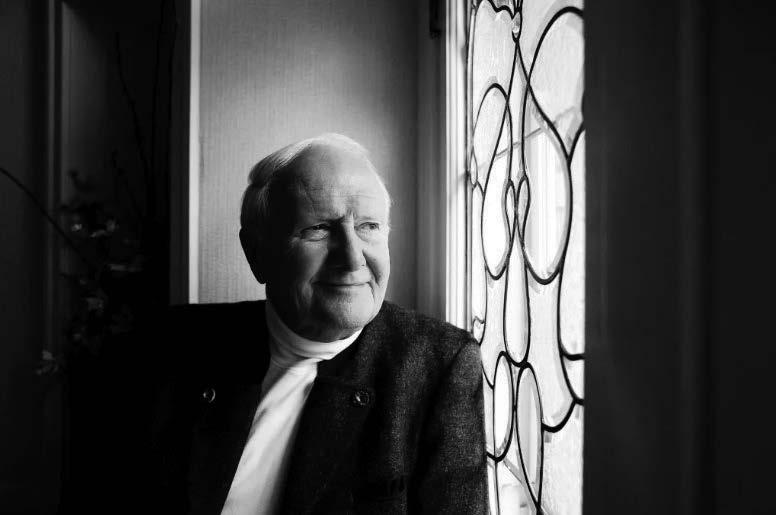
The chaos and cruelty foisted upon we the everyday people, will come to end eventually. It has to The cracks in this radical agenda’s foundation are already showing. It will either implode from within or be demolished from without.
Perhaps soon enough to once again go to Frank’s and have Nik cut hair again.
Joe Harrington Oak Park
On June 24, River Forest released an application to develop 10 parcels on Madison Street, including the demolished historic landmark, Lutheran Child & Family Services, and two lots zoned Single Family (SF) residential. The Development Review Board (DRB) scheduled a hearing 15 days later, for July 9, the statutory minimum notification, although immediate neighbors received their mandatory certified letters later
To review the application, residents must spend this July 4th holiday week, and our country’s 250th birthday, evaluating the project’s changes and new information. The village received the application on/about May 20, but held it, probably to squeeze time for review and while many are away, despite a request by a commissioner to postpone until August (Economic Development Commission (EDC) 6/3/26 audio). Omitted is a Redevelopment Agreement with the sale price for the village-owned parcels; prospective rents
The number of allowances needed show a building too large and too dense for its site, at 5 full stories plus a full rooftop deck, 87 feet high, 72 units with individual balconies, 79 rental parking spaces, plus 8 spaces for retail. Brick garages boost developer rents, but leave a solid brick wall abutting two single-family residences. The EDC didn’t expect 5 full stories (EDC 2/4/26 audio). President Adduci committed to commercial development, which is taxed at 25%, residential 10% (Village Newsletter, December 2017). The EDC said this commercial space is a
“loss leader,” an “afterthought” (EDC 2/4/26 audio). Property tax forecasts should be re-evaluated after Sunrise Senior Living’s successful tax appeals What vetting was done on the applicant, 531 Partners (531), and its individual partners? That was a significant weakness of the Lake & Lathrop project. The builder owned Cigar Oasis, which was evicted, and SportsZone, which was foreclosed. He bid on Lake & Lathrop parcels with the Receiver The partner to manage the building, Starck Chicago, has numerous complaints on his properties. 531 has done two projects together. All of this wasn’t shared with trustees when they selected 531 in November.
A Senior VP of First Chicago Bank, in a letter dated 3/26/26, states his long relationship with the builder. Adduci appointed another First Chicago Senior VP, Scott Elza, to the EDC in June 2025, who sat in two closed sessions to evaluate developers’ proposals. He resigned between Feb. 5 and May 6. (Application, First Chicago letter; EDC minutes 9/3/25, 10/29/25, 2/4/26)
Homeowners bought their historic homes in a quiet residential neighborhood, adjacent to a onestory office space, buffered by single-family homes The size, density, proximity and traffic will reduce the value and enjoyment of their properties. How would you feel if this development abutted your house?
Margie Cekander River Forest
Dean Lueking, 98, a longtime and River Forest and for mer Grace Lutheran Church in River Forest, une 25, 2026 at Sunrise of River Forest after a . Born in Kansas City, Missouri, on June Fred and Tyra Lueking, he grew up there through his high school years. He began his aration for the Lutheran ministry at St. John’s in Kansas and continued it at Concordia SemiMissouri. Prior to his seminary graduation, he spent a two year internship in Yokohama, Japan, which influenced him lifelong On Aug. 15, 1954 he was ordained into the pastoral ministry at Grace Lutheran, where he served for 44 years, first as an assistant pastor and after 1963 as senior pastor until his retirement in 1998. He remained an active member and pastor emeritus until his death. When he came to Grace he was single. That changed in 1957 on a blind date when he met a physical education teacher, Beverly Ann Frano. Less than a month later he proposed. Her surprised response: “Do you know what you’re talking about?” All he could answer was “Please trust me.”
She did and their 68 years of marriage began with their wedding on Aug. 16, 1958 in Wisconsin. Of his many roles of service in the community, Dean was most proud of his board chair work for Thrive Counseling Center at a critical time in its history. He was close to and met often with clergy in churches and synagogues throughout Oak Park and River Forest. Active with Lutheran Child and Family Services, the Luekings fostered more than 30 children over the years. Dean and Beverly were also longtime members of the River Forest Tennis Club and Oak Park Country Club.
Dean is survived by Beverly and their four children, Ann Elizabeth Anderson (Douglas), Christopher Dean (Cameron), Sarah Filipa McCabe (Mark), Joel Frederick (Tiffany), and a foster son, Timothy Lovell (Betty), as well as their 11 grandchildren, Joseph (Morgan), Elisabeth Race (Nate), David (Elizabeth), Kjerstin Uribe (Juan), Grace, Catie, Vivian, Christian, Benjamin, Chloe, Sienna, and their three great-grandchildren, Avery, Lilah, and Tess. All his family reside in the greater Chicago area. He is also survived by many nieces and nephews and friends worldwide.
From the beginning of his pastoral ministry at Grace, Pastor Lueking continued a program of part-time graduate study encouraged by the congregation. He completed his PhD at the Divinity School of the University of Chicago in 1960 which became essential in later years when he taught in seminaries and universities in Europe and elsewhere. He was named alumnus of the year in 1979 and remained actively associated with U of C and Lutheran School of Theology in Hyde Park. He encouraged fellow pastors to write about their pastoral ministries and authored 14 books of his own on parish practice. In 1965 he helped co-found the Academy of Parish Ministry, a national organization providing Protestant and Roman Catholic clergy with an accredited program for professional growth through sharing parish practice, and he published sermons for decades. He used his two sabbaticals during his years at Grace to travel extensively in Europe, Asia, Africa, the Far East and Southeast Asia, interviewing several hundred clergy and laity for their personal stories of living the Christian faith in their cultural context. Beverly’s active participation during those interviews was especially important when speaking with women.
Following his retirement from Grace in 1998 he and Beverly moved to
Bratislava, Slovakia, where he taught in the theological faculty of Comenius University. Thereafter the two traveled to New Zealand, Australia and Papua New Guinea for continued interviews with laity and clergy. Dean’s resultant book, Through Their Eyes, was published in 2010. He was also active in retirement with Opportunity Inter national and World Vision.
In the early 1970s, their house on Detroit Island in Door County, Wisconsin, became a welcome getaway for family and friends. He and seminary roommate and lifelong friend, Martin Marty, conducted a decade of summer retreats on nearby Washington Island attended by numerous Oak Park and River Forest residents
Among several dozen awards received during his long pastorate, he especially valued the shofar plaque given him by the River Forest West Suburban Synagogue, the honorary doctorate conferred by the Lutheran School of Theology in Chicago, the Golden Rose of Charity by Dominican University, the Distinguished Eagle Scout Award, and a personal letter of encouragement from a young Barack Obama when he was running for the Illinois senate in 2004.
Pastor Lueking’s memorial service will be held at Grace Lutheran Church, 7300 W. Division, River Forest, at 11 a.m. on July 18, with visitation prior at 10 a.m. His burial will be at the Grace Church columbarium.
John G. Frick, 66, of Oak Park, died on April 2, 2026. Born in St. Charles on Feb. 22, 1960, he worked as a phar macist for over forty years, beginning his career after graduating from pharmacy school at the University of Illinois. He was dedicated to his work and the people he served. A lifelong Cubs and Bears fan, who was rarely without his portable radio — known to the family as “Pat & Ron” — he would listen to the radio even while watching the game. His devotion never wavered.
He shared his love of the YMCA of the Rockies in Estes Park, Colorado, with his wife and sons, where they vacationed every summer growing up. The entire family also traveled to Iowa every summer to help run his wife’s bicycle business
He loved to cook and barbeque on his Big Green Egg. He also loved to paint and
bike, hobbies he shared with Phyllis. They ran many marathons together and traveled cross country by bicycle. They frequently brought the dogs to a cabin at Shale Lake in Staunton, Illinois to paint.
He loved his dogs, starting with Molly, followed by Sadie, then Ralphy, and Kramer and Frankie. He would sit for hours with Frankie on his lap. To help support Phyllis’ growing art business, Johnny would take the dogs for hours-long walks to keep them out of the way while Phyllis conducted art classes for children in their home
He also played golf and guitar. In the evenings, they would all go into the living room, where Johnny would play guitar and sing to Phyllis, Frankie, and Kramer.
Johnny is survived by his wife, Phyllis Frick; his sons, Wesley Leggette and Myles Leggette; Wesley’s husband, Conrad Zhuang, and their son, Callum; Myles’ wife, Kati Danforth, and their children, Elliott and Genevieve; his brother, Robert G. Frick; and his nephews, Andrew G. Frick and Thomas G. Frick.
He was preceded in death by his mother, Marion; his father, Richard; his stepmother, Susie; and his sister-in-law, Susan. Visitation was held at Yurs Funeral Home, St. Charles. He is buried at Nor th Cemetery, St. Charles.
Ada Four nier died on June 22, 2026, surrounded by family, after 87 wonderful years of life.
A native Oak Parker, she graduated from Irving Elementary and Oak Park and River Forest High School, then attended the University of Illinois Urbana-Champaign, graduating summa cum laude with a degree in Physical Education.
In 1961, she married John “Jack” Fournier, a fellow Oak Parker and the love of her life. Over 65 wonderful years of marriage, their deep friendship, mutual respect, and enduring devotion for med the heart of a life filled with joy, humor, and purpose. They met while in college, working as Park District playground leaders in the late 1950s. Beneath a tree at Lewis Carroll Playground, where their story began, stands a plaque — a gift from their grandchildren — honoring their enduring love. Ada and Jack’s partnership is a beautiful reminder that true soulmates do exist.
Aside from family, athletics were a defining part of her life. Known for her contagious love of competition, she participated in tennis, field hockey, and Frank Lloyd Wright runs, in her early teens, she became an Illinois State Table Tennis Champion, which started her lifelong passion for the sport. For nearly 30 years, she shared her enthusiasm and encouragement with the broader community by teaching exercise classes for the Park District of Oak Park Ada’s pinnacle accomplishment was her beautiful family with her husband, Jack. Her le gacy includes her children, Jeannine (deceased), Joseph, Pe gg y, Johnny (Mary), and Douglas; her grandchildren, Claire (Colin), Ted, Frank (Amanda), Audrey, Charlie, Sophie, Lucy, George (Tiara), Katie, and Sebastian; and her great-grandchildren, Ar thur, Freddy, and Abigail. In lieu of flowers, the family requests donations to Community Support Services, in memory of Ada Fournier, https:// www.cssservices.org/donate.
Everyday, Tim Carwinski (nee Carraher), lost himself among the cypresses, cedars, and sequoias in the Jardin des Prébendes d’Oé. Advocacy for the underdog would define Tim’s life, but first he needed to find peace in the winding 19th-century English-style oasis in the center of Tours, France.
His senior year at Boston College bruised him. As director of an LGBTQ+ support group, he was a staunch advocate for his community, but also a target for students and administrators who opposed it. The animus played out in competing student newspapers and with slurs and vandalism.
Before that, he was a beloved friend and student at St. Giles and Fenwick schools, in Oak Park, where he began collecting lifelong friends. At Fenwick, he was a treasured member of the Blackfriars Guild, fostering his love of musical theater.
After graduating from BC, he taught English in the city on the Loire River in France. He found community among the students and teachers, and a love of good wine and food. Then there was the jardin, a refuge for self-reflection, where he built trust in his own tastes and instincts
He took that confidence to Northwester n Pritzker School of Law, then to the Sor-
bonne, in Paris, where he earned a master’s degree in global business law. His apartment in the Marais District was a test kitchen for culinary ambitions; a gathering place for friends to eat his first attempts at boeuf bourguignon and pot-au-feu, and to drink wine into the wee hours. Among the visitors was his future husband, Patryk Piwinski, whom he met the year before at Sidetracks on Halsted.
Back in Chicago, Tim volunteered with the civil rights organization Lambda Legal. He worked on a seminal Ohio case that established the right of LGBTQ+ parents to seek legal custody of their children. He also worked to defend the right of the state of Wisconsin to provide LGBTQ+ couples with domestic partnership protections. And he worked with the team that helped legalize same-sex marriage in Illinois. He anticipated this victory by proposing to Patryk a year earlier
Tim took a job at the law firm Reed Smith, specializing in commercial litigation, while working pro bono to represent asylum seekers, for which he was lauded by the National Immigrant Justice Center, and the American Civil Liberties Union of Southern California.
Throughout his career he supported Lambda with nearly 2,000 hours of pro-bono work Part of that advocacy contributed to the legal building blocks that were put in place across the country to argue Obergefell v. Hodges, the landmark Supreme Court case that legalized marriage equality in all 50 states
This paved the way for his marriage to Patryk in 2015, when they each adopted the portmanteau Carwinski as sur names
Much like the apartment in the Marais, the Carwinski home was the center of a galaxy of friends, family, and chosen family — including their two cats Lillet Blanc and Cointreau Jr. Countless karaoke parties, backyard movie nights, and elaborate dinners, soundtracked by Tim’s earnest tur ns at the piano, were interrupted only by his pursuit of live theater, international travel, Cubs games, and trips to the National Figure Skating Championships, where the shimmering sequined outfits he sported with his sister Sam became a reliable feature on national television.
The communities Tim nurtured circled him when he was diagnosed with stage four colon cancer at the age of 42. At home and during farewell trips to France, Spain, Poland, New York, and Germany the connections he threaded throughout his life grew stronger. They are the legacy he leaves.
A portion of Tim’s ashes will be spread in the Jardin des Prébendes d’Oé in Tours.
By MELVIN TATE
Contributing Reporter
Since graduating from Fenwick in 2021, Bryce Hopkins has had several challenges to deal with. He played colle ball at three different schools and also suffered jury that cost him a season.
Many in Hopkins’ situation would have given up. But he has lived up to a verse in Fenwick’s school fight song, “a fear less strength that reveals our loyal men never yield.” His dedication and determination have reaped dividends as Hopkins was selected by the Denver Nuggets with the 49th pick in the second round of the National Basketball Association draft June 24.
For mer Fenwick boys basketball head coach Staunton coached Hopkins in his final three seasons with the and isn’t surprised
“I’m super-happy for him,” he told Wednesday an interview. “He put in the work. Most basketball pl when they’re younger, their goal is to play in the NBA. texted with Bryce afterward; this was a goal he had and he was quite emotional, he was overwhelmed. He earned it.”
Hopkins, a 6-6, 218-pound forward, was a four-year sity player at Fenwick. In his senior season, he 24.4 points and 12.5 rebounds per game and was Tony Lawless Player of the Year for the second time as the Friars went 13-3 and won a share of the Chicago League Blue title.
Upon graduation, Hopkins, a consensus four-star, recruit in the Class of 2021, played his freshman colle season at the University of Kentucky. He appeared in 28 g ames for the Wildcats and averaged 2.1 points and 1.4 bounds per g ame.

He transfer red after the season to Providence Colle ge, where he spent the next three seasons. In the 2022-23 season, he made the All-Big East Conference First Team and averaged 15.8 points and 8.5 rebounds per g ame as he helped lead the Friars to 21 victories and a spot in the NCAA Tournament.
The following year, he started strongly in the first 14 contests with averages of 15.5 points and 8.6 rebounds. But he suf fered a torn ACL in January 2024 and missed the remainder of the season. The injury limited Hopkins in 2024-25 when he appeared in only three g ames, and he decided to enter the transfer portal for the second time upon conclusion of the season.
“He’s always had, to use a basketball term, a next-play mentality,” Peck said. “When things go wrong or don’t go his way, he doesn’t dwell on it, he asks what he can do to
Fenw ick alum Bryce Hopkins (shooting) was recently dra ed by the Denver Nug gets
get better. That’s helped him get to where he is.”
Hopkins played his final collegiate season with one of Providence’s Big East rivals, St. John. He averaged 13.6 points and 6.2 rebounds while playing in all 37 contests and making the All-Big East Second Team as the Red Stor m won the Big East tournament title and reached the NCAA tour nament.
Following the season, Hopkins participated in the 2026 NBA G League Combine held at Wintrust Arena in Chicago, May 8-10. His strong performance there earned him an invite to the main draft combine the following week
Peck knows that there’s still more work to be done. However, he’s also confident Hopkins is ready for the challenges that playing in the NBA present.
“He hasn’t reached his ceiling yet,” Peck said. “In col-
le ge, he had to work on his perimeter defense, and it’s a lot better than it was. Anything Bryce has to work on, he works on. He got challenged at the combine and rose to the occasion. He worked hard and prepared to succeed, and I think the same thing can happen on the NBA level.”
Moreover, Peck feels Hopkins will succeed going forward, not just because of his hard work, but also because of his support system, primarily his family
“He’s got two really great parents (Clyde and Karen) and two great sisters (Brianna and Jasmine),” Peck said. “They’ve provided perspective all along. Basketball is a huge part of Bryce’s life, but equally as important, he’s a good person. When you prepare someone to be a good person, things usually go well. He’s got a really good base, and that infrastructure will help him succeed in the NBA.”
Request of Shirley Smith to change name of a minor child
There will be a court date on my Request to change the name of the minor child from:
The court date will be held: On July 14, 2026 at 11:00 a.m. at Maywood Courthouse, 1500 Maybrook Drive, Maywood, Cook County, IL in Courtroom # 111.
Published in RBLandmark June 17, 24, July 1, 2026



LEGAL NOTICE
The Village of Oak Park will receive sealed bids from qualified contractors at the Public Works Center, 201 South Boulevard, Oak Park, Illinois 60302 Monday through Friday, 8:30 a.m. to 4:00 p.m. local time until 2:00 p.m. on Wednesday, July 15, 2026 for the following:
Village of Oak Park Water Distribution System Leak Survey Bid Number: 26-117
Bid documents may be obtained from the Village’s website at http://www.oakpark.us/bid. For questions, please call Public Works at (708) 358-5700 during the above hours.
Published in Wednesday Journal July 1, 2026







PUBLIC NOTICE
Notice is hereby given, pursuant to “An Act in relation to the use of an Assumed Business Name in the conduct or transaction of Business in the State,” as amended, that a certification was registered by the undersigned with the County Clerk of Cook County. Registration Number: M26001773 on June 24, 2026 Under the Assumed Business Name of GREEK CONNECTIONS with the business located at: 1122 NORTH HAYES AVENUE, OAK PARK, IL 60302. The true and real full name(s) and residence address of the owner(s)/partner(s) is: BEVERLY SINGLETON 1122 NORTH HAYES AVENUE, OAK PARK, IL 60302, USA
Published in Wednesday Journal July 1, 8, 15, 2026


Local journalism matters. That’s why we made a bold decision to protect its future.
Wednesday Journal, Austin Weekly News, Forest Park Review, and Landmark are now part of NEWSWELL, a nonpro t journalism organization that provides resources, technology, and long-term support to community newsrooms across the country.
This partnership strengthens our foundation while keeping everything that matters the same. Our newsroom remains local. Our staff remains in place. Our commitment to this community is unchanged. With the added support of NEWSWELL, we are better positioned than ever to continue delivering the independent, communityfocused journalism our readers rely on. Same mission. New chapter. Stronger future. All donations support local operations.









Submit events and see full calendar at oakpark.com/events















With Cantata’s continuum of care, you can live your best life today, tomorrow and into the future. We’ve been here, right across from the zoo, for more than a century passionately serving the needs of local seniors.